







![1918 Spring Offensive Wargame | Full Rules Overview with John & Gerry (WW1 Tabletop Game) [7 Days Early Access]](https://images.beastsofwar.com/2026/03/unboxing-warfulcrum-games-1918-spring-offensive-review-coverimage1-225-127.jpeg)


Wargaming The Battle Of The Bulge Part Three
December 29, 2014 by crew


The campaign continues! Once more I team up with Beast of War community members Gladesrunner and Amphibiousmonster, continuing our commemorative wargame and article series for the Battle of the Bulge’s 70th anniversary. If you need to catch up on what’s happened so far, the series begins HERE, but for now let’s climb back in the turret and see what happens next.
ENGAGEMENT SIX: THE LAST STAND OF KAMPFGRUPPE PEIPER - DEC 23, 1944
Originally earmarked to be the spearhead of the whole Ardennes Offensive, the 4,800 men of Kampfgruppe Peiper (SS Obersturmbannführer Joachim Peiper, commanding) had reached the end of their rope. Constantly delayed by stubborn American resistance and blown bridges, Peiper now hit the one obstacle even his elite battle group couldn’t overcome...lack of fuel. Frankly he’d never had enough for his 117 tanks and hundreds of other vehicles, from the outset his whole battle plan had relied upon capturing stockpiles of American fuel along the way. Now, with only a fraction of his force still running, Peiper was forced to give up his toehold in Stoumont (see Engagement 03 in Part Two of our series) and fall back to the next Belgian village of La Gleize.
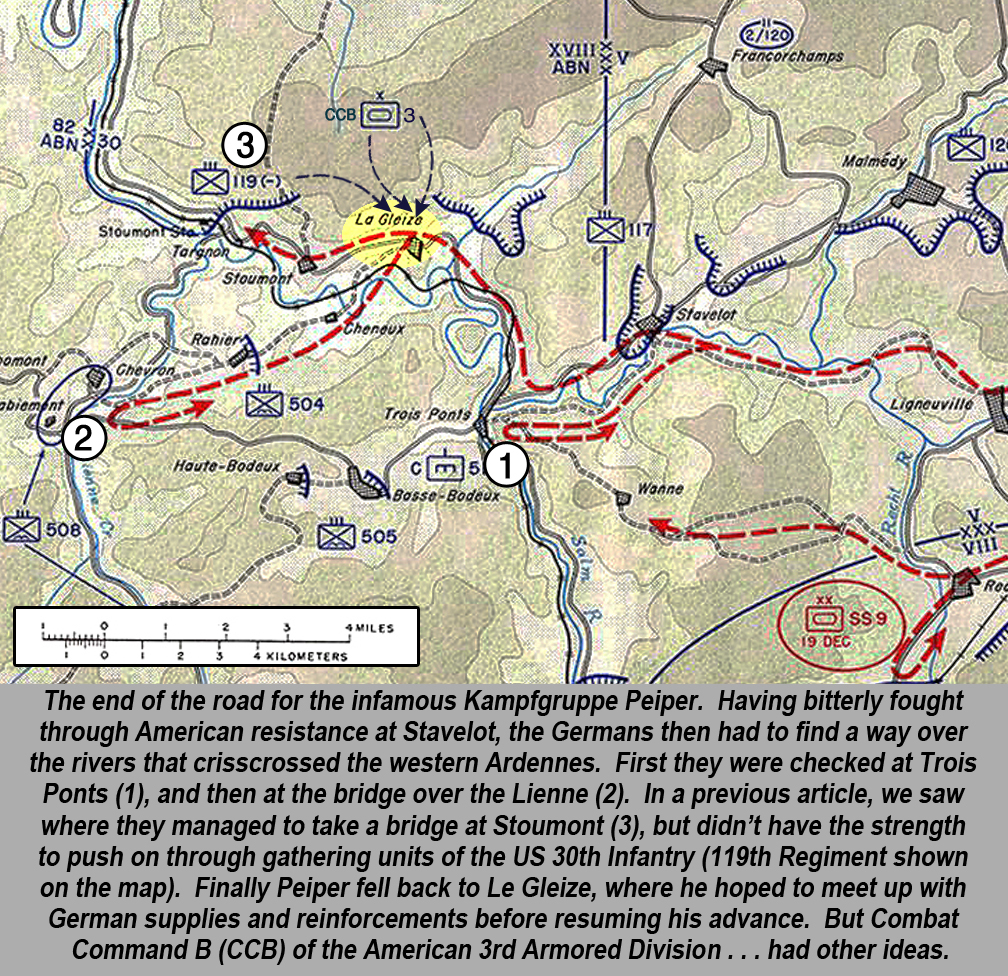
The American First Army (General Courtney Hodges), however, was already pushing back against the faltering German advance. This included the powerful US 3rd Armoured Division, which came down from the north to join the 30th Infantry Division (“Old Hickory”), already stalling this sector of the German drive. With the 30th Infantry holding the Germans in place, two task forces of the 3rd Armoured moved against Kampfgruppe Peiper in La Gleize, while a third task force pushed farther to the east to block any German reinforcements or relief. Now cut off, the Germans in La Gleize were subjected to artillery barrages, long-range tank fire, and limited local attacks, but the Americans dreaded launching a full-scale storming of La Gleize. Peiper’s men, meanwhile, just held on and hoped help would somehow reach them.
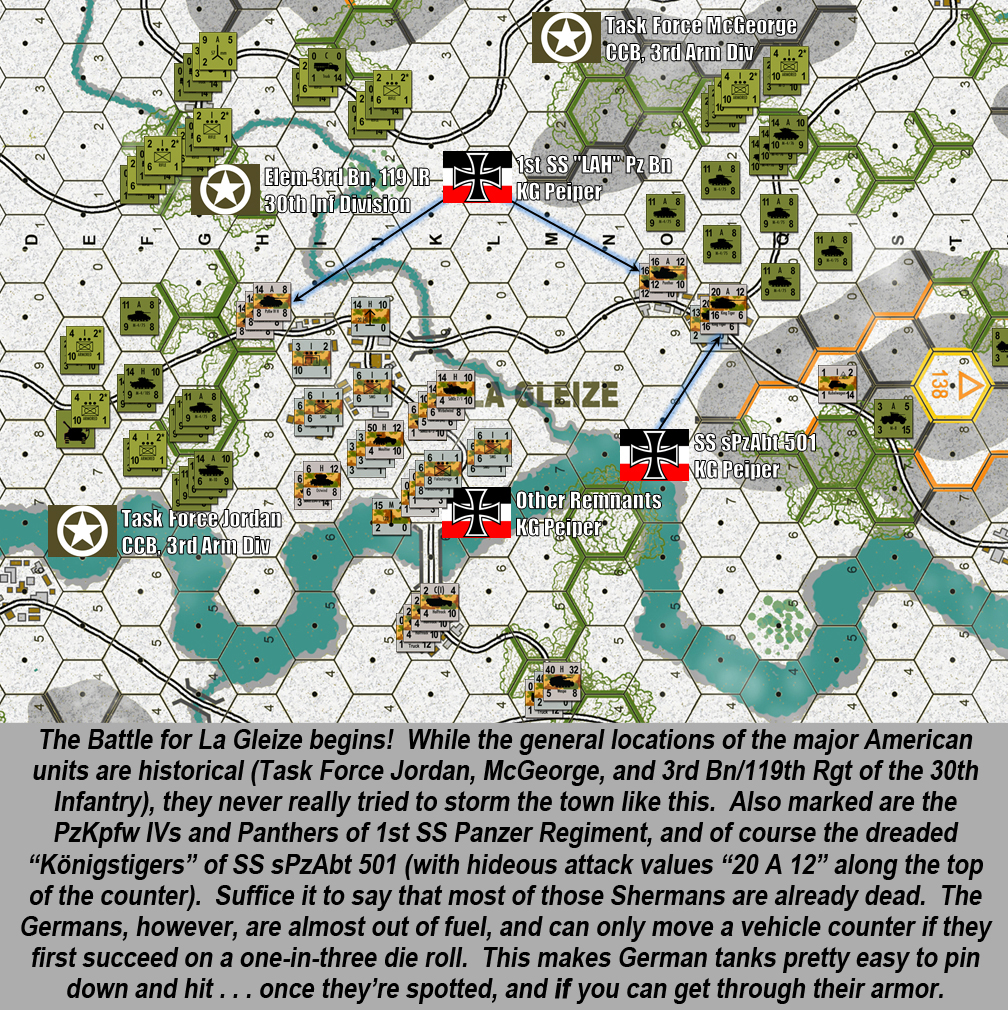
While our game was a bloodbath (see the caption for the image below), historically the outcome at La Gleize was very different. Although Peiper took heavy losses to American artillery and tank fire, he eventually made up his mind to pull out on his own when he realized help would never reach him. With his tanks all out of fuel, he blew up as many as he could and his survivors made their way back to German lines on foot. To this day, one of Peiper’s Königtigers (Number 213, Obersturmführer Dollinger) remains right where he left it, beside the La Gleize Museum.
In any event, it was the end of the road for Kampfgruppe Peiper. He’d driven into the Ardennes with about 4,800 men, he walked out with less than 800. But Peiper’s battle group would be back, in Operation Frühlingserwachen (Spring Awakening) offensive against the Soviets in Hungary (March, 1945). Yes, there were powerful German offensives after the Bulge, despite its usual description as “Germany’s last gamble.”

ENGAGEMENT SEVEN: THE FINAL DRIVE TO THE MEUSE - DEC 24, 1944
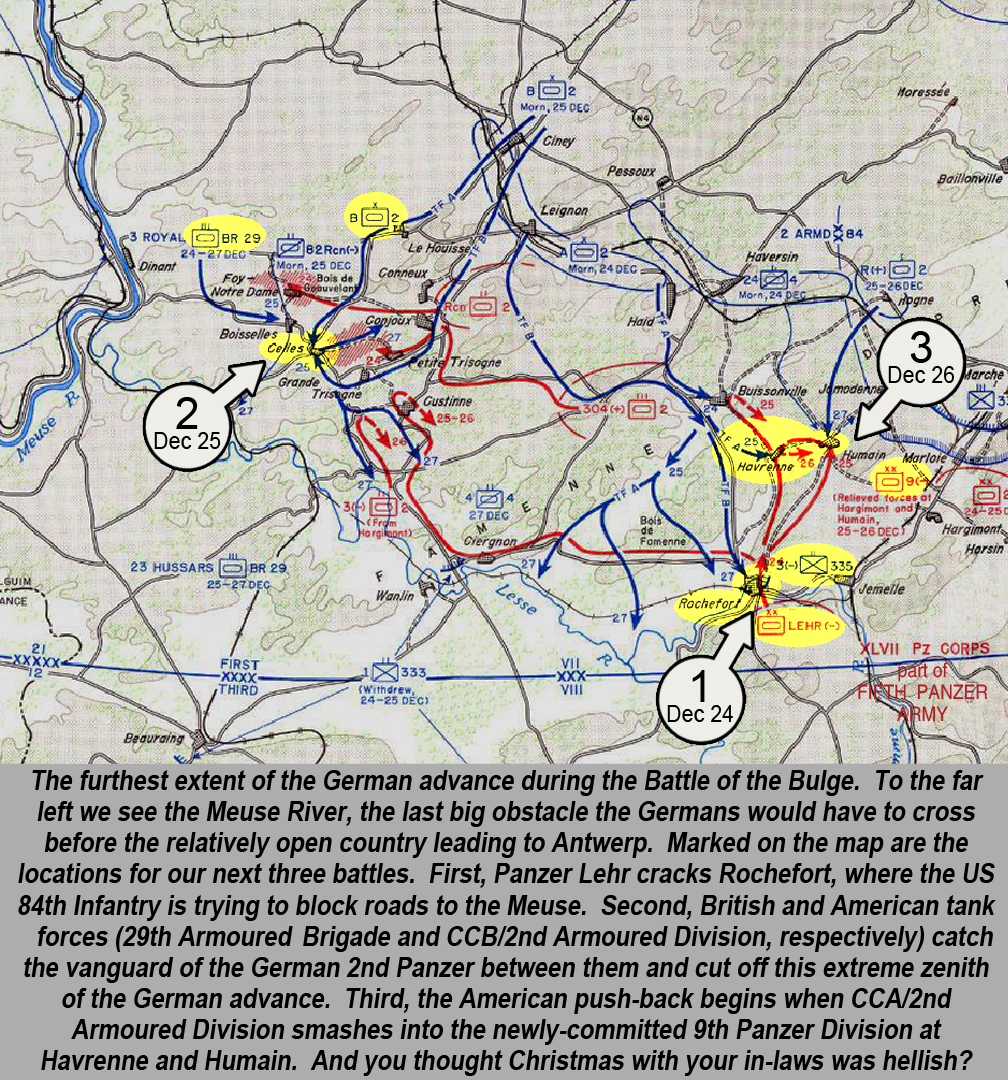
Although Kampfgruppe Peiper marked the furthest westward advance by the 6th Panzer Army, already the 5th Panzer Army to the south was doing much better. Even though they could never take Bastogne, their lead corps (the XLVII Panzer) surrounded the town, bypassed it, and pushed far beyond it. Their immediate aim was a bridge over the Meuse River, the biggest obstacle between them and Antwerp, their ultimate objective. This last German drive toward the Meuse, and the Allied moves to check this advance, would see some of the most dramatic actions of the Ardennes campaign. For our seventh Bulge game, we see leading elements of the Panzer Lehr Division, having swept south of Bastogne, now driving toward the Meuse via the crossroads town of Rochefort. Here they run into a delaying action by units of the US 84th Infantry Division (“The Railsplitters”).
Interestingly, this was a night battle, where Panzer Lehr’s “Kampfgruppe von Fallois” and elements of the 902nd Kampfgruppe led the assault on Rochefort in the wee hours of the morning. Ranges were reduced to 12 inches, regardless of a weapon’s actual reach. The one exception to this was if the Americans (335th Infantry Regiment of the 84th Infantry, played by Gladesrunner) used one of her 81mm mortar sections to fire illumination rounds over the Germans. Gladesrunner did this to great effect, firing these flares over designated German units that could then be engaged at any range. Her 76mm antitank guns thus wrought deadly work on my JgPz IV/70s, “Luchs” reconnaissance tanks, and Mark IVs of the Panzer Lehr’s 130th Panzer Regiment.
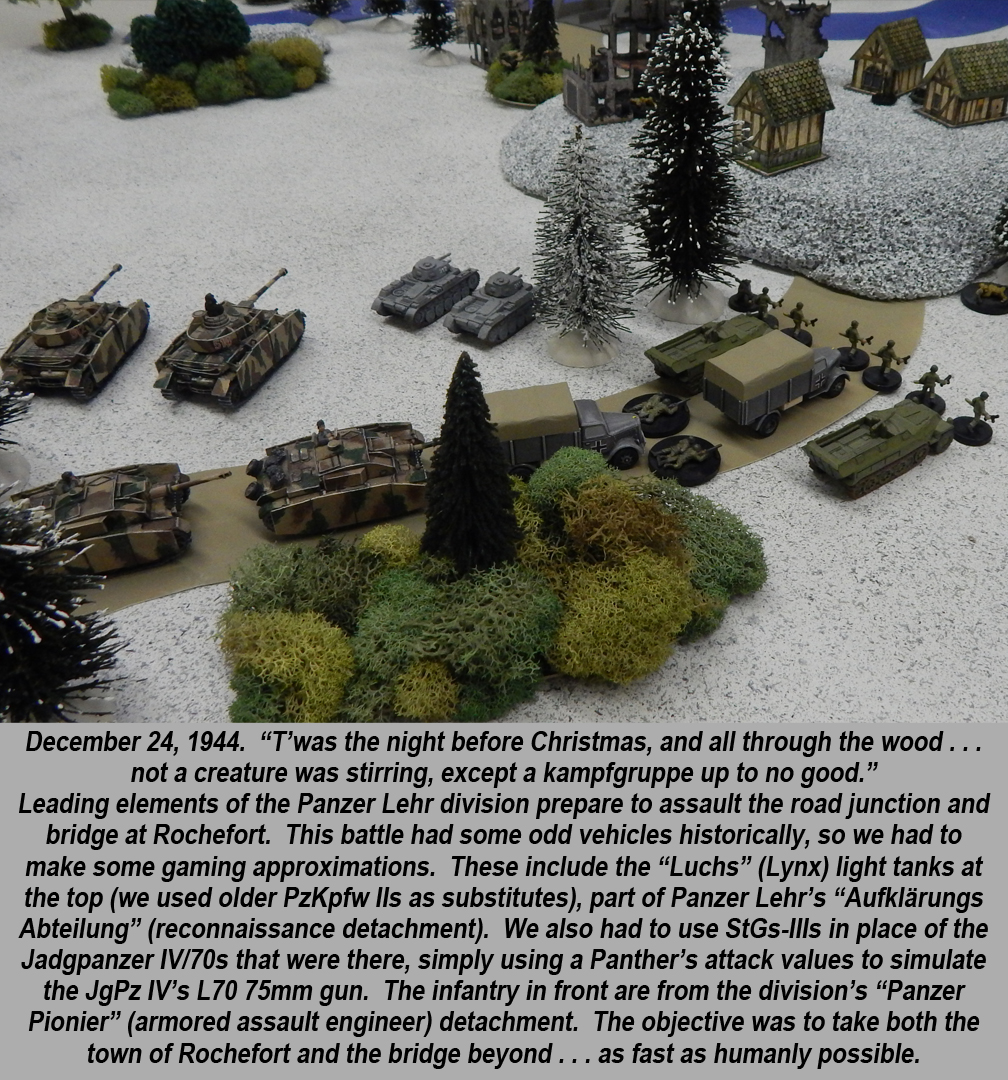
Nevertheless, this was a delaying action. The 84th Division couldn’t hold Rochefort historically, although they significantly slowed the Germans advance. In our game, we decided that if the Germans got their first combat unit through the town and across the bridge on Turn 7, the game was a minor American victory (Turn 8 or later would be a major victory). But I got one of my halftracks across on Turn 5, resulting in a major German victory—at least until Gladesrunner blew it up. I had to cross the bridge again on Turn 6 with a JgPz IV and a Lynx light tank, resulting in only a minor, and hard-fought, German victory.

ENGAGEMENT EIGHT: HIGH WATER MARK AT CELLES - DEC 25, 1944
In some of his discussions about the upcoming “Tank Week” on Beasts of War, Warren has mentioned ideas for a Bolt Action battle featuring British and American tanks converging on a “wedge” of German armour in the middle. Upon realizing the sheer scope of the Battle of the Bulge, he half-lamented that British and American forces would probably never converge on a scale small enough to work for such a game. Fear not, Warren! Although this would be true 99 out of 100 times, there’s always an exception that proves the rule. Here at Celles, we see forward elements of the 2nd Panzer Division, strung-out and low on fuel, trying to cling to the furthest westward positions achieved by the Germans during the Ardennes offensive...only to be hit by Combat Command B of the 2nd Armoured Division (“Hell on Wheels”) and the vanguard of the British 29th Armoured Brigade.
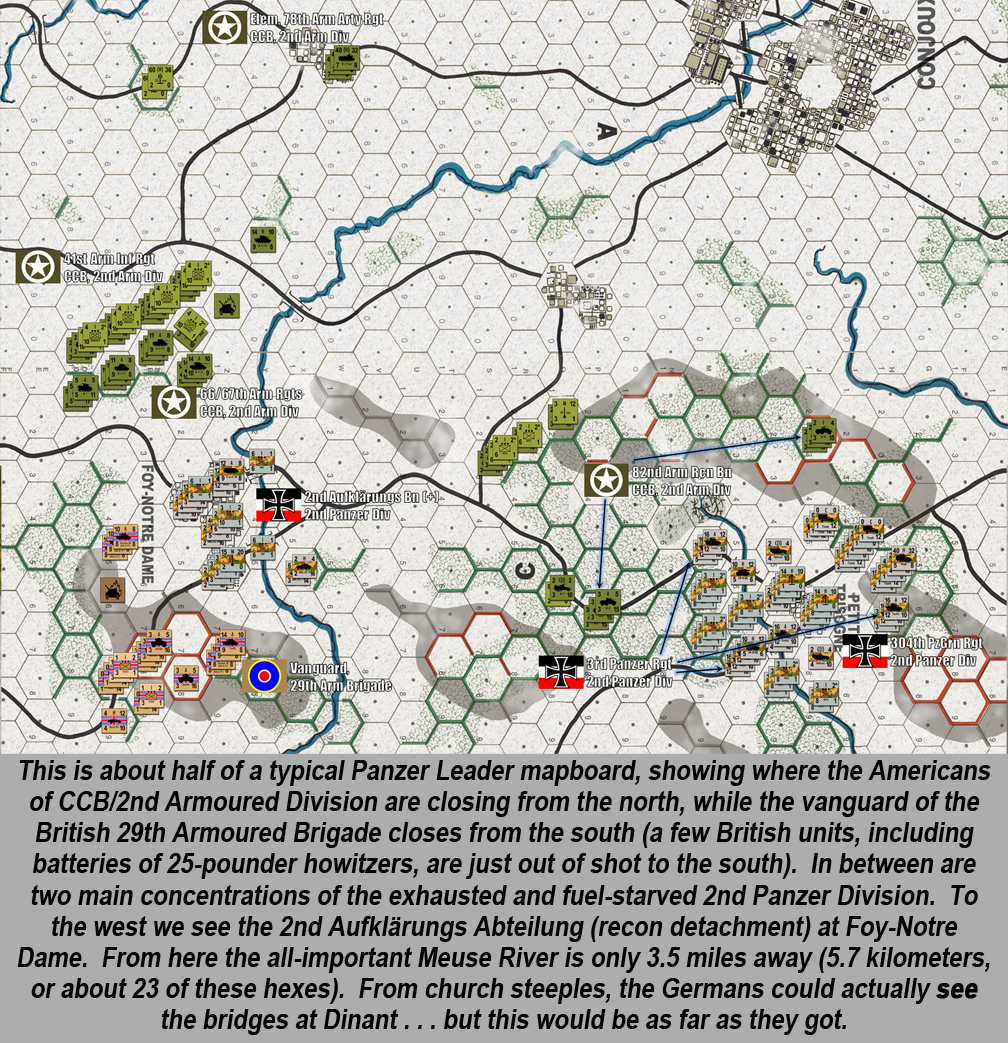
Again I took command of the Germans, while Amphibiousmonster took charge of the combined British and American counterattack. I’ll admit I had the upper hand at first, taking advantage of a road left open to send a whole battalion of Panthers into the British flank and almost annihilate the entire 29th in a horrific holocaust. But British and American artillery, infantry, and sheer numbers of Shermans eventually turned the tide. In particular, Amphibiousmonster made some textbook Panzer Leader assaults into Foy-Notre Dame with artillery (called in the turn before), followed by long-ranged tank fire, followed finally by infantry close assault.
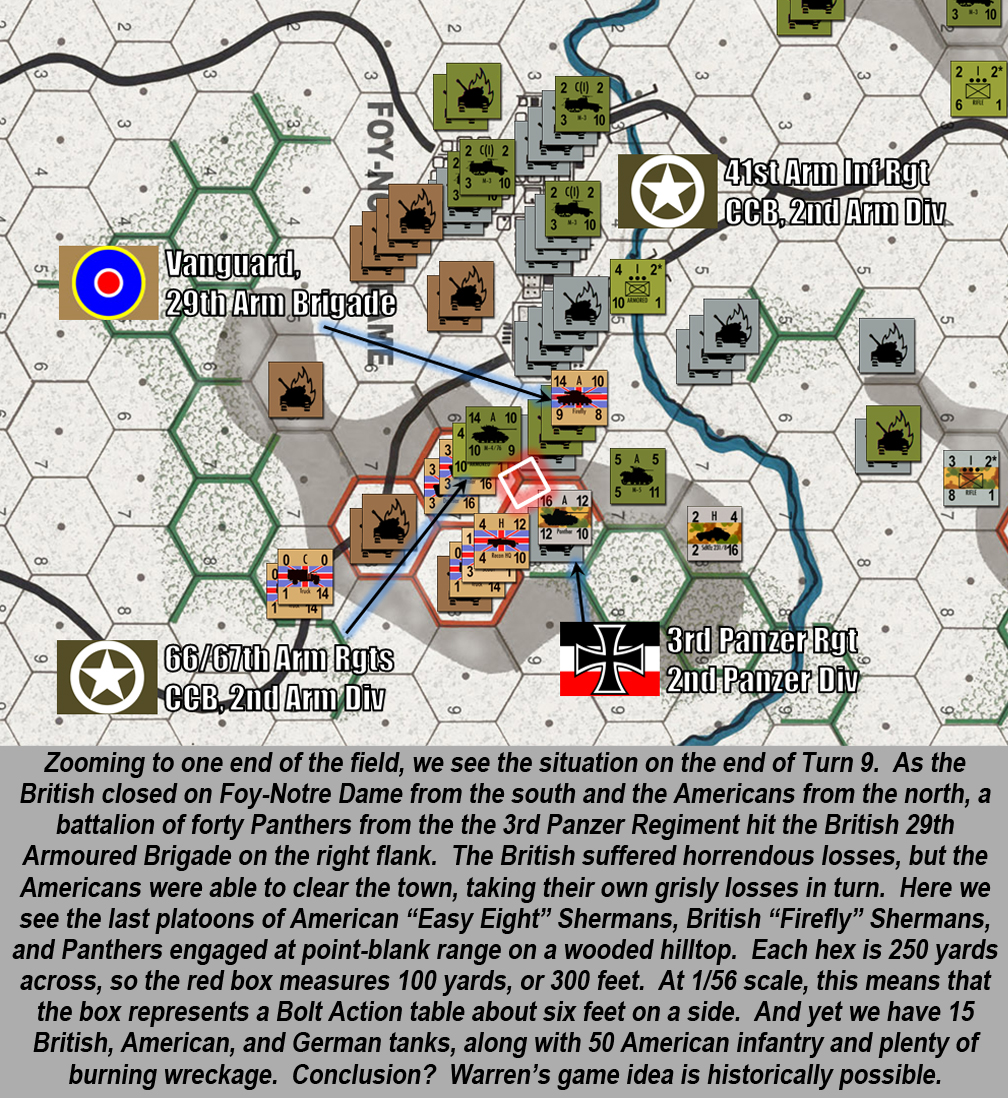
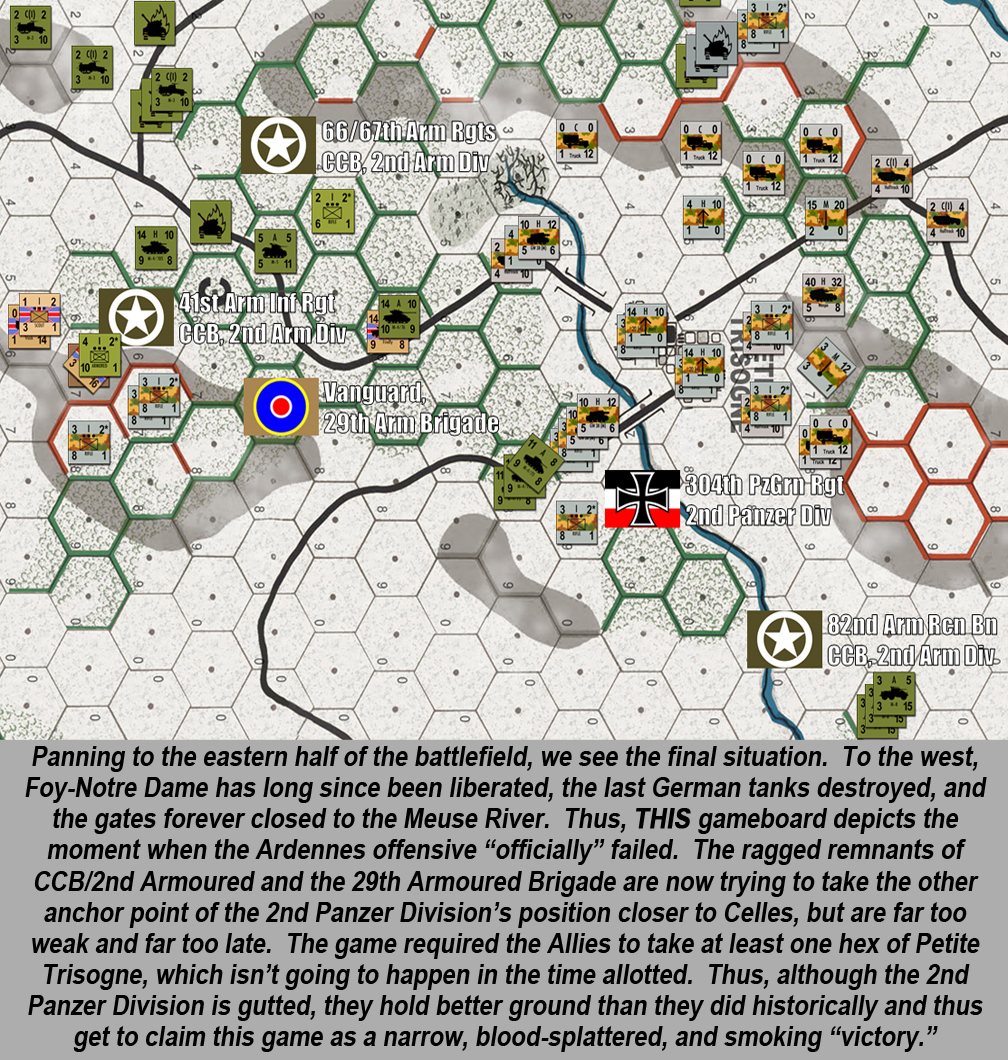
Soon enough I lost the 2nd Panzer’s forward positions at Foy-Notre Dame, leaving the rest of the division to prepare for the worst in their positions further east. But the Allies had lost too much equipment and worse...too much time...regaining control of the situation in the west. My eastern positions remained secure, handing the Germans a narrow and gore-soaked victory. Historically, the Germans didn’t fare quite as well. Their positions around Celles were either destroyed or surrounded, resulting in a pocket that was ground into submission over the next several days. Gone forever was any chance of the Germans reaching the Meuse River, and thus Antwerp. At that moment, the Ardennes offensive had finally and unmistakably failed.
ENGAGEMENT NINE: THE PUSHBACK BEGINS “HELL ON WHEELS” - DEC 26, 1944
Our ninth Battle of the Bulge game again features the 2nd Armoured “Hell on Wheels” Division, but this time in 15mm Axis and Allies miniatures. Also, these are different units of the 2nd Armoured, part of Combat Command A (CCA), attacking the northern shoulder of the German “bulge.” This was part of a much larger operation involving several divisions (perhaps up to 100,000 men deployed over dozens of miles) with the ultimate aim of pushing down into the German bulge, there to link up with a similar operation mounted by General Patton’s Third Army pushing up from the south. If successful, the forward half of the German bulge would be “bitten off,” and all their most powerful mechanized and armoured formations cut off and forced to surrender.
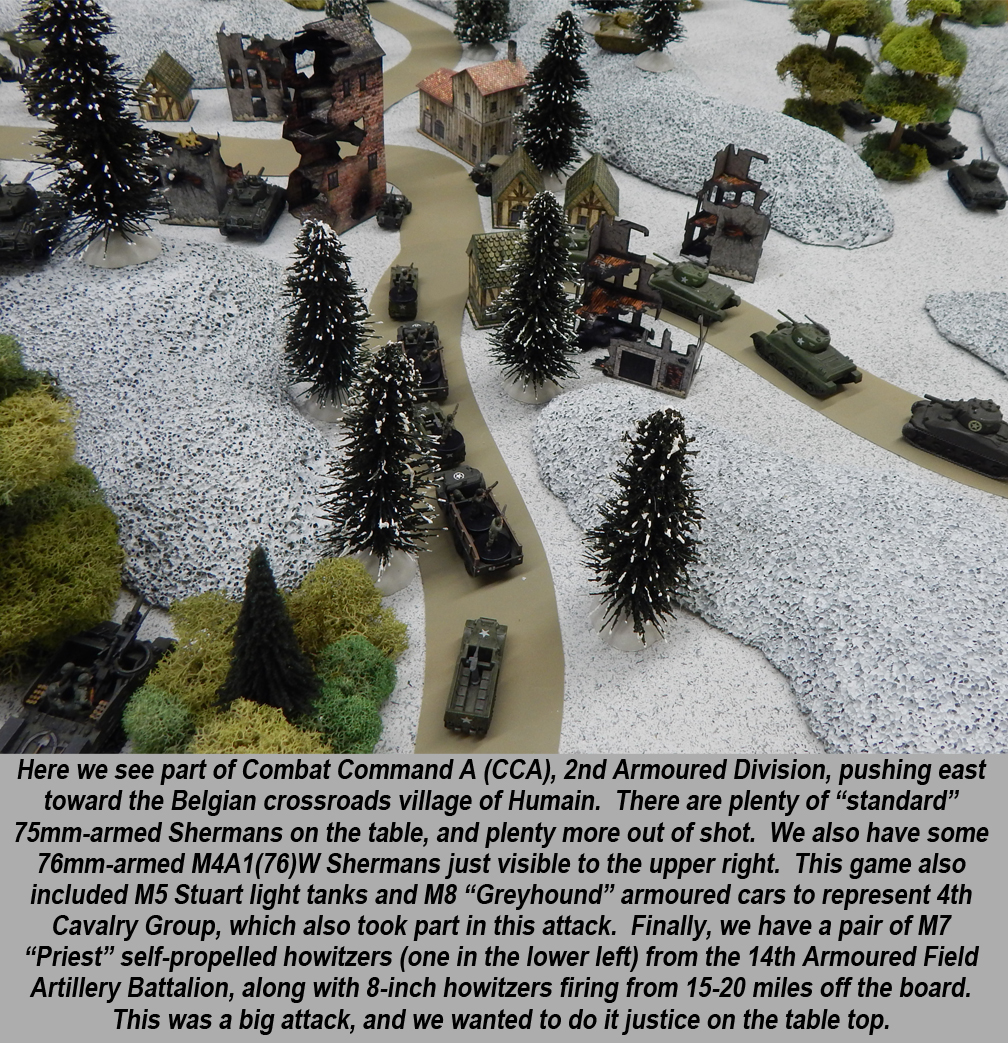
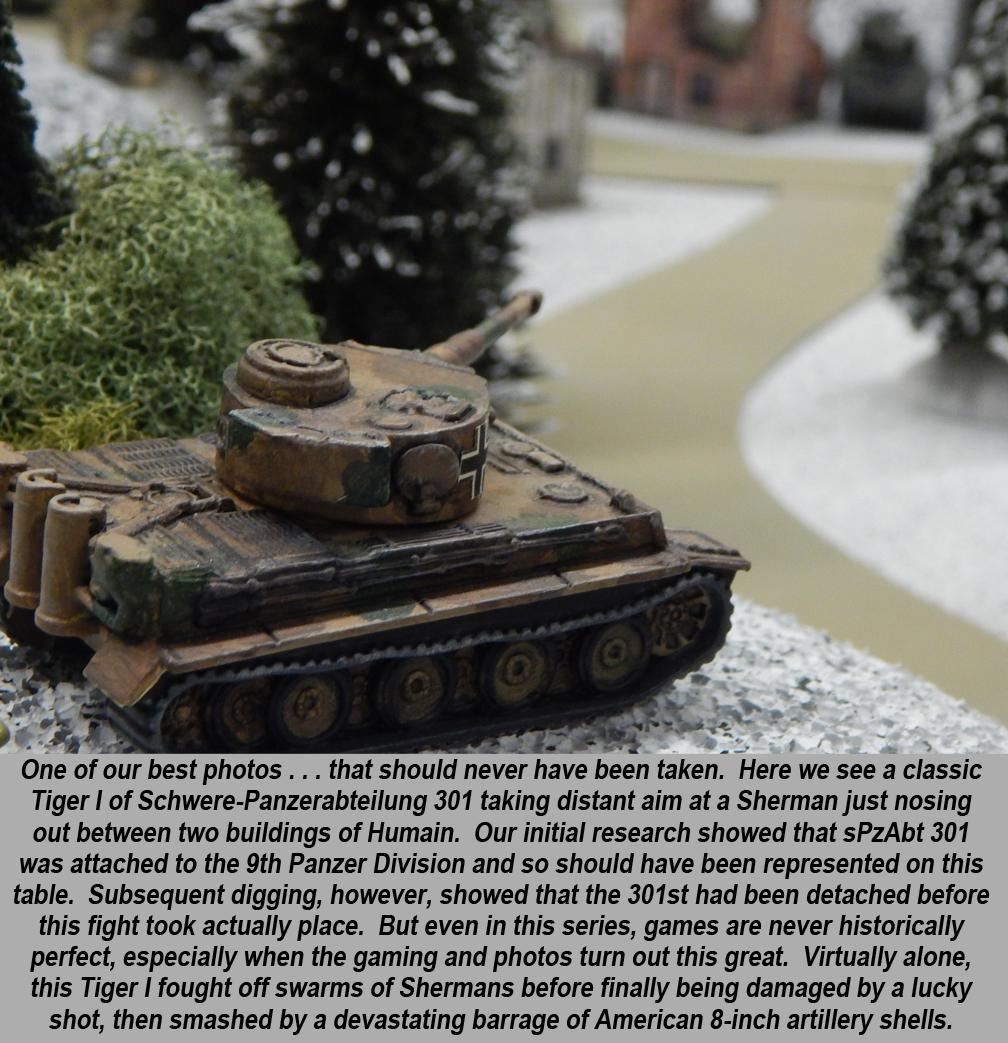
This was a strange battle to research. On paper, Humain-Hargimont should have been a colossal tank engagement, since the Americans threw in a big piece of one of their most powerful tank divisions (2nd and 3rd Armoured were the only US divisions to retain an older 1942-model order of battle that gave them 232 tanks instead of the standard 186). Their opponents were the 9th Panzer Division, just committed from Army Group B reserves and still possessing practically all its tank strength. Yet the engagement doesn’t get a lot of ink. Could it be because they never really came to grips in a dramatic fashion? Such was not the case on our table top, where the two forces all but annihilated each other until Gladesrunner squeaked out a narrow victory.

Incidentally, this American counterattack along the northern German shoulder is where some more “Bulge controversy” comes in. The overall US formation involved was General Bradley’s 12th Army Group, which had been essentially split by the German offensive. Because Bradley himself was headquartered to the south in Luxembourg, he couldn’t communicate well with the northern parts of his army group at this critical moment. So the overall Allied commander, General Eisenhower, had given command of these northern units temporarily to British Field Marshal Montgomery.
This caused an uproar in American circles, which “Monty” may not have helped by his orders to voluntarily withdrawal from hard-fought positions like St. Vith and his reluctance to follow up counterattacks like this one launched by 2nd Armoured Division. Others contend that Monty was a careful and meticulous commander, and that these reserved moves represented the best options amidst the chaos along First US Army’s northern wing. The debate continues to this day, and perhaps in the comments below as well.
In our next part of the Battle of the Bulge series, we’ll take a look at Patton’s famous drive from the south, lift the siege of Bastogne, and take a look at other supporting German offensive operations like “Nordwind.” So stay tuned, because “The Bulge” isn’t over yet!
If you would like to write an article for Beasts of War then please contact me at [email protected].
"Peiper now hit the one obstacle even his elite battle group couldn’t overcome...lack of fuel"
Supported by (Turn Off)

Supported by (Turn Off)
"Amphibiousmonster made some textbook Panzer Leader assaults into Foy-Notre Dame with artillery..."
Supported by (Turn Off)




![StarCraft Tabletop Miniatures Game Pre-Orders Live Now [Updated]](https://images.beastsofwar.com/2026/03/starcraft-tmg-news-cover-600-338.jpg)



![Mounted US Cavalry On Kickstarter For Dead Man’s Hand! [Updated]](https://images.beastsofwar.com/2026/03/us-cavalry-main-600-338.jpg)


Great write up of some really fun games. Speaking, of course, on behalf of the hex games. The systems take a while to learn/tweak, but when you get the hang of them, there is a certain fluidity that follow doctrine of the time.
I do wish I played the British better. We played over two nights and that first night I was a little tired and bleary. They did make the US’s way a little easier going.
Looking forward to comments and the next article!!
Yeah, as Amphibiousmonster rolled the 29th Brigade up from the south, their right flank was left pretty open to a battalion of my Panthers. I remember thinking: “Man, this is probably gonna wreck the game for the article . . .” but I couldn’t resist. How often do you get to open fire with forty Panthers on the flank of a whole battalion of Shermans and Fireflies in the open . . . from under cover on high ground? Of course I paid for it when the rest of the US 2nd Armored came down on my right flank in turn, but by then the 29th Armoured Brigade had effectively ceased to exist.
That’s part of why we play historical war games, though – to find new “historical outcomes” to historical battles.
Again a good real touched upon few bit I did not know/recall
Awesome! Thanks. 🙂
Wow, you covered a lot with that one! As informative as the article was, the best part for me was the “Night before Christmas” modified quote in the caption. I also loved “Christmas with the in-laws was hell”. It was also cool including the historical difference between how the games turned out and the real life battles.
Gotta have jokes to keep people awake through all the history. 😀 And again, an observation sometimes made by non-historical gamers is that historical games can come off as “reenactments” where the issue isn’t really in doubt. And yes, some of our battles have come out pretty close to historical results. But we also want to make sure we point out when they don’t, especially that massacre at La Gleize.
Speaking of La Gleize, I wanted to include a link to the La Gleize museum in Belgium, where one of Peiper’s last King Tigers still stands where he left it 70 years ago.
http://www.december44.com/en/history_battle_of_the_bulgela_gleize.htm
Well it’s nicer than a gnome in the garden?
Kinda tough to get your lawnmower around a King Tiger, though . . . 🙂 I was joking with @amphibiousmonster earlier about how they might have built the museum there because it was too much effort to tow the King Tiger to a new location. “Oh, the hell with it. Let’s just build the museum here.” 🙂
Great battles from the three of you’s have /will you consider at the end or on a later article recreate the bulge offensive with no supply limitations to see if your advance can get any further to Antwerp?
Um . . . interesting question. Some other factors would have to be adjusted in addition to supply and fuel. Such as . . . better German air cover? A more complete American collapse in the battle’s opening days? A lack of American reserves (10th Armored, 101st Airborne, 82nd Airborne, 7th Armored at St. Vith). Quite frankly, the goal of Antwerp never really stood any chance whatsoever, which is why some German commanders (Model, Manteuffel, Rundstedt) advocated not going for Antwerp/Brussels/the Meuse River . . . and instead curling inward to encircle and destroy a sizable pocket of US First Army. At least then the Ardennes offensive would have accomplished SOMETHING. 🙂
So probably a bridge head at the Meuse River would probably be your best progress do you think.
Geographically, sure. The recon battalion of the 2nd Panzer / XLVII Panzer Corps got to Foy-Notre Dame, just a few miles of the Meuse crossings at Foy-Notre Dame (German sources claim they could see the bridges from the church steeples). So yeah, if some things had gone differently (XLVII Panzer Corps winning the race to Bastogne, for example), they might have made it.
But war isn’t a game of football. You don’t win just because you reached a certain line on a map. By not going as far or as fast . . . and instead encircling American units already bypassed, they may have done more good (and not exposed themselves to being cut off and encircled themselves).
Don’t get me wrong, IF the Germans had managed to cross the Meuse IN STRENGTH (not just one exhausted recon battalion of one panzer division) . . . that would have been huge because there are few natural obstacles north of the Meuse. No more hilly terrain, thick woods, and lots of good roads. Further, the Germans would have already been beyond most of the American reserves and cutting deep in to the operational rear of Montgomery’s 21st Army Group.
Damn it . . . that’s supposed to read:
“. . . just a few miles from the Meuse crossings at Dinant.”
Another very interesting series of battles.
“Ranges were reduced to 12 inches, regardless of a weapon’s actual reach.” – I assume this is referring to tablestop distance not the real battle!
No man, it was 12″ on the battlefield, it was a REALLY dark night.
(cut to scene of German and American infantry clumsily slapping and bumping into each other).
Seriously, though, 12″ on our table = four hexes on a traditional Axis & Allies Miniatures map board (we play without hexes, obviously). They never really say what a hex is, but based on some of the weapons ranges we can guess each hex is about 50 meters.
Whereas in the grim darkness of the 41st millenium it is obviously so dark when it’s night that the forces really are running around bumping in to each other at 12″ range.
Cut to two borderline-psychotic, manically-depressed, PTSD Space Marines riding in a drop ship to they’re next battle . . .
“Man, I don’t know how much more of this darkness I can take.”
“I know what you mean. We live and fight in a cold, dark, brutal world.”
“No, I mean I can’t see $hit in this helmet. You think they could set us up with some freakin’ night vision?”
🙂
Another great write up. I remember years ago playing several scenarios of the battle of the bulge using 1/285th scale. It was very very difficult to get anywhere with the Germans because of supply issues.
Oh, and I’ll kick off the Monty stuff…. 🙂
He was severely over rated.
Oh man, @vitalis . . . are you gonna put me in the position of defending Monty, if only to keep the conversation going? 🙂
In all seriousness, I think I would agree. Montgomery’s touchstone victory (El Alamein) was won largely on the back of his predecessor, Claude Auchinleck. Auchinleck suffered all the reverses, sustained all the losses, and took all the abuse from Churchill in the spring and summer of 1942 that “set up the chessboard” for Monty later. In Monty’s defense, he also stood up to Churchill (something O’Connor, Wavell, and Auchinleck never did) and refused to launch his El Alemein offensive until he was absolutely sure everything was in place. Had he caved to Churchill’s political pressure, El Alamein could have wound up a half-victory like “Crusader” or a disastrous reverse like “Battleaxe.”
Enough desert war, though. In the Battle of the Bulge, Monty catches a lot of heat for his command of US First Army, given to him temporarily by Eisenhower. To his credit, he brought a much-needed cohesion and unity of command to the northern end of the Bulge (the part that mattered, since this was the Germans’ thrust of advance). At this point, the shattered American units were fighting incredibly brave but badly-disorganized holding actions, with reserve divisions being chucked into the meat grinder as quickly as possible. Monty made the tough calls to pull out of horribly exposed positions like St. Vith, while holding firm at other more important positions like Elsenborn Ridge. He set up British divisions (21st Army Group) back along the Meuse just in case the Germans did manage a breakthrough (we see 29th Armoured Brigade get into the mix at Celles), and basically brought the madness under control. Patton’s counterattack from the south is all well and good, but we have to remember that it was Monty’s defense in the north (with almost entirely American troops, of course) that really broke the back of the German Ardennes offensive and gave Patton this chance.
That said, when it came time for Monty to launch the counterattack down from the north, he hesitated badly. Eisenhower wanted him to attack on January 1 to coordinate with Patton, and he didn’t. Not until January 5 did Monty really get into gear, despite the repeated pleas of American commanders on the scene like Hodges (First US Army) and Collins (VII Corps). He said the weather was poor. Really? The frost-bitten American troops who’d been desperately fighting since December 16 had no idea. This delay resulted in the jaws not snapping shut nearly fast enough, and a huge body of Germans west of the Bastogne-Houffalize area managing to escape (without their vehicles and heavy equipment, admittedly). This would result in some very hard fighting in mid-January as First and Third US Armies had to grind down the rest of the Bulge in a frontal battle of attrition instead of the planned flanking battle of maneuver.
Plenty to be said on both sides of the ledger, I guess. 🙂
A great read to finish the year. BoW one of the few places when history meets gaming.
Thanks, @yavasa . I’m always half-afraid I’m laying the history on a little too thick. Certainly not the cup of tea for all BoW subscribers, but definitely the gaming material of choice for some of us! 🙂
This reminds me how blessed we are to live in the internet age. I don’t have to say, that a lot of WWII was about propaganda. When Rommel was confounding the British in the desert, the papers had to come up with an excuse besides all the things Oriskany just mentioned. How about, “Rommel is the greatest genius to ever lift field glasses!”
And these half rumors perpetuate to the “headline grabbing” allied generals as well. And they continue because media/information sharing was only so far for decades. In say, the last 20 years of the internet, so much more of the story has been…compiled, than probably the 50 years prior. Just a guess….
This is true, I have some internet sources that can break down historical, individual Soviet rifle divisions down to the veterinarian platoons that would take care of the division’s horses. Of course, you have to teach yourself a little Russian (no, Google Translate does NOT work since the site makes such heavy use of military abbreviations, terms, and acronyms) . . .
With so much information available, it’s probably tougher for single generals, accomplishments, or setbacks to attain the iconic fame/infamy that they sometimes did in the past. Then again, the 101st Airborne in WW2 is much more famous than the equally-deserving 82nd . . . Band of Brothers, anyone? Patton gets a lot more attention than Hodges, Bradley, or even Eisenhower . . . thanks in part to a George C Scott movie released in 1970, although a lot of this was also due to Patton’s “celebrity personality” even at the time.
So whether in a contemporary sense or in hindsight, I think a lot of it comes down to a “cult of personality.” Monty was the guy in change when all the pieces fell together for the 8th Army at El Alamein. Not saying he was just lucky, successful people make their own luck when they make the most of opportunities that come their way.
It would be interesting to know how current / recent conflicts would have been reported in the media age of the 1930s/40s. It’s not like there’s no propaganda in war reporting today, but it’s not hard for people to find critical reporting on any given war / battle.
I’ve been reading reviews of several books which have recently been published on the war in Afghanistan, and – certainly regarding the British forces which are their focus – they seem to be pretty damning. Despite the bravery and competence of individual soldiers.
At least in the UK there doesn’t seem to be much gung-ho ‘everything was a splendid success’ reporting. I wonder if this war had been fought in the 40s how different of our perception of it would be?
There’s a **little** of that in the US, I think, although it’s not universal. But some sectors of the media (cough, Fox News, ahem) tended to rubber-stamp all the government-issued reports coming out of Iraqi Freedom and Enduring Freedom. Journalists, politicians, and analysts who questioned things sometimes got hit with the “doesn’t support our American heroes” or “would be fine to forget about 9-11” mud slinging. Whatever. But like I said, far from universal.
British historians I have ALWAYS felt have a generally far more objective, detached, and clear-eyed view of things. Failures of British command, exploits of non-British allied forces, even exploits of enemy forces, all get equal share of attention. The overall American view isn’t TOO bad, although we sometimes get a little hysterical when people start recognizing the larger contributions made by British or **gasp** Soviet forces.
The Russians are among the worst, however, at least among the Allied nations. They were enjoying a post-1990 renaissance for a while (documentaries, archives, and books detailing everything from Zhukov’s failures at Rhzev to Stalin’s quiet offer of peace during the summer of ’41), but it seems Putin is clamping back down on airing out 70-year old laundry.
I get the impression that there’s more of it in the US, but even so – if you want a different opinion all you have to do is change channels or buy the next magazine on the shelf. Nothing like what I understand is happening in Russia these days.
As for being objective about military failures, one of the interesting points to come out of the articles I’ve been reading recently is the accusation that British military failures really haven’t been examined. There’s been some blaming of politicians, and of a lack of resourcing, but very little critical examination of choices made by the military’s leadership. Whereas it looks to me as though the US learned from failures in both Iraq and Afghanistan to do things quite differently from when they went in.
Re Russian media: I’m not sure about current events or “daily news,” but when it comes to what their historians are allowed to publish and the access that western researches are allowed into their WW2 archives, yes . . . things have definitely clamped down hard in the last couple of years. A couple of the .ru sites I used to go to for Eastern Front research have been shut down, are no longer updated, or have simply vanished. American sites that drew from from Russian sources have apologies up that they can get no new material, but at least still have oceans of old material up from 1994-2005.
I honestly know next to nothing about British involvement in Iraq or Afghanistan (except that in Iraq in 2003, they were mostly concentrated around the Basra area). Did their commanders make bad calls in the field?
Not so sure about whether we in the US have learned anything about our mistakes during the “Bush era.” 🙁 Even this White House seems one bad polling cycle away from sending planes back over Iraq or putting boots back on the ground to fight ISIS. At least we seem to be learning that this is a spec ops war, with select SEAL Team Six strikes against carefully targeted buildings instead of wholesale invasions, surges, and torture. I guess we’ll learn in the next few years whether the lessons have really sunk in. Not to get too political, but suffice it to say that American 2016 election scares the hell outta me.
Re: Russia, that’s very interesting. I think a good example of what’s going on currently is news from yesterday: opposition leader released from prison with a suspended sentence; his brother imprisoned instead; he accuses the Russian state / Putin of effectively taking his brother hostage… And it doesn’t get reported in news bulletins on most of the news programmes. When it is shown, it’s burried away in the business section!
As for the British in Afghanistan and Iraq, here is the main article I read recently that got me thinking about this (a review of several new books): http://www.lrb.co.uk/v36/n24/james-meek/worse-than-a-defeat
It’s quite long, but a very interesting read.
This opinion piece a few days later refers to at least one of the books mentioned in the first.
http://www.theguardian.com/commentisfree/2014/dec/28/rightwing-ideology-lost-britiain-war-afghanistan-and-is-destroying-state-and-country?CMP=share_btn_fb
And this is also full of anecdotes about Iraq, military procurement, etc.:
http://www.independent.co.uk/voices/comment/war-with-isis-the-west-needs-more-than-a-white-knight-9946580.html
“Did the UK commanders make bad calls in the field?” To an extent yes… although the criticism really becomes more deserved the higher up you seem to go.
Oh, and Happy New Year!
These are interesting posts, @angelicdespot . As a former US Marine in supply admin and logistics, I have a few “procurement horror stories,” to say nothing of a new medical care / VA gripes of my own. Nothing compared to what the guys are going through nowadays, though.
“the criticism really becomes more deserved the higher up you seem to go . . .” – That’s the way of rank, though, isn’t it? $hit rolls down hill . . . but the stink rises. I’m half-awaiting the debate to start in these article forums about whether or not Joachim Peiper was really, **personally** responsible for the Malmedy Massacre or all the other atrocities committed by his kampfgruppe, many of which he was clearly not present for. And his death sentence for Malmedy was commuted to life imprisonment and finally “time served” . . . after which he was released because by by “civilian” standards of jurisprudence, a lot of the evidence against him was not obtained legally. But in a military sense . . . the commander is always responsible for the actions of his men. Done deal. The higher you are, the more you are responsible for, in every sense of the word.
Happy New Year!
If they aren’t already, modern “After Action Reports” are just print outs of the commands issued to the drones…
Right? “Just play back the video log recording. That’s your battle report. Oh, and be sure to save a backup copy to the cloud, ’cause we’re selling the original source file to be used in the next ‘Call of Duty’ game.” 🙁
*will be*
I’ve designed a few scenarios in earlier ’44 mostly around D-Day, and some of the September actions both up in Holland and down in Metz/Nancy. The Western Allies have tons and tons of materials. And making really detailed force pools was really easy. One quick example. I found the first likely implementation of the Canadian Kangaroos, during the siege of Dunkirk. I have more specifics on my home PC, but i found the exact Armoured Personnel Carrier regiment, the exact Field Artillery regiment from Calgary somewhere and so forth.
I commend anyone with the patience to sift through Russian, and any other non western. records and assemble that information.
That’s awesome about the research into the Canadian regiments and divisions. I wonder if that’s anything @cpauls1 would be interested in / has knowledge of. These Canadian divisions don’t get enough attention in ETO history, and the battles for the Channel ports / Scheldt Estuary as well.
Many Canadian units are like the US and the Commonwealth. Many maintain their own history and throw it up on the web.
Damn.. there was a battle near the one I researched a day earlier. I believe the regiment was called the Calgary Highlanders (cool name) and the town was Loon Plage. Some companies were shot down to thirty men. Many many brave Canadians and thye always get hella-props from me in casual conversations.
In our trip to Normandy this summer we stopped by quite a few Canadian monuments and memorials, not only at Juno Beach (predictably) but also near where the Battle of Normandy finally ended hear Falaise-Argentan. The 2nd Canadian Infantry Division, 3rd Canadian Infantry Division and the 2nd Canadian (Armoured) all took part in the northern arm of closing that pocket near the town of Trun, which certainly remembers the event to this day. The Mémorial de Montormel has a lot of great information on this:
http://www.warmuseums.nl/gal/078gal.htm
Incidentally, this was the same museum that hosted the visiting Panther when I was there, one of only 12 or so working Panthers still in existence.
http://www.beastsofwar.com/groups/historical-games/forum/topic/spotted-one-of-the-world%E2%80%99s-last-working-panther-tanks/