








World War 2.5 – Gaming An Alternate History [Part One]
February 16, 2015 by crew

Backstage Rules Pack Download
There’s an old saying: “The enemy of my enemy is my friend.” But is that always true? Consider the delicate and uncertain partnership between the “Allies” during World War II. There was open gunfire between the British and French, and jagged mistrust between the British and the Americans. Even Americans and French engaged in full-fledged battle when US troops first encountered Vichy garrisons in North Africa.
All of this paled, however, compared to the paranoia and animosity simmering between the Western Allies and Soviet Russia. These are factions that would have been happy to go to war with each other, if the Third Reich hadn’t been standing between them. Perhaps it’s a fitting measure of Hitler’s evil that he managed to get men like Roosevelt, Churchill, and Stalin around the same table, striving for his downfall.
But what if this alliance hadn't held?
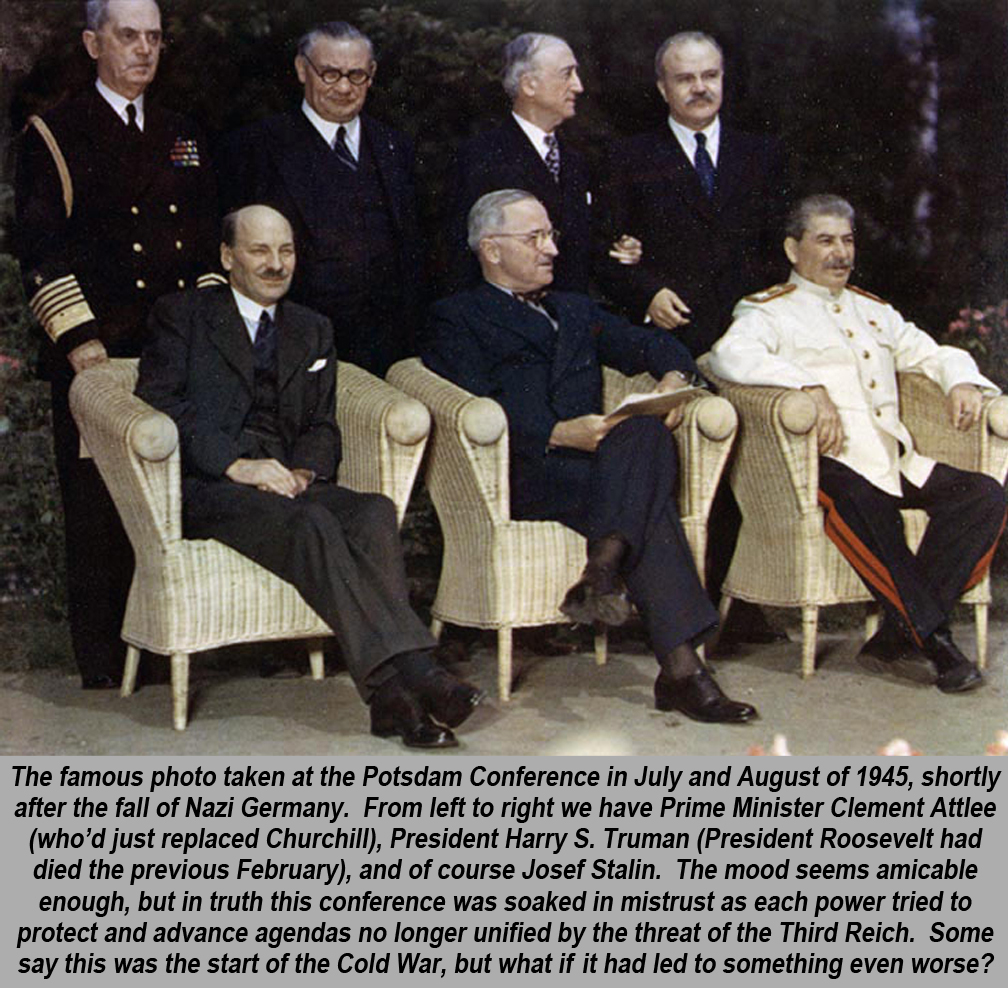
“World War 2.5” is a project that postulates what might have happened if a “hot war” had broken out in Central Europe in the near-immediate aftermath of World War II. Maybe the Potsdam Conference went badly, maybe the 1948 Berlin Airlift was forcibly opposed by the Soviets? Maybe Winston Churchill remained in office and his anti-Bolshevik belligerence triggered an incident. Maybe Patton didn’t die in that car crash, and his blustering about settling accounts with the “mongol Russians” sparked the fateful conflagration. Maybe Stalin’s paranoia got the best of him after Hiroshima and Nagasaki, and he decided to strike before the Americans could build a viable nuclear stockpile.
Of course, we’re not saying such a war was likely, or could have happened at all. Nor are we forwarding a specific reason “World War 2.5” might have started, such questions are not in the scope of this project. Suffice it to say that it’s the summer of 1946 and somehow or another, the unthinkable has happened in Germany and the Soviets have reached a point where they “have no choice” but to strike. The Soviet armies that just liberated Mother Russia and stormed the Reichstag are now pitted against men who landed at Normandy. World War “2.5” has begun.
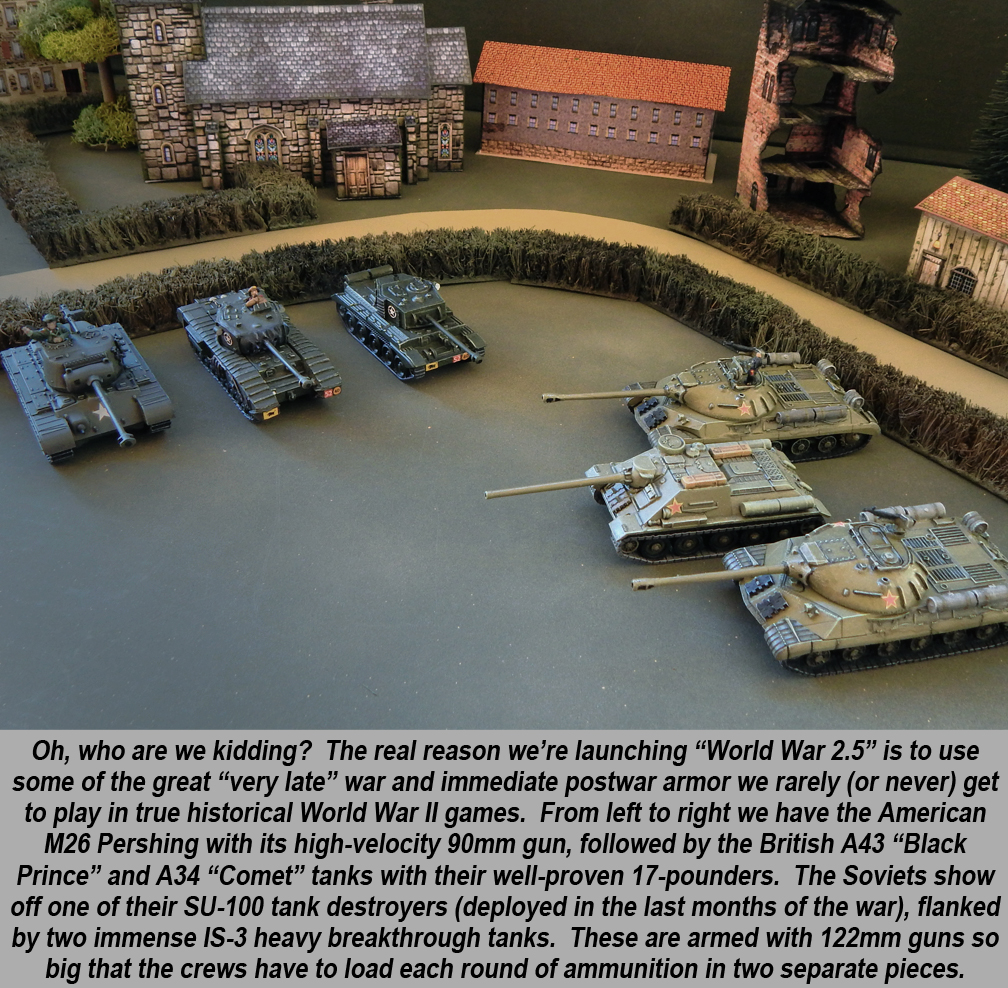
Naturally, it would take more than a few articles to properly envision the totality of such a nightmare scenario so we’ll just focus on part of the air-ground war in central Germany, where four Soviet “Fronts” (roughly equivalent to a western “Army” or “Army Group”) will deliver the main Soviet strike. Their objectives are to achieve a breakthrough, push on the industrial heartland of the Ruhr, and perhaps even cross the Rhine. This axis of attack is no accident, landing at the junction between the US occupation zones of Hesse and Bavaria in the south, and the British occupation zones in Westphalia and Lower Saxony to the north. Of course, this also gives us the opportunity as gamers to put our post-war Soviets up against both post-war Americans and post-war British.
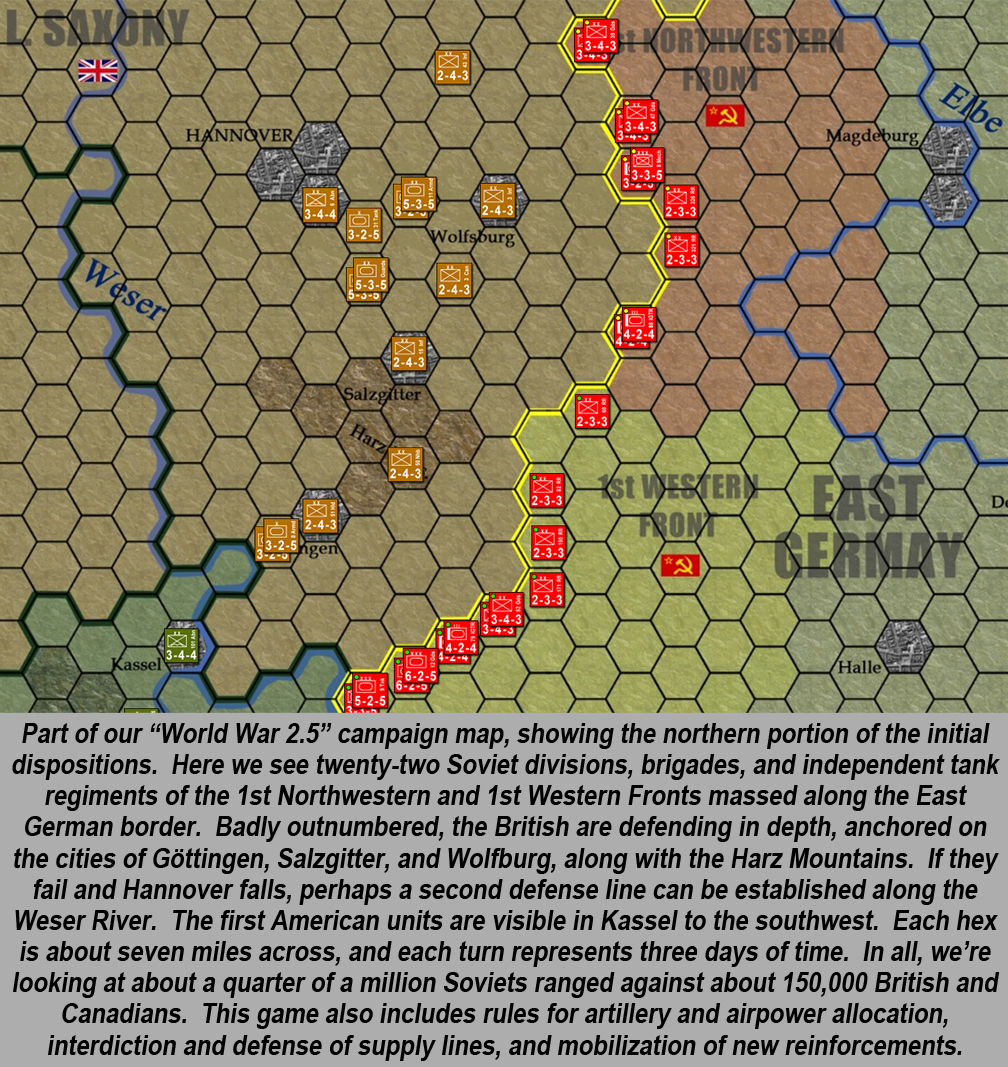
Within this proposed campaign area, we find our Soviets facing off against General Hodges’ US First Army (12th Army Group) and General Dempsey’s British Second Army (part of the newly-formed British Army of the Rhine). The French First Army is also deployed further back in their Rhineland occupation zone, and there are even a handful of small re-armed West German units. Perhaps these are the nascent beginnings of what will eventually become the “Bundeswehr,” their creation accelerated by the impending threat of our scenario.
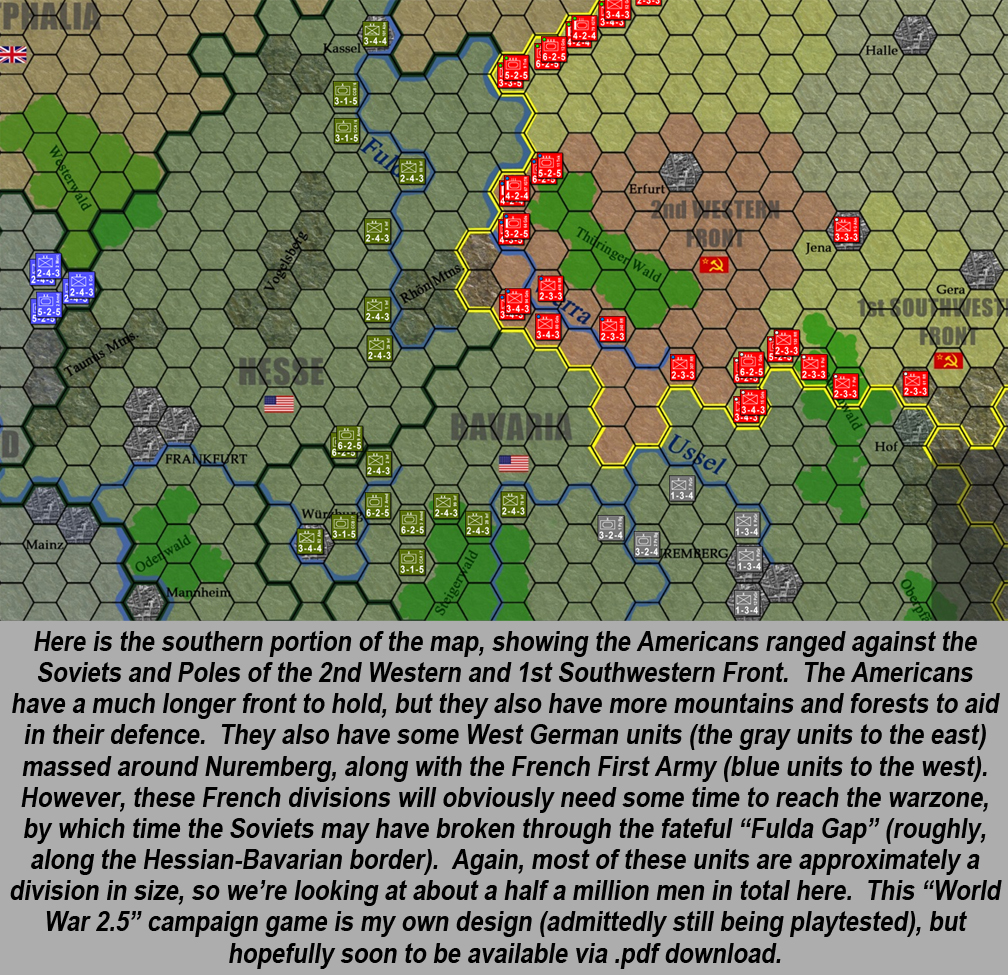
The date is June 1, 1946. The Soviet offensive begins. To the north, ten Soviet divisions drive on Hamburg, aiming for Bremen, the Danish border, and perhaps the mouth of the Rhine. To the south, two more fronts invade Bavaria from Czechoslovakia, while a small operational group drives into Austria and Italy from Hungary and Yugoslavia. These are just holding actions, however, designed to prevent reinforcement against the main Soviet strike in central Germany, delivered through corridors ranging from Hannover in the north to Nuremburg in the south. Meanwhile, still more Soviet forces surround the Allied garrisons in West Berlin, which the Soviets promise will be exterminated without mercy if the Americans dare reach for their very small stockpile of atomic weapons.
As big as it is, the Soviet Army has of course suffered terrible losses in World War II, and so cannot simply roll across Germany in a “Red Steamroller.” Likewise, the American and British have drawn down their “citizen armies” to a fraction of their 1945 levels, compelled by popular opinion and exhausted economies. Not only were these considerations baked into the campaign for plausibility reasons, but also to keep the game manageable and allow more room for manoeuvre.
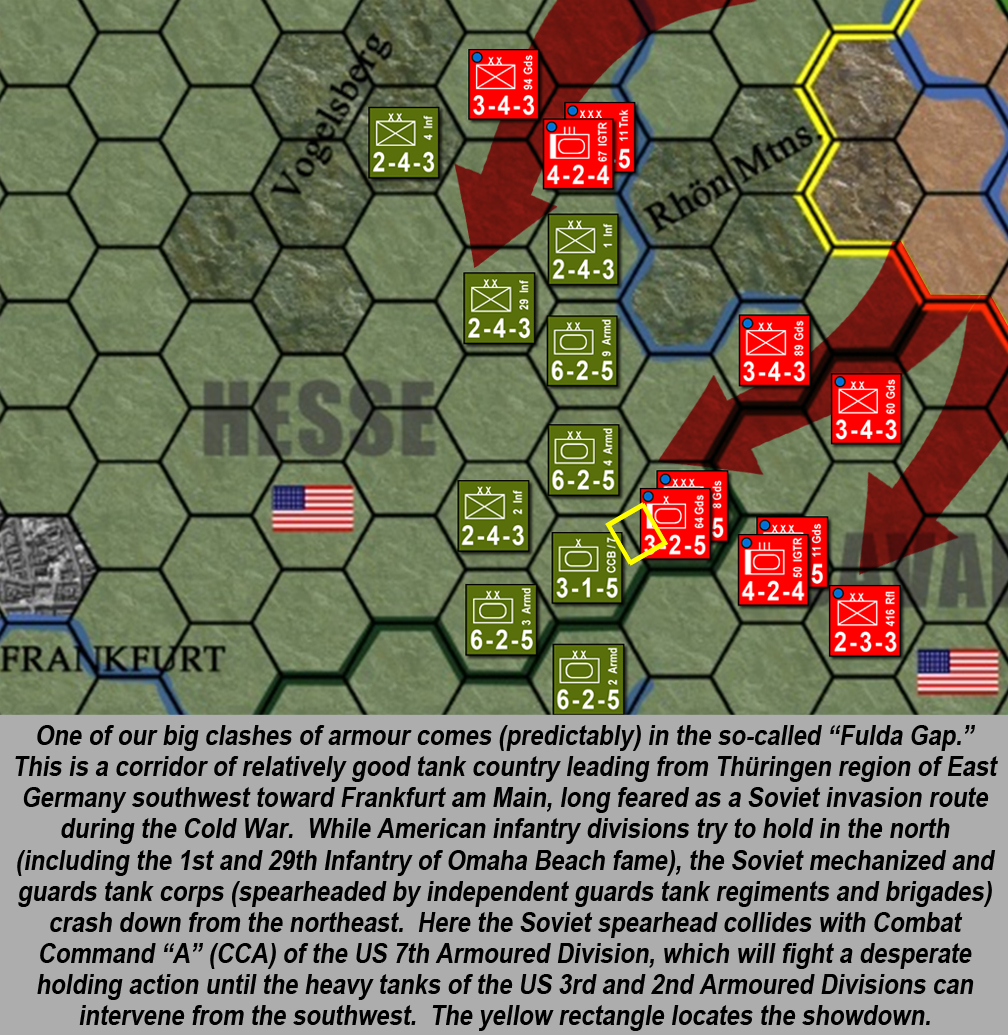
Of course we’re not playing everything on the divisional scale with hex grids and counters. Sooner or later we have to “get down in the dirt” and engage in eyeball-to-eyeball combat. Accordingly, we decided to try out the great “Battlegroup” system (as in “Battlegroup Kursk” from Iron Fist Publishing) to run our 15mm tabletop games. Granted, we've had to come up with some of our own data cards, army lists, and scenarios since Battlegroup doesn't have a “1946” campaign book, but the system is amazing and highly recommended.
For our first miniatures battle, we decided to recreate a small portion of the “Fulda Gap Breakthrough” described in the map above. Here, elements of American “Combat Command A” of 7th Armoured Division tries to hold the spearhead of Soviet guards armour while heavier American tanks of 2nd Armoured Division rush to reinforce their comrades.
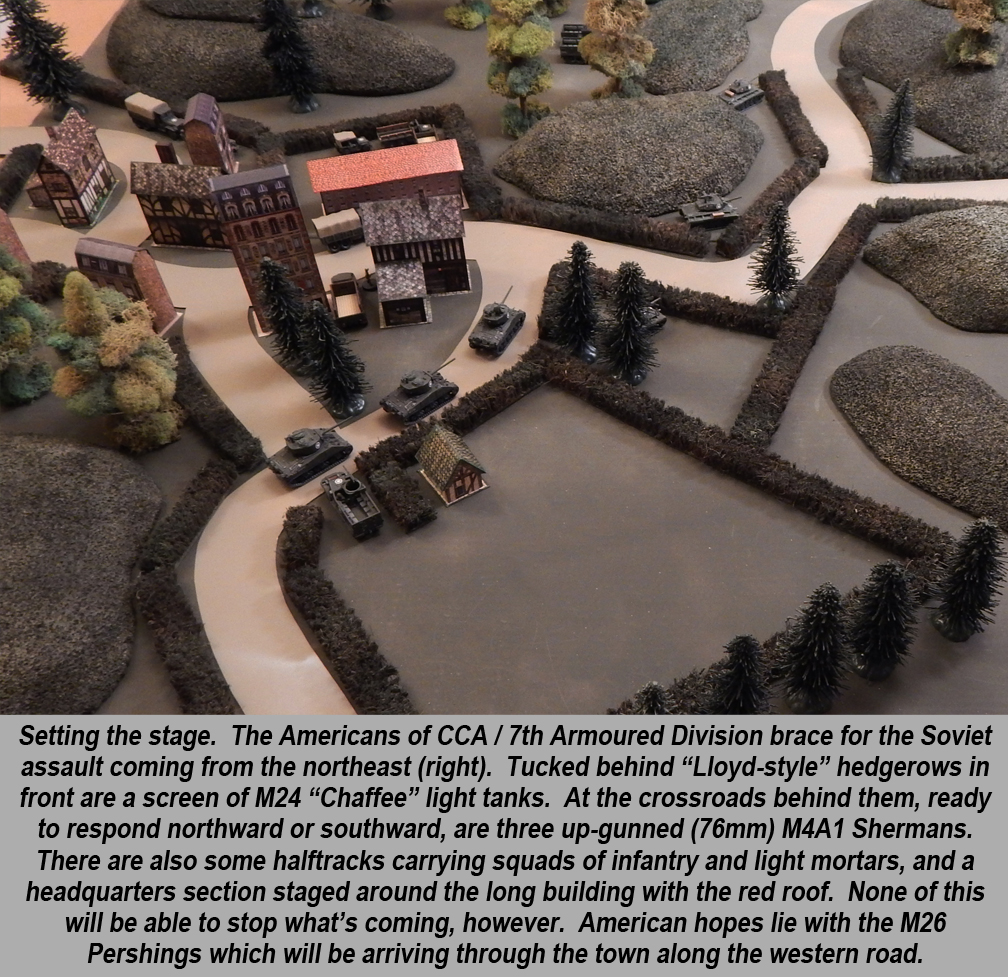
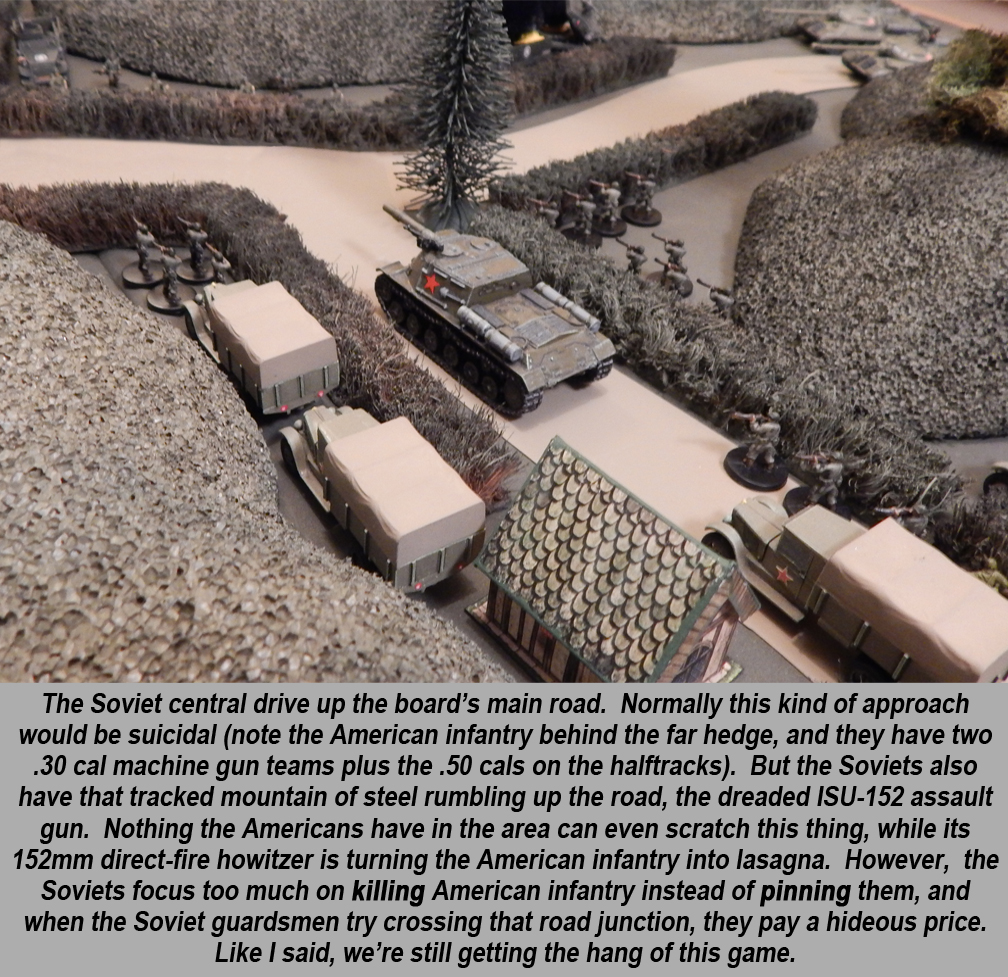
The Soviets came in from the northeast, with a platoon of post-war IS-3 (Stalin 3) heavy tanks pushing up on the right wing, three SU-100 tank destroyers pushing up on the left wing, and a reinforced platoon of infantry up the central road. This infantry was supported by an immense ISU-152 assault howitzer, which the Soviets hoped to use to suppress American infantry positions. This was especially vital since this scenario envisioned the Soviets as a vanguard “breakthrough force,” already pushing deep into American lines and perhaps out of range of their own supporting artillery.
Admittedly, I’m still something of a novice when it comes to the Battlegroup system but already I love how it can create great narrative moments on the table top. One such moment came when the Soviet IS-3s tried to outflank the American screen of M24 Chaffee light tanks, and the first IS-3 was wrecked by some incredibly lucky American bazooka teams. When you lose a unit in Battlegroup, you have to reach into a pot and blind-draw a counter which tells you how many “Battle Rating” points your battle group has just lost. But there are also “special counters” in the pot, and sure enough, the Soviets drew a “Beyond the Call of Duty” counter which allowed another of their IS-3s to take an extra order (in this case, a double-shot “Open Fire” order).
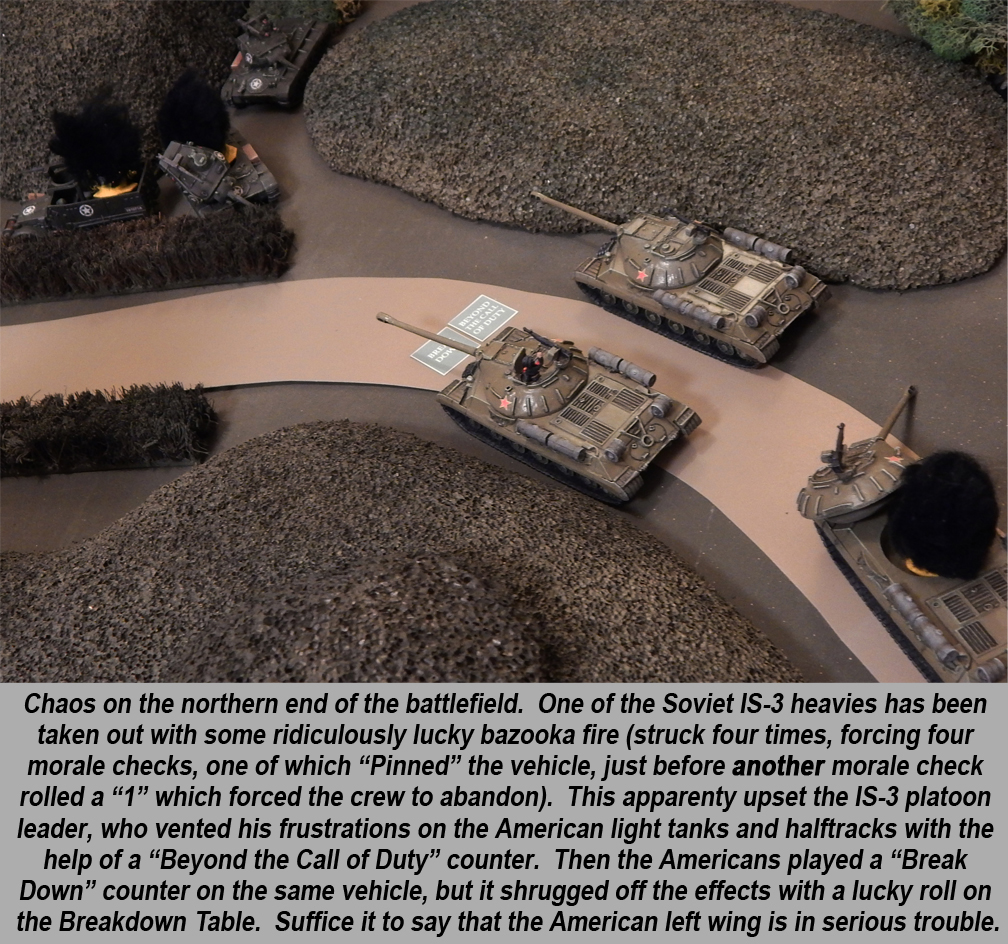
So even as the first IS-3 burned, the second enraged crew was putting down a hideous, superhuman amount of firepower, pretty much mangling the whole American left wing. When the Americans drew their required counters for unit destruction, they drew a “Break Down” counter (which you play on enemy units, in this case the runaway IS-3). However the IS-3 crew rolled a “1” on the Breakdown Table, which allowed theses “Heroes of the Soviet Union” to keep driving despite the clanking noise. “You been drinking our brake fluid again, Yuri?”
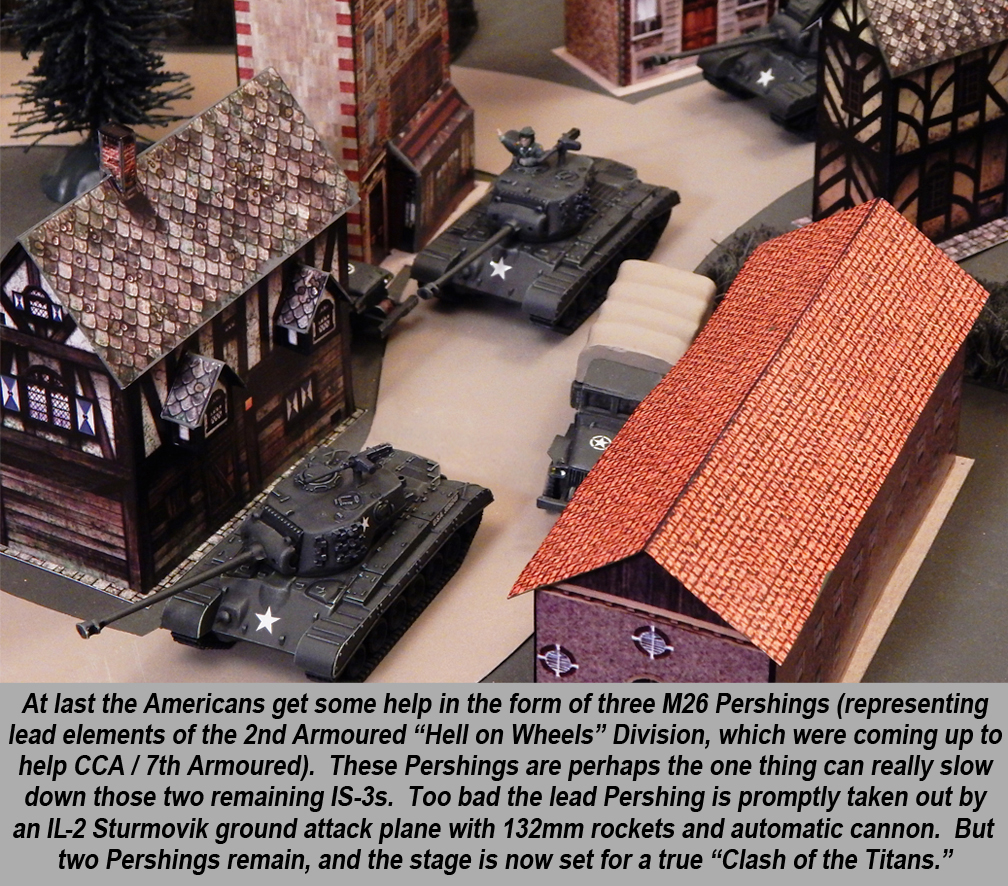
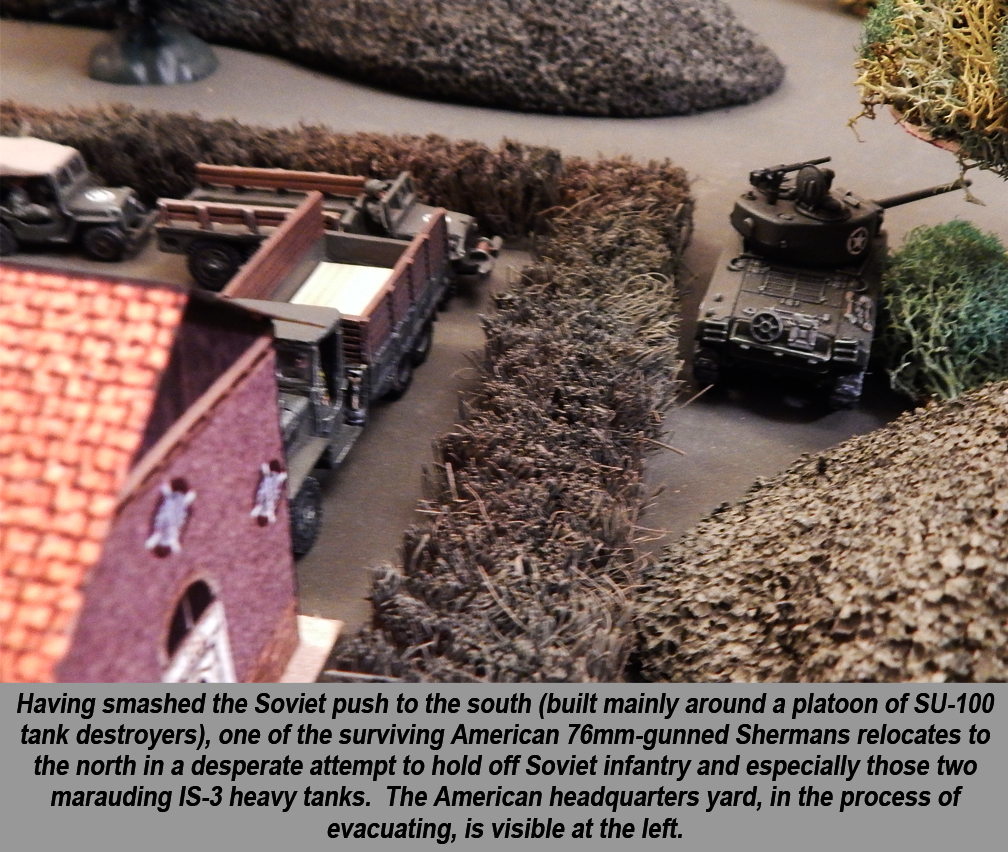
The Americans were getting some lucky breaks as well. To the south, their 76mm-armed Shermans shot the SU-100s tank destroyers to bloody ribbons, firing from under cover in a small German farmyard. One of the surviving M24 Chaffee light tanks managed to get around the side of the ISU-152 assault gun (after it had “Broken Down” as well), and eventually took the beast down with flanking fire. Things really seemed to be turning around when the three American M26 “Pershing” heavy tanks arrived, perhaps at last providing a counter to the Soviet IS-3 heavies.
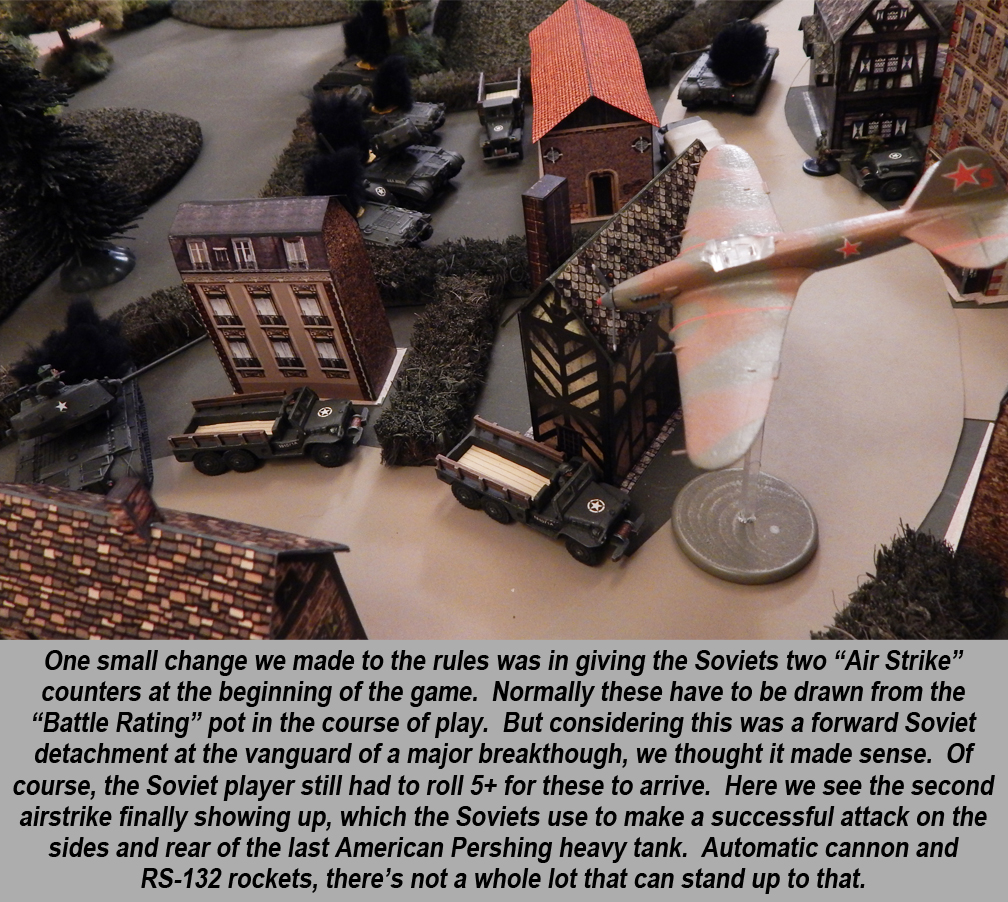
Fortunately for the Soviets, they finally started rolling the required 5+ for the arrival of their air strikes. The first IL-2 “Sturmovik” ground attack plane took out the lead Pershing, a second Pershing falling to one of the IS-3s (even as an IS-3 blew up when hit with a Pershing’s 90mm gun). The final Soviet air strike eventually took out the last Pershing, effectively winning the game for the Soviets. Although this vanguard has been mauled beyond repair, it seems they have kicked open the door for follow-on forces and the Soviet advance through the Fulda Gap can continue.
How do you like our “World War 2.5” campaign so far? Comment below with questions and more then check back when our next article publishes to see how the British are doing in the north.
The Series:-
- Part One: The Floodgates Open
- Part Two: The Big Push
- Part Three: Valiant Heroics
- Part Four [Finale]: The End?
If you would like to write an article for Beasts of War then please contact me at [email protected] for more information!
"Perhaps it’s a fitting measure of Hitler’s evil that he managed to get men like Roosevelt, Churchill, and Stalin around the same table, striving for his downfall..."
Supported by (Turn Off)

Supported by (Turn Off)
"Of course we’re not playing everything on the divisional scale with hex grids and counters. Sooner or later we have to “get down in the dirt” and engage in eyeball-to-eyeball combat..."
Supported by (Turn Off)


Wow. Very well done.
Ah, a post-war aggression campaign, a scenario sometimes referred to as “operation Unthinkable” after the Allied plans for just such an occasion developed in 1945.
While some might think that the Soviets would have just steamrollered the Western Allies in such a campaign, the Red Army was also on its last legs by the end of the war, and many of their soldiers would also be needed to rebuild the Soviet economy.
The end result would probably have been a conflict with smaller, more high-tech forces than WW2 on both sides, as depricted in this campaign.
It offers some incredibly interesting battle scenarios and force compositions, especially once you reach the point where re-armed German units (including many veterans who joined up during the war to fight the Soviets in the first place) hit the front lines.
One of the major questions for those units would be their equipment, especially vehicles. Would they be using American-built machines (available in large numbers once the western Allies demobilized) or leftovers from the old German forces, if those were still around in sufficient numbers?
It’s a situation I’d be interested in gaming out myself, especially if it would give me a reason to model troops from the Dutch armoured division equiped with Canadian Ram tanks created after the war.
Thanks very much, @nsogre and @marqod . Glad you like it so far!
Great question on the vehicles for the re-armed German units. This was a tough one, since of course we all want to see phalanxes of Panthers and Tigers once again rumble over Europe . . . this time as the “good guys” 😀 . . . probably with the new Bundeswehr-pattern “Iron Cross” insignia instead of the Balkan Cross of World War II.
Honestly, another community member (jamesevans140) had the great idea that these German units would probably be armed primarily with hand-me-down American Lend-Lease equipment, not unlike the Free French units later in the war. Would there really be that many Panthers, Tigers, and Mark IVs LEFT? More importantly, these embryonic “Bundeswehr” units would be part of a larger Allied support and logistics structure, which probably wouldn’t bother with the intense maintenance and supply demands these very fickle tanks required.
We’re also keeping the German units very small, strictly brigades in size as opposed to divisions or corps. Any surplus “Volksturm” type units are probably helping to evacuate German civilians from threatened cities (still rebuilding, doubtlessly).
Not sure if I could ever get my head round German units even in pulp setting being ‘ The good guys’
You’re right, of course, @torros . Hence the “quotes.” We’re also keeping these units down to a pretty small role, both tactically and operationally. In a 60’s game, 50’s game, or even a 1948 game, things would be different, but just 13 months after VE Day?
didn’t ‘Unthinkable’ envisage that as many as 100,000 Wehrmacht troops could be raised to supplement the allies? My guess is that local German units would use whatever they could get there hands on until eventually they ended up kitted out like the regular allied troops… (depending on which sector they’re in). As @oriskany says, being part of a wider allied logistics network it’d be unfeasible to maintain parallel supply chains of allied and German manufactures, especially in the long term. Homogenize. Throw whatever we’ve got at Ivan until it becomes a war of production once again… Be a nice modelling challenge!
@bigdave says: “Be a nice modelling challenge!”
Indeed. I’ve had great fun so far “modding” late- and post-war British armour. Now I’m starting a rag-tag handful of surviving German units. Shermans, maybe 1 StG-III, a Mark IV, a Hetzer, and maybe a Panther . . . all with the black “Iron Cross” Bundeswehr-pattern cross instead of the WW2 German “balkenkreuz.” 🙂
Nice work yet again mate. Impeccable timing – I just got my email stating that wave 1 of my Dust kick-starter was on its way. I’m certainly in the mood for some Allies vs. SSU action now. I just hope there is something in the box when I get it… 😉
Thanks, @wookiehair . 🙂 Games like Dust are one reason we’re trying to keep this project as “plausible” as possible. First, it’s what I know . . . 😀 . . . but also I didn’t want to overstep onto Dust’s creative territory, so to speak. I think Dust takes place in 1947 and if I made this too “Weird War 2,” people would be saying: “why doesn’t this guy just play Dust?”
One of these days I’ll have to either try Dust or at least watch some Battlefield demo games. Something about a walker with an autoloading “88” built into each arm . . .
I agree, Dust is a very different thing (alien tech and all). Yours is a far more plausible alternate history and in some ways more interesting because of it. There is a fair degree of crossover though – they have rules for Pershings… but they come with phasers…
Oriskany, we should chat by email. We have stats for a lot of stuff for Battlegroup as 46 is a supplement we have planned…
That would actually be really helpful, @piers. I wouldn’t want to “spoil” any upcoming releases and would certainly keep anything confidential. At the moment we’re using the data cards and lists in Battlegroup Kursk (along with knowledge and comparative ratings of tanks, guns and equipment in other game systems) to extrapolate what we think these 1946 values would be in Battlegroup. We also have Fall of the Reich arriving this week, which I hope will get us much closer in verifying that our 1946 data cards would be correct. But nothing would beat getting it “from the horse’s mouth” so to speak. I’ll reach out in a PM.
Super awesome stuff! It seems so rewarding to play at such a grandiose level as this.
Love the concept – love the time period – love the models and I love the AAR!
As mentioned in another one of your fantastic article series I just need to figure out how to get this much detail into a Fantasy campaign.
As always – keep up the good work and I’m looking forward to the remaining parts of this series!
Thanks, @stlwarrior . Glad you like it so far!
Way, waaaaay back I used to game with a group of guys who also had very high-level D&D characters, to the point where they all had their own castles and fiefdoms, etc. Long story short, we came up with a way to do these high-level wargames in a Fantasy setting. I assume you’re talking about higher-level strategic games than all the great tactical options out there like Kings of War, etc.
For me the hardest part was stacking high-level magic on top of the operational “military” mechanic. Really big spells like “Wish” were broken up into possible applications, like “Feed Army,” “Engineering” (build a bridge over a broad river), “Spawn Horses”, etc. Mass Teleport was another great one, although we had to put a max range on it. And of course, “Counter-magic.”
Some of the magic-heavy players had mixed feelings, however, because they felt our “system” was a little restrictive. It’s definitely doable, I just don’t know that much about fantasy personally.
Those were the days – Seem to recall a misspent youth with that sort of stuff going on
If you EVER get a spare minute (which seems unlikely judging by all the work you do here and in your gaming group) I’d love to pick your brain on setting up a higher-level strategic fantasy game. And I promise that the magic will be kept to a minimum 🙂
And thanks again for sharing all this exciting work!
@stlwarrior – gimme 2-3 weeks to finish this project and let’s start a thread in the fantasy forum. Seriously, don’t let me forget. Start the forum and ping me on it. We’ll gets lots of great ideas from the community, too. I’ve gotten lots (and am still getting them, actually, even in this thread) for WW 2.5.
great start to the campaign! really looking forward to more,this looks like its gonna be a lotta fun to watch.
Excellent start, looking forward to the next episode.
Thanks, @bloodydrake and @gremlin . The next episode features some lighter (but much more numerous) Soviet armor and some British units!
Where do I begin? The operational level game looks and sounds fantastic. The minis are amazing. I’ve seen many of them already but I think this is my first look at your Stalin 3’s. (My 1:35 is a centerpiece of my collection) but these 1:100’s look awesome.
Glad to hear “Battlegroup” is developing into a cool mini system. Can’t wait to learn and read more. GREAT WORK!
Thanks, @amphibiousmonster . The operational-level game is just about there. We’re still playtesting to iron out victory points, strategic redeployment, levying reserves, and isolation (basics are all in place, but polishing details).
Oof, then I have to write it! But all the mapwork and counters are essentially done.
Oriskany
A reformed Eastern german army may be more Hetzer and katchen APC as that seems a direction they were pursuing. More logical for a reformed force with limited resources.
Plus in 20mm CP Models make 46 style Germans…
You know, @piers , I initially set aside the idea of an “East German” army, simply because (1) the Soviets didn’t really need any reinforcements, (2) they already have significant Polish formations that fought with them, and (3) the level of Soviet antipathy and mistrust of Germans would still be too high in 1946 . . . But . . .
They DID have hundreds of thousands of German POWs in labour camps and gulags. Many were not released until the mid 50s. Maybe the Soviets would offer a deal, get out of the Gulag and sign up in our provisional “DDR” East German army?
‘Polish’ is a strong word 😛 In Krakow, once the newly liberated locals began to mingle with the Polish troops, quite a few are believed to have been told ‘erm. we’re all from… Lodz… hence the Russian-sounding accents…’, that and the new looking insignia sewn onto quite old and tatty uniforms… All a bit suspicious. Not that it detracts from the incredible efforts made by the Polish/Soviet troops in freeing the place 🙂
Numerous German communists are believed to have tried to recruit German prisoners of war to no avail, eventually they ended up being flown into Germany in 1945 as a curious communist government in exile… Mind you, overwhelming majority of those likely to have supported Rosa Luxemberg and Ernst Thalman had been long silenced, was a tremendously hard thing for the DDR to legitimise there existence. Think it was in ’52, 120 striking construction workers working on the construction of Stalin-Allee in Berlin were shot by the Red Army, a lot of it has to do with that German socialists at the time felt more aligned to Troskyism than Stalinism, at least from those with experience in the Spanish Civil War and the associated political struggles back home…
Well, there were two”Polish Army” formations I found, the 1st Polish Army in 1st Belorussian Front and 2nd Polish Army in Koniev’s 1st Ukrainian Front. Each had five rifle divisions, the 1st Army had a Polish tank brigade and the 2nd Army had a Polish Tank CORPS. Now I have no idea how “Polish” they actually were, but when I was selecting which brigades/divisions/corps I would “keep in Germany” for 1946 (a vast, vast minority, believe me), a few of these Polish units were kept in for variety and color if nothing else. 😀
Wait until you see the composition of our 1st French Army . . . 🙂
Nothing but Morrocans and Senegalese I hope! 🙂
Russians would have loved to recruit the Poles en masse, but after the execution of the officer corps at the Katyn Massacre it became unpractical. If they couldn’t be led by there own, a lot of Poles just couldn’t be persuaded. Still a fair few no doubt, but not many veterans were left knocking about by 44/45… Ever heard of Wojcek the bear? Loads of Poles joined the British Army, even in my small down we had a population of Free Poles. Anyhow, after taking part in the Persian campaign, a Polish artillery unit adopted a bear as it’s mascot, the bear grew, they taught it to drink like a Pole, and almost as importantly, to carry crates of heavy mortar rounds! Unit fought through Africa, but the army wouldn’t let them take the bear to Italy, so they signed him up as a private in the Free Polish Army. A British officer is meant to have been inspecting the unit in Italy before a bear walks past with a crate of ammo XD I think in the end, the bear ended up in Edinburgh Zoo, there’s a new statue of him been put up recently 🙂
Enjoying this shamelessly.
Well seeing as they already had the ‘Free’ German Army fighting for them in the war it would be likely to have been expanded especially with soviet losses.
Looking forward to the next installment of this
I love that you’re not getting bogged down in the would this have really happened? Could this have really happened? It didn’t but what could have happened if it did, is much more fun 😉
The buildings and boards look great. I can’t wait to see the final version of the division level game!
Thanks, @dorthonion . 🙂 Appreciate the feedback as always! One of these days we should work on a project together.
Maybe I should be really mean, @piers , and have “East” Germans fight “West” Germans, much like the Free French and Vichy French who fought in Syria.
Agree on Soviet losses. As Warren mentioned in the Weekender and I put in the article, the last thing I wanted was a “Red Steamroller” in the wake of so many Soviet deaths due to famine, war, purges, Five-Year Plans, etc. The Soviet armies represented in the WW 2.5 operational game are MUCH smaller than anything in 1945.
Basically, I looked up the composition of the three Soviet Fronts in and around Berlin in April-May 1945 (First Belorussian, Second Belorussian, and 1st Ukrainian — Zhukov, Rokossovsky, and Koniev). I took the 305 brigades, divisions and corps listed for these units, divided by by about EIGHT, and fielded this reduced list of 44 tanks corp, mechanized corps, rifle and guards rifle divisions, independent tank brigades, and independent tank regiments in my game.
There’s just no way even the “Red Bear” could have kept 305 operational maneuver formations in Germany for too long after WW2, mostly due to the losses and economic reasons you and others have aptly mentioned.
Infinitely more importantly, I can’t send Warren a .pdf game with 305 Soviet counters players would have to cut out and set up! 😀
Vichy French were given the offer of fighting for De Gaulle after Syria. Instead they all took the boat home…
Will need to check but the formation of the Soviet Occupation Forces in Germany was done pretty swift by July of 45′, I know that in May they disbanded literally dozens of Soviet rifle divisions, the two greatly reduced Belorussian fronts forming the basis, the Ukrainian front being broken up and sent all over the place. Let me do some reading, but sure by July the Soviets had pretty much set themselves up for the next 50 years in terms of garrison requirement…
Thanks, @ramsus and @gladesrunner . Especially to Gladesrunner who is helping me playtest the operational game!! 😀
Playtesters don’t get enough credit in my view. Playing the same game over and over . . . while the other guy keeps changing the rules!
Both the design and testing “positions” are important and fun.
Certainly, @amphibiousmonster . The designer usually gets loads of credit, though, while the playtesters . . . not so much. Then again, their job is to literally play wargames all day. 😀
@bigdave – completely agree about the Soviet drawdowns. In building the rosters for WW 2.5, I basically tossed 250+ Soviet rifle divisions, independent brigades and regiments, and tank/mechanized corps. That doesn’t even count artillery, air assault, self-propelled gun units, guards mortar (i.e. rocket) regiments, “breakthrough” artillery divisions, etc. These I pretty much ditched wholesale. I probably have more forces than were in Soviet Group of Forces in Germany in 1946 historically, but in my scenario they ARE admittedly getting ready for an offensive war. 🙂
that’s the thing, soon as it got a bit hairy on the diplomatic front, odds are that those ‘disbanded’ units from the Ukrainian front would probably end up back in Germany again, very discretely bolstering areas of the line…
muhuhahehahehaaaa!! 😉
I was serving in the forces in the 80’s and 90’s and this was in the early part of my career, a very real scenario. We used to do border patrols on the ‘iron curtain’ . Great lengths of minefields and barbed wire and control towers. Being photographed and watched through binoculars by the East German/Russian security guards.
I had a mate in a tank regiment who at the time were tasked as Recce and their job was to go ‘hull down’ and cam up at predetermined positions. Then allow the first wave of attacking forces to go past them and radio back any relevant intel. All well and good in practice but not when they were told their life expectancy was 4 seconds due to the fact that the ‘enemy’ had excellent eavesdropping equipment and could pinpoint any radio broadcasts.
Me personally I worked on force protection for a Harrier Squadron operating from a forest in W Germany and using the autobahns as a runway excellent fun. Send the pilots of to do the fighting lol.
Seen plenty of Harrier ops during my USMC days . . . or at least the “Americanized” version.
In another related thread we’ve been talking about a lot of the writing on the 1980s version of this scenario. Ralph Peters’ “Red Army” – Sir John Hackett’s “Third World War; August 1985” – Harold Coyle’s “Team Yankee”, etc.
This is a great concept for a wargaming setting @oriskany. I look forward to seeing how it develops over future articles.
What a great job, Oriskany!
Knowing that I admittedly stink with historical details, this concept speaks wonders to the possibilities that exist in gaming- especially when someone doesn’t have the facts holding them back from exploring the “what if” scenario. The table looks amazing and the concept has my attention. Keep up the great work!
Thanks so much @vetruviangeek and @deltagamegirl22 . It’s always great when we get posts from gamers who usually prefer other genres. Sooner or later we will have you all converted to the Dark Side . . . Mwahaha! . . . Just kidding. 😀
It has already begun. I am developing yellow irises and an obsessive interest in the specific stats of period armoured vehiocles. Can a red lightsabre and reproduction WW2 uniforms be far behind…? 🙂
I name you . . . Daaaaarth Historicus ! Once more the Sith will bore people at conventions across the galaxy!
This may be me being blind but how/where do you make your hex maps as I need to produce some for a game to get some friends interested. As always a really interesting series.
@teabaron – I make all my own hex maps, mostly with Photoshop 14. A Wacom / Bamboo stylus pad definitely helps but I suppose is not required. I download the best quality hex grid I can find, drop it over my background imagery, and erase all the white from the hex grid layer with select/delete to create a “transparent” hex grid. Towns, rivers, mountains, borders, etc., are all separate layers / vectors in the Photoshop file as well, enabling individual editing.
Successive compressed “finals” of the map are saved as .jpgs and inserted into . . . of all things . . . an MS Excel file. Meanwhile, a separate .png file has been created for each unit (okay, this part is admittedly a pain in the a**). These are then inserted over the background ,jpg in the Excel file to create movable, scalable, and rotating playing pieces on an electronic game board (useful for playing over web, etc).
Now, when our game is finalized for publication, we’re saving everything as .pdf files formatted for A4 international printing. We don’t expect anyone to play would WW 2.5 in Excel! 🙂
Hope this helps. 🙂
That is a great help thanks and I am looking forward to the next instalment
Don’t… think… I’ve actually said it yet but great work @oriskany, this could really get people going!!
Great job @oriskany. Brits, yay! Looking forwards to seeing a couple of A43 Centurions in the next show.
Thanks, @bigdave and @elaric . Brits are indeed in next article, and I promise Centurions will be featured before the end of the series. 🙂
Great stuff. This kind of game also has the advantage of avoiding all the unpleasant awkwardness that some people can feel playing historical games, particularly when one (or more!) sides were really pretty awful.
Of course, when you’ve gone to all this effort to enable you to field ahistorical formations of super-heavy tanks etc., I am left wondering… Why have you just got a squadron or two on each side? Even if both sides have shrunk their armies considerably since the real war… Don’t you want to play ‘Kursk’ type battles but with all the coolest kit? 🙂
Funny you should say that . . . I’m finishing the second article now and have characterized the first big Fulda Gap tank battles as “almost Kursk-like.”
But you’re right, these battles are a little small, and there are a number of reasons:
1) The miniature battles are only supposed to represent the very smallest fractions of the big division, corps, and army-sized engagements taking place on the hex board. So, in a way, the really big battles ARE taking place.
2) Trust me, I would LOVE to put dozens of IS-3s and Pershings against each other in a big “Prokhorovka” -type smash-up. 😀 I only have so many miniatures, though, and outside of this project, there wouldn’t be a lot of use for many of these vehicles (okay, you could use IS-3s in Arab-Israeli War battles and Pershings in the Korean War . . .)
3) IS-2s and 3s were issued primarily to small, specialized “Independent Guards Heavy Tank Regiments,” which were sometimes only 30-40 tanks strong.
4) The Battlegroup minis system is still pretty new to me, so I’m keeping the miniature games a little smaller until I grow into it.
5) Both the Allied and Soviet armies depicted in WW 2.5 are actually much smaller than their 1945 counterparts (plausibility and game manageability) so the odds of seeing a true “Kursk-sized” battle (2 million+ men, unless you count the Soviet counterattacks on Orel, which ratchet the number up to 3 million or even more) pretty small.
Some larger miniature battles are in the cards, however.
Yeah, all good reasons I suppose. There’s just something about miniature wargaming that brings out the megalomaniac…
Looking forward to part II.
baby steps WW II.5 next year Kursk II then @oriskany
Wouldn’t that be cool, @zorg ? People would have to lend me hundreds of 15mm vehicles, though. I could rent a small warehouse or out-of-business restaurant or something to set up a 30-foot by 30-foot floor (couldn’t be a table, obviously), and we can do one of these big battles justice!
you can see if you could do it at the BOW studies? if you get the vehicles that is.
@zorg – That one big room they have does seem like it might be big enough. 🙂
you verses john the BOW Kursk?
@zorg – Maybe if I can trick @johnlyons into playing the Soviets. I have a feeling he has way too much experience playing Germans. I’m pretty much 50-50 on playing Germans and Russians, so if I can trick him into playing what MIGHT be his weak hand, I might stand a chance. 😀
Hi @oriskany before you start I would recommend you to watch this movie, Americans knew every move Russians planned in late Cold war. Also I would guess that there would be bigger upraise in Poland because in that time Armia Krajowa was still fighting in occupied Poland if there would be war against america I bet There would be more people joining in. We would never fight against Allies.
http://www.imdb.com/title/tt2785288/ jack strong – it shows great tension during cold war.
Maybe you’re right, @radegast6 . Maybe I’ll take these Soviet-aligned Polish units out of the roster. Originally I put these in there because, like I said to @bigdave , I see TEN Polish rifle divisions just in this PART of the Red Army, that’s something like 180,000 men including support troops. I just wanted to make sure everyone who might have been there was represented, irregardless of which side they were on. Then again, bigdave has information that suggests these “Polish” units may have been a lot less “Polish” then their divisional titles suggest. Either way, maybe their inclusion isn’t appropriate?
I’m certainly not trying to portray the Polish (or even the Soviets) as villains. Like we say in the article and Warren said on the Weekender: “For whatever reason, the Soviets and their Eastern European allies feel they have NO CHOICE but to strike into Western Germany.” In the first couple of paragraphs, I propose possible sparks for this war that lay possible blame at everyone’s feet . . . the Americans, the British, and the Soviets. Also, both armies have the same number of units (part of this is admittedly for game balance), but the map is drawn up to portray a Soviet first strike. Maybe this Soviet strike was preemptive against an imminent US-UK invasion of East Germany?
Also, books like Hackett’s “Third World War” and Coyle’s “Team Yankee” feature Polish units fighting in the Warsaw Pact.
I was just half-afraid that if I DIDN’T include them, someone might say: “You know, there were a lot of Polish divisions that fought with the Soviets in Germany as well. How come they aren’t represented?”
According to my sources, Armia Krajowa was officially disbanded in Jan-Feb 1945 to avoid political problems with the Soviets, who of course had their own “Lodz-based” government they wanted to install after the war. I stress “officially,” were there pockets of unsanctioned resistance going on through the end of the war in May? Possibly even beyond? I know anti-Soviet fighting went on in the Balkans and Ukraine, some sources say as late as 1950.
Like I was saying to bigdave, I boiled a list of 305 “divisions” down to 44 to comprise my Soviet Army. I kept three Polish units. A couple people have questioned this, so I may just re-name these three POlish units something else. There are 261 other Soviet units waiting in line who didn’t get picked, after all. 🙂
Thanks for the comment! 😀
Amazing work @oriskany ! As @radegast6 mentioned, after the “liberation” of Poland by the Soviets, many Polish Home Army members continued to fight against the Sovietization of Poland, some well into the 1950s. Perhaps you could include in the campaign some skirmish-level scenarios of Polish partisans attacking Soviet communications, rail, supply depots, or other installations?
That’s actually a great idea, @lblunchboxlb . There’s actually a mechanic that might support that idea already baked into the WW 2.5 game (albeit it an abstract manner). A skirmish “resistance” or “partisan” game would add variety to all these miniature tank battles, and give me a chance to highlight these other aspects of the WW 2.5 operational-level game.
Thanks for the idea. If I get a chance to use it, I’ll be sure you and @radegast6 get mentioned in the article (probably part 3 or 4). 😀
people do tend to say yes if someone has a gun pointed at them so they may not have had much of a choice to not join the army.
Oriskany a very well written part 1 to WW2.5 really enjoyed reading it, it has a very cold war feel to it, but in a yester year setting, if you know what I mean, brilliant.
You have handled the “What Ifs” nicely, with the backdrop to the whole scenario.
I suspect that there will be faster moving assets showing themselves soon to bypass and push on. As like in “Wacht am Rhein” time would not be on the Soviet side, as it was not the Germans. Logistics, or maybe a unhappy neighbours between the front lines and the USSR, will cause problems.
Now for part 2 and the BAOR unleashing them 17pdr’s/77mm’s of the Centurions, Black Princes, and Comets, against the Soviet masses lol. Honestly mate looking forward to part 2, no matter what happens to the old BAOR.
As a side note did not the French use a good few Panthers (2 regiments I think) for a couple of years after the war, while they waited to get their own arms industry going, so in 1946 there could have been Panthers in the line?
Any ways good stuff mate.
Thanks, @y51c –
“Faster-moving assets to bypass and push on” – Indeed. One reason I boiled down the size of the armies was to open up the battlefield to more fast maneuver. The Allies do not have enough divisions to build a shoulder-to-shoulder defense and once the Soviets smash up one or two strong points (cities), big gaps are almost inevitable through which Soviet mechanized and lighter tank formations can pour.
Then again, as the Soviets push in divergent directions, gaps open up in their lines as well. and before you know it British or American divisions are across the border into East Germany (depending in their reserves). These . . . in turn . . . can get cut off and encircled if they take the “Patton approach” and go hell-for-leather toward Leipzig, Magdeburg, or other East German prizes.
In short, we’re trying to produce a fun, free-wheeling game where careful planning and resource management is key.
British tanks on Soviet armor in Part 2 – Oh, baby. There’s one spot, and one photo in particular, I think you’ll like. 😀
Yes, I’ve read about Panthers in post-war French service. 🙂 I’ve also read (I could be wrong here) that a VERSION of the Panther’s 75mm gun was later installed on the AMX-13 light tank, which was sold extensively to Israel and featured prominently in 1956 Sinai and 67 Six-Day Wars. Thus, a gun designed by the Third Reich . . . later wound up fighting for Israel. 🙂
Alternate history set ups like this offers an almost limitless variety of ‘what if’ scenarios based on any number of historical wars and also flash points that never became wars but perhaps could have been if things had been a little different.
I definitely think that you made the right call by not focussing too much on what the exact sequence of political, strategic and/or economic events that led to this alternate conflict might have been, and instead spent your time and effort exploring what might have come to pass had further fighting between the Russians and other Allied powers broken out after WW2.
Speculating on the politics of it all could be interesting in itself, but it shouldn’t be allowed to get in the way of the wargaming, and you have balanced both admirably here.
Thanks, @vetruviangeek. Yeah, we just threw a couple ideas of how it could have started, and didn’t speculate further. The one decision I had to make for game design purposes was which side hit first, just so I could draw the map and build victory conditions for an anticipated direction of play. Hence, our map has mostly WEST German hexes, since playtesting shows the Soviets almost always gaining ground in this area. Who wins the game is determined by how MUCH and how FAST they advance. So far, we’ve had some games where the Soviets couldn’t even take Nuremburg or Hannover . . . and another where one spearhead made it deep into the Netherlands.
If the game is successful, maybe I’ll come up with a “second edition” map where the inverse is true . . . the map “starts” in West Germany and extends into East Germany, Poland, and Czechoslovakia. That way players could explore a scenario where the western powers hit first.
There you go…. @oriskany does it again. A great read as usual. I have nothing more to say because I do not want to speculate 😛
Thanks, @yavasa ! 😀
Actually, there’s one small question I’d like to put to you, if you don’t mind. As it stands right now, my “Soviet Army” includes 3 Polish divisions/corps (including 1st Polish Tank Corps). These are out of the 10-12 that historically fought alongside the Soviets in Germany at the end of World War 2. There’s a discussion about whether these should be included, or if I should rename them with numbers from the historical Soviet rosters (this would be no trouble at all, btw).
I was trying to ensure everyone who might have been caught up in such a war was represented. But others have brought up very valid questions about whether these units have fought against Americans and British in a new “1946” war? It’s one thing for Polish soldiers to fight alongside Soviets against Hitler in 1943-45 . . . invading West Germany in 1946 might have been another matter. (??)
Thoughts? Opinions? Comments?
their was French & British & Scandinavian units in the German’s army so why not inaccurate or not.
Certainly, @zorg . For operational-level games like WW 2.5, though, I have to consider the scale of the game. I think the British “Free Corps” SS detachment was something like 30-50 strong, so they wouldn’t appear in a divisional-level game where each piece on the board represents 5,000-20,000 men. I know you were just throwing these out as examples, and they’re certainly all correct (I think at least one or two of the big Waffen SS divisions was mostly Scandinavian, so these WOULD appear in a game like this). But I have to take what’s “true” and see if it fits with the context of the game I’m trying to build.
Yes, there were up to 200,000 Poles fighting alongside the Soviets in Germany at the end of WW2. Does that mean that these same Poles would still be in formation over a year later, and would be as willing to fight Americans and British as they were willing to fight against Hitler? Starting as early as Norway in April 1940 . . . history shows that Poles-in-Exile didn’t need much persuasion to fight against Hitler, no matter who was in overall command. But would that same logic carry over to a 1946 fight against the US and UK? Thanks to some great feedback from the community on this thread, I’m not so sure.
Also, I’m looking at the 1946 date at which the game takes place. In a “Red Storm Rising” 80’s-era technothriller, we wouldn’t be having this conversation. Polish field formations were big part of the Warsaw Pact military forces and would be fighting alongside the Soviets . . . period. But again, in 1946 . . . I’m suddenly less than certain.
@oriskany
if I had to put my “professional” historian’s opinion I would rather not do it since I never really got deep into the topic but still let’s try 🙂
The forces that fought alongside the Soviet forces should be and actually must be called Polish despite the concerns in the earlier posts found in this discussion. However, it should be noted that numerous Polish citizens left the Soviet Union under the command of gen. Anders and fought alongside allied forces in the West. On a side note, these people were later prosecuted and often found death upon returning to Poland after the War. In short, if you were not fighting in the Eastern Front you were probably an allied spy according to communist propaganda. But this is only a simplification which can be explained elsewhere. (I do highly recommend a movie about a Czech RAF pilot who returned to Czechoslovakia and died in a communist prison called Dark Blue World).
Returning to the so called Berling’s Army that fought in the East alongside Soviet forces. It included Polish citizens that had not left with Anders, German prisoners of Polish origin forced into Wehrmacht, ex-Polish citizens of Polish origins and the Polish minority in the Soviet Union.
Both of the Armies (1st and 2nd) were formed under the hmmm “supervision” of Polish communists and as many as even 38% of the officers in the 1st Army were Soviet!
The 2nd Army was never occupying Germany after capturing Berlin. Only two infantry divisions from the 1st Army (2nd and 6) occupied Germany but only briefly. We can also trace the 1st Tank Corps “Dresden” in Germany but it moved out from Görlitz region in May.
As for the question of Poles fighting alongside Soviets against the West in 1946. Well, I do assume that yes. These forces would probably move because of the communist influence in the officer corps, soviet officers included in Polish units and the fact that Polish soldiers that came from the East were actually fighting for the liberation of Poland and many of them uneducated and exposed to communist propaganda were indoctrinated in such a way to believe that the West is a threat. Of course not all of them but probably many. The fact that many units fought against their brothers fighting in the underground against the communist rule after the war might be hint to understand this complex and sad history. Hopes this helps James.
Awesome reply, @yavasa – thanks so much. Let me reply to each point in turn:
** The forces that fought alongside the Soviet forces should be and actually must be called Polish despite the concerns in the earlier posts found in this discussion. – Agreed, along with the Estonian, Latvian, and other “national” units in the Soviet Army at the end of the war. Although, I think these units were allowed to display that national heritage more for propaganda value, given Stalin’s lethally-negative attitude toward any non-Soviet national identity. Maybe putting all these non-Soviet, non-Russian / Belorussian / Ukrainian troops in their own units made it easier for the NKVD to keep an eye on them. Despite their courage and sacrifice, it wasn’t as if Stalin ever intended to allow these nations any kind of autonomy after the war.
** However, it should be noted that numerous Polish citizens left the Soviet Union under the command of gen. Anders and fought alongside allied forces in the West. – Absolutely! Who can forget the Polish troops at Monte Cassino? After literally everyone else had failed to storm that place, it was the Polish who finally cleared it . . . at such a hideous cost, of course.
** On a side note, these people were later prosecuted and often found death upon returning to Poland after the War. – As did so many Soviet prisoners of war, or even civilians who’d survived German occupation to be “liberated.”
** . . . as many as even 38% of the officers in the 1st [Polish] Army were Soviet! – Indeed. This lines up with what @bigdave and others have said in the thread.
** The 2nd [Polish] Army was never occupying Germany after capturing Berlin. Only two infantry divisions from the 1st Army (2nd and 6) occupied Germany but only briefly. We can also trace the 1st Tank Corps “Dresden” in Germany but it moved out from Görlitz region in May. – Awesome. This is exactly the kind of “hard data” I need. Whether or not certain Poles may or may not have fought under a Soviet umbrella can be very subjective. How many? In what capacity? How hard would they have fought? But at the end of the day . . . if these units by and large weren’t IN Germany after the end of the war . . . problem solved. 😀
** The fact that many units fought against their brothers fighting in the underground against the communist rule after the war might be hint to understand this complex and sad history. – Absolutely, sir. We may even feature a skirmish-level game depicting this kind of action in a later part of the series. Sadly, this kind of thing happens all the time in history, as I’m sure you know. Vichy French vs. Free French has already been mentioned in this thread. Hell, even my BoW UserID “Oriskany” is a Revolutionary War battle where Americans fought Americans (and plenty of Iroquois warriors as well).
Again, great reply, and yes . . . you’ve been a huge help!
@oriskany thanks. Glad to be of service.
*Agreed, along with the Estonian, Latvian, and other “national” units in the Soviet Army at the end of the war. Although, I think these units were allowed to display that national heritage more for propaganda value, given Stalin’s lethally-negative attitude toward any non-Soviet national identity. Maybe putting all these non-Soviet, non-Russian / Belorussian / Ukrainian troops in their own units made it easier for the NKVD to keep an eye on them. Despite their courage and sacrifice, it wasn’t as if Stalin ever intended to allow these nations any kind of autonomy after the war. – Indeed, Stalin was reluctant. We actually were in a good position after the war compared to other nations incorporated into the Soviet Union as satellite states. Yet the Warsaw Uprising in 1944 and Stalin’s reaction towards it showed his attitude towards the Polish government in London and who is going to rule in Poland after Germany’s defeat.
* Absolutely! Who can forget the Polish troops at Monte Cassino? After literally everyone else had failed to storm that place, it was the Polish who finally cleared it . . . at such a hideous cost, of course. – You are right. Thou it was just a so to say episode during the war it seems Polish forces had quite a few of them during the war despite the small force they represented compared to the United States, Common Wealth and the Soviets. It is nice that people remember the Polish pilots fighting during the Battle of Britain, the ORP Błyskwica destroyer singlehandedly keeping Bismarck busy during the chase, defense of Tobruk, Monte Cassino, Falais, Market Garden etc. Just episodes but really iconic ones.
*As did so many Soviet prisoners of war, or even civilians who’d survived German occupation to be “liberated.” – Indeed, I do believe there was this dark episode after the war when ex Soviet POW’s were sent back to the Soviet Union by allied ships. Tragic stuff.
* Hell, even my BoW UserID “Oriskany” is a Revolutionary War battle where Americans fought Americans (and plenty of Iroquois warriors as well). – I will surely read about it. I am fascinated in US history. Sadly there aren’t many great books translated into Polish. I am personally proud from the Encyclopedia of the South I happen to in possession of. 🙂
very nice start to the battles defiantly reminded me of the (red army) book of the armoured unit pushing forward to relieve the airborne unit holding the bridges. @oriskany
Very interesting series! Looking forward to part 2!
The choice for 1946 and reduced armies is a very logical one, certainly from a strategic gaming point of view.
Personally I’d have preferred 1945 on operational level coming from the idea that the allies turn against the soviets at the last minute, much like Big H had hoped. That way you could include all those lovely late war German tanks and concept tanks (Löwe, Krokodil etc). It’s just an idea though, the campaign looks promising! 😀
Thanks, @neves1789 . I totally get it, there are definitely two ways to do this kind of thing . . . (1) – the war continues straight into 1946, 47, and 48 . . . in which case you keep German design and production going and soon you have all these exotic vehicles. (2) – you set it up as a “new war,” in which case the German production and design has stopped and now they’re rolling around in hand-me-down Shermans. 🙁
I picked this way for a couple of reasons –
1) The “continuous” war has been explored much more heavily by a lot of other people, from “Dust” all the way to “Wehrmacht 1948” and others.
2) I don’t have miniatures for all those crazy German vehicles. 🙂 (A P.1000 “Ratte” would be . . . in 15mm . . . over a FOOT long!)
3) Personally I am not a fan of these extreme, crazy concepts and vehicles that would never really work in an actual army that had to maneuver, fight, and sustain itself in the real mud of a battlefield. I realize it’s a personal, subjective preference, but I’m much more of a pragmatic, “Sherman/T-34/Mark IV” kind of guy. Even in strictly historical gaming, I think hard before putting even a Panther on the table and for Tigers and King Tigers? I always have source material specifying the presence of a schwere panzerabteilung before I even think about it. Again, strictly a personal preference.
Although, if someone “loaned” me a Maus or a Ratte or some such, I would probably find a way to use it. In the consequence-free “reality” of a gaming table, especially in a “what-if” scenario, who wouldn’t want to at least once? Of course, that’s if I didn’t have to pay for, build, and paint the thing, and could simply return it to its owner after the game. 🙂
God, @zorg – that is such an awesome book, isn’t it? Ralph Peters has such an innate understanding of the former Soviet military and the “Russian” mind (in a very complex, deep, and sympathetic sense, by the way). He truly gets the culture, speaks the language (obviously) . . . in short, he just gets it.
I’m just really trying to keep this project from sliding into the “Stop the Big Evil Russian Bear” stereotype. It’s tough, considering how the game is structured so the Soviets strike first. In order for me to demonstrate that the Soviets had cause, I’d have to go into the causes of the conflict, which of course I didn’t want to do. 😀
yes a good book don’t want to spoil the end for people but not the one I was thinking of when I was reading the book as it got better and bloodier.
While I don’t have a Ratte, I do have 1/72 scale models of a Maus and an E-100 that I wouldn’t mind loaning out 🙂
“(A P.1000 “Ratte” would be . . . in 15mm . . . over a FOOT long!)”
Or in other game terms: Stacking limit: 1/hex
Oh lord, I didn’t even think of it in Panzer Leader terms. Yeah, 1 in a hex, movement of 2, can never use road rate or cross any bridges, can never enter a slope hex (so . . . goodbye high ground, the only place a weapon like this could do any good). Can never enter a town hex. Always spotted, never gets DRM bonuses for woods cover . . .
However, it would have an AF of something like 150 H . . . not “(H)” . . . and a range of 15 miles (110 hexes . . .)
6″ direct fire = 30H (ISU-152)
8″ direct fire = 60H
10″ direct fire = 90H
11″ direct fire – 100H – but the Ratte has TWO of them, plus a 128mm coax gun (they all have to shoot in the same direction, thus the 150 AF)
You’d also need two 14AF – AA guns for the two quad 20mm FlaK mounts this thing would have had.
A better way to handle this might literally be to stack 8 or so Panzer Leader King Tigers in a hex, plus two 20mm FlaK halftracks, and say these are all one vehicle. As the Allies engage it, they literally chip away at it by knocking out individual King Tigers or FlaK batteries.
Given all the liabilities listed above, though, we see how impractical this insane idea really would have been. 8-10 King Tigers? That’s you’re whole army, and you’d be up against a regiment of Fireflies, Easy-8s, or God knows what else. 🙂
This would be a WW2 version of the old Steve Jackson “O.G.R.E” game. 😀
Pendraken have a 10mm resin Ratte ready to go but I think are having problems getting it cast in one piece. Even in 10mm its a beast
I found one in 15mm just for the hell of it and it cost something like 150 pounds. Not that it was a bad price, the damned thing was 15.5″ long! 😀
you could just use a 28mm tank?
You might need a little more than 28mm. 🙂
more 1/72 scale then?
I like this, very interesting.
what if’s are always fun to debate,
Great job dude.
Only thing I’ll add, and maybe it’s the red taint in me 😉
BUT… how about turning it on it’s head, and the west invaded the Soviet Union, and the Red’s had to defend.
Think about it, Stalin took full advantage to take as much as he could and set up “friendly” countries that just happened to turn Communist, but he also was an avid believer in Communism in one country, literately going against everything Lennin and old trots had believed in. Even in the Winter War, he went into Finland not to take over Finland, but to reclaim land the Finns took in the earlier 20’s from Russia, kinda the same with Poland without going to much into the history here but he talked the talk about revolutions and the proletariat rising up, but did little to actually help; Mao says hello at this point.
But, surely there are strong arguments to lead one to imagining the Western Allies taking the fight to push back the Red horde, out of Poland especially. I mean for Britain anyway it can be argued that WW2 didn’t end until 1989 when Poland truly got it’s freedom, I mean, isn’t that why we went to war in the first place? Rosovelt the poor critter actually thought he had Stalin pinned, but he clocked it and the total Anti commie Truman took over and is the ying to the soviet yang in kick starting the cold war Politically anyway.
Just my 2 pence. It’s an easy trope to follow that we in the West are the “good” guys fighting off the “baddy” reds, maybe taking it from a different view point could be really interesting…. like the second Battle of Kursk, or Patton’s 8th rolling through the Ukrainian Stepps in deepest winter…
Absolutely, @kommissarboris . The Eastern Front is definitely my “first love” and I actually have a very tender spot for Soviet soldiers in WW2 (which sometimes doesn’t earn me many points 🙂 ). But the things that army accomplished, how it grew and re-invented itself at least three times over, all while being massacred with next to no help from the Western “Allies.” We can never forget who actually “won” World War 2.
This is yet another reason I really like the writing of Ralph Peters (although he’s a Cold War novelist).
Some quote from earlier posts in this thread:
** I’m certainly not trying to portray the Polish (or even the Soviets) as villains. Like we say in the article and Warren said on the Weekender: “For whatever reason, the Soviets and their Eastern European allies feel they have NO CHOICE but to strike into Western Germany.” In the first couple of paragraphs, I propose possible sparks for this war that lay possible blame at everyone’s feet . . . the Americans, the British, and the Soviets. Also, both armies have the same number of units (part of this is admittedly for game balance), but the map is drawn up to portray a Soviet first strike. Maybe this Soviet strike was preemptive against an imminent US-UK invasion of East Germany?
Also:
*If the game is successful, maybe I’ll come up with a “second edition” map where the inverse is true . . . the map “starts” in West Germany and extends into East Germany, Poland, and Czechoslovakia. That way players could explore a scenario where the western powers hit first.
Suffice it to say: I hear ya, I feel ya, and I’m with ya. 🙂
“Where’s the section on Naval Artillery Strength Points?”
“Why? You playing an amphibious landing game?”
“Nope. Just breaking out my Ratte.”
***
Torros gave me an Idea. I could line up my 10mm allies and have my 28mm Koenig face them, as a proxy.
I found an image of the Pendraken ratte but dont know how to add a photo to an ordinary reply
https://www.flickr.com/photos/pendraken/11164371016/
A couple guys on this thread (@lblunchboxlb , zorg, and torros) have been talking about gaming with the P.1000 Ratte.
Based on concept designs (Lord knows this thing was never built), a P.1000 Ratte “landkreuzer” in 15mm works out to 39 cm (gun muzzles to exhaust), or 15.3 inches long.
Yes . . . that’s 39 METERS long in real life, or 129 feet.
Taking this measurement, and just for fun, I worked some very rough Photoshop work to give an impression of what this would look like on a 15mm table. The link below leads to the image I uploaded into a historical forum thread.
Those are 15mm Sherman Fireflies to the left and Mark IV Panzers to the right. 🙂 God, it’s preposterous . . . but I gotta admit it would almost be fun.
the graf spee with tracks?
If you go down the future wars with German war machine concepts you may have to consider the flying saucers they were concept’ing with ?
http://www.bing.com/images/search?q=nazi+flying+saucers&qpvt=nazi+flying+saucers&FORM=IGRE#view=detail&id=1448D870B50ECC8B3FA7F9E29AB2F2559DD01470&selectedIndex=2
I’m afraid @warzan has beat us to it when it comes to German flying saucers! 😀
Lol
In this alternate timeline, and the fear of western expansionism, I am suprised that nobody has mentioned bringing in the numbers of the Chinese yet
@nsogre – that’s certainly an interesting question in the larger strategic sense. Maybe if the Soviets didn’t do well in our WW 2.5 scenario or, even worse, the Western Allies struck first, the Chinese would have eventually started something in Asia. There’s certainly historical precedent for it (just look at Korea at the end of 1950).
This particular, operational-scale situation takes place in 1946, though, when I think China was still sorting out its conflict between Chaing Kai Shek and Mao Tse Tung. Although I admit the idea of Chinese armies pouring into Germany does have a certain “Genghis Khan” quality to it. 🙂
Or WW2.5…pacific style.
Actually during your timeline, China was in civil war with the U.S. troops backing the Kuimitang ( It has been awhile so I think I really mispelled the hell out of that) versus the soviet backed CPC ( or communist block). So we already had “boots on the ground” in China as did the soviets. So that area breaking out into all out war, involving the U.S. and Soviets more than it did, really isn’t that far of a stretch from what did happen. So I can see a split China as it was taking a roll all up and down the front that would seperate all of Europe and Asia. Just throwing more bodies and troop types into the mix. I am in no way as knowledgable on the subject as many of you are, but I do like a good altenate history story..
I wouldn’t worry too much about the spelling of Kuimitang. 🙂 It’s like when people used to argue with me about the spelling of Khadaffi, or Qadafi, or Qadaffi . . . It’s a phonetic spelling of a proper noun from a language that doesn’t use our alphabet! There is no “right” way to spell it except in Arabic (or in this case, Mandarin?) 😀
Interesting idea about China. The US definitely had troops fighting side-by-side with Nationalist Chinese in Burma 1943-1945, and of course Americans were fighting against Chinese in Korea starting in the winter of 1950. Maybe if the US had offered more direct support in the interim, Chaing Kai Shek would not have been pushed onto Formosa (Taiwan), or at least not so quickly?
We (AZ Desert Rats FoW) just did this in January for Flames of War!
Check it out at http://www.azdrfow.com/
Take a look at the turn by turn game, had some fun capturing paris and fighting big grrrrman tanks.
Cliff
Wow, you guys definitely had an ambitious campaign. Looks like the Soviets wound up with several pockets cut off in France, Germany, even Switzerland? While the Germans and Americans made it as far as Poland? Definitely a wild, free-wheeling campaign! 🙂 With so many people supporting it, it must have been awesome. 🙂
Those campaign maps look awesome, and like Oriskany said, A lot of fun and free wheeling game play!
Hey @oriskany I game across Operation Unthinkable while chasing something else. It was a Churchill contingency plan for the invasion of Russia in 46. The plan was to involve all UK and US forces committed in Europe at the time including all the allied equipped Polish divisions. The plan also called for 12 German divisions to be allied re-equipped.
Even though the plan was nothing more than a fantasy the Russians got hold of the entire battleplan and adjusted their lines in eastern Europe bringing in more divisions to maintain the numbers advantage.
Interestingly they did not plan to involve French divisions or re-equipping Italian divisions. I know in the west the Italians had a poor reputation but in the east they fought just as hard as the Romanians and Hungarians. While their eastern army was not as well equipped as these two. They had almost no tanks for starters and what they did have would be better described as tankettes.
So the Brita were planning sneaky things, the Rusians were on the move with the US watching Russian posturing. A spark could have set it all off. We were much closer to a real WW2.5 than people think. While planners called it a fantasy at the time but I don’t think Winston was joking but had returned to his old ways of hatred. Perhaps it was a very good thing he was voted out when he did. I am not clear why. Winston could never get a concrete answer out of Stalin on the Polish issue but he delivered on all things to Winston that he had promised on. With Truman trying to get out of the Roosevelt commitments and Winston planing to invade in 46, I am highly surprised the Russians did not pre-emptively strike
What I was chasing down Centurian deployment in 1945 which turned out to be 6 just like the Black Prince. The Brits seem to order pre-production batches of 6 when developing a design. They also deployed 6 trail Churchills (6 pounder versions I thick) for testing in the battle of El Alamain.
Thanks, @jamesevans140 ! 🙂
Operation Unthinkable: Yes, a few other readers have mentioned ideas for Western Allies striking first instead of the Soviets. If our .pdf “WW 2.5” game is successful (still writing and illustrating the rule book and assembling the layout), we might come out with a second edition with a different map, one that pushes EAST into East Germany, Poland, and Czechoslovakia.
French and Italian Divisions: We’re just using SOME French Divisions because First French Army finished the war in the Rhine and Saar occupation zones in Germany. If the Soviets pushed into West Germany, I thought they might get involved. I only have six divisions included, and they don’t get in it straight away because of their initial deployment zones and setup area. I also wanted a couple of option for additional armies (not only British and Americans) to better facilitate possibilities of team play. The scope of the game is limited to central Germany, with Italian divisions (if any) fighting further to the south.
How Plausible: Initially I wanted to stay away from this, but please check out the second article (comes out tomorrow, I think), where we get a little more assertive about the plausibility of this nightmare scenario. 🙂
Churchills at El Alamein: Yes, a handful were used in a test capacity (I had 1 platoon counter of them in Panzer Leader recreation of El Alamein). I’m not sure which mark (and I’ve had too many people pinging me on technical corrections lately 🙂 ). I THINK the very first ones had already been used in Dieppe and discarded – with a 75mm howitzer in the HULL and a 2 pounder gun in the turret. By El Alamein they’d PROBABLY graduated to the better 6 pounder in the turret and gave up on the hull-mounted gun.
Awesome post, James. The next article comes out tomorrow sometime. I hope you like it, and comment as well! 😀