








![Alternative Trench Crusade Miniatures? Trench Missionaries Review | Wargames Atlantic [7 Days Early Access]](https://images.beastsofwar.com/2026/03/unboxing-wargames-atlantic-trench-missionaries-coverimage-225-127.jpg)

DARKSTAR CAMPAIGN UPDATE: DUCHESS ANNABEL’S WAR IS OVER




Recommendations: 3619
About the Project
The year is 2512.
The powers that remain on an ecologically-devastated and plague-ravaged Earth have been forced to look to the stars for the resources, capital, and room not only to expand, but to survive. While the setbacks encountered by mankind over the past 500 years have forced him to unite in a shaky global coalition and make fantastic strides in technology, they have also caused seismic and reactionary shifts in religion, culture, and politics. A second age of imperialism has dawned, and because man would never survive another war on the fragile remains of planet Earth, he is forced to ply his oldest trade ... war ... exclusively among the stars.
Darkstar is a tactical war game postulating naval combat in a “science faction” universe set five centuries into a troubled and uncertain future. Players take command of warships serving in the new “black water” navies of reborn empires of old, struggling for control of shipping lanes, resources, and colonies. Ships maneuver and fire in fast-paced combat, with survival not only of the players’ fleets at stake, but perhaps their nation and all of humanity as well.
Related Genre: Science Fiction
This Project is Active
Darkstar v1 Rules Published for Everyone!
Good afternoon, OTT / Beasts of War:
Okay, I am officially publishing for general download the v1.0 rules for Darkstar, my tactical starship combat game.
With the background and “lore” previously made available in this thread, this reference is “nutz n’ boltz roolz” for basic, general gameplay, along with the write-ups and warship records sheets for 30 classes (including gunboats, corvettes, frigates, destroyers, light and heavy cruisers, battleships, and carriers) of the six of the most popular factions.
The .pdf is 146 pages, and also includes sample scenarios, tons of illustrated examples, designer’s notes, rules for upgrading your starships and commanders and helpful hints for your first few times trying the game.
The link is above. If you’re interested and don’t have access to it, please PM me with your e-mail address or e-mail at [email protected].
DARKSTAR RULES & WARSHIPS COMPLETE
Backers and supporters have been e-mailed with their .pdf copies of the finished book.
If you supported my PayPal Pool and do not have a book, or cannot access it, please ping me on this thread or via PM and I’ll get it sorted.
General-access to the community at large will come in the next week or so.
Forty days of nearly constant work – from November 18 to December 29 – are finally complete. It was as exhausting as I thought it would be, but it feels so good to finally have it done.
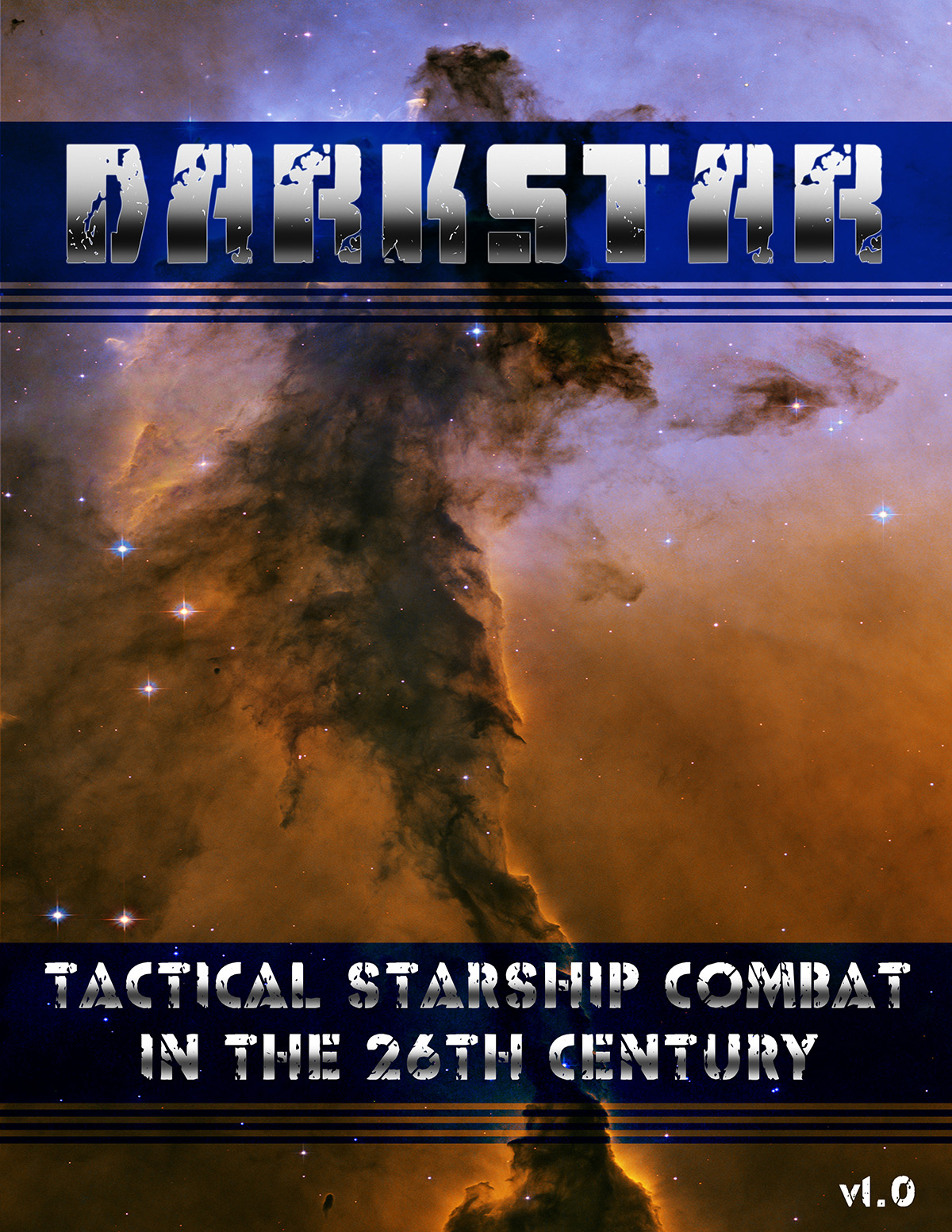
Darkstar Rules & "First Wave" Warships to Publish This Weekend!
Both rules and “first wave” warships ware now complete (30 classes in all) – with write-ups and Warship Record Sheets for print & play.
Just converting to .pdf, and of course I want to design a cover. 😀
Backers / Contributors will get access to the rules first, hopefully within the next 24-36 hours. If all goes well, look for an e-mail soon!
And woo-hoo! Over 2000 recommendations!
Proofreading 50% complete, Ground Broken on "First Wave" starships
Good afternoon, everyone.
Okay proofreading (formatting, tweaks, cross-indexing, etc) on the Darkstar rules is 50% complete. I also want to add copies of the turn sequence and the Quick Reference Sheet. I won’t add a table of contents as again, this will be eventually stitched together into a full Darkstar reference book of well over 200-250 pages, and for that I will have a complete ToC.
Also, I’ve broken ground on the ships that will be included for “Wave One” release. The list of classes is finalized, now it’s just a lot of formatting and proofreading, etc.
The rules will be done by Christmas.
The ships I hope to have complete by New Years.
So the combined rules and ships .pdf may not arrive until New Years.
Just to keep everyone up to date. 😀
Rules - First Draft . . . D.O.N.E.
Just a very fast update – The Darkstar rules, at least in their first draft, are done.
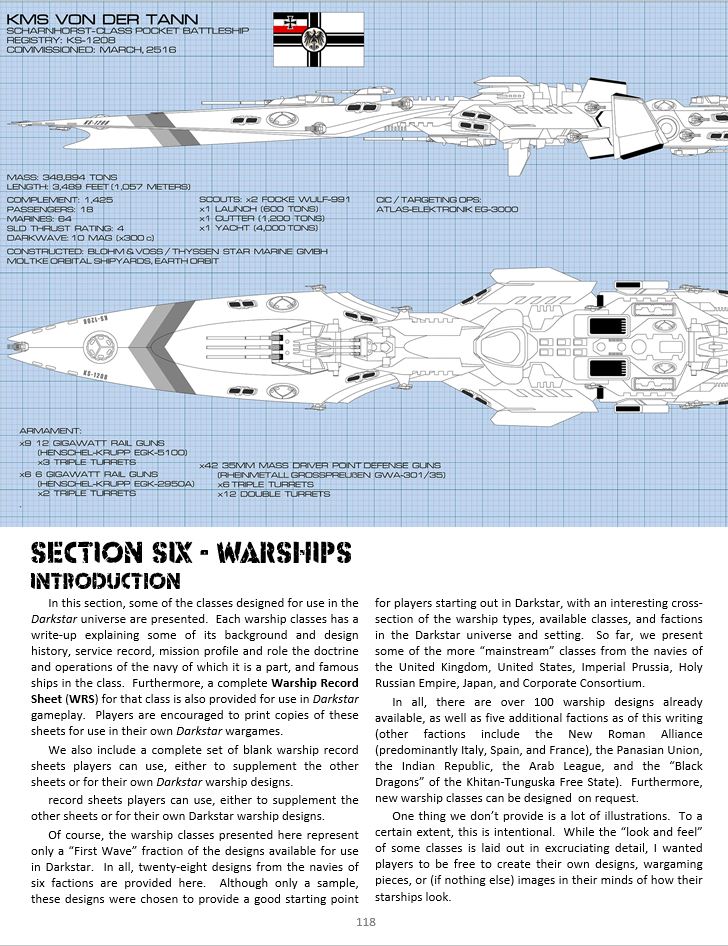
60 pages – and that doesn’t include the 28 warship designs (six factions) I’ll be rolling out with the “first release.”
Of course, I’ll want to breeze through these at lest once for proofing, formatting, cross-indexing, and clarity tweaks.
Again, the goal here is to get a combined .pdf (this will be over 100 pages) put together before Christmas (??) or at least the New Year. And again, it will still be something of a draft, definitely a “living document” that may be updated later for corrections if nothing else.
There’s light at the end of the tunnel!
Update … added Designer’s Notes … make that 64 pages, plus (28 x 2 = 56) pages of warship record sheets and write ups = 120 pages + 7 pages of blank records sheets for players to use = 127 total pages …
New "Aerospace Guard" Warships: Clarino Class
Good morning Beasts on War / OTT:
I’m happy to roll out a new warship class requested by another Darkstar contributor, who had the honestly fantastic idea of including references to the United States Coast Guard as well as the US Navy the future American “navies” of the Darkstar universe.
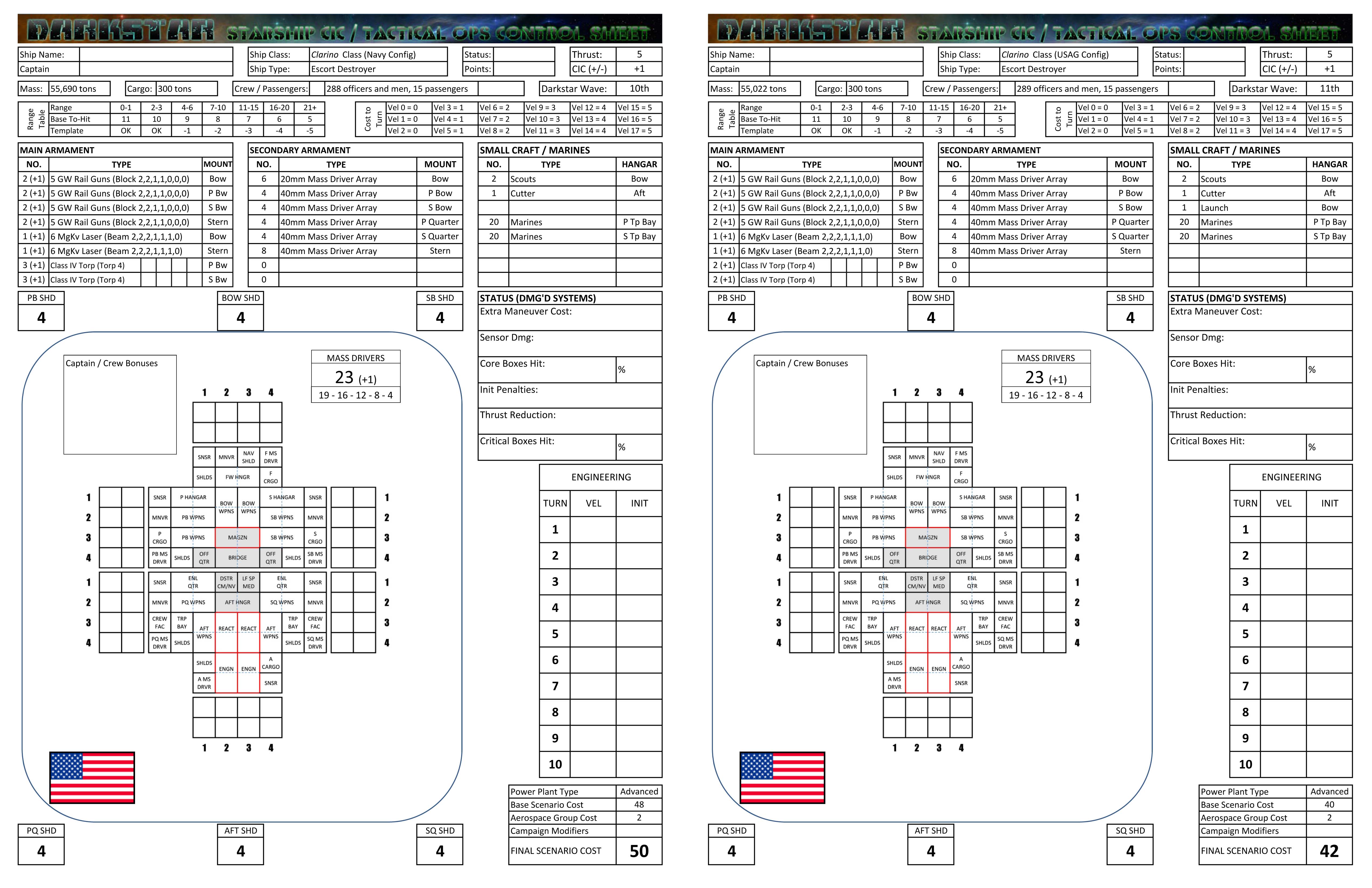
So this class actually has two variants, one for the United States Aerospace Guard (spiritual descendants of the US Coast Guard) and one for the Navy.
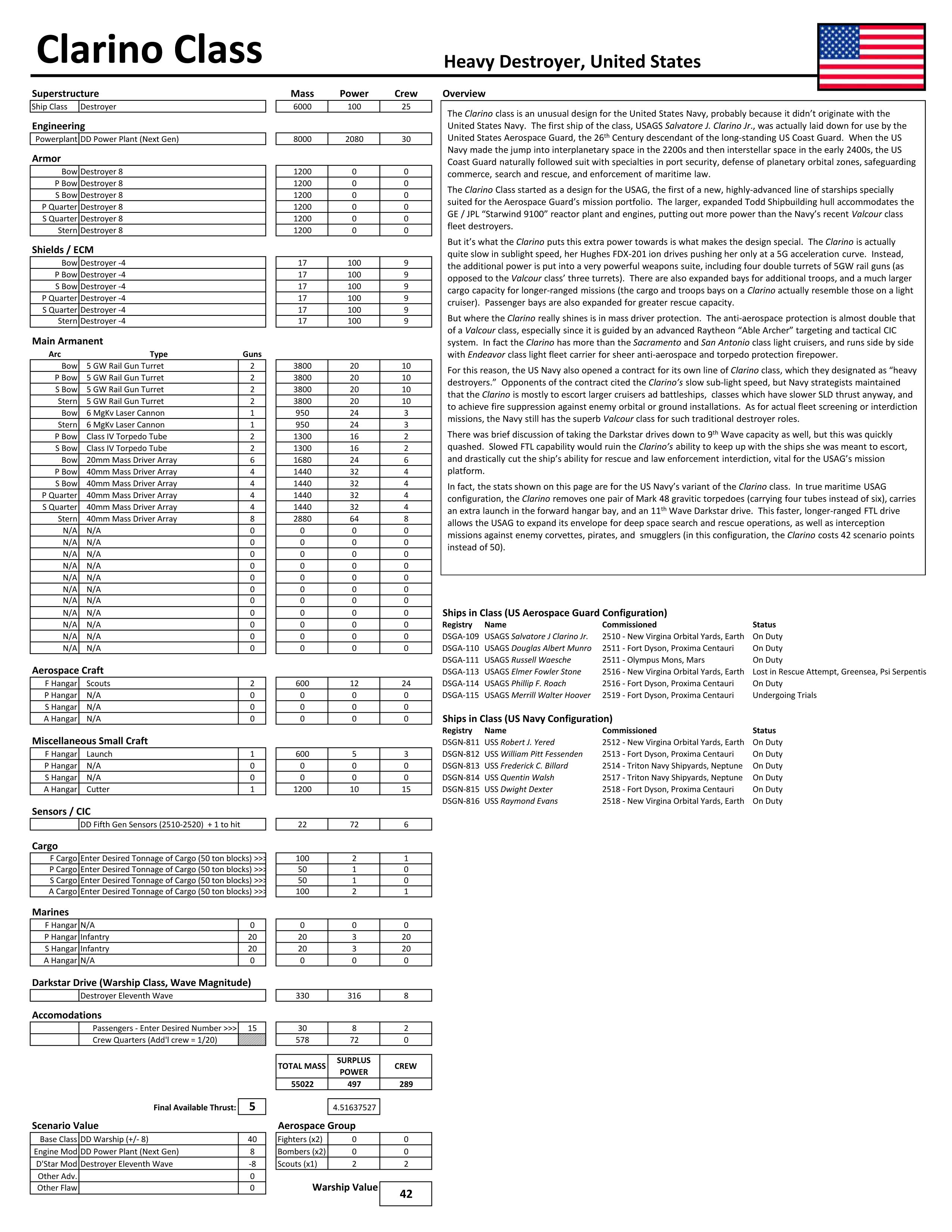
The Clarino class is an unusual design for the United States Navy, probably because it didn’t originate with the United States Navy. The first ship of the class, USAGS Salvatore J. Clarino Jr., was actually laid down for use by the United States Aerospace Guard, the 26th Century descendant of the long-standing US Coast Guard. When the US Navy made the jump into interplanetary space in the 2200s and then interstellar space in the early 2400s, the US Coast Guard naturally followed suit with specialties in port security, defense of planetary orbital zones, safeguarding commerce, search and rescue, and enforcement of maritime law.
The Clarino Class started as a design for the USAG, the first of a new, highly-advanced line of starships specially suited for the Aerospace Guard’s mission portfolio. The larger, expanded Todd Shipbuilding hull accommodates the GE / JPL “Starwind 9100” reactor plant and engines, putting out more power than the Navy’s recent Valcour class fleet destroyers.
But it’s what the Clarino puts this extra power towards is what makes the design special. The Clarino is actually quite slow in sublight speed, her Hughes FDX-201 ion drives pushing her only at a 5G acceleration curve. Instead, the additional power is put into a very powerful weapons suite, including four double turrets of 5GW rail guns (as opposed to the Valcour class’ three turrets). There are also expanded bays for additional troops, and a much larger cargo capacity for longer-ranged missions (the cargo and troops bays on a Clarino actually resemble those on a light cruiser). Passenger bays are also expanded for greater rescue capacity.
But where the Clarino really shines is in mass driver protection. The anti-aerospace protection is almost double that of a Valcour class, especially since it is guided by an advanced Raytheon “Able Archer” targeting and tactical CIC system. In fact the Clarino has more than the Sacramento and San Antonio class light cruisers, and runs side by side with Endeavor class light fleet carrier for sheer anti-aerospace and torpedo protection firepower.
For this reason, the US Navy also opened a contract for its own line of Clarino class, which they designated as “heavy destroyers.” Opponents of the contract cited the Clarino’s slow sub-light speed, but Navy strategists maintained that the Clarino is mostly to escort larger cruisers ad battleships, classes which have slower SLD thrust anyway, and to achieve fire suppression against enemy orbital or ground installations. As for actual fleet screening or interdiction missions, the Navy still has the superb Valcour class for such traditional destroyer roles.
There was brief discussion of taking the Darkstar drives down to 9th Wave capacity as well, but this was quickly quashed. Slowed FTL capability would ruin the Clarino’s ability to keep up with the ships she was meant to escort, and drastically cut the ship’s ability for rescue and law enforcement interdiction, vital for the USAG’s mission platform.
In fact, the stats shown on this page are for the US Navy’s variant of the Clarino class. In true maritime USAG configuration, the Clarino removes one pair of Mark 48 gravitic torpedoes (carrying four tubes instead of six), carries an extra launch in the forward hangar bay, and an 11th Wave Darkstar drive. This faster, longer-ranged FTL drive allows the USAG to expand its envelope for deep space search and rescue operations, as well as interception missions against enemy corvettes, pirates, and smugglers (in this configuration, the Clarino costs 42 scenario points instead of 50).
The Clarinos are large, slow, and expensive, especially for a destroyer-type warship. But the value they bring in safeguarding American flagships, aerospace carriers, or ports is beyond dispute. They’ll never outnumber the Valcours or the older Kinkaids, but they will be a proud staple of the US Navy and US Aerospace Guard for decades to come.
Ships in Class (US Aerospace Guard Configuration)
DSGA-109 / USAGS Salvatore J Clarino Jr. – 2510, New Virgina Orbital Yards, Earth – On Duty
DSGA-110 / USAGS Douglas A. Munro 2511 – Fort Dyson, Proxima Centauri – On Duty
DSGA-111 / USAGS Russell Waesche 2511 – Olympus Mons, Mars – On Duty
DSGA-113 / USAGS Elmer F. Stone 2516 – New Virgina Orbital Yards, Earth – Lost in Rescue Attempt, Greensea, Psi Serpentis
DSGA-114 / USAGS Phillip F. Roach 2516 – Fort Dyson, Proxima Centauri – On Duty
DSGA-115 / USAGS Merrill W. Hoover 2519 – Fort Dyson, Proxima Centauri – Undergoing Trials
Ships in Class (US Navy Configuration)
DSGN-811 / USS Robert J. Yered 2512 – New Virgina Orbital Yards, Earth – On Duty
DSGN-812 / USS William P. Fessenden 2513 – Fort Dyson, Proxima Centauri – On Duty
DSGN-813 / USS Frederick C. Billard 2514 – Triton Navy Shipyards, Neptune – On Duty
DSGN-814 / USS Quentin Walsh 2517 – Triton Navy Shipyards, Neptune – On Duty
DSGN-815 / USS Dwight Dexter 2518 – Fort Dyson, Proxima Centauri – On Duty
DSGN-816 / USS Raymond Evans 2518 – New Virgina Orbital Yards, Earth – On Duty
Thanks so much to our continuing supporters! I’m seriously going to have to think about shutting this donation pool down, I am running out or warship classes in the book. I’m also really trying to focus on getting the book done by Christmas, or New Years at the latest. So if you’d still like to contribute a small amount, I thank you in advance, but I’m probably just going to name a ship for you in one of the existing classes (we can talk about which ones) – or I can write you as a “historical character” in the Darkstar history / canon.
New Royal Navy Battlecruiser: HMS Cross
Good morning, Beasts of War / OTT:
As I continue to thank contributors to the Darkstar contribution pool, we’re adding more and more ships to the “Darkstar canon.” The latest is to fulfill the request of a very generous contributor, enough to have not only a battlecruiser (i.e., a “light” battleship”) class named for him, but his name written into the “legends” of Darkstar history.
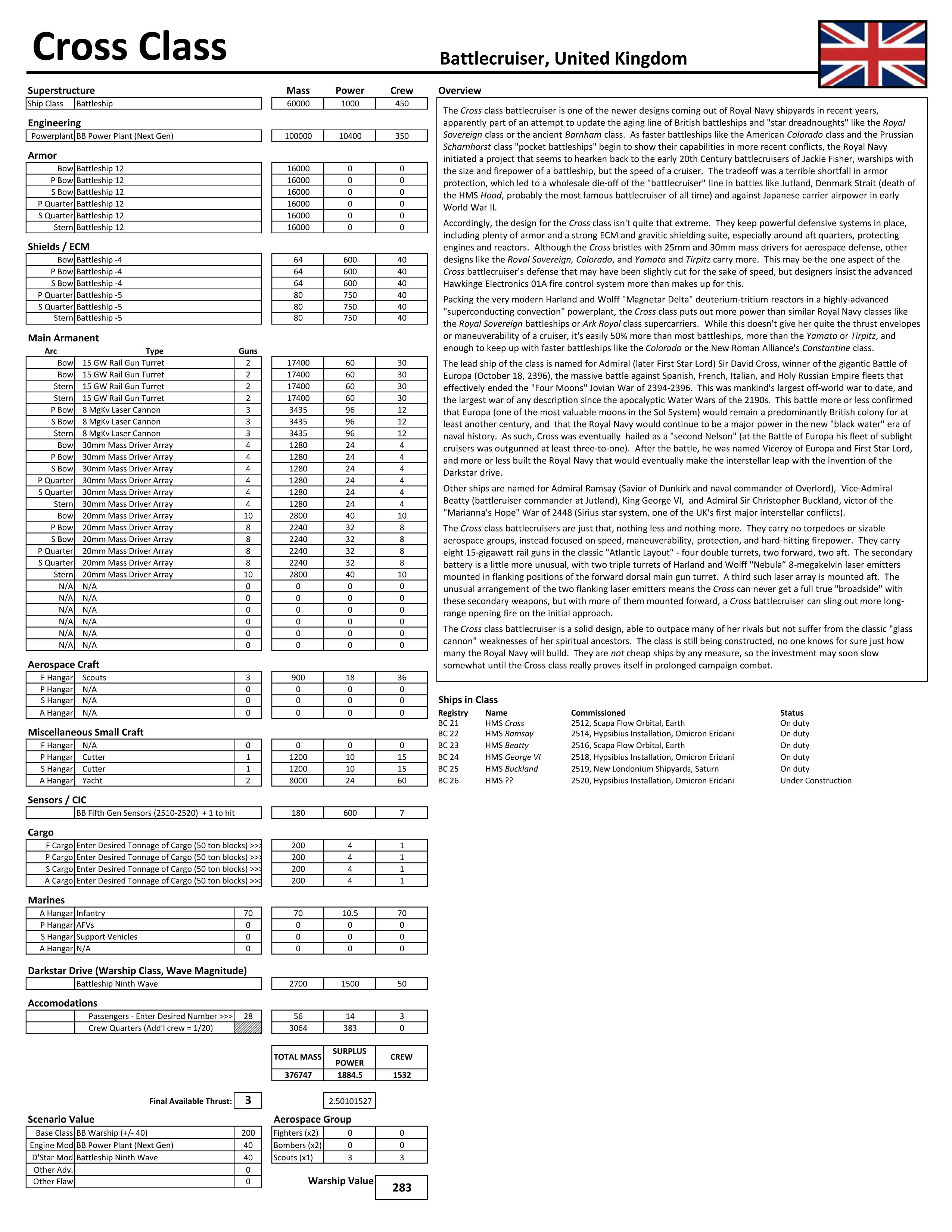
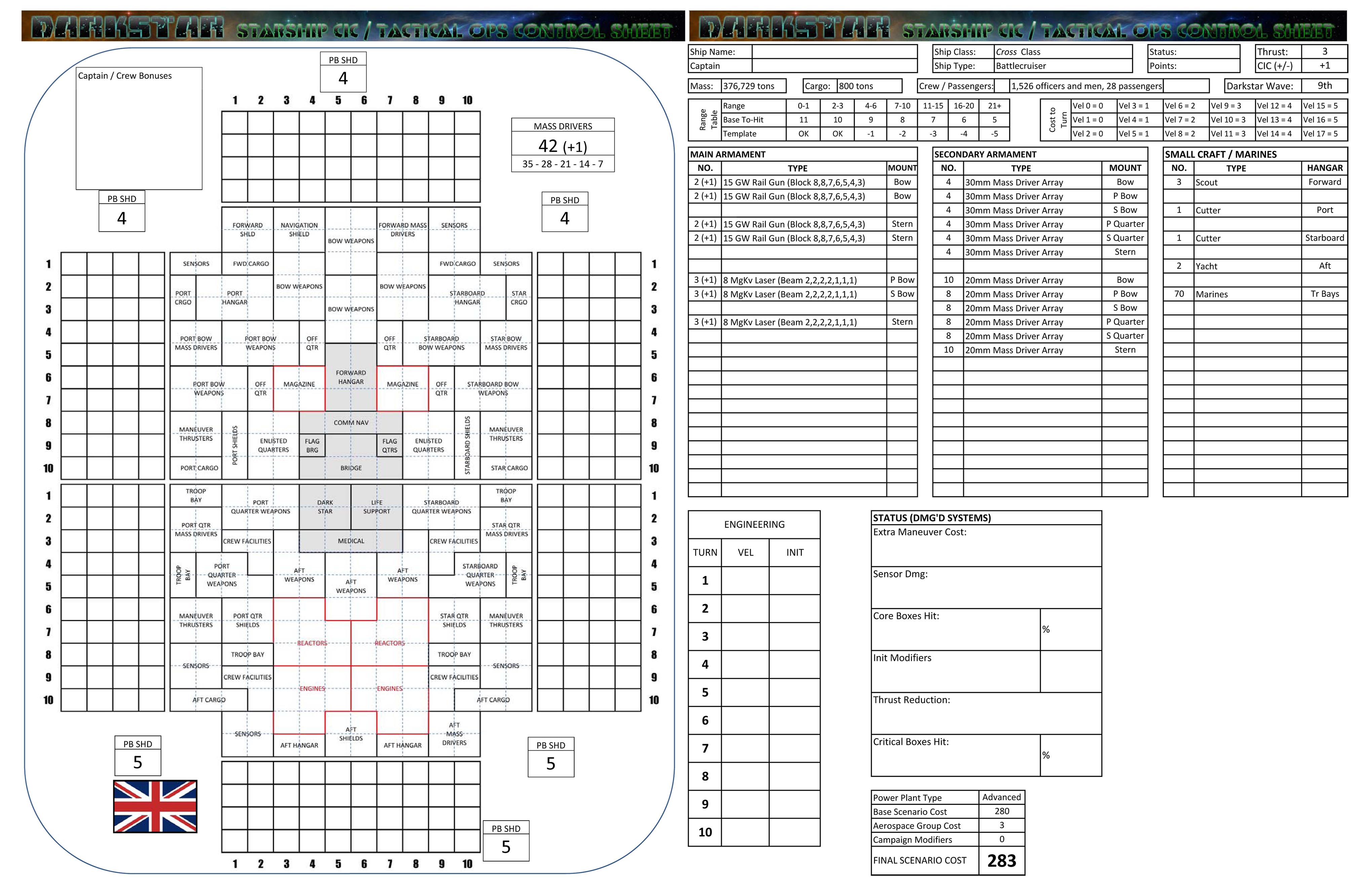
The Cross class battlecruiser is one of the newer designs coming out of Royal Navy shipyards in recent years, apparently part of an attempt to update the aging line of British battleships and “star dreadnoughts” like the Royal Sovereign class or the ancient Barnham class. As faster battleships like the American Colorado class and the Prussian Scharnhorst class “pocket battleships” begin to show their capabilities in more recent conflicts, the Royal Navy initiated a project that seems to hearken back to the early 20th Century battlecruisers of Jackie Fisher, warships with the size and firepower of a battleship, but the speed of a cruiser. The tradeoff was a terrible shortfall in armor protection, which led to a wholesale die-off of the “battlecruiser” line in battles like Jutland, Denmark Strait (death of the HMS Hood, probably the most famous battlecruiser of all time) and against Japanese carrier airpower in early World War II.
Accordingly, the design for the Cross class isn’t quite that extreme. They keep powerful defensive systems in place, including plenty of armor and a strong ECM and gravitic shielding suite, especially around aft quarters, protecting engines and reactors. Although the Cross bristles with 25mm and 30mm mass drivers for aerospace defense, other designs like the Roval Sovereign, Colorado, and Yamato and Tirpitz carry more. This may be the one aspect of the Cross battlecruiser’s defense that may have been slightly cut for the sake of speed, but designers insist the advanced Hawkinge Electronics 01A fire control system more than makes up for this.
Packing the very modern Harland and Wolff “Magnetar Delta” deuterium-tritium reactors in a highly-advanced “superconducting convection” powerplant, the Cross class puts out more power than similar Royal Navy classes like the Royal Sovereign battleships or Ark Royal class supercarriers. While this doesn’t give her quite the thrust envelopes or maneuverability of a cruiser, it’s easily 50% more than most battleships, more than the Yamato or Tirpitz, and enough to keep up with faster battleships like the Colorado or the New Roman Alliance’s Constantine class.
The lead ship of the class is named for Admiral (later First Star Lord) Sir David Cross, winner of the gigantic Battle of Europa (October 18, 2396), the massive battle against Spanish, French, Italian, and Holy Russian Empire fleets that effectively ended the “Four Moons” Jovian War of 2394-2396. This was mankind’s largest off-world war to date, and the largest war of any description since the apocalyptic Water Wars of the 2190s. This battle more or less confirmed that Europa (one of the most valuable moons in the Sol System) would remain a predominantly British colony for at least another century, and that the Royal Navy would continue to be a major power in the new “black water” era of naval history. As such, Cross was eventually hailed as a “second Nelson” (at the Battle of Europa his fleet of sublight cruisers was outgunned at least three-to-one). After the battle, he was named Viceroy of Europa and First Star Lord, and more or less built the Royal Navy that would eventually make the interstellar leap with the invention of the Darkstar drive.
Other ships are named for Admiral Ramsay (Savior of Dunkirk and naval commander of Overlord), Vice-Admiral Beatty (battleruiser commander at Jutland), King George VI, and Admiral Sir Christopher Buckland, victor of the “Marianna’s Hope” War of 2448 (Sirius star system, one of the UK’s first major interstellar conflicts).
The Cross class battlecruisers are just that, nothing less and nothing more. They carry no torpedoes or sizable aerospace groups, instead focused on speed, maneuverability, protection, and hard-hitting firepower. They carry eight 15-gigawatt rail guns in the classic “Atlantic Layout” – four double turrets, two forward, two aft. The secondary battery is a little more unusual, with two triple turrets of Harland and Wolff “Nebula” 8-megakelvin laser emitters mounted in flanking positions of the forward dorsal main gun turret. A third such laser array is mounted aft. The unusual arrangement of the two flanking laser emitters means the Cross can never get a full true “broadside” with these secondary weapons, but with more of them mounted forward, a Cross battlecruiser can sling out more long-range opening fire on the initial approach.
The Cross class battlecruiser is a solid design, able to outpace many of her rivals but not suffer from the classic “glass cannon” weaknesses of her spiritual ancestors. The class is still being constructed, no one knows for sure just how many the Royal Navy will build. They are not cheap ships by any measure, so the investment may soon slow somewhat until the Cross class really proves itself in prolonged campaign combat.
Ships in Class
Registry Name Commissioned
BC 21 – HMS Cross – 2512, Scapa Flow Orbital, Earth – On Duty
BC 22 – HMS Ramsay – 2514, Hypsibius Installation, Omicron Eridani – On Duty
BC 23 – HMS Beatty – 2516, Scapa Flow Orbital, Earth – On Duty
BC 24 – HMS George VI – 2518, Hypsibius Installation, Omicron Eridani – On Duty
BC 25 – HMS Buckland – 2519, New Londonium Shipyards, Saturn – On Duty
BC 26 – HMS ?? – 2520, Hypsibius Installation, Omicron Eridani – Under Construction
Sunday's Game: Japanese vs. Holy Russian Empire
Setting up for tomorrow’s game with @rasmus, the Imperial Russians are going up against the Japanese for control of these two stations in low orbit of a roughly Mars-sized planet.
It’s a classic tech / speed / accuracy vs. bruising weight match up.
135 points on a side.
No Campaign Advantages / Upgrades.
A high tech Japanese light cruiser + a high tech Japanese destroyer vs. medium tech Russian light cruiser + destroyer + frigate.
Japanese advantages are accuracy, thrust, maneuverability, initiative, and torpedoes.
Russians have slightly tougher shielding, more guns (just not as accurate), many more torpedoes (just don’t hit nearly as often or as hard) and of course were able to afford one extra small ship.
Game time tomorrow at 12:00 Noon EST! We’ll see what happens!
 Overall battle area. Japanese are coming down from the north pole / daylight side of our roughly Mars-size planet (6700 km , 37 hexes diameter). Russians are coming up from the southern pole / night side.
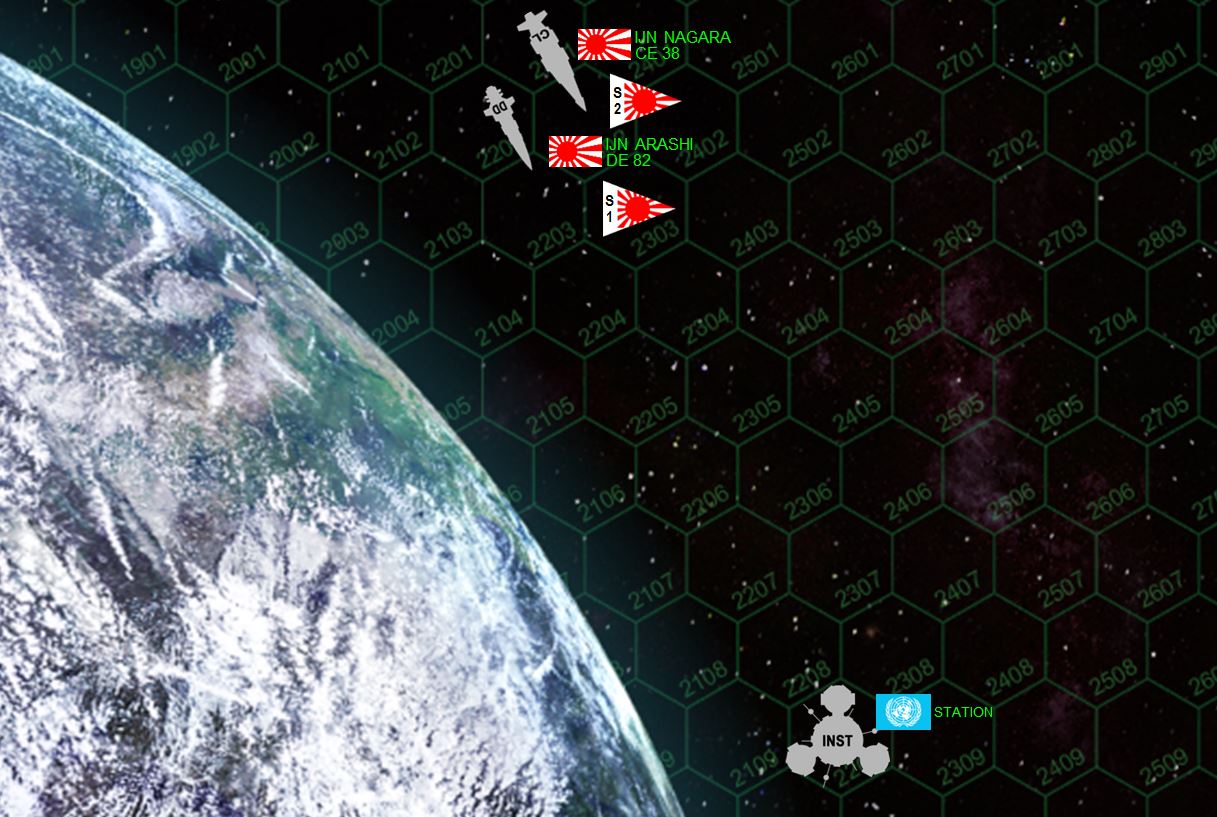 A close up on the Japanese battlegroup. We have the Taiho class light cruiser Nagara and the Takashiro class destroyer Arashi. Both are very fast, bristling with electronics, but also a little fragile.
 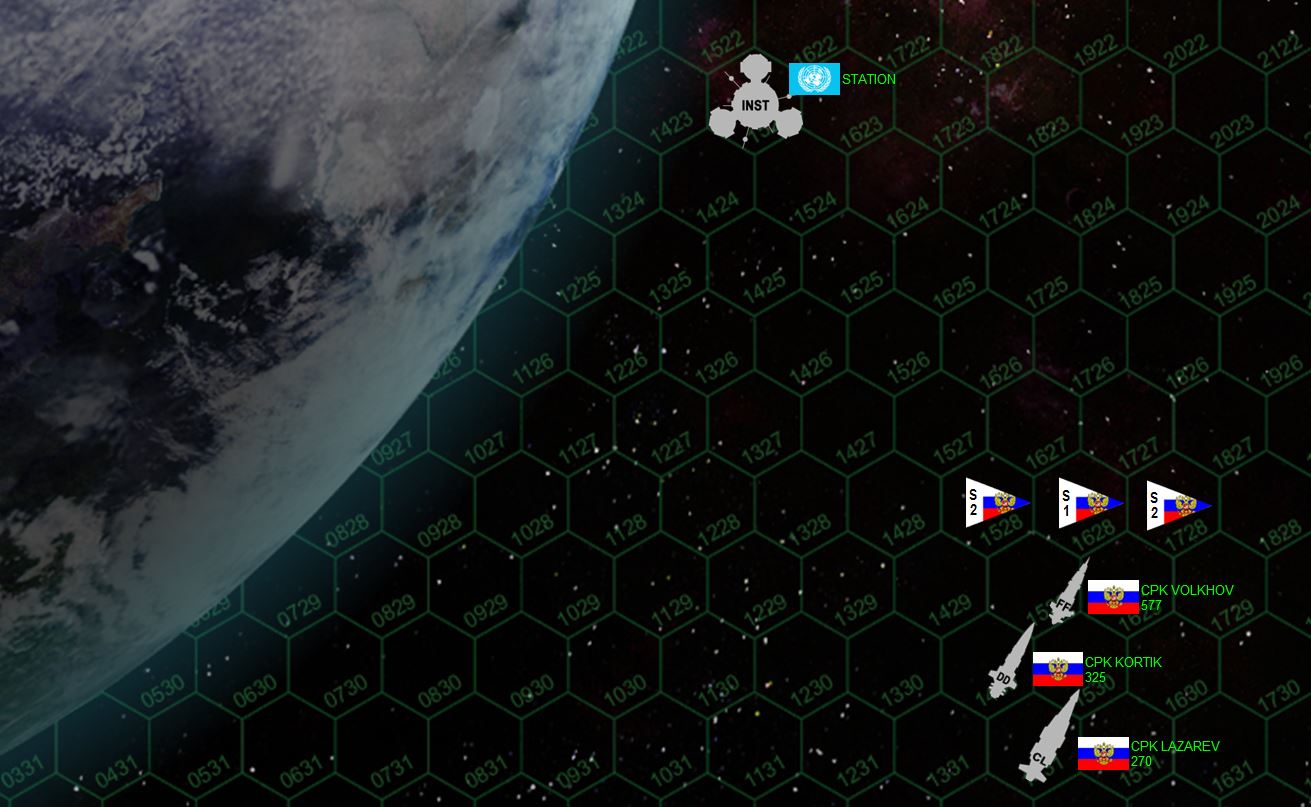 The Russian battlegroup is a lot chunkier. By no leans low tech (actually everything here is "standard") - but they have tougher shielding, more harder-hitting guns (just not as accurate) and more torpedoes (again, just nowhere near as fast, accurate, or hard-hitting as those Japanese Class V ... the Ki-45 "Toryu" (Dragon Slayer) torpedoes.
![StarCraft Tabletop Miniatures Game Pre-Orders Live Now [Updated]](https://images.beastsofwar.com/2026/03/starcraft-tmg-news-cover-600-338.jpg)




![Mounted US Cavalry On Kickstarter For Dead Man’s Hand! [Updated]](https://images.beastsofwar.com/2026/03/us-cavalry-main-600-338.jpg)

![Play WW2 Commando Operations With Butcher & Bolt [Updated]](https://images.beastsofwar.com/2026/03/relaunch-600-338.jpg)