









The Evacuation Of Dunkirk Part Five: Air Operations & Command-Level Games
August 11, 2017 by oriskany


Here we are, at last, Beasts of War, at the conclusion of this week’s explorations into Operation Dynamo, prompted by the movie “Dunkirk” that’s now playing in theatres. Essentially, this was the operation that evacuated 338,000 Allied troops who’d been trapped against the English Channel by the German invasion of France in 1940.
Follow Dunkirk Week Here
So far this week we’ve looked at Dunkirk’s place in the World War II timeline and how this desperate situation came about. We then looked at different ways Dunkirk-themed engagements can be brought to the table in 15mm, 20mm, and 28mm wargames.
Okay, so let’s “zoom out” a little from the foxholes and tank turrets of these miniature games, and take a look at the big picture for Dunkirk. First we’ll look at the crucial role that airpower played for both sides during these evacuations, and then discuss how larger, command-scale games can put you at the Dunkirk general’s table.
The Question Of Airpower
Since World War I, airpower is always been an important part of battlefield operations. In World War II it would become critical, and one of the first episodes that proved what airpower could (and couldn’t) was Operation Dynamo.
So again, German spearheads have pulled off a 200+ mile “left hook” from the Ardennes, through Belgium, and into France, cutting all the way to the English Channel and splitting off about 400,000 British and French troops in a pocket that was being pressed helplessly against the English Channel coast.
The next step for the Germans seems simple: order the panzers (there were PLENTY there) to make one more push and wipe out this pocket. The British had started their “Dynamo” evacuations, but they’d never have time to pull this off, right? Wrong. Because the Germans ordered their panzers to halt, and instead turned to their airpower.
Much ink has been spilled about this controversial “halt order.” Some say it was madness, because if the BEF had been wiped out at Dunkirk than England really WOULD lay defenceless against subsequent German invasion. Others maintain that the panzer spearheads were exhausted and shredded by this point, so they had to pause and regroup.
In any event, Hermann Göring promised Hitler and the generals that his Luftwaffe (air force) could wipe out the British and French at Dunkirk. This seems crazy in hindsight, since we know that airpower NEVER wins a war alone. But recall that airpower was still “new” in 1940, and so far the Luftwaffe had crushed anything it was aimed at.
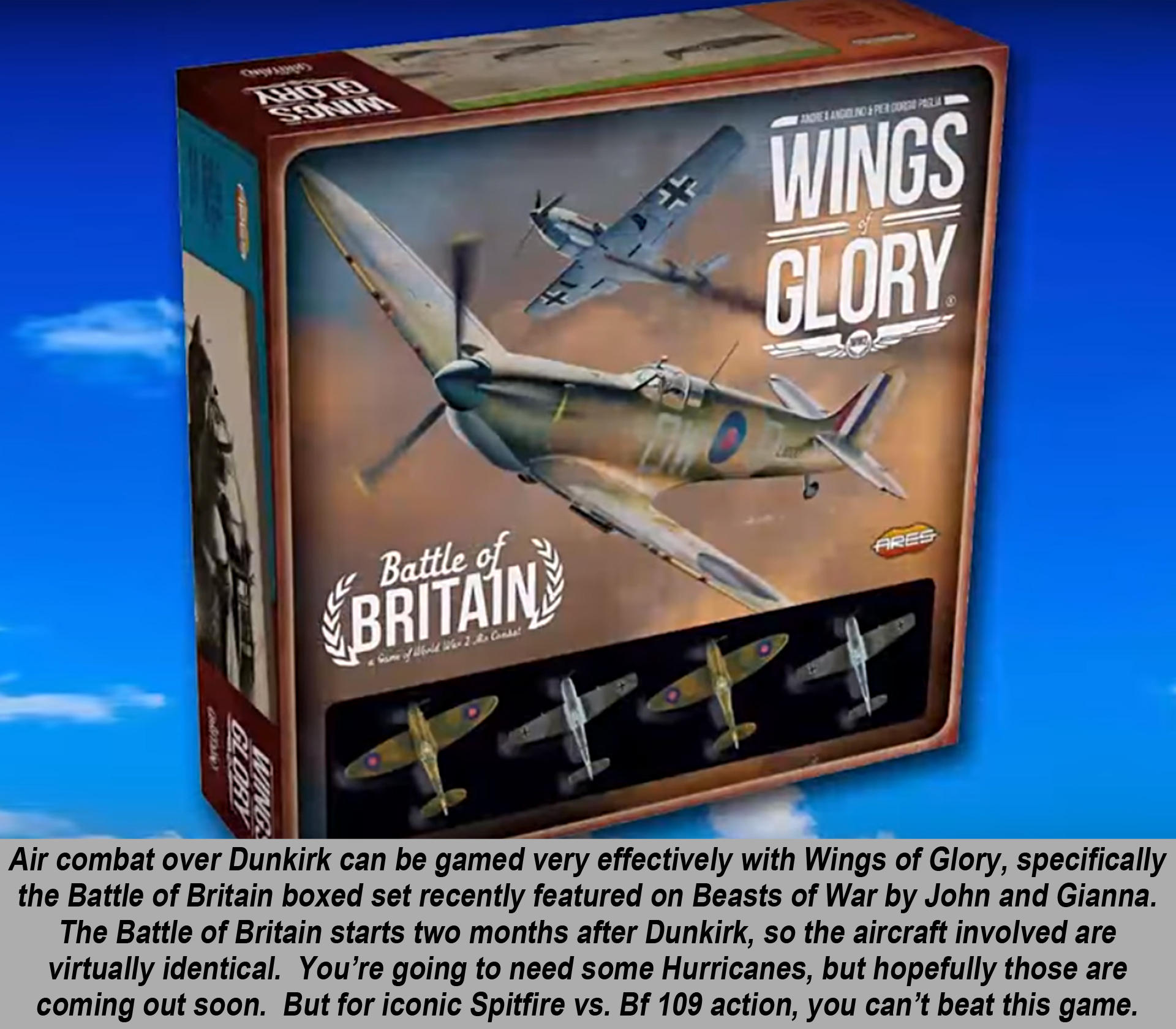
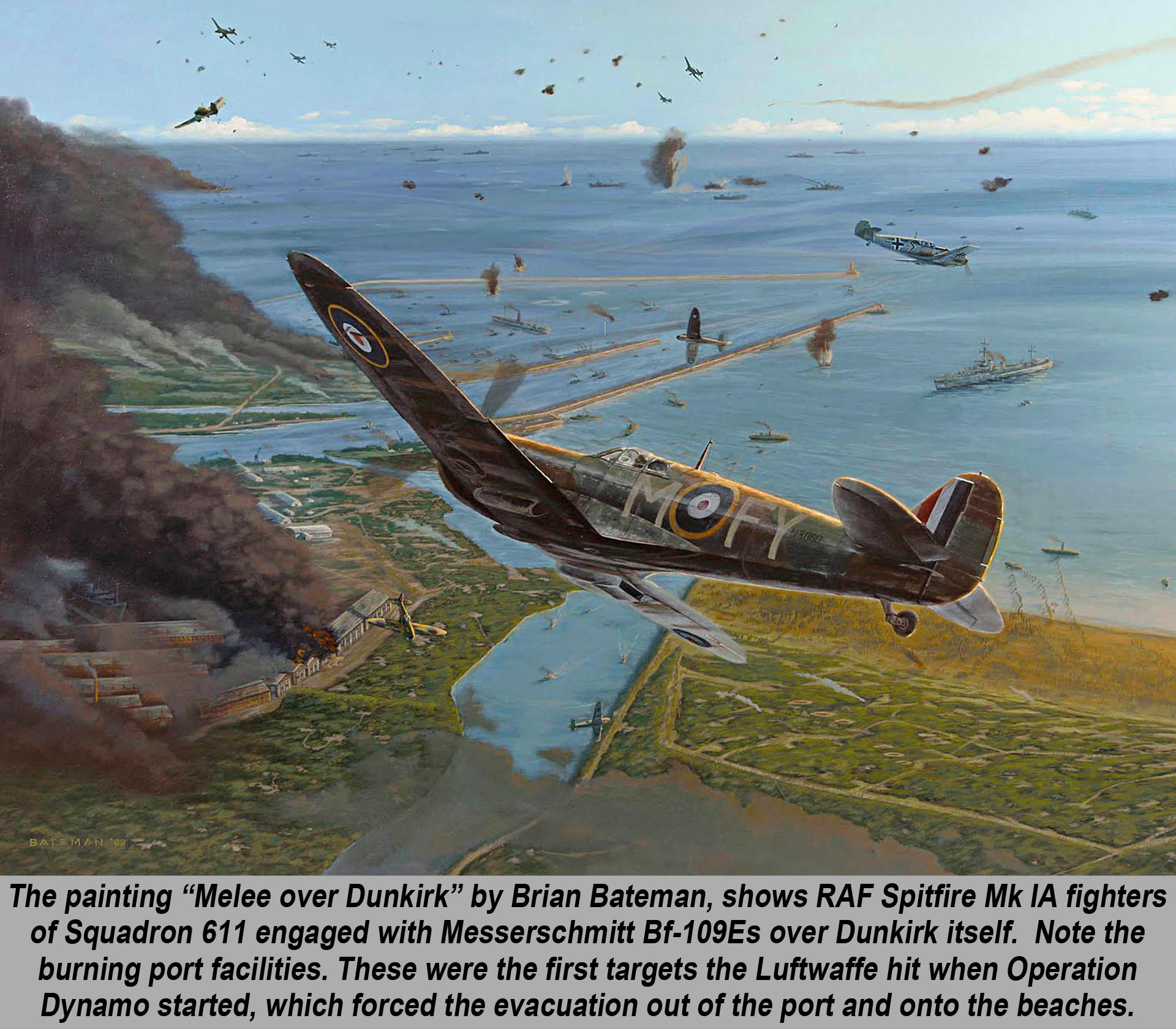
So the British start their evacuation in the last days of May. The German ground forces are (for better or worse) catching their breath and giving the British time to get Dynamo started. The Luftwaffe starts intense bombing of Dunkirk, and the RAF (Royal Air Force) swoops in to the BEF’s defence.
When it comes to airpower, the British had been making their own controversial decisions. Earlier in the campaign, the British had by and large withdrawn all their fighter squadrons, essentially leaving France to her fate. British commanders realized that these precious fighters would be needed very shortly to defend Britain herself.
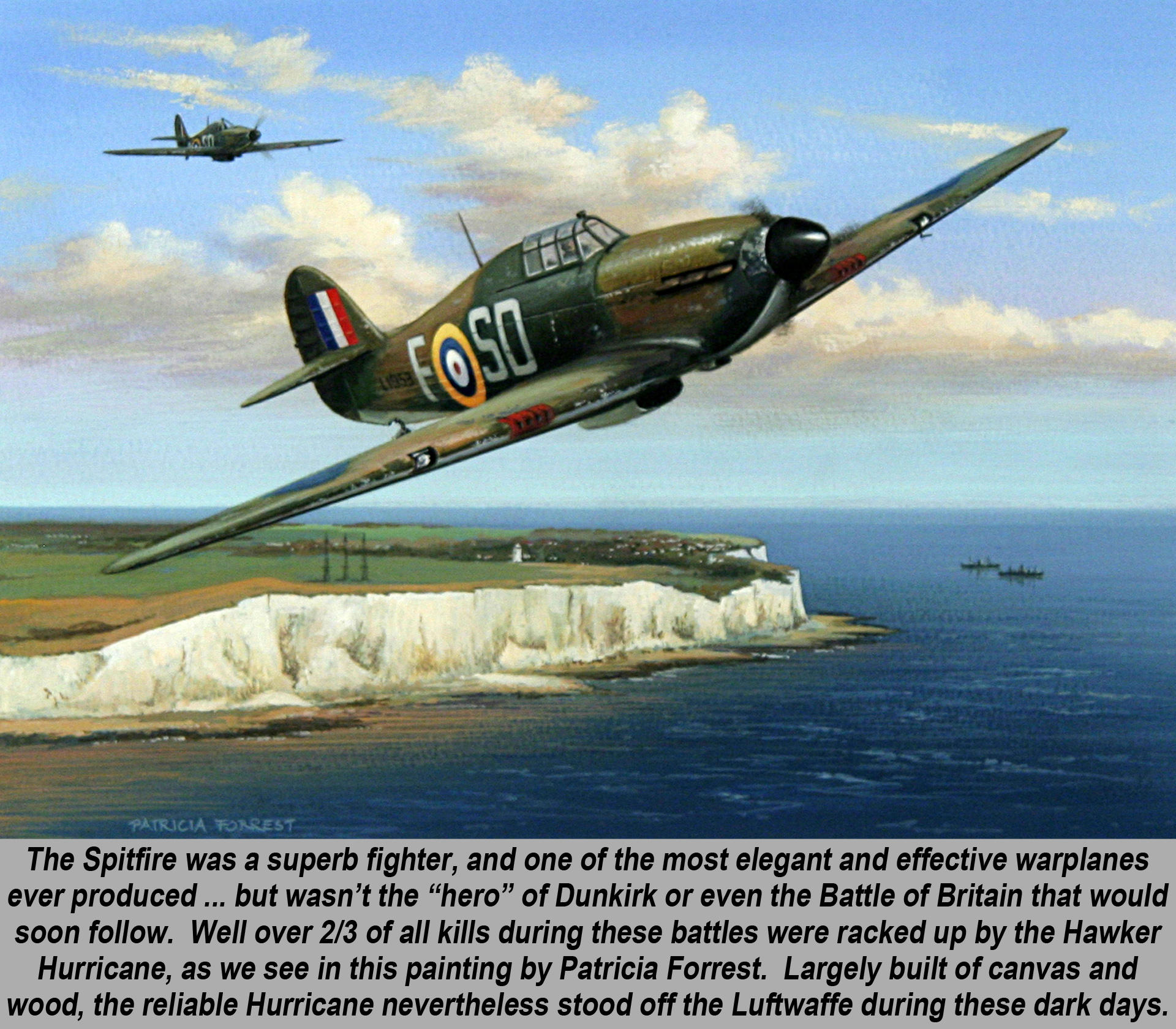
But with the “Dynamo” evacuations under ruthless Luftwaffe bombing and the fate of the BEF in the balance (at this point virtually the whole British Army that wasn’t scattered across the worldwide empire), the RAF was ordered back into the fray and a gigantic air battle erupted over the port and beaches of Dunkirk.
Comparing The Air Fleets
The Battle for France (including Dunkirk) probably sees the German Luftwaffe at the very height of its power (the very next campaign sees it defeated at the Battle of Britain). The Luftwaffe had about 2,400 aircraft at this point broken down into the following major types.
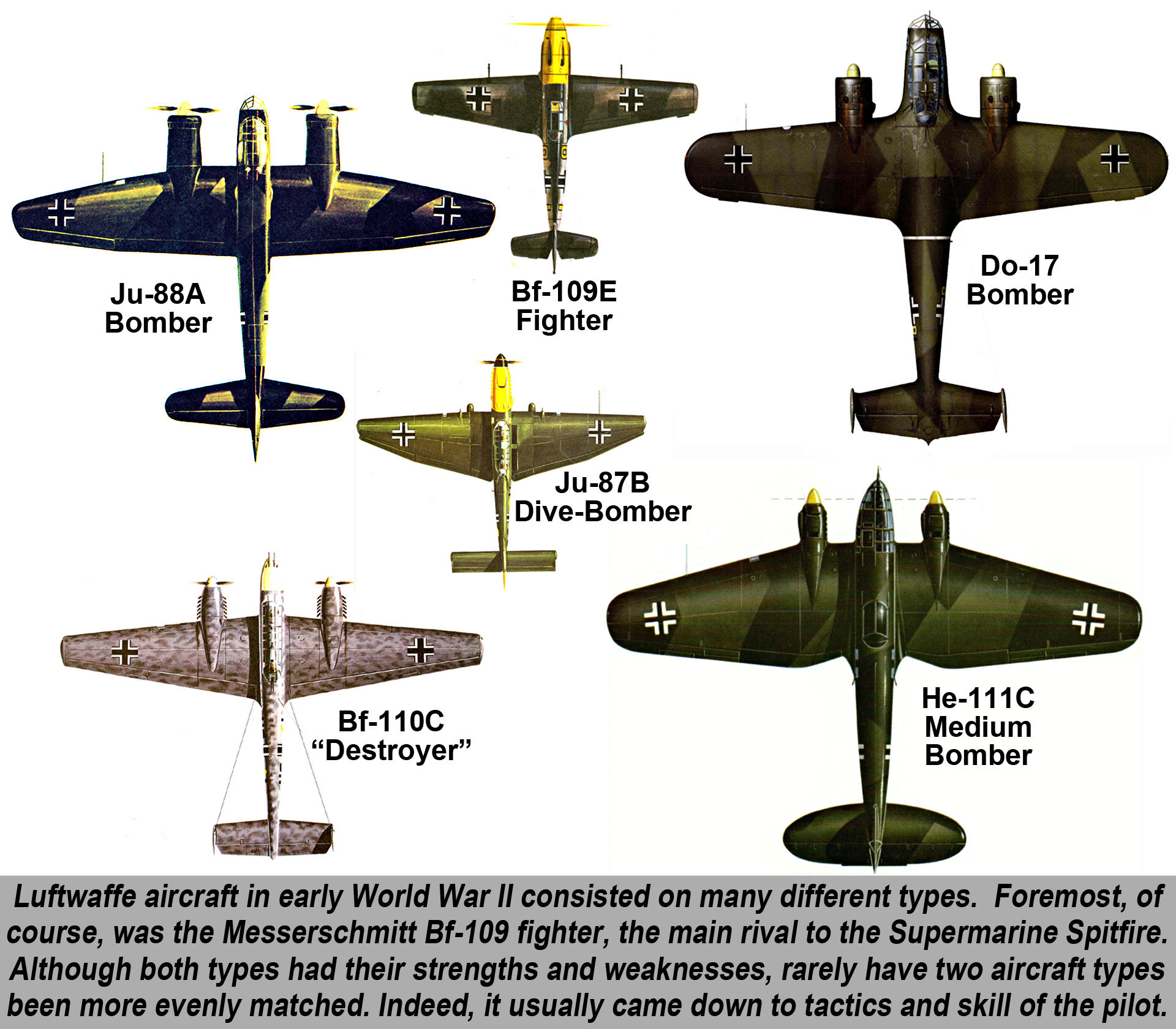
Most importantly we have their mainstay fighter, the Messerschmitt Bf-109 (mostly the “E”) variant. This was an excellent fighter for its day, fast and manoeuvrable, armed with twin 20mm automatic cannons and a pair of 7.92mm FF15 MGs (not unlike the MG34s being used by infantry squads).
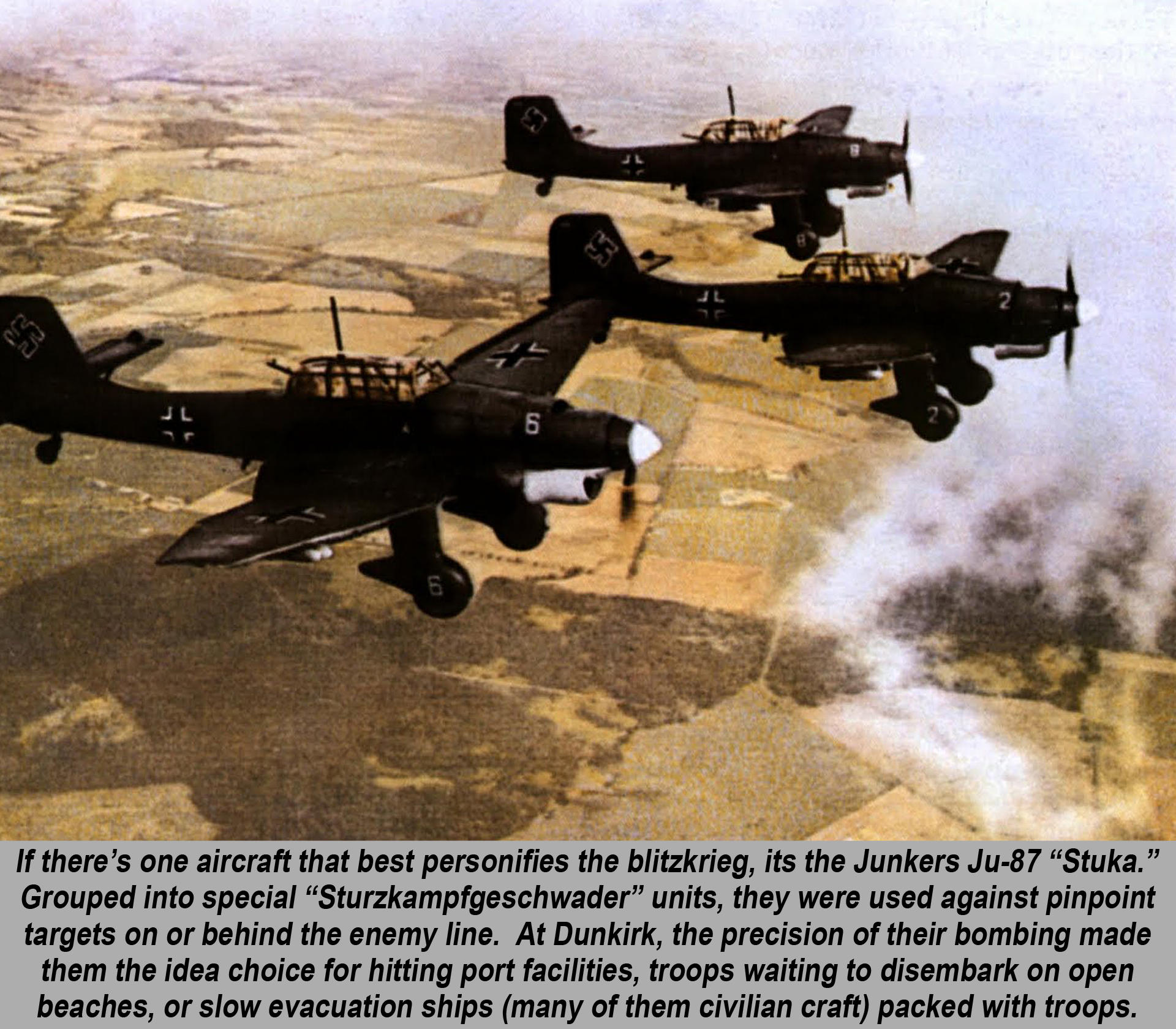
The Germans also have the infamous Junkers Ju-87B “Stuka” dive-bomber, the awful, ugly, shrieking symbol of the Blitzkrieg that terrorized Europe from 1939 to 1941. The Stuka was perfect for precision strikes on ships that were trying to evacuate troops from Dunkirk, but was terribly vulnerable to enemy fighters if not protected by “109s”.
Other German types commonly seen over Dunkirk were the Junkers Ju-88, Dornier Do-17, and He-111C medium bombers. We also see lots of Messerschmitt Bf-110 “Zerstörer (“destroyer”) twin-engine “heavy fighters” – very ponderous in a dogfight but packing a whopping quadruple array of 20mm automatic cannon.
While the British have an oddball collection of bombers in service (this is long before the Lancaster, the Mosquito, the Typhoon or the Tempest), the RAF at this time really comes down to two fighter types: The Hawker Hurricane and the Supermarine Spitfire IA.
The Hawker Hurricane was Britain’s first monoplane fighter, made of stressed metal, wood, and even fabric stretched over a metal frame. Honestly it was nearing the end of its life as a front line fighter by this point, but with eight Browning .303 machine guns, it still packed a fearsome close-range punch.
The plan was to replace the Hurricane with the Spitfire, an aircraft type to become one of the most beautiful and iconic pieces of equipment to come out of World War II. But in early 1940 this replacement wasn’t even close to complete, and the redoubtable Hurricane would still account for the vast majority of RAF squadron strength.
The general doctrine for RAF fighter squadrons at this time was for the Spitfires to tangle with German Bf-109 fighters, thus freeing the slower Hurricanes (who still packed the same firepower as the Spitfire) to go after the Stukas and other German bombers. This way both RAF types were able to leverage their full strengths.
The RAF, however, was hampered by three basic drawbacks at Dunkirk. One, they had to fly across the Channel to engage at Dunkirk, which means they only had about 20 minutes of fuel (at full throttle) with which to dogfight over the actual combat area.
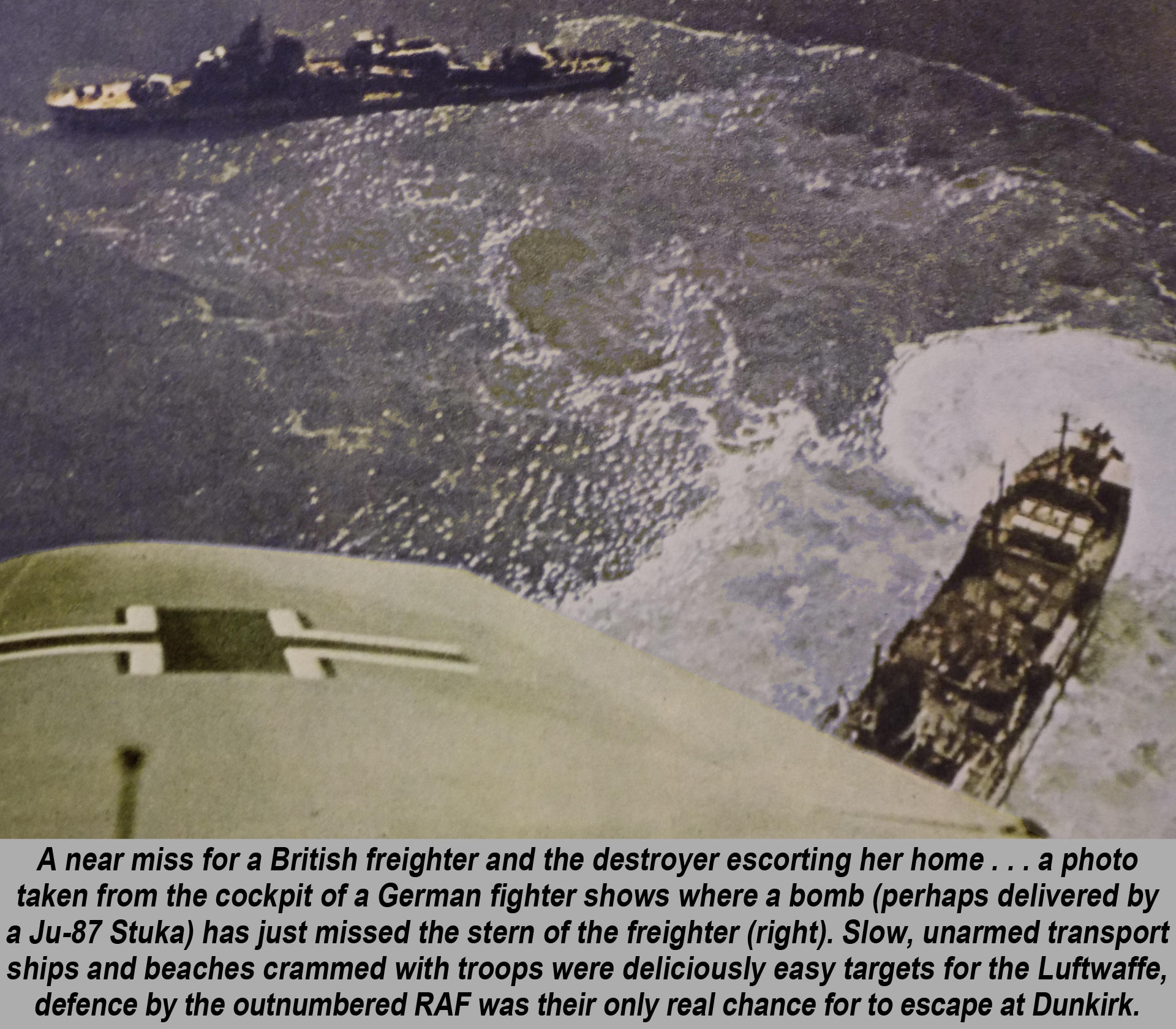
Second, the RAF was still using a tragically antiquated three-plane formation: A leader, a wingman, and a so-called “tail-end Charlie” that was supposed to cover them both. The problem with a three-man fighter formation is that’s someone is always on their own without a wingman, and too often this “tail-end Charlie” was a flying dead man.
Third, the RAF was grossly outnumbered, 4:1 by some estimates.
Yet despite all these disadvantages, the RAF was able to hold the Luftwaffe back to a sufficient degree that Operation Dynamo could get started. By the time the Germans realized the Luftwaffe wouldn’t be able to do the job alone (and ordered their tanks to get moving again), it was largely too late.
Command Level Games
Of course, any of these miniature games, regardless of the scale, are simply too small to stage a battle that will affect the outcome of Operation Dynamo, or even provide a meaningful insight into the context of what was going on. There are some 800,000 men involved in a battle area initially 40 miles across. You gonna do that in 28mm?
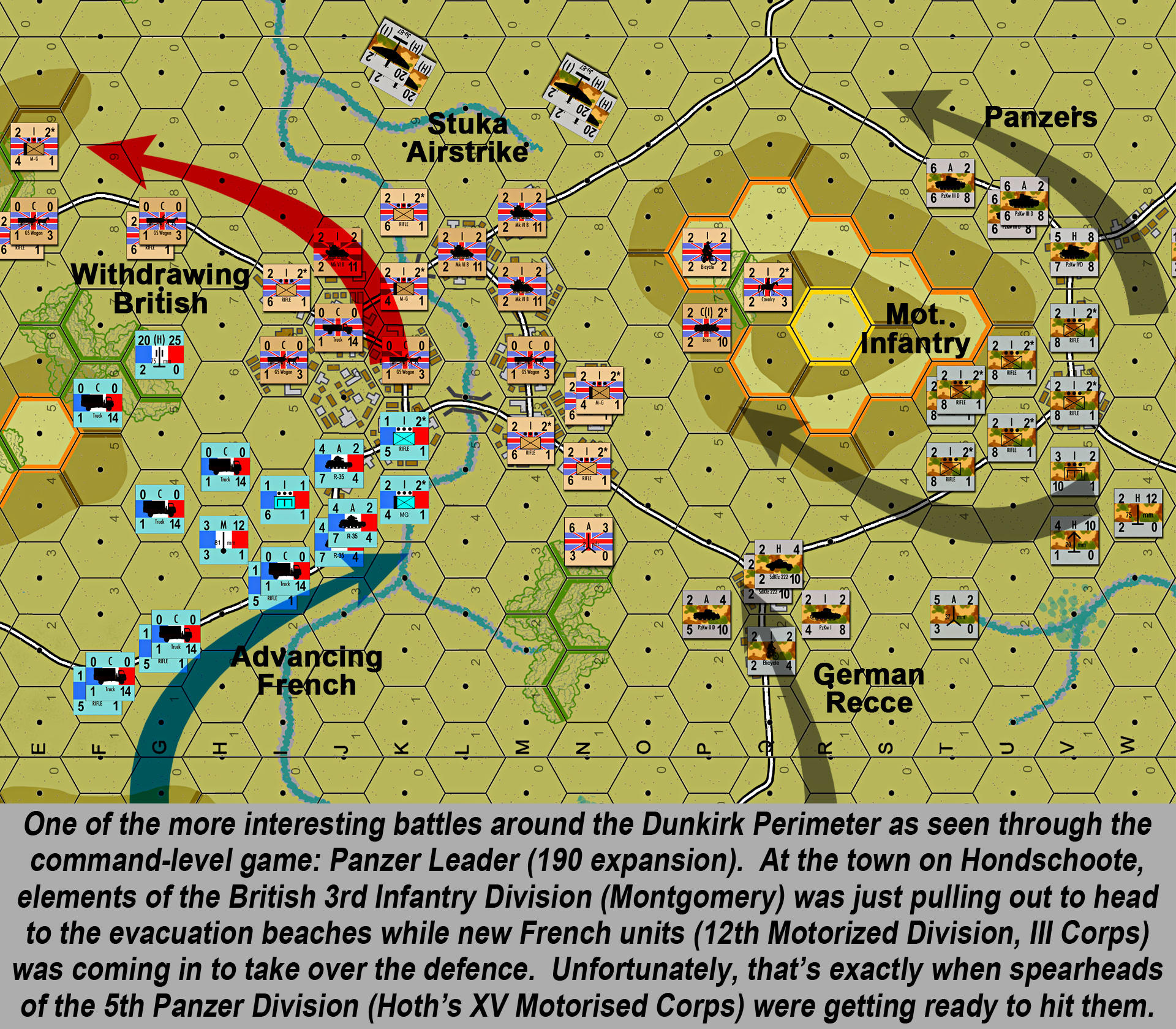
It’s a different kind of game, and it’s frankly not for everyone. But if this kind of perspective interests you, then it’s time to step up to the general’s table and start pushing divisions, corps, and armies around. It’s time for the Command Level game.
White Dog Games’ “A Spoiled Victory: Dunkirk 1940” (Paul Fish, Hermann Luttmann, 2014) is a good place to start, a solitaire operational-level setup where the player tries to “beat the game” and evacuate as many regiments, brigades, and divisions as he can before the Germans implode the Dunkirk Pocket.
Even better is GMT’s “Case Yellow, 1940: The German Blitzkrieg in the West.” GMT makes some of the best operational-level games out there, and with this one you can play the whole campaign in the west as either the Germans or the Allies, and see of a “Dunkirk” situation even happens at all.
Dunkirk: Summary & Aftermath
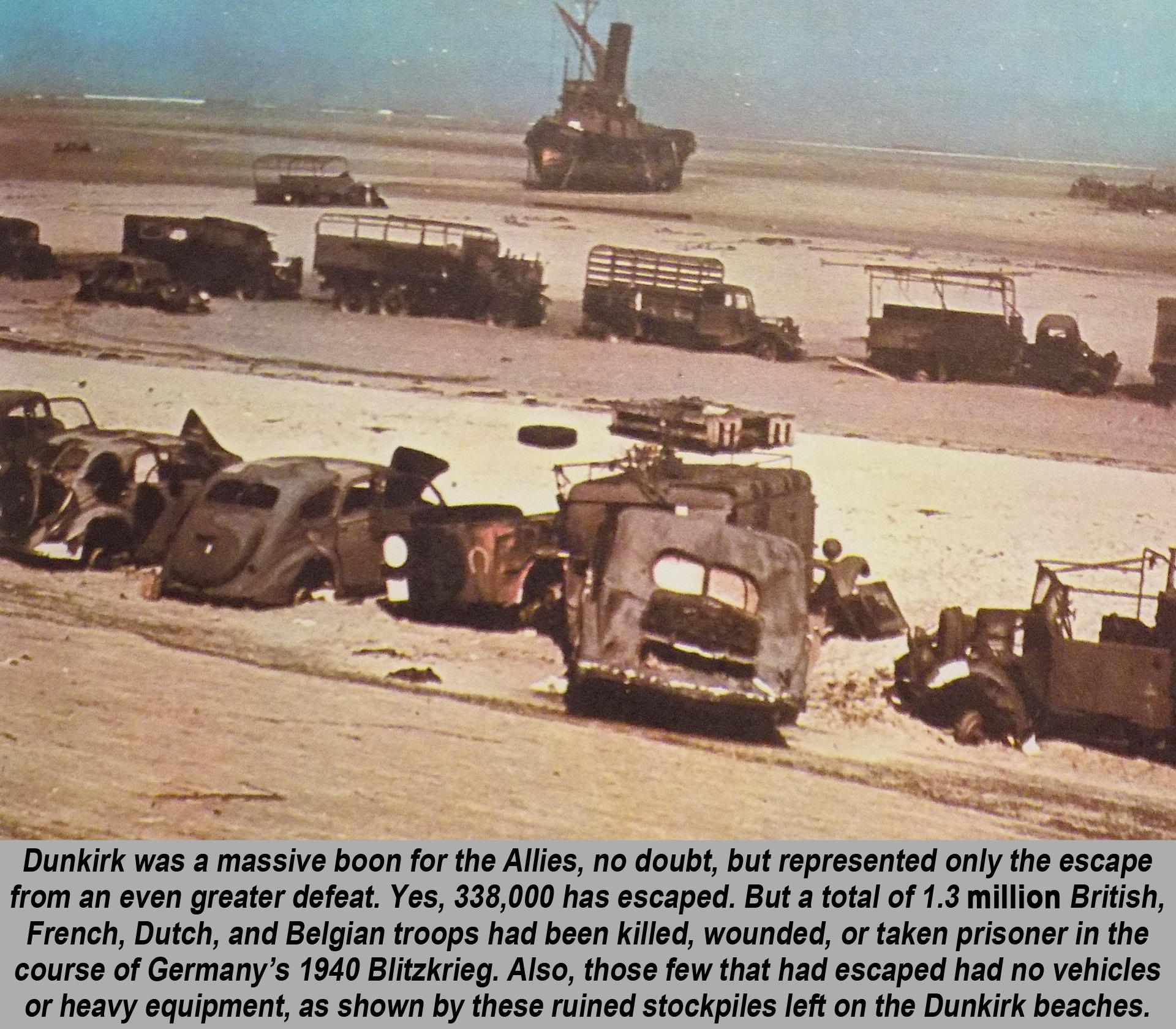
By June 4, Operation Dynamo was drawing to a close. Over 330,000 troops (240,000 British and 98,000 French had been evacuated. Only 35,000 remained to make the final defence (mostly the French 2nd Light Mechanized and 68th Infantry Divisions). Dunkirk was finally taken by the Germans.
What many people don’t realize is that this wasn’t even close to the end of the Battle of France. This was the end of the first phase, “Case Yellow.” Now the Germans pivoted south, reorganized, and launched “Case Red” – the invasion of interior France and the drive on Paris. Here, France would largely fight alone until her final surrender.
Some very small British units were still in France, but this only led to smaller, lesser-known evacuations that would have to be undertaken later in June. These include Operation Cycle (evacuation via Le Havre) and Operation Ariel various western French ports, including Sainte Nazaire).
Sadly for the British, these kinds of sea evacuations were just getting started. Similar evacuations would have to be undertaken from East Africa, Greece, and Crete before the war finally started to turn. But Dunkirk was a miracle nonetheless, a daring and complex operation that HAD to succeed if Britain hoped to continue the fight.
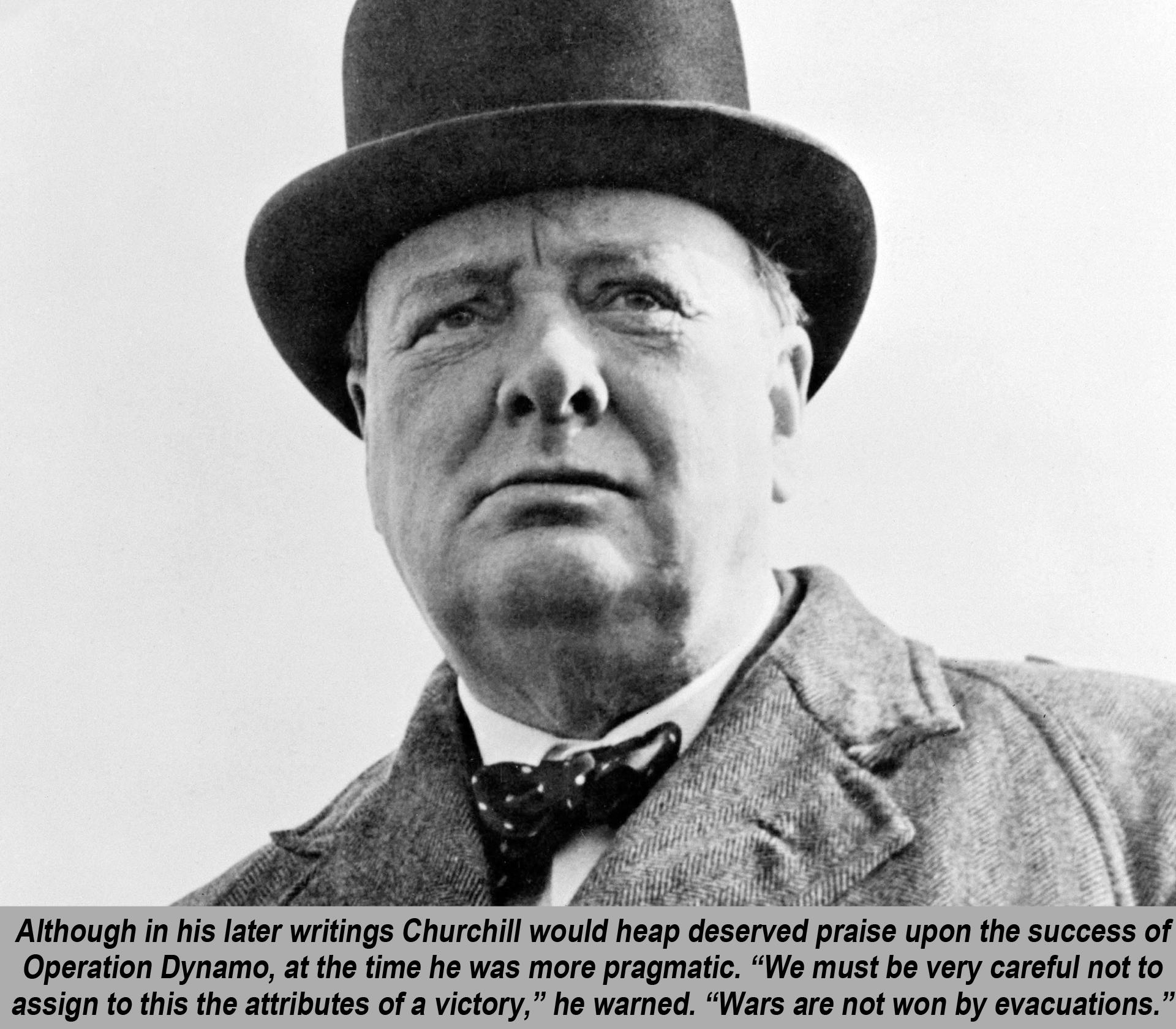
The troops who were rescued were understandably relieved. The people also welcomed them home, and Britain was swept by a wave of celebration and thanksgiving. Churchill was quick to warn the people, however, not to look at Dunkirk as a “victory.” As he would say: “Wars are not won by evacuations.”
This concludes our look at Dunkirk. If you’ve seen the new movie, tell us what you thought of it in the comments below. Do you plan to bring Dunkirk or its surrounding battles to the table top? What are your thoughts on wargaming in the “Miracle of Dunkirk?”
If you would like to write an article for Beasts of War then please contact us at [email protected] for more information!



Well as I was asked directly to comment I think I should. Whilst it sounds like Dunkirk would be a great Naval game given all the ships, I don’t think there is that much in the way of Naval games that would be interesting.
Why well there a number of factors:
1. The German Navy was under prepared going into WW2 they did not have the ability to stand up to the Royal Navy.
2. Whilst the Army had a direct route from Germany to France, this is not the case, all the main German Ports were in the Baltic and they would have to get through the various straights and then past the Royal Navy which had bases in Scotland then sail down to Dunkirk. The Germans had only just overrun Holland and Belgium at this point in the war they had not had time to establish ports on the English Channel from which to operate, in addition Norway did not capitulate to German occupation until the 10th June 1940.
3. As had been stated Dunkirk was left to German Airpower to cover things so those ships and boats that were sunk it was as a result of Air power rather than sea power. You could of course have a game based around getting as many british boats across the table as possible, before they are sunk by the bombes. However to me that is going to make a rather dull game.
So in this case I think the only real alternative is to look at what if’s and focus on Coastal forces rather than large scale naval battles.
Thank you mate 🙂
Oh, sure . . . @warzan comments when its @commodorerob on the thread! 😐
Just kidding, of course. 😀 😀
I have read about U-boat and E-boat encounters during the Dunkirk evacuations, but I have no details in front of me.
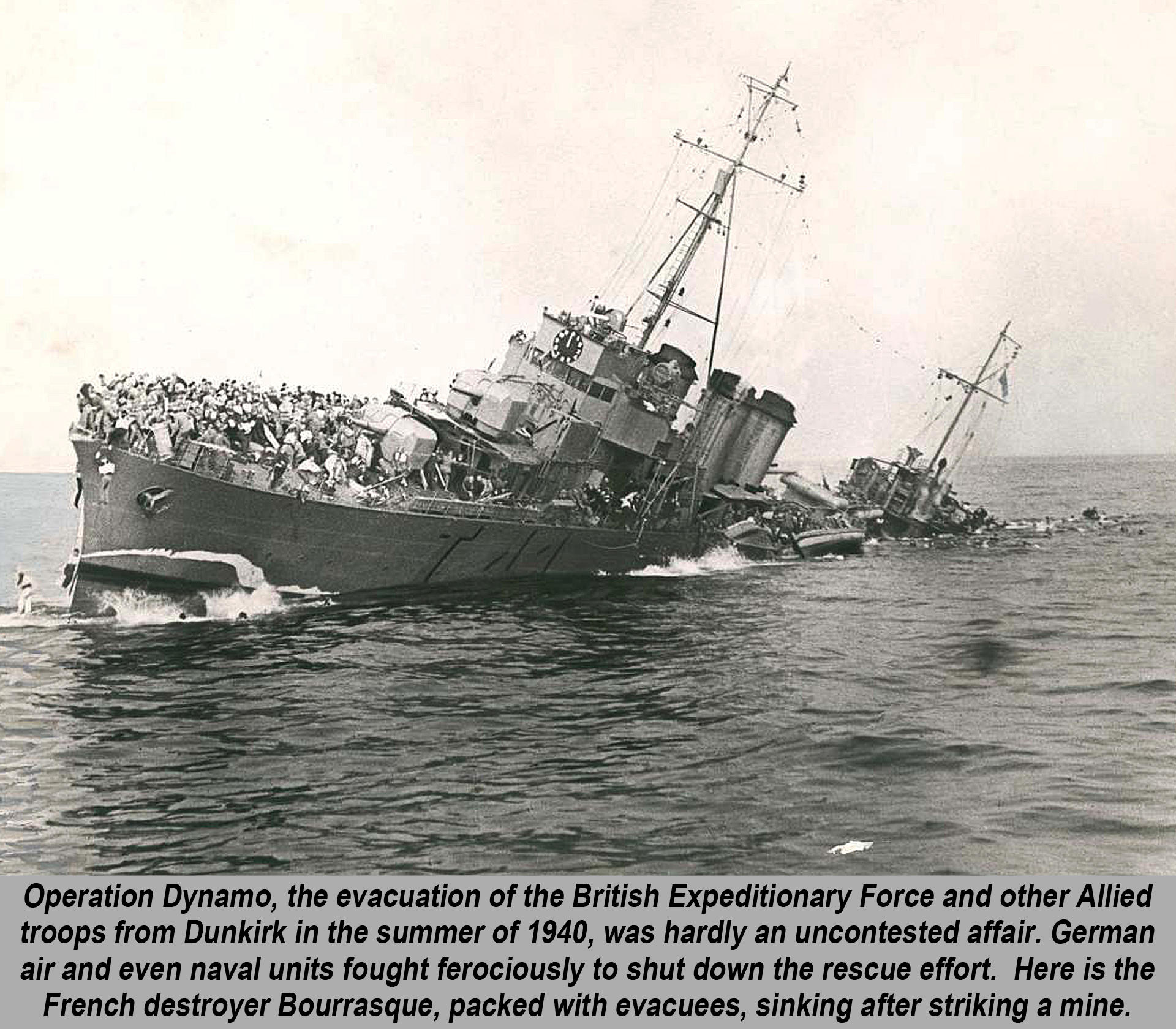
German mines posed a problem, as we see with the French destroyer at the top of the article.
And lastly, here we see that photo with the wrecked trucks all parked in neat rows. I had never known why that was. 😀 Warren told me in Part 1 about the trucks being emergency parked like this to form the foundation of emergency piers. And @avernos was talking about the shallow draft. Look at that abandoned ship run aground there.
Great stuff. Never stop learning!
lol… @oriskany well he did specifically ask me to comment 😉
Seriously though I did think about mentioning UBoats and mines but then in most Naval war games I have played these are incidental factors rather than the focus, so don’t have much experience of basing a game around them.
The E-boats are what I had in mind with regards to coastal forces, I know there were a number of channel engagements that involved E-boats during the war, but my knowledge is sadly lacking as to the Dunkirk period. My interest for WW2 naval gaming is destroyers upwards 🙂
Oh, don’t get me wrong, I totally agree with what you’re saying I was just saying there was some “quasi-naval” action with U-boats, e-boats, and mines Nothing that would make a terribly exciting naval game, though.
Maybe some “what-ifs” like if Scharnhorst of Gneisenau (were they even operational this soon after Norway?) got a little ballsy and tried to interfere with the Dunkirk evacuations. 11-inch shells make pretty pictures when they land in the midst of transport ships packed to the gunnels with troops. 🙁 🙁
@oriskany as you probably know The Scharnhorst and Gneisenau were involved in the Norway campaign and had to return to Wilhemshaven (Sp?) for repairs and did not return to sea till early June, and that was to rejoin the Hipper in Norway.
I guess if you concluded the events in the Baltic quicker and the Scharnhorst, Gneisenau and Hipper managed to sneak down to attack the fleets with their supporting destroyers that could be an interesting game.
Right @commodorerob – this was my question – were the Scharnhorst or Gneisenau even ready after Norway / Weserubung? It didn’t sound right in my head.
But hey, they’s why the call it “what-if”. 😀 And yes, those 11″ shells in the middle of British troop transports make pretty pictures, but not as pretty as 15″ and 16″ shells from say HMS Hood and Rodney landing in the middle of German battlecruisers. 😀
I’m in agreement with @commodorerob and @oriskany on this one too. You’re struggling to get a meaningful naval action out of the Dunkirk evacuation that’s not just RN ships as targets for the Luftwaffe. There are a couple of historical options I can think of but they are not ship to ship actions:
1. MA/SB operation – of the few dedicated coastal forces the British had at this time they used their motor anti submarine boats as high speed taxis for the top brass getting in and out of Dunkirk. This game would play a bit like a WW2 version of Star Wars pod racing with players commanding “Masbys” each with their own objective to pick up/drop off their officer at a particular point finding their way through the wreckage, hidden mine and underwater dangers, luftwaffe air attacks and German (tusken) snipers all at full throttle. Last one home is the loser.
2. Block Ships – one of the last things the British did was to sink block ships in an evacuation port. Often in the face of German fire from the shore. Covering fire was provided by coastal forces that then had the task of taking off the crew of the block ship. As an aside the ports of Zebrugge and Ostend were also blocked at this time, mimicking the more famous operations at the same ports during WW1.
Most naval gamers look to the Norwegian campaign for both their coastal and high seas actions from this period in the war. Here there are lots of actions in the Norwegian Fjords with vessels from small 55′ torpedo boats all the way up to battleships plus opposed naval landings by both the British and French and also the Germans and another naval evacuation by the British and French too, but I digress….
what about rolling three dice for each navel vessel if you get three ones? its hit a mine/torpedo, guys.
maybe, @zorg . 😀
PS Regarding Scharnhorst and Gneisenau around this time; on 9 April there was a short engagement off the Lofoten Islands with the British Battlecruiser Renown, during which Gneisenau was hit 3 times and Scharnhorst sustained serious weather damage necessitating both ships recall to Wilhelmshaven. They didn’t venture out again till 4-9 June when they operated against British ships off the Norwegian coast, on 8th June engaging and sinking the carrier Glorious and her escorting destroyers Ardent and Acasta, though Scharnhorst herself was hit by a British torpedo in the same action and badly damaged. On 20 June Gneisenau was hit by a British torpedo fired from the submarine Clyde and also badly damaged.
Yeah, @broadsword , I tossed out the idea as an alternative history choice, but even as I was writing it I was wondering about the state of these ships after Weserubung. @commodorerob game me the June date. I didn’t know about the battle vs. Renown, though, and most of these other details. Great stuff! 😀 😀 😀
Awesome. Thanks for posting @broadsword and adding more naval perspective. 🙂
Indeed, the “dirty secret” of historical wargaming is that not every historical battle makes a good wargame. Or, in this case, not every PART of a given battle or operation makes for a good game.
We see it here at Dunkirk. Despite the huge naval and maritime effort mounted to rescue these army, there really isn’t much of a naval “battle” here. There are shipping losses – accidents, ships running aground, hit by Stukas, hitting mines, etc. But not really a wargaming friendly “battle.”
I like your shipping race option, though, and definitely the block ships. Hmm . . . crashing a ship into a french port facility, and hopefully get some of those guys off of there . . . sounds like the Ste. Nazaire commando raid project! We’ll get back to that, I promise. There has been some traction on that behind the scenes. First draft of the map is almost done!
I usually look to the Pacific for my WW2 naval action, but I’ve always had half an itch to really get stuck into the Norwegian campaign. At least four nations, the Germans launching the first air-land-sea battle on such a scale, and the Germans NOT ridiculously powerful as they’d be through the rest of 40, 41, and even some of 42.
Really like your stuff, the What Happened and the (What If) you’ve put out. So here’s a funny one.
A quick one and may be a silly one, but I remember some time ago and I’m talking years ago a friend of mine who was well into WWII, may be, as well into it as you, told me this silly story.
Did the Germans one-time, drop wooden bombs on to the beach.
Like I said it’s a funny one. or is it something I’ve made up in my head. lol.
Definitely could be, @nosbigdamus – I haven’t read about it but that certainly doesn’t mean it didn’t happen.
“Dry runs” like this do make a difference in combat. Of course it’s better to he throwing live ordinance, but if none is available right then, these kinds of “dummy attacks” do have a benefit. Wooden bombs could cause British troops on the beach to scatter (they don’t know that bomb is wood when its screaming down on them). That plane is probably drawing AA fire away from another plane that could be carrying real ordinance, etc. British troops re under cover instead of running for the piers, etc.
American dive bombers and torpedo bombers desperately attacked Japanese battleships and heavy cruisers during the Battle of Samar Island, even after they were empty they flew back and “attacked” again. As Japanese warships made evasive maneuvers, this prevented them from driving straight at the American warships, threw off Japanese torpedo spreads, broke up Japanese formations, etc.
A lot of times in war movies you see infantry attacked by tanks, and they’re spraying the tank with MG or rifle rifle. Seems pointless, but it isn’t. If you can keep that crew buttoned up inside their hatches, you take away 75% of their vision and reduce the tank’s effectiveness by 50%.
Don’t forget that awful siren the Stukas used.
I’m not sure how authentic the noise in the movie is, but real bombs or not I’d be running and diving for cover if I heard them …
Oh, it’s authentic, @limburger . That noise was unnerving, and purposefully so. Additionally, there’s the fact that you know there’s a 500-kg bomb behind it . . . and also that people weren’t nearly as used to loud aggressive noises back then. In many parts of the European countryside, the car was relative rarity. Jet planes hadn’t been invented yet. Nowadays we have screaming jets shrieking over us all the time, high speed trains, heavy metal music 😀 , you name it.
I doubt the Stuka would be as effective psychologically today.
Later in the war, one of the things that made the V2 rocket so horrifying was that you DIDN’T hear it coming. The rockets came down supersonic, so by the time the roar of the rocket caught up with the rocket itself, you were already dead.
Thank you, for putting some reality behind something that sounded silly but ends up possible.
😀
Just got caught up on all this. I’ve never been overly interested in Dunkirk, possibly because we had our ass handed to us. Seems the Allies really blundered through WWII up until about ’43.
So it was good to get a fresh perspective, and of course a Panzer Leader board always grabs my attention, regardless of the context! 🙂
Well done @oriskany! 🙂
Thanks, @cpauls1 – and yesm I feel (just personally) that Panzer Leader is just so much more fun in early war. The tanks are nearly as powerful and there are practically no assault guns, so a combined-arms solution with infantry, MG sections, mortars, ATGs, artillery, field guns, all become so much more important.
Also the ranges are so much shorter (PzKpfw IIID has an RF of 2. Not kidding) – that it opens up so much more room for maneuver. You can flank, wheel, charge . . . do that in front of Panthers or Tigers and you get your head taken off. 😀
Glad you liked the article! 😀
I was watching a program today that covered a number of different facts. One caught my attention about a boat that was licenced for 22 people called the Sun Dancer. I missed the captain’s name but he was one of the surviving crew of the Titanic and was in charge of filling some of the life boats. He got a lot of criticism about holding to women and children first and releasing life boats before they were full. The Sun Dancer return to England dangerously over loaded. Redemption?
The infamous halt order. So much has been written and filmed about it. Some raise the point the German Nazi high command were heavily into the occult and they divined it was a bad time to overrun the British at Dunkirk. A cauldron of British witches cast a spell preventing him from capturing the British and crossing the channel. Hitler mistook the Panzer breakdown figures for kills and panicked. Hitler let the British go to sweeten the Hess peace mission. So it all has the science of pin the tail on the donkey. So I will go with that it was because Mrs Brown’s cat had not had kittens and that there was a nesting population of endangered ducks on the final canal so the Germans were not allowed to cross it. 😉
The Vick formation while looking good at air shows was too tight so the pilots had to spend too much time avoiding collisions. So in combat the Vick formation was often taken by surprise.
The Me-109, Hurricane and Spitfire each used very different wing designs each with its plus and minuses. Between 12k to 18k feet the Hurricane could out turn the other two. The Spitfire developed a very slow roll rate under 10k feet and could be out turned by the other two. The Me-109 was a goony bird meaning the wing tips moved up and down by plus or minus 3 feet as if the wings were flapping like a bird to fly so many of its pilot were afraid to push it in a very tight turn fasting the wings would break off. The C-47 was another famous goony bird with a plus or minus 6 feet of wing flap. The basic idea is the wing takes on a better shape in the turn.
The Spitfire is not at its best either. The ones used over France did not have variable pitch propeller blade, so it’s climb rate was not that good. By the time of the Battle of Britain they would be all upgraded to variable pitch propellers. Prior to the Battle of Britain used standard petrol which is around 86 octane and as the Battle of Britain began Britain started getting 100 octane petrol from the US. So the improved performance of the Spitfire came as a shock given their performance over France. The Hurricane with its tight gun configuration actually hit hard than the Spitfire. The Hurricane came from evolution while the Spitfire was the result of revolution.
There is a number of rules available for 15mm where 1 tank equals a platoon of tanks. So for those who may not like map and counters could use the models they already have to game on a similar scale. You could use your current rules using one tank to represent a platoon in a pinch. One or two buildings would represent a large village etc.
Quite a different article format from your normal articles @oriskany. I quite like the new format for a week of something. It allows the delivery of timely subject such as anniversaries. Perhaps the following week could be the gaming hobby thread.
The addition of multimedia was a great addition and thanks to those who made it happen.
Greatest thanks goes to you @oriskany for entertaining us with another informative article series.
😀 😀 😀 😀
Thanks, @jamesevans140 –
One caught my attention about a boat that was licensed for 22 people called the Sun Dancer.
In the course of my research I ran across an article about the Massey Shaw – a London fireboat that was used at Dunkirk, then was about to be scrapped more recently until a group of people raised some money and spent something like six years restoring her to original condition. 😀
The infamous halt order.
Oh God, here we go. 😀 Man, that whole “German high command was influenced by astrology and the occult” is such a gigantic myth it’s almost not worth popping. I don’t usually squawk about it too much because it fuels a lot of the “Weird War” fluff you see in PHPW genre. 😀
Hitler mistook the Panzer breakdown figures for kills and panicked.
Now that DID happen, as discussed in the interview.
The Vick formation while looking good at air shows was too tight so the pilots had to spend too much time avoiding collisions. So in combat the Vick formation was often taken by surprise.
Another issue is that while the tail end charlie was covering the leader and wingman, who was covering the tail end charlie? So he was almost certain to be bounced by Bf-109s.
The Germans had reverted to the four-plane “schwarm” formation, basically a pair of pairs. Halfway through the Battle of Britain the British finally adopted a similar doctrine, and combat losses immediately declined.
The Spitfire is not at its best either.
Absolutely. This is the very first version (Mark 1A), these babies were brand new. This is part of what makes the Spitfire such a great plane in comparison to the Hurricane (near the end of its life) and the Bf-109 (equal at the moment – but already at least 5 years into its development life). So when the Bf109 really gets “old,” the Spitfire is just catching its stride. Thus we see the Germans roll out the Focke-Wulf Bf-190 later in the war, because the Bf-109 design really can’t keep up anymore.
Glad you liked the article and video series!
Command Decision or Test of Battle as it’s now called and Spearhead would be the best two in my opinion
I have seen some threads on Test of Battle (Bob MacKenzie’s work) – amazing stuff, especially for the Eastern Front.
Okay, a few things –
1 – I will not scratch the back of my head during these interviews! Apparently that’s where these annoying audio feedbacks come from. 🙁 🙁 🙁
2 – Apologies for the typo in Image 08. That’s supposed to read: Panzer Leader 1940, not 190.
3 – in the interview, one point I missed regarding that 200-250 mile operational range of a mechanized push … the thing is, when an army moves across enemy country and we see these big arrows slashing across the map, we have to remember that the invader has to CONTROL all that ground behind the spearhead as well.
Often there are follow-on forces, but these don’t arrive until later (being less mobile). In the interim, these spearhead units have to detach holding units, especially along the flanks. This quickly draws off striking power from the spearhead, and eventually the spearhead “runs out of momentum” until some of that tail can be brought up behind the leading elements.
3 – @jamesevans140 – a proper response is coming. 😀
Oh with the halt order thing, I am staying away from UFO’s and contact from other dimensions. I will stick with Mrs Brown’s cat and the ducks. I just can’t believe how much has been written on this order but so very badly researched. Like the Hess thing. What kind of peace gift involves bombing the beaches and sinking ships?
Oh, crap, I forgot about that one. Hitler MEANT to let the British flee so he could sign a peace treaty with them afterwards.
What planet are these people from? 😀
was it not around a third of the RAF ended up over the battlefield/France with most being shot down.
Losses were very high, yes, @zorg . In fact, the first tactical bombing attempt on a German-held bridge wound up still to this day being the highest loss % rate for an air mission in the history of aerial warfare. This, plus heavy fighter losses, and the realization that Germany would be coming for Great Britain next, prompted Hugh Dowding (Commander, RAF Fighter Command) to appeal to Churchill to pull all RAF squadrons out of France. This was seen as a betrayal and abandonment by the French, but the RAF came back in later when they had to cover the Dunkirk evacuations … where they again took pretty high losses.
German air losses are very high as well, however.
A truly enjoyable, and educational, set of articles. All those swear words echoing from your office and 3 am photo editing sessions paid off in a big way. Can wait to see what the next 5 article/interview theme week will be 😉
“All those swear words echoing from your office and 3 am photo editing sessions paid off in a big way”
Stop giving away all my secrets! 😀 😀 😀
Loved the series. Always looking for new scenarios to play other than line out and shoot each other. Lots of good ideas on how to use the various systems in new ways,
On a wide side note, I don’t remember folks thinking Air Power would be all that was needed for Gulf 1. The plan was take out ADA, establish total Air Superiority, that pins the bad guys in place. Once you got that, send in the ground troops. The bad guys can come out to play, and get bomb, or hide in the ground and get buried. The ultimate lose/lose. Very hard to defend with no mobility.
Thanks, @wiseolbird – Glad you liked the articles and the interview series. 😀 I agree, any different way to play wargames — or at least other objectives other than “bang, you’re dead” — are great.
Apologies if I misrepresented my point about air power in Gulf One. The Desert Shield gear up started within a week after the invasion on August 2, 1990 (even sooner than that if you include advance deployments. At the very outset the mission was first to defend Saudi Arabia in case Hussein continued his invasion through the Ras Tannurah region, toward Qatar / Bahrain, etc. But very quickly this shifted to a “sooner or later we’re taking Kuwait back.”
You’re right, never was there an idea that air power would do the job itself
… Believe me, we always saw the ground campaign as inevitable, and the long buildup for that push was the only part of that event I was even remotely involved with. 😀
My point was that even in Gulf One, where so many of the world’s most powerful air forces had six weeks (almost uncontested) to mercilessly pound away at this army that was clearly outclassed, you still have to send in ground forces.
Basically, in 1990-91 we knew that no matter how hard or long the air forces (plural) slammed those people, a ground component to the invasion was always seen as an inevitable necessity. In contrast to 1940, when operational-scale air power was still very new, and the limits of what an air force could do wasn’t as clearly known.
Hence, Goering thought his air force could do the job alone. Schwartzkopf never made that mistake.
Thank you for a really inspiring article series. You should keep doing themed weeks like this. I liked that you referenced sci-fi gaming and a little bit fantasy too. The mix of historical events, sci-fi and fantasy was for me very inspiring. I specially like when you were talkung about scenario design.
@peacefulwarrior – thanks very much, and very glad you enjoyed the series. 😀 These themed weeks are indeed a lot of fun, but even more work than a normal article series (since all the articles have to be done up front). And of course, having the additional input from people like Rich, Jes, Gerry, and Warren only makes it ten times better. 😀
So does this mean we’ll be seeing an “Evacuation Fleet Commander” or a Star Wars: Hoth battle from you in the forums soon? 😀
Blitzkrieg is interesting as it had been in development in one form or other since about 1870. von Schlieffens idea was that Germany would always be under resourced in any war it fought so the idea was to drive deep and fast into enemy territory and behind their front lines and secure a major victory without having to destroy the enemy. You can see an excellent use of combined arms in the Battle if Hamel where Monash developed an infantry and tanks attack supported by aircraft dropping ammo and other supplies to keep the advance going and led to one of the most successful battles for the Allies in WW1.
J.F.C. Fuller, Chief of Staff of the British Tank Corps, spelled out his ideas for using coordinated armor, air power and mobile infantry and artillery forces in his books Reformation of War, published in 1923
In the aftermath of World War I, Germany was faced with limits on the size of its army owing to the terms of the Treaty of Versailles. Hans von Seeckt developed strategies in the years between the wars that augmented von Schlieffen’s doctrines with technological advances. His ideas, combined with concepts taken from Fuller’s works, would be put to use by Heinz Guderian, who became the German Chief of Mobile Troops in 1938.
NB I did copy and paste some of this from another website as I couldn’t be bothered typing it all myself
Great post, @torros – with your 1870 reference I presume you’re talking about the France-Prussian War in 1870-1? We very quickly touched on this in the Part 1 interview.
I could certainly agree that putting together an operational-scale combined arms doctrine into the field, applied against an enemy using surprise, speed, shock effect, and coordination has been around for a while.
Specific to “blitzkrieg,” I suppose that depends on how we define the word. Fuller’s writings were certainly influential. But it was men like Guderian in Germany and Mikhail Tukhachevsky in the USSR that were able to take these ideas, add their own, and then critically BUILD such an army in the field.
Only once that army is out on maneuver did certain things become clear that don’t come out in an academic setting: just how short the limitations are regarding fuel. Maintenance. Both vertical and lateral radio communications. How quickly the army “scatters” itself in the vacuum, especially when the infantry and artillery are not also motorized.
Certainly not Fuller’s fault. The British Army just didn’t have the funding in the 1930s that Stalin and Hitler were able to give their people.
The British did have a fully mechanized force, but it was only a division or even a brigade if memory serves. It did fantastic in 1930s maneuvers on its own, but it’s not going to do much good if not plugged into an army doctrine with an overall operational or strategic-scale plan.
Of course, Tukhachevsky never got to take his “Deep Battle” into combat, killed in Stalin’s purges. The army regressed to a 1920s state and so we see debacles like Finland and Barbarossa.
Guderian and the Germans did get to take their Blitzkrieg into the field. And they had a lot of success with it. Here again, they run into a lot of “you can’t know until you try it” problems. Hence the lessons learned in Poland applied so well in France
But they didn’t win, of course. That’s where the British, Americans, and especially Soviets come in. They’re able to take the German example of operational success of Blitzkrieg, and turn it into strategic victory.
>>>>>>>>>>>>>>>>>>>
So it’s like Hobart and Fuller had a great idea for a wargame. They built it and played it with their friends at the club or dining room table. It was a successful and visionary BEGINNINGS of a design.
Guys like Guderian and Tukhachevsky take the next step, actualize the concept, and bring that game to Kickstarter.
Mikhail Tukhachevsky’s Kickstarter fails, but Guderian’s succeeds, and publishes the “Blitzkrieg Game” successfully in the real world and the real market.
The Germans, however, are never able to capitalize on that success. After initial successful releases like Poland and France, they try a bigger release in Russia. They are not prepared for the broader market, and fail under the stresses of expanded vendors, inventory, marketing, distribution. They are never able to deliver to their backers on the “Russia Release” and the company fails and everyone hates them.
The Allies then come in and buy the Guderian license, and republish the game with a ton more expansions (obviously, the “Allied Game Company” has a lot more capital for initial production investment). The North Africa, Sicily, and Normandy re-releases all work great and at the new big scale. The “Blitzkrieg Game” is now past Kickstarter, and they’re enjoyed sustained success with full-scale retail releases for decades.
It all DOES trace back to those two guys at a dining room table. They DID start it. But at the same time those guys didn’t really invent, conceive, or actualize what “Blitzkrieg” would eventually become.
I think we see the problems with not having radio communication in Germanys attack into France during 1914 . All it took was a lack of communication between 2 of the German Corps (one goes too far west) it give an opportunity for the French too drive into its flanks at the Marneand effectively end Germany’s chance if winning the war. OK there were other problems with Prince Rupert not following the plan that didn’t help the German effort but the Marne was the turning point
Wow, didn’t even know radio communication was a thing in WW1. Then again, I’m on much shakier ground when it comes to WW1. But I always thought WW1 was wire communication, telegraph, sound-power telephones and the like. 😀
Maybe I worded that wrongly. What I meant was that there wasn’t any radio communication for land troops during 1914 and this led to errors by Germany
Either that or I read it too fast. I’m trying to keep up with like six threads here. 😀
For WW2 air games I would look at ‘Bag the Hun’ and ‘Algernon pulls it off’ by TFL or Check your 6 . A friend did a WW2 version of Blue Max which is excellent but sadly no longer available online. Another good game would be the Down in Flames card game by GMT which is excellent
Awesome ideas, @torros ! 😀
always been a fan of Houstie’s Blue Max games.
The WW2 version was written by Ian Clarence. He was also the one who got me into Down in Flames . He did some development work for it as wrll
I’ll have to check these out. I’ve been tinkering with a WW2 fighter game design of my won for years (off and on). But it always becomes a little too clunky and complicated. Time to steal more ideas from other people:
Latest iteration of my game: working title: Aces High
http://www.beastsofwar.com/groups/historical-games/forum/topic/playtesting-new-home-game-aces-high/
Interesting discussion guys.
The terms like blitzkrieg and combined arms is the biggest issue as their precise definition is not locked down and so they mean different things to different to different people.
There is a hidden flaw to German operational warfare that is hard wired in during the Franco-Prussian war. Operational Warfare becomes predominate and focuses on translating tactical operation into operational success, at the expense of the strategic. In Russia this flaw would be cruelly exposed.
Fuller’s Expanding Torrent was seriously politically flawed. He was proposing universal arms rather than combined arms. In expanding torrent it was an all tank force. He envisioned specialised tanks for artillery and carrying assault infantry that would place the cavalry, infantry and artillery arms into a secondary role. Not the best approach in winning friends and influencing people.
The issue with expanding torrent and deep battle did not address an effective command and control system.
Blitzkrieg, expanding torrent and deep battle all suffered from an unaddressed issue. True combined arms and coordination between tanks and infantry. Armored half tracks finally solved the issue of keeping the infantry up with the armour. The tanks and infantry were still fighting separate battles within the same battle space that appeared to be combined arms after the battle. By mid war the Germans tactics become refined with much better tank and infantry coordination. The U.S. finally develop true tank and infantry coordinated combined arms by the last quarter of 1944 with a further refinement of their marriage system between tank and armored infantry units. I just don’t know enough about British or Russian doctrine to state when they finally nailed it.
Operational Warfare in WW2 was very much still in the oven baking. This is not to say that operational warfare was invented here as it goes back to ancient warfare.
But this is what makes early WW2 wargaming so interesting. While operational warfare is still baking there is a lot of theory surrounding weapon systems and how to use them clouds the water a bit. Such as tankettes, land battleships, destroyers (heavy fighters) giving us a situation where you have lots of ideas, theories and everyone thinking they are correct as none have been tested fully in the crucible of all our war.
I know a lot of players prefer the nature evolutions of the late war period, but I love the fun of gaming with the evolutionary dead ends in vehicles and armour along with the untried theories and doctrines that goes with them.
Gotta agree with just about everything in your post, @jamesevans140 –
Blitzkrieg definition: It’s just become one of those buzzwords to mean fast, aggressive warfare. Well shit, you can pull that back all the way to Alexander the Great. I try to keep Blitzkrieg (capital B) “brand specific,” strictly what the Germans were working on before WW2 and in the first three years or so.
Franco-Prussian War: Indeed, the Germans picked up a lot of lessons I feel they mis-applied later. The Schlieffen Plan, for one. Second, the idea of the “Kasselschlacht” (hopefully I’m spelling that right) – or cauldron battle. The Germans would be chasing “modern Cannae” that for the next 80 years. Sure, they got plenty in Russia (biggest encirclement battle of all time – Kiev). But it was misapplied and thus didn’t deliver final victory in Russia.
I agree on Expanding Torrent with no command and control system. And also with Deep Battle. But at least Deep Battle made it into the field for exercises. In the analogy above, Tukhachevsky did take his game to Kickstarter. It just failed. 🙁
I also agree that Blitzkrieg starts the war half-baked. Comparisons between Poland and the West certainly confirm that. The problem, as you state, is that it relies on support elelemnts just as fast as the armor, and infantry that are armored. Neither are the case. For every panzergrenadier in a halftrack there were 20 Landsers in a truck and 20 more in a horse wagon or on foot.
The Americans might have been the first to get it right, as you say, but maybe that’s not because we’re smart . . . it’s just because we had a million halftracks to actually put armored mechanized (as opposed to MOTORIZED) infantry into place.
The Russians were close. They got the idea, they just again didn’t have nearly enough halftracks, either LendLease or their own, especially to plug into an army as large as theirs.
Honestly I think the Canadians of all people were closest in WW2 – with the Kangaroo APC. An actual ARMORED personnel carrier (as opposed to an open-topped “Purple Heart Box”). Again, numbers hold it back from full implementation but they were definitely on the right track.
Yes, yes, and yes. Late war is fun once in a while to play with all the “Killer Kitties.” But I still like early war. If I’m in the mood for big guns, I switch over to Team Yankee or Arab-Israeli Wars. 😀
I like planes!
There she is! 😀
My WIP progress game for WW2 fighter combat:
http://www.beastsofwar.com/groups/historical-games/forum/topic/playtesting-new-home-game-aces-high/
You guys have fun at GenCon! 😀
Great Series!
Black Cross/Blue Sky could probably work for the air battles if your lucky enough to have it.
Thanks very much, @barretem30 , glad you enjoyed the series!
I did a quick search for Black Cross Blue Sky and what did my wondering eyes behold? Hexes! Ah, hexes. They make me feel good all over. 😀 Nominated for the Charles S. Roberts Award for best historical miniatures rules set in 1996 . . . nice.