






![Perfect Call Of Duty-Style Miniatures? Wargames Atlantic’s Operators Review [7 Days Early Access]](https://images.beastsofwar.com/2026/02/unboxing-wargames-atlantic-operators-coverimage-225-127.jpg)






Miniature Philosophy 2: Why Women Avoid Wargames



Recommendations: 1
About the Project
I will discuss here why i think women don't seem to be interested in miniature wargames.
Related Genre: General
This Project is Active
If you can freehand St. George on a kite shield, you should probably try your hand at nail art.
The tools are the same, the skill is the same, but nails and minis are polar opposites. As a wargamer and a father of two daughters, today I write some thoughts on why women don’t like wargames. The following article is full of generalizations and stereotypes. There is no other way to explore this topic in short form. I apologize in advance for offending you with my stereotyping and bad English.
Nails and miniatures:
Nails are to women what miniatures are to men. Men can’t fathom why anyone would pay to have their nails painted. And at the same time, while many women enjoy painting miniatures, there is probably not a single woman on the planet who has ever paid money to purchase miniatures painted by somebody else. Women simply enjoy the art process. Men might like or hate the process, but they enjoy the result. Men need those minis painted, and they don’t mind if they were not the ones who painted them.
To complete this observation, I need to add that women need their own nails done. They don’t just enjoy seeing painted nails. It’s THEIR nails in particular that need to be painted. There is no museum of nail art or sites with beautifully painted nails or models that display their nails. To a woman, the feeling of having neat, clean and painted nails is fulfilling.
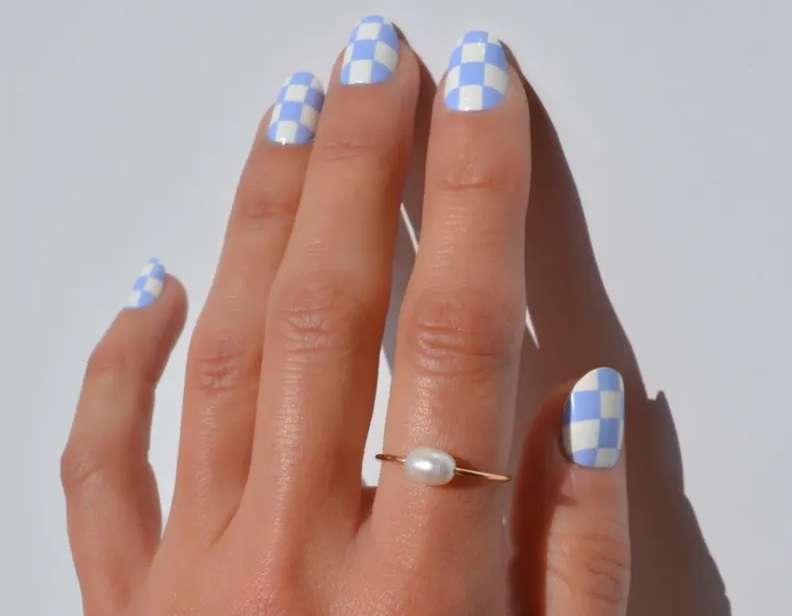 But if you are planning on applying your freehand skills on women’s nails, remember this: Neat and clean! Absolutely no weathering!
 Some thoughts on Women and World War II Wargames:
Some women reluctantly venture into wargaming now and then. My wife certainly has. What my wife and probably any woman will never do, is game World War 2. But why do men like World War 2 in the first place?
I think the reason we like WW2 is the same reason we like miniatures. Uniform and equipment fascination: Women like to dress up with beautiful dresses. Men like to wear armor. They are fascinated by the armor itself as an object. Women see a pretty dress and try to figure out what they would look like in it, what role they could play and at what circumstance they would use the dress. Men simply like watching the armor, they don’t need to necessarily wear it to enjoy it.
 To me, a miniature of a fully armored but totally unarmed medieval knight is useless. My wife doesn't understand why. She doesn't get why i would never buy/paint a knight wearing a cowboy hat either.
So do men have equipment fascination that women seem to lack? Men can see a miniature and say “that’s a nice sword”. And just look at the miniature and zoom in at it and admire that broadsword. Try telling a woman that StuG III looks nice. Or that Nazis had the best looking uniforms. You don’t like Nazis, you aren’t rooting for them, but you objectively judge the uniform itself as if it’s completely isolated from the wearer or the faction. I believe women can’t do that without effort. The reason is that they see the Nazi, as a person, an actor with a motive and a story, a whole. While a man can find certain WW2 tanks esthetically pleasing, a woman will only see the tank as a whole. They see a dreadful tool of a brutal war.
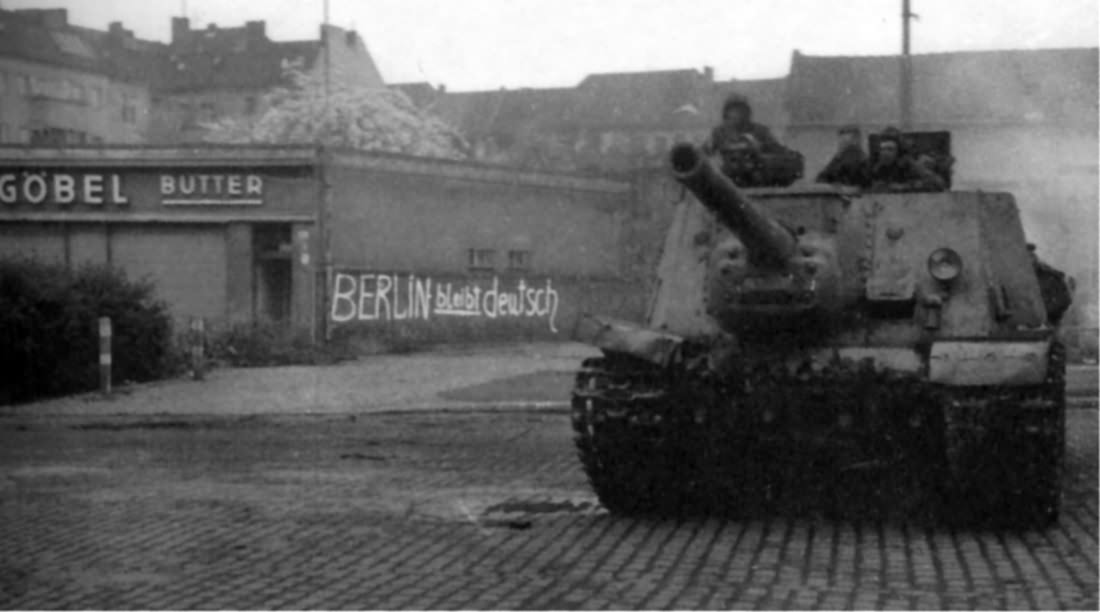 To the underage or elderly defenders of 1945 Berlin, the only feeling the sight of those ISU 152 would evoke would be dread.
If you want to do the mental gymnastics a woman would require in order to appreciate the design of the ISU 152, imagine it like you being asked to appreciate technically artful sculptures that are entirely made of human feces, or something dreadful like amputated body parts. Even in visual studies, it has been proven that women see the full picture in a way men don’t. (source).
So why do some women like wargames?
First reason is obviously the community, as wargames are multiplayer games. The second reason would be that even if women probably don’t appreciate miniatures the same way men do, they still love Engine Building mechanics, random dice pool outcomes, the feeling of commanding a whole army etc. As Personality Psychology studies suggest that on average more men are confrontational and more women are agreeable, this could mean women on average would prefer co-op games or team versus. However, Personality Psychology also teaches us that Main Traits have a massive overlapping bell curve. I for one am a VERY agreeable person, and as a result I prefer co-op and 2v2 and avoid 1v1 games.
 The mainstream narrative on why women avoid wargames is because allegedly, male wargamers are unwashed brutes who aggressively deter or belittle women who try wargaming. I think that’s nonsense. Women are just not interested in miniatures wargames. Women actively play RPGs and TCGs, where the general audience is the same. (Photo from some WW1 naval combat tournament in Poland portal.strategie.net.pl)
Do women dislike war and conflict?
No they absolutely don’t. Almost all of the Fantasy Romance Novels include warring factions and sometimes even big epic battles. Most of the protagonists are able combatants. Large battles in those novels evoke some of the following emotions: Anticipation, self-doubt, betrayal, loss, vengeance. The emotions are strong, and they are the same emotions that narrative campaigns in wargames are sometimes trying to evoke. But the vast majority of wargaming includes only 2 people (who don’t hate each other) who setup their forces and fight a single battle. The battle ends as they discuss some tactics or critical rolls while packing up their forces.
Women apparently find this futile. They can’t appreciate a single event with absolutely no consequences or catharsis.
There are currently no wargames that could appeal to women?
My hypothesis is that there are currently no mainstream wargames designed to appeal to both men and women. (If there are any, please correct me). Most narrative campaign systems are optional and buggy, or fanmade rulesets of games that were initially designed to be played in a single 1v1 battle. I also speculate that if one day we see more games designed with women also in mind, we will see more women in the hobby. I found some evidence online for this. Malifaux seems to be a bit more popular with women, the main reason being that Malifaux has meaningful characters with a bio and a style rather than factions whose main flair is the equipment they prefer. (reddit discussion).
I think future games should consider women. And I don’t think this should be done purely for the sake of bringing women in the hobby. I believe there is real value to including in a game narratives, character bios, consequence and emotions such as loss (of some character you became familiar with), betrayal, self-doubt and vengeance, or roles and mechanics of supporting or rescuing other players. But that would require redesigning wargames from scratch, or accepting some Wargames of the future will have long year-span campaigns similar to Role Playing Games.
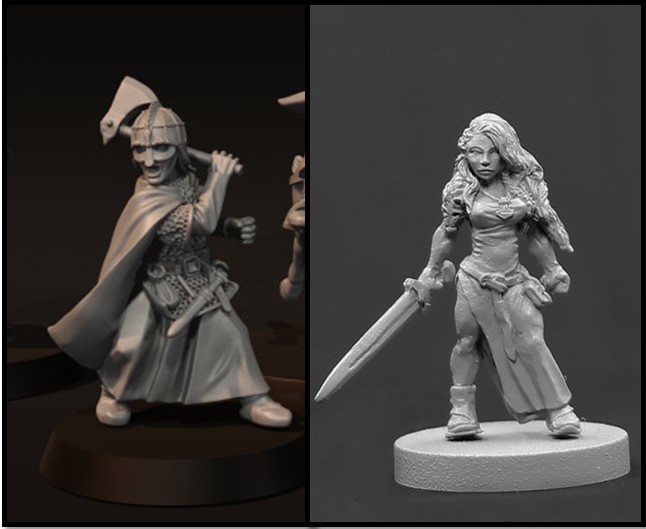 Two Norse women, two polar opposites in terms of function: Men would be reluctant to field the right one with such lack of equipment. Women generally avoid miniatures with helmets and would never chose one with a full face. For them, the least a miniature can do is refrain from hiding the face and hair. (Medbury & Bronze Age miniatures). So yes, the right one is the sexualized one but also the one women would chose. Bad Squiddo miniatures were made from women for women. They are sometimes a bit revealing. But they seem to try hard to not hide the face and hair.
Instead of a conclusion, I feel I should write an apology. First to any woman that happens to read this and disagrees with all of the above. I hope a woman wargamer could address the above topic, and set the record straight. Second, to the few women wargamers who have expressed in the various youtube videos and comments or reddit discussions the view that the reason women avoid wargames is male toxicity. I understand this can very well be your personal experience, and it can be a very real one. I just don’t think it’s the main reason overal. Trading Card Games communities can be toxic too, and women thrive there. And a final apology to the two fine Polish gamers in the main picture of this project. I saw the full gallery and I know you two had lots of fun. I don’t know what is going on in Poland but they seem to have a very consistent percentage of women participating in every single wargaming tournament, whereas in Greece I never see any.



![Zenit Miniatures’ Samurai Warlords Now Live On Kickstarter [Updated]](https://images.beastsofwar.com/2026/02/samurai-warlords-launch-main-600-338.jpg)