









“The Other World War 2”: Wargaming in the Pacific (Part One)
August 4, 2014 by crew


On June 5, 1944, the exact same day that paratroopers took off for their historic drop into Normandy, another massive invasion force was setting sail halfway around the world. This battle would start ten days later and claim 50,000 lives over the next four weeks. Five Americans would win the Medal of Honor, all of them posthumously. To stop the Americans, the Japanese would send their most powerful naval strike group, triggering the largest carrier battle in history (24 in all) that would finally eradicate any meaningful offensive capability of the Imperial Japanese Navy.
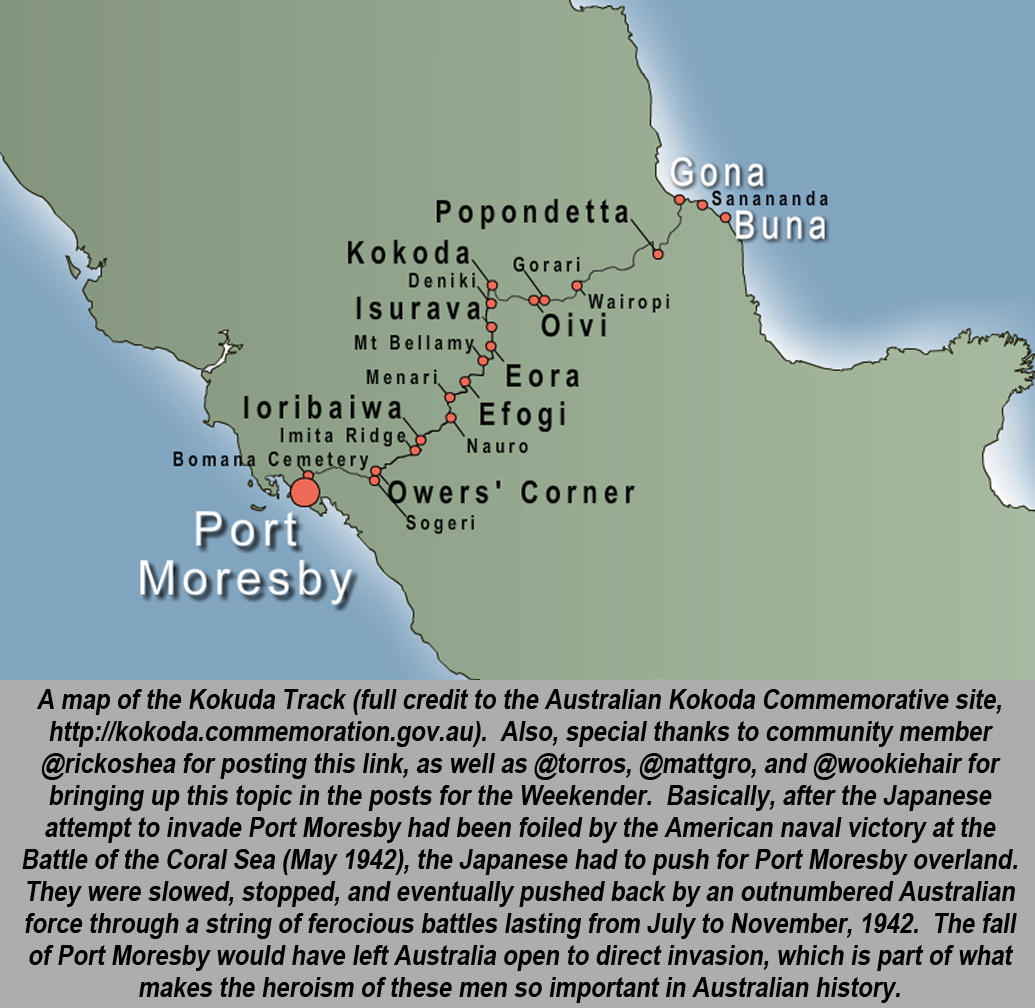
While almost any Beast of War subscriber has heard of the Normandy invasion, far fewer have probably had the opportunity to learn about the invasion of the Marianas Islands, described above. So when the opportunity arose to present some Pacific War wargaming material on Beasts of War, I naturally accepted. I was then asked if there were any upcoming Pacific World War 2 anniversaries we could commemorate in conjunction with these articles. As an American and former US Marine, I naturally proposed Operation Watchtower and the invasion of Guadalcanal (its opening stages carried out by the famed 1st Marine Division). When the article series was announced, however, posts immediately started coming in about the possibility of wargaming or commemorating the vital “Kokoda Track” campaign carried out by Australian troops in New Guinea, which largely took place during the exact same time period (August, 1942). This showed that interest in the Pacific War is more widespread than initially suspected, and that there is a real call on Beasts of War to explore the wargaming potential of this oft-overlooked theatre.
The simple fact is that wargames themed on European, Russian, or North African battles far outnumber those themed in the Pacific. Even when gamers accustomed to European-style wargames give Pacific games a try, they’re often disappointed in how the games play. The games sometimes come off as unimaginative, slow, “un-tactical,” or simply meat-grinder equations of mass firepower and casualties.
There can be an element of truth in this because many Pacific wargames are based on European systems for which “expansion kits” were later released to include new scenarios. This is usually a mistake because the Pacific War was so radically different than the one fought in Europe. To go into a Pacific wargame with a European rules engine is to bring European expectations to the table. Yes, the system may work and deliver “believable” results for your game. But you probably won’t learn very much and even worse . . . you won’t have much fun. A good Pacific wargame requires a rules system built for it, and a general understanding of what made the Pacific War so different.
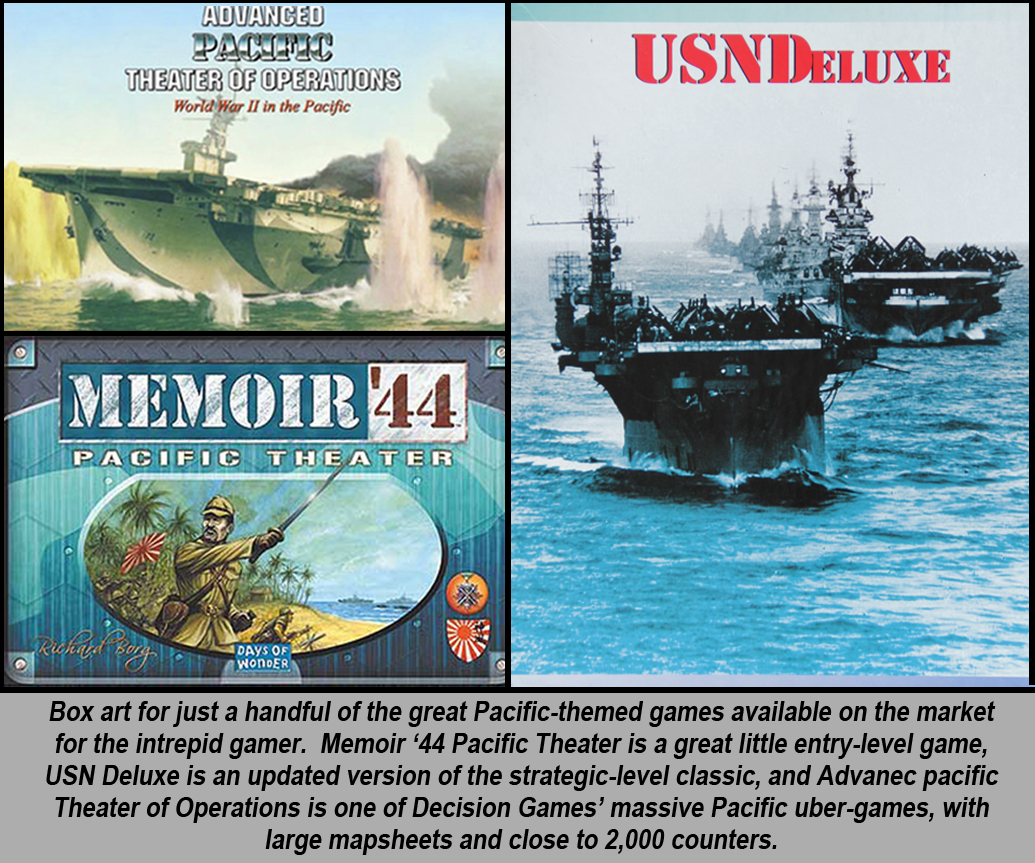
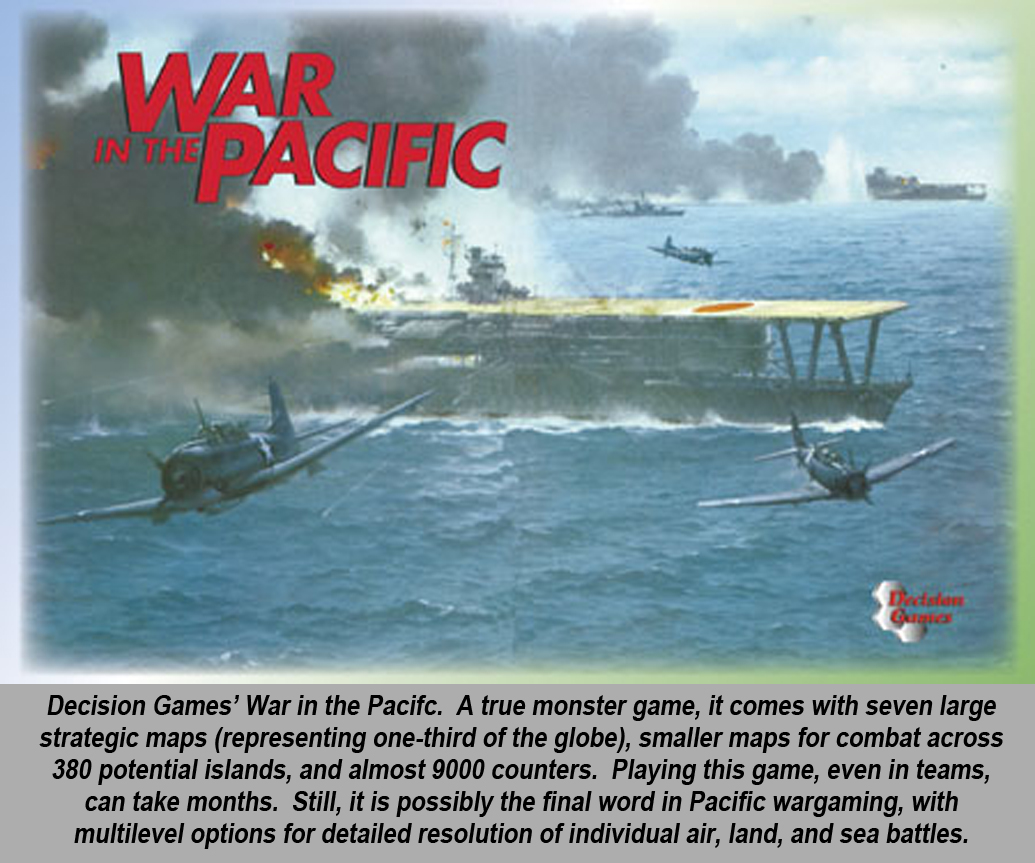
First of all, it’s important to understand which “Pacific War” you’re interested in. There are several areas to explore, each with its own characteristics. A few of these might be the China-Burma-India (CBI) Theatre, the Southwest and Central Pacific Theatres, and possibly even the “Pacific Steppe” of Manchuria for some Russo-Japanese campaigns. Finally, there are strategic-level games where players can take on the role of Nimitz, Mountbatten, Yamamoto, or MacArthur. “Advanced Pacific Theatre of Operations” offers a comprehensive study on the subject, but can be daunting for newcomers to this type of game. Avalon Hill’s “Victory in the Pacific” stands at the other end of the spectrum, offering a great entry-level portal into the theatre. Decision Games “War in the Pacific” is probably one of the biggest games out there, coming with over 9,000 counters (no, that’s not a typo). Probably not something I would try on a rainy weekend, I’m just saying it’s out there.
For those interested in a field command rather than pushing flags around an admiral’s map, one choice is the often-overlooked CBI Theatre, which basically covers World War II in Southeast Asia. This four-year campaign started when the Japanese attacked British holdings in Malaya and Singapore, and would eventually push all the way through Burma. Allied objectives were to stop the Japanese from invading India, keep a supply line open to the Chinese over the Himalayas, and retake the “Gibraltar of the Pacific” at Singapore. The campaign was characterized by brutal jungle warfare, almost a “Vietnam” without the helicopters or great music.
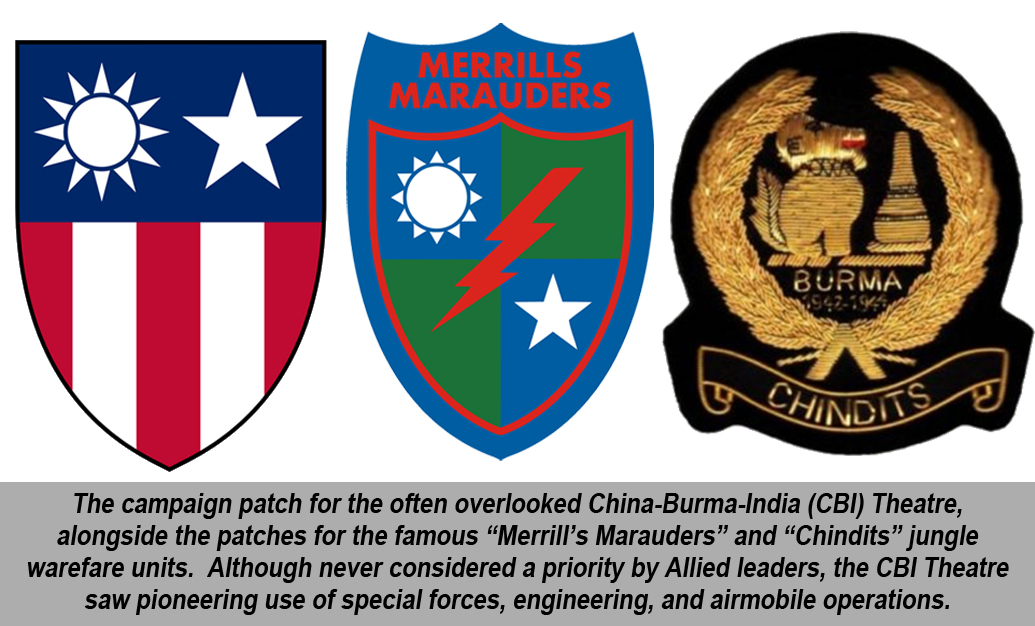
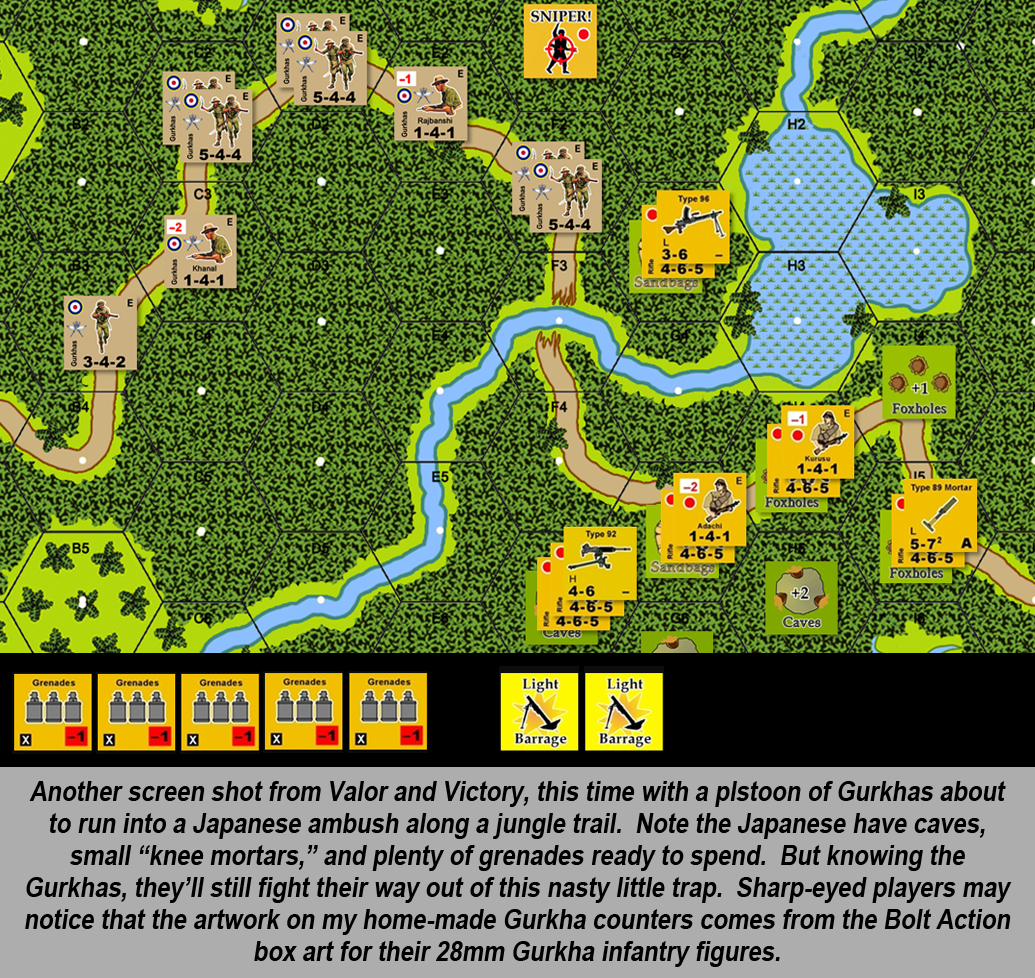
While there aren’t too many tactical games that deal with the CBI Theatre specifically, one “tactical temptation” might be the use of “special forces,” which the CBI Theatre used in abundance. Famous units like the Chindits, Gurkhas, or Merrill’s Marauders campaigned for months at a time behind Japanese lines, struggling toward targets hundreds of miles in the impenetrable jungle. Players may be challenged to set up a campaign series featuring these units in Bolt Action, Valour and Victory, or Band of Heroes, seeing if they can hold their columns together through such an epic trek of combat, exhaustion, and disease. Hidden jungle clearings were vital for resupply, although seizing Japanese supply dumps was also a vital tactic for survival. These men would also hack airfields from the jungle in order to land transport planes so they could evacuate their wounded. Such objectives could be used to keep the game from getting stale or add a distinctly Pacific flavour.

For a fresh perspective on Flames of War, consider investigating the heavy tank and artillery battles at Imphal, Mandalay, and the British-Indian landings at Rangoon. While Japanese artillery and fortifications are formidable in these games, don’t expect their tanks to play very well. In the Pacific, a Sherman plays like a King Tiger.
Yet another avenue might be to pursue an operational-scale game, where players command the whole CBI region. Because each turn could represent up to three months, the slow pace of jungle attrition would be mitigated while the complexities of executing logistics and communication over such impassable terrain could be highlighted, challenging players to make the most out of very limited resources. Jungle engineering was vital as both sides had to build roads and airstrips, chopping them out of the jungle mountains while slugging it out with the enemy. So intense were rivalries between Americans like “Vinegar Joe” Stillwell and Britain’s Orde Wingate (ferocious enough to put the Montgomery-Patton feud to bitter shame) that British and American teammates could even be given conflicting victory conditions. Decision Games’ “Green Hell: Battle for Burma” takes an interesting look at two important engagements in Burma, both focusing on British-Indian operations.
Another area to explore would be the Southwest Pacific, focusing on the American and Australian campaign in the mountains of New Guinea, the Solomon Islands, and the Bismarck Archipelago. This, of course, is where we find the famed Kokoda Track campaign. Taking the Southwest Pacific as a whole, Allied objectives were to stop the Japanese drive against Australia, then fulfil MacArthur’s famous “I shall return” pledge to liberate the Philippines. This was an Army-dominated campaign since the islands were relatively large (New Guinea is over three times the size of Great Britain), making the Southwest Pacific much like the CBI Theatre in many respects. The difference here is that MacArthur also had significant naval resources at hand, and had to land his troops up successive island chains to forge his path toward the Philippines. Control of the air and sea was absolutely crucial, and most often made the actual assault and reduction of powerful Japanese garrisons unnecessary.

From a gaming perspective, these naval and air dimensions can keep your game from devolving into a grind of mass manpower and jungle patrols. Which islands will you take so you can build air and supply bases at the right points, strangling the enemy’s island fortresses while preventing him from doing the same to you? Which enemy strongpoints will you actually have to assault and, more importantly, which can you bypass? Historically, the most formidable obstacle in this campaign was the huge Japanese base at Rabaul. Yet its fortified 100,000 man garrison was ultimately bypassed after a meticulous year-long naval and air campaign of isolation carried out by American, Australian, and New Zealand forces.
The Central Pacific Theatre and naval operations will be discussed in an upcoming article, as well as some more on the Kokoda Track. But for now I hope we’ve sparked some interest into the “other” World War II. So what do you say, Marine? Ready to pack that sea bag and see what’s happening on the other side of the world?
If you would like to write an article for Beasts of War then please contact me at [email protected] for more information!
"...there is a real call on Beasts of War to explore the wargaming potential of this oft-overlooked theatre."
Supported by (Turn Off)

Supported by (Turn Off)
"So intense were rivalries between Americans like “Vinegar Joe” Stillwell and Britain’s Orde Wingate that British and American teammates could even be given conflicting victory conditions!"
Supported by (Turn Off)


![Play WW2 Commando Operations With Butcher & Bolt [Updated]](https://images.beastsofwar.com/2026/03/relaunch-600-338.jpg)

I better crack out The Pacific DVD set again and give them a watch to get me in the mood for some island hopping.
BoW Ben
Absolutely, @brennon , it’s a great show that doesn’t get as much attention as Band of Brothers. And thanks for the great job on the layout, the article and images look great at always. 🙂
It’s great to see this often overlooked conflict getting it’s due. There are so many great opportunities for games in this theater! Thank you!
Thanks, @contrscout . Indeed, the theater covered one third of the planet’s surface, making it (geographically speaking) the largest “battlefield” there has ever been. The opportunities go way beyond the “beaches and jungles.”
massive influence on 20th century development – between the Burma campaign, the liberation of Indo-China (not that they got all that far for quite some time), the Philippines, then later on,the Malaya insurgency, the lessons learnt span generations, just a shame so many people in power ignore them
Korea, Vietnam, even the Bay of Pigs Invasion, hunting down Guevara in Bolivia, even modern conflicts like Kosovo and Sierra Leone all drew on techniques and tactics pioneered in the Pacific campaigns, and not just the fighting itself but the political and social ramifications as well…
Top stuff! Cracking article
Thanks, @bigdave . What you say is so true on so many levels. Not only were a lot of jungle and joint-service doctrines really finalized out in the Pacific (some might say they got their start in the “Banana Wars” of the 1920s), and not only did the world deal with political fallout for decades afterward (Vietnam War, Korean War, Chinese Civil War, etc) . . . but the whole idea of “asymetrical warfare” was, at least in some ways, really brought out here in the Pacific. After all, once you get to 1943 onwards, the war is largely large bodies of well-armed and well-equipped men with massive amounts of firepower going after smaller numbers of underequipped men dug deep into caves, bunkers, and hills . . .who are in many cases all too happy to die for their beliefs. Sound familiar? 🙁
And let’s not forget what’s probably the Pacific War’s most terrible legacy . . . the one and hopefully only time (knock on the biggest piece of wood you can find) that nuclear weapons have ever been used in anger. The dawn of the Nuclear Age? Yeah, I’d say the Pacific War made a little splash.
Brilliant many people (myself included) probably though of the pacific was a navel war except for the Indian/Burma/China mainland battles the fighting was on the water for control to land marines/troops on islands working their way over the pacific towards new guinea and japan.
To a large extent you were right, @zorg . Big parts of the Pacific War really were just naval operations aimed at getting Marine and Army divisions to certain islands where aircraft could be based to support an assault on the next island chain, and so on. The ultimate aim was to get Japan in bomber range and eventually take staging bases for a potential invasion of Japan itself. So yes, a naval campaign . . . but with ground and air objectives.
But other parts were more ground based, like the CBI theater you mention, the Chinese Civil War, the Japanese invasion of China, the three separate wars between the Japanese and Soviets . . . there’s only so much room in these articles, though. 🙂
Ah yes! Pacific… many great books about it and still not so “popular”. I am particularly fond of the whole Pacific theatre of operations. Not only the naval side but also the struggle on the numerous islands, not to mention the combat in the air. A computer game War in The Pacific was a blast!
Thanks, @yavasa . I’ve always half-wondered myself why the Pacific just isn’t as “popular” as you say. From a gaming perspective it’s pretty plain, but in a more general sense of popular awareness . . . I really don’t know. The Japanese culture of the 1930s and 40s was so radically different from anything in America or Europe at the time (or even Japan in the modern day), does it make the war harder to grasp?
I also know what you mean about the air war. Look, nothing against Bf-109s, Spitfires, and Mustangs, for some reason I’ve always been drawn to Zeros, Oscars, Hellcats, and Corsairs. 🙂 Baa Baa Black Sheep!
@orisakny I can think of one reason when it comes to Europe (well maybe not all of it since there were Brit and Dutch territories there). I believe that people are not concerned with the Pacific because it was far away! In Poland for example the number of books translated into Polish (or written in the language) is scarce. Credit cards are not so popular so sometimes it is hard to get access to quality literature on the topic published mostly in the USA. So if the people are not aware of the distant struggle that was a part of the Second World War (even preceded it) they are not interested in the gaming titles. On a side note, most of the games mentioned in your article are not available via Polish retailers (well there is one Internet shop with some Pacific titles). As you say, Pacific themed game needs its own rules that (might be discouraging for some people) usually are complex due to the nature of the warfare (Amphibious landings, terrain, naval operations, air operations, size of units, special ops etc.)
This is true, @yavasa , re: European cultural recollections of the Pacific War. In nations like France or Poland, the “cultural story” of World War II isn’t halfway around the world in the South Pacific, it’s literally right at home. These countries suffered early defeat, yet fought on through Free French and Free Polish units (not to mention resistance fighters at home) until their homelands were finally liberated. Great Britain was under direct threat of invasion and bombed for years. They were largely pushed out of the Pacific War by the loss of Singapore (although of course they maintained a leading role in the CBI Theater). Italy wasn’t involved, Germany and Russia had their own “main event” going between them . . . so yeah, I certainly understand why European history buffs and wargamers would identify more keenly with the European history. 🙂 It’s right outside their window.
For America, ALL of World War 2 was “far away,” yet the Pacific War was a lot more personal. We were directly attacked at Pearl Harbor. Hitler never blew up one of our naval bases and sank half our navy in one morning. Japanese troops overran our garrisons at Bataan, Wake, and others. Japanese troops even took two Alaskan islands of the Aleutian chain (although of course, Alaska wasn’t a state at the time, so America was not “invaded”). In fact Americans took it so personal that we set up internment camps for Japanese-Americans in California . . . certainly not our finest hour.
There has been something of a “reawakening” in the Pacific here in the US lately, with HBO’s “The Pacific” series, along with movies like “The Thin Red Line” (one of the best war films ever made IMHO), “Flags of Our Fathers” and “Letters from Iwo Jima.” Not to get too cultural here, but maybe one reason that Pacific history is a little foggy in the American collective consciousness is that modern Americans can only look back on the Pacific through the lenses of Korea and Vietnam, two wars on which our feelings are mixed at best. (??)
Oh yeah, and the wargames are hard, too. 🙂
@oriskany Could not agree more. I am waiting impatiently for the next part of your article.
On a side note. Everyone interested should read Goodbye Darkness by William Manchester. It explains a lot of things about Pacific.
Thanks for the tip, I will definitely check it out. 🙂
Interesting take on why Pacific battles don’t seem to succeed in gaming, makes a lot of sense. The battles always seemed to me to be dug in slaughter fests; No great standing/epic engagements. Incorporating sea and air definitely seems like a great way to add to the drama. Can’t wait to read more!
Definitely no Kursks or Waterloos. 🙂 But they did have the largest naval battle in the history of mankind (Leyte Gulf) and some amphibious invasions that I think outsized Normandy in certain aspects (Okinawa). So there’s epic. Just in different flavors. 🙂
Nice work Oriskany. I’m, of course, reminded of the “Panzerleader” game we played representing Tarawa. So many many many counters (platoon/section level) packed onto such a tiny island. I played the Japanese and killed sooooo many marines, but my artillery missions were practically preordained with all the crowds of landing craft about. The game was fun but lacked the freewheeling thrusts of a western battlefield.
i would love to learn either a smaller or larger scale Pacific game.
We have an older home built Sci-Fi game (not DarkStar) That is a smaller scale with much smaller battles. A counter is either a single tank, robot or at most a fireteam of four. Point being in that smaller scale, it is possible to have highly mobile, jungle/islandhopping games.
I think there are cultural reasons why the Pacific is less “popular”. At least regarding us Yanks. Simply put, the “bad guys” were still the same colour as us, so we could draw more empathy.
Yeah, that Tarawa game was a fun experiment, definitely an eye-opener (at least for me), and an interesting change of pace. But no, not repeated. 🙂 Central Pacific battles hopefully coming up in the next article, stay tuned.
Another great article @oriskany. It is like a stroll down my childhood and teenage memories with all the great games that were played. You summary of the genre of the Pacific is great, I have always found the Pacific conflict lends itself to themed games of 28mm battles, where a small force can cause anarchy to a larger opponent as the reliance on logistics and communication is everything. You cannot simply “send another truck of ammo” across the ocean if you don’t have naval dominance. If communication breaks down the island fortress you are landing on to re-supply could now be occupied territory. the options are endless, but the battlefield is so different.
You cannot decide to withdraw from and engagement to regroup on a tropical atoll. The control of airfields was also significant, as carriers didn’t just sit around waiting to be used, they were also required to transport aircraft from the US. If you lost the airfield while on a mission you couldn’t exactly fly and find a field to land on, that was it, you lost not only air superiority but also the air force as well. Such a different battlefield, and in some ways more desperate.
Thanks, @mattgro . . . and I hope you saw where I gave you your props in the Kokoda map caption. 🙂
I know what you mean about old Pacific game memories. My friend and I used to play Avalon Hill’s “Midway” after school during our freshman year of high school. We must’ve had twenty games . . . would you believe I actually engaged the American carrier force once with my battleships as the Japanese player? I don’t think my opponent was paying much attention that day.
All the complexities you mention are, IMHO, what makes the Pacific War such a refreshing change of pace. These really are combined-arms land-air-sea operations, with each element completely depending on the other two. I can’t give away too much because more articles are on the way, but we definitely discuss a lot of your points in more detail.
I totally agree about the 28mm battle scale. The ranges are so short, the (land) battlefields are so small . . . Our group normally plays on the platoon level (each playing piece is a platoon so with 30-60 pieces you’re fielding a regiment or brigade of 2500 men), which works beautifully for European, Russian, or North African battlefields . . . but has been tested and doesn’t work spectacularly well in the Pacific. Instead we go down to squad-level (vehicle pieces are individual vehicles), which almost always works better. In the same way I could see where miniature players might want to consider stepping up from 15mm to 28mm in they’d like to give some Pacific gaming a go . . . especially since Warlord makes such great Japanese, Gurkha, Australian, and US Marine figures for Bolt Action! :).
Thanks for the recognition @oriskany but I don’t need it, I just like to have the battle’s recognized for the contribution and the sacrifices the troops have made. It sounds like you have a great handle on the nuances’ of the pacific, am looking forward to the next instalment. Should give great examples of how small scale battles effect overall campaigns and the ability to enhance your gaming experience with a higher level of operation above skirmish. I love the Warlord mini’s, have not yet committed to an army yet, just a few to tide my shiny syndrome over…..
Can’t believe you managed to sucker someone into letting the Japanese main battle fleet engage the carriers, that is spectacular slight of hand to achieve, and a very quick battle would have followed no doubt, with a lot of underwater planes? I was taught Victory in the Pacific by a friend’s father, he gave me the game when I finally beat him one year later.
“Can’t believe you managed to sucker someone into letting the Japanese main battle fleet engage the carriers” – We were kids at the time (14 or so) and like I said, I don’t think he had his head in the game. 🙂 Many of us don’t at that age. “What was that that just walked by. Was that . . . was that a girl?” It’s the kind of thing that supposed to be next to impossible. But yeah, the Yamato’s 18.1 inchers, the Nagato and Mustu’s 16-inchers, the Kirishima and Haruna’s 14 inchers . . . a lot of havoc. If memory serves it wasn’t a completely clean sweep, he got some planes in the air and bombed the hell out of me while his carriers ran like hell (I managed to close the distance on him during the night phases, but could only engage at first light). We basically wound up with an unintended, super-sized recreation of Samar Island, October 25, 1944.
Victory in the Pacific, another classic. 🙂
Hope you like the upcoming articles!
Certainly in this country unless your family was directly involved, the events in Europe completely overshadowed the War in the Far East. We even referred to the 14th Army as the Forgotten Army. It would seem wargaming is mirroring real life.
I look forward to the series as there is a lot of unexplored gaming potential , least of all the great clash of cultures.
Thanks, @huscarle . although it’s never cool when a campaign is “forgotten” (I think Slim’s 14th Army called themselves that even while the war was going on), it also means we get to rediscover it as wargamers. I mean there **are** games out there for these campaigns, just not as many as for other conflicts and campaigns.
Yes and all have their own unique problems of difficult terrain and supply issues. Loads of scope for a good rules writer
Stay tuned. 🙂
Nice work there @oriskany. – It made for an interesting read. I can’t say that I have seen the games you mentioned before, but I’ll have to keep an eye out for them. I played FoW a while ago, I but moved town (and changed games systems) before the Pacific stuff came out. I had a Commonwealth force and I always intended to get the Japanese when they came out, but I never got around to it. I see that Bolt-action is getting more popular in my flgs, so I might have to give both of these gaming systems a whirl.
The Pacific war is pretty personal for me because my three relatives that served there were obviously affected by what they saw/had to do. The involuntary hand shaking in Saving Private Ryan really gets to me every time, because my grandad used to do that (among other things). They all survived the war, but they died before I was old enough to really understand and appreciate what they went through. Consequently. the topic has always been highly interesting to me and historical war gaming is a good added incentive to learn more. That said, I haven’t scratched that itch in a while, so I think it is about time I remedy the situation. Ta 🙂
Thanks, @wookiehair . Glad you liked the article. 🙂
Sadly, most of the games I could mention are quite old, except for the Decision Games releases. Honestly, I suspect Bolt Action over Flames of War for Pacific battles, with the exceptions of the larger battles fought in India and Burma (Imphal, Rangoon, Mandalay, etc). There was actually quite a lot of open ground around some of these places, allowing for the closest thing to a “European” style battle.
Others may disagree, but I have a strong suspicion that Bolt Action is best utilized as an infantry game. Because of the large 28mm scale and the true line of sight rules, the use of tanks on anything short of a tennis-court sized battle becomes something that is by no means impossible, but a subject for careful consideration. While this may be limiting in European games, I honestly think Bolt Action may be perfect for a series of Pacific games, either in the CBI-South Pacific battles discussed above, or the Central Pacific battles coming up. Infantry-dominated battles, close ranges, relatively smaller force sizes, and of course great minis.
Thanks again for chiming in. 🙂
Very nice article.
Personally I feel that platoon level games are the way to go in the Pacific. It keeps fighting close and personal, but it is also a way to ensure that Japanese won’t get utterly crushed by the technological disparity as the war progresses.
This is very true, @drowningharvey . 🙂 From what I’ve read, the disparities in technology and firepower weren’t **quite** as pronounced in the CBI and South Pacific . . . as they were in the Central Pacific. There, things really get out of hand from a gaming perspective. Then again, the Central Pacific doesn’t **really** get rolling until the end of ’43 with Tarawa / Betio, maybe that’s why?
Don’t forget there were some reasonable sized battles around the villages in New Guinea that would make pretty good scenarios for Bolt Action. There is even room for a small amount of armour if you wanted to, say, recreate the actions around Buna over New Years 1942/43. It wasn’t all thick jungle and the airstrip area was quite open. The 2/6 armoured regt was supporting with its Stuarts through out the campaign there.
Thanks for bringing that up, @toofless . Some of the ideas you mention (armor, airfields) are discussed in upcoming articles. Hey . . . Buna? That was basically the “ending” of the Kokoda Trail campaign?
Indeed it was sir. The Japanese had had their crack at Moresby via the track but in the end Guadalcanal was regarded as a more important prize. Still, the numbers had been very much underestimated by allied intelligence and in turned into quite a nasty scrap early on.
Nice work on the article by the way. I think you’ve misspent your weekends with some very big games.
Thanks @toofless . Okay, I’m just speculating here, using educated guesswork by “gaming” through what was going on at the time. I would say Kokoda was more important that Guadalcanal because (a) Guadalcanal hadn’t started yet 🙂 and the Japanese advance down the Kokoda Track was directly threatening Port Moresby. Port Moresby, from what I’ve read, was a major, major prize, strategically speaking it was the front door to Australia or at least would’ve enabled Japan to completely seal of Australia from the US (they pretty much were sealed off from the UK after the Fall of Singapore)
Okay, so once the Australians kick ass at Kokoda, its emphasis shifts to where it’s no longer so much about defending Port Moresby . . . but taking Buna and sealing off parts of the Japanese army in New Guinea. Guadalcanal’s got the big airfield and by time has acted almost like a “black hole” in space, endlessly sucking in men, ships, aircraft, and resources.
I just don’t people to think that because Guadalcanal started, Allied command just “forgot” about Kokoda or New Guinea in general.
Augh! I promise future articles and posts will have more to do with gaming and less raw history! We gotta set the scene first, though, right? 🙂
Great article. I have grognard envy. Have you tried any of Avalanche Press’s forays into the Pacific theater? They’ve released the Saipan 1944 implementation of their Panzer Grenadier system. Looks interesting and I love how the provide supporting articles on their website.
Unfortunately the Pacific has more than just a lower profile that stands in the way of gaming success. One, touched on above, is that often the battles aren’t fair fights. Early in the war Allied forces are acting as speed bumps trying to slow down the Japanese onslaught. Later in the war the Japanese were trying to bleed the Allied counter onslaught dry. After a while these “victory is achieved by not loosing too badly” scenarios can be unsatisfying.
Another problem is the cracking of the Japanese naval code. I think even it had even more direct impact on the battlefield than ULTRA had in Europe. Any attempt to simulate this in a game is bound to influence the Japanese player’s decisions. Would they allow Midway/Yamamoto style ambushes to happen if they knew the Allies had inside knowledge? Or does the game just chalk it up to random dice rolls?
These are great questions, @bigterp . As far as the “Japanese were running wild, then the Allies were steamrolling back toward Japan” You’re definitely right, which is why so many of the better games take place in during the New Guinea / Solomon Islands arena . . . when the war was **almost** hung motionless (or at least moving very slowly) and the two sides were at least close to even. I guess this is especially true in the naval aspect, when the two sides were trading victories fairly regularly.
Never tried any Avalanche Press, but I have heard of PanzerGrenadier. I wonder how that conversion will work to a Pacific setting.
Never enough grognards!. 🙂