









![NO Weekender Or Cult Of Games XLBS This Weekend [Updated]](https://images.beastsofwar.com/2026/03/No_Weekender_and_XLBS_this_Weekend-225-127.jpg)



DARKSTAR CAMPAIGN UPDATE: DUCHESS ANNABEL’S WAR IS OVER




Recommendations: 3619
About the Project
The year is 2512.
The powers that remain on an ecologically-devastated and plague-ravaged Earth have been forced to look to the stars for the resources, capital, and room not only to expand, but to survive. While the setbacks encountered by mankind over the past 500 years have forced him to unite in a shaky global coalition and make fantastic strides in technology, they have also caused seismic and reactionary shifts in religion, culture, and politics. A second age of imperialism has dawned, and because man would never survive another war on the fragile remains of planet Earth, he is forced to ply his oldest trade ... war ... exclusively among the stars.
Darkstar is a tactical war game postulating naval combat in a “science faction” universe set five centuries into a troubled and uncertain future. Players take command of warships serving in the new “black water” navies of reborn empires of old, struggling for control of shipping lanes, resources, and colonies. Ships maneuver and fire in fast-paced combat, with survival not only of the players’ fleets at stake, but perhaps their nation and all of humanity as well.
Related Genre: Science Fiction
This Project is Active
Progress Report - Darkstar Rules
Work continues on the Darkstar rule set. I feel the worst is now behind me. Combat Phase is completely finished. All that remains is . . .
- Resolution Phase
- Ships Crippled
- Ships Exploded
- Ships Breaking off
- Damage Effects
- Scenarios
- (design)
- (scoring)
- Tips
- Designer’s Notes
***
Then 20 or ship classes.
This would turn into 40+ more pages of material
In all this book will be over 80 pages.
20 Ship classes allows me 4 ship classes or so for five factions – definitely a decent start for players who are interested in getting started.

PayPal Contributors Get Their First Warships!
Good afternoon, Beasts of War / OTT!
As I have stated below, I have been so happily surprised by the outpouring of support that people have donated to the ongoing project of an official written and published rules set for Darkstar.
If you are so inclined (I thank you very much in advance), just hit the link below and contribute in whatever amount you feel comfortable.
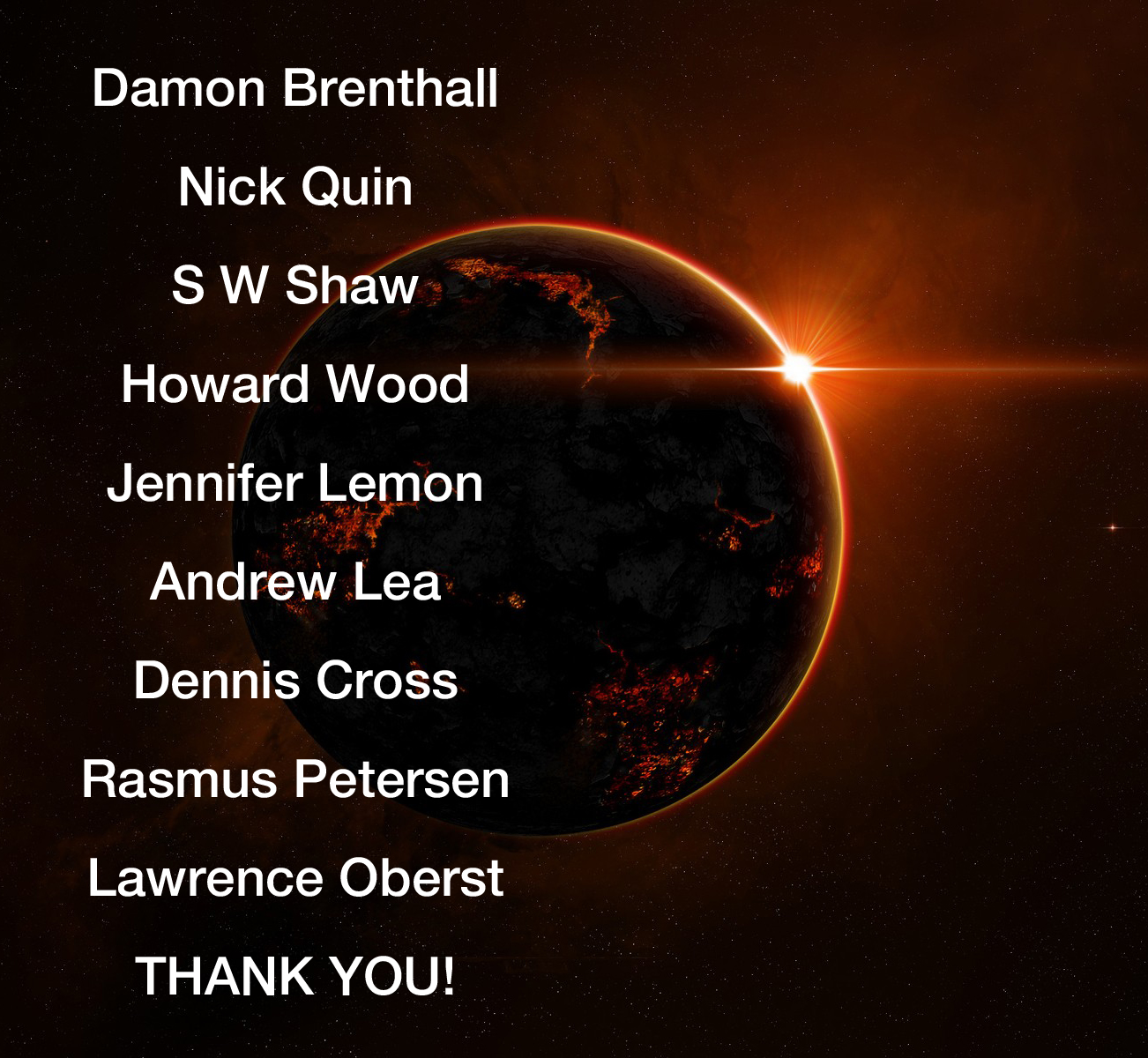
Meanwhile, here is the list of Darkstar supporters to whom I already owe a fantastic debt of gratitude.
In this vein, I’m happy to roll out the first few ships that people have already “commissioned” to be built or named after them. These are included below. I hope you like them!
Thanks so much again,
Jim “Oriskany” Johnson
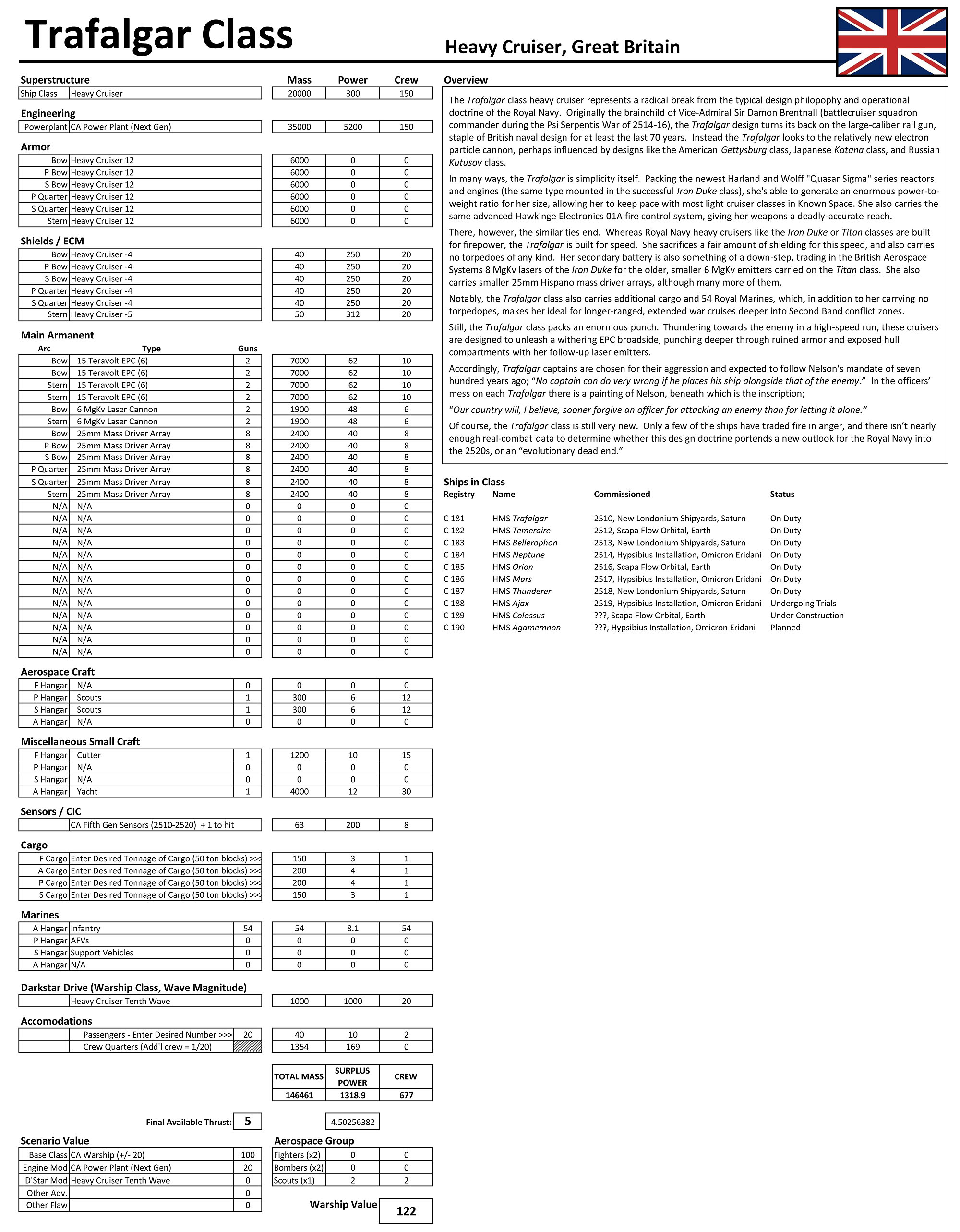
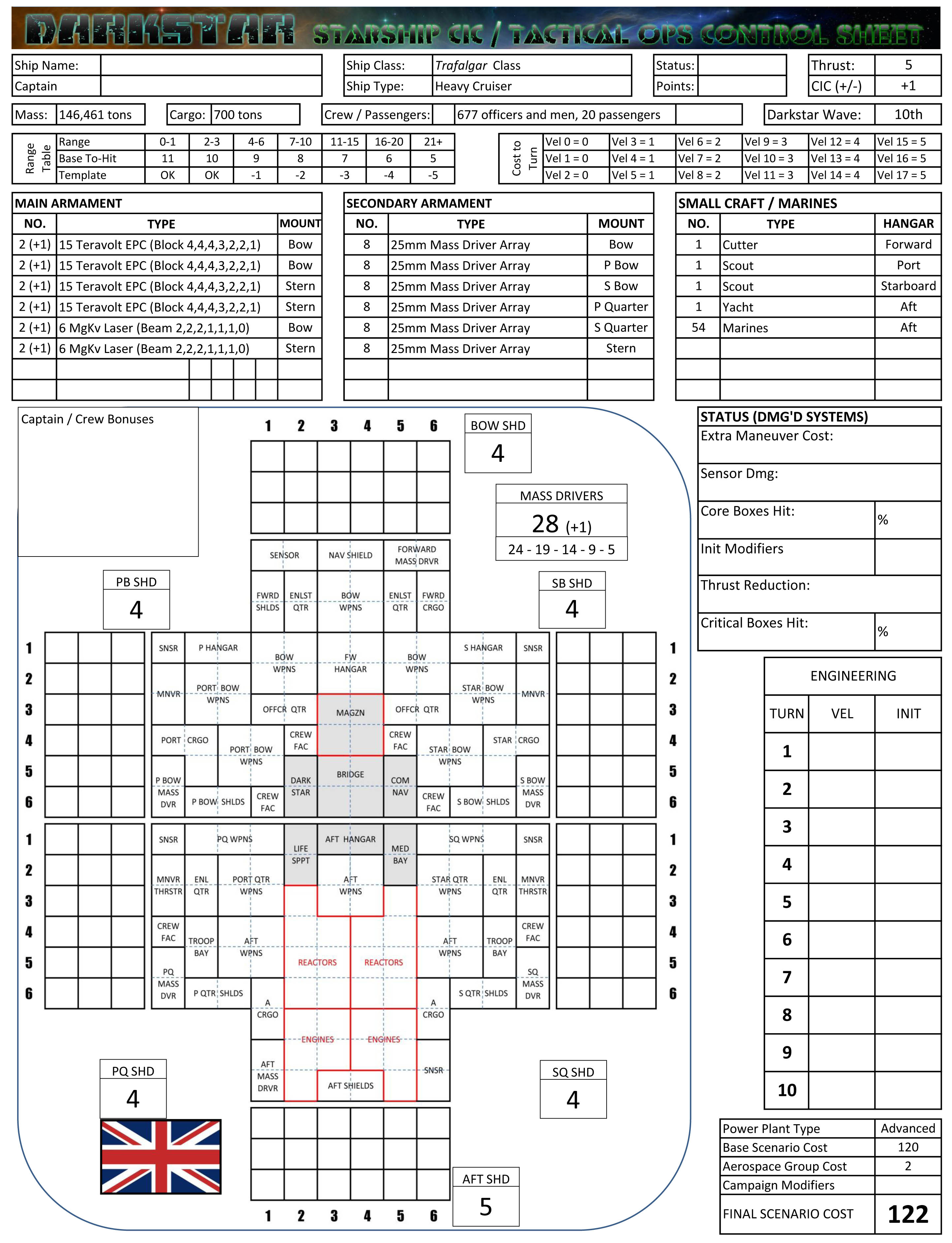
The Trafalgar class heavy cruiser represents a radical break from the typical design philosophy and operational doctrine of the Royal Navy. Originally the brainchild of Vice-Admiral Sir Damon Brentnall (battlecruiser squadron commander during the Psi Serpentis War of 2512-14), the Trafalgar design turns its back on the large-caliber rail gun, staple of British naval design for at least the last 70 years. Instead the Trafalgar looks to the relatively new electron particle cannon, perhaps influenced by designs like the American Gettysburg class, Japanese Katana class, and Russian Kutusov class.
In many ways, the Trafalgar is simplicity itself. Packing the newest Harland and Wolff “Quasar Sigma” series reactors and engines (the same type mounted in the successful Iron Duke class), she’s able to generate an enormous power-to-weight ratio for her size, allowing her to keep pace with most light cruiser classes in Known Space. She also carries the same advanced Hawkinge Electronics 01A fire control system, giving her weapons a deadly-accurate reach.
There, however, the similarities end. Whereas Royal Navy heavy cruisers like the Iron Duke or Titan classes are built for firepower, the Trafalgar is built for speed. She sacrifices a fair amount of shielding for this speed, and also carries no torpedoes of any kind. Her secondary battery is also something of a down-step, trading in the British Aerospace Systems 8 MgKv lasers of the Iron Duke for the older, smaller 6 MgKv emitters carried on the Titan class. She also carries smaller 25mm Hispano mass driver arrays, although many more of them.
Notably, the Trafalgar class also carries additional cargo and 54 Royal Marines, which, in addition to her carrying no torpedopes, makes her ideal for longer-ranged, extended war cruises deeper into Second Band conflict zones.
Still, the Trafalgar class packs an enormous punch. Thundering towards the enemy in a high-speed run, these cruisers are designed to unleash a withering EPC broadside, punching deeper through ruined armor and exposed hull compartments with her follow-up laser emitters.
Accordingly, Trafalgar captains are chosen for their aggression and expected to follow Nelson’s mandate of seven hundred years ago; “No captain can do very wrong if he places his ship alongside that of the enemy.” In the officers’ mess on each Trafalgar there is a painting of Nelson, beneath which is the inscription;
“Our country will, I believe, sooner forgive an officer for attacking an enemy than for letting it alone.”
Of course, the Trafalgar class is still very new. Only a few of the ships have traded fire in anger, and there isn’t nearly enough real-combat data to determine whether this design doctrine portends a new outlook for the Royal Navy into the 2520s, or an “evolutionary dead end.”
Ships in Class
C 181 – HMS Trafalgar – 2510, New Londonium Shipyards, Saturn – On Duty
C 182 – HMS Temeraire – 2512, Scapa Flow Orbital, Earth – On Duty
C 183 – HMS Bellerophon – 2513, New Londonium Shipyards, Saturn – On Duty
C 184 – HMS Neptune – 2514, Hypsibius Installation, Omicron Eridani – On Duty
C 185 – HMS Orion – 2516, Scapa Flow Orbital, Earth – On Duty
C 186 – HMS Mars – 2517, Hypsibius Installation, Omicron Eridani – On Duty
C 187 – HMS Thunderer – 2518, New Londonium Shipyards, Saturn – On Duty
C 188 – HMS Ajax – 2519, Hypsibius Installation, Omicron Eridani – Undergoing Trials
C 189 HMS Colossus ???, Scapa Flow Orbital, Earth – Under Construction
C 190 HMS Agamemnon ???, Hypsibius Installation, Omicron Eridani Planned
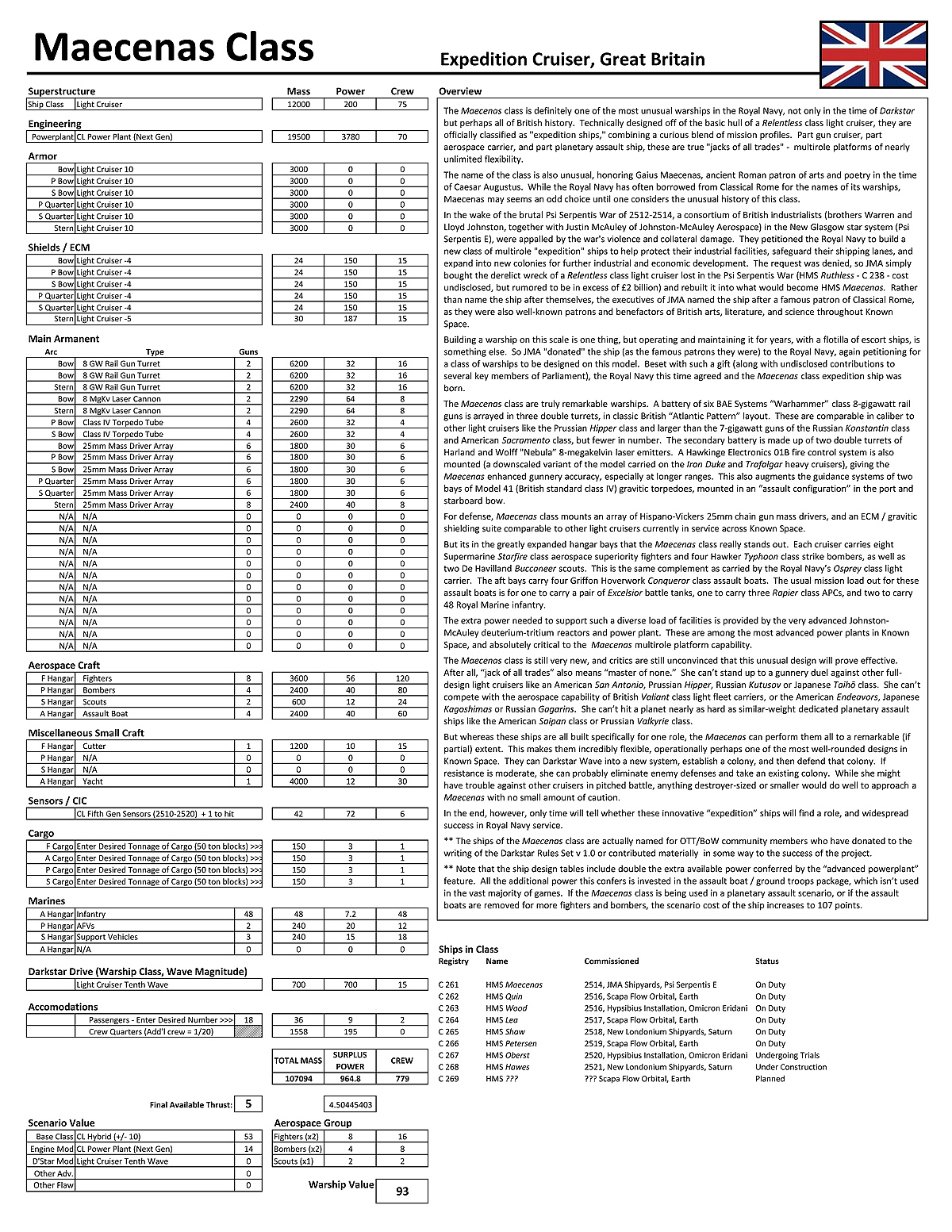
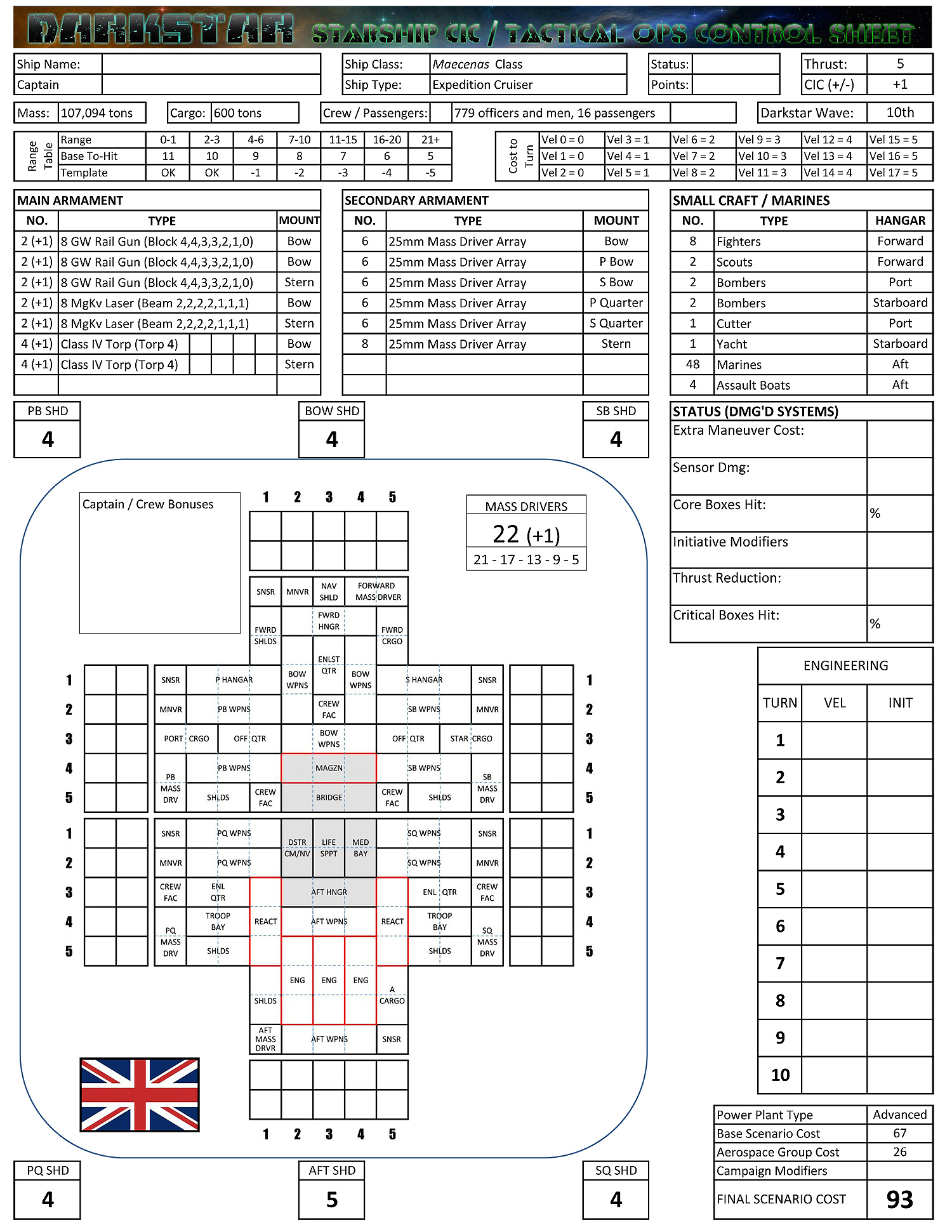
The Maecenas class is definitely one of the most unusual warships in the Royal Navy, not only in the time of Darkstar but perhaps all of British history. Technically designed off of the basic hull of a Relentless class light cruiser, they are officially classified as “expedition ships,” combining a curious blend of mission profiles. Part gun cruiser, part aerospace carrier, and part planetary assault ship, these are true “jacks of all trades” – multirole platforms of nearly unlimited flexibility.
The name of the class is also unusual, honoring Gaius Maecenas, ancient Roman patron of arts and poetry in the time of Caesar Augustus. While the Royal Navy has often borrowed from Classical Rome for the names of its warships, Maecenas may seems an odd choice until one considers the unusual history of this class.
In the wake of the brutal Psi Serpentis War of 2512-2514, a consortium of British industrialists (brothers Warren and Lloyd Johnston, together with Justin McAuley of Johnston-McAuley Aerospace) in the New Glasgow star system (Psi Serpentis E), were appalled by the war’s violence and collateral damage. They petitioned the Royal Navy to build a new class of multirole “expedition” ships to help protect their industrial facilities, safeguard their shipping lanes, and expand into new colonies for further industrial and economic development. The request was denied, so JMA simply bought the derelict wreck of a Relentless class light cruiser lost in the Psi Serpentis War (HMS Ruthless – C 238 – cost undisclosed, but rumored to be in excess of £2 billion) and rebuilt it into what would become HMS Maecenas. Rather than name the ship after themselves, the executives of JMA named the ship after a famous patron of Classical Rome, as they were also well-known patrons and benefactors of British arts, literature, and science throughout Known Space.
Building a warship on this scale is one thing, but operating and maintaining it for years, with a flotilla of escort ships, is something else. So JMA “donated” the ship (as the famous patrons they were) to the Royal Navy, again petitioning for a class of warships to be designed on this model. Beset with such a gift (along with undisclosed contributions to several key members of Parliament), the Royal Navy this time agreed and the Maecenas class expedition ship was born.
The Maecenas class are truly remarkable warships. A battery of six BAE Systems “Warhammer” class 8-gigawatt rail guns is arrayed in three double turrets, in classic British “Atlantic Pattern” layout. These are comparable in caliber to other light cruisers like the Prussian Hipper class and larger than the 7-gigawatt guns of the Russian Konstantin class and American Sacramento class, but fewer in number. The secondary battery is made up of two double turrets of Harland and Wolff “Nebula” 8-megakelvin laser emitters. A Hawkinge Electronics 01B fire control system is also mounted (a downscaled variant of the model carried on the Iron Duke and Trafalgar heavy cruisers), giving the Maecenas enhanced gunnery accuracy, especially at longer ranges. This also augments the guidance systems of two bays of Model 41 (British standard class IV) gravitic torpedoes, mounted in an “assault configuration” in the port and starboard bow.
For defense, Maecenas class mounts an array of Hispano-Vickers 25mm chain gun mass drivers, and an ECM / gravitic shielding suite comparable to other light cruisers currently in service across Known Space.
But its in the greatly expanded hangar bays that the Maecenas class really stands out. Each cruiser carries eight Supermarine Starfire class aerospace superiority fighters and four Hawker Typhoon class strike bombers, as well as two De Havilland Buccaneer scouts. This is the same complement as carried by the Royal Navy’s Osprey class light carrier. The aft bays carry four Griffon Hoverwork Conqueror class assault boats. The usual mission load out for these assault boats is for one to carry a pair of Excelsior battle tanks, one to carry three Rapier class APCs, and two to carry 48 Royal Marine infantry.
The extra power needed to support such a diverse load of facilities is provided by the very advanced Johnston-McAuley deuterium-tritium reactors and power plant. These are among the most advanced power plants in Known Space, and absolutely critical to the Maecenas multirole platform capability.
The Maecenas class is still very new, and critics are still unconvinced that this unusual design will prove effective. After all, “jack of all trades” also means “master of none.” She can’t stand up to a gunnery duel against other full-design light cruisers like an American San Antonio, Prussian Hipper, Russian Kutusov or Japanese Taihō class. She can’t compete with the aerospace capability of British Valiant class light fleet carriers, or the American Endeavors, Japanese Kagoshimas or Russian Gagarins. She can’t hit a planet nearly as hard as similar-weight dedicated planetary assault ships like the American Saipan class or Prussian Valkyrie class.
But whereas these ships are all built specifically for one role, the Maecenas can perform them all to a remarkable (if partial) extent. This makes them incredibly flexible, operationally perhaps one of the most well-rounded designs in Known Space. They can Darkstar Wave into a new system, establish a colony, and then defend that colony. If resistance is moderate, she can probably eliminate enemy defenses and take an existing colony. While she might have trouble against other cruisers in pitched battle, anything destroyer-sized or smaller would do well to approach a Maecenas with no small amount of caution.
In the end, however, only time will tell whether these innovative “expedition” ships will find a role, and widespread success in Royal Navy service.
** The ships of the Maecenas class are actually named for OTT/BoW community members who have donated to the writing of the Darkstar Rules Set v 1.0 or contributed materially in some way to the success of the project.
** Note that the ship design tables include double the extra available power conferred by the “advanced powerplant” feature. All the additional power this confers is invested in the assault boat / ground troops package, which isn’t used in the vast majority of games. If the Maecenas class is being used in a planetary assault scenario, or if the assault boats are removed for more fighters and bombers, the scenario cost of the ship increases to 107 points.
Ships in Class
C 261 – HMS Maecenas – 2514, JMA Shipyards, Psi Serpentis E – On Duty
C 262 – HMS Quin – 2516, Scapa Flow Orbital, Earth – On Duty
C 263 – HMS Wood – 2516, Hypsibius Installation, Omicron Eridani – On Duty
C 264 – HMS Lea – 2517, Scapa Flow Orbital, Earth – On Duty
C 265 – HMS Shaw – 2518, New Londonium Shipyards, Saturn – On Duty
C 266 – HMS Petersen – 2519, Scapa Flow Orbital, Earth – On Duty
C 267 – HMS Oberst – 2520, Hypsibius Installation, Omicron Eridani – Undergoing Trials
C 268 – HMS Hawes – 2521, New Londonium Shipyards, Saturn – Under Construction
C 269 – HMS ??? – ??? Scapa Flow Orbital, Earth – Planned
Darkstar Online - Oriskany vs. Davehawes (Part IV)
The Darkstar battle between myself and @davehawes . . . the first translatlantic Darkstar game run on-line via web conference . . . concludes.
When we left off, this hard-fought battle was at last boiling down to a sizzling and tense finale. One way or another, both my cruiser battlegroup of the Holy Russian Empire and Dave’s light aerospace group were rapidly reaching different breaking points. So far, the British and Russians have traded frigates, each knocking out the other’s smallest escort ships straight away (HMS Fergusson and CPK Volkhov). A massive British torpedo spread and aerospace bomber and fighter strike launched off the light carrier HMS Raven heavily damaged my flagship Basilov (an aging Konstantine class light cruiser), while my much heavier guns (I have no real aerospace group of my own) hammered the sleek, advance Falkands class destroyer HMS Singapore. After taking 50% losses among their fighters and bombers, the British were able to finally cripple the Basilov, but not before her 7-gigawatt rail guns and P-500 “Plamya” torpedoes savaged the Singapore. Both ships are left burning and adrift in space, leaving only the British light carrier HMS Raven and the Russian gun destroyer Kortik (Sonvya class).
The question is, can my guns overcome British aerospace superiority?
Short answer, hell yes. Dave has already lost two of his bombers and four or his fighters, a full half of his aerospace strike group. He hasn’t been able to land his remaining two bombers yet, the Raven keeps accelerating out of their reach in order to keep my guns at maximum distance. To make matters worse, Raven is almost out of torpedoes. Her bow tubes are now empty, she has one more spread left in her aft tubes and then that’s it.
I should have this game in the bag, to be honest, except for one thing. On Turn 3, the Singapore’s last volley of 8 megakelvin lasers hither port quarter perfectly, both digging into the exact same place just deep enough to knock out my shields port quarter shields.
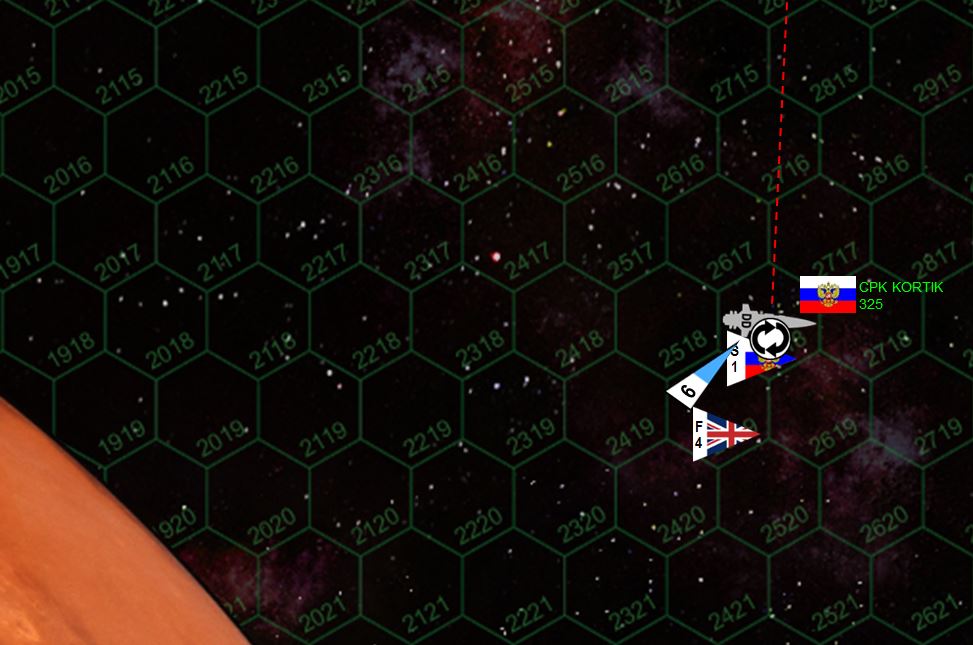
So as the Raven continues to pull away (she is a aerospace craft carrier, after all, she has no business closing to gunnery range of a heavy Russian destroyer), I have the Kortik accelerate into a port turn away from the planet, rolling her over in an attempt to screen my unshielded port quarter.
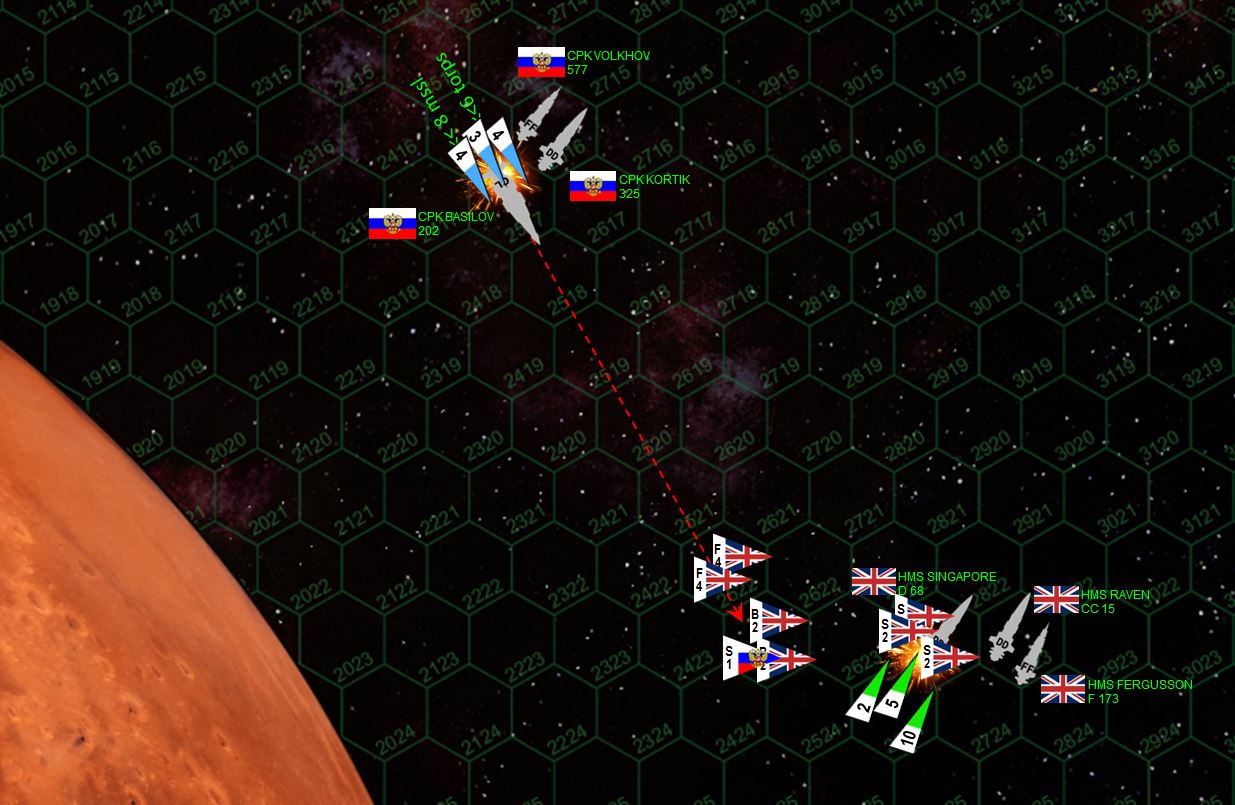
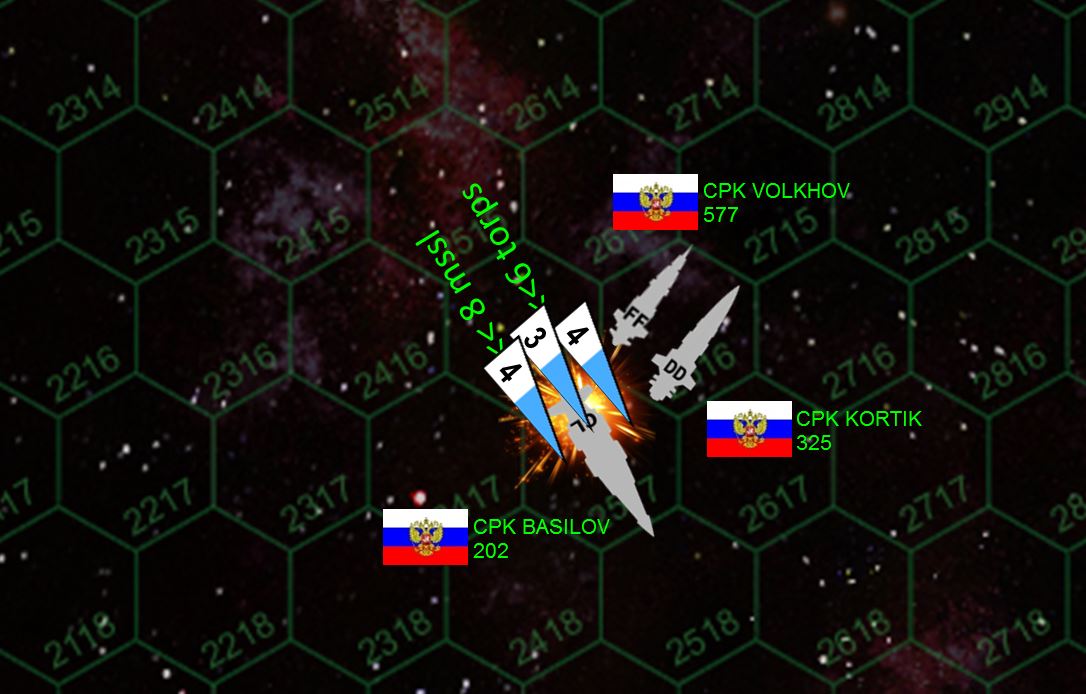
Here we see the fateful moment. These six blue torpedoes are almost the last warheads Raven can launch at me. Her four fighters are also coming in. I have to shoot my mass drivers at the torpedoes to thin them out, Dave has the range to send these torpedoes around my ship to hit her in the unshielded port quarter (along with four fighters on gunnery strafing runs). I won’t lie, this attack will be chancy, not having that port quarter shield is terribly worrisome. But the odds are with me, and if I can just survive this last torpedo spread, I’m 95% sure to squeak out a win.
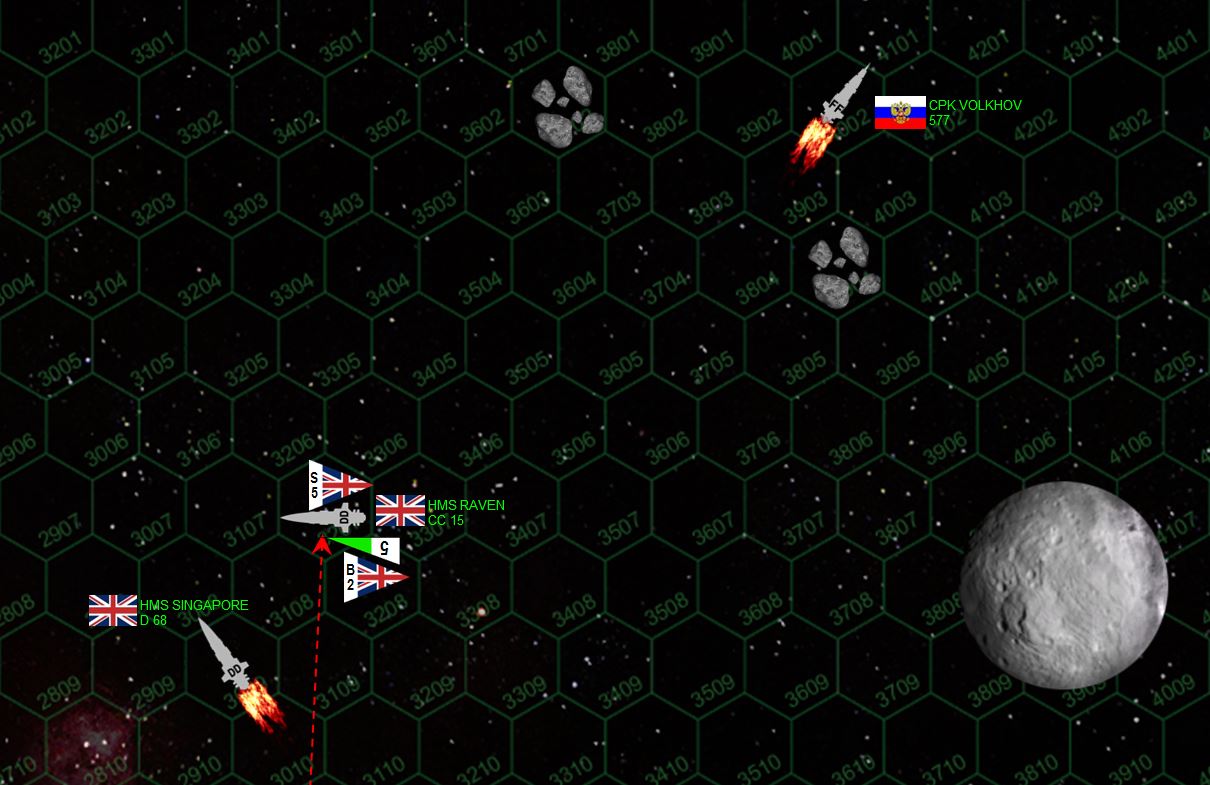
Meanwhile, my torpedoes are racing in against the Raven. I’ll also be unloading a pretty serious broadside on her, although Dave has carefully maneuvered his ship to a range of 11 hexes. This is just far enough to drop my chance to hit against his shields from a 4 to a 3. Also, Kortik may be a fearsome destroyer, but she’s just a destroyer all the same. Still, this is only Turn 4. And if she survives that torpedo spread, I can hit HMS Raven again on Turn 5, and Turn 6, and Turn 7, and Turn 8 . . . until she’s crippled or leaves the battle area. Either way, I win.
Note HMS Singapore soaring by at a speed of 21 kilometer per second, trailing a sheet of burning atmosphere. Also, the derelict Volkhov is spinning out of control, threading the needle between those debris asteroids on her way out into deep interplanetary space, probably launching lifeboats and rescue beacons.
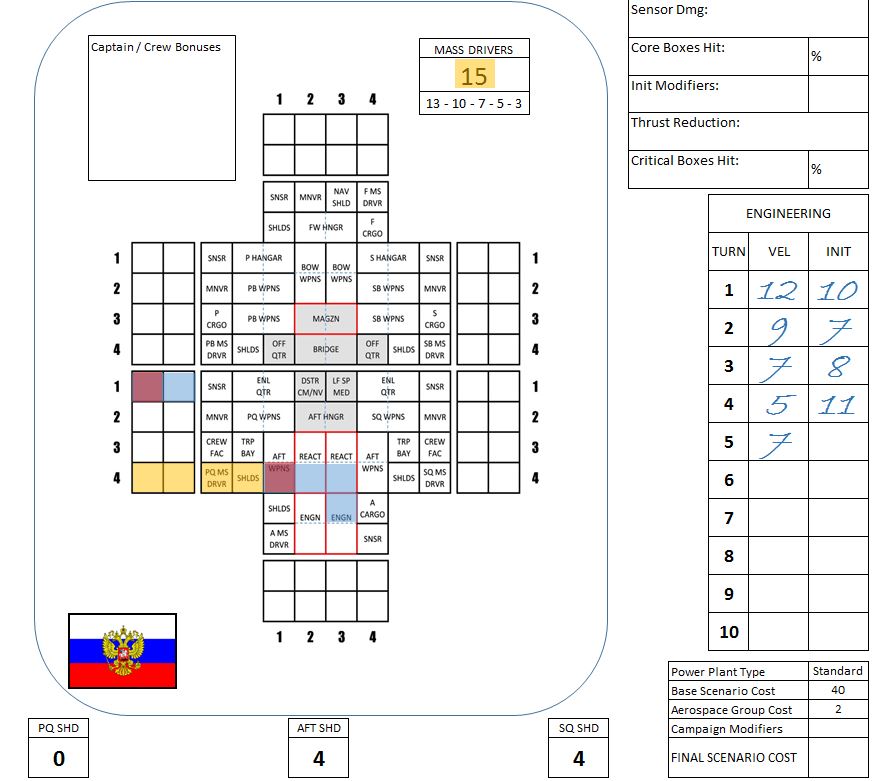
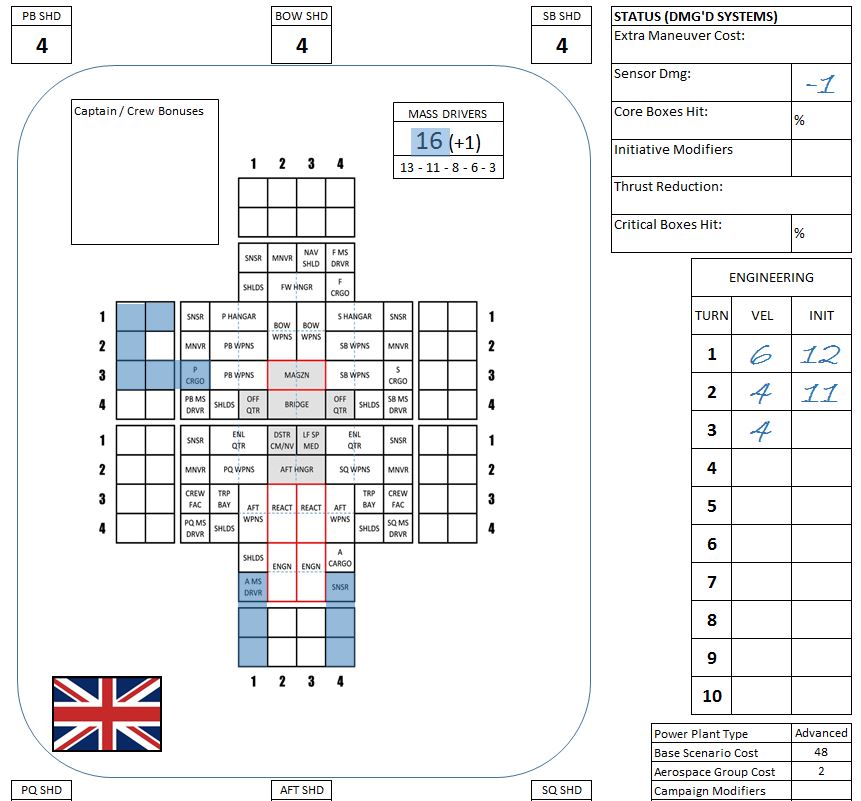
I’m not gonna lie, the British do really well here . . . and just like that, the game turns. Here is the WRS for the destroyer Kortik. Yellow is the damage done in previous turns, you can see where HMS Singapore took out Kortik’s port quarter shields. Okay, I shot down five of his six torpedoes (good roll on the mass driver table), leaving only one torpedo left. His four fighters scored two confirmed hits, but these wound up landing too far forward (column 1). So it’s literally down to that last torpedo.
It will almost certainly hit, as this part of my ship has no shielding. Sure enough, it hits.
But where? Sure, he might knock down Crew Facilities, Maneuvering Thrusters, etc . . .
Or he could roll a 4 on his d4 for hit location, sailing the torpedo right down the hole where his two lasers hit last turn. The warhead explodes inside my Aft Weapons compartment, cavitating through both reactor rooms and down into the starboard engine.
How lucky was that? I’ve now lost three critical boxes, reducing my 7+ cripple target for a destroyer to a 4+. So Dave has to roll 4+ on a d6, it’s literally a 50/50 chance.
He rolls a 5. The Kortik is crippled . . . and that’s game.
Now technically the Kortic gets its return fire on the Raven. But Raven’s mass drivers and scouts have shot down all my torpedoes, and my guns can’t do this much in one turn against brand new armor. I scratch the paint a little, but that’s about it.
So the British have the HMS Raven still operational (20 points), 2 bombers and 4 fighters (12 points) and 5 scouts (5 points) for a total score of 37. I have 1 point (1 scout). A +36 point win = 31.6% margin of a 117-point game, giving the British a solid (but minor) victory (40% is required for a “major” victory in campaign point terms).

In all, I feel this experiment was a success. I might redesign some of the playing pieces, particularly for torpedoes and aerospace craft, just to make them a little easier to handle especially for a remote player. But in all this game shook out pretty well. The margin in points seems a little high, but carefully looking at the actual course of events shows that if Kortik had survived that last torpedo hit (odds were only 25% it would hit in that vulnerable location, then a 50% roll for survival, yielding an aggregate 12.5% chance of being knocked out . . . and she was) – she would have been able to pepper the Raven for the rest of the game with near impunity. It would have been a “soggy” end, but almost certainly a Russian win.
As a designer, any time the game comes close (especially for a new player). I’m happy.
So that wraps up this game. Next I’ll be rolling out some of the ships requested by people who’ve been supporting my PayPal donation pool for the Darkstar rules set.
And yes, still chipping away on those rules. All “to hit” procedures are done, illustrated, etc., I’m now stuck deep into applying damage. After that it’s just Resolution Phase, a few notes on constructing and scoring scenarios, and rules are done! Then comes the fun part, chewing through 20 or so of my favorite classes, making sure at least five or so of these factions are well represented.
Hope you liked the battle report! And please pass your congrats to @davehawes for not only taking the plunge and playing Darkstar, but being the first to do it online, and having the guts to start his Darkstar play with the extra complexity of an aerospace carrier!
Darkstar Online - Oriskany vs. Davehawes (Part III)
The Darkstar battle between myself and community member @davehawes – played online on Saturday, December 1, continues.
So we’ve seen where my cruiser battlegroup of the Holy Russian Empire and Dave’s aerospace carrier battlegroup of the Royal Navy have been slugging it out so far. Each battlegroup has lost its frigate, my CPK Volkhov crippled by a long-range x-ray laser that cut through my portside reactors, and his HMS Fergusson that took a 7-GW rail gun through the bridge.
Meanwhile, my flagship (Konstantine class light cruiser CPK Basilov) has been heavily mauled by British aerospace torpedoes, missiles, and gravitic torpedoes launched from HMS Raven and the destroyer HMS Singapore, losing her starboard side engines and taking damage all the way up into her aft hangars (Oh no, the captain’s yacht was just taken out)!
At the same time, I’ve managed to land some P-500 “Plamya” (Flame) torpedo hits on the fantail of the Singapore, missing her engines unfortunately not taking out some of her sensors and aft mass drivers.
Now we’re looking at the movement phase of Turn 3, where I’ve dove toward the planet in an attempt to screen myself, or at least remove a little of Dave’s freedom to maneuver his fighters and torpedoes. It’s not going to work, as his eight fighters and a full torpedo spread head toward Basilov’s damaged fantail. My mass drivers have already smacked down four of his eight fighters, but the four that are left are ready to start a “Star Wars-style” strafing run on my damaged ship. Meanwhile, my gunners are lining up a second broadside on HMS Singapore, while the remaining two bombers of HMS Osprey can’t quite catch up to their accelerating carrier to land! Hey, wait for us!
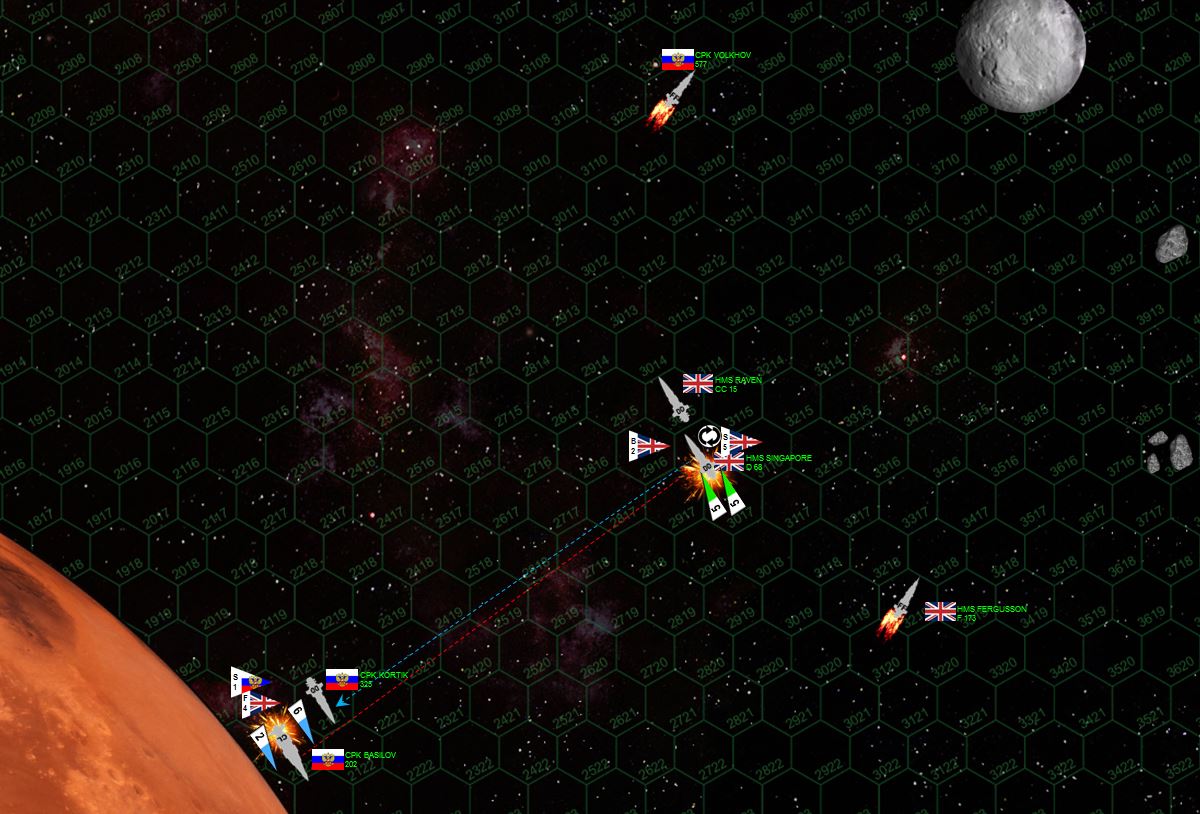
So like I said, I have shot down four Supermarine Starfires, saving the rest of my mass drivers for shooting down the torpedoes. But the Basilov has damaged sensors, don’t forget. Still, the destroyer CPK Kortik is able to knock down some torpedoes as well. Not nearly enough, however . . .
Meanwhile, my own torpedo spread is streaking in on the damaged stern of the Singapore. That destroyer has also taken sensor damage, while the HMS Raven tries to help as well, as well as five British scouts shooting down some more torpedoes. The real threat, however, is the broadside from the 7GW rail guns of the Basilov. The range is 1800 kilometers, perfect for this caliber of gun.
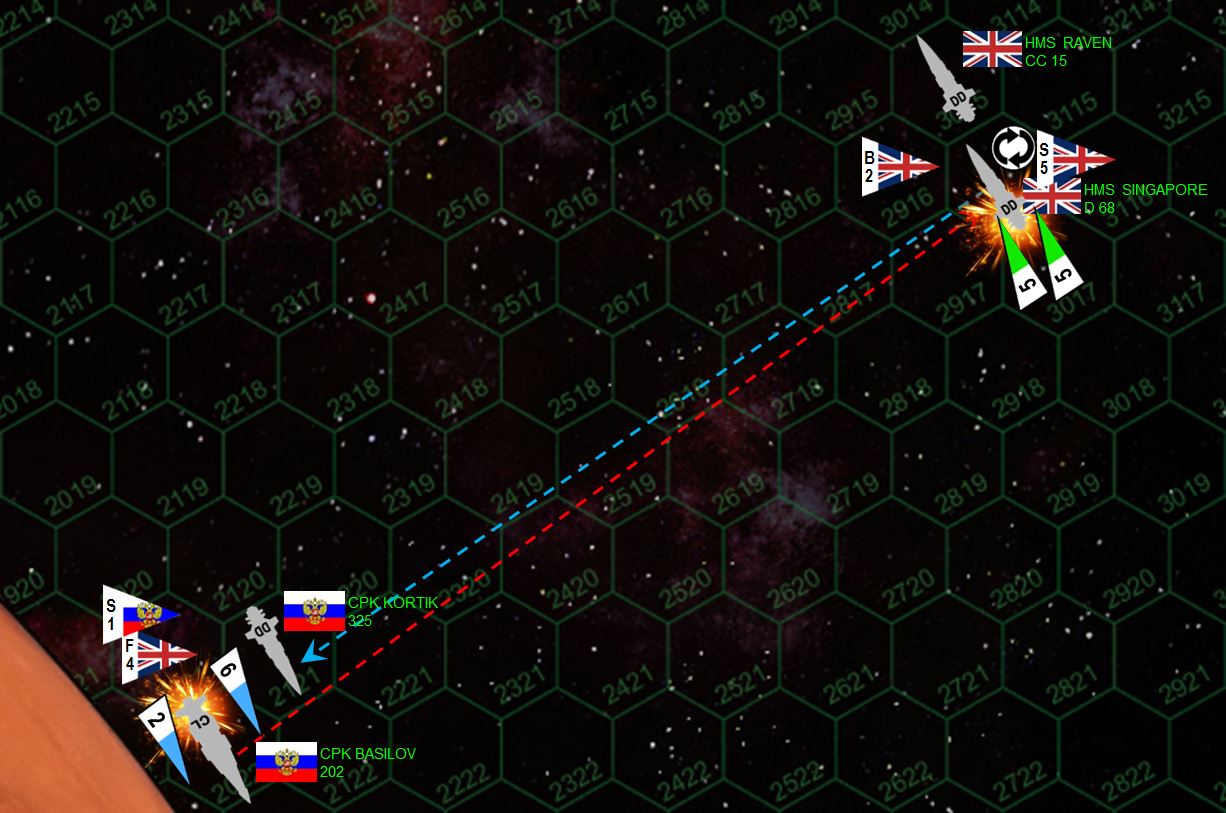
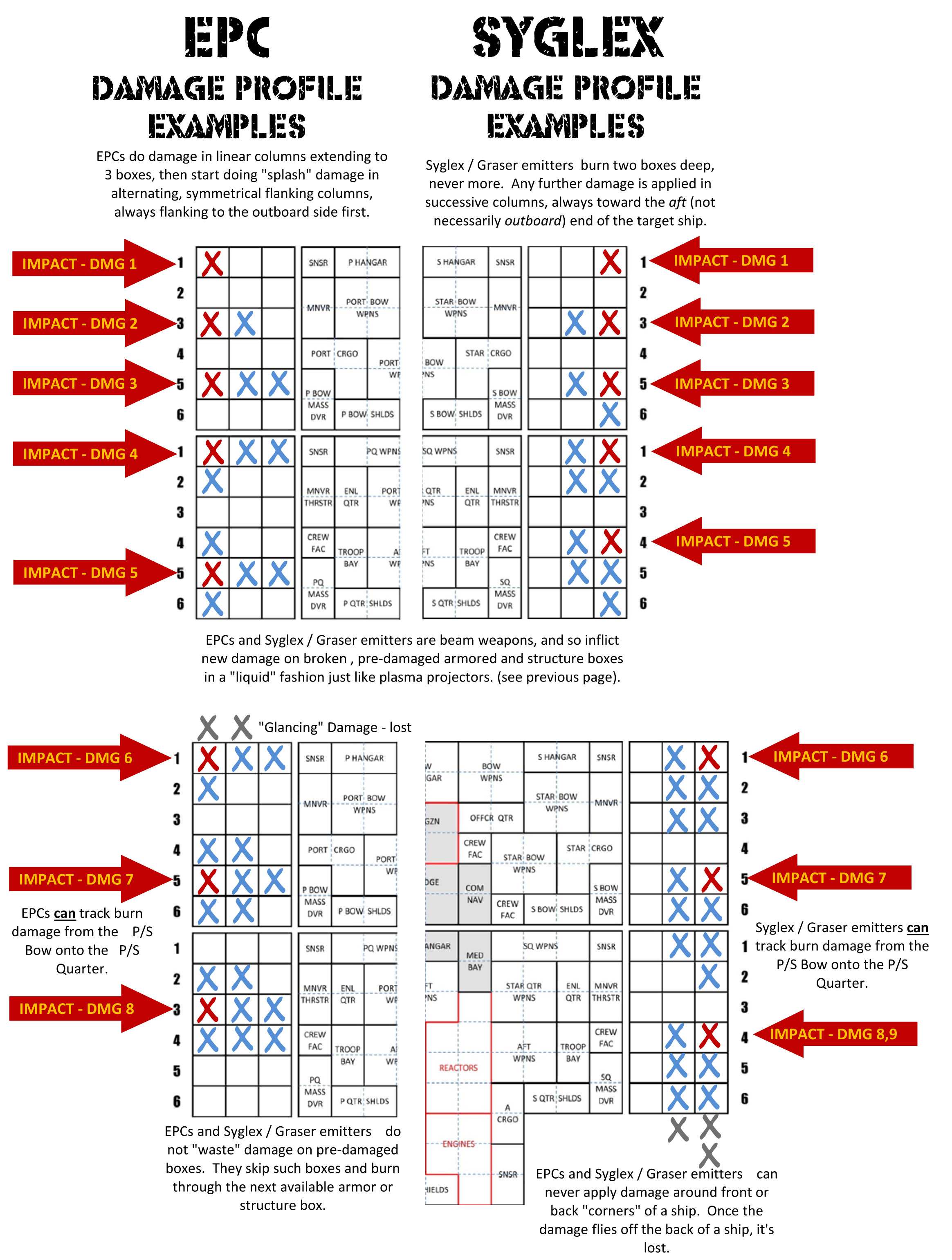
Very bad news for the HMS Singapore. Out of my ten torpedoes, only two survive mass driver fire, scout intercepts, and shields, but they hit the fantail hard. The purple boxes show their impact points, the cavitation damage extends forward through compartments of the ship. Starboard engines take a hit! The second torpedo hits the aft cargo bay, exploding forward and smashing out the destroyer’s aft syglex emitter, the whole weapons turret blown off the ship and into space!
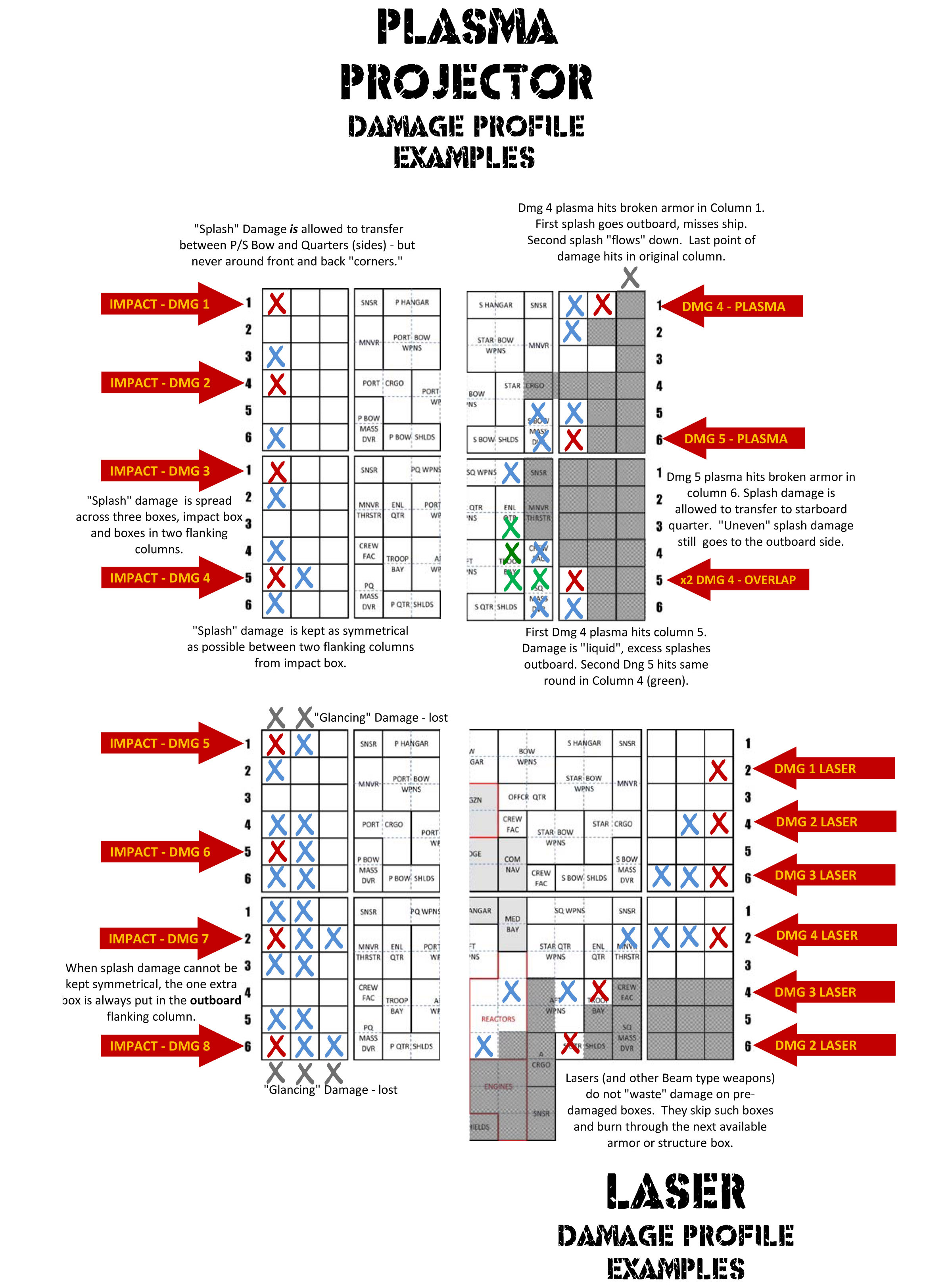
But the real damage comes from the double broadside delivered from the destroyer Kortik and the light cruiser Basilov. One of the Basilov’s plasma projectors hits in Column 1 (green box) spreading left and right (fore and aft) like a flamethrower. With this armor this shallowed, I then follow up with a hammering of five rail-gun hits (three from the Basilov, two from the Kortik – red impact points). These drill deep into the Singapore’s starboard quarter, knocking out more sensors, maneuvering thrusters, the troop bay (half the marines are probably killed, wounded, or trying to put out fires). I then hit the starboard side reactors, the blast carrying through into portside reactors as well.
So three critical (red) boxes of the ship have been hit. Destroyers have a 7+ target to cripple, -3 crit boxes hit = a chance of 4+. I roll a 6, and the HMS Singapore loses power, adrift and dead in space.
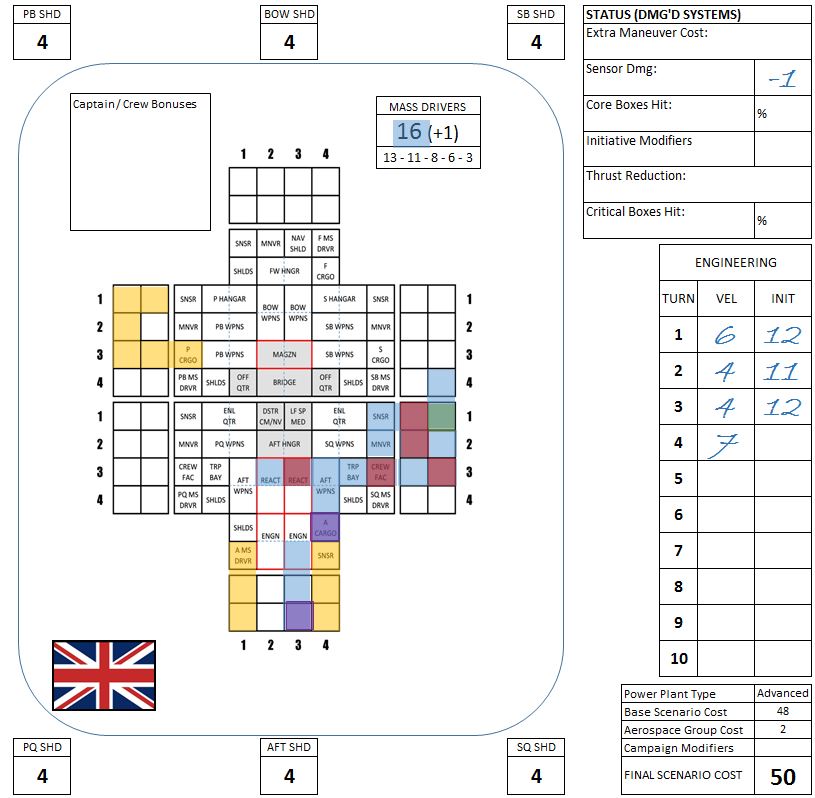
This moment of Russian victory is short lived, however. Even as the Singapore is being hammered, so is the Basilov. The first attack to hit are the those four fighters on a gunnery run. Despite my shields (still up, amazingly), they score one hit that happens to hand on my med bay! So my casualties from engineering have made it to med bay only to be machine-gunned by British fighters!
That’s a war crime, Dave! You can bet I’ll be contacting the Hague about that!
Far worse is yet to come. Four gravitic torpedoes (all from HMS Raven) hit on the red-colored boxes. Aft shields finally die, aft mass drivers are knocked out, portside reactors are gone, portside reactors take a hit. Cavitation damage ripples forward through the ship. Finally comes a torpedo hit again in MED BAY! The blast tears up through the center of the ship, damaging (but not destroying) the bridge, then setting off an explosion in the forward magazine!
Eight critical boxes have now been hit. The Target to Cripple a light cruiser is 10+, -8 crit boxes = a 2+ roll on a d6. It’s a pretty easy roll, which Dave makes with no problem. The Basilov is crippled. Even if she wasn’t, this ship would now be at 60% thrust, -1 from initiative for the bridge hit (for a net penalty of -3 on initiative), -1 to hit, -1 mass driver bracket, no aft shields, 75% chance for a forced break off . . .
In all, 31 days will be needed to bring this ship back, that’s after she’s towed back to a base, assuming she makes her ship recover check at all . . .
Still more bad news is to come. The Singpore’s last volley scores two powerful 8 MgKv laser hits on the port quarter of the destroyer Kortik, then Dave rolls very well on his hit location, and actually knocks down the port quarter shields.
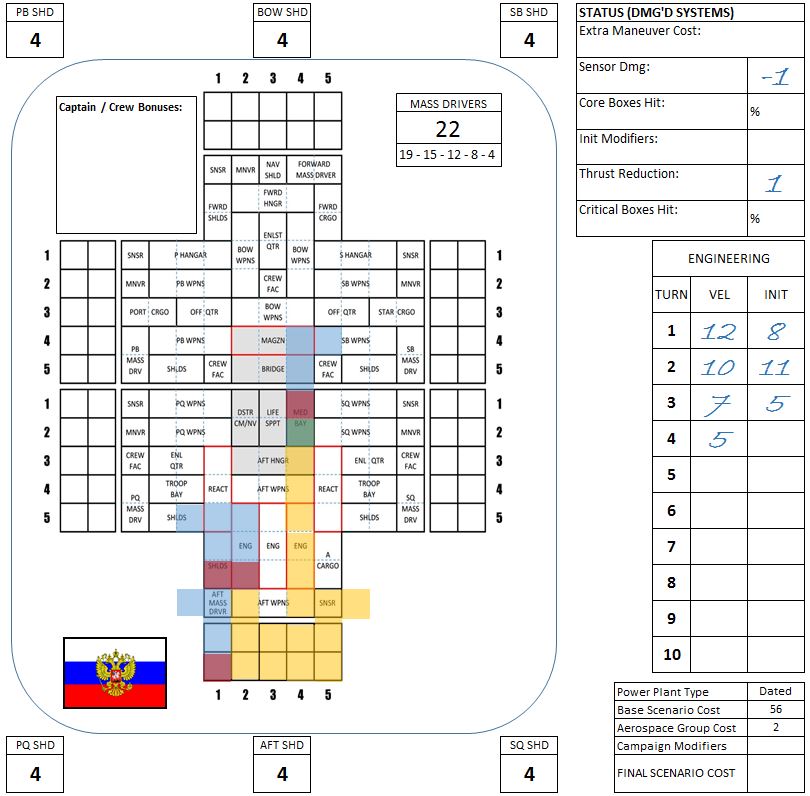
Here we are at the end of movement of Turn 4. The Basilov, Singapore, Fergusson, and Volkhov are all adrift, careening through space at their last powered heading and velocity. You can see why it’s so important that you never end your turn facing toward a planet, moon, or asteroid. You can see where my last ship, the destroyer Kortik, is now inverted, trying to hide her damaged (and unshielded) port quarter from the British. Hiding it from the HMS Raven is easy enough, hiding it from the torpedoes and remaining fighters is not.
However, those disabled shields are really the result of some very lucky shooting from a ship that is no longer operational. If I can knock down enough of these torpedoes, the ones that hit will probably not do enough damage to cripple the Kortik outright. Meanwhile, these are practically the last torpedoes the Raven has. Half her bombers are shot down, the two that are left still haven’t been able to land to rearm. Four fighters are gone. My guns meanwhile, can shoot all day . . .
Believe it or not, the British, particularly the HMS Raven, are actually in a spot of trouble here . . .
Darkstar Online - Oriskany vs. Davehawes Part II
Good afternoon, OTT / BoW:
Okay, so here’s the continuation of the Darkstar battle recently played on-line between myself and @davehawes. In summary, we have my force – an older cruiser battlegroup of the Holy Russian Empire (flagship CPK Basilov) pitted against @davehawes’ smaller, faster, lighter … more advanced but less “punchy-powerful” aerospace carrier battlegroup (flagship HMS Raven).
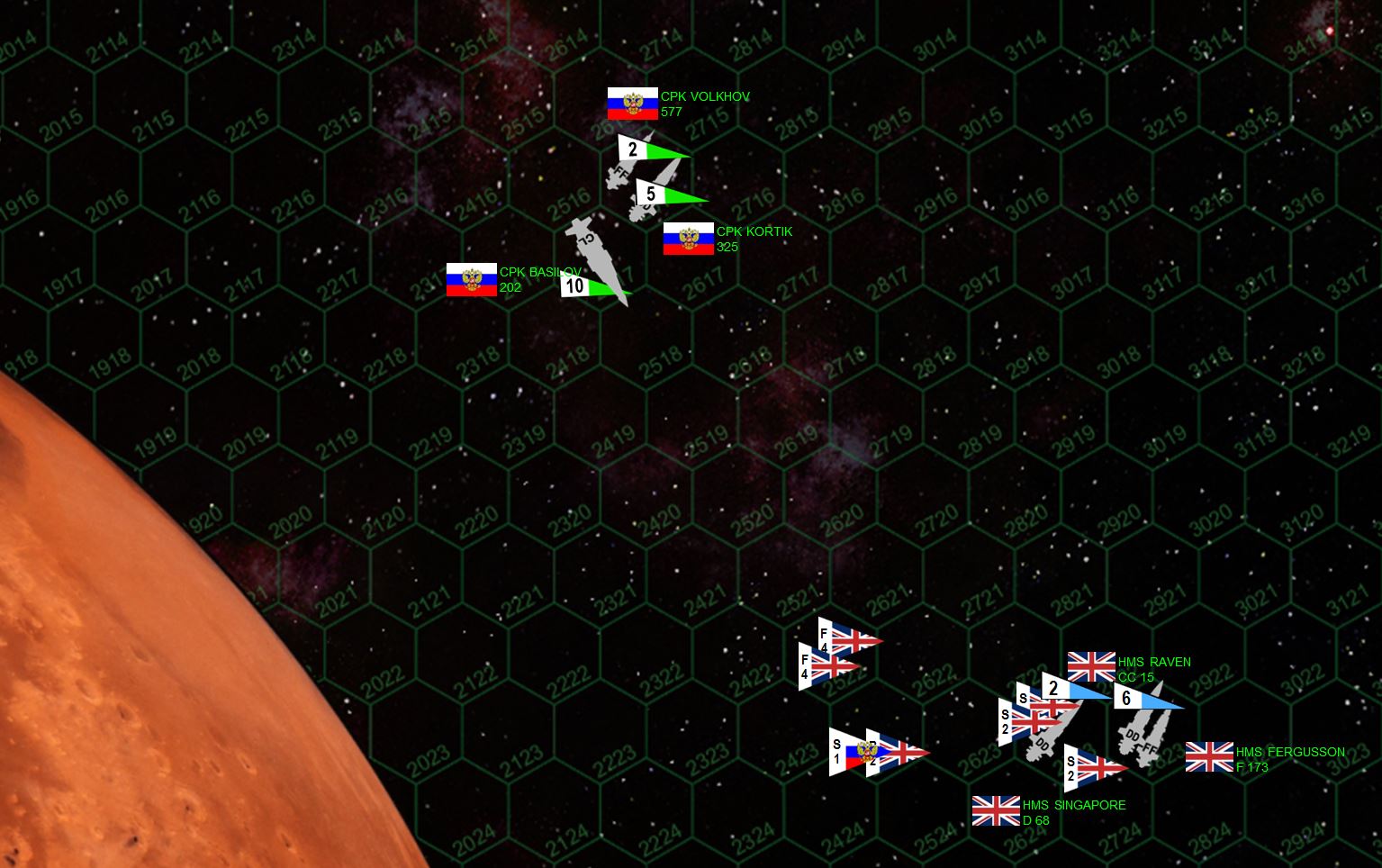
So here’s the general situation midway through Turn 02. The two battlegroups have closed to within 1400 km or so, about the distance between London and Warsaw, and are now exchanging heavy fire. My Russian ships continue to set a high speed, hoping to close with the British as quickly as possible. My guns hit much harder close up, and the last thing you ever want to do with “gun heavy” ships is engage enemy carriers at a distance where their fighters and bombers can simply assail you with missiles and torpedoes. I’ve started to hedge toward the Mars-sized planet in an attempt to cover at least some of the armor and shielding, if I take heavy damage on one side I can always roll my ship and use the planet’s bulk and atmosphere to protect such wounds.
Dave, meanwhile, has been a little accommodating in closing the distance. He’s not moving nearly as fast as I am, and so is not quite as eager to close to any kind of “slugging distance” (perfectly understandable) but I’m a little surprised he’s closing at all. No worries, we’re ready to engage.
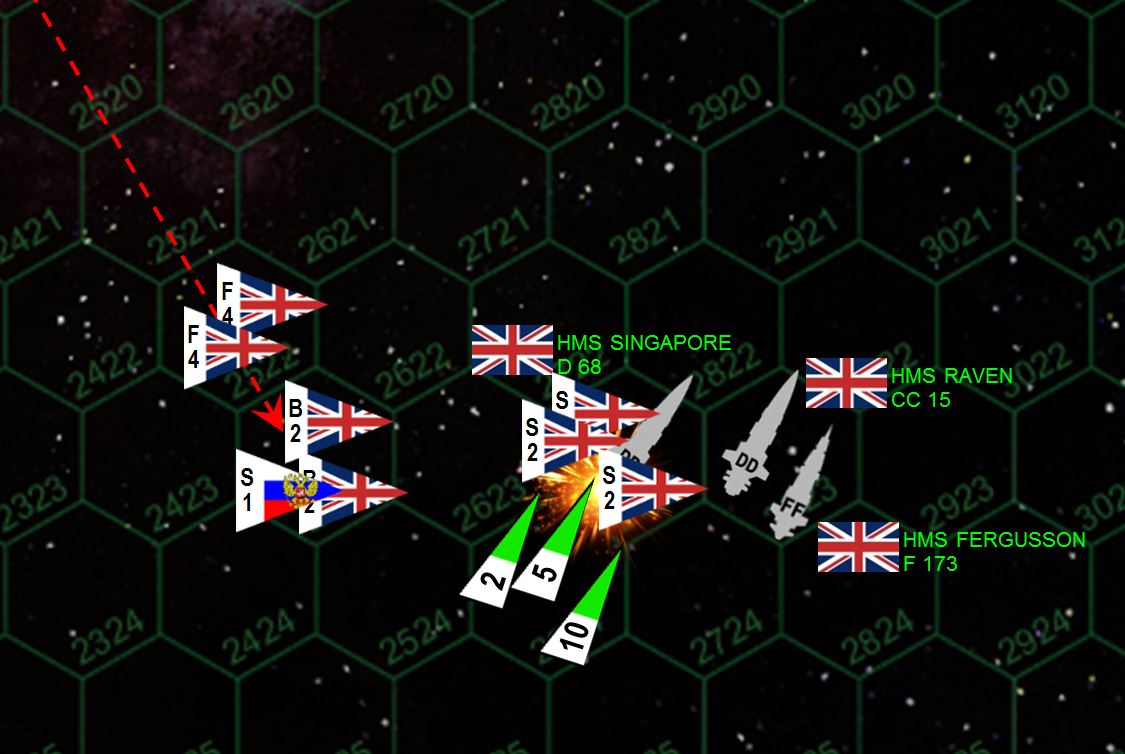
The bad news for me will come in the aerospace attack phase, shown in progress below. His four bombers (two counters of “B2”) are at standoff range, the maximum allowed to sling out their torpedoes past the cruiser Basilov, then fishhook around to hit the Basilov in the stern, by far the most vulnerable part of the ship. To give the torpedoes sufficient reach to execute this maneuver, he has to come JUST close enough to be engaged by Basilov’s mass driver arrays. We open fire with half our guns (keeping half ready to shoot down actual torpedoes) and manage to shoot down one bomber. Then my one and only scout from CPK Volkhov zips in and shoots down another. Aerospace combat is simultaneous, however, so Bomber #2’s ordinance is still launched (each bomber carries 2 torpedoes, so four bombers = 8 torpedoes, one bomber shot down by my mass driver fire BEFORE launch = 6 torpedoes, another bomber shot down by my scouts AS it was launching, so still 6 torpedoes, even though only 4 bombers are left). None of these aerospace craft can shoot at my scout as they used their fire phase to launch aerospace ordinance at my cruiser.
Incidentally, HMS Singapore, Raven, or Fergusson could have shot down my scout, but instead they are reserving ALL mass drivers to try and shoot down the swarm of P-500 Class III torpedoes (green counters) streaking in toward the engines of the destroyer HMS Singapore. Dave also brings in his five scouts, who will take a try at shooting down these torpedoes.
So here’s the Russian battlegroup being hit by the British ordinance package. This is an extremely important phase of the turnand the overall game, it’s really the best single opportunity that Dave will have to knock out or at least badly damage this heaviest Russian ship. I have already thrown half my mass drivers at his bombers, hoping to knock them out even before they launch, plus earn victory points for destroyed enemy combat assets. That worked … partially, but now I only have half of the cruiser mass drivers left to engage the warships torpedoes (blue) the “6T” six aerospace torpedoes launched from those Star Typhoons, or the “8T” lighter eight aerospace missiles launched from the Supermarine Starfire fighters. I also have the mass drivers from the destroyer Kortik and the frigate Volkhov.
I decide to put everything on the warship torpedoes. These are by far the most dangerous, with the highest change to hit and largest damage profile. Even more specifically, I start with those launched from the Singapore, as that destroyer has a +1 CIC / targeting electronics, making her torpedoes in particular even more dangerous.
Meanwhile, the British are doing much the same against my torpedo spread. I have more warship torpedoes, but these are only Class IIIs, meaning they have a lower chance to hit and inflict less damage if they do hit. Still, 17 warheads are nothing to sneeze at. In addition, British scouts are able to attack, subtracting their the class of the torpedoes (3) from the scouts’ Base Intercept Number of 6 (essentially their aerospace attack number). So 6-3=3, giving Dave x5d10 (five scouts) v. 3 … He scores two hits! So whatever the British mass drivers manage to knock down, these scouts then knock down two more P-500 warheads with their light guns.
My Russian mass driver gunners manage to shoot down all but two of the big Class IV warship torpedoes. Their chance to hit is an 8, minus my shields of 4 = ≤4 v d10. One hits, one misses. Two aerospace missiles hit from the Starfires, three torpedoes hit from the Star Typhoons. A typical tactic in Darkstar is to hit with your smaller ordinance first, shaving down enemy armor before really hammering home with your bigger weapons that may exploded inside the enemy ship. So aerospace missiles hit in columns 3 and 4 (two boxes each). The three Typhoon torpedoes hit in Colum 3 (three boxes), then TWO hit in the same column 4 where that Starfire missile just strike. So six boxes are marked off INSIDE the Balisov, wiping out one whole engine (starboard), then drilling into the core of the ship (gray boxes up by the aft hangars). The last big weapon is the that one Class IV torpedo, but its hit location is a little disappointing, a four-point strike that hits column 5. You can see where the fourth box of damage doesn’t even take place in the ship, exploding harmlessly out into space as this warhead basically “clips the tail light” off the cruiser.
So this is nasty. But the Basilov isn’t in real trouble yet. She’s a light cruiser, so her Ship Crippled roll is a 10+ on a d6, -1 off that target number for each critical (red) box marked off. She’s lost three engine boxes, giving her a new Cripple chance of 7+ on a d6. Closer, but still not in immediate danger. She’s also suffered -1 box of gray “core damage.” Light cruisers have a “break off” chance of 15% per box. I roll a 93 on 2d10 percentile, so Basilov’s crew isn’t running yet. However, she has lost one complete engine (starboard), so she’s down -1 in Thrust (this affects her ability to turn and change velocity, as well as initiative). She’s also lost one sensor box, meaning she’s at a -1 to hit with any and all weapons the rest of the game. And let’s face it, her weapons weren’t that accurate to begin with.

The HMS Singapore, meanwhile, fares a little better. Only five of my torpedoes survive British mass driver defensive fire and scout interception. And of those, only two penetrate the Singapore’s shields. That’s the bad news. The good news is that the Singapore is a destroyer and thus a smaller ship. I only have four columns to hit (d4 hit location instead of d5).
However, the Singapore gets very lucky, and the two torpedoes hit outboard (I roll 1 and 4 on hit locations). While this knocks out one battery of mass drivers and a sensor suite (note the reduction of Mass driver number and the -1 to hit for the rest of the game), it COMPLETELY MISSES her engines. If I had rolled 2 and 3 instead of 1 and 4, HMS Singapore would already be in real trouble and well into making critical compartment rolls to maintain power.
Meanwhile, along Singapore’s port bow, the Russian guns of the Kortik and Volkhov have already opened fire. I knock out the port cargo bay, no effect on game play (the captain just lost the prized tea set and box of Cuban cigars he had in storage, he’s a little irate but otherwise undamaged).
Gunnery now opens up, and suddenly the picture starts to get a lot rosier for the Russians. Although the Balisov (Konstantine class light cruiser) wasn’t able to get a broadside against the approaching British warships, it almost doesn’t matter. With three of her four turrets (each a triple mount of 7-GW rail guns) mounted forward, she’s able to blast out a withering fusillade at the hapless little frigate Fergusson. At this rather extended gunnery range, each 7-GW rail gun hit only causes two boxes of damage, and out of the nine guns I can bring to bear, four of them hit (base to hit at this range is 8, -4 for Fergusson’s shields, note the -1 sensor damage doesn’t actually take effect yet since all combat in a given round is considered simultaneous). So that’s four 2-point hits, THREE of which hit in sector 3 (1d6 / 2). Port bow shields are down, two compartments of crew quarters are gone … but the worst is the 7-GW rail gun bolt that smashes completely through the bridge. No roll, no save, the ship is crippled.
Now after the battle, HMS Fergusson will have a chance to be recovered, towed back to the nearest Royal Navy shipyard for repair and refit, to be brought back into service. Looking at her damage here, just 6 days (1.5 days per internal component box hit if ship is crippled) … plus whatever tow time it requires to get her back to said dry dock. But for now, she’s out.
Not to be out done, the HMS Fergusson simultaneously fires back at the frigate Volkhov. She misses. The Singapore, however, scores a hard series of broadside hits (remember her +1 CIC / targeting electronics) with her heavy-gauge lasers and Syglex emitters (synchronized, gravitic-lensed X-rays … basically wide-beam, short-burn X-ray “lasers”). Three of Singapore’s lasers hit, inflicting two boxes of damage (based on Dave’s rolls) in columns 1, 2, and 3. So the lasers perfectly score off all the armor from Volkhov’s starboard quarter. Two syglex emitters hit next, punching into the ship and then “dragging” backward like a blowtorch. The first one hits in Column 2, the second one hist in column 3. As the damage “drags” backward off the back of the ship (syglex emitters are often not terribly effective against smaller ships, at least on the aft quarters), Dave nevertheless hits one reactor box, as shown.
Okay, Resolution Phase. Already the Volkhov is down one complete reactor, knocking down available thrust by -1, as well as her starboard quarter mass driver array.
But could it be worse? Frigates are smaller ships (35,000 tons,180 crew or so), and it doesn’t take much to knock them out. A frigate’s Ship Crippled roll is a 6+ on a d6, -1 off that target number for each critical (red) box marked off. This reduces the -6+ to 5+, giving Dave what works out to a 1/3 chance that this ship will power down right now.
He rolls a 5. So the Novgorod class frigate CPK Volkhov is also crippled, without power, dead in space and out of power.
In effect, the British and Russians have traded frigates. I’ve slightly damaged the destroyer Singapore, while he’s badly damaged the larger light cruiser Basilov. At the moment, the British seem to have the upper hand.
However . . . the aerospace group of the HMS Raven has thrown it’s “Sunday punch.” Half her bombers are now shot down, and the two that are left are too far from the carrier to land quickly to re-arm. Yes, they have eight fighters, but these are now only armed with light cannon, not terribly frightening against full-sized ships. The Russians, by contrast, can fire off those 7-GW rail guns and heavy 40-KG plasma projectors all day …
The advantage may very easily shift back on Turn 3. This battle isn’t even close to over yet …
Darkstar has Gone On-Line!
Well, as some of you may remember, I was challenged on an episode of XLBS a while back to run a game of Darkstar on-line.
Never challenge Oriskany. 😀
In all seriousness … this first on-line game has now been run. It took place on December 1, 2018 between myself here in Fort Lauderdale and @davehawes in the UK, with spectators from the US, UK, and Canada.
The platform proved very smooth and outside of a few lag issues when remote players were trying to move their pieces on the shared desktop, delivered a pretty epic Darkstar experience.
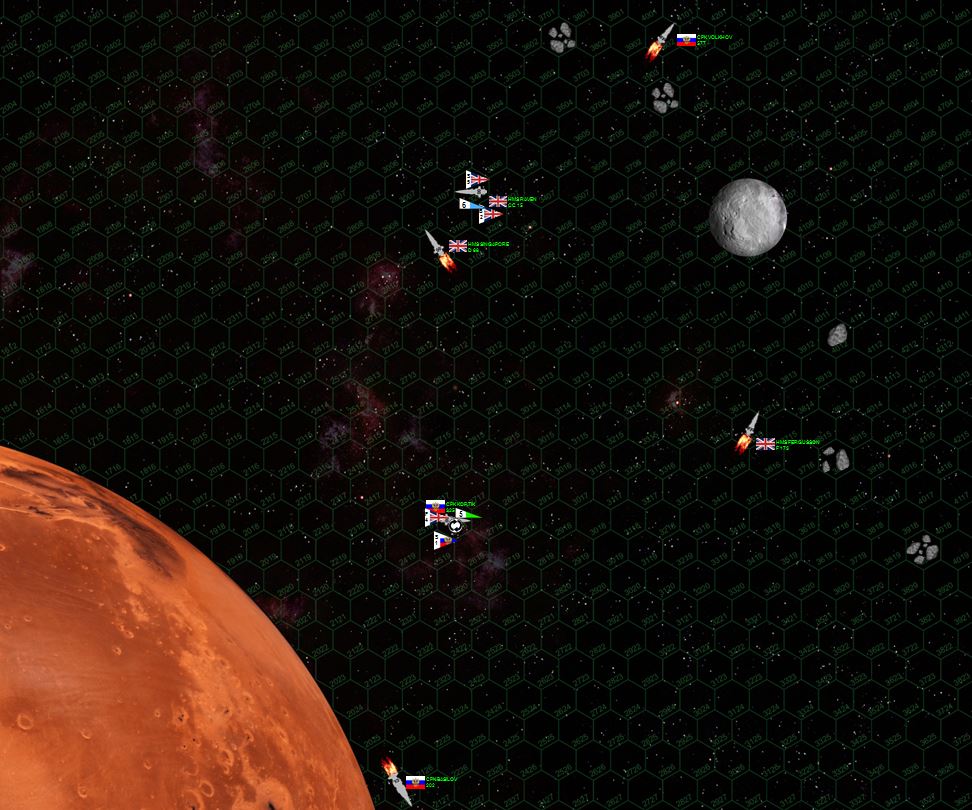
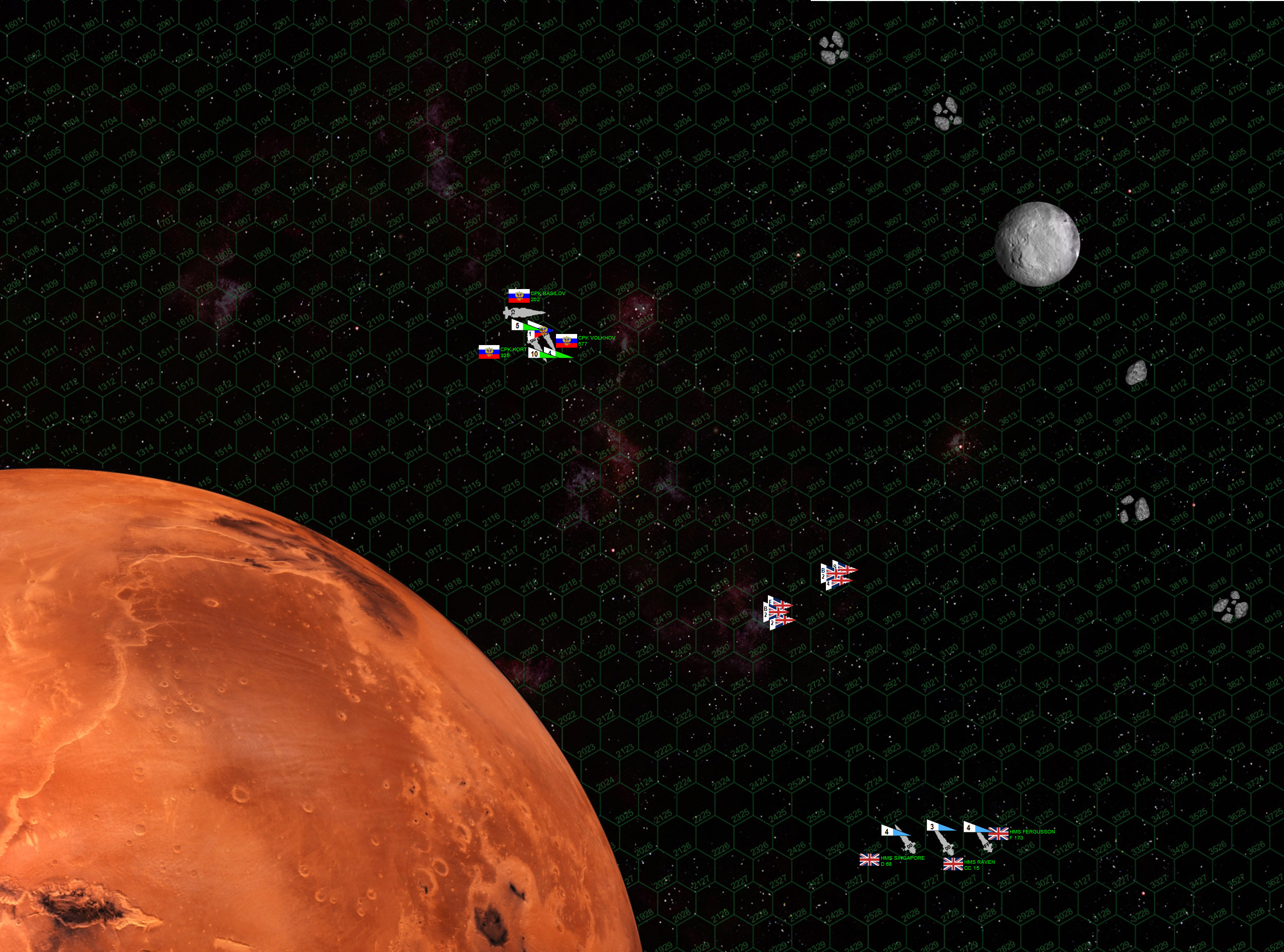
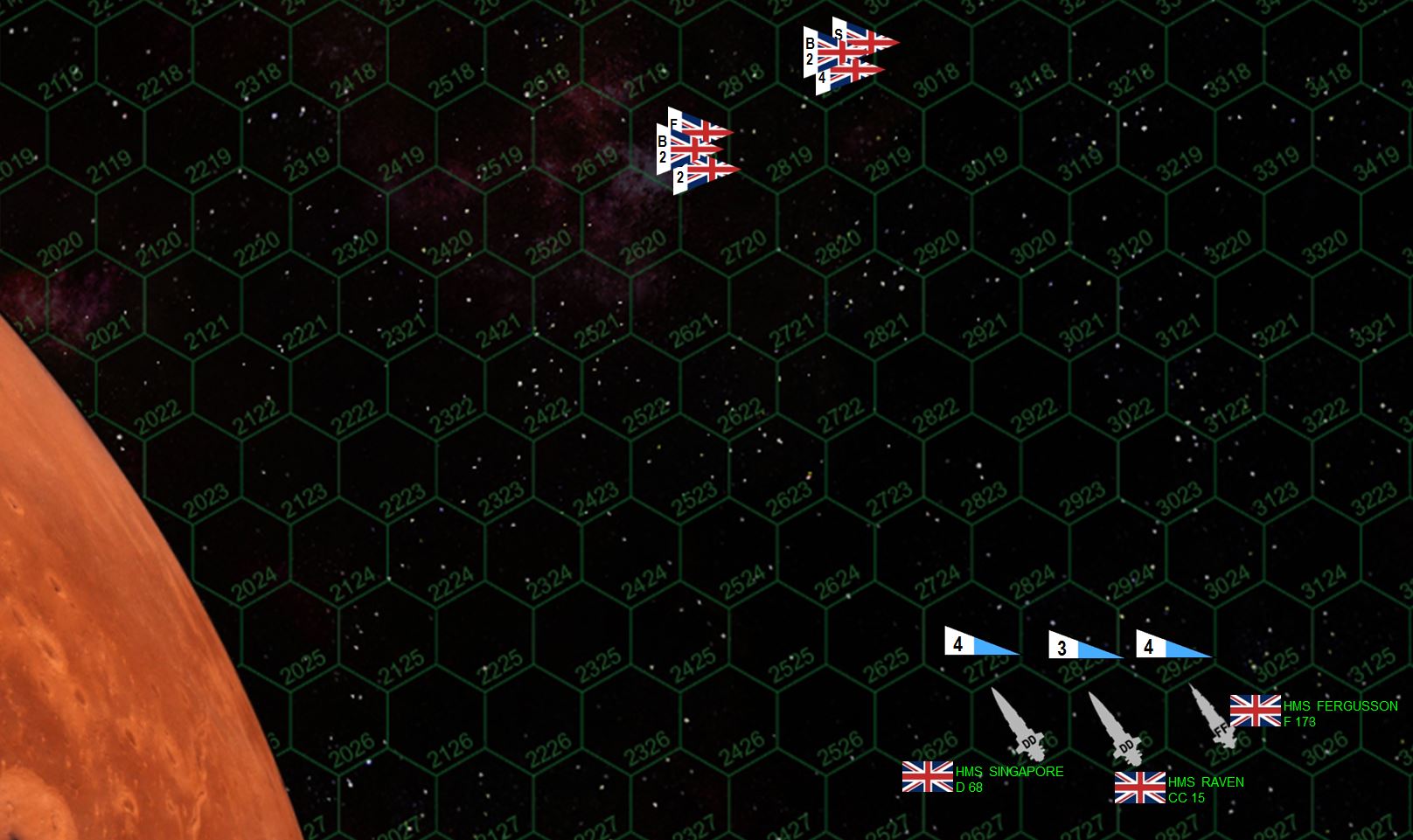
So here we have the opening positions at the end of Turn 01 movement phase. We have a Mars-sized planet and a small moon to upper right. The moon is rich in a valuable resource, and has been mined so heavily by city-sized automated facilities that industrial debris is now presenting a navigational hazard (note the asteroid counters strung out the moon’s gravitational eddy).
Apparently the powers-that-be feel this moon is still valuable enough to fight over, as the Holy Russian Empire and the United Kingdom have decided to have a bit of a dust-up over disputed expiration dates on the mining leases of this facility.
The Russians are approaching from upper left. They have an old Konstantin class light cruiser, a Sonvya class destroyer, and a Novgorod class frigate. All 7-gigawatt rail guns and heavy plasma projectors. A direct, simple, sledgehammer kind of a force. They are approaching at high speed, pushing 36 kilometers a second.
The British (at @davehawes’ request) have a much smaller, more agile, and high-tech force. Notably, the British flagship is the Osprey class light carrier HMS Raven, carrying a complement of Supermarine Starfire aerospace fighters and Hawker Star Typhoon bombers. You can see where the British (approaching from lower right) have set a much slower course, wary of keeping a distance from those big-punch Russian guns, and instead are trying their best to scramble their aerospace group as quickly as possible.
Initial volleys are exchanged at a distance of 3420 kilometers (19 hexes). That’s the distance from London to Cairo. All of Europe would easily fit into the space between these two battlegroups, but they are closing at a combined rate of about 50 kilometers a second (180,000 km an hour).
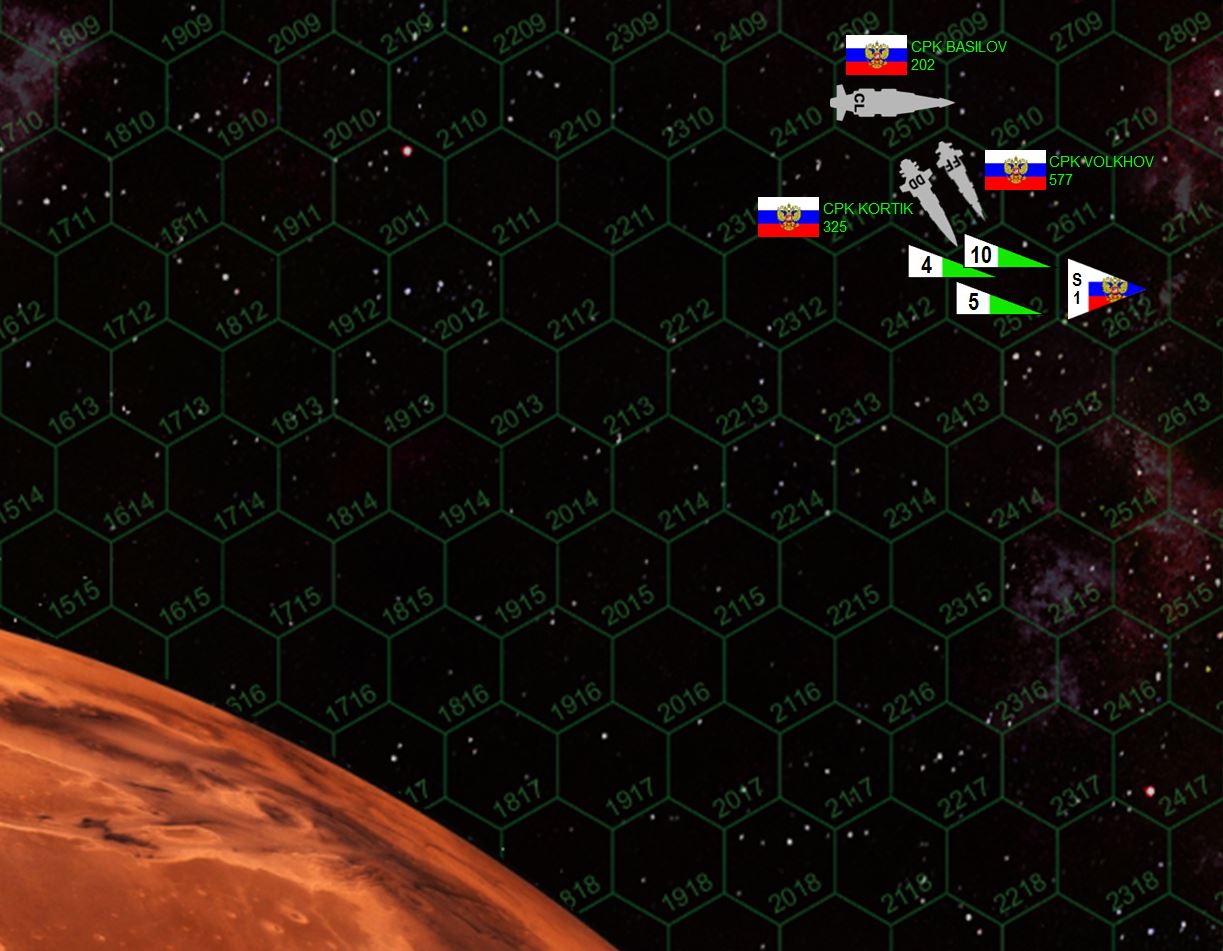
Spreading things out just a bit for the same of clarity (and just in this screen pic), we see the Russian task force making its approach. Flagship is the light cruiser CPK (Holy Russian Ship) Basilov, a Konstantin class light cruiser. Older, cheaper, loaded with simple rail guns and old P-500 “Plamya” (flame) Class III torpedoes, named for Russian Orthodox saints, these ships have a direct purpose and despite their age, still pose a very serious threat to anyone who gets too close, as the British are about to learn.
Slightly more advanced (although by no means state of the art) are the Sovnya class destroyer Kortik (traditional Russian naval dagger) and the Novgorod class frigate Volkhov (named for mid-sized cities of terrestrial Russia).
To balance the game at 117 points, the Basilov and the Kortik are entering this game without their scouts. So the only aerospace the Russians have is the one lonely scout from the little frigate Volkhov.
Russian ships have also launched torpedoes. The decision was made by the Basilov’s captain to slow slightly and lake a turn in an attempt to present a broadside. This doesn’t work anyway (she lost initiative) but the idea was to present more guns in exchange for firing a full spread of torpedoes from both port bow and starboard bow arrays.
The Royal Navy launches aerospace craft to engage. These ships are the HMS Raven, the aforementioned Osprey class light carrier, and her two escorts. These are the Falklands class fleet destroyer HMS Singapore – actually a pretty advanced design and the most advanced ship on this table. On the other end is the humble HMS Fergusson, a small Cornwallis class escort frigate. Specifically designed not to be an independent vessel (she doesn’t even have the full speed of a frigate), she is a true escort ship, designed to hang close to a flagship and provide torpedo, gunnery, and especially mass driver (anti-aerospace craft) support.
Meanwhile, the forward, port, starboard launch bays of the Raven have already launched the maximum amount of fighters and bombers she can this turn. These are racing out to engage the Russians with aerospace missiles from the fighters and much heavier aerospace torpedoes from the bombers.
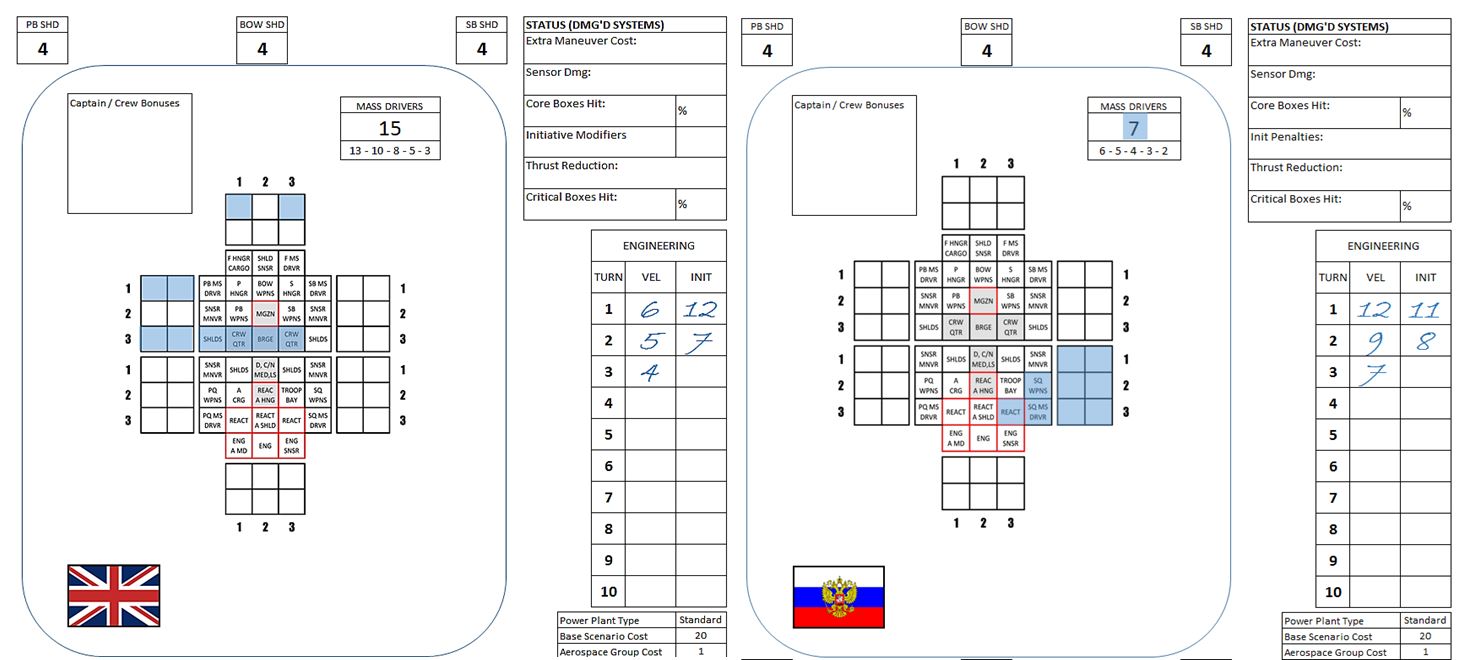
The most challenging part of the on-line play solution was figuring out how to work the Warships Record Sheets (WRS). But I think we’re getting it. Here is a partial view of HMS Osprey’s WRS, showing the torpedoes she’s launches so far, her aerospace group, her mass driver defenses, her initiative for Turn 1, her initial velocity recorded for Turn 1, and the final speed for the turn (which of course becomes her initial velocity for Turn 2).

End of movement on Round 2. The two sides have closed to about 1440 kilometers (about the distance from London to Warsaw). The British are about to hit the Russians with a devastating aerospace and torpedo strike. But the Russians are no slouches when it comes to ship-launched torpedoes, and what this battlegroup lacks in aerospace craft they make up for in guns . . .
Lots of guns.
And the two sides are a lot closer now. And those British ships suddenly look very small and frail . . .
Stay tuned!
What else can I say but THANK YOU!
Wow, everyone. Seriously, what else can I say but … thank you.
Suffice it to say that the results of this pool have absolutely blown away any and all expectations. The response in just twelve hours … it’s absolutely incredible. I’m surprised, thrilled, humbled, excited, and deeply moved.
I can’t connect everyone’s OTT/BoW screen name to the names that appear in the support / donation pool. But just a quick list …
Damon – Consider the Trafalgar class heavy cruiser “under construction” in the shipyards. If you want, we can come up with some distinguishing features from the Iron Duke and Titan classes so it’s not redundant in the canon.
Nick – Absolutely no worries on a warship Quin. UK? US? Any other preference? We’ll make sure she’s a famous ship of her class.
Stu Shaw – Absolutely great idea re: adding pictures of the the warships card construction / playing pieces into the book somewhere. Maybe their own suggestion as an appendix at the back, like some books have painting guides for inspiration, etc.
Howard – “A UK ship,” you say? For that donation and level of support, you deserve a fleet! A ship indeed, that’s going to be at least a battlecruiser, or really any class you want.
Jennifer – thanks so much for all your support, in the pool, at the playtesting table, and everywhere else on the “battlefield of life.” Long live the HMS Kraken!
Andrew – Dude, you didn’t even ask for anything! That’s not going to fly, not in my universe. Do they name warships after engineers? Hell, they do now. 😀
Dennis – my God, man. Are you kidding me? You can’t choose between “hero of the lore” or “warship class?” Have no fear, sir, they name warship classes after historical heroes. So you’re getting both.
Rasmus – Thanks so much! I think there may be some “space Vikings” in the making!
Donation Pool Open - Darkstar Rules Publication
Good afternoon, OnTableTop / Beasts of War;
As you may have heard or read, repeated requests from dozens of community members have finally pushed me into writing down an official, codified set of rules for Darkstar, my sci fi wargame of tactical starship combat in humanity’s far future.
Work has begun on this project, which is every bit as large and complex and I thought it would be. I’m anticipating the base rules to be at least 40 illustrated pages, plus 40+ more pages of starship designs, background, write ups, etc.
All of this is addition to the 30+ pages already published of history, factions, tech, “known space” setting, and so on.
While I’m writing and publishing this rulebook simply strictly at community request, I’ve also opened a PayPal Pool if anyone is interested in contributing to this project. It’s turning into a month of 1:00 AM and 2:00 AM nights, but the goal is to produce a professional-grade .pdf that anyone can download and play a game of Darkstar with a minimum of questions or ambiguity.
If you are so inclined (I thank you very much in advance), just hit the link below and contribute in whatever amount you feel comfortable.
>>Darkstar Optional Donation Pool<<
What you get:
Those who contribute will be included in the rule set or Darkstar “canon” universe somehow. Just some possible examples:
$1 USD or more: A warship named after you (you pick the faction)
$5 USD or more: A warship or colony named after you, perhaps with some of the write up of that warship class mentioning your ship as “the most notable vessel of the class.” Perhaps you can be included somewhere in the background as a prominent starship captain or naval commander in the Darkstar universe, with a short note about how your namesake became famous enough to have a warship named after him or her. You’re also at “the front of the line” if you ever choose to play Darkstar online with our growing “Starships Commander’s Club.”
$10 USD or more: An entire warship class named after you, with your name probably being used as a starship naval “hero” of Darkstar history. Who knows?
Anyway, I’m writing the rule set anyway as a passion project, and as a way to encourage the amazing the humbling amount of interest the Darkstar project has already been generating. Thanks so much, everyone, and I hope to see you “out there among the stars.”
Jim “Oriskany” Johnson