







![1918 Spring Offensive Wargame | Full Rules Overview with John & Gerry (WW1 Tabletop Game) [7 Days Early Access]](https://images.beastsofwar.com/2026/03/unboxing-warfulcrum-games-1918-spring-offensive-review-coverimage1-225-127.jpeg)

Solo Wargaming – Example Playthrough (Pic Heavy)



Recommendations: 321
About the Project
Example playthrough of a solo game for illustrative purposes. Best reviewed using the 'View Oldest Entries First' option.
Related Game: Warhammer Fantasy Battles
Related Genre: General
This Project is Completed
Background and lead-in
Wanting to test the principles of solo wargaming first hand I decided to break out some of my old Warhammer Fantasy miniatures and try a practice game. The rules set utilised would be Warhammer Fantasy – something of a home-brewed mash-up of the parts I like best from 6th, 7th and 8th editions. If you are not a fan of the fantasy genre or are not familiar with the warhammer rules set, don’t worry – this project will aim to illustrate the solo gaming mechanisms utilised rather than focusing on the nuances of the Warhammer fantasy gaming system.
To provide a narrative framework to the game I determined that following the unexpected and untimely death of a venerable grand tribal chieftain, who had held the monstrous races in a coalition and under a somewhat peaceful truce with the human kingdoms, that all the lower chieftains had decided to take up arms against the humans to prove their strength and therefore, their suitability to lead the coalition from now on. The human kingdom, suddenly engaged on all fronts, scrambles to defend its borders, reinforcing existing garrisons with hastily raised levies.
The battle would take place outside a defended mountain pass leading to the human kingdom. An orc warlord leads his forces to attack the pass in an attempt to break through and raid the farmlands beyond the pass, seeking to gain valuables, status and recognition from his peers. The town and existing defensive structures which had previously been present outside the pass had been damaged or destroyed in an earlier war and had not been fully repaired.
The evening before the battle, a group of human scouts from the pass garrison and a group of orc scouts stumble into one another. Were I playing a full campaign I could have utilised a solo skirmish game here to determine the outcome, but for the sake of this article we will assume both sides suffered minor casualties before both forces retreated.
Additionally, in the hours of the early morning, a force of goblins was dispatched by the orc warlord to seize control of a tower near the mountain pass which had been converted into a makeshift signal tower. This was in order to prevent the human garrison raising the alarm that an orc force was on the move in the area. Once again in a full campaign this would have provided scope for a smaller scale game in and of itself, but we can just assume that through stealth, subterfuge and, more likely, overwhelming numbers, the goblins managed to capture the tower.
As an additional aside, I had opted not to include magical equipment or spellcasters in either force for the sake of simplicity.
Orc player’s Information
The Orc warlord knows the following:
- The mountain pass will be defended by at least a token garrison form the human kingdom.
- The garrison is likely to have been reinforced, however given how stretched the human kingdom is, the reinforcements are likely to be few in number and/or of poor quality troops.
- The human garrison likely suspects the presence of his force, given the run-in between the two scouting forces.
- The human garrison will likely not have had an opportunity to fully rebuild the defensive network and structures at the mountain pass. However, in previous battles in this area the older orc advisors recall the humans using various traps as defensive measures. It is strongly likely that some of these may remain and are active, or have been repaired by the human garrison. Consequently travel on the roads may be the best way to avoid said traps. The orc warlord can reasonably suspect that the human garrison will anticipate this approach and either barricade the road, or alternatively, will have the road covered by ranged units and will try to funnel the orc forces down the road.
- Knowing that his intention is to rapidly break through the human lines and raid, the orc player will not bring siege engines as part of his force as they would reduce his mobility once the pass is breached.
- The orc warlord knows he dispatched a force of gobils to seize the watch/signal tower, however will not know if this was successful until he arrives on the battlefield.
Human players information
The human garrison commanders know the following:
- Warlords from the monstrous races have been attacking frontier human settlements regularly of late, following the death of the former grand chieftain.
- Orc scouts were reported in the vicinity in the previous evening. This strongly suggests the nearby presence of an orc raiding force.
- Some of the defensive trap network outside the ruined village on the outskirts of the mountain pass have been hastily repaired and refitted. However due to the hasty nature of the repairs some of the traps may not be in working order.
Orc Forces
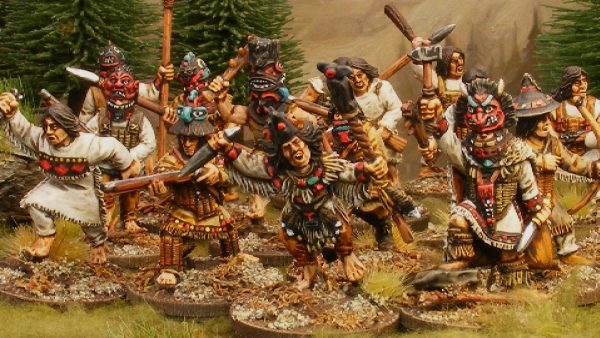
The orc forces were comprised of every painted non-siege weapon orc or goblin miniature I could find.
From left side front to back:
20 orcs with 2 hand weapons (generic heavy infantry)
20 orcs with 2 hand weapons (generic heavy infantry)
20 black orcs (elite heavy infantry)
20 big-un’s (veteran heavy infantry)
10 archers (mediocre missile infantry- will act as a skirmishing scout force for this game)
10 archers (mediocre missile infantry- will act as a skirmishing scout force for this game)
Chariot
Giant (Shock heavy infantry/monster)
Orc warlord
Goblin boss (lead’s goblin subfaction – subordinate leader to orc warlord)
20 savage orcs (fanatical heavy infantry)
20 savage orcs (fanatical heavy infantry)
5 boar riders (heavy cavalry)
42 goblins (poor quality infantry)
21 goblins (poor quality infantry)
20 goblins (poor quality infantry)
20 goblin archers (poor quality missile unit)
Approximate point equivalence of the force is around 2,500 points.
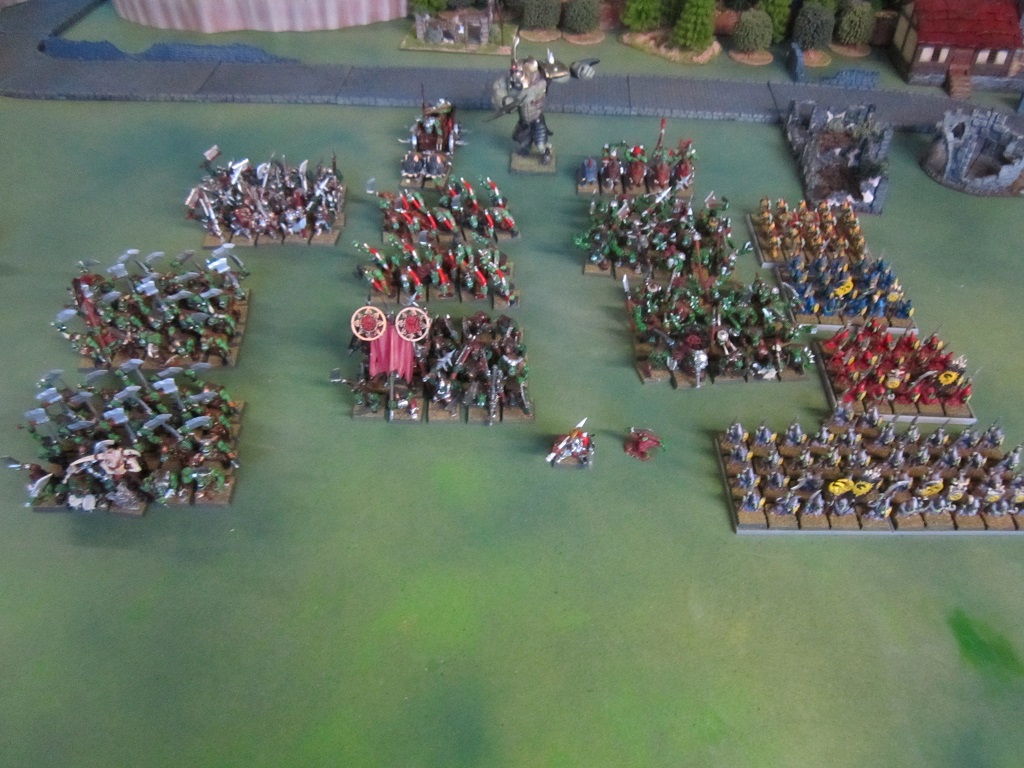
The orcs are essentially a hand to hand combat force so the orc warlord will be seeking to come to grips with the opposing force as quickly as possible. Knowing the forces available to him and based on the information to hand the orc battle plan is as follows:
- the goblins which were not engaged in taking the tower will be deployed on the right flank (mainly to keep them out of the way…)
- The faster elements of the force, ie the boar riders and chariot, will support the right flank.
- The skirmishing archers will be deployed in front of the main body of troops to screen the force from any enemy fire.
- The black orcs will be deployed on the road to spearhead an assault on any defending forces.
- One unit of savage orcs will be deployed in front of the black orcs to screen the elite unit form any enemy missile fire.
- The remaining orcs will be deployed close to the road to support the main attack.
- The giant will be kept towards the rear to screen it from missile fire until such time as it can be deployed to make an appropriate impact.
The orcs also suffer from a special rule called ‘animosity’ which means that each round there is a chance that most of the units (except the Black orcs, chariot and giant) may bicker amongst themselves or charge off rather than following orders.
Human Forces
The human forces are divided into two components – the fusiliers charged with defending the pass and the reinforcing contingent. this was intentional – playing the humans as two smaller discrete forces with differing orders would mean that the army would not fight as a cohesive whole.
Fusiliers Force composition
Front to rear:
Engineer (leader of force)
Two cannons (heavy artillery)
25 spearmen (defensive regular infantry) with two detachments of 12 handgunners (heavy missile support)
The fusiliers are, obviously, a ranged force and will by default be deployed at the mouth of the pass and will not seek to give up their defensive position.
Approximate points equivalence of this force is just over 700 points.

Reinforcing Force composition
Front to rear, left to right:
15 free company (poor quality infantry)
Captain (leader of reinforcing force)
15 free company (poor quality infantry)
10 archers (average skirmishing infantry)
20 swordsmen (good quality infantry)
10 crossbowmen (good quality missile unit)
10 huntsmen (average skirmishing infantry)
6 pistoliers (fast light cavalry missile unit)
Approximate points value of this component of the force is just over 800 points, bringing the combined human forces to a little over 1,500 points compared to the orc’s 2,500.

Based on the information available to them at the start of the battle, the reinforcing force will deploy to the left of the fusiliers in a defensive position. Once they observe that the watch/signal tower has been captured they will need to consider whether to redeploy to attempt to recapture the tower.
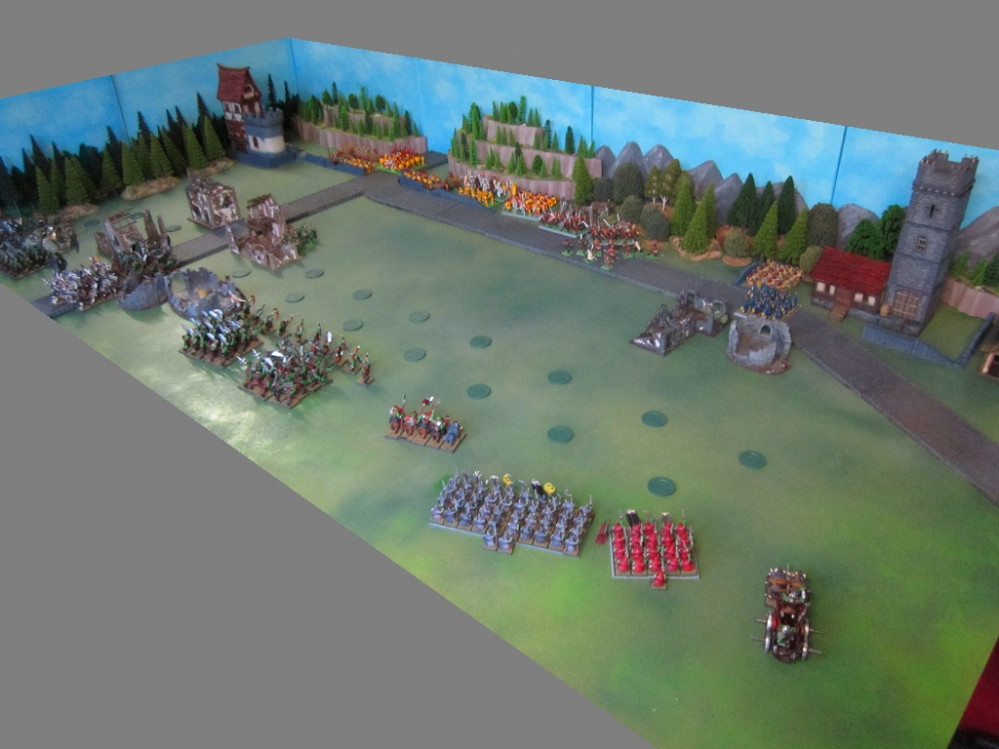
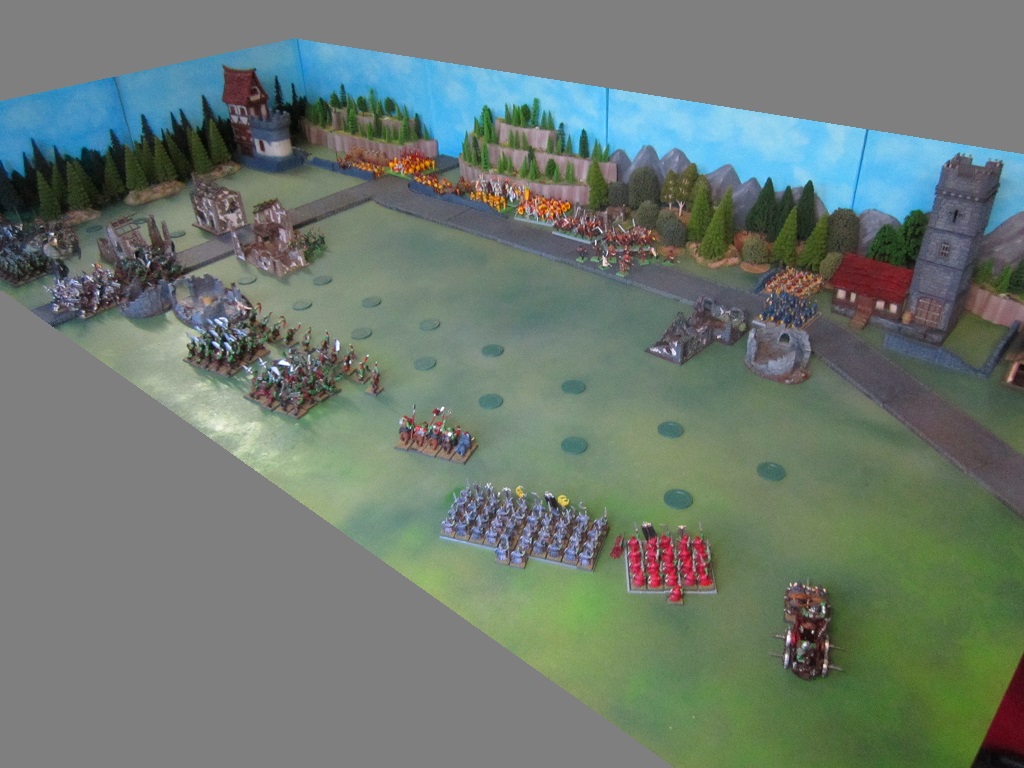
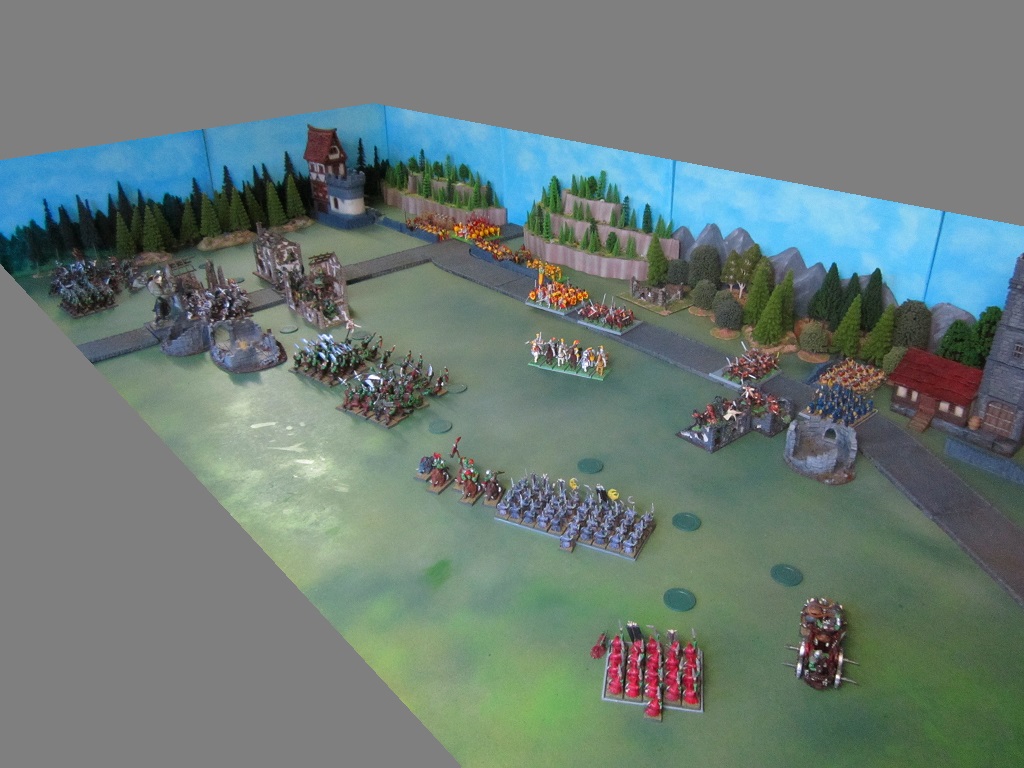
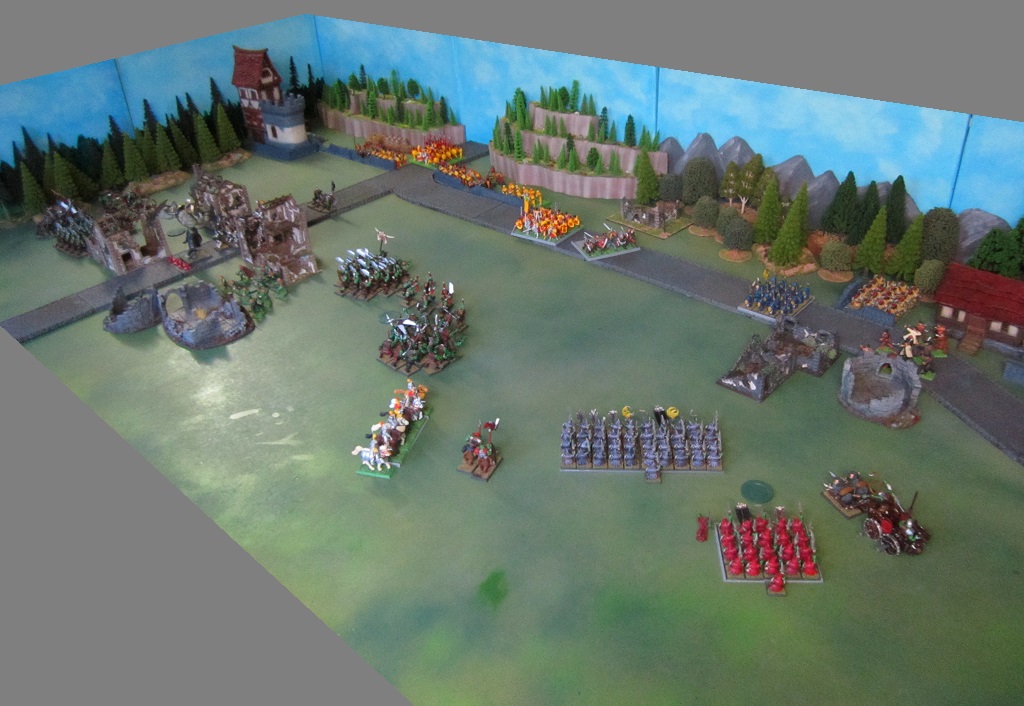
The below image shows the filed where the battle would be fought. The orc army would approach from the left hand side of screen table edge, with the goblin forces having captured and occupied the tower on the bottom right of screen. The fusiliers would deploy defending the mountain pass at the top of screen where the road met the table edge, with the human reinforcing force deploying along the same table edge, further to the right of screen.

Modifications and Win Conditions
With the approximate approach of each group determined for the battle I decided to confirm win conditions. I would use the tried and true ‘tally of opposing forces killed’ as a starting point to determine win conditions. Points would be awarded for standards captured and commanders killed in accordance with the normal rules. No points would be awarded for table quarters captured – control of the pass was the primary objective and this would be determined by remaining forces at the pass entrance at the end of the game. However, wanting to introduce some character to the game and reinforce the narrative elements, I decided that the below additions would also be made to the standard points.
- If the human side could re-take the captured watchtower and light the signal fire atop to warn local villages and farms of the presence of the orc forces then they would be awarded an additional 500 victory points.
- For each unit moved off the board on the human player’s table edge via the mountain pass the orc player would gain additional victory points equal to double the value of that unit.
To make things slightly more balanced the human forces would also have a partly reconstructed trap network in front of the orc horde to slow them down. Trap counters were made by spraying some discount cheap poker chips in green primer and affixing stickers to the bottom of some to them. I repainted 30 counters in total, and half of these (15) had stickers affixed to one side, being three each of the 5 coloured stickers, each of which represented a different type of trap.
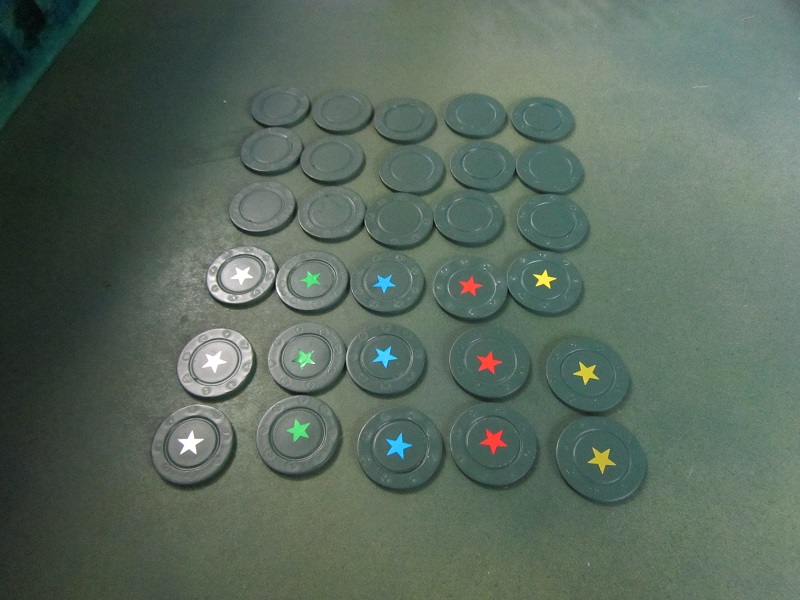
Of the 30 counters I would randomly select 18 for deployment. This would mean that there could be as few as three ‘active’ traps on the board, or as many as 15 of the 18 tokens could be traps, with the average chance being around a 50% chance of each token being active.
Trap token effects (and the in-game effect for anyone familiar with WHFB) were as follows:
Blank Token/ No Sticker = dud trap.
Gold Sticker = Shot Trap – A hidden charge of black powder is ignited launching a single metal projectile upwards from within the ground at a terrifying speed. (Unit suffers 1 strength 10 hit with no armour saves allowed).
Silver Sticker = Canister Trap – A tripwire ignites a black powder charge hidden within a concealed drum of canister shot. Shrapnel flies through the unit. (Unit suffers d6 Strength 4 hits with a -1 armour save applied).
Red Sticker = Fire Trap – An activated mechanism spews forth tar which suddenly erupts in flame. Witnessing the terrible demise of their comrades in such a manner may make troops hesitant to continue forward. (Unit takes d6 strength 3 flaming attacks. If a would is suffered the unit must pass a leadership test or have their movement value halved for the current movement phase).
Green Sticker = Snare Trap. Snare lines, coated in vicious barbs, are hidden throughout the undergrowth. If ensnared, troops will need to spend time cutting one another free. (Pass an initiative save or this unit will have it’s movement value halved for this turn and the unit’s next turn).
Blue Sticker = Pit Trap. The ground suddenly falls away revealing a deep shaft with narrow sides, sharpened spikes lining the bottom. (unit must pass an initiative check or suffer d3 str 3 hits and have it’s movement halved this turn).
I additionally determined that the orc scouts/archers (whom I had upgraded to be skirmishers) would not set off these traps as being better trained (?) they could easily move around any patch of ground that appeared suspicious.
Deployment
Next up it was time to deploy units. First to be placed were the fusiliers as there was no real question about there positioning – they were there to defend the pass.
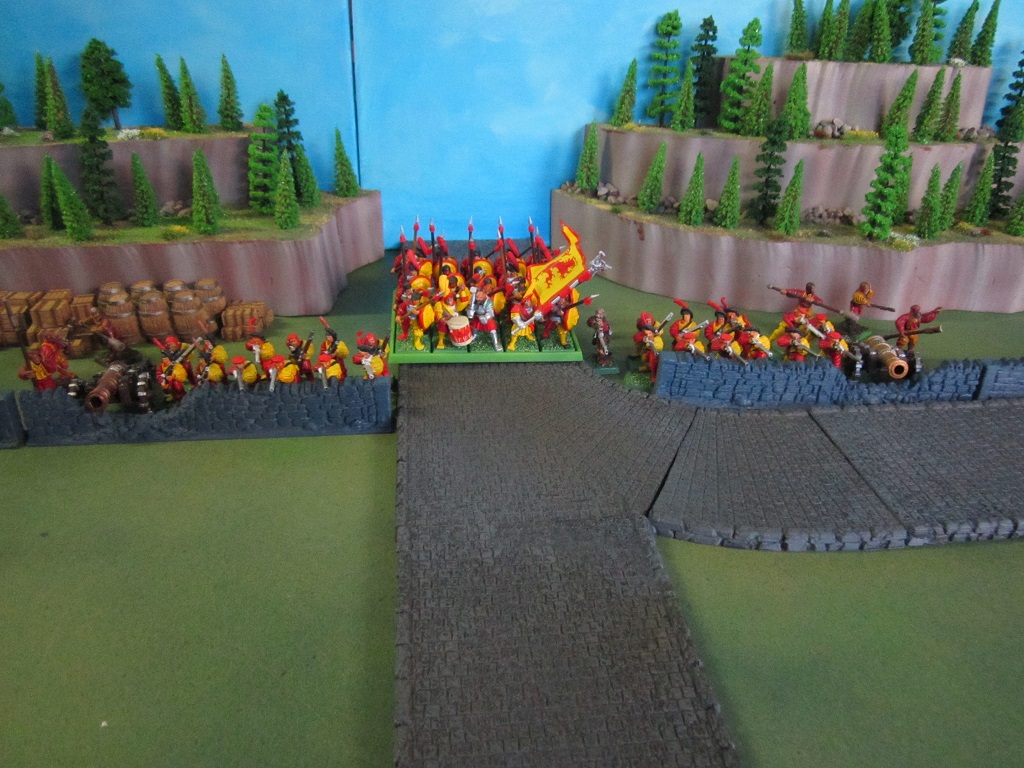
The next body of troops down were the goblin forces that had captured and overrun the watchtower in the early morning, unbeknownst to the human forces.
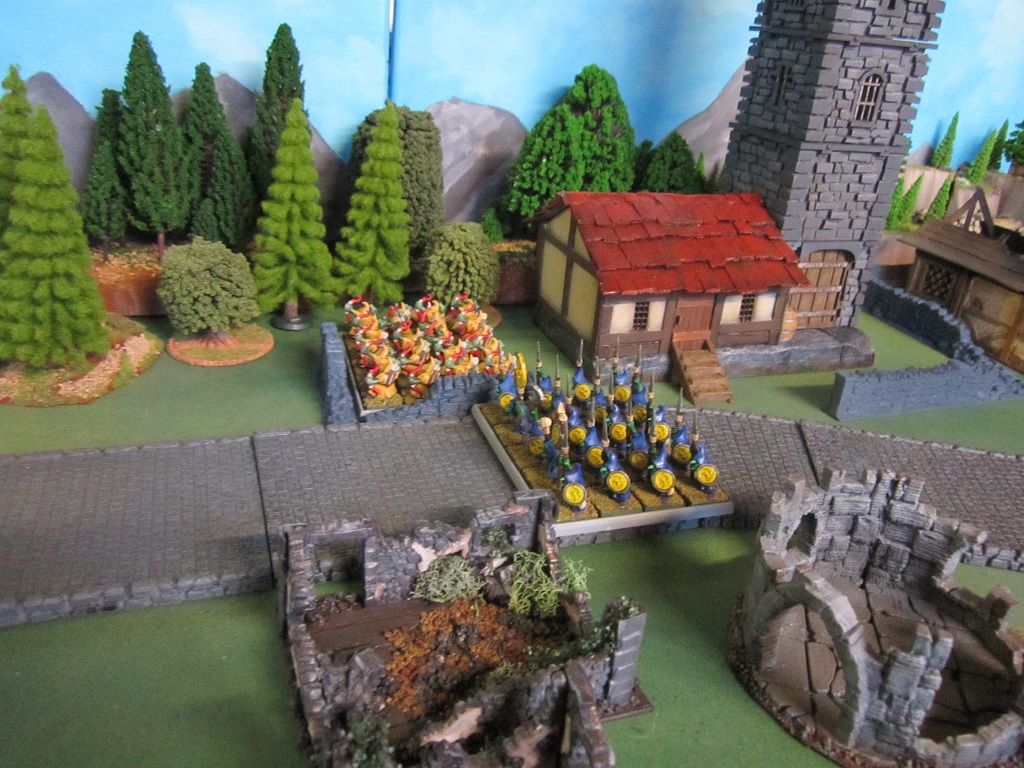
The remaining orc forces were deployed according to their initial battleplan. That is, to the left of road a unit of skirmishing archers up front screening big blocks of orc warriors and orc big un’z from shooting, with a giant using the damaged buildings of the ruined village as cover from the fusiliers cannons. On the road a unit of savage orcs was screening the black orcs. To the right of the road a second unit of orc archers acted as a skirmishing screen for the remaining blocks of orc warriors and savage orcs. On the right flank, orc boar riders (please ignore the missing rider, I’m sure I’ll locate him one day…) and chariot would support the remaining goblin units in sweeping round and securing the right flank.
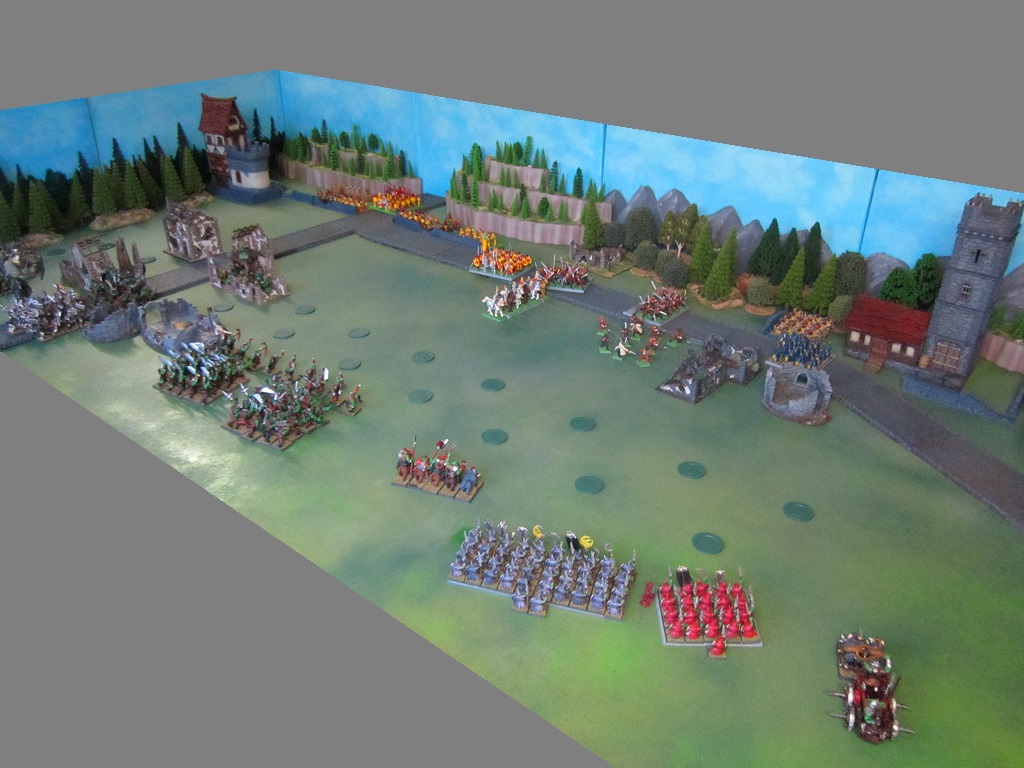
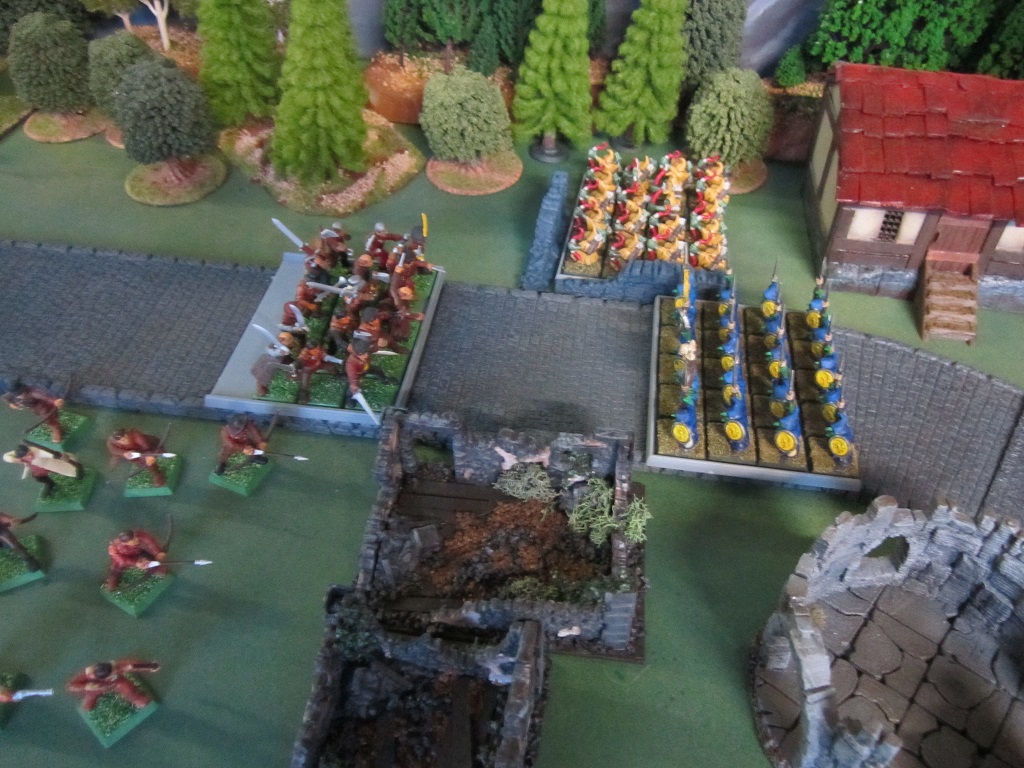
The human reinforcing company took position as best they could in the available space on the far side of the road. The crossbowmen took up a defensive position behind a ruined wall and made ready to add supporting fire to the guns of the fusiliers. Behind them, light cavalry waited for an opportunity to redeploy to a more tactically advantageous position. The swordsmen containing the captain, being the only unit that could potentially withstand receiving a charge by the orc units, anchored the battle line. The remaining free company and archer units were deployed further out to respond to the threat the goblins presented. The human huntsmen made their scouting deployment behind the ruined buildings near the road to the pass – they would attempt to harass and slow down the orcs without becoming involved in direct hand to hand combat with them.
Trap counters were additionally placed along most of the length of the board, face down. I had no idea which or even how many counters were active traps at this stage.
Humans Turn 1
The human forces won the initiative and took the first turn. However with the orc forces either out of range or screening most of their high value targets, the first round of shooting would prove to be ineffective.
The fusiliers stood firm (I determined that this would be their default order for most of the game). The huntsmen moved into one of the ruined buildings to provide a more defensive position to snipe and harass from. These were both straight forward decisions to make – the real point of concern was with the reinforcing company. The commander knew that if he moved his forces to recapture the tower that the fusiliers would not have enough strength to withstand the force of the orc line when it did land. Conversely, foregoing control of the tower would mean that the local populace would not be alerted to the imminent danger. Taking what could best be determined to be a compromise solution, the reinforcing company commander leaves his crossbowmen in position behind the wall, moves his swordsmen forward to protect the left flank, and takes one unit of the free company to support the swordsmen. the remaining free company and archers are sent to try and rout the goblins, with the pistolier light cavalry supporting. If the goblin raiders can be dislodged before the goblin reinforcements arrive it might mean that some of the orc force might be drawn away form the main battle line to help root the free company and archers out of the ruins.
Orc Turn 1
Commencing with their animosity checks, the yellow unit of goblins, and the red unit of goblins, failed their checks and spent the turn squabbling amongst themselves. Crucially however, the orc archers acting as a skirmishing screen on the left flank also took to in-fighting, meaning that the units behind them could not advance through the bickering orcs (we can assume that they were watching, cheering and placing wagers as the archers belted one another over the head with bows until all grievances had been thoroughly resolved). This would now mean that the attack line was going to hit in different phases, meaning that the fusiliers could potentially concentrate fire on the current threat rather than being forced to decide between a number of alternatives all of which demanded immediate attention.
Muttering to himself about the ineptitude of his troops, the orc warlord pressed on with the remainder of his plan this turn, all of which went very well. The savage orcs and black orcs on the road surged forward, unconcerned by the close proximity of the human huntsman trying to march-block them. the giant fell in behind the black orcs and advanced down the road. To the right of the road the archers and infantry blocks advanced in good order. The boar riders advanced quickly to threaten the flank of the human counterattack on the guard tower, with the goblin spearmen and chariot moving round to support. All traps triggered were either duds, or ineffectual as far as damage or in-game effects was concerned.

Humans Turn 2
In turn 2 the human forces continue with their approach. Fusiliers stand firm and fire, huntsmen continue to try and harass and the reinforcing contingent continues to protect the left flank and attack the tower. The free company advance on the goblin spearmen with the archers move into the protection of the ruins nearby.
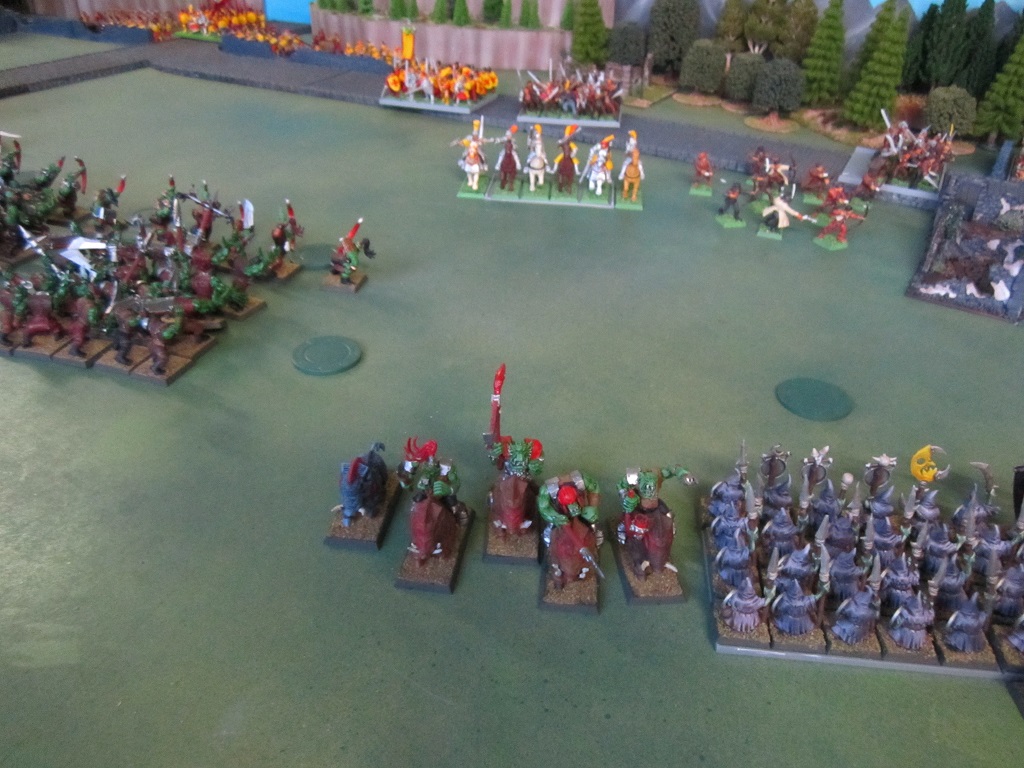
Sensing an opportunity the pistoliers, guns blazing, charge the orc boar riders and cause them to flee back towards their own lines.
Solo gaming decision analysis in depth.
In solo game decision making terms, the pistoliers were determined to be in charge range of the boar riders, and would likely have done enough damage to them on the charge to break the unit. Had this occurred they then would have pursued and likely run down the fleeing survivors, which would have caused panic tests for the nearby orc units. Additionally, the impetus of the pistoliers charge and overrun move would likely carry them through the orc lines and out of harm’s way as far as reprisal charges in the next round was concerned. If the orcs fled, as happened, the pistoliers would only realistically be in charge range of the orc archers, a light unit they could probably deal with in hand to hand combat if required, and they had enough maneuverability to flee from the charge of the archers if it was deemed necessary.
Consequently the human commander determined to declare the (somewhat opportunistic) charge.
From the orc warlords’ perspective, had the orc boar riders stood, been defeated in combat and been subsequently run down it would have caused panic tests for the nearby orc units who witnessed their contemporaries being run down, as well as a panic test for the unit of purple goblin spearmen. While the orcs may have passed, there was a moderate risk they would not pass their leadership check and would panic and also flee, meaning the line advancing on the swordsmen could have become fragmented. Additionally, the goblin spearmen, with their low leadership and far from the influence of the warlord’s presence, would be statistically likely to have fled, potentially (probably) failing to rally for the rest of the game. Once fled, the orc boar riders were likely to rally the next round, and if not would most likely get a second opportunity to rally in the subsequent turn prior to fleeing the battlefield, thus the determination was made that it was better to flee from this charge and preserve the orc boar riders as well as the cohesiveness of the overall battle line.
Given the above, the orc warlord determined to have the boar riders flee from the charge.
In the shooting phase, the leftmost cannon misfires due to poorly loaded powder. The remaining shooting s concentrated on the unit of savage orcs on the road, who suffer tremendous casualties. However, due to their crazed nature, they charge on regardless, heedless of the mortal danger they are in.
Orcs Turn 2
Things were now beginning to become interesting. Outside the guard tower the unit of blue goblins attempted to charge the unit of free company moving up the road. Although the rules did not call for it, I determined that the free company (facing two units of numerically superior goblins with only a light unit of human archers supporting them) would need to make a leadership check to see if they could respond to the charge appropriately, or would outright flee without any consideration being give to how they might more appropriately react. As luck would have it I rolled a 12 on their leadership check (looking for a target number of 7 or less…) and the free company fled. However, in their panic to escape they ended up tripping over one another, and the goblin spearmen caught them in their charge and cut them down. The nearby archers, witnessing this, held firm (they rolled their 7 on 2d6…).
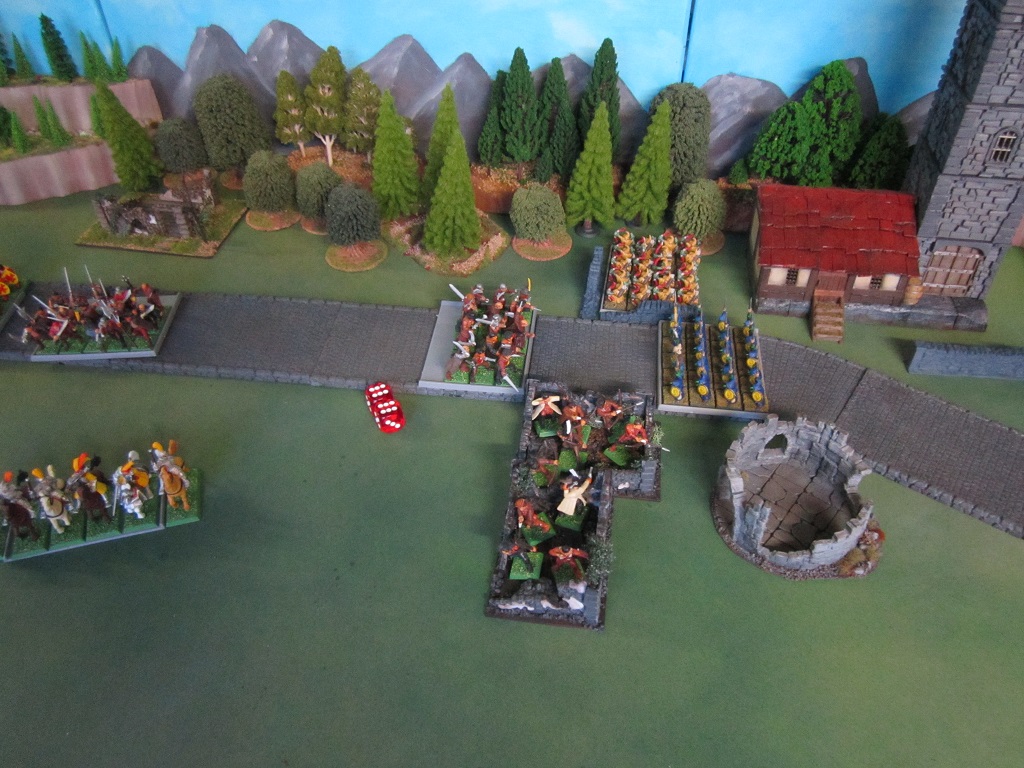
The fleeing orc boar riders regained their composure, rallying and turning to face the pistoliers once more. On the left orc flank, the unit of Orc Big ‘unz ran afoul of a canister trap, as did the savage orcs on the right flank, with both units suffering minor casualties.
In the shooting phase, the goblin archers defending the tower inflicted heavy casualties on the remaining unit of free company fighters.
The remaining forces continued to advance in accordance with their predetermined battle orders.
Humans Turn 3
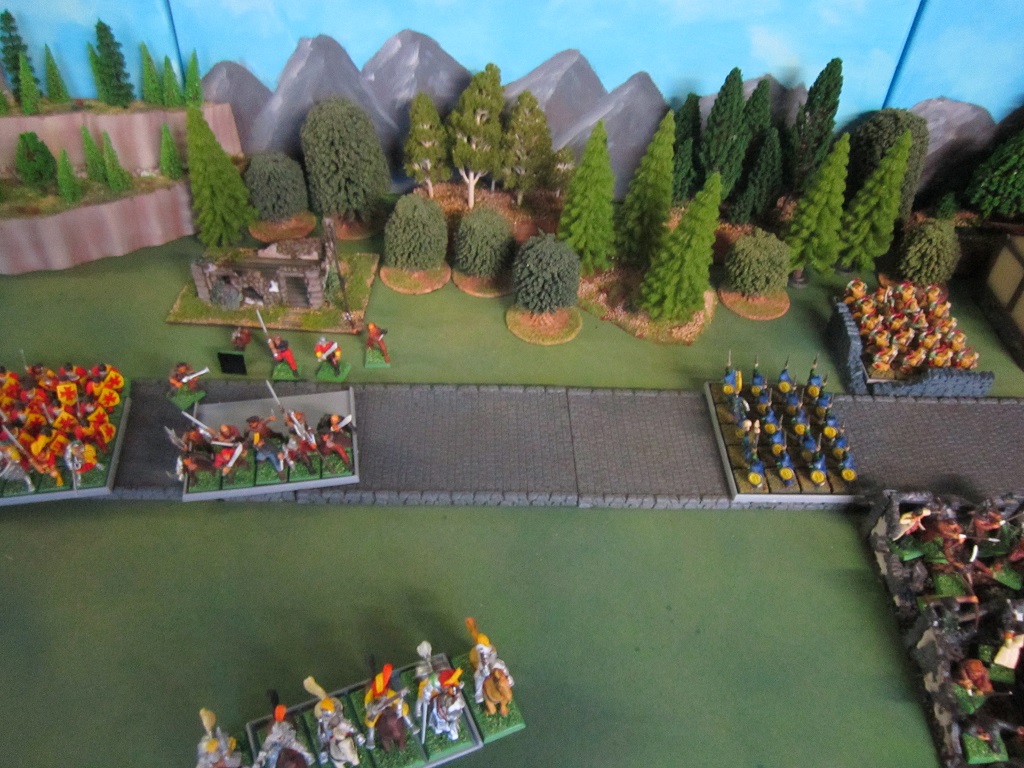
The pistoliers, now effectively the only human unit that could engage in any form of offensive action, used their superior mobility to manoeuvre to the side of the orc boar riders and open fire with their pistols. In doing so, they triggered one of the defensive pit traps, but were quick enough to avoid falling into the hole. The volley of shot unleashed by the pistoliers fells three of the boar riders, but the two remaining riders fail to panic- other lesser orcs might die due to minor inconveniences like being fusiladed in the side of the head but these orcs were clearly made of sterner stuff…
In the centre of the field a lucky cannonball overshoots it’s target of black orcs and catches the giant, inflicting four wounds to the massive beast. The huntsmen slip out of the protective cover of the ruins they had been occupying and fire on the wounded giant, trying ineffectually to inflict a couple more wounds with bow fire and fell the monstrosity.
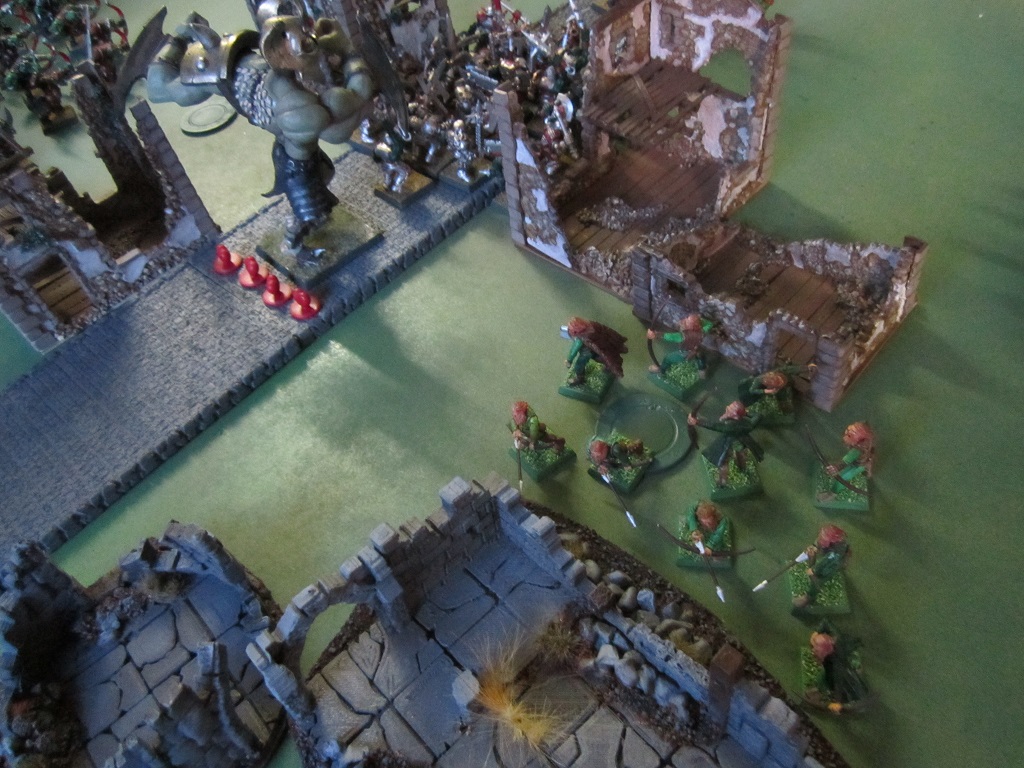
Towards the guard tower, the archers take advantage of the opportunity provided by the goblins being pulled out of line in running down the unfortunate free company fighters. With the way clear they make a desperate break for the tower.
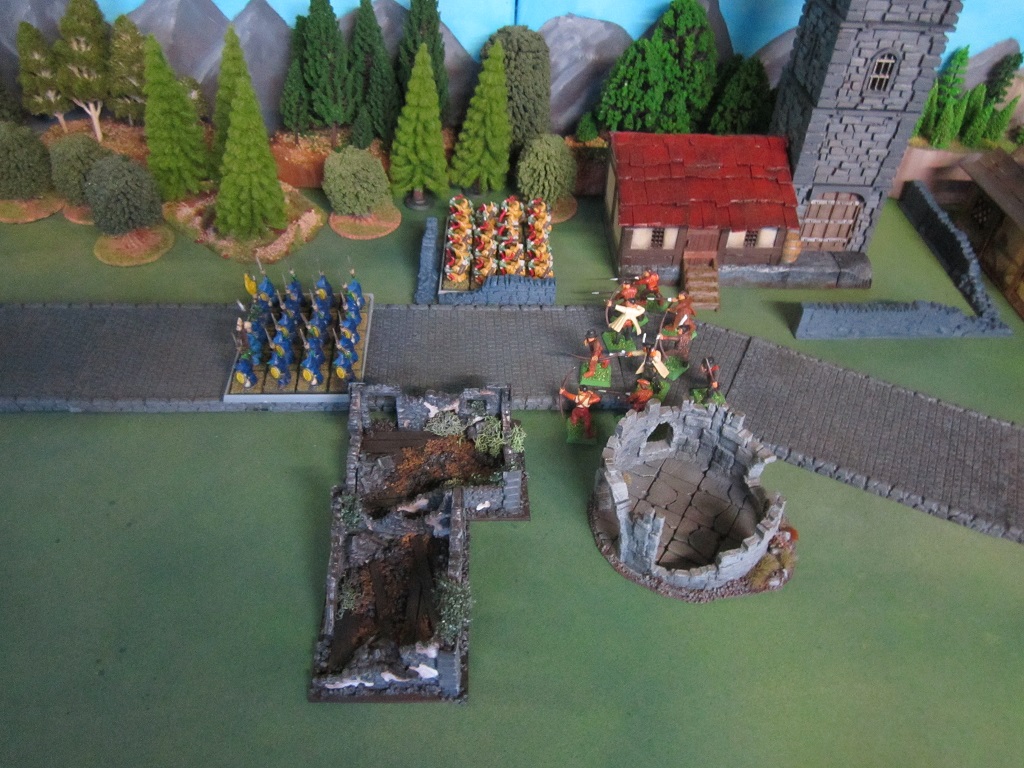
The remaining free company reform to face the goblin force and the fusiliers and crossbowmen continue to pour fire into the savage orcs on the road, almost destroying the unit entirely.


![StarCraft Tabletop Miniatures Game Pre-Orders Live Now [Updated]](https://images.beastsofwar.com/2026/03/starcraft-tmg-news-cover-600-338.jpg)
![Mounted US Cavalry On Kickstarter For Dead Man’s Hand! [Updated]](https://images.beastsofwar.com/2026/03/us-cavalry-main-600-338.jpg)