






![NO Weekender Or Cult Of Games XLBS This Weekend [Updated]](https://images.beastsofwar.com/2026/03/No_Weekender_and_XLBS_this_Weekend-225-127.jpg)



ECW – resurrection after 40 years




Recommendations: 640
About the Project
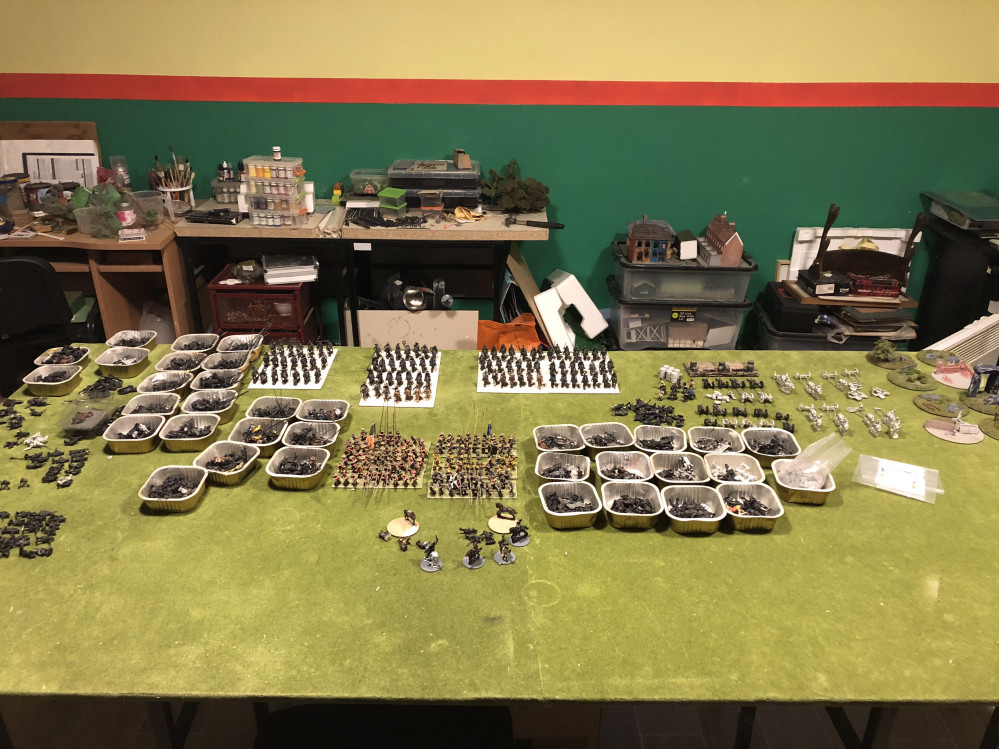
Shortly after Wargames Foundry established itself back in the 1980s, I purchased a sample pack of their ECW figures and I loved them. So, I thought, why not build two armies (I'm a solo player) and set about looking at rules etc. 40 years later in the basement of our newly built home (outwith the UK) my 10 year old says, "Dad can we play with these", pointing to the shelves of partially painted, and based minies, with the remainder still in packs. So I thought, with the OTT Spring clean challenge, maybe I'll get closer to finishing (actually, it's more like starting properly) my ECW project! This is the task: to turn the mountain of lead into something playable. What you can see in the header picture are the six paint/based foot regiments, and the variously based cavalry (for play testing) and the little tin boxes of all the other minis! Our new home has a basement, part of which will be my War-game room. Still need shelving and other assorted finalizing, but it will be where I hope I will spend a lot of time with my boy as he also develops an interest in the hobby. So, the next step is to determine my plan of campaign and what to do first!
Related Genre: Historical
Related Contest: Spring Clean Hobby Challenge (Old)
This Project is Completed
First Reload Markers completed
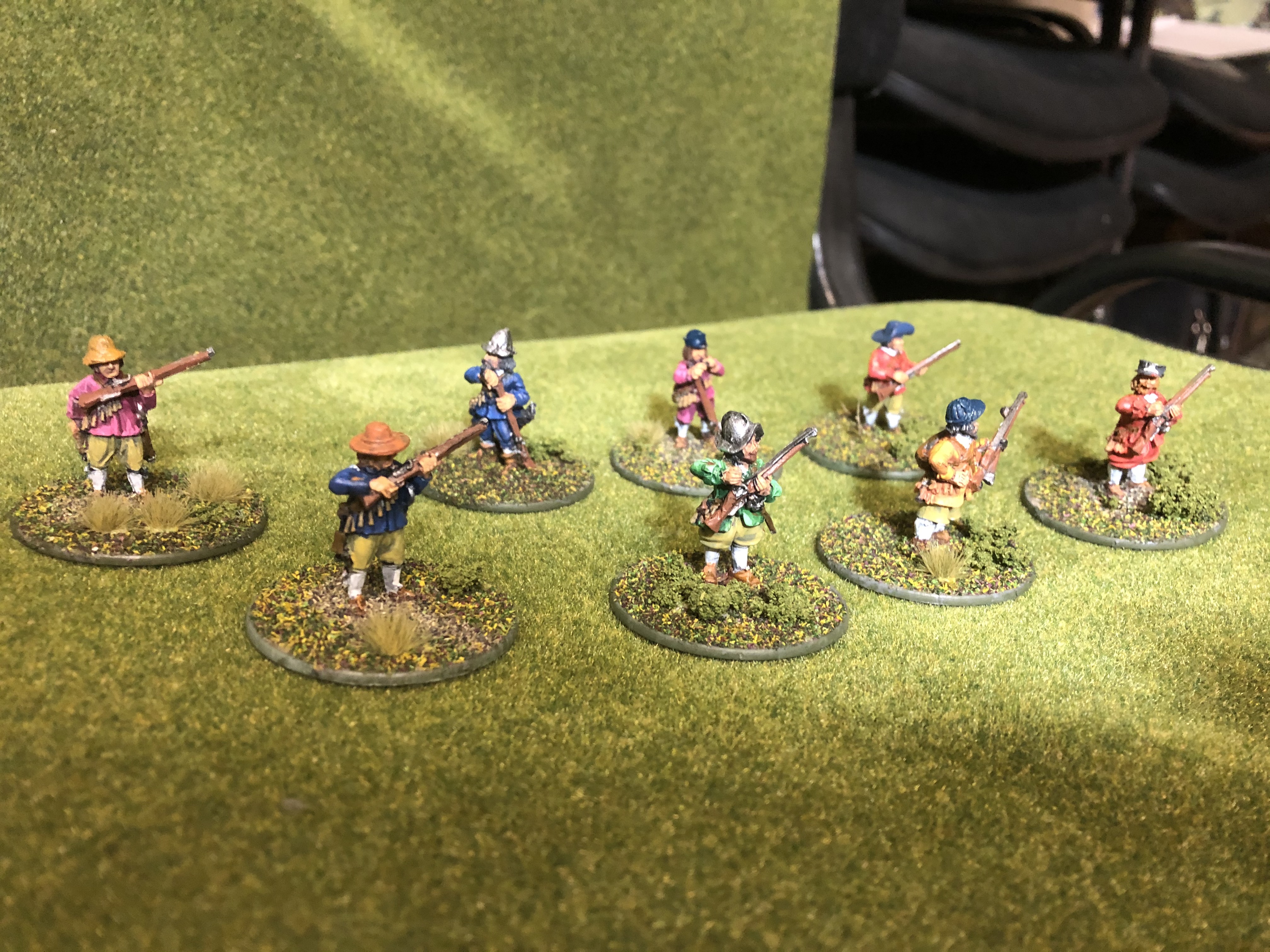
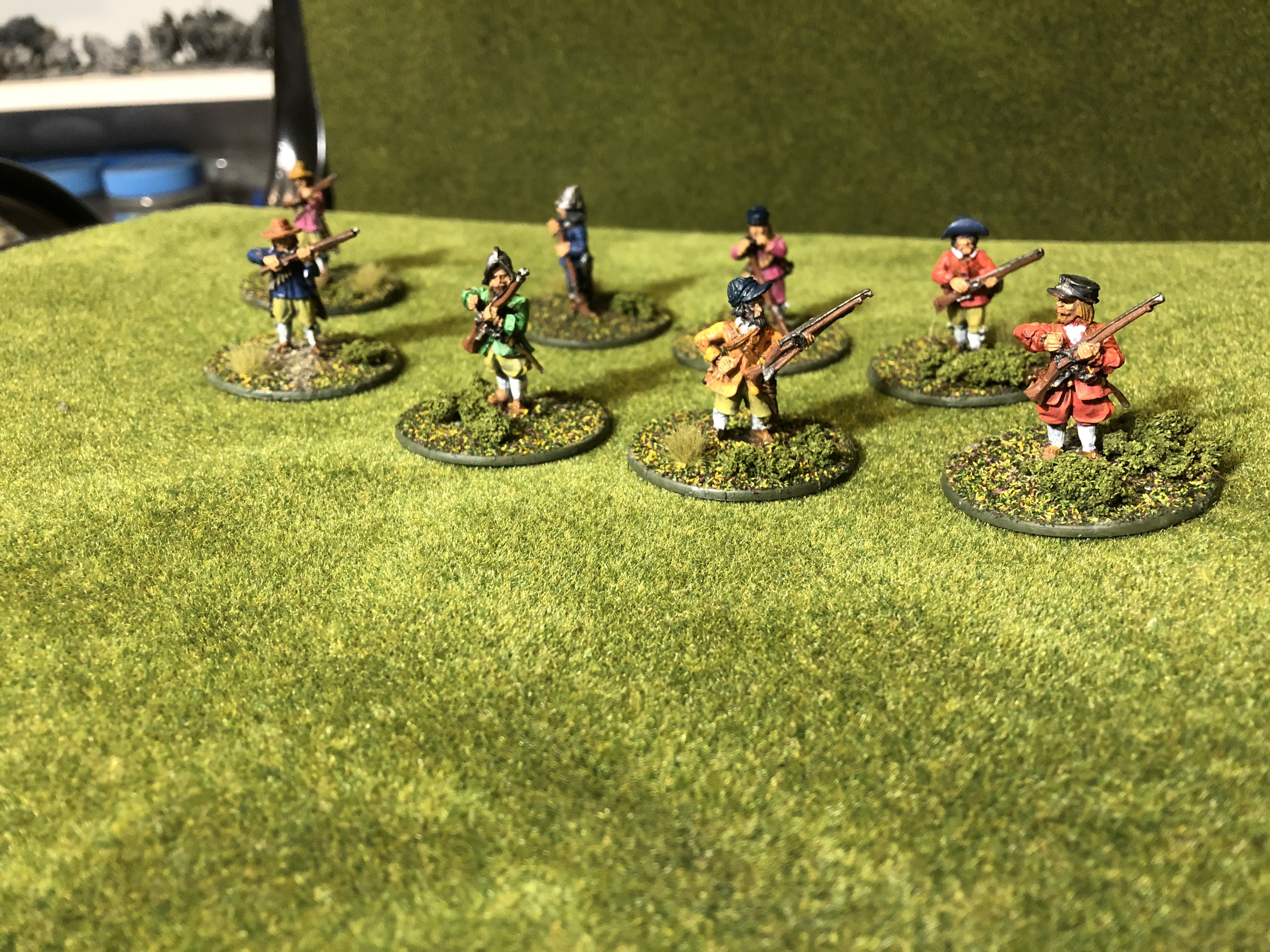
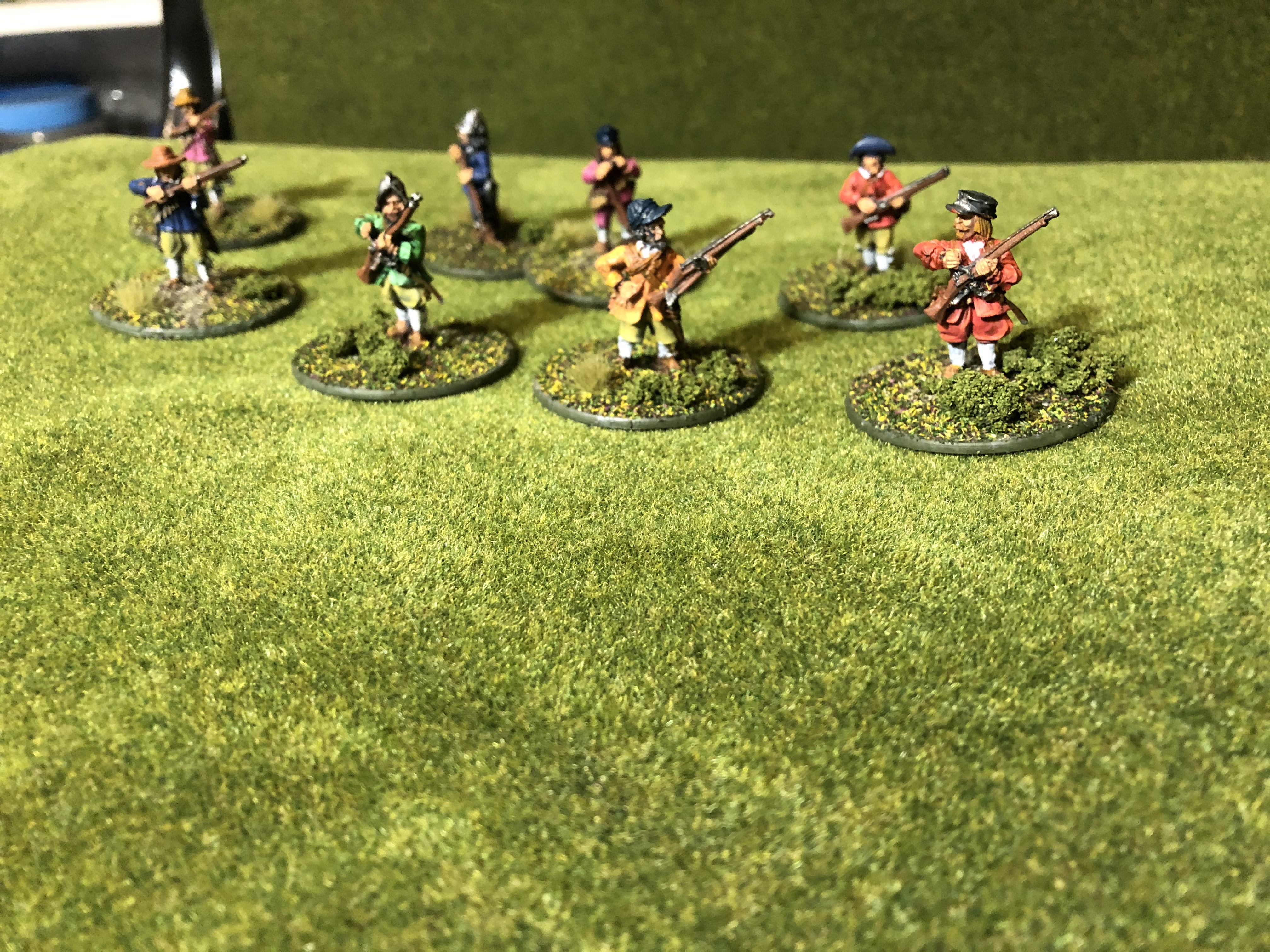
I finished with eight Reload Markers which should be sufficient for now. I have plenty of spare figures, though no more of the 30mm bases. I might wait for the current issues to pass before getting some more.
The method was the same as previously posted. The figure is glued to the base, “bedded in” with pva/water & fine sand, then flocked and other bits of basing clutter added.
Not sure there’s much more to be said. Next up, the four Brigade Officers and the C-in-C.
Officers
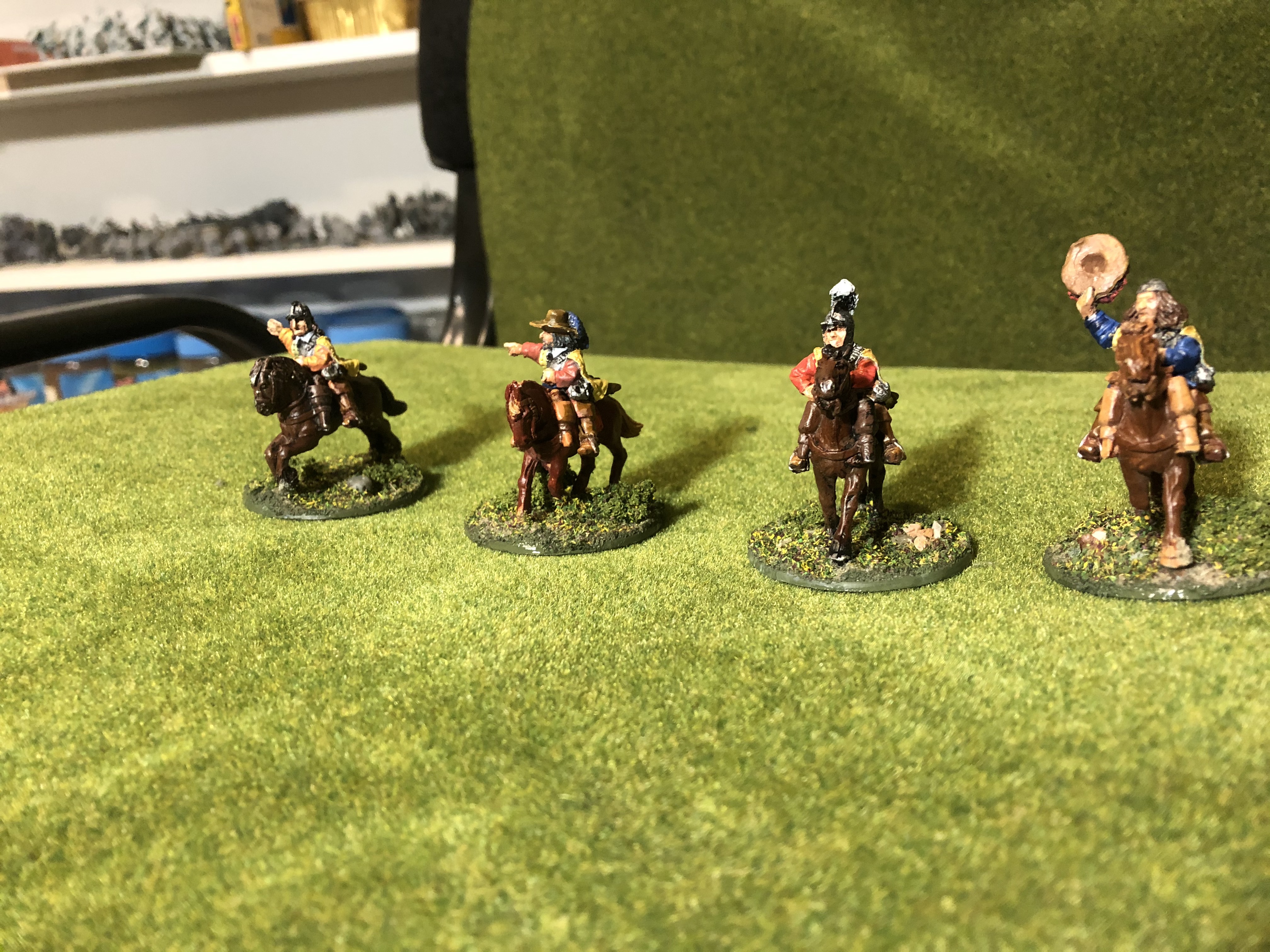
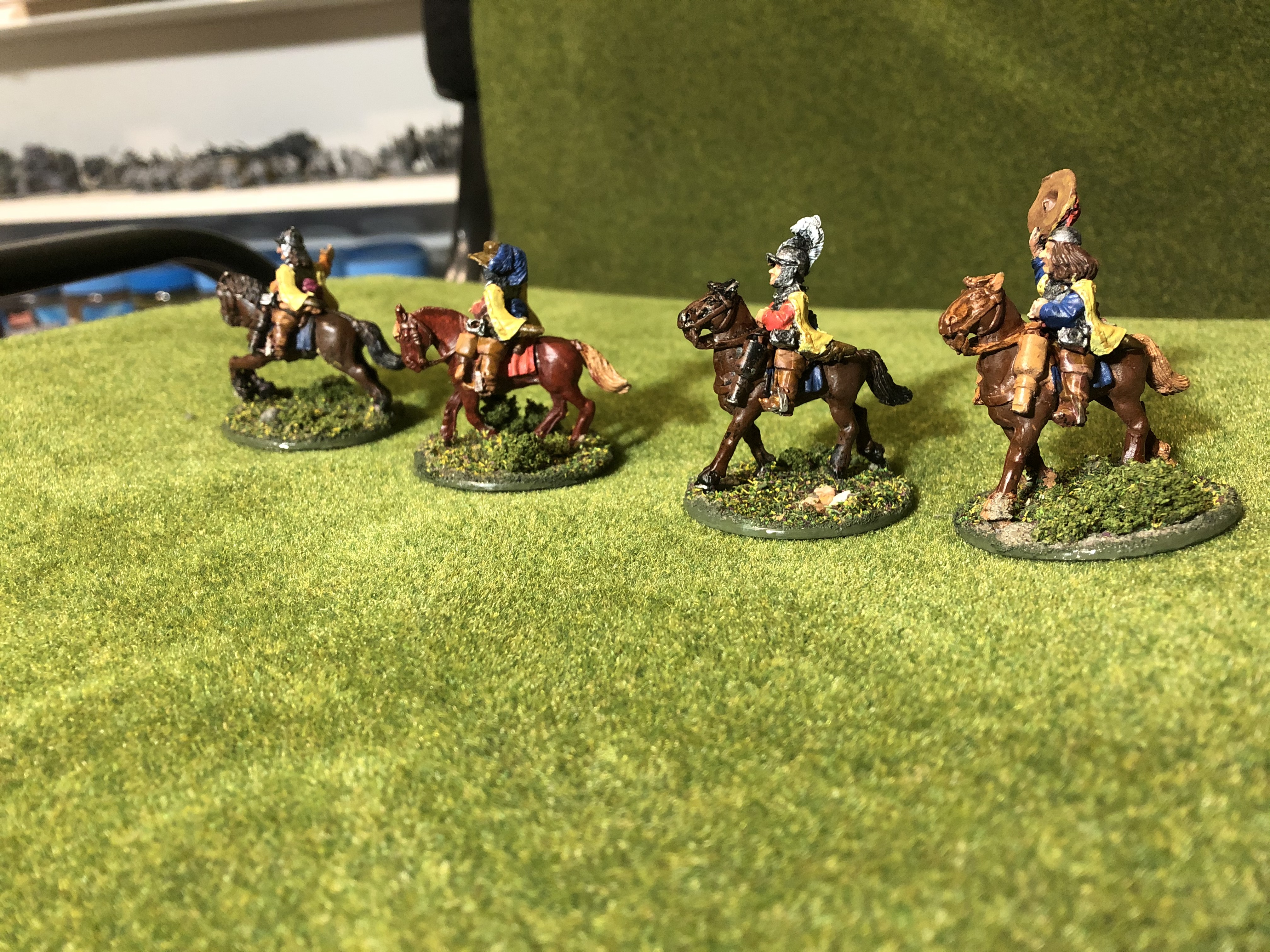
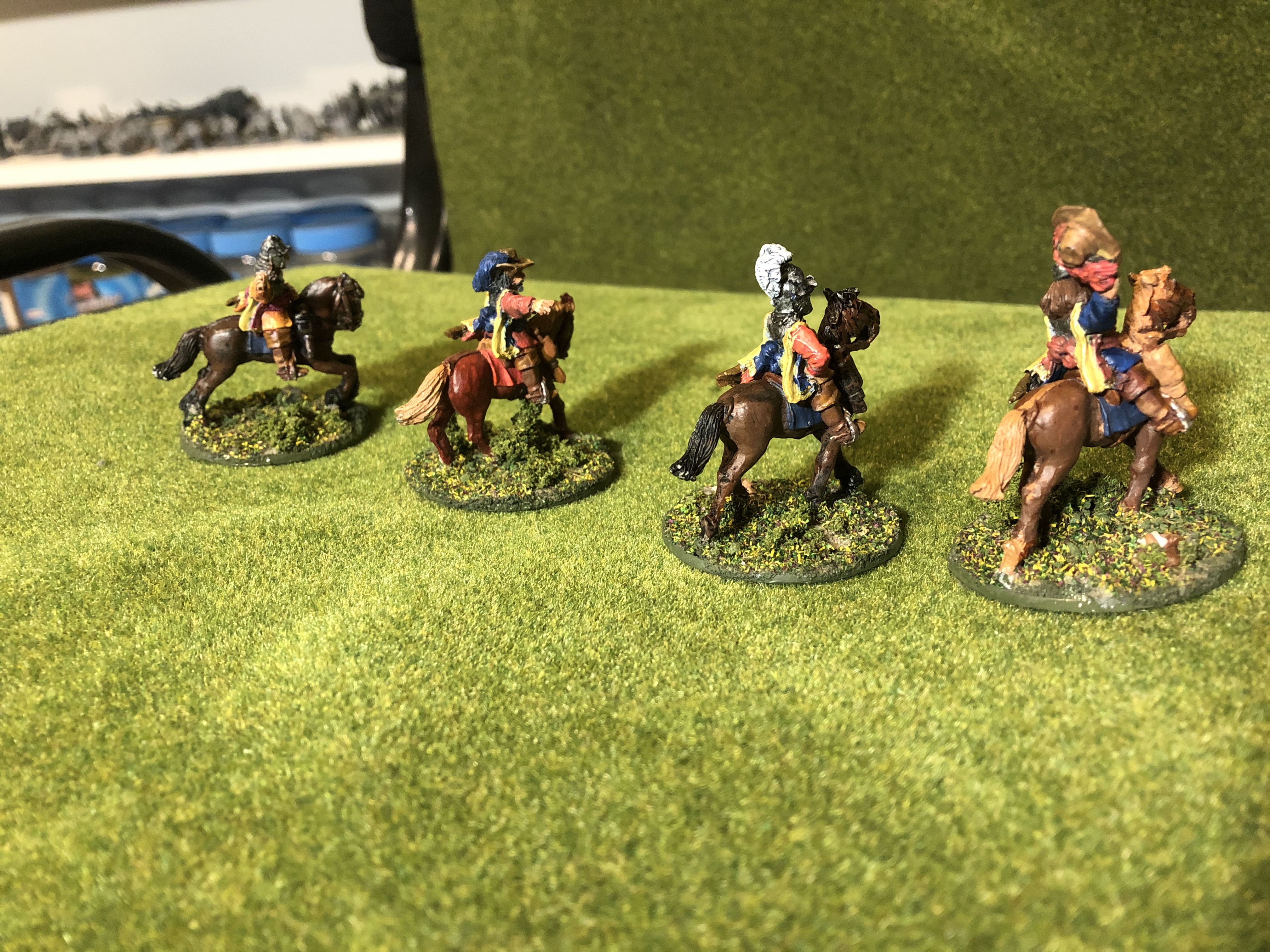
Just a quick post with the four Officers finished. The basing was as usual with water/pva and sand followed by flocking and the odd basing clutter.
Next post will be a more detailed one for the two Commander-in-Chief bases.
Commander Bases
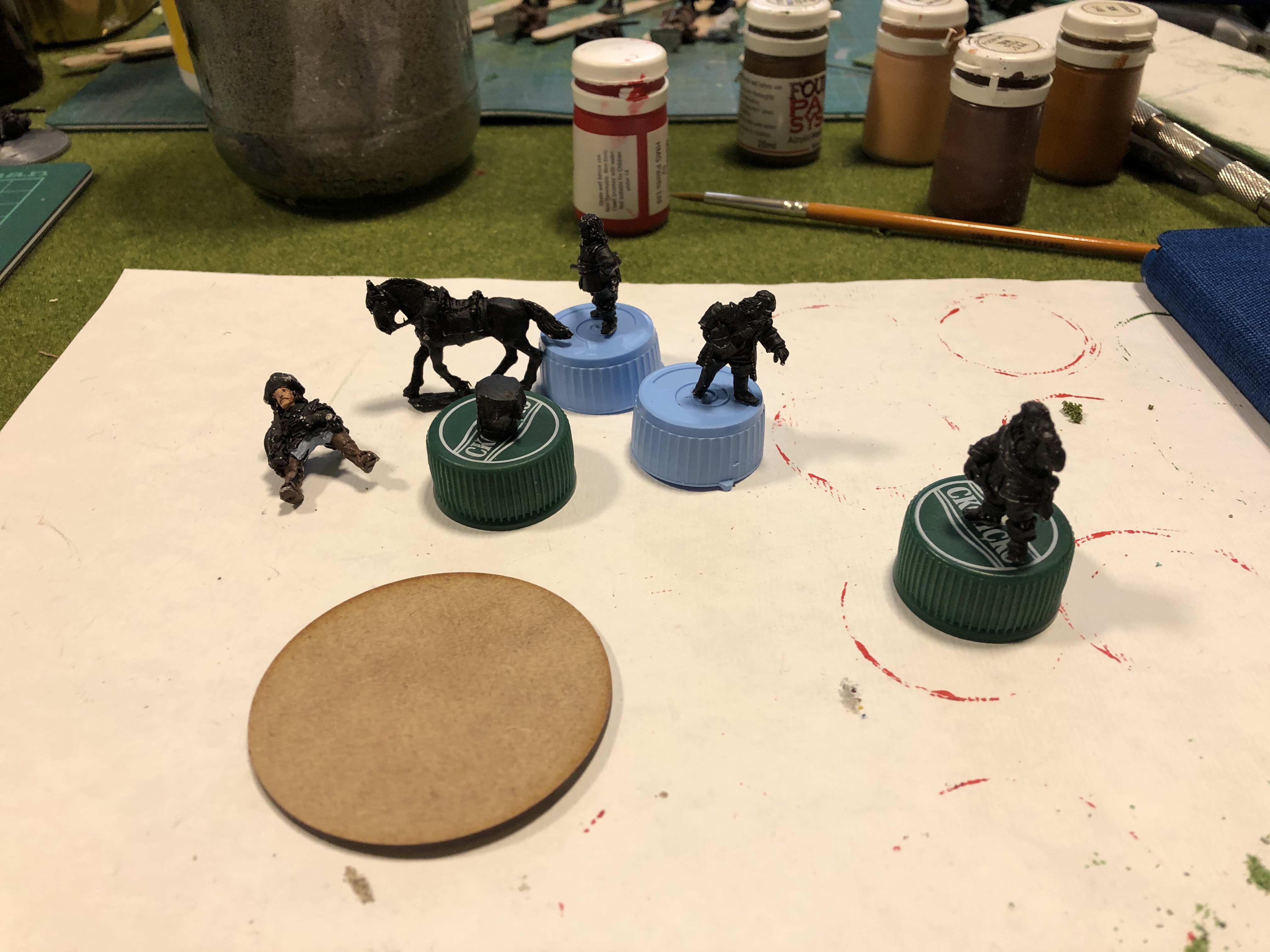
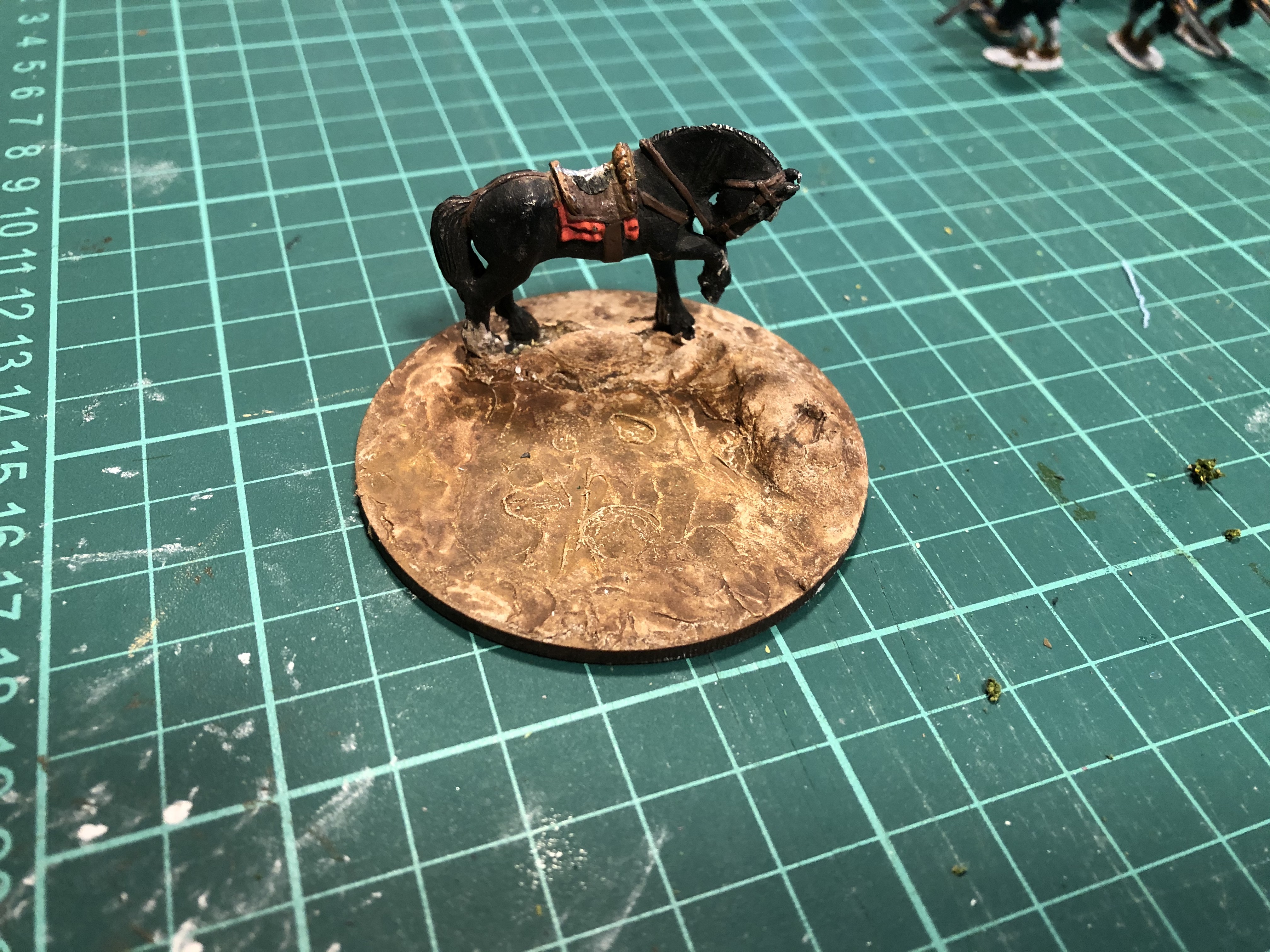
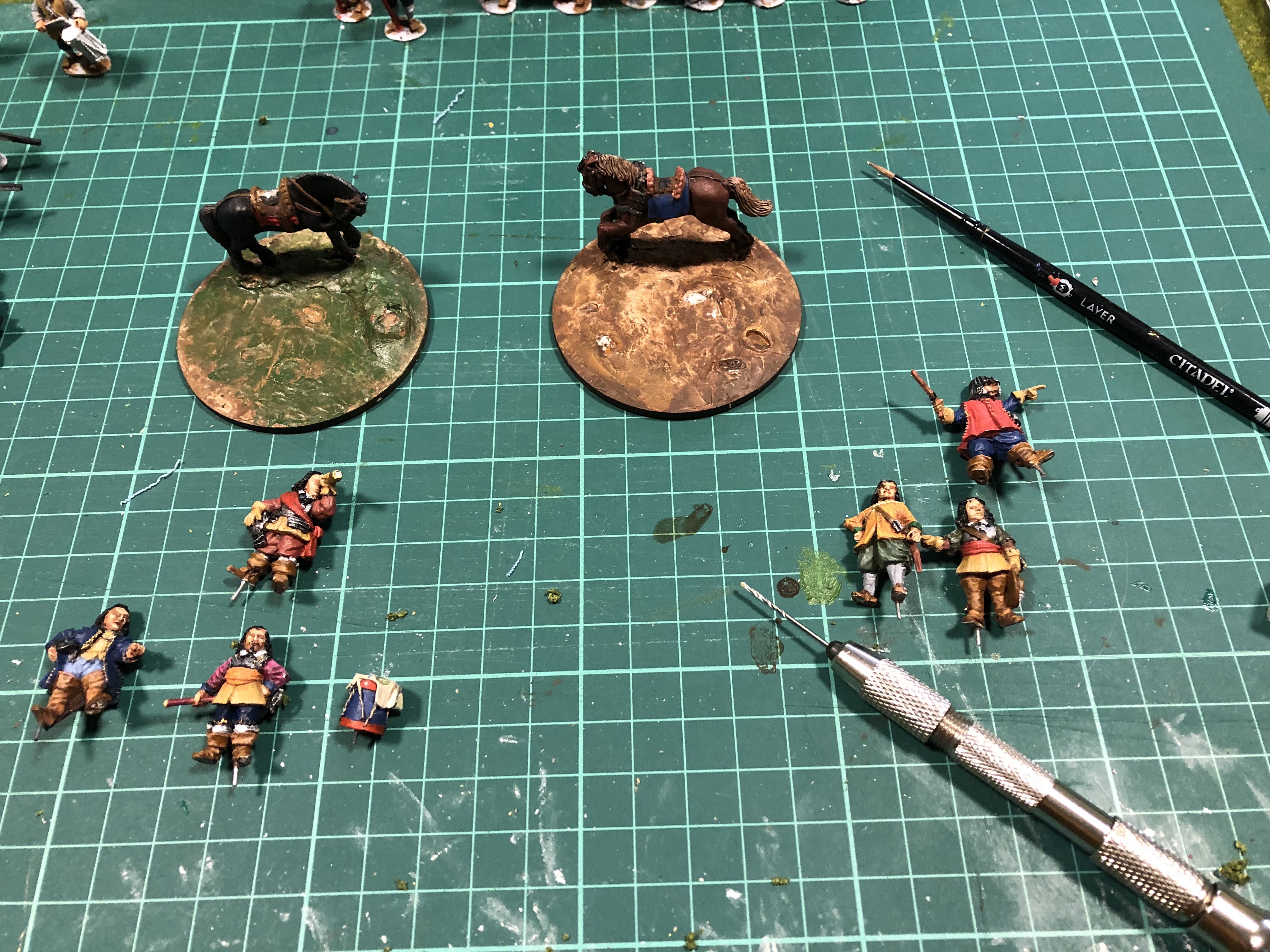
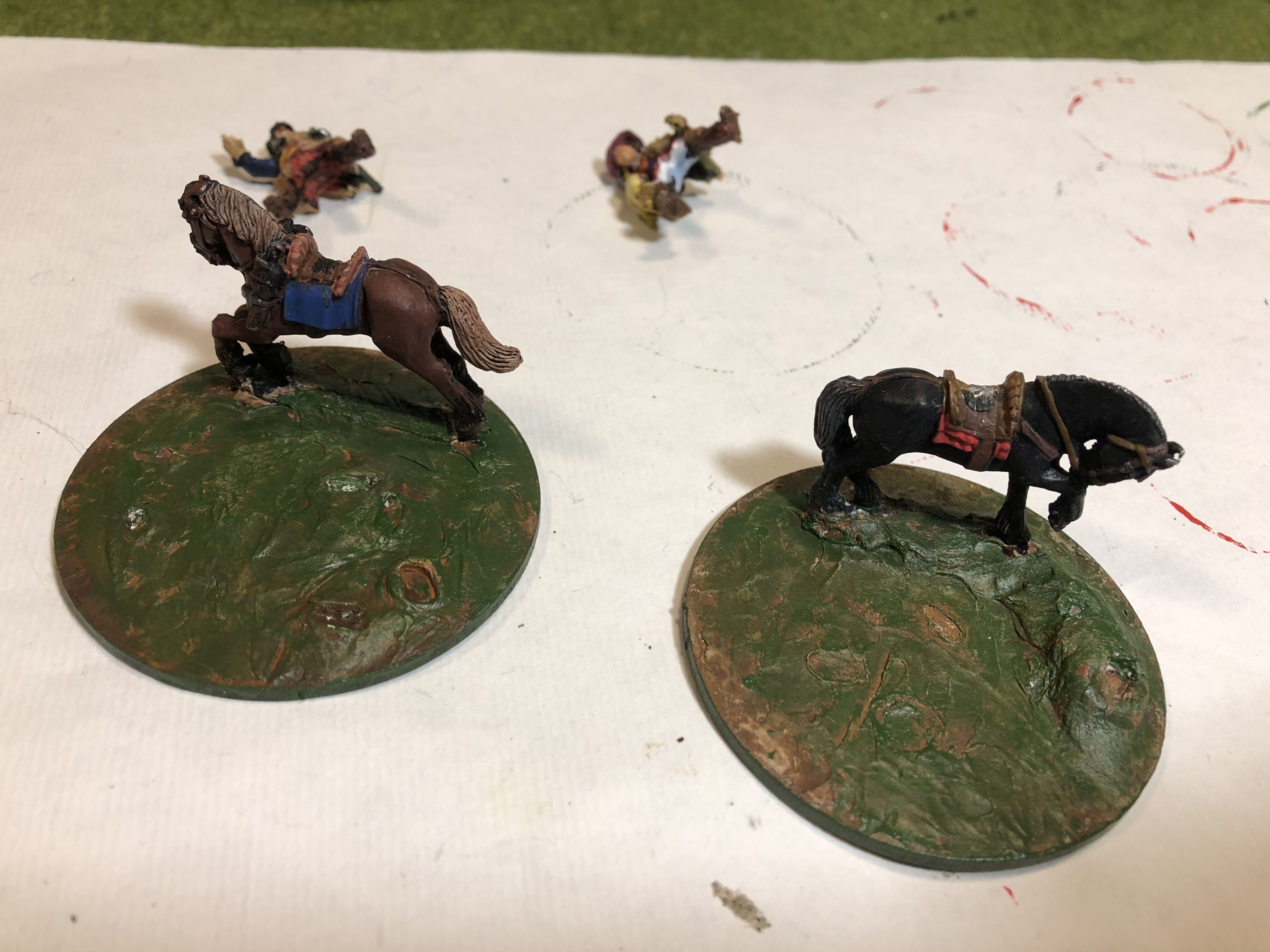
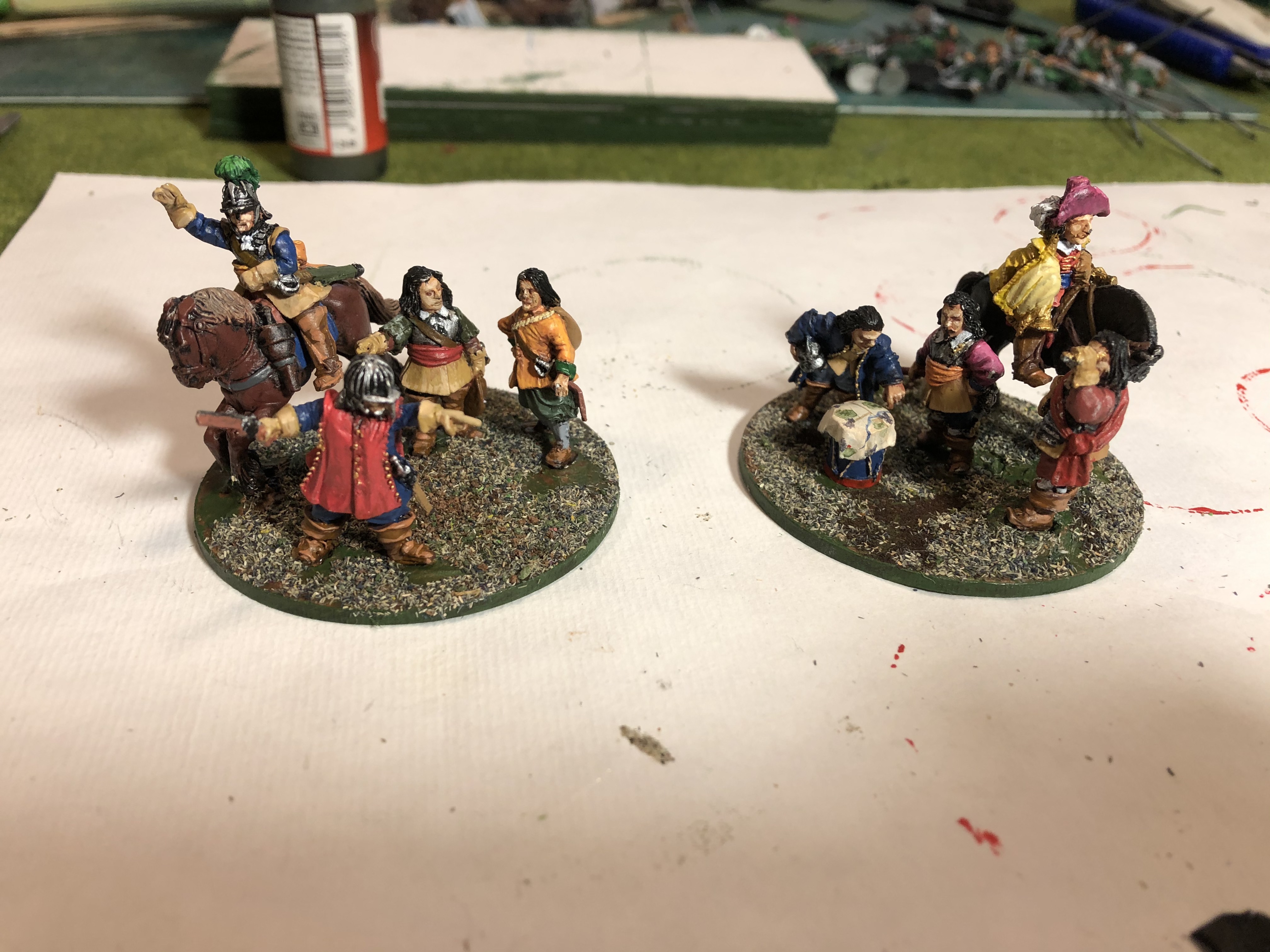
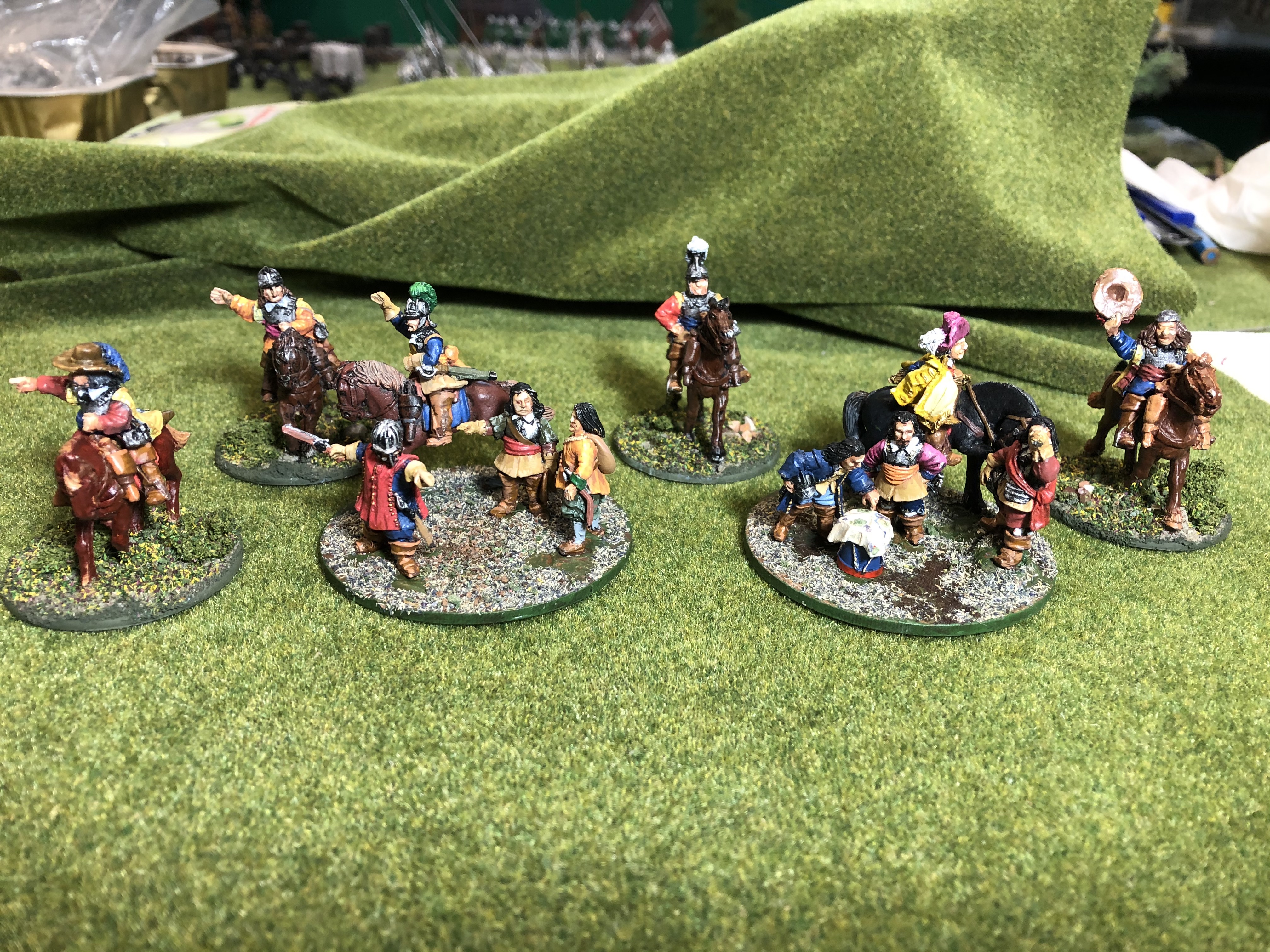
The basing for the C-in-Cs is a little more complex. The initial base – a 60 mm round – has a horse fixed initially. The base is then given a more undulating surface by using DAS air drying clay to create more texture. I just pressed the clay down firmly with my fingers and squished the clay about to add texture.
This is the first time I’ve used DAS so I was not sure how the final base would look. As the clay dried, I stood the minis in the positions I wanted them to indent the clay slightly. Just enough to indicate when their feet would stand.
Each of the figures had their own bases trimmed off and a short piece of rod – actually this is an off cut from a paper clip – used as a mounting point. Once the DAS dried off (I left it a full 24 hours) I checked the positions again, and drilled holes in the base using a small hand drill. I guess a Dremel or similar would work just as well.
The surface was coated with two coats of watered down PVA (about 50/50 or 60/40 water to PVA, I didn’t measure it specifically). This was also allowed to dry fully for 24 hours. Once set I painted the bases in a random way with acrylic paints, using brown and green (just what I had in).
Once fully dry, the figures were fixed into position with super glue and some flock added to finish off the base.
The size of the base isn’t particularly important, but they can be used in both the full Principles of War rules, and the condensed ones I developed for my son and I to play.
So, next step is to get a further 4/5 Foote regiments finished, then on to the cavalry – which I’m not looking forward to. I don’t like painting horses.
Up-date after Easter
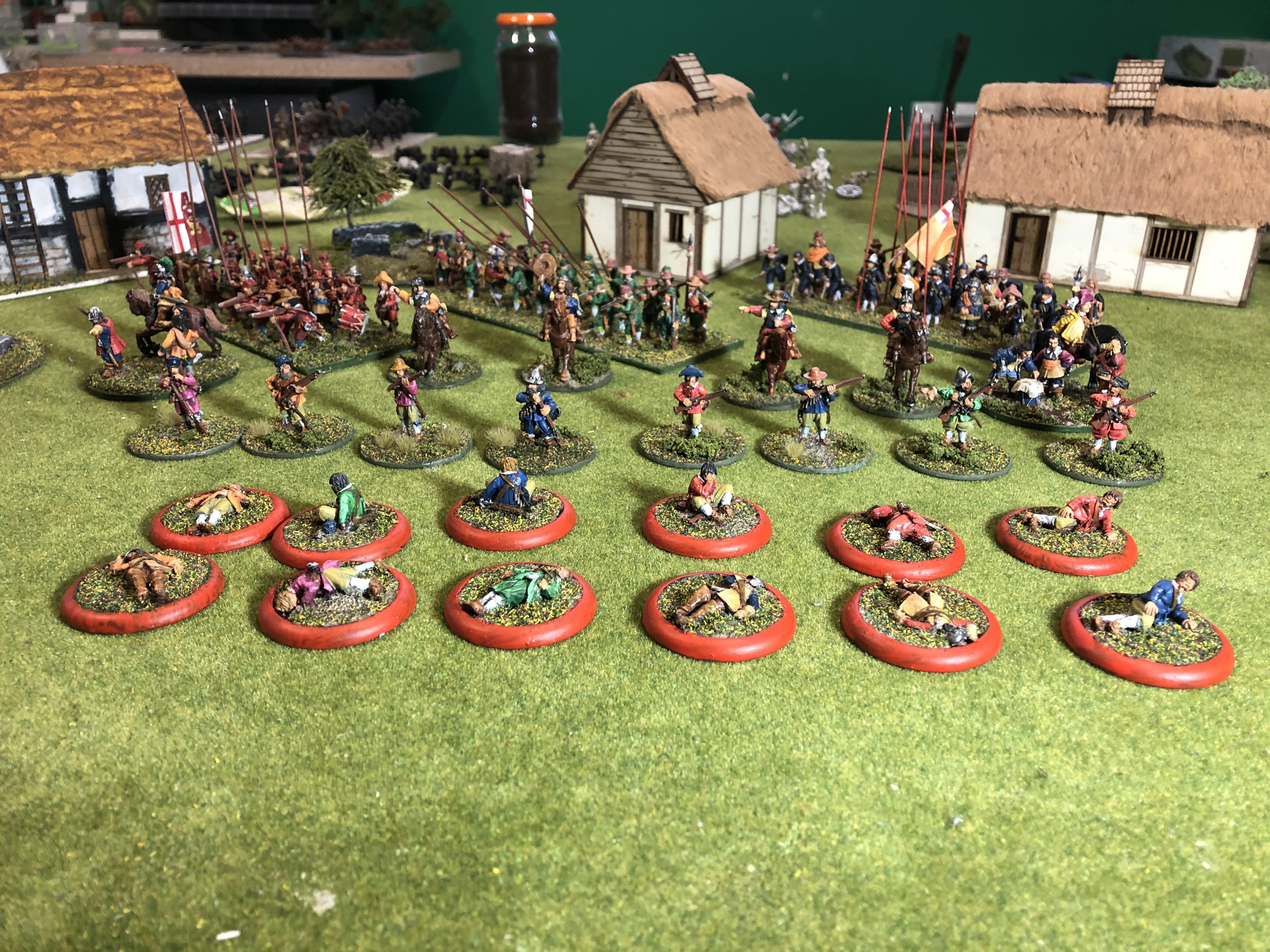
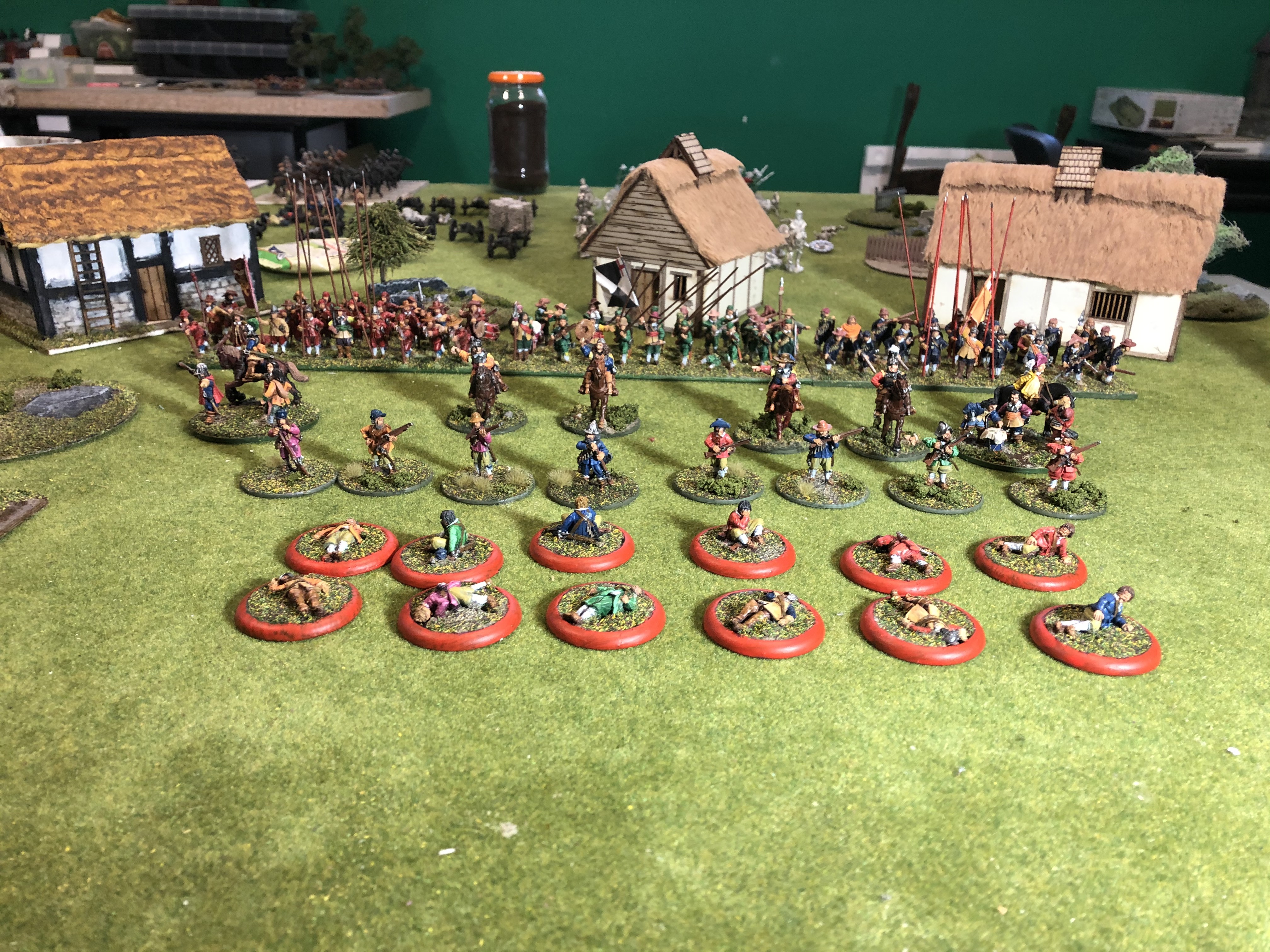
A bit of a break over the TWO Easters we celebrate as I am living in an Orthodox Christian country and this year Easter was one week later than the UK.
So a bit of a slow period in the predicted work, but so far there are three Foote regiments, 12 casualty markers, eight re-load markers, four Brigade commanders, and the two Commanders-in-Chief.
We also played through the rules a couple of times (my son is SO “lucky” with his dice throws – no reflection on my command decisions at ALL!) and I realized I need some form of “Unsteady” marker as well – so, I’ll give that some thought.
Also for the “full” game, I want the regiments to have different starting ammunition – I am thinking of 2d6, or d6+6 (this makes the differences between units less dramatic), and again an on-table-top marker might be good. But, does that mean too many markers? Not sure yet, so I’ll make a couple of testers and see how they look.
Next up I want to start on the Cavalry and all those horses. I’ll be tying out some different techniques with contrast paint (a brown) over different base colours. I expect that I’ll try different light browns as the base colour. I have several of the “Foundry triad” paints, and the highlight colour of the three might work. I’ll see.
All the best.
Horses and Contrast paint
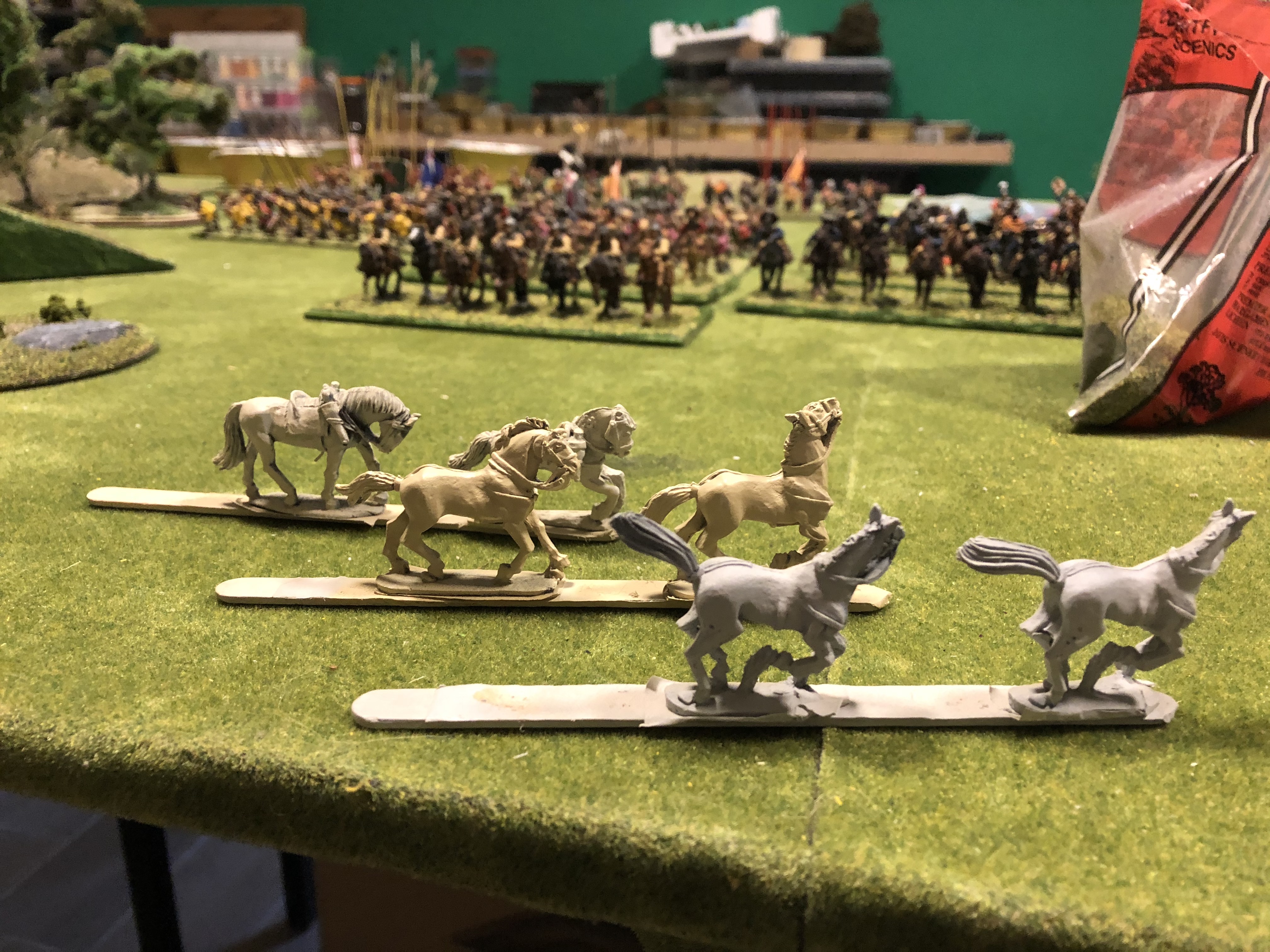
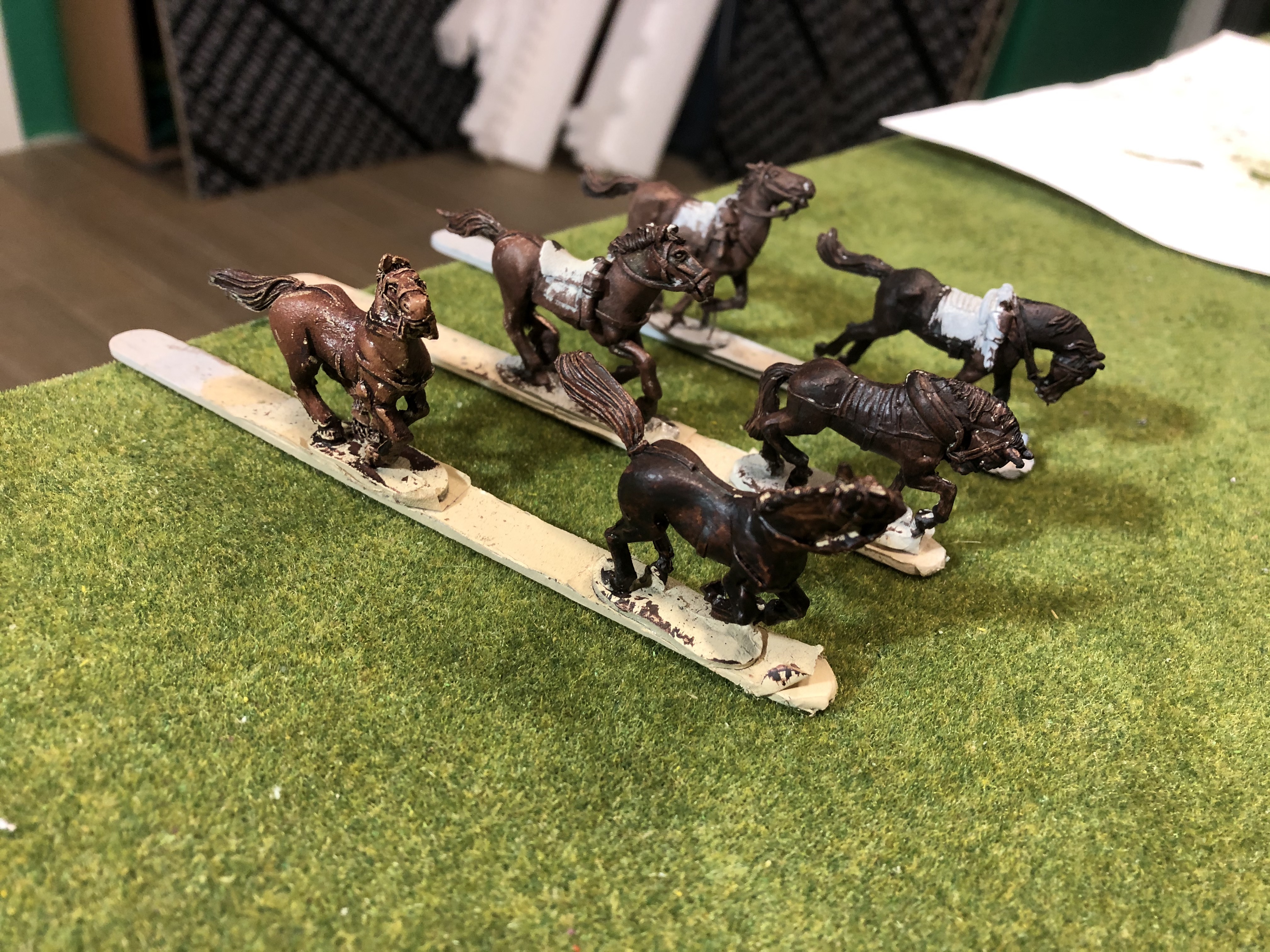
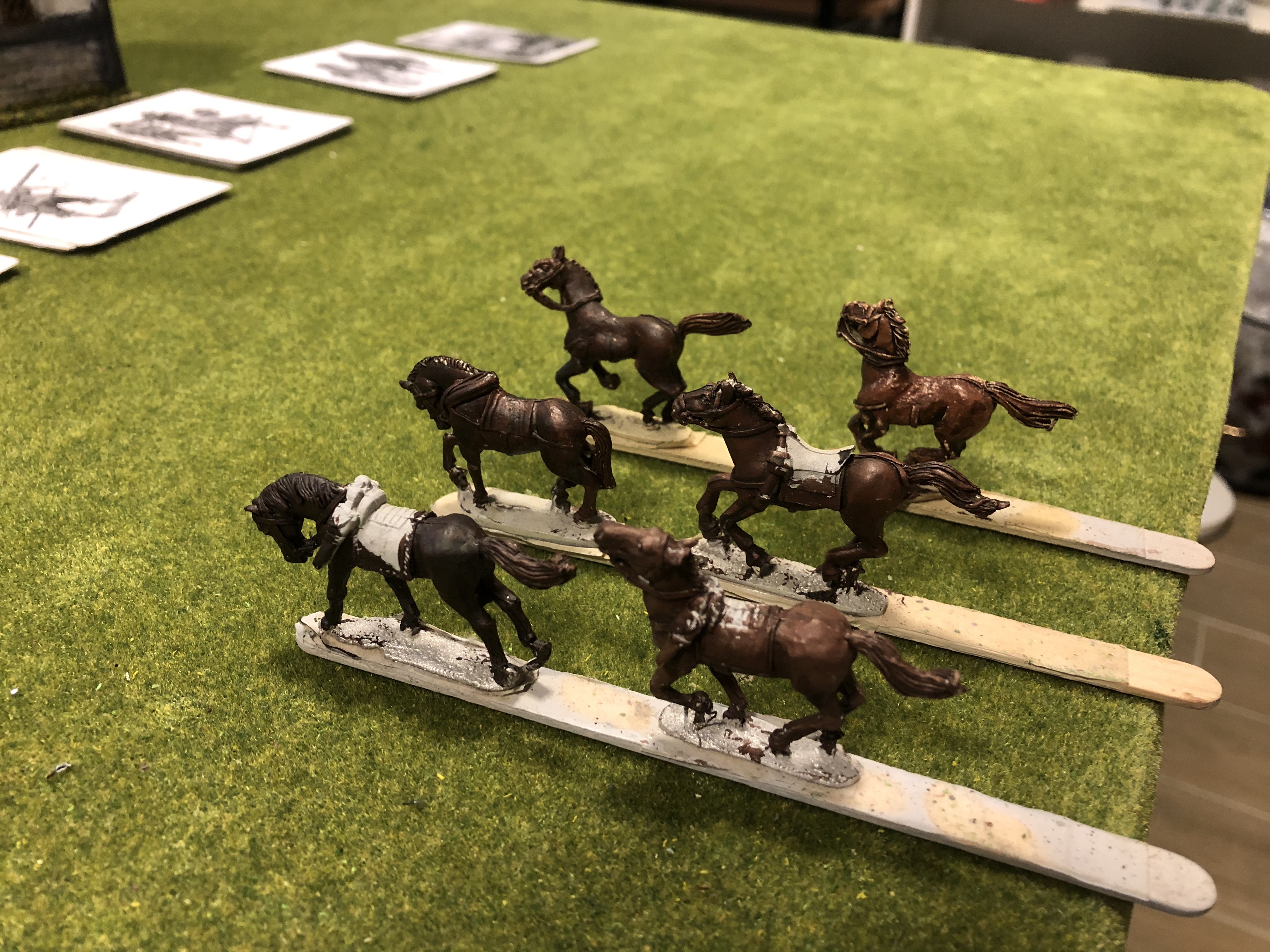
As I have a lot of horses to pain, and the whole point of this Spring Clean challenge is to get as many units painted and on the table as possible, I am looking for a simple, but reasonably effective solution.
Some time ago I bought a brown contrast paint from GW (Cygor Brown) with the intention of trying it on another project (which hasn’t as yet started!), so I thought this might be a solution. I was advised to paint it straight from the pot, although some dilution was possible. I was also told that the underlying base paint would influence the final colour.
With this in mind I used the three primer paint spray cans I had (From GW: Corax White and Wraith Bone, and from Army painter their Skeleton bone). I sampled six horses with the primers – two of each colour.
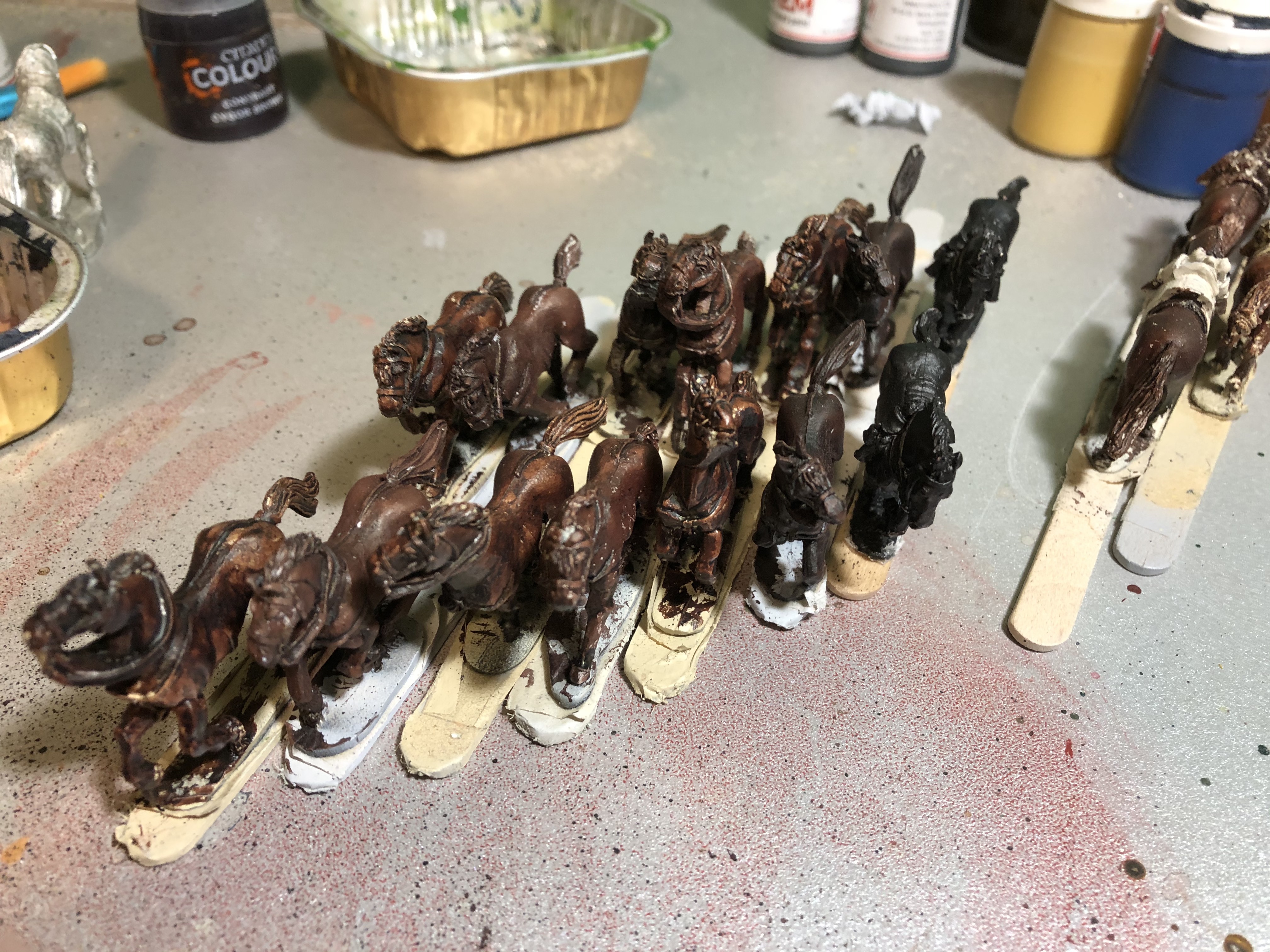
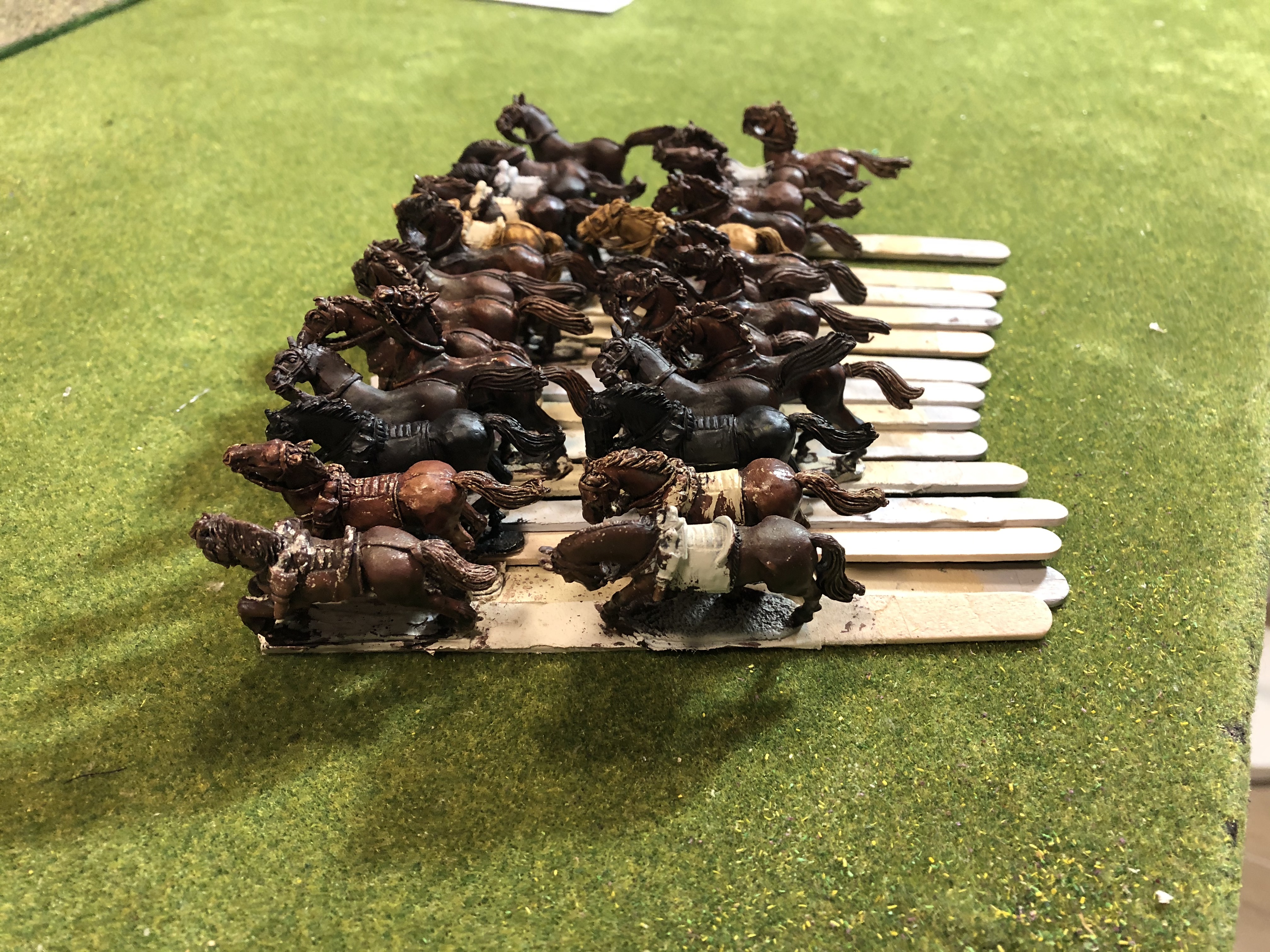
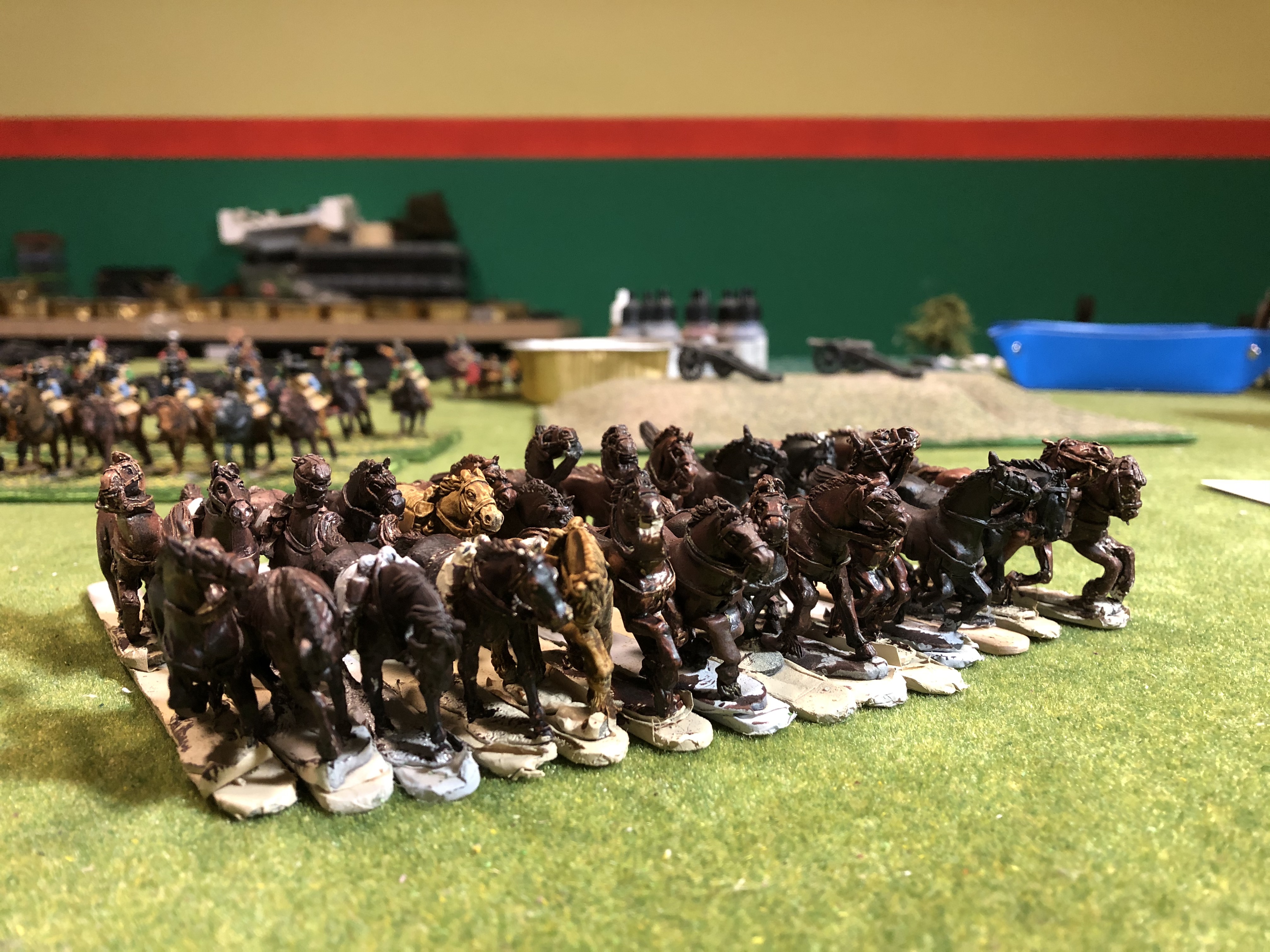
I then painted one of each set with undiluted Contrast paint, and the other with a slightly diluted paint. Probably about 60/40 paint to water. The effect was interesting. At least to my aging eyes, there was hardly any difference between the colours on the three test horses with the pure paint. But the diluted paint appears to me to show some variations. (See pictures)
So I charged ahead and painted up some more. I think that the Skeleton bone has the best affect with the contrast paint and with a dilution of 60/40 this works for me. I tried it with more dilution and this became too runny and mottled effect. Did not look good at all. Some picture below of the horses painted using this method so far. As a group I think they pass muster. I will continue experimenting with different undercoats to see what effect they have. In passing, Black undercoat doesn’t help! Hardly any contrast to me.
A digression - contrast paint
So, although the intention of this Spring Challenge was to get as many figures painted as possible, over Easter I found myself experimenting (briefly) with contrast paints and horses.
 Perhaps some odd base painting?
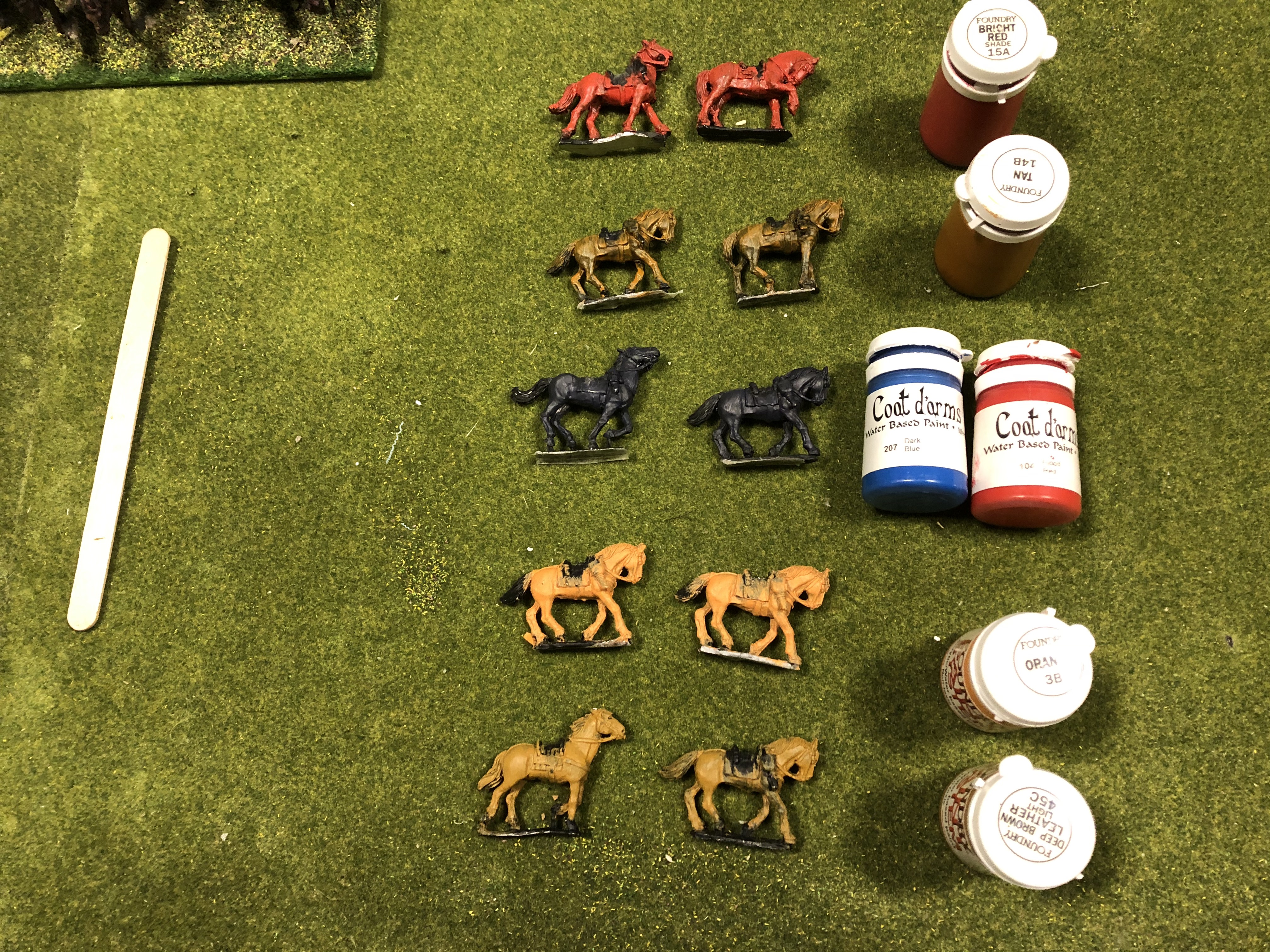
I decided to see what the brown contrast paint would be over a different base colour other than the usual black/grey/white. I already think the buff/cream base works well, but what about more “exotic” colours?
So, Orange, Red, Purple base and let’s see where we go from here
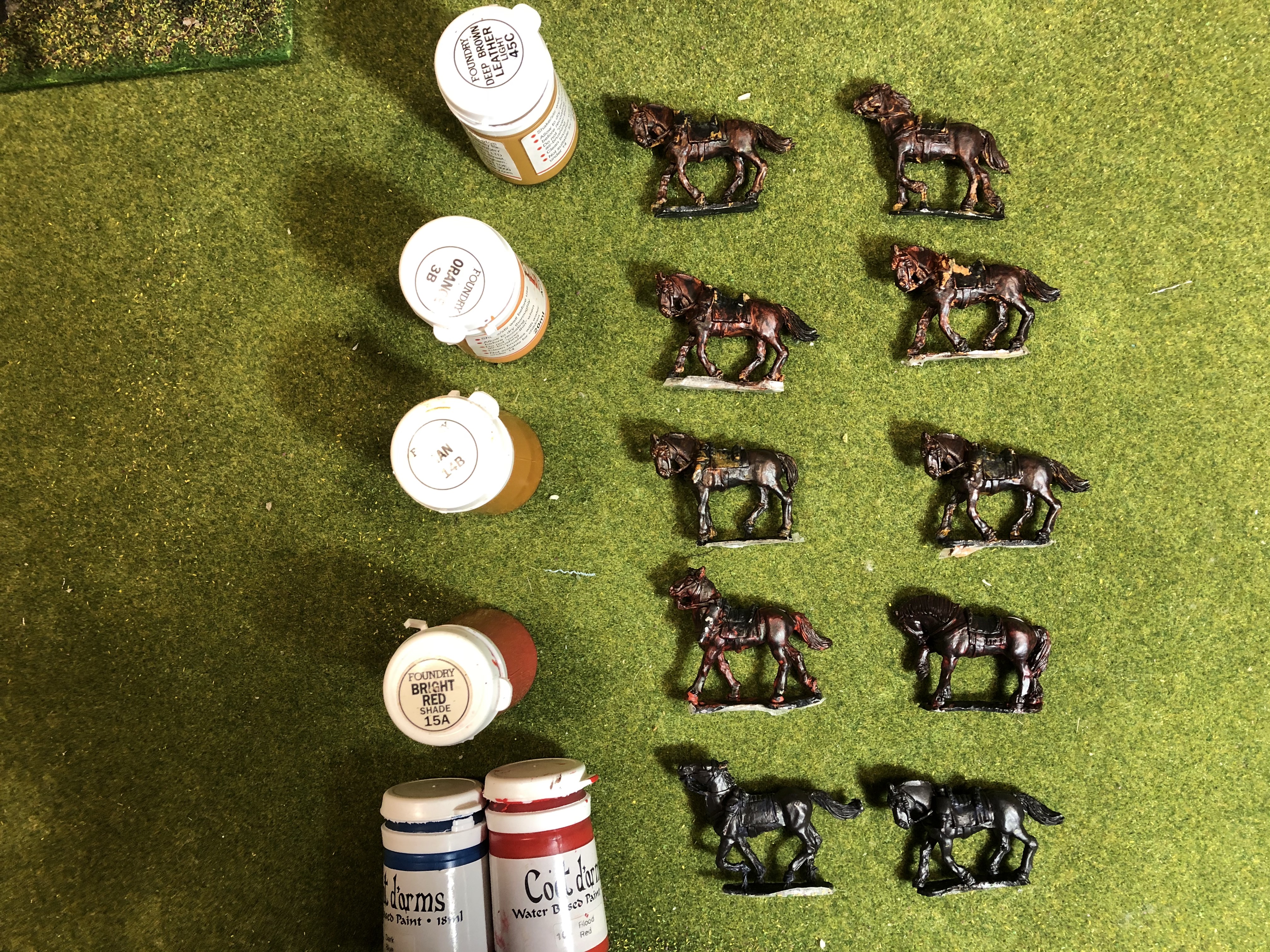 Interesting colours?
I didn’t try to be too careful – so please excuse the “mess” on some of the horses.
But, I think the results are interesting. Overall the Orange/cream base seems good. And even the Red does offer some potential with a more serious base coat. the purple gets a bit lost, but it ends up with a kind of soft black which works to some extent.
So, I think it’s worth persevering with this idea more. By the by, the contrast pains was used pure and about 30/70 dilution for the two horses. I like the potential with the diluted paint.
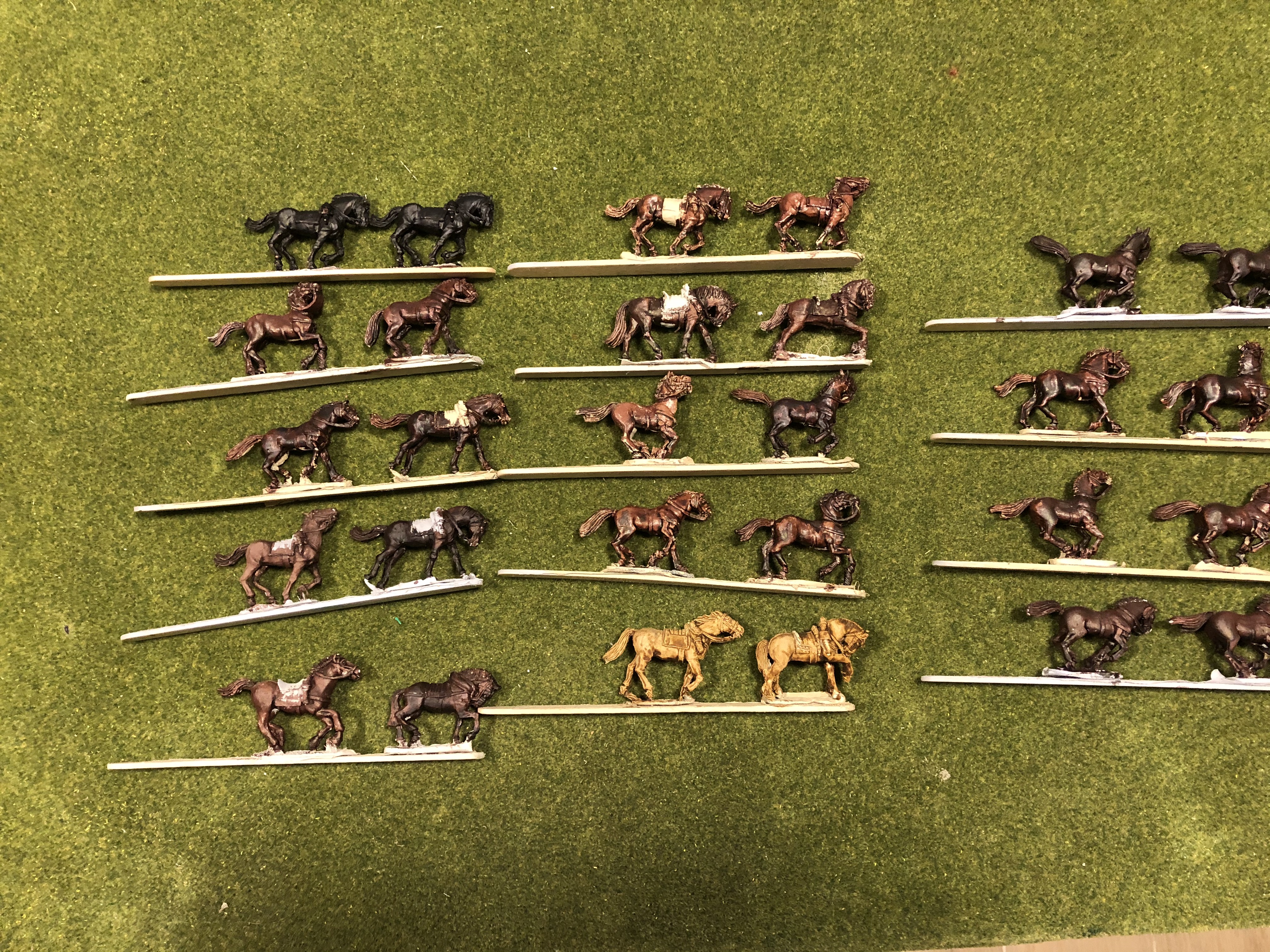 Some results of contrast painting
Cavalry
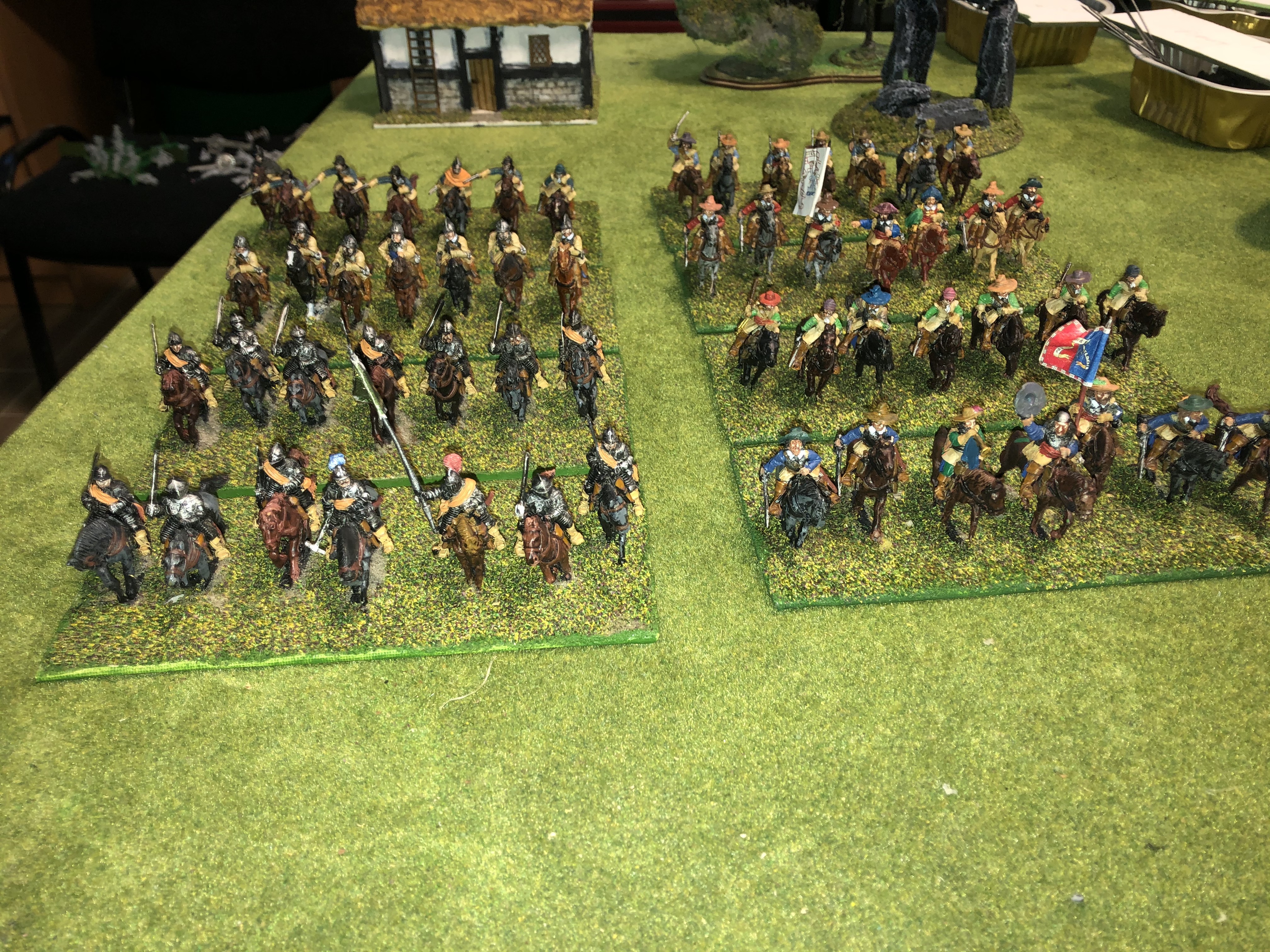 The first bases
Been trying to post this update for a couple of days without success – hopefully with only one picture it will work this time.
Finished painting the previously based cavalry (a bit frustrating at times – will definitely paint horses and riders separately in future and base only when they’re finished).
Overall I’m happy enough with the paint job – it’s not perfect, but will do for now. I adopt the 3′ guideline, i.e. what does it look like at three feet distance (normal gaming distance). And in that sense, they are ok.
Up next some Scottish Covenanters, to be followed by Scots cavalry, and then on to the canon.
The Scots are coming
I am working on a small Scottish covenanter/Montrose force, and hopefully I’ll be posting an update soon. But, in the meantime, here is what I have done with a Scottish light artillery unit.
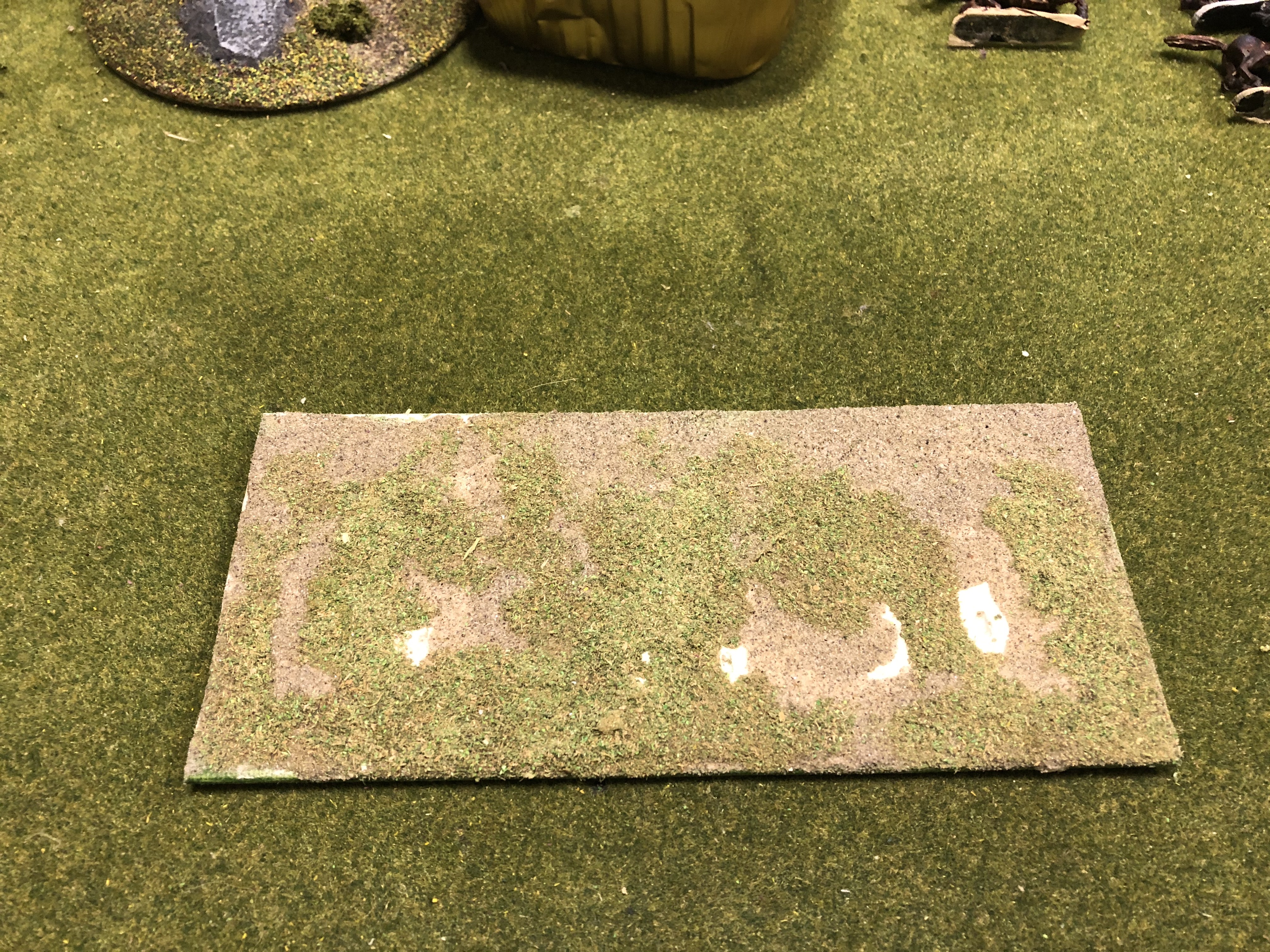
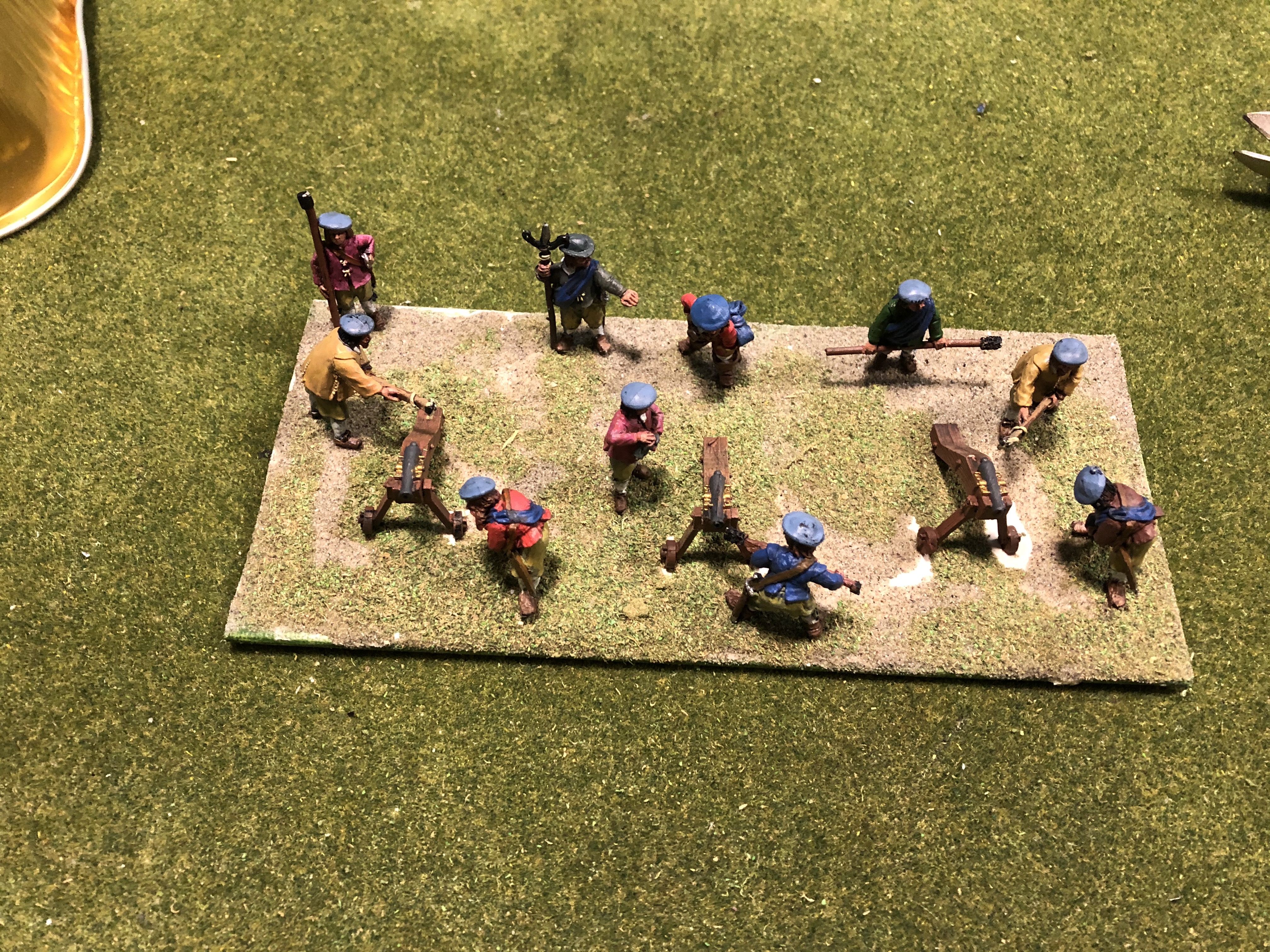
This is the base for an artillery unit. I have added DAS to the base to give some texture and modulate the surface. I fixed the DAS with pva glue first, and then as it dried I used a wet finger to smooth the surface. I also pushed the three guns into the DAS before it fully dried to make an impression for later, and once dried off, I coated it with pva 50/50 and fine sand, and later added some flock.
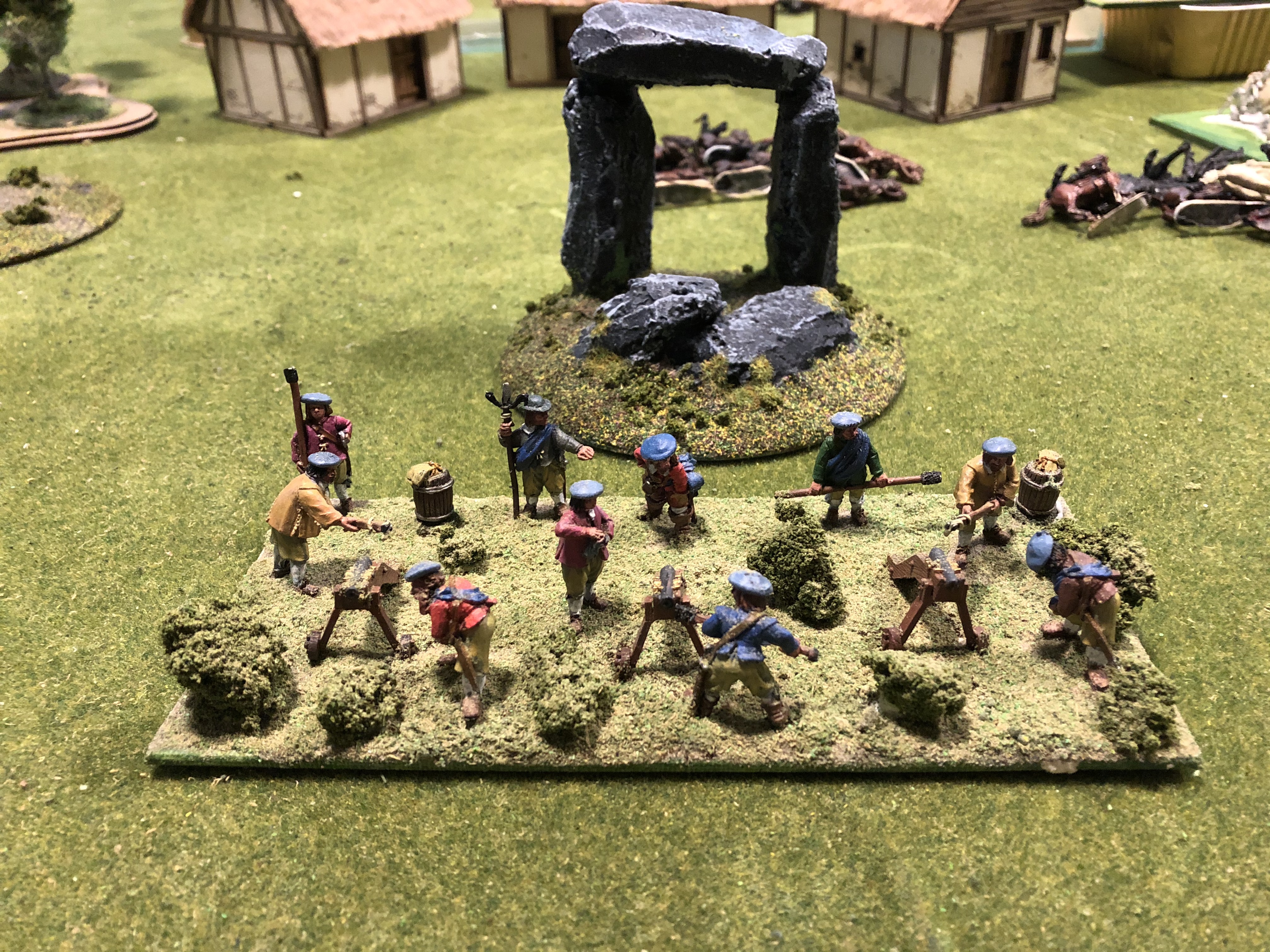
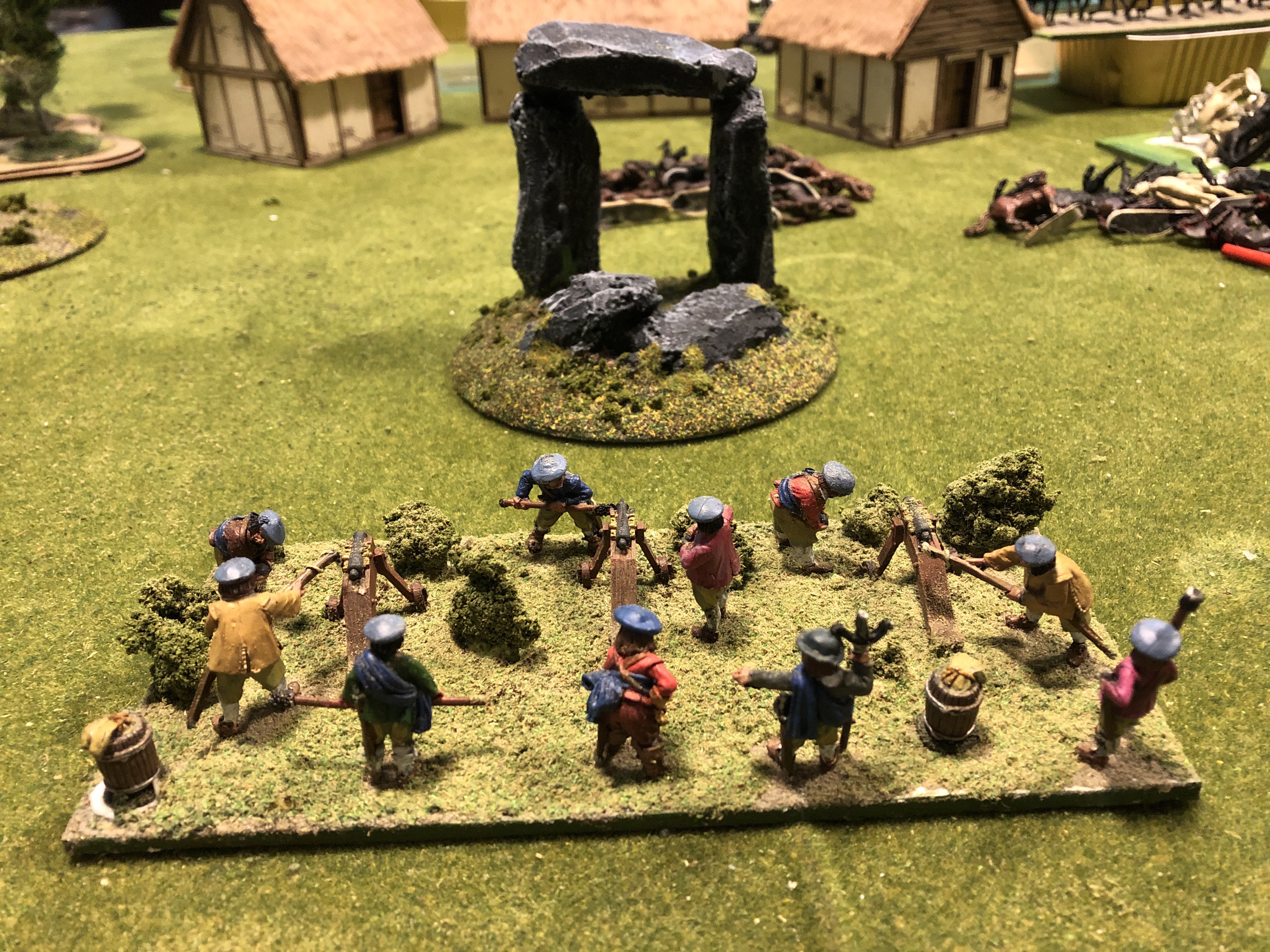
Once the figures were added (I cut off the bases and pinned them to the base), I finished with some additional flocking of different browns and greens, and some “bushes”; finally sealing with a 10% pva solution.
I am in the midst of painting six Scottish foote, and five cavalry units. Be back with you soon.