







![1918 Spring Offensive Wargame | Full Rules Overview with John & Gerry (WW1 Tabletop Game) [7 Days Early Access]](https://images.beastsofwar.com/2026/03/unboxing-warfulcrum-games-1918-spring-offensive-review-coverimage1-225-127.jpeg)
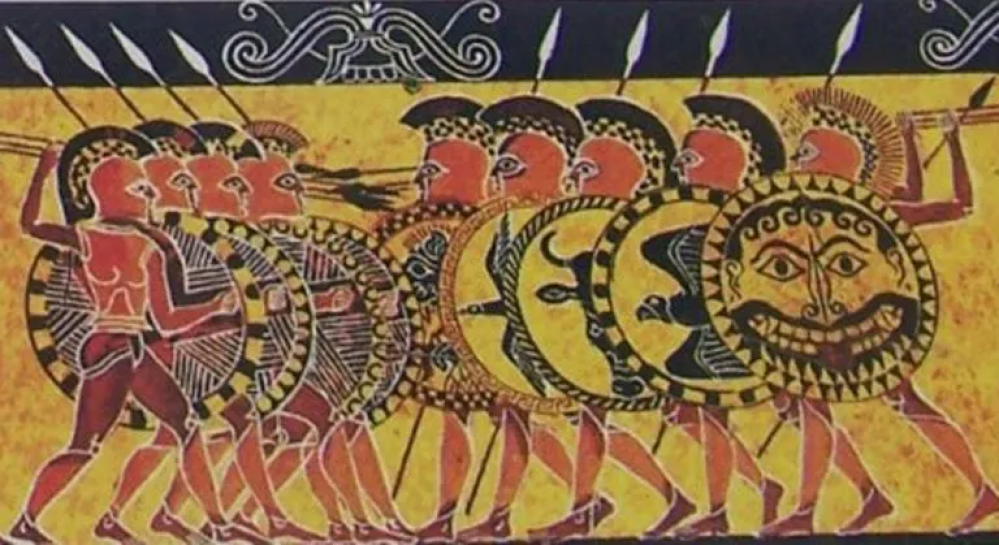
Enyalios!



Recommendations: 491
About the Project
Building of a 15mm and 28mm Hoplite army for a variety of rulesets
Related Game: SAGA
Related Genre: Historical
This Project is Active
The Sons of Heracles
So, after having completed two full corps of Athenians this year, I decided to end on something a bit different. Whilst the next step on this project was allies, I decided to do some allies that aren’t on my project list.
One of the things about DBA is that they list a series of historical allies a certain army can use. Normally, this allows you to take units that your list would not allow – in my battles vs the Scots (see the reports below), my opponent decided to include some cavalry from the Strathclyde list as well. I also see it as a historical reference as to which list I can use in a larger game as allies. Athens has quite a few options, mostly having access to the Mercenary Hoplites and the lists of other city states, but also some access to the Acheminids, Thracians and a few others. But the one that caught my eye was Thebes.
Thebes is one of those Greek city states that I had and had not heard of – most the information I have on them I read after I started playing DBA. The City itself is notable because it was allegorically built by the hero Heracles, and the people considered themselves to be his decedents, which is why you’ll see the Club of Heracles as one of their main emblems. The city itself was situated in the Northern parts of Greece, and was really outmatched by the major powers of Classical Greece – Sparta and Athens. During the Perisan invasion of 480BC, whilst there was a contingent of Thebans at Thermopylae that fought to the end, Thebes eventually joined Xerxes, fighting on his behalf up to and including the Battle of Platea.
What did allow Thebes to punch above its weight, however, was their use of the Sacred Band – an elite force of 300 Hoplites who were professional soldiers, recruited as a counter-balance to the more militaristic Spartans. And the Sacred Band is represented in DBA through the use of the 8Sp element type.
Whilst most of the elements in DBA are a single base, there do exist several double-based elements. 6Kn (6 Knight) are used to represent heavily armored shock cavalry, such as Roman or Byzantine Cataphracts. 8Bw (8 Bow) are generally used to represent a formation of archers sheltering behind a shield wall, such the Persian Sparabara. 8Sp (8 Spear) are a more elite spear formation, and have a bonus in close combat. By taking Thebes as an ally to Athens (they fought together in the Corinthian War against Sparta), I could get access to this unit type.
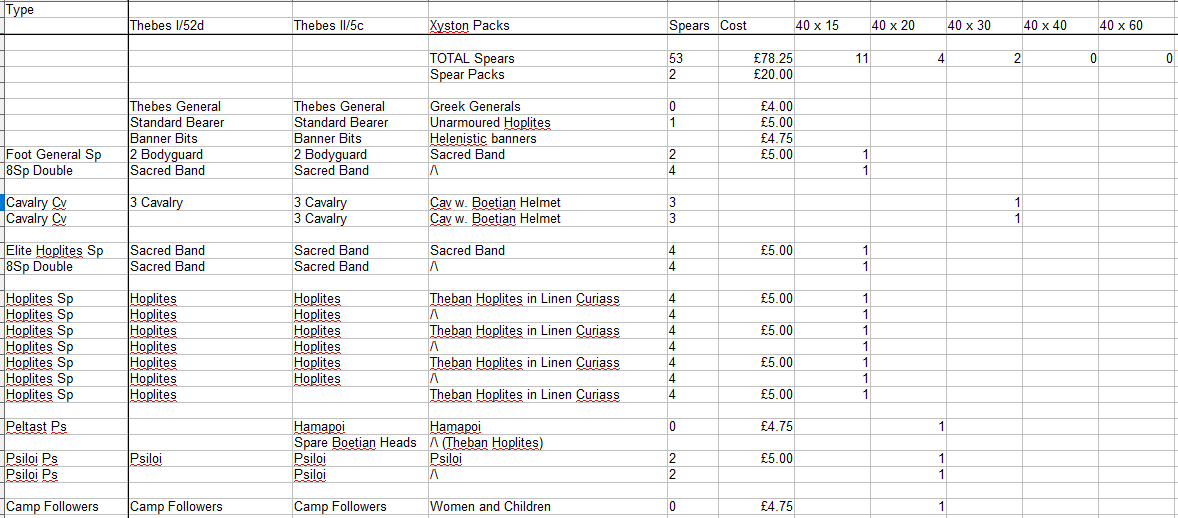
Whenever I start a new DBA corps, I begin by listing out which units I’ll need to complete the various variants, and use that to define which packs I should order. I also use this option to determine how many spears and even bases I’ll need – given that I’m in New Zealand, buying from the UK is usually a four-week delivery time, and I don’t particularly want to put something on hold for that long because I’m one shield short. I also look into what minis I have sitting around spare – in this case, I was able to use some Psiloi I had spare sitting around, which cut my cost down a bit.
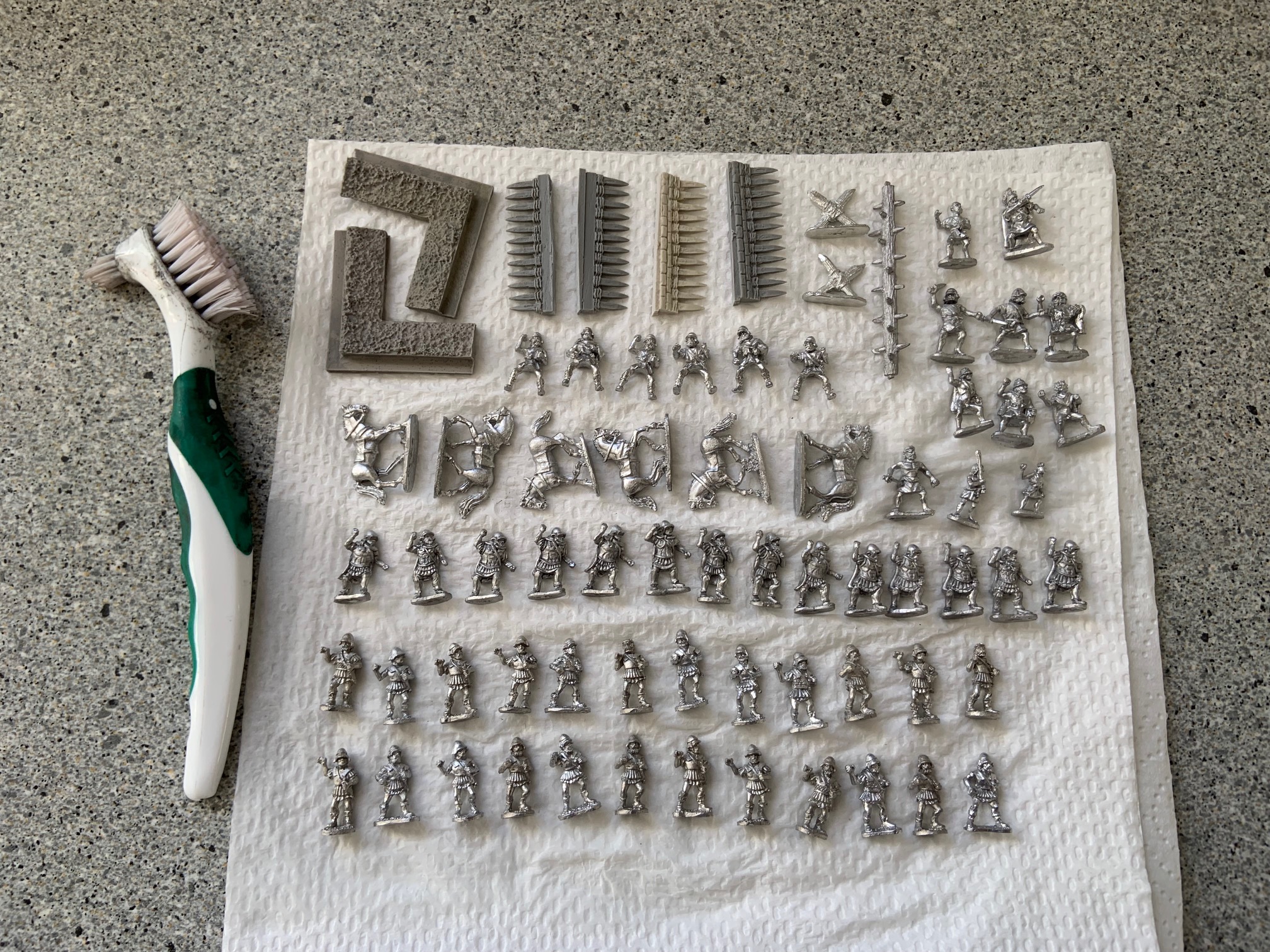
Once the order arrives, I clean it all up – soapy water and a scrub with an old toothbrush is usually enough to get rid of all the extra oils on the minis.
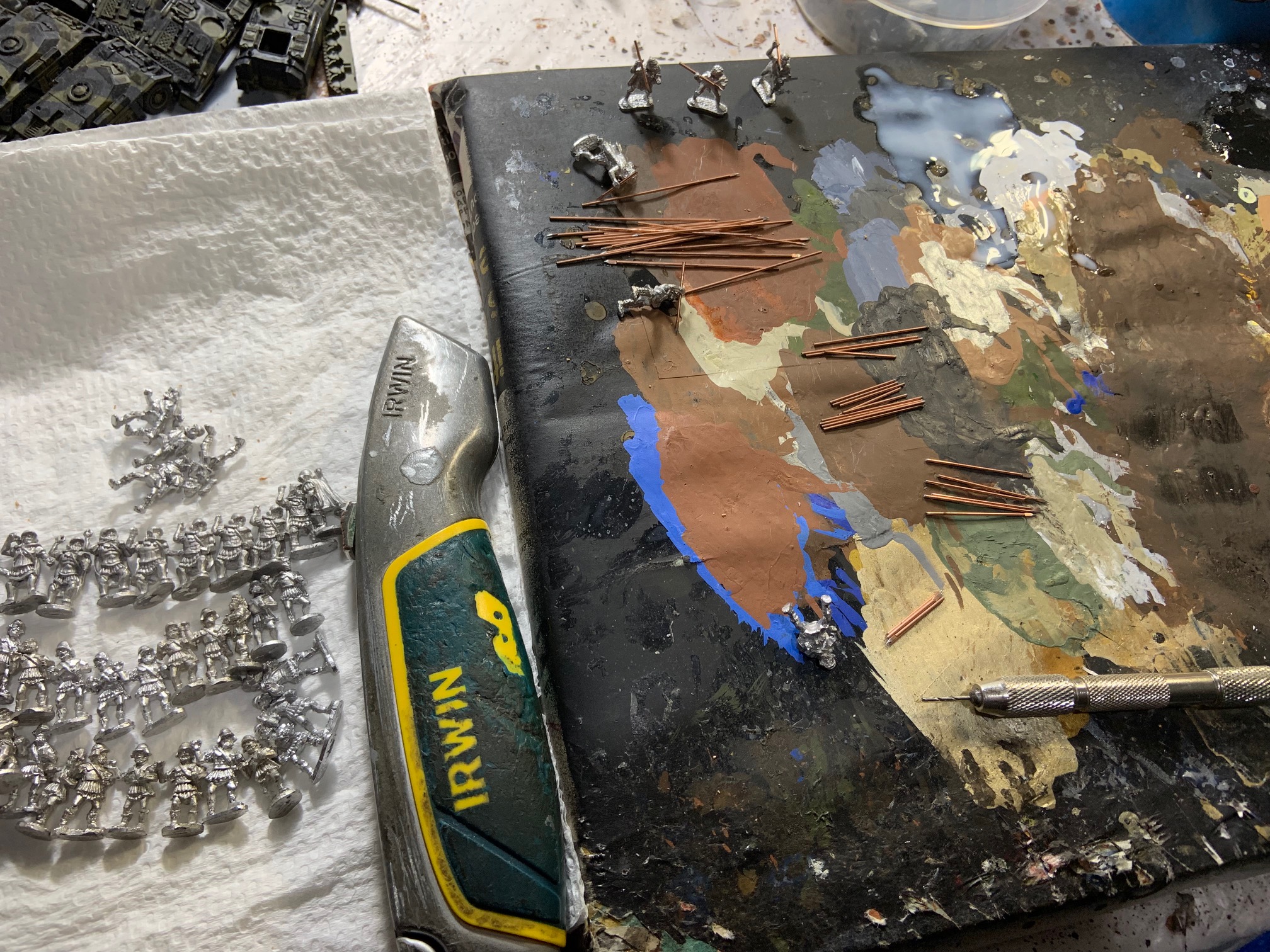
I then add the spears to the minis. As mentioned above, Xyston sells 50mm long brass spears, and I just cut them down to the various type – Javelins used by Psiloi and light cavalry are 15mm long, short spears used by cavalry are 20mm, and hoplite spears are 30mm. I add these prior to undercoating because the holes I normally slip them into are too small to take a fully painted spear (yes, two layers of paint are enough to do that). Also, painting spears on the models themselves is actually easier than painting them separately, especially if you’re dealing with a 15mm long javelin.
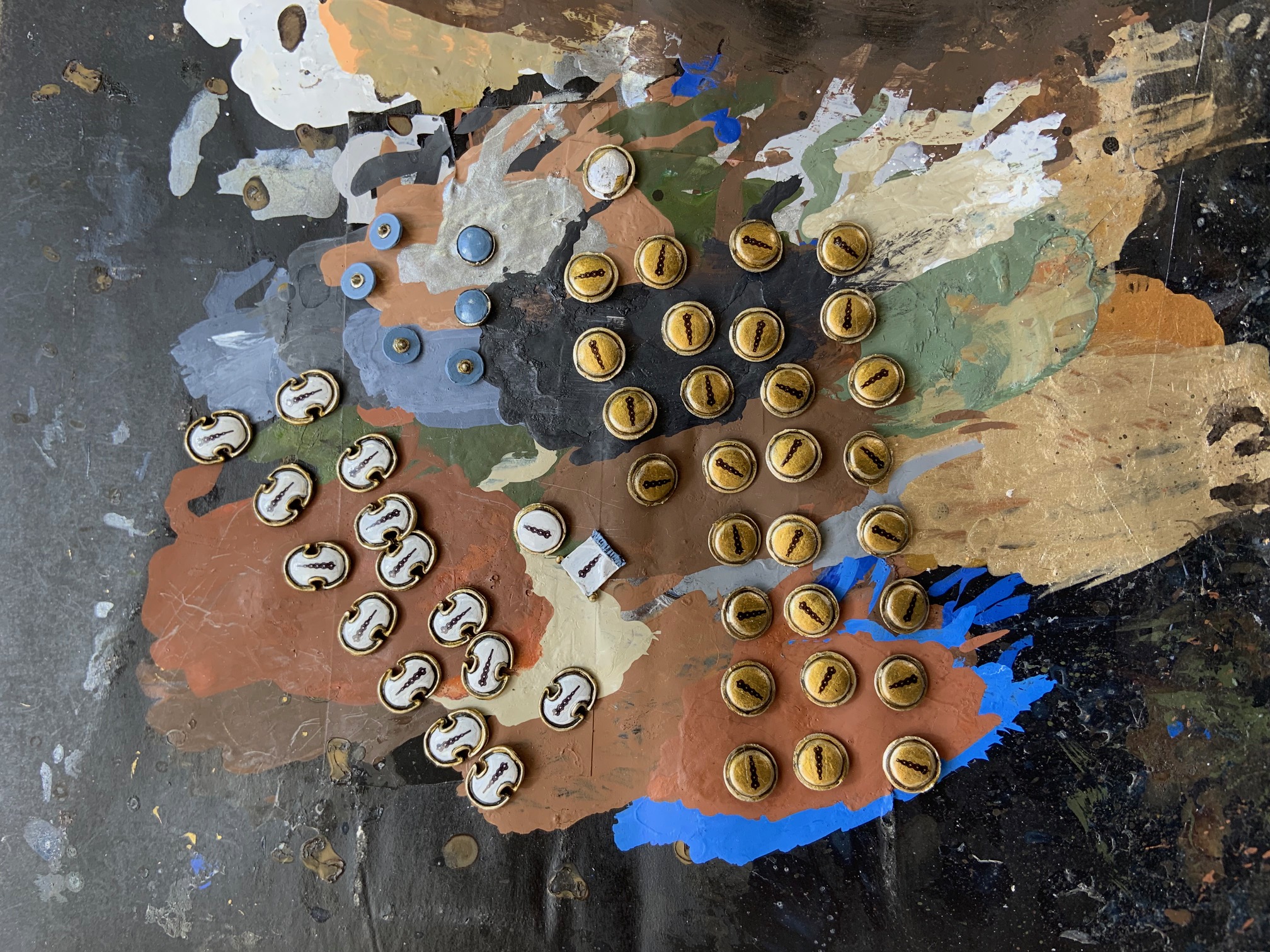
I also have a tendency to paint the shields separately and somewhat before everything else. The emblems here are from Little Big Men studios – I ended up using a full sheet to finish these, but I still managed to scratch one after completion, ruining its emblem. Oh well, that’s the one the standard bearer is getting.
In total, this force had 60 humans and 6 horses to paint, which is way too much to paint all at once. I try to cut the paiting into batches of similar models, although, in retrospect, I should have cut this part down further, doing three batches and separating out the standard Hoplites from the light troops, instead of just separating out the Sacred Band as a separate batch.
For Thebes, I wanted another blue colour, but softer than the Athenian Blue. After some thinking, I remebered I had a bottle of Horizon Blue (Vallejo 901) sitting around, from when I was thinking of doing up some WW1 French troops. It was probably a little lighter than I would have liked, almost a baby blue, but I think it worked out well in the long term. I certainly like how the light blue cloaks of the force turned out, and how they contrast against the darker blue-grey cloaks of the Psiloi.
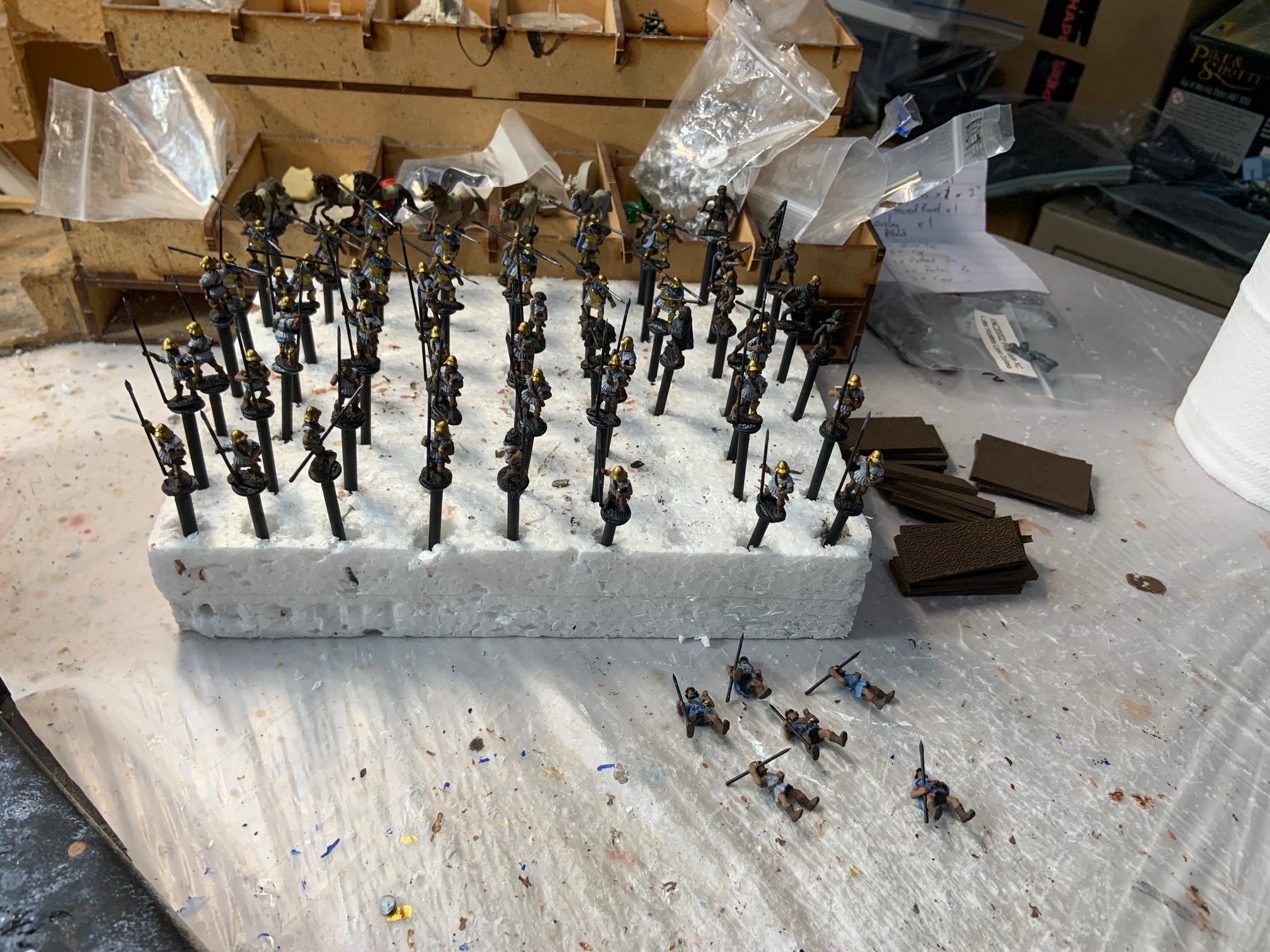
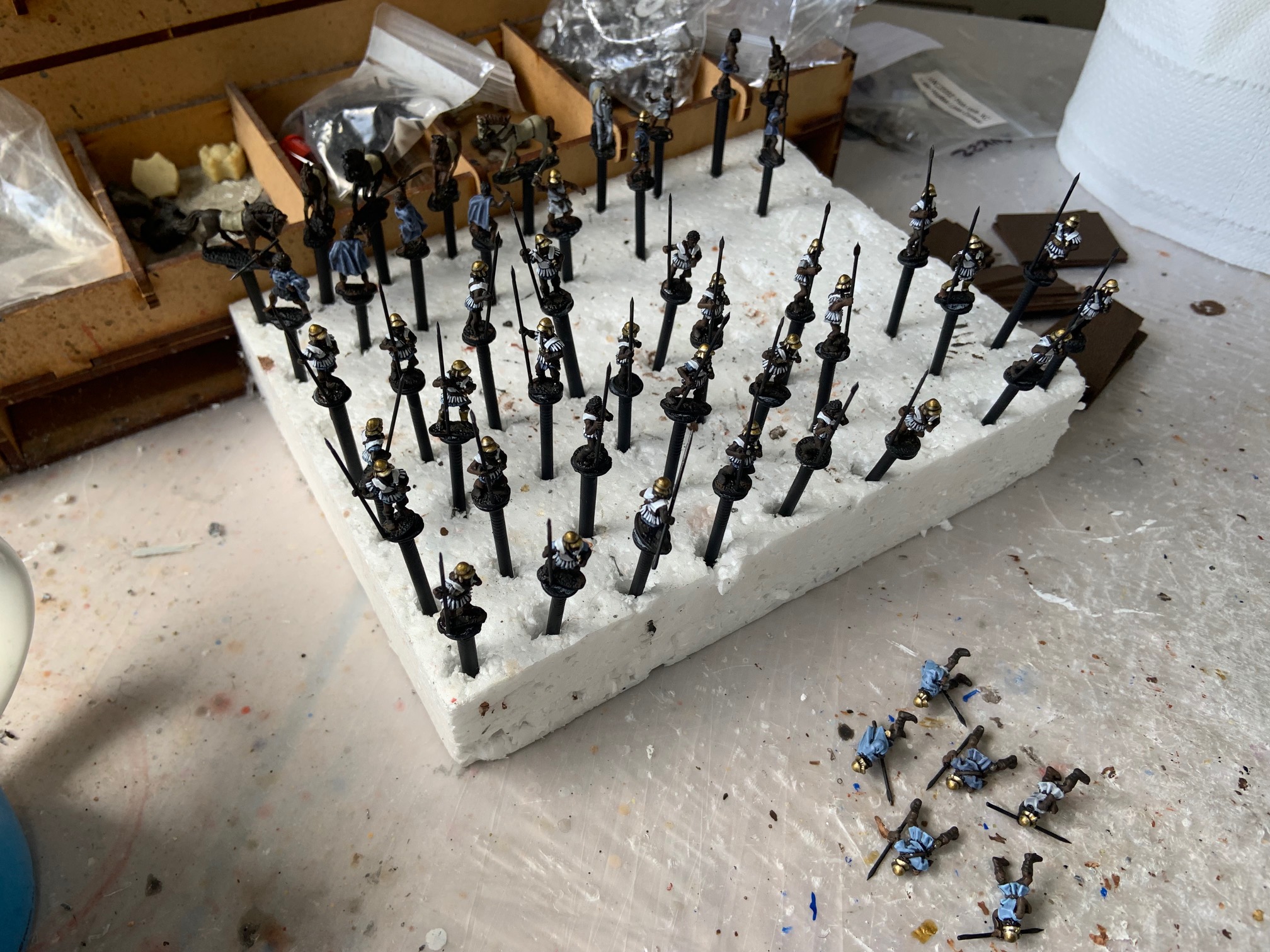

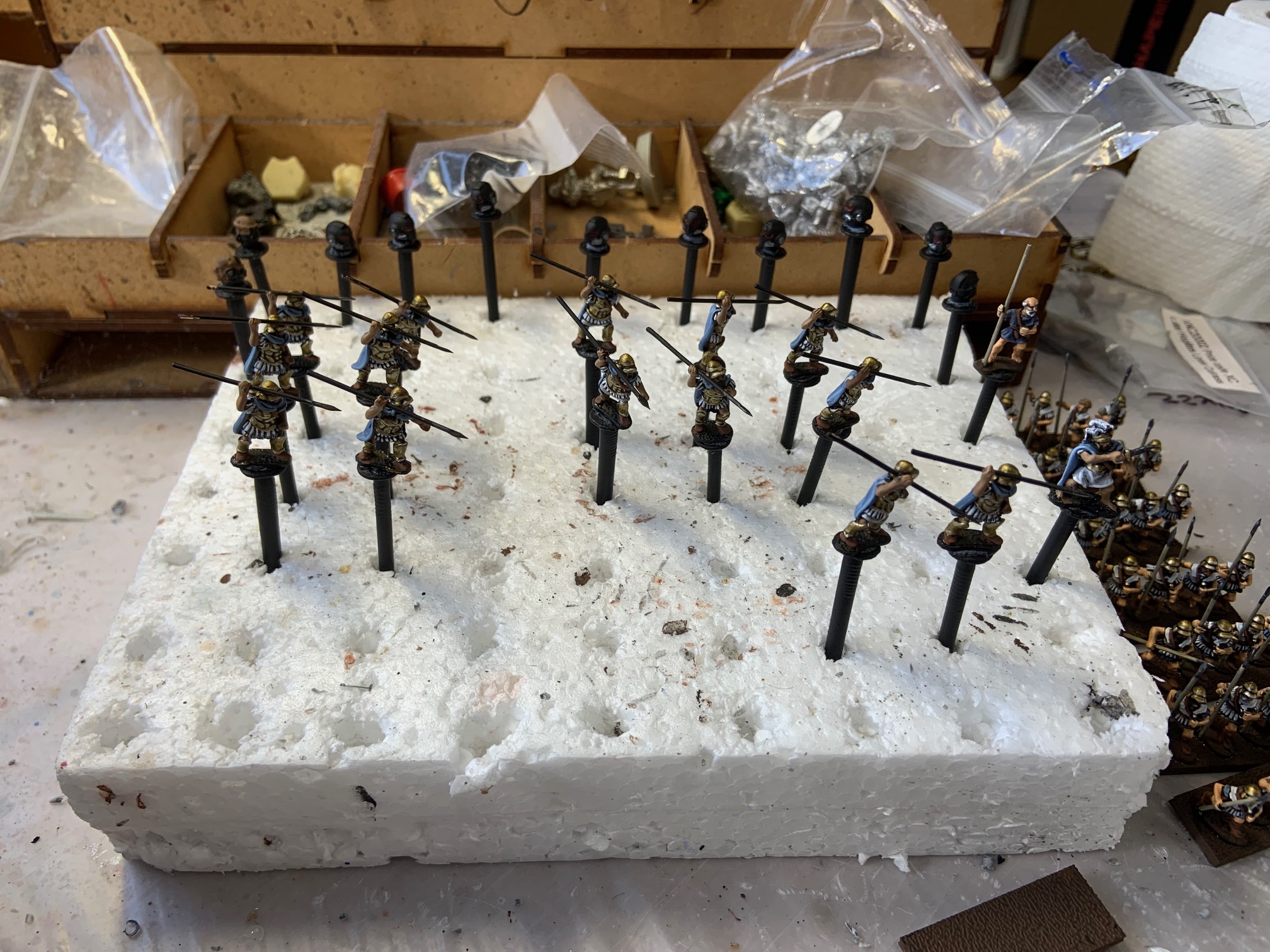
After each batch is completed, I glue them to their bases. It must be noted that the Xyston minis are actually closer to Heroic 15mm than standard 15mm, and in some cases, this can cause some cluttering of the bases. I can mitigate that by rotating some minis to better fit, but I had a bit of a problem with the Sacred Band in this case. Because I had insinsted on 30mm spears for them, despite them being held horizontally rather than vertically, they did have some problems with ranking the bases up. For the next set like this, I’ll definately cut the spears down a bit.
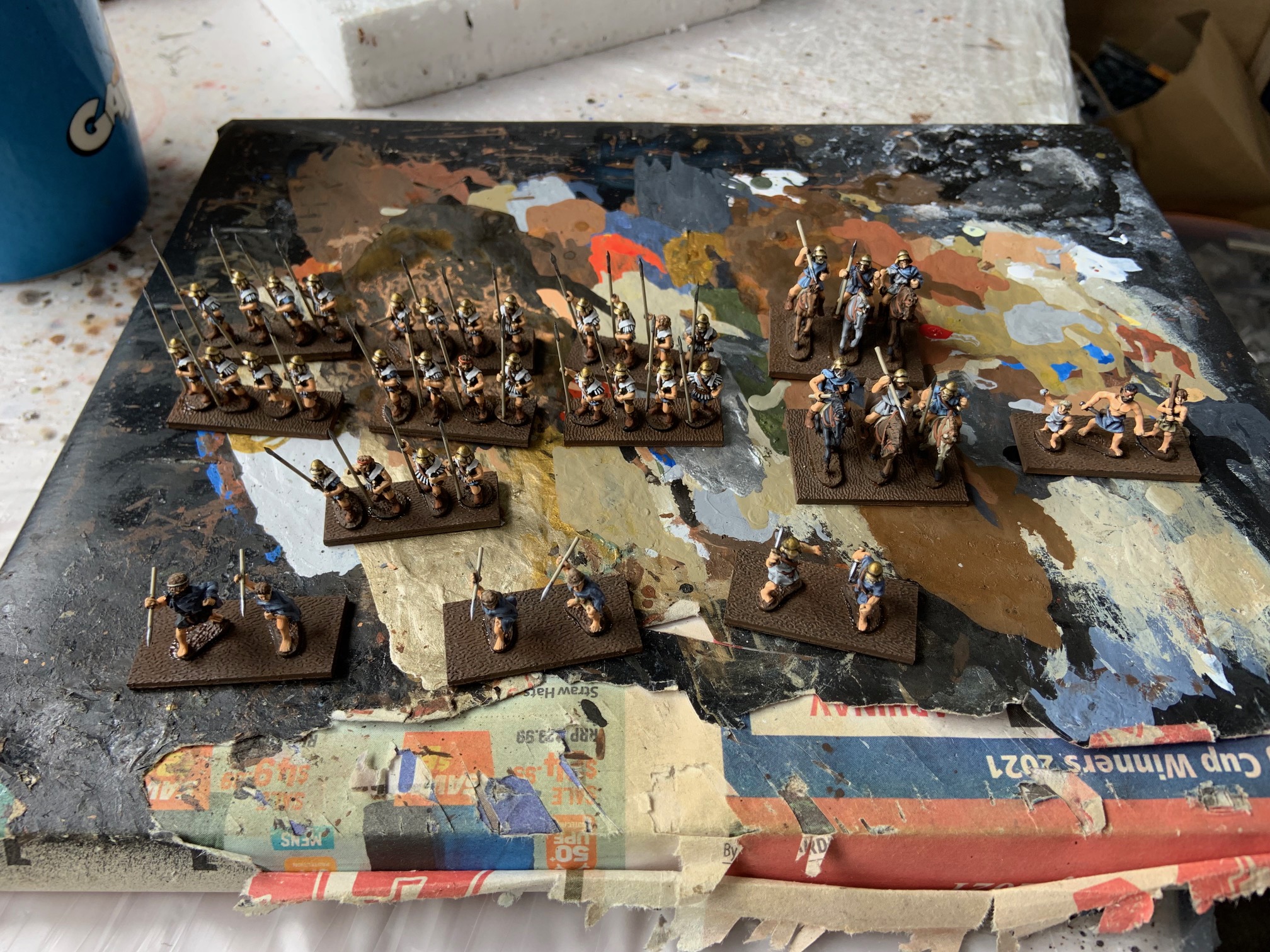
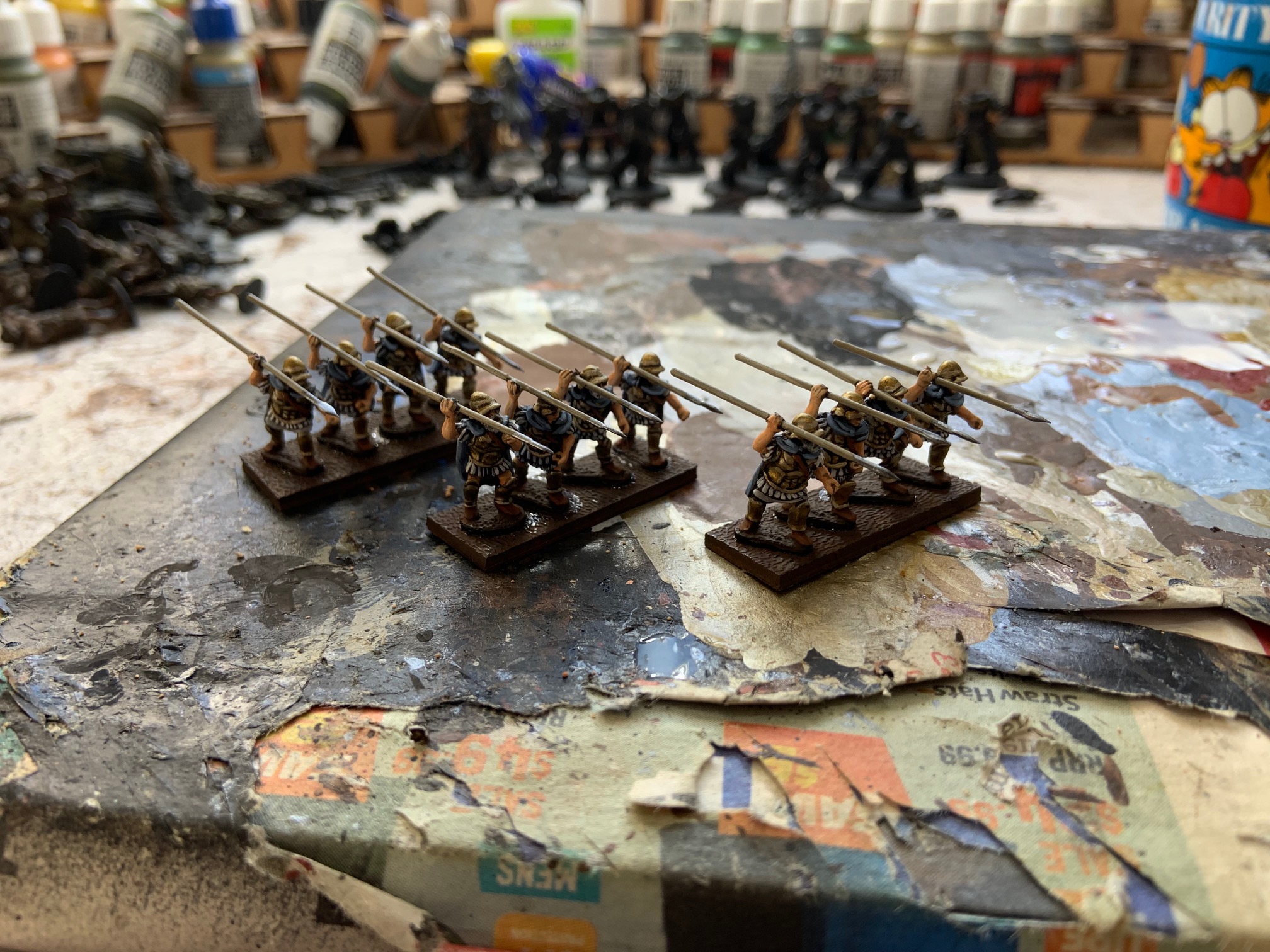
Finally, I add the base texture. This a pretty standard process for me – sand, paint it all brown, drybrush with biege for hilights, and then add flock. For some other 15mm minis, I sometimes add static grass, but for DBx elements, the flock only works out well.
And with that, we have another corps completed. The last project of the year.
The sound of thunder...and the smell of...
DBx Bases: 94 + 7
15mm Spears: 197
DBA Corps: 6
Saga Points: 8
DBx W/D/L: 2/0/6
So, with the Marines done, it was time to get onto the Horse, which is the last major component I need for most of the Athenian armies I’m doing.
And I over did it. Again…
I have a problem when painting in that I’m perpetually unsure if I’ll be able to recreate a mixed colour or painting style in future models. I can kinda handle the former by writing down my paint mixes for future reference, but I still have a tendency to paint all of a certain type of model at once so I can at least try to keep them uniform. This is what led to my 21 models at a time for the Marines, and how I ended up doing 30 bases at once here.
And those 30 bases included 57 horses of varying colours. Seriously, the number of minis I’ve painted over the last two months could be enough to do two or three full DBA armies…
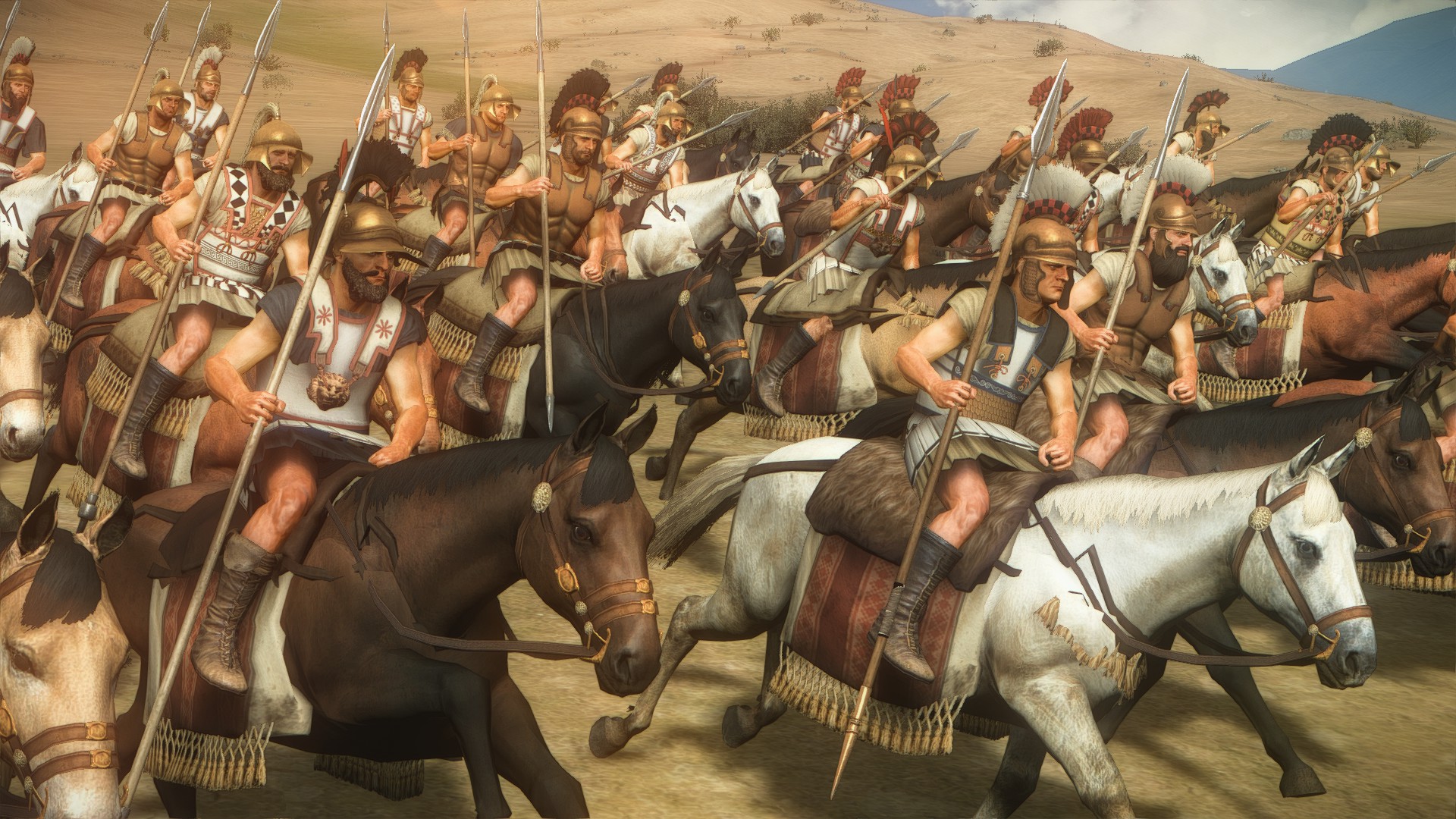
When we in the west tend to think of cavalry, we tend to picture Napoleonic Dragoons or medieval Knights. Buy the truth is that this type of cavalry is actually a more recent development than that of the mounted warrior. The general consensus is that the European development of the stirrup in the 1st century BC caused a shift in cavalry tactics, allowing mounted warriors to more effectively shock charge and engage the enemy whilst on horseback. Most other style of cavalry tended to skirmish and engage in hit and run attacks on enemy lines, screening the main battle line. The first shock Calvary units was really the Macedonian Companions under Phillip and Alexander, being closer to Lancers and Knights than their contemporaries.
In DBA, this divide between shock cavalry and regular cavalry is also modelled – Cavalry elements are faster but weaker than some foot units, more in line with the weaker Auxillia type than the more combat focussed Blades type. If you want a horse unit to break the enemy lines, you need Knights – although still not as strong as a Blades unit, they have the ability to ride down a lot of foot elements if they so much as beat an enemy unit, rather than having to double its combat score.
For the Athenians, they did have a standing corps of cavalry, drawn from the highest classes of society – its one thing for a citizen to own their panolpoly of armour, but a warhorse…yeah, you need to be rich for that. The city states that created the best cavalry were the Thessalians in the Greece itself (natural horsemen), and the Tarantines from Italy, who hired out as Mercenaries to multiple force around the Mediterranean.

In DBA, the Athenains don’t get much in the way of cavalry to support their battle line. There are a few instances of mounted officers, and a couple of extra units. But even in DBMM, the most the Athenians get are 6 cavalry elements. Not exactly much of a support formation, but what the heck. Additionally, the Athenians also get access to some Light Horse support to act as outriders. Before 365BC, these are Horse Archers, which came from the Thracian range. But after that, you get an element of Prodromoi Light Horse. When I first read this, I immediately thought “Hang on, isn’t’ that the name of the Macedonian Light Cavalry”. Well, it is, but the two units couldn’t be more different.
The Macedonian Prodromoi were a subsection of the Companions – equipped with slightly shortened Sarissa and unarmoured, they scouted for the force, and guarded the right flank of the Companions in battle (which meant they guarded the entire army’s right flank, as the Companions were traditionally placed on the right of the army’s line).
In Athens, however, the Prodromoi were mounted javelin men, mostly raised from the lowest classes in Athens. Whilst most Greek warriors provided their own equipment, the prodromoi were supplied by their leaders instead, and probably forced a skirmishing force for the main cavalry, as well as assistants and aides for the officers in the army.
The final element painted up were Hamipoi. Now, I can’t seem to find any sort of direct translation for this troop type on the web, but in DBMM they function as light infantry that can support cavalry elements. This kinda make a bit of sense, as cavalry on its own can easily be swamped by enemy infantry if their initial charge doesn’t break the line, so some supporting infantry would aid them. Also you can see this sort of doctrine in the Battle of Gaugamela in Alexander, when the Companions have some infantry running along beside their horses in their initial maneuver.
So the Athenians were settled, but what else did I do up?
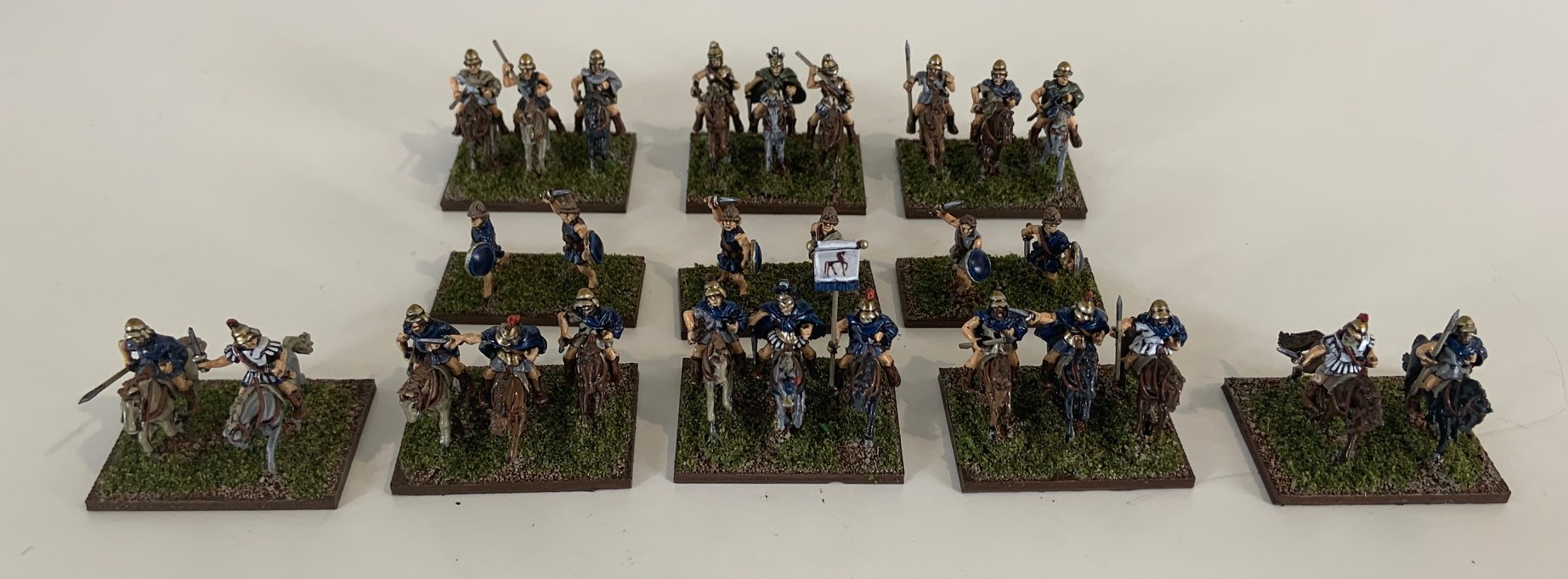
And then there’s the Thessalians.
When I was first thinking about my Greek armies one of my clubmates told me “if you’re going to do Greeks, have some allies as well. You need more than just spears, as such an army is not fun”. He made sense, so I immediately though about including the Thessalians as allies to break up the monotony and add some maneuver to my force. I’m planning on working on them later, but I figured I’d get some of them started at least.
The issue was mainly how to paint them. I didn’t want them looking too different from my main force, but the issue was that searching for “Thessalian Hoplite” only really came up with this picture:
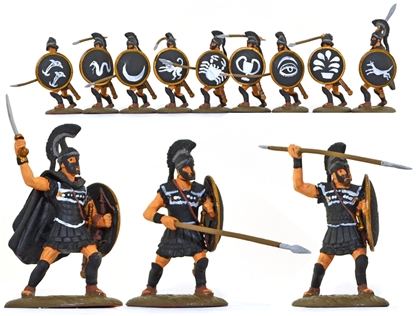
All the others instead showed generic Hoplites or the Thessalian cavlary. But it occurred to me that this might be the answer – instead of the standard Athenian Blue, use a darker blue for the Thessalian units. That, plus the Thessalian cav using Boeotian helmets instead of the usual crested ones would be a good way to mark them out as separate. So, a few units of commanders and some Hamipoi to support them were added to the list.
And finally, just because I love torturing myself, I also did three elements of Mercenary cavalry – the Mercs are another corps that I’m going to do up as something distinctly different to the other forces, and, with them, uniformity isn’t so much of a concern. But I still ensured they all had similar helmets so that they had some cohesion, rather than all looking different.
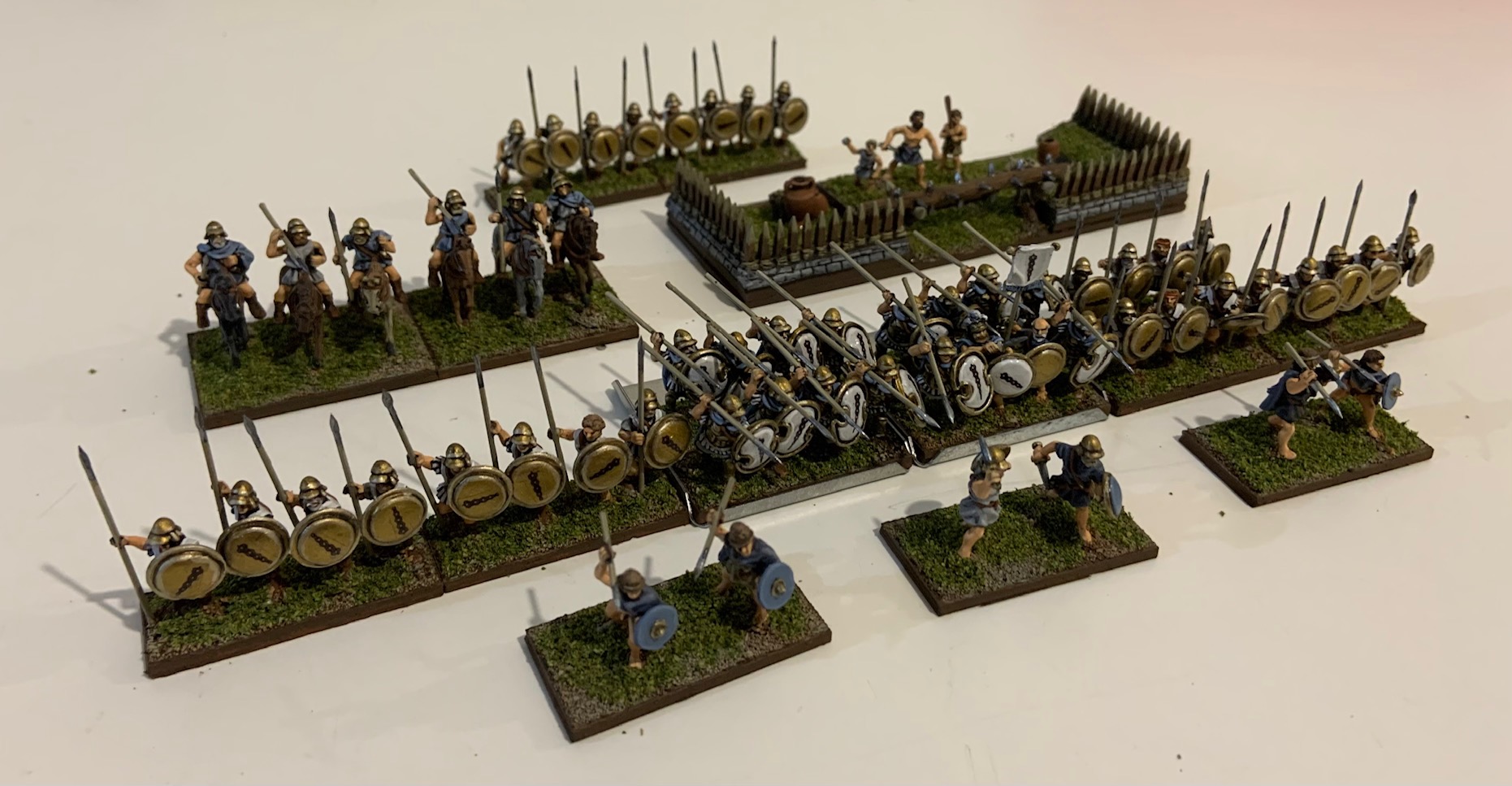
With those done, I had reached a major turning point in my project – three of the four Athenian corps types were done!
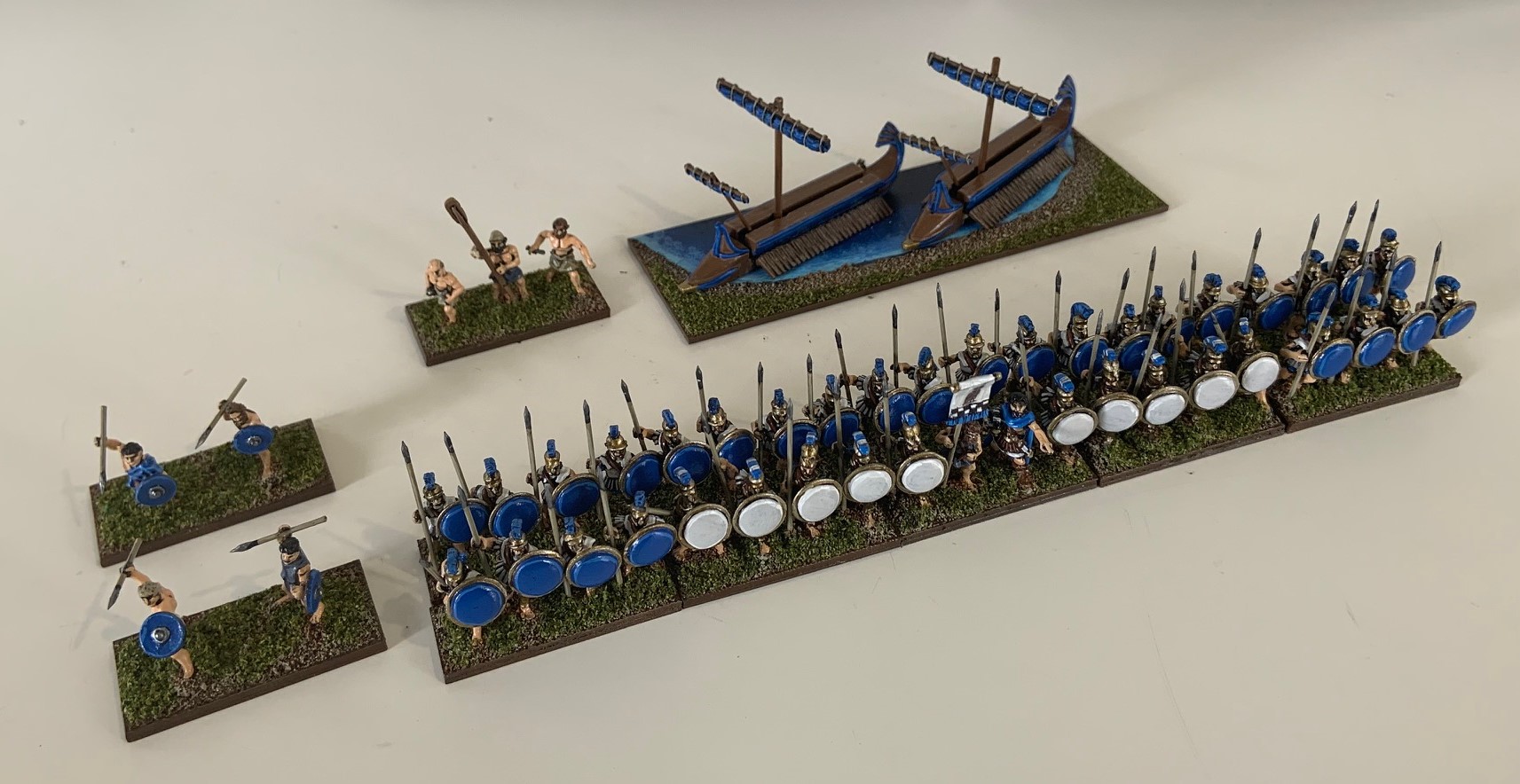
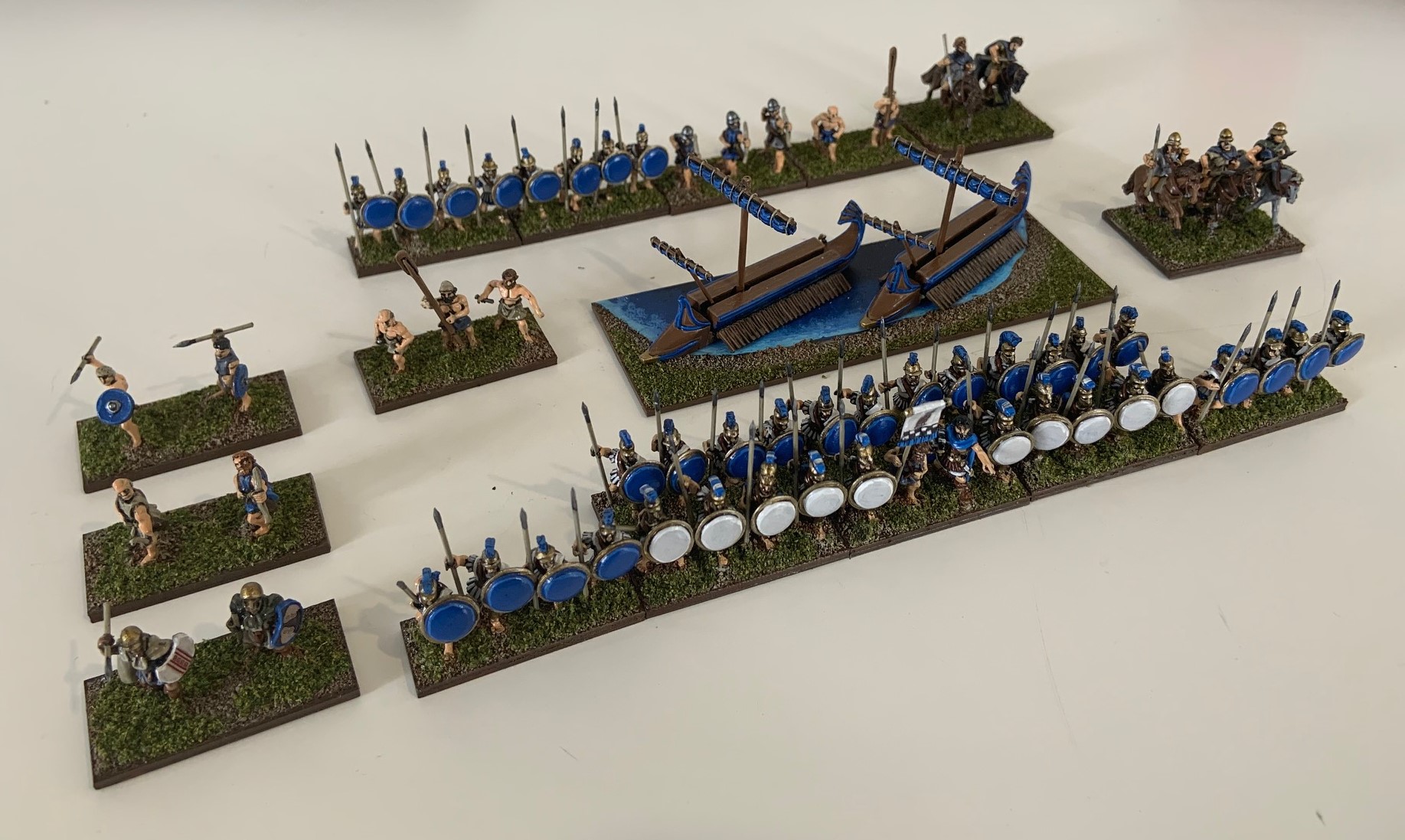

L to R: I/52e Early Hoplite Early Athenians, I/52f Early Hoplite Later Athenian, II/5b Later Hoplite Athenian
The only Athenian army not done yet was the Hellenistic Athenians (II/31h), but that one requires Thureophoroi, and I really want to paint something other than Athenian blue for a bit.
So, coming up next, some allies…
Needing a Sea Change
DBx Bases: 64 + 7
15mm Spears: 156
DBA Corps: 1
Saga Points: 8
DBx W/D/L: 2/0/6
What a nice nap…what d’ya mean its nearly spring again?
The last couple of months have been…busy. I’ve done a few other projects in the meanwhile – hoplites, Necromunda, a whole Roman SAGA force…
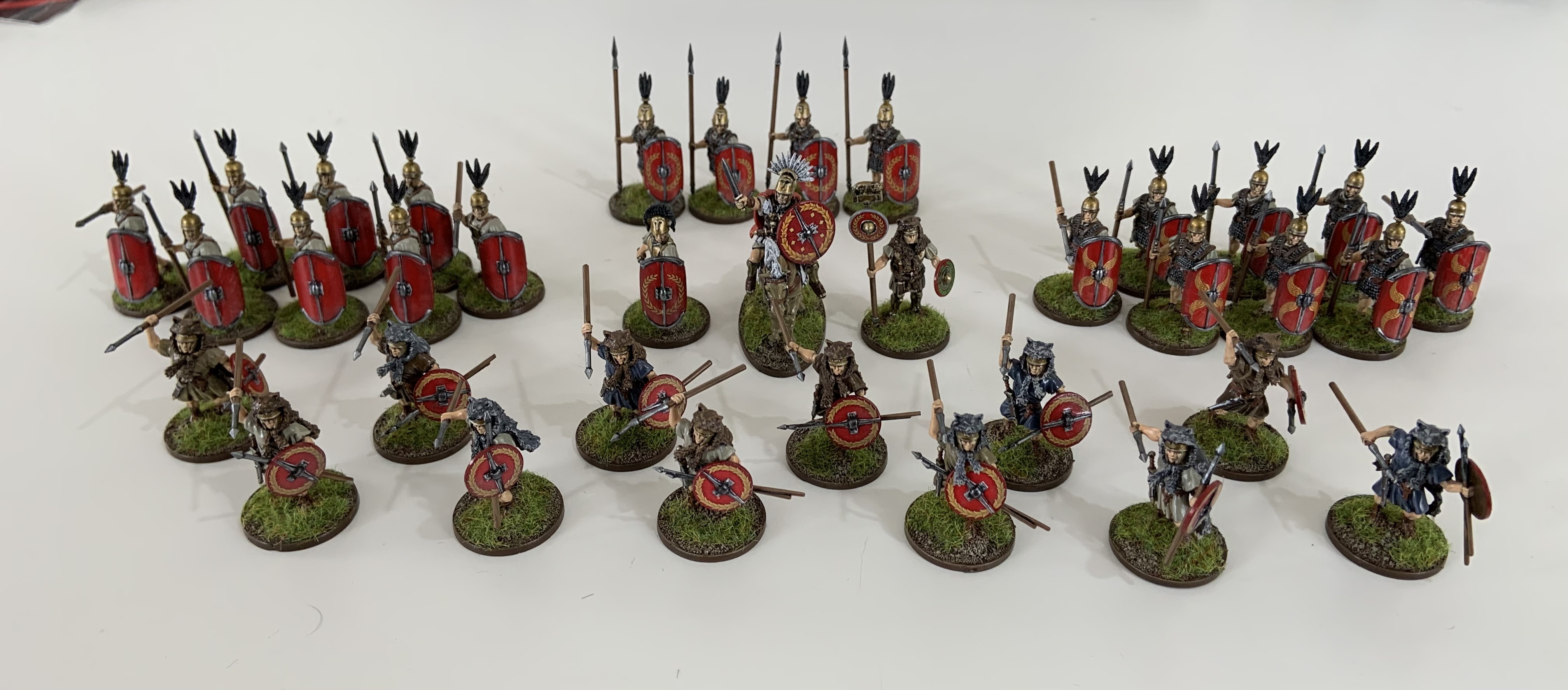 Done in 20 days - send sleep
But lets get back on track for now. As I said last time, Horses and Tridents…so lets get the Tridents out of the way.
Ancient Naval warfare tended to be based around two main forms of offence – ramming and boarding actions. There were efforts to mount some artillery at times – stone throwers, bolt throwers etc, but ramming and boarding were the main forms of attacking. So the naval gameplay in AC: Odyssey where you use massed bowfire to sink enemy ships is basically wrong – I think they were trying to emulate the gameplay from Black Flag there. But the ramming….ooh yes.
As mentioned earlier, a Trireme’s crew consisted of ~170 rowers, two to three dozen deck crew and officers, and 10-20 marines (epibatai) – a dozen or so of which were equipped as Hoplites, the rest as archers. The Hoplites were the primary boarding force for the ship, as the rowers couldn’t really get out of their seats that easily, and had to rely on their own Marines to protect them.
In game terms, DBMM does have the option to include ships as part of your force, and those ship in turn carry troops for landing. I figured that the best way to represent these would be to model actual Marines as a visually different force. But would they also be needed in DBA scale?
For those of you who are unaware of how DBA army lists work, here is the list for II/5 Late Hoplite Greek variant b – Athenians:
II/5b Athenian Army 448-278 BC: 1 x General (Sp), 1 x Cavalry (Cv), 1 x Cavalry (LH), 4 x Hoplites (Sp), 3 x Sailors equipped as peltasts (Ps) or Hoplites (Sp), 1 x Hoplites (Sp) or peltasts (Ps), 1 x Archers (Ps or 3Bw)
Terrain Type: Littorial, Aggression: 2, Enemies:….
As you can see, 12 elements in the army. The notations after each unit is their troop type – Sp for Spears, Ps of Psiloi, LH are Light Horse, Cv are Cavalry, and 3Bw are Fast Bowmen (4Bw are Solid, and 8Bw are a special unit type). The list allows you have some choices in your force – mostly choosing between more hoplites (heavy infantry) or peltasts (light infantry). Mostly I go for more Hoplites as you need as long a line as possible for spears to work properly.
But when I first read this, the second last item caught me out – why put it like that? And then I realised that the option there was the perfect one to include as some Marines – either equipped as Hoplites or Peltasts.
 6 hoplite bases as they're needed under the DBMM rules
Mortal Gods also has Marines for its Athenian force, complete with their own separate models. I figured it was probably a good idea to include a few…but I now realise I really went overboard. 21 models in one go – 9 spearmen, 6 javelinmen and 6 archers. I don’t think I’ve ever painted such a large batch before.
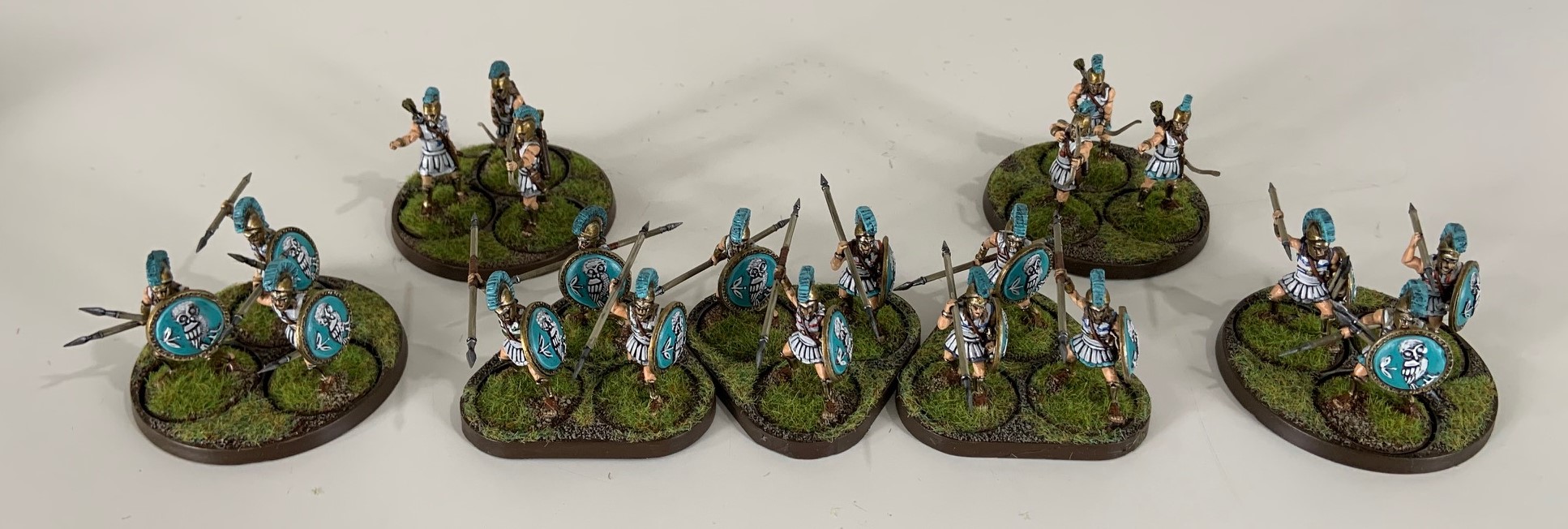
Its been said before that you really need to paint your models in batches – 5 is usually a good starting point as by the time you’ve finished with the last of the lot, the paint on the first one is pretty well dry, and you can get started on the next colour. But this tranche of models has shown me that that is not scalable past a certain point. There is nothing more stressful that finishing colours on 10 models and realising that you’ve got the same amount to go.
From now on, I’m keeping my batches to 10, max.
Toxotai
DBx Bases: 56 + 7
15mm Spears: 128
DBA Corps: 1
Saga Points: 7
DBx W/D/L: 1/0/4
I have a lot to say about the 2004 film Alexander – the writing is terrible, the acting is histrionic, the characterisation certainly is not appropriate in places, but I will admit that the battle scenes are, by far, the highlights of the film. The costumes, the number of extras they have, the grand scale of the battle itself – I’ve not seen such a effort of cinematography made since 1970’s Waterloo.
Battle of Gaugamela Part 1
Battle of Gaugamela Part 2
One thing, however, is notable about the Battle of Gaugamela – whilst the Persians had large numbers of archers supporting their troops, the Macedonians have very little. There are a few slingers and peltasts that support the phalanx, but massed bowfire?
Here’s the thing – the bow, whilst a relatively simple weapon, takes a lot of skill and training to use – this is why during the Medieval period the crossbow was more favored by some armies, since troops could be relatively quickly trained in its use. All you needed was a strong arm, and sometimes not even that. And that level of skill is why the English took a generational approach to peasants training on the archery stocks every weekend during the Hundred Years War. And that still applied, in many respects, during the ancient era – the primary missile weapon of the classical age was not the bow, but the sling.
Which makes sense – its cheaper than a bow, training a child how to use a sling is necessary for any aspiring shepherd boy, and small rocks for ammunition were easy to find. Plus, a well placed sling stone could break an arm, a rib cage, or crack a skull. Also, the Greeks saw the bow of more of a hunting weapon, the war weapon of a coward, and one used by barbarians – sure there were archers in their armies, but they didn’t play a massive role like it would in Europe 1500 years later.
That said, there was an exception to this practice – the Athenians. Some of the sources I’ve seen have noted that, during the Peloponesian War, the Athenians had four main corps of their armed forces – the Cavalry, the Navy, the Hoplites, and the Toxotai (the archers). Indications are that the corps was first raised in the 480’s BCE of about 800-1200 citizen soldiers, usually men who were not rich enough to become Hoplites. Mentions are made of them distinguishing themselves during the Battle of Platea in 479 BCE, and it was noted that of the marine force on each Trireme, four of them were archers. That being said, the Toxotai were not well regarded compared to the other branches of the army – the old biases of cowardice and barbarism leaked over.
 It makes me wonder if the history surrounding this Corps was the inspiration for the Athenian Marksman side-quest in Assassins Creed: Odyssey (wouldn't know, stopped playing that one after 10 hours).
So, some archer support would be needed for my Athenians. And, given the more organised origin of the Athenian Archers, I decided to match the AC:O artwork and give the rank archers all helmets – not good bronze helmets, though, just cheap iron ones, enough to make them look like they had been somewhat equipped out of the State’s purse.
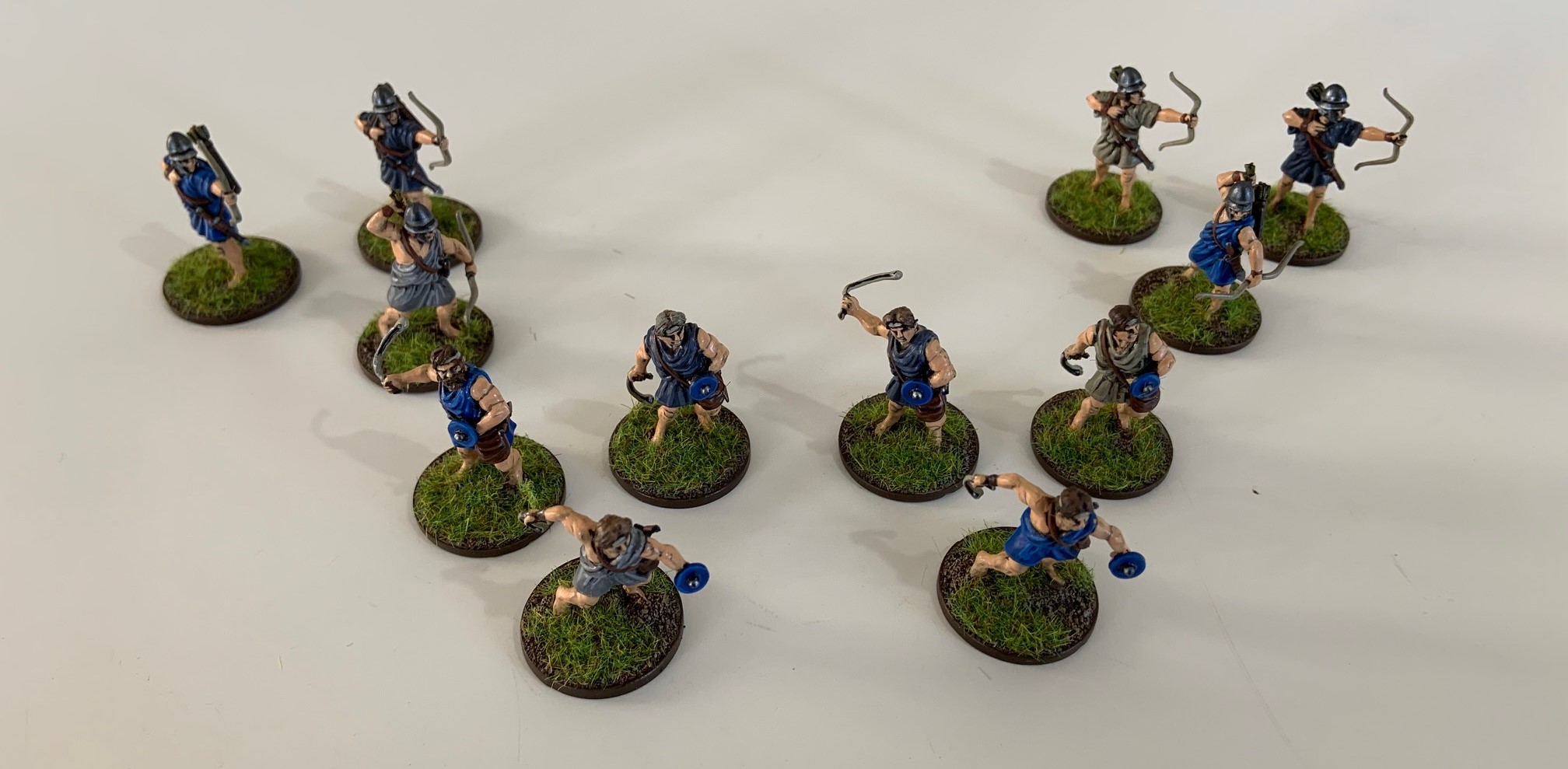
Additionally I also did a few slingers at 28mm as I’ve been wanting to introduce Mortal Gods to some of my local gaming groups – completing the slingers means that I finally have two demo forces which I can use in a 150pt game, or a 300 pt game.
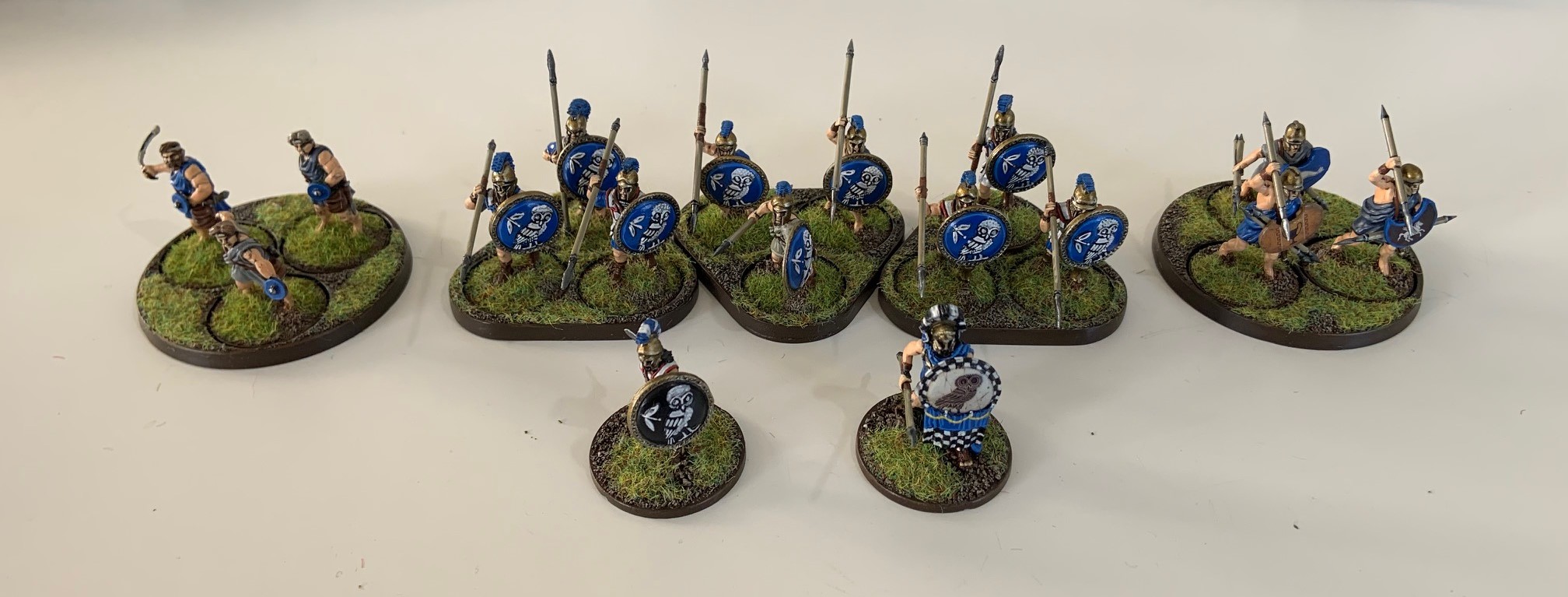
At the 15mm level, most archers for Greeks are Psiloi elements, with the Athenians being the only nation capable of upgrading these to line Bowmen. In reality, I need more archers, but the helmeted heads come from other models, so these eight elements will have to do for now.
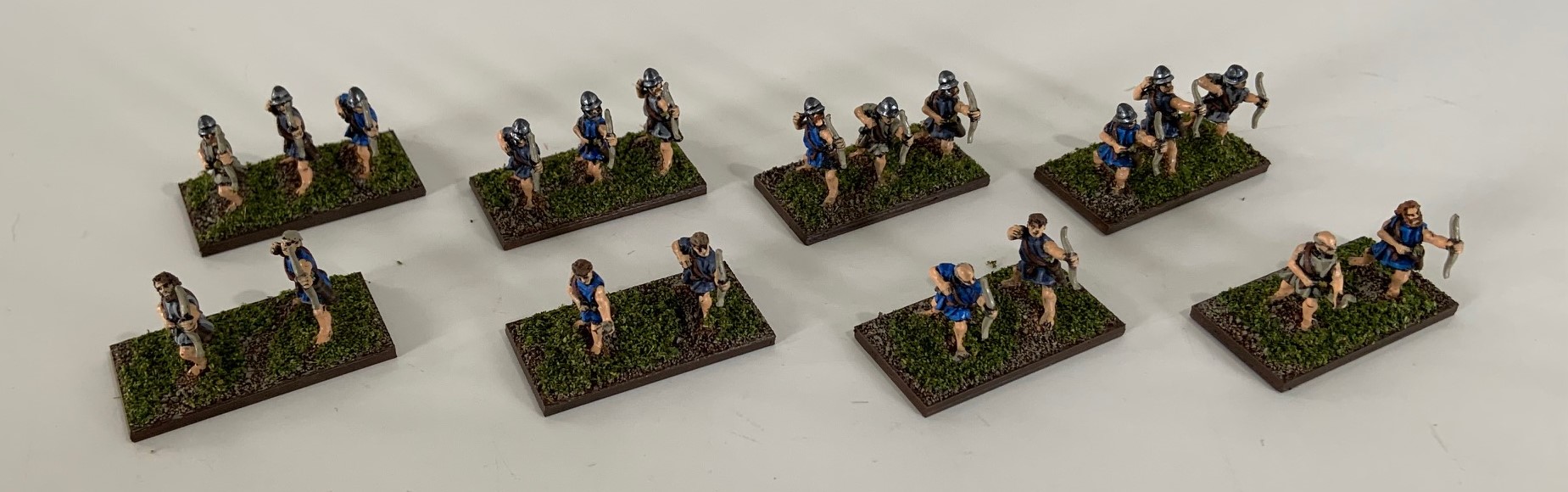
I’m getting close to finishing off my initial Athenian Corps…
Next, the horses and the tridents…
Make up your mind, Chronos!
DBx Bases: 48 + 7
15mm Spears: 128
DBA Corps: 1
Saga Points: 6
W/D/L: 1/0/4
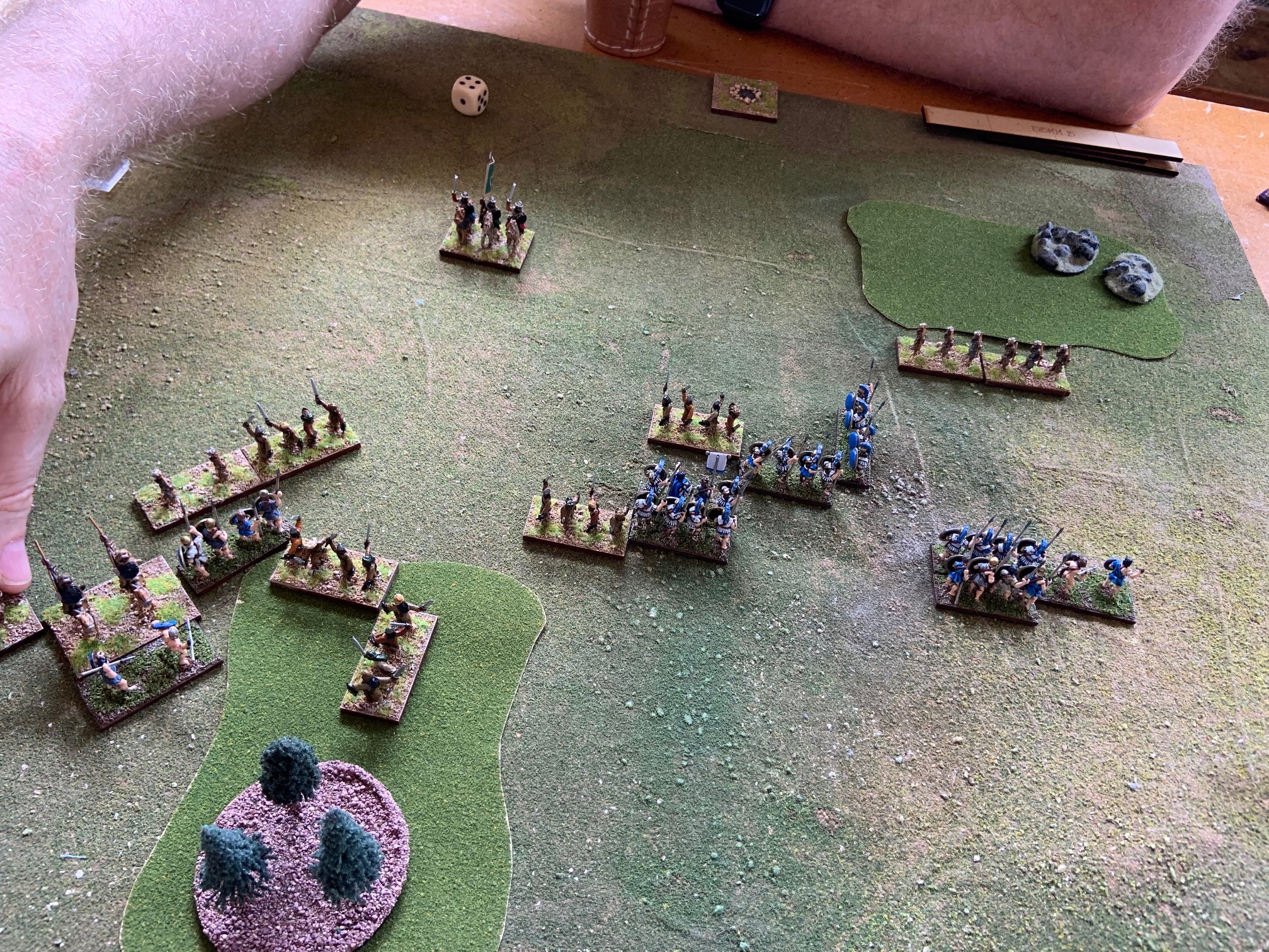
So, another weekend at the club, another three games with the Athenians. But, once again, they were opponents out of time – perhaps after their last encounter, the Greeks retreated to their ships and set off again, only to once again get waylaid onto some weird continent that they certainly didn’t recognise – I think either Chronos or Eris were playing some weird joke on them…
Game 3
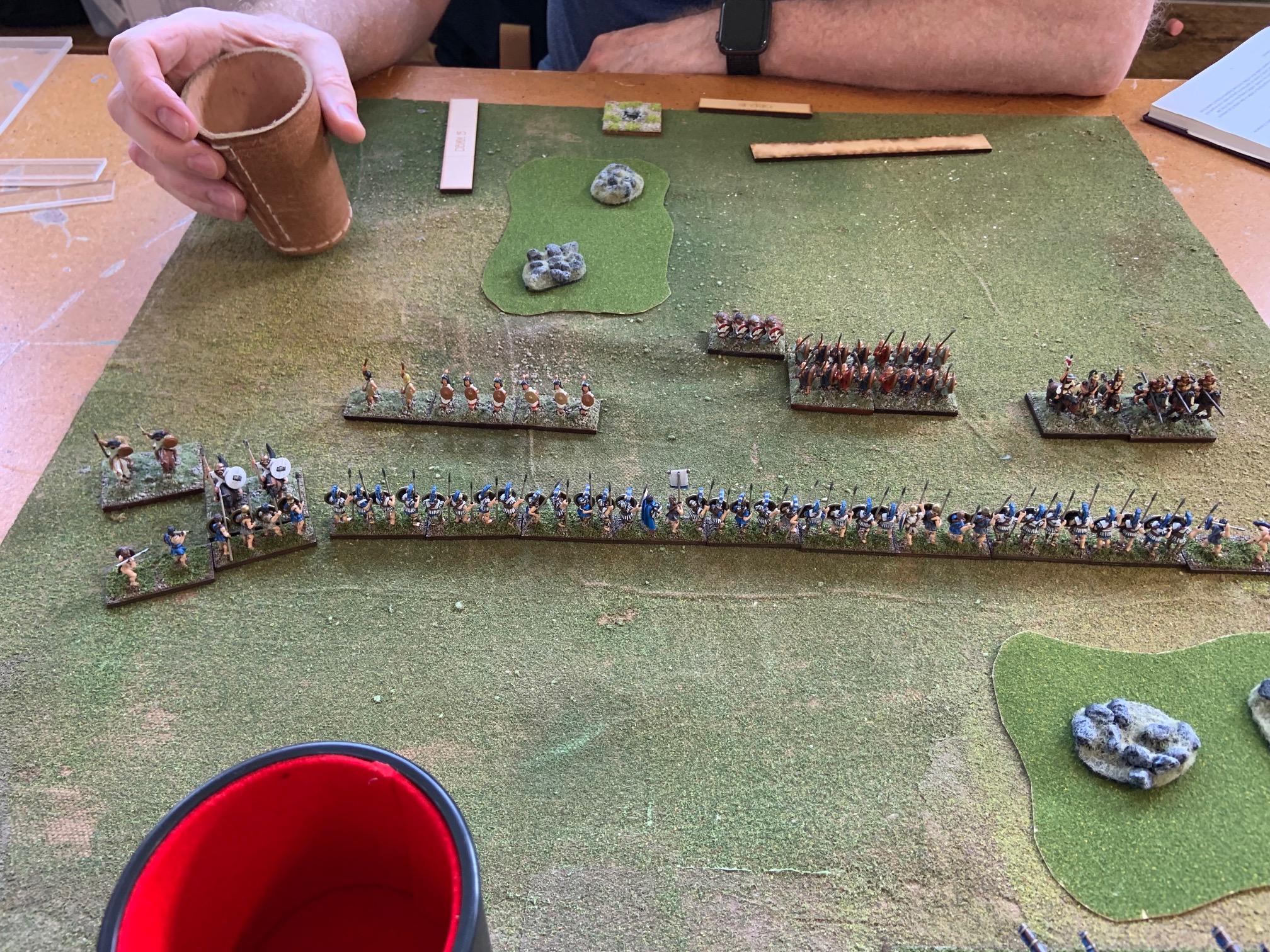
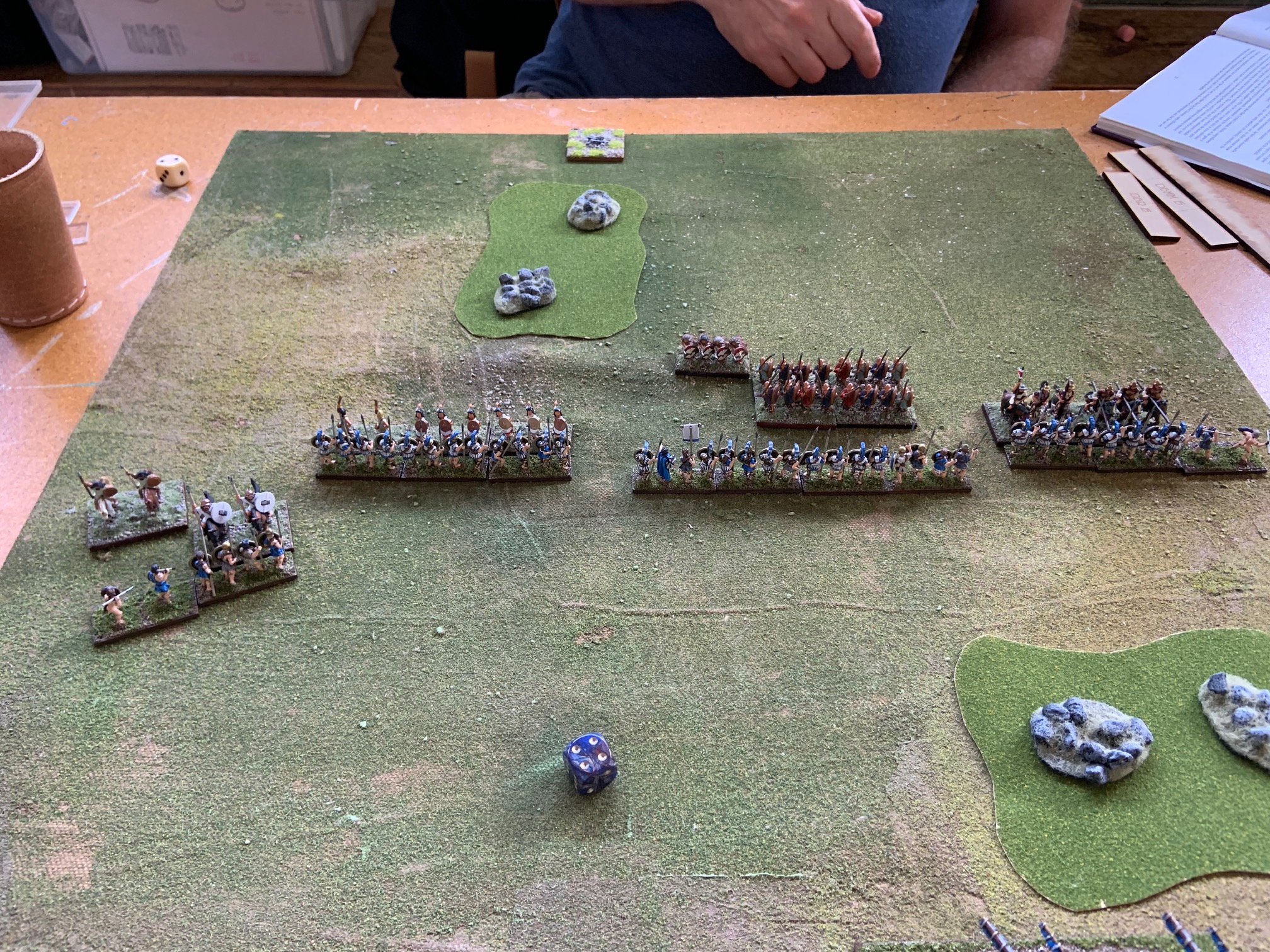
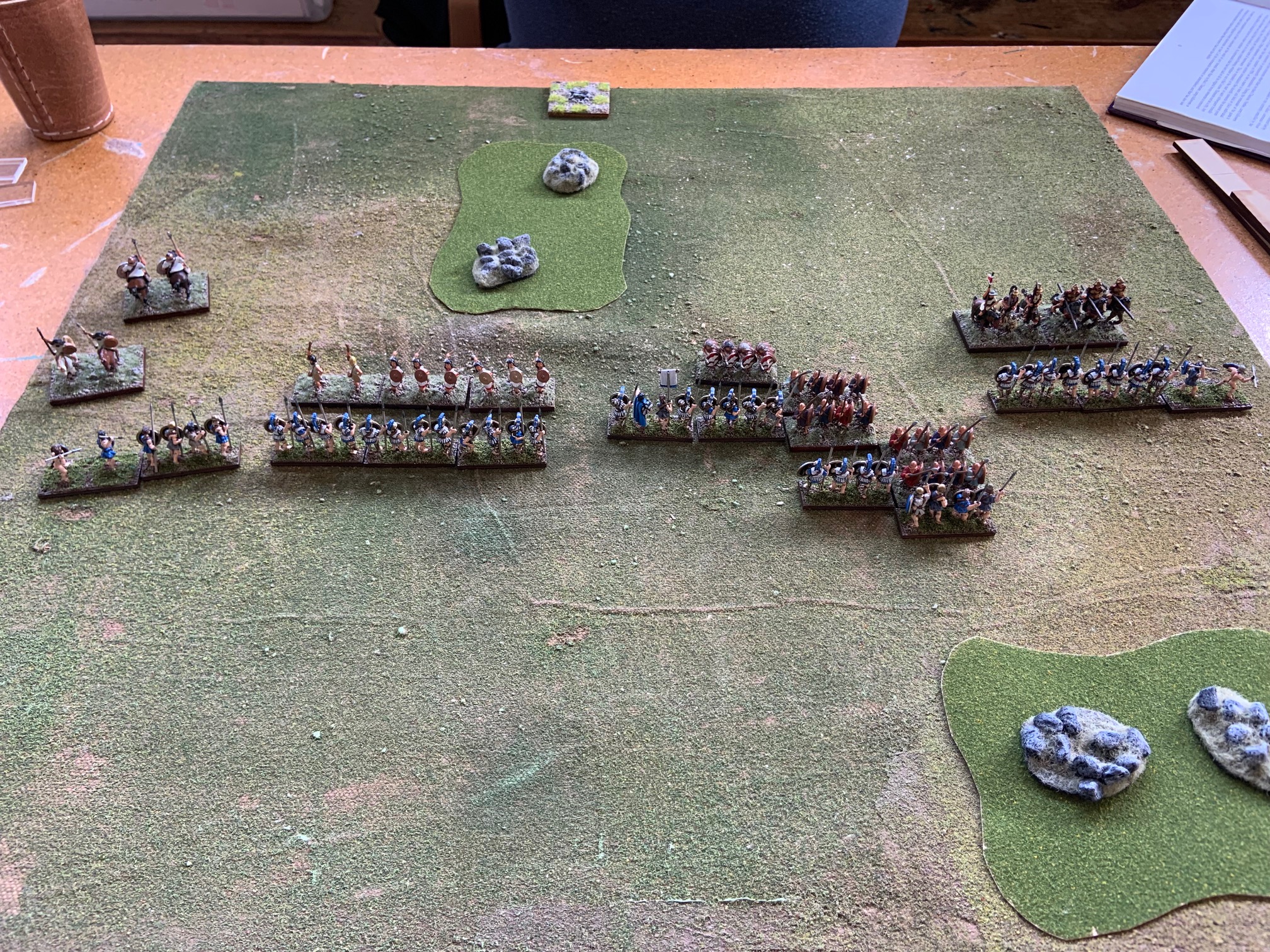
My first opponent was a II/48 Mithridatic army (don’t ask me – best I can tell, its some successor to a Macedonian successor…) – more pikes and some cavalry.
I managed to spread my line out as planned, and eventually the lines clashed, going up against light troops and Auxilla on the left, whilst a detachment clashed with the cavalry on the right.
The light cavalry were quickly forced to flee, but a series of bad rolls meant that I wasn’t able to get the kills I needed – my opponent remarked that his general was very lucky in surviving multiple rounds of combat, when he should have died fairly early. Eventually, the Pikes in the centre managed to get the breakthrough, and, with my line in tatters, it ended up as a meat grinder. The score was eventually a 3-4 loss, but it could have gone either way, in reality.



Game 4
My opponent switched to a II/23a Pre-Islamic Arab army, which meant I was going to face Blades as the main force – goody.
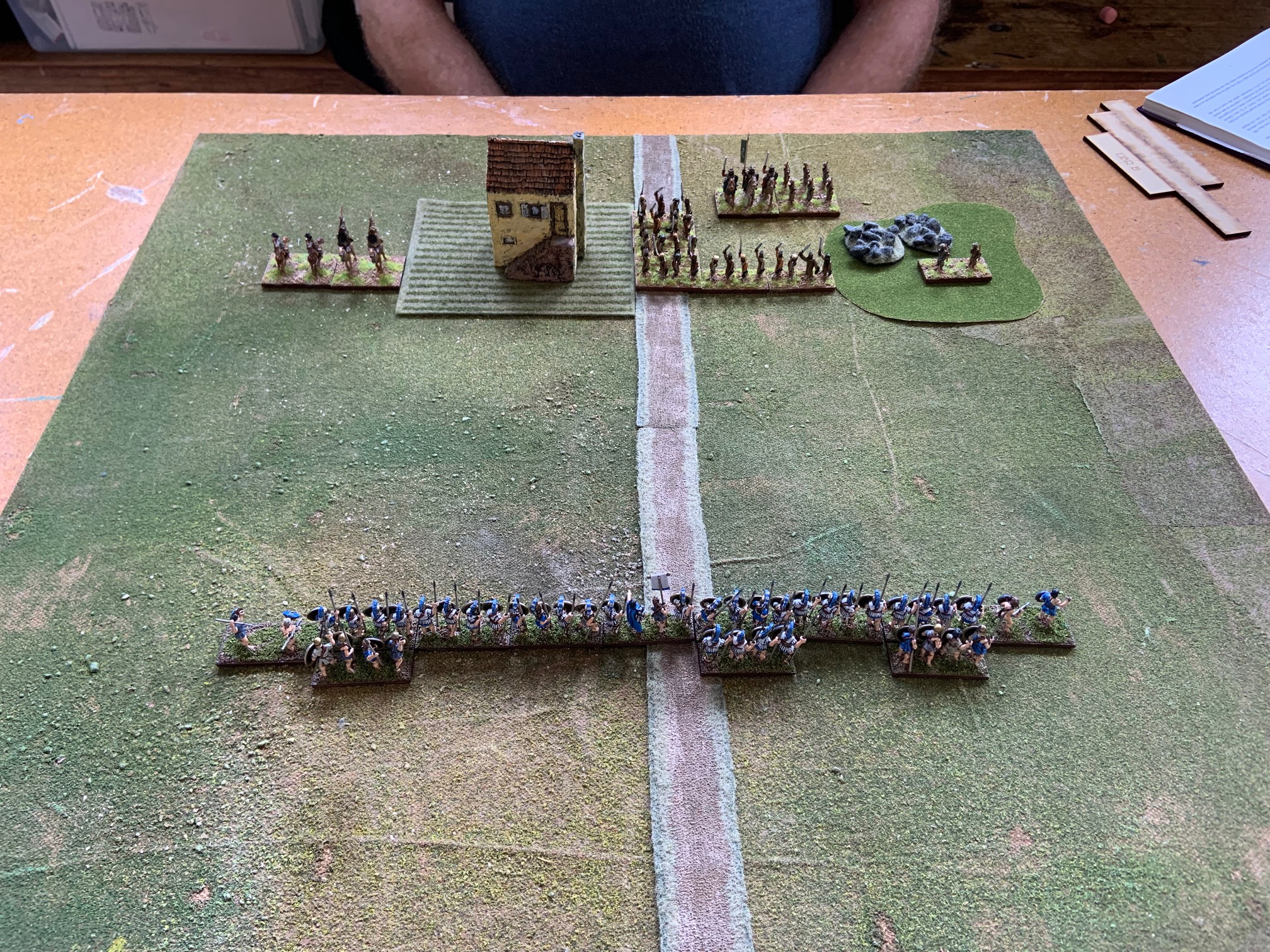
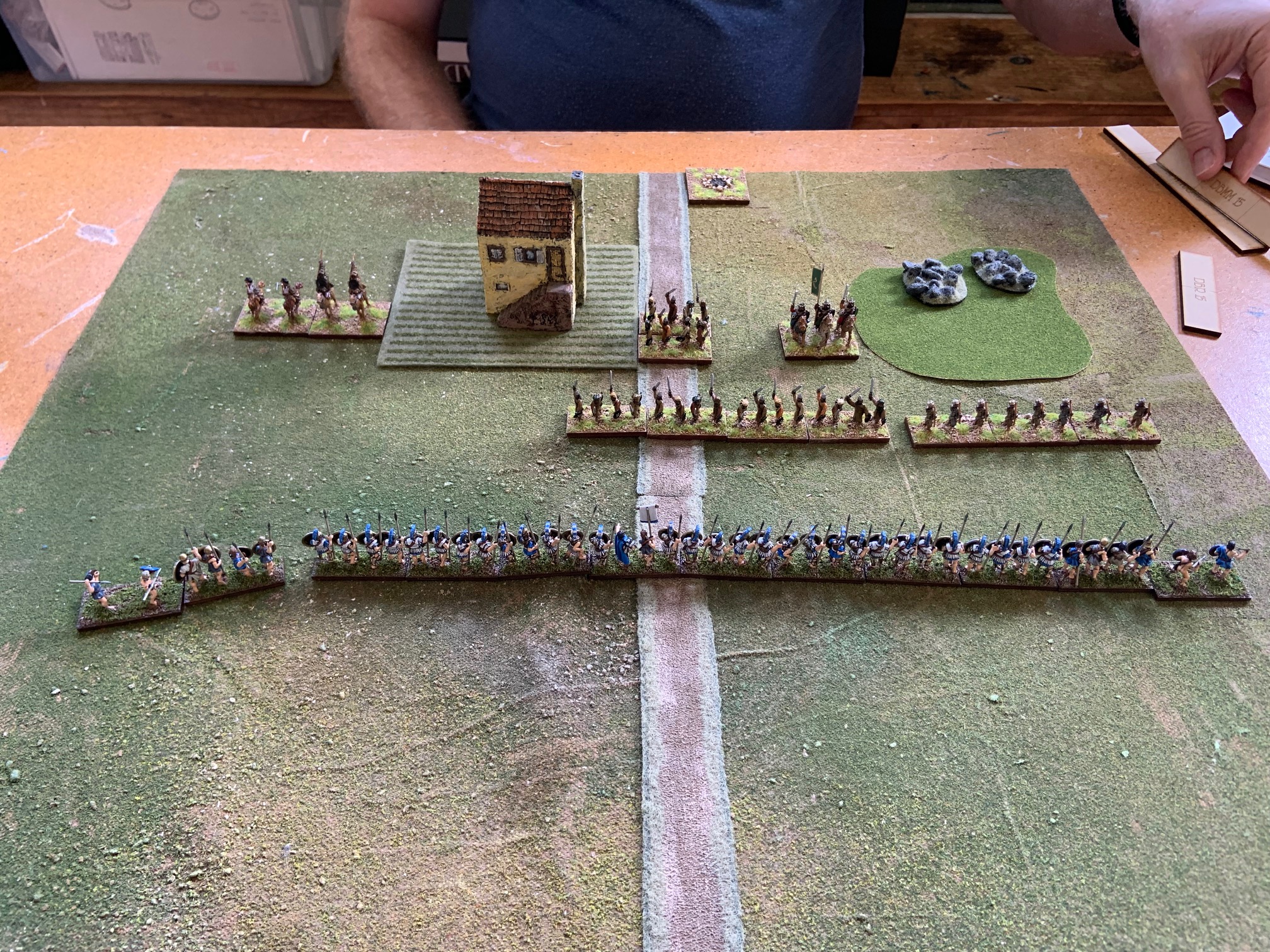
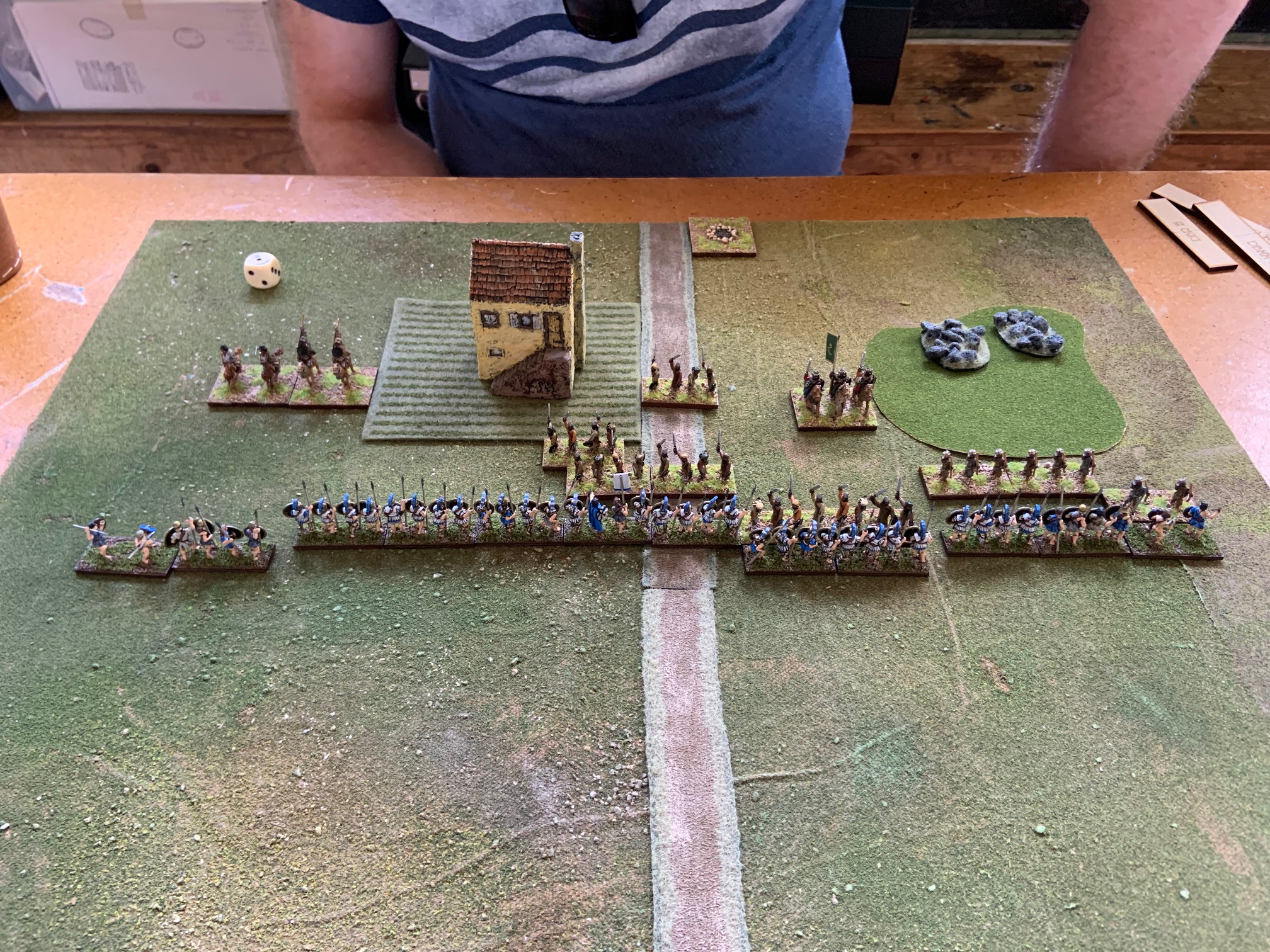
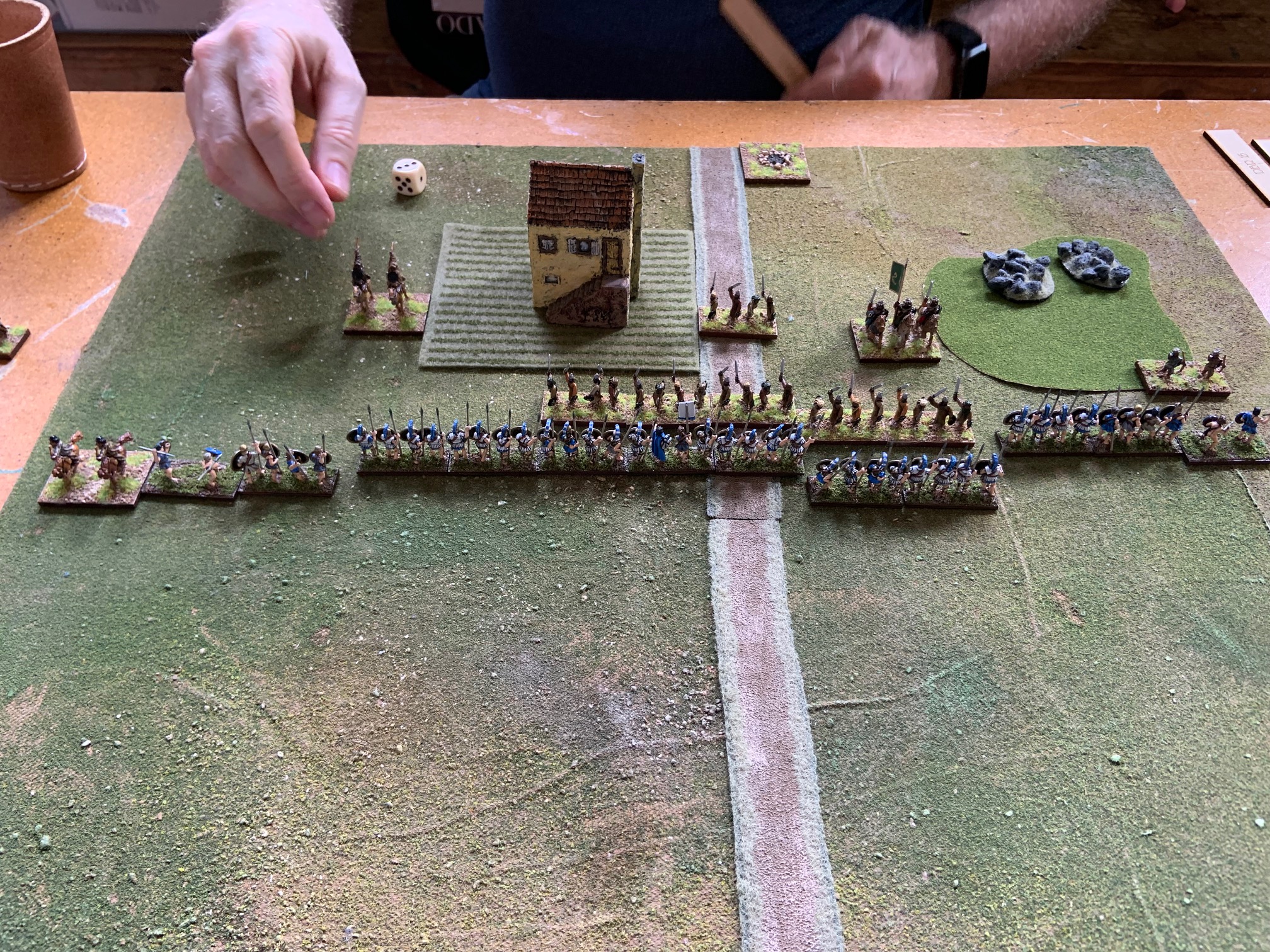
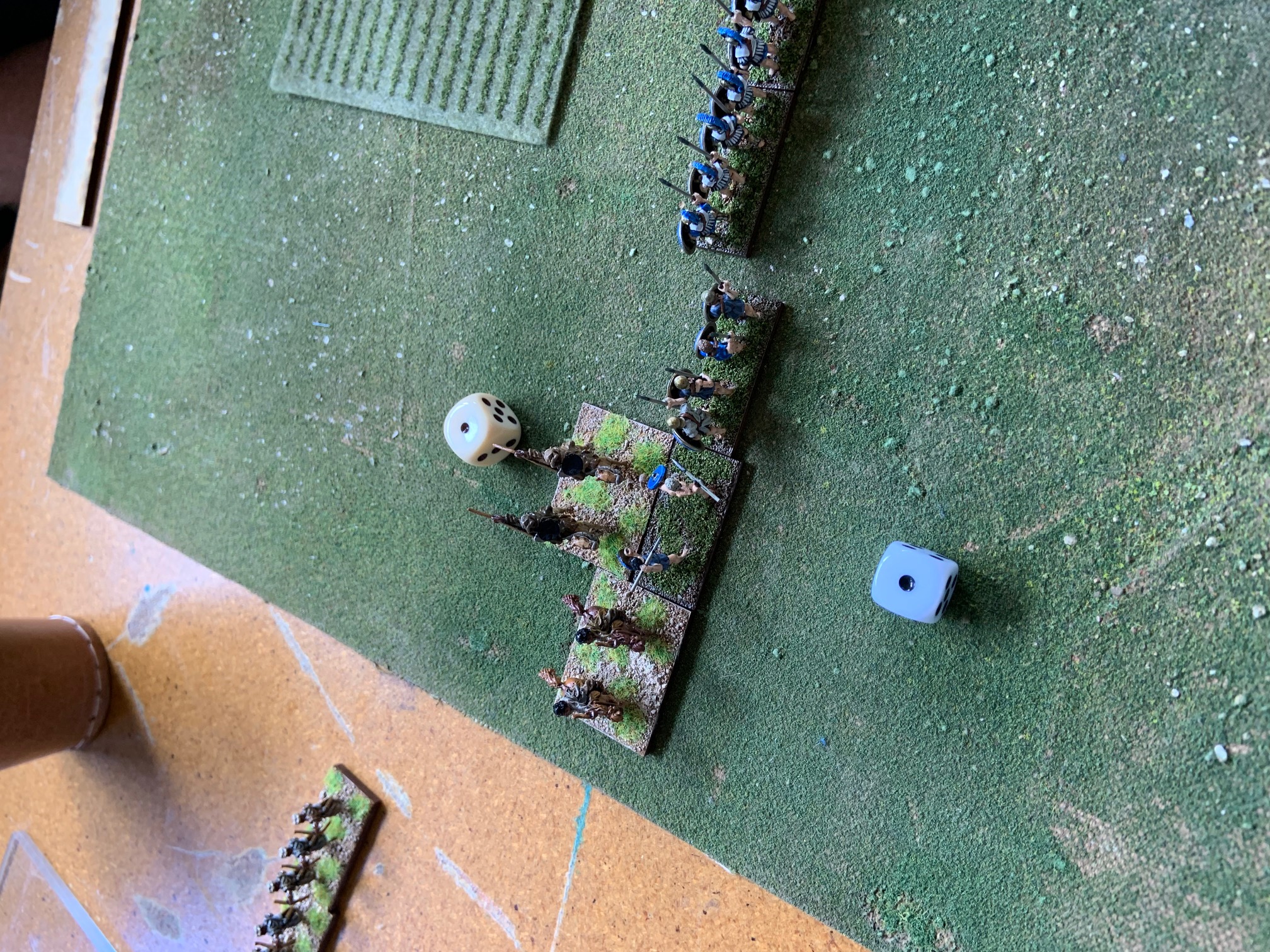
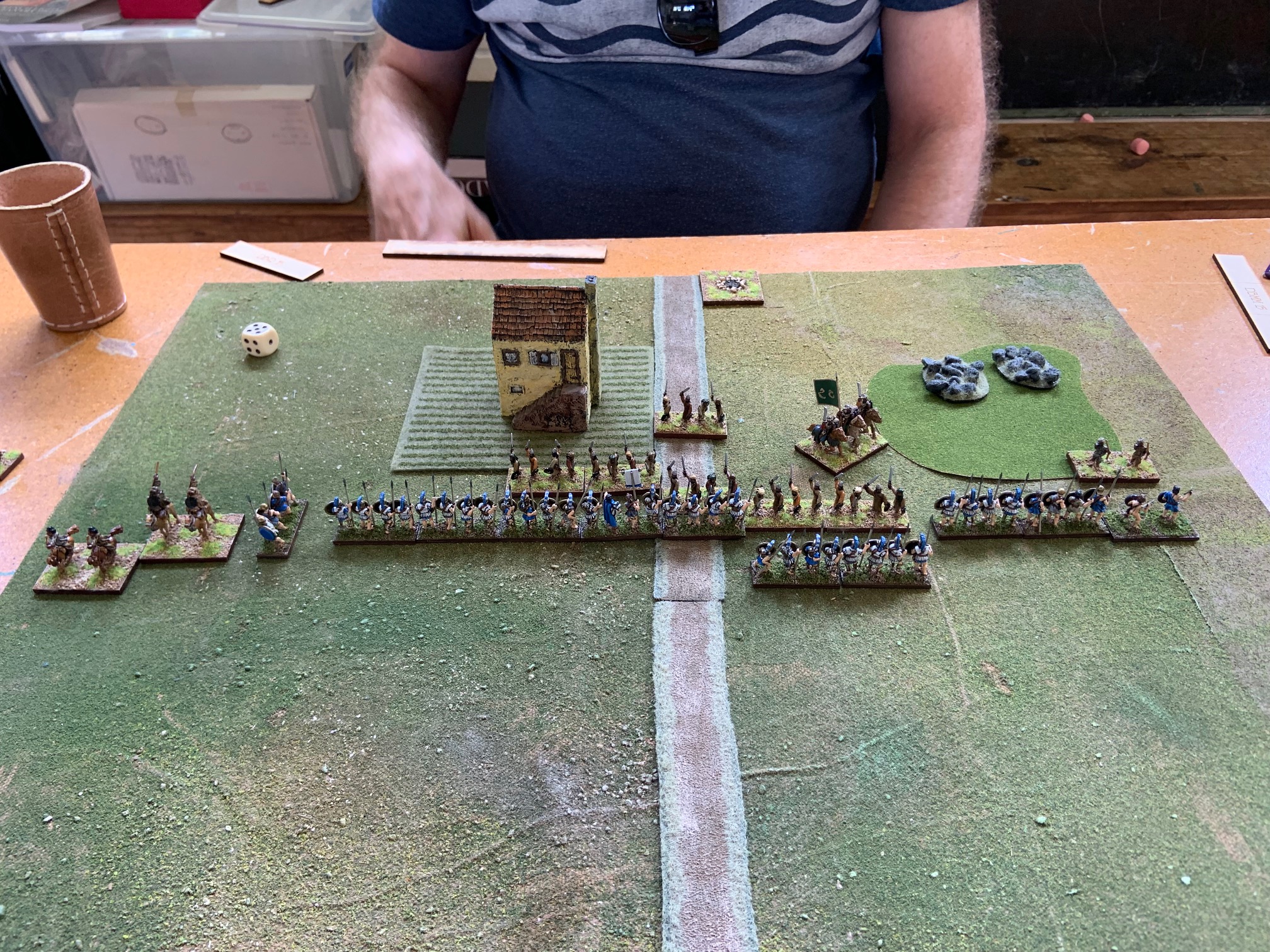
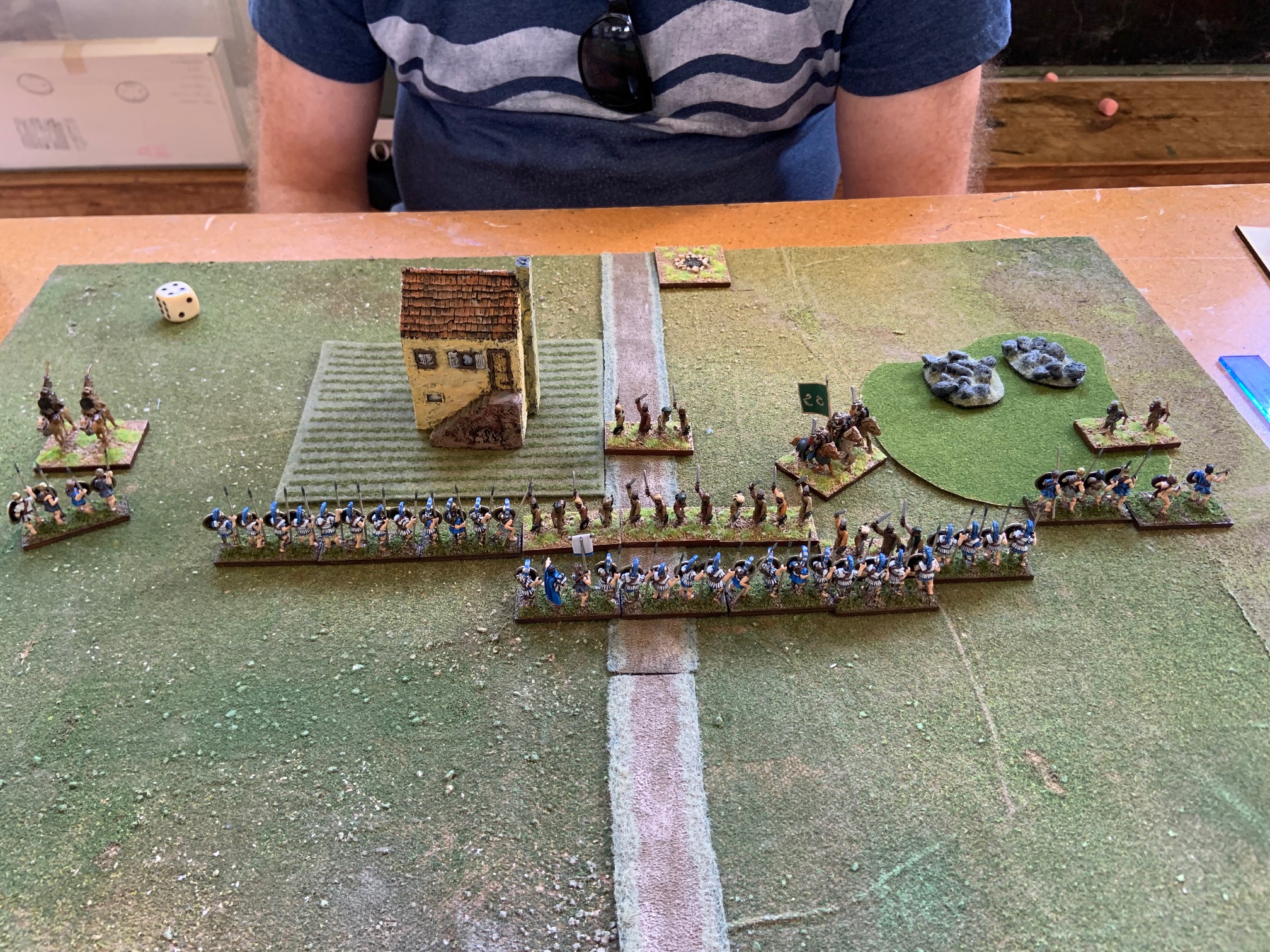
For this game, I managed to become the defender, and, instead of the usual two ploughs you can get for compulsary Arable terrain, I decided to get a City Built Up Area instead – the initial plan was to use it for a camp, and try somthing a little different.
It was actually quite a novel change, as we had to read up on the rules for BUAs as my club doesn’t seem to use them that much. My opponent decided to put the BUA back near his board edge, and I decided not to garrison it. And that proved to be a major mistake.
After I spread out my line, my opponent was having some issues with his broken force using up his PIPs faster than he would have liked. Because of this my spears were able to quickly outflank the blades and they found themselves with their backs literally to the BUA’s walls, and losing combats quickly.
Not that that meant I was winning everything – on the left, a unit of Psiloi and Light Camels clashed and proceeded to fluff the combat completely, and the camels’ accompanying Light Horse eventually managed to maneuver away, race through and eventually sack my camp.
But with the blades fighting for their lives, the spears outflanking them took a toll – first their supporting bows were cut down, and then the blades eventually succumbed as well. The result was a 4-2 victory for me.
My opponent commented later that he probably should have tried to storm the city, although with a base +6 modifier for the denizens, I don’t know how that would have worked out in the long run…

Game 5
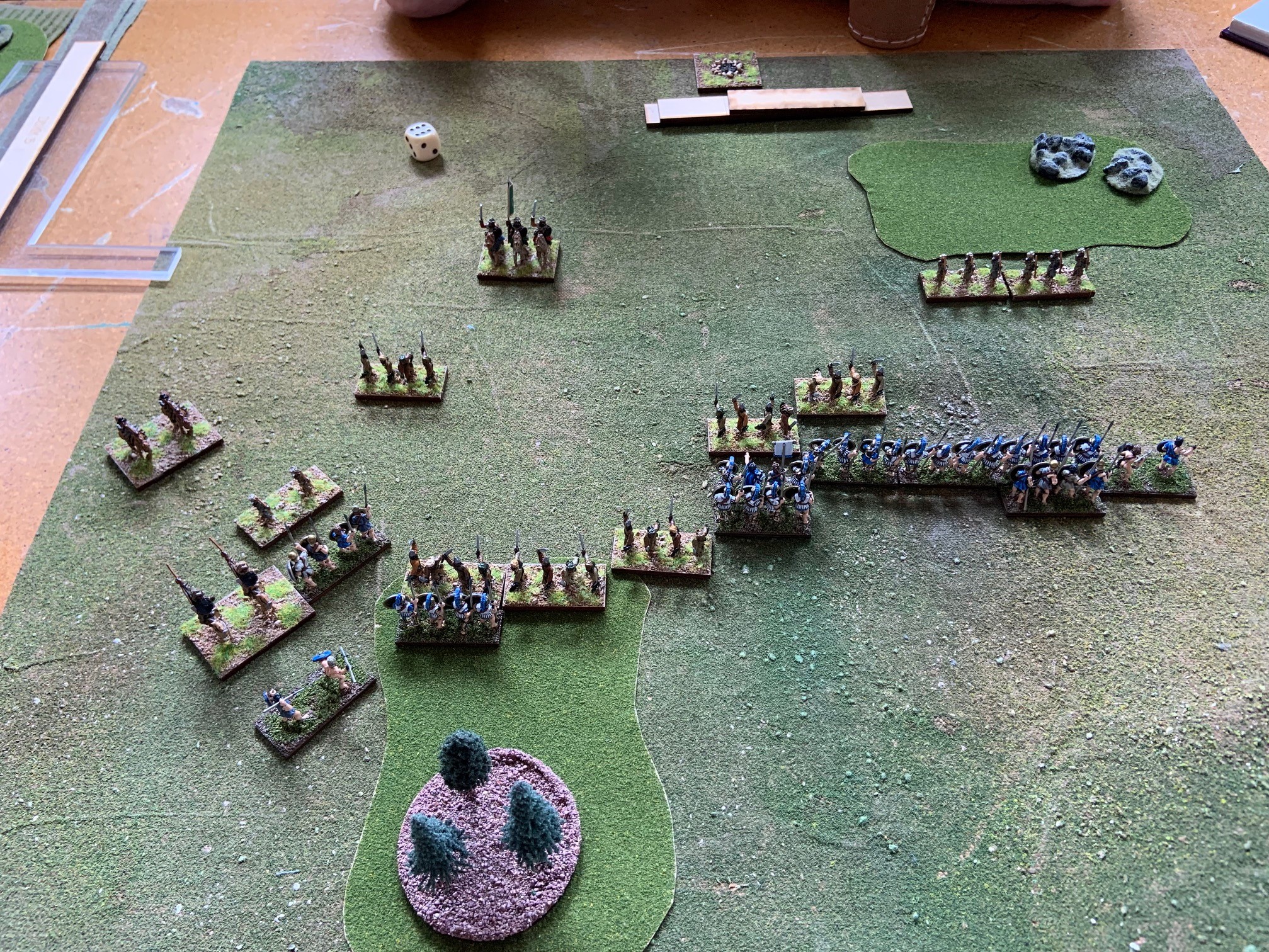
After lunch, my opponent and I agreed to play the game again with a more “traditional” game board, given that the split in the Arab forces caused a major disadvantage for them. Hopefully, this revised game would provide somthing a bit more familiar for us.
Not that it mattered much, as I completely fluffed my deployment. I had a forest in my deployment zone, and it was far enough forward that I couldn’t deploy my line outside of it – and this really had me going for the first two bounds as all my PIPs were spent trying to get my troops out of the woods.
And when the Arabs hit, their point of attack was directly on this weakness in my line – you see, Spear rely heavily on being able to overlap their opponent, not only to reduce the enemy modifier, but also to create a support modifier for themselves…and this support modifier only applies in open ground…as well as spears taking a negative modifier whilst in forests. My opponent was seriously punishing me for this mistake, and it was over a few bounds later. A 1-4 loss.

Xeno
DBx Bases: 48 + 7
15mm Spears: 128
DBA Corps: 1
Saga Points: 6
The term “Xeno” is Greek in origin. It technically refers others, or those different in origin. As you can guess, its been co-opted into English in this same form – Xenophobia is a fear of those who are different in origin. Its also used in taxonomy, referring to strange or having unusual traits – the Xenocyon, or “Strange Dog” is believed to be an ancestor of the African Wild Dog.
Also, Zeno was Greek name, and is associated with multiple personalities throughout the ancient era, most notably Zeno of Elea, a philosopher who was known for his paradoxes, an example of which is Achilles and the Tortoise.
So, what has this all got to do with my painting? Very little actually..
As some of you may have guessed, I’m actually doing a second project alongside this one – the people on the SAGA facebook page are going a “point per month” project, and I used my recent time to do this month’s point. But I decided to add somthing to my Hoplites project as well, so I did a point of Gauls and Iberians, since I knew I’d need a few bases of these also for the Syracuse army corps I’m planning on.
Its interesting that Syracuse is the only army that has foreign allies in its ranks. They do exist for Alexander and the later successors, but the mainline Greek armies are pretty much exclusively Greek. Its almost like Syracuse realised they needed the extra men, and just hired foreign mercenaries to bulk the army out.
Ah, well, enjoy some pictures
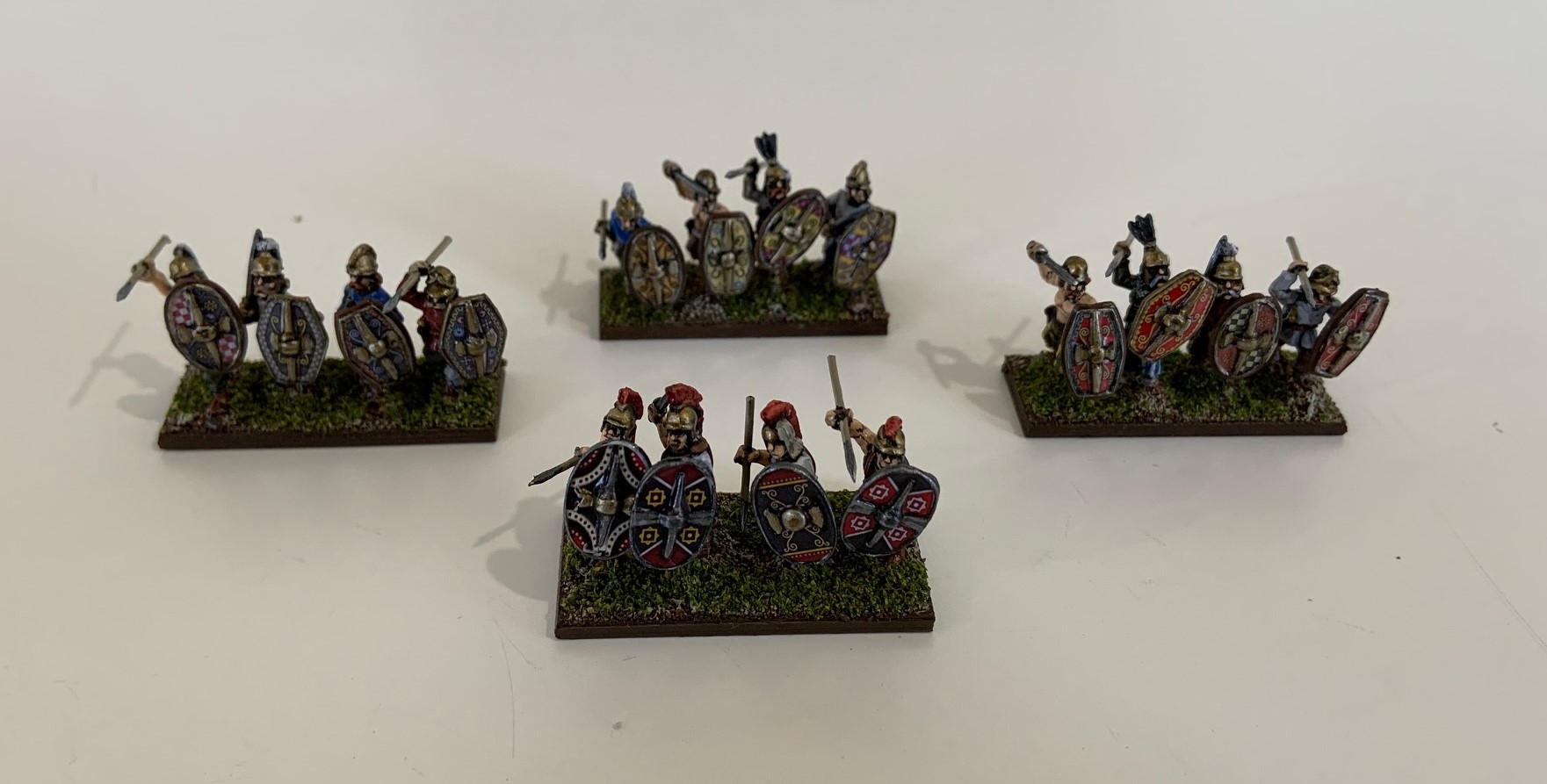
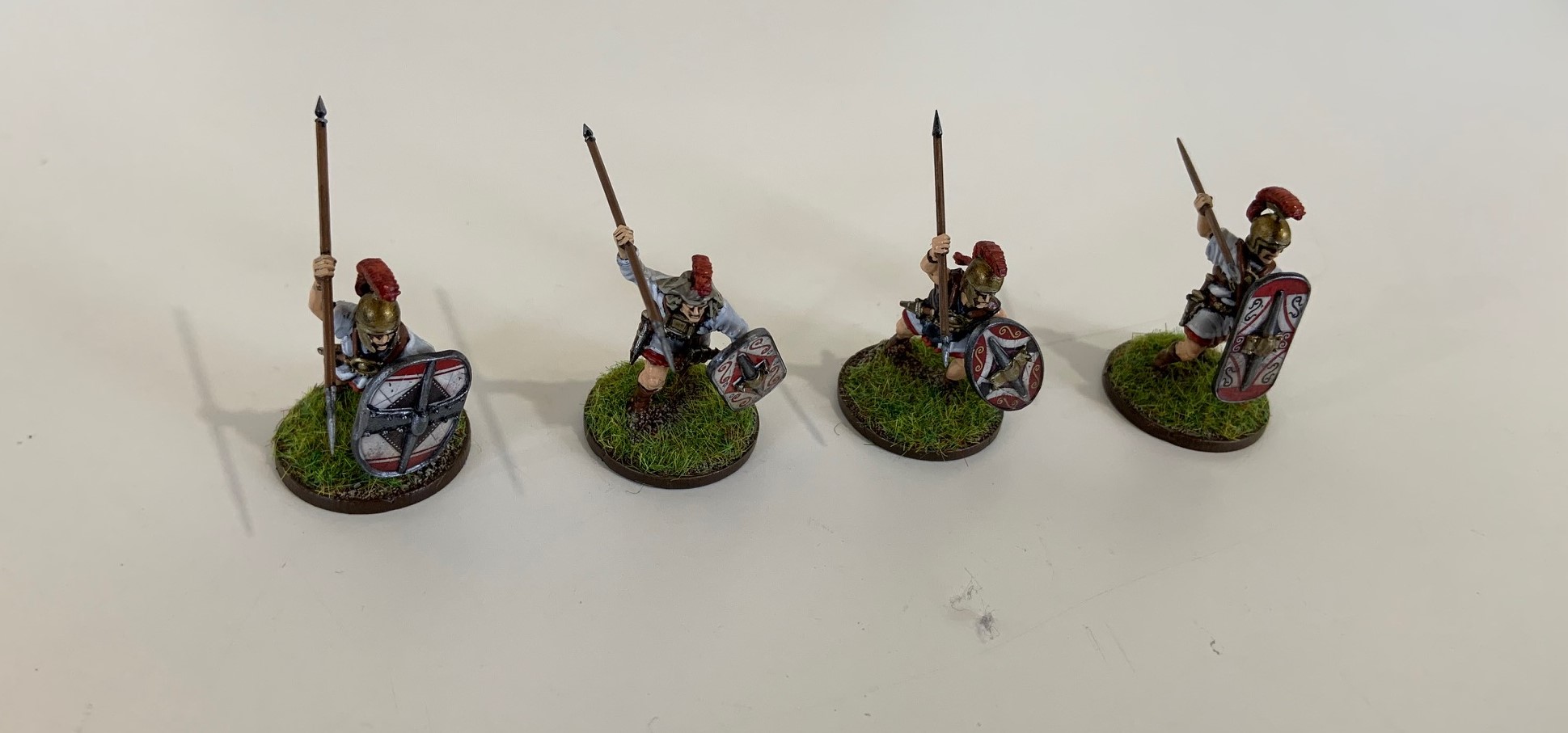

Next month, we’ll get back on track
The second Line
DBx Bases: 44 + 7
15mm Spears: 119
DBA Corps: 1
Saga Points: 6
Here’s the thing about most Hoplites from the Classical Greek City-States – they were not professional soldiers. Certainly, small corps of professionals did exist in certain places – the Epilektoi were a standing regiment in cities like Athens, Argos, and Thebes, and Thebes also created the Sacred Band to strengthen their army, but the majority of the Hoplites in the Phalanx were regular citizens. Citizens who could afford afford the Panopoly of a Hoplite warrior generally numbered around 1/3 of the total population, and since they were mainly artisans or farmers, they generally did not have that much standardised training – although some cities did offer a training program called the Ephebos where young men served the state for a couple of years and formed a standing millita.
This, of course does not apply to the Spartans, and their whole Agoge thing…
Basically, this means that as well as the usual Phalanx, there were also lighter Peripoloi in an army – if not of the younger warriors, you could also see conscripted troops equipped fairly lightly by the state to bulk the ranks. Its this latter option I can see being used to create the next lot of troops for the Athenians – in this case, they’re rowers on the ships who have been given a shield, spear and dagger, maybe a helmet, and told to get in the battle line.
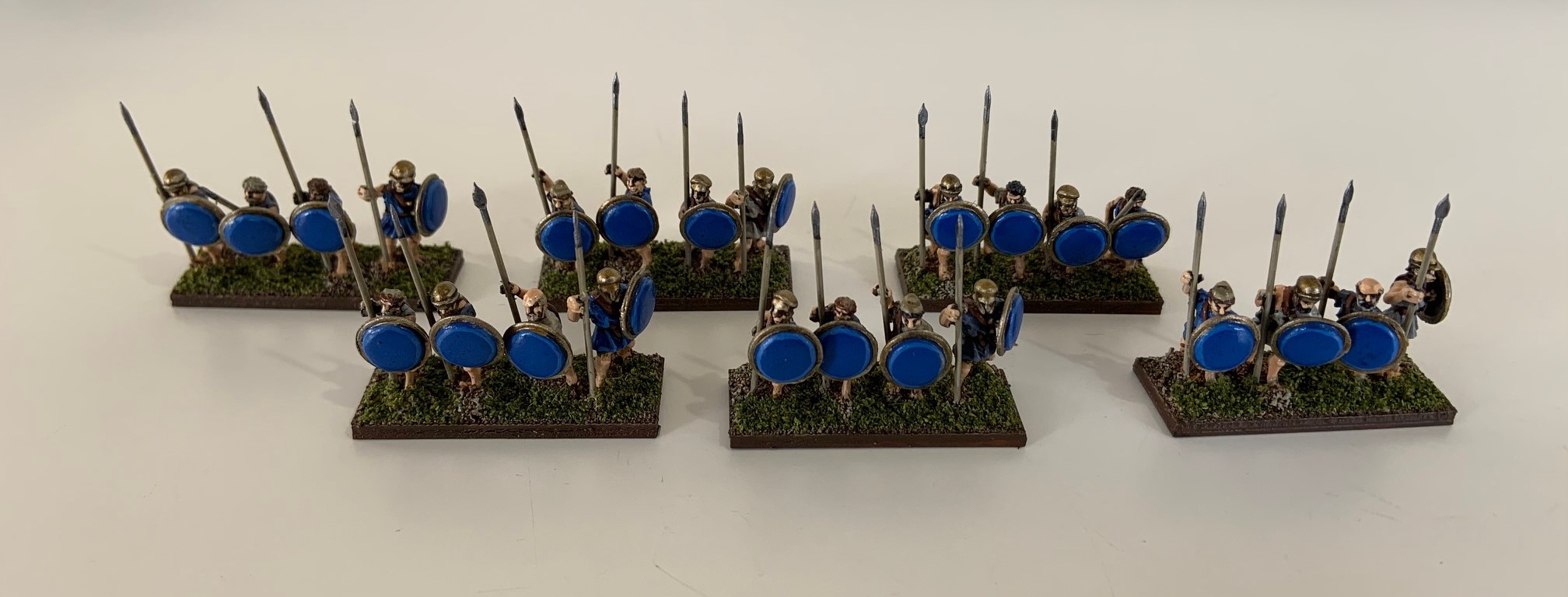
I’m actually quite liking these bases – the lack of armour means that their tunic colours are on full display, and combine that with their less uniform stances means they really do stand out as lesser troops compared to the main Hoplite bases. The other thing I like/dislike is the troop that is facing a different way to his comrades. I dislike it from an asthetic perspective because it breaks the shield wall, but I like it from a modelling perspective because it makes it easier to rank up the bases: the previous set I had to modify after my first games as the shield on the left end of the base had a tendency to impact on models on the next base over. But again, they’re less well trained troops, so…ok…
Meanwhile on the 28mm front:
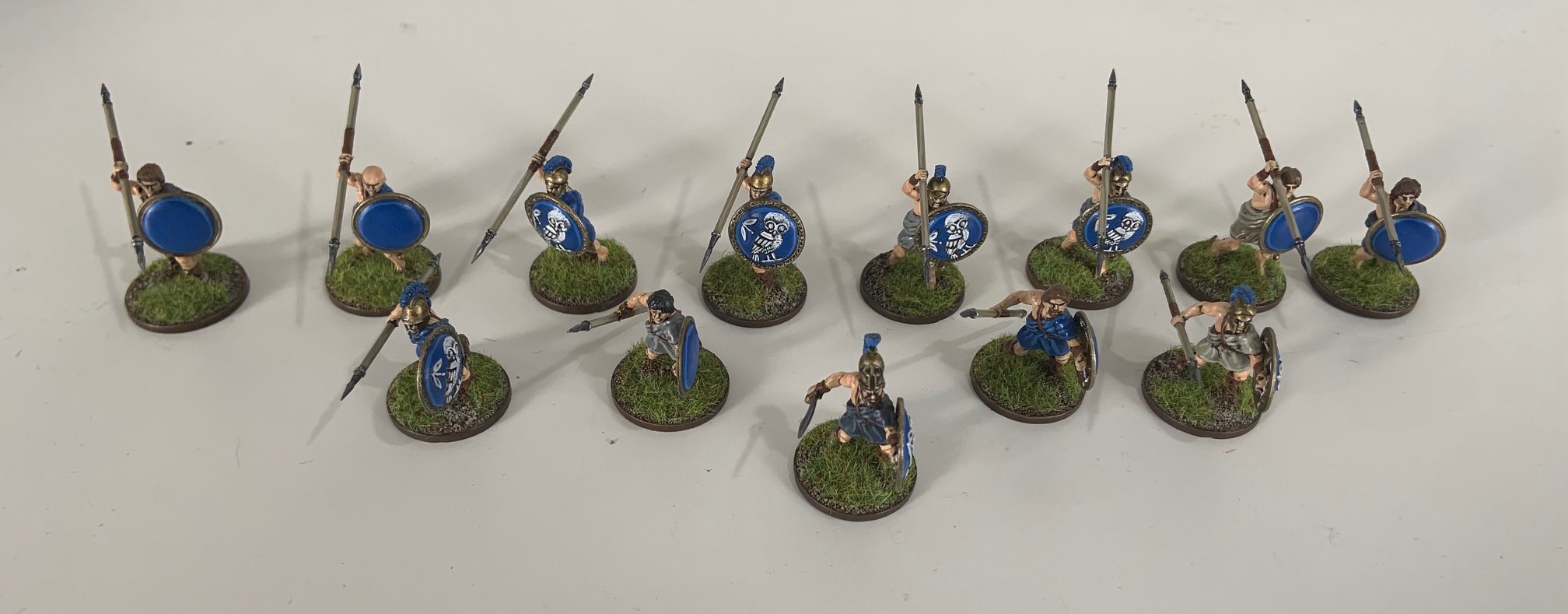
A mix of medium and light hoplites (from the perspective of Mortal Gods) was what I was aiming for – my next goal is to get enough models together to finalise an into set for Mortal Gods that I can take to some of my local clubs, so getting some of these lighter troops has been a bit of a priority for me. Its also why I’m going to be doing some Athenian missile troops before too long.
An Athenian Hoplite in the Court of King Malcolm
So, I finally managed to get a couple of games of DBA in at my usual club, re-learning the intricacies of the game and my hatred of Barkerese. I wasn’t expecting much from my army at this point, but I went in knowing that, so low expectations and all that. I only got two games in against the same opponent, who was using III/45 Pre-Feudal Scots with II/81d Strathclyde allies (namely a unit of Knights and two of Spearmen)
One day, whilst out testing their newest class of Triremes, a group of Athenians rowed into a sea mist and somehow found themselves displaced by 5000 miles and 1500 years to the coast of Dark Ages Scotland. Landing there and finding themselves unable to speak to anyone (as well as probably shivering like mad in the changed climate), they immediately annoyed the Scots who gathered up their local forces (including some visiting forces from Strathclyde), and descended on the bewildered Greeks.
Round 1
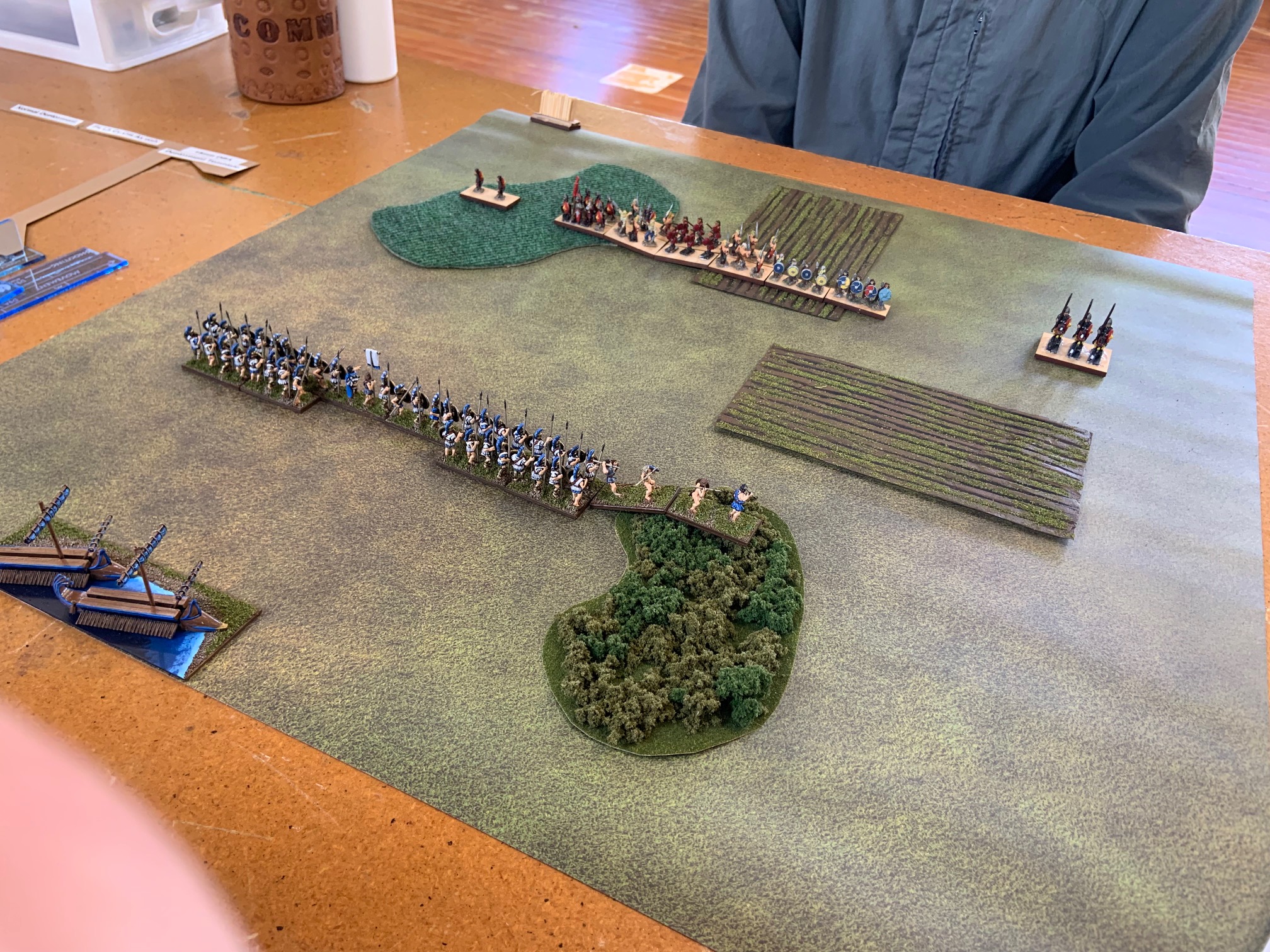
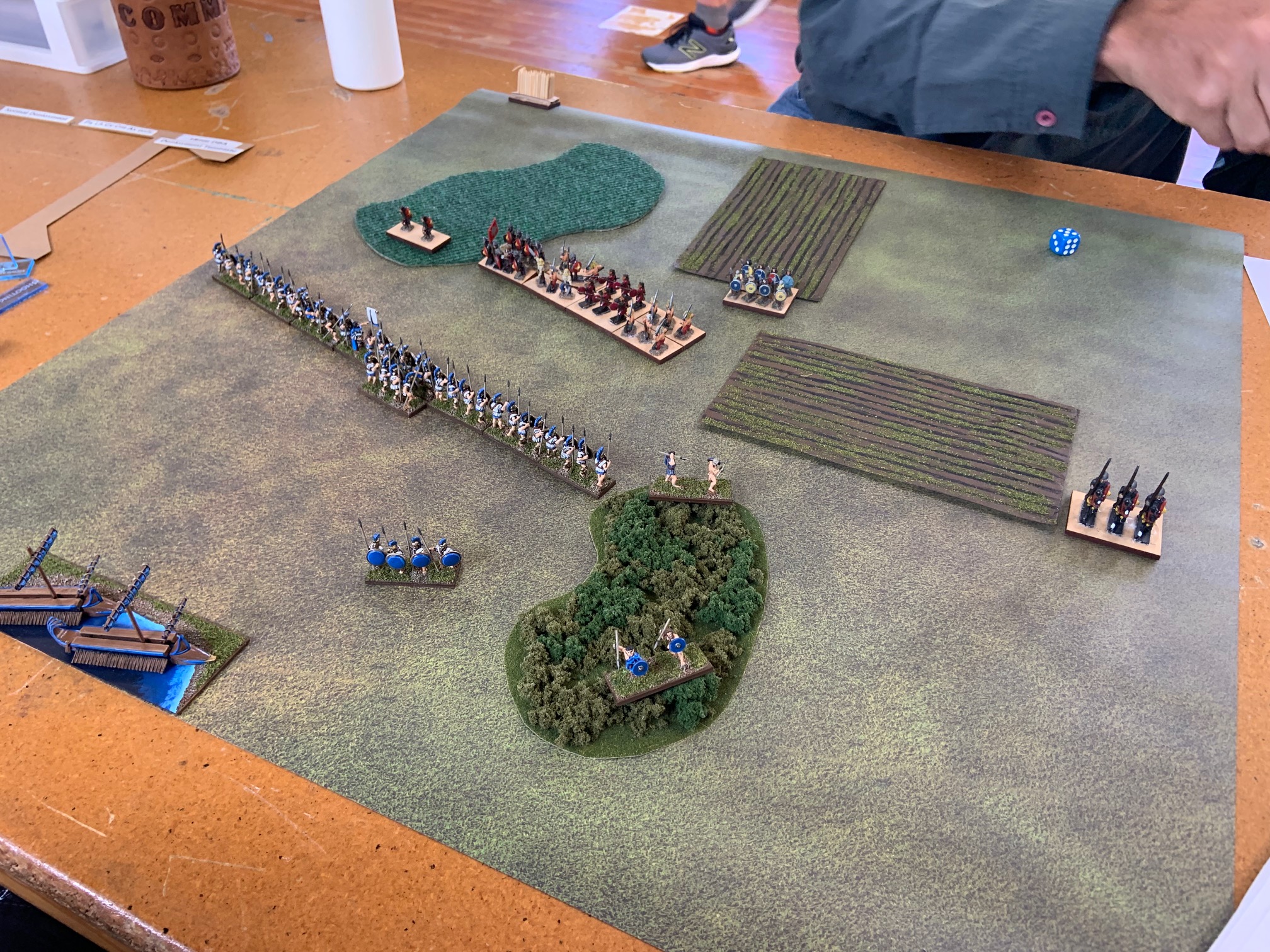
The terrain for the two games was the same – two fields of plough and two of scrub, although the plough only played a part in the first game, when my opponent, who was the defender, rolled a 1 for his PIPs in the first bound. My plan was to line up between the two close areas of scrub and try to take the charge, but I ended up charging in on my third bound after his allies got stuck in the muddy fields.
It didn’t last long, however – Pikes are really good vs infantry, and I didn’t really give myself enough room to spread out and get the flanking bonuses I needed to win the fights. After two bounds of combat, the Scots made a breakthrough, and at that point it was all over.
Hades.
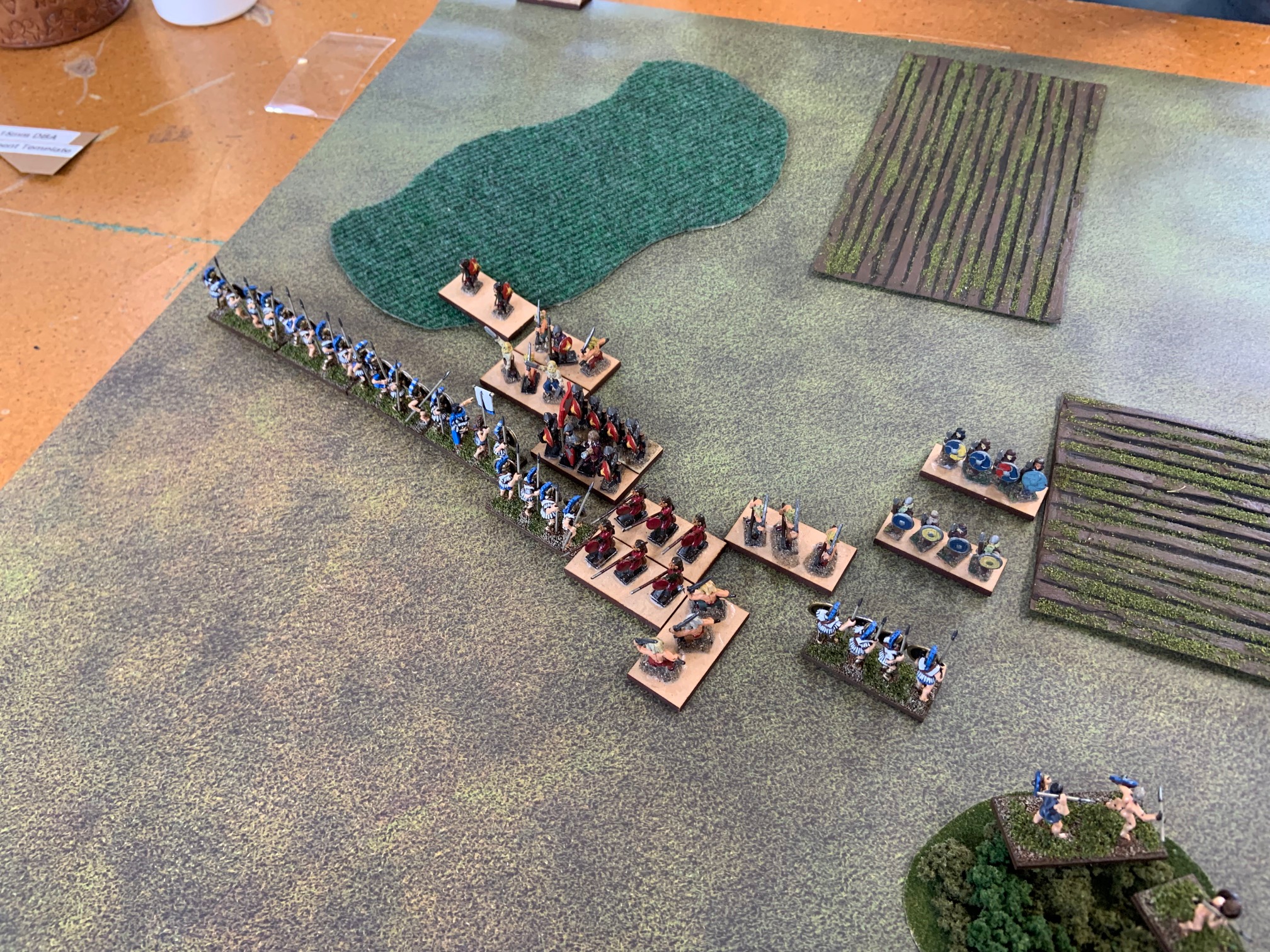
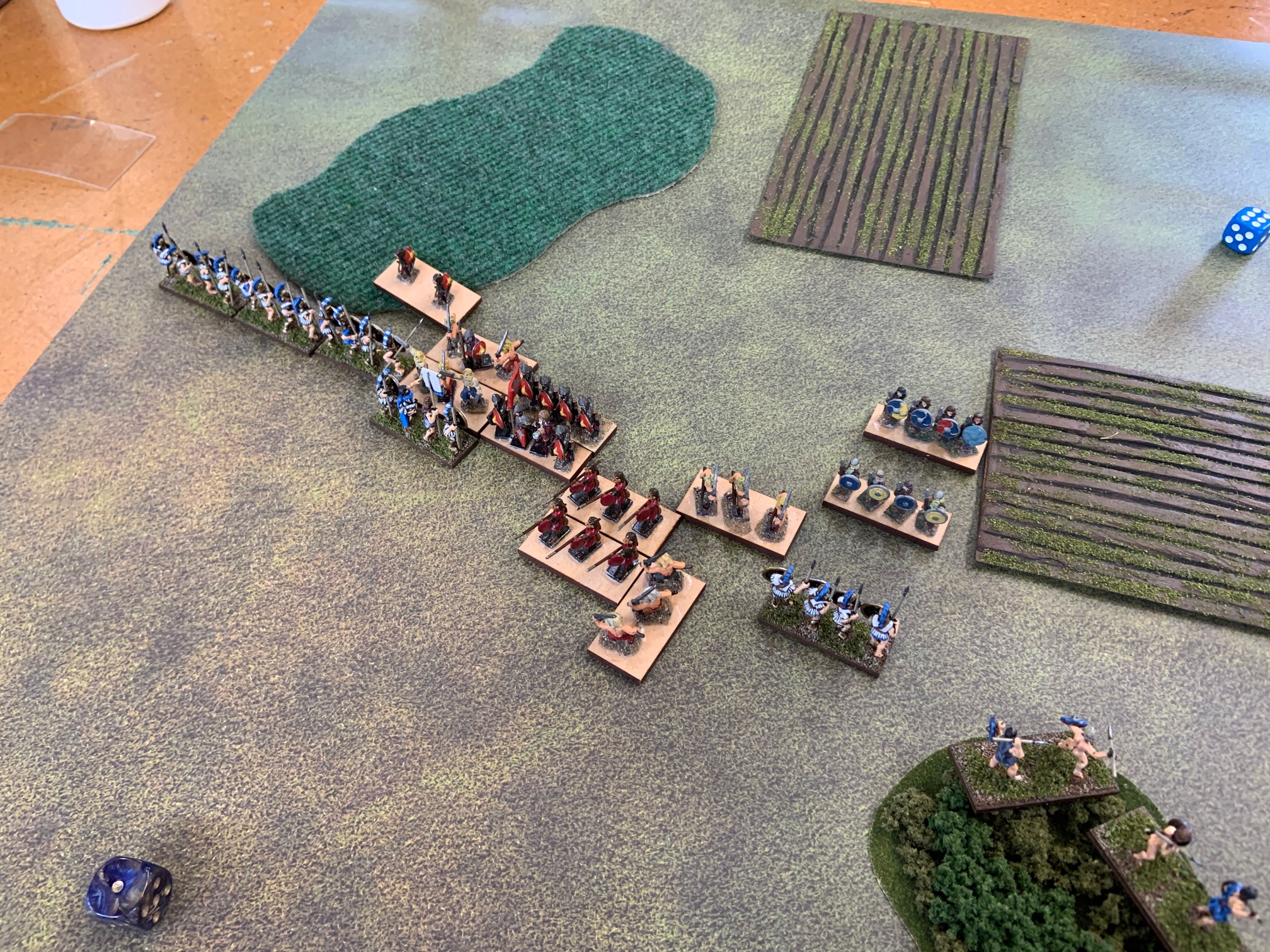
Round 2
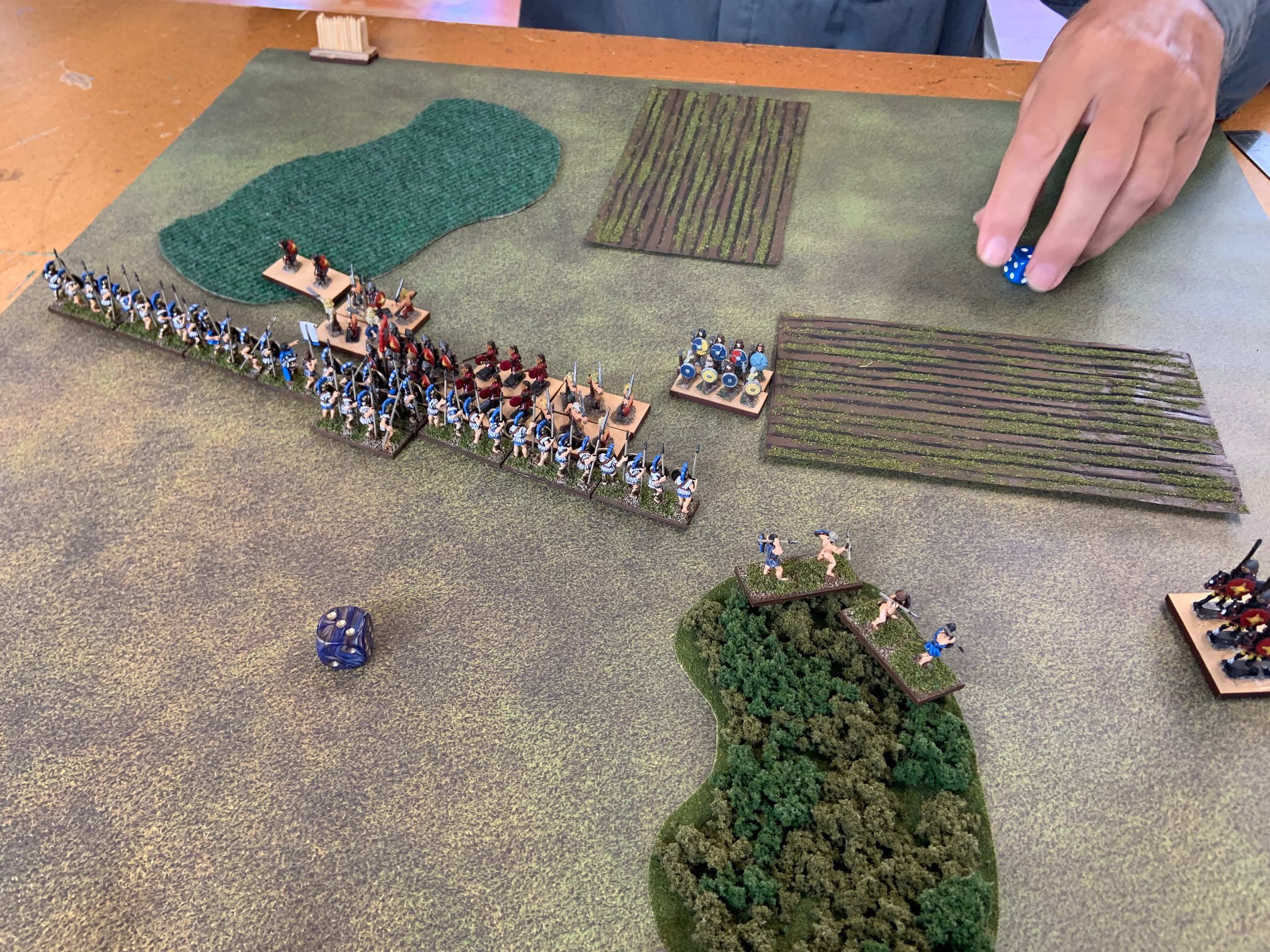
As the attacker again, I chose to set up in between the scrub again to try to protect my flanks, but, in retrospect, I would have been better off in the open fields, getting the spread out line since my opponent’s frontage was shrunk with his pikes.
The end result was a fight that eventually broke into two parts – with my General and a few others going against the Strathclyde on one side, and the rest taking on the Scottish pikes. I managed to last longer this time around, mainly suffering from push backs rather than kills (the Scottish general’s 4Wb was particularity bad at getting kills this time around), but, eventually, one of the pike columns made the breakthrough and it was all over.
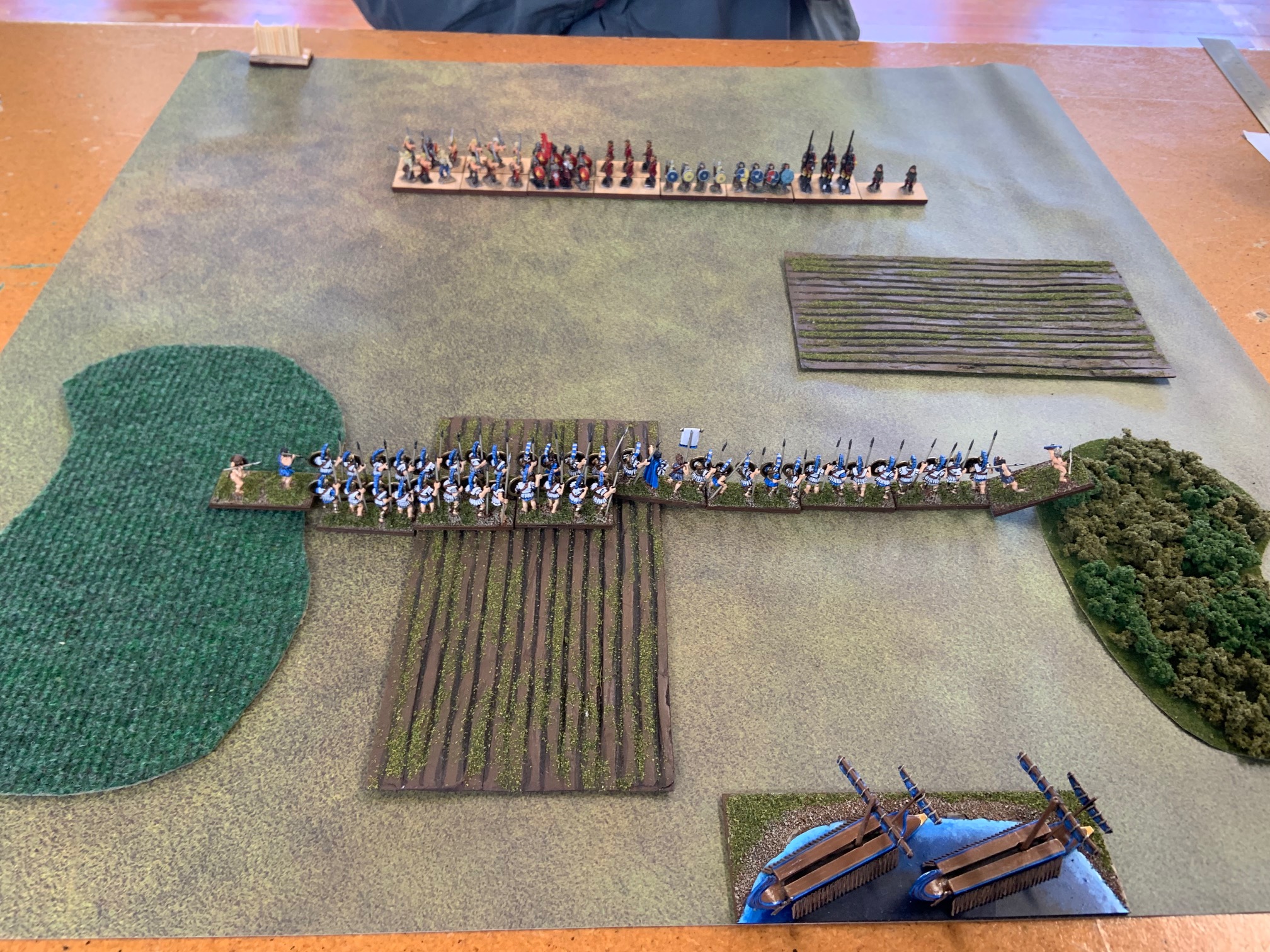
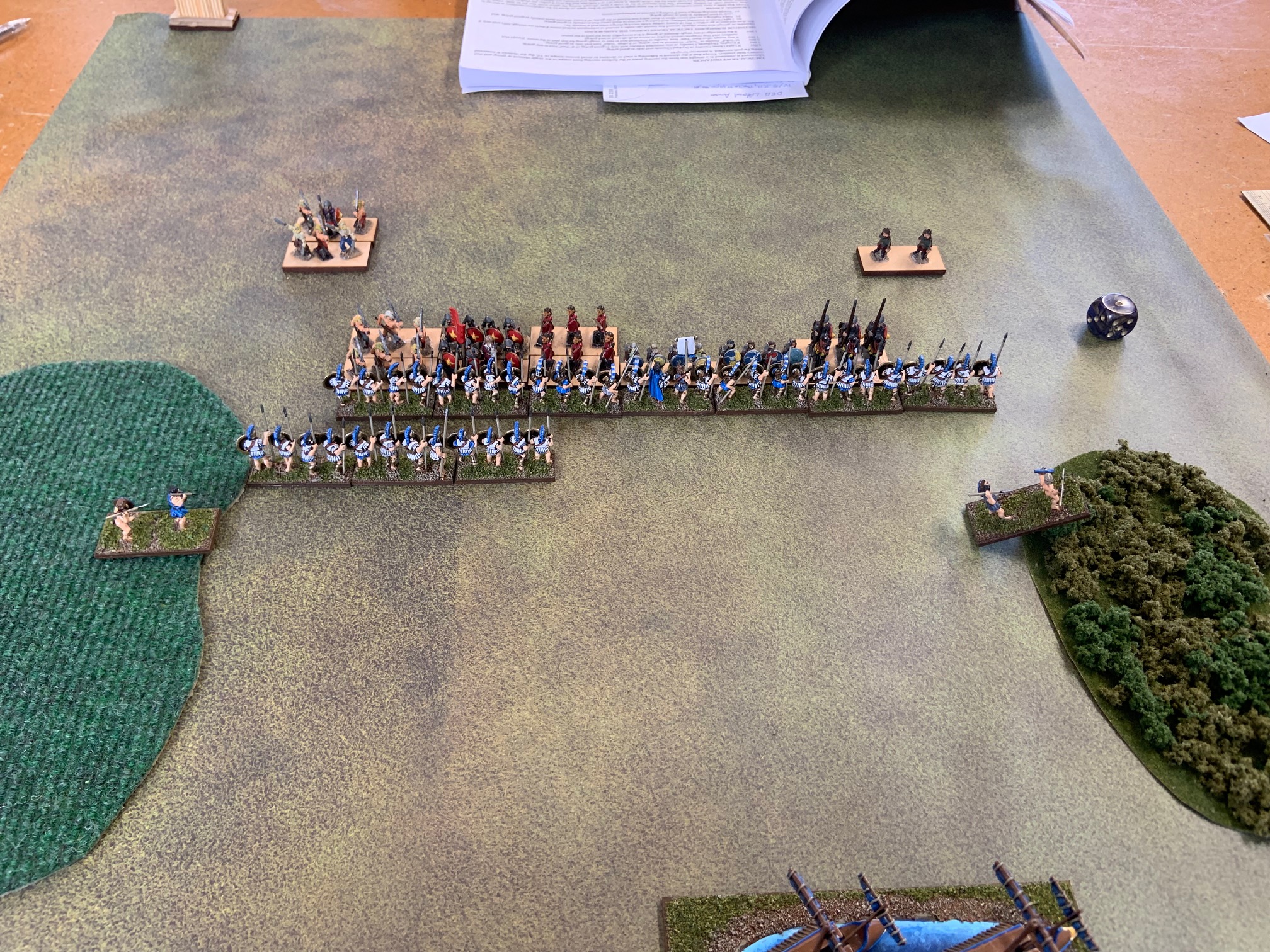
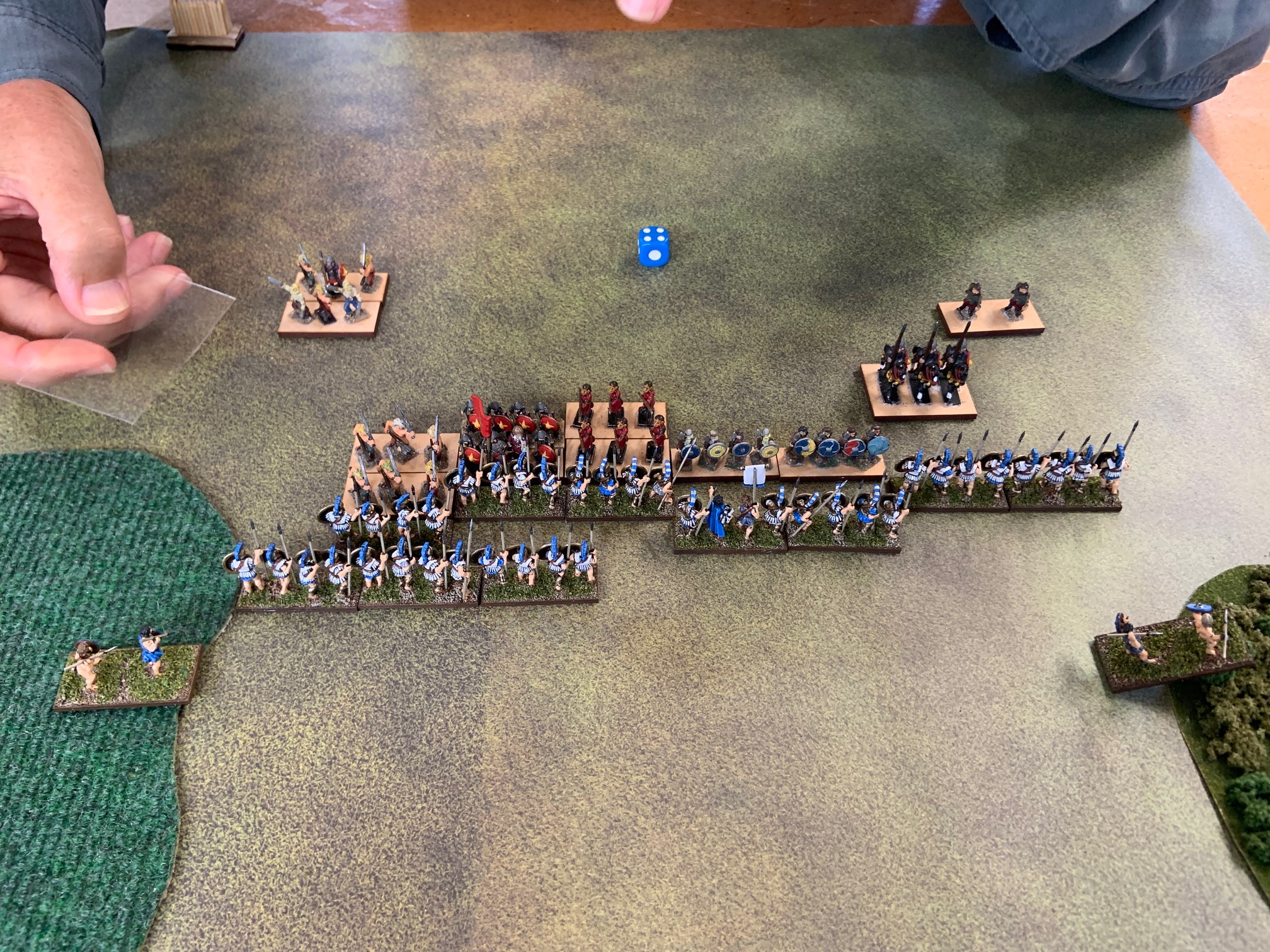
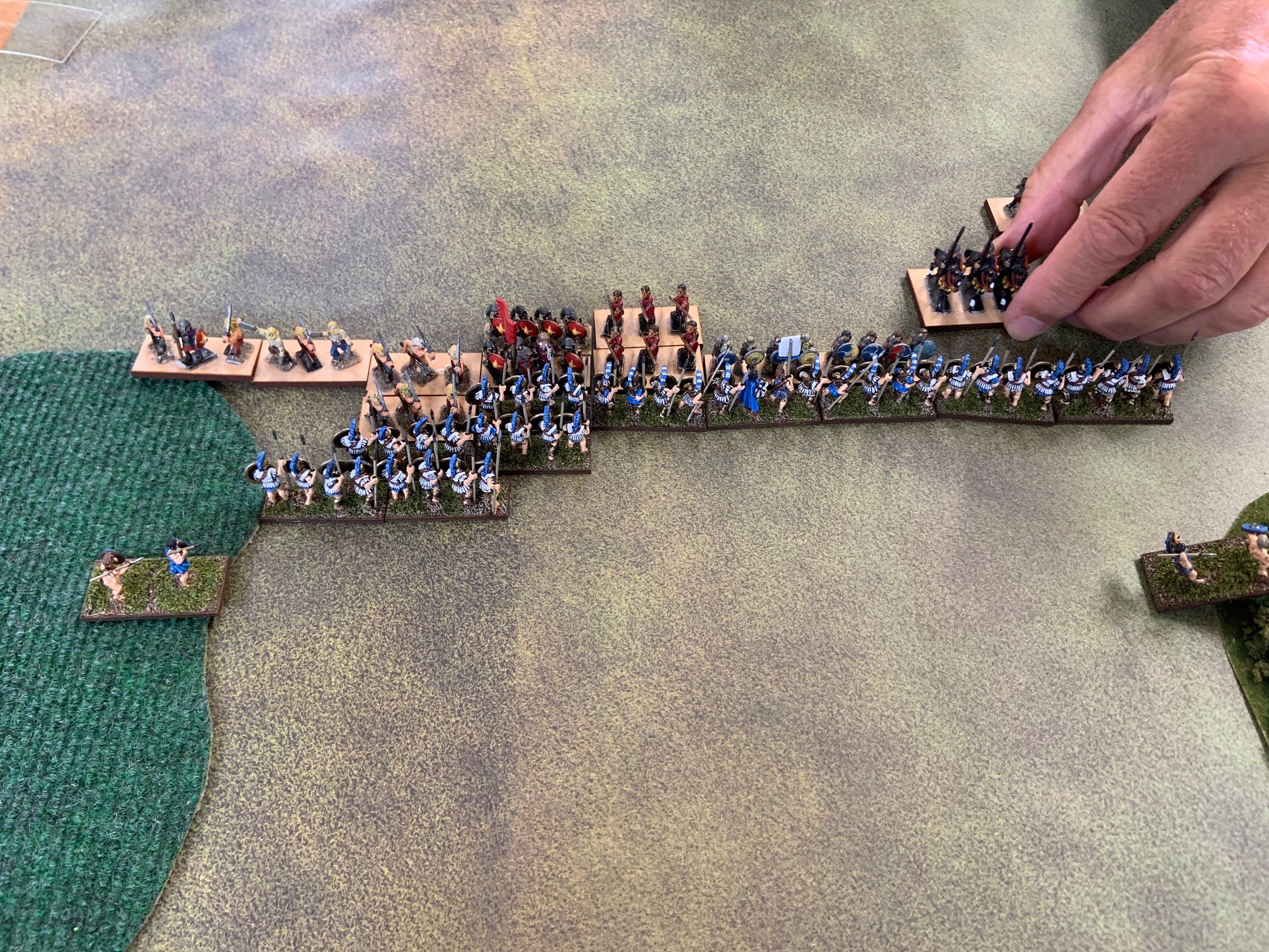
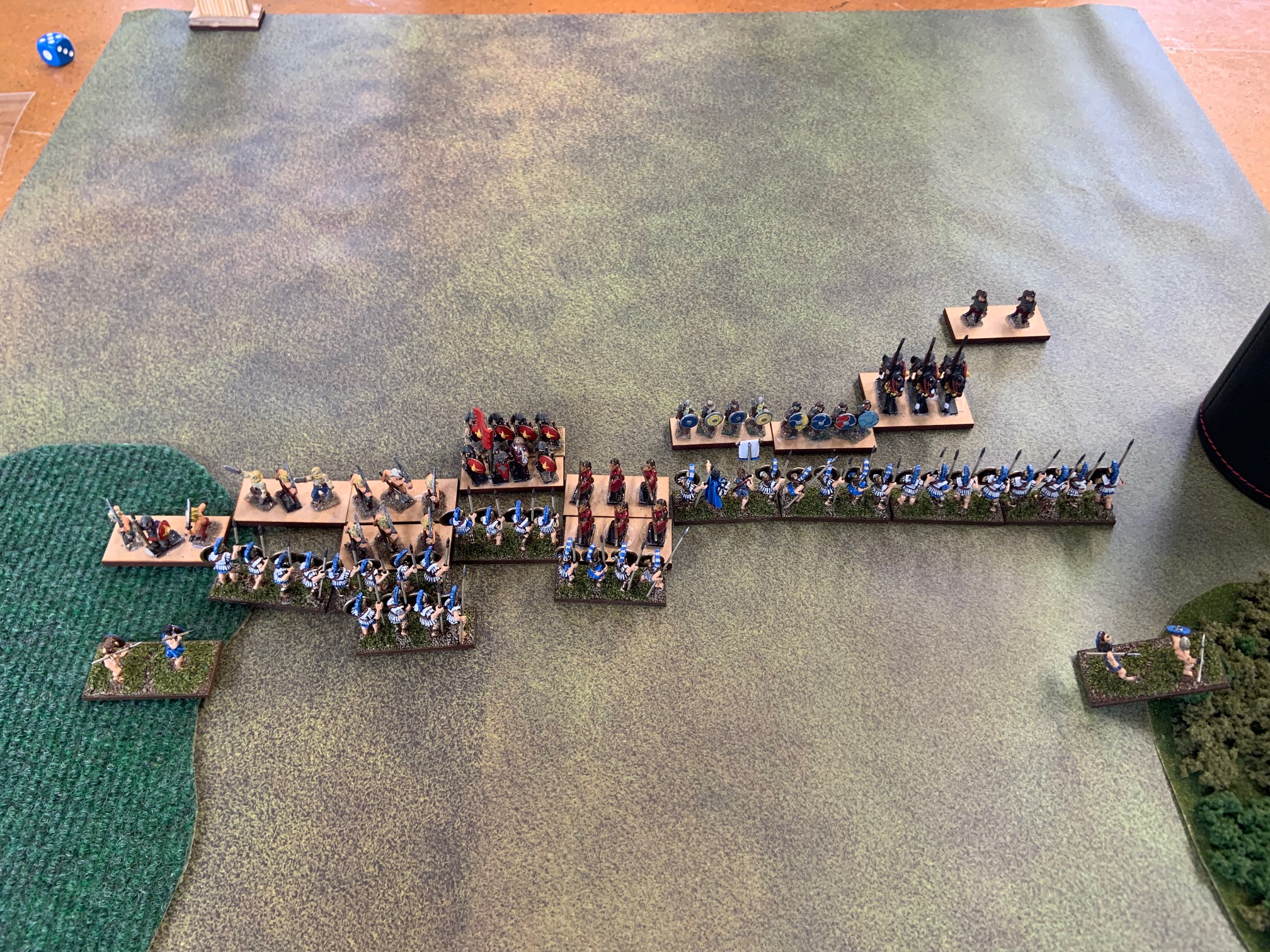
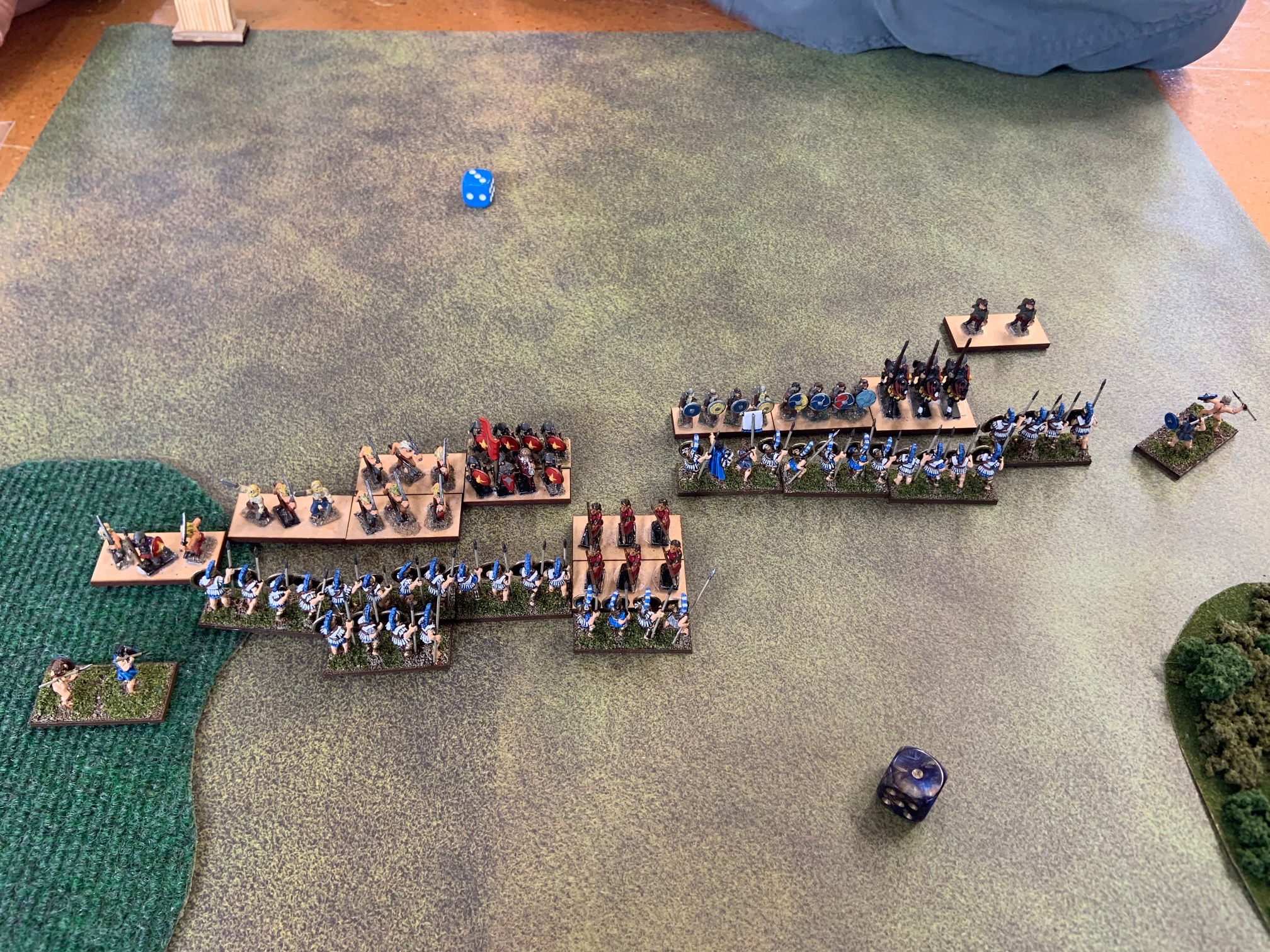
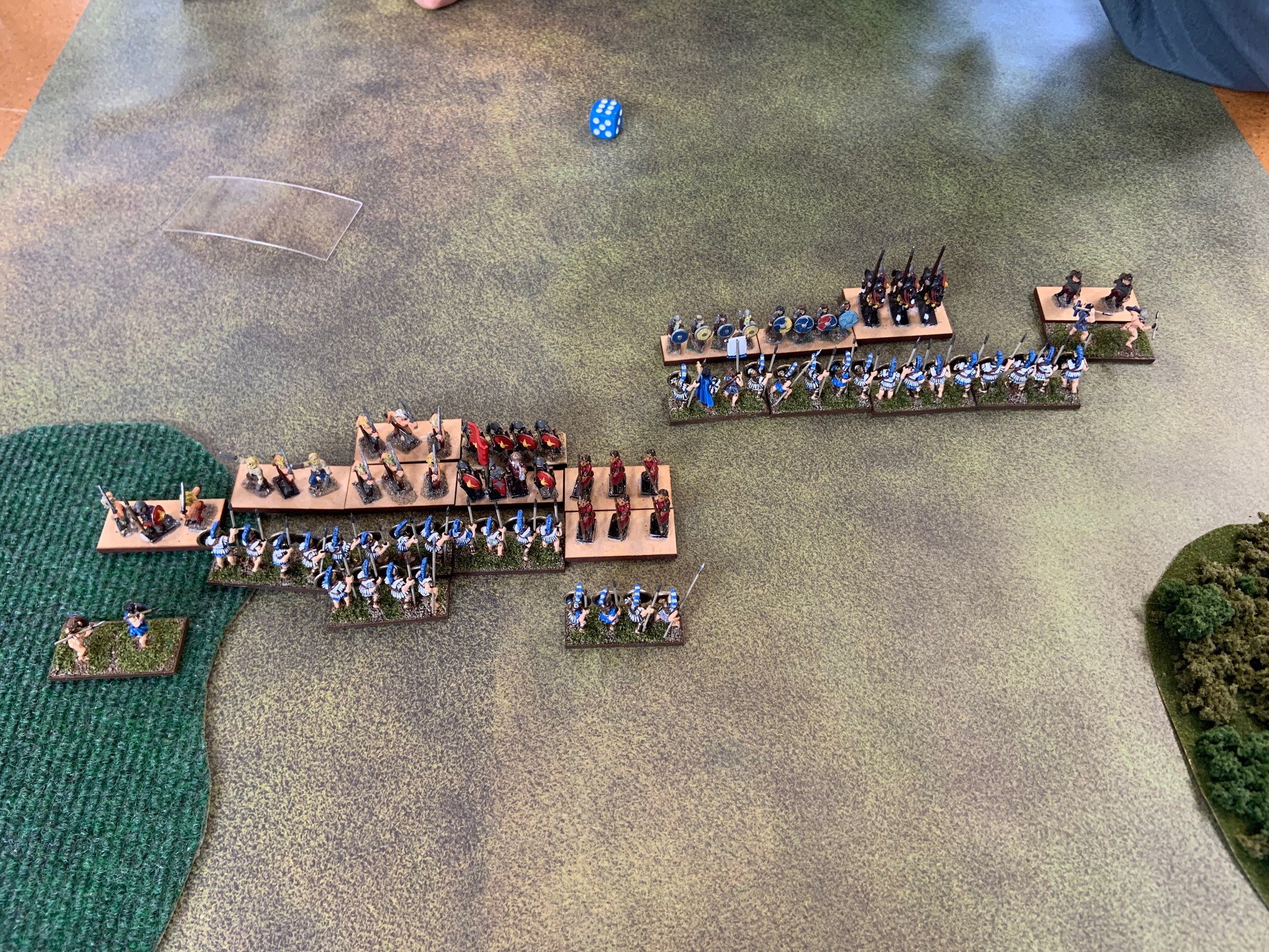
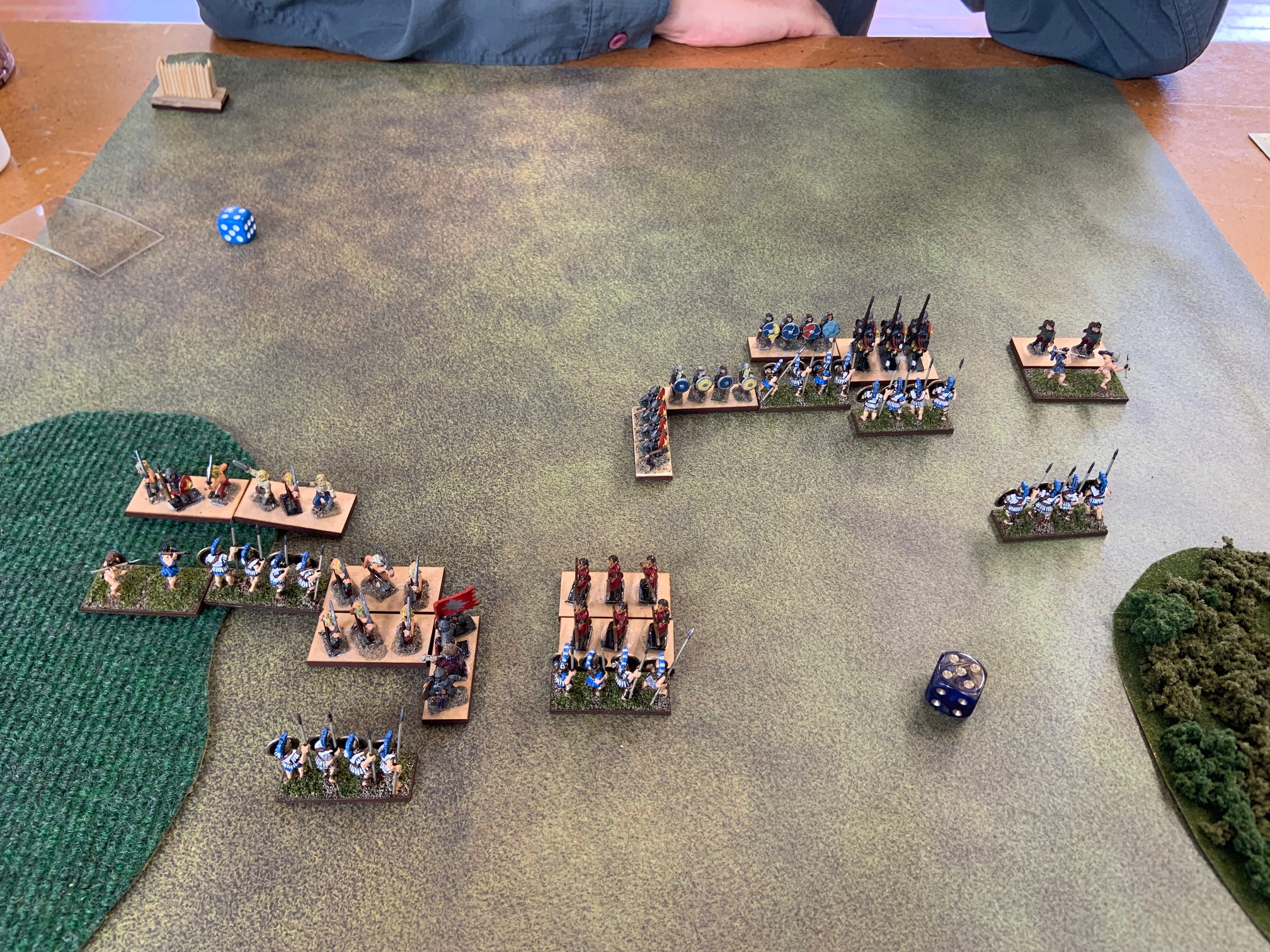
So, lessons learned? Yes, Spears are nothing like Blades! Spears are good all-rounders, but against most other troops in the open they really do rely on having the support and flanking bonuses to win the fights. They really can only go toe-to-toe vs Auxillia and lighter troops – against Blades and Warband, they really are average. Making sure I have plenty of room to spread my line out is a must for this force, and the Psiloi really are for making sure I don’t get flank charged – so I should mainly use them for ZoC denials.
For future games, I think the first couple of bounds will be spent only advancing 1BW at a time, spreading the line out. It was worth trying using the scrub to guard my flanks, but, ultimately, I don’t think it really works as well as it may for Blades. It might work if I had woods or difficult hills, but scrub just delays the enemy.
I will also be revising my prayers to Athena, as rolling 1 to your opponent’s 6 for combat really doesn’t help things…


![StarCraft Tabletop Miniatures Game Pre-Orders Live Now [Updated]](https://images.beastsofwar.com/2026/03/starcraft-tmg-news-cover-600-338.jpg)
![Mounted US Cavalry On Kickstarter For Dead Man’s Hand! [Updated]](https://images.beastsofwar.com/2026/03/us-cavalry-main-600-338.jpg)