











Reviewing the “History” of Team Yankee – Part One: Introduction
August 28, 2017 by oriskany

Good afternoon, Beasts of War. Since mid-August, Battlefront has been running a worldwide campaign for Team Yankee, their World War III alternate history wargame. Since Beasts of War is collaborating on this project, it’s high time we gear up our armies, refresh ourselves on the rules, and prepare to fight this greatest war that never was.
Perhaps now is also a fitting time to look at the “history” of Team Yankee. How did the “story” of Team Yankee get started? How might such a war have really gone? What did the source material get right? What did it get wrong? What IS the source material, anyway? There’s a mountain of misconception out there, so let’s get started.
Throughout the course of this project, I’ll be assisted by Ben Collins (Beasts of War: @benc). I met Ben during the Team Yankee Bootcamp in November 2015, just one of many service veterans attending the event (I think about a third of us at that boot camp had served in our nations’ militaries at one time or another).
During the boot camp and the writing that followed, Ben demonstrated a deep knowledge of how the armies that faced each other along the IntraGerman border in the 1980s were actually put together. With 20+ years in the service, one could expect no less. So when he asked if he could help with this project, I was happy to accept.

Our purpose isn’t to deflate anyone’s national pride, nor make ironclad predictions, and certainly not “poke holes” in the Team Yankee wargame. The game remains admirably faithful to source material, but that source material has some issues. In summary, we’re just trying to shed some light and inspire discussion on this fascinating topic.
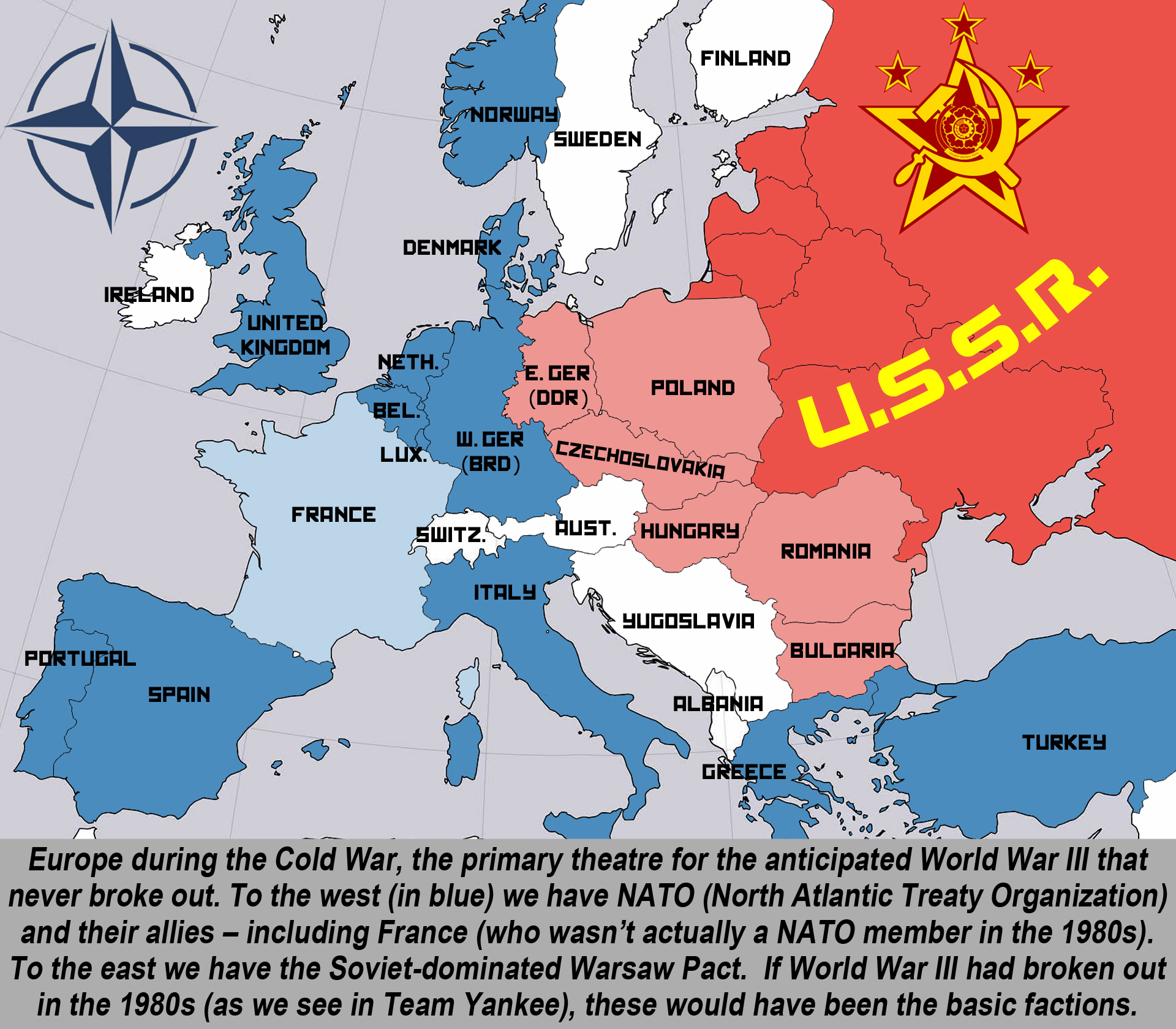
NATO vs. Warsaw Pact, Mid-1980s
BenC’s Commentary:
During the 1980s, the world was broadly split between two competing political, social, and economic ideologies for roughly 40 years. Since the end of the Second World War, and the defeat of National Socialist Germany, the Soviet Union had expanded her sphere of influence to include Eastern Europe.
The Allies sought to limit the expansion of Communism into Western Europe through a programme of rebuilding and investment under the Marshall Plan, interestingly in which the UK was the biggest recipient of this foreign aid. Yet governments in East and West began to regard each other with suspicion, and the Iron Curtain, famously paraphrased by Churchill, was soon drawn across the European continent.
The divided Germany eventually coalesced into two separate states, one rebuilt in the image of the capitalist West, the other modelled on the Communist East. Despite numerous global flashpoints (such as the Cuban missile crisis), and proxy wars being fought, Germany remained the expected future battleground.
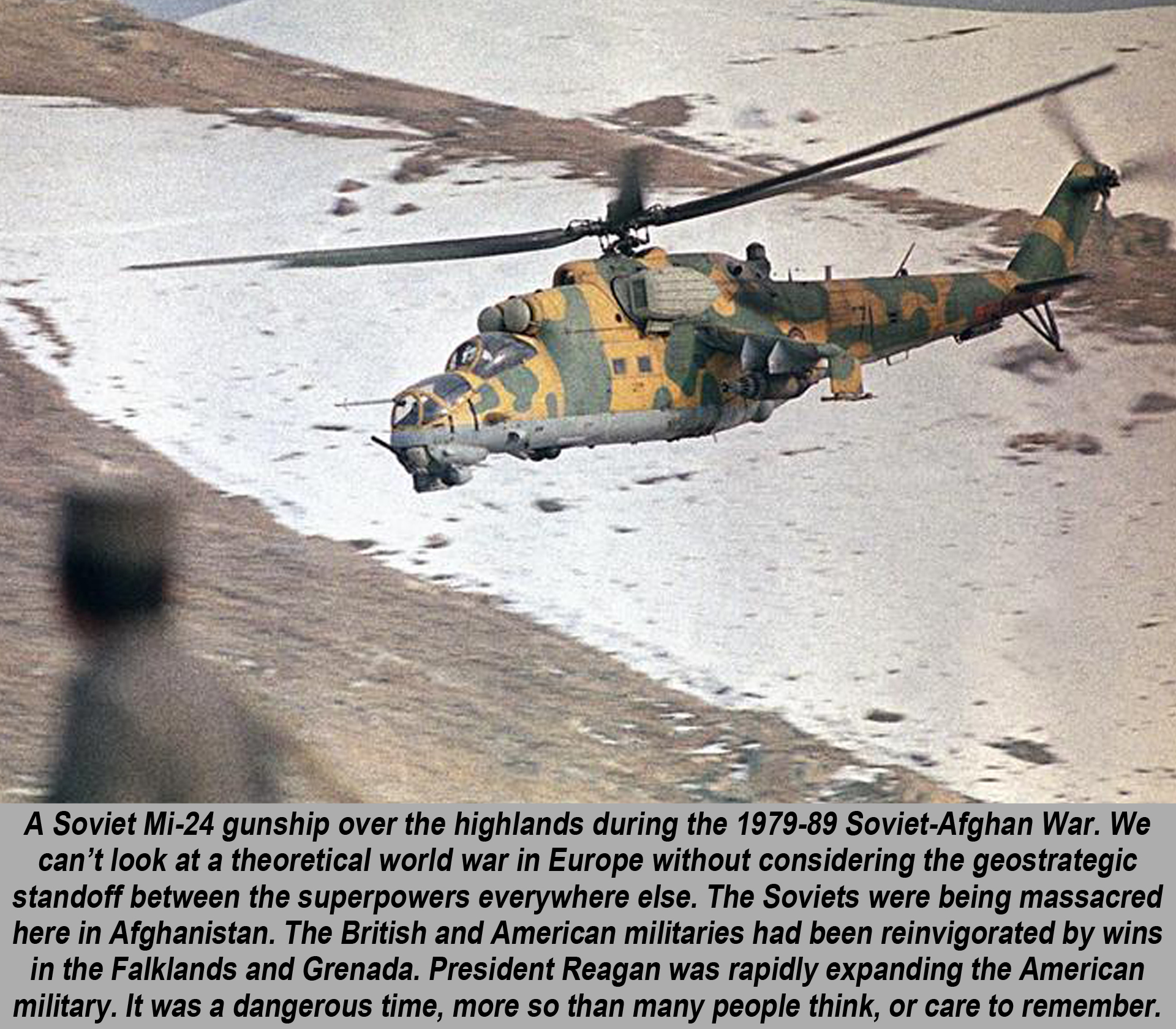
The 1980s represents the period in which both sides were as evenly matched as they had been throughout the Cold War. They were balanced not only in terms of conventional forces, but also in strategic nuclear weapons. Therefore NATO, and the US in particular, could no longer rely on nuclear superiority to deter the Warsaw Pact from aggression in Europe.
With nuclear war now unthinkable for both sides, the weight of deterrence fell onto the conventional forces of both NATO and the Warsaw Pact. It’s worth highlighting that the 1980s also represent possibly the most dangerous decade of the Cold War because of the comparative parity of conventional forces in Germany at that time.
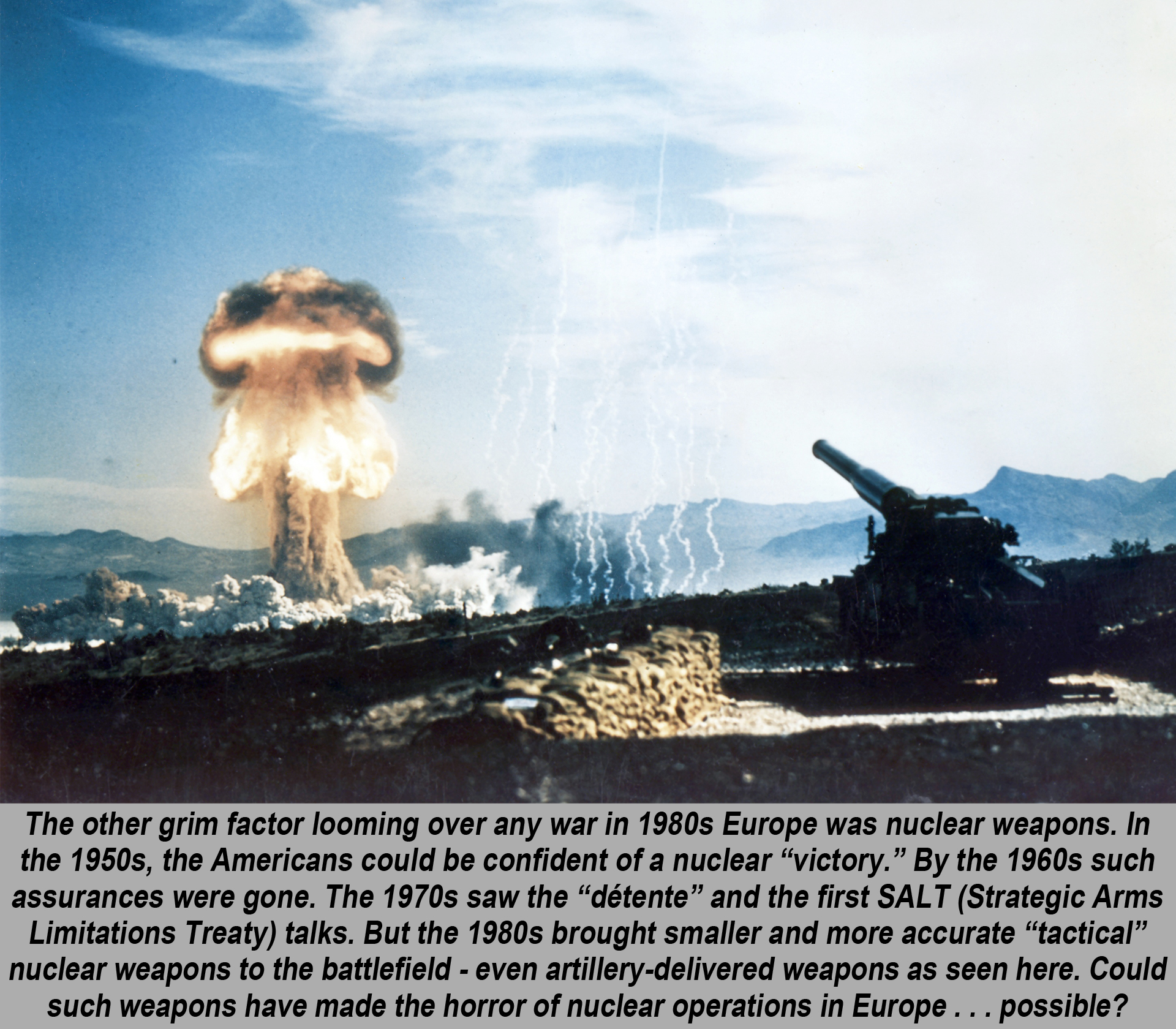
Hawkish leaders on both sides may have considered that if war was to start then their best chance of winning was right then.
The Context of Team Yankee
Oriskany Checks the Background:
The wargame “Team Yankee” is of course based on the 1987 novel “Team Yankee” by Harold Coyle. In the novel, an American tank and mechanized infantry company (commanded by Captain Sean Bannon) finds itself on the front lines of a theoretical World War III in West Germany, trying to hold back waves of Soviet invaders.
This novel is typically regarded as a “gold-standard” authority on the subject, mostly because of Coyle was a US Army major serving in tanks. And indeed, his depiction on how an American “team” (temporary mixed-arms company) is accurate down to some of the smallest possible details.
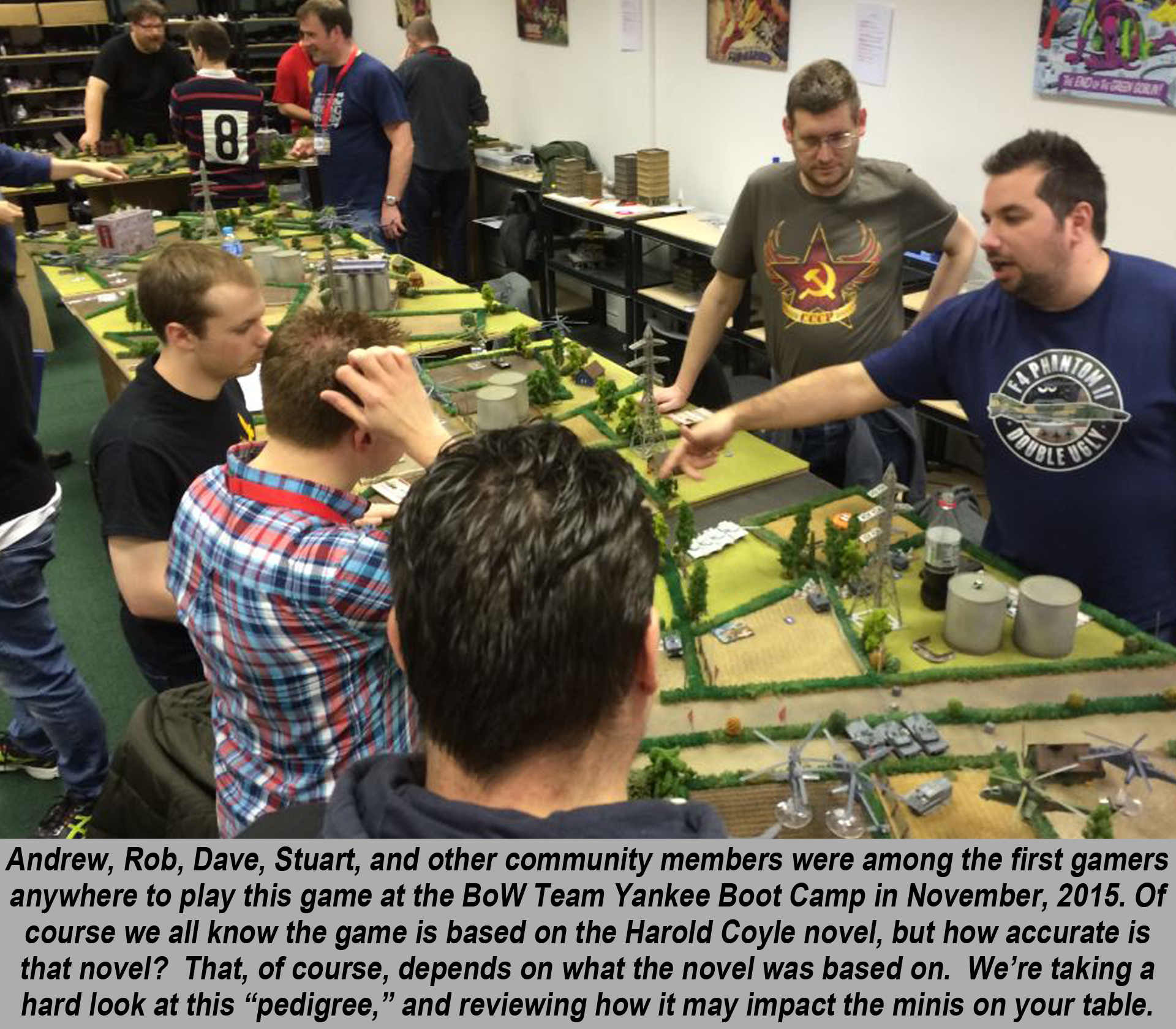
Coyle, however, did not “world-build” his own World War III. In his forward, he freely admits that he’s set his novel in the World War III setting written over ten years prior, Sir John Hackett’s “The Third World War: August 1985.” This is the actual “setting” for the Team Yankee wargame, especially if you’re playing Germans, British, or Soviets.
This is a phenomenal book, written as a “history” as if the Third World War had really just happened. Whereas Team Yankee gives us the “tank turret” view” of company level officers and individual soldiers, Hackett shows us the whole war, and not just in Europe.
Having served as both commander of the British Army of the Rhine and NORTHAG (Northern Army Group), Sir John Hackett naturally presents his war from a place of peerless authority. The problem is that The Third World War (TTWW) was published in 1978, and so was probably written in 1975-77, when 1985 was still the “dark future.”
Accordingly, Hackett (and NATO) were making some guesses about what the NATO-Warsaw situation would look like in 8-10 years. Given his qualifications and background, these would be some of the best guesses possible, but they were still guesses … and thus not 100% accurate. In fact, Hackett would revise his work in the 1980s.
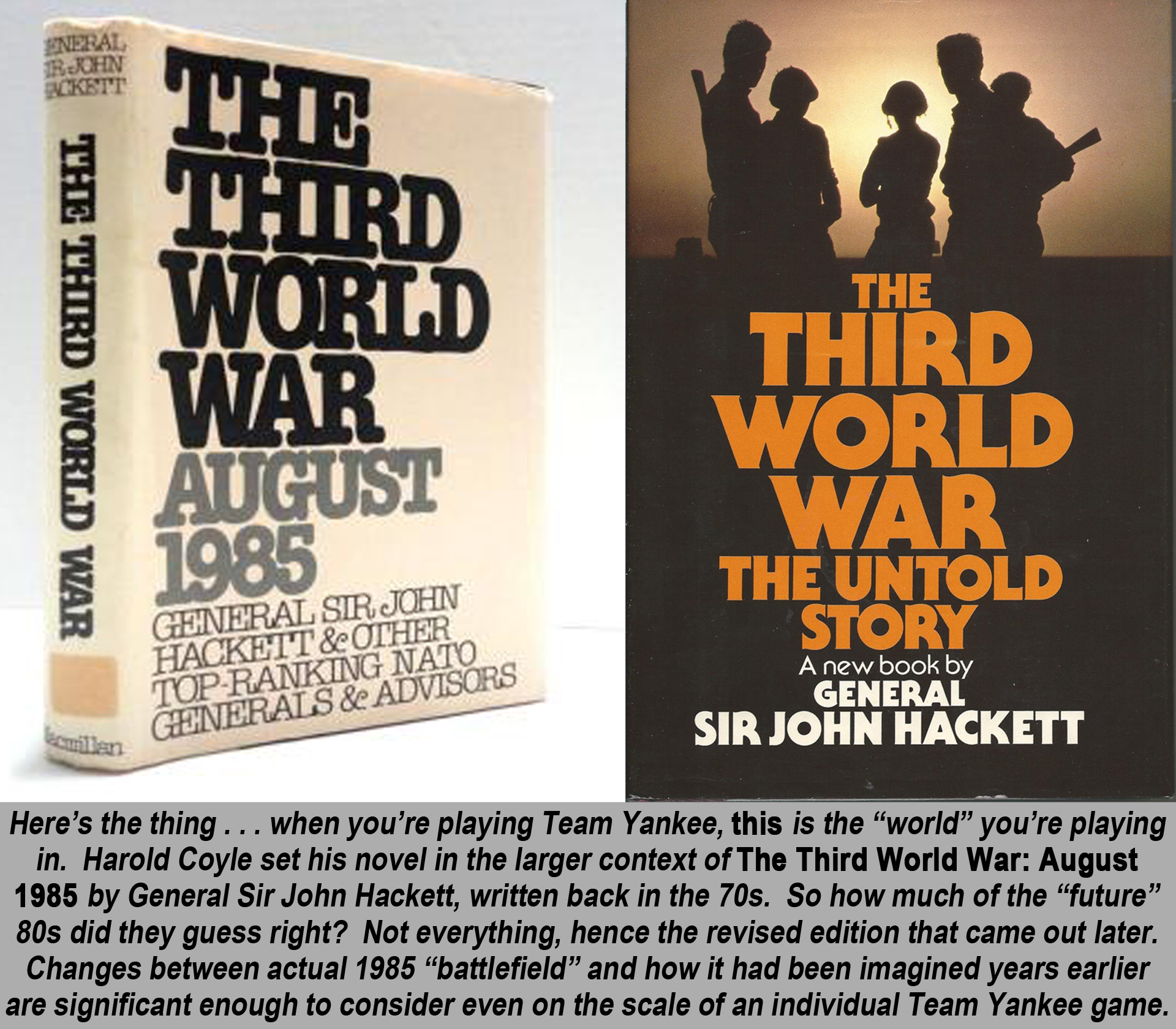
Yet these “guesses” would be carried forward into Harold Coyle’s Team Yankee novel, and therefore the Team Yankee wargame (along with other Team Yankee-based games published since 1989). Please note that we’re NOT trying to “knock” the Team Yankee wargame here, the game gets full marks for fidelity to its source material.
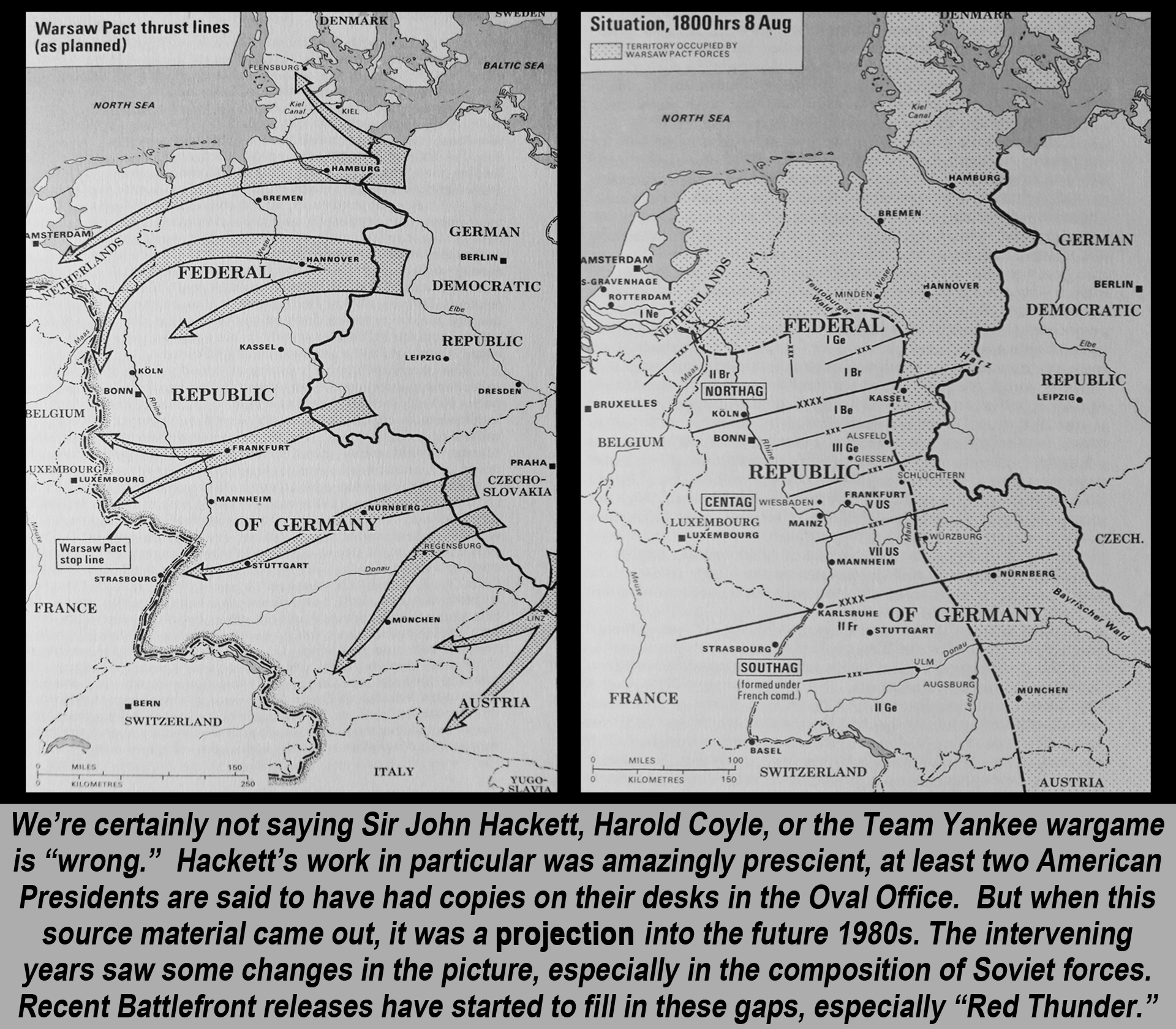
We just have to acknowledge that this source material doesn’t exactly line up with the situation that would have unfolded had war broken out in 1985. And we’re not talking about vague, high-level “interesting background” here, but material differences that would be reflected on a 15mm Team Yankee table top.
BenC Adds his Perspective:
As Oriskany has said, Team Yankee is based on the Harold Coyle novel of the same name. There is no doubt that Coyle was writing from a position of authority and experience as he had been a serving armour officer in the US Army. The book is full of the details that really enhance that turret level view of the Cold War gone hot.
That’s my problem with the Team Yankee novel, however. It is written by a US Army officer who is the product of a training system that, obviously, maintains that the US training, equipment and tactics are far superior to those of the Warsaw Pact. This gives Coyle an embedded bias in his writing when dealing with the Soviets.
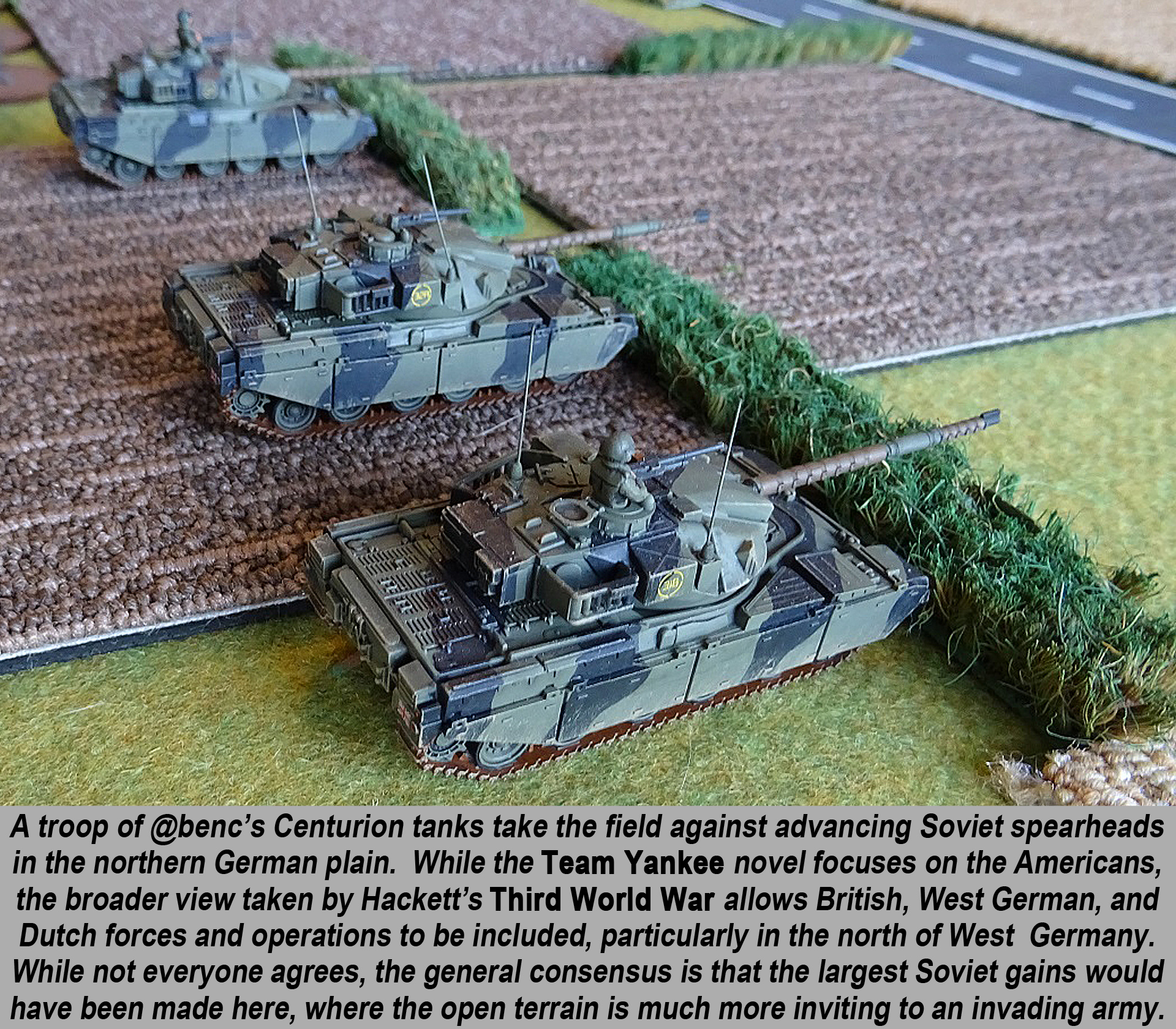
In general the Soviets in the novel Team Yankee are portrayed as ill-disciplined, under-trained and tactically unaware. In the engagements described in the book the Soviets seem to be easily awed by US firepower. While Coyle openly portrays Team Yankee as a “lucky unit,” the enemy often seems to patiently await their turn to die.
As mentioned above, the Team Yankee novel (and thus game) is actually based on The Third World War by General Sir John Hackett. In writing this book, Hackett is making the case that NATO needs strong conventional forces to firstly maintain the conventional deterrence.
Secondly, he maintains that a conventional war that has a limited release of tactical nuclear weapons on the battlefield may not necessarily result in the use of strategic nuclear weapons. In my opinion that was a very dangerous notion to spread both in military and political circles.
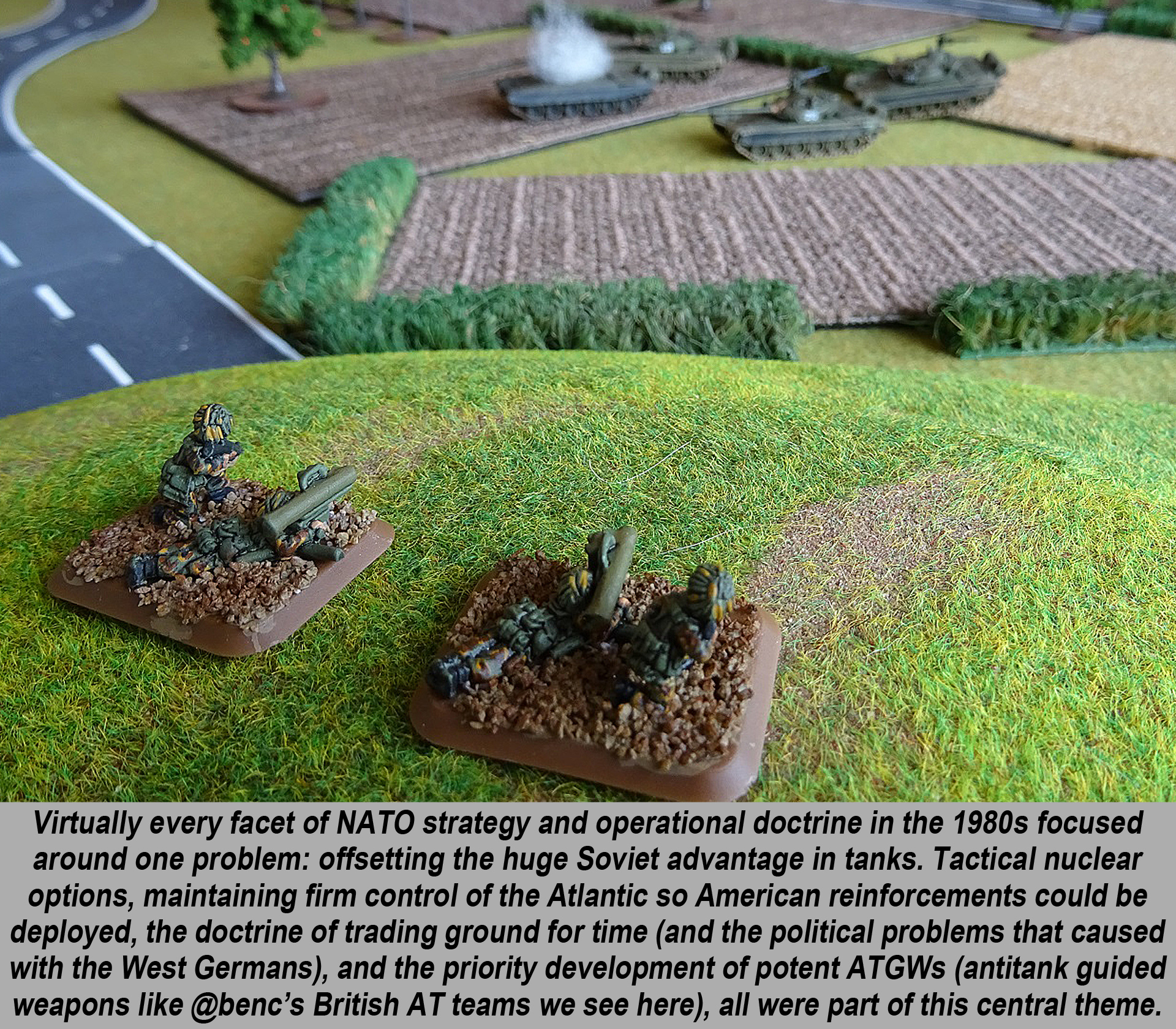
Hackett’s novel builds global tension from friction in the Persian Gulf through to an escalation and eventual confrontation between NATO and the Warsaw Pact. In researching the novel Hackett consulted with numerous military and political experts to build a convincing and realistic picture of a conflict in 1985.
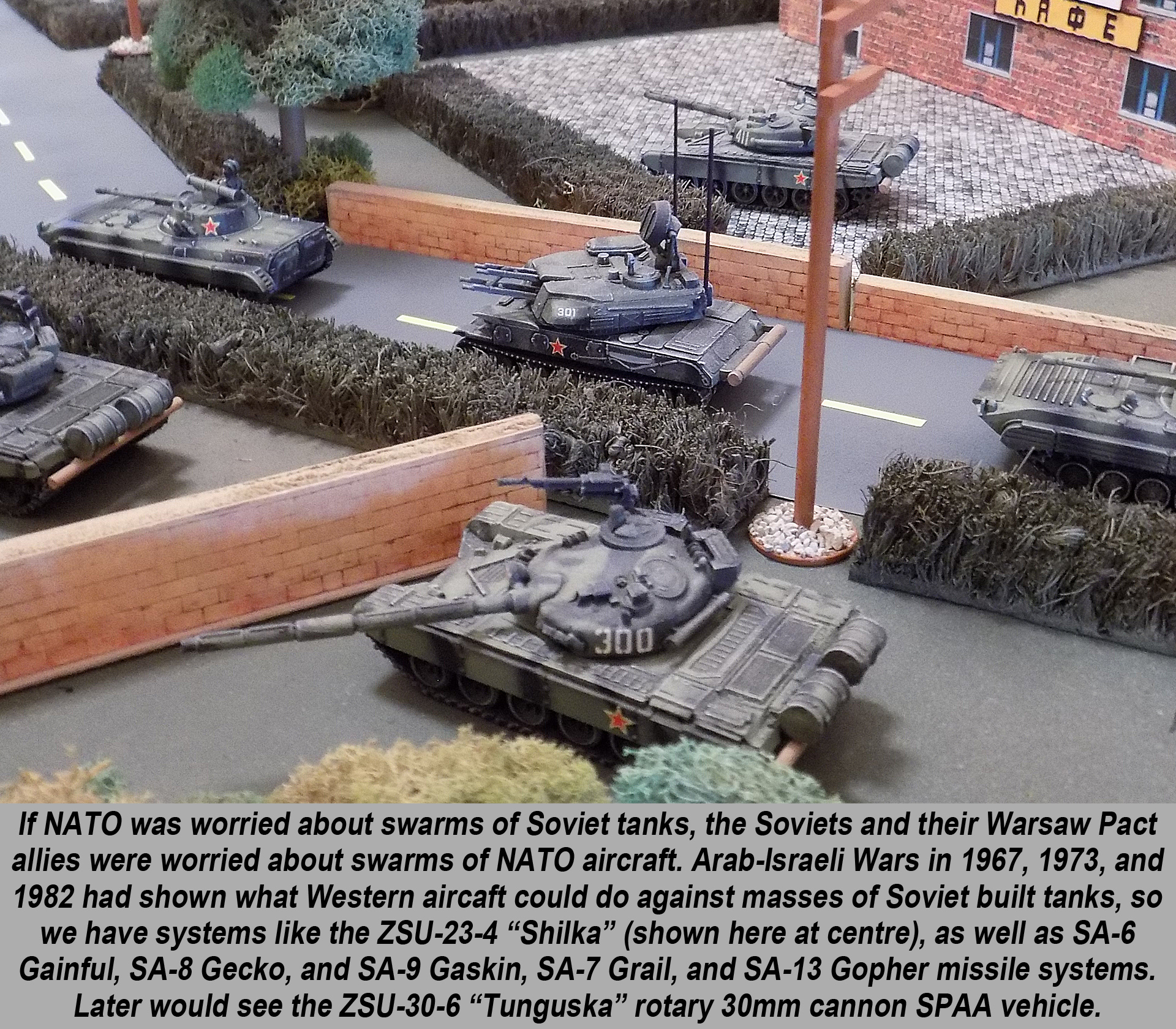
In subsequent years, Hackett has been criticised for painting too rosy a picture for the NATO forces as it seems all of the bad luck falls on the Soviets; the West seem not to suffer from bad decisions or unexpected setbacks.
What Does “Team Yankee” Even Mean?
Oriskany Clears His Throat
Take one look at the cover of the Team Yankee rule book, where Soviet bullets are literally bouncing off the word “Freedom” painted on an American tank turret, and it’s easy to misinterpret what the phrase “Team Yankee” is about. The rule book summaries what “Team Yankee actually means, but let’s take a moment for more detail.
American army units are built into battalions and regiments. In peacetime, for purposes of maintenance, training, and administration, it’s far better to keep mechanized infantry and tank forces strictly organized in their own battalions. In combat, however, these units have to be mixed in order to execute any kind of combined-arms tactics.

Therefore, for field manoeuvres (and war, had it ever come to that), each American tank company would swap one platoon with one mechanized infantry platoon. Then, each tank battalion would also swap one of these modified tank-heavy companies for a mech-heavy company, and so on. Thus, all units would get a combined-arms capability.
Technically speaking, these modified “companies” were no longer companies. They were now called “Teams.” Also, these modified “battalions” are now called Task Forces, not unlike the roughly battalion-sized “kampfgruppe” the Germans used so well in World War II.
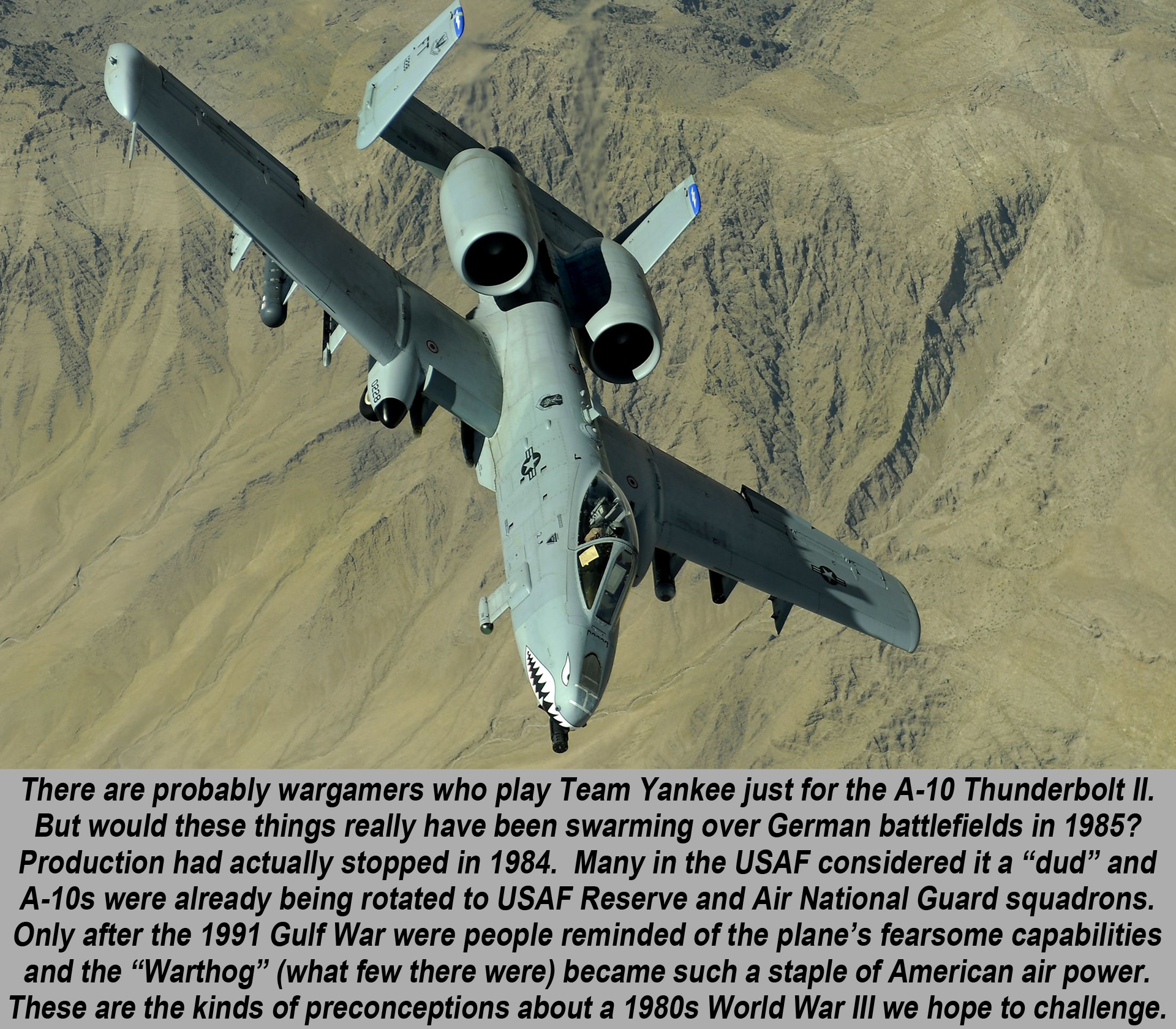
Mechanized infantry-heavy teams would be designated by the first four letters of the radio-phonetic alphabet – Alpha, Bravo, Charlie, and Delta. Tank-heavy teams would use the last four letters: Teams Whiskey, X-Ray, Yankee, and Zulu. Task Forces would usually be given some kind of a code name or named after its commander.
We’re Just Getting Started
Believe me, we’re just getting started here. Upcoming articles in this series will cover how the potential battlefield of 1985 actually differed from what was projected in the TTWW source material, American and Soviet doctrine, the British Army of the Rhine, the Bundeswehr, the Dutch, and the possible intervention of Italians and French.
We’ll also be looking at other World War III books you can use as an “expanded universe” for your Team Yankee games, such as Chieftains, Red Storm Rising, and my personal favourite: Red Army. Some of these are great reference material, some others not so much.
We hope you’ve enjoyed this first part of our article series on Team Yankee. We’ll be continuing to shine a sceptical spotlight on some commonly-held beliefs and presumptions that may be floating around out there, so by all means add your own perspective! Questions, comments, debates, all are welcome below!
If you liked this article and want to know more about the history behind Team Yankee, make sure to check out the Weekender Interview with oriskany below...

Click On The Image and you'll be taken directly to the segment in the show to learn more.
If you would like to write an article for Beasts of War then please contact us at [email protected] for more information!
Supported by (Turn Off)

Supported by (Turn Off)
"80s Hype"
Supported by (Turn Off)



a period/game I know practically nothing about so I’m looking forward to seeing the rest of the series.
Also nice to see you’ve found an ally there @oriskany, is he hard to work for @benc?
Hey, @benc volunteered! So I have no regrets! (Quietly puts the cat-o-nine-tails back in the bottom desk drawer). 😀 In all seriousness, though, we had an aggressive timeline on this one and Ben was great at submitting writing on-time and on-target. 😀
that surprises me, it’s not like @warzan would drop an aggressively tight deadline on you 😉
Ah, it’s all good. He knows I like it. 😀 😀 😀
Looking forward to this series @oriskany. I never read Team Yankee the novel but I did read Red Storm Rising as a kid (I still have the dog-eared copy somewhere) and played the Harpoon naval wargame which was developed alongside(?) (I remember there being links between the two but whch way around escapes me.).
I’m sure the articles will be interesting and thought provoking and I hope the collab goes well for you both.
Thanks, @stoney997 –
Yes, Red Storm Rising, was we know, was written by Tom Clancy, his second novel I believe. His first was co-authored with Larry Bond, who is a big-time wargame designer (Harpoon, Command at Sea series, etc). Clancy has also credited Larry Bond as a co-author of Red Storm Rising (even if the publisher did not). That’s the connection there.
So you’ve played Harpoon? The computer or “tabletop” version? I say “tabletop” even though to play it any kind of scale … well, I have LITERALLY played it on a tennis court (and even that was only with 5-6 ships total).
Yeah, we’ll be trying to provoke some discussion, challenging some myths, preconceptions, etc. Or at least spark some discussion on this. Since World War III obviously never happened, we’re looking at where our ideas of what WW3 would have looked like . . . where those ideas came from?
Obviously, for Team Yankee, they came from the novel. Where did the novel’s ideas come from? General Sir John Hackett’s 1985 novel. Where did THOSE ideas come from, etc. What predictions turned out to be right, which ones not so much, etc?
Thanks for the comment!
Wasn’t there a game Red Storm Rising? I think I remember playing it.
Red Storm Rising by TSR is touched on in Part 05 – along with GDW’s original “Team Yankee” wargame published in 1989/1990.
We should really start playing that Red Storm Rising board game again. It’s a solid game, and every time I take it out to photograph it, I say to myself how we should start playing again. I still have all the components and the board remains in great shape. 😀
And Microprose had a Red Storm Raising computer game, Submarine Simulation with a small strategic side to it. I wasted a few days looking at sonar profiles comparing them to the ones in the manual. … remember the dread that was the Kiev, and playing cat and mouse with Alpha subs
Thanks, @rasmus – The Red Storm Rising Microprose game is briefly mentioned in one of these articles, when we look at some of the other games that have tackled this genre and period.
Damn, Alpha class subs? The fastest and deepest-diving subs in the world at the time, if memory serves,
speaking of computer games :
– M1A1 Tank platoon (Microprose) : classic ‘red’ vs ‘blue’ (Soviets)
– Operation Flashpoint (Bohemia Interactive). it is set on an island, but the gear is from the ’80’s.
Awesome, @limburger – if we’re talking computer games, myself and I assume @cpauls1 still recommend Steel Panthers: MBT by Shrapnel Games.
http://www.shrapnelgames.com/Camo_Workshop/MBT/MBT_page.html
Anything from 1946-2020 can be played at the battalion-regiment-brigade level.
Really looking forward to reading these articles – I’ve always found the 80’s cold war period really interesting and recently got into the game having read the Team Yankee book.
I’d also endorse the British equivalent to Team Yankee – Chieftains by Bob Forrest-Webb which provides a similar field commander’s view from a British armoured regiment.
Thanks. @shart1979 – Indeed, we totally include Chieftains in our review of 1980s WW3 fiction and source material. Look for discussion on Chieftains in future parts of this article series. The book was recommended to me by the Tank God himself, @johnlyons . 😀
Well Mr Lyons has excellent taste 🙂
Having seen some of the other comments I’m really looking forward to seeing some of the articles that discuss some of the discrepancies around the Russian Guards & their T-64s plus the whole autoloader discussion is one that still rumbles on now as how do you game a situation where the crews would get tired or have access to ready racks.
Can’t wait for the next articles!
@shart1979 – T-64s for life! 😀 When I heard that (a) T-64s are being included in Red Thunder expansions and (b) they are measurably BETTER than T-72s in the game I breathed a huge sigh of relief. Massive improvement for the Team Yankee game in terms of realism and reflecting OOBs and ToEs in actual GSFG “Cat One” Tank Divisions.
There’s a lot more on this to come in future parts. Trust me, we get stuck into this. 😀
Thanks for this. I finally got some people at least a little interested in the game at the FLGS, and these articles will be good background reading.
No problem, @erion ! We actually hoped to get it started a little sooner when Firestorm: Red Thunder first kicked off. But then the Dunkirk article series dropped in, and there are only so many hours in the day! 😀 Glad you liked the article series so far and hope you will continue to find it useful.
A very interesting read. You have obliquely referenced one of my biggest problems with Team Yankee, and I would like a more expert view on this point in future articles, namely the characterisation of the Red Army.
Now I don’t doubt the Red Army placed a big emphasis on combat numbers in their combat doctrines, but it appears that Battlefront are determined to reduce Warsaw Pact players into playing Hollywood hordes rather than anything else. Rather than tactical nuance we get BMP spam, rather than careful what if lists for comparative forces we are given elite goodies and redshirt mook baddies. It feels a missed opportunity, particularly when auto loading Soviet tanks have half the RoF of manual loaders from the West! It’s especially annoying when you look at the real term cost to the gamer, a Nato player can field a reasonable force at a half or even a third of the cost it takes to build the same points worth of Warsaw Pact, and that to me seems really bad merchandising strategy let alone game design.
@mythickhan – Thanks for the great comment.
>> You have obliquely referenced one of my biggest problems with Team Yankee, and I would like a more expert view on this point in future articles, namely the characterisation of the Red Army.
We definitely come back to this in much more detail in future parts of this article series (every Monday – five parts in all). Technically, the “Red Army of Workers and Peasants” (RKKA) hasn’t existed since 1947, but @benc and I focus more on the GSFG (Group of Soviet Forces in Germany), and even this in turn doesn’t include everything (NSFG in Poland and CSFG in Czechoslovakia, to say nothing of Southern commands facing Turkey and the Westerns TVDs in Minsk, Kiev, etc).
Yes, we definitely pop a few holes in these myths. The novel Team Yankee does a masterful job of describing how the US Army works in this setting (that was Coyle’s background) but his portrayal of Soviet forces is a little rough.
Then again, what does the enemy look like from a tank turret? I don’t think this was one of the objectives Coyle was going for.
If you’re interested in a more serious look at the Soviet perspective, I highly recommend Ralph Peters’ novel, ironically titled “Red Army.” 😀 WW3 in Germany, but entirely from the Sioviet side. As a former Lt Colonel specialized in Russian Studies, he does a great job portraying the other side.
There are a number of things like this in the Team Yankee game. I don’t want to call them “wrong …” but they were sticking with the source material (Team Yankee novel).
To Battlefront’s immense credit, they seem to be fixing a lot of this with new releases like Red Thunder, which intros better tanks like the T-64s.
The one comment I would respectfully disagree with is the the speed of manual loaders. Autoloaders actually ARE slower than manual loaders – this Team Yankee gets right. Even T-80s have loading times from 8-13 seconds depending on the initial position of the gun breech and cradle, while most well-trained NATO tank crews have engagement cycles as short as five seconds.
I would agree that some of the Soviet forces are handled a little “ham fisted” (Soviet player myself) – but again, I feel Battlefront has taken big positive steps to address the issue. For one, T-72s? When they should be fielding T-64s or even T-80s? But we’ll spill plenty of ink on that issue later . . . 😀
Please don’t underestimate fatigue. My (manual) Loader showed first signs of exhaustion after the first three rounds on the shooting range (Leopard 1A5). An auto loader does not suffer from that. An auto loader (in mid 1980s) has no (at least minor) problems with rough terrain. A human loader (at least in a Leopard Tank) can be thrown around very easy when on the move.
So even though I was gunner in a West German tank I would prefer the auto loader in the Soviet tanks.
Oh, absolutely, @setesch . I’ve handled even the L7 105mm rounds, I understand the Rh-120 rounds (US M256 / M356 built under license) are like 55 pounds (25 kilos).
As far as overall crew fatigue goes, I would again put the disadvantage on the Soviets. I’ve actually tried to squeeze into a T-55 brought back from the Gulf War. Even when I was back in shape I couldn’t really do it. T-72s are even smaller regarding internal space. The point of the autoloader is a space / cost saving measure. Also the rule for the Soviet tank arm is that you can’t be taller than 5’7″ or something like that because you can’t physically fit inside the tank?
Long story short, crew conditions inside Soviet made tanks are friggin’ miserable – and that’s BEFORE you have to operate in MOPP gear because people are tossing chemical weapons around.
I can’t speak for the Soviets but my Football (soccer) coach was a Commander in a T-72… and he is taller than me (about 6’1″). So maybe it’s not that big issue once you are inside.
I only know German built tanks from the inside and both Leopards are quite comfy. When you are not the Commander. Commanders have to have short legs otherwise the back of the gunners seat threatens your shinbone.
That’s odd, @setesch – maybe I’ve been misinformed. Like I said, I’ve personally seen the T-55s, etc, but never the T-72s. I’ve seen youtube videos of their interior and they look extremely tight. But it’s hard to really tell on camera.
Maaaaaybe T-72s are built with more room since they were primarily an export tank, and so other nations may not have been built to specifications of the Soviet Army? I’m totally guessing on that one. I’ll have to do some more fact checking.
I’ve just heard and read that Soviet tank crewmen have to be pretty small in stature or they assign you to BMPs or the like instead. That guideline may not extend to all models of Soviet-built tanks, especially those intended primarily for export to other countries.
Thanks for the heads up, now I’ll have to do some checking around! 😀
Thanks for the reply 🙂 I do think Battlefront have taken *some* steps but I still think the overall approach is ham-fisted. Especially with the continued lack of T-80 tanks or recent combat veterans from Afghanistan. Perhaps they could do something like the Hero lists they released for Late War in Flames of War 3rd Edition… at least people would appreciate the option.
Now, I’m no expert on this but I was going by what I had read about the auto-loaders the T-72 model has a minimum cycle of 6.5 seconds (ATGM 8 seconds) and a maximum cycle of 15 seconds. Apparently in later versions the sequence achieved less than 5 seconds, allowing to reach 3 shots in 13 seconds. Surely that doesn’t equate to fully half the RoF of an Abrams tank? Even if it is slower than an efficient, well trained and untired crewmember!
I would agree with your overall position, @mythickhan – again, I’m a Soviet player myself, and readers on the site who know me know that my writing has always been pretty even-handed with the Soviets / Russians, from World War II going forward. And as far as World War III novels and “how it might have gone” – my favorite is still the one told entirely from the Soviet perspective.
The loading cycles I happened to run across literally just last night reading about T-80s. Granted the source may not have been the best. But it’s pretty much common knowledge that autoloaders are slower than human loaders. How much depends on a number of factors. I would totally agree that playing against M1s, Leopards, and Chieftains that all have double your ROF is frustrating! 😀
The extra man as a loader also means less crew fatigue (one more man to help maintain the tank for the 99.9% of the time it’s NOT in combat), one more set of eyes scanning for targets until the shooting starts, one more machine gun, etc. It’s definitely a plus.
However, it almost means your tank has to be bigger, and much more expensive (one more man to pay, clothe, feed, house, put through college, and he probably has a wife and kids the army has to take care of, etc).
A huge % of a military’s budget goes to personnel. So anywhere a military like say, the Soviet army, can cut one person out of a tank crew, they do it.
I think the only western nation that uses autoloaders are the French in either AMX-30/32, AMX LeClerc, or both, Not sure about that, but I’d be interested in their engagement cycles and loading times. AMX-32 exports have actually seen combat in Gulf One.
You type: “Especially with the continued lack of T-80 tanks”
Ohhh… YES! God, this is so true. I hope to count you among my allies at the barricades when this part of the article series comes up.
There are divisions equipped with T-72s, but these aren’t really the formations you’d see in most “Team Yankee” games. For most GSFG divisions, the evolution goes from T-64 to T-64B straight to T-80, T-80B, T-80U, etc.
We have a chart that tracks this, etc., coming out a subsequent part. It’s hard enough to keep track of … then you run into NATO misidentifying T-72 upgrades as T-80s and vice-versa. Then the Soviet Union falls and all this goes flying out the window.
I look forward to reading subsequent articles in the series! And I shall definitely check out “Red Army”, my thanks for the recommendation.
I shall see you on the barricades when we fight for T-80s 😛
All the best @oriskany 😀
@mythickhan – indeed, if you’re looking for someone who does the Soviet Army “justice” – without being condescending or anything (they are portrayed warts and all), definitely Red Army is the one.
Even leaving aside this new perspective, as a fiction writer myself all I can say is that Ralph Peters is master. His characters, his metaphors, his ensemble storylines … all are done with masterful grace.
The way that war would develop, the amount of time it would take, the materiel and human losses on both sides, he gets it much closer than other novelists (although in truth his novel comes out over ten years after Sir John Hackett, when the 1980s are no longer the “future”).
He’s become something of a guest-fixture on Fox News in later years, unfortunately. I’m choosing to look past that. Definitely one of my three favorite military writers (Steven Pressfield and Michael Shaara are the others).
Anyway, glad you like the series so far! Stay tuned for future articles each Monday. 😀
I remember reading when the wall came down Soviet plans for warfare in Europe came to light. Again I m going back in time quite a bit so might be a little be off but the gist of the article was that the Soviet plan was to fire lots of battlefield nukes into West Germany before the tanks began to roll
I was in USMC boot camp when the Wall came down.
Agree 100% about the tactical nukes, @torros – Declassified CIA docs and even some Soviet planning maps we include in future parts of this article series actually show planned tac nuke strikes clearly marked on some of West Germany’s north sea ports. Presumably this was to seal off possibility of rapid commitment of reserves from the US and UK.
If I remember right, 7 Days to the Rhine, the 1979 Warsaw Pact simulation while on the face of it had Nato nuking Poland trying to wipe out the weaponry and material before the Warsaw Pact went into the offensive was a politically correct sticking plaster over what was in effect a Soviet offensive plan – nuke the northern cities of Amsterdam, Esbjerg and Hamburg to slow the supply of reinforcements but exclude the UK and France as targets to try and prevent the deployment of yet more nuclear arms in the theatre. Race to the Rhine, reunify Germany. Loads of other targets mind you, Vienna, Verona, Stuttgart, Munich, as much as I love Team Yankee the scope in even the European theatre is a fair bit bigger than which we ever see coverage for. Hungarian tanks in Italy? What would the Yugoslav response be? Nightmare! Shaping up to be another great article series, be following this closely!
Thanks so much, @bigdave , and yes, I agree just about everything you say in your post! 😀
Seven Days to the Rhine – sounds about right. In “Red Army” Ralph Peters has the war last 2 1/2 – 3 days, and Soviet spearheads are about halfway there (at least in the north) – and then the war ends for other reasons.
Nukes along the North Sea – Emden, Bremen, Bremershaven, Wilhelmshaven, four confirmed targets of many. I have the Soviet planning maps. I think places like Lübeck, Hamburg, and Hannover are being spared as transport hubs, but YES, a big part of at least one set of Soviet plans are shutting down that coastline to limit / cut off reserves deployed out of the UK or US. The map is featured in one of the article parts. 😀
Vienna = Austria, obviously, a neutral country, i.e, not NATO. So NATO troops would not be authorized to deploy there initially. Leaving only the Austrian Army to stand alone against at least the left wing of the CSFG in Czechoslovakia. May not have to nuke that place? Politically it would be a bad move, driving other neutral countries into the arms of NATO.
Totally agree that GSFG vs. US V and VII Corps, BAOR, and II and III Corps of the Bundeswehr is only the beginning.
In subsequent parts we mention potential smaller actions in Norway, perhaps Soviet Naval Infantry to secure bases or eliminate NATO bases that are helping bottle up the Soviet White Sea fleet in the Barents.
And yes, the fracturing of Yugoslavia. Technically a Soviet ally, but not a member of Warsaw Pact. Would they be pressured into the war? With hindsight, we know how fragile the faultlines in that country were. Obviously the Serbs would be with the Soviets, but does that push the Bosnians or Croats into the arms of NATO?
And of course the south – Soviet southern command pushing into places like Greece and Turkey, supported by NATO airpower in Italy, the US 6th Fleet in the eastern Med, and British RAF airpower (they’ve always had a vested interest in Mediterranean shipping lanes).
Never mind the Middle East and Asia.
Anyway, a lot of this is covered in later articles. Please stay tuned! I sincerely hope you won’t be disappointed. 😀
disappointed? never. really looking forward to the rest of it 🙂 Norway’s an interesting one, the north east border would have seen action but from a naval perspective I would have thought the focus would have been on Denmark, on closing the Kattegat and and on taking on any Nato carriers moving into the North Sea from the North Atlantic – from there they could reach the Soviet Union itself so would have presented a major threat. Further on from Austrian neutrality and it’s implications, am I right in thinking the French weren’t fully integrated into Nato’s command and control structure in the mid 80’s? Yugoslavia is definitely an awkward one, I can’t remember when Reagan actually issued his orders to purposefully destabilize the Yugoslav government, may have been a little after the period Team Yankee tends to cover. Calling in the loans of the Yugoslav government and offering credit and support to the nationalists – lot to answer for… Will have to dig out a couple of books I’ve got and check the dates (some old communist friends who spent time over there, be worth picking their brains too I think!). A Croatian insurgency could have been a real and present danger, possibly enough to stop the Yugoslav army from getting properly engaged in any conflict in Italy… Hmm, lots to think about!
Thanks, @bigdave –
Okay, when it comes to Denmark I have to defer to my friend @davebpg – when we get to Part 05 we’re gonna see a huge project he’s been working on regarding Team Yankee in this area.
Absolutely correct regarding France in the 1980s. They were a founding nation of NATO, and have rejoined fully as of 2006 I think, but in the late 60s they actually dropped out of NATO over the question of NATO Charter, Articles IV and V vis-a-vis strategic weapons. (Basically, when you join NATO all military decisions are shared with other NATO states, and France didn’t want other countries having a say in how they used their nukes.)\
We get into that in more detail om Part 02.
I’m certainly no fan of Reagan, but I’m not sure how much of the blame for 1991-99 Balkan Wars I would lay there. Some perhaps, I’m not doubting your sources. 😀 But that fuse was lit as far back as 1919 with the map-doodlers or Versailles when they duct-taped that Yugoslavian “non-nation” together in the first place.
I would be interested in hearing more about that, though. I don’t know that much about US efforts to destabilize the country, much like the UK did in 1941 (replacing the pro-German Croat government in a bloody coup with a pro-UK / USSR Serb government and prompting the German invasion of April 1941).
Great work yet again! A period I don’t know as much about as I’d like! I’m also looking forward to playing TY in 6mm with the guys in the club 🙂
Nice, @neves1789! 6mm Team Yankee! That’s really going to help some of the range and movement mechanics. Great idea. I think @torros has talked about that too in the past. 😀
It’s 6mm then I almost certainly have 🙂
@rastamann has painted some lovely 6mm modern for TY
http://www.beastsofwar.com/groups/painting/forum/topic/rastamanns-den-of-painting/?topic_page=1&num=15
Awesome! Thanks! 😀
Great work as always @oriskany
I am really looking forward to more of this series. Have you broke out any of the US’s Field Manuals on the Soviet Army(FM100-2-1 through -3)? They were published in the mid-80s and describe the Soviets of the era, or at least what US Intelligence thought of them.
I’d second your recommendation of Red Army, I read that one shortly after getting into Team Yankee to help get in the mindset of the army I am playing.
I remember reading a lot of that material when I was still serving (89-93, USMC). I think that’s where we see a lot of our problems. The US Army in the 50s and 60s was very heavily sunk into the ideas of German WW2 “advisors” like Manteuffel and von Mellenthin, who had this very “big red wall” view of the Soviet Army.
While this may have been true in 1941-42, by late 43, 44 and 45 the Soviets had adopted an operational doctrine of war that … while far from perfect … wasn’t as blunt as many Western analysts tended to believe.
Then again, while we may have been underestimating the Soviets tactically and operationally, we were probably overestimating them strategically. Hence the complete economic and political collapse we saw in 89-91. In hindsight, this shows just how impossible a Soviet-instigated war probably was in the mid-late 1980s. But I don’t think many knew that at the time.
In the course of research, I stumbled across several declassified CIA docs on .pdfs. Most are from the late 1970s, so they’re a little off for the time period, but it shows were a lot of the confusion was regarding (just an example) the T-72 vs. T-80 roll out.
I’ll save most of my questions until the relevant articles. Though I do have to ask: any discussion on Soviet Airlanding Forces? From what I gather the Soviets took quite a bit of pride in their paratrooper/air assault forces. Also the non-Soviet Warsaw Pact forces, right now Battlefront just has the NVA but the Poles especially seem to figure into WP plans for an invasion from my understanding.
Also glad to see you on the Soviet side comrade. I’m trying to build a Tank Regiment from 3rd Shock/Combined Arms Army, Red Thunder releasing the T-64s made my very happy.
Of course, @wayton , we have only limited space in these articles (thjese are pushing the limits for wordcount as it is) … but yes, we do talk briefly about the Soviet airmobile (helicopter) forces – at least insofar as including them and their prospective battles as scenario and campaign ideas in Team Yankee. We also talk about their inclusion in Ralph Peters’ “Red Army” novel – and cite it as an example of how to build them into Team Yankee scenarios.
The Airborne operation in “Red Army” was one of my favorite bits. I could see it making a good mini-campaign with the drop and attempting to overwhelm the light NATO reservist forces, then the building counterattacks, and a final battle with the surviving VDV and the lead elements of their relief.
Gordunov was indeed a badass. A true Aghantsy and airborne badass. 😀
Ugh – that was supposed to be Afghantsy.
Very clear and concise. We all write from a somewhat biased perspective, we can’t help it. This article removes some of that fog without “dissing” the source material. Looking forward to more!
One complaint, you both missed a very important feature of this timeline…where does Llyodoslavia fit into this timeline? 😉
Do’h! Of course, Lloyodslavia! How could I forget? 😀
Of course, we do have a photo from the “Lloydoslavian War” in our Team Yankee boot camp photo up above. So it’s not 100% left out.
In all seriousness, we do mention it briefly later in the series, when we talk about whether or not NATO might have struck first, and why / why not.
Well, this article came at a surprisingly good time. As of last friday I decided to pick up the Team Yankee rulebook and start collecting since it seems to be a good wargame design. And while I like the rules a good deal thanks to them being a nice mix of realism and simplification so that it’s not some massive overbearing beast of a ruleset, I was pretty quickly struck by how badly the ‘historical’ sections of the book portrayed the soviet forces. It was getting really obnoxious and one dimensional before I even got to the start of the movement rules, so I’m glad to see this article addressing that. It felt way too much like I was reading the script for some 1980s action hero movie, filled to the brim with inept russians and their trash equipment while the american heroes mowed them down.
Honestly it got so bad that it almost put me off the game once I saw how one dimensional and not exactly accurate the Russian army list presented in the rulebook was. I’m glad to hear that the recent releases have taken steps towards rectifying that. It would have been nice if they had picked another Cold War gone hot scenario or created their own rather than them seemingly using Team Yankee for name recognition and ease. I seriously hope battlefront drifts a good distance from that origin as they release more new books and actually use the information now available over two decades since the USSR’s fall.
Some interesting comments above. I am currently on holiday in Seattle but I’ll fully engage with the discussion in a few days once I’m back in the UK. I have to tip my hat to @oriskany for allowing me to contribute to this project. I hope it informs, entertains and challenges.
For now though I’m off to enjoy more of a very sunny Seattle!
Hey, there he is. 😀 Hope to see you back soon to take your full share of credit for these articles, in expertise, writing, and table photos. Meanwhile, enjoy your vacation! 😀
Hi there,
This is a series that I will be following very closely. I’ve read Team Yankee, Red Storm Rising, Chieftains and Red Army. I’ve always thought that the quality and tactical smarts of the WP forces was downplayed.
I would love to hear more about the tactical skills of the Eastern forces. I’m much more interested in a hard-fought battle that doesn’t involve a car park of BMPs.
You keep writing ’em, I’ll keep reading ’em!
Cheers!!
Thanks very much, @felixpike !
Tactical skills of the Eastern Forces:
Hmm … a lot of what the Soviets were good at is tough to capture on the limited scope of a Team Yankee table. I mean, you have to fight the battle you’re army is built for. And the Soviets had the advantages of mass, shock effect, and striking first.
So there will be some battles, actually a lot of battles, in which sheer firepower is being concentrated at a very small point.
But the Soviets don’t HAVE to achieve this simply through a “car park of BMPs.” They can also set up God’s own artillery barrage. This is something the Soviets were always very good at, with D30 howitzers, 2S1 Gvozdika SPHs, or BM-21 “Grad” multiple launch rockets and all their modernizations and descendant weapons systems.
In this way, the Soviets could breach a line quite effectively without resorting to lining up tanks bumper to bumper.
Soviet airmobile forces were also quite good, which Team Yankee is trying to offer by letting Mi-24s carry troops and providing stats on their cards for airmobile companies.
And Soviets are very solid, ridiculously solid, in defense. Once the breakthrough corridor has been achieved and if NATO forces try to slice into their flanks, they’ll find that Soviet troops are already DEEPLY dug in, heavily supported by God-knows what, and fiendishly camouflaged. Ambush rule, my friend. Ambush rules, and mines. Soviets love mines.
But the Soviet way of war really comes into its own on the operational level. As is written in Sun Tzu, “strike into voids.” They “win” the battles against M1s and Leopards by ensuring those battles never happen. Tough to show on a wargame table, but once the Soviets achieve even a local breakthrough …
Well, you said you’ve read Red Army. 😀
As Malinsky says. “Don’t react to the enemy’s plan. Make him react to your plan. Ram YOUR plan down HIS throat.”
Really interesting article. I was tempted by Team Yankee at the time, but a bit put off by the association with a particular book I didn’t know much about. (And the title, while historically meaningful sounds like a cheesy Hollywood movie.)
I’m not certain but I’m pretty sure I read Hackett’s book, and while I’m no expert on the Cold War or the NATO or Warsaw Pact armies, if this is the book I’m thinking of, there was quite a lot of the Middle Eastern setting bit which caused my eyebrows to raise. Quite possibly the stuff about Europe was more accurate, but I remember thinking that the predictions for the Middle East didn’t seem very plausible to me, and were based on some quite unfortunate assumptions.
Thanks @angelicdespot – The novel Team Yankee isn’t “bad” by any account. It’s “catching some shade” in this article series and the comments, but it really does show how the American army works, at least the 1980s and early 90s. It’s just the portrayal of Soviet forces that’s a little simplistic, which wasn’t really Coyle’s intent anyway.
I have the feeling that if Team Yankee had come out a few years later and depicted an American tank-heavy mech team against the Iraqis in Desert Storm, this would have been perfect.
But the Iraqis with their T-72s are not the Soviets of GSFG with their T-64Bs and T-80s. 😀
Red Storm Rising may be the book you’re thinking of.
Team Yankee has nothing to do with the Middle East, although the writer did write subsequent books like SwordPoint and Bright Star, which depict US / USSR conflicts in Iran and Egypt.
Thanks @oriskany
I have read Red Storm Rising, and vaguely remember that the set up for that WWIII scenario had something to do with access to oil. Or rather, the USSR choosing to go into Germany because they needed to distract attention from their need for oil somewhere else. Anyway, I remember enjoying it.
It’s very possible I’m thinking of a different book again, but I’m not suggesting that the Middle East section was significant in the grand scheme of things. Just that the trigger for the war had something to do with the region. And then the book focussed on Europe.
Actually… Just had a look at the Wikipedia summary of the book. I think I must be remembering another book. Whatever it is I’m thinking of had an Arab-American uniting most of the Middle East into a single (and successful) state and attacking Israel.
I can’t remember what else happened in the book or what point exactly the author was attempting to make, but it doesn’t look like it had anything to do with Hackett’s book!
Indeed that doesn’t sound like any Hackett or Coyle book I’ve read. 🙂 And yeah, that scenario doesn’t seem terribly plausible, either. Even secular Sunni states like Egypt, Syria, and Jordan could never really get all their ducks in a row in wars like 1967 and 73. Whoever wrote that book didn’t read my articles on the Six Day War. 😀 😀 😀
Yeah. RSR has a lot of problems, but its got some good parts too. Specifically in regards to this article series, though, the parts that are good don’t have much to do with the “Team Yankee battlefield.”
The Soviet air-sea-land invasion of Keflavik, Iceland was the best part of that book. I guess you could do parts of it in Team Yankee, but it’s not a “West German Fulda Gap” kind of thing. 😀
Hmm… I’d completely forgotten about the Iceland theatre. In fact, I don’t really remember much about the book at all, other than that I enjoyed it.
I look forward to hearing about it as a possible reference for TY games!
Awesome! Every Monday they ‘re rolling out through September. 😀
Great intro into team Yankee ! I served as a infantry soldier in us army’s 3rd in 2003 and 2005 in Iraq . I was in a mechanized infantry battalion with bradleys and love being able to wargames what we equivalently trained for in this ww3 setting . Keep up the great articles
Awesome, @mattrendar – I was with the USMC 89-93. Yes, sadly, I’m THAT old. I’m glad you commented. I’d like to ask a question. I have a bunch of USMC/US Army 20mm moderns for War of Terror / Iraqi Freedom / Enduring Freedom, and a big army of insurgents, desert terrain, middle eastern buildings, etc. I play “Force on Force” moderns . . . but when we’ve run modern warfare articles sometimes people get upset.
If we were to run an article series in Fallujah or the Sunni Triangle or Kandahar Road or some such, would that bother you or other vets you know?
I mean, I’m a veteran but my MOS was supply admin / logistics, truly in the “rear with the gear,” so I don’t feel qualified to say myself.
That looks Brill. Again hats off to you Sir.
Is there any way you could put on paper what a British Armoured Battalion looks like, also an American Armoured Battalion and Greman Allied Armour Battalion, then on another paper what a Russian Armoured Battalion looks like to show people what the Allied forces were up against and the amounts in numbers. lol
As a picture paints a thousand words and makes them understand what a soldier on the ground was up against as an officer would see peering through his binos.
On the table, it really can’t be shown and on your pages, ITS SHOWN IN FULL shock mode.
Keep doing what your doing, were loving it. A quick one, I was in the British Army from 81 to 91.
So I watch and read and remember how things were and nearly came to this at these times.
Awesome, @nosbigdamus – Okay, so we want OOBs for US Army, Bundeswehr, and BOAR armor on the battalion level? I’ll see what I can do when we get the support thread going for this thing in the forums. I do have a photo from a helicopter of what a compete Soviet tank REGIMENT looks like (yes, something like 95-100 tanks, not including support and command vehicles).
And shouldn’t YOU be telling US how British battalions were set up in the 80s? 😀
You’re in good company – co-author @benc is a 20+ year British vet.
For the americans the period of TY covers two “series” of organizations. The H Series consisted of 3 Companies of 17 Tanks (3 platoons of 5 and a company HQ of 2); additionally the Battalion HQ had 3 for a total of 57. This was replaced in the mid 80s with the J Series of 4 Companies of 14 tanks (3 platoons of 4 tanks and a company HQ of 2); the Battalion HQ was reduced to 2 tanks for a total of 54. You would also have a recon platoon of 6 vehicles (M114s later replaced with Bradleys) and 6 mortars (4.2″ later replaced with 125mm).
Soviet tank battalions came in 2 flavors throughout the period. The tank regiment battalion was 31 tanks arranged in 3 companies of 10 and a one tank battalion HQ. This would represent 90% of first echelon armor. However there were 4 company tank battalions where a division would have one battalion instead of a full armor regiment.
Does this help?
I should have said Warsaw Pact as East German, Czech and Poles had identical OOB only different equipment.
Indeed, @irondragon, much poorer equipment. Even in East German or Polish or Czech units that used,. say the T-72, these were “monkey models” (term coined by Viktor Suvorov in his book “Inside the Soviet Army.”
Quoting:
Suvorov states that the simplified monkey model was designed for massive production in wartime, to replace front-line stocks if a war should last for several weeks. In peacetime, Soviet industry gained experience building both standard and export-model variants, the latter being for sale “to the ‘brothers’ and ‘friends’ of the USSR as the very latest equipment available.” He also cites the benefit of disinformation when an exported monkey model fell into the hands of Western intelligence, who “naturally gained a completely false impression of the true combat capabilities of the BMP-1 and of Soviet tanks”
Monkey-model tanks were equipped with downgraded fire control systems, downgraded armor, no NBC system, and provided with substandard ammunition. (Their ballistic computers, range finders, and night vision were inferior to those found on production models)
For instance, the 3BM17 APFSDS 125 mm smoothbore ammunition were designed specifically for export, and had a penetration of sloped armor at 2000 m that was inferior to the original Soviet model, the 3BM15. By the time of the Gulf War, both rounds were obsolescent and relegated solely to training purposes (not actual combat). For 3rd world client states, however, they were the most advanced 125mm KE rounds available.
That’s a hell of a way to treat your allies. 😐
Thanks, @irondragon6 – I remember the 3-company, 5-tank platoon (H series) model from World War II. I didn’t realize it lasted as long as the 1980s (four tanks in a platoon, four companies in a battalion).
Again, this is only until the unit goes out into the field or combat, Then it starts switching platoons between companies to form teams and companies between battalions to form task forces.
Yes, I made damned sur eto build my Soviets according to the 3×3 +1 model you’ve described. There’s an interview in the Team Yankee boot camp where I talk about finally switching my Team Yankee Soviets to this model, and finally winning a game. 😀
Great writing by 2 Lloydislavian vets, I have to admit that I have not really done much with TY since the bootcamp – the Cobras look at lot worse for wear, the blades did not enjoy the time in shipping
Oh no @rasmus ! I confess my Hinds also needed a little help after the boot camp. But they’ve been repaired, re-painted, and have done good service since then. 😀
I think they are more fit for objective markers – fragile on shipping seem to mean do not drop over 20 feets
Yikes? A twenty foot drop? What happened, @rasmus ? Did you throw them to see if they could really fly? 😀 😀 😀
crashed choppers make good objective markers, especially in Blackhawk Down style game. 😀
I can only guess but looking at the box they where in … let’s just say that I am glad the better painted stuff came over in a suitcase
Yeah, @rasmus – when I was coming over for the Desert War boot camp, I brought about 60-70 minis with me. I kept them all in my carry-on luggage. It was a pain in security, but I wasn’t about to trust my minis with getting smashed up by some luggage handler or lost in a connecting flight.
Even then, they needed some small spot repairs after both journeys (MGs breaking off cupolas, etc).
Thank you for bringing into the light Sir John Hackett’s work. There was also a contemporary Canadian author who also added to “future war” of this period, but forgive me the name or his book doesn’t come to mind. I am a retired US Army enlisted and officer in armor serving from the early 70’s to mid-2000’s. I don’t play Team Yankee as frankly while a good set of rules, the artificiality necessary between real life and the needs of a “tight” rule set are hard for me. I have difficultly disengaging what orders I would have given as a Commander in my past life from what the game expects. In 77-81 I had many opportunities to directly examine Soviet armor, drove and fired T62, T72, BMP, T55 and several others. I would be happy to share my impressions. One thing I would like you to be aware of was that the Soviet equipment and training was designed for one war, rapidly exploiting the impact of massive fires. Soviet doctrine, tactics and equipment were not designed for platoon level maneuver.
If I may also comment on the NATO them “Team”. Almost all US Army unity fought as combined arms at all levels above platoon. The mix could be one mech and one tank (light), 2 mech one tank (infantry), 3 tank one mech (tank), 2 and 2 (balanced) or 3 and one (heavy). This was a tactical decision made at the Battalion level based on the terrain which may change over time and any tactical “reset”. I also mentioned this is a NATO term as German commanders also exploited teaming, although my experience suggested not a universally as US commanders did.
Finally, each nationally trained differently. US forces consisted of 3 year tour of duty service members. Germans closer to 2 years. I will allow my British, Dutch, French, etc. collogues to inform for their nationalities. Soviet served for a much shorter term but maintained their men in ready reserve-call up status for longer than NATO. This difference in length of training and resulting unit cohesion I believe influences Coyle’s writing.
Well enough for now. Thank you again for a great view of “Team Yankee” in the context of its time and hope to read more.
@irondragon6 –
Thank you for bringing into the light Sir John Hackett’s work.
Absolutely no worries. How could I not? The article series is about the background of Team Yankee, and in the novel Harold Coyle says right in his Forward that he’s setting his novel in The Third World War: August 1985. So if players are looking for a “sourcebook” for the expanded background (especially if playing British or German armies), this is the book they should be looking at.
There was also a contemporary Canadian author who also added to “future war” of this period, but forgive me the name or his book doesn’t come to mind.
That’s one I have never heard of, and would be interested to read. 😀
I am a retired US Army enlisted and officer in armor serving from the early 70′s to mid-2000′s.
Enlisted man and officer? A “Mustang” (as the expression went in the USMC, apologies if it isn’t the same in the Army)?
In 77-81 I had many opportunities to directly examine Soviet armor, drove and fired T62, T72, BMP, T55 and several others.
After Gulf One they brought back recovered Iraqi T-55s and BMPs I was able to crawl around in, but they weren’t in running order. I would be interested to hear about the crew conditions in a T-62 and T-72. I’ve always heard and read (perhaps incorrectly) that Soviet tanks were incredibly small, to the point where only smaller men could operate them. I don’t know if this was limited to strictly Soviet-use models (T-64, T-80) or all of them, or if the whole idea is incorrect.
That T-55 was pretty damned small. Even when I was still in shape in the Corps 😀 I could barely squeeze into that turret, and I’m only about 6’ tall.
Soviet doctrine, tactics and equipment were not designed for platoon level maneuver.
Absolutely. In a comment above, another reader was asking me about “Eastern Bloc” tactics and I was having a hard time finding examples that would fit on a Team Yankee table. As I wrote above, most facets of Soviet doctrine only become evident the operational level.
I know what you mean about “limitations” of a game like Team Yankee. This is something we see in miniature gaming in general in almost any period after Black Powder. It’s less a limitation of Team Yankee, I feel, and more a limitation of miniature gaming in general. I’d be curious to hear if you’ve ever looked at, tried, or have friends who’ve tried GDW’s “Assault” series of hex-and-counter games, its 1985 at the battalion, regiment, and brigade level (each counter is a platoon or section, your force may be up to a regiment in size or the leading echelon of a division if you’re playing Soviets). Free of scale limitations, the map is typically several miles across, and trades “visual impact” miniatures and terrain for much more realistic force compositions, ranges, etc. We discuss these more in Part 04 – with the GDW line (Assault, Boots n’ Saddles, Bundeswehr, and British Army of the Rhine expansion sets).
If I may also comment on the NATO them “Team.”
By all means. I’m just putting in what I’ve seen in GDW’s original Team Yankee game (published 1989), and some old materials I’ve found from NTC and USMC Twenty-Nine Palms.
Thanks again for the great comments, and hope you continue to enjoy the series (every Monday, four more Mondays).
Another good series, looking forward to this one. Funny anecdote… despite going to the TY bootcamp back in 2015 it wasn’t until last month that I actually read the novel… by the pool in Cyprus… where the family next to us on sunbeds turned about to be Russian… Luckily they saw the funny side and later in the bar he (the father) showed me how much vodka he can drink… never again!
Getting back on topic, I too feel the Soviets are the “whipping boys” of the TY mini game. In a recent game against the Brits, I was hitting him on a 7+ (6 followed by a 5!!!) and he was getting a 3 up save. In return he hit me on 3’s and I didn’t get a save… It was all over start of his turn 2. 1/3 of his army killed ALL of mine including 18 tanks (13 T-72’s & 5 T-55’s), 9 BMP’s, 4 Hinds, 2 Geckos and 4 Frogfoots. In return he lost a Scorpion… hmmmmm
My gaming experiences of the various BF systems (FOW, Nam, AIW and TY) have kick started a few ideas rolling around in the ol’ noggin about some house rules to try and even out the game a bit. Is there a better time to start discussing it? Would any one be interested in discussing it? Let me know 🙂
British Infantry is probably the best NATO formation in the game. If you check Firestorm’s website, only the BAOR has a favorable W/L record. :p
I think copious artillery can help there, a full 6 vehicle unit of arty hits those 7+ infantry on a 6+ and then 5+ after they lose gone to ground. More importantly a single shell hits, just hits mind you not kills, then it pins the unit. Then on the the British player’s turn he has a 50/50 chance to unpin. If he does then oh well, if he doesn’t then no Milans can be shot that turn from the pinned unit.
Agreed @wayton about the artillery. Up above @felixpike was asking me about “Eastern Bloc tactics” that didn’t rely on sheer mass (a parking lot of BMPs, he called it) – and massed Soviet artillery or BM21 Grad rockets were my suggestion for how the Soviets could apply the required concentrations and volumes of combat power without lining up T-72s bumper-to-bumper. 😀
@davebpg –
It wasn’t until last month that I actually read the novel… by the pool in Cyprus…
Oh sure. Rub it in. 😀
The family next to us on sunbeds turned about to be Russian… Luckily they saw the funny side …
Not surprising. Almost anyone who knows a little about the Soviet Army in the 1980s probably gets a little chuckle out of it.
I too feel the Soviets are the “whipping boys” of the TY mini game.
It really is a tough call. I did interviews and unboxing videos at the Team Yankee Bootcamp, and afterwards people were asking me in posts and PMs . . . “Okay, off the record – what did you REALLY think?”
Honestly I think it’s a solid game. It has problems and issues, but these are not issues or problems with Team Yankee, more with the limitations of miniature gaming in general for games this modern. The ranges are just goofy. But it’s not “the game’s fault” – at 1/100 you’d need a table 30 meters across (100 feet) to get the full engagement range of a single M1A1/Challenger/Leopard 2.
When it comes to balance, I have no problem with how poor the Soviet equipment is. I started gaming in 1984 with PanzerBlitz, where the Soviets outnumber the Germans in WW2 by at least 3-1. And as we saw in the Gulf War these NATO weapons really ARE that deadly. No Iraqi tank scored a single kill on any Abrams. Now, as we’ve mentioned above, an Iraqi T-72 and a Soviet T-72 are very different beasts, and the Soviets shouldn’t be using T-72s in Team Yankee in the first place.
So it’s going to be very lopsided. I remember Justin asking Anders and I in one of the unboxings: “I see two T-72s for every Abrams, will the Abrams be able to handle this?” I sadly shook my head, thinking, they could handle 3, 4, or even 5 . . . especially once the American player upgrades to the German RH-120 smoothbore gun.
Game mechanic wise, it’s very easy to fix. Just REDUCE the point cost for the T-72s so Soviet players put at least 3 T-72s for every Abrams or Leopard 2.
It does cause a real life” problem, though, in that Soviet players are buying building painting storing triple the amount of vehicles. Maybe it’s a “40K Orcs” thing. When you start with Orcs or Nids or some such, you KNOW you’re gonna being building a big army. Get your paint brushes … and your wallet … ready.
The other fix is give the Soviets better equipment, which you CAN do without breaking the game’s “historical” fidelity … Introduce better tanks like the T-64 and T-64B, and The T-80B. You can also get a little subjective with Category One units like Guards (which most of the GSFG were anyway). Finally, limit the NATO armies. Have your scenarios set on Day Two or Day Three … AFTER massive Soviet chemical weapons strikes have thinned out the NATO ranks considerably. Even NATO “love letters” like Third World War August 1985 and Team Yankee admit that as the war progresses, NATO forces are just going to be out-massed to the breaking point. Rather than making the Soviet player bulk up with 30 T-72s on the table, limit the Americans to 2-3 Abrams. THAT’S ALL THAT’S LEFT by the end of Day Three.
Cold War Commander ( abstract game based in Warmaster) and Fistful of TOWs are both nice alternatives to Team Yankee . FoT is player at a larger scale but should be doable in 15mm
My favorite is GDW’s Assault series – which is discussed in Part 04. There’s also the original Team Yankee game, also published by GDW in 1987, part of their “First Battle” series.
https://boardgamegeek.com/boardgame/8101/team-yankee
A perfectly timed article there @oriskany 🙂
Bit the bullet a few weeks ago and picked up the US and Soviet starter sets, hopefully I can generate some love at the local clubs, just need to get another project finished before I can build and paint them up!
Oh, i know the feeling @olliep . I still haven’t finished painting my German DAK force from the Flames of War 4th Edition Boot Camp. 😀
So you’re going to mention the Dutch too ?
Any mention of the American nuclear weapons that are supposeldy stored in our country ?
And of course AFCENT located at a former state coal mine named ‘Hendrik’ in Brunsum (Limburg).
I’m not sure if they used the mine itself, but I wouldn’t be surprised if they did.
( https://en.wikipedia.org/wiki/Allied_Joint_Force_Command_Brunssum )
Yes, we’re mentioning 1st Netherlands Corps / NORTHAG
1st Mechanized Infantry Division
4th Mechanized Infantry Division
5th Mechanized Infantry Division
Plans for Soviet penetration in this sector (Second Guards Tank Army), Hannover / Hamburg / Bremen area – also defended by West German I and British Corps.
What’s wrong with Americans storing nuclear weapons in the Netherlands? Netherlands is a member state of NATO. That means they help pay the price as well as collect the benefits. The Soviets had many cities in the Netherlands targeted for nuclear strikes (I have the maps to prove it, and others on the thread have already mentioned them). What was protecting these cities? American nuclear weapons, deployed in South Dakota, North Dakota, Montana, etc. If some are also deployed in Netherlands, I don’t see a problem with that whatsoever.
Here is some additional information on Netherlands I Corps, deployed as port of NORTHAG:
Now admittedly this source is dated 1989, so it’s a little “TOO” modern, but as you can see, you can pretty much build a Netherlands Team Yankee force with Leopard 1s, Leopard 2s, M113s, YPR-765 APCs, and Dragon ATGW teams.
My favorite unit is the 102nd Artillery Group – Harderwijk, NL. M110A2 self-propelled howitzers. These things are freakin’ HUGE!
>>>>>>>>>>>>>>>
Note: The Dutch Army could mobilize its major elements in 48 hours, and its entire military in 96 hours. Due to peacetime positioning, lead combat forces could deploy to their GDP positions within 2 days but follow on forces would take up to 7 days. The Netherlands maintained 30 days of war stocks.
1. 1st Netherlands Corps-Apeldoorn, NL: assigned to NORTHAG
a. 1st Infantry Division (Mech) “7 December” – Schaarsbergen, NL:
1) 11th Mech Infantry Brigade – Schaarsbergen, NL:
a) 101st Armored Battalion (RHPA): 61 Leopard 1V, 12 YPR-765
b) 12th Mech Battalion (GRJ): 70 YPR-765, 9 120mm mortar, 16 YPR-765/PRAT, 27 Dragon
c) 48th Mech Battalion (RVH): 70 YPR-765, 9 120mm mortar, 16 YPR-765/PRAT, 27 Dragon
d) 11th Artillery Battalion (Afdeling Veldartillerie) “Gele Rijders” (Yellow Riders): 20 M109A3
e) 11th Engineer Company: 2 Engineering tanks, 2 bridging tanks, 13 M113
2) 12th Mech Infantry Brigade – Nunspeet, NL:
a) 59th Armored Battalion (RHPO): 61 Leopard 1V, 12 YPR-765
b) 11th Mech Battalion (GRG): 70 YPR-765, 9 120mm mortar, 16 YPR-765/PRAT, 27 Dragon
c) 13th Mech Battalion (GFPI): 70 YPR-765, 9 120mm mortar, 16 YPR-765/PRAT, 27 Dragon
d) 14th Artillery Battalion: 20 M109A3
e) 12th Engineer Company: 2 Engineering tanks, 2 bridging tanks, 13 M113
3) 13th Armored Brigade – Oirschot, NL:
a) 11th Armored Battalion (RHvS): 52 Leopard 1V, 12 YPR-765
a) 56th Armored Battalion (RHvS): 52 Leopard 1V, 4 YPR-765
b) 17th Mech Battalion (RICh): 70 YPR-765, 9 120mm mortar, 16 YPR-765/PRAT, 27 Dragon
c) 12th Artillery Battalion: 20 M109A3
d) 13th Engineer Company: 2 Engineering tanks, 2 bridging tanks, 13 M113
4) 102nd “van Boreel” Recon Battalion – Hoogland, NL: 18 Leopard 1V, 48 M113 C&R, and 16 Dragon
5) 25th Air Defense Battalion: 27 PRTL twin 35mm SP, 27 Stinger
b. 4th Infantry Division (Mech) – Harderwijk, NL:
1) 41st Armored Brigade – Zeven, FRG:
a) 41st Armored Battalion (RHPA): 52 Leopard 2A4, 12 YPR-765
b) 43rd Armored Battalion (RHvS): 52 Leopard 2A4, 12 YPR-765
c) 42nd Mech Bn (RLJ): 70 YPR-765, 9 120mm mortar, 16 YPR-765/PRAT, 27 Dragon
d) 41st Artillery Battalion: 20 M109A3
e) 41st Engineer Company: 2 Engineering tanks, 2 bridging tanks, 13 M113
2) 42nd Mech Infantry Brigade – Assen, NL:
a) 57th Armored Battalion (RHPA): 61 Leopard 2A4, 12 YPR-765
b) 44th Mech Bn (RIJWF): 70 YPR-765, 9 120mm mortar, 16 YPR-765/PRAT, 27 Dragon
c) 45th Mech Bn (RIOG): 70 YPR-765, 9 120mm mortar, 16 YPR-765/PRAT, 27 Dragon
d) 42nd Artillery Battalion: 20 M109A3
e) 42nd Engineer Company: 2 Engineering tanks, 2 bridging tanks, 13 M113
3) 43rd Mech Infantry Brigade – Steenwijk, NL:
a) 42nd Armored Battalion (RHPO): 61 Leopard 2A4, 12 YPR-765
b) 41st Mech Battalion (RSt): 70 YPR-765, 9 120mm mortar, 16 YPR-765/PRAT, 27 Dragon
c) 47th Mech Bn (RIMvC): 70 YPR-765, 9 120mm mortar, 16 YPR-765/PRAT, 27 Dragon
d) 43rd Artillery Battalion: 20 M109A3
e) 43rd Engineer Company: 2 Engineering tanks, 2 bridging tanks, 13 M113
4) 103rd “van Boreel” Recon Battalion – Zeven, FRG: 18 Leopard 2A4, 48 M113 C&R, and 16 Dragon
5) 15th Air Defense Battalion: 27 PRTL twin 35mm SP, 27 Stinger
c. 5th Infantry Division (Mech) – Apeldoorn, NL: Reserve Formation
1) 51st Armored Brigade – Harderwijk, NL:
a) 12th Armored Battalion (RHS): 52 Leopard 2A4, 12 YPR-765
b) 54th Armored Battalion (RHS): 52 Leopard 2A4, 12 YPR-765
c) 16th Mech Battalion (RLJ): 70 YPR-765, 9 120mm mortar, 16 YPR-765/PRAT, 27 Dragon
d) 13h Artillery Battalion: 20 M109A3
e) 51st Engineer Company: 2 Engineering tanks, 2 bridging tanks, 13 M113
2) 52nd Mech Infantry Brigade – Arnhem, NL:
a) 52nd Armored Battalion (RHPA): 61 Leopard 1V, 4 YPR-765
b) 15th Mech Battalion (GFPI): 70 YPR-765, 9 120mm mortar, 16 YPR-765/PRAT, 27 Dragon
c) 43rd Mech Battalion (RICh): 70 YPR-765, 9 120mm mortar, 16 YPR-765/PRAT, 27 Dragon
d) 51st Artillery Battalion: 20 M109A2
e) 52nd Engineer Company: 2 Engineering tanks, 2 bridging tanks, 13 M113
3) 53rd Mech Infantry Brigade – Garderen, NL:
a) 58th Armored Battalion (RHPO): 61 Leopard 1V, 4 YPR-765
b) 14th Mech Battalion (RICH): 70 YPR-765, 9 120mm mortar, 16 YPR-765/PRAT, 27 Dragon
c) 46th Mech Battalion (RIMvC): 70 YPR-765, 9 120mm mortar, 16 YPR-765/PRAT, 27 Dragon
d) 34th Artillery Battalion: 20 M109A2
e) 53rd Engineer Company: 2 Engineering tanks, 2 bridging tanks, 13 M113
4) 104th Reconnaissance Battalion – Apeldoorn, NL: 18 Leopard 1V, 48 M113 C&R, and 16 Dragon
5) 35th Air Defense Battalion: 27 PRTL twin 35mm SP SP, 27 Stinger
d. 1st NL Corps assets:
1) 104th Commando Company – Apeldoorn, NL: 27 regular, 9 reserve LRRP teams (104 Waarnemings- en verkenningscompagnie)
2) 105th Reconnaissance Battalion: 18 Leopard 2A4, 48 M113 C&R, and 16 Dragon
3) 101st Infantry Brigade – Den Dungen, NL:
b) 102nd Mech Infantry Battalion: 70 YPR?, 9 120mm mortar, 27 Dragon ATGM
c) 132nd Mech Infantry Battalion: 70 YPR?, 9 120mm mortar, 27 Dragon ATGM
d) 142nd Motorized Infantry Battalion: 6 120mm mortar, 27 Dragon ATGM
d) 143rd Motorized Infantry Battalion: 6 120mm mortar, 27 Dragon ATGM
e) 154th Artillery Battalion: 20 M109A2 (may have been corps asset)
4) 101st Artillery Group – Harderwijk, NL:
a) 109th Artillery Battery: MLRS (11)
b) 119th Artillery Battery: MLRS (11) (formed early 1990, mobilization unit)
b) 129th Artillery Battalion – Havelte: 6 Lance SSM
5) 102nd Artillery Group – Harderwijk, NL:
a) 19th Artillery Battalion: 16 M110A2
b) 44th Artillery Battalion: 20 M109A2
c) 107th Artillery Battalion: 16 M110A2
d) 108th Artillery Battalion: 16 M110A2
e) 117th Artillery Battalion: 16 M110A2
f) 118th Artillery Battalion: 16 M110A2
6) 104th Artillery Group – Apeldoorn, NL: (reserve)
a) 134th Artillery Battalion: 24 155mm M114/39 towed howitzers (reserve)
b) 144th Artillery Battalion: 24 155mm M114/39 towed howitzers (reserve)
c) 154th Artillery Battalion: 24 155mm M114/39 towed howitzers (reserve)
7) 101st Anti-Aircraft Group – Garderen, NL: (controlled all corps AA assets in peacetime)
a) 45th Light Anti-Aircraft Battalion: 27 40mm AA Guns, 24 Stinger (?)
b) 115th Light Ant-Aircraft Battalion: 27 40mm AA Guns, 24 Stinger (?)
c) 125th Light Anti-Aircraf Battalion: 27 40mm AA Guns, 24 Stinger (?)
8) 101st Engineer Group – Apeldoorn, NL:
a) 11th Engineer Battalion – Wezep: 3 engineer companies, 1 construction company.
b) 41st Engineer Battalion — Seedorf: 3 engineer companies
c) 102nd Engineer Battalion: (mobilization only)
d) 103rd Engineer Battalion:
e) 223rd Engineer Battalion: (mobilization only)
f) 462nd Engineer Battalion:
g) 104th Bridge Company:
h) 101st NBC Company:
i) 102nd Heavy Equipment Company: construction equipment
j) 107th Dump Truck Compnay:
9) 201st Engineer Group (Reserves)
a) 107th Engineer Battalion – Maam: armored engineers in M113
b) 105th Pontoon Bridge Company:
c) 155th Bridge Company:
d) 212th Heavy Equipment Company: construction equipment
e) 227th Dump Truck Company:
10) 101st Military Police Battalion – Wezep, NL: (Koninklijke Marechaussee, officially, each squadron with ~170 men, plus detachments elsewhere)
a) 11th Military Police Squadron – Arnhem, NL: (for 1st Division)
b) 41st Military Police Squadron – Hardewijk, NL: (for 4th Division)
c) 103rd Military Police Squadron – Wezep, NL: (Corps rear areas)
d) 104th Military Police Squadron – Wezep, NL: (Corps rear areas)
e) 51st Military Police Squadron: (reserves) (for 5th Division)
f) 102nd Military Police Squadron: (reserves) (Corps rear areas)
g) 202 Military Policy Squadron: (reserves) (Corps rear areas)
h) 32nd Military Police Platoon; (reserves) (Corps rear areas)
11) GPLV (Groep Lichte Vliegtuigen, Light Aviation Group) – aircraft likely to be distributed among squadrons as required
a) No. 298 Squadron – Soesterberg, NL: 24 Alouette III
b) No. 299 Squadron – Deelen, NL: 29 BO-105CB, 1 BO-105DB
c) No. 300 Squadron – Deelen, NL: 18 Alouette III
d) No. 302 Squadron: 18 Alouette III (training unit)
15) 305th Commando Battalion (305 Commandotroepenbataljon): former members of 104th commando company
a) 403rd Company:
b) 406th Company:
c) 412th Company:
*grr* internet ate my response …
//
The ‘problem’ (at least IMHO) isn’t so much the storage, but the fact that it is a public secret (I think even today they will say we don’t have them … ) and at the same time they’ve done nothing to help those in the area feel safe. Even if it is not going to help protect anyone it’s the lack of care that annoys people. There was a very active anti nuclear movement in the 80’s as well.
I do agree that it is too modern.
My dad used to be in the army and I remember several things :
– the ‘soldiers’ handbook’ only mentioned the LAW and AT-4 (I think). While that might be because he wasn’t in a logistics unit instead of regular infantry. I suspect that we didn’t get the high tech AT stuff until later.
– we had plain green uniforms, a bit like the American WW2 era – late 60’s.
I remember my dad getting the new camouflage clothing somewhere during that time.
And again the frontline troops probably had that stuff earlier.
I think only the tanks had camouflage.
And of course our army was conscription based for the most part. As such mobilizing might be fast, but that’s about it.
As for soviet targets … the Germans managed to disable us by attacking the Hague and Rotterdam. I suspect that with nukes they’d be targetting Amsterdam, Rotterdam, Utrecht and Brunsum (Afcent). You wouldn’t have to do much to cripple the supply side of things for the NATO on our side.
No worries, I guess we’ll just agree to disagree.
What years were you father in the army? Squad-level weapons like the LAW and AT-4 wouldn’t appear on this.
And it’s a little to modern, but not much (1985 to 1989). I think all we’ll see is a shift in the preponderance and percentages of 70s-generation OOBs (like Leopard 1s) to 80s-generation OOBs (Leopard 2s).
Oh, one last thing, this doesn’t include the whole Netherlands Army, only the corps deployed into West Germany. Garrison units back in Netherlands were not included. I do have that information, but didn’t want to post it because
(a) they have nothing to do with the article
(b) the post was a pretty formidable wall of text to begin with. 😀
The nuclear stuff was, is and always will be a tricky thing. No worries there.
I’m glad that no one has dared to use any of that stuff so far.
My dad was in the army from 70’s until late 90’s (sergeant 1st class / NATO rank OR6). He ended his career as a sergeant-major (NATO OR7 according to the wiki) During the 80’s he was teaching traffic laws and a bit of basic field training. The latter I know because he used to bring a few left over rations when they had done that. Chili con carne in a can … mmm .
The fun thing is that eventually shops would start selling those very same cans too.
http://www.mreinfo.com/international-rations/dutch-24-hour-combat-ration/#
I know it wasn’t the full Dutch army list … that would have been crazy 😉
I hope TY includes information like that in a future release if only because it kind of is cool to see what we could have done against the Soviets. (as if I needed one more army/system … )
Thanks for the info 🙂
Awesome, @limburger . 😀 I don’t think it would be that hard to come up with a Dutch battlegroup in Team Yankee based on what’s already available. The only unit not being manufactured at the moment seems to be YPR-765 APCs, and these are basically improved American M113s, which are available.
So with Some M113 kits and a little kit-bashing, some Leopard 1 or 2s (depending on when in the 80s you wanted to set your force, and of course some infantry (modern TY German infantry would make a good analog), you’re pretty set.
Of course, then you have to work out the cards.
I could have sworn my old-school 1985 World War III game, GDW’s Assault series, fully included the Dutch in their “Bundeswehr” expansion set. Clicking around old links to that game, though, I can’t seem to find confirmation, however. 🙁
I was serving in the British Army in the late 80’s to early 90’s, and was based in Germany with a self propelled artillery unit, with the M109’s, after the Gulf War we switched to the AS90. So i’ll be very interested to follow this series of articles.
M109 Paladin, nice! Big boom! Lots of veterans on this thread, I love it.
One question I always had: what was the USSR’s plan for Germany if they won?
I had always understood that the Soviets felt threatened by the East Germans. And worried that a unified Germany might try to displace them as the leading Communist nation in Europe.
Karl Marx and Engels were German after all. 😀
I think by controlling the center of Europe like that, this would allow Soviet geostrategic influence to overshadow other states like Italy, France, etc. It also kicks the credibility out from under NATO as a defensive Alliance, if they were unable to protect one of their major member states.
Really looking forward to see what comes next. Might spur to finally get into Team Yankee. I have the rulebook but I stopped my purchases there.
Awesome! One of the best things about Team Yankee as a system is its accessibility. Start with a few tanks and you’ll be playing in 20 minutes. 😀
Another question, is it the BTR mounted Motor Rifle forces that would shore up the flanks of a penetration or something else? Right now I run a tank or BMP heavy force for breakthrough/meeting engagement/pursuit style attacks. But I want to start building a more defensive force so my opponent can have a go at attacking.
… that may be a better question for later.
That’s actually a great question, @wayton – I’d have to look into that a little.
I was a big fan of GDW’s Twilight 2000 role playing game. (I was a big fan of GDW all round. They published some great stuff – Command Decision, Johnny Reb, and my all-time fave Traveller). Anyway, for those who don’t know it, Twilight 2000 was an RPG that placed the characters Poland after several years of back-and-forth, there were a number of sourcebooks covering vehicles and theatres of operation.
In particular, the RDF Sourcebook is interesting, portraying NATO’s attempts to stop the Soviet invasion of Iran. If nothing else, it would mean I could paint some US stuff in Desert MERDC colours…
Absolutely, @felixpike – I remember Twilight 2000 – used to play this during my last year of high school. What an ordeal it was to get to Krakow!
Yeah we had 1 M1 Abrams which was an absolute curse.. Our DM was a bit so we struggles for every litre of fuel until we eventually abandoned it as a waste of time
We had an M1A1 in our convoy. We were able to make the most of its multi fuel capability to get us to Kraków. We were warned we were ruining the engine, though. Kraków was the end of the first “campaign chapter”, so we had a big climactic battle there. The M1A1 wound up getting crippled in combat anyway (I can’t even remember how many T-55s / T-64s we fought). So the tank was junked anyway. What a heartbreaker. She got us to Kraków but in the end it was a thermite grenade in the engine and another in the breach block. 🙁
Convoy? Would have dreamed of having a convoy. There was 6 of us and a tank and all the characters hated each other
Oh no, we had a pretty large party. Two GMs, ten players or so, and I can’t remember how many vehicles. 3-4 at least, lead by that Abrams.
At least that’s what we STARTED with. 😀 You know that THAT game goes.
I was a big fan of GDW’s Twilight 2000 role playing game. (I was a big fan of GDW all round. They published some great stuff – Command Decision, Johnny Reb, and my all-time fave Traveller). Anyway, for those who don’t know it, Twilight 2000 was an RPG that placed the characters in Poland after several years of back-and-forth fighting between NATO and WP. There were a number of sourcebooks covering vehicles and theatres of operation.
In particular, the RDF Sourcebook is interesting, portraying NATO’s attempts to stop the Soviet invasion of Iran. If nothing else, it would mean I could paint some US stuff in Desert MERDC colours…
GDW index rolled out a fantastic series of wargames, the kind of old-school gold we just don’t see anymore sadly. We talk extensively about the Assault series in Part 04 – US vs USSR at battalion – regiment level, then the expansions like BAOR, Bundeswehr, and Boots n Saddles (US air cavalry). Twilight 2000 was a fantastic WW3 / post-apocalypse RPG. Then of course the had the original Team Yankee wargame in 1987 – the lead release in their “First Battle” series.
Great stuff. They don’t really make ’em like that anymore. 🙂
I haven’t seen it for a while but I a sure Strategy and Tactics still do some great games
I found this on a search
https://play.google.com/store/apps/details?id=com.johntillersoftware.fg85
It’s Fulda gap for your tablet
I subscribe to all three Strategy & Tactics publications – Strategy & Tactics, World at War, and Modern War. One new game is usually featured each issue. Usually very small-scope, scenario-based games (one battle only). Never tried one, though.
Is the Command Decision magazine still going?
I have a few back issues from a few years ago, I do not know if they still publish.
If anyone is interested in army TOE’s then Mark Bevis at Micromark has produced extensive cold war lists. You can find them at Wargames Vault for about $2 each. He is updating and producing new ones all the time
http://www.wargamevault.com/browse/pub/3426/MicroMark-Army-Lists
Researching Soviet OOBs at the moment, and found some really solid sources. Trying to find out an answer to @wayton ‘s question about which Soviet mechanized infantry formations employed BTR-60, 70 80 wheeled APCs and which retained BMP-1 and 2 tracked APCs.
I like the start and look forward to the rest of the articles. I wish there was more meat to this one, but I guess I’ll have to wait. 🙂
Thanks, @czfq2b – we have four more parts rolling out (and are limited in what we can include in each one). So hopefully you soon have enough “meat” to feast upon! 😀 And of course we usually have a support thread that gets started with all the materials we were unable to fit into the articles themselves.
In the A10 photo you ask if they would have been present in 1985.
My first duty station was 3/36INF #rd AD, backing up 11th ACR at Fulda.
USAFA was definitely still flying them in theater in 85 and 86. They participated in REFORGERs and FTX and live fires at Hohenfels and Graf.
As to the “last produced in 1984” the last B52 delivered to the USAF was in 1964/65 time frame and is still flying.
Thanks for the comment, @aloharover 😀 Yet another veteran joins the thread, I love it.
Actually, I wasn’t asking if A-10s would be “present” – but if they would be “swarming,” (and even that was a rhetorical question – the answer quite frankly is “no”). Swarming, as in would they have been over every single patch of battlefield 600 feet on a side (less than a single acre). 😀 Because that’s how big a Team Yankee battlefield is (6′ table at 1/100) and every American player seems to have at least one Thunderbolt II buzzing around.
Production had halted in 1984 and many (certainly not all – I never said all) squadrons were being rotated back to USAF Reserve and US Air National Guard squadrons. Many generals within the so-called “Fighter Mafia” of the USAF were trying to have these retired permanently in favor of the F-16C for strike missions.
Please understand I’m not saying they were right. 🙂 The Gulf War would prove how wrong they were.
All I was saying in that caption is that these things are a lot more rare in 1985 than the “Team Yankee Universe” would have us believe. I believe that when every player and their brother has them on their table, it takes something away from how special and powerful they really are.
We see the same kind of thing in World War II gaming, where everyone has to have a King Tiger . . . for some reason.
Also, I fully believe that if this Third World War had actually happened, the “A-10 renaissance” that we saw after the 1991 Gulf War would have come in 1985 instead. All of them would have been brought immediately back to front line service and there would have been no debate about retiring them anytime soon.
As far as the B-52 goes, that type survived into the 1970s and 80s (and far, far beyond of course) because they’d already proved how effective they were even in a non-strategic role through the Vietnam War (Arc Light strikes, etc).
Until an aircraft type (or tank or really any expensive piece of military equipment) proves itself in actual combat, its always regarded with suspicion. People thought the M1 Abrams wouldn’t perform in the desert, they though the AH-64 Apache engines wouldn’t cope with the sand of Kuwait and Iraq.
And in 1985 the A-10 had not yet proved itself in combat.
Given your duty station, I may have some questions for you later in the series, especially when we start talking about actual corp and division deployments. Some sources have VII Corps covering Fulda Gap, leading southwest toward Frankfurt and Wurzburg. Some have V Corps. I don’t know if these two would switch off every few years or so, of if I’m just reading inconsistent data.
I believe the discussion of close air support needs to be put into the operational concept of the time. By 1985 the Army considered the AH64 a night fighter and that role was met superbly during the Gulf War. The US provided two airframes for daytime close air support, the A10 and the F16. The Air Force leadership favored the F16’s duel role capability as both a CAS platform and that of a fighter. The Army’s issue with the F16 was its short legs; one had to nearly predict when and where CAS would be needed hours in advance to use F16s effectively and in training this was rarely achieved. The A10, besides having awesome dedicated anti-tank armament, had very long legs. The A10s when assigned to a ground unit could loiter in a box behind the front line and wait for targets to be identified then come forward in what we called a Joint Air Attack. The JAT assigned targets in the “kill box” to each element. Usually, the artillery would suppress known Air Defense sites, the armor would make the close in air defense (ZU23-4s, etc,) as priority targets and the A10s would be free to engage the tanks. Again, as the Gulf War demonstrated a tactic effective as hell.
Finally, I saw the reference to A10 reconnaissance. I heard this in the Gulf War when I was in the 1st Armored Division. The context in my experience was related to the heavy demand for air recce support within the Corps and stringent Air Force rules of engagement (allocation?). To get eyes on target without having all the JAT pieces firmly in place, our Divisional Staff had the habit of designating an attack box, having the A10 do a pass, report enemy positions in the box, then set up and execute the JAT. I am interested in if there was some other context for this term.
In context of Team Yankee and 1985, the 1st Armor Division expected to have 7 of its battalions in contact at any one time. During tactical exercises we would see initially 2 CAS sourtes per Battalion per day in the initial engagement, and reduced through attrition and the exercises progressed. A sourte of 1-2 aircraft was a normal mission and 4 aircraft indicated a major effort.
I sympathize with the “everyone has a King Tiger” view of the A10. I don’t play FOW for other reasons, but I do play Bolt Action and again I sympathize.
@irondragon6 – Awesome post, sir. 😀
I believe the discussion of close air support needs to be put into the operational concept of the time.
Absolutely, and this is part of what I was saying in that caption, and what I hope I’m saying in the whole article series. Within this context, we’re taking General Sir John Hackett at his word and assuming World War III starts in August, 1985. What would different elements of this war have looked like in 1985? How does that compare to the general public’s imagination (what Team Yankee the game is based on)? Where do these two pictures match up, and where do they not?
And where they do not, what can we do do tweak our tables?
I think a lot of the popular imagination of WW3 stems from the experiences of the Gulf War, where coalition forces rules the skies and steamrolled over the Iraqis. How much of that is transposed back onto Team Yankee (the game, not the novel)? Seeing how poorly T-72s perform in Team Yankee (and the fact that T-72s are even heavily featured), it might be more than we think?
By 1985 the Army considered the AH64 a night fighter and that role was met superbly during the Gulf War.
AH-64 Apache was considered a night fighter? Just asking, do we mean a antitank helicopter that can fight at night?
The Army’s issue with the F16 was its short legs; one had to nearly predict when and where CAS would be needed hours in advance to use F16s effectively and in training this was rarely achieved.
You make a great point here. Interservice rivalry is not something just seen at academy football games … 😀 … it can be a real and deadly thing on the battlefield. The Army flat-out didn’t trust the Air Force pilots and commanders to actually plug those F-16 (Cs, I think) onto CAS for hours at a time and actually STICK there supporting the ground pounders. Slow speed, low altitude, high durability and a ridiculously powerful punch (even after Hellfires, Mk 82s, and other ordinance had been expended) is what the Army wanted. I remember reading in one book in the 1980s: “The infantry isn’t interested in an aircraft that will be flying five miles over their heads while T-72s are running over their toes.”
The JAT assigned targets in the “kill box” to each element.
Okay, this is what I’m talking about. I’m not sure when the “kill box” concept was first put forward, but the first time it was put in practice was the 1991 Gulf War. Management of air assets, including strike packages / ordinance load-out, scheduling, vectoring, in-flight refueling, ground crew turnaround, and BDA after the strike, was all handled by what Schwartzkopf called his “Jedi Knights,” bascially his tech guys running one of the world’s first functional internets. It was only through this kind of information and resource management technology (not battlefield attack technology) that allowed Coalition air power (including the kill boxes) to be so effective.
Now, this wouldn’t have been in place in 1985. What effect would that have had on NATO air operations, especially since Warsaw Pact would have hit THEM first (not us hitting the enemy first as we saw in 1991), and with an actual enemy air force many times the size of ours (and didn’t fly to Iran and surrender like was saw with the Iraqis in 1991). 😀
Finally, I saw the reference to A10 reconnaissance
Are we talking about the OA-10A forward air control version?
Oh, wait, I see it now. Are you referring to something like an orientation pass before an actual attack run?
1st Armor Division expected to have 7 of its battalions in contact at any one time. During tactical exercises we would see initially 2 CAS sorties per Battalion per day in the initial engagement, and reduced through attrition and the exercises progressed.
Okay, so if in the initial stages of a war, a battalion might fight 1, 2, or even 3 Team-Yankee style engagements in a 24-hour period (can’t expect them to keep up that pace for long), and there are 4 companies in a battalion, and the American player (I hope) has only about half a company on the table (unless it’s a really big game), we COULD be talking about … 3 x 4 x 2 … all divided by 2 sorties a day = 12 … one Team Yankee Table in 12 should have an A-10 strike on it . . . BEFORE combat attrition you mentioned.
Put a less cumbersome way, when we consider how many “Team Yankee-sized games” a battalion could be expected to be fighting in the first 24 hours of a full-scale WW3 … and divide that number by the two sorties per battalion/day, we wind up with a pretty small number I think. Especially since this is the 1st Armored we’re talking about, and if high command is assigning A-10 strikes to your sector at all, it MUST be the heaviest sector of the battlefield, therefore driving UP t he number of “Team Yankee games” each battalion is fighting in a given period.
Again, great post! 😀
There are most likely going to be as many opinions as to why the M1A1 so outclassed the T72 in the Gulf War as there are readers to this blog, but in my opinion it was due mainly to the M1s fire control and armor being so superior. We lost M1s to direct fire, but that was damage and injury. The T72s, and I am a direct witness blew up when hit. I mean tank turrets flying in the air kills. Secondly the range of engagement gave the M1s a 500 to 1000 meter advantage before the T72 could effectively engage. This advantage would be greatly reduced in a dansely urban and wooded Europe. In the 1st Armored GDP 800 meters was considered the norm in a maneuver engagement.
To clearify my comments on AH64 night fighting and the JAT. The 64s fought their own fight coordinated with the ground commander. We could talk to them but it was basic. ” Enemy is pushing on my left, anything you can do to engage on that flank would be helpful.” More often it would simply be Brigade sending AH in area and will engage (fill in the blank) along phase line (fill in the blank). Still ground could talk with the AHs in 1985.
As for the JAT, my first exercise newly assigned to 2d Brigade 1AD was to fly in an OH 58 to learn how to coordinate a JAT. The was October 1985. So the JAT would be part of TY. By the way the OH 58s could talk really good to ground, AHs and tac air. Every Brigade had one in the air almost 24×7 if weather allowed.
Finally my comment on AH night fighter. Yes in a tank killer role. The doctrine was the piolits would sleep during the day and fight at night. This made them more survivable.
Great post again, @irondragon6 –
When measuring the M1A1’s superiority over the Iraqi export T-72s, it’s almost hard to know where to start. It’s exponentially superior in just about every way, I think most of the debate and “different opinions” you mention will be coming from people’s opinions over which was the most important.
Fire control and armor, as you say, are definitely two of the big ones. I would add ammunition. Exported Soviet tanks didn’t come with the better FSDS or DU ammunition. And of course crew training.
In the 1st Armored GDP 800 meters was considered the norm in a maneuver engagement.
800 meters in an MBT duel, that is terrifying.
I understand what you’re saying about the brigade-level air assets and their liaison with ground command elements. My question is in regards to a Team Yankee table, where a typical NATO ground force is a couple of platoons. “Each brigade has at least one of these in the air 24×7 …” absolutely, but that brigade might be fighting 20-50 “Team Yankee-sized” battles at any given time.
Then again, this is why I personally feel games like GDW Assault, where you have a few regiments of a brigade on a table representing 10-15 square miles, are a little more realistic. Now your air assets can talk to brigade whenever you want because … hey … you’re the brigade commander. 😀
I guess what I’m saying is, I’m certainly not questioning the doctrine, your experience, or anything like that. 😀 Just how do we plug that into the limited (and frankly distorted) geometry of a Team Yankee (or any miniatures) wargame.
I think a lot of WW3 games I have played and it’s something maybe could be incorporated into TY somehow is to have attack helicopters being called in as close support rather than being on table all the time
I would definitely agree that would be interesting to try, @torros – especially given the scale of your average Team Yankee battlefield / table. 600-800 feet on a side makes it about an acre? Maybe less? Helicopters range around a lot more than that, obviously.
The one exception, obviously would be a heliborne assault where helos have to land and debark infantry.
Another idea would be to have helicopters played by different players than ground forces, and don’t allow them to talk or communicate for direct cooperation. Let’s face it, in a Team Yankee game the NATO player is usually in the role of a Lt or a captain at most (in a large uber-game maybe) – the Soviet player is a Sr. Lt or Captain/Major if he has a whole battalion on the table.
point is, there’s no way he’s talking to that chopper pilot directly. The ground commander called in to his battalion or regiment CO and asked for chopper support, they went to brigade or division who assigned the strike, and the choppers are going in to support a battle at a certain grid reference. The tanks and choppers will certainly see each other, but I don’t think they’re communicating directly unless one side or the other has an actual FAC team in their list and on the table.
Maybe the ground players could take their turn, then leave the room, the two air/helo commanders come in and take their turn, and then the ground players come back in. You might need a referee for a game like that.
But it would be neat to place that realistic separation between the air and ground commanders, for the air commanders to look at the tables without the ground players present and try to surmise where the ground commander could use the most help.
Maybe you could even have rules for smoke or flares, where the ground commander can leave markers and hope the air commanders get the message when they’re actually standing at the table. 😀
Great ideas Jim. We’ve played a few big multi table games back in the 90’s where the( overall commanders behind screens,can only communicate by walkie talkie and plotting reports on paper maps etc) where the air players have been given targets and blown up the wrong bridges etc due to miscommunication. All adds to the chaos which should be present in any wargame
In GDW Assault one time I was playing a Soviet tank regiment + Motorized (BMP) regiment (say 200 vehicles all told), and yeah, called in an artillery barrage on myself. I was expecting heavy American resistance (2nd ACR) at a little German crossroads / village, called in corps-level batteries on it (because corps-level takes two turns to arrive), but the American force turned out to be mostly “dummy” counters. A real force was coming up fast to occupy this key position, my opponent was hoping to delay me with those dummies. I rushed in to take the village on the next turn (completely forgetting about the barrage), and on turn 3 when I flipped the 3×5 card where the fire mission was recorded . . . oh shit . . . those were 203mm howitzers? My OWN 203s?
Fortunately the force was mostly T-80s so they survived it pretty well. That was one time I wanted to roll poorly, I can assure you! 😀
@oriskany I have just read this article and wow you have taken me back to that 18 year old Trooper in 1984 on Ex Lionheart almost a life time ago. As formation Recce for 49th Inf Bgd 2 Inf Div we had the job of rear area security, you know keeping MSRs open , stopping those SPETSNAZ chaps and identifying any DZs for the Airborne threat against bridges. The 80s were I think was the biggest change in military thinking since WW2, from steam gunnery to laser range finders, MK1 eyeball to thermal imagers and steel helmets to Kevlar helmets.
Awesome, @figure11 – very glad you liked the article so far. One of my very few concerns when coming out with this series was for a line of veterans to step up and roll their eyes or shrug off the articles as “off the mark.” My service was a little later and nowhere near Europe (USMC), so it means a lot to get the response we have so far.
I’ve just checked my NATO OOB and sure enough, there we are. 49th Brigade / 2nd Infantry. Not even going to try and post in all the sub-units, but they include Royal Wiltshire Yeomanry, Sherwood Rangers Yeomanry, Kent and County of London, North Irish Horse, Royal Anglian Regiment, The Royal Regiment of Fusiliers, Staffordshire Regiment, and tons of others.
I would agree that the 1980s saw a quantum leap forward. I know I keep going to Gulf War One, but it really is the closest real-world analog. Basically, we have an Information-Age Coalition army demolishing an Industrial-Age Iraqi army. One army was fighting a WW3 prequel, the other was fighting a WW2 sequel. There was just no contest.
The real questions are: How much better were the Soviets than the Iraqis? What happens when they hit us first instead of vice-versa? And what happens when that war (three-five times the size of Gulf One) kicks off in the middle of heavily-populated West German population centers?
@oriskany TTS/QRF do a Dutch range that includes the YPR-765 APC
http://totalsystemscenic.com/new-products/
Epic, @torros ! Okay, so there you go, @limburger . A complete Dutch Team Yankee army is within your grasp. We’ve given you the vehicles, the OOBs, etc. We look forward to seeing your Dutch Team Yankee Army in action on the table! 😀
nice read/start @oriskany I missed this when it came in.
No worries, sir. Thanks for the comment! 😀