















Colour Theory… Part 5
December 28, 2011 by dignity


Video Sponsors: Wayland Games - Battle Foam
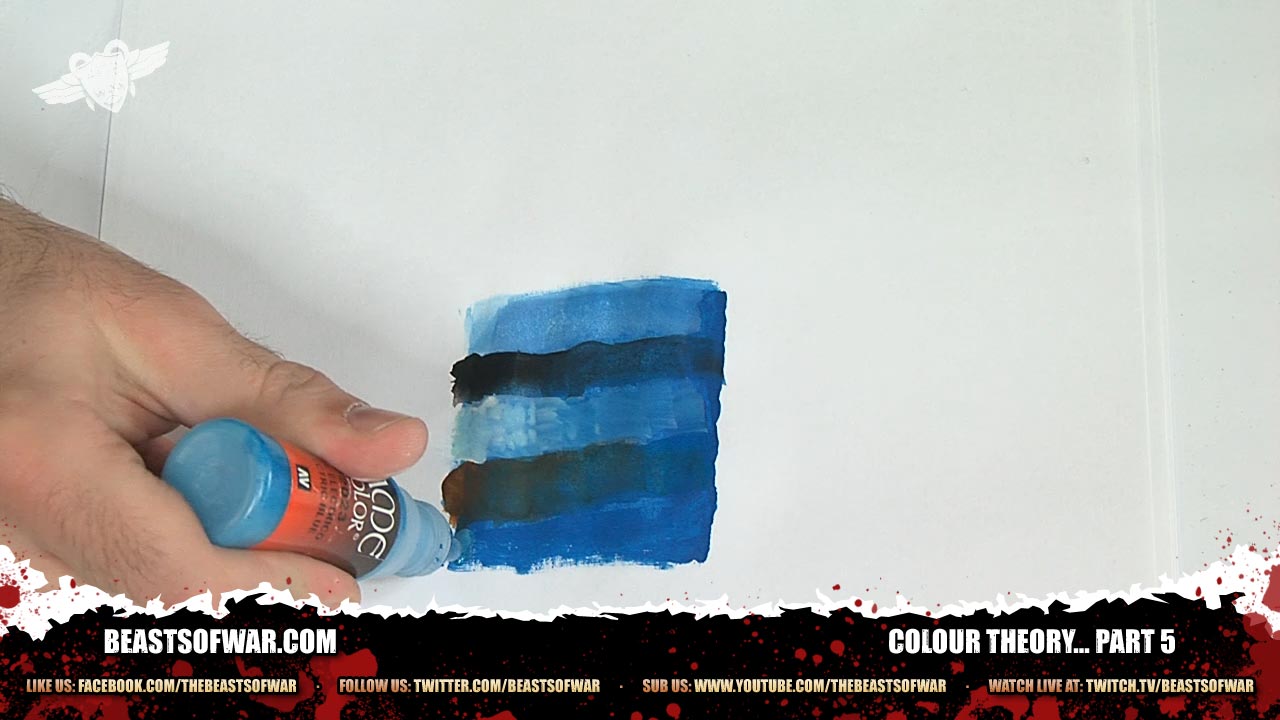
Romain continues his epic tutorial on colour theory.
See the whole series...
Supported by (Turn Off)

Supported by (Turn Off)
Supported by (Turn Off)



















This book is a good help for color mixing: [/img]
[img
Try again?
So a diorama of cowboys around a camp fire. You could paint most of them in dark colours, have the fire bright and the front under parts where the fires light hits the cowboys bright, close to white. Is that how it works?
Yes, it’s chiaroscuro…
You’d probably use yellowish and reddish hues, not white… The fire isn’t that bright, and it’s a warm light. The cow-boys would also be lit by starlight and moonlight, which is usually rather blue and cold.
I’ve told you a bit about harmony, and I’ll tell you about color temperature in part 6… That’ll be useful.
BoW Romain
Thank you, your videos on colour has helped me to rethink and look at what I’m painting in a more stable manner. What I mean is I’m going to make choices intentional not just out of a feeling that this will work. Over all most of us will be able to put this into practice with good results. At least thats what I believe 🙂
Great series Romain, thanks for sharing.
The human eye is mostly attracted to yellow, so i often paint something yellow if i need to draw attention to or away from 😉
True… But red is a more alarming color to the human instincts, so you get equally good results with a vivid red !
BoW Romain
What is the best way to tell if a paint is an actual change of hue, as opposed to a change of value / saturation? For example, the Scab Red, Red Gore, and Blood Red series of Reds in GW’s range. A change of hue seems to be the result of adding pure analogous colors or complimentary colors, rather than adding grey or white.
Are the GW foundation paints essentially desaturations of their color paints, whereas their color paints are closer to perfect Hues?
Reds in particular are tricky as they go pink when you add white which never seems right. The alternative is yellow, which goes orange, which works better but also doesn’t seem to be a true representation of how red highlights (change in perception based on the amount of light striking the surface) in nature. How do you deal with colors that, when using white as the additive to change value, seem to alter the hue so drastically that the result is just not right? Reds and Greens are good examples of this problem.
How does the orientation of light effect the choice of value manipulation. Assuming I am using a single source light, say a bright sun (effectively white light (5500K) at around 3pm, so roughly 45 degrees angle from the surface, directly facing the mini. Light striking directly – on the face / chest, front of the legs, will blend gradually, whereas light striking obliquely, say on the sides of the shoulders, will blend (change value) much more quickly?
I am thinking that because ‘pure’ value is really directly related to quantity of light (as apposed to quality – color temperature) it is important to emphasize that the most important factors that determine value are both the source and directionality of light. When you are working up your schemes on paper, what is a good way to visualize this?
Regarding GW foundation paints, I think you’re tackling this the wrong way… Whatever tone each one of them is, the difference between them and the “main” range or the washes isn’t saturation. Some may be saturated, some may be desaturated. Some may be brighter, some may be darker. I don’t think they all have a “normal” equivalent…
The difference is the type of pigment used, and the paint’s coverage. It’s another type fo paint, that’s all.
Depending on the highlight you need for reds, you can highlight with a lot of things… I’ve had good results with ivory, because it’s a very light yellow, and it is warm enough to avoid pink somewhat.
That said, sometimes, you do want pink…
My advice : go back to the start ! In my first “colro thoery” video, I advise you to observe real things… This is exactly why.
You’re asking me how to highlight red… I ask you : what is it you want to paint ? You’re not painting red, you’re painting a red cloth, of a certain hue. Try and find one, in nature or in a photograph, and see what color it truly is… See what color are the shadows and the highlights.
For all I know, the highlights could be pink, purple, blue, green, yellow, or puce…
There is no “one way” to paint one color, or one thing.
You are right in saying that orientation and position or light affects brightness manipulation… You always have to be aware of where your light comes from. Pushed to the extreme, this leads you to chiaroscuro effects, and very directed light (whether the source is on the miniature or just outside), or mere zenithal lighting.
By toying with the hue and the brightness of the highlights, you can have a light source any color you want, any size you want, and any direction you want lighting your miniature.
As for the way light behaves on things, let true light be your guide (this sounds like religion… it isn’t !) and go out : observe how sunlight plays on things. When in doubt, look at a photograph. I know of a miniature painter who used to do LARP, and photographed himself and friends in costume with different lighting (usually outdoors) to get a better idea of the lighting for his minis… A less extreme solution consists in finding photos online. There’s plenty of that !
I don’t usually work my schemes on paper, just in my head… I find a cool color, or color association, when I look at the miniature, and light follows naturally. I do like to determine the “true” color of a garment and have that as a base color, but it’s only valid for minis that are painted to be “daylight”… And it’s sometimes barely recognizeable under highlights and shadows.
A good way to vizualize light sources is to hold your miniature (preferably primed, because it’s more “legible”) close to a real light source… And check where the shadows are really cast ! Turn your mini this way and that, until you find the right lighting. Don’t hesitate to hold it to several different light sources, if you want… But for “simple” lights, with no effects, a lightbulb or the sun are enough.
I hope this explains things further…
BoW Romain