











First Captain America: Civil War Trailer Hits The Internet
November 25, 2015 by brennon


The first trailer for Captain America: Civil War has hit the internet and it has caused quite a bit of a storm. You can watch it above and then share your comments below...
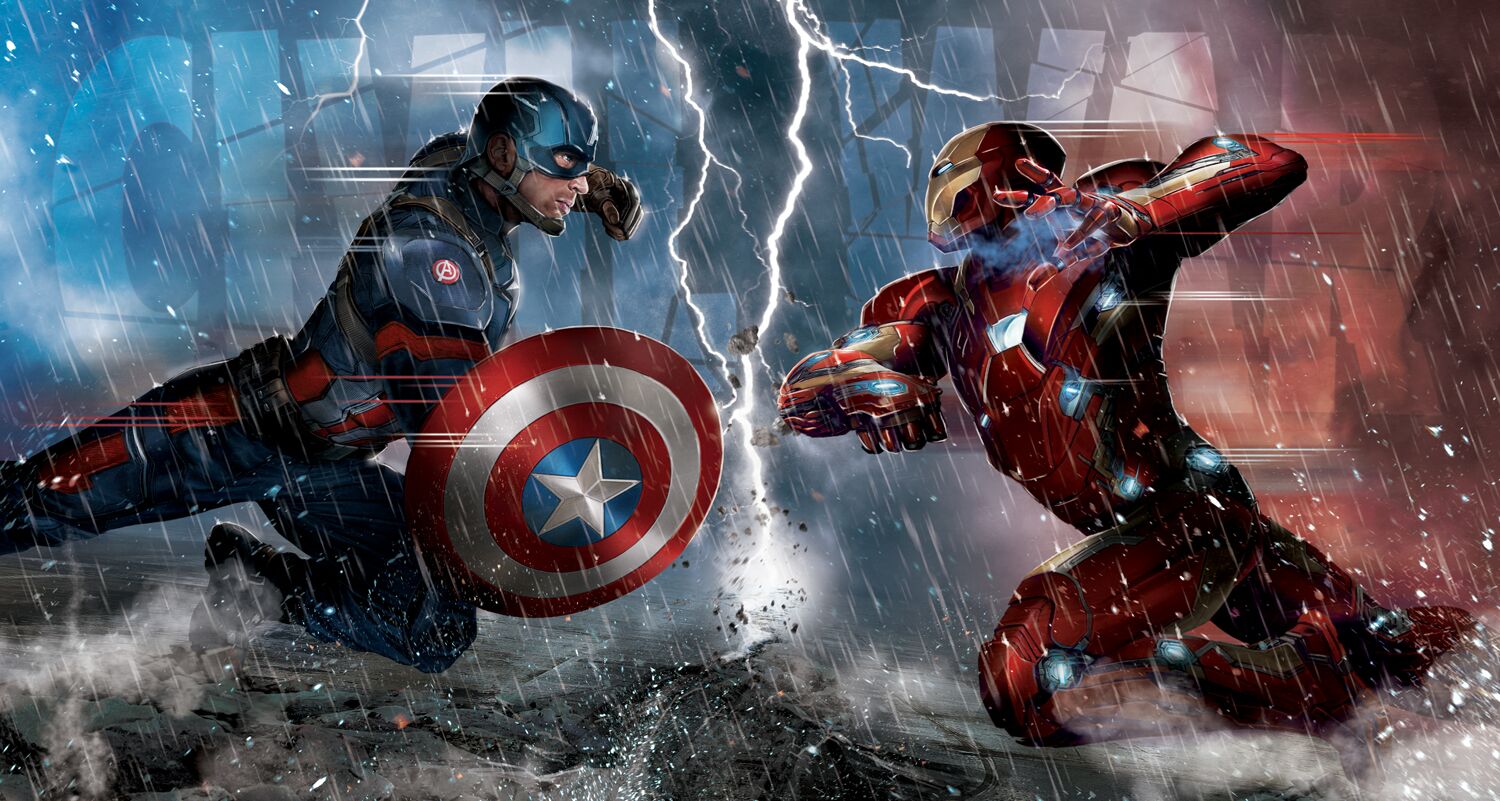
In the trailer we get to see the conflict between Captain America and Iron Man intensifying as they deal with Bucky, now Winter Soldier, after the events of the last film. We also got a sneaky look at one of the new characters, only for a moment, with Black Panther showing up.
It was also hinted that Spider-Man is going to appear in this movie at some point but I'm sure they are going to keep that under wraps for a while. The fight scenes look great and there's plenty of explosions plus it will no doubt get people talking about more 'who would win' scenarios for the next few years.
With Knight Models also planning to bring Marvel to the tabletop you might be able to play these fights out for yourself too soon.
What did you think of the trailer?
Supported by (Turn Off)

Supported by (Turn Off)
Supported by (Turn Off)





I assume that Spider-Man has been kept out of the trailer so that the Metro newspaper can spoil it on the day of release. BOOM! Also, please don’t let it lead to a One More Day movie…
That or lego, does an iron man 3….
Thank you for linking me to the legit one! The others I saw were… Less legit…
I am looking forward to this, I am wondering how it will all go down. I like to see that they kept cap as the guy on the anti registration side, and that he seems to be the good guy, because making out Iron Man to be the good guy when we’re meant surrender control for security, well that doesn’t seem like the good guy! I am really looking forward to it more than star wars even.
The comic book was published as Marvel’s big crossover event of 2006 and tapped into the real world debate at the time between security and civil liberties (in areas such as the Patriot Act). Neither man is intended to be the good guy or the bad guy, but rather representative of different sides of a difficult debate.
Just to expand a little on redben’s point, a critical plank of this story line is that both sides of this argument have merit – it is not a story of heroes versus villains, but of two sets of (on balance at least) good people who are divided by a pretty thorny ethical and ideological issue where there is no obvious bright line between the right and wrong answer.
As you say, Cap is very much of the opinion that individual freedom cannot be sacrificed for security, and feels that it is wrong that people should be under the scrutiny and control of the government not for what they have done, but for who they are and what they might be capable of doing one day. He feels that the government is not necessarily a safe enough pair of hands to hold such power. All of this strikes a chord with many people and resonates with much recent history; the concerns embodied by that character are all legitimate and echo real world issues of the proper balance between personal freedom and collective security.
At the same time, Iron Man represents an equally fundamental question, one of democratic accountability that can be expressed in a form of words familiar from an unrelated by highly revered comic franchise; who watches the watchmen?
You have these individuals of exceptional power and ability who have set themselves up as the protectors of the planet. They are terribly heroic and all, but they were brought together by a high ranking operative of a covert intelligence agency who didn’t even have the authority of his own organisation, acting without the support of the other Shield Council members, and that organisation itself was subsequently discovered to be fatally compromised.
Imagine how we would feel if a senior spook in the NSA, CIA, or MI5 just turned around one day and announced that they had taken it upon themselves to create and unleash a ‘contingency team’ equipped with next generation military technology unlike anything seen before (don’t worry about funding, where the tech comes from, or other practicalities – just run with the idea) in order to ‘maintain peace and security around the world’ without any civilian oversight and indeed without actually bothering to consult anyone first, including their own government? Imagine if then the organisation that person worked for transpired to secretly have been extensively infiltrated by neo-nazis. Serious questions would have to be asked about how this happened and if this organisation, or the team it created, has any legitimate authority to act at all. Just determining what the team’s status under domestic and international law would be at all would be headache.
Now further imagine that one of those operatives turned around and essentially said “states and democratically elected governments can’t put limits on me and my team because that undermines our freedom. We have the power to unleash mass devastation but that is OK because we are the good guys. You know that because we fought the bad guys, and nobody who fights your enemy could ever be a threat to you in their turn, right? When has that ever happened in history…? Oh, and you can’t arrest this multiple murder and known terrorist because he is my buddy. It wasn’t really his fault – he was brainwashed into doing it but he is better now. I have no proof or anything, just trust me. You know you can trust the guy who works entirely outside the democratic system of accountability and military chain of command, and about whom you don’t actually know very much at all – what could possibly go wrong?”
This movie’s plot line addresses the point that the Avengers run around unleashing large scale destruction in the name of saving humanity without even a smidgen of an actual legal or democratic mandate to do so. Calling yourselves ‘the Earth’s mightiest heroes’ doesn’t just afford you carte blanche to do whatever it is you believe you need to without reckoning the consequences, and Tony knows that better than most after Age of Ultron when his own intellectual vanity, tendency toward taking risky short cuts, and desperate need for control unleashed a major threat upon the world.
The point Tony represents here is that individual freedom must stop at the point when it starts to impinge upon the freedom of others, and when you possess the kind of power the Avengers are depicted as having, paired with the willingness to use that power at your own discretion while deferring to no other authority, your actions will inevitably impinge upon the freedoms of others, and if you refuse to acknowledge that or accept any limits upon your range of action then you start to look less and less like the noble hero and more and more like a fairly villainous type who in practical terms lives by a ‘might makes right’ philosophy even if you don’t openly espouse one. At the very least it gives people an entirely legitimate basis on which to question your agenda.
Again, these are valid points that relate back to contemporary concerns about the ways in which security is provided and the powers we confer upon covert organisations to protect us from threats that we are largely left in ignorance of.
While it may be easier to empathise with Cap’s point of view out of the gate than Tony’s – mostly because it fits more easily into our dominant social narrative that places a high premium upon personal autonomy and venerates the idea of the hero as a moral paragon taking on the corrupt system – when you think about it for a bit both perspectives are wholly valid (the lone hero following their own flawless conscience can easily also be read as the rouge operative taking it upon themselves to make decisions for all with no right to do so, depending upon context), which offers a very interesting and promising set up for the movie.
I know the story I know it well, I also know what Ben Franklin said.
“Those Who Sacrifice Liberty For Security Deserve Neither.”
He wrote “Those who would give up essential Liberty, to purchase a little temporary Safety, deserve neither Liberty nor Safety.”, was misquoted slightly on the Statue of Liberty, and rather more misquoted since. Both that and personal feelings on liberty vs security are an aside as to whom Civil War (the movie) presents as the ‘good guy’. The point was only that the comic presented neither as the good guy, so my expectation is the film would follow suit.
Again following on from redben, the problem with the formulation of the misquote “Those Who Sacrifice Liberty For Security Deserve Neither” is that it eliminates vital nuance from Franklin’s original truism – giving up essential liberty for temporary safety is the problem, because that leads to a steady erosion of fundamental freedom, but striking some kind of balance between liberty and freedom is absolutely essential; indeed it is the true art of civilisation.
Any organised culture inevitably involves the sacrifice of some personal liberty for security, because the only total freedom is necessarily an utterly anarchic freedom – a ‘state of nature’ where each individual is totally free to do anything, including depriving others of their freedom or their very lives. A total freedom is the freedom to kill, to rape, to oppress, to enslave, to brutalize, to steal – all at will. Such freedom can only exist without any form of legal recourse, and indeed without any form of law whatsoever, and thus with no certainty. The most powerful and ruthless wield total, unaccountable power within their (metaphorical) sword’s reach, and the outcome depends solely upon their personality and values (and people who are ruthless enough to seize power in blood are rarely of what you would call high moral character), at least until someone stronger comes along.
The only way any practicable social system can exist is because most of us agree to sacrifice some of that unfettered freedom in order to be able to sleep in our beds at night and be reasonably confident that no one will have slit our throats before we wake. Franklin certainly understood that, as his original quote demonstrates.
The corrupted version makes for a better soundbite but, like many snappy soundbites, is ultimately somewhat intellectually vacuous.
To reach some kind of conclusion before anybody unfortunate enough to be reading all this this falls asleep from boredom, the point still stands that Tony is not automatically the ‘bad guy’ here because he feels that super heroes need to be regulated – that some kind of credible balance between freedom and security must be found is clear; the movie invites the audience to ask where that balance should fall, and casts Cap and Tony as advocates for two different, but both still reasonable given the circumstances depicted, answers to that question.
The film isn’t trying to spoon feed anyone easy answers because there isn’t an easy answer to this question – the whole point is to make you think.
Whilst a reader may reasonably imagine that Franklin, as one of the Founding Fathers, wrote this in a great tract on the importance of freedom, it was actually just an aside in a letter to the Pennsylvania governor about a bill to raise funds for the protection of frontiersmen during the French & Indian War, and in fact meant pretty much the opposite of what people think it means. The governor kept rejecting bills which would tax the Penn family who in turn tried to buy off attempts to tax them. The ‘temporary safety’ was that which the Penn’s payoff would have bought. The ‘essential liberty’ was that of the frontiersmen to defend themselves with the funds the taxes would have raised. Franklin was arguing that the legislature had the right to tax anyone to raise funds.
Interesting stuff redben, and just the sort of historical quirk that often accompanies great sayings that were actually uttered or written (bearing in mind that a great many either were never said by the people they are attributed to, or cannot be proven to have been said by them – as an example Mahatma Gandhi never said “Be the change you wish to see in the world”, and there is no poof that Einstein ever uttered the phrase “Two things are infinite: the universe and human stupidity; and I’m not sure about the universe.”).
Often, as in this case, a great saying only truly acquires its resonance and cultural significance some considerable time after it was originally said, and only after it has been stripped of its original context and applied to another, often only tangentially related one.
I know there’s some Marvel fatigue out there but I’m happy to say that I’m not feeling any myself. I am, however, totally feeling this. Thanks for the link 😀
I think this will be a very relevant movie as it touches on the broad views of left vs. right.
I’m feeling Marvel fatigue myself. I think such a story arc deserves much more than just one fight-fest film, considering the source material (just like Ultron did, alas !)… I think it could be good or terrible. I wish it wouldn’t include any reference to the whole “infinity stones” thing, and i’d be very happy if some of the characters they introduced (fake Ant-Man, which i will continue calling that because it’s not Hank Pym, and the Vision, which I don’t like) weren’t in it. That being said, I am anticipating the Doctor Strange movie, which CAN legitimately introduce something about the Infinity Stones, for once !
True enough. I’m no fan of fake Ant-Man myself, and while I’m sure the effects of Civil War will be felt in the future movies, it is a shame that they will shoehorn so much of it into this one (or worse, chop up the original Civil War so much that what you have left is exactly enough for one movie).
Personally I’m really interested in the Captain Marvel movie. It’s either going to be awesome or very, very bad 😀
If nothing else it’ll help keep the TM away from DC lol
Yup definitely feeling the fatigue myself, that said the premise is a solid one, doubt will go and see it at the cinema but is this still meant to be bookending the cap and iron man story arcs? If so it will probably end in mutual destruction. Interesting to see how they handle the ensemble films following this one, will we end up with east and west coast avengers, or will they keep it simple and carry on ignoring the glaring holes left by lack of xmen in the line up?
I mean if spidey may be making a cameo (my guess to replace ironman in subsequent avenger films) maybe fox will decide they would like to make some money off the marvel pie and let the xmen be licensed as well if that’s successful…
Inspite of all the fatigue im looking forward to the inevitable phase 1, 2 & 3 box set, which would be a nice collection, hopefully as one combined big box instead of 3 separate boxen.
I like that they don’t seem to be following the story of the Civil War comics too closely, but are instead taking the basic concept, which was a good idea, and going in a different direction.
The Civil War comics had a lot of potential, but in my opinion it got wasted on characters behaving against their established nature and pointless shock moments. Really do not like those ones, despite them having some good moments.
looks good, so even superhero’s can’t make their mind up on who is what.
never read the graphic novel its based on.
didn’t think much of the editing of that trailer – black screen cuts every few seconds :/
looks really good and I’m not a Marvel fan and I think this looks good
I wonder if the movie will end like the comic series did? No spoilers but if you know the comic you know what i mean.
This trailer was the pinnacle of boredom for me…..
I wouldn’t go that far, but I see what you mean… more CGI pokemon fights…
Speaking as a kid of the 90s, CGI pokemon fights sound amazing.
Digimon always had the better fights….
Well I’m glad to see they’re largely ditching the comic plot for Civil War. Because it wasn’t that great, and movies are even less forgiving than comic books on storytelling.
Great!)