








![1918 Spring Offensive Wargame | Full Rules Overview with John & Gerry (WW1 Tabletop Game) [7 Days Early Access]](https://images.beastsofwar.com/2026/03/unboxing-warfulcrum-games-1918-spring-offensive-review-coverimage1-225-127.jpeg)
Weekender XLBS: The Rise Of Skirmish Games
September 8, 2019 by crew



For some website features, you will need a FREE account and for some others, you will need to join the Cult of Games.
Or if you have already joined the Cult of Games Log in now
What difference will having a FREE account make?
Setting up a Free account with OnTableTop unlocks a load of additional features and content (see below). You can then get involved with our Tabletop Gaming community, we are very helpful and keen to hear what you have to say. So Join Us Now!
Free Account Includes
- Creating your own project blogs.
- Rating and reviewing games using our innovative system.
- Commenting and ability to upvote.
- Posting in the forums.
- Unlocking of Achivments and collectin hobby xp
- Ability to add places like clubs and stores to our gaming database.
- Follow games, recommend games, use wishlist and mark what games you own.
- You will be able to add friends to your account.
What's the Cult of Games?
Once you have made a free account you can support the community by joing the Cult of Games. Joining the Cult allows you to use even more parts of the site and access to extra content. Check out some of the extra features below.
Cult of Games Membership Includes
- Reduced ads, for a better browsing experience (feature can be turned on or off in your profile).
- Access to The Cult of Games XLBS Sunday Show.
- Extra hobby videos about painting, terrain building etc.
- Exclusive interviews with the best game designers etc.
- Behind the scenes studio VLogs.
- Access to our live stream archives.
- Early access to our event tickets.
- Access to the CoG Greenroom.
- Access to the CoG Chamber of Commerce.
- Access the CoG Bazarr Trading Forum.
- Create and Edit Records for Games, Companies and Professionals.
Supported by (Turn Off)

Supported by (Turn Off)
Supported by (Turn Off)


![StarCraft Tabletop Miniatures Game Pre-Orders Live Now [Updated]](https://images.beastsofwar.com/2026/03/starcraft-tmg-news-cover-600-338.jpg)
![Mounted US Cavalry On Kickstarter For Dead Man’s Hand! [Updated]](https://images.beastsofwar.com/2026/03/us-cavalry-main-600-338.jpg)
Morning all, Happy Sunday, stayed up for my Korea ticket!!!
Happy Sunday Brothers and Sisters of CoG!
It’s the XLBS Show.
As to the question of the day, “What do you think about the divide between skirmish and mass battle games in contemporary wargaming?”
I think it comes down to the fact that a lot of folks just don’t think that they have time for a full sized battle any more.
Happy Sunday!!
Happy Sunday!
Happy Sunday!
I would argue that it is competition that is driving the proliferation of smaller model count games and the bigger players in the industry are using them as a way to bring people into their mass battle games as that is where the big juicy profits are.
Content suggestion – Ryan and Gerry sitting in front of a roaring fire, clad in a smoking jacket and fez, pipes in one hand, expensive alcohol in the other philosophising over games and their meaning. Something a little high brow for the discerning cultist.
I would watch that…….religiously! 🙂
Ohhhhhh don’t tempt us!!
When time and resources are limited small scale skirmish is the way to go.
Assembling and painting a dozen figures is something that looks manageable to those new to the hobby.
Even the inexperienced can assemble a dozen figures in a few hobby weekends and have something that can be played.
Systems like Guild ball with pre-assembled teams are even faster to get started.
Mass battle systems with 50+ figures per army are a mountain of plastic/metal/resin.
You need to plan and break it down in byte sized bits or else you’ll feel overwhelmed.
I think things like the ‘slow grow league’ that Battlefront is promoting for Flames of War give people a chance to get started with games that require larger armies in a way that doesn’t scare the crap out of you.
When Ryan mentioned the colour game the first thing I thought of was the Simon game.
My question would be exactly what is a skirmish game? Is it the number of figures on the table and speed of play or is it that each figure in the case of games Bolt Action and 40k has an individual profile or is there any real difference between between so called mass battle and skirmish as each base is still just a footprint on the table and you can have that represent anything you want
Can we blame marketing departments of GW and other companies for muddling that concept ?
Part of the problem is that there is no real word to describe the format between ‘small team skirmish’ (about a dozen models, which could have names) and mass combat (waterloo style formations with hundreds of figures and a ratio of 1 model = x units).
These days the only difference between ‘mass battle’ and ‘skirmish’ is that the former has formations and the latter does not.
Happy Sunday
“Skirmish, why so many?”
You’re probably all right really. Time, money and effort poor. That usually sways me towards the lower model count of skirmish games.
One thing to consider. I wonder what impact Warhammer: End Times had on the mass battle scene, outside the historical gaming player base. Speaking for myself, I haven’t jumped into a mass battle game since the old world blew up. I enjoyed them game, yeah I can still play it but I’m not likely to start a new one. There’s a little trepidation in the back of my mind thinking “If this game doesn’t kick off, I’m left with large units of identical, or close enough to, models and nothing to do with them,”
There might be a touch of buyers doubt going into a large game system. At least from a casual gamers view.
Then from a manufacturers view point, they may think “If GW couldn’t pull it off, what hope do we have?”. Might be too much of a financial risk upfront.
Happy Sunday!!
Took a look at the FoW D-Day Germans release page yesterday… Let’s just say it isn’t a light read and not the product focussed launch I’d expected.
For club evenings and organised play, the snappy set-up, deployment and gameplay from a skirmish system means more rounds. With most, once you’re up to speed you can easily get a game done in 2-3 hours (and watch the 40k boards struggle to get to mid-turn 3 so have to call a result from an unfinished game)
I also think the low model count helps 2 ways.
1) you aren’t confronted by the dreaded chain paint of 20 almost identical minis for one unit. In skirmish a model is a unit and 5-8 models typically a force.
2) that won’t stop the collector in you picking up multiple models over time and even starting on multiple factions from the outset.
A skirmish game also can have that sense of compactness, like a board game, that allows you to put it on the shelf. Both in terms of storage space, but also in terms of being able to quickly whip it out after a few months if you fancy playing something slightly different.
The fact that GW saw the writing on the wall and have successfully been releasing box after box of boardgame like, skirmish versions of 40k and AoS is very telling about the gamer of today.
Mass battle games at 28mm? – no thanks.
15mm or less? Yes please!
I never considered the idea that scale plays a part in massed combat appeal but I think you may be right.
When I saw Gerrt’s 15mm Saga Warband/Army I instantly wanted to do one. I like Bolt Action, but love the look of FoW. It broke my heart to find out Konflict ’47 was originally done in 15mm.
I tend to agree. The first time I went to Adepticon and walked the through the 40k hall, I noted that every table was jammed full of flyers and heavy armor. I was very much turned off by this as having 3-4 heavy tanks on each side 3 feet apart made no sense to me. At here was no room for them to maneuver and I could not imagine how that would ever get that close to each other. I think for me at least for 28mm, skirmish makes more sense.
Consumerism in so many different areas of our lives is increasingly based upon convenience. Let’s consider an analog.
My mother prepared many family meals in her life. Each meal required a recipe (either written or learnt and adapted) and a number of ingredients and equipment (utensils, pans and cooker). At no point in her early life did she have the convenience of being able to buy a ‘ready meal’. Nowadays convenience foods (ready meals or even take-aways) are almost the norm.
The ‘traditional’ historic gamer will accumulate dice, terrain, mats/boards (equipment), buy or develop their own ruleset (recipe) and individually source, acquire and prepare their models (reusable ingredients).
To pick up on Ryan’s definitions, that type of gamer obtains satisfaction and therefore value from those aspects of our hobby that many CoGgers listening to this discussion can appreciate – researching, collecting and preparing their collection of ‘games as objects’ with the later potential of achieving value from ‘games as an experience’. This is a limited marketplace.
The broader, more commercially viable, marketplace is the ‘convenience food’ gamer who either just wants to buy everything they need to get to the experience in a box (ready meal) even better if it’s pre-painted!
Can we then bring in the explosion in boardgames and then the boardgame cafe? Why even buy the box when you can just buy the experience.
By extension can we imagine a day when customers want to rock up at the Experience Centre (interesting name) and rent your models and equipment to play, maybe paying extra for a host to teach and supervise the gameplay?
I predict this will be a valid business model if it isn’t already. Just think what commercial potential lies in those racks and racks of models.
I really enjoyed the D-Day Launch, glad to see it wasn’t just “here’s the 7 new German boxes, thank you and goodnight” lot of great content on it as well as the product showcase.
Yup, I am going back to read more this morning and my morning coffee was accompanied by reading about the Puma in Normandy!
I’m sure I’ll get to enjoy it more when I get the time ;-}
Loved it guys.
Regards skirmish games I often hear the time poor argument. I do wonder about the validity of that argument only because 30 years ago I was spending hours planning, painting and playing wargames. I met my wife, had a family, blah, blah and became time poor. Surely there was a generation of single men after me that took my place? What are they doing with their spare time? I’d hate to think all wargamers are 35+ years old and we were the last generation.
Another point that gets brought up is that they are ‘Gateway games’. The rationale is that you buy a skirmish game in the IP. You love it so much that you think about playing with greater numbers. Mantic certainly followed this strategy with Deadzone and Warpath, and now Vangard and Kings of War. GW previously seemed to fly in the face of this, producing skirmish games that had rule sets nothing like the larger scale games (eg Necromunda, Space Hulk, GorkaMorka, Space Crusade, Burning of Prospero, Betrayal at Calth, Lost Patrol, Stormcloud Attack, Overkill, Assassinorium, etc – all in the 40K IP but not with 40K compatible rules. More recently they seem to have decided to change that strategy, for instance including 40K data cards in Blackstone Fortress and Kill Team Rogue Trader, and the same for AoS and Shadespire.
Recently I’ve watched historical games move to the skirmish format even if they are ‘rank and flank’ era. Sharpe’s practice set in the Napoleonic era, Saga in the age of shield wars, SPQR in the era of phalanxs, legions and massed combat.Even Hail Caesar has a skirmish version (admittedly set in the Viking Age).
I doubt it is the death of massed combat games either. 40K and AoS are still GW’s main games. They aren’t rank and flank, but they aren’t small scale either.
Anyway, food for thought.
I’d say 20 years ago I was doing the same as you: thinking/planning playing etc. Back then though we didn’t have: a real internet (BBS’s though), Social Media out the wazoo, Netflix and all the other streaming services. I’d say there’s more competition now for our attention than ever before.
Skirmishers are easier and faster to set up, I’m working fulltime, usually 50-80 hours. I stick mainly with the GW games because that is available everywhere. I do have several other Game systems, which I actually like more, but 3/4 are out of print or so obscure that maybe 2-3 people besides me in Ireland play them.
I’ve been playing for 25+ Years Miniature games, and nowadays I’m if I get to play at all, it as to be due to time a skirmisher and due to player availability it is GW Games.
Also, no kids involved here, just growing up and having a demanding job to afford all this plastic crack. 😛
Happy Sunday my fellow CoG´s
Warren: STL File please, these Tokenholder is totaly handy, i need them.
In case of Skirmish games: My hobby background began with RPGs, so I like the experience of narrativ character driven storytelling. So for me I love all the Skirmish games revolving around that topic.
Another option for home made tokens are ‘acrylic coin holders’ of various sizes together with a suitable size round card punch. Some interesting options on Amazon including presentation/storage cases.
Yes… but I have some 3D printers here ^^
One for Ryan regards Entropy – could the reason it’s not currently in print be that another game has come out in the last few years with the same name? One that’s on it’s second edition since the first Kickstarter in 2015?
https://www.kickstarter.com/projects/chaoticpattern/entropy-thematic-fast-paced-game-of-risk-and-decep/description
https://www.kickstarter.com/projects/chaoticpattern/entropy-worlds-collide/description
Lack of space, expense of miniatures, increase in the level of quality of miniature that consumers expect, less leisure time or more competition for leisure time, less patience and ability to concentrate until you’ve painted 100 redcoats or pikemen, war films taking a more personal viewpoint, of the squad not the generals, kickstarter and CAD and Chinese manufacturing making it more accessible to create a whole game with minis not just a two colour leaflet of rules.
All reasons for rise of skirmish games. At some point the pendulum will shift back as people will value having painted 200 orcs in the same colour scheme more than staying on the Kickstarter chain or having 10 expensive 10 man forces or factions for multiple games.
I think you have to few the rise of skirmish games from two points that go hand in hand.
The consumers and the companies.
I will start with the consumers as I think that will be easier and will lead to the companies.
The biggest thing that I notice today is that people always have a lack of time.
So if they play games they will rather choose one that will go faster and that they don’t have to put a lot of time in.
Which lead to skirmish games as these don’t take that much time (playing, painting,…) compared to mass war games.
What I also notice is that they don’t stick with one type of gaming, most gamers I know also play on there phone, PC and console leading to less time they want to put into painting and preparing.
The other point is price.
Because people want to do a lot of different things (traveling, going out,…) and have a lot of different things they want (smart phone, big TV, …) they don’t want to invest that much in to big games, even some small games can be a problem for some.
As an example: I met one of my friends (single guy living alone) a while ago in the local hobby store. He told me he got into miniature gaming through a friend and they have started playing kill team. He also said they were looking to start warcry and he will have one group for each game. He bought the getting started set for 40k and he already said that he had models he didn’t need but that the kit was a good price. I hinted that he could go 40k later but that didn’t interest him as he would have to paint to many models for a whole army and he didn’t want to invest that much money in it. He also said that miniature gaming is still pretty daunting to him with all the rules, assembly and painting he has to do.
For the companies:
I can imagine that if you start a new game that it is a big investment if you want to do 28mm war game (design, rules, production, …). If you at least want to offer a variety of armies from the start, also depending on what type of genre (sci-fi, fanatsy, historical).
That it is easier to start from a skirmish game where you don’t have to start with so much for one group. Also if the people are asking for short less time consuming games why make a big war game that might not get sold. They can still develop it later to a war game if they like. As I think what happened with warhammer (a bit before my time but others might confirm).
Then it is also the matter of what your competitors are doing if they are all making skirmish games that are getting sold and you sitting there with your mass battle game on the shelf it might be time to jump on that boat as well.
And then there is the overall view of the people but then you have to look at so much and here the majority mostly rule what is in or out.
Thanks @avernos!! I always wondered why Obelix had his belt around his chest with his big blue and white striped pants… now I understand!
Hang on… @warzan wanted a cosplay inspiration…
Jamestown VA is a fairly small town; you may want to expand your call to neighbouring areas like Williamsburg VA or even Richmond VA.
you know it had never even occurred to me, but that’s probably why they did it. As silly and funny as they were there was a definite basis in reality to the Asterix comics. Clearly the writer was a fan of the period
This XLBS left me with more questions than answers really and was a real hodgepodge of information. You guys seemed to go at this piecemeal. I agree with what @torros mentioned in his post about airing what you deem to be a skirmish game. Gerry stating that the Rorkes Drift game was a skirmish game was surprising to me because of my concept of what that game type is which would be a mass battle game of a historical skirmish.
I think the keyword or subject matter needs to be kicked around in conversation more prior to the question posed being discussed. The teams perception and then that of the community in the following comments could then be weighed and measured to get a feel of the overall response.
I agree with a lot of what was discussed as to the reasons why but truly believe that it is a collection of truths that have led to an increase in smaller model count game releases.
Without having pinned down what a skirmish game is I am unsure if all the games and companies you were talking about even qualify.
It seemed that rank and file ended up being the main example of a mass battle game. Again this may not be the case but came across that way to me.
All in all lower model count games are economically better to throw out there due to time and money invested, be they for the established or crowdfunding based and few companies have the backing, deep pockets or management willing to take a risk on a large investment when a small one will do. It’s just good business and after all, there is nothing stopping you from adding to a successful skirmish game later.
that’s probably my fault, I still use the historical version of skirmish, anything that isn’t a formed unit based system is skirmish regardless of number of elements.
Yup I was going by if it’s not rank and file it’s skirmish.
I’d love some tighter definitions though as a discussion like this really would benefit from them 🙂
I propose FLP for big games – Fuck Loads to Paint. WCM for small games – Wife Controls my Money. Easy!
I think it’s more about the style of the rules rather than the number of figures on a base or how there based. Gerry mentioned Blucher so if you have 9 60×60mm bases (I maybe confusing the base sizes with Grande Armee) you are playing a Napoleonics game with 3 divisions under your command
Agreed it’s a tough one buddy, I think part of it may be how they move and see. Skirmish in my mind tends to mean minis who have a 360 LoS and have a loose formation. It’s really tough to set parameters to allow us to specify a skirmish game due to their diversity of rules and options in their game systems.
Agreed maybe we could poll the community on some of these subjects. Discuss them in the Weekender or Points of View then select from the discussion and comments a number of responses for a poll.
A lot of people will likely have an opinion but not comment. Maybe they would share their opinion if all they had to do was select an option from a poll.
So essentially are we saying it’s based on how the units are deployed i.e. as a unit on a single base/footprint.
I think we do imagine skirmishers to be single minis as part of a unit in a loose formation.
Makes the Apocalypse movement trays a chuckle factor though 😀
I base it on how they were used, skirmishers were the light troops that scouted or protected the flanks of formed units and remained so up to the 19th Century. I’ve never really gotten out of the habit of referring to them as such.
But people who don’t pay attention to that style of warfare have come to think of a skirmish game as a very small group of miniatures.
Both terms are correct, I suppose it comes down to the definition that people first attribute to the word as to how they think of it
Yeah, that’s where my mind goes most of the time when people say the term. Problems start when times changed and most or all infantry became lightly armoured and tactics changed to none formed rank formations.
Maye it would be better to define the criteria of a mass battle game and let everything else be a skirmish or we may need to just not try and fit games into such stereotypes of games.
I would define a skirmish game as one that doesn’t have a unit cohesion mechanic – i.e. every model moves around independently. e.g. Mordheim, Necormunda.
Games where units of multiple models move around together are “mass battle”. e.g. Age of Sigmar, Saga
If those models are touching and ranked up it becomes a “rank and flank” game. e.g. Warhammer Fantasy Battles
@danlee I like that approach buddy, be interesting to see if anyone responds with a reason not to do it that way.
Yeah I think the problem is we say ‘Skirmish’ but what we mean is ‘Warband’, Even in ‘Skirmish’ games like SPQR we have phalanxes and infantry forming up into ranks.
Well I’d go with Skirmish is where 1 model represents 1 man. Most historical mass battle systems use a figure ratio to represent soldiers on the field (so 1 model represents 20 men is common or 50 men if it’s a “grand scale” battle). The number of models doesn’t determine if it’s skirmish (hence Gerry’s Rouke’s Drift can have hundreds of figures and still be skirmish as it’s 1 figure represents 1 man).
Another good discussion today. I think the discussion around what is a game was interesting. I agree with Gerry on this, a rule set is still a game the difference is wether or not that rule set has its own ecosystem. For instance a GW game does, there are the rules, miniatures, paint and terrain for that game and generally,especially in the case of 40k you can’t get alternative miniatures from elsewhere for many of the factions. Other examples will include Warmachine, The Walking Dead and Infinity though not to extent that a GW game is.
The reasons why I switched from rank and file games to skirmish were several, tine constraints, i simply didn’t have the time to paint large armies plus I was fed up of doing so as well. Another was I could buy into a new skirmish game for a much smaller cost, sonetimes I’d only need to buy the rule book. Painting warbands/skirmish factions meant I can spend more time on the miniatures, and I was no longer enjoying the process of batch painting. One of the big reasons was I could spread my hobby into different genres and games more easily, especially with limited space in the house. Though that is about to change as I’m converting the garage into a gaming/hobby space.
For many folk it will be limited time ,space and money.
Gerry is the Johnathon Pie of OTT, always spot on with comments like ‘PEOPLE ARE FICKLE’ LOL
I also rant angrily between the takes 😉
Yet again, another great show.
In the main topic, I am a huge fan of mass-battle games. The look of all the minis ranked up in formations. Depending on the period, dozens of huge flags and banners, the uniform colours etc etc. However, for easy of model storage, I am a fan of skirmish games as well. For me, skirmish is a case of necessity and ease, however, money and space being no object, I would be playing mass-battle games as the majority.
I think I am going to have to wade in with the conversation as well, and agree with Gerry and disagree with Warren. I think the rules are much more an aspect of the game. I do understand Warrens point about the minis etc, but you can still play a game of 40k using only the Main rulebook and the codex. All the minis can be Tiddlywinks but the essense of the game is still there. Its similar to Football. You can watch a Sunday League match in a local park between two local teams who work Monday to Friday 9-5 in the local factories, or watch the World Cup final. The rules are the same. The “minis” are different but its still the same game. (If I got the wrong end of the stick, I apologise and can obviously edit/reclarify).
I think with GW having such a commanding influence within the hobby, people do expect rules to be made with accompanying minis, but I remember a time when the majority of the hobby companies had a divide. Ones on this side made rules, ones on that side made minis. I can understand game designers making minis to go along with their rules, but personally, I have no issues playing people who have minis from alternate companies, just so long as it is clear what the mini is (not even to the level of a proxy mini, just alternate pose/sculpt/etc)
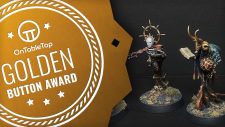
Big congrats to the Golden Button winners. Really nice work!
For many years I play rank and file games and no other type. I had amassed 7000pts Dark Angels, 4000 pts Blood Angels, 2500 pts Empire, a large Napoleonis British Army then I played Mordhiem. After one game I was convinced skirmish was the way to go. I got rid of my armies to fund a plethora of skirmishes games.
I have no intention of playing large scale again, I was tempted to build and play Ancient Greeks mass battle as I had a itch to play a Greek States campaign. Then Mortal Gods and SPQR came along and I realused I don’t need to build large armies to play Ancient Greek. I opted for SPQR as I could play other armies and periods within the ancient world.
HI Warren have you thought of selling your token rings would work for several game systems
Dane
Happy Sunday, personally for me i love the site of massed minis on the table but i also enjoy skirmish but being a predominate solo player of games due to no choice a skirmish game can be easier to play , set up and put away at the end of the day.
For the first 10 minutes I really thought this conversation was completely going to miss the point as there are so many rulesets being produced for mass battle games both historical and fantasy/sci-fi. Luckily Gerry brings a much wider perspective to the discussion. Ryans input was very insightful as well.
Great Show guys.
I feel like we need to differentiate between a “Skirmish Game” and a “Warband Game”.
To me a “Skirmish Game” is something like Lord of the Rings, Bolt Action, Chain of Command, SPQR that level of games. Pretty much anything more than a dozen minis up to about 100-120.
A “Warband Game” is something like Kill Team or Dead Man’s Hand or Malifaux.
They’re very different games, the Warband games tend to be the “Pump and Dump” type games were as Skirmish games tend to be more stable.
Sharp Practice and Chain of Command are two of the best games on the Market and I think that them being purely focused on the game only makes it better. Rich and Co. don’t need to worry about making or selling minis they can spend 100% of that time working on their game.
What’s a major issue with GW? Power Creep. The new stuff is always the best stuff, the cool new minis get the cool rules and the minis sales drive the way the game plays. That sacrifices the game play to sell minis and in my opinion makes the games worse.
I don’t understand the lack of time thing. Why keep buying new games if you have such limited time? Buy 1 or 2 Kill Teams, paint them up then leave them. Don’t keep buying the new thing every week instead buy a box of Napoleonic French or Space Marines or Romans or Elves and finish them one hour at a time over a month and then buy another box and after a year or two you’ll have a brand new large Army and you’ve still got your Kill Teams on the Shelf. I think it’s not about people not having time but people not using their time “wisely” although there’s nothing wrong with it if people want to go that way. Maybe don’t get Aeronautica and instead buy a box or two of Space Marines and paint them up over the next month one hour at a time, you can still play your existing Kill Team or Shadespire as you build those Marines.
As far as there not being Sci-Fi rank and flank games well how would you even do that? The style of warfare just isn’t fought that way.
Take a Look at an American Civil War Wargaming table laid out, look at a Napoleonic table or a mass game of 40k. Now look at a Malifaux gang, there’s a totally different ambience to the game and me personally I much prefer the large Rank and Flank stuff despite being a mostly Skirmish wargamer.
I guess I’m just one of that minority of young wargamers who get inspired by History books 🙂 I defy anyone to read the fantastic Brendan Simms book “Longest Afternoon” and not want to start wargaming Le Haye Sainte (read it it’s a short book) or Hans Von Luck’s “Panzer Commander” and not want to start wargaming his career from the invasion of Poland to France to Russia to North Africa to France then back to Russia where he was captured. I think it’s not so much people not getting inspired by history but people not reading so much history and people not reading the right kind of history for them. For instance if you want exciting stories do NOT read Charles Oman’s 7 Volume History of the Peninsular War (if you want to know literally everything about the Peninsular War read it but yeah it’s VERY detailed) but if you want brilliant WWII Special Forces stuff anything by Damien Lewis is brilliant “Ghost Patrol” “Ministry of Ungentlemanly Warfare” “Churchill’s Secret Warriors” to name a few and very well researched. I’m actually doing a series on the SIG (German’s mostly Jews serving in the British Army who helped the SAS and LRDG infiltrate the German Army in North Africa) over on my YouTube Channel “Another Historian Wargamer” based on Damien Lewis’ work https://www.youtube.com/watch?v=cGKpsfORDPM
Jamestown is a very important place in the USA.
Jamestown was one of the things that inspired the Founding Fathers of the USA away from things like Collectivism and a Planned Economy that we will see later on in the French Revolution. Jamestown also gave the USA the legally justified institution of permanent slavery thanks to Anthony Johnson a former African Slave who became free and decided he quite liked this whole slavery thing when it was other people in the chains.
@warzan I’m so Proud! Making your own 3D models! You’ll be making your own Blimps in no time.
Of course there’s the usual issues of model count, players being time and space poor (if not cash-strapped) that make skirmish games popular these days.
One issue I’ve not seen addressed (and I get ready to duck for all the flaming it might attract) is…. skirmish games are quicker and more exciting, mass battle games are a bit… well, boring (ducks for cover).
I’ve not actually played a whole heap of mass battle games – maybe half a dozen – but each time I’ve been surprised by
a) how long it takes to set up
b) how little of a massive table is actually used – great big empty areas are common
c) how little movement actually happens (particularly when two sides have ballistic weapons)
d) how much of an army can get wiped out in one turn
In particular, you-go-I-go games on a mass battle scale can be tedious. Doing nothing, watching helplessly, while your opponent takes out loads of your models during a turn that can easily last 20 minutes or more – it’s easy to get distracted or lose interest. Then, when it’s your turn, half your models are out of action, and your opponent wanders off to make a brew half way through your turn!
Skirmish games address most of this – and allow you to play more character-driven or narrative-based games, which make them more immersive.
I’ve played far more skirmish games than mass battle games, so maybe that bias in built-in to my opinions; but I always get a lot more “game satisfication” at the end of each turn as well as at the end of each skirmish game – it feels like a story has played out on the tabletop. With mass battle games, I often get the feeling that both players are just relieved it’s over!
I prefer skirmish games because it feels more personal. I like knowing each miniatures name and caring about on some level what happens to them. The whole conversation also seemed to assume that something is “wrong” in the proliferation of skirmish and that those games are lesser. I do not agree.
These days I think it mostly comes down to time. A skirmish game can be painted up in a week whereas a massed battle army takes months to paint up.
The time taken to play also is a factor. At our club we have had a resurgence of Warhammer Fantasy 6th Edition. The people playing Warcyr, Age of Sigmar (1000 point meeting engagement format) or similar games are all finished and packed away an hour before the Warhammer Fantasy players abandon their game at the end of turn 4. They should be playing 6 turns.
Another question, when did “Rank and File” become “Rank and Flank”? 🙂
This also bugs me
I just used the term because someone did in the XLBS. I’ve heard it used before but I’d normally refer to them as “rank and file” games. Given how powerful flank charges are in such games I don’t really consider “rank and flank” to be derogatory.
But a Flank is a subjective thing. Men have Flanks, Unit’s have Flanks, Battle’s have Flanks.
It just sounds very strange to me. Ranks and Files are what the unit is made up of.
The biggest problem with trying to be Gerry-like is that not everyone is up for a lot of variety of things. With my local group I have been able to get them into SAGA: Age of Magic only because they had miniatures for 40k (Tyranids/Daemons) that would work for that game. Another issue is finances. I have to pull them all in and they will happily stay within their 40k bubble, so I have to buy everything to start getting into the game. This makes smaller skirmish games or games that allow you to use a variety of existing miniatures a must to go for for me.
The games we are currently playing regularly are:
Warhammer 40k. It was popular at my local store before it closed down. My friends have their own armies.
Fallout: Wasteland Warfare. It’s Fallout, the IP already had interest and I got some early playtests in with my group to fish for interest. There was interest and I bought stuff for it. My friends followed up and bought their own stuff.
SAGA: Age of Magic. Something I got interested in, I mostly blame Gerry, and tried to sell to my friends. All I had to get was the rulebooks and dice to get everyone in. They had miniatures that could be used for this, I did not and am still building a fantasy army.
This has been my progress so far of trying to get my local group out of their 40k bubble. In the future I am thinking of doing Age of Sigmar, Infinity and maybe Warlords of Erehwon. I have interest in far more games than that, but these maybe quite easy to do.
happy sunday
COG girls and boys.
it was an interesting conversation topic, I think bigger wargames are nicer to watch, but I have a harder time concentrating.
with smaller games it is easier.
I find figures on a round base more iduvidual and have more imotions on me than square bases.
with art is that the same round shapes give a calm feeling and sharp hard shapes do not.
but that is for everyone’s personal taste, I think.
about rule books I like simple rules but where you can use your imagination yourself and you are inspired by your surroundings TV, movies, history and books and where there are as few tokens as possible on the gaming table.
I have virtually no interest in rank & flank games. The few I got tempted by were Kings of War, Runequest and By Fire and Sword. I chucked KoW in part because I found the rules a. bit lacking and I tried building the Mantic Dwarves and they were terrible. Runequest I love because of the maneuver dial system and the depth of tactics but sadly it’s gone the way of the dodo. By Fire and Sword is a super obscure historical era but it’s fascinating and the rules are really superior. Sadly there’s little interest.
As for rank & flank games in the US, there’s a tremendous amount of American Civil War gaming using many rule sets. Other historical periods as well but less so. The only fantasy I can think of is 9th Age and that’s popular, but only with WHFB players. It’s not new players.
Happy Sunday! It’s even still Sunday down here…
That’s a grand looking pair of grunts ready to die for the Emperor there!
On the point of game vs rule set:
A game without a rule set is nothing?
Rules on their own are not a game?
Rules plus components (minis/tokens/proxies) make the game?
To me it sounds like you are coming back around to the explanation that @ludicryan gave: the idea of “Game as Played”.
If it doesn’t matter if the components are proxies, and if rules are on their own are not a game, then the explanation is that the playing of the rules with components is the game… Game As Played.
As a consumer, my explanation of what a game is: something I can experience, with a defined structure, using interactive components.
I have limited time in which to have this experience, so time is definitely a factor.
I’ve mentioned this before: I work full-time, I’m a parent, I want to get my minis painted, my friends want to spend time with me outside of work, they want to talk about the latest show on Netflix or whatever (so I’ve got to find time to watch that?), about half of my gaming circle are parents so their time to meet for games is limited and so on…
I don’t often have time for large scale battles of any flavour.
All the people that I know that are still playing full games of 40k are either childless, or have one night a week/fortnight they can play. The parents of the group are still building/using the same armies they have for years. One parent has been building the same Guard army since he was 15. He would never be able to build a large scale army like that now.
I’ve no intention of setting up and playing a large battle game ever again. Warband/ Kill Team/ Gang fight games are where my Wargaming interest really lie now.
If I was going to go large scale armies, I’d do something younger me never would’ve: I’d go much smaller scale. Epic 40k, Warmaster that kind of thing.
I’d agree tangentially with @dignity in that the smaller focus games allow me to play out the kind of stories I want. It was the main draw card of original Necromunda and later Mordheim: the narrative campaign. When we had a regular base of players, I could run a campaign based around our own fictional settlement. The stories and exploits were retold later and became myth in game. These stories were the real gold that we came looking for in the games, and seek to find again.
Also, shouldn’t the Points of View show be
CoG-itations?
When you talk about palindromes you have to listen to the song Bob by weird al
In regards to Skirmish games, I know for myself and the group I play with, while yes, we are older, we also do not have the space, time nor want to spend the money to play mass battle games and no we are not into historic any more. SW Legion, Kill Team, War Cry, Rangers of Shadowdeep, Gaslands, Frostgrave and we have all just purchased Reality’s Edge: Cyberpunk Skirmish Rules and will have a go with that soon. While I do not play Kill Team and War Cry my friends do and it is all because of how quickly you can get a small warband down and the table and start playing and you can easily have a second war band and get someone else to go along and play. This is why Infinity Defiance will be a big hit too.
You can play up to 4 to 6 skirmish games in a day long organized event versus taking 2hrs just to setup a single mass battle game.
For the tokens, the 3D printing idea looks good, but you can purchase mini poker chips (https://www.amazon.com/s?k=mini+poker+chips&crid=1LA85Q2VNR7OY&sprefix=mini+poker+%2Caps%2C126&ref=nb_sb_ss_i_1_11)
Almost Monday but I managed to watch the XLBS before dawn!
On palindromes, its very cruel that a fear of palindromes is aibohphobia
Regarding skirmish games, I came to miniature games as a long-time RPG player. With that background, it took me a while to wrap my head around the idea that I’m rolling dice for a squad or formation and not individual characters. So, skirmish games where each character is a “hero” and gets a roll is a natural fit for me and others with this same background.
Justin touches on modern media and it’s influence on gaming but I’d like to take it a different direction. For the last two decades, and realistically decades prior, there haven’t been any large mass battles. What we see in media is a serious of large skirmishes, not WWII style mass battles.
@beastsofwar
I think you guys are having issues as you are mixing two definitions. Are you talking skirmish as a game format or skirmish as a movement mechanic.
Basically, are we talkin
-skirmish vs mass battle, or
– skirmish vs rank-and flank
That’s two different things, which I think have been contaminated by old WHFB rank vs skirmish units.
Example, flames of war is a “mass battle” game. You play with platoons or companies of troops. I would also argue that flames of war is a rank and flank game. You are moving around square bases/units, and for many units the facing matters. If 40k is mass battle, so is Bolt Action. I would hardly call a game that requires 50+ infantry and 2+ vehicles a “skirmish” game just bbecause it doesn’t move in squares. Similar could be said for AoS.
Lastly, I think the “rules” vs “game” is also tainted by the two genres groups of fantasy/sci-fi vs. historical. “Games” as warren defines then are necessary in fantasy/sci-fi as it’s fiction. The game element (miniatures) are need to define the creators world and story. What are the races? How do they fight? What do they look like? For historical, it’s non-fiction. The world is a known entity described in dozens or hundreds of books and movies. The rules are just needed to give you a unique way to experience that known piece of non-fiction.
This
You can’t make a Historical “Game” using that definition since you can’t build the world all you can make is a ruleset and then just recommend people buy your minis. Heck people don’t even use the same scale as you a lot of the time.
You NEED to sell a whole package when it comes to something like Fantasy or Sci-Fi since that’s what’s going to make people want to buy it whereas History already has that “Fluff” built in.
Happy sunday!
For me, i’ve started playing more and more skirmish games, because i can try many games: i have MANY interests! I’ve almost dropped 40K, not because i don’t like massive games but, because of the ruleset, the lack of balance and the flavor of the year: PRIMARIS (not because i don’t like them…)…
It’s also very fun to play more than one game in a day, of the same system! You can do a mini campaign in a day, or do some serious strides in a campaign already under way. Or, you can play 3-4 games in a day, across a few gaming systems, with only a medium carry case for all your games!
Very interesting debate!
See you guys later
Something that always grates with me is when people talk about Warhammer Fantasy Battles as a “mass battle” game.
I think it was a lot more nuanced than that. Yes, it was “mass battle” in that you had 100 models or more per side in a 2000 point game, but a) 100 men is not a “mass battle”, it is a minor skirmish. It is only “mass battle” from the context of it takes a massive amount of money to buy them from GW and a massive amount of time to paint them to ‘Eavy Metal standards, and b) you actually only had at most 5 or 6 “units” of models, so you were considering the workings of only half a dozen distinct elements on the tabletop. That is a tiny amount of moving parts.
In no meaningful way can WFB be described as “mass battle”. Only people brought up in the GW bubble of ignorance would refer to it as such unironically. “Rank and flank”, yes, mass battle, no.
You raise a good point in regards WFB
For some comparisons Basic Impetus which is the small beginner version has many forces with 15+ units per side. Compare that to even a Horde Vampire Counts Army (let’s take mine for example) has maybe 6-7 units.
People play skirmish games because it is less. Smaller table, less figures, less terrain, less setup, less playtime, less investment. Goes well with modern attention spans.
“With socialism, all things are possible.” The battle cry of over degreed, under educated, and underemployed LA majors throughout the world.
No one lives in Jamestown. It is an island swamp. Worst possible places to make a settlement. Currently it is a archaeological site. There is a reenactment site, with period buildings and ships nearby. There is also Williamsburg nearby which is another reenactment site based on the revolutionary period. The early sites where selected for their ability to hide from the Spanish not so much for economic growth. Nearby cites of Richmond, Hampton, Norfolk, grew after the Spanish threat decreased.
Interesting discussion on the state of gaming these days, for me they seem to be edging towards games which take less time to play regardless of the number of miniatures on the table. Everyone seems to have them these days and I think that has more to do with more things competing for people’s time, such as tv, some dudes on youtube, computer games etc, for me I am more likely to play a shorter game, like Kill Team, than one say that will take all day, like 40k, as its less of a commitment even though I have the miniatures for both.
Interesting to read everyone’s thoughts on this, should make a good points of view.
@ludicryan best of luck with the coding, I haven’t tried any AI but I taught myself it many years ago so it cant be that hard
Question: Very tall Guardsmen or very small Marine?
Guardsmen on Stilts! 😉
Makes total sense to me. I once met a man with a false leg, but he had a real foot!
I have always liked the idea of having a large ACW army or some other army from the “black powder” era, but the reality of painting it and the space to game it are too much to contemplate. I’ve been into Wargaming for over thirty years but never really had the time or space to actually call it my hobby. (I compensated by playing TOTAL WAR on my pc) but with my youngest child now a full blown adult, I find myself with time on my hands, I stumbled onto Bolt Action a couple of years ago and that was that.
I think Skirmish games are a quick-fix. They allow a change of setting and era at low cost and low maintenance. Since finding Bolt Action I’ve got into Mantics All Out War, Warlord’s Blood Red Skies and Cruel Seas and I am now about to paint up some Romans for SPQR. I think the divide is generated by a lack of quality time in our lives now as work and family commitments have become more of an expected intrusion. People simply don’t have enough time or space to build a large army. In my opinion.
Regarding costumes Warren could be an imperial governor. With a powdered wig a walking cane and a servo skull.
personally I need the rules when playing as my mind is like a colander and only remember the basics of the rules at the best of times.
Proposed definitions.
Skirmish – each model represents one of a thing. That thing usually being a solider or a vehicle.
Mass Battle – each model represents multiple things of the same type. Those things usually being multiple soldiers or multiple things.
Skirmish – you move individual models. Each model has attributes.
Mass Battle – you move formations. Individual miniatures don’t have individual attributes. They only have attributes in aggregate.
There might be more definitions and a game might fit multiple definitions but I think this is a good start.
thanks for the show. Happy Sunday!
loved the IG uniforms.
Cheers for the Golden Button! The Gauls came out surprisingly well for not much time spent on them. The wonders of Citadel Contrast paints 🙂
On the main topic: I think “skirmish game” is too vague a classification. It always needs more info added to make it mean anything at all. Sometimes it means low model count, sometimes it means that every miniature acts individually, sometimes it means that the units aren’t formed into ranks and files, etc.
But if we just assume that the question is about the proliferation of low model count games, then i think its just that they’re easier. In almost every way. Easier to write the rules, easier to market, easier to produce minis for, easier to collect, easier to paint a force, easier to store, easier to set up, easier to play, and so on. Not always the case, and in some of these, easier may simply mean quicker.
Proposed definitions.
Skirmish – you move individual models. Each model has it’s own usually unique attributes. The model is usually not required to act with other models. For example stay within a certain distance of another model.
Mass Battle – you mostly move formations. Individual
miniatures mostly don’t have individual attributes and generally all models in the formation have the same characteristics. Sometimes a single model represents multiple “real world” equivalents. So a single model of a soldier might be multiple soldiers in real life. The abstraction is used to make the model count more manageable or for some reason of the game mechanics.
Low model count – an arbitrary number generally accepted as being low. Generally given as a range such as 1 to 20.
Mid level model count – another arbitrary number generally accepted as mid level and usually expressed as a range. Such as 20 to 80. May overlap with other definitions.
High model count – another arbitrary number accepted as being high. Generally expressed as a range such as 80 to 120 or 80 +
So Saga would be a mid level model count mass battle game as most models are moved as a unit and all models in the unit have the same characteristics.
Mass battle may be the wrong term. Maybe another term would be better. But it does work as a short hand description to differentiate them from skirmish games.
What about;
Gang/Squad level combat
warband/platoon level combat
Regiment/Company level combat
Battalion level combat – there aren’t many miniatures games that go beyond this unless that really small scale
Skirmish – literally individuals, gangs or loose units
Ranked – Combat with Ranked and filed units
Formation – Combat with units designed to fight of loose formation groups, eg squads making up a company, Saga style squads within a warband, unranked squads with a bigger troop formation
I found the mini rules for 40k the most enojoyable, you’re a cool dad @warzan! Making all those custom lots for the gang.
Able was i ere I saw Elba ….
a man a plan a canal panama …
2 classic palindromes … off the top of my head
Gee, either that SM is really the runt of the litter or Justin is close to seven feet tall. And Ryan even taller.
Wow a lot to go through this weekend.
Is a game a game or is it a real game game. FOW is a game system but you don’t need to buy battlefront stuff to play. But the game comes in the Hit The Beach box set and is complete. Bolt Action is the same. 40k really is the same as both of these but it is harder to find proxies because 40k is an IP. Is a hex based game where people are writing their own missions fit in somewhere? What about 2fat lardies? They don’t make models but make great games. Some of which are very large and others are more squad based. This could be an interesting fireside chat (like in the old days when you guys arrived back in NI) @warzan could find a new calling with this type of show.
As for cosplay I think @warzan should go as @lloyd and vice versa. Lloyd could have a pram and a load of kids following him around and Warren could be dressed as a train. 🙂
Really excited to see what products you use and how they go together @avernos Back in the day I was never good at art in school, there are some reasons for that but whatevs, so I never progressed to oil paints. I don’t think our art teacher trusted me that far 🙂 oddly I did very well with the airbrush and got to do some interesting things back then. So when I got into painting little dudes and tanks some of it came pretty easy to understand the basics but I have learned a lot from Romain and John. Every time I get to learn a new system, especially one that could save me time and effort while improving my skill, my excitement builds. So again thanks for taking the time to show off another skill!
I feel stressed as I watch this when the answer is pretty blooming obvious I swear ha ha. Other than cost, it’s literally mere practicality. It’s simply unwise and untenable to lug an army to a gaming club / in public, then only have limited hours to play the game. Playing a massed war game in a comfortable, safe environment basically means doing it at a friend’s house with friends. This is something that has to be planned. Most gamers want to go to their local club and engage in a game with a stranger every week: thus skirmish games (where the models can fit in a backpack) are the best course of action.
I’d wager most people who play skirmish games would happily play a larger scale one if it was practical and possible.
And omg Warlord produce Gates of Antres which has AMAZING PLASTIC MINIATURES – and it’s a full game with ruleset! (like Bolt Action)!!!
And Reamlwars was a possibly American rank and file miniature mass battle game created in recent times. Plus Song of Ice and Fire?
Even more stressed that “Bolt Action doesn’t count as a complete system even though Warlord make specific miniatures for it because you can proxy the models” > EH you can DO THAT WITH WARHAMMER.
arrrrg!
My question for you would be ‘If it’s so obvious, why are AoS and 40K still GW’s biggest selling games?’
And despite the easy of purchasing, painting storing, moving and the speed of play of ‘Skirmish games’, the biggest public tournaments for gaming are ‘Massed combat’ games by a country mile. Adepticon, Cancon, SouthCoast GT (so three seperate events on three seperate continents) get hundreds of gamers each, travelling hundred of miles (Thousands in the case of the AoS and 40K world GTs), moving hundreds of miniatures, to play for as little as a single day but often for several days when skirmish games at the same events get only a handfull.
If anything I think the question really is ‘Why are mass combat games still so massively popular?’
Really Really Really enjoyed that chaps. Gerry and Ryan’s insight was brilliant. I think “rules” do equate to a game I’m afraid warzan.
I’d pick up on Jason’s point about media. With computer games being mainly “first person” shooters, often supported by a squad or team. This equates more closely to skirmish systems if you’re subconsciously playing the part of the hero.
Think LoTR is interesting. Books and movie were a “skirmish” sized band of heroes, who ended up in the middle of a mass battle. Work that one out!
Oh and before I forget. Drop zone commander being a sci-fi mass battle is probably fair.
Not played it but would Apocalypse 40k count as mass battle too (it even has movement trays).
Anyone else expecting GW to relaunch epic 40k? With AI and AT at the same scale not a big leap of imagination.
man thats 1 short space marine on the pic…
Clearly skirmish games are so popular because we all want to spend the rest of our natural (unnatural?…) lives building terrain to play them on?…
I only get to play the games my friends get in to, which is mainly Warmachine. While it may follow skirmish mechanics, it is too large a game to really call it a skirmish game. You can’t group it up with “gang” scale games. I’ve neve rhad much chance to try rank and flank games, but i do have a couple of negative opinons on them, although they wouldn’t stop me trying them
1: Lets use the Conquest starter set as an example, purely because its fresh in all our minds at the moment. It contains around 100 models. Sounds epic. But I bet thats 3ish ranks per side, with one big beastie/machine and one general per side. So you paint and build up 100ish models and end up with 5 bases per side. Each unit block essentially acts and feels as one model. You’ve done the work ro build and paint 100 models to end up with 10 playing pieces. Outside of a starter set that’ll really start to cost too, I’ll bet. Even without the cost and the effort factor, if a unit is going to act as one model and sit on one base, then you may as well be playing with one model.
2: I’ve yet to see a rank and flank game where I’m staring at a unit of 20ish men and I’m not overwhelmed by repetativeness in pose and design. Individually those Conquest men look great, but in a unit, despite their best attempts, the repetition is jarring and I find it offputting. I know armies wear uniforms and people can only stand in so many positions, but it still bothers me. This seems to be less of an issue when units are smaller and will run around independantly.
These issues might just be specific to my mindset and not affect anyone else. I also would not let them put me off trying and enjoying a game, but do put me off being the guy to first buy in and try to persude anyone else to try with me.
As to @warzan ‘s homebrew, have you considered adding some kind of random event token effect to the bag? Perhaps 2 of each players tokens have an X on the back and if you pull 2Xs in a row you roll on a random events table. You wouldn’t want this happening often, but now and again could be fun and add extra excitement to a game. Weather effects could change things? Perhaps a giant beastie appears and attacks both sides, adding its own tokens to the bag? Could be an earthquake? Maybe a random player gains a reinforcement of some sort. Could even be a piece of terrain explodes/falls down and is removed from the table. Perhaps natural gas leaks out of a crack in the ground and anyone firing guns in that area causes it to ignite, or it just blocks line of site for a turn? The moment I say homemade branded tokens I started thinking about what other tokens you could add to the bag. You could even replace the random event table with a separate Bag-O-Doom to pull from, for extra drama.
Speaking personally, the rise of skirmish games over the years I think is largely down to sculptors… no, seriously! 🙂
As sculptors strove for better quality, we got scale-creep; minis became bigger, to allow for more detail. They became multi-part, to allow for more dramatic posing. And these trends continued over time. Eventually, we ended up with amazing, high-quality miniatures that are tiny works of art. Which is great, except it means they cost a lot more per mini to buy, and require a much higher modelling investment from the hobbyist.
So hobbyists look for ways to limit the time / money investment, and that leads to low-figure count games.
That’s my take, anyway! 🙂
I think in small part the rise of strategy video games such as Total War have made playing rank and file for the younger gamers (35 and under) less appealing in many ways.
For myself I was always a fan of the Old Warhammer world and despite the cost would have preferred that they kept old world Warhammer and Age of Sigmar. What really took me away from it originally was the time and that applied to 40K as well. I always preferred small infantry games of 1250 points instead of the 2000+ points battles.
The skirmish games also have another upside in allowing us all to embrace our inner hobby butterfly and collect multiple factions. I have 4 different factions in Warmachine/Hordes and own 80% of the collection for Arena Rex. Even in 40k I have collected a small part in multiple different factions but that was driven more by my love of the 2 player starter sets.
A old gamer writes … I think the rank and file systems offer far more interesting gameplay: maneuvering to get their enemy’s flanks. Large skirmish games are just run together and Mathhammer by comparison. Yes it’s an oversimplification but there’s truth in there.
That said I have no free time. It’ll be skirmish when I ever pick up a paintbrush again.
I had a cracking game of Shadows over Brimstone yesterday. That’s pushing my buttons right now.
The only mass battle games I play now are historical. I still have 40k armies but got tired of the game around the time knights came out. The game was forcing an arm’s race with minis making my armies feel obsolete and even more so with primaris marines. You don’t get that with historical games. Growing up Warhammer was accessable but now the internet allowed me to collect those big historical armies that caught my imagination. Skirmish games allow me to keep my sci fi games quick and easy and a welcome break to the mass battle commitment games.when your painting 400 Zulus stopping and painting some quick starwars minis is a refreshing change of pace.
@dignity, you were talking about pimping your gun with leds for next con. Have a look at my friend’s Facebook or Instagram for inspiration. He makes realy cool cosplaystuff with leds and smokemachines. You can find him on Waynes Workshop.
If 40k outstrips all others combined then several elements possibly make this up, i.e. In
1. GW products are still very much overpriced in my opinion, and so will generate more income per purchase
2. There are still many gamers who, if it ain’t GW, they ain’t interested, what I call ‘blinkered gamers syndrome’, and this is 99% a GW thing, as most other systems do not engender this type of single sightedness
3. If like me, gamers have outgrown GW they will have seen there is much more out there, and the quality is excellent in many cases these days, and many more systems can be funded and played for the same outlay in keeping up with the latest GW iteration of a particular army, and their expensive rules and army books
4. Boardgames have become more of a thing for many gamers, simply because if you are under time pressure, then these can be played in a fraction of the time than say a game of WHFB or 40k.
Personally as I have gone from being 90/10% in favour of miniatures games against other gaming each week to 80/20% in favour of boardgames over miniatures and other games each week over the past 5 years, and when I do play miniatures games, then it is almost exclusively skirmish based systems like Burrows and Badgers, Frostgrave, Bolt Action, SAGA and a few others, and i cannot personally seems returning to regular massed battle games, making them an exception, rather than the rule
Can a rule set be a game ? I can see both points of view but I think your answer is a generational or genre thing.
Most historical gamers are used to the concept of buying into a game that has no accompanying figures, re purposing old armies is a mighty plus.
For those of us who’s wargaming predates GW it is the norm.
how do I get the podcast version of this eps.?
One of the things that has come out of this for me is that people clearly have different views as to;
1) what constitutes Skirmish, Massed combat, Rank and file gaming.
2) different scales (28mm,15mm, 10mm etc) work better for different types of games
3) whether a rules set is a game or it’s only a game if they give you miniatures ranges, IP and all the rest as well
4) Opponents, time and cost seem to be the greatest factors in peoples choice of the types of games they choose. Numerous people stated that they preferred other types of games but played something else because they could get opponents, because they didn’t have time to play long games, paint hundreds of miniatures, the money to buy hundreds of minis, or the room to store them
I think the GW skirmish games are thought of differently than other skirmish games. The way the question was posed said it all. The feeling that you should try to keep up… why do you need to collect and play it all? I think the concern of being “left behind” and your chosen skirmish games no longer being supported is a common outlook. I am susceptible to this, but am trying to look at this in a more rational way. As long as my player base isn’t insistent on only playing the newest games, then the version or games that you have are playable and I don’t need to keep up.
Cost for the manufacturer was discussed. Cost for the customer is a massive aspect for me.
If you can convince me that this will only take a while to paint, won’t cost a bundle and the core box of rules, minis and tokens/terrain will be enough to give me plenty of fun and gameplay I might buy it and play it. If you try to sell me a huge game, with more gritty rules, where i need to buy a large number of miniatures it may be daunting.
When you start into the hobby you are perhaps more attracted to skirmish games. That said, once into the hobby your circumstances and your outlook can change.
e.g. I have a Bolt Action army. I wanted to have a new experience, so I bought the Chain of Command rule set. Over time I found that I had bought too many tanks to easily field as per the rules for either of these games. I have now bought the What A Tanker rules. Rather than making a collection to meet a set of rules as i did in the beginning, I now have purchased a set of rules that meet my collection.
So initially your first miniatures and terrain collections will be dictated strictly by your pocket, understanding and perhaps are more susceptible to shiny packaged core box deals with rules and minis. Once you hobby and play for a while you start to tailor your preferences on the games styles you like to play and rules that meet your collection can become more of a guiding factor than the attraction of a complete game system.
As an assumption…. Gerry loves historical gaming and is an experienced gamer – unless a skirmish game scratches his historical game itch, or unless the game has mechanics that just grab him as a fun game in their own right, Gerry will revert to his current gaming collection or look to expand the armies he already has or look at rule sets that suit his miniatures collection.
I love history. I have been in and around the hobby for a few years. I have storage issues at home. I can’t really afford to buy a lot at the moment. I am more likely to play skirmish games than mass battle games. I like to paint and play in 28-32mm miniatures scale, but my taste may change over time. If I was only starting out now I would be more attracted to skirmish games with a starter set / core box set just due to cost, convenience and space. In actual fact my last purchases were rule sets to try and make better use and new gaming experiences out of the collection of miniatures I already have.
Are there too many Skirmish games? In my opinion my answer is no. If skirmish games drive sales and bring more people into the hobby we can keep our hobby alive for everyone involved. As a generalization I would say that once people have been in the hobby for a while they begin to expand their gaming palette and can be persuaded to try games of different sizes and genres.
Is the pace of expansions and edition changes from skirmish games going too fast? In my opinion, no but if you are a completionist with friends that never play old versions of games or only play the latest games then I can see how it may feel that way. e.g. I bought the Shadespire core box. I have since bought the Orc and slayer dwarves expansions. My friends are happy to play me with my decks and miniatures. I have no interest in tournaments or even that worried about winning or not. If I was worried about finding perfect lists and needing all the cards and minis in my collection the pace of expansions would eventually wind me up I imagine.
@warzan its a brave move sitting infront of your staff and telling them everyone is expected to work longer and work harder… brave move :p
Having a 4 year old and one readying to launch, I have not started to lean towards squirmish, more trying to solidify my purchases onto things either I have a particular love for (Napoleonics, generic fantasy, dark age), and cross reference that with whats popular (generic fantasy and dark age) in my local area… Alot of the new, new stuff just becomes meh! regardless of how pretty…
Is it easier to write a backstory and therefore protect IP with a skirmish game? especially if they are new?
Warren is perfectly shaped for a nurgle marine.
Great show, as usual, fellas!
I used to play a lot of 40K, but I just don’t have the time anymore. I’ve been playing more boardgames and skirmish level games. Some of my friends like wargaming, but do not have the attention span for a full 40K game. We can play about 3 games of Killteam in the time to play 1 game of 40K. Also, it can be hard enough to get my player group (4 people total) to meet up for 2 hours a week to play any game.
I think @warzan brings up a good point about the economic side of creating a skirmish game (small companies can only afford to star with skirmish level game), but I would argue that a company like Games Workshop benefits GREATLY by also having a skirmish level game like Killteam. Whether a new person coming into the hobby is interested in mass battle games or not, having the option to play a skirmish level game is good for BOTH the player and the company (GW). The player is able to get into the hobby by only buying a few units instead of an entire army and GW would be selling models. Then the player can gradually work up to mass battles if they would like and GW keeps selling models.
I have a Space Marine and an Ork army. I have been interested in other factions such as T’au and Necrons, but I just don’t have the time (or frankly desire) to assemble and paint 2 more armies. However, Killteam has allowed me to only have to buy 2 units for each faction to have more Killteams.
Overall, I would say that the rise in Skirmish games has to do with time constraints and the ease of getting into a skirmish game (both number of models and money) vs mass battle game.
Does it not also come down to a matter of space? Rents are spiralling and we are squeezed into smaller and smaller homes. The idea that everyone can fit a 6 foot by 4 foot gaming table in their or a friends home must surely impact on the games we play. Floorhammer looses its appeal once you reach a certain age and financial investment into models and terrain.