










Gaming In The Vietnam War – 50th Anniversary Of The Tet Offensive: Part Three
February 5, 2018 by oriskany


We’re back, Beasts of War, for Part Three in our series marking the fiftieth anniversary of the Tet Offensive. Considered the decisive turning point in the Vietnam War, the Tet Offensive saw communist forces launch a massive wave of surprise attacks all across South Vietnam, timed for the “Tet” New Year holiday.
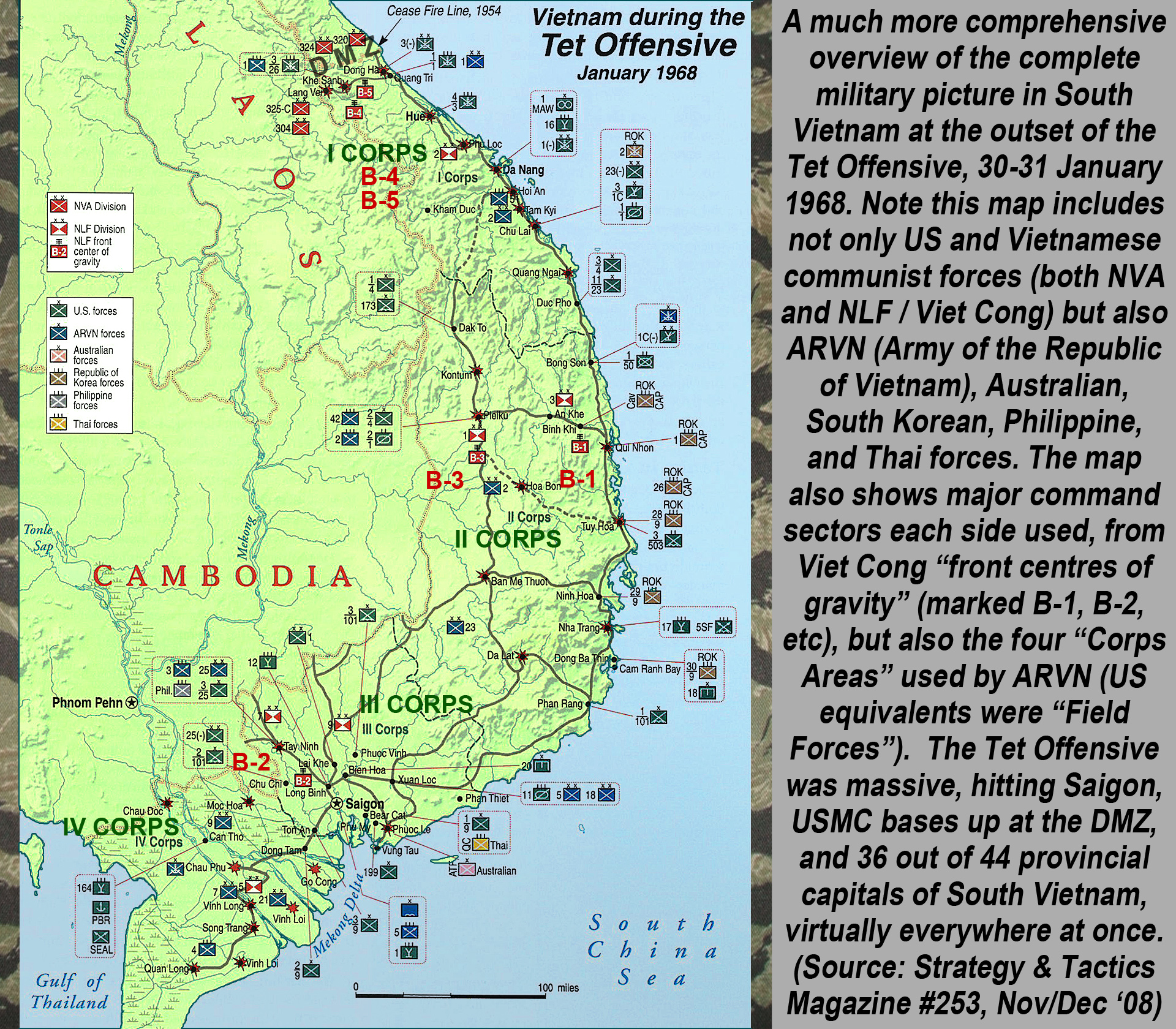
Read The Gaming In Vietnam Series Here
So far, in Part One we took a quick look at the background of the Vietnam War and sketched out communist plans and objectives for the Tet Offensive. In Part Two we looked at the preliminary moves and some of the opening attacks (January 30th and 31st, 1968), specifically around the capital city of South Vietnam, Saigon.
So far, these attacks had been launched by the National Liberation Front (NLF, commonly known as the Viet Cong), primarily against targets defended by the US Army or South Vietnamese ARVN (Army of the Republic of Vietnam). But there was another series of battles further north, near the border between South and North Vietnam.
This was the Demilitarized Zone (DMZ), where most of the fighting took place between units of the United States Marine Corps and the PAVN (People’s Army of Vietnam), often called the NVA for short. These battles were dramatically different, and require a different approach on the tabletop.
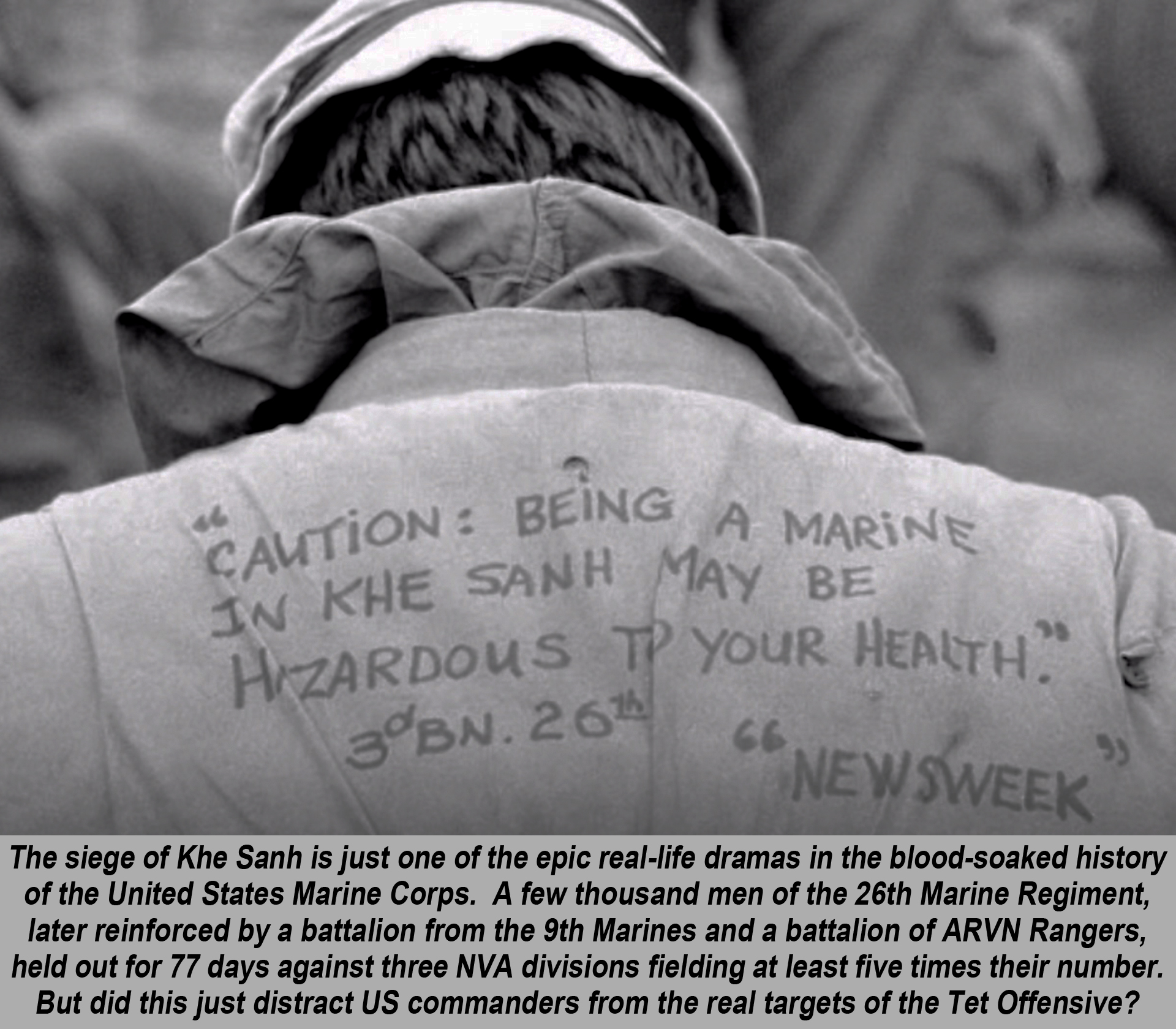
These Tet Offensive battles are some of the most famous in the Vietnam War, including the siege of the Marine combat base at Khe Sanh (probably the longest single engagement of the war), and the intense urban street fight in Hue City, so vividly depicted in the Stanley Kubrick movie: Full Metal Jacket.
We’ll also take a look at the NVA attack on the Green Beret special forces base at Lang Vei, one of the more unusual battles in the Vietnam War in that it saw the NVA make concentrated use of tanks, the first time they’d done so in Vietnam.
The Siege Of Khe Sanh
The Marines’ Longest Hour
When the Tet Offensive struck, American commanders had actually been expecting something of a communist offensive. They were totally wrong about where the attack would come, however, and a big reason for this misjudgement was probably the pitched battle already in progress at a place called Khe Sanh.
Khe Sanh was one of a string of fortified “combat bases” built along the DMZ, manned primarily by US Marine Corps units, defending against NVA divisions across the border in North Vietnam. Far to the west along Route 9, Khe Sanh was particularly isolated because it was also stood close to where the Ho Chi Minh Trail passed through Laos.
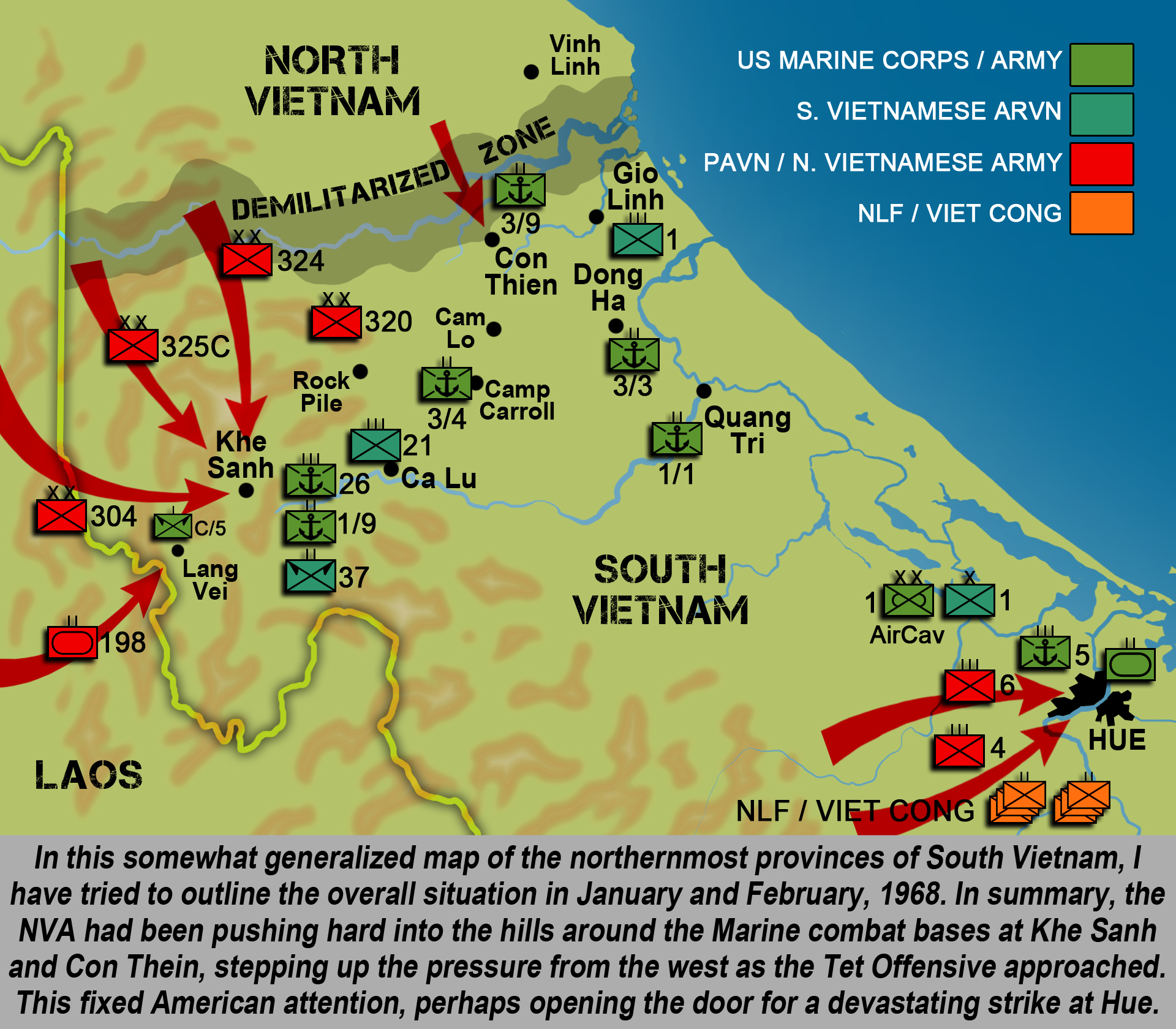
The Marines at Khe Sanh had been fighting NVA units in the surrounding hills for months, and the base itself had been under full-scale attack for nine days. Accordingly, when intelligence clues hinted at a major communist offensive, Americans assumed it would be an NVA ground invasion, with Khe Sanh as a likely first target.
Of course, we now know that the Tet Offensive would strike practically everywhere in South Vietnam, with the Viet Cong putting special focus on population centres like Saigon. However, the NVA was launching major operations of its own, like an assault on nearby Hue City, the special forces camp at Lang Vei, and continued attacks at Khe Sanh.
For Vo Nguyen Giap (the general who’d beaten the French in 1954), Khe Sanh held special importance. He’d seen how surrounding and smashing an elite enemy force on the fortified ground had broken their nation’s will to fight. If it had worked with French paratroopers at Dien Bien Phu and therefore it might work with US Marines at Khe Sanh.
Giap enacted a similar strategy. Three full NVA divisions, upwards of 20,000 men and hundreds of pieces of artillery, surrounded the Marine combat base and 3000+ foot airstrip. Savage battles took place on the hills around Khe Sanh, both sides determined to hold the high ground that would give their artillery a massive advantage.
Soon, Route 9 was severed and Khe Sanh was cut off and then subjected to ceaseless artillery barrages. At the height of the siege, no fewer than 1300 high-calibre artillery shells hit Khe Sanh in a single day. A desperate and costly effort to reinforce and supply Khe Sanh by air was undertaken, involving hundreds of aircraft and great risk.
The American leadership and media became obsessed with the fate of Khe Sanh. By the time the seventy-seven-day siege finally ended, President Johnson had a scale model of the base built in his situation room. General Westmoreland, the US commander in Vietnam, would propose the use of chemical or even nuclear weapons to save the base.
For players looking to recreate the battle, Khe Sanh presents some unusual challenges. Although the NVA spent weeks digging trenches that crept ever closer to the Khe Sanh perimeter, the long-dreaded all-out infantry assault never came. However, intense battles were fought for the surrounding hilltops.
Long ranged (i.e., off-board) artillery played a huge role on both sides. The NVA used 130mm and even 152mm guns firing all the way from Laos. The Marines not only had their own immediate artillery at Khe Sanh but also fire support from other combat bases like the 175mm howitzers firing from Camp Carroll.
Another key element is air power – quite literally the heaviest, most concentrated use of tactical air support in the history of warfare. At their height, Marine and Navy airstrikes on NVA positions surrounding Khe Sanh reached 400 a day. This is on a field only a few miles wide, where a single fighter carried more tonnage than a World War II B-17.
Then there were the USAF B-52s. Based out of Thailand, Guam, and Okinawa, these “Arc Light” strikes were part of “Operation Niagara”, which had three bombers over Khe Sanh every ninety minutes. They flew so high that no one ever saw or heard the bombers, only acres of countryside abruptly vaporizing in hundreds of shattering explosions.
Despite all this, there were direct NVA attacks on some parts of the Khe Sanh perimeter. One came on February 8th, elements of the NVA 101D Regiment hit Outpost Alpha-1, sparking a furious infantry battle. Another came when the NVA 66th Regiment hit the 37th ARVN Ranger Battalion, South Vietnamese troops flown in to reinforce the Marines.
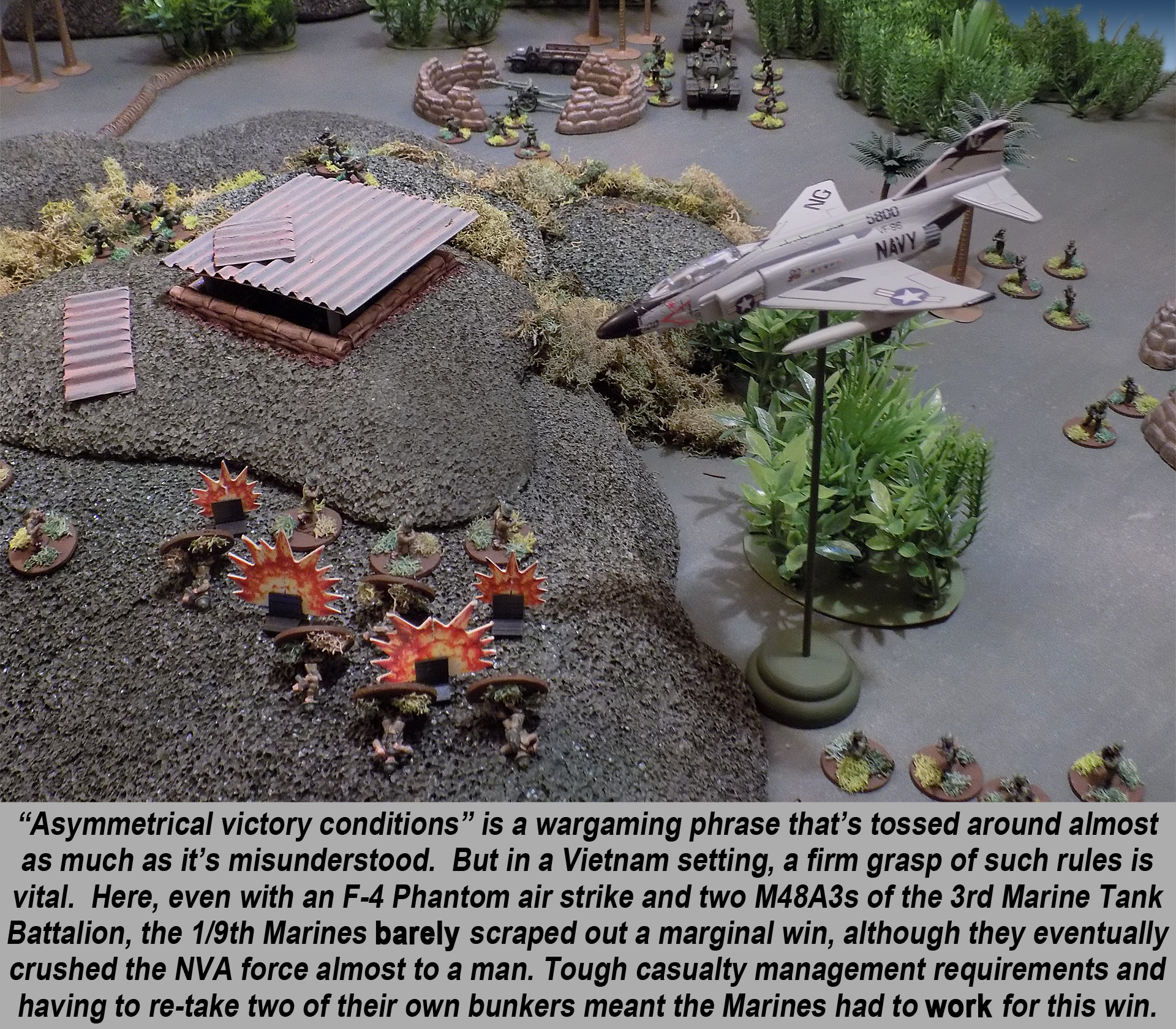
By March 1968, the NVA realized they weren’t taking Khe Sanh. In April, the US Army 1st AirCav division started clearing Route 9, soon reaching Khe Sanh, lifting the siege and ending the battle. The Marines losses amounted to 205 killed, 800+ wounded. The NVA losses at were at least 2500, although, with those Arc Light strikes, we’ll probably never know for sure.
Assault On Lang Vei
Tanks In The Wire!
Just a few miles from Khe Sanh, even closer to the Laotian border and the Ho Chi Minh Trail, was the small special forces base of Lang Vei. Soon after the Tet Offensive began, Lang Vei was also subjected to a direct NVA assault, prompting a battle very unusual for the Vietnam War, and perhaps very interesting for the table top.
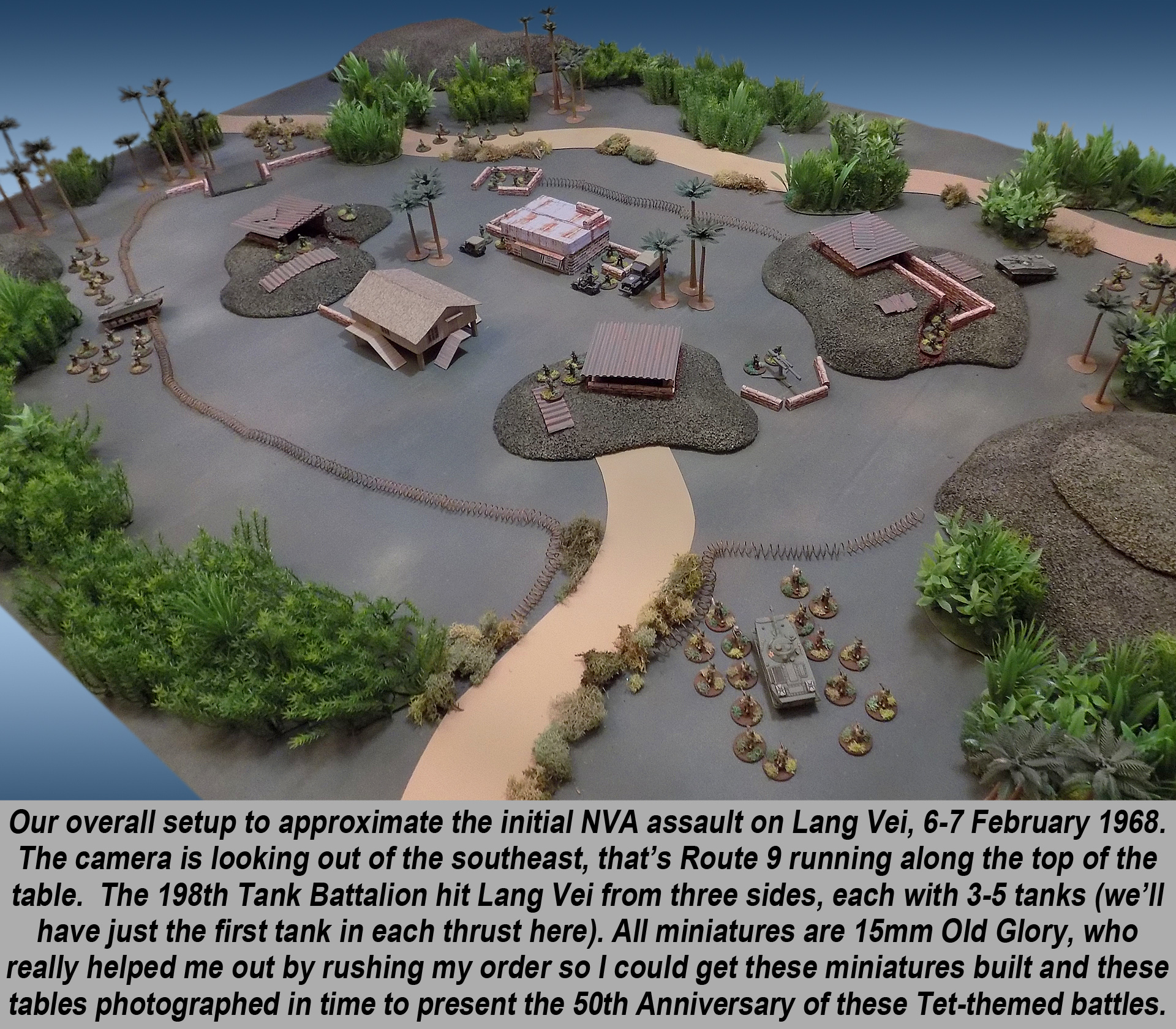
Lang Vei was a much smaller base than Khe Sanh, garrisoned by twenty-six American Green Berets, (“C” Company, 5th Special Forces Group) and ARVN special forces, supported by about 400 “Montagnards.” These were local fighters of the Hre and Bru mountain tribes, trained by the Green Berets as guerrillas against the communist Vietnamese.
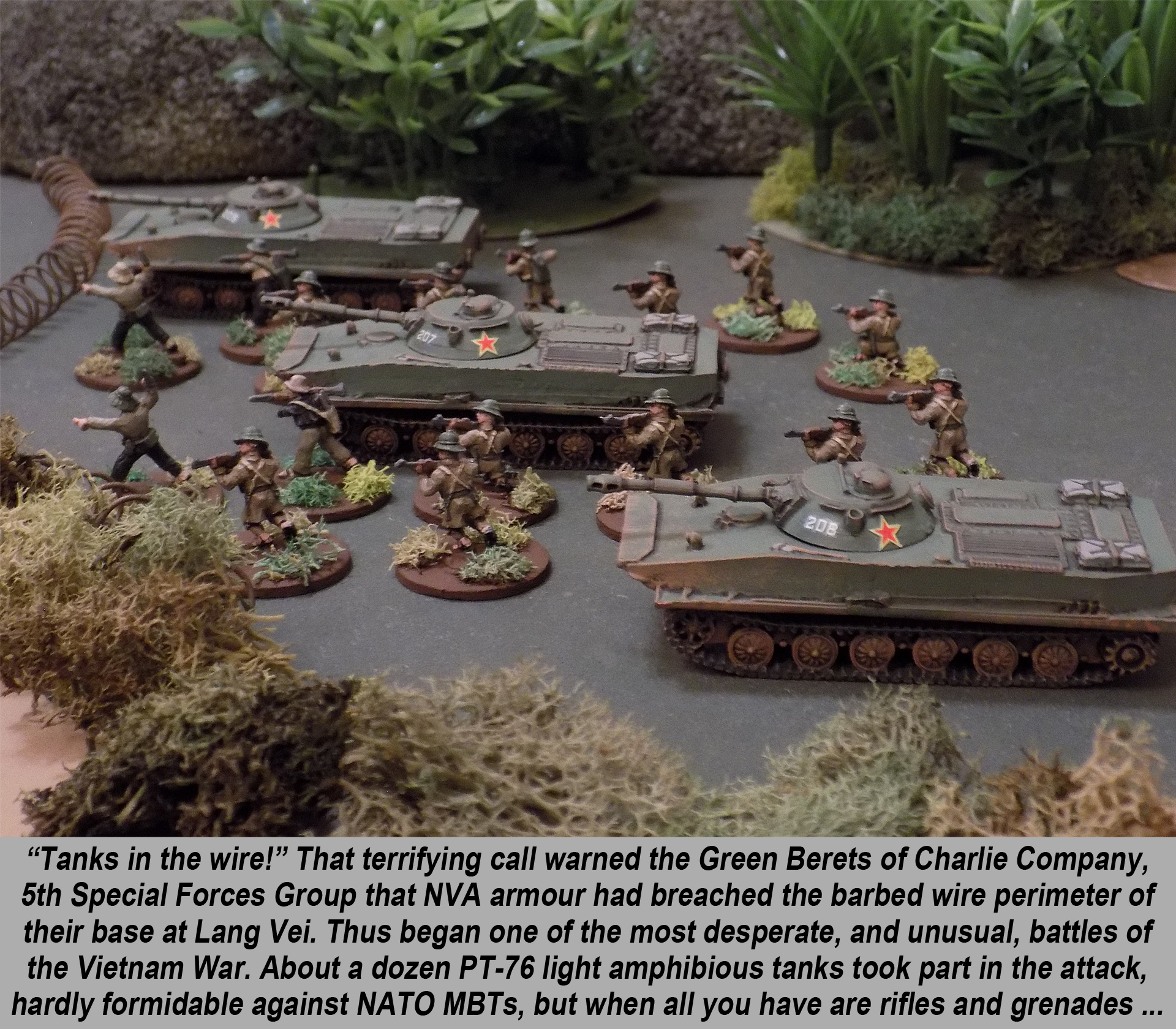
During the days leading up to Tet, these Green Berets and their allies detected unmistakable signs that the NVA was about to launch a major offensive. Among these were reports of tanks, both from an NVA deserter and actually finding tank tracks in the jungle. But the reports were dismissed by HQ, as the NVA had never used tanks before.
That all changed a little after midnight on 6th February, 1968, when the 198th Tank Battalion (203rd Armoured Regiment), hit the Lang Vei base from three sides. The tanks were backed up by infantry of the 24th Regiment / 304th Division (led by NVA Colonel Le Cong Phe, commanding the assault) and units of 101D Regiment / 325C Division.
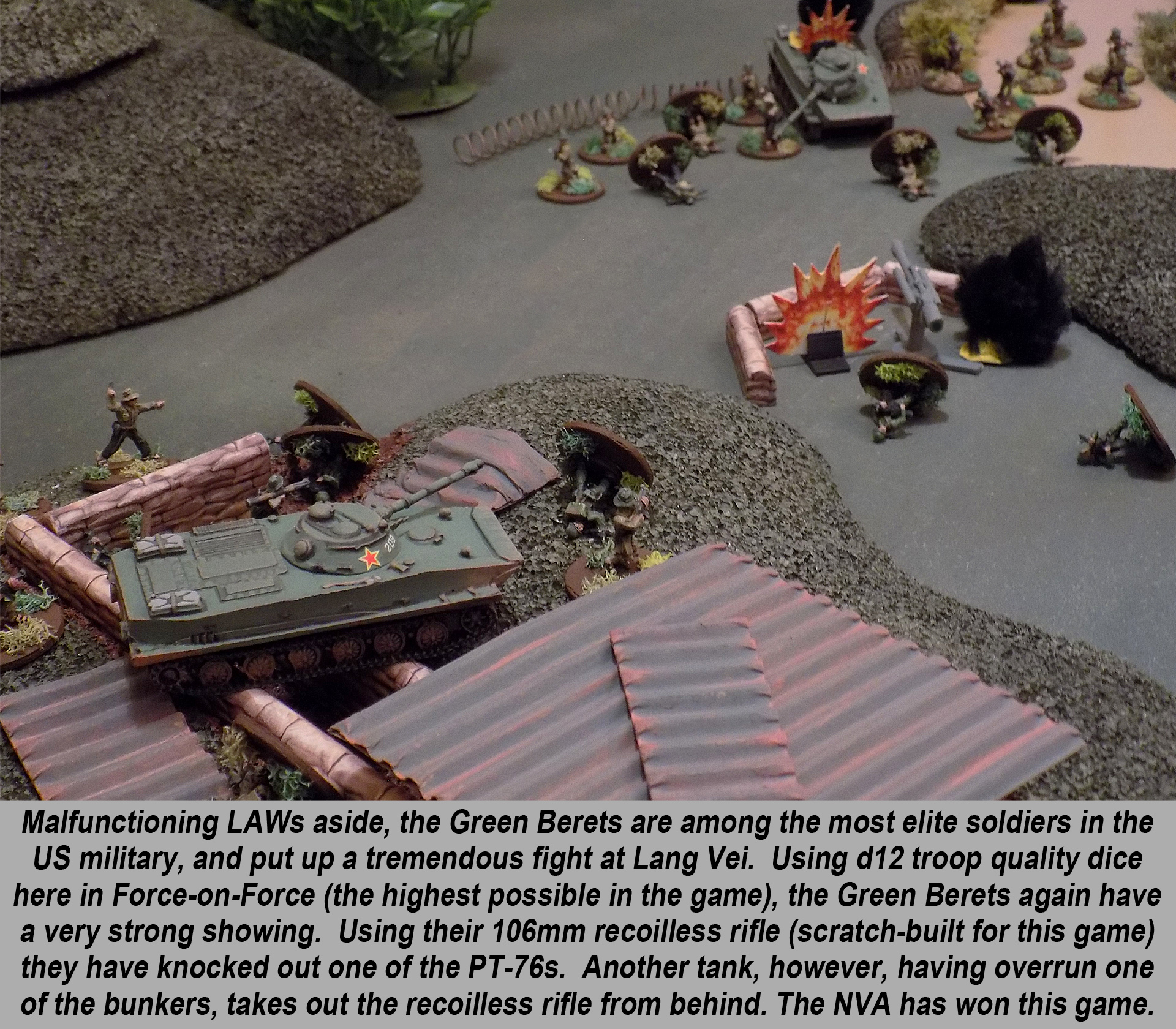
The NVA tanks were Soviet-built PT-76s, light amphibious tanks that don’t seem very impressive when matched against Centurions, M48s, or Leopard Is of the period. But against light infantry armed only with small arms, the warning call that the enemy had “tanks in the [barbed] wire!” was nothing short of terrifying.
The Green Berets were also let down somewhat by their equipment. Fearing imminent attack by NVA armour, the Americans had brought in 100 of the new M72 LAW (Light Anti-tank Weapon). This was a one-shot, shoulder-fired, disposable antitank rocket. This would be one of the first times the new LAWs were being used.
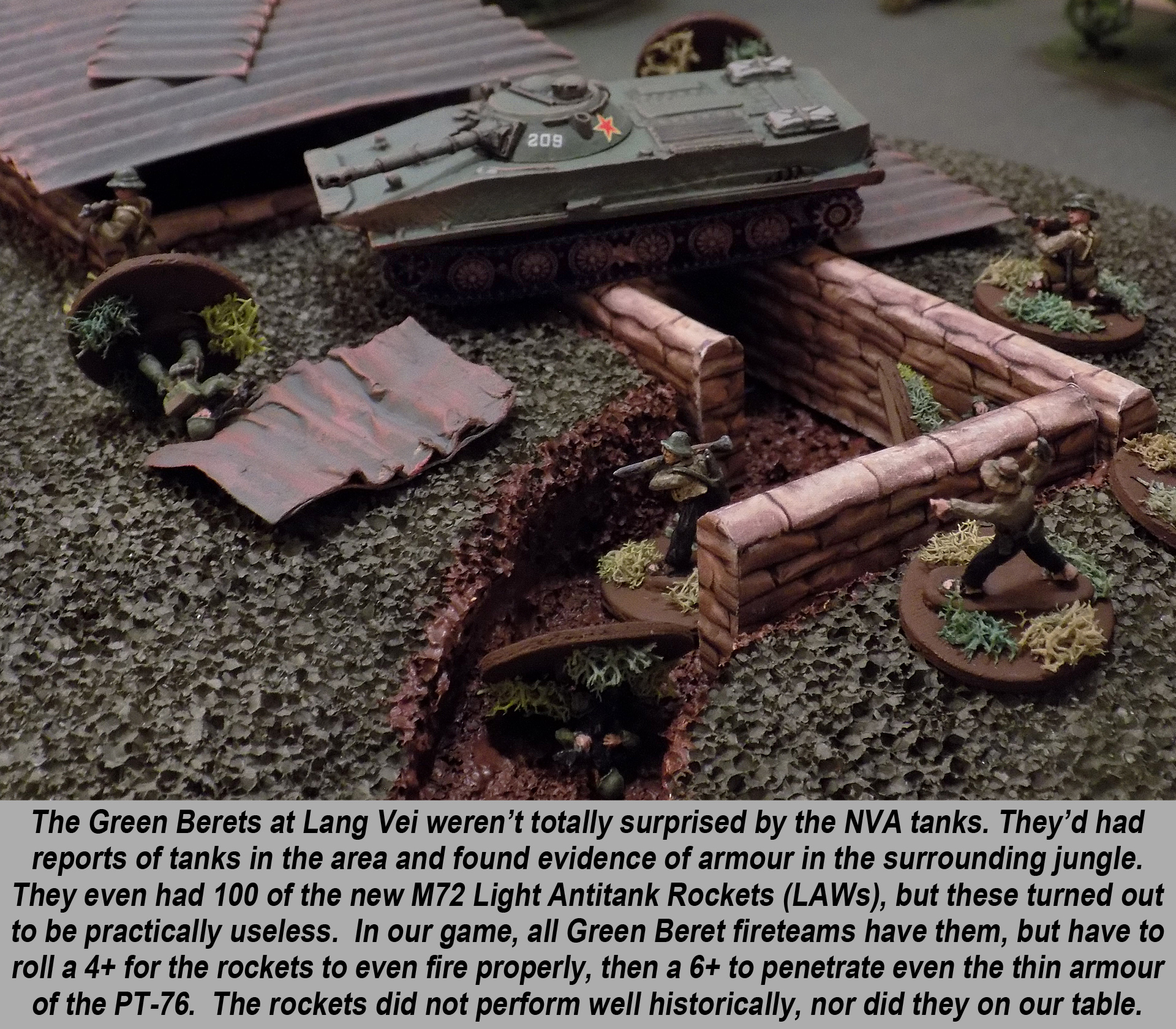
But even against the thin armour of the PT-76, including hits on the flank, the LAW proved incapable of penetrating the NVA tanks. The Americans had better luck with a 106mm recoilless rifle which took out three NVA tanks before being overrun (this brave gunner was listed as MIA until his remains were finally identified in 2015).
The Montagnard tribesmen took the worst losses, often as they tried to break out of the imploding perimeter. Soon Lang Vei was completely overrun, with only a handful of Green Berets cut off in the underground tactical operations centre (TOC). Other Montagnard militia were persuaded to surrender, only to be immediately executed by the NVA.
The battle now became a question of getting those trapped Green Berets to freedom. Sergeant First Class Eugene Ashley put together a force of American survivors and troops from the Royal Laotian Army to try a rescue, but these attempts failed and Ashley was killed. He’d be posthumously awarded the Medal of Honor.
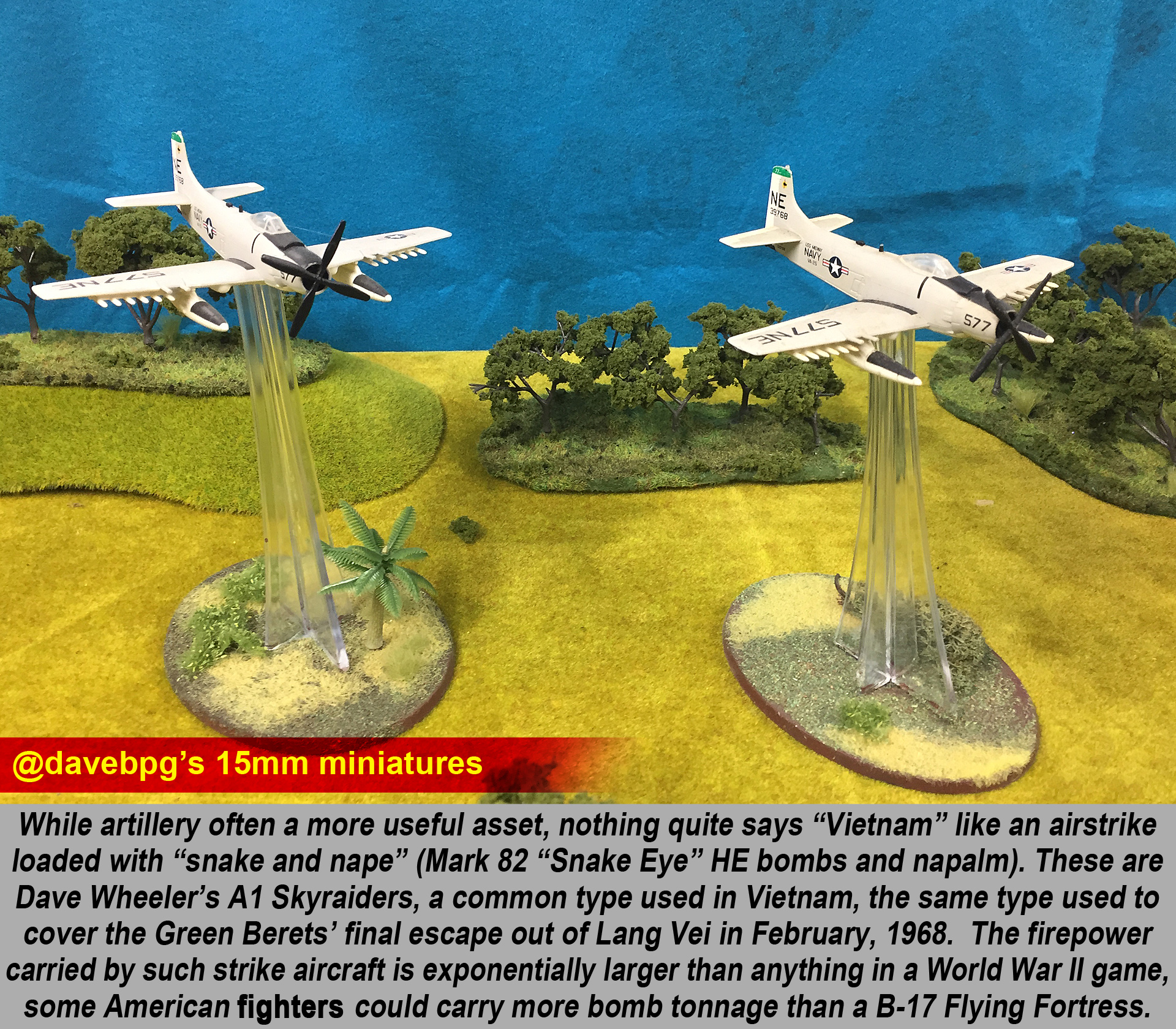
Finally, Captain Frank Willoughby led the handful of American survivors in their own breakout, escaping under cover of air strikes mounted by Douglas A-1 Skyraiders. The planes were told to make three attacks with bombs and rockets, then fly dry runs to keep NVA head down long enough for the Americans to make their escape.
Exhausted and wounded, the Green Berets only made it because ARVN Lieutenant Quy drove a jeep through a hail of NVA fire to give them a ride to the LZ, where a CH-46 helicopter could take them to Khe Sanh and relative safety (remember that Khe Sanh itself was still under heavy artillery fire at the time).
War Across The DMZ
Meanwhile, the NVA was also making hard pushes at targets further east. One of the biggest of these was Hue City, the old Imperial capital of Vietnam. Seized by surprise NVA assault, the city now had to be retaken by USMC, ARVN, and US Army troops in one of the most brutal street battles of the Vietnam War.
Come back next week as we take a look at the Battle of Hue, one the key parts of the big American and South Vietnamese push-back to retake everything the Viet Cong and NVA had seized at the Tet Offensive’s outset.
Meanwhile, post your comments, questions, and input below. Whether larger battles like Khe Sanh or smaller skirmishes like Lang Vei, have you tried Vietnam-themed games, in Flames of War, Charlie Don’t Surf, or Force-on-Force?
What features do you bring to your games to give it a Vietnam element?
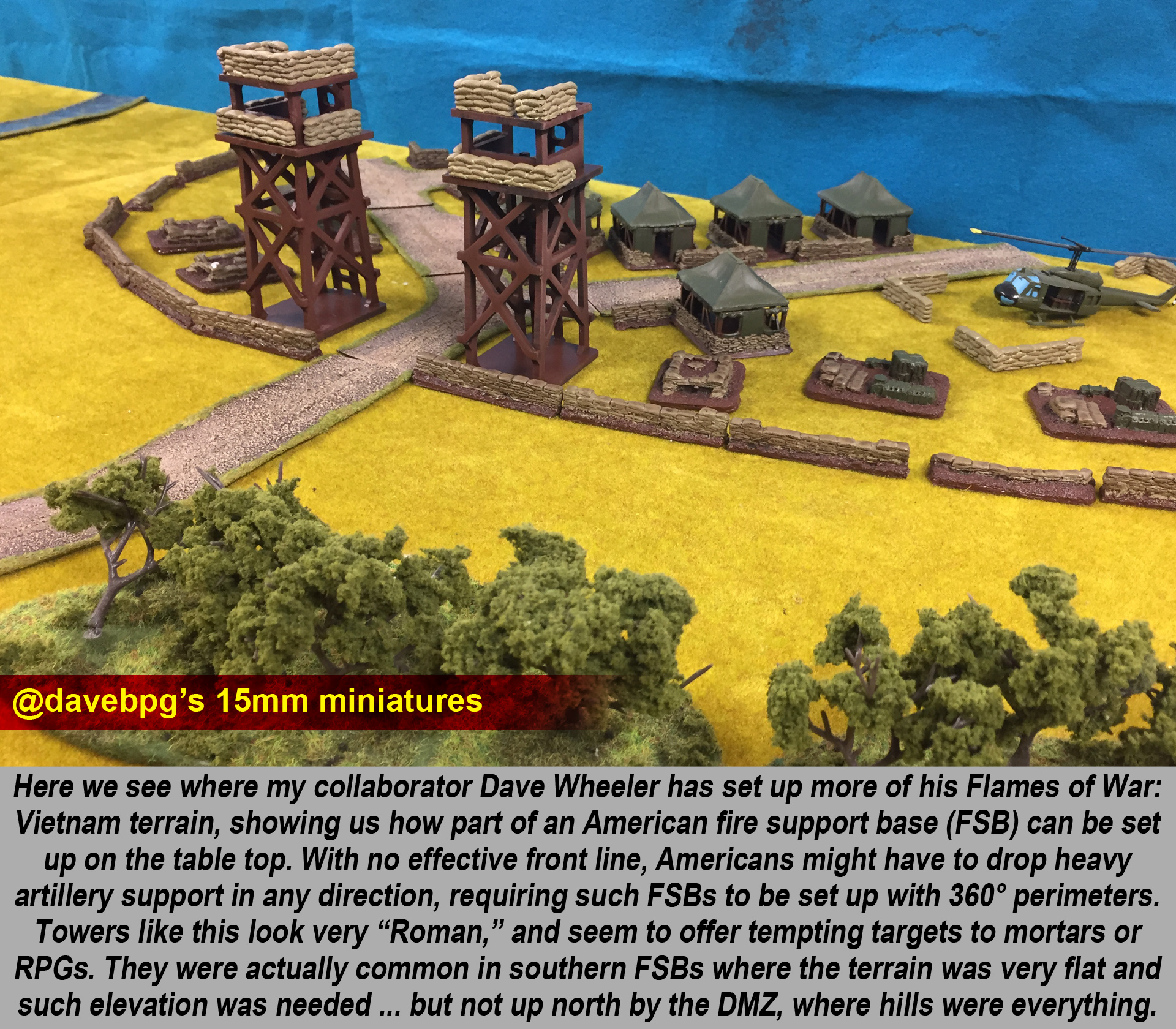
"These Tet Offensive battles are some of the most famous in the Vietnam War, including the siege of the Marine combat base at Khe Sanh..."
Supported by (Turn Off)

Supported by (Turn Off)
"...the warning call that the enemy had “tanks in the [barbed] wire!” was nothing short of terrifying"
Supported by (Turn Off)







Interesting write up on Khe Sanh. It was incredible how focused the whole country became on this one spot, all the way up to the President.
Thanks for kicking us off, @pslemon – Indeed it’s always been pointed out how large a factor Khe Sanh played into the overall American misjudgment on exactly when and where (and by whom, precisely) the Tet Offensive would be delivered.
Some say Khe Sanh shouldn’t have been defended at all. I don’t know if I would agree with that, as the battle / siege tied down two divisions of NVA, plus support battalions and regiments. That’s a lot of firepower to throw into a “diversion,” so I don’t know of we should buy too completely into the idea that this is all Giap was doing at Khe Sanh.
Clearly Giap was looking for an American Dien Bien Phu, which the Marines refused to give him. In any event, had Khe Sanh been abandoned at the outset, who knows where these 20,000+ NVA would have been otherwise committed.
Great read again. Only read about the attack on Lang Vei in passing. Already thinking about what a great scenario this could be. As with those tribes men it’s not the typical red vs. blue. There could be some kind of perimeter. Defended by the Green Berets and the tribes men (I think of them as similar as the viet cong) and the NVA has to break through using Infantry and PT-76s. Then the after the first perimeter is penetrated, the survivors have to pull of some kind of fighting withdrawal to the evacuation zone. @andre77 what do you think? @oriskany you got any more sources on that?
Count me in. This article series and the upcoming Nam Book gets me exciting to get another tour of duty 😉
Thanks, @bothi – these trained Vietnamese locals (part of the “CIDG” program – Civilian Irregular Defense Group) are a tough bunch to research and properly represent on the tabletop (or even write about accurately). Depending on which specific unit you’re talking about, which American or ARVN unit was training them, and when in the timeline we’re talking about, their characteristics, training, and overall quality level can range from “mountain militia” through South Vietnamese Rangers, and everywhere in between.
https://en.wikipedia.org/wiki/Civilian_Irregular_Defense_Group_program
It was these CIDGs at Lang Vei as far as I can tell, but how “good” these particular troops were at this time in the war is actually really tough to surmise.
Just as a TV documentary, this one on Lang Vei isn’t too bad, and goes into what happened after the base was overrun and how the survivors were eventually pulled out of there.
https://www.youtube.com/watch?v=8d4JBDp-Gno
Awesome – does does this mean @andre77 and @bothi are going to running another Lang Vei game? I could only put a few photos of my game in this article – I plan on putting much more in the Vietnam support thread (starting soon). 😀
Looks like it. Have to talk it over with @andre77 more in detail, but seems like a really cool idea. It’ll probably take a few weeks, because we’re in the last preparations for the Tactica Convention 2018 (this time we are presenting an awesome Dune table, spearheaded by Andre). But march seems feasible. Also the new FoW:Vietnams rule should be out until then.
The only “unusual” thing you’d really need are PT-76s (11-12 of them if you’re trying for a 1:1 recreation of the whole battle, I got by with only 3). But from what I see on @andre77 ‘s thread, you guys already have some of that available.
Another challenge is going to be the VERY PRONOUNCED difference in troop quality levels. Force-on-Force handled it perfectly, but this was literally the kind of battle FoF was written for on a fundamental level – the idea if small bodies of super-elite troops against large numbers of lower-quality troops is baked into that system’s DNA. If you’re doing this is FoW, just ensure the scenario really cranks up this distinction or your NVA tanks are going to overrun those Green Berets in 2 turns. 😀
Great overview and some awesome eye candy. I had no idea the original LAW’s were so impotent. I’d like to think they had improved by the 80’s when we were schlepping them around Germany. We always had them around, even in the Brigade HQ, and I recall taking the ‘expired’ ones out to the range for a bit of fun.
The 106 recoilless was a great weapon, but an ungainly beast when mounted on a jeep. It made them top heavy and they rolled at the drop of a hat. Then there was the Ontos, more of a curiosity as I recall. I haven’t read any accounts of them being used in combat.
There was also a man-portable recoilless which seems to be effective in SPMBT. 85mm?
Indeed, @cpauls1 – I was also surprised to hear how bad the LAW performed at Lang Vei. Many failed to fire at all, and even those that fired and hit were glancing off FLANK armor of PT-76s.
Force-on-Force has them as being reasonably powerful, we had to “nerf” them a little for this Lang Vei game based on testimony of the surviving Green Beret of C Co / 5th Special Forces Group who were there.
The 106mm recoilless rifles seemed to be the only weapons that were effective at all against the NVA armor. I’m pretty sure they were mounted in stationary positions at Lang Vei (at least I hope so, as that’s how I had them depicted in my Force-on-Force game).
But I know what you mean, I’ve seen footage of 106mms being fired off old Willy’s Jeeps by the IDF in the 6 Day War and Yom Kippur War, damned things always look like they’re about to tip over.
The M50 Ontos was a USMC-specific “tank destroyer” (??) with six recoilless rifles bolted onto to the top of some kind of old light tank chassis. I know they were used in Hue, I wish I had at least one miniature to use in Part 04 Hue City game. But I didn’t buy / build one as this would literally be only game I would use it for. The thing was super-small, mostly so the Marines could deploy it by air. “Airmobile tanks” tend to be pretty humble. 😀
Circumstantial evidence only, but I honestly don’t think they would have been that great, simply because these were retired by the Marine Corps after a relatively short service, I think 1969-70. Usually the Marine Corps will use weapons and equipment for decades after others deem it as “obsolete” – look at how long they were using the M60A3 MBT and last I heard they’re still using the AH-1 Cobra for cryin’ out loud.
Having served in the USMC infantry from ’76-80, we had several ‘Nam vets in our platoons. I’d asked my platoon sergeant once about the Ontos. He said they had one help repel an assault on one occassion. The Ontos rolled up, fired a round, slight pivot, rinse and repeat until all six tube had fired, then it turned around and left.
The assault broke up at that point and all that was left was the body count. 106mm flachettes worked wonders for a wave attack.
My brother who was in the USMC 65-68 (Operation Hastings among others) had a few stories about the Ontos as well.
Having fired the M72 LAW.. I can attest that it suffered from CHS.. ‘Can’t hit sh!t’ as well as being a bit under-powered. Yet we carried them the entire time I was a grunt.
@gryphonheart – Good afternoon, sir! Always glad to run across another former Marine. 1989-93 myself, although not 0300 Infantry, 3043 Supply Admin and Logistics. Hopefully you don’t hate me now. 😀
Wow, I didn’t even know the Ontos could fire flachette rounds! Damn, you learn something every day. Like I was saying earlier, it’s a vehicle I really don’t know very much about, it only had a very limited service life from what I’m reading.
Never fired a LAW. When I was in the AT-4 was the new thing, although I read the M72 LAW is making something of a comeback in Afghanistan. Did get to fam-fire 20 rounds through a Mk19 at Camp Geiger though. 😀
Hope you liked the material on Khe Sanh. Please come back next week when we look at Hue City. One of these days I should start running a thread on FoF games set in other Vietnam Marine ops like Starlight and Hastings.
hah. Nah, never hate on supply guys 😉 I lat moved into the 4000 field (computers.. now obsolete occ field since it combined with the comm field) in 1980 and finished my career there and retired in ’96.
I got to see the 106 fire flachettes while on Okinawa. It was awesome!
“Fire the .50!”
*boom* .50 cal spotter round goes downrange..
*crew makes adjustments..*
“Fire the 106!”
“Fire in the hole!”
BOOM! and a whole bunch of ammo crates and balloons set up downrange vanished..
Anecdotally, I was told (never confirmed) that the 106 flachette round had 9,999 flachettes in it.. Geneva convention prohibited 10,000 or more. Too cool a story to validate hah!
For Operation Hastings..
http://www.combatwife.net/hastings.htm has some interesting reading and a few first person.
http://libertyyes.homestead.com/Operations/Operation-Hastings-1966.htm
http://www.combatwife.net/chetdiestelhastings.htm
http://lima35.tripod.com/Stories/operation_hastings.htm
Used to be a good site that had almost a day by day of the op. Can’t seem to find it now though 🙁
Never got to fire a .50. Got to fire practically everything else live (fam-fired if not rated) Actually worked briefly as a rifle coach at Weapons Training Battalion, MCRD Parris Island, once I was stationed there as permanent personnel – but never a .50. 🙁
I remember the training / joke they used to pass around re: firing the .50 at people.
“The Geneva Convention prohibits the use of .50 caliber ammunition against personnel, you’re only allowed to fire it at enemy equipment. So remember, if anyone asks, you were shooting at his web belt, helmet, or his flak jacket . . .”
🙂
Never fired the .50 either *sad panda*
The 106mm had a .50 cal spotter rifle mounted parallel to the barrel. The ballistics for both the .50 and 106 were very similar and had the same max effect range of 1800m. The spotter was fed by a 5 or 10 round box mag (can’t remember which).
The crew would fire the .50 and see where the round impacted, make adjustments as needed. When on target.. “Fire the 106!”
Looking at pictures of the Ontos, it looks like each barrel had the .50 spotter.. lol
Good grief, x6 .50s. 🙂 I’d almost be tempted to take the firepower afforded just by the spotting / ranging guns … if it wasn’t for the limited ammo load, of course.
Again, a completely different set of battles that really change what you could bring to the tabletop. With all the off-board assets, just getting troops moving in attack or defense would be a challenge, let alone accomplishing any coordinated plan.
Thanks @donimator – I agree that there are a lot of off-board assets at play, especially in the Khe Sanh battle. I wasn’t kidding, the air power in that siege I think is officially recognized at the most concentrated use of tactical air power in world history. Both sides also had massive artillery support. The NVA was very good at using heavy artillery, and it goes a long way to dispel the notion of them only as a “guerrilla” army. The D30 howitzer was their weapon of choice, definitely one of the best mid-caliber artillery pieces of the Cold War era, and still in widespread use today.
Another great read, the breakout of the green berets could be a game all by it self
Very true. Only seven US Green Berets were in the bunker overnight and made that breakout later that morning, but would make a great skirmish game.
With those numbers it could even be a RPG
True enough, @rasmus – systems like Twilight2000 or Phoenix Command could certainly handle it.
Hell, even GURPS (the ole’ standby)! 😀
Indeed a tremendously informative and motivating part three of the series.
I wondered whether the strategic importance of Khe Sanh was more than the proximity to the Ho-Chi-Minh trail. Did the US and the ARVN launch any gound attacks on the trail from there?
What struck me as well was the term “ground attack by VC and NVA”. Did they have any aircraft to their disposal and have they been used (f. i. MIG of Russian origin).
You mentioned the massive artillery barrages by VC and NVA. The description reminded me a bit of Soviet barrages in WW II. Did Soviet militaty doctrine play an impotant role in NVA fighting? – For the PAVN I have some AA guns from Battlefront, “ZPU-1 14.5mm”. Were these used against ground targets as well? – On the same page in my book I found a mention of “M46 130mm” guns, also for PAVN. For me “M46” somehow points at an American-made gun. Can´t be, right?
LZ means landing zone, right?
As for the dismissed reports of enemy movement this reminded me of the dismissed reports around Market Garden in WW II: “Oh, those Panzers are just inferior, refitting. The soldies we face are either younger than 16 or older than 60.” Dismissed reports seem to be a recurring scheme in military history.
Last question: You named those “snake eyes” HE shells. Why were they called snake eyes? I´m quite sure there´s no dice-roll involved in figuring out the damage. 🙂
Very last question: What size of bases do you and your friend use for single-based 15mm miniatures?
Oh, I wish it was next Monday already, with part IV. Hope the next week-ender will help a bit to shorten the wait.
Thanks and all the good stuff.
I researched a little bit on the north vietnamese airforce. Again it was quite hard to get some more information on them. I found some more information here:
https://en.wikipedia.org/wiki/Mikoyan-Gurevich_MiG-21#Vietnam
After which i bought MiG-21 MF (Super44 model from Eduard) which had decals for a vietnames M-21. I will post pics in my plog after this.
In one of our scenarios I, as a PAVN player, had the chance to buy a interception of US air support. And i wanted to show this in game.
Thanks, @jemmy – okay in an attempt to quickly answer these questions and points.
1) The Khe Sanh fire base was definitely meant to threaten and interdict the Ho Chi Minh Trail. One reason the US Army and Marine Corps generals wanted bases like this in specific areas like this was the hopes that they would one day get authorization to send troops into Laos and North Vietnam. Bases like Khe Sanh would be crucial to support such operations.
As it was, though, they were mostly defensive infrastructure in nature. The high ground had to be held, so NVA could not start staging artillery batteries all across the area and effectively sever the Route 9 Highway and other arteries along the DMZ.
2) ARVN would eventually launch limited invasions into Laos, in 1970, I think … but these were very badly carried off and largely disastrous in result.
3) Yes, the North Vietnamese had a pretty formidable air force, mostly of MiGs and Sukhois, etc. These were never deployed over South Vietnam (i.e., over the actual battlefields, though) to my knowledge. Instead, they were used to defend North Vietnamese targets like Dong Hoi, Haiphong, and Hanoi against American tactical airstrikes by aircraft like USAF F-105 Thunderchiefs and US Navy F-4 Phantoms and A-6 Intruders and strategic strikes by B-52 bombers, etc.
4) I would say that Chinese doctrine played more of a role that Soviet doctrine in NVA methodology. But Soviet advisors were also there. Overall, though, guys like Vo Nguyen Giap wrote his own book, based on his own experience and the very limited tools he had on hand. For Khe Sanh in particular, I would say Giap was basing his doctrine on his own experiences against the French at Dien Bien Phu.
5) I have no specific accounts of NVA AA guns being used on ground targets. I have read of similar systems being used by the Egyptians were used against Israeli ground targets in 1967 and 1973 wars. So it definitely COULD happen. This is only when these guns are being overrun by enemy ground forces, though. So I think the fact that this didn’t happen as much (or at all) in Vietnam is more of a symptom us US forces never finding / overrunning these positions, more than the systems have some kind of technical limitation preventing its use this way.
So just because it may not have happened historically, I see no reason why it couldn’t happened on the tabletop. Only if the guns were mounted in such a way where they couldn’t depress to a low enough elevation to engage ground targets, nothing a blow torch and hacksaw couldn’t fix in the field. 😀
6) The M-46 refers to the M1954 130mm long-barrelled howitzer used by the NVA, along with the 122mm D-30 and the 152mm howitzers fired all the way from concealed positions in Laos. I’m sure there is also some kind of US equipment that just happens to share the same name (there was an M46 prototype tank, for instance, sort of a stepping stone between the M26 Pershing and the first M47 Pattons).
7) Yes, LZ = landing Zone.
8) Yes, dismissed reports are often “sticky” in history because everyone likes talking and writing about them. For every time reports are dismissed and leads to disaster, there are 20 times they are heeded and disaster is averted. But when they’re not heeded, the results are often major and thus stand out in the general historical context.
9) “Snake Eye” refers to a type of the Mark 82 general purpose HE bomb (not shell) still used by the US to this day. Specifically, these are the “retarded” bombs, which means the bombs when released, snap out those drag fins that make the bombs fall closer to “straight down” rather than glide along with the plane’s path as they fall. This allows the plane to fly at much lower altitude and release its bombs, without being damaged by the blast waves of its own exploding ordinance. This is the famous footage you always see of American bombs falling on Vietnam, where the bombs have these drag fins that pop out of the back of the bombs to help create more distance between the impact point and the low-flying aircraft.
The nickname of the bomb was “SnakeEye” – and the mix you often hear for airstrikes is “Snake n’ Nape!” – High Explosive Mark 82 HE bombs with drag fins and napalm incendiary explosive. This is the kind of strike package you often see for desperate, low-level, close-in air strikes made in direct support of ground troops . . .
. . . much like F-5 Freedom Fighter jet fighters that drop the big airstrike that ends the movie “Platoon.” The character Ramucci even uses that phrase earlier when he’s warning his guys not to get out of their foxholes because “air strikes are coming coming up and down all night, layin’ snake n’ nape!”
Hope this answers most of your questions.
Awesome, @andre77 – I look forward to the MiG-21 in your thread! 😀
Oh yes, very good. Much to ponder for me. Only those 15mm basing …
Cheers.
15mm is probably my favorite scale, @jemmy – small enough to allow big battles (I luvs me sum big battles!) and yet large enough to allow a moderate amount of detail painting / visual impact.
Another enlightening article Sir @oriskany, slight aside and excuse my ignorance, British Army teeth arm units hold “colours” that maintain a ceremonial record of battle honours that will be paraded on formal occasions. Do USMC and U.S. Army do something similar? So would the intensity and criticality of engagements like Khe Sahn and Lang Vei be specifically remembered and recognised by the Units involved?
@bonesbs – Oh, good God yes. every US Marine Corps regiment has its own colors, with streamers for different campaigns throughout the Corps’ and the individual regiment’s history.
http://www.fbsind.com/USMC_battle_streamers.htm
As far as what units / campaigns / wars rate a streamer, I think is up to official citations handed down by the President, Congress, or foreign governments.
With limited knowledge, one would assume that there were too many individual large scale engagements during Vietnam to warrant individual streamers. Good system though, like the correlation with campaign medal ribbons. Do veterans get better acknowledgement these days?
I think you’re right, @bonesbs , these all seem to be for campaigns and wars, not individual battles like Khe Sanh, Hue, etc.
When a Marine unit does particularly well in a given battle / specific event, they usually wind up with a MUC or a PUC – Meritorious Unit Citation or Presidential Unit Citation. This decoration is awarded to all Marines in that unit’s alpha roster in the time span specified in the citation (possible example: 5th Marine Regiment, for meritorious service as part of Task Force X-Ray at Hue City, between 30 January and 5 March, 1968, etc).
Individual Marines that rate the award have it entered in their SRB (service record book) and now wear the ribbon on Charlies, Alphas, Deltas, and dress blues uniforms.
But I don’t think the unit itself gets a streamer for the specific event. Could be wrong.
I don’t want to over-generalize, but American veterans have been getting a better treatment from the public since the mid-80s. I have a lot of problems with him politically, but I can’t fault Reagan for his contribution to repairing the relationship between this nation’s public and it’s military. Of course the big turn came in 1991 for Gulf War One. I was in during that time, I remember you couldn’t walk down the street without tripping over a yellow ribbon, but still there were issues with VA and certain benefits like home loans and treatment / acknowledgement of Gulf War Syndrome. 9/11 further reinforced the rehabilitation between the people and the military / veterans, and we see things like improvements to the VA (I know someone in a VA facility now, it’s far better than the gulag I was once in during late 1993) and things like the Wounded Warrior Project.
It’s never perfect. But it’s been getting better. More respect has also been “retroactively” reflected back on Vietnam-Era veterans thanks to more serious movies like Platoon and Full Metal Jacket (yes, I’m leaving out Apocalypse Now, I won’t start that rant). It’s a shame that it takes a blockbuster movie to change our minds about such things, but such is American culture sometimes.
Very informative article as usual, a wealth of great information for both the budding Vietnam war gamer and vet alike.
Thanks very much, @raglan ! Like I was saying before, if you or others in your group are “new” to Vietnam wargaming and want to give it a try, the Tet Offensive might be a good place to start because many of the engagements are actually more “conventional” – resembling the kinds of battles to which many players may be more accustomed.
Not a great fan of the Tet if I’m honest, I much prefer to game in the bush ; )
I actually largely agree to a point. It may feel strange to make the effort to jump to a Vietnam era game, only to play in a battle that is distinctly “un-Vietnam.” In Part04 of this series we focus a lot on the “push back” against the communists, where again it’s the US / allies against the hidden, fortified NVA and VC.
Not many game systems do this classic Vietnam model “right,” though – it’s far from your “typical” wargame – which of course might be part of the draw in the first place. :D.
Great stuff, glad to hear that you are also a lover of the bush.
That’s right. Don’t get between me and some good b … oh wait. Let me not type that. 🙁
Great read @oriskany, you covered a lot in a single brush stroke.
Dien Bien Phu and Khe Sanh are twin battles serrated by a generation. Dien Bien Phu was the battle that broke the back of the French so the significance of this is not lost on either side at Khe Sanh. Khe Sanh is were the will of both sides will go head to head in a single contest.
However with Khe Sanh I also see it as a Kasserine moment for Giap. At Kasserine the US army had trained and equipped to bring a better version of blitzkrieg France 1940 to the table and DAK showed them war had moved on from that.
Giap bested air resupply at Dien Bien Phu but he was not ready for US air mobility nor the fire power it could so quickly bear down on. The US had moved on from French air resupply and Giap was not ready for it, in a similar way the US were not ready for what the Germans unleashed at Kasserine.
One thing that was an issue for Chinese (Mao) doctrine is that it did not consider air mobility, after all Vietnam was going to write this text book. Under their doctrine it would be a unit of attention (see my last entry in past 2 for what this really means) and false lessons about it would have been learned at Dien Bien Phu.
I have looked at high ranking generals rejecting good Intel. To me it is very similar to spacial disorientation. Many aircraft crashes are caused by this. The pilot is fixated on what he believes is happening and eventually dismisses what his instruments are telling him. So I believe generals dismissing the facts are part of the human condition. Just like pilots is can strike at any time. MacArthur suffered this in Korea but not so much in WW2.
From what I have researched the early LAWs deployed in Vietnam was nothing short of dreadful will a string in the tail. It was a one use weapon not just a one shot weapon. It was assumed that once deployed it would be fired. In the field the the weapon would be deployed but then the target was lost. So the soldier would keep it in case the target returned, but within a few hours the weapon would cook off and self fire. Later versions were made safe.
One reliable instance that I know about Soviet advisors in Vietnam comes from the VC were the advisors taught them Finnish motti tactics for use against US supply convoys. The VC were encouraged by what the Finns did against Russia and by using these same tactics they could do the same to the US. I think the Russians forgot to mention the Finns lost.
Thanks very much, @jamesevans140 –
You covered a lot in a single brush stroke.
Fortunately, Beasts of War gives me a pretty big brush and lots of room to swing it. 😀
Dien Bien Phu and Khe Sanh are twin battles separated by a generation.
There are definitely a lot of similarities but also some differences as well. The Marines and ARVN Rangers at Khe Sanh totaled (at the most) something like 6600 men, against 25000+ NVA and support troops. The French and their allies at Dien Bien Phu had 13000, against 55000+ combat Viet Minh. So it’s almost exactly half the size.
But the proportions are about the same. 😀
The difference in Operation Scotland (defense of Khe Sanh) is the massive use of American air power, far outstripping anything the French could bring in at Dien Bien Phu. In fact, when DBP really started going south for the French, the asked for US intervention, and plans were made for “Operation Vulture” – a massive US air campaign that at one point proposed four US tactical nukes to break the French garrison out of DBP.
Nothing against the French, but thankfully President Eisenhower rejected Operation Vulture out of hand.
Massive American air power was of course brought to bear at Khe Sanh, probably the most concentrated use of tactical air power on a tactical battlefield in history. Again, the use of tactical nukes was proposed, but thankfully rejected.
Also, Khe Sanh was in range of other artillery FSB (fire support bases), so it wasn’t completely on its own like DBP.
Lastly, Khe Sanh was at least near a road, the Route 9 Highway, and eventually relieved by 1st AirCav Division in Operation Pegasus. Now it’s clear the NVA had already pulled out of the surrounding hills by then, so the Marines insist they defended Khe Sanh on their own and did not need to be “rescued” by 1st AirCav. But this bone of contention between the Marine Corps and AirCav has probably started quite a few bar fights over the years, so I won’t spark another one here.
At Kasserine the US army had trained and equipped to bring a better version of blitzkrieg …
Funny you should mention that. These battles at Sidi Bou Zid, Kesserine Pass, Tebessa Gap, El Guettar . . . could they be the subject of an *cough, ahem* upcoming article series? 😀
Giap bested air resupply at Dien Bien Phu …
They damned near did it at Khe Sanh, as well. Planes and helicopters could not hand on the airstrip due to NVA AA and mortar fire, and all kinds of new parachute drop techniques had to be improvised on the spot. Finally the Americans overcame this problem with new air resupply tactics called a “Super Gaggle.” Oversimplified – it combined Marine mortars on suspected AA sides, laying white phosphorus, HE-FRAG, and smoke, marking targets for A-4 Skyhawks with “Snake n’ Nape,” helicopter gunships, and huge “convoys” of transport birds (Chinooks and CH-34s) … all coordinated at once, to fly in a massive airlift while NVA AA positions were hopefully suppressed.
It worked, barely, when perfectly coordinated, which wasn’t easy.
I would agree on generals ignoring new intelligence that contradicts what they or their staff may “already know.” So much of military intelligence is incomplete or unreliable, of course, that much of it HAS to be dismissed much of the time. Of course, when it’s dismissed and turns out to be correct, that’s what makes the history books.
I’ll almost always defend Marines, and it’s easy to defend the Marine regiment, division, and MEF commanders in I Corps area in the months leading up to Tet. After all, before Tet started, they were already hip-deep in combat fighting back Giap’s opening gambits. So for them it wasn’t so much a matter of “misinterpreted intelligence.” It’s tough to misinterpret NVA mortar and howitzer shells sailing into your perimeter.
I give full props to Army generals like Frederick Weyand, though (CG: 2nd Field Force, Long Binh). He say it coming at least a week in advance and pulled back a lot of Army formations in the last days of January. Successful battles like Long Binh and Bien Hoa are a testament to intelligence done right.
Of course, the picture was hardly universal throughout South Vietnam.
Yeah, these reports on the LAWs at Lang Vei show they were just awful, and one of the first times they were ever used in combat. Thankfully, it seems improvements and corrections were quickly made.
Very interesting connection between the Finns and South Vietnamese. I had never heard that, definitely good to know. 😀
It kind of makes me wonder how assymetrical victory conditions could be applied to other rule systems and settings.
Scenario building is worthy of an article in itself I think.
I guess part of the problem with sieges on the table top is that the morale and the shear desperation of being surrouned on all sides by the enemy (and the ground shaking with explosions from both sides) is hard to simulate.
With all those bombs one has to wonder how many live ones are still left in that area.
Even these days we’re uncovering bombs from WW 2 over here in Europe.
@limberger Great Idea! I would love to see you team up with @oriskany and work on it, your comments are always insightful and easy to follow. I think you would be GREAT at it. In all seriousness, I have only developed victory conditions for RPG games and would love to learn a little more about how to develop them for different systems.
“Handicapping” – making unfair battles into fair games. 😀
Thanks, @limburger –
“Scenario building is worthy of an article in itself I think”
That’s actually a really good idea. 😀
Sieges also runs into the problem of the scale involved, they take place over dozens of miles and months of time, often a tough thing to work out on the tabletop. Also, resource management is going to be 80% of the game, which can be a fun challenge in other formats, but in a miniature game can be a tough sell.
Indeed, @jamesevans140 was talking earlier about unexploded ordinance in Vietnam. The sheer “vaporizing” power of some of the Arc-Light strikes means no one even has a clear idea how many NVA were killed at Khe Sanh.
First, I love the opening map. It really sets the scope of the amount of military units involved. Aslo, the bunkers carved into the hillside look GREAT as do @davepbg ‘s guard towers. However, my favorite part has to be the subject matter. These battles are even familiar to me, so I can follow what is going on a little better. Once again, great job at making history interesting and proving gaming is actually educational 😉
great stuff @oriskany they cant close any of the bases like teeth on a zip? the others would be to easy to over run then because of the travel times.
They managed to overrun Lang Vei, @zorg , but that was about it. The problem from the NVA is that many of these bases were within artillery range of each other so could provide accurate, pre-sited artillery support for each other. So no matter which one you attacked, you were pretty much fighting all of them, plus the US Fleet carrier battle groups out in the South China Sea, plus the Air Force in South Vietnam and Thailand, plus the B-52s out of Guam, plus plus plus . . .
😀
Also Lang Vei was much smaller than big bases like Khe Sanh, the Rock Pile, Camp Carroll, Con Thien, etc. As in literally 1-3% the garrison.
lang Vei was the weak spot on the end of the chain plus the tanks made defence very difficult didn’t the reinforcement’s refuse to attack the VC? troops.
non us reinforcement’s I meant.
The short answer, @zorg , is yes. Although Laos was technically neutral, there was a local battalion of the Royal Laotian Army in the area, with whom the Green Berets of C/5th SFG and their CIDG (Civilian Irregular Defense Group) “Montagnard” trainees were cooperating to operate against NVA units operating illegally in Laos.
This battalion was supposedly up to 700 strong, but only a small fraction of these agreed to take part half-heartedly in a counterattack led by the Sgt First Class Ashley I mention in the article. This counterattack was launched the morning after the Vietnamese overran the camp, aimed at rescuing the Americans still trapped below ground in the Tactical Ops Center (TOC) bunker.
There were initially also 26+ South Vietnamese (Rangers and CIDG) also in the bunker, but these had already been executed by the NVA when they chose to surrender. I don’t know if SFC Ashley, the other Green Berets, and the reluctant Laotians knew that at the time.
Ashley was soon mortally wounded in his counterattack, and as soon as he fell, the Laotians quit the field entirely.
In their defense, this wasn’t their war. Laos was neutral, these Laotian troops weren’t supposed to be in South Vietnam, and the Laotian government had so far kind of turned a blind eye to NVA running the Ho Chi Min Trail logistics network through their country. So these troops knew their government wouldn’t demand their release or acknowledge their existence should they be captured by the NVA. The agreements with the C / 5th SFG were (to my knowledge) local and unofficial, and would disavowed by both the Laotian and US governments if anything went wrong (and plenty was going wrong that day).
They probably had crap equipment wages & morale before hearing about the execution’s then the commander going down was probably the last straw.
I actually don’t know how they were equipped, that’s a good question. I assume it wasn’t very good, though.
Honestly, they shouldn’t have even been there. Lang Vei is in South Vietnam, these were troops of Laos, which was a neutral country. If they’d been captured, the Laotian government would probably let them be executed for plausible deniability, they didn’t want war with North Vietnam (probably why they let the NVA send the Ho Chi Minh Trail through Laotian territory).
This was a war between the US, North Vietnam, and South Vietnam. Laos (and thus Laotian soldiers) had no dog in this fight – outside of unofficial, local agreements with local US forces like C/5th SFG.
@davebpg ‘s fortifications are indeed awesome. I’d love to set all this up on some big 8×6 table and do some kind of huge “Siege of Firebase Gloria” game. 😀
the B17 had a range of 2,000 ml with only 6,000lb of bombs not much for even then.
This is true, @zorg , depending on the type of B-17 and mission load-out selected on a given sortie. A B-17 could carry up to 17,500 pounds of bombs if over-loaded for a very short-range mission, but of course the vast majority of missions carried much lighter bomb loads than this (my sources: between 4400 and 7900 lbs, 2000-3600 kg), for short or long range missions, respectively.
Meanwhile, an F-105 Thunderchief could carry 14,000 pounds without breaking a sweat. And that’s “just” a 1- or 2-man fighter-bomber.
Those B-52s, meanwhile, had been modified to carry up to 60,000 pounds of bombs per sortie, and Operation Niagara soon had three of these over Khe Sanh every 90 minutes, 24 hours a day. So that’s nearly three MILLION pounds of bombs hitting the immediate area around Khe Sanh, every day. Granted, this didn’t go on for the full 77 days, but even if it was just half of this, we’re talking 115 million pounds (about 60,000 tons) of bombs just from the B-52s.
For comparison, that’s about three times the explosive power of Hiroshima (Hiroshima was only 10K of explosive equivalent, but I’m only counting 30,000 out of my 60,000 tons because not all the weight of a given bomb is actually explosive. Estimating 60,000 tons of BOMBS delivers about 30,000 tons of actual explosive, or the equivalent of a 30 kt tactical nuke. Very rough math here, obviously).
What kind of template do you use for that? And that doesn’t include the fighter-bombers, helicopter gunships, mortars, or artillery.
Yeah, the Americans weren’t playing around at Khe Sanh.
Yes the B 52 is a beast two crews so they could stay on station as long as they can refuel for hours/days?
Indeed, @zorg – for operations like Arc-Light, Niagara, and Rolling Thunder, and Linebacker and Linebacker II (during Nixon’s administration later in the war), B-52s were called in at first from the Marianas Islands (Guam, etc) from thousands of miles away. Later we had some bases set up in Thailand so B-52s could conduct sorties without refueling.
Thailand I take it the bases were never attacked dye the north Vietnamese?
To my knowledge these bases were never attacked by the communist Vietnamese. Thailand had a respectable contingent of troops in South Vietnam to help other Free World forces, and I think there were some border raids and clashes around the time of the Vietnam’s invasion and conquest of Cambodia in 1978.
template size ?
I think it’s more like pick a table quadrant and *boom* it’s gone, no saves allowed …
Those pizza box sized templates that Team Yankee uses are already gigantic and that’s just a few Hinds.
I mean they say that there are no atheists in foxholes.
After a few days of this every single soldier must be praying to some kind of deity in order to stay sane …
It’s no surprise to me that Vietnam veterans suffered from PTSD as a result of battles like this and the constant need to be paranoid even in ‘safe’ zones.
Right, @limburger ?
Template size? I think it’s more like pick a table quadrant and *boom* it’s gone, no saves allowed …
Strictly speaking, and if you convert the scales and do the math, an Arc-Light strike would be “everyone on ALL tables in the BoW Boot Camp is dead on a 2+.”
It’s almost like tabletop miniature games aren’t always the best way to handle these kinds of historical engagements . . .
Er mer gerrd!
Burn the heretic! 😀 😀 😀
@oriskany Been really enjoying this article series. Vietnam is what I cut my wargaming teeth on, my avatar is a 20mm figure from my collection. I haven’t played a Vietnam wargame in a long time, Bolt Action has taken front stage, but I’ve been getting the itch and this is helping. LOL! For me I like gaming the smaller battles more. Basically a reinforced platoon.
I don’t know if you’ve read either of these books but I’d highly recommend “Acceptable Loss: An Infantry Soldier’s Perspective” by Kregg P. Jorgenson, his other books of his experiences in Vietnam are good as well. He was a LRRP team member then went to an Air Cav Blue team. The other book I’ve enjoyed is “Steel My Soldiers’ Hearts” by Colonel David H. Hackworth. Of course there are other really good personal account books out there too.
Keep up the good work!
Thanks very much, @smitty14 ! 😀 Indeed, a reinforced platoon is a good size for a great size, just about perfect for a Vietnam engagement. The problem (at least for me) is that this falls almost directly between the two games I like the most for Vietnam, Force-on-Force and Valor & Victory (admittedly, @aras and I had to design our own “edition” for V&V Vietnam, originally written for WW2).
The issue is that for an American platoon+ (a “real” platoon, i.e., 40+ men at least). means you’re usually fielding 100+ VC or NVA (basically, a platoon vs. a company). This is a s little big for a Force-on-Force game, but a little small for a Valor & Victory game.
Basically, when we’re gaming, we decide whether we want a quick pick-up “scrimmage” game, in which case we take out the V&V Vietnam. If we’re in the mood for a more in-depth study, we set up basically the same kind of game, but in Force-on-Force (sometimes playing “by squad” rather than “by fire team.”
What kind of systems were you using for your 20mm Vietnam games?
I’ve mainly used “FNG” by Two Hour Wargames. They no longer offer it it looks like. I’ve also used Force on Force with fewer models. “FNG” is a good rule set idea wise but can get a bit clunky. It has a small bit of RPG to it with a good campaign system of guys going through their tour and replacements. I’ve been tempted to either clean up some of the clunkiness or do some home brewed rules.
That sounds awesome, @smitty14 . I’ve been tinkering a little with Force on Force, trying to get it to run larger battles a little faster and more smoothly. I haven’t been doing too much, as I know the system well enough to play, but not really enough for “rules surgery.” 😀
On Valor & Victory, though, I’ve re-written the game for Vietnam battles, and @aras and I have had some great success in playtesting. The increase in average unit firepower has been pretty startling. Of course we’re not just picking numbers, we’ve taken what was carried by the average 8 man squad in WW2, plugged into the game values in V&V, and then applied the same methodology forward into a 1960s Vietnam squad. The results have been, well … “boom” … considering factors like virtually everyone was carrying a fully-automatic weapon, every fireteam was carrying a GPMG, then adding support weapons like RPGs, LAWs, M79s, etc. But the games have delivered the kinds of results we were hoping for, and these “extra” support weapons are practically their own units in that game anyway, so can be added or subtracted per scenario.
Those squad firepower ratings, though, are baked right into the “DNA” of the game.
Besides, when you line up a full, say … USMC rifle platoon …
Squad = 3 fireteams of 4 + squadleader = 13 men.
Platoon = 3 squads + platoon leader element = approx 45 men.
So that’s 35 M16A1s, 9+ M60 GPMGs, 3 M79 40mm GLs, +assorted LAWs, shotguns, pistols, 90 grenades, satchel charges, possible mortar support (60mm from company or 81mm from battalion) …
Of course the NVA are no slouches, either, with practically everyone carrying an AKM.
Yeah that’s a ton of firepower compared to that same platoon size in World War Two. LOL!
One way to give the VC and/or NVA a little more power without adding men at 2 or 3 to 1 odds is to give them bunkers, booby traps, or tunnel/special movement assets. Of course with Force on Force as the irregular forces are “killed” off they recycle so you wouldn’t really need to have that many troops on the table all at once. Just a nice steady flow for the opposing force to deal with. 🙂
I would agree with those ideas for Vietnam games in general, @smitty14 – my issue with Tet is that it’s the NVA and especially the Viet Cong on the offensive, more or less in the open, against the US / ARVN, not the other way around. So for the Tet Offensive, things like booby traps, etc. aren’t really going to be a factor. Bunkers / prepared positions are going to be on the side of the US/ARVN. And tunnels (as I’m sure you know) were really only in certain parts of Vietnam, such as War Zone D, C near the Cambodian border, the Iron Triangle, and Cu Chi (probably the biggest tunnel complex of all, or at least the most famous).
Now I agree that once we enter the “push back” phase of the Tet Offensive, where the Americans and their allies start retaking everything the NLF / VC and the NVA had seized, ideas like booby traps, ambushes, tunnels, and bunkers become a great equalizer for the Vietnamese player.
But this is also where massive American firepower really comes into play, now that the full spectrum of support assets are mobilized and communist concentrations have become identified and fixed (outlined by their own success, ironically).
All that said in an operational sense, on the tactical tabletop, we’re so far finding that strictly limiting US numbers (as ARVN units withered collapsed, US formations had be broken up into smaller and smaller task forces to be in more places at once), plus stacking the US player with the usual “regular army” limitations (have to hold / take certain real estate, prohibitive victory point costs of casualties, enforcing casualty management, putting civilians in the way, and sometimes enforcing collateral damage victory point restrictions), usually allows the Vietnamese a real chance to win, especially if they’re allowed to conduct a “fading defense” as they so often did on the actual Vietnam battlefield.
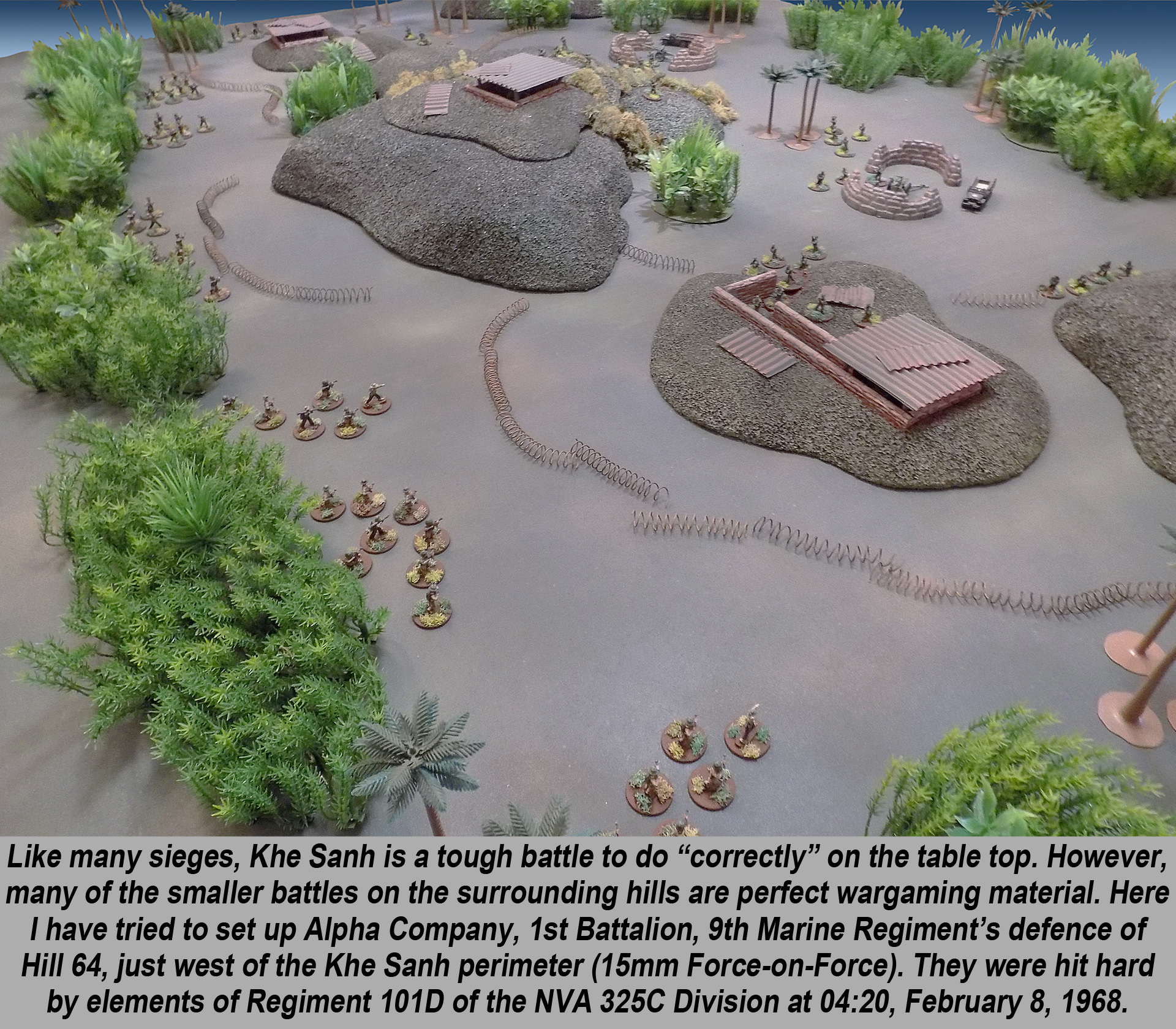
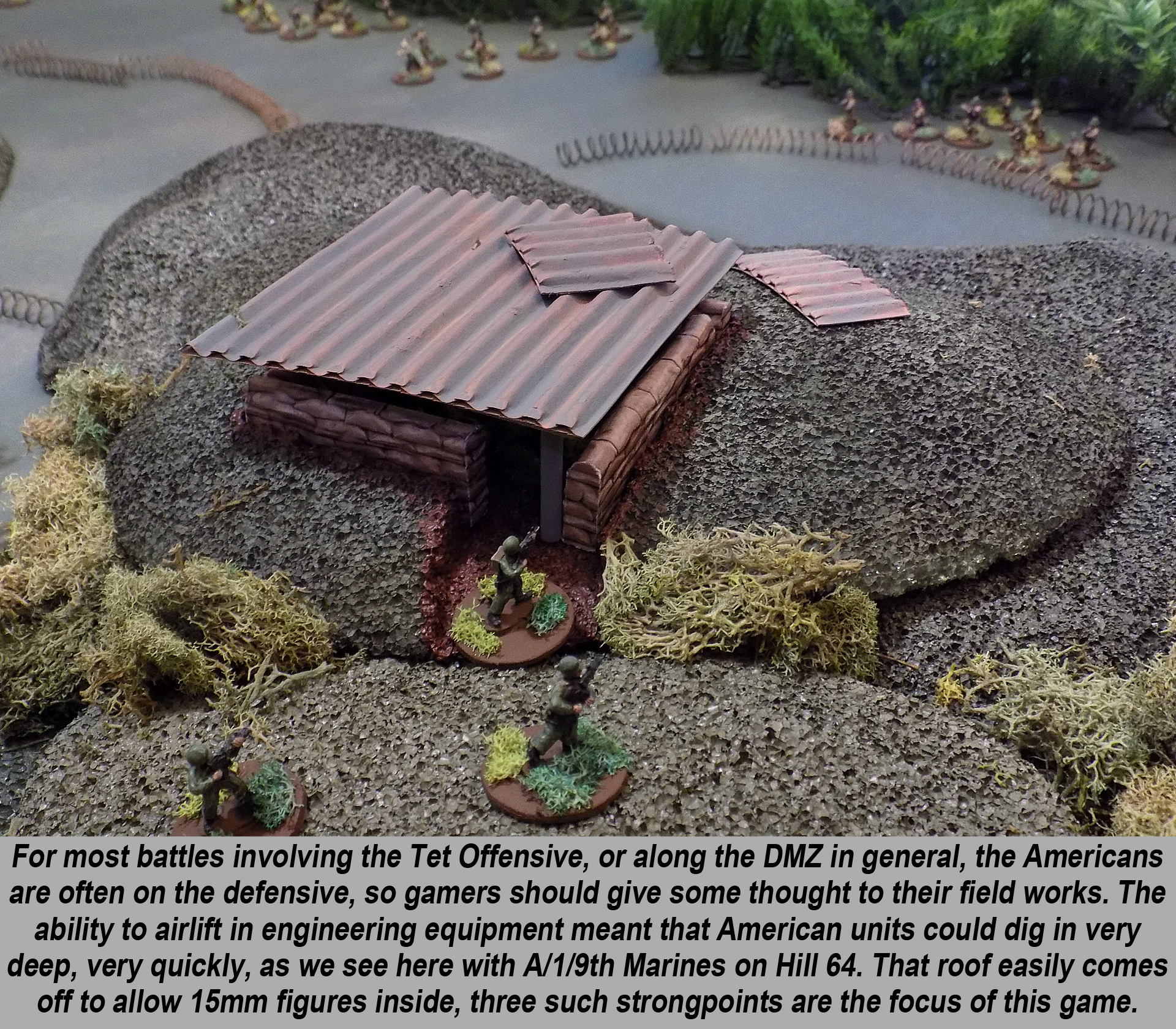
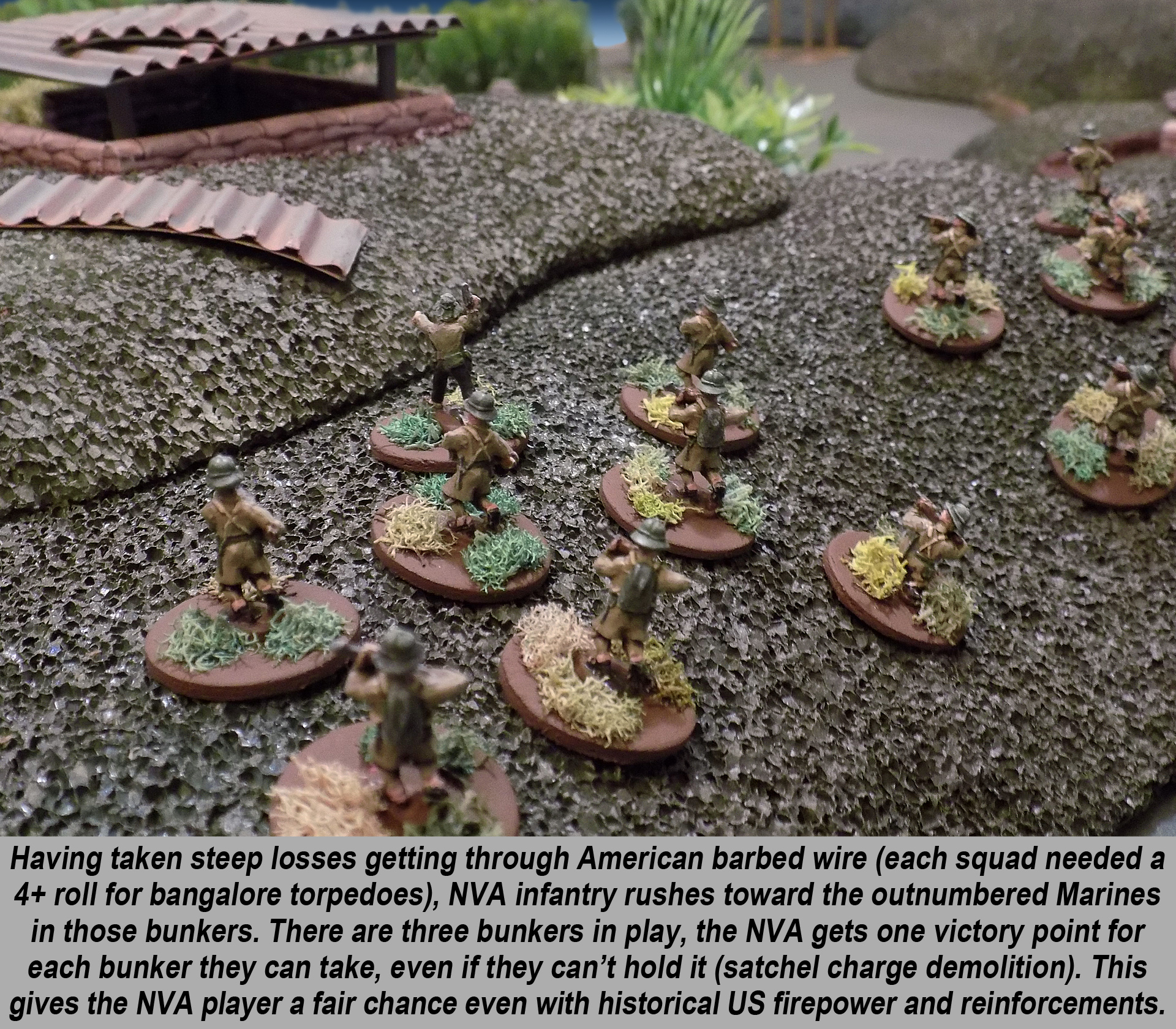
Yeah, a full V&V USMC platoon is freakin’ scary. Put it some kind of fortified defense (like we did above on Hill 64, with a platoon a Alpha Company, 1st Battalion, 9th Marines) and it takes more than a full NVA company, with pretty sizable off-board artillery support, to have any kind of chance to root them out.
As it was, the Marine force in that game wiped out the NVA force almost to a man. But the fact that the Marines had to re-take two of their own bunkers, plus the 8 killed and 18 wounded they sustained, meant that they BARELY squeaked out a game victory. The NVA got 1 “victory objective” just for taking a Marine bunker at any time (they would have gotten 3 for HOLDING them but this wasn’t expected – and sure enough didn’t happen once Pattons of 3rd Marine Tank Battalion arrived), and damned near won more victory objectives for taking out Marine 105mm (“F” Battery, 2nd Battalion, 12th Marines). The NVA kept missing with RPGs, one hit and this game would have been a draw. Two hits and the NVA would have scored a win.
Great stuff
Thanks very much, @c0cky30 ! 😀
Another balancing factor for the VC were their use of sharpshooters, a sniper without a spotter. They had a pinning effect on US units. Their tactics were similar to the German withdrawal from St Lo. In this case the German sniper teams used a series of cave networks that had been connected by the locals for wine storage, that the Germans had modified. The German snipers allowed the US units to pass overhead and then hit then from behind. The Americans thought they had cleared them out several times not realizing the size of the cave complex network. Sounds familiar?
In Tet based games sharpshooters could be used to pin down US infantry units or take out a target of importance if they expose themselves. This could be used to force any tanks to button up that are in range, limiting they vision. The sharpshooter would have the option to bug out and appear somewhere else on the board. You would need to agree how many sharpshooters the VC player gets as they were not like an infestation of fleas.
Compared to standard infantry platoons the Vietnam era infantry platoon is indeed very impressive. However by 1944 the change to the modern infantry had begun. The Volksgrenadier platoon is not looking to shabby.
The platoon was made up of 27 men. They had 4 fire teams of 4 men equipped with StG-44s and Panzerfausts. There was two fire teams of four men equipped with a MG-34, StG-44s and Panzerfausts. In September 44 these platoons were at full strength for the Lorraine offensive. Certainly these units were too little, too late as usual. Having only two MG-34s brings the firepower down, but they could be assigned MG-42 fire teams from the MG support platoon, plus mortars and the like from the other support platoons. Once you consider this they do start looking comparable. However they miss the critical support of air strike and artillery. Once this is considered things unravel very fast.
There is still genius here for the modern platoon.
Great post, @jamesevans140 –
Re: “sharpshooters” – there are a lot of definitions for that term in addition to the one given in your post. Matt Victoriano (USMC Sniper, 2003-2004 Iraq) makes the distinctions between sharpshooters and snipers based on marksmanship as well as what he calls “fieldcraft.” I’ll post his writing below. “Sharpshooter” is also one of the qualification levels for Marine Corps rifle skill / testing qualification. I would agree that snipers usually / ideally work in 2-3 man teams (shooter and spotter), but that’s not universally the case, I just think we should be careful when it comes to these definitions.
https://spotterup.com/the-difference-between-a-sniper-and-a-sharpshooter/
“Their tactics were similar to the German withdrawal from St Lo.”
Definitely a sobering place to visit. So much of the town is distressingly “modern,” because it was levelled during the fighting between units like 29th, 30th, 35th US Infantry, German 352nd Infantry Division, and 3rd FJ Division (6th FJR, I think). The big church there still bears the scars, you can plainly see where the old stonework has been replaced / joined with new brick and concrete. The story of Major Howie is also poignant and compelling. I’ll see if I can find some of my photos.
“This could be used to force any tanks to button up that are in range, limiting they vision.”
Here I agree 100%. Studies run by the IDF estimate that having the commander unbuttoned in his cupola doubles the effectiveness of the tank. I admit the definition is very vague and I don’t know what metrics they used to quantify that, it’s just what I read and I didn’t run the study. 😀 We were talking about this during the Desert War Boot Camp during Free Play Sunday, where a movie was playing and some infantry were being attacked by tanks and the infantry were spraying the tanks with “impotent” MG fire. “Well, they gotta do something,” someone said. Hey, those bullets aren’t getting through the armor but if you manage to force the commander to button the tank, that really cuts down on his effectiveness and enhances your prospects.
“The platoon was made up of 27 men.” – That’s a pretty small platoon. 😀 But I guess by the time you get to VG units, Germany’s running low on manpower.
It was these StG equipped (partially) squads that were used as a base model for our Valor & Victory conversion from WW2 to Vietnam, as the StG44 is a tolerably-good analog to 7.62 assault rifles like the AKM family. For smaller caliber Vietnam weapons like M16A1, we gave the firepower of WW2 SMGs (based on ROF), and cranked the range up to just short of the AKM values (5.56mm NATO Ball / .223 Remington vs. 7.62mm COMBLOC), etc. I won’t get stuck too deep into the weeds on this, but similar methodologies were used to determine game values for light machine guns like RPDs / RPKs, and GPMGs like the M60 and PKM.
One issue I had was what to do with the Australians. Strictly speaking, the firepower should be reduced and the range should be increased, given that they used a variant of the L1A1 SLR 7.62mm semiautomatic “battle rifle” rather than a full automatic 5.56mm assault rifle.
But I didn’t do this, for two reasons.
1) Because accounts I found seemed to indicate that more aggressive squad and fire team tactics made the Viet Cong “fear the Australians more than the Americans.” Not sure what that means, again I’m not a fan of blanket subjective statements not backed up by measureable analytics. Besides, assault tactics are handled in their own ruleset in V&V, so shouldn’t be baked into the firepower values. Then again, the game uses the base firepower as the start line for assault resolution …
2) More importantly, I didn’t feel like reprinting all my counters. 😀
Tremendous reply @oriskany.
At the beginning of August in the Lorraine the VG units assigned to support SS units had two squads with StG-44 and a squad with 2 MG-34s. In an attempt to stop Patton’s
spoiling attack the VG units took a lot of casualties and replacements could be armed with anything. The SS platoons they were supporting had three squads ideally all having StG-44s. However these units had been taken off the line and brought back up to complement. Again replacements could be armed with anything. What I find interesting is the SS not equipping the 3rd squads with MG-42s. Unless they were relying on attachments from the MG support platoons, which would make them a larger platoon.
I use the US armies definition of sharpshooter. Meaning there is no spotter and the accuracy of the shooter may be as good as a sniper, field craft is not considered. This is the definition used by the US army to remove Simo from the greatest snipers of all time list. Simo was at the top of this list. Oddly the definition was not applied some Russian snipers. I have never really understood this as the action did not move a US army sniper into a significant position.
However this definition was broad enough for what I was trying to say.
A number of rules I have played required a tank to have a buttoned up or unbuttoned status each turn. When buttoned up tanks are somewhat short sighted.
The combat rifle you are referring to was simply called an SLR.
Australian doctrine while being similar to both US and UK doctrine does have its differences.
First and foremost you are not here to die for your country. You are here to make the other bastard die for his.
We own no man’s land. Get inside the contacts leader’s had and play with it.
If there are a number of solutions go with the most violent and aggressive solution that will cause you the last amount of casualties. Then apply it as speedily as possible, do not give the enemy time to think. This should give you local surprise.
Accuracy of fire is more important than volume of fire. Volume of fire is to be closely related to the most appropriate at the time. Recon by fire is strictly forbidden.
At all times you must have your mates back.
SOP final protective fire range is 50 yards for up to 105mm guns and 100 yards for anything over. This is much less than the usual standard of 400 yards. If the enemy rushes is APCs to under 400 yards and deploys we have his infantry in an unexpected killing zone. In Vietnam we had a lot of trouble convincing our US ally that this was normal for US, but the artillery unit had to be good enough to be trusted. Accuracy, speed and over the top aggression and violence are central ideas in our doctrine. We constantly train for jungle and dessert warfare for both a major aggressor such as Russia and small insurgent aggressors. So Australian units were a little specialised going in. The VC had looked at our performance in Malaysia and Borneo and considered Australia as leading anti insurgent specialists. But this does not make us navy seals. We can win the odd battle but we can’t win the war, so that should be a factor. Since WW2 we have not trained a soldiers to hate the enemy. We are there to do a job to the best of our ability. If they get in our way then they get to die for their country.
This cold lack of passion, if you like, seems to worry them more than anything else. They see it as their death means absolutely nothing to us. In our experience passion leads to mistakes. We are most capable of mistakes, see the battle for fire support base Corel.
When we analysed the US military we found the US marines to be our best fit to the way we work. You being an ex-marine, read this as almost as it is in your training to reject this statement. 😉
So at the end of the day run with your current stats because a plus here or a negative there for the Australians probably will end up close enough to what your current counters are, so I would not bother. After all we play a very minor rule in the Tet Offensive. It was the South Vietnamese and US militaries that did all the hard work. 🙂
Thanks, @jamesevans140 –
Great info on the makeup of the VG and SS platoons. This is what I love about games like Battlegroup and Valor & Victory, they allow modular construction of squads or platoons, so you can either pursue game balance, available minis, or fluctuations in historical accuracy. As opposed to other “favorite” games like Panzer Leader, where the platoons are more or less baked out of the box (hard core history and Photoshop commandos sometimes get carried away making up their own platoon counters. *cough, ahem …* (why is everyone looking at me)? But of course in that game you’re building battalions, regiments, and brigades.
I have seen SLR and L1A1. I realize there are probably distinctions, but I always cover my bases because there are few people who love to make themselves feel important or well-read by shooting holes in my work. So I always keep it as general as I can, as preemptive self-defense. It’s a shame I have to dumb down the writing like that sometimes, but such is the internet. I realize you’re absolutely NOT one of those people 😀 but everyone is reading these comments and I have to bear that in mind while posting (and especially while publishing).
The game design issue I had with the Australians is that V&V has (like most games) separate rules for application of firepower and close assault, but uses the same game “attack value” as a baseline for mechanic calculations in both cases. The issue is, the attack factor (in a firepower context) is based on the ROF of the unit, and the range factor is based on the caliber / ammo class of the weapon. So late WW2 squads often have SMGs with high attack values but short ranges because they fire pistol ammunition. GPMG support weapons, meanwhile, have high firepower and long range because they fire old-school bolt action rifle ammunition, and assault rifles that have SMG type ROFs but medium ranges (typical bullets are bigger than pistol, shorter than MG (assault rifle rounds even the same caliber are usually shorter with less grain in the shell).
So by the math, Australian squads should have a lower FP (semi-automatic “battle rifles” depending on who’s classification nomenclature we’re using, as opposed to fully-automatic assault rifles with smaller cartridges) – but of course a longer range thanks to the bigger slug. This wouldn’t be a problem except the second I published it, there would be people thinking Oriskany had slighted the Australian military somehow (with no working knowledge of the math that drives the mechanics of the game design).
Far more important, this same “APFP” number (by my calculations a 10 instead of a 12) would adversely affect Australian squads and fireteams in close assault because this same attack factor number is used for assault.
Ideally the solution would be to break these attacks into two separate values (US Army a 12/10, US Marine Corps a 12/12, Australians a 10/14, something like that) but that’s more complexity into a game who’s selling point is that it’s a user-friendly version of 1980s Advanced Squad Leader, a game largely replaced in the market because of its complexity.
I dunno, I guess I’m just gearing up for the arguments I know I’m going to get when I start posting this stuff on BGG.
When we analysed the US military we found the US Marines to be our best fit to the way we work.
Actually makes sense. The 7.62 NATO rifle 1st ATF was carrying in Phouc Tuy and later Dong Nai (and reliance on older-fashioned, semi-automatic fire engagement) lines up with the M14 battle rifle many Marine units were still carrying at the same time. And of course there’s the Marine predilection for close assault, which seems to match the NLF/VC’s opinion of the ATF. Never let a Marine get his e-tool “lobotomizer” within two hexes of you. 😀
The one difference I can think of off the top of my head would be the abnormally large size of Marine OOBs. They like big groups. Most nations have some variation of a 9-man squad, two fireteams of four and a squadleader. Marines run in packs of 13 (three fireteams + SqLdr). Four squads in a platoon instead of three, for a platoon parade-ground strength of around 56-60, which leads to 200-man companies. Up into the operational scale, Marine Expeditionary Force is built around a full division, a full division size FSSG (Force Service Support Group) and a MAW (Marine Air Wing) = three division-level formations, practically an independent corps in itself.
I know far less about Australian OOB templates, but I’m pretty sure they’ve stuck with more of a British model, at least given the naming convention of their units.
I haven’t seen it on the main site yet, but Battlefront just re-launched their ‘Nam range. Seems relevant…
https://vietnam.team-yankee.com/
Thanks, @erion – I noticed when I went to the Battlefront Store to buy the minis for this project and the whole Vietnam page was gone. 🙁 But yes, sometime in February, I believe, is what I heard about the new Vietnam releases. @davebpg touches on this in Part 05 of our series. 😀
Awesome article @oriskany
The Green Beret situation looks perfect for Force on Force I might get started on my Vietnam journey with it.
It really puts into perspective all those WWI and WWII documentaries who try to “impress” you with “and they dropped this huge amount of bombs during battle X” then you look at what they were dropping in Vietnam. Was production able to keep up with demand or did the US have to have “dry” periods where bombers weren’t on call to have enough in case of emergencies?
Looking forward to the next one.
Thanks, @ellessar2590 – Indeed smaller battles like Lang Vei fit a little more comfortably into systems like Force on Force. The vehicles added a slight level of complexity, but nothing that would deter a veteran wargamer. We also had some slight issues with deciding how well the LAWs should work. Using the stats right out of the game, these seem to be the LAWs that work all the time, have all the bugs worked out of them, and with new improved warheads. Against those LAWs, the PT-76s have very little chance. But knocking them down a peg in firepower and accuracy, and somewhat reducing their numbers, delivered a more historically-accurate result for what was reported at Lang Vei.
I’ve never heard of the US running low on ordinance during Vietnam. I know it happened during some of the bombing in the Balkans in the late 90s, but that was strictly precision ordinance and when the US was not on a Cold War footing (military spending was way down during the Clinton administration).
But to my knowledge, the US never really ran out of air-delivered ordinance during Vietnam. Cold War footing, nothing was really “guided” or precision-delivered, and depending on whether you’ve been fitted for a tin-foil hat … 🙁 … many people believe this war was deliberately started by military-industrial complex tycoons to drive business.
Now helicopters, that’s another story . . .
I have been reading the Anthony Beaver book on D Day and he was talking about the American and British precision bombing of the d day beaches to create craters for the troops . Even given that there was low cloud cover none if the shells got within a couple of miles of the target. I remember reading that the British considered anything within 5 miles of the target during the night bombings a direct hit I was wondering if the Americans in Vietnam had the same standards for bombing accuracy
I can’t comment about the US here but in Vietnam we used the Canberra bomber. After a bombing mission their tails would a bit chewed up by their own bombs. If this did not happen the pilot was jokingly told he was not doing his job right. So we would get in very low to ensure the bombing was accurate. I have never seen any data to just how accurate we were.
@torros – sorry this took so long, but today I’ll be at work in one capacity or another from 9:00 AM to 2:00 AM the next morning. I love project roll-outs. =(
Okay, the short answer is YES, American bombing in the Vietnam War, especially around Khe Sanh, was much more accurate that WW2 USAAF or RAF bombing.
For tactical fighter-bombers, a big reason for this is the use of ordinance like the Mark 82 GP bomb, especially the “Snake Eye” variant discussed earlier in these threads. These are the bombs that snap-deploy drag fins from the tail as soon as they are released. This allows the bombs to fall closer to where they were actually released, instead of gliding along with the release trajectory of the plane that dropped it. This is especially important with jet aircraft flying close to the speed of sound. It also allows the bombs to be dropped from a much lower altitude, without the plane being caught in the blast of its own bombs on impact, further enhancing accuracy.
Strikes into North Vietnam also had to be much more accurate. An example is the “Rolling Thunder” strikes against oil refineries / storage tanks in Hanoi and Haiphong. These were less than 500 yards from Russian and Chinese tankers, and tremendous care had to be taken to hit the oil tanks, but not these ships.
Other weapons, like the 54,500 tons of napalm released by TacAir over NVA positions surrounding Khe Sanh, have a little more splash area, but strikes were often delivered with 300 yards of forward Marine Corps positions.
Moving back to the strategic bombers, the B-52s were originally restricted to targets 3400 yards away from the nearest Marine Corps positions (2 miles, already far more accurate). These “ArcLight” strikes were released from much higher altitudes than WW2 bombers (over 30,000 feet in some cases), and were partially guided by electronic ground sensors that had been dropped into the jungle around suspected NVA avenues of approach. As the Battle of Khe Sanh grew more desperate in the last days of February 1968, these B-52 strikes were pulled in to with 1200 yards of Marine positions (3/4 of a mile).
These landed RIGHT on top of NVA positions that had been “trenching” their way toward the Marine perimeter, and included 53,000 tons of bombs (more precise, actual historical data compared to my previous 60K estimate). Close in bombing by B-52s, already a staple of TacAir with “Snake & Nape”, was henceforth a norm for B-52 strikes as well.
In the few miles around Khe Sanh, the 77 days of the siege wound up being hit with about 111,000 tons of bombs. Even if only half of this weight is actual explosive, we’re talking 55 kilotons, or over 5 times the explosive power released on Hiroshima. North Vietnamese positions around Khe Sanh are on record as being hit with more aerial bomb tonnage than any other spot in the history of warfare, and a lot of it was within a quarter mile of friendlies.
Moving forward (while we’re on the topic) this was still the norm for the 1991 Gulf War. For all the TV Footage we’ve seen, only 1% of tonnage dropped over Kuwait and Iraq in 1991 was guided or “smart” in any way. The vast majority of raw tonnage was still B-52s with “iron” bombs, landing within half a mile of friendlies or civilians.
For the 2003 “Iraqi Freedom” War, this proportion was still only 10%.
Thanks @jamesevans140 – indeed, jet strike craft releasing ordinance very low can be very accurate … but because they’re going so fast, the bombs also “glide” off the planes very fast, and can VERY easily take damage from their own explosions.
This is the reason for the “Snake Eye” variants of the Mark 82 I was talking about before. Those drag fins allow TacAir to deploy ordinance much closer to the ground, and thus making them much less vulnerable to ground fire (moving faster relative to gunnery sights and takes advantage of ground clutter to foil enemy SAM radar) and enhances accuracy too.
In fact, this is where the expression “snake & nape” comes from that we see in so many Vietnam accounts and movies. A strike package mix of “Snake Eye” HE bombs and napalm, both designed for very low releases on very precise targets, used in very close air support when the ground friendlies are really in trouble (hence, why it’s always in these movies). 😀
Oh, and I should note that @torros mentions the 5-mile accuracy for NIGHT missions. Many of the aforementioned ArcLight strikes were carried out at night, still to within 1200 yards of friendlies. But of course, those B-52s were equipped with much more sophisticated navigation, ground-following radar, etc.
This is a leap of technology, not skill or courage of the bomber crews.
Part of the problem on D Day was the the bombers were terrified of dropping short and hitting their own troops so delayed the release for 1 or 2 seconds which at the speed they were travelling was far too late
Can’t argue with that.
The tradition of singed trail feathers goes back to WW2 and our Boomerang fighter bomber.
Solomons, Bougainville, New Guinea, and Borneo campaigns, nice. 😀
Thanks @oriskany, an interesting reply.
Actually that is one of the big things I look at in a game. Can I easily construct a historical unit using the rules and processes that are already available and I should not have to come up with house rules to make it so.
As an Australia I would not be offended by stats that are similar to the US marines. Any Australian that disagrees can take a number and meet me in the street (the Australian character coming out.
Again the assault factor is an issue. We go for accuracy over volume and we are explosively violent in the assault. The way we look at the assault it is less about volume or weight of fire, it is about the maximum amount of in your face violence.
Another way to look at it is that we use just as much psychological on the enemy as we minor tactics.
Our order of battle is very similar to the British, as are our principals of war and both have little tweaks that make big differences in the ground.
Our sections or squads are made up of scout group, rifle group and gun group that use light infantry tactics.
The scout group has two independent but self supporting. Their role is to seek out the enemy and establish his disposition and above all estimate the size of our response that we require. If contact is made the scout group is to annoy the enemy until chased off. The scout group will lead this response into a cross fire of rifle and gun groups. They will operate up to 100 yards ahead of the squad. We place a heavy emphasis on local recon.
Rifle group is made up of 3 to 4 soldiers armed with SLRs. They will take a positions and support the scout group. Once a position is taken the prepare for a counter attack. The scout group will check flanks and then join the rifle group to add their fire power to rifle group if necessary.
The gun group is made up of squad MG and SLRs, usually 3 to 4 soldiers. It will add its fire power to support the scout group if require. When the rifle group assaults a position it will support it from a flanking position. Once the position is taken the gun group will move up to the position. Once there thing squad will re-org making the gun squad the primary responder to a counter attack.
The squad leader normally be with the gun group and direct the fire fight from there but may lead from the rifle group if he chooses. On rare occasions he will attach himself to the scout group if he wants to make his own assessment.
On the move the order will be scout group then gun group and finally rifle group. If we need to pull back we will use a cascade withdrawal. The scout group will fall back first and establish a new position covered by the other groups. Then alternating between groups one man will take up the new position with the squad MG being last out. We will use volume of fire rather than accuracy if required.
Squads in action are not that much different. Using one up two back on the move and two up and one back in the attack. We also use Coy (half platoons) making effectively two double strength squads.
Most nations have tried three team squads and coys, but have dismissed it for being too complex to manage in combat. Australian armed forces are kept smaller than we can afford allowing us to spend on training in maneuver and shooting accuracy.
I cannot stress accuracy over volume enough. Your soldiers accuracy is regularly tested at different ranges where a grouping of rounds must be within a certain size and above a certain score. Fail three attempts his job comes under threat.
All our soldiers are trained to a couple of levels above their current level. A squad can be down to just two soldiers and they will both know which one must step up to be squad leader. So our squads are never out of unit command.
The Iraqi solder were taken by surprise by the long range and accuracy of our fire.
Don’t forget I am trying to describe an entire doctrine in a few paragraphs. So you are only getting the essence with a focus on what is very different. I hopefully have kept away from making them sound like super soldiers, which they are not.
Getting back to the main point if I were you I would just run with what you got. Like any nation we can have our good days and bad days. We dropped the ball by our standards, at fire support base Corral. So the negative effect of this must have a ripple effect across the Tet Offensive. I know how much effort you go to, to convert action and equipment into numbers on the playing pieces. But I think you may be over stressing on this.
We live in a hot and dangerous environment and in turn that makes us non politically correct. If you bottle things up people have a habit of going troppo and bad things happen, so we are taught to get things off your chest and call a spade a spade. Your yes must mean yes and the same of your no.
So to other cultures we come across as aggressive or stroppy as the English call us. On the other hand we are uncomfortable around people who don’t get things off their chest. New Australians will say that they are picked on, and correct. They are being tested to see if they are strong enough to watch their mates back. I pressed my own son’s waiting for them to stand up to me and when they did they have reached Australia manhood. This is tempered by the belief that everyone gets a fair go. This cultural nature must filter into our military doctrine. If I wrote the article concerning the the ATF and an Australian objected to a figure here or there he would be expecting me to tell him to piss off. He got it off his chest and it would end there unless he believes it is more important. If this was the case I would expect him to tell me to get stuffed and he will state his case and I would listen. He may or may not like my reply and he will let be know about it. Charles Bean said of the Australian that you think when they are talking that a huge fight is about to break out they will suddenly stop and slap each other on the back laughing and buy a beer. A hard race to understand.
Even hear I try to be politically correct but I don’t think I am doing a good job of it. Really it is not in my nature. So I have no issues about telling me when I cross the line. The Australian for this is “pull your bloody head in mate!”. 😉
Thanks @jamesevans140 –
Sounds like we are of one mind re: game design and modifications. This is probably one reason I don’t go excited about kickstarters or have bought a new game published after 1988 … except Battlegroup. 😀 I design most of my own games, or at the very least “kitbash” older games for new purposes.
Yeah, in order to REALLY do the Australians in Vietnam right in V&V, you’d almost need two attack values, one for assault and one for longer ranged firepower. But like I said, I left it alone. A game has to draw a line in the sand somewhere, especially after you print a hundred counters for an army you’ll only play 2-3 times.
I cannot stress accuracy over volume enough.
You don’t have to stress that to me. 😀 I never qualified less than Expert with the M16A2 and worked part time as a rifle line coach while stationed with Weapons Training Battalion at MCRD Parris Island. I was one of the people putting others “under threat.” 😀
I hopefully have kept away from making them sound like super soldiers, which they are not.
This is something I have to watch out for when gaming with US Marine units / designing for their units in wargames. The temptation is always there to give them god-like attributes and combat values. Can’t do that.
@oriskany I hope you lots of triple time overtime rates for working those sort of shitty hours
Salary employee, so no. But, days like this aside, I’d rather be salary than hourly for sure. Works in my favor far more often than not. 😀
@oriskany, I do believe we are on the same page concerning our wargaming but I think I am the lazier of the two as my order of preference is;
1) Buy a game on the subject matter at the level of warfare I am looking for.
2) Buy a game and tweak it.
3) “kit bash” a game together.
4) As a last resort write the game myself.
Have said that for all historical battles I find that I must tweak the rules or add a section of new rules with a view that if the rules are complex I am not getting it right.
In the second half of our winter timp764 and I will run a Gazala campaign 1942. This is so glossed over by historians, yet many battles are fought in this region before Tobruk is taken. One such battle is the Cauldron, Tunnel Rommel is up against the ropes of mine fields. He is about to go down for the count and the war in the Western Dessert is won, but wait…
In the northwest of the Cauldron a number of armored clashes with the 7th AD occur in a dust bowl. Even infantry on the move create an obscuring haze and it is the dust storms that decide when a battle ends. So for these battles our table with have no terrain, loss of dust and smoke makers and an ever present need to beat the dust storm.
While it is ready to play a general wargame in a time period, all rule sets I have seen need tweaking to fight a historical battle and the events that made this battle back in the day.
Like the battle for Bir (water well) Hakeim was mostly fought between Italian mobile forces and the free French foreign legion and a small support of German tanks. Neither side broke and it was a protracted battle of attrition with the French finally losing. Yet if I play the Italians as given for general gaming they will break. So to reflect the moral of the Italians for this battle only their moral must be tweaked to reflect this.
Again doctrine wise this makes the marines a better fit. They have learned that they can’t rely on a material war as can the army. So they use accuracy to make up any short fall on material. This makes their doctrine closer to the Australian doctrine that does not rely on material.
I am glad to hear you were a couch on the range. You may like this story. A friend of a mate was on his third and final attempt at a certain long range. So my mate and I pulled a few strings and gave away several cases of beer (the real currency of the army) and we got an afternoon of range time with this guy. At short range he did great but at long range not good. It came down to his breathing. He began to suck air just as he pulled the trigger. At short range there was no pressure on him as he had passed them, but as he was under pressure this nervous habit of sucking air had crept in. Once we had pointed this out he was able to correct it and passed his final a few days later. Yet how many times do you couches say “check your breathing”.
The US marines have a long tradition going back to the days of sail. In those days their courage and sacrifice earned them the proud name of “Leather Necks”. In each engagement since that time each of you added to the spirit of the marine and what it means to be one. Yet you are judged by that spirit and nun wishes to be found wanting.
In a similar way the colonies send units to the Boer War and came out of it as the Australian Imperial Forces so this is our birth place on the field of battle. Those Diggers set the ground work. Then came WW1 and on the hills of Gallipoli the ANZAC spirit Ws forged. Those who came after this added to what it meant to be a Digger and are always measured by the spirit of ANZAC and must live up to it. Even civilians before they join the army know that they must live up the spirit of ANZAC.
Remember that the spirit of ANZAC was forged on the field of defeat that burned itself on the Australian soul. This is why we do honour and remember the dead and hold them as the true heroes of our nation. Tells us not to be arrogant to our enemies, to learn his ways, do you job, make the other guy die for his country, be mindful of our allies and to protect our mate and care for the families of the fallen.
So just like the marines the ANZACs have a lot to live up to. This spirit is like a soul and tradition is the body and they should not be confused. Among our young there is I confusion that the Australian spirit was born at Gallipoli, but this is wrong as we were not born out of war. The Australian spirit is our tradition that goes back over two hundred years.
Here is where we do have a problem. Over the years their actions have become legends and they have become taller in the public mind. If this is not filtered out these original ANZACs are about 12′ tall and eat bullets for breakfast. While the reality is they were young ordinary men who were scared witless that some how managed to face up and do their job. This makes them legend to me. So it seems you have the same problem of finding the real marine.
Last night I was thinking about the war in the Pacific, more so on the MacArthur lead campaigns. On the way to the Philippines he bypassed Japanese strong points were they had numbers and took islands were they were not strong but caused the strong points to die on the vine. This is strategy is playing Go and not chess. If not for the nuclear battle field and the wiz kids (I think they are called T2C2 today ) the similarities may not have been missed. Meaning that it was critical that certain areas need to be taken and held so VC controlled areas would die on the vine. Most misunderstood at the time and even now the kind of war they were facing. Let’s call conventional war as fought by the leading nations tier 1 and asymmetrical, insurgent and small wars tier 2. While using methods of both Hybrid Warfare is another means of fighting a tier 1 war. The French in 1812and the Israelis in 2006 have been beaten by hybrid warfare and most certainly the US walked away from Vietnam with a bloody nose in part because of it.
See Hybrid Warfare by Williamson Murray
https://www.amazon.com/gp/aw/d/B008CDSZ0O/ref=mp_s_a_1_1?ie=UTF8&qid=1518285686&sr=8-1&pi=AC_SX236_SY340_FMwebp_QL65&keywords=hybrid+warfare+by+williamson+murray#mobile-udp-contributor-popover-id_1518285772485
@jamesevans140 –
Glad to hear about your upcoming project for the Gazala battles. In his 2000 “Desert Leader” series written for Panzer Leader, Brian Train includes two battles for Gazala, I added three more when I expanded on Desert Leader for supplemental writing in 2013. The 150th Brigade Box was featured in the Desert War article series here on Beasts of War (also done in Panzer Leader), along with Bir el Harmat, Bir Hachiem, some of the initial battles far down on the southern flank (8th Hussars / 4th Armd Bge / 7th AD vs. 8th Pz Rgt / 15th Pz Division), the Cauldron you mention between 1st Armd Div and 50th Infantry and 15th, 21st Panzer and the Italian Ariete Division, and of course “Black Saturday” at Knightsbridge. We also wrapped up our study on Gazala with the “Last Stand of the 32rd Tank Brigade” near the King’s Cross road junction at Tobruk.
So anyway, if any historical / gaming / background material might help your project, feel free to reach out. 😀
On the rifle lines, coaches are really just there to provide safety, help trainees with recording shots in their range books, and keep reminding the shooters what the PMI (Primary Marksmanship Instructor) has actually taught them the night before. PMIs are usually sergeant or staff sergeants, the same as drill instructors. We coaches were usually only corporals (and again, I only did this part time, covering for people when on detached duty, sick, or some such, because I worked at Weapons Training Battalion in supply and had always qualified well with the rifle).
I was thinking about drawing up some Centurions for Valor & Victory and my 1st ATF. But it seems 3rd Cavalry Regiment (A and B squadrons) were equipped with M113 APCs. Most of the Centurion-equipped units don’t arrive until later in 68 or 69, putting them outside the scope of Tet.
I was about to give up when I found a notation on “C Squadron, 1st Armoured Regiment, which seems to arrive JUST in time (February 1968). It’s just one squadron / company, and I haven’t dug any deeper to see if these tanks actually participated in the Tet fighting, but it’s a start.
The term “Leatherneck” indeed comes from the “sailing ship” era of Marine Corps history, as you say. “Leatherneck” comes from the thick leather stock work by Marines in the collar to protect the neck from saber slashes. This is also when Marine officers earned the quatrefoil in the tops of their dress “covers” (hats), from when Marines would draw “X”s on the top of their hats so their own snipers in the rigging knew who not to shoot at.
Most of this comes from the First and Second Barbary Pirates Wars (1801-1815). Turns out Marines were pretty serious pirate-busters back in the day. I know its not the usual era portrayed in games like Blood n’ Plunder, but I wonder if the game could be adopted to the later era.
Thanks for three offer of research material for the Gazala project. Any battle concerning @timp764 ‘s beloved 7.AS he is up for. Although today he told me he is thinking about starting an Italian army later in the year. He does not care how bad the Italian armour was he just loves the look of the things. I told him about more about the battle of Bir Hachiem and the knock down fight between the free French and the Italian mobile forces which he took quite I shine too. Perhaps I should have kept my mouth shut as I have enough on my plate without having to build a free French force. Either way it looks like we will be campaigning Gazala over our winter and spring.
What you are describing about the Centurians is part of the attacks on FSBs Coral and Balmoral. We got to bump heads with 2 regiments of VC and 2 regiments of NVA that were some kind of composite force. They hit us with rockets and mortars and the guns of the US 102 field battery at the centre of FSB Coral fired copious amounts of splintex. The M113s and the Centurians are two different units.
I have found two links that will help you out with this.
https://en.m.wikipedia.org/wiki/Battle_of_Coral–Balmoral
https://en.m.wikipedia.org/wiki/1st_Armoured_Regiment_(Australia)
Hey, check it out! We’re on a second page of comments! Not bad, for Part 03 of a series. Usually these ratchet down on a general ~60% curve (so if the first article gets 100, the second will get 60-70, the third will get 40, etc).
The Free French at Bir Hacheim is indeed a great battle. We did the night escape / breakout in Panzer Leader / Desert Leader. I’m sure I’m preaching to the choir here, but as you know, this is one of the big draws for hex and counter games. On top of the quantum leap in historical fidelity, military realism, tactical depth, etc … there’s also the bonus that you can build an entire new army in an hour or two, given a little Photoshop and patience. 😀 So our Free French “army” in this case was no big deal.
I also like the Bir el Harmat battle nearby. Basically a slightly smaller version of the Bir Hacheim position that was taking place at the same time just a few miles away. Here we had something like 400 Jewish Palestinian Zionists that had volunteered for service in the British Army, under the command of Major Liebmann. I think the were eventually taken prisoner, and Hitler passed the word down that they should be all executed. Rommel binned the order, so the story goes, which seems to hold up as most of these men survive the war and some even served in the early days of the IDF.
Thanks for the link on the Battle of Coral-Balmoral – as I feared this is after Tet, and so out of scope at least of my immediate project. I can’t linger around Vietnam too much longer as the next two article series have actually already been started. So for now I’m sticking strictly with Tet.
Looks like “C” Squadron / 1st AR(A) only shows up in-country in February 1968, and usually there’s quite a bit of time between when a unit “arrives” and it’s actually geared up sufficiently to take part in actual combat operations. Especially since two of the squadron’s troops / platoons don’t arrive until September?
Who knows? Might come back to it someday. 😀
Not bad at all for mid series, @oriskany. Congrats.
Most definitely preaching in the choir, but no objections.
The desert campaign will be a challenge for @timp764 as up till now my focus has been teaching him the game and how to use his 7.AD. In these upcoming battles he gets to find out how the enemy fights back as I will be using full DAK and UK doctrine against him. I am hoping he does well as that will mean I can finally take the gloves off.
As to the Centurions at Tet, This would be a matter of what you consider the Tet Offensive to be. We consider March to be our biggest Tet engagement as the Tet Campaign lasted most of 68 and some histories break it down into 3 phases.
Phase 1: January 30 – March 28, 1968
Phase 2: May 5 – June 15, 1968
Phase 3: August 17 – September 23, 1968
The campaign is not just about the initial offensive and clearing the largest cities but regaining the whole countryside. The focus of your article is only about the first two months. I totally support this. To cover the campaign in just 5 articles would be at the cost of too much heart and soul and that would be a shame. Most of the actions across most of the campaign are not the best kind of wargaming. I would encourage you to still make the Centurion counters and playout the FSBs Coral and Balmoral action even just privately as it is a conventional action very suited to wargaming and you should get a good insight to Australian doctrine and principals of war that are similar but different to the US and UK.
Now having harped on about accuracy over volume so much, I must take a step back. When it comes to support MGs, including APCs and Tanks (MGs) this is not quite the same. All MG gunners are taught about the beaten zone and increasing the killing zone within through crossfires. A MG will fire to create a beaten zone and pin the enemy within. The other MGs will take flanking positions that allow then to crossfire into the beaten zone to create the killing zone and expand it. Very similar to WW1 German trench warfare MG doctrine. While the German doctrine was static this is a mobile warfare version of it. Where it can be artillery plough the ground within the killing zone. The Battle of Long Tan is a great example of this.
In this battle a NVA regiment ambushes a platoon with the aim of destroying it. It goal was to attack and reduce the high moral of the Australian army. Result we got bashed up and the NVA regiment got a kick in the nuts, but our platoon survived in good order. The last time I checked the Battle of Long Tan and Thermopolis were still required reading at West Point as examples of superior discipline over numbers. I his after battle reports and after the war the NVA commander was amazed that the platoons fire discipline never broke down, any gains were met with savage counter attack thus making any gains extremely costly and at no stage did its moral fail them.
One tactic that was heavily used when giving was calling down artillery on our own position. It was timed so our troops could pull-out of it, the enemy occupies it and is pinned in place by local fire. The enemy is hit with the barrage and then counter attacked retaking the position. All this is happening within 50 to 100 yards of other positions. Our US fire support was having kittens at our requests and has to be ordered to comply by senior AU and US staff.
This can be a very intense wargame if done properly.
So definitely print up the Centurion counters and have a go. 🙂
@jamesevans140 – Interesting to hear about the Desert War campaign and plans to “use UK Doctrine” against him. I guess this depends largely on when in the timeline your games will be set. Like the Soviets in the east, the British started out with some terrible organization, doctrine, and tactical flaws that were sadly reinforced in their success against the Italians in Operation Compass, etc (all of which I’m sure you know) 😀 When Rommel and the DAK show up, these shortcomings remain tragically persistent (“Jock Columns,” the outdated ideas of Hobart, etc).
These are presented in a book with which you’re probably familiar, it was of great help to me in my Desert War writings before joining Beasts of War:
https://ospreypublishing.com/world-war-ii-desert-tactics
Now while these bad habits were eventually shed (finally), the degree to which they can still be exploited probably depends on when in the campaign you’re planning to set your games. I can only assume that if you’re planning on Gazala, when a lot (but not all) of these flawed concepts are still in place.
As to the Centurions at Tet, This would be a matter of what you consider the Tet Offensive to be.
To be perfectly honest, I’m sticking with the “conventional” view that the Tet Offensive runs from January 30/31 through the middle of March, 1968. This is marked by the closure of fighting in the last major cities, i.e., Hue City and the Cholon district of Saigon.
The impression I get is that by the time these battles are concluded, the NLF is largely shattered as a fighting force, its military capability and political organization (party offices at COSVN) in South Vietnam is never really the same after that. NVA leaders in the north (whose forces remained in much better shape) were, and I quote David Flitton and Professor John Ericson, “forced to claim that Tet had always been intended as a series of offenses, not one push.” Planning for a second and third wave were undertaken to launch in May and September 1968 – but again, planning for these were only started after the initial Tet Offensive had failed in March. For this reason, I agree with most historians that these roll-out offensives later in 1968 (and extending into 1969, depending on whose definition you use) were subsequent, later, separate offensives, not really part of Tet proper.
Also, keeping a tighter “box” around what “is and isn’t Tet” helps get the article series done on time. 😀 😀 😀 😀
I could spend the rest of the year in Vietnam, especially as I get sunk deeper into Force-on-Force, but two more article series are already started with research and preliminary game design, both of which have to happen before another really big one in mid-summer. No rest for the wicked!