









![1918 Spring Offensive Wargame | Full Rules Overview with John & Gerry (WW1 Tabletop Game) [7 Days Early Access]](https://images.beastsofwar.com/2026/03/unboxing-warfulcrum-games-1918-spring-offensive-review-coverimage1-225-127.jpeg)
The Evacuation Of Dunkirk Part Two: Wargaming At 15mm (Flames Of War)
August 8, 2017 by oriskany
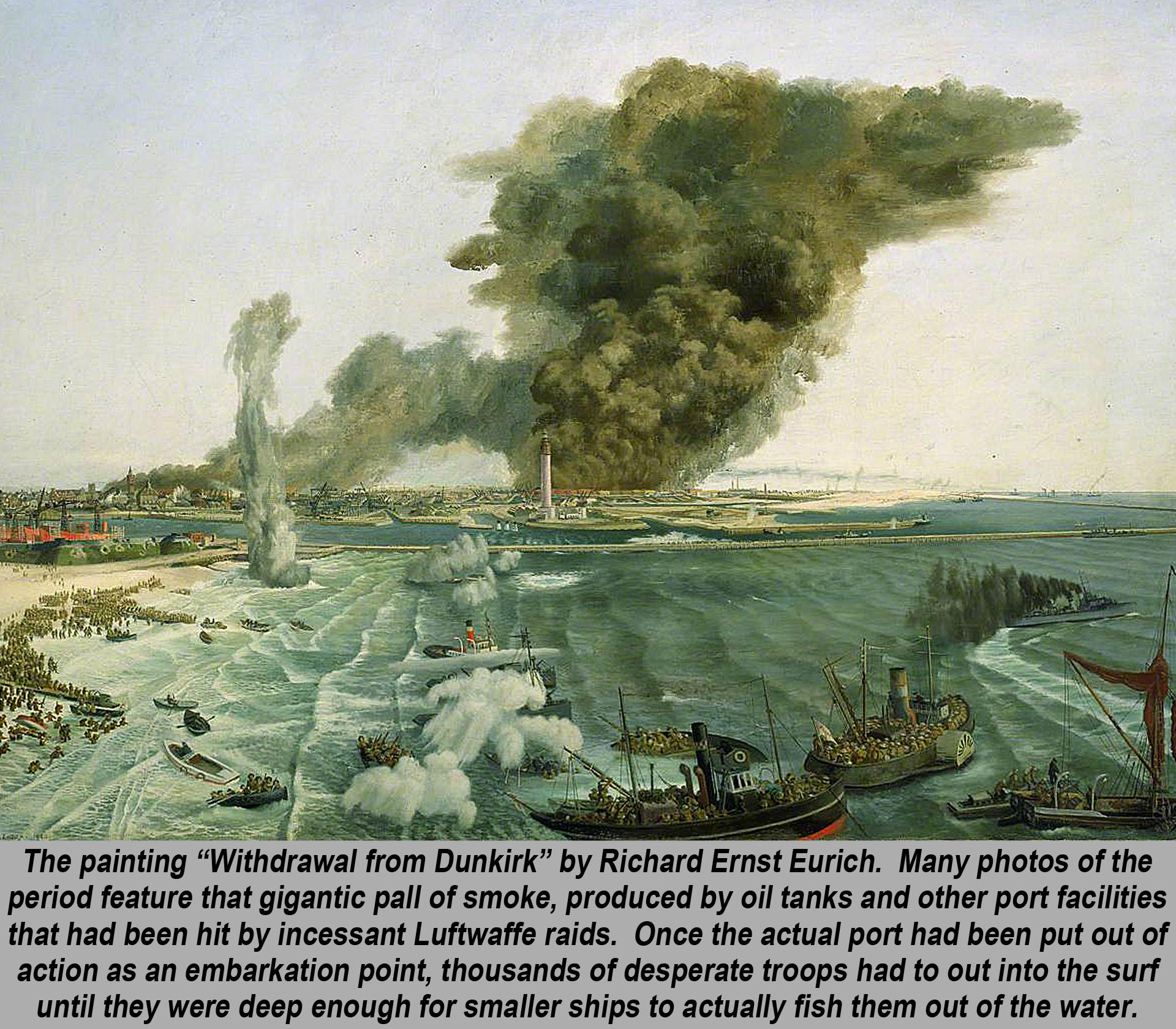
Good afternoon, Beasts of War. This week we’re talking about “Operation Dynamo,” the 1940 evacuation from Dunkirk. Recently highlighted in the new Christopher Nolan film, this was where the British Expeditionary Force was evacuated from France after the Germans invaded that country in the early days of World War II.
Follow Dunkirk Week Here
Although technically an evacuation, there was also plenty of combat around Dunkirk. The Germans contested Operation Dynamo fiercely, as they didn’t want these hundreds of thousands of trapped Allied troops getting away. This gives rise to all kinds of wargaming potential, which we’ll be exploring in this article and throughout this week.
Dunkirk In 15mm
Okay, so how do you “play Dunkirk” in 15mm? What kind of historical engagements took place around Dunkirk during Operation Dynamo that would fit with the features that a 15mm World War Two miniatures game usually brings to the table?
Well, when we say 15mm, we’re probably talking about Flames of War. Therefore, we’re probably talking about a large company or battalion-sized battles and set-piece engagements, with plenty of tanks, big infantry formations, artillery, and possibly even air strikes, all the things that make a big Flames of War battle fun.
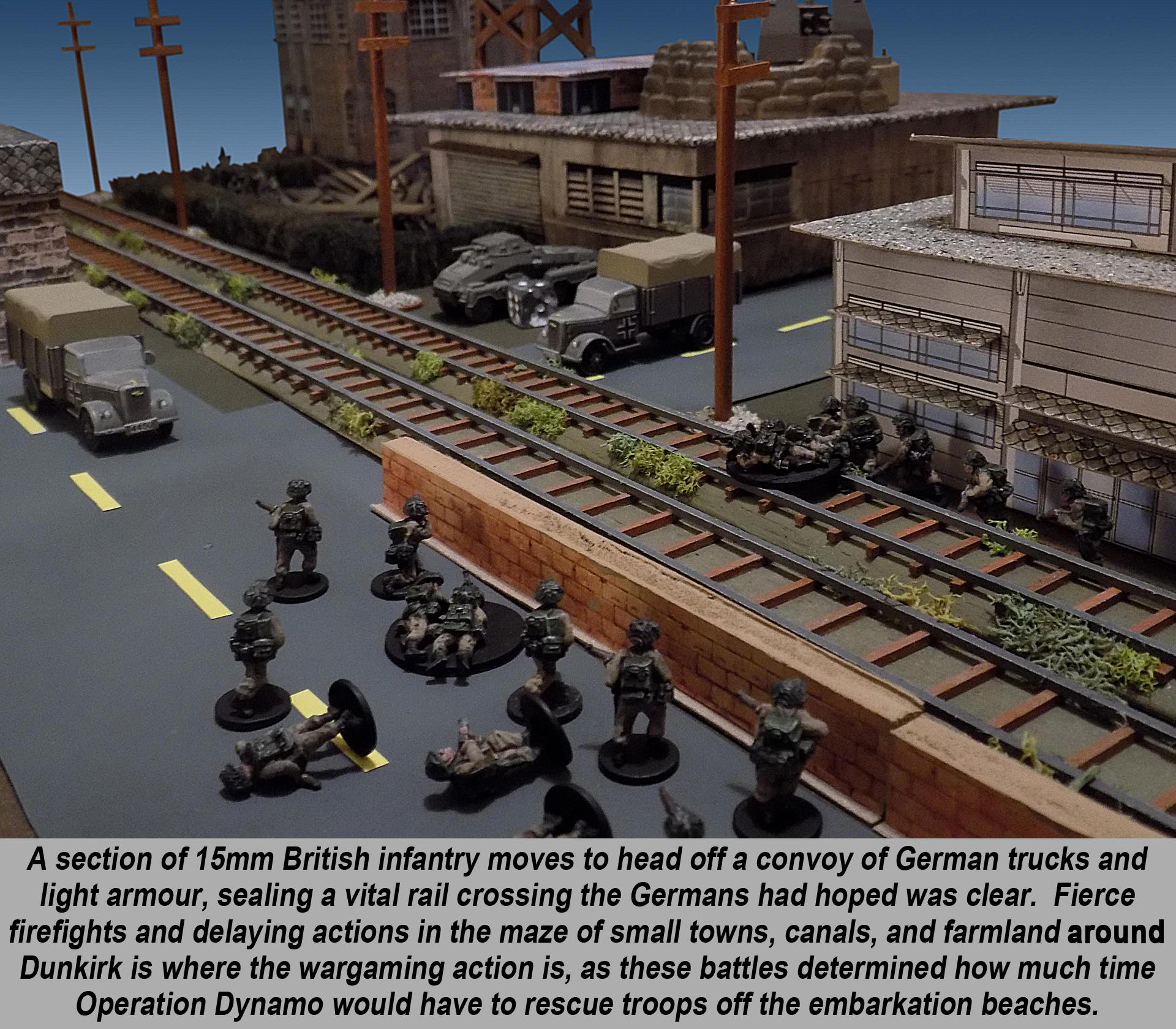
The good news for FoW fans is that there were certain battles around Dunkirk that fit this description. Therefore they can provide a great background for a Dunkirk-themed campaign, or inspiration for you and your friends if you’ve just seen this movie and are fired up to bring Dunkirk to your table top.
The Tactical Situation
We’ve discussed the German invasion of western Europe, how they sliced off the northern half of the Allied armies, and then pinned them against the English Channel. The only way to save these Allied troops was now to evacuate them by sea from the port city of Dunkirk. So let’s zoom in and see how a Dunkirk-themed FoW table would look.
First off, this not “D-Day in reverse.” There was no ground combat on the beach, or even very much in the port. However, bear in mind the size of this operation. Dynamo will last for eight days. There are 400,000 men in this pocket initially 40 miles deep.
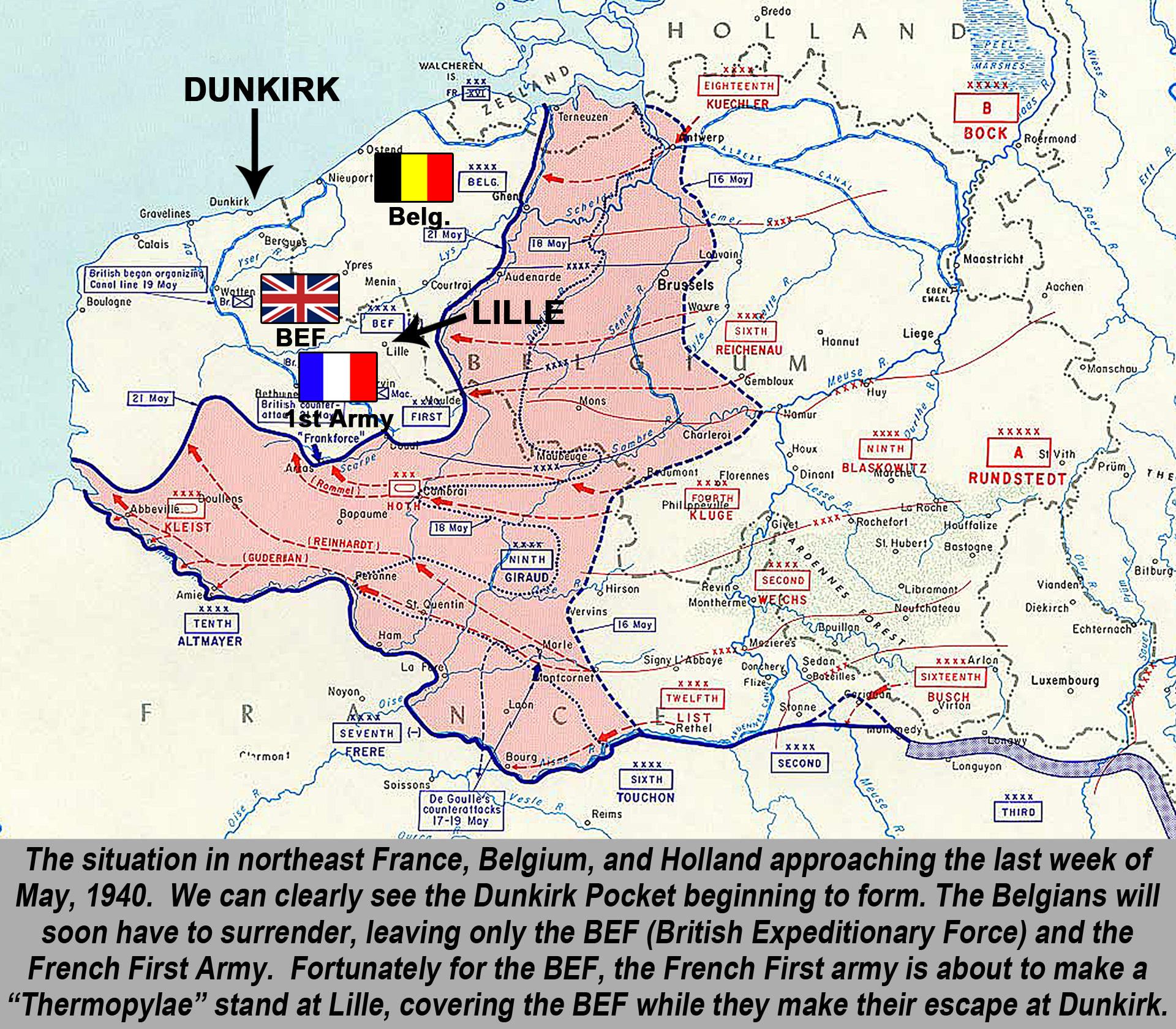
Only gradually will this pocket be reduced by German pressure, the implosion resisted by furious British and French defence. It’s in all these surrounding towns where your FoW tables will be set.
Let’s Talk Tanks
People who like Flames of War tend to like tanks … lots of tanks. So let’s talk about what kind of armour we might’ve seen in the fighting along Dunkirk perimeter, either trying to buy time for the desperate troops being evacuated … or striving to break through to the embarkation beaches and wipe them out.
Specifically for the British, tanks involved include A9, A10, and A13 Cruisers. These are the ancestors of the A15 Crusader IIs and IIIs seen in FoW: El Alamein. Ponderous but incredibly resilient are the A11 Matilda I and especially the A12 Matilda II “Infantry Tanks.” Meant to support infantry attacks, they barely move faster than a walking man.
Most common, however, will be the tiny Vickers Mark VIb “tankettes.” Although thin-skinned and lightly armed (usually only machine guns), they are very fast, and with so few dedicated anti-tank weapons around the early-war battlefield, can be surprisingly effective. Besides, your opponent may think they’re “cute” and underestimate them.
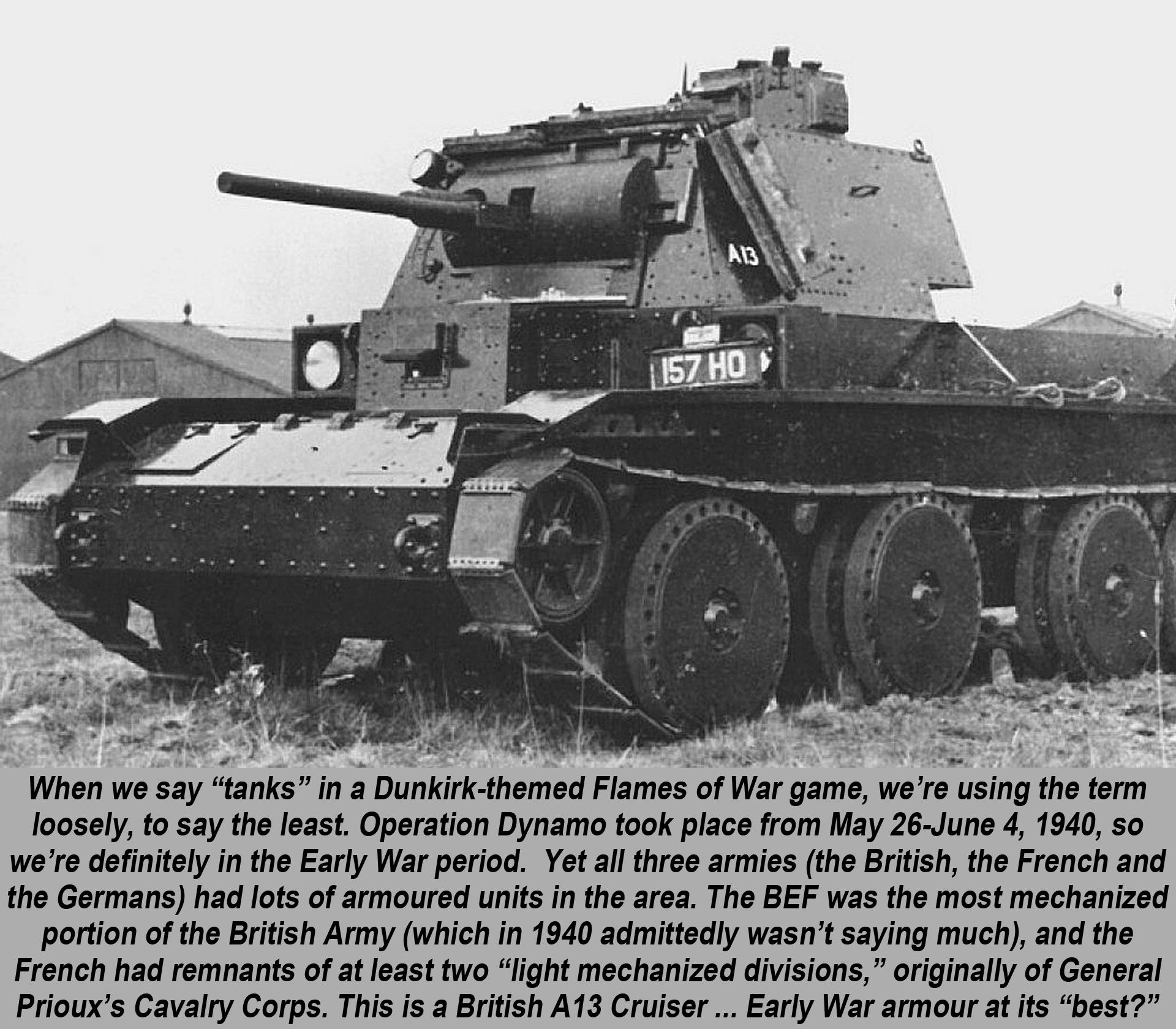
The French have the Renault-35, the tank that made up 80% of their armoured force in 1940. The shattered remnants of Prioux’s “Cavalry Corps” hint at Hotchkiss-35 and 39 “cavalry” light tanks. Famous models like the SOMUA-35 and Char B1/B2 are certainly “valid” for the period, I just don’t know if any were around Dunkirk.
Finally, we come to the Germans. Sadly for them, a huge portion of their “Panzerwaffe” is still made up of the PzKpfw-I. Never intended for combat, it’s really only a training tank with two 7.92mm machine guns. The PzKpfw II is a good recon tank, with only a 20mm autocannon. Just don’t put it up against actual enemy tanks.
Then we have the PzKpfw III, usually the “D” variant, with a 37mm gun. There’s also the PzKpfw IVD. While its 75mm gun sounds fearsome, it’s a short-barrelled, low-velocity howitzer meant mostly for hitting bunkers, troops, and soft vehicles. It’ll be very useful in clearing French and British infantry out of old stone buildings, however.
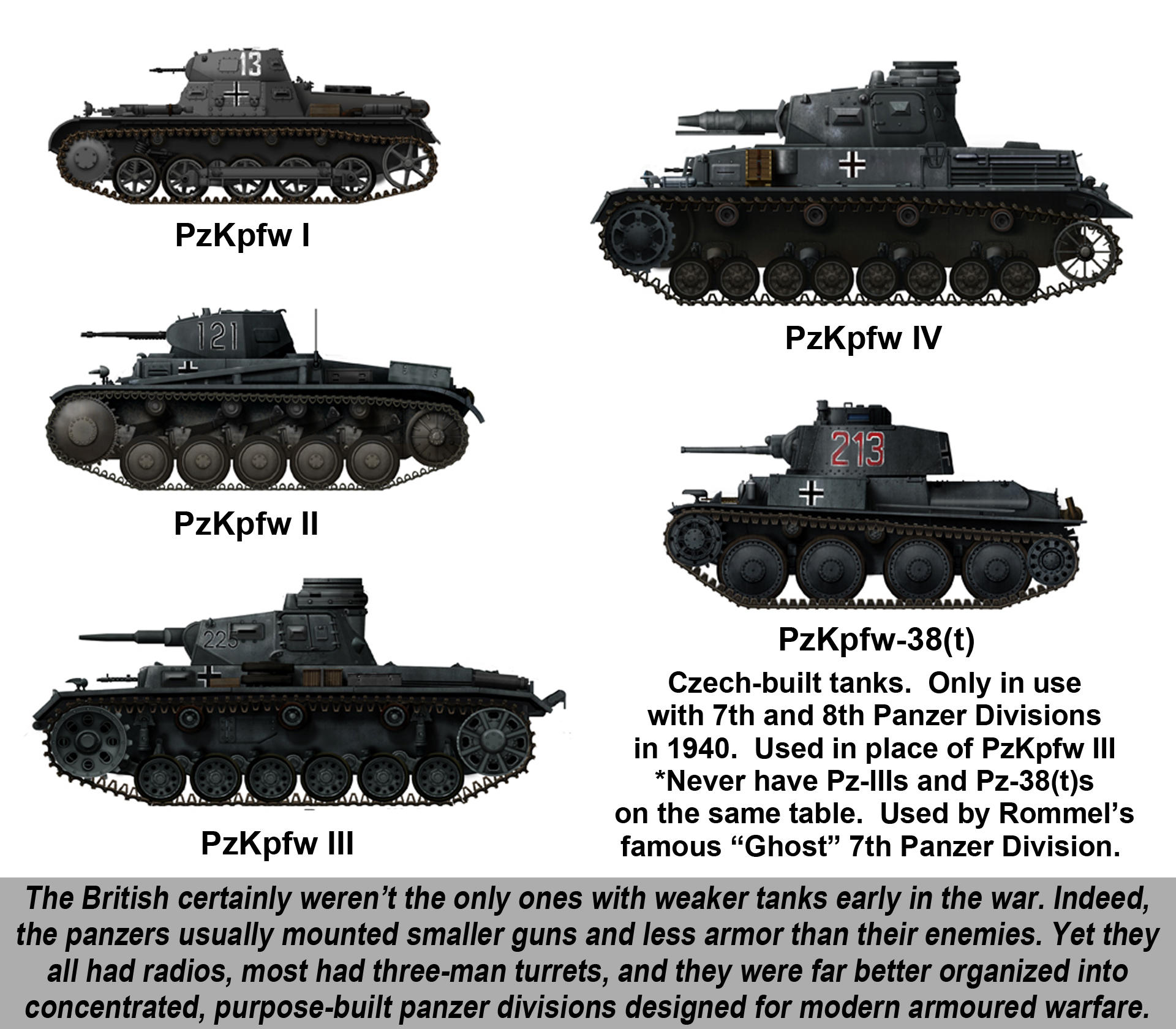
The Germans also had the great PzKpfw-38(t). This was actually a Czech design, “stolen” when the Germans occupied Czechoslovakia in 1939. Only a few divisions had these, though, and only one of these was engaged near Dunkirk to my knowledge (7th Panzer Division fought near Lille, described in detail below).
Battle Of Lille
One of the largest engagements that really decided how much time Operation Dynamo would have to evacuate those troops was the Battle of Lille, fought between French First Army and elements of at least seven German divisions trying to overrun the approaches to Dunkirk.
French First Army (made up of III, IV, and V Corps) held the city of Lille, a large town dominating the southeast approaches to Dunkirk. As Operation Dynamo kicked off, these men stayed behind (giving up their own chance for evacuation) to blunt the German advance and give more time to the Allied troops being evacuated.
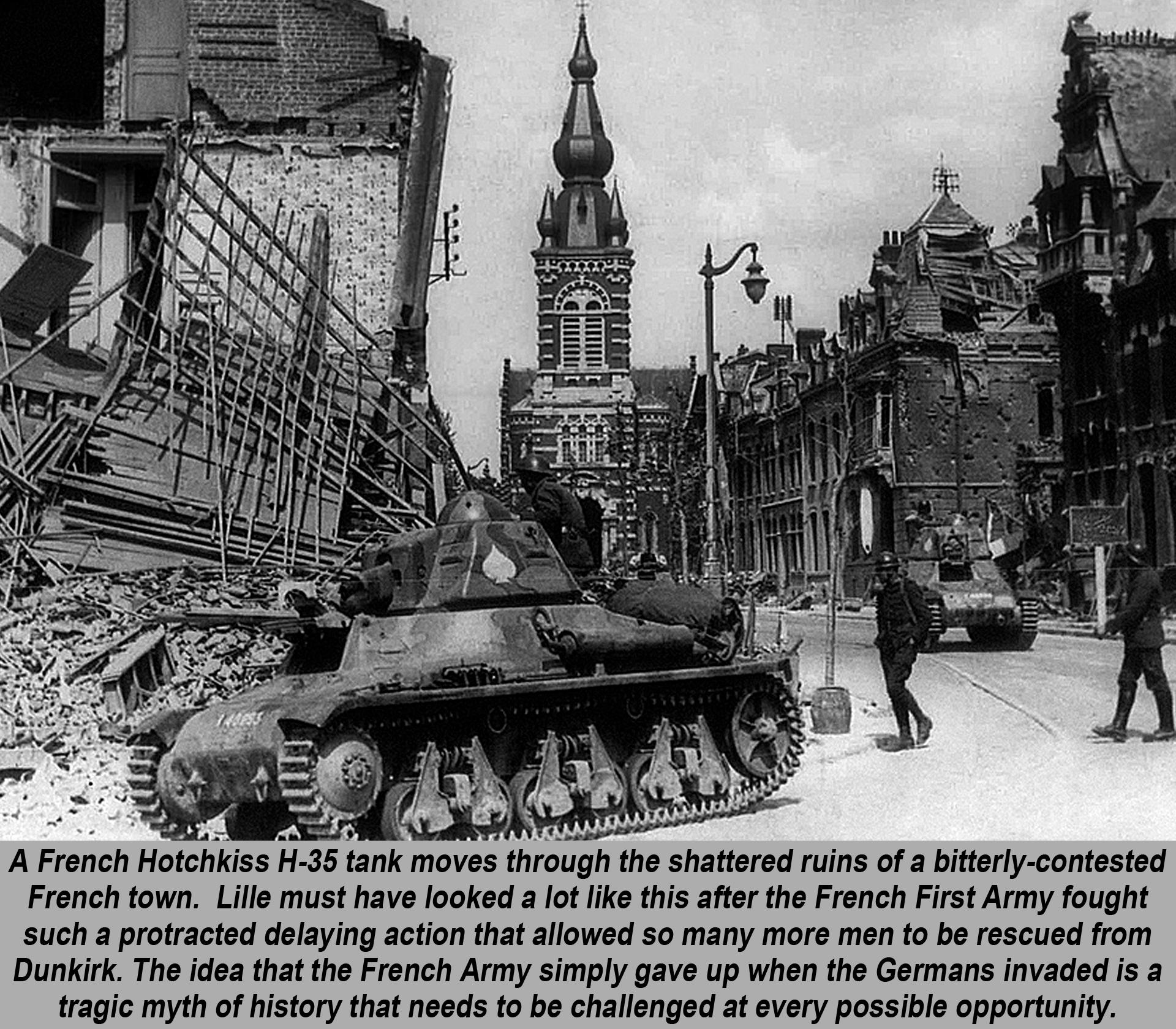
The III Corps was cut off and held out “Bastogne style” in the town of Lille itself, while IV and V Corps battled along the roads leading north toward Dunkirk. Their bloody defiance dragged out for days, inflicting terrible damage on German spearheads (already exhausted after their long push across Belgium and France.
In the end, the Battle for Lille is credited with giving Dynamo another 2-3 days for evacuation, thus saving an additional 100,000 men. One British officer compared the French defence to the Greeks at Thermopylae, and Winston Churchill heaped praise upon the battle when writing his Second World War history.
So if you want a large-scale Flames of War mash-up that really helps determine the success of Operation Dynamo, consider giving the French and Germans at Lille a try. And come back tomorrow when we zoom into 20mm wargaming and tell us what you think in the comments! Have you seen “Dunkirk?” How would you wargame it?
If you would like to write an article for Beasts of War then please contact us at [email protected] for more information!



![StarCraft Tabletop Miniatures Game Pre-Orders Live Now [Updated]](https://images.beastsofwar.com/2026/03/starcraft-tmg-news-cover-600-338.jpg)
![Mounted US Cavalry On Kickstarter For Dead Man’s Hand! [Updated]](https://images.beastsofwar.com/2026/03/us-cavalry-main-600-338.jpg)
Cool read! I’ve recently been thinking about an EW Belgian Chasseur Ardennais force using the French Colonial list from Blitzkrieg! for FoW. QRF has the models so it’s really tempting! These Chasseurs bravely held the village of Vinkt (about halfway between Gent and Courtrai) against the German 225I.D. during the Battle of the Lys. Since that division was rather inexperienced they felt like they were fighting an ‘invisible’ enemy (probably attributed to a number of nightraids by the Chasseurs) and assumed civilians had been shooting at them. Once they took the village, they massacred 80+ people, one of the first large atrocities by the Wehrmacht in the West.
Anyway the delaying action during the Battle of the Lys cost 40.000 Belgian casualties, half the number of the entire 18-days campaign. Once that line was broken, the Belgian king decided to capitulate having done the utmost to aid the allies. At that time, the Yser had already been flooded (like during WW1) and an improvised anti-tank barrier had been built by linking 2000 railroadcars between Yper and Roeselare/Roulers. I’m mentioning this because the failed attempt to hold the line at the Lys and the following collapse of the Belgian army and British retreat then made the encirclement of Lille possible for the German army (and shows the speed of the Germans at that time!). Blitzkrieg indeed! 😀
Thanks, @neves1789 – This is a great addition to the narrative. Indeed the Belgian Army held out for 18 days (actually really good since they were up against the bulk of Fedor von Bock’s Army Group B). I mention that specifically in regards to Dunkirk because Case Yellow opened on May 10, and the Belgians held out until May 28 . . . right when Operation Dynamo was getting its stride. I’ve read somewhere that King Leopold III deliberately dragged out surrender negotiations one more day to keep his army in the field one more day, since it was such a big part of the eastern perimeter round Dunkirk.
Once he finally had to surrender, though, and the Belgian Army stood down . . . yes, this opened a big gap in the Allied left and the British had to scramble to fill it. This leads to (among other things) the Battle of Hondshoote, Wytschaete, the Ypes Canal, etc . . .
Definitely interested in the Battle of Lys. I’ll have to do more reading on that. Thanks! 😀
another great system for battalion and company level games is Panzergrenadier Deluxe.
It works off a modified system of their napoleonic rule set and works for multiple scales including 6mm @torros
it has some interesting mechanics including counter fire in your opponents turn and impetus movement so not everyone will always activate.
If the larger game is your thing it’s worth taking a look at, and they even include a section on how to play with armies based for FoW
Thanks, @avernos . And great idea about Panzergrenadier Deluxe I’m going to have to check that out. Larger battles are definitely my preference.
Hey, I apologize if I seem like I was “overrunning” you in that interview. The thing is we can’t see the studio cams when we’re doing those Skype calls, so we don’t know when someone’s raising a hand or leaning forward or otherwise getting ready to say something. Also, I think there’s a slight lag so I may not hear someone trying to say something until I’ve already started the next rambling run-on sentence. 😮 Like Warren does, just shout your way in and I’ll shut up. 😀
I’ve helped do Skype interviews from that studio, I know it’s not easy. 😀
don’t worry about it, I was brought in to fill up dead air when someone had talked themselves hoarse 😉
and anything that got missed because of the time factor on the videos can easily be included in these posts.
😀
Cheers Gerry I will have a look it
Fascinating stuff @oriskany, and like you suggested yesterday we should definitely play a mass battle of this 🙂 Maybe we could convince @warzan to do a Dunkirk and/or D-Day FOW bootcamp …. hint hint hint
Awesome, @jamjarst . If nothing else, some kind of online campaign like the one I think Battlefront will be starting for Team Yankee soon. (Just gotta give me until early October to dig my way out from under all the projects I’m sunk into at the moment). 😀
This time we just have to be sure NOT to give me a cluster of stone buildings to defend in the center of the table. 😀 “It’s Iron Cross time, baby!
No more games like that please @oriskany, I’m still having nightmares, talk about being left in the perch with multitudes of Germans descending on you, I know what the French felt like after that game. It’s been really interesting to read and hear about the other battles going on in the vicinity and leading up to the collapse of the pocket. To be honest this is one part of WW2 I had skimmed over and that does a disservice to all those brave people who gave their lives to let others escape. Hopefully this series will point me towards some further reading once you have concluded the weeks posts. Cheers Jim.
I’ve re-watched those boot camp clips a hundred times, and every time I’m reminded of three things:
1) how awesome that game was.
2) how much I owe Tom for holding down my left flank on John’s table, protecting me from both John and Bothi.
3) how hard YOU were hit when the two British tables to your left collapsed and you suddenly found yourself fighting two MORE tables of Germans (you’d already beaten your first opponent)
I remember you had actually beaten you opponent, and had a platoon of Crusaders I think deep behind my right. We exchanged some fire, then you suddenly withdrew these forces. I was like . . . why did he do that? Then I glanced down and saw Mark’s and Andre’s tables both pouring up from the south.
I can just picture my tank commanders wondering why those Crusaders suddenly about-faced . . . then they see the huge dust cloud gathering behind the southern horizon. 😀
Glad you like the series so far. Hope you like the rest of it! We’re focusing on the British tomorrow with Monty’s 3rd Infantry Division (Grenadier Guards, Coldstream Guards, some attached tanks, 2Bn/Royal Ulster Rifles, etc).
Yet another great read @oriskany.
If I was to play a Dunkirk battle, I would want to play it as a mini campaign, but use a format similar to FoW’s own “Infantry/Tank Aces”. Rather than level up a commander and base the campaign around the commander, use the points system.
Battle one: Allied forces have 500pts, Germans have 750pts. Allies defending a small hamlet, slightly strategic position, but nothing overly great. Allies need to withdraw units.
Battle 2: Allied forces have 1000pts, plus the successfully withdrawn units, Germans have 1500pts. etc etc.
So rather than the actual beach, you are playing a game where the Allies are trying to hold the Germans back and get units off in tact and the Germans are trying to destroy as much as possible to limit the forces in the next battle.
Great idea, @cypher2009 – and we agree . . . keep the combat off the beach. For Dunkirk, the fighting takes place in the tangle of small villages, canals, bridges, hedges, narrow roads, etc . . . that spread out through this part of northern France near the Belgian border / English Channel.
I like how the results of one game impact the starting forces of the next, Allows one side or the other to build up a sort of operational “momentum.”
@oriskany and anyone else You might find this useful
http://enpointe.perso.infonie.fr/dlm.html#Oobs May 1940
Indeed, this is great. @torros It confirms my “guess” that R. Prioux’s 2nd and 3rd DLM (“Cavalry Corps” – 1st Army) would have been built primary from H-35 and H-39s.
Still, there’s no telling what kind of numbers these divisions would have had available for the battles around Dunkirk. This is because, as you probably know, these two divisions and collided head-on with 3rd and 4th Panzer Divisions (Hoeppner’s XVI Corps) near Gembloux, Belgium, in what was probably the first big mass-tank battle of World War II (May 12, 1940).
This is sometimes called the Battle of Hannut, the Battle of Merdorp, or the Battle of the Gembloux Gap. We actually did it once waaaay back soon after I first joined Beasts of War:
http://www.beastsofwar.com/groups/historical-games/forum/topic/early-war-armor-action-french-vs-germans/
The French actually did pretty well on Day One, but the next day the Germans sent in waves of Stukas and Prioux soon had to pull his forces out. There were still some left to be caught up in the Dunkirk Pocket (hence what we say in the video, where French players have plenty of opportunity to use tanks in their battles) – but really I have no idea how much was left by this point.
Prioux did pretty well at this fight, and in the Battle of France overall. Unfortunately, from what I read he became something of a figure in the Vichy government, and so is not remembered well in French history.
I really enjoy the new video/ text format, great stuff!
@oriskany ‘s enthusiasm is best when it’s ‘live’ and a great primer for the more detailed text.
Excellent content.
After the FoW bootcamp I’ve decided to stick with 28mm as I enjoy single figures and larger scale tanks as well as skirmishes more than all this mass combat (although I did enjoy watching you playing out the massive participation game!!) so I can’t wait for the 28mm part of this series in a couple of days 😎
Thanks everyone for making this BoW week special 🙂
Awesome, @suetoniuspaullinus – and thanks! Indeed, the much shorter engagement ranges we see in Early War make 28mm games like Bolt Action a really good fit I feel for smaller engagements and battles around Dunkirk.
Later in the war, I’ll admit, my “agreement” with scales like 28mm falls off rapidly. As tank / artillery ranges increase and infantry engagement ranges DE-crease (more and more armies switch from bolt-action rifles to SMGs and assault rifles), this widening delta in effective battle distances and geometries really start to strain the credulity of putting both on the same 28mm table.
Earlier in the war, however, these problems are much more manageable, and this is my personal pick for 28mm battles for WW2 (well, that and the Pacific).
You could try this as well
http://france1940.free.fr/oob/oob.html
Thanks once again, @torros – I assume you’ve seen this . . . not quite as complete or detailed, but covers OOBs for just about everyone in WW2.
http://www.niehorster.org/index.htm
Yeah I have. Its a great site
I figured. 😀 I still have that gigantic library you sent during the Sea Lion series. 😀
One of the French problems as well as British was using their tanks as infantry support rather than using them as a mass to go against other tank corps. So French doctrine by and large was a platoon of tanks per infantry company to give support. Thus if course led to many examples of the French armour bring overwhelmed by enemy forces
As an aside my favourite french vehicle was the Panhard armoured car.
Thanks, @torros –
By and large I would agree, except the French were experimenting with larger, division-sized armored formations, like the 1, 2, 3, and partially 4 “Division Légère Mécanique” (DLM to me 😀 ) They were even playing around with putting these light mechanized divisions into larger formations like Prioux’s aforementioned cavalry corps. Definitely the exception (in fact I think this may have been the only one), and these were almost entirely the lighter H-35 and H-39 “cavalry” tanks, and not the heavy hitters like the S-35 and Char b1 /b2.
French armor also had a number of very serious disadvantages in their design. This is almost a “myth, counter-myth, counter-counter-myth” with people like us who read about this stuff all the time. 😀
MYTH: French tanks must have been terrible because German panzer spearheads went right through them, outmaneuvered them, and obviously defeated them.
COUNTER-MYTH: Actually French tanks were usually better because they had better guns and better armor than the smaller Panzers.
COUNTER-COUNTER-MYTH: While none of the above is “wrong,” it’s just incomplete. Tank design is more than just the classic “protection/mobility/lethality” triangle. It’s also how the crew is laid out in the tank, division of duties, and secondary equipment like radios. German tanks almost all had three-man turrets, including a dedicated commander (who didn’t have to work as loader or gunner). He also had an intercom system inside the tank to talk to his crew and at least one radio to talk to other tanks in his unit or higher command.
Even in “good” French tanks like the S-25, you sometimes has a one-man turret, where the commander was also a loader and a gunner. So you had a great gun, with 1/3 the rate of fire and gunner that always fired second since his other duties almost ensured the enemy would spot him before he spotted the enemy. Tanks like the FMC-1, Char b1/b2 also had their biggest gun in the hull (as I’m sure you know), which limits traverse, elevation, engagement cycle time, and ability to engage more than one target.
German accounts have infantrymen basically walking up to French tanks and shoving grenades into exhaust vents, vision hatches, turret rings, etc. Because of the bad way the crew was laid out and the poor division of labor in the crew, French tankers almost never see them.
Oh, and of course the French platoon and company commanders have to control their units via signal flags, since only one tank in a company has a radio for contact with battalion.
Games like Panzer Leader 1940 handle this by saddling French 1940 armor units with the same company command rules we see for the Soviets in 1941, and games like Battlegroup have “one man turret” and “command chaos” special rules that afflict some French tank units in the early war period.
But in raw armor and firepower values, the numbers don’t lie. The games / players just have to hobble these French beasts a little to reflect the true conditions of the period.
Great series @oriskany.
From the current rulebook I would suggest the following missions.
Dust-up
Encounter
Counterattack
Rearguard
Breakthrough
Brigdehead
These missions cover most of the fighting you have been or about to discuss. A copy of Blitzkrieg will give all the army lists for French, British and Germans. I have had a lot of fun in this period using the lessor units, not just the tank heavy forces.
Between the World Wars theories have birth to doctrines using the like of the land battleships. The tankette being another. On the battlefield a number of countries developed doctrines for their use. There was a number of common points shared by these doctrines.
1) The tankette replaces horsed recon.
2) They replace the cavalry in flank security.
3) They protect the flanks of heavier armored units to fend off infantry attacks.
4) To work between waves of tanks to dust off any infantry attacks.
Guardian goes into some detail about tankettes in Achtung Panzer. For Germany they were looking at the Pz-2 for the role but fell the the interim Pz-1. It was quite suited to the role. Historians jump on this but take it one step further saying it was not suited for battle. If I accept this view along with the beating they give the Pz-2. Then by default it means that France fell to a force the was not suited for combat.
Just like the land battleship with window of viability for the tankette was brief and would be closed by 1941. One must also ask if the tankette was not suited for battle, why did so many countries invest in them with England being the largest investor closely followed by Germany.
Thanks for highlighting the French and their hard fought battles between Lillie and the coast. It is not mentioned enough that without their sacrifice Dunkirk would have been a failure. The RAF got some bad press from those at Dunkirk asking where were they. They did not realise that if the RAF was overhead then too would be many more falling German bombs.
Perhaps the most forgotten is what I call the Second Little Dunkirk with the evacuation of British forces in the fall of southern France. I admit it was a much smaller affair.
This is a great and timely series @oriskany and I like the idea of a week dedicated to something.
🙂 🙂 🙂
Thanks very much, @jamesevans140 –
I’ll say this much, I’ve played some Dust Up scenarios in v4 Flames of War at the boot camp and they were great. @brucelea – I still say you really could have won that game if I’d been forced to counterattack into your 17- and 25-pounders. Instead we diced off for it (I’d destroyed most of his tanks after some unlucky crossing checks and I got lucky with my reserves) and it would up a draw anyway. 😀
The one I’d be most interested in is rear guard. I’ve also seen some “delaying actions” in Team Yankee (different setting, but same general rule. These delaying actions we get into more heavily in Parts 03 and 04.
I totally agree tankettes feature heavily in this period, especially for the British (obviously we’re talking about the Mark VIb here). Whether with 12.7mm or even some kind of antitank rifle (20mm, I think) they can do a surprising amount of damage due to their high speed. I learned not to underestimate them in Battlegroup Desert and Sea Lion series.
(I’m leaving out the Italians and Soviets since we’re focusing on Dunkirk).
Nevertheless, I think we can agree that tankettes something of a dead branch of tank evolution. (oh, I just saw where you wrote later . . . “Just like the land battleship with window of viability for the tankette was brief and would be closed by 1941.” We’re on the same page there.
Rather than consider the Pz1 or 2 a “tankette” or used in a tankette role, how about the SdKfz-222 armoured car series? These were better, I feel, and more accurately describe where German light panzer doctrine was at the time. Apologies if I misunderstood what you were writing. But I wouldn’t consider Germany to be using “tankettes.”
Did “France fall to a force not suited for combat?”
Well, in terms of the Panzerwaffe . . . sort of. The Pz1 was not suited for combat and not meant for combat, but due to numerical shortfalls was pressed into actual combat companies (not panzer recon companies, it wasn’t fast enough for that) in limited numbers in all ten panzer divisions at the time. Sadly, it was what was available at the time, just like the British had to use the Mark VIb.
However, I would mitigate this with the fact that the Pz1 was only one tank type out of of six being used by the Germans at the time (Mk1, 2, 3, 4, Pz-38 and Pz-35). Also, the panzerwaffe was only part of a much larger dynamic. All these other elements were certainly “suited for combat.” So like any other army, the Germans went into combat with certain weaknesses to go along with its strengths. The “winner” of a campaign is usually the side that manages to relegate its weaknesses into relative non-relevance, and its strengths into decisive blue-chip game-changers.
“Thanks for highlighting the French and their hard fought battles between Lillie and the coast …”
Absolutely. This was huge, and really held the back door shut while the BEF was being evacuated.
“The RAF got some bad press from those at Dunkirk asking where were they. They did not realise that if the RAF was overhead then too would be many more falling German bombs.”
Yeah, I was really surprised to hear about this attitude. I had no idea the RAF had this trouble during Dunkirk. In Part 05 we go into this in more detail, the withdrawal of RAF fighter command from France by H. Dowding’s order, the return to Dunkirk, the proportion between the Hurricane and Spitfire squadrons, the problem of fuel, comparisons with the Bf-109e, etc.
“Perhaps the most forgotten is what I call the Second Little Dunkirk with the evacuation of British forces in the fall of southern France.”
@avernos has been bringing these up, Operation Ariel and Operation Cycle. 😀 We got ya covered! 😀
Another excellent series of historical articles and videos – thank you @oriskany, @warzan, @avernos and the BOW Community for expanding the discussion in the comments.
Hoping to see the Christopher Nolan film on Friday evening – though it will mean missing
someone Hobby Night Live…
Finally, I remember, as a child, being very impressed by the BBC reading “The Dolphin Crossing” on Jackanory… way back in the 1970s. That book and, of course, “The Machine
Gunners” being childrens’ modern literary classics.
Thanks, @aztecjaguar ! 😀
One thing I definitely want to note, Thank you to whoever came up with that Dunkirk Week intro music! I love the BWWWWWOOOOMM! I feel like I’m in a movie with a Hans Zimmer soundtrack! 😀 😀 😀 great stuff!
I’m only there by default, other real people were away and since I had decided to steal their tables for Rorke’s Drift it seemed only appropriate that I say yes.
It was good fun filming the videos and on occasion I even contribute 😉
I hop you guys filmed that Rorke’s Drift battle, or at least the highlights. 😀
I believe there are edited highlights. It comes down to whether they see the light of day now 😉
Nice, @avernos – I know the feeling. 😀 Here’s hoping for the best.
the Pz38 & the 88 aa gun were both chech if I remember.
the Pz 38t was, but the 88 came from a co-development with a swedish manufacturer Bofors.
must have been captured ones I read about in some book I am sure they were manufacturing them.
The PzKpfw-35(t) and PzKpfw-38(t) tanks, yes. Did Czech manufacturers start making 88s or a similar weapon after the war? They’ve always been a big arms exporter.
possibly.
Cool deal. 🙂
For setting up a scenario to play Dunkirk it might be a good idea to look at some of the narrative missions in the new Warhammer 40k rule book. Especially the scenarios: Ambush! (pg. 198) and Blitz (pg 202). Ambush! focusses more on extracting troops and getting them out of the battlefield alive, while Blitz focusses more on defending a point where there is a continued assault. Both of them could be used as a good inspiration to set-up scenarios to play Dunkirk I think.
Thanks, @amachan – you write: “Ambush! focuses more on extracting troops and getting them out of the battlefield alive . . .”
This sounds exactly like the delaying actions we’re talking about in Part 03. The “defender” (and that’s not really the correct term) has to not only bloody the enemy and cost him time, but also escape with as many troops / equipment / refugees as possible. Dunkirk is an evacuation, after all. 😀 You can’t evacuate if you’re dead. 😐
Good stuff guys!
Finally saw the film last night, very impressed.
My granddad was in the RAF and was actually there, but he never gives very much away about those years, doesn’t like talking about them. Heard plenty of his post-war escapades with the RAF though 🙂
Awesome, @olliep . 😀 Thanks for the comment, and please be sure to tune in for Part 05, where we focus more heavily on air operations. 😀
Thanks for the truly great reply @oriskany.
Also from version 3 of FoW there is a great mission, fighting withdrawal. Each turn you get withdrawal points and when they get to a curtain amount the withdrawing force must remove a unit from the table while covering two objectives. The mission is a great one for when one player had a lot more experience than the other.
It would be well suited for the French lines of defence around Dunkirk when these lines started contacting.
In total the British make around 13,500 Mark VI tankettes to Germany’s around 13,000 Pz-1s. Yes I was avoiding the Russians to stay on subject, but I live their amphibious tankettes.
I do consider both the Pz-1s and Pz-2s to be tankettes. In the Spanish Civil War the Russians had to add more armour to the T-26 design as the Pz-1s with their twin MGs could reliably penetrate the T-26 armour up to a range of 100m.
What is not pressed home by historians is that tankettes are not tanks. The much lighter armored tankette’s mission is to replace horsed recon with a strong anti infantry capability. A tracked tracked armored car if you like.
God pick up on the Sd-222 as the Pz-1s and Pz-2s are directly comparable to the Sd-221 and Sd-222 respectively.
The main difference is that the tankette can operate in more terrain types than the armored car.
The armored car of WW2 are evolutions from the armored cars of WW1 while the tankette is a new competing, between wars full track concept. Both concepts were in general very well adapted for the recon and anti-infantry rules. Both however well generally lose out to the light tank although examples of both will be seen until the end of the war. Today the armored car is going through another golden age.
Fighting Withdrawal sounds awesome, @jamesevans140 – we cover Delaying Actions (as a general wargaming concept) in Part 03, which is close to a fighting withdrawal. One community member in the Part 03 thread has even suggested something similar to the “withdrawal points” where 2d6 is rolled in secret each turn and when the total reaches a predetermined limit, withdrawals are triggered.
Interesting perspective on the Pz 1 or 2s to be tankettes. Personally I don’t agree, but that’s fine. The Pz 1 I can almost see, with its MG-based armament, 2-man crew, and only 5-6 ton weight. But this weight I feel tips it over “tankette – light tank line” (some people even consider the British Mk VIb a “light tank” rather than a tankette – often featuring a TURRET makes the vehicle a light tank instead of a tankette). Also, the Panzer I is pretty slow (at least compared to the British VIb).
I would totally agree that German armored cars have more restricted terrain range than a fully-tracked vehicle like a tankette. They’re faster on roads, and while they can operate cross-country, are much much slower.
That said, German OOBs and tactics doctrine clearly shows that the the “Aufklärungs” reconnaissance role was to be carried out by armored cars, trucks, and BMW motorcycles. Light tanks (even the sad little Pz 1) were in the main panzer battalions.
This is probably now how the Germans WANTED it, but it’s how it was.
And even only the luckiest panzer divisions had aufklärungs abteilung outfitted with armored cars. Most had trucks or even bicycles. 🙁
Factions!
@deekus – are you asking what kind of factions we’d see in Dunkirk?
French vs. Germans.
British vs. Germans.
Roll back the clock a few days before May 28, 1940, say) and you have Belgians along the eastern Dunkirk perimeter as well.
@deekud yep.
Great reply @oriskany. Don’t forget that it has just as much form and function it every bit as important as size and weight when it comes to what makes a tankette. But seriously each to his own. There is just too many competing theories on light armored vehicles coming into WW2 for the water not to be clouded. The Matilda I for example is a infantry support tank has an anti infantry role but does not have a recon role or a armour protection role. So is a different applied theory of anti infantry. It has no anti armour capacity. A true tank has both capacities. What of the heavy armored cars of the day with turrets mounting tank guns (37mm to 45mm). Are these armored cars or wheeled tanks? Modern analysts call them wheeled tanks, such as the 105mm L7 armed Styker. Personally I don’t agree. They are heavy armored cars.
The tankette or armored car were competing theories that never quite got there. It was the light tank such as the T-26 and M3/M5 Stuart tanks that brought the over all theory to fruition. The light tank remains a true tank having both anti armour and infantry capacity best seen in the Chaffee.
You are totally correct about it being a case of what you got rather than want you want when it comes to the German OoB. By the time the Germans had the medium tanks they wanted the time of the tankette had passed and it’s theory was dead. While the Germans shied away from the tankette and invested heavily in the armored car by mid war the short comings of the armored car was becoming evident in Russia for go anywhere recon. So in recon duties the Germans started phasing them out for half tracks and a rebirthed Pz-2. Here again it was more a case of what they had.
I’ll totally admit, @jamesevans140 – that I often try to use my Pz 1s in a generally “tankette” role in Panzer Leader 1940 or early scenarios of Desert Leader. Get around the side of the British / French force, put MGs on soft targets like HQ units, AA positions (clearing the way for my Stukas) or artillery positions. Sure, they artillery swivels on my Pz 1s to engage over open sites, but hey . . . that means those French 75mms or British 18/25 pounders ARE NOT bombarding my assault battalions on the main battle area. 😀
Ahhh there it is. My beloved 15mm 😀 But as you guys said the basic FoW game is about 1-2 companies vs. 1-2 companies. So in terms of WW2 this is quite a small engagement. Of course there were a lot of battles fought at this size or some even smaller. But sometimes (or maybe always?) you want to play the big battles.
We made the following experiences. In a large battle that takes on most part of a day a single player can command up to 2-4 companies. (About 5000 Pts. or approx. 300 in the new point system). Most of the time we had 6-12 players for big events, meaning we could field about 20 companies per side. So we are talking about an engagement on regiment or brigade level (about 3000 men). This can be on one or several tables. And the amount of troops justify to call it a battle.
But if you want to put on a really good show or try to “reenact” and historical battle you need to go even bigger. In the by @oriskany mentioned Battle of Lille you would need at least ten times the amount of troops. But for a game of this size FoW is just not fast enough anymore and you would need gaming tables the size of a stadium.
So for something like this we take a lesson from the napoleonic players, we just scale down. So for a factor of ten a company on the table represents regiment or a demi brigade. You could even go up to divison or corps (represented by one company) for something really big like Kursk.
Of course not all the troops where fighting in the same place. This brings me back to the point of multiple table. Maybe the 5 divisions of the French First Army near Lille were fighting in 5 different places. You could then put up 5 tables with a french player each commanding 3 companies (representing about a divison). Then you mix in 7 German players with atleast 3 companies each (again representing about a division). Three Divisons were motorized, so maybe they can choose on what table they want to enter. Next step would be researching how the lay of the land was and where the fighting took place.
The last step (and maybe the most important one) is setting up good win conditions. For something like Lille I would not go with the standard FoW missions. They can be an inspiration, but you should find your own objectives. For something like Lille you need very asymmetric win conditions. Maybe a few objectives per table and the Germans have to capture some objectives until a given turn. If they don’t the Allied get a victory point and maybe can reinforce another table. If they do the Axis get a point and maybe an airstrike on another table. Then you mix something in like the rules for fighting withdrawel from the FoW rulebook and you have the first idea of a game.
There is a lot more to it, but this should give an idea of how we approach things, when we want to recreate a historical battle.
Great post @bothi 😀
But sometimes (or maybe always?) you want to play the big battles.
Indeed. Through the course of this week we are comparing three different scales and main game systems, FoW at 15mm, Battlegroup at 20mm, Bolt Action at 28mm. So for the 15mm, we wanted to focus on the main things that 15mm and FoW delivers that the other scales and games really don’t. For FoW, this is probably big, chunky, tank-centered battles. That certainly doesn’t mean that’s all FoW can do. Just what really sets it apart from smaller battles played at larger scales like 20mm and 28mm.
Most of the time we had 6-12 players for big events, meaning we could field about 20 companies per side. So we are talking about an engagement on regiment or brigade level (about 3000 men).
Holy hell, 12 players? Then again, we had 12 players at the Boot Camp event (where you vowed on camera to “wipe Oriskany from the table” – I still love that. 😀 ). And yeah, we had 174 tanks total on that side, about a full tank regiment per side.
But if you want to put on a really good show or try to “reenact” and historical battle you need to go even bigger.
Oh, absolutely. We touch on this lightly in Part 05 with “Command Games.” First up here is Panzer Leader – where each piece is a platoon or battery and you will have 50-100 pieces per side on the board, ratcheting the game easily up to the brigade level (brigade or reinforced regiment/regiments per side).
In the by @oriskany mentioned Battle of Lille you would need at least ten times the amount of troops. But for a game of this size FoW is just not fast enough anymore and you would need gaming tables the size of a stadium.
I think you’re being modest in those estimates. 😀 Even if you JUST take the fighting in Lille itself (French First Army had only III Corps in the town, IV and V Corps fought along the roads further north) – 3 companies in a battalion, 3 battalions in a regiment, 3-4 regiments in a division, 3 divisions in a corps = 3x3x4x3 = 108 “companies” in III Corps = 100+ “battles” in FoW. Also, the battle goes on for 4-5 days, so that’s at least 4-5 battles for those 108 companies = 540 Flames of War games potentially being run there. And yeah, with a corps-size frontage being at least 10 miles, we’re talking about a FoW 1/10 of a mile across (520 feet, or 157 meters). A little impractical, but damn, that would look awesome, wouldn’t it? 😀 😀 😀
And again, all this is only for ONE of the THREE corps that First Army had engaged overall.
So for something like this we take a lesson from the napoleonic players, we just scale down. So for a factor of ten a company on the table represents regiment or a demi brigade. You could even go up to divison or corps (represented by one company) for something really big like Kursk.
Absolutely. The “command-tactical” level of wargaming, followed by operational-scale wargaming.
Or use a set of rules where a stand represents a company
Of course that’s always an option. I didn’t want to imply that FoW is “the” way to go for this. But in my area FoW is nearly the only WW2 system that is played (besides a little bolt action and behind omaha) and everybody knows the rules already. Convincing people to play another system is hard 😀
Just wanted to get across that you can also play bigger battles in FoW and that the system works quite well for it.
I’d agree on both counts, @torros and @bothi . Others may differ, but once you get below 10mm I usually say it’s time to switch to hexes and counters (i.e., “a stand represents a company”).
Even for “company-based” armies like early war French and Soviets I would still stick with platoons for easier casualty tracking, etc.
I know hexes and counters aren’t for everyone, but the ruled the wargames market for 35 years for a reason. And they instantly shed all the limitations of miniatures (available models, painting, size of the table, scale problems, unrealistic miniature rules, etc).
I used to be a 100% hexes guy, and kind of rolled my eyes at miniatures. But since joining BoW I’ve really come around to appreciate minis. Now I can happily switch between both. When I want visual impact, a great table, non-computer craft, and epic cinematic moments, I’m with miniatures (and accepting all the limitations and shortcomings thereby).
But when I want hard-core, measured, scaled, “scientific” and historical realism, hexes (or at the very least super-small scales like 6mm or 2mm) I feel are the way to go.
I’m now a gamer that can happily switch between both, and appreciate both schools of thought.
Ok my numbers were a “little” low. But I wrote “at least ten times” didn’t I 😀 Looking forward to part 5 and Panzer Leader. Another game I only read about yet.
And yes the 10th or a mile board would be awesome. But how would you reach the models in the middle?
Actually, I realize now I might have inflated the number of divisions available to the First Army. Doesn’t look like all three corps had the usual “three divisions” – and I doubt these guys were at full parade-ground strength, either. 😀 But still, several hundred games.
The whole Battle of Lille would be crazy to attempt even in Panzer Leader. Like you said in your post above, “They can be an inspiration, but you should find your own objectives. For something like Lille you need very asymmetric win conditions.”
Basically build your “own slice” of the action and game it out, then apply those results into a wider context. Not unlike what we did at the FoW Desert War Boot Camp. 😀
Oh. and how to reach the middle of a 540 foot FoW table? Walk on it. Of course terrain becomes a little tricky, but we had something like this in a small warehouse yeeeears ago when I was lucky enough to play the whole 2nd day of Gettysburg with some friends. I commanded one of Longstreet’s Divisions on the Confederate right. The “table” was on a small warehouse floor, with much of the terrain drawn out in playground chalk. 😀
Where there’s a will, there’s a way!