





![Alternative Trench Crusade Miniatures? Trench Missionaries Review | Wargames Atlantic [7 Days Early Access]](https://images.beastsofwar.com/2026/03/unboxing-wargames-atlantic-trench-missionaries-coverimage-225-127.jpg)

![10mm Medieval Miniatures! Azincourt English Army Review | Wargames Atlantic [7 Days Early Access]](https://images.beastsofwar.com/2026/03/unboxing-wargames-atlantic-azincourt-english-army-coverimage-225-127.jpg)
The Saratoga Campaign Of The American Revolution – Part Four: First Battle of Freeman’s Farm
October 12, 2017 by oriskany


Welcome again, Beasts of War, to our continuing series commemorating the 240th anniversary of the Saratoga Campaign in 1777, turning point of the American Revolution. Through a series of 20mm wargames, we’ve been tracking the movements and clashes of armies slowly drawing toward an inevitable crossroads of destiny.

At last, we are here.
If you’re just joining us, here’s the basic situation. In the third year of the Revolution, British General John Burgoyne has launched an invasion out of Canada down into New York State. By seizing the lines of Lake Champlain and the Hudson River, he hopes to split off New England from the rest of the colonies and win the war for the Crown.
So far we’ve covered the British invasion plan in Part One, including the desperate delaying action at the Battle of Hubbardton. Part Two saw the British try to bring in an additional invasion, largely halted at the Battle of Oriskany. In Part Three we saw the Battle of Bennington, where British fortunes truly started to falter.
Now at last, after two months of skirmishes, preliminary battles, and brutally difficult wilderness marches, General “Gentleman Johnny” Burgoyne’s main army finally emerges into the Hudson Valley. Marching south, they are soon drawing near Albany, the capital of New York State, their ultimate objective.
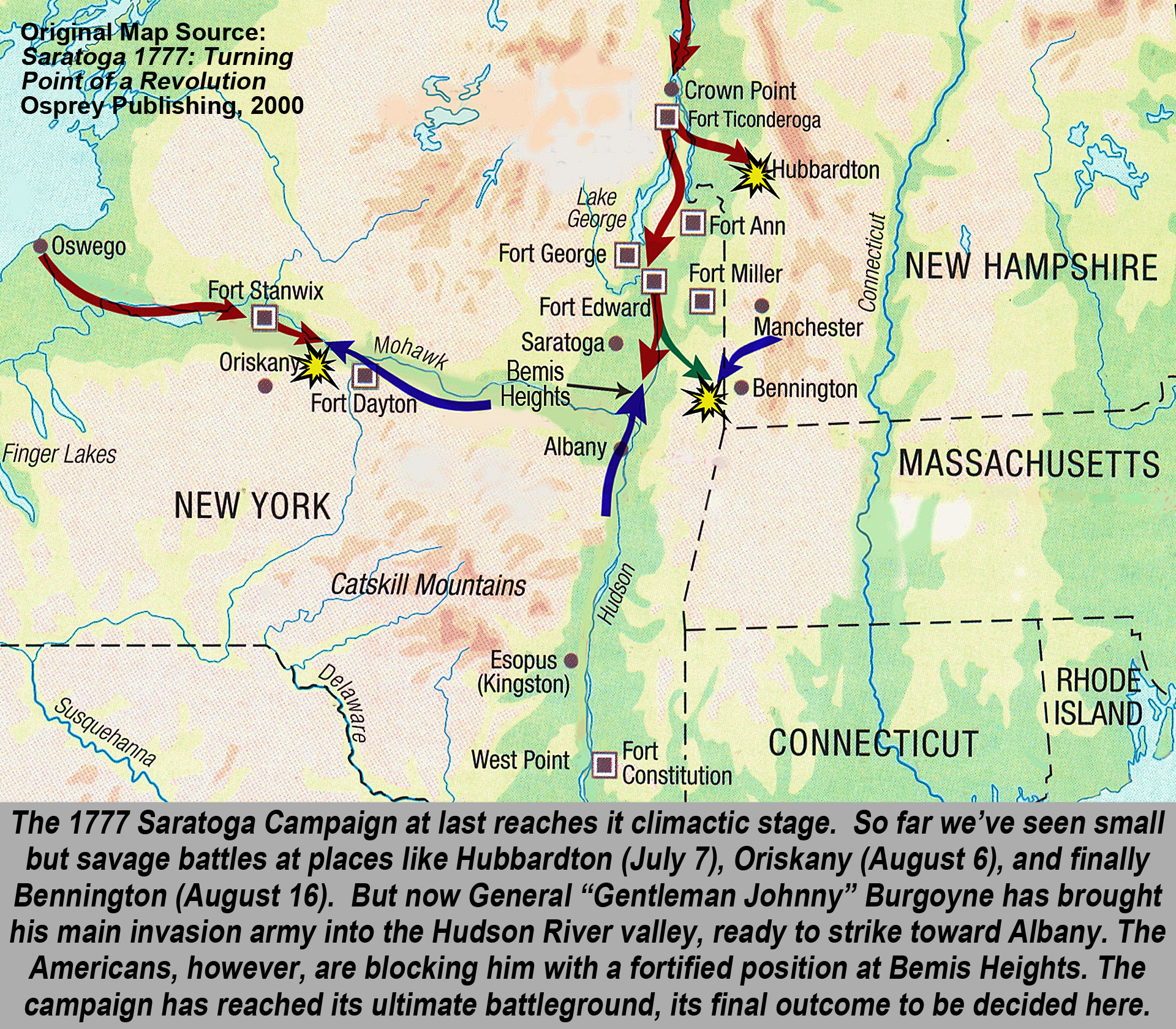
This is also where the Burgoyne’s army will finally meet the main body of the northern American Army, well entrenched under the command of Horatio Gates. Gates and Burgoyne are actually old friends, comrades in British service during the Seven Years War. Now they’ve met again, both leaders of armies, but friends no more.
The Battles Of Saratoga
Setting Up The Chessboard
As August bleeds into September, “Gentleman Johnny” finds himself, his army, and his grand invasion plan in ever more dire straits. Yes, he’s made it to the Hudson. But he’s also been informed that the two other British armies scheduled to meet him in Albany are in fact not coming.
First, the expected British support from occupied New York City has been cancelled. General Howe has instead launched an invasion toward Philadelphia, Pennsylvania…leaving Burgoyne on his own in upstate New York. And we’ve already discussed where Colonel St. Leger’s army was defeated at Fort Stanwix and the Battle of Oriskany.
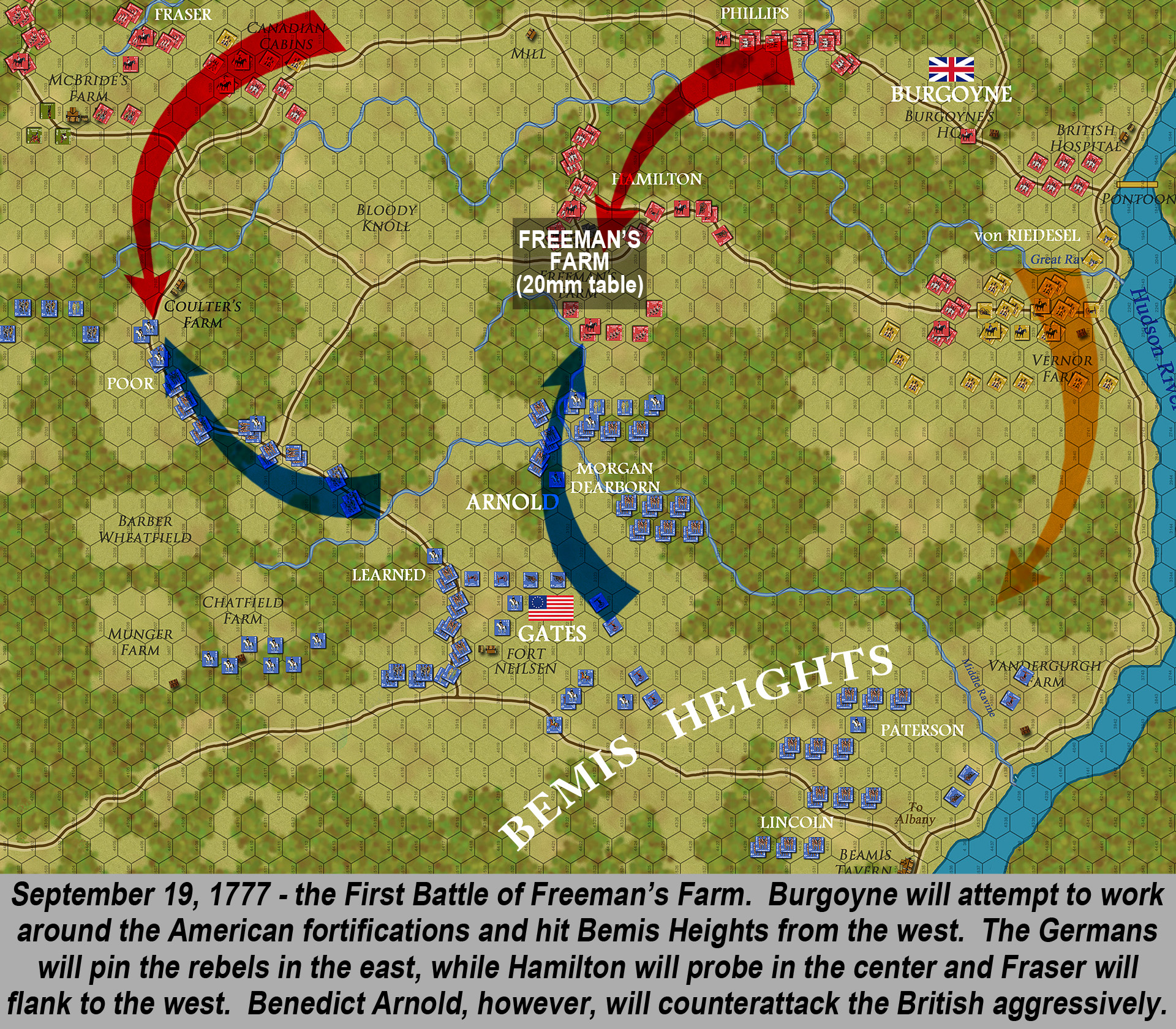
Many of Burgoyne’s generals are recommending that the campaign is given up for the year. Better to fall back to the fortified position of Fort Ticonderoga and try for Albany in the spring. Besides, the Americans facing them have been heavily reinforced and deeply fortified on commanding high ground. The situation doesn’t look good.
Indeed, the Americans are pretty comfortable with their situation. The Polish-born military engineer Tadeusz Kościuszko has selected Bemis Heights for their position and expertly fortified it with plenty of well-supplied artillery. This position commands the Hudson and blocks the route south toward Albany.
The American commander, General Horatio “Granny” Gates, is content to sit still and leave the first move to Burgoyne. His subordinates are far more aggressive, especially the dynamic and ambitious Benedict Arnold, who repeatedly insists on hitting the outnumbered and badly-positioned Burgoyne at first opportunity.
Burgoyne knows he can’t go through the American position, so he sketches up a plan to go around it. He divides his army roughly into thirds, with Major-General Baron von Riedesel and his German troops advancing south down the river (on the Crown left) to hit the Americans in the front and pin them in place.
Meanwhile, two more elements (a central division under Major-General Phillips, led by Hamilton’s brigade – and a right-wing division under Brigadier General Simon Fraser to the west) will angle out to the west and then south, hoping to work himself around the powerful American fortifications at Bemis Heights and perhaps hit them in the flank.
On the morning of September 19th, 1777 Burgoyne’s army begins to move. Sources differ about how many men he has. Some say 6,000+775423, others put the number as high as 8,000. Two things are certain. He has far less than the 10,000 he started with in June, and the Americans definitely outnumber him.
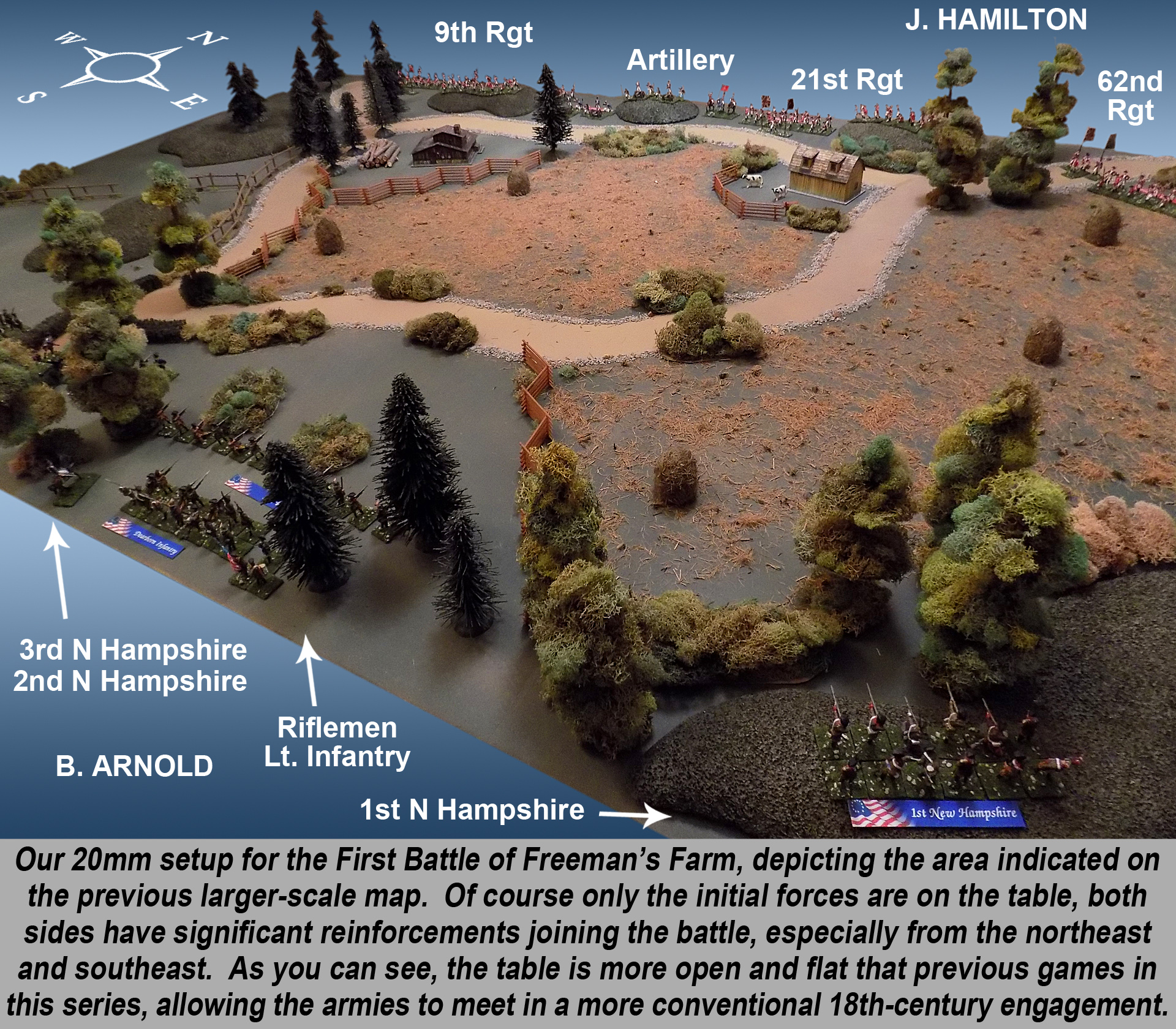
Such a movement is impossible to hide from the Americans. The people here are sympathetic to the rebel cause, every farmhouse houses potential spies. Burgoyne has also lost most of his Iroquois allies, so American scouts are able to get much closer to Burgoyne’s formations and report his every move.
So with greater numbers, the better intelligence of enemy intentions, and a strongly-fortified base of operations, why aren’t the Americans doing anything? That’s exactly what Benedict Arnold (American second-in-command) wants to know. He argues furiously with his boss, but the timid “Granny Gates” still won’t budge.
Finally, Arnold takes matters into his own hands. Assuming personal command of whatever units he can, he heads out to engage the foremost element of Burgoyne’s army, Brigadier Hamilton’s column advancing down the centre. They will meet at a fateful clearing in the thick New York woods called Freeman’s Farm.

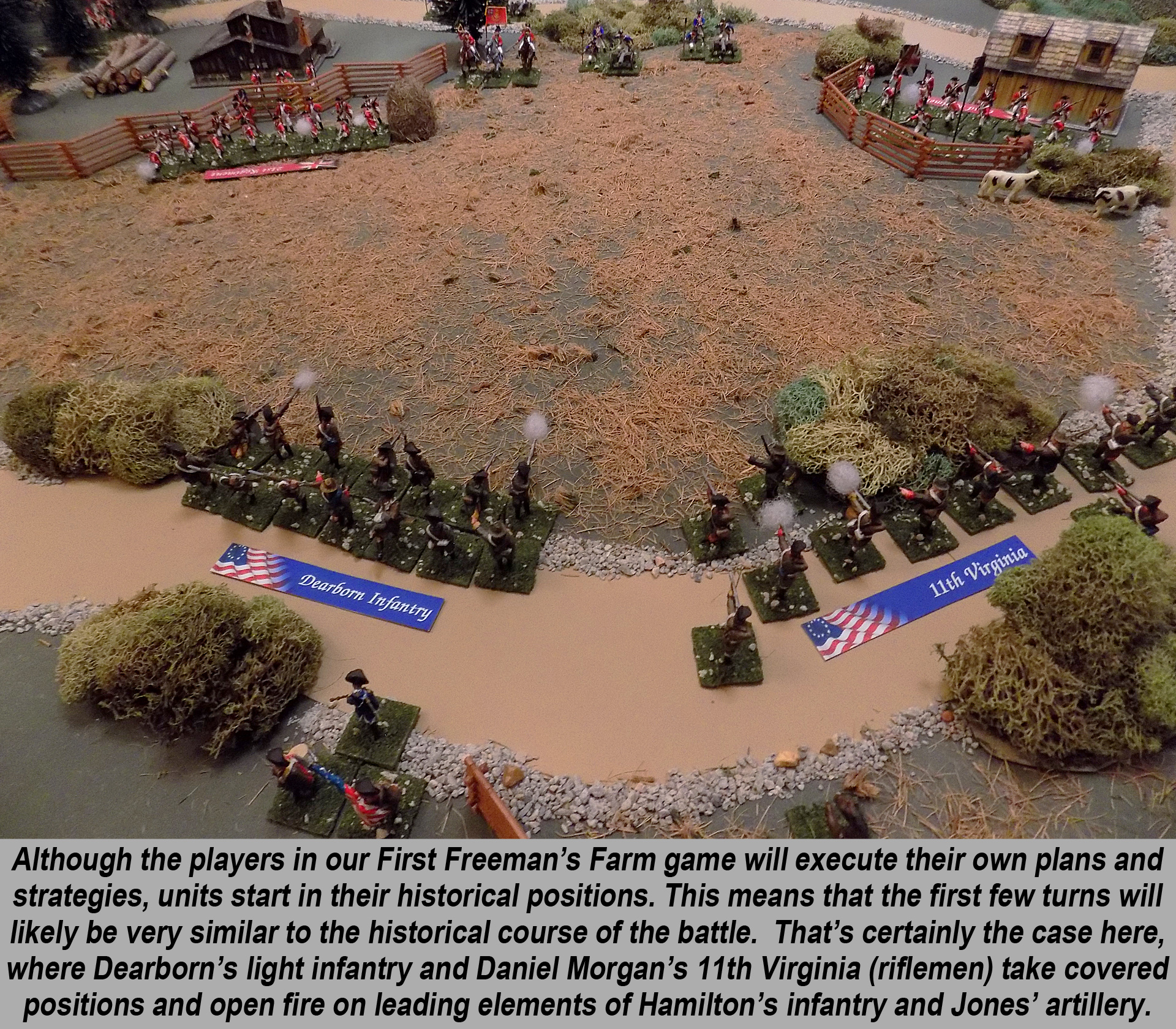
Arnold has chosen his men well. He has the 11th Virginia Regiment, expert marksmen under the command of Daniel Morgan. Widely regarded as the father of US Army special forces, Morgan has fought with Arnold as far back as Canada in late 1775. Morgan is beyond tough, and his riflemen are the deadliest “widow makers” in America.
Supporting Morgan is Henry Dearborn’s battalion of light infantry. Armed with muskets and bayonets, they are an important part of this unit since Morgan’s riflemen (for all their range and accuracy) are slow-firing, and useless in melee combat since they have no bayonets and are not trained to fight when in formation.
As the British pickets emerge from the woods on the north side of Freeman’s Farm, they are immediately engaged by Morgan’s sharpshooters. Down go the officers first. Major Forbes commands a screening force of the 9th Regiment of foot, he loses every officer but one in the opening minute of fire.
The British react. Brigadier Hamilton, coordinating with Brigadier Fraser to the west, commit Canadian Rangers on Morgan’s west flank, driving back the riflemen. Here’s where Dearborn’s light infantry earn their pay, setting up a line of muskets and bayonets behind which the vulnerable riflemen can withdraw.
British firepower begins to pile on. Captain Jones brings up his four six-pounder artillery pieces. After putting a shell through Freeman’s farmhouse to make sure it is unoccupied, they then open fire on the Americans. But more American infantry is arriving, the bulk of Enoch Poor’s brigade pushing up to support Arnold’s battle.
The battle is also spreading westwards. As Simon Fraser (the victorious Scot commander at the Battle of Hubbardton) pushes down through McBride’s Farm, he is engaged by more American infantry under Ebenezer Learned. Soon the McBride Farm battle and Freeman’s Farm battle bleed together into one continuous brawl.
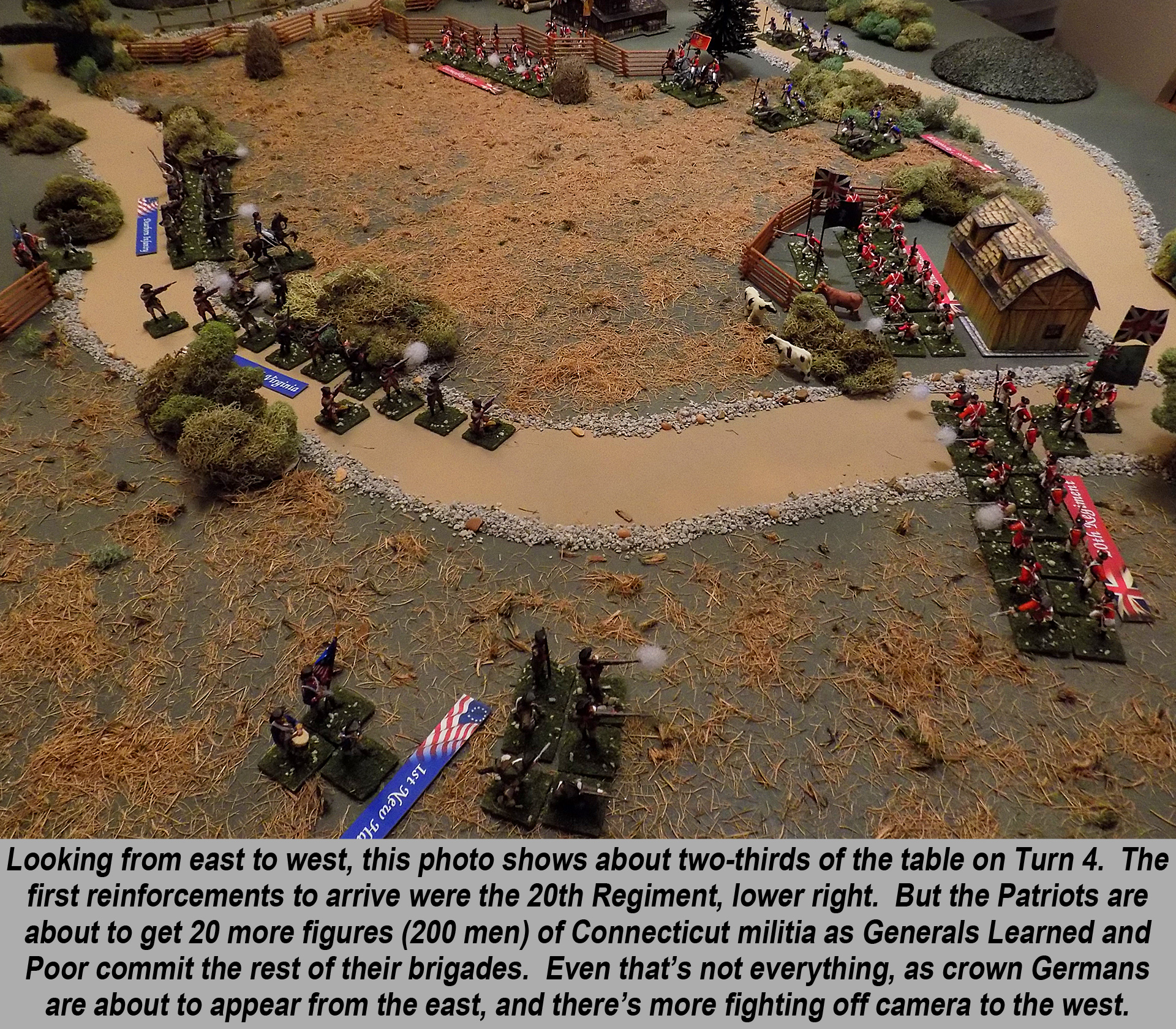
British discipline and firepower continue to tell, with American infantry regiments being torn up by artillery. Morgan’s sharpshooters then start picking off British artillery crews, their rifles are so accurate they actually outrange British artillery. Jones’ guns are bloodily removed from the equation.
The British mount a number of bayonet charges, which are usually their battle-winning “coup de grace” manoeuvre. But here British regiments are taking such losses to American gunfire, and American numbers are just large enough, where the unprecedented starts to happen: American infantry are actually REPELLING the British bayonet.
Another big reason American regiments are doing better here is the incomparable leadership of some of their commanders. Benedict Arnold, Daniel Morgan, Henry Dearborn, these are some of the best battlefield commanders the Americans will ever have in the Revolution. Galvanized and inspired, the men stand and fight.
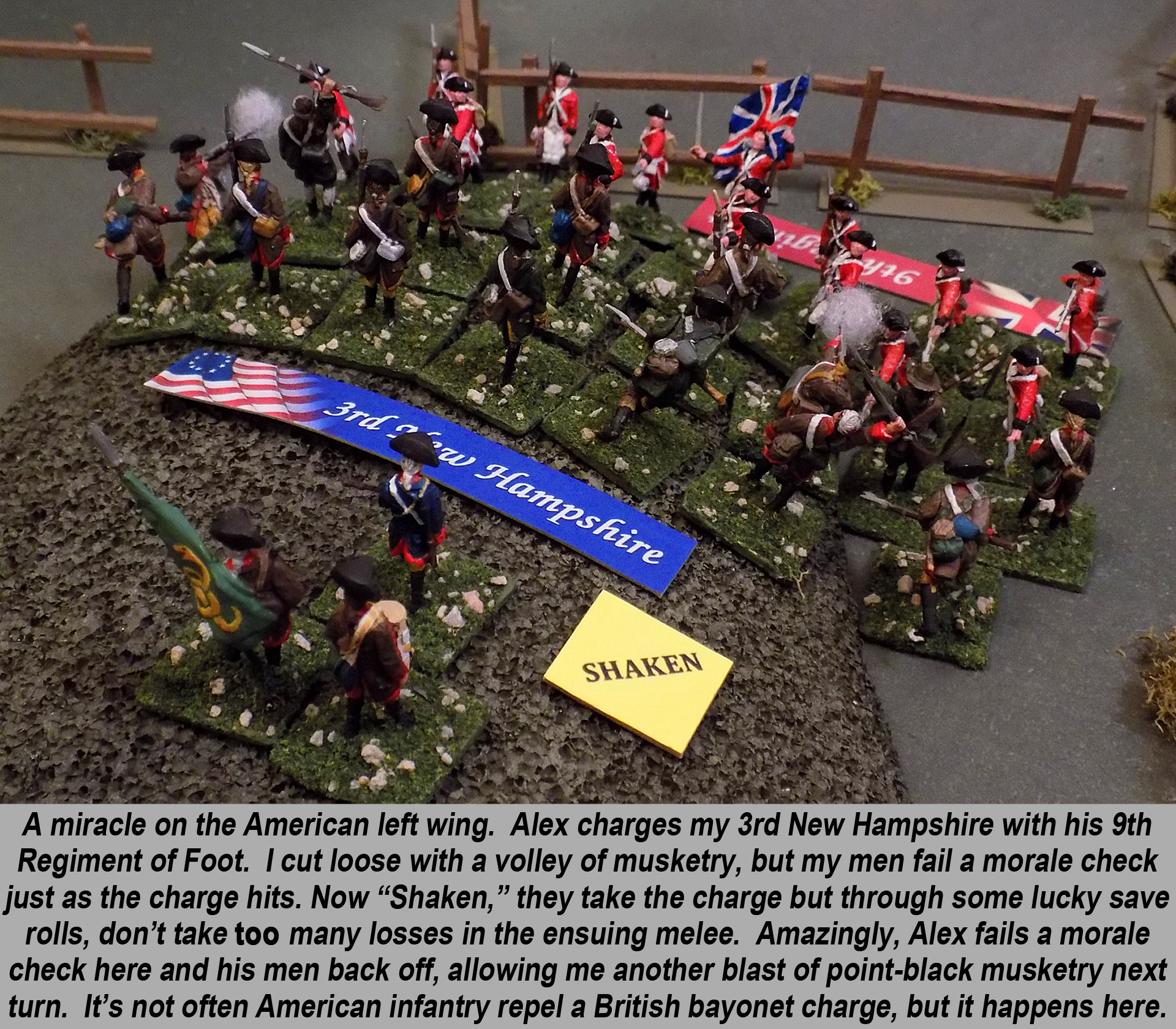
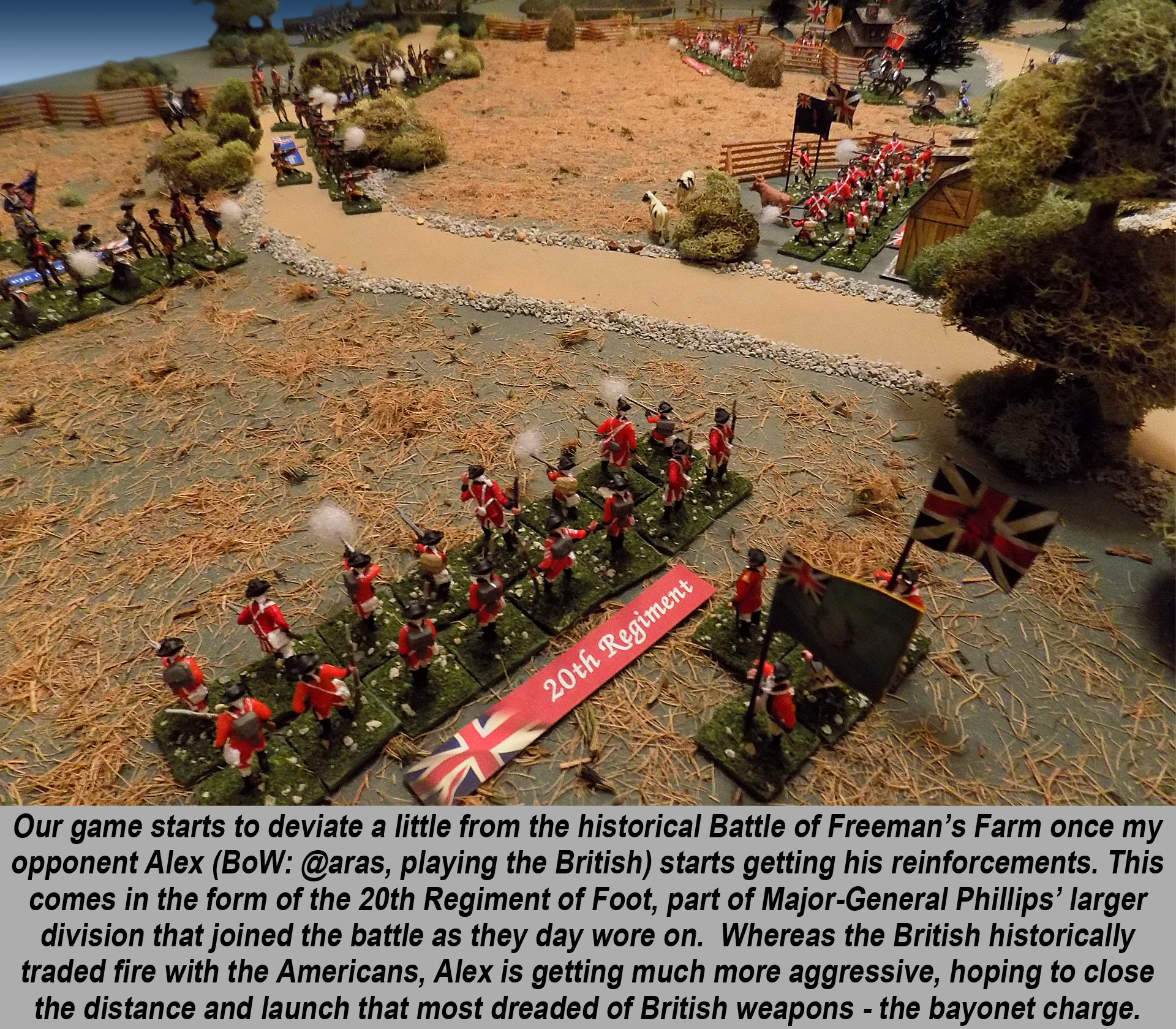
But so do the British. At Freeman’s Farm, the 9th, 62nd, and 21st Regiments of Foot are soon joined by the 20th as Major-General Phillips commits more of his division to support Hamilton. They push into the firestorm from the northeast. The Americans are then reinforced by Connecticut militia, entering the field from the southeast.
Fighting also rages perhaps half a mile to the west, where Learned’s New Yorkers and General Fraser’s British slug it out on McBride’s Farm. They also try to work around each other’s exposed west wing. Captain Fraser’s British marksmen, the few remaining Iroquois, and German jäger light infantry fight it out with American militia.
On Freeman’s Farm, however, things are getting desperate for the British. Their line is starting to buckle in places, forcing some regiments (especially the 62nd) to “refuse” their fronts, setting up at an angle to fight in two directions at once. American muskets and riflemen take cruel advantage, putting these angles in murderous crossfires.
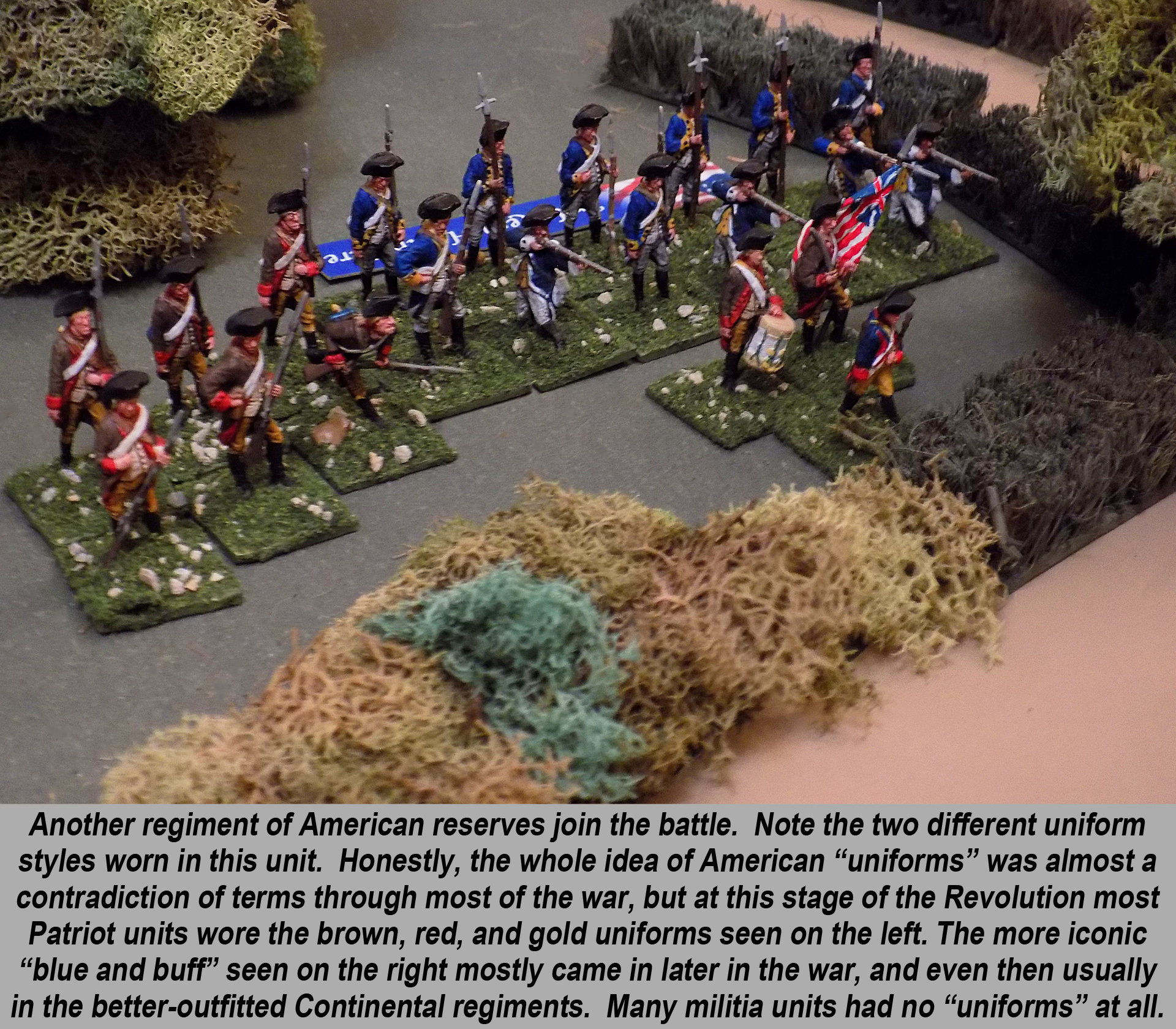
For the British, the day is saved by Baron von Riedesel and his Germans. As per his orders, he’s pushed down along the Hudson River to the east, ready to fix the main American position from the front with a “masking” attack. But when he hears the intensity of the gunfire to the west, he knows the situation is serious.
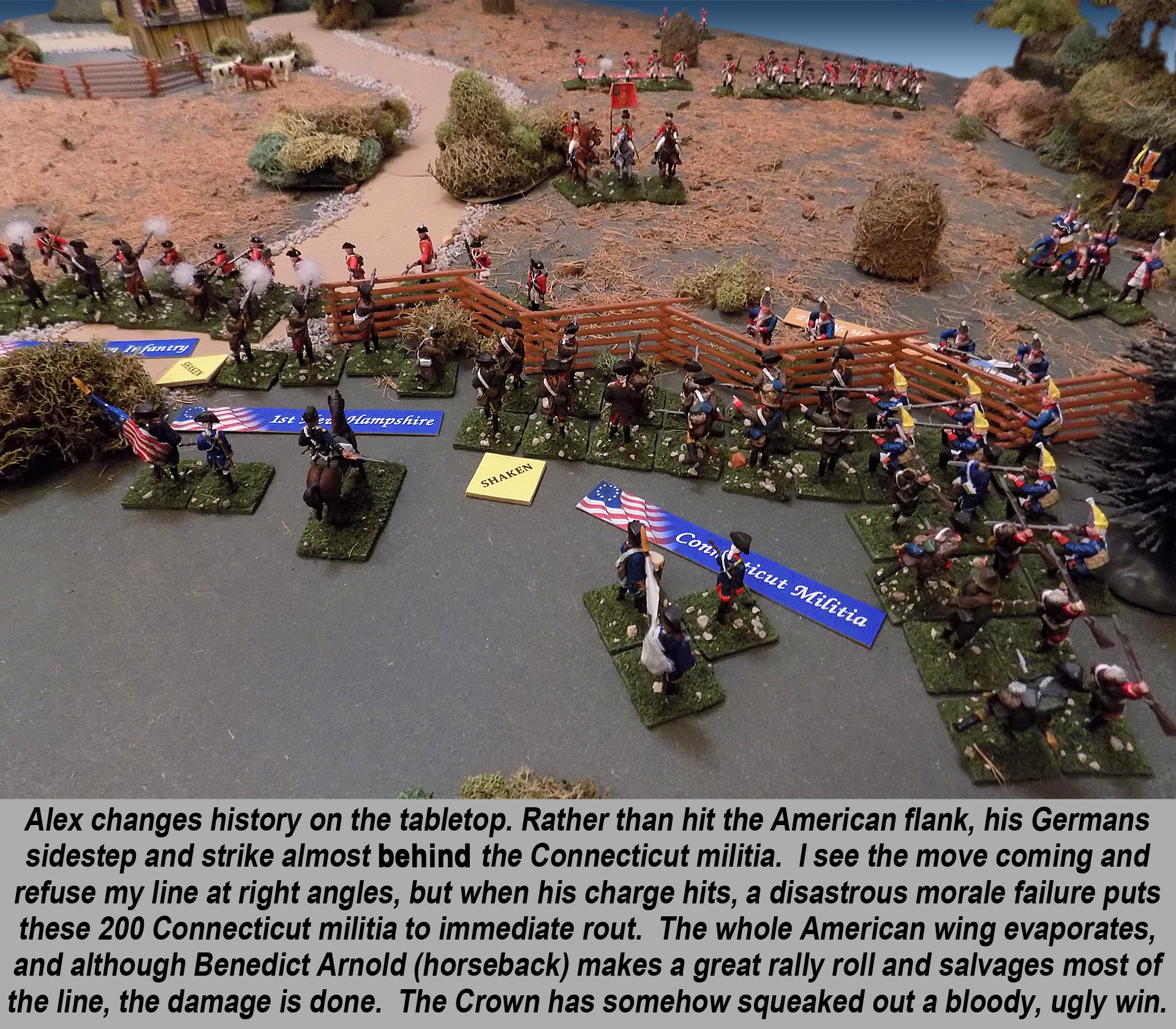
Acting fast and without orders, von Reidesel detaches some of his men and sends them west to help Hamilton and Phillips at Freeman’s Farm. They emerge squarely on the flank of Arnold’s force fighting Hamilton, practically behind the Connecticut Militia.
With a whole new enemy force on their right flank (and partially behind them as well), the Americans are forced to finally withdraw from the field. The sun is going down, and frankly, both sides are more than happy to call it a day.
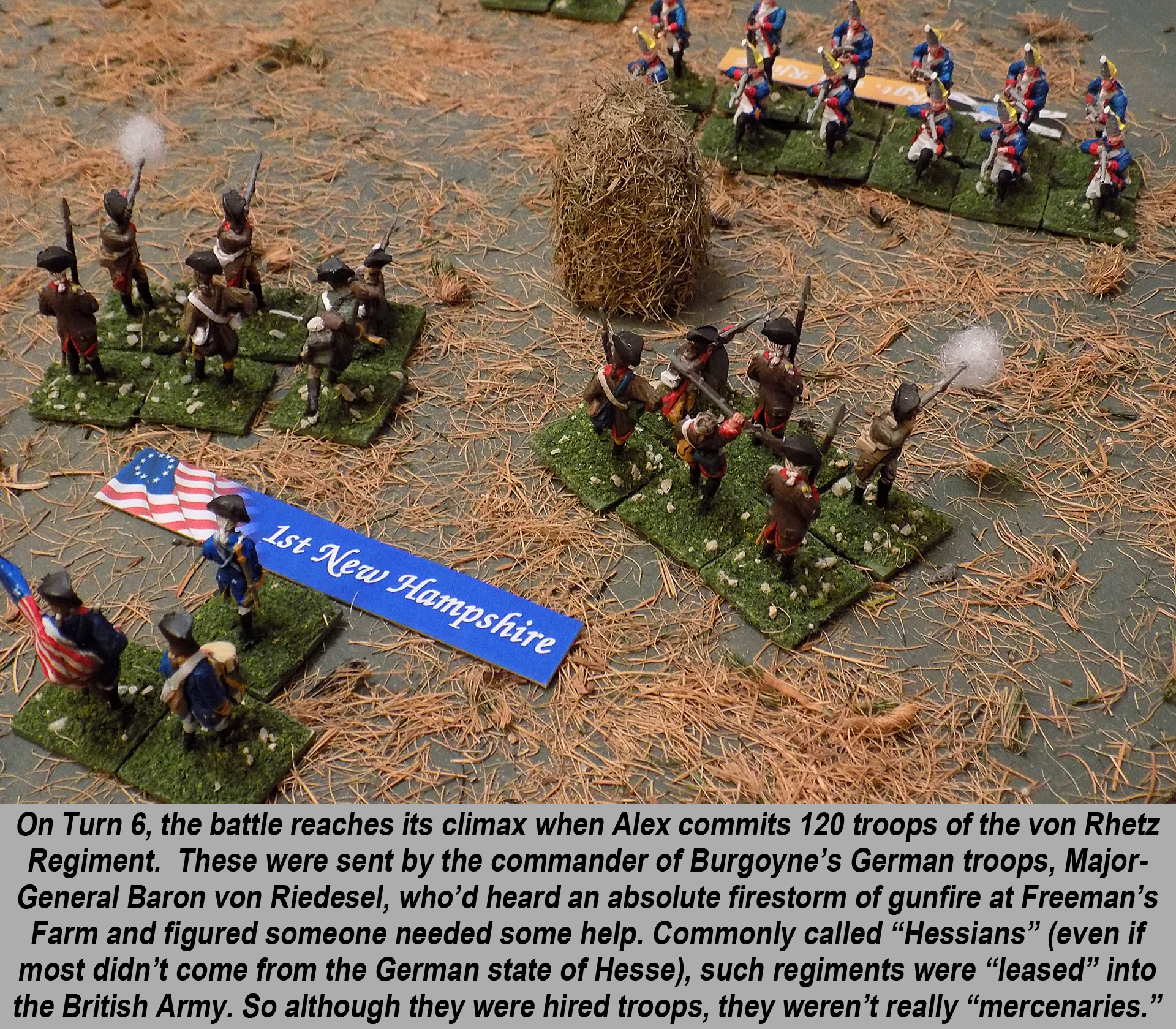
Technically, First Freeman’s Farm is sometimes called a British “pyrrhic victory” as they retained possession of the field. But in no realistic sense can Burgoyne call this battle a success. He’s lost 600 men. The Americans have barely lost 300. And if the day has proven anything, there is just no way Burgoyne is breaking through to Albany.
Through the days following the First Battle of Freeman’s Farm, Burgoyne’s position continues to deteriorate. Through disease and desertion, his army shrinks every day. Conversely, the Americans continue to gather militia from practically every county of New York, New Hampshire, and western Massachusetts.
Even so, not all is well in the American camp. “Granny Gates” is positively furious with Benedict Arnold for engaging Burgoyne without permission. Despite the battle’s success (or perhaps because of it), Gates sees Arnold as an insubordinate hothead, trying to steal the glory of command for himself.
Big trouble is brewing between these two men, trouble that will boil over with potentially disastrous results just in time for the Second Battle of Freeman’s Farm. Indeed, history isn’t quite done with this tiny corner of New York state.
We hope you’ll come back next week for our grand finale of the Saratoga Campaign. On October 7th, 1777, Burgoyne makes one last attempt to salvage victory from his ruined campaign. As for the Americans, Washington has just lost huge battles in Brandywine and Germantown, Pennsylvania…costing them Philadelphia, their capital city.
If the Americans have ever, EVER needed a victory…they need it now. Will the Second Battle of Freeman’s Farm, the climax of the Saratoga Campaign, give them the win they so desperately need? Come back next week and find out as we conclude this commemorative series on this epic campaign.
If you would like to write an article for Beasts of War then please contact us at [email protected] for more information!
"Marching south, they are soon drawing near Albany, the capital of New York State, their ultimate objective..."
Supported by (Turn Off)

Supported by (Turn Off)
"Morgan is beyond tough, and his riflemen are the deadliest “widow makers” in America..."
Supported by (Turn Off)


![StarCraft Tabletop Miniatures Game Pre-Orders Live Now [Updated]](https://images.beastsofwar.com/2026/03/starcraft-tmg-news-cover-600-338.jpg)

![Mounted US Cavalry On Kickstarter For Dead Man’s Hand! [Updated]](https://images.beastsofwar.com/2026/03/us-cavalry-main-600-338.jpg)
![Play WW2 Commando Operations With Butcher & Bolt [Updated]](https://images.beastsofwar.com/2026/03/relaunch-600-338.jpg)
Great article. I was afraid this series had stopped before getting to the end of the campaign.
No worries, @pslemon – I think they just wanted to take a break for WWX week (a themed week for one of the games featured on the site). 😀
Great table! I like all the hay, and of course the cows. 🙂 Also, the timber logs stacked by the farmhouse. Great little touches! Glad to see this article series back on track.
Thanks, @gladesrunner – those “logs” were cut from branches blown down by the hurricane. You know what they say, when life gives you lemons … make lemonade … and by “lemonade” I mean 15mm scatter terrain! 😀 😀 😀
And great bases on the minis as well
Hey, thanks very much, @ramus ! Jim had me chained to the hobby table and wouldn’t let me go until I finished almost 400 bases … Oh wait, he’s glaring at me as I type this …
🙂
Hey hey now . . . 😐
Excellent as always. Seeing these really makes me want to get some more of my AWI stuff painted and try out the system.
Those riflemen sure are effective at taking out officers. What’s the in game effect of losing your unit’s officer? Is it just when it comes to taking tests or is it a passive effect?
Great questions, @elessar2590 –
The question of officer vulnerability is always a tough one for AWI wargames. The Americans do it constantly, and have the men and weapons to do it. The British don’t have many men or weapons for this task, and even when they do, they don’t usually do it because it’s “not gentlemanly.”
I think everyone’s heard the story of Major Ferguson at Brandywine (Sept 11, 1777), designer of the Ferguson Rifle. He had a senior American officer dead-bang in his sights and despite the EASY kill, didn’t take it because it just didn’t seem fair. When cross-referencing where Ferguson was at that time of day on the field, it’s almost 100% the officer in his sights was George Washington himself.
So how do you “game” that? One player has to be a “nice guy” and the other has to be an ass?
In Battlesystem, we have officer broken down into three basic categories. “Majors” – “Colonels” – “Generals.” Each has a different number of figures stacked with the actual commander. Majors = 0, Colonels usually = 2, Generals 3+. So when anyone attacks a command group, the owning player obviously gets to pick which figures are taken off, and obviously they’ll pick the drummer or flutist or standard bearer, etc. before the actual officer.
So higher officers have more “bullet sponges” – and are more survivable.
When an officer finally does go down, the player simply loses that officer. So in order for a unit to take any action, they have to be in “command diameter” of an officer. (Majors = 12”, Colonels 16”, Generals 20”). An officer can only command a certain number of formations (Majors = 1, Colonels 2, Generals 3, plus whatever +1 or +2 command / charisma bonus they have). These differences reflect the different size staffs, runners, riders, couriers, etc., each level of officer has.
So when officers start coing down, the owning player has to be a lot more careful about where his remaining officers are, and make sure he can still command his whole army. If too many officers go down, some units may be left “out of command” and thus unable to move, charge, etc.
Also, officers are required to rally shaken and broken units. So again, lose too many officers and you’re toast.
Officers can be further protected by placing them in direct base-to-base contact with a full unit (general riding in with an elite regiment on a charge, that kind of thing). This gives a bonus to the charge initiation check and morale checks that may be forced by enemy pass-through fire, but now that officer can only use any of his command abilities WITH that unit. The flip side is, the commander is basically immortal since he’s part of the unit and probably the last figure the owning player will want to remove when taking off required casualties.
Other games I have worked on / designed – I put in an “incidental casualty” rule for officers. In Sons of Liberty, although only American rifle units (actually quite rare) are allowed to specifically target enemy officers. However, whenever any officer was within the possible range of at least one enemy unit, at the end the turn 2d6 are rolled for that officer. Box cars = wounded. Snake eyes = killed. Worked pretty well.
To be perfectly honest, we haven’t been doing very much of this. There are usually too many other things to shoot at, and we have enough officers on the field where picking off one or two won’t hurt the enemy THAT much.
What I HAVE been doing with my riflemen, though, and holy hell did it pay off in spades in this game … was target Alex’s artillery crews. This is completely historical, and after just one or two salvos of 6-pounders … (and taking THOSE kind of casualties) … I didn’t feel bad one bit in shutting down these gun crews.
The effect of reduced gun crews is another whole topic. Let me know if that’s something you’re interested in and I’ll drop another wall of text. 😀
Ok, now that I’ve commented on the important stuff
Amazing how those cows survive even when two full regiments are blasting away at each other with the cows right in the middle. “Matrix” cows? 🙂
Great read again, definitely more open to the historical side since the last four series. Looking forward to more. Looks like on the table at least @oriskany and his patriots are getting a more severe spanking!
I’ll totally admit I got the hell beat out of me at the very end. So as my 200 Connecticut Militia come up behind my right wing, Alex brings on his Brunswick infantry (von Rhetz Regiment).
Now historically what happens here, these new Germans bring some pressure on the American right and rear oblique, the sun is going down, Americans figure they’ve already inflicted 2-1 casualties on the British, so they fall back in good order and leave the field to the British.
Here, those Connecticut militia catastrophically fail their morale check. Alex changed history not in where he brought the Germans on (he’s kind of restricted by historical conditions), but in how aggressive he is with it. Instead of advancing by fires, he charges.
So when that German charge hits my Connecticut Militia, they instantly rout. That’s the game immediately over with a decisive British victory UNLESS Benedict Arnold can rally them.
Okay, so to make the rally, the Connecticut Militia has to roll on or under its morale on 2d10. They start with an 11. They are -2 because they are now routed. Benedict Arnold is a +2 charisma commander (also, he’s FROM Connecticut). Anyway, the morale target is back to an 11.
I swear to God, those 2d10 roll a 10 and 1. Benedict Arnold, god of AWI battlefield command, BARELY pulls it off.
Still, I’ve lost 9 inches off my right wing (Connecticut militia did rout for one turn – full movement rate backward). But now they’re turned around and upgraded to “SHAKEN” status. So nevertheless a Crown win on that side of the table.
Where I did a little better was on my left. I repelled a British bayonet charge mounted by 9th Regiment of Foot (ninth image above), broke them, and sent them fleeing off the field. I was able to wheel north and then east, thus splitting off this whole table (Hamilton and Phillips in the British center) from Brigadier General Simon Fraser’s Advance Corps further west.
But yes, this was a tough, hard-fought game.
The best games are hard fault, the crown taking the field truly this time
Absolutely. Congrats to @aras !
Ah ha Part 4 . I thought it might have disappeared. Interesting read as always Jim
Thanks, @torros – just a slight interruption in Historical Awesomeness Service 😀 for WWX week. 😀
Another nice article. I’ve never really explored early American history and these articles have motivated me to broaden my horizons beyond European wars. My copy of Patriot Battles arrived a couple of hours ago, it’s joined my bedside pile along with Red Army and Memoirs.
Oh, and spent some time on the Front Rank Miniatures webstore checking out the AWI 28mm and 40mm ranges. One of the lads at my local club is big into AWI/FIW, going to see if he will organise a couple of games to try my hand.
Another great read. Thanks for this. I first came across Freemans farm in the Blackpowder rulebook so good to see how it sat in the wider campaign.
Awesome, @denzien – Just please note there are two battles of Freeman’s Farm – we cover the second one next week. 😀
a great very bloody read @oriskany and a cliff-hanger as well, very tune in next week to see if the hero? survives stuff.
Thanks, @zorg – Yep, just one more to go. 😀 For Second Freeman’s Farm, we see whether Granny Gates finally gets off his ass and does something, Burgoyne takes his shrinking army (and fortunes) and makes one last attempt, or if Arnold just usurps the army from Gates and fights the battle himself.
(Hint – out of the three things listed above, two of them wind up happening, one does not). 😀
Great read Jim, I thought I’d missed an episode as I wasn’t really interested in Wild West exodus week and then we get inundated with John’s tank and terrain vlogs and your historical articles. Great week on BoW!
I knew very little about this bit of history and I find it and the scale of the engagements fascinating. Another list of books to add to my must reads once I get to retire and become a full time military historian/ man of mystery. 🙂
Thanks, @brucelea – “Full Time Military Historian / Man of Mystery!” Damn, you beat me to the title. Now I have to come up with a new one. “Military Historian and Designated Heir of Hugh Hefner.” No? I’ll keep working on it. 😀
I agree the scale is one of the best things about this war. Bigger than skirmish (why does everything have to be skirmish-based these days?) but smaller than the huge Napoleonic battles that are literally ten times the size or more. At least for me, it’s a perfect fit, nice big battle-scale gaming, but still manageable on the tabletop.
Thanks for the comment! 😀
Great stuff – some of that part of New York State still seem desolated as it was back then.
Seem like @ares played to the Crowns advantages – get up close
When I’ve visited the battlefield @rasmus , I fly into Albany and drive up the Hudson. And yeah, Saratoga Springs and Schuylerville areas are nice small towns, but some of those back roads . . . yeah. It’s pretty sparely populated back there.
@oriskany You’re going to have me painting a thousand AWI models before the winter is out! Well done, and nice basing @gladesrunner 🙂
Amazed by the versatility of Battlesystem. I know my rulebook shelf has only that and AD&D books… and it’s always been enough. I see the rules governing individuals are more abstract, and now that I’ve seen the system in action, I’m sure it wouldn’t appeal to roleplayers, but is outstanding for simulating one-off battles and non-roleplaying scrimmages!
Oops. I’m talking about 1st Edition Battlesytem vs. 2nd of course.
“You’re going to have me painting a thousand AWI models before the winter is out! ”
Oh no! Hey, it’s your fault, really. You’re the one that got me hooked back into Battlesystem.
Yes, commanders are basically units like all others, with a few exceptions to show they are acting as individuals instead of formations.
We’ve abstracted it a little more,and to be honestin a “native D&D” setting the leaders / commanders / characters have a lot more flavor because they can be more than one hit dice, have enhanced movement, armor, weapons, spells.
Here everyone is a normal human, no armor, fighting with normal weapons. No god-like mages and clerics riding around on pegasi and griffons! 😀 😀 😀
Oh, and one more thing to @cpauls1 and everyone who commented on this thread today . . .
THANK YOU so much! We’re at 39 comments, so we beat Part 03’s entire run in just the first day, and damned near reached Part 02’s total as well.
Seriously, everyone, it means a lot. 😀 😀 😀
A good mate of mine is a keen AWI gamer and has over the years ended up with a rather large 28mm collection. We use British Grenadier for our wargame rules (gives a good, fast paced game with an awesome feature of “order” where units gain disorder before loosing casualties…which rewards the player who uses his troops in “bursts” and quickly re-enforces or falls back if they start to get in trouble. Anyway LOTS of eye candy at http://yarkshiregamer.blogspot.co.uk/search/label/28mm%20AWI
Thanks for the great post, @phaidknott – and awesome photos in the link. I was particularly interested in those entries on Second battle of Freeman’s Farm (Bemis Heights) – October 7, 1777. This is the exact battle we’re zooming into for next week’s grand finale.
I also liked the order of battle information in the Yarkshire site. Totally agree with the “ranking” of commanders (“Excellent” / “Average,” etc). I also like the OOB information.
And of course, incredible miniatures. I always have crazy respect for people who paint large armies this detailed and colorful in 28mm.
Hope you’ll check in next week for the October 7 1777 battle. 😀
I have to say that as always this is yet another reason why Jim is held in the regard he is. This series has brought out what I consider to be the best spot on read for a while for me. I am very much an American revolution follower. As if it needs to be said, but I have re-read this series as it gives the, in my humble opinion, a light on some of the lesser known facts of both armies make ups unless you look at these details one is always doomed to imagine a war of sides lining up and being made up of the British and those pesky upstarts. I would like to point out that with the benefit of hindsight we the British may have sent more in the way of force in the first instance had we had the knowledge of how much America would become. We were rather more tied up with keeping our more profitable parts of the empire back then, and as Oriskany points out America then might have been a big place but quite a bit of it was still to be properly to come under America as we might start to recognise it now. I have had the great fortune to read some of the parliamentary enquiry of the day in regards to the loss of the American colonies, they make some references to the miss management of the conflict but all in all, “we can do with out the bother of them!” was the general actual conclusion, we do after all still have the Canadian colonies and if needed at a later date I feel sure that they honestly thought that they could wrestle them back when the upstarts “realise that their trade and their future economy is based upon ours being better relations.” As always we had our stiff upper lip to maintain in the face of defeat, the fact that we had it so bloody stiff we fell over it then and as we have so many times since in history going forth to upstarts down that would be over before Christmas. Thanks again mate as always a rip roaring read with facts that are not dried in the past years and with a passion for a subject that clearly shows. We are in fact glad to have your prose.
Cheers mate Chris G
Wow, thanks very much, @chrisg – definitely appreciate all the kind words.
Indeed, you and I plowed through all the material early last year in our American Revolution series (still one of the more successful historical series we’ve done, measured by content count). Basically this whole series is everything we did in Part 04 of the original series (War in the North) and zoomed in to much greater detail. I’ve also had a lot more time to build much more extensive armies. 😀
I hear what you’re saying about being “doomed to imagines a war of sides lining up, British and pesky upstarts.” The northern part of the war has a lot more factions involved, part of what makes it my favorite part of the war.
As far as the British not sending enough force, I feel they really did plenty of force … at least in mid-1776. This would be right after the fighting around Boston and the British being compelled to withdraw from Boston on 17 March 1776 (only remember the date because it was St. Patrick’s Day 🙂 ).
The British weren’t gone for long, and came back with a vengeance. At the time, the combined force under brothers Admiral Richard Howe and General William Howe was the largest expeditionary force any British government had sent anywhere. It really was “The Empire Strikes Back.” 😀 And the victories they won I think are still the greatest series of military disasters in the history of the American military. Long Island, Brooklyn Heights, Kip’s Bay, Harlem Heights, White Plains, Fort Washington, Fort Lee … defeat after defeat followed by impending defeat.
To your point though, I think after that the British didn’t stick with it as much as they could have. Howe’s victories in 1776 were not really followed up on, the Americans were allowed to escape (yes, flee for their lives) several times and until their position was partially redeemed by tiny little skirmishes at Trenton and Princeton (pitifully small battles compared to big British victories around New York City). Howe’s victories in 1777 (up to and including the capture of the rebel capital in Philadelphia) were not followed up on, in fact the British pulled out of the Philadelphia early the next year (leading to the Battle of Monmouth, 1778).
Indeed, the war was not universally supported in Parliament. Once the French, later the Spanish, and still later the Dutch entered the war, even the hawks in Parliament were no longer very interested in the American colonies, intent on using limited resources to fight the “real war” against the “real enemies.”
As far as the “we can do without the bother of them,” in the late 1700s and early 1800s that was really true. Almost immediately after the war ended, relations were established between the two countries (John Adams, probably the most important political figure in the founding of nation) wound up being our first ambassador to the Court of St. James. we needed to be part of the British trade empire, even if we didn’t want to be part of the British political or military empire. End result, Britain enjoyed the financial benefits of America, without the expense of having to administer colonies there.
I always cringe a little when the American Revolution is called a “British defeat.” Yes, it was an American victory. But honestly a British victory, too. So you lost the American colonies. You also gained all of India, successfully defended Canada and Gibraltar from strong enemies, and reaped a huge reward in the Caribbean, the “Persian Gulf” of the day.
The losers, of course, were Spain and especially France. So bankrupted was the French economy, so ravaged were their remaining colonies, and so destabilized was the House of Bourbon that the whole French empire imploded just six years later.
Then Napoleon rose from those ashes and eventually you kicked his ass, too. 😀
Thanks again for the great comment and very kind words, from a fellow AWI expert, no less! 😀
The snow is coming do let’s make that last minute dash for glory. Hitler should have read the about Saratoga before he decided to make that last snatch for Moscow at seasons end.
Another fine installment sir. While it has not motivated me to start doing the AWI, it has served to increase my efforts for the ACW.
According to the Rifles episode of the old series Takes Of The Gun, Saratoga was the first battle in history where one side had mostly smooth bore muskets, the British, and the other side had mostly rifled bore muskets.
Known as the long rifle at the time and was a modification of the Jaeger hunting rifled musket. Modified again and it was known as the Pennsylvania rifle and finally modified once more to become the legendary Kentucky rifle. It certainly encouraged the British that time had come to retire the Brown Bess smooth bore musket.
The lesson not taken from here was the the day off the Napoleonic battle formations were coming to the end as well. These formations were carried on to create the mass carnage of the early ACW.
It has been a pleasant surprise that each battle you have described in this series has reminded me of so many other battles throughout history. It also points at future wars and how they will be fought in the way that the ACW points to WW1 in a number of ways. However because both conflicts happen in north America the lessons are lost to the very distant European powers.
As for Benedict Arnold is concerned I like to think of him as the Patton of his times. Hot bloods are great as long as the leash is strong enough to hold them.
Thanks, @jamesevans140 –
I hope when you guys get that ACW project up and running we see some photos and commentary here in the forums on Beasts of War.
I’m not sure if I would agree 100% with that episode of Tales of the Gun re: the proportion of American rifles at Saratoga (First and Second Freeman’s Farm). Mind you, I’m not doubting your knowledge, it’s just these shows sometimes feel the need to say oversimplified and dramatic statements – a sin I fully admit I have been guilty in with some of my BoW interviews. (Saratoga leads directly to Normandy? Really?) 🙁
The only regiment to be equipped with them exclusively to my knowledge was the 11th Virginia (Colonel Daniel Morgan), out of at least 12-15 American regiments there. Maybe if they zoom into a specific part of the battle, such as where Morgan and Dearborn first engaged Phillips’ vanguard at Freeman’s Farm, the “one side mostly had rifles and the other muskets” would apply?
There certainly may have been rifles mixed in with the other regiments, especially the militia, of which there were many. But not more than muskets, because rifles were positively useless in melee combat (to the point where Morgan’s riflemen had to have a specific unit permanently attached to them – Dearborn’s light infantry – to protect them.
I can’t imagine most of the American Army at Saratoga fighting under that kind of disadvantage, espeicially with the amount of melee combat documented at First Freeman’s Farm.
I would totally agree that Morgan’s rifles were decisive at First Freeman’s Farm, shutting down the British artillery (both historically and on our table). They also score a major success at Second Freeman’s Farm, but I won’t spoil that for next week. 😀
Great comparison between Arnold and Patton. Both were hard-charging geniuses on the battlefield, and also whiny, petulant, self-important, drama-queen cry babies. At least when the leash was jerked, as it certainly was for both of them, Patton (to his eternal credit) came to heel and obeyed orders like a soldier.
Arnold … not so much. 🙁
It was named after the chap who invented the bullet. Which strangely preferred the minie rifle by 2 years
Preceded sorry
I tend to agree with your over simplification statement. But if you squint your eyes really tight and only look at that one rifle unit it would be safe to say the other unit it engaged then it would be safe to say the other side only smooth bores.
The other thing that concerned me about their statement is that in my army lists for the opening stages of the ACW most of the units are equipped with smooth bore muskets. Even in the final stages even some militia units still have smooth bore muskets. In the opening battles of the ACW my tactics will be hardly any different to those used here. So 90 odd years after the AWI the situation is still a mixed one. It was my understanding that it was the rifle and improved ammunition of the ACW that put the musket and Napoleonic tactics to bed. So I was very interested on your take on their stated claim.
I read somewhere once that genius for battle cannot be taught and those that are born with it are rarely the ones that the army wants. I suppose this is where staff officers come into it.
I suppose the difference between Arnold and Patton is one wanted glory at any cost while the other wanted the admiration of his country for the glory he got at almost any cost.
Look at the career of John Paul Jones and the nations he served. It was very common for staff officers at the time to go to any country at war. But very few did this when their country was at war and far fewer enlisted in the enemy’s army. I have open wondered if Arnold used this to justify that his action was an acceptable one. Either way it burned his name in infamy.
Absolutely, @jamesevans140 – almost anything can be construed as “true” depending on manipulations of context.
I’m on much less solid ground when it comes to the ACW as opposed to the AWI. But even I know that at, say First Bull Run (First Manasass), both sides had all kinds of weapons. Some with smooth bore muskets (more advanced than the Brown Bess of 80 years previous, but still) – some still carrying “buck n’ ball” ammunition for cryin’ out loud. But rifles firearms were in much larger supply, minié ball ammunition (why they call it that I have no idea, it’s clearly not a “ball” anymore), etc. The officers were all carrying revolvers, the there were breech-loading, lever-action carbines for the cavalry . . . etc (well, at least for the Federals at first).
“I read somewhere once that genius for battle cannot be taught and those that are born with it are rarely the ones that the army wants. I suppose this is where staff officers come into it.”
I would agree. In the military I was a terrible leader but my captain once said she would want me as one of her staff officers any day of the week. Someone’s gotta keep these prima donnas in check. 😀
Absolutely agree about the officers serving different countries. It’s a damned good thing for us, too. So many of our best officers actually came from other countries. Tadeusz Kościuszko – the Polish – Lithuanian military engineer who built these fortifications we mention at Bemis Heights (not to mention picked the ground on which Gates would fortify). Von Steuben, the Prussian who’d train our Continentals during the winter of 77-78 – Pulaski, the Polish father of American cavalry, Marquis de Lafayette of course …
Might reply in the right place this time
It was named after the chap who invented the bullet. Which strangely preferred the minie rifle by 2 years
Awesome, @torros – I just don’t know why they call them “balls.” They have a more ballistic shape.
Then again, I guess they call all ammunition to this day . . . “rounds” ???
Standard rounds, like NATO 5.56 and 7.62 are still referred to as ‘ball’, to differentiate them from specialized ammo like tracer. Thus the term ‘4B1T’ or ‘4-bit’ linked ammo, which stands for ‘four ball, one trace’.
That’s actually a really good point, @cpauls1 . You were really “on the ball” for that one.
gro-o-o-o-o-o-o-o-o-an
😀
I think one part that’s usually not seen in most games are the “loyalist troops”. Most games have lines of British and Hessians vs the Continentals. Yet many of the battles the Loyalist troops outnumber the British part of the OOB.
Also get around the problem I’ve seen of British “elite” rgts vs American “militia” (as the loyalist rgts were about the same as the continentals when it came to arms, training and equipment). I think these days we need a little more focus on these rgts rather than the standard “American vs British/Hesse” you usually see on the games table.
I wonder how many engagements actually were just featuring American troops on both sides?
@oriskany as @torros said the minié round was named after the guy. Yes it is still a ball round. It is molded as a ball with at thin flange or skirt attached. When the power charge goes off this skirt is deformed and as it has nowhere to go so it is forced hard against the barrel and into the rifling. By using the expanding skirt allows the round to be smaller than the rifle bore. The round free falls down the barrel while standard balls had to be hammered down the barrel making it bite into the rifling. The minié ball allowed for much faster loading, far less of the expanding gases could escape around it, it spun quicker making it more accurate and had a greater effective range. So it beat the standard ball round in every aspect.
Last week I started looking at early ACW tech. We have had discussions on the eclectic nature of the Finnish Army. Well the early ACW armies takes this to a hole new order. Troops are allowed to bring their own weapons or buy them. Old smooth bore muskets were issued as well as smooth bores that has been crudely rifled. Most troops also got hold of revolvers to supplement their long arm. Given their slow reloading times a wise precaution.
One revolver that was privately bought by a number officers were Italian designs that had 8 or 6 chambered revolver rounds with a single breach loading 12 gauge shotgun shell that was fired by a second trigger and ran under the revolver barrel. The 8 round models tended to be 32 calibre rather than 38. What seemed to be a good idea proved to be too heavy and cumbersome in battle.
The British entering WW2 with an army built from the ground up to police an empire. They then had to quickly build up a field army. The armies of the ACW had to quickly expand so all were welcome. Now they had a pool of strong minded individuals preferring to use their own hunting guns and others grabbing whatever they could get their hands on. So every gun making in the U.S. and Europe were well represented. For those that were not able to do this the armoury had stockpiles of old smooth bore muskets. Obviously this could not continue for long as every unit had different firepower and required all kinds of ammunition. However neither side was ready for war so those few early battles had to be fought by whatever they could get their hands on.
All the main officers on both sides came from West Point that at the times were still being taught Napoleonic tactics, drill and formations that had already been put to bed in Europe.
So I do like the early battles for their chucked together nature.
I would disagree with the drill etc bring abandoned in Europe . Take a look at the FPW or the early tactics the French and to some extent the Germans in the early phases of WW1
@jamesevan140 – great post as always!
Please don’t misunderstand, I know what a minié ball is and how it works. I actually have a few in a display case recovered from a North Carolina battlefield (Chattanooga). I’ll post a picture of them on the Saratoga thread (where we can post pics). I’ve also seen how they’re cast and made.
They’re just not remotely ball-shaped. But as @cpauls1 pointed out above, they’re still calling rounds like 5.56mm NATO / .223 Remington as “NATO Ball.” 😀 (And calling all ammunition “rounds” for that matter).
ACW tech is indeed fascinating and the reason it will always trump Napoleonics in my humble opinion. At the start of the ACW we have armies still trying to use Napleonic tactics. Of course this wouldn’t work tactically because of the higher rates / ranges / accuracy of firepower, but more importantly (operationally) because of rail and telegraph, as we saw at First Manassas / Bull Run (first major battle, as I’m sure you know).
By the end of the war we’re at the Siege of Petersburg and basically a preview of World War I. Breach-loading artillery, lever-action rifles, automatic weapons (sort of, I always thing the gatin gun’s impact is overrated), etc.
I agree that the early battles are in some ways more interesting. From a miniature perspective, also the uniforms. By the end of the war everything (especially on the Federal side) is so much more standardized.
@torros – FPW and the 1860s Wars of Prussian Unification are definitely conflicts I need to do some more reading on.
In a number of ways too true @torros. But I really do mean by the book 1812 for everything here. Expected reload times on drills, exact distance to fire and the whole show from Napoleon’s day. While the system had evolved in Europe to take into account technological improvements, such as the needle rifle, and change on the tactical use of those units of men on the battlefield. Of particular interest here are the ideas of Clausewitz and in particular for the times those of Jomini and his oblique line of battle. Yet back at West Point we are stuck back in 1812.
Nearly all the weapons sold by the Europeans to the warring Americans were from the obsolete stockpile, yet any of them were superior to the good old Brown Bess. So the carnage of the early battles was appalling caused by old methods using new technology. Then the minié ball came into use and they were still coming on in the same old way the carnage reached a new magnitude.
Perhaps rather than saying “put to bed”, I would on reflection has said “moved on from 1812”. So it is a fare point you make and I will try to be less sloppy with my words.
Oh, the good ole’ Brown Bess. AK-47 of the 1700s. 😀
American foot balls are not round either.;-)
You touch on my attraction to the ACW from a wargaming point. One afternoon I can play a WW1’ish game and the following afternoon play a Napoleonic’ish game with the very same armies and rules. I just can’t get that same sea change from the WW2 or modern period unless I use a multitude of armies and a couple of different rule sets. Imagine fighting a WW1 tank battle then doing 73 Easting with the same armies. That is what excites me as a Wargamer about the ACW. I will have to admit with the number of figures involved my uniforms for both sides are going to be standard issue, with the exception of special units such as sharpshooters that have very different uniforms. This project is more about having fun than a in-depth study of history. It may not sound like me, but I do have a fun side and normally that is what 40K is for but I was looking for something in between.
So true, @jamesevans140 – as history progresses, the technology changes (not just in the obvious ways like gun-boomie-‘splosion-thingies, but more impactful technology like the railroad and telegraph in the ACW / Wars of Prussian Unification, the wireless radio in WW2, and the Internet in Gulf War 1.
Obviously, as the technology changes, the tactics have to change to keep up. When the tactics lag too far behind the technology, we see bloodbaths like World War I and the end of the ACW.
So from a gaming perspective, trying to game “out of period” is often a disaster.
Found those ACW bullets I have. I have a photo linked here in the Saratoga thread:
http://www.beastsofwar.com/groups/historical-games/forum/topic/saratoga-campaign-in-the-awi-240th-anniversary/?topic_page=5&num=15#post-217045
Thanks for posting the picture @oriskany, I left a little comment.
I am not sure it would be a disaster as such but just look wrong. Like my U.S.soldiers storming Omaha Beach all dressed as Romans and mounted on bases to form part of a cohort. You could do it but it would feel so wrong and you would get a reputation for being overly tight with your money.
Mind you I am using figures made by a Spanish company, Totentanz. Nice detail for 15mm metals that have a slight edge on the details to catch ink washes. More importantly they cost AU$6 for 8 figures/520 men, this is quite cheap for ACW metals out here. I could have went cheaper with 1/72 poly plastic figures like those made by Revell but then my battlefield would have got a lot smaller.
Apologies, I meant “disaster” from a rules perspective. Like the WW1 tank battle rules for 73-Easting example you gave. 😀
Totentanz seem nice. They bought the moulds for the the old Corvus Belli historicals. Have you thought about 10mm at all?. The Old Glory stuff is cheap and not bad and there are lot of other companies doing 10mm ACW
Quite honestly, I have no interest in starting ACW at the moment … but if I did, or if I ever get bit by that bug, 10mm might be the way for me. These 20mm AWI figures took ALL summer, and still I don’t have quite 400 of them, and still there’s one faction I don’t have (Loyalists) and still most of the figures i have aren’t quite finished (washes on British, Germans, and Iroquois).
Since my ACW wouldn’t have to “mix” with anything else, I wouldn’t have to worry about compatibility with preexisting armies, so I could start with a smaller scale.
Actually @torros 6mm or 10mm were among my first conversations. I could not find anything at all for 6mm and I could not find anyone out here stocking 10mm. So the guy I normally buy from put me on to these 15mm models. I am not keen to order from overseas myself when it comes to metals as the postage costs could buy you half an army. Where the guy I buy from bus in bulk and slow boats them here. It took almost 3 months for my first order to arrive where I could have got them in under 18 days but the postage on offer was much more than my purchase. So if it is not one thing, it’s another.
So that’s how I ended up with the 15mm scale, but as a bonus most of my terrain is in 15mm.
Both Baccus and Adler do huge ranges in 6mm
@torros your knowledge of figurines in both scale of maker among with rule sets continually amazes me sir.
6mm would have been my preferred way to go. Across a Deadly Field covers 10mm so I only needed to reduce measurements by 40% and I would be there.
I know I’ve said this before, but would it be possible to play a 10mm game with 6mm figures? “underclocking” a game’s scale by one level sometimes works well for me.
Sorry @oriskany I see what you mean. I could see a briefing for the U.S. player for 75-E. Men we have the best tank in the world the MK-V* and the Rolls Royce armored cars. The Mesopotamian’s only have MK-1’s and Austin ACs. This is going to be a walk in the park. Before anyone leaves, does anyone know what a T-55 is?
If the rules were one volume it would take several volumes to sort the equipment list and there would be someone wanting to use a Centurian at D-Day I suppose. Then the mix ups. You said we were doing 44, I brought my 1944 army, not 84!
The rules would be struggling at every turn. Like FoW WW1 are out of numbers. The MK-IVs and Vs have an armour value of 1 all round. So we can design a MK-1 and make its armour value 0 all round. How do we now define the MK-IIs and IIIs? Yet FoW is only reaching back a bit over twenty years, let alone trying to cover a century.
“Before anyone leaves, does anyone know what a T-55 is?”
Almost sounds like a weird Star Trek time travel episode. 😀
@oriskany I agree totally with going with 10mm for the ACW and as I said to @torros I would have preferred 6mm if they were readily available to me at the time.
Yeah, I’m not sure … but would 6mm figures work with a 10mm rules set? I mean if you’ve already started buying minis than disregard this. But as we’ve chatted about on other threads, sometimes I find (personally, don’t know if this works with other people) playing on a scale that is deliberately one “level” lower seems to work.
I play 28mm TSR Battlesystem for example, in 20mm for these AWI games.
I often play 20mm Force on Force in 15mm.
I always play 20mm Battlegroup in 15mm.
The ranges and scales just seem to click better. Don’t know if that would work in this case, though.
I as I have probably mentioned before ground scales and footprints for bases are never going to be correct for figures on the tabletop. All you can really do not is try and get it as close as possible. So with that in mind Into for the look of the thing so for horse and musket style games 10 and 6 mm gives you in my opinion the look of a unit on the tabletop
I would agree. When it comes to scales and battlefields, they will never really be perfect. A general guideline would be to go as small as you are comfortable – assuming you are not playing either (a) a Skirmish game or (b) some kind of “command tactical” game like these TSR Battlesystem games we’re running here. Each 20mm figure is on a 3/4″ base, put represents a “file” of ten men.
So since each inch on the table = about 10 yards, a 20mm base is about 7 yards (20 feet or so). Ten men occupy 20 feet in most formations of the period, remembering that they are probably deployed in two ranks or some variation thereof.
Base range for our muskets (as we may have mentioned) is 6″ for massed volley fire, or 60 yards. About right. Fire is possible at longer ranges for massed volley fire, just don’t expect too many hits.
This is the kind of basic math we’ve used to accommodate Battlesystem to our AWI battles.
When it comes to 10mm ACW my preference would be for the GHQ minis.. Yes they are expensive, but also worth every penny. I like Baccus (6mm), but they mold their figs on “strips” which I personally find make basing a pain. Old Glory do 10mm a lot cheaper, but again mold their figs in strips (but this is a personal preference, and doesn’t mean the quality is bad).
For ACW we are still using Johnny Reb 2 (The third edition and fire and fury went off in a direction we didn’t enjoy), we’ve even modified it to play some Napoleonic games (and AWI before we found British Grenadier). Its strange how these three periods (AWI/NAP/ACW) we see how the balance of the three arms change. From AWI to Nap we see artillery strengthen until with Naps we have all three arms (Inf/Cav/Art) fairly balanced in effectiveness …… needing an combined arms strategy to win. Then from Nap to ACW we see Cav effectiveness wain. Although all three periods are “Horse and Musket”, they in effect play VERY differently (in a way you don’t see things change in other wargaming periods like Ancients).
But keep your eye out for a second hand copy of Johnny Reb 2, its an essential ruleset that does many things right 🙂
Johnny Reb 2 the game where no one wanted to charge as the rules were too complicated. Nice game really though
I think GHQ figures are too fragile personally
I can’t be sure, but I’m pretty sure I’ve actually played Johnny Reb a few times. I have no idea which edition. This would be 1994-95, so over 20 years ago, and another guy was running the game. He had tons of figures, I don’t remember them being very big, but each figure represented more than one person.
At one point a bunch of us got together in the second story of an old out-of-business shoe store (a friend of ours worked for the leasing company of the strip mall it was in). Basically it was a 20′ by 30′ empty concrete space. Of course we didn’t have nearly enough terrain or pieces for such a field, so we drew a lot of it out with the cheap colored chalk kids use to play hopscotch on the sidewalk.
Team game, obviously, took the better part of four days.
It was definitely Gettysburg, and I was definitely one of the Confederate players trying to push up Little Round Top. I just don’t remember the full scale. We were either doing the whole second day of the battle (in which case I would have been playing as Longstreet, I Corps, ANV) or just Longstreet’s Corps … in which case I probably would have been wither Hood or McLaws (two of Longstreet’s division commanders).
Anyway, I’m pretty sure the system was Johnny Reb, unless these scales sound totally off to you guys.
Johnny Reb used little green order counters you placed face down at the start of the turn. It’s probably complicated by todays standard (and Johnny Reb 2 was simplified Johnny Reb), but a few games and you’ll know the ropes by heart.
GHQ muskets can be fragile (but no more than 6mm muskets), I’ve got mine bases on square steel bases that has allowed them to weather the years pretty well. 10mm is great for us older gamers for whom (with dodgy eyesight) find 6mm just beyond the ability to focus on. Another 10mm range is Pendraken here in the UK who also have a large range of stuff https://pendraken.co.uk/19th-century/americas/american-civil-war/
Oh … I’m used to “complicated” games. 😀 One thing I disagree with the BoW team about sometimes is their idea that we live in the “Golden Age of Gaming” – nothing could be further from the truth in my opinion. I say we live the post-apocalyptic Dark Age of Gaming – dominated by kindergarten rules sets, overpriced minis, Kickstarters, and slick marketing. Dominated by game designs were with everything simple, everything dumbed down for post-2000 attention spans, everything skirmish scale, everything measured by standards where “you can play a game in less than 90 minutes” … I’m sorry is that supposed to be a GOOD thing???
Nope. Not for me. I’ll stick with old 1989 Battlesystem, 1969 PanzerBlitz, 1974 Panzer Leader, 1977 Arab-Israeli Wars, 1980s Advanced Squad Leader, 1985 GDW Assault, Rise and Decline of the Third Reich, 1980’s Classic BattleTech, etc.
If a game takes less than 3 hours to play, you’ve been ripped off.
If a game comes with a rule book less than 200 pages, you’ve been ripped off.
About the only game that’s come out in the last 15-20 years I’ve actually liked: Battlegroup by IronFist Publishing. And even that gets some heat sometimes for being too technical, too detail-oriented, and the ultimate in unforgivable blasphemies …
TOO HISTORICALLY ACCURATE!!!!!
Dear God no! Anything but that! Where are the torches, pitchforks, and holy water?!?!
Okay,now that “all the kids are off my lawn,” I’ll go back in my old man grognard house and sulk.
😀 😀 😀 😀 😀
Couldn’t agree with you more @oriskany ! I’m happy with Battlesystem and the complexities it generates, and of course the entire Panzerblitz series. I’ve little time for cocktail napkin rules, bumping trays, and Yahtzee-on-steroids dice dumps, not to mention pretty $100 rulebooks that need to be swapped out every few months.
I think it’s safe to say we are in the Golden Age of miniatures, if not gaming, with an ever-growing number of hungry young entrepreneurs producing outstanding models and leaving the lazy establishment companies and their lame offerings (by comparison) in the dust.
Speaking of Battlesystem, I came to much the same conclusion with my dwarven arquebus line and ranges as you did: S2, M4, L6, with a D6 damage but doubled at 1″ point blank range. The spearmen they are paired with are carrying pistols with S1,M2, L3 range. I realize that 30 yards is very generous for a max range, but hey, it’s fantasy. D4 damage, doubled under an inch.
I’m pairing two dwarves on a cavalry base, behind a tower shield. It will be a deadly combo. As mentioned, the dwarf spearmen also carries a pistol, while the gunner also wields a battleaxe.
As for the gun line, I gave the cannon a max range of 48″. I wanted to make them better than a catapult/trebuchet (36″, although I realize a trebuchet can surpass 50″ in real terms) and stuck their penetration value between that of a catapult or ballista: everything is AC5 to a catapult, and AC10 to a ballista, while everything is AC8 to a cannon. 4D6 damage, as per the catapult, but doubled under 8″ for grapeshot type damage. A lot of indecipherable numbers, I know, but there’s a point to all this: you can plug most anything into Battlesystem!
Next: Hussite style war wagons and dismountable light ballistae!
Awesome, @cpauls1 – I guess I should have listed good ole’ Steel Panthers (World at War, MBT, 1939-1999, etc) in my list. 😀
We knocked all firearms in our AWI games down to a d4, except for rifles, which get a d6. Artillery, of course is on a completely different scale.
We knocked the muskets down to a d4 because no one really has “armor” in our AWI games. Our “ACs” are more like a “cover save” based on the training of the unit, if they have any cover, and whether they are in skirmisher formation or not. And of course everyone is a “one hit-dice human”, no protection spells, no healing, no resurrection, none of that. So we didn’t want the battles getting “Hollywood Deadly.”
Also, we’re allowing muskets to fire twice a turn (basically, like longbows). This allows us to keep rifles to just one shot per turn, reflecting their drastically longer reload times. Better AD, though.
We’ve had about ten games, either for the article series or “scrimmage” games for fun or playtesting. Honestly, sometimes I screw up a game design (or game mod). Sometimes I land it right on the money. Happy to say this was one of latter, unlike last time I gamed through the AWI, and tried to force “Muskets and Tomahawks” to my games. Talk about square pegs and round holes.
Should have known to stick with Battlesystem. 😀
@oriskany I get that same Star Trek feel when I look at what West Point was teaching to the officer cadets preceding and during the early ACW. As you would know this only adds to my interest as a Wargamer.
I have committed to 15mm already so my direction is set for this project. 6mm was the direction that I would have preferred, but did not materialise. If I had of went with them I would have kept the ground scale of the 10mm rules and as @torros states it would have given me a better unit foot print but I would have reduced the 10mm movement rates and ranges by 40% in keeping with 6mm. This allows for better movement and maneuver on the table. My one issue I have with most rules while trying to be physically accurate they forget that it is going to happen on an average on a 6′ x4′ table so too much battle is being squeezed onto the table. This has the effect of taking a bit too much maneuvering out of the battle. When they write these rules they tend to forget that across history movement is perhaps your most offensive weapon.
I’d still say 15mm is a solid choice, @jamesevans140. 15mm is pretty much my favorite scale for everything. I mean if I had to pick one scale and use that for everything – it’s the scale I always “start with” and then think about whether I want to go larger or smaller. 15mm is big enough to paint well and look good on the table, small enough where you don’t go crazy trying to build and army and you can get semi-realistic results on a decent-sized table.
@torros we experienced the same issue with GHQ micro armour. The barrels of tanks at this scale are so very easily bent and the GHQ barrels tended to snap when you tried to straighten them while the European bands were not as bad in this regard.
Does GHQ make 10mm WW2 armor? I thought they made 6mm? The reason I ask is that I have (almost by mistake) a pretty sizable collection of 1:144 German armor prepaints from Fields of Honor – actually really good little vehicles. But they’re all the wrong scale for my main 15mm force. I would love to get some quick, easy, and relatively cheap 10mm / 1:144 Allied vehicles (just some Shermans and T-34s) so these German vehicles aren’t sitting on my shelf with nothing to shoot at.
@oriskany are you going to complete you AWI 20mm armies or is this where you are going to leave it?
What do you believe is the ideal scale for wargaming the AWI. Raids I would put to one side as they often rely on individual actions to succeed while acting as I team. I find and prefer 20mm or 28mm scales depending on the size of the raid. For the larger raids like the SAS hitting an airfield I would drop back to 15mm.
@torros and others please let my know your opinions on this as I am curious.
My natural instinct is to go 6 and 10mm. But from what I remember there were some largish conflicts and some smallish ones so to try and cover both I would maybe say 15mm from the look of the thing. Again it depends on the ruleset being used and the basing requirements. For rules although I remember little about it I remember British Grenadier was good
@jamesevans140 – So I am going to finish painting at least the figures I have. The only new units I might add in the future is 1 box (50 figs) of British infantry but painted in Loyalist greens, whites, and browns instead of British red, white, and gold.
20mm would be my pick for what I think you are going for.
In larger battle-sized games, I would defer to @torros or @chrisg on the 6mm front.
@jamesevans140 I completely forgot about Kallistra’s 12mm range which might be a nice compromise
https://www.kallistra.co.uk/?page=98
12mm? 😀 There’s something you don’t see every day. 😀 😀
Well I think there classed as large 10’s or N scale for any model railway enthusiasts out there
Gotcha. Like H0 or HO railroad scale is roughly 1:87, but wargamers sometimes use it as “close enough” 1:100 / 15mm or 1:72 / 20mm. 😀
I think it’s 1/144 or thereabouts
Cool deal, @torros.
And thanks to everyone for helping us get to 100 comments!
Usually the second to last article in a series gets the lowest comment count. This one has beat even the first article of the series, and hit triple digits! Thanks very much everyone! 😀 😀
Sorry guys I was offline all day. Government was putting in some poles and cut my phone line, not happy.
Oy. Glad to see you’re back up. Amazing how much we depend on this whole internet-thingie. After the recent hurricane I was trying to finish articles and record Weekender interviews … without internet. Luckily we found a place that had power and wi-fi so I didn’t have to postpone.
Glad you were able to find some Wi-Fi. Yesterday I would have had to go to the local mall. There must be some kind of magnetic attraction at work with digging holes and telephone and power lines.
Thanks @torros, I have not heard of 12mm before. Is their much of a range? I have read that 144th scale wargaming is picking up in the U.S. with some companies making pre painted stuff but mostly WW2.
Had a friend over today, we have been wargaming together for about 3 decades now. We were talking about doctrine. The Prussian Field Manual of 1888 was adopted by just about everyone. By mid WW1 most European armies had dropped it. However the Russian infantry battalions were still build in accordance to 1888 manual, with the units in open order never shoulder to shoulder. But the foot print is still there. So those similarities you see actual extend into WW2 on the eastern front.
The 6mm scale, do you use it for large armies or for a smaller playing area?
The Germans in Russia (during Barbarossa) was in some regards … yes … startlingly backward in certain ways. Mostly because many of the senior commanders came up not as panzer or air commanders, but infantry and artillery or even cavalry commanders (Hoepner, for example, PzGp IV) from the Great War, who probably learned from the manuals and doctrines to which you are referring, @jamesevans140 .
For a fun read, try to find Guderian’s original (and rejected) plan. Probably wouldn’t have worked, but would have been interesting to see. Maybe if I can find a sufficiently realistic simulation engine I can try it and see what would have happened (without, you know, the deaths of millions of people).
@oriskany, GHQ makes a few things in different scales, but their micro armour is 1/285 scale while the rest of the world standardized on 1/300 scale. Even at this size their detail is second to none, even putting some 15mm vehicles to shame. They seem to use a harder white metal than everyone else so fine parts have a habit of snapping off.
Good to hear that you will continue adding to your AWI armies as there are plenty of wargaming opportunities south of Saratoga, that you know far more than me.
FIWs, English take over of Canada, AWI and the U.S. war of 1812 my knowledge of these wars are no more than high school history in depth. Just a smattering of useless facts spread into the mix. They all seem worthwhile wargaming as each has some interesting challengers. The Napoleonic of 1812 is also worth a good look as it is one of the few well documented hybrid wars of the period and is required reading for those interested in hybrid warfare.
I greatly enjoyed the massive Epic, think 40K in 6mm, battles we played in the past. We played on 12′ x4′ tables and could normally get 2 and sometimes 3 games in a session. So I would love to get back into 6mm gaming just not to sure what period. I would want a period that is well supported.
But that is a future project. For about mid next year I want a three smallish WW1 armies up and running in 15mm. Australian, U.S. and German armies are the ones I am looking at and will be 1918 criteria armies. If I start on them soon they will be ready in time.
I could not help myself and I have bought 2 M4A2s 76mm Shermans to add to my collection. This allows me to field a French armored company. While US equipped I believe they use British doctrine and would give me a break from just US formations.
Yes, AWI armies will be worked on a little more and played with going forward, probably with @aras , for whom this is his “most favorite period of history.” I’ve put too much work into these armies to let them stop just at this one BoW article series. 🙂 🙂 🙂
Technically 1/285 is 6mm .1/300 is 5mm It’s all got confused over the years
God, I remember when @brennon asked me what scale BattleTech was. Ah, such a simple question. Not. 🙁
It certainly has @torros and totally insane with the model train scales. The running gear can be a completely different scale to the model mounted to it.
Dipped my toe into model rail scales helping my Dad with his train set. No thanks, not for me! 🙂
@jamesevans140 always more figures on bigger areas. It’s my one nod to megalomania
The only companies I know going 1/144 are Arrowhead miniatures who do beautiful WW2 and miniature figurines who stuff isn’t quite as good but cheaper.There is a Belgian company do a small range of WW1 and Ancients but the name escapes me at present
@torros the main one out here for 1/144 are PEGASUS Hobbies located in the U.S.
They are plastic but have nice detail, assembled and pre painted. Given a wash and a dry brush I don’t think you would notice the difference on the table. Big attraction is they are cheap. AU$15.00 for 2 Sd 251’s ready to roll straight from the packet.
For me 1/144th scale is a little awkward. I think I would prefer 10mm, at least it equates to N gauge models.
See, I always thought 10mm basically WAS 1/144. 🙂
I had to look it up but 10mm is 1/161
Your a man after my own heart @torros. More men and bigger battlefield. How could you not be happier. 🙂
@oriskany it has be a long time since I have looked at the alternate plans to Barbarossa but most revolved around a similar theme. A sledgehammer approach to Moscow just like Napoleon. Just like him they would have snapped supply lines and no Russians in Moscow, the Russians don’t do the capture the flag thingy game on their own turf.
From memory almost 100% of the teaching staff at the military schools were killed in the purge, but there were plenty of copies of Field Manual 1888 lying around.
So early war to middle-ish doctrinally were an exacting copy of the Prussian Battalion. Tactical use and deployment were completely different, well at least the Prussians used tactics. 😉
So Yarrick and I decided that the Russian infantry battalion had the footprint of 1888 in them.