










The Saratoga Campaign Of The American Revolution – Part One: Opening Battles
September 16, 2017 by oriskany


Here at the Beasts of War historical desk, we try to present historical wargaming content across a broad range of topics. With that in mind, we’re winding the historical timeline back a few centuries to kick off a new article series set firmly in the “Black Powder” era. We’ll be exploring the Saratoga Campaign of the American Revolution.
The American Revolution (or War of American Independence as some prefer) was fought by American colonial rebels seeking freedom from the British Empire. Fighting lasted from 1775 to 1781, with a final peace only signed in 1783. This peace won independence for a new nation that would one day become the truly “United” States.
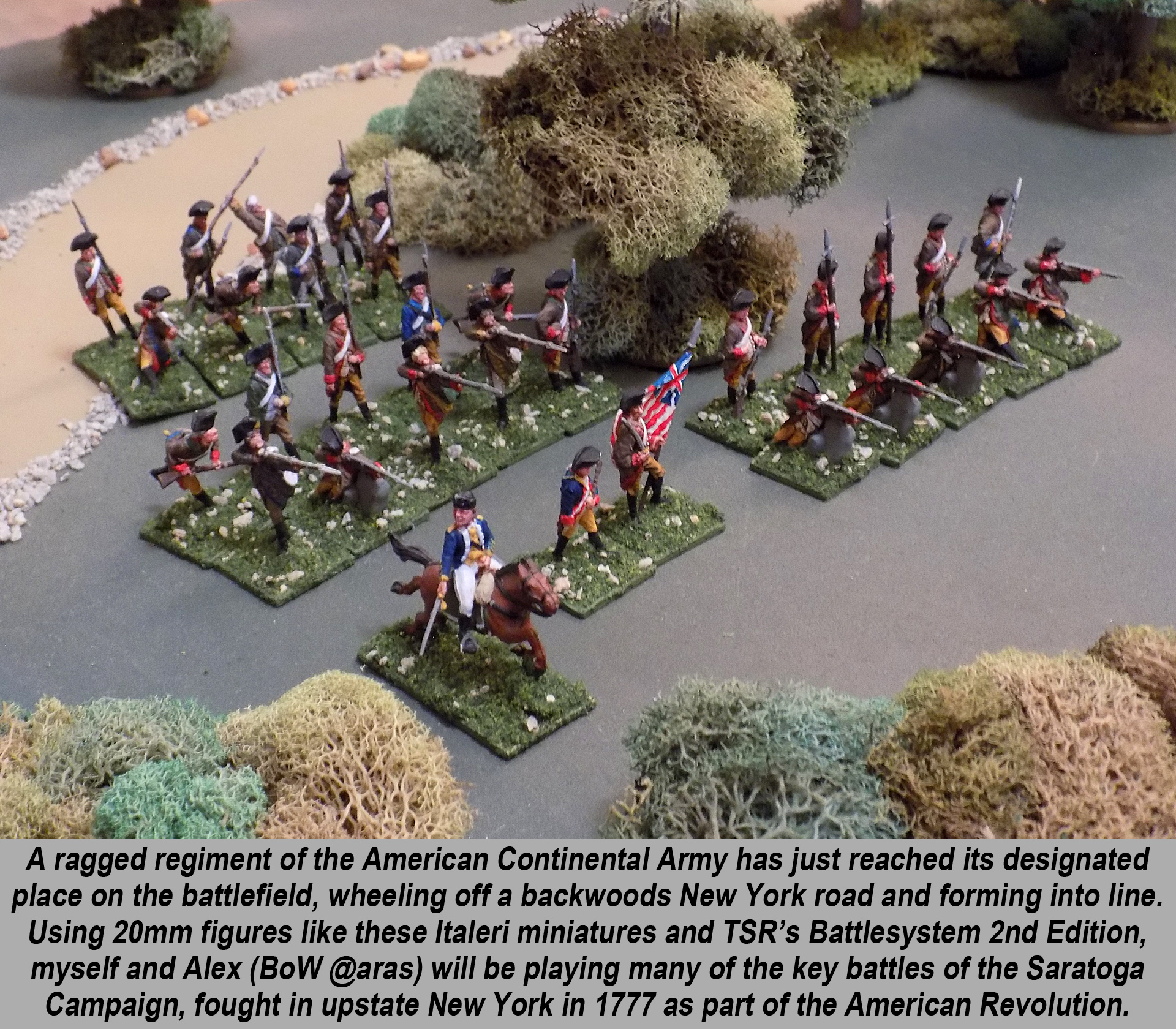
The 1777 Saratoga Campaign was crucial to the outcome of the American Revolution. It’s the “Stalingrad” or “El Alamein” that broke a long and nearly constant string of American defeats. So resonating was the victory at Saratoga that France was convinced to support the American cause – such support being the only hope for American victory.
This seemed an especially good time for this series because September and October marks the 240th Anniversary of this complex campaign. It’s an amazing story involving half a dozen nations, stinging defeats and valiant victories, heroes before they turned villains, a war on the frontier, and a cast of characters Hollywood could never make up.
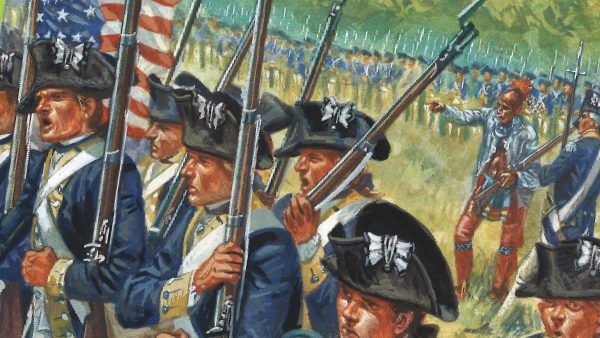
Over the course of this series, my friend Alex (BoW @aras) and I will be wargaming our way through just five of the most important engagements of this campaign. We’ll have 20mm armies of American Continentals, Rebel militia, British regulars and Loyalist militia, regiments of Crown Germans, Iroquois warbands, and much more.
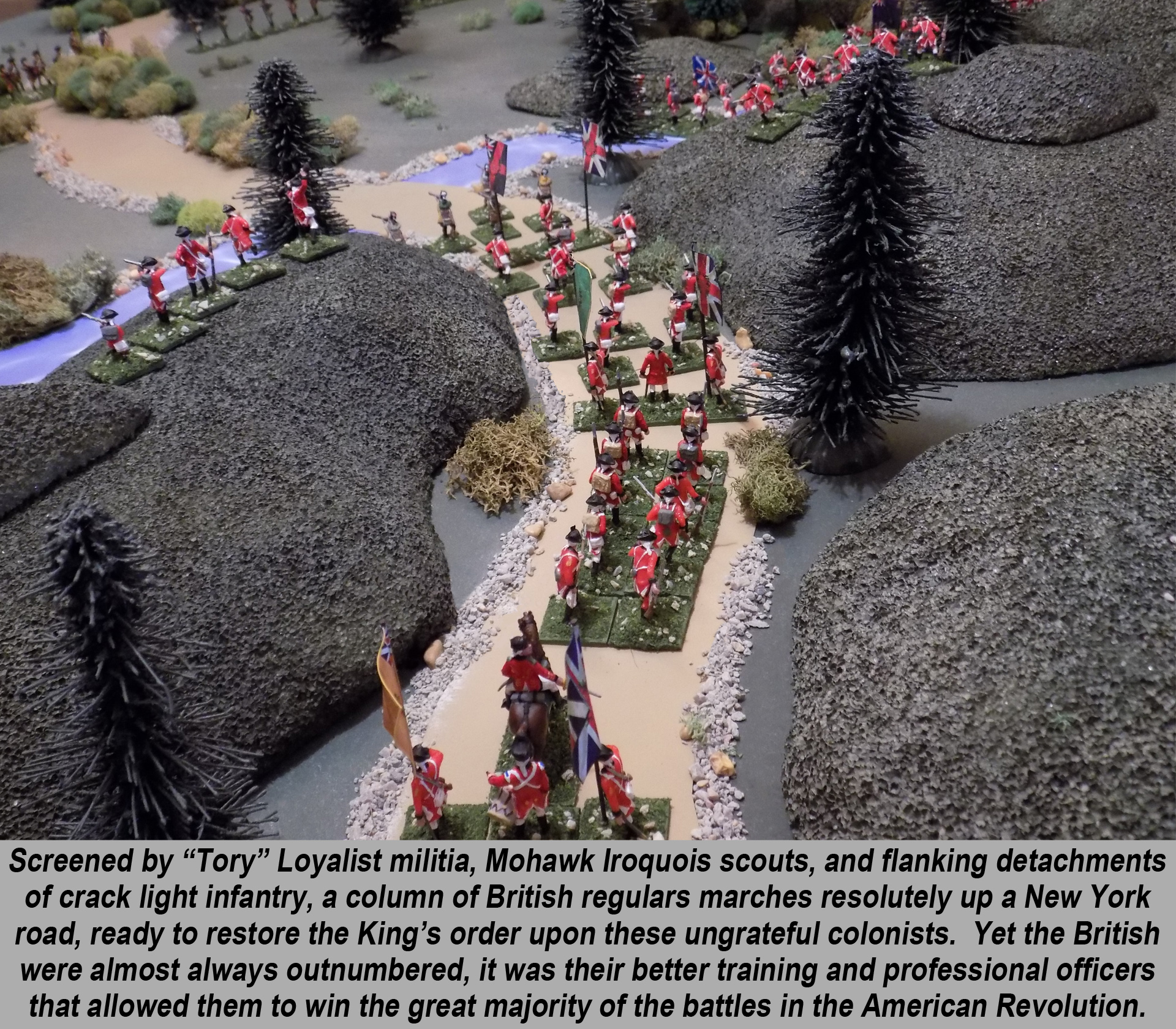
So let’s get started by setting the stage for the Saratoga Campaign – and discuss what made it so important for the destiny of the United States, the Western Hemisphere, and eventually the world.
Background
It Is A Dark Time For The Rebellion
As the summer of 1777 opened, the American Revolution was entering its third year. It was a rebellion that had started almost by accident, with large numbers of disorganized rebels winning startling victories against British garrison troops – mostly through luck, surprise, and the British knack of underestimating these “rustic colonials.”
After the British were chased from Boston in March of 1776, however, they stopped underestimating their enemy. No sooner had the American Continental Congress issued their world-changing “Declaration of Independence” than the British returned to the colonies with a huge fleet and massive army, invading the city of New York.
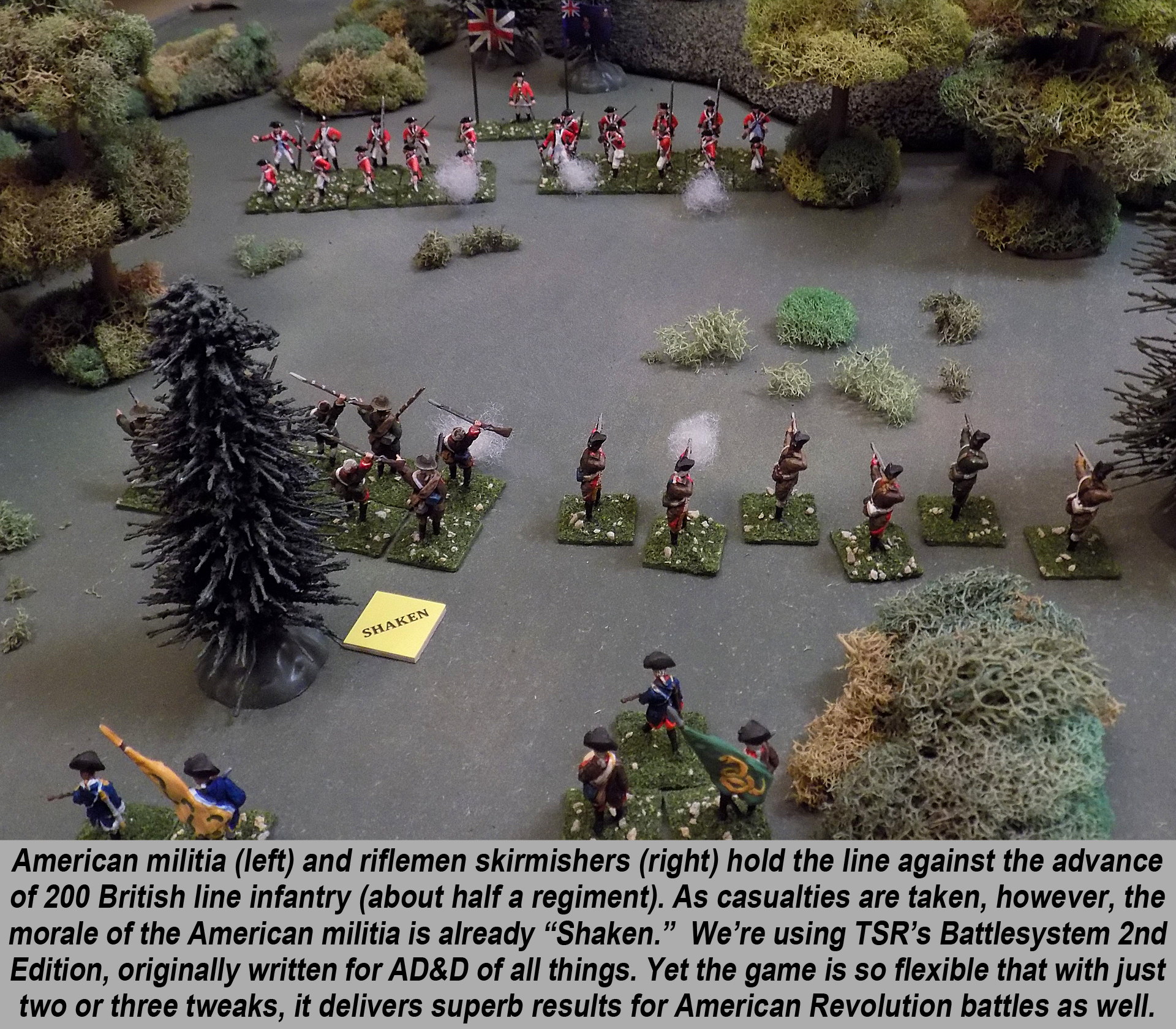
The New York campaign of 1776 was probably the worst string of disasters, debacles, and defeats in the history of the United States military. By the end of the year General George Washington’s “Continental Army” was reduced to less than 2,000 sick, wounded, and starving scarecrows, outnumbered at least fifteen to one.
Beware The North
Meanwhile, 1776 also saw the American rebels under pressure from the far north. After an abortive attempt to conquer Canada had only barely failed, the Americans were chased back down past Lake Champlain by a counter-invading British army out of Quebec and St. Jean.
The British were stopped, just barely, at the Battle of Valcour Island on October 11th, 1776. To accomplish this, the American commander (Brigadier-General Benedict Arnold) had to build a naval fleet from scratch to fight the British to a draw on Lake Champlain. The British were delayed until the onset of winter, which brings us to 1777.
A Gentleman’s Wager
The Northern British Plan For 1777
While the overall British commander in America (General William Howe) engaged Washington near Philadelphia, Pennsylvania (the American capital city at that time), a new British commander in the northern theatre had a plan to split the American colonies in half, delivering a fatal blow from which the American rebellion would never recover.
This was General “Gentleman” Johnny Burgoyne, a vainglorious socialite, playboy, gambler, and playwright who occasionally dabbled in the “hobby” of actually leading His Majesty’s armies in combat. Immensely popular with his men, he’d bet ten pounds sterling that his campaign would succeed in ending the American Revolution.
The plan was a complex one. While his main army invaded south from Canada, down past Lake Champlain, a supporting forces would invade from Lake Ontario in the west and British-occupied New York City in the south. The three armies would meet at Albany, thus splitting New England (cradle of the rebellion) off from the rest of the colonies.
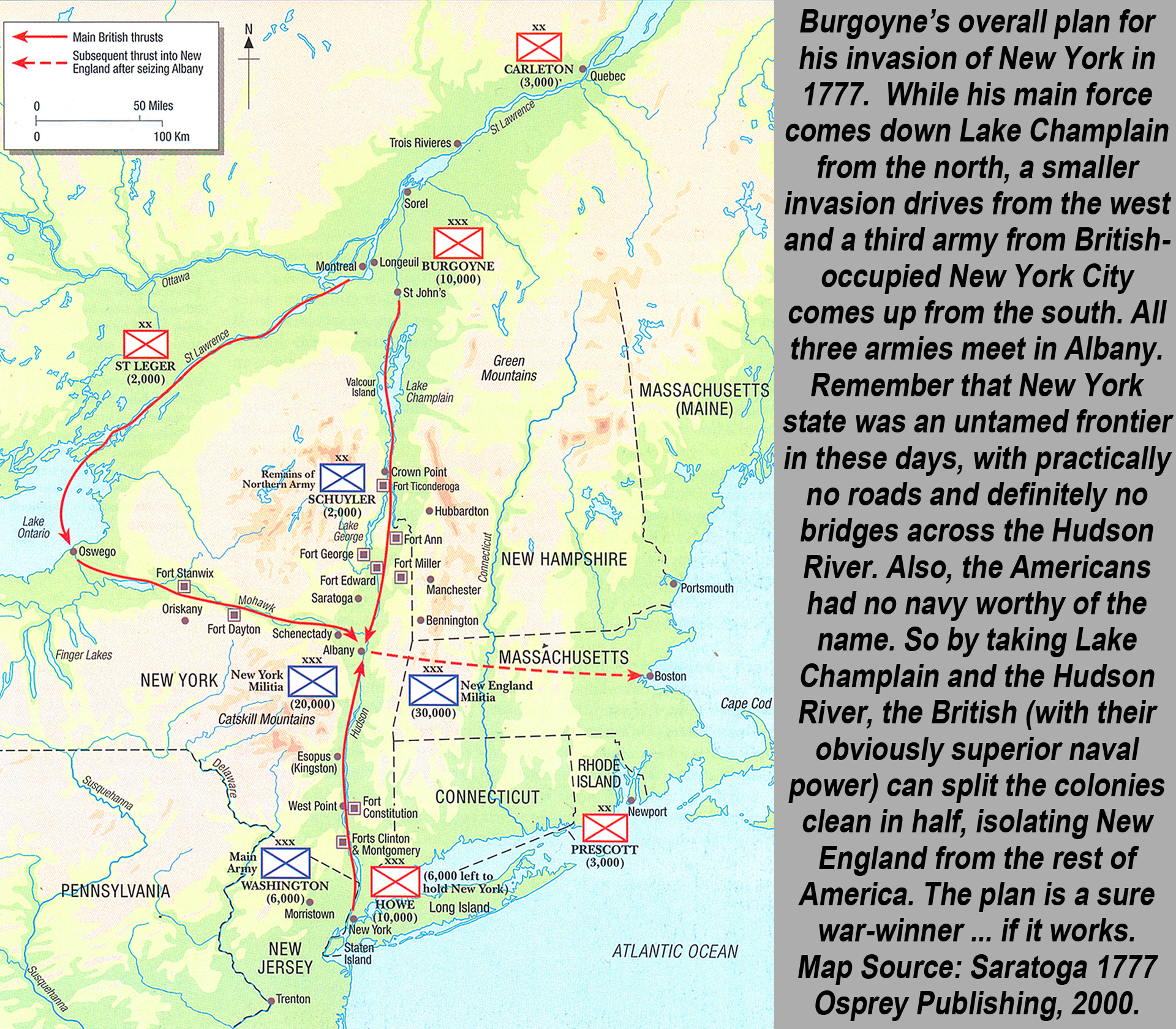
Burgoyne meant to win his wager (he had to, he was constantly up to his eyeballs in debt). So he made sure his invasion force was as powerful as possible. His main army would number almost 10,000 (a sizable force for the American Revolution). The supporting army from the west (Colonel Barry St. Leger) would bring another 2,000.
Burgoyne’s army would include not only British regulars, but also German regiments contracted from Hesse-Hanau and Brunswick. Canadian irregulars, American “Tory” Loyalists, and a large force of Native Americans from the Cayuga, Mohawk, Onondaga, and Seneca tribes of the Iroquois Confederacy rounded out the invasion force.
Arriving in Canada in May, “Gentleman Johnny” presented his orders to the British governor in Quebec, assembled his staff, and gathered his army at St. Jean, near the northern tip of Lake Champlain. In early June he sailed aboard his flagship HMS Thunderer, and led his army and fleet down into northern New York. The 1777 invasion had begun.
In contrast to Burgoyne’s well-organised and impressive force, the Americans who would oppose him presented only a ragged patchwork of “Continental Army” regiments, dilapidated forts left over from the French & Indian War (Seven Years War), and badly-organised, undisciplined, and mutually antagonistic local militias.
Commanding the American “Northern Department” was Major-General Philip Schuyler, a landowner patrician of Dutch descent and veteran of the French & Indian War. He’d pulled political strings to get this job, but failing health and plenty of political enemies would soon see him replaced by someone even worse, Horatio Gates.

But the real commander up here was one of the Revolution’s most able and dynamic battlefield commanders, a peerless hero named Benedict Arnold. For over two years he’d pulled off impossible battlefield feats time and time again, and this campaign would see him to even greater glory...yet also set him on the path to villainous treason.
Gibraltar Of The North
The Fall Of Fort Ticonderoga
As the Americans prepared to meet the British invasion, Burgoyne was already laying plans to tackle his first big obstacle. This was Fort Ticonderoga, about halfway down the long, thin Lake Champlain. The fort commanded the lake, and had been occupied since the Benedict Arnold had taken it for the Americans in May of 1775.
The Americans called Ticonderoga “The Gibraltar of the North,” and indeed this had been a formidable fort in the 1750's during the French & Indian War. But now it wasn’t in the best shape, much of the artillery had been removed to supply Washington’s army. Still, to assault this position would be a costly delay for Burgoyne’s advance.
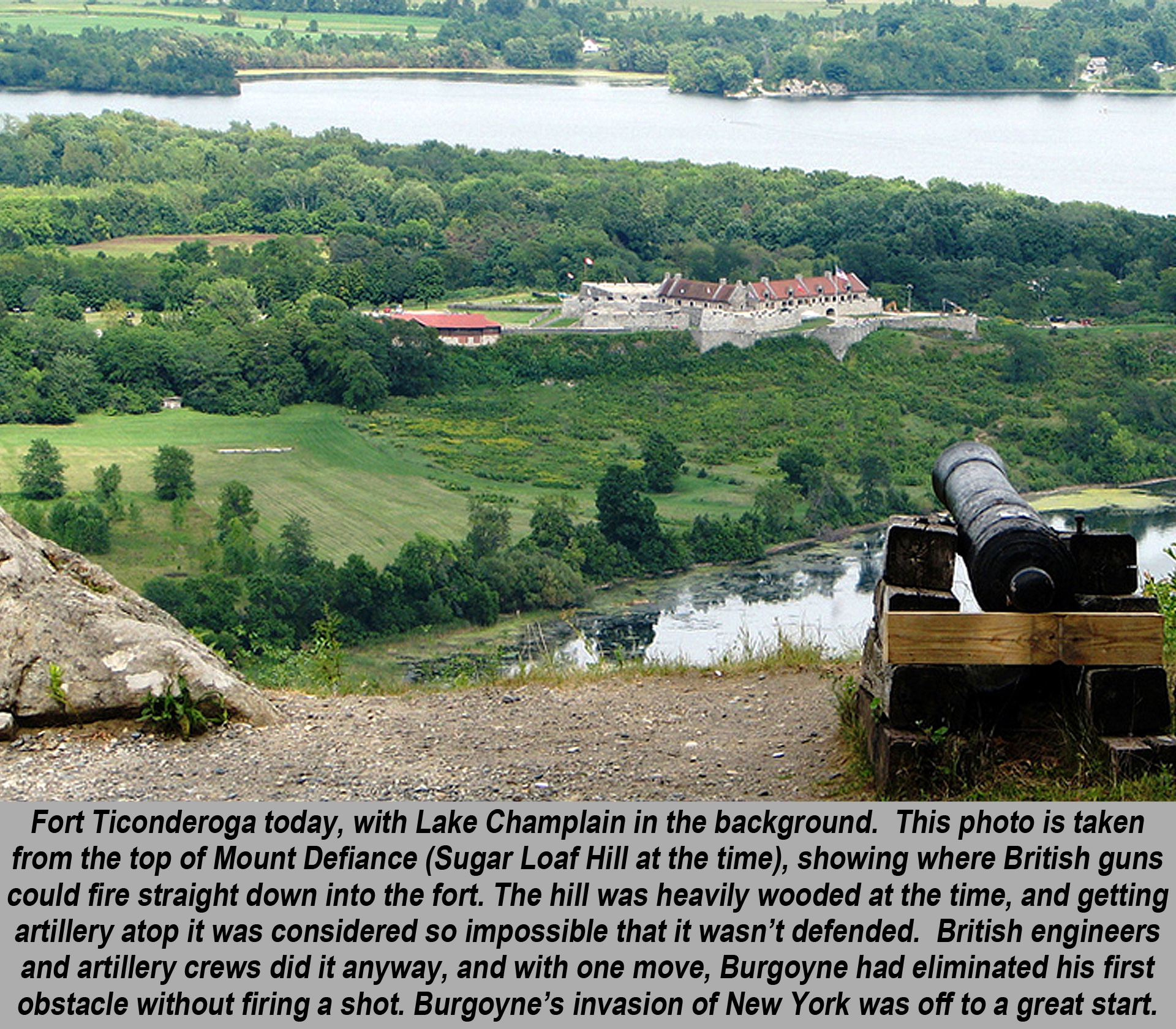
Burgoyne had a way around this. Near the fort was high ground of Mount Defiance, which the Americans didn’t see as a threat since the hill was so steep and heavily wooded. British engineers, however, managed the impossible feat of dragging artillery up the hill, and could now fire down straight over the walls, directly into Fort Ticonderoga.
Battle Of Hubbardton
A Desperate Delaying Action
With even a handful of British cannon atop Mount Defiance, Fort Ticonderoga was rendered completely untenable. The American commander (General Arthur St. Clair) saw no choice but to evacuate the fort. Some of the garrison was evacuated by boat over Lake Champlain, while others retreated overland into what is today Vermont.
Burgoyne led his main army after St Clair’s force (withdrawing south by water). He dispatched his advanced corps commander, the Scotsman Brigadier-General Simon Fraser, in a pursuit of the Americans retreating overland into Vermont. This triggered a small but intense delaying action, the Battle of Hubbardton, on July 7th, 1777.
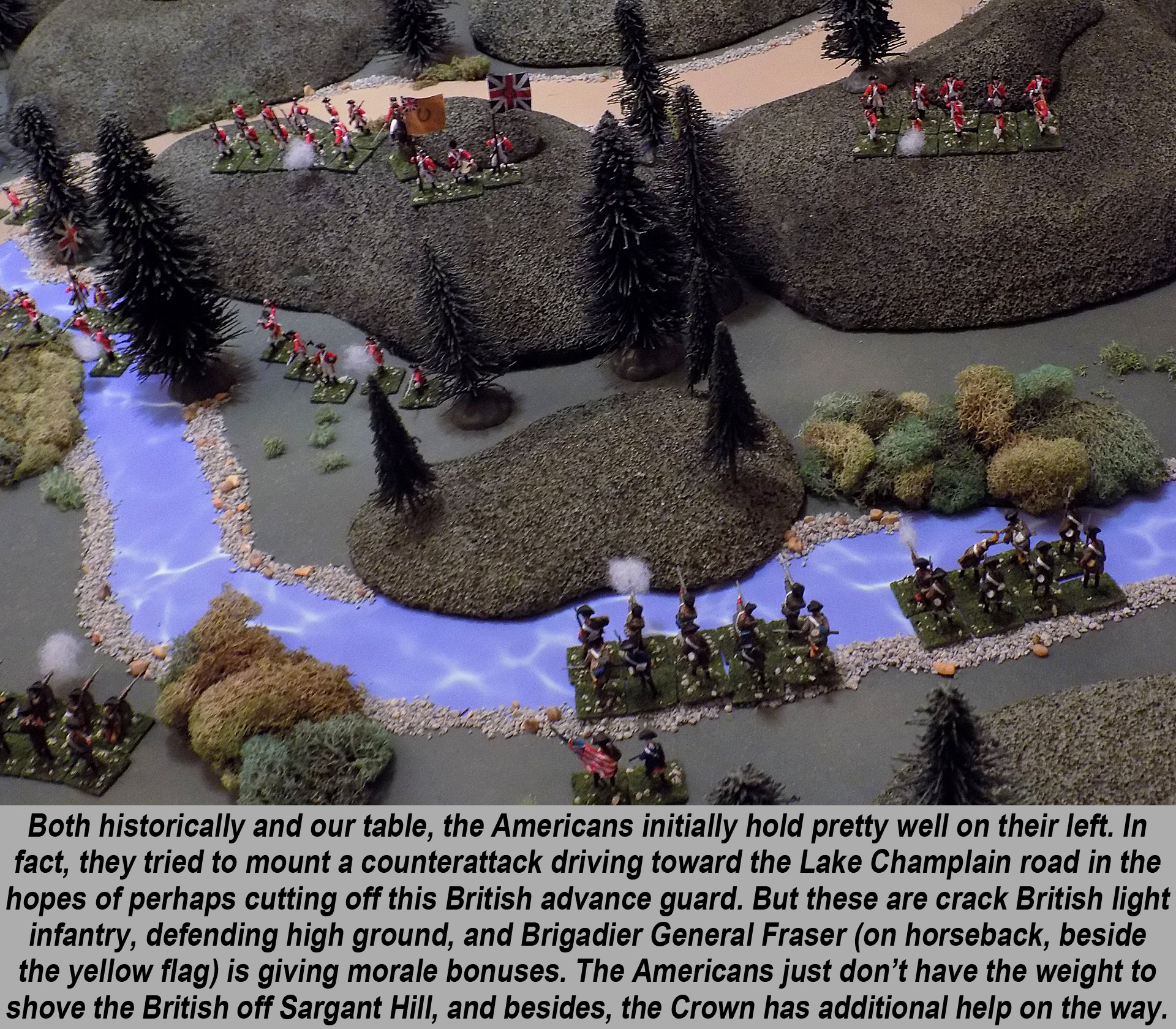
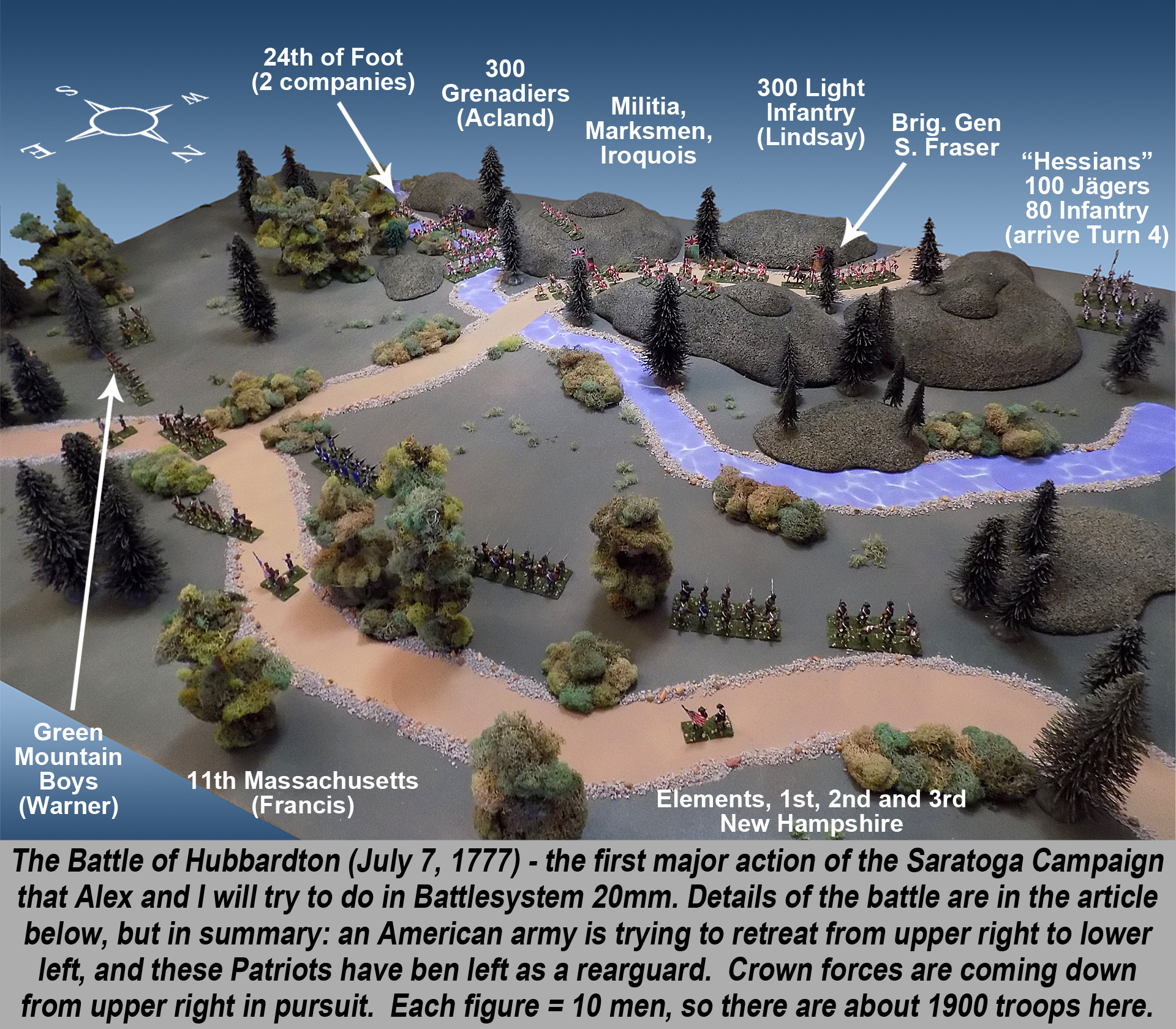
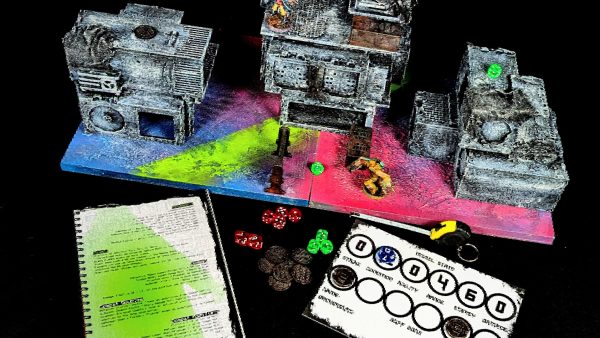
This is the first battle Alex and I have recreated in 20mm Battlesystem. With each figure representing ten men, and a combined miniature count of about 200 figures, we were just able to recreate the whole Battle of Hubbardton on one wargaming table. I took the army of American patriots, Alex commanded the forces of the Crown.
The order of battle is daunting for the American player, to say the least. The British are commanded by General Fraser, who has a full battalion of elite grenadiers and light infantry, along with American Loyalist militia, and Mohawk scouts. Worst of all, fearsome German reinforcements arrive part way through the battle.

The Americans, on the other hand, are hardly formidable. Hundreds fled before the battle even started, so we didn’t include these in our order of battle. Colonel Ebenezer Francis did have a few solid Continental regiments remaining, and Seth Warner led a force of Vermont militia, the brave but undisciplined “Green Mountain Boys.”
If numbers are on the side of the Crown, terrain is on the side of the rebels. This is “frontier” Vermont, with dense woods practically filling the table. The Crown army is barrelling down a narrow military road, which passes through a narrow file between two hills. The Americans are set up in advance, and must only DELAY the Crown’s advance.
It’s this delaying mission that is crucial. Colonels Francis and Warner are only trying to buy time for the bulk of St. Clair’s army to complete its withdrawal to the southeast. This is something I have to bear in mind in my deployment and gameplay, dragging the game through as many turns as possible without being cut off and destroyed.
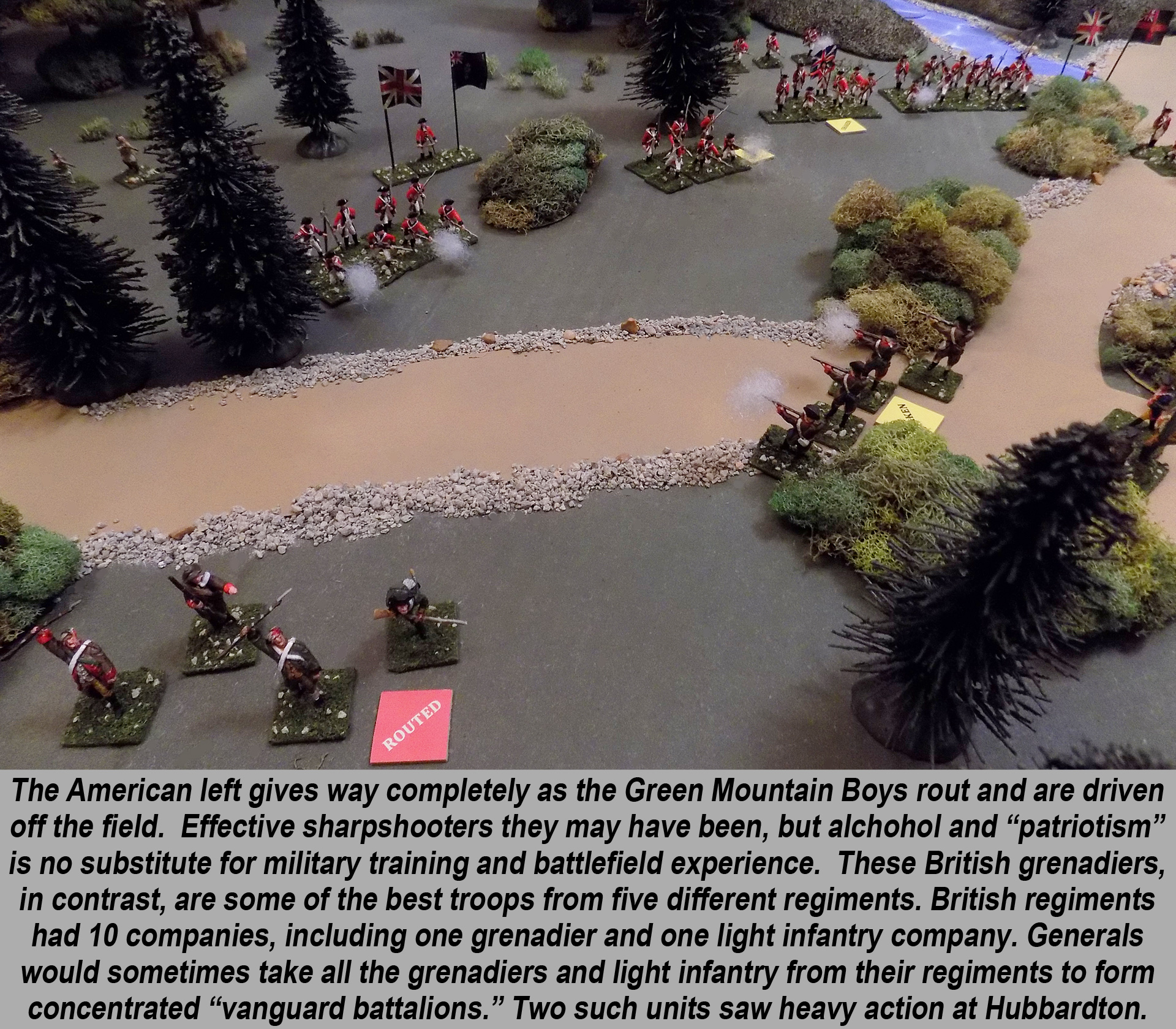
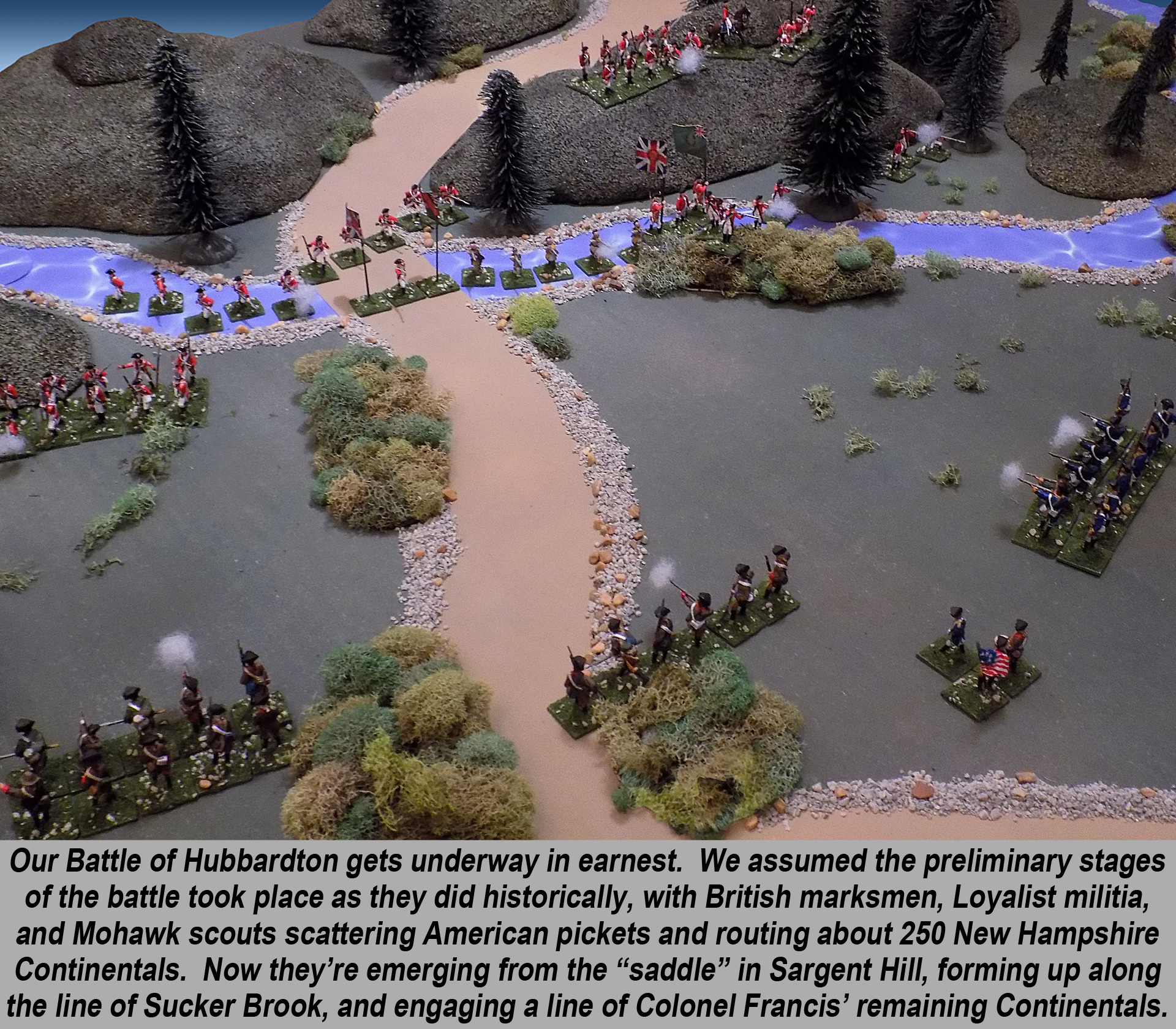
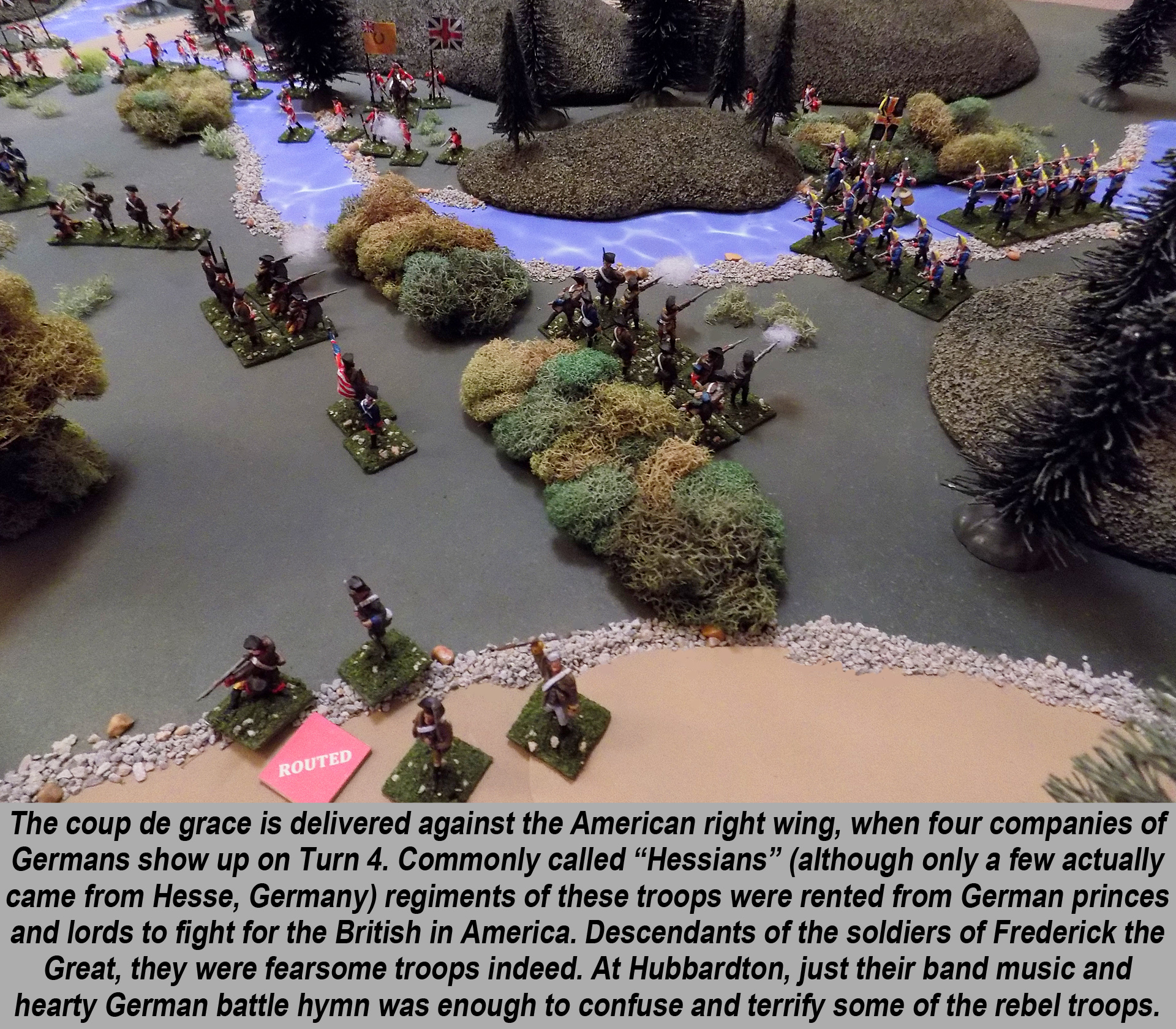
Alex, playing the Crown’s forces, has to overcome the difficulties of terrain and move as quickly as he can. Making use of “Forced March” rules and his lightning-fast Mohawk scouts, he managed to pinch off a Continental battalion on my left wing and annihilate it in place. Things got worse on Turn Four when the Germans arrived on my right.
Still, I managed to refuse what remained of my left wing, falling back while holding on my right. I shattered all three of his grenadier companies, routed the 24th of Foot, and even broke two companies of his German infantry. The game lasted until Turn Nine (quite long for a Battlesystem game), but in the end, I was shoved completely off the table.
Of course, our deployments and manoeuvres differed from the historical course of the battle, but the overall result was about the same. The Americans had suffered heavily but the bulk of St. Clair’s army had escaped, and many of these regiments would see action at the climactic First and Second Battles of Freeman’s Farm (Saratoga).
We hope you’ve enjoyed this first instalment of the Saratoga Campaign. Of course, we’re just getting started, Burgoyne has a long way to go before he gets to Albany. We also have to check in with what’s happening to the west, where Colonel Barry St. Leger’s smaller army is invading from the west.
Here’s a quick preview: St. Leger find his advance blocked by an American garrison at Fort Stanwix. The British lay siege to the fort, but the Americans will send a relief column to the fort’s aid. This sparks a ferociously bloody melee that history remembers...as the Battle of Oriskany. Now, why does that name sound familiar?
So come back next week for the next chapter in this story, and leave your comments and questions below! What kind of black powder games to do play? American Revolution? American Civil War, Napoleonics, English Civil War? Keep the conversation going, and see you next week!
If you would like to write an article for Beasts of War then please contact us at [email protected] for more information!
"Over the course of this series, my friend Alex (BoW @aras) and I will be wargaming our way through just five of the most important engagements of this campaign..."
Supported by (Turn Off)

Supported by (Turn Off)
"What kind of black powder games to do play? American Revolution? American Civil War, Napoleonics, English Civil War?"
Supported by (Turn Off)

Wow! I’ve never gotten a chance to be the first comment. I especially love all the images. They really bring the article to life and make it easy to follow. Of course, the maps wouldn’t look nearly as good without the amazing bases on the mini’s 😉
This is true, everyone. @gladesrunner actually helped a great deal basing all these miniatures with the flock and the pebbles. 400+ miniatures in all (armies to be displayed in course of this article series) – so a huge thanks for all the help! 😀
Thanks for the mention…I’m so (cough) surprised (cough)! Seriously though, I may choke about the bases, but the coolest picture is actually one where you can’t see the bases. The map board picture with all the sections labeled is REALLY cool. More like this please!
Yes, very surprised, I’m sure. I can hear your eyelashes fluttering from here. 😀
Full disclosure to the community, though. I showed @gladesrunner how to do these bases with the first 12 or so, she did another 200 or so, perfected the process, and when I was able to finally come back and help her finish the rest, she had to teach me how to do the rest of them. 😐
Thnks very much. 😀
Absolutely no worries, thank you for all the help. 😀
Great article! I’m looking forward to the rest of the series. My father took me to Ticonderoga when I was little (we went to fort William Henry as well). I have always been interested in both the AWI battles/campaigns local to me, Saratoga and Brooklyn Heights.
Well, never really dabbled in the historical earlier than WW1. However really enjoying your Teams efforts, not sure how @oriskany finds the time or motivation for such in depth and enlightening articles especially with what our US brothers and sisters have dealt with recently. Awesome. Can we see some ACW after the revolutionary wars please?
Thanks very much, @bonesbs . 😀
You ask a number of questions:
1) Where do I find the time? – Sleep is overrated.
2) Where do I find the motivation – Historical wargaming is its own reward. 😀
3) What our US brothers and sisters have dealt with recently – I won’t lie, Hurricane Irma has put a dent in this project. But we’re still on schedule and we’ll have five articles in all rolling out from now until October 12.
4) ACW Content – I would certainly not mind writing ACW content, the issue is I have no mini armies or figures for ACW. I was working with @stvitusdancern on some ideas for an ACW themed article series / PLOG – she bought some miniatures but I don’t know where she is on that in light of other projects and priorities (GenCon, etc).
Long story short, I’d need a collaborator – someone who could send some great table photos of some ACW armies and tabletop battles. If anyone is interested, I can always be reached at james@beastsofwar.com
Awesome job @oriskany really good article and maybe just the motivation I need to finally get around to painting my AWI stuff. Very nice location photo as well. History seems to keep trying to tell us that Cannons can always be where you don’t want them to. The Continentals used a similar tactic at Dorchester Heights didn’t they? I seem to remember that it was with the guns taken from Ticonderoga by Arnold but could be wrong.
Where did you get your miniatures from?
If you want to do an ACW article in the future and need minis let me know and I can take some pics of mine for you to use.
Thanks for the great comment, @elessar2590 . 😀
Yeah, I’m not gonna lie … painting the full four armies (Patriot, British, Iroquois, and “Hessian”) that are going to appear in this article series was seven weeks of work. Technically they’re still not all 100% done. (shhh) 🙂
My miniatures are a mixed bag. My Americans all come from Italeri. My British are Airfix, believe it or not. My “Hessians” (I keep putting that in quotes because as I’m sure you know, that’s an inaccurate term) are Zvezda. And even they’re not 100% the correct period, I had to buy Zvezda Prussians from the Seven Years War and paint them a little different to give them more of a 1770s feel rather than 1750s.
My Native Americans, damned if I know. I had a hell of a time finding them. I’ll actually have to check my online order history. Some tiny little gaming store somewhere that had one extra box back in their warehouse somewhere. Most Native Americans you can find are more of the “Wild West” tribes like Sioux, Apache, Comanche, Arapaho, etc. A very different look than the northeast American Iroquois.
Glad you liked the photo of the cannon looking down on Fort Ticonderoga. Like we say in the article, the Americans knew Sugar Loaf Hill (later Mount Defiance) was taller than their walls, but were supremely confident no one could get artillery up there. I think it was Brigadier General Simon Fraser (commander of Burgoyne’s Advance Corps) who said (it may have been a chief of engineers or some such) …
“Anywhere a goat can go, a man can go. And anywhere a man can go, he can drag a gun!”
Sure enough they got just couple pieces up there, and that was all it took. They fired what amounted to a warning shot, and the Americans started packing.
Yes, the Americans used a similar tactic in Boston … twice. The first was the earthworks overlooking British-occupied Boston Harbor from the north – on the Charlestown Peninsula. This of course sparks the Battle of Bunker Hill (really Breed’s Hill). They were just earthwork forts that had no guns yet, but the British didn’t know that.
The second time was Dorchester Heights, overlooking Boston Harbor from the south. These forts DID have big guns, 50+ of them, from Fort Ticonderoga. Benedict Arnold had captured the fort in the May, 1775, with the *ahem* “help” of Ethan Allen and his so-called Green Mountain Boys (if only we had had Alcoholics Anonymous in those days …).
It was Henry Knox, the father of American artillery, who actually organized and supervised the transport of the guns from Ticonderoga to Boston, a rather Herculean feat through the mountains and blinding winter of 1775-76.
But even this was something of a bluff – for those guns on the Dorchester Heights had practically no powder or shot. 😐
I’ll be in touch about those ACW pics. 😀
I read your article earlier today, since then through out the day I keep ending up here
https://www.perry-miniatures.com/index.php?cPath=23_29&osCsid=o1dn9hph2aeq70gbrsotbqsfd4
This is what happens when I have too much time on my hands
I need to be strong and stick to my current projects
Very nice. I’ve never worked in 28mm yet. Frankly I find it terrifying. 20mm is time consuming enough! 😀 I have huge respect for anyone who makes an actual “army” at 28mm.
“No you don’t! No you don’t! No you don’t!
Just kidding of course. I know the feeling. I have to take a break for a while, I still haven’t painted my DAK army from the FoW Boot Camp, and that was at the beginning of March! I’m usually a guy who genuinely prides himself in having no “lead/plastic/resin mountain” – but now I do confess … a small hill has begun to grow …
I’m doing a Demo game at a show tomorrow. The chances of me not adding to my pile are about as likely as Britain regaining her American colonies 🙂
Or us getting back into Saigon? 😐
In any case, It’s pretty much the consensus that Britain was better off without the American colonies. She won in the Caribbean, the English Channel, India, Gibraltar, defeating France and Spain and cornering the Dutch out of many world markets. Meanwhile, Britain would soon be making all kinds of revenue via trade with America, without having to spend money administering colonies.
Anyway, please have fun at your demo game tomorrow, much success!
Welcome home Jim 😉 I know WW2 and modern is your real home but you do also seem a home in the Black Powder era or any other. 2 series at once … you are a brave man sir
Thanks very much, @rasmus . 😀 Yeah, I like Black Powder. I know enough to write American Revolution and can “keep up” with experts with American Civil War. I’ll definitely defer to the experts in Napoleonics, though, and definitely ECW.
One of these days we have to do an article on the American Revolution campaign that took place out by you – Ohio, Kentucky, southern Indiana and Illinois. Vincennes, Fort Kaskaskia, George Rogers Clark, etc. Especially now that I have a Native American army done in 20mm. 😀
The Ohio valley is also interesting for the French and Indian wars
Absolutely. I will defer to @elessar2590 on the FIW, though. 😀
I have begun collecting forces for this war because I find it easier to break into compared with other blackpowder era wars. The forces are smaller and they look damn good on the table. I love the mix of units from regular troops to native forces and everything in between. I’m a fan of the supplement for Blackpowder by Warlord games on the conflict which is one of the better books for that game to be released. My red coat army is growing but I need to start on those pesky rebels
Very true, @denzien. Using Batttlesystem (10 men/ figure) we were able to put on the entire Battle of Hubbardton and Battle of Oriskany (try that for Waterloo). 🙂 British redcoats always look great on the table, I think it’s the complimentary contrast with the green table.
And yes, the number of factions, especially up in this part or the war, is great.
Thanks for the comment! 🙂
Just for fun you would need about 20,000 minis for Waterloo. AWI is a lot smaller.
Absolutely, @elessar2590 . The biggest land battle in the Revolution is Monmouth (July 1778) with about 25000 men total on both sides (even that’s a generous estimate) – 15% the size of Waterloo. 😀
Honestly I don’t know why the American Revolution isn’t a bigger deal in miniature wargaming. Even here in the States it’s usually eclipsed by the ACW, which is a lot less colorful, has a lot less factions, and to do any kind of justice you need a lot more figures.
AWI provides three times the “fun” and one-tenth the work. 😀
In Europe and the UK it is that we have a few bigger wars around then where the AWI is just a small part of the picture – so if colourful uniforms float your boat any the wars there take center stage
And ACW with the Grey and the Blue is such an iconic conflict with a shadow we still see today.
Nobody debate removing statues from the AWI
Absolutely, @rasmus – This is true, it’s just that here in the US the interest doesn’t usually center around wars in which Americans took little or no part (like Napoleonics, for example, unless you count the so-called “War of 1812” – and even then most Americans wouldn’t have a clue that war even took place if not for the Star Spangled Banner)
Most American wargamers who get into Black Powder don’t get into Napoleonics – instead ACW is their period.
I just always wondered about why ACW gets a bigger pull than AWI here in the US. Maybe no one wants to play the British! 😀
I’m lucky in that @aras has said he’d play the Crown (British / German / Iroquois / Loyalist) all through the Saratoga series. 😀
Great article, really interesting and well written with some great photos. I don’t know very much about the American Revolution, but my interest is certainly piqued. I appreciate the hard work that is obviously put into these articles.
Thanks very much, @fiore – and very glad you like the photos – those are a always the hardest part. Well, putting the armies, terrain, and tables together that GO in the photos, I should say. 😀
This is all just about one campaign, of course. We had a more general look at overall wargaming in the American Revolution that may interest you. This was published last year, and presented Revolutionary wargaming at four different levels: (20mm, 6mm, hex-and-counter command tactical, and strategic):
This is part Five of that series, links to the other four parts are in the article:
http://www.beastsofwar.com/historical/war-independence-southern-theatre-end/
🙂 Thanks for the great comment
one of many many periods I know next to nothing about Jim, my one criticism would be I was so engaged with the article that I had to go back and look at the photos and their own text separately.
Really interested in seeing the rest of this and how it pans out. Will the Americans win? No spoilers 🙂
I’ve only dabbled in some Napoleonic black powder warfare, years ago with In the Grand Manner, which unfortunately never did it for me, and more recently with having picked up Warlords Black Powder and Osprey’s Chosen Men, I will be returning in a couple of scales to the period.
I know that Studio Tomahawk is planning a new edition of Muskets and Tomahawks, so that may draw me across the ocean, at which point who knows where I’ll end up, being Irish after all 😉
Will you be exploring other systems like the Dunkirk series, or will this be the history and specifically Battlesystem for the gaming?
Thanks very much, @avernos – I know what you mean about the text in the photos and the body paragraphs. We only have so much space, however, to do the best we can.
Last year we did a more general American Revolution wargaming series in which we dabbled in more than one system and scale. One of the systems was Muskets and Tomahawks by Studio Tomahawk. I found the system interesting, but not a perfect match for what I was trying to do with my AWI 20mm at the time. Nothing at all wrong with the system, just kind of a “square peg in a round hole” kind of thing.
In fact, some of the “systematic-created history” mechanics were kind of interesting. Secret objectives and victory parameters, that kind of thing. You might draw a card where one of your victory conditions is “you absolutely CANNOT kill the commander of the enemy’s left wing. He’s married to your sister and if he dies by your army’s hand you’ll never hear the end of it.” But of course, the opponent doesn’t know you’re not allowed to kill a certain one of his commanders, etc. 😀
But for this game we’ll be sticking with Battlesystem. Larger hex-and-counter “command-scale” maps will be used for First and Second Battles of Freeman’s Farm and possibly Battle of Bennington, just to give an overall picture of the situation. But these overall battles are too big for Battlesystem, so we’ll be picking certain sections of these battles and recreating those (as a Napoleonics player might set up just Hougoumont or La Haye Sainte for Waterloo).
Irish commander in Part 02 of this series coming up, Colonel Barry St. Leger (County Kildare). 😀
@oriskany, This is well timed! Following my trip to the States I decided to read up up American history. I’ve just finished the excellent ‘1776’ by David McCollough. It’s a little fawning about Washington in parts but is brutally honest when describing the American ‘army’ (if it could be called an army at that time).
Thanks very much, @benc – MCCollough is a good read to be sure. I also like some of the novelizations by Jeffrey Shaara (son of Michael Shaara who write The Killer Angels) – include Rise to Rebellion and The Glorious Cause.
Yeah, it’s tough for American historians not to fawn over Washington. He’s literally the template around which most of our nation and culture is based. He does have some serious personal flaws, of course, not the least of which is his ownerships of slaves and attitudes toward women (more than a little regressive even for the day). Militarily he’s an operational genius, but tactically … let’s just say I think anyone who’s been to a Beasts of War boot camp could probably beat him.
And as far as the state of the American “Army” in 1775-78 goes, the less said the better. It’s not until formal training begins under men like von Steuben during the Valley Forge winter of 1777-78 that the Continental Army gets any kind of cohesion or backbone to actually stand up to Crown regulars (British or German).
In some ways the American “army” of 1775-77 is a victim of its own early successes. Surprise, luck, and British underestimating the extent of the rebellion allowed the militias to score a handful of early wins at places like the Boston Road, Dorchester Heights, Breed’s Hill, etc. This had the long-term adverse effect of convincing the Continental Congress that militias would be “good enough” to win the war, and denied Washington’s demand that an actual formal, standing, professional army of 40,000 be built for the duration of the war. Of course, militias aren’t even close to adequate, as the string of defeats through all of 1776 and 1777 prove. Not until 1778 was Washington get even close to a “standing army,” which is what he wanted in the first place.
The real heroes of this battle were the grenadiers, who took 75% casualties by the end of the game and STILL managed to stay in the fight.
Well, @aras , when you start with a Morale Level of 13 … 😀 … Yeah, by the time I inflict enough casualties to force enough morale checks to where a grenadier regiment is either shaken or routed, there are usually very few of them left.
Then they’re standing within the command diameter of Brigadier General Simon Fraser, who gives a +1 Morale Bonus …
Then they’re ranked two ranks deep, which gives another +1 Morale Bonus …
So they have an effective morale of 15
Tough troops. They run out of blood before they run out of guts.
The Americans, on the other hand, are running away much faster because of their much lower morale levels. Sketchy and incomplete training among Continental regiments and no training among the militia.
We even had a special rule about the “Hessian” marching band. At Hubbardton, these crown Germans marched onto the field with band music and singing a battle hymn. It actually confused and terrified some of the militiamen.
So our rule was the first time an American unit came within 12″ of the “Hessian” command group, they had to make a single morale check. We actually had one company of Green Mountain Boys become “Shaken” by this rule.
Must have been the first music they’d ever heard that wasn’t played on a banjo. 😀
https://www.youtube.com/watch?v=-Zd-ZSnZ3so
Lovely what a time to bring out AWI.
Americans V’s Americans and British.
Start of the sniper and Light infantry units.
The best of the best…
Brill
Thanks, @nosbigdamus ! 😀
“Americans vs. Americans and British.” – very true, especially up in this theatre. In fact, Part 02 features the Battle of Oriskany, and almost entirely American vs. American engagement that is still (by some measures) one of the bloodiest in American history. There wasn’t a British officer anywhere near that battle, that was all American and Native American.
You’re right about the riflemen, and more or less the light infantry as well. Technically there had been “light infantry” units for quite a while, sort of.
The general construction of British regiments at the time was based on ten companies if about 53 privates each, plus corporals, sergeants, and an officer. On paper they had 56, but the pay of these three non-existent men would be pooled into a company fund to help defray costs of boots, cartridge boxes, equipment, etc. – in theory (often the NCOs would just steal it for drinking or whoring money).
Anyway, one of these ten companies was a grenadier company (“heavy” infantry) on the right flank of the regiment (position of honor). On the left was a “light infantry” company.
In the American Revolution, what many British generals would do is strip all the grenadiers and light infantry companies out of their regiments (leaving them with their eight “line” companies), and grouping all their light infantry and grenadier companies together into “vanguard” units of pure light infantry or heavy shock battalions of grenadiers.
This is what we see Brigadier General Simon Fraser doing at Hubbardton. Light infantry (or jägers in German service) were usually more experienced in living off the land, hunting for food, encamping with improvised shelter etc. So they could carry less kit and thus be faster. They were also usually more trustworthy than the usual drunken brawling jailbirds, orphans, debtors, or street urchins that made up the bulk of British regiments at the time. So they could be detached on independent duty with more confidence by their officers.
I think this practice was successful enough where later generations of the British Army started forming light infantry formations on a more permanent basis, but the Napoleonics experts will have to chime in on that.
As for the Americans, we’re running “riflemen” as skirmishers only (never line, regular-order formations). As they did with history, we’re always trying to keep these units paired with battalions of light infantry (Continental Regulars) so the riflemen don’t get massacred by British bayonet charges. American rifles of the day, remember, had half or even one-third the rate of fire as military muskets (as slow as one shot per minute), and could not be fitted with a bayonet. 😐
Thanks for the great comment! 😀
Always been more of a Napoleonics person myself, but a few years back I got to walk the battleground at Yorktown.
Sadly never could get my group into set piece black powder battles.
Thanks for joining the thread, @wayton . 😀 So with Napoleonics, do you do skirmishes? Partial battles? Or some kind of “representational” command-tactical game where a mini = a certain number of men?
People have been mentioning Sharpe’s Practice, which actually might fit well with the smaller, skirmish, and bitterly savage fighting up here in the northern theater.
Oh I just meant in general, more of a “if I could convince someone to play Blackpowder games it would be Napoleonics”. My earlier comment was typed up in something of a hurry.
Of course the group I play with does tend to focus on Skirmish games….so I guess I could use one as a gateway sometime and just sort of move up the chain until we get to individual stands representing battalions.
Anyway great read on the opening of Saratoga, its not a campaign I have studied in earnest…though I did know it was both the one that convinced the French to side with us and was Arnold’s finest hour. Pity for him he didn’t die in the campaign.
Thanks again, @wayton – @torros has what looks like a good idea for skirmish black powder linked below.
But I’m with you, my objective is to get to “battle scale” games sooner or later. 😀
I’m also with you on Arnold. I’ve done quite a bit of reading and writing on him, and stood on the spot where he fell wounded at the Breymann Redoubt near Freeman’s Farm. If he’d died there we’d have a nuclear aircraft carrier USS Benedict Arnold out there somewhere, with cities across the country and an Army barracks named after him somewhere.
Especially considering what would happen to his nominal commander – Horatio “Granny” Gates –
later at Camden . . .
You could try http://www.dadiepiombo.it/english-smoothandrifled.html and all the free supplements. http://www.wargamevault.com/product/137231/SmoothRifled
Awesome, @torros . 😀 Looks great for players who are doing skirmish. Definitely seems to be versatile for all periods within Black Powder.
Thanks, I’ll have to give it a whirl. Most of my group’s comfort zone is in the skirmish level.
Awesome, @wayton . Post some photos with results if you ever do. We need more Black Powder love on the site. 😀
I did buy it and Drums and Tomerhawks a year or more back , reading both seem like solid systems but I have yet to use them in anger
Ok Quick question as I know some basics of the AWI and have watched some TV programs that tried to explore the myths and legends of the period and what people now think is fact. But much question relates to a comment earlier about the conflict being Americans Vs Americans and loyalists. When did the rebels ( for want of a better word) being to think of themselves as Americans or at the start did they still consider themselves British but with grievances?
Great question, @torros, one for which I had a clear, simple answer. There were two and half million people living in the American colonies at the time, so there are probably two an a half million separate answers as everyone saw these issues of the day in their own way.
There are some basics and measures we can list for sure.
John Adams (a major leader of the Continental Congress and he’d become our second President) divided the people into thirds. A third were for the Rebellion, a third were actively opposed, and a third didn’t care.
Even among rebels, before the war and during its early stages, they didn’t want to actually break away from England, just compel changes with England, especially in regards to trade and Crown-subsidized monopolies like the East India Trading Company.
We can see this with the “Olive Branch Petition” that was sent from Congress before the Declaration of Independence.
We can also see it in the early American flags, which had the thirteen red and white stripes but retained the “Union Jack” in the corner.
So at first, yes, I would say most “Americans” saw themselves as Englishmen or Britons with grievances. Then there also were large numbers of African Americans, German and Dutch immigrants or of German / Dutch descent (especially in New York, Pennsylvania, and Virginia). It’s a broad statement, though.
The shift to self-identification as an American was much more gradual. The war lasted eight years, of course.
Even that is something of a simplification. Most people over here didn’t think of themselves first as American, but their identified with their STATE, which were fare more independent then than they are now. I might say I was a New Yorker or a Massachusetts man or a Pennsylvanian. Back then people would only call themselves “American” as a German or Frenchman might call themselves “European.”
Great question, and important question. Just tough to answer. 😀
Thanks Jim. Didn’t expect a simple answer and the identifying with states for the people does seem a logical assumption especially given the way they were founded in the first place . Something that still seemed to be the case in the ACW (Robert E Lee being a prime example). I wonder if it’s still the case
The “state-first” mentality definitely carried through into the following decades, @torros , and not just in personal attitude. Even the regiments were raised locally and named after states (11th Virginia, 4th New Jersey, etc.), both in the AWI and ACW.
In a more legal sense, where states’ identity, sovereignty, and rights leave off and Federal power begins was a major point of ambiguity in the Constitution (itself a major fix and improvement over the original Articles of Confederation). This was a major point of friction left over from the 1780s that leads more or less directly to the American Civil War. So yes, states vs. nation was still a very sore point.
In the 1850s-60s, slavery was really more of a “straw that broke the camel’s back” on this states vs. federal “fault line” in American culture and politics. More specifically, as the US prepared for the great expansion westward, the debate over whether those new states would be slave states or free states is what more or less lit the immediate fuse that led to Fort Sumter in April 1861.
But the root cause and fault line itself had been there clear back to the American Revolution, this “states before nation” mentality.
As far as present day goes, we have a flareup occasionally in debate or politics or loudmouths on the internet … Many laws are still decided at the state level. I won’t list the issues, the usual modern day points of American argument – guns are a relatively safe one, pot legalization, same-sex marriage, others I won’t get into.
Anyway, when Congress or the President goes to make a law about these, things, sometimes there’s a little push-back from the states. Just as often, the Federal government doesn’t want to touch a toxic “vote-killing” issue, so they actually push it off on the states. 😀 “I … ahem … don’t want to impugn on states’ rights, this should be decided at the state level, now get it off my desk.” 🙂
But as far as culture goes, we’re all so interconnected now that I don’t think very many people call themselves Californians or Virginians, etc. We’re Americans first and foremost. There are always the occasional exceptions, though. 😀
Thanks again . I guess travel in the modern era has broken the division the state first mentality
I’ve played these in the past although an earlier version and give a good game
https://www.caliverbooks.com/Partizan%20Press/partizan_BG.shtml
Looks great. I will check it out in detail sometime this week. 😀
Very interesting read. I know quite a bit about ACW but still have to dig into AWI (and FIW). Any books you’d recommend on those topics?
Coicidently I’ve been playing Black Powder (the actual Warlord game) yesterday, we did a part of Leipzig 1813. The game was a bit of a disappointment since it was very killy and at times felt very random with morale. It’s very much (as they write in the introduction) a multiplayer beer and pretzel game with not too much tactical thinking. Which can be fun at times, but we had different expectations (especially since we’d played Across a Deadly Field with my 6mm ACW and had found a wealth of options in a still fast paced game). Anyway, you’ve peaked my interest in that D&D wargame ruleset, now even more so than after the fantasy wargame article series. Keep it up Jim! (and go to hear from you after that little breeze you had there 😉 )
Thanks, @neves1789 –
Yeah, I have heard some strange things from players about Warlord’s actual wargames. The lethality of Black Powder rules sets is a tough thing to get because in some wars the weapons were very deadly (American Civil War) and other wars they were not (American Revolution). When companies try to say they have one rules set for all, I don’t immediately reject the idea, but I do approach with caution.
So far, we’ve had great success with Battlesystem 2nd edition. We did reduce the lethality of the the guns a little (from d6 to d4 for muskets, we kept the d6 for longer-ranged rifles but reduced the rate of fire). The reason we reduced the lethality is that in Battlesystem, many people are wearing plate armor, chain mail, magical defenses and wards, etc … and the game is balanced to include all kinds of fire, magical, enchanted missile fire.
American Revolution of course doesn’t have any of that, and we have the historical records to actual casualty rates of battles to use as a guide.
Also, most of our guns shoot twice a turn while the matchlocks in original Battlesystem only shoot once a turn. We didn’t want our battlefields turning into Flanders or Passchendaele, so we ticked down the lethality of musket volleys.
This has also given the system “room” to staircase up into rifle fire, light, medium, heavy artillery, etc. And since we started our scale at a slightly lower place, the top of our scale doesn’t wind up in the the thermonuclear range. 😀
Books: I would highly recommend Patriot Battles by Michael Stephenson. It’s not a tedious litany of battlefields, generals’ names, and dates, but a look at how the different armies were put together, their strengths and weaknesses, and how they actually worked.
I would also recommend Joseph Plumb Martin’s autobiography – A Narrative of a Revolutionary Soldier: Some Adventures, Dangers, and Sufferings – it’s a small book written by an actual soldier of the Continental Army, the only complete account of its kind ever written. He starts as a private at the Battles of Long Island and Brooklyn in 1776, and winds up as a sergeant of engineers at Yorktown 1781.
Thanks for the book recommendations! I’ve put them on the (endless) list 😀
I’ll definitely try to hunt down a copy of Battlesystem, it sounds like a great alternative to Kings of War, Frostgrave and AoS. Lately I’ve been writing up a small fantasy world of my own, incorporating (read: stealing :p ) idea’s from the fantasy wargame settings that I like. It’s supposed to serve as a background for fantasy battles in the club and tie multiple game systems and settings together. That way we can have a continuous background story and still enjoy multiple systems. Battlesystem could serve as an addition to that!
Anyway, looking forward to part 2! 😀
No worries, @neves1789 . 😀
If you’re creating your own fantasty world for wargaming, then a cannot recommend Battlesystem enough. Just PLEASE make sure you get the Second Edition with the blue cover, not the First Edition with the red-orange cover. Nothing wrong with First Edition, but it’s made specifically for AD&D and is not flexible into other settings.
Second Edition is a totally different beast (as I learned in our recent Fantasy Wargaming article series) – and what Second Edition work for this project and hopefully for yours is its flexibility.
The points list and stat lines include all kinds of human and monstrous troops and unit types, but then also has a very nice system for modifications. So say if you wanted to build 1st AD Century Romans. You look up medium infantry, add a larger shield, a throwing spear, and short sword “gladius”, give them shield wall tactic and maybe +1 to their morale to reflect Roman training. The extra points costs are in there, and now you have great workable stats for Roman legionaries.
The same kind of approach can be used for monstrous / fantasy units.
THIS is the one to get.
https://boardgamegeek.com/boardgame/31302/advanced-dungeons-dragons-battlesystem-second-edit
Thanks for the comment! 😀
Saratoga I thought was a made-up place for starship troopers until your first civil war article @oriskany last year? A nice refresher article.
that a good example of trying to stay up when sleepy it was Fort Ticonderoga I was thinking of not Fort Saratoga
No worries, I knew what you meant. There was a WW2 aircraft carrier (originally a battlecruiser) USS Saratoga, and in the sci-fi TV show “Space: Above and Beyond” the main “aircraft carrier” starship is USS Saratoga. Finally, there is always a USS Saratoga flying around somewhere in Star Trek. The ship that is disable by the alien probe at the beginning of Stay Trek IV: The Voyage Home is USS Saratoga. 😀
above and beyond was a great show will have to try and see the whole show.
I remember the last couple of episodes were pretty bad. I think they were setting up for a second season that never got picked up.
These are always my favorite articles. 😀
Thanks very much, @ghostbear . 🙂 I really appreciate it.
Never played historical Wargames. Always been 40K with my vast armies. Recently though, some of my friends have been playing Bolt Action and others started Team Yankee with both of em trying to corrupt me to them. I am tempted, mostly to take British forces as none of the guys are using them. Only problems are dough and the fact I have two huge forces for 40k, one of 30k and four Fleets for Dropfleet that have mounted up getting in the way!
Thanks for the comment, @biggrim ~ Despite our differences in genres, it sounds like we have one thing in common … we like big battle games. That said, there’s a shift lately in historical games toward more skirmish-based systems that are easier to get into because of low model count.
You’ve already mentioned Bolt Action, a very skirmish-type game for WW2.
If this Black Powder stuff interests you, Sharpe’s Practice has been recommended to me many times for skirmish-level black powder type games. 😀
Great idea for article series! Any chance you’ll try something for Civil War?
Holy crap, thanks! Welcome to Beasts of War! 😀 😀 😀
Ah … the problem I have with ACW articles is that I don’t have the miniature armies, and after working all summer on these AWI armies I don’t think I’ll be painting any more 20mm black powder infantry for a while. 😐 We do have those hex-and-counter Gettysburg games (including the one you played with me and @gladesrunner ), maybe something based on that. (?)
Or maybe I’ll find a collaborator?
Thanks so much for the comment!