










The Desert War: Bolt Action Boot Camp Preparation // Part One – Overview & Origins
August 20, 2018 by oriskany
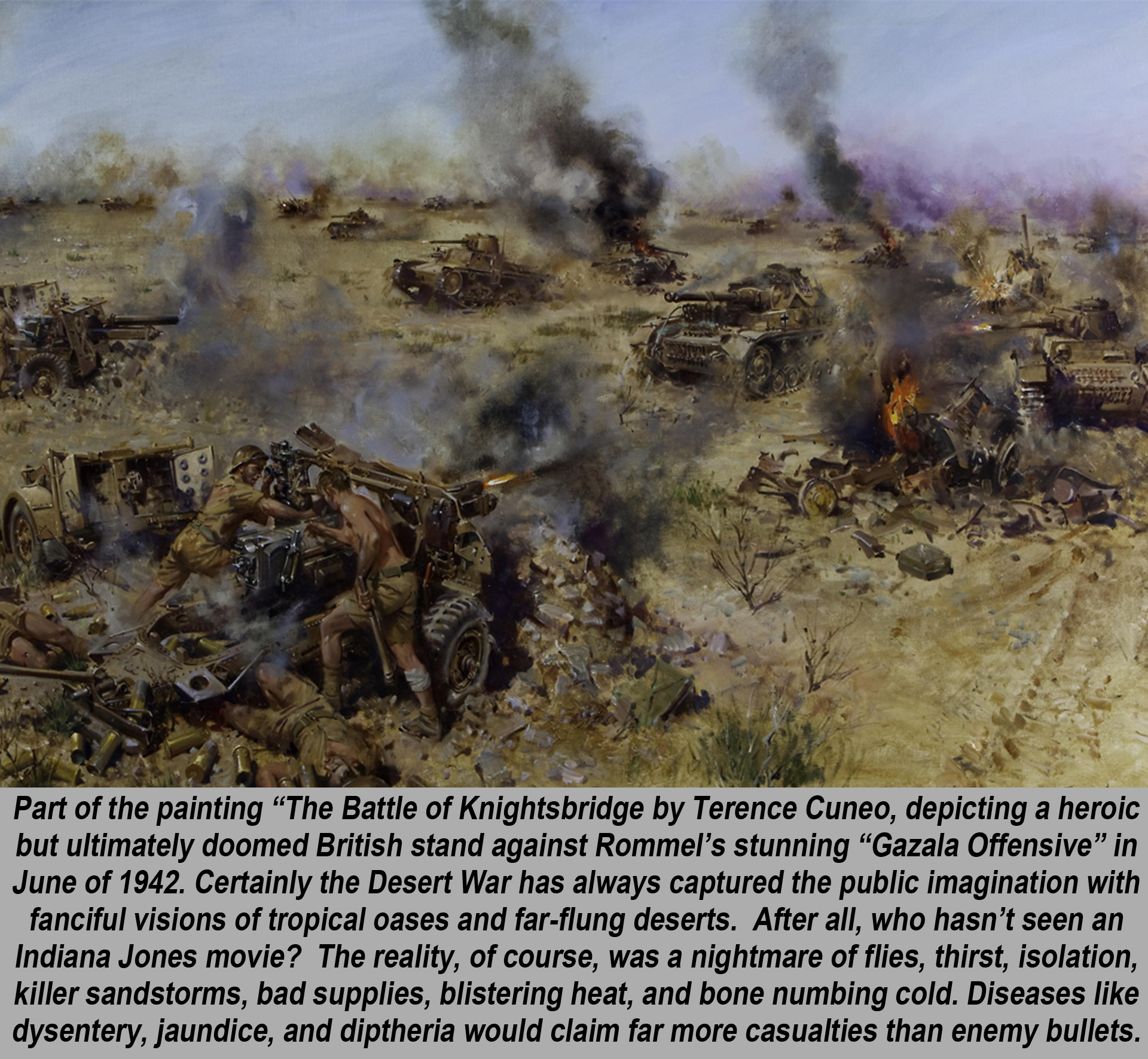
In the study of military history, certain battlefields can acquire a mythic, almost romantic allure. Even amidst the horrors of World War II, there’s one campaign that somehow seems “clean,” isolated, and almost chivalrous. This, of course, is the Desert War, fought in Africa and the Middle East from June 1940 to May 1943.
Read The Original Article Series Here
In preparation for the upcoming Bolt Action “Western Desert” Boot Camp, we’ll be taking a “wargaming look” at the Desert War and what sets it apart from the usual World War II games many of us enjoy. How can games be adapted to play in this theatre? What kind of terrain do we find, what tactics were used, and what did the armies look like?
Why Play In The Desert?
“I hate sand. It’s coarse, and rough, and irritating. And it gets everywhere …”
Even as we all cringe through one the worst-delivered lines in the history of modern cinema, Anakin Skywalker actually brings up a good point. Doing anything in the desert presents a whole stack of challenges, and wargaming is no exception. So why bother?
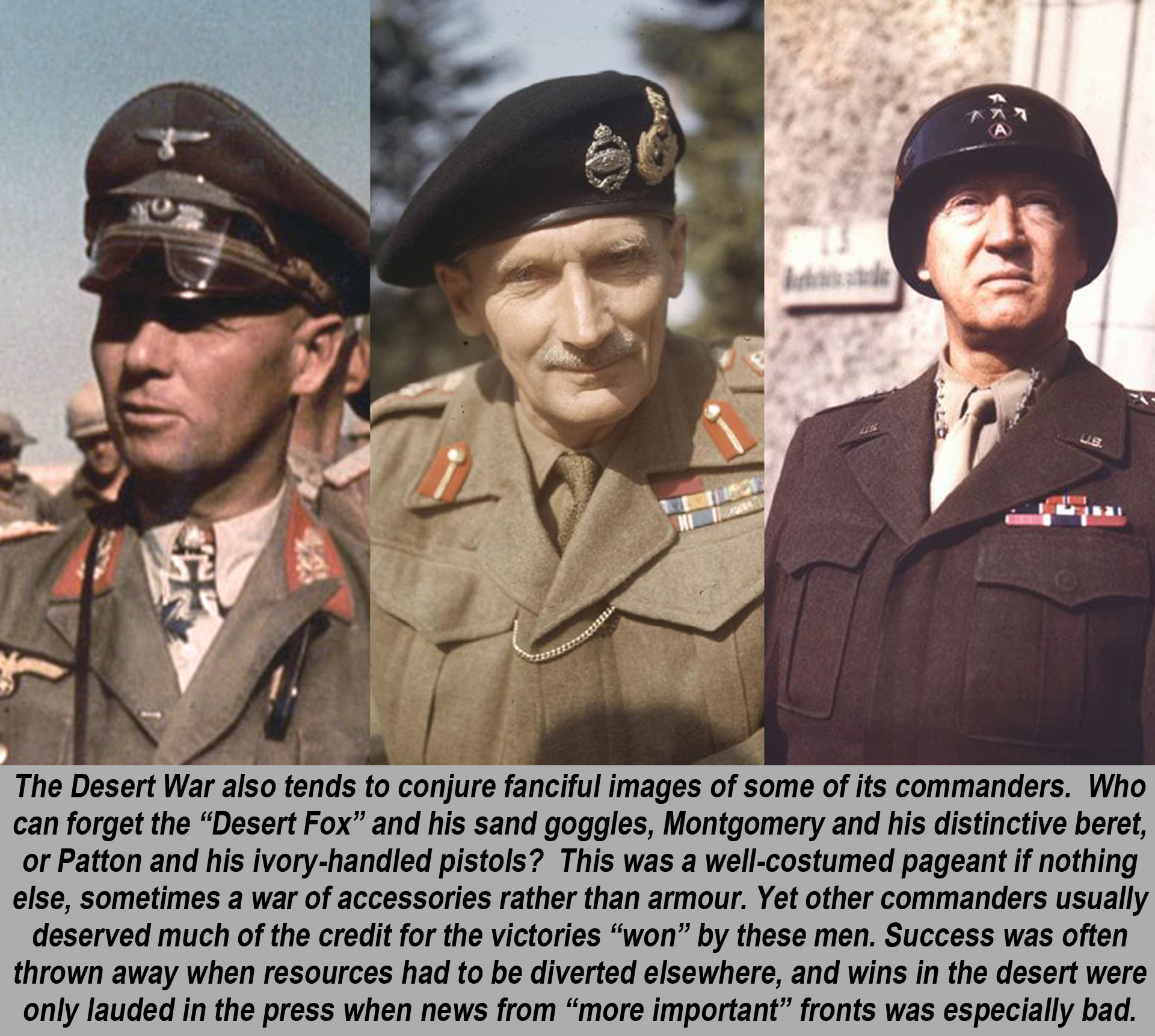
For starters, there’s actually a core of truth to the romance connected to this theatre. There were no SS units deployed here, and very few civilians to get caught in the crossfire. Diaries and records show there was a certain degree of “fair play” between the armies, perhaps because both sides faced the third enemy...the desert itself.
The Desert War also provides new challenges for players perhaps growing weary of French bocage or Russian steppe. The terrain is obviously very different and offers a whole new outlook and backdrop for tactical wargaming. The old tricks won’t work here, while new tactics become available.
These include “hull down shielding” for tanks and some of the first “special forces” operations. The SAS was born in these deserts, after all.
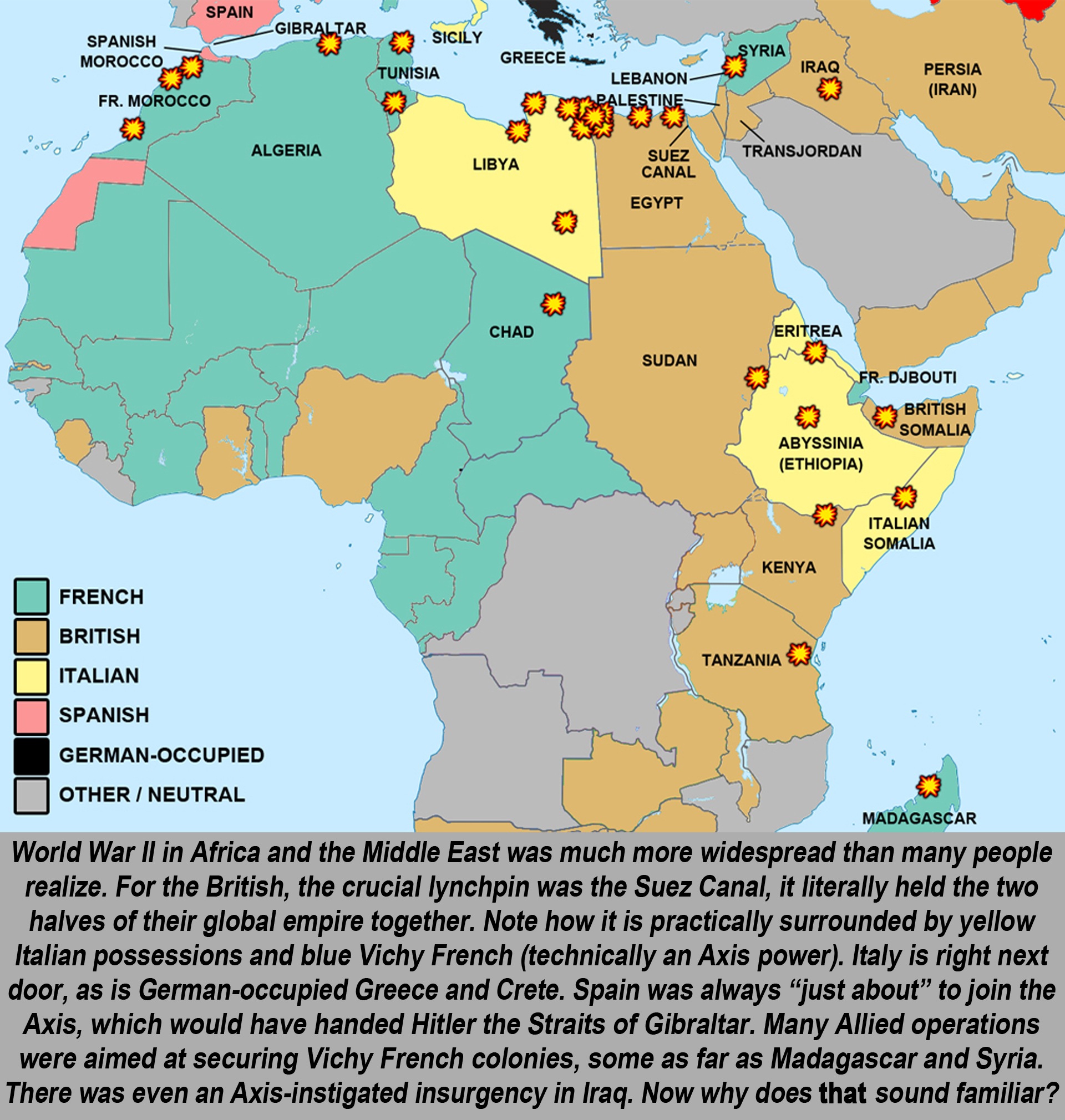
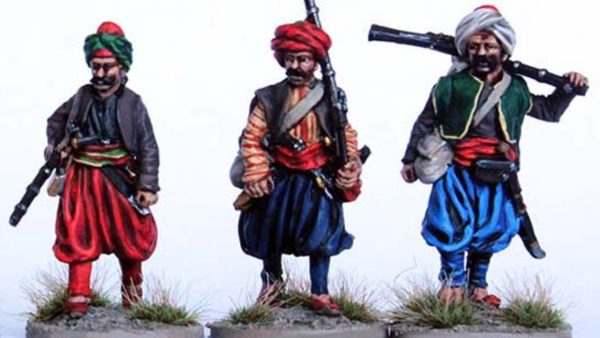
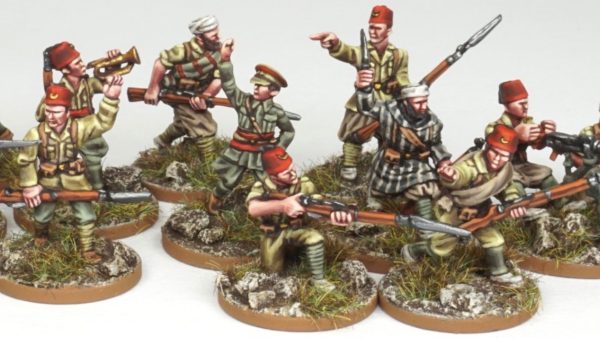
The Desert War was also incredibly diverse. About 75% of the Axis troops are Italians, not Germans. The “British” forces are often nothing of the sort, usually Indians (including troops from modern-day Pakistan, Bangladesh, and Nepal), South Africans, Free Poles, Greeks, Czechs, New Zealanders, and Australians. There were even detachments of Zionist Palestinians and an antiaircraft unit from Hong Kong.
Of course, the Americans joined the conflict in November 1942 with the Operation “Torch” landings in Morocco and Algeria. Free French and Vichy French figured prominently, sometimes even fighting each other (e.g., Syria in 1942). African colonial units were drawn from armies as far-flung as Madagascar.
For anyone who’s interested in expanding the diversity of their armies, this is a good place to start.
Furthermore, at least from 1940 to the beginning of 1942, most of the battles in the Desert War were actually quite small, at least when compared to other fronts. This smaller context can give your games a bigger comparative impact on the overall picture.
Many are the historical moments when you could accurately field the entire armoured strength of Rommel’s Afrika Korps on one gaming table, at least in larger systems.
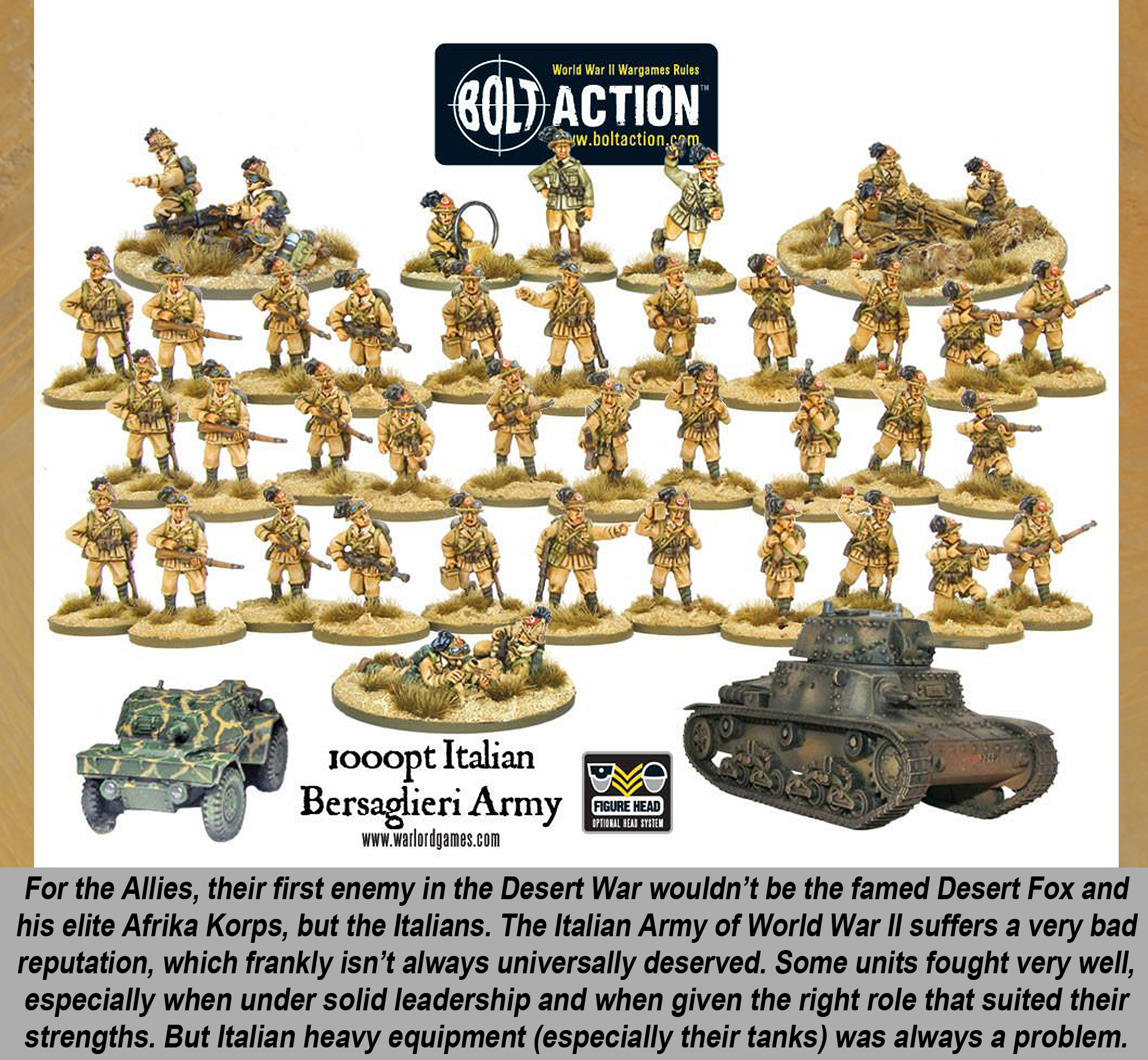
And lastly, players who brave the desert are challenged to win with a lot less than on other fronts. These were armies often held together with baling wire and duct tape, especially in its early phases. Equipment includes the Italian M11/39 tank, armed with a 37mm gun (in the hull, no less), and the Italian CV-35/L3 tankette, an “armoured vehicle” whose deadliest feature may be how god-awful cute it is.
Not that the British can laugh, their most common tank in the early Desert War is the Vickers Mark VIb, armed with just a .50 calibre machine gun. Whole battalions are armed with the World War I-era Rolls Royce armoured car (at least they got rid of the bicycle spokes in the wheels). In short, when it comes to armour the early Desert War can be summed up in three words … “pew-pew-pew!”
Even later, this was hardly a “Clash of the Titans.” Forget Panthers or Fireflies. A Matilda II with a 2-pounder or a Panzer III with a 50mm gun is mighty, and when the basic Sherman first appeared in late August of 1942, it was practically (and briefly) god-like.

Yet when it comes to Bolt Action, I feel this makes the Desert War actually very good fit. Poor armour (at least when compared to other theatres of the war in simultaneous timeframes) gives infantry has a better chance to take a greater role on your 28mm battlefields.
I feel 28mm wargames (Bolt Action definitely included) are at their best for historical and military realism in the context of an infantry firefight.
Origins Of The Desert War
Why Fight Over Piles Of Sand?
The Desert War started almost by accident in the summer of 1940, primarily by the Italians. Yet the Italians initially had no intention of getting mixed up in World War II. But when Germany was overrunning Western Europe, Mussolini abruptly felt like he was missing a moment of destiny. With France crumbling and Great Britain about to fall out of the war, perhaps Italy could snatch overseas territory from the far-flung French and British empires.
Again, Mussolini’s military commanders warned him that Italy’s armed forces were years…perhaps a full decade…from being even remotely ready. Mussolini assured them there would be no real fighting, with the armies of Britain and France collapsing, these colonies would be basically undefended. “All I need is [to suffer] a few thousand dead” he cynically remarked, “and I can sit at the peace table as a man who has fought.”
Sadly for hundreds of thousands of Italians, Mussolini would accomplish the first part of his goal in remarkable scale. First, his June 1940 “grand invasion” of southern France was bloodily repulsed by just six French divisions, even as the rest of the French Army was collapsing against German “Case Yellow” and “Case Red” invasions up north.
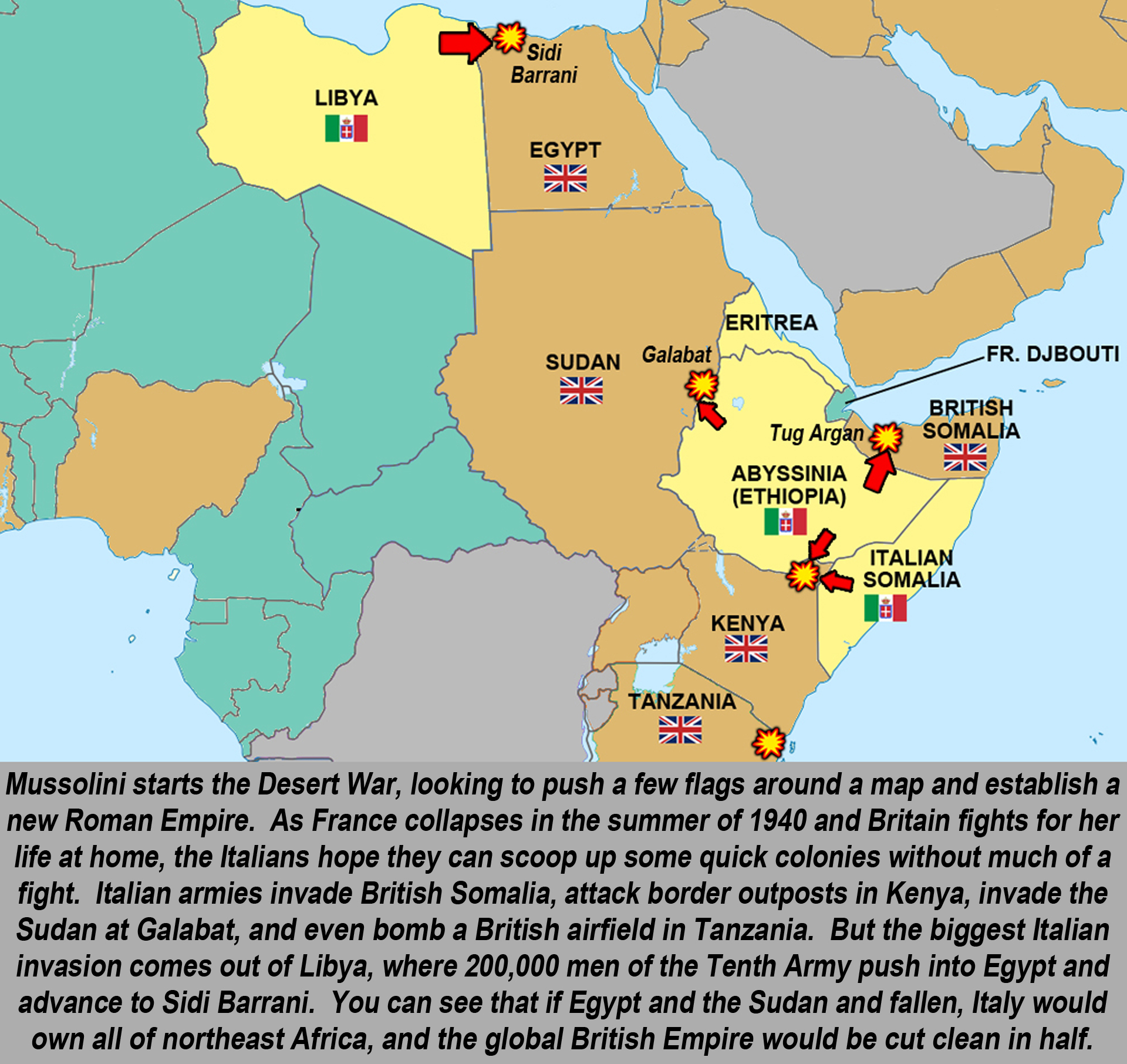
Even with these setbacks in France, Mussolini launched near-simultaneous invasions of British colonies in Africa. Here is where the Desert War officially gets started, but not in the “classic theatre” of Egypt and Libya, but in British-held Sudan, Abyssinia (modern Ethiopia), and British and Italian Somalia.
Believe it or not, Italians actually enjoyed some initial success. First, their army in Ethiopia invaded the British colony in Somalia in August 1940 (when the Battle of Britain was just reaching its greatest pitch). The sheer weight of numbers delivered an Italian victory, and the British were forced to evacuate “Dunkirk style” to Aden. This was the only Italian offensive operation to deliver success without significant German help.
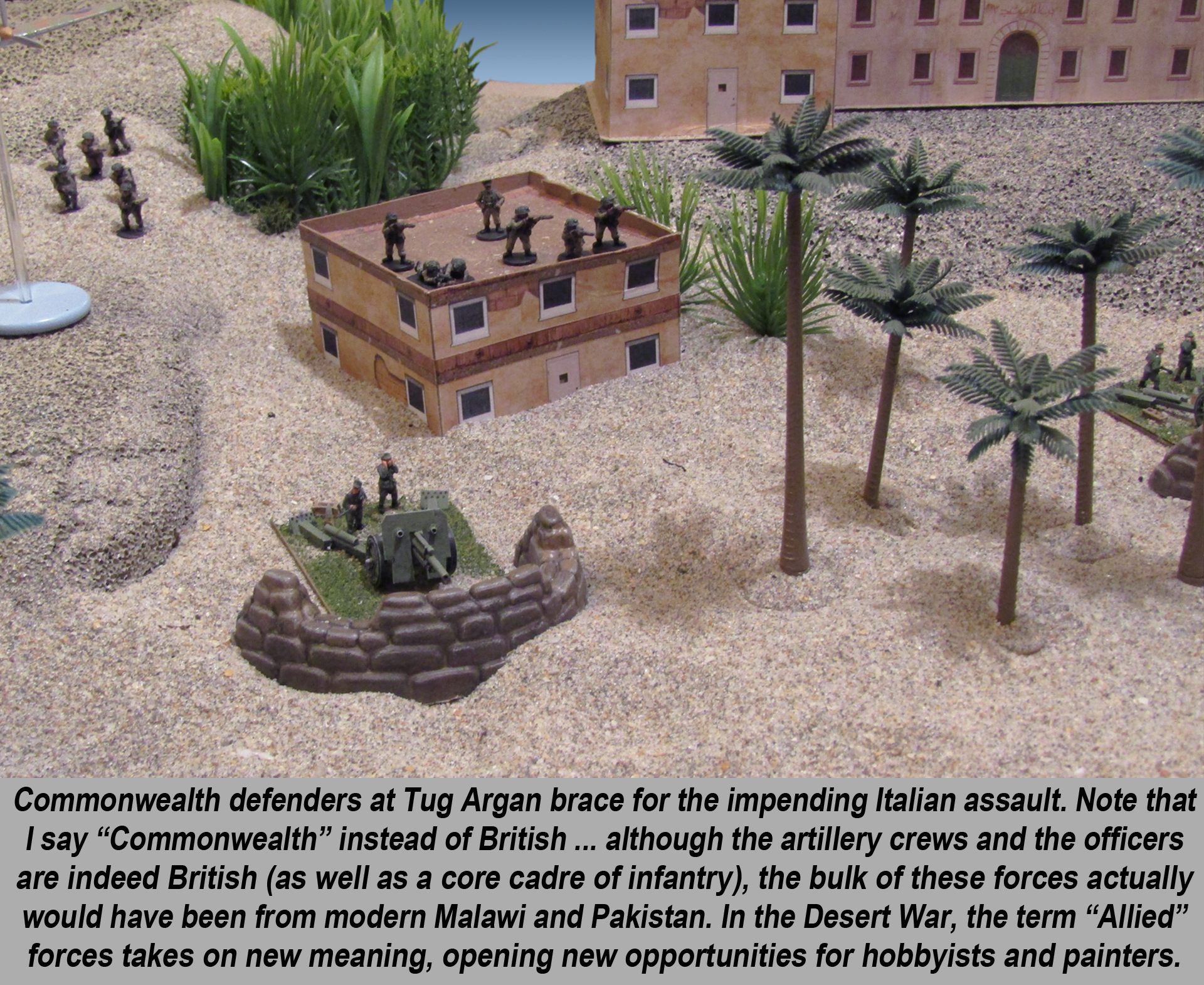
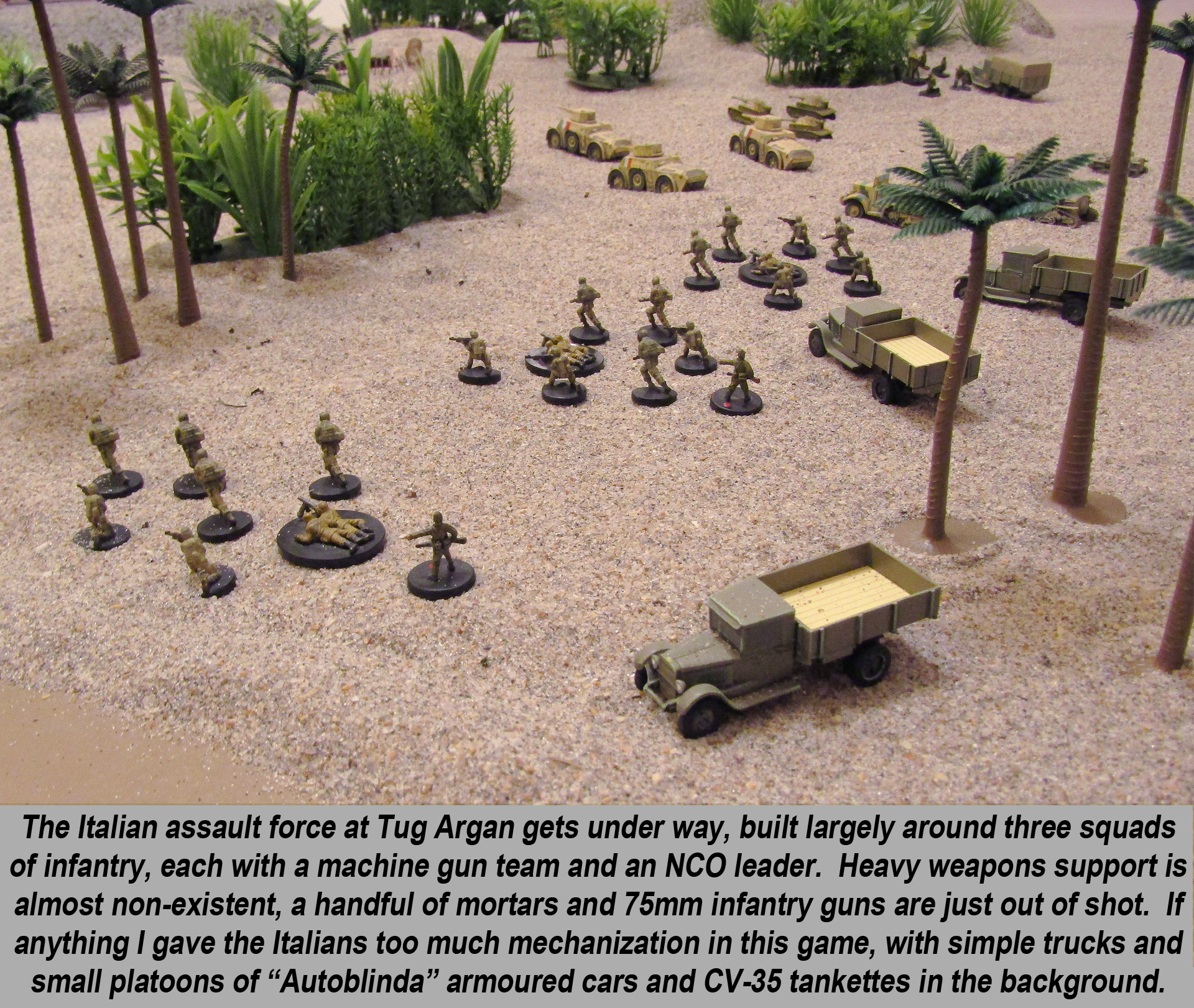
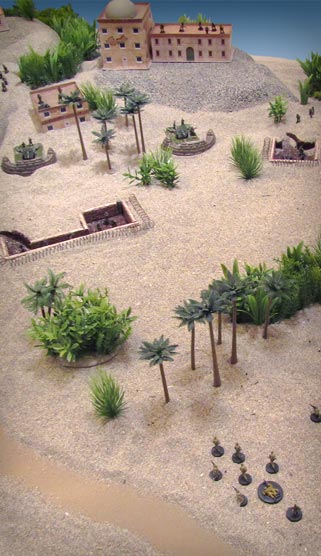
Hopelessly outnumbered, the British fell back to the Assai Hills, where the high ground gave British would hopefully give British an advantage. Several particularly nasty engagements took place at a place called Tug Argan, a fortified British position blocking the road to Berbera, the main port from which the British were planning their retreat.
These battles have served as the backdrop for our some of our past desert wargames, some photos of which are featured in this article. In our games, the “British” force was made up primarily of the King’s African Rifles (“Nyasaland” Battalions from modern-day Malawi), backed up by a Pakistani battalion of the 15th Punjab Rifles, supported by East African Light Artillery (18/25 pounders).
The attacking Italians, meanwhile, lead off with the 7th Colonial Brigade (very solid East African “askari” troops), a handful of wretched M11/39 tanks and L3/CV35 “tankettes”, and a battery of “75/18 modello 34” light howitzers.
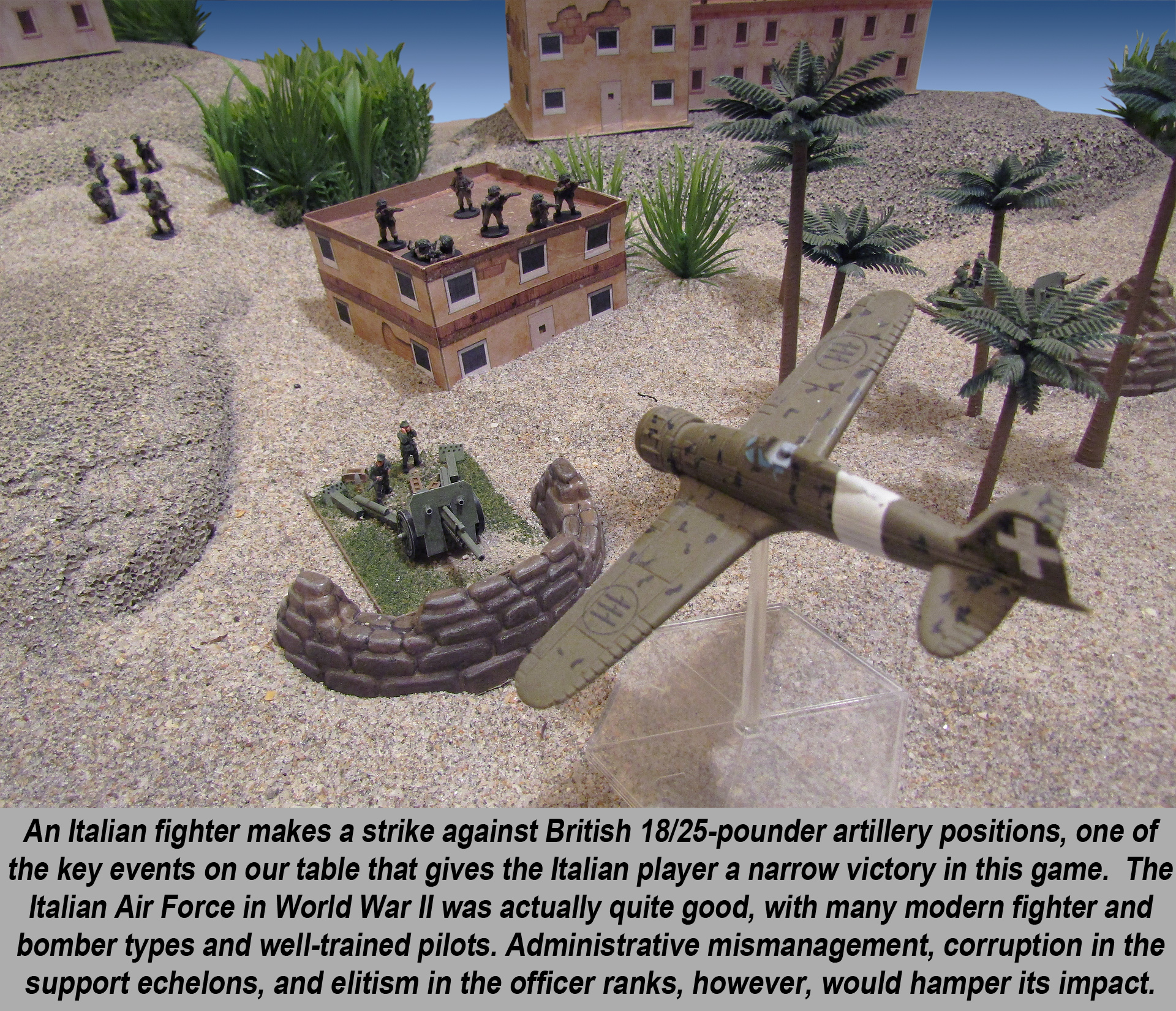
In any game portraying this very first battle of the Desert War, the Italians should have a significant edge in both numbers and direct artillery. Clearly the British have to make the most of their high ground, off-board artillery, and long-range rifle fire in order to pull off a win. The Italians, meanwhile, have to push up the British-held high ground and establish footholds in towns, settlements, and fortifications like Tug Argan.
Libya & Egypt
Next, we come to Libya and Egypt, the “main theatre” people remember from the Desert War.
Mussolini’s next invasion was launched by the Italian Tenth Army, striking out of the Italian colony of Libya, against the British “Western Desert Force” stationed in Egypt. If the Italians could follow up their success in Somalia with wins in Egypt and later Sudan, then all of northern and eastern Africa, from the border of Tunisia all the way to Tanzania, would be one sprawling Italian colony.
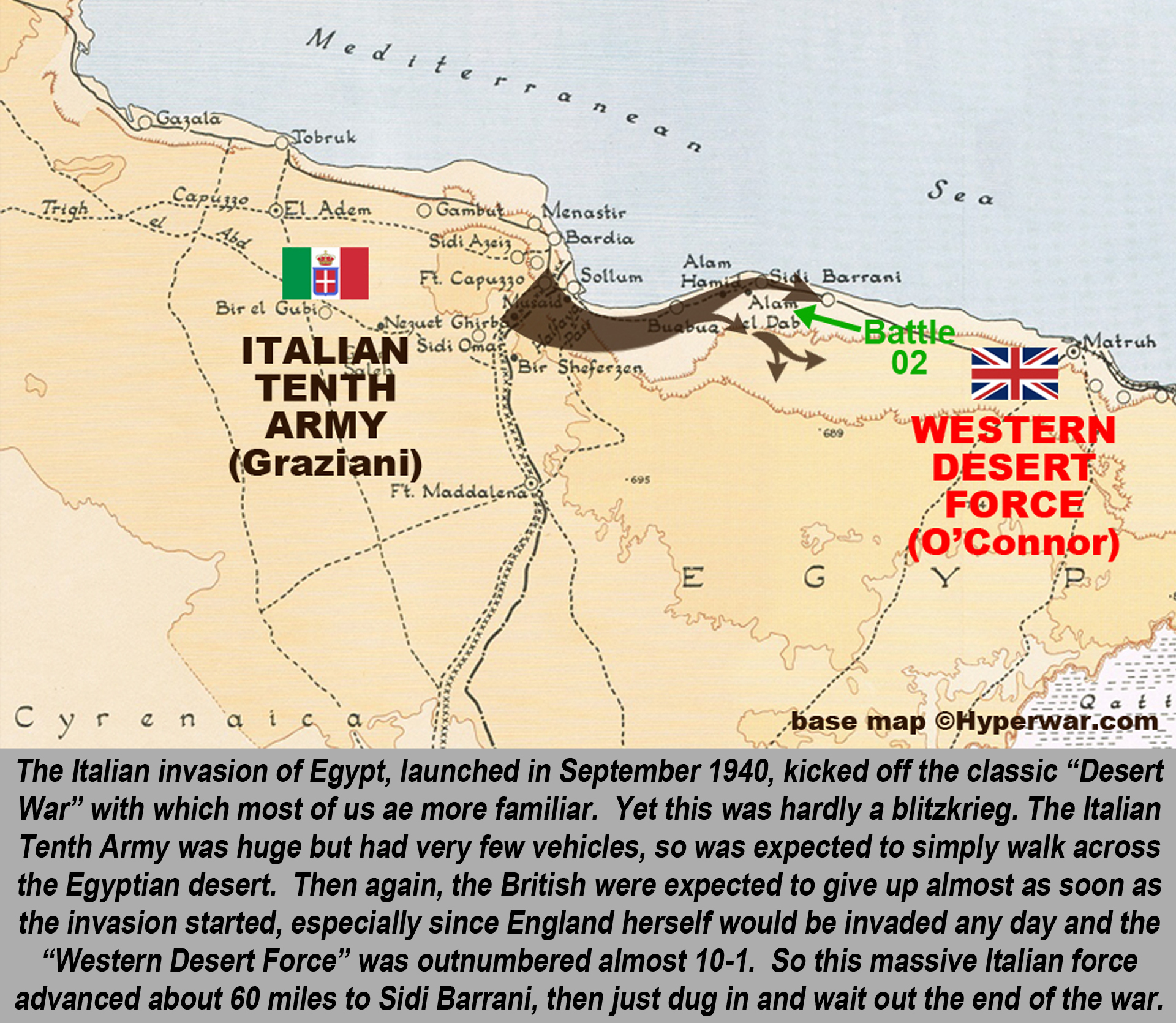
Again, the invasion seemed like it would be a walkover. The Italian Tenth Army outnumbered the WDF by almost 10-1. Besides, the British were “about to lose” the Battle of Britain and face the “Sea Lion” invasion at home, surely they would cut a deal as soon as 200,000 Italian troops marched into Egypt.
Wrong. Although they were admittedly too small to actually halt the Italian Tenth Army, the tiny WDF put up a skilful fighting retreat. One interesting little battle came at Alam an Dab, where a force of British infantry was about to be cut off and the 11th Hussars got the order to mount a motorized rescue.
Again, the battles start off very small, with “armoured vehicles” that are almost laughable. These were engagements determined by infantry, towed artillery, and above all, supply. In many photos, the terrain looks flat and featureless, but don’t be fooled. Even the most subtle dune can provide complete concealment or at least a hull-down advantage.
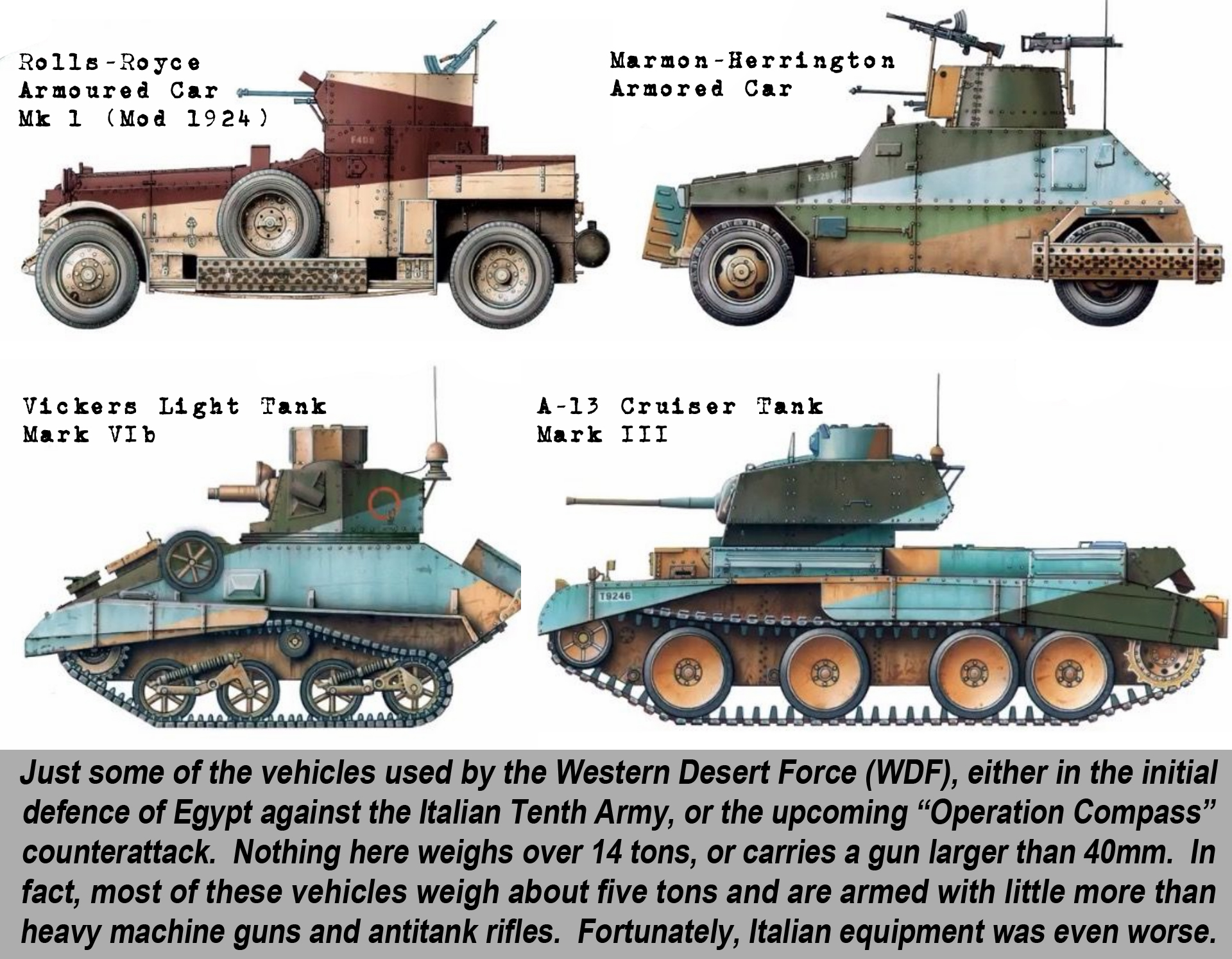
Alam el Dab was one of the few “mobile” battles of the Italian invasion since most of their Tenth Army was “leg” infantry. Yet even most of their “tanks” were armed only with machine guns. For an actual cannon, the Italians had only a handful of M11/39 tanks, armed with a 37mm gun (in the hull, no less).
British antitank capability at Alam el Dab was even shakier, with just “Boys Antitank Rifles” mounted in some universal carriers and 1920s-era Rolls Royce armoured cars. This was a .55 calibre infantry rifle (think of the large sniper rifles carried today) that could shoot through very thin armour plate. Fortunately for the 11th Hussars, “very thin” was all the Italians had.
When the Tenth Army reached Sidi Barrani, barely sixty miles inside Egypt, they simply…stopped. With only a handful of vehicles, 200,000 men couldn’t walk all the way to Cairo. So they dug in and basically waited for the war to end. But of course, the war didn’t end in September 1940. Britain didn’t fall, and the British WDF was already preparing one of the most epic counterattacks in World War II.
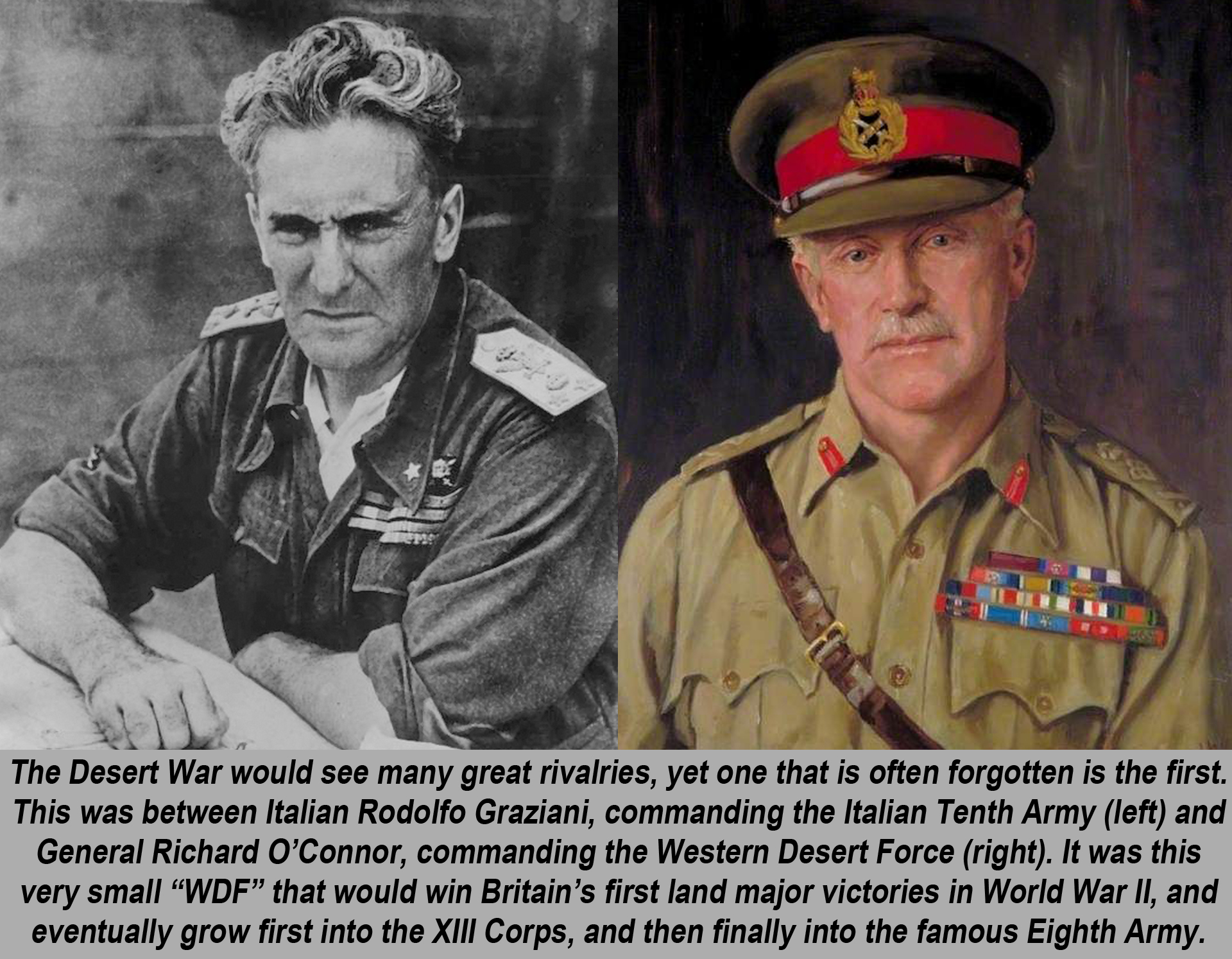
Of course, our Desert War series has barely started. Upcoming articles will cover the “British Blitzkrieg” that was Operation Compass, crushing the Italians so badly that the Germans finally had to send help. That help would come in the form of Erwin Rommel, commanding a handful of threadbare, incomplete panzer units that history would soon immortalize simply as the “Afrika Korps.”
Leave your comments, questions, and feedback below. Thinking of jumping in the Desert War? Will you be attending the upcoming Boot Camp? Watching the live blog?
What parts of the Desert War interest you the most?
"I feel 28mm wargames (Bolt Action definitely included) are at their best for historical and military realism in the context of an infantry firefight..."
"Leave your comments, questions, and feedback below..."

Very cool and great to see some Desert Stuff before the Bootcamp.
I’ve played a few games of the new V4 Flames of War in the Desert and it’s awesome. The Desert really is perfect for smaller games just like the early war in Europe except you have access to a wider range of troops.
Thanks very much, for kicking us off, @elessar2590 ! Wow, all these comments before I even log in this morning. Great! I’d better catch up quickly.
FoW 4.0 was indeed awesome at the last Desert War boot camp. Better for big tank battles, I’m interested to see the smaller-scale infantry engagements with Bolt Action at 28mm.
And you’re absolutely right about the diversity of troops – all told there are easily something like 20 nations involved in the North Africa / Middle East theater. Depending on how you count, many more.
Great article, thanks Jim. Really looking forward to this bootcamp
Thanks, @buggeroff ! Yes, a re-run technically, but given a refreshing make-over to bring greater focus on Bolt Action and the upcoming boot camp (and replace some of the older photos). 😀
Looking forward to seeing you at the boot camp! 😀 😀 😀
excellent article as always Jim. I enjoy getting the background and historical perspective before @warzan gets a chance to rewrite it 🙂 you know I love you Warren.
@warzan changing history never happens you know he’s a history grognard now!
That’s very true! 😀
Thanks very much @avernos (Gerry). I would remind you, though, that @warzan is now a card-carrying member of the International Historical Wargamer Grognard Society. 😀
Always good to read some @oriskany history stuff and getting gaming suggestions for all kind of rule sets.
In the desert theatre I´m particularly interested in the battle of Tobruk, the second battle of El Alamein and finally the Americans. The latter is covered in a fabulous article series by oriskany. Read it and like it.
As for the different type of troops the British fielded I studied the sprues for the new up-coming 8th Army boxed infantry set from Warlord. They have a great variety of heads in it including some with turbans and many other versions. No great difficulties to field an Indian force then. Artizan have splendid Indian officers.
For those thinking of entering Flames of War, there is a “get to know” set called “El Alamein”. You get some good stuff in it. And playing in 15mm is also good for Bolt Action gaming, because the availability of vehicles that are not so very common (f. i. the Rolls Royce armoured car) is better for this scale than it is in other scales.
Thanks, @jemmy – Indeed Tobruk is interesting, especially when you consider how long that “battle” went on for. Rommel’s initial attempt to overrun and take the port off the march, the bloody nose he got there (losing one of his top commanders in the process), the “siege,” I put that in quotes because the town was really never cut off – the 9th Australian or course, the inclusion of Polish and Carpathian units that are added in later, British attempts to break in in Operation Brevity, Battleaxe, and finally Crusader (look for this in Parts 02 and 03).
El Alamein indeed was covered in much more detail in the three-part series specifically for El Alamein for the Fow 4.0 boot camp last year.
https://www.beastsofwar.com/flames-of-war/el-alamein-gearing-fow-boot-camp-part-three/
Tons of Indian regiments, brigades, and whole divisions through practically all of the Desert War. The thing to remember is that they were all called Indian regiments in those days – even regiments that were drawn from what is today Pakistan, Nepal, or Bangladesh. So these units are even more multinational than they first appear.
Thanks for the great comment!
The Italians v the Carpathians I never knew the desert war lasted that long @oriskany Lol
Hundreds of years, @zorg ! it’s nutz! 😀 😀 😀
It’s the dry sand you take for ever to get anywhere. ?
Yeah, I hate sand. It’s coarse, irritating, and it gets everywhere …
Oh wait, I did that joke already 🙁
Ha.
😀
ooo thanks, I will do some brushing up so I feel less newbie at the boot camp.
No worries at all, @laughingboy – that’s part of the purpose of these articles, and re-running this series in particular, to sketch in some background for the Desert War for those who are interested before the boot camp event.
Nice intro Jim. Nice scene setter for the Bootcamp, be interesting to see what we get in the army packages and how we can fit them round your articles. Wonder if they allow the British players to do Jock Columns?
Plus I have models in 28mm of all the British stuff above and quite a lot if Italian (not a M11/39 though).
Thanks, @bobcockayne – great questions – my only possible comment re: Jock Columns is that Jock columns require a lot of vehicles, Rolls Royce and early-model Humbers, trucks, universal carriers for light artillery / 2 pounders, etc. I honestly don’t know how many vehicles are coming with the army packs.
I would also add that Jock Columns have a pretty specific and narrow window in the historical time frame – perfect for this particular article (early war) not so much for the overall sweep of all the Desert War. The Jock Column tactic was discontinued pretty early in the campaign (Brevity / BattleAxe / pretty sure they were mostly gone by Crusader) – I have a feeling these gaming companies and starter packs try to aim at a more universal applicability.
No Italian armour? What about the battles where Rommel fights his first big engagements against the British, where whole battalions are armed with Italian M11s and M13s? 😀 Stay tuned for next week’s article!
@oriskany was actually thinking about a Sat night end game with everyones forces combined more than individual. As for your observation you are on the ball as usual,Jjock columns only really worked against the Italians , and the more mobile Afrika Korps made them fairly ineffective from bits I picked up from various sources. Me thinks will have to research further,
Quick dig to remind my self about Jock columns, and apparently they were dis continued as it tended to split up the armoured units into penny packets which a certain ‘Desert Fox was very good at exploiting.
Fun to wargame in Operation Compass, as we’ll see in Part 02. 😀
@bobcockayne – Megagames are indeed awesome! Combining everyone’s (or at least several players) together on a multi-table smackdown! The one we had for the FoW 4.0 was great, we had 12 players going at once, all of which were attacking ME of course!
(just kidding) …
(but not really) …
https://www.youtube.com/watch?v=9qFyP-MlfPk&t=47s
@orisakany I phibbed about the M11 do have one, going through the painted Desert stuff last night, and found one I’d forgotten about, I’d put a camo scheme on it and A British Facxist insignia as it was pressed into use as part of my Very British Civil War Italian Contigent, theres a light tank as well,
Also for Desert had a M13/40 an Autoblinda , a CV33 . Germans a lone Panzer 2,
Bitishs LDRG 2x Fords one with 37mm Bofors, 3 chevies and 3 Jeeps plus about 24 ft figs
10 Sikhs
10 Gurkas
1 x A13
1x Vickers light tank
1 x Matilda ‘Errol’
3 x honeys
3 x Bren Carriers
1 x Indian wheeled carrier
1 x Diamler scout car
1 x Morris Armoured car
1x Marman Harrington mk 2
1x Marmana Harrinton nk 3
Most thought are Crouchie metal vehicles and weigth a ton, would need to buy another plane seat for the weight.
Holy hell, @bobcockayne – that’s a massive force! especially in 28mm. 😀 I love the inclusion of all your armoured cars, too. NOW we’re starting to look like a Jock Column, except for maybe that Matilda as it may be too slow (I’m assuming that’s a Matilda II with the 40mm / 2pounder)?
Yup and forgot 1 x section Afrika Korps and 1x section Italians desert and 1x in European Dress(think could be used, vaguely remember Osprey showing Blacks shirts in european uniform)
Think only the Morris is a metal model, think the other two are resin so they may fit with out over doing weight allowance.
Are you bringing these to show off? Or are you getting ready for “free gaming” on Sunday afternoon? 😀
Initially was going to bring one Afrika Korps figure so could get near new ones near to the ones I did many years ago. The others were just suggestions I think Rob was on about bringing his LRDG , hence foot figures mentioned. I’d like to show them off, but not sure how well they’ll take the pounding even with them in box on lap on plane.
Much as I’d like to bring them all to show, I’d the infamous Kevin to take a car over!
Trouble is also got to get new stuff back and we have neigh idea what were going to actually get, have a feeling my on flight bag is going to be my figure storage bag with empty figure trays. if did bring anything it would be amended by how many of empty slots may still have.
Awesome~ You’re talking about the Giovanni Fascisti (136th Infantry) units? I honestly don’t remember if they wore black shirts in the desert. I don’t think so. There’s also “Regio Esercito” – agauin, I think they eschewed the black shirt in the desert – I see some images of them with desert sand shirts / jackets OVER black shirts.
Black is just not usually a good idea in the desert heat. 😐
A very welcome refresher before the Bootcamp ?
I totally agree, infantry skirmishes with a little fire support will fit Bolt Action perfectly. I’m quite sure we will fight out some interesting little scenarios over the weekend ?
Thanks, @suetoniuspaullinus – I’ve seen some of the ideas the guys are working on with Warlord and 4Ground for terrain, indeed some great scenarios seem to be in the making! 😀
Army painted and based by Saturday morning? 😉
Hey, there he is! Thanks for the comment @rasmus! This thread is so long I didn’t see you at first! 😀 😀 😀
This theatre is one of the most interesting to me, its the back and forth nature of the theatre that lasted 3 years that makes it interesting. It should not have lasted that long after giving the Italians a damn good thrashing, Churchill turned his to the obsession over Greece( which was a hang up from WW1)and let the Germans get foothold.
I think that it will work really well with Bolt Action cannot wait to get the Jeeps and Chevy trucks rolling at the boot camp:-)
If we had all the various LDRG groups various people have, Jim would be able to plan the games for the whole unit!
@commodorerob – agree 100% about how Churchill’s intervention vis-a-vis Greece / Crete wound up really crippling General O’Connor’s plans for a follow-up phase to Operation Compass – which almost certainly would have thrown the Italians completely out of Libya and ended the Desert War practically before it started.
Or would it have? Say the British really do take ALL of Libya with “Operation Compass II”? Then what? The Vichy colonies in French northwest Africa, starting in Tunisia, are still viable threats, and in turn under threat from these expanding British successes. Does Rommel get sent to TUNISIA instead of Tripoli, with orders to make sure the British don’t invade Vichy colonies and take ALL of north Africa in early 1941? Maybe the desert War starts anyway, except with Rommel starting a long the Mareth Line instead of El Agheila, and with Vichy french troops supporting him instead of Italians?
@oriskany good analysis that is pretty much what David Row proposed in his Alt History in ‘The Whale has Wings’ series.
@bobcockayne – Of course the parallels between a Tunisia-based alternate history and the Libya-based actual history would’t be perfect. One major difference would be supply. As we’d see in 1943, the Axis had a much easier time keeping a bridgehead in North Africa supplied in Tunisia because of the shorter shipping lines, Sicily being just 100 miles northeast, etc.
By the same token, the Allies might have had an easier time supply. The distance between the Mareth Line and TRIPOLI is much shorter than say the Capuzzo/Bardia line and Alexandria. Assuming the British could have taken Tripoli in good shape in an imaginary “Compass II” – and assuming Kesselring never launched Operation Herkules to take Malta, we’re looking at a pretty good supply line for the Allies as well.
So we’re left with a much faster build up, larger battles, less maneuver (the topography here is much more constrained, as we’d see in 1943 with the Mareth Line / Tebessa Gap, etc.)
In short, I feel mid-late 1941 would have started looking a lot like early 1943, just with slightly less numbers, no Americans/British/French coming in the back door from Algeria, and with 1941 equipment.
My vote would be the LRDG / SAS raid at the airfield at Derna in Cyrenaica, Sept 1942 I think. It would be tough to create in miniature (we’d need a lot of 28mm planes for the runway) but would be epic Hollywood desert=adventure-movie awesomeness!
Meanwhile, received my LRDG / SAS 28mm Warlord stuff and starting on a small force (say, half of a historical LRDG patrol).
Two Fat Lardies did a game base on that a few years back at Salute, think it was when they were introducing ‘Troop and Tactics’ which was pre Chain of command.Lots of Junkers JU52’s and Ju 87’s , poor old john would be building them for weeks, hope @warzans not reading this.
We actually DO HAVE THIS exact battle done in Part 04 of this series – although only in part and in 15mm. I agree doing it in 28mm would take up the whole studio and be a metric ****-ton of work, but it would look awesome!
The biggest issue is we’d need a whole new faction. From what I understand we’re getting German and British troops at the boot camp. We’d need Italians.
I have 1 squad of desert Italians ,1 squad of Italians in grey (done for very British Civil war) could be Blackshirts.
@bobcockayne – A super-quick preview of our airfield from the LRDG / SAS raid on Barce:
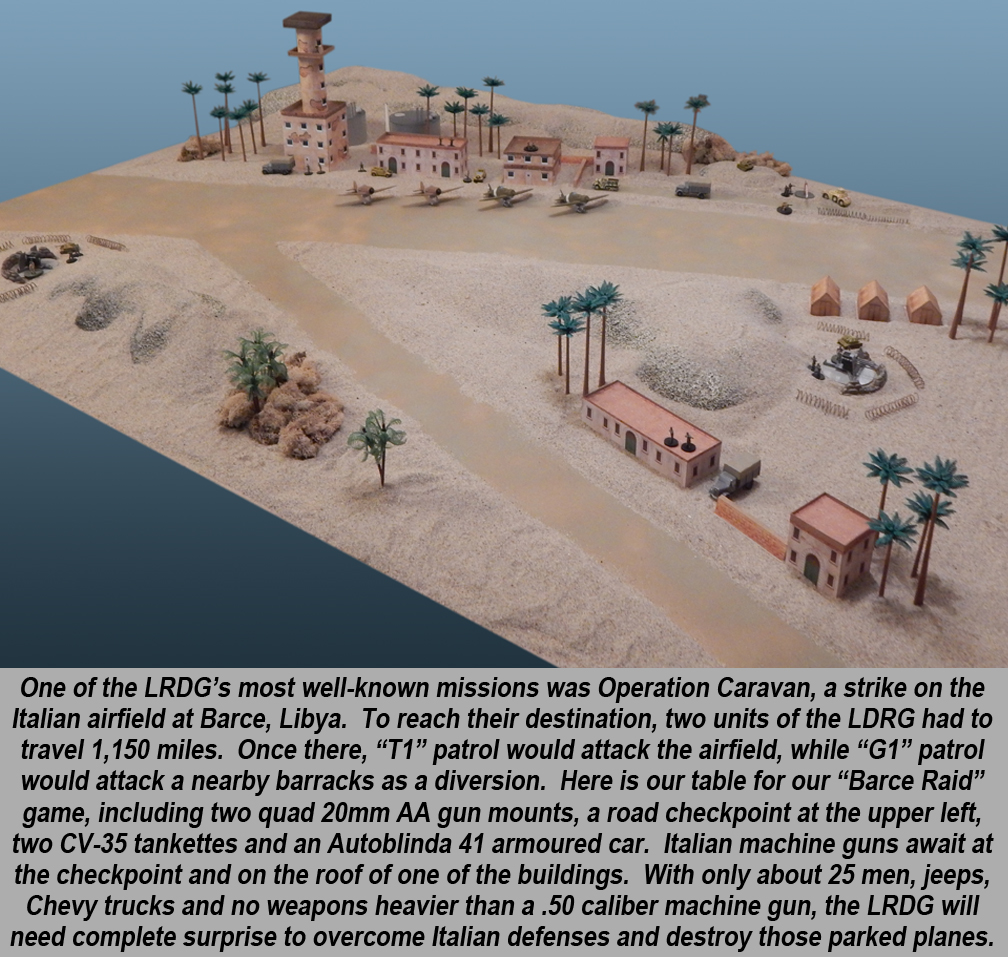
does anyone actually do Aircraft in 1/56 or 28mm scale?
!/48th are close enough
Actually @commodorerob, I have no idea. Very new to 28mm gaming myself. Even the few times I’ve tried BA (besides all the videos I’ve seen on it), we’ve done it in 15mm.
I would agree, @bobcockayne – especially since in this case they’d be more for scenery, terrain, and most importantly, objectives.
Fair enough…i may go hunting for some planes 😉
Sounds great everyone – I would just ask a quick question, @commodorerob and @bobcockayne … to level-set and make sure we’re all on the same page. Maybe I’m being paranoid here, if I am then apologies in advance.
So a lot of people are coming up with a lot of really great ideas for gaming here during the boot camp. Gangs of Rome, Panzer Leader, larger games of Bolt Action / potential LRDG raids on Barca airfields …
I just want to make sure we’re all on the same page regarding what we have time to actually do during free gaming time on Sunday.
Sounds like I’m gonna be stuck pretty deep into Panzer Leader with brucelea and damon at least.
I can’t speak for anyone else. I would just hate for anyone to buy / build / haul a bunch of stuff to the boot camp only to find that no one “has time” to get stuck into it.
Honestly, my game is Panzer Leader – hex and counters, packs up very small and neat in luggage without much drama. If it “gets cancelled” – no real worries on my end, I can build my whole game at practically no cost.
For others that doesn’t seem to be the case. Maybe we should start some kind of sign-up or roster or some such over on the Bolt Action Boot Camp thread so we all know what’s what regarding gaming schedules?
Again, if I’m being a worry wart, than disregard.
Nope @oriskany think were on same page, at moment only suggestions, see my other post.
every time I think of bringing stuff end up with nightmare of packaging/damage.
Nice reminder about time, think just getting stuff we get semi painted is going to be a marathon, and you have to think of a background setting to what were getting to be in background. Extra stuff would possibly throw a monkey wrench in works even if possible. Was planning to bring some background books on Afrika Korps and that will probably take up most of luggage space.
Keep worring Jim and keep us on even keel!
@oriskany, I think separation of things here. 1. From Friday to Sunday morning will be full on bolt action, I won’t be painting anything in site this time, and as I know the BA rules to some extent I am interested in getting people playing asap. I am just pondering a couple of potential scenarios.
2. The free gaming on Sunday, The gangs of Rome game is going to be me learning about it from Gerry and Mick and possibly Lloyd. At that time you I guess will be playing Panzer leader. Also I am arriving in Northern Ireland on Thursday Morning and leaving quite late Monday evening as it saved me more in the flight travelling at these hours. So I will be around to help prep on the Thursday if I don’t end up doing Curator stuff…lol
I’m arriving early morning on Thursday and don’t fly back till Monday evening, current plan was to hang about till @damon turns up and catch a lift. I was thinking about a run through of the curator stuff if we got chance.
@bobcockayne not a problem I think that a few of the curation team will be there:-)
Okay, several responses here …
@commodorerob – Gotcha. Didn’t realize you’d be “starting early.” But most people will be building and painting their armies on Friday and probably a little bit of Saturday (if past experience is an indication) – so you might not have too many opponents for early play?
So the Curator Role, is that for cataloging games, etc … or old archives of past threads that were archived in BoW 1.0? Am I getting Archive and Curator mixed up?
Lastly, and I don’t want to speak for the BoW team here … but I’m really not sure the studio will be “open” for gaming on Monday. I’m pretty sure Monday it’s “Business as Usual” for them, starting with cleaning up after the event.
Again, I pretend to know nothing about the Curator role. I’m sure that would be a totally different situation.
No problem at all, @bobcockayne – I’m just a natural worrier when it comes to planning. I’m in good shape, the nature of my game and armies I’m bringing are such that it’s no big deal to pack and bring them, and if things don’t work out, I’m out nothing but a little bit of prep time. I’m just looking out for the rest of the participants, for whom investment / hassle might be greater.
@oriskany the Curator role is to help look after the website, make sure that all the data entered by the community is as complete and correct as possible, I have been leading on this and working with Warren and Tom and Lloyd to build the curation team and refine the purpose and also help develop other things, which is likely what I will be doing on the Monday 🙂
Funnily you should mention Archives, whilst I am an Information Manager by profession I am also a qualified Archivist, so in theory I could deal with the old stuff as well but that’s a full time job and as much as I love doing stuff for BoW I need to make a living and I doubt BoW could match my Salary…lol
Also from my experience from the Bootcamps there are always the odd speedy person who is up for getting a game on the Friday, other than that I will be making tea and coffee for people…lol
“Data entered by the community” – game ratings and such? Gaming locations? Cool deal. And re: getting done early – I will take your word for it – that person is never me. 😀
I just heard about Operation Exporter. When British Commonwealth and Free French forces fought against the Vichy in Syria and Lebanon in 1941. Might make an interesting mini-campaign.
French put up a good fight captured an entire Indian Battalion If I remember rightly.
@72draco – indeed, the British / Commonwealth / Free French invasion of Vichy French Syria JUST MISSED being included in Part 02 of this original series. But I have written about it more extensively when playing through / reviewing Brian Train’s Desert Leader series for Panzer Leader. Brian’s scenario (with some extra graphics I added) is presented below:
Indeed, @bobcockayne – Vichy units put up pretty strong resistance in many theaters. Here in Syria, Desert Leader Situation 06 (scenario card above) we see a good one (if a sad chapter in French history) where Vichy French and Free French fought each other and actually inflicted pretty grievous casualties on each other.
I guess wars between brothers really are the worst.
Also Vichy forces kicked in some American teeth as well, as we’ll see in Part 05 of this series with the Operation Torch landings.
Great start. The state of the British equipment at times was even more dire than first appearances. At the beginning of the campaign, during an attack against Fort Cappuzo, the Subaltern commanding one of the Vickers light tanks could only fire his revolver at the Italians and his gunner had to use his rifle, both firing through the holes in the front of the turret where the twin MGs had been removed while the vehicle was in transit from England!!
Don’t have any of the really early stuff, most of my BA collection is tailored to the later part of the campaign, Late ’42-’43.
Thanks very much, @damon – and I agree 100%. These early war desert battles are a true “clash of the lawnmowers” when it comes to tanks, AFVs, and vehicles in general. Not only are you early war, but the combatants are two countries that are not prepared for war in general (UK and Italy). Then you add on the fact that this is the lowest priority in the supply chain (for the British it was home defense and the Italians were being strong-armed into Barbarossa prep by the Germans) … and you really have some borderline-laughable equipment and equipment failures.
Frustrating as hell for the m en involved, I’m sure … but for us, really fun as wargamers. I loved taking on Italian tanks with my Universal carriers armed with a Boys AT rifle.
A “Jagdpanther” tank destroyer that is NOT. 😮 But on this battlefield, against L6s and CV-33s … it just might get the job done!
What were Commonwealth and Afrika Korps squad tactics at this stage of the war? Were they based around the LMG/MMG?
Aha, great question @richsh – to address this EXACT QUESTION in greater detail we have some interviews / live streams lined up before the boot camp to start addressing these questions.
IN SUMMARY, though, the British are largely based on the Bren LMG. Moving up to platoon and company level we start seeing 2″ mortars, with 76mm mortars coming in with a weapons section at Battalion level. Early in the war we’re still looking at the Lee Enfield rifle, larger numbers of SMGs don’t start entering regular service until later (reserved for commandos, LRDG, SAS, etc at first).
By this stage of the war, I assume you’re talking about Italians for the Axis (Germans don’t come in until Part 02 of this series). Italians are largely the same with the exception of no very small mortars to my knowledge. There is the Brixia Model 35 45mm mortar, but these are organized into two platoons at the battalion level.
For Italian Machine guns at the SQUAD level we’re looking at the Breda 30. Other “medium” machine guns, even 6.5mm cartridge (pretty light), these seem more like company-role defensive machine guns since they are mounted of TRIPODS. For true “squad-level” tactics – a quick cheat for wargamers is to focus only on what you see mounted on BIPODS.
Thing to remember is that even weapons that are listed as “company” or “battalion” level, are often assigned to support squad-level operations. This allows us as wargamers to start bringing in more of these heavier assets, so long as we do it in moderation and understand they will not be in every game.
Of course the Germans are another kettle of fish, which we will get into in Part 02.
Many thanks for that. I really don’t know much about Italian force organisation so that is really interesting. I’m really interested in how German tactics used in the Early War European theatre changed during the North Africa campaign so looking forward to Part 2.
No worries at all, @richsh – at this small of a level, really down into the squad and fireteam level, it’s almost the “quantum physics of elementary particles” when it comes to how units behave on the battlefield. 😀
Really it comes down to support weapons within the squad or platoon. These heavier weapons are what determine how a rifle fire team / squad / platoon can suppress enemy defenses and thus maneuver towards or around them.
Ironically, it’s this “firepower” than determines your envelopes for maneuver. The more volume, flexibility, precision, and options you have for this firepower, the better you maneuver elements will be able to assault pinned enemy positions.
Conversely, it’s often your maneuverability that helps determine your firepower. Anyone who’s ever mis-deployed an 88 in a blind spot (ahem, cough) knows that 88 has been wasted, but that same 88 on a Jagdpanther tank destroyer is going to be moving and engaging all over the place, multiplying its effective.
That, and how squads / platoons interact with higher support echelons like company and battalion, or even regiment in extreme cases.
This is where the quality of your NCOs, company grade officers (lieutenants and captains), training, and doctrine REALLY make a difference. In game terms, it won’t be about the stats on the unit, but the special rules for how units / leaders on the tabletop can access some of these support packages.
Great read.
Getting primed for next month with all this NA background.
Thanks very much, @leifer1971 – very glad you’re finding the article series useful! 😀
Great article as always. Can’t say I have delved too much into the early desert war. Interesting to find out a little more. I thought DAK were in it from the start trying to take Egypt and disrupt oil and transport routes, oh my ignorance. Strange to think it was caused by the ignorance of Mussolini and his trust in his allies to win a war for him. Great to see the Caunter patterns. I don’t know what the boot camp will hold but I have a feeling I won’t get to paint that scheme and deal with the controvisy over it. Blue or grey? 🙂
Thanks for the comment, @soapdodger … yeah, if I had a nickel for every time I heard someone say Rommel was driving for the Persian Gulf oil fields … I’d be king of the solar system by now and BoW / OTT would have a football stadium for its studio by this point … 😐 No one’s fault, just a lot of bad TV documentaries out there.
Now when we say the Axis may have disrupted transport routes – if we include the Suez Canal in “transport routes” – then yes, 100% correct on that one.
A great start the problem with Italian tank’s is like the Japanese the were good when they were designed but technology and advances overtook them quicker than expected like many other early war tanks.
@zorg – No one talks about Italian tanks in the desert better than David Fletcher – follow this link to get straight to the 15:48 mark of this video you’ve probably seen. My favorite part:
But the construction of the tank, even by British standards at that time … and that’s not saying much … is grim. It’s not even riveted, the whole thing is BOLTED together. And the risk of rivet heads breaking up are bad enough. Bolt heads are BOUND to break up. All you’d need is an impact from a high explosive shell and this thing would probably disassemble itself before your eyes.”
https://www.youtube.com/watch?v=vLcs0d2wgC4&t=948s
love the program bolted together Wow the whole series is great @oriskany.
Not bad for a TV documentary. Stays within a strict focus so doesn’t have to oversimplify too much.
This was a great article! (Despite quoting one of the most annoying characters in one of the worst movies) Having covered the nitty gritty of history earlier, this article was a nice way to focus even more on the gaming side of things.
Hey, come on, now @gladesrunner . We all know Hayden Christensen is an accredited and important historian.
This. Is. Fantastic @oriskany – thanks so much for putting this together. Utterly gripped already Part2part2part2!!!! (please)
Thanks, @irishsteve . Just trying to get people geared up a little for the boot camp. 😀 We have lots more to come, four more parts of this series, some Weekender segments and hopefully even a live stream, all BEFORE the actual event.
I am most interested in the evolution of the airborne forces, and the history of the 509th Parachute Infantry Battalion, COL Edson Raff, and the brief history of the Tunisian Task Force. Raff’s command is a case study in aggressiveness and calculated risk taking, that is rare in the US Army in World War II. From the first US combat Airborne Drop in Algeria, thru the second at Youks les Bains and seizure of Trebessa, the seizure of Gafsa (twice), engagement at El Guettar, Sbeitla, Faid, culminating with the attempt to seize Maknassy. Often with joint operations between the US and French forces. Than there is the raid on the railroad at El Djem. The AAR documents of the Tank Destroyer unit involved (B / 701st TD BN) is great for scenario development http://www.tankdestroyer.net/images/stories/ArticlePDFs/TD_Combat_in_Tunisia_Jan_1944.pdf . And that’s just the US. There are also the exploits of the 1st British Parachute Brigade. Drops in support of the race for Tunis and their raid on the airfields, including Sir John Frost with Oberleutnant Koch saving the life of many of his captured soldiers by circumventing an order from Hitler. Of course there is also the German Fallschrimjagers and Brandenburgers, the rush to Tunisia, and the initial desperate defense of Tunis and defeat of Blade Force. A number of famous German Fallschrimjager from the Eben Emael raid end up in Tunisia in late 42. All of this is before February of 43 and Sidi Bou Zid.
Great post, @jimwesterfield – there’s a lot to unpack here so let me get started.
A lot of the specific history you mention comes from much later in the North Africa / Middle East Campaign. We don’t get to the American involvement until Part 05, and even then it’s really only half the article – the rest of Part 05 dealing with British action down by the Mareth Line / Tebessa Gap, followed up by Mejez al Bab and the capture of Tiger 131 because, well, I think my readers would revolt if I didn’t.
However, we do get a lot deeper into the American experience in North Africa in its own series, Baptism of Fire: 1943 – Americans in Tunisia. We rolled this out during the previous February-March to coincide with the the 75th anniversary of the Sidi Bou Zid / Sbleita / Kasserine Pass / El Guettar / Sened-Maknassy road, etc. We definitely include the 701st TD Battalion in here, as well as the 601st later and of course the 899th at El Guettar.
https://www.beastsofwar.com/modern-warfare/baptism-fire-1943-americans-tunisia-part-four/
(contains links to all four parts of the series)
Now sadly, we mostly focus on 1st US Infantry, 2nd Armoured, 34th Infantry (II Corps), so it’s not exactly the material you bring up, but probably closer than what we can cover in this series. In five parts we’re taking the whole of the Middle East – Mediterranean Theatre, from Sudan and Somalia in 1940 through the final surrender at Tunis in 1943, including (even if only in passing) fighting as far-flung as Chad, Madagascar, Syria, and Morocco.
There’s a lot of really great information in your post, thank you very much for including it. This is the kind of very detailed, deep-dive information we usually can’t get into for an article series, at least until we can focus an entire series on a specific event like the ones you describe, e.g., with the 509th. That’s what makes comments like this especially important, since the general knowledge of this first airborne drop as part of Torch generally presents it as something of a fiasco.
When it comes to German and British airborne forces in World War II, I would defer to another of our historical heavyweights here on the site, @piers .
The entire campaign has some very good stuff for light infantry and special operations. Mid, the SAS and LRDG actions seem to be ideal with the bolt action system. Early, the actions in South West Africa, Somaliland, Sudan, etc feature tribal troops and a lot of commonwealth forces. Field Marshal, The Right Honorable, The Viscount Slim, William Slim KG, GCB, GCMG, GCVO, GBE, DSO, MC, KStJ got his start as a Brigadier there. Avanche press has recently done a series of articles that provide some interesting comments and maps for those actions. http://www.avalanchepress.com/AOISudan.php http://www.avalanchepress.com/Punt.php http://www.avalanchepress.com/Jubaland.php
As for the US Division level actions in the late part of the Desert, I am reminded of Ernie Pyle’s comment “For you at home who think the African campaign was small stuff, let me tell you just this one thing — the First Division did more fighting then than it did throughout all of World War I.” Lots of good stuff. As a veteran of the Big Red One and 18th Infantry Regiment, I still have an open offer to any veterans of the Coldstream Guards, if we run into each other in a pub, to buy them a pint for the actions at the first battle of Longstop Hill 24 December 1942.
@jimwesterfield – Good to hear from you again, sir. USMC myself, Gulf One. We discuss the Big Red One in the desert aforementioned Tunisia article series particularly 16th RCT and its role at El Guettar. However, 18th gets a mention with its close coordination with British V Corps in the north of this general battle area.
We have a lot of veterans on this thread, and a lot of veterans come to these Boot Camp events.
I agree wholeheartedly that the LRDG / SAS is going to be a perfect fit that plays to Bolt Action’s strengths. Small units, infantry-focused (rather than armor or other heavy support assets), and of course something of a “cinematic feel.”
Thanks again for the great comment.
I like your map. Looks like the attack on 23 March, maybe? One of the few examples where the tank destroyer doctrine was implemented as intended. As an old Panzer Leader / Panzer Blitz player it looks fantastic. Those are not the geomorphic maps from the game. All you need is the scene from this battle from Patton where George C. Scott says “Here’s where we kick em in the pants” and “Rommel, I read your book!” Of course Rommel wasn’t there, but… In this battle on the 23rd the 1st Division Commander MG Terry de la Mesa-Allen had his HQ threatened when two tanks came near his headquarters, but he shrugged off suggestions of moving, “I will like hell pull out, and I’ll shoot the first bastard who does.” About the same time Field Marshal Bernard Law Montgomery, 1st Viscount Montgomery of Alamein was getting on with his attack on flanking the Mareth line. 60ish miles to the south the New Zealand Division was still fighting thru the Tebora gap. Also on the same day Montgomery released his 1st Armour Division (BR) to support 2nd New Zealand division. 4th Indian Infantry Division was preparing to execute a night attack toward Tallouf that night. To the north of this battle, not far from the north side of the ridge that is on top of your map, 1st Armor Divison (US) was losing a fight to sieze Maknassay. A very busy day.
Excerpt from the official US history of North Africa (Green Book) on this day and battle:
Reinforced American Infantry Versus German Armor
23 March
General Allen that night had the 26th Combat Team advancing along the Gumtree road, while the 1st and 2d Battalions, 18th Infantry, were engaged, as they had been since the preceding afternoon, in driving out Italian forces northeast of Hill 772 on Djebel Berda, thus widening the front considerably. The trains of the 2d Battalion, 18th Infantry, barely reached the cover of the foothills, after crossing in darkness from the northern side of the valley, when sounds of motors to the northeast were followed by an eruption of tracer fire and the echoing rumble of guns. At 0500, while darkness was still complete, an enemy motorized force was reconnoitering by fire the southern slopes of Djebel el Mcheltat.
Daylight revealed the presence of the 10th Panzer Division, which was methodically sweeping the foothills and the lower ground north of the road before undertaking bolder measures. The 3d Battalions of both the 18th and 16th Infantry were under direct attack. A spearhead moving up the valley was engaged by the 601st Tank Destroyer Battalion until about 0700. The main body of the enemy force was in full view of American observers on heights above the valley on either side, and from the German Africa Corps’ command post on Hill 369.50
At first the battle ran entirely in favor of the attacking Germans despite determined and courageous opposition. Their tanks and self-propelled guns, interspersed with infantry in carriers, rolled westward in a hollow square formation and at a slow but steady pace. Behind them, a column of trucks drove to a predetermined point at the western end of Djebel el Mcheltat and unloaded more infantry, which followed closely the armored rectangle ahead of them. Then the mass of the enemy separated into three prongs. One group turned northwest among the foothills east of Hill 336 overrunning the 32d Field Artillery and part of the 5th Field Artillery Battalions; another continued along the road; and the third, and much the largest, force tried to sweep the hills and northward along the edge of the Chott el Guettar.
German tank-infantry teams overran the American artillery and infantry positions east of Hill 336 in engagements which brought some hand-to-hand encounter, and heavy American losses. A curving belt of mines extended from Choett el Guettar across the road and along the Keddab wadi to the southeastern base of Hill 336. There the tide of battle changed. American artillery and the tank destroyers of the 601st and 899th Tank Destroyer Battalions knocked out nearly thirty enemy tanks, and the minefield stopped eight more. Eventually, the morning attack was contained. The 10th Panzer Division pulled back a few miles to the east and prepared for a second attack. During this withdrawal enemy artillery and aviation harassed the American defenders, and Allied air units struck back repeatedly. The Germans towed their disabled tanks to a prepared maintenance point not far from where their infantry had first detrucked. During this interlude, and running a gantlet of enemy shells and Stukas, nineteen American jeeps rushed back for ammunition, all but six returning safely in time to oppose the next assault. Elements of the 16th Infantry and the 1st Ranger Battalion were put into the line along the Keddab wadi. Headquarters, 1st Division, was ready for the second attack (1645 hours) and aware of the enemy forces to be committed.
Preceded by a German air strike, and on the signal of a siren, the ground troops of the enemy attacked once more toward El Guettar. At 1830, word came that they were still advancing, with thirty-eight tanks in one group, but barely fifteen minutes later, an exultant report arrived from the 18th Combat Team:
“Enemy attacked as scheduled, preceded by dive-bombers which did little damage. Troops started to appear from all directions, mostly from tanks. Hit Anti-Tank Company and 3rd Battalion. Our artillery crucified them with high explosive shells and they were falling like flies. Tanks seem to be moving to the rear; those that could move. 1st Ranger Battalion is moving to protect the flank of the 3rd Battalion, which was practically surrounded. The 3rd Battalion and the Rangers drove them off and the 1st Battalion crucified them.”
Thus at the close of 23 March, a reinforced American infantry division, well supported by Allied aviation, mainly by their artillery had stopped the bulk of an enemy armored division. Kesselring’s report to the OKW acknowledged substantial tank losses in the morning attack at the Keddab wadi; it called the efforts of the 601st and 899th Tank Battalions a counterattack with tanks against the German north wing which had been repulsed, and it attributed the failure of the afternoon attack to superior Allied forces and a threatened penetration through the Italian-held positions on the northern edge of Djebel Berda. Although the armored counterattacks of 23 March were beaten off, the enemy by no means lost his determination to maintain an aggressive defense of the routes of Allied approach to the rear of Italian First Army. He might not succeed in plunging through the Americans with his armor, but he held strong defensive positions and could nibble incessantly with infantry and artillery, and with tanks used as artillery, at the American positions in the hills north and south of the Gabès and Gumtree roads. On 24 March he made some progress in each sector, especially in the high ground on opposite sides of the Gabès road, and on 25 March, he succeeded in recapturing from the 1st and 2d Battalions, 18th Infantry, their most exposed position on one of the northeastern buttresses of Djebel Berda. When a German patrol reached the bare summit of Hill 772 there, mortar fire brought it scampering down. But the two battalions of the 18th Infantry, even with the 1st Ranger Battalion, managed only to hold their position; they could not extend it without larger reinforcements, perhaps another entire regiment. With that much strength, they believed that they could take all of Djebel Berda and the hills east of it, and thus open the road to Gabès for American armor. Had such a regiment been sent, or had the two battalions simply remained in possession, the Germans might not have been able to withstand the 9th Infantry Division’s efforts later to drive them off. But during the night of 25-26 March the battalions were ordered to withdraw through the 1st Ranger Battalion. Colonel Darby’s Rangers, with a purely defensive role, held a south flank position in the foothills west of Djebel Berda for the next two days.
http://www.ibiblio.org/hyperwar/USA/USA-MTO-NWA/USA-MTO-NWA-28.html
@jimwesterfield –
Thanks for the kind words on the map. You are spot on with the date – it represents part of 10th Panzer Division’s attack on 1st US Infantry near El Guettar.
One of the few examples where the tank destroyer doctrine was implemented as intended.
Indeed, the 899th really came to the rescue there.
A very busy day.
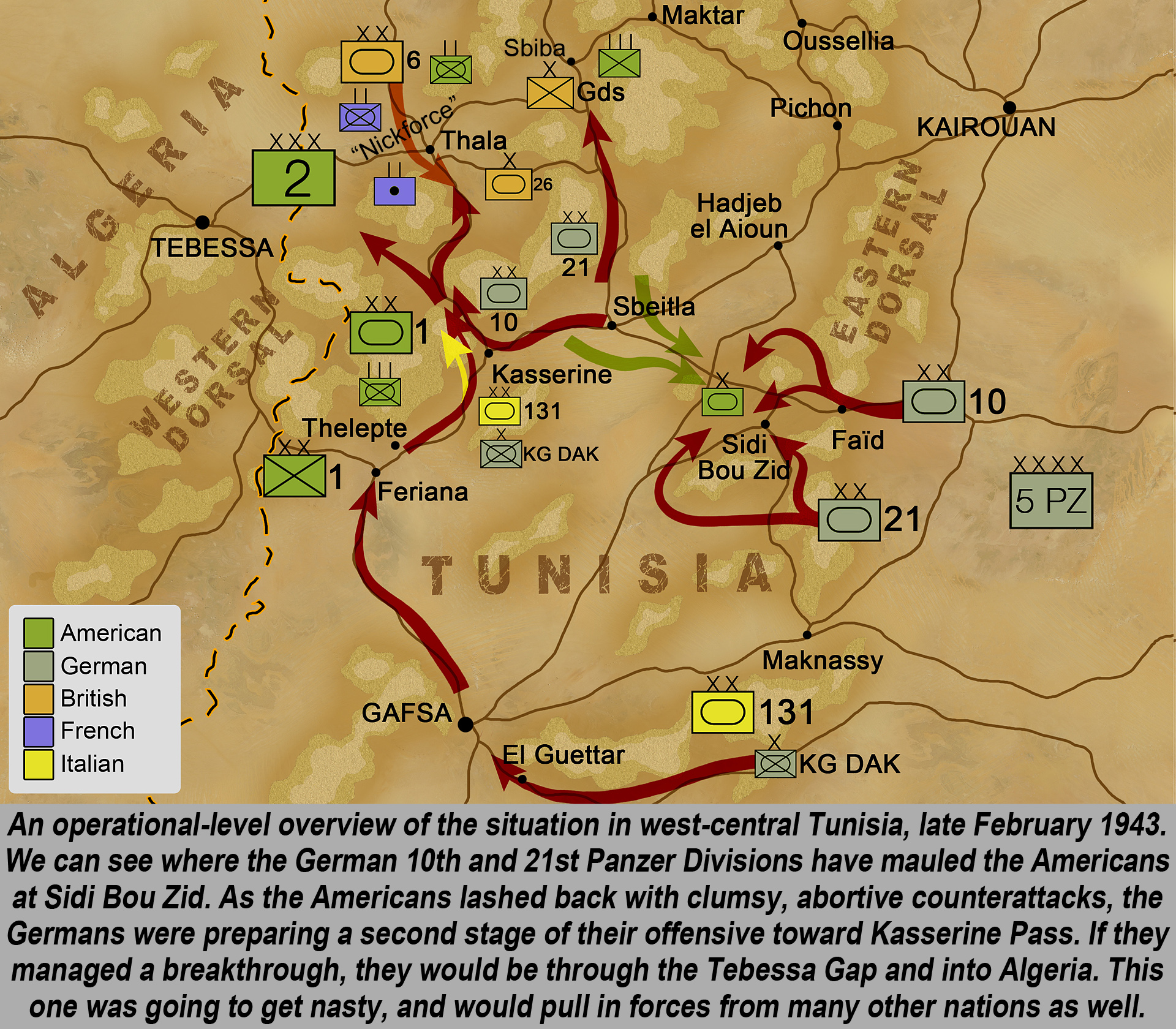
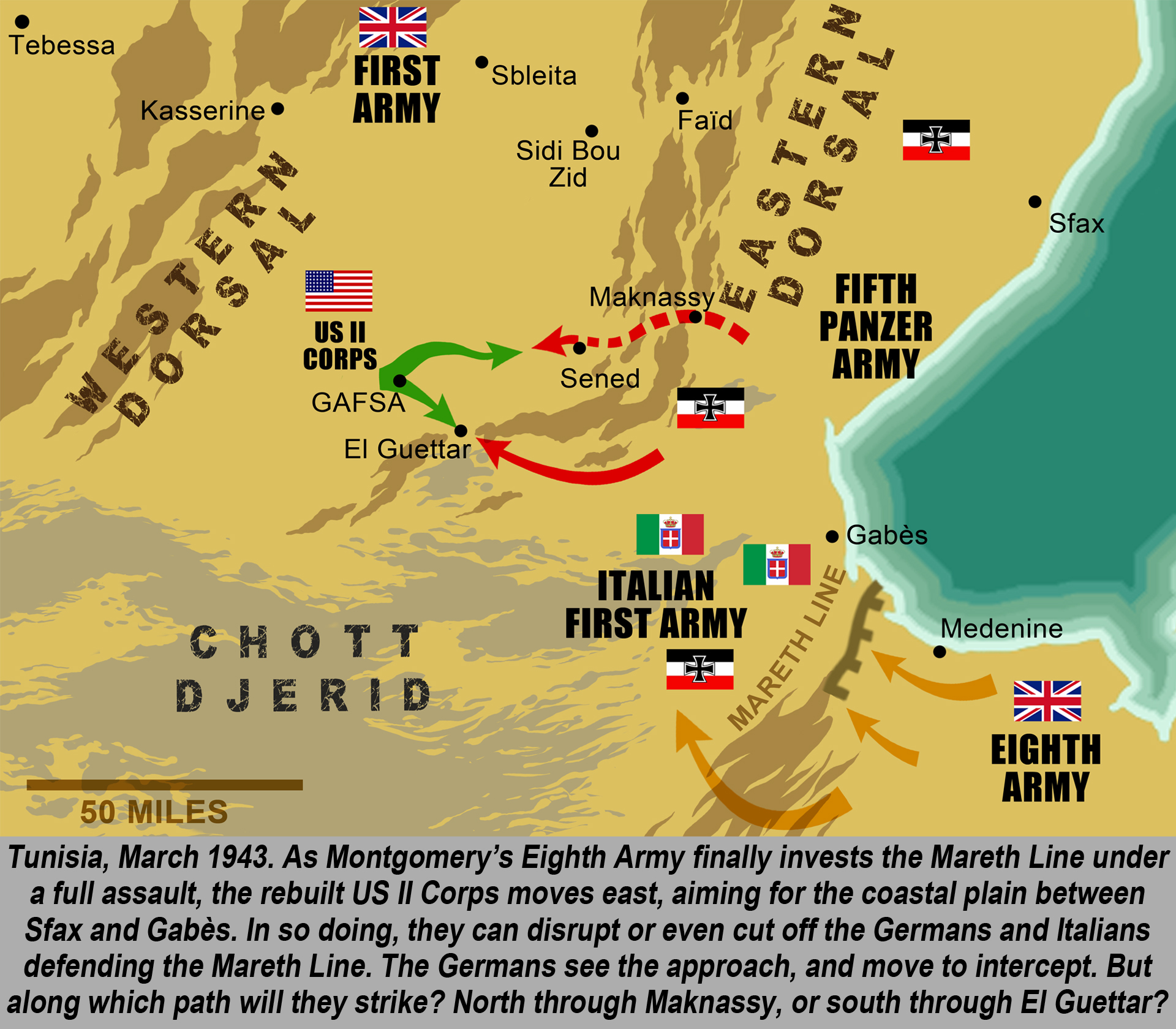
Indeed, that whole week was very eventful. We also include a larger, operational-scale map to provide more context to the tactical operations ongoing.
@jimwesterfield
:
As an old Panzer Leader / Panzer Blitz player it looks fantastic.
Absolutely love that game system, warts and all. Granted, most of the people who still play the system actually take the rules mechanics out of Arab-Israeli Wars (third in the series) and retro-fit them back into PanzerBlitz/Leader. The only real issues are you need new artillery counters – adjustments to the Weapons Effectiveness Charts, etc. The real bugbear is the terrain, AIW terrain rules are written specifically for deserts which don’t jive well with Normandy bocage / Russian steppe. However for North African desert, it’s a match!
Those are not the geomorphic maps from the game.
Yes, we draw all our own maps in Photoshop, usually starting with scaled aerial recon photos or maps from actual action reports written by officers who were there (Lt.Col Louis Hightower’s reports were very useful for the tragedy at Sidi Bou Zid).
All you need is the scene from this battle from Patton where George C. Scott says “Here’s where we kick em in the pants” and “Rommel, I read your book!”
It won’t be in this article series, but it seems we’re talking more about battles that are featured in the aforementioned “Baptism of Fire – Americans in Tunisia 1943” series.
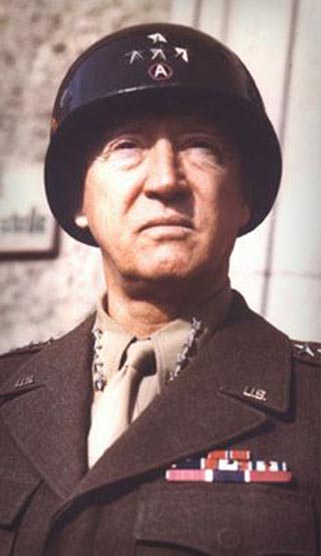
But in Part IV of that series (where that map was taken from), I discuss El Guettar at length, and of course we have a big picture of Patton in the desert.
Half the reason I wrote that series is @warzan loves that movie, so any chance at a Patton tie-in is not to be passed up.
Of course Rommel wasn’t there, but…
Of course, neither was Patton. At least at first.
“I will like hell pull out, and I’ll shoot the first bastard who does.”
Totally. We also hit this in Part IV of that series. It really covers these battles in a lot more detail that this one does (much more of an overview of the whole Desert War 1940-43). Probably still not in as great a depth as you’re used to, but much more depth than we cover here.
Excerpt from the official US history of North Africa (Green Book) on this day and battle:
I’ll have to check when I get home from work, but I’m pretty sure I actually referenced this source in the writing of this series.
Link to the last part of the series, which includes links to the three previous parts, if you are interested:
https://www.beastsofwar.com/modern-warfare/baptism-fire-1943-americans-tunisia-part-four/
Thanks for the link to the earlier series. Very interesting. Must have missed it when it came out. Best of luck with your gaming.
Cool deal. Thanks very much for the great comments and article links.
Hi Jim, many thanks for this fantastic start to our journey to the boot camp. It’s amazing to see how blinkered your historical knowledge can be when you only focus on main events, or what directly relates to you. Thanks for opening my eyes yet again to breadth of military history out there that’s still to be explored. Looking forward to the next one!
No worries at all, @brucelea . They say all battles are won or lost in the preparation, so we try to get the ramp-up to the boot camp started nice and early! Also, by showing the “whole” picture (even if only a quick cursory view), I’m hoping we can make different areas of gaming more inclusive to people’s interests and available armies and give people more ideas. Even for those who like “gaming in the gaps,” this just provides “more gaps” for them to try. 😀
Thanks for the comment! Really looking forward to the boot camp!
Aah! The 7 P’s……
PRIOR
PREPARATION &
PLANNING
PREVENT
P!55
POOR
PERFORMANCE!!!
Oh yes, I remember that from the Marine Corps as well, @brucelea (I think we shortened it to five, but same general idea).
Another one from the Corps (and probably others as well):
“The more you sweat in peace, the less you bleed in war.”
Or as Sun Tzu put more eloquently:
“Victorious warriors achieve victory first and then seek battle, while defeated warriors go to battle first … and then seek victory.
Or as Josephus wrote of the Romans:
“Their maneuvers are like bloodless battles … their battles like bloody maneuvers.”
Or as Oriskany wrote:
“Get your shit together ahead of time so you don’t look like an ass on camera.” 😐
?
???
I do my best.
@oriskany @commodorerob,@warzan think we have an ideal opportunity to prove that historical gaming isnt as hard to get into as it can appear, even if it has raised huge pages of messages on the various forum themes.
@bobcockayne that’s an idea… Maybe do a roundtable discussion on this topic during the bootcamp what do you think @warzan ?
@bobcockayne – we just recorded an interview for the weekender where we touch on this a little, and go over some of the media we will be presenting at the Boot Camp.
I dunno, man. This discussion’s been hit pretty hard, and I fear did a little unintended damage to be honest.
@oriskany thinking might be good to show how Bolt Action campaign are a good intro into the game and historical and you dont have to be as anal as we are!!!
I agree, @bobcockayne , and this is part of what went into this morning’s interview (hopefully air on the Saturday weekender).
As far as “discussions” go, that’s all great. Maybe it’s me, but I just didn’t see too many concrete ideas, original concepts, and actionable tasks people were suggesting or willing to undertake themselves. I mean, I have 300,000 words in 120+ article on the site, making historical wargaming “more accessible.” I’ve designed and published wargames on the site.
I’ve undertaken research projects for people on the site, and provided consultation services to help get their games off the ground. Okay great. I’ve done my part. Now what is someone ELSE willing to DO besides furiously agree with each other.
If this is really a thing we want to improve, we need more people to step up and ACTIVELY HELP.
Also, when this came up on the XLBS thread, it seemed to present an opportunity for some people to take shots at our genre. A lot of overgeneralization – a lot of stereotypes. I stick by what I said, a little bit of damage was done there. I’ve heard from a few other historical wargamers on the site, it got on peoples’ nerves. I did not wholly disagree with them.
I guess I’m just more of a DO person than a TALK person.
@Jim Totally agree, not that I read the whole thread,but did get that gist.
Wish I had more time to help, but most of spare time is spent painting as I pretty much paint everything my group uses. I’ve put on demo games both Sci fi and Historical and can only guess at the amount of effort you must put in.
I’m happy to help at bootcamp but as I actually started in Historical gaming (there wasnt any sci fi-fantasy games when I was an nipper) I might not be the best advert . I think some going to bootcamp admit there ignorance on period and they may be a good start to showing how accessible historical gaming is.
Just a thought but when I started gaming the lack of sci-fi/Fantasy may have been due to its lack of popular media exposure at the time compared to the mountain of ‘historical’ (big inverted commas) movies from the 50’s and 60’s we had been exposed to , now compare that to today where the opposite could be said to be true, films like Dunkirk, Heartbreak ridge are the rare but sci-fi fantasy.
Back in the day you were a bit of a geek to read sci-fi fantasy never mind play it, now it appears the opposite is true.
Absolutely. I remember when kids who read comic books got beat up and head-flushed in the boys room. Now they RULE THE WORLD! 😮
No worries at all @bobcockayne – I certainly wasn’t speaking about you personally.
In a more general sense, the conversation gets a little annoying when the tangent inevitably comes up “the team needs to do more to make historical wargaming accessible” or “historical wargamers need to be more accessible.”
And yet I don’t see any sci-fi or fantasy community members piling out hundreds of pages of content trying to open their genres for new gamers.
Actually, I take that back, I’ve seen exactly two – one series a piece, in nearly five years on the site.
And yet you get the same “grognard-ness” in these genres that you admittedly do get in historical …
Sci-fi fans / players who scoff at low-brow space opera as not “real” Isaac Asimov / Frank Herbert / Orson Scott Card / Piers Anthony / etc “science fiction.”
Or fantasy players who insist you have a full original-elvish understanding of the Tolkien’s Silmarillion … you can’t have just seen the bloated Peter Jackson movies to understand that you’re talking about green-skinned fairy tale monsters and old dudes in pointed hats.
Every genre has it share of rivet-counters, grognards, rules lawyers, etc. But somehow in this community it’s okay to point at Historical and imply that we’re the only ones with this problem. This attitude seemed to be legitimized by how the thread turned out and the XLBS segment a while back (or at least the comments on that segment, I had no issue with the segment itself).
People seem to forget when I was almost “chased off” of Battletech, and why I haven’t written another series on the subject despite lists of people practically begging me to.
“Non-inclusiveness” is everywhere, and frankly sometimes it’s the “fault” of the person who feels they’re being excluded. I don’t do well in fantasy wargames because I hate memorizing all kinds of mass magic spells. I can’t complain that fantasy wargaming “isn’t inclusive” because I don’t want to learn about the genre. Every genre has certain things you have to know. Granted, some genre-veterans take it too far, but it’s equally incumbent on the newcomer to learn the material at least to a beginner’s degree.
I dunno, all this has already been said a hundred times. That’s the other thing about this conversation, it gets very repetitive. 😀
I remember. your Battletech series shame you got flak on it, It is historical, well my history anyway, I’ll have to reread it. If we get chance at bootcamp you can perhaps tell me what you had planned, and I may have a go at putting something together,like to see it get a bit more mention.
Thanks, @bobcockayne – oh, it got tons of mention. Perhaps a bit too much, measured by comments it was far and away the most successful article series yet produced on BoW (1300+ all told).
It was just that no matter what I said, I was getting “something wrong” based on some novel that was refuted by the next reader, this was canon, this wasn’t canon, this ‘mech was taken out of canon after such-and-such lawsuit by Harmony Gold, this timeline split when Microsoft bought some of the license rights for the Mechwarrior PC series, then merged BACK into canon when Pirhana Studios started MW04, the split back off again when HBS started BattleTech 2018, but what about Catalyst Game Labs when they rebooted the original tabletop franchise with the new 2012 starter boxes …
I dunno, maybe people were getting over-excited to see one of their favorite games mentioned in what was admittedly a GW-dominated community. They seemed overjoyed to prove how much they knew about this-and-that, which is great … until it turns into a “correction fest.”
There are ways to do things and ways not to, is all I’m saying. If I went around correcting historical players on this site I’d implode into a quantum singularity of pure a$$hole in about 2.6 nanoseconds.
i dunno, one of these days I just have bit the bullet, read one of these novels, and then set some kind of campaign in that novel.
Ghost Bears for life!
(Oh, and I caught a lot of grief for liking to play Clans, as well. Apparently that offended the Inner Sphere purists).
My old group had one of those, mainly because he couldnt jump all round the table without being shot tp pieces curtosy of pulse lasers and targetting computers,
I was a merc, own regiment Knights Mercian ( old star league 101st Royal Hussars)
First off … Whoo hoo! Triple digits on the comments!
Personally I never really liked jump jets. Too much heat, too big of a penalty to hit with your weapons when you landed.
@oriskany some of its even on topic!
My bad!!!!
Do youvhave any idea which bit of the desert war we are doing,dont say anything , though from what I remember of whats in Warlords starter Armys its going to be 41 onwards.Most of both Armys kit was still being used in 42, but dont think. Includes anything over the top such Panzer IV specials, Shermans or Grants.
@bobcockayne – I have seen preliminary lists. They were infantry (squads & weapons teams) – 1 vehicle only, not a tank. I shouldn’t confirm that for sure since I don’t know if that list was ever set in stone, and if it was, if I should be divulging it. So again, this is only what I have HEARD.
Infantry weapons don’t change very much between 1941 and 41.
Yes, it would have to be 1941 onwards since we’re getting Germans (Rommel’s opening offensive starts in late March-April). 😀
The only real difference would be whether the German MG teams have MG34s or MG42s. I honestly don’t even know if Bolt Action makes the distinction (I wouldn’t, the only real difference between these weapons is manufacturing technique).
I was actually hoping to firm this up myself since I’m trying to set up a Boot Camp Campaign (optional participation). I’d need to make at least a “dartboard guess” as to what part of the Desert War this would fit in thebest.
But my guess would be late 41-late 42. Call it Crusader through Second Alamein.
They do look like they are tweaked lists to the Starter Armys/1000pts armies on the Warlord site, I think Warren said we start with 600pts and build up to the 1000pts.
The site armys differ in composition between the starter and 1000 pts in stuff in the starter (mainly anti-tanks guns and tanks) disappear in the 1000pts ones.
which would explain some part of the secrecy.
You know apart thinking about it apart from a rough idea on time period( and your period is what I guessed as it allows for more open warfare than the fixed positions of later) not knowing may be more, fun, and puts everyone on even keel in that we Grognards dont get an advantage. Play with what you get, another good reason for not bringing stuff with us. Think I’m going to go with plan of bring one Afrika Korps figure that I’ve already done so I can get the newbies to roughly match.
@bobcockayne –
“They do look like they are tweaked lists to the Starter Armies/1000pts armies on the Warlord site …”
Have the lists actually been published for the Boot Camp? I didn’t know that.
“I think Warren said we start with 600pts and build up to the 1000pts.”
Based on the “internals” I’ve seen, that’s going to be generally the case.
I know the new Warlord starter army is published, I’m not 100% sure if those are the exact armies boot camp participants will be getting.
“Play with what you get, another good reason for not bringing stuff with us.”
Okay, there’s been a lot of confusion on this and I want o make sure I’m not sending the wrong message.
1) Please feel free to bring whatever you like. 😀
2) As someone who’s dragged 15mm armies across the ocean … twice … I can tell you it’s a pain. Especially in airport security.
3) The armies I brought were strictly conforming to what people were getting at the boot camp anyway. So I had no unfair advantage at the table, except my miniatures looked nicer. 😀
4) “Extra” units are for “free gaming” that takes place after the Boot Camp has officially ended, i.e., Sunday afternoon. People play ALL KINDS of wild stuff then.
5) My only concern was that many people’s “free gaming” time period seems to have already been spoken for, and I didn’t want people to bring big armies (incurring problems at airports, damage to minis, etc). only to be standing at a table by yourself Sunday afternoon.
6) Of course, if you can contact someone else who’s going and would be interested in playing other armies / expanded armies of Bolt Action ( @commodorerob might be one) – then by all means I’m sure there would be no problem … as long as it’s Bolt Action. 😀 This is an “industry” event, after all.
@oriskany no, nothing has been said about composition of forces.
As for bringing extras, thats purely my decision, basically as :
1. Weight allowance
2. Breakages, most of my stuff has pintle mounts etc and will have enough to do building new stuff to be bothered with fixing it, and things have a tendency to fall off moving them from room to room in apartment, when I was looking at old models had half the crew figures fall off, seems the superglue I used at time must have a ltd stick life!
3 Security at airport still remember Justin’s nightmare storey about the beautifully painted model.
I agree on not wanting to put people off though if nothing else they might get Lance to take professional pictures to show off their goodies, and to be fair think its not your good self causing confusion, but myself. but thanks for clarifying
Pretty good idea if you new what you were getting at bootcamp and bringing pre done painted stuff of same type , means you could spend more time learning and playing , and do the infamous ‘And these are some models I completed earlier’!
specially as you were not just playing you had to do history stuff!
Think I’m sorted via Justin for Sunday Afternoon even if not, they have a very interesting games libary!!!!!
@bobcockayne – Okay, I have seen preliminary lists, but to my knowledge these haven’t been 100% finalized, so I really don’t want to say what they are. I can follow up with the rest of the BoW team and see if they’ve been finalized. I’ll let you know if I hear anything.
I do know it’s looking like 600 initial points, expanding to 1000 points.
Don’t worry about it @oriskany,no matter what it is I’ll have more of a clue what to do with it than the Wulsung botcamp, and it didn’t effect my enjoyment.
That’s all that counts. 😀
Wow, looks like this article really took off! Great start for the series, I like how we start off encompassing the whole desert conflict.
Thanks very much! Yeah, we’re including “everything” WW2 Desert War related so people have the broadest opportunity to play 28mm Bolt Action Desert games with whatever armies they have on hand, or of they’r interested in exploring options besides the classic “British / CW vs. Germans / Italians”.