











Reviewing The “History” Of Team Yankee – Part Two: Opposing Armies
September 4, 2017 by oriskany


Welcome back, Beasts of War, to our continuing look at the background of Battlefront’s Team Yankee wargame. In this series, community member Ben Collins (@benc) and I are exploring what a Third World War in 1980s Europe might have actually looked like, and how these factors might play into a 15mm wargaming table.
In Part One we introduced the project, and look a hard look at the actual books that the Team Yankee wargame is based on. Obviously, this was Harold Coyle’s Team Yankee novel, but also The Third World War: August 1985 by General Sir John Hackett. This is the larger world in which the Team Yankee novel (and game) take place.
So let’s climb in our armoured command vehicle and take to the field, and take a look at the actual armies facing each other in this greatest war that never was.
NATO Forces
BenC Reviews Strengths & Weaknesses
The common perception of NATO’s biggest strength was its technological edge over the Warsaw Pact. When discussing the technological aspects of weapon systems it is perhaps more correct to refer to Soviet or Russian equipment rather than the wider Warsaw Pact forces. Despite the bonds of fraternal socialism and the wide export of equipment, the Russians kept the best technological advancements for their own forces.
During the 1980’s the technological edge that NATO held was initially slipping as a new generation of Soviet systems came online. New systems and equipment such as Chobham armour (a British invention shared with NATO allies), aircraft like the F-16 Falcon, and a host of smart weapons helped NATO to pull ahead once again by the mid-1980s.

NATO’s biggest weakness was and still remains, that it is a military alliance dependant on political cohesion between its member states. During the 1980s NATO comprised of sixteen nations, each its own sovereign state with a government whose main concerns were ultimately domestic.
The political will of NATO to engage in a fully mechanised and industrialised modern war in Europe has always been in question. Contemporary campaigns have shown the casualty adverse nature of Western society.
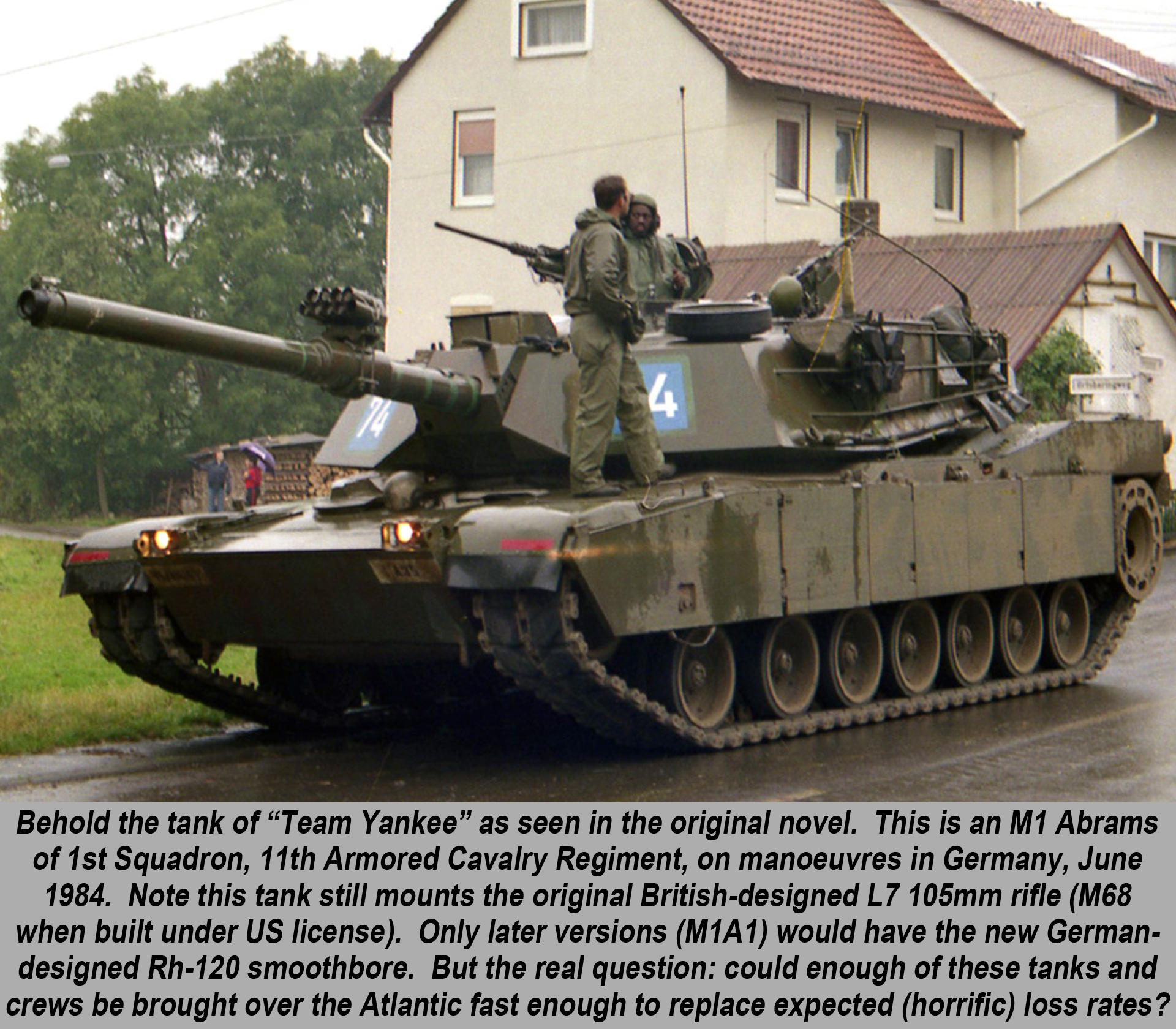
Another obvious weakness for NATO was that its strongest member was separated from Europe by some 3500 miles of Atlantic Ocean. A reinforcement plan existed known as the Return of Forces to Germany (REFORGER), but whilst men can be flown across an ocean the heavy equipment, such as tanks, must be ferried by ship.
This would have led to a third Battle of the Atlantic as submarines once again would be pitted against convoys.
NATO Order Of Battle
Oriskany Reviews The Troops
NATO is an interesting “faction” in a hypothetical World War III because it’s an alliance of many nations, and so gives players a wide range of choices for their armies and games. In the initial stages of a 1985 war in West Germany, we’re looking at West Germans, Dutch, Belgians, Danes, British, Americans, and possibly French.
During the 1980s, the West German border was defended by this “coalition army,” the line divided into corps areas. Furthest to the north we have West German / Danish Corps, a mixed force of German “Bundeswehr” (Federal Army) and Danish forces (with mostly German and American equipment), covering the line north of the Elbe River.
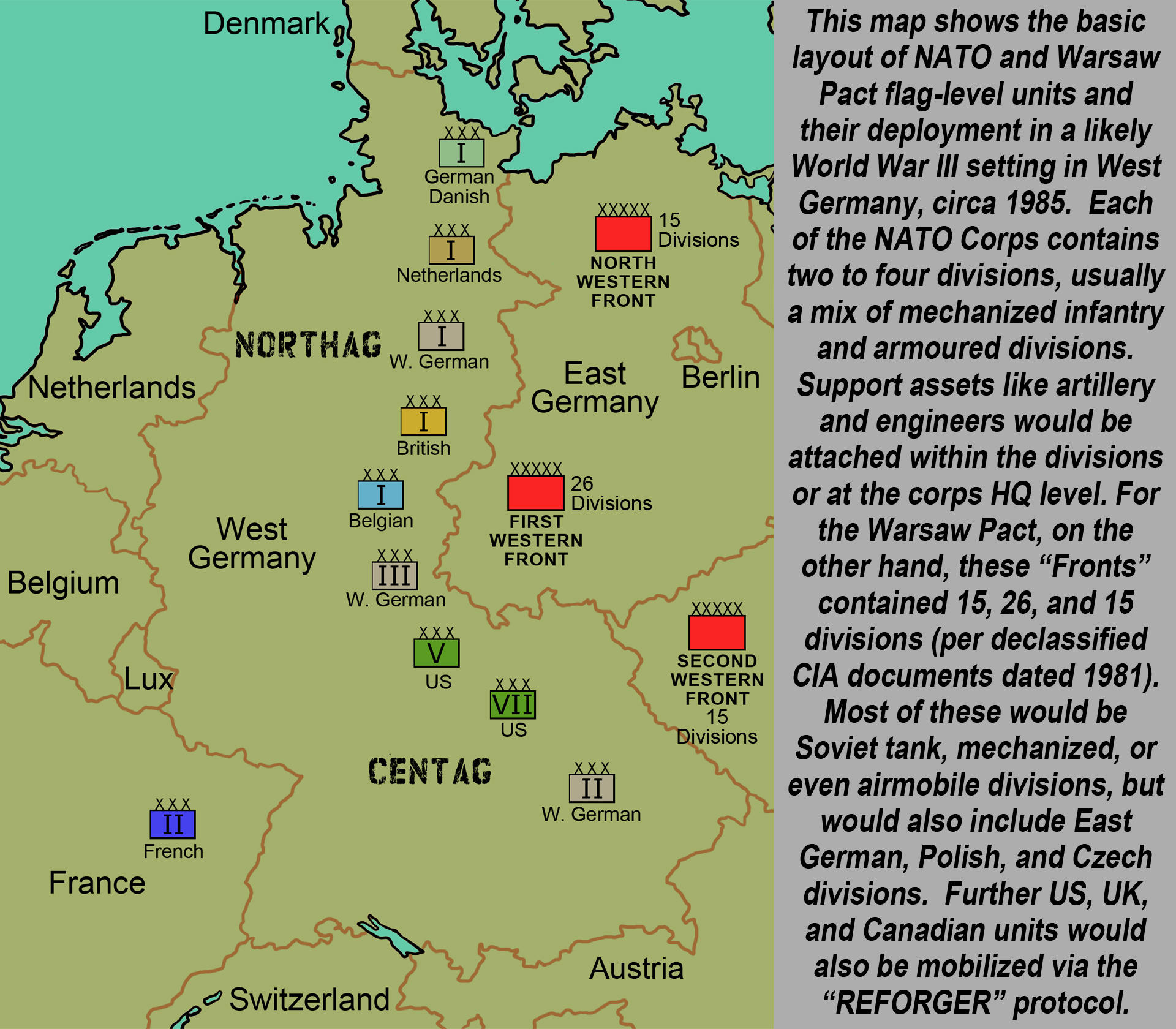
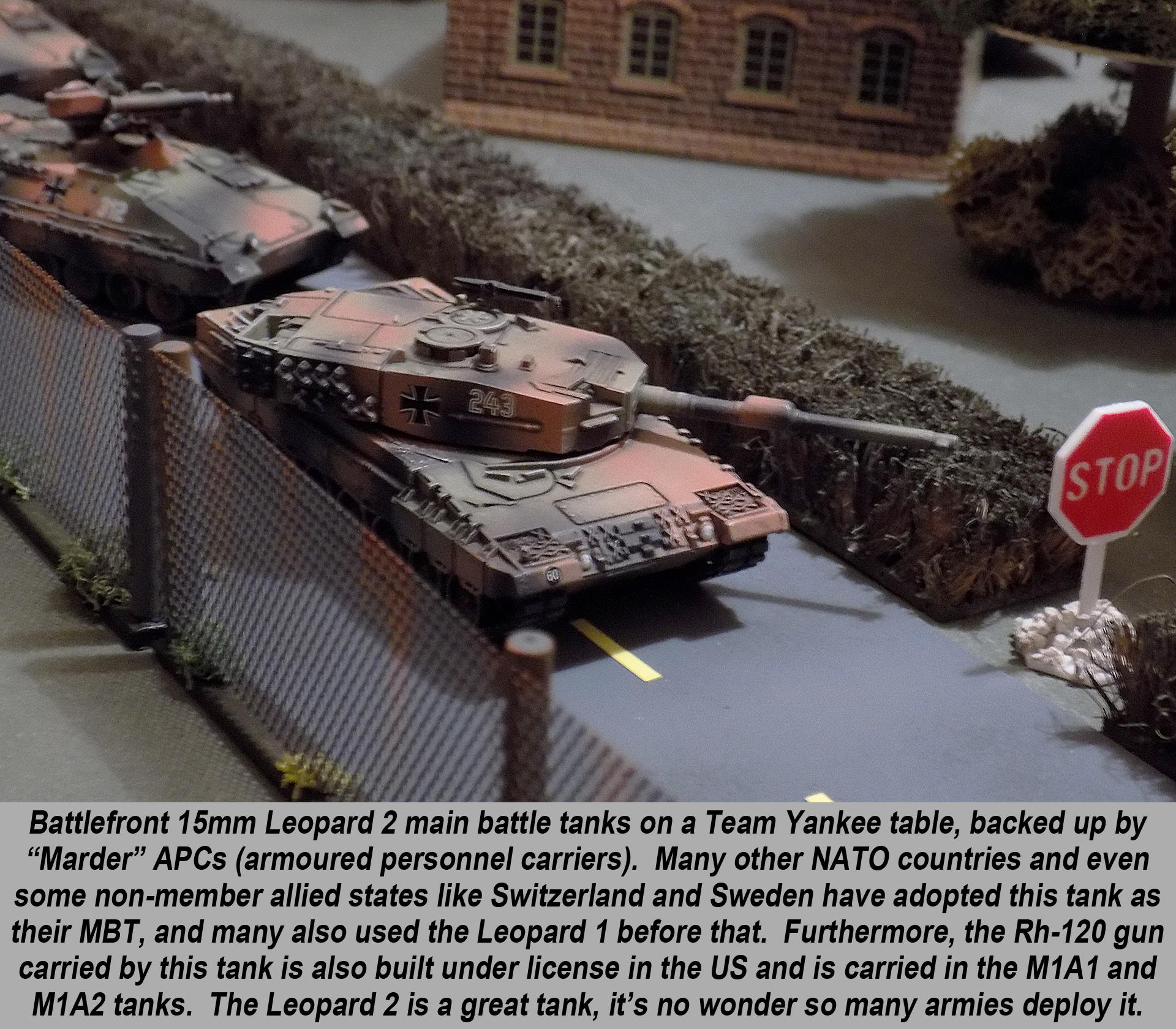
Next, we see the Dutch Corps (three mechanized infantry divisions), responsible for a sector extending back toward Bremen. These divisions each had an integral armoured battalion of German Leopard main battle tanks. Whether a particular division has Leopard 1s or the much better Leopard 2s depends on exactly when your “battle” takes place.
The West German I Corps is next, followed by the British I Corps and the Belgian I Corps, covering a broad area encompassing Hannover, Kassel, and Bonn (the capital of West Germany). The Germans, of course, transitioned from the Leopard 1 to the Leopard 2 during the 1980s, which still serves as one of the best main battle tanks in the world.
The British, meanwhile, were soldiering on with the Chieftain tank. Although one of the most powerful MBTs when introduced in the 1960s, by the 1980s the Chieftain was becoming a bit long in the tooth. A superb “Challenger I” tank was on the way, but in the mid-1980s I don’t think these had arrived yet in battalion-level field service.
The Belgian Corps was lightly armoured. Even in 1989, their 1st and 16th Divisions were outfitted with Leopard I tanks, “Jagdpanzer Kanone” tank destroyers from the 1960s, and a mix of American-made M113 APCs. They did have solid infantry units, armed with “Milan” missiles and transitioning to the Scorpion and Scimitar family of APCs.
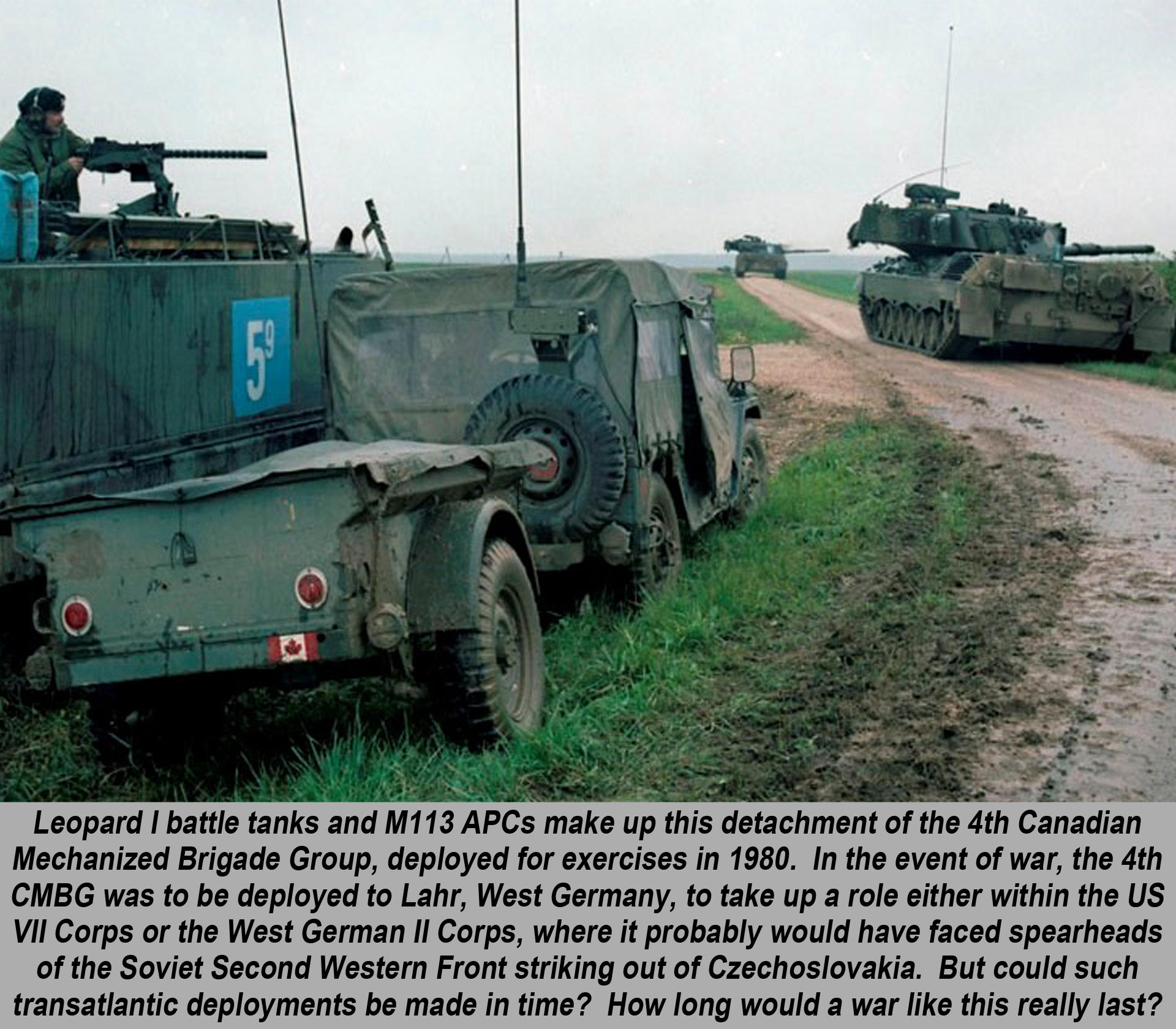
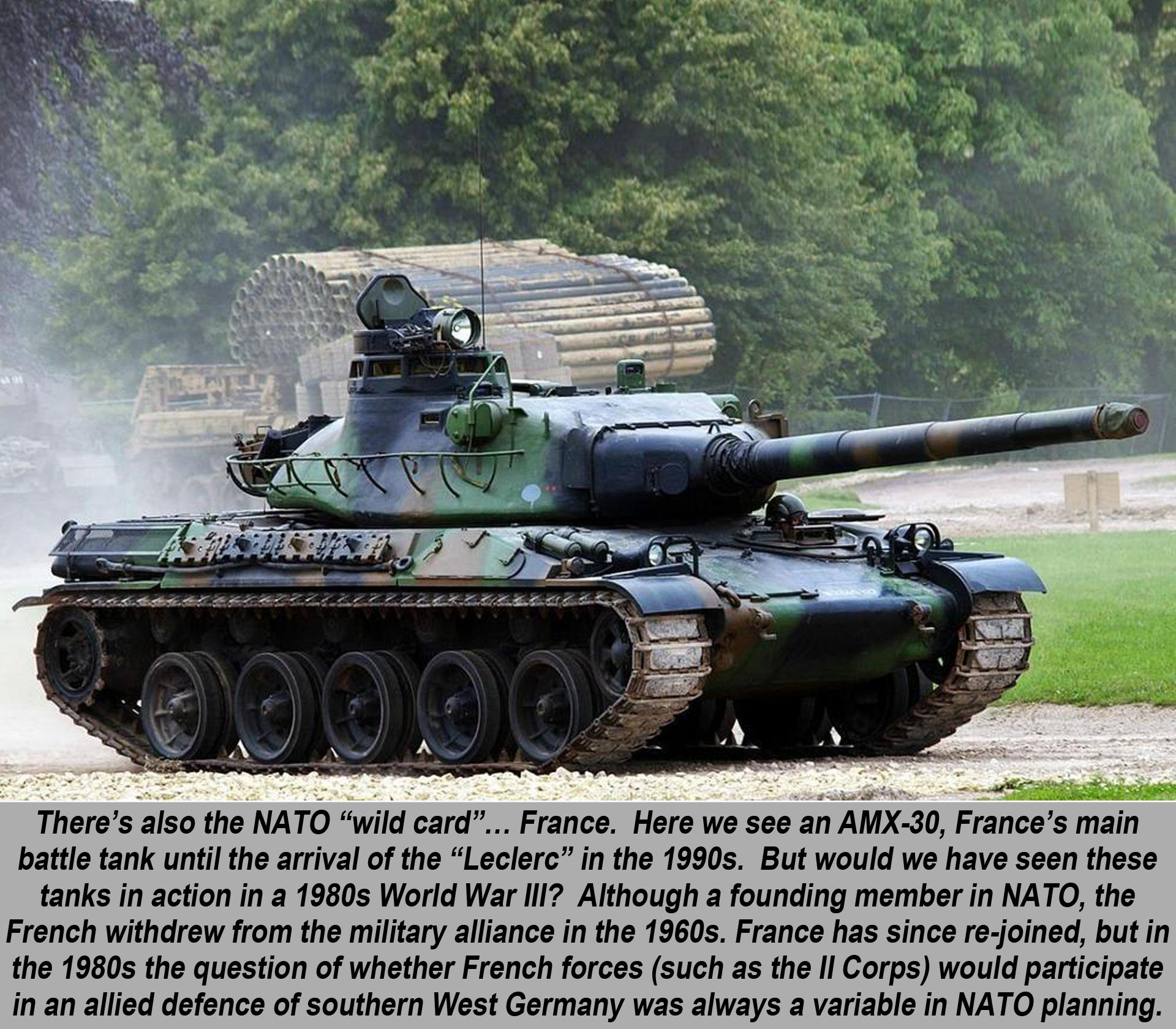
The southern half of West Germany, meanwhile, was defended by two West German corps (III and II) and two American corps (V and VII). With huge military budgets during the Reagan Years, these two American corps (especially the VII) were absolute juggernauts, lavishly outfitted with expensive military equipment.
The main American tank at the time (as well all know) was the M1 Abrams. Yet in Team Yankee we see it still armed only the L7/M68 105mm rifled gun the British had been putting in Centurions since the 1960s. This was also the same gun we see in the Leopard I and M60A3, making the Abrams clearly under-gunned for the 1980s battlefield.
Fortunately, the Americans soon switched this out for the new German Rheinmetall 120mm smoothbore gun being installed in the Leopard 2. This, combined with a very fast (if uneconomical) engine and British-designed “Chobham” armour, finally made the M1A1 Abrams the tank it was always intended to be.
These were just the initial line of forces. In the event of a Warsaw Pact invasion, further American, British, and Canadian divisions were “pre-staged” to be brought in as quickly as possible. These deployment protocols were practised over and over through the “Reforger” (Return of Forces to Germany) exercises of the 1960s-90s.
Warsaw Pact Forces
BenC Reviews Strengths & Weaknesses
It can be argued that the Warsaw Pact’s biggest strength was its greater political cohesion compared to NATO. Where the Soviet Union led, its allies would follow. This said Eastern Europe had seen its share of uprisings and Soviet tanks had been used on those streets.
The Solidarity movement, formed in the Polish shipyards in 1980, became the first organisation in the Warsaw Pact to openly have anti-communist ideals. In the wider view, however, the Warsaw Pact was arguably the stronger political body.

One overlooked strength of the Warsaw Pact was the “Operational Art.” The Soviets had a strong, well-considered warfighting doctrine developed from an ethos that encouraged forward thinking and innovation at the operational level.
This doctrine embraced combined arms and the notion of the deep battle using air assault forces and was undoubtedly ahead of NATO. In the event of a war, the Soviet and Warsaw Pact forces could have established and maintained the initiative through these doctrines.
The most obvious strength for the Warsaw Pact was their numerical advantage. However, putting that to one side we must recognise that the Warsaw Pact can move many of its central reserves rapidly by road, rail and air (i.e., not across the Atlantic). This would allow the Warsaw Pact to reinforce more easily than NATO under REFORGER.
The Warsaw Pact had its weaknesses, too. Since its formation and through to the 1960s the Warsaw Pact was more of a tool in East-West diplomacy than a military alliance. The Warsaw Pact was much more reliant on the Soviet forces than the European NATO allies ever were on the US.
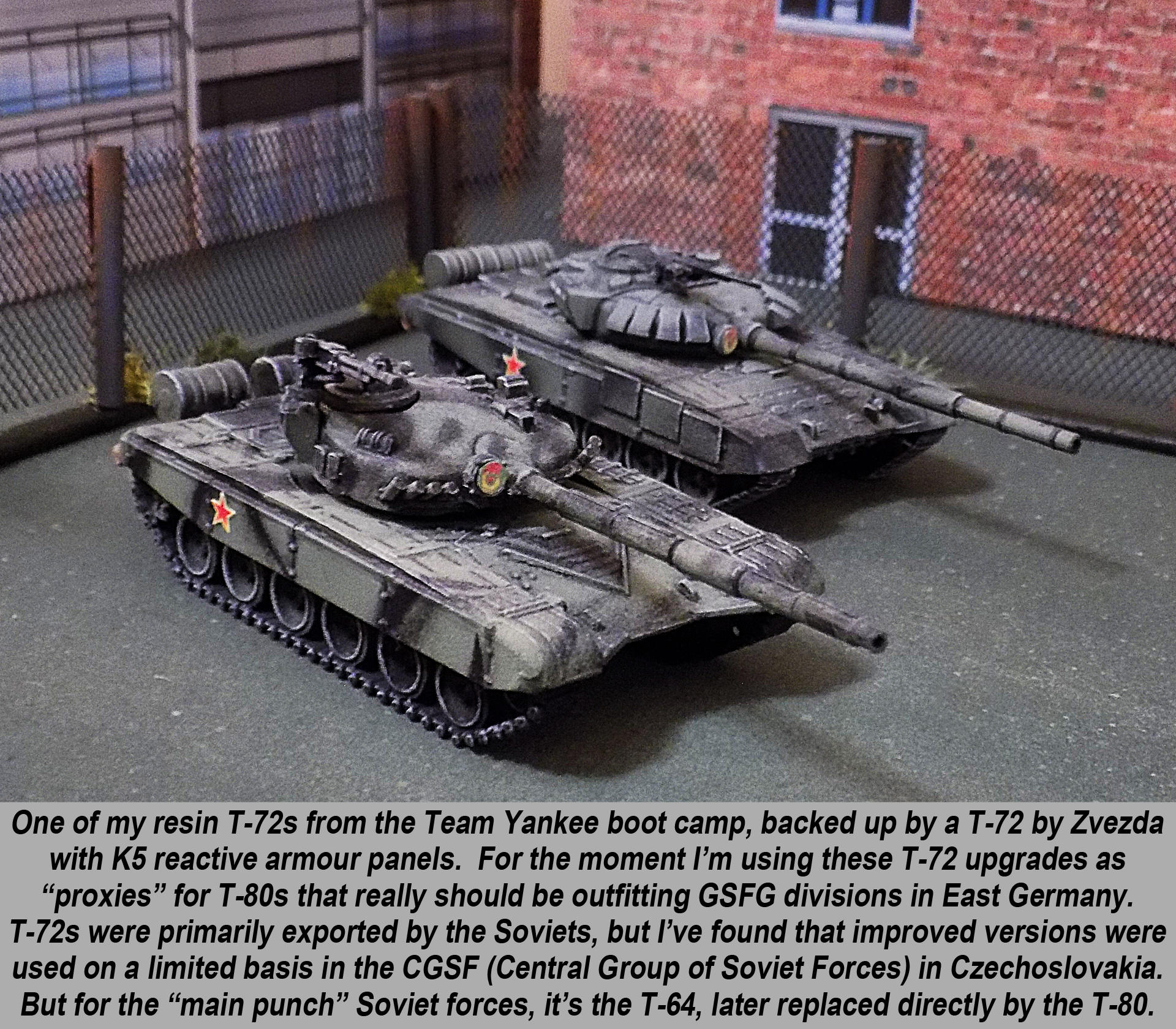
The Soviets retained the best equipment for their own formations and supplied the Warsaw Pact allies with export versions that did not provide the same combat effectiveness. The T-72 provides a good example. For instance, the export version of the T-72, known as the T-72M, lacks the composite armour of the Soviet T-72 which substantially reduces its survivability.
Despite the numerical advantage, the Soviet forces relied on conscription. This had men under arms for a comparatively short period of time; this can be considered a factor in the overall simplicity of Soviet equipment compared to NATO equipment.
In western armies, the burden of tactical command tends to fall upon the Senior NCO, however in the Soviet forces that equivalent burden would fall to the small officer corps. There was a noticeable lack of tactical freedom and initiative at the lower levels of the Soviet command structure, hence the greater reliance on following doctrines.
Warsaw Pact Order of Battle
Oriskany Crosses “Over The Hill”
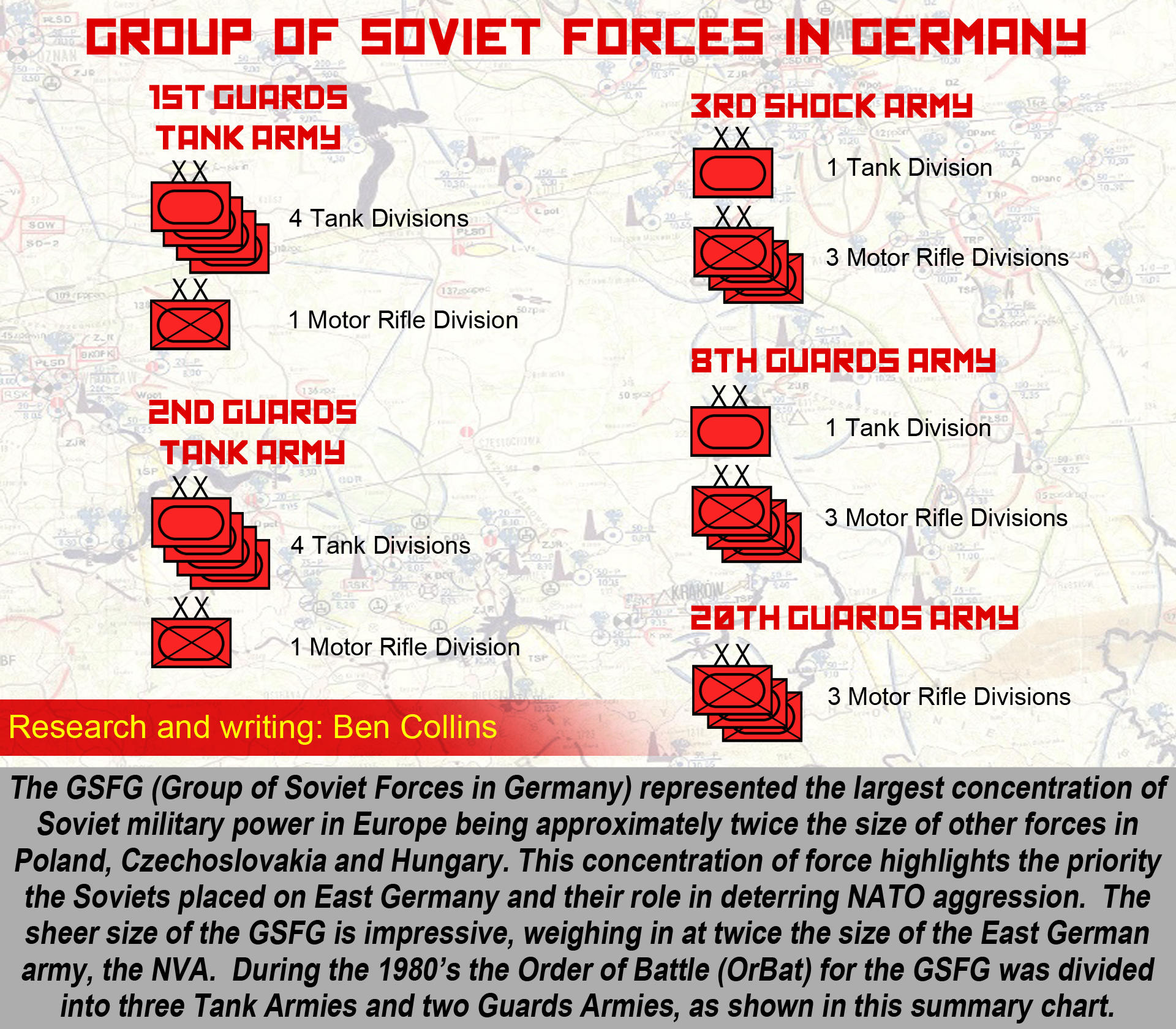
The Warsaw Pact forces facing NATO through most of the 1980s can be divided into a few major categories. These are GSFG (Group of Soviet Forces in Germany), follow on Soviet ground armies staged in Poland or the Soviet Union, and allied armies like East Germany, Poland, Czechoslovakia, and Rumania.
The GSFG was by far the largest of these components. Comprised mostly of “Category I” divisions (Soviets grouped their divisions into Category I, II, and III classifications), they were armed with the best equipment available, usually at least one generation ahead of their allies. Category II and III were reserve units, again with older equipment.
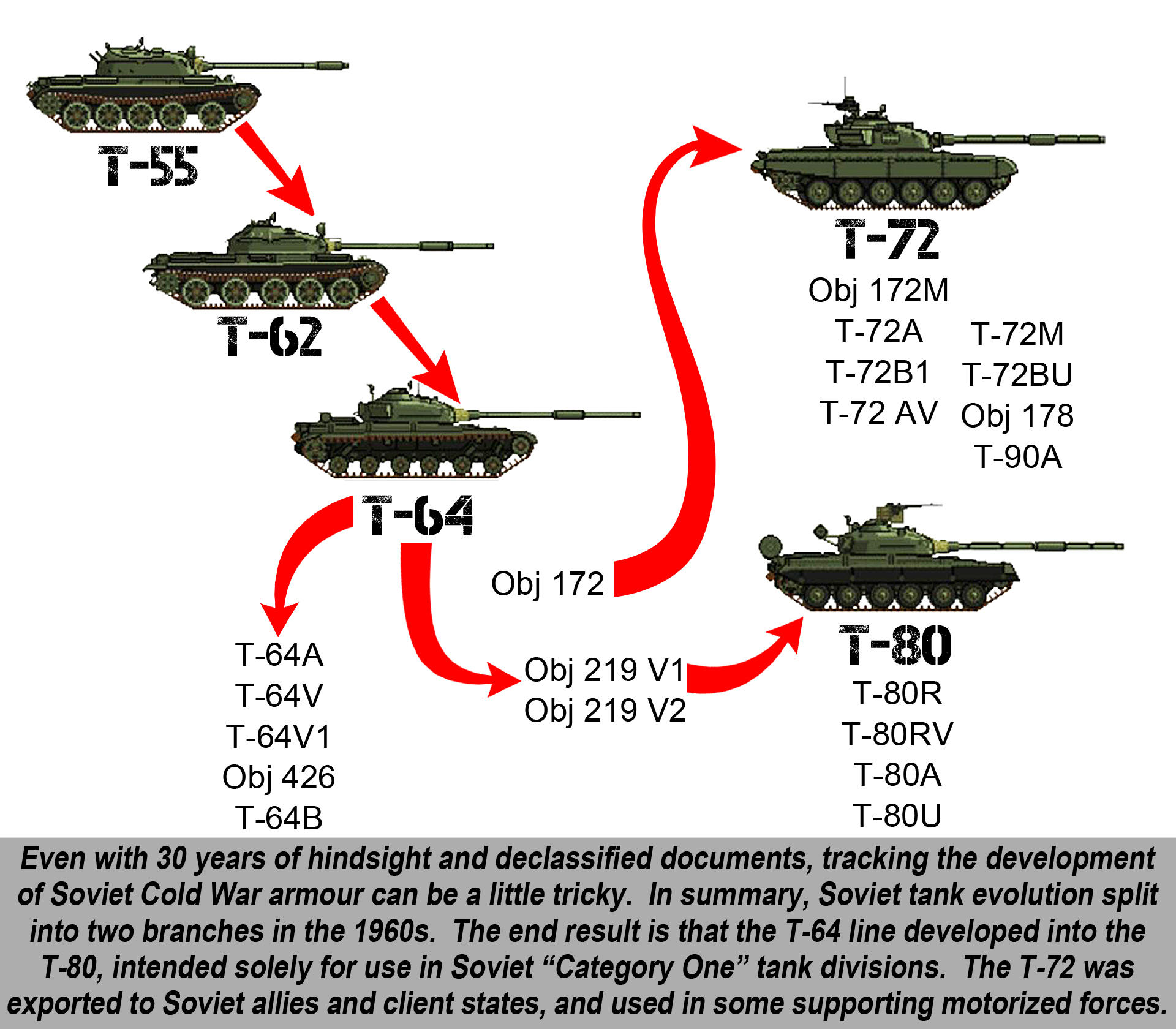
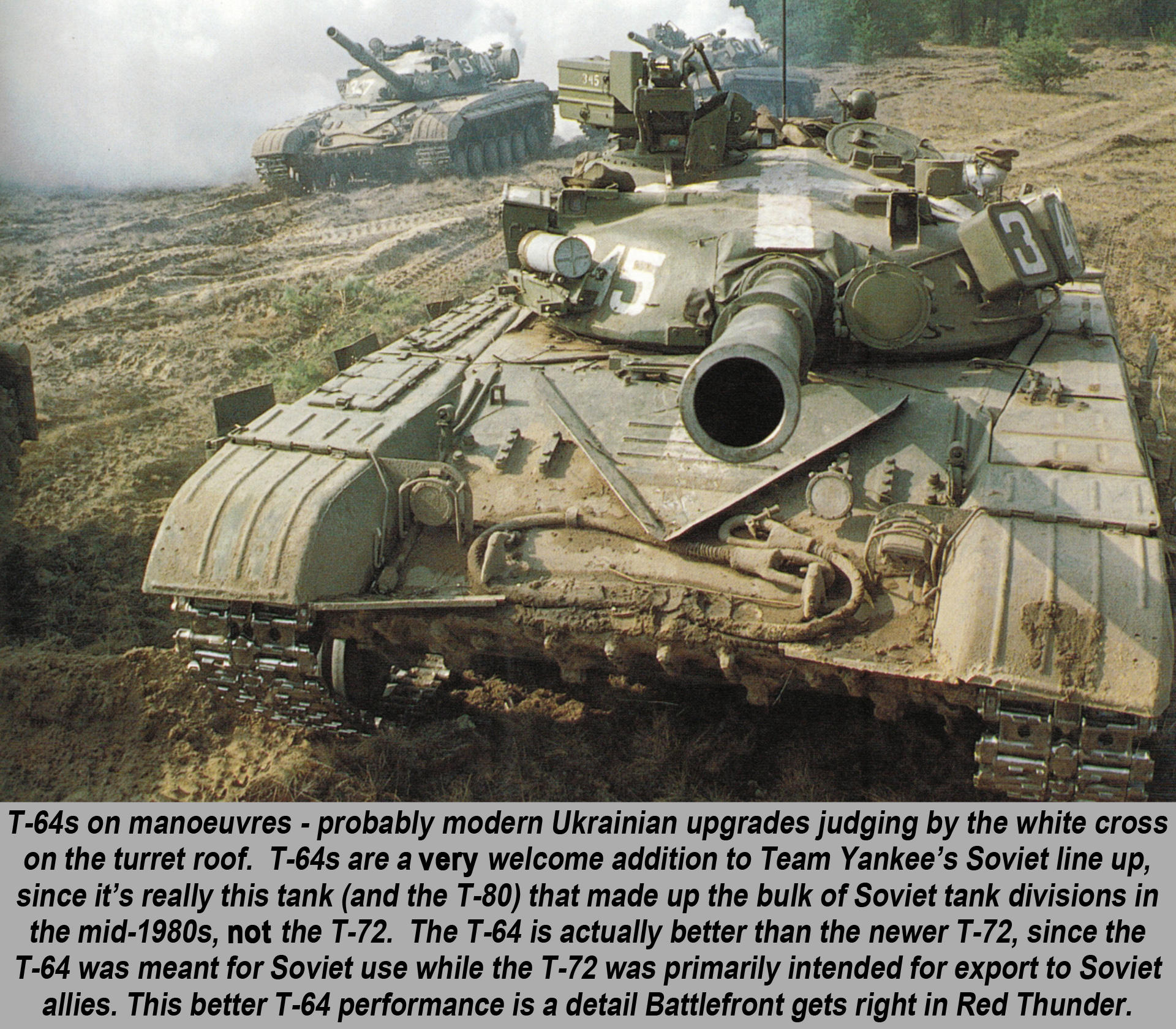
One of the biggest debates (which Battlefront seems to be addressing with their latest releases) is what kind of tanks the Soviets should have. I may catch some grief here, but the fact is that by 1985 the main Soviet battle tank should be the T-80 or the T-64, not the T-72.
Please remember that the Team Yankee novel is in fact based on Hackett’s TTWW, originally envisioned in the mid-70s when the T-72 was first coming out. At the time, NATO analysts believed that the T-72 was slated to become the next Soviet MBT. In fact, this was never the case, the T-72 was meant for export to Soviet allies around the world.
Then, when the T-80 started coming out, early versions of the T-80 were mistaken for T-72 upgrades. Meanwhile, Hackett had published TTWW (which features huge armies of Soviet T-72s), then Coyle published Team Yankee in the “world” presented by Hackett.
I give Battlegroup full credit for sticking true to the Team Yankee source material. Furthermore, they seem to be addressing this gap with the T-64 included in “Red Thunder” expansion. In this set, the T-64 is actually better in the game than the T-72, which is exactly how it should be.
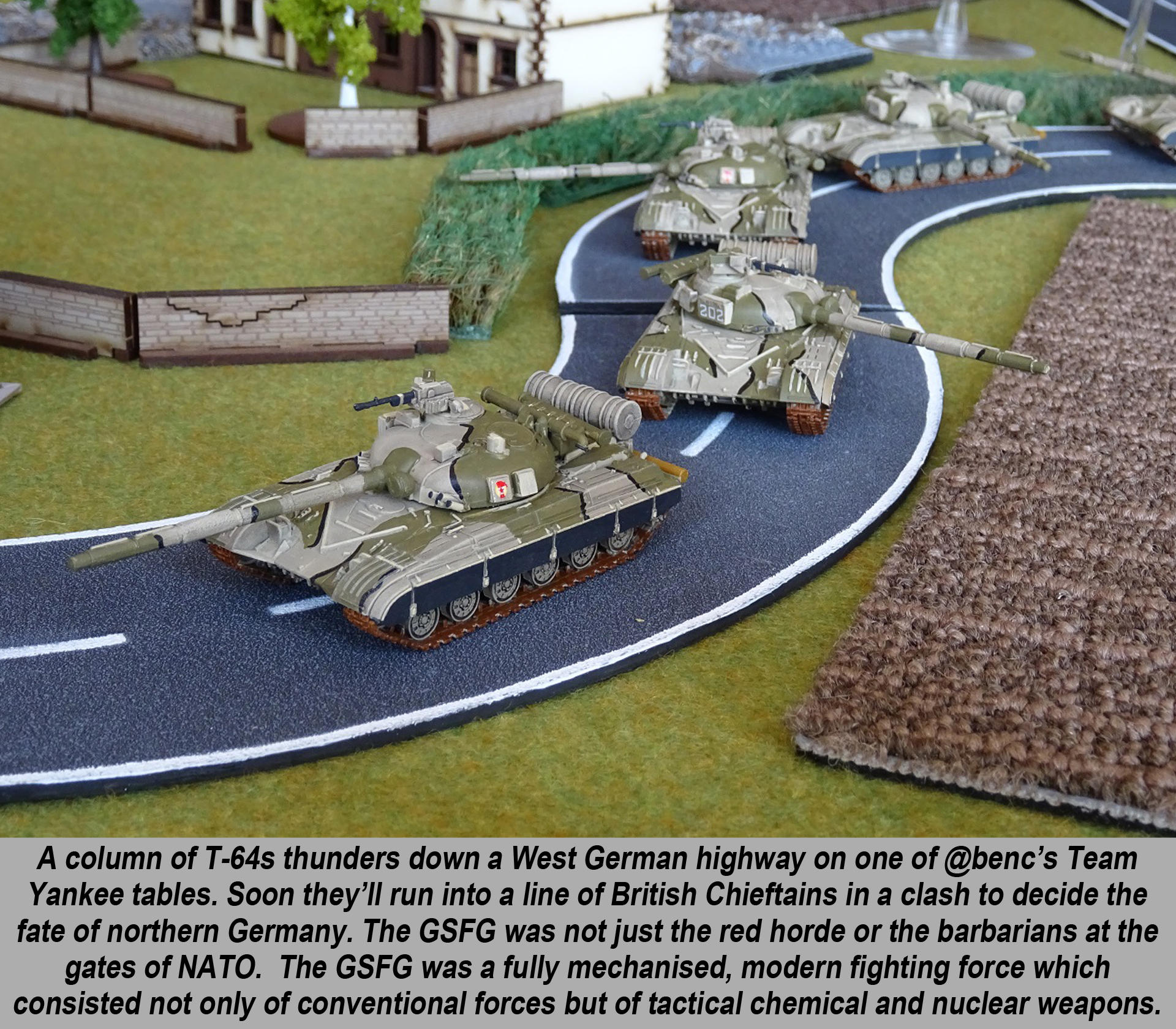
The T-72 does see limited use in the actual Soviet Army...support and HQ units, for example. Also, some regiments fielded T-72s in Czechoslovakia and home garrison units. And of course, T-72s should definitely be used in Polish, Czech, and East German divisions. But the “spearhead” Soviet tank divisions should be using T-80s or T-64s.
We hope you’ve enjoyed this instalment. We may have stirred up some opinions here, but a discussion is always one of the big objectives for these articles. How do you build your NATO and Warsaw Pact armies? What new units would you like to see? Are you participating in the Red Thunder campaign? Let us know in the comments!
If you liked this article and want to know more about the history behind Team Yankee, make sure to check out the Weekender Interview with oriskany below...

Click On The Image and you'll be taken directly to the segment in the show to learn more.
If you would like to write an article for Beasts of War then please contact us at [email protected] for more information!
"The common perception of NATO’s biggest strength was its technological edge over the Warsaw Pact..."
Supported by (Turn Off)

Supported by (Turn Off)
"We may have stirred up some opinions here, but a discussion is always one of the big objectives for these articles..."
Supported by (Turn Off)




Great article. Pretty much in agreement with all of it. Except maybe the bit about the Eurofighter, the main reason why it was delayed so long was because of the end of the Cold War and greatly reduced budgets. There certainly was some politics going on but overall it did progress relatively smoothly.
If you want a more detailed description of the tanks above, I’ve posted this in the forums:
http://www.beastsofwar.com/groups/historical-games/forum/topic/team-yankee-wishlist/
Can’t wait for part three.
Cheers.
Thanks very much, @klorophil – and thanks for opening up that new thread.
As far as the Eurofighter goes, I think I’ll stick to my guns … at least a little. The first requirements and specifications were sent out as early 1972, and development didn’t even get started until 1983. I think a lot of this was because of the different nations involved debating what the new aircraft should actually do (the politics you mentioned).
I would agree that the 1991+ development would have slowed down because of reduced threat / budgetary cutbacks. My point was more the 1970s – 1980s development (or lack thereof).
Lord knows we saw plenty of this going on with the Germans and Americans with the XMBT70 project, leading to the Leopard 2 and Abrams. I’m sure you know (but for other readers) they started as the same tank (or at least the same development project) which basically went nowhere – mainly because the two nations couldn’t agree on fundamental requirements.
The Germans wanted a big, high-velocity 120mm gun. The Americans were still obsessed with their 152mm gun-fired antitank missile, the Shillelagh, as mounted on the M551 Sheridan.
Both tanks eventually came out in the 1980s, and the Americans would up with the German 120mm gun in the Abrams anyway. So there’s 10-15 years (and untold millions) wasted to wind up at where the Germans wanted to be in the first place.
Maybe I should have used that example instead of the Eurofighter, but this was also an excuse to get that sexy Eurofighter picture in the article. 😀 😀 😀
TRIGAT (the intended replacement for MILAN) also gives a good example of how multi-national and multi-requirement procurement shouldn’t be done.
http://www.globalsecurity.org/military/world/europe/trigat.htm
I’d like to add JSF F-35 to that friggin’ list. 🙁
Great lunchtime read Jim & Ben, I have been catching up on this series over the weekend and will add a few comments when I get home from work tonight (nice chieftain AVRE behind that AMX-30!) 😉
Ah, another veteran of the 1985 Lloydoslavian War arrives, Lt. General Brusilov, commanding 3rd Shock Army. 😀 😀
I can’t imagine why you’re noticing that Chieftain AVRE. Is there some personal reason you would have an affinity for suck military engineering vehicles? 😉
Looking forward to the comments. I’ve been hoping you would “show up.” 😀
Thanks @brucelea, glad your enjoying the series.
YOU’RE not your. Curse my tired brain typing fail.
Heeey, there he is. 😀 Thanks for jumping in, @benc . And of course thanks for all the help on the series. 😀
Like a bad ruble comrade Oriskanov!
😀 Not at all, @brucelea . Lt. General Oriskanov’s turn to bring the vodka to the next Lloydoslavia War reunion. 😀
Another great article. I appreciate your efforts to put focus to the conversation. Clearly there was still a Soviet Union in 1985 and there T72 formations outnumbered T64. But as I believe you offered we are focused on what Hackett and later Cole believed what 1985 would look like and not the “each and every” of what 1985 actually looked like. Do I really have to wait till next Monday for Part III? At my age I’m into instant gratification. 🙂
Thanks, @irondragon6 –
Regarding the T-64, -72, and -80, I actually learned a lot during the course of research for this series. I knew the Soviet tank development had branched in the 1960s, but I always thought it was the T-62 to the T-72 . . . and the T-64 to the T-80 . . . with the T-64 / T-80 being the only primary Soviet tank for Soviet use (T-72 for export).
As I learned, the situation wasn’t quite that simple. My information came from GDW’s Assault series, which I played for years, and gave iron-clad T-80 and T-64 based OOBs for Soviet tank regiments and divisions.
Thing is, this edition of Assault focused mostly on GSFG divisions. So it was right, but incomplete.
T-72s were extensively deployed in other Soviet supporting commands, such as NGSF (deployed in Poland), and the CGSF (deployed in Czechoslovakia).
Apologies, yes . . . next Monday is Part III. However, Klorophil has a great new thread going here that might tide you over. 😀
http://www.beastsofwar.com/groups/historical-games/forum/topic/team-yankee-wishlist/
The T-64 & T-72 are a great example for showing that the West isn’t the only place where procurement is a dark, swirling mass of confusion and contradiction. Instead of competing companies/firms the Soviets had their own rivalries between design bureaus.
The T-64, despite being an earlier design, is regarded as the superior tank over the T-72. The T-64 represented a massive uplift in combat capability over the T-62; the autoloader, gun stabilisation, a very advanced, and small, power train etc. This came at a cost though of being difficult and expensive to build, maintain, equip and train.
The T-72 was the solution, having less of a financial & technological cost and to my mind the most important one, less of a training burden.
So, we end up with the situation where the Soviet forces are being supplied with two different tanks, from two different design bureaus, to two different operational requirements.
You couldn’t make it up Comrade!
YEEES! T-64 is a superior tank to the T-72, and of course the T-80 evolves out of the T-64. Except the T-80 suspensions and running gear always looks a lot more like T-72, t he T-64 has those tiny little torsion-bar wheels. 😀
Well said @benc
It’s often misunderstood. There was a reason for the newer T-72 was weaker than the older T-64… and that was the price and the complexity of this system. It was easier to roll out greater numbers to supply the Soviet Army and their allies.
And the rivalries between design bureaus was present at every branch… Aircrafts, Tanks and Ships… everywhere.
Errata on my last comment, should have written T80/T72 formations outnumbered… Operationally we were so focused on identifying T64s as we believed that would signify their main effort; habit has been to identify everything else T72, T62 or T55. Sorry if I caused any any confusion.
Awesome. Yes, I would agree that the T-80s were outnumbering T-64s by 1985. T-80s were the evolution of – and replacement for – the T-64s, as opposed to T-72s. T-72s were never the front-line, spearhead Soviet tank for Soviet use. That was the T-64 evolving to the T-80, with the T-72 on the wings in the aforementioned NGSF/CGSF, and of course downgrades for export to other Warsaw Pact and allied states.
Ironically, with the fall of the Soviet Union, we’re seeing a reverse of this in some ways. The T-64 and T-80 factories were largely located in Ukraine, so when Ukraine broke off, the Russians were left with largely T-72 manufacturing capability. Hence the T-90, which is actually an evolution of the T-72 instead of the T-90.
Not sure how widespread T-90 deployment and export ever got, though. Then we had the Black Eagle, and this new T-14 Armata monstrosity . . . It’s all quite confused at the moment (at least for me). 😀
When Team Yankee came out, our group started Team Yankee in 6mm (Sorry Battlefront). I investigated the satellite states of the warshaw pact. And my focus was on Czechoslovakia. And i was surprised that their armed tank forces consisted mainly T-55. I mean this tank was old at this time. Where the soviets afraid that they would start an uprising and turn their weapons against them? So these were just 3rd class troops for the warshaw pact?
Hey, I know where you’re coming from, @andre77 – my group at the time was playing the “original” Team Yankee as early as 1987 – published by GDW as part of their “First Battle” series.
https://boardgamegeek.com/boardgame/8101/team-yankee
T-55s were indeed issued to many Warsaw Pact partner states like Czechoslovakia, Poland, and East Germany. Later these would be upgraded to the export-variant T-72s, but I don’t have exact data on the timeline on that right now.
Overall I’d say that Battlefront have done a good job in Red Thunder of expanding the Soviet forces. The lists enable the obvious tank heavy or Motor Rifle heavy forces and BF have expanded the support options with some interesting choices.
TY is a game however. The selection of unit or equipment type must be looked at through the lens of game design and (gasp!) balance. A points based system is not going to deliver true to life OrBats nor include everything that was ever painted green 🙂
Truer words never spoken. I’m sunk neck-deep in an American Revolution project at the moment, but I think Red Thunder is next on my purchase list immediately after that. 😀
Almost enough to make you look forward to Mondays. Almost.
Another interesting article – particularly the mention of Solidarity. The imposition of Martial Law in 1981 is a big event in terms of the development of the Polish political landscape but it also says a lot about the other Warsaw pact allies, the East Germans for example were eager to go in and help crush the opposition in Poland. That eagerness of the East Germans against the cautious outlook of the Czechs and the Poles brings in an interesting slant to WW3. For the DDR, victory could have meant German reunification, not to be disparaging but with enough troubles at home how zealous would the Poles be in the already nightmarish task of pushing the capitalists into the Rhine? Facing off against Nato would have been terrifying for even the staunchest believer in ‘the cause’ let alone a reluctant conscript thrust into the middle of quite literally world war 3 whose family back home are getting the crap kicked out of them by the police, treated as enemies in their own country… More about survival than anything else! Good stuff, look forward to next week.
Great points there @bigdave, and I agree about ‘almost’ looking forward to Mondays…
The WP political cohesion was, at the same time, its strength and weakness. Politically more robust than NATO in terms of political unity and purpose yet weaker due to the obvious classes of nations in the ‘classless’ system. If the Polish army had been used as cannon fodder (for want of a better description) or seen as ‘expendable’ by the Russians then the conditions for a Polish ‘workers revolt’ back home very definitely existed.
Great comments @bigdave and @benc – we get into this a little more in future parts, where we talk about the possible ways this war might have ended. There are “social / political fault lines” in both alliances that might have buckled under the tremendous stresses to which such a conflict would have subjected them. Who might have cried “no more” or “no way, we’re not doing this.” 😀
Right, I’m catching up on this so please cut me some slack if I go over some old ground from the first instalment. Secondly, and more controversially, is it ok to post on this thread whilst painting Primaris space marines???
Burn the heretic! Sorry wrong millennia 😉
Anyway, first point….
team Yankee was a first for me, as I usually enjoy historical games but am not one for re-enacting modern history within my living memory, as it is all just a bit close to home. However TY gave me the opportunity to look at the what if scenarios of what would have happened if my 5 1/2 years on the beer in BAOR hadn’t been all that and I had actually had to earn my keep and properly blow some sh!t up!! (For the uninitiated into my long & boring war stories, I was a combat engineer for my sins).
I think that we cannot be too hard to the two main authors of the TY world, as they worked with the intelligence they had available to them at the time. I certainly remember in the mid, to late 80’s being repeatedly reminded that the main tanks we would be seeing would be the T-55 (easily distinguished by the gap between the first and second road wheel, see some shit sticks even 30 yrs later!). As engineers our biggest concern was not just from slowing down the progress ofthe front line forces but from airborne attack trying to disrupt our supplies, control vital bridges and most importantly (which is where I have an issue with TY the game) dropping millions of nuisance minefields. Anyone who has been to Afghan, Northern Ireland or any war zone where your next step could be your last will know the crippling effect this can have on unit manoeuvre and morale. The PFM-1 Butterfly mine was/is particularly nasty and although the game allows for minefields to be placed before a game starts to act as area denial, I would have liked to see a mechanic where you can pay points to drop mines such as the PFM-1 to change your opponent’s plans and force them into a difficult decision.
T-72’s, enough has been posted on this topic, all I would add is that any tank firing at you is going to make you think, I would have preferred T-64’s and like Jim, I will be adding a company of these to my soviet horde. Speaking of which, I went for a VDV force, mainly as I had been given six hinds on the boot camp and wanted to use them in the transport role, added to this is all the usual artillery and air defence support and then I got some BTR-80’s from Zvesda (as at the time BTR-60’s weren’t available) so my force could drive into combat if the scenario called for it. I had wanted to get the airborne variant of the BMP, the BMD-1 but I could only find them on a kickstarter and unfortunately I was skint at the time so missed out. I therefore opted for BMP-2’s mainly because I like the extra punch of the spandrel AT5 🙂
I have recently got some BDRMs for a recce element and just need to get some air support and then I think I’ll be done…………who am I kidding, Acacias, yes please!
Another thing where I have an issue with the game and the alternative history is the idea of engaging the WP in open ground, as I understood the battle plan, everything was about delaying the enemy long enough to either grind him to a logistical halt (highly unlikely) or slow him long enough that the numerical advantage had been somewhat counteracted by reforger units. On all the big exercises I took part in, the first 24 to 48 hrs were no sleep and were all about prepping defences, emplacements, huge minefileds and last of all bridge demolitions (nearly all the bridges over key North/ South rivers like the Weser were, and most likely still are prepared to take ready made explosives). The only open ground warfare would have been the initial units trying to blunt the first blow whilst moving back to the first line of defence. Country attacks, in my opinion would have only occurred locally to buy time (we’re back to Dunkirk again Jim & didn’t even start developing the close support concept until the very end of the 80’s as the thought of supporting attacks with specialist engineer assets wasn’t in our doctrine, they were held far back and only called forward if needed but by then most attacks would grind to a halt whilst they waited for a load of outdated armoured farmers to reach them (if they hadn’t broken down!).
To give an example of the type of equipment I’m talking of, it was practice in the mid 80’s for armoured engineers to provide their own close support to specialist assets such as a bridge layer (AVLB). These protection vehicles were two 105 Centurions and we still had centurion AVREs with the big 165mm dustbin gun. The chieftains we had were so loaded down with facines and bridges they had difficulty keeping up with the main battle group. Hence the idea of leapfrogging from one harbour area to the next and hoping that is close to where you are needed.
Finally for this post, I think the best advantage of still having the chieftain MBTs is that the crews were very well trained, all of the issues with the tanks had been long since ironed out and the only mechanical risks I saw were down to aging parts. However that said , the first time I saw a Challenger MBT I thought it had come out of a sci-fi world it was so far ahead of anything else I’d seen.
That’s counter attacks, not country attacks. Although that said a battalion sized unit of young farmers would definitely scare the crap out of me and put up a hell of a fight!
If you could keep them off the beer long enough 🙂
😀
No worries, @brucelea . Up above I was supposed to say “such military engineering vehicles,” not “suck”. 🙁
No, you really did mean suck and boy do they suck most of the time. We used to joke that we,d never get half of our equipment out of the garages let alone the camp gates before it broke down. On one exercise we only got one combat engineer tractor (CET) out of four we had out on to exercise and you need at least two to dig an anti-tank ditch. Had a cracking BV on it though so loads of brews 😉
I can sympathize, @brucelea , I remember the woes our armor and amphibious assault guys went through trying to keep those old M-60 tanks running (Marine Corps hadn’t received any of the newer M1 Abrams yet – only the Army gets the nice gear at the outset). 😐
@bigdave makes a good point, just how well would the WP forces have held together should everything start to grind to a halt and they find themselves repeatedly being given the tough spots on the front whilst their soviet allies sit back with all of the better equipment.
the other question is just how far would NATO go should the tide turn and they go on the offensive? Stop at the East German border? Or reclaim the whole of Germany? Personally I would have hoped they would have carried on into Poland at least but given the casualty adverse nature of western countries I doubt it would have got much further than the old border at best.
Thanks again, @brucelea –
“just how well would the WP forces have held together should everything start to grind to a halt”
This thread’s getting a little disorganized, so I apologize if I’ve said this above, we DO get into that a little in Parts 03 and 04 – the “political fault lines” in both NATO and Warsaw Pact – fractures that may have developed once the devastation really got started.
I’ve made the case many many times that NATO couldn’t have struck first and invaded eastern Europe. But of course your point is different, what if (by some miracle) NATO was winning such a war and it hadn’t gone nuclear? How far does NATO push back?
In Team Yankee we see American forces in East Germany by Day 14.
In GDW’s Twighlight 2000 WW3 RPG, American recon forces at once point actually push into Belarus, just across the border. The bulk of NATO’s armies (what’s left of them) are in Poland when world civilization finally collapses (thus setting up the background for the RPG).
You have to kind of close your eyes and ears to a whole range of “you gotta be kidding me” factors, I feel, (NATO winning with enough strength to go over to the operational-scale offensive, no one cooking off all kinds of nukes, etc). But once you do, it really does open a whole range of questions.
One thing’s for sure, this would be with a whole lot of second- and third- line forces. We’d see invading armies of Chieftains, M60s, Leopard Is and the like against Soviets T-64s, T-62s, and T-55s. All the front line stuff is long wrecked and NO ONE’s factories are keeping up with losses.
Of course, when it comes to NATO commanders invading East Germany …
NOTHING will ever beat a CERTAIN British NORTHAG commander (*ahem*) I could mention who dropped 6th Airborne into Magdeburg on the last turn of the game (Oh, wait … that was 1946, not 1985 . . .)
Nothing ventured, nothing gained:-)
That was an epic move that DAMNED near turned the game. 😀
Series continues to be great, @oriskany and @benc!
I am a bit surprised VII corps were the lavishly equipped US forces, I figured given the US’s fascination with the Fulda Gap V Corps would have been the pride of the US forces in Germany.
Thanks, @wayton –
I’ve seen maps that show V Corps holding this region, and some with VII showing this region. I see photos with VII armor (you can tell by the tactical numbers) “in Frankfurt” which is in the Fulda Gap area, so I honestly don’t know.
US Army veterans of the period are on the thread and I’ve been asking them for clarification. I’m not sure exactly where those corps deployment boundaries were and I’m sure they changed from year to year.
VII Corps gets the reputation as the US Army’s / CENTAG’s “Sunday Punch” ironically not because of anything in Germany, but because they were ones redeployed to Saudi Arabia for Operation Desert Storm. They were the primary “foundation” unit for Schwartzkopf’s “left hook” and probably the largest and most powerful operational-scale formation the Coalition had in that war.
We get more into the Fulda Gap in Part 03.
BTW, I’m still trying to find an answer to the question you asked in Part One, about when Soviet formations would use the BMP-based mechanized infantry and when BTRs were more the norm. I was hoping to find a distinct, confirmed “rule” about when some units were built with one and not the other.
I’m finding tons of information about HOW BMP- and BTR-based mech regiments were built and how they differed, but precious little about what the criteria was about WHICH would be assigned to a given division.
So far I’m finding a lot of circumstantial documentation that suggests mech inf regiments in tank divisions were BMPs. Mech Infantry regiments in motorized rifle divisions were BTRs.
Also, sometimes Category 2 and 3 tank divisions would have BTRs instead of BMPs.
Again, this is sketchy, so don’t “take it to court.” But its the general tendency I’ve been finding in research.
nice to see the soviets were all on the same side were any of them still using WW II tanks?
what was the front like on the sea side @oriskany a big sub force?
Thanks, @zorg –
In 1985 no, no one in the NATO or Warsaw Pact were still using WW2 tanks. The closest you could say to that Soviet Category 3 divisions (deployed back in Kiev, Western, and Leningrad TVDs) were using T-55/54s, which can draw an evolutionary line back to the T-44 (very rarely used, almost a “skipped generation” in Soviet armor development) which draws back to the T-34/85.
WW2 armor was still being used IN COMBAT as late as 1973, in the Yom Kippur War.
Angola I think was the last country to be using the T-34/85 as an actual front-line battle tank. You might be able to find people using M24 Chaffees and the like as well.
Some people might also point to the Centurion, but I don’t really consider the Centurion a WW2 tank. It really wasn’t.
Naval operations in a potential WW3 are a little out of our scope here, but the broad ideas have been sketched out by Larry Bond (co-author of Hunt for Red October, Tom Clancy also credits him as co-author of Red Storm Rising – design naval wargames like Harpoon and WW2 naval wargames like the Command at Sea series).
Three basic questions here: (and I invite guys like @ecclesiastes or @commodorerob to join in here):
1) does the war go nuclear? A big part of naval operations in WW3 comes down to the two basic types of submarines, hunter-killers and “boomers” – nuclear missile boats. How may of your HKs are AT THE SECOND WW3 BEGINS directly behind an enemy boomer, you torpedo her and sink her before she can vaporize two dozen of your nation’s cities. And of course the enemy’s HKs are trying to do the same to you.
2) Assuming no immediate and unilateral nuclear exchange, bottling the Soviet navy up in the Barents, White, Baltic, and Black Seas. The objective for the Soviets is to get out and interdict American convoys trying to deploy CONUS forces to the UK or Germany via the REFORGER protocols (basically, can the US get more of their home forces to NATO in time, or does the Soviet Navy break out and sink our convoys)?
3) Does the Soviet Navy try to “pry open” the North Atlantic with expeditionary landings to establish bases at places like Iceland or northern Norway? This is the “Keflavik Scenario” we see illustrated by Clancy and Bond in Red Storm Rising. That’s the book that probably best details what a naval conflict would look like in a 1980s WW3.
a great answer the M24 the air dropped tank the US not still have some? @oriskany as you say not your area the navel side but was thinking what sort off losses of reinforcements the NATO forces would have crossing the Atlantic.
For air mobile tanks we’re talking the M551 Sheridan for the US.
And yeah, naval / convoy ops between the CONUS and AFCENT NATO command in central Europe is “my area” (or at least I’m conversant with it) – it’s just not really what the article series is about.
The only real NATO reinforcements coming across the Atlantic are Canadian REFORGER units and the aforementioned CONUS (Continental US) forces.
What that picture what have looked like however is so dependent on the three variables listed in my previous reply it’s actually hard to talk about until “decisions” or “presumptions” are made on those three questions.
Until we know what’s happening with those three things, naval operations in the North Atlantic are a little tough to predict / theorize.
a very complicated situation then through in soviet subs to screw everything.
@zorg – we’d almost have to “gateway” or “keyhole” our way through a few questions to even come to a semblance of a “though experiment” 1980s naval situation.
1) Okay, let’s assume the strategic assets of each navy doesn’t immediately get the order to fire off all the nukes they have. Both navies are still going to absolutely tear the sh*t out of each other’s SSBN boomer fleets into order to strangle up some kind of nuclear option if conventional warfare really takes a desperate turn. So American Los Angeles class SSNs will be sinking Soviet Typhoon class SSBNs (along with many others) while Soviet Akulas and Alfas will be trying to sink our Ohio class SSBNs. Sink the other guy’s boomers, protect your own, so if NCA (National Command Authority) eventually does have to give the order to start turning launch keys, your navy is still in a position to support it’s leg of the “nuclear triad.”
So even if subs aren’t immediately launching SLBMs, I think the sub fleets of both sides are still busy slaughtering each other. I’ve heard stories of a projected massive submarine hunter-killer “die-off battle” under the North Polar ice cap.
2) Okay, so now we’re onto surface fleets. Here NATO has a massive edge, for one reason and one reason only, the American CVN nuclear aircraft carrier fleets. The UK can certainly help with this with ground-based air power in places like Scotland and the Orkney Islands. But when you’re talking naval power, let’s get real, you’re really talking about air power. And VTOL doesn’t count, not on this level.
Since the Soviets didn’t really have any CVN fleet carriers themselves, their first priority for their surface fleet, ground-based air-power, and even any SSN hunter-killers that might still be alive after the “submarine holocaust” would be cruise missile attacks on American carriers. If the Soviets can sink 2-3 of these carriers and neutralize 2-3 American carrier battle groups, I think they have a real chance of the next stage.
3) This is the enabling phase for the Soviets. IF both sides’ sub don’t blow ups back to the Stone Age and IF the Soviets can knock out 2-3 American carrier battle groups, they might be able to land airborne or Naval Infantry (Soviet marines) on places like Iceland or northern Norway. THIS gives them a permanent gateway out into the North Atlantic that NATO cannot bottle up like they can in the Baltic, Barents, or White Sea.
4) Soviet win phase . . . and here the Soviets have already beaten the odds several times. One, we didn’t nuke ourselves into oblivion … two, they were able to take out several of the world’s most powerfully-protected naval task forces ever seen … and three, they managed some kind of expeditionary force landing like we see at Keflavik in Iceland.
Frankly, I think it’s unlikely. But if they somehow manage it, NATO naval power in the Atlantic is in real trouble. Because now Soviet air, surface, and submarine units can easily interdict troop convoys across the Atlantic from Canada and CONUS … assuming WW III is even still going on at this stage. Probably not.
The M551 Sheridan was air droppable using LAPES (Low-altitude parachute-extraction system). Not really counted as a true tank more of a recon vehicle that could be an annoyance more than a threat to Soviet armour. When I was with the division (82nd) we dropped everything except aircraft. We had EDRE (Emergency Deployment Readiness Exercise) rotations so a portion of the division was ready to go wheels up in 18 hours to anywhere in the world. During the mid 80’s we knew that the Soviets would not be the push over like the book suggest they might. You have to remember at that time they had a lot of veterans of Afganistan and we had up to that point Grenada and Viet Nam Vets still within the ranks. Our mission in the 82nd was to create as much chaos behind the lines as possible and hopefully draw away some of the resources to cause delay actions. Between the 82nd and the Rangers, our mission was to grab a foot hold or an “island” to stage counter strikes behind the Soviet lines. It was assumed that they would have pushed far ahead and left a softer backside for us to hit.
Okay, time to catch up on all these responses. I have my 80s synthwave playing through Youtube, a tall drink, and finally some time to work on these. 😀
Awesome, @stvitusdancern – I was hoping you’d show up eventually.
The M551 Sheridan was air droppable using LAPES … Not really counted as a true tank more of a recon vehicle …
Yeah, the armor was tissue think (aluminum in a lot of places, wasn’t it?) and that Shillelagh gun-missile system was never terrible effective, was it? A big enough HEAT shell for soft-skin work, but I don’t know how well the ATGW missile was expected to perform against tank armor. Given by how short-lived the M60A2 was, I’m assuming not very well.
We had EDRE (Emergency Deployment Readiness Exercise) rotations so a portion of the division was ready to go wheels up in 18 hours to anywhere in the world.
Is this the “Ready Brigade?”
During the mid 80′s we knew that the Soviets would not be the push over like the book suggest they might.
I remember during the build-up for Gulf One how seriously everyone was taking even the Iraqis. One of the very few parts of that war I can speak to directly is the supply situation (USMC 3043 supply poag myself) – and the things and quantities that were being purchased, shipped, and stockpiled were scary. 40,000 body bags for starters.
War is never easy for the people who have to fight it, but we were expecting a much harder fight in 91 and many commanders have subsequently admitted to being surprised by how quickly the Iraqis came apart. Hell, look at how the USMC shove into Kuwait, meant to be a “pinning attack” actually broke clean through to Kuwait City and damned near wrecked Schwartzkopf’s single-envelopment entrapment plan.
So no, I don’t think the US military is in the habit of underestimating potential foes.
US civilians and political leaders, on the other hand . . .
Between the 82nd and the Rangers, our mission was to grab a foot hold or an “island” to stage counter strikes behind the Soviet lines.
Those would be some intense battles to play in Team Yankee. Hopefully the new “Stripes” release will include some Hueys and the like to support that kind of gaming.
It was assumed that they would have pushed far ahead and left a softer backside for us to hit.
Indeed, and we get more into the planned fighting withdrawals across these “corps containment areas” in Part 3. 😀
Thanks for the great comment! 😀
Great stuff – I had the joy of seeing an A10 a in the air and up close today, as well as the Thunderbolts air display
Awesome, @rasmus . A big air show? I’ve seen the Thunderbirds, Blue Angels, and lots of others (B1 and B2 bomber) – but never an A10. 😀
http://www.clevelandairshow.com
Big enough, to be a full day out, 30mm on the A10 do not sound like a lot until you have it in your hand.
Missed the WW2 dog fight
Awesome. We used to have an absolute killer air show here in Fort Lauderdale every year, but conflicts with the city government have meant it’s cancelled every other year, so now not enough people go to make it worthwhile for the vendors or the people who actually bring i the aircraft. 🙁
A10s they use to train around Hadrian’s wall in the 90s @rasmas
We did a lot of training with Air Force Reserve pilots at Ft Leonard Wood in Missouri we had a gunnery range that the A-10s used. Really impressive. Love the hog!
A-10 Thunderbolt IIs are indeed amazing, and I feel the game reflects this. I just find it funny that every Team Yankee table seems to be playing in the shadow of at least one of these things.
Given that only about 700 or them were ever built, and at least half of these were back in the US in Air Force Reserve and Air National Guard units like you mention, I feel they’re becoming something like a King Tiger in WW2 games.
They are awesome, and everyone wants one, and I can’t blame ’em. 😀 But man, how rare would these things have been across a continent-sized war, at least compared to the scale and duration of an actual Team Yankee-sized battle?
Brilliantly put and lovely pictures.
One question about air power.
At this time would NATO have the ability in air power to swing a battle, or would the Warsaw Pact mass of numbers, be able to even stop that being able to be used as a power punch against ground forces, as we see in later (wars/battles).
At this time was anti-air better or should i say, could be better used against air attacks back then?
Thanks, @nosbigdamus . 😀
The question you pose is really the $64,000 question isn’t it? NATO was developing every kind of weapons system they could think of (ATGWs, antitank helicopters like the Cobra and Apache, Copperhead antitank missiles, etc) to knock out masses of Soviet tanks because that was the big advantage they had. The Soviets, for their part, were developing a whole spectrum of SPAA, SAM, and SAM vehicle systems to try and cancel NATO’s advantage in the air.
The most expensive game of rock, paper and scissors ever
You missed out lizard, Spock 😉 @rasmus!
I think a big part of these NATO / Warsaw Pact efforts (to neutralize each other’s blue-chip strengths) might also have been influenced by observations made of the 1973 Yom Kippur War.
As we all know, both sides had tons of their equipment at play in this war, and everyone was watching to see how it would perform in real combat.
Western analysts saw how well ATGWs like the TOWs were working (they were working in Vietnam, but not against massed tank formations like those employed by the Egyptians and Syrians). They also saw, however, how those massed tank formations damned near broke through Israeli defenses at places like El Al on the Golan Heights.
Take-Away Lesson: Those ATGWs work, we need more of them, because those massed Soviet tank formations are a real threat.
For their part, the Soviets were watching the Egyptians in particular, and how their stellar use of SAMs and an integrated air defense network completely took the IAF out of the war in the early stages. It was so bad that the usual dynamic of combined arms was basically reversed: usually the air forces go in and soften things up for the tanks . . . When the IDF finally managed to cross the Suez Canal it was the opposite, the tanks had to go first and knock out some of the SAM positions, thus clearing a path for the aircraft.
Take-Away Lession: SAMs and good gun systems like ZSU-23-4s can neutralize an enemy air force, at least for a time. NATO’s air forces are ridiculously capable, so we need more of these systems for tactical air defense while our own air forces (on the operational level) try to take out air fields, communication grids, command centers, etc.
I believe that NATO air power, especially CAS, would have suffered in the skies over a war in Europe. The WP employed a layered and mobile air defence umbrella over their forces from the iconic ZSU-23-4 (which IIRC was the most successful AD platform against allied aircraft in Op Desert Storm, sure I’ve seen that but can’t find the source) through to the SA-9 & SA-13 and above that systems such as the SA-6 and SA-11. How does this carry over to the tabletop? The Soviets have some pretty good AD choices anyway and have even more now with RT. Something’s got to counter those pesky NATO ATGM helicopters!
In Team Yankee game terms….ZSU-23-4 is great. I recently added the SA-8 as well, but to be honest NATO airpower has done little in my games. It’s one area that Battlefront probably needs to improve.
I have not really played since the bootcamp, but the cobras did well for me. Easy when there is no real AA
I would agree, @benc – given Coalition air losses over Iraq during the Gulf War. I don’t think the F-117 was in operation yet in 1985, meaning the USAF wouldn’t have that “lockpick” aircraft that could penetrate enemy air defense and knock out its hubs before the rest of the aircraft went in and took everything out.
We also have to imagine Soviet first strike. How many airfields would be hit my conventional or chemical weapons? What kind of surprise might they have had? Not total, to be sure. But some? Who knows. But we have to imagine at least SOME of the NATO air forces / personnel (at least forward-deployed assets) would be destroyed on the ground.
The Iraqi air defense grid was nowhere near as sophisticated or as deep as the Soviets’ was. NATO did not have specifically-designed “anti-air defense grid strike platforms” like the F-117, and the Soviet Air Force (three times our size) would have been up and dogfighting with our aircraft from the first seconds of the war. And we were LOSING aircraft in the Gulf.
So yes, I would foresee both sides’ air power taking a tremendous hammering. Even those aircraft that wouldn’t have been shot down or destroyed on the ground (or their pilots / ground crews killed in chemical strikes) would have been flying a ridiculous number of sorties per day as fighting on the front became desperate. Ergo, maintenance, wear, and exhaustion start to factor in as well.
I would agree, @wayton – I love my Shilka but only have one. I need at least one more. 😀 And I’ve never played a fixed-wing aircraft in Teak Yankee except once, I had a borrowed SU-25 Frogfoot in the big mega-game at the end of the Team Yankee Boot Camp. I made my big strike and fired off all my ordinance, and did f*ck-all. 🙁
Now my Hinds, on the other hand . . . 😀
I occasionally play an Afghantsy list, though most of the infantry in it will be painted in Motor Rifle uniforms…camo like their example models is a pain at that scale. Regardless it runs 8 Hinds in two 4 helicopter flights. Its an impressive site to see two full companies of Infantry backed up by 8 flying tanks.
I wish BF had included Mi-8s though, and BMDs. Soviet Air Divisions are weirdly fascinating to me, since they can drop a surprising number of armored vehicles.
Up above in the thread we have @brucelea – who has painted / is painting a 100+ VDV-themed Soviet force in 15mm … with the camouflage.
Agree about the Mi-8. I guess people always want the “big bang” items first, so gaming companies want to hook the attention with Abrams, A-10s, Hinds, Leopard 2s … before getting into the very necessary transport and utility vehicles and equipment.
“For every tank, there are ten trucks! Where are my 6×6 trucks?”
Clearly the game needs Mi-26 Halos, that would be amazing to see at 15mm.
Yikes, – just did the math – just short of 16″ long (40cm). Damned thing would take up half the table! Would look awesome, though. 😀
Yes, @rasmus , I still have nightmares about that game. I remember your Cobras took out six of my ten T-72s in one fire phase. I still have the photos. I also remember, though, that we had a slight goof on the rules where the Cobras were firing TOWs and moving in the same turn – I don’t think they’re supposed to do that. No worries, I’m happy to say I actually won that game (might have been a little unfair for you, I had all six of my Hinds against your two Cobras). 😀
Still seem odd to me using what in my mind at least is ATGMs to hunt for air assets
Couldn’t agree more, @rasmus – I mean it was fun that weekend to have the choppers chase around after each other , , , but the truth is those ground attack / tank buster helicopters are not meant to engage each other. They’re to engage ground targets. In fact, only one side or another should have choppers on the table (from a realism perspective) – and that would be which ever side has air superiority over that particular battlespace at that time. I don’t think commanders would send antitank helicopters into a battlespace in which the enemy controls the sky.
Ben in some ways I agree, but you need to remember we had a lot of counter AA capabilities. We were still using F4 Phantom Wild Weasels and they were very effective against Soviet AA. F15s and F16s were being ramped up at this time as well as A6 Intruders and A7s. There was the military version of the Boeing Airliners KC-?? that was packed full of countermeasures that could scramble the super bowel transmission. We had technical superiority at the time but the Soviets were catching up and had the numbers that would make it very difficult for ours to cover it all. We all knew casualties were going to be very high especially in the opening few days.
Great points, @stvitusdancern – I’m happy to say that @benc offers a bit on Electronic Warfare in Part 03. But it’s definitely a huge factor.
I’ve read scenarios where the Soviets start the war by setting off a stratospheric nuclear blast over West Germany somewhere, far too high to do any damage, just fry every transistor in the country with EMP. The logic being, since NATO electronics are so much more advanced that Warsaw Pact, take out ALL the electronics and take away a key advantage NATO planners have been counting on. I know a lot of our electronics were hardened against EMP and such, but I don’t know enough of the technical science to know how much of our gear would have survived such an attack.
Are you talking about ECM/ECCM capabilities “being ramped up” in the the F16s and F15s?
One of the things Ralph Peters talks about often in Red Army are his Soviet commander characters constantly being in the dark, often frustrated by being unable to get timely intelligence or communication with forward units because of NATO jamming. Only division- and army-level transmitter stations are described as powerful enough to punch through NATO jamming in many scenes in the novel. 😀
I was going to chip in here but:
A) I’ll wait until pt 3 drops to discuss EW
B) I’m now in Turkey and on smart phone. 🙂
Man, @benc – Mr. World Traveler here! Awesome.
I may be scarce on the site for the next week or so, but for a far less enjoyable reason. Hurricane Irma is headed for us and we’ll have our heads down for a while and them probably dealing with power outages for a while after that. 🙁
Interesting thread. Gen Hacket’s book and TY make reference to WW3 ending with a Nuclear strike against Birmingham, followed by a retaliatory strike against Minsk. Both were seen as Industrial / commercial / culturally important to the other side (clearly the Soviets have never been to Birmingham 🙂 ).
Neither book makes reference to the naval elements or even the Nukes deploy-able from Aircraft so I shall skip over that for this question…
At the time of the Nukes going off, the US has broken through the Soviet lines and is driving to Berlin. The Soviets (further North) are also driving hard towards the English channel and (in that area at least) seem unstoppable BUT… the Soviets are low on man power, their supply lines are stretched and under threat, and the US reserve forces are just days away while TY itself is pushing deep into Germany. All these factors trigger the Nuke attacks but what comes after that?
If the Nukes go off on a Monday, what happens on the Tuesday? Do the Soviets simply turn around and drive back behind their iron curtain? I doubt this. I doubt having made all these sacrifices in men and equipment that the USSR would want to loose face with it’s own civilian and military by just “going home”.
Remember the US policy in Vietnam was to take an enemy fortified position, and then abandon it, allowing it to be recaptured so that they could draw the enemy out and hit him again (@oriskany for clarification, I realise this is an over simplification), this lead to the infamous battle of hill 937 (better known as Hamburger Hill). This “capture and abandon” policy proved enormously unpopular and wasteful to both the troops on the ground and the folks back home. No reason to suspect that this effect wouldn’t be reproduced in the USSR…. only on a much bigger scale.
A USSR withdrawl would leave behind a conquered West Germany, Netherlands, Denmark, Belgium (the home of Nato) has started to erode and France is on the horizon. Huge swathes of territory taken in a week but given up over night. I can’t see the Ukrainians, Poles and Czech’s standing for that! And the USSR leadership know it.
So if we take that off the table, what else could happen? If the USSR refuses to give back the countries its captured it poses a huge problem for Nato. Every day they are at the Negotiating table the USSR is fortifying a new iron curtain and replacing lost equipment and men. It leaves the Nato commanders little choice but to wait for the US reserves to arrive and then attempt to re-take the countries lost to the USSR.
But would that trigger more nukes?
(IIRC in Gen Hackets book he does make reference to popular uprisings etc leading to the eventual collapse of the USSR but I cannot recall what he says about the Military forces left in Europe after the Nukes go off).
Thanks, @davebpg –
Gen Hacket’s book and TY make reference to WW3 ending with a Nuclear strike against Birmingham, followed by a retaliatory strike against Minsk.
Spoilers! Just kidding, of course. in the actual articles, though, we did leave the endings off all these books out just in case any of our readers wanted to go back and check them out. Then again, these books are also coming up on 40 years old.
Interesting ideas and questions on what happens “The Day After” (still one of the best movies about nuclear war, by the way). In Hackett’s book, the nuclear strike on Minsk causes the basic disintegration of not only the Warsaw Pact, but also the Soviet Union.
Almost the way it really happened . . . well, without WW3 and the nukes, thank God.
My only question on the end of Hackett’s book is NATO’s selection of the target. Would a strike on Minsk (capital of Belarus SSR) actually serve to unite the Soviet Union and her allies? “See, look at what NATO’s doing!”
I’ve always thought another target would be better, somewhere within actual Russia but close to the other Soviet republics NATO hope might break away. Smolensk, maybe? Major transport hub, close enough to perhaps scare Belarus, Ukraine, and the Baltic states to try and make a break from the Soviet Union … “Break away now or you may be next.”
I can only imagine that Soviet forces are pulled out of Europe after a Soviet collapse, just like they had to historically in 1989-1992.
I dunno, that part’s highly subjective.
@benc & @oriskany, as well as EW do you also Chemical warfare in pt3? As I think this should also play a large factor in what happens.
Thanks, @brucelea – Chemical warfare is touched on quickly in Part 03. Only so much room, after all. Also, chemical warfare is touch to replicate on a table, besides just a generic “-1 for everyone” (which is kind of a dull special rule). We did have some ideas on the Weekender thread:
>>>>>>>>>>>
Great question on the chemical warfare elements, and how they might one way work into Team Yankee. Honestly it might just be a “neutral” scenario element. Or say a Soviet chemical attack is dropping in – in advance of an actual ground attack.
So NATO has set up a defense and the Soviets are about to come on the board.
Every NATO unit has to make a save at the beginning of the game. Fail that save and the unit comes off the table before Turn 1. Maybe 2+ for tank units, 3+ for infantry units.
Okay, now the Soviets come on (already in MOPP protocol so they’ve lost no units and had to make no save – obviously they knew the chemical attack was about to happen).
But now everyone has to fight in MOPP gear. -1s for to-hit rolls, infantry movement rolls, etc.
Who knows?
I was thinking about the possibility of being able to fire an artillery barrage and the target area is marked out (I would use the outer square of the template for this) with maybe the inverted NATO NBC warning triangles. The chemical would be a non persistent agent and every unit in the area on the first turn of deployment would have to make a save (like those you suggested) and then in subsequent turns they would operate at -1 to hit. However I would also include the mechanic the each subsequent turn you roll a 2D6 scatter to see where the cloud heads and then extend the affected area as it moves. Any new affected units would just operate at -1 as they would have advanced notice of the attack and would be wearing all their gear, less respirator. Also at the start of each turn you roll to see if it disperses (2nd turn after deployment = 2+, 3rd = 4+, 4th = 6) that way the affected area has a chance to grow and cause real issues; the CW can affect numerous units, including the firer; you have the choice to either work through, or around the CW; and you know that after 3 turns it’s gone. So it can be used as a tool to either prep for an attack, or be used to reinforce a defensive position. You could also throw in the rule that units leaving the affected area do so at half their movement rate to account for time taken to decontaminate themselves, or if you want to really ratchet up the affect, that they also cannot fire for the first turn after leaving due to everyone carrying out decontamination drills. But in a 6 turn game that rule may have too much of an impact, maybe one to play test out.
Good thinking, @brucelea –
I was thinking about the possibility of being able to fire an artillery barrage and the target area is marked out
Like a pre-registered fire mission that actually hits right before the game starts? With off-board assets (these kinds of weapons were usually delivered by longer-ranged artillery and rockets, right?)
The chemical would be a non persistent agent . . .
From what I remember Soviet chemical agents were reported to be non-lethal after as little as 30 minutes. The idea was they would plaster an area and then advance through quickly and exploit the breach before the shock wore off.
However I would also include the mechanic the each subsequent turn you roll a 2D6 scatter to see where the cloud heads and then extend the affected area as it moves.
Neat idea. I was thinking it would just saturate the whole are (remembering how small a Team Yankee battlefield actually is) but this idea almost gives it a World War I mustard gas effect.
I also like the ideas on decon procedures rules. 😀
@oriskany In Cold War Commander you do work out who has air superiority at the start of the game. It’s a bit abstract but it does affect the players ability to call in attack helicopters and ground support aircraft during the turns
That sounds pretty cool, @torros – usually that kind of thing is baked into the scenario (Player A can call in three air strikes starting on Turn 3, that kind of thing). It would be interesting to see it in a more fluctuating state.
As I mentioned it is quite an abstract game so it doesn’t matter if an infantry stand is representing a squad or platoon. It all kind of works though. Fistful of Tows us a much better game if you want some more detail in your games
Great arcticle series. I have yet to read all comments and replies but I will risk this inject anyway. Other great books that are related to TY novel and the book by Sir HAcket are: First Clash, which is a Canadian account of how they would fight this war. This book is filled with doctrinal notes and tactics, techniques and procedures. It was a must read for the officers our our Corps for the longest time. There is also a thre book series that provides an excellent account of the conflict from many perspectives, one being the soviets and Warsaw block perspectives. The three book series is called The Red, The Blue and The Black Effects by Harvey Black. This is a great read that offers much more depth than The Challenger and TY books.
Thanks for the great input, @sircaroon15 – Those are books I have not read but sound interesting, especially First Clash, which I’ll have to keep an eye out for.
In Part 04 we go over many of the other books in this general genre, Team Yankee, Red Storm Rising, Red Army, and a few others (as well as movies and other games that cover the genre). So I hope you’ll return to shed some more light on the books you mention above. 😀
In additional article series, I would love if you could touch on other NATO and Non-Aligned nations that would likely be drawn in this conflict like Turkey, Austria and Yugoslavia, Sir Hackets makes mention of these side battles but I find it adds depth to the discussion. I am currently working on builiding my first TY army and I will be drawing from his book and the East German TY book do build my Yugoslav TY Army.
We do touch very briefly on southern theatre operations in Greece, Turkey, and the Balkans, as well as potential theaters overseas. As you suggest, it isn’t all about central Europe and West Germany. 😀
A Yugoslav army would be interesting. I’m presuming you’re leaving the Yugoslavs united? Certainly they would have started that way (even though not technically a Warsaw Pact power to my knowledge). But the stresses and destructive magnitude of this war might have “spread the cracks” along the old fault lines that have always been there (Croats, Serbs, Bosnians, etc).
Great idea for a post and an army. I hope to see more if it in the future! 😀
I have a campaign for Balkans set in the 80’s or very early 90’s that somebody wrote a few years back. Have to see if I can find it again
Awesome. Historical from the 1991-1992 breakup, or hypothetical?
The campaign must be on the desktop. But here is link to lots of army lists and campaigns
http://www.blitzkrieg-commander.com/Content/Downloads/default.aspx
Lots of scenarios are here as well just look for the ones with CWC beside them
http://www.blitzkrieg-commander.com/Content/Reports/default.aspx
So what is “CWC?” Some of these tables look pretty cool. I like how some of them have explanatory graphics superimposed over them. If only I could think of someone on Beasts of War who does that? 😀