












Operation “Sea Lion” Invading England In 1940? [Part Four]
November 28, 2016 by crew


Good afternoon, Beasts of War. Once more we push deeper into our alternate history of Operation Sea Lion, the proposed German invasion of Great Britain in September, 1940. By gathering research and running a series of wargames, we hope to make some educated guesses about the engagements such an invasion might’ve produced.
So far, we’ve taken an introductory overview of Sea Lion in Part One. In Part Two we launched the invasion with German glider drops and beach landings. In Part Three we saw more landings by the Germans further west and the results of the first concentrated British counterattack.
Now we continue this harrowing tale of “what-if” history, watching what happens as “Unternehmen Seelöwe” enters its most critical stages. Does Britain fall? Does the Third Reich complete its lightning conquest of western Europe?
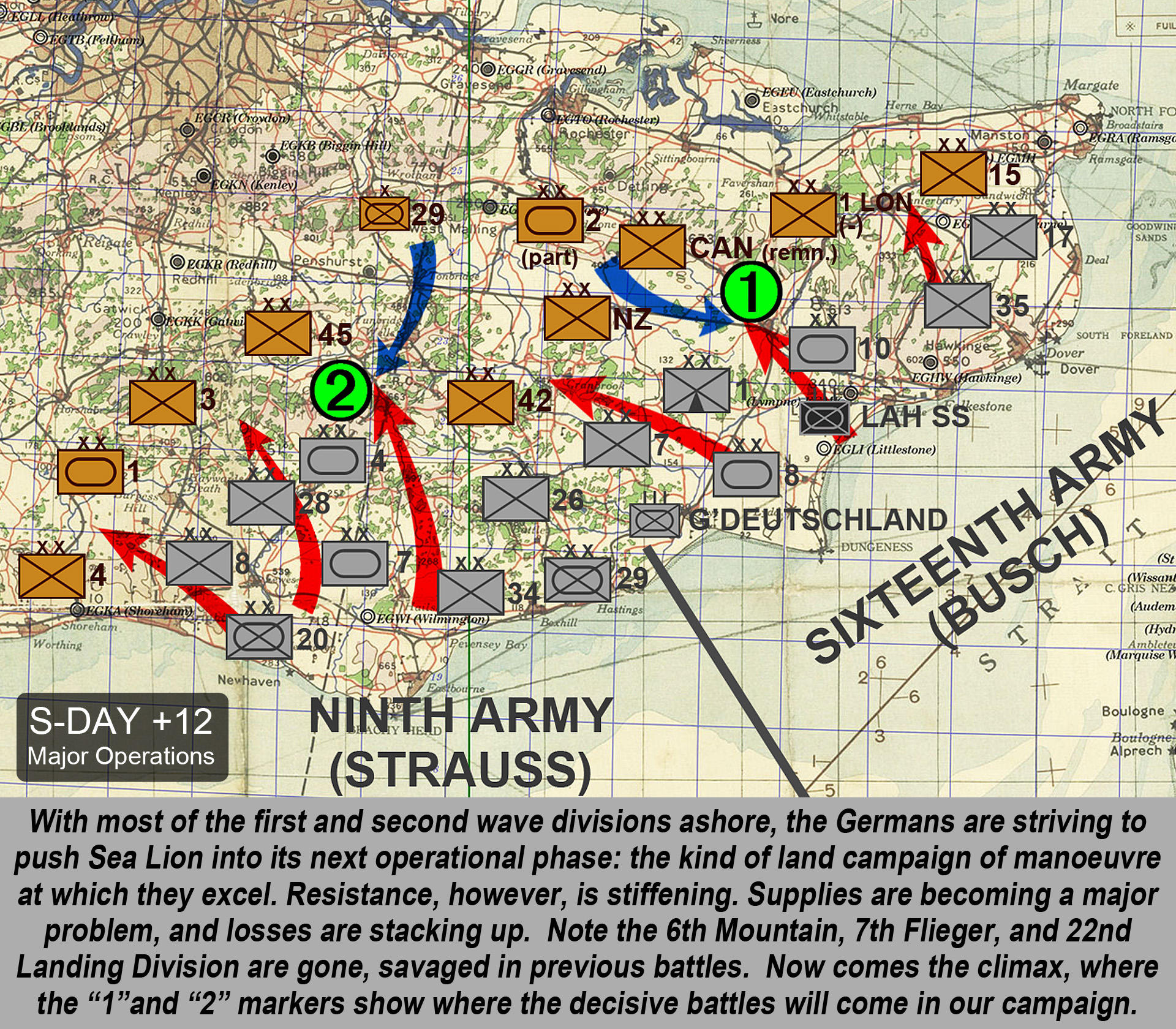
S-DAY +12
The Battle of Ashford
For almost two weeks now, German armies have clawed out a tenuous foothold on the coasts of Sussex and Kent. Initially successful landings have bogged down in claustrophobic villages and farmland, while supply problems and casualties continue to mount. Just to take a quick historical side note: does any of this sound familiar yet?
As the last days of September slip away, the Germans resolve to break things loose, and at last, they have the forces to do it. In the Sixteenth Army’s sector, XLVI Motorised Corps has finally managed a landing, over a week behind schedule because British defenders have blown up over a dozen ships to block the harbour facilities at Dover.

Nevertheless, by September 27th the German 10th Panzer Division stands ready for the climactic break-out. Their attack will fall at Ashford in Kent, currently held by the New Zealand Division. It is hoped this assault will rupture the thin Allied defence line and at last tear open the road to London.
Banking heavily on this success, the Germans also allocate much of their remaining air strength to the Ashford assault. They also commit the “Leibstandarte Adolf Hitler” motorised regiment, fanatical Waffen SS troops originally drawn from the Führer’s personal bodyguard. Soldiers just don’t come any better...or worse.
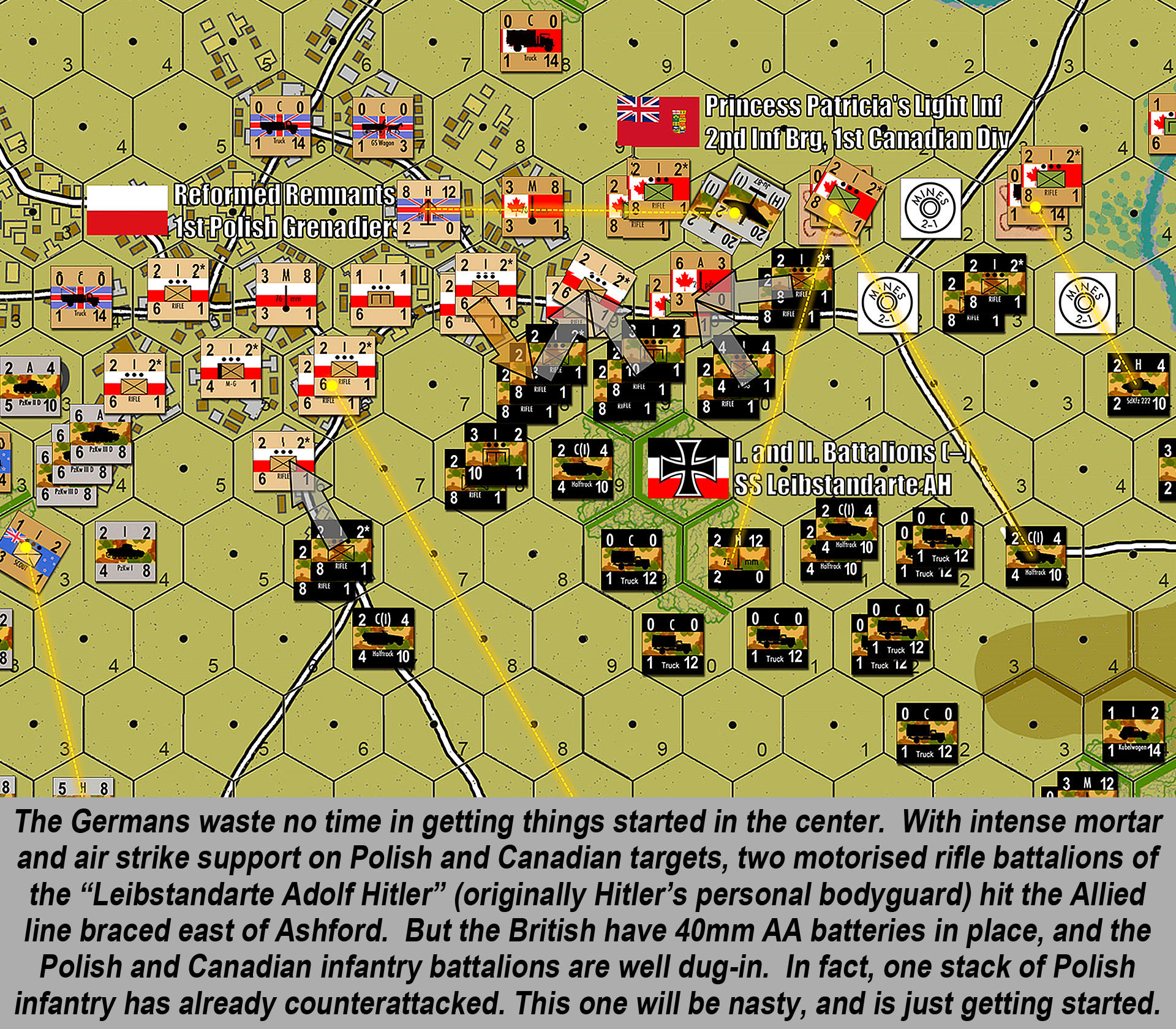
The British, however, have a few cards up their sleeve as well. For one, their intelligence on German plans is superb, thanks to intercepts of German “Enigma-coded” communications. Originally provided by Polish agents right before the war started, these Enigma ciphers practically allow British code-breakers a place at the German generals’ table.
With plenty of warning, the British have time to mobilise forces to meet the attack. Elements of the 1st Canadian Division are moved in beside the New Zealanders, along with rearmed French troops from Dunkirk and even Free Poles. A powerful armoured force is also ready, the 22nd Heavy Armoured Brigade, part of the 2nd Armoured Division.
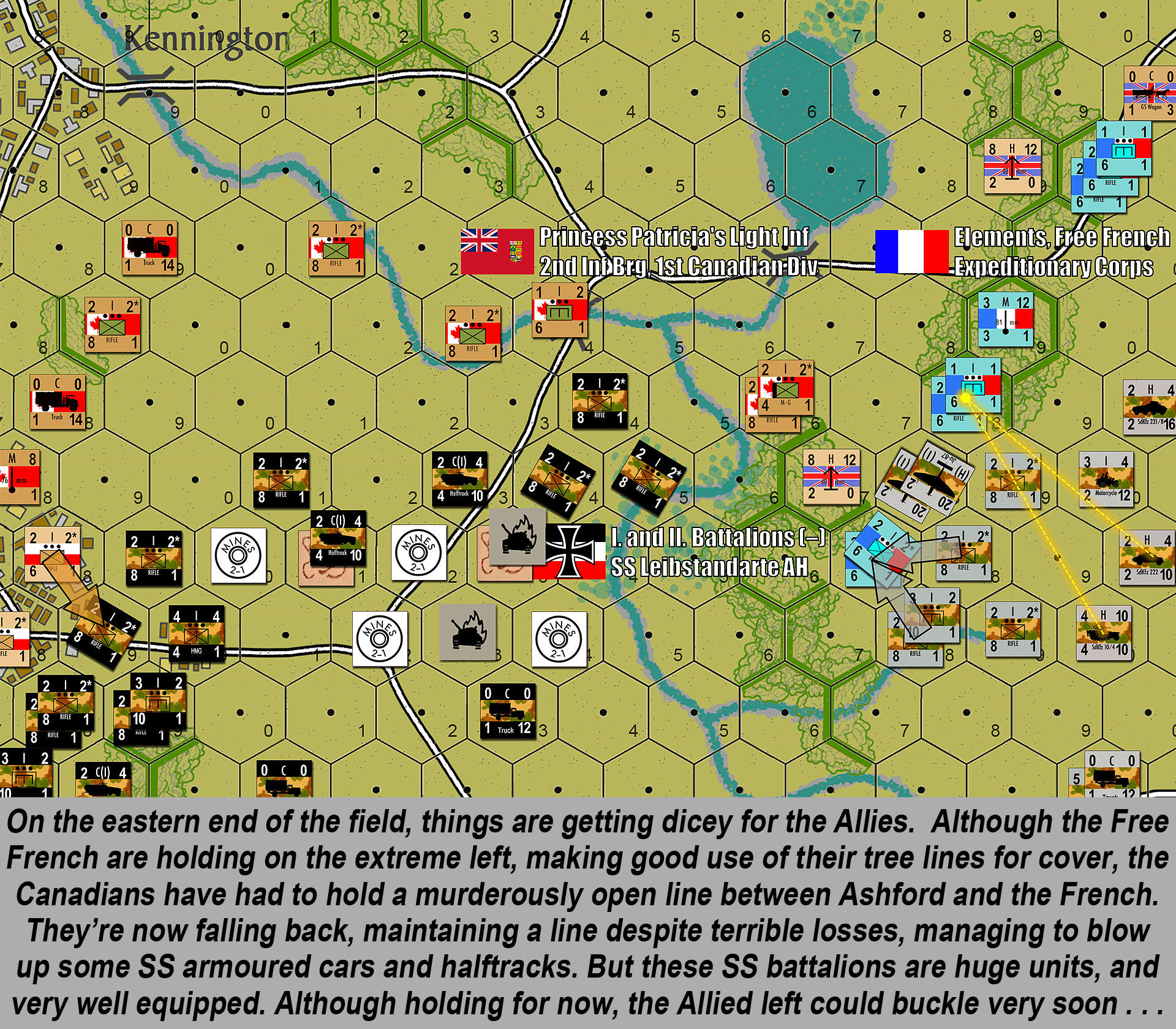
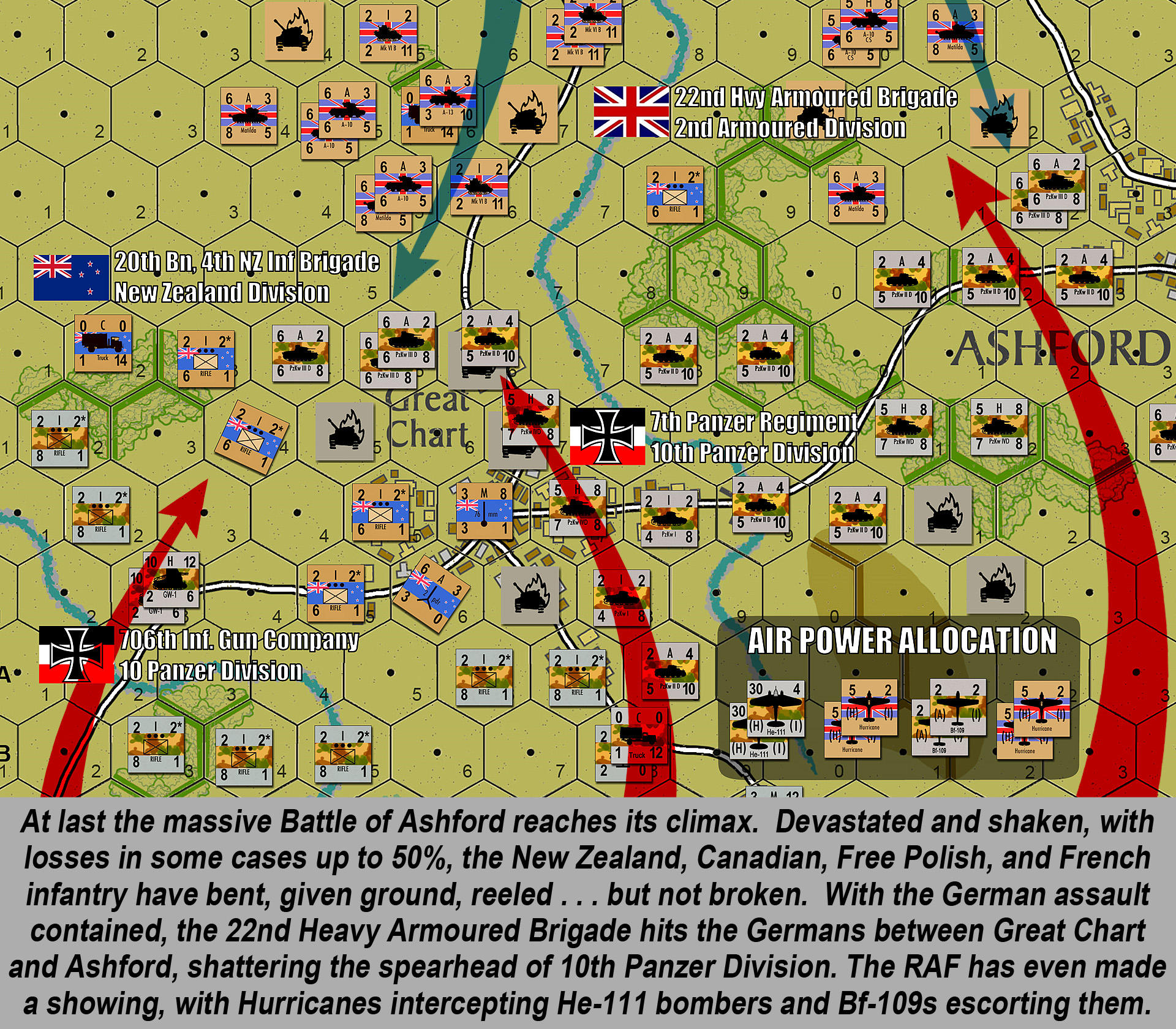
The Battle of Ashford is a titanic clash, erupting into divisional-scale fury on September 27th, 1940 and burning its name into the history books forever. Even the Royal Air Force manages a showing, with rebuilt squadrons put back into the air from airfields in Yorkshire, with venerable Hurricanes fending off He-111s trying to bomb Kiwi infantry.
Losses, especially among the Allied infantry battalions holding the line, are horrendous. But once the Matildas and A13 cruisers of the 22nd Heavy Armoured Brigade show up, the 10th Panzer has lost the day. Although not a clear win, Ashford at least ensures that the big German breakthrough will not come in Kent. As for Sussex, however…
Special thanks to community member @yavasa for the idea of British defenders blowing up ships in occupied harbours, @jamesevans140 for the idea of rearmed Free French troops, and @cpauls1 for the idea of the Princess Patricia’s Light Infantry Regiment representing 1st Canadian Division in this battle.
S-DAY +20
The Battle of Crowborough
In this alternate timeline of World War II, future British historians will not write quite so much about the Battles of El Alamein, Sword Beach, Operation Goodwood, or Arnhem. They will write about the Battle of Crowborough, and compare it forever with moments like Hastings or the Spanish Armada. Britain’s fate turns … today.
The date is October 5th, 1940. The German situation is becoming dire. Worsening weather over the Channel is neutralizing the Luftwaffe’s ability to fend off the Royal Navy, which (despite grievous losses), still has two battleships and plenty of cruisers that don’t need sunny skies to maul the ramshackle German “supply fleet.”
A last, all-out offensive is prepared by the German Ninth Army in Sussex. The place chosen for the attack actually makes sense. With the British 1st Armoured Division largely chewed up at Burgess Hill to the west, and the 2nd Armoured committed at Ashford, there seems no real British tank reserves at the centre.
The Germans, however, are wrong. Desperately scrapping together recovered battlefield wrecks and half-finished tanks from the factories, stripping every territorial reserve unit and even the first battalion of 7th Armoured Division just returning from Egypt, the British have managed a patchwork tank force to meet this new German threat.
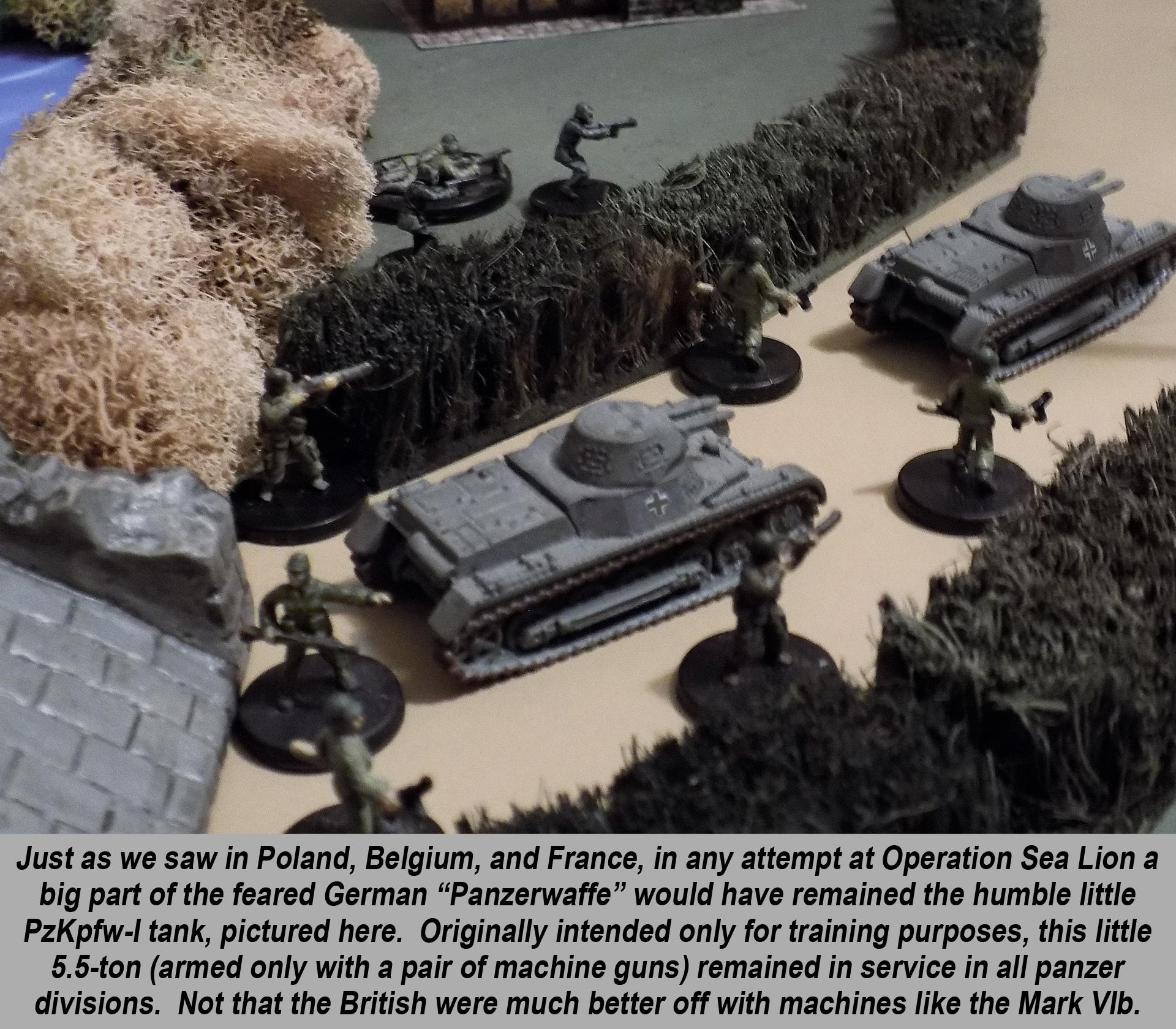
At 05:00 hours on October 5th, the German assault opens up. The massed howitzers and mortars of the entire XV Motorised Corps (Lieutenant-General Hermann Hoth) open fire along the British front in front of Crowborough. Gunfire can be heard as far away as Oxford, eighty miles away. At daybreak, the Luftwaffe joins the assault.
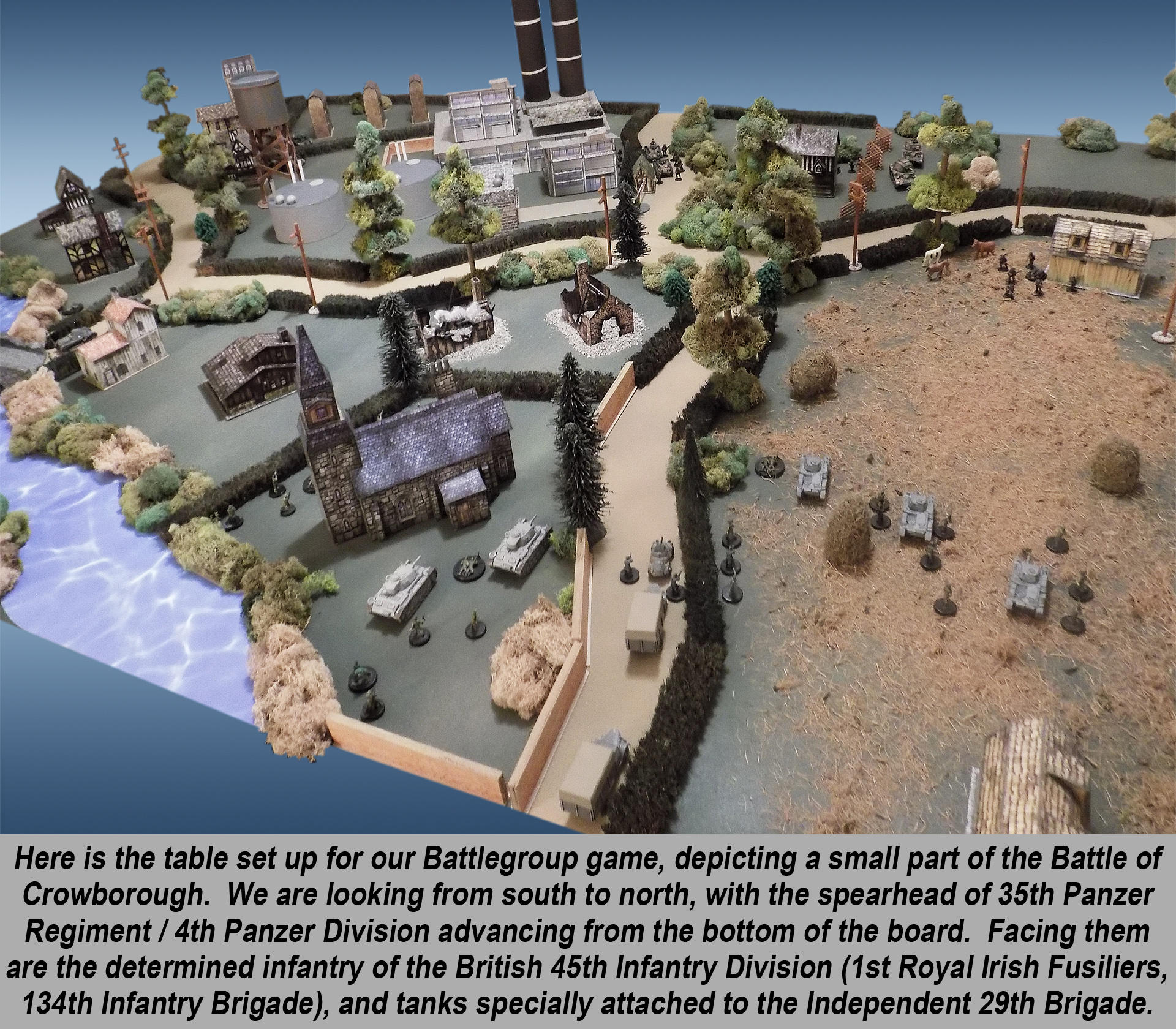
One of the most crucial sectors of this battle (over ten miles wide, extending from Chelwood Gate to Mayfield) is held by the 1st Royal Irish Fusiliers, part of the 134th Infantry Brigade of the 45th Division (I Corps, General Harold Alexander). They hold the road leading straight through Crowborough, and from there, London.
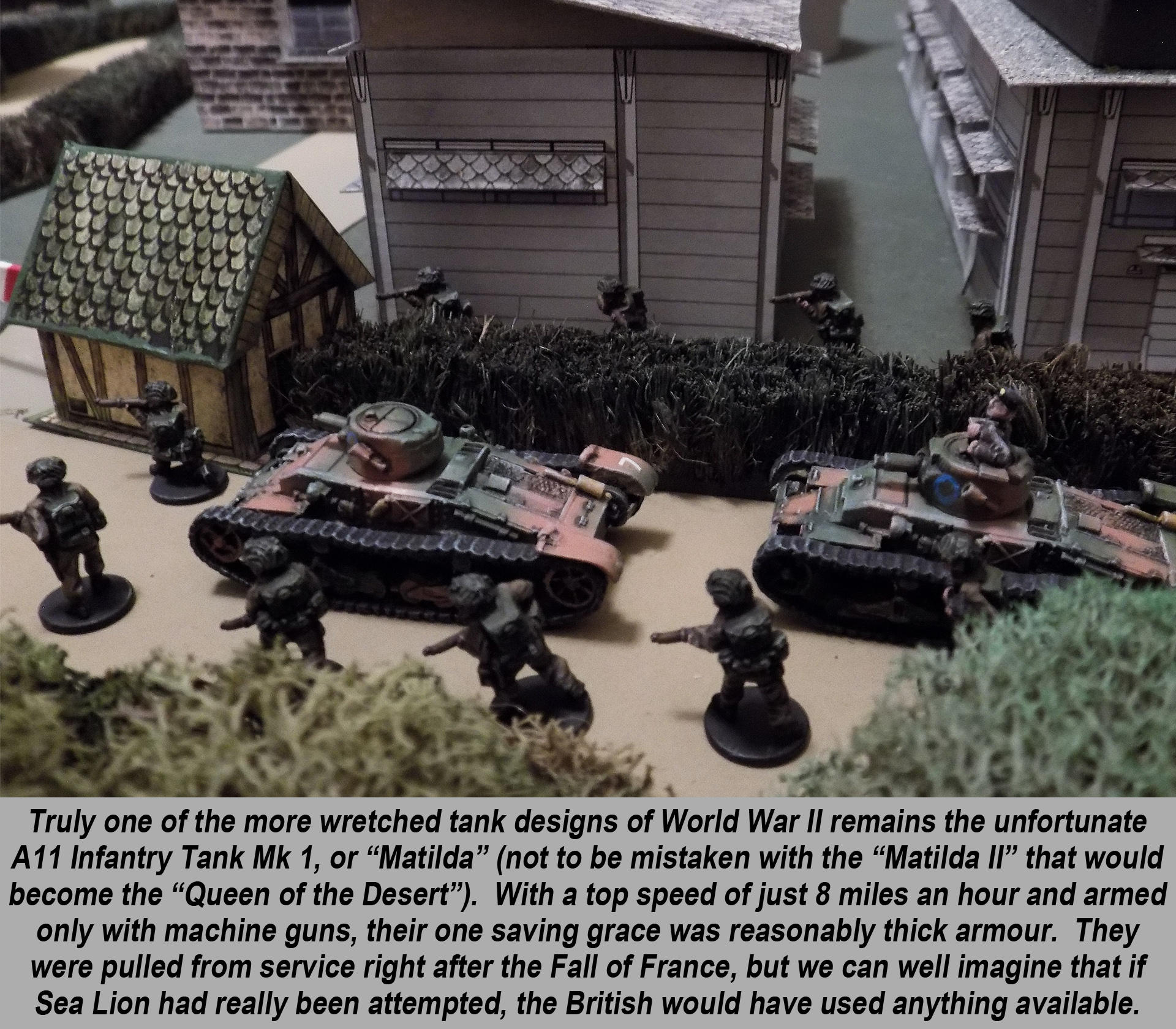
This sector is struck by the 35th Panzer and 12th Infantry Regiments of the 4th Panzer Division, and there’s been no time for the Irish Fusiliers to build field fortifications. Yet even as tank support arrives, attached to 29th Independent Brigade, the defenders know these are the LAST British armoured reserves. The British win today, or lose it all.
For the Germans, the situation is just as dire. Their tenuous supply links to occupied France are breaking down. Many of these tanks have only half-loads of ammunition. The men have been eating whatever animals they can shoot. Fuel is low. Broken-down vehicles can’t be repaired. And behind the lines, a Resistance is stirring to life.
For both sides, it’s now or never.

The fighting that day is predictably furious. Unsuitable British tanks like the A11 Infantry Tank and the Light Tank Mark VI prove little more than scrap metal to German antitank fire, just as PzKpfw Is prove to British 2-pounder guns. But the rest of the tanks lock horns in murderous combat, sometimes at ranges of less than 75 yards.
Artillery is soon removed from the equation, as commanders can no longer avoid hitting their own infantry squads, sometimes in hand-to-hand combat between the burning hulks of tanks. The Germans try to call in air strikes, but at last the Luftwaffe can provide no more. British radio jamming is also instrumental in neutralising this advantage.
Of course, the Irish Fusiliers and 29th Brigade are fighting only part of this battle. Over the horizon to the east and west, the Battle of Crowborough is fought by Scotsmen, Welshmen, Englishmen from the Borderlands to Portsmouth and Southampton, even a battalion of Czechs. This will be an Allied battle, and an Allied victory.
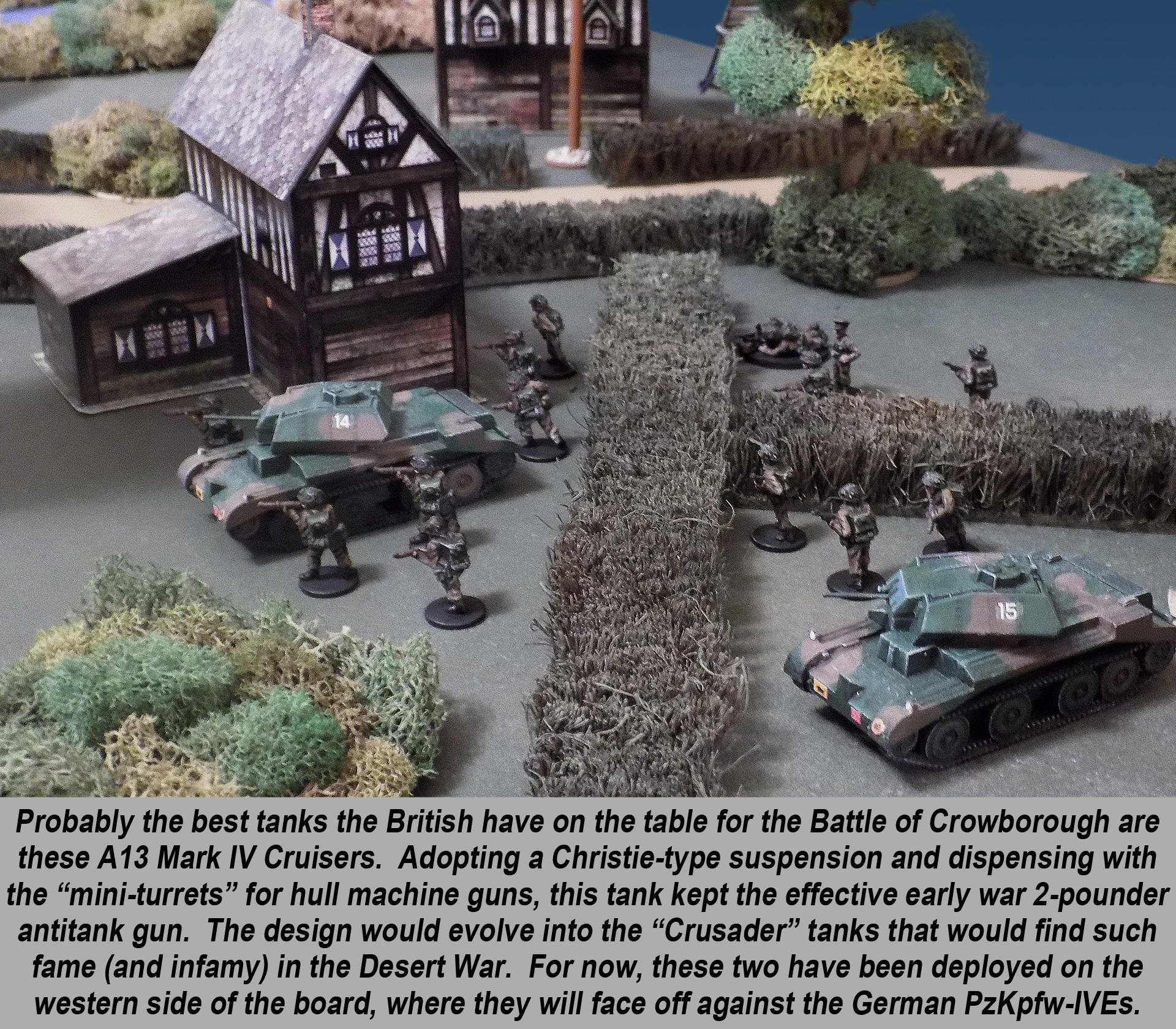
At the end of the day, the 4th Panzer has failed to crack the reeling (but intact) British line. Orders are issued for 7th Panzer Division to carry the assault forward the next day, but the precious handfuls of German supplies have already been consumed. Like most battles, this one is decided on the supply clerk’s clipboard as much as on the battlefield.
In many ways, the Allied win at Crowborough is more a political victory than military pragmatism. After all, the 4th Panzer Division is far from eliminated, and the Rommel’s 7th Panzer looms right behind it. But the Battles of Ashford and Crowborough show that the British and her allies can fight and beat the Germans on the ground.
The battles electrify British resolve. Here is where Winston Churchill becomes the icon of defiance (much as he did after the Battle of Britain in the real historical timeline). No more is there talk of ousting him from Parliament and cutting a deal. The British will fight, and thus comes the end of any real chance of German success.

Over the next few months, the Germans withdraw everything they can out of their English beachhead. Much of this is accomplished by air, as the RAF still can’t close off the skies to German air traffic and the British army remains far too weak to actually drive the Germans back into the sea.
By December of 1940, it’s all over. Germany has suffered its first land defeat in World War II. Tens of thousands have been killed or wounded, with almost 120,000 taken prisoner. Losses in heavy equipment are even worse, the “Channel Airlift” almost resembling a “Dunkirk in reverse.” In 1941, a weakened Germany will turn east.
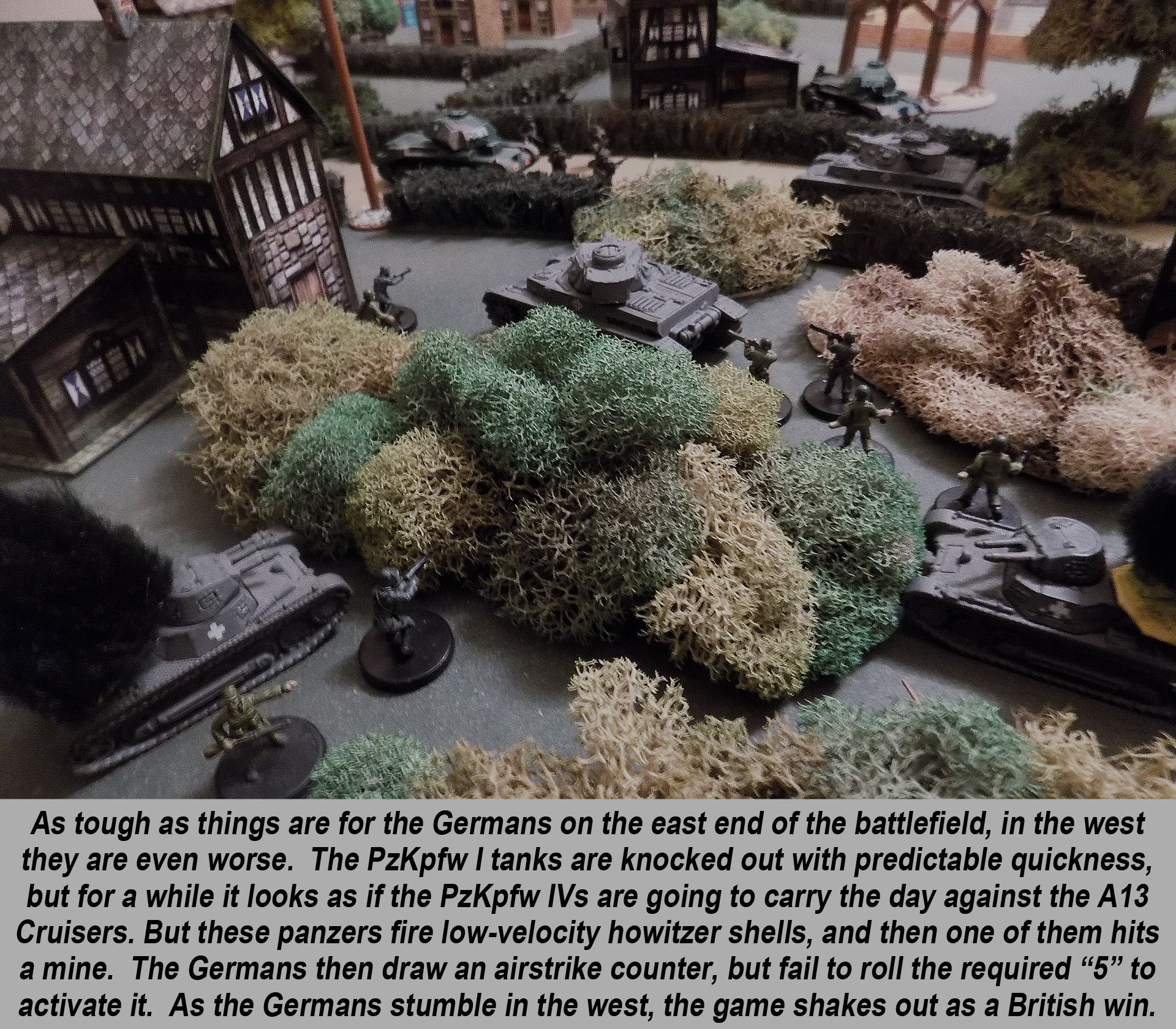
Thus we come to the end of our Sea Lion campaign. Despite a rushed timeline, a weak Kriegsmarine, and the English Channel, unchallenged air supremacy initially allowed the Germans to secure a successful landing. Ironically, that turned out to be the easy part, as sustaining a large campaign across enemy-controlled water proved just too much.
Please remember, however, that we have one more part in our Sea Lion article series. In next week’s Part 5, we really take Sea Lion apart and try to make a detailed, point-by-point prognosis of its prospects. If it would have failed, we list WHY it would failed. If it could have succeeded, we look at HOW it could have done so.
There’ll be plenty of debate, and I think some of what’s presented will surprise many readers. For now, keep the conversation going with your own observations, comments, and questions. Could YOU have taken Britain? What other plans, campaigns, battles, and games have you seen or participated in? Does YOUR Britain stand or fall?
If you would like to write for Beasts of War then please contact us at [email protected] for more information.
"Now we continue this harrowing tale of “what-if” history, watching what happens as “Unternehmen Seelöwe” enters its most critical stages..."
Supported by (Turn Off)

Supported by (Turn Off)
"For both sides, it’s now or never..."
Supported by (Turn Off)











Thanks for this @oriskany
Was a pleasure to read.
Yay! first to post! 🙂
Thanks very much, @jamest123 . Glad you liked it! Pls remember, the campaign may be over, but we’ve got one more article in the series where we try to estimate just how likely this whole campaign really would have been, and what both sides would have to do to win.
I can’t help but think that we would have managed to defend our island whatever the cost my be. If only because of the improved nature of the German assault force compared to the RN who I’m sure would have destroyed themselves to stop the invasion/reinforcements I think that would also apply to the RAF whatever state it was in.
In the long run, I think I agree @darthcheese , as I hope I’ve demonstrated in this outcome. A German attempt at Sea Lion might have seen startling initial successes, but once it got into a “grinding” affair the advantages of the defender start to amplify, as do many of the inherent weaknesses of the German war machine in WW2 (lack of operational endurance, strategic depth, etc).
Again, next week’s conclusion really spreads all these factors out across the table, where we can look at them in greater detail and “alternate history prediction.”
Looking forward to that part.
😀
Cracking, well written article.
Good to see you include forces from the rest of the allies and Commonwealth. This is often an area overlooked by the average Brit when talking about WW2 – just how much was given by our allies.
Given such a defeat, it would be interesting to speculate how the rest of the war turned out. This defeat would weaken and demoralise, until that point, an unbeatable German army. Britain would clearly not be able to launch any sort of counter attack but I would imagine that German would have sued for peace again, although I expect it would have been rebuffed by an obstinate Churchill.
Would this victory be enough to convince the Americans to join? Possibly and that could have speeded things up.
Weakened in Western Europe, would Germany have committed as much in North Africa?
Stalin would have looked West and perhaps smelt an opportunity – might he have tried to launch his own Barbarossa?
Weakened Germans in Europe? Yes, of course. But also weakened british forces in N.-Africa. @oriskany mentioned forces from Egypt joining the fight at home. So maybe some more successful Italians?
Aggressive Stalin? Perhaps… but not until ’42 because of their army’s restructuring. The Germans could have been recovered until then. Very likely no “Operation Barbarossa” in ’41 though.
But I think more of that next week when part 5 is out.
Thanks, @redvers – and some interesting questions gong forward.
The Commonwealth angle is almost a no-brainer. Our Sea Lion forum thread now includes a map that clearly shows the historical dispositions of all UK / CW divisions as of 11Sept1940 – and right there in the path of any drive toward London are the Canadian and New Zealand divisions. From there, of course, it’s not too tough to image Free Poles who fought in Narvik and France, and Free French units who escaped from Dunkirk.
Who knows if Germany would have tried to sue for peace again? They certainly offered peace multiple times before the Battle of Britain. They didn’t after they lost the Battle of Britain, though. I certainly agree, however, that if they had, Churchill and a victorious (and popular) Parliament would have suggested a few not-so-comfortable places for bodily storage of said peace offer. 😀
I’m of course guessing here, but I feel that such a defeat of Sea Lion . . . while perhaps speeding up AID for Britain, may have well POSTPONED actual American entry. After all, “those Brits obviously have things well in hand over there. No need for us to get involved. Wait a second, the Japanese just did WHAT?”
As far as North Africa goes, this all depends on Italy. Remember, German involvement in North Africa and the Balkans was precipitated by the Italians making moves in these regions, getting into dire trouble, and needing the Germans to bail them out.
The Balkans started when Italy thought they could easily invade Greece out of Albania in October 1940.
North Africa started actually in East Africa with Italian invasions of British Somalia in August 1940, followed by in invasion of Egypt out of Italian Libya in September 1940. These moves were largely prompted by Italian belief that England was on her knees, about to be invaded by the Germans, and would quickly fold. Once that all DIDN’T happen, one can imagine the Italians possible NOT making these moves, and not getting into big trouble, thus NOT needing German assistance?
Then again, historically the British DID win the Battle of Britain, thus “defeating” Sea Lion even before it started. So this may have all unfolded much as it did historically.
While I don’t think Stalin would have invaded into German-occupied Poland in 1940 or 41 (he was very aware of how badly out of shape his army was and was in the midst of a 2-3 year crash program to reform his armed forces), Stalin WOULD have been happier than a pig in shit to see a Sea Lion attempt made and fail. Such a battle would have surely weakened both his main enemies at the time, Great Britain and Germany. Stalin’s strategic stock definitely goes up here. Historically, Stalin used German preoccupation with the West in April and may of 1940 to grab territories in the Baltic States (despite German treaties, Lithuania, Latvia, Estonia) and apply pressure of Romania to annex Bessarabia, Moldavia, etc.
In this alternate timeline, he may have applied more diplomatic – political – economic pressure over the fall and winter of 1940-41. Historically, this is when the German Foreign Ministry builds the alliances with Hungary, Romania, and Bulgaria, and actually (at the time) Croat-dominated (and thus pro-German) Yugoslavia. This southern coalition was vital for Hitler, only with this southern flank secure could he contemplate Barbarossa in the spring and summer of 1941.
But if Stalin is able to exploit German distractions and setbacks in Sea Lion to exert more diplomatic pressure in the Balkans, he might have forestalled the formation of this “smaller Axis.” If he could have done that, that means no Barbarossa. Indeed, such a German diplomatic setback in the Balkans would have done far more to hurt Barbarossa than any losses suffered by 9th and 16th Army in Sea Lion.
To carry this still a step further, enhanced Soviet power in the Balkans makes the USSR much more a threat to the the UK’s vital Mediterranean shipping lanes than Germany or even Italy. Remember, it was Italian action against Greece and German influence in a Croat-dominated Yugoslavia that prompted the British to (a) deploy 30,000 troops to Greece (to protect the eastern Med and the Suez Canal) . . . and (b) support a Serbian, anti-German, pro-Soviet coup in Yugoslavia, which is what prompted the whole German Balkan Blitzkrieg in the first place (Yugoslavia – Greece – Crete).
But the SOVIETS are the ones threatening the region instead of the Germans, and the Germans DON’T get the chance to invade the USSR and thus unify the UK and USSR in June 1941, than Sea Lion may have produced a much more “three-way” war than a war of just the “Allies vs. Axis” model of history.
Thanks, @setesch –
Definitely true about weakened British forces throughout the Empire.
In our timeline, Sea Lion only lasts a few weeks. In that time, I dion’t think any of the Dominion Forces could have been brought back home (7th Armoured and 6th Australian from Egypt, 4th Indian from East Africa / Arabia, etc). So at least in this scenario, I think all those forces are still in place.
Also, when Graziani’s 10th Army invades Egypt in September of 1940, he outnumbers O’Connor’s WDF (Western Desert Force) over 10-1. The British don’t really fight him, but pull back. The Italians aren’t “stopped,” they simply stop on their own (at Sidi Barrani, I think). So I don’t know if an Italian invasion of North Africa would have been more successful . . .
BUT . . .
There are definitely no reinforcements going to the British, either. That means no “Operation Compass” counterattack by O’Connor and the WDF in December 1940, Wavell never gets to launch his counter-invasion of British Somalia, Italian Somalia, Abyssinia (Ethiopia), Eritrea, or Vichy-held Djibouti. (French Somalia, I think it was called at the time).
So yes, I think the Italians are going to hold their very few conquests for a little longer. Things might also be better for the Vichy French in places like Syria and Madagascar, too … not to mention the Japanese at Singapore.
“Aggressive Stalin? Perhaps… but not until ’42 because of their army’s restructuring.”
Agree 100%.
Here’s a link to that map of British and CW forces from our Sea Lion forum thread in the Historical Gaming forums:
Again a great articles series.
It does make you think of how things could have gone.
Thanks very much, @caledor2 .
We do have one more coming, where we try taking a closer look at these “what if” factors in greater detail and see what really would have made a difference, and what wouldn’t.
@oriskany Another great article and a plausible outcome, from all accounts. Well written and well researched, as always. Let’s not forget the eye candy: beautiful work on the models! 🙂
Always good to see the Canadians stand up to the Waffen SS, eh? 😀 Thanks very much, @cpauls1 . Although I dunno about my models and miniatures, though. Now that Justin and John have put up their 28mm Sea Lion games . . . 😀
Great read as always.
And while the Germans come out of it weaker in the West. We also need to take into account that the SW of England been hit much much harder that it was in our timeline. Any production in that part of the country will take time to rebuilt.
I also can’t help but wonder if those last British armoured reserves included the A1E1.
God grief, @rasmus – look at this thing! I may not have a miniature of this thing to use in battlegroup, maybe I can proxy a T-35 I have for early War Soviets. Also, I can make up a Panzer Leader counter for this and try it out on the Historical Gaming Sea Lion thread. 😀
I had honestly never heard of this thing. Great find. 😀
Odd giant tanks, that might not be the most useful – is one thing that I seem to fall over and remember. I doubt any one ever made a mini for the A1E1 as it never saw service and only reached the prototype stage
Well, @rasmus – someone made a miniature of them, although I don’t know what scale it is (might be a scale model, too).
 #sthash.EG7CAqqD.dpuf
I’m serious though. I’m making a Panzer Leader counter for these guys. The great thing about hexes and counters, especially electronic . . . you don’t spend days on “oddball” miniatures you’ll probably only use on the table once.
Concerning blockships the pre WWI HMS Hood was scuttled in Portland harbour as an anti submarine measure in 1914. She is still there more than a century later preventing use of the southern entrance to anything but small fishing boats and pleasure craft. You can just see the location of the wreck in this photo:
That should bring back memories to anyone who did Flag Officer Sea Training’s ‘weekly war’ – insanely long days, Hunters flying below masthead height and a few ales in the Green Shutters!
Thanks, @nooblord . Yep, see? Like I keep saying. The British love blowing up and sinking their own ships. 😀 Look at that lovely destroyer we gave them, USS Buchanan one of fifty vintage WW1 four-stackers. No no sooner do they rename her HMS Campbeltown than they pack her full of six tons of explosives and crash her into a German dry dock. 🙁
No seriously, though. Sinking ships like this might have been a serious tactic undertaken to deny the Germans use of port facilities like Dover, Folkestone, etc. This is important for the Germans since they really needed these docks and ports, they didn’t have anything like the landing craft capability or certainly any of the “Mulberry” harbors we see later for Normandy. Landing second-wave (and much heavier, more mechanized) divisions like those of XV and XLVI Motorized Corps would have been much more difficult on beaches, even if those beaches had already been secured.
So I guess the Hood is like the USN’s USS Enterprise? We’ve had something like seven ships with that name, in fact since 2012 has been one of the few times in our history we HAVEN’T had a USS Enterprise in our fleet. 🙁
Another fantastic series @oriskany, such a tremendous talent for this sort of thing! If it’s any consolation as I know you work bloody hard on your various article series, it’s been a crap few weeks for me and being able to wind down from the stresses of work and escape into the alternate reality of your scenarios really is doing a hell of a lot of good for me right now. Great work bud 🙂
Thanks very much, @bigdave – Sorry to hear you’r having a crap time with work. Holiday related? A lot of jobs go haywire this time of year. 😀
We also have our “support thread” going in the historical gaming forums if you’re interested. 😀
http://www.beastsofwar.com/groups/historical-games/forum/topic/operation-sea-lion-addl-content-games-participation/?topic_page=1&num=15
And as far as these articles go, we do have one more coming, where we try taking a closer look at these “what if” factors in greater detail and see what really would have made a difference, and what wouldn’t.
Thanks very much for the very kind words. Comments like that really do help keep it all going (yes, sometimes it does get to be a bit much and a bit old). 😀
these are much fun to read 🙂 as for me taking Britan.. not much chance of that, even though I can almost take candy from children 😉
Yeah, we shouldn’t underestimate the British, @reiton . In a paratrooper game in our support thread, we had a section of Home Guard bicycles counterattack and destroy a platoon of elite German fallschirmjaegers. Absolutely should NOT have happened, I’ve worked through the math and the game odds are almost 1-200 against . . . but that’s the thing with wargames. Crazy stuff DOES happen sometimes. 😀
Thanks for the comment! 😀
never underestimate dads army. they’ll stick it up’em.
don’t discount the matilda I they had a big cast iron rail sleeper as a front axel.
a unexpected final battle @oriskany
I heard that, @zorg , as far as the Home Guard goes. And as far as the Matilda I goes . . . yeah it was tough. Just too slow and no heavy weapons. 🙁 The only thing compromising its armor plating (okay, beyond its riveted construction) was the long stretch of track exposed along the top. Antitank mine, anyone? 😀
one or two miner flaws? in a excellent tanket. @oriskany who do you think would win in one to one verses a PzI?
Well, honestly tank battles are not “jousting duels,” but just for fun . . .
The PzKpfw I has slight advantages in weight and armor.
But the Mark VIb is faster.
Also, the PzKpfw I carries two 7.92mm machine guns. while the Mark VIb carries a .303 (almost the same thing) and a .50 cal, a much larger machine gun that can probably punch the PzKpfw I’s armor, certainly before the PzKpfw I’s 7.92mm MGs could penetrate the Mark VIb.
Then of course there are the Mark VIc variants with a 15mm light autocannon. But if we start talking variants, the PzKpfw I wins with the Panzerjaeger I’s 4.7mm PaK.
In real combat, though, the PzKpfw I has better infantry, artillery, and air support, not to mention a PzKpfw II right behind it with a 20mm autocannon that wins hands down. 🙂
Great great series of articles I have really enjoyed them so far. Such a wealth of gaming potential to explore.
I think we can all have thoughts on the decisions made by the Commanders as they can be based upon sound reason but where do you go for the Wehrmacht when you factor in the decision making of Hitler in defeat ? Some of those high ranking officers may not want to go back.
One things for certain I think our boys will be making a well earned brew.
Thanks, @huscarle – you write: “where do you go for the Wehrmacht when you factor in the decision making of Hitler in defeat ? Some of those high ranking officers may not want to go back.”
A couple years ago a friend and I ran a 20-game series of PanzerBlitz, recreating “a year in the life” of Panzergrenadier Division Grossdeutschland. We created a simple, light campaign mechanic where victories could win you medals, promotions, additional units to your OOB, etc.
Anyway, by the end (following history) we sure as shit didn’t want to surrender to the Soviets. So we did some research and found a way where some Grossdeutschland officers were historically transferred to 21st Panzer Division in Normandy. We took the chance, so we would surrender to the British after a battle or two and wind up with a “happy” ending to our campaign, and a relatively easy way out of the war for our German “characters.”
No way we wanted to spend 10-15 years in a gulag. 🙁
if he survived I think around 80% of them never came home after the war.
Exactly, @zorg – so we wanted our “characters” to surrender to the British. Because you’re right, German POW survival in Soviet Gulags was terrible, and even those few who made it back didn’t do so until 1950-55.
Lt. Colonel Hans von Luck has a telling segment in his biography about his experiences in a Soviet camp down in the Caucasus.
they certainly weren’t like prisons over here.
Well it’s something I’d not thought about until I read your articles. I have always assumed that Sea lion would fail but we would be in trouble if the they actually managed to get ashore and then not for long, as the enormity of keeping their invasion force supplied kicked in.
I have never actually thought beyond that. Now I’m thinking just how far would Hitler have flogged a dead horse. How much would he have committed before the end. What exit strategy would he use ? We can hazard a guess at what he may have done from what happened in Russia but does the same apply here ?
Thanks, @huscarle . Regarding Hitler “flogging a dead horse,” we might take a guess using an example of “circumstantial evidence” from Hitler’s behavior vis-a-vis the “bridgehead” in Tunisia.
Pretty stubborn and pigheaded, but air reinforcements and supply could kept up for quite a while over British-controlled seas in a long, protracted, losing, but ultimately doomed defense of a German bridgehead in Sussex and Kent (as they were in Tunisia).
This campaign could have lasted who knows how long given the grievously under-strength British and Commonwealth armies at the time, certainly nothing like the Anglo American forces in Tunisia in late 42 – early 43.
First up thank you kind sir for the mention.
After spending the last few days looking at concrete and wooden armored cars those Matilda MK1’s are looking amazing and very high tech and the Mark 6 light tanks are looking like snow speeders out of Star Wars!
Very interesting final games here @oriskany. So the fruit of Germany is dying on its own vine. Actually I had spent a little bit of time looking at the ongoing Channel battles. A force of cruisers hitting a flank engaging and drawing off the Germany Navy and Luftwaffe, allowing a couple of flotillas of MTB to appear almost out of nowhere. One ship in the supply column was standing out so juicy I would not and could not leave alone if this had been a real game, a 8,000 ton fuel carrier. An easy target for the MTB to take out.
Wow if Mk VIbs look like snow speeders and A11 Matilda Is look high tech, you’re looking at some really old, improvised “military” gear. 😀
No worries about the mention, those Free French really were your idea.
The balance I try to strike with these articles is how far in advance to write them. On the one hand, the ideal is to write them all, taking my sweet time, edit and re-edit and re-re-edit, submit them all, and sit back and watch them roll out.
The disadvantage there is that I can’t “react” to reader input in successive articles.
Back when I first started these, I wrote one a week. It was hectic and brutal and I was always submitting at the very last moment (which would sometimes put @brennon in a bad spot), but the advantage was that community comments and input could always be factored into the next article.
I think here we found a happy medium, literally about halfway between the two extremes.
A great read even for someone who is only a part part time historical gamer! I love the drama of the s-day +20 writing and the tables look great, as always.
That lead paragraph wasn’t over the top? A little purple in the prose? 🙂
Having seen the Matilda close up at Bovington the suspension and front of the tracks as @oriskany says are highly vulnerable to HE and even sustained fire from an MG 42…The MkVI is one of my favourite tanks though I don’t think I would like to be in one during combat
Thanks @torros – Those Mark IVb light tanks are wicked fast on the tabletop in games like Battlegroup and Panzer Leader. Nothing better to run down fleeing Italian infantry at Sidi Barrani or Beda Fomm. 😀 As for the Matilda I . . . it’s tough to even get them into combat at those speeds, never mind hoping they perform well.
Thanks again @oriskany.
Yep decreasing WW1 rifles, anti tank weapons that will kill half the county with the exception of your actual target, and being torn between using concrete or wood and pebbles for my Armoured trucks. Then your expecting me to get a handle on this late 1930’s super tech! 😉
I suppose leaving a number of games for the supporting thread would be another angle to react to people. These games may be at the fringes of the main storyline but would allow people to see their suggestions on the table or perhaps they post a small game report to show the rest of us. An example of this is that I should have rolled some dice rather than push some models around when we’re discussing naval actions in the channel. This game may not have impacted your articles but would allow us to explore a point in more detail or is that rolling dice, I always get the two confused. 😀
I’ll be honest, @jamesevans140 – I usually keep running games (even is just small solitaire playtests) after the article series is complete, sometimes these are some of the games that appear in the support thread. Like the Penobscot game run for the American Revolution thread, or the fallschirmjaeger game recently featured on the Sea Lion thread (might run another one later today).
I forgot to ask about your naval game. British cruisers drew off German convoy defense and allowed MBTs to swing in and sink some transports?
An 8,000 tanker. That must have made a big fireball. I can see the reports now. “The smoke column was visible all the way in Norwich!”
Actually I had spent a little bit of time looking at the ongoing Channel battles. A force of cruisers hitting a flank engaging and drawing off the Germany Navy and Luftwaffe, allowing a couple of flotillas of MTB to appear almost out of nowhere. One ship in the supply column was standing out so juicy I would not and could not leave alone if this had been a real game, a 8,000 ton fuel carrier. An easy target for the MTB to take out. –
Pure genius, another brilliant series, thank you. All very strange seeing place names that are not too far from me. I have always wanted to play a game where I play the German side just to see what the outcome would be. Makes you wonder what would have happened if Germany was really serious about taking the UK and had planned for it properly in the mid thirties. A fleet of heavy bombers would have helped them I think. Looking forward to part 5 🙂 I just wish my Grandfather was still here, I would have got him to make a comment, now that would have interesting 🙂
Thanks very much, @minty45 . 😀
You write: “All very strange seeing place names that are not too far from me.”
I remember a million years ago when the first Red Dawn movie came out about a Soviet-led invasion of the US . . . my friends and I were too young to see how silly it was, but we threw ourselves into at least a year of “green army man wargaming” and even some RPGs of first the Russians, and later the Cubans (after we moved to Florida) invading our home town. Moving the war to your own backyard is a “safe nightmare” that can really put an edge on the immediacy of your reading, writing, war gaming, or however you pursue the hobby.
Hey, hopefully your Grandfather is looking down and pleased we had the British win the day. 😀
Your reply to me appears like it got cut off. I lost about half of one of my replies to you. I have posted larger replies without this happening.
Post of what I was looking at was this reverse strategy of the Luftwaffe in what they called the Channel War. Where they attack channel shipping to draw the RAF fighters out for an attritional series of battles.
Here I am trying to draw the Germans into a series of battles that has two goals to achieve one main objective.
The objective is to weaken the German military on British soil by impeding his mobility and reduce his strength. By;
A) Draw his limit Naval assets into attritional battles on his flanks. This will force him to convert more Luftwaffe units to the anti shipping rule. This will mean less bombers available for ground support.
B) Attack and preferably destroy;
1) His bulk fuel carriers
2) His larger bulk carriers;
With the purpose of restricting his motorised and mechanized forces ability to make deep penetrating attacks towards London. Reduced the amount of ammunitions and heavy equipment landing on British soil.
Heavy cruisers and battleships of the RN are to be preserved for retaking the Channel. Other cruisers are to be used for the attritional battles while smaller vessels including Dutch Navy coastal defence ships are to concentrate on damaging and destroying cargo shipping.
I would imagine the Germans would not have many fuel carriers of the 8,000 ton class. They may seam tiny to today’s eyes, but they were the super tanker of their day. I believe losing one of these would have a similar strategic cost as losing a battleship.
Your storyline demonstrates the inherent strategic supple weakens when trying to supply their forces across a stretch of sea. If your storyline had continued their advance on London, then the Channel remains a strategic area in preventing the Germans from reaching London. Also this would force the Germans into deploying more Ubaots into the Channel freeing up the approaches to Britain’s western ports.
The heavy cost of this battle plan is that the RN is going to lose a lot of cruisers, however the undersized German maritime forces remain its Achilles heel in Operation Sea Lion.
Ahh, @jamesevans140 . . . that’s my fault, not typing carefully at 2:00 AM.
Often when I want to reply to a long, complex, or well-put post, I copy the original post into my window and then reply point-by-point. You’ll notice that the text that cut off was actually your text from the previous post.
Anyway . . .
Post of what I was looking at was this reverse strategy of the Luftwaffe in what they called the Channel War. Where they attack channel shipping to draw the RAF fighters out for an attritional series of battles.
Right. This was historically the first phase of the Battle of Britain, the so-called “Kanalschlact.”
Okay, so if I read your plan for the Royal Navy correctly, we’re looking at sapping / overstretching Luftwaffe leverage over the actual bridgehead (i.e., the ground battle) by applying additional naval pressure against the two sides of the German invasion / shipping corridor over the Channel. Simultaneously, sink some of the heavier transport and tanker ships, thus hindering the more mechanized divisions the Germans are bringing over with the second wave (XV and XLVI Motorised Corps, most predominantly).
Both these objectives seem aimed at or likely to . . . (a) not stop the initial German lodgement or establishment of a bridgehead, but (b) make it far more difficult to effect a longer-term, operational-scale breakthrough (a German objective that would require much more of the POL supplies, mechanized forces, and tactical ground support the plan seems to target.
I see one potential BOON and one PITFALL to this plan.
BOON: One of the main German assets in holding the Channel open for their shipping, again, is their airpower. A quick way to beat this . . . GO AT NIGHT. Japanese made a living at this under American-dominated skies all through the Solomons camapign (I can’t believe I didn’t think of this earlier, almost all my “conclusions” are based on “historical metaphors” or comparisons like this.
The weakness in “send the cruisers at night” plan is usually your naval bases are too far away. Night only lasts 8-10 hours, after all, a cruising range of 160 nm at most for most classes of cruisers, and that’s assuming you don’t even want to see them again (i.e., they don’t have to get BACK under friendly air cover before the sun comes up).
But here the bases are very close. The North Sea, English Channel are in fact very SMALL bodies of water (at least to people like us who are used to thinking in “Pacific terms”). 😀
One possible limitation / consideration, I think the British will have much more success against the EAST end of the Channel than the west. Bases from which attacks like this could be launched from the WEST are Portsmouth, Southampton, etc . . . all under easy range of Luftwaffe bases in Cherbourg and Normandy. The same cannot be said for bases extending up the coats of Essex, Suffolk, and Norfolk. Naval sorties launched from these vectors would seem to have a better chance at an initial approach. At least German aerial reconnaissance would have a much more difficult time with spotting naval buildups.
PITFALL: Sending in only smaller ships (i.e., reserving BBs and CAs to retake the Channel) at first seems to allow the German U-boats to focus on these smaller ships, even at night. This is especially true given the very small number of destroyers available to the Home Fleet at this time – I put them up somewhere in these posts, it’s something like 34 destroyers, -11 under refit or repair = just 23 available. Destroyers are your only real defense against U-Boats this time, all the air-based ASW assets later in the war haven’t been developed yet (Sutherlands, Catalinas, even B-24 Liberators armed with depth charges, escort carriers, etc etc).
Then again, this is balanced against research I’ve found that plot the actual numbers of U-Boats at sea on a month-by-month basis. In September of 1940 the Germans only have 20. Now if Sea Lion was afoot, leave and refits may be have curtailed or cancelled, you can MAYBE push that number to 25 or 30 at the absolute most for a short period. All the LESS reason to allow their small numbers to concentrate on a smaller part of your own fleet.
“Also this would force the Germans into deploying more Ubaots into the Channel freeing up the approaches to Britain’s western ports.
Absolutely. Given the very small number of U-boats even available (again, just 20-25), I wouldn’t be surprised if a complete U-boat moratorium would have been called over the convoy routes. Yes, cutting those convoy routes may kill the UK … EVENTUALLY. Sea Lion is an immediate tactical and operational event, where hours or even minutes can mean life and death. I definitely see a very noticeable relaxing of the pressure vs. convoys during a Sea Lion scenario.
Thanks for your in-depth reply @oriskany.
I made this assumption this naval plan would occur after the German lodgement had been secured but preferably as the mechanized units had moved up to their assembly areas for the breakout.
My plan is old school attritional warfare with a touch of B.H. Liddell Hart’s impaling them on the twin horns of dilemma. Always making the Germans decide between the Channel and the low lands between the coast and London at the cost of the other. Yes the RN ships a are good at night fighting with many of the newer classes equipped with early radar. The RN submarines are even better. The MTBs are in their element at night.
The flanking attacks should pull the Ubaots out of the Atlantic to fulfill their traditional rule under naval doctrines of the time as fleet scouts. For effective daytime scouting more assets would have to be pulled from the Luftwaffe if they don’t want nasty surprises.
The cruisers are there to draw off supply column support in a similar way fighters draw off fighter escorts from the bombers. The RN cruisers are there to take it on the chin. They are to engage the German Navy’s surface assets. They should go after prime assets either damaging or as a last resort sink them. The idea is to force as many of the German ships to return to harbor for repairs. This a) remove them from any future involvement in the Channel Battles and b) begin to overload their repair facilities. Either way less and less escort ships will be available for convoy escort and hopefully forcing them to use more Luftwaffe assets in the Channel. They can’t have superiority over southern Britain and the extent of the Channel. I am assuming the Luftwaffe took casualties similar to the historic air Battle of Britain. The rubber band is getting stretched pretty tight. I also figure that around S+30 a lot of material and means will start pouring into Britain with if all goes to plan will be fairly devoid of Uboats on Britain’s eastern ports.
The British Army has to do its bit by forcing the Heer assets on land to consume their supplies or even raid and destroy German supply depots in a similar way they went after them in the Western Desert.
So at the end off it, I do expect to lose a lot of cruisers either sunk or in long term repair. I am also relying on the supply of WW1 destroyers from the U.S. which if they arrive historically should make good some of my losses. I would be reluctant to use battleships and heavy cruisers as lack AAA protection in this period, plus they are large easy targets, and I want major assets to bottle up the German navy after this battle. While Germany would be in a weakened state, especially if a lot of her invasion force ends up as P.O.Ws, however Britain will not have the strength to cross the Channel for quite some time. If my plan was to actually work by the time Operation Sea Lion dies on the vine she will not have enough assets to get her invasion force out of Britain. Hello Stalin.
The plan is classical British and historically they have the backbone to pull it off and if they do there will be several new verses to Rule Britannia.
Like all plans this one looks good on paper but there are absolutely no guarantees. By forcing the Germans to continually shift their assets around should weaken them strategically. At this stage of the war Hitler is likely to pull the pin and run, rather than suffering a very humiliating defeat. That to the last round to the last man guy is still a couple off years away.
It is a simple operational plan with elaborate strategic results. It would be far better to lose most of the cruisers than London. Using the MTBs to fall out of the blue has that boys own adventure appeal that Churchill seams to be so fond of.
Awesome post, @jamesevans140 .
I made this assumption this naval plan would occur after the German lodgement had been secured but preferably as the mechanized units had moved up to their assembly areas for the breakout.
Oh, okay. I thought you might be trying to keep the mechanised (i.e., second wave) forces from landing in the first place, or at least landing intact (S-Day +2 or +3).
Yes the RN ships a are good at night fighting with many of the newer classes equipped with early radar. The RN submarines are even better. The MTBs are in their element at night.
A risky and high-loss strategy under enemy-controlled skies and in the face of snsmy submarines (ask the Japanese in the Solomons Campaign of 42-43), but since potential RN bases up the east coast are close enough for British naval units to hit the German invasion corridor within the hours of darkness, it can certtainly yield impressive results. This would be especially true along XIII Corps / XLVI Motorised Corps sector, Sixteenth Army (Folkestone – Dover – Ashford).
The RN cruisers are there to take it on the chin. They are to engage the German Navy’s surface assets.
This is of course totally up to you. My research shows that there are no major German surface units being committed to the Sea Lion plan directlyin the Channel. Those very very few that are (a) not sunk in Norway and (b) not under repair and (c) not still under construction . . . have been sent out into the open Atlantic on what I believe would be a vain effort draw off elements of the Royal Navy before Sea Lion starts.
Unless you coult Z-class destroyers and German E-boats as surface units?
Or are we imagining German surface units returning to the Channel once they realize their diversion efforts have come to nil?
I am assuming the Luftwaffe took casualties similar to the historic air Battle of Britain. The rubber band is getting stretched pretty tight.
Absolutely. Given the possibly FOUR separate missions in which the Luftwaffe can expect to be heavily invested by S-Day +5 or so . . . (protection of German air-transport divisions flying into captured airfields, like the 22nd Flieger DIvision, sinking British warships, tactical support of German ground offensives, and airlifting in of supplies), even moderate losses would cut very deeply.
The British Army has to do its bit by forcing the Heer assets on land to consume their supplies or even raid and destroy German supply depots in a similar way they went after them in the Western Desert.
I’m working up a “Commando” style raid game, based loosely on Force-on-Force, of a British Royal Marine / Commando raid against German occupied Dover, to be played later tonight or tomorrow morning, to hopefully be posted on the support thread. Basically, an amped-up replay of some of the early Norwegian raids, except this time “occupied Europe” happens to be in Kent. 🙁
I am also relying on the supply of WW1 destroyers from the U.S. which if they arrive historically should make good some of my losses.
Historcially this deal was signed on September 2. If we leave aside politics and lack of American faith in an Great Britian which definitely seems to be losing at this point in our campaign, I don’t know when they get to Britain. These were WW1 destroyers i think in mothballs so they must have taken at least some time to get ready for service again. Some very quick research turns up very detailed records on the fate of all these destroyers, but doesn’t mention when they actually got to Great Britain (43 to the Royal Navy, 7 to the Canadian Navy).
If my plan was to actually work by the time Operation Sea Lion dies on the vine she will not have enough assets to get her invasion force out of Britain.
Yeah, once the Germans make their quick (and honestly, I think very very plausible) INITIAL landings, if that doesn’t precipitate a British political or civil collapse, Sea Lion campaign drags on for quite a while. The good news, the Germans are almost certain to lose once the campaign lasts longer than a few weeks. Bad news, it’s gonna be a long, long run. Examples like the Demyansk Pokcet and the Tunisian Bridgehead show how tenaciously the Germans can hold on to an area even if they are “cut off” via aerial resupply. Stalingrad is not a viable example as they Germand didn’t hold the air at that time and as bad as weather might get over the Channel, it doesn’t approach deep Russia in the winter of 42-43. 😀
At this stage of the war Hitler is likely to pull the pin and run, rather than suffering a very humiliating defeat. That to the last round to the last man guy is still a couple off years away.
Absolutely. One can take example from his nervousness and dithering re: the Panzer spearheads in Fall Gelb and especially Dunkirk.
Please keep up this naval angle (either here or in the forum, where you can post your own maps, charts, game photos, etc), as I didn’t address it very much in the articles. It will add to the overall narrative. 😀
Extremely good points @oriskany.
Once the Germans have a bridgehead most safe Montgomery style plans are out the window. It is time for Patton style plans. I am not saying one general is better than the other, I am relying on the cliches attached to both to set a mind set.
I have constructed this strategy from the point of view of a nation on the ropes and not a nation in its primacy.
It considers a political turmoil, with explosive inter department rivalry, as well as, infighting within the department’s.
This is why the battleships are being held back for a Nobel cause. I am assuming the Admirably would not release the battleships to such a high risk plan. With their precious battleships off the table they would be more agreeable for MTBs, frigates, escorts, destroyers and cruisers, in that order, to be on the table. So to speak.
At no stage is it attempting to take and hold the Channel, it will be a by product of achieved aims.
Grandstrategically I have problems. In this domain I am forced to examine the kind of peace that is to follow and adjust my strategies to ensure this peace is optimal for the nation.
Issue: if Germany are weakened too much then the French will have to learn to speak Russian. German withdrawal from England must be relatively unopposed. In a similar way the Turks allowed the allies to skip away from Gallipoli. The plan cannot have a Tunisia style last stand, ideally a Sicilian skip away. We are not dealing with a post Stalingrad Hitler yet. If he thinks he can get most of his troops and equipment out of England then it would be a sneaky victory, especially under some bullshit cease fire.
To this end east bound sea traffic would not be touched and any west bound traffic that is high in the water.
Strangely the German mechanized units sitting on the continent is of no use to me. I need them in England consuming fuel, ammunition and spare parts. To meet their needs an infantry unit can live off the land, while the monsters arising from the industrial age cannot. Break a track on a tank the replacement part was made in Germany. A German horse breaks a leg, you shoot it and grab any nag from a near by field.
The only real strategic weakness to the German war machine is that it cannot afford an attritional war. In Operation Sea Lion it is on sea they can afford attritional warfare the least. For this purpose I would consider a rowboat armed with an MG a German naval unit, so destroyers, escorts and MTBs are considered as operational units. This is not a naval battle in the truest sense of the word.
I would not expect to see any destroyers from the U.S.in under 30 days with completion of the final delivery in early December. They are there to make good my losses after this action, not for feeding into the battle line. I would also expect to see the Germans feeding Vichy naval units into the line at some point.
One thing Roosevelt was paranoid about was Germany possessing both the French and British navies with the ability to use Canada as a backdoor into the U.S. In fact one of the prewar rainbow plans looked at an issue similar to this.
While the very basics of this plan holds true to attack your enemy where is weak and you are strong. It is a battle plan not aiming for a victory in the Channel, it is trying to bleed the German invasion force dry. After all your storyline has the Germans beaten inland but it is still a long way back to the coast. So quite unusually the battles in the Channel are operationally looking for a draw rather than an outright victory with the roll on effect of a strategic victory. In a similar way the Russians were losing or drawing at the operational level but ultimately winning at the strategic level, the one that matters.
So at the end of the day I am expecting high losses nor trying to avoid them either, not withstanding pointless waste of course. The Germans must be kept bleeding at their weakest point with land units forcing the invasion force to use more supplies than can be shipped to them.
The main weakness to this plan would be the British losing their resolve to follow the plan through, with Winston at the helm I don’t see it happening.
The other thing this plan does not address directly is the air bridge. However the invasion forces could not be wholly supplied by it and would require more and more bombers to be used as transports. This would be in keeping with the overall plan as this is still reducing their fire power at the front line. This forcing them to make hard decisions that no matter what they choose it will hurt them in another way.
Admittedly this is not a plan your typical tabletop or PL Wargamer would choose.
Good evening, @jamesevans140 –
I agree completely with the German need for a quick win, and a fast Guderian-style breakout (This is a Patton-free zone, here – just kidding). 🙂 Going back as far as the Franco Prussian War in 1870-71, any German wins are fast wins. As soon as an enemy can stretch out a battle longer than a few months, the “Prussian General Staff” Germans are effectively doomed. Mons, Barbarossa, there are plenty of examples.
So I foresee for Sea Lion the Germans making for an immediate mechanized breakout, driving either (a) for London, or if it was too heavily fortified, another general strategy is a drive on Bristol, to slice lower England in half, isolate Wales, and cut some of the supply / communication likes to London.
German withdrawal from England must be relatively unopposed. In a similar way the Turks allowed the allies to skip away from Gallipoli.
I almost assume it would have to be, except for the naval dimension. At least in this “vision” of Sea Lion, the British Army is far too weak to aggressively smash the Germans in to the Channel. The Germans can no longer support Army Group A in Great Britain and have to “volunteraily” withdrawal. There would be British pressure, sure. But I don’t forsee any massive counter-smash. Just look at the tepid pursuit of Rommel by Montgomery after El Alemein – and the British are far weaker (and the Germans far stronger) in this scenario.
Strangely the German mechanized units sitting on the continent is of no use to me. I need them in England consuming fuel, ammunition and spare parts.
Gotcha, Let them enter your cauldron, your “Isle of Doom.” 😀
I totally get it, and see your reasoning. Not sure if the Imperial General Staff would appreciate it. They had a bit of the “Panzer Panic” after what had just happened to them in Case Yellow / Red.
The only real strategic weakness to the German war machine is that it cannot afford an attritional war.
They’re not too bad at attrition itself (with their great coordination of artillery and air power), it’s just that attrition takes time and that’s the one thing the Germans traditionally can never afford. Like I’ve said in other threads, they’re the boxer that HAS to knock you out in the first two or three rounds. As long as you’re standing at the beginning of Round Four, you’ve won.
I also explain it to RPG players like this. 😀 If the German war machine were an RPG character, they would have CRAZY Dexterity, and pretty solid Strength. Their Constitution / Stamina, however, is ass. 😀
I would also expect to see the Germans feeding Vichy naval units into the line at some point.
Now THAT would be awesome. Can you imagine HMS Hood, Warspite, and Nelson vs. Dunkerque, Strasbourg, and Provence?
<bOne thing Roosevelt was paranoid about was Germany possessing both the French and British navies with the ability to use Canada as a backdoor into the U.S. In fact one of the prewar rainbow plans looked at an issue similar to this.
War Plan Red. Some guys and I were talking about it briefly on one of these “what if” threads. 😀
After all your storyline has the Germans beaten inland but it is still a long way back to the coast.
The Germans haven’t really been beaten in a decisive land engagement. They have just run out of time. Their larger supply and logistics have set a cruel limit on how long Rundstedts’ Army Group A can mount large-scale operational-level drives toward war-winning objectives like Bristol or London. They have spent their last big stockpiles of supplies on these attacks (and they are having incredible difficulty replenishing those stockpiles over the Channel) and now they are stuck.
Given the terrible weakness of the British army right now, and the damage they’ve already sustained, they’re not kicking the Germans off anywhere. As you say above, I’m tempted to envision that they’ll be “allowed” to withdraw Gallipoli style.
The other thing this plan does not address directly is the air bridge
You’re right, that air bridge is going to only be a short-term solution, and only for part of Army Group A at that.
Very interesting theorising, but I would say the amphibious invasion would be a disaster for several reasons.
1) Every nation has underestimated the difficulty of an amphibious operation, Dieppe taught us a lot, but prior to that there were all kinds of crackpot ideas such as the US had a contingency plan to launch an amphibious assault as part of a possible war with Canada, it simply was hopelessly thought out.
2) Battleships were obsolete, but not ineffective. The problem they had was that they were a very expensive unit for their effectiveness, but early in the war (and even late stages) they were incredibly hard to kill. Take Warspite for example in 1940
“On the way back to their respective bases the British and Italian fleets were both attacked with impartiality by the Regia Aeronautica, and the angry intercepted signals from the Italian admiral greatly cheered the British ships. Warspite alone counted 300 misses by bombs, but the fleet and the convoys arrived at Alexandria safely.”
http://www.shipsnostalgia.com/guides/Warspite
300 misses was not unusual at all, a moving warship was hard to hit, and could take many hits before being sunk. Force Z were hit by dedicated anti-shipping aircraft yet Repulse managed to avoid 19 torpedo’s before being finally hit.
Add to that we also know that the loss of the battle of Britain would have caused the RAF to move north of the Thames, so air support for the navy would be guaranteed – they were too important both operationally and for moral.
2) Coastal artillery.
We had to deal with coastal artillery in Normandy and did so with precision shooting from battleships (even the old USS Texas got in on the act). The German navy would almost certainly have to assist but they were too small to be effective, I think their only reasonable way to silence them would be with the army.
3) Railguns.
Guns on rails, we converted some of our old obsolete 9″ naval guns to fire from railways, add this into the hell that would be the crossing and beachhead.
4) Heavy bombers
Probably used by night if we could not defend them (likely if the remaining airforce was tied up defending our battleships). But I wouldn’t like to be on the beachhead!
5) There are many more ships than listed. We had the old Iron Duke with an assortment of guns on her, along with monitors like HMS Terror armed with 18″ guns off the converted “light battlecruiser) HMS Furious. The submarines too would have been a menace to any capital ships likely tying up what little destroyers they had. I doubt any attack would have landed, the carnage at seas would have been terrible, imagine Normandy landings against a diminished airforce (they sent only 2 planes up – try 300) and a large surface navy.
6) I think any ports would have been made useless for 6+ months with sunken block ships and demolished facilities if they looked likely to fall. We could afford to live without them, the Germany army could not be supported for long with river barges!
All in all I think operation Sea lion was a disaster waiting to happen, Norway resulted in the destruction of much of the German surface fleet, this would have finished the rest off along with losing the cream of their armed forces. The German army was very good, but as we learned from Dieppe and Normandy an amphibious assault is a very difficult thing indeed best attempted only with complete air and sea superiority. What would have been interesting would be how this defeat would have shaped the war, no Russian invasion perhaps?
Traditionally the German General Staff are weak in the strategic sphere. After all going all the way back to the father of Fredrick the Great all German victories were accomplished in the operational and tactical spheres. They never had much experience on the global empire stage so in the strategic sphere they were never forced to evolve their strategic doctrine as much as the other nations. The preparations and planning for Operation See Lion demonstrates this quite clearly. Piss poor planning gives piss results. Much of their strategic success is owed to the nimblness of their middle level commanders in the operational level and the tactical finesse of their lowest echelon. If not looked at carefully their strategic successes look more like luck rather than management. To a degree there is some truth here, but it is self-made luck.
Your quite right, I don’t see a push them into the sea scenario either. It would be a true set back to the British army regaining strength. It needs to appear to be much stronger than it is for political negotiations after the Germans begin their withdrawal. Hitler is fully aware of Stalin’s intentions and he too will want to withdraw his forces with the last amount of casualties. So allow any successful action of the Germans as long as it is to Britain’s benefit.
Yes the general staff would need Churchill to pull them by the nose. During the Battle of France they treat it almost like an infection. A general screams I have been blitzkrieg’ed and their answer is take two aspirin and call us in the morning. Although this was not really the case, they were struggling to come to terms with this new form of operational warfare.
I agree my plan is unorthodox but I believe Churchill and commanders like Claude Wingate would grasp it.
I believe the British in this case can afford trading some space for time considering there is little time available for the German window of victory. When I saw how little space was being captured by the Germans it was not a good sign. However their were in a good position for a political solution. They could have negotiated a cease fire and be in a position of strength to dictate terms, as long as the terms were not too harsh but with enough sting to feel real. This would have been Hitler in his true element, being a masterful politician at this point in time.
Yes it would be totally awesome to see a naval battle with the pride of France and Britain going head to head. I believe however the French would stay true to their word and sink their capital ships if Germany attempted to use them. On the other side I don’t think the French would tip their hand and fore warn the Germans if they tried to use France’s lesser vessels.
While a Germany first plan shocked many Americans, the U.S. government did follow one of the rainbow plans that was effectively a two front war, basically a European power on the Atlantic front and a major Asian power on the Pacific front. They deduced by taking out the European power first would quicken the defeat of the Asian power, while the reverse did not apply.
It would depend on how you define beaten. To me beaten by your enemy and beaten by your own supply line adds up to the same military defeat. I would imagine Gobbles going into overdrive concerning a Jewish stab in the back in either case.
Historically, fictional of coarse, the final German lines for Army Group A was not too far off what I was expecting. Rundstedt was one of the more cautious German commanders by German standards at least. On the other hand you would not want Rommel in his position as he never considered supply and would make the German position more tenuous than it should be.