












Operation “Sea Lion” Invading England In 1940? [Part Three]
November 21, 2016 by crew


Good afternoon, Beasts of War. Oriskany here, ready once again to resume our explorations of Operation Sea Lion, Germany’s hypothetical invasion of Great Britain in September, 1940. Through research, theorisation, and wargaming, we hope come up with a prognosis of what this “invasion-that-never-was” might’ve looked like.
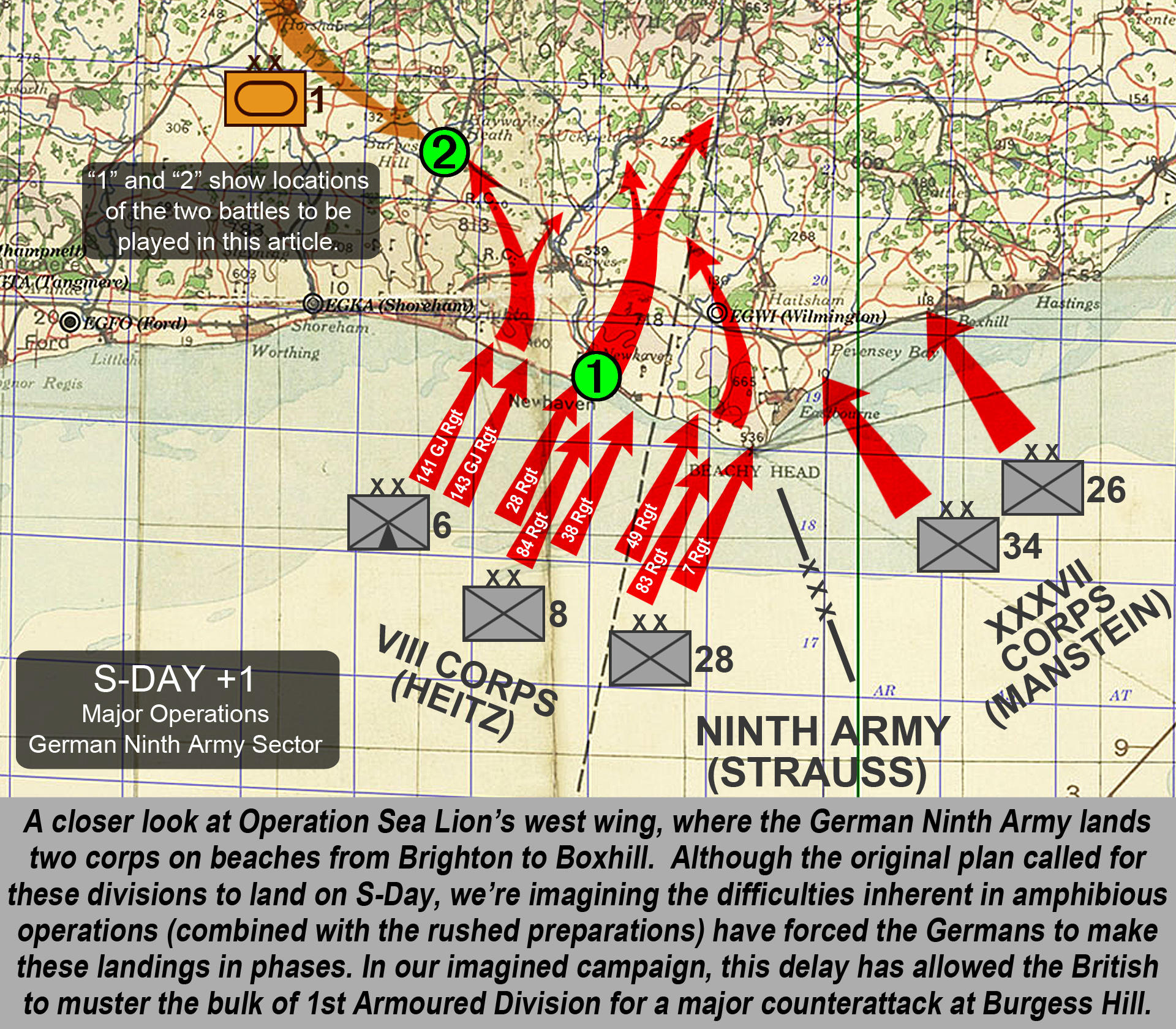
So far, we’ve taken an introductory look at Sea Lion and a cursory view of its prospects in Part One. In Part Two we actually launched the invasion with games depicting German airborne drops and beach landings in Kent, near the town of Folkestone. Now we’ll take a look at what’s happened to the west, along the shores of Sussex.
S-DAY +1
Landings at Newhaven
The date is September 16th, 1940. Initial German landings have been carried off by the Sixteenth Army at Hastings, New Romney, and Folkestone. However, German mines, bombers, and U-boats have failed to completely shut down ferocious Royal Navy counterattacks against the German invasion fleet crossing the English Channel.
Losses have been grievous on both sides. Already two of the Royal Navy’s most powerful battleships, HMS Nelson and Rodney, have been sunk by Luftwaffe bombing, while U-boats have torpedoed HMS Hood off the Isle of Wight. She’s been burning in a massive oil slick for the last eighteen hours.
One British task force, however, built around the battleship HMS Warspite, has broken into the westernmost convoys of the Ninth Army. Many transports carrying the 6th Mountain Division have lost, and the overall Ninth Army landings have been delayed by twenty-four hours. But as dawn rises on S-Day +1, these landings are on again.
As powerful as the Royal Navy was in 1940, one must remember their carrier force was small, and battleships are terribly vulnerable to air and submarine attack. Capital ships like HMS Courageous, Royal Oak, Barham, Prince of Wales, and Repulse, historically all were destroyed by Axis aircraft and submarines early in the war.
Naval actions of World War II teach one immutable truth: The battleship’s day had passed, aircraft and submarines were the new weapons of note. And in 1940, the Royal Navy (particularly the Home Fleet) was a force of battleships, hopelessly prepared for the previous war. If the Germans indeed own the skies over southern England …
Still, it’s tough to ignore this much firepower. This may well have been the death of the Home Fleet’s dreadnoughts, but we have to assume they would have fought like hell to defend their home shores. Thus, we’re imagining that the Home Fleet has weakened and delayed the Sea Lion landings, even if they couldn’t stop them entirely at first.
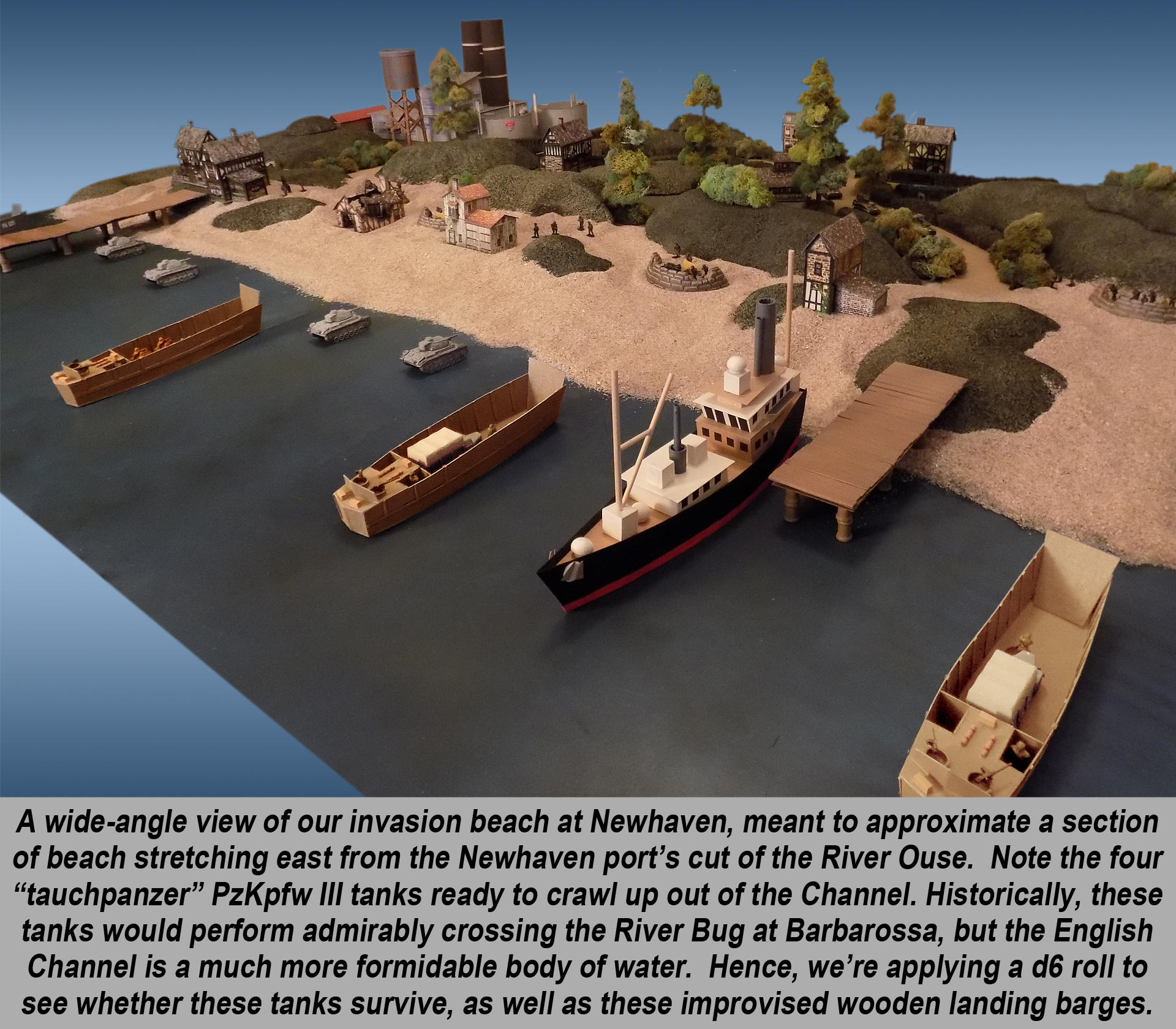
At 06:50 hours on S-Day +1, the German VIII Corps (Ninth Army) hits the beaches, running from Brighton in the west to Beachy Head in the east. In the centre of this attack, the 8th Infantry Division lands at Newhaven. Waiting for them is the under-strength 45th Infantry Division, part of the I Corps commanded by General Harold Alexander.
A solid commander, Alexander has made the best preparations he could. But he’s being hit by three German divisions, while other beaches like Folkestone are only being hit by two.
One reason the Germans are hitting these western beaches with additional forces could be their planned thrust to isolate London from the rest of the country, for which additional forces will be needed in the west. Also, these beaches are out of range of the German coastal artillery batteries at Calais and Boulogne.
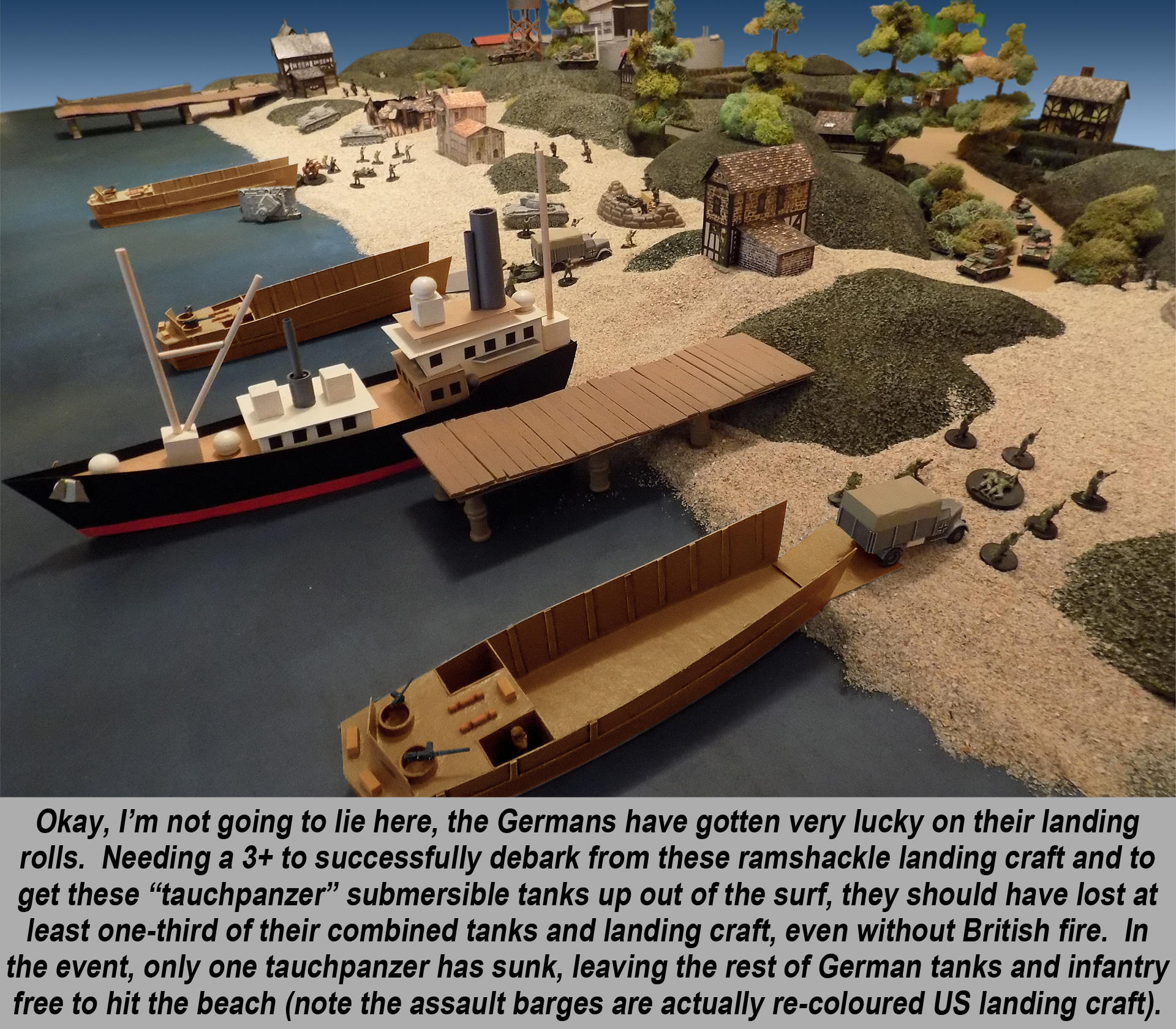
The landings of September 16th are a bloodbath. It’s tough to decide who is more badly prepared, the Germans with their wooden canal barges and hastily-converted “assault ships,” or the British who have little more than sandbags, mines, and some barbed wire to offer as “coastal defences.”
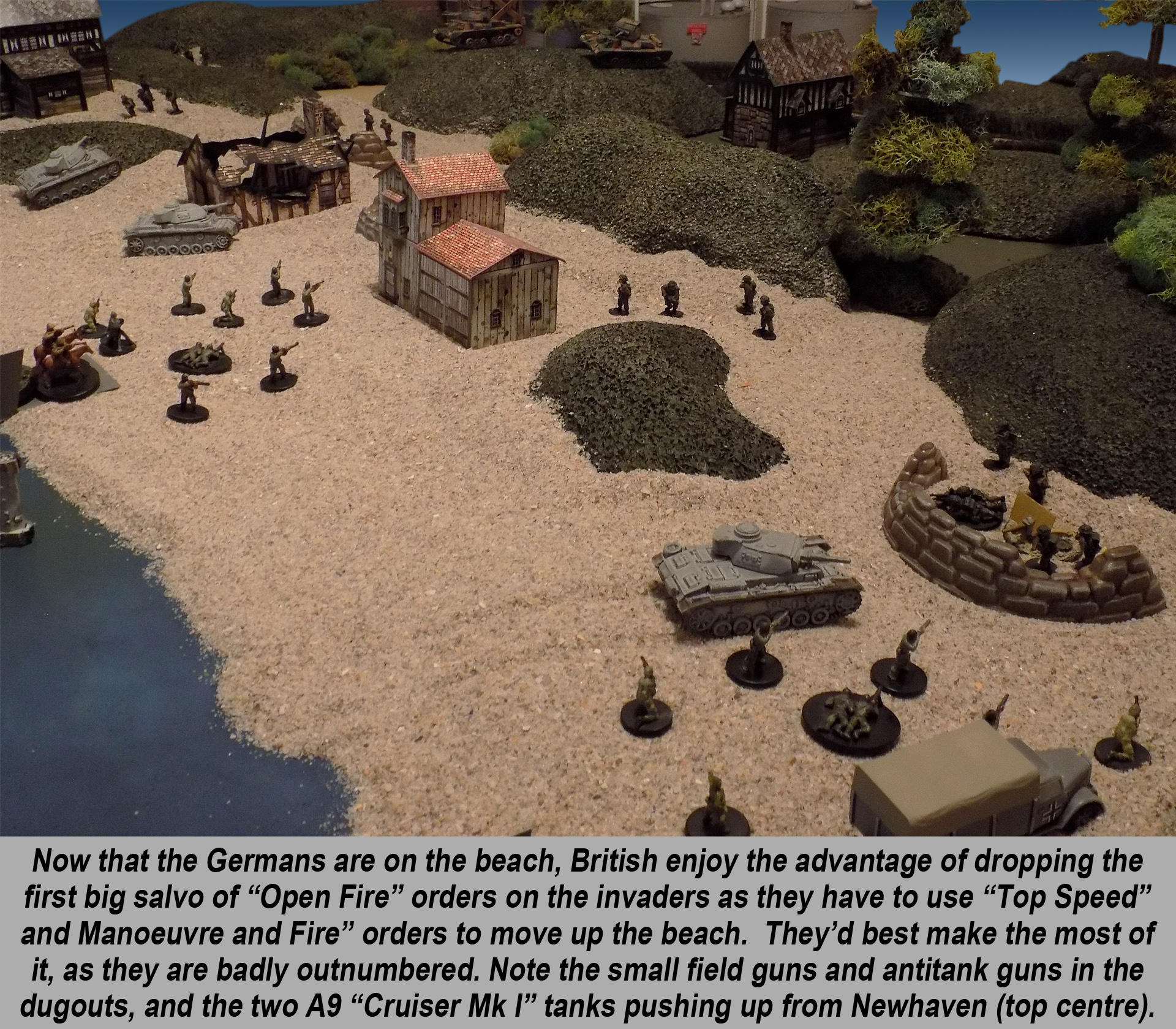
Many of the German “tauchpanzer” submersible tanks don’t perform nearly as well as expected. Although they’ll perform well in river crossings in other theatres, the English Channel is no river. Also, even ancient 18-pounders and underpowered 2-pounder anti-tank guns can easily pop holes in approaching German landing craft.
German heavy equipment also presents a problem. Much of it is still horse-drawn, and horses are not creatures made to endure the pitching and rocking of landing craft, much less when under fire. When the doors finally open, the usually stampede ashore in a panic, often pitching their towed equipment into the surf.
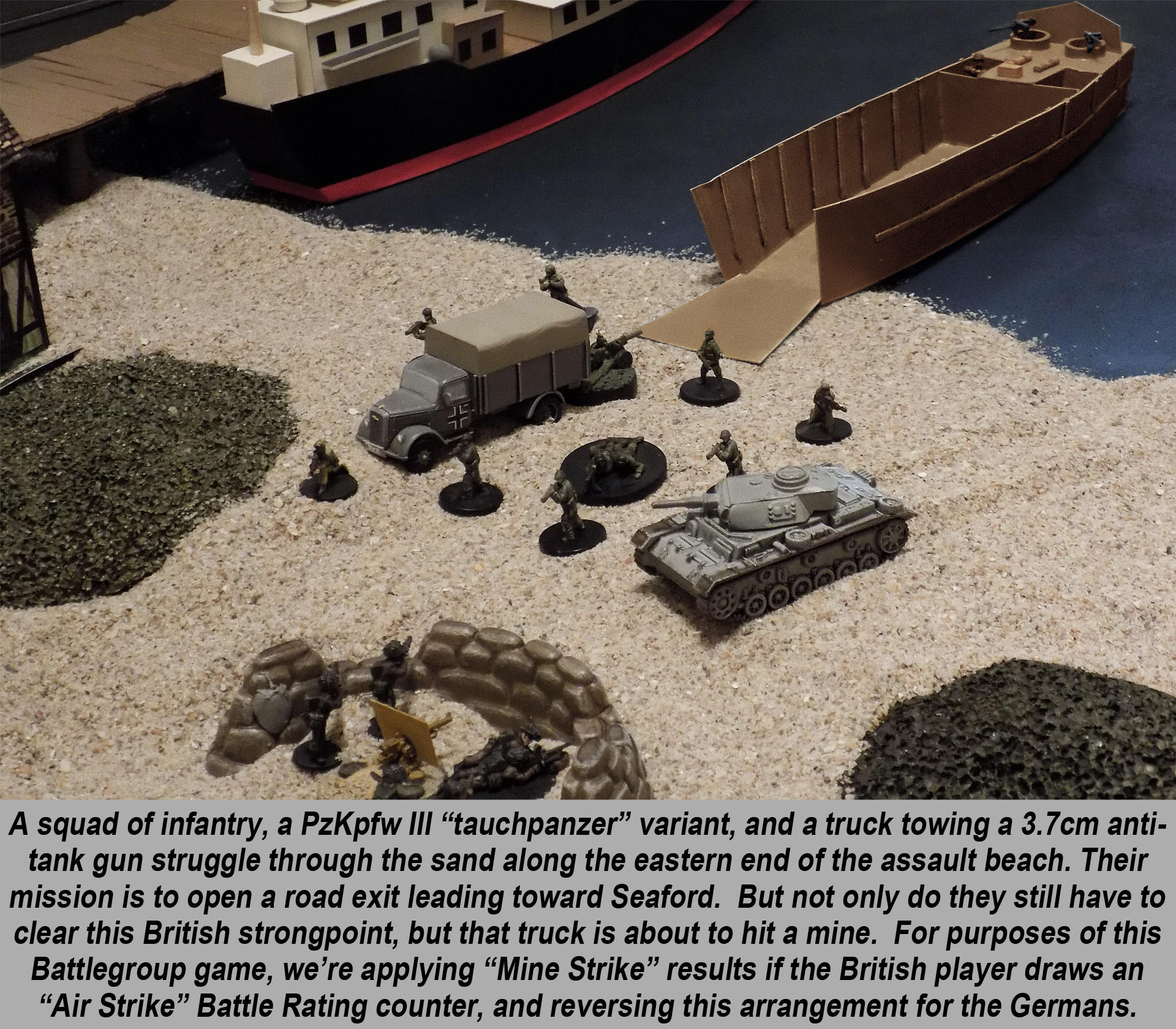
Yet again, it’s the Luftwaffe that saves the day. With Heinkel He-111C, Junkers Ju-88A, and Dornier Do-17 bombers hitting British reserve assembly areas, communication points, and bridges, and Ju-87B Stukas hitting more tactical targets right on the front, the Germans soon claw out just enough of a toehold to secure a tenuous lodgement.
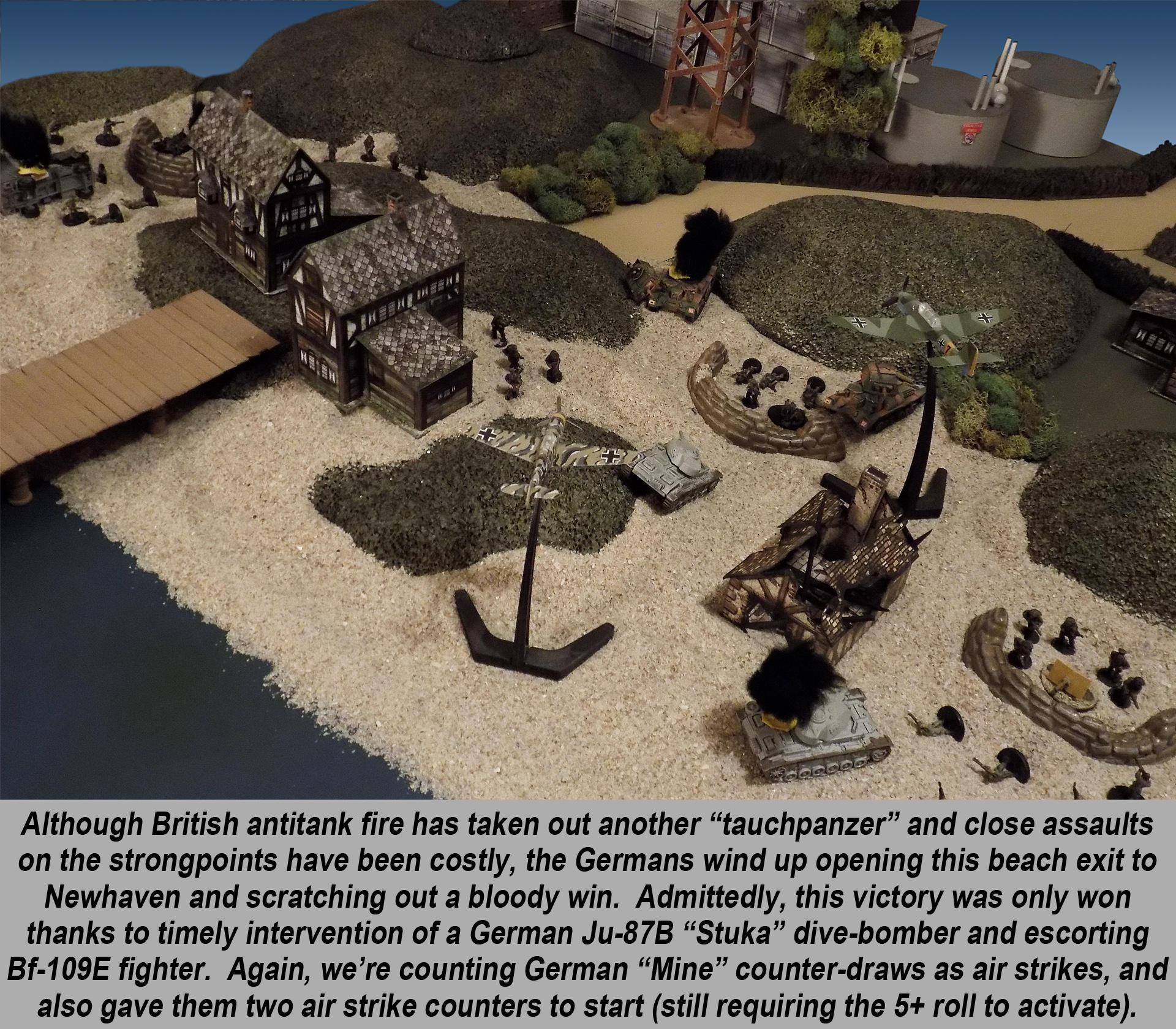
The Luftwaffe, however, is quickly coming to the end of its tether. Simultaneously having to support the landings, sink British battleships and heavy cruisers, and protect the airborne drops from RAF squadrons being re-mustered from bases in the Borderlands and Scotland, endurance of men and machines is rapidly becoming a problem.
S-DAY +3
First Counterstrike
The German 6th Mountain Division just can’t buy a break. Not only do half their transports get sunk by the HMS Warspite trying to cross the Channel, but their weakened landings at Brighton have relegated them to a “flank covering” force for the other divisions of VIII Corps / Ninth Army.
Now, as the VIII Corps pushes its way steadily toward Horsham, Crawley, and Tunbridge Wells, perhaps even a breakthrough toward London and the Thames, the 6th Mountain Division is struck in the left flank by one of the first powerful British counterstrikes of the invasion, mounted by the 1st Armoured Division attacking at Burgess Hill.
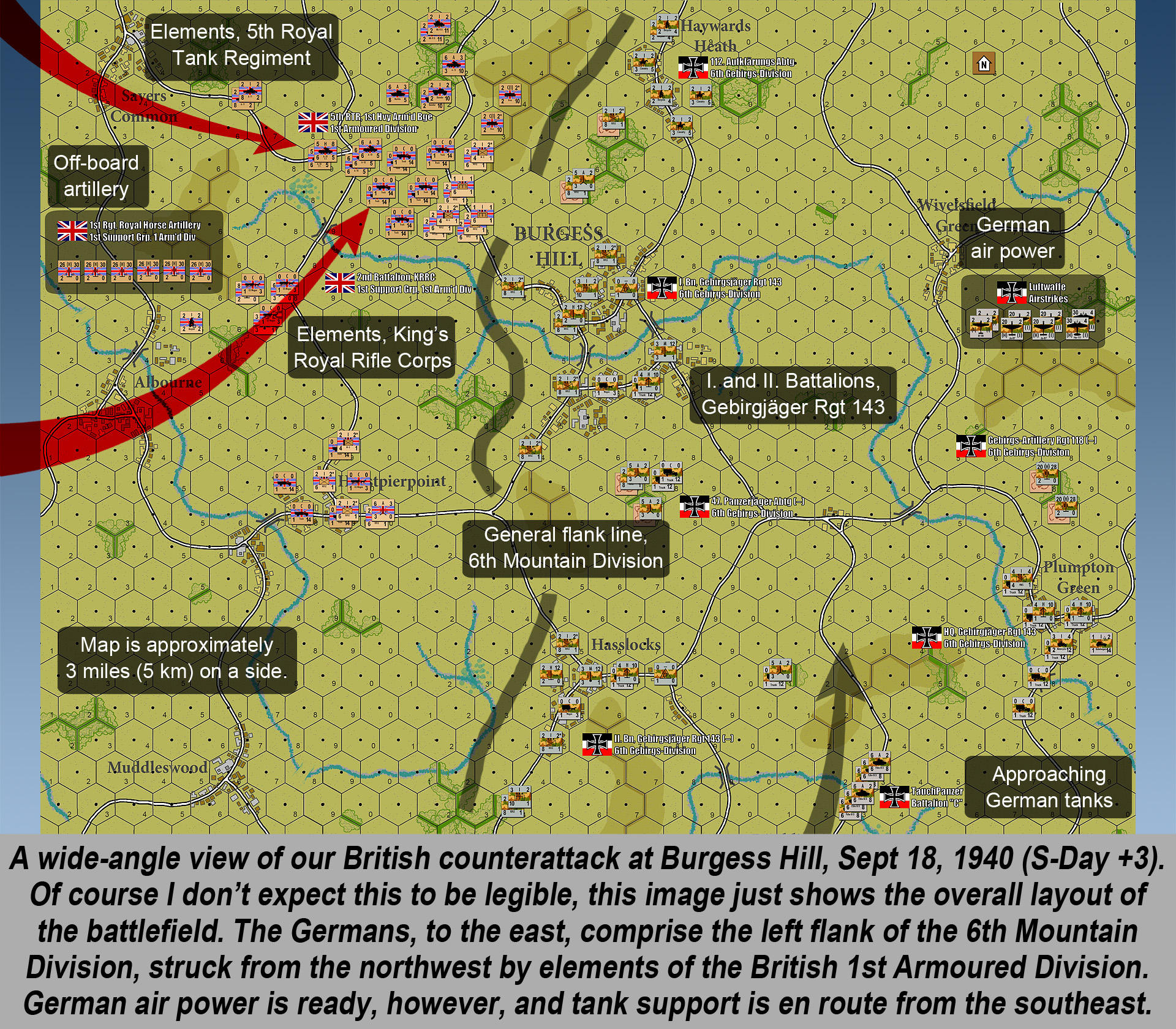
By the third day of the invasion, the situation is growing critical for the British. Despite horrendous losses landing from both the air and sea, the Germans have managed to secure the ports of Folkestone, Newhaven, and Eastbourne. Second-wave German divisions are now being debarked in these ports, including two panzer divisions.
Airfields at Hawkinge and Lympe have also been taken, allowing for the fly-in of the German 22nd Air Landing Division. It isn’t all going the Germans’ way, however. A brigade of the 1st London Division, despite being cut off, is holding Dover against all comers, denying the Germans a key port planned for the invasion.
The British realize, however, that they have to strike back now. Accordingly, 1st Armoured Division is given some of Britain’s last tank reserves, reinforced with infantry, and ordered to hit the flank of the German VIII Corps, where the German 6th Mountain Division is braced at the crossroads town of Burgess Hill.

The British have chosen the place for their attack carefully. The 6th Mountain Division lost the better part of a regiment just crossing the Channel, and has had a rough go of its since then. Also, as a mountain division, they’re short of motorized transport, and they’ve been struggling to keep up with the rest of the German advance.
Thus, while the rest of VIII Corps, and especially von Manstein’s XXXVII Corps further east, have been driving north, their flanks become ever more vulnerable as the weakened, exhausted 6th Mountain Division tries to protect Ninth Army’s wing.
Knowing that the Germans will rule the skies, the British reinforce their attack with plenty of antiaircraft batteries. They’ve also been remobilising old stockpiles of 18-pounder howitzers left over from World War I. Far from the newest weapons on the field, they can still lay down plenty of fire support that just might turn the day.

The British launch their attack in the predawn hours, when darkness will still cover their approach from the Luftwaffe. By the time the sun is up fully, the ridges overlooking their advance bristle with 40mm Bofors AA guns. They don’t stop the Stukas entirely, but the Luftwaffe’s impact on this battle is much diminished.
The massed British artillery opens gaps in the sparse German flank protection north or Burgess Hill. The faster Mark VI light tanks, cruiser tanks, and armoured cars race through these breaches, while the slower infantry tanks grind into the German line and support a battalion of the King’s Royal Rifle Corps advancing into Burgess Hill itself.
By midday, the flanking regiment of 6th Mountain Division has been badly mauled. Counterattacking German tanks are pinned by British artillery and shot up as they attack dug-in Matildas. To prevent a complete collapse of VIII Corps’ flank, 6th Mountain and 8th Infantry divisions are pulled back, largely halting this part of the German advance.
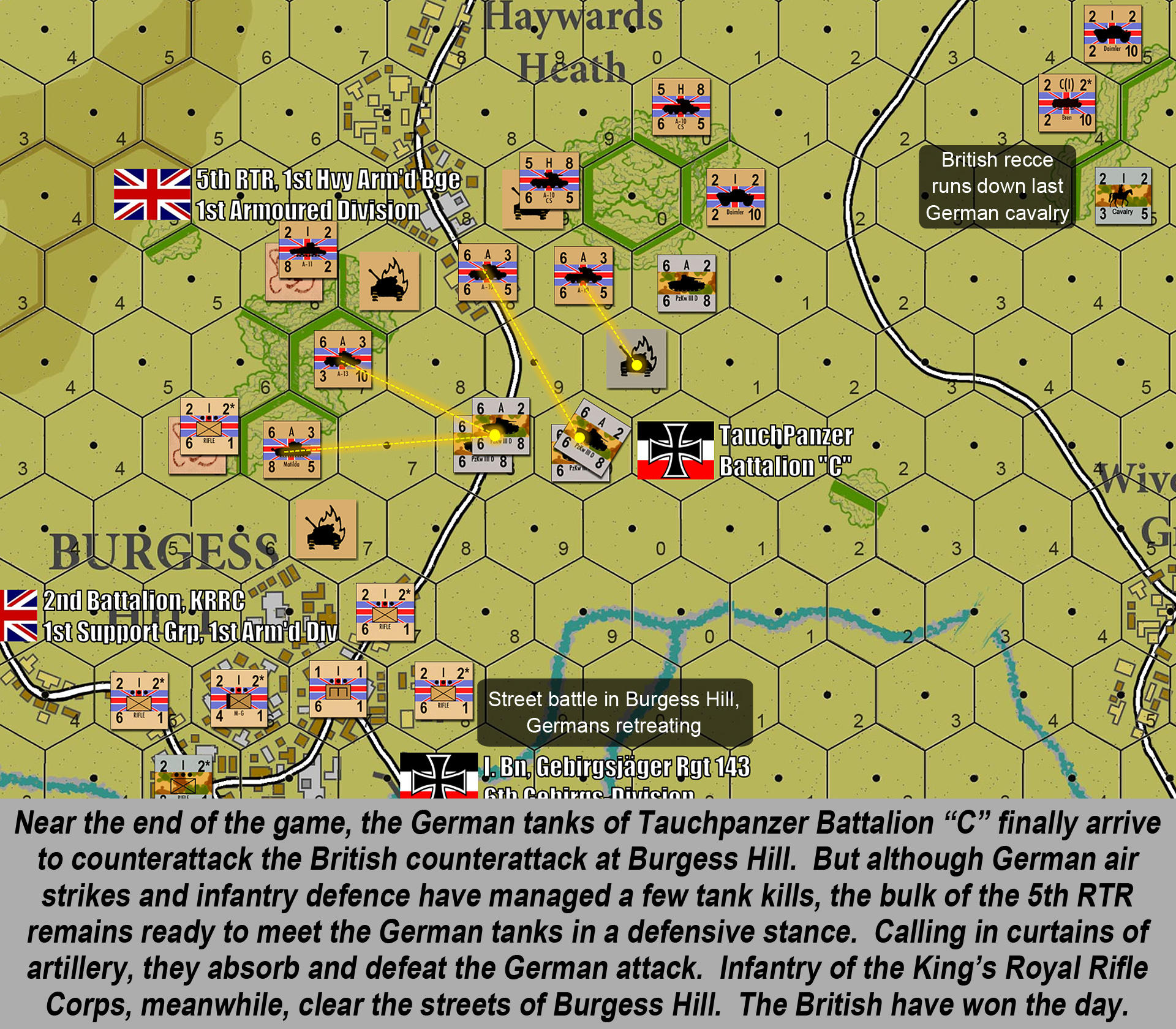
The British victory at Burgess Hill comes just in time for an embattled Winston Churchill. Remember that he was a compromise choice to replace Neville Chamberlain, who only resigned four months ago. In our timeline the British never won the Battle of Britain, so Churchill is still “Mr. Gallipoli” who has yet to win the confidence of the public.
Accordingly, there’s been a strong faction of Parliament who’s been anxious to cut a deal with the Germans – and they’ve been screaming for Churchill’s resignation practically since the first German soldier landed at Folkestone. In the wake of Burgess Hill, however, these opponents are silenced. Britain...will fight.
But with the spearheads of two German armies now on her shores, now including the lead regiments of two panzer divisions, is it too late? Drop your comments below. Is the tide finally starting to turn? Is German luck at last starting to give out? The fate of Western Europe could hang in the balance!
If you would like to write for Beasts of War then please contact us at [email protected] for more information!
"...we have to assume they would have fought like hell to defend their home shores"
Supported by (Turn Off)

Supported by (Turn Off)
"In the wake of Burgess Hill, however, these opponents are silenced. Britain...will fight"
Supported by (Turn Off)



Amazing series I’ve really liked reading these. It makes me want to dust off my Blitzkreig Germans and see if my friend still has his Early War Brits
Thanks very much, @elessar2590 – I was very interested in the Weekender and XLBS show to see how John and Justin will also be running Sea Lion-themed games in 28mm for Bolt Action. Hey, if even one person / gaming group sets up a game and runs something they haven’t thought about before, my work is done. 😀
Amazing!
It reads like a good book. The political factor is rather intriguing as well..
Can’t wait to read the next instalment!
Thanks, @suetoniuspaullinus – the “narrative” part of the campaign is certainly fun to do, but tricky as well … if only because it can quickly run away with itself and we try to keep these articles to a certain length. I know I said I would last week, but this time I MEAN it … 😀 I will start up that parallel thread in the historical gaming forums (Thursday, most likely) where we can all dump in exposition, background, our own games, photos, and not be limited by length or content type.
Then we can really get into the “good book” narrative. 😀 We’ve also got people who are threatening to run naval wargames in the Channel, Home Guard guerrilla skirmishes, all kinds of additional explorations.
I’ve enjoyed reading these, been a particular favourite of mine for years. I would advise anyone who wants to see the view from the German side to read ‘Invasion of England 1940’ by Peter Schenk. Which gives a good idea of just how badly thought out this operation would have been.
Great call, @grizler – Schenk’s writing has in fact been a major (in fact the biggest) source on this series, at least regarding the German planning and orders of battle.
From Part One:
http://www.beastsofwar.com/battlegroup/operation-sea-lion-invading-england-part-one/
This was a really interesting read @oriskany
I like the British counterstrike at Burgess Hill. It did go quite as planned I assume. Especially taking into account the fact that they had some knowledge on how to do it after France with Arras being the most spectacular one.
Taking into account a lot on AA units was a decisive factor and dug in Matildas is a pain in the bottom. Yet, the attack would be a boost to the morale. So the Brits would have to push further the next day and I wonder if the remains of RAF would be able to tackle the Luftwaffe that wouldn’t have to focus on the RN so much anymore. Questions, questions, questions…
I wonder if the GMT’s PQ-17 based mechanics would work for replaying the Royal Navy push for the landing fleet.
I have to admit, @yavasa , I’m completely unfamiliar with the PQ-17 system. I’m assuming this game recreate the PQ-17 Arctic convoy in 1942? What a slaughter that was. And a great example to show what tough time any Royal Navy force would’ve had under German controlled skies.
Yes, the British did very well at the Burgess Hill battle. VERY well, in fact, considering. Let’s just say that I’m making no secret about the fact that I’m giving both sides a lot of credit in the course of this Sea Lion campaign. Clearly, we’ve been giving the Germans a lot of “possibility leeway” here, but just to be clear we’re also doing it with the British in battles like Burgess Hill.
I would pose Arras as an example of how bad British coordination and tactical doctrine really was this early in the war. Granted, the French also share a lot of the blame for this — Arras was supposed to be a converging attack with French division or divisions attacking from the south, combined with a large British force attacking from the north. But through communication breakdowns, bad officer training, poor equipment, breakdowns, etc, what started off as a two nation, three-division assault from two directions became an only-British attack from one direction, built around just two battalions of tanks, I think (with no supporting infantry, I don’t think). Yes, 7th Panzer Division (and XV Motorised Corps as a whole) had a fair scare on that one, but the end result remains that the attack was blunted basically with a couple batteries of antiaircraft guns. I don’t think the German tanks ever had to turn around. The biggest effect was the loss of Hitler’s nerve when he got the news.
In contrast, the Desert War shows that the British Army had a hard time with combined arms mechanized warfare as late as early 1942, when they were outmaneuvered, outfought, beaten and hurled back hundreds of miles by a smaller German force at Gazala, Tobruk, and Mersa Metruh. Operation Battleaxe, operation Crusader are just more examples that this is a tough thing to learn under fire. At least in the desert the British had time to learn from their mistakes. In a Sea Lion scenario they would have enjoyed no such luxury.
I’m not trying to get down on the British here, but these kinds of counterattacks are really difficult to pull off, much less under enemy controlled skies. I just wanted to give the British a break, since we are quite honestly giving the Germans some pretty serious breaks as well. I mean, as paper-thin as British beach defenses were in 1940, and as badly beaten the Royal Navy would have been (granted – assuming clear skies and German control of the air), the idea of a four-corps, nine-division German assault out of a “fleet” of stolen barges is assuming the Germans a “rolling a lot of sixes.” 😀
And I’m certainly not trying to crack down on my own article here. 😀 I firmly don’t believe that anything here is out of the realm of possibility. Let’s just say that with the British mounting a coordinated mechanized counterattack on this scale in 1940, and with the Germans simply getting out of the water, both sides are at the top of their game. 😀
In gaming terms, the real problem with historically-accurate British tank forces at the time is . . . well . . . the tanks. 😀 Some tanks like the Mark VIb Light Tank have a Panzer Leader speed of 11 hexes (almost three kilometers), or 22 hexes on roads (almost six kilometers). There are also the A11 infantry Tank Matilda 1, with a speed of 2 (4 on roads). Coordinate THAT so it all hits the Germans at the same place at the same time.
Firepower and armor aren’t the issue. Yes, many British tanks are armed only with machine guns. But so are many German tanks (PzKpfw I with just two LMGs, and the PzKpfw II with an aircraft-model 2.0 cm autocannon). Many of these British tanks (like the Matilda 2s you mention) are really well-armored, which is not true of the German designs. But of course many of these British tanks also had one- or two-man turrets in which the commander had to also work as gunner or loader . . . making unit tactics (like the ones required in a big battle like this) somewhat difficult.
On the other points – a resurgent RAF . . .yes, look forward to a little of that in Part 4. The fate of the the Gebirgs Division and the overall disposition of the Ninth Army in the wake of Burgess Hill . . . yep, coming up in Part 4.
I’ve also used one of your ideas posted in an earlier thread, and made sure you got credit! 😀
I couldn’t agree more on Arras @oriskany Yet, some historians tend to show it as an excellent example of a counter strike with the use of tanks. Yet, as you have written it was uncoordinated and conducted with poor equipment. 😉
The approach to this articles that you are writing about with giving credit to both sides is good. If it was hardcore wargaming I don’t believe the counter attack would stand much chances not to mention the whole German landing would be hmm… interesting.
My idea? Whaere what?! I will wait for the next installment 😉
@oriskany As for the PQ-17 just visit GMT Games and search for the game. The rules and some exmples of play are for free. It is not an easy title but really rewarding imho.
Oh, and I’ll check out that PQ-17. COmbined arms WW2 naval wargames are tough. I’ve found that they re often too simplistic (War at Sea, either the Avalon Hill board game or the miniatures A&A game) or too complex (Avalon Hill’s “Flattop”). 😀 Finding something in the “sweet spot” would b e nice, and free is always a good thing! 😀
Thanks, @yavasa – indeed Arras definitely had a big impact, but I think a lot of this came about when Hitler got the reports of what had happened and it reinforced his already-frayed nerves about how far and fast the panzers were advancing without infantry support. He was a World War I veteran, and was used to war a certain speed. The idea of the panzers charging ahead without the infantry always made him (and many of the infantry and artillery trained generals on his staff) very anxious. Battles like Arras seemed to prove to them how reckless the panzer commanders were being.
The German generals at the scene (Rommel, Hoth) were fine with the result (once they got over that initial heart attack of panic, that is). This was one of the first times in WW2 that 88s were used in the antitank role (although I’ve read it was also done during the Spanish Civil War).
What I find interesting about Arras is how big of an assault it was supposed to be, and how puny of an assault it would up being, mostly doe to poor communications, coordination, and training. I have no doubt that if Arras had been carried out to its initially intended potential, it would have resembled a mini-version of Patton cutting off the Germans at Bastogne in the Bulge (1944).
When setting up this game at Burgess Hill, I wanted to give the British a real solid chance by putting one of their strongest units (1st Armoured Division) against one of the smaller German units (6th Mountain Division). These Mountain Infantry were certainly tough, but as mountain troops they have no real heavy weapons. Certainly no tanks, very few vehicles, all their artillery is very light (as they usually have to drag it up mountains, etc.). Yes, the British tanks were poor, but note where their biggest breakthrough was, the 6th Mountain’s recon battalion (cavalry and bicycles, of all things).
When on the attack, apply your strength against enemy weakness – “strike into voids,” so says Sun Tzu. 😀 So we’re not really giving the British too much “magical” deus-ex-machina help here. Just applying a very smart attack against a prime target.
That, and some very lucky dice always help. 😀
that was a turn up for the books the end of this one series is going to be as predicable as the US elections were with one of the spearheads mauled and half the supply fleet gone ill go 50/50 @oriskany
Thanks, @zorg . I think a big part of what people think about when considering the “possibility of Sea Lion” has to do with whether the Germans can actually make the crossing. As may be apparent from these articles, I think that prospect was actually a lot easier than many people think in the early fall of 1940.
It’s what happens AFTER that . . . that’s the killer. It certainly was for the Allies at Normandy. They planned and prepared and planned and prepared for two years for that one incredible day, and then got hung up in the hedgerows with nightmarish casualties for two brutal months. Overall, June 6, 1944 was an amazing success (heavy casualties at Omaha not withstanding). But battles like Caen, Bluecoat, Goodwood, St. Lo, Cherbourg, all have to be regarded as Allied failures to a large extent.
It’s in this longer, later, more “grind-your-way-out-of-the-beachhead” phase where I think the initially rosy prospects for Sea Lion quickly start to wither, and hopefully it’s being reflected in the campaign.
yes the Germans defiantly don’t have the huge supply fleet the allies had in Normandy and will struggle to advance on limited reinforcements/supply’s even with a weakened enemy.
Agreed, @zorg . I think the best chance for a long-tern German victory here is some kind of political collapse or diplomatic solution. But after the British victory at Burgess Hill, that might not be forthcoming . . . 😐
role on Monday for the next instalment to find out. Lol
We’re also starting the support thread in the Historical Gaming forums, @zorg – keep an eye out! 😀
sweet.
What about the Royal Navy destroyers and smaller MTB’s of which they had a lot. Do they not play a part yet ? Or are they waiting in the wings to cut off supplies. The Luftwaffe had a pretty bad track record when it came to targetting Naval craft.
Great questions, @huscarle ~
I’ve just checked my records and I show 34 destroyers with the Home Fleet in September, 1940, 11 of which were under repair (I’ll get their names together in a list later on). So that’s 23 operational destroyers. Not a lot, I don’t think, against some 4000 (admittedly *unarmed*) German transports and “landing craft.”
I think this is especially true considering that many of these destroyers would still be required to keep the convoy system going with the United States and the British trade empire.
The plight of the Royal Navy vis-a-vis destroyers can be inferred by their willing to hand the United States a big portion of their Caribbean colonies for fifty 1916-era destroyers. We still hold many of those islands to this day, I believe. This deal was signed on September 2, 1940, so there’s no way they would have been delivered in time for our imagined S-Day on September 15. Furthermore, with a British defeat at the Battle of Britain (in our alternate timeline), it’s tough to imagine the Americans even making this deal in the first place, since Britain would have hardly seemed an investment worthy of backing at the time.
As far as MBTs go, I admit I’m on far less sure footing there. We do have people on these threads threatening to run a naval skirmish game in the “support thread” forum 🙂 . . . with German Z-class destroyers and E-boats against British destroyers, frigates, and corvettes together with MBTs. Honestly, I’m going to leave this to them, as they probably know a lot more about it that I do.
Given British losses to U-boats (never mind the Luftwaffe) in the first two years of the war, it’s tempting to simply shut out the Royal Navy altogether. HMS Courageous, Royal Oak, Barham, Ark Royal, that’s four capital ships off the top of my head, and the Royal Navy only had five in the Home Fleet in September 1940. Especially since the U-boats wouldn’t have to look for these ships, if they want to stop the German invasion fleet, the U-boats know EXACTLY where they’re going to be. Oh, and German aerial reconnaissance like the FW-200 Condor pinpoints their location. Still, I made sure not to count them out entirely.
The only way these ships can be protected from U-boats is by, yeah . . . destroyers. All 23 of them. So it seems like the Royal Navy destroyers, which would have been a factor I certainly agree, are presented with a range of unenviable choices.
If they attack the German invasion fleet, Britain starves because the already-overstretched convoy system breaks down. This is at a time when Great Britain was down to six weeks of fuel, food, and strategic metals, etc.
If they attack the German fleet, they leave the capital ships open to U-boat attack and they’re toast.
If they protect the capital ships, the convoys sink.
If they protect the convoys, the capital ships sink.
It’s tough. There just aren’t enough of them. This is why Britain was willing to sell off parts of her empire for fifty ancient buckets of rust. They needed destroyers THAT badly.
All this said, I promise the Royal Navy has its day. The German challenge is that their U-Boats don’t have the best endurance. Please remember the big U-Boat pens along the French coast haven’t been built yet, these U-boats are probably still having to base out of Wilhemshaven, Bremen, Kiel, and the like. Also, once the weather turns south in October, the Luftwaffe is grounded and the British surface units (let’s not forget cruisers) come back into the fore.
Also, as much weight as I’m putting on the German U-boat fleet, there really weren’t that many of them around at the time, either. Research shows as low as 20 ocean-going boats on patrol at any given time in the fall of 1940. Yet 2.3 MILLION tons of shipping were lost in 1940 to these boats. Still, if the Germans pulled most of these wolf packs back into the Channel to support Sea Lion, one has to imagine the pressure on the convoys easing up a little, which in turns frees up more of the aforementioned destroyers to protect the capital ships from the U-boats in the Channel.
Finally, as Sea Lion gets underway, British naval reinforcements are going to start arriving from places like Gibraltar, the Mediterranean, possibly even the Far East (if fighting lasts long enough). As difficult a time as the Royal Navy would’ve had stopping the initial assault, I think their prospects radically improve when it comes to STRANGLING the German bridgehead as Sea Lion enters week 2, week 3, week 4 . . .
What about the Kriegsmarine which took heavy losses in the Norway campaign over half of the Destroyer fleet and some Cruisers were lost. They weren’t left with a lot that wasn’t in for repair at the time. The biggest threat will be the U Boats for sure.
The Luftwaffe unlike other Air forces made little use of torpedo’s and lacked A.P. bombs hence their bad strike rate against shipping.
I’m glad to see they have overcome these difficulties and made it ashore as the land campaign is what we all want to see played out. The German Army is another kettle of fish all together, though as I suspect they will be out done as the noose tightens. It will be all down to the logistics of keeping them supplied.
For me the most thought provoking thing would be what would happen after a failed invasion. Which way would the war turn next ?
Great point, re: the German surface fleet, @huscarle – the German surface fleet in the 1940 Sea Lion plans are basically a non-issue, at least so far in the plans and documentation I can find. Indeed about half the Kriegsmarine’s surface assets were lost or at least heavily damaged during Operation Weserübung. None of the “famous” heavy ships (Bismarck, Tirpitz, etc) were ready in the fall of 1940. From what I can find, all the remaining surface units were either being held back or sent out into the open Atlantic to . . . and I’m not kidding here . . .
. . . “draw off the Royal Navy from Great Britain.”
Personally I don’t give this part of the plan any chance of success, since the British are probably “reading all the Kriegsmarine’s mail” via the Enigma / ULTRA intelligence channel at Bletchley Park. They would have known the Germans were trying to lure them away, and thus not responded.
This is the reason none of the German surface ships (few as they were) are being featured in this article series. I’m picturing them steaming around Iceland and Greenland, wondering why no one is chasing them. 😀
Regarding the Luftwaffe’s effectiveness vs. British surface ships . . . I certainly understand what you (and others) are saying regarding their lack of anti-shipping training and equipment. I would only add . . .
German aircraft sank plenty of British shipping in the Channel during the opening phases of the Battle of Britain. Granted, these were not warships, but they did have air cover. The warships in our scenario wouldn’t have air cover.
During the Hunt for the Bismarck in May, 1941, the British were horrified of the prospect of the Bismarck making it back . . . not all the way to France . . . but to within 200 miles from France where she could benefit from German air cover. This is part of the reason Admiral John Tovey launched those desperate Swordfish air strikes off the Ark Royal, because these British battleships, etc, really were afraid of Luftwaffe air strikes.
Now maybe they didn’t have the information then than we have now. Its possible they didn’t know how “ineffective” German air strikes would be against British surface ships? I just don’t think we should count out the effect air power has on surface warhips, given the 25-30 battleships sunk by aircraft during World War II. 😀 I mean, there’s a reason there hasn’t been a battleship built in any navy since 1945.
True Battleships are ineffective when it comes to the right weaponry.
Despite having cracked the German codes. I believe the RN would have responded in part to the ruse to draw them away into the Atlantic.
To not respond would have alerted the Germans to the fact that we were party to their communications which in long run have been far more costly. This was a pretence which was played throughout the war. We always used the information gathered from the code breakers carefully. Not giving the game away was a priority. Using the info from Bletchley often required creating the illusion we had come across the intel by accident. Planes would be sent up to make out they came across things by quite chance.
@huscarle – I would agree that deliberately “ignoring” intelligence is sometimes undertaken so as to not tip your hand than you’re reading the enemy’s mail. The famous (or should I say infamous) example of this is the terror-bombing of Coventry. I’ve read accounts that claim the British knew this was coming and took no steps to defend or evacuate the town, these lives were “deliberately sacrificed” to preserve the Enigma / ULTRA secret.
I would offer the following: As with many presumed factors or actions undertaken by the British predicted for a a Sea Lion scenario, logic is often skewed by the “now or never” desperation of the situation. German troops are LANDING on Britain’s shores. Leading panzers are now 45 miles from Whitehall. NOW is when you drop the gambits and use everything you have at your disposal for national survival.
Besides, I’m beating up the Royal Navy enough in this series, I didn’t want to have them set in a wild goose chase, too. Their revenge is coming, I promise!
But as with everything in this series, who knows?
Another great article and more great photos. That trawler sitting by the dock was built totally from scratch in like 2 hrs! Just to put some decoration on the table.
Well worth the effort. Tables should always look cool
Thanks very much @gladesrunner and @huscarle – Ahh . . . actually that was about three hours. And after that game I put about another two hours into it to really finish it off (and enter it in Chris Goddard’s November Competition –
http://www.beastsofwar.com/groups/painting/forum/topic/november-painting-competition-is-now-open/
So it actually looks a little better now than it did on this table (sadly). 🙂
Quite an interesting read @oriskany. If the RN Home Fleet cant impale itself on the spears of the enemy, then what was it good for. At this stage of the invasion I see it as now or never for the RN and those extremely expensive dreadnoughts just become expendable.
At this stage of the war the 2 pounders and 37mm AT guns that are almost laughable later in the war are remarkably potent at this stage of the war and most German tanks will not get a second chance with the 2 pounders. The Royal Artillery training is almost second to none and I would not wish to be on the receiving end whether it was 18 or 25 pounders for that matter.
I must admit that I was quite surprised with the horses and heavy equipment landing on a non secured beach. On the other hand invasion by sea is not something Germans are known for so a mistake like this is plausible. Given the mishaps of the Allied invasions during the war I have quite enjoyed the way you have brought these mishaps for the Germans in your storyline.
The landing rules you have used with the built in mishap casualties I believe covered the operational issue with the T-Pz-3s that I discovered a few years back when I was researching a what if Operation Sea Lion.
Nearing their operational depth in salt water they begin to approach neutral buoyancy. Not quite enough ground pressure. This was not considered a problem during testing as only 2 sea floor conditions were an issue. These were loose mud and loose gravel sand. The tracks would simply spin and the T-Pz-3s would become stuck as its tracks lacking ground pressure simply spun. All tanks that became stuck were recovered. In the test area these 2 sea floor conditions were not common and were largely dismissed as unfortunate. However these 2 conditions were far more common on the other side of the English channel at the operational depths they intended to be released at. They never got around this near neutral buoyancy issue that arose from these 2 conditions while river bed and depth never placed these tanks in similar conditions to this operational issue.
Once the action moves inland and the beachheads are secure stuck submerged tanks could be recovered. The would be a number of mitigating circumstances to whether an individual T-Pz-3 got stuck so I do stress your casualty percentage that you factored in more than likely covered this very advent of bottom crawlers getting stuck.
One function of the Home Guard would now be play a major part in being the eyes and ears for the defence. Going to ground and noting the type, strength and direction of travel would more than likely be more devastating to the Germans than the Home Guard actually engaging them.
At the moment I am not sure if and how many underground Home Guard command and communications bunkers are present in the current battle areas. They would help ensure that German luck was running out.
Certainly not having a Kriegsmarine air wing is showing this shortcoming as the Luftwaffe is stretched to the limit trying to cover all bases.
All up a great read and I am enjoying the level of research you have put into this what if and it shows wonderfully in your narrative. 😀
Thanks @jamesevans140 –
Reading what you sayabout the RN “impaling itself,” I’m reminded of the plans the Japanese had for their battleship Yamato at Okinawa. Only enough fuel for a one-way voyage, no escorts . . . just beach yourself next to the American invasion beaches . . . you CAN’T be sunk now, and fire those 18-inch guns until the ammo runs out . . .
I agree 2-pounders are no joke against armor of the period. With a close range penetration of out to 20″ . . .they have at least a 50-50 chance of penetrating just a bout anything short of a PzKpfw-38(t), and even their their chances aren’t terrible.
In our Panzer Leader game at Burgess Hill, I can personally vouch for the effectiveness of massed 18-pounder fire in the indirect role.
As far as the horses go, this is based on photographs I’m seeing of the Germans having horses draw artillery and wagons and caissons off landing barges. True, British might not be firing machine guns at the landing craft “Saving Private Reinhardt” style, but it’s easy to imaginge the invasion beaches still being under howitzer or mortar fire while the Germans are trying to bring off this battalion- and regiment-level support gear.
And the basic rule of amphibious landings, of course … what can go wrong, will go wrong. The drift rules in Panzer Leader, combined with minefields, friendly artillery, and even overstacking all adds up to make these games terribly chaotic. Half the challenge is literally just getting out of the water (especially with theterrible defense values I gave these German landing craft).
They just got seriously lucky with those tauchpanzers, though. They were supposed to lose one in three. So with eight total landing units (four barges and four tauchpanzers) I was expecting at least 2 or maybe three losses straight away. They only lost one. That was pretty much it for the miniatures landing game, especially once the Germans activated those air strikes. The Germans just had chocolates and a bouquet of roses ready for Lady Luck.
Good call on the Home Guard reporting on German dispositions and movement. This would help off set the difficulties we can assume the British would have at this point with aerial reconnaissance, given Luftwaffe air supremacy.
I’m running the first games and assembling the first additional elements to go in the support thread. I’ll make sure we start putting in those “phase-by-phase” divisional maps if your group is still interested in them (keeping them “behind” the current progress of the campaign articles, of course) 🙂
I love these historical “What if’s”. I do wonder about Operation Sealion though if they had tried the “First Sea Lord Jack Fisher Manoeuvre”. Fisher had put forward a plan during his tenure as First Sea Lord during WWI of an amphibious assault of Germany through the Baltic Sea after grounding a number of big gunned cruisers to act as fire support. Once grounded they would be unsinkable and were the most likely way for troops to survive the trip to the beach in great numbers. Once there the troops (about 4 divisions) would spread out and would require far more troops than just 4 divisions to contain and repel. Instead he lost the argument to Churchill’s disastrous Gallipoli idea. Had Germany adapted idea they probably could have crippled Britain and ensured an instant fortified landing point.
Imagine the Graf Zeppelin was used as a massive tank transport! shuttling armour back and forth much like car ferries do today whilst the Kriegsmarine kept an armoured corridor on either side of it! It’s easy to look at WWII navies and see Britain’s navy as huge compared to Germany’s but Germanys was nearly all in one place whilst Britain’s was spread throughout the globe.
Thanks, @horus500 – now THAT’s an awesome mental image, the Graf Zeppelin completed and loaded not with aircraft, but hundreds of tanks – big ones too (at least for the time) – PzKpfw IIIs and IVs. Maybe even a handful of those early B- and C- model StuGs! 😀
Landing on the Baltic coast? That’s a rough ride in World War 1 – you have to get right past the sizable German Navy (in those days). They’ve just completed construction / enlargement on the Kiel Canal (I’ve read some people call THIS one of the contributing factors to starting WW1) so the German Navy could deploy to either side of Denmark.
One thing’s for sure, you sure would have triggered that “decisive naval battle” everyone was waiting for in World War 1. 😀
The problem with Germany doing something similar in WW2 as part of Sea Lion is none of the big surface units are ready in 1940. Scharnhorst and Gneisenau I believe are sunder repair. Bismarck isn’t finished construction, Tirpitz is nowhere close. You do have a few “pocket” battleships and heavy cruisers (Admiral Scheer, Lutzow, Hipper, etc).
There is the possibility, of course, of big coastal guns at places like Calais and Boulogne-sur-Mer. talk about unsinkable battleships! 😀
Thanks for the comment! 😀
Another great read. I posted up a link on the FB page. But you should check out the documentary called. “It Happened Here” Filmed in 1964 it covers life in an occupied England.
Would be cool for some skirmish game ideas.
@commissarmoody – thanks very much, and thanks for the Facebook link. More exposure is always a great thing for an article series like this!
Skirmish games in occupied England is a subject I think @jamesevans140 will be covering in more detail (I can only add so much in limited space). But I’ll definitely keep an eye out for the documentary. I just watched “Hitler’s Britain” which was okay, but not great.
Hitler’s Britain was ok. I know you folks can nitpick just about any history or what if scenario to death. But its ok for a starter. The same guys who did “It happened here” also did a documentary in 63-64 exposing pretty much how ill prepared the government was to deal with a full on nuclear war. It was band by the BBC if memory serves.
“It happened here” fallows a lady who was a Nurse prewar and the problems she had to deal with getting reregistered with the new government. The new rules. trying to just get along as if things where still normal. But at the same time people she knew are getting targeted as enemies of the new government.
An interesting film if nothing else.
@commissarmoody – Actually found It happened here on Youtube yesterday and gave it a watch. Didn’t get through all of it yet, but it was definitely pretty good. 😀 Great recommendation, thanks! 😀
Glad to hear you are enjoying it. As I said, its not for every one. But I think its a good start for those who want to do an occupied Britain style game.
Indeed, @commissarmoody – I definitely prefer the approach taken by “It Happened Here” it to a “Hitler’s Britain” approach. At least the version I see on YouTube and Netflix – Hitler’s Britain immediately goes for the huge CG red swastika banners hanging off Big Ben and Westminster . . . immediately going for that emotionalist gut reaction. I dunno, just not for me.
In fact, when @lancorz was working up some of the banner graphics for this article series, I asked him specifically to avoid this kind of thing. (1) – who wants swastikas sprawled all over Beasts of War, WW2 or not? (2) – that immediately suggests that Germany wins the campaign, and I knew I’d take enough flak as it is from the historical die-hards on the site. (3) – it just seems cheap.
“It Happened Here” on the other hand, takes an almost Orwellian approach. You’d have to look at the description to make sure you weren’t watching an old indie-production of “1984.” 😀
Let’s face it @oriskany unless those dreads do something they are nothing but anchors of defeat. While others in the RN and government would be screaming that they might be WW1 relics but they will not be paid off for another 20 years so be careful with them. Expanding on your Yamato scenario there are plenty of mud flats in your invasion areas where these dinosaurs could be put to useful rest.
In our Finnish wars of this period we have become very respectful of the Swedish and German 37mm guns and sidestepping that 88 style son of a gun the Russian 45mm. By far the nastiest guns we have faced are the Russian 76.2 mm AT gun and the Bofors 75 mm AAA/AT gun both very 88mm in performance. These were possibly the writing on the wall that the days of the 37-40mm are now numbered. In confined terrain it is your side armour you have to worry about as these small guns can pop up anywhere and slice right through your side armour.
Horses for the Germans leading the invasion with their infantry divisions are a problem. In which wave do you place them as there is no heavy equipment until they land. The Germans are simply not in the position to have the battlewagons parked off shore to hammer the defences out of existence. The other big issue is how Operation Sea Lion was simply thrown together and where several alternate plans are thrown into the ring an unholy hybrid tends to immerge. That completely overlooks a number of obvious must haves. With proper planning tractors of some kind may have been organised, but you are fighting against the maximum tonnage of those bashed out invasion barges. Adding clam doors and ramps would mean the maximum tonnage is now well down.
If there were clearer heads there was 2 weapons they could have made better use of and they had them in numbers and should of been applied thickly. These weapons were the light firstly the 75mm IG18 and the 37mm PaK36 with a generous supply of both AT and HE shells. Admittedly they could be man handled with great difficulty across the beaches, not so sure about the mud flats though. They were easily moved with one horse or a small vehicle. This is what I believed the inclusion of a mountain division in the first wave as they had even lighter versions of these guns. As you say what can go wrong will go wrong and the question of the horses could easily be one be one of these. Its like the invasion of Finland the Russians were fumbling around stumbling into the large concrete bunkers. If anyone ask the NKVD they had the exact locations of the bunkers mapped, armament type and numbers, and concrete types used, so they would have known what explosives to best use against which bunker.
As far as getting out of the water and the number of T-Pz-3s landed, well lady luck sometimes smiles upon the foolish and on other days she simply crushes them. You had put appropriate values and chances in place while the dice decided to wonder off in their own direction. Yarrick in our group is notorious for lady luck just urinates on him in these situations. If you want none of your barges and T-Pz-3s to make it to the beach then just get Yarrick to roll the dice for you.
The Home Guard communications was a major one and almost conspicuous by the lack of telegraph poles around it. At the other end of the scale would be kids on pushbikes with reports hidden in their handle bars. Either way the Home Guard would have getting SIT-REP through to high command.
Our group is still extremely interested in your phase-by-phase maps. These articles has certainly added to their fire. This last week and this week Yarrick has been going through the rules to Battlegroup and getting some very basic games with the interested guys in our group. I am getting a Home Guard listing together. We need 3 levels of quality troops for the Home Guard. In the Battlegroup Blitzkrieg British list has only one quality of troops so I am assuming that the Regular and Territorial troops are considered roughly equal in quality. Where I have to consider from men useless to Territorials in quality. So 3 levels should cover it, inexperienced, irregular and regular. Treating the regulars as the elite. Some of their support weapons are exotic such as horizontally firing mortars with sights and a lot of prayers.
I am also looking at a reload system for troops similar to tanks and guns. This is to cover the Home Guard units with only 10 rounds a piece. What I am thinking is this amounts to 2 fires, so if the squad fires twice in a turn they are out of ammo. These guys are more than likely going to opt to be the eyes and ears guys. While they will be most likely to be of poorer quality, I am considering giving them the Reconn rule which will change the importance of the dynamics of these poor quality troops. It will entice players to take them and I am thinking of making regular troops restricted. These are some of the things Yarrick and I will look at in the next meeting. Once we have completed are lists I will send a copy to you and @piers to go over and lend some experience.
This Sunday Yarrick and I will have another planning, progress meeting, and what I mentioned above so it will be great you will have the turn by turn supporting thread up be then. If anything the enthusiasm of those interested has only increased and this has most defiantly been your articles fuelling them. 😀 😀 😀
Great comment, @jamesevans140 –
I agree that these battleships are pretty much doomed, unless they’re not used (which I highly doubt). Still, the mental imagery of just one of these things loose in the middle of a largely wooden German invasion fleet is a deliciously horrible glory.
Okay, I’m looking at (Sept 6, 1940) – in the Home Fleet:
1st Battle Squadron
BB 26 HMS Nelson
BB 29 HMS Rodney (just completing turbine blade repair)
BB 04 HMS Barham
Battle Cruiser Squadron
BC 51 HMS Hood
BC 34 HMS Repulse
1st Cruiser Squadron
CA 39 Devonshire
CA D84 HMAS Australia
CA 96 Sussex (undergoing repair)
CA 78 HMS Norfolk
CA 65 HMS Berwick
CA 55 HMS Suffolk (undergoing repair)
2nd Cruiser Squadron
CL 71 HMS Galatea
CL D.58 HMS Cardiff
CL 12 HMS Aurora
15th Cruiser Squadron
CAA 93 Naiad
CAA 31 Bonaventure
18th Cruiser Squadron
CL 15 HMS Manchester
CL 19 HMS Birmingham
CL 83 HMS Southampton
CL 18 HMS Edinburgh
CL 21 HMS Glasgow
CL 76 HMS Newcastle
CL 58 HMS Fiji (under repair)
The aforementioned 35 destroyers (11 under repair) = 24 operational.
Two Minesweeper Flotillas – 11 minesweepers (2 under repair) = 9 operational.
1 carrier
CV 47 HMS Furious (Swordfish and Sea Gladiator biplanes)
1 training carrier
CV D.49 HMS Argus
28 Submarines – 6 under repair or refit, 7 more on patrol off France, Norway, or Denmark = 15 ready in England.
As far as the 75mm IG18 and the 37mm PaK36 . . . I’m using the standard OOBs / ToEs for 1st wave German infantry divisions, in which these weapons feature prominently anyway. I tried to have horses draw them in one boat on my miniature table (just for visuals, you can just see some cavalry miniatures used as proxies to tow light howitzers.
In the more complete Panzer Leader games these pieces are much more prevalent. Sure, everyone wants 15.0 cm howitzers and 88s . . . but when you have only these (albeit plenty of these) – you learn to make the best use of them, especially those infantry guns. Man, can they help tip the odds column when you need it. They’re very good at dispersing enemy soft targets (infantry platoons) before you mount a close assault with your own infantry in their movement phase.
Very glad to hear about your group’s continued interest in Sea Lion. John and Justin’s Bolt Action game was also very gratifying to see. 😀
As always a joy to read, enjoy your thanksgiving
Thanks, @rasmus ! 😀 Have a great holiday (some long-overdue time off coming up . . . ) 😀
Really enjoyed the first two articles but had been looking forward to how the boys from Sussex performed when their turn came. Good to see that they put up a fight!
The tricky part with any beach landings along the Sussex coast is the hill line just inland (South Downs). This reaches the sea in parts, Beachy Head being a good example of a formidable chalk cliff akin to Dover. The South Downs would present any landing army a tough struggle having just landed. Given the scenario, I would imagine that the Germans would have pushed over this, especially given their air superiority but it might have taken them a few days to do so. It’s also worth considering whether once ashore, the Germans become targets for the big guns of the RN?
Once over the Downs, the rolling farmland would be easier to handle and Burgess Hill is nestled in the middle of ‘Mid Sussex’. The North Downs East to West just south of Croydon would present the final geographical hurdle. It’s here that the British would be building their last line of defence for London.
I particularly enjoyed the battle of Burgess Hill. Living just on the edge of Haywards Heath, I suspect that had my house been around at that time, it would have been flattened by the British 18 pounders. It will be interesting to see whether the British can really push forward or the additional German reserves landing at the coast can be brought to bear.
Looking forward to the 4th article.
Thanks, @redvers – but you’ll remember I apologized in advance if I blew up up house! 😀
Sadly, I had to cut it off a little for reasons of space, but the hex maps I had set up for some of the earlier battles really do have a line of hills along its north edge. I didn’t know the name of South Downs, but these hills (I think) are in there, based on information I can find on Google Earth and the like. These hills have a big impact in Panzer Leader games, for reasons of LOS, spotting, movement penalties, and penalties for units trying to attack or shoot “uphill.” This makes high ground (especially if it has any cover crowning it like treelines or towns) very valuable.
As far as reserves and continued British pressure, suffice it to say that 6th Mountain Division is in real trouble (already weakened in the crossing and down with the bulk of a British armoured division waist-deep in their flank). The Germans, however, are about to make a major push toward Ashford in Kent. But don’t worry, there’s another big battle coming in Sussex as well. 😀
You did indeed apologise up front. And from the game you played, it was more likely the British artillery that would have done the damage rather than the invading Germans.
I think the line of hills on the north of your map that you cut off aren’t far enough north. The one you refer to is just a rise from the ‘low weald’ to the ‘high weald’ in Sussex.
The North Downs run east to west about 20 to 30 miles north of Burgess Hill.
The South Downs, just to the south of the village of Hassocks in your battle, are similar to the North Downs and any invader would have had to make it over this hill line before entering Sussex. From much of the Sussex coast line, this would have meant heading up hill from the beach. The link gives a picture of the South Downs, just in land from Brighton and the North Downs are similar. Probably fine for a Churchill tank to get up but it would definitely pose problems for these early war tanks.
http://www.geograph.org.uk/photo/2599866
Having said all that, Newhaven and the River Ouse present a flatter approach inland as the river has cut through the Downs. It would be a bottle neck but certainly an easier proposition.
Probably far too much geography in this post and not enough war gaming! I’m sure the boys from Sussex will give Jerry something to think about in your upcoming battle!
That my bad, @redvers – I checked my files and this line of “northern hills” I think I was looking at Ashford over in Kent. I don’t know of those are the same hills you’re talking about (i.e., if “North Downs” runs that far east).
So far the only brown slop hexes (in Panzer Leader) that have really been in a position to make a difference have been the bluffs immediately behind Folkestone. Those have been murder, just as they are when you play Gold or Omaha in Normandy (but not, say . . . Juno, Sword, or Utah).
Anyway, these maps are custom-drawn from templates I have built in Photoshop. I get the towns as close as reasonably allowed, when it comes to elevation I try to get close. I’ll admit that when it comes to tree lines I’m completely guessing (modern Google Earth isn’t going to reflect tree lines from 76 years ago and 1940 aerial photography is incomplete).
The “rivers” on the maps are PanzerBlitz-style streams / gullies. Random little creeks that again, I’m just making sure some are there. Actual rivers that tanks / infantry would have to have a major bridge across would be much wider (each hex is between 150-250 meters across. So as you can see, a certain amount of artistic license is taken with the scaling on the towns. Again, these is meant to approximate 76 years ago (towns were much smaller, I’m assuming), and within the constructs of the game.
Hence, for the miniatures table I tried to avoid the River Ouse altogether. 😀
As far as the British artillery goes, well, as if you needed any more reason to hope the British win this campaign. 😀 If there’s a British win, the British government might compensate you for the house their artillery blew up. I don’t think you’ll be getting that from the Germans! 😀
I didn’t realise that these were custom drawn maps. Extra kudos to you for that. They’re pretty accurate and probably about right for 1940’s Sussex – even more kudos for getting it that close when you’re aiming from the other side of the Atlantic. Not sure where you get the time to put all the effort in!
And yes, the hills North of Ashford are the North Downs that, having skirted the south of Croydon, then turn South East and head down to the coast. The white cliffs of Dover is where they meet the sea.
Of course, any British counter attack is now going to have to push the Germans back over the hills so it certainly isn’t going to be easy.
Thanks, @redvers – yes, custom drawn maps, BUT . . . I have a library of template files and components I’ve steadily built up in Photoshop so it’s not quite as horrific as it sounds. And the “point-point” cartography (ahem) DOES admittedly compromise with game mechanics and the templates in place.
Great series of articles. Very tempting to play a game of London as Stalingrad…
I’m not sure the old dreadnoughts would have been sunk so easily, especially Rodney and Nelson. I would accept their weakness against U-Boats, but German air power had limited ability to sink battle ships. They had no torpedo bombers, which were a key aspect to Japan’s success in the pacific. (Italy had them, and as their efforts in the battle of Britain, showed, Italian air power was pretty feeble). I would argue the deck armour plating of RN capital ships was fairly substantial, and German bombers were not carrying big bombs or bombs designed for taking out heavily armoured warships. Look at the need for the tall boy bomb to sink the German pocket battleship, Terpitz, which was little more than a battle-cruiser in terms of armour.
Also the Brits put several obsolete old dreadnoughts in the southern ports, as they believed the German’s couldn’t sink them. (I do not know a date for their deployment). This suggests even owning the skies, and as the German surface navy had been all but wiped out at Norway, only the U-boats really could protect the German barges from the Home Fleet on the warpath. Prince of Wales was lost to Japanese air power, which was built on supporting its fleet. German air power was built on supporting its army.
But I’m being picky. Its a great set of articles. Can’t wait for the conclusion. Will dust down my old 6mm Germans and Brits over Christmas, see if I can get a game in!
Thanks very much, @rjparker – you make some great points n the British dreadnaughts. A few posts above I have their listed names in the Home Fleet in September 1941. Three battleships (one of them very old) and two battlecruisers.
The more I look at this, the more I think the “heroes” of the Royal Navy in this scenario may have been the cruisers. The Battleships are just too vulnerable to U-boat attack (point taken about the aircraft). The destroyers are too few, and trying to either protect convoy routes or the aforementioned capital ships against U-boats. British carriers are a non-issue, there’s really only one (HMS Furious) at this time in the Home fleet and it’s air group is almost all canvas-and-wood biplanes.
But there are quite a few cruisers, come of them heavy cruisers, and many of these were pretty modern. Many like Norfolk and Suffolk already had radar installed, as we see during the hunt for the Bismark next year.
oriskany
What a great article series, We both enjoyed reading it and the pictures really add the flavour.
Chris G and Victoria
Thanks very much, @chrisg and @victoriag ! 🙂
I have been thinking @oriskany perhaps like a bar room fight it is the little guy you have to keep your eye on. In this case the motor torpedo boats.
Look at the carnage the German E-Boats caused when they got in amongst the U.S. practice invasion exercise. Also a Ju-88 doing a torpedo run would not try to run then down and they are too agile for a Ju-87 to dive bomb. The MTBs would carve up the tugs pulling the landing barges or any of the motorised one for that matter.
The 75mm IG18 and the 37mm PaK36 to me works better in the first 48 hours. Cargo tonnage is at a premium during this time and you get much more ammo per ton for these guys. If you required the punch of a 105 during this period a Ju-87, Ju-88 or Do-17 will do a better job. Certainly at this point the ground commanders are used to supporting the frontline using aircraft as flying artillery. While these 2 guns would be considered light, perhaps too light by some, we get an elephant and the ants sort of thing going on.
One of my favourite German aircraft is the Ju-88. It is a good Swiss army knife, much like the British Mosquito. Another favourite. 🙂
@jamesevans140 –
“A bar room fight it is the little guy you have to keep your eye on. In this case the motor torpedo boats.” — I’m coming around to that as well. That, and the cruisers. Were you still thinking of a War at Sea scenario in the channel? Chris Goddard I think was the one toying with the idea of an MBT – E-boat “skirmish.” 😀
The 7.5 cm IGs work so much better for me in Panzer Leader. They only have a 2 attack factor but a 12 range, which means that 2 AF doubles to 4 at range 6 or less. Easily enough to disperse a Allied rifle platoon with its Defense of 6, and if there are even a few German rifles, MGs, or God willing an 8,0 cm mortar section . . . Their AF of 2 lulls the opponent to disregard them sometimes, but once you get the hang of using them in a combined arms role, they become a real force multiplier to other artillery, infantry assaults, or if you’re lucky, some German assault pioneers. 😀
PaK36s I have a real problem with because their range in PL is only a 2 (300 yards). They hit hard enough within that range, but that short range makes them tough to use offensively. Defensively they have to be sitting RIGHT on top of the objective for the enemy simply drives around them.
Either way, these have been my bread and butter in Sea Lion games. I honestly haven’t used a single 7.5cm FdHbtz, 10.5cm, or certainly any 88s, either in miniature or Panzer Leader.
Absolutely agree 100% on the Ju-88. in our “Aces High” Battle of Britain air combat game, I have a Ju-88 crew that’s survived the whole campaign and even managed a few Hurricane kills. Fast in a dive, too. If it loses a dogfight against Hurricanes it can simply enter a shallow dive and outrun the bastard. 😀 By contrast, Ju-87 Stukas are just too vulnerable, He-111s are overrated, and Do-17s just don’t have the bomb load.
Oh, and a I meant to say, @chrisg – A Yorkshire mention is coming up soon! 😀
oriskany
chrisg is a sleep. i will let him know 🙂
Cool deal. Thanks! 😀
We are thinking about a WaS games @oriskany for Operation Sea Lion. One issue is that While we have respectable U.S. and Japanese Fleets our U.K. and German fleets are fairly poor, just enough for a 100 points battle. If we were to do a series of games it would be to effect what is landed in the beaches. For our current look at the Home Guard we are going to use your articles for the background story and so to that end it will be you telling us what arrived. Certainly later if we wished to do our own full Operation Sea Lion a WaS series of battles would be part of it. After all the channel is at the heart of it.
It is amazing how all these ideas are coming out cruisers, MTBs and the like that were not even considered earlier. Your articles series have certainly brought out a lot of fine details with many postings from the guys here.
I do think that that if a RN dreadnaught entered the channel it gets targeted by everything as it is a capital piece lacking on the German side. Their size actually starts working against them and everyone on the German side would want bragging rights on bagging one.
This could work to the RN’s advantage. By sacrificing one of these big girls it would attract most of the fire power allowing the cruisers and MTBs to get through. However even on the wargames table this would be a gutsy move. I am not sure about the effect on public moral this would have with the loss of naval personal in this manner. The other issue is that would it be worth it once the Germans establish high capacity air bridges.
The PaK36s are under utilised in many rulesets. In my Finnish campaigns I use them a lot alongside the 75mm 76K/02s field gun. The Pak36 using HE is often overlooked. Yet the blast of its HE round is around the same as a HE round from a Sherman 76mm. So they are good against troops in the open and entrenched. In HE mode it can chuck a round out to over a mile with effect. While in AT mode the PaK36 is good for MG nests and the light and they help convince armour to stay away from the field guns. With the area effect barrage of the field gun and the sniper like ability of the PaK36 they make a great complementary combined arms team. As you say most people reach for the 105s or 155s first while this cost effective team at this period in the war is overlooked. I would agree that in AT mode the PaK36 even at this time of the war is about 300 yards as it really needed a longer barrel. I am surprised that PL does not give it a long range HE attack, but then I suppose that most people just see it as an AT gun.
The pre-war Ju-88 V series was the fastest with a top speed of 360 mph. The A series released around the time of the Battle for Britain was slower even though it had much more powerful engines. It is heavy now and is better stressed for dive bombing and had a larger war load than the V series. Some of my favourite battles were the Ju-88 in heavy long range fighter mode against the Sutherland flying boats. These battles could be epic.
@jamesevans140 – It’s tempting to imagine British battleships beaching themselves right next to German invasion beaches or even “running the gauntlet” and drawing all the fire so cruisers, destroyers, and even MBTs could whisk in and start sinking German transports.
It might even be fun trying it out in a wargame. But I don’t think the British would have tried this. A completely subjective guess here. But the British public and especially Navy officer class really cherished these things. The Germans bombed Westminster Abbey and the British shrugged it off. They practically leveled Coventry in one of the worst terror-bombings to date and the British were “We’ll owe you for that, Jerry!”
The Bismarck sank the Hood and the British nation lost their shit. The Royal Navy forgot everything else but sinking the Bismarck. They pulled the Force H out of the Gibraltar and the Mediterranean WHILE CRETE WAS BEING INVADED, other ships simply abandoned convoy duty to join the chase, leaving whole convoys of unarmed merchantmen in the open Atlantic filled with U-boats.
After PQ-17, Churchill gave up on the Arctic Convoys to Russia, cabling to Stalin some nonsense about “we can’t lose any more of our battleships.” What battleships have to do with the Arctic convoys I don’t know, but this damned near caused a split between the UK and USSR in the middle of World War 2 (the Soviets were fighting at Stalingrad at the time).
The point is, the UK and Royal Navy had something of a love affair with their battleships at the time.
That said, in this scenario where England itself is being invaded, they may have resorted to desperate measures.
Interesting information on the PaK 36s HE capabilities. I did not know that. I totally see why Panzer Leader doesn’t include it, given their rules on weapons classifications (A, I, H, M, etc). Their WEC (Weapons Effectiveness Chart) allows for an A-class weapon to fire at half-strength at soft targets, but this would still be limited to the range of 2 (300 meters or so, up to 500 depending on how you play).
That said, I’ve certainly employed special scenario rules for some weapons. The JS-2 / 3’s 122mm gun is an “A” class weapon in that game, but correctly doesn’t get the best attack factor because the gun had a low rate of fire, was pretty low in muzzle velocity, etc. i.e., wasn’t as great an armor-piercing gun as its caliber would suggest.
So we house rule it, where it keeps it relatively low A value, but doesn’t halve its attack value when firing on soft targets. A 122mm HE shell makes a BIG friggin’ mess!
We fdo the same thing with the Tiger I’s L56 8.89 cm KwK. It’s actually not as great an “A” class weapon as the Panther’s SMALLER L70 7.5 cm KwK (In panzer Leader, a 15 vs. a 16). But this means that when these values are halved for firing at soft targets, the Tiger’s 88 is still lower than the Panther’s 75, which is silly. So again, we just don’t halve the Tiger’s value for soft targets. This way the “short barreled” 88 is still a beast for buildings, soft targets, etc, but not QUITE as good as the L70 75 on the Panther.
Then we don’t allow soft target attacks AT ALL for British 2-pounders, for obvious ammunition reasons.
Anyway, sorry. The point is, we do make spoecial rule exceptions. We could easily do this for HE shells (extended range) on Pak 36s.
Damn, at least it would make the damned things more useful in game terms. Because you can’t really hide antitank guns on a Panzer Leader board (concealment is a huge part of ATG deployment), these things are just the pits on a gaming table. Probably one reason they’re underused, as y ou say.
I have part of today off and then a long stretch of time off after that. So that support thread will be going up later today or tomorrow (Thursday U.S. time) at the latest! I’ve already started building some of the images for it.
@oriskany, just a bit further on my previous comments about Germany’s drawing the British fleet into a decisive action in the Channel or North Sea. It’s easy to assume that the battle would go Britain’s way because we look at the fleets available at the time and assume it’s a numbers game. Germany doesn’t have the Tirpitz and Bismarck yet so they will lose and quickly.
What is worth remembering is that less than 20 years previous Brigadier General Billy Mitchell sunk a battleship and was ultimately humiliated and court-marshaled for demonstrating the fact that you got thousands of planes for each battleship. Britain still hadn’t fully accepted airpower at sea. They had 7 and were building more but like most superpowers, still believed in the battleship.
Had the Germans drawn the British fleet out into a seemingly decisive battle to contest a crossing, then ambushed the British with submarine attacks and air attacks with the expressed purpose of crippling the British fleet, then starving out the British before invasion would have been a much more viable option. Germany could have spent nearly the entire Luftwaffe crippling the British fleet and rebuilt it far quicker than Britain could rebuild it’s fleet.
These ‘left-field’ tactics can often totally throw conventional generals. I still remember Marine Corps Lieutenant General Paul K. Van Riper played the Iraqi’s (Reds) in wargames planning the first gulf war. Adopted an asymmetric strategy, in particular, using old methods to evade Blue’s sophisticated electronic surveillance network. Van Riper used motorcycle messengers to transmit orders to front-line troops and World-War-II-style light signals to launch airplanes without radio communications.
Red received an ultimatum from Blue, essentially a surrender document, demanding a response within 24 hours. Thus warned of Blue’s approach, Red used a fleet of small boats to determine the position of Blue’s fleet by the second day of the exercise. In a preemptive strike, Red launched a massive salvo of cruise missiles that overwhelmed the Blue forces’ electronic sensors and destroyed sixteen warships. This included one aircraft carrier, ten cruisers and five of six amphibious ships. An equivalent success in a real conflict would have resulted in the deaths of over 20,000 service personnel. Soon after the cruise missile offensive, another significant portion of Blue’s navy was “sunk” by an armada of small Red boats, which carried out both conventional and suicide attacks that capitalized on Blue’s inability to detect them as well as expected.
At this point, the exercise was suspended, Blue’s ships were “re-floated”, and the rules of engagement were changed; this was later justified by General Peter Pace as follows: “You kill me in the first day and I sit there for the next 13 days doing nothing, or you put me back to life and you get 13 more days’ worth of experiment out of me. Which is a better way to do it?” After the reset, both sides were ordered to follow predetermined plans of action.
Personally I think the Luftwaffe could probably have managed the same result on the British fleet if they had prepared the ambush by baiting the hook with the German invasion fleet.
@horus500 – okay, my bad. We’re talking about a possible British offensive on German shores in WW2, I thought we were talking about WW1 (hence, Jackie Fisher, etc)
While I certainly can’t argue with the possibility, I don’t think that would have happened but ONLY for political reasons. British strategic thinking at the time was focused on peripheral landings all over the place . . . Sicily, Italy (which they did, obviously), but they also wanted landings in Greece, Yugoslavia, Sardinia, Norway, every place EXCEPT northwest Europe. We can’t forget how desperately and bitterly Churchill opposed the landings in France (Normandy), much less Germany itself.
Again, strictly for political reasons. Put a different Prime Minister at 10 Downing Street at who knows? 😀
Oh yes, I’m familiar with Mitchell’s dubious attack on the . . . Ostfriesland? (off the top of my head, checking Wikipedia . . .) BINGO, had it right! 😀 No, that particular test didn’t prove very much. Park an old WW1 dreadnaught out in the ocean, give it no fighter protection, no movement, no escorting ships, no evasive maneuvers, no anti-aircraft protection, and bomb it literally for hours, and congratulations, you finally managed to sink her. Not exactly a fair or realistic test, and did not convince many people YET about the importance of air power vs. surface capital ships.
I think I’ve heard something about the wargame you’re talking about (I was actually in the US Marine Corps during Desert Storm). I’m pretty sure this took place later on, in 2002 according to Riper’s Wikipedia entry:
Van Riper gained notoriety after the Millennium Challenge 2002 wargame. He played the Red Team opposing force commander, and easily sank a whole carrier battle group in the simulation with an inferior Middle-Eastern “red” team in the first two days.
To do this, Van Riper adopted an asymmetric strategy. In particular, he used old methods to evade his opponent’s sophisticated electronic surveillance network. Van Riper used motorcycle messengers to transmit orders to front-line troops and World War II light signals to launch airplanes without radio communications. Van Riper used a fleet of small boats to determine the position of the opponent’s fleet by the second day of the exercise. In a preemptive strike, he launched a massive salvo of cruise missiles that overwhelmed the Blue forces’ electronic sensors and destroyed sixteen warships. This included one aircraft carrier, ten cruisers and five of six amphibious ships. An equivalent success in a real conflict would have resulted in the deaths of over 20,000 service personnel. Soon after the cruise missile offensive, another significant portion of the opposing navy was “sunk” by an armada of small Red boats, which carried out both conventional and suicide attacks that capitalized on Blue’s inability to detect them as well as expected.
After the simulation was restarted with different parameters, he claimed that the wargame had been fixed to falsely validate the current doctrine of the U.S. Navy. He is also critical of post-war Iraq plans and implementation. On April 24, 2006, he joined several other retired generals in calling for Rumsfeld’s resignation.
@oriskany Just had time to read parts 2 and 3, and they are a great ‘what if’ bit of reading and gaming, with some fabulous tabletop shots. Well done, as always!
Awesome, @cpauls1 – thanks very much! 😀
I don’t remember, do you guys celebrate Thanksgiving tomorrow? If so, have a great holiday! 😀
This scenario does make for great wargaming as it is a battle and a raid within the same game.
Too true about British public opinion. Indeed if a person brought me a business plan with the same parameters as this scenario I would reject it out of hand as an act of desperation. There is great investment for only a small temporary gain at best case.
But there is the a danger if the plan were presented the Churchill. He has a propensity to risky daring do plans and the RN loves Churchill. The plan would most likely to fail and I believe it would break the British backbone.
It was a fun plan from a wargaming perspective. I am still tempted to break out WaS and give it a few tries.
I think too often a gun is seen as a weapon and give it statistics, more often these days are viewed with AT and HE ability. The gun is only the delivery system while the shell it fires is the real weapon. The shell´s ability is what the statistics need to reflect when it is a AT or dual role AT/HE. The 17 pounder and U.S. M1 76mm are almost the same thing however the shells they fire are quite different. Most dual purpose guns fire between 3 to 5 different story piecing shell and 1 or 2 types of HE, plus special rounds like smoke. For wargaming purposes we need to simply this otherwise games would be a paperwork nightmare. Imagine writing up the shell load of every tank and gun you have. At times we may need to focus more on some rounds for historical reasons and that is where the time honoured house rules comes into play. Most wargame rule today handle general battle very well and it is only when you wish to dig deeper into one specific battle the rules need a little tweaking.
On another line of our disappearing Tiger Is. One source I came across states that the last operational Tiger I was destroyed in NW Europe on Aug 27th 44 and by this date it’s production had ceased. There are still operational Tiger 1s in Italy and the Eastern front and given that NE Europe will soon get a lot of Kingtigers, it is understandable the Tiger 1 disappears. Now all I need is another source to support this and I will lock it in. This however casts a shadow on the Zug of Tiger 1s appearing in just one battle as claimed by veterans. Bugger I have already bought the models destroying my 41year old record of never having bought Tiger’s for wargaming. 🙁
That’s one of the great things about World War 2 from a gaming perspective . . . things change so fast that these special rules don’t have a chance to “pile up” too deep. Yes, we start stacking up special rules for 3.7cm PaKs and their HE ammunition, L56 8.8cm, the 122mm on the JS 2 and 3 tanks, etc. But I can’t imagine a scenario where a 3.7cm is standing next to a Tiger, except in an AA role on the back of a halftrack. So in any given scenario, you don’t have to work in too many special rules.
Back when my brother and I used to play a lot more Panzer Leader, we would actually make up physical printouts for our scenario cards, imitating the ones from the original 1970s boxed set. This turned out to be great because it limited the special rules. If you couldn’t fit it in the scenario card, it couldn’t be part of the game.
Keeping track of 6-7 ammunition types and loadouts for every tank platoon in your force? Too complicated, you say? I hereby introduce you to GDW’s Assault series, including Assault, Bundeswehr, Boots n’ Saddles (US Army Air Cav), and BAOR. Oh hell yes, you tracked APDSFS, APDSFS-DU, HEAT, HESH, guided missile (for the Soviets) and God knows what else for every tank platoon in your regiment or brigade-sized force.
Sounds insane? Yes. However, this is mitigated by the fact that in the 1980s you basically only have two tank guns on the battlefield, the Soviet 125mm smoothbore and the RH-120 / M256 120mm smoothbore. Okay, the L11A5 120mm rifle is you start bringing in the British. But basically two types of antitank gun would have fought that whole war in Western Europe. So there was room in the game’s “Complexity Sphere” to stack in factors like ammunition loadouts.
I had a Tiger I miniature and wanted to use it in my battle of the Bulge tables when I was writing up my Battle of the Bulge article series two years ago. So I was desperately trying to find a place where Tiger Is fought in this battle. I confirmed that 9th Panzer Division still had a sPzAtbg using Tiger Is (December 1944) but didn’t actually get them into the battle because of some kind of train / railroad screw-up. So they were definitely still around, just rare as hen’s teeth.
Meanwhile, the Sea Lion support thread is up and running! I led off with the high-level operational / situational maps you requested for your group. Running up to S-Day +3 for now, so as not to get ahead of the article series.
http://www.beastsofwar.com/groups/historical-games/forum/topic/operation-sea-lion-addl-content-games-participation/
That was one great things about many map based games of the period is that they kept most special rules to the scenario brief that allowed very specific fine tuning for a specific battle. Yes they were many games that had round type and numbers. We used the GHQ rules for moderns 1:300 where we used platoons and company of tanks where round management seriously slowed down the game. We did not think much of it at the time as all wargames took a better part of the day and large games took multiple days. Today people want several games a day or at least one game wrapped up in two hours or less. So I believe most gamers today want the game system to simulate what might be called the boring stuff.
The source that mentions the last operational tiger being destroyed on Aug 27th 44 is from US operational reports of the day. If the Tigers did not come off the reserve line then in essence the report remains true. However my experience of reports of the time forces me to try to establish facts through at least 3 separate sources that at least mostly agree and average the differences.
37mm with Tigers would be temping as they would help keep Bazookas at bay, although in this instance I would prefer US 37mm as they had canister rounds and make excellent back scratchers. 🙂
Oh, absolutely (on the 37mm FlaK with Tigers). 20mm, 37mm, and 20mm quad AA systems used as HE on enemy infantry is one of the most fun things to do in Panzer Leader.
Well, that and fire a “Wespe” or “Hummel” direct-fire into an enemy-held urban hex. BIGGA-Boom! 😀
Ohh Yeah!!!!
Back scratching at its best.
I am amazed that so many players talk about combined arms but rarely to I see it on the table Pared teams can be devastating.
Honestly I’m not sure if many of the game we see nowadays are big enough or deep enough to demand that kind of combined arms work. Battlegroup is a sure exception, but I’m sure people are used to me schilling for that game. Well, this is just one of the many reasons. Same with Panzer Leader. You can’t just stack up on big cats and expect to win.
Heck, look at that fallschirmjaeger game we just finished in the Sea Lion thread. The best infantry in the game until 1945 USMC assault infantry, and the Germans lose because that’s ALL they had. The British had a vastly inferior force, but a mixed force of AFVs, infantry, MG sections, light artillery, AA, trucks, and even bicycles, and they squeaked out a win (okay being on the defensive in stone villages and 1-162 odds strokes of luck helped a little, too). 😀 😀 😀
I can’t speak for 20mm rules but I have a lot of experience with 15mm. I have found the combined arms teams like we are talking about to be devastating. Especially when they converge on a position where I wish the firefight to happen. I usually operate in combined pairs but swoop in with recon teams or air observation. At this point smoke will start appearing isolating my victim, um we target. The exact mixture depends on the nationality I am playing and the doctrine of the time we are playing. Another combination is mortars doing the pinning, 37mm HE and small arms fire followed some close assault. Rather than pressing my advantage I break off. I try to lead them into less favourable terrain and repeat the process. I am trying to draw them into my firepower umbrella while leading them out of theirs. This is a very Finnish combined arms. Although the Fins are amongst the best troops stat wise they work much better as light infantry. Hit, run and ambush. They don’t have the tanks and large AT guns.
I am looking forward to trying out this kind of combined arms in Battlegroup in our Home Guard games. 🙂
I’m not sure about some games like Flames of War or Bolt Action (I honestly don’t have enough experience) – but Battlegroup and Panzer Leader – combined arms is king. Combined arms is baked so deep into the units capabilities, weapons classes, even the turn sequence, that if you DON’T employ combined arms, you are almost guaranteed defeat. And this isn’t the kind of “combined arms” you see in some video and computer games, where it resembles a slightly more complex game of rock-paper-scissors. This is real combined arms, at least in an academic “wargaming” sense. 😀
I do agree. In FoW combined arms are there and very deep. This is were players of 6 to 12 months experience loose to players of 4 years experience and do not know why. Understanding combined arms is a must along with basic military thinking of having a reserve to reinforce or counter-attack with. You must be aware of how to deploy and use your assets, a classical mistake is trying to use a tank destroyer, like the M-18, as a tank.
These are the 3 main reasons why many players lose games by not understanding them. A dislike many new players have with FoW are its rules to surprise the player as the battlefield commander, most prefer a more clinical experience. An example of this is a new player moves his tanks forward to suddenly have a anti-tank gun battery suddenly appear behind or to their side and the tanks get badly mauled. They usually exclaim I could have won this game if it were not for magically appearing AT guns. The truth is they lost the game for not being a good battlefield commander. In that they did not include recon troops to flush out possible ambush sites and that is why they ended up with a large calibre AT gun pushed up their rear end. The ambush did what it is intended to do, shock the player (Battlefield Commander). One of my likes about BG is that it also has tactical level surprises out of the blue to shock the would be player.
I also see BG and FoW as complementary hand in glove systems. When I am only interested about whether a platoon took a small hamlet I use FoW as my interest is about things higher up on the tactical scale. When I am interested in how the platoon took the hamlet I break out BG. I must admit that my interest with BG is in France 1940.
At the moment I am looking at a couple of sets of rules that is even higher up in the scale of things where one tank or a stand of infantry represents a platoon. Much on the scale of PL. It also means that the players can use their current models. Unfortunately I have had unexpected resistance to PL on that grounds that it is not tactile or visual enough, it is quite complicated and the length of time it takes to setup and play a game. I will still be using PL as a PC based mini-campaign tool until they start warming to the old girl. As for the tabletop version I am looking mainly on how it looks at C&C more than the combat side of FoW. The commander is sitting higher up the tree as battalion leader for smaller games and regimental commander so you are interested in the results of a company taking a hill or not and are not interested in how they did it. I believe that anything higher in scale such as divisional commander could be done in the 6mm scale but anything higher than this would best be done using maps and tokens where your attention shifts to supply issues and replacement units and you are not interested on how the battalion did rather than how it achieved it.
So I really cannot see BG and FoW as competing systems. Just like your use of PL combined with BG, you get a better game. Although I do separate them with figure scale, using FoW in 15mm and BG in 20mm. I find it helps drive home the point that the 2 systems operates at different levels of scale. So we focus in with BG, so the figures and models should be bigger to reflect this. The guys that want to do the Home Guard campaign have indicated that they want to use 20mm as there are heaps of scale models in 1/72 or 1/76 that easily approximate 20mm. From this range they can build there armies very cheaply and because this scale also approximates HO/OO model trains their is an almost endless variety of scenery that can used. In my general area there are a lot of outlets for model trains which is a bonus. 🙂