










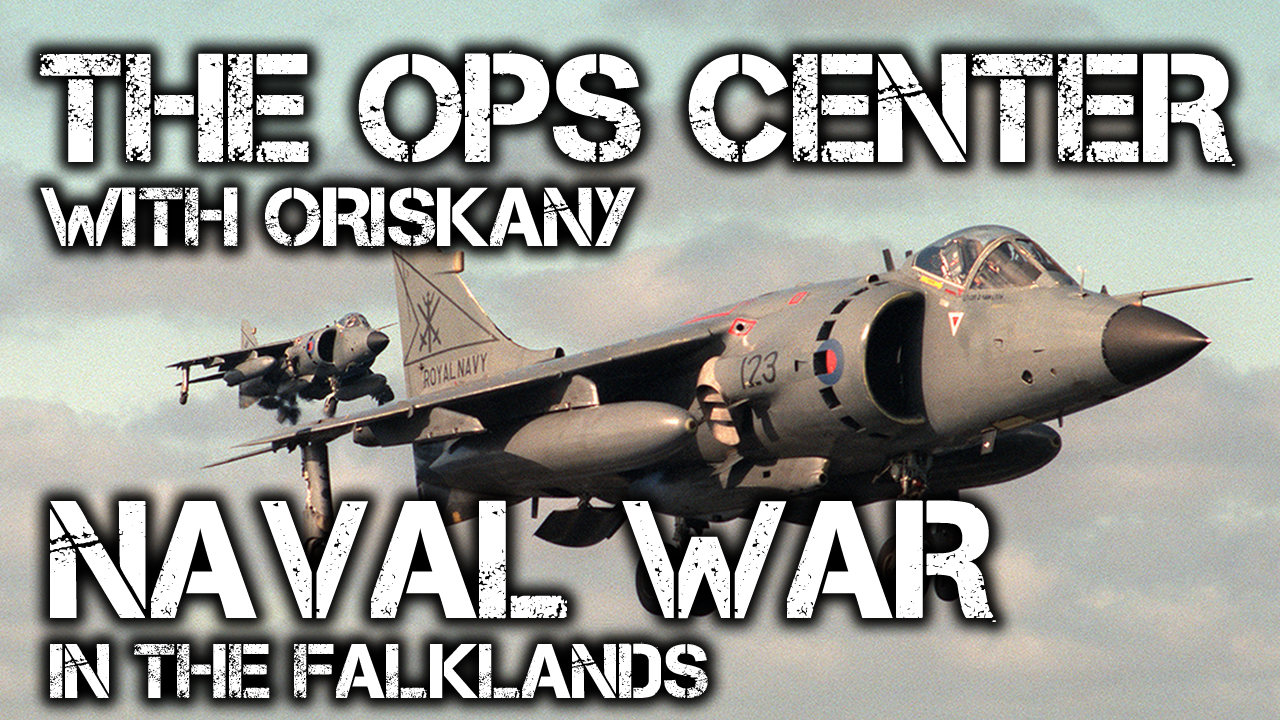
OPS Center Episode 7: Naval War Falklands
May 24, 2019 by stvitusdancern


Jim dives deep into the naval battles surround the Falklands War. If you are looking for inspiration for a great gaming experience, then come along and let Jim guide you through the treacherous seas.
Do you have what it takes to take command of a battle fleet?






Nice work Jim
Thanks very much @grimwolfuk . 😀
a great episode the problem with the British ships was the aluminium saves weight for speed but if a fires starts the aluminium cam burn and is difficult to put out. James
Yes, @zorg – this was an unfortunate side effect of naval / maritime engineering in the 1970s. Cruise missiles were a big thing, and very very powerful – to the point where people largely stopped putting guns on warships. Electronics became your new armor against guided weapons, and of course point-defense guns and interception SAMs. So no armor on the hulls … which actually made a kind of sense (no armor could really save you from Harpoons, Exocets, Tomahawks, or the Soviet Kingfishers, etc.). The bad side effect was that no armor on the hulls made steel superstructures top-heavy, especially as volume had to keep being increased on these structures to accommodate ever-more numerous and powerful sensor suites, transmitters, receivers, and EW suites.
So they had to save weight on the superstructures of these warships. So construction started with aluminum and plastic.
Very bad news once a fire breaks out, as you mention.
The trend started to reverse itself in the 1980s, largely after experience in the Falklands War.
and Falkland’s was why the Iona class was dusted off to get back into action was mentioned.
Absolutely, @zorg – to be honest they were talking about bringing those four ladies out of retirement for a fourth tour or duty (WW2, Korea, Vietnam previously, although not all four had been brought out for all those conflicts), but the experiences of the Falklands War really provided the impetus to re-commission those ships.
BB61 USS Iowa
BB62 USS New Jersey
BB63 USS Missouri (where the Japanese surrender took place in World War II)
BB64 USS Wisconsin
The Wisconsin I don’t remember many stores adout her from the war either was she mostly carrier escort during the war?
USS Wisconsin might have been the last one to fire in action, she was certainly bombarding Iraqi positions during Gulf One. I actually knew a guy on one of the Marine teams calling in the fire missions.
Ooh I do remember the carrier force she was with got rattled by a large cyclone killing quite a lot of people as well as sinking an crippling a few ships.
She’s a museum ship now.
That’s the “Cobra” Typhoon, December 1944.
Three destroyers lost:
USS Hull – 202 dead, 62 survivors
USS Monaghan – 256 dead, 6 survivors
USS Spence – 317 dead, 23 survivors
Damage to dozens of other ship to varying degrees.
In more cheerful news: the four Iowa battleships:
USS Iowa: Museum ship in Los Angeles, California
USS New Jersey: Museum ship in Camden, New Jersey
USS Missouri: Museum ship in Pearl Harbor, Hawaii, across the channel from USS Arizona.
USS Wisconsin: Museum ship in Norfolk, Virginia
well they’re on standby for the next alien attack?
I don’t think so. 😀 Opening the ships as museums is a pretty irrevocable step.
Maybe turn them into space battleships so they can join the Yamato?
Lol.
Another cracker Jim really enjoying these, thanks mate.
Thanks very much, @ironshield ! Community feedback is key to keeping a series like this going.
Wow! Well done Jim. This is the first time I’ve had 25 minutes to string together, and it was so worth it!
As a teen ‘sitting on my rucksack’ during this conflict, I had a limited view of the conflict, but was ready to go, as Canada was prepared to support this.
Fascinating how all the naval elements mesh. I was cross-trained in air/naval stuff at the time, but never even considered half the factors you mentioned.
Thanks very much, @cpauls1 ! We’re three episodes down, one to go (land ops) – I actually just finished my Royal Marine Commando force in Valor & Victory, I hope to test it out in a live stream later today.
I’ve run across reports that although the US had to publicly sit this one out because of touchy, tender relationships and tricky geopolitical issues elsewhere in Latin and South America at the time, the Marine Corps amphibious warfare ship USS Iwo Jima was ready to deploy / be loaned to the British if either Hermes or Invincible took serious damage.
And I agree, the naval aspect of this conflict is the really interesting part, if only because its so rare in the post 1945 era. Even if the Argentinian Navy was more or less compelled to head back to port by Conqueror sinking Belgrano … we’ve been having some what-if battles in “Naval Command” where the Argentinian Navy actually meets elements of the British fleet, and things get messy real fast, mostly with the LPD landing ships Fearless and Intrepid, and the follow-up LSL ships RFA Gallahad, Tristram, and the other “Round Table” ships. The Argentinians always wind up taking a pounding, especially once the Harriers get airborne, but they can do a hell of a lot of damage in the meantime.
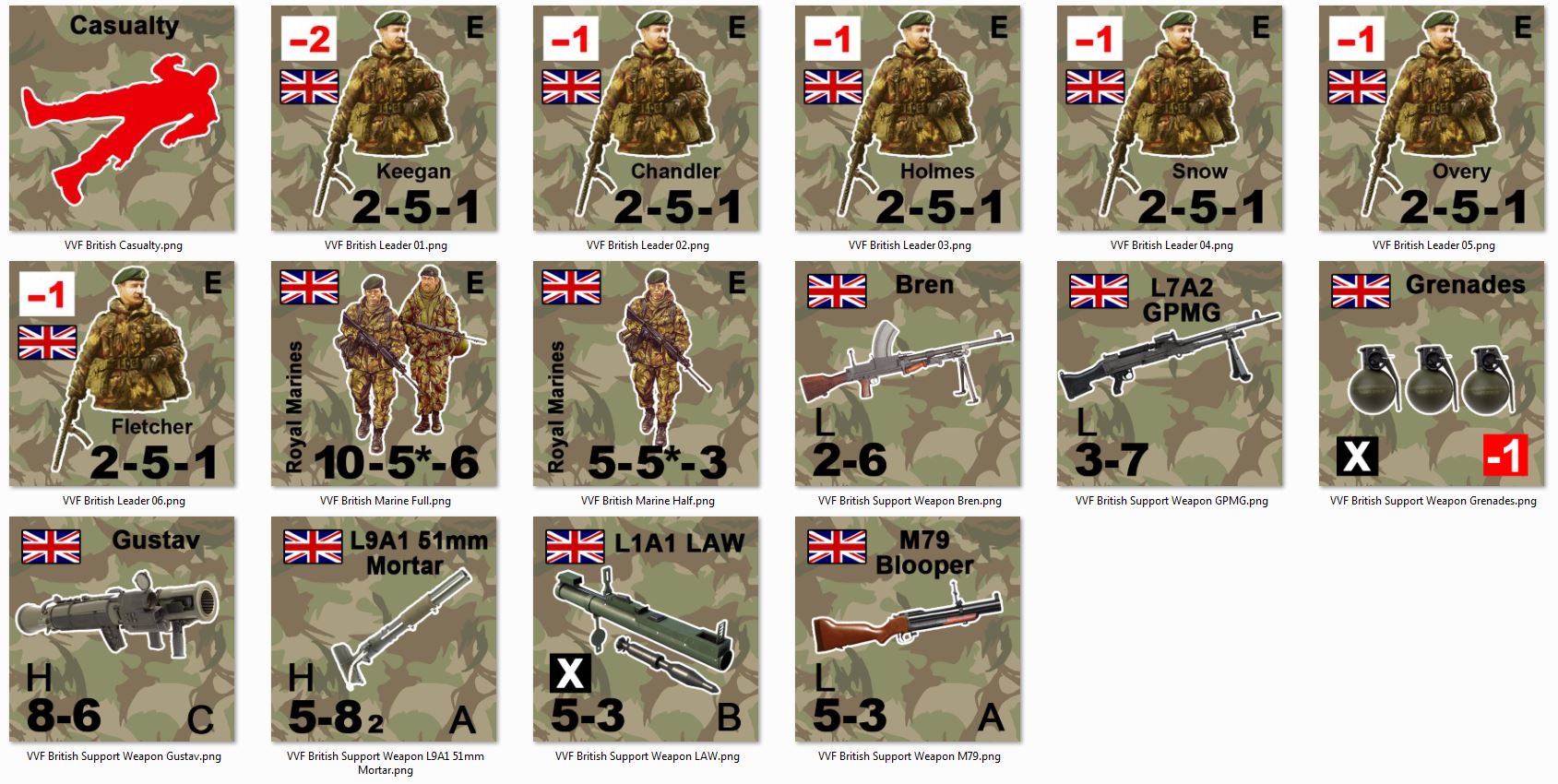
Amazing job on the graphics @oriskany , as always. I’m curious about the Bren gun counter. Was it really still in service then? We had moved on to the FNC2 at that point, and I assumed the British had gone down that same FAL path.
All the other kit is nostalgically familiar.
Yep, the Bren was still in use.
https://en.wikipedia.org/wiki/Weapons_of_the_Falklands_War#Infantry_weapons
Thanks, @grimwolfuk . I think I might have the British grenades wrong, but eh … the game values / rules are the same.
They look like the M67 frags, which were common enough in NATO at the time, perhaps even universal, like 5.56 and 7.62 ammo.
Yep, @cpauls1 – You are correct, those are totally M67s, which may be the problem. Pretty sure the British were using L2A2s at the time (their version of our M36 frag grenade). They jumped from this to the L109 later, so I don’t know if they ever officially used the M67 (or whatever their name for it would have been).
No worries. Nothing that can’t be fixed with ten minutes in Photoshop! 😀 😀 😀
Indeed, @cpauls1 – I was a little surprised to see that myself in artwork (Bren gun, slightly tweaked and modernized, from credible historical artists, still in use in 1982 Falklands) and photos. I don’t know how often I’ll be using them in the games, but since I already had the template from WW2 V&V graphics I’d done, it was easy to include.
The worst one from graphics perspective was the L9A1 51mm mortar, I had a HELL of a time finding any kind of image on that and even now I’m not 100% sure the one I have is accurate. Almost everything I’ve been able to find so far has been 60mm commando mortars or the old reliable 2″ mortar from WW2. Apparently the L9A1 was something of an odd duck that didn’t see much service between the times of these other two more significant types.
The Argentinians were also on the FN-FAL (I know everyone has their own name for this rifle, SLR, L1A1, C1, the Argentinian FM FAL or FAP … yes, feel free to snicker here …) But for simplicity sake I just call it the FN FAL. I found it interesting that some British forces hit the Falklands with the old Stirling SMG, and at their earliest opportunity, replaced them with FN FALs they took off captured Argentinians.
Also, both sides are using the same BASIC MG, the British call it the L7A2 (along with many other variants for vehicle and helo mounts), the Americans call it the M240 I think, the Canadians call it the C6, but it’s all the same basic FN MAG GPMG.
Hey, if nothing else it makes graphics and assigning game values easy. 😀
Yup, C6. A lot of painful memories carrying all that stuff: Karl G, M72’s, belts of ammo for the GPMG, and a few rounds for the mortar, not to mention your own load out. I found the term ‘light infantry’ quite ironic.
Did the Bren still use .303 ammo, or was it rebored to 7.62?. Seems a pain, logistically speaking, to schlepp an extra calibre of ammo along.
I could be wrong but I thought the Sterling was only issued to crews. That was its function in our army, and it seems an odd weapon to hand out to infantry that were mostly fighting in bald assed tundra.
You’re one up on me. I’ve never even heard of a 51mm mortar. At first glance I thought it was the 2″ tube.
Not sure about the modernized Brens, @cpauls1 . I agree it would have made more sense to keep everything at one ammo type (7.62mm NATO standard).
I never got to fire an M240 (our name for the C6 / FN MAG). I had my own “come to Jesus moment” with an M60E3 once, though. 🙁 Pro tip, when changing out the barrel, MAKE SURE that locking lug is shoved forward hard and tight again before firing off that first burst afterwards …
Stirlings in the Falklands were with a lot of the SAS / SBS and even some of the Para and Royal Marine Commandos,at least according to the photos I see. Not for long, though, according to what I read many quickly chose to sling them in favor of “liberated” Argentinan FN FALs / FM FAPs.
You may very well be right about that L9A1, I had a hell of a time finding even that image, and yeah, it looks very close to the old 2″. Many sites that claimed to have images of the L9A1 straight-out had CLEARLY the old 2″ or the newer 60mm “Commando” mortar. Apparently the British went from the 2″ to the L9A1 VERY BRIEFLY before going to this newest 60mm model, so very few of the L9A1s ever saw action, if at all, and only for a very brief window of time. So, no, like I said, I do not stand 100% by that L9A1 image, it very well could be a 2″ mortar. Hell, I’d draw my own if I could get a reliable image of what it looked like.
I’m certainly not complaining! Those images are great, and I’m no rivet counter.
Odd that some regiments were using Sterlings as their primary weapon!
Certainly no one is complaining, @cpauls1 . 😀 I just get curious, is all. Also, getting ready to start writing the script for Episode 08, when I really should know this material in detail. So I’ve confirmed L2A3 Sterling SMGs in 2nd and 3rd Bn Paras, in addition to the vehicle crewmen,artillery, and engineers you mention.
When it comes to Marines, I do see some photos of officers carrying Stirlings – specifically 45 Royal Marine Commando HQ with Bn Co Lt. Col. Andrew Whitehead at Two Sisters, along with officers and his staff and Company COs. Definitely the exception rather than the rule. Maybe I’ll change those Marine Commando smallarms to FNs or even US M16s, to further distinguish the counters from the Paras once I make those up as well.
I remember when this was happening in the news. Not many people were taking it that seriously until the British ships started to suffer those hits. It seemed surprising at the time.
Thanks, @pslemon – indeed, the sinking of the Sheffield and Atlantic Conveyor (and other Exocet hits on other ships that did not sink) caused a pretty major shakeup in the world’s navies. Like I was saying last episode, the Exocet was something of the 1980s “navy boogieman” – with hits on USS Stark, everything that happened in the Falklands, etc. It was a good missile and sold widely, and could be a big “equalizer” to smaller nations who didn’t have large surface or conventional navies.
And hey, if they mention it as a major threat in the TOP GUN movie (briefing scene before the final dogfight), you KNOW it’s serious! 😀
From memory the Exocet on HMS Sheffield didn’t even explode. It was the heat of the missile hitting the ship that set the aluminium on fire
That is correct, @torros – as mentioned in the episode at 15:25. 😀 😀 😀
I love this whole series. I, like most non-military American young peopled, thought of the Falklands as something on the news that looked like those cool 80’s action movies. The some of the adults were very serious about it, but most were just meh. This series is filling in the shameful gaps in my knowledge.
Though the fun part is the chance it is giving me to play “battleship” and be a Harrier pilot (not a very good one unfortunately.)
Hey, @gladesrunner – you did a good job in that game. Both HMS Arrow and HMS Glamorgan remained afloat and operational to keep shelling Port Stanley Airport, which is all Rear Admiral Woodward can really afford to care about as the task force enters the exclusion zone. Like I was saying in the live stream, you’re basically in a war against Argentinian bulldozers … 😀 … you have to keep that airfield damaged faster than they can repair it, so Argentinian jets can’t base off the Falklands and have to operate from the South American mainland (at the limit of their fuel for most types).