







![1918 Spring Offensive Wargame | Full Rules Overview with John & Gerry (WW1 Tabletop Game) [7 Days Early Access]](https://images.beastsofwar.com/2026/03/unboxing-warfulcrum-games-1918-spring-offensive-review-coverimage1-225-127.jpeg)
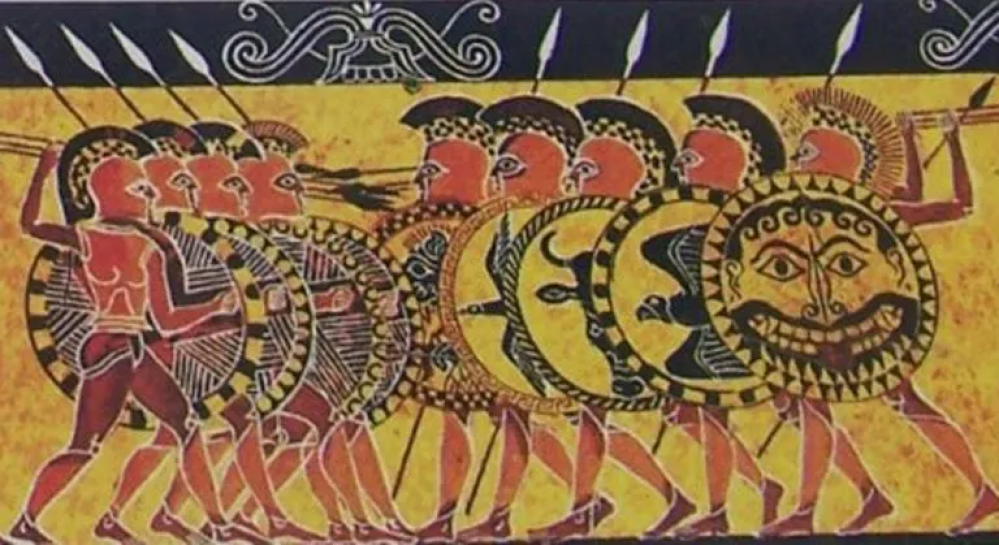
Enyalios!



Recommendations: 491
About the Project
Building of a 15mm and 28mm Hoplite army for a variety of rulesets
Related Game: SAGA
Related Genre: Historical
This Project is Active
Peltasti
DBx Bases: 38 + 7
15mm Spears: 95
DBA Corps: 1
Saga Points: 5
(I’ve removed the targets since I’ve added so many elements to my projections that I can’t keep up with what the targets are anymore. But the posts below should give you an idea of what I am aiming for).
Peltasts – the light infantry of Classical Greek armies. Looking back over the term, its interesting, because the role and name seemed to vary over time, with the Greeks, Macedonians, Persians, and even the medieval Byzantines using the term to refer a variety of troop types. The name of the troop came from the Pelte, a crescent-shaped shield made of wicker wood and/or leather that the infantry type would be distinguished by.
Best I can find, the style of combat – a lightly armoured infantryman who would skirmish, using javelins to harass the enemy and guard the flanks of the main Phalnax – originated in Thrace, where it was the standard combat style of the tribesmen in the area. Over time, the Greeks hired Thracian mercenaries to provide troops of this type, and eventually adopted it for some of the poorer soldiers in their state armies. Peltasts were also one of the main mercenary types hired in the Classical era, which kind of makes sense, since a poor man can probably scrounge together enough money to buy a shield, dagger, and a few javelins, maybe a helmet, and hey, he gets hired for a battle that he can most likely run away from if things go bad!
In most wargames, javelins are short ranged missile weapons – in SAGA, they actually have a dual purpose, being a ranged weapon that the troops can throw for free after moving, and as a one-time melee buff when they charge into combat. In DBx, most Peltasts and similarly-equipped troops are the basis for the Auxillia troop type – lighter than Blades or Spears, but better suited for attacking in terrain, flank guarding etc., and don’t really do well in open terrain. They can also be used in a lighter role as Psiloi, and generally act as the Superior Psiloi troop type.
For my Athenian Army, the first appearance of Peltasts is in the Book II Later Hoplite force, where there is a list entry for sailors equipped for combat – in this instance, you have a choice of equipping the sailors as Peltasts (where they are fielded as Ps), or as Hoplites (Spears). I take this as meaning that the rowers of your ships are pressed into service on the main line, and the officers just equip them with whatever spare equipment they have to hand. This means that they get the shield and weapon, and maybe a helmet if one is available.
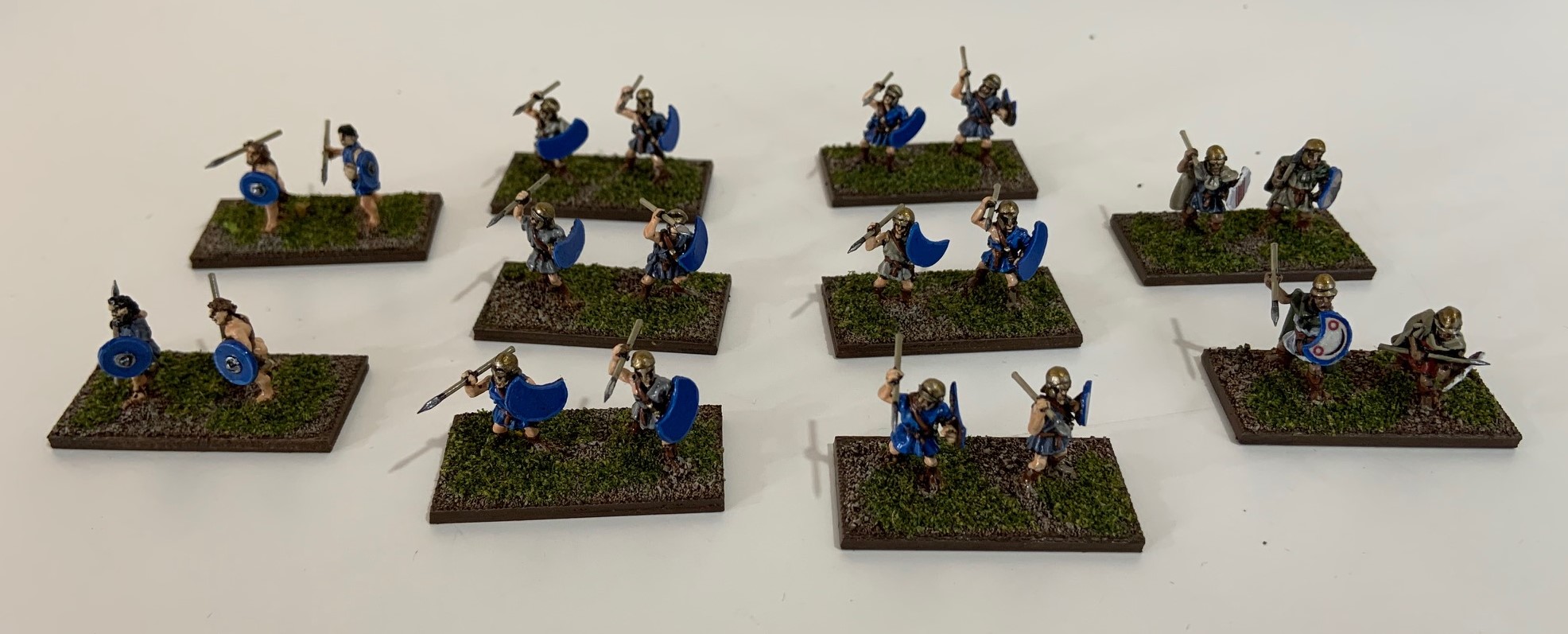
So, six elements of sailor Ps were done up, as well as two new elements of regular Ps, which I calculated I needed, but had not yet done (oops!)
The other two elements were a pair of Thracian Ps elements. As mentioned above, the Thracians were the originators of the Peltast fighting style, so the Athenians probably have a few of them as mercenaries to stiffen their screen. This pair of elements were painted with a bit of blue on their shields to distinguish them as Athenian, thus differentiating them from their cousins who will come later…
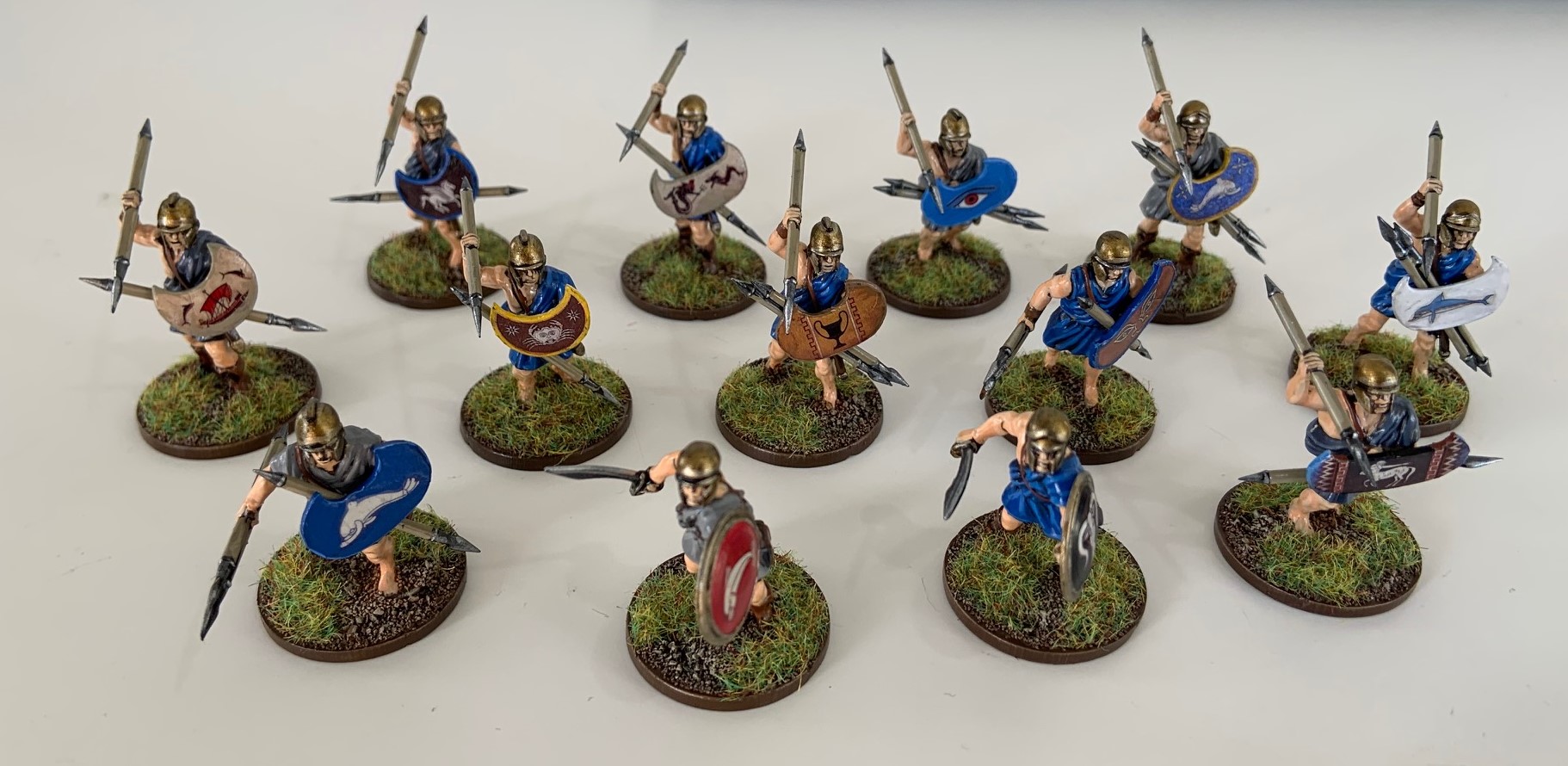
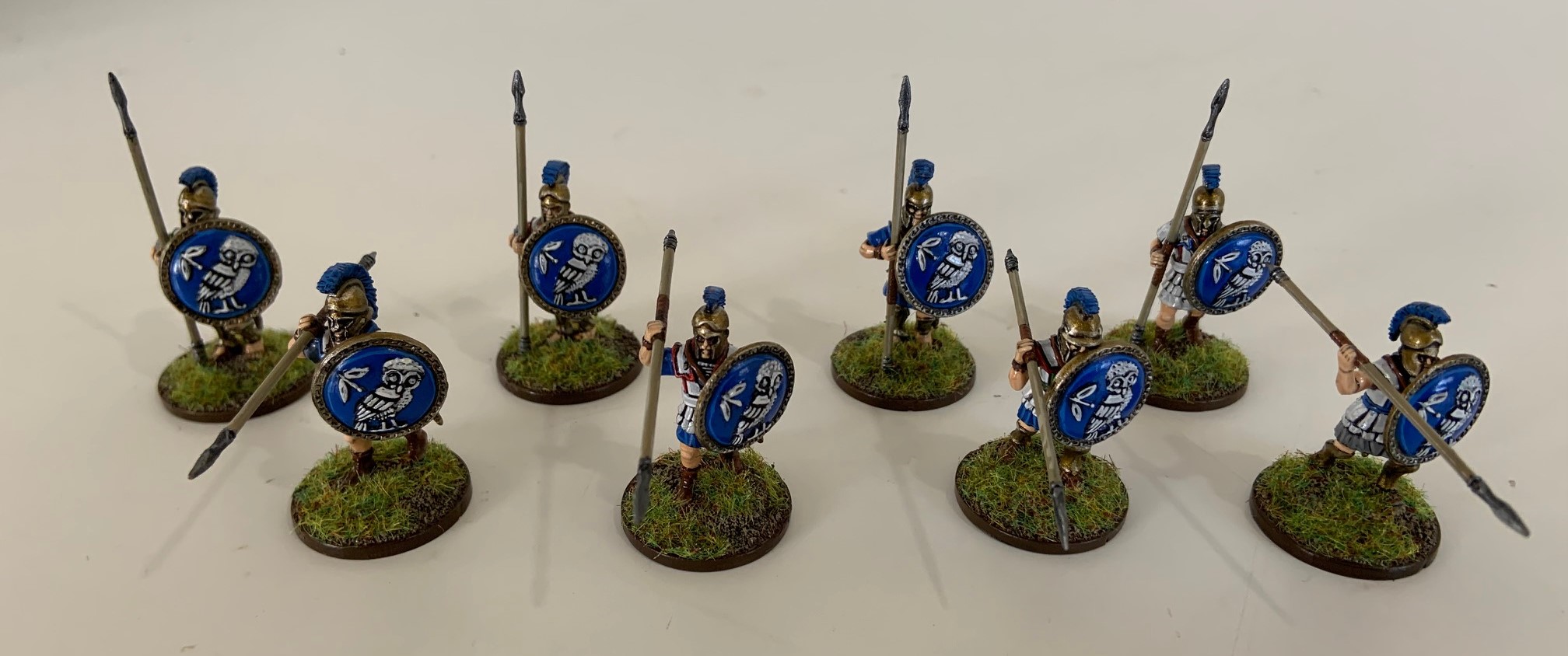
For the 28mm, I’ve actually got 24 peltast models built, including two unit leaders, but I decided to do a unit of 12 this time around – the rest can be done later. But the shields were a bit of a thing to do…whilst I definitely recommend Little Big Men studios for their shield transfers, just putting one on a shield isn’t really enough – You then have to paint the edges of the shield to match the front, and not many of them use the standard Vallejo colours…I was mixing and matching colours for hours, trying to get them completed and looking good. I also did a few transfer chop jobs, mainly to add some differing designs to the shields, as I figured the 28mm Peltasts should really have some shield designs rather than just the plain blue – these are actual troops equipped with their own gear, rather than guys forced to fight and equipped by the state. I guess I could have gone with the plain shields, but I do like the variety I ended up with.
Next up – the remainder of the sailors.
Home is where you lay your head
DBx Bases: 28/177 + 7/18
15mm Spears: 75/451
DBA Corps: 1/16
Saga Points: 4
I read somewhere once that “In war, amateurs think of tactics. Professionals think of logistics.” And, when you come down to it, they’re not wrong. Without food, water, fuel, medical supplies, ammunition, etc, an army, no matter how ancient it is, grinds to a halt. Or at the very least, is severely weakened in the field.
But, generally speaking, we wargamers don’t really consider the logistics of our armies – its somewhat off board, and we only work out who shoots what, and not how they got a hold of that ammo. Its only in games of a larger scale – the larger grand strategy games that really take it into account. Heck, the only GW game I’ve seen consider logistics is Battle for Armageddon from 1992.
The DBx games also don’t really take detailed logistics into account either, but they do take the effect of they army’s base, the Camp, in account on how it affects their morale. In DBA, losing your camp is the equivalent of losing an army element. In DBMM, the camp provides a bonus to army morale. And it makes a bit of sense to see it this way – at the Battle of Gaugamela in 331 BC, one of the reasons Alexander had to break off his pursuit of Darius was to go back and plug a hole on the Macedonian left that was allowing raiders to loot his camp. If his camp had been completely sacked, the Macedonian Army would have probably disintegrated.
As a result, camps are represented on the board in DBx games. In DBA, they’re a single base, but in DBMM, you can buy multiple elements, all of which contribute to the morale of an army. Now, for DBA, I’ve seen people use a single unadorned base as their camp, but I’m always of a mind to do somthing a little extra. And then I found Baueda, or, more specifically, their camps. These looked perfect to me (especially the Egyptian one!), and it seemed like an excellent way to do camps for my DBA forces. Well, for my other forces – as mentioned earlier, my Athenian camp would consist of a couple of beached Triremes (from Xyston) – mounted on a 40mm x 120mm base to keep consistency with other camps I was planning on doing.
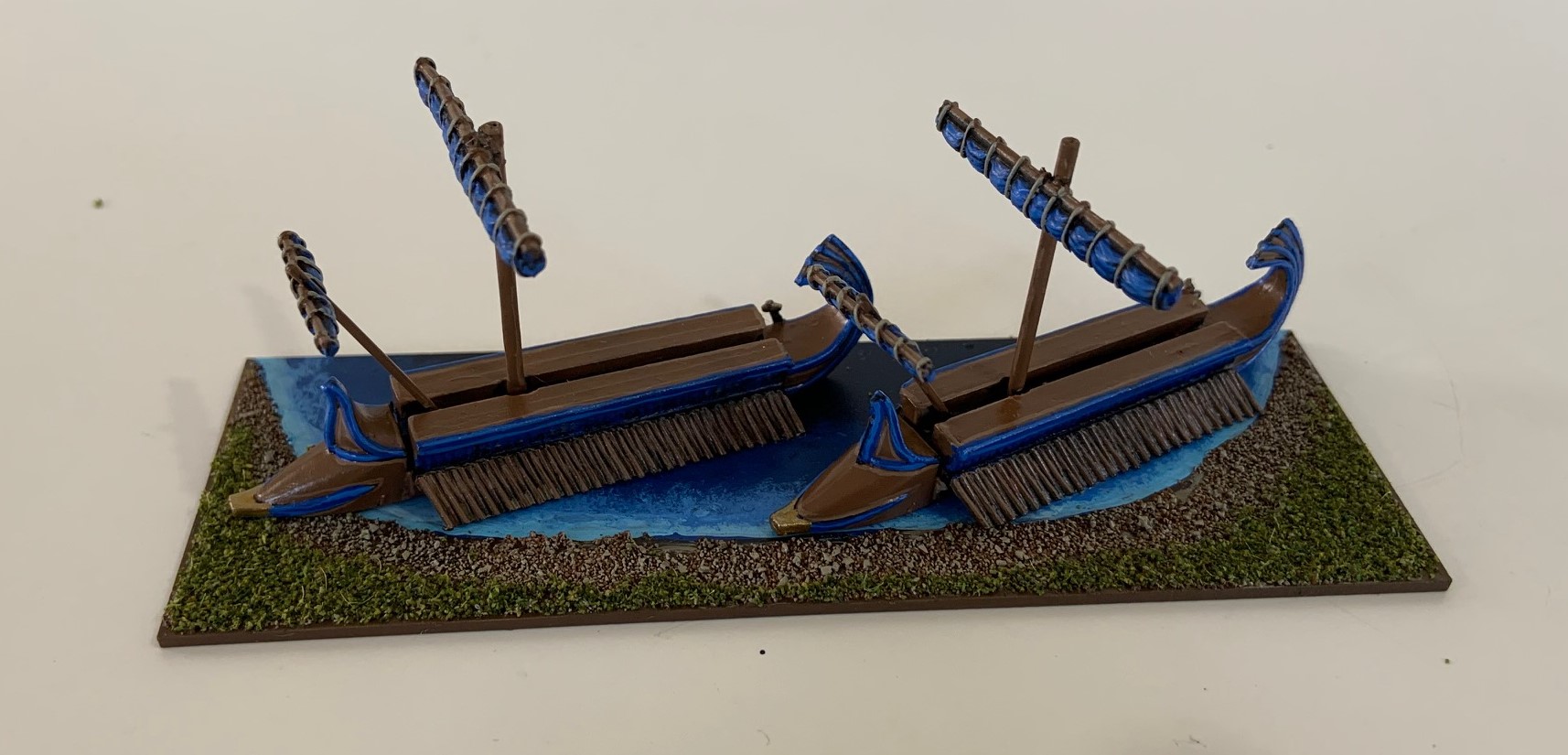
But one camp? No, that would be too easy. I also used the opportunity to do some DBMM tents (from Baueda) for the Greeks. Initially, I was going to do six tents, but I eventually figured to include a camp kitchen (also from Baueda) to act as a bit of a centrepiece. If you can make it look more interesting, why not spend a bit of extra time? I also used 2mm PVC bases for this, since I had a few spares sitting around.
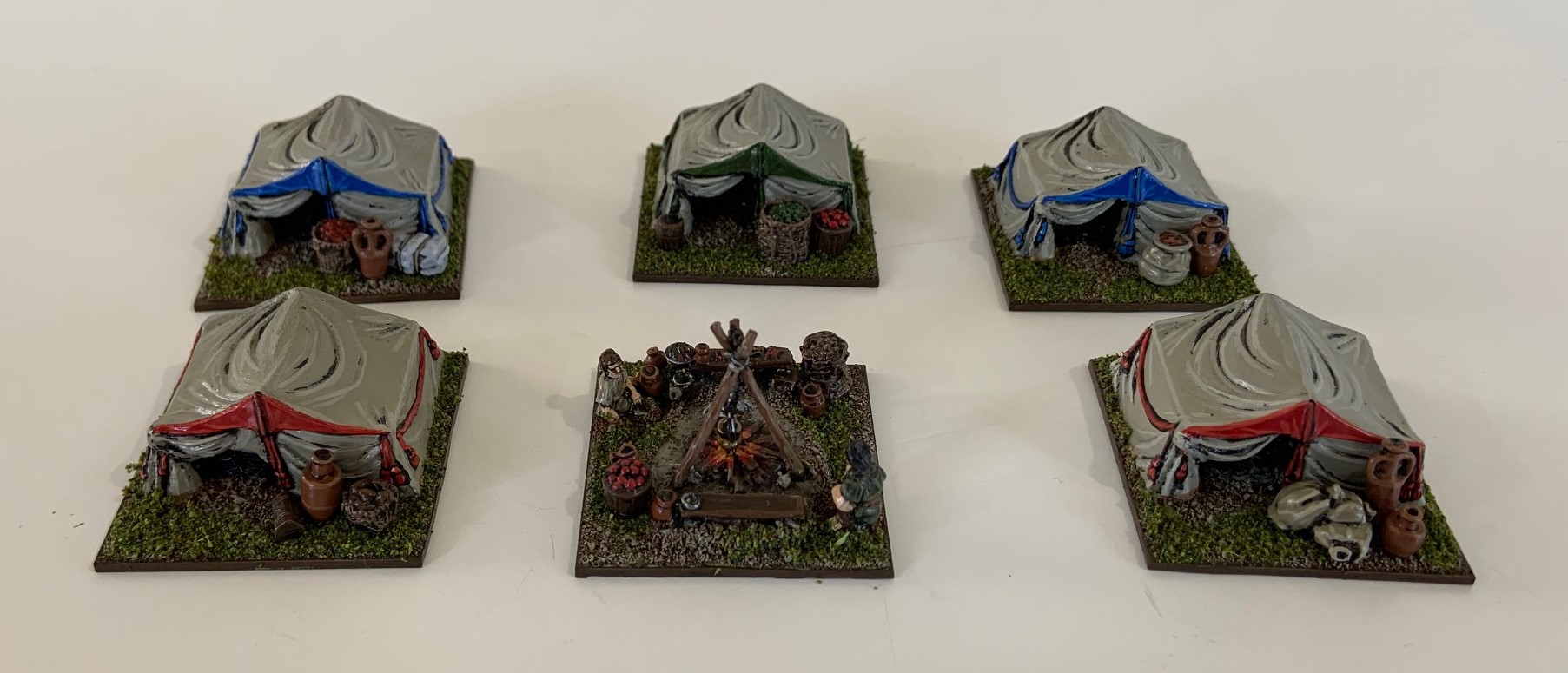
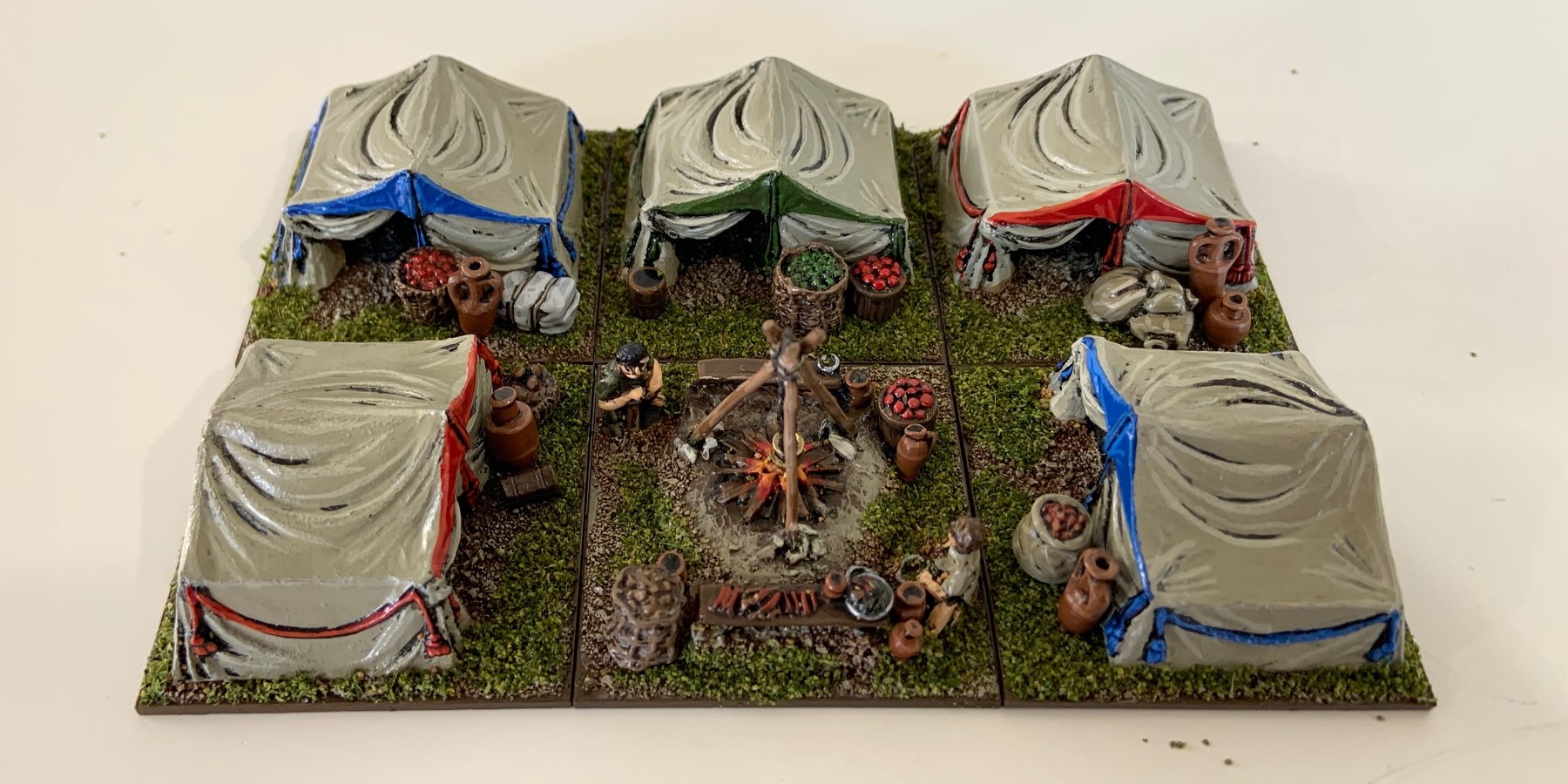
I then also took the opportunity to rebase some previous camps I had completed for my 15mm Sea Peoples (tents are from Essex here), thus freeing up some magnetic bases.*
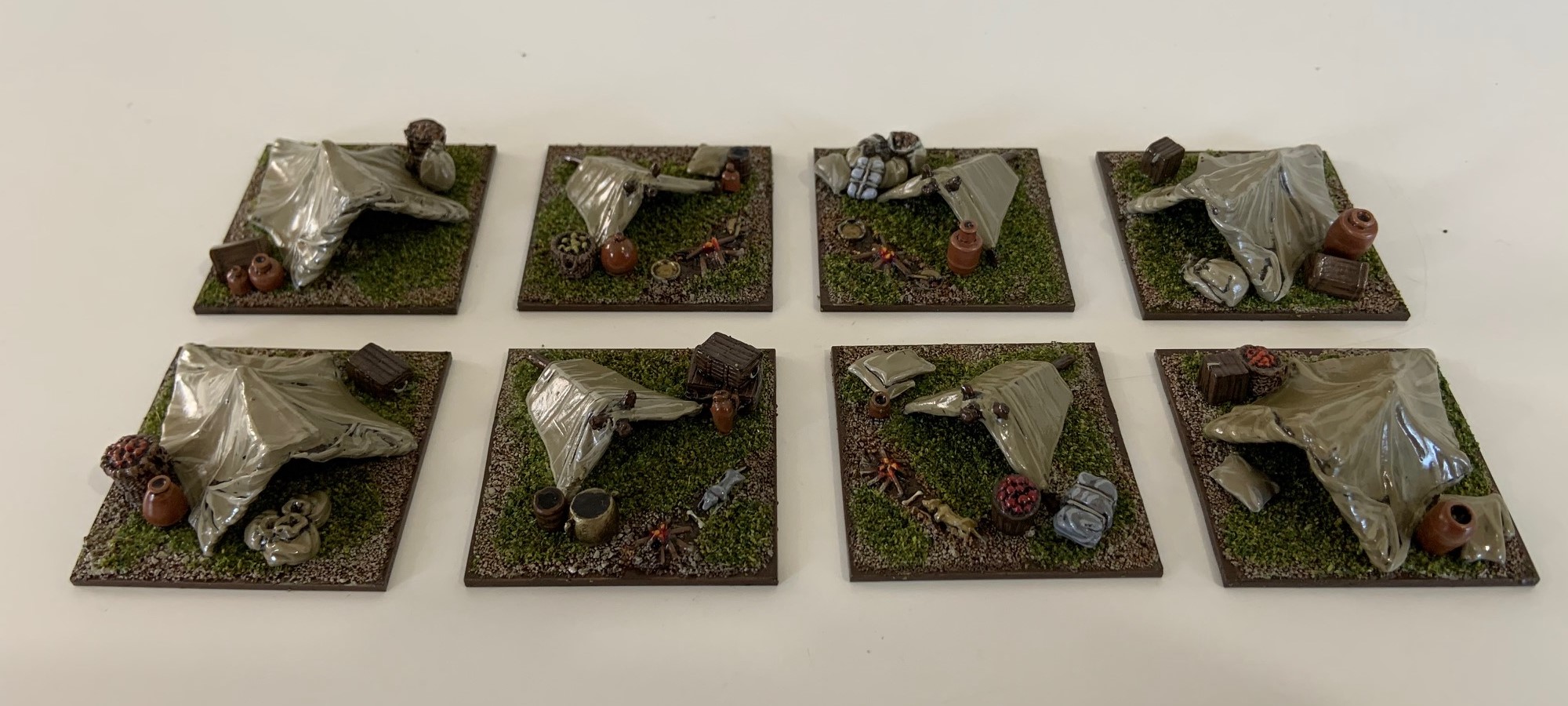
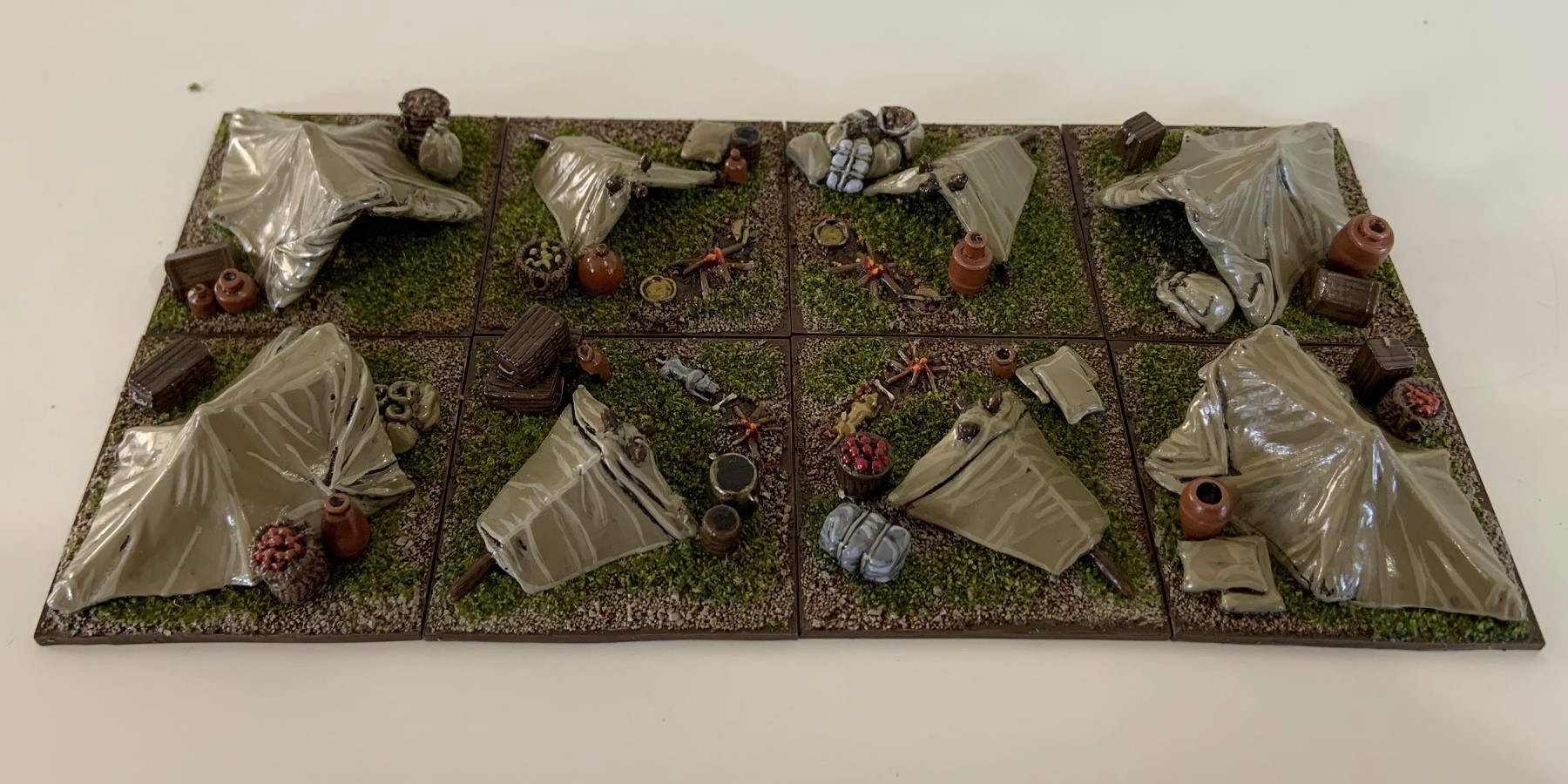
You may notice that the tents aren’t alone there – that’s deliberate on my part. Initially, I did have the tents sitting alone on their elements, but they ended up looking boring. Plus any camp is going to have some detritus scattered around the place, so a bit of baggage here and there seemed like a good idea – make the camp look used. Plus, it allowed the individual elements to look a bit different.
Finally, I put a full camp together – its technically a Hellenic camp, but I’m going to use it for my Nubians and Ancient Libyans instead.
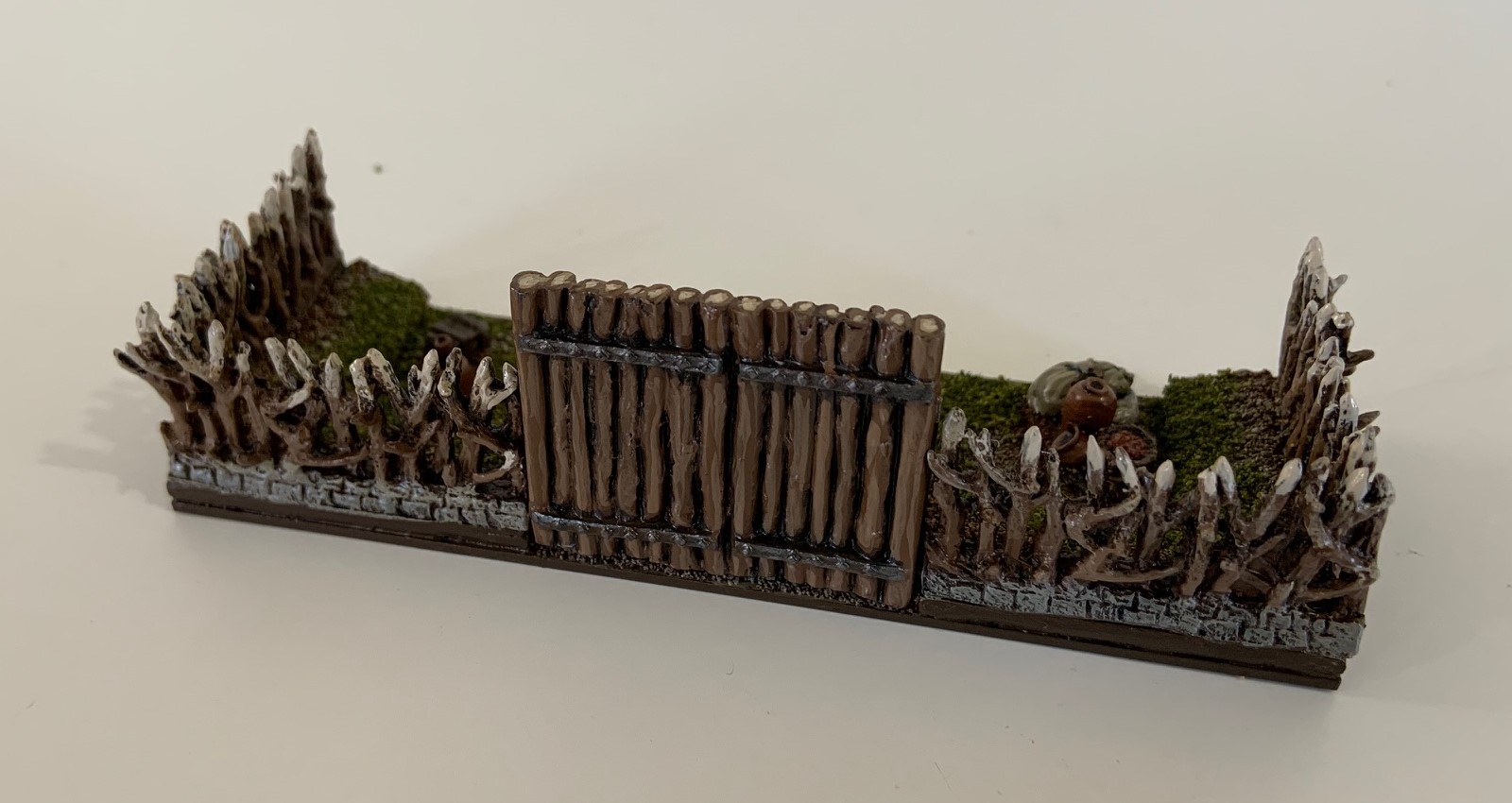
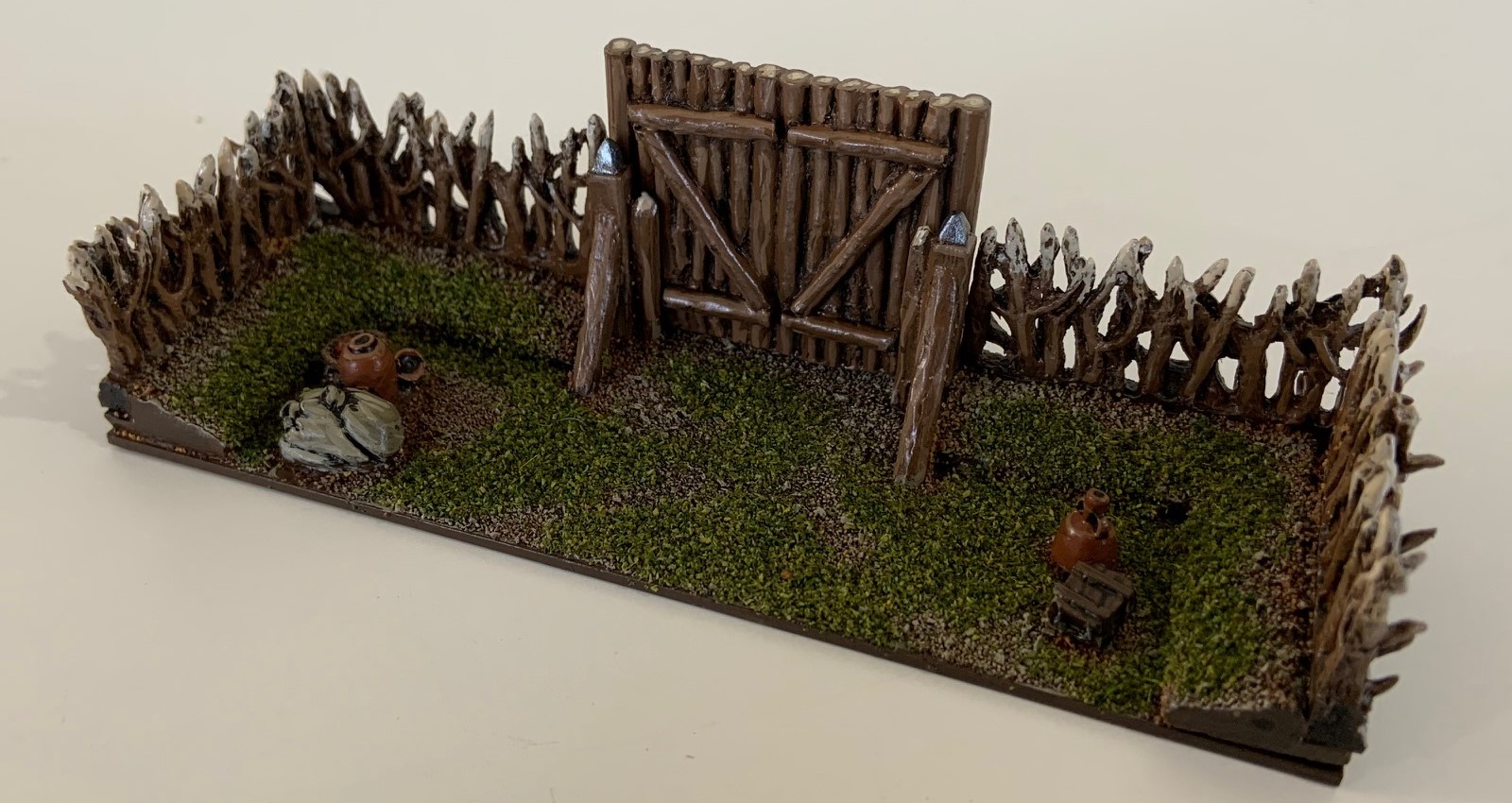
But on the better side of things, what does this mean? Yes! My first corps is complete!
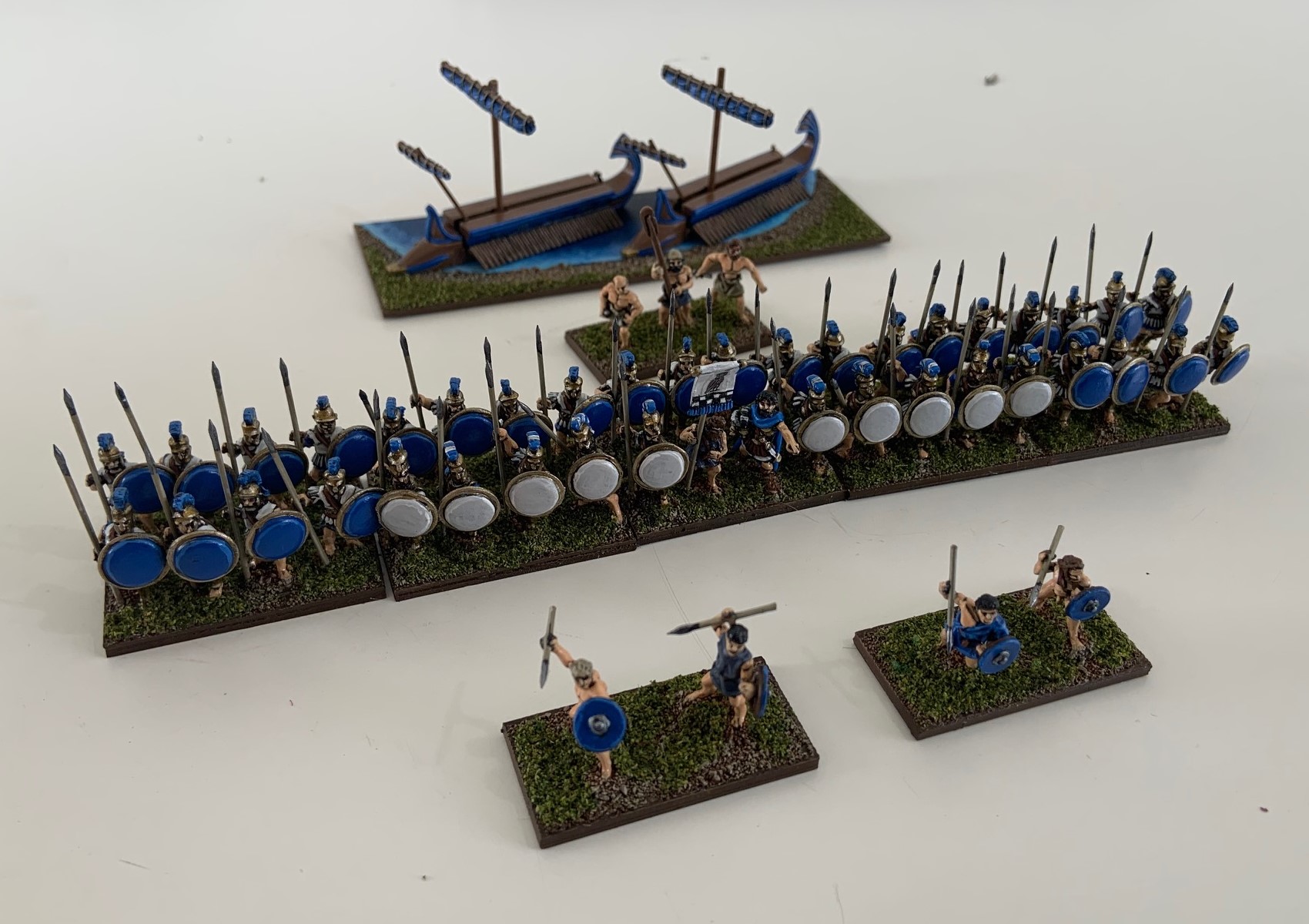
10 elements of Spears, 2 elements of Psiloi, one camp and one element of camp followers. One month after starting, and I’m ready to start playing games of DBA again!
Or at least once my club starts meeting again…(Damn you COVID!)
So, phew – that’s a good start. Now I have to get working on a few upgrades for the next corps.
*Note – I use magnetic bases from Shogun Miniatures to mount my DBx stuff. Unfortunately, because Shogun uses USPS for delivery, and USPS doesn’t currently do services to New Zealand, I can’t restock my supply. I have enough bases to get through this project, but having some spares that I can either use or cut into the needed size is useful.
For the PVC bases, I glue magnetic tape to the bottom, which allows me to still use magnetic storage for them.
Psiloi
DBx Bases: 27/177 + 0/18
15mm Spears: 75/451
DBA Corps: 0/16
Saga Points: 4
In Ancient Greece, Psiloi were light infantry, who usually ranged ahead of the main battle line in a skirmish sceen. The name Psiloi came from the word psilos, which literally means “bare” or “stripped”, which, in some of the artwork of the time, seems to be literal for the skirmishers – some were only equipped with a shield, javelin, and possibly even a knife belt, and only that. And that was assuming they had weapons at all – the gymnetes (meaning “naked”) were men who skirmish ahead of the main line in little more than their birthday suit, picking up and throwing rocks at the enemy.
In DBA, Psiloi are the skirmishers of your army. Mounted two to base, they are one of the weakest troop types, but are still very valuable, since they are somewhat more able to move through terrain than other troop types – and thus can be used to pin or tempt enemies into terrain when they normally would not want to be – but also a direct threat to Elephants. They represent a large array of troops – not just the ancient and classical jalvelinmen, but also skirmishing archers, slingers, and even hand-gunners in the late 15th century. In the larger DBMM, Psiloi are divided into Inferior, Ordinary and Superior grades, with Ordinary being usually equipped with bows and slings, and Inferior and Superior elements both having similar descriptions – although I’ve always thought of the Superior elements being either more highly trained and heavily armoured than their Inferior counterparts.
In Saga, Psiloi are a troop type in the Age of Hannibal book – there they are rated as low-quality troops equipped with Javelins and really work on automatic – if they are in range, they throw their javelins, and if they aren’t, they move. They also don’t cause any disruption to your own force if they die, so I see them as a screen to soak up missile shots from the enemy.
But why all the exposition – mainly because the Athenians don’t have that many Psiloi to paint up for use. At best, they get two Psiloi elements per corps, and they are little more than javelinmen. The Xyston miniatures are fairly interesting for use with these elements – there are 24 base Psiloi model variants available, with a mix of tunics, hats, cloaks and sword belts. And some of the mixes are…interesting. There’s one guy who has a cloak, sword belt and a Petasos hat, and nothing else – I mean, at least he understands how to protect one important part of himself…I guess.
I only had 8 models to paint (4 elements total), so I divided them into a mix of guys wearing tunics and those who weren’t, and none wearing hats or cloaks. And although I was able to include some of the Athenian tunic colours, ultimately, their link to the army as a whole came from their shields, painted in the standard Anthenian blue.
Since I didn’t have that many to paint, I also took the opporunity to do a few more elements – the rowers. In DBA, as part of the camp (coming up next), you also get an element of camp followers. This usually represents cooks, washer women, servants etc. that form a last line of defense before the camp gets sacked. But I’ve had an idea of using grounded ship as my Athenian camp, so it made sense that the camp followers in that instance would be the ship’s rowers (Greek Triremes had about 170 rowers each to support ~15 deck crew and the same number of marines). Additionally, Rowers are available to Athenians in DBMM as Ps(I) elements, subject to how many boats you have in your force. So, bonus! Not only would I get my camp followers painted, but a few extra Ps units completed.
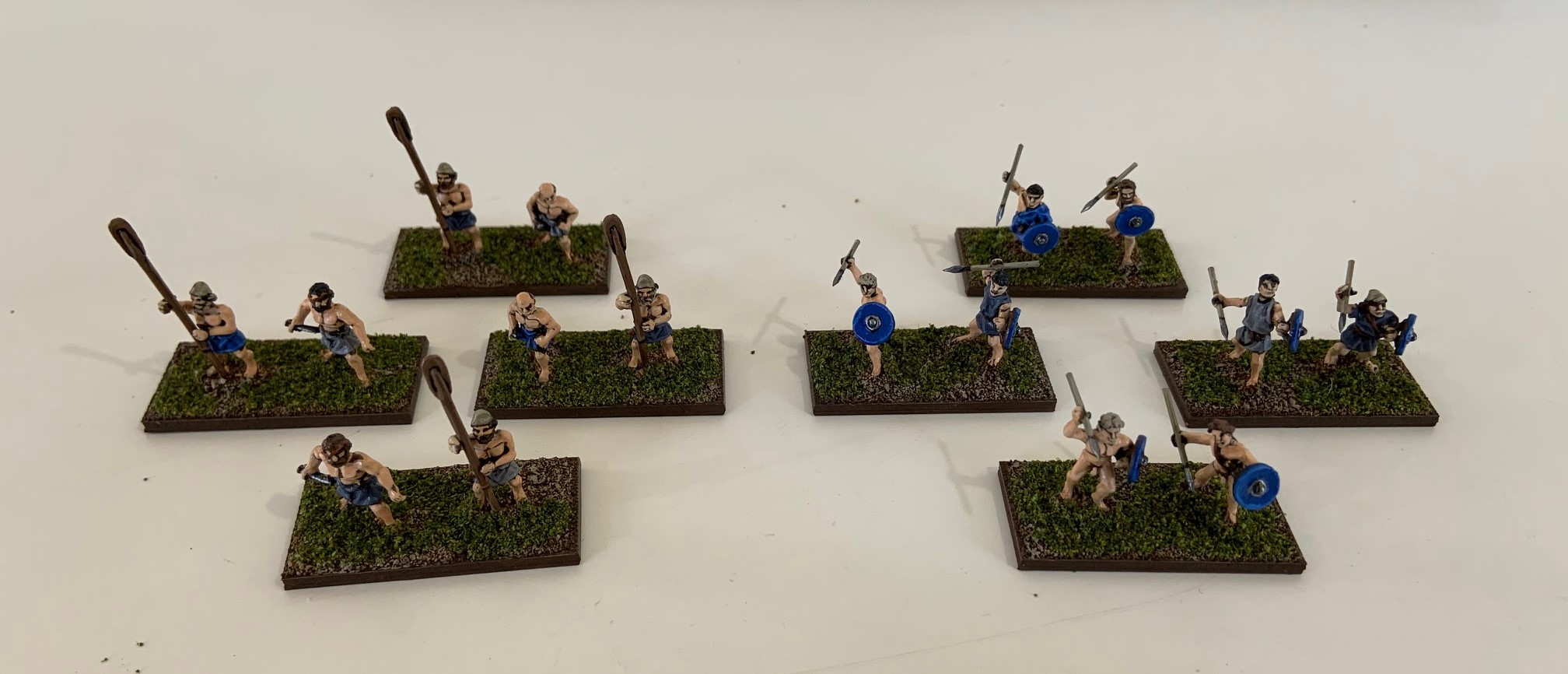
Heck, given the size of the oars these guys use, I can almost see them running forward and doing a Dwarf sweep with it…that’d be one way to disrupt a phalanx…
As for the 28mm scale…well…I only did 3 new models in Athenian colours (enough to do a group in Mortal Gods) because I had already painted a unit of Psiloi months ago, for some reason. Yes its a bit of a cheat, but I want to get somthing else done by the end of the month.

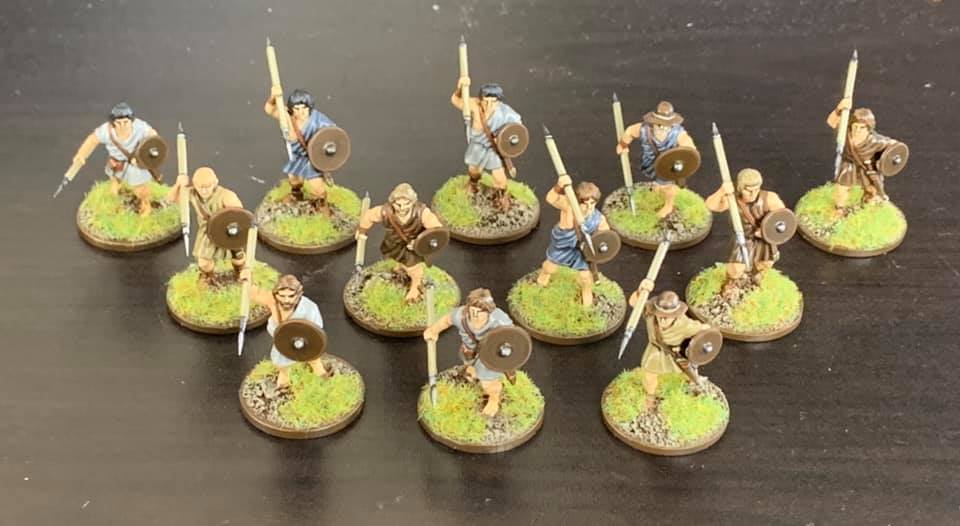
Anyway, a few new elements, and that’s most of the first corps done, apart from the last thing – the camp.
The first Phalanx
DBx Bases: 19/177 + 0/18
15mm Spears: 67/451
DBA Corps: 0/16
Saga Points: 3
So, next on the list are the regular line hoplites, the main force of my army.
Unlike the elites, these guys only get Linothorax armour – not that I mind, as painting flat white parts are somewhat easier that sculpted metalics. The regulars also kept to the mix of tunic colours that I’d worked out previously.
Now, according to the rolls, I need a minimum of 5 elements of Spearmen for my first Corps. Although I’m planning on actually using 7, since I’ll have 2 elite elements…oh, heck, lets just do all 10! Plus a point of 28mm Hoplites to match!
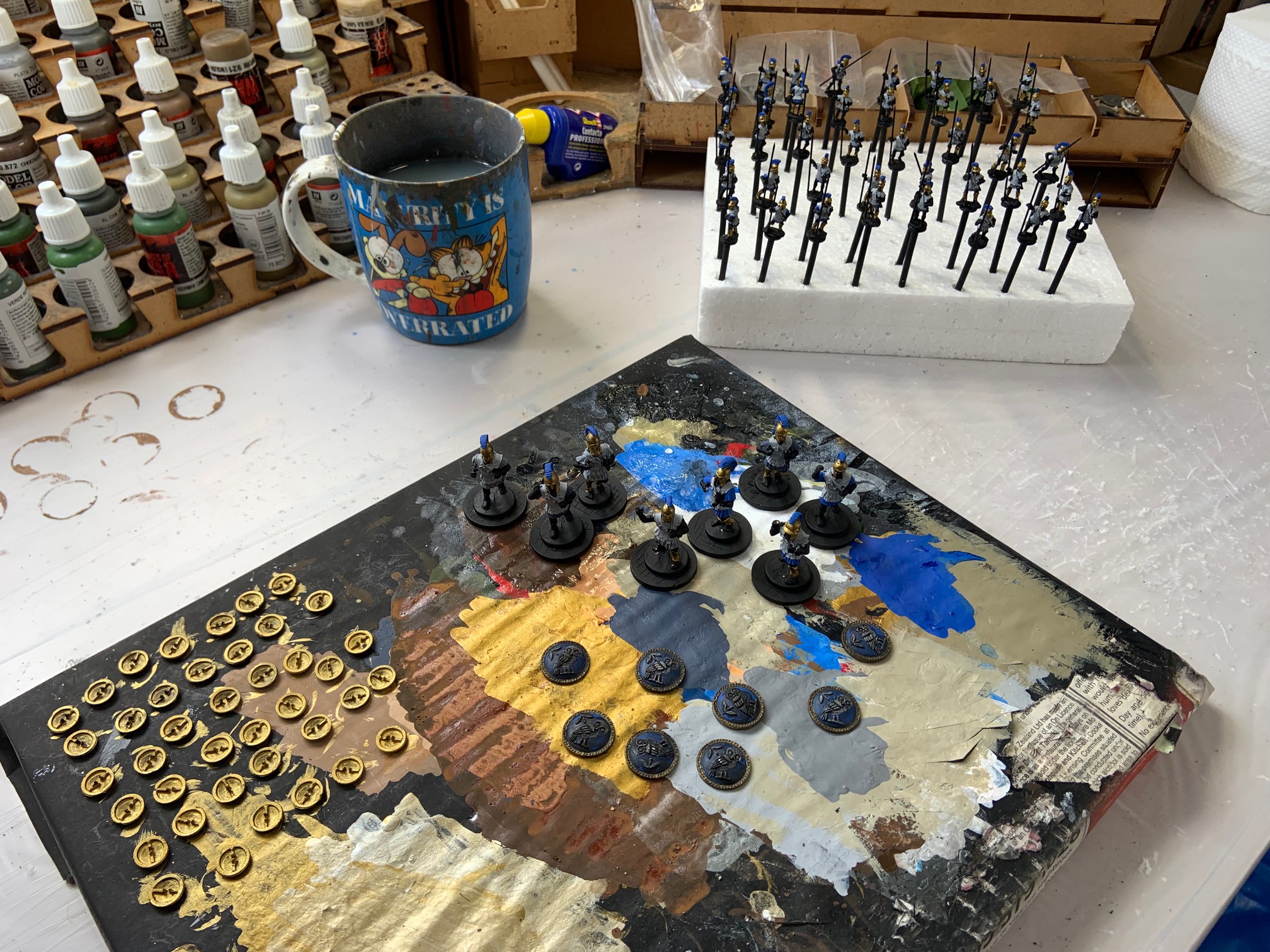
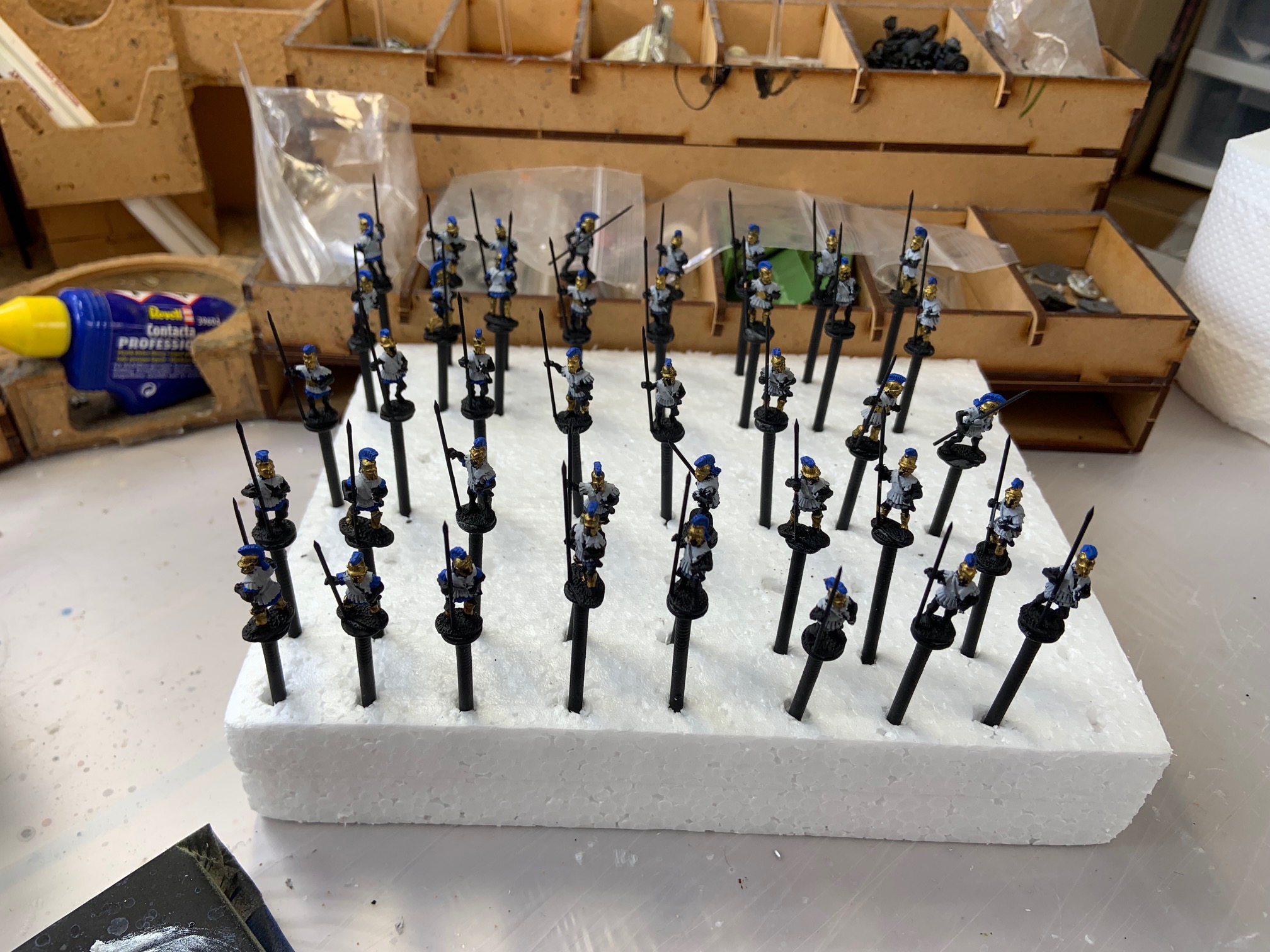
At least with this lot, most of the models had upright spears. There was one guy who pointed at an angle, but it was flat enough to his body that I figured it wasn’t going to be so much of an issue as the goon. And whilst the thought of painting 40 minis at once initially sounded daunting, I eventually was able to get into a rhythm that seemed to work, even if I was being propelled along by SCP readings…
The white for the armour was probably the most interest part of the process. Since you can’t highlight white (its the naturally lightest colour available), you have to create an off-white or very light grey to use as the base, which you can then highlight with straight white. The mix I use three parts white (Vallejo 951) to one part sky grey (Vallejo 989). On the palette, the light grey mix looks almost like white on its own, and you can only really tell the difference once the white paint is placed near it, or highlighting it on the models themselves.
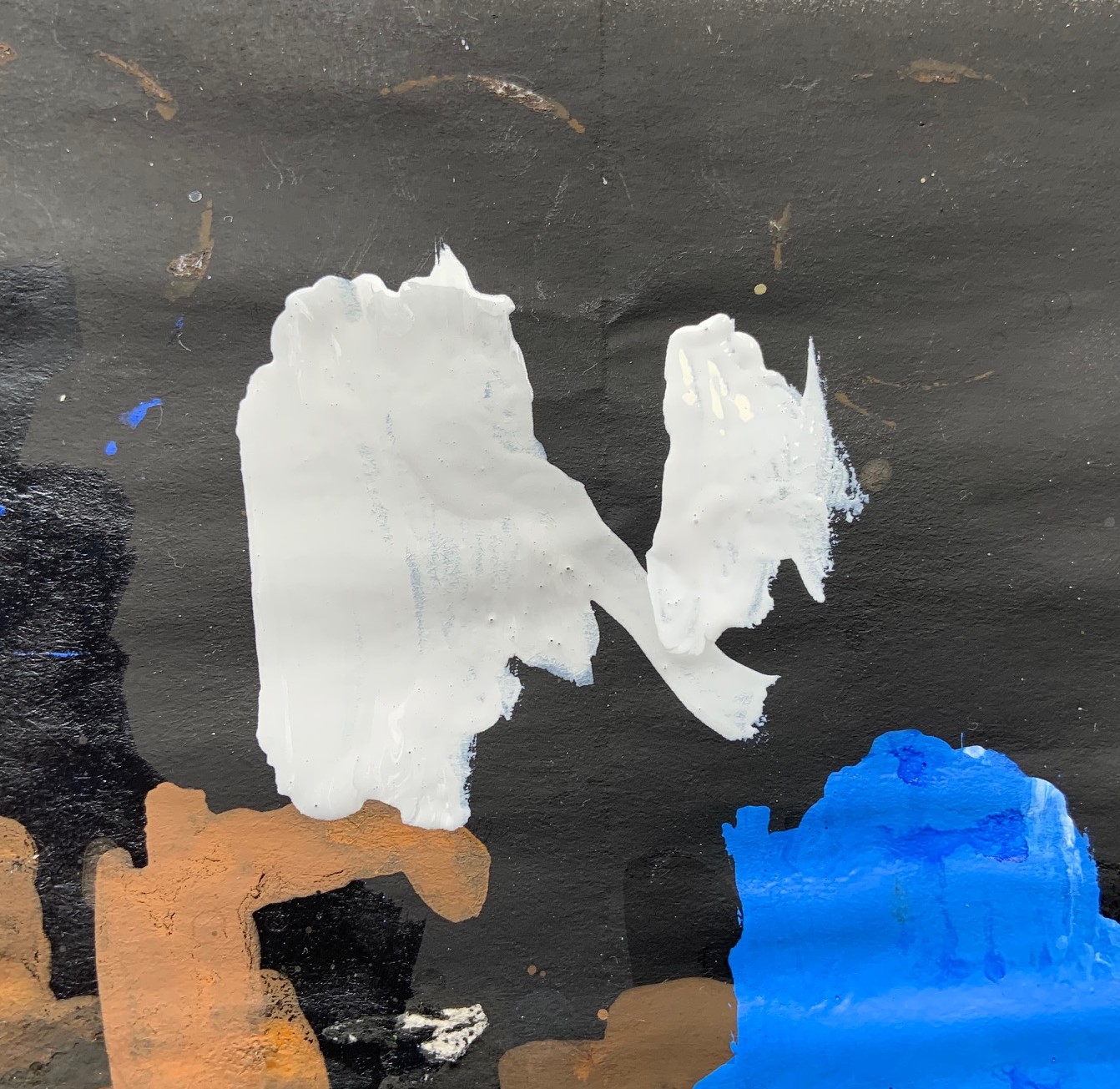 The light grey mix is on the left
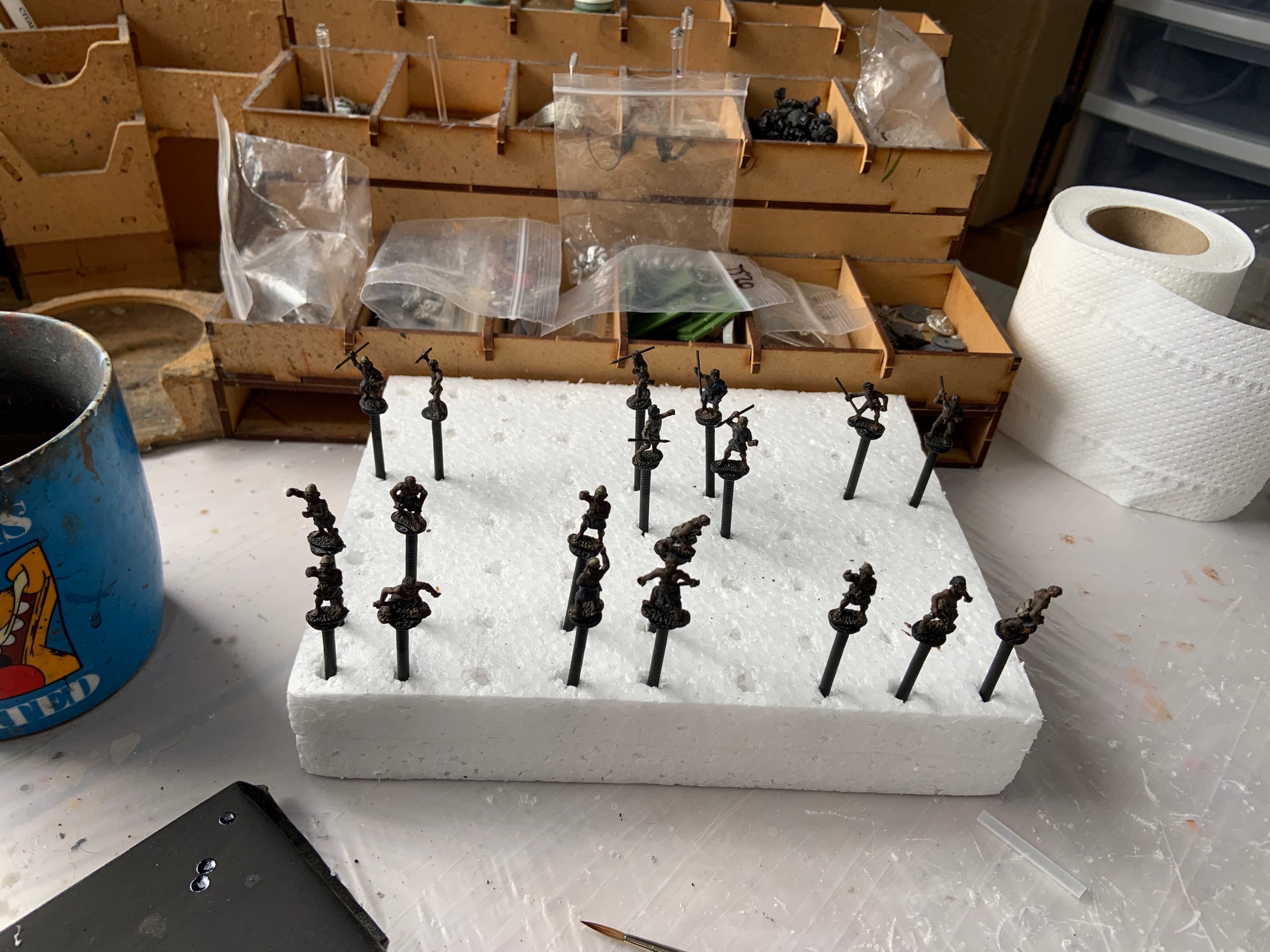
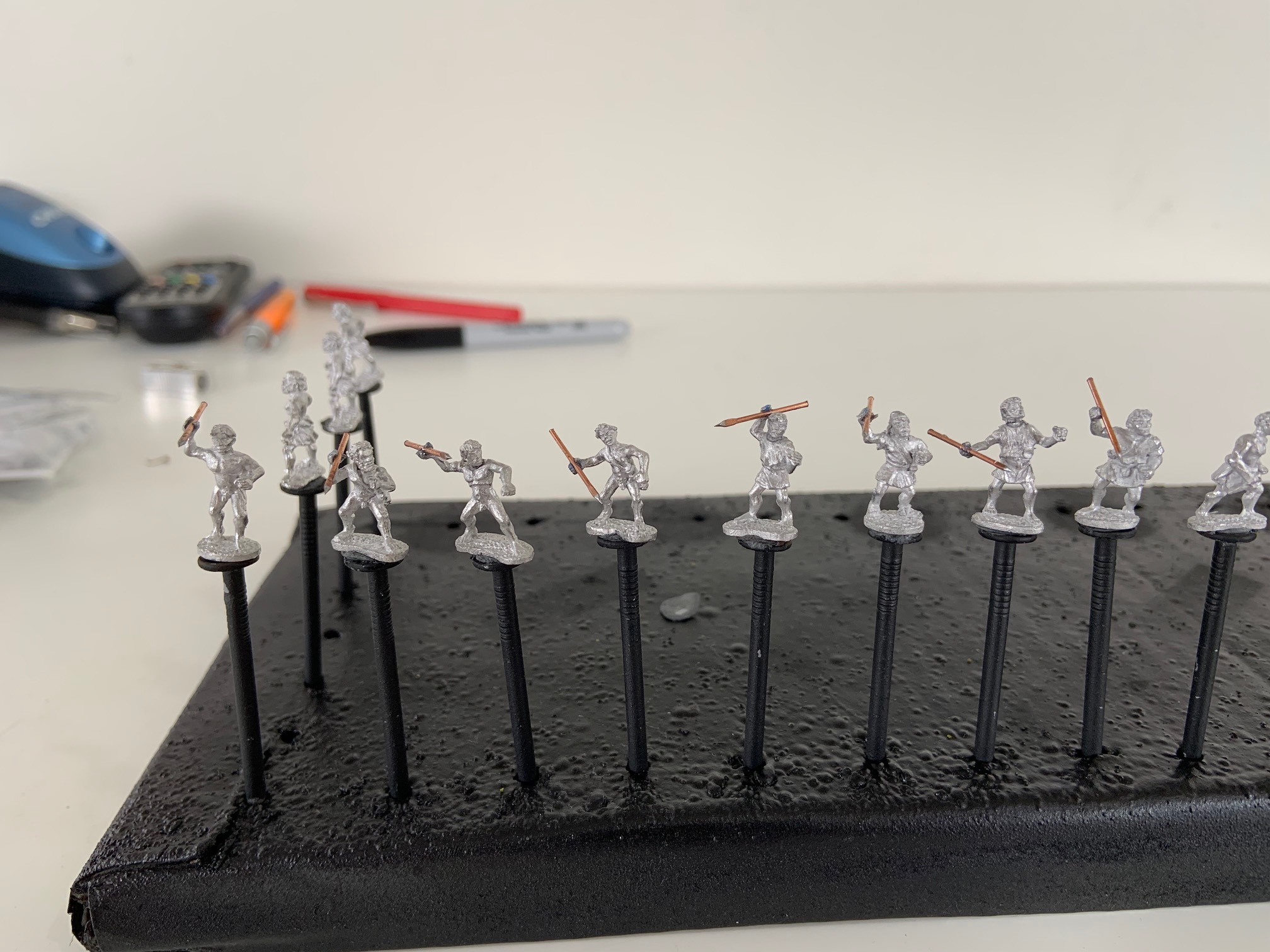
By the way, I wholeheartedly endorse this mode of painting 15mm or even smaller minis, which I picked up in my early days of painting Flames of War. Use blu-tac to stick the minis onto the heads of iron nails, and use those nails as the grip you need when painting the individual models so you don’t have to touch them. When not being painted, you can stick them into a block of polystyrene you can pick up cheaply at craft stores. I’ve even started using the nails for other models, such as heads I need to paint separately, ship turrets, etc. But I guess if all you have is a nail, everything looks like…(ok, that one didn’t work).
So, after another week and a half,
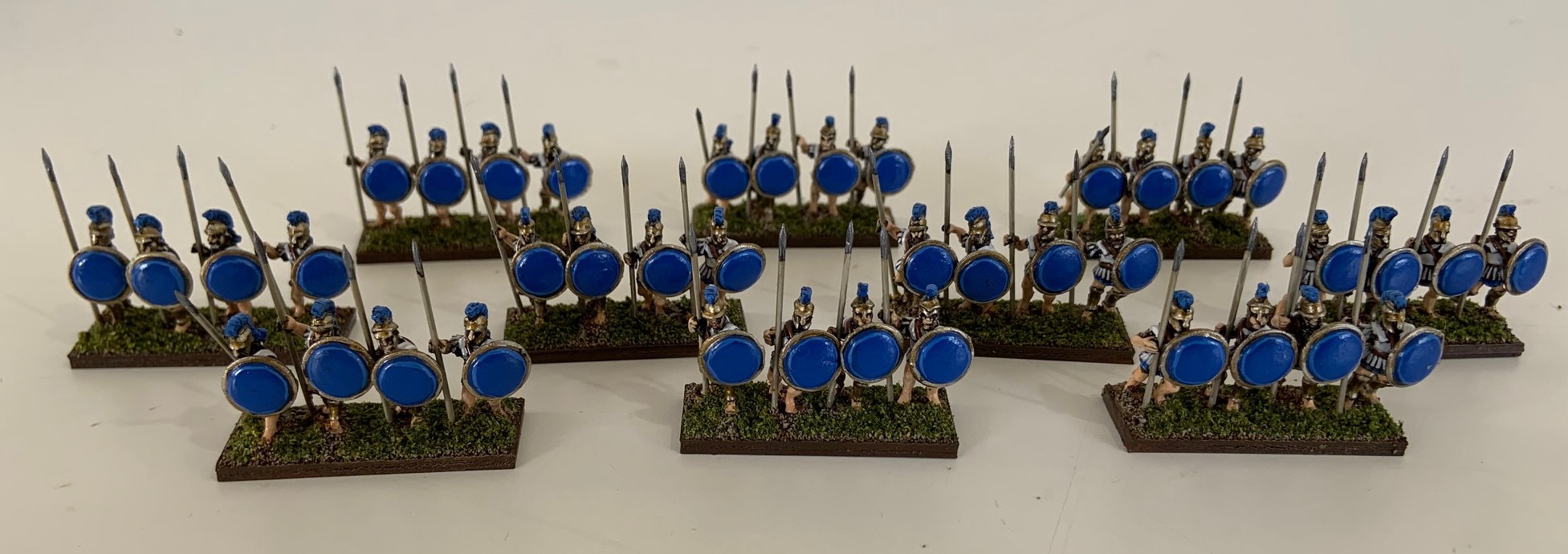
Again, the 15mm Hoplites don’t have shield devices…yet. But they actually don’t look too bad in the long run. I can only guess how they’ll look once I get those transfers…
So, with that done, I’m almost complete on my first DBA Corps. Only a couple of elements of Psiloi needed, as well as the camp.

But that’s for next time.
Epilektoi
DBx Bases: 9/177 + 0/18
15mm Spears: 27/451
DBA Corps: 0/16
Saga Points: 2
Ok, so first batch of models – specifically the command elements and the elite hoplites. Originally, it was only going to be seven elements: C-in-C, 2 Sub-Generals, and 4 Elites. But after getting the minis worked out, and checking my forward planning, I realised I had a few hoplites left over, so I added the Mercenary officer I would also need.
But then I saw the officers I had left over and my eyes fell on one that looked very much like the Champion of Olympus model I had gotten as a promotion from Footsore a couple of years ago. And my mind started working…
Nine elements – usually enough for a decent chunk out of a DBA Corps, and I’m only getting started (what am I thinking???)

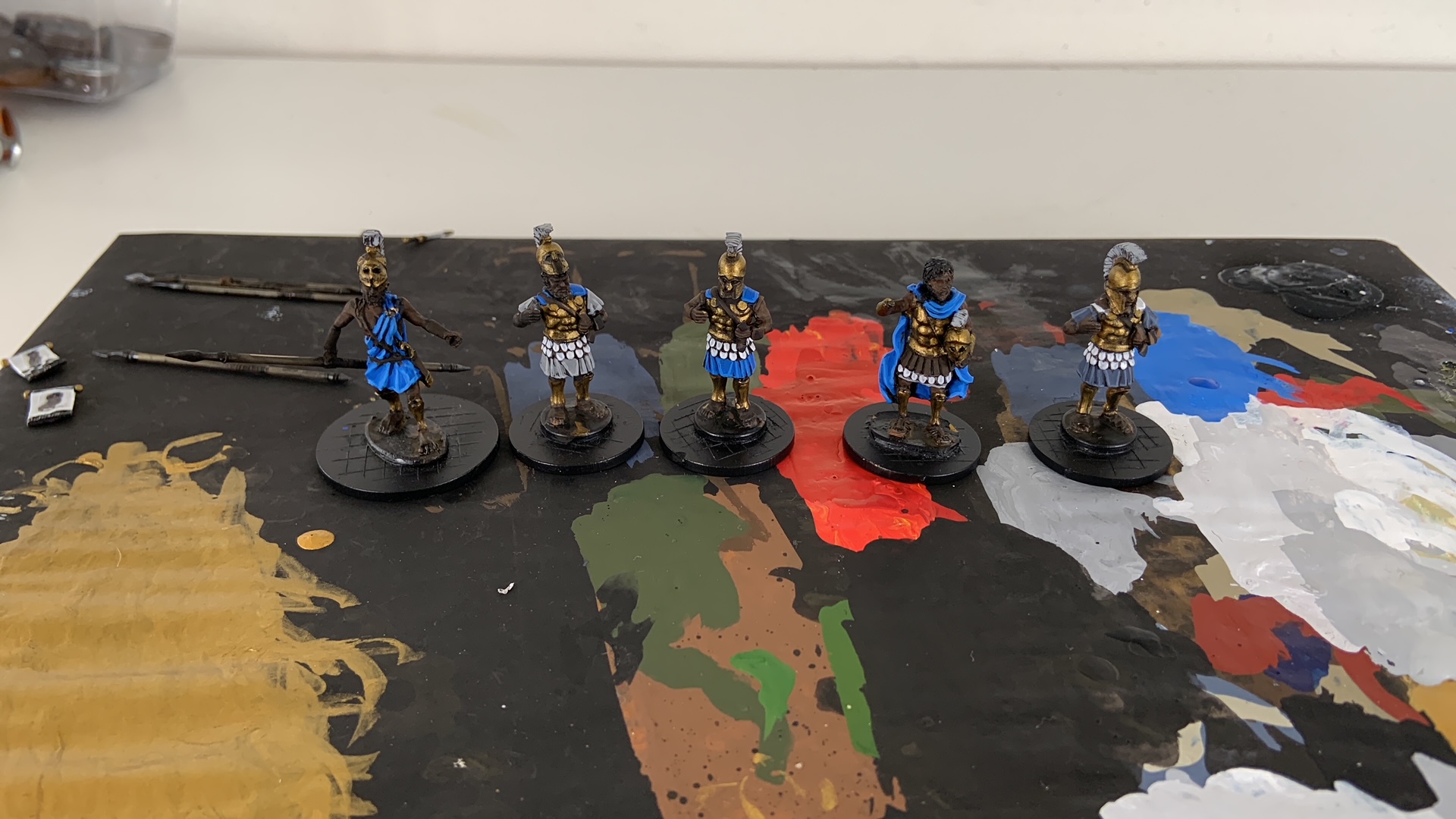
The painting itself also allowed me to confirm my paint schemes and colour mixing. I only had a few items that needed some custom work, such as the larger blue tunics/cloaks, and the Champion’s green cloak. If you get up close to them, the paint job doesn’t look the best, but I’m not a Golden Daemon contender – battlefield quality is Ok by me.
One thing I did work out with this batch was the mix of the grunt’s tunics for the entire army. I saw an article in an old White Dwarf once which said that it is possible to do a mixed colour army like the Brettonnians – the trick is to use the same palette of colours all the way through. So, if you use yellow in several places, make sure its the same shade of yellow – that should be enough to give some link throughout the army.
I knew there were several colours I wanted for the tunics on the grunts – blue (Vallejo 930 Dark Blue), mid grey (870 Mid Sea Grey), a blue-grey (816 Luftwaffe Uniform), and white (actually a very light grey so I can highlight with white). I knew the white would be a small portion of the tunics (since the Linothorax for the line Hoplites would also be the same white), but the rest? I eventually settled on groups of 8 (which worked fine, since Spear units have 4 models per base), with 3 Blue, 2 Blue-grey, 2 grey and 1 white per group. Add to that a mix of models per group, and whilst there was some variety for the lines, there would be a sort of uniformity amongst them.
The Champion’s element was a bit different, as his guards had white tunics – I figured that since the Champion himself had a white tunic, the guards would have something similar.
The Mercenaries, however, had completely different tunic colours. I’m thinking that when I get around to the Mercs, I’ll use some more cloth colours in there (tan, brown, green etc), but still keep to the idea of a limited palette to provide some uniformity.
The other big thing about the model – the helmet crest – was also a way to link the lines together. I was planning for my Athenians to all have blue crests, but I added some white stripes for the elites to mark them out a bit. The champion’s crests were all white, and the mercs – well, they all had Phrygian Cap helmets. The models I used for the mercs had already donated their heads for some head swaps, but I decided to use the caps as a way to show link across the base.
Finally, I worked out a few spear lengths – Xyston sells packs of spears made from brass rods 50mm long. Now that’s a bit too long for a Dory, but no so much for a Sarissa…
I eventually settled on 30mm long for a Dory, 20-25mm for a cavalry spear or for one used by a Thureophoroi, 15mm for a javelin, and, if I ever get around to doing some Macedonians, 40mm for a Xyston. Cutting the rods isn’t too hard – a bit of rolling it back and forwards under my hobby knife, and I can eventually snap the extra length off – the spares will be used as materials for standards, pins for heads and the like.
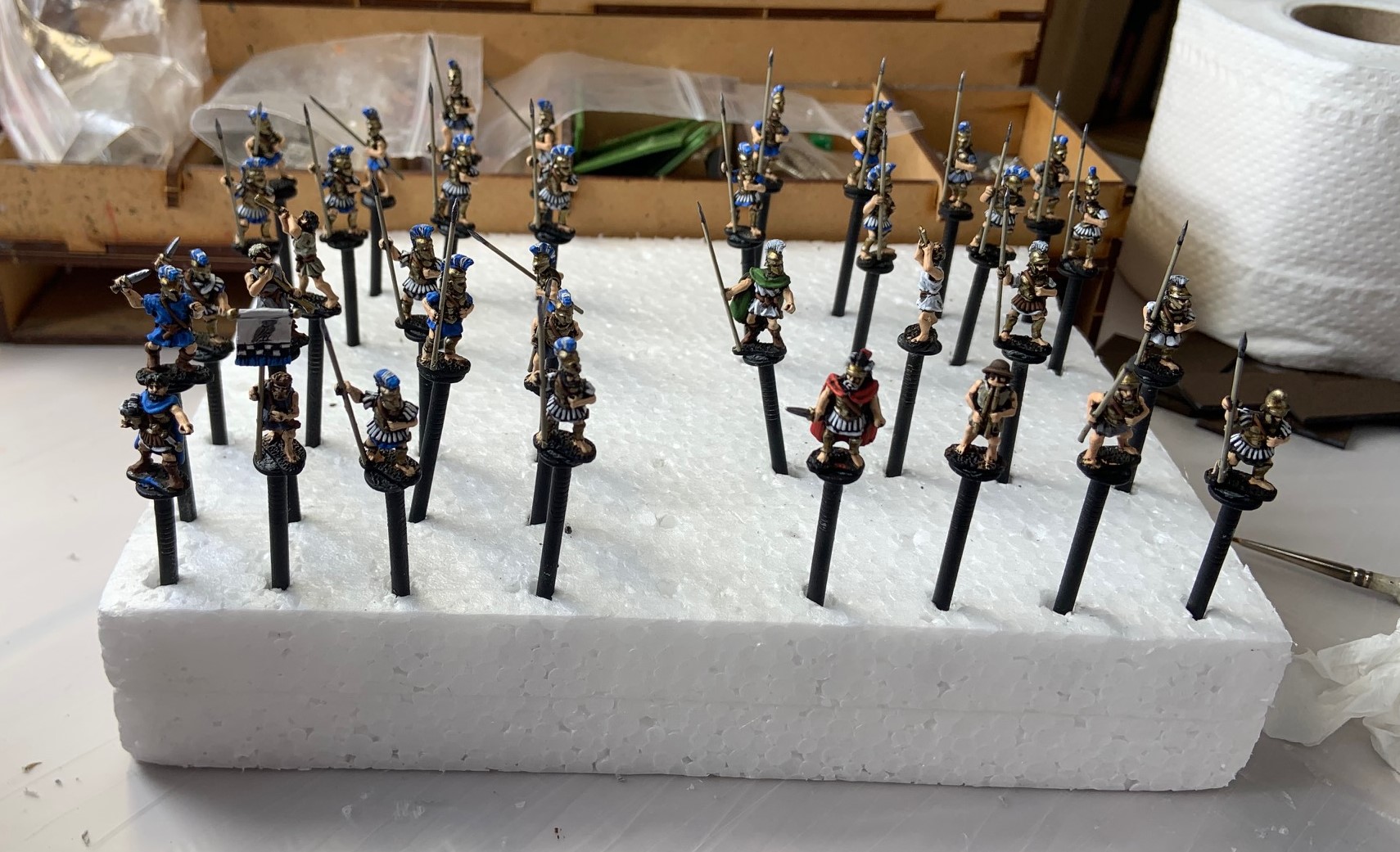 Almost done...
There was, however, one thing that got my goat up – this goon:
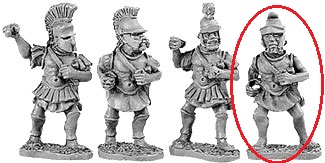
Whilst the other models in the set all had their spear relatively upright, the way this guy’s had was angled made things a heck of a lot more difficult (you can see the angle in the “Almost done” pic above). The models are already larger than expected as they’re “Heroic 15mm”, which mean that they’re actually 18mm tall, and there isn’t as much space to play around with on the base, unlike when I’m using minis from Essex. And the goon’s spear angle and base made situating them on the base as a group a bit more of a hassle.
So, lesson learned – I’ll be double checking all future models to make sure that sort of jiggering is not required.
On the 28mm side of things, it was a fairly straight forward job – mostly copying the scheme of the existing elites, and a few custom jobs for some new characters.
I was even able to find enough models in the 15mm officers to be able to recreate my 28mm heroes in 15mm scale
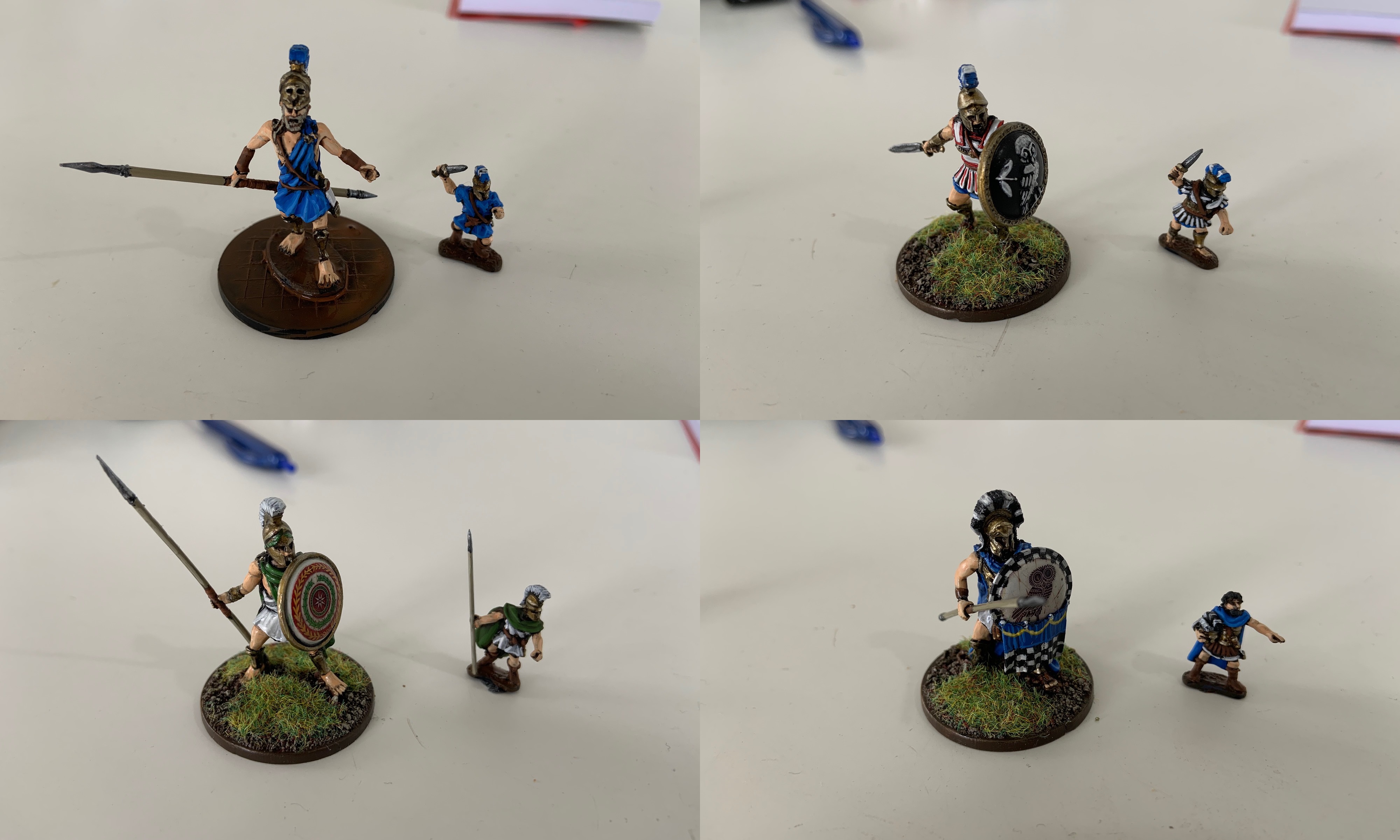 Clockwise from top left: Medium Armour Promachos, Heavy Armour Promachos, Andronicus the Defender Lochagos, Champion of Olympus
And so, just over a week later, I was done.
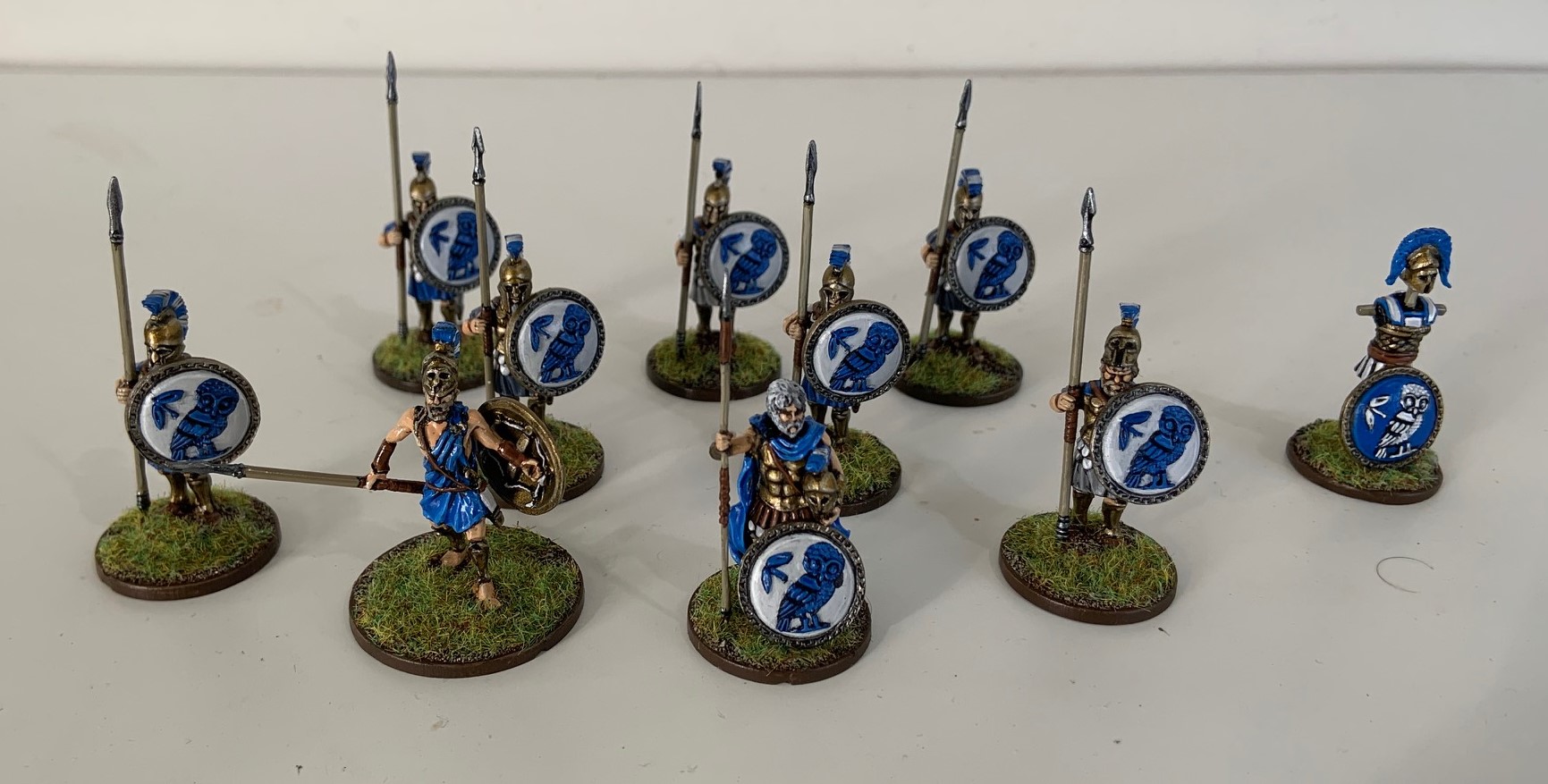
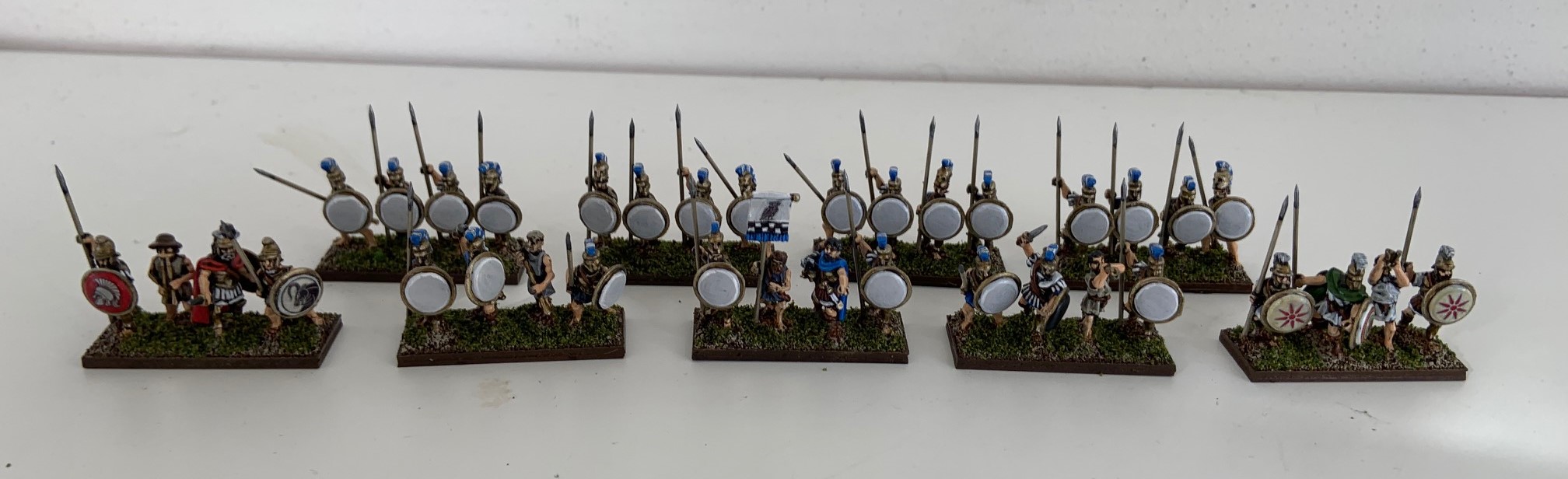
One thing you will note is that on the 15mm scale, the Athenians don’t have shield heraldry. My original though was that I could hand paint the devices onto the shields, but in practice, it turned out to be impossible for me – I just don’t have the skill in it. Transfers were the next option, but finding white and blue Little Owl devices in 15mm scale in good quantity is actually somewhat difficult. Veni Vidi Vici does have some on one of their transfer sheets, but its only two symbols to a sheet, and I’ve got over a hundred to do, so not really economical. And a custom run from them would cost at least £150, so, no. The Little Big Men transfers I’m using elsewhere are also not an option, as they only have two devices in black on white – useful for a hero and some standards, but not economical for the project.
*Sigh*
I guess they’ll just be left to their own devices for now…(yes, yes, yes, I’m finishing this entry soon…).
Nine DBx elements down, a full Hearthguard unit completed, heroes done, and a Tropharion completed for desert.
But I’m only getting started. Already have the next batch on the table, and its a bunch of regulars.
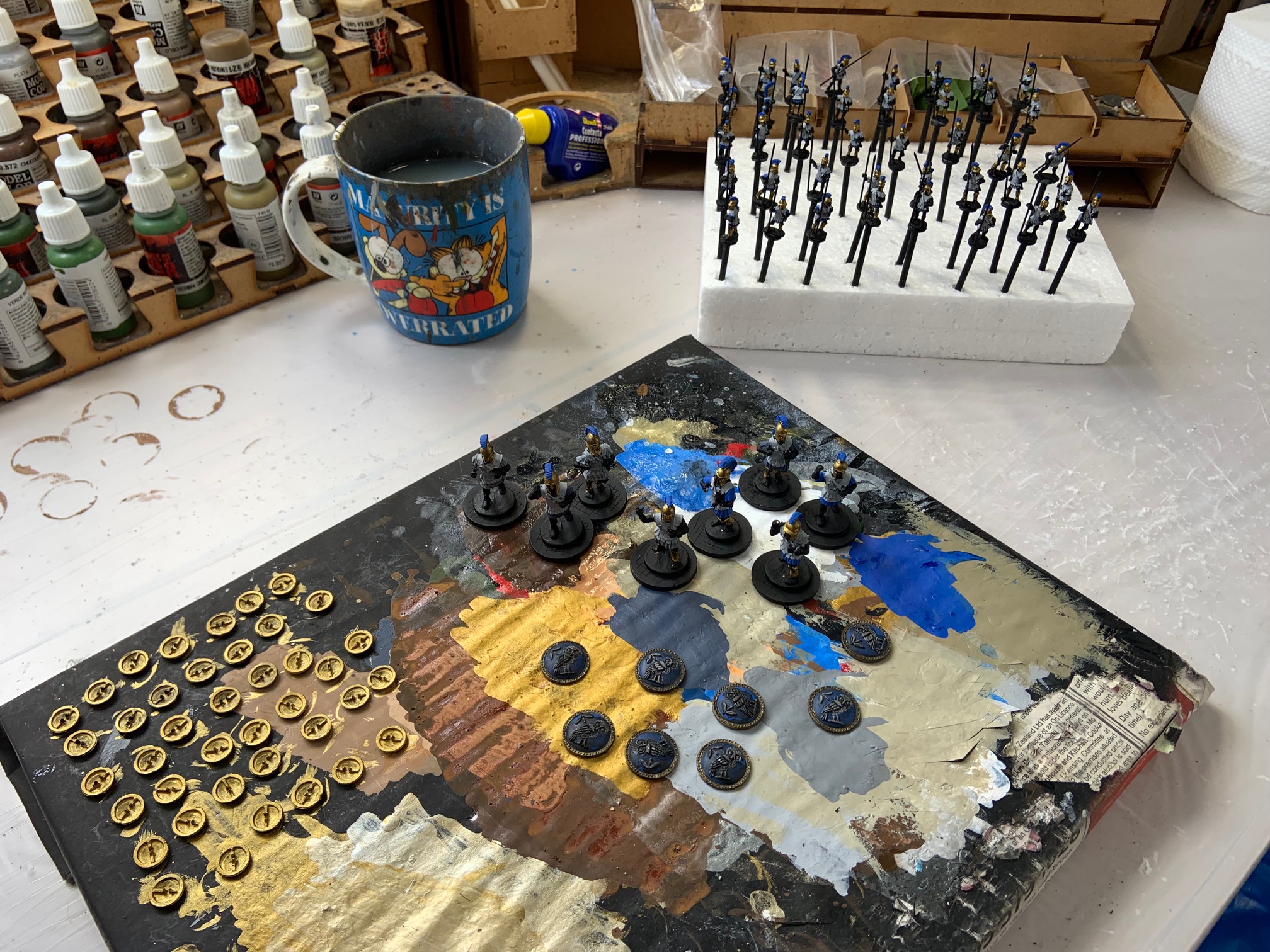
The clean before the storm
DBx Bases: 0/177 + 0/18
15mm Spears: 0/451
DBA Corps: 0/16
Saga Points: 0
Because I rent, I keep the area around my painting table covered by a plastic dropsheet, which I replace each year. This way, I stop my landlord’s carpets from being dotted with splashes of paint, and other detritus from the hobby. The sheets aren’t anything fancy – just plastic painters sheets I pick up from the local hardware store – but I justify that the cost is definitely less than having to pay to replace the carpets when I finally move out.

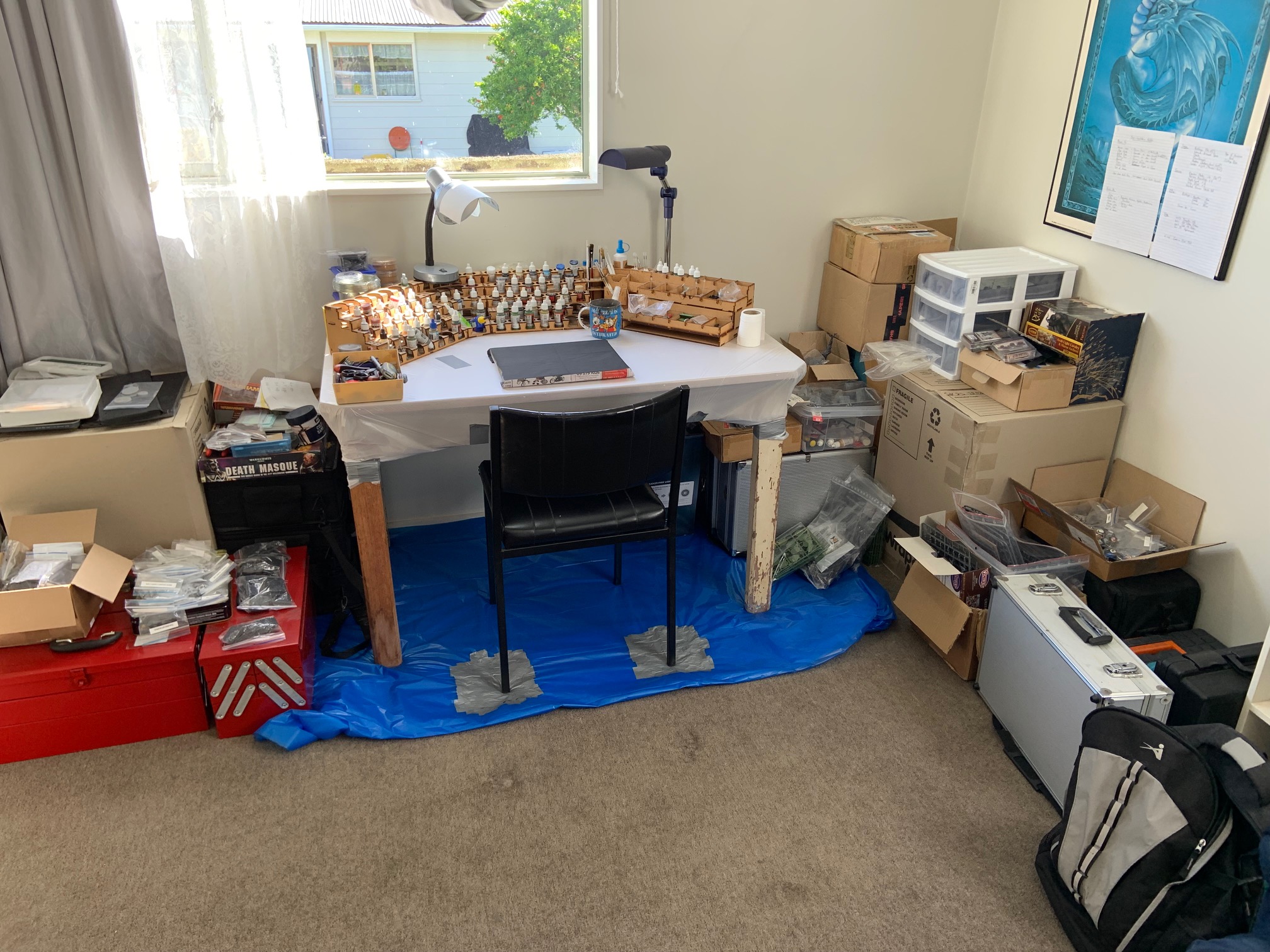
And because it was December, and I was starting a new project, I used the opportunity to also do this cleaning, rather than leaving it to the new year and having to tear everything apart mid-project – not just replacing the sheets, but also clearing up my work area, since it tends to get crowded with abandoned and half-finished tasks, left over materials, general debris, dust, etc etc.
So with a refreshed work area, dust blasted, left over projects put away (you don’t want to see my study right now), I was free to begin working on my Hoplites.
But where to begin?
Well, I actually had done some prep work earlier in the year. I started by painting up an OpForce for Mortal Gods – this allowed me to test some of the colours that I was considering for my main force.
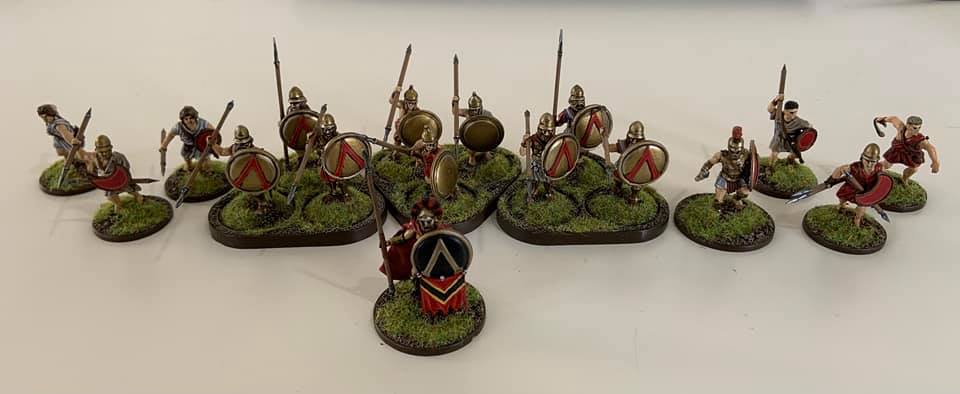
I had also started on some of the characters and elites for my Athenians, although these ones were somewhat more complex
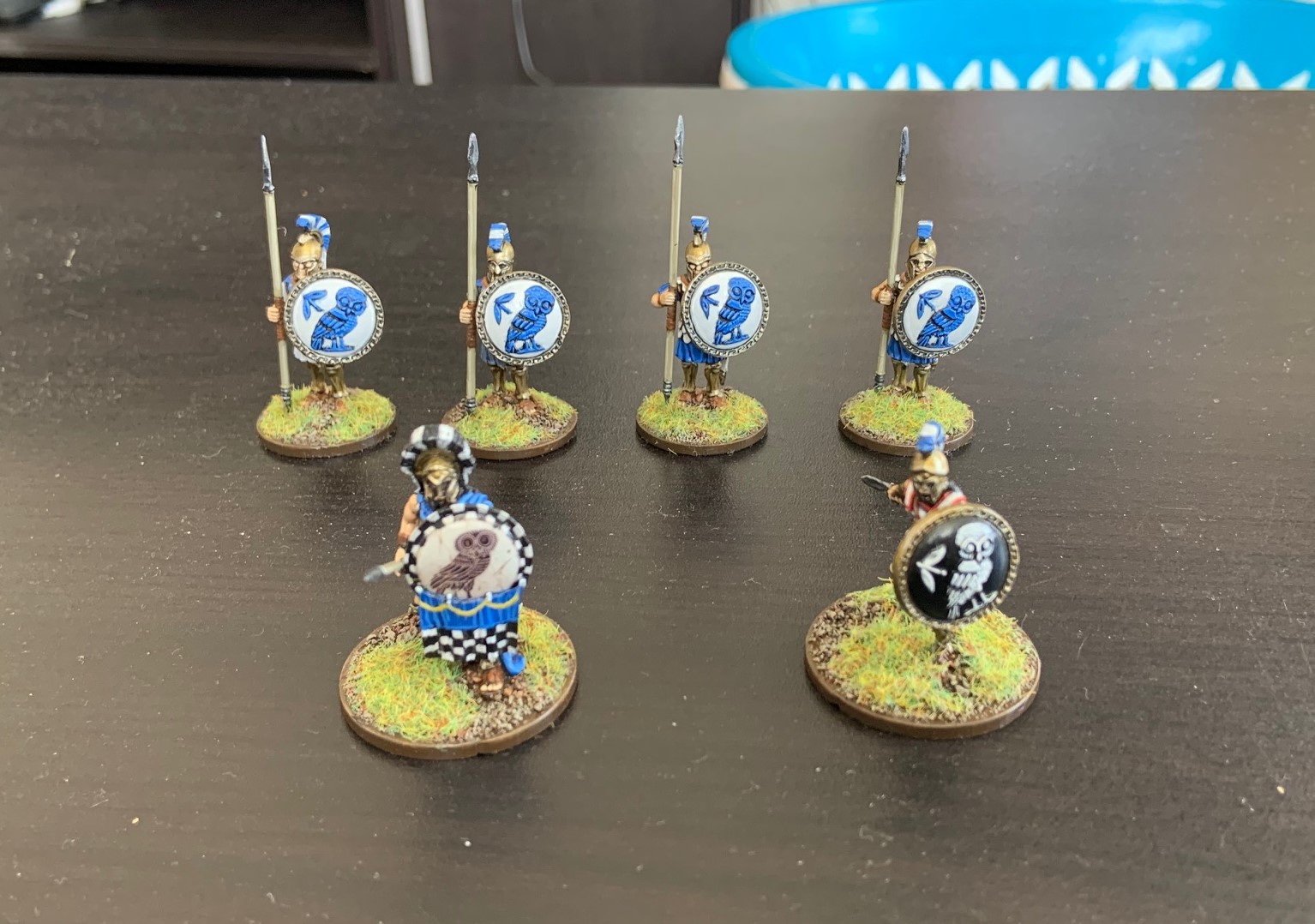 Front Row: Lochagos, Promachos. Rear Row: Elite Hoplites
Finally, I had done up a point of SAGA Psioli, but we’ll get to them later.
But for the main project, where do I start from? Well, we start at the very beginning – MVP (minimum viable product). Paint the smallest amount needed to put a DBA Corps in a game, and work out from there – adding elements to allow other forces to be used, add allies, etc.
In this particular case, this meant that the first Corps I would be painting was I/52e – Early Hoplite Greek, Early Athenian Hoplite 668-541 BC. Its a fairly straight forward force consisting of:
- Hoplites with General (Sp)
- Hoplites (Sp)
- Hoplites (Sp)
- Hoplites (Sp)
- Hoplites (Sp)
- Hoplites (Sp)
- Hoplites (Sp)
- Hoplites (Sp)
- Hoplites (Sp)
- Hoplites (Sp)
- Psiloi (Ps)
- Psiloi (Ps)
Hopefully I can get this completed before my Christmas break is over.
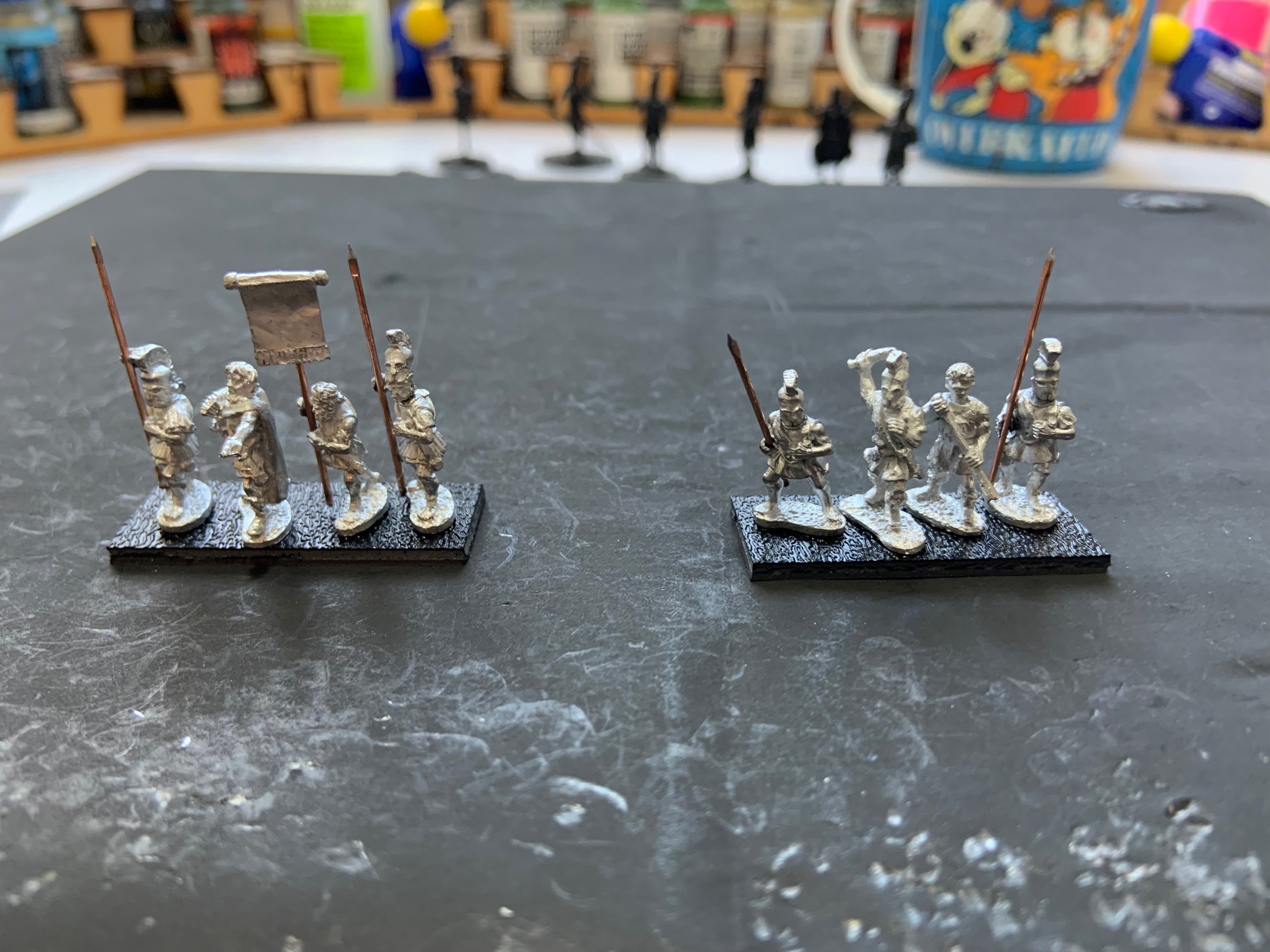
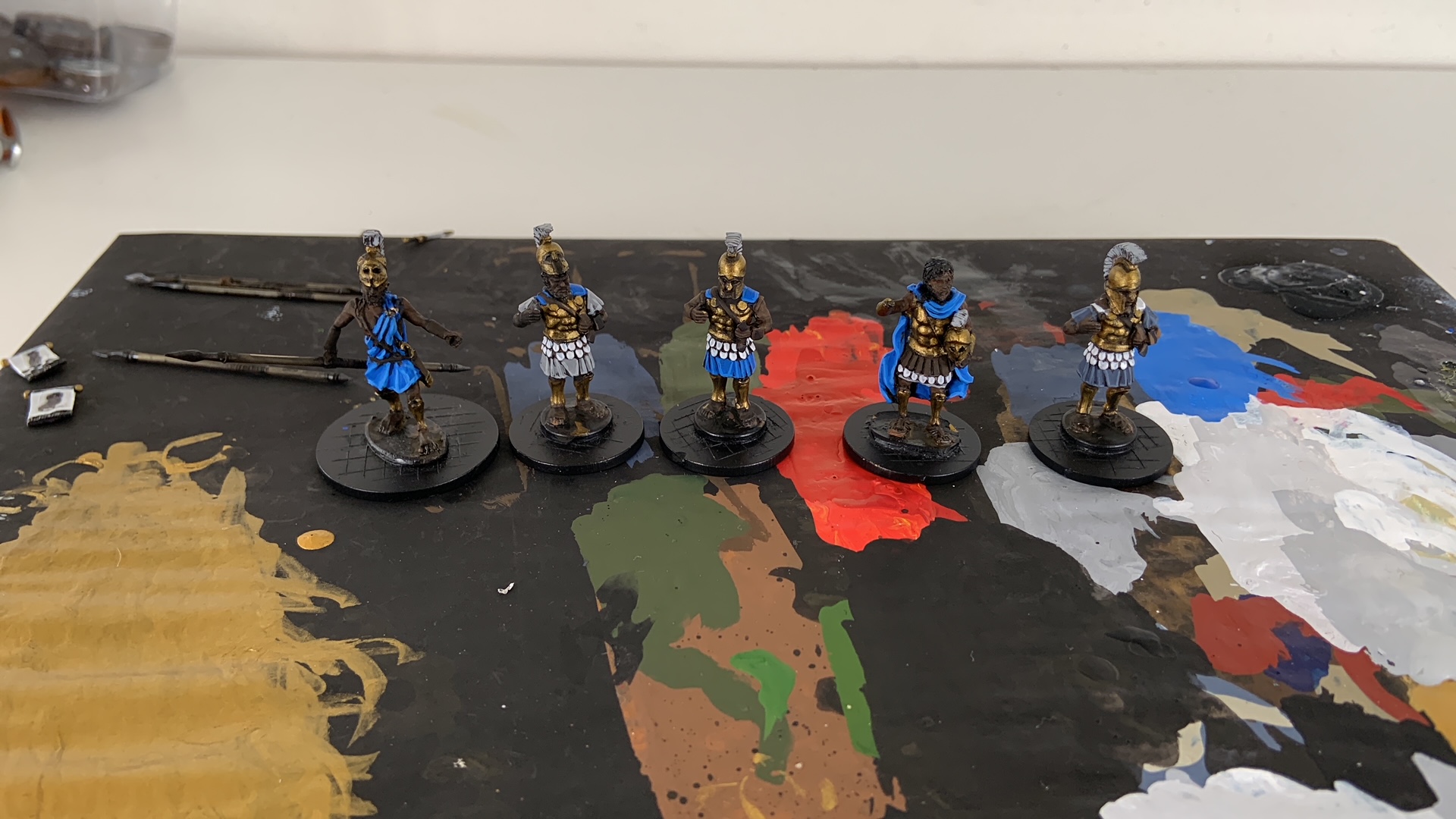
With that decided, I figured the best place to start would be the command elements. Not only would this match the character models I had already completed, but it would allow me to complete the unit of SAGA Elite Hoplites I had begun – I had decided early on that the Elites would be wearing the metal Cuirass armour, whist the regulars would be have Linothorax.
The other thing I needed to do was t0 clean up the metal models that Xyston had sold me. And generally speaking, I was quite happy with what I saw – no real casting issues, the detail was there. If there was one complaint I had is that the models had probably a little too moulding flash compared to what I like.
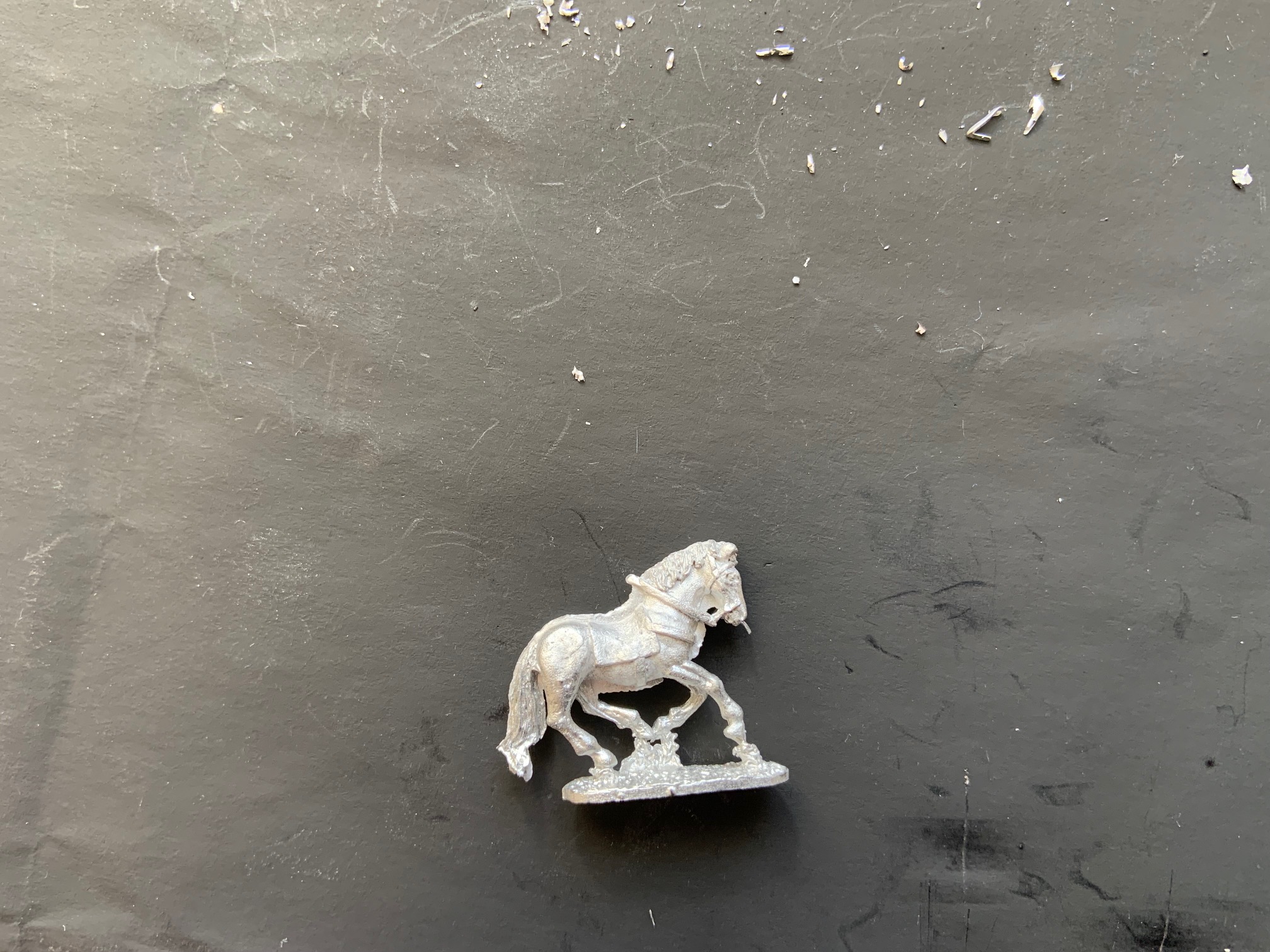 Yikes!
But in that particular respect, it isn’t a show-stopper for me. Unlike some of the stuff I’ve gotten from Forge World, which had similar amounts of flash, these models did not have casting misalignments to go with the flash – unlike FW, where if you saw this amount of flash, you wondered how badly aligned the moulds were (I had a few models that I had to bin because they were misaligned up to 1.5mm, and that’s just too much to try and scrape over).
I also did a quite a few headswaps for this batch, as I wanted all the Athenian elites to have Corinthian-type helmets.
Finally, I decided on how many minis I would need. One thing I had already determined is that Generals/C-in-C’s would have a standard on their base to mark them out, where as Captains/Sub-Generals, would not, or at least replace the standard with a trumpeter instead. Add to this a decision to paint up four elements of Elites, as the Athenian elite hoplites, or Epilektoi (rated as Sp(S) in DBMM, as opposed to Sp(O)) has a limit of four elements in DBMM. I’d painting up more than I intended, but it would finalise one of my army choices for DBMM, and cut down painting for when I did the second Athenian Corps.
As the crossover to SAGA, three new Elite Hoplites, a Veteran Hoplite to act as their unit leader, and a new character (medium armour).
Lets see how quickly I can get this lot done!
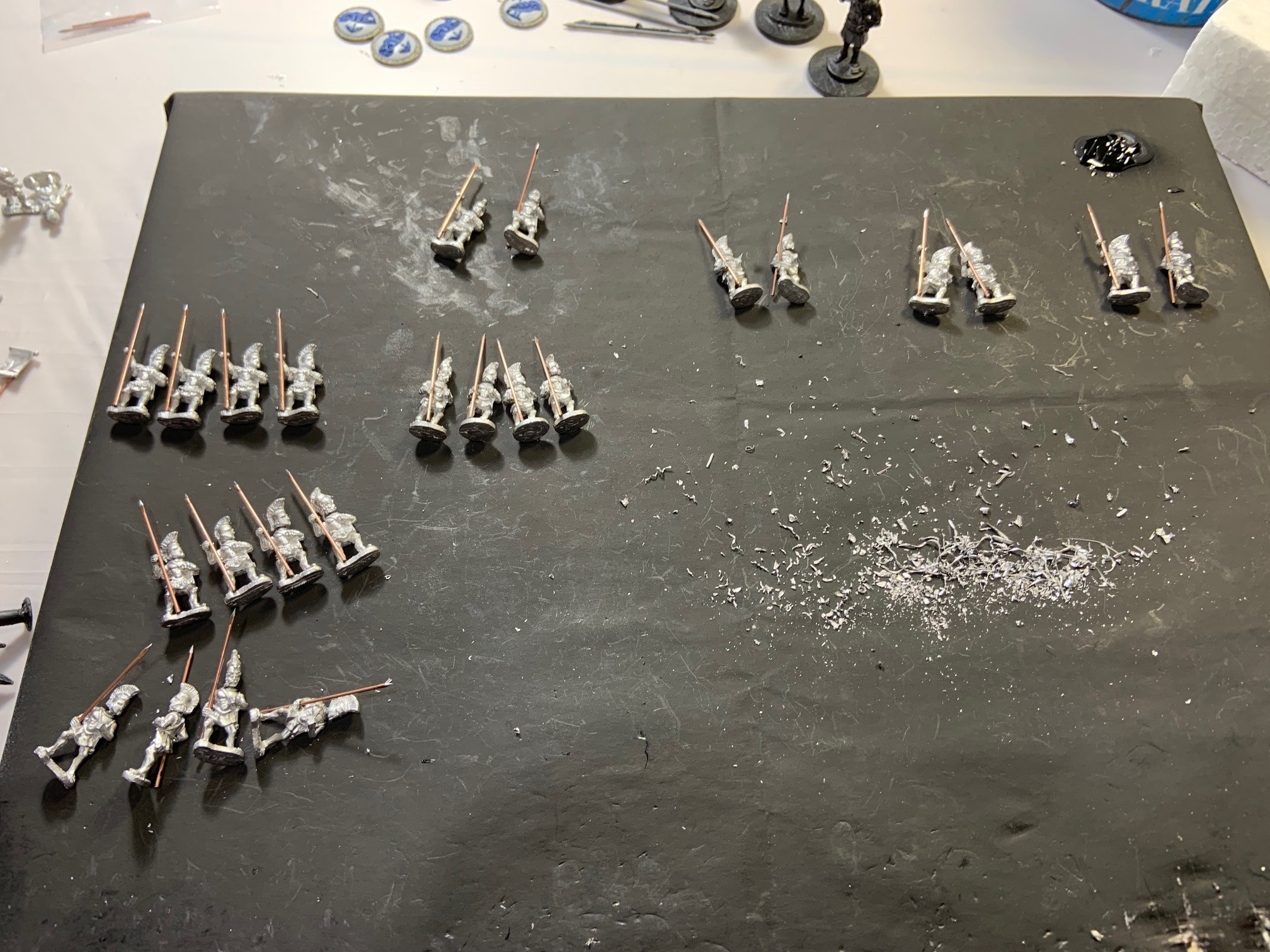
Preparing the Muster
DBx Bases: 0/176 + 0/18
15mm Spears: 0/448
DBA Corps: 0/16
Saga Points: 0
When I said this was a long-planned project, I wasn’t kidding. Spreadsheets to work out the most efficient way of purchasing models, test painting to work out colour schemes, test forces to work out how to paint 15mm models like these (I’m mostly used to 28mm stuff).
And then there’s the supplies I’ve stockpiled

Varnish, undercoat, glue, sand for basing, new paint brushes, new pots of paint, the quantity of which was determined by how I plan to paint things – although this is also taking into account the absolute mess the global delivery network is in at the moment, and how confident I am of being able to get resupply in the near future. (And now we have the diesel problem to worry about…)
Also, the bases I’m using are shown – over 180 of them of various sizes.
And, lo, the miniatures
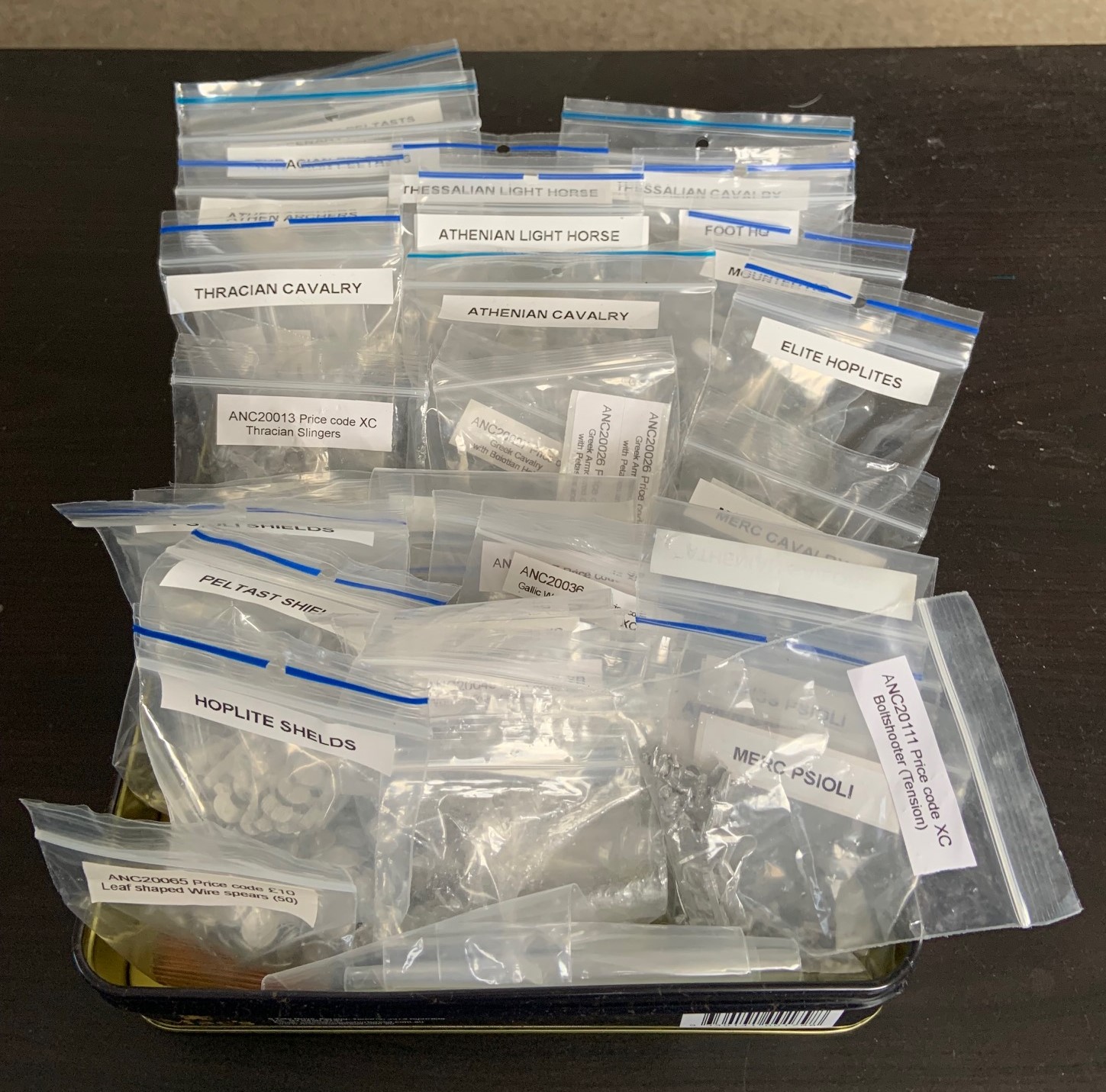
That is 3.35kg of metal (what type of metal does Xyston use? Doesn’t feel like white metal). I sorted them into category bags, so I’m not constantly sifting through a pile of metal, or tons of smaller bags. I don’t have a full breakdown of troop types, but I can tell you that I have five different types of shields, and of those, there are over 300 of the Aspis type (so I really do have the 300 here…)
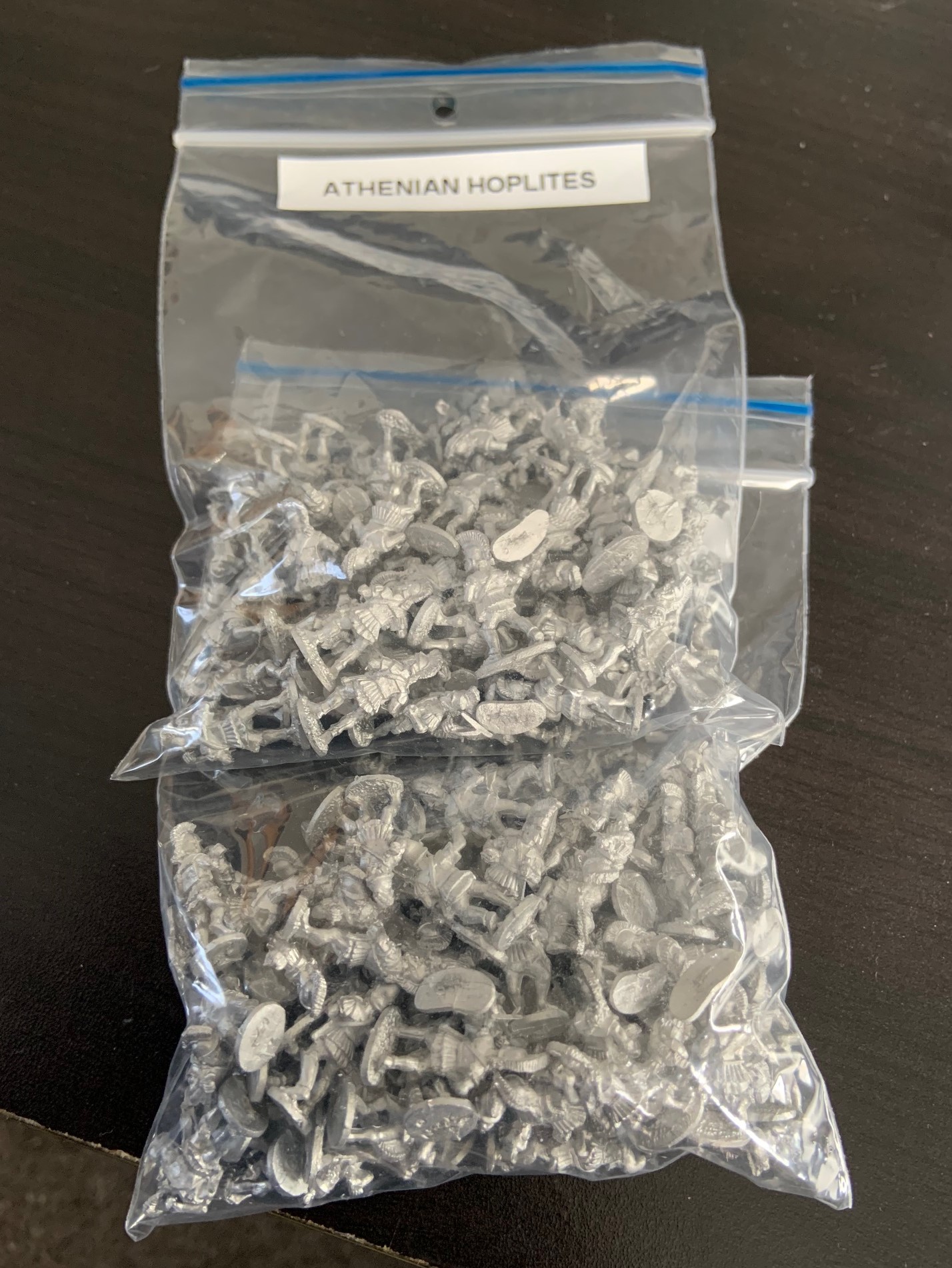 Would you like some hoplites with your hoplites?
I’m almost done with what I currently have on my table – I think I’ll have it all done over the weekend or not long after that. After which, the effort begins…with cleaning…
A long awaited project...
DBx Bases: 0/176 + 0/18
15mm Spears: 0/448
DBA Corps: 0/16
Saga Points: 0
The origins of this project are a confluence of circumstances. Last year, I was introduced to the DBx series of games whilst visting a new games club. I’ve always been into historical gaming to an extent, being very interested in SAGA, but the more large-scale games have always been a bit…opaque in their ruleset. But the promise of being able to play a game large-scale battle with only 12 elements (so, max 50 minis – hey, similar to SAGA…), was very attractive, so I quickly started in the ruleset, DBA in particular. Multiple armies came to mind to build, but the Greeks were one that really caught my eye. Doubly so when I started looking around for minis to use and came across Xyston/Scottia Grendel – their minis in particular looked excellent, so a Greek force from them went on my to-do list.
And then Covid got serious.
Many things went off to the side as a result, and I moved to other projects – but the idea of making a Greek army for DBx remained in my mind. Then SAGA Age of Hannibal was released. And I finally got a hold of the Mortal Gods starter set. And I bought a bunch of Victrix hoplites for both.
Eventually I said “screw it” – although I was originally going to make the Ancient Egyptians from Essex my first major DBx force, I bit the bullet and bought [AMOUNT REDACTED TO MAINTAIN SANITY] of minis so I could build a large amount of 15mm Classical Greek forces. The last box of these from Xyston arrived recently, so I was able to get started.
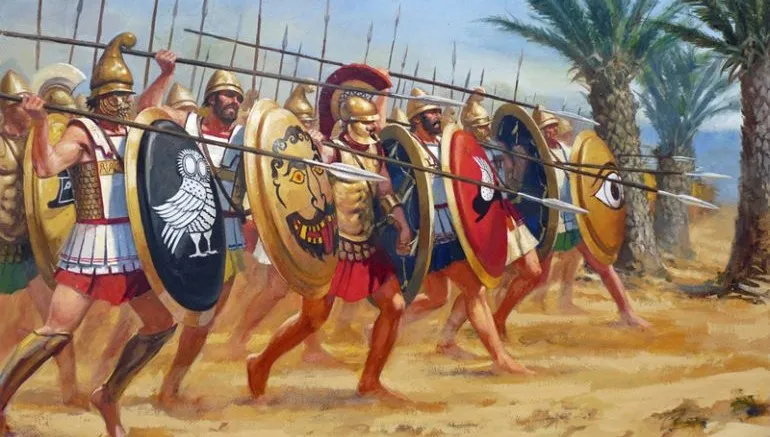
So, how to paint them? Well, this is the concept art from Assassins Creed: Odyssey. I like blue as a colour for my armies (My favorite scheme is mid grey with blue highlights, and gold trim), and this Athenian art certainly gave me some inspiration on how to proceed.
What to build the forces as? Originally, I was planning on doing an entirely Athenian force (to match with my choice of faction in Mortal Gods), with a few Thracian allies, since some of the DBA Athenian lists have Thracian elements in them. But some of the guys in my group pointed out that, “Forces that are all Spears can get boring after a while.” That made sense, and after some reading of the lists, I saw that the Athenians had several additional options for allies, but it was the Thessalians that caught my eye – plenty of cavalry that could diversify my forces.
Additionally the mercenary hoplite, peltast and thureophoroi units can be used as part of of a future Macedonian and Successor force, which not only cuts down on stuff I have to buy and paint, but the minis are also available from Xyston.
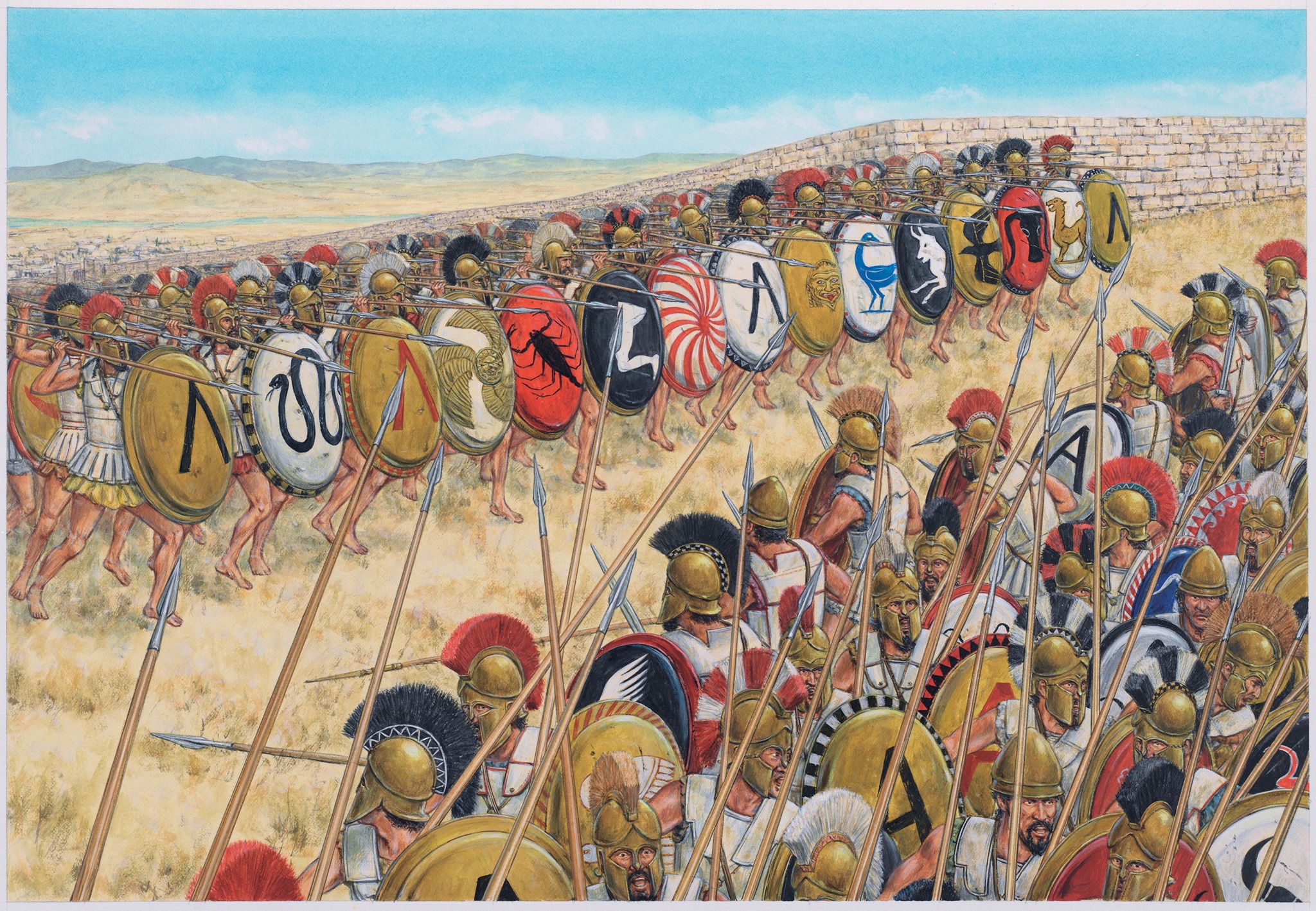
After a bit of playing around with stuff on paper, I decided to track my progress through a combination of criterion. Firstly, I will track when a full 12-element DBA army has been completed – I’ll refer to each as a corps. Each corps will consist of the base elements, plus the options available for the force. Additionally, some of the corps overlap – the Athenians, for example, used Hoplites and Psioli in all their armies, with additional forces (cavalry, archers, theuropoli) making up the differences. I eventally settled on the following groups of blocks, split up by the available overlaps:
– 1 x Thracian (I/48)
– 1 x Bithynian (II/6)
– 2 x Early Thessalian (I/52c)
– 2 x Later Thessalian (II/5d)
– 2 x Early Athenian (I/52e,f)
– 2 x Later Athenian (II/5b)
– 3 x Hellenistic Thracian (II/31h)
– 1 x Early Mercenary Hoplites (I/52j)
– 1 x Later Mercenary Hoplites (II/5i,j)
– 1 x Syracuse (II/9a,b)
Three corps can be combined for a BBDBA game – So, if I wanted, I could go two Athenian Corps and one Thracian Corps, two Thessalians and one Mercenary, two Thessalians and one Athenian…basically, there’s a lot of options available for me if I went for one of the larger games.
I then added in how many SAGA points I had completed to monitor the 28mm model progress, and then the base count and spear count to show how many individual 15mm models I had completed (Although it mainly gave me multiple numbers to montior – I kinda like statistics). And whilst the numbers are big (176 bases required for the 15mm models, plus another 18 for the various camps!?!), its not like I’ve limited myself to a month to do this – I fully expect this project to go well into next year – which is good thing, really.
So, with 450 spears, I’m definitely not recreating the 300, but I am doing up a force worthy of kicking ass at Marathon…wait, I can sub some of these Merc Hoplites into the Later Achaemenid force (II/7) as well…ooh, possibilities…


![StarCraft Tabletop Miniatures Game Pre-Orders Live Now [Updated]](https://images.beastsofwar.com/2026/03/starcraft-tmg-news-cover-600-338.jpg)
![Mounted US Cavalry On Kickstarter For Dead Man’s Hand! [Updated]](https://images.beastsofwar.com/2026/03/us-cavalry-main-600-338.jpg)