







![NO Weekender Or Cult Of Games XLBS This Weekend [Updated]](https://images.beastsofwar.com/2026/03/No_Weekender_and_XLBS_this_Weekend-225-127.jpg)




Book Review: Mechanicum By Graham McNeill
November 9, 2010 by lloyd

Mechanicum
By Graham McNeill
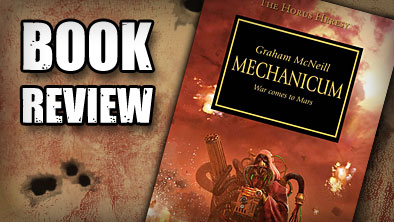
Before I begin I would like to start by pointing out that this was my first foray into the Horus Heresy series. In hindsight it may not have been the best place to jump in, but I was drawn to it mostly due to the fact that I have always had a fascination with the Adeptus Mechanicum that has even manifested itself as plans to make a Mechanicum army. Since this was back in my early days of gaming, however, this pretty much consisted of painting a land raider red before losing interest. Mechanicum may well have succeeded in reigniting this interest, providing as it does an in depth description of the cult of Mars in the events leading up to the creation of the Dark Mechanicum. With a complexity which at first amazes, and later baffles, Graham Mcneill presents the reader with the story of treachery on the red planet.
First let’s get the bad points over with. I found this book to be unbelievably confusing at times. I’d often find myself flicking back through it to remind myself of who was what and whose name belonged to which character and what their importance was within the plot etc. The author often jumps the plot between the various central characters as the story progresses, and while this can be a useful narrative tool, the gaps between the moments when some of the characters appeared would often be so that you would have to take a few minutes reminding yourself who they were. I found that this made Mechanicum a rather slow read (of course the dose of flu and the surfing holiday didn’t exactly help me to speed my way through it). Also the text is full of examples of technological jargon which piles bafflement upon bemusement. However, this may have been the author’s intentions, showing the almost mystical way in which technology is viewed in the grim darkness of the far future, and also enforces a sense that not even the adepts of the Mechanicum fully understand what they do. Technology within the book Mechanicum can almost be viewed as being used in the same way that magic is within fantasy fiction. That which can’t readily be explained within the novel is simply explained away as being technology, in the same way as things happen by magic in fantasy. How can a structure be built within a volcano? Technology.
Having said this, in Mechanicum McNeill has succeeded in creating a thoroughly engaging plot that draws its readers in, and has created some well thought out characters, even if it is somewhat hard to remember who or what each of them is (with the possible exception of Rho-Mu 31, that’s not the kind of name you forget in a hurry). Although the plot progression is constantly split between the many characters of the story, they do begin to mesh well together and there are enough moments of action placed throughout to hold a reader’s attention. Also, the fact that most people with even a cursory knowledge of Warhammer 40k background will already have an idea of the outcome of the events does not make the book predictable. Rather, McNeill has managed to use it as one of the story’s main holding factors upon a reader’s attention, as you are held by your curiosity in how the outcome came to be.
All in all, Mechanicum proves to be a highly interesting look into how the great events of the Horus Heresy affected one of the lesser explored areas of the 40k universe. Held back as it is by its confusing structure, unnecessary detail and large amounts of jargon, the plot itself nevertheless serves to make the book an enjoyable, if somewhat hard going. I wouldn’t hesitate to suggest it to both fans of the Horus Heresy or others with an interest in 40k background. However, newcomers to the 40k universe might be best starting elsewhere as a lack of background knowledge could only serve to heighten confusion. It has definitely reawakened my old interest in the Adeptus Mechanicum. Now, where’s my red paint?
BoW Sam
Pro
+ An engaging plot
+ Explores a part of the 40k universe not often addressed
Con
- Rather confusing at times
- Not overly suitable for those new to the fan base
Supported by (Turn Off)

Supported by (Turn Off)
Supported by (Turn Off)




good review
I would disagree that it is overly complex or confusing, although for sure it is not a good starting point for either the Horus Heresy nor as a first foray into 40k fiction. I guess perhaps my Higher Physics may mean I’ve slightly better technical understanding than the layman – but i doubt it’s a sufficient difference to alter enjoyment of the story, as technical detail is only ever covered in passing at it’s most basic level, with the rest left to handwavium or modern day established science.
In my opinion it is however, alongside Legion, one of the finest books to come out of the HH series, if not BL as a whole (I would note that I have not yet read the 4 most recent HH books, but am extremely widely read from all across the BL catalogue since BL first launched).
as a footnote I would recommend reading the HH books in the order they’ve been published for best appreciation of how things intertwine and overlap – especially when books like Fulgrim cover a time span that stretches over the length of all three of Horus Rising, False Gods & Galaxy In Flames and dips in and out of interaction with major characters at different points in those books.
Thanks for the feedback mate. With hindsight I definitely saw that it was a bad choice to read it first before other horus heresy books. You might like to know though that fro my next review BoW have asked me to look at what would be the best introduction to the 40k universe for a new player and with this in mind I am currently reading Horus Rising. Also, I would like to point out that I’m a BA hons English student, so my technological knowledge pretty much begins and ends with the ballpoint pen, so its probably not to be wondered that the technology leaves me all at sea. Again thanks for the feedback and suggestions mate.
BoW Sam
I must admit that I haven’t done any proper physics for about 5 years now since leaving school and studying graphic design at uni, so i’m undoubtably rusty, but I’m sure there’s knowledge still kicking round my head somewhere.
Regarding introductory books, the first BL book I ever read was First & Only, the 1st book of the flagship Gaunt’s Ghosts series, an excellent starting point I’d say. On a similar vein I would also be inclined to recommend Nightbringer (the 1st of Graham McNeils Ultramarine series), the Last Chancers trilogy by Gav Thorpe (currently only available 2nd hand I believe, although I’m sure BL will reissue again it at some point) & Storm of Iron also by Graham McNeil for those with more interest in chaos (specifically Iron Warriors), although the story itself is split fairly equally between chaos and imperial perspectives.
To sum up how all three authors present themselves in these books:
Graham McNeil gets the attitudes, beliefs and core nature space marines better than most other BL writers I feel (he is also frequently merciless in his take on the grimdark, which I rather like).
Dan Abnett is a master at telling dramatic stories from a very human perspective in the grimdark (hence why Brothers of the Snake, 100% marine focused, was a rough read – probably his poorest BL book – whilst Legion, basically a human perspective on a pre-HH conflict that involves the Alpha Legion, is superb [I await Prospero Burns with baited breath] ).
Gav Thorpe knows all the intricate minutiae of everyday life in the grimdark like the back of his hand and this echoes through his writing.
Ramble ramble ramble. Can you tell I’m up late despite being tired?
i want that book!
I liked this book fairly well. I really didn’t have trouble remembering the characters. I was a bit confused at the end, and had some questions. But for the sake of spoiling it for others, I’ll keep them to myself. Nice idea reviewing the HH books!
I just want to point out that the “grand scope” of the HH novels is actually part of what draws me in and helps to set this series apart. HH novels do often have an ambitiously large set of characters, and it can get a bit difficult at times to remember which minor characters belong to which chapter or legion, but they always provide a handy “Dramatis Persone” list within the book’s para-textual materials. Jumping back and forth from time to time does not hinder the pace of reading once you get used to this. Either way, this novel has a large scope and, in my opinion, this really helps capture the sheer vastness of a planetary civil war.
My second little quibble has to do with the “jargon.” There are moments in the HH series that are confusing and difficult, but this is deliberate. It is, after all, the 31st millennium. There needs to be moments of defamiliarization in order to create a sense of foreignness and distance. I don’t have the book in front of me, but Horus Rising starts with someone saying “I remember killing the Emperor”…You only find out later that this was some backwater planetary leader who stile’d himself as “the emperor of mankind”. Either way, it really works to throw you off, confuse you, and remind you that you’re not in Kansas anymore.
Either way, I thought this was a good book. I disagree with your criticism, but that’s just my opinion. Might have been nice for you to be a bit more specific about the aspects that you liked, but overall, McNeil did a good job here.