











Bolt Action Unboxing: Sherman VC Firefly
November 4, 2016 by dignity
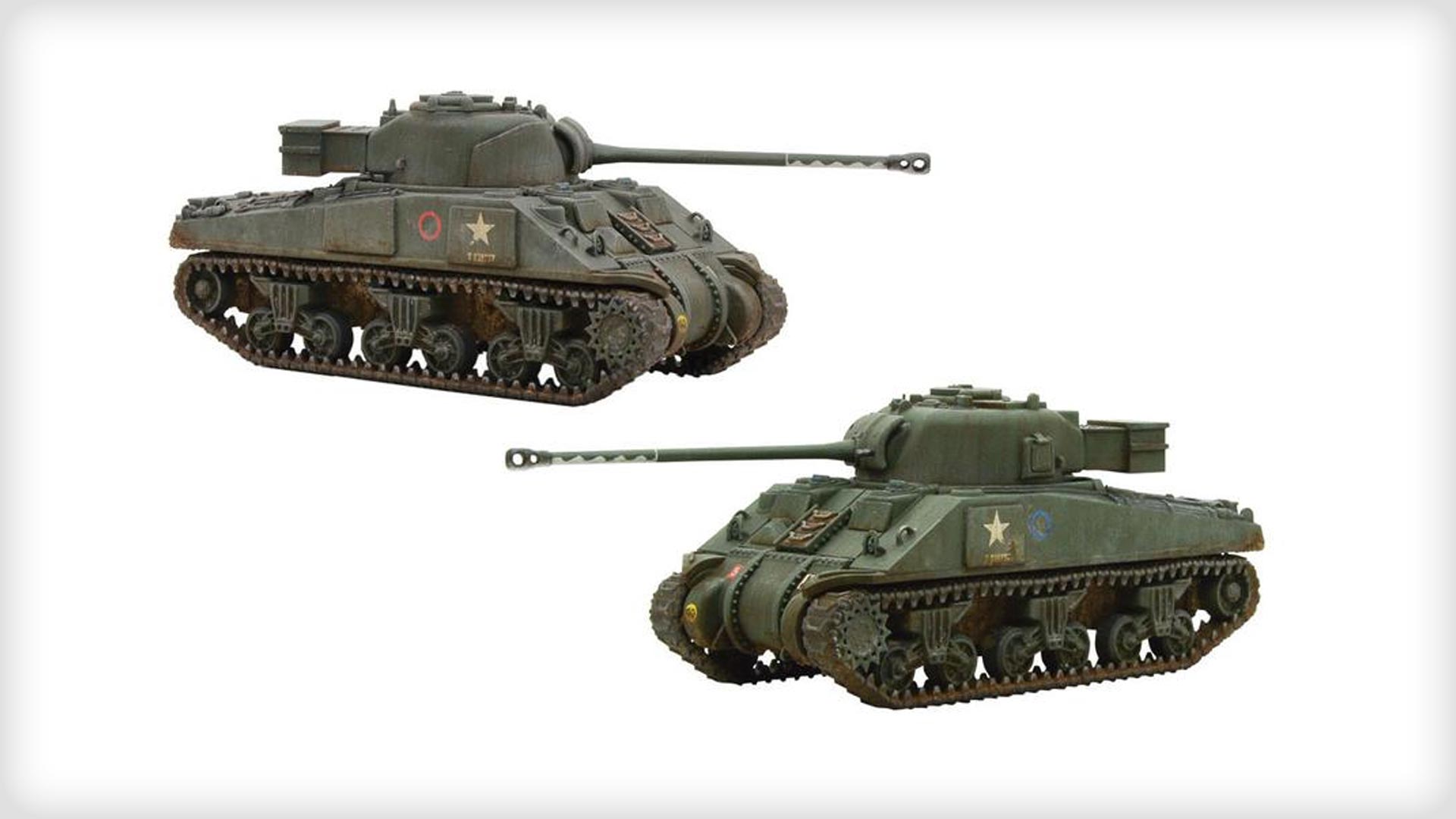
Today we're unboxing the new Sherman VC Firefly for Bolt Action from Warlord Games.

This is a variant of the American Sherman equipped with a powerful 17 pounder anti-tank gun. It soon became highly valued as the only British tank capable of defeating the Panther and Tiger tanks it faced in Normandy at standard combat ranges.
In recognition of this, German tank and anti-tank gun crews were instructed to attack Fireflies first. Between 2100 and 2200 were manufactured before production wound down in 1945.
Major George Brighty and Lieutenant Colonel George Witheridge were the ones to really push the Firefly development against all opposition from the MOD. So they are probably the culprits who acquired a Sherman to work on.
What are your theories about the acquired Sherman Firefly?
Only the Firefly could knock out Tigers and Panthers?
Wonder what killed all those Tigers and Panthers then… cos it wasn’t just Fireflys.
Maybe they died of old age ?
😉
Possibly…
air support?
I actually built one of these yesterday. Went together easily.
When is John going to get the Prodos head sculpt treatment that you and Warren got? He’s got the tanker helmet for the photos. Think of it, whole companies of Shermans facing of against Tigers, all sporting the same commander or driver.
Another great video! I neglected the opportunity to talk on the last tank unboxing (shame on me), so in a belated effort to redress this issue . . .
First up, just a quick word “defending” the video:
Only the Firefly could knock out Tigers and Panthers?
I may have missed it, I’m not sure the guys ever actually said that. I’ve listened to the video twice now, but I could have still missed it.
One addition (i.e., NOT a correction) –
Justin calls this at first a “VC.” (Wow, the VietCong used Shermans in Vietnam? I really learn something every day on these videos. 😀 😀 – just kidding) In British nomenclature, “C” = a tank equipped with the 17 lbr. I think the “V” relates to the base model, which the British called a Mark V, roman numeral five. So I believe this would be “pronounced:” . . . “Sherman Five-C” ??
1:46 – “For all I know there’s a hamster wheel in the back of it.” 😀 Great line.
John is spot-on when he’s talking about the murderous effect of longer-ranged German gunnery. In larger-scaled games where range can be handled with greater precision (you can have tables several “miles” wide), this really comes into critical focus. Picture an open field with a Tiger on one end and a company of Shermans advancing toward it (okay, “open fields” are a rarity in most real combat situations, but this is just an example). One MPH = about 26 meters per minute. So a Sherman advancing over rough terrain is moving say . . . 25 mph. That’s 650 meters in one minute. Now if a Tiger with the L56 8.8cm gun can engage a Sherman at say . . . 1200 meters, while the Sherman has to wait until about 200 meters, that means that the Shermans are exposed to the Tiger’s effective killing range for about 90 seconds, long enough for the Tiger crew (especially if well trained) to fire 18 rounds (the norm for a trained crew was about one round every five seconds?). Even if only half of these hit, we’re looking at 9-10 dead Shermans before they even get to engage.
This happens all the time in games like PanzerBlitz, Panzer Leader, Arab-Israeli Wars, GDW Assault, etc.
Hence, the Soviets / British / Americans / Egyptians have to use “Indian Tactics” as they Americans called them, drawing into ambushes, flanking attacks, calling in air strikes, etc. Basically, “fight dirty” to redress the materiel inferiority of their equipment.
This is also part of what made upgrades like the Firefly so important. That 17-pounder gun was only 77mm, I think, but that longer barrel, (and required larger breech block, recoil braces, recoil path, etc) means higher muzzle velocity = not only greater kinetic hitting impact (always the only reliable way to get through tank armor) but also a much longer range. This closes that murderous gap that allows a Tiger to take on 10-20 Shermans (in the admittedly oversimplified example above).
It says up above “the only British tank capable of defeating the Panther and Tiger tanks it faced in Normandy”. Though it seems to have changed slightly since earlier.
Derp, I see it now. I thought we were talking about something said in the video.
Part II . . . 😀
Justin, you’re not alone in trying to figure out how different armies allocated / organized tank destroyer assets. The Germans had tank destroyer battalions (panzerjäger abteilung), while tanks were in panzer regiments / battalions / companies, but their StGs were originally allocated also to the artillery (as British AT assets were) as “batteries.” This is part of what made StuGs so damned effective, their whole crew was a GUNNER first, AFV crewman second. Panzer crews were reversed. I have sources that say that German tank crews usually needed five rounds to “walk” a shell onto a new target, while the artillery-trained StuG could do it in three with superior “bracketing” practices you see in artillery training.
Later, StuGs were pressed into tank destroyer battalions and eventually the tank battalions themselves, as resources dried up. But yes, every army handles this kind of thing differently. The British Army was always been the most confusing to me (even more so than the Soviets, who use completely different echelon hierarchies for different branches in WW2, and were always changing them).
Also, Justin, starting at 5:20 or so, you basically “stumble” into one of Rommel’s favorite tricks in 1941-42. Reach out and slap the British tanks with your Panzer IIs and IIIs. Fall back behind a ridge. The British are chasing you in their Crusaders, Grants, and possibly early Shermans. Behind that ridge, in a reverse slope position, a line of 88s stands ready (out of range of British 25-pounders) to skewer the tanks as they advance.
6:00 – Indeed later variants of the PzKpfw IV (G, H, etc.) still had a harder-hitting gun L43 and L48 series of guns than the original 75mm on the “vanilla” Shermans. The range was about the same, though, so at least they Shermans didn’t have that awful “death gap” illustrated above. Also, the PzKpfw IV remained pretty vulnerable, even with additional armor plating and schurzen (In Panzer Leader, the late Pz IV has an attack of 14 vs. Sherman’s armor of 10 for a +4 differential, while the Sherman’s attack 11 applies against a Pz IV’s defense of 8, for a +3 differential. Both guns have a range of 8 = approximately 800-1000 yards).
12:20 “When you’re putting your transfers on, watch this again, let John’s gibberish wash over you, and put on whatever you like.” – NO! Don’t do this! Pay close attention to John and other sources. 😀 Even when winning my Golden Button for my Leopard 2s I had to take grief from someone for the wrong, get this . . . the wrong “tonnage decal on the mud guard?” Yeah, I know. Welcome to my life.
All these stories about units arguing over 17 pounders and missing Shermans “sunk in bogs” . . . my time in the military was very un-glorious, basically I was THAT guy (Supply NCO) sitting behind the supply counter telling people “Yes, we have it. Yes, you need it. No, you can’t have it.” We also had our fair share of what we used to call “D9Z forms”, to report / record a “miscellaneous loss.” Supply items that are broken, lost, stolen, whatever, just vanish from the battalion supply pool in a “miscellaneous way.” We used to call them “Pawn Shop Receipts,” because when the suspicion was that when something like this came up missing, it was hocked at a local shop for some fast weekend beer money. =(
On the cramped conditions of the Sherman tank, they were described as “hotels” by Soviet tank crewmen who were used to T-34s. Then Lend-Lease Shermans would come in, with a little padding on the seats, “roomy” interiors (by comparison), all kionds of “luxurious” creature comforts. Yeah the exact phrase from the veteran in my book of interviews and memoirs was: “I sat in the American Sherman, I felt like I’d just checked into a hotel!”
Yeah, yeah, I know you guys love the Firefly in comparison to the American Easy Eight. Everyone’s gotta “root for the home team.” We certainly do so here in the US, where the Easy Eight usually ranks higher than the Firefly in “casual estimation.” They’ll even have statistics that back it up, but even as a loyal American . . . I find these a little skewed. The fact is that Easy Eights were usually deployed in platoons of five, while Fireflies were usually only one tank in a TROOP of FOUR. So when American (ahem) historians compare Firefly kill rates vs. Easy Eight kill rates , they don’t always take into account that what they’re really reporting on is a platoon of five Easy Eights against a single Firefly and three “vanilla” Shermans. Yes, the American tan UNIT it much more effective. But that doesn’t really mean the Easy Eight is superior to the Firefly on a one-to-one basis.
I’ve read in passing (I’ve never checked on this) that the M1A1 76.2mm on the Firefly was more accurate, while the Firefly’s 17lbr hit harder. Again, I don’t know if that’s accurate. There are also questions on the supply / quality of American ammunition in larger calibers, including the 76.2mm M1 and M1A1, and the later 90mm. Published performance ratings might be relating to the “intended” enhanced ammunition of these weapons, which were not always available in actual wartime 1944-45.
By end 44 many British troops had two Firefly tanks, one generally being the Troop leader who was also usually assigned the best gunner.
Wonderful. That’s MORE Panzer Leader counters I have to make now. 😀
I will confess to having made some counters of JUST Firefly troops (completely inaccurate, indeed, just for fun as a “dream team” counter). Using the math formulas used in Panzer Leader, you wind up with attack factors on a late-war Wehrmacht Panther platoon.
Which I guess makes sense. You have a very high-velocity, high-performance 76mm gun in the form of the 17 pounder (corrected to what I posted above, checking around I’m finding that the 77mm variant of the 17-pounder was installed on the Comet), compared to the L70 7.5cm gun of the Panther.
This also causes it to edge out the M1-series 76.2mm guns mounted in Easy Eights. Granted, it’s only Wikipedia, but I am finding some confirmation to what was posted above:
The UK had developed a more effective anti-tank cannon before 76 mm gun [American M1A1/2 “Easy Eight” gun] became widely available. Although only slightly longer at 55 calibers, their Ordnance QF 17 pounder (76.2 mm) anti-tank gun had a much larger 76.2×583mmR cartridge case which used about 5.5 lb (2.5 kg) more propellant. The anti-tank performance of the 76mm was inferior to the British 17 pounder, more so if the latter was using APDS discarding sabot rounds, though with that ammunition the 17-pdr was less accurate than the 76mm.
i.e., the Easy Eight tended to be more accurate, but the 17-pounder hit harder, but in the balance the 17-pounder was still a better weapon.
Okay, @johnlyons , okay. You win this one. But I’ll be back! Bwahahaha!
For those interested in such things, here’s some more in-depth info on the markings (hope you don’t mind my input, John).
The division badges are as John mentioned and would usually be on the left hand side (if you look at it head on) with the numerals being on the other side (though some units used other placements, in particular the Poles). The 3 digit numerals are also just division specific, hence being next to a certain Divisional badges. Most Armoured Divisions use the red square with the numbers, which denote a particular battalion within a division. Here’s a bit of a run down.
50 – Brigade HQ
51 – Senior Regiment
52 – 2nd Regiment
53 – Junior Regiment
54 – Motorised Infantry Battalion
The 45 on the green and blue square is the recce unit of the division (quite often equipped with Cromwells)
Using John’s beloved Guards Armoured Division, the numbers would equate to the following units.
50 – Brigade HQ (no specific unit for these)
51 – 2nd Armoured Battalion Grenadier Guards
52 – 1st Armoured Battalion Coldstream Guards
53 – 2nd Armoured Battalion Irish Guards
54 – 1st Motor Battalion Grenadier Guards
45 (on the green and blue square) – 2nd Armoured Recce Battalion Welsh Guards in Cromwells.
Now on to the shapes. First point here is what each shape means. The diamond is Regimental HQ with the triangle denoting ‘A’ Squadron, the square ‘B’ Squadron and the circle ‘C’ Squadron (naming conventions of squadrons may differ from regiment to regiment). Next comes the colour. Red denotes Senior Regiment, yellow the 2nd Regiment and blue the Junior Regiment. White denotes an ‘unbrigaded’ vehicle, which commonly means recce. For anyone who has noticed the green decals in the Universal Carrier kit, those denote Motorised Battalion vehicles.
So back to the Guards Division. Let’s say we have a Sherman V with the All Seeing Eye badge on the left hull (Guards Armoured Div.) which has a red square with a 53 in it on the right hull (Irish Guards). Now we look for the turret marking. Let’s say it’s a blue square (blue confirms it’s Irish Guards and the square tells us ‘B’ Squadron. So those three symbols can bring it down to a single squadron of 4 or 5 tanks.
Hopefully this is useful to people.
Man, @crazyredcoat – long time no see. 😀
I appear sporadically, mate. Been busy of late. 😛
Firefly was upped to two to a tank group, or 50% in some units in the later war. Oddly a whole lot of the German armor was kaput by then!
Firefly is a beautiful Kludge but…don’t talk crap abut my Easy 8 again, yo. Hell the Konflikt ’47 should be FULL of Easy 8.
Of course the tesla tanks they sell only have the 75mm turrets as the alt turret which is okay for Bolt Action but not how things are in Konflikt ’47.
But gift horse mouth i guess. But the 3 pounder would be a better turret to put in with the Tesla sherman.
BTW how did Tesla create a rift tech weapon for the US in the late and alt-post war period when he died in 1943 as a sick old guy in a NY hotel?
looks a nice well detailed model.
Re Justin’s question about the turret basket in Fury.
If you check out the “how it’s made” video extras with DVD/ iTunes version of the film it explains that the internal shots filmed in the tank were done using a enlarged wooden mock up of the inside of the tank. The inside footage of the tank isn’t shot from inside a tank. Something to do with access and camera angles. The pre-mentioned extra vids explain it better if you watch them.
Hope that helps Justin.