







![NO Weekender Or Cult Of Games XLBS This Weekend [Updated]](https://images.beastsofwar.com/2026/03/No_Weekender_and_XLBS_this_Weekend-225-127.jpg)



Barbarossa 1941 – USSR Invaded 75th Anniversary Series [Part Four]
July 11, 2016 by crew


Welcome back once again, Beasts of War, to our commemorative wargaming explorations of Operation Barbarossa, the Axis invasion of the Soviet Union in 1941. This assault, the biggest in history at the time, ignited what is known today as “the Eastern Front,” by far the largest part of the Second World War.
So far we’ve seen...
- Part One: The opening invasion and first Soviet counterattacks
- Part Two: The Battle of Dubno and crossing the Dniepr River
- Part Three: Northern operations and the massive Battle of Kiev
But now the autumn rains have set in and the German advance, all but unstoppable until now, finally seems to be stumbling. Stiffening Soviet resistance and a bewildering lack of focus the German operational plan aren’t helping matters. Technically, Operation Barbarossa has already failed, but a new assault is already brewing.
The Hungarian Fast Corps
October, 1941
As mentioned in previous articles, the Germans had plenty of allies when they invaded the Soviet Union. Another of these was the Royal Hungarian Army, which contributed a 40,000-strong “Carpathian Group” (spearheaded by the semi-armoured motorized “Rapid Corps”) to Army Group South.
This Hungarian Rapid Corps achieved notable success during the encirclement of Uman in July and the Battle of Nikopol in August. However, losses were always severe. Part of the reason is (to put it cynically) that the Germans considered such “allied” units to be expendable, and they were poorly equipped compared to German formations.
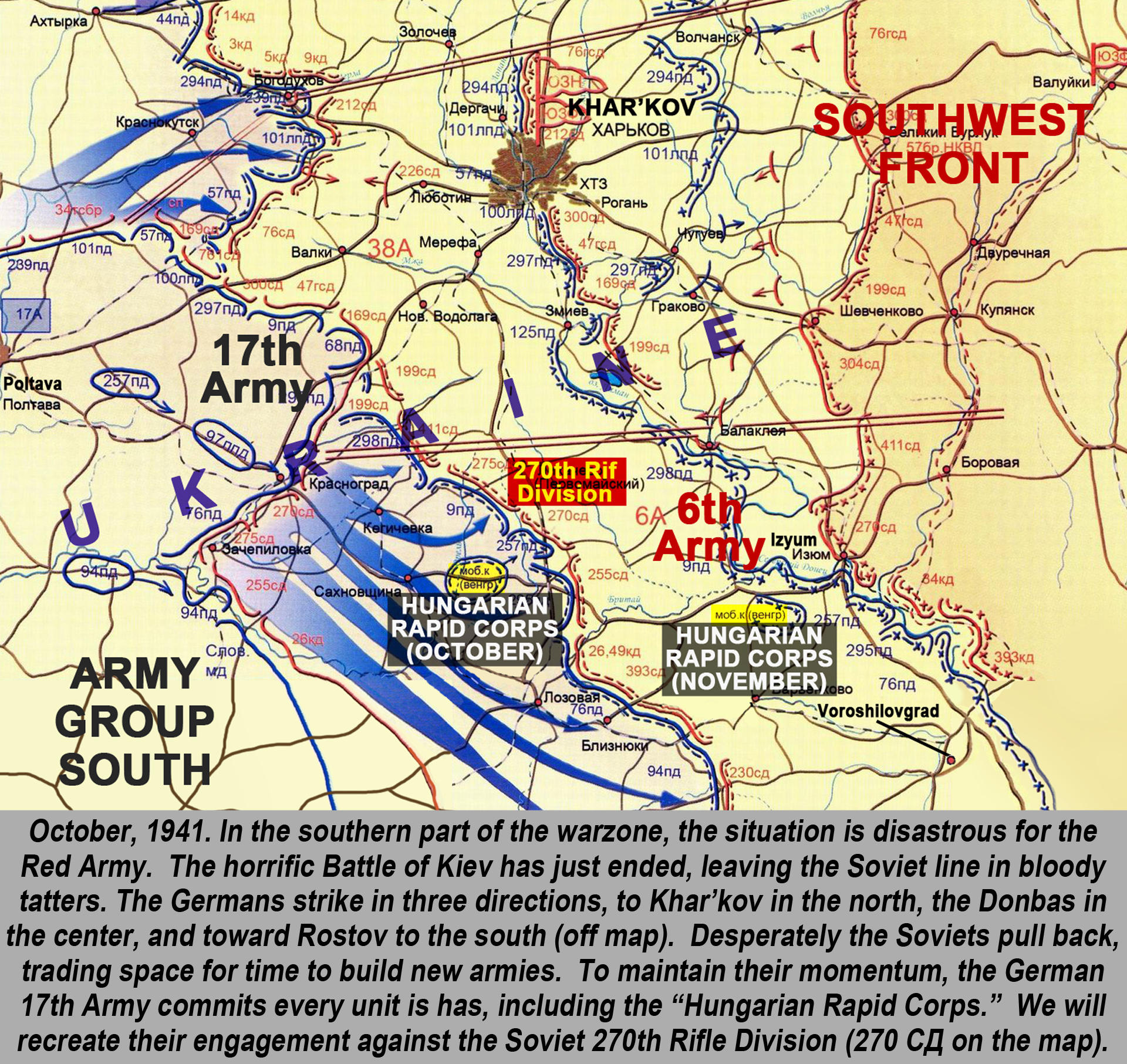
One of Hungarian Rapid Corps’ more celebrated moments came after the Battle of Kiev, when the German 17th Army was advancing toward the Donets River. Despite being battered down to just six battalions, the Hungarian Fast Corps (part of 17th Army) was ordered to break through a strong section of the Soviet line held near Pobjeda.
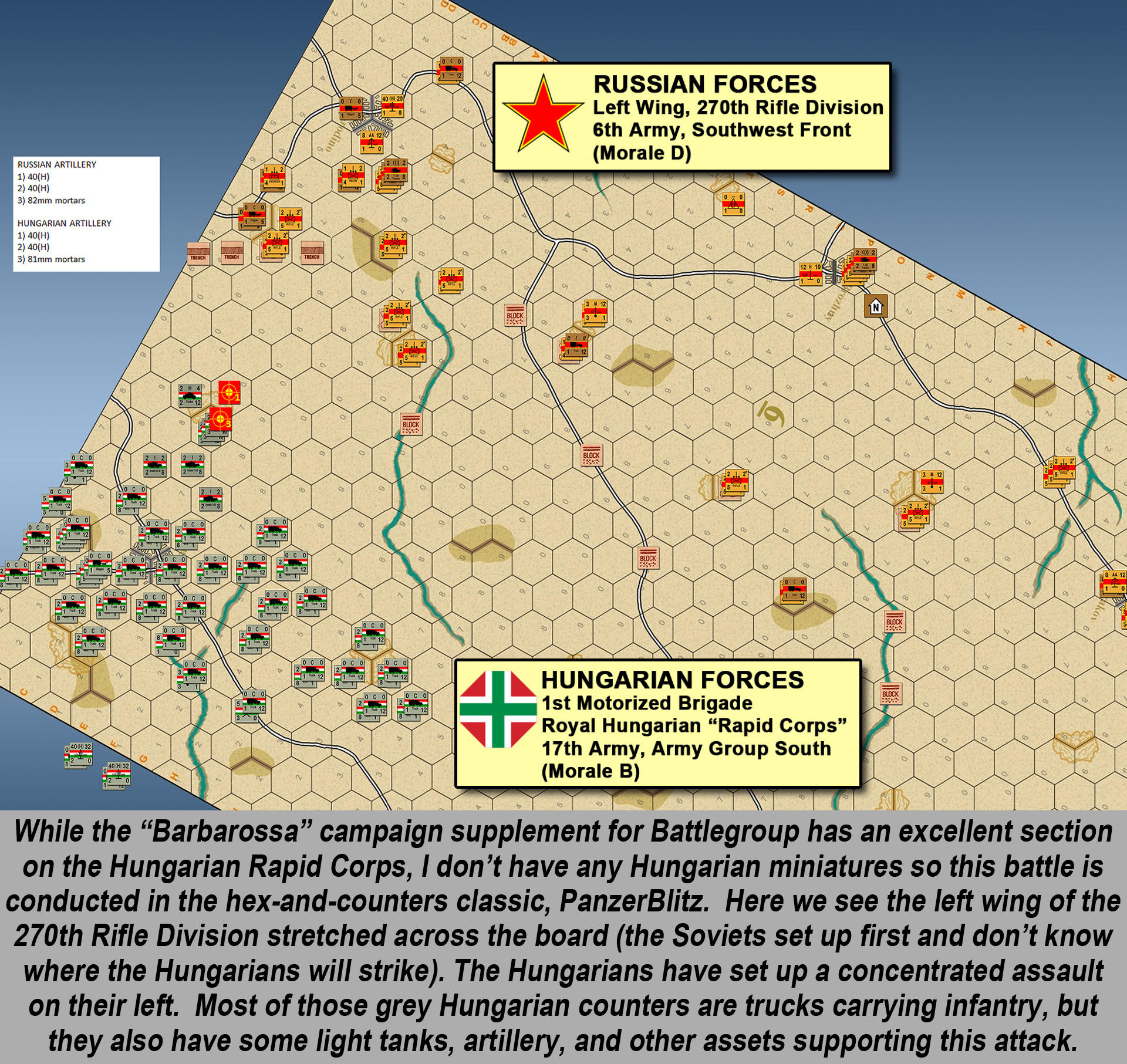
However, the Hungarians outflanked the Soviets (instead of driving straight through) and hit the Soviet 270th Rifle Division from the side. After a hard-fought but successful battle, the Hungarians destabilized Soviet defences enough to let the 17th Army mount a breakthrough toward the key cities of Voroshilovgrad and Izyum.
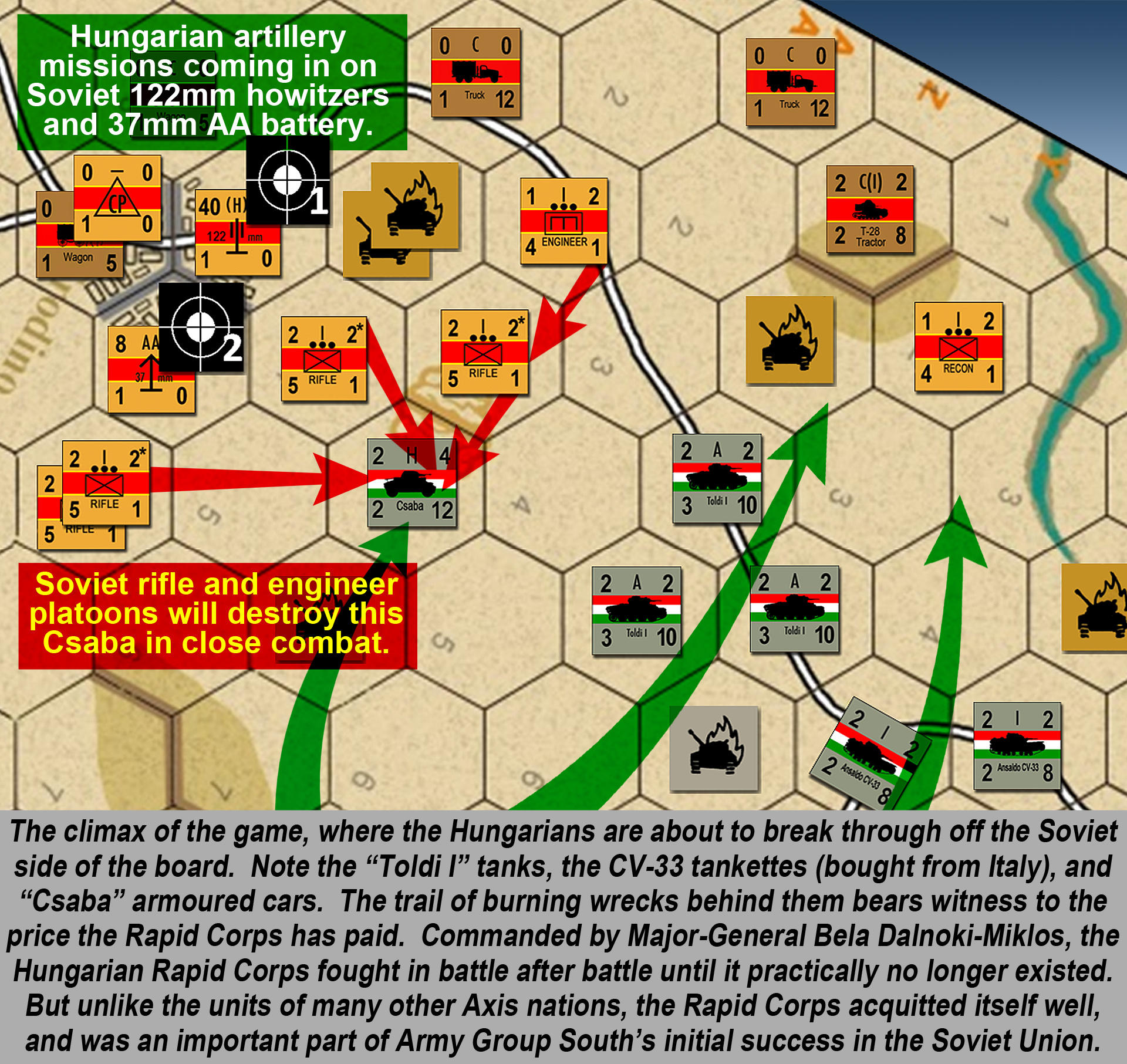
In November, the battered and exhausted Rapid Corps would fight two more bitter engagements just south of Izyum until the Germans finally took the city and secured a bridgehead over the Donets River. By this point, however, the Rapid Corps had lost thousands of casualties and almost all their vehicles, and were withdrawn in early December.
The Typhoon Strikes
Mtensk - October 2nd, 1941
With Leningrad now under siege in the north and Kiev fallen in the south, the invaders finally shifted their attention back on the central prize: Moscow. Technically speaking, Operation Barbarossa was over. A new invasion plan had been drawn up for what the Germans hoped would be the final effort in the east: Operation Typhoon.
If successful, this assault could end the campaign in Russia. If Russia has to sue for peace, with the US still neutral and Great Britain hanging by a thread, Germany just MIGHT win the whole war right here. If you want an operation where the total outcome of the World War II could really have swung Germany’s way, it’s this one.
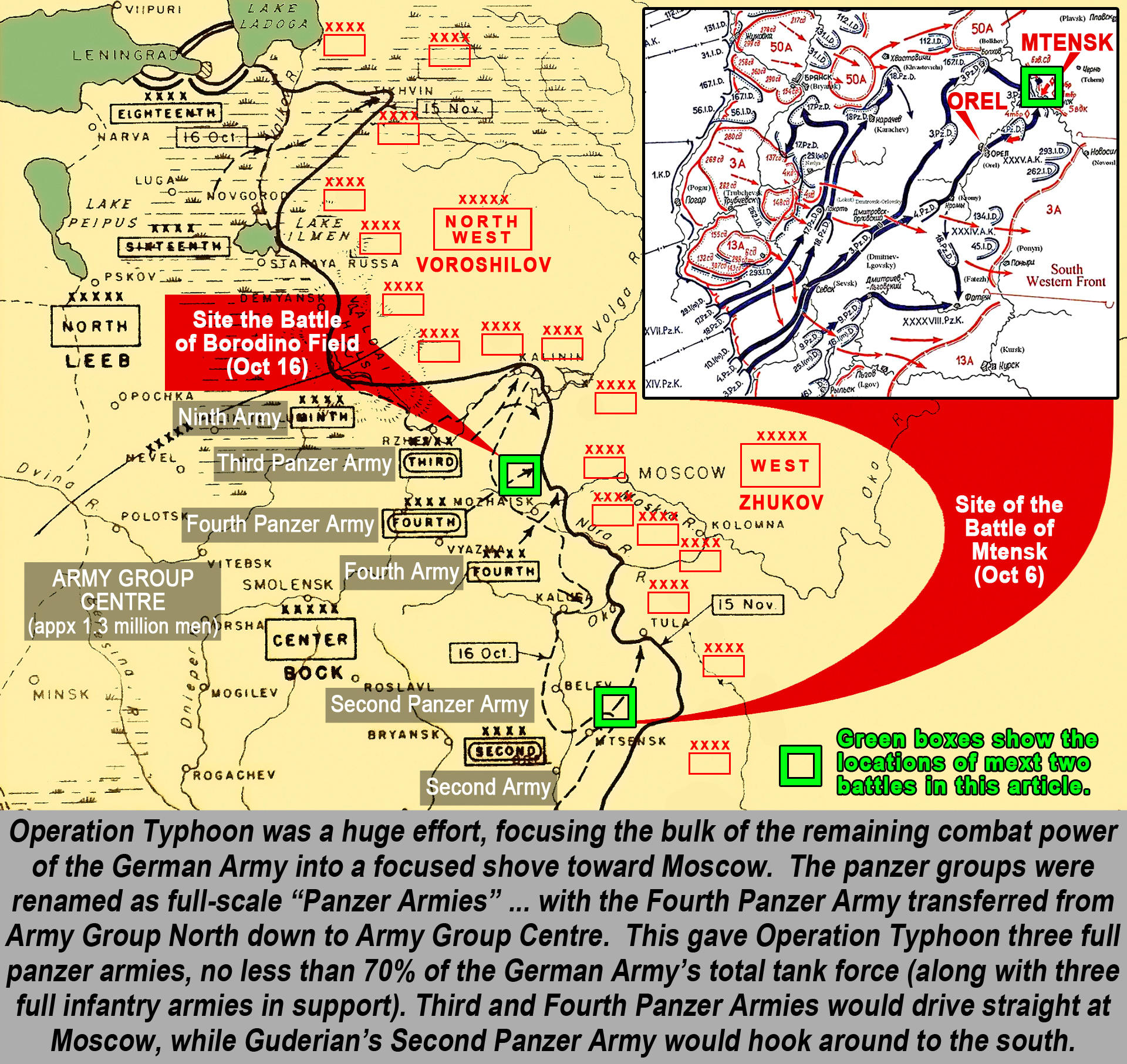
The main push of Operation Typhoon opened on October 2th, 1941. Even considering the firepower available to these reorganized German armies, the attack met with stunning initial success. The heaviest blow came right up the Smolensk-Moscow highway, where the Soviets had fortified a massive new line of defence near the town of Vyazma.
The result, however, was all too familiar. The panzer groups carved out yet another series of vast encirclements, and within weeks the bulk of seven Soviet armies … SEVEN … were lost in or around of Vyazma. Almost 700,000 more men were gone, and the road to Moscow was torn open yet again.
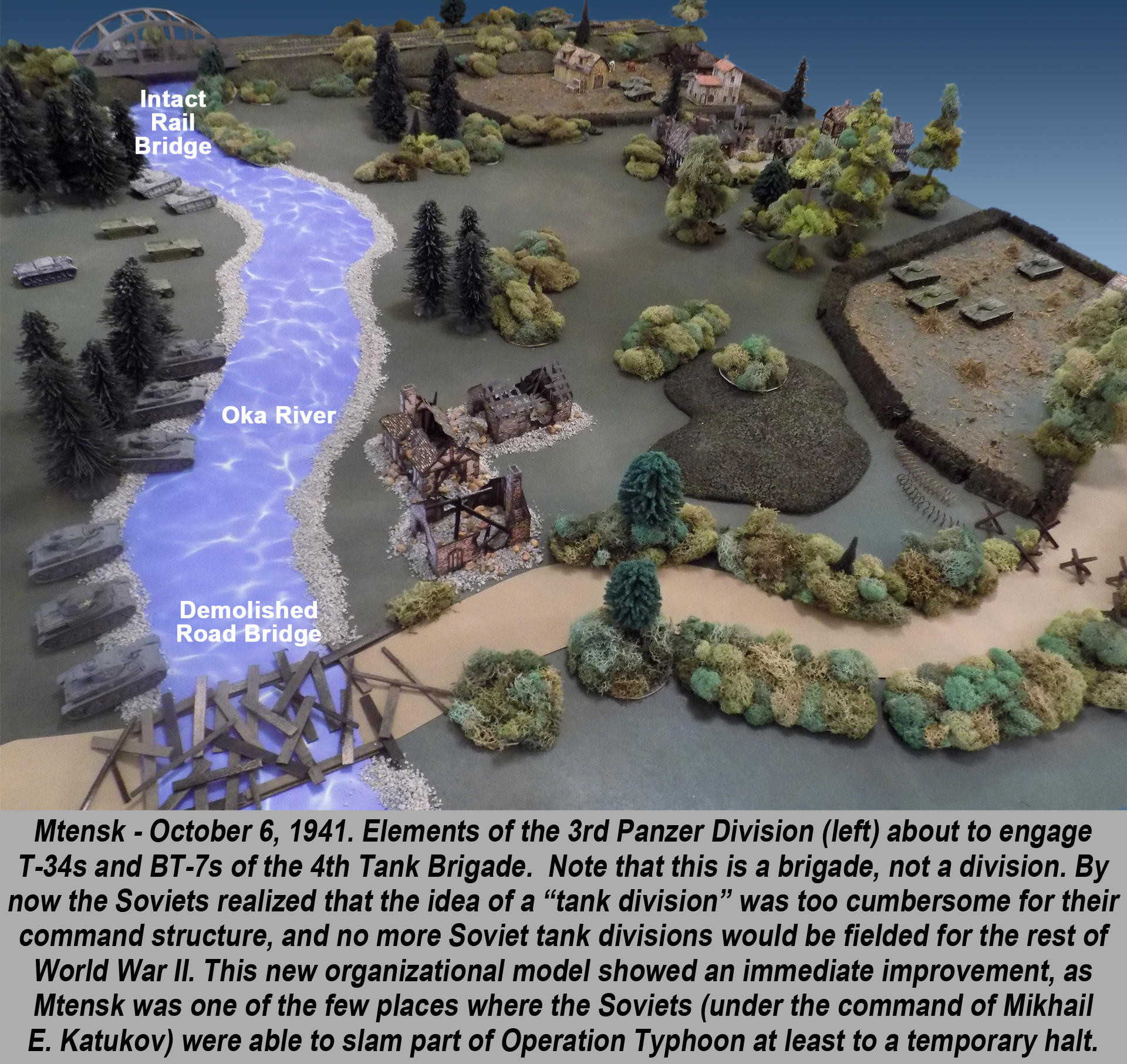
To the south, meanwhile, Guderian’s newly reorganized “Second Panzer Army” (formerly Panzer Group II) had opened its own offensive. The idea was to outflank the main Soviet defences centred on Vyazma, drive through Orel and Tula, and eventually approach Moscow from the south.
At first Guderian did very well, his lead units took the city of Orel so fast that Soviet authorities didn’t have time to cut electrical power. However, he was about to hit a very serious obstacle in the form of the “1st Special Guards Rifle Corps” … a new type of unit that slammed the 3rd and 4th Panzer Divisions to a dead halt near the town of Mtensk.
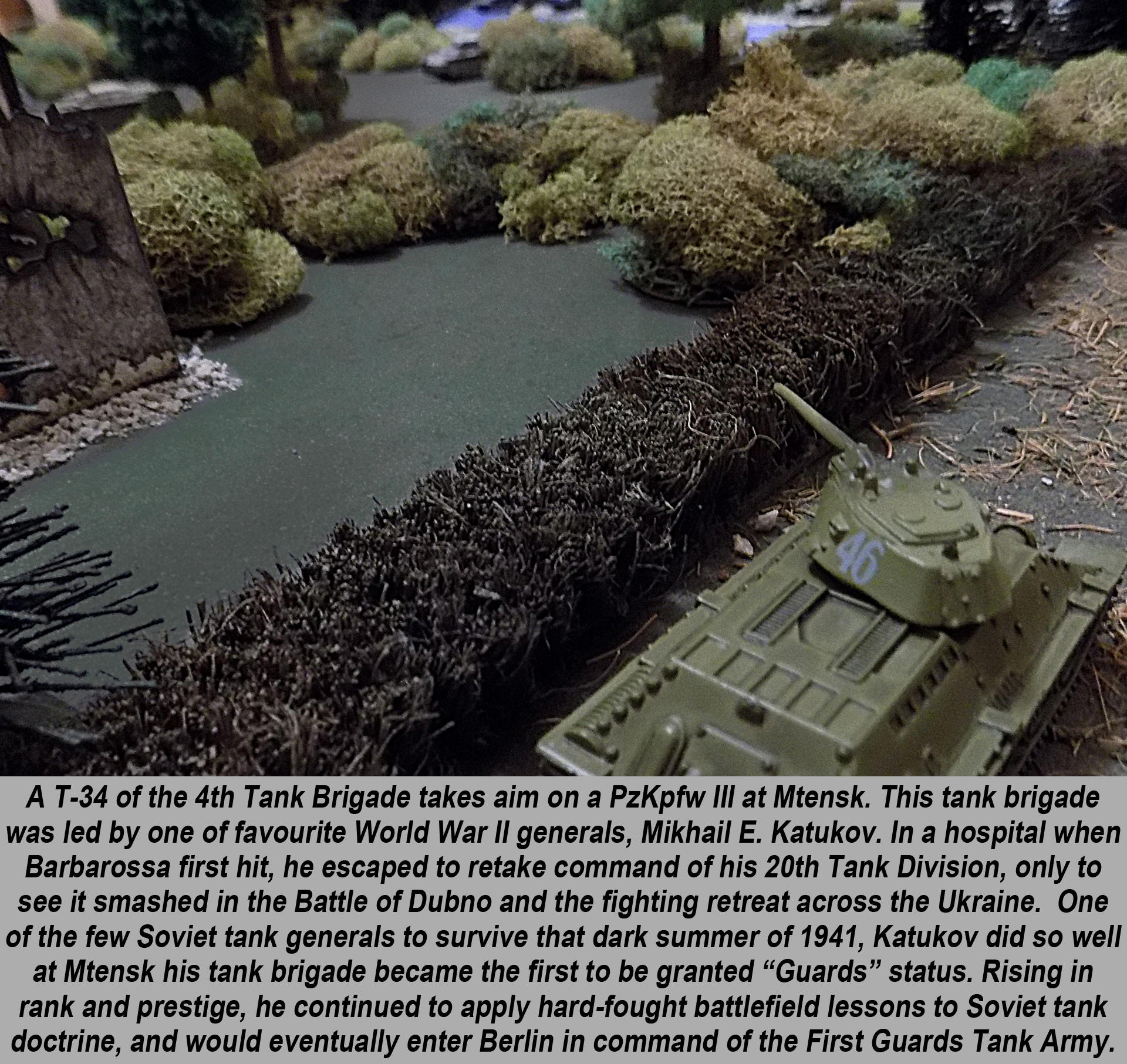
The 1st Special Guards Rifle Corps is a tough unit to research, since it only existed for about ten days. Incorporating the new Soviet tank brigades and more T-34s and KV-1s, the unit possessed much greater operational speed and effectiveness than the old bulky “tank divisions” loaded with old models. Despite it all, the Soviets were learning.
One of the key units of the 1st Special Guards Rifle Corps was the 4th Tank Brigade, commanded by a man destined to become of the truly great tank generals of World War II. This was Mikhail E. Katukov, who’d be leading earth-shaking armour battles from the first week of Barbarossa though the last shots fired in Berlin.
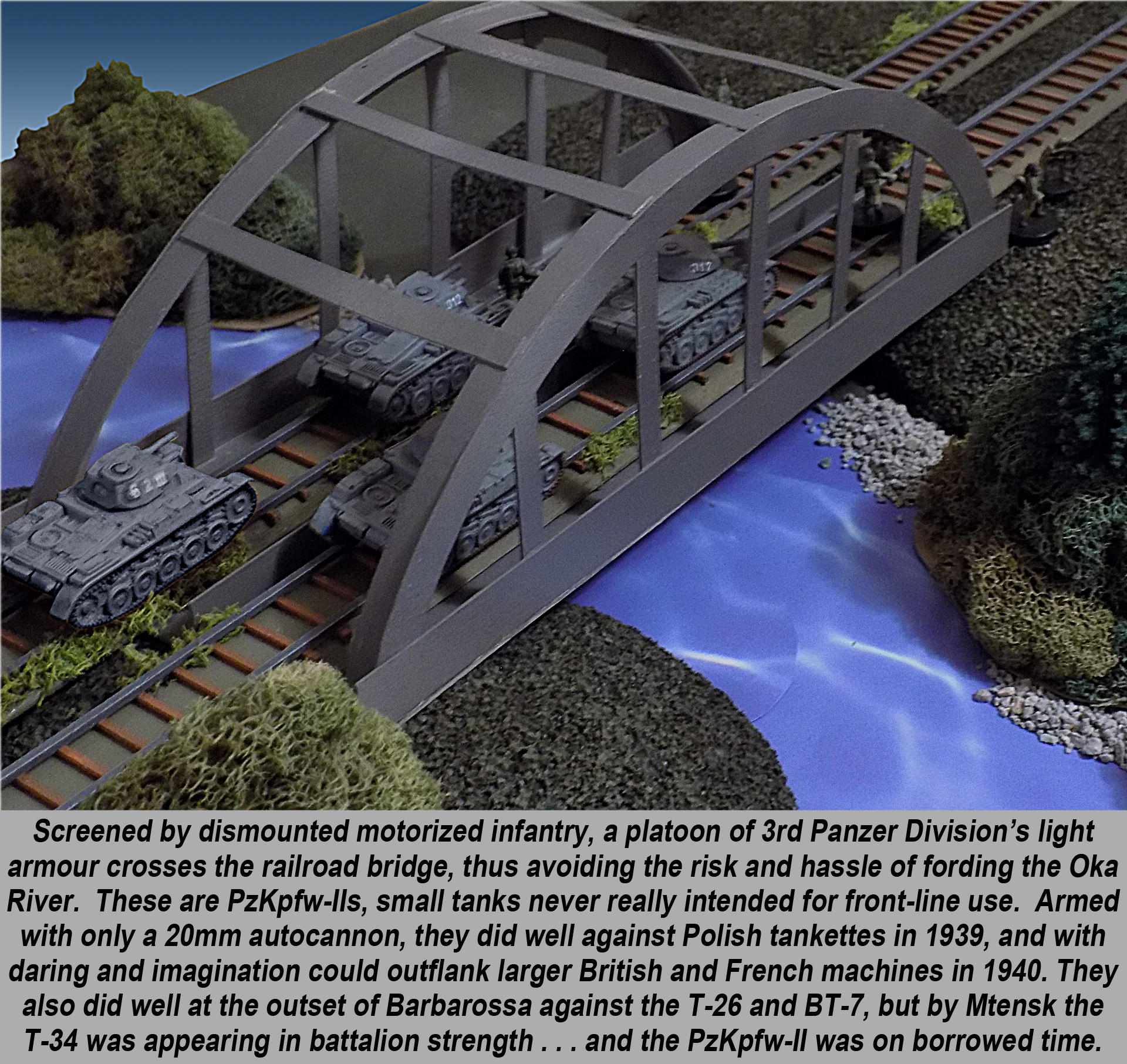
Since his first taste of combat at the nightmarish Battle of Dubno and the bitter retreat across the Ukraine, Katukov had been developing new tank tactics and training his officers to apply them. These involved concealed firing positions, dummy firing points, secondary fighting positions, prepared lines of phased retreat.
Many of these ideas may sound “simple” or “basic.” Just remember the Red Army’s officer corps had been gutted by Stalin before the war, and those that survived had mostly been killed by the Germans. Katukov was one of the few who was re-inventing the Red Army from the ground up, and in the heat of apocalyptic combat, no less.
Still, Katukov (and the rest of the Red Army) had a long way to go. Shaking off the setback on October 6, the panzers struck again on October 9. They cracked the Soviet line, and what remained of Katukov’s brigade fell back with other units across the Zusha River over a damaged rail bridge in the middle of the night, still under German fire.
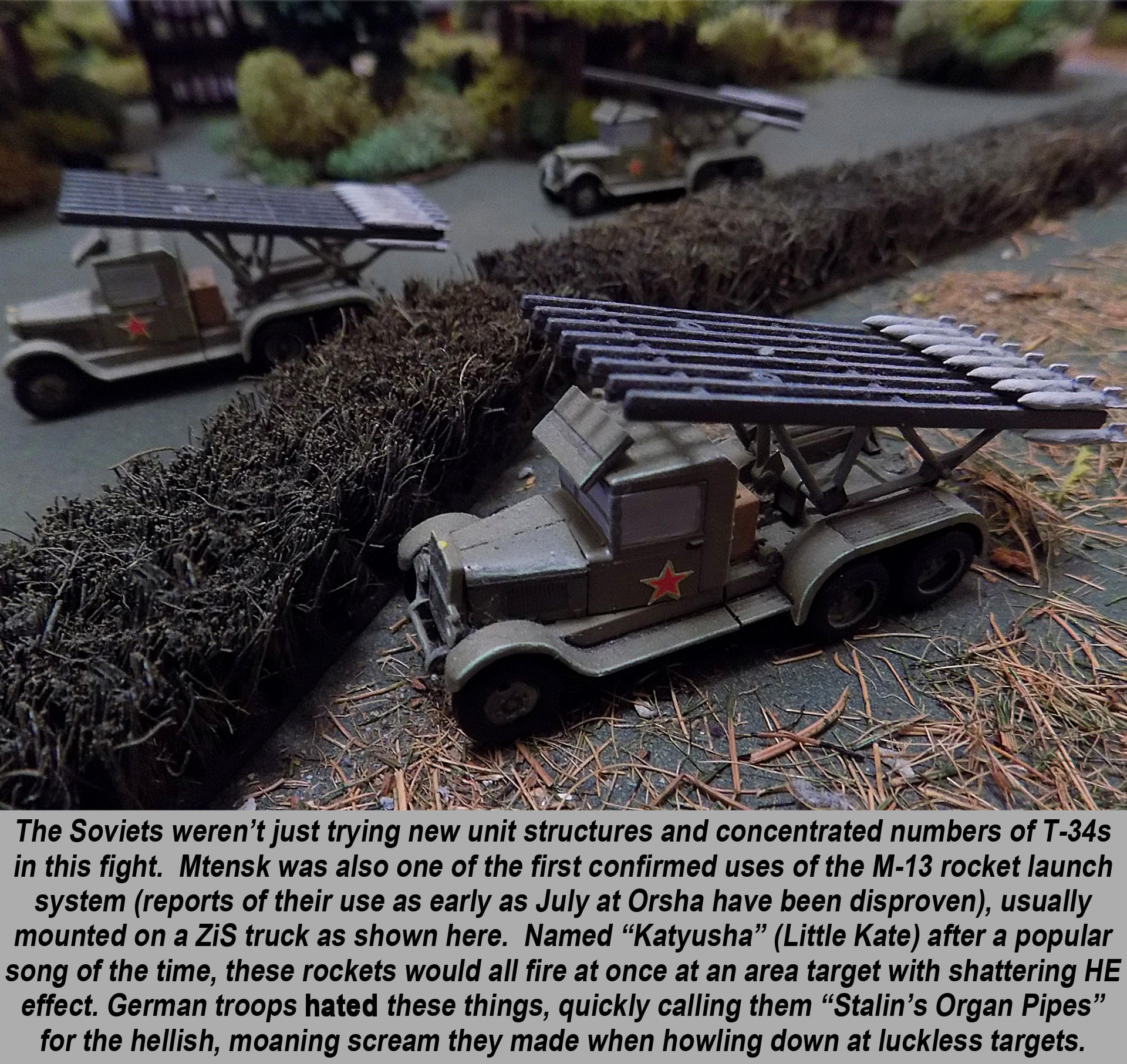
The Germans, however, had already run out of time. The first snows fell on October 7th. Their spearheads, having advanced 200 miles in the first week, advanced only 20 miles in the second week. Guderian himself would grumble in his memoirs that Mtensk saw a marked improvement in Soviet tactics, equipment, and operational planning.
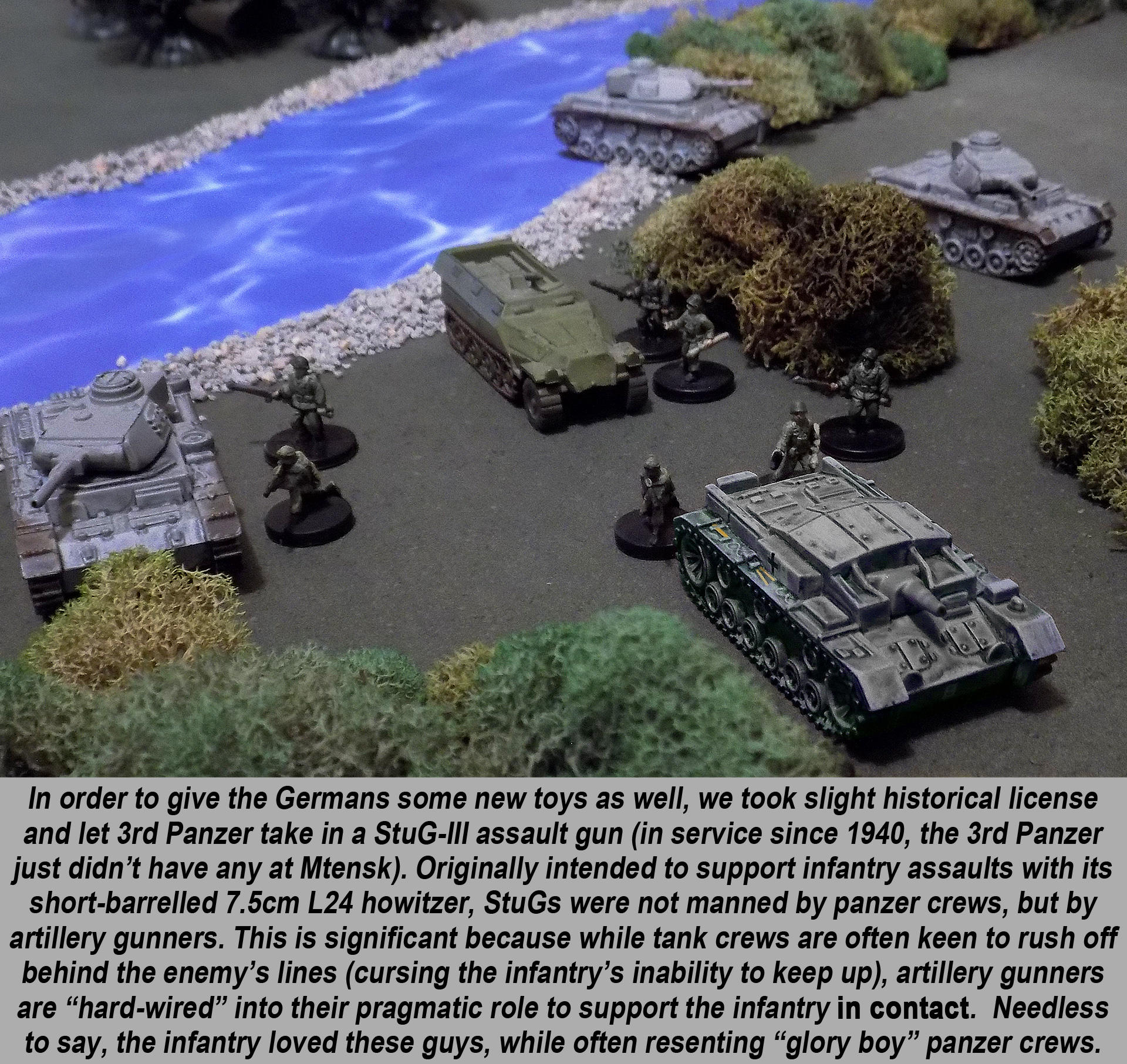
Katukov, meanwhile, would receive the Order of Lenin for his fighting around Mtensk, and his 4th Tank Brigade would become the 1st GUARDS Tank Brigade on November 11. On that same day, Katukov was promoted to Major-General, and was well on his way to becoming one of the great Red Army tank commanders of World War II.
Napoleon’s Battlefield
Borodino - October 16th, 1941
Many people like to draw comparisons between Napoleon’s invasion of Russia in 1812 and Hitler’s invasion of 1941. Few people realize just how similar these invasions actually were in places. One 1941 battle unfolded on the exact field as one of 1812’s bloodiest battles, the eerie coincidence not lost on the men or commanders who were there.
Earlier in this article, we discussed the cataclysmic Battle of Vyazma. The bulk of seven Soviet armies were chopped up into a series of pockets that collectively cost them even more than the disaster at Kiev. For the first time in the war, Germans forces actually outnumbered the Red Army.
While these pockets were being reduced, the German XL Motorized Corps (including the SS “Das Reich” division and Vichy French volunteers) were among the spearheads racing eastward to exploit the breach. But they met fierce resistance at the historic battlefield of Borodino, where Russia’s fate had been decided against the French in 1812.
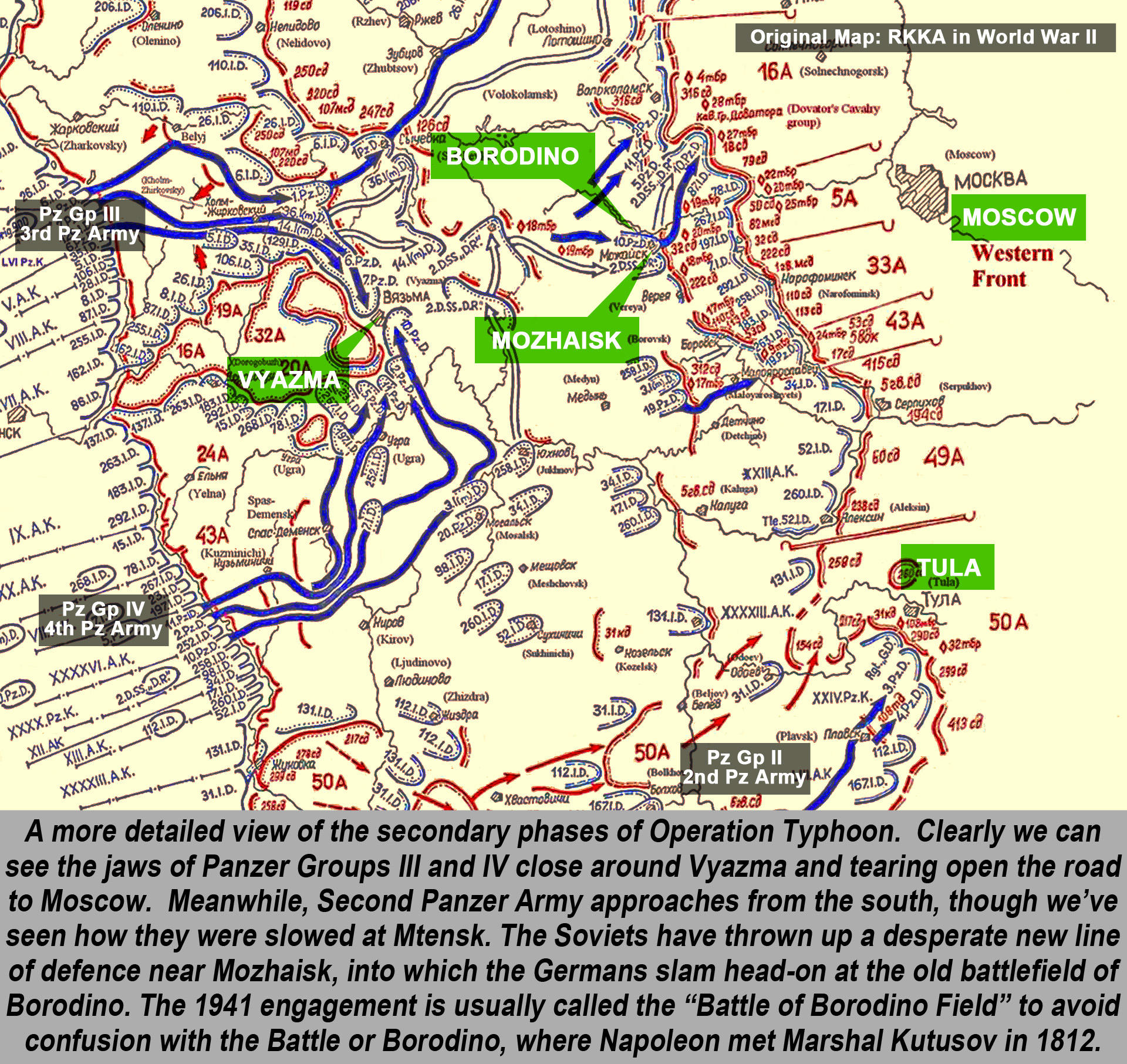
Needless to say, the Soviets were scratching together a new defence in the wake of Vyazma. This would be the “Mozhaisk Line,” centred just 60 miles from the heart of Moscow. After advancing some 600 miles so far (almost a thousand kilometres), one can understand how the Germans assumed their invasion of Russia was all but won.
First to hit the Mozhaisk Line (at Borodino) was the aforementioned XL Motorized Corps, which included elements of the 10th Panzer Division and the Waffen SS “Das Reich” Motorized Division. Although some of the best troops in the German war machine, these units were also badly worn out and understrength after four months of combat.
Also present were thousands of Vichy French volunteers of the “Légion des Volontaires Français,” or LVF (attached to German 7th Infantry). Like many of Germany’s “allies,” many of these men genuinely feared the threat of Soviet Bolshevism. Others simply preferred military service to the conscript labour they faced back in occupied France.
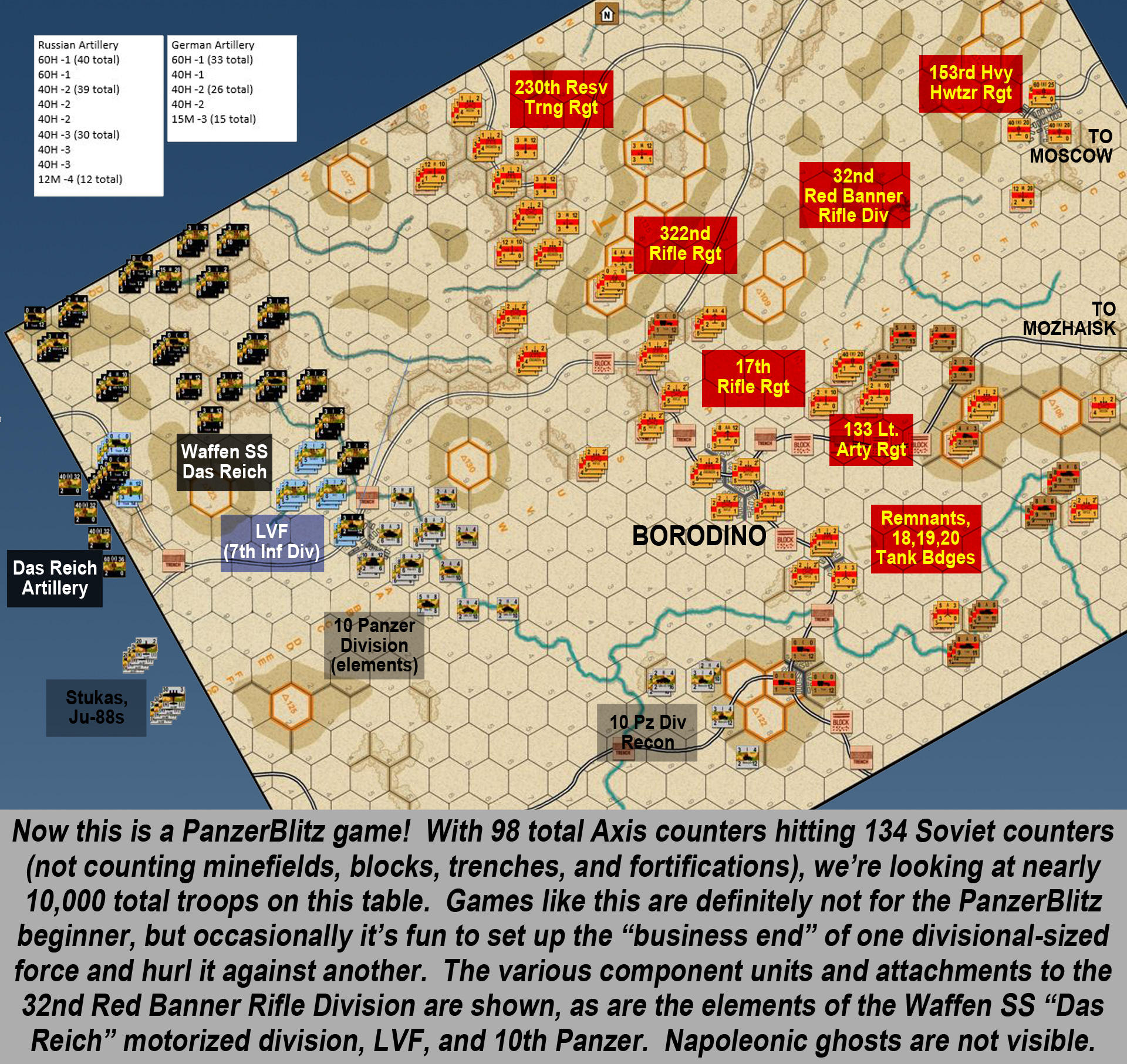
Standing in their way was the newly-arrived 32nd “Red Banner” Rifle Division. Unlike many in the Red Army, these men were victorious veterans of wars in Mongolia against the Japanese in 1938 and 1939 (where they’d earned their Red Banner status). Now they’d meet the Axis on the exact field where Kutuzov had met Napoleon back in 1812.
The symbolism was lost on no one. Field-Marshal von Kluge spoke to the men of the LVF, reminding them that Germans and French had fought together against the Russians on this very field 129 years ago. Meanwhile, the Soviets staged 32nd Red Banner Division’s HQ on the exact spot of Kutuzov’s headquarters.
Suffice it to say that history repeated itself in full, bloody fury. The advance of XL Motorized Corps came to an abrupt and impolite halt, and they would gain just 30 more miles in the next two weeks. But that also meant that Germans were now just 30 miles from Moscow, when the full freezing force of the Russian winter finally struck …
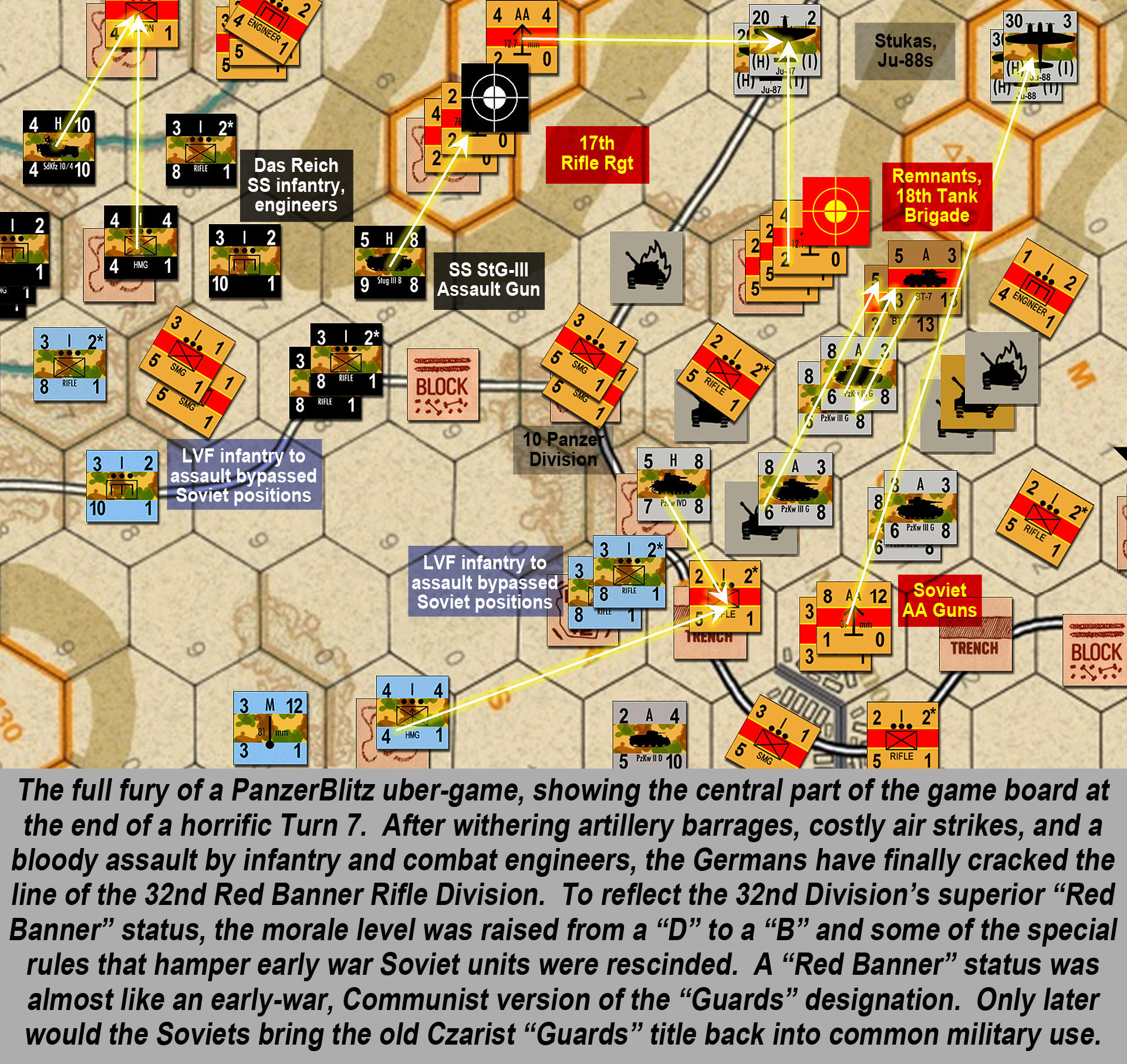
Hopefully it’s clear that by this point, the campaign in Russia was truly coming down to the wire. THIS was the point where the outcome of World War II hung in the greatest doubt. If the Soviets had been forced to sue for a separate peace, even a temporary one, all the potential trajectories for the rest of the war come into grave, grave question.
Please come back next week as we conclude this 75th Anniversary commemorative article series on the invasion of the Soviet Union. This is one of history’s true turning points, so don’t miss it! Meanwhile, please feel free to keep the conversation going in the comments below, and give us your take on this pivotal campaign of World War II.
If you have an article that you’d like to write for Beasts Of War then you con get in contact with us at [email protected] to find out more!
"After a hard-fought but successful battle, the Hungarians destabilized Soviet defences enough to let the 17th Army mount a breakthrough toward the key cities of Voroshilovgrad and Izyum..."
Supported by (Turn Off)

Supported by (Turn Off)
"...for the first time in the war, Germans forces actually outnumbered the Red Army"
Supported by (Turn Off)






Excellent as ever. Have you written any historical books or anything? If not you should.
Thanks, @gremlin . Actually, I don’t think I have the right “letters after my name” to write any kind of official history, and really these topics are covered by far better and more knowledgeable historians than I. In some more niche settings, like historical fiction novels, gaming guides (i.e., So You Want to Wargame on the Eastern Front? – not unlike these articles), I have tried my hand . . . and while I’ve managed literary representation and agency contracts, never that elusive publisher.
And of course, some internally-published works for the tech company I work for, but that doesn’t really count. 😀
I’m waiting until I win the lottery and then try my hand at e-publishing or self-publishing. 😀
Thanks again!
Looking forward to you winning the megamillions then. Or should i win we might work something out 😉
Sounds like a plan. 😀
As always an enjoyable read.
Thanks very much, @rasmus . One more to go! I’ll also start posting the Mtensk battle report later tonight or early tomorrow. 😀
Excellent read! Looking forward to article 5!
Are you using a software version for Panzerblitz? I only now noticed how neat the gameboards looked 😀
Are you using a software version for Panzerblitz?
Hmm, great question, @neves1789 . The answer is . . . sort of.
Really this is just a series of .png, transparent-background images in Microsoft Excel. So I:
** Photoshop together a mapboard I like. Often these are simply .pdf scans of old PanzerBlitz maps from the 1970s (which explains why they may look dinged up in some places).
** Create a file folder of counters somewhere, just one needed for each unit type. Still, this can be dozens of files per faction, but they are very small .png “icons.”
** The map is then inserted into an Excel document as an image.
** The units are then inserted into the Excel document as well, where they can “float” over the mapboard. In Excel editions 2007 and later, they can be freely rotated, stacked, grouped together, shuffled, etc. If you have three Mark IV tanks, and you need three more, just CNTL-C, CNTL-V yourself three more.
** Other than that, though, the game is run like any other manual board game. I have all the charts, rules, roll physical dice, etc.
** Needless to say, maps and units can be reused in future scenarios. The end result is your laptop becomes an infinitely-expandable, portable, and upgrade-able library of any / all PanzerBlitz, Panzer Leader, or Arab-Israeli Wars games.
** The arrows and labels are of course added in later specifically for the article, just to help the readers follow along with just one or two images.
This format has a number of very keen advantages:
1) You can play anywhere, anytime.
2) Through shared-screen applications like Google+ Hangouts, GoToMeeting, etc, you can play with anyone around the world.
3) You can save each turn of the game as a separate tab in your workbook, so any rules mistakes or questions about previous turns can be easily referred.
4) Replays are extremely easy. If you lose a game and wish, “Damn, if only I hadn’t done that on Turn 4 . . .” Simply go back to Turn 4 and save a new file.
5) Live games played in-person are projected up on a 60″ plasma TV, with the two players watching each other take their turn. The living room is literally turned into an electronically-driven CIC. 😀
6) You are absolutely not limited in scale. You can have 100 Mark IV platoons on a map board, or 200 T-34 companies (not sure what battle you’d be doing there, except maybe all Prokhorovka)!
7) You can easily draw your own maps and revise / manufacture your own counters without the hassle and expense of printing, production, and cutting.
Wow, that sounds amazing, especially when played on a tv! Are those files public domain or still under license?
@neves1789 – the games in question (PanzerBlitz, Panzer Leader, and Arab-Israeli Wars) have been out of print for over 30 years now, and the company has been bought by WizKids. I think the license technically still belongs to someone (Multiman Publishing), but they’ve re-designed the game into a frankly inferior version, I feel. So the original counters and maps I think are “fair game.”
In some ways like Battlefleet Gothic, the game has been out of print for decades yet kept alive by a loyal community who consistently design their own counters, maps, scenarios, and variants.
There are plenty of places where these can be found, and downloaded free of charge. One of the most complete is “Imaginative Strategist” – linked below. Probably a hundred maps and thousands of counters. 😀
http://www.imaginative-strategist.layfigures.com/IMSTRAT%20PB%20Page.html
Amazing! I just downloaded everything I need to get playing, time to get a friend over for some Panzer Blitz! 😀 In the meantime I’ll play some Gary Grigsby’s War in the East!
Thanks for sharing! ^^
No worries, @neves1789 – just bear in mind that, our of the box, PanzerBlitz is a very old and very flawed game. It was probably the first of its kind, first serial-published in “The General” magazine as far back as 1969 – so the basic published system definitely has some teething troubles. Other games have copied this game shamelessly through the decades, admittedly fixing many of its flaws and steadily improving through evolution. But when you’re the first, yeah . . . some mistakes are going to be made.
If you try it out and enjoy it, wonderful. There are several fixes, however, that can greatly enhance the realism, playability, and overall enjoyment of this system (as they rolled out successive installments in 1974 and 1977 – Panzer Leader and Arab-Israeli Wars).
I guess what I’m saying is, if you ever have any questions, or wonder why a certain rule sounds or plays “goofy” … you’re not crazy … it probably IS goofy. Just drop a note and I’ll do my best to offer some options for rules fixes. I’ve been neck deep in this game for about 30 years, so I know it (warts and all … and how to fix them) pretty well. 😀
As always incredible research and presentation of such that even if your not a WW2 gamer there is so much here that you will find yourself waiting for the next installment. A hearty and well deserved thanks must go once more to Oriskany. Faultless mate quite simply faultless.
Thanks very much, @chrisg – although I’m not sure about “faultless.” 😀 I see at least one typo I must have missed . . . 🙁 But seriously, if these articles have a fault, it’s simply that we can only look at a tiny fractional percentage of what was really going on during this incredible and decisive campaign. 😀
Thanks once again for the kind words!
Another interesting read! It’s sad to think it was all pointless since the Germans had already “lost”.
Thanks, @gladesrunner . As far as the Germans having already “lost:”
1) Well, yes, technically, with 75 years of hindsight. I’m sure at the time they thought it was still possible. What choice did they have by this point?
2) While it’s always tantalizing to think about alternate timelines and what would have happened if the Germans had just gone a little further . . . gone a little faster . . . we can never actually be “sad” that the Germas lost. I know what you mean, we also get it a lot here in the US with the Confederates in the ACW. 😀
Thanks again for the comment and the support!
interesting that the Germans read the French battle reports but never really learned from them?
on this topic (visions of war) are showing programs on Barbarossa on the 16/17/18 of this month
http://www.visionsofwar.tv/schedule
Awesome, @zorg ! Thanks for the heads up. 😀
Thanks again for another informative article @oriskany. It’s lovely to hear about more of the Russian commanders. While I’d heard of many of the German commanders I’d only encountered Zhukov and Timoshenko on the Russian side. I’ve got plenty more names to look up now. It’s great to hear about a useful Axis ally as well.
Indeed, @seldon9 – the Soviet generals in WW2 in general get a bad rap. Like British, French, or German commanders of WW1, they’re usually portrayed as artless butchers who pushed attacks forward heedless of casualties. This is a flawed and incomplete picture.
At the beginning of the war, however, many Soviet commanders were forced into such attacks by political commissars reporting through their own Party-based (not military) chain of command to Stalin.
Zhukov of course is always at the top of the list. He’s often described as the general who never lost a battle, although his botch of the Rhzev Salient battle pretty much disproves this. It was taking place largely during the same period as Stalingrad and was NOT a Soviet victory, so often goes unreported. But of course Zhukov did succeed during two campaigns against the Japanese in 1938 and 1939, probably saved Moscow, and won a nearly unbroken string of victories all the way to Berlin.
Aleksandr Vasilevsky is another high-ranking officer that doesn’t get enough coverage. More or less on Zhukov’s level as far as rank and command, he doesn’t get as much coverage perhaps because he was mostly a staff officers rather than a battlefield commander. He planned (but did not command) most of the important Soviet battles from 1943 onwards.
Of course there are the other Front (roughly = Army Group) commanders like Konev and Rokossovsky and Vatutin and about twenty others.
My favorites, though, are the next level down, the “Soviet Pattons,” the six commanders of the six “Guards Tank Armies.”
1st Guards Tank Army – my man M. E. Katukov. Could write a whole article series just on him. Doubtful is anyone would read / comment on it, though. 😀 Not only commanded the first guards tank army to be formed, also “wrote the book” on many Red Army tank doctrines and tactics that would characterize their successful campaigns later in the war.
2nd Guards Tank Army – S. I Bodganov – a master organizer, he possessed a rare quality (at least in the Red Army at the time) of picking good subordinates and then trusting them. Unlike many Soviet commanders of the time, he wasn’t very centralized and knew how to delegate. Fought some of the first successful battles against Guderian.
3rd Guards Tank Army – P. S. Rybalko – “The hammer” – ruthless, demanding, and hard-driving, he could nevertheless inspire and galvanize. His subordinates all did well after the war (unlike many Soviet commanders, even Zhukov) and all who served under him remember him well, despite his blunt, graceless, and no-nonsense demeanor.
4th Guards Tank Army – D. D. Lelyushennko – energetic and aggressive, he was sort of a one-man fire brigade during many battles of 1941. Highly energetic, he seemed to thrive on fluid situations, and often went into battle with only the “first half” of a plan. Breaks the stereotype of the Soviet commander who must rigidly stick to a prearranged procedure.
5th Guards Tank Army – Pavel Rotmistrov – “the School Teacher.” Studious, somewhat small, and bookish, a tank theorist and architect who nevertheless will forever hold the record of commanding the largest tank battle ever fought, Prokhorovka, during Kursk, on July 12 (holy crap, that’s today) 1943. At this battle, his five corps collided with three SS Panzer divisions (1st SS Liebstandarte, 2nd SS Das Reich, and 3rd SS Totenkopf) all on one immense field.
6th Guards Tank Army – A. G. Kravchenko – in many ways a “Rommel,” in that he loved to command from the every front, sometimes too close to the front. Yet he possessed an amazing mind for detail, and was very hard on his staff when he seemingly had to know the position of every gun and tank. Commanded the last great tank offensive of World War 2 on August 9, 1945, when 6th Guards Tank Army spearheaded the blitzkrieg into Manchuria against the Japanese.
Mmmmm… Panzerblitz uber-game. *drool runs down chin*
Another informative article with great eye candy @oriskany . You don’t often see “Hungarian Army” and “notable success” in the same sentence in a WWII context. Something of an eye opener!
Can a late war eastern front game be far behind, if only so that you can buy T-34/85’s, SU-152’s, and JSIII’s in quantity, along with a handful of Tigers? 🙂
Just went back to the Panzerblitz boards, junkie that I am, and have a few points:
Those Waffen SS counters are beautiful, and remind me of the original squad leader SS counters.
Also, you’ve used terrain very well on the Soviet side in the Borodino battle! There are some deadly kill zones in there built around reverse slope/built-up areas… yikes. I’m guessing the Soviets weren’t that astute at the time! Looks like a real slog for the Germans.
Thanks, @cpauls1 😀
Indeed, that Borodino game was pretty huge, about as big as I like a usual PanzerBlitz game to get (about six hours to play). Although only two boards (scaled by the measure of the actual battlefield), the force density was very high. All told there were well over 250 counters on the table. Sometimes when you get enough measurements and metrics of a battle and actually set it up as a “faithfully-measured / scaled” wargame, only then do you get a real sense of how dense, fast, large, or sparse a given battlespace really was.
An extreme case of this might be Iwo Jima. The island was . . . what? 3 miles long? 1000 yards wide at its narrowest point? The point is it would easily fit on two PanzerBlitz Boards. Yet at its height involved something like 90,000 people (at least 4,000 counters). So every single hex on those two boards is quadruple-stacked. And the game lasts five weeks (4,200 turns, assuming 12-hour days). Certainly not recommending anyone plays a game like that, but sometimes just “building the game in your head” helps slam home a true measure of a battle’s true scope.
As far as the Royal Hungarian Army and its service in the Soviet Union goes, I’m pretty sure the “Rapid Corps” was the only part that was even close to “mechanized” and was able to distinguish itself. I also think they had little choice. They were part of Stülpnagel’s 17th Army, von Rundstedt’s Army Group South. The problem is that this Army group had the most ground to cover across the vast expanse of the Ukraine but only one Panzer Group (von Kleist’s Panzer Group I). So any other unit that was even partially armored or mechanized was utilized, leveraged, and exploited to the fullest. I have a feeling the Rapid Corps wasn’t so much a unit “used” . . . as “used up.” By December I think they were withdrawn, and I don’t know if they ever came back.
The general poor reputation that Axis satellite armies get in the Soviet Union often revolves around formations like the Italian 8th Army and the Rumanian 3rd Army, which I believe were the units that bucked so badly along the flanks of Army Group Don in 1942 and pretty much doomed the German 6th Army at Stalingrad.
Okay, @cpauls1 – in response to your second comment:
Indeed I was hoping you’d like the PanzerBlitz boards and counters. 😀 A lot of these counters are available as .pdf downloads at the Imaginative Strategist site: ( http://www.imaginative-strategist.layfigures.com/index.html ), although I do add my own simple colors and markings in Photoshop, etc.
The Soviets are indeed set up in a pretty solid defense. This was a Red banner division, after all, they’d been in some pretty serious combat AFTER the purges so their officers and NCOs knew their business (we also gave them a higher Morale rating that typical for 1941 Red Army, I think a “C” instead of a “D”). Historically the Germans were pretty well slammed to a halt here, although they would eventually pry their way through in the following days. This scenario was played twice, the Germans won one, and the Soviets won one. Looking back through my notes (these PanzerBlitz games were actually played some time ago), both were very narrow victories.
Definitely a slog for the Germans. Fortunately, their victory conditions were very close (I think get units onto the northeast half of the board). SS “Das Reich” was a motorized division at the time, not a panzer or even a panzergrenadier, so outside of armored cars and a few early StGs, they have to rely on 10th Panzer for their armor support against the three Soviet tank battalions deployed on the south wing of 32nd Red Banner. They also have Stukas and plenty of artillery support.
But in the end it always comes down to the “poor bloody infantry.” This, Das Reich was plenty of, and really good infantry at that.
@oriskany Is that a historical defensive posture? Any chance you could e-mail this scenario to me? Or do you already have a link set up? I’d like to play around with the interface you’ve created… and the hundreds of counters muahaha. I don’t have time quite yet to play a scenario, but would like to eventually. Does it just run on Excel, without any plug-ins?
By the looks of that defense, you would likely turn me to red mist and bone chips (or the cardboard/electron equivalent), but it would be fun. 🙂
BTW, I remember the density of counters in your Pacific campaign. It was frightening, with success measured one reduced bunker at a time, over weeks. Semper Fi, marine. 🙂
Is that a historical defensive posture?
Ehh . . . sort of. Below is linked the actual RKKA map from the battle that was used for research. You can see the Soviet markings for 230th Reserve Training Regiment, 322nd Rifle Regiment, 17th Rifle Regiment, tank battalions in the south, Das Reich Division to the northwest (МДСС РЕЙХ) and 10th Panzer (10 TД) – hopefully those special characters will work . . . 😀
So you can see that we used a generalized starting positions. But of course, players have freedom when deploying their forces.
Sure, I can send the scenario if you want. It just runs on Excel, 2007 or later. No plug ins required. Remember, all it does is display the board. It doesn’t know the rules or run the game or roll dice or anything. It’s a virtual game board and counters, that’s it. 😀
Fantastic stuff. Another awesome history lesson and I love the set-up.
Thanks very much, @unclejimmy ! 😀
Awesome post @oriskany 🙂
I need to read more on Katukov…
Definitely my favorite of the bunch, @yavasa , but mostly for personal reasons they all were great in their own ways). Katkov’s dry, sardonic sense of humor is great, even down to his use of metaphors or even made-up words, like when a badly-damaged German division was “crutching” their way back across the Dniepr River during 1943, and how he described his BT-7 commanders in 1941 as his “Knights in Plywood” – brave but doomed, due to the cheap equipment given to them by the state.
Some of his staff got too involved drawing meticulous maps (safe far behind the lines, of course). Katukov cracked at them: “Yes, your maps are very pretty. But the fighting is nowhere near there!”
And of course any general who has to “break out” of the hospital to rejoin his unit when the fighting breaks out is awesome. Then again, getting out of the hospital was probably easy once German bombers blew out all the windows. 😀
A great book on these six Soviet Guards Tank Army commanders – the maps aren’t so great (I think the publisher used literally Windows 3.1 Paint) – but the narrative is great.
https://www.amazon.com/Red-Army-Tank-Commanders-Schiffer/dp/0887405819
Thanks @oriskany will take a look at the book.
🙂
No idea why my second post got attached to the first
No worries, @rasmus – I think we’v e all “self-replied” at least once. 😀
A great installment @oriskany. It’s down to the line with only the final article to go. The final goal can be seen glinting in the far distance. A German unit reaches a suburb terminus of the Moscow commuter rail line. With the chilling winter winds biting at their faces with the fate of the world yet to be decided, they feel not the cold but rather victory in their grasp.
As you say at the time no one truly knew who would be the victor. This becomes very apparent when you read about the Finnish politicians and the high command trying to formulate strategy. The Germans will win, no they won’t, yes they will, on a monthly basis. Forcing the Finns into a duel strategy as it was too close for them to decide at the time.
It was good you covered the Finns and now the Hungarians who are all too often glossed over by historians almost as children of a lesser god. Yet the Hungarians were either buying tanks from Sweden, building them under licence from them or building their own kit. They were just held back as they had not managed to develop their operational level armored doctrine. The Italians on the other hand had their operational armored doctrine that rivaled the German operational art but never had the medium tanks to deploy it.
If we put morals and reasons aside the German and allies they commanded does not look too dissimilar to a modern U.S./NATO multinational task force. In other histories about the Eastern Front all to often pay only lip service to the multinational nature of the forces pushing east. Given the small size of these articles you have given up a significant portion of these articles to Germany allies.
The Germans up to WW2 were usually weakest at the strategic level while being strong at the operational and tactical levels. The Russians were the opposite in being strongest at the strategic level, weak at the operational and almost hopeless at the tactical. In the battles you have covered in this article we see the Russians starting to put the lessons learned into action at the tactical for the first time. Taking the first steps towards relearning deep battle doctrine, eventually adding the hammer and sickle technique to it that we will see in fruition in 1944.
The amount of frustration that Hitler and the German high command must have been off the charts. Finally they out number the Russians and the tipping point was reached so now it is just a mopping up operation. Then to be prevented from pushing home their advantage by the Russian winter, knowing that by the time they will be able to move again the Russians would have had the time to rebuild their forces again. Couple this with having Moscow almost in their grasp only to see it slip out of their hand. Like someone in the out field catching the ball and then drop it.
I certainly feel for the Russian field commanders. After Stalin’s purges being dragged up and out of their level of competence and then suddenly hit by one of the world’s most experienced army before having a chance to grow into their positions. If that was not hard enough for them to then have political officers with no military experience telling them what to do militarily. Thankfully Hitler was throwing his advantages away by continually bouncing between objectives and diluting his forces. Napoleon Bonaparte would be calling him rank amateur time and time again.
The absolute vastness of Russia and its huge distances between anywhere was an environment that simply swallowed whole armies if they tried to occupy it. There also seems to be a strong enough historical evidence now to say never approach Moscow from Borodino fields. I greatly enjoyed reading this article as your passion for the topic really came out.
Thanks, @jamesevans140 –
A German unit reaches a suburb terminus of the Moscow commuter rail line.
Awesome, 😀 you’re getting an early start on the debate we deal with in Part 05 – just how close did the Germans really get to Moscow? There are monuments to supposedly mark the spot (rail bridge at Khimki), but these officially these monuments commemorate only the Battle of Moscow overall. What defines “how close” – the actual front line of the lead German divisions (2nd Panzer, Panzer Group IV), or the furthest detachment of their recon elements (far from a “permanent” or solid perimeter). Both the Soviet and the German front line units in the area had, by this point, been pushed to the absolute breaking point, so “front lines” were extremely hazy, thinly-held by very sparse units, and “how close did they get” starts to become a very subjective exercise. But anyway, more on this in our frozen Part 05!
It was good you covered the Finns and now the Hungarians who are all too often glossed over by historians almost as children of a lesser god.
Indeed, the Germans almost treated the Hungarians, especially their Rapid Corps, as an expendable asset. Then again, as I was saying to @cpauls1 above, Army Group South and Stülpnagel’s 17th Army was so starved for mechanized / armored units, what choice did they have? Perhaps we can forgive Stülpnagel – redeemed by his later membership in the German resistance and role played in the “Valkyrie” attempt on Hitler’s life.
If we put morals and reasons aside the German and allies they commanded does not look too dissimilar to a modern U.S./NATO multinational task force.
I sometimes … VERY CAREFULLY … make similar comparisons to the Waffen SS and the US Marine Corps. Perceived to be “tougher,” driven by an intense esprit de corps, among the first troops to use battlefield camouflage uniforms, often questioned as “why do we need a ‘second army?’”
Given the small size of these articles you have given up a significant portion of these articles to Germany allies.
Well, I’m sure that most people who would be interested enough in this material to slog through these articles … 😀 … have read material on these campaigns before, so I’m always hoping to present or discuss some under-reported angle to provide something new.
The Germans up to WW2 were usually weakest at the strategic level while being strong at the operational and tactical levels.
Couldn’t agree more. The almost laughable fantasy that was the German “win-picture” for the invasion of the Soviet Union is proof enough of their strategic short-sightedness, despite tactical and operational excellence. Really? A “Great Wall of Germany” along the Urals? Will it be visible from space? 😀
The amount of frustration that Hitler and the German high command must have been off the charts.
David Glanz’s “Barbarossa” book does a good job of listing all the times the Germans SWORE they had this war won during that first summer and fall of 41.
I certainly feel for the Russian field commanders. After Stalin’s purges being dragged up and out of their level of competence and then suddenly hit by one of the world’s most experienced army before having a chance to grow into their positions.
Absolutely. This is why it’s easy to “fall in love” with commanders like Katukov, Bogdunov, Lelyushenko, Rokossovsky, and others. These, of course, were the survivors. Far too many were killed by the Germans (Mikhail Kirponos, one of the better Soviet commanders who died at Kiev) or Pavlov, made a scapegoat and killed by the NKVD after a one-day kangaroo trial.
There also seems to be a strong enough historical evidence now to say never approach Moscow from Borodino fields.
There’s certainly some truth to this. Unfortunately for the Germans and their allies, the very conditions that make this true also made the problem inescapable … simply put … at the time there wasn’t that many road routes by which Moscow could be approached. If you take a look at a map of Russia, you see a lot of rivers starting here and flowing south, while other flow north. Along the center line (the Minsk-Smolensk-Vyazma-Mozhaisk-Moscow route), there really aren’t that many rivers, they all START here and flow either north or south. This is because of a “land bridge” of say 600 feet of elevation (and hundreds of miles wide, admittedly) that forms an imperceptible “dry road” that leads straight to Moscow. It’s no accident that the roads to Moscow led through this corridor in those days, or that Napoleon and Hitler both headed through the same route, or even fought on some of the same battlefields. Engineers or generals, they’re just trying to avoid these massive Russian rivers.
So to your point, yes, this is a dangerous patch of ground. As you approach, your objectives are now obvious, and the one viable line of advance makes the defender’s job easier.
The Germans, I think, realized this and at least tried some other axes of advance, such as Guderian’s Second Panzer Army up through Tula from the south, and of course Panzer Group IV’s push from the north and northwest as we’ll see in Part 05. Von Kluge’s Fourth Army (via Mozhaisk and Borodino) never got THAT close through the “front door” straight out of the west.
Of course, there are a lot more roads and bridges up today.
Also a little known fact, the bulk of the LVF were made up of former POWs captured during the Blitzkrieg. And, like you mentioned, preferred the option of fighting on against the soviets, rather than labour camps.
Their Commanding officer, Colonel Roger Labonne, (and indeed the entire regiment) even refused to fight on the Western Front, because as far as they were concerned, the Allies were their friends and France was their home.
Great series so far!
Thanks, @wittman007 – “Their Commanding officer, Colonel Roger Labonne, (and indeed the entire regiment) even refused to fight on the Western Front. … now that I did not know.
From what I’ve read, these men later served elsewhere on the Eastern Front (attached to other divisions, eventually the Waffen SS) and eventually were upgraded to 33rd SS Charlemagne Division, who were heavily embroiled in the very last fighting in Berlin. Ironically, many of the last soldiers to defend Hitler weren’t German, but French (and other Waffen SS troops of other countries) who realized they could never go home.
Taking a quick peek at Wikipedia, it then follows that some members of the 33rd SS Charlemagne were (rather than being shot by the French after the war), were instead offered a chance to redeem themselves serving the Foreign Legion in French Indochina, i.e., Vietnam.
Dien Bien Phu anyone? (1954)
These guys just couldn’t catch a break. 🙁
Charles De Gaulle was presented with 11-12 of them, when they were captured by Communist Partisans, after the war.
He berated them for a number of minutes before asking them why they wore a German Uniform. One of the men stood up and asked him “Why do you were an American one?”
De Gaulle had them all shot without trial.
The only member I know of who survived to old age was Henri Joseph Fenet.
A sad end, when you take into account that these guys fought in a theatre known for its brutality and excess, yet committed zero atrocities, even though they were within the Waffen-SS, whose record is stained with massacres, executions.
Truly some hardcore soldiers.
Man, @wittmann007 – don’t get me started on de Gaulle. His pretentious relationship with Eisenhower, his refusal to cooperate with SHAEF (hell, even Montgomery agreed to work under Eisenhower’s command and cooperate with two other American Army Group Commanders – Bradley and Devers). And what exactly did he DO? Guys like Philippe LeClerc and Tassigny commanded the actual troops in the field, including command of the 1st French Army in the south (part of Devers’ 6th US Army Group) and LeClerc’s record goes all the way back to cooperating with the LRDG in the Libyan Desert.
So what was this blithering ****-wit doing besides refusing to cooperate and actively trying to politically sabotage Operation Overlord, the liberation of his own ***-damned country? For which he would take credit for, of course, brusquely shouldering aside more deserving officers like LeClerc (the MBT is named after him at least) and Tassigny.
Okay, a couple of armored counterattacks with his “DRC” division at the Germans in 1940 at Crecy, and (spoiler alert) failed in epic fashion. Seriously, that’s his claim to military fame as t he strong man of France? That was the moral certitude on which the bloody “Legal Purges” were launched in 1944-45?
People who’ve read my articles and know my record on this kind of stuff know I’m very positive on the French. As I stated in the recent Battlegroup series, I don’t think they get nearly enough credit for their performance under impossible conditions in May and June of 1940 (case in point – most people think the campaign ended at Dunkirk).
So it kind of “Gaulles” me ( 😀 ) when a politician and manipulator like de Gaulle swallows so much of the credit for France’s comeback in WW2, setting himself up as some kind of Gallic warrior-king (despite losing the war in Algeria and let’s not get started on France’s withdrawal from NATO) – while the French officers who really won those battles and helped liberate their country are all but forgotten.
See, didn’t I tell you not to get me started? 😀
Speaking of “positive on the French,” (and to get this back on gaming), I hope it’s clear to anyone who notices that the slightly lower values for the LVF counters are due to equipment and unit size, not a perceived “lower quality” of French troops. PanzerBlitz is a unit game, each counter is a platoon of 40-65 men, and the combat values are typically determined by the SMGs, LMGs, MMGs, light mortars, and other support weapons typically carried by the squads on average.
Great post! Thanks very much.
Come for the eastern front, learn about the westen …. Gotha love it
We’re “Equal Opportunity” trash-talkers. 😀 This LVF conversation has ranged from Borodino to Berlin to North Vietnam.
I live to serve!
Looking forward to the next post!
Thanks, @wittmann007. One more part to go. Definitely my favorite as far as table photos go. 🙂
Finally got the time to catch up with this series. Amazing stuff as always from @oriskany. I’ve been planning running Barbarossa mini campaign with a friend for a year now, maybe this is the final inspiration we need. 🙂
Thanks very much, @guillotine . 😀 I hope your Barbarossa campaign turns out well. Did you have any idea what system(s) you’ll be using? I’ve done a fair amount of writing on this subject, if you have any questions, please never hesitate to ask.
Thanks again for the comment!
Last time we did something similar we played six games over a long weekend, each scenario representing different stage of operation Bagration. Then we played them out using Flames of War, but now having Battlegroup available we might go with that.
This time it could be fun to incorporate higher level game as well, especially if we could play it online as my opponent lives in a different city.
Damn, @guillotine – six games in one weekend! That’s some serious work. Usually when I coax someone into running a campaign it’s two games a weekend, over four, five, or six weekends. Bagration is certainly an interesting part of the war to explore, just not sure I would want to play the Germans without some seriously asymmetrical or “handicapped” victory conditions. Bagration has got to be one of the biggest single land defeats ever suffered by Germany. Things like Normandy, Stalingrad, and Tunisia took out whole armies, Bagration took out a whole army group. Okay, technically, Tunisia cost them 10th Army and Panzerarmee Afrika, not to mention the Italians, technically making this an “army group” defeat. But I still think Bagration was larger.
Just about any hex-and-counter game can be incorporated into online play, and I’m not talking about Vassal or other “solution” where the idea of your own game, rules, counters, maps, or scenarios might be a problem. I’ve done it for PanzerBlitz, Panzer Leader (Juno Beach landings in last year’s WWDDC), Arab-Israeli Wars, American Revolution games, and even RPGs. It does take a little work to set up the game initially (not each scenario, the actual game system). But once this ground work is laid, it actually starts paying huge dividends in time saved, ease of play, flexibility, and scalability.
I will avoid the topic of de Gaulle in fear of not stopping, so I will change the subject. The 75th anniversary this year is the birth of the Jeep, Peep or Bantam or what ever else you want to call that marvelous quarter ton truck.
As far as how close Germans got to Moscow I remain rigidly old school. I have read many of the claims but I am unconvinced. For me it is registered central post office measured to HQ of 2nd Panzer Division..
While most are familiar with the anatomy of the main line of resistance but tend to forget that the main line of attack shares a similar anatomy.
The motor bike soldiers are but tendrils of recon in front of the main line off attack. They are just trying to find a direction of approach that will have the minimum amount of resistance for the main body of attack. It is then the doctrine of these troops to bug out if they encounter more resistance than what they can handle, which they did. This is just a foray into no man’s land. The primary objective of any invading army is to occupy space and control it.
I believe the first time the Germans declared the victory of Barbarossa was 14 days into the campaign.
Stalin was paranoid of the Germans invading Russia via Finland, the traditional invasion route of Sweden in the past. It is actually a more direct approach to Moscow via Leningrad and the railroad from Murmansk to Moscow. His very costly victory in the Winter War gave him some piece of mind that he had created a large enough buffer to close off this line of approach to the Germans. More importantly he believed he had placed a wedge between the Finns and Germans as the treaty that was signed effectively made Finland a satellite state not too dissimilar to the post Warsaw Pact countries. However Stalin was seriously wrong about this as the relationship between Finland and Germany only became tighter and his buffer could be taken back in 2 to 4 days.
Thanks again for the great comments, @jamesevans140 –
As far as how close Germans got to Moscow I remain rigidly old school. I have read many of the claims but I am unconvinced. For me it is registered central post office measured to HQ of 2nd Panzer Division.
Post office of Moscow to Krasnaya Polyana? Indeed, as we’ll cover in more detail in Part 05. 😀 There are many points of view / myths / stories, and we’ll at least look at them all (okay, we’ll look at many of them).
I believe the first time the Germans declared the victory of Barbarossa was 14 days into the campaign.
Yep, right after the first string of pockets (Bialostok, etc) was finally liquidated in the center, the bulk of the Soviet tank force was wrecked at Brody-Dubno in the south, and the route to Leningrad was torn open by a coup-crossing over the Dvina in the north. By this point (14-15 days) the Germans were already almost half the distance to Moscow (approaching the Vitebsk-Mogilev-Gomel line. Given what had happened so far, you could almost forgive them for them believing this. But of course with their supply lines lengthening, and the Soviets’ lines compressing, and the Soviets shaking off the shock of the initial assault, every single step from here would become exponentially harder . . .
However Stalin was seriously wrong about this as the relationship between Finland and Germany only became tighter and his buffer could be taken back in 2 to 4 days.
Indeed, that “buffer zone” wasn’t very deep, especially along the Karelian Isthmus (50 miles or so?). Especially since this was right along the invasion route toward Leningrad, a major industrial, population, and symbolic center. Granted, there wasn’t a lot of road or rail access through this area in those days, but still it wasn’t a very deep buffer in the day of mechanized warfare.
Thanks for your great reply. Everything concerning the Eastern Front is always nothing short of epic, this also true of logistics. I find the German C&C of their logistics another one of their weak points and they seriously under resourced this extremely important aspect of operational warfare. In all fairness the Russians were also falling over themselves with their logistics and they would do it again as they approached Warsaw in 44.
However for the Germans logistics will also play its part in their failure to take Moscow. Mind you the list of failings for not taking the city is quite a large and extensive list. Logistics is just one small item on that list. So any advancement they made much past HQ of 2nd Panzer was a short lived dream. I will certainly write more on this in your last cliff hanger final article which will be a great place to end this series and a great place to kick off for any future article series should you decide to continue writing on the Eastern Front.
I have never bothered to count the number of times the Germans declared victory on the Eastern Front. Including the amount of times in the late war the people were told that a ‘vunder season’s is just around the corner that is so bad it will scare them all the way back to the Urals.
Certainly the way the Finns used the half platoon as their smallest operational unit meant they could use side trails and fire trails and tread very lightly upon the terrain. So roads were not broken up by their passage, something the Russians failed to learn with their division sized operational units that very quickly destroyed the roads they traveled quickly becoming bogged down. These small Finnish units were able to fairly easily infiltrate Russian main lines of resistance. So your quite correct about it not a true buffer zone, just a wide boarder line. The low quality of troops that were stationed there was nothing short of a joke given the quality of the Finnish troops and any German units that could have been on their way to Leningrad. Being Russia’s second city it would have been a blow to national moral. If Moscow and Leningrad were to have fallen it may have embolden a leadership challenge. After all Stalin believed they were coming to arrest him after 3 day mental breakdown.
@jamesevans140 –
Everything concerning the Eastern Front is always nothing short of epic, this also true of logistics.
I would agree that both the Germans in 41 and the Soviets in 43/44 were having trouble maintaining the pace and scale of logistics in the required comparative sense with the pace and scale of their battlefield operations. Barbarossa and Bagration, these were two of the largest military offensives ever launched, and while it’s one thing to stockpile support and supplies for their initial launch, carrying said supply and support into the operational depth of the battlespace as the offensive moves forward (in terms of both space and time) … while being shot at … is another problem.
Nationalistic pride aside, I feel the Americans came the closest to getting this right. I find their preparations for the Overlord offensive, both in their imagination and “operational deep field” sustainability, outstripped offensives like Barbarossa and Bagration. Nothing against the UK, but I don’t feel they ever had anything close to the sheer financial and industrial muscle required for this immense undertaking. And of course the Americans weren’t perfect, we had plenty of trouble keeping POL (Petrol, Oil, Lubricant) supplies to the forward spearheads I the wake of the Falaise Gap and the great breakout across France. And we’re still having problems, as evidenced by the POL failures as recently as 2003’s Operation Iraqi Freedom.
The fact is, this s*** is harder than it looks. For every “miniature on our tables” we have five other invisible miniatures that put him there and keep him there. This is the 80% of actual warfare that only comes in when we step OFF the battlefield and click up to the operational scale of how armies operate.
But of course I was a supply guy in the military myself. Logistics and supply are always going to be “sweet spots” for me. 😀
I have never bothered to count the number of times the Germans declared victory on the Eastern Front.
Couldn’t agree more. Three years ago I did some much more in-depth writing on these five months of operations (far more than could even fit here), and two thirds through the project I found myself repeating myself over and again. “The Germans announced the war was as good as won!” Other people who were reading this material were asking me: “Didn’t you say that in Chapter Two? Oh, and again in Chapters Four and Five?” I found myself having to explain in the text that yes . . . this isn’t the author before his cup of coffee, the Germans really were saying this on nearly a monthly basis. 😀
The low quality of troops that were stationed there was nothing short of a joke given the quality of the Finnish troops and any German units that could have been on their way to Leningrad.
I’ve always kind of wondered a little about this. The Finns enter Barbarossa “officially” in late July, and make fast gains down the Karelian Isthmus despite being mostly a foot-powered force if I’m not mistaken (and the very dense terrain in that part of the country). I also know they pretty much pull up and stop when the reach a general line along the 1939 border, i.e., this was a “Continuation War” fought for their own reasons and not some “Pan-European crusade” proclaimed from Berlin. I think the Finns were smart enough not to let large-scale German formations into the southern part of their country, not to subordinate their military to the OKH or OKW the way other Axis allies did, and not get involved in what could have become a bloody “Stalingrad North” battle in the streets of Leningrad, the kind of protracted urban fighting with which their shallow manpower resources couldn’t cope.
And people ask me, but what if the Germans really had taken Leningrad? Would it have affected the Soviets economically or industrially or politically? Well, no. At least no more than the siege already was, Leningrad was well and truly sealed off for some time. I think you’re right, though, in the sense of Soviet morale. For as every day it survived, Leningrad was a source of motivation, rage, inspiration, and vengeance. If it had truly fallen, I’m sure the defeat would have had some impact on the Soviet psyche.
And as far as the 2nd Panzer and Moscow goes, Part Five comes out in just two days! I hope you’ll like it! 😀
Great reply there @oriskany and POL does come across as being close the your heart. I am more than passing in my interest in the man behind the man behind the man holding the rifle. One off my hallmarks of my working career has been been the supply of resources on demand in time of requirement regardless of distance or terrain. This involved multiple source points, delivery systems and maintaining deliver of s services at a given point as described under ISO9000 and 9001plus their amendments.
However don’t get me wrong as ih have the deepest admiration for what the supply offices amazingly pulled off in field. That was made that much more difficult by Hitler’s continually changing lines of advance. My criticism is levelled at those in the German high command. This is and i must stress just one of many things that ate away at the chances of the German’s having any chance of success. It is just a rain drop in the down pour that washed the Germans away. Having two different rail gauges between east and west is just a beginning of the problems that the planners needed to addresss.
Supply of the divisions after an advance of a1,000 kms appears to be one of those magic numbers advancing armies need to address. It appears to be one of those frictions of war that must be pushed through like a marathon runner hitting the wall. At this point the runner has expended all energy and the body must start burning itself up.
Your 80/20 rule of manpower also appears to apply to POL. How many gallons of POL must you expend to get just 1 gallon of POL to the front line. A gallon POL may start from a field in Texas and travel to a field just outside Metz. The U.S. 3rd Army required around 400,000 gallons of POL a day, less when on the defence and a lot more when on the attack or belly deep in mud. I don’t have figures for the M4 in the mud in the Lorraine however it was noted that the Panther could consume a full tank of fuel in under two hours in these conditions. I can’t believe that a Panzer army on the Eastern front would consume that much less.
Given the experience of supplying their armies on the Eastern front the German High Command had calculated that the U.S. 3rd Army would hit this wall just before hitting the Moselle River, if they tried to keep all allied armies in supply. The advance into Holland came as a surprise as it did not make sense in German operational doctrine. The Germans would have expected the shoulders and flanks of the U.S. 3rd Army’s advance to be expanded and secured, as it was the deepest dagger pointing at Berlin. At the somewhat simple German strategic level of planning the Germans go for the shortest straight line on the map, unless Hitler interjected.
Yes when claiming victory on the Eastern from there appears to be a German echo in the room.
The most bizarre fact about Finland is that officially the German high command considered the terrain of Finland as a horizontal mountainous condition. The fastest way to move through it was on foot. After the Finnish infantry were the German ‘motorised’ mountain divisions moving operationally as a division. When traversing Finland your foot print on the ground must be minimal at best otherwise you break the surface up. The massive Russian formations very quickly completely destroyed the Finnish roads. Even the main north south railway backbone could handle no more than 1 large supply train a day in fear of breaking up its foundation.
By the Continuation War one in three soldiers defending Finland spoke only German. As you stated the Finns really only recaptured their old boarders but usually advanced past it to the first highly defensive position as they expected an immediate counter attack from the Russians who in turn preferred to defend Leningrad. The Finns were surprised by the almost total lack of fortified line preparations by the Russians. While the quality of troops were only a little better than those Russian troops that were involved in the Winter War. To be fair the Finns did little to fortify their positions near Leningrad as they were technically still on the advance, this will come back to haunt them in 44. By the time of the Russian invasion the Finnish troops had been rotated an replaced with less experience fresh recruits thus giving the Russians a similar experience on their advance into Finland.
Generally the Finns considered the troops of the Continuation War to be not as good as those used in the Winter War as many of these troops had returned to positions required to run the country. As I have stated above their lines were now mostly manned with fresh recruits. From my studies I find this opinion to be harsh and a little unfair. It is true that the Finnish soldier did not wholeheartedly defend non-Finnish soil, they did however wholeheartedly defend Finnish soil.
Given our conversation here I can’t wait for your final installment, as I must say that this has been one of the best short essays I have read on Barbarossa. 🙂
Thanks very much yet again, @jamesevans140 –
I am more than passing in my interest in [supply and] the man behind the man behind the man holding the rifle.
Like we used to say: “If you need it, we have it. If we don’t have it, we can get it. If we can’t get it, you didn’t need it in the first place!”
One off my hallmarks of my working career has been the supply of resources on demand in time of requirement regardless of distance or terrain.
That’s definitely our logistics and supply chain where I work now, especially in terms of IT support, replacement and RMA units, and Field Replacement Units) and pre-staged materials. This way, if your system goes down, we can get a new unit in your office or server farm quickly, despite customs or other shipping / logistics delays, because we already have the units pre-staged in your country. 😀
Supply of the divisions after an advance of a1,000 kms appears to be one of those magic numbers advancing armies need to address.
There are a lot of these, like the “250-300 mile” bounding limit that seems to limit operational scale offensive operations. These seems to be the case regardless of how strong or weak enemy resistance is, or the mechanized speed of the attacking force. The Germans had to take France in “two bites,” one to Dunkirk, and then the “Case Red” offensive down to the south for the often-forgotten second half of the 1940 campaign. The Germans launched into Russia and sealed the Minsk / Bialostok pocket (200 miles or so), then paused to regroup, then launched on Smolensk, got a bit of a bloody nose and diverted tanks to Leningrad and Kiev, and then finally on Moscow, each of these about 200+ miles. Even the Americans in Iraqi Freedom had to pause ad “bring up their tail” a little on the way to Bagdad. The original plan was to have a much bigger drive south out of Turkey, so Baghdad could be approached from two angles. At first Turkey refused to allow permission, then changed their mind at the last minute, allowing the US to put 173rd Airborne Brigade in there . . . Okay, off on a tangent a little there but the idea is that even with the most modern armies in the 21st Century, this limit seems to be an almost physical law.
Your 80/20 rule of manpower also appears to apply to POL. How many gallons of POL must you expend to get just 1 gallon of POL to the front line.
Damn, in some theaters I’ve heard this ratio to be as high as 10-1. Granted, this was an extreme example (supplying Rommel’s forward-most positions at El Alamein).
I can’t believe that a Panzer army on the Eastern front would consume that much less.
By this point of the campaign, fuel consumption rates were skyrocketing because only tracked vehicles could move in all this mud. So even simple or light hauling jobs that could normally be taken care of by trucks and the like . . . had to be done by full-scale vehicles like halftracks, Famos, or even tanks. Also, these engines had to work much harder to pull this stuff through the mud. Then, when the cold really set in, vehicles had to be kept running almost constantly so they wouldn’t freeze up. This, plus the sheer distance over which said fuel had to be carried (as you mention), put the German forward units in an impossible logistical position.
Generally the Finns considered the troops of the Continuation War to be not as good as those used in the Winter War as many of these troops had returned to positions required to run the country.
Now this I never knew. I guess I should have assumed as much, if memory serves the Finnish army deployed was a lot bigger in 1941-44 than it had been in 39-40 (only nine divisions, initially?) Whenever an army grows that much there’s going to be an almost inevitable decline in “elite” status.
. . .As I must say that this has been one of the best short essays I have read on Barbarossa.
I agree on both counts. This was too short, and yes, it is great. (just kidding) 😀 😀 😀