








![NO Weekender Or Cult Of Games XLBS This Weekend [Updated]](https://images.beastsofwar.com/2026/03/No_Weekender_and_XLBS_this_Weekend-225-127.jpg)




Gaming In The Vietnam War – 50th Anniversary Of The Tet Offensive: Part One
January 22, 2018 by oriskany


They say we learn the most from our mistakes. If this holds true for nations as it does for people, then anyone with even a passing interest in military history, even a casual wargamer, should spend at least a little time looking at the Vietnam War.
Catch The Introductory Weekender Interview Here
What better time than now, with the 50th Anniversary of the Tet Offensive upon us? Fought in January, February, and March of 1968, the “Tet Offensive” was arguably the largest and most intense series of battles of the Vietnam War...its bloody and uncertain results proving crucial to determining the conflict’s final outcome.
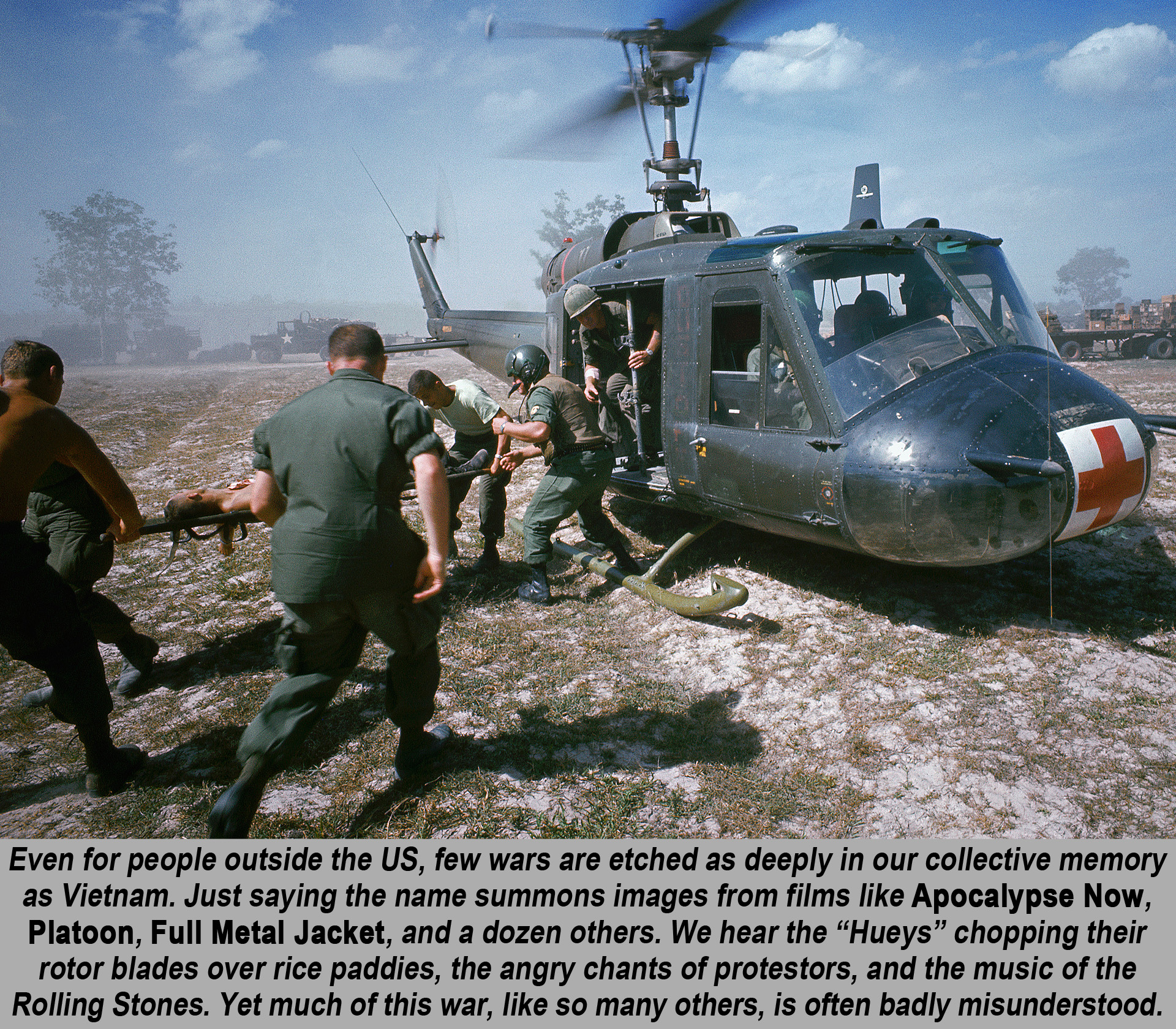
To commemorate this milestone, this five-part article series will present an overview of wargaming the Vietnam War, while also taking a sharper focus specifically on the Tet Offensive. We’ll sketch in plenty of background, look at both sides’ objectives, plans, and tactics, and chart the course of this earthquake moment in modern warfare.
We’ll be discussing several wargaming systems during the course of this series, switching between them as best fits the particular engagement being examined. These will include “Tour of Duty” for Flames of War, Force-on-Force, and an updated Vietnam “re-skin” of Barry S. Doyle’s Valor & Victory (originally for WWII squad combat).

We hope to present some interesting background on Vietnam, a balanced look the Tet Offensive and some of its more important battles, and examine what made it such a watershed in late 20th Century warfare. Finally, we hope to show some “features” of Vietnam wargaming, and what makes it distinct from other conflicts.
A War Nobody Wanted
Summary Background
The Vietnam War has become a watchword for the misapplication (and sometimes abuse) of modern military power, and what happens when the strongest nation on Earth so grievously underestimates the opposition. Cold War politics aside, all the firepower in the world might not prevail against unyielding national will.
But how did this war start? How did the Americans even get here, never mind lose? Most immediately, how do these factors manifest as object lessons, not only in the realms of modern military tactics, doctrine, and geopolitics...but also on the wargaming table?

Vietnam had been a nation at war for a long time. Formerly part of the French colony of Indochina, Vietnam had been occupied by the Japanese during World War II. The American OSS (Office of Strategic Services) helped a resistance movement fight against the Japanese, the Viet Minh, under its charismatic leader, Ho Chi Minh.
After the war, the French wanted their colonies returned. The Americans didn’t universally support such “re-colonization” but needed French support for the founding of the UN and NATO. So the French returned to Vietnam, and war immediately broke out between their colonial forces and the Viet Minh.
This conflict came to a head in 1954 at the Battle of Dien Bien Phu. Here, a garrison of French (and allied) troops, heavily fortified deep in the backcountry of northern Vietnam, was surrounded by a large army of the Viet Minh. French commanders were confident that superior training, artillery, and air support would win the day.
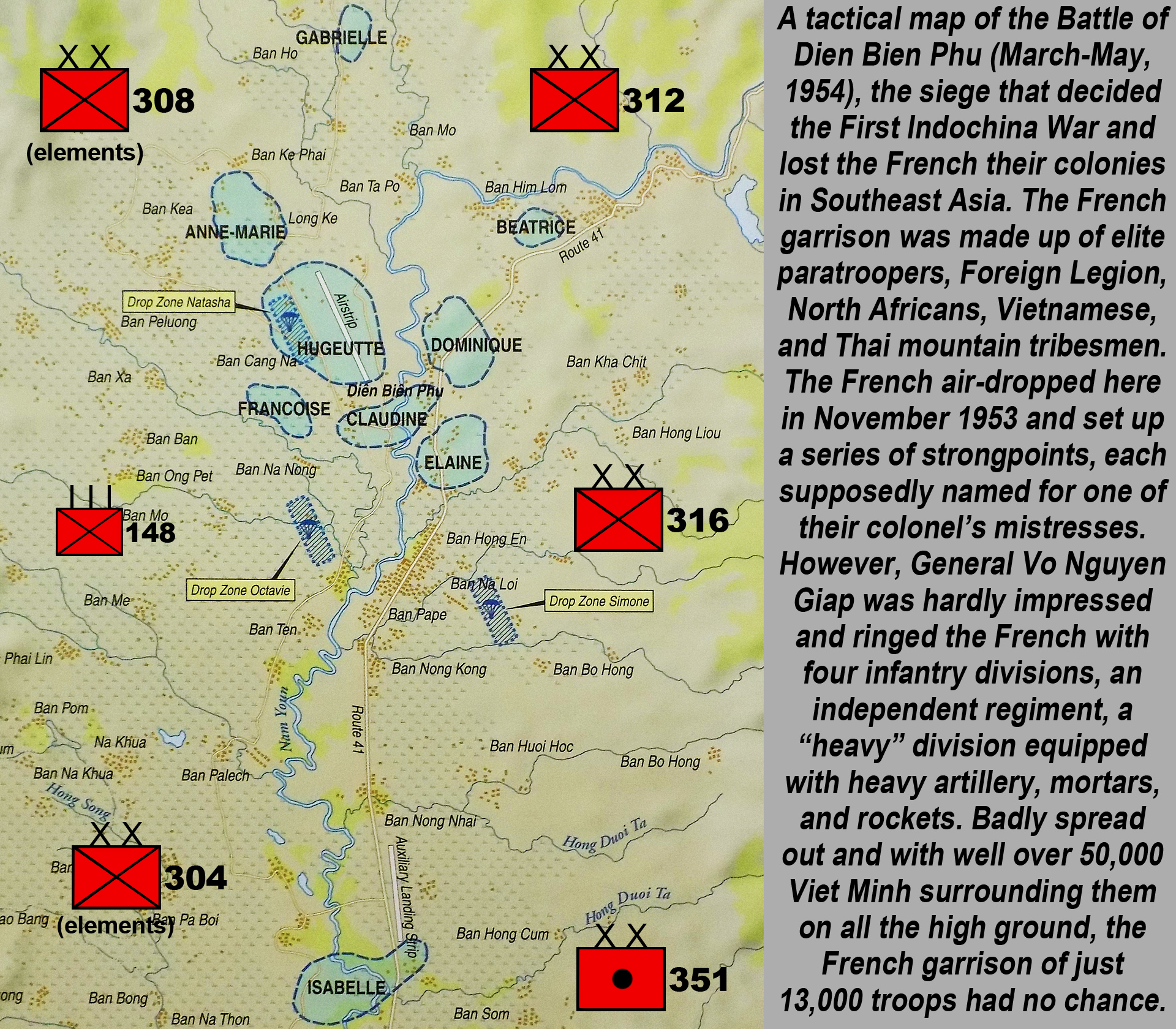
The French, however, had badly underestimated Vietnamese determination, numbers, and ability to deploy huge amounts of their own artillery (288 guns, not including rockets and mortars). The Vietnamese commander, General Vo Nguyen Giap, was also exceptional and would cause the Americans years of grief in the decades to come.
The French stood no chance. Cut off, surrounded by massive Vietnamese artillery batteries on high ground, and subjected to human wave attacks, they pleaded with the US for help. But President Eisenhower turned down “Operation Vulture” which at one point even included the possible use of nuclear weapons to extract the French.
Although they’d won the war against the French, the Communists in Vietnam were bitterly disappointed by the peace talks which only gave them the northern half of the country. The southern half would remain a western-style democracy with its capital in Saigon, bolstered by grants and military support from the United States.
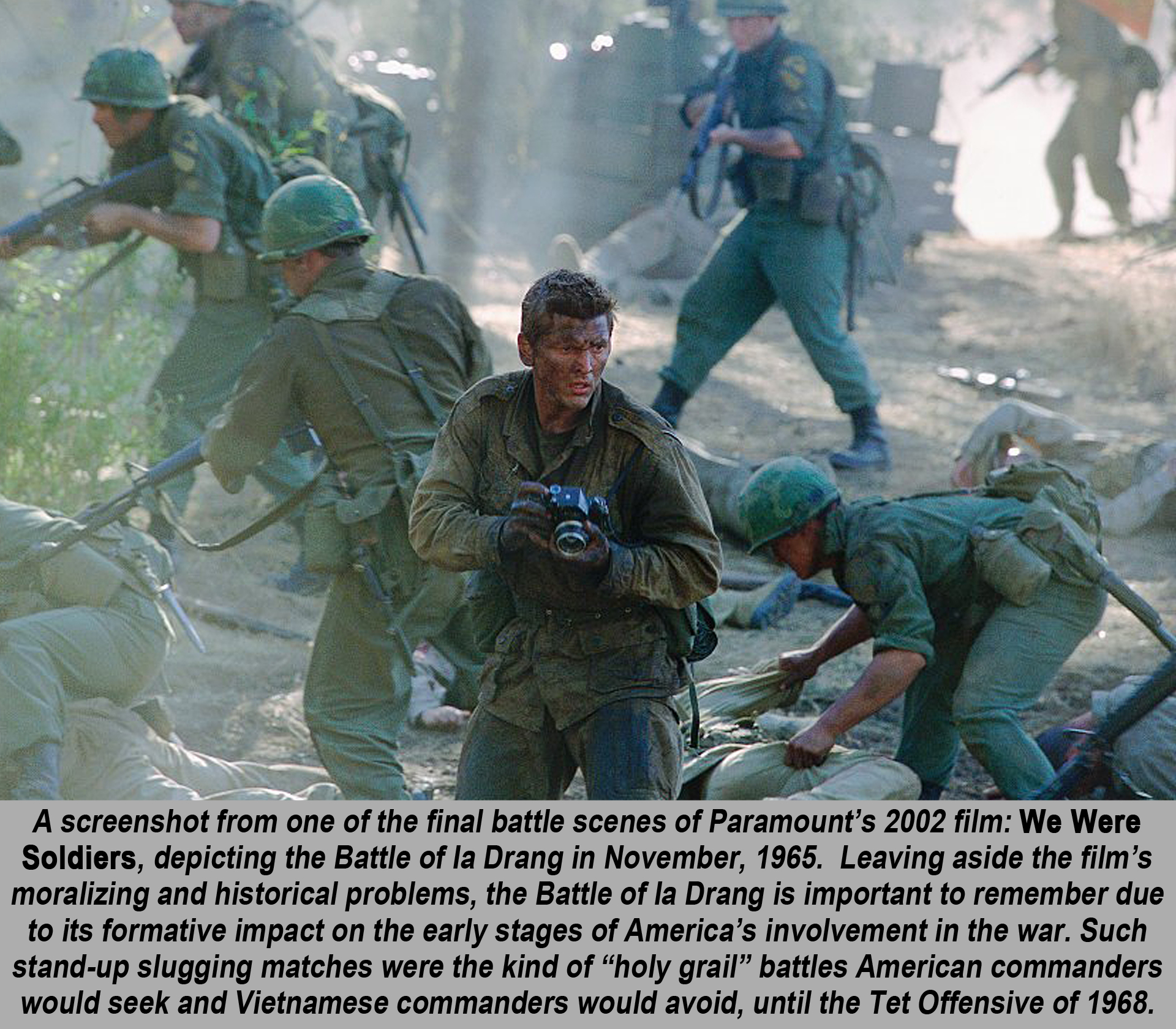
Soon enough, the old war had bled into a new one, this time against the Saigon government and its American supporters. At first, very few Americans were deployed in South Vietnam, but under President Kennedy and then Lyndon Johnson, more and more US troops were sent as the South Vietnamese government and army faltered.

After a controversial incident where North Vietnamese gunboats supposedly fired on US destroyers in the Tonkin Gulf, America was more or less committed to a growing anti-insurgent war in South Vietnam. Their mission was to defend and support their allies in Saigon, at least until the South Vietnamese could fight on their own.
Factions
As with most wars, the factions involved are a little more complex than “good guys” vs. the “bad guys.”
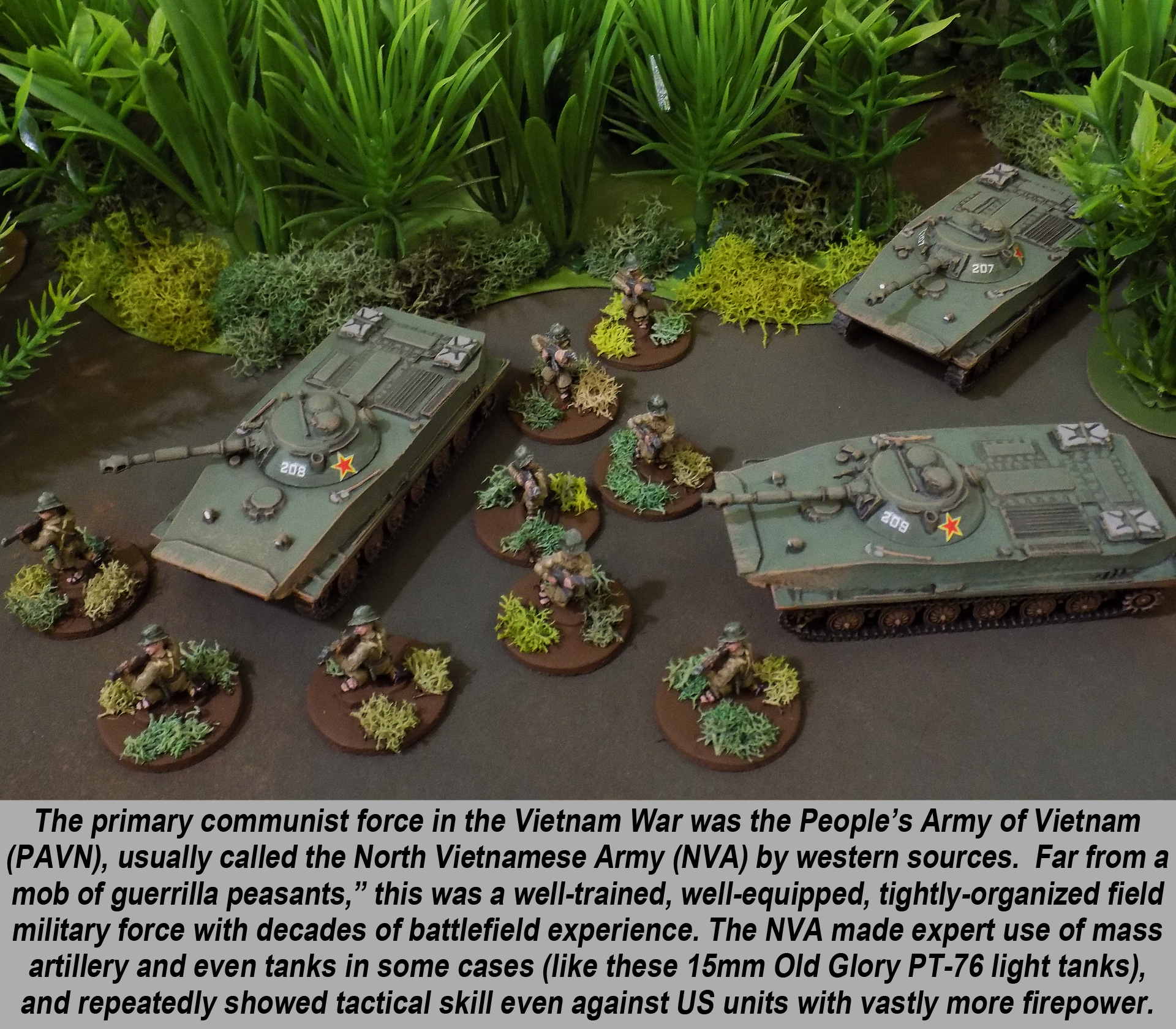
On the communist side, we have the formal army of North Vietnam, officially titled the People’s Army of Vietnam (PAVN), often called the North Vietnamese Army (NVA). Their overall objective in the war was to bring about the unification of North and South Vietnam into a single nation controlled by their communist government in Hanoi.
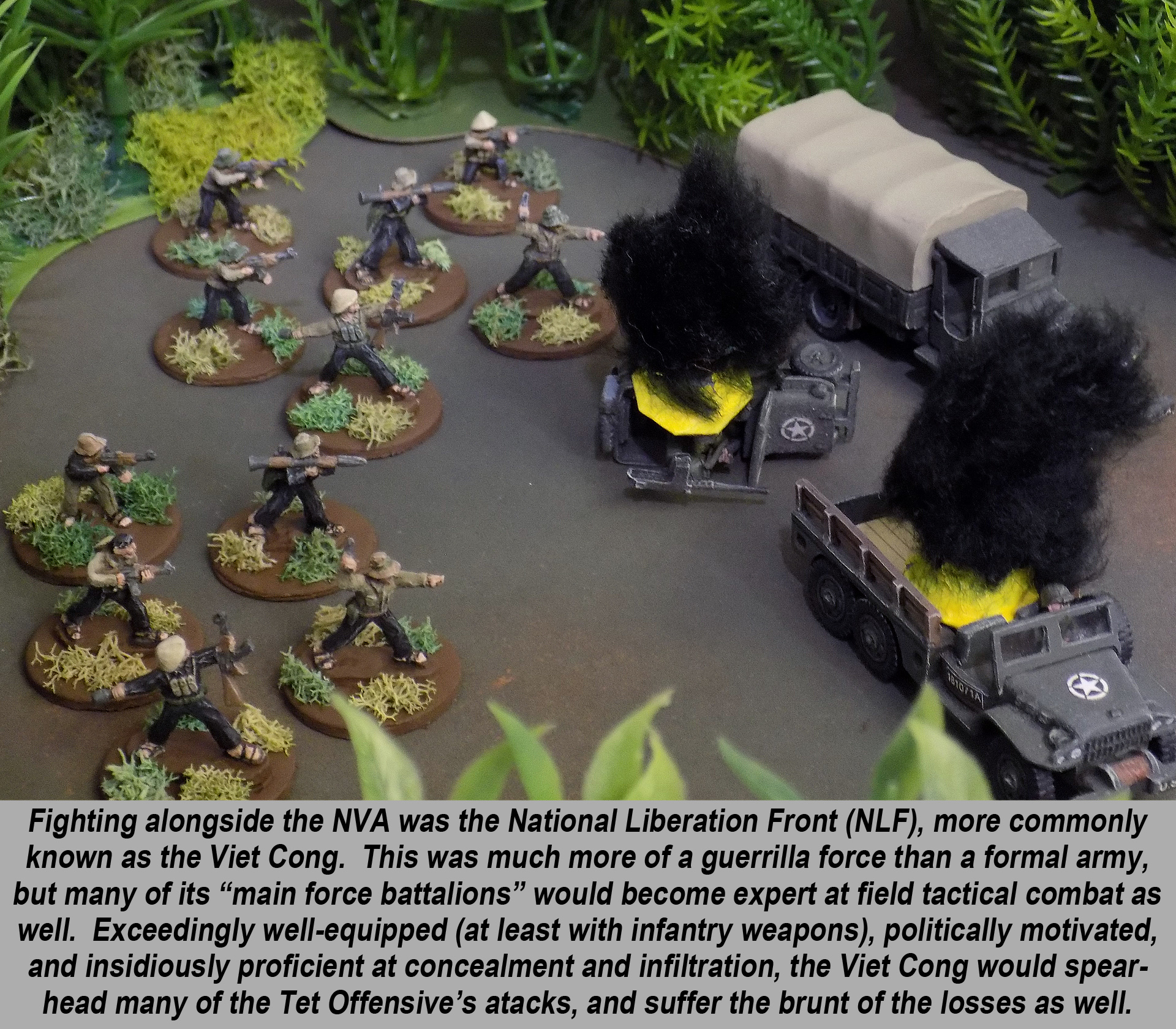
We also have the National Liberation Front (NLF). Often called the “Viet Cong,” this was a less formal communist insurgency in South Vietnam. These were not North Vietnamese, but South Vietnamese communist sympathizers or just people rebelling against the corrupt and ineffectual South Vietnamese government in Saigon.
This difference is an important one, for although the NVA and Viet Cong were obviously fighting on the same side, they had vastly different tactics, organization, and equipment – all of which will greatly affect any Vietnam tabletop army. They also greatly mistrusted one another, a factor fully evidenced in the bloodbath of the Tet Offensive.
For the “Free World,” we have the United States (Army and Marine Corps troops, Navy warships and carrier-based aircraft, and Air Force fighter-bombers and B-52s). Despite huge advantages in resources and firepower, US forces were hampered by policy limitations, discipline and morale problems, and even widespread drug abuse.
Also in the field is the Army of the Republic of Vietnam (ARVN), basically the South Vietnamese army fighting for the Saigon government. Although widely reviled as incompetent, cowardly, and prone to desertion and even atrocities, some units in the ARVN performed much better, including during the Tet Offensive.
Nations like South Korea and Australia also had smaller units fighting in South Vietnam. These were further supported by contingents from Thailand, New Zealand, Taiwan, and the Philippines - American allies with a keen interest in curtailing the spread of communism in the Asia-Pacific region.
The Tet Offensive
A Bid To End The War?
The Tet Offensive was an all-out effort by both the NVA and the Viet Cong, aimed at nothing less than the complete destruction of the South Vietnamese army and the collapse of the Saigon government. Sudden, overpowering, and widespread, its successful execution was expected to end the war at a stroke with a communist victory.
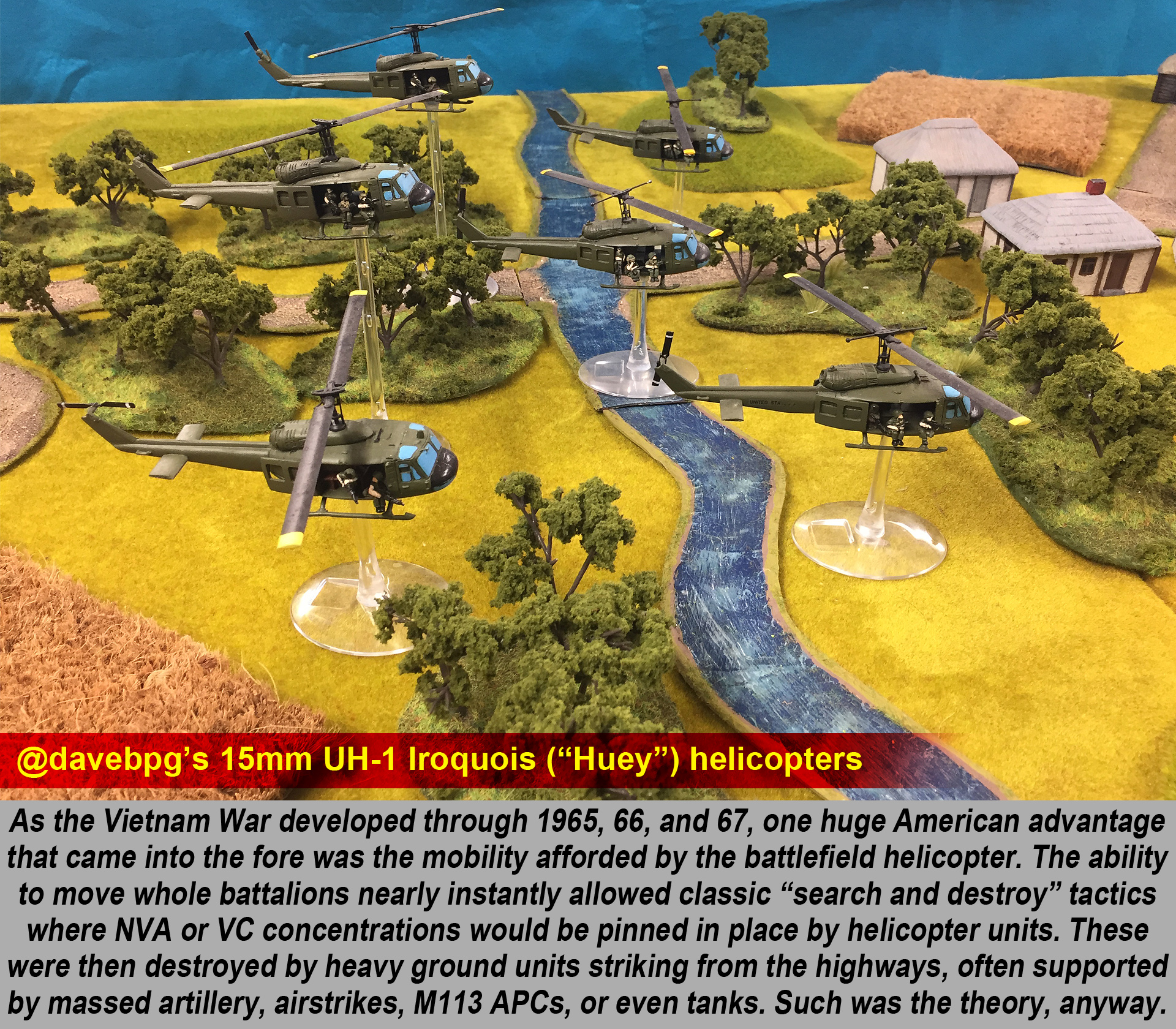
Scheduled for January 1968, the Tet Offensive is so-named because it was timed for the Tet holiday, the Vietnamese New Year which had in previous years seen an informal cease-fire observed by all sides. Massive numbers of ARVN troops went home on leave, and even US forces relaxed their alert postures as the war took something of a break.
Tet in 1968 would be tragically different. Instead, Vo Nyguen Giap, the general who had defeated the French at Dien Bien Phu, had coordinated a massive series of strikes by both his NVA “main force” regiments and divisions and Viet Cong guerrillas further south.
The communists would hit everything at once – military bases, highways, infrastructure, government centres, logistics, communication, all at the same time and with lightning bolt surprise. Lulled by the holiday ceasefire, American and especially South Vietnamese forces would be overrun without a chance for effective resistance.
The idea was to ignite a panic across all of South Vietnam, implode ARVN’s morale and cohesion, and start a massive popular uprising against the hated and corrupt Saigon government. Once in power, the new pro-communist government in Saigon would demand the United States leave South Vietnam. The war would effectively be over.
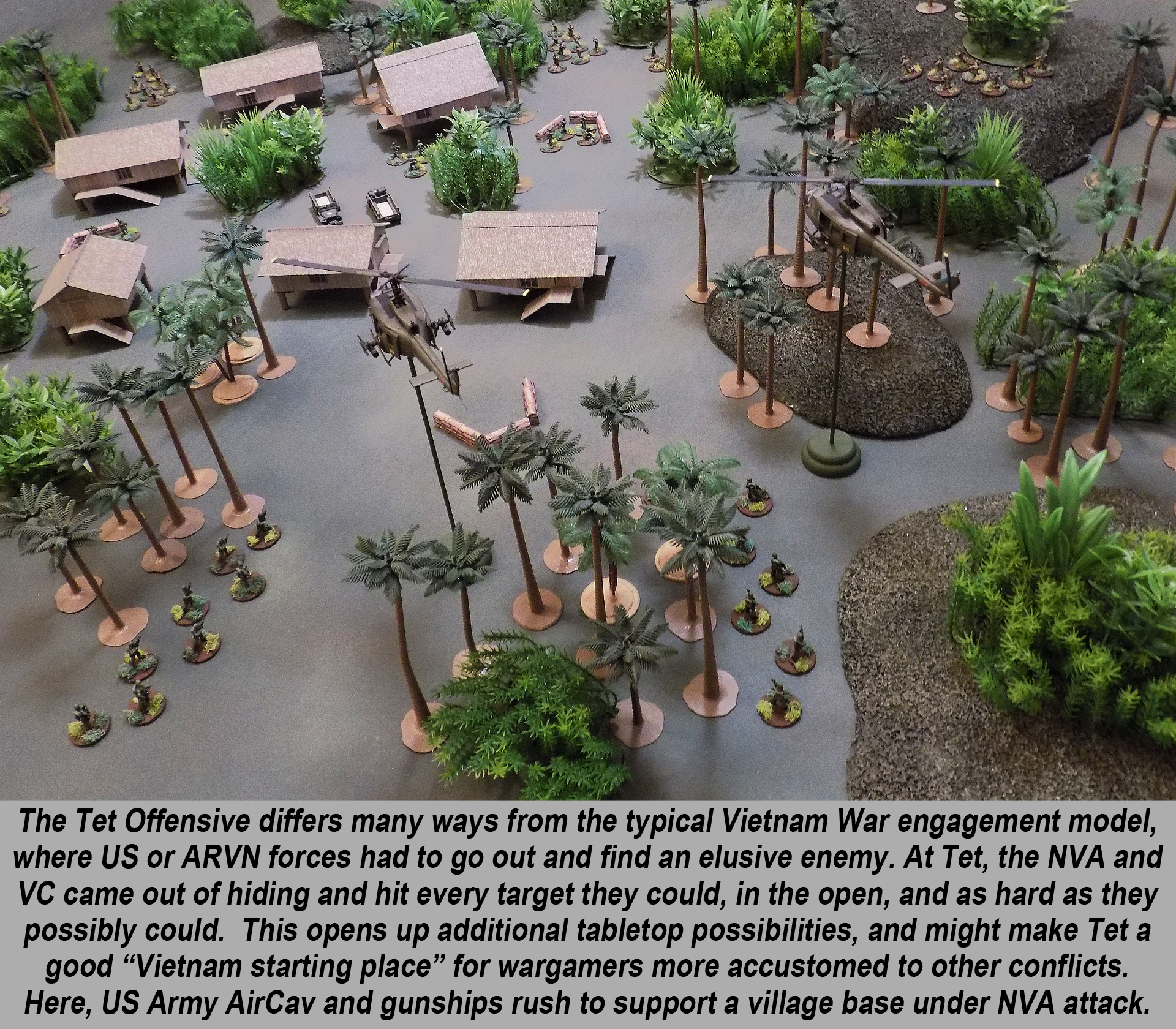
Although probably the largest single battle in the Vietnam War, the Tet Offensive is also the least typical in many ways. Usually, American and ARVN forces had to probe out into the countryside on “search and destroy” missions, hunting for an elusive enemy who denied pitched battle in favour or booby traps, snipers, and ambushes.
Not here. The Tet Offensive was one of the few times the NVA and especially the Viet Cong massed together and assaulted US and ARVN forces in full, frontal combat. We can almost look at it as “Vietnam in reverse,” often fought in burning city streets instead of jungles and rice paddies.
In some ways, this was exactly the kind of combat American commanders had been hoping for. But the shock of so many attacks, combined with widespread failures of many ARVN units, made this one of the bloodiest and most desperately-fought periods of the Vietnam War. American units were badly caught off-guard and paid accordingly.
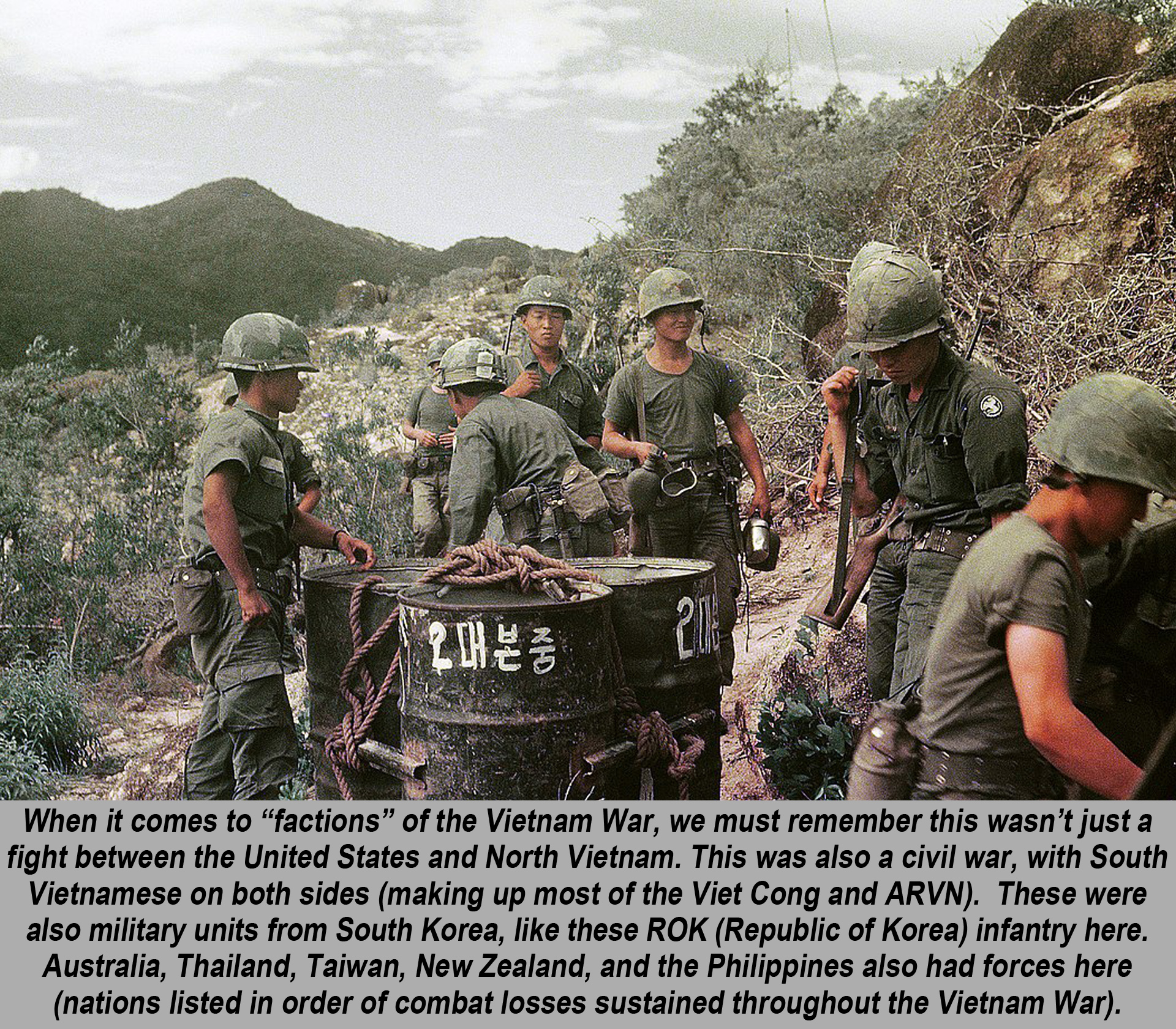
In the end, the Tet Offensive would also show just how far the Americans were from “winning” this war, despite assurances the government had repeatedly made to the American public. Tet probably puts the final coffin nail in the Johnson Presidency, and fatally wounded American public support for the Vietnam War.
In a word, if you’re looking for a specific moment when the Vietnam War was actually lost, the Tet Offensive is a good place to start.
We hope you’ve found this first look into the Vietnam War and the Tet Offensive informative, maybe even inspiring. After all, there are multiple game systems out there that cover the Vietnam War, this could be your excuse to fire up some Jimi Hendrix, Stones, or Doors (8-tracks only, for historical realism) and “hit the bush” yourself.

Next week, we’ll look at the plans for the Tet Offensive in more detail, as well as wargames depicting some of the opening communist attacks. We’ll have street battles, assaults on American firebases, jungle firefights, village assaults, the full gambit of the Tet Offensive engagements. So stay tuned!
Meanwhile, have you played any Vietnam-themed wargaming yourself? How about “Tour of Duty” by Battlefront, “Charlie Don’t Surf” by Too Fat Lardies, “Force on Force” by Ambush Alley Games / Osprey (which started with their “Ambush Alley” Vietnam core rules)?
Post your comments, questions, and insights, and let's keep the conversation going!
"We’ll be discussing several wargaming systems during the course of this series, switching between them as best fits the particular engagement being examined..."
Supported by (Turn Off)

Supported by (Turn Off)
"...as with most wars, the factions involved are a little more complex than “good guys” vs. the “bad guys”"
Supported by (Turn Off)



https://carportgaming.blogspot.com.au/2017/03/letters-from-vietnam.html
https://carportgaming.blogspot.com.au/
Wow, thanks very much for the links, @c0cky30 ! I’ll definitely give this a read and once I get a little familiar with it, perhaps a try. Force on Force is probably by favorite post 1945 wargame, but seems to be written for slightly smaller battles than I really like. This might be the perfect fit. 😀 Thanks again!
No worries at all. Let me know if you have any further suggestions for the supplement or need anything further explained with the rules. Always willing to help. Just happy to see some NAM wargaming. Keep up the good work.
In this series, we’re using Force-on-Force (sometimes a streamlined version of the rules for faster play when the battles get larger) – and a re-skin of Barry S. Doyle’s Valor & Victory (updating from WW2 to Vietnam). @davebpg is helping us out with some Flames of War. When we start the support thread I hope to get some people on the forum with Charlie Don’t Surf, and who knows, maybe some of this Chain of Command DMZ.
Vietnam is a tough conflict to get “right” – between factors like casualty management, asymmetrical firepower levels, mobility differences, off-board assets (that’s BOTH sides, the NVA artillery was often better than ours or at least longer ranged, they had plenty of it and were very good at using it). Combined with civilians, irregular vs. regular tactics and rules of engagement, it can be tough from a game design perspective.
I’ve played Ambush Valley that was the Vietnam supplement for Force-on-Force…
Well kinda had too, as I wrote it.
Force-on-Force is probably my favorite post-1945 wargame. The troop quality mechanic at its base is very straight-forward, intuitive, and yet delivers such realistic results. Such differences in training and tactics of the MEN are so much more important in modern or modern-ish conflicts, rather than minutia on 5.56mm or 7.62mm or other technical details in equipment (where pretty much everyone’s carrying an assault rifle of one kind or another).
great article, again thanks guys!
Excited for the rest of the series, these series are not only a well of ideas for scenarios and campaigns but also very informative and I always discover things I wasn’t aware of before.
Thanks very much, @donlou ! We try to communicate, entertain, and if we’re really lucky / successful, maybe educate just a little. 😀 Of course, I often learn a lot from the comments, and I’ve definitely learned tons about wargaming from the community as well.
Sadly, the US never really seemed to learn anything, preferring to inventing their own version of the Dolchstoßlegende rather than taking the lesson of Vietnam to heart.
Politics aside, I must admit that I just don’t find Vietnam that interesting as a tabletop game. Search and destroy versus guerilla ambushes doesn’t lend itself well to gaming. In my opinion, anyway…
In any case, I’ll be looking forward to seeing what you can come up with.
@warworksdk – I would agree … partially … with what you suggest re: comparisons to the Dolchstoßlegende.
If I understand correctly. Dolchstoßlegende is the self-promulgated myth where the German Army didn’t really lose in World War I, but was betrayed by the people at home.
In a strict military sense, I don’t think the comparison holds up. The German Army in 1918 really was losing, they just hand’t completely collapsed yet. That cannot be said for the US military in South Vietnam, the numbers just don’t support that conception.
In a broader sense that includes the media, social movements in the US, etc, I can see where the comparison holds more water. SOME of the generals (not all) maintained for years afterward that “we could have won” – especially right after Tet – had the politicians and the public been behind them.
Of course, that involves quadrupling the scope of the ground war, moving it from just South Vietnam to a full-scale invasion of North Vietnam, Cambodia, and Laos in order to interdict VC / NVA base areas. The military hawks would argue that the war has already BEEN expanded by the communists to these areas, fighting the war with one hand tied behind their backs is why the American military couldn’t get the job done.
But if 480,000 men could barely handle the mission in South Vietnam, how many would you need in South Vietnam, North Vietnam, Cambodia, and Laos? Two million?
I realize I’m arguing both sides of the question here. 🙂 Any good historian has to be objective, after all.
The basic lesson is that once a group of people make up their minds how to live in their own country, no amount of money, firepower, propaganda, or empire is going to change their mind. The Americans learned this in Vietnam, the Soviets learned it in Afghanistan, the French learned it in Algeria (and Vietnam as well, so long we’re on the topic), and yes, the British learned it in the American colonies in the 1770s/80s.
What grinds my gears a little (you certainly didn’t do this. just opening a new tangent on the discussion) is when people compare Vietnam to conflicts like the British in Palestine or the Americans in Iraq. Nothing could be further from the truth. In Vietnam we have a country where the majority of the people want a certain model of independence, artificially DIVIDED into a north and south (treaty ending the First Indochina War).
In Iraq we have a country that’s actually three major, mutually-antagonistic ethnic groups (Sunni, Shi’ia, and Kurds) that’s artificially GLUED TOGETHER by the map-doodlers of Versailles in 1919. 1948 Palestine is similar in that it’s “externally” glued together by the British. If we want to compare Iraq to anything, Yugoslavia in 1990-92 is probably a better model.
Also, in South Vietnam we were supporting a secular, right-wing dictatorship that was abusing the people. In Iraq, we knocked one down. The problems in Iraq came when the “artificial country” fell apart because it was never really a unified country. Our problems in Vietnam stemmed from trying to keep separate two halves of a country that desperately wanted to come together.
>>>>>>>>>>>>>>>
Question Two: Vietnam “isn’t interesting” on the tabletop:
I’ll admit that the search-and destroy vs. ambush model can be very tough to do on the tabletop, and even when done correctly, might not be everyone’s cup of tea. This is part of the reason we’re doing the Tet Offensive, because it is absolutely NOT that. Here, the NLF and PAVN are coming OUT of hiding and attacking the Free World forces in large, open, nearly conventional battles. It’s the most “un-Vietnam” part of the Vietnam War. For this reason, I suggest with this series that the Tet Offensive might be a great starting point for people who are interested in exploring Vietnam, as some parts of it might be passably familiar to gamers accustomed to more conventional wars.
Your answer to question two makes me excited to see how you could take more asymmetric games like S&D/ambush (I’m guessing they would be asymmetric?) and use them to influence the main point of a Vietnam campaign.
Like having smaller battles to influence points or strategies for a larger battle.
I have a question though, wouldn’t a game based on Tet start off unbalanced anyway? As the US would start unprepared? Or am I getting this all very wrong? 😛
(ps: basing all this on what I just read as my only exposure to Vietnam is Full Metal Jacket)
Good questions, @redyeti . 😀
Question one: Asymmetrical search and destroy
For search and destroy games, we’ve found that enforcing casualty management on the American forces is pretty serious. The VC / NVA typically get 3 victory points for each US casualty, assuming he is SECURED and DUSTED OFF. This means medics, which take up space in the order or battle in the helicopters, don’t fight, and are vulnerable themselves to communist fire.
Americans are also making checks each time a unit moves for booby traps.
Americans can also not fire in anyway at civilians, including area effect weapons whose AOE might splash onto civilians. In our Force on Force games we’ve actually made up civilian counters and rules for their random movement (almost like the zombies in Walking Dead). As an NVA player a few times, I can tell you personally it really annoyed my opponent when a Vietnamese family just wouldn’t abandon the hooch in which I also had a DShK 12.7mm MG shooting up his helicopters.
However, the US has a MASSIVE advantage in firepower, numbers, and battlefield support in the form of helicopter gunships, air strikes, or best of all, off-board artillery.
Also, the US gets a 3-point victory bonus every time there is a successful close assault on a communist position, winning a “prisoner of war” token – assuming they also use a fireteam to evacuate the prisoners to the rear as well.
Lastly, we’re experimenting with hidden movement for VC / NVA units, using a mix of “real” units and dummy counters.
>>>>>>>>>>>>>>>>>>>
Question Two: How to make its results count in a larger campaign context:
Wow. THERE it is. This question is huge. Very huge. These countless small battles that the US kept “winning” – what did any of it actually mean? How does that build into victory or defeat on the larger scale.
When we come up with an answer, we need to call General Westmoreland, I’m sure he spent the rest of his life wondering. 🙁
“Like having smaller battles to influence points or strategies for a larger battle.” – the sad truth of Vietnam is that they didn’t. The US would take a hill or valley or village, try to pacify it, win some hearts and minds, maybe even install an ARVN garrison force, and it would all fall apart as soon as they left and the VC / NVA returned.
I wish I had a better answer. I mean you could always come up with some kind of tournament point system, but it’s exactly that kind of erroneous thinking that caused the US to lose the war in real life. “Let’s kill the communists, let’s bolster ARVN, let’s bomb the North, let’s rack up the tragically irrelevant ‘body count’ measurement.”
The fact that there really wasn’t a viable measurement of large-scale victory, or how these small but costly victories built into that, is one of the biggest problems the Americans faced and ultimately failed to resolve.
So sorry I don’t have a good answer on that one. Neither did Westmoreland. Or the Joint Chiefs. Or President Johnson.
In World War II, American families hated seeing their sons die in some far-off land. But at least they knew there was a goal. They could see Berlin, point to it on a map, and watch their armies inch closer toward it every day. As bad as it was, everyone knew it wasn’t going to last forever.
In Vietnam, the fact that these constant skirmishes, ambushes, booby traps, and sniping attacks kept killing and maiming Americans, and the government could never answer what is in effect YOUR question 🙂 is a big part of what caused the American public to loose faith in the war, the president, and the government in general.
For a campaign, I don’t think you can avoid looking at US politic.
Sorry… Once again those politicians are interfering…
For the US – especially in the later part of the war – it’s all about managing casualties. The more casualties, the more demoralized them men get, the more fragging we see, and the louder the protests at home become.
For the Americans then, the campaign is all about fulfilling their objectives before they’ve suffered so many casualties that the politicians have no choice but to seek an end to the war and get the boys home.
But what are those objectives then? In the main they went for simple body count. Kill enough Viet Cong and victory is assured. Didn’t really work out like that,of course…
For a slightly more limited campaign though, I think we can come up with some slightly more concrete objectives. For example:
Cut the supply trail.
Find the underground HQ.
Establish and hold a firebase for x turns.
The Viet Cong I’m not so sure of. In theory, all they need to do is to ambush US patrols every now and again and otherwise just let the Americans dig their own grave. For example:
Keep the HQ hidden.
Ambush and destroy a supply convoy.
Ambush and destroy a patrol.
In essence, the US is trying to establish footholds and kill as many Viet Cong as they can find. The Viet Cong, on the other hand, is trying to remain mobile and hidden, springing the occasional ambush.
Of course, during Tet, with the NVA thrown into the mix, the objectives become far better defined in military terms.
@oriskany – you write:
For a campaign, I don’t think you can avoid looking at US politics. Sorry… Once again those politicians are interfering…
Please don’t apologize, half the point of Part 05 of the series is how, in the age of televised media, symbolism and politics are a very real, tangible objective on the battlefield, and thus on the table top.
In our Vietnam Valor & Victory game (we’re calling it “V3” for short) – I think we hit very close to what you’re saying about victory conditions and casualties. American units have to take given objectives (based on the scenario), but casualties give so many points to the NVA / VC that the American player has to be VERRRRY careful not to take too many casualties (actually, VERY few). And God save you if any of these casualties are not secured or dusted off to the rear or the LZ for evacuation, i.e., if any NVA / VC unit is allowed to move into a hex with an American casualty counter in it. Then the already exorbitant victory point cost … is doubled.
So yeah, you might take that objective for 10 points, but if you take four casualties (3 points a piece), you’ve still lost the game 10-12.
In essence, the US is trying to establish footholds and kill as many Viet Cong as they can find. The Viet Cong, on the other hand, is trying to remain mobile and hidden, springing the occasional ambush.
That’s a good summary. So long as they Viet Cong manages to continue to exist and pose a threat, the US HAS to go out after them, which means more time (US expenditure eventually hit $2B a MONTH), more casualties, more Senate hearings, more protests, more Democrats lining up against LBJ …
Of course, during Tet, with the NVA thrown into the mix, the objectives become far better defined in military terms.
I was just going to say, up north near the DMZ, with more of a “field army” approach, the games start to become a little more conventional, but still very asymmetric in balance and design.
It wasn’t so much needing more troops. It was getting the US government to fight the ‘real’ war. Laos and Cambodia were the keys to winning the war, but no one would accept an outright invasion of these two ‘neutral’ states. It all came down to shutting down the Ho Chi Minh Trail and that required expanding the war into those nations… who were basically occupied by the Communists and were being used for the war.
Check out this Quora:
https://www.quora.com/Why-did-the-United-States-lose-the-Vietnam-War/answer/Randall-Case-2
Later in the war the US and ARVN did attack the trails to varying effects. It certainly brought the VC/NVA out to fight and the US invasion in ’70 wrecked the NVA’s preparations for some years- to 1972 anyway.
If the allies could have summoned the will to go after the trail the war might have had a very different outcome, maybe.
They did try to cut the trail, yes. And boy oh boy did the brown stuff hit the fan when people found out…
Had the US officially invaded two neutral countries they would likely have lost what little support they still had for the war. Remember, they weren’t even supposed to be at war… Advisors, they called it… Yeah… Right…
Add to that the logistical nightmare of having to fight a guerilla war in three countries where the general population were generally against them.
There was no way that was going to happen. And the NVA knew that…
In a sense then, I suppose there’s actually some truth to the idea that the war was lost by the politicians. North Vietnam did some pretty slick political and military work during the conflict, eventually getting America into an impossible situation.
@tgunner91 – sorry for the late reply, I only saw this post now (been following Parts 02 and 03).
The question of “cutting the Ho Chi Minh” trail is a complex one. What it would have taken, what it would have cost, and benefits it would have yielded are all highly abstract variables.
Later in the war (1969+) . . . I feel this would have been more effective than earlier in the war. Earlier in the war PAVN/NVA formations are often supported by local NLF / VC battalions already nested in South Vietnam, often supplied by corrupt elements elements in the Saigon government. So is the Trail really that big of a factor.
Later in the war, after Tet, when the PAVN / NVA has assumed a more undisputed leadership role on the communist side, I think the Trail took on a greater importance.
But “cutting the trail” is still like trying to dam a river, as it’s a network of routes, and bombing one just means traffic shifts to the others, and by the time anyone can bomb / cut those others, the first one has been repaired. 🙁
And of course we all saw the reaction when Nixon eventually did invade Cambodia to try and go after VC / NVA base areas.
And yes, Operation Lam Son 719 is an interesting read. Pity it was such a disaster.
We’ve been disagreeing on a lot lately, @warworksdk – but when you say: “They did try to cut the trail, yes” – I definitely have to agree there for sure. 😀 Looking at the numbers (two million tons of ordnance delivered via 580,000 bombing missions – so roughly the equivalent of 100 Hiroshimas over nine years) dropped on Laos – still the heaviest bombed country on Earth to my knowledge . . .
Yes, I think we can safely say the US did try to cut the Ho Chi Minh Trail. 😀
Awesome article I can’t wait to read the rest.
Here in Australia we’re still trying to sort out Vietnam with some Veterans that served with 2nd D and E Platoon having to fight almost half a century to get the Government to admit they even existed. Vietnam was also our only war involving Conscription.
Where did you get that amazing terrain in the last picture?
I’ve played some Flames of War Vietnam but it’s never really stood out to me as a period I’d be interested to wargame. Although that was a while ago and maybe this series will give me that shove into Vietnam.
I know Jim is a big fan of papercraft terrain for getting impressive set ups on the table quickly and cheaply. It looks like that is another fine example of the card folders art 🙂
Thanks, @elessar . It always grinds my gears a little when I hear veterans’ troubles after Vietnam. Hardly the most original sentiment, I know, but as a small-time veteran myself, that just really gets to me no matter what country the soldiers served.
Vietnam was also the only time to my knowledge the US Marine Corps had to accept conscripted draftees.
Please rest assured we address the contributions of the 1st Australian Task Force (included units of New Zealand troops as well) in Part 04. In the “Vietnam-Edition” re-skin @aras and I have hammered out for Valor & Victory, I built a reinforced company of Australian infantry (7th Bn, Royal Australian Regiment) and put it in the field against elements of 275th Rgt / 5th NLF Division at Trang Bom, Dong Nai Province.
HONESTLY, I’m not sure if FoW Vietnam is really the best model for some Vietnam battles. Don’t get me wrong, for the Tet Offensive, FoW is perfect, because of the larger-scale, almost conventional-style nature of the engagements. But for the classic Vietnam-style “Battles in the Bush” – more skirmish-model games like Force on Force might be a better fit. 😀
Thanks, @avernos . Yes, @elessar2590 – everything on that table is scratch-built, except the palm trees.
I do use some Dave Graffam models for WW2 buildings, etc (I wouldn’t really call that “scrach-building”), but there isn’t really that much for modern-looking buildings. So I find skins, textures, or just straight-on images of buildings in Google Images, download, format in Photoshop, and make “wallpaper” for simple cardboard boxes. Windowsills and shutters are pasted on to give just a touch of 3-d effect. Even then, the buildings look pretty simple, but then you make a bunch of different sizes in such a way where you can stack them together to make single buildings of more distinctive shapes. A few add-ons (“attic” window pieces and the little round wooden buttons make great HVAC vents on the roof, etc.), and before you know it you have passable buildings.
If you’re really careful, you can build these buildings where they fit into each other like faberge eggs for easier storage. 😀
The chain link fences are also scratch-built, wooden dowels and frying pan splatter-screens from the kitchen cut nicely into 15mm chain link fence. 😀
The telephone poles are again just wooden dowels, super-glued onto penny bases, with a little cat litter glued on top of the penny.
The roads are gray-primed strips of posterboard, with strips of yellow paper glue-sticked onto them for the traffic lines.
Basically, like Gerry says, I just build it all myself (except the palm trees).
I always like lots of signage for my urban tables. It’s a great way to turn buildings built for Ukraine in 2014 into Vietnam for 1968 (or France in 1944, or whatever). This is particularly great for settings where the alphabet is different (like areas of the former Soviet Union or the Middle East). Just a few signs and PRESTO, your French village is now a Soviet village or Syrian town or Egyptian road junction, etc.
Just putting this out there up front, some of the pictures I supplied Jim were taken by / with a friend Richard Covil (who’s forum name I don’t know) who deserves credit for the first “in game” picture on this article.
My bad, sorry guys.
Looking forward to another excellent series. Nam is a challenging setting to play against due to the nature of the warfare but get it right and it can be a very exciting and emotional roller coaster of a game. In short it rewards the investment of time and effort.
Looking forward to more stuff soon 🙂
Thanks very much, @davebpg – for the invaluable contribution to this article series. I won’t lie, at the outset of this series my Vietnam miniature collection was precisely zero. I spent all of December in a frantic buy/build/paint effort, but even now (150 infantry, five aircraft, and maybe 10 ground vehicles – plus terrain) I don’t come close to Dave’s collection. So his photos, plus his expertise in Flames of War: Vietnam, really make a crucial contribution to the big-scale battles of the Tet Offensive. 😀
Great start, can’t wait for the rest of the series. Have read quite a bit on Vietnam, looking forward to seeing your treatment of the subject.
Thanks very much, @gremlin – I look forward to hearing about what you’ve read, and how the series holds up historically. 😀
We’re focused, of course, on the Tet Offensive (granted, there was a lot of background in this first part). But we’ll be a little more zeroed in from here on out. And of course, with so many individual engagements in the Tet Offensive, we can only feature a sample. We tried to spread it out, with some in Saigon, outside of Saigon (Long Binh and Bien Hoa), then up north for the DMZ (Khe Sanh, Lang Vei, and Hue City), and include counterattack battles like Hue City and the 1st ATF in Phuoc Tuy and Dong Nai provinces).
Hope you like the rest of the series!
While the conflict has always excited me from a visual point of view I’ve never played a table top game in Vietnam,
Often when watching movies like We Were Soldiers, I get the urge to do something but to date I’ve not gotten beyond the, “wouldn’t it be interesting to..” stage.
It looks like this will be another great article series and I’ll be watching out for the rest of them over the coming weeks, maybe I’ll go in country yet.
Superb work as always @oriskany
@avernos Weren’t you at the big one me and Jerry ran at Dragonslayers?. I thought you had been
sadly not, been to a few of the big games but I missed out on that one.
Thanks very much, @avernos ! Perhaps some kind of weird space-time portal may warp some of your Saga warriors into the Central Highlands! The heat may be a touch much for them but I’d bet they’d scare the hell out of some Viet Cong! 😀 😀 😀
the nekkid ones certainly would 😉
As Wellington (Justin) once said “I don’t know what they’re do to the enemy but the winkies terrify me!”
pretty sure that’s correct ^^
Good ole’ Justin. I didn’t have the heart to tell @thisisazreal – but one of those Vietnamese signs actually reads:
G.I. JUSTIN – NUMBER ONE GOOD TIME!
YOU GOT GIRLFRIEND VIETNAM?
Just kidding, of course. 😀 😀
For Vietnam games. Plastic aquarium plants are your friend
So very true, @torros . “Greenery Mats” at the craft store are even better (unless this is what you’re talking about) – you can get a 12″x 12″ slice of this for a couple bucks and even cut it into shaped sections. Or, you can pluck out individual “stalks” and use them to accent other mats.
http://www.michaels.com/10275721.html
I talked to some military chaps some years back who told me the British had ‘advisors’ in Vietnam.
true enough – remember looking into the British Advisory Mission to South Vietnam (BRIAM) when I was reading my degree. So called civilian operation made up primarily of veterans from Malaya – they trained hundreds of South Vietnamese in counter insurgency tactics as well as advising the government for the strategic hamlets programme. Also the possibility for some SAS involvement in the highlands but so far as I’m aware that’s still unproven, with a letter sent to the War Office from the British military attache in Saigon only suggesting how we could get involved. What isn’t conjecture is the involvement of MI6, in both Hong Kong and the Hanoi operating station which we had in place from the end of WW2…
I think the SAS part tis what these guys were referring to
Thanks, @bigdave and @torros –
Also the possibility for some SAS involvement in the highlands but so far as I’m aware that’s still unproven …
Trust me, I checked. Whenever you publish anything on BoW it’s a good idea to check for British involvement. 😀 I’m not saying it didn’t happen, from a purely statistical standpoint it’s tough to prove a negative, but I didn’t find any verifiable records.
Information on the the BRIAM is very interesting, though. 😀
God, the Strategic Hamlets Program, what a disaster that was.
Another great read @oriskany! A friend of mine has spent a number of years living in different parts of Asia and Australasia, when he was in Vietnam he spent a great deal of time in the north and was lucky enough to have visited Dien Bien Phu – meant to be an incredibly interesting place to visit, the whole area has barely changed with huge swathes of it preserved, the French positions of Beatrice, Isabelle and Elaine, the Muong Thanh Bridge and the De Castries’s Bunker. Nearby Muong Phang has example trench sections and you can even visit Giap’s staff quarters. Looking forward to part 2, and loving your buildings by the way!!
That sounds awesome, @bigdave – I’m always struck by exactly where Dien Bien Phu was, it really is in the middle of nowhere. Kind of makes me chuckle when historians talk about how “remote” Khe Sanh or Lang Vei were. Dien Bien Phu sounds like it would be an amazing place to visit.
I’m also kind of impressed with how the Vietnamese government has preserved so many of the battle sites. Sure, there’s pro-Vietnamese slant to the memorials, which makes perfect sense.
I’ve always been a little confused by the plaque commemorating the four MPs and one US Marine who died defending the US Embassy in Saigon (we get to that in Part 02). The Vietnamese put it up, apparently the US really wanted it taken down. I’ve seen photos of the plaque, I don’t understand the problem. It was finally removed when certain buildings were demolished, a new replacement plaque reportedly exists in the compound’s garden. I’m not sure whether this is the one the Americans wanted removed or not.
What a splendid start for the series!
I can even add a tiny bit:
General Giap was called the Vietnamese Napoleon, because he was so good as a commander.
Dolchstoßlegende means “Stab in the back Legend”. The Germans, in particular Ludendorff, claimed, they hadn´t lost the war in the field (“Unbeaten on the Battlefield”), but had a dagger (=Dolch) thrust in their back and lost the war on the home front. I think this doesn´t apply to the Vietnam war.
In WW I two further months of warfare would have the French, Brits and Americans stand on German soil and eventually, as the French would have preferred, in Berlin, and the German army finally beaten.
The Vietnam War, or as the Vietnames call it, the American War, is in my opinion a quite different case.
What the Americans underestimated was the power of nationalism and patriotism. George Orwell has in one of his political essays pointed out the power of nationalism is one of the strongest in politics. He says the rise of facism and national socialism was subject to this fact.
And the fighting spirit of the Russians in WW II was also due to the “Great Patriotic War” Stalin had proclaimed.
I do think FoW Vietnam is quite appropriate for some kinds of battles in the theatre. Vietnamese attack on an American fortified camp for instance is perfect with this. Or an American helicopter assault on an enemy position.
I remember the Rambo movies. It was said Rambo´s unit consisted of single fighters dropped behind enemy lines with the task of sabotaging and killing as many enemies as possible. Did a unit like this really exist? I know there was a LRDG in WW II with similar tasks. But one-man units? In WW II and in Vietnam? Keen to learn more.
Looking forward to episode II.
The RAF had plans to bomb Berlin by the Spring of 1919 while the army was keen to push the Germans beyond the Rhine – interesting to see how that would have effected the outcome of world history…
Damn, I never knew that. Suffice it to say that plans are in the works for at least one article series this year commemorating the 100th anniversary of the end of the Great War.
This is entirely new to me and this is a reason why I like to read historic stuff on BoW. I read quite a lot of material, but this … no. Didn´t know this. Thanks, bigdave. You´re verybigdave for me from now on.
Did the Brits have any long-range bombing planes in WW I?
I would defer to @bigdave – but I did find something on the Handley Page V/1500, a four-engine night bomber the British were intending to use to bomb Berlin.
https://en.wikipedia.org/wiki/Handley_Page_V/1500
Don’t think it was ever used, though.
Also:
On 6 June 1918 the British formed the Independent Force under Major General Hugh Trenchard to engage in long-range bombing directed at industrial targets deep in German territory. Missions were undertaken with De Havilland DH9s and Handley Page O/400s, but the war ended before Britain’s four-engined Handley Page V/1500 bomber, designed to drop 7,500 lbs on Berlin, entered service. Ultimately, retaliatory bombings on German cities provoked German retaliation against not British but French cities, which led to disagreement between British and French leadership concerning the strategy of such bombing and allocation of resources away from the Western Front. Still, the British dropped 660 tons of bombs on Germany, more than twice what Germany had managed to drop on England.
Hi @jemmy, @oriskany has hit the nail on the head in regards to the Handley – particularly in regards to French resistance to the use of terror tactics. Bombing industrial areas like the Ruhr was one thing, but mass strikes against population centres terrified the French as so many of their cities remained within sight of long-range German artillery. Last thing the French authorities wanted was retaliatory artillery strikes as a result of air raids from the nascent RAF (which was only formed in 1918). The scale of destruction from the allied air raids was tiny (emphasis on allied, the French arguably had the upper-hand when it came to aerial warfare even by the end of the war compared to Britain), what it did serve to do however was to terrify the industrial workers of the Rhineland, who would then quite understandably insist upon the deployment of rudimentary anti-air defences to defend themselves (no matter how awful those defences were, truck-mounted machine guns, older artillery pieces, hitting something was a rarity!). Yet another drain on military resources but an increasingly necessary one. When you look at Britain’s relationship with aerial warfare, we began the war as one of the few major powers without an air arm. First months of the war the War Office was requisitioning not only aircraft and their pilots/owners and painting them green for use as recon units until a more organised effort could be made, they were also requisitioning elephant guns to give those pilots some rudimentary protection! Huge learning curve, but by 1916 and 17, and having learnt a great deal from the French, (and the Germans) the Brits would ultimately come out of the war with some real pioneering stuff. If you ever get the chance, read into the works of Bernard Wilkin, he’s a Belgian historian working at the University of Sheffield who specialises in the history of aviation and propaganda during the First World War, really interesting stuff.
Thanks, @bigdave – again, not really my area, which is why I scurried off to Wikipedia just so I could provide some kind of answer. 😐 I know, I know … (hangs head in shame) … Wikipedia isn’t the best source for anything, but here’s the thing … at the bottom of most Wikipedia pages is a list of their sources, usually hyperlinked, so you can go straight to them and get better or more detailed information. 😀
True, the Americans seriously underestimated the opposition they were facing. And yet, I still hear many claim that the war was not lost on the battlefield but rather at home, with the brave GIs betrayed by cowardly politicians who wouldn’t do what was needed to win. A sentiment very much like that of the Dolchstoßlegende, even though the US was never in any danger the way Germany was at that point in time.
As for one man teams, I seem to recall reading somewhere that the US would drop spec-ops behind enemy lines at various points in time, though I believe they were fighting in small teams rather than as individuals.
Thanks very much, @jemmy – YES, please add all you want – that is the point of these comment sections and gives us a chance to kick things around that couldn’t fit into the article itself. When I’m writing these within word-count constraints, I’m always having to leave things out, hoping “maybe someone will bring that up in the comments …” 😀
I agree that comparisons between the Americans in Vietnam and the Germans in WW1 are a little tough – BUT, I concede to @warworksdk that SOME of the American generals had some rather dubious impressions about how the politicians “lost” the war.
If anything, the politicians were doing exactly what they’re supposed to do – reflect the will of the people.
If you ask me honestly, and as long as we’re not shying away from politics, we lost that war in 1946 the moment we allowed the French to reclaim their colonies in Indochina. This is what turned the Viet Minh, who’d been our allies against the Japanese (hell, the Americans practically founded the Viet Minh during WW2 through efforts of the OSS) into the enemies that would eventually morph into the communist party of North Vietnam and the NLF.
I would agree 100% about nationalism. As I say in the article: “Cold War politics aside, all the firepower in the world might not prevail against unyielding national will.”
There were Long Range Reconnaissance Patrols (LRRPs) that would go deep into communist territory and try to train contingents of Hre and Bru mountain tribes, known more casually by the French term: “Montagnards” (mountain people). These would serve as “force multipliers” (a team of 6-12 SpecOps generates a battalion of 600 guerrillas).
But no, there’s never a single man. This is a big problem I have with a lot of the more modern wargames where players and designers are chasing “heroic” or “cinematic” moments. Wars aren’t won by individuals, not even heroes, to be honest. They’re won by units. Wars are a social art, and every hero can only BE a hero because of ten unsung people behind him.
Right, FoW Vietnam is great for attacks on US fire bases (fire support bases or FSBs). The problem is, this almost never happened, EXCEPT during the Tet Offensive. This is one of the things we covered in the interview during the Weekender, the Tet Offensive is such iconic moment in the Vietnam War that in the movies, somehow the Tet Offensive has become the whole Vietnam War. I agree, for the Tet Offensive, it’s perfect, which is why I wanted to make sure it was represented. 😀
@warworksdk – you write: “And yet, I still hear many claim that the war was not lost on the battlefield but rather at home, with the brave GIs betrayed by cowardly politicians who wouldn’t do what was needed to win.”
Sadly, I agree that this sentiment is sometimes present. I don’t agree with the sentiment at all, but have to confess than some in this country cling to it.
Any force on force Nam batreps planned?
Great question, @raglan – Full-length batreps for Force-on-Force in the article series … not really … only because such battle reports would basically take over the whole article. We do have tons of table photos, and talk about the game system and how it plays on the tabletop.
BUT –
As you may know, we always start a “support thread” for these article series, usually after two-three articles have published. In these threads, we have unlimited room and can other people can also post images and battle reports. So YES, we’ll have some full-scale Force-on-Force battle reports for them!
After all, I didn’t build 200+ Vietnam miniatures just for this article series! 😀 😀 😀
You’re are a beautiful man, I will look forward to those mate!!
You’re a beautiful man …
Well, Gal Gadot, Scarlett Johansson, and Charlize Theron certainly seem to think so.
I swear those three won’t leave me alone … 😐
ZZZZzzZZZ … continues to snore while dreaming … ZZzzZZzz …
lol.
Hey, a guy can dream, right? 😀 😀 😀
Around 30 years ago (gasp!), I picked up the Avalon Hill / Victory Games’ title ‘Vietnam: 1965-1975’ – a regiment/battalion scale game. With a friend we tinkered with the scenarios, finishing two I believe – the largest being the Battle for I Corps. We always looked at the full campaign, but the box estimate of 200+ hours to complete was grossly underestimated, in my opinion.
The campaign rules added some interesting mechanics for offensives, though.
The crux of the game was the balance between US commitment vs. morale at home. The FWA player was generally able to ramp up forces quickly, but would take a morale hit if it was too fast and also big penalties for US losses. Morale was constantly dropping and US commitment would have to decrease if the morale threshold ever dropped below commitment. The US player could also put resources into building and supporting the ARVN, pacification, sea supply and Ho Chi Minh trail blockades, bombing of the north, etc.
The NLF player always had the option to act first, would get alert rolls before US/ARVN operations, and had their counters hidden until engaged (with some dummy counters). One choice the NLF player had between seasons was to declare an offensive if the US commitment was marginally high enough. During an offensive, the NLF player got a few extra units, but the big impact was to US morale. The US player received no mitigating benefit for NLF casualties and also took a morale penalty based on the number of attacks the NLF performed – an atypical choice for much of the game as the NLF primarily did not seek to engage. An offensive took a significant amount of the NLF player’s resources for that turn, but properly planned could put a severe dent in US build-up or even force a withdrawal. In this game, an offensive was not a tactical choice, but a strategic/political one.
This game has a very good module on VASSAL that aids much of the turn bookkeeping and might make a campaign playable … one day.
@donimator – Ah yes, the Avalon Hill operation-level game! These were my favorites, and actually, I Corps tactical zone is the part of Vietnam that has the most interest for me personally.
I like what you mention about alert rolls before US / ARVN operations. This is another big advantage for the communist forces that helps offset the Free World advantage in firepower and resources. Corrupt elements in the Saigon government were constantly leaking intelligence to the communists.
of course this would be worse for ARVN operations, but most US operations had to coordinate with ARVN, or at the very least, the US would have to liaison with ARVN and let them know a given operation was kicking off. It WAS their country, after all, and we had to make sure so ARVN units would be in the way of the next B-52 ARC-Light strike. 😮
So either way, ARVN command units would know, which means the NLF/NVA would know. Thus, all the tactical mobility and surprise afforded by battlefield helicopters or the like would mean nothing since the NLF had us beat with operation-level intel beforehand.
In this game, an offensive was not a tactical choice, but a strategic/political one.
That sentence right there neatly summarizes the planning, objectives, and ultimate outcome of the Tet Offensive. Awesome! 😀
Might make a campaign playable one day? Don’t you mean one week? Or one month?
I’m trying to hack my way through a SMALL USMC-themed 1967-68 Vietnam campaign in Steel Panthers: MBT. Two battles down, eight to go – I think I might finish by next Christmas. 😀
The Alert mechanic really captured the flavor. The NLF players also had the choice to just disperse (non-NVA units) with a unit’s combat strength value going back into the replacement pool – a minor overall loss vs the cost to create a unit, but the US player didn’t get the morale bonus for removing units.
Interdiction could also be used before the check to make movement more costly. Key for the NLF player was having units in provinces and capitals to affect pacification of the SVN population. They are never looking for a fight in this game.
… by ‘one day’ I meant at some point in time :-p . Lord, even with VASSAL I would think it would still be a 300+ hour game if both players new the rules and the interface well.
I really like the idea of “dispersing” NLF units, how they’d just vanish into the countryside or melt back into the general population of a given operational area.
Interdiction also makes sense. Having an NLF main force or even local sapper battalion in a given area means mines in the road, cut communication lines, extra troops needed for security sweeps, etc. – all of which would slow down a US battalion / regiment / brigade’s operational mobility and freedom of maneuver.
“… by ‘one day’ I meant at some point in time :-p”
Oh, I figured. Trust me, I remember how those old Avalon Hill games could go. I think I spent the summer of 85 playing through one game of Rise and Decline of the Third Reich.
One more point on the interdiction in this particular game – it was a support mission (mainly US) for artillery, naval gunfire or airpower to hinder movement through hexes in support of an operation. The combat value of that firepower was not used in the combat ratio for a particular attack, but you could make surrounding hexes 1 or 2 movement points more expensive to pass through hindering or making certain avenues of retreat less desirable.
Coupled with a good combat result and a highly mobile attacker, they could keep up with retreating forces. Maximizing your pursuit was critical for the US player, because once you made contact with an NLF stack you could drive them from an area or force them into taking losses as the combat ratio rose in the attacker’s favour. I think this general idea could scale down to the tabletop level.
Gotcha. Almost sounds like “Interdiction Fire” in the Arab-Israeli Wars tactical game, low-intensity artillery fire that could never do any damage, but could slow down any unit that tried to pass through its AOE. Egyptians batteries were great at this, slowing down companies or battalions of Israeli tanks that were trying to push through gaps in their entrenched infantry and/or minefields.
I agree with the idea of scaling down the idea of operational interdiction to the tactical tabletop. In our games, we’re allowing artillery to be called in basically anywhere (at least if there’s a spotter helicopter or recon sections on the table). So they call in off-board US artillery from an FSB somewhere on VC / NVA units trying to pull off the table (NVA / VC player isn’t usually awarded points for keeping units ON the objective, encouraging a “hit and fade” strategy). But the American player gets points for communist forces KILLED. So the artillery pins them down long enough for the US ground forces to catch up and finish the job.
That’s the theory, anyway. 😀 In our games it’s been proving appropriately frustrating.
Took a look in my rulebook for the blurb at the start of the Tet Offensive scenario. Even through a mid-80’s lens, it seems a fairly accurate summary:
The Tet Offensive of 1968 was the psychological turning point of the war. The American public had been told that the war was being won (and by some standards, this was true). Then the NLF launched a country-wide offensive. Scenes of battles and violence even in the streets of Saigon itself destroyed all confidence that the US was actually winning the war. In military terms, the offensive was a disaster; NLF military might was shattered and took years to rebuild. But its effects on US morale was decisive.
Sounds like an interesting mechanic, to have your own moral constantly declining.
Reminds me of the old Final Liberation game which had a similar mechanic. You really had to stay focused and keep your objective in mind, lest you ran out of moral before the enemy did.
I never played the full campaign to test it out but theory-crafted it plenty over the years. The US starts with high morale / low commitment. Between seasons (2 turns to a season) morale is modified. Every season you lose morale based on current commitment, new commitment, combat losses, SVN political leaders, bombing of the north, +more. You can mitigate that a bit by having some combat success without significant losses, but every season it will drop, even as you are pouring more resources in. NVA/NLF morale goes up based on new US commitment, allowing them to use more resources.
As the US player you can also devote resources to building and training the ARVN, providing air power, blockades, Ho Chi Minh Trail interdiction, etc. The trick, I think, is to maximize the effectiveness of the ARVN, allowing you to draw down US combat troops. But … to do that you need to control population in each of the 35+ provinces which give you resources to recruit and enhance the ARVN … to control provinces, you need to remove NLF units, which means US combat forces need to be active … which means your morale is going to drop, limiting your commitment cap. It sounds like a delicate balance to say the least … without even getting into the game’s modeling of the SVN political system.
Is this the old 40K turn-based tactics computer game?
One of them, yes.
Final Liberation was based on the Epic 40.000 game.
Awesome. 😀
@oriskany :
thanks for the start of yet another series of wargaming articles.
I never knew the VC were south vietnamese, but then my knowledge of Vietnam is limited to the Tour of Duty tv-series.
Lots of stuff to learn.
Thanks, @limburger – Ah, yes! The old Terry Knox Tour of Duty TV series. First season of that show was great. Attack on Firebase Ladybird was the best episode, I feel.
The intro pretty much sold ‘Paint it black’ and a lot of 60’s era music to me
https://youtu.be/0z6fcd–354
https://youtu.be/qV4Q-RSQCq0
I agree, @limburger – sadly, I read somewhere they got in a lot of trouble over this, apparently the song wasn’t properly licensed and they got the sh*t sued out of them.
Season Two they have different music for the intro.
Paint it Black is also the end theme to the Vietnam classic Full Metal Jacket.
a great start to the series the war was as clear as mud for most of the war will the Australian’s be involved in any of the tables, another thing about Nam the US air force had no cannon mounted fighters as the (expert’s) saying missiles are making guns obsolete.
Yes, @zorg , we do include a battle of “C” Company, 7 RAR (7th Battalion of the Royal Australian Regiment, 1st Australian Task Force) – which engaged 275th Rgt / 5th NLF Division north of Trang Bom, Dong Nai Province on 5 February, 1968.
And yes, the initial F-44 Phantoms did not mount the traditional 6-barrel M61 Vulcan 20mm rotary cannon for air-to-air dogfighting, assuming missiles exclusively would be the new norm for dogfighting. Missiles definitely have their place, at long and medium ranges. Once it closes to short range, though, it’s tough for an American fighter pilot to get deflection on a maneuvering MiG long enough to get missile lock (even for the short-range AIM-9 Sidewinders). The Sidewinders CAN engage at those short distances, but only if missile lock is achieved.
Thus, a burst from the Vulcan is usually better. Up against North Vietnamese Air Force MiGs, though, these gun-less Phantoms didn’t do as well as hoped, and later variants had the gun re-installed.
And the main reason they started the top gun program reteaching pilot’s shooting skills.
Miramar Naval Air Station, yep. 😀 Had a friend in the Marine Corps who was in one of our F/A-18 squadrons who got to go there (as a support technician, not as a pilot).
Wow… First up another good article, second, I have not read all the comments above… Lots very quickly. My thoughts on Vietnam. It is a conflict that has always fascinated me, not that I come anywhere near the knowledge of some of you guys, but for me it’s the political side of things I find more interesting than the military side. Don’t get me wrong be I think that there is lots of great opportunity to game in this period I haven’t had the opportunity. Unless you count running around as a kid with a toy M16. Looking forward to reading the rest of the articles
Awesome, thanks @commodorerob . 😀 Indeed the comments have been thick and fast on this first day. You guys have been like an NVA battalion coming over the wire! I love it! 😀
Indeed, the political side of the conflict isn’t just interesting to consider, it’s actually quite necessary. The military and political sides are informing and influencing each other, and this goes all the way down to the tactical tabletop in many of the battles (unless you just run “generic” Vietnam campaigns, “somewhere in the Central Highlands, 1968 …” that kind of thing).
Oh, and correction on my part, for @zorg ‘s comment above, I meant to say F-4 Phantom, not 44. This keyboard’s getting old, it’s almost time for a new laptop. 😐
Some of my favourite Nam games never even featured any VC or NVA…
Players expect them, so kick off at any figure on the table… bad news when it turns out to be a farmer or a Kit Carson on point for an LURP team the umpire neglected to mention…
That turned into a nasty firefight.
Traps, mines, bouncing bettys, some poor unfortunate villagers, one sniper round and a blue-on-blue… and not one VC on the table…
Damn, two LRRPs going at it? That’s going to be a very short, very unpleasant meeting. 😮 Then again, with the “alphabet soup of programs” as LBJ called it, with CIA, Army Intelligence, Special Operations / Green Berets, ARVN Rangers, the Royal Laotian Army, the Australian and New Zealand SAS, and apparently the British SAS according to some people above, none of them talking to each other as they all operate together in these remote jungle highlands, WITH at least two different indigenous mountain tribes …
You’re not telling me these groups didn’t run into each other and cut loose at least once in the 10-12 years they were running around out there. 😐
Nice primer article on the Vietnam conflict and some really interesting conversation so far, already exploring the military/political tangle; I think this is the most important factor in trying to understand the war.
The immediate post WW2 American foreign policy regarding the French is really interesting as well, how it sets the scene for the next 30 years. For anyone that’s interested, it’s worth reading about the Vietnamese fight against the Japanese upto 1945 and then the conflict with the French trying to re-establish their colony. It’s quite a while since I read up on it but it really left me believing that America’s policy after WW2 was flawed and the fear and paranoia of the Communist ‘Domino Theory’ plot compounded that error. It’s final outcome was a national tragedy that did grievous harm to the US.
Really looking forward to seeing this series evolve.
Thanks, @damon –
Indeed, like I was saying to @commodorerob above, we usually try to leave politics out of it but Vietnam is one of those wars where you almost have to at least be aware of it, and yes … that goes all the way down to the table top in some battles.
Why was it the US Embassy firefight (which we do in Part 02) so important? The media / political angle and the perception is presented to the American public.
Why was Khe Sanh fought for so bitterly (which we do in Part 03), only to be abandoned shortly afterwards? maybe because LBJ had a scale model built in the situation room (even he was a hobbyist, it seems! 🙂 ) and the whole American public was fixated on this.
Why were casualties so high in Hue (which we do in Part 04)? Because the South Vietnamese government initially forbade the use of support barrages and airstrikes in their cultural heritage centers … only after the Americans overrode their decision did the full extent of US firepower cut lose and “win” the battle by leveling 80% of the city – which directly impacts victory points and win conditions of our tabletop games.
The point is, politics really does seep down into the most intimate, immediate levels of some of these Vietnam games.
Regarding WW2 and Postwar French Indochina:
I would agree that a rabid fear of communist expansion helps get the Vietnam War started, even before the First Indochina War really gets going.
So (as you probably know), the Viet Minh gets started in WW2 fighting the Japanese. The Vichy French were pressured by the Germans (after the surrender of France) to hand over French Indochina (modern Vietnam, Laos, and Cambodia) to the Japanese, sort of a geopolitical sweetener Hitler and von Ribbontrop threw in to the Tripartite Pact in September 1940.
So the Japanese don’t have to “conquer” Vietnam, it’s basically handed to them.
The Viet Minh is founded before Pearl Harbor, I don’t remember the exact date (so sometime in early-mid 1941).
Once the Pacific War gets rolling in December 1941, the American OSS (Office of Strategic Services, the forerunner of the modern CIA) starts sending aid / money / weapons to the Viet Minh to help them fight the Japanese.
The Japanese lose the war. Yay. Everyone’s happy … until the French say they want Indochina back.
Right off the bat the Americans don’t want to facilitate / support / condone this. Old school European colonialism gets our hackles up. But, and here’s the tragedy, FEAR OF COMMUNISM compels the US to support the French reclamation of Indochina in 1946. But it’s not in Southeast Asia yet (I think the British were winning the Malay Crisis already or very soon afterwards). It’s making sure conservative factions in France itself wins out against the very strong Communist movement in that country AND making sure France signs into NATO and the newly-forming United Nations.
Basically, this is what France demands in return, and the US caves in. THAT starts the First Indochina War in 1946 between the French and our former allies of the Viet Minh (well, turning to Mao-style communism didn’t help).
This war cooks on until Dien Bien Phu in 1954. By now Eisenhower is President, he’s never gotten along with de Gaulle or his faction of French conservatives, and he’s not about about to get dragged into bailing out the French at Dien Bien Phu (Operation Vulture, can you believe the option of nuclear weapons was actually on the table?).
So the French lose, and in the peace talks that follow (politely the French are pretty much elbowed out of the negotiations), the US / UN manages to work some kind of a deal where Hanoi gets the northern part of the country, a democratic western-style government holds onto power in Saigon in the south, the nation is temporarily split along the 17th Parallel, a DMZ is set up, and elections will be held to settle the country’s fate once and for all.
Of course these elections never happen, because the ruling Catholic minority in Saigon (leftover from the French colonial period) know they will lose. Soon the north loses patience, but at first refuses to support southern Vietnamese guerrillas who are soon operating against the corrupt and oppressive South Vietnamese government.
Why the US supported the French is regrettable, but at least understandable given the global geopolitical situation at the time. I suppose American support of Saigon is also understandable (reluctant and limited as it was at first). The fear among Republican hawks in Congress was the “domino effect” you mention, where if one country “falls” to communism, ten others will go along.
The problem is, the US position in Southeast Asia soon resembled a poker player who just doesn’t have enough sense to fold a bad hand. He’s thrown money into the pot. He knows every card in the deck is against him, but he keeps betting more and more in attempt to bluff his way out. But with each new bet, the cost of folding becomes worse and worse. If we hadn’t supported the French in 46, well, who cares? If we hadn’t supported Saigon in 54, well, who cares? We’d already defended Berlin and South Korea, out anti-communist credientials were solid. If we hadn’t KEPT supporting Saigon against communist insurgency past 1962, we’d have taken a hit but we’d also just “won” the Cuban Missile Crisis.
The tragedy is the Kennedy Assassination in 63. A new president (LBJ) could have said, “new President, new policy, we’re getting out.” but because of how LBJ came into office, and wanting to retain some of that Kennedy / Camelot popularity / continuity (at least until he’d won his own election in 1964), LBJ kept huge numbers of Kennedy staff and cabinet, who naturally kept giving him the same advice. Stay the course. Stay in.
By the time LBJ wins his own election in 64 (crushing Goldwater in what was at the time the largest landslide victory in the history of American presidential politics), the Gulf of Tonkin has already “happened.” I put “happened” in quotes because I think we all know by now that nothing actually happened there, those American destroyers were never fired upon by North Vietnamese patrol boats.
this leads to the Gulf of Tonkin Resolution in Congress, and now LBJ practically HAS to go to war in South Vietnam.
So yeah, it was a national tragedy for the US. Much more so for the Vietnamese, who wound up losing something like 2.5 million people in that war (compared to our 58,200). NONE of it had to happen. It was an avoidable disaster at any one of a dozen points between 1946 and 1964, maybe even later.
But … now that I’ve written a sixth part of this article series … 🙂 🙂 🙂 … let me close out this “national tragedy” of a post. 😀
@oriskany good summary of the political history, makes a useful ‘appendix’ to the articles.
So many historical bones to chew on. Gulf of Tonkin alone is worth it’s own article.
@damon – “Gulf of Tonkin alone is worth it’s own article.” – That’s the truth. 😐 Talk about “perception is more important than reality.” There’s even a Mind-Melter Episode in there, I stumbled across a video once where someone was trying tot blame what happened (or what DIDN’T happen) to USS Maddox on some kind of whale of even sea monster.
“The Sea Monster that Started the Vietnam War!”
Have I mentioned how much I love the internet? 😐 😐 😐
“The Sea Monster that Started the Vietnam War!”
Not to forget the Great Laotian Truck Eater 🙂
Laotian Truck Eater? Never heard of that one. 😀
Here’s that video on the “Creature that Started the Vietnam War” – good for a laugh.
https://www.youtube.com/watch?v=ARmRTkyOm3M
@oriskany [b]Talk about “perception is more important than reality.”/[b]
The most alarming part is that the perception was crafted from misrepresenting and manipulating after action reports and intelligence reports to suit a political agenda, creating a false ‘truth’ that allowed LBJ to get the changes to US policy through congress with the Gulf of Tonkin Resolution to allow full scale military action. This killed millions of Vietnamese and tens of thousands of Americans. Did anyone actually have to answer for that?
[b]“The Sea Monster that Started the Vietnam War!”
Have I mentioned how much I love the internet? /[b]
The truth* is out there…
You just have to want to believe…
[i]*for a given value of true; from ‘utter bollocks’ to ‘No, it really was THIS big’/[i]
@damon –
The most alarming part is that the perception was crafted from misrepresenting and manipulating after action reports and intelligence reports to suit a political agenda, creating a false ‘truth’ that allowed LBJ to get the changes to US policy through congress with the Gulf of Tonkin Resolution to allow full scale military action.
I would agree … about 75%. I would definitely agree that Tonkin Gulf was as straight out lie. But I don’t know if I would characterize it as enabling LBJ to push policy changes through Congress. Granted, he did officially ask Congress for war powers, but this is a formality of the US Constitution and how the President formally has to request war powers from the Legislature. In truth he was pressured into doing so by members of the JFK cabinet (retained after the assassination for reasons of political legitimacy, he wouldn’t win his own election and be formally elected President for another four months), the Joint Chiefs, Secretary of Defense McNamara, and the hawks in Congress (mostly Republicans, but plenty of southern Democrats too).
But yes, I would agree that in broad strokes, Tonkin Gulf was used to effect policy change.
The Sea Monster that Started the Vietnam War!
I still want to send this to @warzan and see if he wants to melt Justin’ mind with it. 😀
No, it really was THIS big
That’s what she said. 😐
Wow, great start to the series! I absolutely LOVE the opening quote, the period pics, and the Huey fill table pic from davepbg.
Dude’s got a lot of choppers, doesn’t he? I had two for the series, I just finished two more. So now my whole fleet is just four.
What I really need to get is one of those H-34 “Sea Horse” helicopters the Marines used (they didn’t really use the UH-1 Huey in Vietnam to my knowledge, at least not in this period) so I can complete my US Marine Corps Vietnam force. 😀
Surfin’ Bird, baby! 😀 😀 😀
It’s certainly an interesting period. For me it’s one of my memories of seeing something momentous happening on TV ( apart from Chelsea beating Leeds in the 1970 FA cup final) which was the chopper taking of from the embassy ( was it the embassy) in Saigon in 1975. I doubt it was on live TV but it’s certainly the first time I has seen proper war
I have vague memories of those images, and of the Huey’s being pushed off the deck of an aircraft carrier
I would have been 8 or 9 at the time. But I do recall my Dad calling me in to watch and remember it as a moment in history. Bit like watching the Berlin wall come down live on TV
@torros (Reply One) Yes, it was the Embassy in Saigon, April 29, 1975.
The US had actually signed the Paris Accords back in 72, and completed pull-out in early 73, with only base security personnel, etc left and air power based off carriers and in Thailand trying to prop up that useless government in Saigon. The NVA launched proper, conventional invasions down into South Vietnam in 1972 and again in 1975 (this is where you get to use all those T-54/55s and T-34/85s from FoW Vietnam range).
The US was able to deploy air power and help stop the NVA in 72. But after Watergate in 73/74, Nixon was out and Gerald Ford was in. Congress passed new resolutions positively banning ANY US military action in South Vietnam, so when the NVA struck again in the “Ho Chi Minh Offensive” in 1975, the ARVN realistically stood no chance.
By April, 1975, Saigon was falling. Marine Security Guards tried to maintain order as US personnel and dependents were flown out of the embassy out to a waiting carrier battle group. After all US personnel, then dependents, they started pulling out anyone that could fit. It was a terrible scene, thousands of panicked people who knew what communist takeover would mean to them (they’d been involved with the Saigon government, etc).
Two US Marines wound up being hit and killed by NVA fire in the chaos. They were the last two Americans to die in 13 years of involvement in Vietnam.
@oriskany I only ask because I heard the famous picture was actually on top of the CIA building down the road from the embassy
@torros – Gotcha. That specific photo (if we’re talking about the same one) was taken on the roof of the United States Agency for International Development (USAID) – the CIA had the top floor.
These weren’t the last choppers out of Saigon, though. I could be wrong, but I’m pretty sure these positions were evacuated in a collapsing perimeter that finally wound up at the US Embassy (Operation Frequent Wind).
Confirmed:
At 04:58 Ambassador Martin boarded a USMC CH-46 Sea Knight, call-sign Lady Ace 09 of HMM-165 and was flown to the USS Blue Ridge. When Lady Ace 09 transmitted “Tiger is out,” those helicopter crews still flying thought the mission was complete, and delayed evacuating the Marines from the Embassy rooftop. CH-46s evacuated the Battalion Landing Team by 07:00 and after an anxious wait a lone CH-46 Swift 2-2 of HMM-164 arrived to evacuate Major Kean and the 10 remaining men of the Marine Security Guards, this last helicopter took off at 07:53 on 30 April and landed on USS Okinawa at 08:30.
@damon (reply two – trying to keep t his thread in “order”) –
Yes, I think that naval task force off in the South China Sea had only smaller carriers and/or amphibious warfare ships – so they weren’t the largest nuclear supercarriers, etc. That, and plenty of helicopters that weren’t originally theirs were flying in with refugees (Army helicopters, ARVN helicopters, etc). So before they knew it they had to start pushing these Hueys off the carrier decks to make room for the people trying to get to safety.
45 choppers in all. Looking at this image, those markings don’t look like a Navy bird to me.

There were also South Vietnamese air force and army officers flying choppers on their own out to the fleet, and when they were denied permission to land, they ditched in the sea beside the carriers, hoping to be picked up. The full desperation of the situation becomes clear when we remember that these pilots had their wives and children aboard.
@torros (reply three) – Missed the Berlin Wall coming down. We were in recruit training at the time, we had no access to any phones, news, media, TV, anything. It wasn’t until I graduated to Infantry School that I leaned the Cold War was “over.”
The prelude to Tet around Dak To as well as the battles involving the Marines in Corps 1 make for plenty of action. The enemy was well armed and quite aggressive.
Dak To was indeed a helluva battle, probably the bloodiest of the pre-Tet “positioning” battles. Trust me, we briefly go into this in Part 02 as General Vo Nguyen Giap sets up the chess board for Tet through the mid- and closing months of 1967. So that’s Con Thien (up in I Corps Sector you mention), followed by Song Be further south, Loc Ninh, and then by Dak To.
Dak To sees the US 4th Infantry Division (the same unit that landed at Utah Beach on D-Day) up against the 1st NVA division, reinforced by two independent regiments (17th and 174th). The 4th gets reinforced by the 173th Airborne and some tanks, in what turns out to be one helluva battle in the Central Highlands.
Some very interesting conversational points in this thread already and this is only part 1! I think this goes to show how divisive the Vietnam war is even to this day.
My 2 cents? I would be interested in how people obtain their knowledge about the conflict. Films? Books? TV? Actual experience? For the most part I would expect people’s initial interest to be tripped by the movies. There are some fantastic films out there but I would encourage people to treat films like Platoon, We were soldiers etc with pinches of salt. Whilst they highlight certain situations that occurred during the conflict that are important to remember, you cant treat all of it as gospel.
Indeed, if one were to watch only Platoon, then you would come away believing that the US Infantry were drug taking, civilian raping, immoral drunks concerned only with them selves. Not saying there weren’t some bad eggs in Vietnam, just not that many.
If you are going to watch one movie and ONLY one movie then it has to be Hamburger hill. John Irvin’s translation of Samuel Zaffiri’s novel is excellent and will give you a good insight into what I feel is the true US Infantry man in the Nam.
Doesn’t want to be there, Doesn’t know why he’s there, No one at home cares he’s there (outside of his family) and he generally feels about as down trodden as you can get, so looks to his brothers in arms for security and comfort, the bond of soldiers.
This bond among soldiers and the lack of support from back home, exacerbated the outcast status felt by the Vets among civilians when they returned home, which only helped widen the social and political divides over the conflict, increasing the pressure on the government and effectively tying their hands.
There is little doubt in my mind that if LBJ had taken a “f*** it” pill one morning, the entire US war machine would have steam rolled into the north and the “war” would be over in about a month. Leaving the war of occupation that follows aside, of course he cant.
A huge invasion of the north would undoubtedly provoke China (who by then was rapidly catching up on the US in terms of technology and tactics) and god forbid even the Soviets into acting and thus you have WW3, only a bit before Team Yankee…
While “winning” might play well at home, news reel footage of GI’s coming home in black bags (apologies for referring to your countrymen in such a callous way @Oriksany) would not and the question over Vietnam would still be “Winning, how and at what cost?”
When it comes to history, I tend to stay well away form Hollywood. Their track record on historical accuracy is somewhat dubious…
I haven’t been digging nearly as deep into Vietnam as I have into WW2, so most of my knowledge comes from documentaries. Battlefield: Vietnam is fairly good, though I find it’s approach to the way somewhat unstructured at times, and – as all Battlefield episodes – it doesn’t really go that much into details.
@davebpg –
I dunno about divisive 🙂 – I’m happy to say there haven’t really been any arguments on the thread – a few differences of opinion but we’ve been having a remarkably “un-internet” debate on the matter. 😀 But it’s definitely kicked off some great conversation.
I don’t mind history in movies, even if it is always wrong, and assuming people don’t stop there. I call it the “Braveheart Effect.” In 1995 I had honestly never heard of William Wallace, I saw the Braveheart movie and was blown away. So I started researching these Wars of Scottish Secession, Bonnockburn, Robert the Bruce, etc. Learned that Braveheart hot frigging everything wrong, insultingly wrong, but it didn’t matter. It had keyed me into something I’d never heard of and probably would never have started reading about had I never seen the movie.
On Vietnam War movies in particular:
Platoon isn’t too bad. There are actually some really acute historical details in there, as in where 25th Infantry (Tropic Lighting) was actually deployed, what it was doing in the lead up to the Tet Offensive, the 141st NVA regiment is mentioned by name, although according to maps I’ve found it may have been in the sector of the neighboring US 1st infantry Division (Big Red One).
We Were Soldiers just has too much moralizing, religion, and ham-fisted social commentary for my taste. The officers’ wives talking in a circle, where one impossibly naive woman wonders “why you can only wash ‘colored’ clothes at a certain section of the base laundry” – with an African American officer’s wife sitting right there. Oh, FFS. 😐
For someone who joined the USMC in 1989, 1987’s Full Metal Jacket is practically my “Breakfast Club” coming of age movie. 😀 So I can hardly be expected to be objective about it. I can definitely speak to the cruelty and mental abuse of Marine Corps training, that’s for sure. And when you get to Da Nang, Phu Bai, and Hue scenes, there are some amazing bits of very accurate history in there. When Joker’s walking along the road and asking about “Hotel Two-Five” – he’s talking about “H” Company, 2nd Battalion / 5th Marines, one of the first units to drive back into Hue toward the Perfume River. Mentions of Operation Hastings, the AirCav’s difficulty getting into the battle, NVA use of B40 rockets, there are some great details sprinkled in here.
Just two exceptions – the portrayal of the Marine colonel at the mass grave doesn’t come anywhere close to any of the Lt. Colonels or Colonels even remotely associated with Task Force X-Ray, 2nd Bn / 5th Marines, 1/1 Marines, or 3rd Marine Tank Battalion. I don’t know who he’s supposed to be but he’s an oafish caricature.
And of course the tanks are wrong. Some of the scenes show M41 Walker Bulldogs – incorrect. Marine tank battalions, including the 3rd that spearheaded Task Force X-Ray, were equipped with M48A3s.
Hamburger Hill is definitely a good one. It’s a nice contrast to the saccharine portrayal of the 101st Screaming Eagles we see in Band of Brothers – here’s another movie about the 101st … a little different. 😐
Another I’d like to recommend is a little movie called The Iron Triangle. Low-budget, not a lot of production value, and a little cheesy in places (part of the late 80s Vietnam movie craze kicked off by Platoon) BUT … and hold onto your seats … it actually has Viet Cong characters and tries to show some of the conflict from the Viet Cong’s perspective in a sympathetic light. For this reason alone, check it out (just don’t expect $100M budget). That said, the battle scene at the end is one of those rare pieces of cinema that manages to almost make the chaos of combat “beautiful.”
Full Movie:
https://www.youtube.com/watch?v=a5ug-byBe_o
No need to apologize, Dave – It’s the nature of the subject matter. There have been plenty of newsreel images I’ve wanted to include in the article series, but … eh … yeah, thought better of it.
“I don’t mind history in movies, even if it is always wrong, and assuming people don’t stop there.”
But they do stop, that’s the problem. No offence to you Americans, but debating you on history is often, I find, an exercise in futility. Many of you ( our resident historical editor excluded, of course… 🙂 ) have a rather bad understanding of history, formed by Hollywood and irrevocably tinted by nationalism. Seriously, the times I’ve heard “we saved your ungrateful butts in WW2…”.
Braveheart is a text book example of this. It’s not just a really bad movie, but it’s so historically inaccurate that I don’t know if I should laugh or cry. And yet, for many this is now the story of William Wallace…
But truth to be told, we Europeans aren’t much better. Though in many cases I find this to be not due to nationalism, but rather to youngsters simply not caring about it and the subject getting seriously neglected in school, constantly sidelined by the STEM mentality.
First off, I would never defend the “historical IQ” of the average American. It’s appalling. We used to have these team-building events at work, sometimes with silly little trivia contests – people didn’t know which came first, the American Revolution or the American Civil War. These are college grads and MBAs at a tech company, by the way. Another favorite was people had no idea which DECADE in which the US Constitution was ratified. There were twenty lawyers in the room, lawyers who don’t know about the highest law in the country?
As far as the rest of this post goes, I think it’s best if I leave it alone.
This documentary about the tet offensive is excellent by the way:
https://www.youtube.com/watch?v=5SjD279yvLU
I used to love this series. I want this guy’s “magic” map case! That would be awesome for gaming! 😀
Not too keen on it, to be honest. I prefer history to be told as fact without any docu-drama. It distracts from the main point of what’s going on.
But apart from that it wasn’t bad – certainly not compared with some of the drivel History Channel makes.
But those comments… Oh my… 🙁
@warworksdk –
“I prefer history to be told as fact without any docu-drama. It distracts from the main point of what’s going on.”
This is the point I was trying to make in the Weekender thread, and apparently didn’t quite get across. 😐
I love those comments. I think my favorite is:
“The satanic USA spread its murderous tentacles all over the globe.”
Yeah, there’s our geopolitical expert with his wisdom for the day. 😐
I suppose I should add my favourite Vietnam film is 84 Charlie MoPic
I don’t honestly think there are too many good films about Vietnam as a lot of the time they don’t know where to pitch them as in gung ho let’s kill the baddies or at the other end it’s Oh why were we there and about the calamity of war. I guess it’s a question the American public are still asking themselves
I feel there are a handful, @torros. I stress “handful” – out of the massive pile that has been produced, especially after the success of Platoon in 1986.
The one that I actually feel is terribly overrated or at least misunderstood is Apocalypse Now. Strictly speaking it’s not a Vietnam War movie! I know that sounds crazy but it’s actually an adaptation of the novel Heart of Darkness about the brutality of Belgian colonialism in central Africa in the mid 1800s. Throwing in some Hueys and slapping “Vietnam” on it … I dunno. A great movie, don’t get me wrong, but it has the historical value of, well, have we mentioned Braveheart? 😐
I would never have said Apocalypse Now was a Vietnam FM. Just happens to use it as a background
It’s kind of scary, though, how many people regard it as a “Vietnam classic.” 😐
That title rang a bell, so I went and watched it on you tube. i remember watching it years ago now. I agree, it is an interesting film.
replying to @torros about 84 Charlie MoPic
Yeah, sometimes these threads get a little tangled. 😀
You can read a bit about the truck eater here
https://www.google.co.uk/search?client=tablet-android-pega&ei=Xk5nWpiRMIfZgAanibzICw&q=great+laotian+truck+eater&oq=great+laotian+truck+eater&gs_l=mobile-gws-serp.3…5567.12465.0.13813.12.10.1.0.0.0.163.1138.2j7.9.0….0…1c.1j4.64.mobile-gws-serp..3.5.561…35i39k1j30i10k1.384.v7ap322RJlw
Just read the forward – this book actually looks pretty good. Might have to check it out fully.
So we are off to Nam this time @oriskany and this article series looks like it is going to be as diversive as the historical conflict.
This conflict tends to turn me inside out and up side down.
Two of my brothers served with 3RAR over there. Both came back but spent many years denying that they went. Governments went into denial mode over the political debacle and the peace movement called my brothers baby killers. When they returned the government tried to hide it by flying them back in the middle of the night. Their souls were deeply wounded and were not the same human beings when they got back. I lost them for over two decades to the bottom of a bottle. Today they look much older than they should but are healing inside. They started to open up a bit back in the 80s when a song called Only 17 was released. Talking about it and trying to understand it from their side when they did their duty for our country has seemed to help them greatly over time. So at an emotional level I just not only hate this bloody war but the while period and is aftermath.
Yet I want to know why both my brothers were f@cked up by this bloody war and then screwed for being there???
War, any war, is driven by politics and the politics does not stop. With the Vietnam war this goes into overdrive and the politicians kept on getting the politics wrong and for the most part were oblivious to what each cog in the military could our could not do. A theatre commander leaves Washington without political aim, military objective and no exit strategy being defined. There is no grand strategy for the post war outcomes. There is knee-jerk reactions demanding quick outcomes for the voters and their support, something that will drive this war.
On the other side you have a country that is used to being occupied, wearing out the occupier and throwing them out, going all the way back to the Mongols. It has very long serving, veteran leaders and military officers that are about to teach us a doctrine of war that we have not experienced. Mao’s art of war. Trade space for time while avoiding decisive battles to wear down the will to fight of the occupier in the field and politically in his homeland. This being applied using hybrid warfare using a military army and a people’s army. I am glad you outlined the Battle of Dien Bien Phu as it demonstrates this being applied to a single battle and now being applied to the whole theatre of war. There has been much written that the Viet Cong were south Vietnamese and just as much has been written about the mass migration to the south by northern communists before the outbreak of this war and I would imagine the truth is somewhere in between.
The question concerning the British SAS being in Vietnam is most likely yes rather than officially so. Vietnam was the largest deployment of Australian SAS until Afghanistan. The UK, NZ and AU SAS are a very tight knit community often swapping men and sections for a time to gain experience in the others procedures. This also includes shall we say practical experience, so it would be surprising if the UK SAS did not swap people in and out during this deployment.
It most definitely not too early to seriously historically wargame Vietnam as there are so many questions that can be answered by it. We can test doctrine and tactics and get to understand why a commander did this and not that. However Vietnam is a war that too many false positives can easily gained. An outstanding US tactical victory all to easily becomes a strategic loss and one eye must be kept on the peace talks as it is a time of peace talk tactics. Look at the middle east to see what I am talking about.
Given this complexity Vietnam is great wargamed using a number of systems that cover the strategic, operational and tactical at the same time. Trying to keep it just at the tactical is probably to hard and be too unbalanced for the communist player who needs to play at the strategical level for his victories. This also means finding players that will not mind losing most tactical games. Basically we have the US lead side playing chess, a decisive game of attrition. While the communist player is playing Go, a game of holding the most area with the least amount of forces.
At the same time these games must have the utmost respect for the veterans and not simply expect them to put up with it being played out in their faces. It cannot be played like many of the Hollywood movies on the subject and as such it cannot be played in the beer and pretzel form of gaming as respect is owed to this topic and the people who did it did not survive it.
So Vietnam pulls me in many different directions at the same time. I hate it but believe historic wargaming can give exposure to the topic. In most wargames we take the politics out, while for Vietnam it must be left in. Otherwise we miss the point. Blame must be left out as the whole world is at fault.
It is also the hangover the world had to wake up to after the great binge of the atomic battlefield doctrine.
This year marks the 100th year of US and Australian cooperation in war. It is being celebrated officially as Mateship to remember what our two nations have been through over the years. The Vietnam war is very much a part of this remembrance and I consider this article series should be part of this.
@oriskany I chased up two articles on the Australian actions during Tet for you with the links below.
https://en.m.wikipedia.org/wiki/Operation_Coburg
https://en.m.wikipedia.org/wiki/Battle_of_Coral–Balmoral
Thanks for jumping in, @jamesevans140 –
I like divisive, it drives up the comment count. 😀
Very sorry to hear about your brothers, and I know what you mean. I have two members of my not-so-extended family who went over – neither came back whole, albeit for different reasons. Suffice it to say that substance abuse is definitely a big, big factor.
Governments went into denial mode over the political debacle and the peace movement called my brothers baby killers.
That’s just despicable. Plenty of that on this side of the water, too.
You know, I get there were plenty of people who just opposed the war, which is certainly understandable. I dropped about 2000 words on the previous page carefully detailing why this war should never have happened and all the “missed exit ramps” we could have taken. But if a handful of US Army troops at My Lai can tarnish the reputation of the entire US (and Allied) military, I say the actions of a handful of “peace” protesters can tarnish their whole f***in’ movement. What’s good for one is good for the other.
Why they went? Why anybody went? Again, earlier in the comment thread we go over the reasons. The reasons are there, they’re just sadly insufficient. The whole thing could have been avoided a dozen times between 1946 and 1964, and possibly after that (or at least minimized).
As far as why the veterans were treated like that afterwards, well, there just is no reason for that.
Interesting input about the British SAS. Indeed, I have records of Australian and NZ SAS deeply involved. But nothing on the British. Doesn’t mean there weren’t British SAS operators attached to officially-deployed Australian or New Zealand SAS teams. Sort of like there were … *ahem* … “no” Chinese or Soviet pilots flying for the North Vietnamese Air Force against American B-52s and F-105 Thunderchiefs. 😀
It most definitely not too early to seriously historically wargame Vietnam as there are so many questions that can be answered by it.
I realize I may be in the minority here, but I say it’s never too early to game in ANY conflict. The only real obstacle you run across is the lack of reliable declassified information. This month’s Strategy & Tactics – Modern War issue has a great article by Ty Bomba and a wargame for Isis in Syria. I certainly wouldn’t mind running it, and may even buy and play this game. But I’d never publish about here on BoW.
However Vietnam is a war that too many false positives can easily gained.
I agree 100%. One reader on the previous page asked how we could, in a campaign context, build the results of skirmish or tactical games into a larger operational or strategic picture of “victory.” I replied -flat out- that I didn’t know, but when we find out, we need to go back in time and tell General Westmoreland, the Joint Chiefs, LBJ, Nixon, and everyone else in a policy position.
Sure you could just tally up objectives or kill ratios or whatever kind of tournament system you wanted. Players just need to be aware that’s the same wrong-headed thinking that plagued the American commanders, generals, and politicians all through that war.
Peace talk tactics – Look at the middle east to see what I am talking about.
Oh, I know. 😀 I brought this up extensively discussing victory conditions for command tactical wargames during the Six-Day War 50-Year anniversary series June of last year.
Trying to keep it just at the tactical is probably to hard and be too unbalanced for the communist player who needs to play at the strategical level for his victories.
It does require getting a little creative with your victory conditions. In the previous page we went over the victory conditions for our Valor & Victory minigame recreating the counterattack re retake the US Embassy in Saigon, 31 January 1968. The VC of C10 Battalion are GOING to lose, but with a 3- or possibly 6-1 victory point differential for casualties, plus a very strict time limit for the Americans to retake the compound (every turn is more TV footage beaming live into millions of American living rooms) … the VC player has a real chance of winning the game.
This also means finding players that will not mind losing most tactical games.
Tactical battles the VC will always lose. So far @aras and I are finding a very even run of VC / NVA winning tactical games. 😀
… it cannot be played in the beer and pretzel form of gaming as respect is owed to this topic and the people who did it did not survive it.
Amen.
Regarding 100 Years of Mateship – yes, this is why I definitely wanted to include the 1st Australian Task Force in this article series. They are featured in Part 04, where “C” Company, 7RAR fights against elements of 275th Rgt / 5th NLF Division along the approaches to Bien Hoa and Long Binh (5 Feb 1968). I built a whole “ANZAC” army in our Vietnam Edition of Valor & Victory just to facilitate this.
Thanks for the links! Rest assured Operation Coburg in particular has been mentioned in Part 04.
Btw :
It wasn’t just the French that wanted their colonies back.
We Dutch had the same idea with our Indonesian colonies …
And to say that it marks the darkest pages in our history is to put it mildly.
What we did over there and how our soldiers that refused to obey orders were treated is abonimable to say the least ..
Details :
https://en.wikipedia.org/wiki/Indonesian_National_Revolution
I’m guessing that spending part of the funding that we got through the Marshall plan on a war can’t have been something the US government liked …
but it is kind of weird to see other countries doing something similar a few years later.
I honestly had no idea the conflict was this bloody. I mean, I knew Indonesia gained its independence during roughly 1945-1950 (The Death of Empires 😐 ). But didn’t know the war was this intense or that the British were involved.
Hey, at least the Dutch figured out they shouldn’t be there after 4 years. It took us 10-12 in South Vietnam. 🙁
Hi Jim ,
Good start to an interesting war, I vaguely remember news clips on Tet offensive , I was all of 9 and didn’t know waht was going on,Think there was an attack on US embassy and for some reason I got the idea, that it was a last desperate attack by the Vietkong and thought it was all over.
‘ But didn’t know the war was this intense or that the British were involved.’
I had a magazine series (long gone) called ‘War in Peace’ detailing all the various bush wats since WW2 and it was amazing how many places the British/Commonwealth armies got involved in.
Generally it was by units of the Forgotten 14th who were moving into old Euroean Colonies to ensure Japenese surrender, to only find they ended up using their old enemies to help put down the various insurrections.
Somewhere I have a photo , which I think is in Vietnam of a British lend lease bomber squadron attacking Vietminh positions with and escort of Japanese fighters!
Thanks, @bobcockayne
You are correct, there was an attack on the US Embassy by a platoon of the NLF (Viet Cong) C-10 Sapper Battalion at about 12:30 AM January 31, 1968. We go into it a little in Part 02, which should publish next Monday. We even feature a mini-game of Valor & Victory depicting the counterattack by the 716th Military Police Battalion and Marine Security Guards to retake the embassy, recreating on the game board literally the footage you saw 50 years ago (almost to the day).
For some reason I got the idea, that it was a last desperate attack by the Viet Cong and thought it was all over.
The reason you got that idea is because even at the tender age of nine, you were apparently an astute military analyst. 😀 From a certain perspective, that’s exactly what the Tet Offensive was. In more detail: The NLF in the south actually expected to spark a popular uprising and win the war outright, the more realistic PAVN / NVA in the north were hoping to hedge their bets in case they were forced to the negotiating table after stepped up US offensives and bombing throughout 1967.
…and it was amazing how many places the British/Commonwealth armies got involved in.
Yeah, with Force-on-Force (post-1945 skirmish wargaming) you never run out of wars to recreate. In Part 04 of our old Force-on-Force article series we listed through all the supplements, and there are a LOT.
http://www.beastsofwar.com/force-on-force/modern-wargaming-vehicles-supplements/
I’ve always been interested in the CBI Theatre (China / Burma / India … i.e., “Forgotten Fourteenth” Army), ever since seeing that old Merrill’s Marauder’s movie as a kid.
Were the British involved against the Viet Minh? I think that was mostly a French thing. Now I do know the British were heavily engaged against Communist insurgents in nearby Malay (Malayan Emergency – starting in 1948 and lasting into the 60s, I think).
https://en.wikipedia.org/wiki/Malayan_Emergency
They were initially involved right at the start, mainly in 45-46 when French took over, Like in Dutch Indonesia they initially went in to ensure the Japanese garrisons surrender and govern tiil the old colonial Governments re-gained control, The Vit Minh naturally objected, and. tried to stop it. Think it was a short vicous campaign as they were fighting veteran 14th Army units and Japanese garrison troops pressed into service.
I must admit I was suprised about British Involvement,
Think we buggered off out of it as soon as thr French could take over.
If I get chance I’ll see if I can find my old refernces.
Jim found this on wikipedia:
en.m.wikipedia.org/wiki/War_in_Vietnam_(
I didn’t know the details myself, because we’re more or less treating it as if it never happened … (I did say it is a ‘black page’ in our history)
We don’t even refer to it as the ‘Indonesian war of independence’
Officially the two military operations are listed as “police actions” .
And it’s not that we figured it out …
https://en.wikipedia.org/wiki/Rawagede_massacre
Estimated 430 civilians killed …
When you consider what we had to endure from the Germans during WW 2 this makes our actions even worse.
I don’t know if and when the Americans ever apologized for some of the things they did during Vietnam, but it wasn’t until 2011 for us …
We also had to deal with a terrorist attack (the infamous hostage situation at ‘de punt’ : https://en.wikipedia.org/wiki/1977_Dutch_train_hijacking )
So yeah … dark days.
Indeed. To answer your other questions, I don’t know if the US has ever apologized for actions taken in South Vietnam, and frankly I don’t know if they ever will. There are two reasons for this:
One, the Hanoi government still hasn’t come 100% clean about the open issues of American POWs / MIAs in Vietnam. Many are still unaccounted for. An extremely touchy subject here among veterans in the US, I almost hesitate to bring it up. But suffice it to say i don’t think there’ll ever be a complete “handshake” between Washington and Hanoi until this issue is set to rest one way or another.
Two, the massacres and atrocities committed by the North Vietnamese or even South Vietnamese communist guerrillas are far worse, and I don’t expect Hanoi to be issuing any apologies anytime soon. And until they do, Washington probably won’t either.
The numbers back this up. By far the most horrific US incident is the My Lai massacre – between 350 and 500 civilians killed (apparently no one is sure?)
Compared to 2500+ South Vietnamese civilians killed by the NVA and NLF when they occupied Hue City 31 January – 5 February 1968.
So I’m not holding my breath.
ALL THIS SAID – and to end on a far more positive note:
Relations between the US and Vietnam have been formally normalized since 1995, we have consulates and embassies in each other’s countries, trade is good, tourism is up, and there’s even a very solid shared security agreement. in 2016 embargoes were fully lifted. The Vietnamese general Secretary visited the US in 2015, we’re even helping them build nuclear power plants. The destroyer USS John McCain has recently visited Cam Ranh Bay, (named for our senator who was tortured for over five years in a Vietnamese prisoner of war camp). Over 21000 Vietnamese students are currently studying in the US.
So it looks like after all this time, things are finally getting better. 😀
War is ugly, isn’t it ?
It only ever has ‘nice’ endings in movies, but in reality … not so much (and that’s putting it mildly).
I can see how this situations is hard on the veterans, because when you know that some of your fellow soldiers might still be there …
I really wonder what the Hanoi government thinks it has to gain by not saying anything, but then again it might be about saving face and such.
Indeed, @limburger , even the “cleanest”, shortest, and most publicly-supported coalition-driven war in recent history, Gulf War One, had some terrible environmental fallout afterwards with the burning oil wells, veterans’ issues with “Gulf War Syndrome,” public backlash with the “Highway of Death” (the Basra Road), blue-on-blue friendly fire incidents, and the Coalition’s failure to support Kurds and other anti-Saddam insurrection factions within Iraq, that it instigated into action and then left to its fate once the war was over. Saddam and his military / police certainly assuaged their wounded pride by taking out frustrations on these people throughout the early 90s, despite ineffectual UN sanctions.
Anyway, I’m just demonstrating how much I agree with you. That’s the “happiest” ending to a war in recent memory, and it still has plenty of darkness lurking under all those yellow ribbons.
As far as Vietnam goes, I quick check and it looks like the POW MIA is down to 32 persons, which has got to be hell for those 32 families, but in a war that killed 58200 Americans, wounded 300,000+ more, 5500 South Koreans, Australians, and other allies, and something like two million Vietnamese, that’s not a bad number statistically speaking. I mean, we still have “unknown soldiers” from World War I and II.
As far as either side expecting an apology from the other, I honestly don’t think either side wants to press the issue because frankly our relations are improving very well and pushing some uncomfortable diplomatic issue 50 years old might screw things up. Cultural and economic “healing” has been remarkable, and even leaving that aside, there are mutually beneficial geostrategic concerns.
Mainly this revolves around China. For the US and Australia, China is the major rival in this part of the world, particularly in the area of the South China Sea. The Chinese are literally building their own islands out there where the water is very shallow. They then claim these are sovereign Chinese soil, and establish small military bases on them. These are smack dab in the middle of international waters, through the crucial shipping lanes that brig millions of barrels of from Southeast Asia and the Persian Gulf to the very large industrialized economies of the Pacific Rim (Japan, South Korea, and Taiwan foremost among these).
If China can interdict or threaten these, it simultaneously hampers and destabilizes FOUR of its major rivals … South Korea, Japan, Taiwan, and of course the United States.
Australia is extremely concerned about these recent developments, as @jamesevans140 can probably speak in more detail to. These “islands” in the South China Sea (and similar “islands” build by Vietnam and the Philippines) are increasingly considered major regional flashpoint for potential war.
Anyway, as you may know, Vietnam and China have been rivals or outright enemies for hundreds of years. They went to full scale war in 1979, one of the biggest “red-on-red” war between two communist states in the Cold War (Vietnam’s invasion of Cambodia in 1978 was another, although Pol Phat’s Khmer Rouge was practically it’s own perversion of “communism).
Anyway, with Vietnam and the US both wary of China, and very concerned with recent Chinese territorial expansion in the South China Sea, a “strange bedfellows” relationship has arisen, along with other traditional US allies in the region like the Philippines, Australia, and ASEAN member states.
So never a happy ending. But maybe a happy “epilogue?” 😀
I would like to thank everyone who has contributed to this discussion thread. It has been so informative and eye opening.
Hear, hear, @gremlin ! This has been a great discussion. I hope it keeps going, and I hope the discussion continues when Part 02 of the series comes out on Monday, January 29. We timed it so the real onset of the Tet Offensive (Part 01 was a lot of background) with specific tactical situations and wargames hits on the closest Monday to the actual 50th Anniversary of January 30-31.
Thanks too everyone for making this article series a success already! 😀
Good reply as always there @oriskany and thank you for your understanding. One of the hardest things I see with wargaming Vietnam is that on most days both sides looking at the data believed that they were winning and at the end of it no one really won it. Away from the tourist areas in Vietnam the country and its people are still suffering from it and the people are still worse off than before the war. I saw a shocking program a few months ago that was not about the war but about the national highway. The mines and bombs still need clearing so the government pays for scrap metal. So women from the villages are sent it to collect it, some don’t come back and there are plenty of women missing bits.
So a good wargame on Vietnam would have to delude both sides that they are winning almost right up to the end. This is just another issue. All current rule sets at the moment are based on western warfare, that would include the Soviet Union and its satellites. The Vietnam War dos not easily shoehorn into these principles of war. In wargaming we play from the tactical up with politics removed. Yet it seems that the Vietnam War must be played from the political down and always politically. The US player can wipe the table clean yet one dead American and the are matches and riots state side trying to bring down the government while the politicians scramble for quick solutions.
The SAS is still outstanding in their role during Tet. After this the body count mania catches up with them. The Australian and us generals become more interested in the body count than the intelligence the are given. When they finally do act on the intelligence it can be 3 weeks or more before it happens. The situation has changed and yet the SAS becomes tarnished from what they believe to be bad intelligence given by them. Were the generals expecting the SAS to glue the enemy in place until they got off their backsides?
One of the Osprey publications has an illustrated plate showing the typical Australian SAS trooper in Vietnam. The issues I had with it was the camouflage jacket and its pattern were British Army issue along with a lot of the kit. The illustration was like it was out of the old movie the flying geese than an Australian SAS soldier. Perhaps it was a mistake or it was another tick in the box that the British SAS was there. The issue is that any involvement by members of the British SAS in Vietnam will remain classified. For the gamers that would want to use them I would say add them as an attachment to an Australia SAS unit and you will not have destroyed history by much.
In a few hours I am off the CanCon to do my annual hunting so I will catch up with you and the guys in a day or so.
Thanks for another great reply, @jamesevans – and hope you have a great time at CanCon! 😀
So a good wargame on Vietnam would have to delude both sides that they are winning almost right up to the end
I would agree with this on higher-level wargames, operational or even theater-wide specific.
All current rule sets at the moment are based on western warfare
I would suggest taking a look at Force-on-Force, specifically the non-kinetic warfare section where “regular” armies fight against “irregular.” It’s like the two sides are using totally different rules sets, because … well, they are. 😀
US player can wipe the table clean yet one dead American and there are riots state side trying to bring down the government while the politicians scramble for quick solutions.
Well, we don’t go into the riots and politics, but the “Vietnam Edition” for Valor & Victory (V3, we’re calling it), @aras and I have had great success with victory conditions are very clear and very asymmetrical.
>> Depending on the scenario:
>> The US gets 1 VP per VC/NVA casualty marker (roughly, 4-man fire team eliminated)
>> The VC/NVA get 5 points per US casualty marker … ASSUMING that casualty marker is “secured”, i.e., one of the designated medic teams has reached the casualty token and evacuated them to the rear during the command phase, or another US fire team has used its fire / movement phase to attempt an evacuation roll and succeeded.
>> Unsecured US casualties are worth 8-10 each.
>> US gets 5 points per VC/NVA prisoner-of-war token, assuming they are evacuated to the rear (again, US fire teams have to make this their action for the turn and they have to succeed on a roll that actually isn’t that easy).
>> US gets 5-10 points per objective taken (almost always on the offensive).
>> US loses 8-10 victory points for any Civilian counter attacked (often in same hex as NVA / VC targets, drifting artillery or air strike missions, etc).
>> NVA / VC gets zero points for any objective still held (they’re not planning or expecting to actually hold ground.) Their idea is to deny the US the objectives for as long as they can and bleed American forces via casualty tokens. The very low award the US gets for actually killing their fire teams means they can afford to take very high casualties and still win. Also, they suffer no penalties for any Civilians killed.
Odd for Osprey to make a mistake like that. When I was looking up information on the 1st ATF to make counters / values for our V3 games, it looked like they had mostly American support gear, but were carrying the SLR / L1A1 rifle.
I certainly agree on a lot of what has been said.
There are a few things to consider as well:
Actions were not just geurilla in nature. The Vietnam conflict featured numerous large actions (Ia Drang Valley, Long Tan etc were far from policing actions). These actions were very much along conventional warfare lines.
The level of conflict you are representing on the tabletop.
Platoon level gaming shoukd have a different focus objective to Company or Battalion level.
A platoon action will be less focused on International political objectives compared to the Battalion level. So too the assets each has at their disposal will be different. What does need to be considered in this conflict and a common factor in modern warfare however is the Rules of Engagement. Hue is a classic example as the full assets the US had available were not able to be brought to bear early in the conflict due to the significance of the region. No such restrictions were on the NVA.
The other thing that is often overlooked is that the NVA were quite well armed. Where they lacked was ground attack air.
As stated in the comments above I think that a lot of this conflict can be balanced by using different game onjectives for each side.
Another are of this wargaming that is often overlooked is the ARVN. Quite often the NVA was prepared to fight these guys toe to toe and these games can be very interesting.
You bring up a great point about ARVN, @c0cky30 . We have created ARVN units for our Valor & Victory scenarios but to be honest haven’t really play tested them yet. They’re featured in our “Retake the US Embassy” scenario game in Part 02, but in all honesty they’re only in perimeter security, they don’t actually take part in the fighting. We will definitely see them in action in Hue City and in the later battles in Saigon (specifically, the Cholon district, where the Saigon fighting lasted the longest).
Great article. I especially like the background on Dien Bien Phu. I did a lot of writing on the topic back in college. 🙂
Really enjoyed reading this first article and looking forward to seeing where you take it next @oriskany
Thanks very much, @brucelea – In Part 02 we get into some of the more tactical battles in Saigon and outside of Saigon, specifically Bien Hoa and Long Binh, as the Tet Offensive really kicks off.
Then we shift up north for some USMC vs. NVA action near the DMZ. Here’s where I was able to use that “USMC” d6 dice you gave me at the Desert War Boot Camp with some actual Marine Corps minis on the table. 😀
Glad you liked the article, thanks for the comment, and hope you like the rest of the series as well!
Thanks @oriskany, we had a great time at CanCon. However in the heat of the moment timp764 and I did something rather silly while under the spell of an evil supplier, we bought 2 new armies for FoW. These are 42/3 Western Desert motorised infantry companies with supporting tanks, AT guns, art and aircraft. What could we do as it was offered at wholesale prices. This will be a project for us rather than the group.
One of the issues with the ASAS is their ethereal nature and their constant psychological warfare against the enemy. So I consider that particular drawing as being out of place rather than wrong. Although this may be myth rather than fact, however I have heard it from many sources. When direct contact with the enemy was part of the plan their kit was almost all US and part of this kit was $100 USD and a pair of Lewis jeans. If captured alive they were to pass themselves off as a lost US patrol. From a doctrinal view point the ASAS can have any kit they desired and had the budget for it. Even back then the politicians in Canberra objected to the size of their budget.
One Australian General that was nominally commanding them addressed them after one of their major efforts. They were expecting praise but was dressed down instead. He told them they were a wasteful drain on resources, they did not do the real fighting of the infantry and “it was about time you SAS barstards learned how to die.”
To me this is indicative of this war. The ATF had a great tool for the job but the generals and politicians did not know how to use it. So the SAS was made to a lot of jobs it was not suited for.
One issue for the average Australian’s history is for the most part is that we remember a polished version of Galilee at the cost of the Western Front, for the most part. A similar thing happens with the Vietnam war. The protests and the Battle of Long Tan is remembered and again for the most part at the cost of the rest of our other engagements. During the Tet offensive the defence of Fire Support Base Corral is a much larger engagement for the Australians than Long Tan. It also shows we are not super soldiers and perfectly capable of SNAFU as anyone else. So to me this engagement is more earthy and real, for want of a better way of saying it.
As for wargaming on the table top I try to avoid body count victory conditions as they are just as misleading as the real body count. I prefer victory conditions and objectives to be operations based over several linked games. Most of the operations of Vietnam on both sides were area or regionally based with some of these areas being no go areas for communist forces. In some of the individual games the communist forces can get game points for simply disengaging. So I tend to look at these operations in an area and base victory conditions and objectives to just that operation rather than generic ones across the board. Anywhere the US armed forces can be applied they win, but that is not the point. However the Vietnam war was a Hybrid war switching at will between conventional and asymmetric warfare at the will of the communist leadership. Given the curtain battles on the table top should use standard victories conditions of the game system and Hue would be one such example. As I have said this war has left me with equal and at the same time opposite views that are not in conflict.
While you have your research material out the Battle of Long Khanh on June 7th, 1971, is the big one in my family’s history as both my brothers fought here. So any gaming of Vietnam at home has to be extremely sensitive to this. It must have some impact on me when gaming this period but I have no idea by how much. One thing this series may do along with its conversations is demonstrate to me is its true impact. Something I am looking forward to if it happens, do this could be a journey for me. So don’t hold back and wagons roll.
Awesome, @jamesevans140 – very glad to hear you had a good time at Cancon – and stoked to hear about the new army. I have some of the German forces for the 42/43 th Edition releases and in fact and building / painting my 8.8s and 10.5s from that very set this very weekend. 😀
I understand about the casualty-driven victory conditions. Please note in my above listings that VC / NVA casualty counts are practically meaningless, a US player who focuses on how many VC / NVA counters he has removed is in danger of making the same mistakes as his real-life counterparts. For the Americans the point is objectives (5-10 points) and 5 for POWs. Only the communists are really awarded for enemy casualties, which I feel reflects their “bleed the imperialists” doctrine and strategy.
Have no fear, we’re not going anywhere near Long Khanh – this is well out of the scope of the Tet Offensive. 😀 We are featuring elements of the 1st ATF, however, in Part 04 we’ll look at some of 7 RAR’s blocking operations outside of Bien Hoa and Long Binh (Dong Nai province, making this one of the first times 1st ATF deployed out of Phouc Tuy province).
I’ve also printed the counters for the 1st ATF in V3, so I may set up some other battles for the support thread. 😀
Thanks @oriskany, we had a great time at CanCon. However in the heat of the moment timp764 and I did something rather silly while under the spell of an evil supplier, we bought 2 new armies for FoW. These are 42/3 Western Desert motorised infantry companies with supporting tanks, AT guns, art and aircraft. What could we do as it was offered at wholesale prices. This will be a project for us rather than the group.
One of the issues with the ASAS is their ethereal nature and their constant psychological warfare against the enemy. So I consider that particular drawing as being out of place rather than wrong. Although this may be myth rather than fact, however I have heard it from many sources. When direct contact with the enemy was part of the plan their kit was almost all US and part of this kit was $100 USD and a pair of Lewis jeans. If captured alive they were to pass themselves off as a lost US patrol. From a doctrinal view point the ASAS can have any kit they desired and had the budget for it. Even back then the politicians in Canberra objected to the size of their budget.
One Australian General that was nominally commanding them addressed them after one of their major efforts. They were expecting praise but was dressed down instead. He told them they were a wasteful drain on resources, they did not do the real fighting of the infantry and “it was about time you SAS barstards learned how to die.”
To me this is indicative of this war. The ATF had a great tool for the job but the generals and politicians did not know how to use it. So the SAS was made to a lot of jobs it was not suited for.
One issue for the average Australian’s history is for the most part is that we remember a polished version of Galilee at the cost of the Western Front, for the most part. A similar thing happens with the Vietnam war. The protests and the Battle of Long Tan is remembered and again for the most part at the cost of the rest of our other engagements. During the Tet offensive the defence of Fire Support Base Corral is a much larger engagement for the Australians than Long Tan. It also shows we are not super soldiers and perfectly capable of SNAFU as anyone else. So to me this engagement is more earthy and real, for want of a better way of saying it.
As for wargaming on the table top I try to avoid body count victory conditions as they are just as misleading as the real body count. I prefer victory conditions and objectives to be operations based over several linked games. Most of the operations of Vietnam on both sides were area or regionally based with some of these areas being no go areas for communist forces. In some of the individual games the communist forces can get game points for simply disengaging. So I tend to look at these operations in an area and base victory conditions and objectives to just that operation rather than generic ones across the board. Anywhere the US armed forces can be applied they win, but that is not the point. However the Vietnam war was a Hybrid war switching at will between conventional and asymmetric warfare at the will of the communist leadership. Given the curtain battles on the table top should use standard victories conditions of the game system and Hue would be one such example. As I have said this war has left me with equal and at the same time opposite views that are not in conflict.
While you have your research material out the Battle of Long Khanh on June 7th, 1971, is the big one in my family’s history as both my brothers fought here. So any gaming of Vietnam at home has to be extremely sensitive to this. It must have some impact on me when gaming this period but I have no idea by how much. One thing this series may do along with its conversations is demonstrate to me is its true impact. Something I am looking forward to if it happens, do this could be a journey for me. So don’t hold back and wagons roll.
Thanks @oriskany. I had no fear of you doing anything concerning Long Khanh as it is well and truly outside the scope of this article series.
Yep I am going to be very busy painting up our models and restoration of old scenery and building up new pieces.
Indeed intelligence was almost working and some information about a possible drive towards Saigon was picked up and as a result of that the 1st ATF was move out of Phouc Tuy province as a blocking force.
At the time New Zealand and Australia get involved in Vietnam under the ANZUS treaty and so in the media out here ANZUS troops was used as a collective term for the forces involved in joint actions. It was used for internal propaganda to get the Australian people behind the war by inferring the ANZAC spirit into ANZUS. It did not go done well with the people. However this term may help you save you word count.
Personally I am waiting on Hue as at least this is about as close as it gets to a battle of decision that is preferred by the West and the straight up objectives and victory conditions apply to the battle for Hue. As you know I am interested in Hybrid Warfare and the way it fluxes between regular and irregular warfare. Vietnam and the Peninsula War of 1812 are good examples of this kind of warfare. The interesting twist in the Vietnam conflict is that Mao’s theories on the art of guerrilla warfare are added to the mixand the reluctant General Võ Nguyên Giáp is a grandmaster of both. The Battle of Hue is a point where the irregular warfare switches to a conventional field army on a centre of gravity to force a decision in the war. The Battle does not go their way and so they revert to irregular warfare rather than the rout you get with a conventional army. I admit that the post battle irregular warfare was toothless for some time due to their decisive defeat. In the defence of Giáp he believed that it was too soon and had to be ordered to launch the Tet Offensive. However he was a general and not a diplomat and did not understand that the political outcomes of the Tet Offensive were aimed at the peace talks. If the Tet Offensive was won by them, then this would have been a bonus.
Just like WW1 the most important lessons to take away from the Vietnam war is how to prevent it and fight the war on your terms.
Thanks and great reply as always, @jamesevans140 – Indeed, Hue is also one of my personal favorites. Hue and Khe Sanh. When you’re in the Marine Corps, these are touchstone moments that are constantly mythologized and driven home, to the point where objectivity starts to become a problem. Other examples include Belleau Wood in WW1, Guadalcanal and Iwo Jima in WW2, Chosin Reservoir and Inchon in Korea, Operations Starlite and Hastings in Vietnam, Al Khafji in Gulf One, Fallujah in Gulf Two, etc.
And of course joining the Corps when I did in 89, Fell Metal Jacket had only recently come out in 87. For this movie, and the dramatized memory of Hue City, was practically our “coming of age” anthem. 😀