











The Battle Of Kursk: 75th Anniversary // Part Four: The Myth Of Prokhorovka
July 23, 2018 by oriskany


Every good story has a climax, the writers tell us. So if we’ve spent the last three weeks telling the story of the Battle of Kursk, the most titanic single battle in the span of human history, it follows that we’d be approaching one hell of an explosion. Sure enough, we have arrived at last: the tank clash at Prokhorovka.

Catch The Entire Series Here
If you’re just joining us, please take a moment to check out the previous instalments, where we reviewed the background and context for the Battle of Kursk, look at the games most commonly used to play out moments in the battle...
- Part One: Background & Wargaming
- Part Two: Assault From The North
- Part Three: Assault From The South
...and review the two great strikes the Germans hoped would bring them victory.
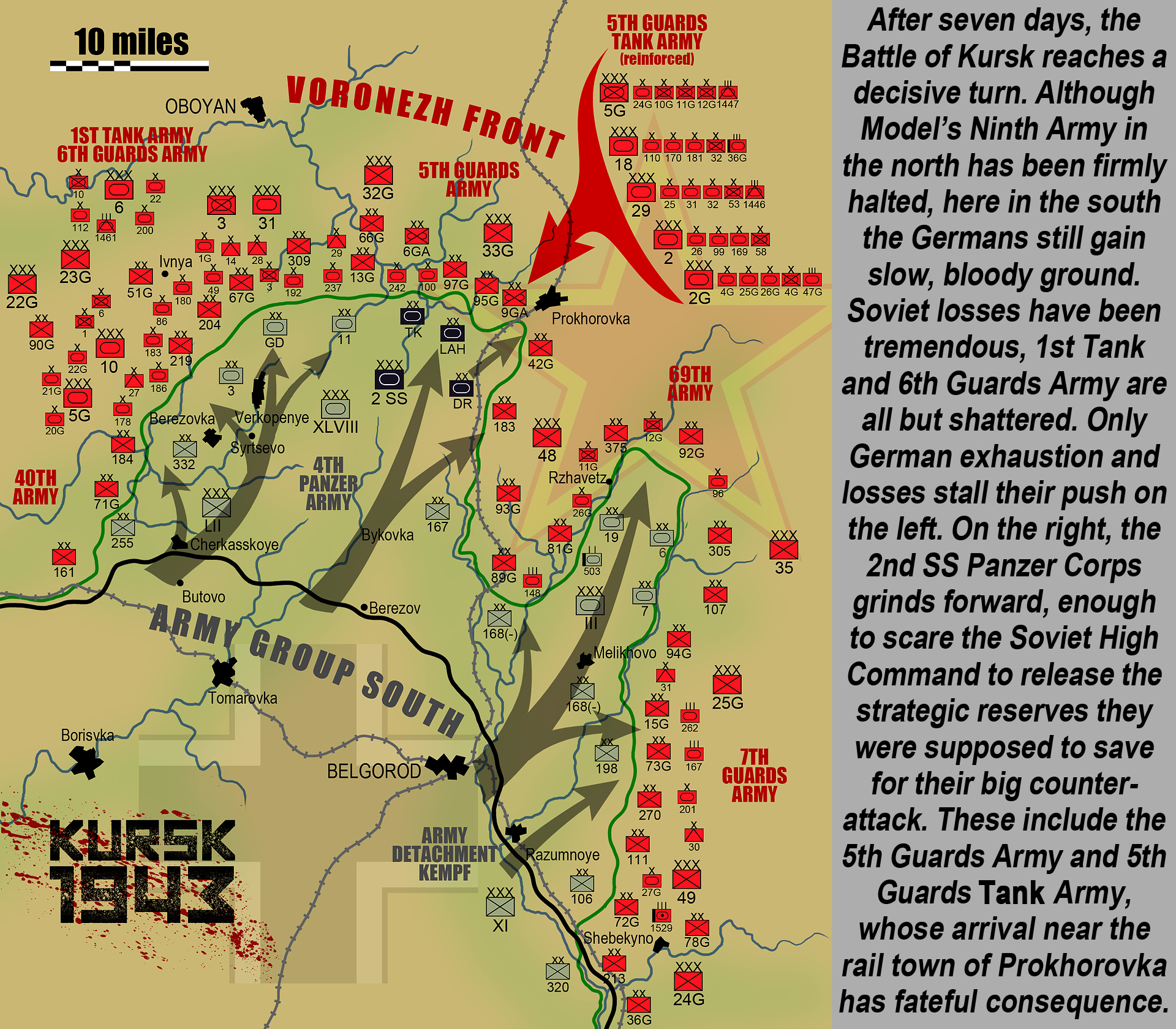
Now, the battle has reached a deadly breaking point, leading to a gigantic firestorm of men and machines at a tiny railroad town called Prokhorovka.
The Myth Of Prokhorokva
Like so many such events, the true story of Prokhorovka has been blurred by layers of myth and legend. Revisionists and apologists have clouded what really happened here, hampering our ability to design, set up, and play historically-accurate wargames. We’ll see what we can do to fix that.
So here’s a very fast background. In the summer of 1943, the Germans launched Operation Citadel against Soviet armies on the Eastern Front. Their target was the Kursk Salient, a huge bulge in the battle line about the size of Northern Ireland. With converging attacks from the north and south, the Germans hoped to slice off this bulge.
If the Germans could destroy the Soviet armies caught in this pocket, they just might buy the time they desperately needed to stabilize the front in the wake of Stalingrad, and perhaps redeem a global war that was already slipping away from them.
Operation Citadel kicked off on 5th July 1943. Almost immediately, their attack in the north was bloodily halted in a series of engagements whose scale and ferocity frankly defy description in an article like this. But in the south, a stronger German offensive (Fourth Panzer Army) was still gaining ground after a week of apocalyptic combat.
By July 11th, the situation was coming to a head. Although bloodied and exhausted, Fourth Panzer Army’s spearheads were finally coming to the end of the strongest Soviet defensive belts. Were these Germans about to pull off the impossible…again?
The Soviet plan had always been to let the Germans hit them at Kursk with everything they had. Only after grinding them down in brutal defensive warfare would the Soviets hit the Germans with carefully hoarded reserves, all at once.
Now that Soviet plan was under threat. Although their Central Front had shut down the German attack in the north, the Voronezh Front was perilously close to a fatal crack in the south. Finally, the STAVKA high command was forced to a fateful decision. They had to change the plan.
Reaching into their strategic reserves (Steppe Front, General Ivan S. Konev), the Soviets sent two huge armies to bolster the splintering Voronezh Front. First of these was the 5th Guards Army. But next came the 5th Guards Tank Army, heavily reinforced and ordered to smash a gigantic attack headlong into the very tip of the German penetration.
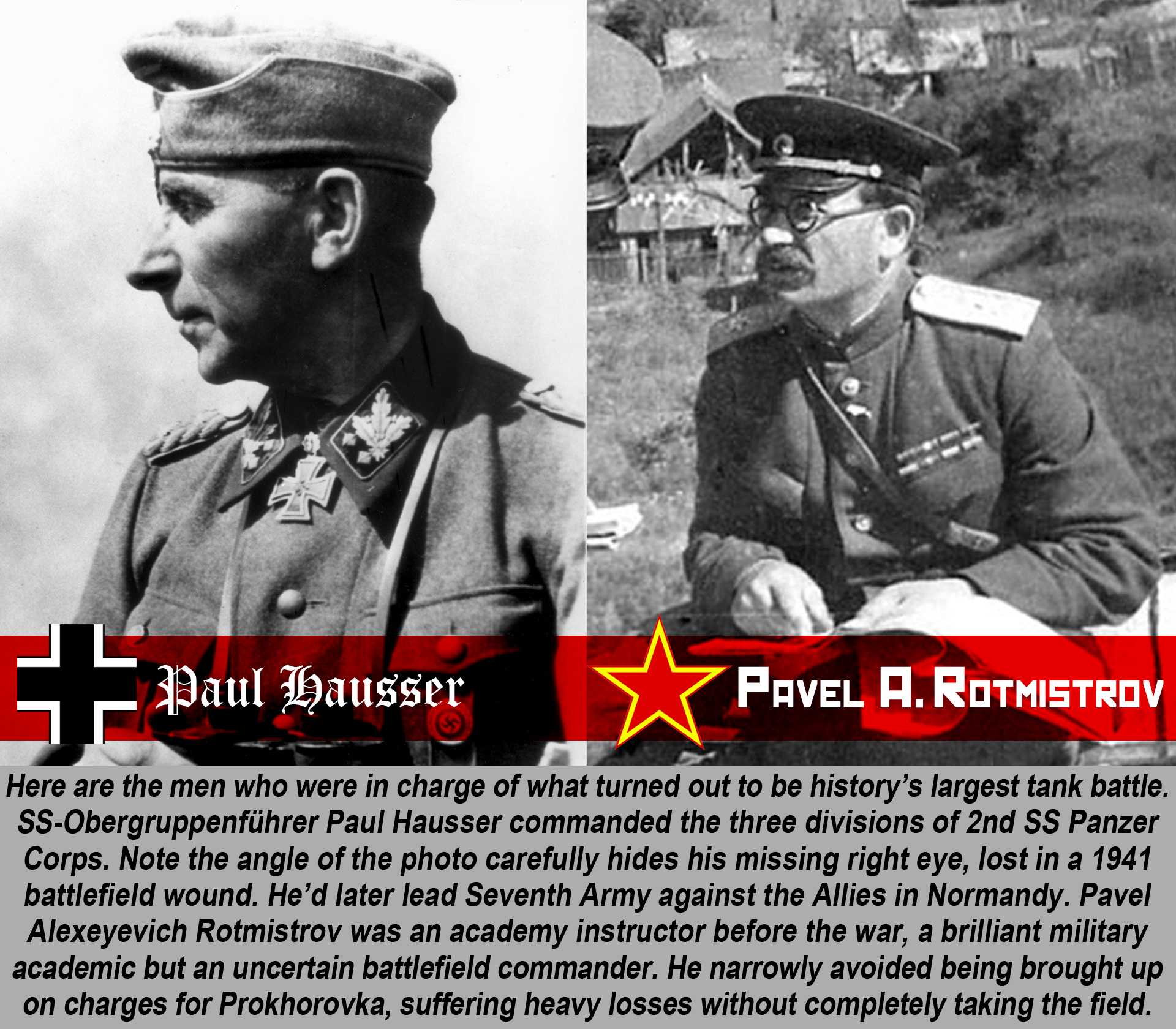
These positions were held by some of the very best…and worst…soldiers in the Third Reich - the top three panzergrenadier divisions of the Waffen SS. These were the ideological shock troops of National Socialism, armed to the teeth with the very best equipment. Politics aside, one cannot argue with their battlefield accomplishments.
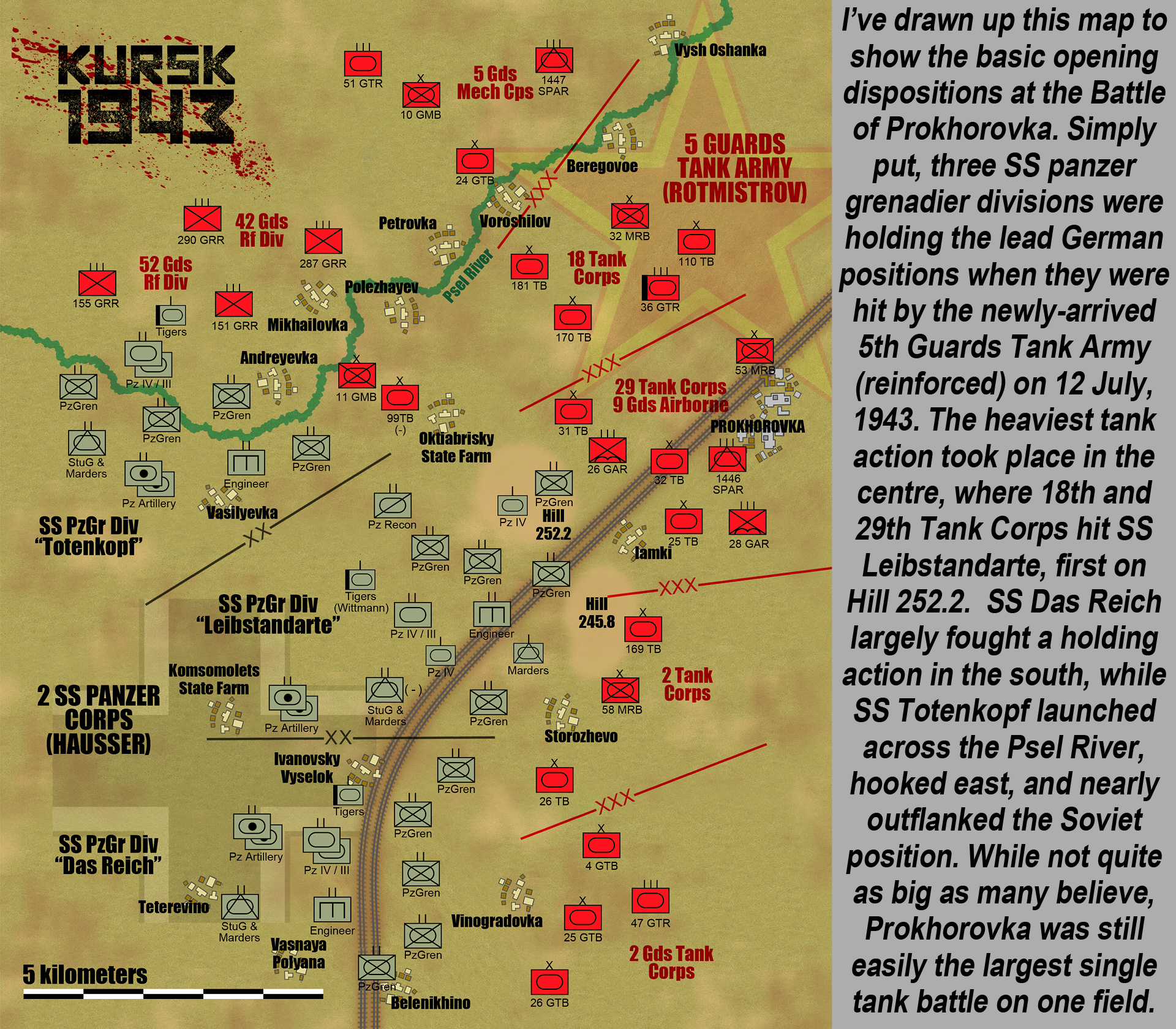
These three divisions (collectively, 2nd SS Panzer Corps) were massed near a gap leading northeast between a bend in the Psel River and the Kursk-Belgorod rail line, where it passed through the town of Prokhorovka. This part of the Soviet line was held by Guards and even a Guards airborne division, hurriedly rushed in as part of 5th Guards Army.
Poised to continue their assault, 2nd SS Panzer Corps was instead struck full-force by 5th Guards Tank Army, now reinforced to contain four full Soviet tank corps and a mechanised corps. As the story goes, the stage was set for thousands of tanks of collide in open combat, a “Braveheart on Tank Tracks” clash to decide the fate of the world.
Okay, sure. Now let’s look at what really happened.
First, one must remember that Soviets organised their tank units very differently than Western armies. In short, a Soviet tank or mechanised “corps” is essentially analogous to a division in other armies. So it’s not like the Soviets had five corps times three divisions = 15 divisions. More like five divisions and even this number is a little soft.
Also, some of these corps could not get their full order of battle onto the field in time. Some had been attached to 5th Guards Tank Army only the night before, and communications and coordination with HQ remained poor.
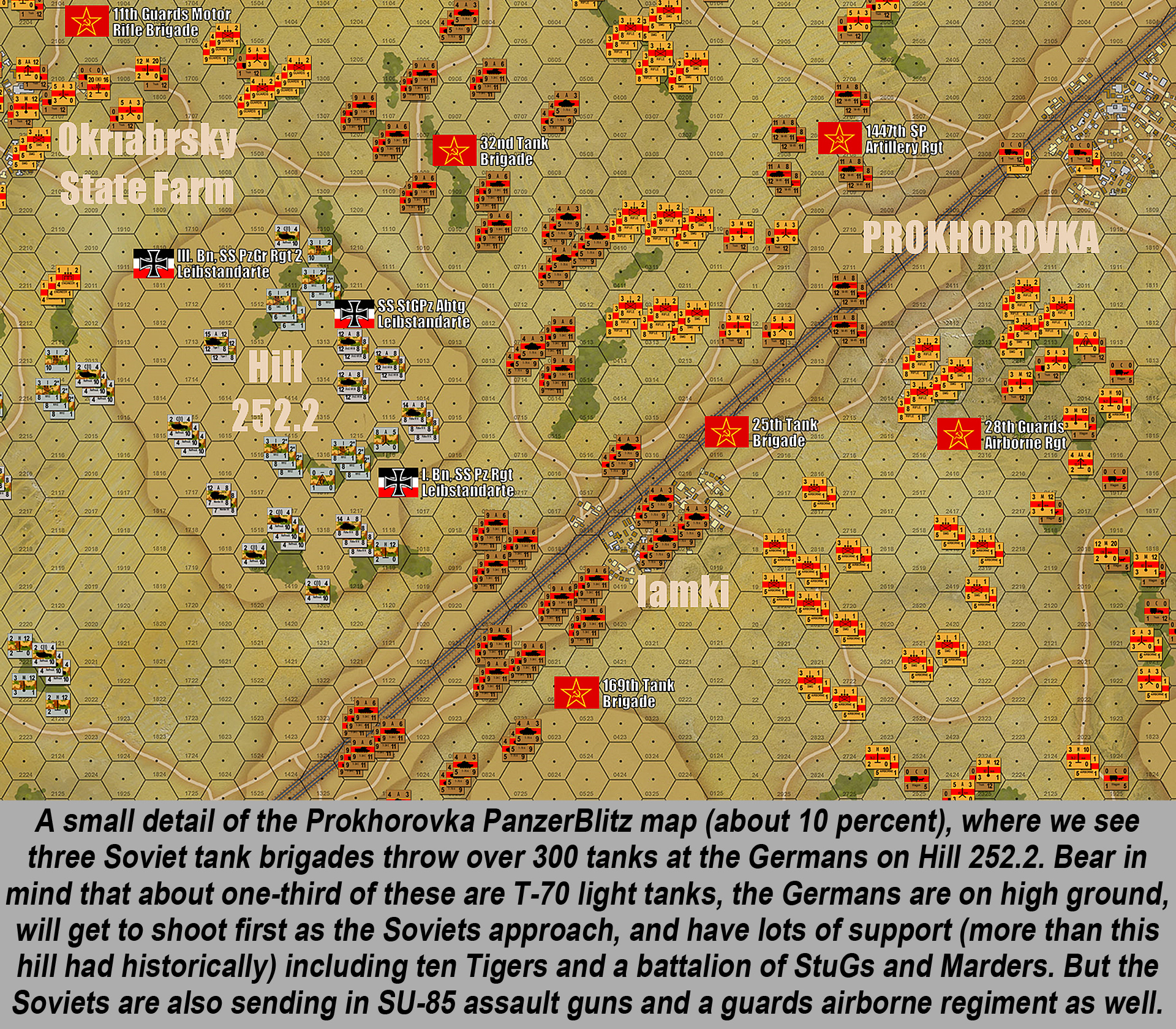
The myth of Prokhorovka also includes Soviet tanks deliberately ramming Tigers to destroy them. This just didn’t happen, is all – although the Soviets did rush one battalion of 1st SS Division with six brigades of tanks, desperate to close to point-blank range to nullify German advantages in long-range gunnery.
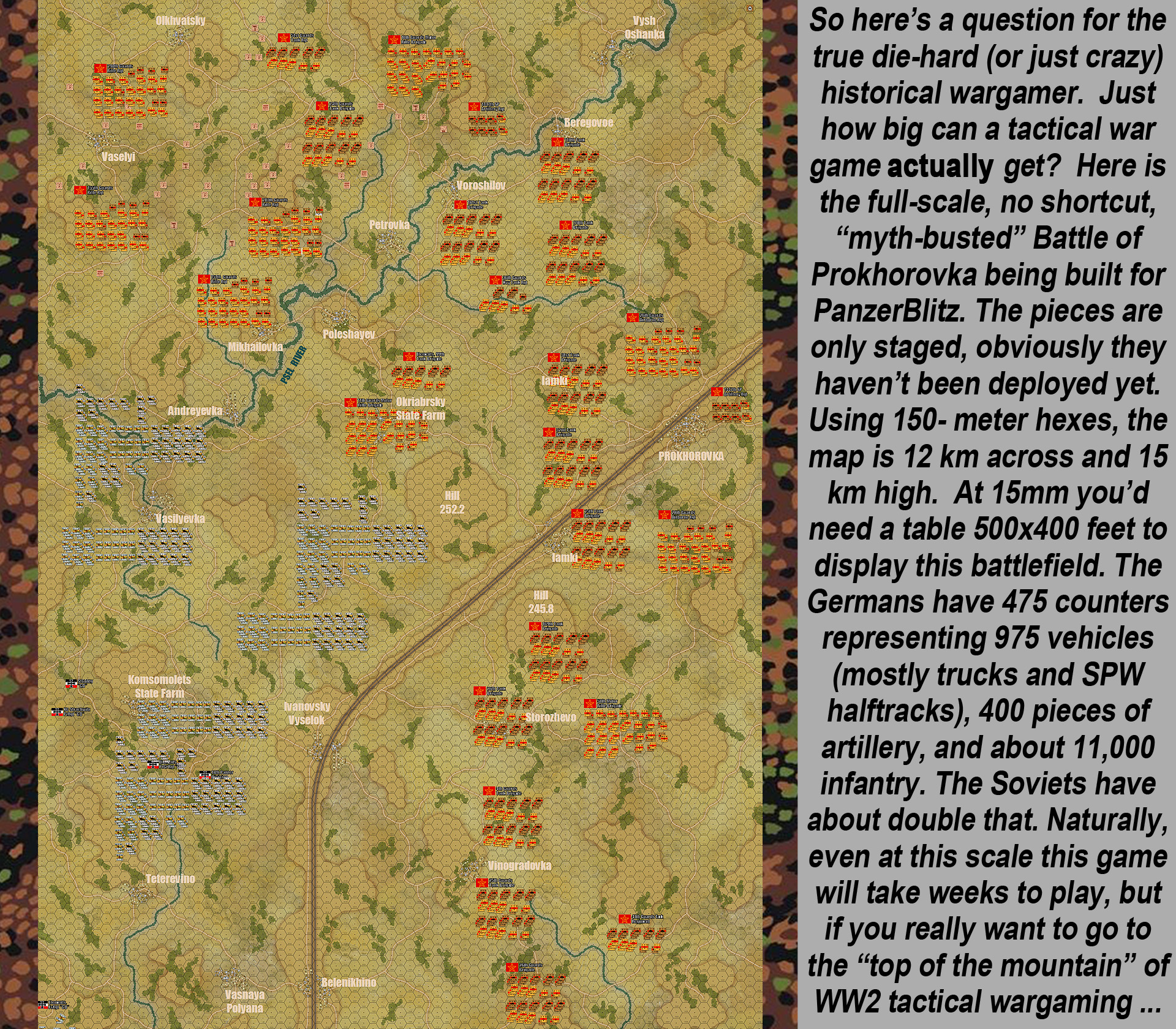
Another myth of Prokhorovka is the sheer size of the battle. “Sloppy” historians use the starting orders of battle of all units involved to calculate the scope of the fight, rather than a careful review of battlefield reports. Although huge, and still the biggest tank battle that every been, Prokhorovka isn’t as nearly big as some people would say.
Another fallacy is the notion that Prokhorovka was mostly a tank battle. It wasn’t. Like most World War II battles, this was predominantly a clash of tanks hitting dug-in infantry and anti-tank guns. Only once these tank thrusts had been contained could they be counterattacked by friendly armour and a classic “tank-on-tank” battle ensue.
Yet another Prokhorovka myth is that 2nd SS Panzer Corps was effectively annihilated in place. Although losses were heavy, these Waffen SS divisions retained much of the field, so could recover and repair many of their tanks overnight. In short, the 2nd SS Panzer Corps survived Prokhorovka largely intact.
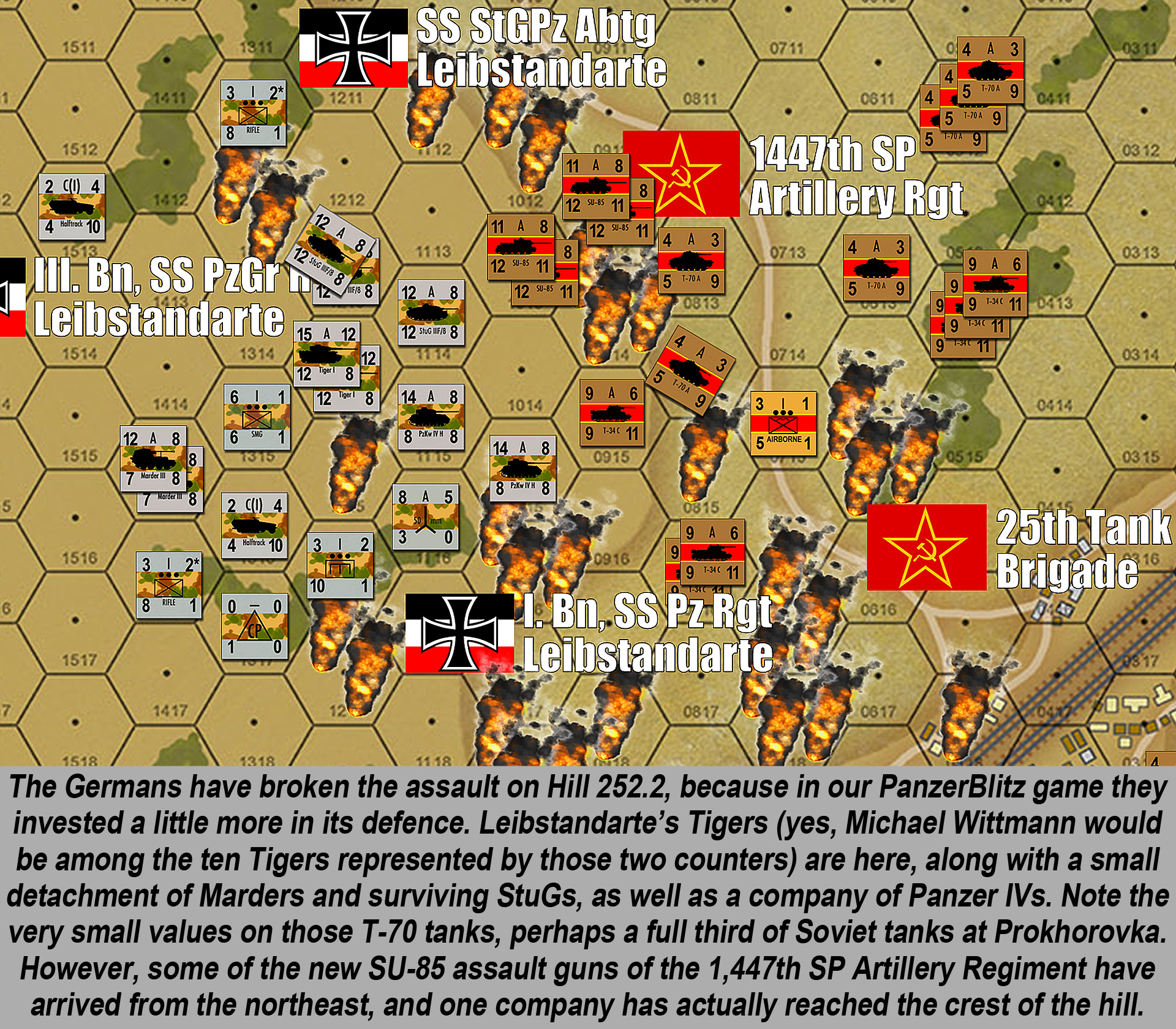
Perhaps the biggest falsehood, however, is that Prokhorovka “ended” the Battle of Kursk. This is 100% flat-out wrong. Fourth Panzer Army and 2nd SS Panzer Corps continued to mount limited operations as late as 15th July, and parts of Army Detachment Kempf even made modest gains.
Even when Operation Citadel truly ended, this is only the halfway point in the true Battle of Kursk. Despite what you’ll read in almost any history published in the West, a huge part of the battle had yet to be fought as the Soviets unleashed their long-awaited counterattacks. We’ll cover these (with tragic brevity) in Part Five.
The point is, while Prokhorovka may have been the “cinematic climax,” it certainly wasn’t the end.
Prokhorokva In Miniature Wargaming
Simply putting a word like “miniature” next to a clash as huge as Prokhorovka seems a little silly. We’ve already seen where a full-scale recreation of the fight flat-out broke PanzerBlitz, so can you even do a battle like Prokhorovka in any kind of miniature scale?

Obviously, the answer is yes…you just have to select either a specific part of the engagement you want to recreate, or “sample” the kinds of units you think were engaged in the overall battle, build a list, and run the game as a “representative compression.” For this article, I decided to do a little of both.
Turning again to Battlegroup: Kursk, I’m running a large but simple Soviet list…mass armour. The aim is to recreate part of 18th Tank Corps’ spearhead against the German centre (1st SS Leibstandarte Division) near Hill 252.2. Every T-34c on my shelf is on the table, along with some assault guns, T-70 light tanks, and even Lend Lease Churchills.

The Germans, being on hasty defence, have to build a more eclectic list. Although they have one platoon of PzKpfw IVHs and one of Gs, two StG-IIIGs and a single Tiger (eleven vehicles in all), they’re still outnumbered two-to-one by the Soviet tanks and assault guns. The rest of the weight has to be carried by artillery and grenadiers.
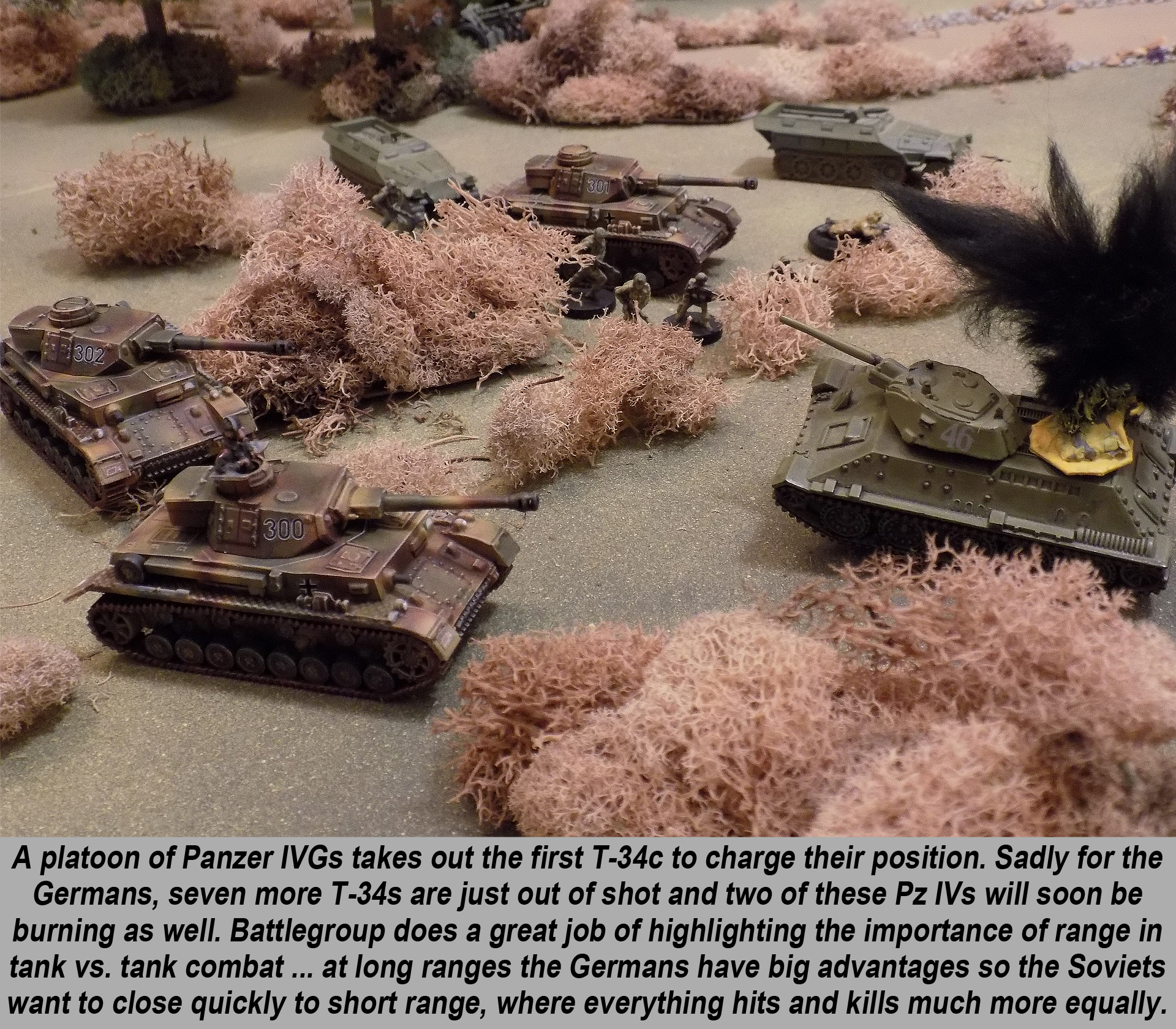
Whether your playing World War II Battlegroup or World War III Team Yankee, the dilemma for the Soviets is largely the same. Their guns are powerful enough, they just don’t shoot very far. Their enemies, meanwhile, can mow them down at a distance with virtual impunity, not because their guns hit harder, just shoot further.

So the Soviet aim (and we certainly see this at Prokhorovka) is to rush the enemy as fast as possible, using every possible scrap of terrain to screen your charge from enemy reaction fire. Up close, everything hits and kills on a much evener basis, and the Germans lose their critical edge.
The question is almost always some version of the following: Have the Soviets lost too much making that initial charge? Or have their edges in numbers and mobility helped them close the distance to where a T-34 can kill a Tiger almost as easily as the reverse?

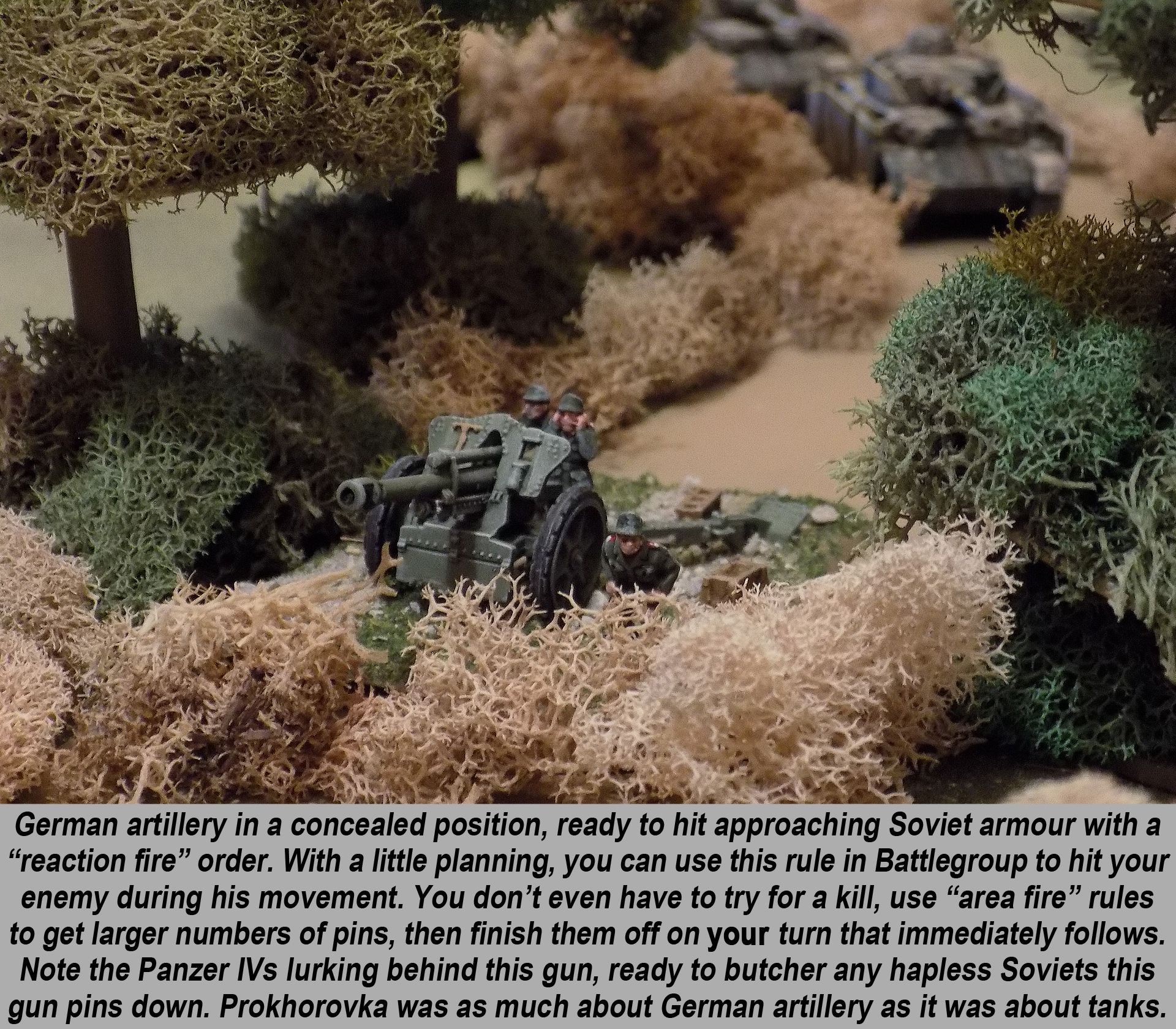
There are a hundred and one variations on this theme. As mentioned, the Soviets can use terrain to screen their approach. Feints and misdirection can also help, as can artillery-delivered smoke. Artillery can also suppress pin German gun emplacements and dilute that murderous “reaction fire” that reaps such a grim harvest.
Of course, the Germans have their own bag of tricks to impede this tactic. Artillery can pin Soviet targets as they make that charge, holding them up for direct-fire attacks next turn. German defences can also be layered, with grenadiers and antitank guns to absorb the shock, while panzers snipe from afar or launch a counterattack.
As it unfolded, the Soviets took a bloody-knuckled win. German “area fire” wasn’t terribly effective at pinning Soviet armoured targets, and even when they had to rally tanks and thus draw battle rating counters, they were lucky enough to draw relatively small numbers and thus keep their battlegroup intact.
The Germans, meanwhile, lost heavily in a series of close assaults against Soviet tanks overrunning their positions. This is always a dangerous tactic when the enemy is not pinned, but before long the Germans just had no choice.

These losses kept forcing the German player to draw battle rating counters. They did draw an “Air Strike” counter but never rolled the 5+ required to activate it. Even if they had, the Soviet tanks were so intermingled with their own positions it’s uncertain whether such a strike would have done more damage to the Germans.
In any event, once the Soviet tanks were amidst the Germans in a melee, the game was pretty much up. Here is where Soviet numbers (assuming enough of them have survived) will almost always come out on top, and today was no exception.
Well, it certainly hasn’t been easy trying to crunch the largest tank battle ever fought into a single web article. I hope you’ve enjoyed it. Next week we close out the series with the devastating Soviet counterattacks, considered by some to be the “true” Battle of Kursk.
In the meantime, please post your questions and comments in the comments below. Have you ever “been” to the Eastern Front? Inspired to give it a try? What kind of tactics do you use to defeat a smaller but more advanced foe or an opponent with perhaps lower quality units…but five times as many of them?
"Now, the battle has reached a deadly breaking point, leading to a gigantic firestorm of men and machines at a tiny railroad town called Prokhorovka..."
Supported by (Turn Off)

Supported by (Turn Off)
"Perhaps the biggest falsehood, however, is that Prokhorovka “ended” the Battle of Kursk. This is 100% flat-out wrong..."
Supported by (Turn Off)




First haha (editor’s privilege). The battle you played out here showed off how it can be quite hard to get that accurate representation of the events on the table top due to the scope of some of these battles but it did come out very well, in the end, I think from following along.
However, it did bring into question something I think niggles me a bit sometimes. I do like the simulation that we have to engage with as wargamers to get to play out some of these battles but it reinforced for me why I like games like Chain Of Command and Bolt Action where there is a focus towards the individuals fighting on the tabletop rather than whole platoons and regiments – I get the place for that, but I tend to like the more personal stories.
Of course, you can get some great moments out of bigger engagements and they look epic, but I think there’s plenty of room for trying to follow a smaller skirmish in games from these epic encounters too.
If I was going to try and put together an infantry clash between squads or something @oriskany what would you recommend? Are there are any moments that stand out to you from this particular clash that could be done and if so which system would you recommend?
I’ll just squeeze in here if the ever benevolent and merciful @oriskany will let me 😀
Early in the morning the SS drove the Soviet Infantry from Storozhevoe which would make a really cool game.
A lot of “Bit and Hold” stuff seems appropriate. Bite and Hold is an early WWI Tactic where you take ground and quickly fortify it so the enemy has to attack you and you get the benefit of defending. Good idea on a small scale not so great when the other guy has dozens of Batteries ranged in on that position.
Both sides did this throughout the day. Imagine you’re some foot slogger following the Tanks forward. The Tanks drive the Russians back out of a small farmhouse and you set it up for your Commander to use as a Command Post. Suddenly your tanks get smashed in the flank and maybe one or two make it back to the CP followed by Soviet Tanks with Tank Riders. That’d make a fun and plausible game of Bolt Action/Chain of Command.
Here’s an account of a Soviet Infantryman defending a “Domineering Height” against a German attack by a Company with two Tigers in Support.
http://ww2today.com/12th-july-1943-kursk-massive-tank-battle-at-prokhorovka
Thank you @elessar2590 that is very helpful! I like the idea of fighting in and around close terrain for WWII games and this would be very much in the spirit of what I’m looking to do
Holy hell! 🙂 12 comments before I even log on in the morning. Thanks very much everyone, and thanks to @brennon for kicking us off.
As for smaller infantry games, both in terms of systems and historical moments … I would take a look at the Hill 252.2 that is mentioned in the article. We didn’t have room to go into it in full detail, but here’s a little more information.
The stay starts with SS Sturmbannfuhrer Joachim Peiper’s III. Battalion / SS PzGrenadier Regiment 2 on the reverse slope of the hill (which is more or less in the center of the battlefield near that long railway embankment. This is the same Peiper that we would see in the Battle of the Bulge make such deep penetrations and carry out the “Malmedy Massacre” against US POWs in that battle. The point is, he’s an infamous, well-known, and notorious “bad guy” from a narrative perspective.
Anyway, note that he commands panzergrenadiers, i.e., “armored grenadiers” – SS infantry in halftracks.
He gets hit very, very hard by huge numbers of T-34 tanks (130 in all, but that all of Peiper’s battalion of perhaps 400 men, for a small skirmish game you would only try to recreate a slice of that). These tanks are from P. S. F. Moiseev’s 31st Tank Brigade and P.A. A. Linev’s 32nd Tank Brigade (29th Tank Corps, 5th Guards Tank Army), with tank riders from the 9th Guards Airborne Rifle Division.
Peiper’s men are in big trouble until they are relieved by Pz IV Tanks of Obersturmfuhrer Rudolf von Ribbontrop’s panzer company (6. Company/SS Panzer Regiment 1 / Leibstandarte Adolf Hitler Division). By the way, this was the son of Joachim von Ribbontrop, German Foreign Minister.
So we have famous (or infamous) people on both sides, elite troops on both sides, right at the EPICENTER of Prokhorovka – where the fighter gets to true bayonet range between elite (or at least “very veteran”) INFANTRY units on both sides. Possession of that high ground was crucial since it was fight in the center of the field, much of the rest of the field was flat, and whoever could get big guns up t here would have a sizable advantage over the enemy.
Osprey does a great writeup, map, and illustration of this in Kursk: The Southern Front 1943 by Robert Forczyk.
Yes, @elessar2590 – the “benevolent and merciful Oriskany” gives permission for other knowledgeable historical wargamers to post on my article thread. Consider yourselves the beneficiaries of largesse. 😀 😀 😀
Great article and link in your post. I appreciate the delicate “approximations” they include in their text, there’s a lot about this battle that isn’t known and when people really try to throw out very hard facts, I always raise an eyebrow and wonder what their sources were. Not saying it can’t be done, just “pack a lunch” if you know what I mean (ie., the job may be bigger than many writers think).
The only actual problem I have with that article is the last image, that shows a “Damaged and abandoned German Panther tanks left on the battlefield at Prokhorovka.” Except there were not Panthers at Prokhorovka. The only Panthers at Kursk were 51. and 52. PzBn / PzRgt 39 / 10th Panzer Brigade, attached to Grossdeutschland PzGr Div / XLVIII Panzer Corps. They were at Kursk, and they were at the southern shoulder, just not here at Prokhorovka.
To reply to @brennon‘s second comment, and add a little more about h is idea for an infantry-heavy skirmish game at Prokhorovka:
Expanding on the Hill 252.2 battle idea posted above:
If you wanted to keep it strictly infantry based, no worries. The Germans have slit trenches and foxholes in the area. The battle raged literally all morning, so you could set your skirmish game later in the fight with all kinds of T-34/76s and PzKpfw IV tanks scattered around as WRECKS to add terrain and cover features.
Special rules could be worked into the scenario where some of the tanks are still burning, and maybe on a certain die roll, explode from burning ammunition and fuel. So your troops want to get close to the cover to shield from enemy fire, but of they get TOO close … and unlucky with the dice …
Exploding terrain! What more could you ask for?
Also, I’d like to apologize to the community … and really, the English speaking world … for this sentence:
“Up close, everything hits and kills on a much evener basis, and the Germans lose their critical edge.”
How about: “Up close, everything hits and kills on a much more even even basis, and the Germans lose their critical edge.
Ahh, that’s better.
@brennon I think Crossfire is probably the best. It’s a little different with no move or fire ranges and no real turn sequence but it does create a lot of tension for the players
I second “Crossfire” very interesting wargame. You should still be able to find it in Print floating around somewhere out there.
If you want a nice breakdown Lindybeige has some great stuff on it.
I think it’s been re released again
It has
https://www.caliverbooks.com/bookview.php?ugovpg2ehdj5lnii592mnfvu21&id=22875
And a scenario book
https://www.caliverbooks.com/bookview.php?ugovpg2ehdj5lnii592mnfvu21&id=11026
Thanks for the great links, @torros – I think this is a different game than the one I had in mind when I was trying to remember “Crossfire” (might have been getting it confused with Chain of Command)
I like that – a desperate scrap for control of an area.
It’s particularly good if run with an umpire or attack defence games where the defenders are hidden
Have a look here http://www.lloydianaspects.co.uk/wargaming/crossfireMain.html
We’ve used the crossfire mechanics to play 40k/sci-fi. Works well
I find most sci-fi settings work well with historical system, with a judicious amount of tweaking, of course – given how much sci-fi settings tend to take from history anyway.
Single-blind or double-blind games are indeed great fun and high-tension … if you have the available umpire and / or two gaming tables (depending on what kind of game you’re playing and how you’r handling the hidden unit aspect).
@torros – interesting idea about the Crossfire system. I get the no fire ranges (Force on Force is similar in this regard – given that it’s usually played at 20 – 28mm and the table is only 2-3 feet … is anything ever really “out of range”) but no movement rate?
Is this the game with the variable movement based on 2d6, 3d6, and 4d6 rolls? Did BoW do a demo game on this waaaaay back in the day?
You basically move terrain feature to terrain feature. The enemy can always interrupt the movement with fire if they can see the unit
In its simplest form a unit in a field would move to a hedge for example and stop. They then make the decision if they wantv to cross the hedgerow. As they cross if there is any enemy that can see it can choose to fire. If they get a result the initiative is passed to the enemy.
This plus follow up videos explain it better https://youtu.be/RO81x71xaqk
Got it. The old “America’s Army” fireteam system. 😀
I think I maaay have seen this game played somewhere – @elessar – I found this as a primer:
https://www.youtube.com/watch?v=RO81x71xaqk
Great minds and all that
Something like that. 😀
@brennon what about the German sapper’s mine clearing with the Russian’s fighting to stop them.
German “Pionier” assault engineers, always a tough battle and great tension for a cinematic game. This would work for engagements a little earlier in Kursk when the Germans were on the offensive. Here at Prokhorovka, though, the Soviets are hitting the Germans, mostly with tanks and 9th Guards Airborne Rifle paratroopers on the backs of tanks. 🙂
The exception would be to the far north of Prokhorovka, where the 3rd SS “Totenkopf” (Death’s Head) Division has a bridgehead across the Psel River and is trying to shove through elements of 52nd and 42nd Guards Rifle Divisions.
Possibly an option for Lloyd to ponder ?
Is Lloyd into combat engineering / mine warfare? Or is this more of a terrain challenge?
that I cant telly you hopefully he’ll do a report/project on what he wants I thing from his question its an elite unit/dirty dozen type game.
Oh, okay, @zorg – I didn’t know that. I might have missed that in one of the Weekender / XLBS episodes. SpecOps in WW2? Yeah, there are more than a few opportunities for that, ranging from strict historical to campy / fun alternate history. 😀
@lloyd can often be seen on The Strand beach in Portrush digging experimental communication trenches
@torros – We never quite outgrow sand castles, do we? 😀
Where can you get a copy of the PanzerBlitz game you are using. I really like the recreation you did.
think it’s out of print. I got a digital copy from this Gentleman https://www.ebay.co.uk/itm/Avalon-Hill-Panzerblitz-Panzer-Leader-Arab-Israeli-Wars-PDF-Reference-Disc/110897227823?_trkparms=aid%3D222007%26algo%3DSIM.MBE%26ao%3D2%26asc%3D52543%26meid%3Dbb983a194cd44caf9436cc7fa15ae25e%26pid%3D100005%26rk%3D5%26rkt%3D7%26mehot%3Dpp%26sd%3D112621894761%26itm%3D110897227823&_trksid=p2047675.c100005.m1851 great collection
I have that disc, @buggeroff , it is indeed a comprehensive and fantastic collection. not only all the games, but Imaginative Strategist expansions, Pz Leader, Arab Israeli Wars, Panzer Leader 1940, Para Leader, PanzerNacht, Finnish Blitz, Steppe Blitz, PaznerBlitz 1941, even the laughable but somehow lovable “Chopper Blitz.” 😀 Also, all the articles presented for this series through years of “The General” magazine in the 1970s and 80s. Great stuff!
The digital one he uses for the articles he created himself based on the actual game @buggeroff gave you the link to. If you go to his great war project page he goes through the steps of creating the counters and the boards.
Thanks, @gladesrunner – I should add that while I indeed created those units and maps myself, a huge debt is owed to sites like
ImaginativeStrategist.com
http://www.imaginative-strategist.layfigures.com/IMSTRAT%20PB%20Page.html
and
Greg’s PanzerBlitz.com
http://gregpanzerblitz.com/
A lot of the counter values are taken from these sites, at least for the German units. The BASIS for the Soviet units are as well, I have modified them because I don’t like Soviet company vs. German platoon scale, and I don’t agree with the characterization of Soviet combat capabilities presented in the original game (useful for 1941 or even 1942 scenarios, but not for 1943 onwards).
Okay, @lhmg deep breath …
1) Yes, PanzerBlitz is out of print.
2) It is available in many, many places because people still love it and design / publish / produce post-market editions and expansions.
3) I have the .pdf disk that @buggeroff mentions. Highly recommended. It has everything ever published for the game including its two follow-up games, Panzer Leader and Arab-Israeli Wars.
4) I can also post a link to immediate PanzerBlitz rules below.
5) WARNING – people who still play PanzerBlitz are almost universal in agreement: the game is broken. However, the follow-up / expansion “Arab-Israeli Wars” fixes all of these problems. Most people who play “PanzerBlitz” are really playing Arab-Israeli Wars system back-dated to WW2 units and engagements.
6) The units and maps in my PanzerBlitz games featured in this article were created I Photoshop, Illustrator, and even MS Excel specifically FOR this series. It’s exclusive content, baby! 😀
More to come, but for now here is the link:
http://www.imaginative-strategist.layfigures.com/PDFs/PanzerBlitz%20Rules%20of%20Play.pdf
You can always find a copy or two on ebay. Just don’t over pay. The dvd is nice but a lot of work to get printed.
This is very true, @stvitusdancern – Thanks! 😀 The original sets can be found but they are often either overpriced or in very poor condition – we’re talking about a cardboard product from potentially 48 years ago, after all …
Also, to use the “corrected” rule sets (i.e., Arab-Israeli Wars engine) – many new / revised counters would be needed, especially for artillery and infantry. Tanks too, if you’re ditching the regrettable Soviet company vs. German platoon unit scale mismatch.
Awesome article @oriskany very cool to see so many tanks all at once.
Light Tanks to me are pretty useless in Combat but great for confusing the enemy.
You could mix them in with the bigger tanks and make the attacking force look bigger than it actually is. They could breakthrough in isolated spots and hopefully trigger some panicked German Tank Commanders misidentifying them. They would be good spotting tanks (if they have radios) or maybe even “Battle Taxi Escorts” in Commanders wanted a little bit more protection.
Total speculation though.
I think it depends on the games/battles your trying to portray. Light tanks had there uses right to the end of war in regards to recon and conversions into command tanks
Totally agree re: command tanks. As mentioned above, I would equate light tanks in WW2 in many ways to operational-level cavalry ops (i.e., BETWEEN battles) in older armies.
It’s bit like Napoleonics and why light cavalry is put on the tabletop.In small games they don’t seem of any particular use but. In larger campaign games they show there use in either following up a defeated enemy making sure they can’t regroup or screening your own troops if you have been beaten. No matter the period there are reasons why these at first glance useless units were formed and used
Agree 100%, @torros – sometimes wargaming zooms in a little too close and we lose perspective of what’s happening on the larger canvas, “between” battles when the utility of certain units really comes into the fore.
Say a force of the aforementioned T-70s rushes forward through a gap opened in a German line. Twenty miles behind, they seize a rail junction the Germans need to evacuate a collapsing pocket. To the German admin clerks, rear-area security troops, and even infantry reserves, the “light” T-70 tank with its steel plating armor and 45mm gun and machine guns is an absolute beast, they’re not budging those tanks out of there right away … giving heavier Soviet assets like T-34/76s of the main line brigades or follow-on mechanized rifle or motorized rifle brigades time to catch up and hold that objective for real (i.e., before Germans can mobilize a real kampfgruppe against the T-70s).
Thus, the rail head is never re-taken by the Germans, the evacuation of that collapsing salient never takes place, and the German “battlefield setback” becomes a mini-Stalingrad, all because of those light tanks. 😀
Thanks, @elessar2590 – and great question.
Light tanks, in certain time periods (pre-MBT) really do have a place. But to see it, we have to zoom out a little from the narrow confines of tactical tabletop wargaming.
The thing to remember is how rare tanks really are. Kursk, for example, has a total of 5500 tanks / AFVs and maybe 4 million men (including Soviet counter offensives). That’s one tank for every 700+ men. Most wargamers (myself included) far exceed this ratio in their games. Which is perfectly fine, that’s how it’s supposed to be, the games we play focus on places where armor is concentrated to much higher densities (spearheads, counterattacks, etc.).
The point is, zooming out a little, we can imagine where there are vast stretches of the battlefield where there are no tanks. It’s in these voids where light tanks are supposed to strike out, slash deep into enemy rear areas, and move very fast to secure key places like high ground, woods, rail heads, road junctions, etc. … holding them just long enough for the main armored force to catch up (followed by the real “take and hold” force … infantry).
You know where light tanks are NOT supposed to be used? Places like Prokhorovka, in head-on clashes with every armor. 🙁
This just goes to show how jagged the Soviet situation was becoming here on the south shoulder of the Kursk Salient. The plan was for 6th Guards, 7th Guards, 40th Army, 69th Army in reserve, etc … to hold the German attack with Katukov’s 1st Tank Army providing LOCAL armored counterattack where needed. Only when 4th Panzer Army / AD Kempf was fully stopped would the real OPERATIONAL-level Soviet counterattack be launched in the form of Konev’s Steppe Front (of which 5th Guards Tank Army was a primary component).
However, the Soviets here in the south were really being stretched to the breaking point. Katukov’s 1st Tank Army was fully committed against XLVIII Panzer Corps in the west, and committed piecemeal in local counterattacks until it was all but destroyed. 40th Army wasn’t really equipped for this, 7th and 6th Guards were either largely destroyed or pinned down by AD Kempf in the west … and while XLVIII Panzer Corps was more or less halted in the west, in the center, Hausser’s 2nd SS Panzer Corps was still breaking through at Prokhorovka, threatening to make the pivot westward toward Oboyan and perhaps further.
All this leads to the Soviets having to break their own plan, and commit a huge slice of Konev’s Steppe Front early. This is P. A. Rotmistrov’s 5th Guards Tank Army – NOT built or designed for this role, but thrown into a headlong counterattack against 2nd SS Panzer Corps at Prokhorovka nonetheless.
Hence, you see hundreds of T-70 light tanks hurled into a battle in which they are wholly unsuited and were wrecked in horrific numbers.
Really, the light tank role should be thought more analogous to the cavalry units of the 19th Century. Full scale battlefield assault units? Not really, more for flank security, screening, recce, exploiting breakthroughs AFTER the main battle has been won, or taking and holding advance key ground BEFORE the main battle begins.
But you also bring up a good point about commanders. Germans often used old Pz I light tanksand other models as command tanks. Usually the heavy guns and ammo would be removed to make more room for all the radios, optics, and other command equipment. Often a dummy gun would be installed to it wouldn’t be quite so obvious to enemy gunners …
“Hey! See this tank with no gun? Command tank here! Blow me up so our whole force has a -2 initiative penalty the rest of the game!” 😀
As if all those extra radio antenna wouldn’t also make it SOMEWHAT obvious, or the distressing German habit of clearly marking command tanks with “R” or “S” tactical numbers that practically advertised their presence.
I love the Banner Quote…”Now, the battle has reached a deadly breaking point, leading to a gigantic firestorm of men and machines at a tiny railroad town called Prokhorovka” It sounds like a pull quote for a great Spielberg or James Cameron Hollywood Historical blockbuster movie. Though if that panzer blitz map is just 10% of the battle, they may need to use the dreaded CGI to pull it off.
Gotta get the Hans Zimmer / Christopher Nolan music into the trailer …
“Now, the battle has reached a deadly breaking point …”
BWWOOOOMMM!
“… gigantic firestorm of men and machines …”
BWWOOOOMMM!
“… in a moment history will never forget …”
BWWOOOOMMM!
“Who will win?”
BA-BA_BWWOOOOMMM!
“Who will survive?”
BA-BA_BWWAAA-AAA-OOOOMMM!
BLOODBATH PROKHOROVKA: 1943
(Rated R)
Summer 2018
In a cinema near you …
Lol the Braveheart of tank battle’s the Germans would have wished the Russian’s had lifted their KILT’s an exposed their ass’es @oriskany
Oddly, that analogy isn’t too bad, at least if we go by the MOVIE version of battles like Stirling (and not the actual Battle of Stirling Bridge, etc.).
The English have a vastly superior advantage in heavy shock units (cavalry, a little like Tigers and PzKpfw IVs vs. T-34/76s and especially T-70 light tanks) and longer ranged weapons (archers – again like the longer reach of German vs. Soviet guns).
So the Scots in that movie have to find a way to close the range fast.
But where as the Soviets charged the Germans at Prokhorovka, “General Mel Gibson” somehow get sthe English to charge his infantry with set spears.
Same GENERAL problem, two different solutions. 😀
Off course the real battle of stirling bridge had a huge advantage the ground was very muddy even drowning English troops forcing them to use the bridge limiting number’s attacking Scottish troops @oriskany
But that is an other time as said the tanks steamed in to minimize loses getting the numbers advantage to try an win the field.
Oh absolutely, @zorg . The Mel Gibson “Battle of Stirling” and the historical 1297 Battle of Stirling Bridge resemble each other about as much as Stirling Bridge and Prokhorovka. 😀 😀 😀
At Stirling Bridge, wasn’t there a collapsing bridge somewhere that worked to divide the larger English army on opposite sides of the river, allowing the Scots to defeat it in detail?
Yes the bridge was destroyed in the battle by who and when is in doubt it did condemn the English troops to the north but.
Awesome, @zorg . Once I read something about how it collapsed under the weight of English armored infantry and cavalry, but that was 20 years ago and I’m certainly no expert.
very possible they were in retreat after the scots charged them and in the confusion, ? @oriskany
I honestly don’t know @zorg – I’d have to read up on it again. My reading on the Battle of Stirling Bridge is almost as many years ago as … well … the Battle of Stirling Bridge. 😀 😀 😀
Lol Now back live to the field.
Right? 😮 “Up to the minute coverage!”
Live Blog!
Lol and slow Mo action shots.
A great post @oriskany mass assalts was the last chance to halt the German’s after beating the minefields or did their air force still have some fight still in it.
The aerial aspect of Prokhorovka is a a hotly-debated issue. There were definitely huge numbers of aircraft engaged, but what they were actually doing depends on who you ask. Some historians claim they were engaged against ground targets, others maintain there was too much dust and smoke for them to see anything on the ground, so they turned on each other.
I would propose (as usual) a combination of the two. Probably by the end of the day the density of aircraft overhead has dropped off tremendously, not only due to combat losses but also as squadrons RTB for re-fueling and re-arming. Also, later in the day is when we’re going to see that problem with dust and smoke.
It’s a scary visual to imagine, being a tank crewmen or infantryman fighting for your life in this swirling maelstrom of dust, fire, and smoke, you can’t see more than 50 feet in any direction, and out of nowhere, a burning plane crashes down randomly from a titanic air battle overhead you can’t even see.
Yes it does sound like something from clash of the Titans.
😀
I don’t know all the details about the air battle above Kursk and especially above Prokhorovka, but in a book about the Me110 (“Messerschmitt Bf110: Die Rehabilitierung eines Flugzeugs” by Michael Ziefle) was a passage about the I./ZG 1 which was present in that Operation. They claim several air victories (e.g. 16 Bombers mostly IL-4 and nine fighter planes some La-5, MiG-3 and LaGG-3) and dozens of tanks (no exact number claimed here).
So it’s quite obvious, that the battle in the air was fierce as well.
And btw. I think the chances for being hit by a crashing plane was far lower than being hit by a bullet or artillery shell (grenade… what ever) 😉
Thanks, @setesch – indeed the air battle is something I really had to skip a little in these articles. Thanks for bringing it up so I can address it a little here:
A few highlights:
The opening week of Citadel sees some of the largest air battles so far, much much bigger than anything seen in the Battle of Britain.
In the south, the main German air formation is Fliegerkorps VIII (just over 1000 aircraft).
The main Soviet air formations are the 2nd and 17th Air Armies, with 1419 aircraft combined.
In the north, we have Luftflotte 6, with 686 combat aircraft. Although badly outnumbered, these German Luftwaffe units had many of the new Fw-190A fighters and plenty of veteran pilots.
The Soviets here had the 16th Air Army with 961 combat aircraft.
There was also the 15./Jagdgeschwader 51 (or Escuadrilla Azul No. 4 – ‘Blue Squadron’), a Spanish volunteer unit equipped with FW Bf-190A fighters.
The Germans also had 1. Flieger-Division with four Stuka groups and seven bomber groups for Citadel.
In the south, there were actually fewer of the new FW Bf-190, and more of the older Me Bf-109Gs (veteran units like Jagdgeschwader 3 and 52). There were also six groups of the old Ju-87D Stuka dive bombers, some of the new FW Bf-190A-5 with ground attack cannon, and of course the great Hs-129B twin-engined “tank busters.”
From July 5 – 15, veterans of Jg 3 and 52 recorded kill ratios of 4:1 or higher against Soviet fighters. In the first three days of the battle, this ratio was even higher, FlK VIII lost 17 fighters while shooting down 193 Soviet warplanes. Sturmoviks, usually dreaded as “the Cement Bomber” bu German fighter pilots, also took abnormally high losses during this phase of the battle. But Germans also lost two very high-scoring aces, and could never sortie enough aircraft to support both Hoth’s 4th Panzer Army and Kempf’s Army Detachment at once, and so had to continually hop back and forth.
I probably have more detailed information at hime if people are interested, including initial combat aircraft strength of FlK VIII, LuFl 6, 16th, 2nd, and 17th VA (Air Armies) of the Soviet VVS supporting both sides of the Kursk battle at the outset (5 July 43)
nice one.
Yeah @zorg , I’ll see what I can drop in regarding actual combat aircraft strength when I get home this afternoon. 😀
nice.
Okay, @setesch and @zorg – here is what I was able to find on comparative combat aircraft strengths at the outset of Operation Citadel (5 July 1943).
NORTHERN SHOULDER:
Soviet 16th Air Army (LtGen S. I. Rudenko) – Supporting Rokossovsky’s Central Front
Fighters:
Yakolev Yak-1,7 and 9: 300
Lavochkin La-5: 110
P-39 Aircobra (US Lend Lease): 40
Bombers:
Petlyakov PE-2: 175
A-20 Boston/Havoc (US Lend Lease): 85
Ground Attack
Il-2 “Sturmovik” 241
TOTAL: 951
German Luftflotte 6 (Colonel-General R. R. v. Greim)
Fighters:
Messerschmitt Bf-109: 39
Focke-Wulf-190: 186
Bombers:
Junkers Ju-88: 92
Heinkel He-111: 152
Ground Attack:
Junkers Ju-87 “Stuka”: 159
Messerschmitt Bf-110 “Zerstörer”: 58
TOTAL: 686
SOUTHERN SHOULDER:
Soviet 2nd and 17th Air Armies (LtGenerals S. A. Kravsovsky and V. Sudets, respectively)
Supporting Vatutin’s Voronezh Front
*Individual fighter types not available, but include Yak-1, Yak-7B, La-5 fighters, Il-2 Ground attack, US A-20 Boston/Havoc, Pe-2 bombers).
Fighters (Yak-1, Yak-7B, La-5): 552
Bombers (Pe-2, A-20): 248
Ground attack (Il-2 Sturmovik): 515
Night-bombers: 94
Reconnaissance: 10
TOTAL: 1,419
German Fliegerkorps VIII (Maj.Gen Seidemann)/ Luftflotte 4 (Gen Otto Dessloch).
Fighters (Messerschmitt Bf-109G and a few Hungarian Fs): 196
Ground attack: 426
** includes Ju-87D Stukas, Hs-129 tank-busters, and a few Ju-86G Stuka with 37mm AT cannon)
Bombers (Ju-88A, He-111H): 293
Reconnaissance: 106
TOTAL: 1,021
GRAND SOVIET TOTAL: 2,370
GRAND GERMAN TOTAL: 1,757
GRAND COMBINED TOTAL: 4,127 aircraft
Thanks a lot for these numbers @oriskany .
Interestingly the I/ZG1 claimed downing some IL-4. It seems to me that they had shot down A-20s and thought these were IL-4s.
I guess it was’n uncommon in the heat of battle. When you expect to fight Russian planes even an American one becomes Russian 😉
Well now hold on, @setesch , you may well be very correct about those Il-4s. Please note that my numbers include only those air formations directly attached to either the Central Front (16th Air Army) or Voronezh Front (2nd and 17th Air Armies) i.e., subordinate to these Soviet Fronts.
My source for these was Forczyk’s two Osprey books on Kursk, which focus on the northern and southern shoulders of these battles.
So what that means is that the FURTHER elements of Soviet forces are not included in his lists. This would include, most immediately, Konev’s Steppe Front / STAVKA reserves.
Switching over to Glantz’s books that take a much broader view of the battle (his OOBs definitely include Steppe Front, for example), I’m finding tons of “Guards Long Range Aviation Corps.”
Orel Axis (North Shoulder)
1st Guards Long Range Aviation Corps
2nd Guards Long Range Aviation Corps
3rd Guards Long Range Aviation Corps
5th Long Range Aviation Corps
7th Long Range Aviation Corps
Poltava Axis (South Shoulder)
4th Guards Long Range Aviation Corps
6th Long Range Aviation Corps
Soviet Long Range Aviation Corps, Divisions, and Regiments were indeed primarily made up of Ilyushin Il-4 bombers (formerly DB-3s) , although other types like the Pe-8 were also used.
So each of these Corps was made up of two divisions, each division usually made up of two LR Aviation Regiments (1943 = roughly 25 bombers each, but this is full “parade ground” strength, standing field strength would be a little lower).
Even taking this into account, we’re talking seven corps x 2 divisions x 2 regiments x 25 bombers = 700 aircraft at full strength, say 500 not destroyed / undergoing maintenance, etc, and taking out some for the Pe-8s, perhaps 350 Il-4s at Kursk and 150 Pe-8s?
Obviously we’re taking a little but of guesswork here on the numbers, but the formations are confirmed and the aircraft types are confirmed. Il-4s WERE at Kursk, just not part of the three VVS Air Armies directly attached to the two Soviet Fronts under initial attack.
Well OK my bad @oriskany .
With these numbers the Soviet superiority in numbers grows even higher than your first post let assume.
I guess the Germans (feels weird to write this as a German 😉 ) had something similar on their side? Or were there only the mentioned numbers operational at Kursk?
Wasn’t “your bad” at all, @setesch – you were totally right. 😀 If anything, my initial list was just incomplete.
I will check to see if the Germans had a “second wave” like this. I have the book with me that may shed some light. POSSIBLY the rest of Luftflotte 4 (note only Fliegerkorps VIII within that air fleet was initially listed).
The Soviet numbers indeed look even more terrifying, I would only add that (a) they didn’t / couldn’t commit all these at once, Steppe Front forces don’t really start entering the battle full force until a little later. And (b) German kill ratios and Soviet losses were VERY high in the early days of Kursk. So these numbers start to even out a little early on.
That said, obviously the Soviets will eventually win out with a huge numerical superiority.
This is great never knew so many US plane Were sent over always thought of tank trucks n guns with lend-lease nice one @oriskany
I’m not gonna lie, @zorg , I had no idea about the A20 either. I saw A20 in Forczyk’s listings and thought: “hell no, that’s gotta be “Antonov 20” or some AN-20 aircraft I’ve never heard of, that can’t be the American A-20 Havoc / Boston Bomber. One of my favorite badass “Flatten a King Tiger with one throw” WW2 aircraft …
But sure as $h*t, there it is. Like 3000 of these were sent over to help the Soviets. And I never knew it until writing this article series. Nuts! 😀
yes the Boston fighter bomber she was about as good as the Mosquito I think.
@zorg – I’ve always loved the A-20, but honestly still learning about the A-20 in Soviet service.
Just a few super-fast checks on Wikipedia (hardly “research,” I know …)
“Through Lend-Lease, the A-20 was the most numerous foreign aircraft in the Soviet bomber inventory. The Soviet Air Force had more A-20s than the USAAF”
And as much as I love the Havoc, I might give the edge to the Mosquito.
MANEUVERABILITY: MOSQUITO
Mosquito is much lighter – 18000 lb loaded compared to A20 24000 lb.
FIREPOWER: MOSQUITO
A20 has x6 nose-mounted .50 cal HMG …
while the Mosquito has x4 20mm autocannon AND x4 .303 cal MMG.
SPEED: MOSQUITO:
A20 flies at 316 mph. Mosquito maxes out around 360+.
BOMB / ORDINANCE LOADOUT: EQUAL
Both have 4000 lb bomb / rocket loads.
VERSATILITY: MOSQUITO
Mosquito could also be used as a night fighter. Some pilots tried to engage day fighters, and often lost to Bf-109s and especially Fw-190 D-9 “Butcher Birds.” I don’t think the A=-20 ever works as any kind of fighter, even in a night / radar role.
RANGE: MOSQUITO
A-20 = 945 miles.
Mosquito = 1500 miles.
DURABILITY: A-20
The Mosquito was made of wood, and more importantly, only had two crew. This makes it more susceptible to damage than the Havoc, which has 50% more mass, 3 crew, and all-metal construction.
People often say the Mosquito was resilient because it with wood, enemy shells punch straight through …
Well, they punch straight through sheet metal too. And these people are forgetting that wood … burns. Granted, so does aluminum, but not nearly as easily as spruce. 🙁
Still, the very fast comparison above shows that objectively the Mosquito was probably better than the A-20 in the ground attack role.
I think it’s the A-26 Invader is when the American heavy twin-engined ground attack aircraft get really crazy (6000 pound bomb load, x12 .50 cal total, 35000 pound weight yet 355 mph …)
they could both be formidable aircraft the mosie did get 6 .5 cal on later variants but they may have been for special units
Certainly possible, @zorg . I’m counting dozens of versions here – including 10 versions just built in Canada, and five more version in Australia.
Brilliant they even had Cannon’s on some variants I think I’ll see if I can get some pictures up.
Yep, these are the 20mm Hispano autocannons I mentioned in my comparison list.
three picture’s from a quick web search guys.
 &exph=600&expw=800&q=mosquito+plane+variants&simid=608040618535030042&selectedIndex=50&ajaxhist=0
 &exph=343&expw=750&q=mosquito+plane+variants&simid=608042701569720446&selectedindex=197&ajaxhist=0
 &exph=823&expw=587&q=mosquito+plane+variants&simid=607988894223107846&selectedindex=139&ajaxhist=0
Ohhh, okay @zorg . you’re talking about an actual CANNON cannon, not an autocannon. Gotcha.
Quick Check:
Another fighter-bomber variant was the Mosquito FB Mk XVIII (sometimes known as the Tsetse) of which one was converted from a FB Mk VI to serve as prototype and 17 were purpose-built. The Mk XVIII was armed with a Molins “6-pounder Class M” cannon: this was a modified QF 6-pounder (57 mm) anti-tank gun fitted with an auto-loader to allow both semi- or fully automatic fire. 25 rounds were carried, with the entire installation weighing 1,580 lb (720 kg).
Well, if we’re talking about that, then … the Germans and Americans have it beat with 75mm guns in the nose of dedicated ground-attack aircraft:
Hs 129 B-3
It was decided that the 7.5 cm (2.95 in) semi-automatic Rheinmetall PaK 40 anti-tank gun, which had already been adapted for use in the Junkers Ju 88P-1, would be further modified for use in the Hs 129. This resulted in the BK 7,5 (Bordkanone 7,5), which, even though it weighed 1,200 kg (2,600 lb), was lighter than the PaK 40. Fully automatic, it featured a new, hydraulic recoil-dampening system and a new, more aerodynamic muzzle brake. An autoloader system, with 12 rounds in a rotary magazine, was fitted in the empty space behind the cockpit, within the rear half of the wing root area. The gun and its recoil mechanism occupied a substantial gun pod under the fuselage, and a circular port at the rear of the pod allowed rearwards ejection of spent cartridges immediately after firing. While this new variant, the Hs 129 B-3, was theoretically capable of destroying any tank in the world, the added weight worsened the aircraft’s general performance and it was inferior to previous variants.
The Bordkanone 7,5 was the heaviest and most powerful forward-firing weapon fitted to a production military aircraft during World War II. The only other aircraft to be factory-equipped with similar-calibre guns were the 1,420 examples of the North American B-25G and B-25H Mitchell, which mounted either a 75 mm (2.95 in) M4 cannon, or lightweight T13E1 or M5 versions of the same gun.
yeah they did go for some outlandish designs the B XX with 8 20mm is one of the Canadian ones.
More guns! Must have MORE GUUUNS!
That’s always a good way to go.
I think you will like These @oriskany
A-26 Invader … guns, guns, guns!
the negotiator. Lol
And here’s my counter-offer to your counter-offer …
Lol.
After last friday´s operation (medical, not military :-)) and today´s check, blood loss and whatnot I still feel a bit dizzy, but the article has got to be read all the same and I want to ask a few questions:
– Did the SS LSAH near Hill 252.2 have a heavy tank detachment?
. Did the state farm Oktrjabsky see a fierce fight? If so, wouldn´t make that for a nice @brennon -desired game, and of course a jemmy-desired game? Finally we can use our Russian farm buildings!
– Was Isanki just a hamlet, a village or even a small town? Did it see battles and if so, more infantry-based of armour-heavy?
– Those little villages on the map that depict the opposing German and Russian frontlines are ones where the fighting took place or wree they just overrun in the first onslaught? All of it would make great games, I believe.
– Where were those Elefant tanks fielded against their enemies? South or north?
– Did the Russians use Katyushas massively?
– Where do you get those marvellous minis from? I´m reinforcing my armies in 15mm for BA and so far I use mainly Zvesda, PSC and an occasional Battlefront, if I can´t find the models elsewhere, for instance the “don´t speak to me, I haven´t had my coffee yet” Brummbär. Sorehead, what a nice word! Thank you, mbhe.
– This Rudolf von Ribbentrop: Joachim´s (“oh no, I´m not arrogant” brother?
Oi, getting dizzy again, blimey, thanks for the article, greetings to Florida.
Good afternoon, @jemmy –
Damn, I’m sorry to hear you’ve been having medical challenges as of late, I hope everything has turned out well for you in the wake of your procedure.
To answer some of your questions:
1) SS LAH had its own Tiger schwere Panzerabteilung – 12 tanks in all at the beginning of Citadel. Not sure how many of these remained by Prokhorovka. But they were not really near Hill 252.2 These tanks were 6. Ko / SS PzRgt LAH, commanded by the aforementioned Ribbontrop.
2) – YES, the Oktiabrikiy State Farm does see very serious heavy fighting. At 11:30 hrs none other than Michael Wittmann has four Tigers in action here (here is where those SS LAH Tigers are you were looking for – about 2.75 km northwest of Hill 252.2) – fighting off 60 Soviet tanks from the 170th and 181st Tank Brigades (18th Tank Corps), “knocking out about 20 for the loss of one Tiger” (Forscyk). Meanwhile, Soviet 53rd Motor Rifle Brigade tried to take the Oktiabrskiy State Farm but took over a thousand casualties from German artillery and air strikes.
3) Historically Iamki doesn’t look like it saw much action, mostly behind Soviet lines.
4) Some of these villages at Prokhorovka were indeed scenes of pitched battles.
5) – No Ferdinand Elfants were deployed in the south. These were all with sPzJgAbtg 653 and 654 with Ninth Army in the north, along the Maloarkangelsk Station-Ponyri axis, as we saw in Part 02.
6) Katyushas were organized strictly into “Guards Mortar Regiments.” I don’t think any were used at Prokhorovka specifically, but I’d have to get home and look in my sources to see if any were attached to 5th Guards Tank Army. I would warn that just because they were attached to 5th GTA does not mean they were engaged at Prokhorokva. This “whole OOB” approach to research is how the numbers and scope of Prokhorovka gets inflated, as mentioned in the article.
7) I am a “faithless strumpet” when it comes to miniatures, I buy from whoever can get me the miniatures in the shortest amount of time. The Brummbaers specifically are from the old Avalon Hill 15mm Axis & Allies game, with pre-paint minis touched up and enhanced with some extra painting details. I use Battlefront, PSC, Zvezda, Old Glory, Avalon Hill, wherever I can get the 15mm minis I need as fast as possible when a project is kicked off.
8) Rudolf von Ribbontrop at Prokhorovka was the son of Joachim von Ribbontrop, the German Foreign Minister later hung at Nuremburg.
Thanks for the great comment! Feel better soon!
Okay, @jemmy , as promised – More detail on the Guards Mortar Regiments (Katyushas):
Yes, as we said there were many of these at Kursk. Not 100% sure whether any fought at Prokhorovka specifically, but just on the southern shoulder:
6th Guards Army had:
5th Guards Mortar Regiment (split btwn 52nd and 67th Guards Rifle Division)
16th Guards Mortar Regiment (assigned to 375th Rifle Division, transferred to 5th GTA on 11 July – so maaaaaybe in the Prokhorovka area)?
79th Guards Mortar Regiment (later transfered to 1st Tank Army)
314th Guards Mortar Regiment
316th Guards Mortar Regiment
7th Guards Army had (or would be assigned from Front HQ):
97th Guards Mortar Regiment
309th Guards Mortar Regiment
315th Guards Mortar Regiment
40th Army:
none
69th Army:
none
1st Tank Army:
79th Guards Mortar Regiment (transferred from 6th Guards Army above)
66th Guards Mortar Regiment (from 38th Army)
36th Guards Mortar Regiment
These things bombarded German positions (4th Pz Army and AD Kempf) all other the place along the southern shoulder.
As for the 5th Guards Tank Army (specifically at Prokhorovka), I’m seeing only one integral Guards Mortar Regiment, the 76th Guards Mortar Regiment – part of 29th Tank Corps.
When 2nd Tank Corps was attached to 5th Guards Tank Army, it brought the 16th and 80th Guards Mortar Regiments.
So that’s potentially four GMRs were at Prokhorovka, 76th, 16th, and 80th … plus part of the 5th that was attached to 52nd GRD – remember fighting SS PzDiv TK across the Psel Bridgehead …
BUT …
Given the haste with which 5th Guards Tank Army’s assault on 12 July was thrown together on the night on July 11-12 and thrown into action on the morning of July 12, and how carefully these Katyusha barrages had to be set up (not the most flexible of weapons especially when used en masse) – I would be sharply surprised to learn that any Katyushas actually took part in the fighting at Prokhorovka on July 12.
If anyone has information otherwise, I’d be very pleased to learn – just please provide a source.
Another excellent history lesson. When will we see Oriskany’s “History of the Second World War”. I’m sure it would give Churchill’s one a run for it’s money. Keep up the great work.
Thanks very much, @gremlin … but man, that’s a lot of writing. Six volumes, I don’t even want to guess how many pages or words. Maybe if I could get a research team as big as Churchill’s was … 😀
Lloyd George’s WW1 memoirs are even more wordy
Just as incomplete and politically motivated? 😐 😐 😐
There his ‘How I won the war’, and if everyone had listened to me the war would have been over sooner memoirs. It’s the impression I got anyway
Lots of that, from all over. As much as I love Guderian, his “Panzer Leader” memoir is pretty bad with that. 860 pages of “If o-o-o-only they’d listened to me!” :*(
Even Patton’s “War As I Knew It: The Battle Memoirs of Blood ‘N Guts” has a lot of this. granted, it was published by his wife after his death, based on letters and memoirs, and such. I doubt his wife would want an objective, “warts-n-all” portrayal. But still for those who read it without taking “that lens” into account … a lot of it can be mistaken for harder-core history.
Very true I must read the Lloyd George ones again.They are sitting on my shelf gathering dust
I swear to God @torros – my Guderian spent about 2 years as a prop-stand for my keyboard, helped incline the keys and made typing a little easier.
Huge thanks to everyone for making this thread such a success!
Eventually I’ll get round to Kursk lol
Sounds good. One part to go next week! 😀
Another triumph!
Witmann at Oktiabrikiy State Farm – I think that was a scenario in the Pre-Steel Panthers SSI computer game Panzer Strike (1987). Non of the great Steel Panthers graphics, but an innovative turn set up with both sides giving orders and the computer then executing them indipendant on the players (I can recall if there were the option to fire snapshots at times)
https://en.m.wikipedia.org/wiki/Panzer_Strike
Panzer Strike! Man, @rasmus – that is OLD SCHOOL, I love it! SSI, SPI, GMT, Decision Games, Avalon Hill, Victory Games, man … this is “when wargaming was wargaming.” 😀 Thousands of titles on hundreds of topics, this is why I always bristle just a little bit when people say the 80s and 90s were “dominated by GW as the only real wargame company.”
October State Farm would be an interesting once to set up in PanzerBlitz Revised or Steel Panthers. Maybe a project for the support thread … 😀
This is SUPER detailed. It boggles the mind.
Thanks @mage – we love to be “boggled!” 😀
Wow! Great article @oriskany . I pee’d a little when I saw that Panzerblitz board! Also, some myths dispelled within the battle itself. Well done.
Thanks very much, @cpauls1 – Yes, I wish I could say I played out that entire Prokhorovka battle in PanzerBlitz. But to be honest it took 14 hours to build the map in Photoshop, all the counters, and then deploy all the counters in their historical parent units in the actual Excel “play file.” Honestly I think a game like that would take a summer to fully play out.
But I can think of worse ways to spend a summer!
So for the actual game play in the article, we focused in a little on the center, where we see 1st SS LAH fight against Soviets 29th Tank Corps / 5th Guards Tank Army. Even this game was insane, taking the bulk of an entire day to work through … solitaire (against a live opponent would take even longer).
Clearly, even PanzerBlitz breaks eventually. I just wanted the wargame image of what a full Prokhorovka battle would look like on some kind of wargaming system, as in … and this is the actual math … six thousand 8′ x 4′ 15mm miniature tables.
“The terrain looked far too small for the action held within it.”
My paraphrasing of a quote of a Russian pilot lying over Prokhorovka on the first day. However I think it says everything about Prokhorovka.
Well done in giving us a taste of the meat of Prokhorovka in a single article, you could do a series on this intense battle and still have to leave things out.
I think the next time a play a Prokhorovka based game or line of games mini campaign I would take the forces we would use on 6×4 table but play them on a 4×4 or 4×3 table to get a feel for this tank melee. This of course would ignore the approach and remove some of the range advantage of the Germans.
I have played lots of Eastern Fronts games over the past 10 years but most have been in the far North with Finnish and German forces vs Russian forces. To me the Russians are at their most dangerous when their forces consist entirely of their lowest quality forces. As it has been stated that ‘there is a quality about quantity’. In a game like this there is enough dice being rolled for a damaging amount of 5 and 6s to keep flowing. So when focused on targets they begin to fall.
I remember one game when Yarrick used an all low points infantry units force. There was not enough room for him to deploy his army, in fact it took 3 turns for it to come onto the table and this was a 1000 points FoW game which is normally a small skirmish game. He deployed a number of penal units which does not effect force morale when they are destroyed. In BG this would be the same as not having to draw a token for them. I deployed a wall of fire with the Finns but I could not destroy enough of them. They started assaulting my dug in units in numbers destroying them. In an assault the Russians are surprisingly effective. I very narrowly won the game by skin of my teeth. However I declared that it was a marginal Russian tactical victory. I pointed out that if the game continued I could not hold the position and as a aftermath of the game I would have to withdraw to form a new line of defence. This line had shattered and he had units flanking to my rear. It has been the only game I have ever played where I felt intimidated by what is on the other side of the board. Since this game it does not bother me but I know it is game on.
On the other hand if he deploys his best units they can be held and defeated. So Yarrick usually only seeds his low quality units with quality units that normally have a mission to complete while ignoring what I am doing. They are also difficult to identify and hit among the masses.
I have learned to completely respect the Russian Naval Infantry. These guys are really go and are generally equipped to do the business.
I hate the T-60/70 tanks, they are horrible. They have greater armour than the T-26, but have a similar gun to the model of T-26 used by the Finns. The T-60/70 45mm can easily penetrate the front armour of the T-26, but it has to be at close range to have any chance of doing the same. The T-26 has a better chance on the side armour of T-60/70. Meanwhile the T-60/70 has a chance of penetrating the side armour of Pz-4s, Pz-3s and STuGs, especially at close range. This creates an issue for the German tanks I listed above in that do they go for the T-34s that can penetrate their front armour or go for these pesky light tanks. The T-60/70 if it keeps range can pin or even chew up infantry units. They make brilliant recon tanks zipping around and covering likely ambush sites making it difficult to ambush the T-34s on their flanks. They are also handy for dealing with artillery and anti tank guns.
So I think the T60/70s are a under utilised but useful tank in the Russian line up, if the player knows how to use them in a very aggressive way. So I am not surprised to see that they were used in numbers at Prokhorovka. I too would take them in numbers. They are better than armored cars and can fulfill their role, they have just enough front armour do be far more resilient than armored cars and T-26s. They are great recon vehicles and can threaten most German tanks from the flank and if lucky can take down a Panther this way. You can use a couple of them from the flank with their hits disrupting fire of a target tank to take a bit of heat off your T-34s.
One thing I hate that starts about here is that a number of historians start to refer to the SS Panzer divisions and GD as corps. Yes they have more tanks than a Heer Panzer Division, but not double. It takes two Panzer divisions at a minimum to make a Corp. However they more usually pare a Panzer Division with one or two infantry divisions that bring a lot of artillery and soldiers to consolidate captured ground with them. Finally corps normally have additional recon and artillery units as well. So the SS Panzer divisions, especially the big three, and GD are way too small to be considered corps. They are just fat divisions, a little like the first three US armoured divisions that are also tank heavy but no one calls them corps.
@jamesevans140 – “The terrain looked far too small for the action held within it.”
I would agree. Setting up that massive PanzerBlitz board, and taking even the smallest possible estimations of the opposing OOBs and actually setting them up on a truly SCALED (i.e., NOT a miniature table) playing table and even on such a huge table the only way to fit these armies on the table is to triple-stack damned near everything …
… you could do a series on this intense battle and still have to leave things out.
So very true. 😀
… In a game like this there is enough dice being rolled for a damaging amount of 5 and 6s to keep flowing. So when focused on targets they begin to fall.
This certainly comes out in a Soviet vs. German east Front PanzerBlitz game, or an Arab-Israeli Wars game (especially as the Isrealis are normally on the offensive). Sure, only one-third of my Syrian or especially Egyptian tanks will live long enough to shoot, and only one in three will hit … so it works out that only one in nine of my tanks will land a blow … good thing I outnumber you TEN to one. 😀 😀 😀
So Yarrick usually only seeds his low quality units with quality units that normally have a mission to complete while ignoring what I am doing. They are also difficult to identify and hit among the masses.
Maybe this is a point where your games are more realistic than ours, but in our games everyone knows the “troop quality level” of all the units. In a large game, it is possible to mix them up as you describe and hope the opposing player simply loses track. But even if he doesn’t, it’s still possible to execute the kind of plan you describe, forcing the enemy to use opportunity / reaction fire on expendable units in close assaults or overruns, then ghosting in your more valuable units during the same movement phase. The opponent is really in a dilemma. Do you “accept” the assault or overrun? In which case the crappy attacking unit may not kill you, but will probably pin / disperse / whatever.
This just means you die when the quality enemy unit rushes in afterwards, and you never GET that fire on it. better to take the shot on the crappy enemy unit, and at least kill someone.
I have learned to completely respect the Russian Naval Infantry.
Amen. Always be wary of “marines,” no matter whose “Marines” they may be. 😀
I hate the T-60/70 tanks, they are horrible.
I totally agree. In BG, PB/PL, they are terrible. T-26s are actually pretty solid, albeit in 1939-41 scenarios (and with large numbers). But in 1943, with upgunned Pz III and IVs (never mind Tigers and Panthers), all that big numbers of T-70s can really do is apply pressure to the enemy’s ammo supply. 🙁 Honestly, I don’t think they’re fast enough to get close enough for flanking shots on heaver German tanks. Maybe with good use of terrain. But in that terrain, on the flanks of German armor, any competent German player is going to have some kind of infantry support – and here the T-70 completely breaks down, I feel. Dig German grenadiers out of a treeline or town with T-70s? Yes, trees or towns, you need that terrain to screen your approach against the aforementioned German tanks and assault guns.
They’re used in Prokhorovka game just because they were there historically. I honestly do’t know how much faster they are than T-34s … almost upending their use in the operational cavalry role.
One thing I hate that starts about here is that a number of historians start to refer to the SS Panzer divisions and GD as corps.
I agree. I would add, though, that GD does become a “corps” much later in the war, albeit it a terribly understrength one. Basically they divide the already-weakened division in half because they need it in two places at once, I think GD Divisions and “Brandenburger” division” I can’t remember off hand.
And sometimes … are they talking about 1st SS LAH Div, 2nd SS “Reich” Div, 3rd SS “TK” Div as 2nd SS Panzer Corps? Are they getting “Corps” and “division” mixed up here? It’s confusing because at Prokhorovka, you DO have a 2nd SS Panzer Division, which is part of the 2nd SS Panzer Corps.
There’s also the distressing German habit later in the war of calling tiny units “divisions” and “corps” in an effort to make Hitler’s fantasy maps look more reassuring. It gets very confusing. 😀
Sorry for the late reply as life has conspired to keep me away.
It is here on the eastern front that the difference in scope between FoW and BG truly shows itself.
Depending on the size of the game Yarrick will lead with a rifle battalion that has either two or three rifle companies with up to 22 fire teams a piece with 3 more small fire teams for the battalion HQ. So if he goes for maximum that’s 338 15mm figurines or 69 fire team bases. This is just his cheap shield to which he will add his better units that will be made up of 5 to 12 bases each. This is why it can take up to 3 turns just to match his army onto the table.
Units like mortar, HMG and PTRD teams stick out. So do rare units dressed in dark blue or wearing Mickey mouse camo. As for anything else in the Russian army they all mostly wear khaki. We normally just run through the army sheet before play after that you need to send out recon teams to do any id, but these teams can be driven off. The other thing we do differently for FoW is that the the Russian artillery park usually stays off board with the exception of short barrel 76mm field guns, well they are called field guns for a reason. Finally Yarrick will have his tank force which normally support his infantry. In the dark forests filled with Finns it is a brave man who has his tanks lead the way. In the forests an AT gun ambush can come from any direction.
Now for me my Finnish force at best will be about a third of the size of Russian force. We can normally get 2 large games in on a games day. That is why I
enjoy playing both FoW and BG. I like to use BG to zoom in to see how a bridge is taken or the taking of an urban area room by room. There are times where I want to come up from FoW but the rest of my group is hex phobic. The prime candidate for this is Combat HQ. This is still under development but is getting close, air power rules were added just recently. Each model or stand is a platoon. We then have the FoW Fire Storm campaign rules were a piece represents a division. I like to ask questions and have a set of rules to fulfill that question. Such as Kursk a number of questions would be best settled at divisional levels while other questions are best answered at company or platoon level. Such as developing tactics for a combined team of Ferdinand and short 75mm Pz-3s or Pz-4s. What is the right mix ratio? What are the benefits or drawbacks when compared to a Ferdinand/infantry mix. These questions would be best answered at company or platoon level of gaming. On the other hand what if the Germans had reinforced the north arm of the assault rather than the south would best be investigated at divisional level. It is asking these sort of questions that inspire games for me rather than a “let’s do a Kursk or battle of France game.
When we play further south Yarrick can use penal units which are not part of any Russian formation. In BG this would mean that you would not take a token for these units. This allows him to launch assaults that will damage me while he takes massive casualties that does not effect the rest off his force.
I don’t know why historians don’t use terms for Germans units that are not so confusing. After all if I make a reference to a US heavy armored division you know it can only refer to the 1st to 3rd armored divisions. I see the first through to third SS Panzer divisions and GD basically in the same light, as heavies. They can call GD a Corp but at that time she struggles to be at divisional strength, no matter how good it looks on Hitler’s map. This is not the first time he pulled something like this. Such as splitting the first Panzer divisions in half to create new divisions. This worked well as the early divisions were too Panzer heavy. The issue with Hitler is if he tries something and it works he then ignores all the times it does not work.
hrrr … it is 2:15 AM here at the moment and I can’t give a proper reply to this comment at the moment, @jamesevans140 – I promise I will at a later time. 😀
No problems at all @oriskany. At the moment my wife is back in Finland for the next 5 weeks so my days and nights are getting very confused as we Skype a lot. I just wish I was able to travel. I could have visited the battle sites, see a number of you guys and take a little detour on the way back to see you and yours. I imagine I would also blow my excess baggage limits as well. 😀