








![1918 Spring Offensive Wargame | Full Rules Overview with John & Gerry (WW1 Tabletop Game) [7 Days Early Access]](https://images.beastsofwar.com/2026/03/unboxing-warfulcrum-games-1918-spring-offensive-review-coverimage1-225-127.jpeg)

Centennial Gaming In The Great War – The Campaigns Of 1918: Part Two
April 30, 2018 by oriskany


We have returned, Beasts of War history fans, to our continuing series on the 1918 campaigns of World War One. Specifically focusing on the spring and summer of 1918, my friend Sven Desmet (BoW @neves1789) is taking a wargaming look at the 100th anniversaries of these engagements, which in many ways changed the face of war.
Read The Series Here
In Part One last week, we introduced the project and summarized the Great War up to this point. We also looked at some of the “mechanics” of Great War combat (i.e. trenches, artillery, and machine guns, railroads), and took a first look at how these work on the tabletop (specifically, Flames of War “Great War”).
So now it’s time to “go over the top” and get started with the actual battles of 1918. We’ll start with the “St. Michael Offensive” of March and April 1918, looking how the Germans hoped to finally shift the war decisively in their favour. More importantly, we’ll look at how actions in this offensive can play out on the 15mm table.
The St. Michael Offensive
The Clock is Ticking …
The St. Michael Offensive - also called the Ludendorff Offensive or the “Kaiserschlacht” (Kaiser’s Battle) - was a massive German attack on the Western Front starting in March 1918. The goals and concept for the offensive become clear with a brief overview of Germany’s strategic imperatives in the fourth year of the Great War.
At the outset of 1918, Germany was faced with a “good news, bad news” situation. On the positive side, Russia had dropped out of the war after a string of cataclysmic defeats and the Bolshevik Revolution. The Germans had finally broken free of their classic strategic dilemma, the two-front war.
The Central Powers had also frustrated attempts by the Western Allies to start “second fronts” at places like Gallipoli and at least for the moment, Austria-Hungary was holding the Italians in the south. As 1918 opened, the Germans could focus solely on the Western Front, giving them a momentary numerical advantage over the British and French.
The bad news was that the Americans had entered the war in 1917. For now, it was taking the Yanks time to raise an army, ship it across the Atlantic, and integrate with British and French armies already in place. But later in 1918, the Germans knew they’d see the numerical balance shift irrevocably against them.
All these factors led the German Imperial Staff to an inescapable conclusion for early 1918. In order to get any kind of favourable result out of the war, the deadlock in the trenches would have to be broken now. The Western Allies had to be dealt a crippling blow before the Americans could tip the scales against Germany forever.
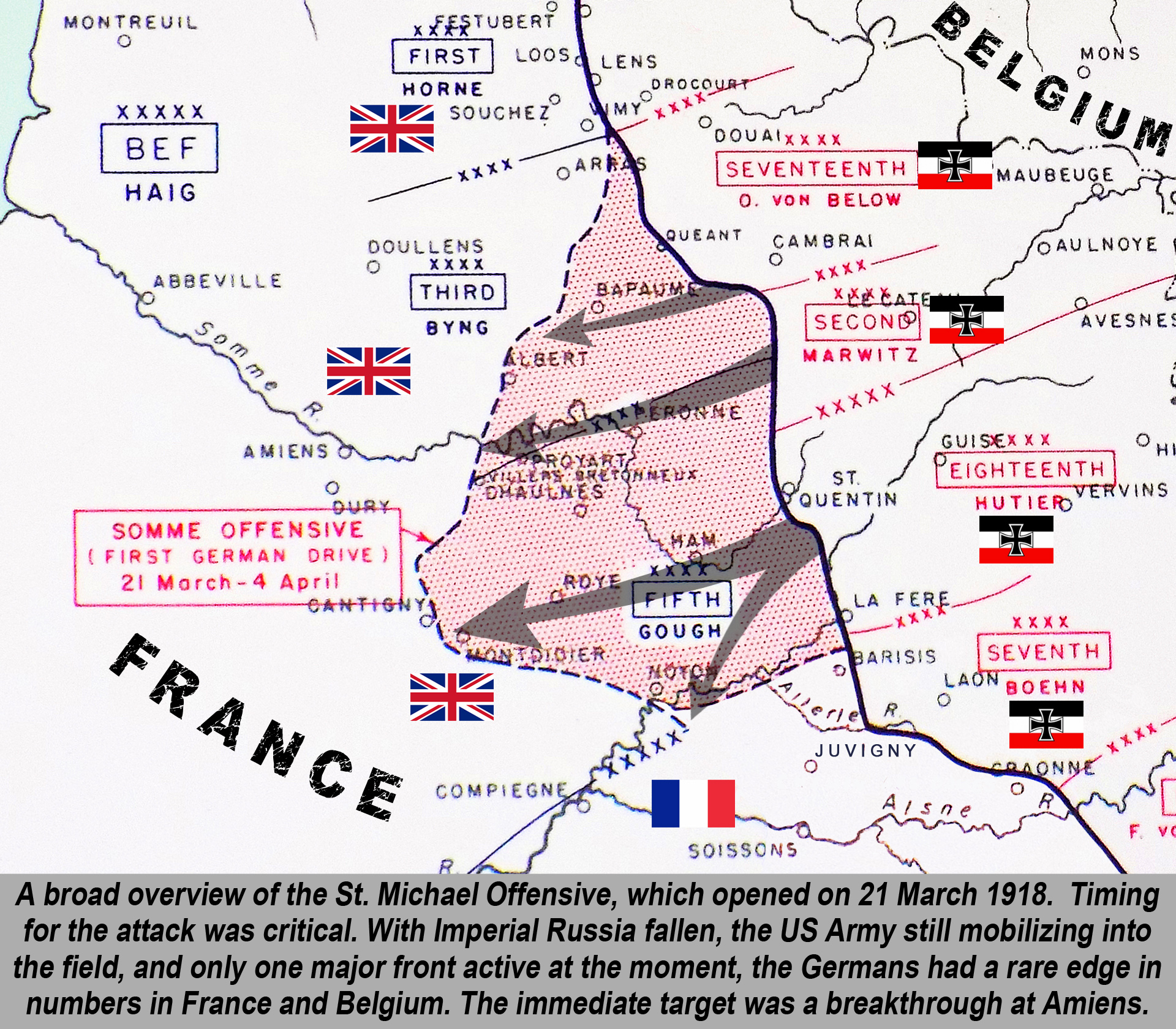
Named after Germany’s patron saint, the St. Michael Offensive launched on March 21st. For five hours, over 6,500 guns and 3,500 mortars plastered the sixty mile front of the British Third and Fifth Armies along the Somme. Then, sixty-five divisions of the German Second, Seventeenth, and Eighteenth Armies shoved forward.
The British reeled back, their Fifth Army, in particular, taking hideous losses. At least for the moment, the Germans seemed to have finally broken the trench stalemate with the largest territorial gains since 1914. A big factor in this success was the use of new “stormtrooper” units and tactics, which Sven discusses in more detail below.
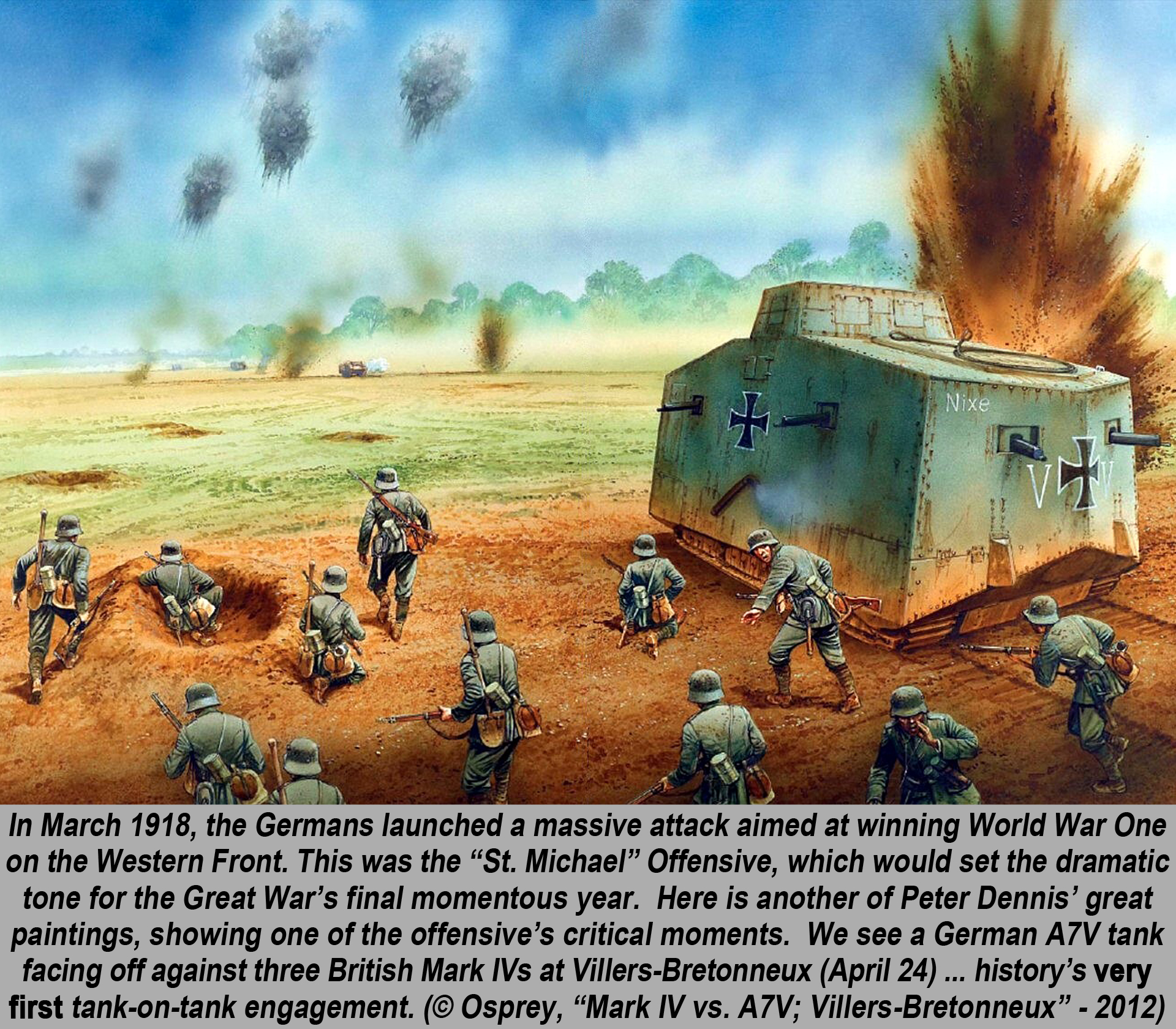
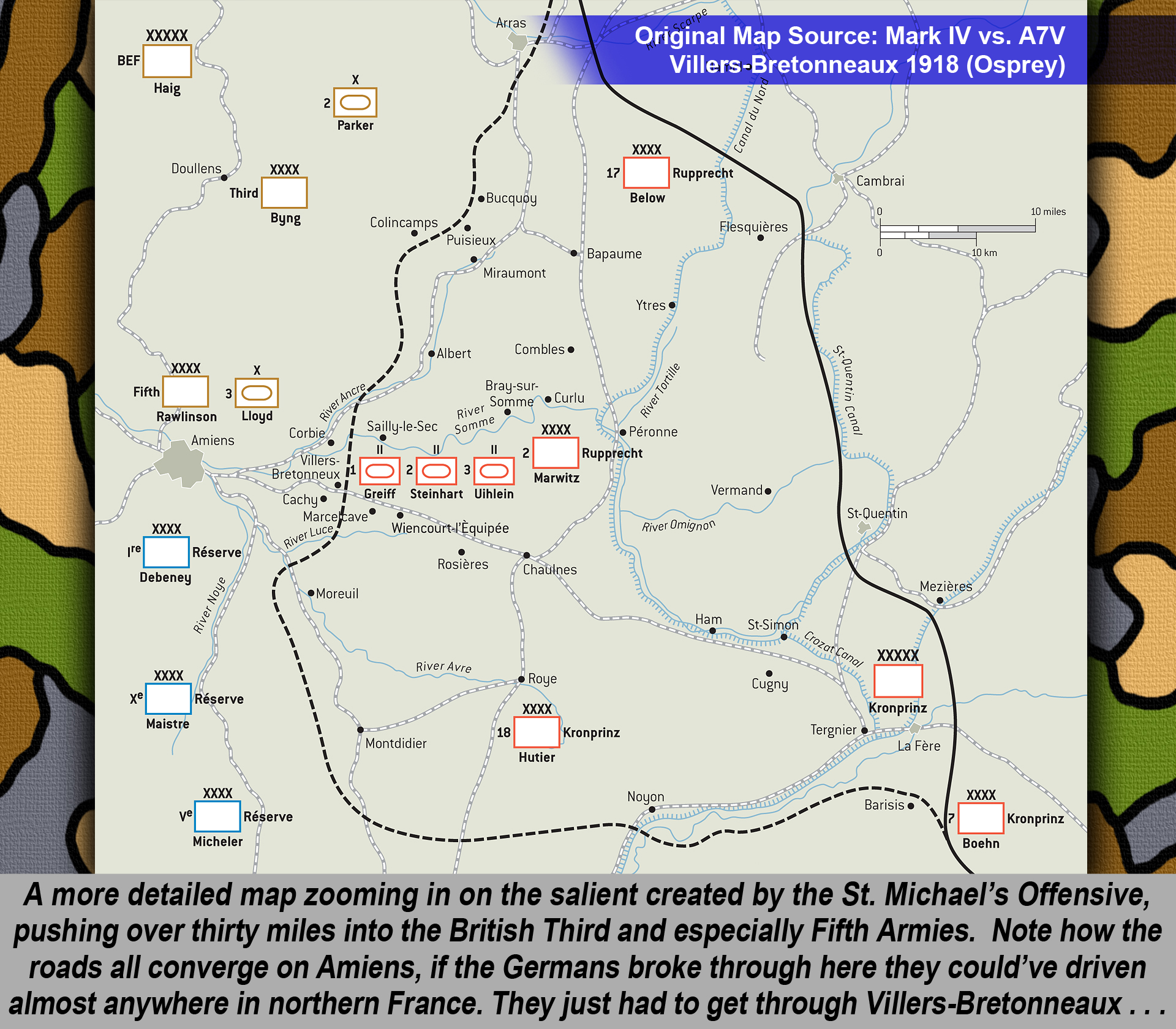
The German objective was a breakthrough at the city of Amiens. But they were finally halted just short of this target in a series of battles around the town of Villers-Bretonneaux, a landmark moment because it would see history’s first true “tank engagement” - with opposing tanks actually firing on each other in combat.
Yet despite desperate efforts, the Germans would fail to break through to Amiens. Thus, other offensives would have to be launched, covered in Parts Three and Four of this series.
Sven Gets Down To Details
Not Just A Military Necessity
As Jim has pointed out; this was the big one for the Germans and they knew it. This offensive had been planned not only to get a military victory but to end the war and dictate the peace. Or at least come to the negotiating table as equals...
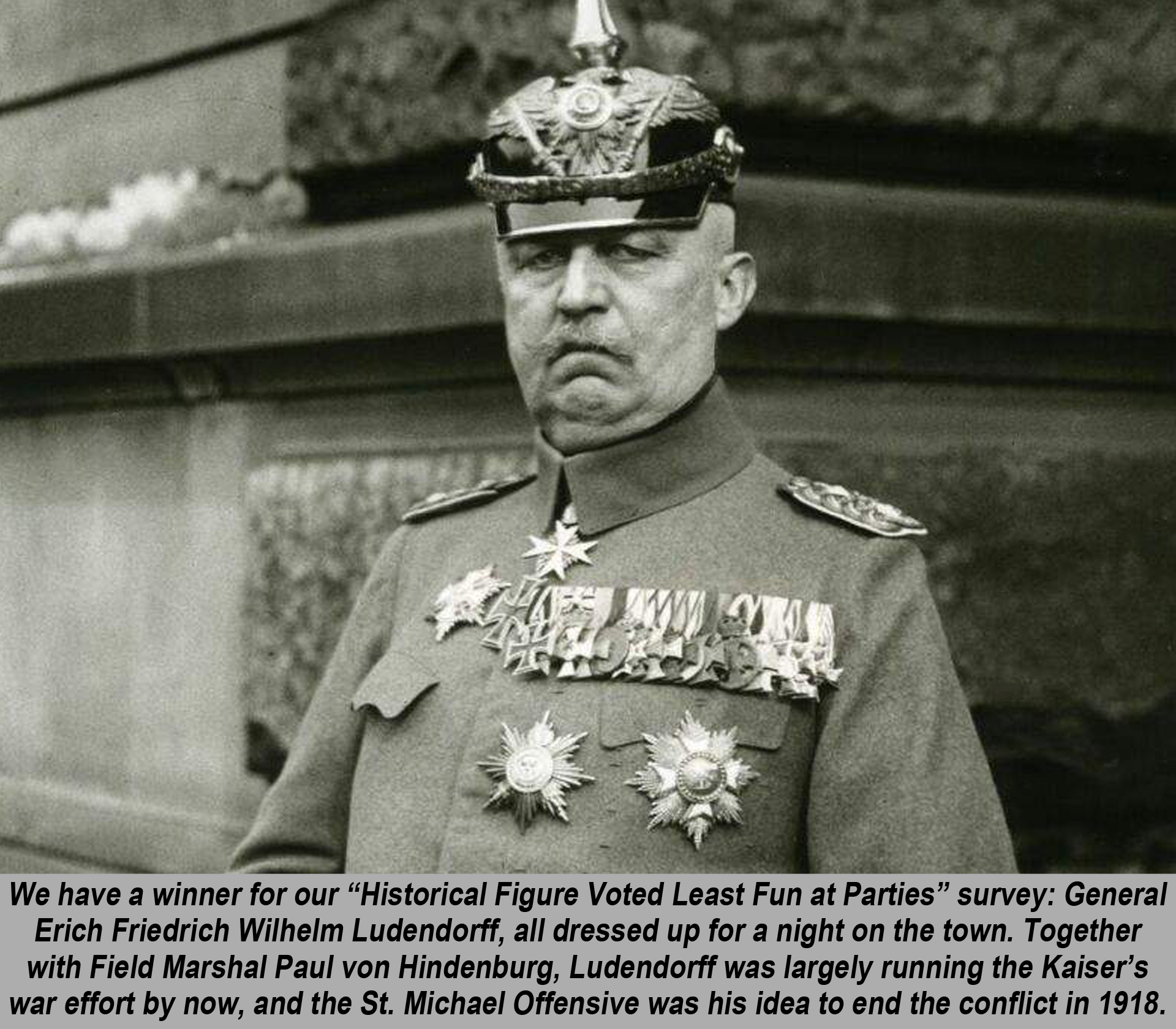
The situation at the German home front had made it clear that the war could no longer go on, both politically and economically. The Social Democratic Party was gaining support against the war and gradually swaying public opinion against the military dictatorship of Ludendorff and Hindenburg.
Fuelling this growing feeling of dissent was the deteriorating economic situation. Since 1914 the British Navy had been blockading German ports and preventing foreign products, including food, from entering the country. By 1918 hundreds of thousands of civilians would have been starved to death.
Bewegungskrieg/War Of Movement
One of the defining aspects of the St. Michael Offensive would be the speed at which the Germans broke through the line. In 1806, The Prussians had learned what speed meant at the hand of Napoleon and had studied this aspect of war throughout the 19th Century.
Generals like Clausewitz, Moltke and Schlieffen had passed on their views on warfare to the World War One generation of Prussian officers. So really most German generals (disregarding Falkenhayn) had not forgotten that war was all about movement, it’s just that the stalemate got in their way.
For their last big strategic offensive, they would have to apply all the lessons from the previous years to force a decision. If there ever was a do or die moment for the Germans during World War One, then this was it.
Innovation
In Part One we saw how trench warfare had been around for centuries and how industrialised warfare had led to a stalemate. The operational and tactical advantage had shifted to the defender. The many failed offensives of both sides had shown how costly in lives that could be.
Before we dive into the actual offensive, we’ll take a look at the innovations that the Germans had developed throughout the war. Ludendorff himself had already published writings on both defensive and offensive tactics in positional warfare in 1917-18 and had these taught to his subordinates, sometimes down to company level.
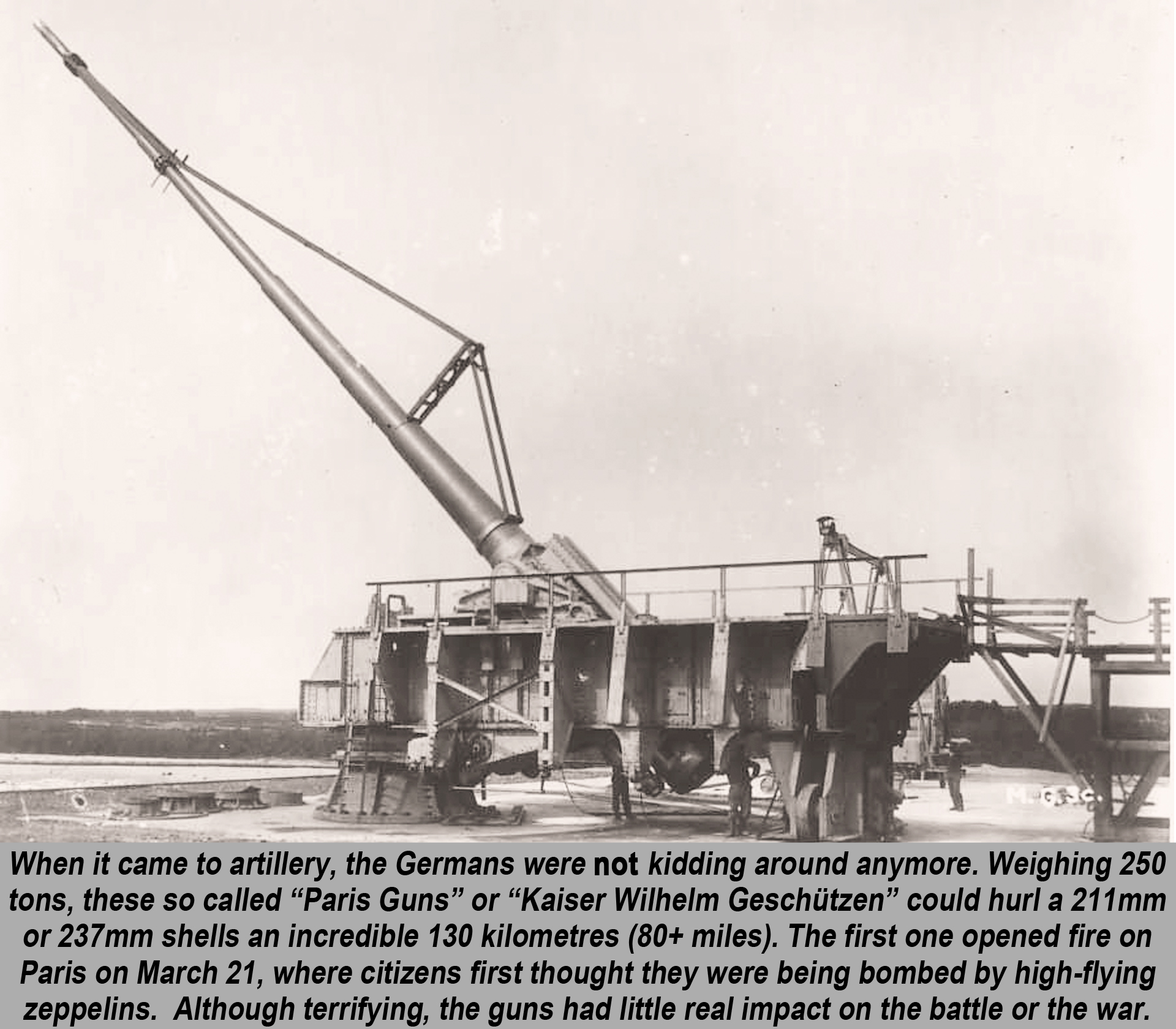
One of the bigger innovations came from the artillery officer Georg Bruchmüller. He had successfully commanded large artillery formations on the Eastern Front during the Russian Brusilov and Kerensky Offensives in 1916 and 1917. Unlike the Allies, who favoured long artillery barrages, Bruchmüller advocated short intense barrages. He would eventually be known as Durbruchmüller; Durchbruch meaning breakthrough in German.
These were less aimed at destroying the entire frontline and causing mass casualties but trying to disrupt the enemy as much as possible. His barrages would only last five hours and used three phases. First, attack the enemy troops with gas. Then hit their guns with a mix of gas and high explosives, and lastly a creeping barrage of high explosives to screen the German infantry attack.
The other German innovator was Oskar von Hutier; a German general who had served in the west and east since 1914. He had studied enemy tactics like the successful Russian Brusilov offensive of 1916 where the Russians had penetrated the Austrian line at their weakest points using smaller, specialised units. Von Hutier would take this approach and formed the now famous Stoßtruppen or stormtroopers.
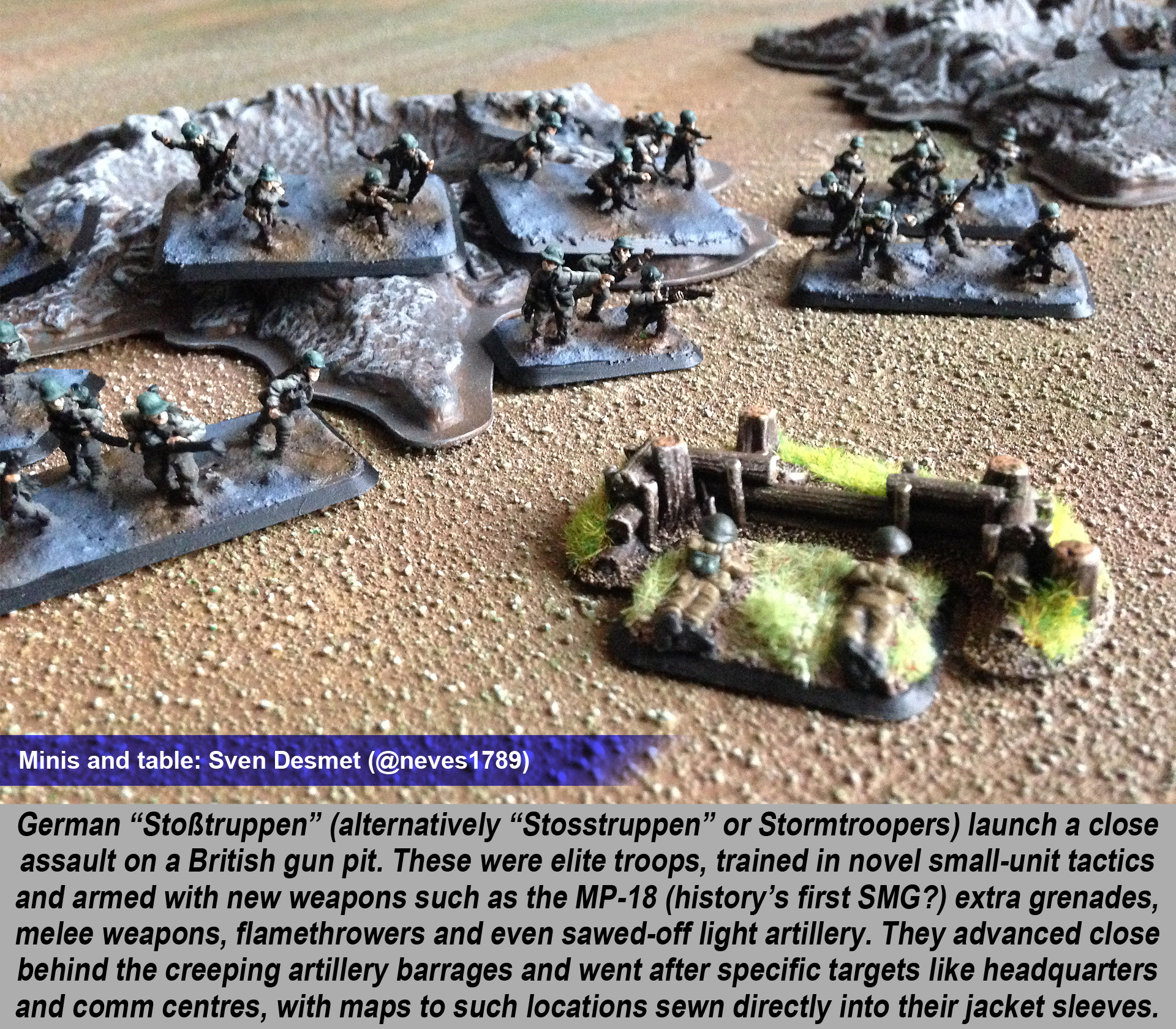
One of the main tactics employed by the Stoßtruppen was infiltration. They would follow the creeping barrage into the enemy trenches and push beyond, ignoring strongpoints to isolate and surround them. Reserves would push into these breaches instead of onto the strongpoints as had been the case in earlier battles like at Ypres or Verdun.
The close combat power of the Stoßtruppen was also increased through the use of the lighter MG-08/15 machine gun and the famous submachine gun, the MP-18. However, most Stoßtruppen were equipped with pistols, hand grenades and close combat weapons like knives and spades...all intended to maximise shock upon the enemy and keep the offensive going.
Putting It Into Practice
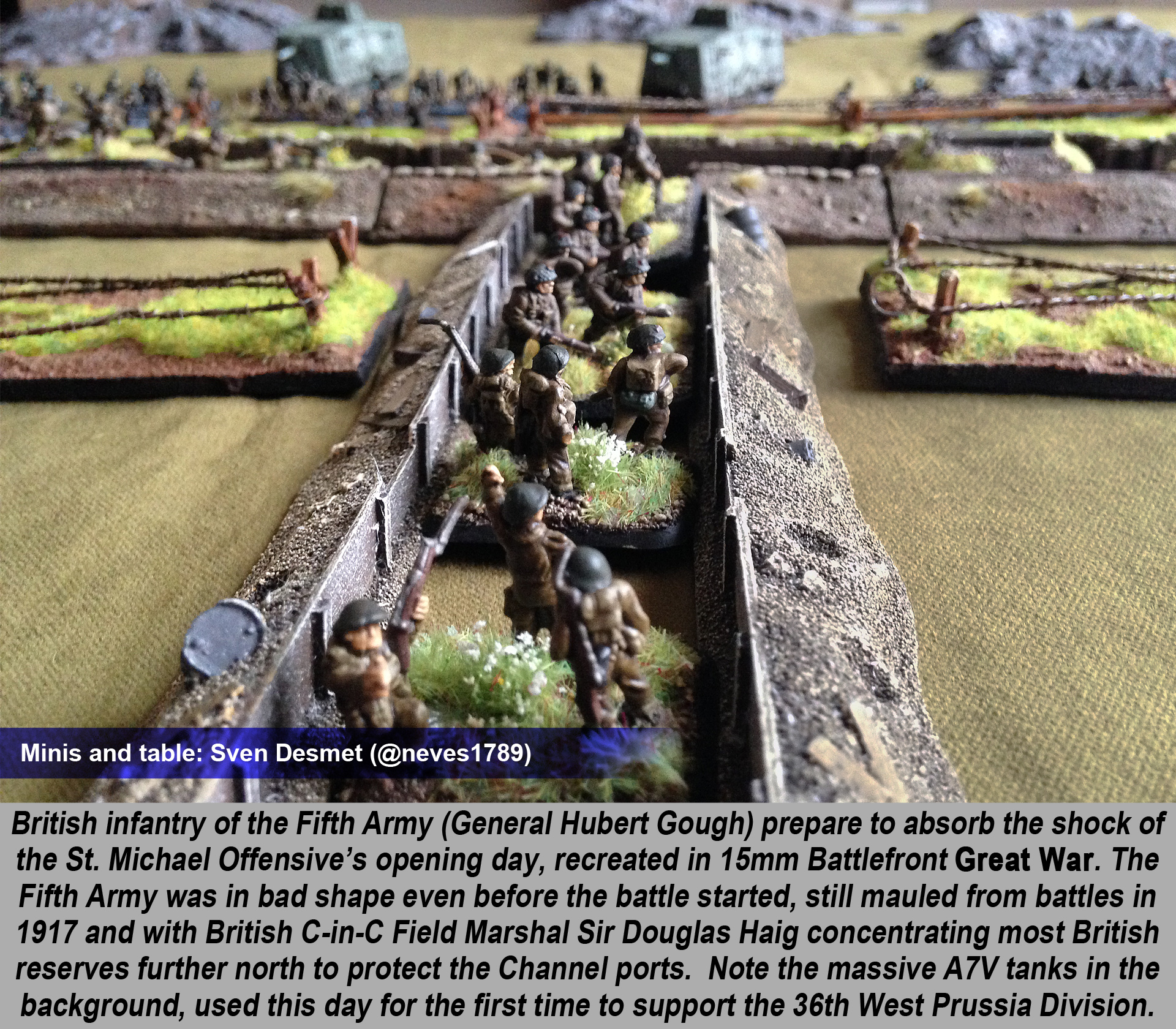
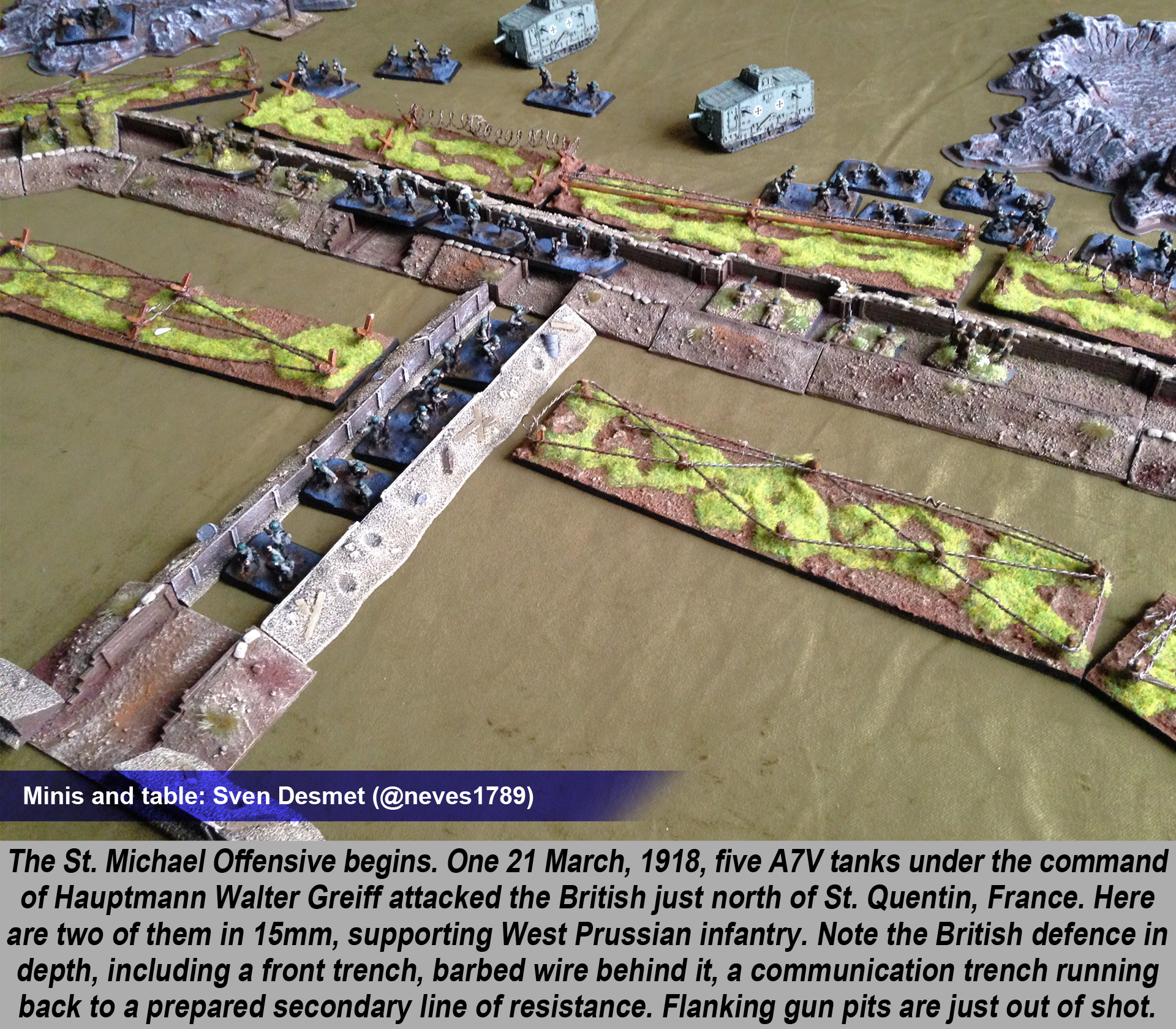
All these theories culminated on March 21st, 1918 with the start of Operation Michael. Ludendorff put the centre of his offensive on the Somme at the point where the French and British armies met and tried to drive a wedge between the Allies. The German Eighteenth Army under von Hutier pushed southwest to drive the French from the Aisne and threaten Paris for the first time since 1914.
Meanwhile, the German Seventeenth and Second Armies pushed the British Fifth Army back from the Somme and aimed at the important rail hub at Amiens. Capturing this town would severely hinder the Allies lines of communication and might even see the British thrown out of the continent.
Indeed the British suffered heavy casualties as the new German tactics wreaked havoc on the regular British soldiers.
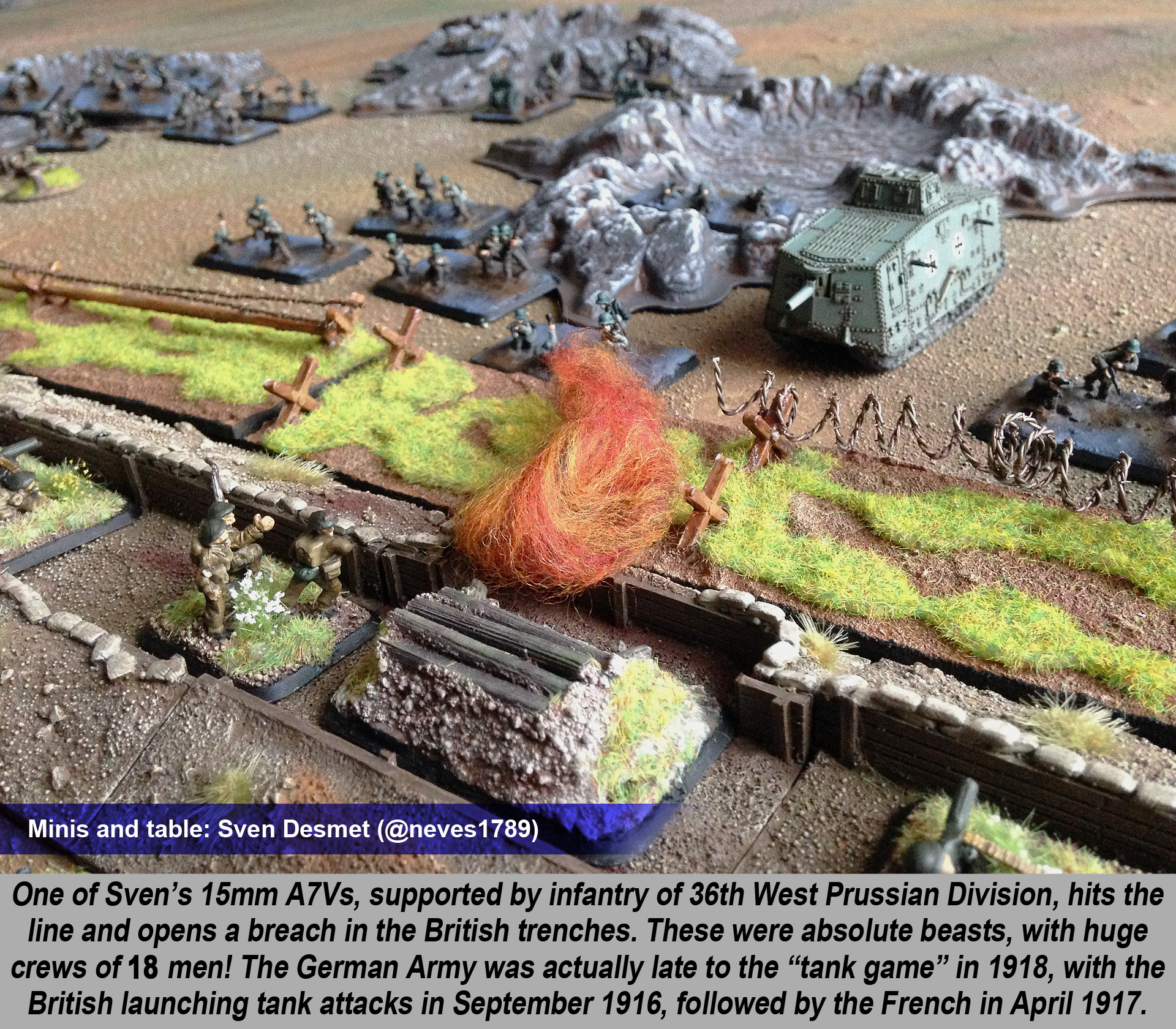
In fourteen days the German Stoßtruppen had broken past the trenches, pushing sixty-five kilometres (forty miles) into the open fields beyond, an astronomical distance by Western Front standards. Allied resistance, however, had not completely crumbled and all these gains did not come without a cost. Many of the best trained and experienced German troops had now been killed or wounded or were simply exhausted.
When after two weeks, the offensive came to a halt, the Germans found themselves in an overextended salient with the Allies recovering and reinforcing. The offensive had failed to reach its strategic goal and stalemate had returned. They would, however, keep up the offensives as we’ll see in Parts Three and Four.
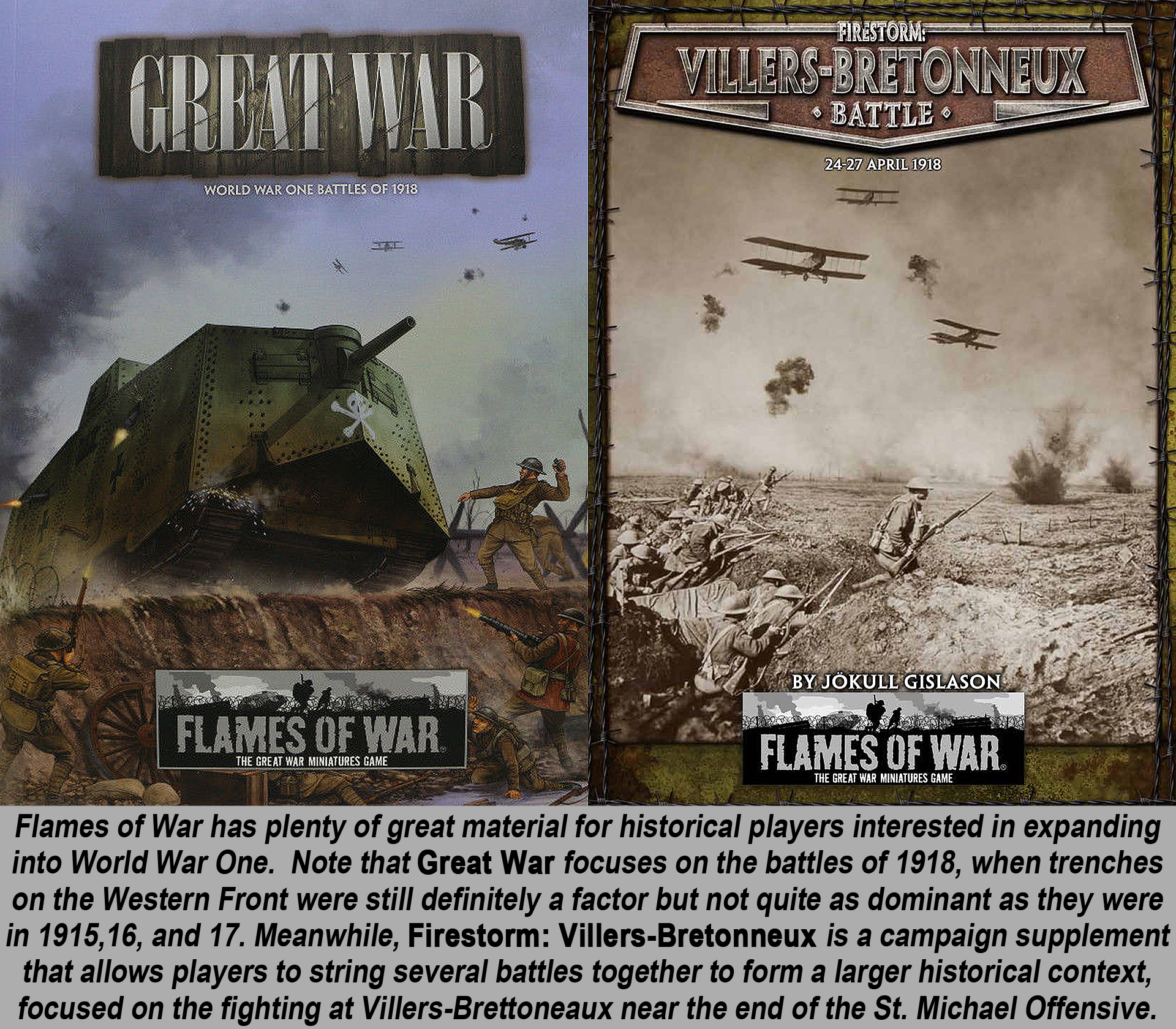
In Flames Of War: Great War
Flames of War Great War brings the Stoßtruppen to life through a number of special rules and equipment that reflect their character and allows players to recreate the St. Michael Offensive. A Stoßkompanie or assault company is equipped with pistol and MG teams and the odd SMG and flamethrower.
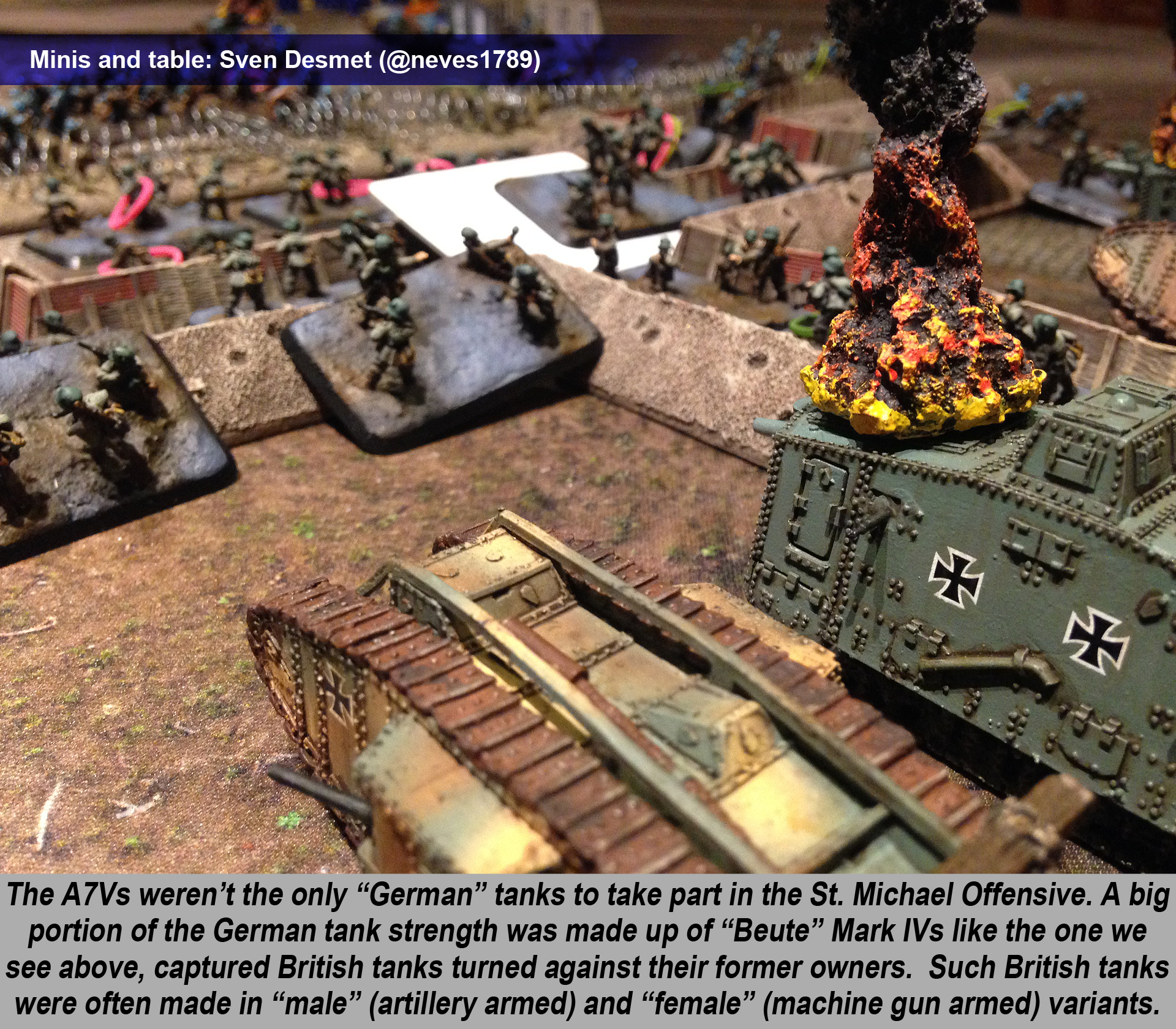
They give the player the option to perform a night attack, making everything harder to see and hit. They can also use the spearhead rule, allowing them to deploy further into No Man’s Land. Combined with a “Fearless Veteran” rating, the best in both skill and morale, it makes these guys tough as nails on the tabletop.
The scenarios covered in the book perfectly suit the St. Michael Offensive, going from a standard trench attack through to a more mobile battle for the second line and then eventually the green fields beyond. This also works great as a mini-campaign like my Great War opponent (@Erik101) and myself have been playing.
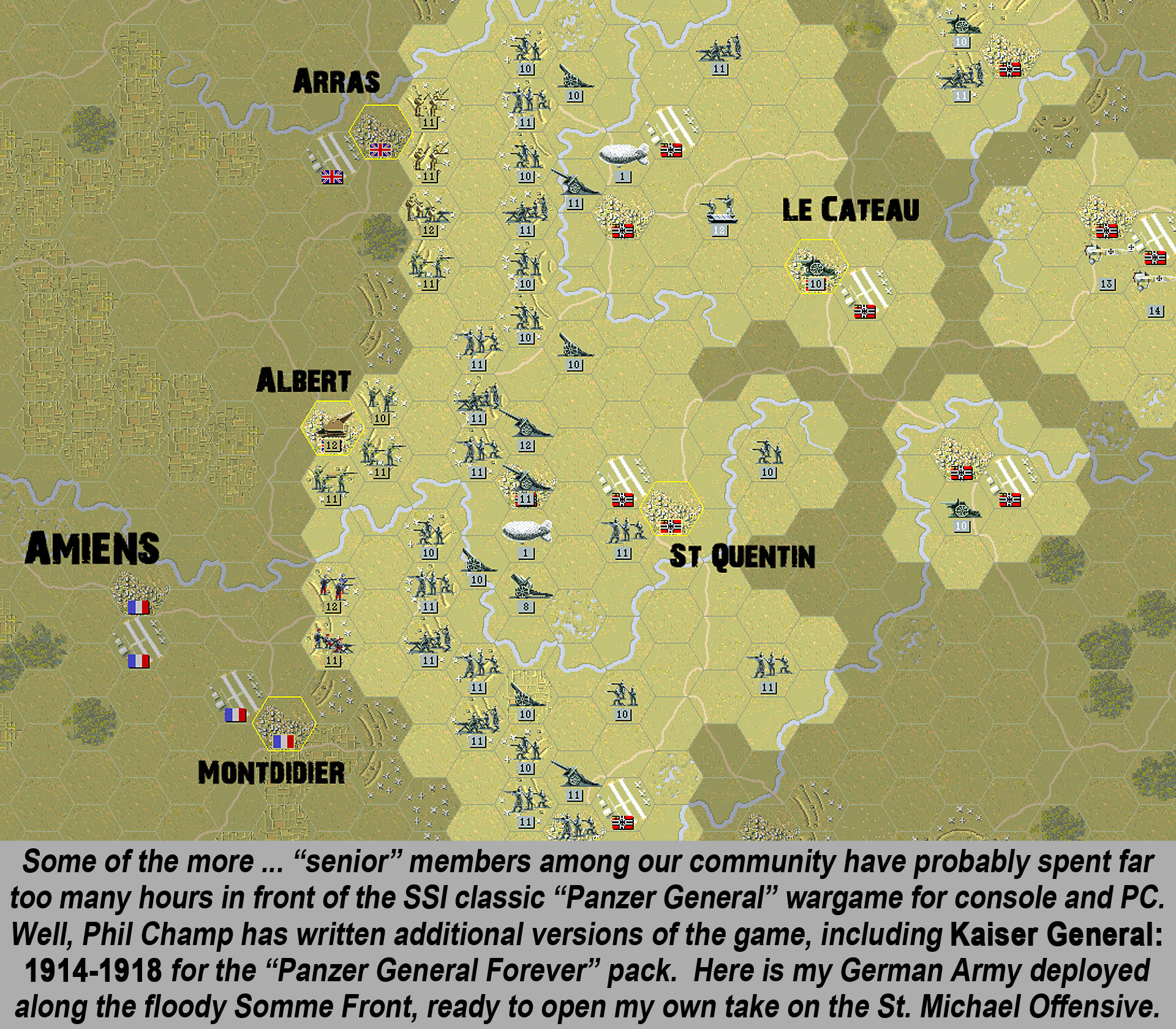
In Part Three we’ll be taking a look at how the Allies countered these tactics and how artillery and tanks played a role both in real life and on the tabletop. The last big German strategic offensive had failed, yet it still had not brought an end to the war...
Oriskany’s Debrief
We hope you’ve enjoyed this second look at centennial gaming in the Great War. Have you tried any “storm trooper” tactics of your own? How would you handle a trench breakthrough in your wargaming?
Post your questions, feedback, and comments below, and keep the conversation going!
"At the outset of 1918, Germany was faced with a “good news, bad news” situation..."
Supported by (Turn Off)

Supported by (Turn Off)
"One of the bigger innovations came from the artillery officer Georg Bruchmüller..."
Supported by (Turn Off)




![StarCraft Tabletop Miniatures Game Pre-Orders Live Now [Updated]](https://images.beastsofwar.com/2026/03/starcraft-tmg-news-cover-600-338.jpg)

![Mounted US Cavalry On Kickstarter For Dead Man’s Hand! [Updated]](https://images.beastsofwar.com/2026/03/us-cavalry-main-600-338.jpg)
Very informative article. I feel the urge to start painting some 15mm WW1 figures, fortunately I have a load awaiting paint from the Great War Kickstarter.
Thanks very much for kicking us off, @gremlin ! I’m noticing that many of the 1918 WW1 15mm figures looks very similar to 1940 BEF and French Army figures, even the Germans look very similar in 15mm (at least early WW2). The tanks and artillery, however, of radically different. I might get a 15mm A7V just as a display piece, with that huge block shape and the rivets, it’s just such a beautiful disaster to look at at. 😀
Thanks! They’re great fun to paint, the 15mm scale just works so well for anything around company level.
Another great article! Interesting how the outcome in World War I seems to be in doubt much later than it was in World War II. Looks like @oriskany and @neves1789 make a great team!
Thanks very much, @pslemon ! There’s actually a third person that should be in these credits,@neves1789 mentions him in his text and I could have sworn I put him in the photo credits – that’s @erik101 . I’ll have to check my originals, I was certain I re-uploaded replacement images with his name in those blue credit bars, but I might be losing my mind again. Half the miniatures and terrain in those WW1 table photos are his, though, and we want to make sure he’s recognized for his part in helping Sven and I put this series together.
Thanks for the reply! Working with @oriskany has been awesome 😀
I also just noticed that @erik101 wasn’t mentioned on all the pictures but I’m sure he won’t be too upset 😉
Here’s what happened – I was under the impression that @erik101 ‘s miniatures were in the photos with French and German troops in Parts 01, 03, and 05. These were photos @neves1789 took for me after I realized we needed British troops featured in the St. Michael / Georgette offensive material.
So if some of these British minis in Part 02 are his, I do apologize.
No worries @oriskany, it’s only the last picture in fact that was taken with his terrain, though it’s only showing my mini’s. 😉
I don’t think after 1914/15 the result was in doubt. I think it needs mentioning what the British blockades of German ports was achieving and even Ludendorff realised something needed to be done before the German people rose in revolution in their opposition to the continuation of the war
Thanks @torros 😀
>>>>
Correction to my earlier correction re: @erik101 🙂 (apparently I’m still asleep this morning) – His miniatures were in the photos with French and German troops in Parts 01, 03, and 05. These were photos @neves1789 took for me after I realized we needed British troops featured in the St. Michael / Georgette offensive material. The photo credits are in fact correct. 😀
another great article 🙂
Thanks very much! 😀
Thanks @commodorerob ! You’ll be pleased to hear we’ve managed to get some naval action in part 5 😉
Do the Entente get the Spearhead rule as well?
I would defer to @neves1789 on this one, but I don’t think so.
From WWPD page on FoW Great War: German Army Lists: they seem to single out Stoss platoon for “Stosstactik” and “Spearhead” rules. Hardly conclusive, of course.
The Stoss Platoons. What many German players are going to be drooling over. These boys are fairly pricey, and are always Fearless Veterans. So the basic buy is 6 pistol teams and a MG team. You can add an additional pair of pistol and MG teams, and also add a flamethrower. The command pistol can be swapped for a SMG. All of the pistol and SMG teams are Tank Assault 3. The platoon also has series of “Stosstactik” rules (I love that term!) – they always hit on a 2+ in assaults, they have Mission Tactics (same as WW2), and if you are attacking and have at least one Stoss Platoon deployed, all of your Stoss AND Infanterie Platoons may make a spearhead move! Last, but not least, having a Stoss Platoon gives you “Always Attacks”, unless you also have an Artillery Battery (in which case you gain “Always Defends”.
No, although they get some other special rules. The French get Quick Fire, rerolling failed hits with their 75’s and They Shall Not Pass, rerolling failed counterattack tests. The British get British Bulldog, also rerolling counterattacks. The Americans get rerolls on their unpinning tests and don’t need command teams to assault.
The mission specific rules offer more flavour though and really give the game a WW1 feel.
I think it bears noting (at least I’m pretty sure on this) – that Battlefront was going for a 1918 feel for these rules. The mechanics and dynamics for a battle taking place in, say, 1914 would be quite different.
Oh absolutely! I’d even dare using an ACW ruleset for 1914 ^^
There is a rule set called Bloody Big Battles which covers mostly 19th century large battles but it has been adapted to the Balkan Wars and the early days of WW1. Its basically a cut down version of Fire and Fury but although I haven’t played it myself seems to have a small but loyal following
“I’d even dare using an ACW ruleset for 1914” – with a few mods, yes. From what I understand belt-fed machine guns like the Vickers, Maxim, and MG08 were in use, but few enough that a little tweak in the rules or adding a new unit for “machine gun companies / battalions” (depending in the scale in question) would probably straighten that out.
Repeating rifles of late ACW might be close enough to bolt-action rifles of 1914 for an approximation. Care has to be taken, though, battles like 1866 Königgrätz show the devastating difference between even rudimentary breech-loading weapons and an army still armed with classic ACW-era muzzle-loaders.
The biggest hurdle (and again, this would depend on what scale you were working with) might be breech-loaded artillery.
@oriskany you wouldn’t have to worry too much about Machine Guns in 1914 since everyone except the Russians only had two guns per Battalion. The Russians had 8 but since officers were responsible with their lives if anything happened to the gun they tended to be pretty far away from the action.
I would just increase a unit’s firepower to represent the two MG’s. Breech loading artillery is very tricky though.
@elessar2590 –
*** “you wouldn’t have to worry too much about Machine Guns in 1914 since everyone except the Russians only had two guns per Battalion.”
Right, this is pretty much what I was thinking. My only question would be about separate MG units (not in the battalions, but in their own) which so many armies seemed to embrace in earlier years. Whether this would be a factor in 1914 I honestly don’t know, I don’t THINK so, but wanted to leave it open as a possibility in my original reply.
Breech loading artillery, yes. In most unit-based games (as opposed to wysiwyg games) – an attack factor is caliber x rate of fire, and of course ROF goes way up exponentially with breech loading.
@oriskany Bloody good article again, Always amazed at how a simple idea like the Stormtroopen worked, we off course know it was used again and with armour in WW2,
Be interested to read the next bit on how they countered it,
Like a lot of my historical reading, did it ages ago so nice to get a refresher,
Particularly as I’m considering doing a Masters degree on War studies in the next year if I can sort out the pesky living expenses thing.
I think it needs remembered the Germans lost a lot of men in Operation Michael ( I think about 200,000) Probably their best troops to be honest that they were going to be hard replacing that experience. A bit like the initial attacks in 1914 they tired themselves out and found it harder and harder to resupply as the days wore on
Very true. This is all covered in future segments, especially the Spring Offensive / Kaiserschlact overview of Part 05.
Am I jumping ahead too much Jim?
No, @torros, I just wanted to make sure our readers knew we didn’t “miss” this. We are limited in how big we can make these articles, and therefore can only include so much information per article. The series is developed and produced as a body (and even then of course we can’t get everything). But rest assured, we do get to this.
Meanwhile, if we don’t address perceived omissions, people get the wrong idea. It’s an unfortunate side effect of publishing in a “sniper-rich” environment of the internet. Everyone has to prove how well-read they are (short of putting int the work to publish content, of course).
Meanwhile, no worries about skipping ahead. After 100 years, I think we are in “spoiler safe” territory. 😀 😀 😀
Thanks very much, @bobcockayne – Always glad when people appreciate the effort myself and other content creators put into a project like this.
Like most great ideas, military or otherwise, the success of things like the stormtroopers comes not in its “high concept” but in the details of its execution. “Greatness comes not is doing extraordinary things, but in doing simple things extraordinarily well.”
Aircraft, tanks, poison gas, that’s all fine, but as late as 1918 Germany was practically destroying whole British armies (Fifth, for example and almost the Third) primarily with much older tools like infantry and artillery, just with better doctrine – as @neves1789 puts much better than I. 😀 It’s not “big boom” tech, it’s how the tech is used, which admittedly sometimes means “enabling tech” like RT, radar, etc.
@sven must not forget to give you praise for your bit,
Haha thanks 😀
That master’s degree sounds real interesting, does it specify on a historical period or is it more based toward modern application?
How inspiring. There is one thing I want to mention first, and this is the accuracy with which things are described and explained here. This is truely splendid, and for this I will confer the “Pour le Merite” to both @oriskany and @neves1789 . And that´s even before I read the last three parts. 🙂
One of my historical sources has it that even if from 1917 onwards the eastern front didn´t see much or any fighting any more, still there were around a million men locked down there. I wonder if the offensives 1918 had been successful had those troops been included into the attack on the western front.
Good to mention Ludendorff´s military dictatorship, many people forget this is what it was. Some people wonder why Ludendorff wasn´t accused and sentenced as a war criminal. Just like Falkenhayn the “White-bleeder”, he should have been.
As for the political side in Germany, the Social Democratic Party is really a great issue. The Acronym is SPD. There were discussions in German parliament about financial support for the war effort (Kriegsanleihen = war loans). Some of the SPD wanted to support it, some did not. That meant trouble. It culminated in the split-up of the SPD into the remaining SPD and the USPD, U (unabhängig), meaning independent. This was a terrible blow for the left wing of the German political landscape of the time, even more so, because the USPD was just as the SPD opposed to the Communists. May be a united opposition might have ended the German war effort, but it wasn´t meant to be. They preferred to fight each other.
As it happens only a few months ago there was an article in my favourite military journal dealing with “How Germany revolutionized its infantry”. They were called Sturmbatallione, meaning assault batallions. They were founded in 1915 already, then called “Assault Department Calsow” after their then leader. Later they were to become “Sturmbatallion Nr. 5 (Rohr)”, named after their commander Rohr. He was largely responsible for training and developing tactical doctrine and such like, including new attire and quipment, Minute planning and observation of enemy positions down to MG nests.
Sturmbatallions were thrown into action on a large scale in Verdun 1916 already, and of course as we learnt during the St. Michael´s offensive and Champagne offensive, both the latter in 1918. In the course of time more and more Sturmbatallione were set up.
What is quite interesting is that the stormtroopers were not only fighters, but also instructors and teachers for ordinary troops in order to inject the stormtrooper spirit into all the German army. That went so far that they even weren´t deployed some times, because the army didn´t want to loose there specialists.
They were treated quite well, their resting time and facilities being remarkably longer and better than those of ordninary soldiers, what made the latter “a bit angry”. Those stormtoopers made the advance, the line infantry would occupy the captured territory and trenches, stormtroppers retreat to their “hotels”, the line infantry would finally have to face the inevitable counterattack and the retributionary artillery barrage. “Damn those ***peep***!”
The stormtroopers carried more handgrenades with them than other soldiers, in bags around their necks or even tacked to the back of their uniforms for their comrades to get and haul them (grenades, not the comrades :-)). And they had soft leather boots as opposed to the stone hard army boots of the ordinary trooper. Stormtroopers never carried backpacks, making them much quicker. Maybe the British on the Somme should have left their backpacks, weighing about 30 kilos, behind, to cross the no mans land a bit quicker and of course in the time planned by their so-called tacticians.
As for gaming, this is the first time I saw the Villers-Bretonneux supplement for Battlefont´s “Great War”. Is that still obtainable? I own the WW I rulebook already. Are there any new features in the supplement?
What came across my mind looking at the picture of the 5 A7Vs attacking was that the Germans on this occasion deployed 25% of their very own tank force. Just 20 of those beasts were made. If you´d have read “The Germans attacked with 25% of their tank force” one might have thought “Oh, an armoured tempest”. Ok, a little one …
Only yesterday and the day before yesterday I had the American marines push forward into the outskirts of Manila in 1945, fiecely defended by the Japanese. As always, movement, firing at enemies in fortified positions and speed are/were quite important. I like Bolt Action very much, and for fighting with stormtroopers in WWI, the units of which consisted only of very few men, Bolt Action seems appropriate.
I had first ideas for my first WWI tweaks for Bolt Action: The stormtroopers may move further two inches (no backpacks, quicker movement), very difficult terrain becomes difficult terrain and attacking enemies in fortified positions gets a bonus and attacking enemies in trenches denies them cover (many handgrenades).
Any further ideas welcome.
If anyone wants to build up WWI forces, there is much in plastic on offer for 20mm. Companies HÄT, Emhar and Zvesda, Strelets are quite good, and especially the emhar minis take acrylic paint quite well. They also have artillery pieces. Btw, the best French minis still are the Airfix lads for me: Unlike those in many other sets they wear the Adrian helmet. Unfortuntely the Revell French and Germans are not available any more. Although the Revell minis always depicted giants compared to the size of other companies. And if I remember correctly people were a bit smaller at the time …
Looking forward to next Monday and bear in mind: “March separately, strike together!” (Moltke). “Make my right wing strong!” (Schlieffen).
Thank you guys.
@jemmy – wow the Blue Max? I don’t know if I deserve that. I know @neves1789 does, but I think we already gave him the “Croix de Guerre” as well. This guy won’t be able to stand up soon under all his medals.
I’ll settle for the World War I service medal,
https://en.wikipedia.org/wiki/World_War_I_Victory_Medal_(United_States)
… with bronze star for second award (after our “Heroes of Limanowa” article series last year).
Yes, both Sven and I have been working very hard to ensure our accuracy is at the highest possible standard. I say possible because we are limited in size and length of these articles, and we do have to generalize from time to time.
I know that with Russia’s exit from the war (after the fall of the Romanovs and then the Kerensky provisional government), the Germans were able to pull many more troops out of the East and send them into Ludendorff’s “Kaiserschlacht.” I don’t know if they were able to send them all, of course. With Russia descending into civil war, I’m sure at least garrison forces were kept in place.
Regarding Ludendorff’s politics, many also forget the degree to which (in later years) he backed and legitimized Hitler in his early career.
Very interesting to read about how stormtroopers were also employed as instructors to other infantry units. I did not know that.
Stormtroopers carried more hand grenades – YES. Sven touches on this in his series, and Alex and I have been hitting this point quite a bit in our Valor & Victory “WW1 Edition” gaming in scenarios using stormtroopers. Not a higher attack value (albeit at a shorter range) and enhanced close assault / melee values, but a more generous mix of support weapons like MG08 / 15s, 7.58 cm minenwerfers, grenades, and of course MP 18s *not really a support weapon, of course). More in this equipment mix in Part 03.
The Villers-Bretonneaux supplement prominently features a linked-scenario campaign mechanic, where players can string together a small narrative that helps recreate the larger picture around Villers-Bretonneaux and the Amiens Salient in general.
Thanks again for the great comment!
The Russians had serious problems coming to the table since the Bolsheviks wanted peace but didn’t want huge chunks of Russia leaving the nation and the Germans at one point in 1918 did reoccupy Russian territory. The Germans wanted to split as many countries from Russia as possible and used that as the excuse to keep the pressure on.
The Germans were also pretty involved in the war in Finland with Mannerheim preventing the new nation from falling to Communism.
The Russians only real threat was “if you don’t give us peace we’ll start a Communist Revolution in your country” but since the Germans financed and aided the Russians Revolution they doubted the Russians could pull it off.
Thanks very much, @elessar2590 – yes, I have read that, where on his return to Russia, Lenin apparently traveled by closed train through parts of Germany and along the way made a pit stop for a hefty piece of German funding to cause problems in Russia … definitely an embarrassing secret the Bolsheviks wanted hidden in the late teens and early 20s (Russian Civil War years).
I did not know about the Germans involved in Finland. Was this during World War I or afterwards during the RCW / Friekorps era? I honestly don’t know. My friend @aras has a lot of relations from Lithuania, and family memories about German influence there in the interwar years.
During the war. The Finnish Civil War was January to May 1918.
Yep and not only did Lenin get his initial backing from Germany he continued to receive German support right up to the Revolution. It actually came out a few weeks before the October Revolution but the Communists managed to keep it quiet aside from the intital week or two before things in Russian went completely insane.
Russia … 1917-1922 … that’s definitely a violent slice of history right there.
Another amazing article guys.
@neves1789 how did you find the Flames of War rules for using Tanks? I’ve played some WW1 Flames but never used tanks. Do the rules feel a little clunky or do they add another layer of period feel?
great stuff guys good to get some meat on the bones as its more WWII I have mostly read over the years.
Thanks very much, @zorg ! I agree it’s always great to expand the topics when it comes to historical wargaming. It’s not like we have a shortage of material or anything! 😀
That’s for sure @oriskany.
🙂
Ok, shame on me! I completely missed the first day of article two.
Another great entry. I have to say I love how much I learn in you articles without getting bored. Though I’m embarrassed to admit that of the thousands of words of well written text and the great table and map shots, my favorite image is of Ludendorf and his title of”least fun at parties” . Poor Germany, it never had a chance with guys like that in charge.
Hey, if you ask me, they were very “kind” to Ludendorff when they made him the villain in the recent Wonder Woman movie.
Oh, Hollywood. ** sigh ** Will you ever actually grow up?
Well history is written by the Victor’s so the won’t be nice to losers They have just defeated.
Well, @zorg , given Ludendorff’s wartime policies, followed by his support and legitimization of Hitler in his early career, I’d say he deserves his “villain status. 😐
He was probably a bit do lally by then?
Well, he helped Hitler in his early days and was present at the Beer Hall Putsch … in fact he was the main political weight and “legitimacy” behind it, so …
Great stuff.
Thanks very much, @c0cky ! 🙂
For me guys this article was way too short. In the same way you see a really good movie but feel you were ripped off as it only went for an hour. Then you look at your watch to see it was actually two and a half hours long. The miniatures look great. With the second installment you really hit the spot, so we’ll done to all of you.
Took me a while to get to this installment as I have been busy creating masters, molds and casting them for the Desert project. I have hit a number of auctions of eBay and got a lot of stuff, so the armies are now much bigger than the original budget could afford. On the down side my suppliers have let me down on my WW1 Mateship project, so that will not happen any time soon.
The concept of Storm Troopers using infiltration goes back as far back as 1909 with the British. The French write a paper on the subject in 1915. Then the Germans create two types of them. First one infiltrates to the front line then does a lot of raiding, destroying MG nests and field artillery while taking lots of casualties. In the earliest raids the troopers were weighed down with bullet proof steel armour which was quickly abandoned with the steel helmet that we know today was retained. The second was not about fighting and more about getting into the enemy’s rear area. Giving the Germans too very different tools for the job. By 1916/17 the British, Canadians and Russians all have their own version of the first type off Storm Trooper. A number of historians argue that the British was the most sophisticated of the type.
Going into WW1 the armies were still firing then moving which goes back to the days of muskets. Firing first gave your intentions away and attracted suppressive fire. With the advent of the machine gun and quick firing artillery not a good idea. Each army once WW1 had begun quickly came up with movement with fire, i.e. the maneuver. Then stalemate fell upon them and ways of getting around no man’s land lead to looking at infiltration and downsizing of the smallest tactical unit. The company by platoons gives way to platoons by squads. So the storm trooper and trench raiders were creations of their time to deal with the pressures this war brought about.
Thanks, @jamesevans140 –
For me guys this article was way too short. In the same way you see a really good movie but feel you were ripped off as it only went for an hour. Then you look at your watch to see it was actually two and a half hours long.
Ha! Thanks very much. We were actually kind of bursting the seams on this one, per the constraints and limitations by which we try to abide for publication. Luckily, we have three more articles in the series, and perhaps another series later in the year (Centennial for Hundred Days, St. Mihel, Argonne, Armistice).
So we may have as many as 10 articles this year on this. That’s 2500+ words each, including captions, or 25000+ words total, practically a small book. Just part of what we do here for the historical Beasts of War community.
I don’t want to speak for @neves1789 , but @elessar2590 has also expressed keen interest in collaboration on a World War One series later this year. Maybe I’ll “play matchmaker” and let Neves and Elessar work on that second series, and I’ll take a break. 😀
Glad to hear about the Desert project – that’s just one of those topics that never gets old. Sorry to hear that Mateship Project isn’t going so well. The clock is literally ticking on that one (at least if you want to hit the 1918 inauguration). Hopefully you saw some of the Americans in Tunisia articles we ran in February and March to hit the 75th Anniversaries of battles like Sidi Bou Zid, Sbiba, Kasserine Pass, El Guettar, and the Maknassy Road.
I absolutely agree that Stormtroopers, for all their extra pistols, shovels, knives, bayonets, grenades, and sometimes even flamethrowers (and in the 1918 campaigns, SMGs and MG08/15s … much more on that in Part 03) – and I think Sven hits this point very well in the text – the Stormtroopers were more about infiltration PAST the trenches and hitting high-value targets like MG nests, artillery positions, HQs, observation posts, communication centers, etc. Like most elite or semi-elite troops, you don’t put them at the spearhead of the main-axis offensives.
Great read both of you
Thanks very much, @rasmus ! 😀
Thanks @oriskany. Look forward to what Sven has to say about the stormtroops. Funny that they were active for just 3 years yet they are infused in our culture. Mention them to people who literally knows nothing about them and an almost prime ordinal fear stirs briefly in their subconscious.
Yes a did catch your 75th actual on Tunisia. Our first focus is on Gazala, @timp764 choice. Here we implement doctrine and tactics of the combatants to test them and better understand them. This goes for the troops and their equipment as well. The leadership gets the same treatment. Then it is off to the actions such as inside the box of the 150th, our backsides press against the mines and barbwire in the cauldron. We will look at Bir Hakeim with and without Kiers to get a feel for their impact on an action that should have been a simple overrun. All the games are double features meaning play a game and then swap armies and do it all over again. The person who does best over both games is the winner. None of the games are going to be balanced so double features will help with this. Underlining all this will be about building up @timp764 ‘s understanding of FoW and give him the chance to experience with other armies, sometimes this is the best way to better understand your own army.
Today I have about 60 palm trees to paint up plus some Afrika Korps AFVs to check out a style of painting for them that I am concurring.
It was a shame about the Mateship project. All I needed was two companies each of Americans, Australian and Germans plus associated war gear. My suppliers could not get them to me with enough time to paint them up and build the required WW1 scenery. However I can aim at getting it done for the Mateship 101st anniversary of US and Australian cooperation in war.
Thanks, @jamesevans140 –
@neves1789 has covered the Stormtroopers in this part of the series, in particular when he discusses von Hutier’s observations from the Eastern Front and application into a new German stormtrooper doctrine adopted and applied against British and French formations in the West.
Totally agree about the “nightmare image” in the subconscious. This is a point I touched on near the end of the article series interview in last week’s weekender. “This is the 1918 nightmare image of the German Stormtrooper with the steel helmet and face hidden behind a gas mask erupting out of nowhere” … or some such. 😀
Interested to see what you come up with regarding the 150th Brigade Box in regards to Rommel’s nearly-botched attempt to yet again dislocate the Commonwealth wing with a right hook swing around the south. We hit the topic in the Desert War series two years ago, but of course we can only get so deep into detail in these articles. In associated Desert War writing I’m able to get a lot more focused in areas of operational context, historical background, tactical doctrine and equipment, historical outcome and possible alternative outcomes based on the given range of factors.
George Lucas makes tremendous use of this fear as a tool in his Star Wars Saga combined with the old Hollywood tool that the bad guy wears a black hat. Imperial Storm Troopers just the name and we need no more explanation. The very essence of evil is a man dressed in black breathing through a gas mask. So to this very day ‘The Nightmare’ still there just below the surface.
To me storm troopers are little different to blitzkrieg in that it is a convergence point of ideas and theories that everyone is kicking around. Then suddenly someone has that moment that makes all then connections. Look around 1917 and 1918 and all the components of blitzkrieg are in place just the moment did not occur for another generation. You may say the tank is not ready but I would ask you to focus on the Whippet and FT-17 and forget the rest. Just that man prefers to reach for a sledgehammer before picking up a hammer.
Hutier and blitzkrieg both have their hammers and both rely on infiltration tactics far more. What is the use of an umbrella in a flood?
I am looking forward to taking a deep look into the Desert war. Historians tell us that brigade boxes and Jock columns are really bad tactics yet there seems to be too many successes floating around in the background for this view to be entirely correct. My research into the Lorraine tells me to scratch a little deeper for the truth.
@jamesevans140 – Wait a minute, Star Wars has a villain in black who breathes through a mask? No way! See, now I know you’re just messing with me. 😀
But dear God, no more STAR WARS! The series is dead! It’s been creatively dead since 1983! The only parts of the franchise that were good after that were some of the EU material, that Disney / Lucasfilm has now decisively nuked out of canon! *weep, sob*
I would agree that the ideas of WW1 stormtroopers and early WW2 blitzkrieg have a lot of parallels, at least in broad conceptual strokes vis-a-vis what these doctrines were trying to do. Of course the tools, capabilities, and scales of what was attempted and accomplished are totally different, so much as to make the similarities almost unrecognizable. But I agree they’re there.
I’m not 100% certain how to reply to the rest of the post. When you say “you may say the tank is not ready” and “I ask you to focus” … and I’m not sure if you’re addressing me or the community at large / others who may be reading this post.
On Jock Columns and Brigade Boxes, I would say they really are bad ideas, when used in isolation as Commonwealth forces did in the earlier days of the Desert War, late 1940 / 41. Granted, they “got away with it” in 1940 against the Italians, but once up against the Germans the flaws of how these ideas were applied really started to show (Sonnenblume, Skorpion, Brevity, Battleaxe, Crusader). Once Jock Columns and Brigade Boxes are pulled into a more tightly knit, cohesive battlefield practice, I think they work much better (Gazala, despite the overall result of the battle).
I was just as shocked! I thought Star Wars was about a father with breathing problems trying to deal with a wayward son that he had not seen since the boy was born. 😉
I completely agree about what is being done with Star Wars. I thought there were laws about interfering with a corpse? I also get the patronising comments from my grandson about that was my Star Wars and this is his Star Wars.
The realistic depth of penetration to which blitzkrieg could operate at is far greater than that of Hutier tactics. There is a limit to human endurance under battle conditions. The lack of mechanized movement ties Hutier tactics far more to the tactical than the operational. Hutier tactics did not seem to deliver the same psychological blow to C in C that blitzkrieg did. The allies recover from the initial shock and stop the German army in its tracks. While in France 1940 the allies don’t seem to get off the back foot. Here it would come down to the different time scales at which both tactics must work, foot pace vs truck pace. So both forms of tactics use the same principal of infiltration tactics it is blitzkrieg that can get more leverage from the shared principal.
As for the rest off the email I was talking to both yourself and anyone in the community while setting my position. I did not want to go over what we had been previously discussing. Such as the unsuitability of the larger tank designs if someone decided to join in.
“Your” Star Wars and “my” Star Wars. I would agree with that. “Our” Star Wars is great, “theirs” is terrible. 😮