











Gaming The American War Of Independence Part One – The Shot Heard Round The World
April 4, 2016 by crew


Welcome, Beasts of War, to a five-part article series presented by community members @oriskany and @chrisg. Our topic will be helping wargamers play their way through one of the most famous, yet misunderstood, wars in the last few centuries; The American Revolution (sometimes called the American War of Independence, or AWI).
Completely examining the causes, ideology and politics of the American Revolution would take fifty articles, and oceans of ink have already been spilled by authors far more eminent than us. Instead, we will focus strictly on the campaigns, battles, and conditions that should be understood to properly set up a game set in this conflict.
An Exercise In Perspective
Through the course of this series, we’ll be careful to remain objective. Many subscribers come from the UK and the US, after all. There’s plenty to be said on both sides, and we’ll pull no punches when it comes to drumming up a little friendly “transatlantic Beasts of War” rivalry. We’ll just make sure both views are represented.
Accordingly, Chris Goddard (BoW @chrisg), a true Yorkshire Englishman, will be writing his segments as seen by those loyal to the crown, His Majesty King George III. Meanwhile, James Johnson (BoW @oriskany) will take the role of the firebrand rebel, presenting from the perspective of patriots determined to bring forth their new nation.
An Overview For The Crown
The American Revolution, or War of Independence, or First Civil War, or whatever you choose to call it, has its roots long before the first shot was fired, and long before the Boston “Tea Party” or Boston “Massacre” you’ll hear these rebel colonials carry on so much about.
Some twenty years prior, the Crown had nobly “sorted out” a bitter and expensive war against the French of Canada and their Native American allies. Known as the French & Indian War, it was part of the global Seven Years War, which Britain had undertaken (in part) in defence of her rightful American colonies.
That war had cost a tremendous amount of money, and the Crown levied taxes to help pay a crushing war debt. It was only fair that the colonies that had been so bravely defended pay their fair share. Yet the American colonists steadfastly refused, raising quite the fuss about imagined “tyranny” and “lack of representation.”
Tensions mounted through the 1760s and early 1770s. Angry mobs attacked His Majesty’s troops in the streets of Boston, and when these men fired to protect themselves, these “Sons of Liberty” cried “massacre.” Later they’d attack our merchant ships in Boston harbour, their “Tea Party” little more than an act of organized vandalism.
All the while, the American colonists were the most free, and least-taxed subjects of His Majesty’s empire. But it wasn’t enough for them. Meanwhile, as unrest led inevitably to rebellion, our real enemies (France and Spain), seething for revenge from their disastrous defeat in the Seven Wars War, watched carefully and bided their time.
An Overview For The Patriots
Rarely in the course of history has one people tried so hard to avoid going to war with another. Leaving aside our most fervent hotheads (I’m looking at you, Samuel Adams), the absolute last thing Patriot leaders wanted was war with the British Empire. The prospect terrified us, and with good reason.

Great Britain was the most powerful nation on earth, and had just emerged triumphant from the Seven Years War. What did we have besides fowling rifles and squirrel guns? No navy, no treasury, no credit, no allies? This war was forced on us by the repeated abuses of a distant King, his Parliament, and monopolized trading companies.
A people should have a say in their government and what taxes are levied against them. Yet when we raised protest, we were met by British regulars in our streets and in our homes. Our “Olive Branch” petition wasn’t even read. Instead our ambassador in London was publically humiliated and driven from England under threat of arrest.
Hessian mercenaries were next, followed by blockades of our biggest harbours. Only those ships owned by companies affiliated with the Crown were allowed passage. We had to buy THEIR goods, pay taxes on them, and be grateful? The pennies of tax are one thing, but when the Crown makes it impossible to do business ...
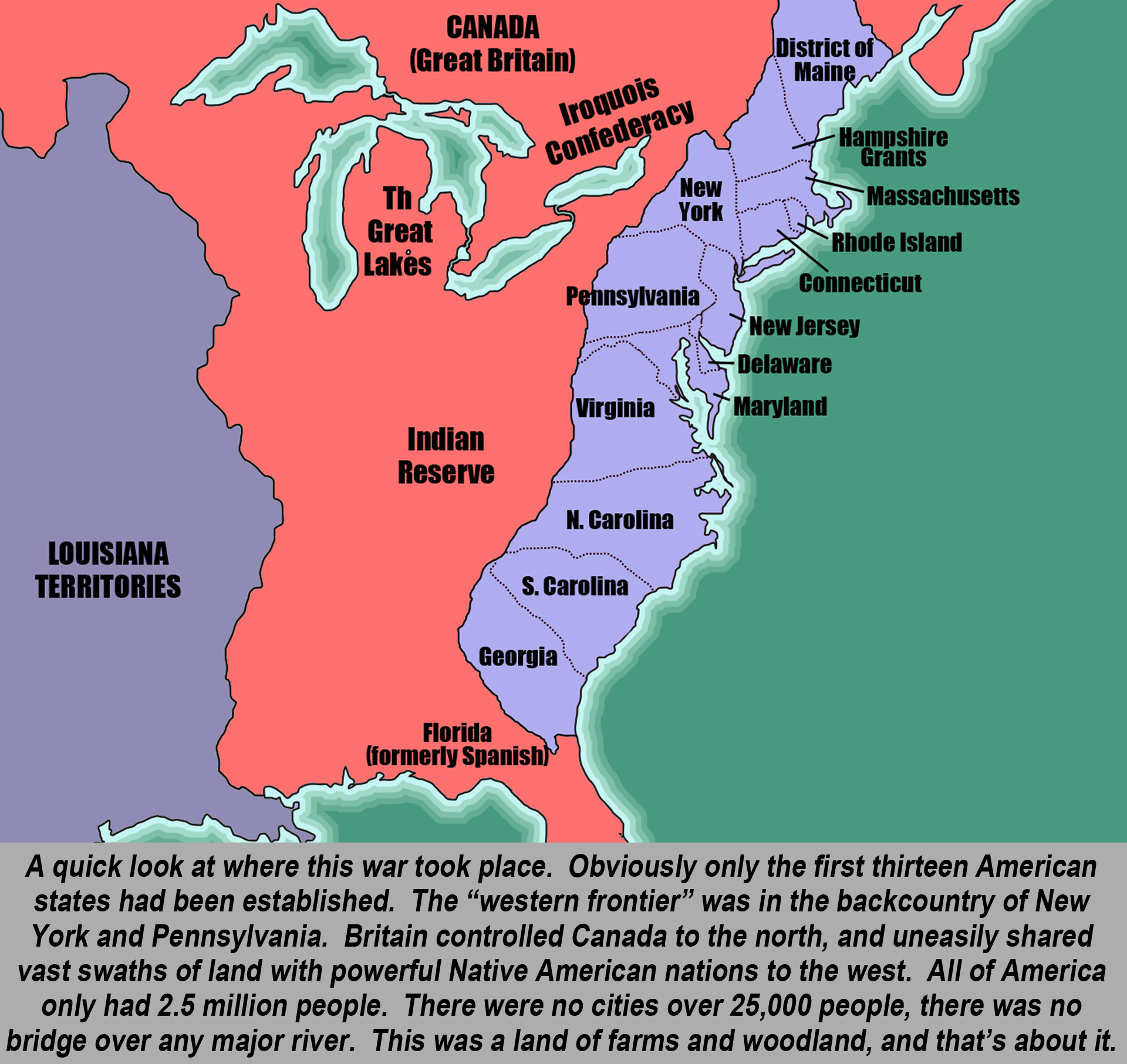
This wasn’t a war we wanted, not at first. Those British soldiers who gunned down our citizens in the streets of Boston were defended by an American lawyer and fervent patriot, John Adams, and they were acquitted. We were mostly Englishmen by descent, we shared the same God and language. But the time for that has passed, I’m afraid.
The First Bloody Day
A Patriot Perspective
The American Revolution is generally recognized to have started on April 19, 1775. On this day, three separate engagements were fought along the roads west of Boston, Massachusetts. These were Lexington, Concord Bridge, and Battle Road (sometimes called the Battle of Menotomy).
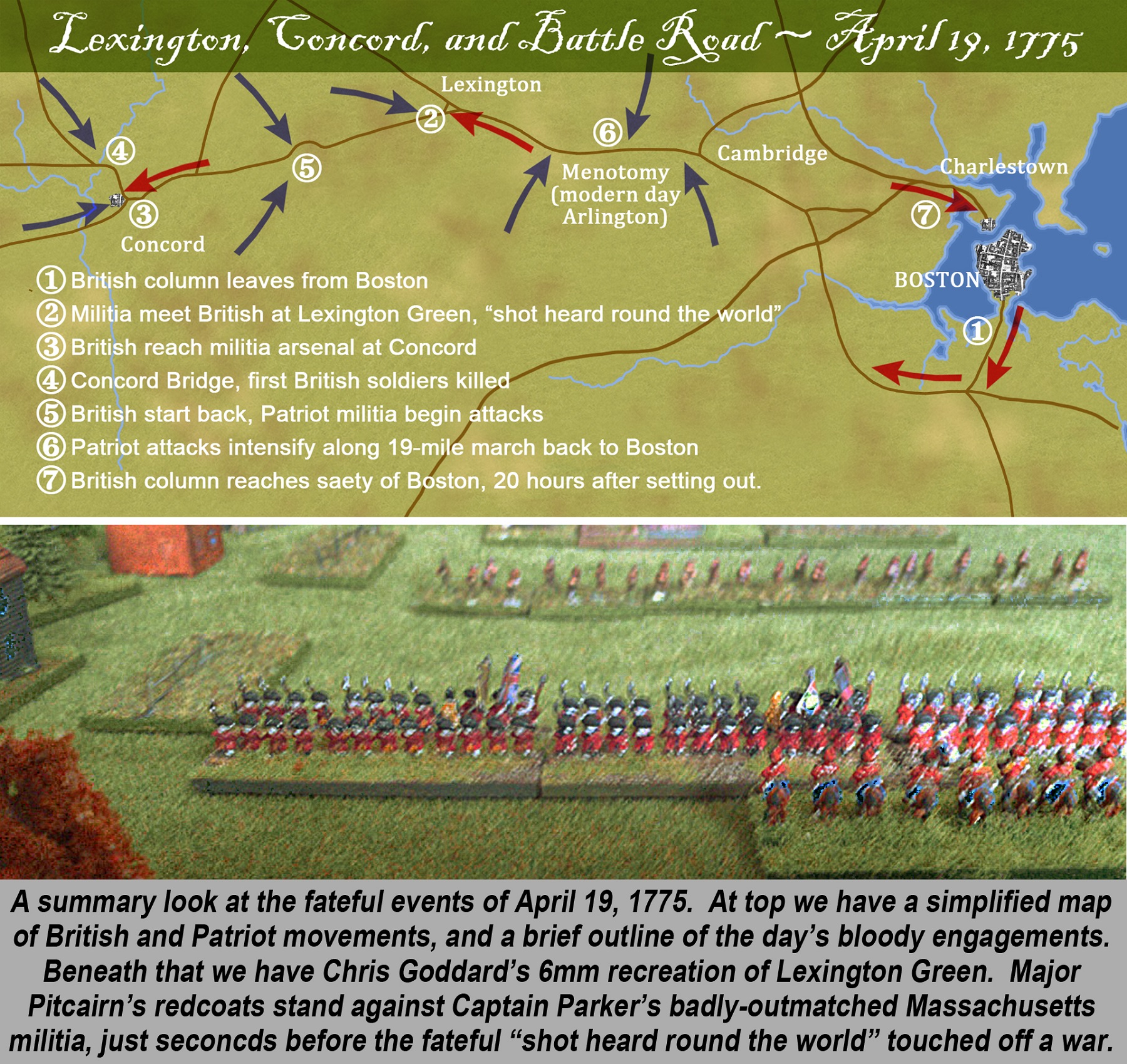
The night before, General Thomas Gage (military governor of Boston), had secretly dispatched 700 British grenadiers and light infantry by boat from the port of Boston. Under the command of Lt. Colonel Francis Smith, their mission was to march on nearby Concord, where local militiamen had been massing arms and gunpowder.
This was an exercise the British had carried out many times before, and by now the locals were tired of such incursions. They also had plenty of warning about this “secret sortie,” leading to Paul Revere’s famous midnight alarm ride. Alerted by Revere and others, a force of militia soon gathered at Lexington Green to meet the British.
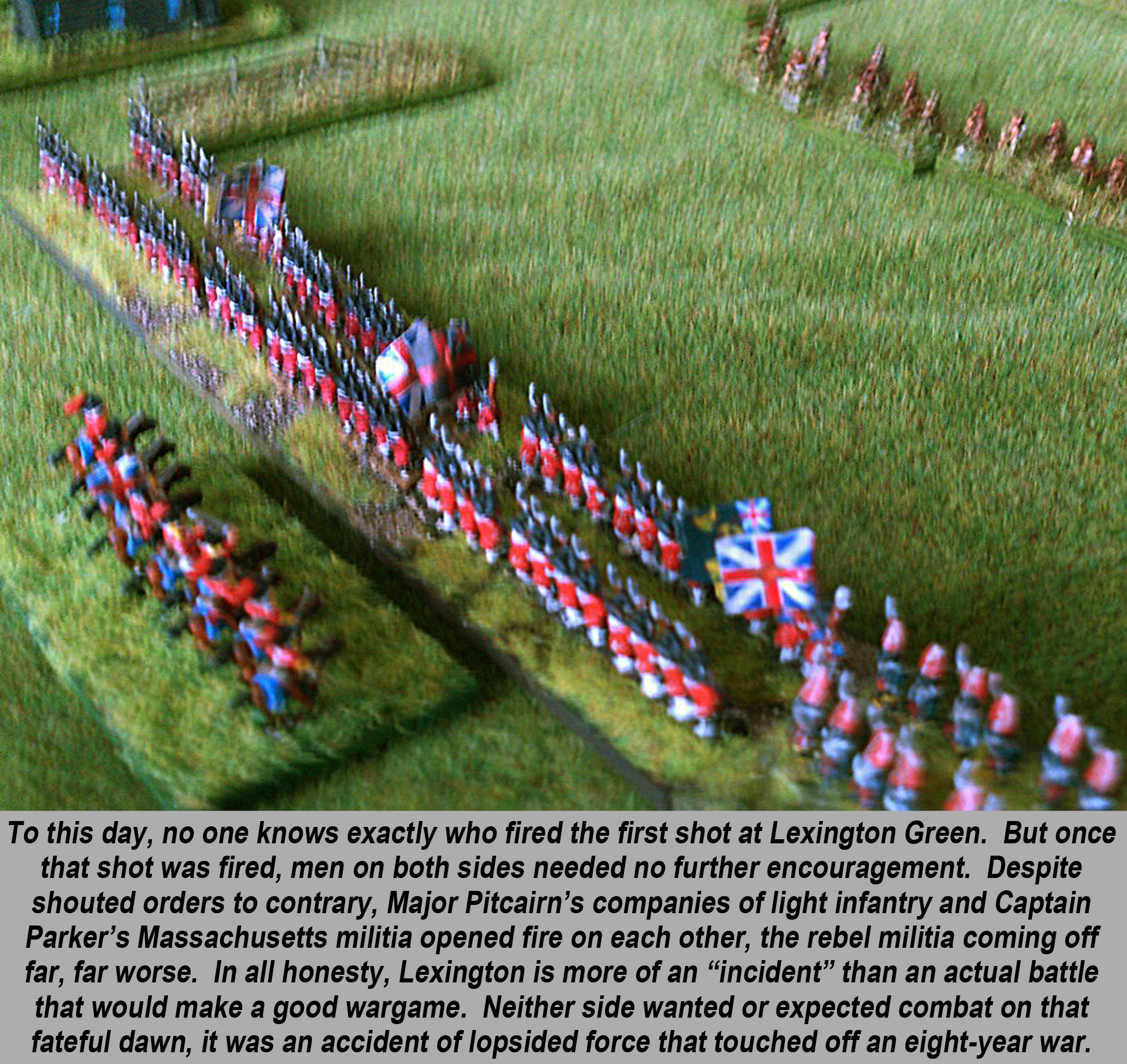
But the British would be marching all night, so the militia went home or adjourned to nearby Buckman’s Tavern. Shortly after first light, however, the British advance guard arrived at Lexington, commanded by Major John Pitcairn of the Royal Marines. Their ranks thinned by fatigue, boredom, and drink, the militia mustered out to face them.
The standoff was far from epic. About 70 ragged militia (under the command of Captain John Parker) faced Pitcairn’s highly-trained light infantry. One side was bleary and bad-tempered after marching all night. The other was terrified, outnumbered, and probably hung over. Both commanders ordered that no one fire.
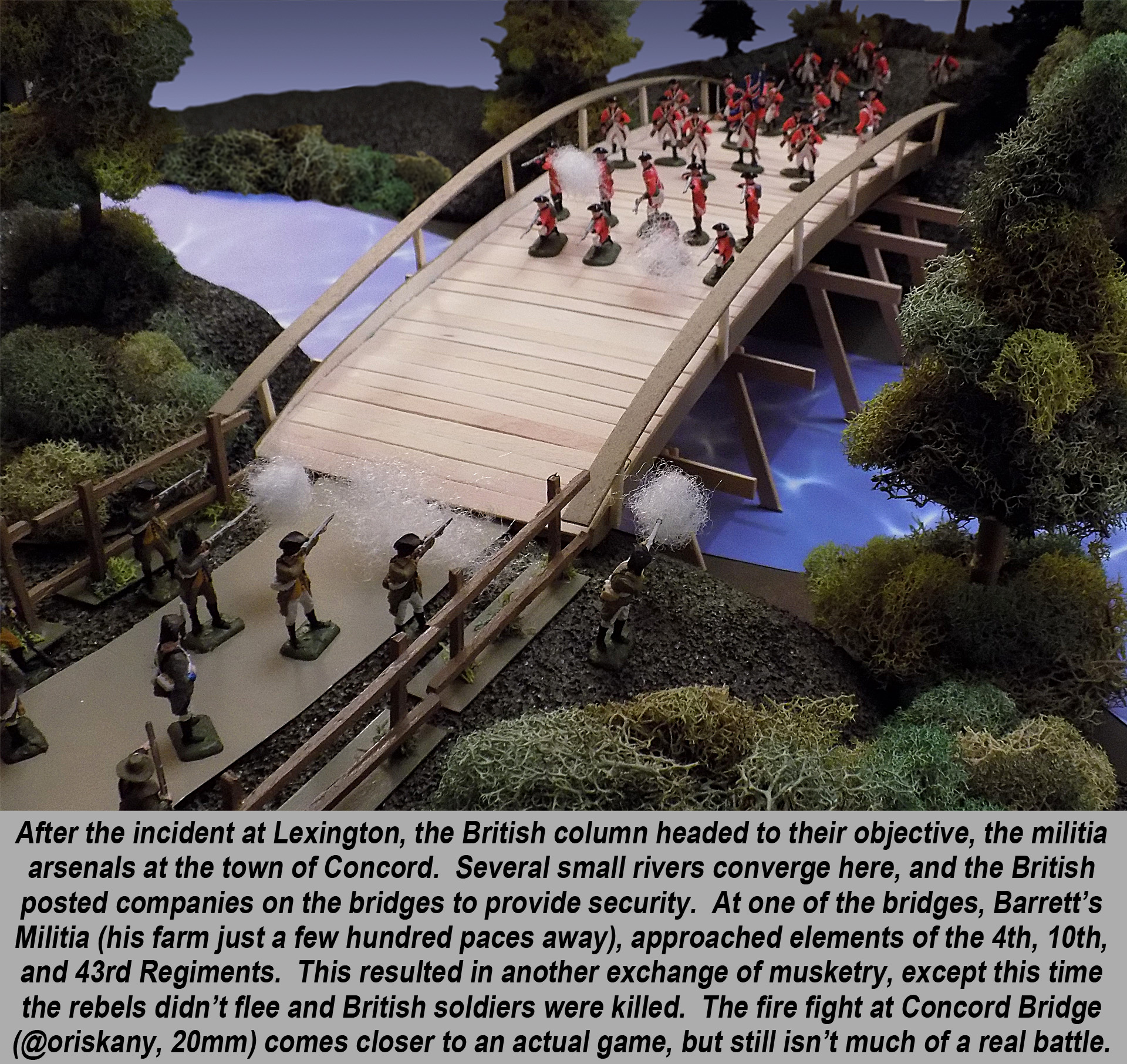
But someone did. To this day, no one knows who. This was the “Shot Heard Round the World.” The officers lost control and the two sides opened full fire. Eight militiamen were killed, the rest swiftly routed off. One British soldier was slightly wounded. The first shots have been fired, the first blood had been drawn.
For The Crown
With the rebels suitably driven off, the King’s troops then continued on with their mission. They soon reached the town of Concord, found the rebel supplies, including buried cannon. Nearby rebels, having fled from the town before Pitcairn’s arrival, now saw smoke rising from Concord and thought the British had put the town to the torch.
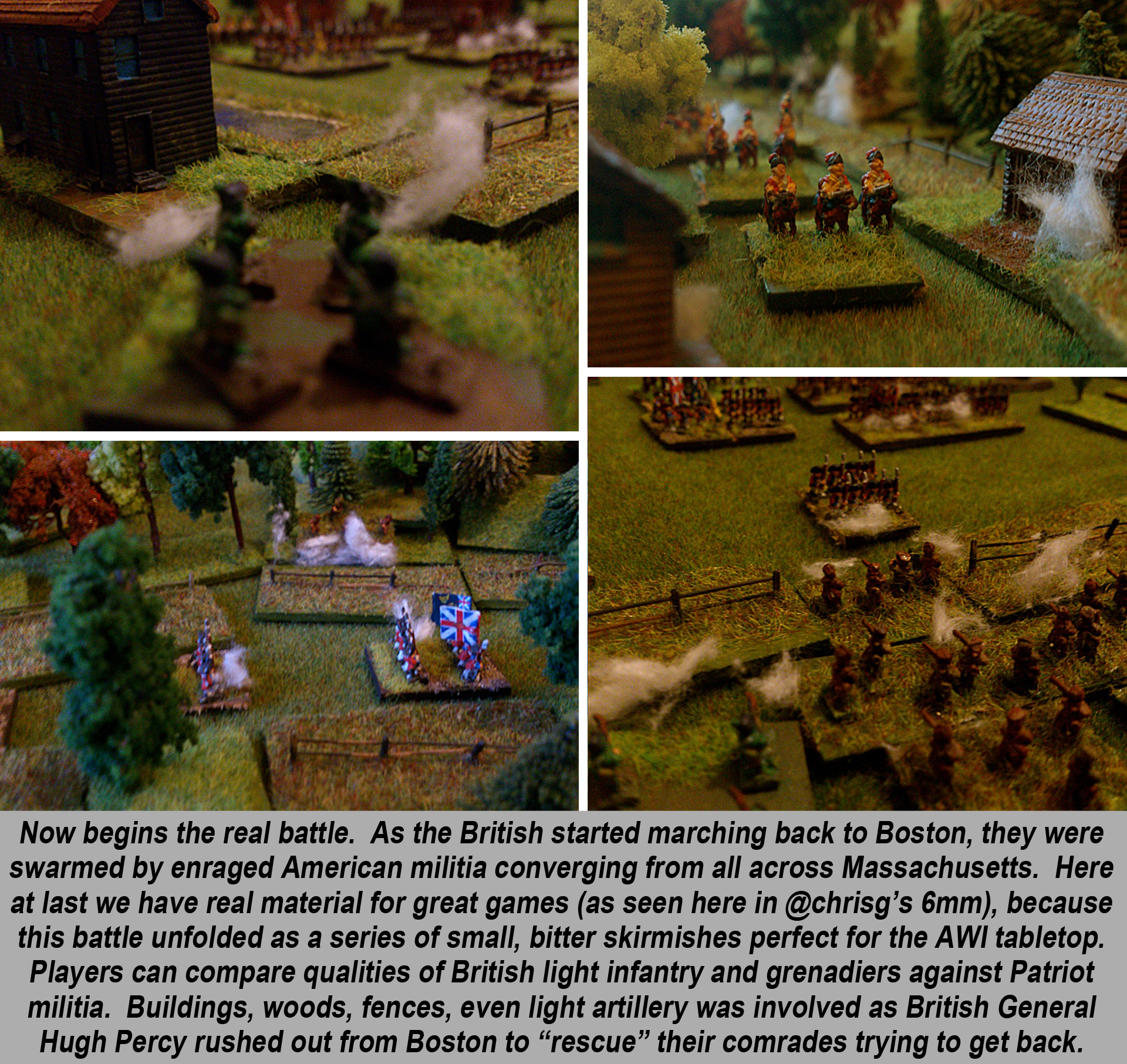
The rebels swiftly advanced back toward the town from several directions, including the North Bridge over the Concord River. Several British companies, about 100 men, held the bridge, and again there was a tense standoff. Again, fire was exchanged. But this time, British soldiers were killed. An irrevocable line had finally been crossed.
Yet the long and bloody day had only just begun. The British now had to march 19 miles back to Boston, and the gunfire at Lexington and Concord had alerted enemy militias all across the countryside. From all directions they converged on what became known as “Battle Road,” and started the Revolution’s first real battle.
Battle Road, or the Battle of Menotomy (present-day Arlington, Massachusetts), quickly set the tone for just how bitter, brutal, and bloody this “glorious” American Revolution would be. Rebel militiamen poured out of surrounding woods and farms, firing from behind trees, fences and walls at British soldiers in the road.
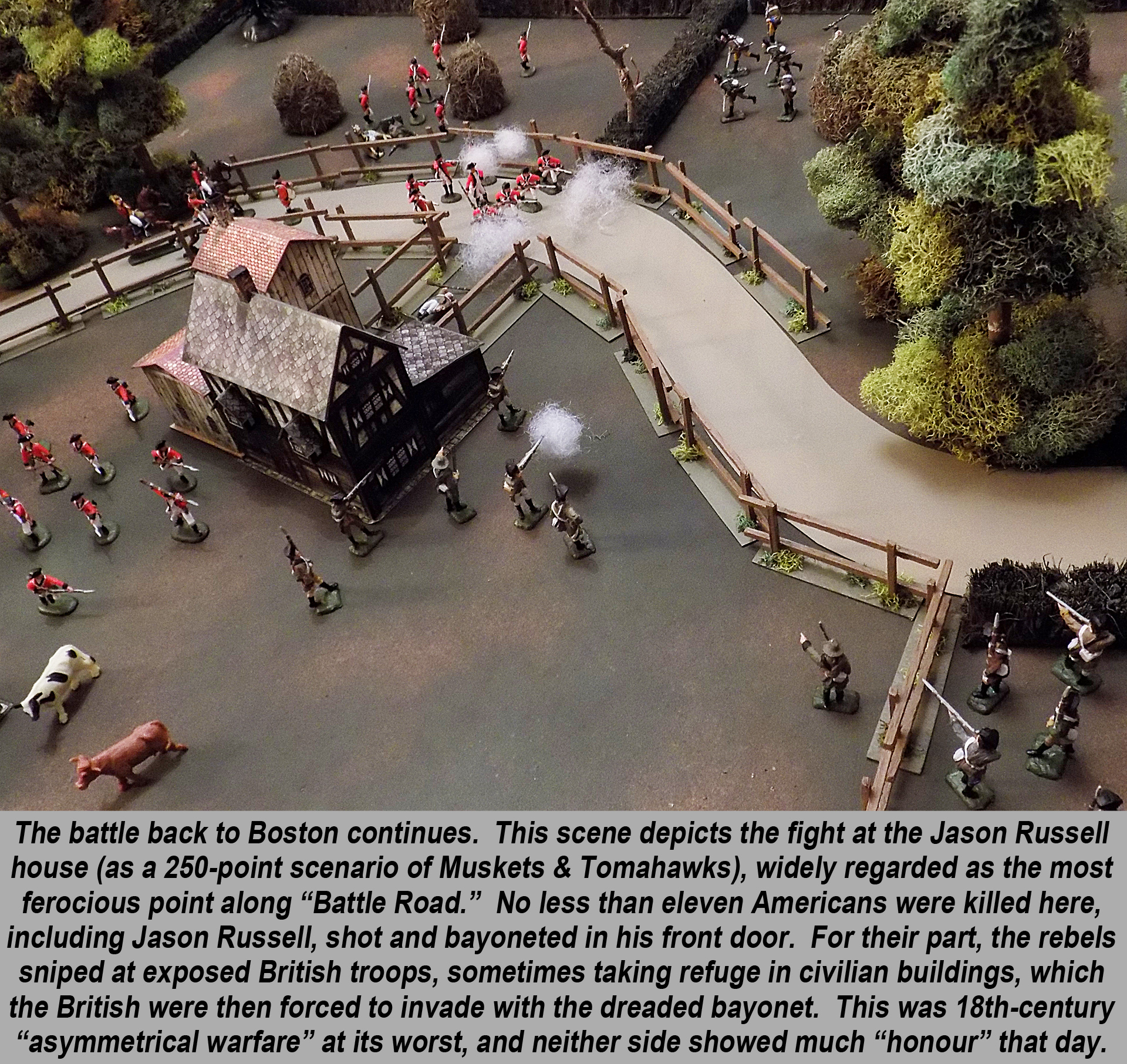
Initially finding themselves in quite a bit of trouble, Pitcairn’s advance guard was soon reinforced by the rest of the British force and together they fought their way back to Boston. Along the way, parties or grenadiers and light infantry were dispatched to outflank “patriot” rebels, kicking in doors to get at snipers in windows, attics, and barns.
The fighting went town by town, field by field, house to house, and sometimes even room to room. Rebel losses were grievous, but so were British losses. They assailed us with their dreaded “widow maker” rifles, we gave them our dreaded “cold steel” bayonet. Finally, as the column got back to Boston, it was over.
For better or worse, and regardless of the causes, the war was on. It wouldn’t end for eight long years. Even the Declaration of Independence, which officially announced the new “united American States” was over a year away.
Like those British regulars at Concord, we have a long march ahead of us. In the weeks to come, we’ll be rolling out more articles on the American Revolution, starting with Bunker Hill and wargaming our way all the way to Yorktown. What do you think so far? Please let us know with comments or questions below.
By James Johnson & Chris Goddard
If you would like to write for Beasts of War then please contact us at [email protected] for more information!
"...we’ll pull no punches when it comes to drumming up a little friendly “transatlantic Beasts of War” rivalry. We’ll just make sure both views are represented."
Supported by (Turn Off)

Supported by (Turn Off)
"...both commanders ordered that no one fire, but someone did. To this day, no one knows who. This was the “Shot Heard Round the World”"
Supported by (Turn Off)

Thumbs up gents, great work! Looking forward to the next part 😎
Thanks, @suetoniuspaullinus . In the next part, things get pretty serious. Now that we’ve gotten through the introductions, causes, and the first skirmishes . . . Part 2 gets into some large-scale battles, starting with Bunker Hill (Breed’s Hill). 😀
Good first intro into the AWI, it’s always been a period I’m interested in and so looking forward to the next instalment.
Thanks very much, @chaingun . Stay tuned, it gets bumpy from here. 😀
Looking forward to the next one, remind me that I have the John Adams Miniseries on BlueRay but got distracted halfway through it …
Definitely an awesome miniseries, I have it as well. The parts pertaining to the American War of Independence are really 1-3, I think, after that it’s John Adams’ diplomacy overseas (he was our first ambassador to Great Britain after the war, that must have been a stressful job), his term as Vice-President, then President, then retirement (rivalry and reconciliation with Thomas Jefferson), and later life. Definitely a great show.
And from what I understand more correct than some movies. .. like the one with Mel Gibson
Oh dear God . . . yes . . . THAT one . . . 🙁
So I’m guessing Standartenfuhrer Banastre Tarleton will not be making an appearance in this series then? 😀
@silverstars –
Lt. Colonel Banastre Tarleton will, yes.
Colonel William Tavington (played by Jason Isaacs) will certainly not. 😀
Tarleton? Tavington? Really, Hollywood? Real slick, real subtle. That’s the limit of your creative friggin’ subterfuge?
Make no mistake, Tarleton was a hard-as-a-coffin-nail merciless battlefield commander. But I’ve honestly never run across any actual account of his involvement in atrocities against civilians.
And there certainly were horrendous atrocities in the southern part of the war, but almost exclusively by American Loyalists vs, American Patriots, and definitely vice-versa.
I’m not 100% on this, but I think I heard that the screenwriters actually changed the name of Isaac’s character in that movie on protest from Tarleton’s family. I know they changed Mel’s fictional “Benjamin Martin” from the original (historical) “Swamp Fox” Francis Marion, what they got a whiff of what kind of human being HE was.
Great stuff guys! Being born and living all my life in New England I’ve been around all these places that parts of the war took place. It would be pretty cool to set them up on the tabletop. Actually I now live were one of the last British victories took place, Benedict Arnolds raid on New London. Even Today on its anniversary they shut Bank street down while a parade of citizens and re-enactors most dressed like colonials march down the street with a hanging effigy of Benedict Arnold firing off a small naval cannon. Its pretty cool.
Can’t wait for the next part, thanks!
Awesome, @barretem30 , and thanks! Yeah, Benedict Arnold basically burned down New London before he was sent south to Virginia in the last months of the war. I’m actually pretty “soft” on Arnold, looking at the first three years of the war and everything he did to keep the war going for the patriot side. I guess this is part of what made his eventual betrayal and treason such a blow for the Americans. As Washington himself yelled when it happened: “Arnold has betrayed us! Who can we trust now.”
I think the New London incident is even more telling because he was born and raised right around there (New Haven, I think). So it was almost as if he betrayed his country and then added insult to injury by burning down (almost) his home town.
Plenty of material on Arnold will be presented when we talk about the northern theatre (Ticonderoga, Quebec, Champlain, Valcour Island, Saratoga, etc.).
This is great, so many places and conflicts I had heard about, but good to put things into order and flesh it out. Looking forward to the next article.
Thanks very much, @sheepman . Indeed, a lot of these names, places, and dates are just kinda jumbled up in a general vague awareness – Bunker Hill, Saratoga, Valley Forge, Yorktown . . . Washington, Cornwallis, Howe . . . wasn’t Mel Gibson in this war somewhere? 😀 In the course of this series I hope to at least sketch out the general time line. The main focus remains on gaming, of course.
great job gentlemen 🙂 PDF versions would be greatly appreciated, stop my boss from catching me online 😉 😉 😉
I know the feeling, @buggeroff . . . 🙂 I’m typing this in a discrete corner of my screen right now. 😀
hahahaah, excellent. shhhhhh going to hit minimise 😉
hope all with you and the family 🙂
Looking forward to the rest of the series, as its a topic im mostly completely ignorant on, well not for much longer :D, keep up the good work @oriskany & @chrisg
Thanks very much, @nakchak . Again, we’re covering eight years of conflict in just five articles, so we can’t get into a lot of detail, but we hope to just get people familiar enough to run some games if they’re interested. 😀
I know very little on this topic, but am really looking forward to following this series. Cheers, Fellas! Keep up the great work!
Thanks very much, @niktyrrell . 🙂 We’ll be rolling out new articles every Monday for the next four weeks.
Excellent first article to a period of history I know so little about, so I will treat this series as part of my education. Historical gaming is something that I’m increasingly being drawn into (as is real ale – is this an age thing?) more for the learning aspect.
One interesting point is the comment on perspective. I can understand Americans having a greater attachment and patriot view of the war given that it created your country. However, and perhaps this is just me, but as a Brit, it raises no ill feeling. After all, if I had to harbour a grudge against every group the British had ever had a scrap with in history, it would be a long list! 🙂 If however England were to play the USA at rugby or cricket, it might be a different issue. Right, I’m off for a cucumber sandwich and a pot of tea.
Keep up the good work!
Regarding our perspective, it’s just that I think the two biggest “demographics” in the BoW community are the UK and the US. In so much historical gaming, these two nations are naturally allies (WW2, Team Yankee, moderns, etc). Here was one war where the “two sides” of the BoW community were squarely set against each other. Now granted, the conflict is 240 years behind us. But I’ve encountered lots of historically-minded gamers from the UK (and I totally agree with them) that the way this war is often remembered in the US is kind of a joke. British “lobsterbacks” are broadly-drawn villains right out of a Star Wars movie (with red coats instead of white and black armor), while the Americans are always the plucky rebels, outnumbered and righteous, fighting for the freedom of men all around the world.
Of course movies like The Patriot are laughably good examples of this. But at least on this side of the water, it goes back much further. The way the war was being remembered and recorded in the early 1800s, the way the war was “sold” to people while it was still going on, even before it started. Everyone knows the Paul Revere engraving of the “Boston Massacre.” The way Washington is portrayed crossing the Delaware in the famous painting is fantasy. The famous painting of the Declaration of Independence is a complete fiction. But these images have been time-stamped on the American psyche in such a way that the way the war is popularly remembered bears little resemblance to the truth. This pseudo-history carries forward into everything from our movies to our foreign policy to the Assassin’s Creed video game series. 🙂
All that said, a little UK/US “trash talking” never hurt anyone. 😀
I am sooooo looking forward to getting all the kids to bed tonight to sit down and read this … Hopefully with a good glass of JD 🙂
Hey, we are visited by the man himself! Thanks, @warzan. We hope you like the article when you get a chance to read it. You know, we could do a follow-up series on the War of 1812, complete with the battle of New Orleans. But we’d have buy some “alligator artillery” miniatures to complete the tables. 😀
We fire our guns, the British keep a comin 😉
That line is from the Battle of New Orleans, the second US/UK war. Better known as the war of 1812. Of course the Battle of New Orleans was fought in 1815, after the peace treaty was signed.
All right, @blipvertus and @warzan – I wasn’t going to do this . . . but here it is.
https://www.youtube.com/watch?v=VL7XS_8qgXM&list=RDVL7XS_8qgXM
Music starts around 00:28
Living next to Bushmills and drinking JD?! Ok, looking at the subject we will let that one slide 😉
That’s American whiskey you’ll be drinkin’ sir! American whiskey!
Hello all and thanks for the great comments from both Chris G and myself.
I really like the idea that we have been trying to get started of support for both sides yes, but pick a side and let the di of fate roll the numbers.
I love the way the Patriots scream we do not want to fight, can’t we talk about it etc and then attack our loyal troops so far from their homes and loved ones posted in Boston. They were trying to stone a lone guard to death. The troops that responded did so out of self defense.
and the print made depicting the massacre is by none other than that hot head Paul Revere so make of that what you will.
The same chap who managed to become legendary even though he is stopped and held for the best part of the night at British road block. One that had been set up because the unfortunate American were sneaking about moving arms and ammunition about, not that they ever wanted to fight. Then again the British troops in Concorde destroy cannons and stock piles of powder, again because the Patriots don’t really want to fight but are gathering a large arsenal for the Squirrel hunting season.
Then when they have the opportunity they hide as best they can and shoot from deep woods through barn windows and have no real stomach for a war, they cowardly hide not wanting to pit their courage against our poor tired troops. So lets not forget just how much the minutemen are all prepared to gather in secret and to act against the King the rightful ruler his royal majesty King George the third and British government. Boo-hoo they are so hard done by, perhaps we should have simply made them stand by their war debt, just as they did with us much later in history that we have only just repaid but repaid we have.
Maybe we should present them with a re-addressed bill up dated to today’s value LOL
So pick a side and let the di choose.
Good hunting Chris G and Victoria G
Thanks for checking in, @victoriag and @chrisg !
I guess it goes without saying, but I’ll say it again anyway. These articles are totally a team effort between myself and @chrisg – wouldn’t have been able to do them without his help. 😀
Okay, now that the polite part of the message is over . . . 😀
(putting on the tricorn hat to play the firebrand hot-head rebel for a moment) . . .
. . . and please remember I’m just playing around here . . .
Regarding the sentry at Boston – What can I say? Boston is a wild town. Ever been to a Celtics game? 😀 Shut down our harbor and start billeting troops in our family homes and yeah, Americas are gonna get riled up. As far as the shooting went, one of our most fervent Patriot leaders, John Adams, was the lawyer who defended him in court, alienating his own family (Sam Adams), and got them acquitted. Too bad the corrupt, bought-and-paid-for by monopolized shipping interests “gentlemen” of the British Parliament and Privy Council couldn’t exhibit the same virtue. Oh, I forgot. They would keep themselves busy publicly humiliating our ambassador and chasing him out of the country under threat of arrest. Was this before His Majesty refused to even receive the Congress’ Olive Branch petition? Hmm . . .
Loyal soldiers? Poor tired troops? Is this why the popular British saying at the time said: “A sailor before a vagrant, a vagrant before a criminal, a criminal before a dog, and a dog before a soldier?” Sounds like the only people who treated these loyal soldiers worse than us were their own officers. Besides, can we really feel sorry for these guys, when out of 25,000 fatalities we suffered in the course of this war, 11,000 (44%) died in horrific conditions aboard British prison ships? Good thing the Hague wasn’t prosecuting for war crimes at the time, eh?
I can’t really stand up too much for Paul Revere. Yes, he is the “famous one” for that midnight ride of April 18, 1775. But of course he was just one of dozens of alarm riders that night. He’d wind up as the famous one just because his route happened to be the one along which the regulars were coming. And of course Revere would later be courts-martialed for his part in an American naval disaster. So I hold up my hands on that one.
Yes, we hide and shoot from windows and woods. This is what happens when a handful of farmers takes on the most powerful army on the planet. Trust me, we spend the rest of the war trying to build an army that could, as Washington put it, “look the enemy in the face.” And once we did? Hey, look . . . we won. (okay, *… ahem … * the French *…cough…* might have helped too, along with Prussian military officers, nobles from Poland, money from Spain, arms from Holland, etc etc etc.)
I guess that brings up another point. What does it say when Americans and British start fighting, and basically the whole world lines up on our side? Just saying . . . 🙂
Stand by OUR war debt? You mean from the Seven Years War? Tisk tisk. We were a sideshow in that war, a sideshow that gave you Florida, the Louisiana Territories, Canada, and the Ohio River Country. I think it’s safe to say the crown made his money back on that deal. As far as your 150 million in war debt, that was earned in Europe. It can’t really be OUR war debt if we’re part of the British Empire at the time – so if you’re charging us for that debt you’re recognizing us as a separate entity, which sort of undermines the whole Royal position. But if you want to hold that against us and present a bill, we’ll counter with a civil action for 20,000 cases of kidnapping on the high seas (impressment) of American citizens against their will, not to mention invading our country and burning down our capital and White House in the 1812-14 affair. How much money is 20,000 capital crimes worth, adjusted for inflation?
Okay, back to the sensible present-day forum. 😀
ah, Paul Revere what a numpty – my six-times great Grandfather was a young British officer that got himself caught up on the receiving end of the Penobscot Expedition where the garrison gave the army of Massachusetts a bloody nose.
Think it’s also worth pointing out that the conflict in the America’s began a full two years before hostilities broke out in Europe – between the aggressive behaviour of the settlers of Georgia and the incompetent handling of negotiations with the French courtesy of a land pirate like young Mr Washington I do believe my colonial cousin that our American brethren certainly hold some portion of the blame for the Seven Years War. Prime Minister Pitt however was sensible enough to see that the vulnerable underbelly of the French Empire was it’s colonial possessions – taxes from sugar, furs, ivory, slaves and spices all funded the behemoth that was the French army and navy. If you want to defeat the armies in Europe, steal Johnny Crappo’s resources and funnel them into the British navy and Prussian army.
And on the subject of civil action, how much of the money promised to the hundreds of thousands of loyalists forced into exile in Canada has been paid by the various state governments as instructed by congress and a certain Mr Franklin as part of the 1783 Paris talks?
Great stuff @oriskany, loving this first venture, can’t wait for the next ones
Good points, @bigdave, although I admit I only have a conversational knowledge of the French and Indian War / Seven Years War. @elessar2590 is the real expert on this, I think he had a whole part of his article series specifically about how the war started (Washington, Half-King, Jumonville, etc.).
I have to raise an eyebrow, however, on the idea that George Washington “started” the FIW and by extension, the Seven Years War. That was a war that was waiting to happen, and the crown made a fortune off that conflict in possessions taken from the French. I’m not sufficiently versed in 18th Century economics to understand how the Kingdom was still in debt (and it certainly was, uncontested, to the tune of 150 million pounds). But after operating those colonies (especially the rich sugar islands) for almost twenty years, how that war hasn’t paid for itself by now . . .
(almost sounds like 2003 Iraq. Go in, take all the oil fields . . . 15 years later . . . wait a second, HOW did this war cost us $18 trillion?)
Franklin promised money to Loyalists in Canada? I honestly never knew that. But I also know that you couldn’t trust Franklin as far as you could throw him, especially when he was “wheeling and dealing” in diplomatic back channels. He must have known America was beyond broke, we only got our first bank at the very end of 1781, we had a federal “government” that didn’t have the authority to tax. We didn’t even have a currency, John Adams was practically begging to the Dutch banks to get a national loan. What the hell were we supposed to pay this with? Bales of hay? We couldn’t give them what we were giving everyone else (land grants) because the Loyalists couldn’t move back here.
It just sounds like Franklin was being a little disingenuous. Further, I’d argue that the British envoys across the table from him at the Treaty of Paris knew this, and just signed the papers anyway because of everything they were winning in India and the Caribbean . . . i.e., the vested shipping interests that put those politicians there in the first place. A classic case of the politicians forgetting the “little guy.” Doesn’t make it any better, though.
No contest, however, on the on the Penobscot Expedition. That truly was a disaster for our side, and one of your greater victories. Funny thing is that was the second time the patriots tried a move to through the Maine backcountry. Arnold’s near-disaster trying to push a small army up the Kennebec River in Maine damned near killed all of his men, even before they failed to take Quebec. Hey, dumbasses! Maine is not the back door to Canada! Almost reminds me of a certain prime minister who kept thinking the Balkans and Italy were the “soft underbelly” of Europe. 😀
Started is probably a bit strong of me tbh, but it certainly contributed. British administration of the colonies could be terrible at times, Washington being merely part of it at the time. Local aggression combined with inadequate handling from further up the chain the America’s were always going to be a powder keg.
To be honest, far from Maine being the key point of contention in that region it was Louisbourg and the surrounding environs. It was an important and strategic way station that allowed for the resupply of passing fleets, with the resources being drawn from Nova Scotia and New Brunswick, particularly water, but also meat, timber, leather, replacement tools etc. With Massachusetts’ dependency on maritime trade it was very brave of em to pull a stunt like that, and it very nearly paid off…
This is great, @bigdave – I actually didn’t know very much about the Penobscot Expedition, Louisbourg, or Nova Scotia’s part in the Revolution. I mean, I knew it was Howe’s big base when he withdrew from Boston – March 17, 1776, and re-launched a new campaign into New York and Long Island in August later that year.
Right, I don’t know if the Americans ever thought Maine was somehow “important,” but at least twice they tried to use it as some kind of invasion route to get to important areas in Canada. Both times ended in disaster. I know a lot about Benedict Arnold’s invasion up the Kennebec in Sept-Dec 1775, but this other campaign I am definitely listening (and learning) more than I am teaching. 😀
I recommend Bernard Cornwell’s book ‘The Fort’ a ripping yarn about the Penobscot Expedition.
Thanks, @ozzie . Others have made the same recommendation, so I will definitely have to check out that book. 🙂
woo hoo!
🙂
If only the Rebels had crossed the Atlantic and finished the job… (Not realistic for a multitude of reasons I know. Would have been interesting, ehy!)
*ahem!*
Super fascinating area of British history, and in my own experience I have to say, the period is not spoken about in the UK let alone covered in the education system (things might have changed now).
Cool article!
Thanks, @dice !
“If only the Rebels had crossed the Atlantic and finished the job…”
Well, not for lack of trying. In April 1778, John Paul Jones and his ship USS Ranger did try to bombard and raid the town of Whitehaven (Cumbria, Northwest England). Managed to spike some guns and set a few fires but that’s about it. A similar raid was mounted on St. Mary’s Isle, but again with less than total success.
More significantly, as soon as France entered the war, a crisis developed in the English Channel that soon led to a pretty serious naval battle off the Island of Ushant (almost 60 full-sized “ships of the line” between the two sides). So the war DID brush up against British shores on a few occasions.
“… the period is not spoken about in the UK let alone covered in the education system …”
Surprising, since this is basically the beginning of what would become the Victorian Empire. At least in terms of British possessions in the Caribbean and especially India (yes, the Napoleonic Wars would cement it in place, but uncontested British dominion of India pretty much starts here). France had many colonies here, too, but would lose them in fighting the British on our side. Like I said in the Weekender interview, the Americans may have won their little corner of the war but the British won resoundingly just about everywhere else. 😀
Whitehaven was a farce! Used to live in Lancaster (just round the coast), the crew of the Ranger tried to set fire to some coal barges in the pouring rain (trust me, it rains a LOT in that corner of the country), soon gave up and like any sensible bunch of sailors abroad they went to the nearest bar. That’s not to say it didn’t terrify the government – considering that for every £1 the American colonist was paying in tax to the crown, your average Briton back home was paying £17 (I think, been a while since my uni days). Given the right spark I’m sure violence could have kicked off back here, a rebel ship spinning the right rhetoric could have been a dangerous force but instead they tried to set fire to our belongings which had your English proletarian just a teeny bit miffed…
Okay, okay, @bigdave . 🙂 Whitehaven was hardly the Battle of Hastings, and John Paul Jones was no William the Conqueror. I always thought it was mostly a publicity stunt to get Jones’ name mentioned in Congress, and a bigger ship so he could take bigger prizes. Not really my specific area of expertise, though.
These kinds of privateers, though, did threaten to get out of hand by war’s end. One of Washington’s best units, Colonel John Glover’s “Marbleheaders” from Marblehead Massachusetts vanished from the order of battle almost to a man so they could sign aboard privateer ships and make a fortune. Washington often complained bitterly he was having trouble recruiting and retaining men partly because anyone who had even an idea how to sail was on the high sea hoping to strike it rich.
Liberty and Equality are all well and good, but there was also an admitted mercenary streak to the Patriot cause, no doubt about it.
Actually, I think you’re being generous on the taxes. I’ve heard taxes in the colonies vs. Great Britain to be a 1-to-25 ratio, at least until the Intolerable Acts. The much-decried tea tax was something like 1/3 of a penny per pound. These were slogans engineered by the early patriot leaders (i.e., the Sons of Liberty in Boston) to rile up the people. Most of these men were very wealthy (John Hancock, Sam Adams had a lot of money come down to him from his family), and what they really protested was the MONOPOLIES, not the TAXES, imposed by British shipping interests protected and subsidized by a Parliament I think we would consider by today’s standards to be corrupt.
But of course, the average blacksmith or farmer won’t pick up a musket so the rich can get richer. “No Taxation without Representation,” though, that’s a different story.
Great stuff … ten times more exciting than boring old history classes.
Although to be honest the American and British wars weren’t much of a topic for us as we had our own wars to be reminded of.
And once more we’ve got proof that wars never are as neat and tidy as they often appear in summaries.
In keeping with the theme one may also consider Sid Meiers’ Colonization as background material : https://en.wikipedia.org/wiki/Sid_Meier's_Colonization
There’s even a free open source variant : https://en.wikipedia.org/wiki/FreeCol
The original DOS version of Colonization did get me interested in the period first time around – not being from any of the 2 sides it where not touched in my history classes
Thanks, @limburger – although if I’m looking at your BoW profile right . . . 😀
The Netherlands were eventually waist-deep in this war, as well. As I’m sure you know, they were the economic power-house of the day, they helped us establish national credit and made loans to us during this period. They also supplied us with arms covertly through a smuggling operation based out of the island of St. Eustasius in the Caribbean. Finally the British had to declare war on the Netherlands to shut it down (November 1780, I think). Dutch spies were also instrumental to Washington in New York. Supposedly he once said: “No one hates the British like a Dutch merchant.” 😀
It’s the one aspect that isn’t given much attention in history classes in my time.
I think the last bit of old history we had was about the 80 year war against the Spanish (basically our ‘war of independence’ … :))
Then we had our ‘golden era’, which was glossed over and it was straight into WW2 as the last bit of history I remember from school.
It might have something to do with how much profit we made from slave trade in addtion to the spice trade (by the VOC)
Oof, the Eighty Years’ War ( 1568–1648). There’s a long subject. I don’t think we could cover that in five articles. 😀
lol … It’d be a challenge just to cover the highlights.
I’d love to see someone try though.
Sounds like you just signed yourself up for a project, sir!
– just kidding – 😀
It would be a quick read, though.
“PART ONE – The First Twenty Years . . .”
I know so little about this, great and well appreciated effort.
Are there any books you recommend on the subject!
@bigbadbazz ~ One that I definitely like, especially if you’re looking for the “you are there” feel of the war, is Joseph Plumb Martin’s A Narrative of a Revolutionary Soldier: Some Adventures, Dangers, and Sufferings of a Continental Soldier. This was an autobiography actually written by a Continental soldier, the only book of its kind. Started as a private in 1776 (Battle of Long Island), wound up alongside Alexander Hamilton in the nighttime bayonet charge against Redoubt #10 at Yorktown (sergeant in the engineers, 1781).
http://www.amazon.com/Narrative-Revolutionary-Soldier-Adventures-Sufferings/dp/0451531582
Another good one is Patriot Battles by Michael Stephenson. Despite the title, it presents a very balanced look at how these two sides were put together on the battlefield, how a British regiment was actually assembled, how much they were paid, how both sides were armed, how each battle played out and WHY it played out that way. Very important from a wargaming perspective, at least for scenario design.
A buddy and I are just starting to get into the AWI. I wanted to play napoleonics, he something more asymmetrical. I wanted to play 10mm, he 28mm. So we landed at the AWI in 20mm. Already tried muskets and tomahawks and the system seems quite interesting, but not for the larger engagements. Anybody tried british grenadier at some point?
The article series comes at a perfect moment for us. Normally you don’t get anything about the AWI in history classes here in Germany. Nearly anything a lot of people know about the conflict is from “The Patriot”. And we all know how historically accurate that is. Some maybe watched the TV series “Turn”, which I think is a little better and more entertaining, but I can’t really say much to it’s accuracy, because I’m just starting to read more about the conflict.
Can’t wait for the next article. I’m ready to be educated 😀
Which figure range dd you end up going for?
@bothi – Well, if your friend wanted something asymmetrical, the AWI is definitely a good choice. That said, by the end of the war the American Continental Army has evolved to the point where the warfare becomes much more conventional for the period, so the AWI really gives you a lot of choice. What I find appealing about it from a gaming perspective is the relatively small size of the engagements. You can do a battle that “really matters” with a much smaller figure count than you can with Napoleonics (although I guess there are exceptions, like the Peninsula Campaign).
Muskets & Tomahawks I liked, but I didn’t find it a PERFECT fit for what I was trying to do. It works fabulous for smaller engagements, and the subplot “narrative-generation” system works great if you don’t already have historical background. Like you, though, I think I was going for slightly larger battles. I definitely still recommend it as a great system, though.
Yeah, The Patriot was a disaster. But it was a Roland Emmerich movie, what can you expect? Look what he did to Godzilla. I’ve only seen the first season of Turn, which is a little better. Actually a few historical spots are actually quite clever (the capture and “seduction” of General Charles Lee leading up to the Battle of Trenton). Not everything in there happened, but they take what we DO know, and “game in the gaps” (as @warzan might say) in the areas we DON’T know to tell some interesting stories about what MIGHT have happened, all without screwing up too many details.
When it comes to history, no TV show or movie can be perfect, and we shouldn’t expect it to be. But Turn isn’t too bad.
If muskets and tomahawks doesn’t quite fit maybe try the Eagle Rampant rules (variant of Lion Rampant for Napoleonics). I only got them this weekend so not had a chance to try them yet. They are printed in the latest Wargames Illustrated issue.
http://wargamesillustrated.net/medieval-napoleonics/
I think I would wait for Sharpe Practice 2 by Too fat Lardies
@koraski and @torros – thanks for the comments and tips!
I looked at Muskets & Tomahawks (which is great, don’t get me wrong I’m not trying to give it a bad rap here), Rebels & Redcoats (too large in echelon level) and Redcoats & Rebels (yes, a different game, amazingly detailed but honestly too complex). Also, Redcoats & Rebels was a “command tactical” game where each figure represented about 50 men.
I haven’t heard of these two games you guys mention (“Eagle Rampart” and “Sharpe Practice”). I’ll have to check them out.
Muskets & Tomahawks worked great, in fact we had to take some stuff OUT of the game so we could create larger battles without running 5-6 hour games.
I had a look at the 1st edition of Sharpe Practice and a Terrible Sharpe Sword the ACW version/expansion. Great rules on paper at least the project never got off the ground and on to the table
@torros We actually haven’t bought anything yet, but thinking about to get the main body of armies in the close to 20mm plastic ranges like airfix (just because they are cheap like hell). To fill the gaps we probably going for BandB Minitaures, which should be a close match to the airfix ones. What would you recommend?
@koraski and @oriskany As mentioned above we tried Muskets & Tomahawks and liked it a lot. I guess it will be part of we will be doing. It seems to fit really well for the small engagements. But we are looking for a larger scale system too. Eagle Rampart wasn’t up out alley, I didn’t like what I read about it, but please, tell me more. Never heard of Redcoats & Rebels (the complex one), I like complex games, so I guess I have to take a look. Same goes for Sharpe Practice 2, I like the rules by Too Fat Lardies.
Anyone tried “British Grenadier” ruleset. Looks nice (from what I can find) and it seems to be a variant of General de Bridadier. But it’s hard to get a copy over here.
And yeah I will be going for some more regular army and my buddy for a more irregular/asymmetrical one. So until now it seemed that I’ll be ging Brits and he Yanks. But as I am learning here, the Brits weren’t that regular-line-infantry-army all the time. Didn’t really know that 😀
Indeed, @bothi , there were quite a few flavors of British, or more accurately, “Crown” forces.
The basic British line regiment was just under 600 men, divided into ten companies with a theoretical strength of 56 men. Actually, the real strength was 53, with the pay for these missing 3 men pooled into a “company fund” to help defray costs for uniforms, equipment, boots, etc.
Of those ten companies, eight were classic “line infantry” (the prototypical “redcoat”), one was a grenadier company, one was a light infantry company.
Many generals would detach all the grenadier and/of light infantry companies from their regiments and form them into specialized “regiments” of strictly light infantry or grenadier for special missions. Grenadiers were typically “shock troops”, light infantry for screening, scouting, flank defense, etc.
The British also had two regiments of dragoons (light cavalry).
The British also had a very small detachment of rifles, “Ferguson rifles,” under the command of Patrick Ferguson. This was the guy who COULD have shot Washington at Brandywine (Sept 11, 1777) but chose not to. This was a very small unit, but it bears noting that the Americans didn’t have a complete monopoly on rifles.
Then you get in Hessians, who also had infantry, grenadiers, dragoons and light infantry (often called “Jägers”).
Then you have militias. Queen’s Rangers, New York Royals, Tarleton’s “British Legion” was partially Loyalist militia. These weren’t quite as rag-tag as Patriot militia, but they were definitely “militia.” They often fought with “Indian tactics” the same as American militia, used what weapons they had at hand, including hunting rifles (as opposed to smoothbore muskets), etc. In the south these were especially “backwoods country boys,” usually first-or-second generation families with much more recent ties to Great Britain.
Lastly, you have the Native Americans, especially the Iroquois. There were six tribes in the Iroquois Confederacy, and four of them fought for the Crown. The Oneida and Tuscarora supported the Patriots, while the Cayuga, Mohawk, Onondaga, and Seneca sided with the Crown.
Needless to say, there are plenty of “irregular” options for a Crown or Royalist AWI force.
An interesting read for anyone interested in the period is The Fort by Bernard Cornwell of Sharpe fame
Yeah its a fun read
Personal favourite 🙂 Moore got my six–times great grandma up the duff so I’m a descendent of his
Sir John Moore, @bigdave ? Damn, that’s pretty awesome. I don’t have any relations from the war, both sides of my family I think were still in Europe (Mother’s side – Irish Catholic, Father’s side, Scot).
The Penobscot Expedition – this is where Paul Revere gets courts-martialed right? Yeah, like I said above, I don’t really understand why he’s included in the “pantheon” of American heroes of this war – especially when other like Nathaniel Greene get overlooked (okay, Greene was something of a profiteer, but this was accepted practice at the time for officers of all armies).
yeah – was a nice chap, was well respected as an MP but didn’t stop him having a wilder side when he was younger then buggering off to the army haha.
Revere ended up out of his depth, decent sized force of regulars in a fort (even if it was a hastily built pile of logs) is a daunting prospect for anyone, let alone a force comprising mostly of militia. The sharpshooters did well for themselves as I understand, they did strongly influence the light infantry doctrine installed into the army later on by Moore at Shorncliffe. If it wasn’t for the colour of the cross-belts they could sniped away much more easily than they did. Had the fleet been delayed by so much as another week, odds are Revere would have won but it would have cost him dearly none the less, wasting the lives of his men trying to storm a well defended position. Hell of a job getting such a force of militia out so far into the sticks all the while trying to maintain your supply lines. Greene? Wasn’t he played by Mel Gibson in the Patriot? Afraid I struggle with the panoply of names, was for the most part a medievalist back when I was reading for my degree.
I think part of Paul Revere’s overly-precipitous rise in the Patriot ranks was due to his chance helping of fame from April 18, 1775 . . . and his personal connection to early Sons of Liberty figures like John Hancock and Samuel Adams (these were the two guys he met in Lexington that fateful night.
Hancock was one of the richest men in America, plenty of money to throw around (or help raise “personal” regiments and contribute “privateer” ships to a prospective fleet).
And of course Sam Adams was the “mouth” of the early Revolution, instigator of much of the turmoil in Boston in 1770-1775. A tremendously famous figure once the shooting started.
I’m sure that knowing these two guys helped Revere rise in military prominence much faster than would have otherwise happened. And when “commanders” rise to positions of responsibility for which they are eminently unqualified and unprepared, well . . . we see the result. 😀
Mel Gibson in The Patriot played a fictional character named Benjamin Martin. Originally he was scripted as Francis Marion, the historical “Swamp Fox.” I think halfway through production someone actually cracked a book and saw what kind of person Marion actually was, and the character and script were hurriedly adjusted.
Mel Gibson catches a lot of hate for that movie, but honestly I think the fault lies with Roland Emmerich, a true Hollywood ass-clown who has produced an string of unremitting shit-fests including the the 1998 Godzilla, Independence Day, Day after Tomorrow, 2012, etc. He’s disrespectful of other people’s IP and franchises, and definitely took a tremendous turd all over history with The Patriot. And not just “geeky details” . . . offensive against people’s family’s (Tarleton) and not even knowing how many years the Revolution lasts (in the movie . . . TWO years pass between the 1776 Declaration of Independence and the 1780 fall of Charleston).
Greene (probably my favorite single Patriot general) was in the movie briefly, but shouldn’t have been. The big battle at the end features him, even though Greene wasn’t at the Battle of Cowpens (this was Morgan and Colonel William Washington, George’s second cousin). “Cowpens” is what it says in the credits, but when you look it up online they say the battle at the end of that movie was a combination of Cowpens (January 17, 1781) and Guildford Courthouse (March, 1781). It’s neither, it’s just a disaster.
Anyway, putting away my soap box for now. 😀
I would have to agree with @limburger – if only history classes had been as good as this.
Well written and very absorbing. Nice job. That bridge looks awesome!
Another triumph. Jamie is wanting to know about the hex-game you are using.
@unclejimmy I think @oriskany gave an overview of the hex game some weeks ago on the Weekender thread
Thanks @unclejimmy and @rasmus – Indeed, this was the “Tactical Sons of Liberty” (working title only) we had on the UncleJimmy Thread one time, where Rasmus Petersen’s Pennsylvania riflemen were among the forces under the command Brigadier General Johnson’s army, which met the redcoats of Brigadier General Goddard (which included the dragoons of Captain D. Oliver) at the epic Battle of Pauls Manor.
Alternate history at it’s best, baby!
Unless of course, Jamie’s talking about the larger-scale 1776 Avalon Hill game, with the whole Thirteen Colonies laid out in a game that covers the whole war (if you want).
Which were also previewed 😉
We were doing pretty well in that battle, @rasmus , until one of @cpauls1 ‘s Canadian militia shot me off of my horse. 🙁 We’ll get them next time, once my shoulder heals. 😀
That’s right, we also ran through a battle report of the 1776 campaign. I have to run that again, the British totally ended the war victoriously in December 1776 in that game. Now that I know the rules a little better it’s time for some payback. 😀
Another great article, another historical period I need to start in on. Why do you do this to us??? I still haven’t finished the afrika Corp and Desert Rats forces! What’s next? Boxer rebellion? Punic Wars? I’m sure it will be something I didn’t know I wanted to collect…
Boxer Rebellion? You know. @koraski , that’s not a bad idea. The Anglo-Zanzibar War, the “100-hour Soccer War” between El Salvador and Honduras in 1969 . . . I’ll leave the Punic Wars to @redben . 😀
Glad you liked the article. As far as collecting and building too many armies, well . . . that’s what hexes and counters are for. 😀
Excellent stuff, i look forward to the rest of the series.
Awesome, thanks very much, @hairybrains ! Great userID, by the way. 😀
Great read @oriskany and @chrisg !!!
I have learned so many new things today. Yep, my knowledge of the war was more like you poined out… red vs blue. I need to read more about it thou. I am waiting impatiently for next instalments! The two perspectives narrative is great and gives a lot of insight.
btw. any introductory books on the topic?
Thanks very much, @yavasa ! Yep, we’ll be running another article each Monday for the next month or so. Glad you’re liking it so far.
A good book to start with is Patriot Battles by Michael Stephenson. Despite the title, it presents a very balanced look at how these two sides were put together on the battlefield, how a British regiment was actually assembled, how much they were paid, how both sides were armed, how each battle played out and WHY it played out that way. Very important from a wargaming perspective, at least for scenario design.
http://www.amazon.com/Patriot-Battles-How-Independence-Fought/dp/0060732628
Thank you sir!
No worries, @yavasa . It also presents rather stark portraits of a lot of the military leaders, both merits and flaws. Just as an example, Washington’s issues with gender and race, and his rather appalling lack of tactical finesse, are balanced against his operation genius and amazing leadership abilities. I don’t think the writer is trying to “tear anyone down,” but present a more honest view that frankly makes me appreciate the good qualities all the more.
Found Turn on Netflix should see me though the week
It’s not too bad, mostly espionage and soap-opera drama, instead of too much battle and combat. Again, I’ve only seen the first season, though.
That is all Netflix have as well … But on “holiday” at the in-wars so need something 😉
All week with the In-Wars? Uh oh. SOunds like you might be starting a Revolution of your own, @rasmus . 😀
Monday nights are going to be full from now on as it is my club night too. Great start to the series with setting the scene, this conflict is not one of my strong points so I’m looking forward to getting some inspiration to exploring it more.
I feel sorry for community members who have posted that they wished their history lessons were as interesting at school. For me History was the only redeeming feature of school. I was fortunate enough to have a really good history teacher though.
Can’t argue with that, @huscarle (history being the best subject at school). Glad you’re liking the series so far, there’s a lot more action to come as we start getting into the battles proper in Part 2.
Good overview and enjoyable read. The long 18th Century has long been a favorite period of history for me from both an English history perspective (esp. most things relating to the growth of progressivism in arts, sciences, and politics through the Enlightment as experienced in England) as well as from the American Colonial point of view – especially how many of those Enlightenment ideals evinced themselves in the expression of self-governance in the Colonies. The discussion of taxation without representation was good, but I was hoping some of the other Acts passed by Parliament during this time in relation to the Colonies would have found their way into this overview. For instance, the quartering of troops in Colonial households was experienced as a major opposition for homesteaders – no one would want to have to house and feed armed infantrymen.
It would be interesting to conclude this series with an summary that discusses how our Bill of Rights arose out of many of the grievances the Colonies had leveled against the Crown. And I would be very interested to see how politics in England shift (or not) post-war.
Points well taken, @rangerruss – there would indeed be plenty more to put in there. The Stamp Act, the Intolerable Acts (Boston Port Closure, Massachusetts Governance Act, Justice Act, Quartering Act), etc. I just didn’t want us to get bogged down in the politics, and wanted to move us to the wargaming as quickly as possible. I think that’s what people on the site are most interested in reading about. That said, I thought at least a little “background color” from both sides’ perspective would help establish why the “little plastic men” on our tables were shooting at each other.
As for moving into the post-war years (i.e., the Constitution and Bill of Rights), I again agree with what you’re saying. Examples could include how our Third Amendment draws a direct line of sight with the Quartering Act that had so many colonists in Boston in an uproar in 1774. That said, it’s a little far afield from tabletop wargaming, combined with the fact that final ratifications didn’t come until 10 years after the war officially ends in 1781?
Totally worthy conversation for the comment thread, I just wanted to explain the reasons they weren’t included in the actual body of the article. 😀
@bothi. The soft plastic figures are cheap but you’ll struggle to get all the different troop types you need. As I mentioned earlier there are some nice 20mm metals from irregular they sometimes get a less than favourable press but the range from what I can see is complete and they usually paint up better than they look on the website
I guess I should say the ones I got were these, many years ago, long before I ever got into miniature wargaming (I got them as literally just “plastic toy soldiers”)
Not bad detail, at least on the Americans. The British not so much, and they’re also a little smaller than the American counterparts. Again, not strictly “miniatures” – as opposed to “plastic army men.”
http://www.classictoysoldiers.com/cgi-bin/ctsc6/rtl/phd.cgi?Autoincrement=003700&tag_rf=25mm%20Toy%20Soldiers+Rev%20War%20(25mm)%20Manufacturers%2025mm+IMEX
Is the size and details a PR ploy ? To make the crown look bad 😉
Ha, @rasmus . . . But I think just inexpensive, inconsistent minis. 🙂 When you get 200 pcs for $35, well… This is what happens. I know you’re kidding around, but it occurs to me that I’ve been talking about Muskets & Tomahawks and people might think these minis are FROM M&T. They’re not, I just used part of the game system
Can’t say enough about this gents. Well done @oriskany and @chrisg … a brilliant collaboration! 🙂 I’ll save my questions for the end, as I know there’s four more instalments. Again, congrats to both of you 🙂
Thanks very much, @cpauls1 . Glad you like it so far! 😀
I meant to add this earlier but there is a load of PBS documentaries on you tube about the AWI
Agreed, @torros . Indeed there are a lot, one of the best things about YouTube. Lots of “free” documentaries that no one contests or force to be taken down because no one thinks documentaries are “popular” or “entertaining” enough.
One of my favorite series is the old Greystone series from 1994, that starts here (before the History Channel inserted their head directly up their ass).
https://www.youtube.com/watch?v=8Ii_GxGKNEI&list=PLsN18m_K9_Q6N5WYFPdVjs59bddi5V83c&index=1
This playlist is missing Part 05. And when it comes to this part, skip the first 2 minutes or so, it’s real cheese. Just skip it or endure it, it gets better once the actual show gets started. 😀 Not perfect, they do make a few small mistakes (they get the Battle of Oriskany completely and literally backwards in Part 03), but not bad compared to some of the series that have been inflicted on us in subsequent years. 🙁
I really like those videos too. I like to play them when I am painting my AWI miniatures and listen to them in the background. I really like the series with the reenactment vignettes.
American documentaries about the Revolution get a bad reputation (sometimes deservedly so), but I think this particular series does a pretty good job.
a great start to the series guys are you using the large map as a command map showing where a battle is in relation to the others?
Thanks, @zorg . Yes, some photos of the the big Avalon Hill 1776 map will be used to show the overall situation during certain points of a given campaign, with labels and arrows added digitally to help illustrate where armies where moving to meet in featured battles. 😀
Oh man, you guys are sorely tempting me to pick up that Revolutionary War set from Warlord! Love the article gents, keep up the great work.
That’s 28mm, right, @ghostbear ? Man, those uniforms are going to look amazing at that scale. I squeezed as much detail as I realistically could on these 20mm guys (well, at least for 140 of them without spending six months painting), and was able to get a decent amount. But 28mm will probably blow it away, especially from Warlord.
Usually I’m a WW2 / Moderns guy, and even at 20mm or 28mm the figures are usually browns, tans, greens, etc. To paint something that is scarlet reds, deep blues, bright whites, verdant greens, shiny brass buttons, and deep black linings, really pops. I think another big factor is that most gaming boards are green, and a big British army really pops off such a gaming table with that complementary red.
Thanks very much, glad you like the series so far! 😀 Part 02 comes out next Monday!
Sharpe Practice via lardovision
https://m.youtube.com/watch?feature=youtu.be&v=fwH6-2K9voc
And just because,here is parte the second
https://m.youtube.com/watch?feature=youtu.be&v=S-fl0ddqud4
Great videos, @torros . I’ll definitely have to check this game out. BGG lists this game as: “large scale skirmish rules, designed for between 30 and 120 figures a side.” This looks like it might have been more the scale I was going for with my 20mm. Thanks for the heads up! 😀
Hurray collay, the Jabberwocky is dead!
Ho wrong thread, actually found a place that serves tea and the inter-web. so a lot late and a little too brief. But thanks so far for the likes and the comments. Really enjoyed working with my friend Jim Oriskany. I shall say that it is a little strong of these upstarts to actually address themselves as “Patriots” when clearly a patriot is loyal to the throne that rules over them. Maybe we should really address them as they should be known anarchists, revolutionaries and the soft under belly of of the rightful laws that govern the Colonies of the Americas. There that what you meant JIm? by a little friendly rivalry you revolutionary you! LOL.
Discuss in fewer than fifty words which actual side you will take and why. LOL
Hey, there he is. Hello @chrisg ! I was wondering when my partner in crime was going to make an appearance. 😀
As far as “what I meant,” hey, I stand by what I wrote. 😀 Warning to all tyrants, this is what happens when you treat your subjects like “naughty children.” People don’t respond well to that, Americans even less so.
As far as “which side you will take and why,” I think my position is pretty clear. Looks like you might have allies @bigdave and of course Victoria. I look forward to see what others will add to the discussion!
LIBERTY OF DEATH!
Oh, God, that’s supposed to be “Liberty OR Death.” So much for my big finisher. 🙁 🙁 🙁 🙁
I will be back on the 13 thanks though to all for the great comments.
more a spacemarine/ inquisitors saying liberty of death?
Yes, @aorg – as I read it afterward I realized I had the message EXACTLY wrong. Oooooh … the power of conjunctions! 😀
I can’t hardly wait for the article with Bunker (Breed’s) Hill. I have had the chance now to game that battle twice using the Black Powder rules and the Rebellion! supplement playing the part of Brigadier-General Pigot and Colonel Prescott.
It is really interesting how after playing those games, I can look at maps of the Charlestown Peninsula with the troop movements on them. Even though my table was setup nothing like the actual geography, it seems somehow more familiar as I can go that is where I sent the 47th Foot charging up to the Rebel redoubt or that kinda looks like where the New Hampshire Militia finally broke after holding their own against a Grenadier Battalion for 3 turns in my game.
Well, you’re in luck, @clash957 . . . the Battle of Bunker / Breed’s Hill is what we’re leading off with for Article 02. Yes, we have the 47th of Foot marked where it was, both the line infantry companies and the light infantry and grenadier companies that were detached and concentrated on another part of the battlefield (along with the light infantry and grenadiers of several other regiments). We show parts of the battle in both @chrisg ‘s 6mm and my 20mm (the cracking of the actual reboubt) – and in a hex-and-counters game board that represents all the 2200 British troops vs. the 1300 or so patriots.
Hope you like it!
OK this is the last time I will mention it
Sharpe Practice will be released 23rd April and they are now taking preorders
Thanks, @torros – I was actually half-wondering whether the game was already available. 😀
Who needs history class? LOVE the format. Seeing the battles from both sides really adds depth and adds interest. I also enjoy the multiple levels and the multiple scales. You guys are really giving the readers bang for their bucks. Though I have to say, I don’t know if I would be brave enough to build either type of army myself: one requires you paint LITERALLY hundreds of figures and the other requires insane detail. Props to both hobbyist. Keep it up 😉
Thanks, @gladesrunner . I can’t speak for @chrisg , but just speaking for myself, building this kind of army doesn’t require so much “bravery” as it does patience and having no life (just kidding). There are a few more things I might want to do with them one of these days (months), but for now I’m happy with where they are. Glad you like the series so far. The action only gets heavier from here! 😀
congratulations to both oriskany and chrisg for an excellent read on my part I provide tea and scones and sandwiches too keep fed and water whilst you two got the articles done ready for their launch
victoriag 🙂
Great point, @victoriag – no army gets anywhere without its vital support echelon. 😀 For her part, @gladesrunner might have to change her name to “craft runner” for all the times she’s been asked to bring back glue, paint, and especially small brushes. 😀
I would like to point out Jim almost got his quote correct and I have not stopped laughing about his big ending.
Should that not really be Death to liberty. MMM! Maybe your not such a died in the wool revolutionary as you make out.
Tee-hee Chris G
That would be “dyed in the wool,” @chrisg ? 😀 As long as we’re comparing typos in our posts? 😀 😀
Totally kidding of course. Actually that exchange could almost serve as an analogy for how many campaigns in the American Revolution played out.
1) The Patriots roll out, proud and brimming with idealism, ready to make a bold statement which they promptly screw up beyond all recognition.
2) The Crown catches the Patriots in their mistake, and quickly turns it against them.
3) Embarrassed in retreat, the Patriots skulk away, usually finding a way to deliver one last parting shot on the Crown as they flee.
Liberty or Death!
Hopefully I got it right that time. 😀
Good article. It’s an engaging look into a piece of history I know practically nothing about.
Thanks very much, @bucketknight ! 😀
For smaller engagements you can also have a look at Song of Drums and Tomerhawks – based on the Song of Blades engine published by Ganeshagames and Fristcommandwargames
Awesome, @rasmus . I’m also seeing everything you’re putting on the unclejimmy thread about this. Hey, when / if you feel comfortable, when we start the side thread for this series (sometime next week) – with additional commentary, photos, battle reports, etc . . . you should try this game out and put up a battle report. 😀
A couple of things just hit me. When you go to Prince Edward Island in Canada or Halifax (both colonies that remained loyal to the Crown during the American Revolution), they refer to the States as the “Boston States”. It must because of the Revolution starting in Boston.
The second thing is it excites me to see they have “Butler’s Rangers”, Col. Butler’s Loyalist Rangers, on the example map. These guys settled in Niagara-On-The-Lake after the Revolution, coming North to Canada. Near where I live is Butler’s burial ground where they laid to rest many of the Loyalist Rangers. Their uniforms where green in colour, similar to those on the TV series for Sharpe’s Rifles.
Well they do say it was his experiences during the AWI that led Sir John Moore to set up rifle regiments in the British Army and was particularly taken with green uniforms the Americans wore
There were also “Ferguson Rifles” – an experimental rifle corps that … well, actually didn’t see very much action during its brief time in the AWI. Founded by Patrick Ferguson, who developed the “Ferguson rifle” used by the unit. They fought at Brandywine (Sept 11, 1777), where Patrick Ferguson famously got an American officer in his sights and could have almost certainly killed him. He decided against it, primarily as a point of honour. No one knows for sure, but evidence strongly suggests (based on place on the battlefield, time, and others around “the officer”) that the man Ferguson could have so easily killed was George Washington. 😀
Thanks, @skid64 – do they refer to the States like that now, or did they at the time?
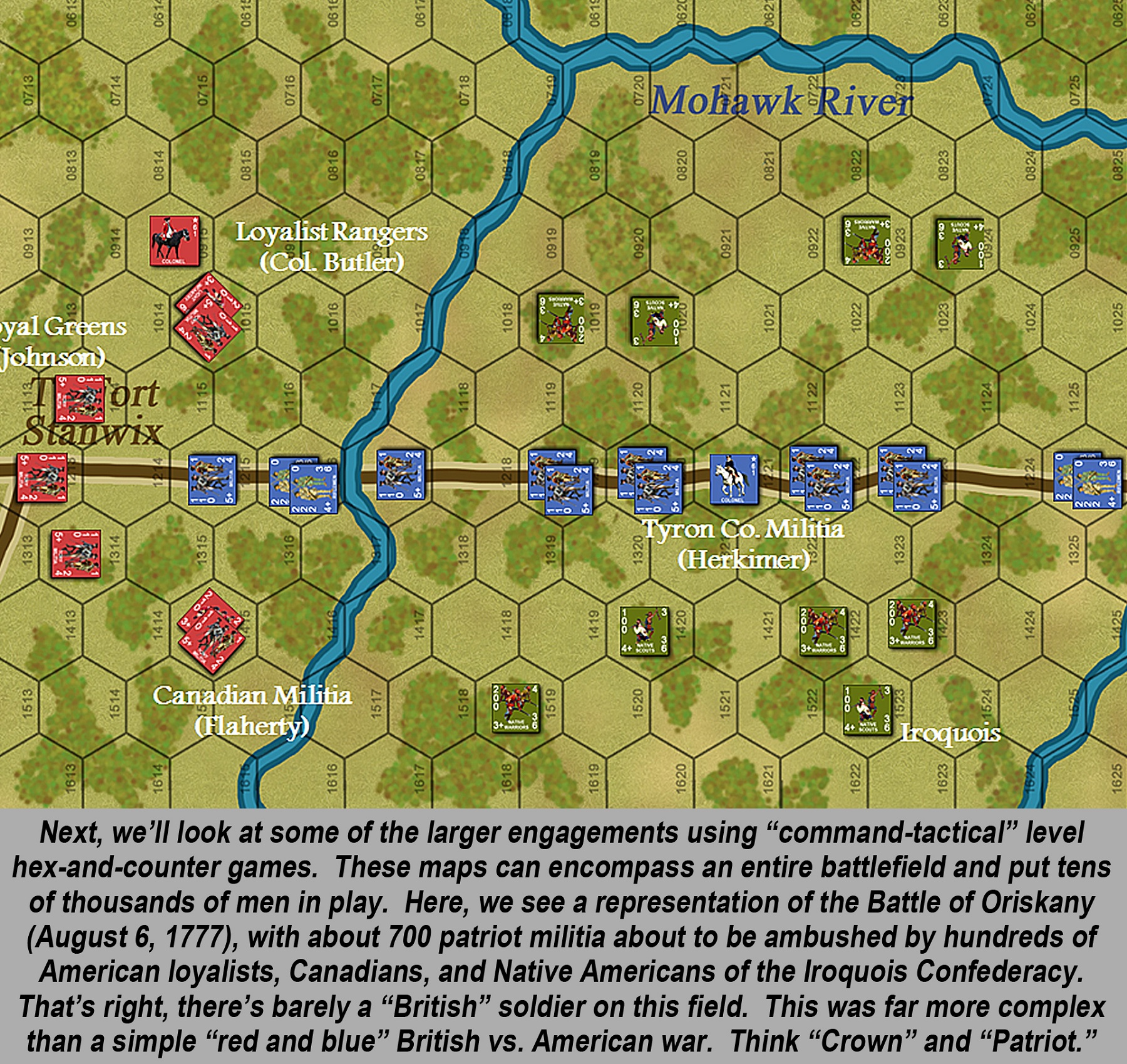
Indeed, according to my research, Butler was present at the Battle of Oriskany (what the map is from, much more on this in Part 04), along with other Loyalist units and about 400 Iroquois. Now I’m not 100% sure, but I think Butler distinguished himself at Oriskany so much that he was promoted and authorized to raise his own regiment. This regiment officially became Butler’s Rangers (hence the map only shows “Butler” in command of “Loyalist Rangers.”
The counters are designed red just to make owner / allegiance clear. I’m not sure if you can see it, but zooming in you might see that the militia figures on the counters are wearing a variety of colors, including green (I didn’t want to make individual counters for each regiment). 😀
Thanks for the comment. 😀
This conflict has always interested me, but from a skirmish perspective. I quite fancy playing out a campaign at skirmish level with a mix of patrol size clashes through to company regiment skirmishes. Though I’m not convinced to go with 28mm or 20mm yet, plus. I’m dithering over two rule sets as well.
This article series is definately pushing me to get organised to start painting and gaming.
Thanks, @warhammergrimace – as far as skirmish level AWI gaming goes, I liked Muskets and Tomahawks … I think it was aimed a little more at the French and Indian War than AWI, but the two are so close. The sub-plot mechanic was interesting, not sure if this was one of the two systems you’re pondering. I’ll be honest I didn’t know there were that many systems available, although a lot of them seem to be skirmish Napoleonics “backdated” a little to AWI.
@oriskany and @chrisg I have looked through the three articles that are up so far and enjoy them. Will you be doing a separate article/part to cover available and suggested rules?
Thanks, @mwcannon – actually we hadn’t planned on it, BUT … I always start a side-thread in the forums to where we cover pretty much everything that couldn’t make it into the article series for one reason or another.
For now, I can say this:
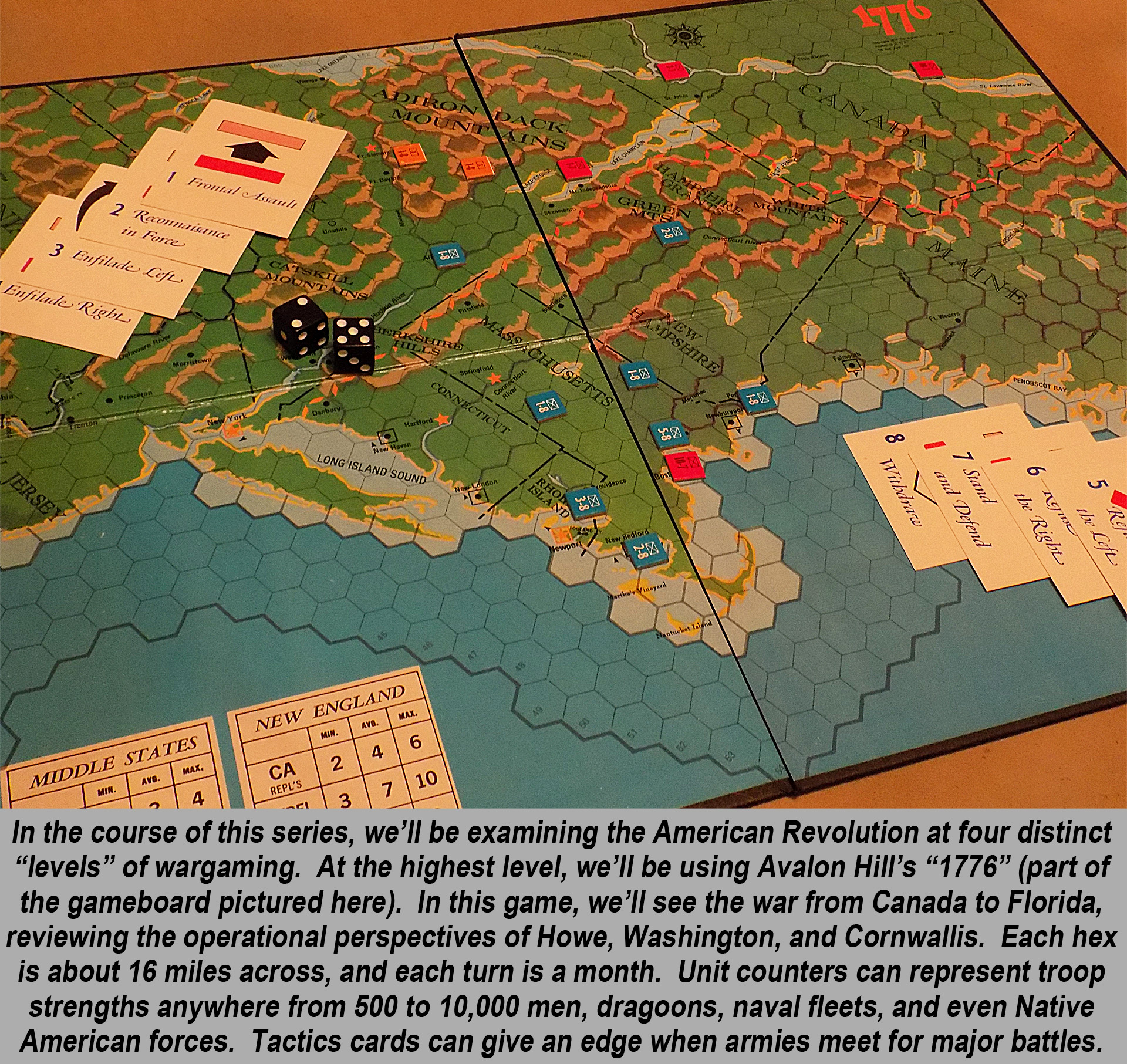
Large-scale operational scale – I used Avalon Hill’s 1776 wargame.
Mid-scale “Command Tactical” scale – I’m steadily building and playtesting my own hex-and-counter game. We can definitely talk more about that in the forum. I may even get to the point where .pdf downloads are possible for interested players.
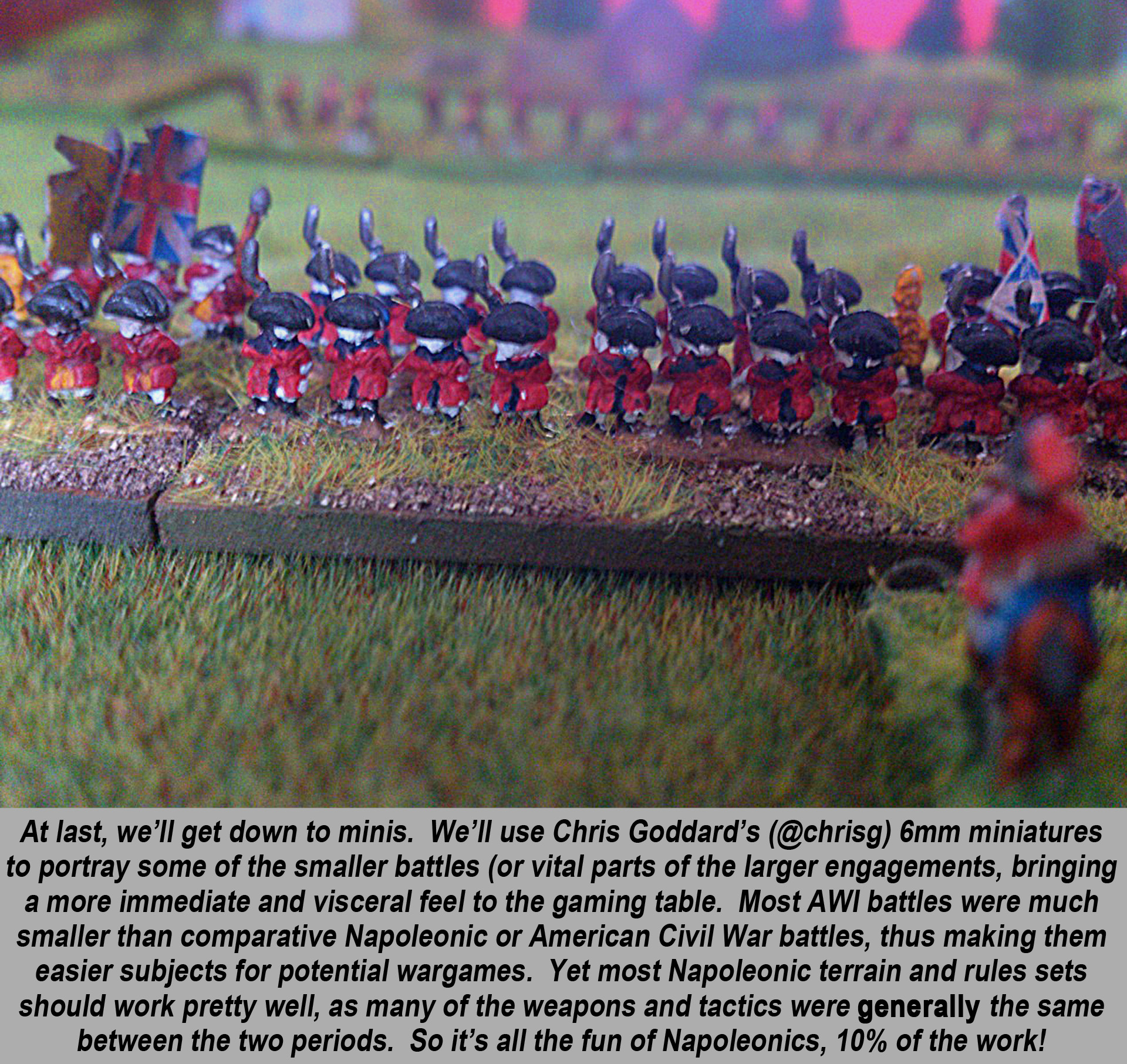
6mm tactical scale – Those were @chrisg ‘s games, I’d have to let him speak on those. 😀
20mm skirmish scale – I used Muskets & Tomahawks by Studio Tomahawk. I didn’t cover the actual game system very much in this case because I honestly only used part of it, and it was covered in much greater detail in the recent article series on the French and Indian War (Elessar2590).
We’ll get that forum thread going soon!
Late to the party as usual, but I think I set a new record by almost missing the entire series!
@chrisg and @oriskany this looks like it is going to be a truly great series and it is refreshing that you are going to tell the story through both sides. I like that you touched on what would be called the “Big History” of the birth of the US, which is what I find very interesting as it rest upon just a couple of big what ifs.
What would the US today look like if the French had defeated the British in Canada? They would have access to the US interior and would not have sold its now accessible Louisianan territories. Would the Spanish still hold territory west of the Rockies? What would the US be today if King George III had given representation in the British Parliament? Starting with the actions in Canada the US that we love or hate could have turned out so different.
If is often forgotten that the colonists at the time considered themselves more British than the Brits. One individual alarmed by the way British aristocracy clipped their words urged the aristocracy to send their sons and daughter to the colonies so they could be taught how to speak the language properly. An interesting side point to Paul Revere was that the warning was sent out in what we would call a pony express today. Paul had the shortest ride of all the riders involved.
Asymmetrical Warfare is a media buzz word that tends to over shadow other forms of warfare today. While the Peninsula War of 1812 is most often cited as a good example of Hybrid Warfare I see the AWI as another great historical example of it. For those unfamiliar to this term Hybrid Warfare refers to campaign where one or all sides have the option of fielding a land army capable of taking to the field when things are going well for them and can immediately transform to guerrilla warfare disappearing into the woodwork when thing are not going their way. In modern times Hezbollah uses Hybrid Warfare methods.
Now off to catch up with the rest of the series.
Hey, look who it is! @jamesevans140 returns! Glad you like the series so far. 😀
I like your comments about the “Big History” aspects of what could have been if the American Revolution had turned out differently. We were talking about this on one of the other threads somewhere, I can’t remember where …
We once wanted to create an alternate WW2 where part of the fighting took place in the continental US. Sounds crazy, I know. Well, we took what I think is a much more realistic angle on it than they do in say … Man in the High Castle. We went back to the American Civil War and made just a few smaller (and more believable) nudges to history, thus setting it on a different “trajectory.” By the time you get to the 1940s, these initially smaller changes have resulted in a very different world in which part of WW2 could have actually taken place in Georgia, Tennessee, Virginia, etc.
Anyway, we started talking about this kind of idea in the American Revolution, and very quickly history goes off the rails in some very big ways. No successful American Revolution doesn’t just have huge impacts in the Americas, including British possessions in Florida, the Louisiana Territories, the Native American nations, and Canada. But also …
No American Revolution means no uncontested British control of India. Also, it means no French Revolution, which means no rise of Napoleon and no Napoleonic Wars. No Napoleonic Wars and no uncontested British dominion in India means no Victorian Empire. the 19th Century is turned completely inside out, and not just in the Western Hemisphere.
Of course you can give yourself a headache trying to work through these endless permutations and possibilities.
Glad to see you again, and glad you like the series so far! Thanks for the comment! 😀
Well I have finished the Fort again and it really was a great American or should that be Massachusetts screw up?
I have read some history if the AWI and at the time I get the feeling Britain was losing interest in the Americas and was more and more turning it’s head towards India and the East.
Hello, @torros – American, Massachusetts, whatever you want to call it, it was a top-to-bottom clusterXXXX by the sounds of it. Although again, I still don’t have all the details (caliber of artillery, both in the fort and on the ships, precise causes for Patriot hesitation at key junctures, etc.)
We just gamed out way through most of the Penobscot Expedition with two games (a loose adaptation of Letters of Marque for the naval part, then Sons of Liberty Tactical for the initial American landing and ground assault up the western bluffs).
Now that you’ve re-red the novel … did we at least come close? 😀 These games were “approximations” to be sure, but I guess all wargames are to one extent or another.
http://www.beastsofwar.com/groups/historical-games/forum/topic/birth-of-the-united-states-wargaming-the-american-revolution/
Well I am presuming the novel is close and the author says he used enquiry board documents concerning the action at sea and on land as well as Revere being accused of cowardice. I think from what us written was Lovells hesitation and trying to run the expedition by democratic vote, by the American Navy refusing to take on the British sloops anchored in the harbour and a 32 gun ship of the line plus 3 frigates showing up that scattered the American Navies 40 odd ships. A lot if the ships were privateers who actually sold shares before setting off as they expected to gain a lot of Plunder.Again from the novel and the authors historical notes he notes the the Massachusetts militia were useful and refused on most occasions to face the British and a lot of the work had to be done by the Marines that sailed with the Navy. On a side note the Massachusetts committee refused to ask for help from the Continental Army as they wanted to prove they could take Fort George by themselves. In the end Massachusetts bankrupted itself over the whole affair. In the war of 1812 the British retook the Fort and built the stone defences you can see today
That seems to line up with most of what I found, @torros . I admit I did only cursory research, I have no doubt Cornwell is on the money given the reputation he enjoys vis-a-vis his Sharpe novels. And I’ve run across a lot of documentation based on the records from the various trials that were held afterwards. If there’s anything lawyers like to do, its build up stacks of paperwork.
I didn’t know about the attempts to run the fleet via “democratic” means. Almost reminds me of how the Red Army … immediately after the revolution … actually tried an egalitarian model without ranks. Worked out about as well as it sounds, I think they abandoned the idea after about twenty minutes. 😀 But a lot of revolutions briefly try to run their wars on the model and ideals of the revolution itself, which of course never works.
Definitely found lots of information on the fleets, what ships were there, and how many guns each ship had. Just not the size of the guns, or any information on the guns in the fort. @crazyredcoat tried to help, but in the end I think we were all guessing.
No worries, though. The games turned out pretty well.
Definitely found some information on the Continental Marines you mentioned, and how they took so many more casualties than the Massachusetts “militia” that the American commodore commanding the Marines threatened the general commanding the militia to pull said Marines off the peninsula and leave the militia high and dry. Certainly not the first time the Marines would wind up carrying the Army’s load.
(ahem) … but I digress. 🙂
Should add the heaviest guns the Americans had were the 18pdrs on the Warren and some of that had to be by the artillery as Revere fitprgot to bring any for his own artillery. Although I can’t prove it when it comes to Natilus Island the British went with Fredrick’s maxim of he defends everything defends nothing.. The book suggests the reason why the American Navy didn’t go into the harbour from where the could maybe fire at the fort (which was still in half built when the Americans landed) was due it’s positioning once the ship had sailed in it would find it hard to sail out as there wasn’t really enough room to tack. The British also had some 9 pdrs guarding the entrance and presumably had access to heated shot which would have greatly troubled the ships if they had entered
Awesome, @torros – the 18 pdrs on the Warren is the first hint we’ve found so far on any gun calibers. For our game we just had to take a shot in the dark, and assumed all the guns were “roughly the same size.” As pertains to design, I aimed at a “central average” of 12-pounders, figuring some would be heavier and some would be lighter, and hoping it would “all come out in the wash.” 😀
I was considering that the larger ships should get a boost in their calculated firepower ratings (based on the number of guns). The general idea was, say … we would assign a 24-gun sloop-of-war a Firepower of “6” based on 4 guns / Firepower Point. With larger ships like the Warren with her 32 guns, she might get a 9 or a 10, instead of the 8 she would normally get based on a strict 32 / 4 = 8 reckoning. The assumption being bigger ships would probably at least a few bigger guns in the mix of her broadsides.
But I didn’t … for three basic reasons:
1) had no evidence at the time
2) the Americans were already really overpowered in this game.
3) a reduction in the “expected” formula-driven firepower numbers could be attributed to the well-documented American inexperienced crews, officers, etc.
Yes, we were counting the the fort as only “heavy cover” rather than “fortified cover” since I’d read the fort was only half competed (the British had only been there for 20-25 days when the Americans arrived, something like that)?
As far as the British not putting up a very strong resistance at Nautilus Island, I read similar accounts, and so in our naval game didn’t even have the issue in question. If the Americans could land the historically-prescribed 2 company counters (2×50 = 100 men) on the island, it was theirs for victory conditions purposes.
We did miss the 9-pounders with heated shot guarding the entrance. That would have helped a few days aho when I was trying to balance that first naval game. I was half-afraid that some kind of land-based artillery could have helped what at least appears to be a huge American naval superiority.
Overall though, we were pretty close. Not bad for one day of reading, one day of design and tinkering, and two days of gaming / battle reports.
Thanks again for the assist! 😀
On one other basic note. The British had never any intention if engaging the American Navy in an open fight so when the sloops were anchored the man in charge of the British Navy removed a lot if the guns from the sloops and gave them to McClean to help guard the Fort. My feeling is that McClean thought the whole affair futile and the setting up of a New Ireland for American loyalists would never succeed and expected the Americans to over run the Fort on the day they first landed.
Thanks once again, @torros –
ARTILLERY IN THE FORT:
@crazyredcoat said the same general thing … that artillery in the fort should be “borrowed” naval artillery from the sloops HMS Albany , Nautilus, and North. In the thread in question (we can’t really post more pictures here), its shown where I replaced some of the “light artillery” in the Sons of Liberty: Tactical game with “heavy artillery” (light artillery in that game = “grasshopper” guns like 3 and 4 pounders, “heavy” artillery are usually 6-pounders. Of course that scale doesn’t apply to the ad-hoc naval game we ran 🙂 ).
MCLEAN’S “FUTILE” MISSION:
Now I knew about New Ireland and the whole “Loyalist Colony” angle, but I’m actually pretty surprised to head about Francis McLean’s lack of optimism regarding the expedition, given how well the British seem to have fought at Penobscot.
I mean even if you consider how divided, indecisive, timid, self-serving, and sometimes even cowardly the American commanders were i this campaign, the sheer weight of their numbers and fire when compared to the British should still give them a victory unless the British fight like in a very professional, determined manner.
Although, when first watching that American task force sail up Penobscot Bay on July 25, I’m sure anyone would be more than a little discouraged. 😀
TAKING FORT GEORGE:
As far as overrunning the fort the first day they landed, I set up the ground battle and tried to “thought-experiment” my way through it. Given the numbers on both sides (ground forces were closer to being even), plus the rather steep bluffs the Americans had to climb, I can kind of see why that fort was never taken.
in our game it never felt like the Americans really had a chance. However, we did allow the British a lot more freedom when it came to activating and deploying the 82nd Regiment.
But even deploying the 82nd, then only half the 74th, and considering that Fort George was only half completed (giving the game stats of a wooden building), and only a few heavier guns, those Massachusetts Militia and Continental Marines never really came that close.
I’m assuming the idea that the Americans “should have taken the fort rather easily” stems from their fleet bombarding the fort with their 320 guns. But as I’m sure you know, only three Americans ships actually supported the landings (USS Hunter, Tyrannicide, and Sky Rocket, and they were bombarding the coast on which the Americans landed, not the fort.
Yeah, thinking back on that ground assault game, adding another 14 ships = 28 heavy artillery batteries in the Sons of Liberty: Tactical scale … hmmm …. you know, that could have made a difference. 😀 😀
I should also apologise for my posts it was late at night usng one finger typing and autocorrect and all the terrors that brings with it
No worries at all, sir. Thanks very much for keeping the thread going! 😀