









![NO Weekender Or Cult Of Games XLBS This Weekend [Updated]](https://images.beastsofwar.com/2026/03/No_Weekender_and_XLBS_this_Weekend-225-127.jpg)


Baptism By Fire: 1943 // Americans In Tunisia – Part Four
April 2, 2018 by oriskany


The time has come, Beasts of war, to draw the curtain down on our article series reviewing the American Army’s “initiation” battles in North Africa against the Germans in World War II. Using game systems like Battlegroup Torch and Panzer Leader, we’ve been recreating some of these events in our historical wargaming.
Follow The Americans In Tunisia Series
If you’re just joining us, so far in this series we’ve covered:
- Part One: Introduction & Background
- Part Two: Disaster At Sidi Bou Zid
- Part Three: Slaughter At Kasserine
In summary, suffice it to say that German and Italian forces had been hitting the US II Corps all through February 1943, inflicting harsh defeats at places like Sidi Bou Zid and Kasserine Pass. The Germans had come very close to splitting the American line clean open, and opening a road all the way out of western Tunisia and back into Algeria.
In the end, American numbers, British intervention, and German commanders in personal conflicts had frustrated the German advance. Finally, they withdrew at the end of February, but the battered and bleeding survivors of II Corps were in no shape to pursue.
Taking Stock
The battles of Sidi Bou Zid, Sbleita, and Kasserine Pass had cost the US II Corps in the area of 10,000 casualties, over 180 tanks and armoured fighting vehicles (AFVs), and hundreds of soft-skinned vehicles. In particular, 1st Armored Division was practically smashed and would need weeks of delicate repair before it was ready again for combat.
The Americans also took a hard look at their recent performance. Firstly, Eisenhower fired his chief of intelligence, who’d been overly reliant on ULTRA / Enigma information (great for strategic and operational data, not so much for tactical battlefield information).
Also, the commander of US II Corps, Major-General Lloyd Fredendall (universally disliked by fellow generals), was politely removed by General Eisenhower and “promoted” back to America to run a training command. Although never officially reprimanded, his already-damaged reputation was ruined and he retired shortly after the war ended.
The British were also quick to label Fredendall as a scapegoat for the near-calamity. They held no respect at all for the man, and General Harold Alexander (Montgomery’s boss, British C-in-C, Middle East) diplomatically assured the Americans that “I’m sure you must have better men than that.”
Still, a little of the blame must fall on others, including Frendenall’s boss, the British Lieutenant-General Kenneth Anderson. National loyalty aside, no less than three British generals of Eighth Army were forced to admit that Anderson’s formations were badly coordinated and unwisely deployed.
It can be argued that by giving the corps and divisions under his command too much ground to hold, Anderson forced them to spread out to the point where Germans could isolate and attack individual commands, like the French XIX Corps at Faid and CCA/1st US Armored at Sidi Bou Zid, defeats which set the stage for Kasserine.
Eisenhower therefore streamlined and clarified the command structure between the US, British, and French forces in western Tunisia. National “autonomy” was greatly reduced, and forces of different nations would deploy, operate, and fight as a truly allied team.
Within the American forces, in particular, changes were implemented regarding how divisions would deploy. Combat Commands (CCs) within US armoured divisions and Regimental Combat Teams (RCTs) within infantry divisions would be much closer together, allowing mutual reinforcement and easier support from corps command.
New Commanders, New Plan
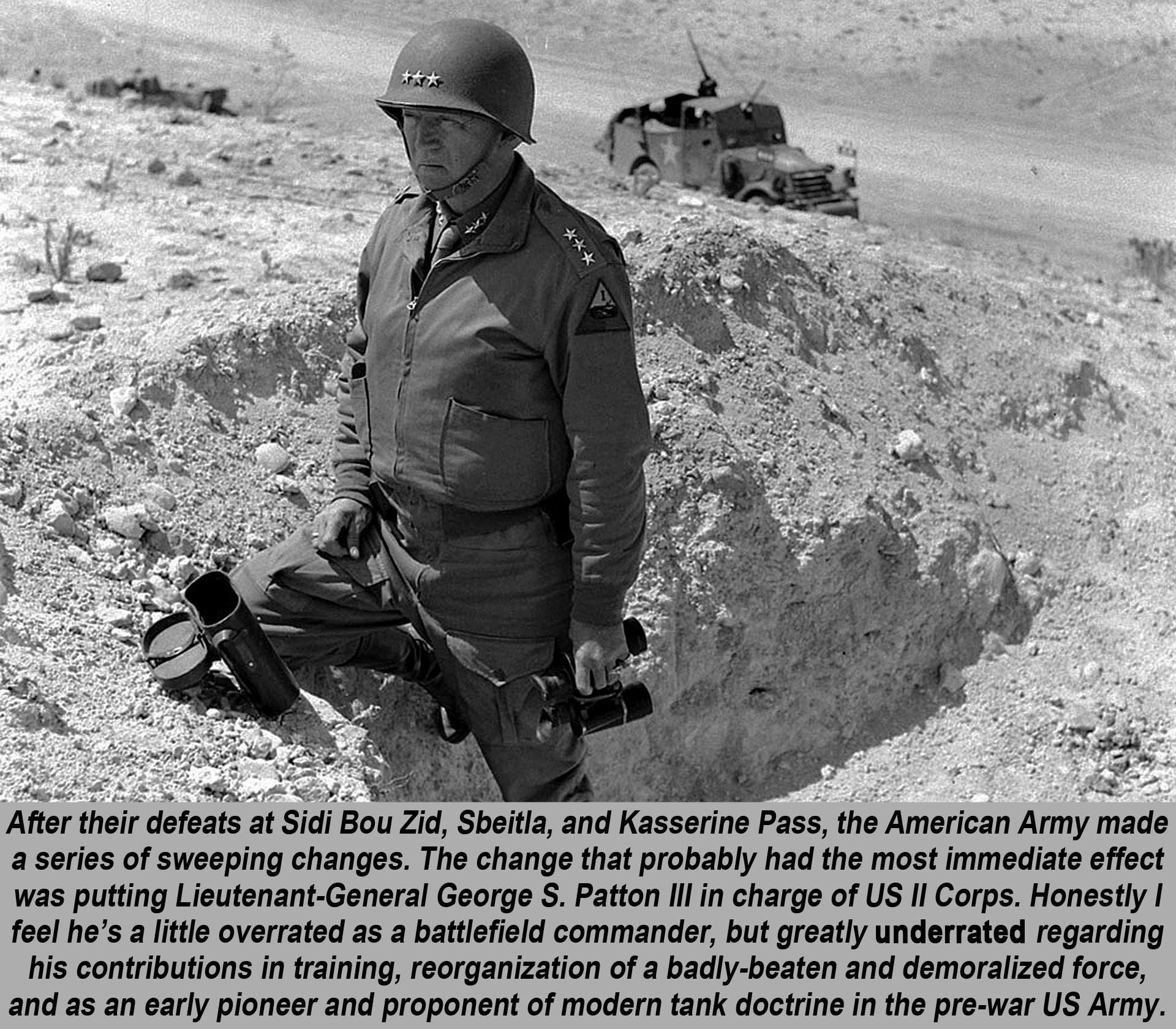
Meanwhile, a new commander was brought in to command II Corps on March 6th. This was freshly-promoted Lieutenant-General George S. Patton III, formerly commanding US I Armored Corps back in Morocco. As we all know, Patton was a fire-breathing, aggressive general who immediately started whipping II Corps back into shape.
Much as Montgomery did on a larger scale with the repeatedly-defeated Eighth Army before the Battles of El Alamein, Patton used disciplinary techniques and training to first restore military order and then fighting confidence among the men of II Corps. Training reduces fear and uncertainty, of which II Corps had plenty after suffering its harsh defeats.
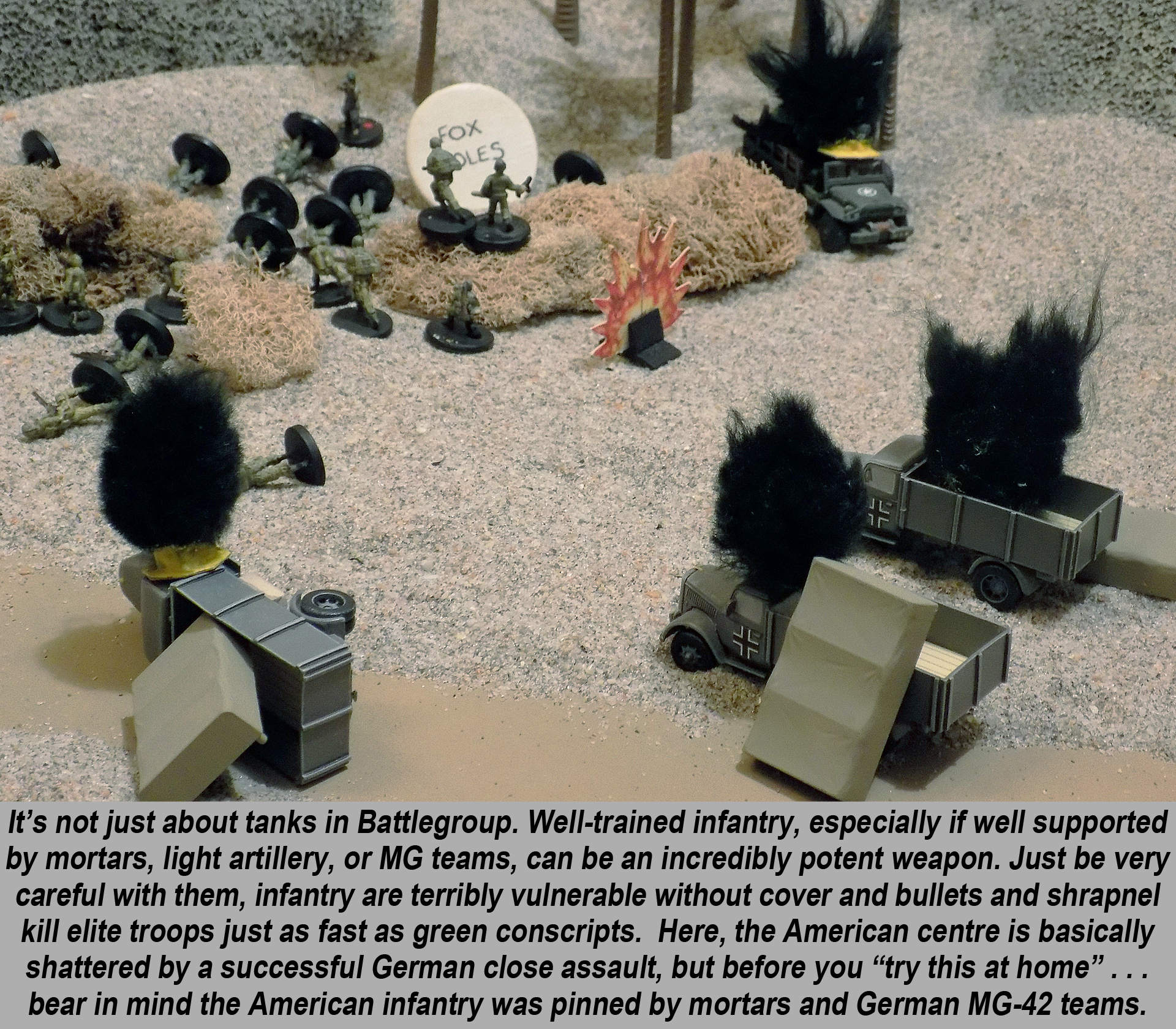
One may ask how the Allies in western Tunisia had the time to make all these changes. Simply put, while the Allied camp was coming together, the Axis camp was falling apart. The bickering between von Arnim and Rommel grew worse until Rommel again fell ill (years in the desert had wrecked his health) and returned to Germany treatment.
While home, Rommel pleaded for Hitler to withdraw German forces from Africa. Not only did Hitler refuse, but forbade Rommel to return. Hans-Jürgen von Arnim was now in command, and the Desert Fox would never again set foot in North Africa. An epic chapter of the Desert War had come to a decidedly anticlimactic close.
Another reason for the reprieve was that Montgomery’s Eighth Army had finally closed up its long advance across Libya and launched a full assault against the Axis divisions holding the Mareth Line in southern Tunisia. General von Arnim could no longer afford to pound away only at US II, French XIX, and British V Corps in western Tunisia.
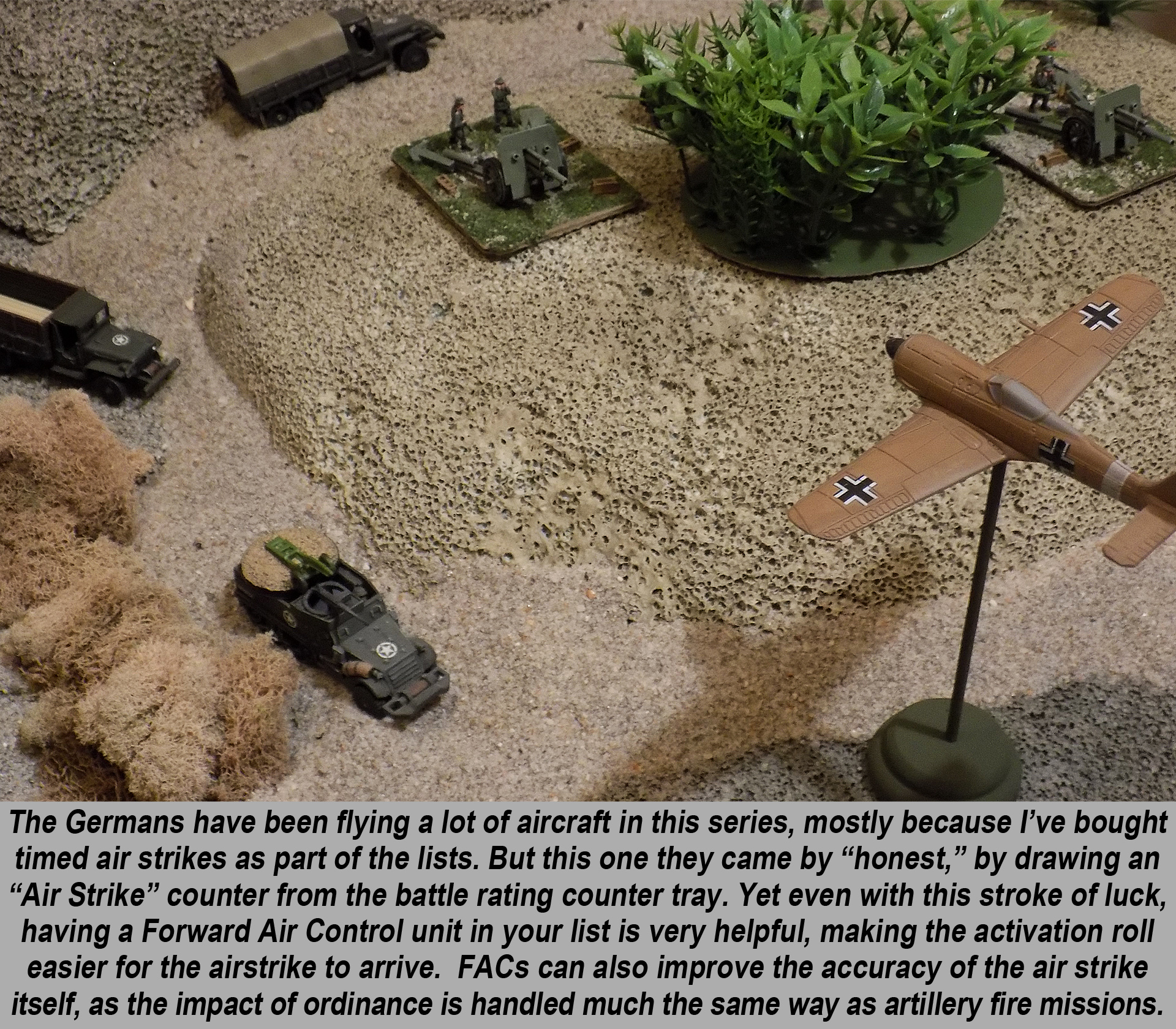
With the Battle of the Mareth Line opened in earnest, Patton was keen on letting his boys loose for a little payback. A major offensive back toward the Eastern Dorsal chain of the Atlas Mountains might threaten the right rear of the Axis forces defending the Mareth Line facing Montgomery, and ultimately make the Axis position untenable.
On March 17th, II Corps moved out of the mountains of the Western Dorsal, pushing forward into the abandoned plains near the town of Gafsa and the old battlefield of Sidi Bou Zid. Gafsa was soon set up as a forward supply base for further operations and on March 18, 1st Ranger Battalion pushed ahead to take the oasis of El Guettar.
The only resistance encountered was a light skirmish with the Italians, who quickly retreated and took up positions in the hills overlooking the town. This was actually a good move, for it blocked the pass through the Eastern Dorsal mountains leading beyond El Guettar. Here the Italians could hold until German reinforcements arrived.
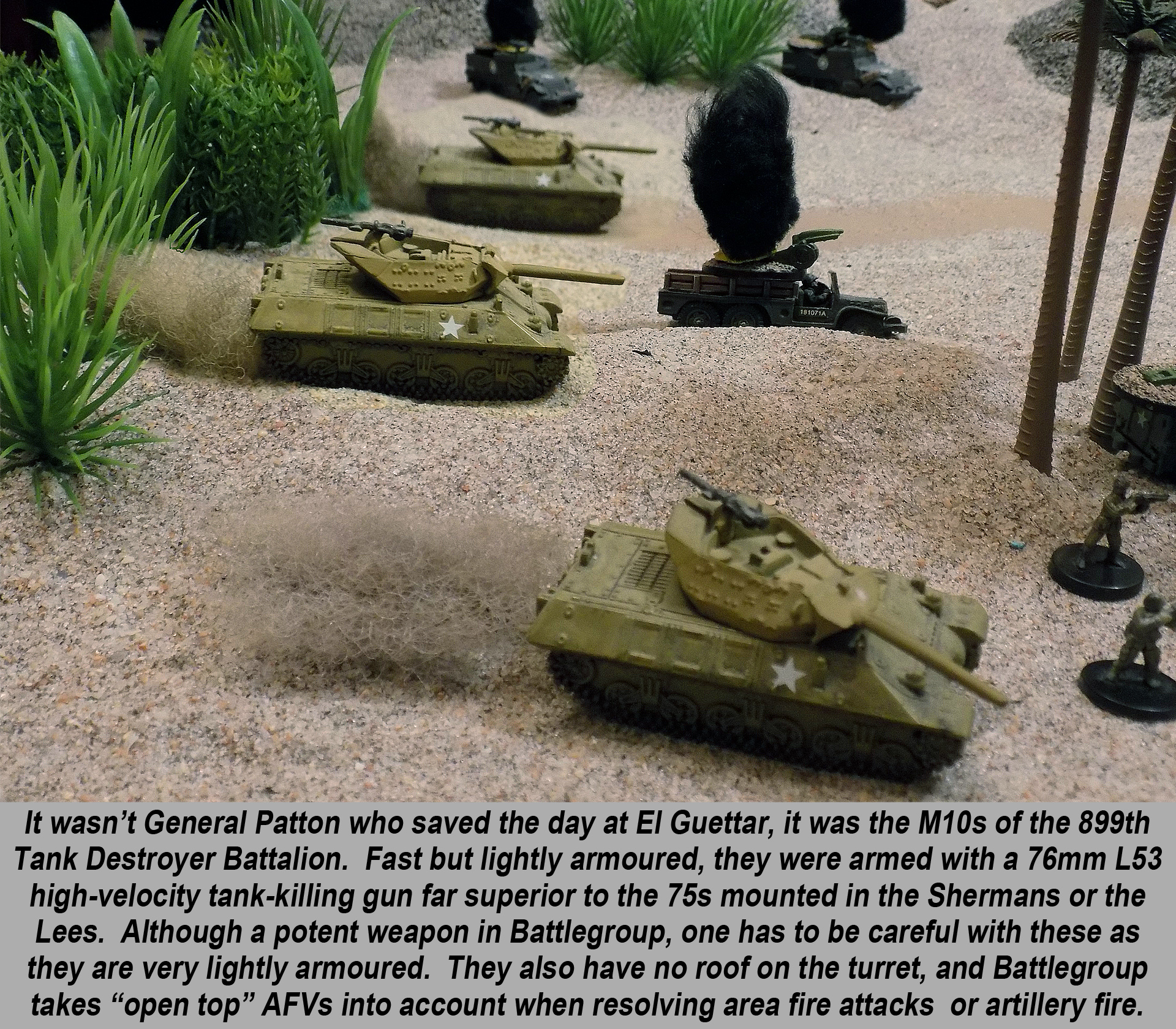
No such luck. The Rangers scaled a sheer cliff on the night of March 20 and took one of these Italian positions, along with 700 prisoners. The high ground southeast of El Guettar was now in American hands, and their mechanized forces were now in a prime position to drive through the Eastern Dorsal and deeper into the Axis rear.
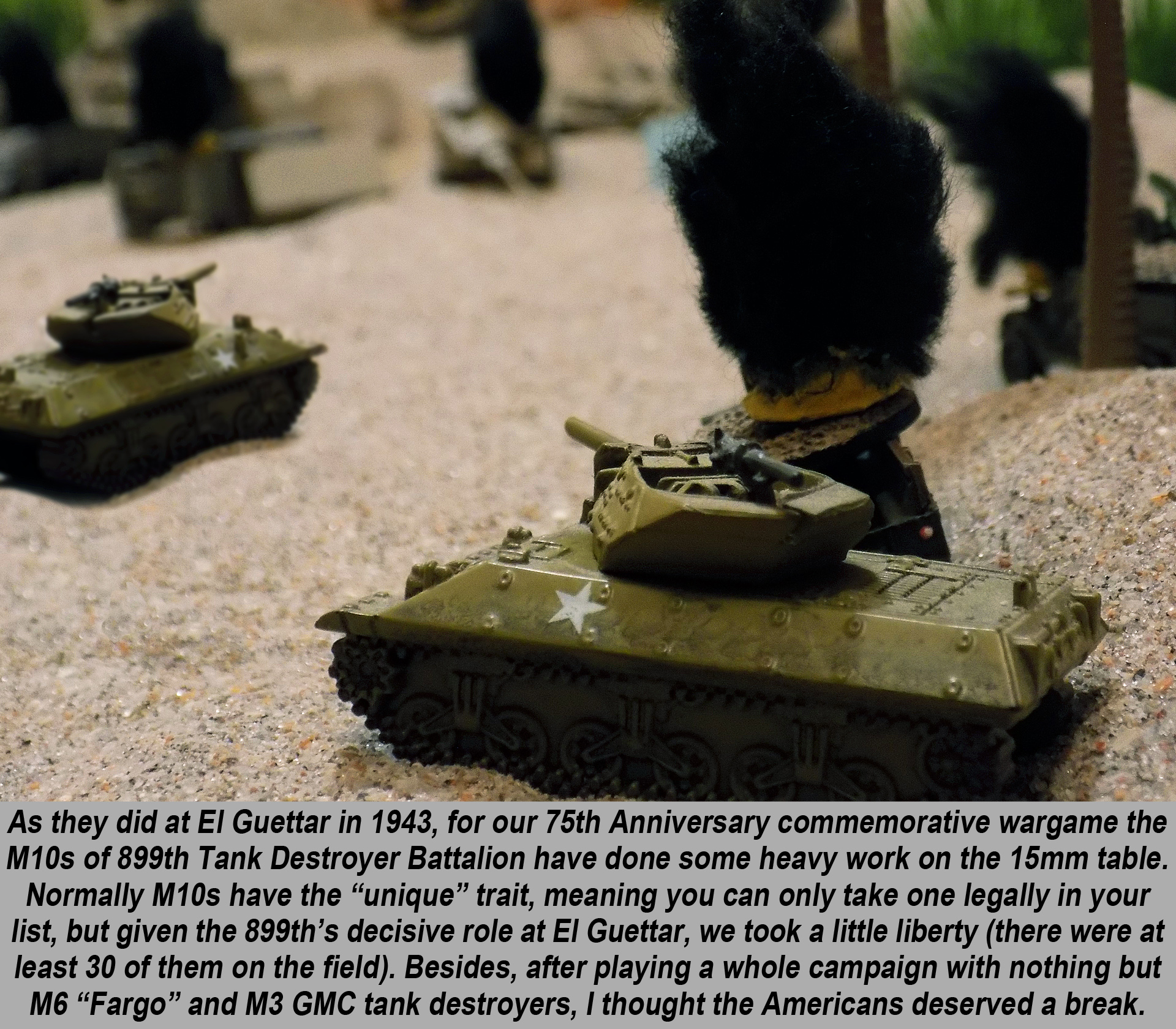
Von Arnim, upon hearing these reports, sent 10th Panzer Division to beat up on the “upstart Yanks” a third time. Thus, one could argue that Patton’s II Corps had already accomplished its primary mission, practically without firing a shot. Major German formations were already being pulled off Montgomery’s front in the south.
Redemption At El Guettar
In any event, the stage was set for the showdown at El Guettar. Of course, anyone who’s seen the George C. Scott movie has seen this battle recreated for the silver screen, but we hope to do a better job than Spanish army troops and American tanks (ironically named “Pattons”) painted tan in a sad attempt to look like German panzers.
The most egregious thing the movie gets wrong is putting Patton personally there. He wasn’t. Furthermore, this isn’t just historical academics because it takes credit from the generals who actually were there commanding on the scene.
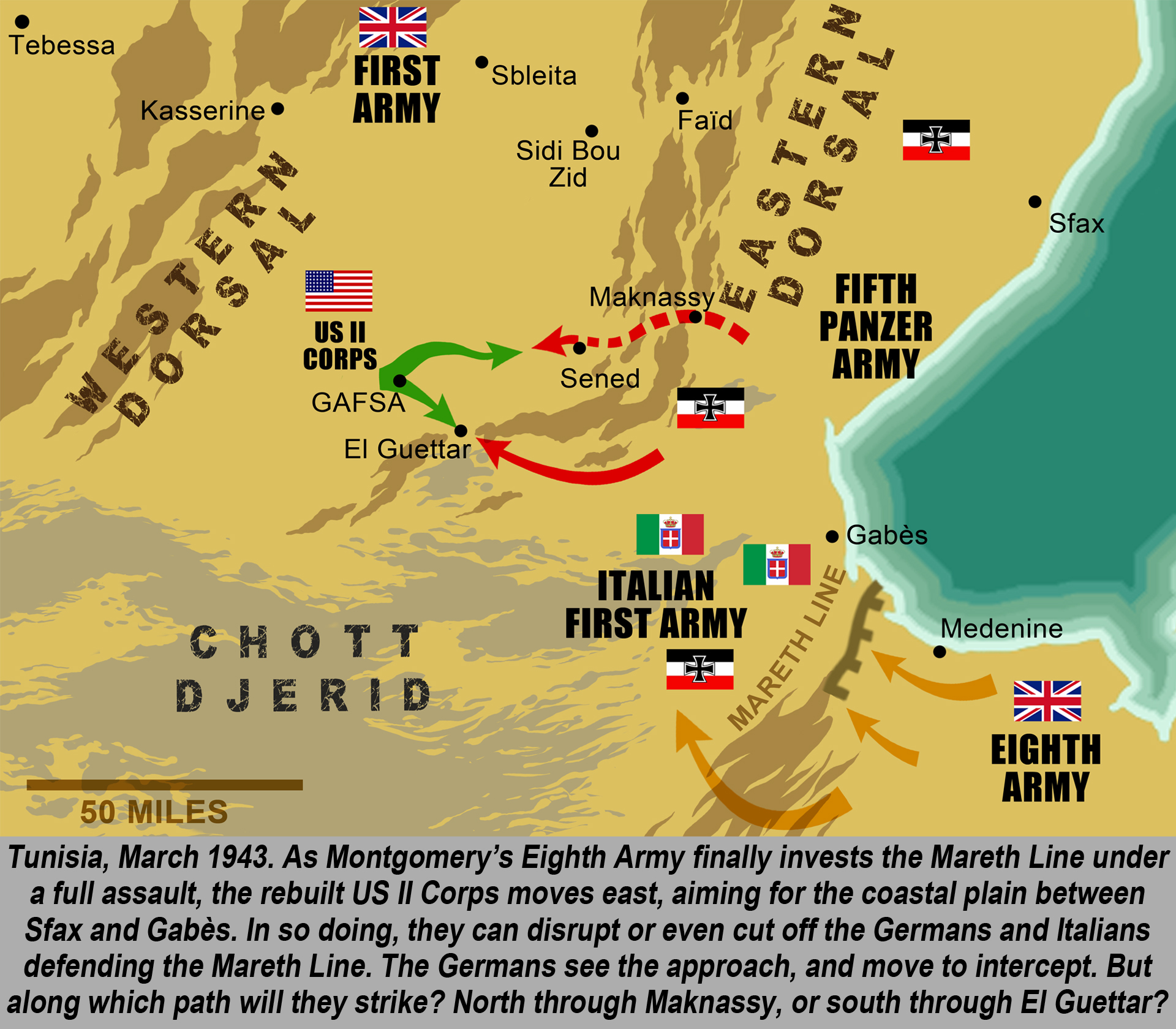
In summary, 10th Panzer was driving toward US II Corps from the east. They could attack along the Sened-Maknassy road to the north, or along the more difficult approach through El Guettar to the south. To his credit, Patton deployed so both approaches were covered, but felt the northern avenue more likely.
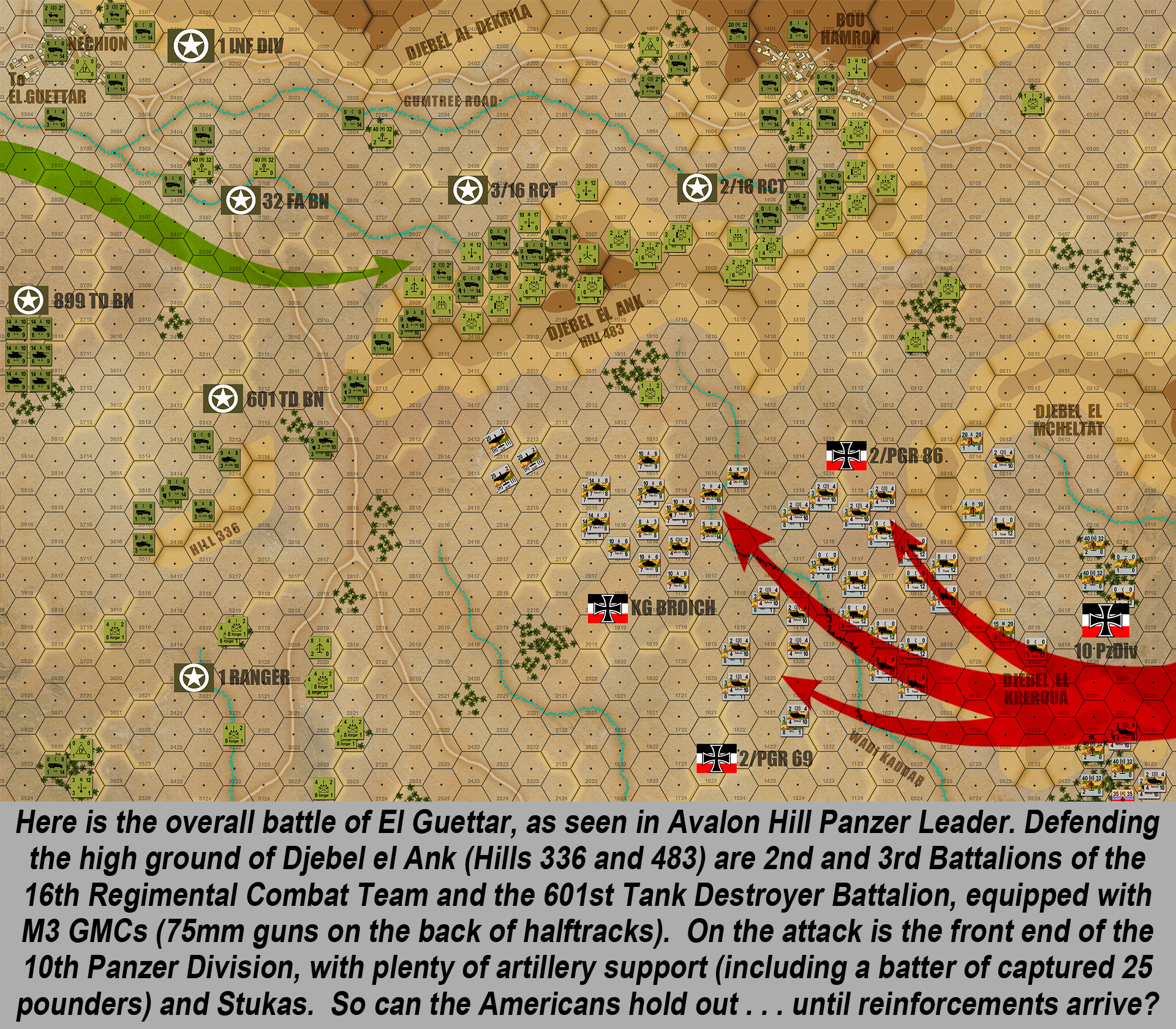
Thus, Patton deployed his stronger 1st Armored Division in the north, where he took personal command. In the south was the US 1st Infantry Division (The Big Red One), commanded by Major-General Terry Allen, assisted by his executive officer (XO) Theodore Roosevelt Junior, son of the famous American President of the same name.
These were the men who’d actually command at El Guettar. One veteran describes General Roosevelt marching on foot with the men, M1 carbine slung over his shoulder. Another describes General Allen’s reaction when his HQ was about to be overrun by German tanks.
“Like Hell I’ll pull out,” he snarled, “and I will shoot the first bastard who does!”
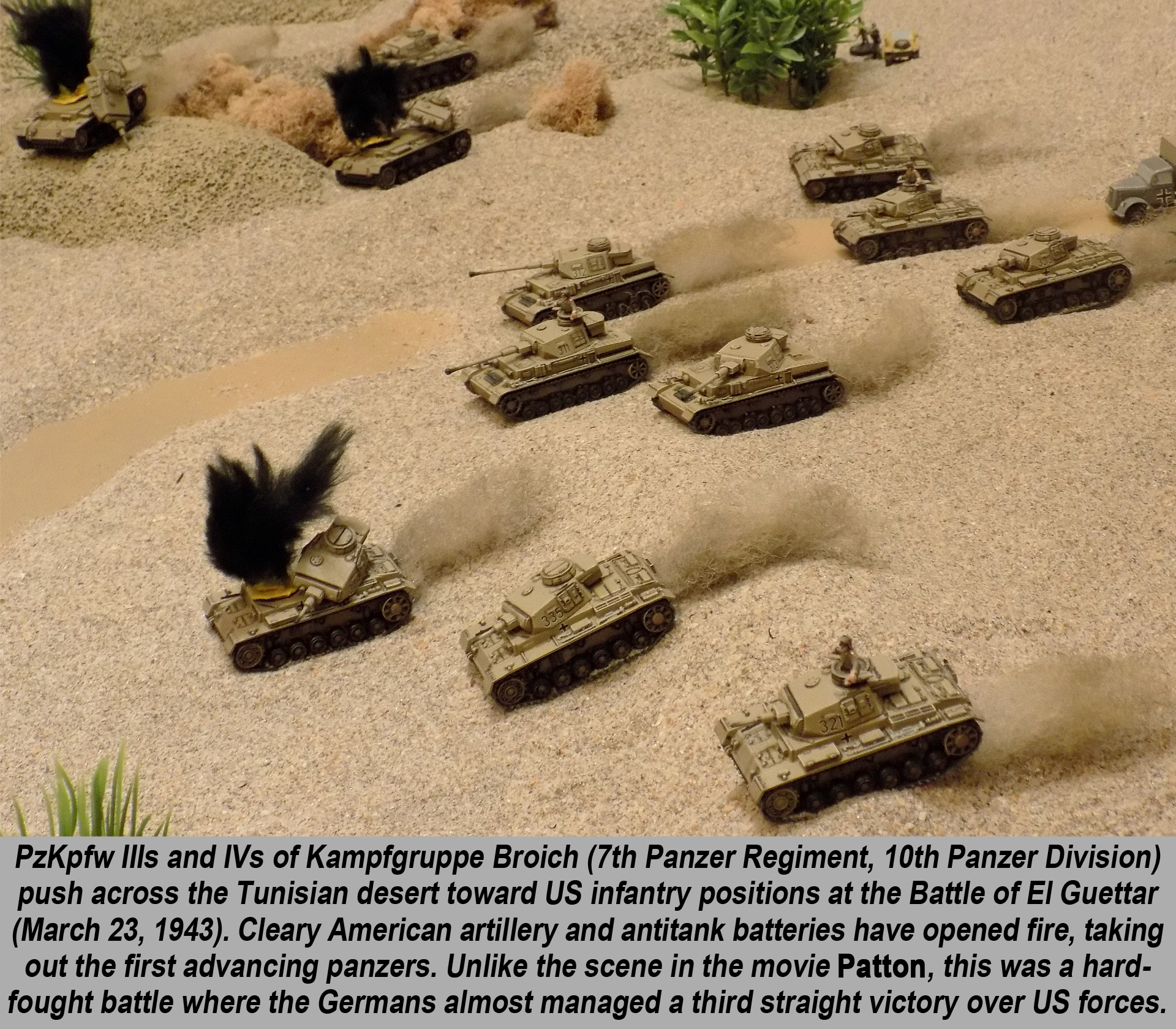
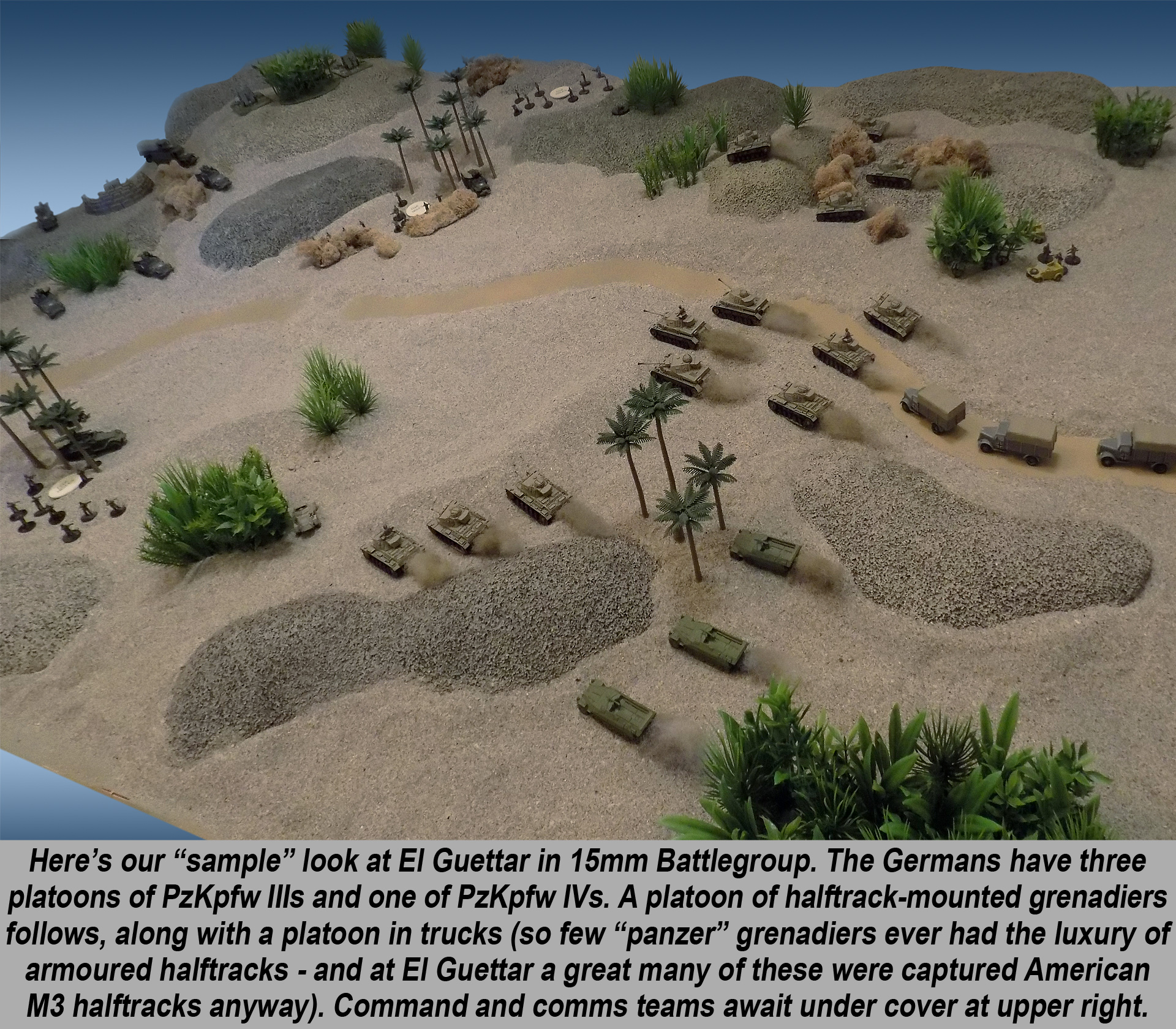
The 10th Panzer hit the US 1st Infantry, hard, on 23rd March 1943. The German attack force was commanded by Freiherr von Broich, with fifty-seven tanks of 7th Panzer Regiment, plus elements of 69th and 86th Panzergrenadier Regiments. Another interesting feature is the 90th Artillery Regiment, partially armed with captured British 25-pounders.
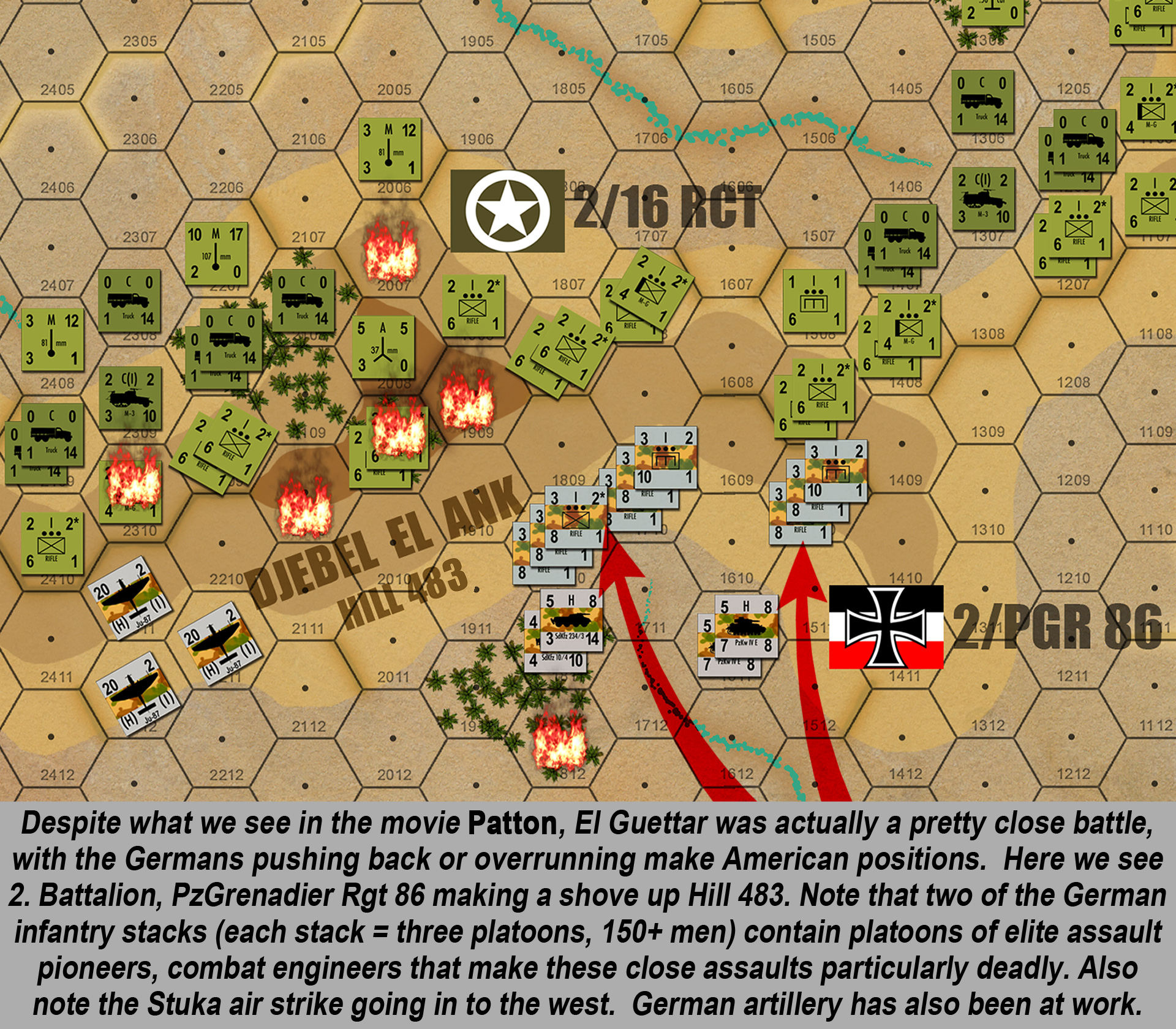
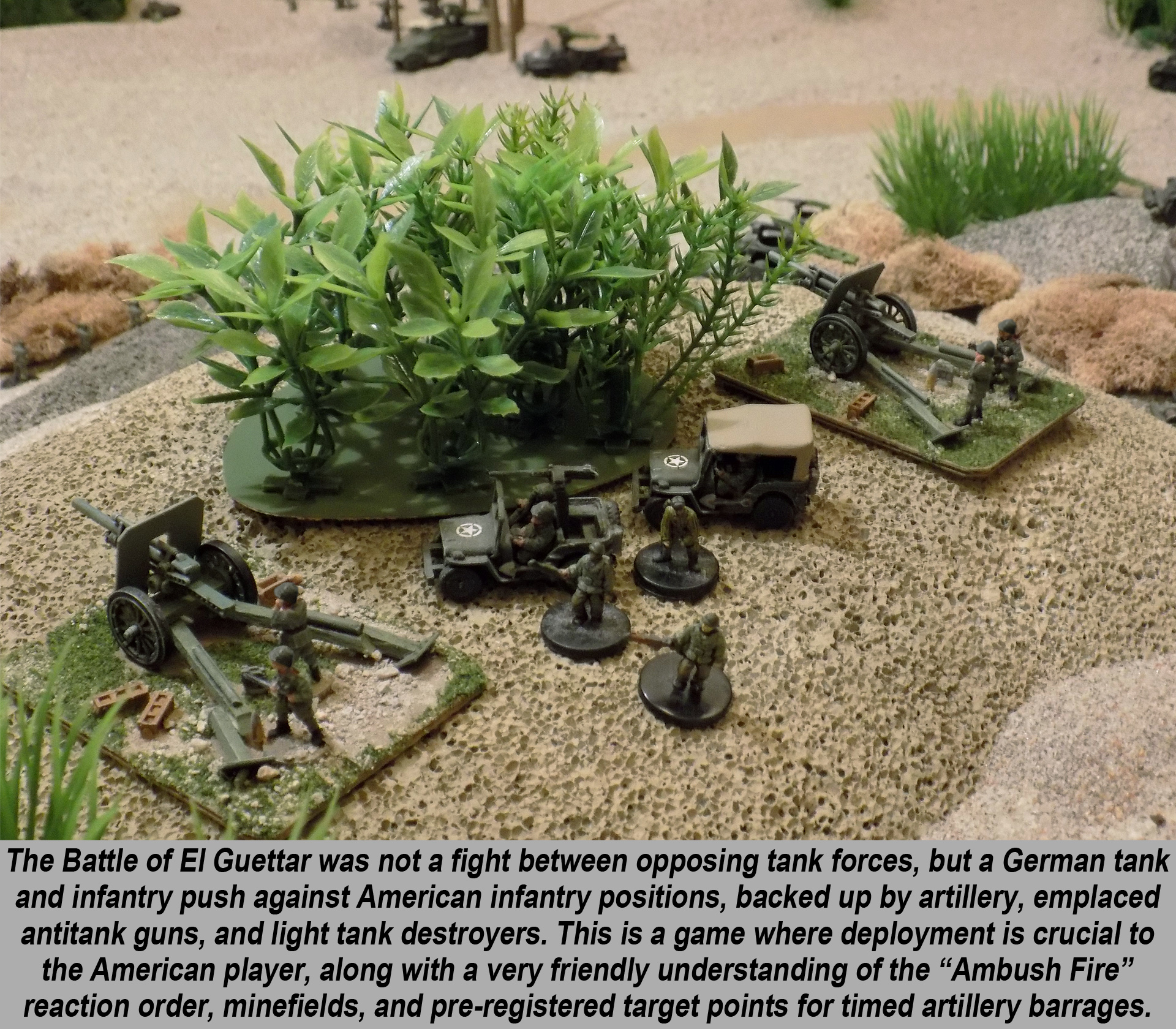
One thing the movie does get right is the general feel of a German mixed force moving up a valley against a line of American antitank guns and artillery on high ground. The Germans weren’t massacred in the open, however. They actually shoved back the outgunned American infantry and for a moment, it looked like Kasserine all over again.
Although much improved since the dark days of February, the Americans were still hampered by poor equipment. The 601st Tank Destroyer Battalion, for instance, was equipped with M3 GMC (gun motor carriages), basically halftracks with a 75mm gun bolted to the back. Not much of a tool for fighting the latest PzKpfw IVs.
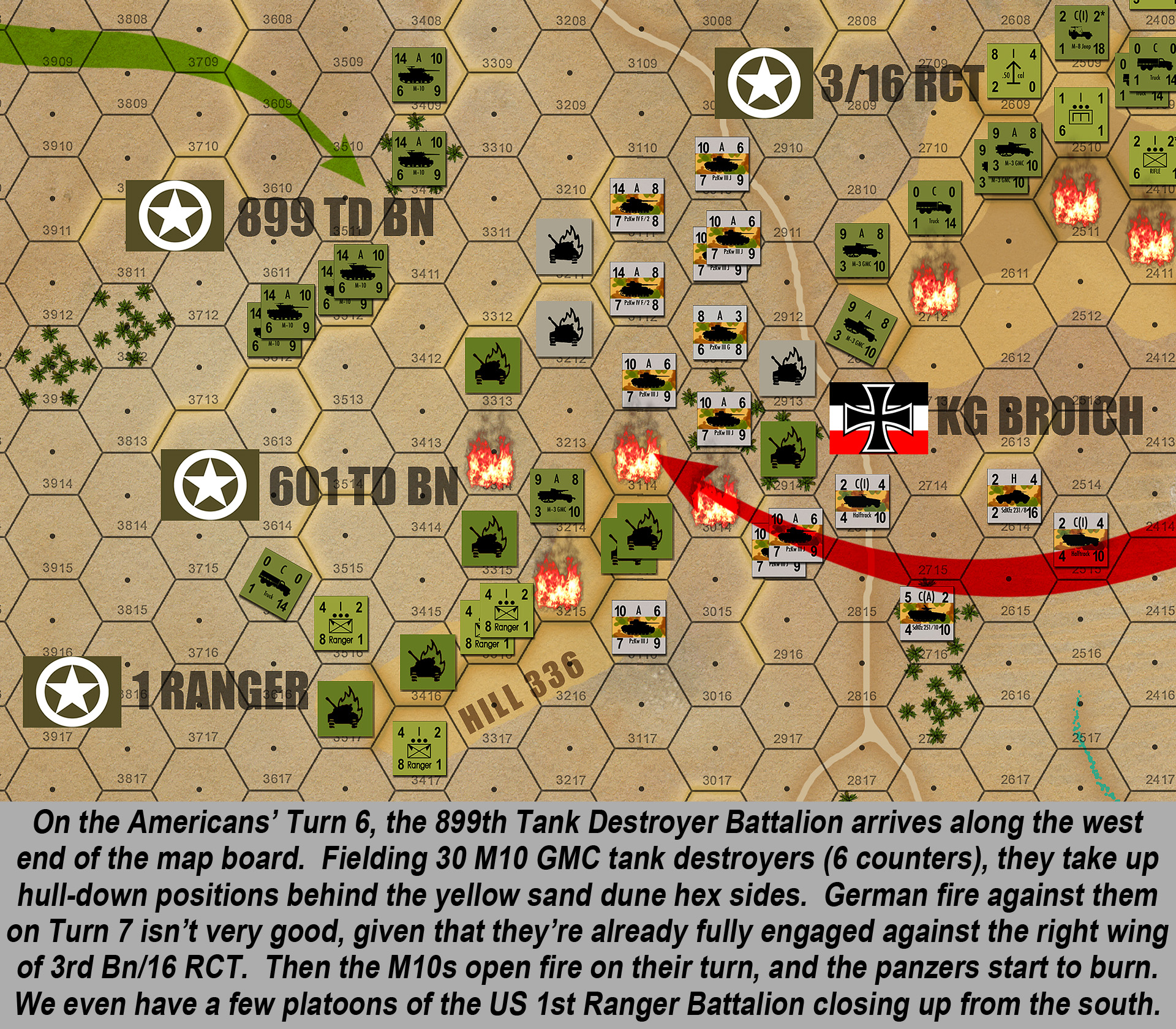
Still, Patton’s training and discipline paid off. The men didn’t panic, even when the division command was about to be overrun. The Germans then ran into a minefield, halted just long enough for the arrival of 899th Tank Destroyer Battalion, equipped with the far superior M10 tank destroyer with high-velocity 76mm antitank guns.
Heavily mauled, the Germans withdrew. Patton, having heard of the fighting the south, hurried to personally command the battle. The Germans tried again in the afternoon, and Patton was on the scene for this second engagement. But the threat had passed, and the Germans soon called off this second half-hearted assault.
The Americans had, for the moment, redeemed themselves. They’d won a victory over hardened veterans of the panzerwaffe. Of course, subsequent counterattacks to exploit this success were clumsy and inconclusive. The Americans had learned to hold the field, but to actually attack the Germans successfully was another lesson.
More importantly, the armies of the US, UK, and France had learned to work and fight together as a coalitional team. France, in particular, was no longer a “Vichy enemy.” Americans had learned to respect British experience, and British had learned to respect American competence, firepower, and battlefield grit.
This wraps up our article series on the American “Baptism by Fire” in Tunisia, 1943. For hard-core history buffs and wargamers, I hope I’ve provided lots of detailed food for thought on gaming these interesting battles where the balance between Axis and Allies was still (at least tactically) very much in doubt.
For those newer to historical wargaming, take heart. As this series shows, even the people who play at “1:1 scale” can be inexperienced. We all have to start somewhere - and practice, perseverance, and tenacity will always pay off in the end.
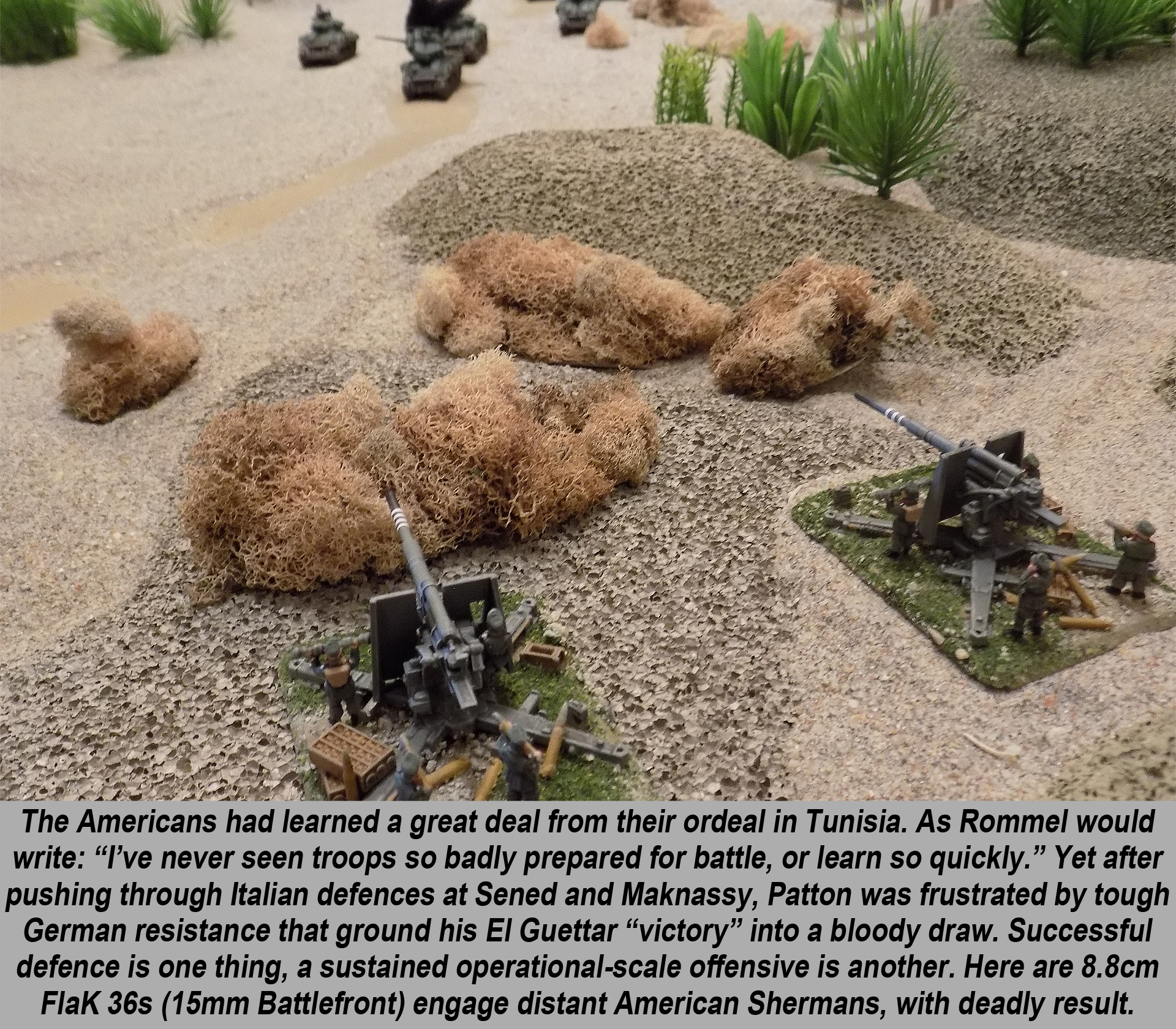
As always, I’d like to thank BoW Content Manager @dracs and my editor @brennon - also @lancorz for the awesome front page graphics and Tom for the “behind the scenes” web support. Thanks as well to @dignity and @johnlyons for the great Weekender interview, and of course @warzan for the opportunity to publish on BoW.
Most of all, thanks to all of you for continuing to read, support, and comment on these articles. I can never express how much it means to be able to share all this with such a loyal and enthusiastic audience.
Now, why are you still sitting in that chair? Get out into the desert and win some battles!
"National loyalty aside, no less than three British generals of Eighth Army were forced to admit that Anderson’s formations were badly coordinated and unwisely deployed..."
Supported by (Turn Off)

Supported by (Turn Off)
"“Like Hell I’ll pull out,” he snarled, “and I will shoot the first bastard who does!”"
Supported by (Turn Off)



Glad I’m finally on a day off so I can catch up on what has been a great series of articles. Many thanks again Jim for continuing my education into areas of WW2 I have a sketchy (at best knowledge of). Now to go and dig out those Gibraltar tunnel photos to see if you can guess what is still left hiding in there from the war!!??
Thanks very much for kicking us off, @brucelea ! 😀 Glad you liked the series. We’ll be taking a slight break from WW2 for a while, but have no fear, we’ll be back with a vengeance in the summer.
What’s in the Gibraltar tunnels? I have no idea. Rommel’s captured Enigma Machine? Eisenhower’s phone number rolo-dex? Montgomery’s pajama wardrobe? 😀 😀 😀
Glad to see the Americans pull out a win in the end. Interesting perspective on the Battle at El Guettar – I suppose practically everyone has seen that sequence in “Patton” but it’s neat to see how it really unfolded.
Thanks, @pslemon ~ of course the movie gets practically every detail wrong, movies always do. But I think they were going for an overall impression that the US Army in Tunisia (or at least II Corps) was in very rough shape after a series of hard defeats – Patton comes in and turns things around – and wins a victory, restoring American confidence. In these broadest of strokes, the movie gets the impression across. 😀
Great series @oriskany I’m going to have to rewatch Patton to see if I can pick out your highlighted mistakes. Looking forward to your next one to brighten up my Mondays.
Thanks, @gremlin ~
Just for fun, and for everyone’s convenience – a link to the Patton scene of El Guettar:
https://www.youtube.com/watch?v=_BloTR88ZxE
Even before the scene starts, it’s a little off. The movie portrays Patton awoken in the night by his aide with an intercepted radio transmission … “Rommel’s 10th Panzer is going to hit us at El Guettar.”
There are two mistakes just in that one sentence. Rommel was no longer in command, and in fact 10th Panzer was never part of the Afrika Korps.
The movie does sort of correct this in the battle’s aftermath, where Patton is disappointed to learn Rommel wasn’t there.
Also, the German strike through El Guettar was a surprise, the Americans suspected the attack would come through the Sened-Maknassy corridor further north. El Guettar was covered by 1st US Infantry was a contingency, and thank goodness it was.
Rommel’s book is not right. His book was called “Infantry Attacks” – not “Tank Attacks.” He was reportedly working on Tank Attacks, but never finished it before his death in October 1944.
The battle scene is set up. Patton was not there. He was on the field with 1st US Armored Division along the Sened-Maknassy Road, 20 miles north, the expected route of the German advance.
The German tanks, obviously, are hilariously wrong. What makes it funny is that they are actually M47 and M48s, models ironically named “Patton.”
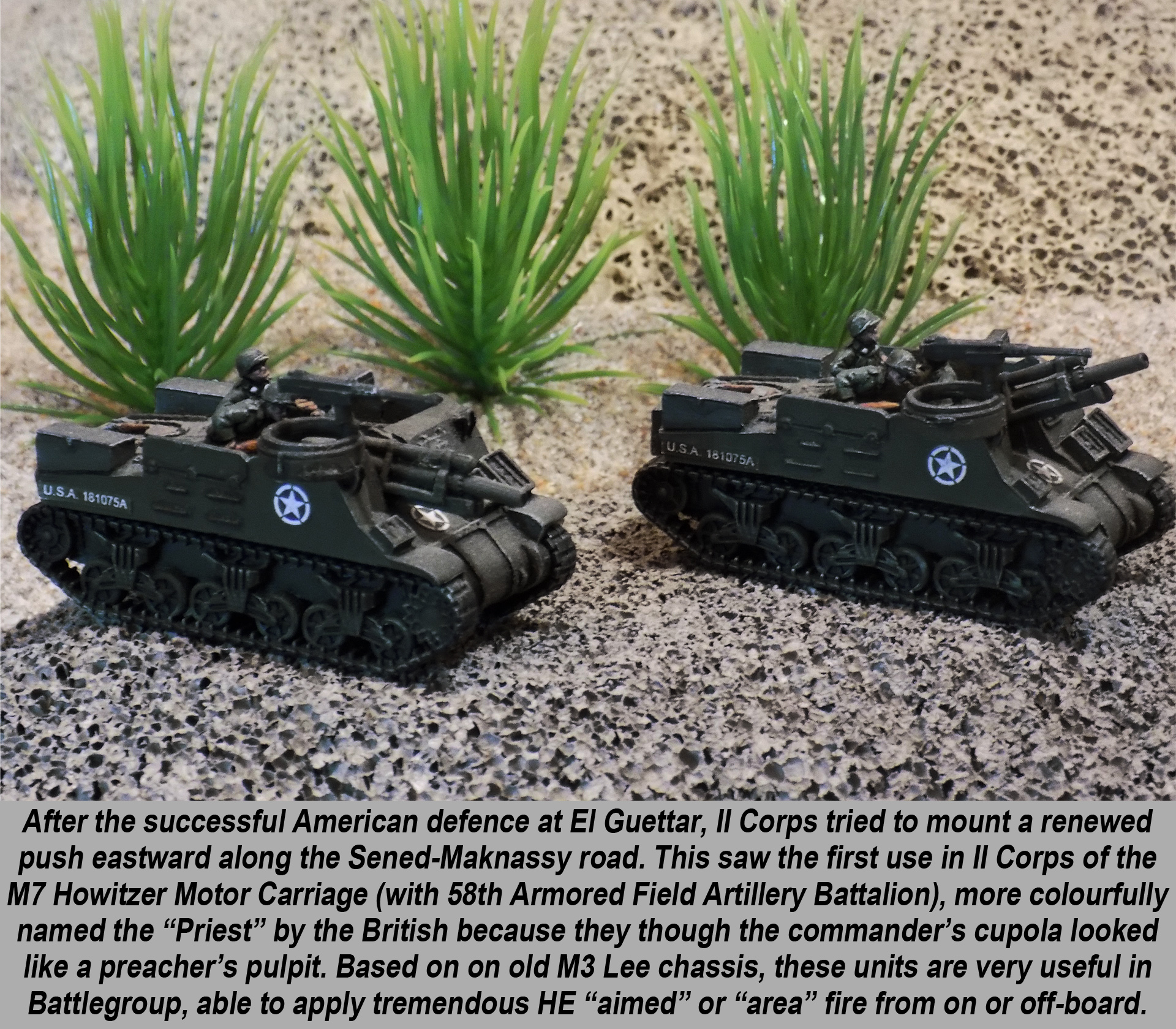
To the movie’s credit, much of the American defense is shown to be emplaced artillery and antitank guns on high ground. This is generally correct (although much of the equipment is wrong – the movie shows M7 Priests that would not be used in Tunisia until the 58th AFAR deployed them near Maknassy about two weeks later).
The movie also shows lots of American tanks. Just … no. There were no American tanks at El Guettar.
The movie also makes it look like the Germans were halted in the open, largely massacred, and then withdrew. Again, not true. With only weak antitank guns and note enough artillery, the Americans were initially unable to stop the Germans of KG Broich (7th Pz Rgt, 86th PzGr Rgt, 69th PzGr Rgt) from getting up on that high ground and mixing it up with them. As we cover in the article, US 1st Infantry Div HQ was almost overrun.
It wasn’t until the arrival of 899th Tank Destroyer Battalion (M10s) hitting the Germans from the northwest that the attack was truly broken. The movie SORT of gets this right, by showing American armor coming in from behind the American right wing (this would be the correct angle) – but it’s tanks instead of M10 tank destroyers.
Of course, as the Germans were being seen off, Patton hurried south to be on the actual battlefield. He arrived after the Germans withdrew. The Germans did mount a second push through this corridor later in the day, and Patton was there for that, but it wasn’t the “first contact” clearly being shown in the film, and certainly not the decisive part of the battle. The Germans half-heartedly probed down the El-Guettar / Nechion road, and pulled out when the Americans opened fire.
Well done @oriskany . You brought a lot of life to a period of the war that is typically dismissed with a few paragraphs. The lessons learned here shaped both allied and axis thinking for the remainder of the war. As this last phase petered out to the capture of all of Tunisia, the US and UK forces still had some hard fought battles, but like most wars and the Desert campaigns in particular, it was the battle of supply that ultimately won it. Towards the end the Germans were just not effective due to shortages in everything.
Some good tabletop ideas come from this series, While thought of as a desert war, the terrain was far from desert-like except for the pervasive dust and dirt. Some of the lessons of hill and mountain fighting would serve the US well in the march on Rome. Even Montgomery’s 8th was cautiously slowed by the terrain, though they had tastes of it through Libya.
Any system with a good mechanics distinction between green and veteran troops could shine in recreating these conflicts. It would work well with an extended campaign where troops surviving a battle got an experience bump.
I really enjoyed this series in large part from recently re-reading a few histories of the desert campaigns. If anyone is looking to dive deeper, there’s some great books available
– An Army at Dawn: The War in North Africa by Rick Atkinson – part 1 of his Liberation Trilogy, follows the US Campaign from Torch through Tunisia
– The Desert War The Classic Trilogy on the North African Campaign 1940-43 by Alan Moorehead. The British and Commonwealth side of the campaign. With its 1959 publish date, it is a generation removed from An Army at Dawn and reads quite differently with much of the research for the book firsthand and fresh.
– The Long Range Desert Group 1940-45: Providence Their Guide by Maj-Gen David Lloyd Owens has some very interesting characters and stories
I look forward to the next series and the next couple of years as we roll through 75th anniversaries.
Thanks very much, @donimator .
You bring up a great point about the rest of the war in Tunisia. As important as actions like Sidi Bou Zid, Sbleita, Kasserine Pass, and El Guettar were, they’re only a small part of the whole story. The Mareth Line could be a whole article series itself, with the Eighth Army trying to get through 1st Italian Army and 15th Panzer Division, until the LRDG finds a way around the side through the Tebaga Gap – we have an attack through there spearheaded by the “hard as coffin nails” 28th Maori Battalion, tribal troops from New Zealand who really must have scared the crap out of the Germans in their night attack. Then of course there are the American battles along the Maknassy Road, the British pushing toward Bizerte and Tunis later in March, April, and May (later in March I think is where Tiger 131 is captured at Madjez al Bab by 48th RTR).
Indeed, supply is always king. As someone said “Amateurs speak of tactics, professionals speak of logistics.” This was part of the reason why the Allies initially had such a rough time in Tunisia. The Germans (for once) had a very short supply line, Tunis is only 100 miles from Sicily, after all. Anderson and Eisenhower, for their part, were advancing all the way from Algiers, Oran, or even Casablanca … That’s a long supply line! Meanwhile, Monty was advancing from El Alamein, (1400 miles, I think) where his supply base was Alexandria. Granted, he was able to leap-frog this though Benghazi and Tripoli, but this takes time, and one reason his advance through Libya took so long.
**I’m one of those rare American history guys who doesn’t judge Monty harshly on this advance through Libya. People who say he should have been more aggressive after Alamein probably need to take another look at what happened after Battleaxe, Crusader, and other British offensives in the desert.
And yes, the desert in Tunisia is radically different from the desert at places like Gazala, Alam Halfa, Alamein, Tobruk, and other “classic” Desert War battlefields. Very rocky and surprisingly wet, especially during late 42 and early 43.
Any system with a good mechanics distinction between green and veteran troops could shine in recreating these conflicts.
Completely agree. IN fact, when Brian Train rolled out his “Desert Leader” expansion for Desert Leader (available below) – he actually created a new morale level for the Americans. Normally the game measures Morale from “A” (best) to “D” (worst) – but for the Americans he created “E” for really bad. Granted, “morale” is the wrong term here, it should really be “unit cohesion” or “troop quality” or some such.
https://brtrain.wordpress.com/scenarios-and-variants/
As for the Battlegroup, Battlegroup Torch includes an additional level of ineptitude for these initial Americans – the “Auxiliary” special rule. You can buy it off for a certain number of points for certain units – but it’s not cheap.
Many people have recommended Army at Dawn, I’ll seriously have to check that out. And anything about the LRDG automatically has my interest. Some of the things those guys pulled off is literally beyond belief.
Like I was saying above – we’ll be taking a slight break from WW2, but we’ll be back with a vengeance in the summer. 😀
tribal troops from New Zealand who really must have scared the crap out of the Germans in their night attack.
Wonder if the Maoris challenged the Germans before the attack, imagine the Germans wondering ‘Was ist das?’ at the sound of a Haka chant carrying through the night air?
https://www.youtube.com/watch?v=u0mWiG2IaSk
Definitely possible, @damon – definitely some hard-core dudes.
https://28maoribattalion.org.nz/
When we fielded them in Panzer Leader I made sure to use the enhanced Commonwealth infantry platoon counters (2-I-8 for enhanced unit toughness, instead of the usual 2-I-6).
The attack values stayed the same since the platoons have the same rifles, Bren Guns, grenades, 2-inch mortars. etc.
We were thinking of giving them enhanced close assault abilities, like German paratroopers or combat engineers … but honestly they didn’t need the help. 😮
The VC citation for Lt. Moana-Nui-a-Kiwa Ngarimu of the 28th (Maori) btln during the fighting for point 209 in the Tebega Gap sums up the ferocity of the fight the New Zealanders were engaged in
https://en.m.wikipedia.org/wiki/Moana-Nui-a-Kiwa_Ngarimu
I’ve got some writing, scenario design, and battle reports for this battle I did years ago in Panzer Leader / Desert Leader. I have posted in the Tunisia 1943 support thread (it’s literally two articles’ worth, plus an image). Definitely a battle for the record books. 😀
http://www.beastsofwar.com/groups/historical-games/forum/topic/tunisia-1943-75th-anniversary-thread/?topic_page=3&num=15#post-230943
Great finale.
Rommel’s opinion of the Americans sums up their achievements from their ‘baptism of fire’;
“astonishing… the speed with which the Americans adapted themselves to modern warfare. In this, they were assisted by their extraordinary sense for the practical and material and by their complete lack of regard for tradition and worthless theories.”
I think Eisenhower deserves a lot of credit for the way he forged the co-operation between the allied forces that shaped the latter part of the campaign, despite transatlantic bickering and distrust from some of the senior political and military leaders, Ike fostered a close co-operation and mutual respect within his own headquarters that prevented nationalistic and jingoistic differences having a prolonged negative impact. I personally believe Ike was one of the most important characters in getting the alliance to function.
As for books, I can second ‘Providence Their Guide’ about the founding of the LRDG, real ‘Boy’s Own’ stuff.
I’m a couple of chapters in to ‘An Army at Dawn’, Interesting but maybe a little too ‘poetic’ for my taste, pressing on with it though, it has me hooked.
I’ll add ‘Desperate Venture’ by Norman Gelb, a very interesting look into the political, strategic and logistics that lead up to and during Operation Torch.
‘Alamein; War Without Hate’ by Bierman & Smith, again, a bit ‘poetic’ at times but an excellent narrative of the British perspective of the North Africa campaign from 1940 to 1943.
A very late Easter egg for all those historical wargamers this chapter IV is. Huge as an ostrich´s and sweet as nougat.
The first map shown really got me. It makes all the operations easier to follow and also to put them into context with the first chapters of this series. And I see that it´s, as allways, all about the passes. Good to see, why those spots were so immensly important.
As for Patton, later he was regarded by the Germans as “the best man” the allies have (Even if he is in many person´s opinion over-rated). In the movie “A Bridge Too Far” there is a scene, when the German high command in the West asks, who is going to lead the attack, as they expected one in the West. One German General said, “Montgomery or Patton?” Another one answered: “Patton”. “Yes, their best man.”
The movie “Patton” depicts him as a bit “harsh”, and it does so well. The actor does such a great job I hated Patton at the end of the movie. But he was motivator indeed. He knew determination and self-confidence are essential for a soldier. – Question: If I remember correctly, Patton died in a car crash in 1945 in Germany. Some people believe it was an assassination. He was murdered because he had made himself too many enemies and because he was so strictly anti-communist and his aggressions against the Russians didn´t fit in with the then US-policy concerning the communists. True?
I like to play Bolt Action and Flames of War. This episode gave me ideas for some new elements to include in games: 1. Let M10 join the battle, but only as reinforcements, just as described in the article. 2. Let Americans start as inexperienced and then make them experienced after a few turns. 3. Remove an entire German squad or platoon to show the effect of troops pulled out of the frontline to shift to positions to fend off the British attack on the Mareth line.
What I got from the series is: Learning to hold your ground was hard and necessary for the Americans, they did, and that made them capable of launching their attack on Sicily. Sicily is a step further. They definitely have and had learnt to attack. First things first.
Thank you very much for this cornucopia of awesomeness.
“Cornucopia of Awesomeness” You are SOOOO right @jemmy.
Glad you liked the map, @jemmy – those are original and take a VERY long time to do in Photshop.
Yeah, Patton’s battlefield reputation was pretty inflated, both nowadays (after the movie) and even at the time. Then again, he was the first American corps commander to score a victory over a German force, so you can almost see where the Germans got the idea. That, and he was always so highly featured in the American press.
The movie Patton actually takes it VERY easy on him. They leave out his racism (incident with the 761st Tank Battalion), not to mention his antisemetism. His soft treatment of Nazi and SS officials after the war as military governor of Bavaria is another problem. The “slapping” incident is softened. It was a beating, and not just once. It was a chronic series of incidents, in the movie he reaches for his pistol – in reality he hauled it out and shoved it in the man’s face.
Perhaps worst of all is his sacrifice of 300+ lives sending a force on a personal mission near the very end of the war, to rescue his son-in-law who’d been a German POW since Sidi Bou Zid. It’s the last month of the war, and he diverts a battalion task force off on its own on this unnecessary rescue mission, where it gets cut off and basically annihilated (along with most of the prisoners they “rescued.)” Absolutely shameful, and none of this is in the movie.
The movie does a great job at Patton’s pre-planning and operational preparedness when the Germans hit the Ardennes in December 1944. This really was one of Patton’s shining moments, even detractors have to give it up for him here.
Also, Patton’s biggest contribution may have been before the war, when he steadfastly remained a pioneer and proponent of tank warfare – probably a big reason America had any kind of a tank force when they entered World War II.
Patton was “assassinated” – positively, 150% not true. I don’t think they make tin foil hates big enough for that conspiracy theory.
The details of this are in a made-for TV sequel called: The Last Days of Patton – also starring George C Scott.
https://www.youtube.com/watch?v=GCTGRwvFqtE
Glad you liked the series! 😀
Thanks, @gladesrunner . 😀
What…ONLY 4 parts? I’m used to the Oriskany Five! Oh well, I guess I missed that little detail in the interview. Sorry to see it end. One question, the couple of American commanders you mentioned all seemed a bit like John Wayne. Was that just a commonality in this theatre, or were most of the American generals at that time really that brash and well…American?
Take a look at the exploits of Brigadier General Theodore Roosevelt Jr or Major General Terry de la Mesa Allen, two significant command ‘characters’ in the American army in Tunisia, both very ‘American’ in the best tradition of John Wayne, but inspiring field commanders who had the respect and trust of their men, both put themselves in harms way while leading the battle. Allen was described by an aide as “the fightingest man I ever met”.
Compare them to the likes of Major General Fredendall, not an inspiring commander…
Yes, @gladesrunner – this series started a little late because of the Tet Offensive series, and I wanted to wrap it up a little more quickly. A fifth part COULD have been squeezed out if we’d included more on the Sbleita counterattacks of Feb 15-17. Also, we could have added more about British participation vs, 21st Panzer at Sbiba, or with “Nickforce” coming down off the Thala Road at Kasserine Pass.
But that would have dinged against the “Americans in Tunisia” theme.
Also, just wanted to take it semi-easy for once! 😮
Oh, absolutely, @damon – both Allen and Roosevelt are mentioned in the article – and this is why it kind of sticks in my craw that Patton is portrayed as being “on the field in command” at El Guettar. He wasn’t – THESE guys were, and it was these guys who led the real battle that day.
As for our “man of the hour” Fredendall … well … MajGen Hamron (2nd US Armored) called him a “physical and moral coward” – BgGen Omar Bradley said his bomb-shelter headquarters 70 miles from the front was “an embarrassment to any soldier.” Yeah, not one of our best.
@gladesrunner realizing there’s not going to be a part five is like discovering you just ate the last cookie and didn’t realize till you reached in the box and found it empty!
What do you mean, today is SUNDAY? I thought today was MONDAY, and I had another day off after this! I have to go to WORK tomorrow?
Used to do a lot more four-parters, even throwing out a three-partner now and then (El Alamein, Six-Day War, etc).
Always wondered if people prefer five-part series with shorter articles, or four-part series with longer articles?
I think I prefer more short installments over few ginormous ones.
I tend to agree. There were only four parts in this one but they were quite large. A lot of 1:00 AM-2:00 AM nights in this one. 😀 Putting out the same material over more weeks allows a more measured pace.
Easy, many long ones 😛
Er mer gerrd! @rasmus has no mercy on me. 😀
To be honest I like the 45 minutes – lunch reading / skim through the comments.
And the a full read through later
Yeah, we’re maxing out at about 1800 words an article, with 12 photos (usually one photo per three 60-word paragraphs). Not to let it get too formulaic, but we want a certain kind of presentation (avoiding walls of text) given the geometry of the publishing webframe BOW uses.
Thanks a lot for all the great comments! 😀
Sad to see another great series end…
Fear not, @koraski – the next series is already in progress, with two articles written and illustrated. Not sure when we’ll start rolling them out, though …
Let me know when you’re ready to do ACW. I’ve got a mountain of Perry plastics and the added motivation of starring in an Oriskany article would be good motivation to get them built and painted. Dibs on the Union though! One of my ancestors served in the 10 volunteer New York cavalry.
The lack of painted armies to photograph is the single biggest limitation we have to ANY of these series. I would love to do ancients, medieval, ACW, WW1, more naval, etc. This is the reason I’m always on the lookout for collaborators.
So to answer your question – as soon as you’re able to set up,photograph, and send me 50-60 hi-res (1920p+) photos of your ACW armies on the table, let me know and we’ll get to work! We can be sure to pick a specific topic that fits the armies you have on hand.
Community painting challenge:
1. Find a period,
2. Get some volunteers,
3. Get them send to you or the BoW studio.
4. Take pictures
5. Let the magic happen
That’s not a bad idea. “RALLYING CRY TO THE ORISKANY MILITIA!”
TO ARMS, TO ARMS!
** and by “Arms,” we mean paint brushes. 😀
Can you recommend a good camera for the job or a few things to look for in a camera.
I’ve got some WWI French on the painting table with Germans to follow and if I could help out with some photos I’d like to especially with the anniversary this year.
Great question, @elessar2590 – I just have a standard digital camera (not a full-scale DSLR), so “between” a smart phone camera and a full-scale professional DSLR. But honestly today’s smart phones take great photos.
I can offer a few tips regarding photos intended for use in an article (or a battle report you’re posting in your own):
>> Always take photos in LANDSCAPE format, not portrait.
>> Be sure the camera has a good “MACRO” mode – the setting that most cameras indicate with a little “flower” icon. This is the setting specifically made for focusing on objects close to the lens, so perfect for photographing miniatures.
>> Always have a “point of interest,” the main thing the photo is supposed to be “about.”
>> Leave plenty of room around the point of interest – because as we use photos in articles, they have to be cropped / resized to fit into a given template, caption bar, webframe, etc.
>> Be aware of “spillover” light coming through windows and creating glare of overexposure. I can fix just about anything in Photoshop except this. 😀
Awesome series @oriskany
I really like the zoomed out Hex maps. They really help put everything into perspective. It can be tricky to keep track of everything going on and to have the images to reference makes life a lot easier.
Thanks, @elessar2590 – indeed, hex and counter gaming (well, GOOD hex and counter gaming, there are some bad systems out there) … at least for me … frees the player from many on the constraints and assumptions we have to deal with as miniature players.
Most immediately, the ranges can be “correct.” This makes a fundamental difference in EVERYTHING – as it effects the length of time the attacker has to travel under enemy range before making contact, how different arms of service interact (artillery over the horizon, armor across the table, infantry at practically point-blank).
Also, the scale and composition of the units – such as 15 tanks in a company, 1000 men in a battalion, etc, and 10 infantry units for every armored unit (if not 100 or 1000).
These kinds of differences mean that armies and battlefields can be constructed to a degree of practical realism and historical accuracy that just isn’t practical (or fun) on most miniature tables. Therefore, the tactics that work and don’t work in a good hex and counter game are the tactics that would work in actual combat, while tactics on a mini table are what works in the game.
But of course no H&C game looks as good as a miniature table, even with Photoshop maps and counters! 😀
Great series. I would like to see one more section on specifics on how to game those scenarios.
“the movie gets practically every detail wrong”
The sacrilege. How could Col Glover S. Johns let them get away with that?
Thanks very much, @wiseolbird – While we won’t have any more parts in this series, we do have the support thread where we’re able to go into a lot more detail with the material that couldn’t make it into the actual series. For instance, the gaming battle reports are a lot more more detailed.
http://www.beastsofwar.com/groups/historical-games/forum/topic/tunisia-1943-75th-anniversary-thread/
Colonel G. Johns? one of the technical advisors? Well, senior military advisor was Omar Bradley, who was at the time of filming a retired five-star general (last five-star general the United States will likely ever have) – so if a five-star general will let it slide, I’m sure it’s good enough for the colonels! 😀 😀 😀
And the movie was kind to Bradley, as well. … For some reason
Somehow he always came out looking like the smart, calm, reasonable one … 😀 I wonder …
Just because they’ve got an expert that doesn’t mean they’ll listen …
The advisor might have corrected them, but there’s a good chance the director thought it looked ‘cool’/’better’ when done the ‘Hollywood’ way.
I can see the writer’s room now …
Director: “Okay, we have this great scene where our heroic main character saves the day at El Guettar!”
Consultant: “Well, here are the notes from our historical advisor: The main hero is 25 miles away on the wrong battlefield when the shooting starts. Then, while other men win the battle, he drives in a jeep as fast as he can to get to the actual fight. When he gets there the fight is over.”
Director: “Well, we can’t win any Academy Awards with THAT!”
😀 😀 😀
Was it that practical in terms of logistics for the Germans to use the British guns and American half-tracks ?
I can understand the vehicles, ’cause that’s just feeding it a bit of fuel and it runs.
Anything is probably better than walking in that stinkin’ desert.
But guns must be tricky as you need matching ammo too.
I can’t speak to WWII as a whole but it was a common practice in WWI. The idea was basically capture it use it until it’s broken then dump it. Ammunition wasn’t normally manufactured but guns were occasionally converted to fire the captors standard ammunition.
A WWII example would be the Marder. The Germans took the Panzer 38(t) {my personal favorite tank} and fitted it with captured Russian Anti Tank guns (ZIS-2 I think) while they manufactured their own guns for the vehicles. The Germans captured a lot of British equipment in France but I’m not sure how much actual ammo they took. Vehicles can be a pain if you can’t replace parts as the Soviets found out post War when the US stopped sending spare parts and their Lend Lease trucks slowly died from attrition.
Basically it comes down to you have this big gun with X amount of ammo and you might as well use it rather than sit around doing nothing or have to lug it around everywhere.
@limburger – most definitely. Everyone use captured equipment except the Americans and the British from 1942 onwards (they were too well supplied by then). Usually when you captured enemy weapons you also got your hands on some stockpiled ammo / supplies for it as well.
Indeed, @elessar2590 – Captured equipment was a MASSIVE factor in the Desert War for everyone except the Americans and the British from the middle of 1942 onward.
Earlier, the British made great use of captured equipment, even Italian equipment. They captured so much material from Operation Compass and their destruction of the Italian 10th Army that when Rommel showed up and launched his first big attacks in the spring of 1941, he was opposed by whole British tank BRIGADES equipped with Italian M13s.
Later, easily 50% of German armored transport in North Africa was American M3 halftracks.
Even Rommel rode around personally in an oversized British truck he converted into his mobile headquarters.
Also, many times the Germans could capture Soviet, French, or British guns, they would be re-bored / chambered to fire German ammunition.
Thanks for the answers 😀
I’m guessing one serious problem for captured equipment is that your own allies might mistake you for the enemy no matter how big the ‘do not shoot / we are friends’ signage is..
It would be kind of cool to field an army using captured equipment.
No worries, @limburger – you are absolutely right about the risk of using captured enemy equipment and friendly fire. It’s almost funny to see photos or color plates of German T-34s and KV-1s in use on the Eastern Front, the balkenkruez markings on them are COMICALLY large, and there are double the number (one on each side of the turret, two more on the hull even bigger, sometimes a huge one on the back of the turret so their own antitank gunners don’t drill them from behind, etc. But you’re right, I’m sure it’s still a risk.
Then again, using the enemy’s gear always has a certain amount of problems … I quote the top source for WW2 information:
https://www.youtube.com/watch?v=nR-jxuqfY2s
Battlegroup has points lists, and game values, and rules for using enemy equipment that one side or the other was using for the campaign in question (British Matildas in German service in 1942 Desert Battles, US M3 Halftracks in 1943 Desert battles, etc.).
Previous banter aside, another great read
Thanks very much, as always. 😀 😀 😀
@oriskany day late reading it, had some new shelves for game room put them up Sunday and spent yesterday loading them and moving stuff to far safer storage!
Good lunch time reading again, for what was a very interesting pivotal point of the war in the West. going to have to go back through my reading material again .
To back up your comments on captured equipment , there is a whole bunch of photos of the Australian division at tobruk with a unit of captured M11/39’s and M13/40’s.
Pretty sure that Tanks in Camera has a picture of a captured 25pdr in use.
@bobcockayne – Thanks for catching up! Interesting note re: the Australians at Tobruk with captured Italian equipment – do you remember if that’s the 6th Australian when Tobruk was captured (Operation Compass – Jan 1941) or 9th Australian when they defended it Rommel during the siege later in 41?
I know the British / Commonwealth wound up with HUGE numbers of M11s and M13s and such after Operation Compass. I think it was the whole 2nd Armoured Brigade that was re-equipped with M13s when Rommel attacked in Operation Sonnenblume early in 41 (El Agheila and Beda Fomm). The men in that brigade must have lost a bet or something. 😮
For El Guettar – I know that artillery regiment had some captured 25-pounders at the time, but given how these German units are always broken up into “kampfgruppe” and the like, I don’t have any direct evidence they were actually used THAT DAY at El Guettar. I decided to go with it, invoking “the rule of cool.” 😀
@oriskany the M11/39 that I looked up on Google( same photos from what I can remember from Tanks in Camera) are captioned as 6th division, but for the M13/40’s no unit is designated, though I think the 9th would have taken over any equipment in Tobruk at the change.
I know from a couple of British Tank vets accounts, tanks would left for the replacement units when they were pulled out of the line rater than transport them the umpty thousand miles back to Cairo. A lot of 2nd Armoured Division tanks were old 7th Armoured and a regiment of captured M13/40’s cast offs, which helps explain their poor performance against Rommel.
Ah yes, @bobcockayne – that’s 2nd Armoured DIVISION, not brigade. I actually covered this in Part 02 of Desert War series back in 2015, I should check “myself” as a source. 😀
Yeah, we actually did this battle, where Rommel (with the very first, half-complete elements of the DAK) engages with the British that were actually fielding Italian armour.
Image:
Article link (one of my older ones):
http://www.beastsofwar.com/battlegroup/desert-war-gaming-ww2-part-two/comment-page-2/
Panzer Leader and miniature eye candy. What’s not to love! Another great series @oriskany . 🙂
Thanks, @cpauls1 – El Guettar is a great little scenario for Panzer Leader, really drives home the problems of stopping tanks … without tanks of your own – while for the Germans, it’s how to break an enemy line with tanks, instead of “jousting” against enemy tanks 1:1 in an open field (like so m any miniature game scenarios tend to depict).
Loved the series. Could you post what models and scale were used please.
Thanks very much, @nemoreturns – the scale is all 15mm. As for the manufacturers for the models, they’re all over the place. Zvezda, PSC, Battlefront, Avalon Hill / WotC Axis & Allies 15mm pre-paints, Old Glory, etc.
We’ve got more information on the support thread we usually run for these article series.
http://www.beastsofwar.com/groups/historical-games/forum/topic/tunisia-1943-75th-anniversary-thread/
a nice finally to the series @oriskany doesn’t the (big red one) film cover Tunisia as well?
Eh … they try to. I think more emphasis is placed on the landings in Morocco where they briefly fight the Vichy French. Not a terribly “history-heavy” movie in any event. Been ages since I’ve seen it.
You definitely have the fight division, though! Big Red One is totally 1st US Infantry, which had constituent units at Sidi Bou Zid and Kasserine, and took the brunt of the fighting at El Guettar. 🙂 Good call!
Yeah could have been it’s not a film that get played much and i have never seen a DvVD in the shops to pick up. @oriskany
Yeah, might be worth picking up if you can find it on the cheap. Lee Marvin and Marvin and Mark Hamill, if nothing else. And MArk hamil actually cared about that movie, which automatically makes it better than The Last Jedi. 🙁
Lol Amazon here I come?
I want someone to publish rules for the “delivering a newborn baby in the a tank turret” scene. Roll a 4+!
? Sounds like a job Johnlyons may consider ? 20 quid for the double disc Film I’ll wait.
Yeah, from what I remember the movie wasn’t THAT great.