








![1918 Spring Offensive Wargame | Full Rules Overview with John & Gerry (WW1 Tabletop Game) [7 Days Early Access]](https://images.beastsofwar.com/2026/03/unboxing-warfulcrum-games-1918-spring-offensive-review-coverimage1-225-127.jpeg)

Modern Wargaming: Conflict In The Ukraine Part Four – Endgame & Conclusions
November 16, 2015 by crew


At last we come to the end of our article series on modern wargaming, with a specific focus on the recent conflict in Ukraine. In Part One, we discussed “current-conflict” gaming and summarized the context of the 2014-2015 war in Ukraine, while Parts Two and Three took a more detailed look at the conflict’s engagements.
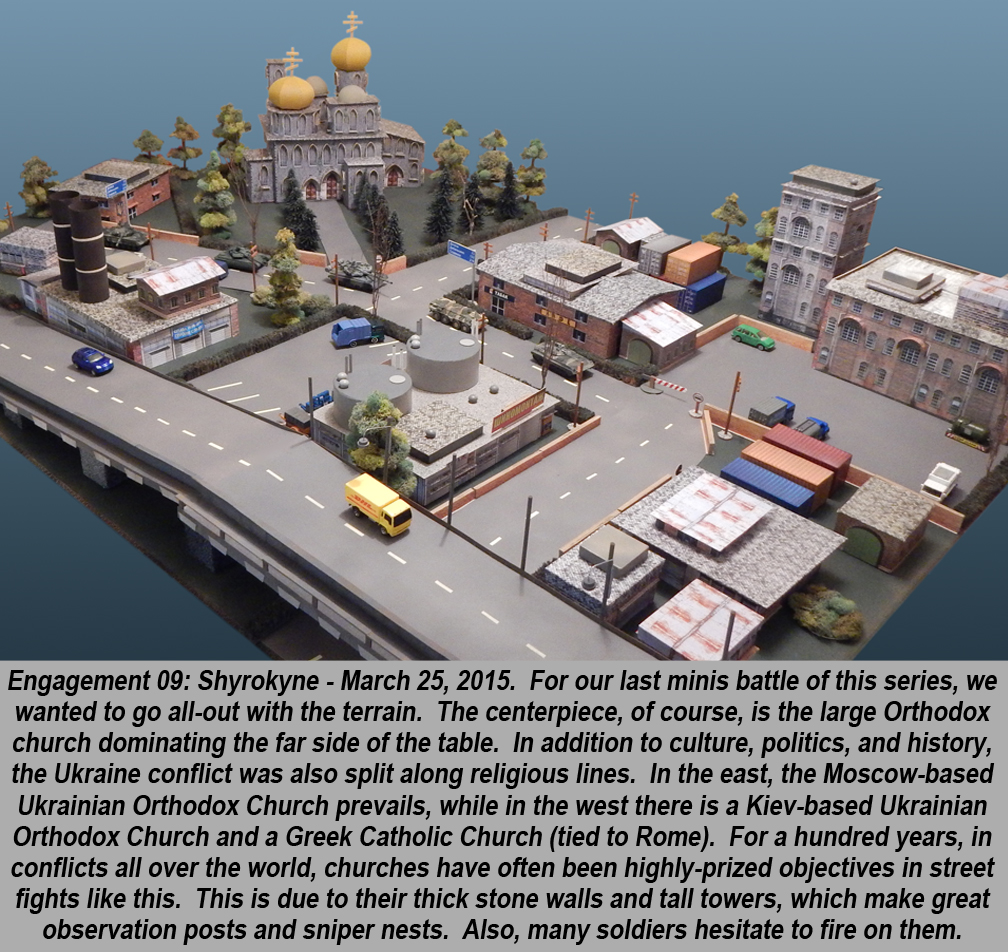
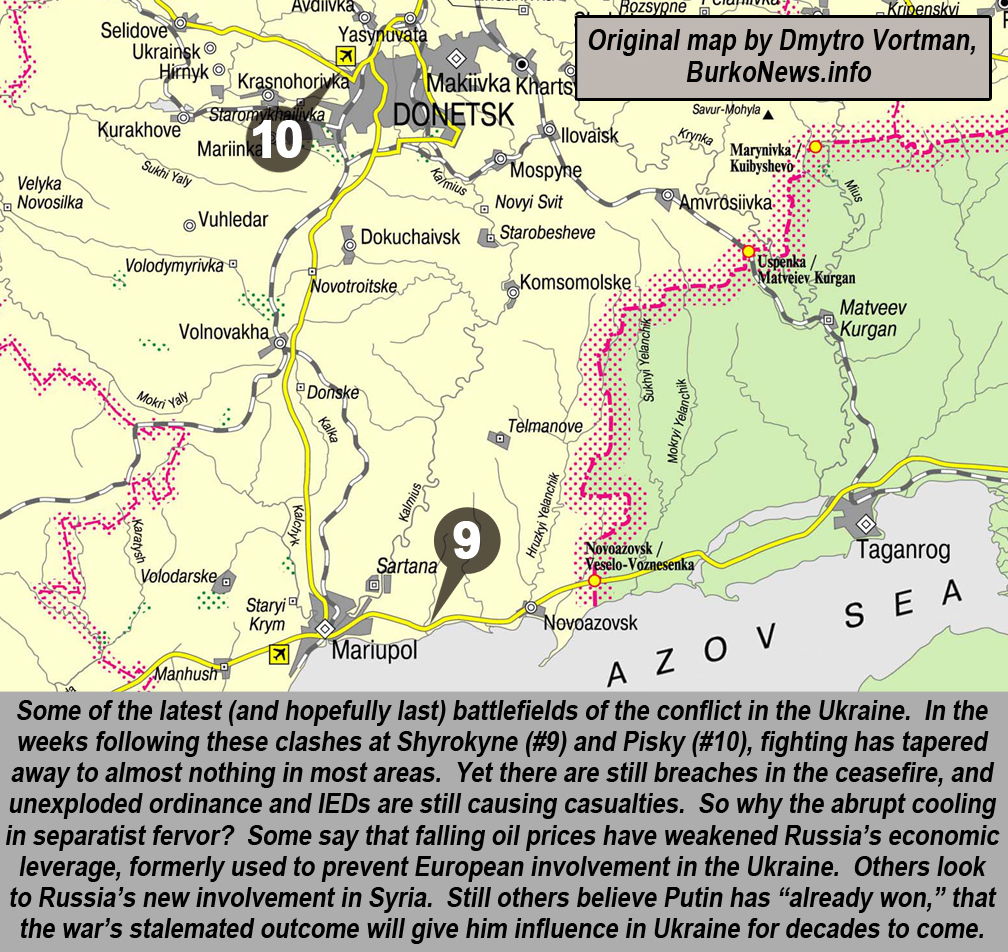
Now we come to the end of the conflict, looking at the last engagements in the spring and summer of 2015. We’ll briefly discuss how the violence has reduced to a fraction of its earlier levels, prompting many to hope that this conflict may be finally drawing to a close.
THE GATEWAY OF SHYROKYNE (March 25th, 2015)
In Part Three we discussed how the Minsk II ceasefire (February 11th, 2015) failed to even slow down the fighting in many areas of eastern Ukraine. One such hotspot lay in the far south of the warzone, where the town of Shyrokyne stood squarely in the path of the separatist advance to Mariupol.
Mariupol is an important industrial centre along the Sea of Asov. Largely pro-Kiev, it was nevertheless a target for separatists and supporting Russian Federation troops, with advanced T-80 series tanks often photographed in the area. Just seven miles (11 kilometres) to the east, Shyrokyne blocked the road and approaches to Mariupol.

Mariupol (and by extension, Shyrokyne) was an objective for pro-Russian separatists for more than just industrial and economic reasons. Ukrainian media often suggested that Putin wanted this strip of land along the coast of the Sea of Asov to form a land bride to Crimea, recently annexed by the Russian Federation in early 2014.
Despite constant shelling, separatists attacks, and Russian armour, the Ukrainians never gave up Shyrokyne. Army, National Guard, and volunteer militias (including the “Donbas” and controversial “Asov” Battalions) held their positions for months, especially when fighting reached an apex in March and April, 2015.

Finally the Organization for Security and Co-operation in Europe (OCSE) negotiated a “demilitarization” of Shyrokyne. On July 1st, the separatists agreed to withdraw if right-wing militias like the Asov Battalion did the same. The agreement was controversial, but the militias pulled out, replaced by the Ukrainian 36th Marine Brigade.
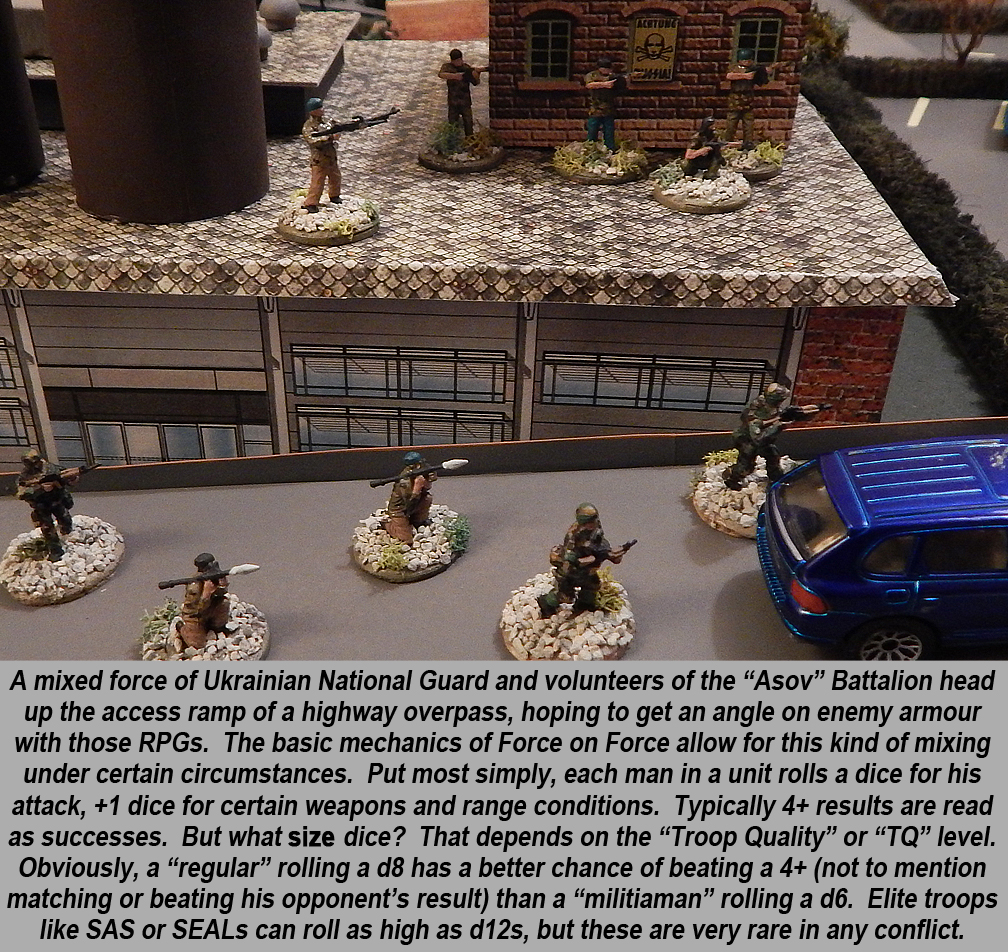
During the battle for Shyrokyne, the Ukrainians also had foreign volunteers in their ranks. Polish volunteers were interviewed with the Donbas Battalion during the shooting, but it was never clear how many there were. Ukrainians also claimed other “NATO forces” were helping them, but I could find no source to verify this.
PISKY SUBURBS (July 17th, 2015)
Even as fighting began to diminish in the south, in other areas of the warzone the violence continued unabated. One of the fiercest battlefields in the Ukraine during the late spring and summer of 2015 remained near one of the war’s most bitterly-contested battlefields: the Donetsk International Airport.
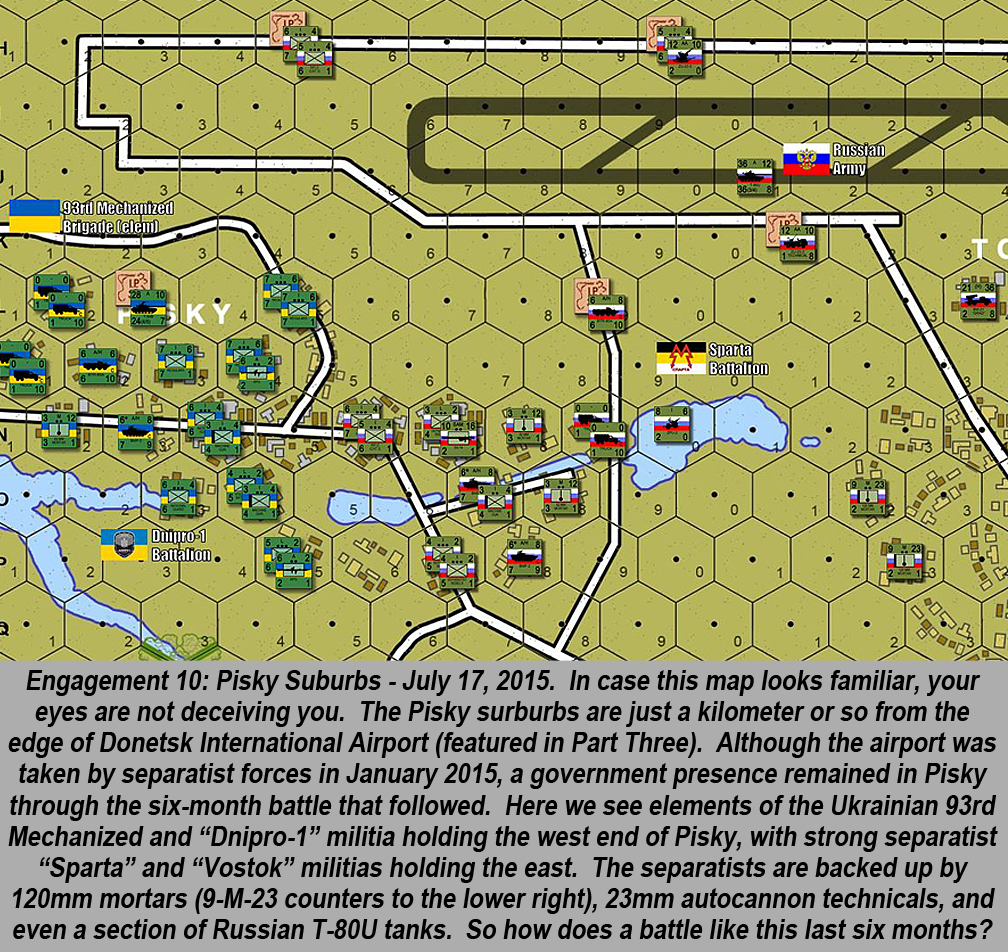
Although the airport had been re-taken by separatists in January (only after a devastating four-month siege), the neighbouring suburb of Pisky had always remained in government hands. This was a sharp thorn in the side of the separatists, as Pisky was right on the outskirts of Donetsk itself, capital of the DPR (Donetsk People’s Republic).
Defended by elements of the Ukrainian 93rd and 28th Mechanized Brigades and the “Dnipro-1” volunteer battalion, Pisky has seen heavy fighting as recently as August 12th (latest confirmed report). Yet this seemed to be strictly “non-kinetic” warfare, with exchanges of sniper fire, artillery salvoes, and patrol skirmishes...but no set-piece assaults.
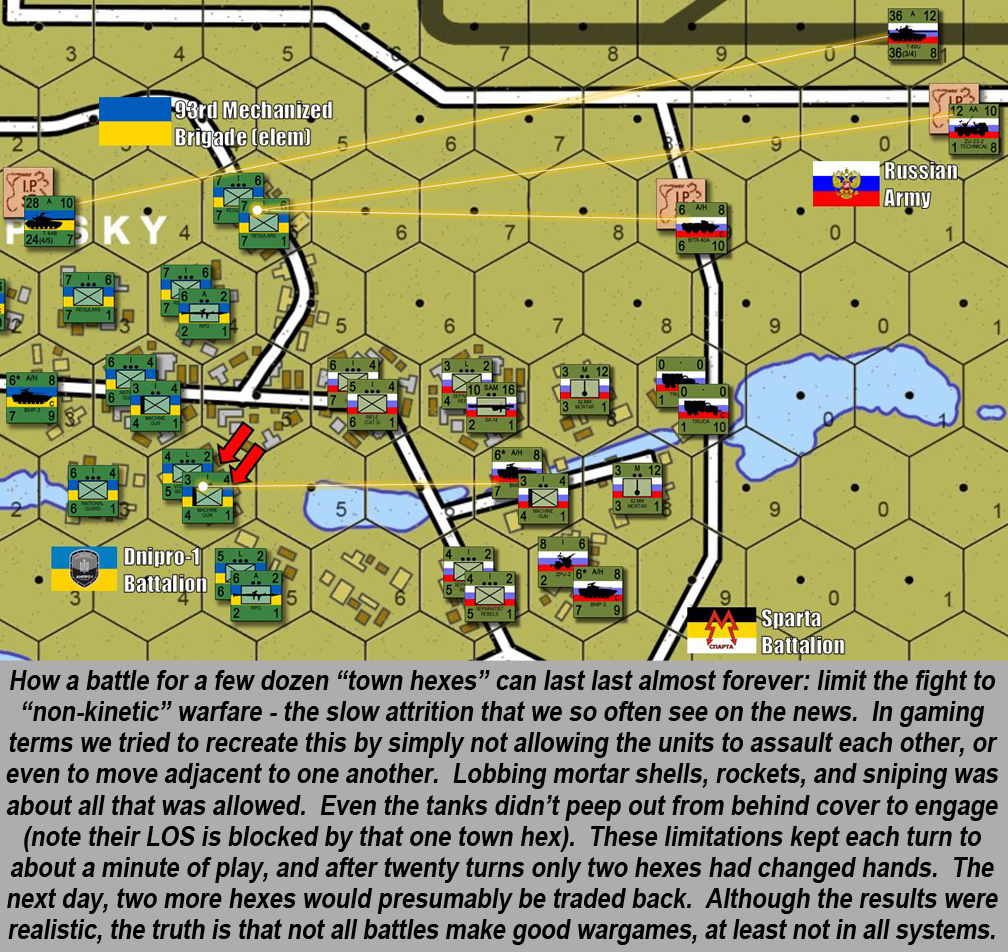
Not that the fighting seemed “non-kinetic” to the civilians who lived here. Once housing over 2000 residents, only about 100 residents did not flee. Those house still occupied were painted in large letters “People Live Here” so as not to draw fire. Without gas, water, or electricity, they have survived on humanitarian aid.
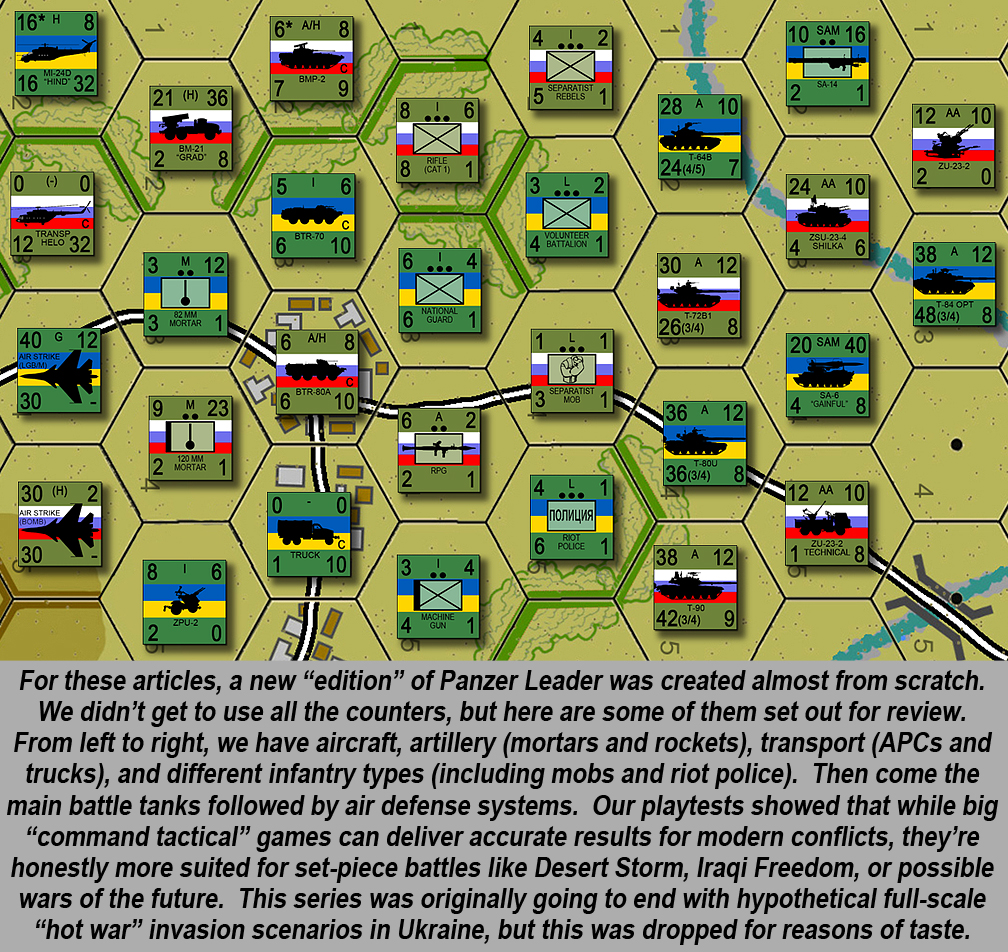
For the Ukrainian troops in Pisky, the objective was simply to hold out. If the DPR couldn’t control the suburbs of its own capital, after all, could it really be recognized by the outside world as a viable independent state?
THE END IN SIGHT?
Meanwhile, against all the odds, violence across the Ukraine abruptly started to scale back, starting in August of 2015. By October, it had almost stopped completely.
Meanwhile, the rhetoric of DPR and LPR leaders became much more conciliatory. They began talking about cooperation with Kiev, assuming certain conditions were met. Hardliners, meanwhile, were quietly replaced. Russian military support for the separatists has also greatly reduced.
CONCLUSIONS?
For those interested in examining the particular problems and characteristics of the Ukraine conflict or similar modern-era war on the table top, here are a few takeaways that might help you get started.
TROOP QUALITY: Far more important than the technical particulars of “this gun” or “that tank” is the training and confidence of the combatants. Whereas late World War II saw armies of relatively similar conscripts using vastly different weapons, in modern warfare the exact opposite is usually the case.
The evolution of modern weapons has led many of them to very similar “apex” designs. In contrast, modern war sees everything from untrained insurgents (angry civilians who can barely reload their weapons) to elite SAS and Navy SEAL teams. These are the critical “force level” details to watch, not millimetres and rounds per minute.

TECH, SCHMECH: While we live in a high-tech world where the latest gadget seems to effect everything, this is rarely the case in most wars currently in progress around the world. Bear in mind that most wars today are not fought between “armies” – but insurgencies, militias or terrorist organizations.
Even if one side has technology and the other doesn’t, the low-tech side will do whatever it can to ensure technology doesn’t matter. For example, insurgencies may hide in dense civilian population centres so government forces can’t use smart bombs or artillery on them.
Even if a given insurgency or rebellion has high-tech gear (usually through foreign aid), they usually can’t support, supply, or maintain it. Most smaller armies spend their limited budgets on “bang,” and neglect things like spare parts, logistics, safety, or command and control. So, once in combat, they don’t stay “modern” for long.
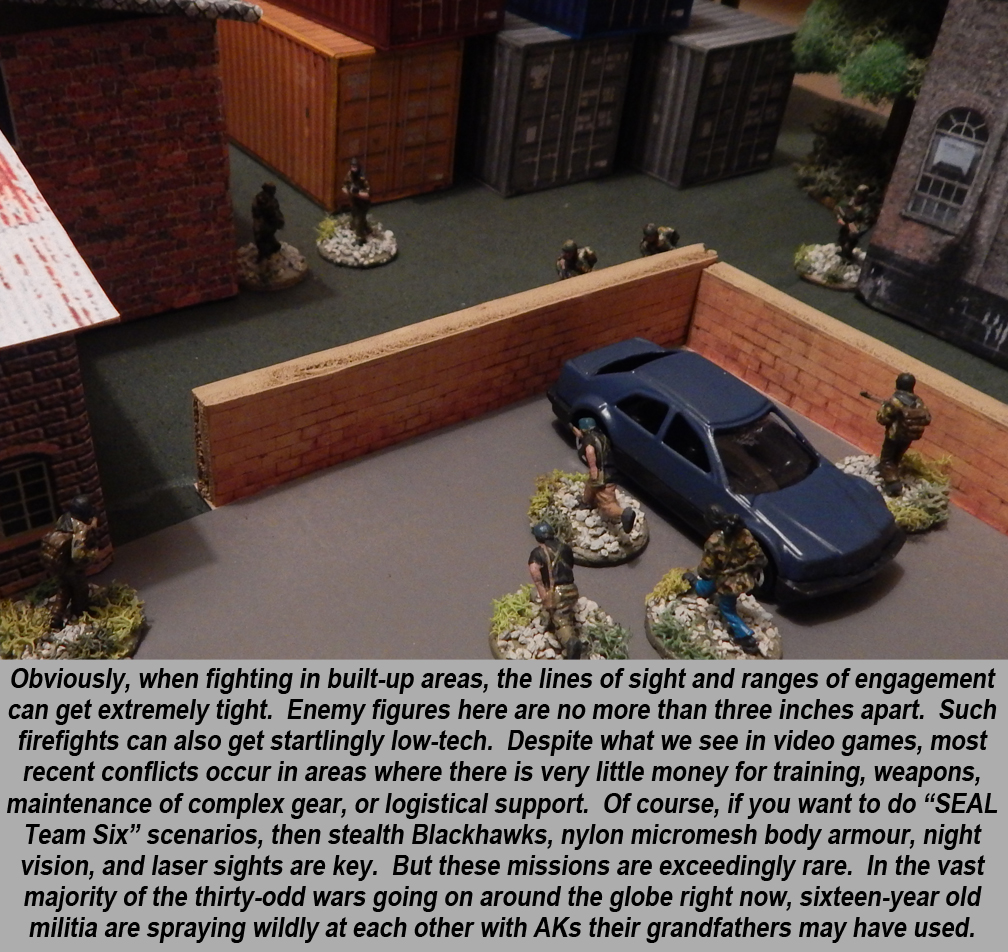
GO TO TOWN: Over half the world’s population now lives in cities, and many of the world’s current or recent conflicts have followed them. This means building a lot of urban terrain, and like Warren says, “more is more.” This is especially true if you’re trying to recreate the density of places like Donetsk, Mogadishu, or Fallujah.
Once the terrain is in place, lines of sight and fire become extremely short. There is no “battle line,” each squad becomes a self-contained cell within its building or alley, and this makes them very easy to outflank. The battle space is also three-dimensional, with movement possible in upper floors or in the sewers.
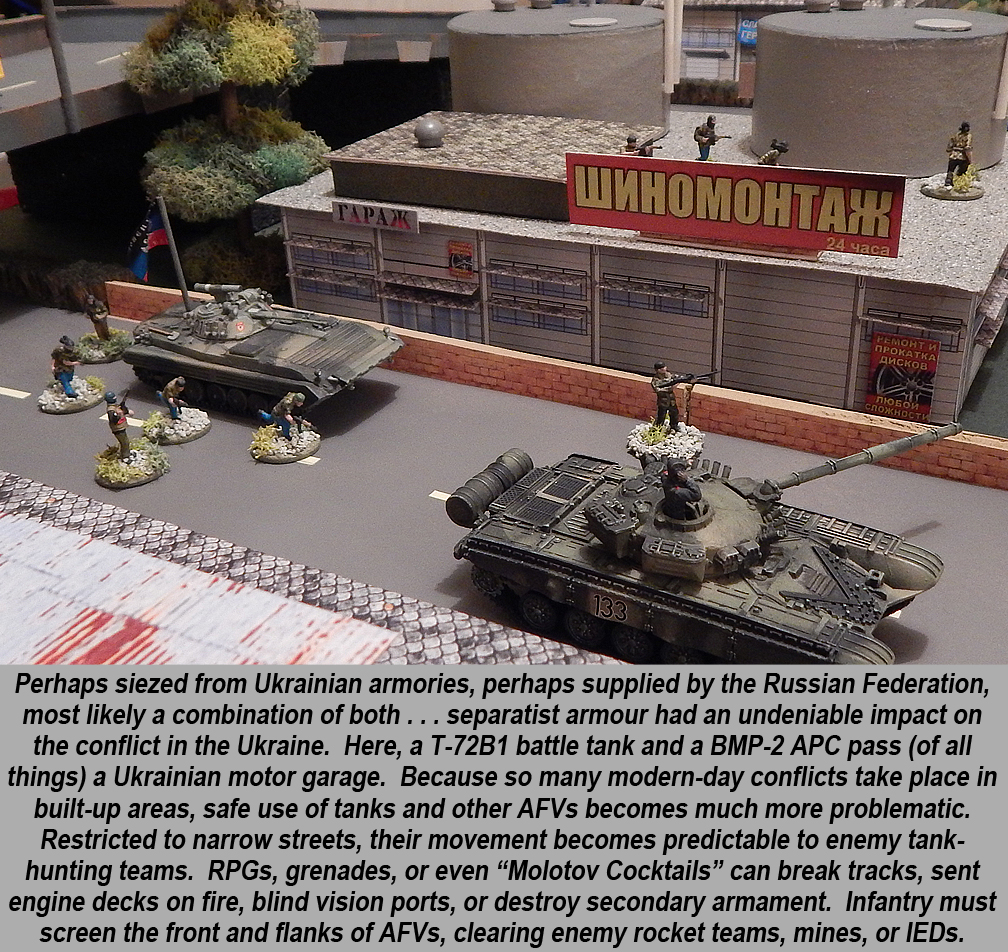
In closing, some special thanks are in order. Firstly, I would like to acknowledge Beasts of War community members @grimwolfuk and @unclejimmy for introducing me to Force on Force, which has turned out to be a near-perfect system for the kinds of conflicts and engagements found in the Ukraine.
I’d also like to thank the community members who’ve supported this series throughout its run. Our subject matter has definitely sparked some lively conversation. Even if some readers may not have agreed with the topic, the worst thing we can do with a conflict like this is ignore it.
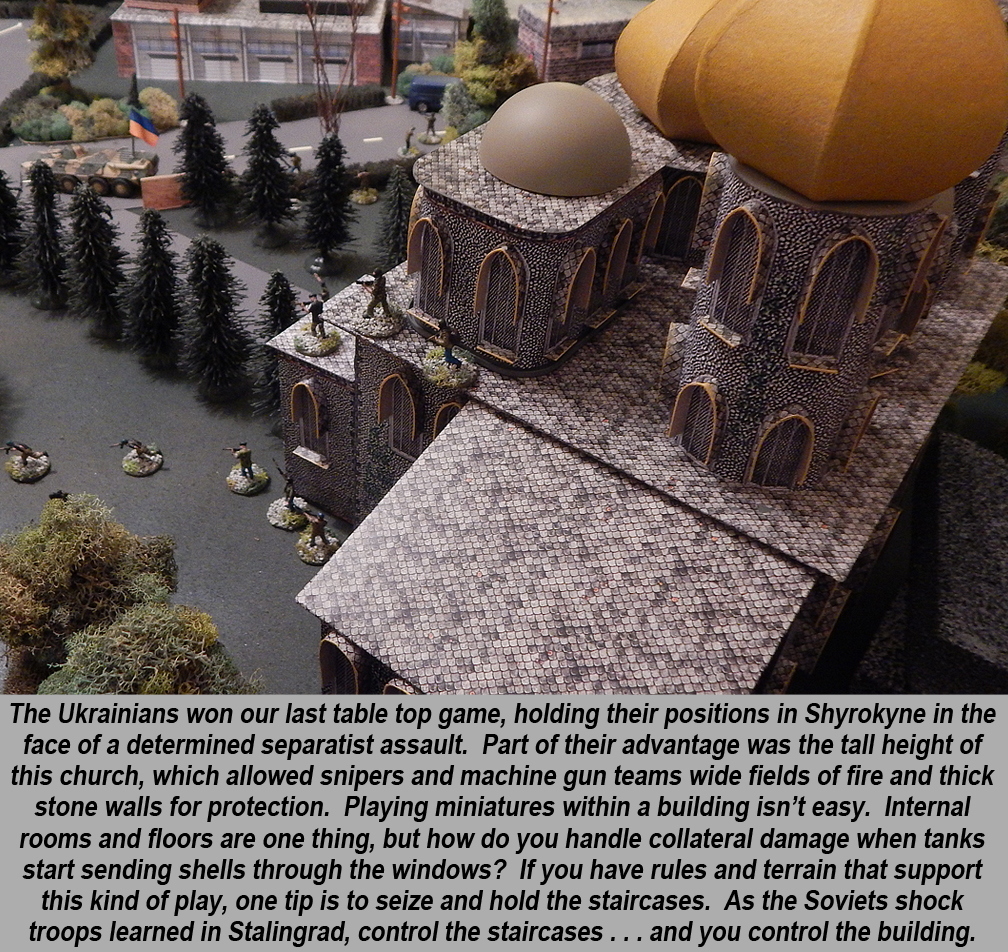
Finally, I’d like to thank @brennon, @warzan, and other members of the Beasts of War team who’ve allowed me to publish on their site, and helped make it look so amazing. People tell me often how great these articles look, but honestly at least half of this is due to the people who work behind the scenes to showcase all this content.
I’ll be taking some time off for the Team Yankee Boot Camp and the holidays after that. Do you have any ideas regarding content for the new year? Even better, reach out to the team and ask about publishing an article of your own!
If you would like to write an article for Beasts of War then please contact me at [email protected] for more information!
"One such hotspot lay in the far south of the warzone, where the town of Shyrokyne stood squarely in the path of the separatist advance to Mariupol..."
Supported by (Turn Off)

Supported by (Turn Off)
"This means building a lot of urban terrain, and like Warren says, “more is more.” This is especially true if you’re trying to recreate the density of places like Donetsk, Mogadishu, or Fallujah..."
Supported by (Turn Off)



![StarCraft Tabletop Miniatures Game Pre-Orders Live Now [Updated]](https://images.beastsofwar.com/2026/03/starcraft-tmg-news-cover-600-338.jpg)

![Mounted US Cavalry On Kickstarter For Dead Man’s Hand! [Updated]](https://images.beastsofwar.com/2026/03/us-cavalry-main-600-338.jpg)
I logged in just to say: this is beyond silly.
Hi @skinnybruiser – I’m sorry that you find this silly but I think this has been a very interesting take on the way in which we explore modern history and conflicts like this.
oriskany has talked about this in multiple entries to the series (and in the first part) but I think this has done a lot to help people understand just what went on during the conflict last year and the beginning of this one.
Wargaming gives you an entirely different viewpoint on the conflict than just reading what’s found in the media etc. You can explore what challenges the combatants might have faced on the battlefield and the conflict from the inside out.
As well as that it is also an opportunity to understand the situation surrounding a given event. I for one have learned more about this conflict from reading these articles than I did watching the news or documentaries on it.
While this approach isn’t going to be for everyone, and I respect anyone’s opinion on the matter, we undertook this project to see what it could offer to us as both players of games and those interested in history and how conflicts are fought.
I think that at the conclusion of it it’s proved, to me at least, that this has worked out well as an analytical exercise and indeed showing how well some wargaming systems deal with the modern way of fighting battles. It has also showed what they can’t replicate too which is always important to know.
BoW Ben
Thanks very much, @brennon, I appreciate the support. Frankly I was just going to ignore @skinnybruiser ‘s well-informed and eloquent comment, especially once I saw that he’s been a member for three years and made exactly three comments – all of them negative.
Maybe in three more years he’ll return from under his troll bridge and dazzle us with the magnificence and insight of his next creative opus. I wait with baited breath.
Slam my work all you want, but personally I find the “educated opinion” that studying modern conflict is “silly” . . . personally offensive and distasteful. I’m sure other military veterans among the community would also be interested to hear the conflicts in which they may have taken part “silly.” I wonder if they thought it was silly while they were protecting @skinnybruiser ‘s right to sit in comfort and safety and illuminate us all with such scintillating proclamations.
What I find silly is the notion that someone would actually believe that reenacting a conflict with a tabletop game is a way to “study it” or give any kind of insight on guerrilla warfare that couldn’t be gotten from informed reading (that would ofc be still limited).
I wouldn’t have had any issue with your piece had you not mixed wargaming and your extrapolations on an ungoing conflict that still leaves bodies on the ground daily. Play your scenario as many times as you want, you wouldn’t know more about what happened there after the 100th time than you did after the 1st.
I fear future articles involving models of suicide bombers and aoe blast markers, with annexed insightful analysis.
>> “What I find silly is the notion that someone would actually believe that reenacting a conflict with a tabletop game is a way to “study it” . . . ”
Well, military academies around the world do it on a daily basis, so . . .
>> “any kind of insight on guerrilla warfare.”
Okay, we’re not talking about guerrilla warfare. That’s not how the Ukraine Conflict was fought, and not what the articles were addressing Are we talking about non-kinetic warfare, because those are two different things.
>> “leaves bodies on the ground daily”
During the nine weeks of research on this project, I’ve checked the casualty reports daily. Unfortunately they’re all coming from the Ukrainian government side right now so they can’t really be trusted. In any event, the continuing casualties have also been addressed in the article, and I’m not sure why that means we shouldn’t talk about it. I mean, I don’t think there’s a “statute of limitations” on the value of human life? Is it okay to game, say . . . World War 2 . . . because the tens of millionswho died in that conflict don’t matter anymore? Or is it historical gaming in general you have an issue with?
>> “Play your scenario as many times as you want, you wouldn’t know more about what happened there after the 100th time than you did after the 1st.”
Well, nine weeks on this project have definitely taught me a lot on this conflict, and hundreds of people on BoW who’ve read it. So again . . . huh?
>> “I fear future articles involving models of suicide bombers and aoe blast markers, with annexed insightful analysis.”
Well, sarcasm aside, I doubt you’ll be seeing any more modern conflict articles from me. As for suicide bombers, you see these all the time in FoW and Bolt Action Pacific-themed games, World War II naval games, 40K, etc. etc. Last but not least . . . AOE blast markers? Now we have an issue with blast templates? How about dice, are we cool with those? Gameboards? Pencils? I know I find myself offended by tape measures all the time. 🙂 Yet people keep using them . . .
All this notwithstanding, I definitely and honestly appreciate this second post more than the first. We’ve had “dissenting” opinions on the article threads for Parts I, II, and now IV, and this one definitely resembles those others. 🙂 Definitely don’t agree, basically with any of it, but at least it’s a discussion.
I’m an Officer of the British army. War gaming is conducted at every level within officer promotion. From company tactics to NATO level invasions. I have been involved at both levels, in practice and reality. We lay a lot more complex mechanisms on top of what we have here, but this is the basic level, in fact, this has been well thought through!
And yes, the military also use dice. So please, tell me of your experiences? However, I will point out that it does not replace informed reading, just like informed reading doesn’t replace war gaming, they are joined.
@brennon good work!
Thanks very much, @conscriptboris . 🙂
That is exactly how it is done in war studies! What do you think the military run ‘exercises’ for? It’s all done on paper first. The US Navy use the ‘Harpoon’ system to teach basic tactic to officer recruits, or at leat the used to.
As for information, or ‘insights’ taken ‘from books’ – @oriskany, a few others on this site, all have first-hand experience of such conflicts so who better to hear it from?
It is not your fault you are ignorant, on the subject, but you shouldn’t make such rash statements on something you, clearly, know nothing about.
If you have no interst in modern conflicts then just don’t read what is written.
I, myself, hope @oriskany keep writing his articles on the subject. As he is a former US Marine that served in Iraq, and having faced someone shooting back at him, I find his viewpoint(s) more insightful than some front-room Rambo that talks through his arse.
(…and it was me that gave you a +1 as marking you down for having an opinion, however wrong it is, is a bit childish)
Tally-ho and all that!
Wow, thanks as always @unclejimmy – and very glad to see you are feeling better.
Man, Harpoon . . . what a system. 🙂 Definitely one for the computers. Played it a few times in my younger days, I was lucky my Dad had a tennis court in the back. Seriously, you usually need THAT much space.
One thing I feel I HAVE TO CLEAR UP because it’s been said a few times (with the best intentions, of course), but I just want to be 100% honest especially about something I feel is as important as this . . .
Yes, I am a USMC veteran who served during the Gulf War, but I’ve never been deployed into combat. I am not a combat vet and have no combat experience whatsoever. When I left the Corps I had precious few ribbons on my chest. I worked supply, logistics, and operations. Ironically, the one time I was ever shot at was three years after I left the Corps . . . and as they say at the end of Conan the Barbarian . . . “but that is another story!”
** Later, you post: “If you have no interst in modern conflicts then just don’t read what is written.”
Couldn’t agree more. Frankly, there is tons and TONS of stuff on Beasts of War that I don’t really have any interest in, and a little bit here and there I actually find a little distasteful (the actual product or game, not the fact that BoW covers it). You what I do? You’re gonna love this, it’s a big secret . . .
I CLICK ON SOMETHING ELSE. 😀
That’s what’s so awesome about Beasts of War, they cover so much material across such a breadth, you can only really be interested in as little as 10% and STILL have a universe to be lost in. 🙂
** “I, myself, hope @oriskany keep writing his articles on the subject.” – that’s gonna be up to the BoW team. I usually pitch 3-4 ideas and ask which one they like. This way I get to write about stuff I like, while BoW still gets to direct the general content on their site. They definitely wanted this Ukraine series. 🙂 But they’ve also said (as Warren’s said on two XLBS episodes) “We’ll do this one and see how it goes.”
Honestly I’m just trying to stretch out a little, I’ve done so much material on WW2 and we have so many WW2-knowledgeable people on the site, I wanted to try something new.
But if “you people” have chased me off of moderns, I might wind up doing sci fi. Trust me, that ain’t pretty! 😀
More seriously, there have been rumblings from Warren and others about possible Revolution / 1812 projects?
I assume the bit which was “beyond silly” was you logging in?
I was tempted to put “what a dick”, but I didn’t. I feel a bit better today so decided to write a bit more!
Brevity is the soul of wit, they say. 😀
I have been told heaps of times that ‘sarcasm’ is the lowest form of wit. My reply – it usually contains a direction and a physical impossibility!
Oh, I gotta say, @unclejimmy , I disagree with what people have told you. 🙂 Sarcasm . . . when done well . . . can be an art form.
By “direction and physical impossibility” . . . you’re referring to an “anatomical” impossibility and a distinct lack of sunshine? 😀 😀
Sarcasm is not the lowest form of wit, that was propaganda from a country across the pond from me that has a reputation for not getting it….they made it up to make themselves feel better. 😛
Uh … Wow. 🙁
Great end to the series, @oriskany . Hmmm… it would be a shame to not take all that kit over to, say, Chechnya 🙂 . Just sayin’.
Stellar terrain once again, and a monumental accomplishment given the time you built it in.
Definitely not a bad idea, @cpauls1 . I was packing up all this 20mm urban terrain the other day wondering when I could use it again. It would be a shame to put all that work into just this article series. Maybe next year (after the holidays), something in the historical forum, perhaps.
Thanks for the comment! 😀
Excellent as ever and very informative. Can’t wait for your next series.
Thanks, @gremlin . 😀 I have no idea what the next one will be about. I’ve done lots on World War II but the topic is a little crowded at the moment. 🙂 Moderns has been okay, maybe USMC vs. Insurgents in Iraq? Then again, @warzan ‘s been asking a lot about Revolution / AWI in some recent Weekenders . . .
The Anglo-Zanzibar War would be good
https://en.m.wikipedia.org/wiki/Anglo-Zanzibar_War
Not sure if I can stretch four articles out of a 40-minute war, Mr. @torros . 🙂
Most wargames take much longer than that whole war took in real life. 🙂
Part One – How it really went down
Part Two – Alternate Result 01
Part Three – Alternate Result 02
Part Four – Director’s Cut and DVD extras.
😀
Part 5 : Deadliest Warrior style replay featuring a what if Hoplites, Mongols, Centurians or the SAS had been there? 😛
I just checked out the site for this show, @nakchak . They have some pretty neat match ups. Others are a little obvious. “Jesse James Gang vs. Al Capone Mafia?” Eh . . . Jesse James had like five guys with lever-action rifles and revolvers. Al Capone had hundreds of goons with full-automatic Thompsons, and millions of dollars to finance a war. So I’m goin’ with old Scarface on that one. 🙂 Or am I taking it too seriously? 🙂
Oh no! Is this one of those Superman v Batman who would win conversations? 🙂
…how about bloopers?
Sure, @unclejimmy . I can image Daniel Craig playing the British admiral about to give the order to fire.
“All batteries, stand by to fire! We have the enemy fart in our sights!”
CUT! CUT CUT CUT!
“What? What did I say?”
“It’s fort, Danny. Fort, fort, FORT!
Yeah but you could do it in 1:1 scale
@gladesrunner. Neither. Marshall Law would just shoot them both
from 2000 AD?
Originally Toxic but still written by Pat Mills and the fabulous artist Kevin O’Neill
@ oriskany – fantastic work you did on that series. re future how about:
– somalia / mogadishu black hawk down type of scenarios. there will be USMC / delta and insurgents obviously…
– or – this may be bit awkward but definitely not crowded 😉 – mercenary wars in Africa e.g. Rhodesia bush war?
hrm, not sure how this is “silly” personally but each to their own I guess. I thought the subject matter was conveyed tastefully and in an interesting and objective way personally. The only thing that stood out a little to me was how immaculate those roads look 😛
Great ideas, @lukaszknap – I’ll admit a 1/72 UH-60 Blackhawk would look pretty amazing on a table. My only reservation would be the buildings. I’d have to build basically all new “desert” or “African” style buildings, which isn’t such a bad thing in itself (that’s why they call it a hobby 🙂 ), but where would I store it? Seriously, I’m reaching critical mass at my house. 😀
Also, we’ll have to see if BoW wants to do any more modern series.
I agree with what you’re saying about the streets, @abstractalien – all kinds of rubble / caved in buildings / ruins / road debris were actually considered . . . but these are actually very difficult and time consuming to do in 1/72 in comparison to “intact” buildings. Also, I was half-worried that showing the towns in devastated condition might be seen as “insensitive.” I dunno, maybe I was being paranoid?
Nice series.
What about Soviets in Afghanistan? I think this war is not often talked about. And I’ve got no idea what really went on there 🙂
That might work, @setesch . I already have a lot of the vehicles, not many buildings required for terrain, and I still have all that desert hills / trees / escarpments from the Desert War series . . . My insurgents were actually more of a “Middle East” variety, I had to paint them to look more like Russians and insurgent Ukrainians, it wouldn’t be too hard to revert them to their original state. I’d just need some 1980s Soviet infantry. And of course a 1/72 Mi-24 Hind gunship. 😀
Well… Revell makes some really good kits… but I fear it would way too much for a wargame. Don’t know if companies have Hinds in 1/72 with lesser parts suiteable for wargaming.
…have a look at what Zvesda make – awesome kits and really cheap too.
Big fan of Zvezda. Hopefully going to Team Yankee Boot Camp with a force of Zvezda T-72s . . . and I ain’t the only one! 🙂
now where can you get them I wonder?
…ebay is a goldmine for them!
have a read of “the bear went over the mountain” and “the other side of the mountain” for more info in the Soviet Afghan war . Great books
That’s a great tip, @aloharover . Thanks, I’ll check those out on Amazon. 🙂
As always well written. And a well informed conclusion backed up by the game results – as we would expect from the sober analytical games – rather than beer and pretzel games.
If you are looking for something different to do with WWII how about the Japanese army’s invasion of China? That’s a bit of WWII you hardly ever see anything on. I’m not sure if there are any great battles to replay, but it’d be interesting to find out.
Thanks very much, @rasmus . This is pretty much what we were going for – although I’ll admit that now that this series is done, I find myself in a pretty “beer and pretzels” mood. Maybe break out King of Tokyo at home in the next couple of nights. 😀 That, and get ready for the upcoming campaign in Lloydoslavia! 😀
There are a couple of battles in the 1937-45 campaigns between Japan and China, @icestation . Shanghai, Wuhan, and of course Chinese participation in the campaigns in Burma all come to mind. You’re right, this period doesn’t get enough attention.
was reading about the Reconquista https://en.wikipedia.org/wiki/Reconquista as that war even though it lasted over 700 years barely gets a mention.
In my opinion the war that seems to get forgotten would either be Portuguese Colonial War of the 60’s and 70’s or the War of 1812 (even though Warren has tried to bring it to attention with the Johnny Horton song) there was a lot more to it then that particular battle.
War of 1812 definitely doesn’t get enough attention, even in “American” history. We have the Revolution / AWI, of course, and everyone here talks about the Civil War (it’s basically our “Napoleonics”), but in between we have this “stepchild” war most Americans wouldn’t even know gave birth to our national anthem. 🙂
Most of the battles were relatively small, too. So they should be easier to do in a gaming setting. 🙂 Maybe it’s just that not a lot of minis have been created for it?
The South American wars of Independence are very interesting as well. Quite small battles during the Napoleonic period
We’re talking Simon Bolivar and those wars, @torros ? There’s definitely a lot of ground to cover there. And yes, again, it’s amazing how much isn’t know about them (definitely gotta put myself in that category . . . 🙁 )
I am looking forward to the invasion of Lloydoslavia – and it might be a little more in the beer and pretzel wain 🙂
Totally agree, on both counts. 😀
We are indeed talking about Bolivar and the battles in the region against The Spanish
This is a good starting point
.http://www.grenadierproductions.com
A nice link for anyone who is interested
http://www.professionalwargaming.co.uk/2014.html
Great link, @torros . I actually have this guy’s book (P. Sabin) “Simulating War.”
A little self-aggrandizing, but he’s definitely an authority on the subject and his book definitely outlines how “simulation” level wargames can be applied in all kinds of study.
an interesting end to the series.
love the table quality & pictures. @oriskany
Thanks, @zorg ! 🙂
It’s interesting to hear that wargaming is no use for studying military conflict, when many military organisations use it for that exact purpose…
When I worked with Ambush Alley Games on Force on Force, we had a large number of veterans, particularly of Iraq and Afghanistan who both shared their experiences and played the game. It added an extra dimension to the work and I was fortunate to meet some very nice chaps. One of them used the rules mechanics to take his new squad leaders through basic tactics on the table top before deployment, both as a learning tool and as a bit of fun to break the stress and bond them together.
Really its all about what you want to take from it. If you think one aspect of wargaming is ‘silly’ then the same can be said for any period of gaming really, all historical gaming for me involves military study and research and a by product of that is that can help to inform and impart a sense of the conflict. After all, do we not require our miniature troops to act in a manner that I’d historically likely and a reflection of the period recreated? It’s hard to offer that without proper research and study. Some games do offer a historical system that’s ‘lite’ on historical reflection but in my view they lack something for doing so. Rules don’t need to be complex or intense simulations to provide a degree of historical feel, they just require a design team that spends the time and effort into understanding the given period and who are then able to abstract that into a playable set of mechanics that gives period feel and, the key, in a format that also offers the gamer a fun time in doing so.
…a comment from the man himself! I love Force-on-Force, maybe the best rules I have ever used. I also played a set of rules called ‘Battlegroup Kursk’ – they also get my vote. Oh, what am I thinking, you did them both!
Thanks, @piers . Not sure what I can add to what you’ve posted or what I’ve posted and written. Needless to say, I completely agree. 🙂 🙂 🙂
Oh, and everyone … I didn’t mean to BOLD face my whole response up near the top of this thread. That was just me screwing up the closing bold code in my typing and there’s no edit functionality on these front page threads. 🙂
when you think about it war games have been around nearly as long as the pointy stick.
chess and mah-jong? are thousands of years old with commanders out manoeuvring their opponent to win the battle improving their battle skills without loosing men.
its not mah-jong its the one with black & white disc’s on a chess type board
its Wei-qi I was i trying to remember saw it on @torros web link.
“Black & white disc’s on a chess type board” … almost sounds like “Go.” 😀
https://en.wikipedia.org/wiki/Go_(game)
yup.
That would be an interesting thread or forum post . . . “What’s the oldest Wargame?”
“Parallels between gambling (i.e., poker, etc) and games” – there are certainly lots of games that have some element of bidding, betting, wagers, bluffs, etc, not only in skirmish games like Wolsung but Eurogames and cube-pushers in the “Settlers of Catan” vein.
I am sure they have found figures from Ancient Egypt that they think they were used for ta tactical demonstrations
This might help
http://astralcastle.com/games/index.htm
Yeah, I hear the Sphinx figure was impossible to find, the company only released a few and one of the Pharaohs bought most of them just so he could be buried with them. Ra, of course, was overpowered and was soon banned from tournament play, which pissed off most of the fan base who’d paid quite a lot for them and waited forever on Kickstarter . . . 🙂
well they couldn’t play golf they couldn’t get out of the sand bunkers???
GHQ miniatures was setup to supply the US army with miniatures back in 1967
Indeed, @torros – GMC is awesome. Never actually played, but knew a guy who did heavily and I was always impressed with how his tables and vehicles looked. If you HAVE to play WW2 or moderns in miniatures . . . this is the scale really to do it in (at least if you like big tanks, heavy artillery, air strikes, etc.)
Well, what is left to say? A beautiful conclusion to a wonderfully well written, and constructed, set of articles.
I would like the see you produce something on Iraq – that really would be worth reading. Never having experience of the ‘infantry’ side of things I would like to hear your take on it.
Feeling a bit better after reading this too. I have the urge to try painting more of my minis so I can play some more games.
As for you game setting – totally stunning as always. I wish my games look half as good.
p.s., you should see this guy draw too!
Iraq was actually the original idea for this modern series. Somehow Ukraine grabbed my attention instead. Could certainly come back to Iraq, I already have the troops for it (just a little repainting), some desert buildings, one M1, one Bradley, a couple of HMMVWs . . .
My one hesitation would be, as always, the terrain. Most of the anti-insurgency battles in Iraq were in cities. That means a lot of buildings, obviously, which have a distinctive look from these I made for buildings for Europe.
Thanks for the kind words on the tables and artwork. For those who don’t know, @unclejimmy runs a thread every weekend that’s well worth checking out. Not only did he point me out to Force on Force (along with @grimwolfuk ) but also gave the the secret hints on how base all these 20mm infantry!
http://www.beastsofwar.com/groups/painting/forum/topic/and-now-appearing-by-popular-request/
…shhhh, it’s a secret!
Oops. 🙂
@skinnybruiser – have you ever heard of someone called Silvan Engel? Perhaps not, but my grandfather told me this when I was about eight – “It is better to be silent, and be thought a fool, than to speak and remove all doubt.”
Very clever man my grandfather and he would sit in silence until he knew exactly what to do. At which point he would jump-up and set to work. A great skill to learn. During WW2 he worked for a company that made things and his job was to make designs that wouldn’t work – work.
He also grew amazing rhubarb and tomatoes which he said was the most difficult thing he ever learned to do!
He would take me fly fishing in the local river and would stare, in total silence, at the water for five or ten minutes then make a couple of casts, just letting the fly touch the surface enough to cause a tiny ripple. Then silence again. He would then point to a spot, cast again, let it drift and on his next cast a fish would bite. I always thought it was magical, but he said it was just practice and being quiet.
Lisa and Homer might have presented it better!
I’m not being a dick, but just trying to stop you getting ‘into trouble’ in the future.
I know I blab a lot on this site, but in person I’m usually pretty quiet. I like to “be right.” In my more arrogant moments, I’ll crack something like:
“Whenever I open my mouth, rest assured, I am right.”
To which my girlfriend replies: “That’s why you’re so quiet all the time.”
Exactly. 🙂 If you’re like me, and you’re not smart . . . don’t talk. It makes it easier to fake it. 🙂
….or as my corporal in basic used to say, “if you can’t dazzle me with your brilliance then baffle me with your bullshit.” I could always answer his questions since i’m a clever-clogs.
Like Lt. Col Doolittle says when he’s trashing Ben Affleck’s character in Pearl Harbor: “That’s bullshit McClusky! However, that’s very very . . . GOOD bullshit.” 🙂
Are you sure the bullshit bit just isn’t describing the film
See, I KNEW I would be getting some “backchat” on the Pearl Harbor reference. Yeah, some parts of the movie are a little rough historically. Same writer, I think (Randall Wallace 90% sure) who did The Patriot and Braveheart. 🙂
The “wars are wargames with real people” thing going around in some comments here is so foreign to common sense that it would hardly be taken seriously anywhere else. But hey, to each his own. Have fun with quotes and zingers.
I actually agree with most of this comment. Some of the language here may sound cynical, but it’s a cynical subject. A discussion about war without a degree of detachment or cynicism is like talking about pigs with talking about mud. I mean, you used the word “war” and “common sense” in the same sentence. Just asking . . .what is it you think we are talking about?
And, sadly, “games” are exactly how real wars are seen by the politicians who start them. Power, stock options, placating right-wing voting bases, looking to score the next “tough guy” sound bite on CNN, or . . . worst of all, caving to pressure from K Street lobbyists who represent the interests of energy or defense corporations . . . YES, they see it as a game. Anyone who thinks otherwise is pretty naive.
“Taken seriously anywhere else.” – – No, you’re probably right. This is a war gaming site. We talk about war games. I do not talk about war games (and expect to be taking seriously) on the tech or politics sites I subscribe to / write for. 🙂
Military exercises are basically wargames played out with real vehicles etc. So….
Best wargaming story ever – the Republic of Ireland was neutral in WW2 (politics!) and it was assumed that one side or the other might invade it. Ireland was not exactly well endowed with wealth or military equipment so they had to make do with whatever was available. So down in rural County Cork, an exercise was in progress and the defenders of one crossroads had a few rifles and pitchforks. it had been quiet and thoughts were turning toward getting an evening meal when they spotted one of the opposition pedalling manfully up the slope towards them. As he reaches the ambush they all start shouting ‘bang’ or whatever but the cyclist just carries on regardless. They shout at him, telling him he is deceased.
His reply: ‘F**k Off! I’m a tank’
Great story, @dorthonion . Apparently they never played Panzer Leader. “Don’t you know “I” class weapons have no effect against armored targets?” 🙂
My favorite “wargaming in the military” quote I think is from Josephus, when he was writing about the Roman Army:
“Their maneuvers are like bloodless battles, their battles like bloody maneuvers.”
Brilliant!
He must have forgotten to make the “bbrr-rrmm-mmbbrr” tank noise as he rode by. 🙂
They should have yelled buckets of bullets and he should have replied boulders of lead! 🙂
A truly outstanding article series @oriskany. Two things from this series that stood out for me was firstly the wealth of detail that you researched and presented in these articles. Secondly the great pains you went too to deliver them so impartially.
With each series your wargame table and models just keep getting better. Perhaps for your buildings you could consider sturdy box constructions that your printouts slip over. That way you can flat pack the card exteriors and only need a few basic shapes that don’t flat pack.
It was interesting that two side issues arose. Firstly we all claim to know what a wargame is, yet an understanding of what they are was not that apparent. It seemed to stem from the background of the individual that placed them in one pole or the other. The first pole uses wargames as part of their military analysis while the other used wargames for fun and social interaction games. Of coarse anyone could be plotted somewhere between the two. However it came as an uncomfortable experience for some as by reading these articles that another pole existed. Now at least the two poles have been defined and the experience of what a wargame is has been expanded for both poles.
The other point it raised was what topic matter should or should not be pursued. Hopefully the answer is any topic concerning warfare in its art and science. If done publically it should be tasteful and clear in its approach.
As a by-product this article series has made people stop and think about these points and that is never a bad thing.
A third point has also been raised about what can be learned from wargames? When you walk into a room of trainees I can immediately divide the room into 3 broad groups. The first group learn and gain the most from just reading. The second group gain most by being spoken to and the third group gains the most by hands on practical exercises. Also graphic representation can be of help to some particularly in the first two groups. Wargames from the historical research for a battle through to playing it out on the table is one of the few tools we have that addresses the maximum learning gain to all 3 groups. The wargame is usually at its best when it is setup to answer a question. It is easy to formulate in your head by reading something from a book and is a good starting point. However does your formula stand up to uncertainty that real life throws at you. The wargame allows you to test and adjust your formula. So it is not a surprise to find out the huge outlay of then military and over the past 10 year the corporate world has invested in wargaming. Base on previous decisions made by your counter part when played over a series of wargames allows you to get inside their decision making head. A wargame usually brings out a must deeper focus and maintains it. I have certainly seen that young managers once put through a coarse that involves a lot of wargaming come out generally better decision makers then those who have not. This is through wargaming they have had plenty of opportunities to hone their essential skills and thus put those skill to immediate use while those who have not wargamed tend to falter more and need more assistance to get going. There are of coarse exceptions to what I have just said but they don’t make a general rule.
So yes wargames are an amazing analytical tools when they are set up correctly. However they can be used for fun social interaction as well which also makes wargames very versatile.
So at the end of the day thank you @oriskany this has been your best series yet. You have given us a clear understanding of a current situation and what modern warfare is really like for the non-superpowers of the world. But most of all we have had to look at ours selves and question what we do. It is highly beneficial to shake the apple tree occasionally to see what falls out.
Take a well earned break at Team Yankee as you are going to need it as it is going to be hard to top this series. 🙂 🙂
Thanks very much, @jamesevans140 – this was definitely a tough one. Fun to do, but honestly I’m glad it’s complete. I guess I say that every time, don’t I? =)
That idea about cutting the cardboard buildings into flat wall sections doesn’t sound too bad. That’s what they are now, basically just cardboard boxes with printed Photoshop skins pasted to them. With a sharp enough knife I could probably cut these all apart with a sufficient level of neatness. What I’ve started doing so far is building these structures so they can fit inside one another Fabergé Egg-style. So that big Orthodox church has the energy plant inside it, then the cafes and warehouses, then the small metal sheds, etc.
I think I understand what you’re saying about “knowing or not knowing” what a wargame is. I might take it a step further and ask “what is fun?” I mean, we all play wargames “to have fun” — but the definition of “fun” is very different for different people. Personally I find (a) any game that takes less than four hours, (b) played for “beer and pretzels” laughs and socialization, and (c) written with any kind of tongue-in-cheek humor stupefyingly boring. I will only play if I am suitably sauced. Seriously. 🙂
In the course of these articles we’ve had some well-put opinions and viewpoints where people say they don’t play these Ukraine-type of games for a whole stack of reasons. And while all valid, I could only reply that these “aversions” that kept people from engaging in this type of game are my requirements. The things that discourage these players from these games, or the things they find distasteful, these are the things many “heavy-historical” players need or we won’t show up. And of course the reverse is equally true. The happy, fun, beer-and-pretzel, sci-fi, fantasy, or PPW aspects they want to have in their games . . . are the exact reasons I never go near them. No big deal, one isn’t “better” than the other.
Even within the same gamer, there are different types of “fun.” Right now I’m in more of a sci-fi / corny alternate history mood (getting ready for boot camp) because this Ukraine project has been pretty friggin’ heavy for the last nine-ten weeks. Yeah, it’s time to take the foot off the gas a little. After a few weeks of corny silliness I’ll be ready to shift back into something heavy again.
All that said, the type of “fun” at one game or table would . . . 100% agree . . . be inappropriate at another. Trying to bring Ukraine-weight to a Team Yankee shoot-em-up would drag the game down and dampen the mood. “Dude, we’re trying to have fun here, lighten the **** up.” Naturally, bringing a “Yeah, I smoked that ****er!” jubilation to a Ukraine table (or Syria or Chechnya or Darfour or Somalia or take-your-friggin’-pick) wold be beyond disrespectful, offensive, and distasteful.
Like I said on an earlier article . . . I have fun at a bachelor party. I have fun a 10-year old nephew’s birthday party. One kind of “fun” does NOT mix with the other. Make sure the mood matches the subject, and you’ll be fine. If it’s not “your” mood, play something more lighthearted and frankly, leave us alone. Trust me, I may be over to “your” table for a little relaxation when this “heavy” stuff is finished. 😀
Tons more on the analytical side of the question, I’ll post the rest a little later. 🙂
Yes you usually do “Its over and I am over it”ish statement each time. Lets face it dude you put heart, sweat and soul into these articles just for us to enjoy. You literally drain yourself every time.
To one pole we have people who have been brought up in wargaming on Fantasy and science fiction so in many ways look at it as a toy to be played with. Yes it is a lot of fun charging across the table and killing lots of fictitious orcs. Except no one asked to orcs if it was fun. There is absolutely nothing wrong with that style of play. However for most that have played like this had no ideal that when ramped up this toy is a tool. From the historical pole those that came via this direction have move off the tool side as well. Today most have forgotten that the base represent real men is the important bit and not the model on top. A bit of Hollywood has moved in. Again I have no issues with that either. I believe that in this series some were shocked by using a wargame in its most orthodox way. To others it was the subject matter that was the shock. Again this is wargaming in the most orthodox fashion as passed down to us from the Prussian Staff Officers. As I said earlier wargames are tools, the tools of war used for analysis to gain deeper understanding. But this is what you and I do. We use wargaming to test a theory of to gain more insight. So what we get out of it is the satisfaction of learning and understanding and while it is rewarding it should never be confused with fun. On the other hand people who have only used wargaming for fun can only assume that we are having fun from their own experience. Hence my original statement knowing but not knowing. How can they know if they have never had the experience one way or other.
But you are right Team Yankee is there to put another twist in wargaming so we can go and kill fictitious Ruskies, Yanks and followers. My only concern is that have they opened the door far enough for Red Dawn to get through. 🙁
Look toward to your reply on the analysis part.
As you say in your post, @jamesevans140 – “. . . wargames are tools, the tools of war used for analysis to gain deeper understanding. But this is what you and I do.”
Very true, but in full and fair defense of some of the detractors of this series, I’m not sure in this is what was accomplished with the Force on Force miniatures games. I don’t think I have all the rules quite straight, and if I do, there are a few small but important omissions. One example was minimum engagement ranges on ATGWs. That one BMP / AT-5 shot killed the T-72 in the flank and won the game, but frankly I don’t think that should have been legal. My own shortcomings with the full dimension of urban warfare (interiors, sewers, etc) are another.
The Panzer Leader games, on the other hand, yes . . . I have leveraged them as a real tool in other situations to recreate and truly “re-fight” historical engagements. One example was Tarawa, November 1943. We set it up and ran it over a couple of times, using all the same landing beaches, units, and maneuvers on a custom map drawn to scale with the actual island, basically reenacting the battle until the game naturally produced the “correct” result. We even plugged in ever die roll into a simple Excel table that calculated your “average luck” so we could tell if the game had turned out a certain way only because of chance.
Only when the force pools, scenarios, special rules, etc all resulted in a historical result “hands free” of above-board manipulation, were we satisfied that we had the proper rules engine to really start plugging in some alternate scenarios and see what really “might have happened.”
Now, did we have this wealth of information for Ukraine? Certainly not. Nevertheless we were able to make some educated guesses, or at least “confirm” through our own Panzer Leader “simulations” what was happening and what factors could be causing the results we see on the news.
Example: Second Battle of Donetsk International. DPR claims they are getting no Russian aid (well, some of them do. Others proudly admit it). Anyway, run the siege on that airport WITHOUT Russian aid (i.e., nothing larger than an RPK LMG, PKM GPMG, or RPG rocket). What a slaughter. Run it WITH Russian aid (i.e., with the T-72B1s we see burned out on the tarmac in news footage, the Grad rockets, the 120mm mortars reported by Dnipro and Donbas Battalion, 95th Airmobile, and UAF National Guard). THAT’S what makes the attack possible.
In other places, Russian aid doesn’t seem to be quite as important (Sloviansk, Debaltsevo). So we’re “seeing for ourselves” (albeit it in a wholly vicarious and academic sense) that Russian aid is making a difference, and exactly where and how it’s making its greatest impact.
Another example was the experimentation with non-kinetic warfare in Pisky suburbs. In interviews with UAF officers in the battle (while shots are whistling overhead), they say “this is a battle of distance. You never see the enemy. They never see us.” Okay, so I tried a Panzer Leader battle in the Pisky map (again drawn in Photoshop from satellite photos) where opposing units were never allowed to be adjacent. No overruns, no CAT attacks, no spotting in woods or town hexes until the enemy fires at you (and then they displace). Yeah, we had 20-turn games that lasted all of an hour (there was rarely anything either side could do) and maybe one or two hexes traded hands.
The point is, now we’ve seen “for ourselves” how and why certain things are unfolding in certain ways.
Anyway, I’m preaching to the choir. 🙂 You know all this stuff.
I also agree with your distinctions between “fun” and “satisfaction.” I mean, to me they’re synonymous, but to others that may not be necessarily true. 🙂
Well quite an interesting reply there @oriskany. Now where to start. OK with the English language may be a good start. There is an excellent multi part series produced by the British called “The Adventures of English”. It traces the development of English from a minor Germanic dialect through the influence of languages it encountered through to its near extinction to it spread across the world. One thing made it strong was its core taken from invading Saxons. The Saxon language is not a broad one but when dealing beyond its depth it uses compounding of words. Such as encountering a reed flute it becomes music-reed or song-reed. However by being conquered entirely or in part meant that another language becomes dominant for a while but was eventually consumed by the English language. What this produced was a stack of words that meant the same thing. Such as ‘fight’ from the Saxon-English and ‘Battle’ from the French language spoken by the Normans. Instead of choosing a single word something truly amazing happened. They kept all the words but used them to quantify with. A fight is smaller than a battle and a battle is bigger than a fight. Hence we get synonyms. Today we lazily say words that are synonyms mean the same. This unfortunately brings us back to the start of having a gaggle of useless words meaning the same thing. I prefer to still use words to quantify. If there was just a little rain I call it drizzle or a shower depending on the size of the droplet of water.
Satisfaction is an end state of contentment and happiness. It can be reached through fun, love or hitting some annoying idiot which is not fun. Satisfaction can also be reached through gaining knowledge or by understanding a deeper meaning.
However we live in times where the meanings of words become stretched or outright corrupted. There are many reasons for it. acceptance is one. Children play games but adults play wargames. The media is another source trying to sell copy. So we come to a term that covers this ‘In the common usage’ and there in lies our problem. I was being very particular with my usage of fun and satisfaction but in the common usage they can mean exactly the same thing. This is what has dogged this current series synonyms and there common usage. We failed to establish a precise usage and in reality it would not have worked as people joined in at various stages without necessarily having read from the start. This was evident in some remarks. However this was not a lecture so people quiet rightly could join in and leave at any point they wished nor would it have been right for anyone saying that you must read this or that before commenting.
A good thing was people did join in and expressed themselves reading and commenting using their understanding of the words in common usage. I also got satisfaction from this series making us look inward and test or modify what our beliefs were concerning the subject matter that was presented. This also included what we thought through our own experience what a wargame actually is. Understand that I condemn no one here as each view point is valid and I except the multiplicity of views concerning this series.
You and I represent one extreme end of wargaming however you write your articles for a much boarder audience. Most would turn away if they had to read the 100 or so running of just the first battle to leverage the most analysis. You raised a sort of first look that was light enough for a broader audience and hopefully raised enough interest for others to pursue such as whether Russian support was present nor not and did it matter. Your tests were pursued at the tactical and operational levels this helped balance any false returns that could have resulted if only tested at a single level. This approach enabled by to focus down on a point and then pull back to see how it related to other points. When we looked at Timoshenko’s strategy used in the Winter War it simply was not translating at the tactical level. It was only when we deployed a full Russian Battalion taking it into to the operational did it truly showed itself and we then understood the genius of his strategy that allowed the Russian forces to operate at a level they were simply were incapable. This allowed him to match the tactical flexibility of the Finns.
Call it luck or chaos it factors largely in battle and should be present in the simulation. For example there is a famous video footage taken when the Marines were entering the outskirts of Bagdad and an Iraqi tank is destroyed trying to make its escape on the other side of a waterway by a Marine using a shoulder mounted weapon. It made for some very dramatic viewing. The only issue was that the Marine’s aim completely missed the tank! If you watched carefully his shot it the middle of the waterway and it bounced up hitting the tank in a vulnerable spot thus destroying it. If the angle was a bit lower the shot would have sank into the water. If it was only a bit higher it would have it the bank. If the tank had of been a bit slower or faster a different result could have happened. Your BMP taking out the T-72 could easily fit this type of unbelievable hits. Of coarse replaying a battle several times over has a tendency of removing this kind of luck or chaos. For me to remain true to life it should be preserved it was just unfortunate that your shot decided the game.
I was certainly interested in what is described as distance wars. I have noticed this in a number of conflicts throughout the Middle-East and the fall of the old Yugoslavia. This partly aimed shooting at perceived movement in the distance. Is it due to the level of training, a form of frustration or is it part of what they refer to as low intensity warfare? Is it a by-product of situational warfare that through one means or another not yet become attritional? It has certainly spiked my interest. A book examining future war written in the 90s called War and Anti-war looked at the possibility of what they called flag wars. This simply meant groups polarising behind a small state, religion or cause that would prove either too costly for Superpowers to get involved or simple they would not benefit from their involvement. It predicted that this would be the modern warfare in the early part of this century and we would not see the large wars involving major powers that we have experienced at the beginning of preceding centuries. I am not sure if they considered major powers feeding supply and material into the local wars but I would be surprised if it didn’t as this was seen in the Iraq-Iran wars in the 80s. The book did consider it highly likely that a major war would occur near the end of this century as fossil fuels were running out and there is a shift in the dynamics of power between the superpowers. At the time of writing the term superpower referred to any nation capable of producing nuclear weapons so that gives us quite a few superpowers to be concerned with. Given this I certainly agree with you that what we saw in the Ukraine is what modern warfare is in the near future rather than a global power centric view of what modern warfare is about.
I think this is more than enough of a response for one night. Look forward to your reply.
Please don’t take it amiss, @jamesevans140 – but just for fun I pasted your response into an MS Word document to measure it. 1320 words, almost as long as the article itself. 🙂 🙂 🙂 You should contact @brennon and write some articles! In a way, you already have!
I know what you mean overuse of some words, how they morph in meaning (or dilute in meaning, if you take less *ahem* charitable view on the subject). A prime example I’m sure everyone’s aware of is the word “literally.” Literally has been misused so much and so often Webster’s finally had to change the meaning of the word. So now we have no word that actually means literally (of course this was featured on the recent Aaron Sorkin show “The Newsroom.” Definitely worth a look).
Another personal favorite of mine is the spelling of e-mail. E-mail, yes e-mail! There’s a friggin’ dash in the word! It’s an abbreviation of “electronic mail.” Without the dash it would be pronounced “ehmail.” No longer, it’s been misspelled “email” so many times by so many lazy people that, sure enough, they’ve had to change the spelling of the word so “email” is now an official correct spelling. 🙁 🙁 🙁 Another lowering of all our standards to the accommodate the most obtuse common denominator. We all now live in a world that is just a little dumber . . .
Okay, enough of that.
And I get what you’re saying about the AT-5 destroying a BMP at a range of about oh . . . 18 inches on the board x 72 = 108 feet or about 32.5 meters. Problem is, these kinds of missiles don’t even arm to explode until about 100-200 meters, depending on type and manufacturer. The secondary rocket propulsion engine hasn’t even fired yet at 32.5 meters. And while . . . yes . . . freak occurrences do happen (the unarmed missile hits the tank and detonates the case of grenades that was stowed outside, which sends a chance shred of hot shrapnel into the exhaust which has accumulated a coating of un-burnt fuel, which catches fire, which in turn detonates the exhaust system, the engine, setting off the fuel and then the ammunition . . .) My issue is that in the game, this would happen 100 out of 100 times, and players BMPs would be able to plan on it.
Again, nothing against Force on Force. For all I know there’s a rule I’m not aware of or a source book I don’t have.
I would certainly agree that intensity conflict (or “non-kinetic” warfare or whatever term they’re using these days) is certainly interesting, especially since it accounts for 95% of the conflict taking place in the world right now. I just don’t know for sure if it makes for interesting wargaming . . . yet. The system I tried (2014 Panzer Leader) “worked” in that it delivered the appropriate result when the appropriate restrictions were plugged into the design. It just wasn’t a terribly engaging game.
Like I said in the article . . . the “dirty little secret” of historical wargaming . . . not every historical battle makes for a good wargame. 😀
The problem is here I am up most of the night unsupervised and I can actually really type now. I have missed that so much hen pecking away at my Kindle. So I was lean on my wording and struggling with its pre-emptive typing. Now it is relegated to being just an e-reader (do I have to change my spelling on that already?). So oops on the 1320 words I got carried away with my new found freedom. 🙂 🙂 🙂
What is the maximum word count for an article anyway. Maybe I should write my reply in MS-Word first and use that as a restriction.
The utter dumbing down of a language the was renown for its preciseness. Look at the 700+ languages and dialects spoken in India yet they chose English as their official legal language as non of their languages could compare to preciseness English.
I am at a loss particularly with the younger generation incorporating all their texting jargon into the language. I have actually read resumes presented for high paying roles from this generation with G8 and the like in it. In fairness to getting the right person I have sent back resumes to be represented in proper business English and slapped the employment agencies over the knuckles for not having pre-phased the resumes rather than reject the candidate out of hand. On the other hand I have considered emotion bots like smiley faces as an advancement as the written language was missing a mechanism for jest or even sarcasm without an accompanying sentence to define it as such. Yet it should have been handled by punctuation in the like of a question or exclamation. I can shout at you but I can’t laugh with you. But enough of this.
One issue I have with modern rules is that they do not state the 4 common scales. That being scale of models, scale of figures, ground scale an time. They are used to shoe horn a battle on to a kitchen table. Scale of models is straight forward e.g. 20mm. Scale of figures is less popular today but means how many real men are represented with a models base. If FoW the standard base of 2″ x 1″ has 5 15mm models on it. You could just as easily use just one 25mm figurine with the base representing five men. A common one for Napoleonic’s is one model represents 33 men or a standard Prussian based platoon. Now comes the issue of being able to fight a battle and still be able to manoeuvre. So the scale of our table, map if you prefer is on a much smaller scale where one inch can present 50 yards and the size of the base with one model on it is set to an area our platoon would occupy in our table scale. All weapon ranges are set to our table scale. The final scale is time which gives us a few issues. A game turn could represent 1 minute which makes calculating how far our different troops can travel in that minute. If the game last just 5 turns then the battle only lasted 5 minutes where the real battle could have lasted 9 hours. So the normal fudge is 1 turn is representative of one hour of battle time. This at least allows campaigns to be better co-ordinated. But all modern wargames fudge all this simple to fit a battle onto the table. Distances also compress over distance with these games. Most SMGs have an effective range of 100m. In FoW an SMG has the range of 4 inches implying a scale of 1 inch equals 25m yet an 88mm is effective to 1Km yet only has a range of 32 inches which is only 800m in this scale so what happened to the missing 200m. An artillery piece that has the range of say 5 miles has a range of 60 inches in FoW which is only 1.5Km. So distance is compressing more the further the distance is. It is like we are in a collapsing universe or something. The average medium tank in FoW can travel 12 inches in clear terrain that’s about 300m in this scale while men can travel 6 inches or 150m. The men would require at least a minute to cover this distance yet a tank travelling at 60KMh just for ease of calculation should have travelled 40 inches. This implies a vehicles turn lasts 10 seconds while the infantry’s turn lasts 60 seconds. FoW is just an example but all modern rules do this to some degree. This makes it hard for people coming from a game like PL which does not have these inconsistencies. Quite often important things are over looked by games rules either by accidental omission or by choice to keep the rules simple. Players of today opt generally for a simpler set of rules rather than complex. As long as it gives them the flavour they generally are not interested in the details such as safe distances such as how long it takes for a warhead to arm and how far must you be away from the target not to be killed by your own weapon. There is too much for the player to remember such as the are 2 ATGM weapons both take 10cm to arm but they have two different warheads so with one you need to be 5cm from point of impact while the other is 10cm which causes certain problems. If the rules do not specify this sort of thing then both sides would be compensated by the lack of the rule in that the game would be consistent allowing analysis but you would need to be aware of false positive results such as both sides using these weapons just 2cm from target, a tactic that would not replicate to the real world.
Yes I am oh so aware of wargaming’s dirty little secret. In the Winter War as part of a campaign we had to fight a number of battles that had no real tactics. You needed to delay the Russian advance so it is about how long you can survive for rather than a battle that was interesting to play. But they were important as they influenced battles that followed them. 🙁
@oriskany Where about’s did you get the terrain from? A lot of it looks like its printed, just wondered where it was printed from!?
I love the Church, it came up well looking very 3D. It seems by adding bits that stick out boosts the 3D effect to the flat parts. 😀
Thanks, @lotan2012 ! Hopefully I answered your questions in our chat. 🙂 Just let me know if you have any other questions.
Thanks, @jamesevans140 . Yeah, just making more modular “boxes” of building to stick together is a lot easier. It does have drawbacks, like unsightly gaps sometimes in the building’s corners, joints, or seams, and on that church it was a pain because I had to work around the window awnings. But this gives a little flexibility for setting up different shapes of buildings on the table, and of course helps with the age-old storage problem.
This trick works GREAT, though, on the old Soviet-style warehouses, factories, workers’ housing, etc. If the two parts of a building look like they have different textures or manufacture . . . so much the better!
Max words on an article is . . . I try to stay below 1300. The “official” limit according to the BoW style guide is about 1000. But people regularly submit articles over 2500. I almost never make it through those, however. This was a “finale,” so there’s always 2-3 paragraphs of “thanks and acknowledgement,” so it was little more than my usual.
Hey, I like emoticons, at least in informal writing. 🙂 The more pictures, the better. Soon we will have nothing BUT emoticons, and our language development will have come full circle! We’ll be back to hieroglyphics!
Your write: One issue I have with modern rules is that they do not state the 4 common scales. That being scale of models, scale of figures, ground scale an time. They are used to shoe horn a battle on to a kitchen table.”
Man, I could not agree more. This is the “issue” I have with Bolt Action, at least when both sides have armor. A four-foot BA table covers . . . what? 75 yards or so? Tanks don’t engage at that range, and don’t tell me about “bocage!” Still, an awesome infantry-battle game. 🙂
“You could just as easily use just one 25mm figurine with the base representing five men.”
Hell yeah, agree 100%. Be careful, you’re starting to sound like a Panzer Leader player. 😀 The only issue with representational mechanics like that is that you pretty much lose the “true line of sight” aspect, as that depends on the miniature and the terrain being in scale with each other. That means you need real terrain / LOS-LOF rules. Don’t get me wrong, it’s totally worth it. But it is a trade off.
“The average medium tank in FoW can travel 12 inches in clear terrain that’s about 300m in this scale while men can travel 6 inches or 150m.”
This is the kind of critical thinking and actual math that really dissolves so many games today like acid. I don’t blame the games, though. It’s not their fault that WW2 or modern war games just won’t fit on any reasonable-sized table if done to a true realistic scale (the exception is always all-infantry battles, which can be fought at ranges that are murderously close). But for any kind of combined arms engagement, the math simply doesn’t add up. You’re either playing with 1mm figures, or on tables the size of tennis courts or golf courses.
Speaking personally, I’ve been wargaming for 25 years and only miniature gaming for about 18 months. I’ve come to appreciate what both “hex and counter” games offer in terms of actual realism, and what miniature games offer in terms of visual splendor, great tables, and hobby work in the building of units and terrain. This is why I try to have a little of both in a lot of the articles. Yes, BoW is a “miniatures” site so the mini games get pride of place, but when a “skirmish” game just can’t handle what you’ve got on your plate . . .
@oriskany in the past I have played around with cardboard boxes as the core of the building. I found one little trick is to run masking tape around all the edges of the cereal or whatever box they become much more rigid and if the tape is applied correctly they are true and square. This greatly assists the veneering stage of the construction. The really helps against unsightly gaps and corners.
I like the idea of 2 different textures to the factories. I do a bit of photography mostly landscapes that includes city scapes. One time I was photographing an old industrial part of Sydney and I noticed this about the buildings there. Over their life these buildings have been expanded and modernised to better for fill their current use. What the building was used for may change several times. There were exits that were bricked in, new exits cut into old brickwork that had more modern framing. There were old size small bricks, larger modern larger bricks and cement blocks in use. Yet in other areas there could be found modern precast cement sections that made up whole walls. Yet none of these building were much older than 150 years. The Ukraine has industrial buildings much older than this.
Thanks for advising me on article length, so in future I will used that as a guide for the length of my replies. Earlier I got carried away in the excitement of being able to finally type again.
It does seem like our language is headed to go around full circle. The will be even truer if we remove synonyms from the language as most ancient languages only had 30,000 to around 48,000 words in their diction. When you also include professional terms and scientific descriptors both the French and English have over 1 million words in their diction. There are a number of languages that are not far behind that.
I admit openly that I have a very chequered wargaming past. Over the last over the past 42 years I have played map based games like PL, I have role-played in games such as Twilight 2000 and Snapshot. On the table I have played in 25mm, 20mm, 15mm and 6mm scales that cover from Napoleonic’s to the near black future. There were social games in there as well such as D&D, Grav Ball, fantasy football and the like. So over this chequered past I have evolve to be that thing this journey has taken me. So yes I can come dangerously closed to sounding like this or that including PL as the experience is all there and I will use that experience to take me to where I want to be. At present that place is using wargames as an analytical tool and sometimes almost as an archaeological tool to examine the minds and logic processes of the decision makers on different battles.
The actual engine of Bolt Action is mature and well tested as it is the modified engine of Warhammer 40K edition 3 ruleset. Many times in BA it shows it’s flaws as well. The engine is great for infantry engagements and their supporting weapons but vehicles and tanks were an after thought badly forced upon the engine. So if you sense the vehicles and tanks don’t really fit you are correct. Previous attempts for vehicles and tanks can only be described as abortions at bests. One or two vehicles and tanks on both sides kind of works. However the more vehicles and tanks you add the more apparent the division becomes noticeable and clunky. Today there are separate rules in WH40K for large vehicles and tank engagements. In BA there are the tank battles ruleset for the same thing. This shows that the WH40K engine logics were not there to support tank actions just infantry actions at a skirmish level. Their 6mm rules engine for very large battles was much better as infantry and vehicles worked well in this engine as the logic for procedures for infantry and vehicles being part of the same system was imbedded from the start.
Only 2 weeks ago the group I play with examined the Bolt Action rules for the first time. Of them the guys who had played 3rd edition WH40K recognised the engine and jumped straight in. For those that started in later editions of WH40K recognised it as being WH40Kish. Some of the old bottlenecks that dragged out the game are still there and the players of the newer editions found it old that they were still in place. The issue comes back simply to copywrite. As Andy Chambers does not hold the copywrite for the fixes introduced in later editions. However I believe he should have taken the time to completely intergrate infantry and vehicles into a harmonious logic engine rather than blow the dust off the old 3rd edition rules engine.
In BA I also have a lot of issues with unit coherency where they must remain 1″ of each other, this is roughly 6 feet, when most armies of WW2 especially in the later years trained not to bunch up like this and to maintain 5m apart to reduce casualties. I know there is plenty of footage showing them bunching up to around 6′ in cities and they may have done just that. Footage of this kind is normally re-enacted with director telling the soldiers where to be and what to do so it looks real for the people back home. Then with tanks there is an issue with fitting just a single platoon on to a gaming table in 15mm and 20mm games and again particularly in late war with the Battle of the Bulge being an exception. As I mentioned before to you a German tank platoon has a rough frontage of just up to 500m. Depending on the terrain but regardless of their formation when going into battle the individual tanks opened up their spacing between themselves so that it was between 50m to 100m. Yet rulesets try to squeeze a whole company or more onto the kitchen table. Of course there were a number of exceptions such as the Bulge and Kursk where distances between tanks were well under 50m.
As far as line of sight not being true line of sight in operational map games such as PL I tend to disagree. I believe that the are “mostly true line of sight”. Quite often not all members of a platoon have line of sight to a preferred target but may be aware of it. All too often true line of sight on the gaming table over simplified. This can also be compounded by the model terrain we use. Such as the model trees we use are generally less than half the height of a mature tree and the things we call hills are nothing more than rolls and knolls but are far from being anything near the height of a real hill. The average kitchen table for 15mm really only represents the side of a real hill. Rarely is observation towards the sun is treated in the rules or the effects of the build up of smoke on the battlefield. Many Russian shells were still charged with black powder. So even on the gaming table line of sight is more ‘ish’ than true.
I don’t mind simplified rules as it keeps the logic engine from being too complicated. This is what turned the average wargamer from map based games like PL as their logic engines became too complex and too much of a chore to learn as most game houses used different logic engines to each other and even then the houses tended to had 3 or more engines.
Currently there is a discussion on FoW vs Battlegroup. Currently FoW is losing badly as it is rated as being too complex to learn, yet you and I know that it is very simple and a bit light on when compared to the logic engines used in map based games. So generally the average WW2 player wants speed of learning than true accuracy. I am staying out of the general discussion as the two games are not comparable as one is set at the skirmish level and one is set at the tactical approaching operational. So what really should be the question is at what level of operations do you wish to play.
@oriskany I am going to have to find some way of pulling a break on my typing as it look like that last response got away from me. 🙂
No worries, @jamesevans140 . I will put more of a detailed post on tomorrow (on three hours of sleep atm . . . and still building Soviet attack helicopters in my hotel room. 🙂 )
For starters . . . I’ll just say that (1) I don’t think PL is really considered an operational level game. In fact I’m sure it isn’t. The unofficial terms I’ve used are “command tactical” – “high tactical,” or even “representational tactical.” Basically, one piece = more than one actual man or tank, and the game is not meant to be “in scale,” but remains a tactical game.
And (2) – all I meant by “true line of sight” – and I may have the definition wrong here – is that the board and miniatures are in scale with each other. I.e., you put your eye down on the shooting model, and if it can “see” the actual target, LOS exists. Obviously, you don’t do that in PL.
Anyway, I agree with just about everything else in your post, but for now I gotta get going, I want to finish at least one more Hind tonight before I finally go to bed.
Hmmm @oriskany I think we are dealing with shades of grey, how long is a piece of string and the dilution of the English language. The operational has always been an old duck. Napoleon started the thinking rolling with the creation of the division and this was perplexing to the general staffs of Europe. Was it a strategical or tactical unit?
Yet somewhere between the strategical and the tactical warfare was being redefined. It was not long before they started talking about war in the Grand Tactical. This was not very well defined as to where it sat. They still talked about strategy to win wars and tactics to win battles, one being the aim while the other was the means. Today we still talk about aims and means and all we have done in the process is change the name from Grand Tactical to Operational. However little was done in defining it. Still it’s meaning is considered to warfare that occurs somewhere between the lower strategical and high tactical rather than stating it begins here and end there. Then our poor little duck has to survive what we wargamers and the media did to it.
From a wargaming point of view I consider the more abstraction in a wargame the more it dwells towards the operational and the less amount of abstraction the more it is seated in the tactical. So I believe we are both using different terms for the same thing. I use the term operational you call it high tactical, Generals of old would call it grand tactics.
Both PL and FoW cannot resolve the actions of two individuals against each other. PL’s smallest unit is the platoon while FoW smallest unit is the fire team. Both systems are using abstraction to represent teams of men and do not consider the individual action. To resolve individual action we would need to use BA, BG or FonF as they are true tactical systems. FoW sits a little higher in the tree as it is abstracted to fire teams while PL sits much higher in the tree as men and machines are abstracted into the effects of unit action rather than individual action.
Of coarse abstraction has immediate impact on line of sight. To tactical systems a tree is a tree and a hill is a hill while a group of trees are just that. If FoW we are abstracted with area and lineal terrain. A forest or woods are area terrain and are defined by their base and not the model of a tree. Abstraction of terrain has been creeping in to our systems to avoid complex terrain rules but often use the logical error of saying get down and use your eyes to see what you can shoot. I call it a logic error as these to ways of doing things realistically don’t tie together very well. Such as these three trees represent hundreds of trees in this forest. Yet because I can see you man between two of these model trees I can shoot at him. Many rules systems state if my guy is on one side of a hill and yours is on the other side they cannot see each other. It sounds good and logical but the height of the hill is now abstracted.
It is like when I play FoW and then play BG I have to adjust my thinking as one is more operational and the other is more tactical. As a result I use 15mm for FoW and 20mm for BG as one can be used at Battalion level while the other can resolve the actions of two individuals. Both systems stand on their own virtues and one is not better than the other as they both have valid uses. Where I used to make my logical mistakes is when I used to consider the terrain on the table was the same for both systems.
Line of sight and terrain plus battle conditions must be heavily monitored in most games. A while back when a had a game against one guy the game fell apart. In my turn I had prepared to close assault one of his squads with dismounted infantry and APCs. In that turn my artillery barrage wondered off target and destroyed a building in the village my command section was moving through at high speed. My commander was unbuttoned in his APC for observation purposes. We replaced the building with a destroyed building and this is where it went south in his turn. The destroyed building had 2 wall sections missing revealing the intact building behind it. By getting right down he could look through the front window of the building and out through the back of it through another window. Both windows were 2′ by 3′ in scale. By doing this he could see my commander on his APC. So he declared that one of his standard infantryman had line of sight and was taking the shot. The Infantryman in question was not a sniper, had narrowly missed a barrage and was about to be assaulted by two squads and their APC. We had 4 tables playing different games and about 10 people at the warehouse that day. A guy on the closest table heard this and replied before I could that it would be a non-shot. Well very quickly all the games stopped and it became a group discussion.
They all argued that sods of soil were still hitting him with large chunks of the building still falling while throwing up a huge cloud of dust and my commander was in those window frames for much less than a second and the bullets probably would not be able to make the distance within the time frame of opportunity. I offered to dice for whether or not take the shot with a 50/50 chance. He refused as there was nothing in the rules that said he could not take the shot regardless of how extreme the odds were. This would mean a straight up shot with -1 for range as the rifle was at long range. So under house rules it became a non-game with non-results. Socially the worst result in our group.
On reflection I believe that we were wrong and he was right. He used this as his social game for fun. While at the time most of the group was evolving to role-play wargaming. In his game the rules said he could take that shot and it was unfair of us to impose our more serious style of play upon him. However I see this as an exception to the rule when talking about true line of sight. All I am saying that generally TLoS works better the more tactical level the rules are such as BA and you must consider the level of abstraction as it has a habit of creeping in.
(For those who have not read previous discussions between @oriskany and I, yes we are arguing because we agree. But that is what we do. Role-play wargaming means that an order of battle is not good enough and you must use the tactics of the day. After all there is enough pieces in place to use blitzkrieg in 1917 but that would be wrong as it is out of the generals’ mindset of the day.)
Well it sounds like you had your first games of Team Yankee today. I hope you got enough sleep to be almost functional. Although there is a theory of learning that was pioneered by the US armed forces that believes you should be missing some sleep and you should be hit with information overload. They believe it registers as an ordeal and you will recall far more for far longer. I have been to courses that use this theory and I am still amazed at just how much I can recall more than a decade later.
In a motel building models when you should be sleeping. Must admit guilty as charged. When sent interstate for business meeting going over a few days I would pack the current unit I was working on with enough modelling gear and paints to work on it.
Sounds like a lot of fun and I am looking forward to talking too you in depth when you get back.
If you have the energy at the end of the day feel free to throw any questions concerning FoW you might have in my direction. If I cannot be there I can still be of help. 🙂
Yep. That one got away from me as well. Bugger!
2:00 AM . . . I have the “Team Yankee Thousand Yard Stare” going on right now . . .
I can’t really begin to fully reply to your in depth post . . . I just don’t have the brain cells at the moment. I would just say that YES I agree that “command tactical” games like Panzer Leader are on a different “representional” level than “WYSISYG” games like Flames or BA or BG. I personally don’t classify them as “operational” because there is no resource allocation facet to the command tactical game, the board is still a single battlefield on a single day, and the units have ranges. In actual operationL games, 50% of the game is logistics, movement between battles, and each turn may have ten battles in it (the final game may have hundreds).
Basically, tactical games are battles.
Operational games are campaigns (weeks or months).
Strategic games are wars (years or decades).
Just my two cents. 🙂
I am not expecting your thoughts on Team Yankee until your back home and have SCed the thousand yard stare away.
50% of the game is logistics
Only 50% ????
🙂
Massive thoughts on Team Yankee, @jamesevans140 . 🙂 99.9% positive. Although, to be honest, I only had tank and helicopter games. I’m sure vast amounts of additional nuance comes in from using infantry, artillery, air defense, etc. So my “insight” (such as it is) would certainly be incomplete.
50% . . . right, that might not have been enough. When you get a chance, check out near the end of the Sunday Live Blog, we actually broke World War 2.5 off the table and played with four BoW members, with Warren and Lewis (and even John Paul G. from Battlefront looking on). Each turn took about an hour . . . with the players easily spending the biggest slice of time on Resource Allocation phase . . . NOT the combat phase.
Man, what a weekend. Was there something about Team Yankee you wanted to talk about / ask about first?
Hey @oriskany,
Sounds like you had a really great time there.
I will check the Sunday Live Blog as soon as I can.
Every thing I have seen about Team Yankee I have understood them and know the FoW rules to them. Two things I don’t understand is Unit Size as you appear to buy units for your army such as whole companies and Battalions. So the game appears to be larger in scope than the reinforced company army list of FoW. Given the much larger units it sounds like it sits between FoW and PL. Where would you place it given your initial experience?
The Resource Allocation you mention is new to me, so what is it and what does it do and is the combat phase still there? At a hunch it could be an expanded beginning of turn phase of FoW where you do the game maintenance and roll for aircraft appearance, rally units, remount bailed out AFV crews and try get to get bogged down vehicles going again.
So I am interested in your take on the game as you seem to be impressed with it.
infantry and artillery if it was added would make for a slower game and I would imagine they wanted fast games so you could get as many games in as possible to learn the basics.
If the logic engine of the rules for FoW is still in place then adding infantry and anything else will follow quite a logic path that is similar to the rest of the game. It feels like a whole and total system unlike WH40K and Bolt Actions where vehicles and aircraft feel like another system that has been not so well shoe horned into the basic rules. Aircraft in WH40K was not a very good fit at all.
I will leave it here so this one does not get away from me and catch up with you on your tomorrow night.
But sounding very good all-round. 🙂
Indeed, @jamesevans , so far the Team Yankee game seems pretty great.
There are a few small issues I “noticed” about the game, but three things kept me from tossing them out on camera or in the more public forum threads:
1) We only have very few elements of the game in play. Basically, tanks and helicopters. Only a handful of infantry on the US side – no artillery, no DPICM, no fixed wing aircraft, no air defense, etc etc. So I don’t want to start critiquing the game based on only two elements out of seven or eight.
2) I’ve only played seven games, so I’m hardly an expert. I could be wrong.
3) Anders Johansson and John Paul Giamatti were there, so it’s not cool to start nit-picking a game with the guys standing right there.
Oh, and I guess there’s a fourth reason . . . it’s genuinely a great game! It seems to be missing a lot of the bugbears I had about Flames of War. So I guess my favorite things so far isn’t what Team Yankee has . . . so much as what it **doesn’t** have.
Flames of War **seems** to be a game that started in a good place and then grew organically, with fans wanting to add things and writers adding things as the game grew and they needed to sell more books and models. Eventually it turned into a gamey clusterf**k (depending on who plays it, of course, and what rules they allow into a given session).
Team Yankee, by way of happy contrast, seems like a “page one” rewrite. The game is slick, clean, straightforward, fast, tactical, and without the special rules that give me pause. No Sherman Jumbo rules, no Infiltrate, no Spearhead, no Patton rules, no Stormtrooper move, none of the rules that say: “Don’t play tactics, just invoke the rule that **says** you’re playing the tactics” . . . or “the rules of physics change depending on what uniforms you’re wearing.”
Yes, certain things are easier or harder for the different armies depending on tactics, training, and doctrine, but the numbers encourage / discourage players to replicate these on their own, rather than slamming it down in an obtuse special rule.
But over all. . . YES . . . I have now played a FoW-esque game, and it was great!
Thanks you for your opinion on the overview of Team Yankee @oriskany. 🙂
I will not be jumping in until I see a bit more on the table and they put money where their mouth is. They have stated that a lot will be released over 2016. It looks to me they have 2 commercial goals for Team Yankee. Firstly there is a lot of delay on other units as all forces and models for Team Yankee will be done in plastic and secondly in 2017 other nations will be added to the line up. So the Team Yankee is aimed at the lower end of the wargaming budget and Team Yankee will be the core set of rules for the modern period.
It could be me but so far modern army lists for FoW have not be a good marriage. Whether it has been Vietnam or the Arab-Israeli armies I believe I could take out any line up from them with a formation of SS panzer grenadiers backup up with either Tiger Is or Tiger IIs. I think it is a bit embarrassing about having your M48A2 taken out at long range with WWII surplus Tiger II, nor would I need paper tigers such as the E75 or E100 designs. Forgetting about the super heavy weights as utter madness the under 100 ton designs has some virtue. By the time they would be ready they would have been the contemporaries of the M48 and M60 designs.
When a great game system such as FoW reaches the level of success and market share it currently hold it becomes a victim of its own success. It drove the market place but now the market place drives it. As such they must give the punters what they want. When they released Blood, Guts and Glory FoW also launched a US nation wide sales campaign. As I mentioned a while back they ruled the M4 up to match the historical performance in the Lorraine. Either their research was highly flawed or they were afraid to place negatives on the German player as it would hurt US sales for their German models.
We need to run a tight balance between historical tactics and how they transfer to the table. Such as shoot and scoot tactics. Both German and US forces used this tactic but how do you translate it to the table. You have say 5 M4 turret down on a reverse slope of a ridge. In their turn they need to move up to a hull down position, find a target, fire and return to a turret down position. There are 2 movement and a combat by fire to be accommodated. The Storm-trooper rule achieves this by using the assault phase as a short movement phase. It is a good solution as it keeps everything in its appropriate phase of the turn such as movement then fire. I like that it is a skill test as failures represent the one that did not execute a shoot and scoot fast enough. The rule delivers its shock factor to the table.
One rule I did not like at first is the optional deployment of TDs on the table. However once I understood its framework of logic I now support it. When the game starts you deploy the recon section and later in the game you place the TDs within a certain distance of the recon section as an ambush.
After researching to historical TD tactics this rule becomes interesting. The TD units have massive recon capacity to call upon and they used the air and ground recon assets of the larger unit it was attached to. All recon attachments firmly places the position and direction of enemy AFVs and are in constant observation once discovered. The TDs themselves look for a position that they can best ambush from. However they would be aware that they are under observation with these recon units buzzing around. It comes as a hard hitting shock to the Germans when the TDs attack. Now that shock and surprise has to be replicated on the table. By deploying the recon sections you make the opposing player aware that TDs are lurking in the area an is aware of potential TD traps so with care he can avoid this and if not the ambushes will be an unpleasant surprise. This funny deployment actually brings tactics to the table. When the recon sections are on the table they stir up a lot of TD and anti-TD tactics by both players. So looking at this deployment method holistically it delivers the historic TD tactics to the table.
However I still remain cool about the Patton rules as they so far to date seem to be a clumsy attempt to deliver the special relationship Patton his airforce tactical assets. However I believe that this relationship delivered to the table should have came from the ground attack aircraft and AOPs that are already a part of the game and should never have come by placing the actual general on the table. What were they thinking. Other game systems have heroes with special abilities and I suppose it could have been driven by the demands of the players migrating from those systems. Myself I just can’t justify 3 stars being on the table.
The other issue my group has is with the US being able to out manoeuvre the German player. By September 1st American Blitzkrieg was over. They out ran their supply lines, the inherent killer of any blitzkrieg manoeuvre. So any rules that give extra speed to the US player should have been removed. Their research seems to confuse the outbreak from Normandy and the race across France with the action of the Lorraine.
German players in general are a funny lot as they seem to be unable to leave home without as many Panthers and Tigers squeezed into their points. Yet they completely ignore the great workhorse the Pz4. Yet the Pz4 is one of those historical pairings such as Spitfire vs Me 109 or MiG 15 vs F-86. People can argue for hour which was the best. The Pz4 can easily carry itself against a M4 or Cromwell, yet it is ignored by FoW players.
So much so this morning I won an e-Bay auction. A new and unopened Plastic Soldier box of late model Pz4s. They can be built as F1 through to G models. I embed magnets that allow me to swap models. It was on e-Bay for 7 days and I was the only one to bid for it. So I got it for Au$20.00 plus Au$8 they retail for Au$48.00 plus postage. I just don’t understand, what a bargain. Historically there was still more Pz4s in the Lorraine but more Panthers were engaged as they generally spearheaded an attack. The Germans used their tactic of mixing Tiger 1 with their PZ4s. They tried mixing Tigers with the Panthers but they were too easy to see among the Panthers.
On a side note I have downloaded a e-booklet from Amazon for a few dollars it breaks down the major engagements from the Team Yankee book for wargamers. It lists the units mentioned in the book and he has drawn up the battlefields as they were described in the book. Once I have gone through it I will let you know what I think.
So I will not be looking at starting Team Yankee myself as I prefer the start with either an infantry or mechanised formation. So I will wait until it has been fleshed out a bit more. In previous releases they have always at least provided armour, infantry and artillery main options for the 2 main sides. Again this leaves me wondering why they brought it to the market place so soon. It is a bit out of character for them. Tanks and just helicopters sound a little premature to me.
By all means keep sending your insights as you get deeper into it. On the whole I have no real issues with the FoW core rules, just the expansions for late war US forces in ETO. On the Easter Front we have no such issues.
Must go I have the grandson over.
For me and I hope TY doesn’t follow suit is that FOW is just over complicated. I don’t get why you need all the special rules to represent tactics a simpler set of rules like Command Decision or even BKC or for modern CWC and FFoT3 can easily represent the same things without all the faffing about you have with Battlefronts systems? Then if course there us is the artillery on the table thing…..
Hopefully the answer is in the amount of abstraction used by the rules and at what layer of the tactical spectrum those rules are addressing. I am neither for or against artillery being on the table. For me it is up to the history. During the Lorraine campaign CCA HQ was assaulted by a company of Panthers. A battery of 155mm guns was part of the HQ. So doing this battle and not having 155mm would be just as bad. But for a general battle that does not include overrunning a rear echelon I believe that pieces larger than 75mm should not be there.
So far my only potential issue is the point costs for certain vehicles, at least as they pertain to each other. I’ve pulled apart the math as best I could and basically come up with an M1 is about triple the value of a T-72, which makes sense. (Fires twice as often, hits +50% more often, +40% movement, 50% chance to bog on short cover, etc).
But the point costs on the card lists a “32-point” game as 4 M1s vs, 7 T-72s.
That should be 12 T-72s?
My issue isn’t with how poor T-72 is. It really is a deathtrap. My potential worry is “tournament players” pointing at the card and claiming that T-72s should only outnumber M1s by 1.8-1 . . . instead of 3-1, for any kind of “balanced” game.
Then again, with Hinds vs, Cobras, we might have the opposite issue.
Overall, though, it’s definitely a great game so far.
In FoW the points can be a bit fuzzy as they get bumped over time for in the wild realities that was not apparent during play testing. They also have their own little quirks. My greatest dislike concerned special rules in the previous versions prior to the third edition. They would come up with a special rule for movement + fire + movement and called it Storm trooper movement for the Germans and call the same rule for British or US by 2 more different names. This was highly annoying that one special rule could be know by different names according to nationality.
As a design over time becomes obsolete and points change over time period. Then there is their cheaper by the dozen costing. Say they release army lists for the 1990s where you can buy 5 M1A1s for 250 pts and your company command M1a for 50 points each. You have the options to buy 4 of them for 205 for roughly 51 points each. Then 3 will cost you 155 for roughly 52 points each. The final cost is rounded to the nearest 5 points. The cost for elite units with a special feature will cost more than regular troops with that ability for that ability. Such as say we have Regular GIs that cost 100 points while Airborne cost 150 points. We might have an ability called double attack. GIs with this ability may cost 120 points while the airborne may cost 185 points as the elites will inflict more damage with this skill.
When you have access to several army lists to compare makes calculating something new much easier as you can get a feel for their bumping of points. Team Yankee has only one list for the moment so working out their fuzzy logic will be extremely difficult. They are using a very different points system for Team Yankee than they use for FoW and this will make it even harder to get a feel for their point cost system.
I am glad you are making more modern scenarios. Is there a chance that you will be making more scenarios for the balkan conflict, the Greek-turkish conflict, The Arab-Israeli wars, The war in the sahara, Operation external, the Chinese-Vietnamese conflict?
Thanks, @pault . 😀 We have another series on moderns coming out soon, but more of a generic review of game style and mechanics. I think it will be a while before we tackle any specific modern conflict. Between Ukraine and Team Yankee, I’m thinking of switching gears to something else for a while. 😀