








![Alternative Trench Crusade Miniatures? Trench Missionaries Review | Wargames Atlantic [7 Days Early Access]](https://images.beastsofwar.com/2026/03/unboxing-wargames-atlantic-trench-missionaries-coverimage-225-127.jpg)

Modern Wargaming: Conflict In The Ukraine Part Two – Civil War In The Donbas
November 2, 2015 by crew


Welcome to Part Two of our continuing article series on modern wargaming, specifically the recent conflict in the Ukraine. In Part One, we discussed many of the pros and cons of “current-conflict” gaming, and a summary background of the Ukraine conflict.
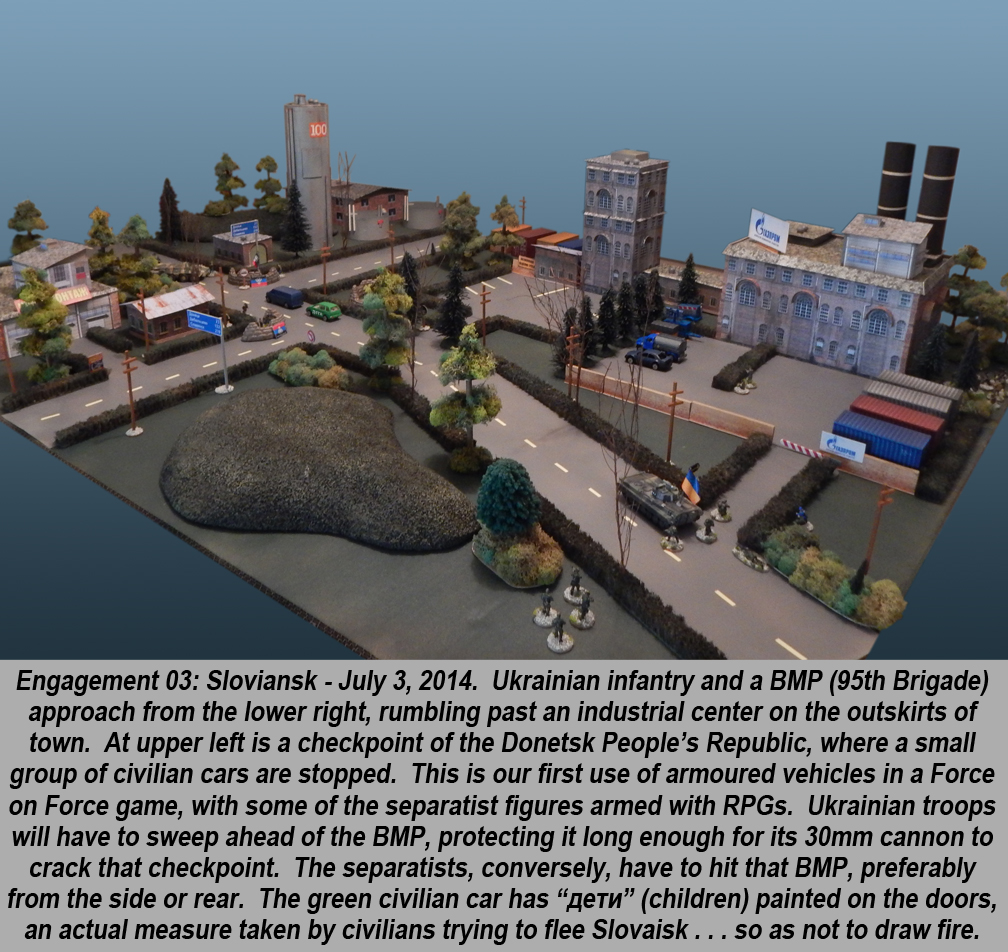
Now we push forward into the summer and early fall of 2014, looking at some of the more pivotal engagements of this conflict, and discussing in greater detail what gaming can teach us about the specifics of modern warfare.
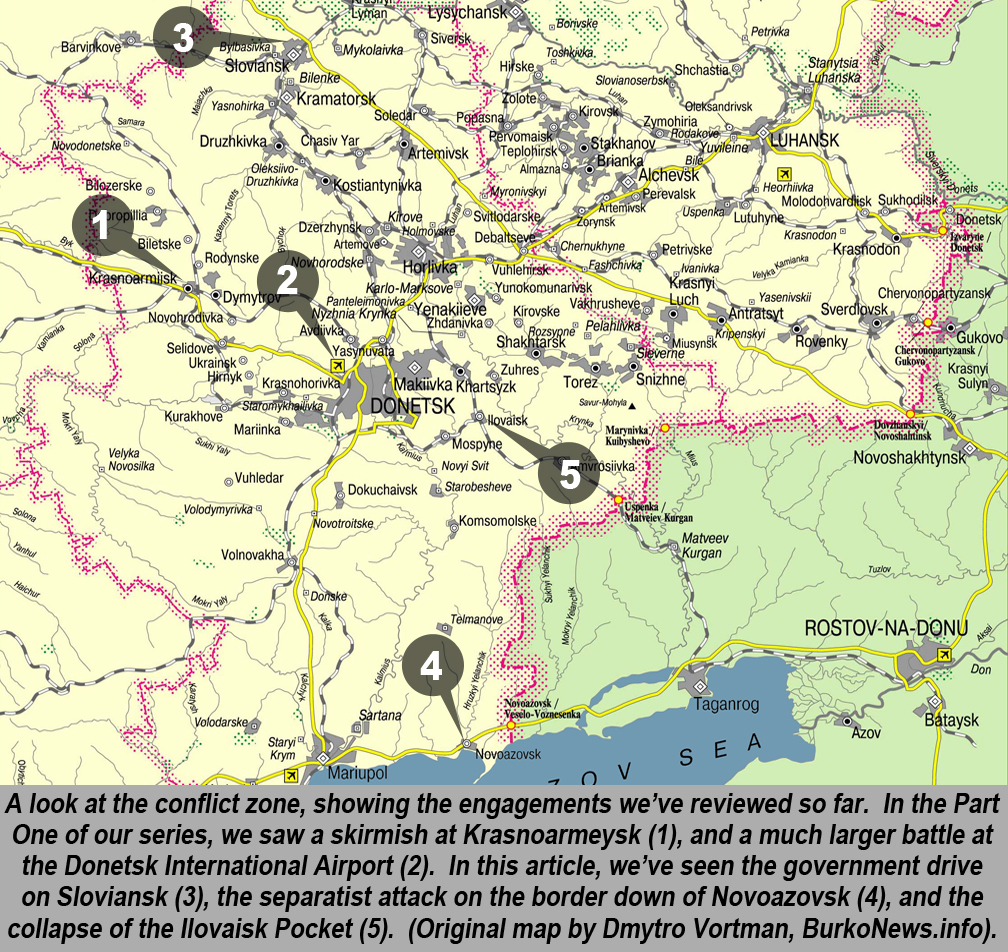
THE DRIVE ON SLOVIANSK (July 3rd, 2014)
Due in part to problems in funding, supply, morale, and corruption, the Ukrainian Army was relatively slow to react to the uprisings in the self-proclaimed Donetsk and Luhansk Peoples’ Republics (DPR and LPR, respectively). Once the Ukrainian Army got moving, however, they did so in a big way.
A powerful drive was launched southeast between the rebel strongholds of Donetsk and Luhansk, aimed at dividing the rebels and cutting them off from Russia, from whom they were suspected of receiving support, recruits, and supplies. One of the towns in the way was Sloviansk, a known rebel haven.
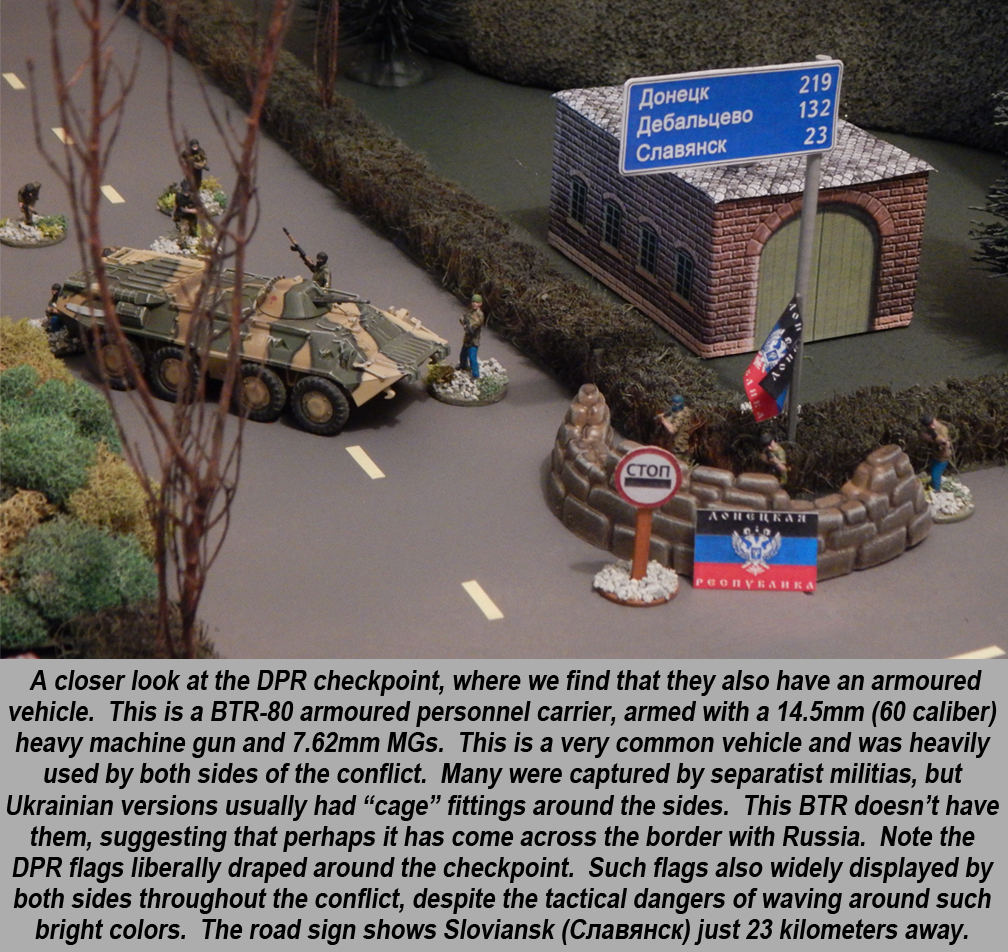
The town was soon surrounded by Ukrainian Army, National Guard, and “volunteer militia” forces. Although President Poroshenko offered a ceasefire, this was never observed around Sloviansk. DPR separatists repeatedly fired on Ukrainian forces, who deeply resented their own government for tying their hands with a ceasefire.
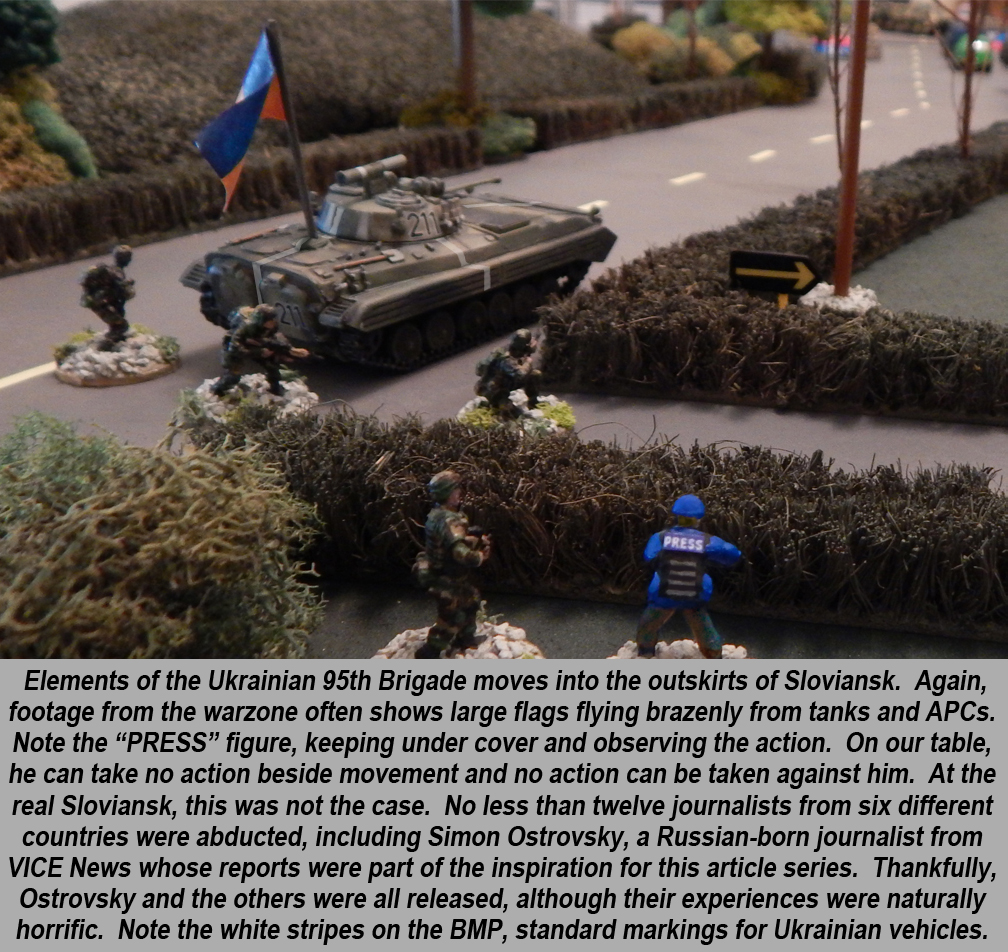
Finally, the Ukrainians launched a new offensive against Sloviansk on June 3rd. Renewed fighting raged for the better part of a month before the separatists started to break. Ukrainian troops pushed into Sloviansk itself during the first week of July, which is the engagement we’re featuring in the third simulation of our series.
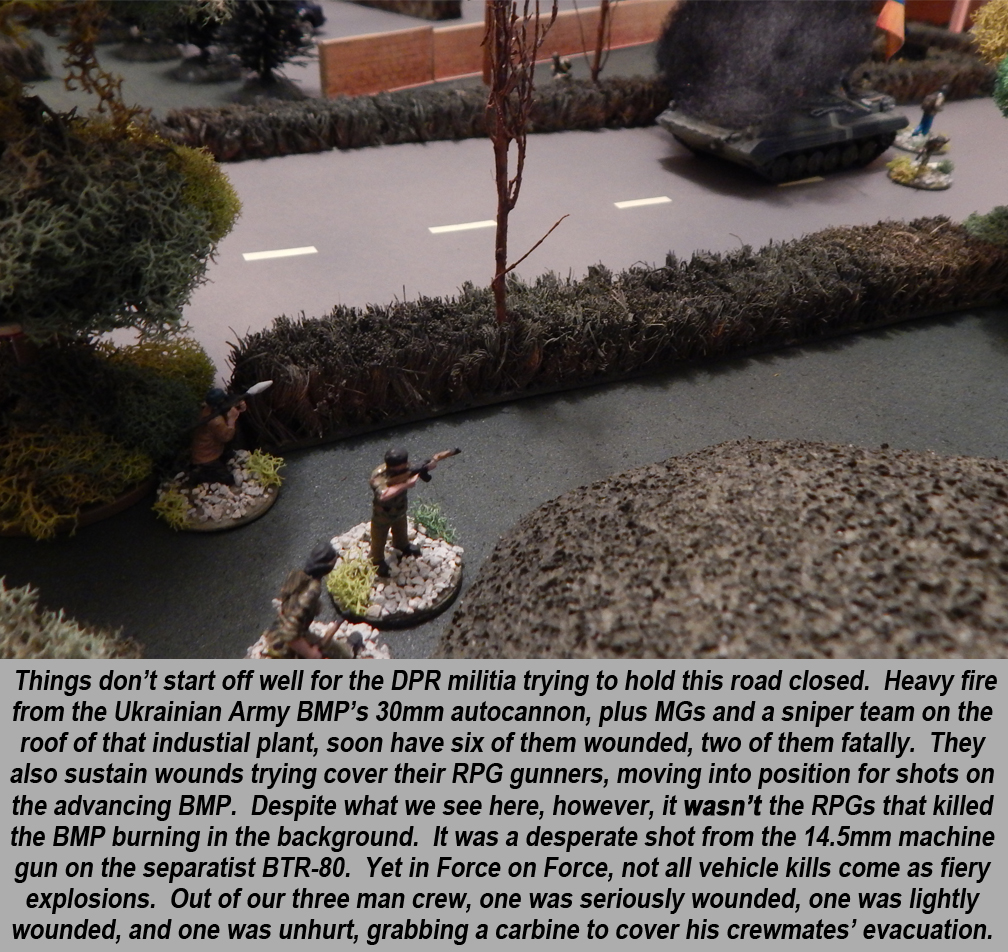
The government push into Sloviansk was a large operational undertaking, involving perhaps up to 15,000 troops of the Ukrainian Army (95th and 25th Brigades), National Guard, and supporting volunteer battalions. Up to 500 tanks and APCs may have been used. If there was any doubt regarding the gravity of the situation in the Ukraine, it was gone now.

The pro-Russian separatists finally withdrew from Sloviansk on July 5rd. In the aftermath, government forces continued their push down through Artemivsk and toward Debaltseve, still intent on separating the DPR in the south-west from the LPR in the north-east, and preventing them from supporting one another.
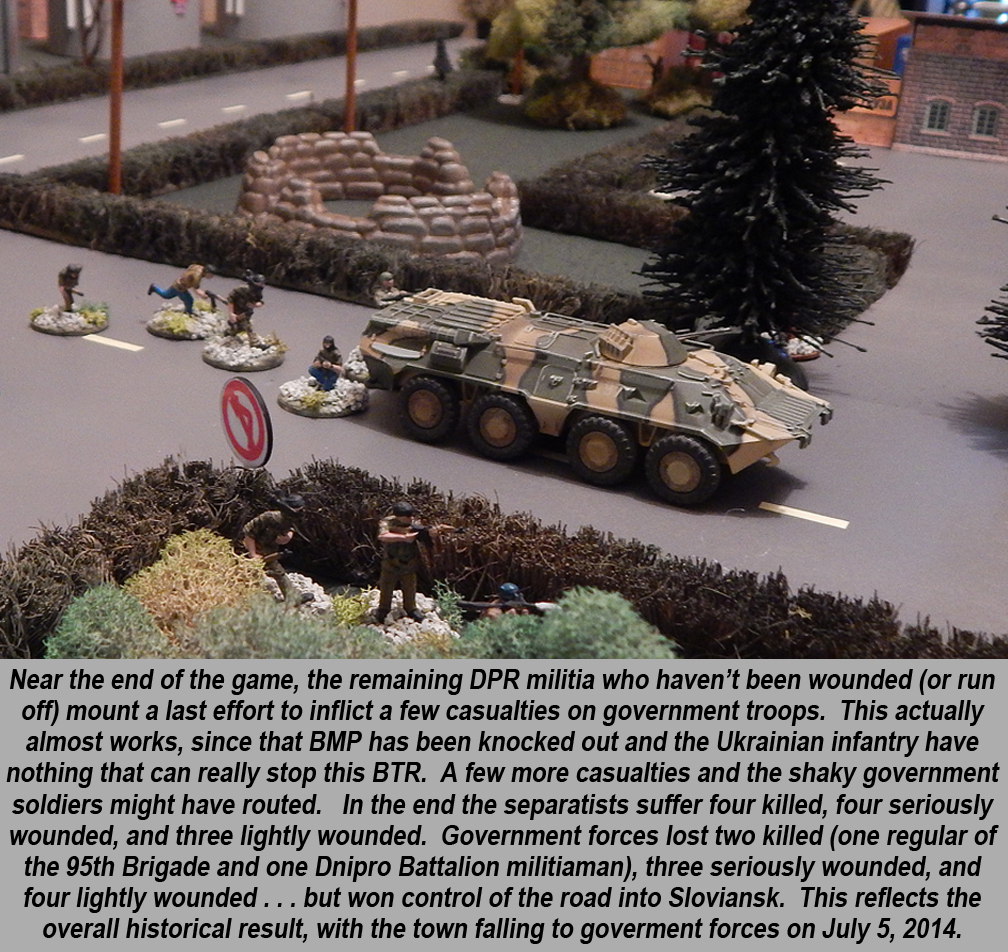
Trouble, however, was brewing to the east. Already there were strong suspicions that Russian support for the separatist rebels was coming over the border. Well-armed and armoured professional soldiers, notably free of insignia, started to appear in the conflict area, soon earning the nickname of “Little Green Men.”
NEW FRONT AT NOVOAZOVSK (August 26th, 2014)
As fighting continued into August, there could no longer be realistic doubt that Russian soldiers had entered the Ukraine and were fighting alongside DPR and LPR separatists. Satellite photographs showed Russian armoured columns, including BTR-90 and BMP-3 armoured personnel carriers, T-80 battle tanks, and self-propelled artillery.
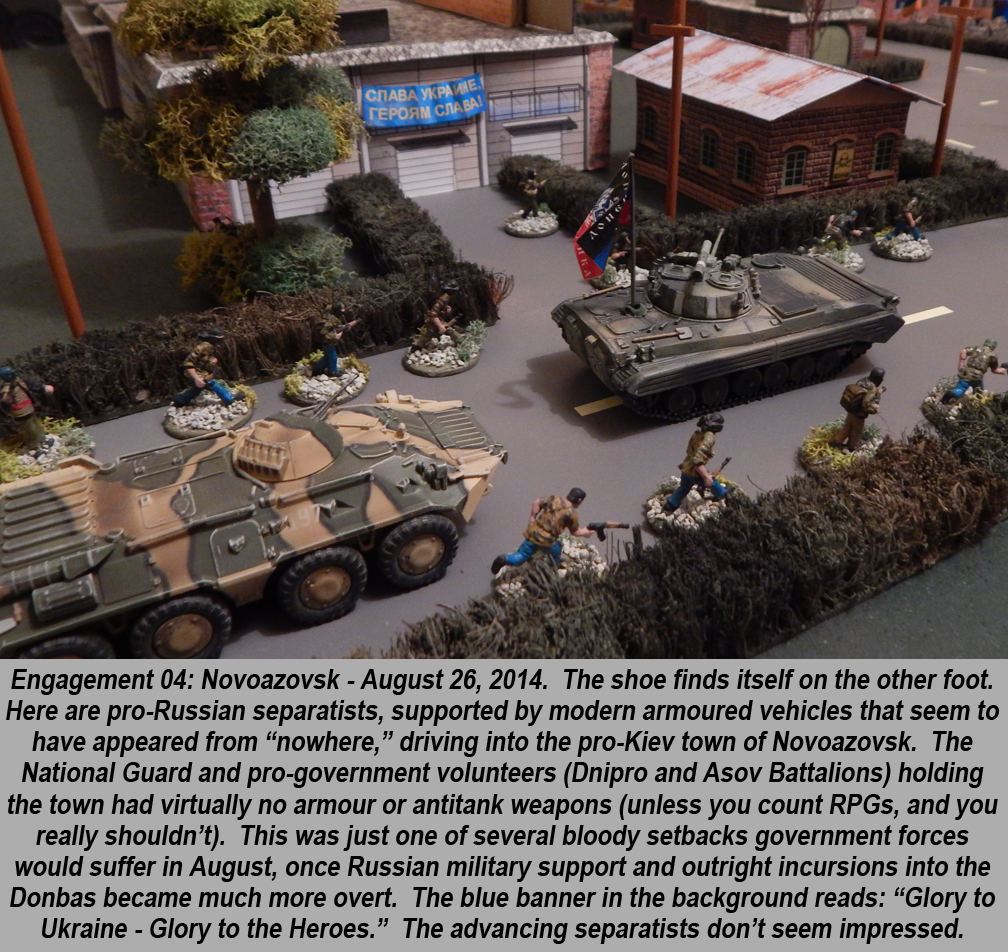
Russian soldiers were also taking “selfie” photos and posting them on VK, a social media site based in St. Petersburg. In interviews, separatists freely spoke of Russian troops fighting alongside them. President Putin even awarded the Order of Suvorov to the 76th Guards Air Assault Division...for a battle that supposedly “didn't happen.”
One of these incursions came in the south, near the coast of the Sea of Asov. A column of Russian armoured vehicles came across the border and supported local separatists in their assault into Novoazovsk. This was an important town because it controlled the road to Mariupol, a large industrial city just twenty miles further west.
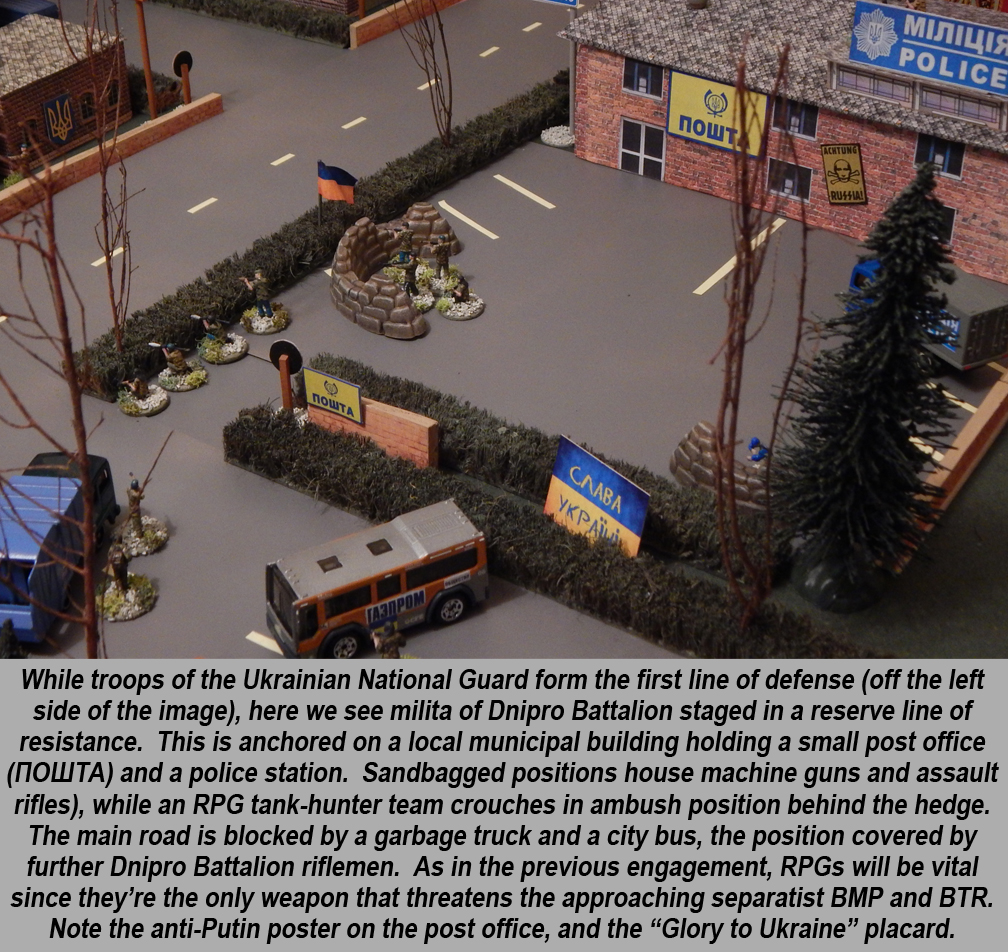
Ukrainian National Guard and militia were unable to hold the town for long. In interviews, National Guard troops bitterly lamented their lack of heavy weapons and armoured vehicles. Meanwhile, fleets of modern tanks and APCs were driving down Kiev streets in Ukraine’s Independence Day parade, gear that was sorely needed at the front.
In general, the soldiers of the Ukrainian Army was not terribly well supported by its government or its people. Fund-raising drives had to be held on Facebook and other social media sites so they could have flashlights, web gear, rain ponchos, and body armour. Their weapons dated back to 1988, and one batch of ammunition was dated to...1947.
All this from a country that until recently was one of the fastest-growing arms manufacturers in the world. The T-84 “Oplot” battle tank has advanced explosive reactive armour, ground search radar, ballistics computers and a gyro-stabilized main gun.
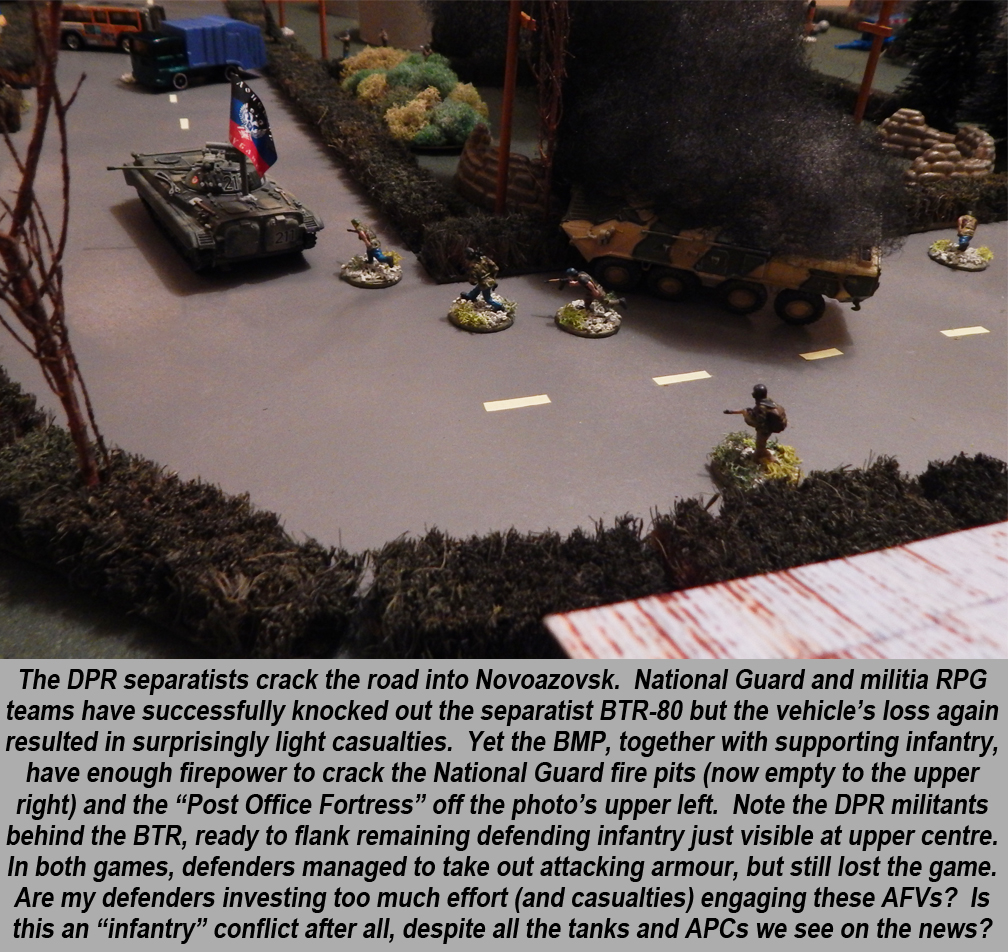
Yet these were sold for export and profit, while their own army faced Russian T-80s with upgraded T-64s that were sometimes forty years old.
ESCAPE FROM ILOVAISK (Sept 1st, 2014)
Perhaps the most telling evidence that Russian support had truly entered the equation was the sudden string of reversals suffered by the Ukrainian army in August and September, 2014. The most grievous of these came at Ilovaisk, where a sizable pocket of Ukrainian forces were surrounded by pro-Russian (and allegedly Russian) forces.
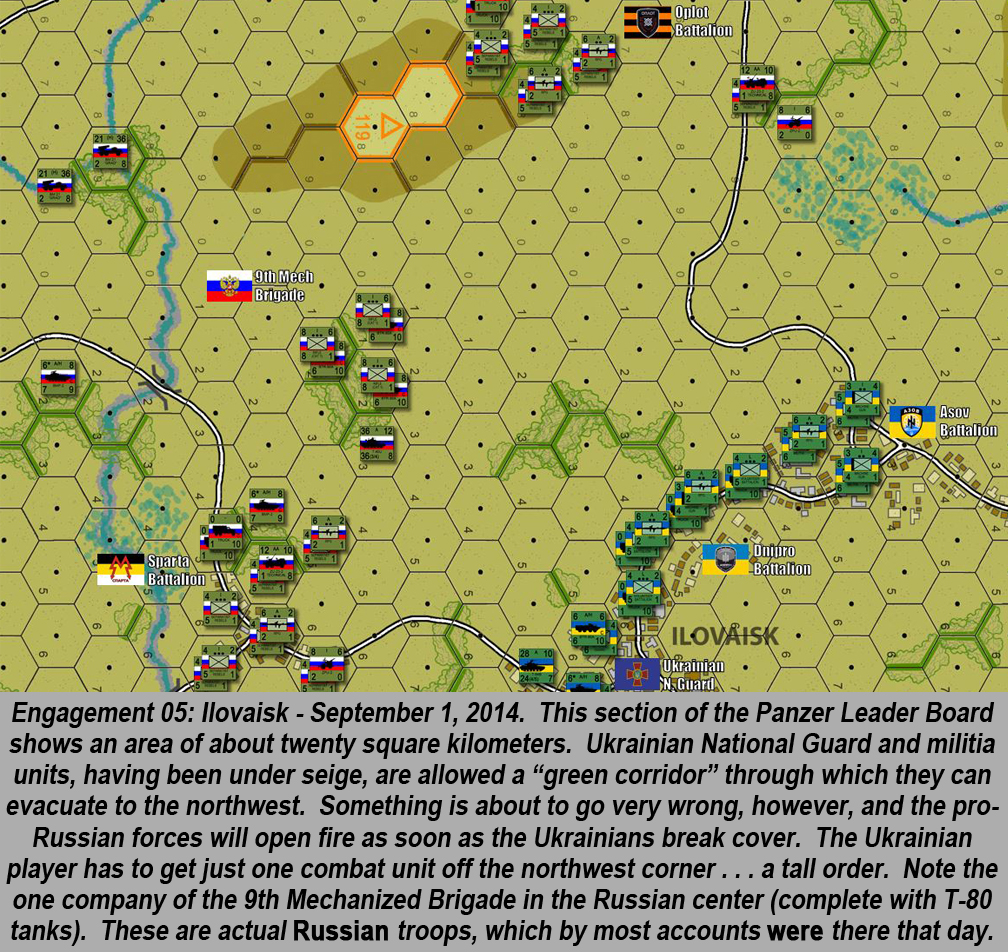
Details are very murky here. Some sources claim that in addition to various militia and National Guard units, the Ukrainians also had elements of the 79th and 72nd Guards Mechanized Brigade in Ilovaisk. Others claim that Ukrainian Army forces “never came to help” the embattled militia and National Guards troops in the town.
Whatever the case, the Ukrainians were soon in very deep trouble. In late August, a deal was struck that would allow the Ukrainians to evacuate through a “green corridor.” However, this didn’t happen. As the Ukrainians started to move, someone opened fire.
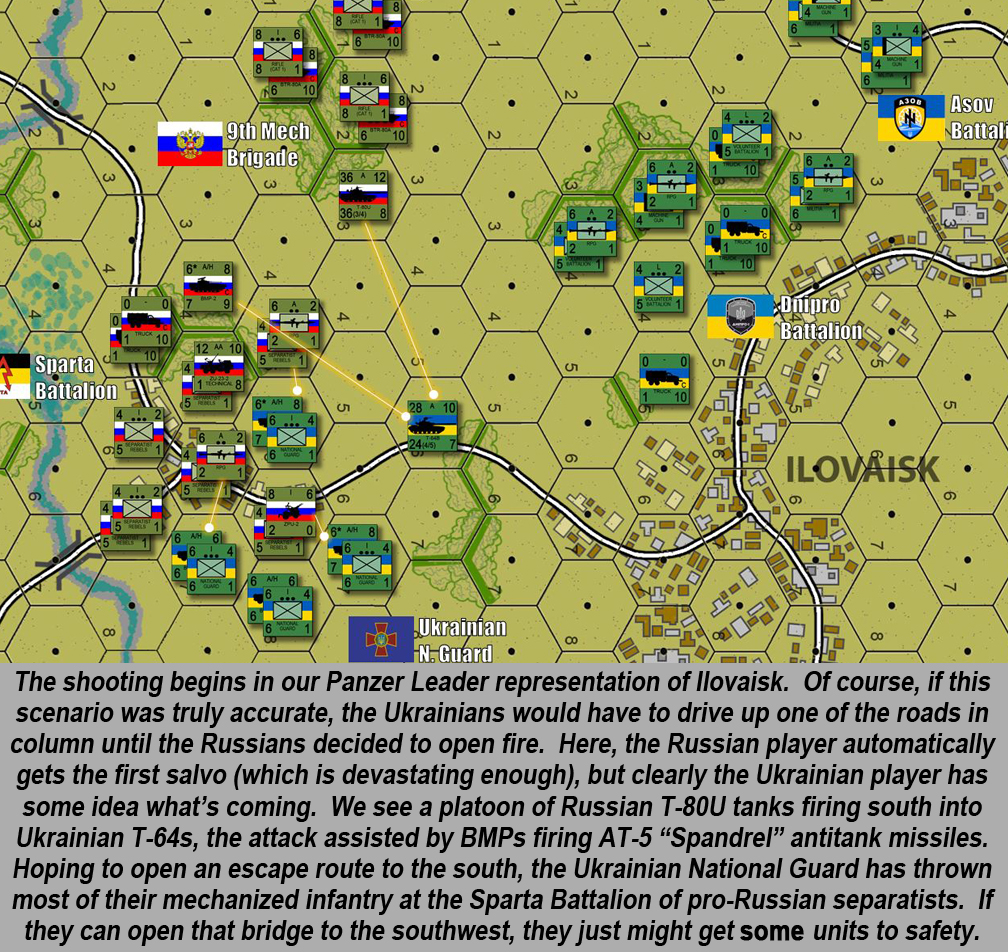
On one hand, it’s tempting to say that the separatist rebel militias, some of which have a less than perfect human rights record, pulled the trigger. In militia-driven conflicts around the world, these ad-hoc forces can sometimes commit acts that a disciplined, trained, and accountable army would not.
On the other hand, the attack on the evacuating Ukrainian convoy seems to have been carried out with great precision. Video footage from the site show turrets are blown completely off of tanks and APCs bowled over. There are no scorch marks from “misses,” the area was not simply blasted with indiscriminate “Grad” rocket fire.
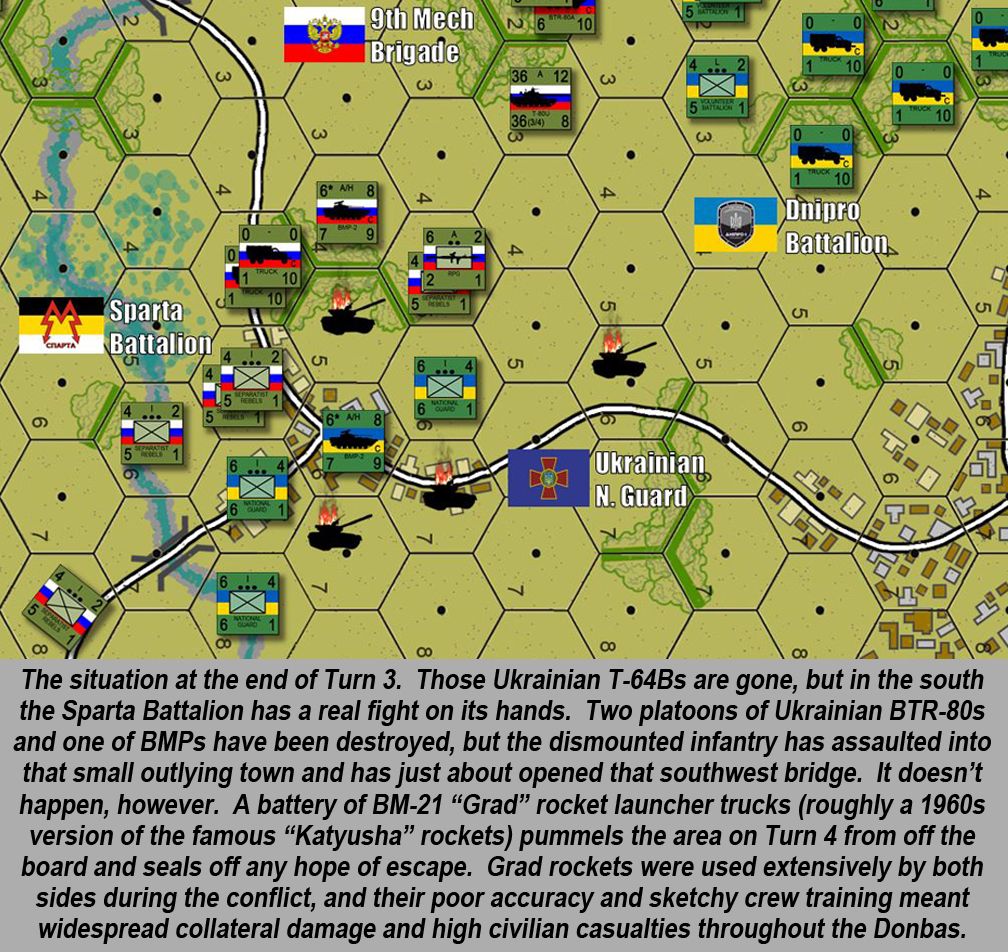
Chillingly, it’s almost certain that a “real” army did this. The Ukrainians say they lost over 300 men in this tragedy. Pro-Russian sources say it was over a thousand.
In any event, the disaster at Ilovaisk sent shockwaves through the Ukrainian military and government. The Ukrainian Defence Minister would be forced to resign in October. Meanwhile, it’s been suggested that this calamity, along with other setbacks, helped compel the Kiev government toward a cease-fire agreement being worked out in Minsk.
THE MINSK PROTOCOL (Sept 5th, 2014)
In Minsk, capital city of nearby Belarus, a cease-fire agreement was signed on September 5th between the Ukraine, the Russian Federation, the DPR and the LPR. The agreement was reached thanks to facilitation by the Organization for Security and Co-operation in Europe (OSCE).
However, within two weeks of the signing, repeated violations were committed by soldiers on both sides of the conflict. Meanwhile, the separatist republics set up government elections in November. While these elections were widely supported by the local populace, they weren't recognized as legitimate by the international community.
Thus ends Part Two of our Modern Wargaming; Conflict in the Ukraine series. Response to our first article was certainly spirited. It may not be for everyone, just please bear in mind we’re not “making sport” of any of this. If anything, we’re raising awareness of these issues (at least in our little community), and trying to learn something about how these conflicts unfold.
If you would like to write an article for Beasts of War then please contact me at [email protected] for more information!
"Well-armed and armoured professional soldiers, notably free of insignia, started to appear in the conflict area, soon earning the nickname of “Little Green Men”..."
Supported by (Turn Off)

Supported by (Turn Off)
"...fund-raising drives had to be held on Facebook and other social media sites so they could have flashlights, web gear, rain ponchos, and body armour. Their weapons dated back to 1988, and one batch of ammunition was dated to...1947"
Supported by (Turn Off)


![StarCraft Tabletop Miniatures Game Pre-Orders Live Now [Updated]](https://images.beastsofwar.com/2026/03/starcraft-tmg-news-cover-600-338.jpg)



![Mounted US Cavalry On Kickstarter For Dead Man’s Hand! [Updated]](https://images.beastsofwar.com/2026/03/us-cavalry-main-600-338.jpg)

![Play WW2 Commando Operations With Butcher & Bolt [Updated]](https://images.beastsofwar.com/2026/03/relaunch-600-338.jpg)
Another great historical analysis @oriskany . Panzer Leader is a great tool for showing large scale deployments and battles, and it looks like you’ve done a fair bit of work on terrain over the last while for some of the skirmish engagements! Well done!
Just occurred to me that this conflict is more personal than I thought: my step-son will be deploying there shortly!
Thanks, @cpauls1 . Is your step-son going to be part of the NATO contingent in / around Kiev? I know we sent 300 paratroopers of the 173rd Airborne Brigade last may (March / April) to train and advise. I also read Britain has followed suit with 75 more.
http://america.aljazeera.com/articles/2015/4/17/us-sends-300-troops-to-ukraine.html
Sure enough, at the bottom of this thread is the sentence:
“The United Kingdom is also deploying some 75 troops to Ukraine to train government forces there, while Canada announced Tuesday that it will send 200 trainers.”
I honestly did not know Canadians had deployed as well. All the more reason to hope the cease-fire continues to hold. 🙂
We have other contingents going as well, but in a more “operational” capacity. I’ll leave it at that 🙂
Of course, that may all change now that we’ve voted in the most idiotic Prime Minister and government in history, but that bit of politics is a discussion for another thread 🙂 .
Canadian politics, @cpauls1 ? Yeah, I’m leaving that one alone. At least until I write the “Hypothetical Canadian Civil War with covert US involvement” article. Totally kidding, of course. 😀
I’m in @oriskany , if I ever get this @#$%ing MS done. Not sure how I feel about Donald Trump putting his feet up in the House of Commons, but couldn’t be worse than what we have now 🙂 .
Oh God, @cpauls1 . If Trump wins down here, I might find myself defecting on the Canadian side. 😀
It seems a little distasteful to be playing a game about an ongoing conflict. I might be out of line for saying so, It just struck me as such. The battlefield looks really good though. Maybe I’ll become comfortable with the idea of modern conflict eventually.
Needless to say, I (and many others) respectfully disagree 100%.
@drathmere no more so than any other wargame in my opinion, only difference is that the conflict is current, rather than another generations war. War is war, people die in horrendous circumstances. The sheer quality of writing and research in this article shows the respect the author has for the topic, never mind the impossibility of getting authoritative information on this conflict.
As mentioned in the first part of the article (which i cannot recommend highly enough), there are many ways to “play” war games, you of course have your objective/points/inflict casualties ways of playing, which is what is most familiar to me, i have only played fantasy and sci-fi set games. I am not a historical wargamer so i cant speak for all but certainly the first installment of this series left me with a sense that on the other side of the wargaming fence it seems like the historical style of playing also encourages a more “simulation” and “what if” analytical way of playing, which to my way of thinking makes exploring conflicts like this a wholly respectable thing to do, the only stupid question is the unasked one.
Thanks very much, @nakchak . Definitely appreciate it.
We’re certainly “learning” a few things in the course of these engagements, like how tough Ukrainian nationalist missions are with more and more Russian armor entering the table. Seriously, RPG teams have been worth their weight in GOLD. Now that we’ve “been” there and “faced the same challenges” (in a 100% completely vicarious way, of course), we’re seeing just how real the calls were from the Ukrainian military for military support (especially with their own government and people doing such a lackluster job).
One reason I picked Force on Force for these skirmish games was the emphasis on troop quality rather than nit-picky details on such-and-such millimeter gun and so-many-rounds per minute, and so many millimeters of armour at such-and-such an angle. As they taught us in the United States Marine Corps, “it’s not the dope on the weapon, it’s the dope BEHIND the weapon . . .”
This has brought up in a real sense just how important missions like the 173rd Airborne and @cpauls1 ‘s stepson will be undertaking. Any improvement, even if its only an incremental one, in Ukrainian troop quality (cross-training, confidence in higher echelons, morale, etc) is worth more than billions in free high-tech gear. This is especially true if that gear is likely fall into separatist hands if given to a poorly trained and motivated force (again, as we saw with whole mechanized columns in the spring of 2014). This was the worry, debate, and reservations on whether the US would send big military aid to the Ukraine.
I guess my point is . . . we’ve SEEN that. We didn’t read about it, take someone else’s word for it, read it off some angry, biased blogger somewhere. Admittedly in a tiny, academic, and wholly vicarious way, we researched and “thought-experimented” our way through the problem, it unfolded on the table, and we came to our own conclusions.
We’ve LEARNED something, and formed educated opinions on very recent, real-world events. If that “distasteful,” I don’t know what else I can say.
Wonderful analysis and another great article.
Thanks, @mrharold ! 😀
Not just the quality of writing or the research, but this guy has been to war and seen it all for real.
Thanks as always for the great support, @unclejimmy . But yes, a USMC veteran, in the interest of full disclosure and honesty, never been close to actual combat.
Seen some grisly “aftermath” stuff, though. More than enough to take the material with seriousness and gravity.
If one area of wargaming is in bad taste then all wargames shoud be. However, it is, after all, just a game.
@oriskany cant wait for part 3, i am not exaggerating when i say that reading this series has made something “click” for me, never really saw the appeal to historical (perhaps “reality based” is a better phrase) gaming before, but now i am very interested in giving it a go!
Thanks again, @nakchak . 🙂
I definitely like Historical, or “reality-based,” as you say. That said, I do enjoy some sci-fi (Star Wars and Star Trek related stuff, or other ‘verses heavily influenced by them). Even then, I usually find that I’m drawn to them as an excuse to play “naval” battles that never took place historically. 😀
For modern-setting, our biggest challenge (strictly from a GAMING perspective) has been terrain. So many of recent and/or current conflicts are taking places in heavily built-up areas, and I’m not sure if other agree, but city terrain for me seems to be the toughest, most time consuming, and expensive to build.
Did you have any era of history you were most interested in?
@oriskany
One idea for terrain although i suspect 28mm isnt a suitable scale for this idea, would be micromachine playset’s, not the recent rubbish, but the late 80’s early 90’s toys, stuff like this: http://www.ebay.co.uk/bhp/micro-machines-city
I suppose printing out pictures of the cityscape from google earth, and sticking them to cereal boxes would be cheating?
As for my own historical interests, i tend to read a lot about WWI, Vietnam and Recent world events, although as i mentioned prior to your articles i had never considered experiencing them vicariously through the medium of gaming before. That may well change now 🙂
Actually, @nakchak – a lot of my cars, roadsigns, fuel tanks, trailers, etc . . . are Matchbox / Hotwheels, actually “cheaper” brands from the local drug store because they make “normal” looking cars and not hot rods and racing cars. 😀 The scale is a LITTLE off . . . but not too much.
Cereal boxes, you say? I certainly hope that’s not cheating because that’s what a lot of these buildings are (well, iPad cases, shipping boxes, gift boxes, that silo is an old holiday gift can for a bottle of Southern Comfort. 😀 Smaller ones are small cardboard jewelry cases I get from the craft store for $1 each. The trick is stick on a lot of additional elements to break up the box-shape, then stack them together to further “unbox” the overall look of the building. That, and give the “cereal box” an awning to make it look lore like a real building. 😀
Here’s a great documentary series on Vietnam. This link should lead you to the whole 12-part playlist. I often have this kind of thing on in the background while painting / building.
https://www.youtube.com/playlist?list=PL0679IGx8w0jpry6P-xHoqfoWrgbxUn03
Heh the cheating was about printing streetview images and sticking them onto the box ;), i am a big fan of “found” terrain, i.e. found a use for it, lost count of the number of refineries i have made over the years from pringles tubes, drinking straws and ATX PSU’s…
(just discharge the caps before use, unless you want to tase your opponent, in that case charge them up before battle commences;) ) I have found CD cases to make quite good tower blocks, especially the totally clear cases, just mask a suitable window pattern onto the sides and glue them as cubes, then just stack them together. DVD cases tend to look more like stage set peices than terrain, although the sleeve on the front of them can be good if you again print either a real city scape or artwork that fits the location and have as background
Cheers for the link has been added to my saved for later list
Dude, that idea of the clear CD cases behind a building skin for a “window” effect is actually pretty sweet. Thanks, @nakchak , I may have to use that. 😀
I hope no bottle of Southern Comfort was injured or inhumanly treated during the production of this article series. 🙂
No, @jamesevans10 – but some “So Co” bottles were definitely emptied in the making of this (and other) series. 😀
A whole painted army has a beauty of it’s own even if the individual normal soldiers are not shaded or highlighted. I think the same goes for buildings when they are used in large numbers. While an individual building model may not be a work of art a table full of buildings certainly is. 🙂
Nice article, mate. Tastefully done, as always.
Thanks, sir! 😀 We’re doing our best.
Excellent article. I have learnt more about the conflict from you than from any of the news bulletins and articles that I have seen. Keep up the great work.
Thanks very much, @gremlin . Two articles down, two more to go. 😀 We’ll be covering some of the fighting that’s stretched into 2015, the Minsk II Protocol, the eventual “wind-down” of widespread combat, and maybe a few “take away” points on what makes modern combat “modern.” Of course technology is obvious . . . but really . . . is it? Not in ALL conflicts, we’re finding.
so far so good.
Awesome, @radegast. Thanks. 😀
Cannot thank you enough for firstly continuing with this series mucker. Secondly with out doubt your work is as best it can possibly reflect a war that is as current tomorrow as it is in recently fought conflict(s). A real art form of a great worded piece and as always done with taste as well as respect for any involved.
Thanks. @chrisg .
As far as why we **might** not have continued . . . When I first “soft-pitched” this idea to the BoW team, we had a quick Skype and the general idea was: “let’s try it and see how it goes.” Two XLBS episodes ago, Warren characterized the series as an “experiment.” So when the first article went up, after the first day’s feedback I reached out to the team again and said “hey, we’re running about 85% positive (at the time, 27 out of 32 comments that weren’t mine), should we keep going?”
The BoW team wanted to keep going, and on yesterday’s XLBS we had further affirmation of that. So yes, we’re now sticking to the full four-article run, unless something crazy happens, which I don’t foresee based on how careful we’re trying to be.
Thanks once again for the kind words and great support! 😀
Well written, Informative, and tastefully done. Now I just envy your free time to do all this. 🙂
Thanks, @silverstars . Don’t envy me too much. What free time I have these projects consume completely. No worries, though, I always take 6-8 weeks off between 8-week project. But “during a run,” it’s work, sleep, eat, write/graphics/research . . . not necessarily in that order. 😐
Free time? No, its called should be sleeping time and should be eating time 😉 You mini’s gamers have some seriously skewed priorities. “Hmmmm I could sleep or I could dry brush all my metal buildings and give them rust.”
Sheesh, all this because I was eating dinner the other day with the fork in one hand, and the “rust brush” in the other. That bridge had to be finished! @unclejimmy was waiting! 😀 😀 😀
This is a battle you can’t win. Suggested next move – Total surrender! 🙂
Some interesting times back then every day a ceasefire was broken somewhere most of the time no one knows who was to blame?, love the table pictures @oriskany
Thanks, @zorg . I’m really becoming something of a fan of 20mm. I’ll probably always stick to 15mm for WW2, simply because I like larger battles and I have 300+ minis already. 🙂 But for smaller, modern skirmishes I’m slowly converting to 1/72.
I honestly can’t keep track of the ceasefires in the Ukraine. Of course there are the “big ones,” Minsk and Minsk II (Sept 2014 and Feb 2015, respectively), but there were many many others in between which quickly broke down. Even now there are small violations every couple of days, and people still being hurt and killed by unexploded ordinance and IEDs. Thankfully, though, the violence seems to be about 5% what it was as recently as July. Prisoners are being released, artillery and other heavy weapons are being withdrawn, and the rhetoric coming out of political leaders of the DPR and LPR is really toning down.
I know I sounds like a broken record on this . . . but keep your fingers crossed this trend continues.
As someone new to modern figures and larger scale pieces, I have to say I am impressed. The amount of detail you can fit on the infantry is amazing (stripes on pants, blue armor on police, etc.) Also the larger scale on the buildings allows you to add the signs which, for me, make the board. They truly turn it from and old “city” board to an Eastern European board. Your writing is always informative while still being entertaining, however your boards are really what catch the eye and make you want to read about the game that went with them.
Thanks, @gladesrunner . Although in truth, those signs are just to “punch up” what I was afraid were rather plain-looking buildings. 😀
All too quickly dismissed as scatter scenery. Yet nothing places a battle to its place and time than scatter scenery. Just the simple addition of a movie poster locks down the time. Street lights and road signs have similar effect. I am a firm believer in that your table should get just as much time as you place in the models and their bases as it makes for a total visual experience. 🙂
I know what you mean, @jamesevans140 and agree. To save myself money, time, storage space, and most importantly sanity . . . 🙂 . . . I keep this signage detachable. To give a WW2 example, a general “restaurant” type building can a French cafe in Normandy, or a gasthaus in Germany, simply by switching out the sign hanging out front. Presto, the whole board is now in a different country with “authentic” detail.
Well I must say the second instalment lived up to the high expectations that was placed upon it by the first article. Very well delivered narrative.
The old maxim of go into the countryside and swim through the people like fishes through water is now mostly behind us now. Besides the migration of the population from the countryside into the city that has occurred since the 60’s is our every growing dependence on electronic based high technology. You simply don’t get good Wi-Fi in the countryside. This raises the question could a modern war continue if we experienced solar flares to the point that the power grid was taken down?
These 2 points alone makes war today city centric which is about the last place MBTs can be truly effective. The closeness of the terrain surrenders much to the guy on foot. The old answer was to support them very closely with infantry. Yet the last place infantry today want to be is near a tank whose armour explodes with deadly force when it is hit. As the technology is getting cheaper perhaps the next addition to the MBT will be armed UAVs launched from and controlled by the MBT crews or perhaps remotely controlled vehicles that can work close to the MBT.
So far it looks like Force on Force has been a good choice to explore this conflict at such a low tactical level (skirmishing). Something that is easily missed is the amount of work that you placed in the production of the Panzer Leader boards and playing pieces that you have produced here.
To many of us the format you use for your articles is well known but I am still amazed at how it continues to mature with each article series. It would be all too easy to accept the standard of the last series as a template to future articles. You work to a near enough is not good enough ethic that continues to drive the quality of all aspects of you work. While I am familiar with the high level of research you do. This article series shines out to such a point that most readers are seeing and appreciating the level of research you conduct.
Having said all this article 3 has a large set of shoes to fill but I am quite sure you will not disappoint.
@jamesevans140 “You simply don’t get good Wi-Fi in the countryside” not true, have been known to string hotspots through trees, with 300m runs of cat5e/6 with a repeater over a couple of fields. Admittedly i am networking geek and never grew out of climbing in trees but still 50MB/s says good wifi in middle of no where 😉
As for reliance on fat pipes, most military grade field comms infrastructure is actually quite low on data bandwidth requirements (one of the reasons military grade encryption is based on 20+ year old technology) essentially if you have the bandwidth to receive a fax you are not totally cut off and a couple of mobile cell sites easily provide that much coverage.
As for solar flares, batteries are immune especially if suitable shielded i.e. all the EMR shielding that military spec dictates (in case of nuke) pretty much means nothing would happen (other than (public, not the order of magnitude higher resolution military) GPS would probably be fried, and maps still exist as do compasses) a more worrisome event would be the (magnetic, not polish people) poles flipping
Augh, @jamesevans140 ! I was JUST LAST NIGHT writing a rather big section on the difficulty of modern tanks in cities (Part Three contains separatist T-72s advancing through the Kyivs’kyi District toward Donetsk International Airport). Do you have a webcam in my office? Creepy. 🙂
Thanks for the comments on the Panzer Leader boards. I will sloooowly convert all of Beasts of War to Panzer Leader! The cult lives on, bwahaha! 😀
And thanks for the comment on the article format. This was the thirty-third article done for Beasts of War, it’s safe to say we’ve hit a stride. Additionally, the LAYOUT and WEB DESIGN work done by Ben and others on the BoW team really helps a writer put his or her best foot forward. That “his or her” isn’t just a PC phrase, of course, I’m referring to Dani’s article series in March on Warmachine.
http://www.beastsofwar.com/warmachine/warmachine-coming/
Additionally, keeping at least close to the word count suggested in the BoW Style Guide enforces efficiency of prose and a “brevity of wit.” Learning how long they “like” their paragraphs prevents “walls of text.” Spacing the photos and making their images (and captions) part of the story . . . all of this really is a collaborative effort and these articles wouldn’t look nearly as good as they do without the work on the BoW team. 😀
BoW has a style guide @oriskany ? Sheesh. That would help!
Yeah, the basics. Word count, use the Queen’s English (all those extra “u”s . . . I guess to add a bit of “colour” to the text 🙂 ), how many images to include, etc.
Do you have a link @oriskany? Couldn’t find it. After I get this effing MS out of my hair I’ll likely do a few how-to articles with my floating castle. Queen’s English, you say? Is there any other kind? 😉
Uhhh . . . there’s, like REAL English? As in . . . why doncha learn to talk ‘Merican good? Duh. 😀
Seriously, I think it’s a .pdf. I’ll e-mail it to you.
lol. Thanks @oriskany . Ah hope’s ah can make somethin’ as purdy as this 🙂 .
If I can get through the inch-thick Times style guide (advanced editing textbook) I’m sure I can get through BoW’s!
I know the feeling. The one we had for reference and web publishing at work was about that thickness, but a big part of that was confidentiality-related. “Please don’t tell our competitors about the price points on our upcoming releases and products.” Wow, really? Thanks.
Sent the style guide. 😀
OMG, the thing has more holes in it than Swiss cheese. Ambiguous enough for my purposes.
As a professional writer for 12 years and having had to BUILD a couple of these writing guides for companies, I actually found BoW’s style guide a breath of fresh air. Word counts, number of images, a very few things to NOT discuss, a general summary of style (Queen’s English, gaming issues, etc). How to include a few informal terms specific to expected content. Done.
No rambling about non-competition clauses, confidentiality agreements, indemnification protections, CCU licenses, public domain, blah-blah-blah who gives a s**t- do you ever get tired of the sound of your own voice.
Frankly, stuff like this is the job of the copy editor. Style guides always seemed to me to be either (a) a copy editor trying to make his / her job easier, (b) or a copy editor’s boss trying to shitcan said editor.
I need neither one. 🙂
Peak-a-boo. 🙂
Thanks @nakchak but my statement of Wi-Fi in the country was a generalisation encompassing the entire world every inch of it and was not considering the exceptional few places. Well aware of bandwidth so no need to go there. In situations of civil uprising the non government side would have to rely on G3 or less which covers a large portion of the population but falls well short of covering the world away from population centres and remember I am generalising here. 😉
Which is why many non government organizations of civil unrest are tied to city and towns. It all starts with cell phones for them and networks are generally not built in areas of low population and minimal electricity grids, if at all. Yes I am aware that there is at least one non state organisation that has its own cell phone network coverage.
True about the batteries but how were you going to recharge them? It may be months before the transformers are rebuilt. Yes you could use petrol generators for a while until it runs out as the lack of electricity will impede its delivery at some point in the supply chain.
The point I was making is that our war machines have become too reliant on high technology and groups are more tied to the towns and cities, so please don’t reader much more than that into what I was saying.
In Iraq a British Challenger MBT had its sensor packs removed by repeated RPG hits. There was no old school optical sites so they were reduced to looking down the barrel for aiming and all the ballistic targeting computers were completely useless. I consider this more of an exception rather than a rule. However oversights have a bad habit of creeping in such as the removal of guns from the early F4 phantom design.
The last solar flare storm of the intensity I was considering occurred in the 1880s burning out much of the northern US telegraph network and a number of scientists consider we are over due for a similar one. If it is of similar intensity the US will take around 4 years to rebuild its power grid while the rest of the world will take up to 10 years.
I’m actually not very knowledgeable about these “EW” kinds of questions. I’ve definitely heard most of what your talking about. I know many modern AFVs are “EMP-hardened” which is supposed to make their electronics resilient to some of these things, but a small battlefield tactical nuke is one thing, the sun throwing a temper tantrum is something else. 🙁
Re: Challenger visual engagement: I know what you mean about systems failure in combat, and how nothing will ever truly replace the “Eyeball Mark 1.”
This was one of the things I was hoping to bring out in this series. When first rolled out on XLBS Justin asked: “Is modern combat really that much different than WW2?” To which I could reply, at least in part . . . not really. While we can certainly theorize about what might happen if big nation-states take their blue-ribbon armies out to fight each other, that’s really not what “modern” . . . or at least “current” conflict usually is. It’s little militias with T-55s older than their grandfathers, blasting away at each other with little or no training. Even if the weapons are high-tech, the low training in some of these “armies” means the UNITS are not.
That said, I found one VICE mini-doc that showed an Ukrainian militia unit (Dneipro Battalion) . . . since they have no drones or RPVs for recon, have built their own. Literally in some dude’s garage, they were “hobbying” together their own drones, flying them over separatist positions, and really getting some good photos.
https://www.youtube.com/watch?v=yFOqB-Dhrtc&index=28&list=PLw613M86o5o5zqF6WJR8zuC7Uwyv76h7R
One of the biggest issues that would face a militia if they captured a current generation tank would be care and feeding of the beastie. Just the simple act of aligning a gun barrel of say a M1 to its targeting systems requires laser systems and a specialised PC. The M1 starts screaming feed me after 4 to 5 hours of operation but at least its not concerned about it’s diet, just that it will want lots of it. There are few mechanics that can strip down and service a jet engine. Then there is the little issue of getting replacement compressor blades.
The modern MBT is tough, rugged and amazingly shootie. But boy they need their TLC. A US analyst once described the M1 in war as going to war with 1 foot stuck in a bucket. He was talking about having to set up FARPs for it and the massive logistic train to keep them on the field and running. In this regard in what he was saying applies probably to nearly all current generation MBTs. The Ukraine’s environment has a history of being hard on tanks.
In the 2006 Lebanon war Hezbollah used a number of drone designs and were out reconning the Israelis in this area as the Israelis were not expecting a drone war from the Hezbollah militias to be so well equipped. The cell phone remained one of the greatest weapons they faced in the Lebanon war. Modern operational warfare has a requirement for the element of surprize to work effectively. These new information gathering systems are dirt cheap and gives a lot back to the militias. The Israelis and forces deployed in Iraq and Afghanistan found that when they attempted actions in city and towns the militias were kept up to date in real time of their position, actions and movements. Current armies have spent millions to get this type of Intel yet cell phones and home made drones have given the various militias this capacity and it was as cheap as chips. Asymmetric warfare is a curious thing and has many turn arounds.
Simple economics also comes into play for regional powers as well. It would not make sense for Russia to have deployed T-90s when they had older and more disposable tanks that was up the task.
Finally I have put solar tantrums to bed. I was just taking that train of thought to its logical maximum.
Also while we are on the children theme. I have a grandson and a grandson in law currently serving. I also have a grand daughter that is wholly unimpressed with their lack of military understanding. At the beginning of the year she and I went through the strategy and tactics of the Napoleon Wars and broke down the pros and conns of the weapons in use that included land and sea systems. Before that we did the same thing for WW1. Why is she not serving her answer was simple. She does NOT do that crawling in the mud thing. She would be extremely interested in what is being done here. It is not the first time she has used wargaming to analyse something about war. To her wargaming is just a tool available to her and she has no interest in using it for social intercourse. I have been blessed with curious kids and grand kids. But man I wish I got even a cent for each time that why word was thrown at me. I would have been extremely wealthy man. 🙂
@jamesevans – “An analyst once described the M1 in war as going to war with one foot stuck in a bucket.” Ha! I know exactly the guy you’re talking about. Curly dark hair, kinda young? He was in “Generals at War” and some other series. I always find him a little annoying, just his speech, voice, and body language. He definitely knows his stuff, however, and makes the occasional memorable turn of phrase.
I remember what he was talking about in this documentary. In addition to everything you’re saying, there was the additional point of: “Here’s what the RPG-armed Iraqi insurgents learned very quickly during the 2003 invasion. Those Abrams are armored to hell-and-back. The FUEL TRUCKS that are never far behind? Not so much.” 🙁
“Current armies have spent millions to get this type of Intel yet cell phones and home made drones have given the various militias this capacity and it was as cheap as chips.” — Reminds me of the old Space Race story. “Did you know NASA spent $1 million dollars designing a ball point pen that would write in zero G?” — “What did the Russians do?” — “Gave their guy a pencil.”
Feels wrong on so many planes. The battefield is very nicely done. The article is great. But I just can´t game this. There might be people who lost their loved ones to this conflict watching me and my buddies having fun playing the game (wich is the conflict).
I´m sorry it doesn´t seem right. There are so so many wargames in all periods that we should´t need to do this. I might be wrong and I might be “bleedy” beacuse Im a dad but many of those who died in this conflict was also someones dad, not just lead or plastic men. Play something else
I hear what you are saying, if the articles showed a flippant disregard i would also agree, but in the authors defense what i see here is more of an analysis of the (ongoing?) conflict using miniatures, in that respect how does it differ from bomber command pushing planes around a huge map? or a diorama in a museum?, other than a ruleset is employed to provide the mechanics of simulation, and offer the opportunity to better understand the decisions that were made/forced by circumstance?
I appreciate it, @nakchak . 😀 Some people just aren’t going to get it, and that’s perfectly fine. I will say I find the “dad” comments particularly telling. Warren, father of three, spent a chunk of last XLBS supporting this article series, but I guess his opinion as owner of this site has been overruled. To say nothing of the step-dad we have at the top of this thread, who also supports this series and what it’s trying to do, and who actually HAS someone deploying into this conflict zone. I suppose his point of view should also bow to someone who tells us what we should and shouldn’t game.
Interesting.
am a dad too, admittedly my daughter is only 13months old, but i certainly wouldn’t keep her away from exploring history and conflict if that’s whats she’s into, if anything so that knowledge of the past explain the present, and hopefully guides the future, truth be told as long as she asks “How” and “Why” a LOT then i will be happy 🙂
“Why” is the question. In the end, perhaps the ultimate question. That’s where all the power is, and why it’s often so dangerous. All the way back when we were kids . . .
“You have to go to school.”
“Why?”
“Eh . . . because I said so!”
Once you got to “because I said so,” that was when you knew you’d won the argument. 😀
Great article/series. I thought I was fairly well informed about the conflict, but you’ve filled in a lot of details I didn’t know. Keep up the good work.
Regarding the question of ethics or taste on gaming modern or current conflicts.. the thing is, pretty much every kind of wargame can be interpreted as offensive, controversial or morally wrong to some people. World War 2 is a popular period, but does playing that for fun trivialise the horrors of the Nazi regime? Ditto for classic Pulp gaming where explicitly Nazis (as opposed to merely German soldiers) are a popular opponent. The American Civil War is another popular period, yet again players on the losing side can be accused of trivialising or glamorising slavery and racism. Best not dwell on anyone who plays Darkest Africa games, or any of Britain’s colonial wars. Even discussion of the conquests of Alexander the Great can lead to heated controversy, depending on whether he’s described as Greek or Macedonian. And I’m leaving out some of the most obviously dangerous conflicts, like the Arab-Israeli wars, India vs Pakistan, Vietnam, the Irish Civil War, the Falklands.
“Aha” I hear someone say, “that’s why I don’t do historical games, and only play fantasy/sci-fi.” Well I’ve got news for you pal, playing a game with magic users or chaos demons in is a blasphemous sin, according to some religious types. I’ve seen someone take offence at the traditional view of Orcs & Goblins as “greenskins” as being a parallel to real world colonial racism. Heck, just the other day I heard about someone offended by Star Wars who described it as “a Right Wing power fantasy.”
Just for the record, in case anyone doesn’t get it, I personally don’t agree with ANY of the above positions. But someone out there does and is ready to be offended at your choice of game.
Let’s also not forget that pretty much ANY wargame represents attempts by human beings to end the lives of other human beings. That in itself is a horrible, horrible thing, and I don’t see how it can be fine if it represents something that happened a hundred years ago, but somehow morally wrong if it represents something that happened last week.
However, at the end of the day, we should all act according to our own conscience. If you personally find a type or period of game distasteful, don’t play it. Don’t read articles that discuss those games or buy figures or rules made for it. Personally, I’m a modern-era wargamer (amongst other things). I wargamed the first Gulf War while it was happening, tweaking the rules I used to reflect what we were seeing on the nightly news. Personally I’m mostly OK with gaming the recent insurgencies in Iraq and Afghanistan, though I wouldn’t insist on playing either with my friend in the army who’s served tours in both theatres. On the other hand, I also used to be an enthusiastic Colonials gamer until 2001. But after the 11th September attacks, the western powers vs Islam subtext never quite sat right with the lighthearted tone of the games we used to play and I haven’t played a colonial game since (switching to Victorian Science Fiction gaming in a strictly European setting).
But that’s just me, acting in accordance with my conscience. I don’t believe I have the right to make others conform to my gaming choices, any more than they have the right to dictate what games and periods I want to play.
I hope this excellent and informative series is allowed to continue on BOW, and that those who find it and ultra-modern gaming not to their taste can learn a little tolerance for those of us who do enjoy such things.
Dr V
Thanks very much, Doctor. 😀 You know, I could try to add to what you say, but pretty much you say it all. So I’m gonna thumbs up and leave well enough alone. Thanks again for the support and the great post.
All I will say is that as a USMC vet during the Gulf War (sadly yes, I’m that old), I had friends in Bahrain, at Khafji, and Kuwait City and up the Basra Road. I remember when the very first dedicated wargame based on the Gulf War came out (Line in the Sand, I can’t remember who published it) I was actually very pleased. I remember thinking “Wow, that was ‘our’ war.” We gamed heavily all through my time in the Marines, and some games were almost “required reading” (I remember our battalion had a copy of AH’s old Advanced Squadleader” in the rec room).
Last thing . . . after being totally immersed in this subject matter for going on six weeks (with about two weeks to go), I will confess it is getting a little heavy. I watched the X-Wing on Endor videos the other day with a certain longing. Maybe I’m just getting saturated with the subject, but “serious, heavy” wargaming DOES get burdensome after a while and you long for a chance to laugh and chuck dice in a way that would be admittedly inappropriate with this material.
Then again, after a few weeks of “clowns with water pistols” . . . I’d be pining again for something with a some actual meaning and gravity. 😀
Classically it is the base of a figure that was the important piece not the figure itself. Most common the base occupied a scale area occupied by a platoon and represented a platoon of real men. In modern times it is all about the figure and the respect for the real men has somewhat given way to playing toy soldiers. So it is no wonder people get confused when the wargame is used in its classical role as an analytical tool, like @oriskany is doing here, and not merely playing toy soldiers.
The word Orc or Orcha is a Saxon / Celt word for stranger or foreigner. To Harold’s lot the Normans were orcs. To the Normans Harold’s lot were aliens. Something to thick about. 😉
@jamesevans140 – you write: “Most common the base occupied a scale area occupied by a platoon and represented a platoon of real men.”
– – – or the size of the counter . . . the HEX and the counter. When you start talking platoon-sized pieces, the cult of Panzer Leader whispers to you from the darkness. Shhh . . . don’t resist, James. It’s so much better if you don’t resist. 😀 😀
On a more serious note, the idea of wargames used “classically” used as analytical tools of course goes back (as I’m sure you know) to the 1850s at least . . . Prussian officers at academy used little lead soldiers and horses as part of their training.
I’m reminded of the time the Imperial Japanese Naval Staff war-gamed through their upcoming operation at Midway. The Japanese officer playing the Americans scored an early success when a carrier strike sunk two Japanese carriers. The umpire ruled the result as “invalid.”
Of course, on June 4, 1942, American carrier airstrikes would sink FOUR Japanese carriers in the most decisive day of naval warfare since Trafalgar.
Looks like the umpire was right. Those results really WERE invalid. 😀
@oriskany get out of here you map heathen! 🙂 🙂
Some wargame historians push this date back to medieval times when kings played a game similar to modern chess but had about 4 times as many squares which could be coloured to represent terrain types and the had a number of different playing pieces. Modern chess does descend from this game. Others push it back to the Romans as many military figures of about the right size has been found. However there is no evidence linking the figurines to a game. The Romans were big on figurines. You could buy little figurines of popular gladiators from the arena. You are correct in that the military officer class started focusing on wargames. The Prussians were really big on miniatures wargaming rather than moving real men around the battlefield. The Prussian main set of rules was Kriegspiel that was very well developed by the late 1880s. The British copied these rules and started using them around the turn of the 1900s. These staff wargames were very different to how we play today. In its most complex form it required 3 rooms, one for each side and usually between them a room for the referees.
Only the referees’ table had all units on it. Each side has all their playing pieces plus what the referees decided. Both sides would write up orders for the actions they were taking in a turn and these orders were past to the referees who updated everything and gave the results back to the players. They never used dice as all results was determined by the experience of the referees. Who could not be argued with as the referees tended to out rank the players. In the simplest form they were organized by a couple of junior officers playing on the same table with a divider between the 2 so they could not see the other side until a single referee lifted it.
Wargames as we know them today for the general public descend from Little Wars that was written around 1910 for gentlemen to lay down on the floor and play toy soldiers in 54mm scale the standard size of the tinsoldier (toy soldier) of the day. The cannons actually fired match sticks. Public interest peaked just before WW1 after that there was little interest in wargaming until the early 1950s. There was of coarse the few diehards that kept the flame burning. The initial main periods were the Napoleon wars in Europe and the American Civil War in the US. By the end of the 50s the periods being played simply exploded in choice including WW2. WW1 was the least popular as it was seen at the time as an aberration of war and not real warfare.
On the night of June 5th at one of the staff colleges as part of returning for his wife’s birthday had lost a wargame based on a Normandy invasion. However in this game the Allies had only landed 3 divisions. Given this I would loved to have seen his face when he was informed that they landed twice as many divisions.
About your invalid results, too right they were. You guys cheated and used an unsinkable carrier. 😉 🙂 😀
But I suppose there was nothing in the rules that said you could not. 😉
We’ve run PanzerBlitz/Leader with the two room “double blind” system. I was running it (i.e., the referee not playing). never have I been so glad for an iPhone to take quick photos of one player’s map, so I could run into the next room and update the other player’s map if anything was spotted / engaged.
Kriegspiel, that was the name of it. Couldn’t think it off the top of my head earlier.
“Little Wars” – that was H. G. Welles, wasn’t it?
Cheated? Hey, having a battle at Midway was far from “our” idea. We could say the same about the Japanese at Leyte Gulf. Except about a dozen “unsinkable” aircraft carriers / airfields.
@oriskany
1. Yes Kriegspiel was the German primary war game rule set leading up to WW1.
2. Yes it was HGW. He also wrote an expansion to it but I cannot remember it’s name off the top of my head, I can chase it up for you if you want. People know HGW via science fiction whoever he turned his hands to my things including war analyst. The War of the Worlds was an off shoot of his study into an invasion by a vastly technologically superior adversary. The germs were not a big insight. The Victorians were into germs in a big way being a descent discovery, much like weight loss today.
3. Forget about the unsinkable aircraft carriers as both sides should have focused on un-downable planes. 🙂
I have had no luck with the team’s in different rooms thing. I have only tried it twice and both times the referees could not resist making their own changes thing it was funny. This kind of humour I have a tendency to walk out on.
I’ve always read a lot into HGW’s “predictions” in War of the Worlds. Chemical warfare by the Martians, biological “warfare” by . . . well, by accident or Mother Nature or however you want to interpret that part of it. The heat ray (lasers) and the some of the shielding was described as causing incoming shells to explode prematurely.
The only big thing he seems to “miss” is radio. He has the Martians blasting those very loud horns at each other as a way of communication – but of course the novel was 1898 . . . 1896 . . . something like that . . . before wireless communication had made a big splash in military tech.
Double blind gaming – is not fun. Probably even less for me because I’m always getting stuck being the referee. 😀
Back to HGW and “Little Wars” – my favorite Panzer Leader website “Imaginative Strategist” actually took its name from the first paragraph in HGW’s write up for the game in 1913. Quoted below:
Almost sad, really, thinking he wrote this in 1913. Apparently no one listened . . .
“And if I might for a moment trumpet! How much better is this amiable miniature than the Real Thing! Here is a homeopathic remedy for the imaginative strategist. Here is the premeditation, the thrill, the strain of accumulating victory or disaster — and no smashed nor sanguinary bodies, no shattered fine buildings nor devastated country sides, no petty cruelties, none of that awful universal boredom and embitterment, that tiresome delay or stoppage or embarrassment of every gracious, bold, sweet, and charming thing, that we who are old enough to remember a real modern war know to be the reality of belligerence.
This world is for ample living; we want security and freedom; all of us in every country, except a few dull-witted, energetic bores, want to see the manhood of the world at something better than apeing the little lead toys our children buy in boxes. We want fine things made for mankind — splendid cities, open ways, more knowledge and power, and more and more and more, — and so I offer my game, for a particular as well as a general end; and let us put this prancing monarch and that silly scaremonger, and these excitable ‘patriots,’ and those adventurers, and all the practitioners of Welt Politik, into one vast Temple of War, with cork carpets everywhere, and plenty of little trees and little houses to knock down, and cities and fortresses, and unlimited soldiers — tons, cellars-full, — and let them lead their own lives there away from us …
Great War is at present, I am convinced, not only the most expensive game in the universe, but it is a game out of all proportion. Not only are the masses of men and material and suffering and inconvenience too monstrously big for reason, but — the available heads we have for it, are too small. That, I think, is the most pacific realisation conceivable, and Little War brings you to it as nothing else but Great War can do.”
H.G. Wells, Little Wars, 1913
@oriskany HGW was an insightful man for his times. At the time of writing radio was still be argued if it could work much like EM engines are today but if it was only written a few years later I think he would have included it. Just prior to writing it as I mentioned he was touring the lecture halls discussing an invasion by a technologically superior force. The foe were the Martians but the lecture was as factual as he could make it and perhaps this flowed on into the book. He actually regretted his Martians lecture as no matter where he went that was all people wanted to hear about and were not interested in his new material.
Floor Wars was the expansion to Little Wars more of a volume 2 really with a lot of tidy ups. You can get books and e-books today that contain both.
Here are just some of his other works;
Maxims and Opinions of the Duke of Wellington. Not the real title as it is more of a chapter.
A Modern Utopia
The New Machiavelli
A short History of the World
Under Wellingtons Command A Tale of the Peninsular War
War and the Future: Italy, France and Britain
War in the Air
What is Coming? A Forecast of Things to Come After the War.
The list goes on in both fiction and non-fiction.
Most people today would find Victorian humour rather distasteful and inappropriate. Remember the airliner that disappeared recently and there was a massive search for it in the south Indian Ocean? Imagine if someone wrote to the papers and as the only survivor gave an account of what happened and the horrific trial of survival that followed in all the gory details. Now imagine that the author turned out to be Steven King. This was nothing more to little musings to the Victorians nothing more. Many of the great writers did this including HGW who wrote a few of them. As it was part of the times and excepted almost expected there is no judgement here.
I love the times he lived in. Some of the greatest people to have lived was part of the deluge of these times. Edison, Einstein, Marconi, Tessler just to name a few. We get cocky about our great achievements but I don’t think we surpassed the great men and women who make their achievements between 1880 to 1910. We used the power of the horse for over 40,000 years look what they did in just 30 years. It is just so taken for granted these days we have forgotten just what a leap it was.
Agree 100% @jamesevans140 about the tech advances and visionary importance of the early 1900s. When I’m in the mood to pick a fight, I usually roll this argument over at the tech company where I work, where they think they’re doing “so much” to “change the world.”
Compare things invented between (about) 1900 and 1950, vs. (about) 1951-2000 . . .
Air plane
Car
Computer (binary logic driven, as in the Z1 in Germany and the Bronze Goddesses of Bletchley Park).
Telecommunications
Ballistic rockets
Guided missiles
Super highways
Order-by-Mail commerce
The jet airplane
The Helicopter
The Telephone
Plastic
Things invented after 1950 . . .
(crickets)
Granted, there have been a lot of IMPROVEMENTS, amazing improvements. But real accomplishments? Real breakthroughs?
Okay, you have a few like the microchip and the Internet (although could these be considered improvements to the aforementioned pre 1950 computer and telecommunications)?
Polio Vaccine? (early 1950s)
Television? Wasn’t that actually invented before 1950, but only brought out after WW2 into widespread use? Sure, it’s usually identified as a 1950s advancement, but I think it was actually invented long before that. Not 100% on that.
The basic point is . . .
We’ve been standing on the shoulders of giants for quite a while.
@oriskany Yes the TV was kicking around before WW2. In fact the Japanese attack stopped the roll out of TV as a consumer product. The factories were ready to roll.
By mid wall the Germans had TV remotely controlled antiship flying bombs. By late war bold the US Army Airforce and the US Navy had both developed radio control versions of the B-24 that were crammed full of high explosive. The intent was to fly them into heavily fortified ground targets. Both systems used a TV camera that transmitted an image of the flight instruments back to the controlling aircraft were the remote control pilot could see them on a TV screen. These remote aircraft were to be piloted while over English soil as a safety measure. When the B24 was about to fly over the coast the pilots were to hand over the control of the aircraft and the bail out. The first flight experienced and electrical fault and blew up before the pilots bailed out. The lead pilot was JFK’s older brother but both pilots did not survive. Both projects were dropped after this accident.
In early 44 in Italy an UK Sherman was taken out at night by a Panther using a IR system. After D-Day German snipers had been equipped with a very limited number of rifles equipped with IR sights.
A couple of years ago my son-in-law and I started a list of unique weapons systems completely designed and has to be based on new technology. Since then many things have been added to that list but most have been removed as they were just extensions of technology from WW2 or earlier. Our list so far.
Neutron Bomb
Laser Targeting
Light intensifying night vision
Anything else has been removed as some part of it relied on earlier technology. One of us comes up with something, we research it and then it usually falls off the list. So the advancement of the modern era has been all bells and whistles but lacking in substance. Even the car has had no significant improvement since 1928 in has been all refinement and anything else comes from refinement of other systems not originally used in the car but are still refinement of other technologies.
To me it was a truly Golden Age of advancement.
Thinking about what the difference between modern warfare now and “modern” warfare from WWII would probably be, I can think of a few major differences. And from here on out I’m discussing what a 1st world power against another 1st world power with roughly the same generation of technology and level of logistics/resources. No asymmetrical warfare as seen in Afghanistan/Iraq. This is a conflict between people with the highest tehnology that current technology can offer.
1. Information- This is a major difference between now and WWII. The Fog of war from the early 20th century is almost completely gone. Between AWAC airborne radar stations giving the commander a constant picture of the air situation, Drones of various sizes giving live feeds of the ground situation at all times, computer systems giving the location of all units down to individual vehicles/ infantry squads, Night vision across the board and now thermal imagine for the individual soldier not far away, knowing where you are and where the enemy is almost absolute. Special Ops that mere decades ago you sent out and hoped for the best can now be watched live by the Commander in Chief. As Oriskany said, even the most rudimentary of militias have cell phones at their disposal, which can be a poor man’s warning net. And when both sides have this level of technology there is very few places to hide, which is unfortunate because…
2. Precision/Lethality- What made a bang before now makes a boom, and what you had to fire salvos to hit before now only takes one round. As smart weapons on aircraft made Operation Desert Shield into a turkey shoot, we are now seeing that level of precision coming down to the individual infantryman. Tanks can hit reliably in with the 1st or second round while on the move, and soon will have high explosive rounds with laser-designated air-burst fuses, which means cover means very little unless they are in a reinforced bunker. The Artillery arm now has GPS guided shells and can provide pinpoint precise fire and knock out designated targets with one hit, much like the air force. Drones can send hellfire missiles to knock out targets of any size from an altitude so high they cannot be seen with the naked eye. Infantrymen have ATGMs which can knock out the heaviest of tanks from kilometers away make Bazookas and Panzerschrecks of the WWII era look like play things. and instead of just heavy machine guns they also have fully automatic grenade launchers firing 40mm high explosive rounds, and individual infantrymen with airbursting grenade launchers to complement the fully automatic small arms they all possess. It is a world where if you see it you can hit it, and if you hit it you will almost certainly kill it.
Granted all this lethality comes at a major price in both financial cost and the amount of logistics just to keep things running. Also in a real shooting war between equal combatants where everything is so lethal and so expensive to build and maintain, who ever wins the first battle will probably win the war. Factories could grind out Shermans all day long, but M1A2s, F22s, and the highly trained personnel required to operate them cannot be replaced in time to continue the war. What is brought to the table will have to win or die and/or surrender.
As far as gaming that kind of war, at say a tactical level like Bolt Action or Flames of War, I imagine it would play out similarly to WWII with the major exception being that instead of 5 turns to figure things out and move to range and so forth, units push for immediate line of sight in the first turn, let loose for the rest of the 1st turn and the next turn, after which it will probably be all said and done with twice the casualties on either side in less then half the time of a normal WWII game. Brutal would definitely be the word to describe it. And I can understand why most major nations would rather fight proxy wars against other nations to avoid the all or nothing scenario such a conflict would bring about.
Great post, @silverstars –
I think one way I’ve managed to “get away” with doing modern combat on a 20mm table is keeping it militia-based, and small scale. If we were going to do what you’re talking about (“blue-ribbon” army vs. “blue ribbon” army in full-scale battlefield combat) – that’s really tough. I agree with just about everything you say, and might even take one step further to say that miniatures in general might not work.
Ranges are something like 3,000 meters for MBTs, easily . . . and 5,000 for most current-generation ATGWs. That’s 300 feet on a 28mm (Bolt Action table). I don’t know anyone who has a table that big. 😀
The old saying you see in WW2 games: “well, lines of sight weren’t that long” (leaving aside that they usually WERE 1,000 meters+ , yes even in Normandy) . . . in modern combat, how many weapons systems don’t NEED an LOS, as you list in your post?
World War II saw opposing Industrial-Age armies on a “total war” footing having at each other. The post-1945 era saw a new other Industrial-Age wars (Korea, India-Pakistan, the Arab-Israeli Wars, etc), but these weren’t really on a “total war” footing, so these are incomplete examples insofar as economic, industrial, and societal factors are concerned.
The Gulf was something of a turning point, with the Coalition’s “Information Age” army pitted against Iraq’s “Industrial Age” army. Schwartzkopf and his “Jedi Knights” of internet technicians (first real “internet” if memory serves), battlefield information management, and the SMALL but decisive proportion of smart munitions (something like 1% in the Gulf War of total tonnage used, I think it went up to 40% or so in the 2003 Invasion) – the results speak for themselves.
In a truly Information-Age era, full-scale war, would there even BE a “battlefield?” We’ve seen how Russia cannot keep its deployment of troops secret because of something as silly as soldiers taking selfies and posting them on social media. Most of the Ukrainian volunteer battalions were raised on Facebook pages. Funding drives on social media is keeping these units supplied in the field. Twitter may be credited with helping bring down the Mubarak regime in Egypt, and maybe even sparking the revolt in Syria (sadly, this has led to the war we see in progress now).
Can armies keep any secrets? And if they can’t . . . can they truly operate in anything like a conventional battlefield sense? Are armies too complex, expensive, and technologically fragile to survive a true “World War III” showdown? How is such a conflict envisioned without involvement of strategic (nuclear) weapons?
Or have we entered an age where war is “always” going to be fought by proxy (at least by the big powers), with drones, and small groups of special forces?
I don’t pretend to have any of the answers. Nothing like it has happened yet (thankfully) It certainly wouldn’t be ANYTHING like World War II with new toys. It makes my head swim, to be honest, which is probably why I stick to militias. 😀
Again, great post!
Agree with most of what you say here @silverstars except point 1.
Did you know that Iraq has approximately 256,000 boulders that give off the same targeting profiles as a Russian jeep? Missions had to be flown to eyeball these contacts.
In many ways today we can get faster into the thickest fog of war than in any time in history.
Once we enter the into the immediate battlefield the fog of war generally clears up much better than at anything in history. So our situational awareness is far greater.
Your conclusions about similar powers is supported by the fact strategy changes very slowly while tactics by necessity must change to meet the current war. When we compare even Viking and Saxon land armies we find them similarly equipped and used in a similar way. This is not surprising as just like militaries today they by this stage belonged to an international military community where ideas are being exchanged one way or another.
You touch on an interesting point concerning the cost of equipment and level of training. A number of analysts are saying warfare at the top order is of limited endurance and that strategist must incorporate a roll over to a less child in their planning. Here they expect that lesser child to be a military of similar capacities to those of the 80s and 90s. Many were critical of the US that they took too long to roll over to an extended endurance roll (their opinion not mine). So far the F35 has been running at around 24 hours maintenance to each hour of flight. Most 5th generation fighters are not far off this mark. Given this a number of experts say that air wars like NATOs war with the old Yugoslavia and the first Gulf War are behind us as the 5th generation aircraft are incapable of such sustained action. This I don’t agree with. They are part of first strike capacity not the sustained fight. this is for MPVs and generation 4 aircraft. At this stage of a war the 5th generation aircraft would be best deployed as rapid response and specialist missions. Mind you these same experts mock the current Russian stealth designs as they have provision for external stores. They argue that they will no long be stealth aircraft if they use them. True but the experts seem to have forgotten there is little need of stealth once you have air superiority. Once you achieve this it is about pounds of ordinance down range and not about sneaking about.
The word scalability comes to my mind when comparing WW2 to current warfare. We are doing far more with far less especially at the tactical level. The four man fire team is expected to do the job of the section (squad) of WW2 and far more firepower comes off the modern fire team. The modern section must deploy over a larger area to prevent higher casualties. Here is also when that endurance thing kicks in again. If a fire team takes a casualty it has lost 25% capacity while the WW2 section would have lost only 10% of its capacity. Whoever if placed side by side these figure shift even more as the WW2 section has far less firepower spread over a greater number of soldiers. So that 25% is more like 35%. Due to the modern level of training much more can be asked of the fire team and the average soldier from a modern top order military would compare better with a commando rather than the average soldier of WW2. Veteran units or WW2 would compare much better as they have had the hardest instructor of the lot who rarely gives a second chance. So comparisons become more difficult as there is more to it than equipment and training. Experience and moral can still mess up any equation.
In regards to @silverstars Point 1, I think I land “between” the two positions. I would agree that a huge amount of “fog of war” has been dissipated. Any kid with a laptop can see any corner of the planet with a quick scan of GoogleEarth. A crude example, admittedly, but I don’t want to write a book here. 🙂
That said, we’ve no sooner removed the old fog of war than replaced it with a new and possible even more opaque fog of war. Not a lack of information, but an overabundance of information. I know I’ve brought them up before, but the information management team that Schwartzkopf referred to as his “Jedi Knights” in Gulf War One – he also credited as his most valuable asset (more so than the F117, the M1A1 or the AH-64D or other more tactical tools).
Sifting through all that data, plucking out what was actually important, disseminating it to the right people (those with fingers on the triggers who HAD to know whether there were friendlies in front of them), and doing it in real time . . . this was the force-multiplier that kept F-15E Strike Eagles from hitting the same targets twice, and kept the fratricide levels to such a low level considering the sheer scale and speed of Desert Storm.
Information management, the modern counter to the today’s SELF-IMPOSED fog of war, is what shortens decision cycles to the point where the enemy is always reacting to you.
This makes the enemy’s information management network a prime target, and we get into the realm of cyberwarfare. A successful attack here blinds the enemy with his own overabundance of data, and could well be the “smokescreen” of the future.
Security of information and protection of management assets is the next issue. As we’ve seen in Ukraine, despite all the classic Cold War security measures, the exact location of Russian units was betrayed by soldiers taking selfies (with phones that record your GPS coordinates, no less) and posting them on VK, a social media site in Russia.
Thus, any kid with a Facebook account can pinpoint the locations of Russian forces in the field, practically in real time, better than all of Mi6 could do back in 1944. Clearly the Russians have grossly underestimated the pervasive presence of social media.
I hope we learn from their mistake. Back in World War II soldiers’ letters home would be censored by military officers, mothers would get letters from their sons with black streaks across names of towns, units, rumored deployments, etc.
Do modern military authorities have to come up with something similar for 21st century correspondence? Disabling of Facebook accounts? Access only to military-controlled internets when on certain deployments? How would such measures be put in place and enforced in a wireless world?
Maybe we should call it the “Static of War?” The “Fog of Facebook?” It sounds silly, but these things have seriously compromised the diplomatic and military security and standing of the Russian Federation while in the midst of a freakin’ WAR.
The only thing better than learning from your mistakes . . . learning from someone else’s. 😀
Bottlenecks in the flow of information is a big issue. Staff officers tend to over analyse each incoming piece of intel while their numbers have not been drastically increased. The other issue found in both Gulf wars were old school officers between the dissemination points tended to hoard the intel was it empowered them in the old school way. As these officers are retired and or retrained this issue should clear up.
As a creature we tend to be able to handle up to 6 different tasks at the same time reasonably. Other the other hand as you start adding tasks on top of the 6 tasks balls are being dropped and out past 8 tasks then complete tasks are being forgotten or ignored. This continues to happen until the person becomes completely paralysed with no or meaningless output.
During the Arab World people rebellion many were recording events and posting them to social media. When not at the front line solders are given Internet access to they can email, skype and Facebook their love ones. These points make excellent hacking targets either for gaining information or doing a denial of service attack to bring down the servers. Soldiers who can’t get news from home tend to have their moral plummet. While they have this contact they can stay on the front line longer. So these systems can be used for much more than delivering more than just an information fog of war.
Our sensors back then actually cut the word out. So a really bad letter could arrive home in many tiny mixed up pieces.
The fog of war and the friction of war will always be there. The amount will vary and their nature can change. Each war will have its own fog and friction that will have to be address by the armies involved. Certainly with the passing of each decade EW is becoming larger and far more important than it has ever been. Some of the battles of the Napoleon period was one of the last times when a commanding general could stand on a hill and see everything involved on the battlefield. The size of the battlefield continues to grow driven by technology of all forms. By WW2 the battlefield could only be completely seen on a map. Even flying around in a spotter aircraft could not guarantee a full view of the battlefield. So todays generals must be able to read the most information off the map while visualizing what it happen on it. While the size of the battlefield continues to grow the amount of information it can generate climbs incredibly and technology tends to play catch up rather than surpass it.
However this mainly effects war between major powers for the types of modern wars being fought it is more of a question of which major powers back which side and how much information are they prepared to give. The major powers also need to better coordinate their dissemination to avoid situations like the Iraq-Iran war. Where the CIA was providing information to one side and the military was supply information to the other.
So the gaining, analysing and dissemination of information has to be far better managed in the future. This is still early days for EW being used like this. Look at the development of tank warfare in its first 20 years, you tend to shake your head and wonder what they were thinking.
EW will be no different.
Unfortunately armies rare do is learn by someone else’s mistake. They prefer to reserve the right to make the mistake themselves. On too many occasions when they do decide to learn from the other guys mistake they draw the wrong conclusion. 🙁
OMG, it’s so hard to read all this, as a recently retired spook. The armchair theatrics is killing me lol.
In the 80’s, as a wee tot, I became a retread from the infantry into the G2 world. In 4CMBG, as a corporal, I was one of seven int ops responsible for a brigade of 4500, and also cross-trained with the counter-int types, and did some dirty work on their behalf.
When I recently retired as a Warrant Officer, I was qualified as 2IC of an intelligence platoon of 30+ troops, a multi-disciplinary organization that gathered information from an entire theater… and we were good, in conjunction with our allies, and I’m guessing we still are. And that was for a 2000 man Battle Group built around a single regiment!
Spooks don’t live in a closet, and they also evolve: advance teams always find an ISP as a first order of business, and monitor all social media. As for cell phones: they work where we operate because we want them to. They may give our adversaries info on our deployment, but they give us a greater dividend, in terms of our enemy’s intent.
@oriskany Obviously you are the closest, in your assessments, to real world events. Bravo!
“Armchair theatrics?” 🙂 Yes it, called wargaming. Welcome to the hobby. 😀
Just listing some publicly recorded events from recent history and asking some questions. Note the whole back end of my last post ended in question marks. So I doubt I came to any earth-shaking conclusions. 🙂 And I have no idea how a western army or government would do this, but it just seems clear that the Russian government / army / FSB (and I wold say GRU . . . is that still a thing?) . . .DIDN’T do it, at least not sufficiently.
“Selfie Soldiers: Russia Checks in to Ukraine” – Jan 16 2015
https://www.youtube.com/watch?v=2zssIFN2mso
So, yes, “spooks” evolve, but it seems some are evolving faster than others.
I mean seriously, Russian intelligence, if a 12-year old can find your “Secret Army” from halfway around the world . . . I don’t think you’re doing it right. 🙂
Well, I just got the chance to sit and read this through in one go. Your best yet, in my opinion. I love the pictures too. Is there anything you can’t do?
Well done. In another place – 500pts!
Wow, thanks, @unclejimmy !
Things I can’t do? Plenty. I can’t code, so I can’t build my own website like BoW (standing by for the 10,000 products that allow you to “build your own website in five easy steps!”) It doesn’t work that way, folks. There’s an industry out there for web developers and web designers. 🙂 Trust me, I’ve worked as the latter, but NOT the former. Huge difference.
And apparently I can’t paint infantry very well. I can get the uniforms and equipment okay, but when I try to do the faces / hands / skin it never comes out quite right. I get the color right (years of “art” painting have taught me to mix acrylics) but I never seem to get the wash or drybrushing right. Instead of “shadows” and “3D contrast,” my guys just come out looking dirty. Then I try to dry brush them and they look like they’ve been working at an office job all their lives, pale as a ghost! 😀 So I wind up with platoons of coal miners. Pale and dirty. 😀
And apparently I’m terrible at business. People are always like: “Oh, you should write this for money or design this game for money or do that for this Kickstarter or blah-buh-blah.” Dude, I don’t even know where to start when it comes to that end.
500 points? Augh! Just please tell me it applies to LAST weekend’s score! 😀 Actually,most of this was put together the weekend before that. Just not this weekend, or else the event would already be practically over!
Love the series (as I did the others you have penned). Question for @Oransky, are you having issues finding the proper vehicles and soldiers in 20mm here in the US, or are you ordering from foreign distributors? My modern gaming so far is skirmish level 28mm, but am thinking about going to 20mm if I continue down this path.
I do have a comment/question for those that sound like they are against ‘gaming’ this particular event.
Do you feel the same way about gaming Panama, Desert Storm, Balkans, Iraq, or Afghanistan? If not, why?
And secondly, where you there?
Those events are the range of my career as an Army grunt. I do have some friends that are gamers, and they do stop with the cold War. “I made 5 trips down range, I did it, don’t need to re-enact it”. But they do not object to folks in the club that do game recent events, there are also some of us that were there and do participate in these games.
@oriskany, again love your articles, keep up the great work.
Thanks very much, @aloharover – it sounds like we were in at roughly the same time (at least at the beginning). Was in USMC infantry school when Just Cause hit it Panama, December 89. I still remember our platoon marching to morning chow at 6th Regiment messhall at Camp Geiger, and we walked right in with no wait . . . because 6th Regiment had vanished in the night to be deployed down in Panama . . . It was an honestly spooky moment because we were all green-ass boots right out of basic, it was the first wake up call that . . . “Hey, you’re in the friggin’ Marine Corps now. This is what we do.”
Was in DURING Liberia, Desert Shield, Desert Storm, Balkans, and the month I got out was Mogadishu, Somalia (October 93). But like I was telling @unclejimmy above, I was in supply admin and logistics, a hated poag, always in the “rear with the gear.” 😀
I always say that because, obviously, a veteran should never make up bullshit about what he’s done and I NEVER want to pass myself off as some kind of “combat vet.”
I also like your “were you there” question. I’ve been grinding my teeth, wanting to pose this question but as the writer of the series I don’t want to seem “defensive,” etc.
A line we hear often is “I don’t think we should be taking amusement out of other people’s suffering.”
Okay, (1), we’re not taking amusement out of it.
(2) if you really feel that way you need to toss that iPhone you’re carrying around because you know damned well the conditions they’re being built in. You need to sell your car and never buy another because every time you fill up at the pump you’re fuelling (no pun intended) further conflict in the Middle East. You need to take your wife’s wedding ring and sell it back because of where those diamonds probably came from, and you need to stop wearing clothes because of Indonesian, Chinese, or Mexican children are working 16-hour shifts in sweatshops at 10 cents a day to make them.
Anyway – on a more productive line . . .
I haven’t had too much problem with miniatures yet. There are tons of 20mm infantry out there, I bought mine from Caesar Miniatures because of the low price point. Great detail, but the plastic is VERY soft and you have to make your own bases.
Vehicles . . . I’ve been grabbing stuff from a variety of sources. I have noticed one issue . . . once you get to 1/72 or 20mm, the vehicles become much more “models” and less “miniatures.” So the number of parts starts to rise. For my tanks (Part III has a few and Part IV has a lot), I just broke the piggy bank and built fully-built pre-painted die-cast. Some of them were $25 a piece (still hella-cheaper than most 40K vehicles) but in putting together this series TIME was a crusher and I had to get vehicles on the table fast.
Good news is, in 20mm I think the number of vehicles goes waaaaay down. As opposed to 15mm games like FoW or (in my case) Battlegroup – I like to have 10, 20, or more vehicles on the table.
I feel like I am breaking the bank with the 28mm stuff. 🙂 But thank you for the info, thank you for the articles, and Thank You for your Service.
Marines are Riflemen 1st
Once a Marine, always a Marine
Semper Fi
Happy Birthday!!
Thanks, @aloharover – Indeed, I’ve just made the jump from 15mm to 20mm . . . and suffice it to say it’s been a journey. I can’t even imagine making the jump to 28mm yet.
Glad you like the articles. 😀
As for the “service,” all I did was sit on my ass in an office or warehouse and fill out requisition forms. A little bit of tactical training (everyone had to do it back then) and later as a rifle coach since I tended to score well with the M16A2. I was in and out long before more recent conflicts in Iraq and Afghanistan. Those are they people who need to be recognized this Veterans’ Day. 😀