












Operation “Sea Lion” Invading England In 1940? [Part Five]
December 5, 2016 by crew


Well, we’ve drawn up the plans, we’ve weighed the options, we’ve thrown the dice, and now the time has come for us to bring our explorations of “Operation Sea Lion” to an end. Could the Germans really have attempted an invasion of Great Britain in 1940? What would that invasion have looked like? Did they really have a chance?
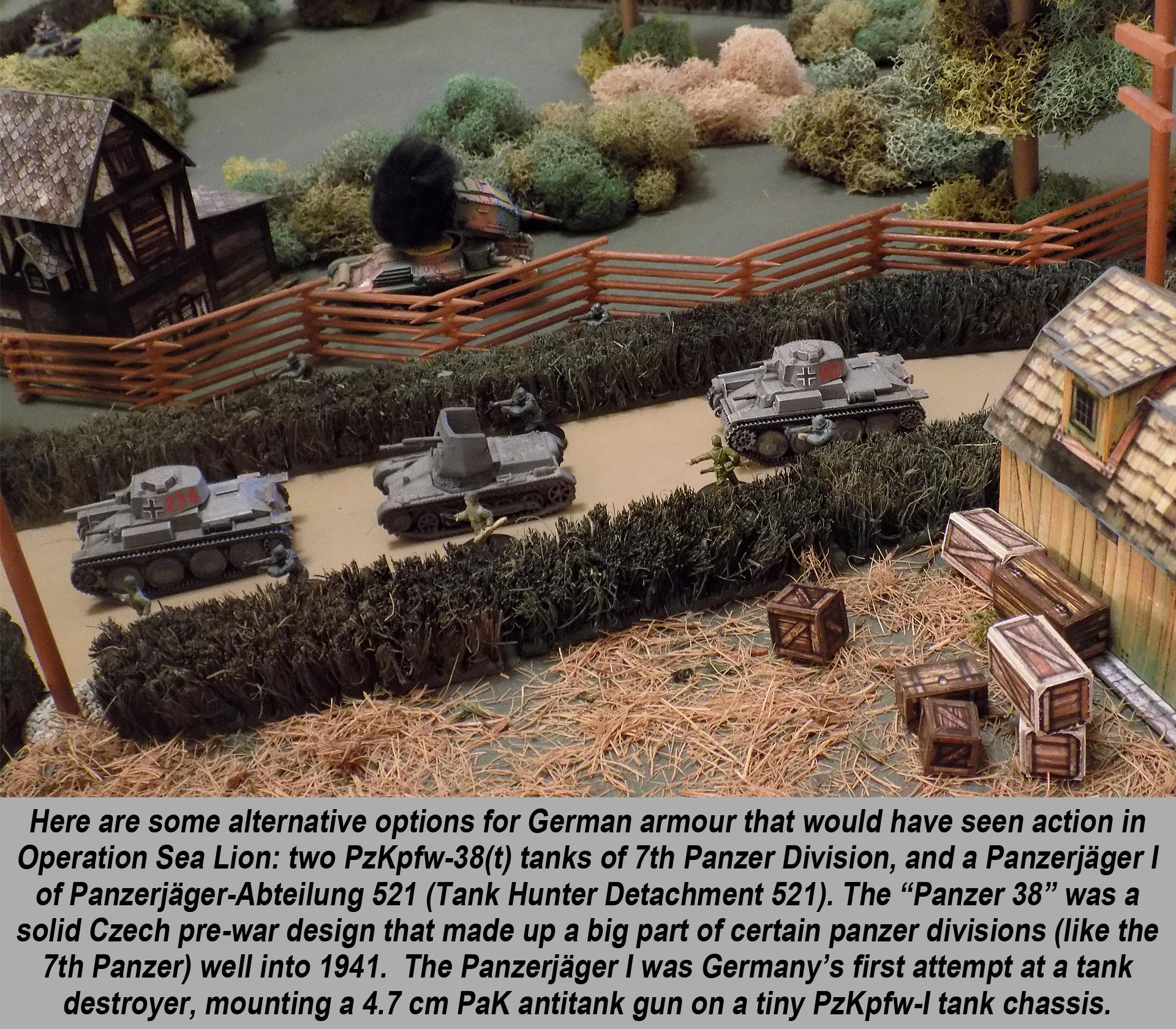
It’s been quite a journey. Part One gave us an overview of the project. Part Two saw the Germans open their invasion. In Part Three they expanded their beachhead and the British launched their first counterattacks. In Part Four came the climax and final outcome, or at least one possible outcome.
But now we can look back at what we’ve examined so far and really take a deeper dive into Sea Lion’s prospects. What were the Germans’ chances, really? What other plans and time frames can be examined? If the Germans would have failed, WHY? Conversely, HOW could they have won? What factors really would’ve made a difference?
The Case For Seelöwe
So we’ve already established (at length) the prerequisite that for Sea Lion to any chance at all, the Germans must win the Battle of Britain. In fact, it was precisely the Germans’ failure to do this that compelled them to cancel Sea Lion.
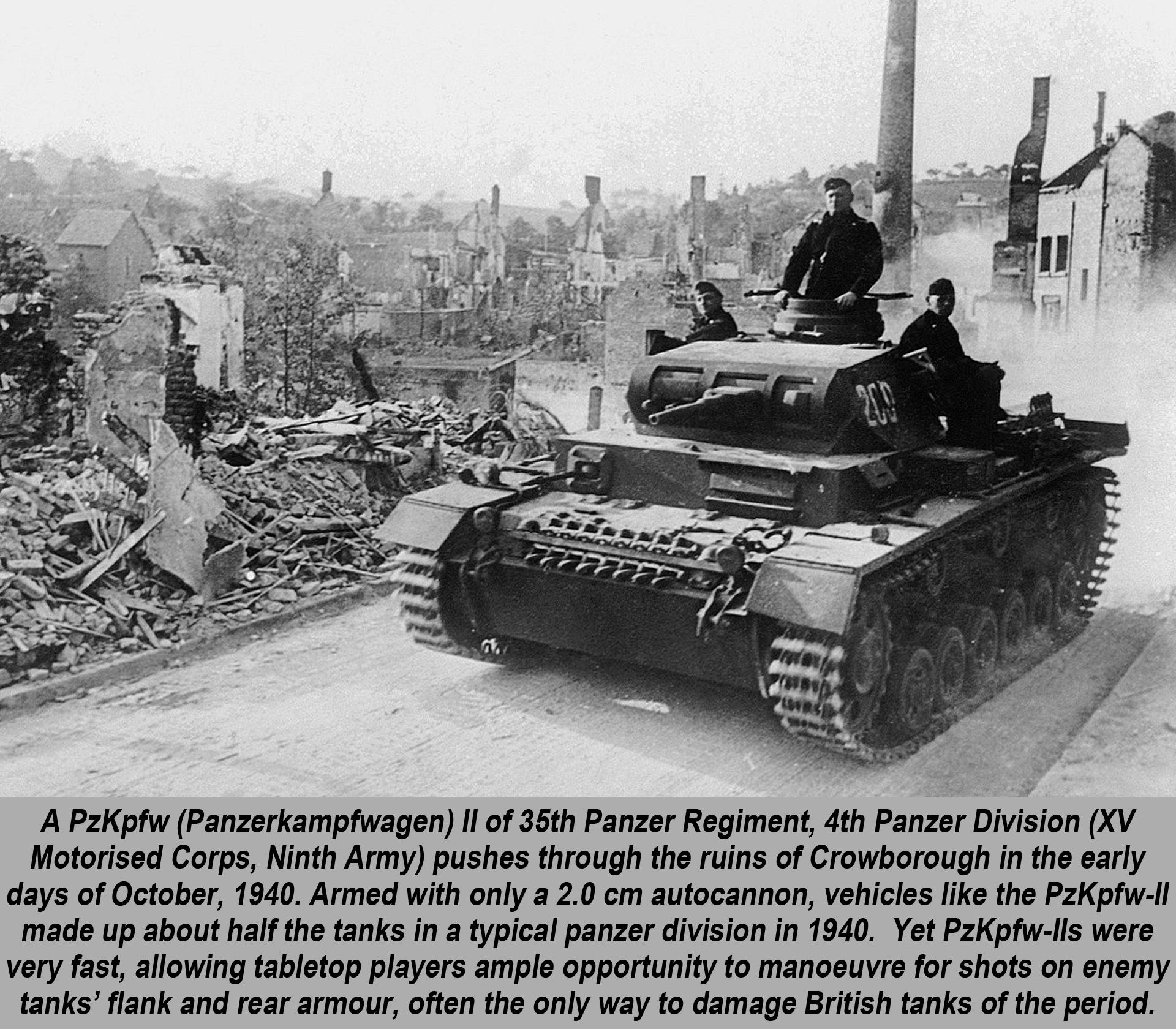
But if the Germans win the skies, what then? Let’s take a fresh look at some potentially misunderstood factors.
The British Forces
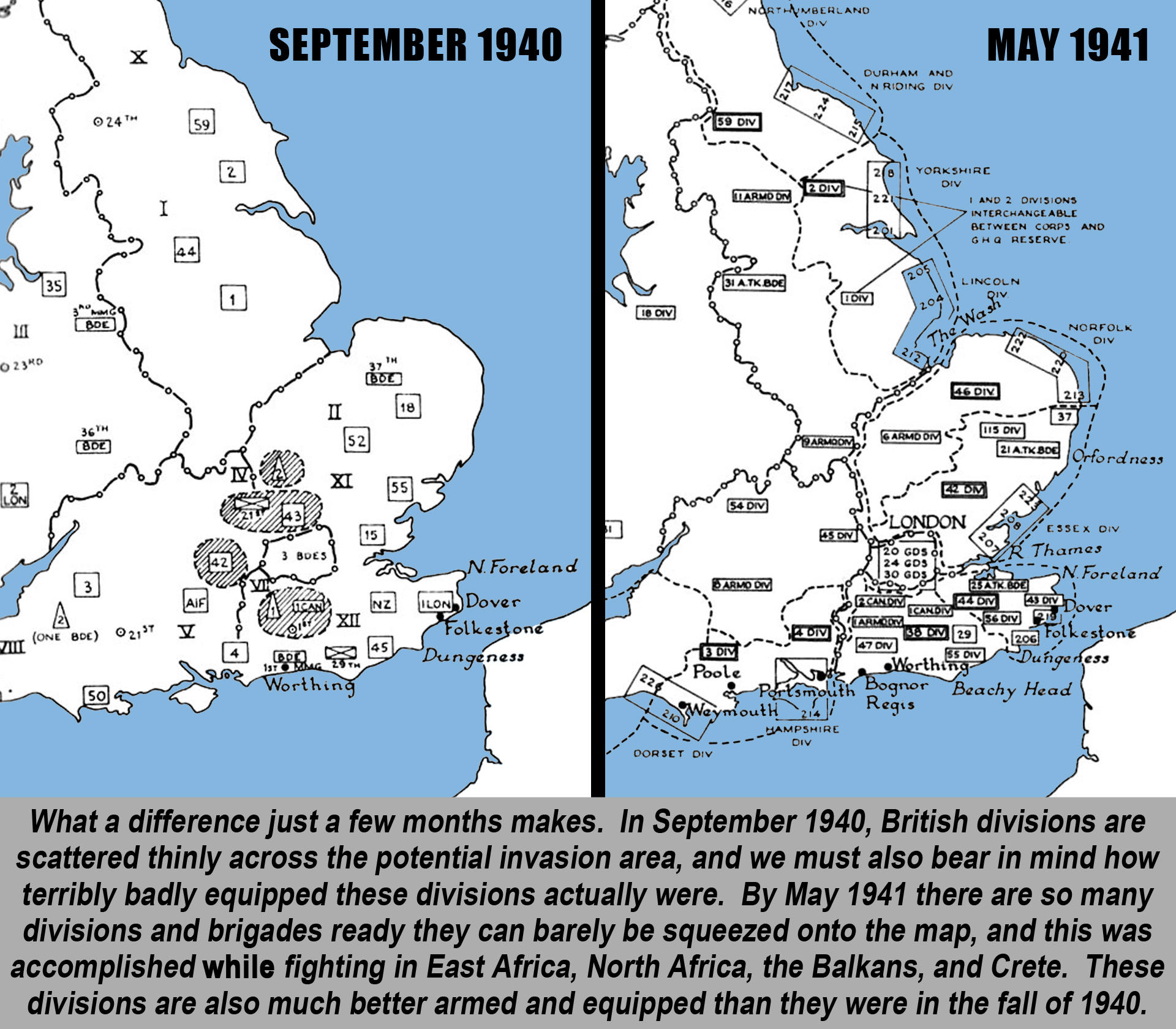
One thing that should be kept in mind is just how weak the British Army was at the time. The B.E.F. represented some 70% of the British Army, and the B.E.F. had just suffered a catastrophic defeat that had cost them virtually all real war-fighting equipment.
On the other hand, other non-British Commonwealth units like the New Zealand and Canadian Divisions were deployed in Britain and would have helped in the defence. However, it seems that other units like 7th Armoured, 6th Australian, and 4th Indian Divisions could not have been brought back to England in time to face an invasion in 1940.
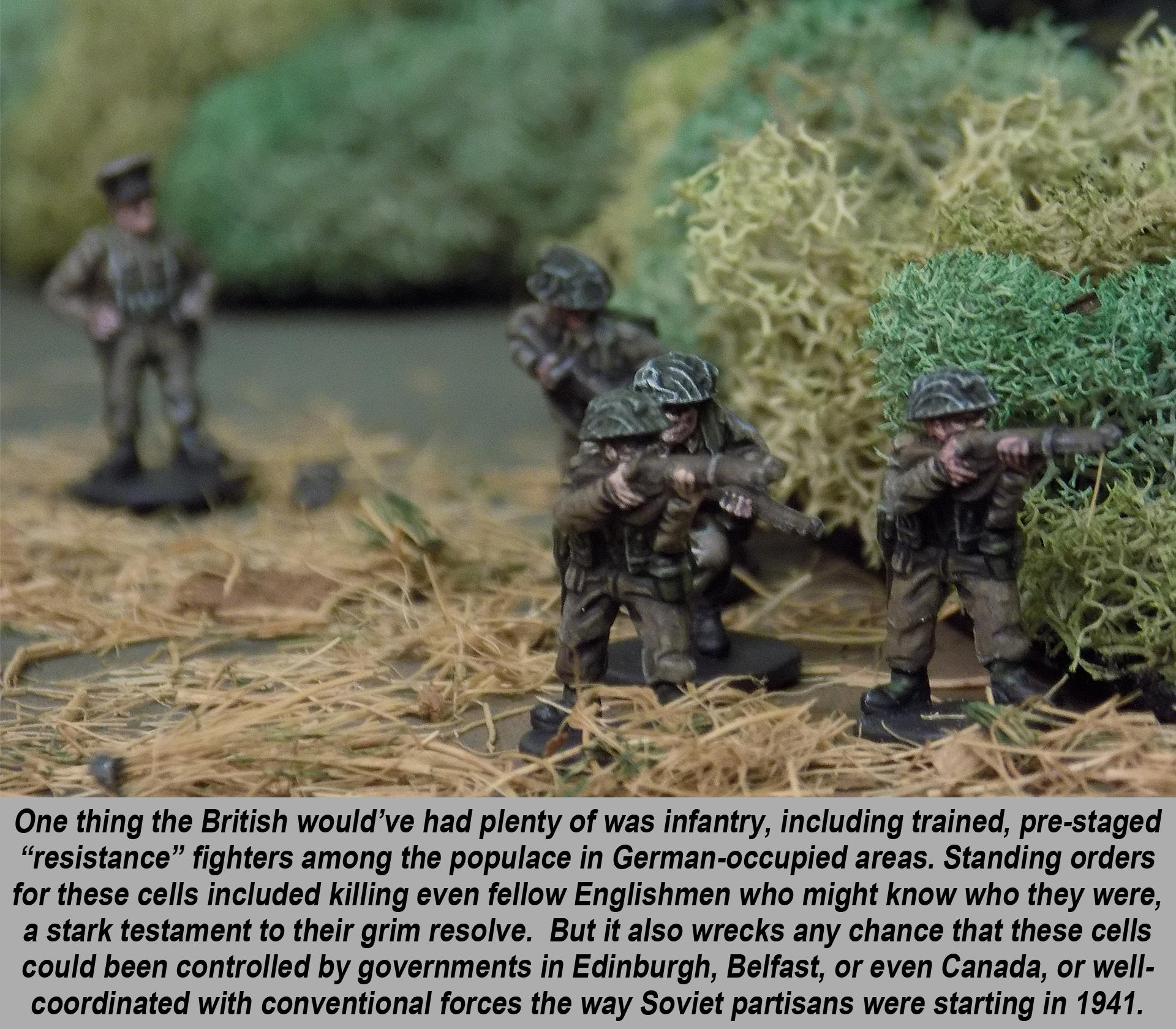
With the British it’s not a shortfall of manpower, and certainly not courage. It’s equipment and preparation. Many World War II campaigns demonstrate that vast reserves of manpower don’t help if you don’t have the right vehicles, heavy weapons, munition stockpiles, training, doctrine, all of which the British were desperately short on in 1940.
The German Forces
The Germans are also somewhat ragged after the Battle of France. However, because Operation Sea Lion would have been smaller than Case Yellow or Case Red, it’s easy to imagine that some German divisions and corps could have been “condensed” into the required fully-manned and equipped invasion divisions in September of 1940.
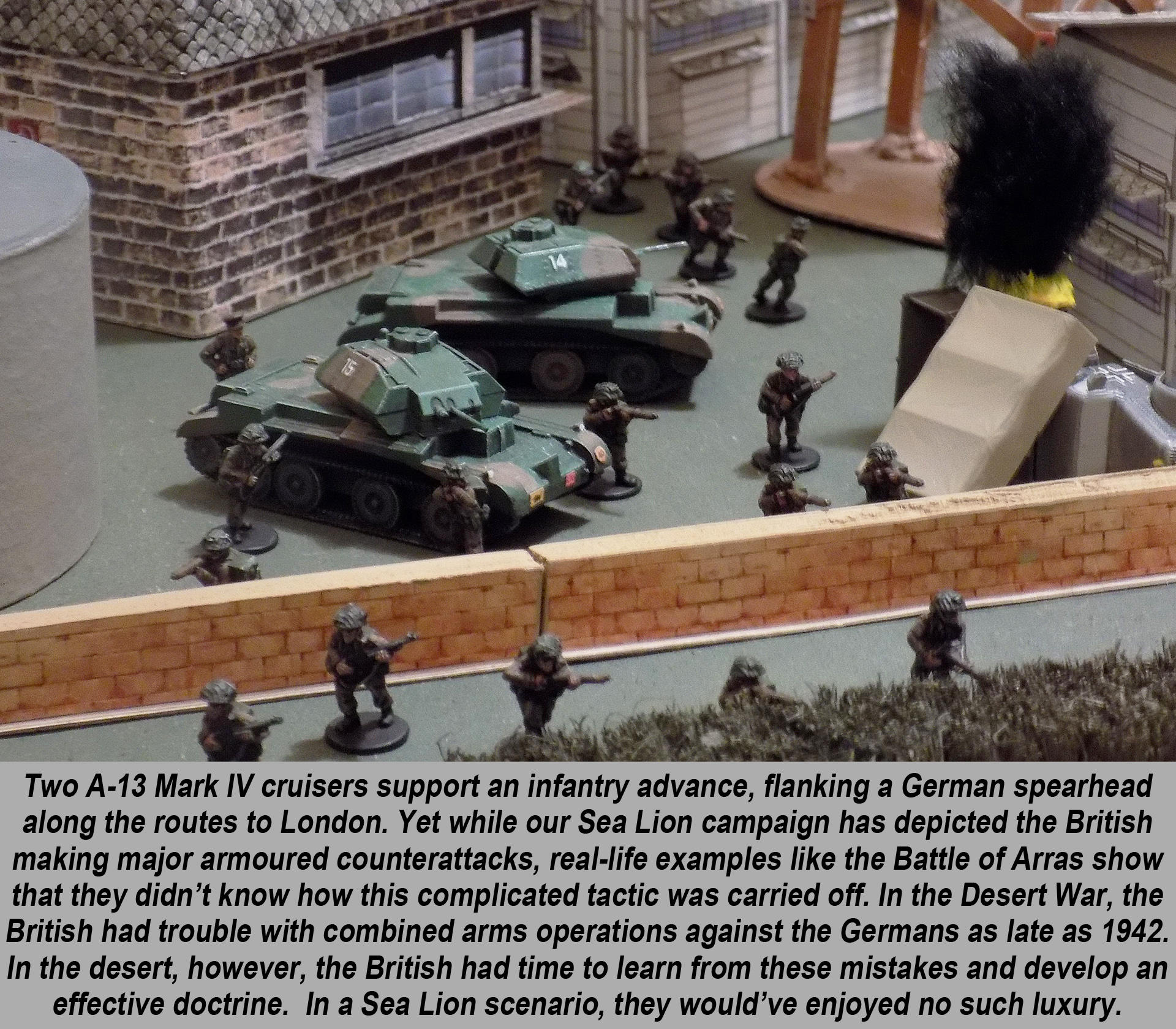
For instance, the nine or ten panzer divisions in the French invasion could have contributed to rebuilding the four that would have participated in Sea Lion. Despite combat losses and maintenance problems, it seems and Rundstedt’s Army Group A could have been ready to launch a real invasion in very short order.
This presumption breaks down, however, when it comes to airborne forces. One can’t just “transfer” infantry to the paratroopers without weeks of training, to say nothing of transports, gliders, etc. A lot was expected of airborne forces in Sea Lion, and frankly the plan has glaring holes where there just aren’t enough of these elite troops.
The Royal Navy
The British Royal Navy is probably the most overestimated factor in Sea Lion. Often seen as a tremendous obstacle to any attempt to cross the Channel, the fact is that the Home Fleet only had one carrier and five battleships / battlecruisers in the fall of 1940, all of them at least 25 years old.
Furthermore, German aircraft and submarines showed that they were very capable of sinking these assets. The Home Fleet was hopelessly over-prepared for the past war, and honestly couldn’t keep Great Britain FED without massive support from the United States which was not forthcoming in the summer of 1940.
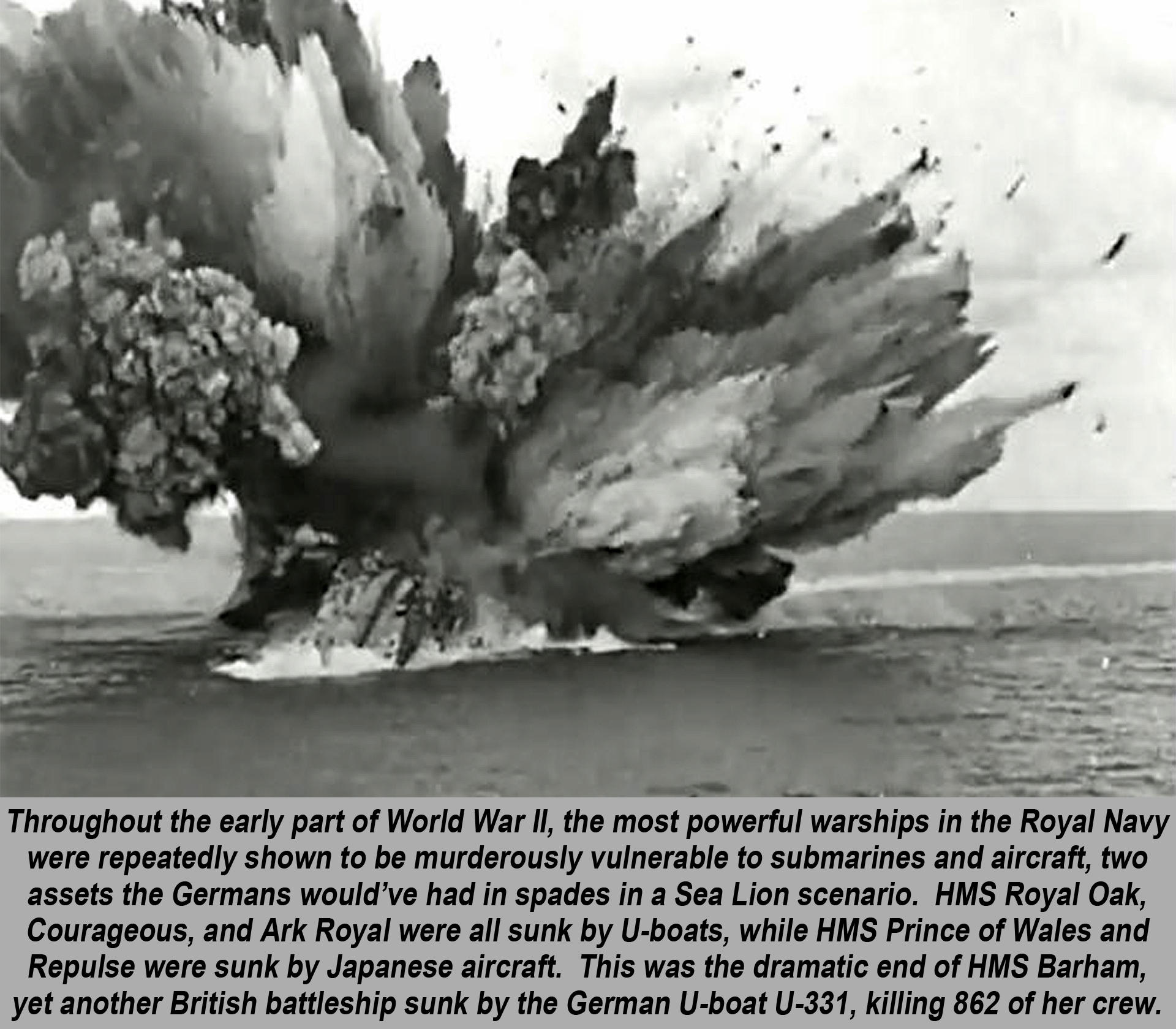
All that said, while the Royal Navy seems incapable of stopping an initial invasion, they could have easily strangled said invasion once the weather started grounding the Luftwaffe in October and November. British dreadnoughts do not need sunny skies to sink German transport ships, after all.
Disunity Of Command
Without a doubt one of the worst obstacles to Sea Lion was presented by the Germans themselves. Simply put, there was no unity in the higher levels of German command. Throughout the war, bad liaisons, miscommunication, poor coordination, and outright rivalry plagued German planning and operations, costing them many battles.
Although the OKW (Oberkommando der Wehrmacht - Supreme Command of the Armed Forces) technically had command over the Army, Navy, and Air Force, they really didn’t. Also, the OKW didn’t have a singular head, like Eisenhower would be over SHAEF (Supreme Headquarters Allied Expeditionary Forces) later in the war.

Like many dictators, Hitler often kept authority deliberately divided between rival organisations so any real power rested ultimately with him. Indeed, only Hitler could command the Army, Navy, and Air Force with the coordination required by an operation like Sea Lion. But when a rank amateur like Hitler is your military commander …
German Victory Conditions
So if the Germans were going to succeed in Operation Sea Lion, what kinds of things would have to happen? If such a victory were possible, what would it have looked like?
We’ve already stated the Germans have to win the Battle of Britain. Taking an honest, unemotional, and unprejudiced look at the state of the British Army and the Royal Navy in 1940, it’s clear that the only think saving England from invasion was the Royal Air Force, which of course is precisely what happened historically.
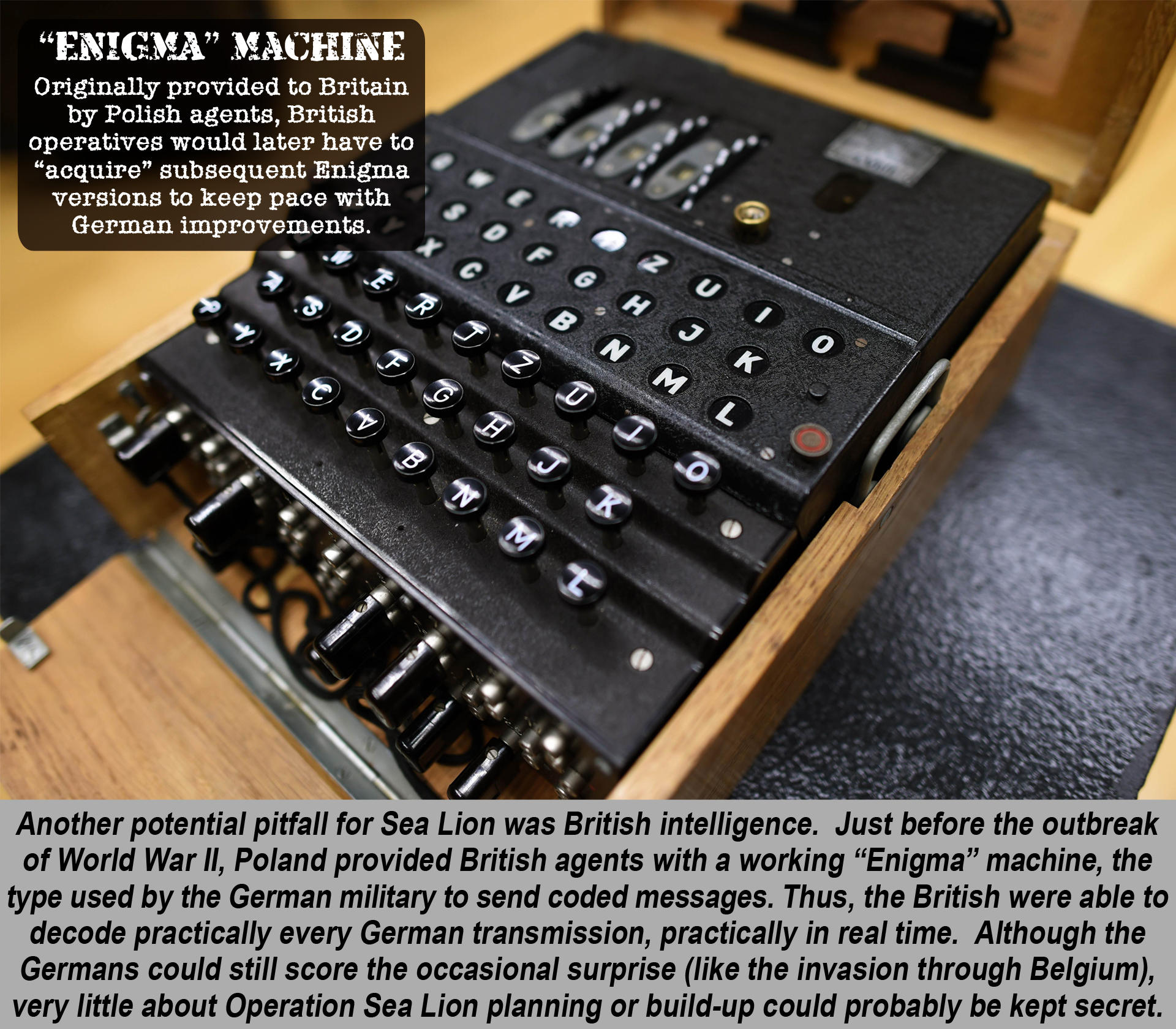
Assuming the Germans could cripple the RAF in the short term (they couldn’t have done it permanently because of the range of German fighters and RAF bases in Wales and Scotland), it’s pretty clear that landings were possible. However, landing troops in Sussex and Kent, and conquering Great Britain, are two very different things.
Let’s start from a simple assumption: Germans always have to win QUICKLY. All their great victories, from the Franco-Prussian War of 1871 to Manstein’s “Backhand Blow” in 1943, all are won very fast. Germany is the boxer that HAS to knock you out in the first two or three rounds. If you’re still standing in round four, you’ve won.
So could the Germans have broken out of their beachheads in Sussex and Kent? Honestly, I believe they could have. It’s when they reach London and the line of the Thames that things get very difficult. London would have been a bloodbath, a “Stalingrad West,” not terror-bombed into surrender Warsaw or Rotterdam or left open like Paris.
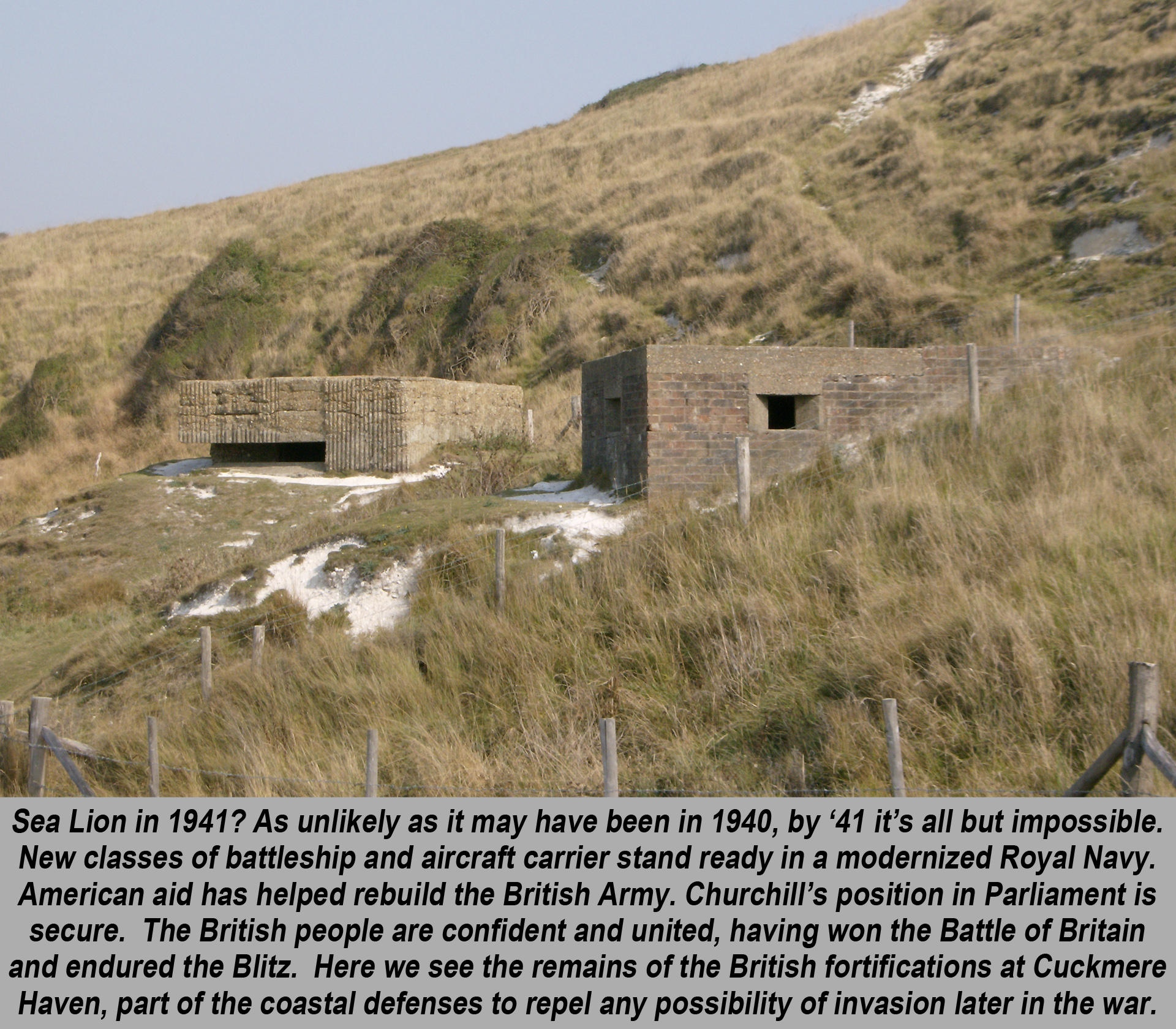
Also, keeping Sea Lion supplied over the English Channel, through a long and expanding campaign, becomes unlikely. As said above, once the weather grounds the Luftwaffe, the Royal Navy can now come back into the English Channel and start sinking German supply convoys. The Germans must win well before that.
The Politics Of Sea Lion
Any real chance of German victory seems reliant on some kind of political collapse or disintegration of morale. This seems remote but it IS possible, given our scenario of a German victory in the Battle of Britain. The Battle of Britain is what made Churchill an icon of resistance, but if the Germans win that battle, he’s still “Mr. Gallipoli.”
Please bear in mind that Winston Churchill only became Prime Minister on May 10, and was far from a universal choice. Foreign Minister Halifax was still a major opponent who may have favoured a negotiated peace along with others in Parliament. Many saw Churchill’s defiance as foolhardy in the face of constant German victories.
Historically, Churchill needed Neville Chamberlain of all people to help hold his coalition together through the summer of 1940, and that was while WINNING the Battle of Britain. A German victory over the RAF, followed by successful landings, just might have ousted Churchill when the British government felt forced to offer peace.
Summation
Having considered all these factors, where are we left with Sea Lion? Honestly, once we assume a Luftwaffe victory in the Battle of Britain, a successful German landing on British shores becomes (in my opinion) surprisingly feasible.
Like all German campaigns, however, the crushing factor is time. If the Germans can win quickly, there is very little they can’t accomplish. If their landings proved successful, the shock (combined with the presumed crippling of the RAF) just might have caused a crisis of confidence in the British government. If this happens, the Germans can win.

If, however, the Germans can be contained, even for a short while, exponentially-increasing difficulties in logistics, supply, reinforcement, and shipping spin rapidly out of control. Once the weather deteriorates to the point where the Luftwaffe cannot suppress the British Home Fleet, Sea Lion is doomed.
Thank You!
This concludes our article series on Operation Sea Lion. By no means does this have to be the end of the conversation, however. Comments or questions below are certainly welcome, as well as in the Sea Lion thread we now have going in the Historical Gaming forum.
As always, I would like to thank the beasts of war team, especially @warzan for letting me publish, @brennon for being such a great editor, and @lancorz for the amazing support graphics and layout work. Also, I’d like to thank @dignity and @johnlyons for the great Weekender interview.
Most of all, however, I’d like to thank the community members who took time to read through the articles, especially those who supported the progress of the series through their many insightful comments. Community interaction is what I t’s always about, and we wouldn’t still be doing these articles without you.
If you would like to write for Beasts of War then please contact us at [email protected] for more information.
"The B.E.F. represented some 70% of the British Army, and the B.E.F. had just suffered a catastrophic defeat..."
Supported by (Turn Off)

Supported by (Turn Off)
"Without a doubt one of the worst obstacles to Sea Lion was presented by the Germans themselves. Simply put, there was no unity in the higher levels of German command..."
Supported by (Turn Off)






I was wondering if a French resistance woukd play any part delaying troops to the French seaports ,destroying train lines etc It might buy the British a bit more time in getting defences more properly prepared,organising a more effective civilian resistance and all that goes with that
Unfortunately the French Resistance was nothing more than many small independently operating groups that fought from time to time more against each other than against the Invaders back in the days. So I doubt that these people would be a great help for the British.
Great question, @torros . 😀 There is the famous example of the French Resistance delaying the 2nd SS “Das Reich” Panzer Division for weeks as it tried to redeploy from the south of France up toward Normandy after the Allied landings of 1944. However, this is 1944. I think in the summer / early fall of 1940 (S-Day is barely three months after the French surrender), the French Resistance wouldn’t have formed to such an extent, much less been trained, coordinated, and equipped do such an extent by the SOE, OSS, and other organizations. I would certainly count it as a factor in a 1941 Sea Lion scenario (for intelligence as well, as “maquis” resistance cells carefully noted and recorded all these redeploying German divisions). But in 1940 it’s tough to imagine them making much of a difference yet.
Thanks, @setesch . I concur, especially in a 1940 scenario. Of course there is Eisenhower’s quote that the French Resistance’s help in Overlord was worth “15 extra divisions” (200-300,000 men). But again, this is in 1944 (not 1940), and of course the Resistance in this case is embedded behind the occupying Germans, on defense ON that ground. If the battle is in England, the French Resistance is less of a factor.
@oriskany great conclusion. I do agree in most of the points. But… there is one question left adressing the Royal Navy’s Home Fleet. Would there be any significant Ship left when the weather turned? The Luftwaffe and the U-Bootwaffe would have about one to two months time to suppress the Navy. If the Battle of Brittain would be won by the Luftwaffe, the Navy would be left alone against Stukas and Heinkels with Torpedoes. So maybe the supplies could get through after some initial raids.
This is a great question, @setesch , and really a tough variable to predict. Basically, I envision two basic scenarios:
1) “Aggressive British” – The British are terrified, desperate, and enraged as German invasion troops hit the landing zones and assault beaches. They send their heavy surface naval elements into the Channel to shut down the German convoys at once. Here, the Royal Navy takes steep losses to German aircraft and especially to U-boats.
Three things to remember, though:
1a) As others have brought up on these threads, the Luftwaffe hadn’t put as much emphasis, training, or equipment into maritime operations, sinking enemy warships, etc. Yes, there were torpedo-armed Heinkels, etc., but my initial mentions of ships like the Repulse and Prince of Wales *(sunk by Japanese naval aviation) might have been a little optimistic.
1b) Also, German U-boat strength at sea in September 1940 is barely over 20 U-boats. That’s not very many, even considering that there were only 23 operational British destroyers available for ASW work in September 1940.
1c) While there aren’t enough destroyers and the British dreadnoughts make very large and pretty targets … the “sweet spot” in the Royal Navy (as it was for many WW2 navies) may have been the cruisers. There are a lot more of them, they tended to be faster than the battleships, can base in more harbors, and 6″ and 8″ guns sink troop transports just fine.
But all this notwithstanding, I feel the Royal Navy would have taken a hammering if they had taken this aggressive approach and tried to shut down Sea Lion “up front.”
2) “Tactical British” – The Royal Navy holds back, at least some of its heavier ships, in protected anchorages out of range of fighter protection for German bomber missions.
2a) Enemy warships have to be precision-bombed, i.e., you can’t do it at night, i.e., you need fighter protection, i.e., places like Scapa Flow are relatively safe from German air attacks. The lack of security measures that allowed Gunther Prien and U-47 their exploit in sinking HMS Royal Oak IN Scapa Flow in 1939 have now been corrected. In short, if they hang back just a little, the big surface ships of the Royal Navy are pretty much safe.
2b) The Royal Navy can focus on night attacks (providing cover from the Luftwaffe), or wait until October weather can hamper the Luftwaffe before sending down their big heavies, letting smaller ships like cruisers and MBTs (destroyers are almost certainly protecting convoys or battleships via ASW duty) dampen the German convoy effort until then.
2c) Once the Luftwaffe is grounded (or at least hampered), the British battlewagons can hammer their way through the rough seas and open up on German supply and reinforcement convoys, or perhaps even start shelling embarkation ports like Calais, Ostend, and Boulogne.
It really depends on how “emotional” or desperate the British are when Sea Lion hits. This is what makes it tough to predict.
Historical example: The commander of RAF Fighter Command in 1940 fought to pull all his fighter squadrons out of France even while fighting was still in progress there and resisted protecting convoys in the English Channel against German fighter sweeps that were clearly intended as “bait.” He knew the real fight was coming (the Battle of Britain) and was constantly resisting political and public pressure to “squander” his assets by fighting the Germans too aggressively, too far forward, vainly trying to protect objectives that had already been lost.
This same kind of thing may have happened with the Royal Navy in a Sea Lion scenario. As we see with Greece in 1941, the British High Command did often respond to fear, throwing away victories like Operation Compass (N. African Desert) in an attempt to salvage battles that were already lost (Greece and Crete). The British Admiralty may have seen the prudence of a more reserved approach to Sea Lion, but with people screaming about “panzers 40 miles from Whitehall” . . . they may have been pressured into earlier attacks where their chances of success are much lower.
@jamesevans140 has been investigating these naval options in much more detail. 😀
On the other hand we seem to forget all the other assets. Like British submarines and German Cruisers/Destroyers. As I read few seconds ago, the Germans had serious issues with their Torpedoes. The fuses had often malfunctions, so my point with the Torpedoe Heinkels and the U-Bootwaffe won’t work any longer 😉
Taking the results of Operation Weserübung into account we can assume that the Deutsche Kriegsmarine wouldn’t be as effective as I thought.
I’m not sure about German destroyers, but according to the plans I’ve found, those few German cruisers / pocket battleships that were not sunk in Norway or still under refit / repair . . . were being sent into the open Atlantic to “draw off” British naval assets from the defense of the home islands.
Given the British advantages in Enigma / ULTRA, I don’t think this would have worked.
So we’re left with U-boats and German aircraft, which (despite their limitations in 1940) are nothing to scoff at. If World War II teaches any “naval lesson,” it’s: Battleships are dead, Submarines and Aircraft are the New Kingpins in Naval Warfare.”
As far as bad German torpedoes, they couldn’t have been worse than the ones the Americans started the war with in the Pacific. 🙁 🙁 Damned things only exploded about a third of the time, even if they managed to hit the targets.
This has been a great series. Plenty to think about.
Luckily for us, if the RAF and Royal Navy were unable to stop the Nazi tide we still had Captain Mainwaring and his elite unit.
Thanks very much, @wesadie1969 . The Home Guard has certainly been proving its worth in some of our support thread games. 🙂 They barely squeaked out a white-knuckle victory against elite German paratroopers in a 20-turn ParaLeader game, including one insanely lucky and cinematic moment where a Home Guard bicycle section actually took out a platoon of fallschirmjaeger.
Okay, more precisely the Home Guard bicycle section managed to take the fallschirmjaeger WITH them as they were likewise destroyed, and even this was figured to be almost 200-1 odds against.
But yeah, the Home Guard has definitely been making its presence felt.
http://www.beastsofwar.com/groups/historical-games/forum/topic/operation-sea-lion-addl-content-games-participation/
Thanks again, glad you liked the series.
Would have loved to have seen the Home Guard / Fallschirmjaeger showdown.
Once again @oriskany thank you for another great series, don’t let it be too long until your next.
Well, it wasn’t “in miniature” but here is the actual turn it happened in hex-and-counters Panzer Leader. 😀
http://www.beastsofwar.com/groups/historical-games/forum/topic/operation-sea-lion-addl-content-games-participation/?topic_page=2&num=15#post-184437
Picture:

What an epic series of articles!
Thank you @oriskany for giving us so many ideas for our games, much appreciated man!!
And I agree, a Blitzkrieg would have been their only chance of victory. Otherwise who it would have become Germany’s very own Vietnam I think. Not a war of attrition but Guerilla warfare.
Thanks very much, Thanks very much – @suetoniuspaullinus . Speaking of “ideas for games,” I’m listening to the Justin-John Sea Lion rematch at the moment. We’ll see if the Germans can score a win this time. 😀
#%!&!! Time for BoW2!
This bl**dy chat room window obscures my window and I’m writing blindly..
The OKW wouldn’t approve at all!!
Rant over.
I know what you mean. 😐
Very good series, as always from Mr O! Can’t wait to see what gets the Oriskany treatment next!
It’s good to see a fresh, dare I say it, revisionist approach to Sealion as it’s often disregarded out of hand as doomed to failure from the outset.
One thing often touted, and to which I agree with to a degree, is the likely inability of the Fallschirmjäger to be adequately at strength and the lack of transports with which to transport them after losses in the preceeding campaigns. While this is true to a degree, 7th Fleiger actually began a series of planning efforts and even went as far as to begin stockpiling ammunition and equipment at a collection depot in St Quentin. Despite this though, the disunity of which Oriskany mentions rears it’s head again with how they would be deployed even before the tasks of assigning pilots to the transport fleet to make up the losses from Norway and Holland.
Perhaps most worrying though is the German reliance on flat bottomed river barges as transport ships, for use on a sea and one that at the best of times can be a little rough. Even small swells can cause these barges to tip and turn which would be rather hazardous when loaded. Also the sharp turns required for the approach to beaches was never really overcome and proved a very difficult issue for such flat bottom vessels when under tow.
Even with no enemy, the challenge of just getting across is a big one… even worse if it gets windy half way across. The English Channel isn’t a nice stretch of water…
I think what is most worrying is the almost complete lack of specialist landing vessels and amphibious doctrine in the Wehrmacht – both current and historically. We don’t see the first purpose built German landing vessels available till 1941, with the MFP series, and then only in small numbers. As for the Siebel Ferries fitted with aero engines, the Kriegsmarine considered these a dreadful idea, least of all as they could not move astern and made a hell of a racket!
All that said, it should be noted that the collection of river barges did see some use. A few were used to occupy several Baltic Sea islands during the summer of 1941.
Like all good ‘what if’ topics… no one really knows what might have happened.
Thanks, @piers . 😀 While I would say there is a “victory window” for the Germans in Sea Lion, it is exceedingly small. I don’t give them a very large chance for victory in the long run. Earth-shaking revelation, I know. 😀 But that’s where the facts, trends, and plausibilities seem to point. As you say, no one really knows. In the end it’s all just educated guesswork. And while we may not have wound up with a surprise outcome, I think we’ve shed some light on the “how and why” campaigns like Sea Lion (real or imagined) really work.
What I was really hoping to stir up was some conversation (we certainly succeeded in that regard) and by turning over some long-held “generality rocks” and seeing what “bugs of detail” crawl from underneath, to prompt a re-evaluation of some of the commonly-held “obvious” factors.
“Oh, if the Germans won the Battle of Britain they would have steamrolled into Great Britain because whoever owns the sky wins the day.”
Well, maybe not, because the Luftwaffe is being weighed down with at least four full-scale, operational-level missions here, AT ONCE. And even a German victory in the Battle of Britain doesn’t eliminate the RAF because of factors like range of fighter escort for precision daylight bombers, etc.
Sea Lion has no chance because of the Royal Navy.”
Hmm, we’ve more or less “sunk” the iron-clad certainly in that view. Pun totally intended, I regret nothing. 😀
Sea Lion would have won because of awesome German paratroopers.
Certainly, German fallschirmjaeger were great troops, but as soon as I stumbled across the “missing” division(s) along the left flank in Kent, I knew there was a problem. Then you added your information about the obstacles and shortfalls that were facing the divisions the Germans DID have, such as personnel and officer losses, trained air crew, and transports. I just don’t think there are enough of them.
The devil’s in the details, and I think a lot of the presumptive, boldly-drawn generalities that many people seem to have can be called into question with some good old-fashioned, detail-oriented research (I know you’re no stranger to that).
And I think you’ll agree that if you really want to do alternative history “right,” you need to know a lot of the “real” history first. 😀 If nothing else, to learn where history’s “weak points” are, to see where the story can really be changed. “Game in the gaps” all you like, but we have to know where those gaps are and where they potentially lead.
As far as what’s next, nothing until the New Year. I have a few ideas, but they would require a lot of miniatures to build, etc. 😀
Thanks again! 😀
I think you got it in one politicians were/are the weakest point of many country’s quick to get into wars quicker to get out if their arse is in the gun sights a great series of articles @oriskany
That’s usually the case, @zorg , ain’t it? Thanks, and glad you liked the article series. We’ll keep posting battle reports and the like on the support thread for a little while.
yup you’ve still got dover to retake.
😀
A very fitting conclusion to the series. I love how you broke it down to the bare facts. However, best “fact” why it would’t fail… “The obstinate and unshakable determination of the British people to defend their homes”
Sometimes that does happen. All the spreadsheets and plans, all the logistics, all the timetables and OOBs and the ToEs. etc . . . You can “McNamara” a campaign to death – but sometimes in the end it just comes down to the “weaker” side f***ing refusing to be beaten. Vietnam proved this . . . three times (French, Americans, and Chinese). Afghanistan, too (British, twice – then Soviets, then Americans).
I am wondering, would the British have used the naval assets of the other allied countries that had taken refuge there, to hinder the invasion efforts?
The Dutch for example, had four submarines (O-21, O-22, O-23 and O-24) up at Dundee at the time. Would they have been used to attack the invasion ships, be used to hunt the German U-boats or would they have stayed put around Dundee?
There where also several Polish submarines stationed at that time in Britain. So the British could have used them.
I seem to recall that they did use the Polish subs in the Mediterranean during the war, so if the home nations are under thread – I bet they would use everything including the kitchen sink
Great question, @shanaar . I must admit I did not know about the Dutch submarines. SO you give three choices for them …
Attack invasion ships: Definitely possible. This is what submarines were made for in those days, and German ASW (antisubmarine warfare) assets were exceedingly thin. No ASW aircraft to speak of, and only a handful of Z-class destroyers.
Hunt German U-boats: Very unlikely, in my opinion. To my knowledge ( @commodorerob might back me up on this ) submarines did not hunt or fight each other in WW2 the way they do nowadays. I think there was one incident of a British submarine tracking down a German U-boat at the very end of the war near Norway somewhere (in fact may have even been technically after the war in Europe had ended).
Stayed in port: Possible, depending on the state of the submarines, state of their crew, and state of their integration into Royal Navy command. Would they be added to one of the submarines squadrons / flotillas the British had set up? Communications and coding standardized? Perhaps British liaison officers among the crew? Before a sortie, any ship (especially a submarine) would require dozens or hundreds of small parts for maintenance items … are these available / compatible with available British sources?
Bringing in assets from allied nations is always tough. Ships and aircraft are the toughest. In the case of these submarines, it’s certainly possible, there’s just a lot of work, training, and preparation involved (much more than most people imagine). Given the only 3-4 months between the German invasion of Holland, Belgium, Luxembourg, and France . . . and our proposed Sea Lion timeline, I don’t know if had been done.
Definitely true, @rasmus . The Royal Navy has a lot of assets in the Mediterranean, and the “Chase the Bismarck” incident in May 1941 shows just how fast they could have / were willing to shift assets out of the Mediterranean up to the Atlantic in times of emergency. They may not have been there to slow or stop the initial invasion, but I firmly believe these ships and task forces would have been pulled up to Great Britain in case of an invasion.
The Bismarck wasn’t nearly as big a threat as an actual invasion of England, and still the British pulled just about everything out of Gibraltar in May 1941 even WHILE the Germans were invading through Greece and Crete.
Such reinforcements from other regions are one of the reasons (along with lack of German logistical depth and worsening weather over the Channel) why I don’t give the Royal Navy much of a chance to slow or stop the initial invasion, but a steadily growing near-certainty to choke it to death in later weeks and months.
The question is, how much would the British Empire / Commonwealth suffered in the interim? As with Rome, when an empire’s “home” is under attack, outer provinces are quickly sacrificed to other threats as the core territories are increasingly prioritized.
@oriskany the majority of sub hunting was done by surface ships with depth charges and hydrophones (sonar was in its early days), my knowledge of submarine warfare is limited, but from what I do know the submarines general had a few purposes..
1. scouting for information about the enemy
2. taking out surface ship mainly supply ships
3. laying mines
there is as far as I know very little sub v sub action in ww2 and most were collisons. A submarine was armed with deck guns which could only be operated on the surface or torpedos which require aiming with the use of a periscope which is not very useful under water.
Yeah, to my knowledge (and even this is sketchy) there was only one sub hunting down and killing another sub on purpose . . . a British sub tracking down one of the last U-boats in the very last days of the war (again, may have technically even been after the war ended), the German U-boat was trying to get a safe harbor up in Norway somewhere?
Subs of the day usually had four-six forward torpedo tubes (somewhere in the 21″ range), one-two aft tubes, a 4-5″ deck gun, and maybe some MGs or 20mm cannon for air defense while surfaced.
Leaving aside monstrosities like the Japanese I-400 class (friggin’ thing had a SEAPLANE for cryin’ out loud). 😀
https://en.wikipedia.org/wiki/I-400-class_submarine
@oriskany what is your source for the RN Home fleet disposition? The information I have says that both the battleships Nelson and Rodney were in the Home fleet which whilst not brand new they were only 15 years old in 1940. Along with 2 other Battleships there was 1 Battlecruiser squadron, 3 Cruiser Squadrons 4 destroyer flotillas and 4 sub flotillas, plus a lot of odds and sods. and potentially 2 Carriers depending on the events with Ark Royal and Furious.
My view is that the battleships and battlecruisers would not have been the main thorn in any german invasion, but the Cruisers,Destroyers and submarines (including one called Sealion) of the RN that would have been the issue for the germans invasion.
Good afternoon, @commodorerob –
My source is http://www.niehorster.org/ – which has a series of specific and very detailed pages for Home Fleet assets for Sea Lion, dated for 07 September 1940.
Yes, Rodney and Nelson were both there. However, I did not include the Rodney because records show it was undergoing turbine repair and not operational for the specific period in question. You’re right about their age, though.
There’s only one other battleship I show is HMS Barham.
Two battlecruisers, Hood and Repulse. This is why my records show four battleships / cruisers – Nelson, Barham, Hood, Repulse.
My records show only the HMS Furious and HMS Argus (training carrier), the four individual squadrons (801, 804, 816, and 825), their aircraft types (mostly Swordfish and Sea Gladiators) and number of aircraft. Not very much. My records do not show the Ark Royal, I think she was in the Mediterranean? Wasn’t she the one who launched the raid on Taranto?
As far as cruisers and destroyers go, @jamesevans140 and I have been through this with a fine-toothed comb in previous threads. We have every cruiser accounted for, class, pennant number, and status (under repair or refit, etc). I won’t go through it again here. 🙂 Same with the destroyers (34 on record, -11 under repair or refit = just 23 available, and the 42 American four-stackers have not arrived yet … 8 went to Canada). Just an educated guess here, but I’m putting those 23 destroyers “on defense” trying to protect cruiser and capital ships against the 20-25 German U-boats records show were available at sea in September 1940. Even this roughly 1-1 ratio of destroyers vs. U-boats is terribly inadequate, as I’m sure you know. 😀
I would agree about the cruisers. As we’ve been saying in previous threads, cruisers seem to be the “sweet spot” in the Royal Navy in this scenario. The capital ships are too few, too old, and too vulnerable. The destroyers are too few. But there are actually a lot of cruisers on hand, they’re much more modern on average, and 6″ and 8″ guns sink German troops and supply transports just fine. Other commenters have also brought up the question of MBTs.
I’ll admit I wasn’t sure about the submarines. I have 32 with the home fleet, with 7 under repair / construction and 8 more at sea far from England (Bay of Biscay, Denmark, Norway, etc). So that leaves 17. The reason I wasn’t sure about their application was British submarine doctrine / deployment / training. Traditionally, WW2 has two big “merchant killer” submarine fleets, the Germans in the Atlantic and the Americans in the Pacific. Other navies like the Japanese and the British tended to view submarines as “cavalry of the fleet,” screening, security, and picking off enemy WARSHIPS as opposed to going after merchant vessels / tankers / transports.
@oriskany thanks for the source I was not aware of this, I have to admit I have not read all the discussions on the previous articles so missed the one about the cruisers.
You are correct about the Ark Royal leading the attack at Taranto (another really interesting part of the war at sea) however that attack did not occur until November 1940 so it is plausible that she would have been available.
On the use of subs by the British I would uggest they would have changed tactics to defend at all costs. Churchill would have given the orders like he did to attack the French fleet at Mers-el-Kébir.
As to Rodney I believe in mid September 1940 she was assigned to Scapa Flow specifically to guard against a suspected German invasion.
Indeed, Rodney was there. BB 29 Capt. F. H. G. Dalrymple-Hamilton – 2nd Battle Squadron under RAdm L. E. Holland – Scapa Flow.
We’re just showing HMS Rodney was under turbine repair at the time.
nice graphic:-)
You done it again @oriskany great stuff.
And yet again you point out that amateurs does strategy, while the professionals does logistics, an invasion, over hard terrain like the channel is won or lost in the logistics depo
Which is the worrying issue…
Logistics is a dirty word in the Wehrmacht.
Of course I may be biased by my time in the military, as a supply poag “in the rear with the gear.” You know how it is, no matter who you are, your job is the most important in the whole endeavor, the whole organization would fall apart if it wasn’t for your tireless and under-appreciated efforts. 😀
Finally had the time to read this and the previous part! Good job @oriskany and thanks for the thumbs up.
No worries at all, @yavasa . Glad you liked the series!
Another thing maybe worth considering and it is something I think that would effect thepublic reaction to German invasion is what would have happened if Lord Harris had accepted the position of PM in May 1940. I suppose as suspected he would have tried to make peace with Hitler but I don’t think they would have the same determined spirit as they did under Churchill and Hitler might have been tempted to annex the country anyway
Great point, @torros – I feel that the general conception that Churchill was a rock-solid leader with a secure position is largely colored by our retrospective view back through the victories of the Battle of Britain and subsequent events. At the time, the situation was substantially different. And if we change the outcoe of the Battle of Britain (a prerequisite to enable any plausible contemplation of a Sea Lion type operation) . . .
Even the most cursory research (i.e., Wikipedia 🙂 ) shows . . .
Churchill was still unpopular among many Conservatives and the Establishment, who opposed his replacing Chamberlain; the former prime minister remained party leader until dying in November. Churchill probably could not have won a majority in any of the political parties in the House of Commons, and the House of Lords was completely silent when it learned of his appointment . . . An element of British public and political sentiment favored a negotiated peace with Germany, among them Halifax as Foreign Secretary, but Churchill refused to consider an armistice. Although at times personally pessimistic about Britain’s chances for victory—Churchill told Hastings Ismay on 12 June 1940 that “you and I will be dead in three months’ time” – his use of rhetoric hardened public opinion against a peaceful resolution and prepared the British for a long war . . .
Sources:
“Is Tomorrow Hitler’s? 200 Questions On the Battle of Mankind.” – Knickerbocker, H. R. (1941).
“Churchill in 1940: The Worst and Finest Hour”. Reynolds (1993).
” Report on England, November 1940.” Ingersoll (1940)
I have to disagree.
Once an invader steps foot on British soil, there would be no surrender.
Both my Grandfather’s were in the service, and one just back from Dunkirk. Both mentioned that period to me and made in known on no uncertain terms that resistance would have been bloody and to the very end.
Don’t mistake politics for the public will to resist an invader. A German landing would have met a violent resistance.
I once asked my Grandfather who returned from Dunkirk what he would have fought with, given the state of things in August and September 1940. He said it didn’t matter. All that mattered was trying to kill them in anyway you could.
I can’t disagree with anything in your post, @piers . For the populace facing the actual invasion or any occupied zones behind German lines, there is no question of giving in. Records show the Home Guard guerrillas getting the standard order: “Take two or three with you.” These men knew they were going to die. Their first order in their seal envelopes were often “kill the person who gave this to you” so German interrogators could not compromise these resistance networks. These people were serous about what had to be done to resist an invasion.
I’ve also seen some material that details the writings of a novelist Margery Allingham, who lived with her husband along the Romney coast. They had a old 1800s revolver in the house with just three or four bullets. Their solemn promise again . . . “take two or three with you.”
I also have no doubt that even if the formal British military or government were defeated (even partially), fragments of units would have melted into the countryside to begin a partisan style war like we see in Belarus, Ukraine, and Russia proper. I don’t think the Germans could have ever snuffed out such a resistance. Yugoslavia, France, Russia, the examples speak for themselves.
I would just make the distinction between a organized government / military resistance and and a popular underground. Like most nations (the US certainly included), I would offer that the people in the UK were stronger than their government. I do see a government collapse in 1940 as remotely possible given just the right (or wrong) conditions. But even if this would have happened, I don’t see the British people or soldiery simply shrugging their shoulders with a “shucks … well, we tried.” 😀
A fantastic series all up @oriskany. It is one thing to recite history and it is another to put into practice what you have learned. I think the what if’s gets us to focus on the latter. Your research skills and insight into what you have discovered has really shined through in this series. The replies and questions that this article has generated from the community has been just as amazing. So thanks to all that has made this a very enjoyable read.
I will certainly post a far more detailed reply before your Sunday as for the moment my plate is full with family celebrations.
Thanks very much, @jamesevans140 – It’s been fun. Indeed this series has generated more traffic than any series I’ve done except BattleTech (I don’t think I’ll ever beat that score). 😀 Yes, it’s now beat the American Revolution series, the WWDDC series, and the World War 2.5 series.
Not that I *ahem* keep track or anything. 😀
Indeed, awesome participation and support from the community (especially guys like you), for which I am very grateful.
Have a great time with your family!
I had a lot of fun that’s @oriskany. In March we have a local public holiday celebrating the foundation of our city, it is the last of the hot weather and so we tend to party it up a bit. I think as a result of this holiday I have a suspiciously high number of grandkids born in December, 50% of them in fact.
Awesome. 😀 Hope you guys have a great holiday season. I’ll be in touch on the Uncle Jimmy thread and maybe toss a little more material on Sea Lion forum thread.
A very belated thank you for an excellent article series. Interesting and educational.
I believe that Churchill being toppled following the defeat of the RAF would have been a better than remote chance. He was hardly a popular choice to become PM, especially from within Westminster and had a series of ‘black marks’ against his name. The window to remove him swiftly would be open at this point. The big question is whether anyone would have moved against him after a German beach landing – would such an event have united everyone behind the current PM?
I think it may have, albeit briefly. Had the Germans managed to push on into England following their beach invasion, a larger group would have wanted to sue for peace and likely won out, removing Churchill. Had England resisted and pushed Germany back to France, then he might have lasted a bit longer.
And with regard the Home Fleet. While we can look back and see that the Home Fleet would have struggled against the U boats and Luftwaffe, did the Germans know that at the time? The British Navy carried a fearsome reputation which could have been enough to deter Germany from trying.
Some great points here @redvers, especially about Mr Churchill. This side of the war we are taught about the great man, the war hero and the man who saved England. We tend to forget that before the war he was the fair weather fellow swapping political parties with the wind, the glory and medal chaser with total disregard for his fellows. Yet as the clouds of war were gathering he was the voice in the wilderness that the people tentatively came to. So I agree completely that his time as PM would have been on razors edge.
My group of gamers have looked closely at the naval situation as a side request from @oriskany and some interesting points came up. Even if the Home Fleet does nothing it causes something. Most of the German battleships that rename get tired up ready to counter any moves of the battle wagons of the Home Fleet. They sort of become the Tirpitz in reverse. The biggest thing that keeps coming back to bite the Germans is their lack of preparedness. In September the Germans had about 20 to 25 Uboats but only 18 on station at any time. The Kriegsmarine did not want the maritime version of He-111 as it was you expensive in manpower requiring a minimum crew of 4 to complete a torpedo mission, plus the torpedoes seriously effected the aerodynamics of the He-111. Somewhere between 60 to 90 of them were forced upon the Kriegsmarine. Many of these were converted to transports. Sorry so far we have not found the exact number, but it must have been quite a few as their were used to relieve pockets and Stalingrad later in the war. Further we have not been able to define how much actual training in torpedo bombing was given. However if the sea supply lines were under stress the Germans would be forced to use most of the Kriegsmarine He-111s to reinforce the air bridge.
At the beginning of September the first conversion kits started to arrive at some Ju-88 squadrons so each plane could carry 2 torpedoes. Given time for the conversion, testing and training it is doubtful they would appear in any significant numbers by the end of September. The Ju-88 would go on to become a great torpedo bomber.
In our games we found anything larger than a light cruiser entering the channel was on a death ride rarely achieving its goal. So the battles for the channel ends up being the battle of the Tin Cans, DE class or smaller, with MTBs and E-boasts playing a vital role. Some of the most modern British light cruisers were equipped with radar and are of great importance in directing other ships on to target in bad weather, a capacity the Germans don’t have yet.
In most wargame studies two things are often missed. The first is Coastal Command. At this stage it is a far cry from it would become. Such as they do not have a depth charge that can be dropped by air yet. They are highly trained and have a fleet of Hudson bombers for the maritime role. This is backed up by the extremely good Short Sunderland flying boat. The Luftwaffe would have sustained massive losses winning the air Battle of Britain, so they can achieve total air supremacy on land in southern England or the Channel, but not both. So bomber raids by Coastal Command supported by what is left of Fighter Command is still possible.
The other thing often overlooked is mining of the channel. While supply ships can come from a number of ports they will be arriving at only a couple of known ports, so the approaches to these ports can be heavily mined by sea and air. Also drifting mine fields caused havoc in a couple of games, similar results to WW1.
In our games we believe it was highly likely a political solution would be sought once the Germans started moving inland. Prior to both world wars Britain was Germany’s greatest trading partner with Sweden being her primary source of iron. Oddly at the time Hitler wanted both to remain neutral. Even stranger Hitler wanted the RN in the east as a counter balance to Japan. So I believe at this point in the war conditions of surrender would be very light and without occupation. Britain would be forced into exclusive trade at very favorable rates for Germany. At the end of the day the German economy requires profitable trade.
One thing most people over estimate are the Uboats as we are a long way from the dreaded Wolf Pack tactics. At the time must navies had a doctrine of using them in fleet actions as scouts and picket ships. In our games we found them most effective as pickets. Usually 9 Uboats at each end of the channel with them identifying targets and directing surface ships onto target. Getting forces past these pickets proved very annoying. Torpedoe bombers were not a real issue but normal bombers, coastal batteries and mine fields were a significant one.
So our findings support much of what you say minus the weird stuff we found. 🙂
Excellent post @jamesevans140 and you make a number of interesting points regarding the RN and U boats at the time. My uneducated view is that the RN carried, if nothing else, the reputation at the time. Looking back, it might be that this was undeserved due to the age of the fleet however, at the time, did this impact Germany’s view? How strong was the RN reputation in 1940?
As you point out, Churchill led a defiant rally before becoming PM. Chamberlain favoured Lord Halifax, as did a lot of the political and social elite at the time but Halifax declined the role leaving Churchill as the only candidate. At the time, as you say, Churchill had been very flaky in his political party allegiance and by his own admission, had spent most of the 1930’s out in the political wilderness.
Coupled with all of this was his continual opposition to Indian self government and he had also played a role in the 1936 Abdication Crisis. All of which left him with few supporters inside Parliament. Had things gone poorly, I think it likely he would have been ousted and the UK taken some form of peace from Germany, especially if, as you suggest, they would have offered terms that involved non occupation.
It was of course Churchill’s stubborn resistance and the Allies eventual victory that allowed history to paper over these previous actions.
Great stuff all round, really excellent article series and follow up comments from everyone. I’ve learnt a lot from looking into all of this off of the back of these articles.
@redvers I believe your initial opinion of the RN is correct. At this moment of time it is the most powerful and best trained navy in the world. Possibly the most advanced as well with radar already being installed in its latest designs.
However it faces two issues. Firstly it is now spread very thinly across the globe protecting its interests. Secondly air power has reached a point where it can sink battleships with bombers and Germany has the channel totally covered by bombers.
Personally I am used to wargaming naval battles in the Pacific and Indian oceans, so to me the English Channel is a small tight place to be. Usually we play on two to four map boards. The narrowest part of the Channel fits on just the short length of one board. To me it feels more like a river.
Lord Halifax, in one documentary I watched, was supposed to turned down the PM ship as he viewed cleaning up Chamberlain’s as a career destroying pursuit. Now in all our games with a political ending found Churchill to be a road block to non-occupational treaty terms. As Hitler disliked Churchill, so with him in power as PM the terms would be much less favourable. So Churchill is dismissed and the job is offered to Lord Halifax again given his outstanding performance in international politics. This time Lord Halifax accepts, as this will boost his career, and non-occupation terms are negotiated.
Of all @oriskany ‘s articles this one really stands out for me. It got a lot of people thinking and gaming at so many levels. We have seen gaming at the squad and platoon levels that in turn got people talking right up to the political level. For my gaming group it has involved looking into the post invasion naval actions and his storyline against these naval actions kept bring us into the political. It has generated a lot of interest in exploring the Home Guard in more detail next early year, and we will be using his storyline created here as the backdrop to our campaign. Many of the truly great comments that has been posted will also be factored in. So for our group this article series is a real gem. @oriskany has also offered to produce more maps with greater detail for us, so we would like to thank him for his kind efforts. 😀
A really fantastic set of articles, im preparing slowly a 28mm Sealion campaign, probably using Combat Patrol by Buck Surdu, but i like the look of the Panzer Leader game as well, i am wondering, where do you get the maps from (Folkestone) and counters from?