










Plastic Soldier Tease New Battlegroup CENTAG Supplement
November 8, 2022 by brennon


The Plastic Soldier Company has teased a new supplement coming for those wanting to play out some Cold War battles. CENTAG is on the way that comes with new army lists for use with Battlegroup Northag.
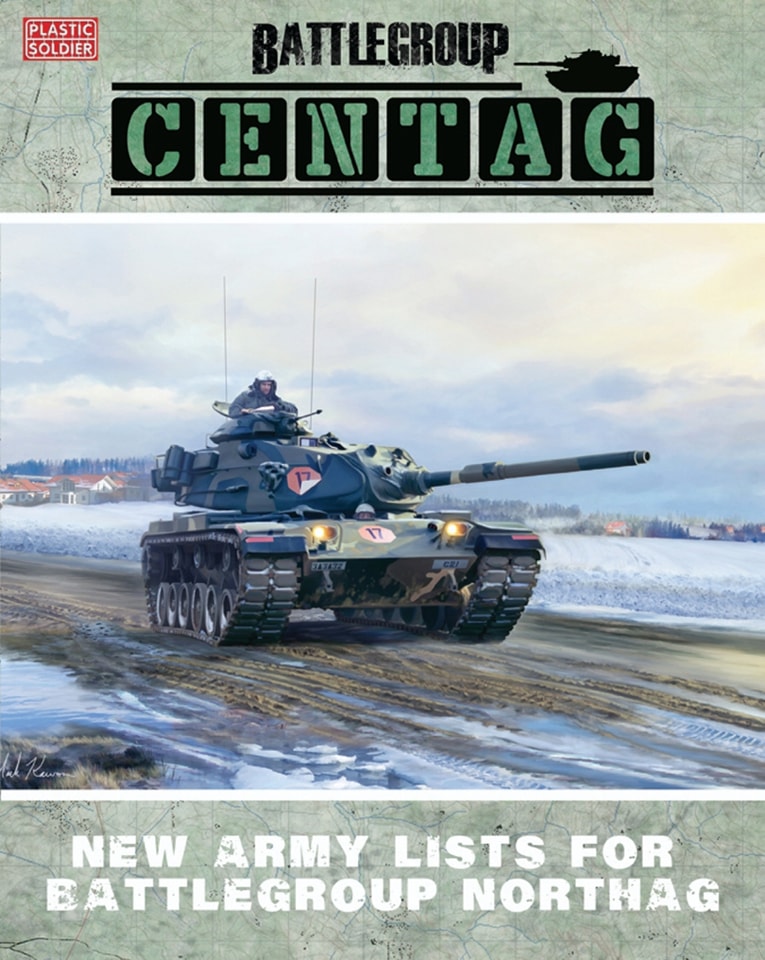
Battlegroup CENTAG // The Plastic Soldier Company
This new set of army lists is going to be coming out soon alongside a host of new miniatures to go alongside it. I had to look this up but CENTAG refers to a NATO military formation that features troops from Canada, West Germany and the United States.
This, therefore, offers up some neat options for those wanting to build up another united front during that Cold War period and the threat of the Soviets from the Eastern Front. If you're interested in learning a bit more about CENTAG then you can have a peek at the Wiki entry!
It will be interesting to see what miniatures come out for this new supplement. I don't think it would be a bad bet to say lots and lots of tanks!
What are you hoping to see?
"It will be interesting to see what miniatures come out for this new supplement..."
Supported by (Turn Off)

Supported by (Turn Off)
Supported by (Turn Off)

Got the rules, will be picking up these expanded army lists (as the core rules only have the British and Russian forces). PSC and the Rules’ authors have sensibly kept the timeframe in the early 80s (so the Abrams (105mm gun), and the Challenger are about to come into service (but the main tanks are still the Chieftan and M60s). For the West Germans and the Dutch I guess they’ll be fielding the Leopard 1 (and well as a fair few M113s along with the Americans).
This timeframe was probably the most dangerous for NATO as the technology gap hadn’t yet widened up with the advent of the advanced armour types and thermal imaging for the NATO tanks. It was the period when the Doomsday Clock really was at “seven minutes to midnight” and things were at a definite face off (watch the Danish Documentary “The Man Who Saved the World” for just how close things came).
Battlefront also started off with Team Yankee in the early 80s, but alas the playerbase clamoured for bigger and better and faster tanks and they ended up with a really lopsided game.
So Battlegroup NORTHAG are probably the modern ruleset we’re using at the moment. It’s just about the right complexity (with a few elements from the WW2 Battlegroup rules thrown in), and plays pretty fast. We’re using 6mm figs (as we already have loads), but there’s a fair few 10mm vendors out there these days. When you get to 15mm, then things start to break down as the models are just too large and if you play using the 10mm ranges it looks farcically short ranged (and adapt the ranges to 15mm then the table ends up being too small) in our experience. We play with 6mm and using the 10mm ranges and everything works out perfectly (although we are looking at perhaps getting some 10mm from PSC, Timecast and RED3 as our 6mm models are a bit old and dinged up (and the T54s, T72 models were designed by the Russians so that your barrels WILL snap or bend in stupid ways as the model makers had to stick with the real dimensions (such a small tank with a LONG gun sticking out the front)).
GHQ all the way for me. Nothing beats their models – at any scale. (West) Germans should be able to have Leopard II by then, as they were in service by the early 1980s.
“First Clash” is a great book for a look at the Canadian perspective of this period. Written originally for training purposes, it was later released in hardback and paperback version. It was required reading.
Not really, if we take early 1984 as our baseline then West Germany had accepted about 500 Leopard 2s (the total order was 2125 with the last being delivered in 1991). At the same time Germany had about 1200 Leopard 1s on the books (and these were being upgraded to the Leopard 1A5 with the armour upgrades. So not all formations were equipped with the Leopard 2s).
Just like the US and the UK Germany was shifting to a new MBT, however the process to the nations took up until the early 90s before it was totally complete (although West Germany could be said to have the Leopard 2 in “widespread use” (although that term is subjective) in the mid 80s. But certainly, the German Territorials had had the Leopard 1s cascaded down (replacing the M48 Patton) in this period. It’s also probable that the armour native to the Panzergrenadier units were also using them until all of the Panzer Brigade units were allocated with the new MBT.
So all in all, around early 1984 Germany was equipped with a mix of the two tanks (with the majority still being the Leopard 1s). Now exactly “how” the army lists in CENTAG are going to work I don’t know. But I know that with NORTHAG the British in this period have the option to buy exactly TWO Challenger 1s models as re-enforcements (coming on the table with a dice roll) with the rest being Chieftains. And it’s stated that the period is 1983 in the rulebook. I’d expect it to be similar with the US units (with two M1 Abrams with the 105mm gun, with the rest being M60s). For West Germany I don’t know, perhaps you might be able to buy a larger number (say four models), but I’m guessing here.
It’s a bit like the T34 in Russia in WW2. At the end of the war, most wargamers assume that all the T34 were the later T34/85. When in fact in 1945, about 2/3rds were the earlier T34/76 model.
I’d LOVE to buy the GHQ models, but they cost about £14 for five models, whereas the 10mm Resin models from PSC cost £13 for four models (and they are going to be a bit more robust, after spending HOURS trying to straighten/replace the barrels on some old Heroics and Ros T72 models from the 80s I never want to go through that again). But I’d agree the GHQ models have more detail than the PSC ones (even when they are 6mm).
Yeah, the quality of the GHQ is what makes the difference. I used to be one of their catalogue painters, too, so I have pretty solid technique for painting them. I do commissions for a select group to keep up. It’s different painting 1:285 scale.
I served in the early 1990s, as an armoured recce officer; I am very familiar with the Leopard program from both the Canadian perspective and the German.
The Canadians did something fun: when the aging Leopard fleet needed upgrades, we bought whole tanks, took the upgraded turrets off, and put them on the existing lower hull. That way the serial number of the tanks stayed the same, and on paper only the turret was upgraded.
There’s still a few people around who own what were 0km/0hour lower hulls sold as “surplus” during that time. Kind of hilarious.
The current state of the armoured corps is not amusing though, as only one full regiment of sabre squadron Leopard IIA6s can be fielded; there are also Leopard IIA4s (waiting to be upgraded) that are being used at the school in Gagetown. The other “armoured” regiments have been relegated to a “heavy armoured reconnaissance” role.
Ironically, this mimics the 4CMBG days, when the Leopard C1 were in Germany, only returning after the 1998 Kosovo deployment (C2 by then). The C2 MEXAS deployed to Afghanistan, and was replaced by leased Leopard IIA6CAN. I wonder what the damage deposit on a Leopard in an active war zone would be? One was lost to an IED strike, the driver is someone I know; he lost both legs in the strike. RheinMetall brought that vehicle back to Germany as they certainly were meant to be stronger.
The Challenger II has the distinction of never being destroyed in combat, as per the MoD site.
It will be interesting to see the direction the next generation of armour takes.
One thing is certain: the mythical Soviet armour has been proven to be feeble. This is for two reasons: crap design, and, more importantly, the ability of lower level NCOs and even troop leaders to NOT make decisions in a timely fashion. That’s unthinkable to Canadian training, and has been imparted to Ukrainian forces now during Op. UNIFIER.
I am still hopeful for Leopard IIs , as they certainly were there.
And “rules” are a jumping off point for me; how things compare in “the game” will inform how to build scenarios. Rules be damned, I say! ?
After Bosnia, Canada brought back 6 T-72s; four were used as range test targets. The Leopard C2 was putting rounds through-and-through them, not APFSDS either, solid shot. Granted, a Leopard C2 had thin armour – they were designed to be fast, not mobile castles. So it would come down to getting the shot off first. Of course, Canadian crews were exceptional versus conscripted troops anyway, so the “kill ratio” was estimated to be 5:1, Soviet dead tanks to Canadian armour lost.
Naturally I’ll be fielding 4CMBG; really looking forward to this. The “Flames of Fantasy Team ‘Merica” gong show isn’t even close to reality for what the Canadians used, so I hope that @piers does this right.
Germans should have Leopard II by then, as the training versions were in service by 1978/79.
Well, you’ll certainly be fielding the Leopard 1 then (they didn’t replace them until 2010 (not sure on that one?). Ofc the Leopard 1s were extensively updated from their original 1979 version by then (although in 1983, which is NORTHAG/CENTAG period they’ll still be the original A2/A3 versions). The last Chieftain in the British army left service in 1995, so it takes a while for nations to replace their MBTs.
Yes, it was late into Afghanistan when the Leopard IIA6M(CAN) was leased.
See above for the C1/C2/MEXAS upgrade story.
Also, the Canadians in 4CMBG had mortars NOT mounted in M113s, Lynx recce vehicles were everywhere; the Blowpipe MANPAD was carried in MILCOT 3/4 ton pickup Chevy pickup trucks. ADATS wasn’t in CENTAG.
If you need any info on 4CMBG, I have mountains of it. The last three years prior to retirement I spent in the archives and museum of the second largest military museum in Canada. I worked with the regular force armoured regiment there, as it was my affiliated regiment from my service time.
The best part was the weapons vaults; the trophies from the Boer War onward are pretty spectacular. One of the projects I did was to photograph and inventory one of the collections, as it was not particularly well documented. Some very exotic and historic pieces in there.
Ooh will be interesting to see what they bring out to battle with/against.
CentAG included army lists…
US Army Armored Battlegroup
West German Armoured Battlegroup
Canadian Battlegroup
Danish Mechanised Battlegroup
Dutch Armoured Battlegroup
VDV Soviet Airborne Battlegroup
Soviet Naval Infantry Battlegroup
Warsaw Pact Battlegroup – allowing players to field East German, Czech or Polish Battlegroups
CentAG book includes the following army lists for use with NorthAG…
US Army Armored Battlegroup
West German Armoured Battlegroup
Canadian Battlegroup
Danish Mechanised Battlegroup
Dutch Armoured Battlegroup
VDV Soviet Airborne Battlegroup
Soviet Naval Infantry Battlegroup
Warsaw Pact Battlegroup – allowing players to field East German, Czech or Polish Battlegroups
Sounds good? @piers – Anita at PSC is projecting June vs. your January; any thoughts?
I REALLY hope you got the Canadians right. Flames of Fantasy Team ‘Merica are horribly off. Like, not even useable.
I was told January last week when discussing Battlegroup releases for next year.
Its only waiting on pics… been written for over two years.
Of course… its also waiting for miniatures to release with it…….
Excellent – thank you!