









![1918 Spring Offensive Wargame | Full Rules Overview with John & Gerry (WW1 Tabletop Game) [7 Days Early Access]](https://images.beastsofwar.com/2026/03/unboxing-warfulcrum-games-1918-spring-offensive-review-coverimage1-225-127.jpeg)


Six-Day War 50th Anniversary: Middle East Blitzkrieg [Part Three]
June 21, 2017 by oriskany


Good afternoon, Beasts of War. Today we’re closing out our three-part article series commemorating the Six-Day War. Fought in June 1967, this war saw the IDF (Israeli Defence Force) engage and soundly defeat the forces of Egypt, Jordan, and Syria in one of the most stunning campaigns in recent military history.
If you’re just joining us, please check out our previous parts. In Part One we briefly reviewed the Arab-Israeli Wars up to 1967, looked at the roots of the Six-Day War, and discussed the initial Israeli air strikes that set the war in motion. In Part Two we looked at the war’s largest battles, fought between Israel and Egypt in the Sinai Peninsula.
But there’s plenty more to cover, with fighting still to come between Israel and Jordan in the West Bank and Old Jerusalem…and between Israeli and Syria in the fateful Golan Heights overlooking the biblical lands of Galilee.
War In The West
Israel vs. Jordan (June 5th-7th)
Israel had planned exhaustively for war with Egypt and Syria, but the entry of Jordan into the war came as a bit of a surprise. Israeli Prime Minister Levi Eshkol contacted Jordan’s King Hussein before the shooting started and promised that if Jordan stayed out of the conflict, Israeli would respect her neutrality.
Unfortunately, Jordan had been pushed into joining the conflict by Egypt and Syria. Although more advanced than the Egyptian or Syrian armies, the Royal Jordanian Army and Air Force were far smaller and nowhere near prepared for a showdown with Israel. Egypt also lied about how the war was going so far, claiming huge wins over Israel.
Thus, about three hours after the Israeli Air Force (IAF) had struck targets in Egypt (June 5th, 1967), Jordanian artillery opened fire into Israel from positions in the West Bank. Israel responded with air strikes into Jordan, wiping out their air force much as they’d done to Egypt and Syria earlier that morning. Then the ground war started in earnest.

Israeli objectives for the war with Jordan were two-fold: take the entirety of the city of Jerusalem (the city had been partitioned between Israel and Jordan since 1948), and take all of the West Bank (Jordanian land extending beyond Jerusalem to the “west bank” of the Jordan River).
The Battle for Jerusalem in 1967 began where the War of 1948 left off. Israeli mechanised units and tanks advanced north of the city, Colonel Asher Dar’s “Jerusalem Brigade” advanced south of the city, and paratroopers in halftracks pushed into the city itself. The objective was to cut the city off from the Jordanian Army in the West Bank.
Meanwhile, a larger campaign had started with Israeli spearheads striking deeper into the West Bank. Ramallah, Bethlehem, and Jericho all saw action, but the biggest battle was in the north at Jenin. Here, Israeli tanks of Peled’s Division ran into Jordanian infantry and tanks of the 25th Brigade.

For a time, the Battle of Jenin looked as if it might end in stalemate, with a Jordanian armoured brigade coming up to reinforce the brave 25th. But IAF strikes mauled the approaching Jordanian tanks (ironically, the same M48A2s the Israelis were using). Left on their own, the Jordanians at Jenin were soon bypassed, encircled, and defeated.
Meanwhile, fierce fighting raged through Jerusalem and its surrounding suburbs. Despite being cut off, troops of the Jordanian 27th Brigade (Brigadier-General Ata Ali) and other units put up fierce resistance at places like the Latrun Road, Ammunition Hill, Mount Scopus, the UN Compound, and the streets leading to the Temple Mount.

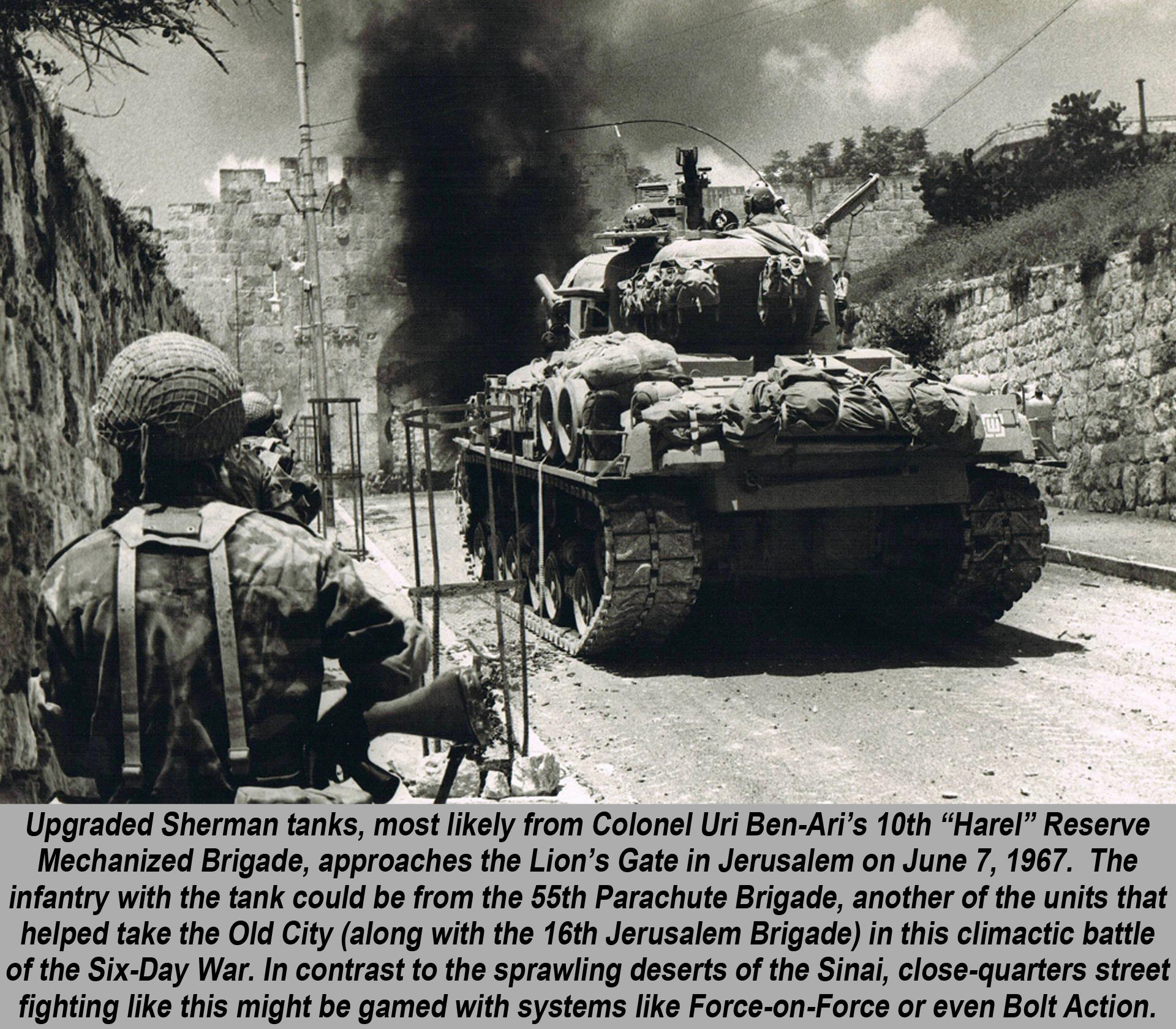
But the Israelis were not to be stopped. With upgraded Sherman tanks in the streets alongside infantry of the elite 55th Parachute Brigade, they soon cleared resistance and reached the Western Wall. This wall holds immense symbolic importance to the Jewish people, last remaining fragment of the Second Temple, destroyed in 70 A.D.
War In The North
Israel vs. Syria (June 9th-10th)
The last part of the war came in the north, where the Israelis faced the Syrian Army. The Syrians were dug in along the Golan Heights, a tall plateau of volcanic rock running north to south, almost forming an immense topographical “wall” ten to fifteen miles wide between Syria and Israel.
Between these two hostile states, possession of this “wall” is critical. Whoever has it commands the high ground for any potential battlefield between the two nations, and can see deep into the enemy’s territory. For years Syrians had used this advantage to shell Israeli settlements in Galilee with artillery and rocket fire.
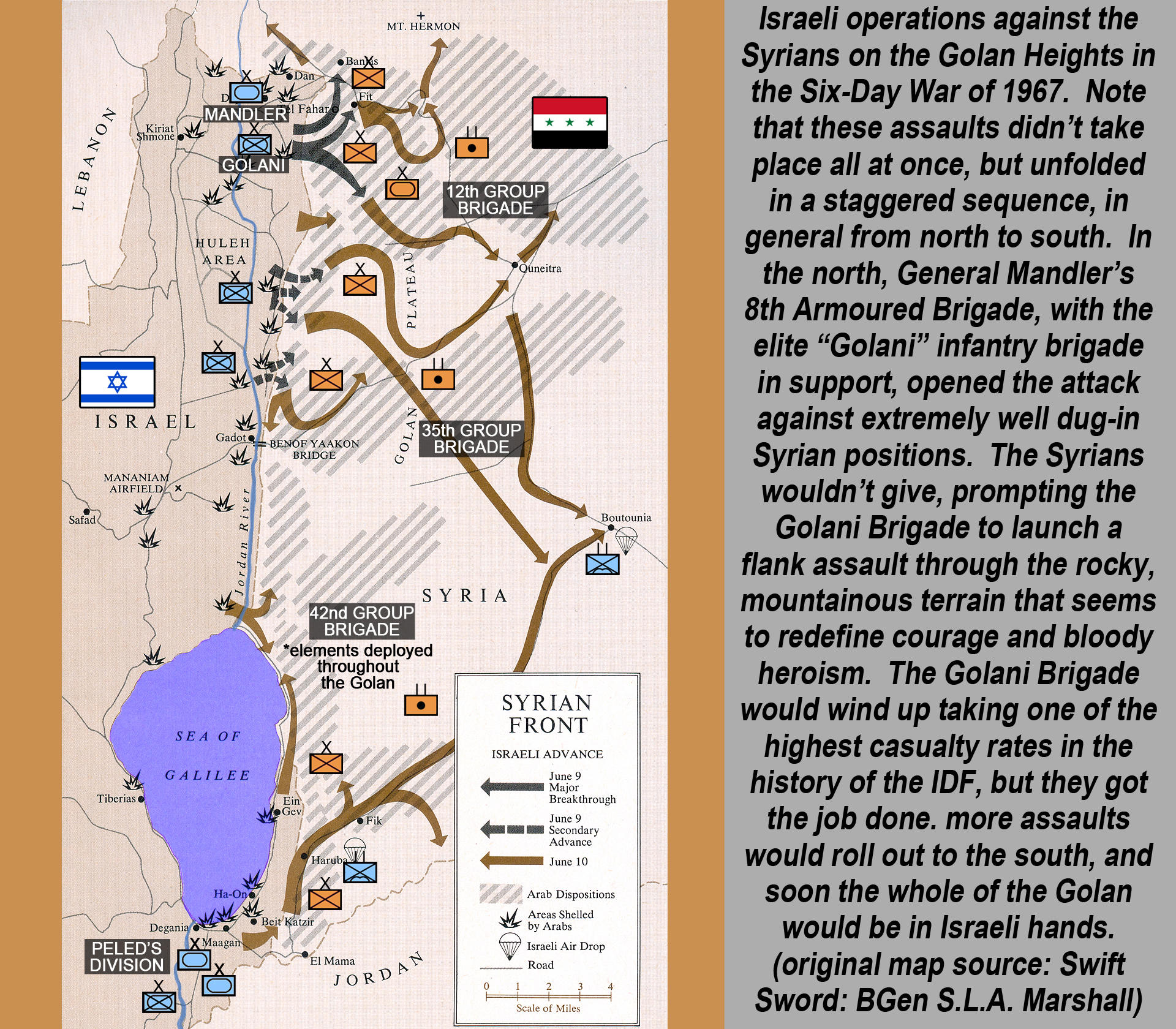
Possession of the Golan provides further leverage in the form of water. It's relatively green and moist up there, at least compared to the surrounding deserts. Whoever owns the Golan commands irrigation for agriculture for miles on both sides of the border, another advantage the Syrians used against their Israeli foes.
In many ways, Syria didn’t want the Six Day War. They’d only gotten involved when Soviet intel falsely reported that Israel was preparing to invade Syria. This was exposed as a blatant “false flag” operation designed to strengthen Syrian dependence on Moscow, yet even when this ruse was exposed, it was too late. War was already inevitable.
When the fighting started, Syria tried to make a show of being involved without becoming too heavily engaged. They tried bombing some Israeli targets, the IAF wiped out their air force. After that, they shelled some Israeli positions, but while the Egyptians and Jordanians were heavily engaged and defeated, the Syrians largely did nothing.
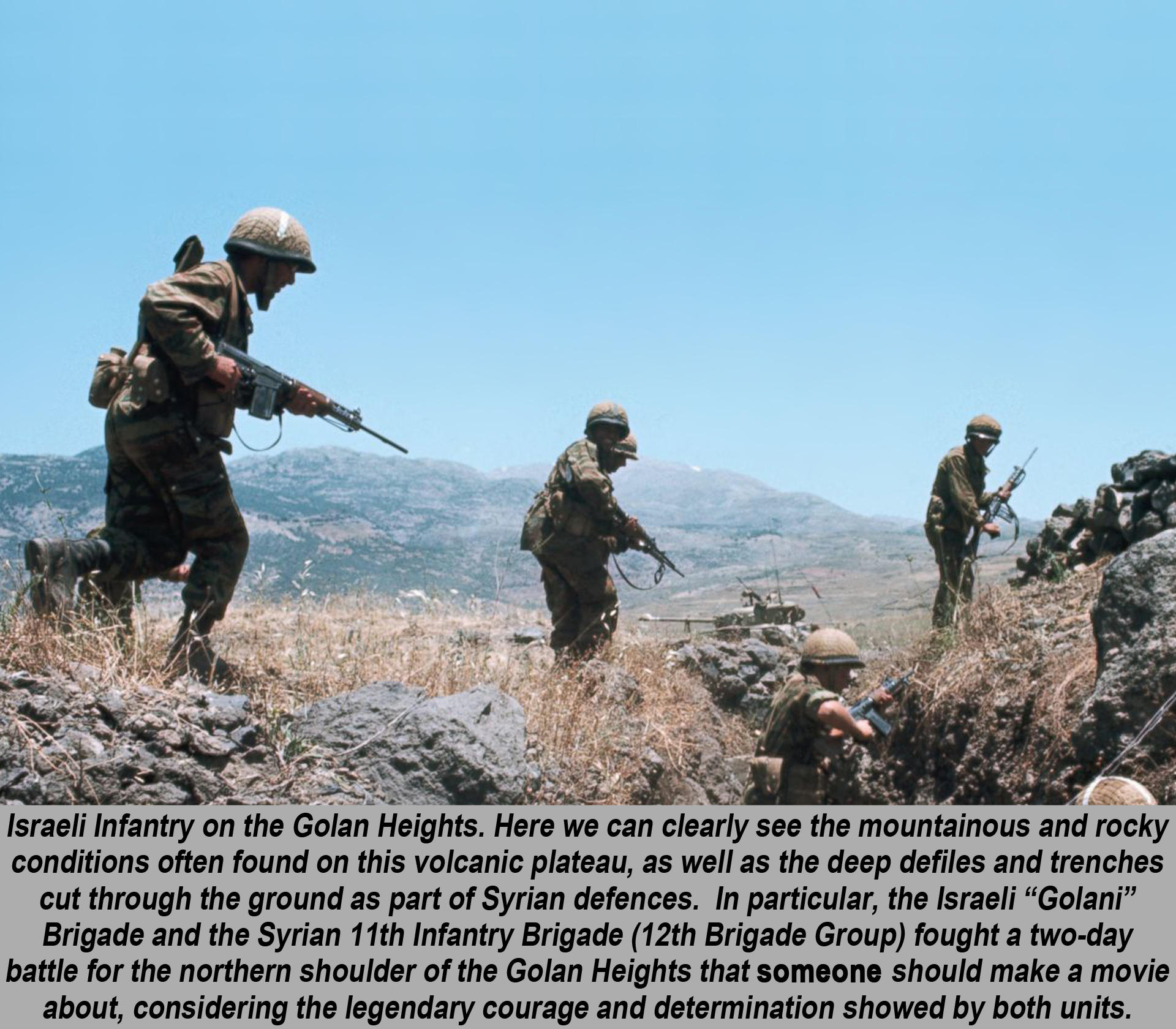
The Israelis took the war to Syria, however, starting on June 9. Starting at the extreme northern tip of the Golan, a brigade of tanks under Colonel Mandler and the crack “Golani” infantry brigade took heavily fortified Syrians only after a desperate and blood-soaked flanking attack in which both Syrians and Israelis showed incredible bravery.
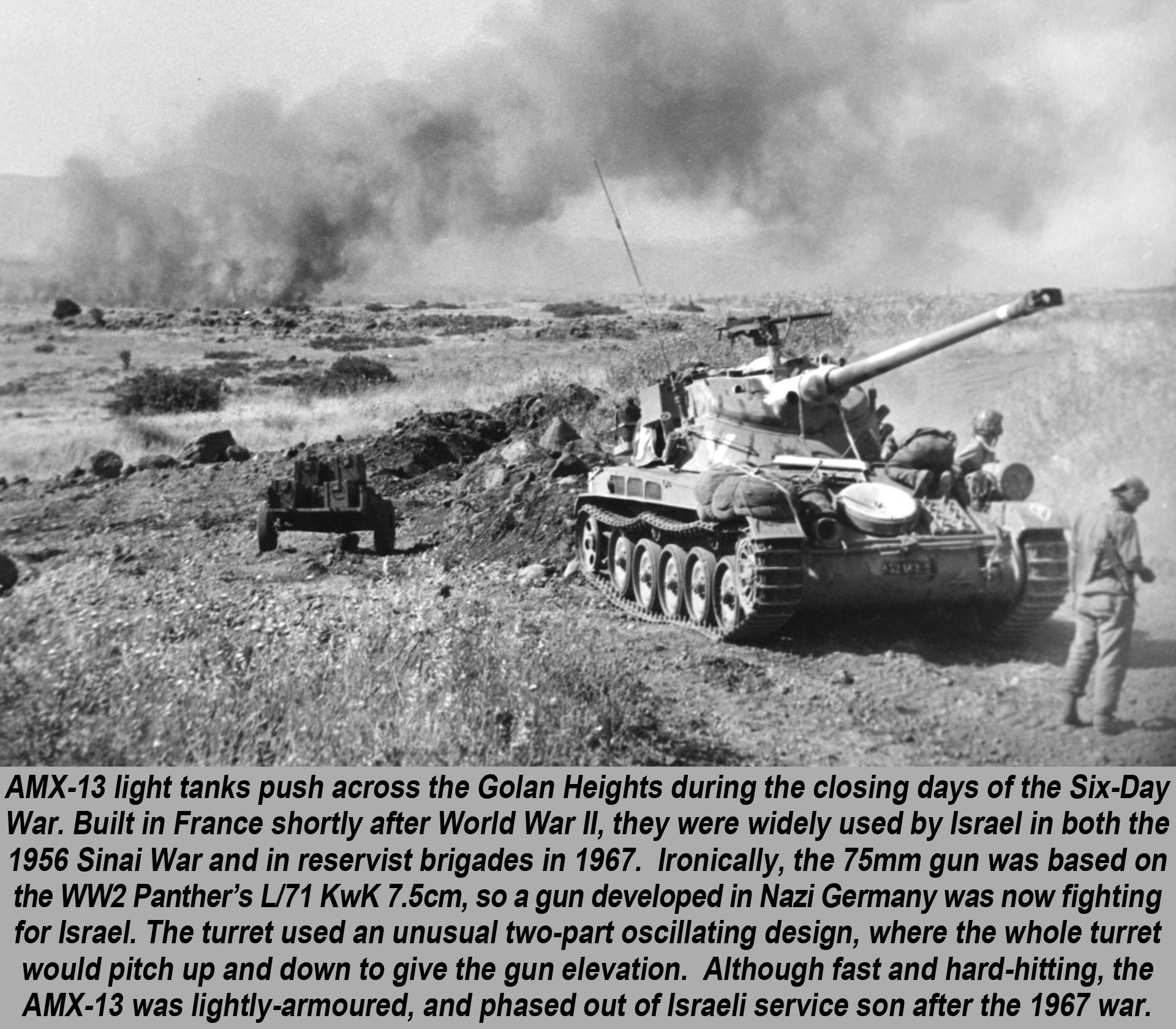
Two more Israeli infantry brigades supported this offensive’s southern shoulder, pushing across the Jordan River, hooking northeast, and linking up with the bloodied Israelis coming down from the north. Together they drove on Quneitra, largest town on the Golan and astride the highway leading straight to Damascus, the capital of Syria.
By June 10th, the last day of the war, Israeli forces that had helped win the West Bank had been shifted to the Golan and were hitting the Syrians from the south. Tanks of General Peled’s division leap-frogged over helicopter paratroopers and soon took Rafid, overlooking inner Syria, before the UN cease-fire took effect at 18:30 hours.
Assessment
Needless to say, the 1967 Six-Day War was a stunning military success for Israel. But how did such a one-sided war happen?
First off, on a strategic level, Israel was able to win because she struck first with a dazzling blow, then scored lightning victories against her opponents before they could recover and coordinate. If Egypt, Syria, and Jordan had all been able to fight Israel at once, the outcome would’ve been very different.
Tactically, Israeli training was far superior. Whereas Syrian and Egyptian armies had invested in numbers and considered sheer size as a strength, Israel (with fewer resources to call upon) concentrated on making the most out of the soldiers, tanks, and aircraft they had. Hardened, all-or-nothing motivation also proved a key edge for the Israelis.
Israel’s victory in 1967 would have far-reaching, if often unintended, consequences. Most immediately, Israeli was safe for the time being. Not only had the militaries of her enemies been crippled, but Israel had won strategic depth in the Sinai, West Bank, and Golan Heights, “buffer” ground that could be traded for time in future wars.
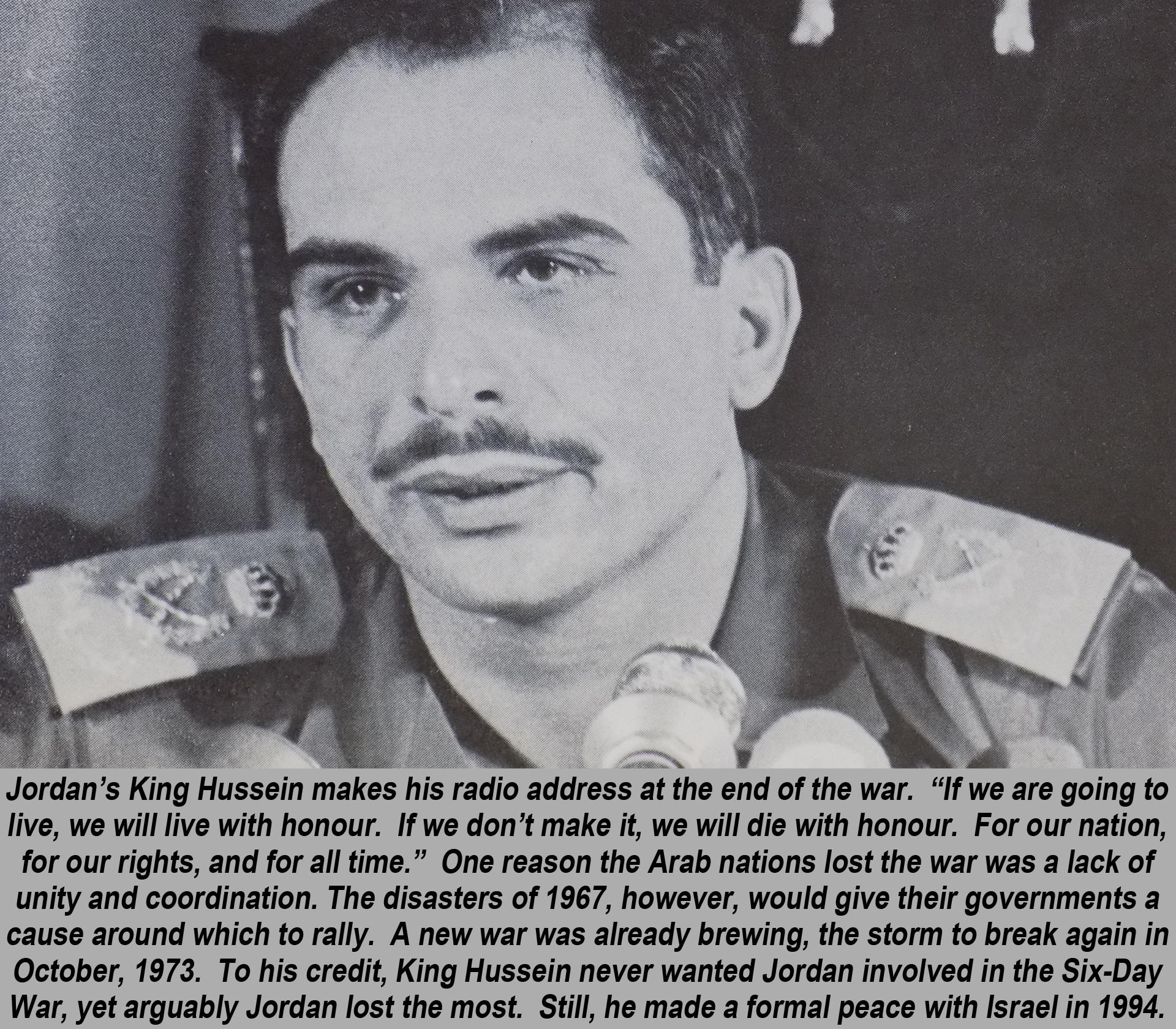
But the newly-occupied territories also presented new problems. For one, a Palestinian resistance movement was quick to ignite in conquered territories like Gaza and the West Bank, which causes immense problems to this day. Displaced Palestinians in Jordan would also cause problems, including a brief war between Jordan and Syria in 1970.
The uncertain peace that followed the Six-Day War would also see the governments of Syria and especially Egypt seethed for revenge. From 1967-1970 simmered the “War of Attrition,” a low-intensity state of constant skirmish that saw the Suez Canal become (for a time) the most heavily fortified line on Earth.
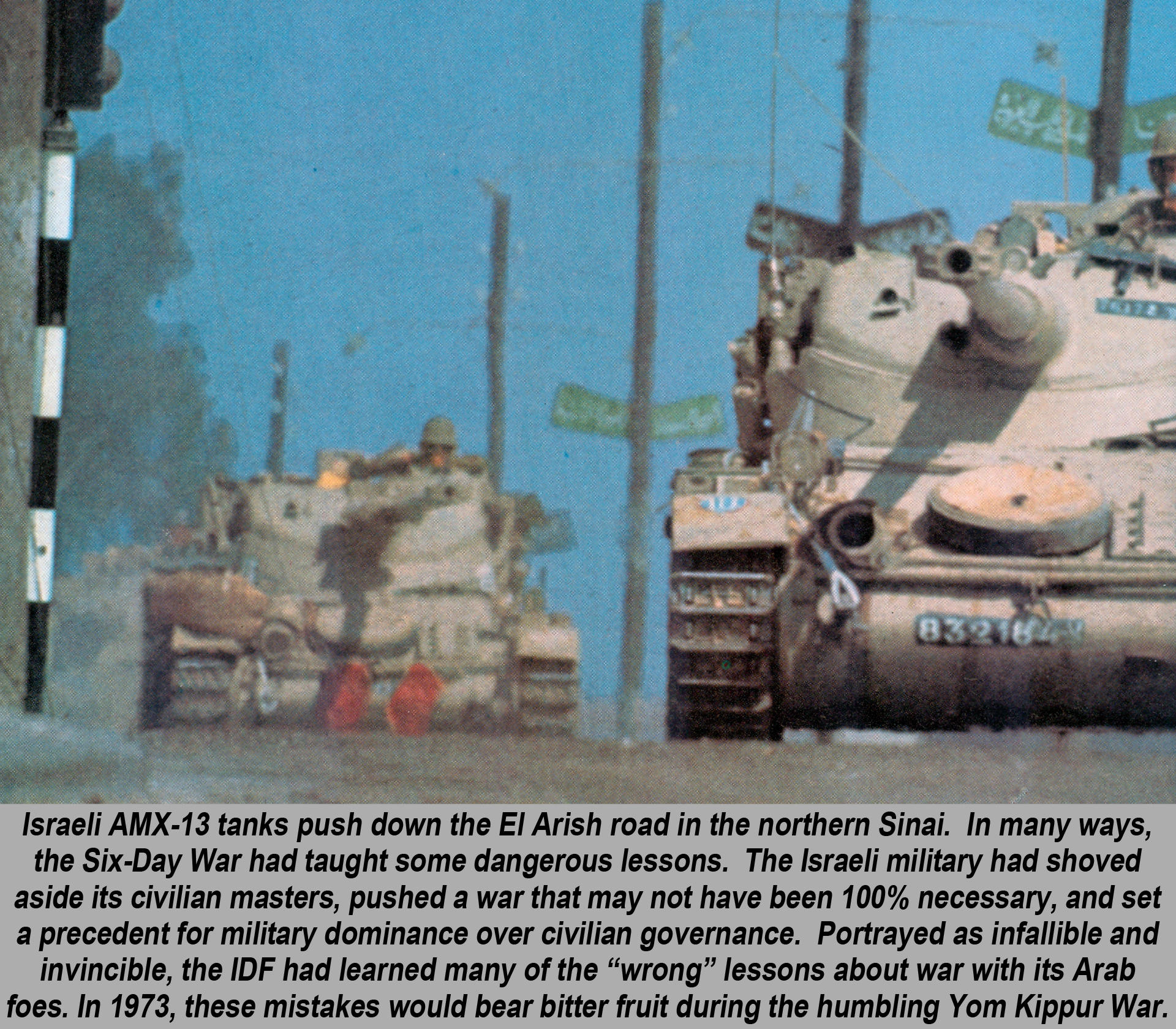
But most of all, the Six-Day War “taught” the IDF that they were vastly superior to their “feeble” Arab opponents. Yet as Friedrich Nietzsche wrote: “war makes the victor stupid.” The Egyptians, in particular, would rebuild their army along totally new lines, and return in 1973 to greatly redeem themselves against the IDF in the Yom Kippur War.
Wargaming Notes
So what features and elements should a wargame include in order to recreate some of the conditions found in the Six-Day War?
The opposing armies must have dramatically different feels. The Israelis are light, fast, well-trained, and small in number. You can’t make a mistake with them, their units should be fragile and expensive. Egyptians and Syrians, on the other hand, should have big numbers, low point costs, but be hard to handle in mobile or offensive operations.
Yet just as the Israelis are great in attack, the Syrians and especially the Egyptians should be rocks in defence. Arab artillery and infantry should be weapons to be truly feared, and always be liberal with mines, blocks, fortifications, and improved positions. These armies could dig in and entrench like few others in modern warfare.
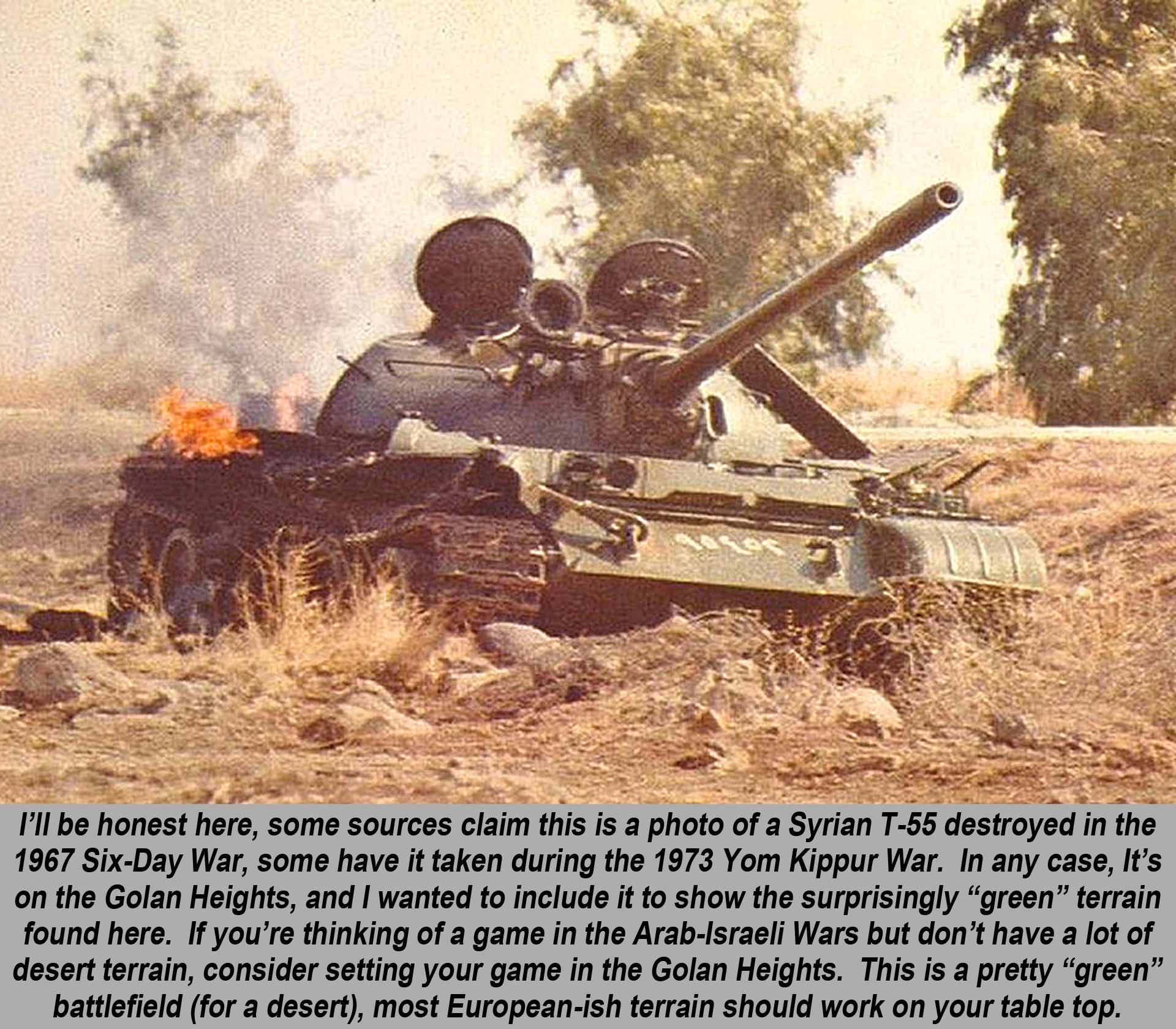
Finally, games should have asymmetrical victory conditions. Let’s face it, in any historically-accurate Six-Day War game, the Israelis are almost certain to win. The trick is to make their victory requirements very tough so even an unfair BATTLE can become a fair GAME that is enjoyable and challenging for both players.
In at least a few regards, the Arab-Israeli Wars are perfect for wargames. Compared to World Wars, these fights are small and short, and thus more manageable. They also use a great deal of World War II or Cold War equipment players may already have, making it easy to convert armies to explore a new area of history.
Another bonus is the victory conditions. In games from other wars, these can feel a little “gamey” … take a certain bridge by turn eight because that’s when the game ends no matter what, that kind of thing. Believe it or not, these factors sometimes fit perfectly in an Arab-Israeli War context.

Historically, the instant the first shot was fired in these wars, people were on the phone to Washington, Moscow, and the UN to end them. Both sides thus want to take or defend whatever they could, knowing the war could suddenly end “out of nowhere,” and these objectives would make important bargaining chips in the post-war talks.
Give It A Go Yourself
That wraps up our 50th Anniversary article series on the Six-Day War. I hope you’ve enjoyed reading them, and just maybe picked up a little extra knowledge or gaming inspiration. As always, I’d like to thank @brennon and @lancorz for helping me publish material on the Beasts of War site, and always make my material look so great.
Most of all, of course, I’d like to thank all of you, all the Beasts of War community members who have taken the time to plough headlong through the verbose ramblings of a would-be historian and inveterate madman. Your patience and curiosity, and the tireless support of @warzan have meant worlds to me.
So I hope you’ll take just one moment more and drop a comment below. Best of all, if you’ve tried a wargame set in the Arab-Israeli Wars (Avalon Hill’s classic, Avalanche Press’ Sword of Israel, IDF, Fate of a Nation by Battlefront, Flashpoint: Golan, Yom Kippur, Crisis: Sinai 1973, Jerusalem 1948, etc.), tell us about your wargaming experience!
If you would like to write an article for Beasts of War then please contact us at [email protected] for more information!
"In many ways, Syria didn’t want the Six Day War. They’d only gotten involved when Soviet intel falsely reported that Israel was preparing to invade Syria..."
Supported by (Turn Off)

Supported by (Turn Off)
"So what features and elements should a wargame include in order to recreate some of the conditions found in the Six-Day War?"
Supported by (Turn Off)






![StarCraft Tabletop Miniatures Game Pre-Orders Live Now [Updated]](https://images.beastsofwar.com/2026/03/starcraft-tmg-news-cover-600-338.jpg)







![Mounted US Cavalry On Kickstarter For Dead Man’s Hand! [Updated]](https://images.beastsofwar.com/2026/03/us-cavalry-main-600-338.jpg)

Great finale. It’s crazy how much double dealing there was behind the scenes. More than one battlefield in play here, I guess.
Thanks for kicking us off, @gladesrunner . Yeah, there is a very strong political, espionage, and diplomatic element to all of these Arab-Israeli Wars, and the wars are small and short enough to where these factors really reach down and “touch” the battlefield at the tabletop level.
This can make the victory conditions that sometimes seem very “gamey” in some games actually make sense in an Arab-Israeli Wars setting.
e.g., take this hill by the end of Turn 8 because … on Turn 8 the war magically ends?
Actually, yes. These wars usually ended with a phone call from the UN, prompting battlefield commanders to attack and defend objectives simply to give their diplomats extra bargaining chips at the peace table (where many would say these wars were really won or lost).
Scoring a “pointless” victory by a certain time (i.e., turn in a game) can help convince a reluctant ally to join a war, or compel a superpower “patron state” to authorize additional emergency aid.
Even ends of the table or map can be used as “realism” elements in a game design. (No, you can’t go there. It’s not the end the of world, it’s just Jordan. Or a staging point for UN peacekeepers, or the Jordan River, or the Mediterranean Sea, etc).
Thanks for the comment! 😀
https://m.facebook.com/story.php?story_fbid=10154481092280880&id=1767886810189145
Found this on Facebook
Thanks, @dugthefug1644 – and that’s a great little animation. 😀
Still, a little bit of a political ax to grind in there, isn’t there? Nothing like an impartial, unbiased view, eh?
Definitely presents one side of the issue, and not the other.
I couldn’t help but notice they skipped straight from the 1948 to the 1967 War, completely ignoring Israel’s invasion of the Sinai in 1956 with the approval and cooperation of the French and British.
Still, there is some good information there (Syria’s diversion of the water supply, mentioned in the article above … and Egypt’s closure of the Straits of Tiran, mentioned in Part 01, etc).
The slap in the UN’s face was a particularly nice touch (only deployed there after Israel’s invasion in 56).
And even the title text: “Arab Leaders declared their intention to annihilate the Jewish state”
First of all, why “Jewish” and not “Israeli?” There are plenty of non-Jews living in Israel. Does it halve to be a religious thing?
Admittedly there was a lot of rhetoric coming out of Damascus and Cairo to that effect, but just looking at the deployment of the armies shows that Arab “intention to annihilate Israel” just flat out isn’t true. In fact, records show that the IDF knew the Arabs were not going to invade, but allowed the propaganda to progress into order to pressure Israel’s Prime Minister Eshkol and other “doves” into stepping aside and letting the IDF initiate the war.
The fact that Eshkol was also Defense Minister and Moshe Dayan (the *ahem* “hero” of the Six-Day War) wanted the job was also a factor (he took over just days before the war started).
Never mind the fact that Syria and Jordan didn’t even want the war, and were only pushed into it by Nasser’s political pressure, popularity with the Palestinian refugees, and outright lies to Jordan and Syria on the morning of June 5 as to how the war was progressing.
There are two sides to every issue, is all I’m saying. This animation shows one side to an overwhelming degree of bias.
I will say this, at least they give Sadat and King Hussein their due. 😀 😀 😀
Was just presenting as exhibit A as to why you should follow an Oriskany multi part article series rather than getting your knowledge from Facebook. 🙂
I don’t pretend to understand the politics and centuries old hatred from my quiet suburb of London.
Got taught early from my brilliant History teachers that you always look for bias before you read or listen to any source and judge it accordingly.
If I read something and feel offended I take a step back, consider who wrote it and why they wrote and consider it again.
Found your series really interesting.
Going to Tankfest this Sunday at Bovington in Dorset and try to spot something from the period while i’m there.
Thanks, @dugthefug1644 – I sincerely hope I didn’t come across like I was coming after you in my post. Definitely not the case. The people who made that video, however … 😀
And of course nothing they say in there is factually wrong (substantially). However, Bias often comes in what you DON’T say as much as what you DO say.
I did some “heavier” writing about ten years ago for the Yom Kippur War, and man, you had to read a dozen books before you even had a clue where the “truth” was. None of the reference materials really had an unbiased view, only by absorbing ten or so and them “aiming in the middle” could you guess where the “truth” is somewhere in the middle. Even then, it’s always very complicated, multifaceted, and in the end a guess.
Of course, a little three-part article series on a wargaming website isn’t going to unravel any staggering truths, either. These are just some fascinating little wars for the historian and the wargamer, and ones not usually given much press in the market.
Thanks very much for the comment, and have a great time at Bovington! 😀
The trouble is that we can often assume that the best reports of what happened come from eye witnesses, but when people go through the horrors of a conflict how many come out the other side without a bias?
Glad you were able to tackle a potentially sticky time period so well.
I enjoyed a well visited forum here a year or two ago about should we be concerned about what you field in game if the troops committed atrocities or fought for values that are objectionable today (i.e. SS troops in Bolt Action). Should Confederate flags be displayed prominently on boxes of Confederate soldiers when some people object to the flag?
The concensus seemed to be that we are only playing games and not making judgements. We shouldn’t change our portrayal of history on the tabletop to avoid today’s sensibilities, but we should never intentionally use the symbols involved to offend people we play either.
For this grown up attitude and many other reasons I love the Beasts of War community.
Thanks, @dugthefug1644 –
The trouble is that we can often assume that the best reports of what happened come from eye witnesses
Very true. We were briefly having this conversation on one of the Midway threads about the catch-22 posed by first-hand sources . . . priceless and irreplaceable on one hand, but of course always emotionally involved in the subject matter (how could you not be when you live through experiences like that).
I enjoyed a well visited forum here a year or two ago about should we be concerned about what you field in game if the troops committed atrocities or fought for values that are objectionable today
Some of us had a similar discussion shortly before the Flames of War Boot Camp (again, very briefly), because the DAK symbol actually includes a swastika, so should you include it? Anyone who has German warplanes in their collection faces the same decision since German aircraft of WW2 had the swastika on the tail.
For this grown up attitude and many other reasons I love the Beasts of War community.
Couldn’t agree more. Even when members of the community don’t agree (we had a few readers who initially didn’t appreciate the topic of our article series on the 2014-2015 Ukraine War), we were able to have a respectful debate and discussion.
great ending the middle east was/is a pit of vipers with each trying to out deal the other to get political strength from one power or another. the AX13 reminds me of a updated infantry support tank? @oriskany
The AMX-13 is a neat little tank. The turret comes in two parts that rotate inside each other almost like a ball-and-socket joint, allowing traverse and elevation (the gun itself does not depress or elevate like in most tanks). Fast little buggers in Arab Israeli Wars you have to keep an eye on them as they’re the first ones around your flank.
Ironically, the gun was originally based on the gun in Germany’s WW2 Panther tank. So a gun originally designed to fight for Nazi Germany winds up fighting for Israel. In the 1948 War of Independence Israel also used German WW2 Messerschmitt Bf-109 fighters.
Of course there are also the famous pictures of burnt-out PzKpfw-IVs and even StG-IIIs that were used by the Syrians on the Golan Heights.
Arab-Israeli Wars . . . clearance sale for old WW2 overstock armor. 😀 😀 😀
Did I go wrong or have I found a historical site, called Beast of War? 😉
We finally made it happen, @rasmus ! 😀 😀 😀
Few wars lasted as short and cast as long a shadow, as this one
Ironically the subsequent Yom Kippur War was bigger, longer, more destructive, more dangerous to Cold War tensions, and more bitterly fought . . . yet in a relatively short time span actually led to a final settlement between Israel and Egypt (the main Arab state player in the wars against Israel). Whereas the Six-Day War . . . you’re right . . . has left serious scars to this day in the Golan, the Gaza, and Wet Bank.
Again, my knowledge of this conflict is limited. I was aware of the rapid domination by the Israeli Air Force, but thought the attacks of Jordan and Syria were coordinated with that of Egypt.
Did any reinforcements from the Sinai redeploy to fight the Jordanians or Syrians, beyond the air force units mentioned?
Great article once again.
Thanks, @cpauls1 –
Unfortunately for Egypt, Jordan, and Syria, operations against Israel were not coordinated in the least. Syria didn’t even enter the war (really) until June 9, by which time the Egyptian Army in the Sinai had already been smashed and Israeli tankers were sunbathing on the banks of the Suez Canal (and Israeli paratroopers were at the West Wall).
In fact, Syria and Jordan never “attacked” Israel at all . . . beyond some ineffectual artillery and small arms harassment. Other than that, they patiently waited their turn to be attacked and invaded by Israel (to Israel’s credit from a military perspective, I’m not judging their geopolitical motives or justifications).
Yes, two units that I know of deployed out of the Sinai to fight in other theaters.
1) 8th Armoured Brigade (General Albert Mandler, sadly later killed in the opening days of the yom Kippur War) redeployed to fight the Syrians on the very northern tip of the Golan Heights. This is in the shadow of Mount Hermon, where the borders of Israel, Syria, and Lebanon meet (nice, quiet neighborhood).
2) Colonel Modechai Gur’ 55th Paratroop Brigade (“Paratroop” as in M3 halftracks are “aircraft”) fought in the Sinai and also in the streets of Jerusalem. The famous photo of Israeli paratroopers reaching and praying at the West Wall (not included in this article for various reasons) are members of the 55th.
I forgot to mention, @cpauls1 – did you notice in Image 02 – the map of the West Bank, the Israeli drive coming out of the north at a town called Jenin . . . and the flanking drive around the east? Watch out for those AMX-13s! 😀
I’ll be a better opponent next time, now that I’m more familiar with the rules 😉 I may buy the box again (the ex threw it out).
I found the Super Shermans more worrying, but there’s no denying the speed of the AMX13’s!
Honestly, @cpauls1 – I still think you might have won that game on points in the long run, 😀 but it was getting super late. That, and that last mortar barrage of mine was just ridiculously lucky.
Image 03 has a detail of the Scenario S-5 (Jenin Hypothetical) mapboard – slightly updated. This is the version that postulates what might have happened if the Jordanians had that brigade of tanks arrive from the south. Historically these were M-48A2s, the game doesn’t have physical M48A2 counters in the boxed set so they substitute a larger number of T-55s (I don’t think the Jordanians ever used T-55s).
So the image has a sh*tload of RJA (Royal Jordanian Army) M48A2s rolling up from the south (one advantage of playing with home-designed electronic counters).
In my games with @aras, I find that adding these tanks to the game ironically doesn’t help the Jordanians that much. Yes, the fortified 25 pounders will almost certainly survive. But since the Israelis get 2 VP for each Jordanian tank platoon destroyed, this just gives those M51 Super Shermans and AMX-13s that much more opportunity to rack up points. As you may remember, the Israeli tanks don’t have THAT much to do once they eliminate those RJA Centurion IIIs because the Israeli tanks then have the wrong weapons for the job at hand (elimination of fortified and dug-in soft targets like infantry and artillery).
Granted, adding the additional RJA tank brigade makes for a bigger, longer, and her-scoring game, but I’ve played this 6-7 times now and the overall balance of victory (in points) believe it or not trends to be the same.
Don’t knock your performance in that game! You did great and like I said, if we’d pushed that all 20 turns you might have actually still won that one. Well, except for that insanely lucky mortar barrage on Turn 13 . . . 😀 😀 😀 Seriously, were those like guided mortar shells? 😀
Great series. In your second to last paragraph, in no way are you a “would be historian” you really bring the subject to life in an easily readable way. Keep up the good work.
Thanks very much, @gremlin , I’ve really appreciated your support through the Midway and Six-Day War series, and previous ones as well. 😀
Here we are again we have turned to page to find the end of the book where we wanted more.
Truly great effort @oriskany! You have manage to impress me once again. You have managed to put just as much history in this three part article as you would in the usual five part series, yet it does not feel composed in any way.
A few years back I watched a documentary that focused on the Soviet involvement in this war. Going by the records they looked at Soviet fingerprints are all over it.
As you said they fed the Syrians blatant rubbish. Where they saw fires in Egypt they added petroleum to the fire. They told all in the Arab that Israel was about to launch an attack them. Talk about self creating prophecy.
Yet the only thing that the documentary could not nail down was the Soviet objective and aims for doing this. Even today that is not clear.
Much has been made off the irony of Israel making use of Nazis methodology in warfare. Apart what had been said above other sources writing the fingers four flight formation and the Israeli armored brigade use SS armored division movement formation, starting with the self propelled artillery being in the centre. Is this really a fair comparison?
The Israeli doctrine is based on highly aggressive actions in mobile warfare at the operational level. It’s aim is to translate to the strategic level by wins here in the operational. The US has a similar doctrine to this called AirLand and the Germans had one called blitzkrieg.
All three are good examples of operational mobile warfare. They share a lot in and they have enough differences to be considered separate application of operational warfare. Because they are all working in the operational sphere many of their operating methods will be very similar due to the requirements of the sphere. All fast aircraft requires wings and a fuselage to fly. Perhaps even better look at the MP-44 and the AK47. Both used the principles of assault rifles. They used completely different internal action, yet they both look alike.
As you might remember I call the end game of the Arab-Israeli wars cease fire tactics and they certainly come into play here.
I have a soft spot for Jordan here, a tragic hero archetype. It was out of a sense of honour to its allies, who played much on this to force their involvement. Even Israel tried to give them a way out as they seemed to sense this.
There is more than one way at looking at success of these articles. After all look at the long lines of people at KFC, yet how many of them would appreciate venison and truffles simmered in a vintage wine sauce.
I have been kicking some cans around about a possible future course for this kind of article and would be happy to talk over an e-mail with you about it.
For now all I can say is that this article series was extremely well done especially considering you were doing the five part series about Midway at the same time. Neither suffered because of the other. Both showed your passion and research you have in both topics.
All up;
😀 😀 😀 😀
Thanks very much, @jamesevans140 !
Soviet Involvement
Indeed, the Soviets started poking the bear with that false flag intel “leak” to the Syrians that Israel was about to invade. The idea wasn’t implausible, the IDF was stronger and more capable than the Syrian Army to a comical degree, look what they did to the Syrians with really just a reinforced division. And of course the Syrians were goading the Israelis with artillery and rocket attacks into Galilee and diverting water supply off the Golan Heights to hurt Israeli agriculture.
Goal? It seems it was just to drive the Syrians into a cozier relationship with the Soviets. As we see even today, the Russians always have an eye on Syria because Turkey (NATO member) can so easily bottle up their Black Sea / Mediterranean access. For this reason, I think the Soviets always like to have plenty of friends in Syria so they have easier access to the Med. A Russian naval / air base in Syria would make the Russians / Soviets very happy.
I don’t think the Russians intended for a war to start in 1967.
Israelis using German WW2 equipment, tactics, doctrine
As you say, a lot has been made of this. Maybe a bit too much. Equipment, I think it’s what was available and good. I just find a wry and ironic. 😀 As far as the doctrine, tactics, and methodologies go . . . I don’t see the big mystery. Germany and Israel are in very similar positions. Surrounded by more numerous but less-organized enemies. Outnumbered but possessing qualitative edges in terms of training, equipment, and motivation. Basically, Israel faces the same geostrategic problems Germany did (albeit on a smaller scale), can we be surprised when the same solutions work?
Yep, in all these wars (at least 1956 forward), the armies are fighting with one eye on the UN stopwatch. Whoever’s losing at the moment is screaming for a ceasefire. Whoever’s winning is doing whatever it can to delay that ceasefire as long as possible.
Okay, there may be more than one way to look at the success of the articles, but really only one way to MEASURE it. And measuring is what counts.
All the same, thanks very much for the kind words! 😀 😀 😀
And another great read, knocking ’em out of the park at the moment @oriskany. Can I please have one on the Korean War next. Ashamed to say that whilst I know about some of the more famous battles I do not know the complete ebb and flow of the war. Just saying mate, hate to see you resting on your laurels, plus you’ll only get on Jen’s nerves if you don’t keep busy!! 😉
Thanks very much, @brucelea . 😀 Korean War is actually an interesting idea, and I even have some models that could be purposed for such a project – late war Sherman Easy 8s, Pershings, even a “Black Prince” (only time they were actually used, I think, I think 6 of them served with AVRE in Korea if memory serves).
I’ll be taking a break for a while, re-asses and the like. We’ll see what happens later in the summer.
Thanks very much for the comment! I really appreciate them.
You also write:
plus you’ll only get on Jen’s nerves if you don’t keep busy!!
You know me too well! 😀 😀 😀
Thanks
I didn’t know very much about this it goes to show that soviets have
there finger in a lot of pies
Thanks, @timp764 – Indeed, when the Russians got involved in Syria back in 2015, I was surprised by how “surprised” many people seemed to be. The Russians (and before that the Soviets) have been angling for influence in Syria for over 50 years. In fact, nowadays even more so as the largely Sunni, largely secular sect of the Arab world represented by the Assad regime might be seen as a counterweight against the independent-minded Kurds on their southern Caucasian border, and especially the larger Shi’ite fundamentalist influences in places like Iran.
Basically, the southern border of the former Soviet Union is a scary place for those in Moscow and St. Petersburg, and for years they’ve wanted friends down there to shore up their position.
Only 6 Churchill Black Princes were made and all saw action in Korea, unlike the Matilda Black Prince that never saw service.
Yep. 😀
(only time they were actually used, I think, I think 6 of them served with AVRE in Korea if memory serves).
Great series again, oriskany! Thank you so much for putting these together.
I have no idea who they were attached to in Korea, so I will sniff around the AVRE. While researching something else I came across a reference to their departure orders.
What I find interesting is the term Black Prince which seems to be parlance for an indigenous design being radically up gunned.
I find that the most overlooked part of the Churchill is its drive train. The engine, gear box and differential. Many tanks are build for speed such as the Sherman and Cromwell. Their gear ratios are high to get them to speed at the expense of torque. From memory you like muscle cars. For the quarter mile to get up and running you need torque not house power. The Churchill was not built for speed and was under powered for it. What it did have was lots of low end torque that coupled with its long go anywhere near WW1 tracks you had a real hill climber of the tank world. The issue with the Centurian is the it traded a little too much torque for speed.
One of my qualifications I picked up along the way was my articulated vehicle licence. I think you call it a truck trailer licence over there. It is not the same as the semi tailor licence those things are bigger. I lot of the testing was on gear ratios, split gear boxes, etc, and when to use them. A split gear box has at least low and high ratios plus a number of normal gears. This left me with a solid appreciation for things like the Churchill.
The Panther and both Tigers I would love to get a ride in as I don’t understand them. They are overloaded and underpowered. Yet they can climb any slope a Sherman can, both would literally be crawling and can achieve top speed of above 20mph. They must have a very low low and a high high ratio. This could be at the expense of mid range. It would mean that in rolling undulating terrain the tigers would have poor performance. Yet tank people call this terrain Tiger country. As I said performance wise I don’t understand them.
I must admit that allied tank wise I avoid Korea as it is sad to see good tanks dug in as artillery. Although this practice started in WW2 Italy with the M10 and M18 destroyers as field commanders did not know how to use them. There is a certain similarity between Italy and Korea terrains.