









![1918 Spring Offensive Wargame | Full Rules Overview with John & Gerry (WW1 Tabletop Game) [7 Days Early Access]](https://images.beastsofwar.com/2026/03/unboxing-warfulcrum-games-1918-spring-offensive-review-coverimage1-225-127.jpeg)
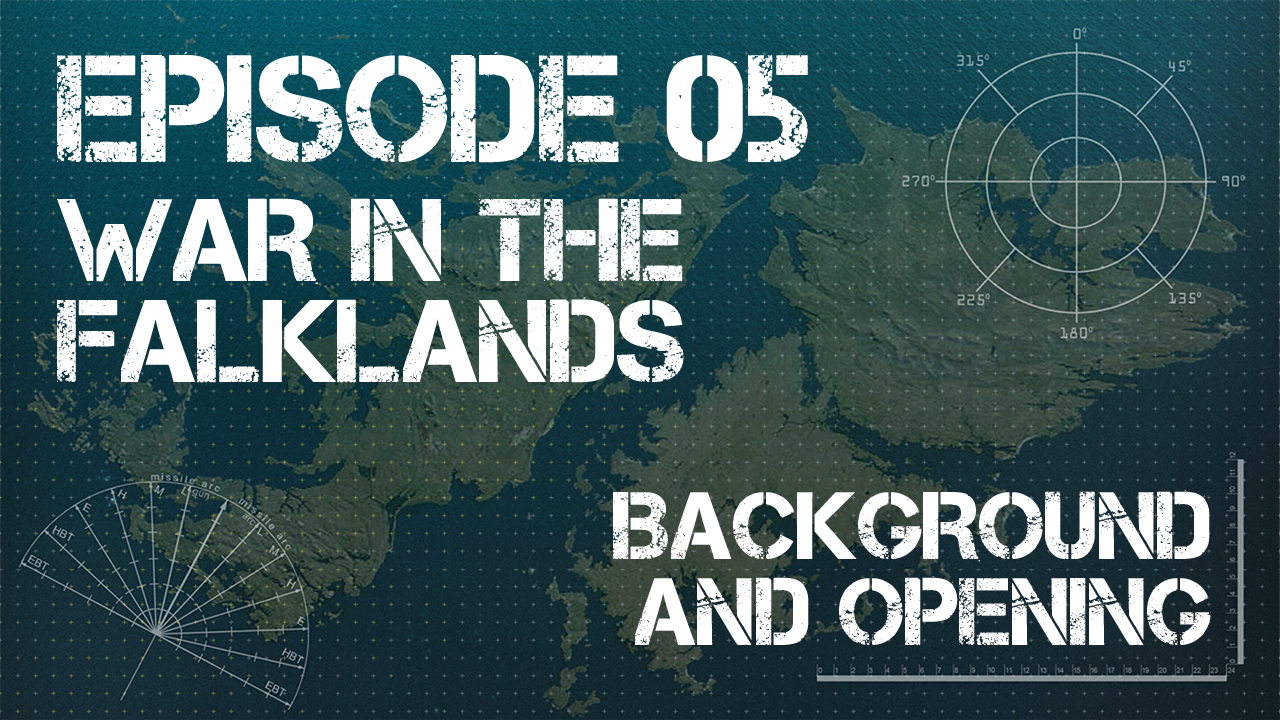
SITREP OPS Center Episode 5: Intro To The Falklands War
April 19, 2019 by stvitusdancern


Welcome back to the next great instalment of the OPS Center from Jim "Oriskany". He is here to guide us on this little war that happened way down in the southern end of the world. He brings us into the fold of how and why this war started.
Also while you are here take a moment to check out the REPLAY of the live stream where I as the British take on Jim as the Argentinians in a air battle and win!
Have you thought about gaming in this theater?





![StarCraft Tabletop Miniatures Game Pre-Orders Live Now [Updated]](https://images.beastsofwar.com/2026/03/starcraft-tmg-news-cover-600-338.jpg)


![Mounted US Cavalry On Kickstarter For Dead Man’s Hand! [Updated]](https://images.beastsofwar.com/2026/03/us-cavalry-main-600-338.jpg)
Excellent start to the series Oriskany.
Thanks very much. 😀
The first war I remember, I was 6.
Thanks very much, @darthcheese – Yeah, I was 10 that summer, I turned 11 later that year. It was a “busy summer” with Israel’s “Peace for Galilee” kicking off in Lebanon in June of the same year. Briefly, both wars were in progress at the same time (June 6-13, 1982).
I remember when this was in the news. Scary time. The people in the Falklands weren’t British citizens? That was the whole idea of going down there, I thought, to save their people, etc.
Thanks for the comment, @pslemon – Yes, my sources indicate that FULL citizenship was bestowed to Falklands residents shortly AFTER the Falklands War. That said, Falklands residents enjoyed some kind of partial citizenship (not sure of the legal details there), and definitely considered themselves “British” by descent. They CERTAINLY did not feel “liberated from colonialism” by the Argentinian marines and commandos.
I should also take this opportunity here to offer a small correction:
ERRATA:
At 17:45 I mention French-made Exocet antiship missiles mounted aboard the light cruiser ARA General Belgrano.
Okay, I wasn’t really clear here. The Belgrano herself … never carried AM-39 Exocets. The Belgrano task force had the capability … CAPABILITY … to carry Exocets, specifically aboard escort ships. This ironically made the escorts more dangerous than the main ship in the battlegroup. As it turns out, these escort ships weren’t actually carrying any Exocets (they were in critically short supply – I think the whole Argentinian military had exactly FIVE of these things), but I’m not sure whether British intelligence knew that at the time.
I wanted to clear this up because this all becomes pretty important later in the conflict, when the British have to decide whether to attack the Belgrano, and whether such an attack would or would not be justified, given what level of threat she or her escorts may or may NOT have posed, even before entering the “legal” boundaries of the Total Exclusion Zone combat area.
A lot more on that in future episodes. 😀
Great video. I’m embarrassed to admit I don’t know much about this war. Looking forward to changing that while shooting down some planes.
We should get another game of AirWar C21 going. We’ve only done one scenario out of the “Operation Corporate” supplement so far. There are also:
Good Morning Stanley! – A British destroyer and frigate have been bombarding the Port Stanley Airport all night. As the sun comes up, they are attacked by Argentinian A-4 Skyhawks and Mirage IIIs. Harriers on CAP intercept.
A Couple Cannon Would be Nice – a British “Nimrod” AEW aircraft – armed with Sidewinders missiles (yes, the British did that), is attacked by a lone Mirage III. Because … reasons. 😀
Attack the Airport – Despite the success of the “Black Buck” Vulcan raid cratering the runway of Stanley Airport, the runway was still usable by short-run turboprops like C130 Hercules transports and Pucara strike craft. RAF Harriers (GR.1/3) are brought in to hit the airfield again. This is strictly a ground attack vs. air defense game, probably good for solitaire.
Hacking Fat Albert – An Argentinian C130 troop transport, escorted by Mirage IIIs, is intercepted by a pair of British Sea Harriers from HMS Invincible.
Battle of San Carlos Water – HMS Fearless (amphibious warfare ship), four LCMs, and four LCUs, work to put troops (40 Commando and 2 Para) onto the beach at San Carlos. The Fearless is protected by two Sea Harriers, which is fortunate, since four A-4C Skyhawks with two x1000 pound bombs each, just arrived.
AX-04 – a hypothetical scenario that explores what would have happened if Argentinian Pucara strike planes, namely the one “AX-04” modified prototype), modified to carry old American torpedoes, had the right ordinance on hand and could have launched an attack against HMS Active and HMS Plymouth. Escorted by standard Pucaras and a pair of Aermacchi MB-339s.
Type 64 – This was an informal term referring to the effective combination of a British Type 42 destroyer and Type 22 frigate – the two classes made such a great team and worked in such close coordination that planners thought of them as a single naval unit, the “Type 64.” This game puts the destroyer HMS Coventry and frigate HMS Broadsword up against two waves of Argentinian A-4B Skyhawks.
Through Fire and Water – another battle in San Carlos (known by the British as “Bomb Alley”), where the Type 21 frigate HMS Ardent is hammered by two waves of four A-4 Skyhawks, the first wave is “C” air force planes, the second “Q” naval variant Skyhawks.
Tumbledown: British artillery positions are supporting Scots Guards infantry attacking Argentinian emplacements outside of Port Stanley. These 105 batteries are in turn attacked by Pucara COIN aircraft. The British have to defend themselves with “Rapier” SAMs. Another solitaire-friendly ground attack scenario.
@oriskany great stuff – recall this on the news one of the 1st wars I lived with
Thanks @rasmus ! Yeah, like I was saying with @darthcheese – this was a “busy” summer. Next year would see Grenada and the Marine barracks bombing in Beirut. The 80s weren’t always so great, it seems.
As always great stuff @oriskany I look forward to the next installment!
I’m showing my age here but, I was a senior in high school when this all went down. We all wondered if this would expand and lead into the much thought about ‘Third World War’.
I remember talking in Government class about how America’s hands were for the most part ‘tied’ as the little-remembered ‘Monroe Act’ technically said that we, (USA), must side with Argentina and not with our long-standing Allie the United Kingdom.
***”The Monroe Doctrine is the best known U.S. policy toward the Western Hemisphere. Buried in a routine annual message delivered to Congress by President James Monroe in December 1823, the doctrine warns European nations that the United States would not tolerate further colonization or puppet monarchs.”***
Thanks for the great and insightful comment, @templar007 –
Yeah, when it comes to American support in the Falklands War … this is a tricky one.
While the Monroe Doctrine was, as you say, originally written as a “wave off” against British or French colonialism in the Western Hemisphere, and this largely forgotten by the end of World War II, it popped up again big time in the 60s, 70s, and 80s – not against the British and French, but the Soviets (just another “European” colonial power). The Monroe Doctrine was invoked as justification for actions starting with Cuba, then Belize, Honduras, Grenada, Nicaragua, El Salvador, Guatemala, and Operation Just Cause in Panama 1989 (not that the Soviets had anything to do with that last one).
In the Falklands, the Americans and yes … even the French … really were on the British side. The Americans emergency-leased their base on Ascension Island to the British, without which this deployment would have been basically impossible. The Americans also fast-tracked shipment of large numbers of AIM-9L Sidewinders for use on British warplanes and even AEW aircraft like the Nimrod.
We’ll get into this more in Part 02, but it cannot be over-stressed how vital this one particular missile type was. It allowed the British to engage Argentinian fighters from any target aspect, and hit with very high probability. This basically allows non-fighter aircraft like the Harrier (the only jet combat aircraft the Royal Navy could stage on their small carriers) to act like fighters, fight enemy fighters, and beat enemy fighters. This allowed the 10-1 loss ratio the British scored in combat aircraft, which gave the British control of the skies, which game them control of the sea and finally the ground. The AIM-9 (specially the “L” variant) Sidewinder was the silver bullet that really made all that possible.
Politically, the conduct of the Argentinian government really ensured they would have no friends in this fight, Falklands or no Falklands. The 1976-83 “Dirty War,” with “death flights” throwing political opponents out of helicopters or airplanes by the hundreds … military juntas replacing each other faster than Hollywood romances … even if people believed the Islas Malvinas properly belonged to Argentina (as some in even in the UK believed), the conduct of the Galtieri government and the stunning audacity of their invasion ensured they’d be on their own.
Even the French cut off shipment of the new AS-39 Exocet antiship missile, which is why the Argentinians only had five or six of these missiles in their inventory.
That said, the Americans could NOT OPENLY go all-in to support the British. First, our military was still in bad shape. Vietnam had so far only been followed up by the humiliating “Eagle Claw” disaster attempt to rescue the American hostages from Tehran. We hadn’t even had the “redemption” of Grenada yet, much less Desert Storm.
Second, PUBLIC or MILITARY or OVERT support of the UK would have very bad repercussions for the US, not with Argentina, but all the other nations of South and Central America. The Monroe Doctrine has never been popular down there TO SAY THE LEAST, and if Uncle Sam stomps down there with the USS Nimitz, Enterprise, or Kennedy battle groups, Central and South America turns against us in a big way and that’s just the kind of thing the Russians were waiting for. Remember, Grenada, Nicaragua, Guatemala, El Salvador … all these were already in progress or about to jump off. The US couldn’t risk angering too many people as we’d need a lot of friends in these countries going forward.
That, and there were personal relationships between members of the Galtieri regime and members of the Reagan cabinet and administration, Secretary of State Haig in particular had some very close friendships down there that Argentina tried to leverage. Haig was in charge of third-party negotiations for peace while the British task force was en route, and while there was never a question of America joining the war on the Argentinian side, there was strong pressure for a deal where the Argentinians would pull out of the Falklands if the initiative to turn over Islas Malvinas was re-introduced on the floor of the British Parliament. The British, by this point, naturally refused.
That is a fascinating insight that I had no idea about thanks for that @oriskany
🙂
Thanks very much, @warzan . Yeah, America’s role (or lack thereof) in the Falklands is a multifaceted issue. It’s tricky because so much of the Argentinian weapons, aircraft, ships, and ordinance were American manufactured. The A-4 Skyhawks that bombed HMS Sir Galahad (worst single disaster for the British in the Falklands War) were American planes, dropping American bombs, by pilots probably trained in part by American advisors. The LVTP-7 AAVs that “conquered” Port Stanley: American. Argentinian boots, helmets, web gear: American. In fact, if you wanted to build this force in a Team Yankee type setting, I would recommend players buy American infantry sets. Most of the Argentinian warships: American (including submarines, most of their destroyers, and the cruiser Belgrano – formerly the USS Phoenix, a Brooklyn class light cruiser).
Then again, Argentinians were all firing FN-FAL rifles (British), and their two most modern destroyers (ARA Santisima Trinidad and ARA Hercules) were Type 42 destroyers, built from British blueprints under licence, I think Hercules was actually built IN the UK.
Just one of those ironies in modern warfare where half the time you find yourself fighting people equipped with your gear or that of your allies.
Excellent stuff Oriskany. Really brings back memories and makes me feel bloody old. Everyone talking about being at school when it happened I was 29 at the time! Looking forward to the next episode.
Thanks very much, @gremlin ! 😀 And hey, don’t worry about it. Anyone who still plays with toy soldiers on this site is still young at heart. 😀 😀 😀
On the subject of British equipment being used against them in the Falklands, I forgot to mention the biggest piece of them all, the aircraft carrier Veinticinco de Mayo (25th of May) – originally the Colossus class HMS Venerable – commissioned in 1944, sold to the Netherlands, who used her for a few years, and sold her to Argentina to serve as their carrier, biggest warship, and basically flagship of their fleet in 1982.
Brilliant Oriskany i can remember being on immediate stand bye for this conflict looking forward to the rest of this.
Awesome! Thanks, @ironshield . I hope I do it justice. Yeah, that’s the thing about covering conflicts more and more modern, before you know it you’re covering conflicts that people know first hand. And I know well the dread of “stand by” for these kinds of things, I remember the feeling for Just Cause (Panama 89) and Desert Shield / Storm (90-91).