






![NO Weekender Or Cult Of Games XLBS This Weekend [Updated]](https://images.beastsofwar.com/2026/03/No_Weekender_and_XLBS_this_Weekend-225-127.jpg)



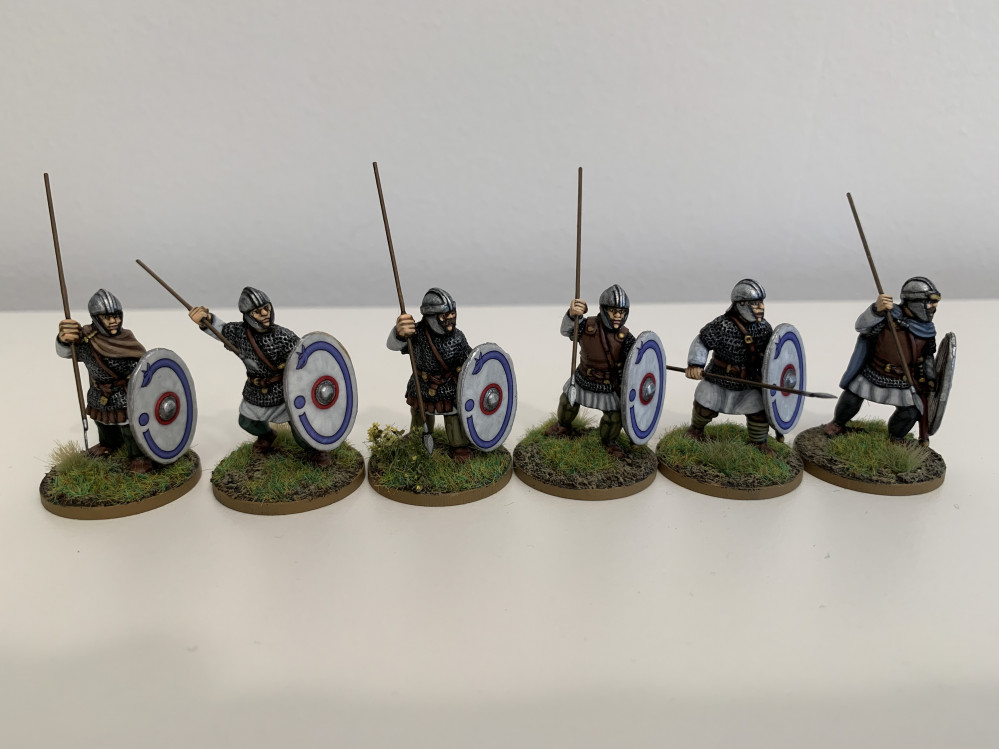
Romano-British for Dux Britanniarum




Recommendations: 1546
About the Project
This was a project started during lockdown to build a Romano-British war band for Dux Britanniarum by Too Fat Lardies. It's stalled of late, so my hope is that by documenting progress on this project I'll be incentivised to finish it.
Related Company: Too Fat Lardies
Related Genre: Historical
This Project is Active
Battle Report - Raid on a Border Tower - Assessment
It’s been a few months since I played this game and so I’ve written this battle report on the basis of my notes and the pictures I took at the time. However, I have to say that I thoroughly enjoyed it back in November and found myself reliving the excitement as I was writing.
There were four pivotal moments in the game. The first was Ceawlin’s devastating charge which eliminated two-thirds of Peredur’s escort in turn two. At that point Garcianus and Urien had barely got the rest of the British force moving and it seemed unlikely they would be able to recover the situation.
However, a series of good move rolls and timely activations meant that Garcianus and Peredur were able to meet in the centre of the table and see off the attack by Berthun the Devil in turn four. I had expected Garcianus’ attack on Saebert’s force in turn five to be more devastating than it actually was. However, as it turned out, the effect of a Carpe Diem card and all the following cards was only enough to offset the effect of casualties, shock and superior forces on the Saxon side. That said, if Garcianus had not made that intervention when he did, the Saxons may have been able to bring superior forces to bear later in the game.
As it was, the sacrifice of the warriors and Comanipulares meant that the stage was set for the Levy to come up and put the depleted remnants of Saebert’s command to flight. Things might have gone differently if Ceawlin had managed to make a better move roll and join the fray, but as it was, Urien Cadwallader and his band of raw amateurs managed to time a charge at exactly the right moment to bring Saxon Morale to zero.
I learnt a lot from this game, but three things stand out:
- Terrain matters. Intervening obstacles played a significant role in reducing movement at key moments. Peredur’s force was left hanging in front of a drystone wall, whilst a hedge kept Ceawlin from joining the last fight with the Levy. Obstacles also forced groups into smaller gaps, reducing the number of men they could commit to the fight.
- Keep rallying off the shock. Having nobles remove shock was crucial to keeping groups in the fight. The British did this more than the Saxons and it showed in the way they were able to keep the depleted warriors and Comanipulares fighting down to the last man. In contrast, the Saxons had fewer opportunities to rally off shock which left them vulnerable to a counter-attack.
- Barbarians don’t always need to charge. I was probably over aggressive with the Saxons, in part driven by the need to try and capture Peredur before he could be supported by the rest of the British force. As such, formations attacked piecemeal, with never more than two groups brought to bear at one time. I might have been better off taking a bit of time to dress the ranks and create a more organised attack of three or more groups, thereby creating a better chance of punching a hole in the British line. Such an approach would also have given the Saxon nobles more of an opportunity to rally off shock before it became an issue.
Overall, I felt it was a pretty good simulation of Dark Ages warfare, with the role of the nobles critical to the execution of attacks. The fact that a well organised band of Levy could see off a group of Hearthguard, but only after the latter had been suitably worn down, also felt like a realistic result and showed that even the weakest troops have a role to play in the warband. Next time I shall try to find a more fully-engaged opponent as I think solo play may accentuate my instinctive bias to the underdog British. I shall have to get to work on some new terrain such as a church or town gates in order to play out some of the other raid scenarios in the rulebook. After all, Ceawlin needs to raise some money fast!
Battle Report - Raid on a Border Tower - Campaign Housekeeping
Dux Britanniarum is meant to be played as part of an overall campaign. I’m not sure when I’ll be able to play again, but I thought it would be worthwhile going through the post-game sequence to see how things would play out.
During this sequence, both sides tot up points depending upon how well they’ve done in the game. The difference in points totals determines the impact of winning or losing. In this game, the British succeeded in rescuing Peredur, which gave them 2 points. They also killed 13 Saxons, which netted a further 2 points. They had also retained an ability card which allowed them to pursue their defeated enemies, giving an extra 1 point. However, they lost 15 men killed, which reduced their total by 2. So overall, the British score was 3 points.
The Saxons killed 15 British, netting them 2 points. However, at 13 killed, their losses were almost the same, not something that will enhance Ceawlin’s reputation. As such, 2 points are deducted to reduce the Saxon total to Zero.
As a result, the difference between the scores is 3 points in favour of Garcianus. He gains a Thief’s Horde in plunder and will recover his losses in one month. Ceawlin gains no loot, and will recover eight of his lost men in one month, should he wish to take the field again with a reduced force. If he wishes to wait until he is back to full strength before raiding Garcianus’ lands again, he will have to wait two months, which might lose too much of the precious campaigning season. Ceawlin will have to choose.
Battle Report - Raid on a Border Tower - Turn Seven
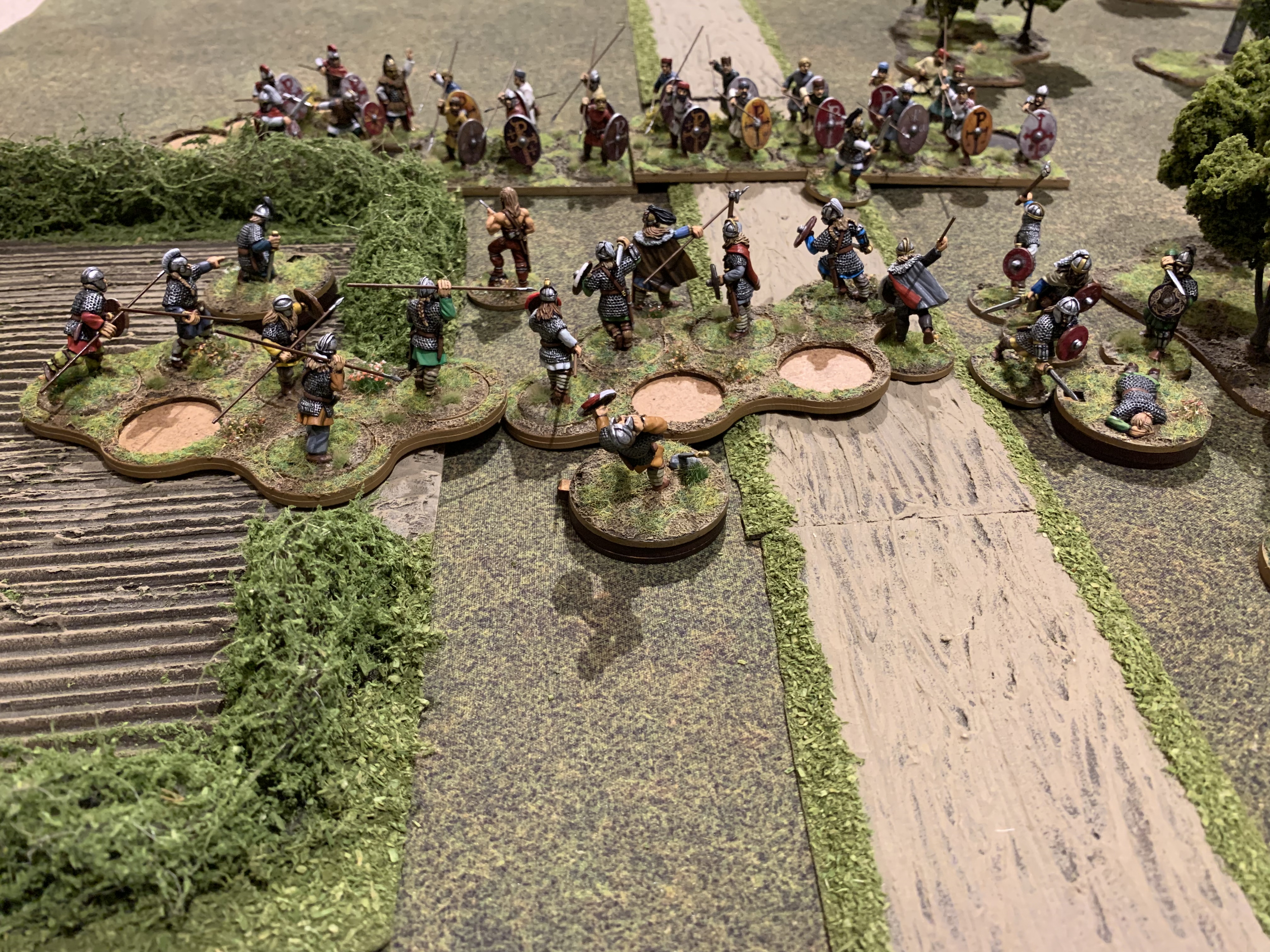 The Levy put their foes to flight!
Once again, Urien Cadwallader saw a chance for glory. The wounded Saebert and his 3 remaining Hearthguard were shocked and battered and made a tempting target. Their level of shock was dangerously high an if he could put them to flight it would bring the Saxon Force Morale to zero and the whole barbarian host might flee.
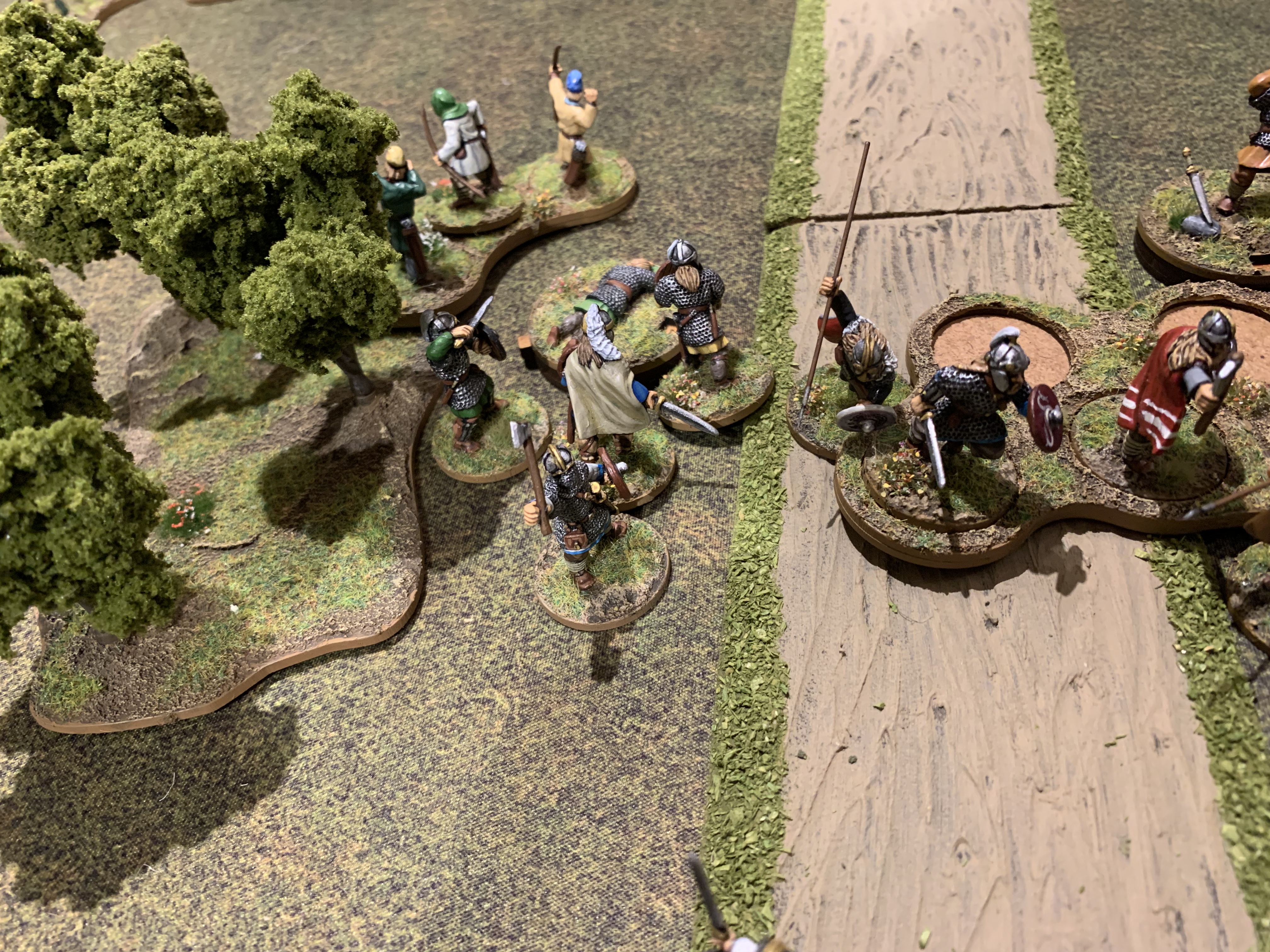 The Shame! Saebert and his men flee the field in full sight of their Lord!
Rallying his men for a final effort, Urien and the Levy charged the Hearthguard. Only two Levy groups could be brought into the fray and 8 British dice were rolled against the Saxons’ 4. This was a bloody melee in which seasoned killers fought a last ditch stand against farmers and townsfolk. The Levy made 5 hits to the Hearthguards’ 4. One member of the Levy fell, but the sheer ferocity of their attack was too much for the already demoralised Hearthguard. How could they be defeated by farmers and clerks? 4 points of shock went onto the Hearthguard bringing their total to more than double their remaining numbers. They “lost their amphora” and fled. Saxon Force Morale fell of Zero and Garcianus and his Britons claimed the field of victory!
 The Levy stand firm, defending their homes against the piratical invaders
Battle Report - Raid on a Border Tower - Turn Six
At this point it was clear that the game could go either way with both sides on a Force Morale score of 4. On the British side both groups of Warriors had been wiped out and the Comanipulares were down to two men. However, the Levy were still at full strength and had established themselves in shieldwall with all of the British nobles close by.
On the Saxon side, one group of warriors had broken and fled, but the remaining groups were still operational, although with casualties and accumulated shock. These groups were working in two formations each consisting of a group of warriors and hearthguard. Saebert commanded the formation nearest the British Levy and Ceawlin would need to move his troops up alongside them in order to bring his full force to bear. However, he would need to do this quickly if he was to stand any chance of completing the original objective of capturing Peredur Constantine without taking further damage to his force’s morale.
The turn started with the British Missiles failing to repeat their success of last turn and all shots missing their target. Ceawlin then tried to bring his formation alongside Saebert’s but to do so they needed to negotiate a hedge surrounding a field alongside the road. The boughs of the hedge were thick and stout whilst its thorns and briars tore at the men’s clothing. As a result, Ceawlin’s men managed a mere 2 inches of movement and barely cleared the obstacle.
The next leader to activate was Peredur Constantine. There was no point in the battle-scarred Comanipulares remaining between the Levy and the Saxons, so he ordered them to move out to the right of the Levy and removed a point of shock.
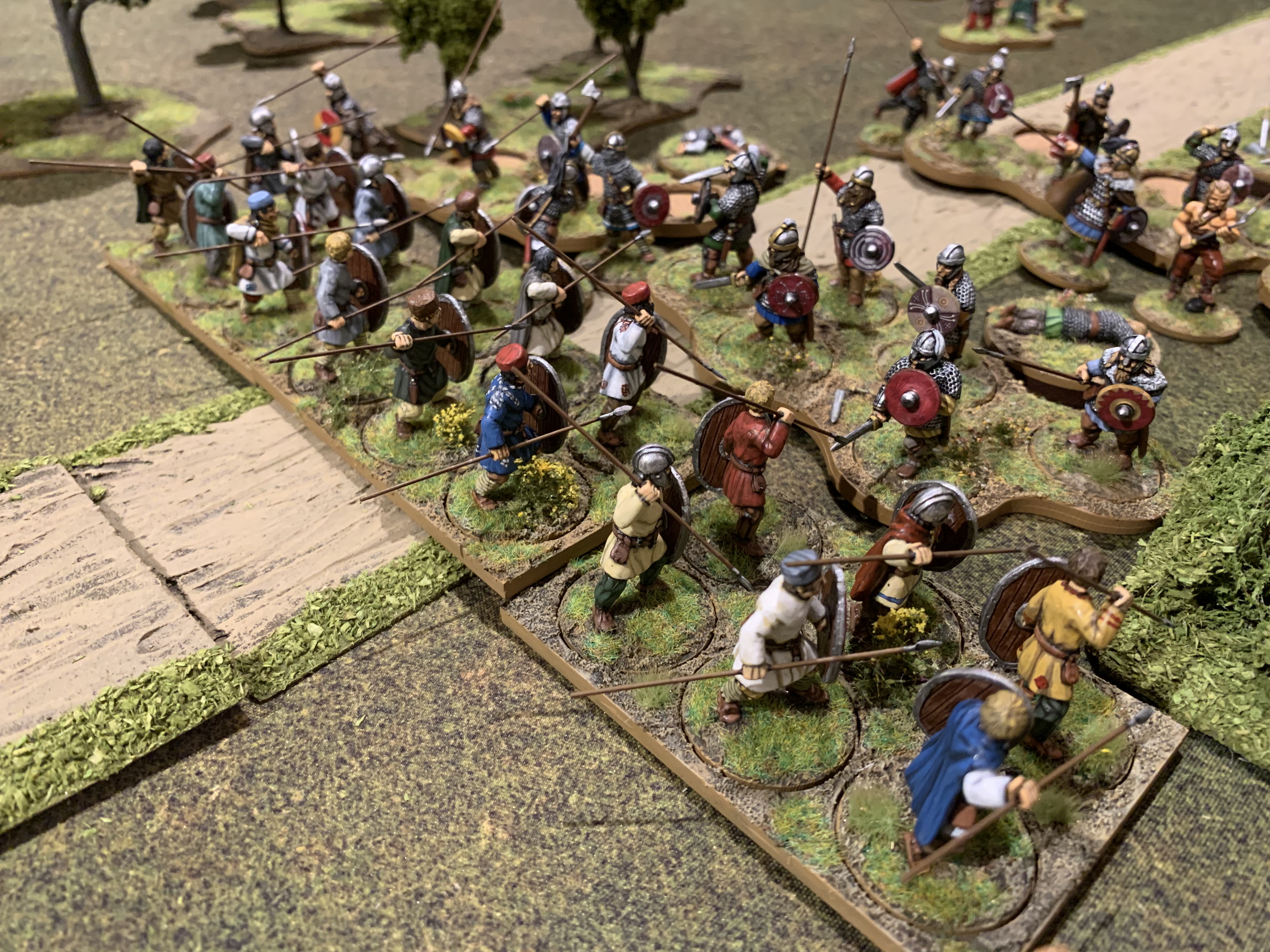 Urien Cadwallader and his Levy charge the Saxons under Saebert
Then came the turn of Urien Cadwallader. Weighing his options the British noble decided there was no merit in standing to receive the Saxon charge and ordered his men to charge the Saxon hearthguard and warriors led by Saebert the Old. Despite their inexperience, the Levy performed admirably, advancing in shieldwall a full 5 inches, one short of their maximum. This manoeuvre also brought them alongside the remaining Comanipulares, allowing the elites to lend their support.
The sheer weight of numbers provided by the Levy meant the British rolled a massive 25 dice to the Saxon’s 9. The Levy scored 10 hits and the Saxons only 3, but again, the superior quality of the Saxons showed. Despite the disparity in numbers, the British could only kill 2 Saxons, whilst the Saxons claimed the life of another of the Comanipulares, reducing them to 2 men.
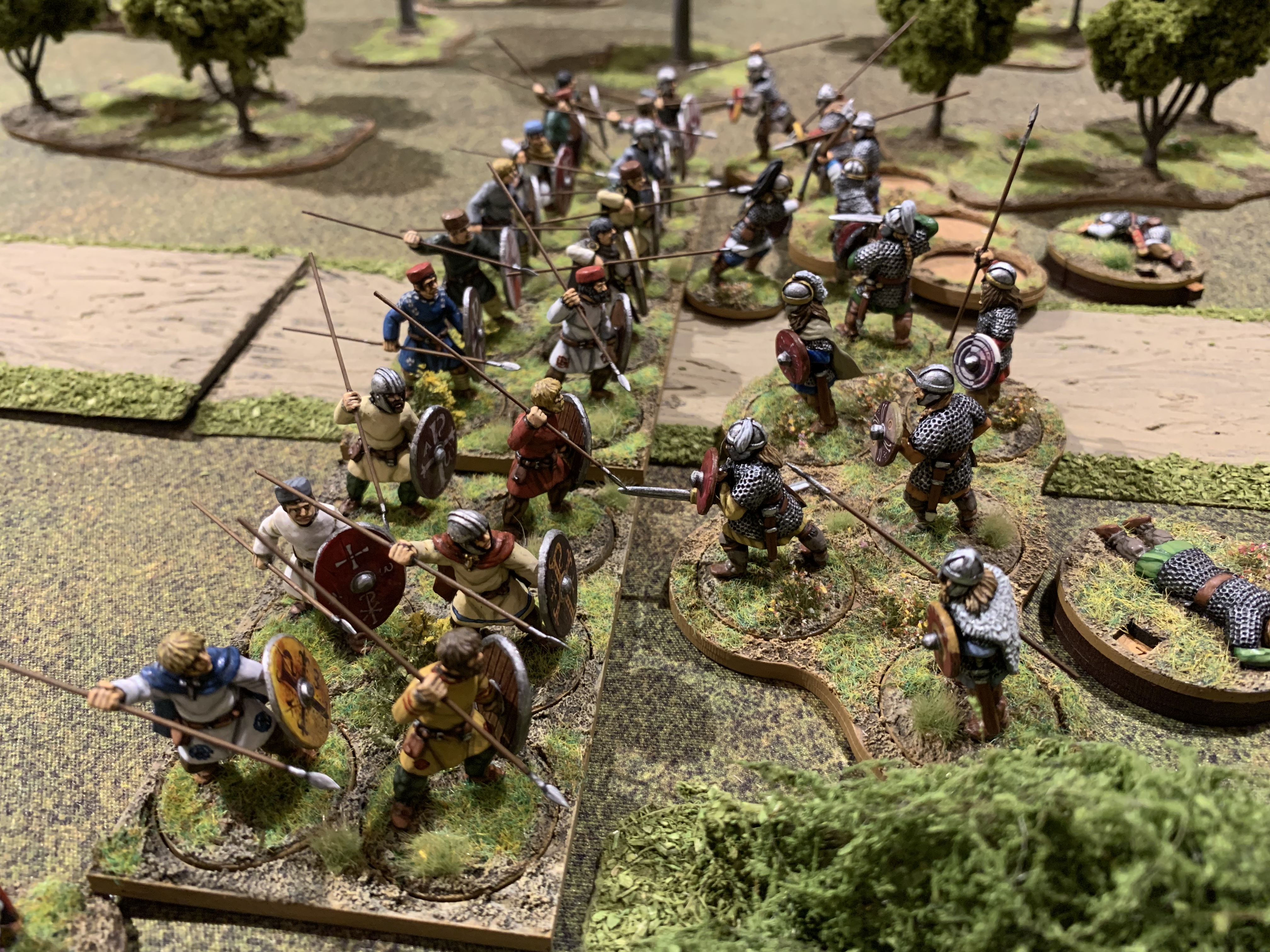 The battle rages back and forth
Both lines descended into a frenzy of hacking and stabbing as a second round of combat was fought. But this time, the British made their numbers tell. 24 dice resulted in 14 hits and 4 kills on the Saxons. Despite the Saxons making brave use of their 9 dice to cause 2 kills, the determination of the British citizenry to defend their lands proved too much for them. Saebert the Old staggered back wounded, as he watched the group of Warriors under his command wiped out by the enraged Levy. He retreated a short distance with the three surviving Hearthguard under his command and Saxon Force Morale fell to 1. Would Ceawlin arrive in time to save Saebert who was left hanging in front of the British line?
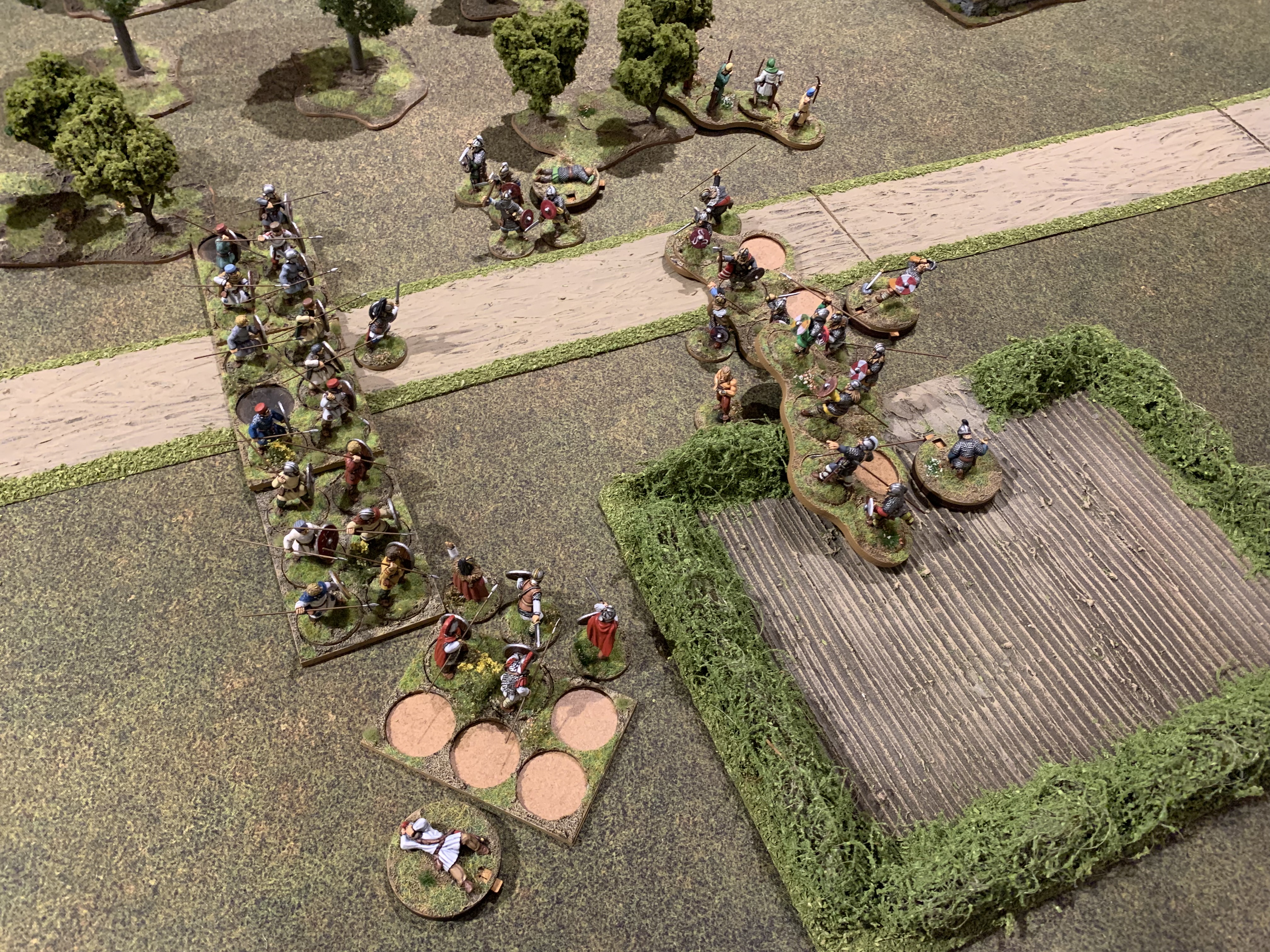 A wounded Saebert the Old retreats with the three remaining Hearthguard, hoping that his liege lord will come to his aid
Battle Report - Raid on a Border Tower - Turn Five
Turn five began with Saebert the Old moving his combined formation of Hearthguard and Warriors forward towards Garcianus and the remaining Comanipulares and Warriors. The Saxon Missiles also moved forward, shooting at the British missiles but missing. Peredur Constantine was then activated and used is two command initiatives to remove a point of shock from each of the Comanipulares and Warriors. Over towards the farm, Berhthun the Devil detached himself from the fleeing group and moved to return to the fray. Behind Saebert, Ceawlin collected the group of Saxon warriors who had fallen back from the earlier fight with Garcianus and combined them with his other group of Hearthguard.
This looked to be a turn of consolidation on the Saxon side. They had received a check in the last turn and needed to redress their ranks and rally their troops. But Garcianus had other ideas. Sitting within the British abilities deck was a Carpe Diem card, a powerful ability that would allow a noble to play multiple cards in a single turn. Garcianus saw an opportunity to strike at the Saxons whilst they were still disordered.
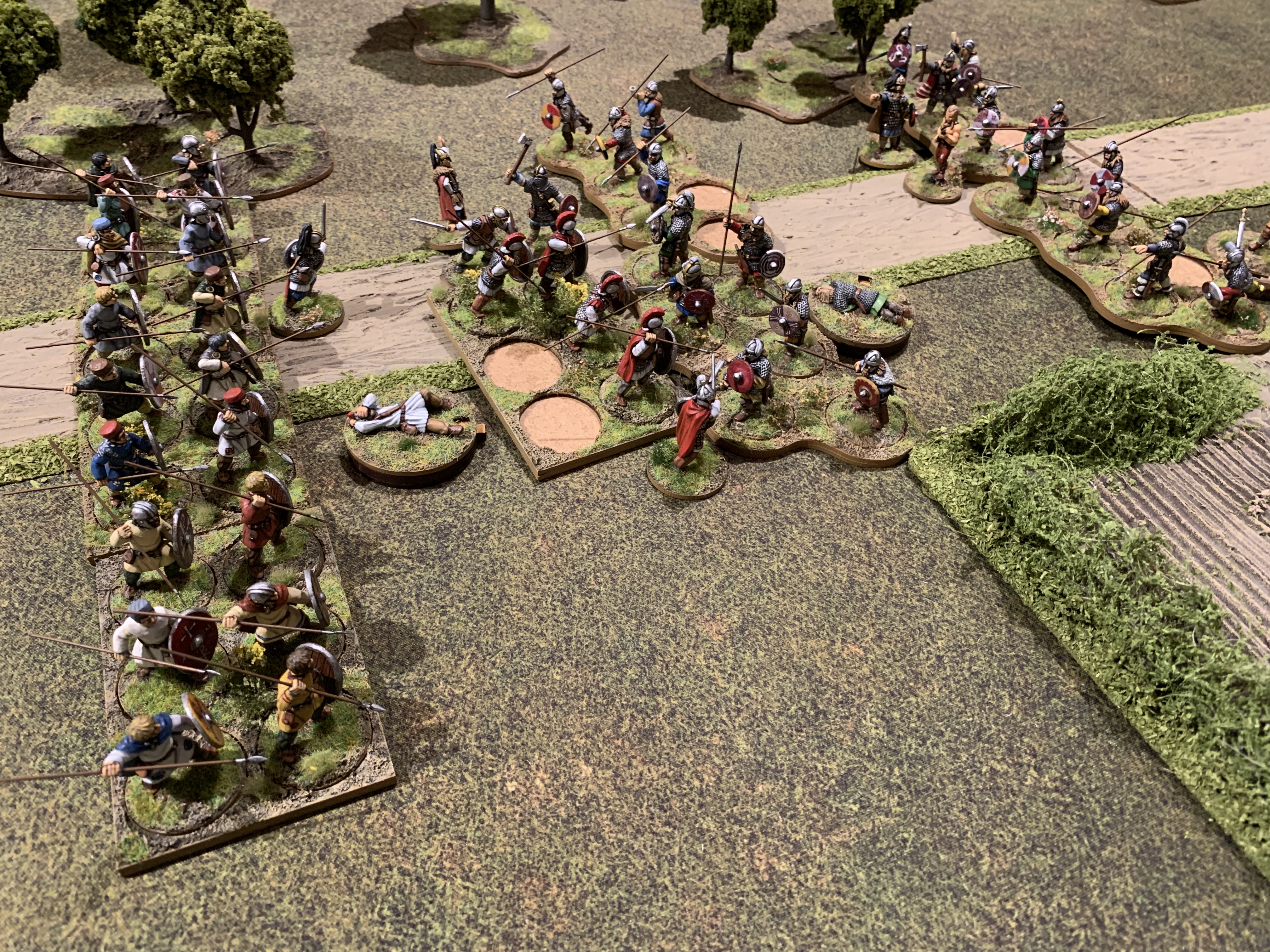 Hero of the Age! Garcianus and his Comanipulares hurl themselves against the hated invaders!
Using his first two command initiatives, Garcianus removed a further point of shock from each of the Comanipulares and Warriors. He then used his last command initiative to play Carpe Diem and unleash a run of cards. Audicia gave him a further command initiative which was used to charge Saebert’s formation. Strong Arm inflicted shock on the Saxons, and Hero of the Age allowed him to double his number of attack dice. Usually, this would increase his dice from 3 to 6, but because of Audicia, his command initiative total was 4, meaning that he would contribute 8 dice to the coming combat.
Despite all of this, the continuing impact of casualties and shock meant that the British advantage was not quite as pronounced as it might at first seem. They rolled 19 dice to the Saxons’ 14. Moreover, the Saxon blades were more deadly, making 9 hits that resulted in 3 kills, whilst the British could only manage 7 hits and 2 kills. The result was that the last of Peredur’s warriors was wiped out and British Force Morale fell from 5 to 4.
Both sides were still in the fight however, and a second round was fought immediately. This time the British rolled 16 dice to the Saxon’s 12. The Saxons continued to show their quality. Despite only making 2 hits to the British 7, the result was the same for both sides: 1 dead and 1 point of shock.
Despite the bloodshed, neither side had gained an advantage and a third round of combat commenced. 14 dice were rolled by the British and 11 for the Saxon. This resulted in 6 hits for the British and 9 for the Saxons but neither side made any kills. The amount of shock was greatest on the British Comanipulares and, down to three men, they were obliged to withdraw. The Saxons were unable to follow up.
 But alas, the last of Peredur's warriors has fallen and the Comanipulares fall back on the Levy
The retreat of the Companipulares had brought them into direct contact with Urien Cadwallader and his Levy. This allowed Urien to rally two shock off the battered Companipulares. The turn then ended in bizarre fashion when the British Missiles managed to kill one of the Saxon Hearthguard accompanying Ceawlin.
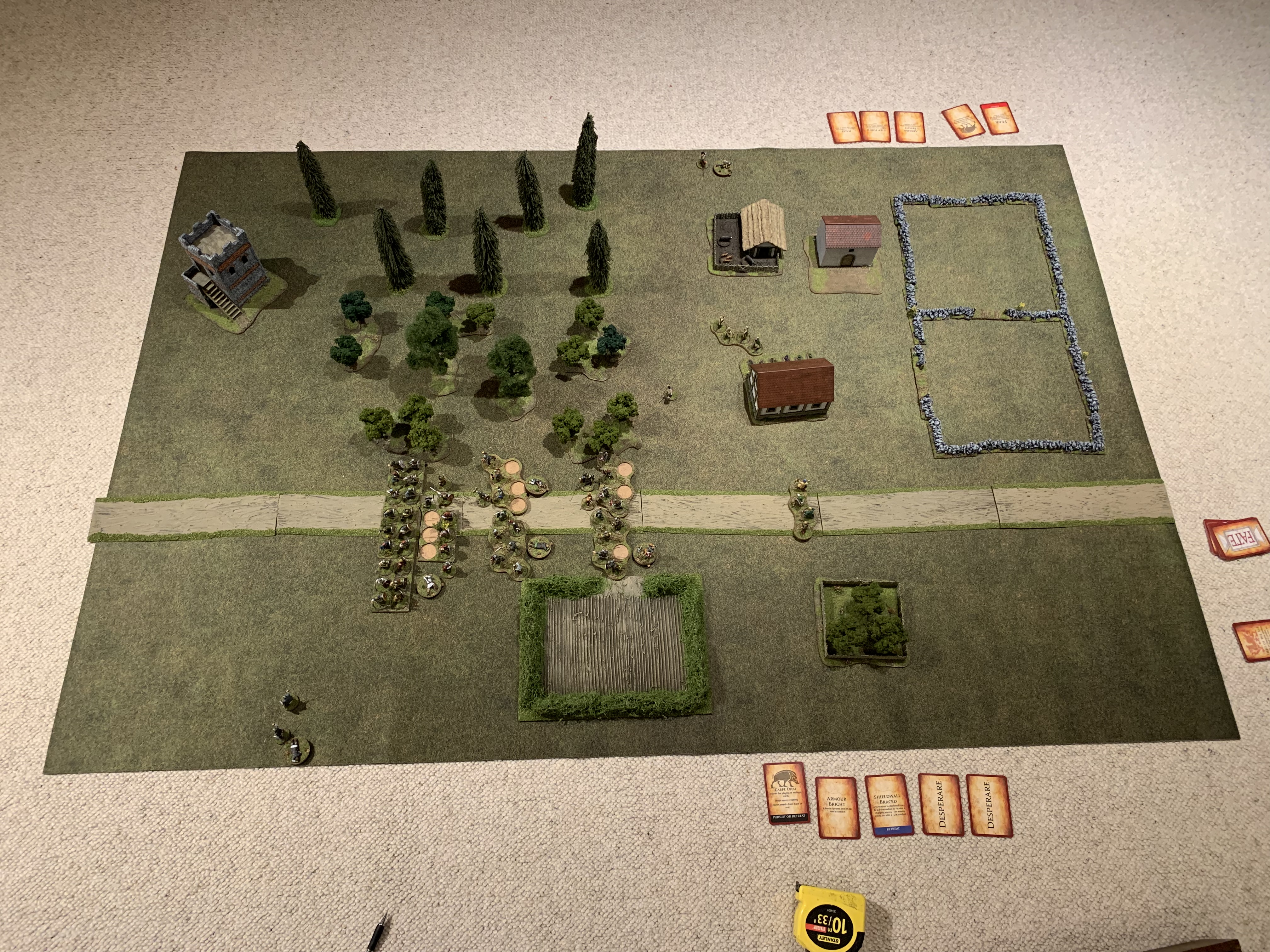 An overview at the end of Turn Five. The Comanipulares have fallen back upon the Levy. Saebert's command waits to renew the fight, whilst Ceawlin brings up the rest of the Saxon forces
Battle Report - Raid on a Border Tower - Turn Four
The British Missiles came out of the deck first. They launched a volley against Berhthun’s men and although they hit, it had no effect. Next up was Saebert the Old who formed a group of Hearthguard and a group of Warriors into a single formation and then moved it forward. Despite rolling a respectable 10 inches of movement, this still wasn’t enough to bring them within reach of the British. The Saxon missiles also moved 10 inches. Peredur was activated next and moved his warriors into contact with the Comanipulares and then formed them into a single formation to face the Saxons.
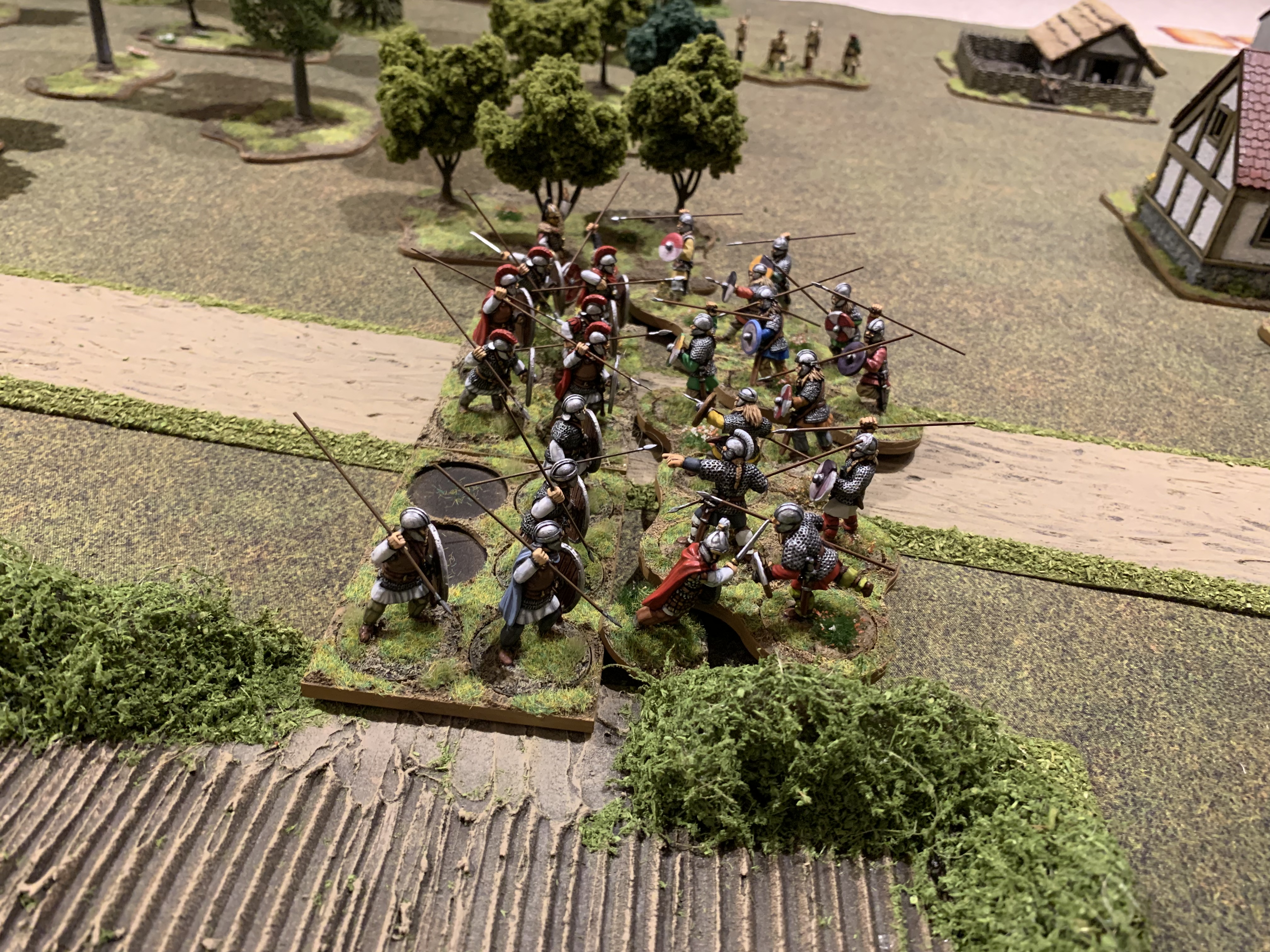 Berhthun the Devil and his men charge the formation led by Garcianus and Peredur. Note the British Missiles skirmishing in the background
Now came Berhthun the Devil’s chance for glory. Playing the Aggressive card, he led his two groups of Warriors against Garcianus and Peredur’s formation. Alas, it was a rash move for the Saxon. The presence of Garcianus and his champion meant the British rolled 18 dice to the Saxon’s 14. Despite this imbalance, both sides scored 8 hits, but again, the superior training of elites versus warriors showed, except this time it was to the British advantage. The Saxons suffered 3 dead warriors and 3 shock, whilst the British lost a warrior, with the warriors taking 2 shock and the Comanipulares 3. The result was that one of the groups of Saxon warriors fell back 3 inches.
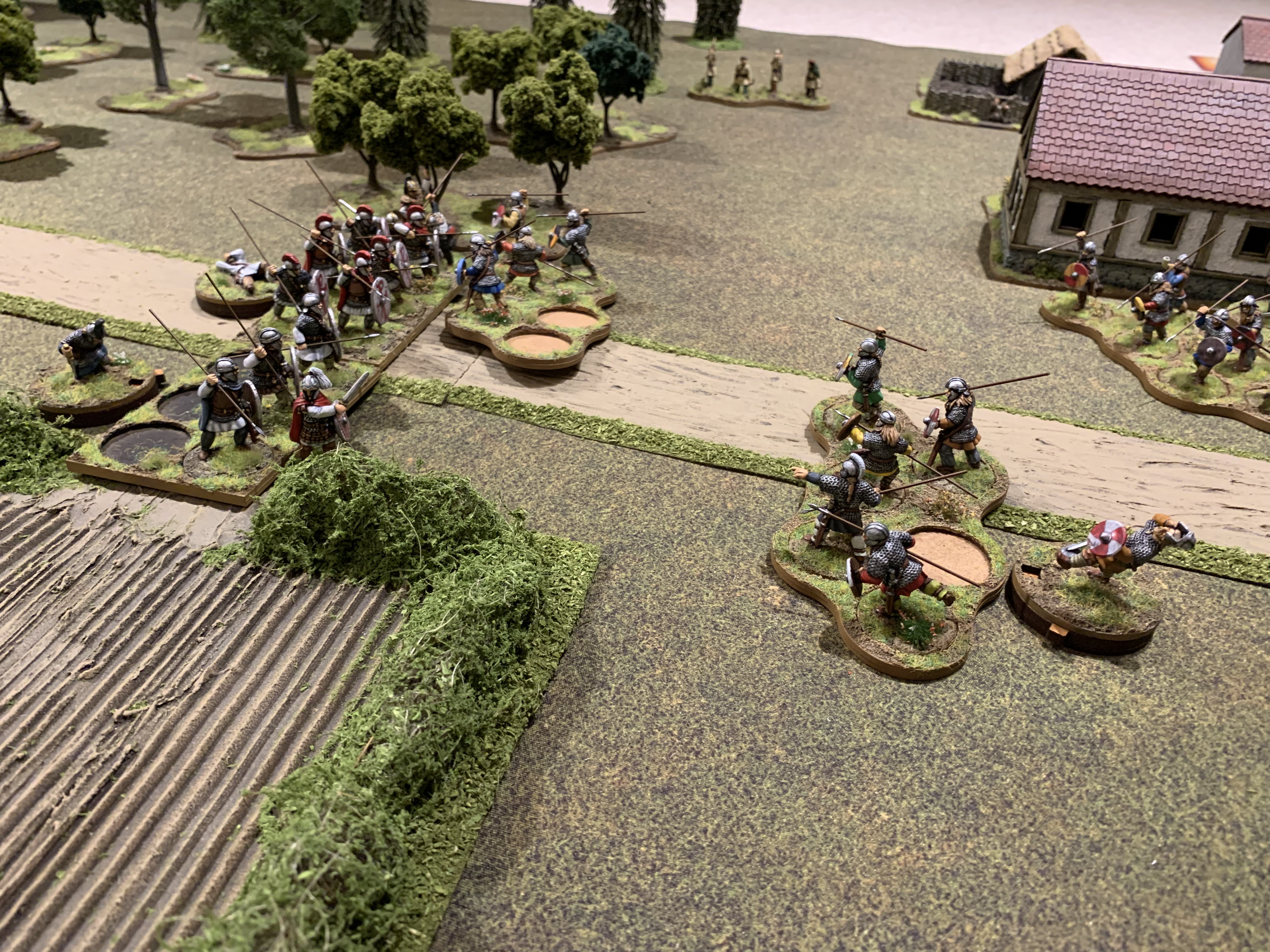 The Saxons come off worse and one group is forced to withdraw, leaving their companions to face the British alone
The other group was still in combat however, so a second round was fought. But this time, the effect of the Aggressive card no longer applied, so 6 Saxon dice were rolled against the British 17. There was no cause for complacency on the part of the British however, as those 6 Saxon dice resulted in 2 dead Companipulares. In reply, the British could only kill a paltry 3 Saxon warriors. That said, those casualties, plus the combined shock were enough to break the group of Saxons who had stayed in combat. They ran, taking Berhthun with them. This defeat filled the Saxon onlookers with dismay and Force Morale fell a massive 3 points from 7 to 4.
Next up was Ceawlin who used his command initiatives to move his group and Saebert’s forward (again an illegal move as Saebert had already activated his group in the turn, but this was missed). Garcianus’ card came up next. Viewing the battered state of his men he did not relish a contest with Ceawlin, Cenfus, Saebert and the combined Saxon elites at this stage. Using a newly drawn Bounding Leap card, he ordered his and Peredur’s formation back a massive 16 inches, taking them out of the immediate range of a Saxon charge. They still could not yet count on the support of the Levy however, as despite Urien’s urging, the inexperienced farmers and townsfolk struggled to advance in shieldwall, shuffling forward a reluctant 4 inches.
Battle Report - Raid on a Border Tower - Turn Three
By this stage, Garcianus could see Peredur and his men running down the road, the remnants of the broken group following on their heels. It was time for Garcianus to use his three command initiatives to assert some control over the rapidly deteriorating British position. Using his first command initiative, Garcianus put the Levy into a single formation for Urien to command. He then attached himself to his Comanipulares and ordered them down the road towards Peredur and his remaining band. Although they didn’t quite make contact, Peredur’s warriors were now within Garcianus’ command range, allowing him to use his final command initiative to remove a point of shock from them.
The next card out of the activation deck was the British Missiles who finally emerged from the edge of the wood to shoot at the Saxon groups commanded by Berhthun the Devil, but to no effect. The British run of luck with activations continued however, with Peredur out of the deck next. He used his command initiatives to move his remaining warriors closer to the Comanipulares. Although they were still not quite in contact there was a good possibility that they would be able to form a single formation next turn. These troops would have to hold the line until the Levy could come up in support. The next activation was Urien Cadwalladr who moved his Levy formation down the road towards Garcianus and Peredur and then ordered them to form shieldwall in preparation for the combat that was sure to come. (I think this last move by Urien may have been illegal as the Levy had already been activated when Garcianus put them in formation, but this was missed in the heat of the action.)
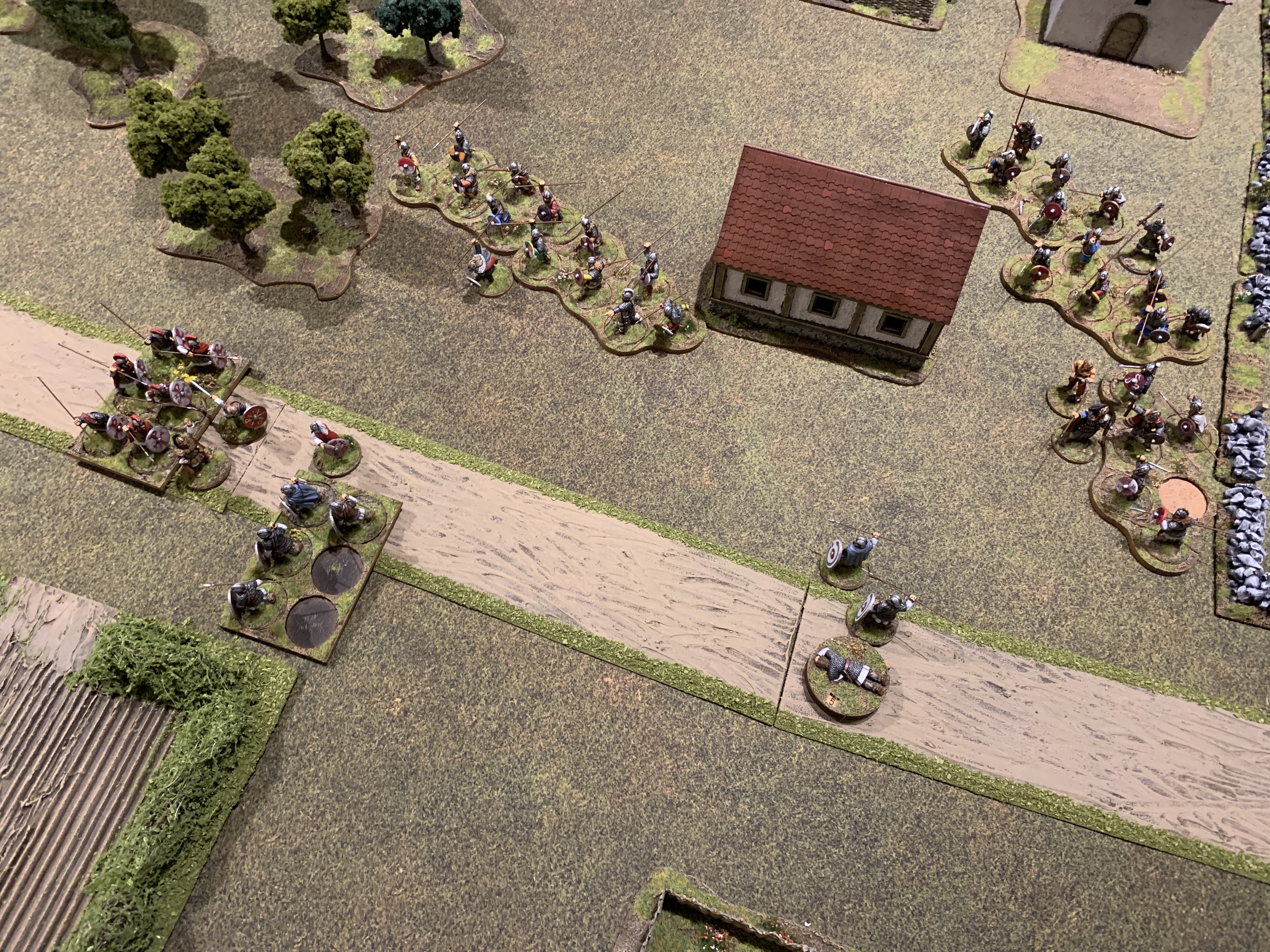 Garcianus and Peredur meet on the road, Berhthun the Devil and his formation close behind them
All of the British cards had been activated first, a run of luck that had allowed them to stabilise the situation without Saxon interference. However, the Saxons would now be able to react for the rest of the turn. Unfortunately for them, none of their formations could match the speed of the British movement. Berhthun’s group of warriors were closest, but they moved in desultory fashion towards the waiting British. Ceawlin, Saebert and the Saxon Missiles all did likewise, the Saxon force all converging on Garcianus and his men. The situation for the British was perilous but not hopeless. In addition to the 6 elites, 4 warriors, and his own prowess in battle, Garcianus could count on both Peredur and his own champion, Gwallawc Gwerthefyr to aid him in the fight.
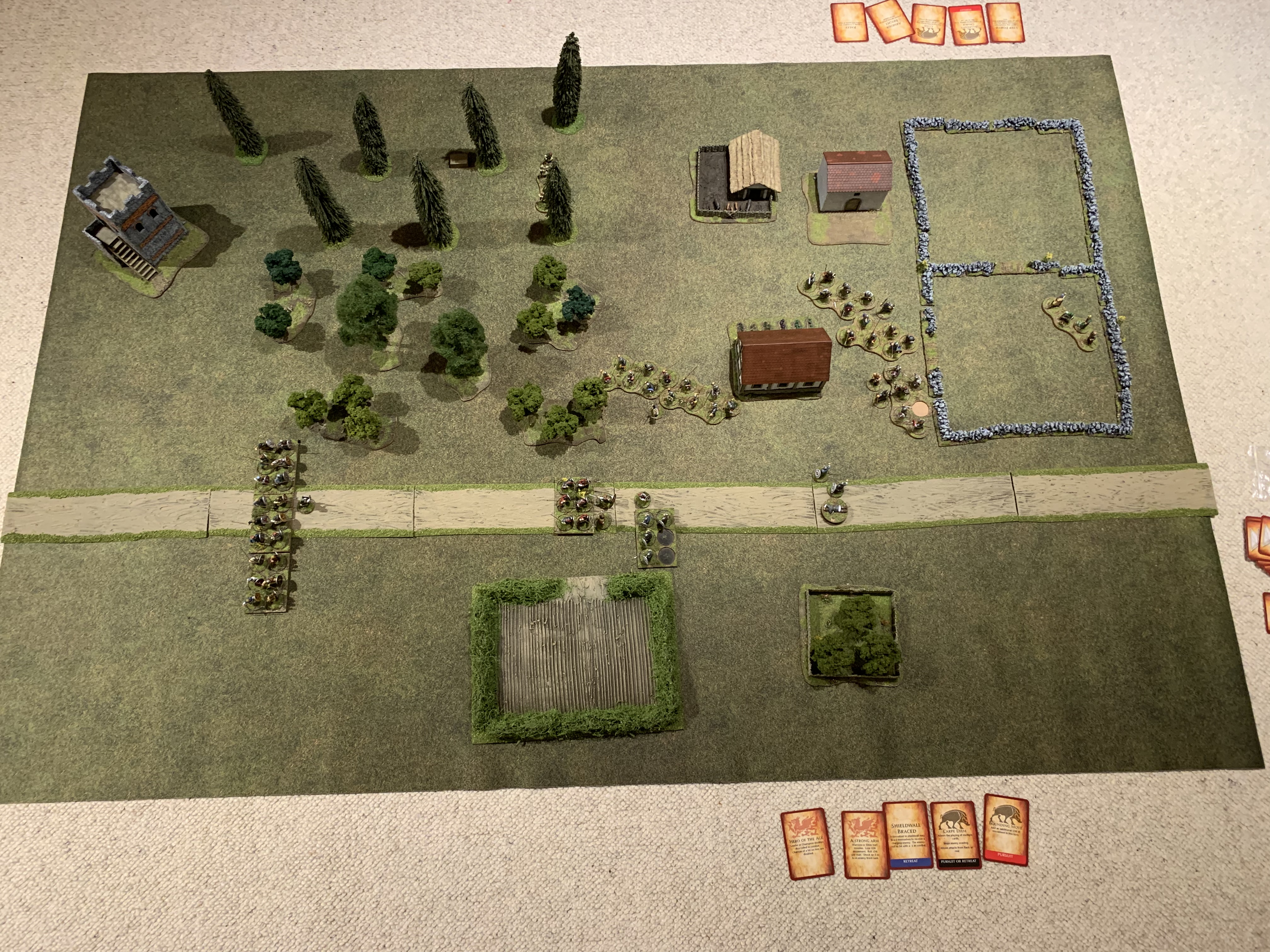 An overview of the situation at the end of Turn Three. Peredur and Garcianus are almost in contact in the centre by the field. Urien and the Levy are advancing behind them. Berhthun is close to charging Garcianus and Peredur, whilst the remainder of the Saxon force struggle to keep up. The British Missiles lurk in the forest behind the bottom pine tree on the right
Battle Report - Raid on a Border Tower - Turn Two
The activation deck was shuffled and Saebert the Old’s card came up first. He used both his command initiatives to order one group of Hearthgaurd and another of newly arrived warriors over a drystone wall to towards the left flank of Peredur’s warriors. Garcianus came up next and continued his efforts to get the Comanipulares and Levy moving in an organised fashion down the road. The British missiles continued their slog through the woods with a slowness that did no credit to their status as light troops.
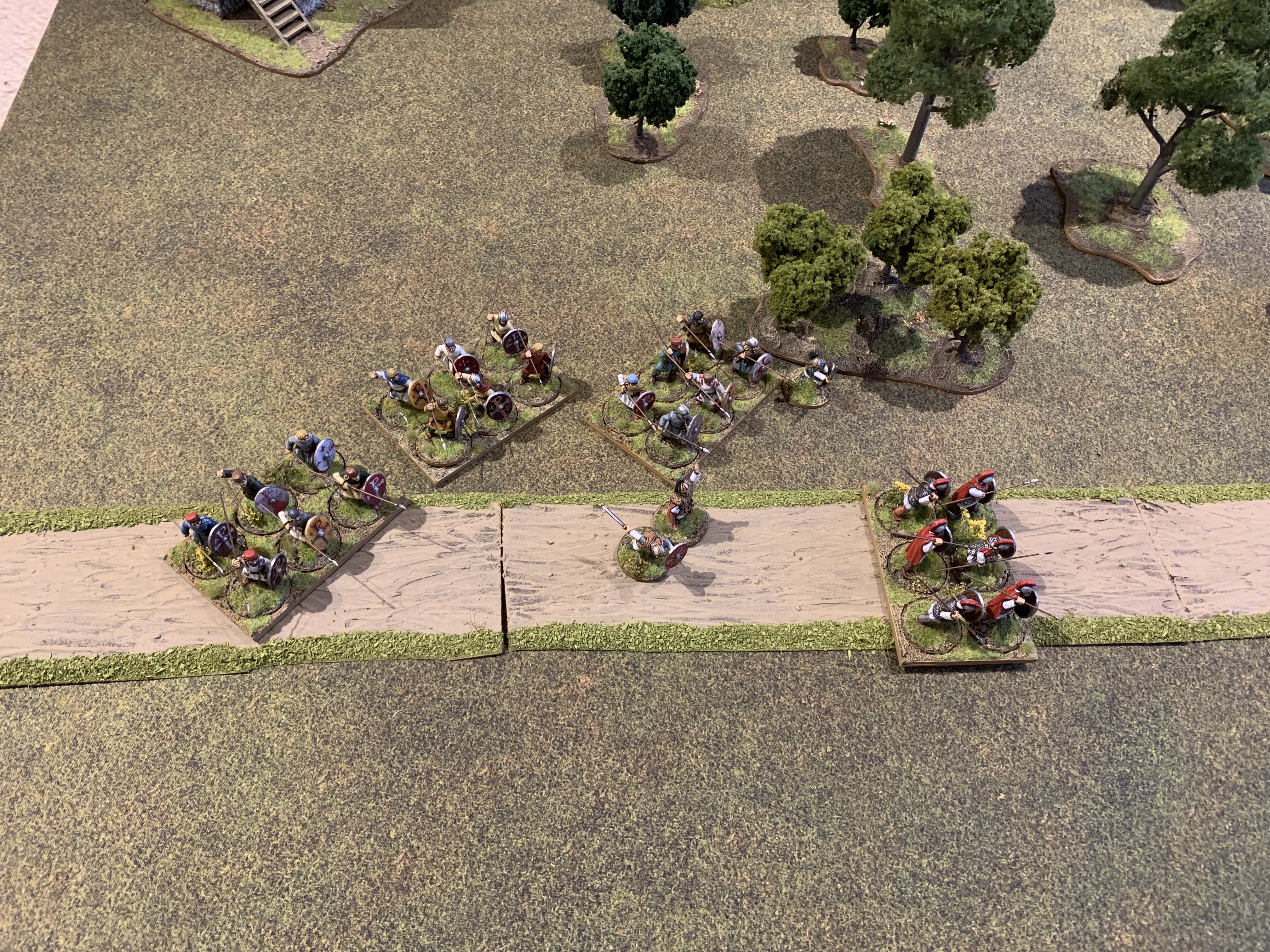 Garcianus and Urien struggle to get the relief force moving
The next card to emerge with Ceawlin who found himself facing Peredur’s shieldwall with a single group of his Hearthguard. There was really only one option that an aspiring Saxon Warlord could take in that situation and Ceawlin ordered a charge. This was not quite as suicidal as it sounds. Although the British had more men, Ceawlin’s Hearthguard were elites compared to Peredur’s warriors, meaning they added extra dice to their attack. In addition, Ceawlin would add further dice to the Saxon total as would his accompanying champion, Cenfus. This put the number of Saxon dice slightly higher than the British.
However, Peredur had a ruse to play. Not wanting to engage in combat just yet, he played the Bounding Leap card to have his men withdraw before Ceawlin’s charge commenced. This they duly did, but again, the drystone wall impeded their progress. Had they put enough distance between themselves and Ceawlin?
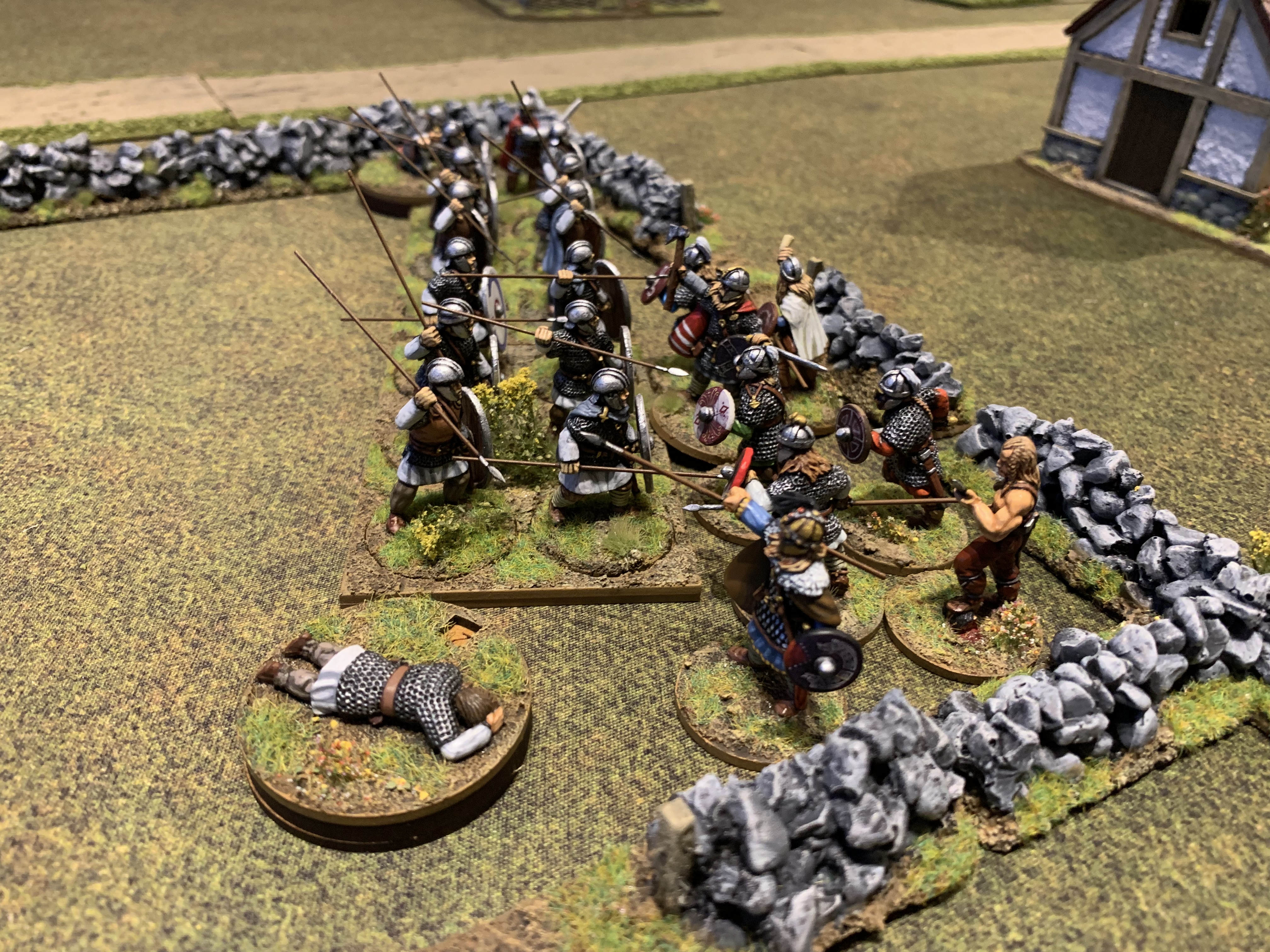 Ceawlin and his Hearthguard charge home against Peredur's warriors...
Unfortunately, it wasn’t enough. Ceawlin and his Hearthguard smashed into the shieldwall. The dice were rolled and each side scored 7 hits. However, the Saxon strikes were far more effective. Despite the shieldwall allowing the British to ignore the first casualty on each group, five British warriors fell dead at the cost of one of the Saxon Hearthguard. The British fell back with one group reduced to three men and the other to four. The British woes were not over yet however, as the Saxon missiles opened up. Another British warrior fell dead reducing one group from three men to two. That group had also taken significant shock. This now massively exceeded the remaining number of men, meaning that the group was broken. Beyond fleeing for the British table edge they would play no further part in the game. In total, the last two Saxon actions had reduced Peredur’s force by two thirds! The broken group of warriors brought British Force Morale down by two points to 5.
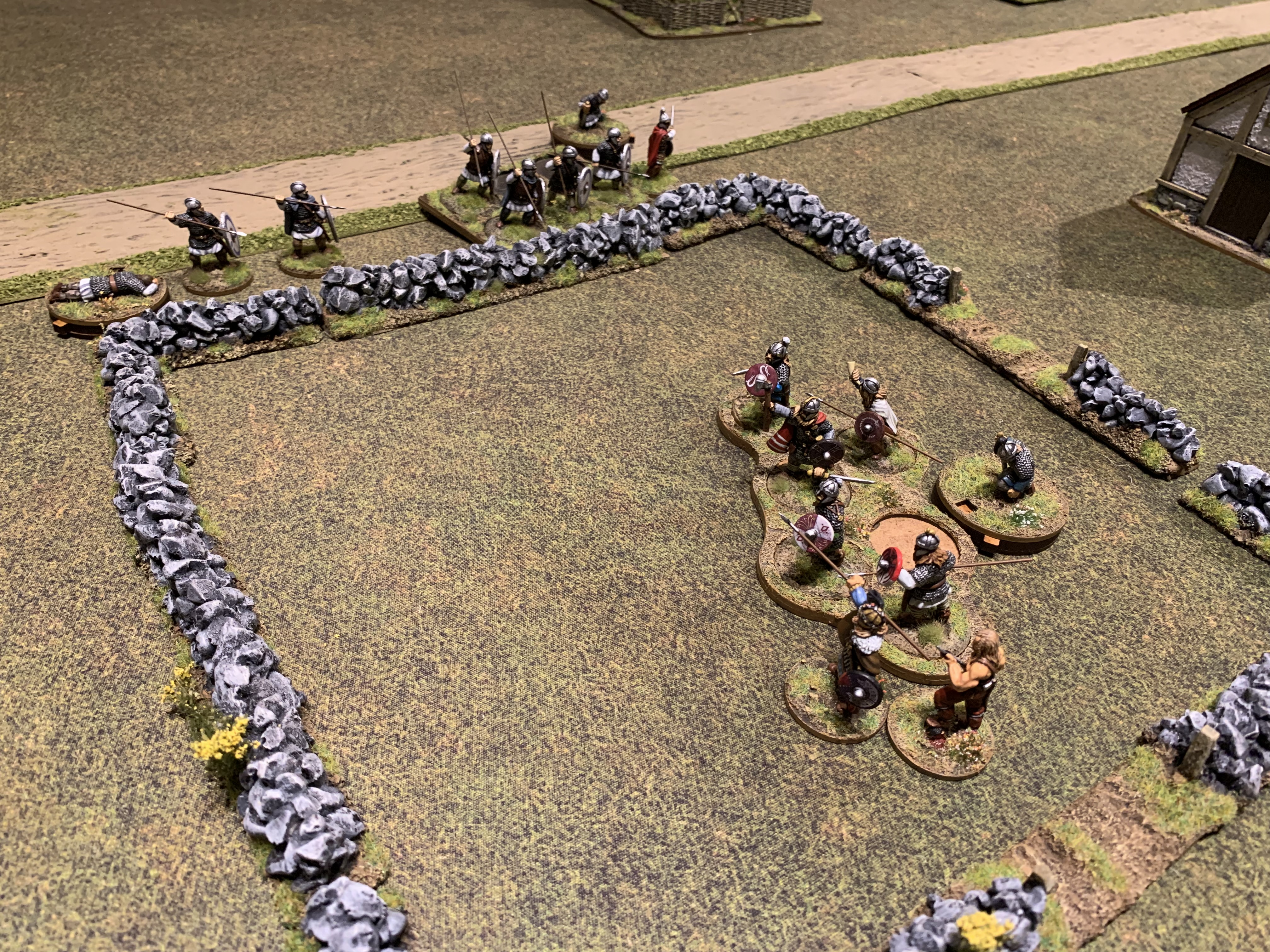 ...and put them to ignominious flight!
Fortunately for Peredur, his card came up next, giving him an opportunity to extract himself from this deadly situation. Gathering his four remaining men around him, he ordered them to run a swift 13 inches to the road at the price of one point of shock. He wasn’t out of the woods yet though. Whilst Urien Cadwalldr continued to try to get the Levy to move down the road, Berthun the Devil started moving two groups of Saxon warriors around the side of the farm, hoping to head off Peredur before he could reach safety.
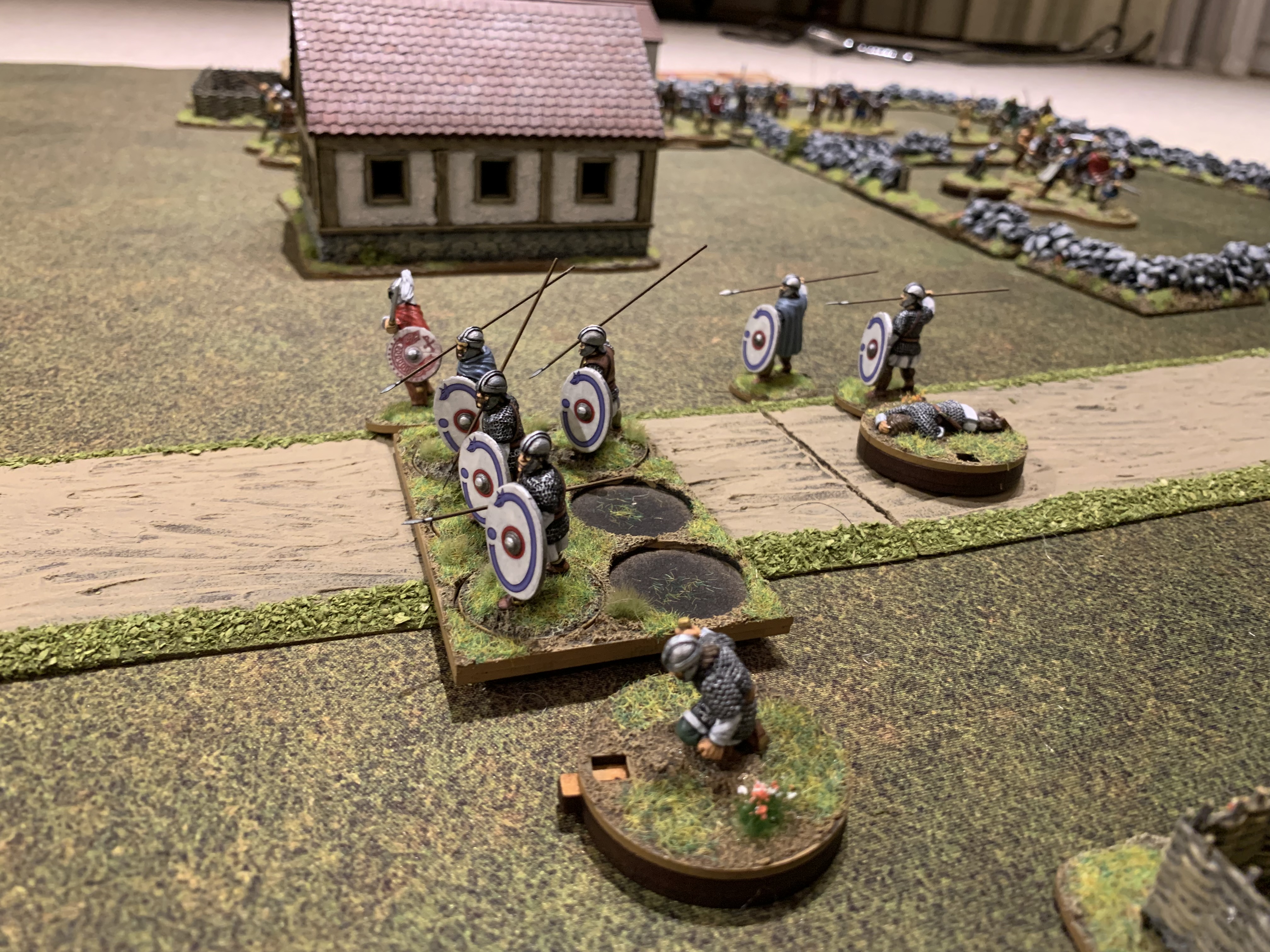 Peredur and the remains of his escort flee down the road, hoping to reach the safety of the tower