










Savage Core Expedition Journal



Recommendations: 12
About the Project
The often overlooked and very quirky Savage Core is high up on my list of games I want to spend more time with in 2025. This will be a log of our games as we try out different factions and scenarios.
Related Game: Savage Core
Related Company: Lucid Eye Publications
Related Genre: Pulp
This Project is On Hold
Thoughts after two games
I think our second game was a much better example of what Savage Core is like, and it was definitely more enjoyable for us. The two factions seemed to balance out a lot better — while the Amazons are definitely better at range, the fact that they always had to move first kept them on the defensive, and I think the Atlanteans lost due to impatient tactics as much as anything else.
I like how simple the game is, with only one named character on each side, with six once-per-game abilities. It’s not like Shatterpoint, where you really have to stay on top of the synergies between characters, or Knight Models’ Batman, where each character has so many complicated special abilities that it’s impossible to keep track of it all.
On the other hand, the game can (and does) swing wildly based on the egregious amount of die rolling. Successful hits only result in damage half the time, less for ranged attacks. And don’t get me started on rolling for movement…
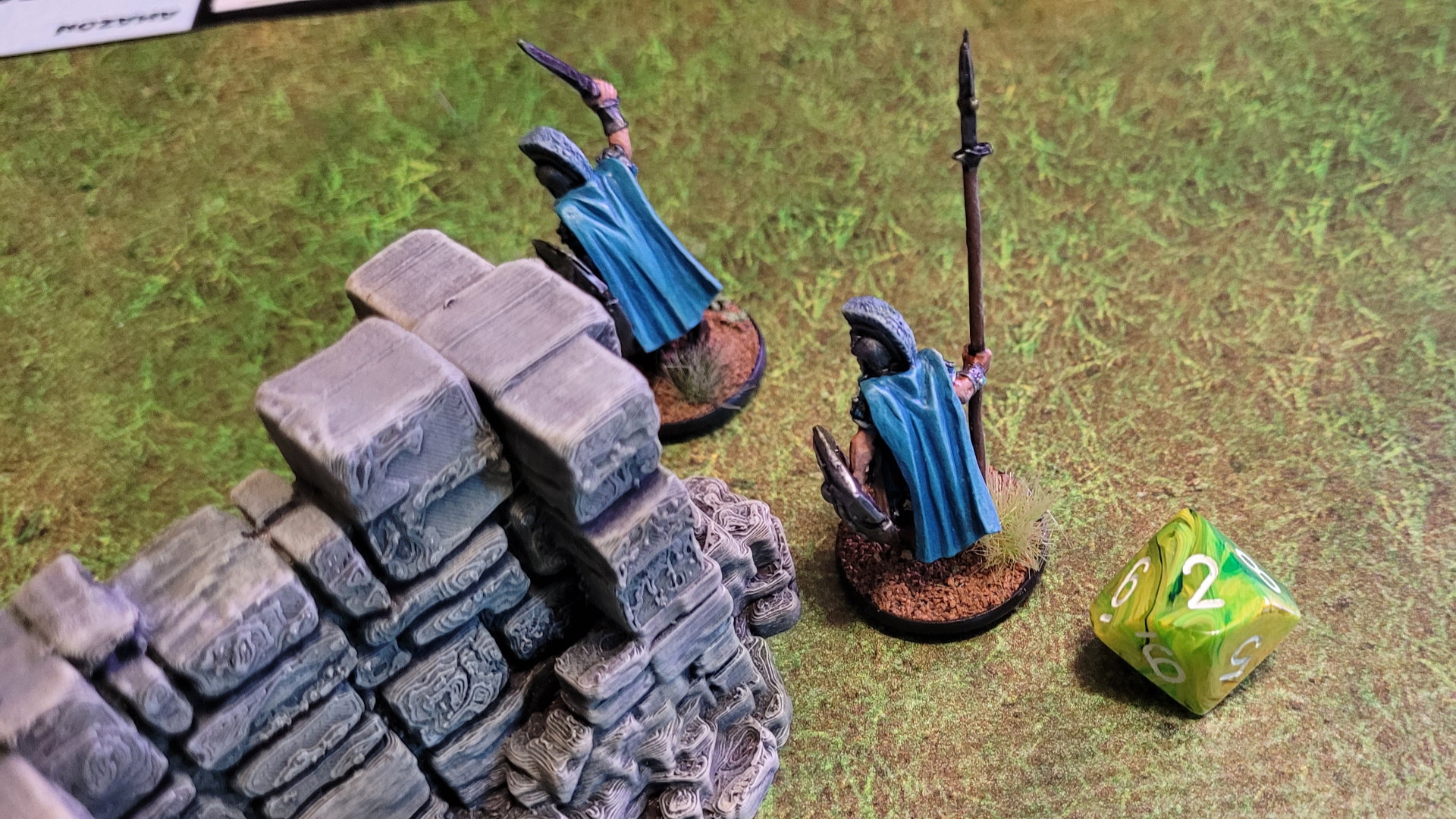 Moving at a snails pace thanks to some unlucky rolls.
By far the most interesting thing about Savage Core is the Double Trouble encounters. These add a lot of flavor and enjoyable chaos to the game. The problem is that they don’t happen nearly often enough in an average game. We were lucky to get one on our first turn, but in our previous match we didn’t get one until the last round, when it was too late for it to have any appreciable effect. And it’s certainly possible to go a whole game without having one at all. There is a scenario called “Rumble in the Jungle” that has a Double Trouble encounter happening every single turn, but that seems like a bit too much.
Next time we play, we may try one or two house rules to mitigate some of the randomness. I am thinking about a deck of cards for the Double Trouble, with a few blanks thrown in so that there isn’t an encounter every turn, but you’re guaranteed at least a few over the course of a game. I’m also thinking of adding a “take 5” rule for movement, where you can always set the movement die to a 5, or roll if you want to try for more distance, knowing that you’re risking getting less.
Overall we did enjoy the game, and the miniatures themselves are absolutely top notch. The balance between the Atlanteans and the Amazons still seems a little lopsided, but each has an alternate Boss that we can try, and we’ve got models for five more factions so there are plenty of possibilities for better match-ups, even without falling back on house rules.
Stay tuned…
Atlanteans vs Amazons REMATCH
Trying out a somewhat non-standard scenario for our first game in two years may not have been the best idea — we found that the Bosses we chose were not very well matched, with the Amazons having a huge advantage at range that wasn’t really equalized by the Atlanteans’ slightly better close combat values.
Additionally, we made one major rules blunder in that we were using our Bosses’ Smarts for initiative, when it should have been their Moxie. This had a huge effect on the game, as the Amazons’ much higher Moxie value means they’re better at range but will also consistently win initiative — moving first isn’t much of an advantage in this game.
We decided on a rematch using the same Bosses, Seratra and her Amazons against Kryxos the Indomitable and his Atlanteans. This time we’re going to play with the standard “eliminate the opposing Boss” win condition.
On turn one we both rolled an 8 for initiative, which means we trigger a Double Trouble encounter right away, which is great. These are random encounters with non-player models or environmental conditions, and in my opinion, they are the main thing that sets Savage Core apart from other games.
Our Double Trouble is “Ravenous Beasts,” which places 1-3 non-player beasties on a randomly chosen table edge. They will move after both players, making a beeline for the nearest model and attacking if they get into base contact. With a Moxie of 5 they’ll be pretty good at evading ranged attacks, and their massive Buff of 8 will give them a huge advantage in close combat — it’s a small mercy that they leave play after 3 rounds. Naturally, they’ll be starting on my table edge, so my Atlanteans will need to run for their lives.
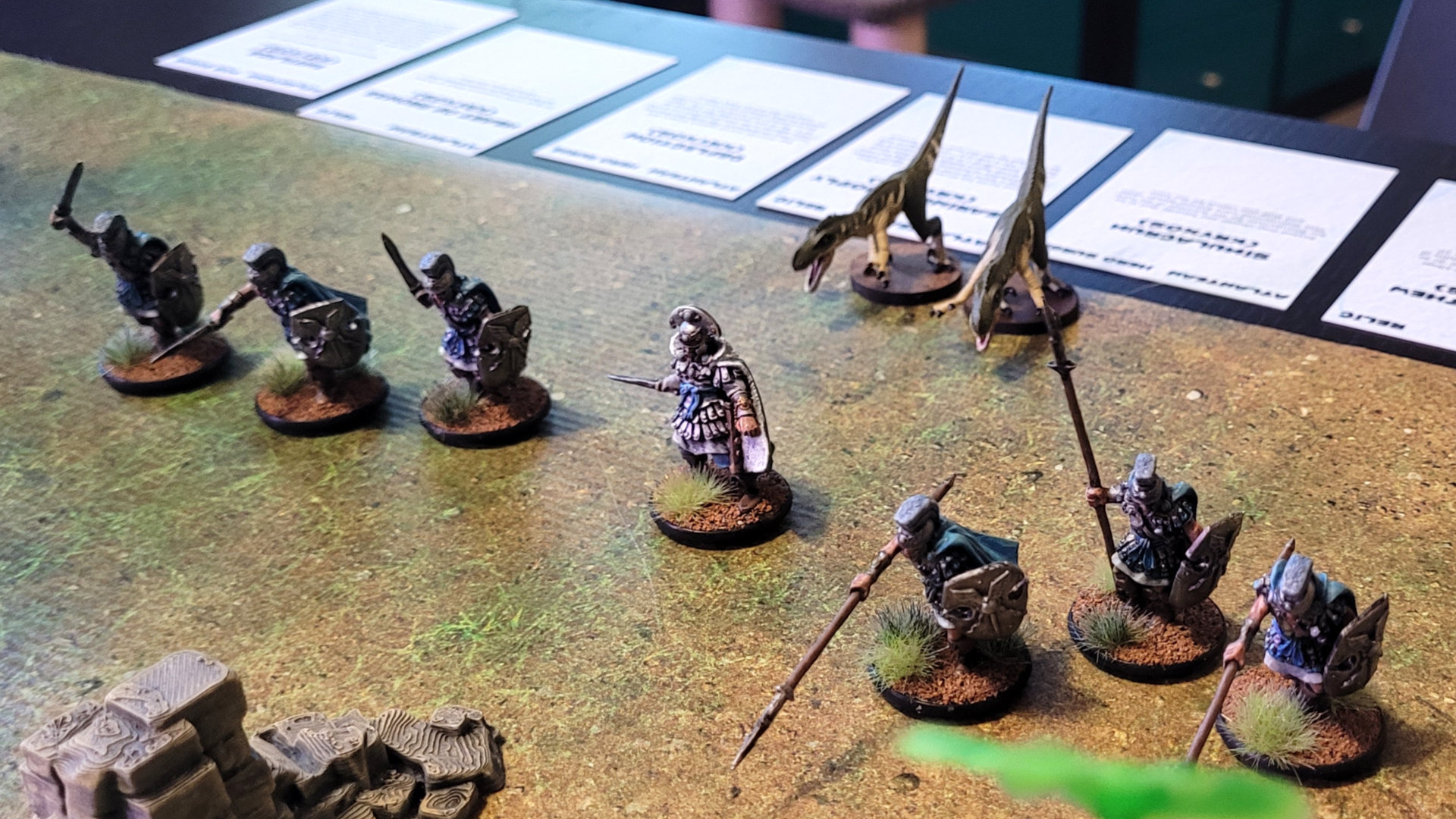 Not off to a great start, but at least we're motivated...
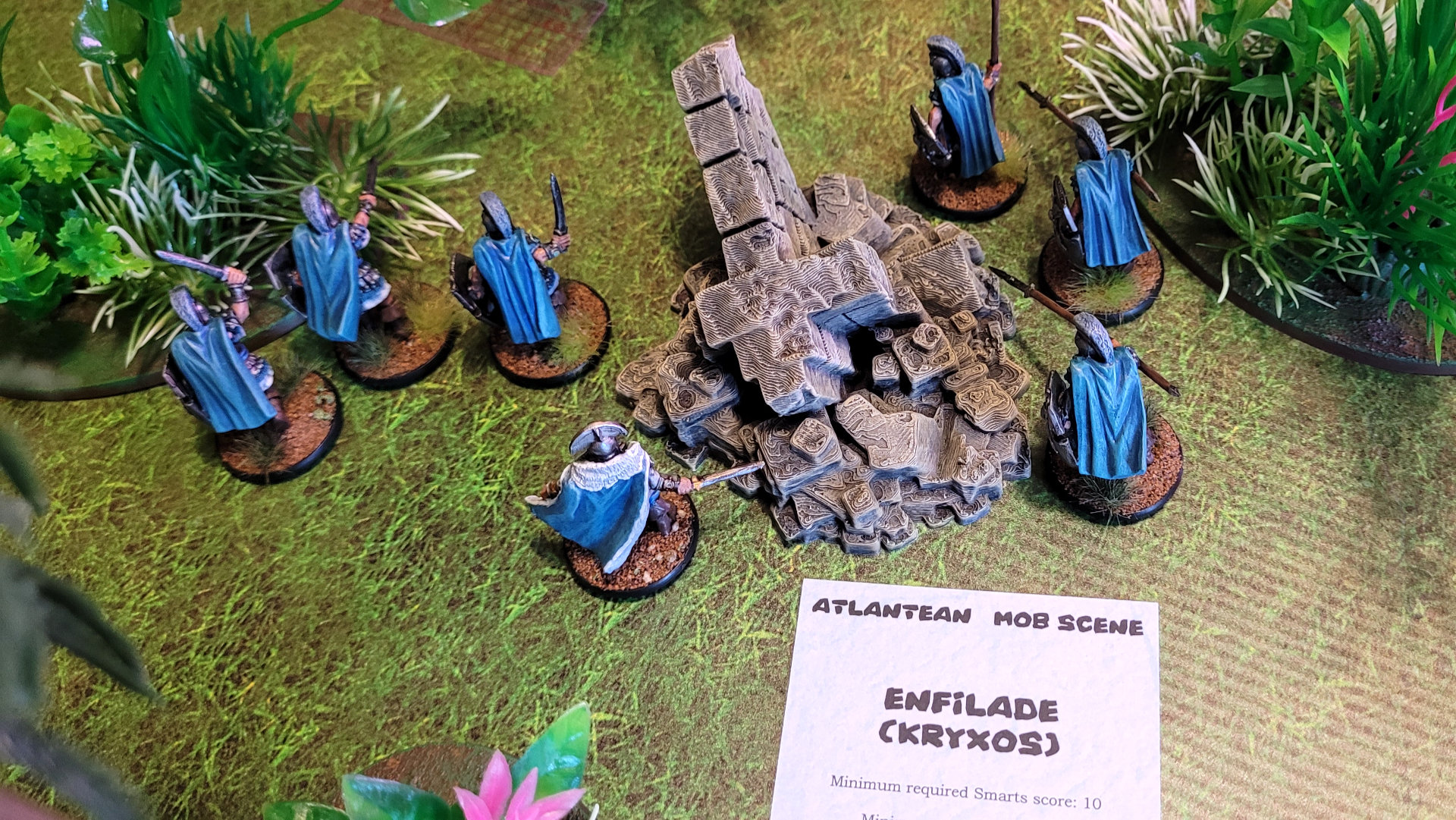 At the beginning of each turn (after initiative is rolled), each player has the option to play one of their six Tricks, once-per-game special abilities that provide the bulk of each faction's flavor. Luckily for me, I manage to successfully play Enfilade (it requires a 4+ roll on a d10), which allows me to reposition my forces anywhere on the board as long as it's at least 8 inches away from my opponent's models. Not only does this give me a huge head start, but it gets me away from the ravenous beasts.
My opponent has to move her forces first, and since she doesn’t have any incentive to make it easier for me to get into base contact, she instead attempts to draw me out into the open by moving to the far edge of a clearing in the corner of the board. This, after we were talking before the game about how skirmish game boards should be round because no one ever goes into the corners…
Remembering how completely I got clobbered by ranged combat in our last game, I proceed cautiously, sticking to the shrubs and staying just out of range. My hope is that since she’s backed herself into a corner, I’ll be able to get into close combat on the next turn, where I’ll have the advantage.
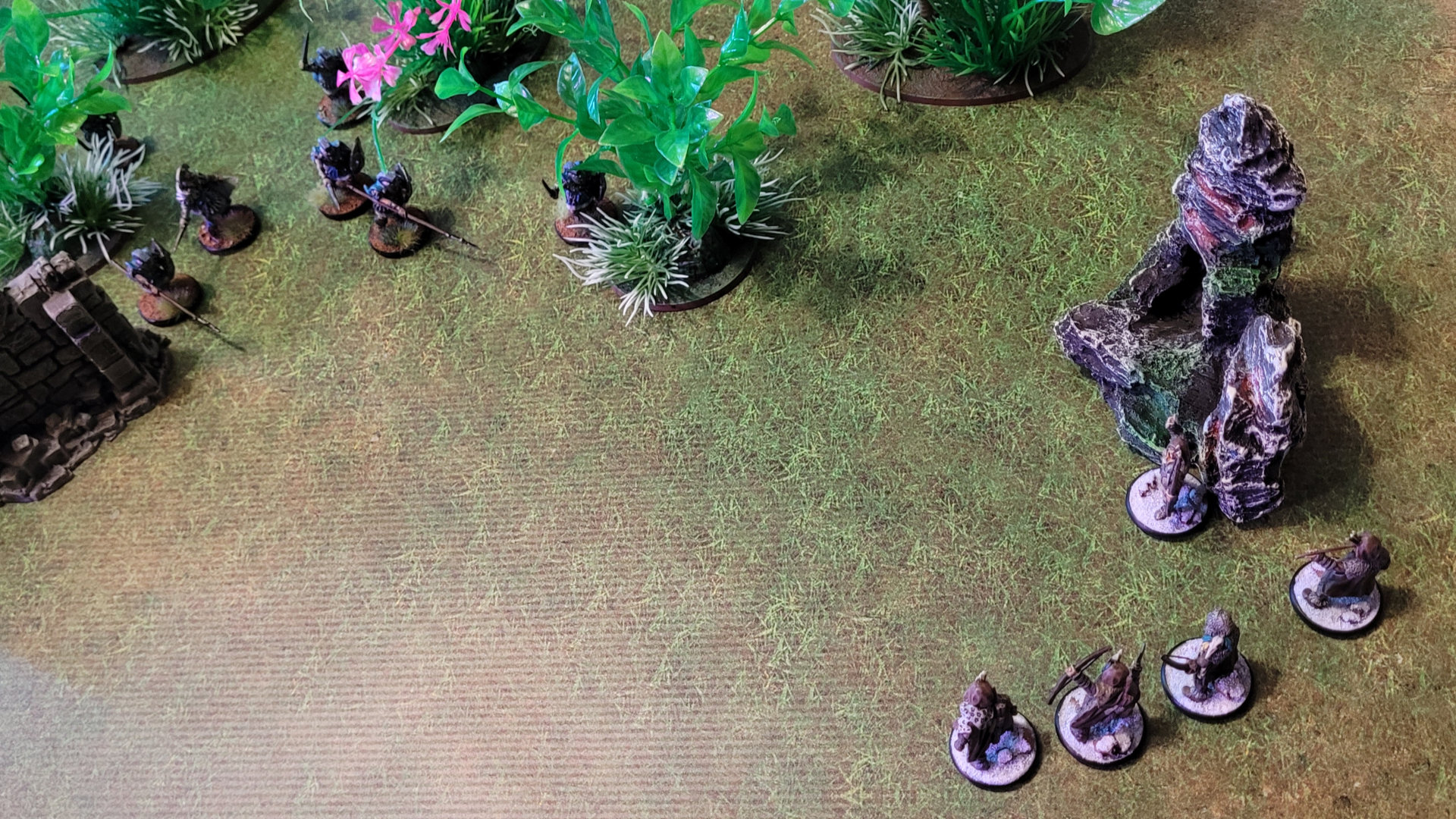 My opponent spends her next turn milling about at the other end of the clearing, and a few lucky movement rolls allow me to get two of my Atlanteans into base contact for some close combat. Unfortunately, the ravenous beasts have caught up with one of my slower-moving units...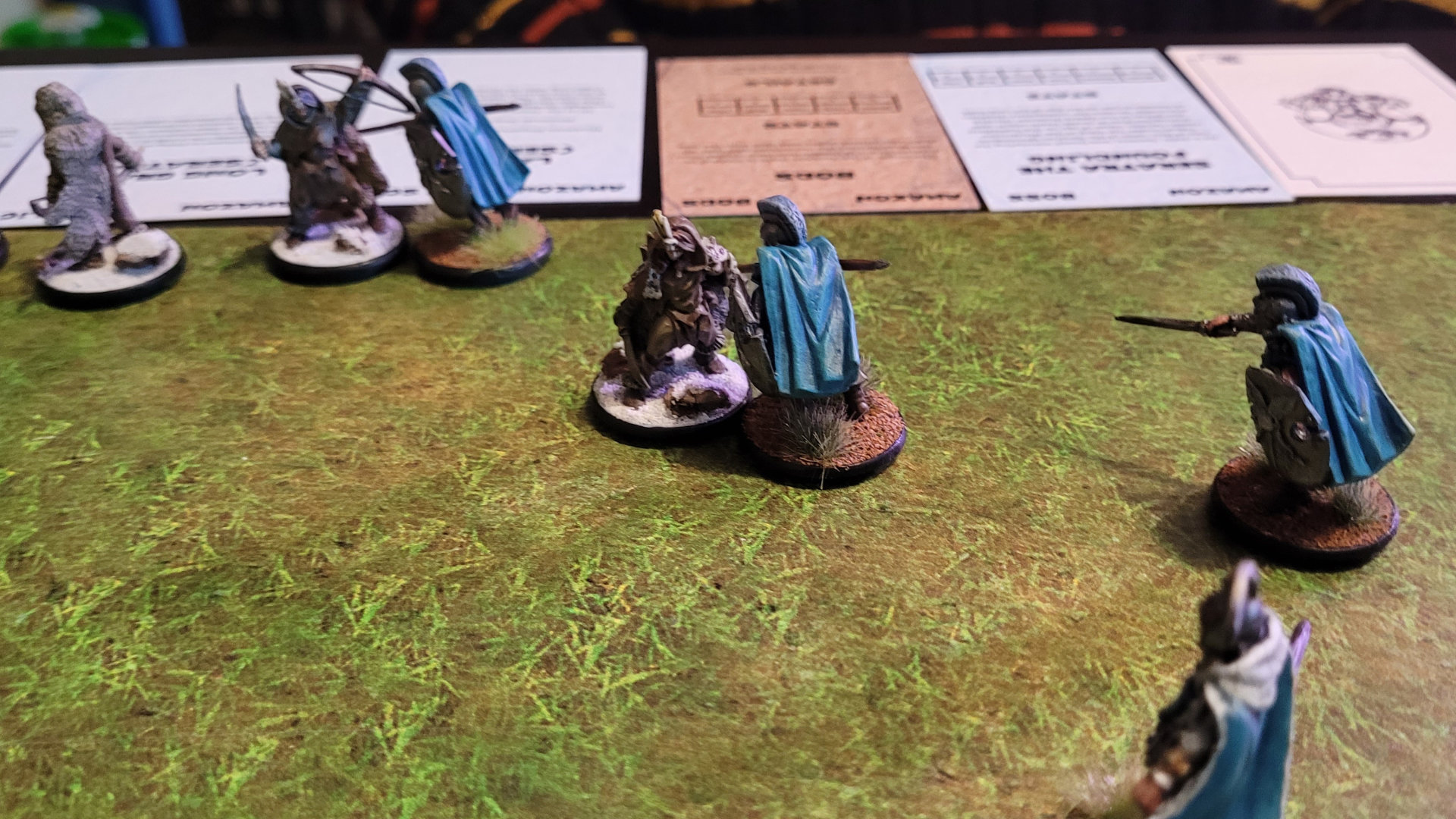
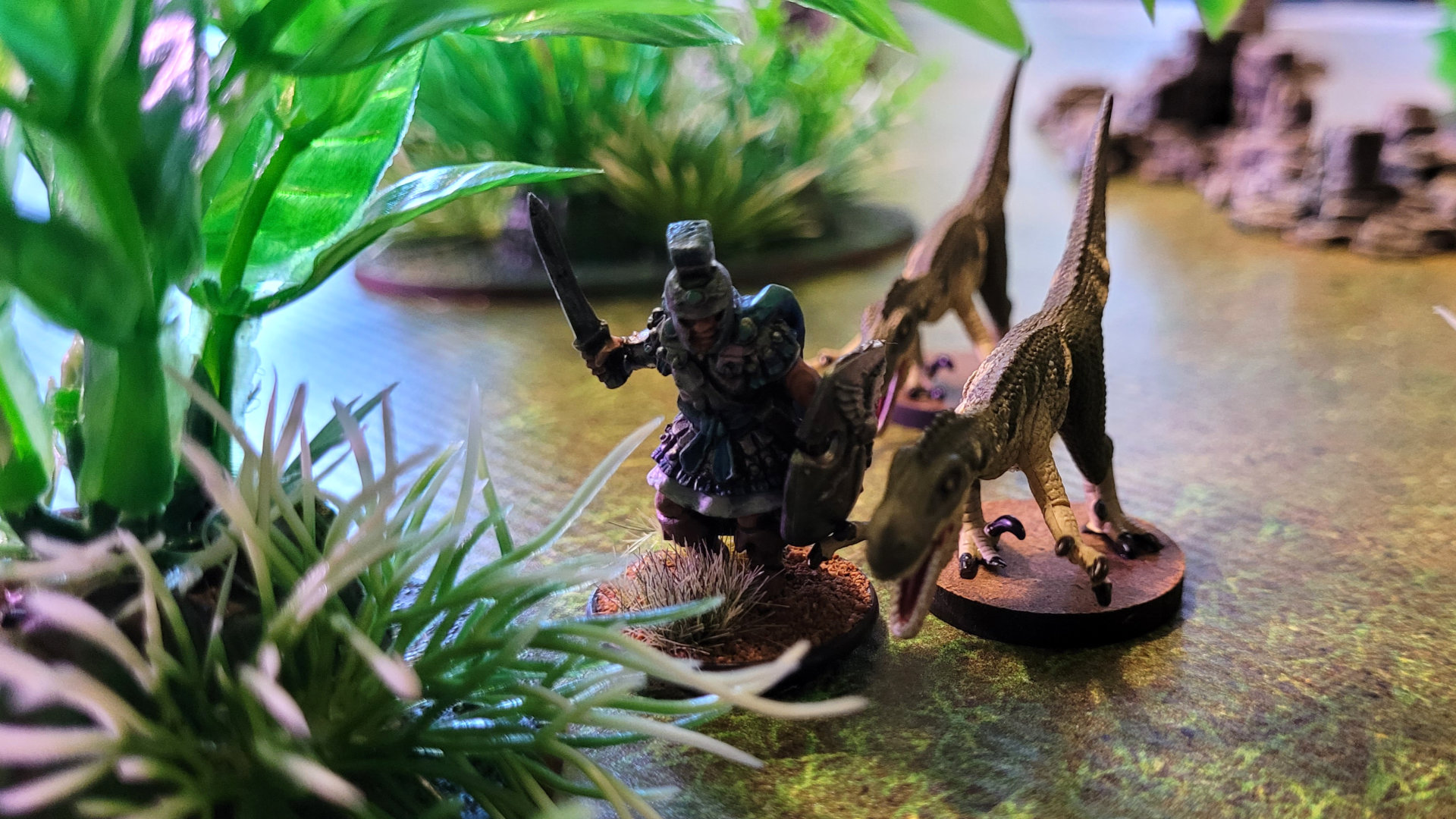
Our first combat was sadly inconclusive. Combat in Savage Core is resolved first by an opposed roll using the relevant stat (Moxie for ranged or Buff for close combat) plus a d10 roll to see if the target is hit. After all hits have been determined, the targets roll for each successful hit to see if they’re wounded. Bods die after one wound, but Bosses can take four or five before they go down. In our case, there were a few hits but no wounds. Even the ravenous beasts failed to make a meal out of my extremely lucky model, and they leave the board at the end of this round.
My opponent, who has won initiative every round (thanks to Seratra’s Moxie of 7 compared to Kryxos’ 1), chooses to play Lost, a trick that makes one of my units disappear from the battlefield, and during movement she backs off her Bods except for one who is stuck in close combat.
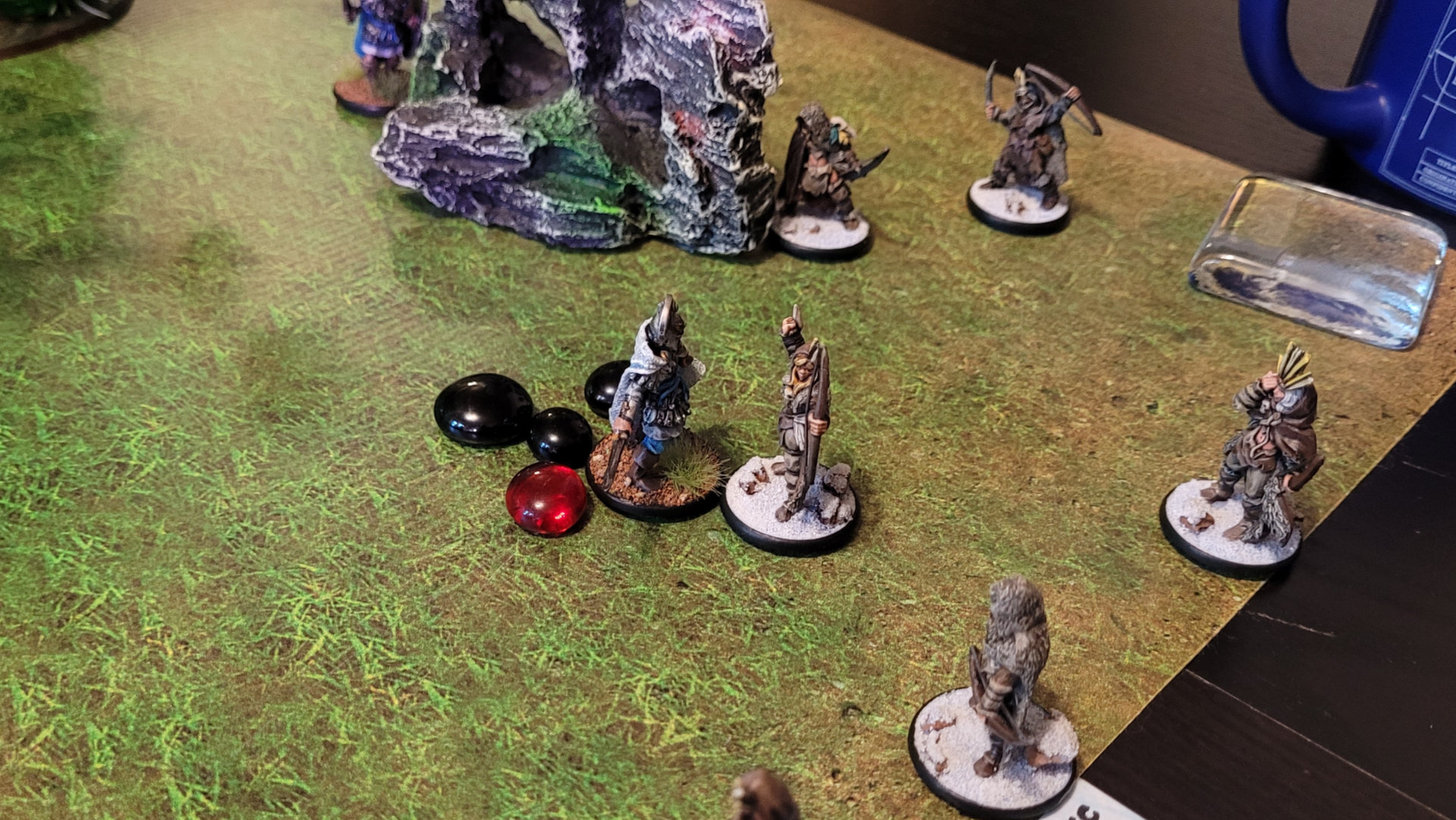 Sensing that I need to escalate matters, I run Kryxos into the middle of the fray -- if he can survive the combat phase I've got a Trick up my sleeve for the following round. Kryxos takes four hits which turn into three wounds, so hopefully it will be worth it...
At the start of the next round, I pull out my nuclear option, a Trick called Searing Panoply. It should result in a devastating area attack centered on Kryxos, but it’s a risk. Every model (friend and foe) within 6″ of Kryxos dies on a d6 roll of 6+. I’m hoping this will thin out the Atlantean Bods so I can swarm Seratra, but unfortunately my gamble doesn’t pay off. I manage to take out two Atlanteans, but the remaining five dogpile Kryxos and that’s the end.
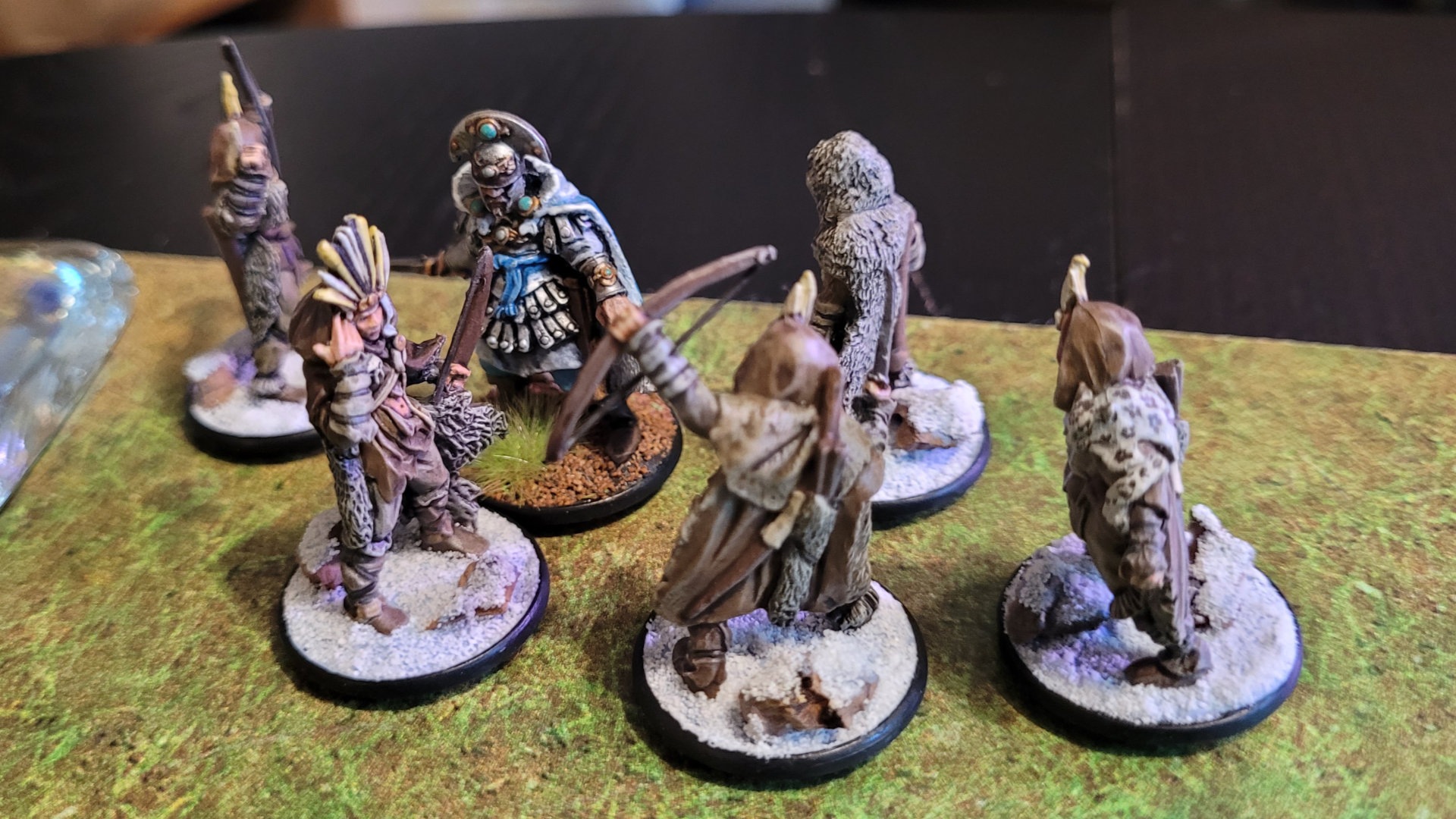 Hmmm, this didn't go as planned...
Atlanteans vs Amazons in the "Don't Look Back" scenario, part 2
At the start of round 3 my opponent manages to win initiative, which is really the beginning of the end for me. She plays “Spookgem” as her trick for the turn, which all of my models within 10 inches of Seratra to move 10 inches away from her. In a game where I’m already struggling to close with my opponent’s models, it’s a devastating move that I won’t recover from.
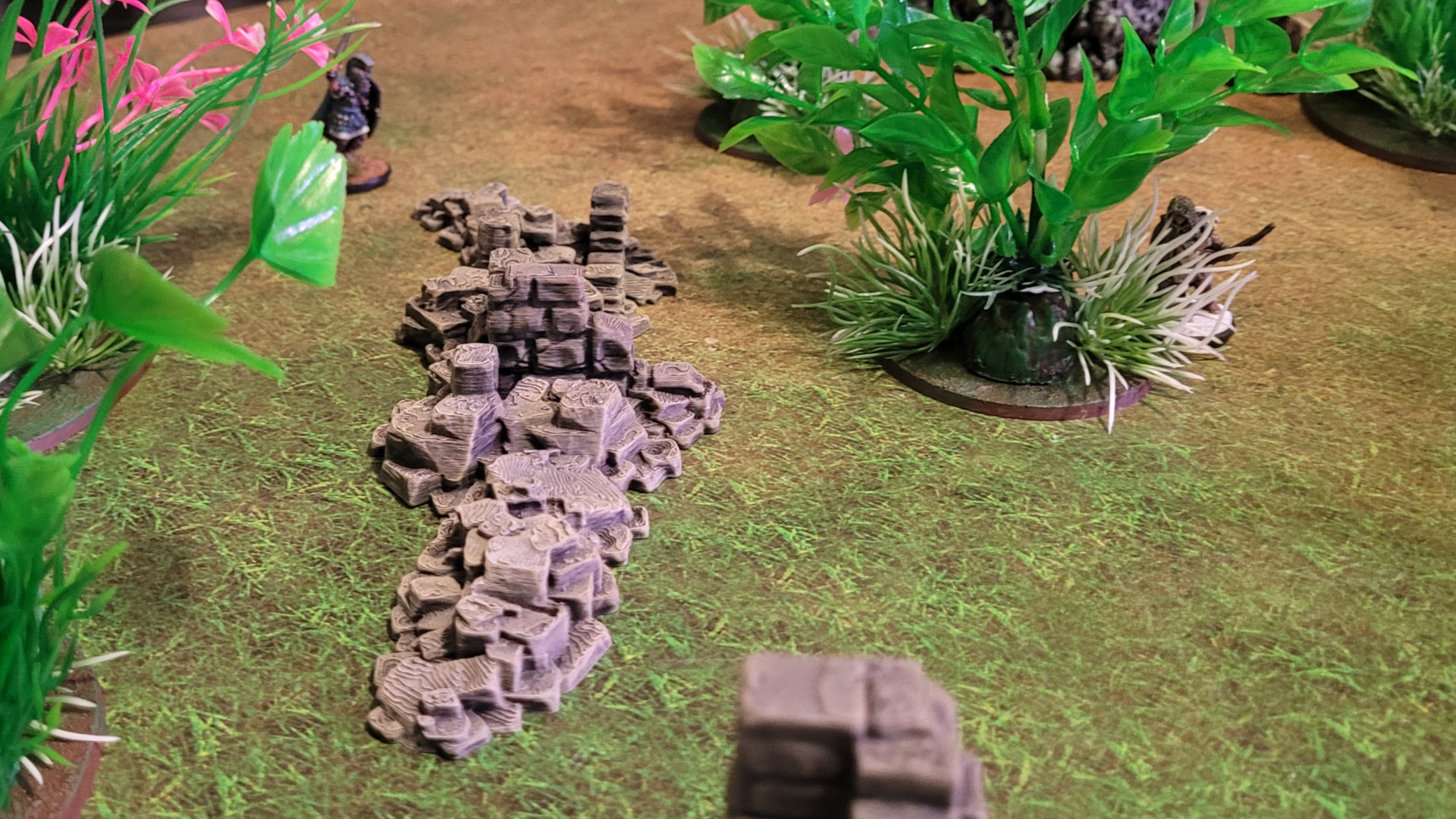 Wait, is that a Spookgem? RUN!
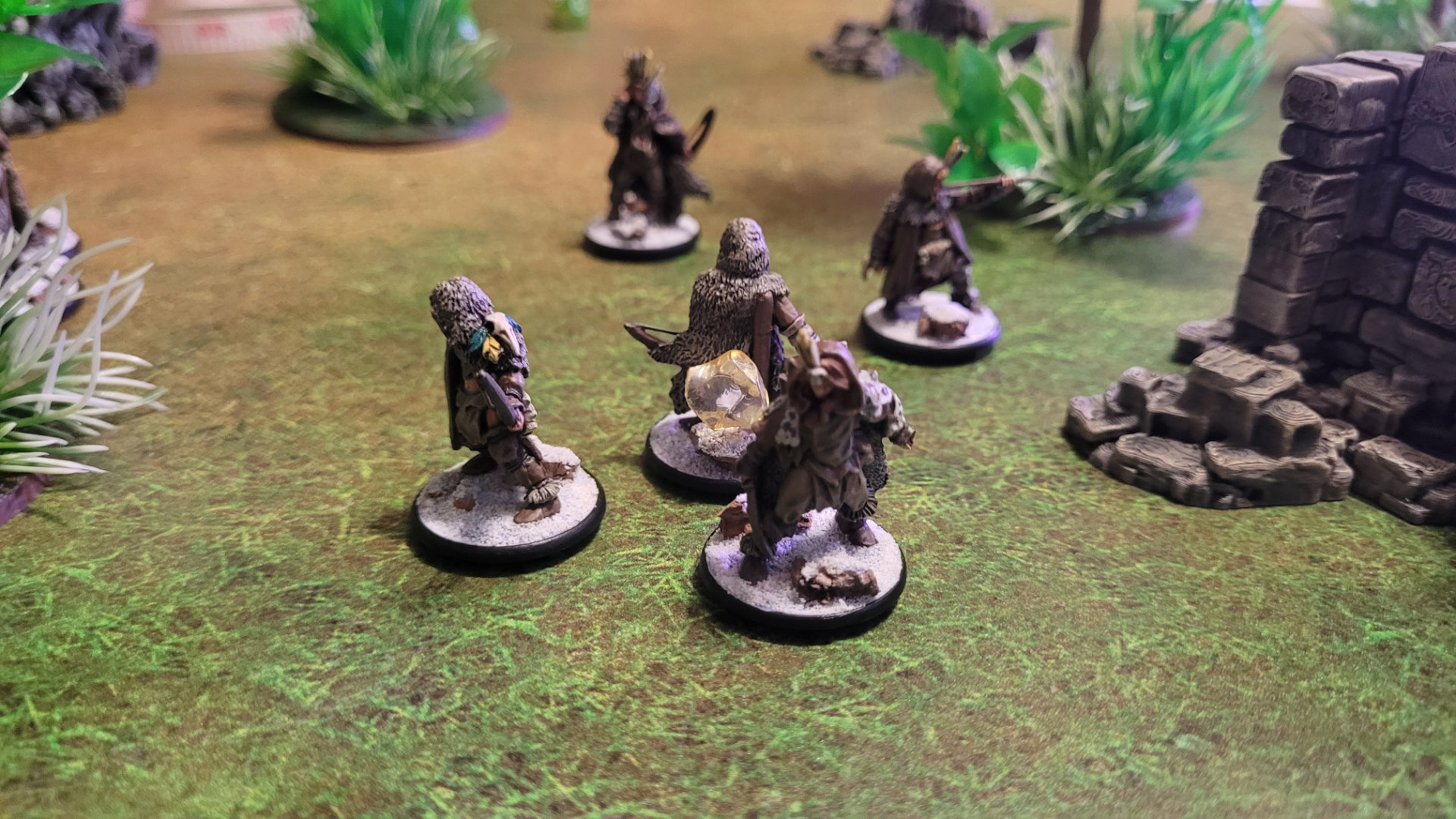 The Amazons take up a defensive position.
I win initiative at the start of round 4, so my opponent hedges her bets by playing “Lay Low.” It’s a difficult trick to play in that it requires her to roll a 7 or better to succeed, but succeed she does, and the effect is to end the turn immediately, so I won’t be able to take advantage of moving and attacking first.
One game element I haven’t touched on yet is Double Trouble, which we finally trigger on round 4. On any round that both players roll the same number for initiative, it triggers a random encounter taken from a list that can include anything from a wave of lava creeping across the board to a ravenous T-Rex stomping out of the bushes and eating any models it comes into contact with. Double Trouble is what attracted me to Savage Core in the first place, and it is easily the most fun and interesting thing about the game.
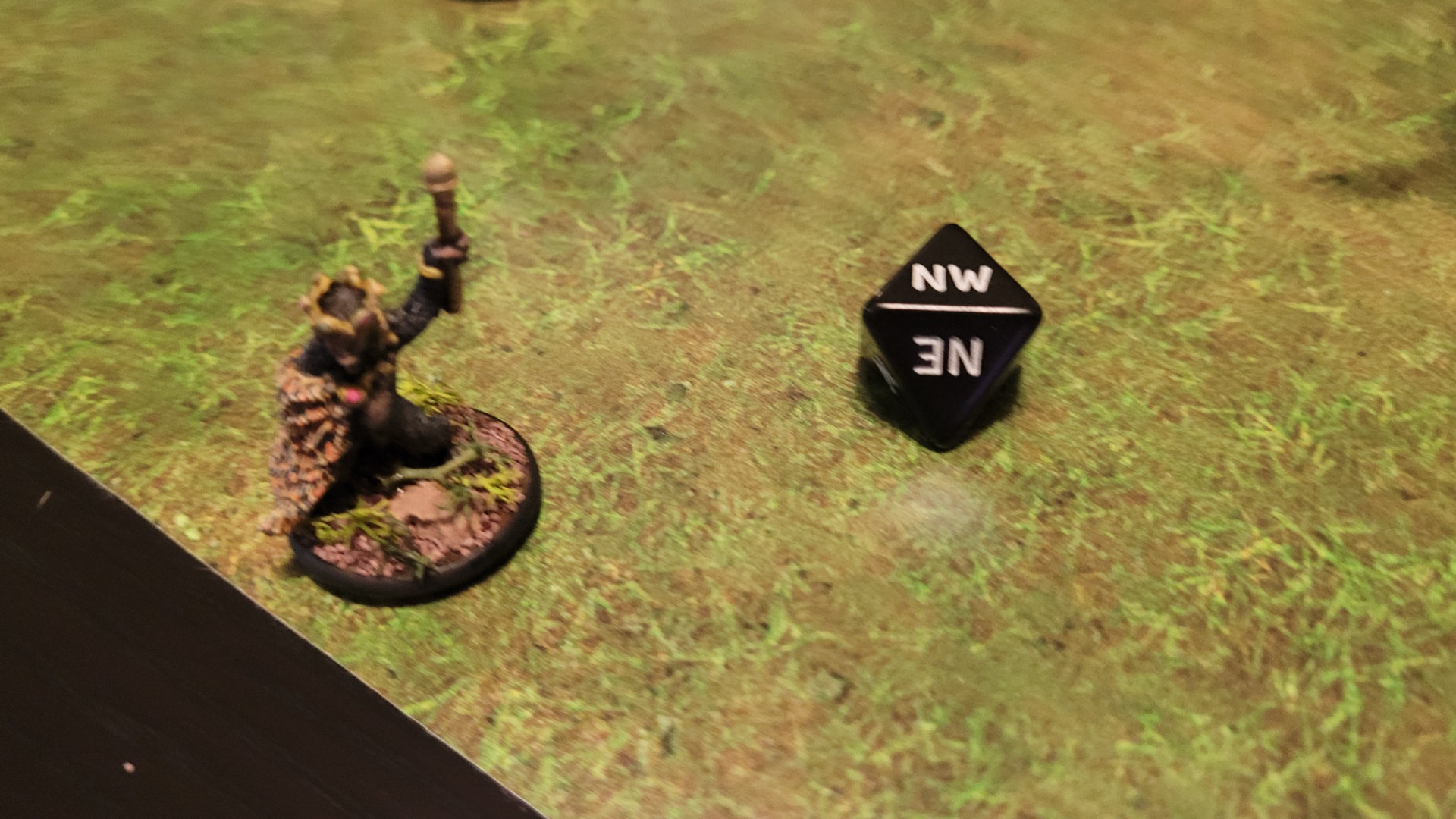 Rosko, moving too fast to be photographed clearly.
Our Double Trouble is “Rosko, Ape Lord of the Trinkets,” a strange chimpanzee who wanders around the board randomly leaving little trinkets, represented by tokens on the board that have different game effects if a model picks them up.
Unfortunately we don’t really get to take advantage of Rosko’s helpful littering. Even though I win initiative again on round 5, my opponent is able to get the sunstone back to her starting edge at a leisurely pace, and that’s the end of the game.
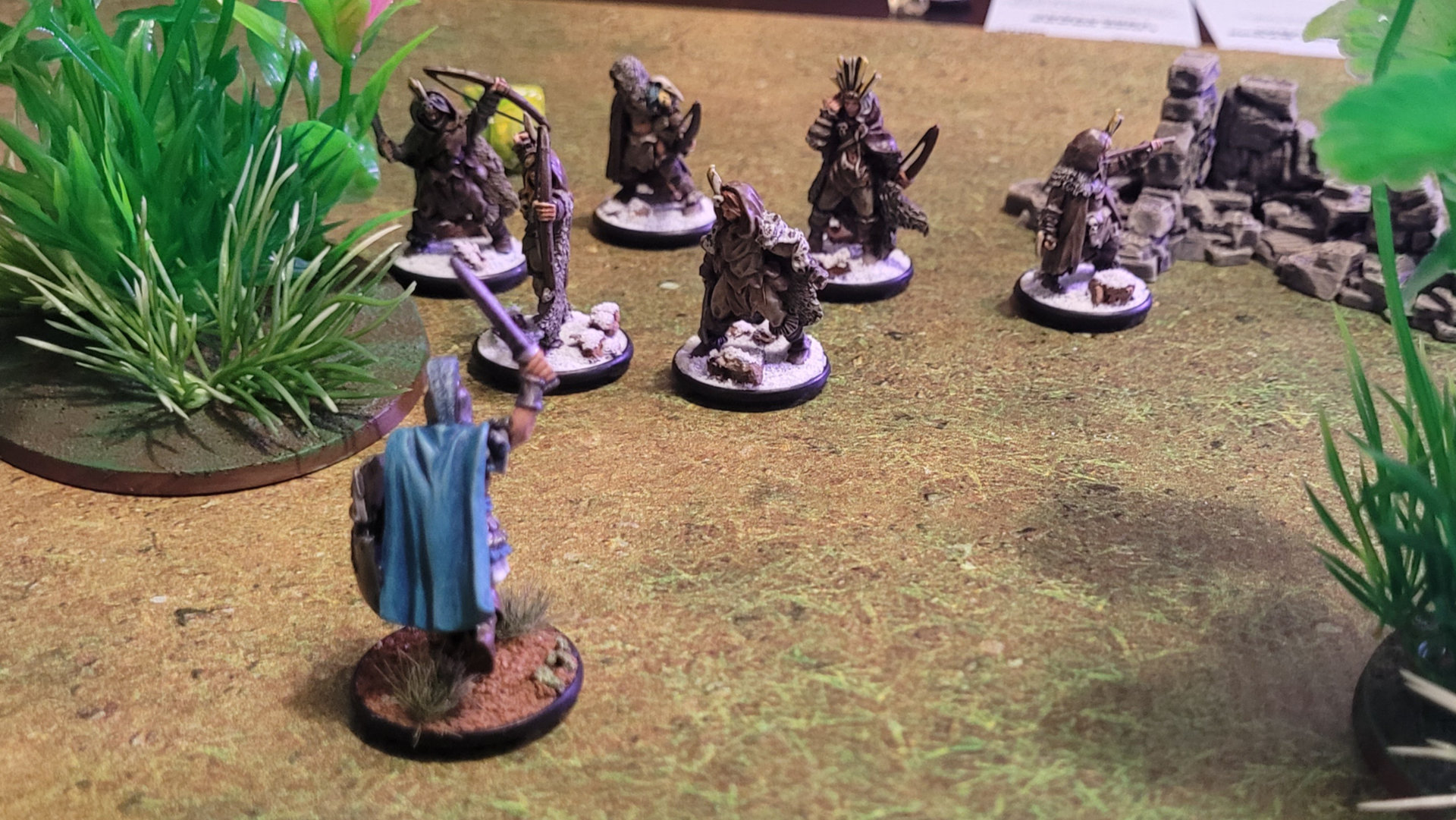 Come back here, we're not done yet!
I have to admit this game was pretty unsatisfying. The Amazons seemed to completely outmatch the Atlanteans in terms of maneuverability — the only advantage I had was the Enfilade trick, which could only be played on round one and required a die roll in order to be successful.
I do think that the two forces might have been more evenly matched in a standard game, where the goal is to eliminate your opponent’s Boss. Our experience points to the fact that the particular scenario may not be very well balanced for the different factions available in the game, exacerbated by just how random the game is — movement is a die roll, evading damage is a die roll, the more powerful Boss effects are a die roll…it makes the game pretty egregious. Plus, we only got one Double Trouble encounter, and it happened too late to have any effect on the game.
Savage Core is a simple game, so it might just need an attitude adjustment to make peace with the randomness of it all and enjoy it for what it is. We’re going to try a rematch as soon as we can. Next time we’ll play the basic “kill the other Boss” scenario, possibly with “Rumble in the Jungle,” a rule which adds a Double Trouble encounter every single round. Should be fun…
Atlanteans vs Amazons in the "Don't Look Back" scenario, part 1
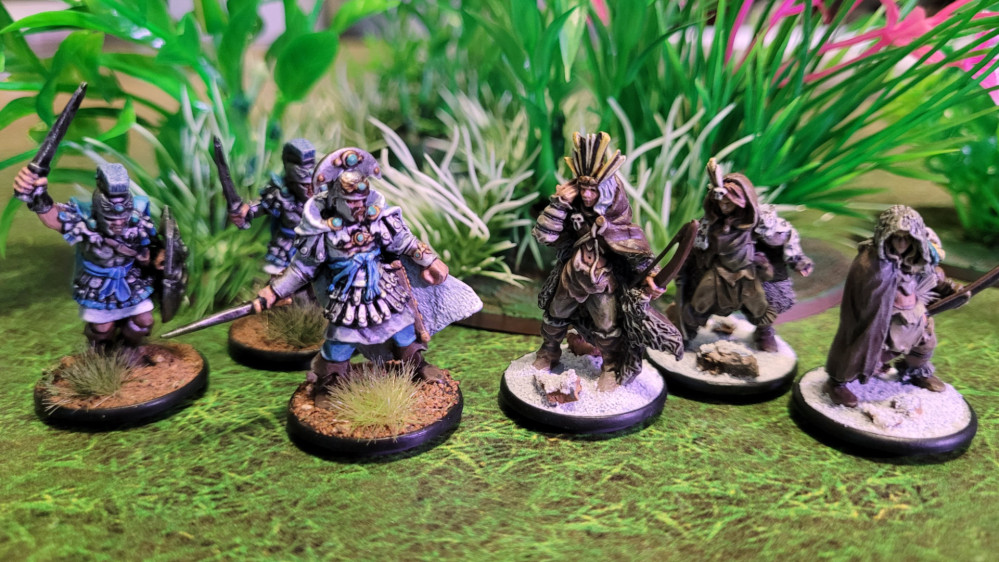
My opponent and I are returning to Savage Core after a few years away. For our first game of 2025 we’ve decided to pit the recently painted Atlanteans against the even more recently painted Age of Ice Amazons.
Force building in Savage Core revolves entirely around your faction’s Boss, who has six game stats and a unique set of “tricks,” special abilities that can each be used once per game. Your other six models (in a normal game) are “Bods,” essentially minions whose stats might vary slightly between one faction and the next but who don’t have any particular abilities of their own.
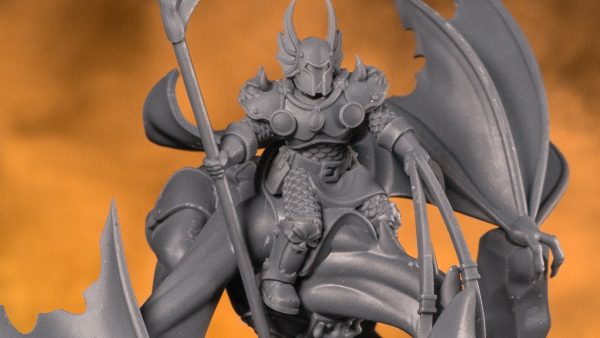
The Boss of my Atlantean force is Kryxos the Indomitable. Half of his tricks involve buffing up his Bods in one way or another, while the others are a mixed bag of wound deflection, early extra movement, and what could be a devastating area attack.
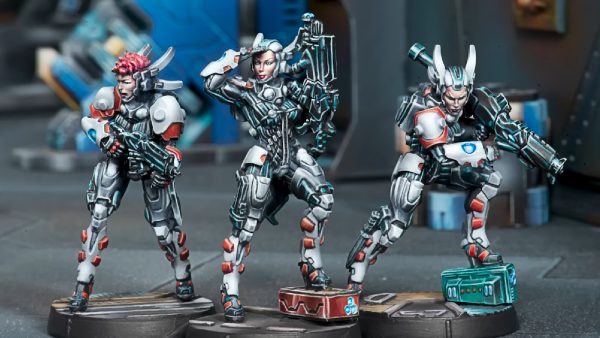
My opponent’s Amazons are led by Seratra the Foundling. She’s faster than Kryxos and better at ranged attacks, but not as smart or tough. Similarly, the Amazon Bods are good at range but a little weak in close combat, so Seratra’s tricks involve moving enemy models away, or hiding friendly models so they can pop up unexpectedly, or avoid attacks all together.
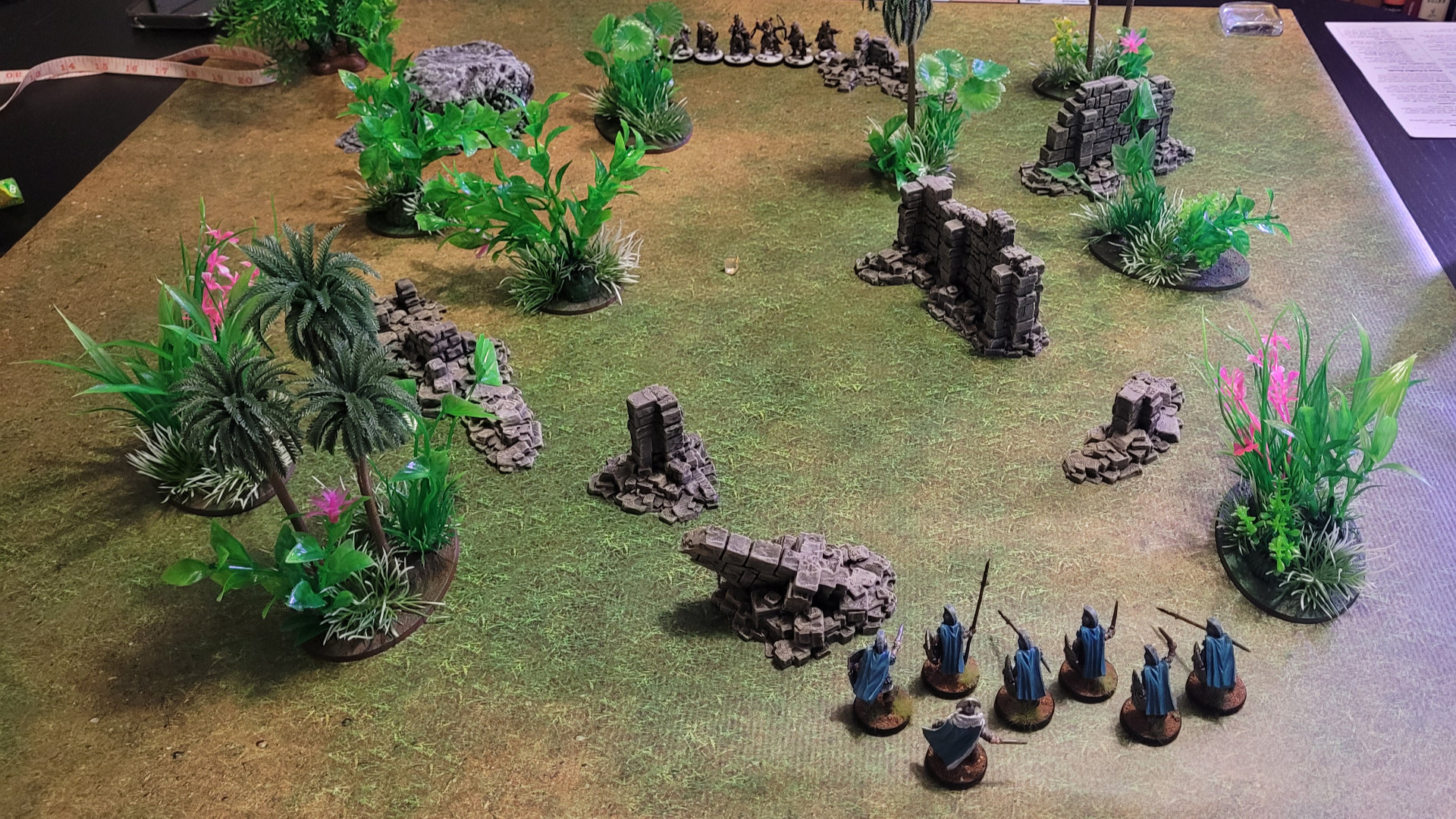 The battle lines are drawn.
We’ve decided on the “Don’t Look Back” scenario, which is essentially a football game. We start with a sunstone (objective token) in the center of the board, which can be picked up by Bods but not by Bosses. The player who successfully collects the sunstone and returns it to their starting edge of the board is the winner.
Normally I’m a little wary of “collect and return” objectives in games, and in this case the Amazons would appear to have the advantage with their faster movement and Seratra’s tricks. However, I do have one ace up my sleeve: Kryxos has a trick called “Enfilade” which, if successful, will let me redeply my Bods anywhere in the board, as long as it’s in clear terrain and not in base contact with any enemy model.
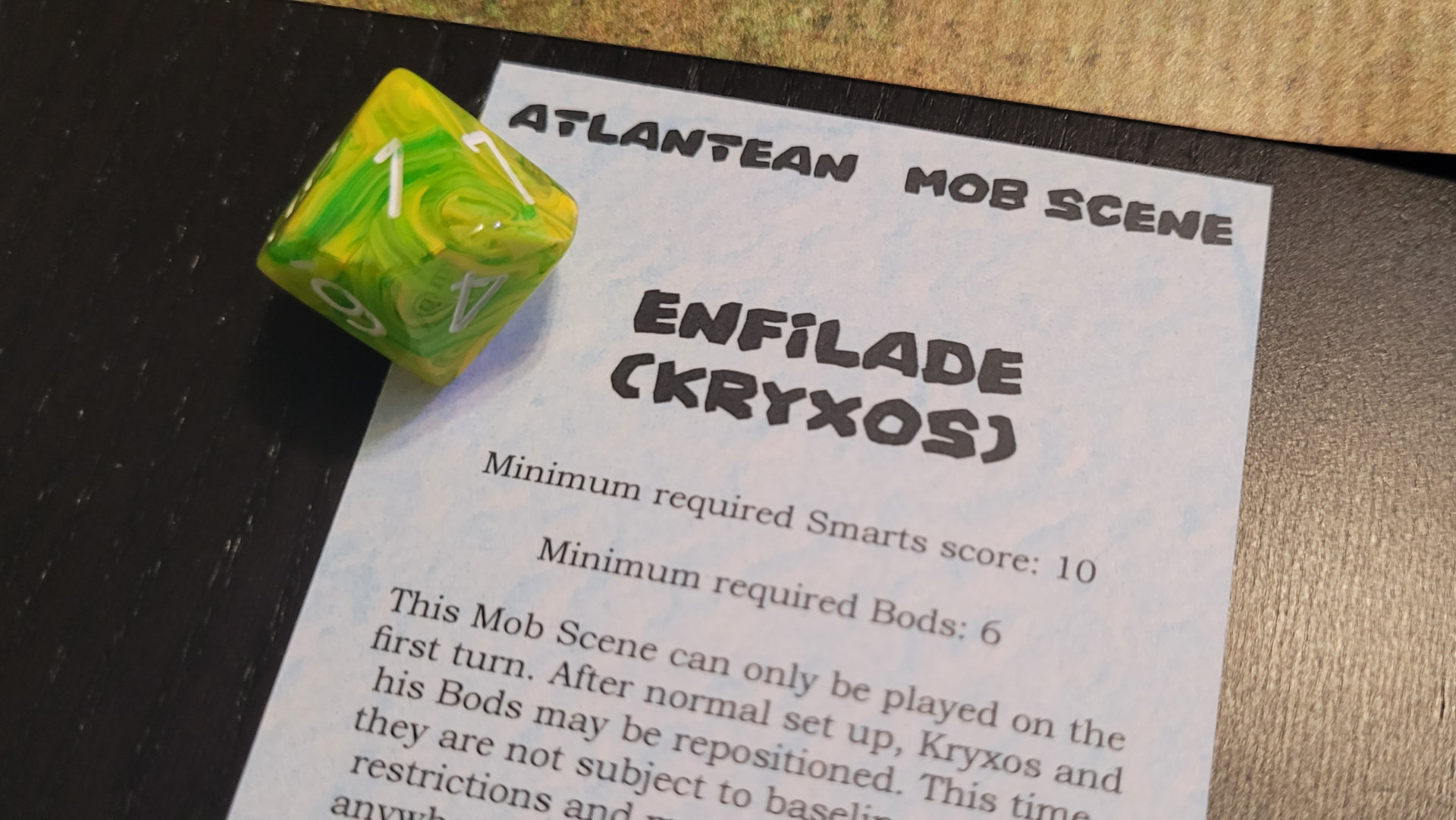 The first of many failures.
It seems too good to be true…and it is. This trick has to be played on the first turn, and I have to roll a 4 or better (all rolls in Savage Core are on a d10) to make it happen. So naturally, I roll a 1. We’re not off to a good start, and it isn’t going to get much better.
My opponent’s first trick is “Lost,” which moves one of my Bods off the board. At the start of the next turn I have to roll a 5 or less to return the lost Bod to play, along my starting edge of the board.
Movement is random in Savage Core, with each model rolling a d10 and adding their Clip (movement) value, which is 1 for all the Atlanteans, 2 for the Amazon Bods, and a lighting fast 4 for Seratra. The first player moves all their models, then the second player moves, then the first player makes all their attacks, then the second player. Damage is resolved at the end of the round, so if your model gets eliminated they’ll still get a chance to attack before they go.
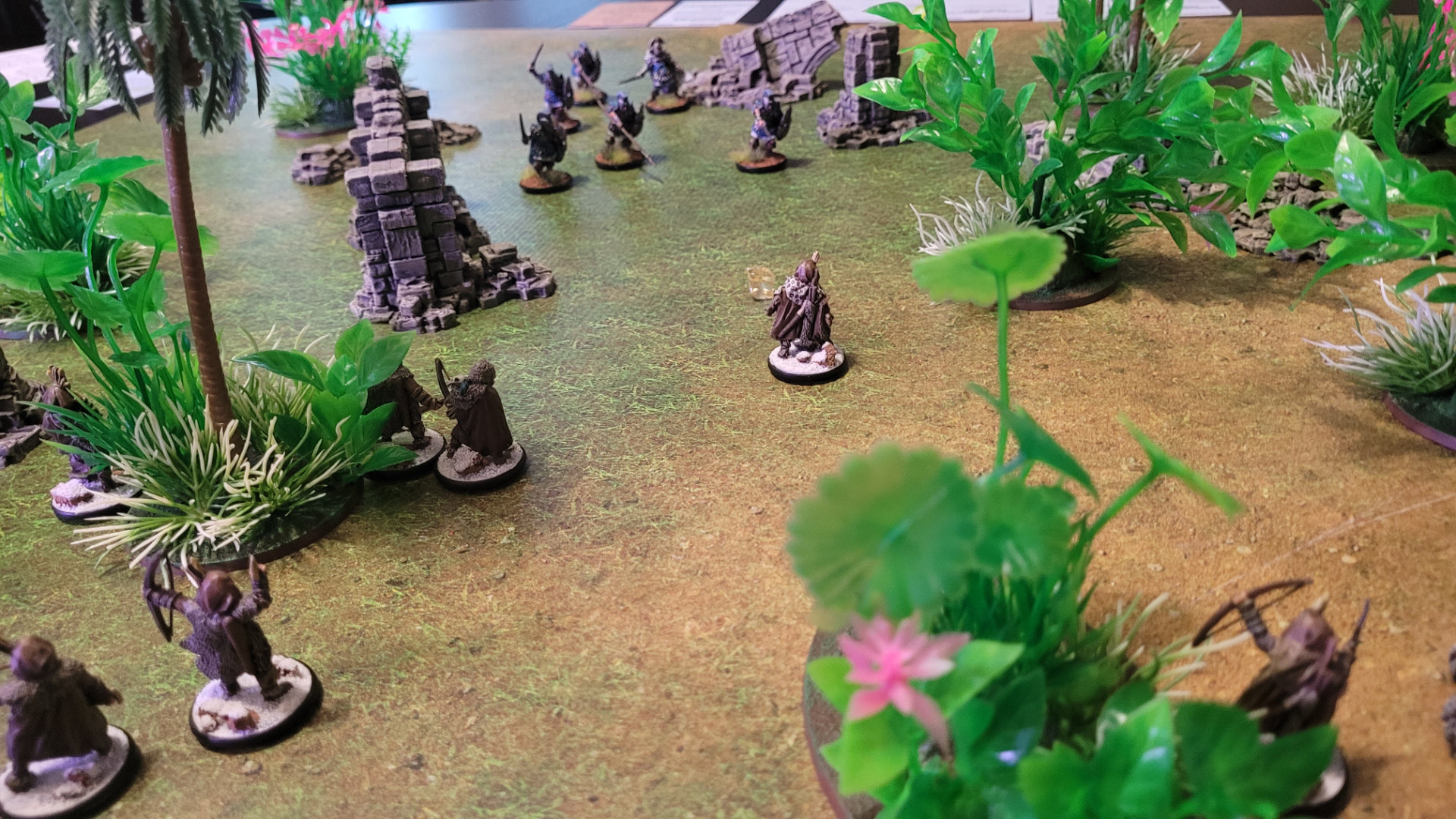 The Amazons wisely keep their distance while the Atlanteans rush in.
We spend the first round primarily just moving into position, and by that I mean rushing the center of the board. All characters can make a generic attack at a range of 8 inches, And I’m able to attack one of the Amazon Bods with two of my Atlanteans. Ranged attacks are opposed rolls with each character adding their Moxie stat to the roll, and unfortunately, the Amazon Bods have a Moxie of 6 compared to the Atlanteans’ 2 — they are much better at ranged attacks, so not only does the Amazon evade my attacks, she is able to successfully hit one of my Bods when it’s her turn to attack.
At the end of the round, each model rolls once for each time they have been hit. For a ranged attack, a roll of 1-4 is a wound, which is the end of most Bods. So at the end of the first turn I’m already down two models, one shot with an arrow and the other lost in the jungle, possibly to reappear later.
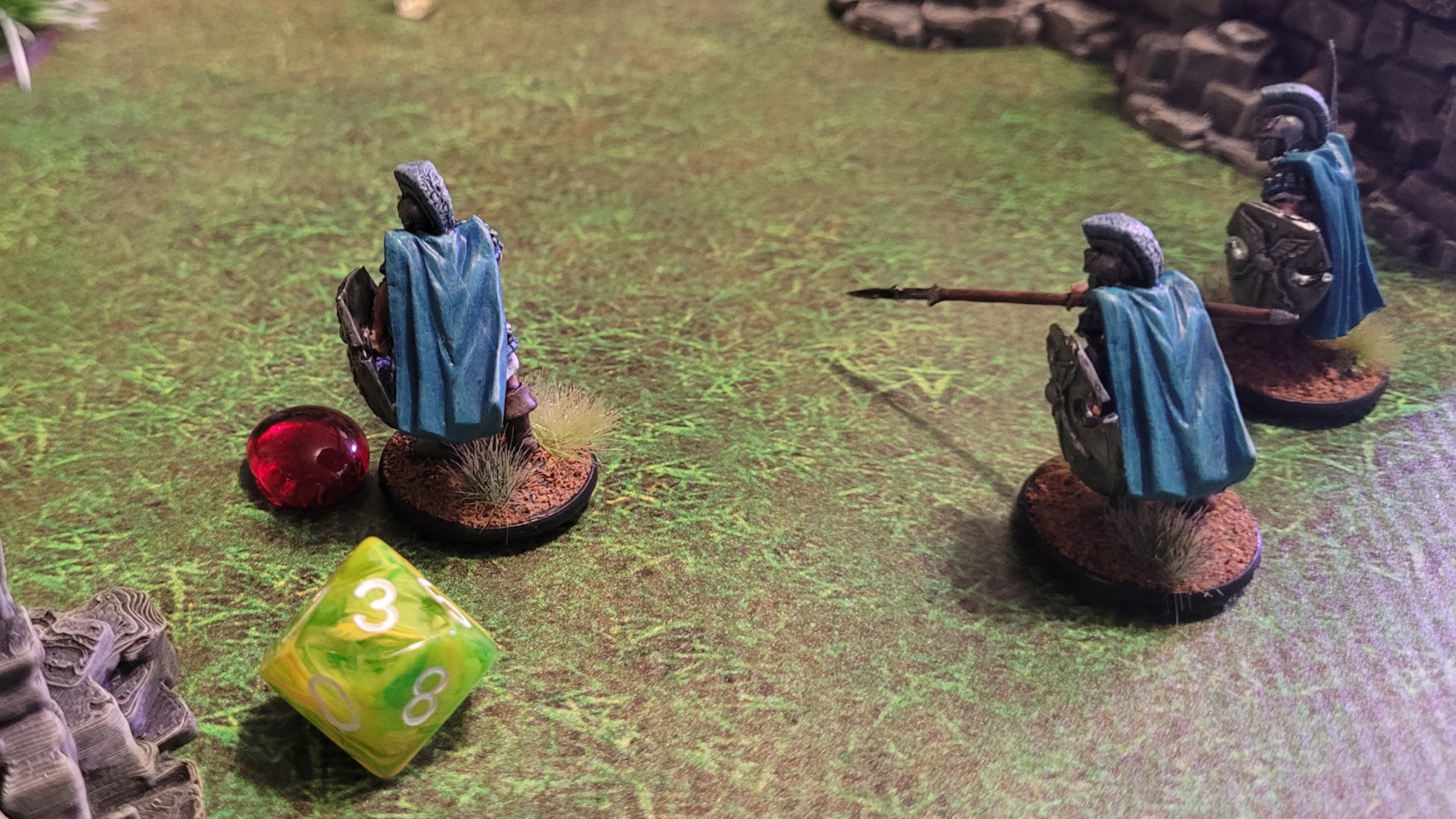 Shot down in his prime.
My Boss has a higher Smarts value than my opponent’s, which means at least I’m winning initiative consistently. However, I’m not sure that moving and attacking first is much of an advantage, since my opponent will get to see where all my models are positioned before she moves any of hers.
For my trick this round I play “Chorded Thew,” which will give my Atlanteans a defensive bonus in close combat — I’m hoping I’ll get close enough for that to be useful. My opponent plays “Meteoric Cut,” which will give Seratra two attacks this turn, and turns out to be a lot more effective.
In other news, my model that was removed from the board on the previous turn makes his roll and returns to play, too far away to do anything useful.
My movement rolls are lousy so I don’t manage to close with any of the Amazons, however, I do manage to grab the Sunstone. This momentary advantage is short lived, however, as the Amazons move into position and let loose with a barrage of ranged attacks, taking out two more of my Bods, including the one carrying the sunstone.
To be continued…