








![NO Weekender Or Cult Of Games XLBS This Weekend [Updated]](https://images.beastsofwar.com/2026/03/No_Weekender_and_XLBS_this_Weekend-225-127.jpg)





Blood Red Skies Unboxing: F4U Corsair Squadron
July 18, 2019 by dignity


It's not tanks but John is just as excited to be unboxing the new metal F4U Corsair Squadron for Blood Red Skies from Warlord Games.
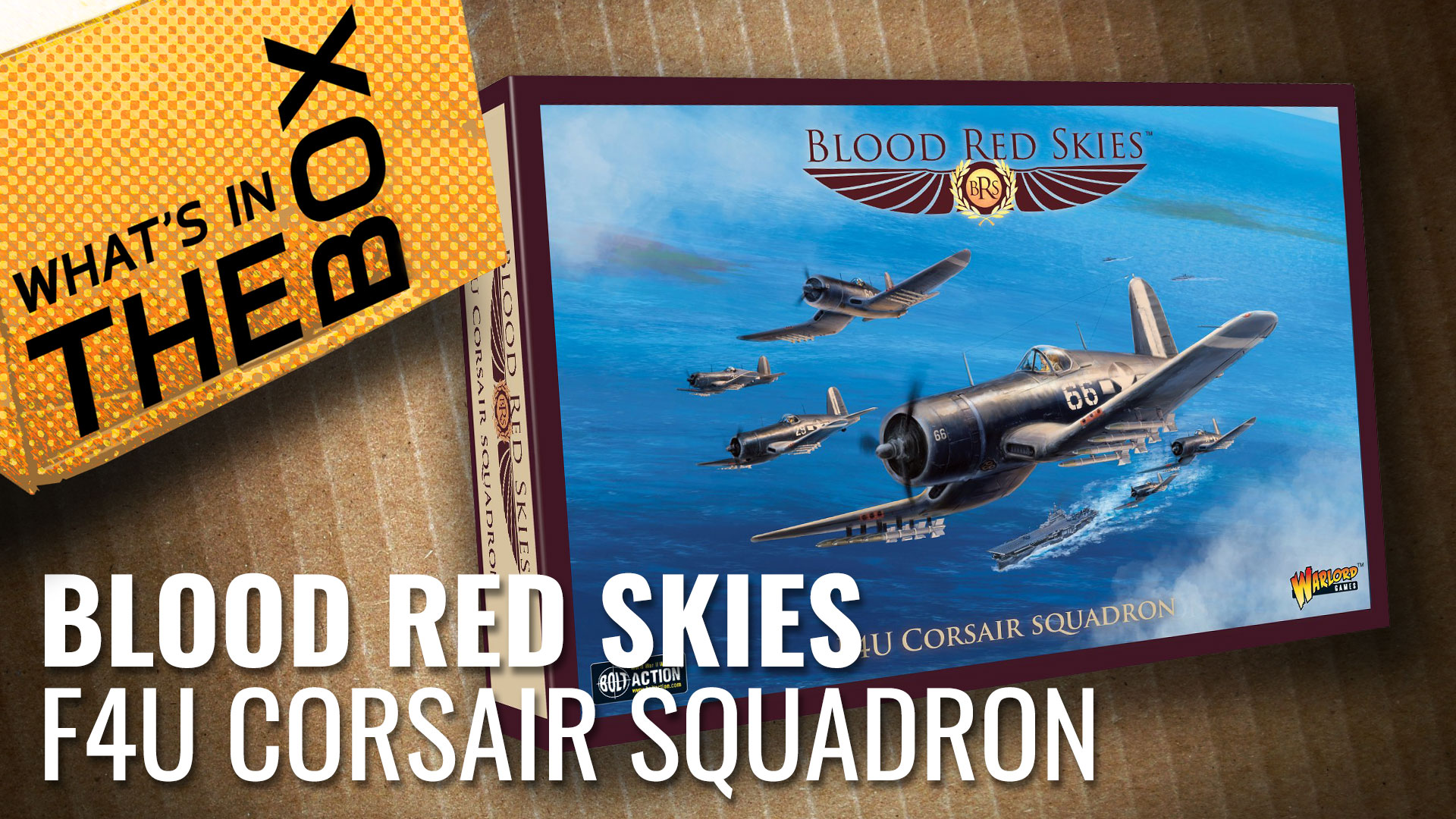
Featuring a classic gull-wing silhouette the set includes 6 metal Corsairs, as well as decals, trait and ability cards, and the new larger flight stand bases which accommodate the new weightier aircraft.
Do you also like the Corsair design?
Supported by (Turn Off)

Supported by (Turn Off)
Supported by (Turn Off)









![StarCraft Tabletop Miniatures Game Pre-Orders Live Now [Updated]](https://images.beastsofwar.com/2026/03/starcraft-tmg-news-cover-600-338.jpg)


Always loved the Corsair since being introduced to it via the old DOS (I think) game Aces over the Pacific
Yep, loved that game. I grew up in Bridgeport near where the Corsair was built and there was always a real copy of the aircraft that sat on a pedestal that I remember passing by every Sunday going to church. However, it was a very difficult plane to actually fly and was prone to many mechanical issues.
Definitely agree on the Corsair’s difficulties to fly, specifically to land on a short carrier flight deck due to the long nose and the high angle of attack required for carrier landings. The hydraulics in the landing gear were also INITIALLY a little “springy” because, again, a carrier landing is almost a controlled crash. I won’t repeat everything because I’ve already listed a lot of this in posts below.
But as far as “technical problems?” I’m not so sure. Sure, the Corsair had a tough start (it was a pretty unusual design for the day), but primarily these teething issues were with the NAVY. How much of these are flight characteristic issues and how many were “technical” or “mechanical” problems might be up to interpretation – i.e., the hydraulics in the landing gear was a problem specific to how a pilot has to land on a carrier flight decks?
On the other hand, the Marine VMF squadrons who used them on ground air strips took to them like ducks to water. They didn’t have nearly as many problems with them (despite the brutal conditions at remote jungle air strips, but of course they were able to land with shallower approach angles, mitigating the Navy’s problems with landing approach visibility and hydraulics in the landing gear.
The Navy was also in love with, wed to, and having great success with the F6F Hellcat by this stage, so was more reluctant to embrace a new fighter by the end of 1943. The Navy admittedly did NOT love the Corsair, which is why it’s been slandered with some of the myths we see with the Corsair’s “technical issues.” Not that the Navy was wrong, the Corsair just wasn’t really the right fighter FOR THEM. Overall, however, I feel the Corsair’s “mechanical” reputation is a myth and doesn’t stand up to statistical analysis of its operational history.
After all, they type was used by seven nations besides the Americans (including the British in the Pacific, clip-wing Corsairs replaced the Seafire on at least one carrier), and in six wars AFTER World War II, in combat until 1962. This was LONG after any of its contemporaries (last Spitfire flew in combat service in 1954 / Malaya to my knowledge). I don’t even know about the Hellcat.
So unless you’re trying to land on the Corsair on a carrier? HOWEVER, I fully confess that carrier operation WAS the Corsair’s original design mission, and the type had real troubles in this area. Fortunately, she found her niche in other, closely related operational roles.
one of my favorite planes of all time. it doing a firing run with rockets and strafing is iconic. saw a remote control plane sort of do it and looks like trouble on the receiving end.
Spitfire still my iconic plane of World War Two… not at all biased by the fact that Reginald Mitchell comes from my home town.
No worries at all sir. Just as I am not biased by connection with the US Marine Corps. 😀
My connection is by birth, yours is by choice. Mine a quirk of fate, yours requires a bit more effort 🙂
My experience of the military comes from the cinema and it’s taught me three military units that you don’t mess with… the SAS, Navy Seals and US Marine Corp.
😀 I might add Royal Marine Commando and certain American airmobile units like 82nd Airborne. 😀
The F4U Corsair is iconic with airwar in the Pacific.
Time for a little Black Sheep Squadron!
Gonna piss off all the Spitfire fans, but I don’t care. STILL the most beautiful and in my opinion best fighter of WW2 (although to be fair, it did come out AFTER the Spitfire).
Whistling Death, baby!
Fought well after WW2 as well, with active combat service in Korea even in the age of jets.
We are all entitled to our opinions…
But Stoke doesn’t have much to be proud of… so I’ll be proud of the Spitfire and Reginald Mitchell…. just a shame he never saw it fly into battle.
I understand the R J Mitchell reference, is “Stoke” the town where the Spitfire was developed? Of one of the late late late variants? Or Stoke-on-Trent where one is being restored (??)
There’s one regard in which I will always give the Spitfire all the credit in the world …
America’s “other” greatest fighter, the P-51 Mustang, was really quite mediocre until they put the Spitfire’s Merlin engine into it.
Merlins in Mustangs, the Sherman to the Firefly, the British really were good and taking mediocre American gear and making it great.
Stoke is part of the city of the Stoke-on-Trent.
The Spitfire used to be inside what was essentially a large glass building near to the city museum and was later transferred to the museum itself. Personally I preferred it under glass, but it was more secure in the museum.
It is being restored at present and due to return in 2020 I believe.
Apart from being famous for pottery, we can also take credit/blame for the captain of the Titanic…
I’m in no position to judge what the better plane might be but I bet the F4U Corsair doesn’t have an excellent beer named after it, unlike the Spitfire! 🙂
I can’t argue with that! 😀
But not all beers named after aircraft are great…
The F4U, along with the Army’s P-47, are my favorite American planes of WWII. There’s something quite appealing about the look of radial engines. Coincidentally, both planes used the same engine.
P-47 Jugs, baby! Agree 100%. And if anyone needs to know how great the P-47 is …
The A-10 is NOT named the Warthog. No, no, no.
It is named the Thunderbolt II.
After the P-47. That’s how great the P-47 was, especially in ground attack.
Not to mention take insane amounts of damage and keep flying. I recall a story where a FW-190 caught an already damaged P-47 limping back home. The FW strafed him 5 times spending all his ammo in the process. When the P-47 didn’t fall out of the sky, the FW pilot flew up beside it, saluted the P-47 pilot, and returned to base.
Seriously epic stuff. 😀
Fighters are just annoying little flies. The real kings of the sky were the Avro Lancasters. I do think reading Conrad’s War as a child might have warped by brain somewhat.
she is a beaut of a plane.
Marine Corps, baby! These F4U Corsair was actually rejected by the Navy originally because of their VERY long nose, which made them tough to set down on a carrier (carrier landings involve very steep angles of attack, it’s very tough to see where you’re going when trying to land on a short runway).
The Marine Corps took them (we always get the Navy’s leftovers) and made them war winners, although of course they were usually being operated off of land airfields where shallowed angles of attack are possible when landing. Their performance against Japanese Navy Zeroes and Army “Oscar” fighters was so good (the Japanese called them “The Whistling Death”) that they were eventually re-adopted by the US Navy for carrier use (despite their landing difficulties, they killed so many inexperienced pilots they were called “The Ensign Eliminator”). But in Navy use the Corsair always had to compete with – and play second fiddle to – the F6F Hellcat.
It was the Marine Corps that made the F4U Corsair famous.
Interestingly, the example shown in the photo does not have the markings that would specify whether it is Marine or Navy. It’s pretty easy to tell, the lower fuselage normally has a great big “NAVY” or “MARINES” emblazoned on it. 😀 😀 😀
Strange how the Japanese called most of the Allied fighters some sort of “Death”. The Bristol Beaufighter used in the pacific was nicknamed the “Whispering Death”
The Beaufighter – now THERE’S a badass plane that doesn’t get enough attention. Given when the Beaufighter comes out, I wonder whether we would have ever had a “Mosquito” if the Beaufighter hadn’t paved the way in British aviation in some of the design elements (twin engines on the wings to clear the nose for a massive pack of machine guns and cannon).
Although … “whispery death?” I don’t doubt the nickname or your information, I just question what is “whispery” about a Beaufighter. 😀 She’s big, she’s mean, she packs a helluva punch … It was used in Europe as a night fighter, was it the same in the Pacific? Could that be the source of the nickname?
Apparently it was just a very quiet airplane. “The Beaufighter’s Hercules engines used sleeve valves, which lacked the noisy valve gear common to poppet valve engines. This was most apparent in a reduced noise level at the front of the engine.” (from the wiki page)
On looking back at the Corsair, what surprised me was how many were flown by the Commonwealth (the British Fleet air arm had 18 squadrons flying the aircraft by the end of the war and actually were flying them from carriers before the US navy did, although they did “clip” 8 inches off the end of each wing to fit them in the British Carriers).
And the Beaufighter is nearly always overlooked, yet with 4 20mm cannons AND 6 .303 machine guns, torpedos, rockets, bombs etc… it was pretty heavily armed and saw active service throughout the whole war. AND there were 4 USAAF nightfighter squadrons operating in the med. So you could pretty much paint either aircraft up in US or Commonwealth colours 😀
Awesome, @phaidknott – I did not know that about the Beaufighter. I’ve never seen one fly even on film, so I have no idea how loud or quiet they were. They just LOOK loud, with those two massive engines extending almost past the fuselage nose.
I “discovered” the Beaufighter when friends and I were developing our own WW2 fighter combat game for the club. We fought our way completely through the Battle of Britain (all my games are campaign games) and at the end some of my British players wanted to upgrade their pilots into new aircraft. One wanted “the biggest, meanest, scariest sumbitch available” … she wanted something that could tear a Bf-110 in half. That’s when we found the Beaufighter, I think used in anti-shipping strikes in occupied Norway and also as a nightfighter in the post-Battle of Britain Blitz. Good GOD the firepower, especially in early 1941!
Yeah, I’ve gone over this a couple times now, so I’ll make it quick … 😀 It doesn’t surprise me that the CW used the Corsair OFF carriers before the US Navy did because the US Navy largely rejected them for a number of operational (and some would hint political or at least doctrinal) reasons. The Marine Corps loved them, the US Navy not so much. I think the Navy had a few squadrons off the late-war Essex class carriers later … but only after modifications were made and the Corps had been using them for at least two and a half years.
nice to see some metal
Lovely looking plane. I understand why this kit is in metal but I don’t like it. The larger base required to stop it falling over would grind my gears when put alongside the other models. I guess you could try to weight the base with something, but even then, a big lump of metal leaning forward is going to require a reasonable counter weight.
Otherwise, a great addition to the game
I agree about the bases… too big. I was hoping for more plastics. Unless they do so I guess I’ll be sticking with the starter box that I have.
There are some 1/200th scale Corsairs in resin available (although you’d still have to get the Warlord box for the stands, and cards). Bit of a waste to not use the metal models, but you’d be able to put them on the normal flight stands.
Warlord have started to produce some of their SPQR figures in a “new” type of resin/plastic material. By new, I mean new to tiny fighty men and tiny fighty planes… I think the plan will be to produce these planes in that material but it is going to take time.
The wing shape is very nice
The Corsair has always been my favorite WW II aircraft. Probably because mom was a ‘Rosey the Riveter’ and worked in a Corsair plant in Ohio that made the center wing sections. She’d tell stories about how they’d have people with dwarfism crawl inside the sections to rivet parts of the interior as well.
Will definitely be picking these up. VMF all the way! No squidie Corsairs for this Jarhead!
@gryphonheart – a fellow ex-Marine? In any event, I agree about the Corsair. VMF squadrons are where it’s at, honestly I don’t think the Navy “liked” the F4U that much given the reasons I list in other posts above. I just hope the game gives the Corsair values commensurate with its historical performance and combat qualities. 🙂