







![NO Weekender Or Cult Of Games XLBS This Weekend [Updated]](https://images.beastsofwar.com/2026/03/No_Weekender_and_XLBS_this_Weekend-225-127.jpg)




Modern Wargaming: Conflict In The Ukraine Part One – Overview & First Engagements
October 26, 2015 by crew

Community members at Beasts of War may be familiar with my articles revolving primarily around gaming in the Second World War. In an effort to keep things interesting and to “expand my range,” this new article series will shift to a much more current conflict, the ongoing fighting in the Ukraine.
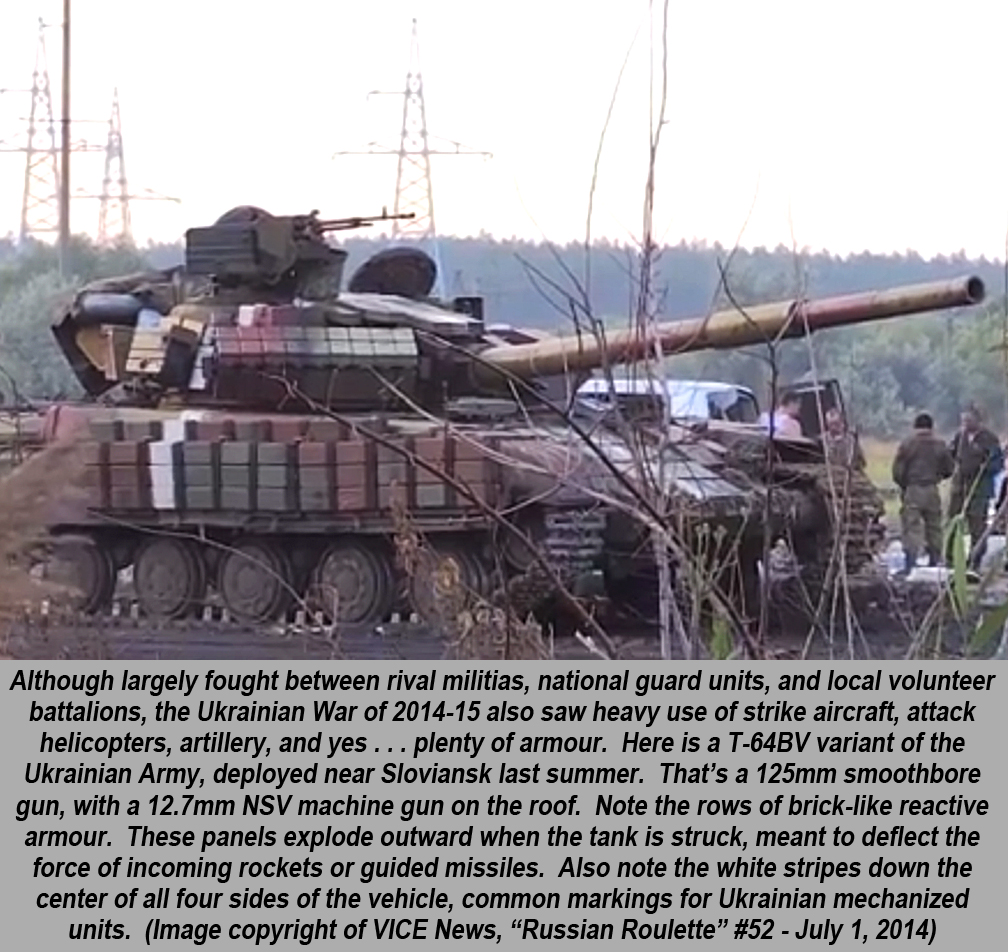
Such conflicts, however, can be tricky topics to handle in a wargame. After all, while you won’t ruffle too many feathers with a battle from the 1400s, when it comes to a war that is much more recent, delicate care must be taken in how the subject is approached.
"Today's War" - Why Game It?
Perhaps the first question when setting up current-conflict wargames is “why do it?” The roots may lie in why we play wargames in the first place. Sure, it’s always to “have fun,” but what defines “fun” at a gaming table can vary widely from group to group. In all honesty, current-conflict wargames may not be for you.
Many people who play modern wargames are themselves veterans of the armed forces, who have a keen, personal interest in the conflict in question. There’s certainly nothing wrong with this, but bear in mind that such games might not be terribly objective. It’s hard not to see one side or the other as the bad guys when it’s “your” war.
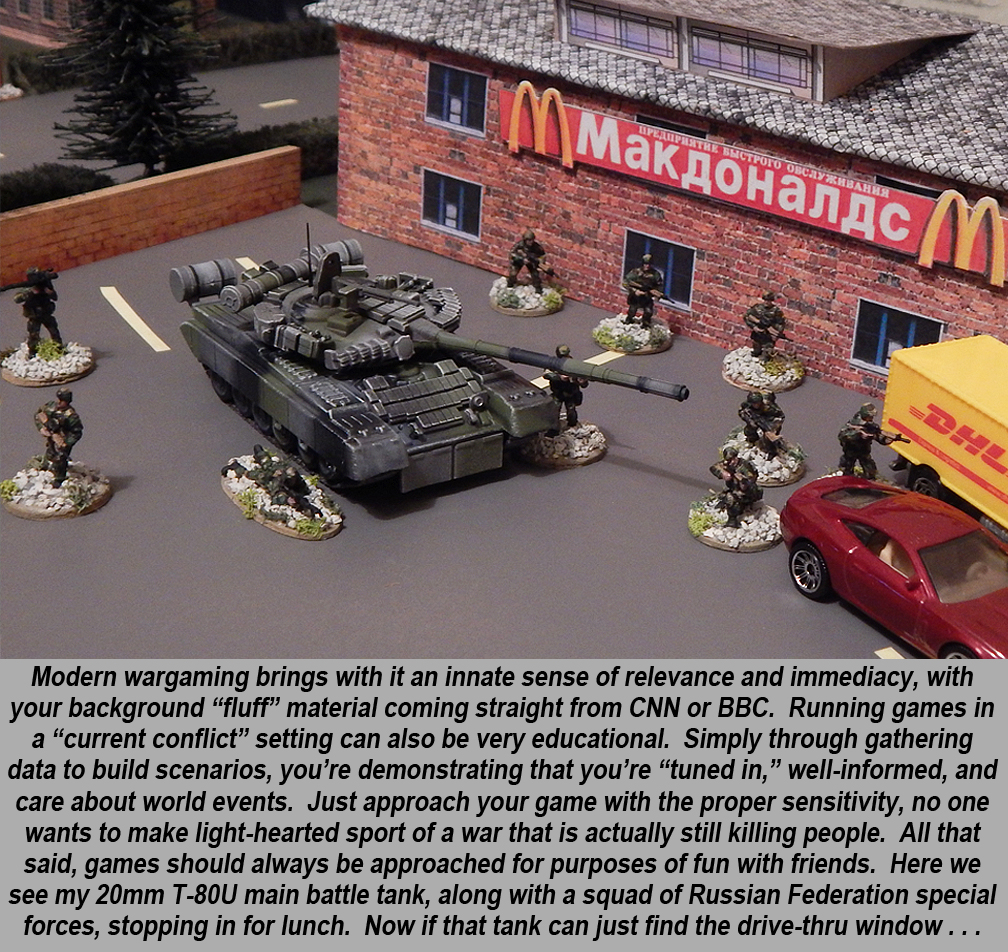
Other gamers see themselves more as “analysts.” They want to examine actual battles (whether they occurred five centuries ago or five minutes ago) and see what made them unfold the way they do. For many such gamers, research and game design are as important as building and painting miniatures.
There are some gamers for whom current-conflict wargames may not be a great fit. Competitive gamers should be especially careful. Wiping the floor with your opponent is always fun in Warhammer 40,000 or X-Wing, but perhaps not when CNN and BBC are still showing crippled civilians and masses of refugees straight from “your table.”
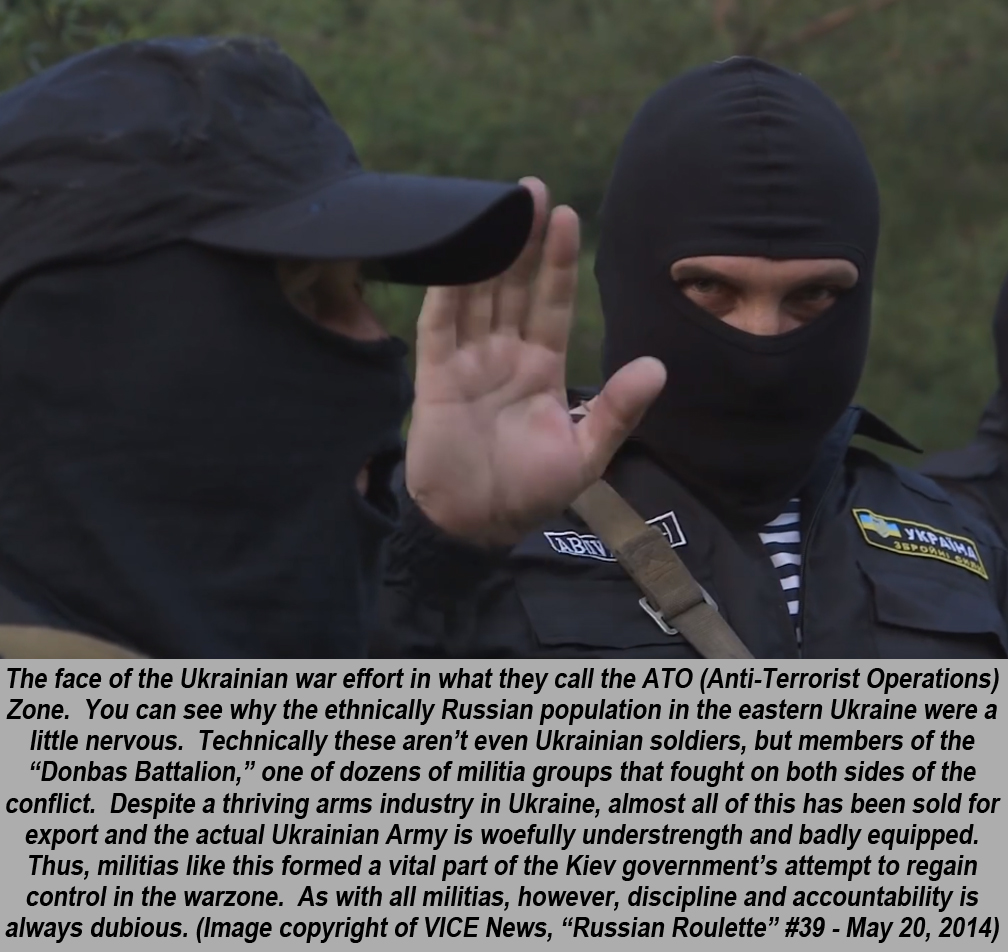
Also, detail-driven “rivet-counters” might have a hard time with the pervasive ambiguity when it comes to conflicts this recent. No one’s written dozens of books on these wars yet. Much of the information will still be classified and ALL of it will be horrendously slanted one way or the other. Prepare for a lot of guesswork.
For those who choose to pursue current-conflict gaming, the rewards can be great. After all, this isn’t dusty, boring history (yawn) no one cares about – nor the “geeky” Sci-Fi or Fantasy that cause non-gamers to patiently roll their eyes. This is happening NOW, every time people turn on the television. If done right, current-conflict wargaming comes with an almost “built-in” respectability. After all, you’re not a gamer. You’re an analyst!
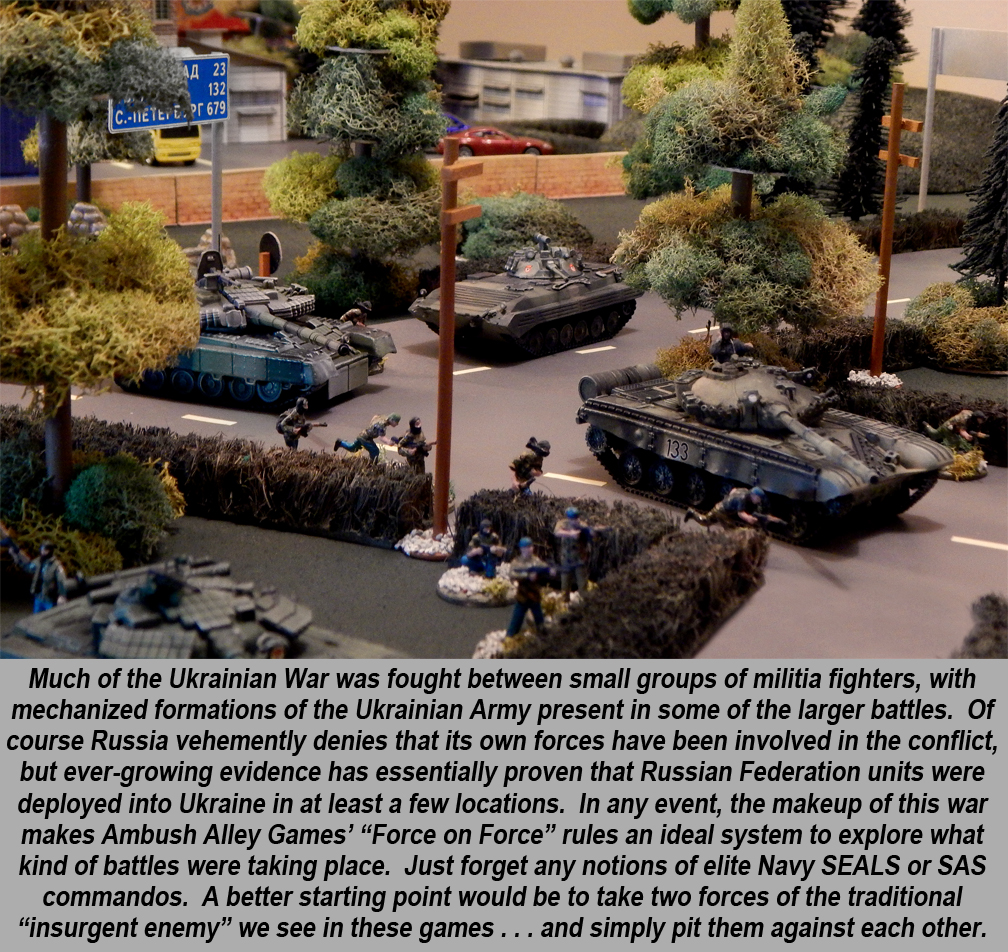
Fortunately, there are some great systems and product lines to help you get started. Spectre Miniatures have great 28mm moderns and have recently started rolling out rules. Empress Miniatures also have great rules and miniatures, especially vehicles that have been featured on recent Beasts of War “What’s In The Box” episodes.
Ambush Alley Games also has the “Force on Force” system, a favourite of many community members who tackle modern-era wargames. In fact, this is the system we’ll be using for many of our games depicting skirmishes that have taken place recently in Ukraine.
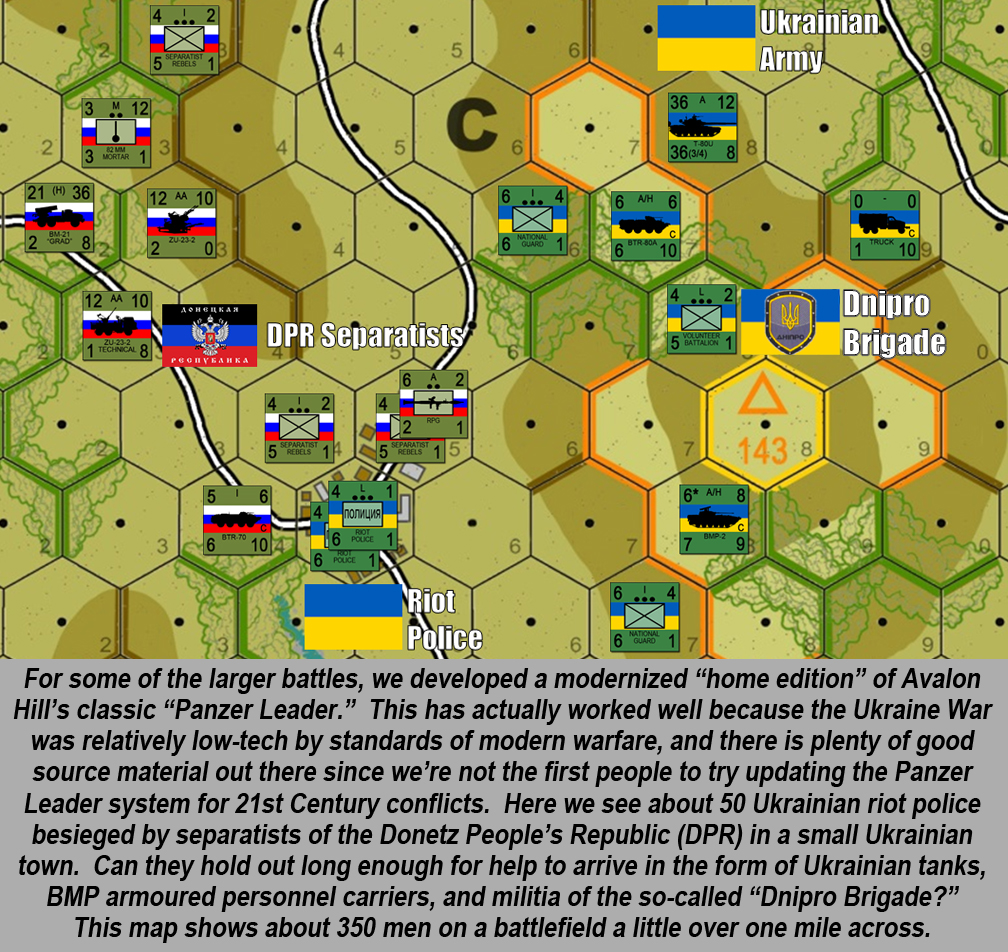
Perhaps the simplest reason to wargame current conflicts is that it keeps you informed about important events of our time. In Syria, the Cold War may have restarted. Putin seems to pose an ever-greater threat. China’s shadow stretches ever-longer across the Pacific. Not to sound preachy, but these are events about which we should all be at least somewhat aware.
The Ukraine - Origins Of The Conflict
To understand how and why the Ukrainian War was fought (and who was fighting it), we should take a quick look at the recent history of Ukraine.
Note that I’m referring to the war in the past tense, in just the last month or two the Minsk II cease-fire seems to be finally taking effect. Knock on wood, touch cloth, and call me an optimist, but as of this writing the war seems to be drawing to a close.
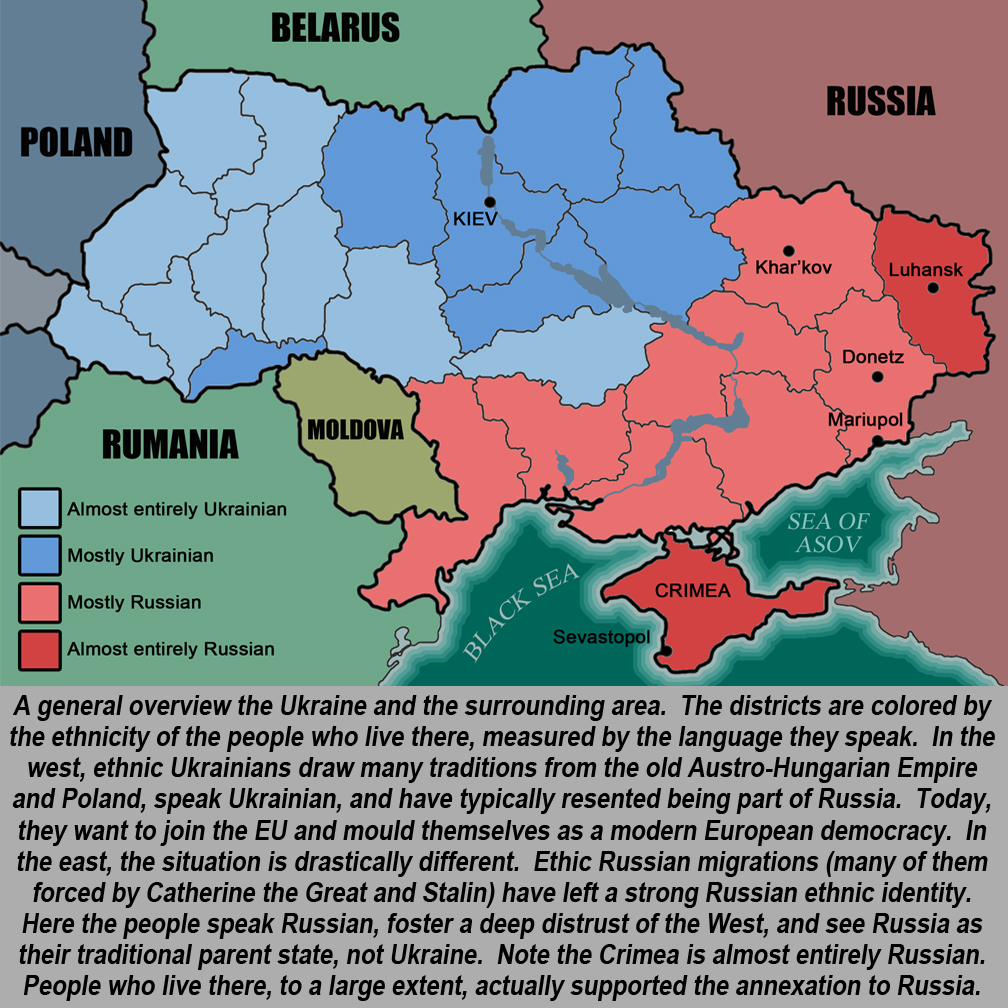
Formerly part of the Soviet Union and before that the Russian Empire, Ukraine has only been an independent country since 1991. Ethnically and culturally, the country is sharply divided between east and west, and it is along this fault line that the country broke in early 2014.
In November 2013, the faltering Ukrainian government (long plagued by rampant corruption) was poised to sign a historic trade agreement with the EU. President Viktor Yanukovich, however, was secretly negotiating closer ties with Russia’s President Vladimir Putin.
On November 21st, the government about-faced and announced no EU agreement would be signed. Protesters immediately flooded into the “Maidan,” the Independence Square in the capital of Kiev. Huge demonstrations demanded an immediate change in government.
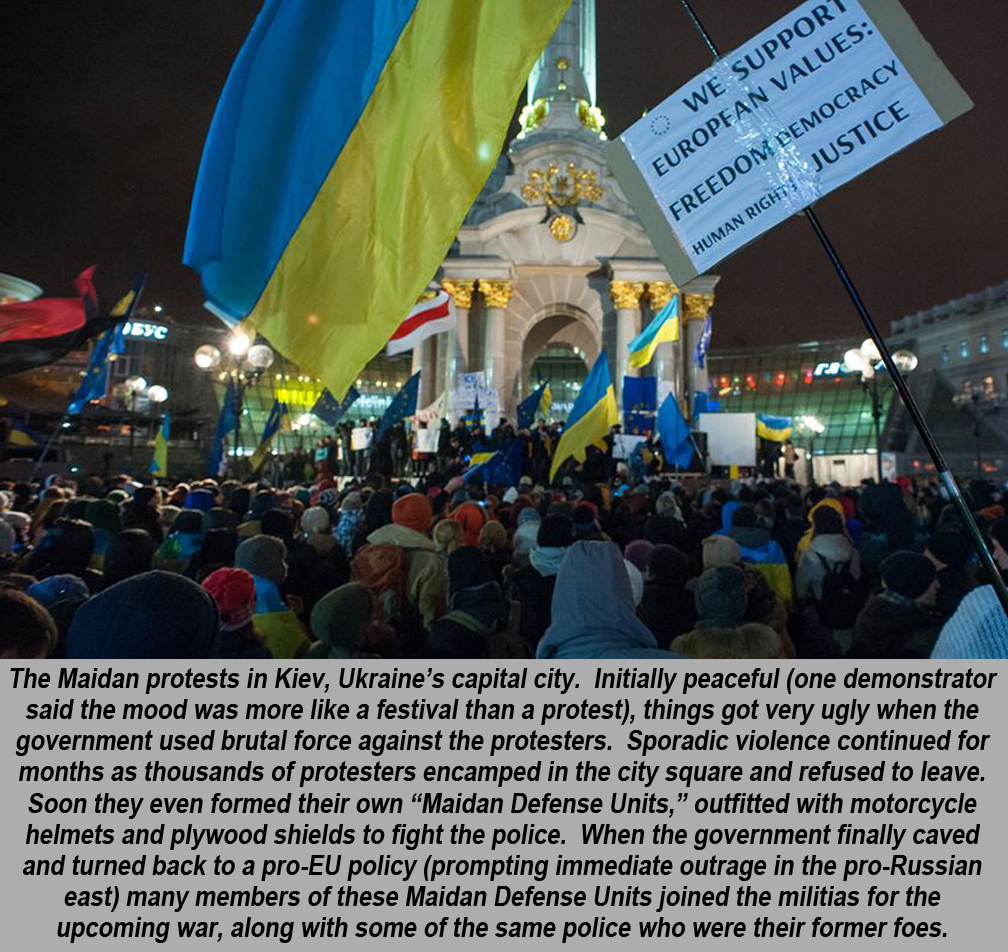
The government crackdown was brutal, especially by the “Berkut” (Eagle) police paramilitaries. The protests lasted ninety-two days, during which central Kiev was effectively a warzone. Constant clashes would ultimately kill 125 people, with almost 2,000 injured and sixty five still ominously “missing.”
Finally, Yanukovich caved on February 22nd, 2014. He fled the country via helicopter in the middle of the night and was given asylum in Russia. The interim government called for the election of a new president on May 25th, and eventually signed an agreement to join the EU. The Berkut was disbanded, but reformed under Russian control.
Reaction In The East
While the Maidan movement was widely celebrated as a populist victory against a corrupt and brutal government, reactions in Ukraine’s eastern districts were a mixture of horror and rage. In many cities like Khar’kov, Donetz, and Luhansk, counter-protests immediately broke out and government buildings were stormed and occupied.
In all fairness, these fears are not completely unfounded. Eastern Ukrainians saw the Maidan movement as the “Kiev Junta,” an illegal overthrow of their elected government. Pro-European leaders in Kiev have a long history of corruption and embezzlement, and there was even talk of outlawing the use of the Russian language.
Also, there is a dangerous far-right streak in western Ukraine, most notably in the group known as “Right Sector.” Pro-Kiev Ukrainian militia have been photographed wearing swastikas and giving Nazi salutes. Certain “volunteer battalions” have insignia clearly drawn from the Waffen SS. Many are also admitted “Banderists,” named after a Ukrainian nationalist leader who briefly collaborated with invading German forces in World War II.

While such elements certainly do not represent the majority of the pro-Ukrainian forces, it should be kept in mind that there WERE two sides to this war. The people in Eastern Ukraine do not trust Kiev, the EU, or the West, and want to remain close with Russia. When the Maidan movement swung Ukraine toward Europe, they reacted.
The War Begins
On April 7th, 2014 a referendum was held in the east Ukrainian city of Donetz, proclaiming the Donetz People’s Republic (DPR). A similar republic was soon declared in nearby Luhansk (Luhansk People’s Republic, or LPR). Together they formed the “Federation of Novorossia” (New Russia), announced they were no longer part of Ukraine, and reached out to Russia for help.
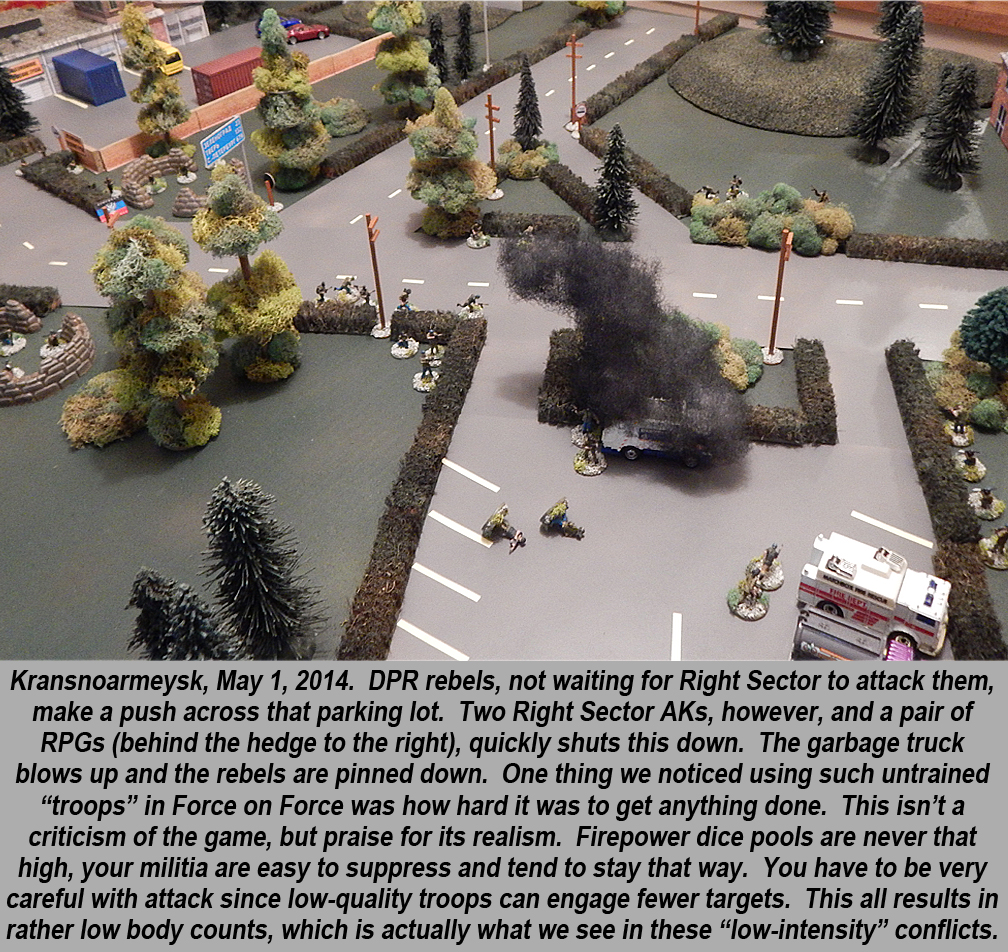
April 18th saw the first large-scale Ukrainian military movement into these areas, naturally intent on shutting down these pro-Russian separatists. But the Ukrainian Army, after years of neglect and corruption, was hardly ready for a war.
Ukrainian troops were also often reluctant to fire on “fellow countrymen.” Whole armoured columns allowed themselves to be stopped by crowds of civilians, disarmed, and sent walking home. The weapons and vehicles were promptly handed over to the growing separatist militias of the DPR and LPR.

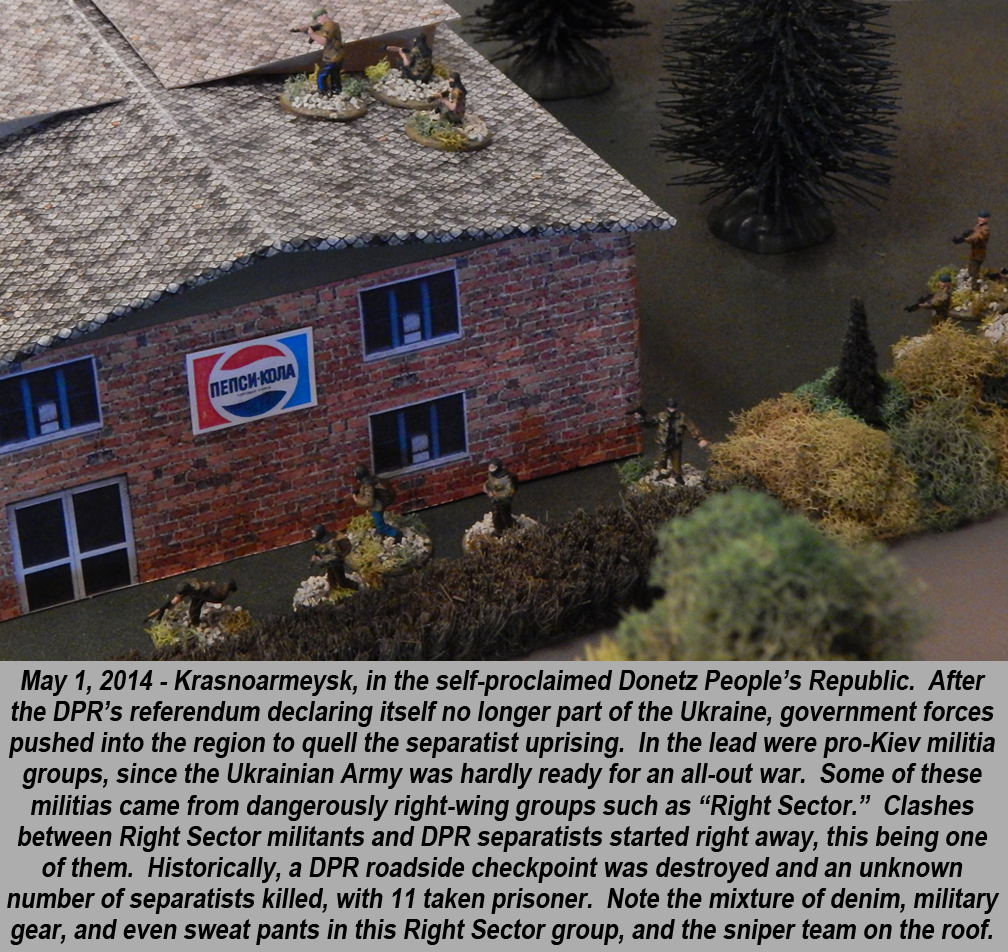
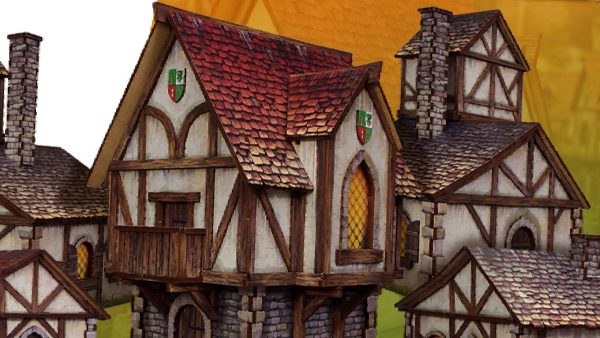
Pro-government Ukrainian militias, however, were all too ready to engage separatist rebels. Fighting quickly broke out, with one particularly intense skirmish taking place near Krasnoarmeysk on May 1st, 2014. This was the focus of our first “Force on Force” game detailed in the photos above.
A New President, A New War
On May 25th, the promised elections for a new Ukrainian president took place. Petro Poroshenko was the clear winner, a wealthy businessman widely known as the “Chocolate King” because of his huge candy business. He promised to follow through on most of the demands posed by the Maidan movement.
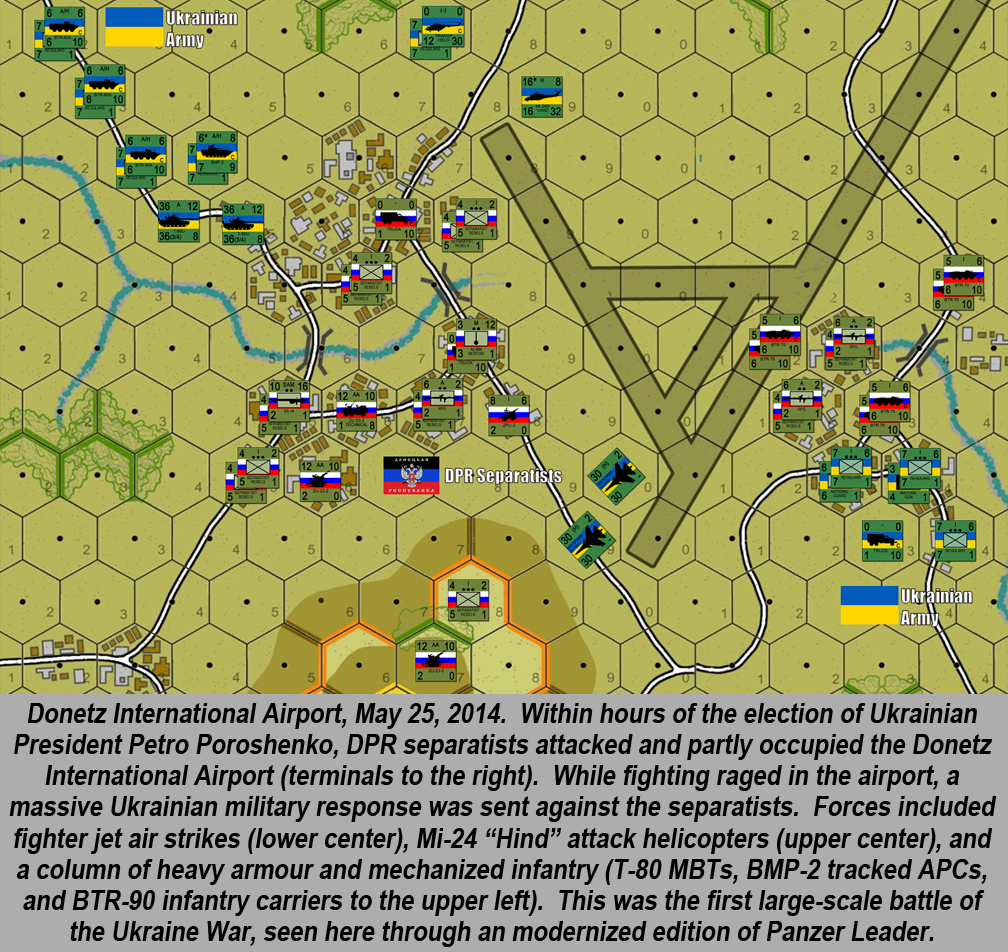
Within hours of Poroshenko’s election, DPR separatists attacked and occupied the Donetz International Airport. Poroshenko, however, decided to start his administration with a show of strength. In the first set-piece battle of the war, the Ukrainian Army assaulted the airport, complete with jet aircraft and Mi-24 “Hind” attack helicopters.
This was a big fight, tackled through an obviously-modernized variant of Avalon Hill’s classic Panzer Leader. The Ukrainians won this battle, mostly through overwhelming firepower, and retook the airport by morning of May 26th. The war was just getting started. Many more battles were to come, some at this very same airport.
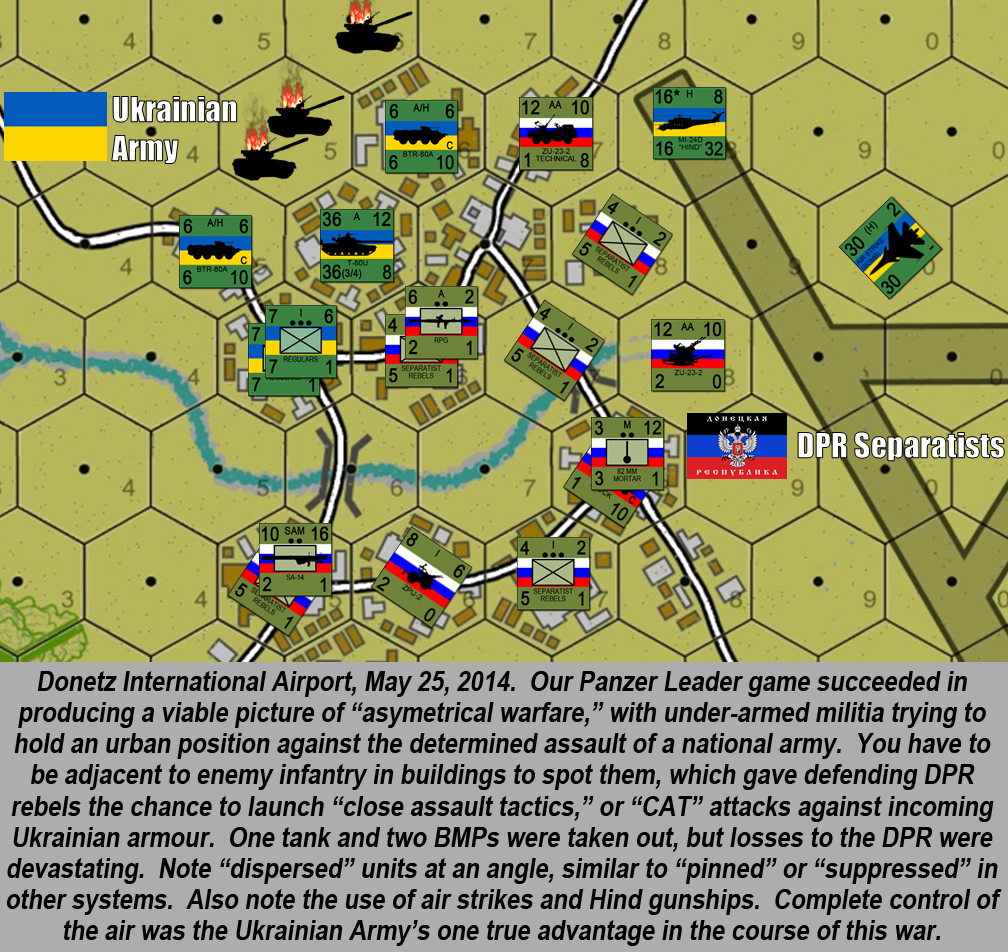
Thus begins our new article series on the Ukrainian Conflict. What do you think so far? What are your thoughts on wargaming this conflict, or modern wargaming in general? Post below and keep the conversation going, and of course stay tuned for more to come.
If you would like to write an article for Beasts of War then please contact me at [email protected] for more information!
"If done right, current-conflict wargaming comes with an almost “built-in” respectability. After all, you’re not a gamer. You’re an analyst!"
Supported by (Turn Off)

Supported by (Turn Off)
"Whole armoured columns allowed themselves to be stopped by crowds of civilians, disarmed, and sent walking home. The weapons and vehicles were promptly handed over to the growing separatist militias of the DPR and LPR..."
Supported by (Turn Off)



Great overview of the conflict @oriskany ! Another deadline met. Nice job on all the kit too! This promises to be another great series 🙂 .
It certainly had me thinking about the various factions involved with this. I knew a fair bit about this conflict when it was happening but had no idea about how convoluted it was between the warring parties.
It’s also fascinating seeing the tabletop of a modern battlefield.
BoW Ben
Thanks, @cpauls1 . As far as the kit goes, I’ve always been a 15mm 1/100 player, but once I finally bit the bullet and finally started working with 20mm 1/72, I gotta admit I’m really coming around to the new scale.
And thanks very much, @brennon – indeed the factions are bewildering. Although there are essentially only two “sides,” (Kiev government and pro-Russian separatists), the number of these “volunteer battalion” and “territorial defense” militias is bewildering. Then you have whole units like the “Berkut” police paramilitaries that have, for lack of a better term, switched sides. Many police units in the pro-Russian east have also switched sides. Then you have the Russians themselves, who “weren’t there” at all (yeah, sure) . . .
Additionally, the different units within a given side don’t always get along. The separatist “mayor” of Slovyansk, for instance, was removed from power by other separatists. The pro-Ukrainian volunteer battalions often criticize the Ukrainian Army and National Guard for not doing enough to help them. They’ve been known to encourage renewed demonstrations at the Maidan in an effort to coerce or even replace the NEW Poroshenko government in Ukraine (the government they’re supposedly fighting for). Meanwhile, the Kiev government can’t entirely trust some of these militias because of their overtly far-right (I’ll just go ahead and say it: neo-fascist) beliefs.
Long story short, it’s very confusing. Even for me. What Brennon’s being nice enough not to say here is that I goofed up one of the images in the article with the wrong volunteer militia on the wrong side, and I had to send in a last-minute fix which the team was nice enough to switch out for me. 😀 Thanks again!
An excellent article. Thank you very much for posting.
Thanks very much, sir! 😀
Congratulations @oriskany for the start of what so far looks to be another great series of articles from you. In this article you have set the stage very well especially with the background and lead up to the battle. I liked the way you also introduced us to the workings of the tools you will be. I salute you for clearly mandating that the series will treat the topic with respect and sensitivity. After all there are too many families trying to come to terms with the loss of their loved ones on all sides.
We too often forget how the fabric of of society is so badly torn as wargamers. It starts out easy enough with an issue. Then the society becomes polarized factions in support or against the issue. When cultural or religious become part of the issue then it becomes easier to map these groups each supported by one or more factions that are bowing arming themselves and seeking to fulfill their aims by force. But in reality families suffer because they live in the wrong shaded area of the map. In any area where the cultural or religious groups do not have total control there are many families that are inter-married between the factions.
That is perhaps why these sort of conflicts become so messy so fast and this in itself is enough to create cracks that allows outside influence to creep or sneak in.
I certainly look forward to seeing how these armies work out for you and the tactics you will have to adapt then compare them to the historic material. A few years back we selected some battles just prior to WW2 that allowed us to use that were the poorest skilled, motivated and lead the the FoW system could produce. You could move them but not necessarily in the direction you wanted. They were happy to use small arms and mortar fire on the other army and even happy if the other guys could not fire back. If they received fire it did not take much of it to convince them to leave. You can completely forget asking them to assault anything. While not accurate we found any attached artillery to be useful but anything that forced motivation tests through shock value such as tanks and cavalry. Then the army just melts away. Just like yourself everyone seemed to be firing but not many seemed to be dying.
I truly can’t wait for the journey you are about to take us One.
Thanks, @jamesevans140 – Indeed we’re trying to “handle with care” on this one. To date this conflict has claimed upwards of 6,000 lives, with 2.5 million displaced. But in every new report or mini-documentary I’ve seen, interviews with soldiers, civilians, and militia fighters (on both sides) are all asking that awareness be raised. If we can do that here in our own tiny little way . . .
As I grow more and more familiar with the Force on Force rules, I’m finding them an increasingly good fit for what we’re trying to do here on the tactical/skirmish level. By setting virtually all the troop types on the d6 “militia” level (lowest in the game, d8, d10 and finally d12 are increasingly elite forces), I’m getting really good results for the militia vs. militia type of engagements. Other rules like “Casualty Penalties” (a squad is slowed down more by wounds than outright deaths) also add a “slowing down” mechanic to a properly “non-kinetic” level of combat.
Of course, once the better / more ferocious militias, Russian regulars, and some Ukrainian Army units get in, it’s easy to crank up the intensity and professionalism by changing those Troop Quality dice.
One thing I’ve found so far is that fighting with armies this “fragile” really makes it a challenging game. You seriously have to be careful. In many World War II games, the infantry teams are pretty robust. Sure they get pinned, sure they take hits, but they can usually take quite a bit of punishment before they break. Not so here. I was watching a VICE news segment where they were embedded with the Asov Battalion (one of the harder groups involved on the pro-Ukraine side), they were assaulting a chemical factory. ONE of their men was wounded (not even badly, he was mildly cursing his misfortune) and they broke off the assault. Can you imagine that at D-Day or Stalingrad?
I know what you mean about low casualty rates. For Article Two we have a real throw-down this last weekend. First use of AFVs and everything, during one of the more serious battles outside of Slovyansk. On our table, the Ukrainian Army lost 1 KIA, their Dniepro Battalion allies lost 1 KIA, and the DPR separatists lost 4 KIA. About double that in seriously wounded, and a few walking wounded as well. This general level of loss seems to fit reports I’m able to find for most skirmishes. Of course there are bloody exceptions like what happened at Ilovaisk (late August, 2014) . . . but more on that later.
Well written article. I’ve never went past fantasy/sci-fi in miniature wargaming, or board gaming, since they tend to be much more niche. Unless you already have a group dedicated to historicals it mostly just not going to happen. My most modern board game is still way back in the ancient world (Sword of Rome) ;P
When it comes to current events, the Russian landgrab in Ukraine being one of many conflicts, I really dislike the “middle of the road” type arguments. What it boils down to is that Russia redrew the map of modern day Europe and stole a big chunk of Ukranian soil. The fact that the Russians got away with it can be attributed to a lame and impotent EU. I certainly hope that the rest of the world has a more sharp retort when the Russian administration steals more land in the future, whereever it may be. I’ve studied international relations at university so I know things are seldom all black or white but Russia has always been a special case. Neither European nor Asian but always autocratic and nonrespeonsive to anything but raw power.
I think because of the type of conflict that this is. A middle of the road approach to the events leading to the conflict needs to be taken, or an article like this can easily end up as a political debate.
Whilst I may well agree with the points you raised (I do) care has to be taken. I know of another wargaming forum where due to complaints raised about discussing the political aspects of Russia/Ukraine, it resulted in a blanket ban on discussing all topics on conflicts after 2000.
What you wrote makes sense as I certainly don’t want BoW to have to ban certain topics. As a person who has Hungarian parents, has spent lots of time in eastern- and central Europe and has studied some international politics (not my degree which is in another field) I find it quite difficult to separate politics from…well, pretty much anything. When the next article is published I’ll pinch myself in arm and keep telling myself “it’s only a game” 😉
As wargamers we need to be selective in our view. At the end of the day it is focused on a 6′ x 4′ table representing a small slice of a battlefield. An area that is supposed to be where the battle is decided. In this tiny space the carnage of one side besting another in the name of good social fun has no place for politics. While politics has no effect on the game a good dice roll does. Away from our table wars are fought to fulfil the political aims. So at this level war is only an implement of politics. Most politics is driven by economic realities rather than moral high grounds. While the EU’s economic engines are driven by cheap Russian oil the EU will and can only protest with very carefully chosen words of dissatisfaction. It may not be right, we may not like it but this is the cold harsh realities of the world. Look at the politics leading to WW2. This may sit uncomfortably with us but at the end of the day we are not politically any better.
All this reality should be ignored if we want to roll our dice and just enjoy the game.
I gotta agree with that, @jamesevans . 🙂 Honestly I would have preferred to skip past all the context and setup (i.e., the politics) and get straight o the “6×4” as you put it. But if I jumped straight into “DPR this” and “Sloviansk that” . . . the SBU, the FSB, Asov Battalion vs. Sparta Battalion . . . many readers would be justifiably lost. We always say that “fluff” or “background” is an important part of a game. Well, this is the fluff. If someone finds it offensive, that means they find war offensive. Makes sense, it’s a good thing to be offended by. 🙂
One small note I would make is this . . . These PARTICULAR “games” (I almost hesitate to call them that) are not being run for “social fun.” 99.99% of other games are of course run for EXACTLY that reason, and I agree that’s the whole point of the hobby.
But these are different. In fact, many of them (especially the Panzer Leader ones) are run solitaire. There’s nothing social, and no one’s laughing (I assure you). This is a puzzle I’m trying to put together, figuring out for myself what this conflict was about . . . rather than reading about it one some politically biased website. When all the research is done, the rules, the scenario conditions, actually playing the game is often a chore (again, I’m running many of them solitaire and this is where I sometimes find out that my “analysis” doesn’t hold water – so yeah, not much fun).
As Warren said in XLBS – this is an experiment to explore how modern warfare works. Well, at least this particular type of modern warfare: militia on militia, with governments standing by pretending to be outraged, and a public switching the channel back to “Dancing with the Stars.” 😐
Thanks – @panzerkanzler and @deejay . 😀 I’ll agree that the Russian “landgrab” is a tricky subject, one of many reasons I stayed clear of the Crimea in this series. Also, there was no major fighting there, so it’s tough to put a wargame setting there. As far as eastern Ukraine goes, neither the DPR or LPR ever formally and unilaterally announced they wanted to “join” Russia (although many voices in these self-proclaimed republics wanted exactly that). Some wanted to be truly independent states, others wanted increased autonomy but to still be part of Ukraine. So I’m not 100% there was a land grab there, but if these republics had broken free who knows what Putin would have done?
Crimea, of course, is a different story, obviously it was annexed. The Russian side of the argument is that 90-95% of the population was ethnically Russian and didn’t resist (possibly welcomed) the move. Of course that doesn’t make it right . . . any more than when Hitler annexed Austria or the Sudetenland in Czechoslovakia . . . or what my own country (US) annexed Florida (where I live) from Spain, or pretty much our whole southwest from Texas to California from Mexico.
What interests me is the difference in reaction been the Crimea and the Donbas. Russia annexes the Crimea, and hardly a shot is fired. The Ukrainian military (and there are a LOT of bases and units deployed here) is ordered to evacuate. Half these units stay and simply join the Russian military instead. But when the Donbas starts to break away, all hell breaks loose.
Is this simply because the Donbas came second, and Kiev and the EU were saying: “no more” ? Or is this because the Donbas is a very important resource area with coal, heavy industry, arms manufacturing, agriculture, and other large economic factors? By contrast, the Crimea offers almost nothing and in fact COSTS Russia to administer? Is this why the Kiev government was more willing to give up on Crimea, but not on the Donbas?
By the way, I’m certainly not saying that the Russians annexed Crimea to “liberate” anyone. While economically weak, the region is vital the Russians in a geostrategic sense, especially in regards to their navy. Russians have wanted and been fighting for access and a big naval presence on the Black Sea since Peter the Great . . . they’re not stopping now.
Great discussion. 😀
If anything I’d say the Crimea was/is more valuable to Ukraine than the Donbas. Largely for its strategic value and potential for tourist development. In contrast the Donbas is full of loss-making heavy industry that were it not for concerns about mass unemployment would probably all just be best shut down.
Although events unfolded differently in Crimea and Donbas, I think ‘land grab’ is still a fair description of what happened. For sure, Russia hasn’t formally annexed the later, but no one should be under any illusions that the seperatists would have held out on their own without Russian military support, and there are numerous examples of ‘frozen conflicts’ and ‘disputed territories’ which have been forcibly detached from their original countries by Russian /Russian supported troops. Whether it’s Georgia or Moldova, Russian backed enclaves give Putin most of what he wants without the hassle of formal annexation.
Sounds like we have different sources on the economic viability of the Crimea. The Wall Street Journal has quoted back in March 2014:
“The burden of propping up Crimea’s anemic budget—which costs Ukraine $1.1 billion a year—would become Russia’s responsibility if it succeeds in annexing the breakaway region, but the figure could end up being significantly higher if Russia tries to raise incomes there to its national average. Despite being a popular holiday destination, Crimea is unable to balance its books without substantial outside help and was expected to draw about 57% of its budget—or 3.03 billion hryvnia ($321 million)—from Kiev’s coffers this year.”
Globe and Mail said:
“If the breakaway region of Crimea becomes part of Russia – or even just a Russian protectorate – it will do so as a geopolitical island, one that will cost the Kremlin billions of dollars to support . . . the two million people who live here are expecting lots of help from Moscow, aid that some say could push an already staggering Russian economy into crisis.”
Later . . .
“Nor Crimea is economically viable on its own. The region has long been a net recipient of tax transfers from the central government, with two-thirds of the regional government’s $1.2-billion annual budget coming from Kiev.”
Now where I would probably agree with you is in the diminished economic viability of the Donbas. Formerly stacked with steel, coal, and armaments manufacturing, the devastation caused by this conflict has greatly weakened its ability to pay for itself or help put Kiev into the fiscal black. Particularly, this is in terms of energy consumption, these big factories were far from efficient and were only just beginning a modernization program when fighting started.
HOPEFULLY, the recent reduction in violence, the conciliatory language coming out of DPR and LPR leaders, and aid (such as German Chancellor Angela Merkel pledging more than $690 million for the rebuilding of infrastructure and aid to refugees) means there is finally light at the end of the tunnel for this region.
I think perhaps I made my case too strenuously @oriskany !
The Crimea is probably more expensive for Russia to administer than it was for Ukraine thanks to it being more geographically isolated and the impact of sanctions, but I wasn’t meaning to suggest that it was a source of all riches even before the annexation. I’m not sure that anywhere in Ukraine was doing well economically!
The point was more about not overestimating the economic value of the Donbas region. Or was meant to be!
Fascinating article, really makes you stop and think a bit, although i doubt i will ever be into modern war as a setting for gaming (i like my fantasy and sci fi too much ;)), and despite being fascinated with WW I and II i cant bring my self to have “fun” in that setting, as its too real a setting for my tastes (can honestly say bearing witness to the last post at the Menin gate, and visiting Tyne Cot and the nearby (highly contrasting) Langemark cemetries has had a lasting effect on me) i can certainly see the appeal. Fairplay to BoW for highlighting the breadth of our hobby and giving me an insight into a style of gaming i never considered before 🙂
Thanks, @nakchak – I know what you mean. Even though I live, eat, sleep, and breathe historical gaming, being to places like Omaha beach and wading in that water, or walking the rows of the cemetery over Easy Red beach . . . can definitely put a different focus on your “game.” The next time your opponent rolls a fistful of dice and you’re taking a dozen figures off the board before they even get out of the landing boat, you DO pause for a second.
That said, there are a lot of gamers out there (I think I’m one of them) who almost “need” that gravity to make all the time and effort of the hobby “worthwhile.”
Not that I don’t enjoy sci-fi, too. 😀 But the sci-fi games I play (Star Wars Pocket Models and of course Imperial Assault) don’t really require the big investment in time, effort, and research.
Nice article, mate. Cracking read. I’ve always been tempted to delve into modern stuff, (in the 28mm I know and love 😛 ) but I don’t think I’d want to go into The Ukraine for a couple of the reasons you mentioned at the beginning of the article. I’d even be wary of Iraq and Afghanistan, to be honest. Although I think the Falklands War could be interesting to look into…not sure if anyone does minis for that in 28mm, though.
Gripping Beast – MOFO range
Thanks, @crazyredcoat –
* – “in the 28mm I know and love . . .” I’ll admit I would really like to see a nice T-80 done in 28mm. 😀
* – “I think the Falklands War could be interesting to look into . . ” Indeed that would be a great one. A naval / air element, two professional armies (as opposed to relatively unregulated militias), and relatively few civilians around.
I’ll also be honest, I was a lot more comfortable with the idea of this article once news started coming back the fighting has tapered down to almost zero. The rhetoric coming out of separatist leaders is a lot less . . . well . . separatist. Once again, let’s keep our fingers crossed that this conflict has truly become “historical.”
Great tip, @deejay . Thanks!
Very well done article… another great purpose for wargming modern conflicts (which is something I don’t often do) is to learn about then and to help to get into the mindset of the folks involved which, of course, helps with understanding.
Thanks, @mrharold . This is also my first spin into “modern” gaming (besides hypothetical WW3 stuff from the 80s, which almost doesn’t count), and a lot in the October 1973 Yom Kippur War.
I know what you mean about learning the conflict and getting an understanding. Reading and watching good documentaries about the Maidan, you really get a feel for the pro-West mood in the conflict. Conversely, I’ve gotten a feel for the pro-Russian separatists point of view, even if I don’t really agree with it.
One point in particular: Consider that 25 years ago, NATO’s influence ended at the West German and Czech borders. Now . . . NINE former Warsaw Pact nations have become full members of NATO. PLUS, all three Baltic States (former Soviet Republics). That “blue NATO line” has moved hundreds of miles east, INTO the former Soviet Union.
One June 27, the Kiev government in Ukraine signed first treaties to bring them into the EU. Great news for us, and this is largely what the Maidan was all about . . . but to ethnic Russians in the east, this could be the first step in eventual NATO membership. Can we imagine US Marine, RAF, or even German Bundeswehr bases staged permanently along the Dniepr River?
Granted this is an extreme example. And I’m not saying that this would happen (NATO membership alone is something like a ten-year process – and no one’s officially asked for it yet). But this is what the people in the DPR and LPR were seeing, and it scared the hell out of them. Again, don’t really agree with their point of view, but I’m glad I’m aware of it.
Very well written article, and I look forward to the rest of the series. As an interesting heads up, if you are into PC wargaming at all I would suggest a look at Battlefront’s Combat Mission:Black Sea. Its a hypothetical Cold War gone hot(There’s a lot of that going around recently) in the Ukraine region in 2017 between NATO, the Ukraine, and Russia. At the moment the game contains US Army, Russian and Ukrainian ground forces with more options coming in expansions. Its a very, very tactical scale game (for a fellow Avalon Hill fan, it’s basically ASL on the computer) and gives you a look at a lot of the small arms and vehicles you will see in the near future for both sides. GPS guided artillery, Drone air support, Anti-tank missile defense systems for AFVs, laser-ranged air burst munitions, you name it. It gives you a glimpse into the future capabilities of 1st world armies, and that future is frankly terrifying. A great series of computer games that I would recommend for any tabletop wargamer.
And if anything can be learned from that game’s Forums, fair and balanced discussions that is as free of politics as possible about the subject is definitely the way to go. Things can devolve in to rhetoric and propaganda in a heartbeat when the subject is this close, and I would like to see Beasts of War remain the happy little place for all my gaming desires. 🙂
ASL on the computer? What’s not to like? Always great to meet a fellow AH aficionado. 🙂
I was thinking of adding a small “hypothetical” section at the end of probably the last article. But given how close this subject matter is to a lot of people, and with the fighting finally winding down to a practical halt, I’m wondering if “imagining” the whole thing blowing back up again (and on a far grander scale) would be the right thing to do.
I completely agree that Beasts of War should remain the “happy little place for all our gaming desires” – So I’ll probably just “stick to the facts.” What happened, when and where, and how . . . focusing on tactical and gaming details keeping it politics-free. Once I start talking about what MIGHT happen, I have to come up with a reason WHY it happened and then it’s hard to refrain from handing out black and white hats. 🙂
I’ll definitely check out Combat Mission:Black Sea, though. 😀
Glad to hear. In the Designer’s defense, they actually thought up the scenario a few years before hostilities broke out as merely a realistic guise to get the best of the West and the East equipment-wise to smash heads. They were actually quite unnerved when things started to become reality, especially since their only other modern warfare game they have made was a hypothetical 2008 NATO invasion of……Syria. And they came up with that one in 2006. Fans of the games have kindly asked them to stop making any more modern wargames for the good of humanity. 🙂
Long ago, @silverstars , we used to play a home-written RPG where our characters would do all kind of crazy spec-ops stuff. In the course of designing missions for our players, we “accidentally” predicted the wars in Kosovo, Georgia, and some others.
It got to the point where I said: “New mission! The first thing that happens, we all win the lottery!”
It didn’t work. 🙁
Great job! I just love Force on Force and used it to create a scenario in 28mm
about italian special forces in Somalia in 1993, with AFVs and angry mobs. It
came out quite well, we used miniatures from Spectre and Venetia and AFVs
from Carlo Bardelli. A nice game and a good set of rules.
Jeep it up!
Thanks @fabione – I was very recently introduced to Force on Force (I’m still learning the rules as we go) – it was introduced to me by @grimwolfuk and unclejimmy, two great friends on this site.
Man, Somalia in 93 . . . it seems you’re not “flinching from the tough ones,” either. 😀
My miniatures are coming from all over. Time is always an issue with these article series, so I’m going for small piece-count and ease of painting. My infantry are from Caesar Miniatures, mostly because of the price point. Very nice detail on them, but the plastic is just a little soft.
I might have questions re: Force on Force . . . I’ll probably start a forum thread as I dig deeper into the system.
Well I helped develop Force on Force… and did the book pics.
Any questions I can try and help.
Man, that’s awesome, @piers . Thanks! I remember how helpful you were with the Battlegroup explorations of the Desert War, I’ll reach out if I run across any snags I can’t figure out in the rule book.
That is great to here and it will most certainly help the modern rules your working on.
you are touching very sensitive subject mate – good luck with that, for me as Poles Russians as country ( Putin) will always be enemies of the state. I still remember communism, an idea of CCCP in putin mind is really strong, good luck with your article Oriskany.
Respect you enormously Oriskany but I’m uncomfortable with this one. For some context I suppose it is relevant that I’;m a Moscow resident (for work anyway) and I’m acutely aware of the strong feelings about what is an ongoing conflict on both sides of the divide. I respect the fact that you’ve tried to be even handed here but for me, analyst or no, gaming a conflict that is still producing casualties is problematic.
Admittedly I probably feel a similar way about gaming in general. Infinity and X-Wing are my current games (although I have a ‘historical’ World Eaters HH army). Bolt Action has tempted me but I think even here I find it difficult to divide the conflict from its context. I read military history (particularly) WW2 – but weirdly this makes me less likely to game in this field. I do sometimes wonder where we should draw the lines of taste and decency.
I have enjoyed reading your previous articles immensely but living where I do I find this one a bit worrying. Please be very careful with your content.
Thanks @radegast6 and @hedleyb for your honest feedback and input. Interesting how we had one post from both sides of the issue here back-to-back, it shows just how important it is to keep a balanced view (more than we can say for most media outlets, in all honesty).
As you can probably guess, I respectfully don’t agree with this position. And in all honesty, I get just a **little** nervous around lines like “taste and decency.” But I can respect opinions and feelings of other people. We’re trying to handle this as delicately as we can, but frankly no article series is going to be for everyone.
I earnestly hope you like the next series better. Any suggestions on material? 😀
@oriskany Please don’t think the taste and decency line was an attack – just genuine musing on my part. I’m a literature teacher whose experience of the military has been filtered through Sassoon and Owen as well as numerous first hand accounts. I firmly believe it is vital to connect with warfare, and the experience of soldiers – but I find the line between game and recreation personally problematic. It is not for me to dictate your hobby and we all need to draw our own lines. For me current conflicts are problematic, and something I find personally ‘distasteful’ because of the current nature of ongoing casualties.
I was also interested in your point about ambiguity. I feel somehow safer with a conflict when history has had a bit of time to breath. Perceptions of an ongoing conflict are coloured by the reporting and prejudices of the time. I would guess the version of http://www.rt.com/news would probably be different from the BBC. Living in Russia I get a very different version of things… and I have to admit I prefer it when my favourite wargaming site doesn’t touch on contemporary politics! I tend to visit BOW as an escape from current tensions and don’t much like finding them here. Again a personal view not an attack.
I was reading recently about the Luftwaffe’s casualty reports during world war two and their claims of bombings of London that weren’t actually happening. I should be clear I absolutely respect your attempt to produce a neutral piece but even in the above are some lines that the students I teach would raise their eyebrows at.
As to future articles. Well the Pelopenniasian War (sic) – the Greco-Persian conflicts right down to a historical Thermopylae and Salamis would be great. And as a Russian resident the events of War and Peace would be a blast! Bring on Borodino. I was going to suggest the Crusades but again this one would need to be carefully handled. 🙂
I suspect this is why I go back to SF. At its best it allows us to look at ourselves with a distance that can get muddied when we stand too close. Although when it’s done badly it can be equally damaging – see Starship Troopers or the increasing misogyny and fascist theocracy of 40K.
Actually, and I apologise for the ramble, I think I know the perfect setting for your consummate skill at handling different scales of action. Do Arrakis – complete with Fremen Sardaukar and Sandworms. 🙂
Anyway good luck with your continuing work on this site. BOW is a broad church. I just wish this particular subject wasn’t covered – but it’s a personal point of taste and decency – certainly not a comment on yours.
Living in the East has been rather eye opening as to perceptions of the Worlds
@hedleyb – Understood, and thanks for following up. I guess I should mention that these games aren’t played with “beer and pretzels,” laughing and joking and trading “trash talk” while swiping figures from the table. I know those kinds of games, that kind of mood, and there’s absolutely nothing wrong with it. But if a subject like THIS were approached THAT way, I would be with you 100%. In such cases, the conflict doesn’t have to be “recent or ongoing” to cause me to wince. I’ve been in the military and seen this kind of thing (more accurately, the aftermath thereof) first hand. I assure you we’re not taking it lightly.
Just speaking personally, if I’m sitting down to play a wargame, I play serious. If I’m in a “beer and pretzels” mood, I usually sit down for poker (either way, I’m throwing money away pushing little bits of plastic around). Just different aspects of gaming suit different people, I suppose. I don’t game to escape, I game to “in search of” . . . for lack of a better phrase (and I hope I didn’t sound pious right there). I often have a hard time with sci-fi or fantasy because of a lack of grounding or reality. Fans of those genres reply with “that’s the whole point!” And I have to agree. I would just offer the case that the reverse is also true.
But that’s what’s so great about a site like Beasts of War. On other sites people would be all-caps swearing at each other by now. 😀
As far as the Peloponnesian War, Greco-Persian conflicts, or Thermopylae / Salamis go . . . community member @redben is the expert there and has in fact already put a series of articles a while ago about wargaming in the ancient world.
Thanks again for the great comments! You’ve given me food for thought as the subsequent articles are put together. 🙂
I din’t wanted you to stop writing it Oriskany, I just wanted to point out that this can be very “touchy” subject for some like me, I think you handled it good especially that you dont live in region of conflict, and you have never been in situation ( only read about it) that many/some of us faced on day to day basis.
“and you have never been in situation ( only read about it) that many/some of us faced on day to day basis.”
I’m going to have to answer that on a private message. Frankly, you have no idea where I’ve been and things I’ve seen.
Hi Mate glad i helped, I was thinking about using the Ukraine as setting for a campaign using the Spectre Rules (v2 when launched) and the starting mission was going to be an observation mission that goes wrong.
Have you looked at empress for the 28mm T80 and T90
Man, I just made the jump to 20mm. Now we’re starting me on 28mm?
Empress indeed makes soem awesome stuff. I can only imagine how that T-80 looks. 😀
A very interesting article, but I have to admit I find it very uncomfortable playing games based in a historical context, especially when it still directly affects the current political stage or is within current living memory.
Its strange as I am quite happy to watch historical war films of more recent conflicts – so perhaps I am being a little hypocritical.
But for these reasons I prefer to stick to fictional universes for my gaming.
No worries at all, @sheepman . In equal measure, the very things that put some people off of historical gaming are the very things that make it 90-95% of the gaming I do. That heavy, serious material that some find uncomfortable is actually a *requirement* for me and many others. Otherwise . . . why are we doing this again?
Of course, that’s not everyone’s opinion.
Is it weird that for a while all I could see was those people waving around a giant slab of greenstuff?…
Great article though 🙂
Man, now my board is under fire. 🙂 Just kidding. Thanks for the comment. 😀
One word mate, excellent. The initial draw down of the issues that led to this conflict were handled firm enough not to drop the thread and not too heavy handed to detract from the humanity of the situation. So far so good said the man as he fell from the multi storey and I can honestly say it is just heading towards a safe landing. I cannot think of any of us who has the ability to produce a well balanced and sympathetic approach. Will be storing this separately for future use and waiting for the next instalment.
No more than expected then mucker. 🙂
Appreciate the comment and support, @chrisg . I hope you’re right about the safe landing. 😀 Well, as Warren said during the XLBS, this was an experiment. We’ll see how it goes. Now that the “root issues” have been outlined I hope we can move forward to the facts of the engagements, tactical issues of this type of “militia v. militia” conflict, and aspects of rules that can reflect them.
Thanks again for the comment.
a nice article @oriskany the Ukraine is a bit of a hornets nest or a modern day Korea I hop not Korea still get in the headlines now & again.
Thanks, @zorg . Maybe someone wants to take on Syria. Now THERE’S a hornet’s nest I wouldn’t want to write about.
now that is a mess just waiting for the headlines of a NATO & Russian plane crashing in to each other. @oriskany
Bite your tongue, @zorg . 🙂 So far the US is automatically diverting all aircraft, combat and otherwise, the second any Russian place gets within 20 miles. Some people may see this “allowing” ourselves to be “bullied” by the Russians (sigh . . . really?) but it’s just common sense for two air forces who aren’t sharing air traffic control data.
it dues happen even on training flights with two pilots taking to each other. @oriskany
@zorg – All the more reason to be careful, I suppose. 😀
yup.
On the content side of things, great article! You mentioned enough history and politics to set the scene and give the conflict meaning without weighing it down in a lot of opinionated politics that might send things up in flames.
On the visual side of things. the larger scale looks AMAZING in the photos. I can see why people might switch to 20 mm from 15 mm in spite of the cost. Also, any battlefield that has a McDonald’s has to get extra credit! Now you just need to add in Warren’s ice-cream truck 🙂
Thanks very much as always for the support. Looks like I need it more than ever.
*auch* an heavy topic to start of the mid-term holiday with, but you did handle it well. As with any conflict there are at least 3 sides to this one the western, the eastern and the truth. And we all know what is the first casualty in war ?
Thanks very much, @rasmus .
I’ll start by praising a very well written article @oriskany on a very, very difficult subject. I’m definitely someone who feels very uncomfortable about this subject and had I been asked yesterday if I’d like to see this content on BoW I’d probably have said no.
That said, I don’t believe in dictating what other people find fun and/or (more accurately I think) interesting and rewarding, so it wouldn’t make any sense for me to object to seeing this kind of thing covered on BoW. I could after all simply choose not to read it.
I read every line of the article with great trepidation, but I think you’ve managed to cover a very complex, emotional and politically-charged subject very well. As a historian I can always complain about something not being detailed or nuanced enough, but being realistic space is always an issue and shortcuts will always have to be made and I think you do a pretty damned good job of trying to stay objective while still covering all the major issues.
You mentioned just above that you wouldn’t cover Syria (for which I’m thankful). I remember sitting on Qassioun Mountain overlooking Damascus in Summer 2005 with the war in Iraq raging next door. I was discussing with a friend the dread we felt at the prospect of Bush and his Neocon cheerleaders extending the war there to Syria and the devastation that would cause. And now of course I think things are worse in Syria – I country I grew to deeply love over the years I lived there – than they ever were in Iraq.
Although the gamer part of my brain can see lots of scope for political intrigues and wargaming opportunities, the idea of actually playing a game set in that war really appalls me. And it’s from that direction that I approach Ukraine really. Unquestionably there are two (or more) sides to every story and many of those fighting the new Ukrainian government have real grievances (even Russia has some legitimate grievances with the way the West has acted), but what matters most to me are people. The lack of interest, the ignorance – even in much of the media and politics – about the war in Syria is astounding. And the way the Orwellian 1984-esque ‘doublespeak’ of Assad’s and Putin’s propaganda seems to have found a shockingly widespread acceptance (while the voices or ordinary Syrians are almost impossible to come by) colours the way I see the Ukraine conflict.
I look forward to reading future articles in this series with great interest, despite my misgivings!
Thanks very much, @angelicdespot . The last thing I wanted was to cause anyone “trepidation.”
Not sure if I’ll be writing any more of these, to be honest.
I hope my reply hasn’t put you off. If anyone was going to do this well it was you. And although I read every line with trepidation, I did get to the end of the article without an ‘argh NOOOO!’ moment!
Just one quibble – you say that after the Maidan revolution Ukraine signed an agreement to join the EU. I think you meant – as you said in the previous paragraph – an agreement with the EU. (That potentially opens the door to EU membership decades down the line but it’s not what was on the table then.)
Oh, also very much liked your introduction to the thinking behind modern wargaming. I think you should unapolagetically copy/paste that section if you do write another article on a modern and/or ongoing conflict.
No worries, @angelicdespot. The BoW team and I certainly knew this could be a touchy subject, which is why I tried to handle it so carefully. But frankly, this is stuff that needs to be talked about.
Hopefully, future articles can focus more on the small scale, tactical detail and much less on the politics. We had to set up the context first, but now that’s out of the way. 😀
We’ll see what happens.
First may I thank you for your honest and open opinions, especially from someone so close to the centre of gravity. I find your stance that while this topic is not for you and would prefer that it was not here, but accept you don’t have the right to tell people what they can and can’t do commendable and refreshing.
I understand your view point. For me I simply cannot play a wargame on the Vietnam War. I lost family members well loved to me to that conflict. Yet I would still be among the first to defend it if there was a call to ban games on this conflict for what I believe are similar beliefs to yourself. I have the same reasons for not playing WW2 Japanese games. Although my Family members who died at their hands were not known to me, the Family still hurts through our loss. But when is too soon, for me these conflicts are too soon.
My best friend and I prefer to wargame the WW2 Russo-Finish wars. Now enter my wife who was born in Lahti Finland and was there the day the bombs fell.
Please forgive what I am about to says as you will find my next comment as you will find my next comment inappropriate and you have every right to find it so. But please read on.
She is the product of a social political system that encouraged the belief in that the only good Russian was a dead one. I profusely apologize against.
Through our wargaming and after game talks she gained a deeper and wider understanding of those wars. She became endeared to a Russian who was plucked off the streets of Leningrad after stepping out of a shop picking up a pair of shoes for his soon to be wife. After only firing 3 shots he was shipped to the front as trained. The following day he was a P.O.W of Finland. She became enraged at a system that would do that to someone. But it melted the ice that was placed in her heart. Today she and her friends knit and make clothes for the displaced of this conflict. To her today a Russian is just another person on this planet that has every right to be here. Yet to her our wargaming her wars was too soon at the beginning.
There will be many instances in the future that will be too soon. They will be played in homes and clubs for the right and wrong reasons. With your help and those that contribute to these articles we have an opportunity here. We can set a way in which such instances happen here at BoW. So far the tone has been that of the highest respect for those that are still hurting. What is said and done is without politics or prejudice to those involved. Respect for those who contribute even if you may not agree. To me this is already a good start. I hope we can lay down some good guidelines for the future here.
If you request my friendship here at BoW I would be happy to talk at length with you as I do not wish to go what people would consider off topic to which I am probably am guilty of.
@jamesevans140 and @oriskany – I’ve been thinking more about this today and I think it’s not so much the gaming that bothers me about modern war gaming, but the politics.
I think there is a big difference in playing, even laughing about ancient Greeks fighting other ancient Greeks, say, and doing the same with modern conflicts. But there’s a lot less difference between gaming contemporary conflicts and say, Vietnam or even WWII. Both wars still have very obvious impacts on the world and people today, so there’s no fundamental reason why I should find wargaming WWII acceptable, but Syria or Ukraine not. Any gamer with a personal connection to any of these conflicts will either avoid that particular subject or will treat their hobby as a means of paying their respects. And while I might find it a bit uneasy, the idea of playing an alternative history game set in Iraq, Afghanistan, Ukraine or even Syria doesn’t worry me anywhere near as much as the idea of playing a genuine ‘historical’ game.
I think the difference, as I said, is the politics and the historiography. When people write about WWII there may be plenty of different opinions and different interpretations of sources, etc. but on a lot of the stuff that matters, there’s little argument. The Holocaust was not a fake, millions were murdered, etc.
The reason I read the article with trepidation – and would feel the same about other contemporary war gaming materials – is that I feel that the article is potentially contributing to a conflict simply by referencing it, in the use of language and in the choices it makes in what to cover and what not to cover.
I found the article well researched and the conclusions balanced and credible – so was able to read the bit about the wargaming with more interest and less worry. If I’d disagreed more with your analysis, then I’d have been a lot more upset than I would have been by you arguing that Rommel was a douche, or whatever. Even if I have a strong opinion on the subject, it doesn’t matter: Rommel’s dead and the war is over. We can argue about it – and enjoy doing so. But if you’d been ‘wrong’ about an ongoing conflict – or even (we hope) a recently ended one – then your article would contribute in some small way to making the conflict worse, or at least worse understood.
You’ve certainly got me thinking!
Well, @angelicdespot – I think you’re giving way too much credit. 🙂 On a serious note, though, I think I see what you mean. In the course of research, I ran across plenty of very nasty “news” reports and opinion blogs (note the quotes around “news”), on both sides . . . although admittedly more from those with a pro-Russian slant. The inflammatory language on these sites certainly wasn’t making anything better.
Hi @oriskany … It’s been a while!
I thought you might be interested in this interview I did, inspired in part by this series of articles you wrote all these years ago…
My thoughts on wargaming modern conflicts, referencing mainly Syria but a little bit Ukraine too.
https://youtu.be/qbku5dOFAR4?si=3g6Dg9T3wiptJyd1
Hope you’re keeping well!
Wow, this article series is a blast from the blast!
Your video is great! Very well done!
Great to hear from you again!
@angelicdespot I am using @oriskany trick to reply to reply to you as I am out of reply buttons.
I could not agree with more. My gaming friends and I believe there is no place on a 6′ x 4′ table, just the sound of rolling dice. If you have read any of the previous articles you would have noticed that @ordinary and I are friends but we live a hemisphere apart. We try to encourage and promote thought. Having said that we take no prisoners with each other either. In fact in one article a number of people here at BoW tried to broker piece between us. We had to explain this is what we do and we are actually good friends. So I am pleased that we have provided thought with you.
It was politics that was instilled in my wife that was a real problem. Thankfully our wargames helped to remove the politics that has no place in this day and age.
We cannot and should not stop people from exploring this conflict, Syria or any other conflict in the near future. But as we have agreed politics or anything that antagonizes the situational or if it is not respectful to those involved have no place here. If they wish to explore how the art and science has evolved as a result of a conflict I have no issues with it as long as it is clinical and raises attention to the conflict is only a positive way. As I mentioned before we have the opportunity here to demonstrate how such conflicts should be handled here at a place where wargaming is the main point. When you consider there are many young players here who may not have our level of life experience it gives us the opportunity to teach them. If they take these lessons to their wider community that would have to be a good thing. Even if they the only thing they learn is to see past the politics we would have achieved something positive. This is why I place great importance on your opinion as you are closer to the centre of gravity to this conflict and you are a voice that is outside of US-NATO influence. This makes you a great input to what is being done here. As we both believe and have stated that we are not political and are not trying to attain any political goals here then what we set down here is just that little bit more creditable.
I remember that time you’re talking about, @jamesevans140 – we were kicking something around and a few onlookers on the thread thought we were arguing. We were saying: “No, no, it’s all good. 🙂 We do this all the time, it’s just usually in forums or PMs.” Shit, what the hell were we even talking about?
I’ve probably said this before but I’ll mention it once again. Some readers are asking (to one degree or another) about “respect” or “politics” or other aspects of this subject matter.
One – and this I KNOW I’ve said: I feel the politics were a required aspect of context and background, which (at least for my part) is now passed. A lot of people didn’t know this material, and the article is pointless to them without it.
Two – my playlist of news reports and mini-documentaries on this subject now exceeds 200. And in almost every single one of them, 75% to be very conservative, people who REALLY ARE in this conflict on both sides are all saying . . .
“People have no idea what’s happening over here. You people in NATO, you people in the EU, you people in the US, you people in the West, you need to pull your head out of your ass and pay attention to what’s happening over here.”
Now I would never claim that my silly article series has any high and lofty aims of “raising awareness” or anything like that. And if some readers are “uncomfortable” with the objective “middle of the road” approach or see it as “pro-Russian” . . . Sorry. Most of the media in the west is just bent too sharply the other way. Treat the Russians and pro-Russian separatists like comic book villains and you do a disservice to the Ukrainians who were fighting them. Where’s the “respect” in that?
Three – is it “respectful” to just ignore the conflict altogether? I understand many feel you shouldn’t have “fun” with this. Well, who’s having fun? What is “fun” anyway?
People always say “we play wargames to have fun,” but then neglect to define what “fun” is. I have fun at a bachelor party with whiskey and strippers. I have fun a ten-year old cousin’s birthday party. I would dare say they are not the same, and that one would definitely be inappropriate at the other. Yes, some KINDS of “wargaming fun” would be inappropriate with this material. If that’s the kind of “fun” people think we’re having with this, then I’m afraid they don’t know me very well, or didn’t read the article very closely.
Sorry if that “soap box” sounded kind of tall . . . Put firmly away for now. 😀
Great job @oriskany I am not going to comment on the article because I am kind of biased on the whole war, but the article is really well written and handles things with great care.
Understood, @yavasa , and thanks for your support. 😀 I guess this is the problem with “calling it down the middle,” people on either side (and as I’m sure you’ve seen, there are comments on both sides of this issue) will see you as leaning “the other way.”
Anyway, we’ll see.
Nah, the problem is connected to the cultural background, the distance to the conflict zone, experience, education etc. etc. @oriskany but it does not matter here since we are discussing wargaming. 🙂 As a historian I observe the things that begin to happen in Europe especially with a fear. The last two decades resemble the 20′ and 30′ of the XX century in many many aspects.
1) First of all, we have the big loser of the the Cold War – Russia. It underwent a period of liberal democracy but it slowly started to turn into more of an autocratic system. That would be one parallel.
2) It slowly starts to test different tactics and armament during big and small conflicts with Osetia, Ukraine and Syria being the latest.
3) The West does does nothing except of imposing sanctions in order not to escalate the conflict and allows annexation of certain territories of Ukraine. Yes, the world is different now, since we are a global economical village.
4) After years of stagnation the Russian army is slowly beginning to build new and upgrade old equipment and the official line of Kremlin underlines the importance of military forces and Russia’s imperial views. The second part is largely done on demand of many common people which the system started to feed after Boris Yeltsin’s period which sunk the economy (so we had crime, corruption en masse, weak army, poverty, lack of perspectives). Putin simply gives people what they need: jobs and thus welfare. If you travel abroad and meet some Russians on vacation they won’t say a bad word about the guy. Treat it as a joke but it seems the opposition does not travel 😉 All that would be ok if the strong, xenophobic, anti-West propaganda was not fuelling the whole thing.
5) The economy crisis of 2008. Maybe not so harmful as the one from the 30’s but you get what I mean.
6) Many countries turning to populists and far-right wing parties as for example Hungary and two days ago Poland showed.
7)With the last point comes tension and we know that Europe, especially the Balkans is a melting pot. With the migration crisis at the door, weaker and weaker EU and stronger Russia, some countries slowly moving towards nationalism (in a weak sense not the 30’s nationalism) we have a problem here Houston.
That’s my point of view on the matter. Simplified for the needs of a comment but the reasons mentioned above restrain me from commenting on the war in Ukraine.
Those are some interesting parallels, @yavasa. Maybe I can add one more. As Germany looked vengefully and hungrily at territories it had lost after the Treaty of Versailles, does Russia / Putin look at former Soviet republics in a similar fashion? The rationales given for the annexation of Crimea sound oddly similar to those given for Germany’s annexation of Austria. Then again, as I said in an earlier post, this is how much of the southern United States was founded, including the state where I live. =D
I definitely get that Russians “won’t say a bad word about the guy” (Putin). I have Russian friends and yes, that’s often true. I’m pulling information off of Russian websites (WOW, are they biased), of course balancing them against Ukrainian or western websites and news services. This isn’t to find out who’s a “good guy” or “bad guy,” I’m literally just trying to figure out what unit was in what town on a given day.
Another big part of my research (and frankly, my inspiration) has been the great “Russian Roulette” series on VICE News. Between Simon Ostrovsky on the Ukrainian “side” and Henry Langston (often embedded on the separatist side), It’s one of the more balanced views I’ve come across. These separatist segments is where you see still more Putin support. There are 119 episodes available in YouTube, all the way from the annexation of the Crimea to the present winding down and (HOPEFULLY) end of the conflict.
Yes, you are right @oriskany about the Soviet republics. This is a sphere of influence Kremlin assumes belongs to Russia. Hence we have the Russian combat aircraft flying in and out of sovereign countries airspace, kidnapping of military intelligence agents on sovereign lands, getting involved in conflicts in sovereign countries just because someone asked for help. Not to mention the “origins of Russia” rhetoric Putin uses while talking about some parts of Ukraine. This summer while he was visiting Crimea he went underwater in a batyscaphe and said something more or less “roots of Russia reach deep”. Yes, it is propaganda meant to facilitate the belonging of Crimea to Russia.
Of course, Ukrainian government and administration not to mention peace keeping forces like the police or the army are corrupt. I have met many students from Ukraine who always mentioned the corruption when asked about their country and that war that raged there. Not the pictures we are shown in the television but real, brutal full scaled urban warfare. Of course this might be exaggerated from the point of view of the civilians involved for whom this is a personal tragedy and they do not distinguish small untrained forces operations from regular warfare especially when their home got shelled but still. What is quite and irony refugees from the Easters part of Ukraine are not so welcome in the Western part.
Do not get me wrong. I am not accusing you of something. I am also not some kind of a lunatic scared of Russia thinking everything Putin does is bad. 😉 You did a really good and deep analysis of the conflict. It is as you have mentioned a really sensitive topic. I really like your approach of checking the information on different news services and comparing it. I must check out the Russian Roulette series on Vice. Problem with the modern times as you have mentioned is the fact that not much has been written about it so far and when it comes to really good papers on such topics they are usually spread in many specialistic magazines around the world so it is hard to catch up with everything.
Indeed, @yavasa – I fully confess to a lot of guesswork. Such is one of the pitfalls of modern or current-conflict gaming, and definitely in the course of this project there is some of it.
Corruption in the government and army of the Ukraine is touched on briefly in the second article series. This isn’t to point the finger at anyone, but just to explain (to a degree) what kind of weapons these troops are armed with . . . or aren’t armed with. People who Google the Ukrainian Army might find all kinds of great weapons (T-84 “Oplot” battletank, for instance), but the actual army doesn’t have any of these. These are sold for export and profit, while their own army faces Russian T-80s with old T-64 upgrades.
Artillery barrages were a huge problem for both sides. A main culprit of this were the BM-21 “Grad” rocket launcher trucks. Notoriously inaccurate to begin with, the crews on both sides were usually badly trained, which made their fire even more indiscriminate, causing many civilian casualties and collateral damage.
Yeah, check out that Russian Roulette series if you get a chance. It is totally uncensored news, however. A small percentage of the footage is beyond graphic.
@oriskany for some reason there is no reply reply button on your comment above. So I am forced to reply down here.
My comment of “social fun” were very generalised as was the rest of my comment it came from. Don’t forget I know you and yours reasons for gaming and writing these articles via all our previous conversations. I was talking about shared experience with the like minded and not your definition of beer and pretzels that is a long way from what I meant. To laugh and talk lightly about the subject matter you write about here I frankly would find sick.
What many people here at BoW would not know is that in the corporate world we play wargames these days. They may look a bit different such as we don’t use figurines or even counters but how they operate underneath is almost identical. Our economic wargames are amazing analytical tools especially when all the facts are not known to us. The real difference is the results of these games impact directly on the real world.
I see what lessons to be learned here do not apply to just militia verses militia modern war. It is applicable to non nation state terrorist groups. At least one of them already is better equipped, trained and capable of defeating an imprudent nation state. In the very near future there will be organizations with similar capabilities to these militias and local responders may not have much better resources. So it is of great importance in a military sense that we learn the real lesson of warfare from this conflict so correct doctrine can be applied to conflicts in the near future. We may use world powers to sort these wars out but this solution may not always be an option. So I place a lot of importance on what can be studied here in face of what near future conflict may have in hold for us.
Going off subject here but it will be some time before you read your PMs given your workload here. I am in shock my M18s arrived my Monday afternoon and yesterday I got an email that my M32 and AOP are on there way. 🙂
No worries, @jamesevans140 – I think the BoW webframe allows so many replies to replies to replies, etc., and eventually no more. Sometimes I reply to myself in such an instance. So I’ll say something, you’ll reply, but after that no more reply “levels” are allowed. So I’ll reply to my original comment, which is then assigned to the same “level” as your reply, but since my re-reply came after yours sequentially, it drops in beneath yours. 😀
I completely understand what you’re saying, I apologize if what I said in reply to “social fun” was misconstrued. I think in that second paragraph I was speaking more to “everyone” – I should have done a better job at making that clear. The question I was addressing is part of the hangups some readers seemed to pose yesterday . . . that current-conflict wargaming runs the risk of “making sport” of tragic events that are very recent or still ongoing.
I just wanted to head that off at the pass. Anyway, it sounds like we’re totally in agreement on that.
I see a lot of what you’re saying about “non-nation state terrorist groups.” For the purposes of this project, I’m steering clear of that exact phrase (both sides were calling each other terrorists). But on a strictly analytical level, the “militias” (there’s that nice neutral word again) of the DPR and LPR could fit your description. Later in the conflict, when they start fighting real Ukrainian Army and National Guard units, a lot of what you’re talking about totally seems to apply (“local responders may not have much better resources,” etc). Between the extra support the DPR/LPR separatists were receiving from Russia, and the problems faced by the Ukrainian Army re: corruption, supply, funding, shortages, morale . . . Yeah, it became harder and harder to tell who was the “militia” and who was the “professional army.”
Great news about the M18s. Fantastic machines, just don’t get hit! 😀
Thanks @oriskany for the lack of reply work-a-round. 🙂
I believe we are on the same page in what we are saying. You as the creator of this article need to be a little guarded and very clearly set your definitions. I hope that I have made it clear what my definition is and if readers have issues with it they were to direct their comments to me and not you. I believe your point to be clear to me and if your reply to me was a PM there would be no need of my elaboration. So we were both making it clear to other readers.
In the slippery slide of the real world words and their meaning are twisted and turned. What is one person’s terrorist will always be someone’s freedom fighter. This will never change as it depends on your polarity on the given conflict.
I hope my use of the word terrorist was clear to all in that;
1) it was not used to refer to any group of this conflict.
2) the group’s I made reference to may not exist at all and if they do they are not part of my polarity and indeed would be opposed to mine.
Certainly for those wishing to understand the conflict carefully considered wargaming would help them understand why a militia did this rather than that. This is especially true for tactile learners.
What we can learn from this particular conflict will be applicable to conflicts that will take place well outside this zone. A balanced understanding of this conflict is important as warfare has changed. We need to understand how war changed so lives are not needless lost in a future war because we have to learn what should of been learned here.
My M18s are beautiful. But even if sd222s start firing in their direction all bets are off. My M18s were made for hit and run or should I stay have to run. 🙂
So you are my friend a truly great analyst. 🙂 @oriskany
Wow. Thanks, @yavasa !
I find it such a hard topic to read about even though I’m in Canada. I know some friends from that country and have raised funds for a charity that focuses on child aid. I personally can’t see myself playing this campaign due to it feeling to fresh for me. But I do find your attention to detail @oriskany and neutrality to be exceptional. I will be reading more of what you write on the topic.
Thanks very much, @manpug . Happily, I think we’re past the politics now. I know I keep repeating myself here, but I felt drawing a quick box of context around the conflict was important before diving into the nuts and bolts detail. That means outlining the factions, which requires a quick review of the politics. It sounds like you’re pretty familiar with the conflict, but a lot of people weren’t. Now they are. So if anything . . . maybe we’ve raised a little awareness here? 🙂
Right, back to somewhere with a decent internet connection so can comment further @oriskany
As interested as I am in the ‘wargaming crunch’ I absolutely agree that you needed to include the politics and the setting. The point is, by writing an article referencing an ongoing conflict, you are in a small way becoming a part of it. There is no avoiding the politics.
Even if you want to say ‘I don’t want to get involved with the politics so I’m not going to comment on it’ – that’s a political decision with political repercussions.
It was a good article because you treated the subject matter with respect and professionalism and because you took a perfectly reasonable political position: to attempt to remain neutral, to treat claims made by all sides with scepticism, to try to understand what ‘objectively’ happened, to explain to readers what the issues of academic disagreement are, and so on.
I think you probably have raised some awareness here!
Thanks very much, @angelicdespot . Although now I’m confronted with a new challenge . . . how vehicles work in Force on Force. 😛 Actually I think I have it down now, at least when the vehicles are one one side or the other (light armor hit by RPGs and such) . . . tomorrow’s game actually tries putting them up against each other. Still learning my way through this rules system.
As I’m not Ukrainian guy but I’m from country very close to the conflict I will say some things. I think its to quick to evaluate conflict in Ukraine. First you have some things wrong from what I know Russian start what Hitler did with Czech country before 2 world war. They brought people to border and try to acknowledge some territory from Ukraine. Putin is afraid that post communistic country will go away from they influence and by it other countries like Kazakhstan and others. The same now with Syria as always war for influence 😛
I agree with the second part of your post, @mortenius . 🙂 Just from what I can see (which certainly isn’t everything) I think it’s clear the Russians are very worried about former Soviet Republics turning toward the West. The starkest example would be the Baltic States, which are now full-fledged members of NATO since 2004 (according to my sources they were NATO states even before they joined the EU). I think it’s Article Five of the NATO Charter that states that “any attack against any NATO state constitutes and attack against all of them” . . . and that includes the US, which once and for all seems to put the Baltic States outside the reach of Russian influence.
Russian media sources make no secret of this dread of the “encroaching West.” Where the line between East and West used to be along the East German border, NATO states now reach to Russia’s border with Poland and even INTO the former Soviet Union with the aforementioned Baltic States.
While we may see it as more and more states embracing democracy and the economic community of the EU, some Russian sources are characterizing this more and more as a “quiet invasion” ever eastwards. It’s an old fear, easy to understand in the cultural context that remembers Hitler, Kaiser Wilhelm II, Napoleon, Charles XII of Sweden, and back and back and back . . .
So yes, I completely agree it was a struggle for influence. This same fear of a “domino effect” (if one goes, they’ll ALL go) explains the two conflicts in the Chechnya and a third in Georgia (1994, 2004, 2008). The difference being is that this time Ukraine well and truly is ANOTHER sovereign country, and justifying Russian interference and influence there becomes much more problematic.
Thanks for the comment and the great discussion. 😀
Found your write up very interesting reading .there is lots of modern day wars
Sadly, this is very true. At least thirty around the globe at any given time, depending on your definitions of “unrest” , “conflicts” , and all-out wars.
Thanks for your interest. 🙂