








![NO Weekender Or Cult Of Games XLBS This Weekend [Updated]](https://images.beastsofwar.com/2026/03/No_Weekender_and_XLBS_this_Weekend-225-127.jpg)



Barbarossa 1941 – USSR Invaded 75th Anniversary Series [Part Two]
June 27, 2016 by crew


Welcome back, Beasts of War, to our 75th Anniversary review of “Operation Barbarossa,” Germany’s massive initial invasion of the Soviet Union. Opening on June 22th, 1941, this assault ignited what is known today as the “Eastern Front,” four years of the most brutal warfare in history … and by far the most important part of World War II.
In Part One, we saw the Axis hurl four million men across the Soviet frontier, backed by thousands of tanks, aircraft, and artillery pieces. We gamed one of the first tank clashes on the Eastern Front, together with the first desperate Soviet counterattacks. Now we shift south to the Ukraine, and one of the largest tank battles there’s ever been.
The Battle of Dubno
June 24th - 27th, 1941
While German spearheads were making runaway gains in the north toward Leningrad and in the centre towards Minsk, things in the south were proving a little more sticky. Despite tremendous gains and devastating damage inflicted on the blindsided Soviet forces, German spearheads into the Ukraine were moving far slower than planned.
There were two basic reasons for this. First, Soviet planners had assumed that any possible invasion would target the Ukraine for its rich agricultural and industrial resources, so more forces were deployed here. Second, the general commanding in the Ukraine was Mikhail Petrovich Kirponos, a cut above other Soviet generals at the time.
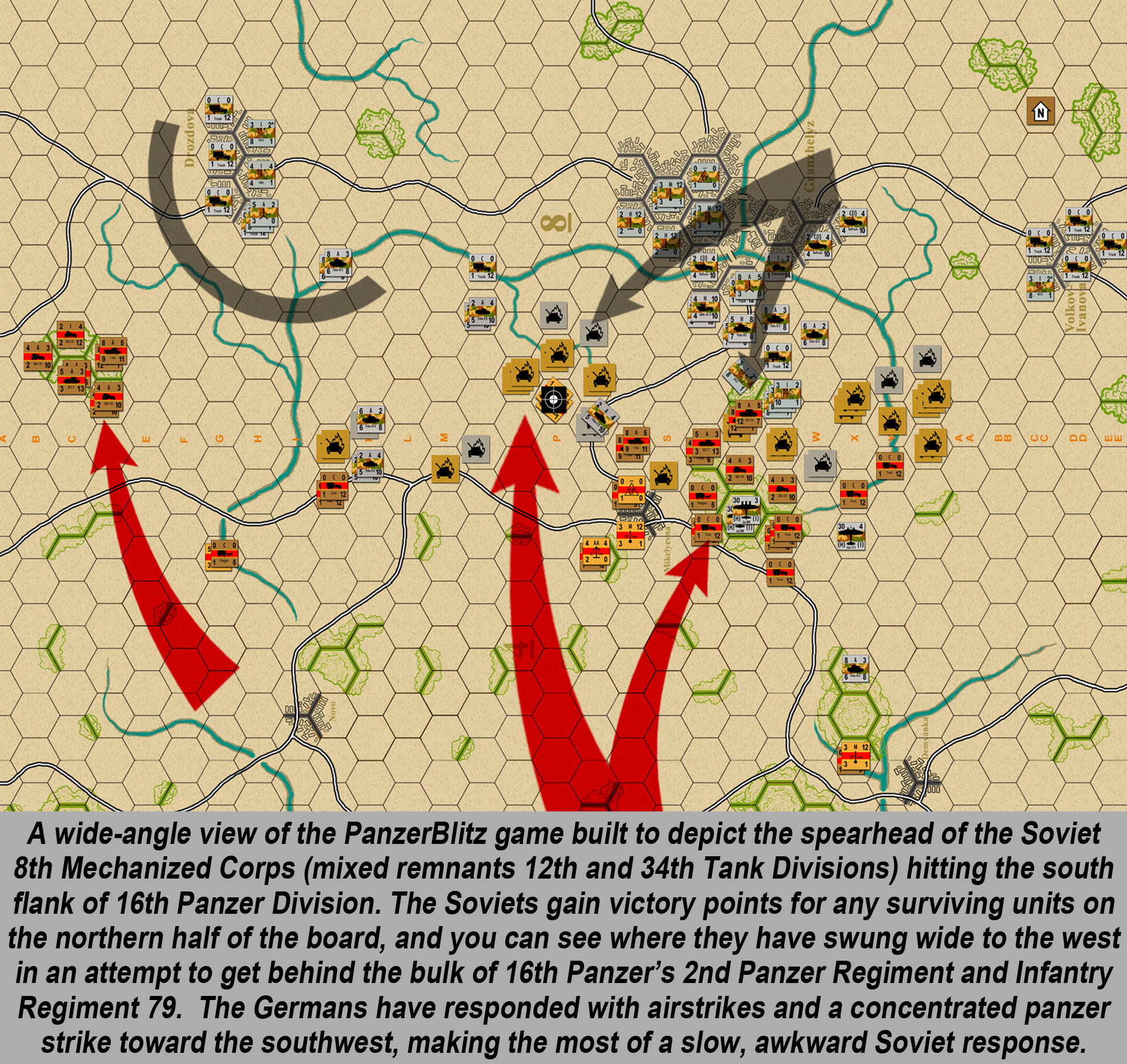
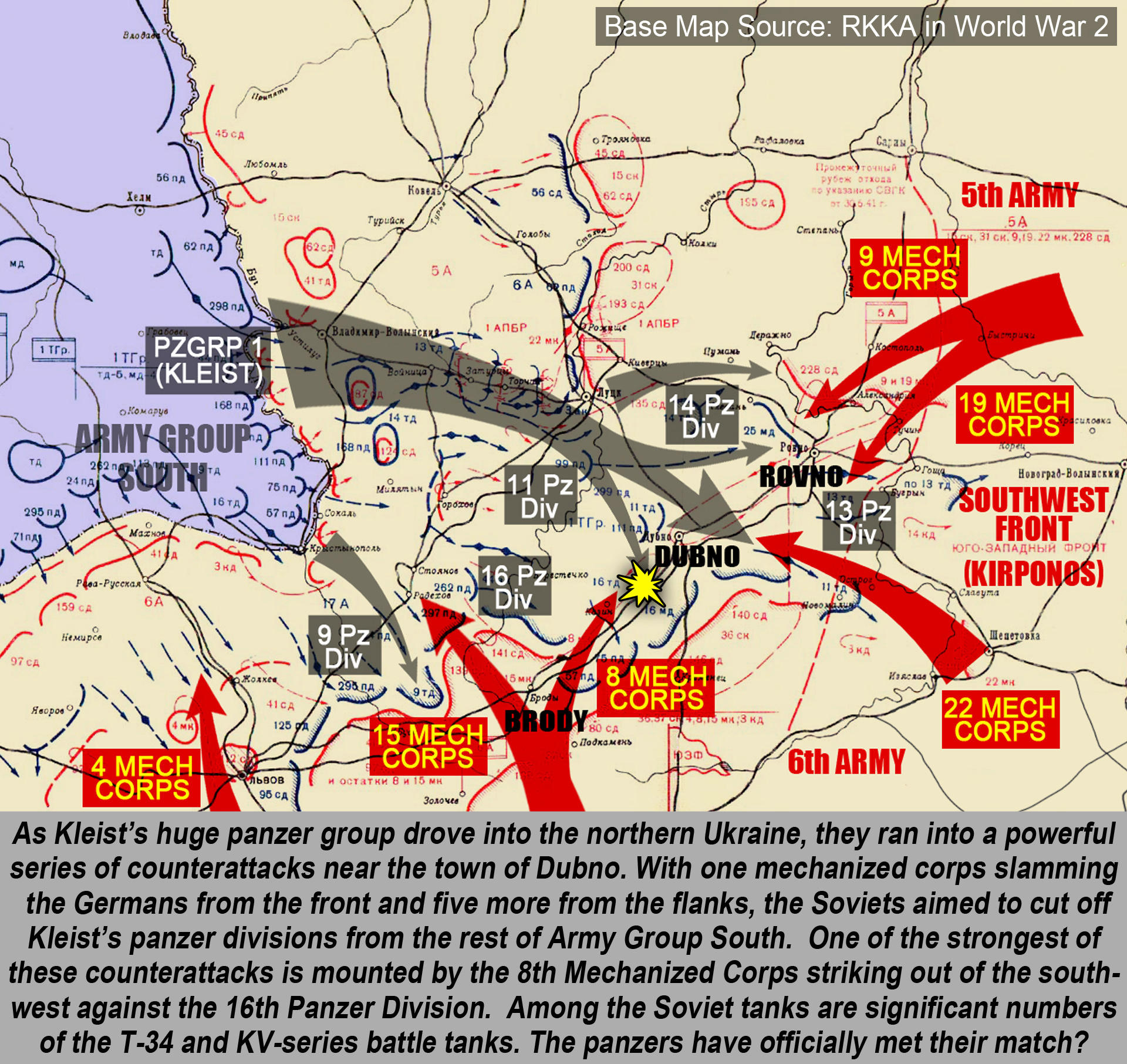
When the Army Group South attacked the Ukraine on June 22th, 1941, Kirponos reacted quickly. No less than six Soviet mechanized corps (over 2,500 tanks) were massed into a combined counterattack against the front, left, and right flanks of First Panzer Group, the huge armoured spearhead commanded by Colonel-General Ewald von Kleist.
The Germans ran into the first part of Kirponos’ attack (22nd Mechanized Corps) on June 24th, starting a series of engagements that are sometimes called the Battle of Brody, Battle of Rovno, or Battle of Dubno. Whatever the name, it would last four days and involve more tanks than any other part of Barbarossa.
In fact, this would stand as history’s largest single tank battle until the Battle of Kursk in 1943. Kleist’s whole panzer group (thirteen divisions, including five panzer and two motorized divisions) would be struck by elements of all six of Kirponos’ mechanized corps, totalling twelve tank divisions and backup infantry and artillery.

Again, these Soviet units were hardly full-strength, but suffice it to say that this was one hell of an explosion that had many on the German general staff genuinely worried.
As massive and well-conceived as Kirponos’ attack plan was, it was crippled by two major problems. First, the Germans absolutely owned the sky. Every move Kirponos’ tanks made was spotted and reported, quickly bringing down the screaming Junkers Ju-87 “Stuka” dive-bombers.
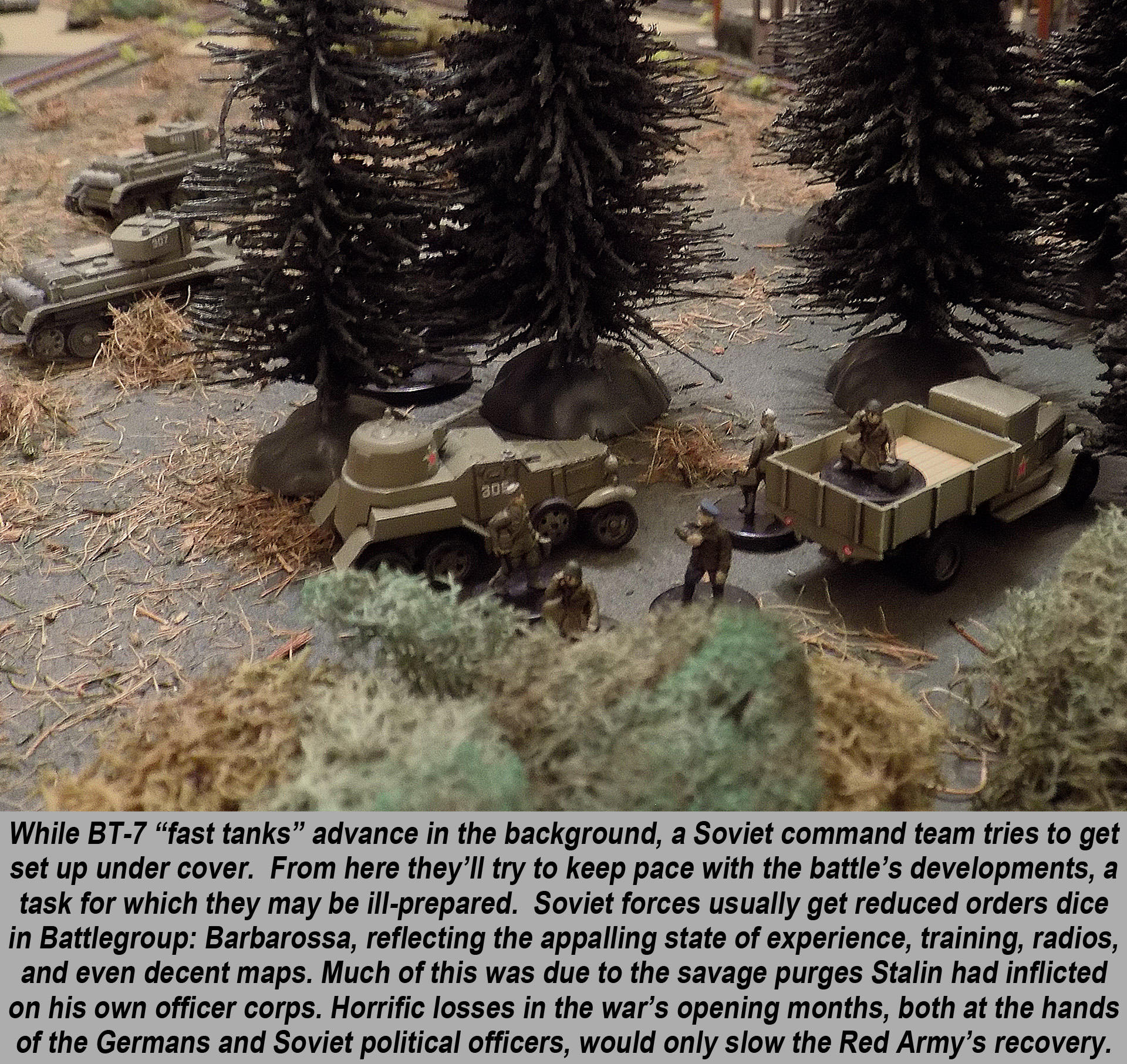
Also, Kirponos was working against the Red Army itself. Not enough radios, fuel, ammunition, or spare parts … an inexperienced officer corps, bad roads, poor coordination, all the connective tissue that holds an army together, all of this was completely lacking and effectively doomed Kirponos’ counterattacks before they could really begin.
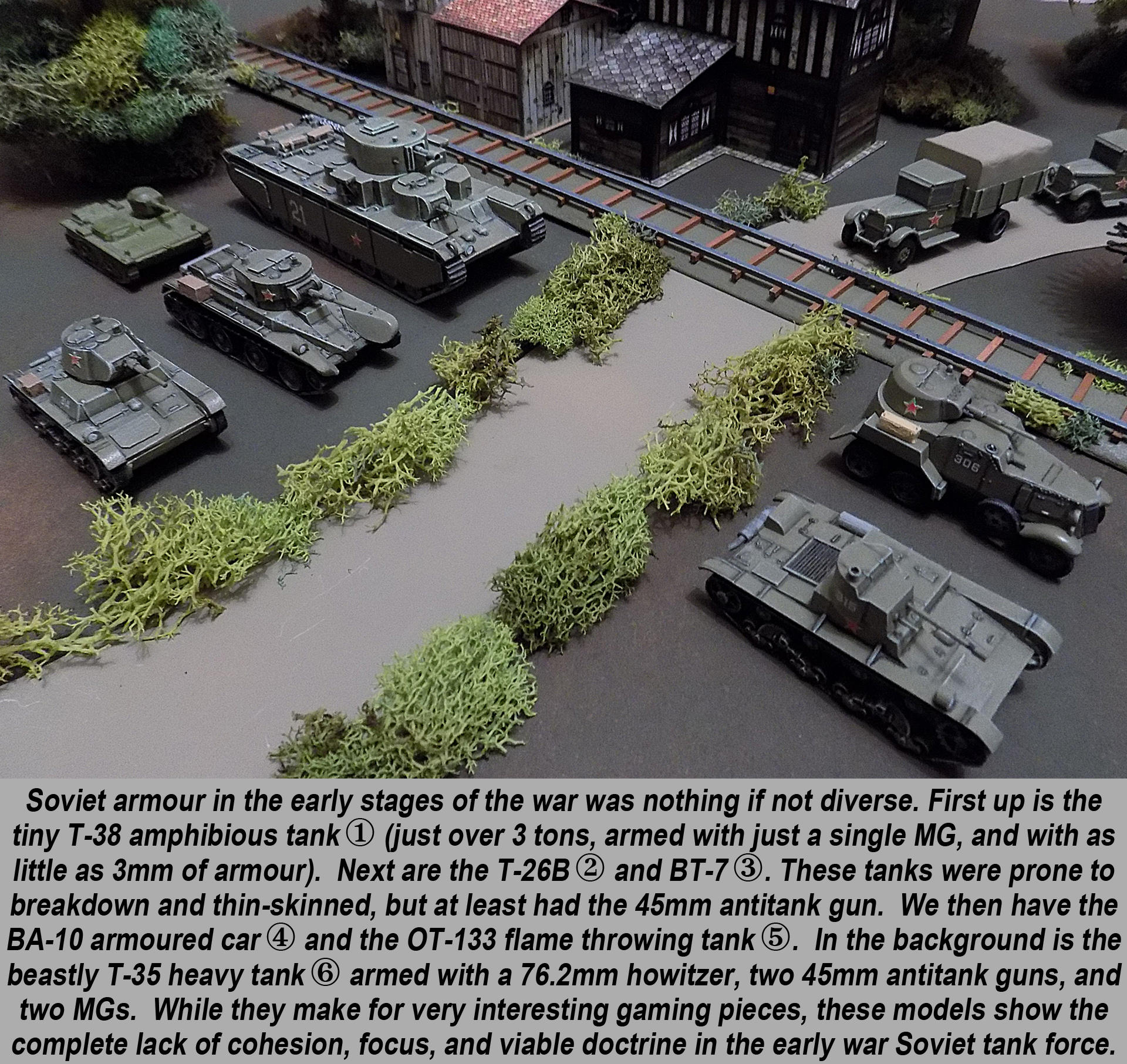
The result was a spasmodic, uncoordinated series of attacks. Never were Kleist’s panzers hit all at once. Instead they were able to pivot and apply their full strength against each Soviet attack in turn, like the hero in a bad martial arts movie surrounded by enemies who all make the fatal mistake of attacking him one at a time.
Still, the Germans were horrified at the sheer scale of the Soviet attack. Kirponos hit Kleist’s one panzer group with more tanks than were possessed by the entire German Army. Not only were the German tanks badly outnumbered, they were also woefully outclassed by two famous tank designs, the KV-1 heavy tank, and the incomparable T-34.

The KV-1 (named for Klimenti Voroshilov, Soviet general and crony of Stalin’s) was a heavy tank, armed with a 76.2mm main gun that outclassed the 37mm and 50mm guns on German tanks. The KV also carried thick armour that made it impervious at anything the Germans had short of a direct hit from one of their 88mm “FlaK” guns.
While the KV was formidable, the T-34 was nothing short of revolutionary. Many consider it the “grandfather of the main battle tank,” a design with firepower, protection and mobility all in equal superlative measure. One key design feature was the slope to its armour, making it more likely that an enemy shot would glance off its face when struck.
However, these early T-34s were not perfect. Only the company commanders had radios, meaning they had to command their platoons with signal flags. Ammo was badly stored. There was no gunner, the commander had to operate the main gun himself, making it hard to command the tank properly, much less a platoon or company.
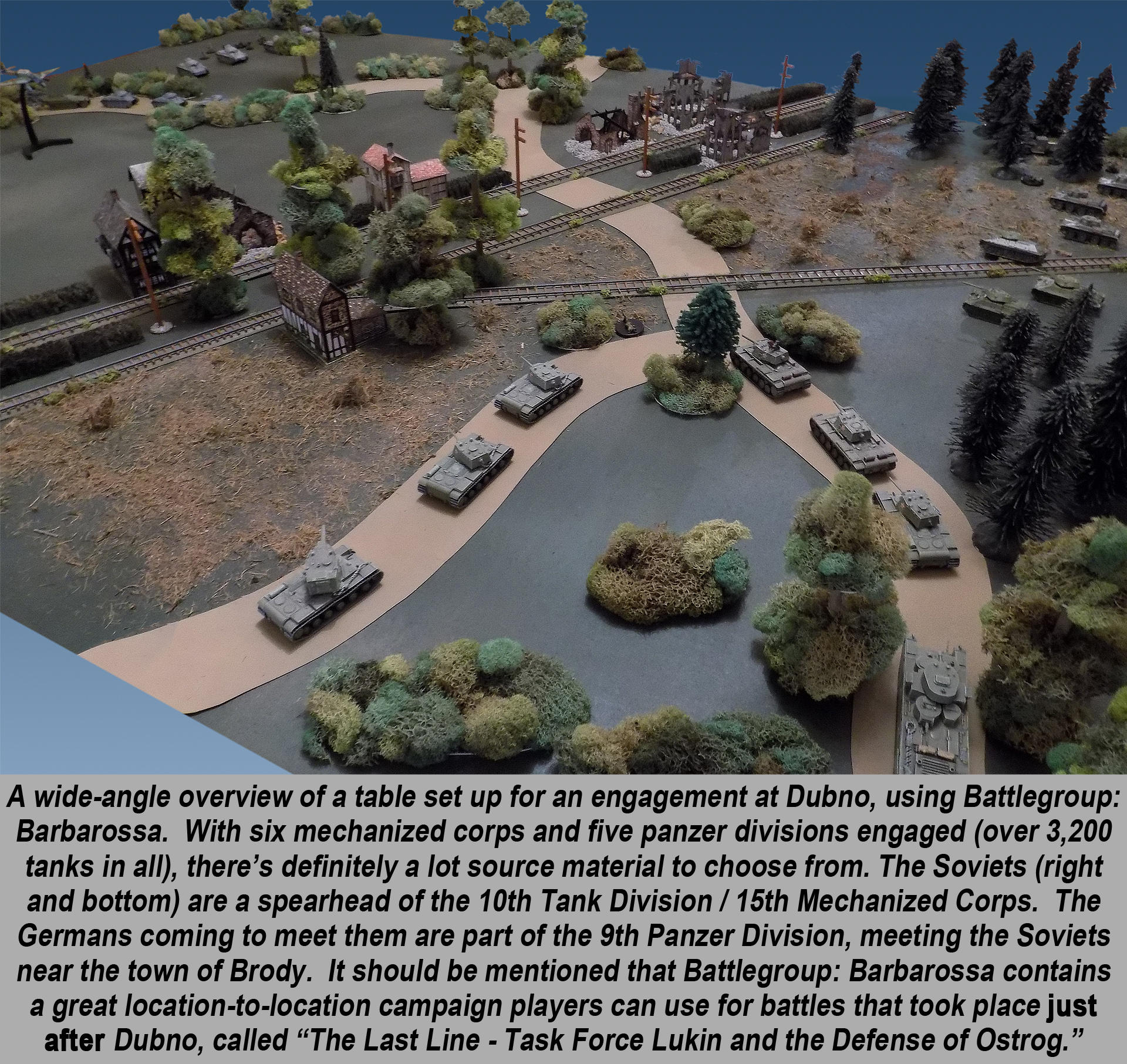
Kirponos’ basic plan was for the 22nd Mechanized Corps to hit Kleist’s panzer group from the front, halting them long enough for the 9th and 19th Mechanized Corps to hit them from the north. Meanwhile, three more mechanized corps (8th, 15th, and 4th) would hit them from the south.
These northern and southern attacks were meant to slice behind Kleist’s spearhead and meet at Dubno, thereby cutting off the panzer divisions the way the Germans were doing to the whole Red Army along the entire front. But these kinds of attacks require practised coordination. The Germans had it. The Soviets didn’t.
Although the Germans would experience some panicked moments, their fast, agile, and well-coordinated panzer divisions (9th, 11th, 13th, 14th, and 16th Panzer Divisions, forming the basis of III, XIV, and XLVIII Motorized Corps) were able to pivot time and again, smacking down each disjointed Soviet attack and quickly turning to face another.
Although facing the KV and T-34 for the first time was definitely a shock, many of these machines were abandoned when they broke down, threw a track, or simply ran out of fuel. German gun crews also soon developed tactics against them, like immobilizing them with track shots or drawing them into traps of flanking fire.
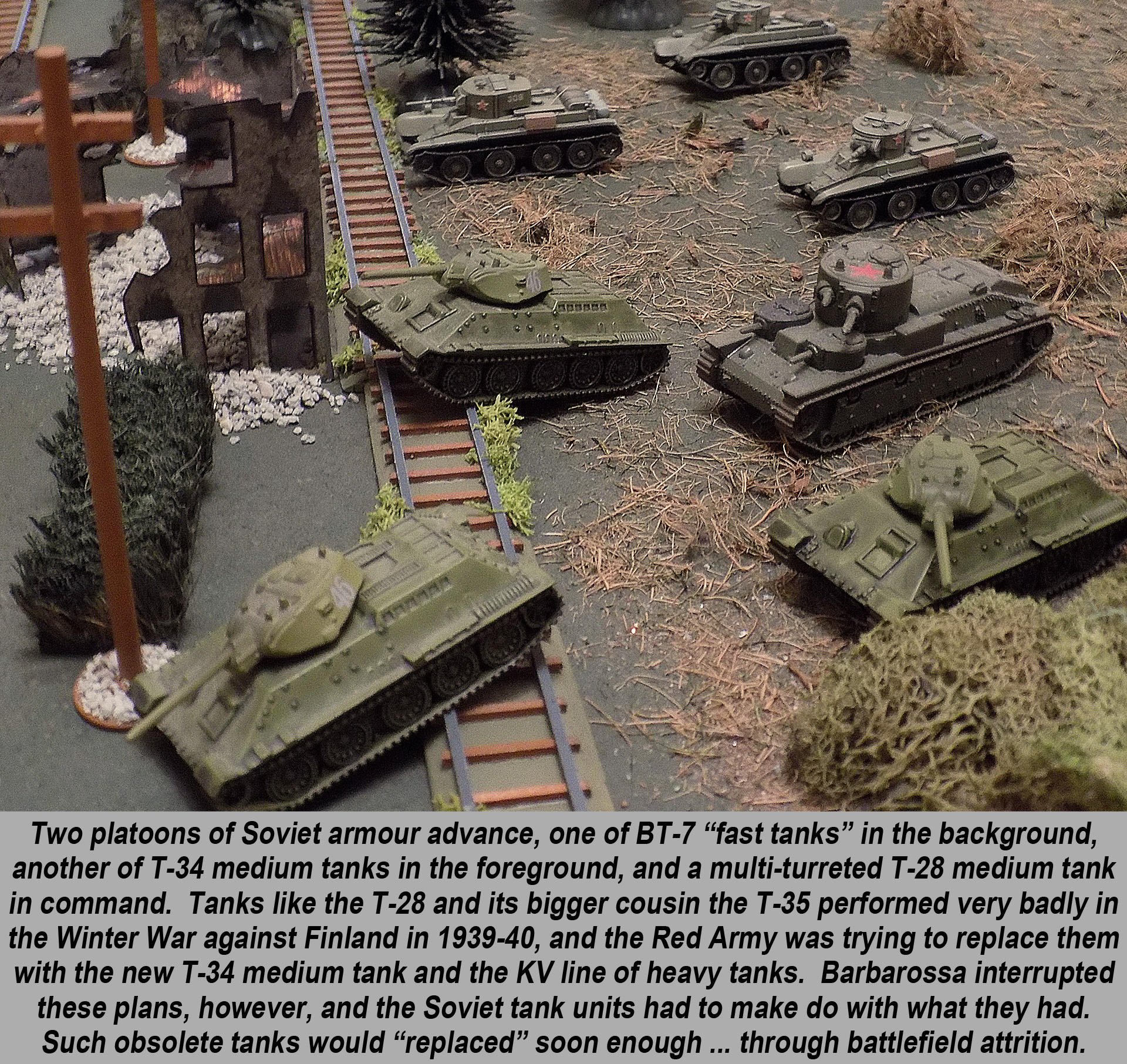
In the end, the Soviet pincers were unable to close at Dubno. Although German losses were heavy, Soviet losses were catastrophic, particularly among their tank divisions. The 10th Tank Division (15th Mechanized Corps) went from 205 tanks to about twenty in two days. The 22nd, 8th, and 4th Mechanized Corps were all but annihilated.
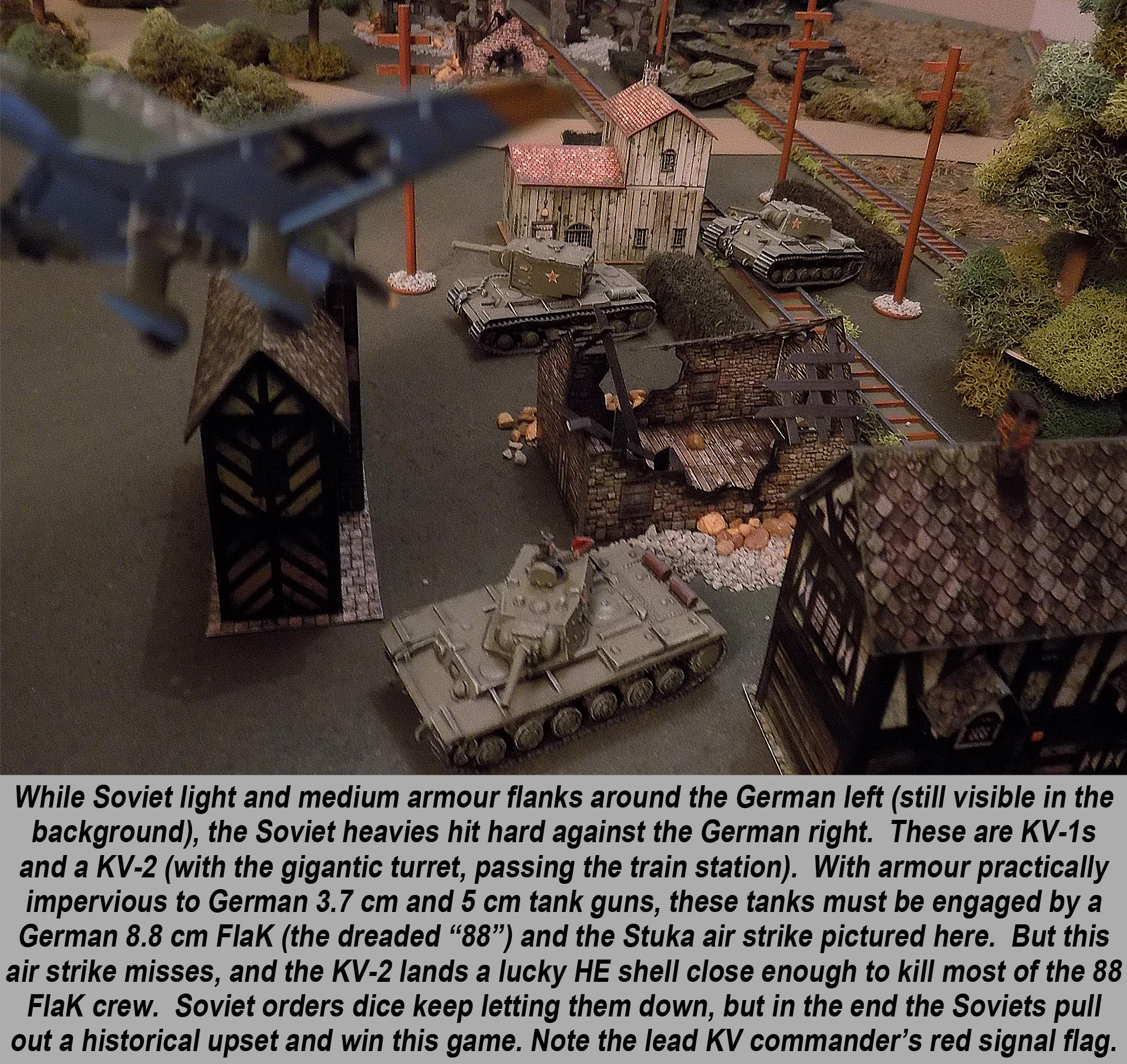
The surviving Soviet forces had no choice but to pull back, giving up their defence of L’vov, falling back through Zhitomir and finally towards Kiev, the capital of the Ukraine. Still, the Battle of Dubno slowed the advance of Army Group South by at least a week, something that no one else on the Soviet line was able to say.
A War of Rivers
Guderian at the Dniepr
As the Battle of Dubno raged and subsided in the south, in the centre, panzer generals Guderian and Hoth pushed their armoured spearheads ever deeper into the Soviet hinterland. After taking Minsk and sealing some 330,000 Soviet troops in Bialystok Pocket, they raced eastward toward the mighty Dniepr River.
This is a massive river, taking a winding course from north to south across thousands of kilometres of Russian and Ukrainian steppe. Indeed, the Eastern Front would be in many ways a “War of Rivers” – the Dniepr, the Don, the Donets, the Dvina, and the fateful Volga, where the Germans would one day come to grief at Stalingrad.
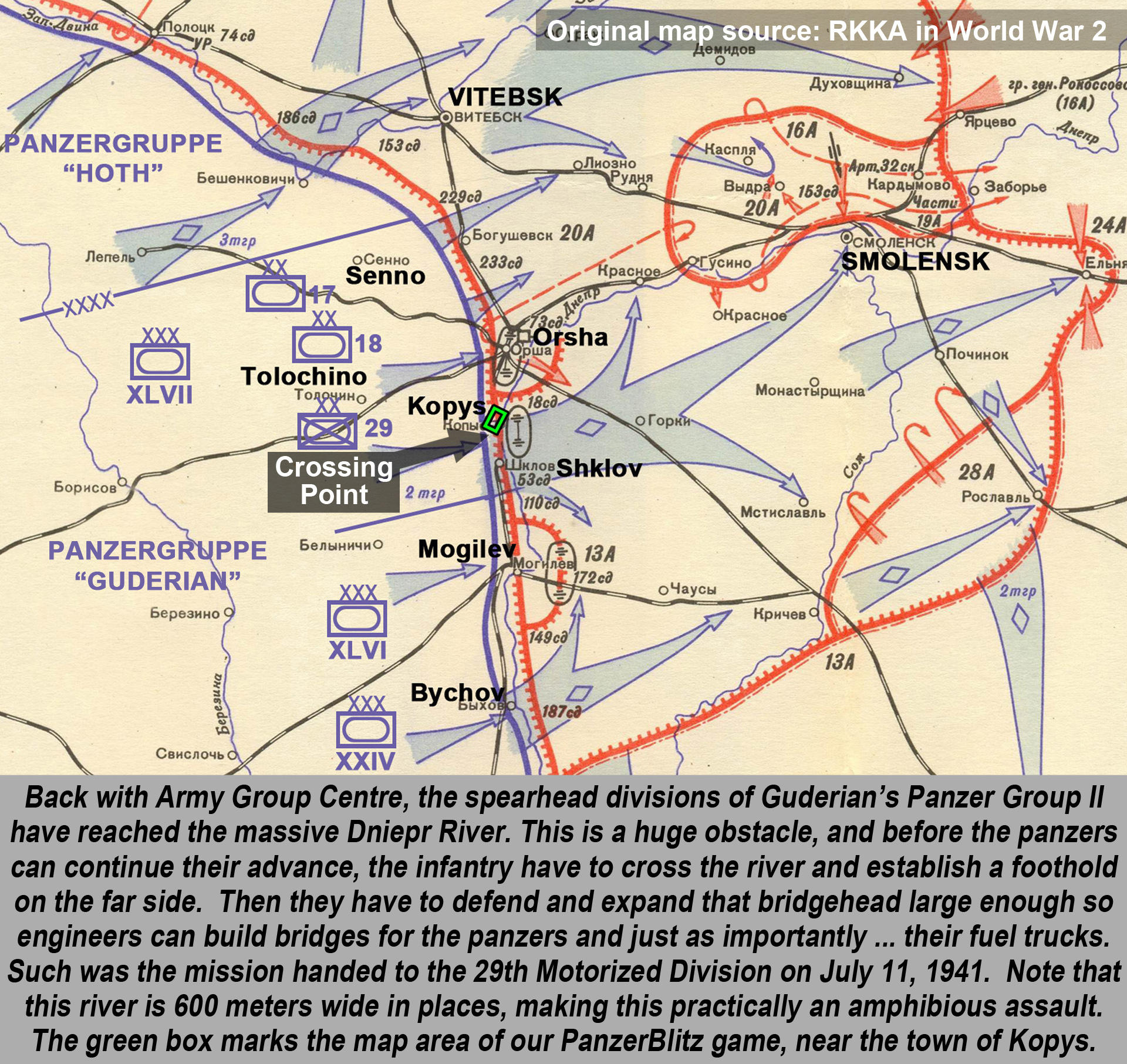
But for now, Guderian wanted to get bridges across the Dniepr, and fast. If he waited too long the Soviets could use the reprieve to organize strong defences along the opposite river bank. Guderian therefore ordered an immediate infantry attack in assault boats, which we will recreate in a game of PanzerBlitz.
The gamble was dire. Guderian had bypassed many pockets of resistance and his rear was far from secure. General Hoth’s Panzer Group III was lagging behind in the north, leaving Guderian’s left wing exposed. But they didn’t call Guderian “Fast Heinz” for nothing. On July 11th, he hurled the 29th Motorized over the Dniepr at a town called Kopys.
The Germans had only outboard assault boats, many of them wooden. Needless to say, they’d be horrifically vulnerable making the crossing on open water. Only by seizing the moment and attacking while the Soviets were still reeling from recent defeats did the Germans stand a viable chance.
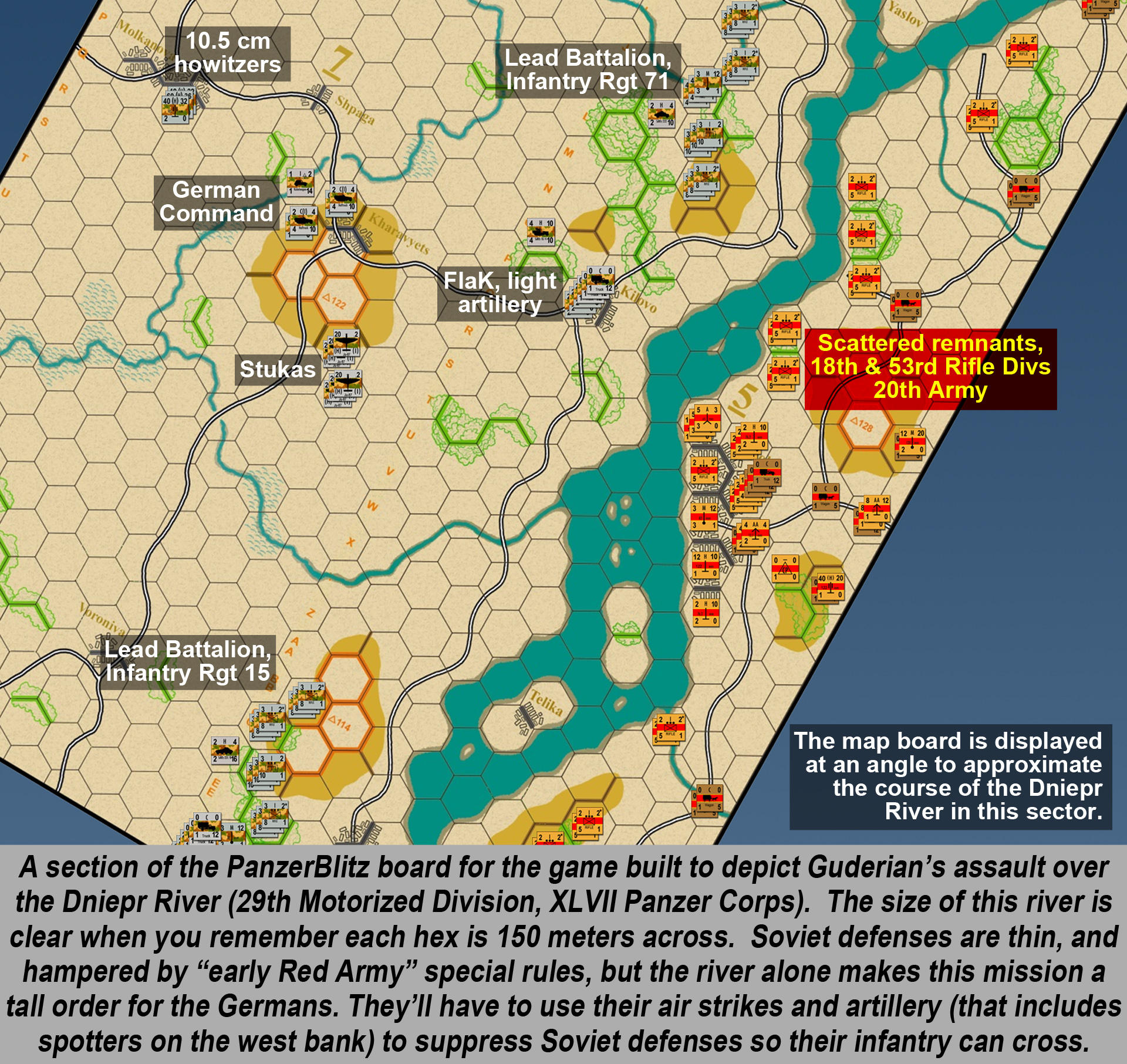
The Germans also enhanced their odds with massed artillery and air strikes, wreaking terrible damage to any Soviet unit on the far river bank. On the operational level, such interdiction also prevented the Soviets from bringing up any reinforcements or mounting reserves for an immediate counterattack.
Once across, the infantry then had to expand the bridgehead to a sufficient depth to allow German engineers to build first pontoon, then permanent bridges. Only then could the heavy artillery, panzers, fuel trucks, and supply convoys rumble over the river, reform, and continue the advance still deeper into Russia and the Ukraine.
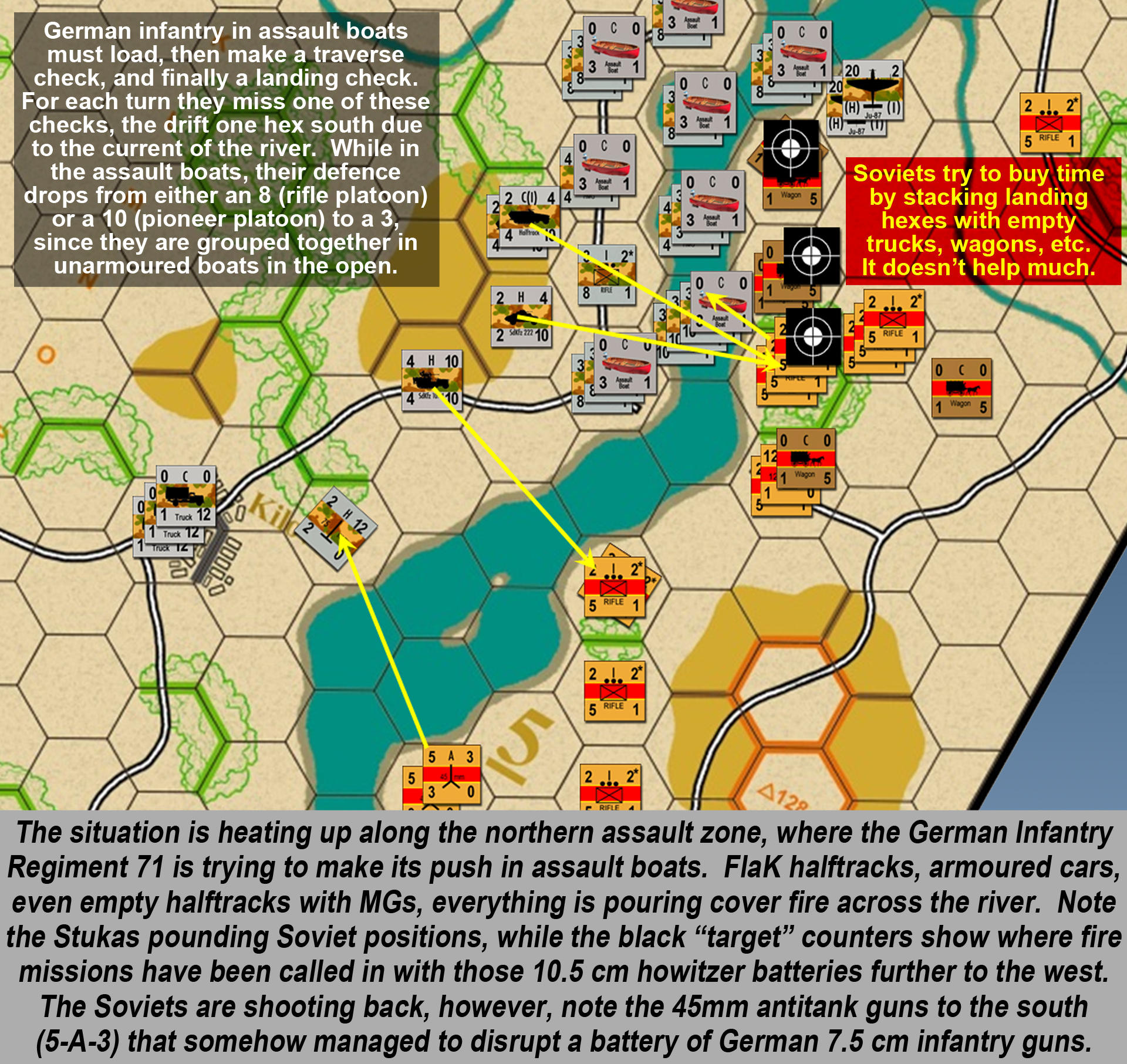
Once Guderian had one or two bridges across the Dniepr, the Soviet defence fell apart quite quickly. Panzers and motorized grenadiers fanned out, attacking other Soviet positions from the east side of the river. More and more crossing points opened, and soon Panzer Group II was again pouring toward the east.
As with most military obstacles, it’s like knocking down a wall with a crowbar and hammer. The difficult (and bloody) part is getting that first crack. Once you get a crowbar in that crack, you can start to pry it wider. Pry it wider, and you can get more leverage and hit that crowbar with a bigger hammer. Soon enough, the wall is rubble.
By the end of July, the Germans had pushed 500 miles deep into the Soviet Union in place. The Red Army had basically been annihilated, but a new Red Army was already taking its place. Come back next week as we take a look at German advances in the north, and Hitler makes one of the greatest operational blunders in history.
If you have an article that you’d like to write for Beasts Of War then you con get in contact with us at [email protected] to find out more!
"...all of this was completely lacking and effectively doomed Kirponos’ counterattacks before they could really begin"
Supported by (Turn Off)

Supported by (Turn Off)
"Guderian therefore ordered an immediate infantry attack in assault boats, which we will recreate in a game of PanzerBlitz..."
Supported by (Turn Off)









Good one @oriskany 🙂
The Dubno – Luck – Brody battle, at least preparations to it, showed the lack disorganization of the Russian forces. Well, sorry, it is hard to talk about preparations with such a dynamic change of the situation. Yet, the orders given to the units before the battle took place were changing a lot. Let’s take the 8th Mechanized Corps that you write about. On the 20th of June it got on alert. On the 22nd of June it moved towards Sambor just to get an order, in the evening to move into the Kurovice-Vinniki sector and subordinate to the 6th Army. 14 hours later the order is changed and the Corps must change the direction of its advance for Javorov to attack the German spearhead on the 24th of June. Yet, not a suprise for all at this time, the order is changed again! This time the 8th Mech Corps goes to Brody to counterattack at Dubno. So, the battle that Jim is writing about in the article. Now, ok, rapid situation changes demand decision changes but… it still is the Red Army that lacks proper communication means like radios. The roads are clogged with civilians and due to German air dominance not really of use so the Corps has to travel by backroads and forrest roads to gain at least minimum protection. What is more, it does have a lot of the new tanks but also more of the older ones that are at the beginning of this 500km march in not a really good condition and require maintenance. After the march, half of the old 700+ (add 169 modern medium and heavy tanks so T-34s and KVs) Soviet tanks is destroyed by the Luftwaffe or left behind due breakdowns. And this is only one of the groups that took place in the battle. It basically got weakened due to the shoving around from place to place as a result of bad decision making.
Awesome poast, @yavasa – and great detail! Especially on the 8th Mechanized Corps. Most of the detail I have on this revolves around Rokossovsky’s 9th Mechanized Corps because it contains the 20th Tank Division, commanded by my favorite Soviet general, M. E. Katukov.
I’ve done a lot of reading on Katukov, and he describes what the movement toward the Dubno-Brody battle was like. The infantry have no trucks so they have to ride on the tanks. The tanks have to drive waaaay too far on the roads when they should be carried on trains and then debarked much closer to the battle area. Constant air attack, getting lost, confused orders, all the things you mention. 😀
Still, the Germans weren’t having a picnic, either. From almost the outset, the advance of Barbarossa was somewhat more difficult in the south. There were a number of reasons for this. Most generally, the Soviets had slightly stronger forces in the south. In their pre-war contingency planning against a possible German invasion, the Soviets knew that the massive Pipret Marshes (sitting squarely in the middle of any German advance out of Poland) would force the Germans to vector either north or south of this obstacle. The Soviets had guessed that the Germans would hit harder in the south, aiming at the rich economic prizes in the Ukraine. Although Hitler would become obsessed with these targets later, at least at the outset the Soviets had guess dead wrong.
Thus, Army Group Center’s strike with two panzer groups northward of the marshes was much stronger than Army Group South with just one panzer group. Army Group South also enjoyed much less air support than its big brother in the center. All these factors add up to a somewhat weaker German force hitting a much stronger Soviet defense in the Ukraine.
Second, the Soviet commanders seemed to be a little better in the south. The Southwestern Front was under the command of Mikhail Kirponos, a far better choice than the hapless Pavlov commanding the Western Front. Kirponos had some pretty solid people working for him, as well, including the aforementioned Rokossovsky and Katukov. Although Kirponos gets some bad press from writers like Georgi Zhukov and Nikita Khrushchev (the future General Secretary of the Soviet Union, a flag-ranked commissar during the war), he seems to have done measurably marginally better than many of his peers.
Who knows what history might have held for this man, but he was killed during the defense of Kiev in September.
Subsequent writing, however, has treated him a little better, especially in light of the difficulties he faced not only from the Germans, but the crippling weaknesses inherent in the Red Army.
Lastly, the Soviets seems to have slightly better equipment in many of these formations. Most notably, a new of the tank divisions assigned to 5th and 6th Army were partially equipped with the new T-34 and KV-1 you mention, while the Western Front formations were still dealing largely with models like the T-26, T-40, and the wretched T-38.
Panzer Group I (Colonel-General von Kleist) led the way for von Rundstedt’s Army Group South into the Ukraine on June 22. Once across the Bug River, von Kleist was to advance to Rovno and Korosten with the operational objective of Kiev. He deployed the III and XLVIII Motorized Corps up front, driving a wedge between the Soviet 5th and 6th Armies and hoping to cut an important railroad line to Kiev.
The Southwestern Front was actually pretty quick to react, goaded in no small part by very blunt (if murky and indistinct) orders from Moscow. Six Soviet mechanized corps, with over 2,500 tanks, were massed to take part in combined counterattacks against the front, left, and right of Panzer Group Kleist. The Soviet 22nd Mechanized Corps would halt (or at least slow) the Germans from the front near Rovno, while the tanks of the Soviet 5th Army would strike from the north and the 6th Army did the same from the south. The idea was for these two counterattack to slice behind the Germans and meet at the town of Dubno, cutting off the German spearhead into a pocket the Soviets could destroy later.
The orders went out and the Soviets got moving. Marshal Georgi Zhukov and Nikita Khrushchev headed to Kirponos’ headquarters to ensure nothing went wrong. Unfortunately, plenty did go wrong.
Most importantly, the Soviet units earmarked for the operation were widely spread across the vast distances of the western Ukraine, and would take some time to get in position. Second, many of these so called “motorized” units were nothing of the sort, especially the infantry. Rokossovsky (9th Mechanized Corps commander, 5th Army) had to basically steal 200 trucks and even then most of his infantry were riding on tanks. Most of the Soviet units were thus strung along long dust roads, with the tanks too far ahead of the supporting infantry. This meant that either the units arrived piecemeal or, as in Rokossovsky’s case, whole and intact but far too late.
Lastly, the Germans owned the skies. They saw the Soviets coming from a long way off and many of the formations were heavily bombed before the battle really began.
@oriskany great post. I have to agree with all that you write above. I did manage to find something on the web that might interest you. Here you go, the account of the 8th Mechanized Corps commander Ryabyshev. A splenid read that actually proofs on the level of a Corps all the holistic points made about Barbarossa’s first days.
http://english.battlefield.ru/battles/22-1941/84-8th-mechanized-corps1941.html
That is indeed a great page you have linked, @yavasa . I have saved it as a bookmark and will go through it in detail on my lunch break today! 😀 (We’re coming up at end of quarter at work so we’re working strange hours)
The site is actually not bad. It has some moments thou. Like for example when they try to argue that Polish officers shot at Katyn was not a Soviet thing…
Yeah, that’s pretty terrible. But that’s the thing with veterans’ accounts. I mean, they lived it, they were there, and they have a singular perspective that absolutely cannot be matched by any subsequent historian. And, sadly, as time marches on, their accounts become fewer and fewer and accordingly more invaluable.
On the other hand, it’s exactly this “we were there” quality that fatally flaws so much of their accounts from perspectives of objectivity, analysis, and clarity. If you were there, you’re emotionally invested so delivering an unbiased account becomes very difficult.
Accordingly, a lot of veterans’ accounts are deeply saturated with the viewpoints and propaganda at the time. I’d certainly agree that disowning the Katyn Massacre of 1940 (uncovered by the Germans in April, 1943, I believe) is a pretty extreme and reprehensible example, but we see the same mechanic in the way US Marine veterans of the Pacific describe the Japanese, German soldiers claiming “we didn’t know” when the Holocaust comes up, etc.
I’m sure these Red Army soldiers were told in emphatic terms that Katyn wasn’t the work of Soviets. And given the life-and-death battles they were in for a “Great Patriotic” cause, they almost had to believe it.
Nowadays, of course we know better. Still, the Russian government might still be sticking to that story for the foreseeable future, if only to avoid admitting that they lied to their soldiers and veterans who were making such incredible sacrifices.
Too early for a pint … so a pot of coffee it is … lean back and read
Drowning in coffee myself at the moment, @rasmus 😀 Welcome to the States, if your move is finally completed. 😀
Thanks for the welcome.
Almost complete, stopping over at the in-wars for a week
Well, if you can survive a week at the in-wars, you can survive anything. 😐
330,000 men lost in a single encirclement … *ouch*
There are no small losses in this part of the war.
The Germans should have considered themselves lucky the Soviets had such problems ordering their troops.
You kind of get to see the result of that when the soviets strike back in operation Bagration.
I suspect that’s why the rest of the allies were kind of afraid of the Soviets near the end of the war …
Stalin bumped off the soviet Unions best generals in the purges before the Great Patriotic war, they were sorely missed
Indeed, @limburger ,and unfortunately for the Soviets, this would be just one of dozens of such encirclements. And they would get bigger. Kiev would encircle or destroy by combat upwards of 650,000 in September, and the October disasters at Vyazma would (when combined) total out at over 700,000.
Granted, most of these casualties are prisoners of war. But that’s where the Eastern Front’s real death toll takes place (well, that and among the civilians). The fact that between 3-6% of PoWs on either side ever see their homelands again is part of what drives up the Eastern Front’s butcher’s bill.
Absolutely, @mamlukomar – and the biggest general the Soviets lost in these purges was probably Marshal Mikhail Nikolayevich Tukhachevsky. This guy really was ahead of his time, and had built the Red Army up into not only the world’s largest army, but in some ways the most advanced (or at least the most forward thinking … we’ll never know how well some of these ambitious ideas really would have worked).
But YES, these men were sharply missed. How sharply? Well, thousands of officers and generals that had been suffering in Soviet gulags since the purges were abruptly released, reinstated, dusted off, and put back in their old commands.
One of the biggest examples was Konstantin Rokossovsky, mentioned above. The guy had been stripped of rank, imprisoned, beaten, tortured, and just that fast was whisked back to command a mechanized corps (sorry, our bad), even if he had all false teeth now to replace the ones bashed out by the NKVD.
I don’t know why but I love the T35 useless tank, I think it is just the idea of it armaments 3 full guns and a few MGs.
I feel odd saying it but this is properly my favorite part of the War. I know lots and lots died. but game wise it is the most interesting – asymmetrical
I totally know what you mean, @rasmus, on both counts. The T-35 is a wretched thing, historically and in game stats (both in Axis & Allies 15mm and in Battlegroup: Barbarossa). But I still can’t suppress a girlish giggle whenever I put it on the table. I mean look at that thing!
Now, the T-35 does get to use the “Multiple Turrets” special rule in Battlegroup. Give it an “Open Fire” order and if it rolls a 5+, it gets to fire a third time (normally Open Fire lets you fire twice). It’s only happened a few times for me, but man, it’s glorious. Most multi-turret tanks only have MGs in the other turrets, but this thing has actual 45mm ATGs, which makes it all the better.
And I’m with you on the second part as well. Eastern Front was always been my “home” and “first love” as a history buff and wargamer. The war lasts four years, and each year really does have a distinct “period” or “flavor” especially from the Soviet perspective. I’d be hard-pressed to think of an army that re-evolved so many times, so fast, so successfully, and under such pressure. It’s almost puritanical ferocity, its scale, it’s apocalyptic scope, it really is “the real 40K.” In fact, reading some of the 40K fluff on their wiki site, it’s blatantly clear this is where they drew some of their inspiration.
I tell you what, I foresee being forced down to an amusement park round your neck of the woods. I’ll have to take on you Red Army – I will take a look at building a historical 1941 Heer
Oh no … it sounds like you may be dragged to the “Orlando Gulag,” run by Kommissar Disney and his evil Mouse minions!
Sounds good, @rasmus – I have a big 15mm Soviet force for all periods of the war, or we could go the hex and counter route. 😀 Orlando is only about three hours from where I’m out, gimme a shout with enough warning and I can probably meet you up there.
We are talking winter, this one or the next – as you might have guessed I don’t do well in heat. Nor do the rest of the family, both of them also being gingers
Awesome, @rasmus – just a word of warning. Travelling to Florida in winter, the weather is absolutely gorgeous, its the reason you put up with the heat, the hurricanes, and the (*ahem*) tourists (just kidding).
But coming here in the winter has two drawbacks: More expensive. And more crowded. Everyone wants to come here in the winter, and the crowds and prices reflect it.
Another fabulous article!
Thanks very much, @dorthonion ! I was starting to wonder if they were getting too long, but there’s a lot of ground to cover. 😀
a great article didn’t know that the Germans were actually slowed by any one at the beginning of Barbarossa. @oriskany
Actually yeah, in the south things were measurably more rocky for the Germans pretty much from the start.
I mean they were still winning, closing huge encirclements and winning massive battles like Dubo-Brody, Uman, eventually Kiev (Part 03). But bigger Soviet armies, smaller German armies, the phased introduction of their allies’ forces (Romanians, Hungarians, etc, they didn’t all come in at once), and a very wide battle front (tougher to achieve the local concentrations of force required for the Blitzkrieg doctrine), and most of all, a better Soviet commander, I think made a big difference.
can’t wait.
Very cool article. You can really tell the passion you feel for the subject area. I can’t believe I have never heard of the Battle of Dubno, Kursk yes but not Dubno. Was it because it was eclipsed by Kursk as far as numbers and importance/influence on the war?
Also, the train tracks came out looking sweet!
By Kursk and by Stalingrad and a few other in importance, even Kiev shortly after.
Yeah, good call, @rasmus – Kiev is one of those “stealth” turning points not many people think of.
It’s just a personal opinion, but I’ve always felt that most of history’s “turning points” are really nothing of the sort. They’re “always late,” just confirmations of trends and trajectories that have long been on course. Maybe it wasn’t obvious at the time, but by the time the “big turning point” (i.e., Stalingrad, Kursk) rolls around, the issue is well and truly decided.
I mean, did Waterloo really doom Napoleon’s empire? Of course not. That was done long ago at Leipzig, some would even say Borodino or Moscow. Waterloo was the end of an attempted comeback.
Did the sack of Rome really determine when the Roman Empire would fall? The sack of Rome was probably in the cards due to declines that had begun generations earlier.
On the Easter Front, I’d say Moscow was the real turning point. When you invade Russia, you have to knock it out in the first big swing. If you deliver that first big knockout blow, and somehow, some way, the big Red Bear somehow staggers back to his paws . . . you are dead. Happened to Hitler, happened to Napoleon, happened to Charles XII. In fact the only people who’ve “conquered” Russia could be the Mongols, who knocked them out straight away and even then only by turning half the Russian princes as vassals against the other half.
Anyway, I feel that December of 41 is when it’s decided that Hitler will not destroy Russia, EVER. Stalingrad was certainly important in 42, but the Soviets certainly weren’t going to be defeated in the field and not going to offer any more deals. And Kursk in 43 was beyond a forlorn hope for the Germans, it merely confirmed what was already beyond inevitable.
But at Moscow they just missed it. And one of the big reasons why?
Kiev. And there’s where you nailed it, I think. 😀
Of course, is it really wise to push past Smolensk, Vyazma, Mozhaisk and Borodino, and all the way to Moscow with one million men sitting directly on your right (south) flank in and around Kiev?
That’s where the debate comes in. But those weeks Guderian spent running to meet Kleist at Lokhvitsa (thus sealing the Kiev Pocket), and Hoth spent running up to help Hoepner and von Leeb at Leningrad, were sorely missed when the autumn rains and first snows started to fall.
They really might have reached Moscow. Then again, would that really have clinched it?
People have been arguing that for . . . whattya know? 75 years. 😀
Thanks, @zorg and @gladesrunner .
Yeah, those rail road tracks were just put together with some balsa wood. The base pieces and rails were easy enough, the only tedious part were all those railroad ties. I made twelve feet of the stuff, with about 450 of those tie boards cut (very thin balsa wood square dowels).
Not many people (at least in the West) have heard of Dubno. One reason may be cause it has three names and with practically every book you pick up, they choose another of the three (Dubno, Brody, or Rovno).
Good old training on Panzer General coming in here … Kiev seems to be the turning point you need the major victory or you are doomed
Ah … Panzer General. Ah … Barbarossa. 😀
https://www.youtube.com/watch?v=Qn5Z5Ly3fqQ
https://www.youtube.com/watch?v=-Y9pvkcxH7Q&index=3&list=PLuXk2Ke3aaAgm8htbKZouPnOWTdznHK7a
A brilliant evaluation of the feelings of two fronts in a single article @oriskany.
On the German side the number of different types of vehicle with few exchangeable parts and different ammunition requirements was a bit like blowing a raspberry at the friction of war and saying do your worst! On the other hand it was truly amazing that at this stage of the war crews were not trained to do even the most basic of maintenance on their vehicles this adding to the attrition. Many prewar tank designs were meant to be transported to the battlefield not driven to it. Each 100km driven is just more tanks out of action with track issues, engine issues.broken fan belts were very common on these early tanks when they had to do too much crawling. Unlike the T35 the T28 was not to bad. The Finns liked them just that in Russian hands they were not used very well. This brings me to the ongoing issue with the Russian army going all the way back to the Spanish Civil War. Their tank and infantry coordination just did not happen. The tanks usually get ahead of the infantry loading mutual support benefits. Doctrine of the day just compounded the issue as at the end of the day if the infantry was not with the tanks then the tanks had to withdraw until they had infantry protection. This was the primary cause of failure in many breakthroughs they achieved in Finland. The Finns would block the infantry causing the Russian tanks to cross the line twice. Pass me another cocktail Simmo. What just one Juha. 😉
Oddly if a unit makes contact and there are no orders forth coming then they are to dig in and hold until orders arrive.
Russian doctrine belongs to the school of the attack. The foundation of which its that war was to be fought on foreign soil never the motherland. So very little training for defence was given. This is keeping with the times as defensive action was frowned upon in blitzkrieg. The other conviction is that the Russian soldier is barely or badly trained for his position while at this point of the war the German soldier was trained to act for a short period up to two ranks above his current position.
The operational chaos we see with orders given, changed, retracted and even reissued again we saw happen in the battle for France. It is a symptom of German real time decision making getting tighter and tighter inside the Russian decision making loop (OODA Loop).
Again the Russians were expecting to have enough time for their units to practise the maneuvers they were expected to do prior to bring deployed into combat. They would never get this luxury and what should have been reflex reaction to the officers just was not there due to the purges. It was outstanding that the Russian army as a whole achieved what little they did.
While the tank strength in the Ukraine did come as a surprise to the Germans which surprises me as the Russians did have more than 8 times the tanks the Germans had. At least on paper the T26 outclassed the Pz 1s and Pz 2s but let down by doctrine, training, reliability and just about every thing else.
The KV1 should not have been such a surprise either as the Finns had captured a couple during the Winter War in working order and what they learned about these beasts was passed on to the Germans. I also believe the poor old KV1 at this point in the war from historians for being under gunned with its 76.2mm gun. While this is true later in the war. But really, honestly how big of a gun did it need at this point of the war as it could knock out any tank from the front at any range for the moment it is the IS2 in this time frame of the war. The Finns had the Bofors 76mm sometimes referred to as the 88 of the North that could penetrated the KV1’s front armour at medium range however these were required in their AA role protecting Helsinki. I have never been sure whether it was Western propaganda playing down the significance of the KV1 our not. Let’s face it the primitive Russians having something better than British superior engineering. That’s just not cricket chaps. 😉
Thanks very much, @jamesevans140 –
On the German side the number of different types of vehicle with few exchangeable parts and different ammunition requirements was a bit like blowing a raspberry at the friction of war and saying do your worst!
Very true. But in many ways, the Germans had little choice. They weren’t expecting to go to war with anyone besides Poland in 1939, and were never really ready in the West in 1940 and certainly weren’t really ready in the East in 1941. Tanks that were meant for training, tanks that were meant for recon, tanks that were taken from the Czechs, tanks that were refurbished after being captured from the French and British … huge numbers of French and British trucks and tractors, the Germans had to make to with what that had.
A good indicator of this can be taken from the reorganization of the Panzerwaffe in 1941. Early in the war, the Germans had ten panzer divisions. What a nice round number!! I can so easily picture some German OKH staff officers standing around before the war asking themselves, how many panzer divisions should we have? I dunno. Ten? Ten sounds good. I mean come on, barely anyone knew what a “tank division” even was in those days.
Once Hitler issues the directive for Barbarossa, he demands that the number of panzer divisions be doubled from ten to twenty. Absolutely no friggin’ mention of where these tanks are coming from. Just make it it happen, because “reasons!”
So what do they do? They cut the number of panzers in each division roughly in half. Just that fast, the 1940 panzer division model of a central panzer brigade built around two panzer regiments is cut to each panzer division being built around a single panzer regiment and two regiments of motorized grenadiers. Presto! Twenty panzer divisions!
My only real point is that going into Barbarossa, yes . . . the Germans were using every kind of vehicle they cold get their hands on. Standardization? They couldn’t afford it. I wouldn’t be surprised to find @warzan and Justin’s zombie apocalypse ice cream truck in there somewhere. 😀
On the other hand it was truly amazing that at this stage of the war crews were not trained to do even the most basic of maintenance on their vehicles this adding to the attrition.
Are you talking about the Soviets? Very true in 1941. By the end of the year, however, Soviet tank crews actually started their tour IN THE FACTORY helping build the very tank they would drive into combat. The engineers and workers would let them work on the tank, not only to help fill manpower quotas in the factories, but also to give these crews some serious hands-on experience in how their tank worked. Maybe the driver worked on the engine. Maybe the gunner helped with the turret drive or the suspension. Maybe the bow machine gunner helped on the transmission. Point is, when the tank broke down, odds were good at least one member of your crew helped build whatever just broke, and could fix it. Russians learn from their mistakes, if nothing else.
Doctrine of the day just compounded the issue as at the end of the day if the infantry was not with the tanks then the tanks had to withdraw until they had infantry protection.
Makes sense in theory. Tanks without infantry support conjure up gruesome images of turtles dropped in ant piles. But try keeping your tanks and infantry together in a broad, real-scale game like PanzerBlitz. The only way is with trucks. But infantry in trucks are murderously vulnerable. The trucks are just there to get you TO the battlefield, not ACROSS it. So do you let the infantry ride the tanks? Again, ring the dinner bell for enemy machine gunners. The halftrack would eventually provide a stop-gap solution, but the fleets of American M3 halftracks were still some years off. Without an effective APC of some kind, this advice is harder to take than it is to give.
Russian doctrine belonged to the school of the attack.
In 1941 and early 42, absolutely. It’s not until Zhukov starts winning Battles like Moscow in December of 41, Stalingrad in 43-43, and of course Kursk in 43, do we see the classic Soviet defensive doctrine start to come in. Let the enemy hit you first, grind himself to a pulp against your infantry and artillery, and only when he’s exhausted do you counterstrike with carefully-hoarded reserves.
This was a doctrine made for the Soviets. Not only does this not work for American or British armies (whose public would never abide such casualties), but tactically the Soviet soldier could hide and dig in like nobody’s business. Accounts of generals like von Mellenthin talk of Soviet engineer BATTALIONS sneaking forward under cover of darkness, laying huge minefields RIGHT IN FRONT of German lines, and when the sun comes up the Soviets are gone and there isn’t so much as a leaf out of place. The practices of deception, entrenchment, camouflage, or maristroika as I think the Soviets called it, was an art form.
Of course, in 1941 such accomplishments were far, far down the road. In that dark summer and autumn, it was totally as you say: Attack, attack, attack.
Let’s face it the primitive Russians having something better than British superior engineering. That’s just not cricket chaps.
Partially Britain’s own fault. David Fletcher from the Bovington Tank Museum says of the T-26B: “This was a good little tank designed by Vickers, a British Company. You know it was good because the British Army didn’t buy it.” 😀
Instead it winds up with the Red Army in the thousands, and helps fill the tank graveyards of Dubno.
Part 03 we head north, good sir, to see what Army Group North, Manstein, and the Finns are up to! 😀
Another great read @oriskany 🙂 Did I mention massed Panzerblitz makes me giddy 🙂
Thanks, @cpauls1 – indeed, an excuse to play more PanzerBlitz is half the reason this article series is being done. 😀 😀 😀 The bigger the games the better! There are some really big ones in Part 04, including Waffen SS and Vichy French counters. 😀
Fun stuff in the works it seems
We certainly hope so, @rasmus . 🙂 In Part 03 we check in with Army Group North and see how they’re doing toward Leningrad, take a look at what the Finns are up to in the “Continuation War,” and close the ring around Kiev. Part 04 talks about Typhoon, and of course Part 05 is our grand finale!
And not there is a battle report in the sistertreat on the historical forum
True enough, @rasmus, we are now rolling out the more detailed battle reports for the Battlegroup: Barbarossa depiction of the Battle of Dubno-Brody.
http://www.beastsofwar.com/groups/historical-games/forum/topic/barbarossa-soviet-union-invaded-75-years-ago-today-battle-reports/
Awesome reply @oriskany.
I am also happy many new Kindle is learning much better than the last or at least this one has learned your name rather than insisting that your name is ordinary.
From a sociology point of view we are also looking at one of the largest human migrations up 1941 and Germany was not really ready for it as you say. When you look at the northern sector in your next article you will find two or three infantry divisions that are now motorised with their platoons being carried by modified Bren gun (MG34) carriers supported by re-armed Polish tankettes. So yes they pulled in vehicles from just about everywhere, including funky ice cream vans. However the blowing raspberries I was making a remark concerning the multitude of vehicles that they developed that were nearly identical in form and function, but little compatibility of parts between them. Just because I have a radio with a bit more range, I don’t need a whole new vehicle wrapped around it nor do I want 4, 6 and 8 wheel options. I certainly do not fries with it. 😉 perhaps I would prefer tracks. I would site the Sdkfz 2XX range of vehicles for a start. I know Hitler preferred diversity with the survival of the fittest but the Heer should have known better after Poland. It is no accident that the British has a standard horse cart going back to 1703. In Nelson’s day he had access to flat pack frigates. In fact standardization on the battlefield goes back to ancient times. On high wear items why they did not use common tracks for the Pz-1 and Pz-2 or the Pz-3/4s. The Polish and French campaigns should have highlighted these necessities. It seems the rule was of in doubt add more variety.
Sorry i should have been more clear and yes I was referring to the early war training not given to crews by the Russians. All comments I make on your road to Moscow series i make in that context and hopefully within the actual article. The Eastern Front is just so large a topic it could easily drag us off topic from your articles if we let it.
Prior to WW1 military thinkers were divided into two schools of thinking, that of the attack and they defence. These schools still had followers among the top ranks in WW2. France went with the school of the defence while Russia went with the school of the attack as part of ‘natural’ communist science of war. At the heart of this ‘science’ is that all wars are to be fought on foreign soil and never allowed to be fought on home soil. As it was natural the theory goes that little or no training is required as it comes naturally to the communist. At this stage of the war the Russians had not found the answer to coordinating their infantry and tank formations other than using an order to do so. Add the commissars to the mix and it gets very ugly, at least they were starting to be checked by this stage.
The British army the poor cousin of their armed forces. Forced to push new weapon designs a miniscule budget rather than performance which was not part of the budget. As a result the British army get stuff like the Matilda 1 and small middle east countries import the Vickers 6 ton tank. It is amazing that the British army were able to become a motorised force given the budget they had to work within.
Unfortunately I will be off line for the next couple of days but I am really looking forward to the next installment. You may be surprised that it is not because you will be covering the Finns. It is because it involves my favourite German army 18th the only true all arms formation of the German army. Warships and multiple amphibious assaults to take the Baltic islands, what is not to love about this army. I think many readers new to this front will be surprised by the number of amphibious actions taken by the Germans, Finns and Russians. 😀
Awesome reply @oriskany.
I am also happy many new Kindle is learning much better than the last or at least this one has learned your name rather than insisting that your name is ordinary.
No worries, sir, glad to hear your new technology is more obedient. These godd***ed tools need to remember that they work for us, not the other way around. Death to AI! Keep them all enslaved forever!
When I first joined the site I people were constantly misspelling or mispronouncing my BoW ID. I heard everything from Ork-i-shan-ee to Orik-SHAN-ee. Someone on the BoW team Googled the term and must have come up with the aircraft carrier, which was nicknamed “the Mighty O” – which, although flattering, was open to dreadful misinterpretation and mercifully short-lived. 😀
In the northern sector you will find two or three infantry divisions that are now motorised with their platoons being carried by modified Bren gun (MG34) carriers supported by re-armed Polish tankettes.
Would absolutely not surprise me. Army Group North was always “the runt of the litter” and probably at the bottom of every supply and requisition list. Part 03 will feature 8th Panzer Division, who’s 10th Panzer Regiment was one of the last to still be using the PzKpfw-38(t)s.
…but little compatibility of parts between them.
Absolutely. There’s the famous story of Rommel after Kasserine Pass, looking over mountains of captured American equipment. What seemed to impress him most wasn’t the quality of the equipment (which wasn’t great, obviously), but its standardization.
I was referring to the early war training not given to crews by the Russians.
I figured from the context. Totally agree about the tactical and operational predilection to the attack, attack, and when in doubt, attack again … despite the fact that many of these attack had to be fueled by vodka and sometimes only one man in five had a rifle. Later on, the Soviets would fall in love with the initial defense, letting the Germans destroy themselves in apocalyptic battles against masterfully camouflaged, dug-in, and interlocking defensive positions before replying with a devastating smash of their own. Sort of a staple of the “Eastern Front Middle Period,” running from Moscow in November 41 through Kursk of 43. After that, the Soviets really didn’t have to wait for the Germans to grind themselves down, they could skip straight to the “devastating smash” part. 😀
The British army the poor cousin of their armed forces.
Absolutely. In the 1930s the RAF and Royal Navy always got the bulk or appropriations.
I am really looking forward to the next installment.
Awesome! Hope you like it!
What a great artical, and the commnets add even more value. Thanks everyone!
Awesome, @itchardpirate – Glad you liked it! 😀
@oriskany – Jim top notch work as always! I learn something new each time I read your pieces. I kick myself for not picking up Battlegroup rules when we have been at Salute the last two years.
Thanks very much, @stvitusdancern , I certainly appreciate it. Indeed, the Eastern Front isn’t a part of the war a lot people in the West read much on, and when they do, it’s usually a little later than Barbarossa (more like Stalingrad or Kursk).
To set up such books, magazine articles, TV documentaries, or movies, there’s usually a preface like: “The Germans invaded in 1941 and initially made tremendous gains. Despite heavy losses, the Soviets stopped them at the gates of Moscow.” And that’s literally it for the first year of the Eastern Front pretty much to explain why the Germans are in Russia for Stalingrad, Kursk, etc.).
I wouldn’t worry too much about missing the Battlegroup rule book, from what I hear there’s a new version of the book in the works with expanded scenarios and some beginning army lists (?) – things the original core rule book didn’t have.
Just finished catching up on article 1 and 2, great work as usual! I’m glad you’ve included some of the more detailed encounters since I had limited knowledge on them. Any books you would recommend reading on the subject? I recently finished The Desert War trilogy by Alan Moorehead after your inspiring article series on the subject!
Looking forward to part 3 😀
Thanks very much, @neves1789 . 😀
When it comes to the “detailed encounters,” I feel like I should add the disclaimer that this is only a very small selection. A lot of campaigns, especially smaller ones like the Desert, are more linear. You go from the Italians at Sidi Barrani to the counteroffensive at Compass which includes Sidi Barrani, the “Battle of the Camps, Halfaya Pass and then Bardia, finally cutting the Italians off at Beda Fomm, etc. The Rommel arrives and you start the next “act” of the story.
My point is that these campaigns are linear. You can go from one “detailed encounter” to the next.
On the Eastern Front, and especially Barbarossa, battles like Pruzana, Grodno, Brody-Dubno, and Kopys were happening all over a broad front, simultaneously. I’ve had to leave out easily 98% of what was going on. The heroic resistance put up by the Brest-Litovsk Fortress against XII Corps, Army Group North’s drive to the Dvina River, all the amphibious operations landed int the Baltic States, the introduction of the Romanian Army and the attack on Odessa along the coast of the Black Sea, all of these are things that have already been left behind in the chronology of our narrative.
In summary, this is just a sample of what’s waiting for the wargamer in the East. You could research, game, and explore here your whole life (I’ve done pretty much exactly that) and still find new things every day.
For books the Eastern Front, I would highly recommend the following:
War on the Eastern Front – James Lucas
Not really a history of battles, but a collection of battle reports, diaries, letters home, unit logs, essays, all written from the German perspective, detailing what life was like on the Eastern Front for a German soldier. Includes the stories of Hyazinth von Strachwitz (probably spelled that wrong), one of the top tank aces – Hugo Primozic, the war’s top “StuG” ace, how the Germans had to build a bridge of ice blocks over the Dniepr River during one winter, and excerpts from German handbooks published about how to live and survive in Russia. A great primer for what makes the Eastern Front so different. A little depressing, though. It ends on a German chaplain, tracking how many men have been lost from his battalion. “Every day I draw new crosses besides the names of the men in my book. We are all going to die out here.”
In a more general sense, there are currently two great historians on the Eastern Front – UK’s Richard Overy (Blood Upon the Snow) and America’s David Glantz (Kursk, Barbarossa, and a dozen more). Anything written by these two men on these topics is gold IMHO, especially since they lift the curtain somewhat on the Soviet perspective (long closed because of lack of access to Soviet archives during the Cold War).
Almost forgot to look at your reply! Thanks for these recommendations, I’ll start tracking them down 🙂 Eastern front is indeed so monumental, it’s hard to get a good grasp on it on a more operational and smaller scale due to the sheer amount of actions fought.
I may have to put those Horus Heresy novels on hold for some Eastern Front reading 😉
Thanks, @neves1789 – indeed, that’s how I learned what I know of the Eastern Front – start at the larger, broader strokes, and work your way down into successively smaller levels of detail. If you try to learn it at full detail from front to back you’ll probably go crazy.
I’ve been neck-deep in the Eastern Front one way or another since I was about 14 (and that was a loooooooong time ago, believe me) and I still learn something new every time I start kicking over rocks, to to speak. It’s just bottomless.
Speaking of bottomless, I’ve noticed some pretty heavy “Eastern Front” influences in the very little “40K” research I’ve done on some basic wiki sites and such. When these guys were looking to describe the End of Man, they knew where to look to “get in the mood.” 🙁 Units like the “Grey Knights?” Mankind surrounded and beset on all sides after a failed crusade? Elite but doomed units fighting across vast stretches of nothingness? All in the name of dead / dying “emperor” who needs thousands of dead a day just to stay alive and in power? Replace orks and ‘nids with NKVD penal battalions and Guards rifles and we may have a winner.