








![NO Weekender Or Cult Of Games XLBS This Weekend [Updated]](https://images.beastsofwar.com/2026/03/No_Weekender_and_XLBS_this_Weekend-225-127.jpg)





Let’s Play: World War 2.5
November 21, 2018 by dignity


Justin is joined in the studio by Jim 'Oriskany' Johnson to play World War 2.5: an operational level game of Jim's own creation.
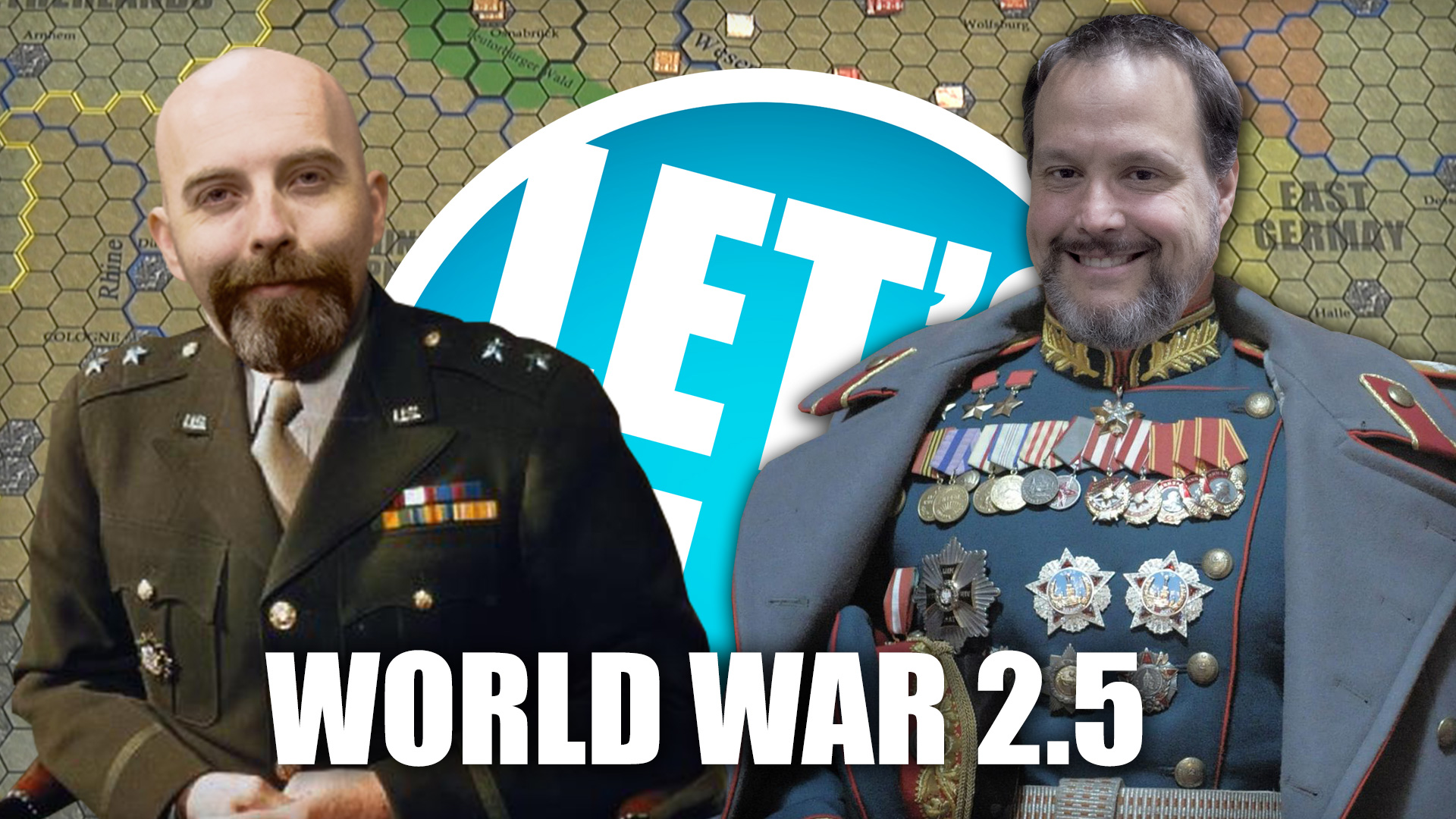
Going back to Jim's first article for the site back in 2014, World War 2.5 is an operational level game where each unit on the board can represent up to 20,000 troops. Justin Eishenhower and Jim Zhukov must guide the Allied and Soviet forces against each other on a map of post-war Germany and the surrounding regions where each is seeking to capture more cities and lines of supply are crucial.
What conflict or war would you like to see represented in an operational level game?




@oriskany wow you have really ended up on the wrong side of this conflict hehe
Dear God, that photo is priceless. 😀 😀 😀 Although Eisenhower seems to have been demoted … three times (from five-star general in 1945 onwards, to two star general). Maybe he gets re-promoted after winning this campaign so badly.
@oriskany I think you need a slight tweak to the supply chain routes! Well played both sides.
Actually, @elpotof – no. I just played very badly, and the game punished me for it. The game challenges the players to (among many other things) to keep a cohesive backfield. I failed, Justin saw a weakness, and exploited it.
In my defense, I hadn’t picked up this game in almost four years, and since it’s usually a 4-5 hour game, we only played the last 1.5 turns. So in an actual game, the table wouldn’t have looked QUITE like this.
About the only tweak I really see here is a rule allowing only one airborne drop per division per game (that leapfrogging at the end was really a little “broken).
Nothing bad on @dignity – he played the game perfectly as designed and presented.
But is we look at Market Garden as a historical example, those airborne divisions were scrambled for the operation in SEVEN days, and it was seen as insanely fast and led infamously to disaster.
Each turn in World War 2.5 is three days.
So Justin was dropping airborne divisions with only three days of prep … from enemy cities.
With only five airborne divisions i the whole game (two American, one UK, two Soviet) this won’t be hard to track.
That’s the only actual change I see. As for the supply routes through the Hannover-Kessel gap … no, I just screwed up THAT bad, and Justin took fair advantage. 😀
Yea, the airborne leap-frog seemed a little unintended. I had thought earlier in the game you said that you had to hold a city for an entire turn before you could deploy from it? Or maybe that was for replacing lost divisions.
It does seem strange that the airborne troops could get all of their planes, equipment and logistics into enemy territory like that. Speaking as someone who’s obviously never played the game, it does seem like that strategy of throwing your two airborne around in that empty Soviet back line would be overly powerful, especially since they could be cut off and have no chance of surviving or getting home, but by the end of the game they still ‘hold’ the city so there’s no penalty. (Actually, on re-watching it, I think you implied that cities have to be in supply to count for victory. That softens the blow to a large degree.)
As for the supply lines, I got the impression that in your mind supply lines had to be traced more or less directly back to a home city. Maybe spell that out more clearly in the rules? I can see people game supply lines big-time. For example, you could go all the way North, around those Soviet units, and then back down. If the only rule is that it can’t go into enemy ZoC’s, you could get very cheeky with it.
@greyhunter88 –
“I had thought earlier in the game you said that you had to hold a city for an entire turn before you could deploy from it? Or maybe that was for replacing lost divisions”
Yeah, that was Strategic Redeployment. But you’re right, it’s also deployment of units re-drawn / re-purchased from Reserves Pool.
I would not be opposed to a rule like you suggest, if anyone has a way to clearly write it, as in “1970s/80s rule book for a real wargame” write it. I think you’ll find it more difficult than imagined.
As it stands, I’m happy enough to leave these rules as written. at least for now. They “threaten” the player with what may seem a cheesy or unrealistic result, UNLESS they work within the realistic constraints of operational-level (NOT tactical-level) warfare on this scope.
Play your army carefully, realistically, and with operational security (one of five key facets of operational thought and military dynamics), and your opponent CAN’T do this to you.
I failed to do this at the table, and Justin made the right call in making me pay for it.
It’s not a failing of the game. It’s a failing of the player.
Uhhhhm that photo is amazing and terrifying at the same time!!!
What are you talking about? That photo is my favorite thing about this video!
Coming in a distant second is me laughing at @dignity at 42:00.
Mwahaha! 😀 😀 😀
Game looks really good, very entertaining show.
Thanks very much, @gremlin . 😀
I have noticed two minor things I got wrong with the rules, though.
At 42:30, Justin scores 7 defense successes against my 13 attack successes. That’s supposed to be a surplus of +6, but for some reason I said +7 (13 – 7 = 7 apparently, in “Oriskany Math”). 🙁
The good news is that the combat results are the same for +6, +7, and +8, so there was no actual effect on game play (phew!).
The other bigger issue comes at the very end, where I FORGET to count the West German city of Hof (down by the Czech border) as a Soviet victory.
So I actually control NINE West German city hexes = 27 points.
@dignity controls 23 (not 24) West German towns.
But Justin still controls 3 East German towns = 9.
So the final score was actually 32 to 27, Allied victory (+5 margin, not +9).
Still a loss for “Billboard Belly” Zhukov, but not quite as bad as we thought. 😀
Looking forward to this – We had great fun when we played it
Indeed, @rasmus – you were one of the original BoW playtesters! 😀
General @rasmus, yes we did and it was good to see my airborne tactic taken to the next level. Although our (well my) dice rolling was monumentally bad!
Really enjoyed this let’s play @oriskany, I think you’re finally converting @dignity to the dark side (queue more maniacal laughter)???
The “Lets Play” is pretty good, but it didn’t have quite the drama of your game @brucelea . That last Hail Mary roll of yours was one for the history books.
That was an epic gaming moment. I remember when @wittmann007 even started playing dramatic music on his eye phone. Unlike this game, THAT game came very close. The odds were maybe 10:1 against the British in that last roll, but it can’t be denied that statistically, it DID come down to the last roll.
Who summons me!
I remember that. I think it was Berlin that was turned to dust over the course of 9 days by Artillery, Bullet, and Bayonet. Every roll was countered.
Must admit, I never thought I’d have that much drama in something that isn’t as “Visual” orientated! 🙂
Thanks, @wittmann007 . I always contest the automatic assumption that miniature wargaming is “more immersive” than hex & counter gaming.
In many cases, miniature gaming doesn’t let you imagine or visualize. It tries to visualize for you.
Then usually gets it wrong.
Highly UN-immersive in my book. 😀
@oriskany That’s a fair point! Never thought about it like that.
Now that you mention it, I do a lot of Cold War era gaming online, and some of the best titles out there represent the units with the NATO Standard divisional markers.
Yeah, @wittmann007 – in the old H&C boardgame ecosystem, some big ones are “NATO – the Next War in Europe” (Operational – Level 3) – and of course all GDW’s Assault line (Assault, Bundeswehr, BAOR, Boots n’ Saddles) – Command Tactical, Level 2
https://boardgamegeek.com/boardgame/2079/nato-next-war-europe
https://boardgamegeek.com/boardgame/8284/assault-tactical-combat-europe-1985
SPI did a big Fulda Gap game
Now that does ring a bell.
nice one guys I think Justin had Dorothy in charge of supply’s ?
No, @zorg , Justin played fair. I just didn’t do a good enough job keeping a cohesive line from the start.
We also played a “partial” game. So I chucked counters on the table and tried to set up an approximation of where a game would be at the end of Turn 3. These videos can’t be 3-5 hours long. As part of this process, I removed some counters from both sides to account for combat losses in the ongoing campaign. I may have pulled a little too much out for both sides. In terms of statistical analysis, we would have to assume that Turns 1-3 were freakishly bloody and both sides having a tough time maintaining orderly lines of enemy contact, supply, and communication.
This produces a chaotic battlefield environment where there isn’t so much a cohesive and unified “battle front,” but a broken series of smaller, disassociated battles.
The problem with this is, such a battlefield is mathematically hard to produce, either in this game or in real life. In order to inflict sufficient losses to result in a battlespace density THIS THIN, the opposing forces have to have certain levels of combat resources at their disposal. But they can’t, because they’re also suffering similar very heavy losses themselves at the same time. It’s almost a logical paradox.
Sure, it can happen to ONE SIDE or the other, one battlefront simply disintegrates and the the other army starts a rampage to victory. But both sides, at equal rates, to produce the same level of chaos on both sides … eh …
All of this assumes, of course, so “wildcard” factors like mass disease, revolution, atomic weapons, chemical or biological weapons, zombie outbreaks, etc.
Long story short, I may not have set up the very best example game, but in the context of what was on the table, Justin did very well for his first play through.
no that was a good game just making fun of the countryside magical mystery tour’s of the supplies Guy’s. what’s that saying you can’t always pick where you fight
(No battle plan survives contact with the enemy) not the one I was thinking of but quite appropriate.
😀
I also recall @brucelea fighting hard for Hanover – or rather for a nightclub that used to be located there
Prime battle spots are Hannover in the north, Kassel in the center, and Nuremburg in the south. You would think that games occasionally develop where the Soviets break through in one or more of these areas, leading to a second wave of battles in the Ruhr in the north, Paderborn in the center, and Wurzburg / Frankfurt in the south. Actually, it almost never happens. Oh, the Soviets occasionally score huge breakthroughs there, but these follow-on battles don’t become very large because in order to have lost that first round of battles, the Western Allies typically don’t have the resources to fight a second round of very large battles further west.
Conversely, in Allied-dominated games, a broken Soviet army doesn’t have a lot to mount strong defenses at places like Erfurt and Magdeburg.
I recall the battle zones – but also @brucelea s chance to reminis on his time in (West)Germany
Yes, you called it right @rasmus, the only reason I threw everything into protecting Hanover was to stop any Soviets getting control of that most glorious of night clubs…. the mighty Disco Ducks!
Double victory points for the Disco Ducks! 😀
Man… I wish Jim would just start his own company so I could buy all of his games, already.
I generally have 0 interest in this kind of game, but the way he’s designed it combined with the way he explains it and provides flavour and historical context (eg; describing the interdiction, or why a division is rendered inoperable at 5% casualties), really makes it seem like more than the sum of its parts.
This really contrasts with so many new trends in WarGaming, whether it be Flames of War or Warhammer 40k. Rules (and more importantly rulebooks) are becoming so obsessively focused on ‘quick and easy play’ that so much texture is lost. While I functionally like the new version of Flames of War as a game, for example, the new rules and army books are so sterile. It tells me that if I roll X, my tank is Bailed Out, without even giving me the context as to what that even means. Every single Late War German, from Sicherhung policemen to SS-Panzergrenadiers, are all “Careful Veterans”.
While some older games can be a little wordy, and their rules can be a little clunky, I love all the brain fuel and inspiration as to what I should be picturing. That richness of imagination and spectacle is what I think drew so many of us into the hobby to begin with. Nowadays many games don’t even seem to want to acknowledge that. They tell you to roll this or that, without even telling you what is supposed to be happening in the narrative of the game.
This and Darkstar have been really top notch Let’s Plays. Thanks to both of you for putting them together.
Well @greyhunter88 I couldn’t have said it better myself! Though Oriskany is such the perfectionist, it might take awhile for his games to actually get put into circulation 🙂 But they would definitely be worth the wait.
Thanks very much @greyhunter88 and @gladesrunner 😀 😀 😀
Regarding combat capability of divisions at different levels of personnel loss … Yeah, it’s all a matter of statistics. Now of course I’m generalizing here, and oversimplifying to a ridiculous extent. But I was just trying to get the basics across on how units this size can not only knocked out this fast, but how they can come BACK this fast.
Let’s assume 5% KILLED (not casualties, strictly speaking). Okay, the general trend is you take your number of killed and x2 or x3 that in wounded. That’s +15% wounded, for a total CASUALTY rate (“casualty” is defined as anyone on your roster who is not active, i.e., combat ineffective) of 20% at least.
Okay. But does that mean a division is 80% combat effective? Not really. Military units are made up of smaller constituent military units. Divisions are built of brigades and regiments, which are built of battalions, which are built of companies, etc.
So say there are 11 players on a football team, one goal keeper and ten field players. You have a league of ten teams. That’s 110 players. Now, 25 players are removed because they were found to take illegal steroids (about 22% of our presumed 110 total players). What’s the status of your league?
It’s not 80%. It’s 0%. Sure, you may have 85 remaining players, but NO TEAM has a full strength of 11. You have no complete teams. You have zero league.
Now of course that’s a wildly oversimplified example. Some teams may have been wiped out with all 11 players, one or two may even be untouched. Teams have replacement players. You can “cannibalize” players from one team to other teams, etc.
But that’s how larger organizational bodies can break down after sustaining only a small loss of overall personnel, equipment, and infrastructure.
But that’s ALSO how divisions of 20,000 and hundreds of tanks and thousands of vehicles that are smashed in brutal battles on Turn One … can come back strong as ever on Turn Two.
It’s just a matter of mobilizing those “background” resources, in this case … fuel, vehicles, replacements, reserves, etc … to fill in those missing 25 players, and bring your league from an effective strength of zero back to 110.
This is actually the kind of thing that irks me a little sometimes when people talk about how operational, or even command-tactical games are “abstract.” They really aren’t. People just don’t understand sometimes the processes and dynamics being recreated. Now if people want to say “aggregate” or “average” … I would go with that. Wars are won by groups, not by individuals.
and that is why the “pro”s do logistics, he who can reconstitute his looses the quickest have an enormous advantage
Thanks for that! I had always assumed that outside of very specific cases, such as Stalingrad, when I hear about a larger military unit being “destroyed”, it’s generally rendered combat ineffective.
It’s neat to hear a breakdown of how that math works, in a very simplified manner.
Question, though. Say you’re taking 20% casualties. If that’s spread relatively even across most units, couldn’t that division still put up a decent fight under most circumstances?
Eg; if you normally have squads of 10 men, and roughly speaking you’re losing 2 out of every one of those squads (accounting for say redistributing survivors from particularly badly mauled units), would squads of 8 really be considered combat ineffective?
Is this a ‘best case scenario’ thing, where it’s unwise to deploy them as such, because their lower operational numbers will lead to increased casualties, which will snowball from there? I’ve often read that the American army, in particular, during WW2, had issues where units were so often replenished with new recruits that it ended up hampering overall combat veterancy and cohesion.
I imagine that in some real world scenarios, such understaffed divisions would have to be put in the field. Or is it the case that the mathematics of war so heavily work against such depleted formations that they’re relatively useless?
Either way, to put it succinctly, I really appreciated those little asides. Even without understanding the ‘fluff’ behind what happens, the game would still work exactly the same. However, people would likely be imagining entire formations being wiped out in bloody slaughter, only to pop back up 3 days later.
Rulebooks used to be full of such lovely little bits of historical or thematic trivia, or design intentions, and to me, personally, I feel 10x more connected to a game that tries to be evocative, and dare I say it… sometimes even educational.
Depends on the unit, really. I mean sure, an infantry squad of 10 reduced to 8 is till 80 percent effective, but what about the mortar team of three, that NEEDS three men to operate properly? they lose one, you now have NO mortar teams. What about the supply company of 100, who supports 5000? They get reduced to 80% effectiveness, but that decrease in operational ability then “spreads” through the 5000 they support.
It’s much more complicated than just reduced by 20%, as I said. And the math works out differently at the larger scales, as we’ve also covered. 😀
Ah, true. Interesting.
I just wasn’t sure if maybe casualties tended to focus on more ‘line of battle’ units than support, artillery and what not, outside of tragic cases like an overrun or a rout.
It makes sense, though. I think you handled the simulation very well in the rules without over-complicating it.
Everything here is by the brigade, division, or corps. So 5,000-30,000 men.
Thus, the aggregate patterns and trends in the math are very very different than we see in tactical gaming.
Ok this is a little complicated. In the only battle of the Soviet 5th turn, did you count the 1 success from your special outside events roll at the start of the turn? If not would that have changed the difference to a 3 ? And is there any difference between a 2 and a 3?
Regardless very entertaining and making me a little sad I got rid of my hex games years ago. (No gaming group and no internet existed to find one)
Great job as usual and a very neat and tidy game.
That’s actually a really good catch, @firebuck. As you can see, watching the video from about about 1:07:00 on … I get all turned around. Hell, I start moving Justin’s units in southern Hannover. 🙁 Anyway, yes. We totally forgot to include that one extra success, which yes, DOES make a difference (cranks the result from a foothold to an exchange). So that would have wiped out both Justin’s unit and the unit I was attacking with (I only had one in that hex) – but would have left me with another unit in northern Hanover.
Ironically, it might have made things even worse for me at least immediately. With only one division left in Hanover, its tough for me to defend it from the second division he has to the southwest, to say nothing of the two tank brigades he had hiding back is Osnabruck (which it turns out he never activated in Turn 5).
In the long run, though, it might have made a crucial difference because that division that should have died in the streets of Hanover, wound up taking Wolfburg on Justin’s Turn 5. If it had been destroyed, I would still own Wolfsburg at the end of the game.
So … six in one hand, half dozen in the other. I might have lost one hex in Hanover, but kept Wolfsburg. The battle would have been slightly different, but I think the score would have been roughly the same (again, adjusted to 27-32, accounting for Soviet occupation of Hof down by the Czech border.
For being on camera you did very well at not making mistakes
Thanks very much, @rasmus – indeed it is tough. Especially since I haven’t really looked at the game since the Team Yankee Boot Camp (three years ago this weekend – US Thanksgiving 2015). And of course we couldn’t film an entire game – and things in the studio were a little rushed that day so @dignity and I couldn’t sit down, plat turns 1-3, let Justin really learn the game, then turn the cameras on for Turns 4-5.
No worries though. The game still came out pretty close, which is always what I hope for as a designer. 😀
All of which reminds me, Happy Thanksgiving to you and yours! 😀
Thanks and the same to you and @gladesrunner and yours as well. I forgot you spend Thanksgiving weekend in the Irish rain with us … Is it really 3 years ago?! I guess it is.
Oh yeah, that was totally three years ago – Team Yankee boot camp – Thanksgiving weekend 2015! Trying to build 1/100 Hind gunships while they play Two Minutes to Midnight 19,872,972 times in a row. 😀 😀 😀 😀 😀
Time seem to have flown – very fast – I been in the states 2.5 years now
That’s what happens when you stay this busy. 😀
While this video is fun to watch, there was something a little better about the Darkstar “Let’s Play”. I’m not sure what was different, that one just seemed to have a little something extra 😉
Though I will say @dignity is racking up the rematches he owes Oriskany.
That little something is easy to point out, your good self is missing 🙂
They call it the “Gladesrunner Factor.” 😀
Clearly that’s you Jenn!
Oh Jesus Christ and a goddamned half … I have a huge typo on the map in East Germany. “East Germay”?
Really?
Three and half years and no one noticed that (especially myself)?
Or were you all just being polite? 🙁 🙁 🙁
And here I were looking at getting a map printed on a mouse mat – might also be an idea to get counters printed the same way
Ugghh … let me at least snap out a new e-copy of the map file before you do that, @rasmus – should be a two-second fix assuming I still have the .psd template somewhere.
Thanks. That should do as a xmass present to me.
I dunno. Have you been a good boy? 😐 😐 😐 😐
Never, why do you think I have to arrange my own presents 😉
Oh noooooo! 😮
@oriskany This game looks amazing. Would love to play it. Has OTT ever thought about putting a feature on the website for independent game designers to post files in a location for other players? It could be a good tool for play testing and amateur publishing of new games. My friends and I design our own rules because no games we’ve played have quite hit the spot. Would appreciate being able to potentially get more play tests and feedback to tighten up rules. Not so much a project feature more of a play tester’s corner.
Thanks very much, @smithsco – I’m almost positive @warzan had something in mind for that for a future roll-out feature for BoW / OTT 2.0. I wouldn’t want to speculate on when we might see it, but I do know it was supposed to be added sooner or later.
The motion of the rampart advert is killing me!
Oh no! 😀
Finally had time to catch up with this video. Another intriguing game.
Another candidate for ‘conference gaming?’
It would definitely be possible, @damon . In fact, this game was developed first for electronic play and playtested electronically for a while before I actually printed the board. It would also give me a chance to correct that infuriating “East Germay” typo. 🙁 🙁 🙁
So to get this on electronic web conference play would be eminently easy.