












Weekender XLBS: Armistice Centennial – Remembering World War I
November 11, 2018 by dignity



For some website features, you will need a FREE account and for some others, you will need to join the Cult of Games.
Or if you have already joined the Cult of Games Log in now
What difference will having a FREE account make?
Setting up a Free account with OnTableTop unlocks a load of additional features and content (see below). You can then get involved with our Tabletop Gaming community, we are very helpful and keen to hear what you have to say. So Join Us Now!
Free Account Includes
- Creating your own project blogs.
- Rating and reviewing games using our innovative system.
- Commenting and ability to upvote.
- Posting in the forums.
- Unlocking of Achivments and collectin hobby xp
- Ability to add places like clubs and stores to our gaming database.
- Follow games, recommend games, use wishlist and mark what games you own.
- You will be able to add friends to your account.
What's the Cult of Games?
Once you have made a free account you can support the community by joing the Cult of Games. Joining the Cult allows you to use even more parts of the site and access to extra content. Check out some of the extra features below.
Cult of Games Membership Includes
- Reduced ads, for a better browsing experience (feature can be turned on or off in your profile).
- Access to The Cult of Games XLBS Sunday Show.
- Extra hobby videos about painting, terrain building etc.
- Exclusive interviews with the best game designers etc.
- Behind the scenes studio VLogs.
- Access to our live stream archives.
- Early access to our event tickets.
- Access to the CoG Greenroom.
- Access to the CoG Chamber of Commerce.
- Access the CoG Bazarr Trading Forum.
- Create and Edit Records for Games, Companies and Professionals.
Supported by (Turn Off)

Supported by (Turn Off)
Supported by (Turn Off)





Happy Sunday
Happy Sunday!!
Happy Sunday !
Happy sunday folks
Happy Sunday to you, @avernos . Thanks for helping out with another great interview, and for being so patient while John and I rambled for so long. 😀
At the time of this post, we are about 1 hour, 12 minutes short of the Armistice.
11:00 11.11.18
There it is. 😐
Commemorative Sunday to ALL
Wow! 100 Years ago this morning, the war to end all wars, ended. Neat weekender guys, a bit more of a serious tone at times, but fitting.
@avernos great looking diorama! Something so simple, but so moving.
Indeed that is an awesome little piece. I wish I could have spoken to it during the interview, but please remember I can’t see it during the recording. Watching this morning was the first time I could actually see it.
https://www.beastsofwar.com/project/1300056/
thanks guys, I know you can’t see it @oriskany but I didn’t have any photos taken to send to you at the time, that gives a slightly better idea of how it looks currently than the camera did.
Definitely epic work, @avernos – and great call on putting that angle in the wall. 😀
thanks @oriskany
Mixed feelings Sunday!!
Hurrah, the ‘ Great War to end all wars’ is over and the boys can come home… but.at what cost?
So while we’re at it, best not forget those lost in conflicts in these intervening 100 years.
How can we possibly game in this genre? At one level we can game in the very abstract, zooming out completely to markers on a map of Europe; but isn’t there something obscene about rolling dice where every dot on a dice represents the loss of thousands of men. A bit too Haig/Kitchener for me.
Perhaps we should zoom in to a couple of hundred yards of trenches and witness the squalor and ferocity of the mixture of death by artillery bombardment, machine-gun fire or hand-to- hand combat in the mud? Do we need casualty models hanging off the barbed wire or drowning in the mud-flooded blast craters?
Not today thank-you, not for me. Excuse me I’ve got a promise to keep I made to one lucky Grandad many years ago…
I respect your opinion, if even I couldn’t possibly disagree more strongly with your characterization of historical wargaming.
Thanks for your thoughts Jim. This is my opinion this morning and it’s quite a personal, emotionally based one around today’s events.
Ask me next week and our thoughts will probably be more aligned. I don’t have a thing normally about historical, there’s just something about today that makes those abstractions a bit clearer and more poignant.
No worries at all, sir, you are certainly entitled to feelings and opinions no matter what day it happens to be 😀 and certainly to change them from day to day as well.
*my girlfriend does it all the time.* 🙁
I do agree on one point – this will not be a day for “beer and pretzel” historical gaming.
Horrifying thought – how long before it does become a ‘beer and pretzel’ day? Come the bicentennial will gamers still have the respect and solemnity we have, or will that extra degree of separation be enough of an abstraction to make them comfortable with it? 🙁
Hopefully never, @lordofuzkulak – I mean… I’ve played at tables with Romans vs. Carthaginians … and while there admittedly wasn’t any kind of personal connection or solemn mood for the “anniversary” of the Battle of Zama, it wasn’t anything like “beer and pretzels” either.
Happy Sunday.
We don´t have to forget also that for some soldiers the Great war didn´t end in 1918, for example Czechoslovak legion was caught in civil war in Russia and they have to fought through whole Trans-Siberian railway. And the last legionaries left the Vladivostok port in September 1920.
Very True. Australian, British and even Canadians were fighting the Reds in Russia for a while after-woods. The Russian Civil War itself would rage for a few more years.
The USSR invaded Eastern Europe getting to Warsaw itself before being defeated. The Middle East turned into a total mess and descended into tribal warfare only now with Machine Guns. The British had a revolution brewing in Egypt that threatened the Suez, India was a Powder Keg, Ireland was in a rebellion/Civil War and Germany was basically no longer a country at this point. Communist “Soviets” are springing up all over Europe as the Freikorps tried to keep some form of Nation in existence.
The Great War was over but the Empires of the World were collapsing and that was rarely ever peaceful. New Nations were being forcefully created and ethnic tensions still last to this day.
I certainly take your point, @alin I would only add a gentle caution against bleeding World War I into succeeding wars. Historically the Russian Civil War isn’t really considered part of World War I, even if there is (depending on your definition of the RCW) some overlap in the dates. It just leads to a slippery slope where wars all across Russia, the Middle East, Poland, and Africa drag on well into the 1920s. I don’t think most historians consider them part of World War I.
Then this leads to “pre-dating” wars as well, where people like to argue sometimes that World War II “started” in 1937 or even 1931 with Japanese invasions into parts of China. Before you know it you get to a point where World War I never actually ended, it just morphed into World War II. And since World War II led to conflicts still ongoing now (and so did World War I for that matter), would we make the case that World War I ever ended at all?
Absolutely, @elessar2590 . We touch on this very briefly in this interview and try to tackle it in a little more detail in Part Three … where the legacy of the the Paris Peace Conference (not just the Treaty of Versailles) led directly to problems not only building into the European theaters of World War II, but helped start the war in the Pacific – and also conflicts that “skipped” World War II entirely and smoldered through the Cold War into beyond – right up to today and well into the foreseeable future.
Indeed, the War didn’t end 1100hrs 11/11; the Armistice was just the cease fire between Germany, France and the British; with Marshall Foch representing various Allies including the US and Commonwealth forces. This West Europe part of the war ended officially with the Treaty of Versailles signed 6 months later… but it wasn’t called a World War for nothing!
Agree on two points. 😀 11/11/11 was only a *cease-fire*, not the actual end of the war. The British naval blockade against German civilians and occupation of the Saar / Rhineland continued long afterwards. And Versailles was only one treaty of the Paris Peace Conference, other treaties had to be drawn up and ratified to end other parts of the war – in Eastern Europe, Southern Europe, Africa, MidEast, and even the Pacific (disassembling the German Empire out there and handing possessions predominantly to the Americans or Japanese).
Happy reflective Sunday
Going off to Belfast for Remembrance Day so will watch later
We will remember them. (British Legion Bergen)
happy sunday, will watch some of this before heading off to the local remembrance service. bit of a loose connection, my unit 12 Med SQN sent guys out with Black Watch to support the Marines in Falluja. I was one day out from being sent with my mate when the unit realised they had basically gutted the Armoured section and made the Sqn under manned so only half of the unit were sent with guys robbed from other units.
Indeed, @armholeeio – we were talking about the Black Watch at Fallujah just recently on the next episode of the “Situation Report” podcast. November 8 was the anniversary of the start of that battle in 2004.
I feel the idea of the working class being slaughted while the toffs sit back is a bit of a myth.Officers in the trenches still had to go over the top. The casualty rate for lads who went to Eaton is very high. I’m sure I read some where that 4 British generals died but I might be wrong about that. My favourite British officer is Smith Dorrien who saved the British army from destruction at Mons at the start of the war. He started out surviving Isandlwana in the Zulu war 1879 and went on to fight every colonial war up to WW1. Sudan, Boar war etc and his sons died in WW2. Happy Sunday we are a lucky bunch not to have been born a hundred years earlier.
It is a myth, you’re really right. This is the point I was hoping to make with the discussion of the staff officers. It’s one thing to talk about what the generals and staff officers may have been doing, but that doesn’t include the company-grade officers (lieutenants, captains) with the sections, platoons, and companies in the field.
Then there are field-grade officers (Majors, Lt. Colonels, Colonels) who are leading battalions or working on staffs. Again, the quality of staff work and how close they may or may not have been to the front varies widely between the armies or even certain divisions within the armies.
Even brigadier generals leading brigades are well within artillery range, or can be caught up in fighting if the division in which their brigades are attached are either attacking or defending in a breakthrough zone.
It’s easy sometimes in casual discussion to blur terms like ‘generals’ and ‘officers.’ Of course they’re not synonymous. Even among generals there are at least five official levels (depending), and the experience of war is very different between a brigadier general and a Marshal like Foch or a Field Marshal like Sir Douglas Haig.
60 British Generals died in WWI
Class Warfare and the big step Left Europe took Politically directly after the Great War has a lot to do with our perception of the War.
The Working Class was slaughtered while the Rich sat in a Chateau. Not Ture
The Rich forced Europe into the War and the working class didn’t want it. Also not true the war was extremely popular at the onset. The man who was basically holding War back was Archduke Franz Ferdinand who fought with Conrad von Hotzendorf and stopped him from going to war at least a dozen times prior to 1914.
There’s others but I think everyone gets the point.
Two minutes to Armistice at time of post …
I totally agree with your points, @elessar2590 – in fact at 35:10 I lead off with: “I’m going to defend the generals here …” 😀
Very Great Show
@lloyns for the Civil War around Petersburg at the end of the War had some very complex and well planned trenches and defensive emplacements surrounding the city and the European advisers were terrified by it. The Europeans basically looked at the War and took back the lesson “We’re so F**ked if a big war kicks off in Europe”. The Europeans knew what would happen if the War dragged on, it would devolve into trench warfare and Machine Guns (or the things that would later become Machine Guns like Gatling and Gardner Guns) would be a huge problem. That’s why Wars like the Seven Weeks War and the Franco-Prussian War were so quick and decisive. That had to be fought quickly before it devolved.
@dignity and @lloyns British Officers were ridiculously brave in both the Napoleonic Wars and the Great War. In the Napoleonic Wars British Officers had to be ordered to stop holding staff meetings in clear line of sight and range of the enemy. During the beginning of WWI British Officers lead their men from the front with swords and riding crops in very distinct Officers Uniforms that made them very clear targets. By the end of the War the uniforms had been toned down and the sword was left at home but officers still lead their men from the front, they were the first over the trench to charge the enemy. British Officers had a higher casualty rate than the men during WWI. They were very proud of this. The “Lions led by Donkeys” myth is very inaccurate. British Offcers walked bolt upright towards machine guns and there are a staggering ammount of accounts about this behaviour.
Slight detour but it has to do with the USMC so i believe I can get an official @oriskany Pardon. In 2005 in Iraq LIMA Company 3rd Battalion, 25th Marines was engaged in a firefight in a town. Staff Sergeant Goodwin walked upright, giving orders and boosting the moral of his men and the marines on the ground reported feeling a sense of safety and comfort because of his behaviour, if he was in charge and he was calm then they had nothing to worry about. “Staff Sergeant Goodwin he’s walking up the middle of the road like nothings going on you know. he’s got his American Flag banana draped around his neck just like George Patton or something. And at the time I’m like this guy’s crazy you know. I looked at him and he’s like calm as can but so it eased my nerves a lot” Lcpl Mark Camp. SSGT Goodwin died on May 9th while searching a house in Iraq.
@oriskany a very good documentary about the USMC LIMA Company in Iraq
https://www.youtube.com/watch?v=cRMCjzTYbY0&fbclid=IwAR33WgpwtKEmWnyicHCRhI4wFwmW0jg0Kxf9ub6G4og9dcYslnT-Xdl2OIw&app=desktop
60 British Generals died in WWI in action. Hardly hiding in a chateau.
Three big things effected Europe in preparation for WWI in this chronological order. The siege of Plevna, the Lebel 1886 and Sir Hiram Maxim.
At Plevna (1877) the World finally saw the correct way to use a repeating rifle. The Russian’s were attacking an Ottoman defensive position which contained men armed with both single shot rifles and some level guns. The lever guns held back until the last minute and unleashed a hail of firepower at close range that drove off the enemy. This made the European Powers take Magazines seriously.
When the 1886 Lebel came out with it’s smokeless powder cartridge it sent Europe into an arms race that made long range warfare finally a true reality.
Finally Sir Hiram Maxim’s Machine Gun finally solved all the problems with Machine Guns. His guns were used by all sides (except France because French Weapons suck).
Ten VC’s were earned in November 1918, a lot of men were dying for no reason.
Great post – @elessar2590 …
Indeed, we mention 1864 Petersburg, the trenches, and Longstreet, European observes (especially with AVN) – all as eerie previews of the Great War. One thing I didn’t mention was the big use of mine warfare, digging the tunnel under Confederate trenches and blowing a hole in it leading to the Battle of the Crater, which worked about as well as subsequent mining operations around Passchendaele / Messines Ridge.
I agree the “Lions led by Donkeys” is a myth – I think a big part of this is (like I was saying to @denzien above) a blurring of terms like ‘officer’ and ‘general.’ Even ‘general’ is an oversimplification, as we have brigadier generals, major generals, lieutenant generals, generals (colonel-generals in some armies), and marshals / field marshals … and the experience of war is very different between a brigadier general and a Marshal like Foch or a Field Marshal like Sir Douglas Haig.
November 1918 is indeed tragic waste. Even worse are the 2,738 men killed and 8,206 wounded sustained between 0500 and 1100 CET on 11/11/1918 … AFTER the cease-fire had been agreed but before it took effect. Much more on this in Part Three.
OH, AND SUPER-THANKS TO THE EDITING TEAM for putting up that flash card beneath the screen when I was trying to remember the Battle of Königgrätz. Sometimes it may take me a while but I’ll get there eventually.
11 minutes to Armistice at time of post …
Very true about the generals.
A big part of WWI is the creation/destruction of the “Militia Myth”
It’s a very Colonial thing. Basically a force of Militia fight alongside a much larger Regular force, have some success then everyone just assumes that “Group X” are just natural soldiers that you can just give them a gun and they’ll fight as well as any other man.
America had the myth start in the French Indian War and got it shattered in The AWI.
Canada had the myth start in the War of 1812 and had it shattered in WWI.
Australia had the myth start in WWI/Boer War and got it shattered in WWII in New Guinea.
It was a very dangerous myth that got a lot of men killed.
WWI also got rid of almost all of the “Gimmicky” differences between Regiments. A Kilt looks cool but when you get Mustard Gas on your Man Parts it’s suddenly not so cool.
Completely agree about the militia myth, @elessar2590 . Specially for the Americans, I would take it a step further and say it was created or at least reinforced during the Revolution, specifically at Lexington and Concorde in April 1775 and again at Bunker / Breed’s Hill in June 1775.
These rag-tag unarmed militia simply jumped out of the wheat fields, picked up granddaddy’s musket, and “defeated” trained British regulars? Unfortunately for the Revolution, this is precisely how many in the Second Continental Congress saw it.
So when Washington starts asking for a permanent standing army of 40,000 raised for the duration of the war, the Congress (still terrified of authoritarianism, standing armies of occupation, and the idea of trading one tyrant for another) denies his request.
Thus Washington faces off against the Howe Brothers at New York with an army comprised almost entirely of militia. Brooklyn Heights, Kips Bay, Harlem Heights, White Plains, Fort Washington, Fort Lee … its defeat after defeat, disaster after disaster. The militia army completely evaporates, often fleeing the scene before the battle even starts.
I would like to say that the American militia myth dies there, but as a society we stick with it for over a century … with the idea of the “citizen soldier” pushing really all the way through World War II and even into Korea and Vietnam, where conscription still relies on the idea that 6-8 weeks of boot camp can prepare the average qualified American civilian for the complexities and terrors of modern warfare.
In the wake of Vietnam, 200 years later, it seems as if we’ve finally and fully shaken off this “Roman Republic” fear of a standing, full-sized, professional army.
The militia myth is an easy one for civilians in government to fall for. One, it seems somehow “safe” and “democratic.” More directly, it’s also cheap, especially in peacetime.
But it’s wrong.
@oriskany – I’ve just caught up on the XLBS and reading through the comments and wanted to explore this militia tangent a bit.
It seems that since the end of the Cold War the armies of Europe have wanted to professionalise, end conscription and have better, more committed soldiers.
Military budgets are under a lot of strain, and here in the UK there’s quite a shortage of soldiers. I’m not sure how much of that is to do with short budgets. I get the impression that the US military is also facing a manpower shortage.
No one (except for a few populist politicians who just love to hark back to ‘the good old days’) are talking about reintroducing conscription. One of the issues I think is that while a lot of the public romanticise the military, not many have very much to do with it. And in some countries that still have conscription (Norway? Sweden?) I think one of the advantages they see is that it keeps the general population interested in the military.
Understandably there’s a focus on buying new and expensive kit and preparing for a future of cyber warfare and drones, but we still need soldiers.
Would be interested in your thoughts on how modern (European / US / allied) militaries cope or should cope with the issue of recruitment, retention and working out what kind of army they want to be today.
Honestly my thoughts were pretty much in the episode, and in the comment above. And I’m trying to avoid walking into too many minefields today.
Okay, fair enough! 🙂
I hope I didn’t sound like I was “slamming a door” on that, @angelicdespot . I just seemed to get the feeling like we were already heading into an argument, apologies if I misread it.
@oriskany no worries! I don’t think I was heading in to one, but you may have had other comments / commenters in mind too.
I was genuinely interested in your thoughts but perhaps it’s one for a real life meet up if I can ever make it to a boot camp!
Sounds great! 😀
I agree with Gerry on him going back to the diorama and adding the extra colour to the figures as at the moment (from what I can see on camera), people will look at it and some will either think it looks unfinished, or if they’re thoughtless will crack jokes about the soldiers being covered in mud, which is just disrespectful (won’t be Gerry’s fault, but if adding some colour/sepia tones will help avoid eliciting that reaction, I think it’ll be worth it).
Also just thought of something that I don’t think was mentioned in the show; in addition to remembering the soldiers who fought in the War, we should also give thoughts to those conscientious objectors who drove ambulances and would run out unarmed into No-Man’s Land to recover the wounded. Regardless of whether or not you think they were right to object to the war, I’m sure we can all agree they deserve respect for still serving in a valuable capacity and that it takes immense bravery to go out into a bloodbath without weapons purely to try and save lives.
@lordofuzkulak I found something very interesting today.
Three people have been awarded the VC twice and two of them were awarded in WWI and both were a “bar” or 2nd VC awarded. *EDIT* Captain Chavasse actually won both his VC’s during WWI.
Both men were Medical Corps Officers
Surgeon-Captain Martin-Leake
and
Captain Noel Godfrey Chavasse
Surgeon-Captain Martin-Leake (from Wiki)
During the action at Vlakfontein, on the 8th February, 1902, Surgeon-Captain Martin-Leake went up to a wounded man, and attended to him under a heavy fire from about 40 Boers at 100 yards range. He then went to the assistance of a wounded Officer, and, whilst trying to place him in a comfortable position, was shot three times, but would not give in till he rolled over thoroughly exhausted. All the eight men at this point were wounded, and while they were lying on the Veldt, Surgeon-Captain Martin-Leake refused water till every one else had been served.
2nd VC
For most conspicuous bravery and devotion to duty throughout the campaign, especially during the period 29th October to 8th November, 1914, near Zonnebeke, in rescuing, whilst exposed to constant fire, a large number of the wounded who were lying close to the enemy’s trenches.
***
Captain Noel Godfrey Chavasse
During an attack he tended the wounded in the open all day, under heavy fire, frequently in view of the enemy. During the ensuing night he searched for wounded on the ground in front of the enemy’s lines for four hours.
Next day he took one stretcher-bearer to the advanced trenches, and under heavy shell fire carried an urgent case for 500 yards into safety, being wounded in the side by a shell splinter during the journey. The same night he took up a party of twenty volunteers, rescued three wounded men from a shell hole twenty-five yards from the enemy’s trench, buried the bodies of two officers, and collected many identity discs, although fired on by bombs and machine guns.
Altogether he saved the lives of some twenty badly wounded men, besides the ordinary cases which passed through his hands. His courage and self-sacrifice, were beyond praise.
2nd VC
Though severely wounded early in the action whilst carrying a wounded soldier to the Dressing Station, Capt. Chavasse refused to leave his post, and for two days not only continued to perform his duties, but in addition went out repeatedly under heavy fire to search for and attend to the wounded who were lying out.
During these searches, although practically without food during this period, worn with fatigue and faint with his wound, he assisted to carry in a number of badly wounded men, over heavy and difficult ground.
By his extraordinary energy and inspiring example, he was instrumental in rescuing many wounded who would have otherwise undoubtedly succumbed under the bad weather conditions.
This devoted and gallant officer subsequently died of his wounds.
the nice thing is no one will crack jokes to my face because I’m just shy of 2m tall with a temper 😉
But it is unfinished, however the deadline was to get it done for Armistice Day and it was the only way I could manage it, so I’ll be revisiting it soon(ish) to do some proper painting work on it.
https://www.beastsofwar.com/project/1300056/
Here’s where I’m currently at though since you really can’t see more than brown on brown from that distance
Great point @lordofuzkulak – conscientious objectors or not … support personnel who care for the wounded, especially those who do so at personal risk, should never be forgotten. It’s a long-standing rule in the Marine Corps that Navy Corpsmen are the one MOS in the the Navy that is not ridiculed. Well, them and the chaplains (who are officers anyway).
@avernos –
“Let him have it, it’s not wise to make fun of Gerry’s miniatures.”
“But sir, no one worries about making fun of my miniatures.”
“That because you don’t pull people’s arms out of their sockets when you’re upset. Gerry’s been known to do that.”
“I see your point.”
😀 😀 😀
By my clock – it is 11:00 AM in France and Belgium.
Unless I’m off because of daylight savings time for some such nonsense …
100 years ago … this moment.
Lest We Forget……..
to servicemen and servicewomen from all nations and conflicts regardless of national politics. We serve(d) to protect our nations.
Happy Sunday All, as always a good show that tries to discuss good topics that some people do wont to acknowledge. (I swear I saw Justin tear up at the end when he signed off). For me I the 11th hour sitting alone in my study with the lights off and listened to the Last Post & Reva lie. I actually didn’t want to face the crowd I knew that would be at the local war memorial, or the crowds in the RSL (Returned and Services League, a club/pub set up after WW1 by returning service personal here in Australia) afterwards.
Well said, @recon63 – I wanted to make this point at the end of the interview … where the UK, Australia, US, and Canada tend to “claim” much of the reverence for Veterans / Armistice / Remembrance Day, this is a big day for really twenty+ other nations as well. And yes, that includes Germans, Austrians, Hungarians, Poles, Czechs, Italians etc.
I remember a few years ago we did the Kickstarter articles for “Heroes of Limanowa” – a game developed by a studio in central Europe who venerates the contributions of the Austrian-Hungarian armies early in the war. We found one photo where modern Hungarian veterans went so far as to kit themselves out in 1914 gear, get on horses in 2014, and re-trace the hundreds of miles their forefathers did to meet the Russian armies approaching Limanowa.
So many nations have a reason to feel proud on this day.
10:55
Watching the BBC coverage of the Cenotaph service and remembering my Grandad Harold Sharples, served in the BEF in France in 1940, evacuated at Dunkirk, later transferred to North Africa and fought with the Desert Rats before being wounded, returned to the UK and spent the rest of the war guarding POWs as his wounds made him unfit for the front line. He lived with the physical and mental wounds until he died in 1983.
Thank you Grandad, you gave for my tomorrow
Well said, @damon – Not sure if I have a relations in the Great War, but I do have them in World War II and Vietnam. And of course many friends I remember from the Gulf War.
Now this was a different show from other XLBS and it was very much done in the right fashion. You guys really struck the note and set the tone right for this very special day. Thank you.
Happy Sunday 🙂
Happy thoughtful Sunday everyone, thanks team for a very respectful and informative show today. I watched this with my boys and then watched the BBC coverage this morning observing the silence with my kids.
Thanks
Martin
Remember the Black Watch! 😀
You do know that technically they don’t exist any more they are part of the first Scots army ? now @oriskany
It was a reference to 2nd Bn Black Watch that @laughingboy was playing at Torbruk – November 1941 – Crusader – Bolt Action Boot Camp.
cutbacks to the military have forced ? the government to redeploy all regiment’s into one battalion @oriskany
https://www.army.mod.uk/who-we-are/corps-regiments-and-units/infantry/royal-regiment-of-scotland/
I honestly have no idea. The original comment was about World War I and II (Tobruk, specifically) … as well as the 2018 boot camp where @laughingboy and I were at neighboring tables for a few hours. 😀
Yes I understand I’m just saying to in form you of the present army problems. they are going to close fort George down the line as well at the moment too
The Russo-Japanese war of 1904-05 gave a strong portent of WW1, especially the siege of Port Arthur; trench works separated by a no man’s land with barbed wire and mines, covered by machine guns and quick firing field guns, the battle characterised by rushes ‘over the top’ and horrendous casualty numbers for the ground gained (or not).
Many western observers disregarded the lessons as a peculiarity of the Japanese way of making war.
Also, something that’s just come up on Facebook remembering the non human casualties, a big part of WW1.
https://m.facebook.com/thepenkridgebookoflife/posts/1961409740818939
When it comes to the Russo-Japanese War, I totally defer to you, @damon – I still remember those warships you had! 😀
MASTER OF DISASTER? with that intro i thought you were gonna be wrestling.
tis a time for thoughts and remembering love the tone of the show. for all servicemen and women past amd present i salute you and raise a glass in your direction thsnk you for your service. for those that never made it home sleep well and thank you for the ultimate sacrifice.
OH, YOU DIDN’T KNOW?
YO’ ASS BETTER CAAAAAAALL SOMEBOOOOODY!
https://www.youtube.com/watch?v=Bi27_jKHino&start_radio=1&list=RDBi27_jKHino
It’s me, it’s me! It’s the D – O – double G!
On a more serious not, glad you liked the show. 😀
Happy Reflective Sunday
Great show moving and educational. Keep up the good work lads.
Glad you enjoyed it. 😀
‘ello people…. why are there so few beards in this episode… we need more beards!
Yes. Tarantino is massively overrated for me too.
I’m going to assume that’s another pun that I’m not getting 😛
no, just an opinion. If anyone has fun and enjoys those movies: more power to you. But for me they are just boring most of the time. But that’s something for nearly all “over the top” movies like splatter, gore and similar genres to me.
That being said: I love (and funded) Iron Sky I & II 😉
one of my friends wrote some scenes for IS 1, I’m looking forward to 2 finally
Not a big fan of Tarantino; but I’ll give him one thing – he doesn’t pretend to make high art or historically accurate films/movies. He does pulp, often in homage to the pulp that influenced him, and that certainly includes Glorious B*****s.
That may be but still that doesn’t make him a great director nor does it justify the hype around some of his works.
For those of us in the USA
Fathom Events has partnered with Warner Bros. Pictures to bring Peter Jackson’s World War I documentary “They Shall Not Grow Old” to U.S. theaters on Dec. 17 and Dec. 27. Fathom Events is a joint venture of AMC Entertainment, Cinemark Holdings, and Regal Entertainment Group — the three largest movie theater chains in the U.S. so check your local theater listings.
For those in the UK – BBC 2 at 2130hrs tonight (Sun 11/11)
+1 for All Quiet on the Western Front. The book it’s based on it also a fantastic (i.e. utterly horrifying) telling of life on the front lines.
Good call, @somegeezer – I would also add Johnny Got His Gun, either the movie or especially the original novel by Dalton Trumbo.
Cheers Jim. Not one I’d heard of but I’ve just ordered the book.
It is good, but extremely “heavy.” Read this book only on a sunny day, with all sharp blades and prescription meds locked away, if you know what I mean. 😐
Ha! That’s exactly the sort of cheery read I go for.
Oof, then you definitely won’t be disappointed in this one. 🙁
humble ending Justin. well done.
Amen to that. Well done, @dignity .
And huge thanks as always to @avernos and @johnlyons .
On the subject of “They Shall Not Grow Old”. Does BBC2 stream it online too? Or do we have to wait until it hits any other legal streaming service?
it won’t stream live iplayer will show it after a day normally, but you’ll need a vpn showing in the UK for it
A that’s the smallest hurdle 😉 TOR makes anything possible ,)
in that case you should be able to watch it from 22:30 tonight your time. Otherwise I’ll let you know when it’s up for repeat viewing
BBC iPlayer does stream live as well
There is a ‘making of/ behind the scenes’ program on Monday night on BBC 4 @ 7.30
That was fitting. Well done guys.
Happy Remembrance Day folks
Went into town today to listen to the bugler at the church and watch the troops parade in the market square, was great to see so many parents bringing their kids out to see it so it’s not lost in generations just yet…
“We will remember them”
Thanks very much, @ugleb and @olliep – I wound up staying awake until 5:00 AM local time, which was 11:00 CET, so I could be posting here and taking a quiet moment for the actual moment of the Armistice.
Happy Sunday and remembering those that served their countries in the Great War.
I’m personally remembering my Grandfather on my dad’s side of the family tree today, as he served in ‘World War One’ in America’s first machine-gun platoon.
Great show everyone
Got back from the Remembrance service in Belfast which was basically the same as every other year. No mention of it being the 100th anniversary. No mention of WW1 at all
I kinda have mixed feelings about this. Part of me wanted something special to take place and part of me was pleased it was exactly the same as every other year.
Wife got to put her cross in the garden of remembrance for the grandfather who was in the 39 AIF in WW1 and put her Aussie flag on the cenotaph
Interestingly there was a wreath from Brazil and Lucia and St Kitts
Sadly a poor old chap collapsed while waiting to lay a wreath and after being treated by the St John’s ambulance was taken away in a proper ambulance to hospital
Thanks @templar007 and @torros –
Great note on America’s first MG platoon. So were they equipped initially with French Hotchkiss? From my understanding they started with this, then went to the M1917 (largely a slimmed down and lighter version of weapons like the MG 08 and British Vickers).
I understand what you mean re: conflicted feelings on WW1 specific mentions at today’s ceremonies and observances. While Veterans / Armistice / Remembrance Day should really be about ALL veterans of ALL wars, this particular year almost seems like it needs a WW1 focus. I’m sure Remembrance Day 2045 will take more of a WW2 focus. 😀
If you get a chance to see The Battle of Ypres made in 1925 it’s interesting to see how WW1 was viewed in the 1920’s. It even has some slapstick in it
https://www.imdb.com/title/tt0016558/
I think along with all the soul searching and head shaking at the apalling loss of life some of the soldiers thought it was the best years of their lives and hated the thought they would have to go back to the humdrum life they had before 1914
May I salute you gentlemen on a brilliant XLBS you should be very proud off the show that you have just produced,once again you show us that you are not just gamers of board or miniature thank you.
Thanks very much, @ironshield – again, thanks to Justin, John, and Gerry (and whoever helped me out with the editing) for the great conversation and interview.
I can only echo what Jim said, thanks @ironshield it’s not often you get the opportunity to commemorate a landmark anniversary such as the centenary and it was a privilege to join in one.
A very informative and at times emotional XLBS , thank you guys
Really special. Thanks guys.
Thanks very much @a27cromwell and @warbossd – glad you liked the episode. 😀
an interesting (we shall remember them) show guys.
Every name starts with a J just as mine : D
Thanks, @zorg !
We should start a club, @yosh i! 😀
I’m afraid not, I’m a G.
?
A G dot… translated to German you get “G Punkt”.. which can again be translated as “G spot”. Thought you wanted to know XD
I did, and that is how I shall expect to be referred to in future.
regards,
G-Spot
Is that why we can never find you online?
I’m not a myth, I am there you just need to know where to look
We’re just not looking on the right kind of website, is that it? 😐
nice one boys.
Poignant! Thanks for the in depth talk, this for me was my way of honoring Armistice [and a moment of silence/meditation].
Thanks, @nosbigdamus – although I think @dignity “stole the show” there at the end. 🙂
Sounds good, @redsarge – for me 11:00 “Western Front Time” was 05:00, I made sure to stay up and the house / apartment complex was deathly quiet.
Honestly, best show ever. You guys took an important topic and gave it the justice it deserves. Very professional , very respectful, very informative. Great job guys, loved it.
Wow, @coachjose59 – thanks very much! 😀 Totally a team effort, I’m sure I can speak for Justin, John, and Gerry when I say it was our honor to do it.
About 40 mins in and Jim has made an excellent point about the ability of German staff and junior officers getting to pick their positions for defence. I read an interesting staff order in our Corps library, when I was researching for a battlefield tour of the Somme. It was a general order to Royal Engineer units to not make our trench systems too habitable for our forces. The concern was that if the trench systems were too well developed it would deteriorate the fighting spirit of the men and they might not want to leave the trench to attack the enemy. Therefore any developments/improvements almost always came from the individual units and men who occupied them. The Germans on the other hand had the opposite mentality, in that a better prepared trench could withstand a determined attack. Look back at the Somme, the only way the British got the Northumberland regiments anywhere near the enemy line at La Boiselle was to detonate two large mines at lochnagar and Y sap, over 120,000 lbs of Amonal explosive and to that date the largest man made crater/explosion created by man. The reason that was needed was because the German frontline dugouts were between 18 & 30 ft below ground, way beyond the reach of any normal artillery.
The other main reason for allied trench positions was almost political, it didn’t look good when positions were almost a mile apart because of topography, that was a bit of France, or Belgium we could take back. In fact during my research the only areas of the batttlefield where there was more than a few hundred yards between lines was due to marshland/rivers (the Somme, Andre, etc) where it was impossible to construct a trench. In these locations, they sent men out into forward positions to occupy the ground, to basically get them to sit in the sh!t completely exposed waiting for the joy of trench foot, stray shells and the snipers bullet.
An interesting thing I found in the daily unit reports leading up to the battle of the Somme was the RE officers being concerned over supplies going missing, especially timber for shoring up tunnelling operations. It seems that no matter what time of history you go the British/commonwealth soldier will always acquire stuff to make his life a little bit better! If it ain’t nailed down……nick it! Or as Royal Engineers say… take it even if it is nailed down, cos now you also have NAILS?
Fascinating read there, it shows quite starkly the approaches the forces took on both sides. Did you see They Shall Not Grow Old last night?
Too tired and have to be up early in the mornings. Will watch tonight
Got to see about 30 mins of it Gerry and had to get to bed as I’d been up early travelling to the National memorial arboretum to pay my respects to some friends & brothers. Going to watch the rest today when I ge5 a chance. Truly amazing work though, my jaw literally dropped when it changed into colour. I also wondered if they used Lyn Macdonald’s tape library at the IWM London for the voices of the veterans. I hope they do a making of programme, it would be fascinating.
I heard an interview with Peter Jackson where he said he borrow close to 600 hours of audio from the IWM to use in it, there is a 30min profile on Peter Jackson tonight on BBC 4 from 7:30- 8:00 which was filmed while he was making it, as to how much is about the film itself that’s another matter. It’s called “What does an artist do all day”
Very glad you liked the show, @brucelea – and I was hoping you’d show up. 😀 Not only as a veteran but also to get the military engineer’s perspective.
Indeed, topography seems to have played a role here not only in tactical, but also operational and even strategic thinking.
So tactically, having the high ground is usually good because it increases the range of your artillery (at least in those days) and the enemy has to charge UP at you.
Operationally, it prolongs the weeks-months-years your units can occupy those trenches because they stay dry. This leads to easier casualty curves due to reduced disease, sanitation, morale issues, etc.
Strategically, the Germans were much more willing to stand on defense because they’d pushed through Belgium and into France, and were now content to let the Allies try to throw them out. The British and especially French and Belgians didn’t really have this option, German strategic positioning more or less COMPELLED them to take the offensive time and time again. Hence the idea of “let’s not make our trenches too comfortable.”
It always kind of amazes me how historically the British officer class seems to like waging war against their own men. The old “British soldier is a beast in a red coat – who longs for the lash” mentality from the Napoleonic era. Don’t make our trenches too comfortable or they won’t want to attack – don’t give our pilots parachutes or they’ll be too apt to bail out of their planes, that kind of thing. Fortunately this seems to have been left in the dustbin of history. One can only hope.
And totally agree with the “nick your kit” mentality. Some of my friends in US Marine Corps supply, this was the closest they came to combat in the Gulf, when British troops tried to break into their warehouse to steal Gore Tex cold weather gear. 🙂
Steal American kit, us………never! We bartered for it and very occasionally it happened to fall off the back of a lorry. OK, sometimes the lorry might have been parked up……????
All’s fair in love, war, and especially Supply. 😀
@avernos, I might just be able to squeeze that in before our prior engagement but knowing my admin, probably best to record it ?
Very sympathetically done gents, a very poignant episode for the day. I would just like to bring to the attention of our community the ceaseless work the great Lyn Macdonald has done in telling the stories of the servicemen and women of the First World War. Whilst working at the Imperial War Museum she noted the need to record the voices of the veterans before they faded from our ears. She spent countless hours talking to them and recording their memoirs. As someone who is fascinated by all the cataclysmic events of that war and how it affects us even now, hers has been a life long journey to ensure that their accounts are heard and added to all that the (professorial) military historians of that generation wrote. For me me as a veteran, as interesting as the wider tactical picture is, I always feel it more when I can put myself in the boots of those living through it. I would recommend any of Lyn’s books, alongside that other First World War military historian Martin Middlebrook who upset the establishment when he wrote The first day of the Somme.
Awesome post, @brucelea – I will definitely see what I can find about any of those books.
Oof, the first day of the Somme. Still the worst single day in British military history, if memory serves?
19,240 killed, and a total of 57,470 casualties.
Compared against all three days of Gettysburg (biggest battle of the American Civil War, the largest battle ever fought in the Western Hemisphere) – which for all THREE days, and counting BOTH sides – “only” produces 51,112 casualties, including 17,848 killed and “missing” (mostly killed).
I was reading when a British Officer finally got to the top of Gheluvelt Plateau he looked back and stated.”My God How did they not kill us all”
In some ways war is like real estate. Location, location, location.
As usual, another great episode. You guys set the bar.
@zarphann – thanks very much! 😀
Thank you Justin, and tank your crew for me.
Very good episode guys! It really gets you thinking. And thanks for telling us about the peter Jackson movie “They Shall Not Grow Old”. I didnt know that it was coming so thanks.
Thanks very much @reaperfcrew . 😀
I was always led to believe (seeing as they were mentioned by @oriskany) that the 36th Ulster Division was the only unit to hold all its objectives after the 1st day of the Somme. Anyone know if their is any truth in this?
Honestly, @chesh – my knowledge of the 36th is much more focused on the 1918 battles, starting with the more or less complete rebuild of the division in Feb-March 1918, only to be hammered again in the Kaiserschlacht Spring Offensives.
So I would have to defer to guys like @torros or @avernos .
Although, just as a guess, it might be another Irish division, perhaps 10th or 16th. I only say this because 36th was with II Corps / Second Army, a little further north at Passchendaele / Messines Ridge?
They were definitely at the Somme of the first day, and did loose heavily (and still commemorated in parts of Northern Ireland£
For memory they moved beyond their targets, but them lost ground in the 2nd of July because they were to far ahead of the other units.
It’s just the part on whether anyone else held their objectives on the night of the 1st July, I’m a bit sketchy on.
There first action was in the Somme where their target was the
Schwaben Redoubt
Just to note that unlike a lot of the other attackers they sprinted forward to get to their objectives before the Germans recovered from the bombardment. From memory the did take but we’re forced out again in the evening after running out of ammo
Out if 9 VC’s won on the first day of the Somme 4 were won by the 36th Division
To quote historian Martin Middlebrook
The leading battalions (of the 36th (Ulster) Division) had been ordered out from the wood just before 7.30am and laid down near the German trenches … At zero hour the British barrage lifted. Bugles blew the “Advance”. Up sprang the Ulstermen and, without forming up in the waves adopted by other divisions, they rushed the German front line ….. By a combination of sensible tactics and Ulster dash, the prize that eluded so many, the capture of a long section of the German front line, had been accomplished
Thanks @torros. My memory is sketchy and it’s got to be a good 10-15 years since I read anything properly on the topic.
Yep, sure enough, there it is – schwaben Redoubt. I told you @torros would be a guy to ask.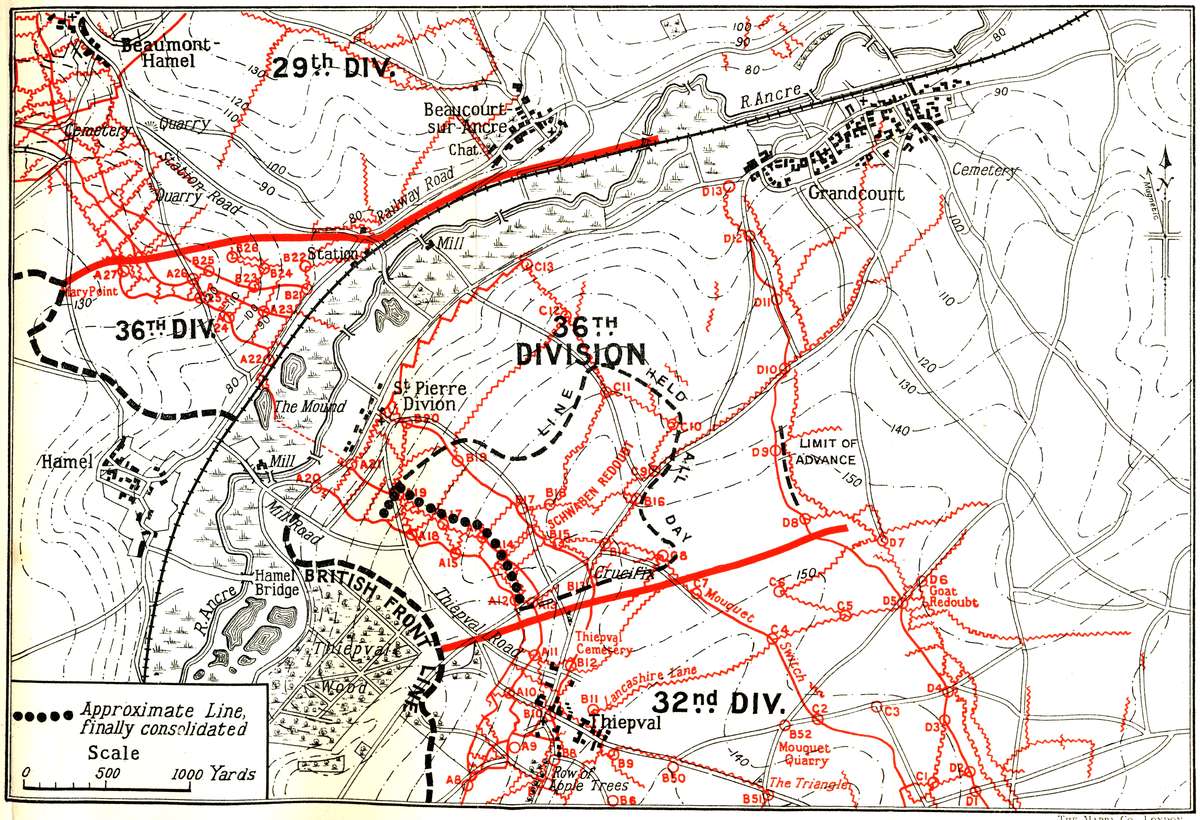
A great resource on the 36th can be found as part of the Guternberg project here. If this link doesn’t work – try “Gutenberg Project 36th Division) and you should find it.
This is where I got most of my data on Courtrai – 19 October 1918.
I just didn’t research further back into the 1916 battles as they weren’t under discussion for the article series.
https://www.gutenberg.org/files/48716/48716-h/48716-h.htm
@oriskany totally agree on Longstreet!
You also did a great job on the military history aspect and today’s military. Well Done!
The Ossuary is absolutely amazing at Verdun. You can look through the glass windows at the piles of skulls and bones. Truly sobering!
Great job Beasts of War Crew for a really excellent show on Veterans day.
From a Veteran of both Gulf Wars I am truly touched at your professionalism and handling of the topics today.
Thanks!
@oriskany
Forgot to tag you above.
Guess I did get it right.
Awesome, thanks very much. Glad you liked it. 😀
I’m still in hiding, though. Mobs of Civil War reenactors with torches and pitchforks are prowling the streets looking for me.
Bit late, but thanks for a great show.
My interest in history definitely came about via military modelling and wargaming, then the interest in wargaming dipped a bit, and although I don’t have much time for it now, I’m back to being more of a gamer than a historian. So I hugely appreciate learning history through the filter of gaming.
For a long time I felt very ambivalent about Remembrance Day. I’d never been someone who was vocally against it for ‘glorifying war’, but it did verge on ‘dwelling on the past’ rather than looking to the future and focussing on cooperation today.
Having friends who’ve been caught up in the war in Syria has made me much more aware of – perhaps I should say more concerned about remembering – the wars of history.
I know the ‘we shall never forget’ sentiment is aimed primarily at those who sacrificed their lives for their countries, but for me it’s always also meant that we shall never forget the general horror of war and therefore that we’ll always strive to avoid it where possible.
In Syria today you have the repeated use of chemical weapons against civilian targets, the deliberate destruction of medical facilities and personnel and all the rest of the horrors that it did seem in recent decades that the world was trying to put solidly behind us.
@johnlyons ‘ comment about the evils of social media also touched a nerve. Although the Syrian protestors used social media to chronicle the repression and attrocities, social media has become a vector for the deliberate propagation of disinformation and war crimes denial. It’s pretty depressing.
And of course, as the world seems to be becoming more unstable and more dangerous again, we have a lot of bickering and division and rising nationalism and populism in the ‘West’, rather than focussing on trying to improve lives.
Hmm… That was a bit of a ramble. But it was a very thought-provoking show. Thanks guys.
Great episode. fantastic job guys.
Thanks very much, @radegast6 ! 😀 Glad you liked the episode.
Thank you @avernos for shouting out about the Facebook Page that Dicky Boyd and myself created and those that are interested the link to The Great Fallen, Remembering the Armistice, https://www.facebook.com/groups/253536112173195/
My pleasure I do still intend to tidy it up and post pictures again mind you.
Great project, once again! 😀
I don’t know, if you know, but Germany payed the last part of it’s dept, around 200 million euros in 2010
Interesting. Is this from World War I? Or World War II? And if World War I, was it pertaining specifically to the Treaty of Versailles? Are we talking “debt” via national bank loads, etc, or actual reparations as stipulated in the Treaty of Versailles Because that was one of six treaties ratified at the Paris Peace Conference, to which at least two the Germans were signatories.
I only ask because according to my sources, most of the Versailles-specific reparations (beyond the first payments immediately demanded) were waived sometime in the 1920s.
I think this all the loss taken out by Germany with the US and private banks in the Allied countries. It was restructured to fall into line of being paid back if there was trade surplus of over 3% in the year It must be noted that Germany volunteered to pay the reparations back so they could join the IMF
1920s or afterwards?
After WW2 I believe
So, again … we’re actually off topic. 😀
Which is fine, people can talk about whatever they like. 😀
It’s just that sometimes these vague “I don’t know if you know” … or … “what about this” … or … “don’t forget to mention” … questions and comments actually cast a little doubt on the content I have created (perhaps unintentionally), either with articles or the interviews.
Then it becomes clear that the people were talking about something NOT COVERED in the content.
I have no problem if someone has an opinion or even a correction on something I produce. But let’s have it be about something I actually wrote / said so I can mount an actual defense and make a constructive counterargument (supported by sources).
I apologize if it sounds like I’m overreacting, but this has happened a couple of hundred times over the past few years. It adds up.