










Modern Wargaming With “Force-On-Force” Part One – Introduction
February 8, 2016 by crew


This article series is presented as a collaborative work by Beasts of War community members @unclejimmy and @oriskany. The notion for these articles came from another series recently presented by oriskany on the recent conflict in the Ukraine, which used the ‘Force-on-Force’ system by Ambush Alley Games and Osprey Publishing.

Oriskany’s articles, however, didn't go very deep into an explanation of the rules or the mechanics of the game. So, this new article series will examine the “nuts and bolts” of Force-on-Force in more detail. We hope this will be useful if you’ve never heard of Force-on-Force, or are thinking of giving it a try.
Force-On-Force - An Overview
Force-on-Force is a game designed to simulate small-scale combat actions between modern forces. This series isn’t intended as a full guide to playing a complete full game - just a look at how some of the mechanics work and a summary of what the game is all about.
The rules describe two types of engagement, Kinetic and Asymmetric. “Kinetic Warfare” generally describes your traditional battle situation. Two opposing forces, usually professional soldiers in full-scale standing armies, fight it out over an objective or simply to eliminate one another from the board.
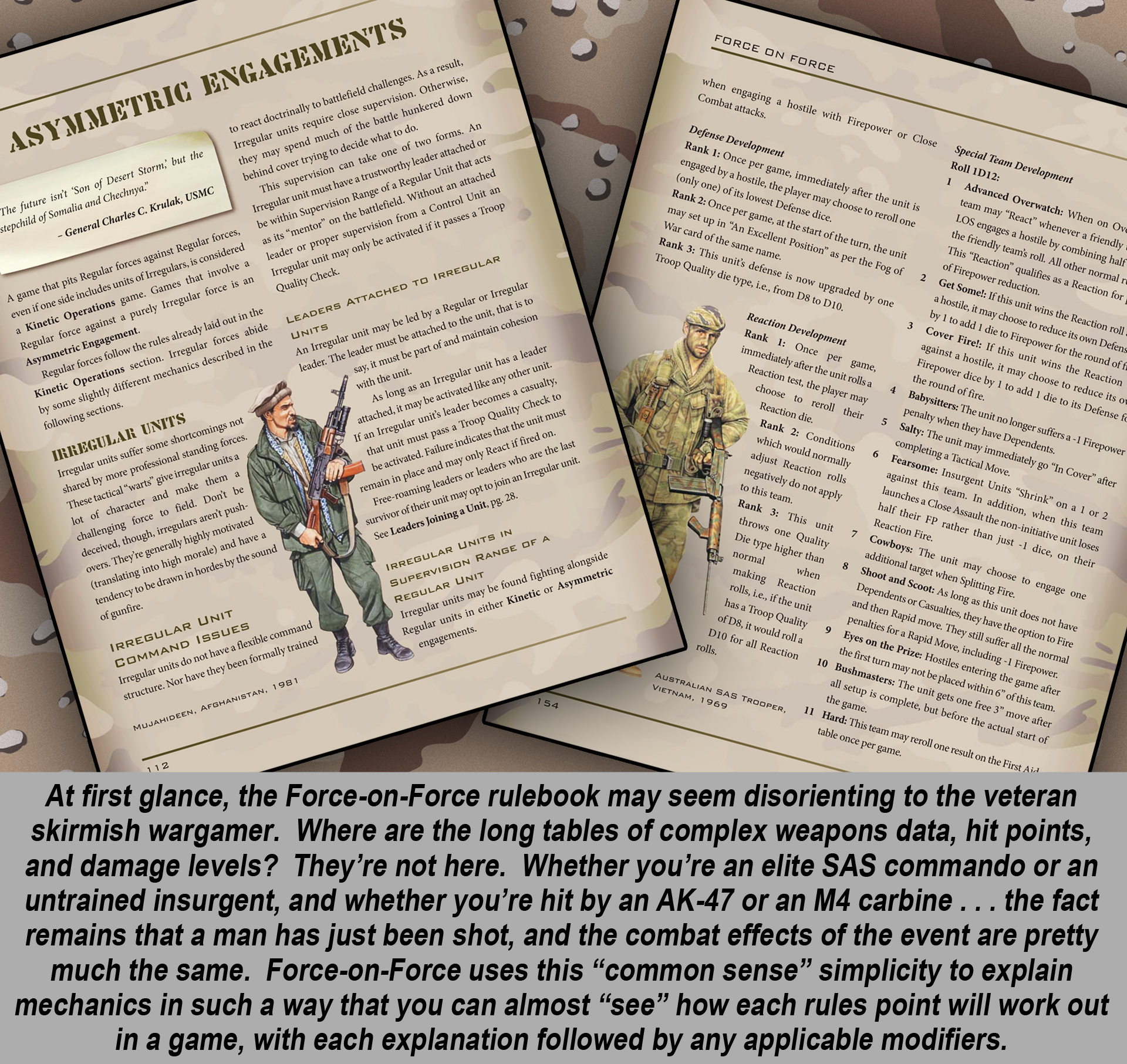
An Asymmetric engagement, in contrast, is the type of warfare used in counterinsurgency, the smouldering conflicts we see so often in the news. Snipers, patrolling, and artillery exchanges are punctuated by ambushes and firefights, usually pitting government troops against some sort of militia, insurgency, or terrorist network.
In their January 2009 Counterinsurgency Guide, the US State Department defined counterinsurgency (sometimes referred to as COIN) as: “comprehensive civilian and military efforts taken to simultaneously defeat and contain insurgency and address its root causes.”
To capture and replicate the characteristics of both Kinetic and Asymmetrical combat, “Force-on-Force” rules use a straightforward and easy-to-learn system (presented in a stellar rulebook) to produce a fast-paced and colourful 'combat' experience.

At first glance, however, new players might be confused since Force-on-Force “sounds” very different to many other skirmish games. Once you begin playing, you'll find you can play detailed, action-packed, and cinematic scenarios without having to refer back to complex of cumbersome rules or even having to pick-up the rules.
Force-on-Force is not a game designed for huge engagements. It is best played with a few units per side and maybe one or two vehicles. That is not to say with experience you could not play larger games, but it has been designed with this sized game in mind.
Troop Quality
In Force-on-Force, troops are rated for their training, confidence, and level of supply. This is expressed, in game terms, by a Troop Quality (TQ) die. This scale starts with a d6, which would represent untrained or poorly trained militia or rebel units. A unit represented by a d8 would be well trained or experienced troops.
Units made from veteran troops, with extensive combat experience, would use a d10. Finally, d12s would be used if you field units with the training and experience of the SAS. This last type should be very rare in games, as they can easily unbalance a game if not used sparingly.
As an example, this is the entry for the modern British army.
British Army
- Initiative Level: D8 to D10
- Confidence Level: Confident to High
- Supply Level: Normal to Abundant
- Body Armour: 1d
- Troop Quality/Morale: d8 to d10/d8 to d12
Force-on-Force takes place using a series of actions and reactions. This is not a static game, during each turn everybody does something. As one side makes actions with their forces, the other side can react to anything it can see or by which it is affected.

A unit’s actions are self-explanatory: Move, Fire, Request Air Support or Hide. There are more, but these are just beginning examples. There are also reactions to these that opposing players can take, during the first player’s turn as he is making his initial actions.
Movement is also straightforward. There is “tactical” or “rapid” movement, allowing a trooper to move 6", or 12" if he wants to take the risk. Over rough, for example, troops using Rapid Movement have to roll a TQ dice. Get a “1” and your foot has found that rabbit hole, you are now a potential casualty.
Open Fire!
Okay, let’s address what most people want to know about a game right away - how does combat work? Well, in Force-on-Force there are no massive tables of weapons. Your training, confidence and supplies are what dictate your fighting strength … it’s less about the weapon, than the capabilities of the man BEHIND the weapon.
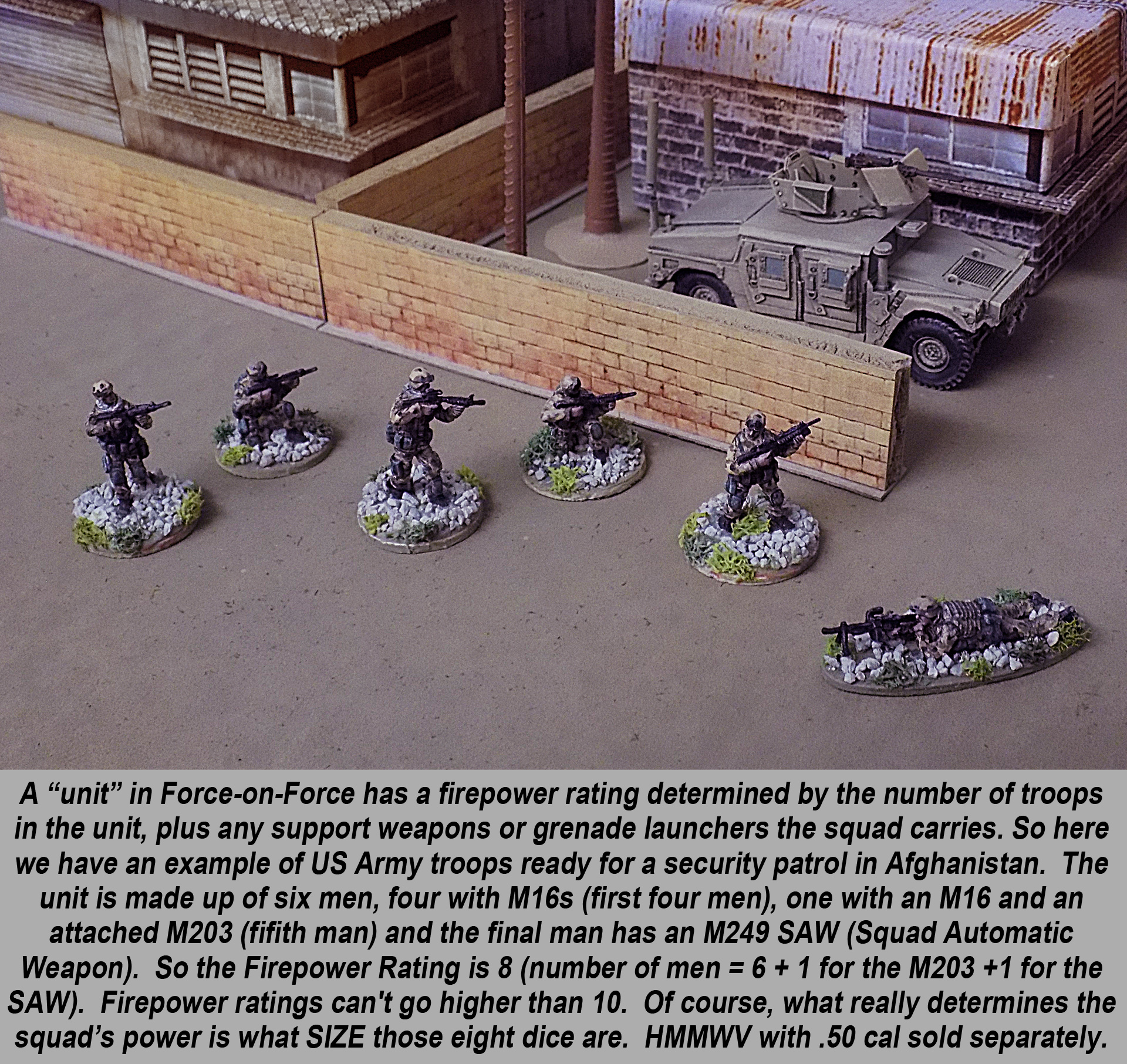
Once the attacking player has calculated his firepower (described in the caption above), the defender works out his defence. Count the number of figures in the unit or the number of firepower dice of the opponent, whichever is LESS. That’s your basic defence, which can be modified by cover or body armour.
At this point dice are rolled by both sides and 4+ results are compared. The defender matches his dice to those of the attacker, he must equal or better the score of any dice. Any attacking dice that remain that cannot be equalled or beat will cause one casualty.
A further level of detail can be added with “Fog of War” cards. Whenever you make a reaction test and roll a '1' you draw a card. Sometimes the result will be beneficial, perhaps a passing Cobra makes a strafing run for you, or you find a really well built wall to hide behind.
However, Fog of War cards can also benefit the enemy. You might have triggered a booby trap or just heard some bad news over the net and it lowers morale. Strictly optional, these cards are free to download from the Ambush Alley website.

In the image above, we show an example of how fire and reactions work. Clearly there will be cases when some units wind up shooting multiple times in the same turn. This is intentional, since in modern warfare, hard pressed units can lay down ridiculous amounts of lead. However, there are limitations to this.
All units in Force-on-Force are either “Regular” or “Irregular.” Irregular units may only participate in one round of fire they have initiated by either action of reaction. Irregular units may only be activated or react once per turn.
Regular units may react multiple times, but each time they do so lose one point (dice) of firepower. Eventually they will no longer be able to fire back as they run out of firepower dice. Then again, in a highly trained unit even a single d10 or d12 can roll a result that a d6 or d8 militia can never match. This is that one perfectly-placed sniper round ...
Show Of Force
What about the fancy stuff, like calling in an airstrike, heliborne assault, and “fast-roping” infantry? Well, it’s all there, but again the rules are elegant and nuanced, and allow for application of more “subtle” modern tactics. One example is the “Show of Force.”

Modern aircraft (fighter jets and helicopter gunships) can be used to seriously damage the morale of non-regular troops, even without releasing ordinance. When combat aircraft fly low and loud over Irregular troops, it can rattle their nerves to the point where all irregulars must roll an immediate morale check at a -1 die roll modifier.
Results are applied immediately. This tactic is brilliant for clearing insurgents, without actually firing a shot. This is especially useful since civilians are often in the crossfire, or your superiors might be trying to contain the conflict’s level of violence. Note that this tactic also “ignores” line of sight, because raw fear finds you …wherever you are.
Debriefing
Of course, all this is only the beginning of what Force-on-Force has to offer. Fully exploring a wargame system that can encompass virtually any conflict from 1945 to the present day is going to take more than one article. Post comments or questions below, and let us know what you think so far.
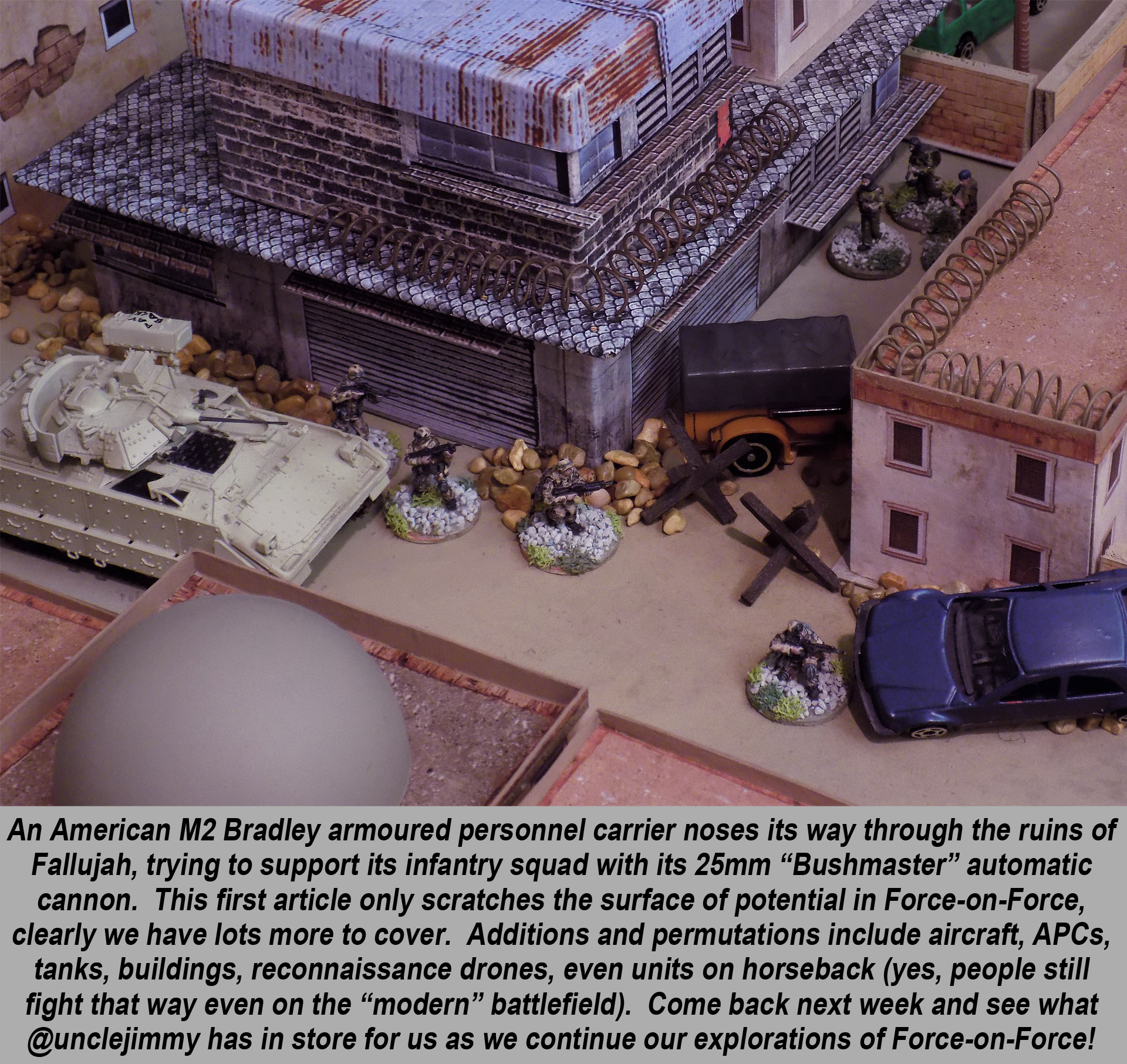
Better yet, get some friends together, break out some miniatures, and try this game yourself! Saddle up, people! And lock n’ load!
If you would like to write an article for Beasts of War please contact us at [email protected] to find out more!
"The rules describe two types of engagement, Kinetic and Asymmetric..."
Supported by (Turn Off)

Supported by (Turn Off)
"…it’s less about the weapon, than the capabilities of the man BEHIND the weapon"
Supported by (Turn Off)


Fame! I’m gonna’ live forever…
As always with @oriskany you only get the best quality pictures. Some awesome looking stuff.
Just so everybody knows – almost all of the hard work for this article was down to James. Thank you.
Actually, at least 75% of the writing is @unclejimmy . I’ll admit to some editing, the photos, and the graphics formatting. 😀
…so all the hard parts!
p.s., I can’t even change a lightbulb.
Absolutely brilliant this game has always interested me, never dived in because all of the reviews,articles and AAR make it look very confusing and slow with loads of counters and book keeping looking forward to this series, as I have love everything from you before. Fingers crossed I will finally have a game to use my Empress mini’s in.
Cheers Matt C
After a few games it is reasonably easy to play without counters. However, they are very useful to counting how many shots you have left to exchange in a round.
I’ll try and do a AAR – just for you!
Thanks, @matt931 – Counters can be a little useful, as @unclejimmy says, to track how many “reactions” and fire phases a unit has taken in a given turn (more on this in later articles).
I think you’re in good shape, though, with Empress miniatures. The reason I say this is the QUALITY of the MINIATURE might have a positive impact on how the game actually runs. Specifically, how easy it is to tell who is who, what weapons a figure is carrying, etc. Long story short, really great quality miniatures can also reduce the “weight of the game” relying on counters.
Most of all, when you start playing, remember what we say above: This is a game for smaller skirmish type battles. Later, you can grow into big armies, but by keeping initial games small, you pick up the basics much easier and faster. 😀
Thanks for the reply !!! I’m loving the idea of playing out games with single fire teams against insurgent gangs, does it have rules for civilians?
Of course it does! Rules for mobs, for having to identify targets before firing on them (rules of engagement) and all manner of other details. There is nothing ‘missing’ from the rules, that I can think of, so any scenario you can devise will covered.
You can easily set-up a squad of experienced troops to fight off a ‘hoard’ if that was what you were thinking of.
When it comes to non-combatants you can add such details to your games without any problems.
…he’s right about using quality minis – it does help a great deal.
Cheers dude. I’m looking. Forward to an AAR I’ll hold you to it. Lol
I have asked the boss (@oriskany) if he can help with the pictures again. Only one of the pictures is mine and he did some amazing photo-shop magic to give them colour.
I have real trouble painting at the moment and he rescued me – that is what Marines do!
Well done @unclejimmy and @oriskany . Great collaboration and a detailed explanation of the rules. 🙂 Seems like quite the elegant system.
A few questions: Could FoF be used for near future stuff? Lasers, plasma etc. If the new Traveler rules suck I’ll be casting around for a different system. This one may fit the bill.
You mentioned armour. Are there stats for different vehicles? How does FoF handle that.
Looking forward to the next installment! 🙂
FoF has a future version called ‘Tomorrows War’. I think that is where I will move next.
The system looks and sounds very complex when you first encounter it. Once you have played two or three games you will not even need a rulebook. On the FoF website there are some great aids – go and have a good look around.
There are a list of common vehicles, but the stats are just a line of information the allows you to use it in a game. It is not really a game about armour – one tank will make a huge difference in the wrong hands. Vehicles play just like troops, there are no huge amounts of complex rules to add.
Sorry, @cpauls1 – yes, I just saw your question. YES – FoF does have some great rules for vehicles. They will be summarized and reviewed in Part 04 of this series. Definitely not for “mass Prokhorovka tank battles,” though, Force on Force is primarily concerned with smaller, squad-sized skirmishes. I’ve used 3-4 vehicles on the table at once – MAXIMUM, and most of these have been HMMWVs and IFVs/APCs.
Great start lads, it reads very well and I look forward to the next instalment 🙂
Thanks, @brucelea – did you get Team Yankee flashbacks when you saw that Hind in Image 07? 😀
Really enjoyed the article @oriskany and @unclejimmy, looking forward to part 2.
Thanks, @biggabum and @cpauls1 – glad everyone likes it so far! 😀
Nice looking article you’ve got here, chaps. You never know, might even convince me to get some modern minis and give it a go. 😛
Great game for Force on Insurgents battles & campaings as well as great Force on Force within the real om scenario play. Didnt ever like the 10D die cap though, can feel a bit broken sometimes.
If you want to play out Black Hawk Down, Irak, Afghanistan, Vietnam – Here´s your game though. Cold Wars Gone Hot is worth a look at aswell.
The game would deserve a good and fully functioning campaign system.
It does have a campaign system – it is basic, but it allows for a campaign setting to be played-out really well. You have to do a little work too. I have played a few linked games and it doesn’t seem to need a system of its own.
There is an amazing blog-thing that does have a very detailed campaign setting and rules if that is your thing. If you have never seen it the you ought to.
http://bigfof.blogspot.co.uk/
I am sure @oriskany is going to put a list of blogs/stuff that I think are great sources of info. If he isn’t then i’ll pop a list up a bit later.
Thanks for the article, guys. I generally do not game in the modern era because I retired in 96 and modern games leave me flat. I do see some interesting possibilities, however, in using these rules ofr a number of circumstances. When are you doing the Tommorow’s War reviews…. 😉
Sorry, don’t play it yet. I have been tempted for a while to buy one – let me speak to my darling wife and i’ll see what I can do. We aim to please…
The rules are very flexible and have such a great level of abstraction that it is very easy to add elements from outside of the game.
My son is interested in how the law applies to PMC’s and so we have played games including operators robbing banks/safehouses in war zones (he is also a fan of Pay Day 2). So simple to do as there are just a few variables that determine the whole game – once you know how the game plays the rest is easy to work out.
You could easily set a game in the era you are familiar with. In the rules, a rifle is a rifle – it is who uses it!
I would demo this game for everyone who is interested if I could. This is one of the best sets of rules I have ever used, seen or heard about – next to Battlegroup. They both have such simple and elegant sets of rules that they are sometimes overlooked. However, they both deliver games that are never boring and don’t require a heap of other material to play.
I hope that helps…D.x
You’re in good company, @mwcannon – I think six of the guys on this thread are veterans, almost all of us leaving the military in the 90s.
Does anyone know where I can buy the core rule book in the UK???
Here…http://www.ambushalleygames.net/
There are always copies on ‘other’ sites if you are counting the pennies.
It’s not instock anywhere in the UK!!!!!!!!!!!! Soon annoyed!
Bit late to the party but I bought my copy, admittedly a few years ago, from Waterstones. In my local one there’s a spinning rack thingy dedicated to Osprey books. Had a dig through that and found FoF, Cold War Gone Hot and Tomorrow’s War.
sounds like a good game system the new zombie game Z nation? figures of army soldiers will be perfect for this game I think
Perhaps, @zorg – although most “plastic army men” over here are about 2″ tall (50mm including helmet, which would make them roughly 1/35?). So you could definitely have some epic “Green vs. Tan” battles, but then you’d also need some monster-sized terrain.
Are they smaller over there? I’ve seen them about 1″ tall (roughly 1/72, or 20mm), which is what MOST of these photos are.
It’s the new project Z troops I was thinking of 28mm I think check them out @unclejimmy @oriskany
http://www.beastsofwar.com/project-z/wargames-illustrated-sneak-peek-project-soldiers/
Ambush Alley already has Zombie rules for FoF! They are pretty good fun too.
There is also a set of solo rules. These are excellent and good for all those lonely nights…
Out of curiosity, is there really anything that prevents this from also being a WWII Skirmish game?
Not really, @silverstars . In fact, and we’re covering this a little in one of our later articles, one of the supporting supplement books available for Force-on-Force is called “Classified: Special Operations Missions, 1940-2010.” Obviously, this supplement is meant to support some of the early commando missions undertaken in World War II.
https://boardgamegeek.com/boardgameexpansion/139144/classified-special-operations-missions-1940-2010
The first edition of FonF had a WW2 section in it.
@silverstars – if you have a look on the AA forums I am sure they have a section for people who use it for WW2.
@unclejimmy
Do you want a copy of Tomorrow’s War? Should have a spare copy as we got two each when writing on it.
Great article, I will send a link to it to Shawn. We invested alot of blood, sweat, tears and paint in those books…
“We invested a lot of blood, sweat, tears and paint in those books…” It definitely shows, @piers . I just have the .pdf version and it’s a great product.
Oh, and please “keep us honest” if I get anything wrong on the mechanics. 😀
I hope I did a good job trying to represent it. (gulp)
Nice read guys!!! Neat change of pace. I’m used to very historically rich articles and this one, while very detailed and vivid, is a little “lighter”.
Even though I’m not the biggest wargamer in the site, this looks like a very neat system. It seems very realistic for a modern setting. However the biggest plus I can see is its flexibility in allowing a gamer to use a range of mini sizes. So many games out there require you to get “their” minis and while I know building those piles of lead and resin is half the fun of the hobby, it can get expensive. It also delays you playing the game. With this system it seems you can grab whatever you have on the shelf and get started.
Looking forward to more great reads!
I think @gladesrunner (my better half) says all this that because she hears me cursing and swearing and hurling dice across the apartment slightly LESS at this game than I so at most other games I play. 😀
FoF is perfect for it’s setting. It lacks nothing, except clutter.
Great stuff – an other game that go on to the list
…top of the list I hope!
its a great game, gets regular table time at the local club glad to see it getting some coverage here.
Glad to see another player. I thought when I first joined BoW that there would be more people mentioning it. However, sometimes on BoW, the games that should be shouted about never get a mention and yet they spend a lot of effort on other games.
It must be difficult to cover everything, but I thought FoF would have been more popular.
Maybe it will be…
Thanks, @rasmus and @toshkien . I guess I’ve been lucky on this site so far, last year I was casting around for a moderns system and “ran into” UncleJimmy who recommended Force-on-Force. When I was looking for a WW2 battle game I “discovered” Battlegroup on Beasts of War. I haven’t been steered wrong yet! 😀
I might lack taste in music, but when it comes to games I know something of quality when I encounter it.
If someone can tell me a better set of rules I can tell them that they are wrong! Simple.
My assistant, and I, will have a game tomorrow and we can do an AAR just so you can see it all in action. I missed loads of details out on purpose – otherwise I would just be copying out the rules, but I think I included enough to get a good idea of just what the game has to offer.
I don’t have a real ‘assistant’, it is just Jamie’s day off.
If you read this and have any questions please feel free to ask. When I get it wrong @piers can tell me off.
I thought I was your assistant, @unclejimmy. 😐
…but I thought I was yours!
Great read gentlemen, straight to the points pictures are ace and not ambiguous about it’s content. I have the FOF rules and have played it for a while now. Even played it in 1/35 scale and if you have enough scenery down to cut down ranges and cover then it plays well, Tamiya do some really nice figures and conversions for the insurgents or the terrorists are not too difficult either.
You should be proud of this one chaps it really does what it says on the tin.
I thank you both for such ace content and something good to read on a Mondays.
If you will indulge me please, if I have not commented on previous Monday articles by other authors I have read them all and have really enjoyed them, there is without doubt upon this site BOW a great deal talent and knowledge in their own given subjects. So thanks to all.
I am especially pleased and if you have them as friends, not just people talking upon a computer thread. I am especially pleased that this FOF series looks to be as well received as it deserves.
Victoria and Chris G
Thanks very much as always, @chrisg . 😀 Wow, 1/35? That must look awesome, but you’re right, you’d need quite a bit of space / terrain for it.
We hope to be putting out articles on Mondays, and sometimes Wednesdays, at least for the foreseeable future. Indeed we have some great contributors lined up, and what we hope is some interesting and well-received subject matter (and not all historical gaming, either).
Thanks again! 😀
@piers even sent it to Shawn Carpenter! Bloody hell.
He thought it was good – you don’t get a better review than that.
We said plenty of nice things about the game, I would hope he liked the review.
Not that I would ever write anything good about a game I didn’t honestly feel. There are plenty of games popular on this site I don’t really like. Just don’t write about them. 😀
Heard this and the sci fi variant are meant to be pretty decent. Seems folks prefer Ambush or Force on Force layout to Tomorrows War
Gives me a Stargrunt 2 vibe with dice etc, I found downloads available [including a quick start rulebook] which ill have a read to see if I want to lash out on yet another set of rules. I seem to collect rulebooks
As to scale 6mm great for mass battles, 15mm for modern/scifi skirmish gives good scale, 20mm for airfix kit and many modern/ww2 options, 28mm for sexy figs and paint jobs and 54mm is awesome but requires space
I started out with Stargrunt back in the very early 1990’s. Great game system. I am busy working through Tomorrow’s War right now – expect a little review tomorrow!
At a fist look through it is based on FoF, but offers a lot more options when it come to what you play with. It is NOT just another FoF supplement.
I can’t really compare Force on Force to Tomorrow’s War personally, I’ve never tried the latter. I think I agree mostly with what you say on the scales, though. 15mm and 20mm are my favorite, can’t argue with the appearance of 28mm infantry.
Re getting the rules
I see the PDF is easy to snag but the actual printed book seems scarce – is it currently between printings?
Tomorrows War still seems to be in good circulation [well better than force on force]
Found one…
http://www.ebay.co.uk/itm/Force-on-Force-by-Robby-Carpenter-Shawn-Carpenter-Hardback-2011-/322002719132?hash=item4af8db919c:g:RqUAAOSwX~dWnO9a
I switched to pdf a while ago, but I did buy the FoF books a while ago.
The quick start rules and intro scenario do appear to be very interesting :
http://www.ambushalleygames.net/force-on-force-play-aids/
I can see why this system would be easy to learn.
A few questions :
– How does the system handle ‘friendly fire’ ?
– can units panic ?
– are you really forced to carry your wounded ?
I can understand why ‘good guys’ would do it, but there’s got to be scenarios in which such things wouldn’t have to be bad (especially in a zombie scenario where the victim might reanimate ).
There is always one! Let’s see if I get this right without having to look it up…
Friendly Fire – other than having LoS you have to take into consideration ‘Line-of-Fire’ too. LoF – units must have a clear LoS to a target to be able to fire at it. However, if they are ‘civilians’ or other friendly units in the way then LoF must be considered.
LoF is traced from the middle of the unit that is firing to the middle of the target. Any units or civilians within 2” of this line, and at the same elevation, are considered to be “in the line of fire.”
Most units may not fire at a target if other ‘friendlies’ are in the line of fire. They may fire if civilians are in the LOF, but they have a chance of hitting them.
Units of ‘irregulars’ may fire at targets regardless of their LOF unless a scenario restricts them, but have the same chance of injuring friendlies.
Rules of Engagement might include units having to make an identification check before firing on units which have not fired at them first. Just like the real thing! Can you see how this will complicate things as a mob advances on you?
Units Panicing – the morale rules are very simple and produce some excellent results. Failing morale checks will force a unit to lower its morale die type by one – a unit with D8 morale now only had D6 morale. If a units die type becomes any lower then they become combat ineffective and are removed from play.
Before this, repeated failures of morale force units to ‘fall back’ to the closest cover and must not move towards the enemy. These units can still react, but their troop quality die is also at -1. If this takes the die type below D6 they cannot fire at all.
Caring for the Wounded – in most modern armies nobody gets left behind – dead or alive. If you were wounded would you want to be left? Would you leave your best friend behind? This game tries to simulate modern warfare and has included such mechanics to give it a better feel. Having served as a medic myself, it is an excellent rule. It might complicate your well made plans, but so will a real casualty!
You are allowed to ‘leave’ the wounded alone, but it cost you a negative die shift to the units morale.
Insurgent units use a different system. Their dead are removed from the battlefield automatically. Locals drag the body into their house or into a hidden position so they can be buried as quick as possible. This is how it happen too.
The writers of FoF have done a perfect job of adding these little touches to bring aspects of modern military operations to the tabletop.
If you want to play with Zombies, and I do, then it is up to you to decide if your units are happy to finish-off their own team members…
How’s that?
excellent 🙂
I certainly understand the casualty rules from a moral perspective.
However we as players don’t always play by the rules, which can make it difficult to get players to act like they would have to if this were real.
Eh . . . SPOILERS! 😀 These morale rules are covered in Part 02 of these series, and casualty rules are covered in Part 03. Four parts in all, hopefully publishing each Monday.
I’m kidding of course. Great questions, great answers, and yes, we do cover them in subsequent parts of the series (four parts in all).
I just kept it brief and left out ‘how’ it works,
there’s more details coming ?
You’ve already sold the system to me.
Still looking forward to the rest of the articles in the series though.
Will there be a comparison between this and any other skirmish level systems for the same period?
I have not made any comparisons because this is the only set of rules, in the modern setting, that I am familiar with. I have tried a couple of other, but they all have a different ‘feel’ or have a totally different style.
@grimwolfuk is a big fan of Skirmish Sangin and the rules by Spectre Miniatures and is just finishing his article on 28mm modern gaming using the SS rules, I think.
Obviously I have missed a lot of things out – the article is just about the basics, but there are three more articles all filled with good stuff.
Slight correction . . . we’re not covering zombies. At least not in this series. 😀 Perhaps a future series.
That’s fine, if a little worrying. However, you pay the price…
I was asked about Tomorrow’s War by @mwcannon and I said I would have a stab at describing it. I bought TW and the supplement ‘By Talon & Dagger’ on pdf and I have to say I was very surprised.
It is way more than just another addition to FoF, even though it seems to use the exact same method of play. The real beauty to this game is that you can bring in such sci-fi elements as Jump-troops, Mechs and all the usual toys that come with the setting. These fit in perfectly, just like armour does in FoF. You also get the option to add such delights as fighting in low or high gravity, no-atmosphere worlds and even to have ‘aliens’ as your enemy.
Someone needs to get in touch with Frank Drake!
There are some excellent guidelines for creating realistic alien races – and a few samples. You also get the chance to build your own corporate units to go out and fight missions. There is a section on traits you can add to your forces to give additional flavour – which is what i’ll be doing very soon.
It looks like an exceptional game in it’s own right – without having to be a player of FoF.
If I had never seen FoF and came across this I would have written an article on it! Which is what I might do next…
Buy it – it is worth it. If you really don’t like it then i’ll give you a refund! I wish I had bought it before now.
The obvious comparison systems would be ‘bolt action’/’beyond the gates of antarez’ (because the latter had to incorporate aliens and futuristic weapon systems) and infinity.
IMHO the key aspect that tends to sell SF/Fantasy skirmish games are both the models and background. Rules tend to be secondary as they serve to enhance the fluff as opposed to historical games in which the role may be reversed.
“Tomorrow’s war” sounds a bit boring and generic by comparison.
Care to comment on that ?
@limburger – you write:
IMHO the key aspect that tends to sell SF/Fantasy skirmish games are both the models and background.
Agree 100%.
Rules tend to be secondary as they serve to enhance the fluff as opposed to historical games in which the role may be reversed.
Not so sure about that part. Admittedly I play many many more historical games than sci-fi games, but among historical players, “fluff” is the actual history that usually reigns supreme in our sub-genre. We don’t usually call it fluff, but for game design purposes, that’s essentially what it is … the background behind the minis and dice.
Most historical players I know would rather lose a hard-fought, historically-plausible (note I didn’t say accurate) game than win a game in which Shermans can shoot as far as Tigers or Romans fight in shapeless blob-formations or British grenadiers fear their enemies’ bayonet instead of vice-versa.
And not all games that happen to have Shermans, Americans, Germans, and Tigers are “historical.”
Because sci-fi games tend to take place in a comparative vacuum (not all, settings like Star Wars, BSG, or even Halo have to design their systems and backgrounds around a non-tabletop gaming universe that is important to people who buy they game in the first place), I think many big sci-fi games (40K) have their fluff built and written with a game in mind.
History wasn’t like that. Hitler or Churchill or Caesar or Napoleon, when planning their wars, weren’t thinking about potential wargames that would be based on. The games have to follow the historical fluff, not vice versa.
Just some thoughts.
No comparison at all! Tomorrow’s War doesn’t have a miniatures range – it is just rules.
Since the rules are primarily FoF they are not boring at all. All of the dynamic aspects are already included and all of the mechanics that brings FoF to life are there too.
If you think it sounds “a bit boring” then just don’t play it. Simple. However, you are missing out on an amazing set of rules to fill those dark, lonely nights.
No need to add a ‘Care to comment on that ?’ – I have tried my best to answer all the questions people have asked. Adding lines like that my be taken the wrong way and people might think you are a dick.
@unclejimmy :
I think I kind of failed to translate my question, because I didn’t mean be rude.
Historical games tend to be easy to compare. The books may make the background more accessible than dry historic books, but when it comes down to it you can compare them on how you want the game to feel (cinematic vs realistic). The hardware still has to perform comparibly even when using Hollywood as a gold standard. The Tiger in Kelly’s Heroes still was sufficiently scary. One doesn’t need a degree in history to understand that bit. The hard stuff is in how various minor hardware variations affect the results. Some might like that and thus choose rules that model such things while others don’t mind the slightly less historical accurate but potentially more fun alternatives.
SF is a tougher sell. You can’t easily compare a boltgun from WH40k to anything in Infinity. The relative power of weapon systems depends on the writing/fluff. If the movies show troopers not hitting anything then it’s hard to have rules that classify them as elite troops.
This is the first time I’ve even heard of FoF.
Their website isn’t exactly helpful in getting an idea about the system and background.
As such I don’t even know how they could model aliens and futuristic weapon systems.
Do they modify the wound system to represent aliens that are tougher or weaker than base line humans ?
Hard sci fi is generic, but it still allows for a ton of options like if laser or plasma based weapons are an option. Or is there nothing beyond kinetic weaponry ?
I suppose there’s enough to write additional articles explaining the sf variant.
I know what you mean about the website – it can be difficult for someone who doesn’t know about the rules.
They don’t try and model ‘aliens’ or ‘future’ weapons – you are left to work out what your aliens are – based on a number of traits that exist within the rules. You don’t even have to fight aliens, you can just fight other humans.
In FoF the weapons are only described in terms of what firepower they add to a squad using them. As an example – a five man squad has a firepower value of 5. Then add +1 for a Sgt. with a grenade launcher, +1 for the SAW (LMG) and you have a value of 7. It doesn’t matter what the weapon really is, they all do the same thing.
If you want to be exotic with your sci-fi then just work out what the effects of the weapon will be and that is all you need.
There is no ‘wound’ system. Your unit, when hit by enemy fire, makes a roll for each trooper injured and applies the result. The mechanics are explain fully in a later article. To make tough aliens you would just give them a better defence value or a trait to simulate the kind of toughness you want.
TW has a number of Tech-levels and they play a part in how your units are equipped. High-tech levels give you all the big stuff. Again, the choice of how to play both sets of rules is totally up to the player.
I am going to buy some minis in the next few days, try a game and then I will write a full article.
I understand it must be a bit frustrating when this article just contains a few items, but you will have to wait for the other – that is the way they had to be set out.
I hope this answers your questions? I have never done this before and I hope my answers are easy to understand. D.x
p.s., I ‘think’ I gave @oriskany a list of other sites I visit that are connected to FoF – some of them are a bit more gentle than AA.
Have a look at a blog called ‘Land War in Asia’ – some good stuff and worth a look. There are some excellent AAR’s and they might give you a overview of how it plays.