





![Alternative Trench Crusade Miniatures? Trench Missionaries Review | Wargames Atlantic [7 Days Early Access]](https://images.beastsofwar.com/2026/03/unboxing-wargames-atlantic-trench-missionaries-coverimage-225-127.jpg)

![10mm Medieval Miniatures! Azincourt English Army Review | Wargames Atlantic [7 Days Early Access]](https://images.beastsofwar.com/2026/03/unboxing-wargames-atlantic-azincourt-english-army-coverimage-225-127.jpg)
The Battle Of Kursk: 75th Anniversary // Part Five: Zhukov Strikes Back
July 30, 2018 by oriskany


For the past four weeks, we’ve been taking a wargamer’s look at the Battle of Kursk, marking the 75th anniversary of the largest single battle fought in the sweep of human history. At last, we’ve arrived at the end, but if you thought the Battle of the Kursk was over, Marshal Georgi Zhukov and a few million of his Soviet countrymen beg to differ.
If you’re just joining us, please take a moment to check out the previous articles in this series.
- Part One: Background & Wargaming
- Part Two: Assault From The North
- Part Three: Assault From The South
- Part Four: The Myth of Prokhorovka
In short, the Battle of Kursk was fought between the Soviet Union and Germany on the Eastern Front of World War II. Starting in July of 1943, it opened with a gigantic, all-out German attack (Operation Citadel) on the Kursk Salient, a bulge of Soviet-held territory the size of Northern Ireland, pushing into German-occupied Russia.
Stopping Operation Citadel
To meet this threat, the Soviets had a three-stage plan. One, build some of the strongest, deepest defensive belts in the history of warfare. Two, let the Germans hit these belts and grind themselves down in brutal frontal assaults. Three, when the Germans were exhausted to the point of collapse, hit back with enormous armoured reserves.
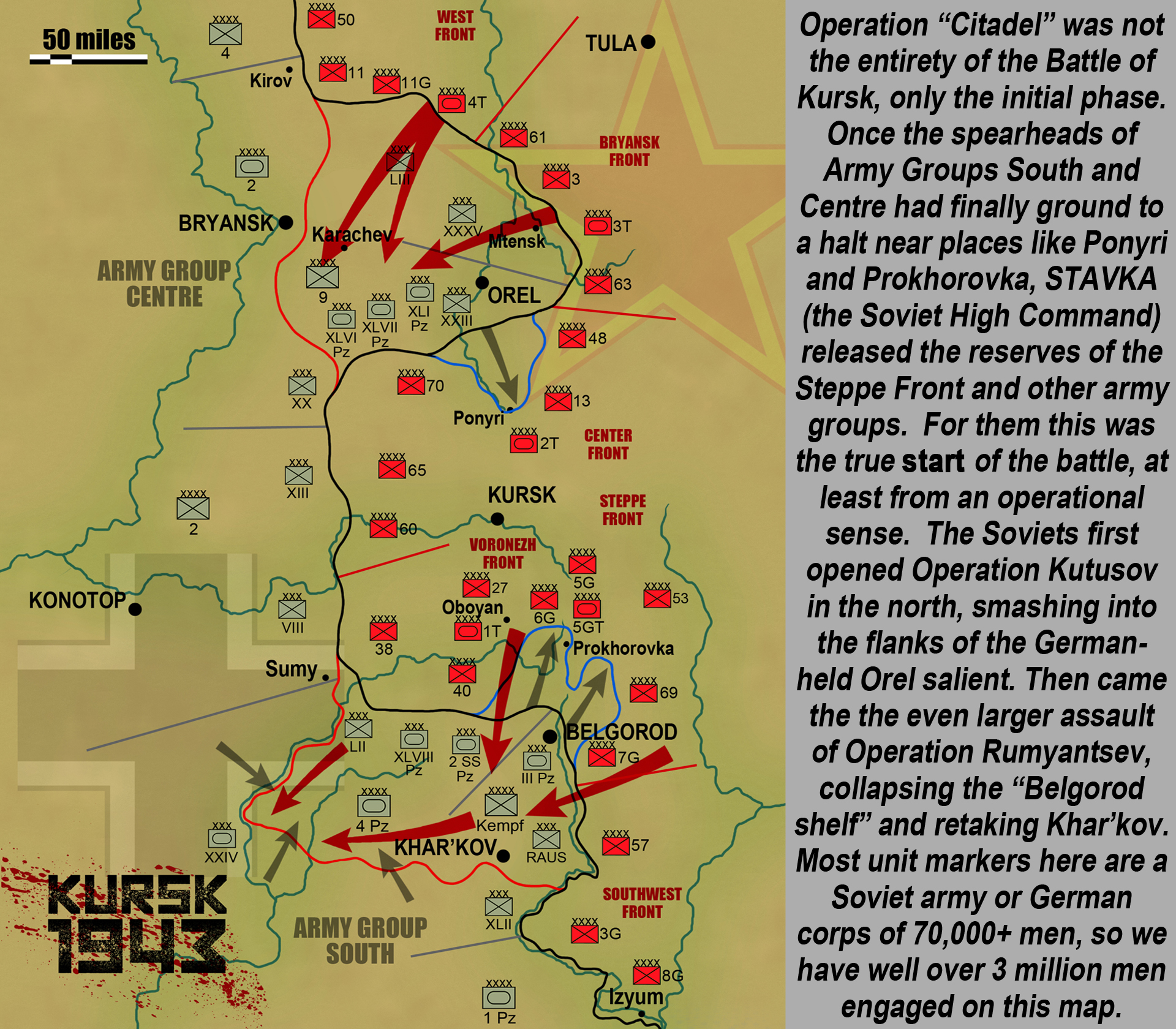
In Parts Two and Three, we saw the Germans launch Operation Citadel against the Kursk Salient. In Part Four we saw the Soviet plan nearly fail when the Germans almost broke through. The Soviets were forced to commit some of their counterattacking reserves, setting up the clash at Prokhorovka, the largest tank battle the world has ever seen.
Now in the devastating wake of Prokhorovka, the Germans had been finally and resolutely halted. Making matters worse, British and American troops had just landed in Sicily (Operation Husky, 10th July 1943). Finally, Operation Citadel, Germany’s last real attempt to regain the initiative in the East, had failed.
This is where the Battle of Kursk “ends” in most histories published in the West. Yet nothing could be further from the truth. As gigantic as this battle had already been, for Marshal Georgi Konstantinovich Zhukov (overall Soviet battlefield commander), the Battle of Kursk had yet to truly begin.
Put another way; this is where Zhukov leans over the map table, picks up a handful of dice, and with a toothy grin that is wholly unpleasant, whispers to his opponent …
“My turn...”
Operations Kutuzov & Rumyantsev
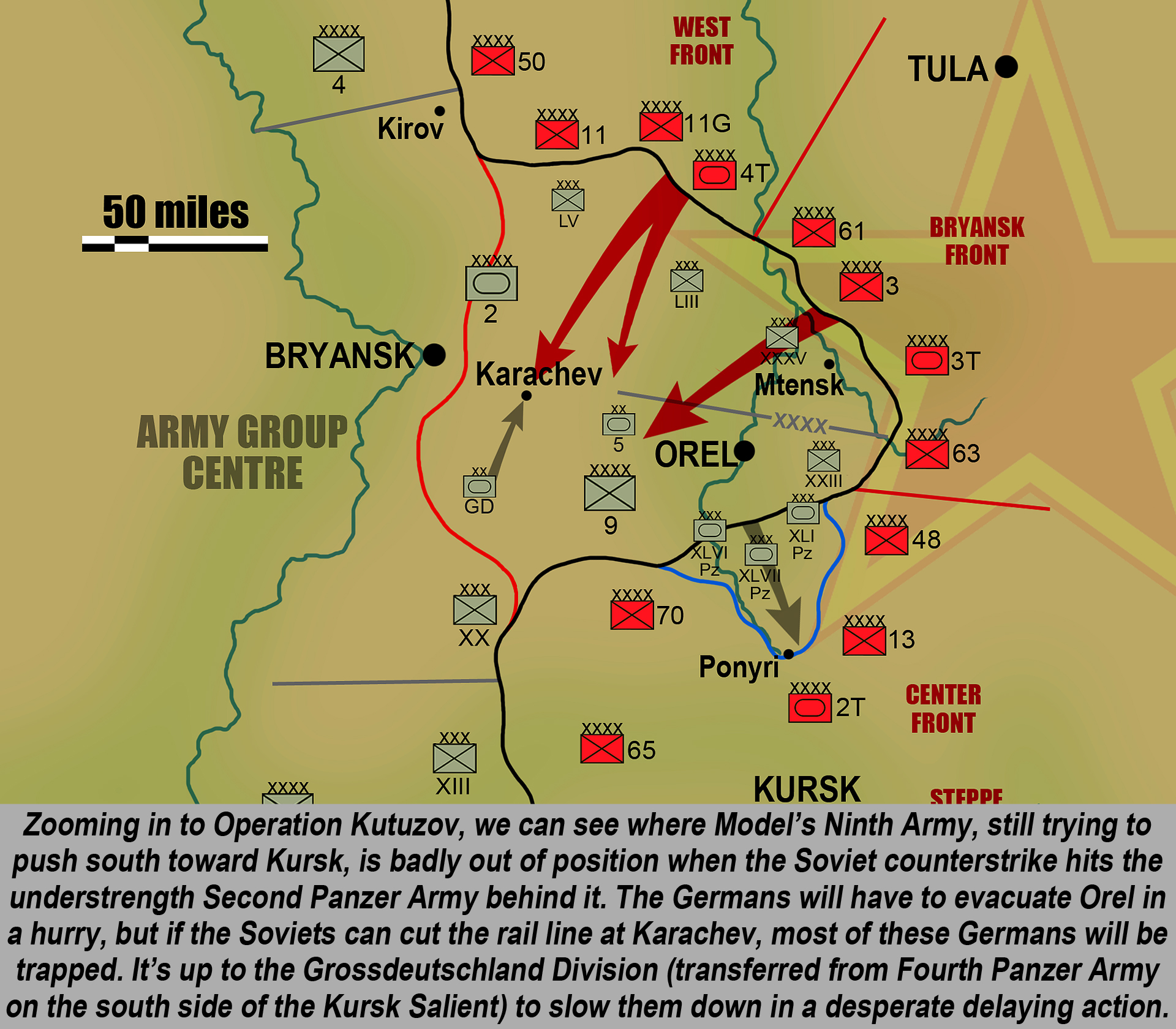
The massive Soviet counterblow was unleashed in two overall phases. First, the Soviets struck to the north with Operation Kutuzov, smashing into the German Second and Ninth Armies in the area around Orel just north of the Kursk Salient. The attack struck on 12th July, the same day the Germans were halted in the south at Prokhorovka.
The German Second Army soon buckled under the onslaught, falling back toward Orel and Bryansk. This threatened the flank and rear of the more powerful Ninth Army, still trying to push south towards Kursk and thus badly out of position to meet the new threat.
Needless to say, Colonel-General Model was forced to give up his stalled attack toward Kursk, pull out of his southward attack, and pivot against Operation Kutuzov. He was soon reinforced by units stripped from Fourth Panzer Army south of Kursk, including the crack (but exhausted) “Grossdeutschland” panzergrenadier division.
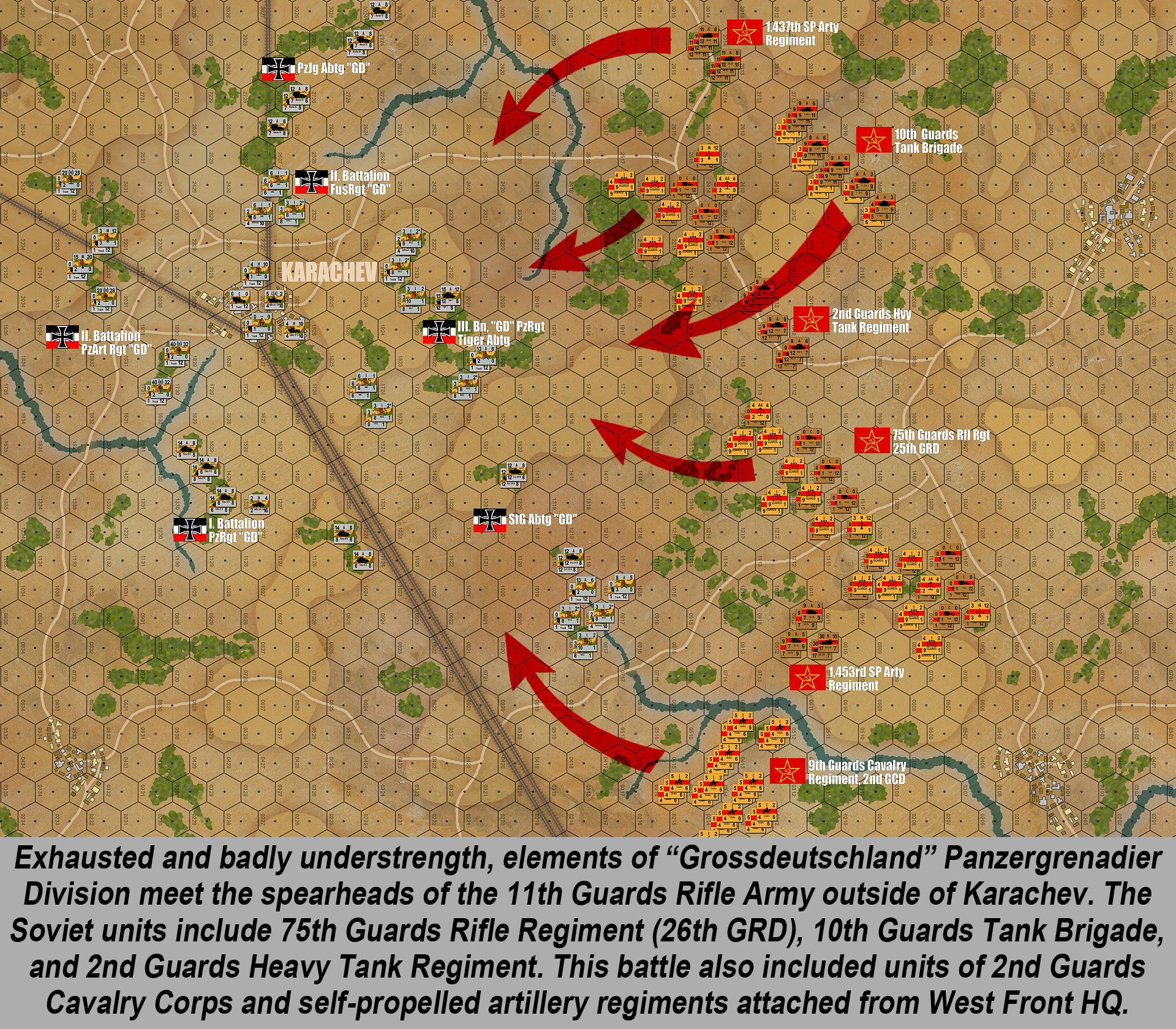
The engagements of Grossdeutschland Division near Orel will be the basis for our wargames in this article. Part of the division fought at Karachev, where they desperately tried to delay the Soviet advance on a key rail junction the Germans needed to evacuate larger units of Ninth Army before they were cut off and lost “Stalingrad style.”
No sooner had the Germans thus weakened Fourth Panzer Army to send these reinforcements, however, that the Soviets hit Fourth Panzer Army south of Kursk with the second phase of their counterattack, Operation Rumyantsev.
This attack soon smashed the German gains in the southern wing of Operation Citadel, retook Belgorod and Khar’kov, and pushed Army Group South clear out of Russia and across the border into Ukraine. The Germans struck back with local counterattacks that eventually stabilized the line, but some tremendous damage had been done.
Together, Operations Kutuzov and Rumyantsev lasted until August, crushed any remaining offensive capability of German Army Groups Centre and South, retook hundreds of miles of Soviet territory, and decisively ended the overall Battle of Kursk.
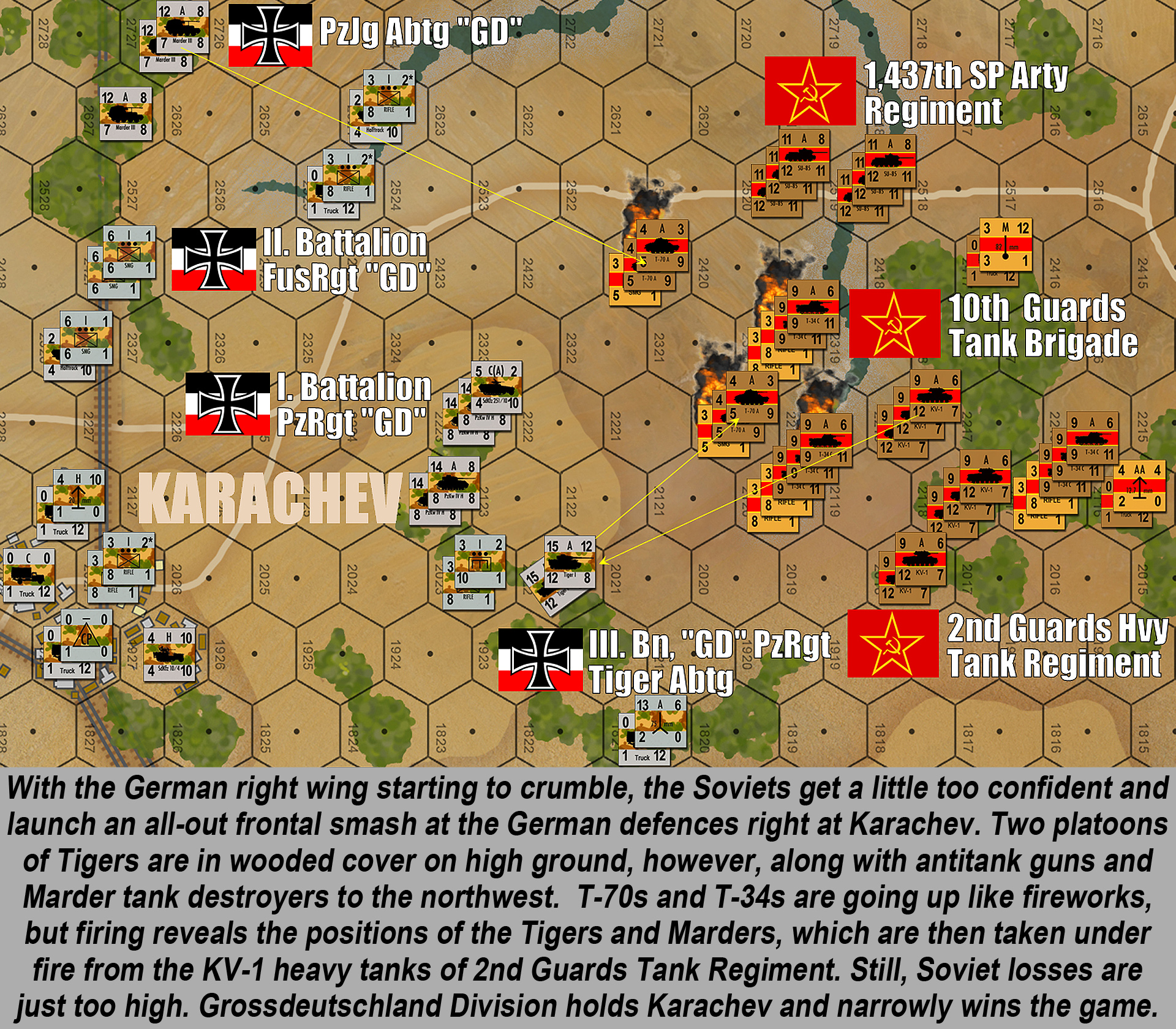
Most importantly, the Battle of Kursk showed that the Red Army could beat the Germans in summer (so far all their victories had been in the frigid Russian winters), and won for the Soviets the battlefield initiative they would not lose until 1945. There would be pauses, but never a full stop in their advance from now on, all the way to Berlin.
Delaying Action At Karachev
Of course, the sheer scale of the individual engagements of Operations Kutuzov and Rumyantsev make them even more challenging to recreate on the miniature tabletop than the German offensives of Operation Citadel. With a careful approach, however, you can still stage Kutuzov-Rumyantsev themed games that are fun and impactful.
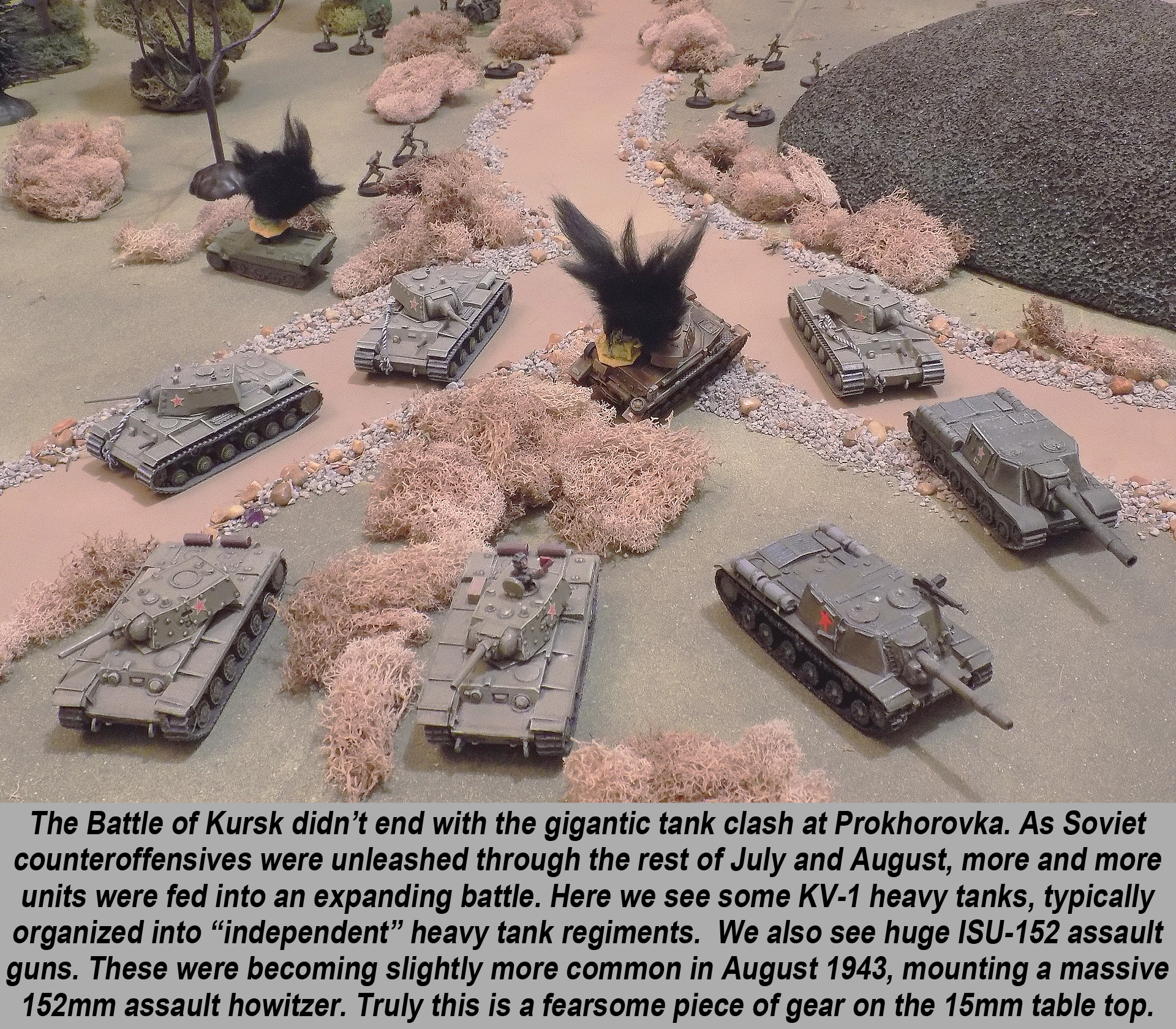
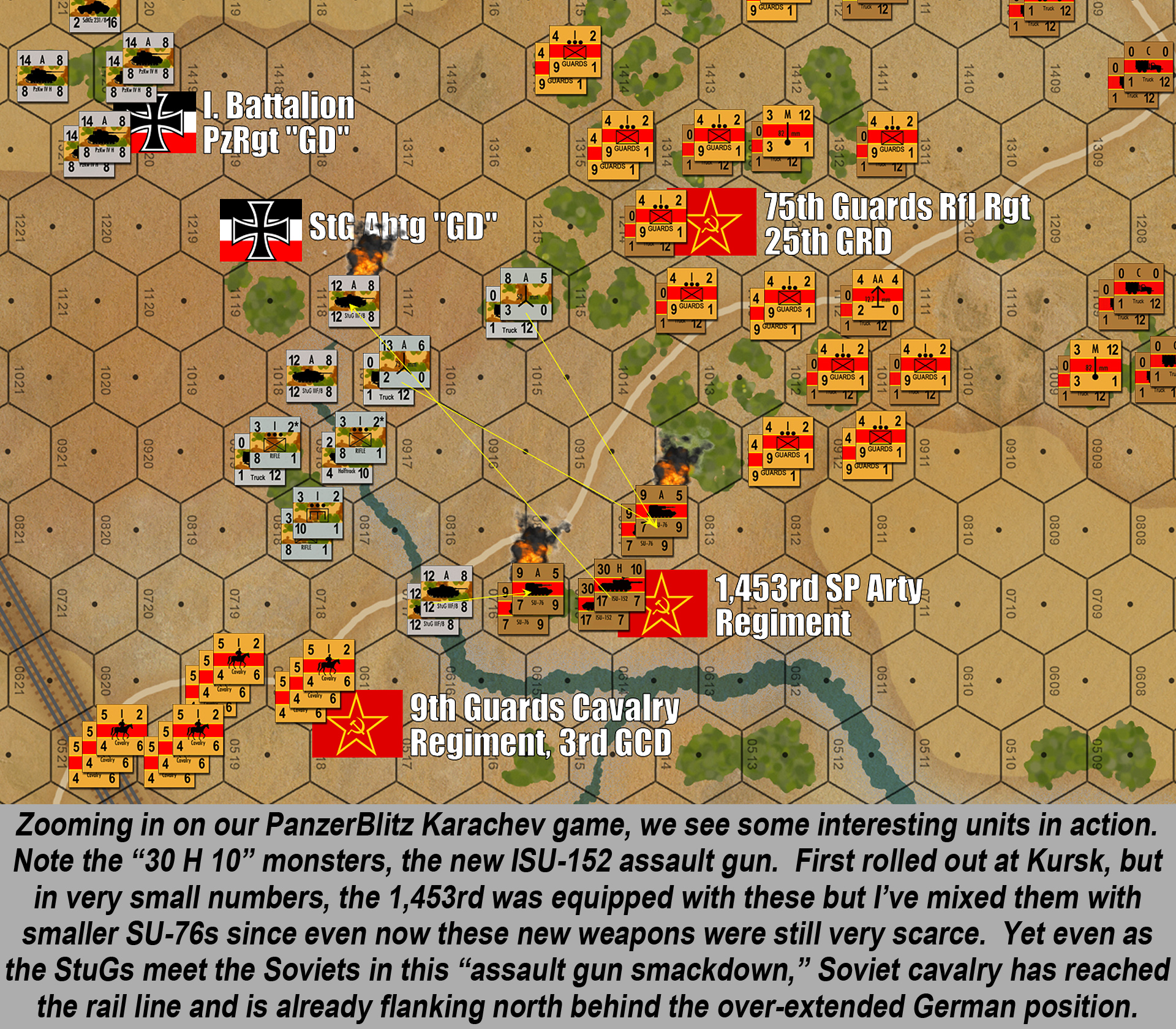
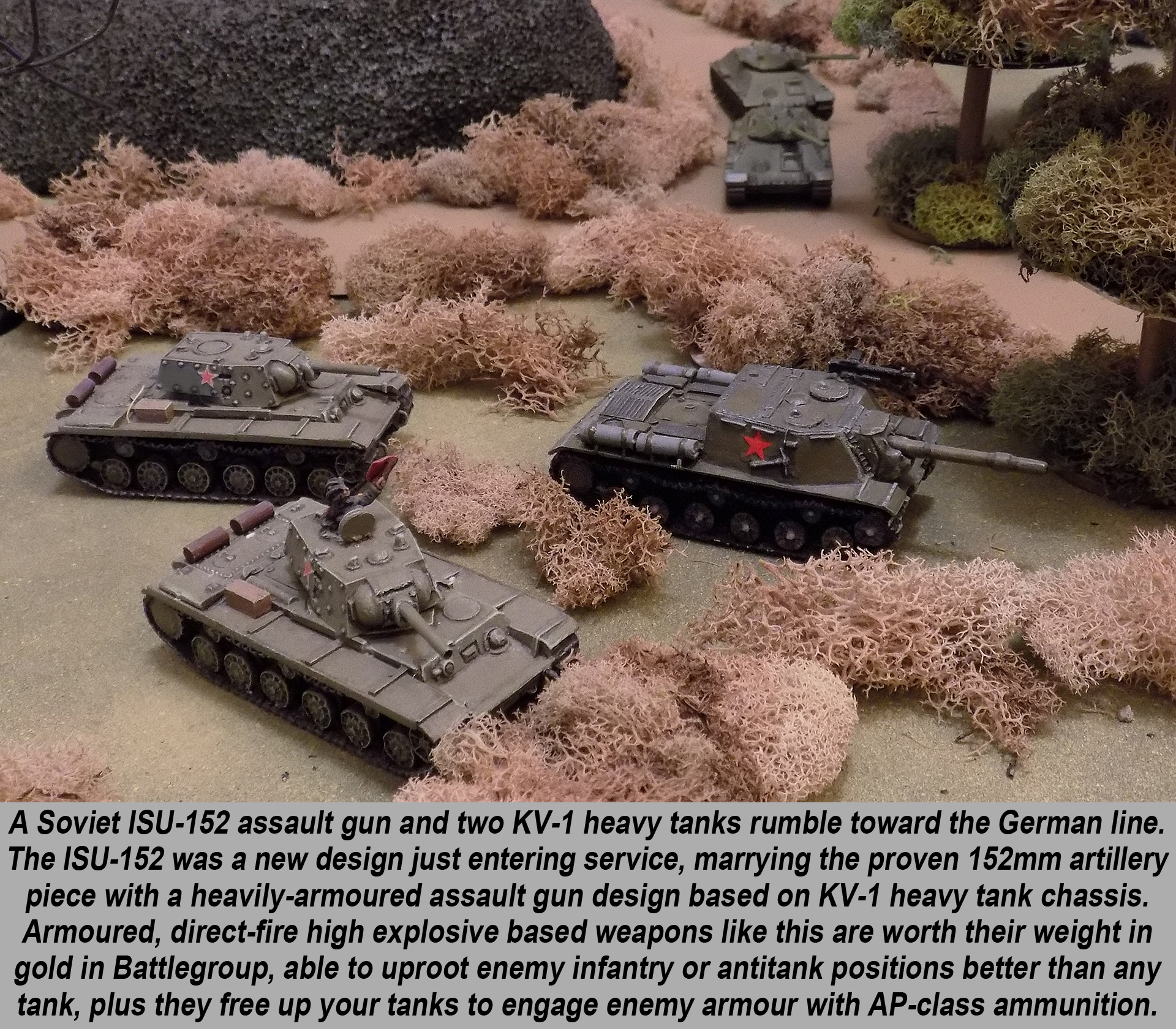
First up, these later operations see more varied equipment. For Kursk, both sides were desperately shoving out new weapons and vehicles. In the Citadel phase, most of it appeared only in very small numbers (e.g., the ISU-152 assault gun), or didn’t work properly (PzKpfw V Panther), or didn’t really appear at all (SU-85 assault gun).
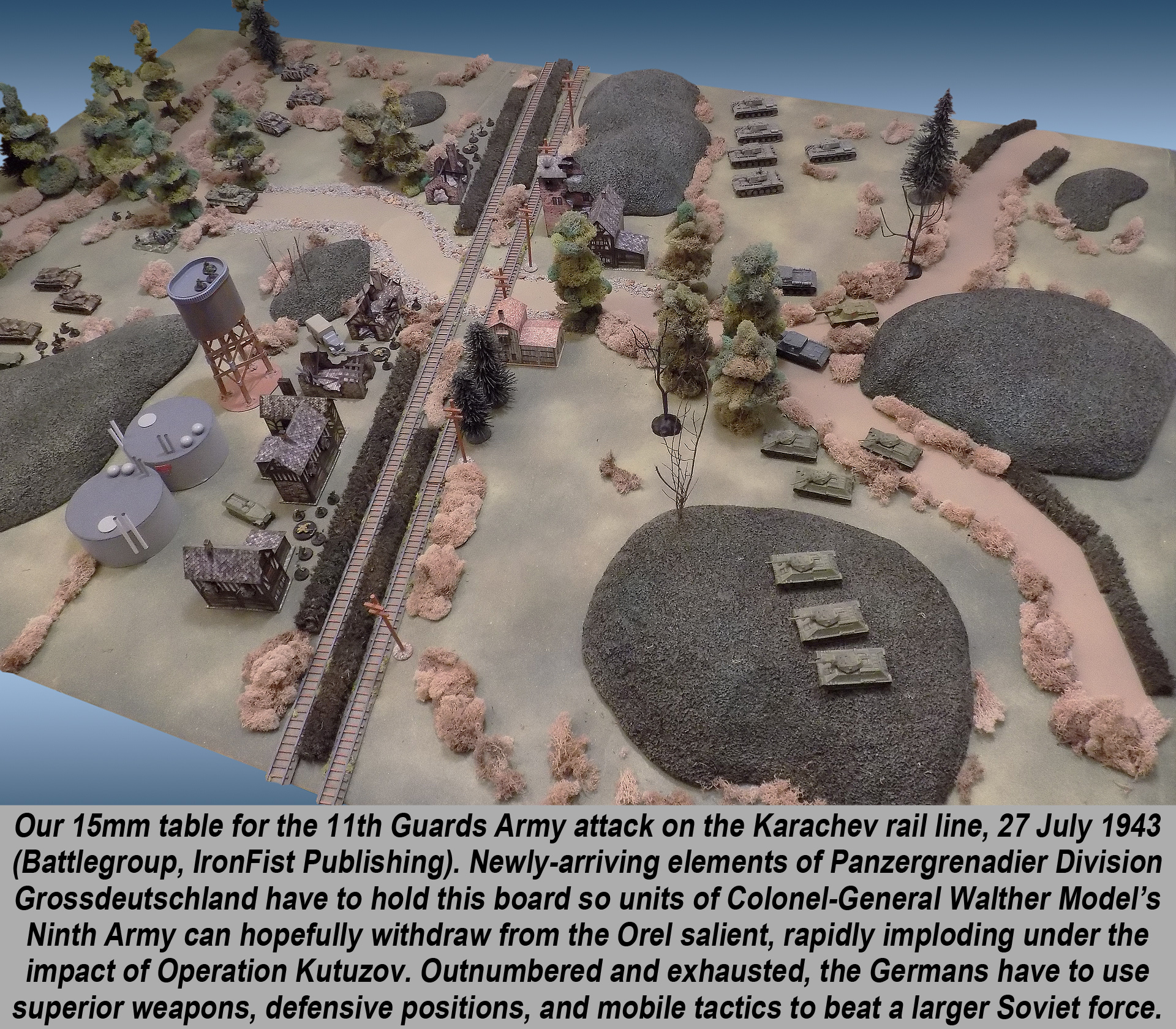
Later on in July and especially in August, however, more of this equipment started to make a more meaningful impact on the battlefield, a factor we’ll strive to feature in our Kutuzov-themed 15mm staging of PG Division Grossdeutschland vs. leading spearheads of the 11th Guards Army.
Also, the Germans didn’t have vast field fortifications with which to resist the Soviet offensives, as the Soviets had against Operation Citadel. Therefore, the movement in these post-Prokhorovka games tends to be much more fluid, with rampaging Soviet spearheads hurled against agile German counterattacks and mobile defence.
As we did with PanzerBlitz, we’ll look at a kampfgruppe of the “Grossdeutschland” PG Division facing off against the 11th Guards Army at the vital Karachev rail line. German units include a platoon of PzKpfw IVGs and another of Hs (never neglect these workhorses), and a single Tiger from III. Battalion, PzRgt “GD” (Tiger Abteilung).
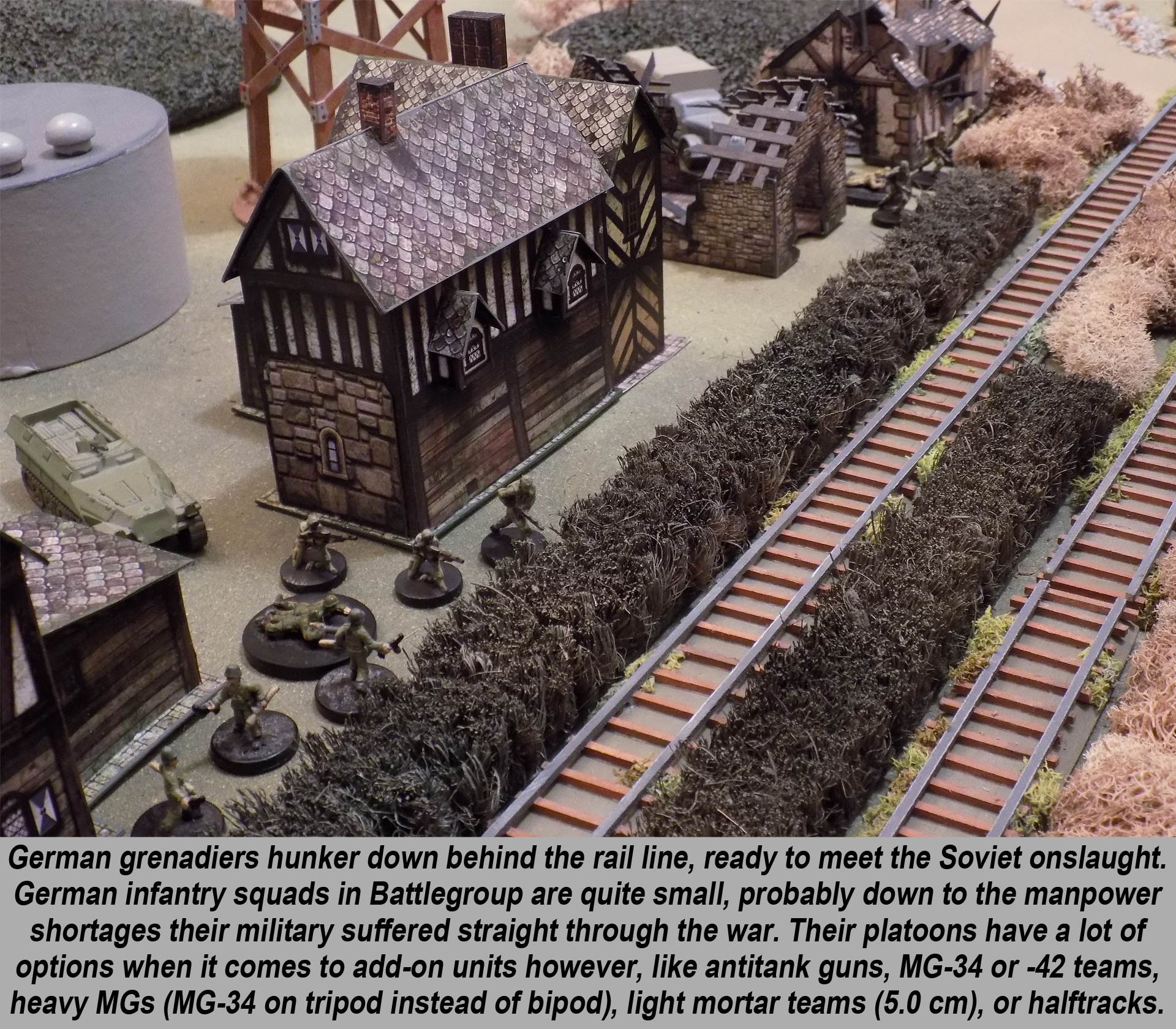
Another thing to never neglect is infantry. In fact, Battlegroup insists you include a solid infantry component in your game, requiring a certain number of platoons in your force depending on the scale of game you’ve selected. German panzergrenadiers are very good, especially if you spend a few extra points to equip them with antitank grenades.
The Soviet force is a little more complex because 11th Guards Army was a huge force and I wanted to include the “flavours” of many unit types historically included in its order of battle. For my bedrock infantry, I picked the 75th Guards Rifle Regiment of the 26th Guards Rifle Division (11th Guards Rifle Corps).
Now everyone reading this probably knows I love Battlegroup as a system. One of the very few points where I slightly disagree with the game, however, is its treatment of Soviet Guards, which they go out of their way to say are not “elite.” While I would agree they’re not automatically elite, they’re not basic grunts, either.
“Guards” units were call-back to the Imperial Russian Army that had defeated Napoleon in 1812. Initially outlawed as “bourgeois” by the Communists (although even they had their “Red Banner” formations), they were brought back late in 1941 as the Soviet government sought to leverage patriotic love for the Motherland against the Germans.
Guards units were awarded that title for meritorious action in heavy engagements. So by definition, they’re not conscripts, but at least blooded veterans. All this said I can partially understand why Battlegroup treats them as normal Soviet soldiers, for a few basic reasons.
One, the unit often took such horrific losses winning its “Guards” status that although the unit was “veteran,” individual troops were often green replacements. Guards soldiers didn’t usually receive additional training on an individual basis, although on a unit basis they often had extra attached specialist units like engineers.

Two, higher-level Guards units (especially armies) often had non-Guard component units plugged into their order of battle. So a major formation like 11th Guards Army here at Karachev is going to have regiments, brigades, divisions, and even corps that aren’t necessarily Guards and shouldn’t be treated as such.
All that said, having done the research and found that even down the regiment level, these units at the front of 11th Guards Army’s advance really were “Guards,” I have cranked up their point cost slightly to give them all at “veteran” status for the Battlegroup game.
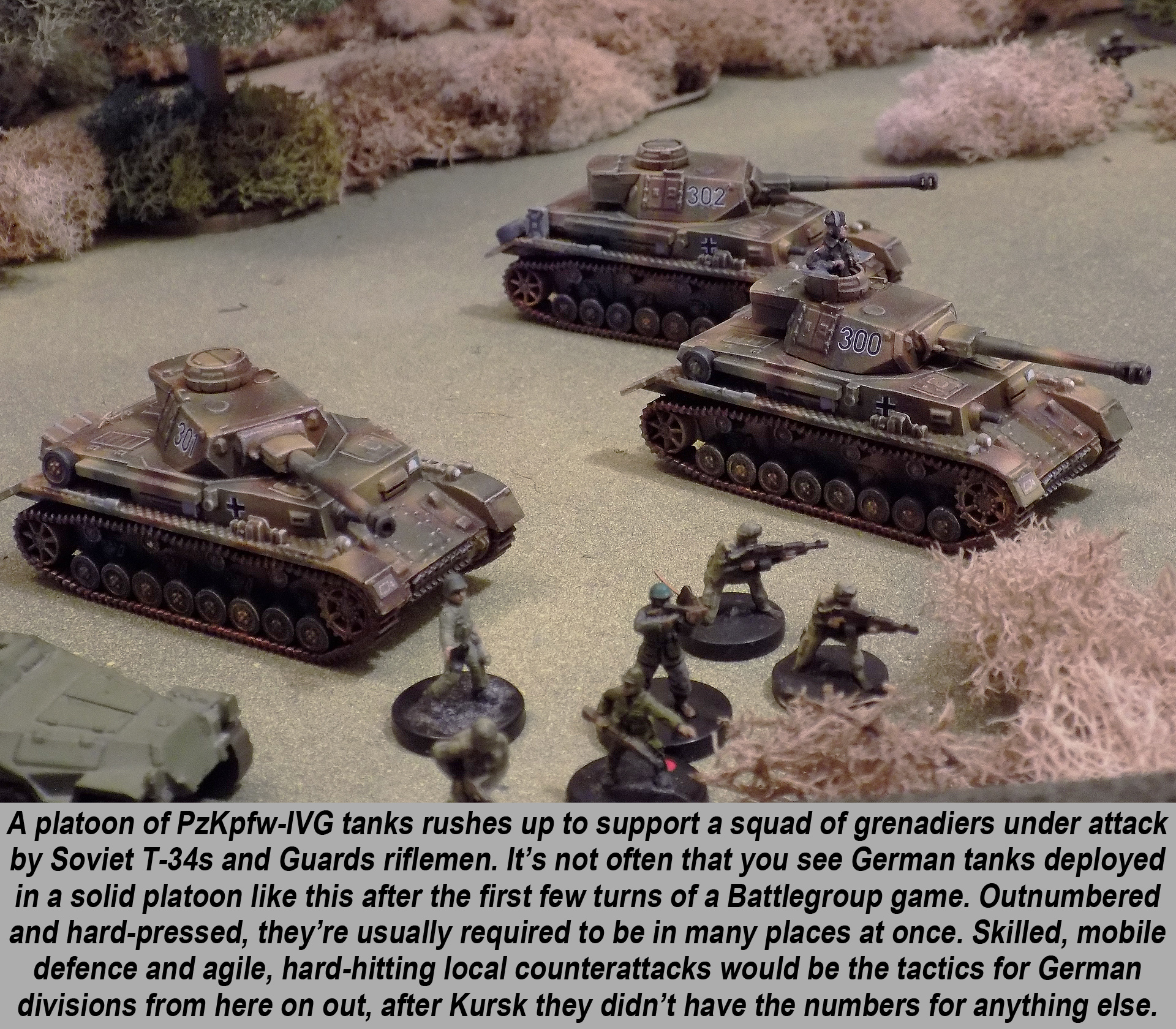
If nothing else, upgrading your Soviet Guards rifle units allows them to be pitted against veteran German panzer grenadiers. We all love our tanks, but a hard-core matchup between two veteran infantry forces is the stuff of legend, not only for Battlegroup but also Flames of War and especially infantry-heavy games like Bolt Action.
Thank You!
Well, if you’ve made it this far, congratulations. You have survived yet another of Oriskany’s article series. The 75th Anniversary of the Battle of Kursk, being the largest single battle in the history of human warfare, was definitely a subject I wanted to not only publish on Beasts of War but really present to the utmost of my meagre ability.
As always, I really want to offer my heartfelt thanks to the Beasts of War team. This includes Ben and Sam for the publishing support, Lance for the front page graphics presentations, Tom for the web support, and of course Warren for encouraging me to publish “deep dive” historical wargaming content on Beasts of War.
Most of all, I need to thank all of you who’ve read these articles, been so supportive over the years, and left so many great comments and questions the article threads. Hopefully, I’ve provided some insight into wargaming “through the eyes of military history,” or even inspired some of you to try out some “harder-edged” historical wargaming.
In the end, I just hope I’ve provided a few minutes of entertainment to a great community.
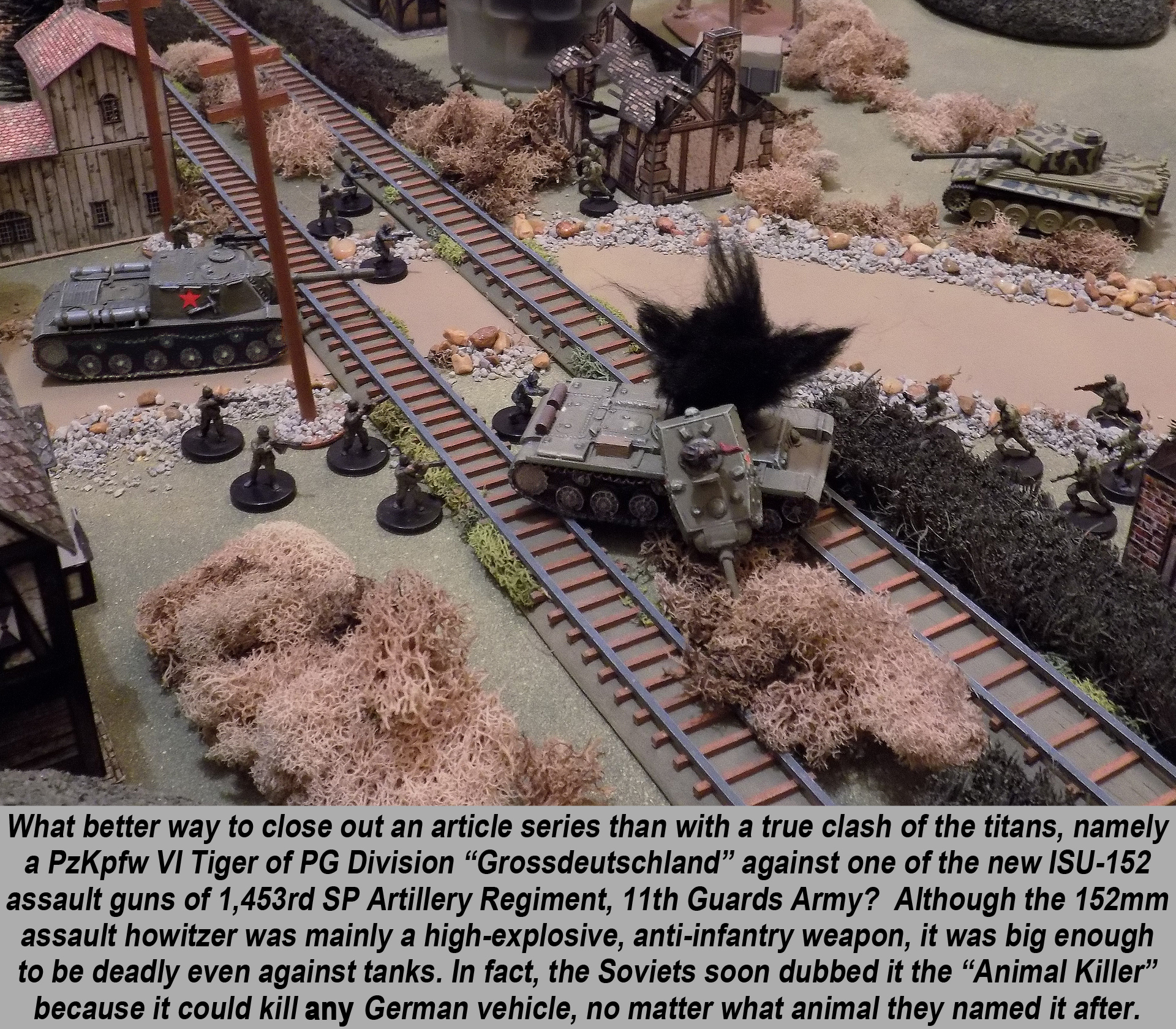
For now, I’ll be taking just a short break from publishing on Beasts of War. I’d like to free up some time to participate more fully in the site’s great Projects area, and perhaps explore some other ways I can contribute to on-going Beasts of War content, especially in the historical arena.
Meanwhile, what are your thoughts and insights on the Battle of Kursk? Have you ever given thought to an Eastern Front wargame? Although Battlegroup: Kursk was specifically written for the Battle of Kursk, there’s no reason at all why systems like Flames of War, Bolt Action, or Chain of Command wouldn’t work for this setting.
So leave your battle cry is “Panzers East!” or “Glory to the Motherland!” Post your comments, questions, and feedback below and keep the conversation going! A topic like this is too big for a mere article series to do it any justice!
"...this is where Zhukov leans over the map table, picks up a handful of dice, and with a toothy grin that is wholly unpleasant, whispers to his opponent “My turn...”"
Supported by (Turn Off)

Supported by (Turn Off)
"Another thing to never neglect is infantry. In fact, Battlegroup insists you include a solid infantry component in your game..."
Supported by (Turn Off)


![StarCraft Tabletop Miniatures Game Pre-Orders Live Now [Updated]](https://images.beastsofwar.com/2026/03/starcraft-tmg-news-cover-600-338.jpg)


![Mounted US Cavalry On Kickstarter For Dead Man’s Hand! [Updated]](https://images.beastsofwar.com/2026/03/us-cavalry-main-600-338.jpg)
![Play WW2 Commando Operations With Butcher & Bolt [Updated]](https://images.beastsofwar.com/2026/03/relaunch-600-338.jpg)
Great series of articles. It has made me want to get back into gaming the Eastern Front. I am predominately a Bolt Action and FOW miniature gamer but your articles have fired an interest in the PanzerBlitz game/series as I really liked your graphics and found where you did Barbarossa before. Start at the beginning and work up heh. I hope you also publish your Kursk PanzerBlitz graphics too. Keep up the great work.
Thanks very much, @lhmg , and thanks for kicking us off in the comments! That’s not a bad idea, publishing some more of the Kursk graphics, maybe in some kind of support thread or a project. Sooner or later I’m going to want to play that Kursk – PanzerBlitz megagame, after all! 😀
Huge thanks for the community and also the team for all the help they’ve given rolling out this series – Ben, Sam, Lance, Tom, Colin … and of course Justin and John for the great interviews and live stream! 😀
Thank you so much @oriskany for another awesome series of articles. Your introduction really impressed upon me the sheer scale of this battle – especially that this was the largest battle in human conflict. The statistics that the vast majority of the German war effort was in the East, was very sobering. As a Brit, we almost always only ever hear about the Battle and campaigns in Western Europe and North Africa.
The Info that Western histories have either ignored or downplayed the Soviet counterattack is for me yet another example of Beasts of war at its best – educational, accessible, respectful and Entertaining.
Enjoy your well-deserved “Short Break”
and am looking foward to the next Series – whatever it may be.
Thanks very much, @aztecjaguar – I really appreciate the kind words and the great comment!
The statistics that the vast majority of the German war effort was in the East, was very sobering. As a Brit, we almost always only ever hear about the Battle and campaigns in Western Europe and North Africa.
The best example of this came from a book actually @johnlyons recommended to me, where the measure the German war effort my “division-months” – how many divisions were deployed to a given theater for how many months (because they obviously moved around a lot). You wind up with 7,811 German “division-months” committed on the Eastern Front, 637 in the West / Scandinavia, 393 in Italy, 91 in North Africa. That’s 86%. German divisions deployed in the Western Front never exceeded 85 or so, and never dipped below 320 in the East, and this is when the Germans were clinging to “hold the West at all cost, let the Eastern Front take care of itself (Hitler’s words)” in the sad hope of working out some kind of separate peace with the Western Allies.”
Soviet losses (military and civilian) also exceed combined British, American, French losses for the whole war (including Pacific) by a factor of about 25-1 … and that’s being very conservative.
So yeah, the scale is totally on the Eastern Front. This war … and the bulk of the 20th Century, was decided in Russia, the Ukraine, and Belarus for sure.
Thanks again for the great comment!
Thank you @oriskany and @johnlyons for the fascinating “division-months” comparisons. Now I am curious to learn the “division-months” of the Soviets, British / Commonwealth, Americans, Italien Japanese throughout the various WW2 theaters of war. Could be more than enough an article of article and / or some infographics.
And then compare all those to the “division-months” involved in WW1…
I was reading recently a wikipedia article about the British Army at the start of WW2 and how small and “under funded” it was compared to France and German armies of the time. (Apparently funds were diverted to the Royal Air Force Bomber and Fighter Commands, and all the radar infrastructure).
Which then got me around to thinking about alternative history scenarios – which I am sure have been discussed often in other threads – what if the Germans had simply waited and not invaded Poland in 1939, the Low Countries and France in 1940 or the Soviet Union in 1941? But waited, say, another 5 or 6 years?. Would they have still go on to develop the better tanks, weapons seen later in the war – or even the atomic bomb? Would the British and the Americans developed their own armaments as they did, if they were still at peace? Could Japan have waited a few more years to attack Pearl Harbour? Or were the American oil sanctions too much of a long term disincentive to wait?
This all goes back to your image of the devastating “my turn” counter attack of the Soviets. What if the Germans had been able to use V2 rockets – let alone atomic weapons – on their “first term”, would the Soviet Union, or Britain or France. been able to organize a counter-attack?
Problem is Germany cant afford to wait 5 or 6 years as then British and French re-armament programmes would have been in full swing and Germany would likely be bankrupt.
Also, war tends to drive the technological developments, so no reason to assume that had they waited till say 1943 to invade Poland, that the equipment would look much different from 1939. War drives change and development.
I would further add that a lot of this also depends on the Soviets. Obviously Soviet invasion of Poland doesn’t happen if the Germans don’t make that invasion as well. Not sure about Baltic States and/or Finland. If they do, especially Finland, this is where the Soviets realize how bad their army really is, and triggers their massive post-purge reform and rearmament – historically in progress when Barbarossa hits in June 1941.
So if Finland happens “on schedule”, again as @piers says, the Germans really don’t have time to start WW2 in the mid 40s or later. Red Army reforms and rearmament are really going to make this unlikely after 1942, 1943 at the latest.
.
Yes, absolutely. The “Alternative History” Scenarios could just a interestingly applied to the other combatant Nations… and even non-combatant neutral countries.
It always seemed strange to me as a child, that some Countries could somehow decide not to get involved in WW2: eg. Spain, Ireland, Sweden, Switzerland.
@aztecjaguar – We always meant to get to a “Alternate History” series, talking about the different “flavors” it can take – from …
1) Yes, it absolutely could have happened this way (what if Barbarossa had hit “on schedule” on May 15, 1941 … what if the Americans had listened to the British re: how to deploy those DD Shermans), etc.
2) Battles that only happen contingent on other historical events you change (if the Germans had won the Battle of Britain, could Sea Lion have really happened, if the Americans couldn’t get the A-bomb to work, what would the invasion of Japan looked like), etc.
3) The real off the wall stuff, like DUST and K47, the works of Harry Turtledove, etc …
Never got around to it.
Some of those countries may be slightly more involved than you think. Spain had a full infantry division and air combat units in Russia fighting on the side of the Germans. And many Swedish *ahem” volunteers fought with Finland against the Soviets.
Germany wanted Spain in the war so bad she could taste it. If Spain jumps in, that’s it for Gibraltar, which cuts off the British from the Mediterranean and the Suez Canal. That “ends” the war in North Africa … and with no real British presence in thew eastern med, Turkey might’ve been more eager to enter on the Axis side against their traditional enemies, the Russians, especially if the Germans throw in a slice of occupied Greece as a sweetener …
Thank you @piers for adding the Economic Dimension to the discussion – and, I guess, how the “if it ain’t broke, don’t fix it” rationale would greatly restrict the further Rapid Development of Weapons and indeed war planning and Battlefield Tactics.
Thanks again for another great comment, @aztecjaguar .
“Division months” would be tough for some of these armies since many of them didn’t rely exclusively on the division as their standard maneuver-level formation. The Soviets would be the worst offenders, with so many brigades and independent regiments (none of which belong to any “division” – instead bolted directly to corps, army, and front level commands. But I’m sure someone somewhere has run some kind of similar statistical analysis.
Indeed the British Army was always the “poor stepchild” in the interwar years. The British government and public emerged from World War One with such a profound sense of shock that they vowed never to get involved in another massive European land war. Then, as so often happens with people, believing that fervent wish so strongly soon turned into a sort of retroactive acceptance as “fact.”
i.e., “We don’t want to get involved in another big trench war, therefore it’s impossible we ever will, therefore we don’t need a large ground army. Even if we do, we have plenty of “Commonwealth” troops for that (Indians, Australians, Canadians, Kiwis, South Africans.”
The Royal Air Force received a much larger portion of the available funding, but I think the Royal Navy took the lion’s share.
Even this, however, was focused largely on “breadth” rather than “depth.” The size of the Great Britain’s trade empire meant that even with all that funding, the Royal Navy had to be so large to protect it that out of all of its battleships at the outset of World War II, I think only one was not built during World War I.
It also speaks to the fact that even the “rich” service was a little underfunded – since defense budgets in general were small in the climate of post-WW1 pacifism and global economic depression.
Indeed German “wunderwaffe” are fun to read and speculate about. There were *ahem* “projects” on the *cough cough* “drawing board” (you always have to take these kinds of things with a grain of salt when talking about the Germans in WW2) to include some kind of V1 weapon launched from a U-boat for use against the United States. Would have been history’s first submarine-launched cruise missile. But a nuclear warhead on that thing? Then there’s the “V-3 London gun” the Germans were building in France, a multi-staged chamber gun the Germans were building in France that would’ve been able to drop stratospheric shells on London. The Germans did actually have some kind of prototype under construction on this, though.
Of course, we’re deep into “Konflikt 47 territory” here. 😀
Later instigation of WW2 is always a tricky subject. It’s tough to know how far Germany would have pushed, say … tank production and design without T-34s shooting holes in their panzers. It’s telling to note that Hitler actually ordered some aspects of Panzer development stopped in late 1940 since it was “clear” the war was won. Also, the Soviets were getting very strong, it’s tough to say where the balance of power might have been it the war doesn’t start until the mid-1940s.
One things for sure, the German Navy would have been in much better shape. Gigantic 20” gun armed battleships, German aircraft carriers, some versions of the plan also list 300 operational U-boats … All of this of course, only works if Erich Raeder’s “Plan Z” is brought to completion.
https://en.wikipedia.org/wiki/Plan_Z
Thank you @oriskany for the detailed reply. Must say, I had never heard of the German Kriegsmarine “Plan Z” before. There were Plans for 20 inch Naval guns? We are going to Need a bigger boat.
Actually, I was thinking more about the Late War German Weapons that actually did get used in the (apart from, obviously, the Atomic bomb) such as the Panther, Nebelwerfer, Stgw-44 assault rifle, V1 and V2 rockets, Me jet Fighters.
“What if” scenarios including wierd war tech such as antigrav-systems, the Maus Tank, etc. are definately more “at Home” in Konflikt 47, for example.
@aztecjaguar ~
There were Plans for 20 inch Naval guns?
Well, “plan” is a strong word. But technically, yes.
As we all know, Bismarck and Tirpitz were the last big battleships built for the German Navy.
Naval Plan Z had five additional classes planned out, H-39, H-41, H-42, H-43, and the terrifying H-44 class.
While I think four units of H-39 were in fact “started,” (barely) – the outbreak of war pretty much nipped these in the bud. They never even picked names for them to my knowledge.
H-39s would have displaced about 58000 tons, making them roughly the same size as the US Iowa class maybe a smidge smaller). Armament would have been x8 16 inch guns (x4 twin turrets). Basically, big versions of the Bismarcks.
H-41s would have displaced 68800 tons, and measured 925 feet. This would have made them the longest battleships built. They would outweigh the US Iowa class, and come close to the Japanese Yamato class. x8 16.5 inch guns.
H-42s: 90,000 tons. x8 19-inch guns. Outgunning and outweighs Yamatos by a significant margin. If built, these would have been the largest battleships in the world so far.
H-43s: 110,000 tons Same guns as the H-42s, I’m supposing with more armor protection.
H-44s: x8 20-inch guns in x4 double turrets. 131,000 tons, making them almost DOUBLE the weight of any other battleship ever built. 1,131 feet long, making them 40 feet longer even than a modern-day US Nimitz class nuclear aircraft carrier.
Absolutely insane. If laid down on schedule in 1944, we’re looking at 1949-50 (at the absolute earliest) before the first one of these H-44s were commissioned.
But the Germans were not alone in this lunacy. The British had the proposed “Lion” class, the Americans had the “Montana” class, and the Japanese had the “A-150” class of “super-Yamatos.”
https://en.wikipedia.org/wiki/H-class_battleship_proposals
Thanks @oriskany – I have been reading through the Wiki links you provided about Plan Z and the battleship classes H-39 through H-44 – all fascinating stuff.
Obviously other priorities – such as fighting the war the Germans had just started – meant these “Plans” never got very far. What does seem odd though, if Hitler decided to delay building this fleet of super-battleships until after the war, against whom would they be needed to fight? The Japanese? Perhaps in 1939/1940 he did not expect the USA to get involved in what was then a European / North African war..? Then again, perhaps it was simply the “big is better” mentally. Each Tank was bigger than the previous Series. Each monumental Germania Building from Albert Speer was designed to be ever more Intimidating.
Which brings me around to Alternative History and novels such as “Fatherland” and “SS-GB” – and your idea for a Series of articles with three Levels of Alternative History – sounds awesome!
Thanks @aztecjaguar – The photos of Speer’s planned buildings in “Germania” are indeed interesting to look at, the scale of some of those buildings are truly monstrous. The size of that Reichstag dome? I can’t remember the numbers but it was supposed to have been obscenely large.
“Who would these battleships have fought” – well, the idea for Plan Z (and how we got on this topic in the first place) was that Hitler told the Navy that the war would not start until the mid 40s at least. So they would have time to build many of these ships, and then fight the anticipated war with them from the late 40s to the early 50s or some such. Such was the idea, anyway.
Also, battleships are a prestige thing, a weapon that ironically proves more useful in peacetime than wartime.
These “what if” naval ideas I always find intriguing, and are a big reason my group here in Ft Lauderdale has put so much work into the Darkstar project – it’s a sci-fi space version of “all the cool naval stuff that we’d like to see.”
Check it out if you have the chance:
https://www.beastsofwar.com/project/
From the project:
What a finale! Great job on closing out this epic series!
Thanks much much, @gladesrunner ! And no sand scattered all over the dining room floor this time! 😀
Excellent article series, really enjoyed them. I love how it puts the whole of the war into perspective, we spend so much time playing with platoons and squads that we completely miss the divisions and army groups (I play a lot of BA or platoon sized battlegroup).
Looking forward to the next series.
Thanks very much, @civilcourage !
Tactical wargaming is definitely great, and often my favorite as well. I just wanted to put a little perspective on larger operational or even strategic views as well. This is because people often ask questions like “could the Germans have won this battle or that battle,” what would such a victory have looked like, what kind of effect would it have had …
Honestly, these are the kinds of questions you never get answers in the smaller wargames.
The same things works in reverse, where this larger context also explains why tactical battles are shaped the way they were. Why did the Germans drive straight into these minefields? Why are there Panthers on this battlefield and not that battlefield? What were they trying to accomplish? These intended objectives are key to “character motivation” in a narrative sense, and adds much needed “story” to the tabletop battles.
I’m actually taking a bit of a break from articles here on Beasts of War for a little while. I’d like to free up some time to participate more fully in the site’s great Projects area, and perhaps explore some other ways I can contribute to on-going Beasts of War content, especially in the historical arena.
Great series @oriskany . Really enjoyed it, and learned a few things to boot. In my books you can never go wrong with some eye candy miniatures battles, augmented by Panzerblitz.
Thanks very much @cpauls1 – yeah, one of these days I really gotta get to that Prokhorovka mega game and see if I can put a dent in it. Maybe if I just keep all units in stacks, move / fire whole battalions at once, and try for one turn a weekend, I might be able to make some headway. 😀 It would be a PanzerBlitz game for the record books to be sure!
Would make for a great weekend… with liberal amounts of honey whiskey of course.
Oy! THAT game would take a lot longer than a weekend. We’d have to figure out a way to lock ourselves away for 2 weeks minimum, a month at the outside. 😀
“… the end is nigh.” Now this is the end of this splendid article series about this battle or better chain of battles.
What a pity soviet players can´t (or shouldn´t) include T34/85s and SU 85s into their games. Unfortunately, so far, I have ever so many of those and only few T34/76.
My favourite games are Bolt Action and Flames of War and I am going to combine them using the BA rules with 15mm models. In an old issue of Wargames Illustrated there are a few simple rules how to perform BA battles with really many models on the table.
I plan to get a few KV 1 for this as well. What type did they use. I read there were different models in 1940 and 1941, but what type was in use in 1943? If it is not a big difference from a model point of view that´d be allright for me…
Operation names: Kutusov, name of a general in the Napoleonic era. But who or what is Rumyantsev? I suppose, like Bagration, another Russian general (of old)?
Dear @oriskany ,many thanks for inspiration, information and education. If you say your abilities are meagre, don´t change a bit of it! 🙂 And have a deserved break and an occasional KitKat. And early cups of coffee so you´re not a sorehead. Thanks for this for me new word, too.
Bis bald und auf Wiedersehen.
“… the end is nigh.” Now this is the end of this splendid article series about this battle or better chain of battles.
What a pity soviet players can´t (or shouldn´t) include T34/85s and SU 85s into their games. Unfortunately, so far, I have ever so many of those and only few T34/76.
Thanks very much, @jemmy – Okay, regarding the SU-85s … you can swing them easily enough in a lot of these later July-August phases of Kursk, the Soviet phases, the “post-Citadel” phase. The mistake I made in Part 04 was rolling them out a little too early – 1446th / 1447th SP AT Artillery Regiments attached to 5th Guards Tank Army HAD these (Glantz), I just don’t think these particular sub-units were available to the 18th / 29th Tank Corps until later in the campaign or these SP AT Regiments hadn’t been upgraded until later in the Kursk campaign. I would say the former case is more likely, as new equipment means training and new support assets, and units don’t usually do this while at full-stride in a campaign (although if anyone could do it, it would be the Soviets).
T-34/85 doesn’t really start to appear until the very end of 1943, early 1944. Many companies call this a “mid-war” tank, which I feel is a mistake.
KV-1 is always good to have on the table, so long as you’re featuring some kind of “independent heavy tank regiment” on the table – as these were not featured in the Soviet line tank brigades. Three or four brigades would be bolted together into a tank corps (no Soviet tank “divisions,” remember) and added to corps HQ sometimes would be a separate regiment of heavy armor – 35-40 KV-1s, or even Lend Lease Churchills (as we saw with 36th SGHTR at Prokhorovka).
Soviets would never throw anything away no matter how obsolete it was (this makes the Soviets surprisingly easy to build armies for). So any KV-1 mark will do. I would stick with the E for 1943 battles, as these had “applique” armor that could be bolted on at any time, i.e., I have a feeling prior marks of the KV-1 were upgraded to this standard.
One option would be the KV-1S, which was actually a lighter-armored version in exchange for more speed. About 1200 of these would be built, ending in the summer of 1943.
These lead into the KV-85, later the JS-85/JS-1, and finally the JS-II by mid/late 1944. The line doesn’t finally end until the I-10Ms we see in Egyptian service in the Yom Kippur War in 1973.
Thanks for all the great support, great comments, and insightful questions! I promise I’ll still be around, I’m trying to see if the BoW team has anything for me re: the upcoming BA Boot Camp and the FoW releases (tanks, Stalingrad, etc)
Excellent to see the ‘post-Kursk’ period covered.
Great series @oriskany
Thanks very much, @piers – I totally agree, the Kutusov / Rumyantsev offensives don’t get nearly as much attention as they deserve, truly the “second half” of Kursk.
Appreciate the kind words!
That “My turn” moment never really ended until they hit Berlin. I always see the operations after “Kursk” as the beginning of the Soviet Steamroller. The confidence this series of battles gave the Russian commanders, despite several hairy moments, cannot be valued high enough.
I can’t argue with that, @johnlyons , at least in a general sense. From here on out the Soviets were more or less constantly either (a) on the offensive, (b)recovering after an offensive, (c) preparing for the next offensive, or (d) conducting an offensive somewhere else along their line.
Kutuzov and Rumyantsev here give the Soviets Orel in the north (Kutuzov), and Belgorod / Khar’kov in the south (Rumyantsev). The carries through until the middle of August. By September you have larger offensives opening toward the Dneipr River aimed at Kiev and the collapse of the German forces through the Dniepr Bend extending south to the Black Sea and the Crimea (this is where we see the movie “Cross of Iron”). 😀
The Soviets will call 1944 “The Year of Ten Blows” with attacks that finally lift the siege of Leningrad in January-February, in the south leading to the breach west of the Dniepr (the infamous Cherkassy Pocket), Bagration in June 1944, and rolling up to the gates of Moscow in July 1944. The Soviets stop here, partly to rest and reorganize, partly to allow the Warsaw Uprising (now if progress) to burn itself out and allow the Germans to kill off all the Polish resistance members who are affiliated with the government in exile in London. Stalin, of course, wants his “Moscow Poles” running the show in Poland after the war.
Later in 1944 we see more offensives down through the Balkans, April of 1944 Grossdeutschland fights a massive battle against the 16th Tank Corps in northern Rumania, and finally a Soviet push through to the German border and the invasion of East Prussia, the establishment of the Courland Pocket (which would hold out until the end of the war), and the final knocking of Finland out of the war.
12 January 1945 opens the assault into Germany, driving to the Oder River and the Seelow Heights, setting up the Battle for Berlin starting in April.
So there are pauses … but these are “reorganize and regroup” pauses rather than German counterattacks. There are no more Citadels, no more Winter Storms, no more “Backhand Blows.” Once in a while the Germans manage to escape encirclement as we see at Cherkassy, or a futile counterattack like Lake Balaton (Operation Spring Awakening, Battle of the Bulge in the East, March 1945). But never a meaningful reverse posed by the Germans against the Soviets, that’s for sure.
A great Ending/Height Tide @orisany its the long road back now which is just as dark an dirty.
That for sure, @zorg – the Battle of Berlin is still one of the worst in history, if you ask me.
Very true.
The Battle of Berlin is tough to quantify, @zorg , because the number of casualties, military and civilian, are impossible to nail down and more or less “lost to history” (at least an EXACT count), especially on the German side. Proper records were just not maintained during the battle or the chaos of immediate post-war that followed.
https://www.youtube.com/watch?v=Qo95rTt9ikU&index=6&list=PL8hNHC9nbLlwpq5bbCkcODDmAXXFfuSKZ
Oh, and that last paragraph is supposed to read:
So whether your battle cry is “Panzers East!” or “Glory to the Motherland!” … post your comments, questions, and feedback below and keep the conversation going! A topic like this is too big for a mere article series to do it any justice!
that’s a great video I did see they glossed over the Warsaw massacre when the Russians sat out side during the uprising thanks @oriskany
Certainly. This episode I think focuses on the Battle of Berlin, April 1945. When it comes to sketching in the background they can only include so much. When I wrote this for Kursk, after all, I think theBattle of Moscow gets two sentences, Stalingrad maybe three sentences. 😐
It basically starts at the defeat at kursk go’s through the pushes to Berlin points out big battle/city’s plus new weapon’s but just the uprising in Warsaw another point they got wrong saying the troops at the Bastogne bulge we’re green not recovering units from the front the German’s hit first. @oriskany
Again, I don’t think they get anything “wrong.” It’s background for the battle of Berlin, as you say they go from Kursk to Berlin, in both East and West, in less than 10 minutes (2:54 to 12:44). They’re not going to cover everything.
And they don’t say the troops at Bastogne were green and recovering. They say the troops making up the initial line were green and recovering. Which they were. 106th was very green, 28th was beaten up and recovering (which means many replacement = green troops).
Perhaps I’ll see if I have time to watch the film again properly.
Yes some of the troops were the attackers on the big push against the Siegfried line and pummeled by the German’s.
No worries, @zorg – you know I don’t usually defend TV documentaries. The Battlefield series is pretty good, however, at least for a TV documentary series. I especially like how the “battle” never gets started until after the halfway point of a 2-hour series, proof and acknowledgement that the real factors that determine the course of a battle always takes place BEFORE the shooting starts.
You might like this one better (Battle of the Rhine – so Market Garden, Bulge, and Rhine River crossings into Operations like Linebacker and Varsity in the spring of 45 ).
https://www.youtube.com/watch?v=A34iQr1DyV8&index=12&list=PL8hNHC9nbLlwpq5bbCkcODDmAXXFfuSKZ
Indeed, the INITIAL American line at the Bulge is basically four divisions … 28th and 2nd Divisions were veteran divisions. 28th in particular was in the Hurtgen Forest along the Siegfried Line as you mention, 2nd was previously in action trying to drive toward the Roer River. Heavy combat meant these units were nowhere near full strength and well below establishment when the German assault hit. The 99th and especially 106th were fresh … but relatively new and inexperienced.
We cover quite a bit of this in the old Battle of the Bulge series way back in late 2014 (70th Anniversary).
https://www.beastsofwar.com/featured/wargaming-battle-bulge-part/
Yes that is a good series plus the information may have being accurate at the time of making.
Always possible. 😀
Very enjoyable article series as always. As a Bolt Action fan i have been inspired to start a Soviet Army.
Thanks very much, @danbag – I think two years ago we had a great project going on for Soviets in Bolt Action, when @warzan and @johnlyons was getting his 8th Guards Army put together. I put together a “packet” of sorts to help him build his force is a more or less historically accurate manner, without having to do any additional research in uniforms, weapons, vehicles, equipment, OOBs, battles and campaigns in which the 8th Guards Army participated, etc. I’ll see if I can find that old thing. 😀
A great look at this epic battle with your series of articles @oriskany. I am warming to this new format of combining the gaming into the historical article, rather than two separate pages.
Over the years I have had a number of games and campaigns. From micro armour through to hex and counter games up to divisional level games which has left me with a number of impressions.
Firstly this is a Russian battle and not a German battle as out forth by a number of Western histories. It is a Russian counter offensive against the German offensive to remove the Kursk bulge. So it is about what the Russians do rather than what the Germans try.
Over the years it is a stratagem I have used many times to great effect in my games. Dig in and go on the defensive. Let the other guy wear his army out trying to get through my defences. Then using units I have kept fresh roll over to the offensive.
Hitler took way too long to launch the offensive, giving the Russians too much time to build their impressive fortified lines. Even then the Germans were not ready and had committed everything to the battle with nothing in reserve. While you can still reinforce an action you retain the initiative.
The Germans could never have obtained the objectives of Citadel with the forces they had. Army Group Centre sorely needed reserves to get their northern attack moving again. Then when capital units were withdrawn as a result of the Allied invasion pretty much sees the death of Citadel. Then comes the Russian counter offensive that had been waiting for the right moment. The Germans are now too thin on the ground to go over to the defensive and hold off this new sledge hammer. The Germans really needed to go on to the defensive for all of 43 to make up their losses in men and equipment from the previous years. Then in 44 to go on the offensive anywhere except Kursk.
I find Guards units to be highly variable due to the cost to the unit in getting that status. If the cost was light then the unit could be veteran. If the cost was too high then they are just conscripts with good equipment.
I can’t remember the unit name but it falls into the second type of Guards unit I outlined above. They were an independent KV1 brigade that fought in Finland in 44. It was smashed when it got Guards status and its performance was lack later after it was rebuilt. Before deploying for Finland they had their clapped out KVs replaced. The unit were expecting JS2s like other Guards units. Under the orders of Stalin they got Churchill tanks as a reward for their poor performance.
I have left a comment in part 4 but it might be easier for you to reply to it here @oriskany rather than jumping back forward.
Okay, @jamesevans140 – I finally have an hour to myself where I can put together proper reply to your great post! 😀
… combining the gaming into the historical article, rather than two separate pages.
Yeah, during the Great War series we may have laid the history on a little deep and not too much gaming. The community response seemed a little deflated – not sure if that was due to the WW1 content or not enough gaming in the articles (this is a wargaming site, after all), so I decided to kick up the gaming content and see what would happen.
Firstly this is a Russian battle and not a German battle as out forth by a number of Western histories.
I agree 100% with your characterization of the Kursk battle. Both sides have a plan at the outset of the battle, the history of the battle should really include both sides trying to carry out their plan. From the Soviet perspective this battle was always planned to have a counterattack phase, actually for STAVKA that was the whole point. So to present Kursk as Operation Citadel but not include Kutuzov and Rumyantsev is a little silly in my book.
Like I was telling @gladesrunner below, when American historians write about the Bulge they include both the German attack on December 16 AND the American push-back. British historians on El Alamein include Rommel’s attack at First Alamein and Alam Halfa Ridge AND Monty’s counterattacks with Operations Lightfoot and Supercharge. The Soviets should be treated with the same symmetry.
Of course they haven’t, though. Part of this is Cold War politics, of course, but part of it extends all the way back to the very says all this was happening, when Khar’kov, Orel, and Belgorod were overshadowed in western press by Patton and Monty landing in Sicily … convinced “they” were winning this war.
Let the other guy wear his army out trying to get through my defences. Then using units I have kept fresh roll over to the offensive.
It can be a tricky stratagem, as the Soviets learned at Kursk. The trick is to make sure the attackers hit the breaking point JUST before you do. Commit too much to the defense and you deflate your counterattack that was the whole point of your plan. Commit too little and the enemy breaks through, as nearly happened at Prokhorovka.
Also, western democracies can’t usually get away with this kind of plan on a large scale. It takes too long and costs too much, you’re basically sacrificing the luckless bastards in that defensive line with casualties that nations with more open media tend not to accept.
Hitler took way too long to launch the offensive
Absolutely, it’s been one of many points of conjecture what would have happened if Citadel had been launched at the original start date in early May, as soon as the ground dried out after the <i<rasputitsa spring rains. Did those 200 Panthers, 60 Tigers, and few dozen Ferdinands and Grizzlies really make that big of a difference in a battle of some 5500 tanks, assault guns, and tank destroyers?
Army Group Centre sorely needed reserves to get their northern attack moving again.
Indeed. Model’s Ninth Army was basically nowhere after just the first few days of the battle. Their penetration into Rokossovsky’s Central Front defensive zones was very shallow, and I’m not sure if any amount of reserves would have got them going again.
I find Guards units to be highly variable due to the cost to the unit in getting that status.
They’re definitely a mixed bag, historically. Many times it’s only the parent using that is “Guards,” component units aren’t guards at all, titular or otherwise. Take Rotmistrov’s 5th Guards Tank Army for example. At the battle’s outset it has only 18th and 29th Tank Corps, and 5th Guards Mechanized Corps. There isn’t a guards tank unit anywhere in this “guards” tank army. Meanwhile, 2nd Tank Corps and 2nd GUARDS Tank Corps get attached later, after 2nd Guards Tank Corps had been assigned to Katukov’s 1st Tank Army (non-guards) just a few days before.
As with so much in these battles, especially on the Eastern Front, the answer is just research. And more research. And more research after that. 😀
I can’t remember the unit name … they were an independent KV1 brigade that fought in Finland in 44.
I can probably find it given a little time. KV-1s were usually organized into “separate” or “independent” Heavy Tank regiments instead of brigades, many times Guards status. Often Separate Heavy Tank Regiments would be upgraded to Separate GUARDS Heavy Tank Regiments, as we see with the 36th Guards (Churchills) at Prokhorovka and the 2nd and 4th Guards (KV-1s) attached to 11th Guards Army, here at Karachev.
The unit were expecting JS2s like other Guards units. Under the orders of Stalin they got Churchill tanks as a reward for their poor performance.
Oy. Them’s the breaks. =( Churchills were not considered poor heavy tanks in Soviet service at Prokhorovka in July 43 … but by June-August 1944, though … yeah, not getting JS-2s would be a serious blow.
I did find this: Finland at War: The Continuation and Lapland Wars 1941–45
By Vesa Nenye, Peter Munter, Toni Wirtanen, Chris Birks
On 13 and 20 June, Fadeyev ordered Colonel Peter Yeftimenkov’s 382nd Rifle Divisions to attack through Naatala and past Lake Kokkoselka, and to capture the distant Kavantsaari road that same day. These commands must have assumed that Finnish resistance had been completely broken, as this interim target was nearly 10km to the north. The first day of the arrack did not go well for the Soviets despite these two divisions receiving suppot from the 952nd Assault Gun Regiment, the 226th Tank Regiment and the 46th Guards Heavy Tank Breakthrough Regiment. As this section of the Finnish lines still held, Fadeyev was forced to repeat the same battle orders the following night.
These attacks again achieved only limited success by capturing a section of the defensive line at Riikolanvuori just south-east of Lake Noskunaselka. The slow pace of success then prompted Fadeyev to throw in his reserves: Colonel Basil Rzanov’s 177th Rifle Division was to combine forces with the 382nd Rifle Division at Riikolanvuori. Over the next few days all of the 6th Rifle Corps attacks faltered in the face of amassed and accurate Finnish artillery. The Soviets’ own operations were hindered by the continual lack of ammunition that had resulted from the small quantity of trucks made available for Fadeyev’s supply.
On 26 June, Fadeyev’s men were to attempt their last breakthrough attack …
I’ll drop a quick reply on Part 04 but after that I agree, it might be better to keep further conversations here. 😀
What can I say, @jamesevans140 – never present me with a challenge!
I am closing in on proof of one unit in particular, 46th Separate Guards Heavy Tank Regiment (SGHTR) that was attached to 98th Rifle Corps / 23rd Army / Leningrad Front, used in the Karelian Offensive into Finland in June 1944.
The photo allegedly shows a Churchill of 46th SGHTR passing through Viipuri / Vyborg in front of the Hotel Continental on or around 20 June 1944.
The book “Karelian Ishtmus 1944 – Final Battle by Ilja Mosjtjanski” lists the unit with 6 Churchills and 32 KV-1S on 10 June.
46th Separate Guards Heavy Tank Regiment
Commanders, Lieutenant Colonel A. S. Parhsev – Lieutenant Colonel P. V. Lapin.
10 June 1944 – n the Ohalatva area – staging only – not in combat.
11 June 1944 – Advanced towards Korkealampi / Lempaalanjärvi, toward Metsäkylä.
13 June 1944 – South of Siiranmäki.
14-15 June 1944 – In combat, Siiranmäki.
17 June 1944 – At Valkjärvi.
18 June 1944 – Near Oravaniemi, Vuoksi.
21 June 1944 – West of Valkjärvi for resupply and maintenance.
The problem here is that 98th Rifle Corps and 23rd Army were not in Viipuri, but further east in the Karelian Isthmus. Viipuri was in the area of the the 21st Army, not the 23rd.
So poking around Axis History Forum, I’m finding where sure enough, some people think these Churchills were actually with the 226th Separate Heavy Tank Regiment (non-Guards) – backed up by the “646” tactical number – the 646 falls into the range used by the 220th SHTR – the the 46th SGHTR used 651-699 apparently.
These are guys who make me look like a “casual” history buff, and even they’re not sure.
But long story short, there were definitely Churchills in Finland, with at least one separate heavy tank regiment, one that also had / used to have KV-1s! 😀
I realized I never commented on the pull quote… GREAT choice Ben!!! Oriskany, that is some great writing and imagery. I can totally see a toothy Russian grin and an evil glint in the old man’s eye. I’m getting a total Sir Gawain and the Green Knight moment.
Thanks, @gladesrunner – just trying to make a point to a wargaming audience on how incomplete most western historians are when it comes to “The Battle of Kursk.” In most games, the attacker gets a turn, sure. But even if the attacking player fails, as the Germans certainly did at Citadel … bad news … the defender player gets a turn as well!
I mean, American historians, when writing the Battle of the Bulge, include both the German attack of December 16 AND the American counterattack that partially pinches off the Bulge and drives the Germans back to their start point.
British historians writing the Battle of El Alamein include both the Germans attacking them at First Alamein and Alam Halfa Ridge … then the big British counterattack under Montgomery, right?
The Soviets deserve the same treatment.
Also, pulling in these subsequent Soviet counteroffensives allow us to bring in more new toys! (more Panthers, SU-85s, ISU-152s, etc).
ERRATA:
I’d like to update the ISU-152s included in this series to the SU-152. In fact, the ISU-152 wasn’t rolled out until much later in 1943. A subtle difference (between the SU-152 and ISU-152), but nevertheless important.
The beginnings of the ISU-152 came on January 24, 1943, when the first prototype of the SU-152 was unveiled. This was a fully enclosed 152mm gun-howitzer on the KV-1S tank chassis. It was designated Object 236 (Объект 236). Object 236 was completed in Factory No. 100 in Chelyabinsk, and was successfully tested from January 24-February 7, 1943. On February 14 the vehicle was adopted and put into production under the KV-14 (КВ-14) designation; in April 1943 the designation was changed to SU-152 (СУ-152).
Although the SU-152 was successful in combat, production of the KV-1S tank chassis was ending, which made the modernization of the vehicle necessary, using the new IS tank chassis. On May 25, 1943, the administration of Factory No. 100 ordered the modernization of the SU-152, which included increased armour protection and other improvements. Development began in July 1943, under the supervision of Joseph Yakovlevich Kotin (the chief designer of Soviet heavy tanks) and G. N. Moskvin as the main designer.
The new design, designated IS-152 (ИС-152), was tested from September to November, 1943. Testing revealed a large number of deficiencies, which sent it back for further improvement. On November 6, 1943, an order was issued for adoption of the improved variant, under the ISU-152 (ИСУ-152) designation, and in December production began at the Chelyabinsk Kirovsk Plant, replacing the SU-152.
Just watched an interesting documentary on the KV-1 tank. Great article series as usual from @oriskany. Germany lost the war by the end of 1942 and it is a tragedy that it took another 3 years of conflict for the dinosaur to realise it was dead.
I would argue that they lost the war on 11 December 1941
Thanks, @tankkommander – indeed the whole KV line is interesting, with many missteps along the way but also many great vehicles that had a great effect on the battles in which they fought. Missteps include keeping the same 76.2mm gun that we originally saw in early marks of the T-34 … so your heavy tank (with all its “heavy tank problems”) only has the same hitting power as your much faster, more numerous, cheaper, and easier to maintain medium tanks. Also, sending whole regiments of these into Finland? In November / December 1939?
I always wish the KV-85 had a longer run, but of course it gave way quickly to the IS-2.
ISU-152 and ISU-122 are some of my favorite Soviet units.
And they always get slaughtered in Arab-Israeli Wars, but Egyptian IS-3, T-10, and T-10M battalions are always fun top p[lay, especially on defense against Israeli Super Shermans and M-48A3 Pattons along the Sinai front in 1967.
I have a soft spot for the frankly ridiculous KV-2 🙂
The Spanish Civil War was a tragedy but it did at least give impetus for Soviet tank design and the KV-1, without which the German advance may well not have been stopped.
I totally agree. I have a KV-2 in 15mm I love using in Barbarossa games. Absurd, but I don’t care. It’s awesome! I have a T-35 as well. In 15mm that thing is bigger than most tanks in 28mm. 😮 !!
I would generally agree, @torros – we make the case in the Barbarossa series that the real turning point of WW2 is the “first week of December, 1941” (roughly speaking) – the opening of Zhukov’s counterattack at the gates of Moscow (5 Dec), the attack on Pearl Harbor (7 Dec), and America’s entry into the European War (11 Dec).
As I’m sure you know, Germany declared war on the US, not vice-versa. I’m sure the US would’ve declared war on Germany eventually in the wake of Pearl Harbor, but it wouldn’t have been immediate. The US was furious with Japan, and strong Republican and isolationist elements in Congress (this is back when their opinion still mattered when it came to Presidential war powers) STILL weren’t 100% keen on entering a war against the Third Reich, instead opting to focus everything on a separate war against only the Japanese.
Awesome finale to a great series.
Really nice terrain is some of it Printed Paper Terrain? If so how do you find it?
Thanks very much, @elessar2590 – yeah, it’s good ole’ Deave Graffam terrain / buildings:
http://www.davesgames.net/