








![NO Weekender Or Cult Of Games XLBS This Weekend [Updated]](https://images.beastsofwar.com/2026/03/No_Weekender_and_XLBS_this_Weekend-225-127.jpg)



Modern Wargaming: Conflict In The Ukraine Part Three – Escalation
November 9, 2015 by crew


We embark on Part Three of our continuing article series on modern wargaming, specifically the recent conflict in the Ukraine. In Part One, we discussed “current-conflict” gaming and took a quick look at the context of the 2014-2015 war in the Ukraine. Part Two took a more detailed, tactical look at the conflict’s early engagements.
Now we move into the middle phase of the conflict, where fighting continued through the winter of 2014-2015 despite the agreements of the Minsk Protocol (implemented September 5th, 2014). We’ll discuss how the conflict escalated as foreign involvement became more overt, and how these influences affected continuing engagements.
DONETSK INTERNATIONAL (October 2nd, 2014)
As discussed at the end of the Part Two, the Minsk Protocol failed to even slow down the fighting in the eastern Ukraine. In fact, certain areas of the warzone saw the combat intensify further. One of the worst areas was an old battlefield, the Donetsk International Airport.
Donetsk, of course, was the capital of the Donetsk People’s Republic (DPR), larger of the two rebel states trying to break away from Ukraine. Yet right on the outskirts of the rebel capital, government troops had maintained control of the sprawling airport since seizing it in May, 2014 (see Part One of our series).
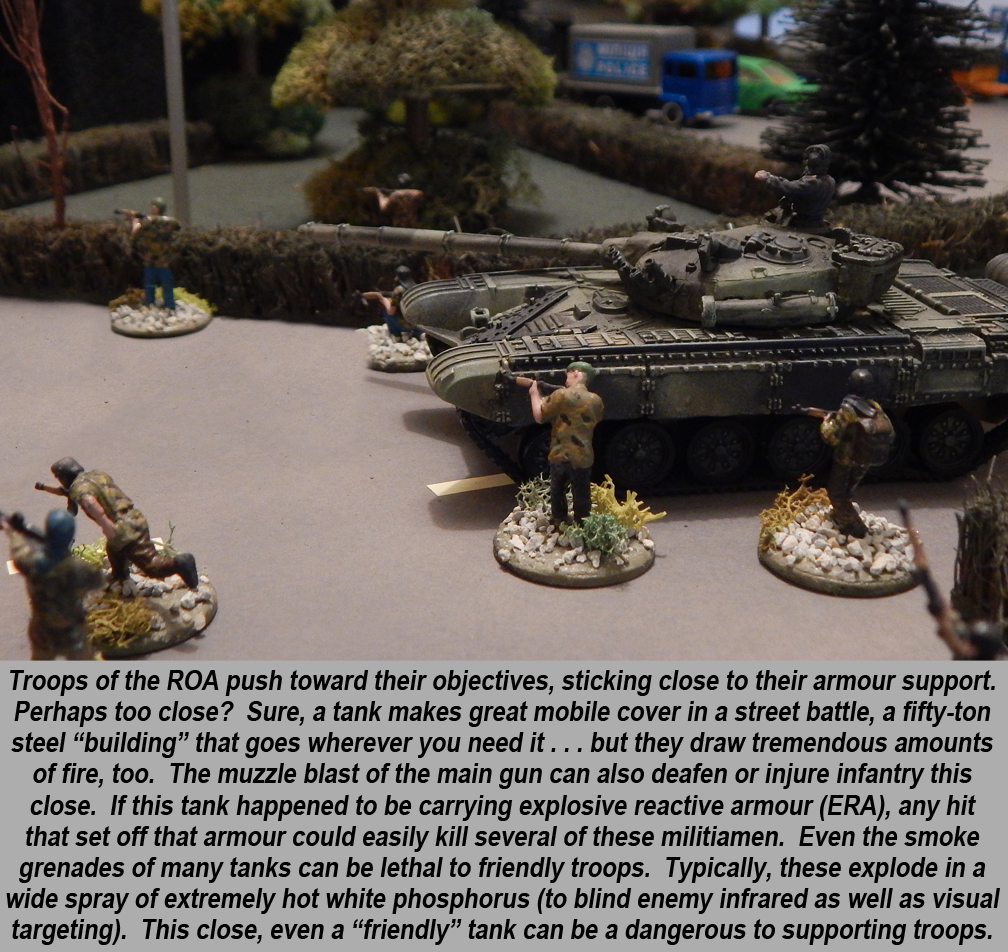
Four months later, the separatists were back, this time with help. Whether or not Russian soldiers actually took part in the battle is, for some, an open question. But, Russian aid seems to be beyond dispute. BM-21 “Grad” rocket launchers, modern APCs, and especially T-72B1 main battle tanks; stark evidence lays in the wreckage on the field.
This is important because without heavy support, it’s doubtful the DPR could even have contemplated an assault on the airport. Just as no amount of arrows ever made can knock down a castle, no amount of AK assault rifles could ever storm this airport. Only with heavier, military-grade artillery does such an attack become feasible.
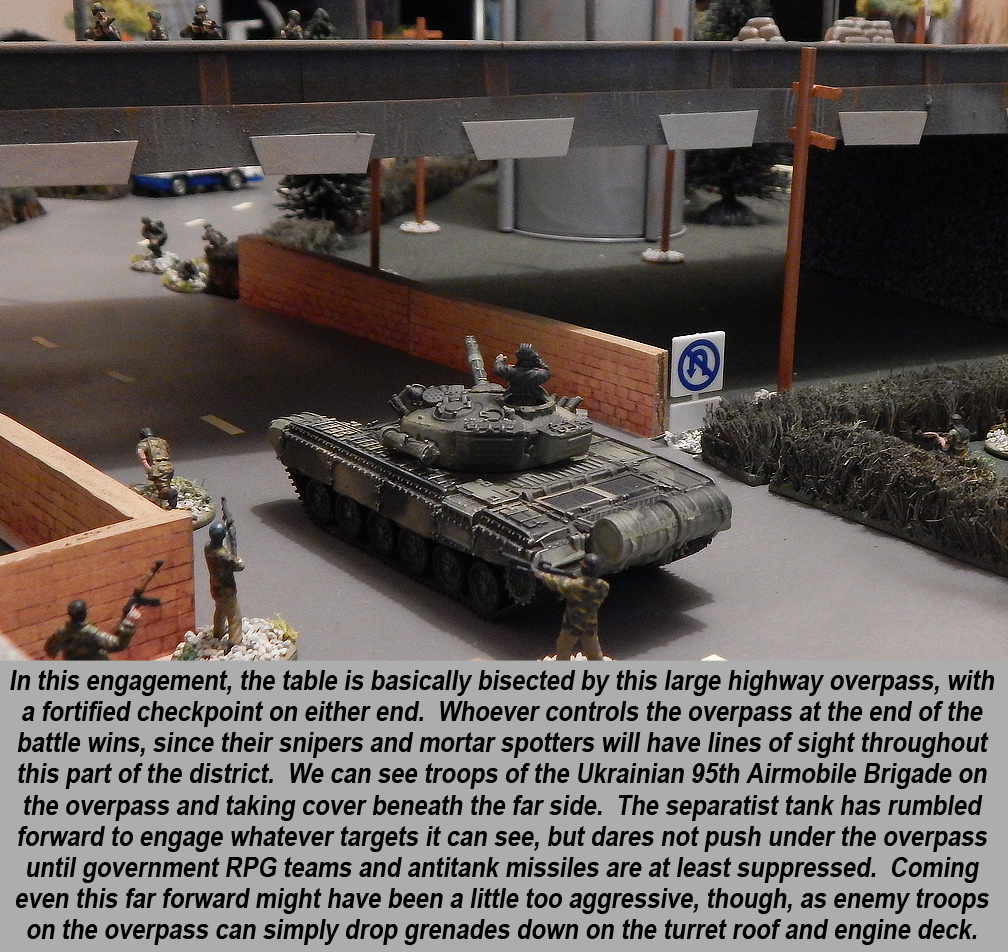
For the separatists, the first step in re-taking the airport would be clearing government troops from the surrounding neighbourhoods, especially to the south. These included the Kyivs’kyi District of Donetsk (ironically named for Kiev, the capital of the Ukraine).
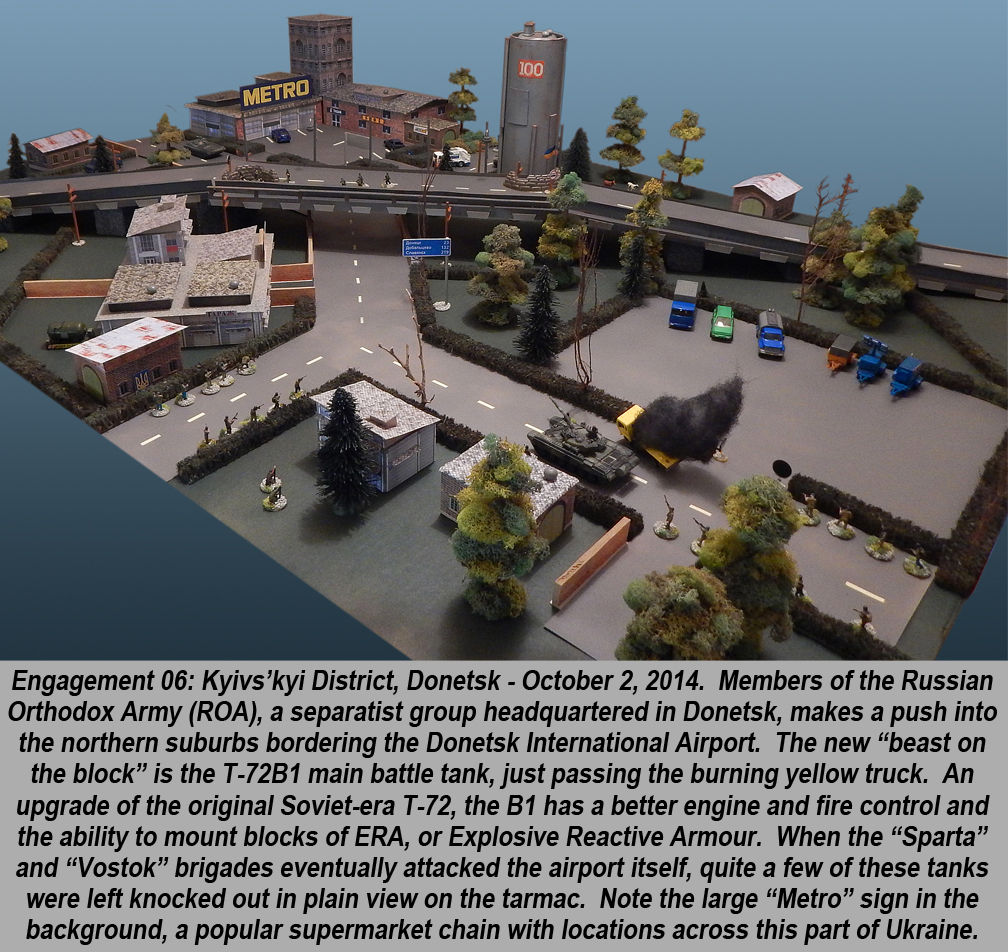
Fighting in these approaches to the airport started as early as September 29th and our next engagement takes a look at one of these initial clashes. As outlined in these photographs from our table, we used Force on Force to see how tanks could support a militia-based drive into the outskirts of a modern city.
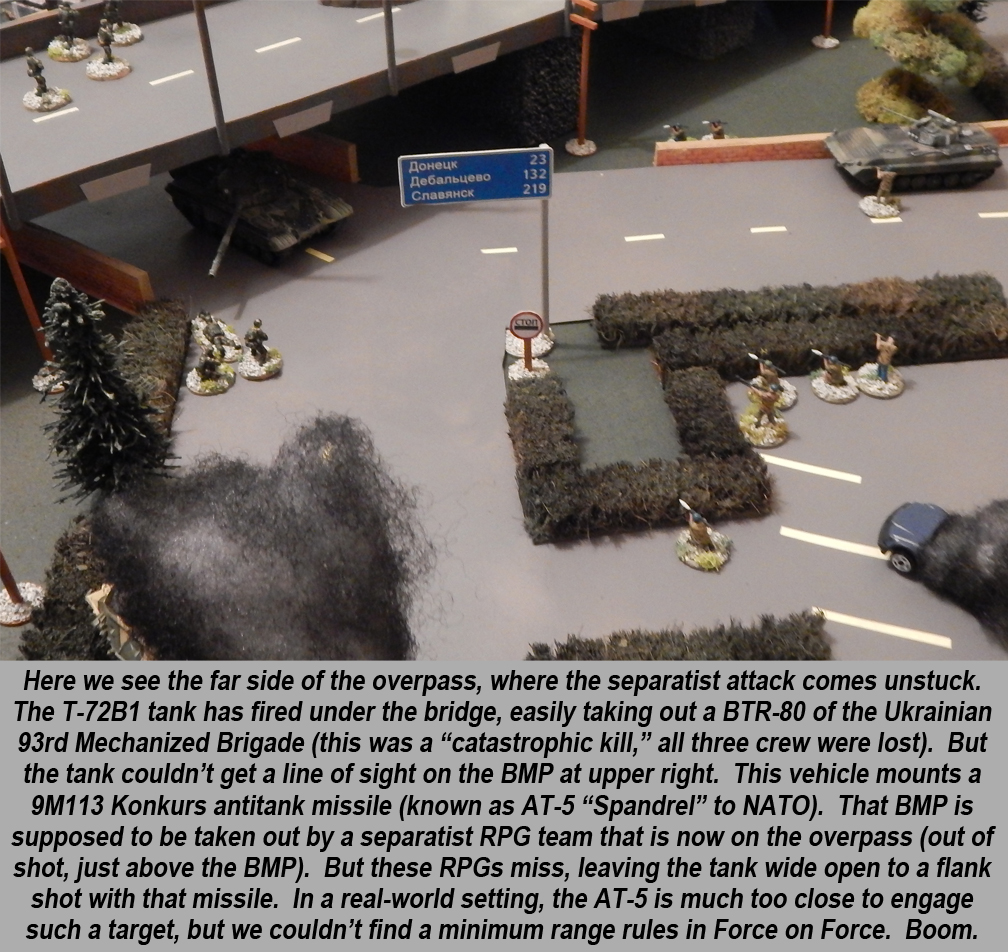
Frankly, we had some difficulty. In addition to the AT-5 antitank missile’s minimum range (see the photos), separatist infantry could also clear many Ukrainian RPG teams before they could get flank or rear shots on the T-72. Typically, these are the only shots with which an RPG has any hope of hurting a modern tank.

Yet our game table doesn't have basements, indoor rooms, sewers, or truly hidden movement. So, was the T-72 unrealistically safe? Did the Ukrainian tank hunters never have a chance at getting a proper angle on their quarry? The cardinal rule is: “never send tanks into cities.” Yet here the separatists seemed to be getting away with it.
THE AIRPORT FALLS (January 21st, 2015)
Study enough military history and you’ll find that almost every war has its “Stalingrad.” In Normandy it was Caen and St. Lo. In World War I it was Verdun, in Vietnam it was Hue City. Here in the Ukrainian Conflict, it was Donetsk International Airport.
While the First Battle of Donetsk Airport lasted just one “blitzkrieg” day in May 2014, the second battle lasted from September 29th all the way to January 21th, 2015. Having surrounded the government troops inside the airport, separatists then subjected them to a withering siege lasting almost four months.
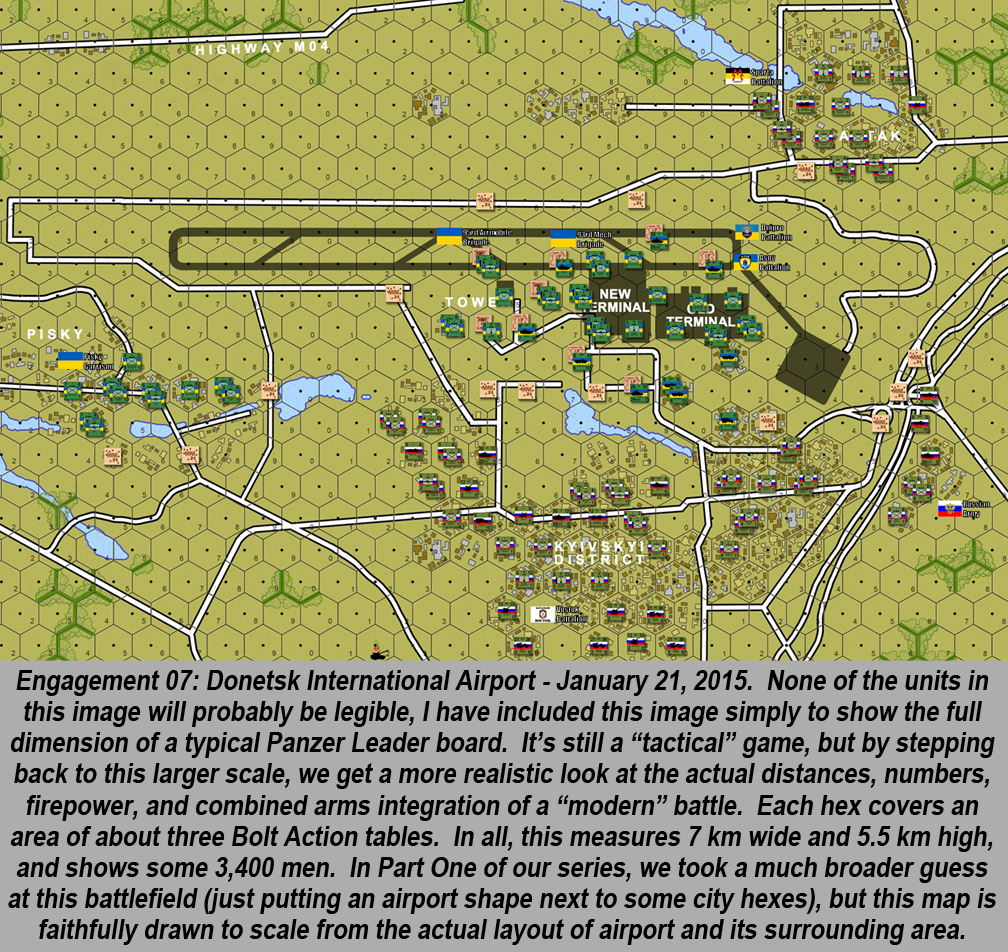
Built during the Cold War and recently modernized with a new terminal, the Donetz International Airport was a gargantuan complex. Covering some fifteen square kilometres, it included huge terminals, tunnels, bunkers, even entrances to nearby mines and the Donetsk sewer system.
The airport was also well-defended. Some sources place elements of three Ukrainian Army brigades (95th Airmobile, 75th, and 93rd Mechanized) in the battle, plus volunteer militia. Ukrainian media was soon calling their soldiers “cyborgs” or “Terminators,” a testament to their indestructible resilience.
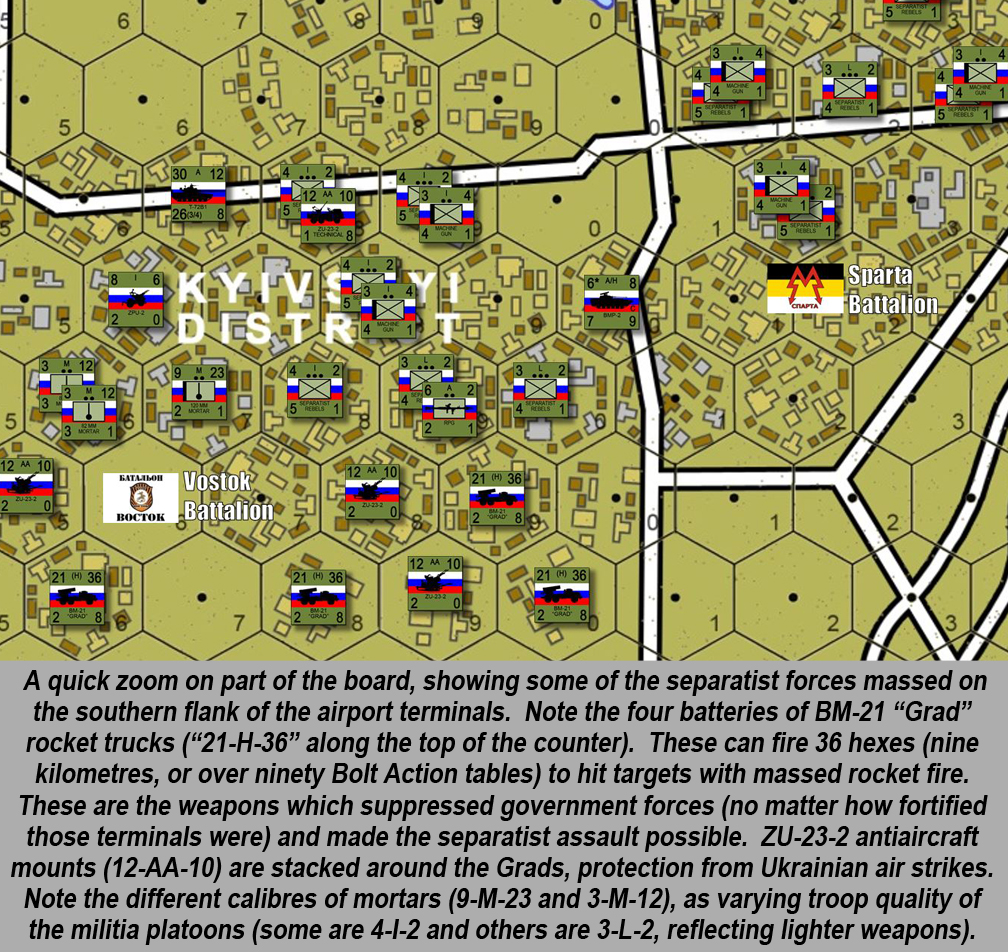
These men, however, were not “terminators.” With every building in the airport gutted by fire, rockets, and artillery, they were steadily pushed back into a single terminal. Fighting continued, floor by floor and room by room. The wounded could not be helped, and calls for reinforcement, supply, or evacuation went unanswered.
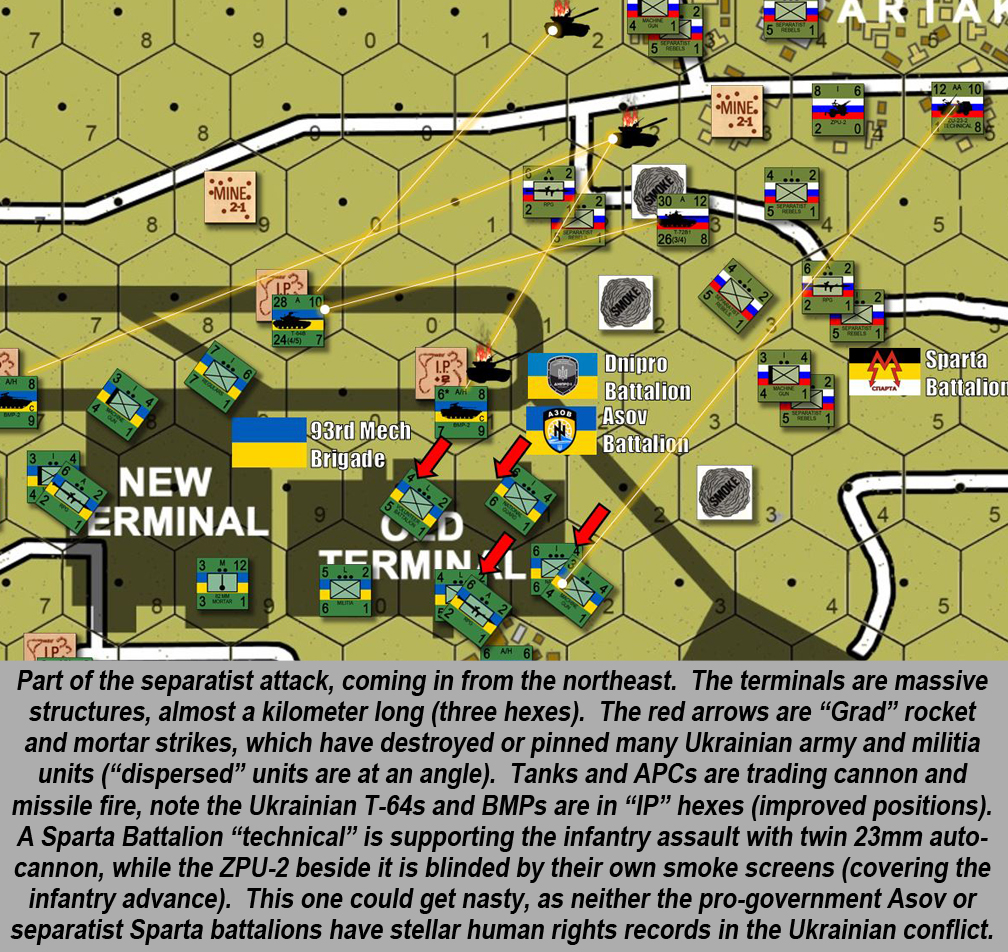
The hammer finally fell on January 21st. Cut off, starving, out of ammunition, and mostly wounded, the last surviving Ukrainians were overrun by a final separatist assault. About 400 Ukrainians had been killed, over a thousand wounded, and the rest captured. The Second Battle of Donetsk International Airport was finally over.
DEBALTSEVE (February 17th, 2015)
This was only one of several Ukrainian setbacks during the winter of 2014-15. With their hands intermittently tied by a series of failed ceasefires, and facing separatist rebels with ever-growing Russian support, Ukrainian Army and militia fighters faced an uphill struggle.
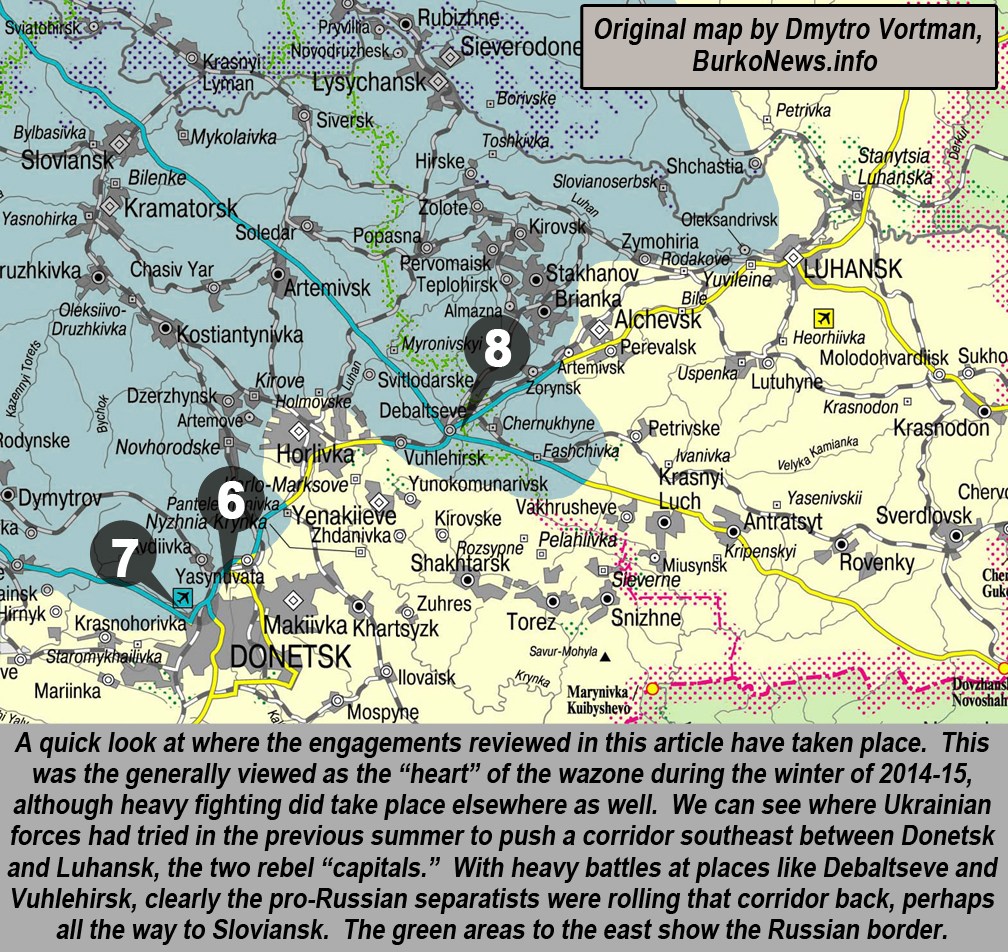
Another such setback was the collapse of the wedge that Ukrainian forces had driven between Donetsk and Luhansk back in the summer of 2014. One of the key battles in the resurgent separatist drive was the Battle of Debaltseve, fought in January and February of 2015.
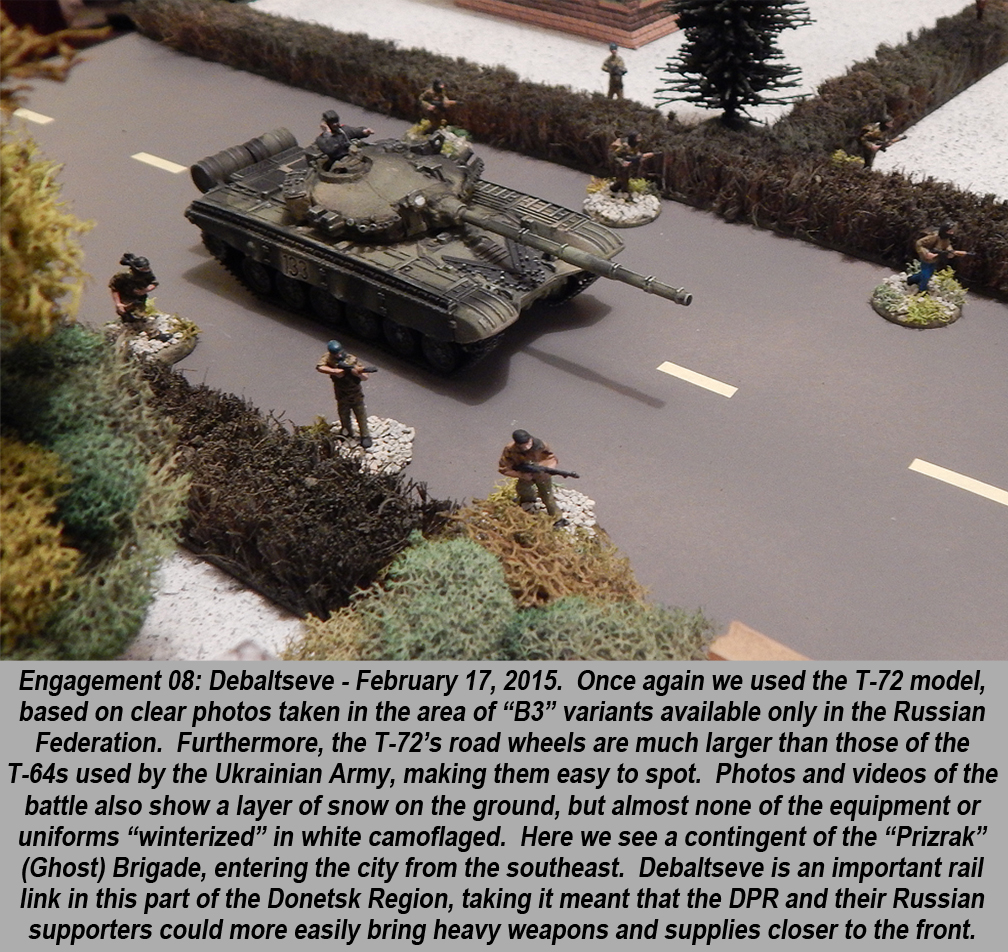
At least one source has dubbed Debaltseve “The Shame of the Generals” – probably because once again nearly 6,000 Ukrainian troops found themselves in a pocket, surrounded by Russian-backed separatists. These rebels pushed into Debaltseve itself on February 17th, which is the engagement we’ve recreated here.
After weeks of hard fighting and ceaseless shelling, the Ukrainian position had become untenable. Haunted by what had happened in the “Ilovaisk Cauldron” (see part two), Ukrainian leaders finally managed to get most of their troops out, mostly through farmers’ fields since the main roads had all been cut by separatist artillery and armour.
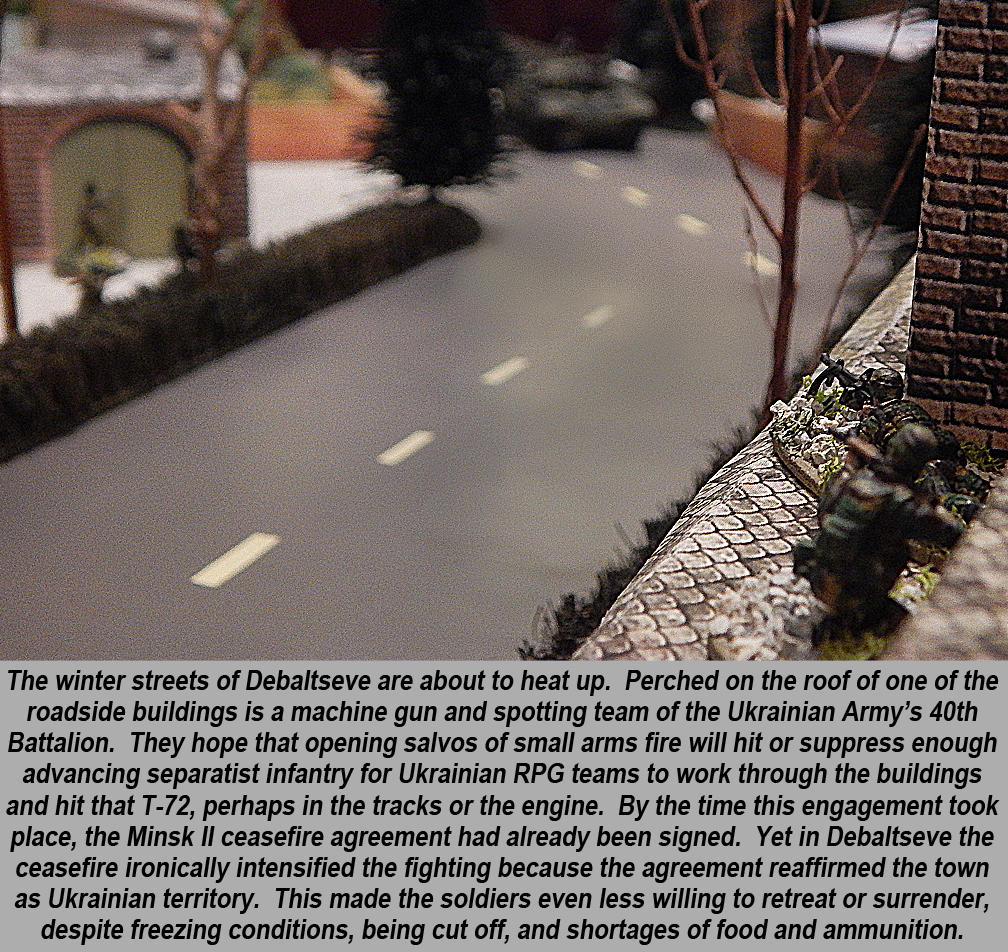
The professionalism of the “rebel” troops again hinted strongly that Russian regulars were now in Ukraine, actively fighting government forces. Many of these “little green men” (as they came to be called) were clearly Asian in heritage, suggesting a Siberian division and not “local patriots” as Russian media claimed.
In one incident, “separatist” troops, despite being pinned under devastating Ukrainian artillery fire, did not retreat or break. In fact, they simulated a gun battle with THEMSELVES to cause Ukrainian artillery spotters to mistake some of them for friendly troops. The artillery was lifted just long enough for the “separatists” to escape.

It is interesting to note that pro-Russian civilians in these areas freely admit these are Russian Army troops, who are characterized as “well-behaved” in comparison to DPR militias (sometimes feared even by pro-Russian civilians). In any event, American journalists in Debaltseve noted that much of the city welcomed the separatists as “liberators.”
MINSK II AGREEMENT
One of the worst things about the Battle of Debaltseve was that it raged straight through the implementation of yet another ceasefire agreement, Minsk II. Signed on February 11th 2015, this protocol broke down almost immediately as separatist rebels continued to press their advantage at Debaltseve and elsewhere.
But as winter turned to spring, the Ukrainians were getting international help as well. Military advisors from the UK, Poland, the US, and Canada arrived to help train the rebuilding Ukrainian Army. German Chancellor Angela Merkel pledged 500 million euros in guaranteed credit lines to help in reconstruction. At last, the world was watching.
Needless to say, such support drew a sharp response from the Russian Federation, who still claimed that they “weren’t involved” in the Ukrainian Conflict. Both sides accused the other of escalating the situation, while Ukrainian and separatist forces continued to fight in violation of the Minsk II ceasefire.
In our fourth and final instalment, we’ll look at some of the last battles of the Ukrainian conflict, and pose possible reasons that the fighting has finally (and thankfully) reduced to a fraction of previous levels. Finally, we’ll try and draw some conclusions from the conflict, and how it has shaped the current (and future) state of modern war.
If you would like to write an article for Beasts of War then please contact me at [email protected] for more information!
"The cardinal rule is: “never send tanks into cities.” Yet here the separatists seemed to be getting away with it..."
Supported by (Turn Off)

Supported by (Turn Off)
"...they simulated a gun battle with THEMSELVES to cause Ukrainian artillery spotters to mistake some of them for friendly troops. The artillery was lifted just long enough for the “separatists” to escape"
Supported by (Turn Off)





Loving this series of articles, as i have been saying week after week, it has been a real eye opener for me. Keep up the good work :), the effort and detail put in to each installment is really appreciated.
Thanks very much, @nakchak . One more to go after this one! 😀
Awwww :(, well bet your happy to get some game time back, but i will be sad to loose this weekly brightening of what are usually crap Mondays.
It’s always a toss up between whether I write four or five articles in a series. How much material is there, and how much can I put forward in a meaningful discussion, that kind of thing. “Four Level of Wargaming,” “Star Wars Pocket Models,” and “Desert War” were all five articles. WWDDC (Worldwide D-Day Challenge) probably should have been five, but we also had a 700-post forum and at least five other forum threads connected to it.
With Ukraine we’re definitely sticking with four. With very recent (or even ongoing) conflict . . . so much is unknown. You can only stretch it so far.
Then it’s time to start getting excited for the Team Yankee Boot Camp! 😀 😀
Great part 3 there @oriskany. So far I thick you have called the number of articles fairly on the mark. The information you have present has been tight, precise and to the point. It be a shame to see filler content just flesh the subject to an unnecessary 5 article just because we came up with some rule declaring all article series must have 5 articles.
Militia armies seem total adding what they consider theirs to be added to some new map of the world. So politics and cease fire rulings have little impact. So the Cease Fire Tactics of the Arab-Israeli conflicts are not used here. So it appears that small nations apply such tactics while militia groups do not. It also may indicate that the strategic leaders of the militias cannot control their tactical units or that they have no desire to do so to enforce the ceasefire.
While Guderian in his work Achtung-Panser! writes that built up areas such as towns and cities as not tank terrain, and he is correct in this, but war has moved into built up areas. So these hard hitting machines are being dragged into built up areas to protect the infantry. Yet the explosive reactionary armour mean you cant convince infantry to closely support the tank as the infantry is sensible enough to stay away from tank because they don’t want their heads blown off by their own tanks.
From what has been demonstrated in the tabletop wargames above for combined arms to work in built up areas close support has to be loose support. In loose support the distances between the units must open up and these units must be aware of their tactical duties to make combined arms work. The tabletop wargames demonstrated to me the need of infantry teams
to be in advance of the tank to neutralise or push back RPG teams out of range. There would be a need of infantry to clear buildings and deal with RPG team on the flanks of the attack as well. Then when the infantry teams come under pressure then the tank destroys the pressure point. The infantry can no long use the tank for mobile cover as this is just asking for the tank to be destroyed.
Today there are a massive number of armoured car designs coming out of a huge number of countries. Many of these designs seem to specialise in fighting in built up areas so from this group a replacement vehicle may evolve to replace the tank in this environment. Their are a few new variants in tank models currently available models that has started to better deal with built up areas, but they have a long way to go to reach perfection. I imagine that work has began to design a new tank that is completely optimised for the built up area environment. However if and when they are introduced their price tag will be out of reach more militia armies. So for this group armoured cars may be in reach or old tanks that have been refurbished for the fighting in built up areas. The biggest impact will occur when better training and tactics are used for combined arms.
Back to the article, you can place a big check mark against this article as another success delivered. 🙂
Thanks, @jamesevans140 – Yeah, like we said in the article, we may have had some issues with our first attempt at using armor in cities, but this MAY be because we’re pushing “Force on Force” outside of what it was designed to do. The biggest “rules” seemed to be the minimum range on that AT-5. I have .pdf copy of FoF rules and searched the doc a dozen different ways to try to find a rule on this – they have it for mortars but not ATGWs? Of course, I still could have missed it. Then again, it was really the only chance the UAF had on slowing down that T-72.
Another challenge with gaming miniatures in cities seems to be moving / tracking where people are IN the building. I understand DZC has some rules on this, but I’m not familiar with the system. So it can be tough to move friendly infantry into enemy buildings and clear out RPGs, etc. To say nothing of sewers.
One special rule we were toying with was “vanishing” RPG teams. At the beginning of the battle, the defender simply takes his RPG teams off the board. The commander has sent his best men out into the maze of alleys, basements, and sewers. The commander (i.e., the player) has no earthly idea where those RPG guys have gone or whether he’ll ever see them again. Each turn he rolls a d6 per RPG team and has to score a 6 or something. If he “activates,” the RPG team pops up somewhere, probably behind the tank. Enemy infantry gets a reaction phase against it (maybe they can pin it back down) and then the RPGs let fly into the engine deck.
In subsequent plays, we’ve found that a good tactic is for the tanks and infantry to work close, but not TOO close, as you say. Basically, the tank tosses a shell into a building. This suppresses enemy snipers and MGs, clearing the way for friendly infantry to enter the building – while the tank continues to hose it down with on-board MGs. The infantry clear any RPGs / ATGWs in the building, making it safe for the tank to now move forward and repeat the process on the next block.
Similar fire and maneuver tactics were used by the USMC at Hue City in 1968, and most recently internet footage of Syrian T-72s has been released showing them using this tactic in Aleppo.
Ah yes, the Ontos. Nothing like 6 106mm Recoilless Rifles firing simultaneously to convince someone to leave a residence. 🙂 I remember them vividly while reading “Phase Line Green”, a memoir of a Marine lieutenant serving in Hue, some years ago. Definitely a vehicle that 40k fans could get behind.
From my modern wargaming experiences, I concur that while AFVs don’t excel in built up areas, they are still needed. I would usually use tanks almost like one would use Heavy machine gun nests in cities; keep them at the back of a main street where their main cannon can still provide accurate direct fire and all the enemy will see is the almost impervious front of the tank. Obviously you want your Abrams/T-90 main battle tanks on that detail. Then you advance with your infantry screen with a bounding overwatch with one element advancing and two elements holding for cover fire(so if you are wanting to move a platoon forward, you would have one squad advance with two squads in place). Then trailing behind your infantry you would have your lesser AFVs on stand by for the “Stick and Move” maneuver you were referring to. As Americans i would use Bradleys(or LAVs or AAVs if Marine Corp) or as a Soviet bloc/Russian equipped country I would use BMPs. Anything nimble that can squirt High Explosive rounds at the front of a building quickly and then scamper off. Stryker vehicles could be used for the US so long as they are equipped with the 40mm grenade launcher. For the REDFOR side of things Anti-aircraft assets like the Shilka or Tunguska could also be used.
But basically just use your Infantry for their superior spotting to learn where the enemy is at, let you AFVs hit these strong points and then scoot, then have infantry cover fire and advance, and keep your best tanks in the back controlling the main arteries of your advance. That’s what kept things from getting too ugly on my end anyway. 🙂
I will confess, unloading a Shilka into enemy-held buildings sounds like it would definitely “leave a mark.” Never done it in Force on Force (I don’t have the miniature and don’t have the stats for that vehicle) but I have done it in Arab-Israeli Wars (Yom Kippur War 1973). Damned thing is practically a light assault gun, assuming there are no Israeli tanks or aircraft in the area.
I’m not 100% sure on this, and I’m sure it depends on different environments, but USUALLY tanks or other AFVs should be able to find a sweet spot in the range for most approaches on enemy urban strongpoints – i.e., too close for ATGWs (which mostly can’t be fired from inside buildings anyway because of backblast . . . I know there ARE exceptions to this) but too far for RPGs, GLs, LAWs or other “pipe bomb” weapons. Put down one or two HE-FRAGs to cover the infantry so they can sweep and clear the building, and move on, definitely with at least one more squad on either wing to ensure infantry with RPGs don’t get at your flanks.
Of course, this all assumes that the tank gunners are free of any “collateral damage” restrictions or other such rules of engagement. In Ukraine, Russian and Ukrainian gunners had no such issues. 🙁
As far as tanks in cities go, as there is adequate infantry support and no Tom Hanks with his sock-and-grease “sticky bombs,” we should be all right. 🙂
No problems at all @oriskany.
One of the hardest parts of finding something in a PDF word search is asking for the right word to be searched in the first place. 🙂
I have searched my PDF copy of Battlegroup for the rules for smoke. No luck yet I cannot believe that it does not have the rules for smoke, it so basic for WW2 armies.
For buildings we draw up some very basic floor plans that only include structural internal walls but not partition walls for each floor. Only large buildings should have internal structural walls to divide a floor into very basic rooms. A unit in a room has fire access to all windows. Movement is kept basic they can move up to 3 rooms horizontally and 2 vertically. When a unit has entered a building they are transferred to the floor plan. You must empty a room of enemy units before you can occupy the room.
For sewers we use basic tiles that are randomly rolled for and then rolled for its orientation. Each title represents one room that can have 1 to 4 exits on that tile. You move one room per turn. It can be roughly mapped out as a build with 2 rooms above you a third move places the street above you. If there is a street room without a manhole hole marked on the street as scatter scenery the you randomly roll, a 5+ is a good start, for there to be one, which should then be marked on the table.
For the disappearing and reappearing unit we use a basic rule. Remove the unit from the board placing it in an area for reserves off the table. Starting from the next turn it can be brought back on a roll of a 6. The turn after that requires a roll of 5+. The turn after that a roll of 4+ is required. You have a dice for each unit off the board. This is similar to the reserves roll in FoW.
We have done the Stalingrad a few times and these basic rules work fine. If a unit has pretty shaky morale you could also incorporate a moral check at some point to prevent the unit from running off, oops sorry I meant getting lost. 🙂
Our WW2 games in built up areas when the bazookas and panzer-fausts are out in number panned out in a similar fashion. Teams of infantry being supported by mobile bunkers. At least we had the luxury of placing screening troops tight around the tanks to keep magnetic mines and the like away.
With a militia that has gained experience in the countryside trying to take control of a built up area would be a very daunting tasks with a lot of first timer got yous being committed. So I would expect that the correct handling of the tactic you describe would come about through all too bitter experience.
Thanks, @jamesevans140 –
PDF Word searches – Oh, I tried it a bunch of different ways. To the game’s credit, I easily found the minimum range rules for on-board mortars, both light and medium. My suspicion on the ATGWs and AFVs in general is either (1) there are some supplements I don’t have or (2) FoF is designed primary as an infantry game. ABSOLUTELY nothing wrong with that (I kind of wish Bolt Action had “stayed” that way).
Those quick-mix building rules sound pretty workable. in this series I usually had too many buildings on the table, though. I suppose over time I could build up a library of these floor plans. Then again, my buildings are typically “modular,” actually little segments and wings I mix and match to provide variety and more interesting “unboxy” shapes . . . without busting the bank or having to rent a warehouse for storage. 😀
Maybe I could use the “modular” parts as a rudimentary movement system? Moving from one “addition” to another? With a little counter beside the unit to track which floor it is on?
Okay, that sewer system is starting to sound like a dungeon crawl adventure to me. 😀 “You gently pick the lock to the next room. It opens slowly, the rust of ages squealing in anguish off its hinges. Wait, once inside . . . the chest of gold you were hoping for? NO! IT’S A GERMAN PIONEER TEAM WITH FLAMETHROWERS! So sad for you . . .”
You write: “So I would expect that the correct handling of the tactic you describe would come about through all too bitter experience.”
This seems to be the case in so many conflicts and wars, doesn’t it? Things that happened in previous conflicts have to be “relearned” on the battlefield. People always assume they’re “better” or “smarter” than the previous guys, or that this war will be “different” or that “these new weapons make those old tricks obsolete.” So often, these turn out not to be true.
Unfortunately @oriskany I believe that wargames rules are a bit on the rushed to the market place a bit too soon and have not been tested for robustness of situations. So many rules are not considered and are incorporated into the next version. Like the first version of FoW was good in most situations but clunky around the edges. The 3rd version is quite smooth in operation but the rule called across the Volga that aloud off board artillery was omitted. The early versions of 40K felt like the vehicles were a different system badly cobble on the rules. Bolt action has this same feel to it. That may be because the same person wrote both and repeated past success instead of building new success.
The simple floor plans are very easily drawn up on a PC and then copy, pasted and rotated to get your floor plans. Where you join building to make more complex builds are ideal indicators of internal structural walls.
You could use counters to represent units so give them try. We tried it and found just using the unit itself was faster and easier. The rules we came up with were designed for easy of use without slowing the game too much.
As the fighter thief I immediately break left and the elfin fighter breaks right. That bloody annoying useless magic user of ours cops the lot and is killed. We toss the Germans a bag of gold as a reward and we leave.
Yes the sewer rules descend from both D&D and Lord of the Rings rules. However for historical wargaming the rules were reduced to the simplest form, again so not to slow the game down and not feel like a badly cobbled on other rules set. It worked well for our Stalingrad games. My scouts from the German reconnaissance companies make good use of sewers to hunt down and kill the Russian sniper teams. We also used the Across the Volga rules for off board artillery, man that Russian artillery park can lay down some hurt.
As many a historian has said the armies train to fight the last war better but the new war plays by a different set of rule that need to be learned. In a very general way this is mostly true.
Armies also have a bad habit of not learning from their allies previous experience and doom themselves to learn these lessons via the school of (very) hard knocks. Again just a very broad statement and there has been in resent years armies that accept a limited amount of experience from their allies but almost at the last possible moment. I think this is as you have mentioned that ‘we have trained for it, we know what we are doing and you don’t’ mentality.
As they say ‘Battle plans only work up to first contact with the enemy’ and ‘a blade is not truly tested until it is used in battle’. 😉
You’re probably right, @jamesevans140 , about games being released with initially rough rules and then smoothing out in later editions. Even my favorite – Panzer Leader family – is a terrible example of this. I always talk about h ow great the game is but can never actually recommend it, because the “out-of-the-box” rules are just horrific. Thankfully the game has been reworked in later editions (Arab-Israeli Wars is the best, mechanically) and even further by the community and fans. After the games went out of print the fans kept supporting it for decades much like Battlefleet Gothic. People are still putting out “dining room” counters, maps, rules, etc. even now. I recently downloaded a Gulf War edition that actually seems very smooth.
“Man that Russian artillery park can lay down some hurt.” – Indeed, Russians have always like their big guns.
Death to the useless magic user, eh? Makes sense. At least a cleric can heal other members of the party. 😀
Another well-written account, @oriskany. I’m sure the debate about tanks in cities will rage on, and that the correct answer, must necessarily, be situational.
Good solutions by @silverstars, and some of it is pretty much textbook. Think of a platoon as an awkward three-footed beast that must always have two on the ground, and one moving forward. It doesn’t matter how many men you attack with, if you don’t have enough soldiers laying down covering fire… and at least one of your squads should always try and work its way 90 degrees to the side of an attack, to get a crossfire on the target.
Tanks are great for controlling fire lanes, preventing lateral reinforcement of a target, and are especially good at intersections, to prevent infiltration behind your position, but only if you “own” the two blocks forward of its position. That being said, no commander is likely to leave an asset like that in the backfield for long if he needs to get a position unstuck and has no other option.
Lighter armoured vehicles, equipped with cage armour to detonate RPG rounds, are also quite useful for such engagements. As you discovered in your article @oriskany, buildings can actually be your friend if you’re a tanker. Keeps all the long range missiles at bay.
Tanks have their place in the city, but it’s called “combined arms” for a reason. If you have other assets can better take out a target, like a loitering strike eagle or a FCO with eyes on the problem, those options should be explored first.
I never fought in a built-up area, but we got into some lively debates on those topics, and wargamed scenarios extensively within the staff college. We also played out instructional scenarios using SPWAW, which you are familiar with. It proved an invaluable training tool.
Thanks, @cpauls1 .
Interesting points on the “loitering Strike Eagle” and “FCO with eyes on the problem.” Yes, when it doubt, and if you have a strike package on deck, drop that “snake and nape” in there first! 🙂
In this **particular** article series I avoided stuff like that only because, at least from what I could see, there didn’t seem to be that kind of tactical coordination on either side. Indirect fire weapons you see in most Ukrainian Conflict footage were mostly old D30 howitzers and of course the ubiquitous and dreaded BM-21 “Grad” multi-rocket truck. Almost every mini-documentary or news report had “Grad damage” or “Grad shrapnel” or unexploded Grad rockets laying around. It seems both sides were spraying with these things pretty indiscriminately, the poor training making these already-inaccurate weapons positively random.
Long story short, they seemed to be mostly harassment and morale-bombardment weapons, not tactical support assets a platoon or company leader could call “grid coordinates” on. 🙁
Yes, those short ranges were definitely helpful for the tank in some situations, not in others. (although as we show above, we went ahead and let that BMP cook off that AT-5, even though it was less than two feet away. At 1/72, we’re talking about 150 feet tops? Waaaaay to close for the warhead to arm or even for the missile to steady its flight (these things usually have two engines, right? A “launch” booster and then a main rocket that propels to target)?
But by that point, we were realizing that those Ukrainian RPGs just weren’t going to cut it, and couldn’t find the minimum-range rule in Force-on-Force, so we let it fly.
And besides, who DOESN’T like blowing up T-72s?
As always my friend, you treat the subject with clarity, with good clear lines of this delicate subject matter and well researched objectiveness. That leaves us wanting more. I for one will be talking to Warren about one of the awards in the new year being a special one for outstanding contribution by a BoW member to the site and without doubt in many peoples view point I think if it can become an award then I shall be nominating you sir, for going beyond what the average member contributes. Plus being un-fased by the subject matter, and taking a couple of slight knocks for all your hard work. THANK YOU James Johnson aka Oriskany is my own applause.
Wow, thanks, @chrisg . 😀 We have one more article to go, where we’ll be talking about some of the last engagements, the draw-down in violence, and some takeaways for gamers interested in modern or current-conflict games. As for the “slight knocks,” its all good. 🙂 We’ve been as delicate, sensitive, and objective as we can. Perhaps the dissenting opinions we’ve seen just show how much this subject “needs” to be talked out?
Thanks again. 😀
Spot on @chrsg. I am with you on this mate.
🙂
I remember the news pictures of Donetsk airport I think? it looked like a picture of the moon with the amount of craters over it. The battle sounds more like the paras in Holland trapped & surrounded by the Germans. Tanks in built-up areas have always been a weak point with battles with enemy troops at killing range or with a grenade taking out a track. @oriskany
Very true, @zorg – the Donetsk International Airport is an absolute ruin. Looking at the wreckage on new sites, I can’t imagine it ever being repaired, they’ll probably just bulldoze it and build it over. I was thinking of putting some photos of the airport in the article, but I can’t put in too many photos, I wanted to keep the images and text gaming-focused, and of course there is always the sensitivity issue.
Ukrainian media was calling it a “Stalingrad” battle. Well, it was nowhere near the SIZE of Stalingrad, but in terms of duration and intensity . . . yeah, it’s not a bad comparison.
I love the table! 🙂 Its looking more and more like a model train set every day! That scratch-built overpass came out great.
Thanks, @gladesrunner . All this terrain in scratch built, I guess I should say, with the exception of the pine trees (old Christmas decorations sprayed dark green to “un-winterize” them). I think my favorite bit (and easiest) are the small stalks from the cinnamon broom . . . break ’em off and stick them in the hedges, instant dead trees. 😀
I agree @gladesrunner and at the rate he is improving with each series it will not be long before his tables will look better than most train sets. 🙂
I might have to go out and buy some quick train tracks now. 🙂 Toys R’ Us, here I come. 😀 😀
As ever, brilliant. I will find out what you can’t do! Looking forward to the next part. Then what?
Things I can’t do? Plenty. I can’t code, so I can’t build my own website like BoW (standing by to hear about the 10,000 products that allow you to “build your own website in five easy steps!”) It doesn’t work that way, folks. There’s an industry out there for web developers and web designers . . . for a reason. 🙂 Trust me, I’ve worked as the latter, but NOT the former. Huge difference.
And apparently I can’t paint infantry very well. I can get the uniforms and equipment okay, but when I try to do the faces / hands / skin it never comes out quite right. I get the color right (years of “art” painting have taught me to mix acrylics) but I never seem to get the wash or drybrushing right. Instead of “shadows” and “3D contrast,” my guys just come out looking dirty. Then I try to dry brush them and they look like they’ve been working at an office job all their lives, pale as a ghost! 😀 So I wind up with platoons of coal miners. Pale and dirty. 😀
And apparently I’m terrible at business. People are always like: “Oh, you should write this for money or design this game for money or do that for this Kickstarter or blah-buh-blah.” Dude, I don’t even know where to start when it comes to that end.
that easy do faces the same colours as the uniforms and just say its camouflage. @oriskany ?
That’s actually a great idea, @zorg . “They’re all special forces snipers man! Honest!” 😀
“No, that’s not a featureless, detail-less blob of ruined plastic. That’s his ghillie suit!”
LOL
With my shaky hands camouflage is real easy. It trying to paint a normal uniform is the killer. 😀
@jamesevans140 makes a good point. In games where we don’t have the luxury of removing the roof and gaming inside, I will make a separate floor plan, and orient it in the same fashion at the side of the gaming table. “Interior” action happens there, and it keeps people honest: “Yes, I can see that tank! The building has windows, and I’m in the building!” Um… not so much.
I’m actually going to have to try that one of these days, @cpauls1 and @jamesevans140 . The Ukraine games are complete for these articles, but for the next project . . . hmm . . . 🙂
I presume that would be a lot of work, but once the “floor plans” are worked up and saved in a file somewhere, I’m guessing the workload would taper off rather quickly. Great ideas!
I just trace the building on paper, @oriskany . I tell everyone that, no matter where they go in my gaming world, they only get one diorama per gaming session. “Don’t like my paper floor plan? Suck it up, buttercup!”
“Build a bridge . . . and get OVER it.” 😀 “Don’t like my terrain? YOU run the next session.” 😀
All you need to do is create a file that has boxes you can resize, rotate and add or delete boxes. Really it is nothing more than that. The table as you have setup here can be mapped out in under 10 minutes and hit the print button.
One thing we have notice is that by basic mapping of your buildings it makes you focus more on the layout of your table, specially when sewers are also pre-mapped.
Sounds nuts, but Excel is probably a better tool for that than Photoshop. Not only is it easier, faster, and lighter on memory for “low-hanging fruit” like this, but the thickness of your lines will always be the same no matter how you resize or reshape the box. They’re also very easy to rotate in the newer editions. Even doors and windows can be blocked out with white shapes that float over the squares to make easy gaps in the exterior wall lines. successive tabs can be stored in a workbook to store different templates like house, office, warehouse, etc.
@oriskany I am a firm believer that the application you know best is the best application to use. Excel is light on resources and for graphic use you have been using it for years. Just don’t get carried away with the details. When you adding floor tiles and carpets you know you have gone a step too far. 🙂
Absolutely. For exteriors, just about everything on those tables you see above (and the franky . . . badass Orthodox church you may have seen on @unclejimmy‘s thread) gets created, skinned, and printed out of Photoshop. That’s for EXTERIORS.
I would never do exteriors in Excel.
I would never so interiors in Photoshop or Illustrator. 😀
The right tool for the right job, as they say. 😀
It was the solid resin buildings that pushed us down this path. Although the detail in buildings that have interiors is catching up to resin still the best buildings with someone lives here details are solid resin.
Our system has over time been simplified. Initially we designed the buildings with details of every room. This slowed the game down and considering that partition walls are made of light materials they offer little protection and troops can easily made their own doors (openings) quite quickly. Given this we dropped partition walls entirely. We focus on the structural walls that give protection and are hard to make openings. This modification stop us getting lost in the fine detail that really did not matter and as a result the game play was sped up. It also puts a little control on tanks running through buildings. Yes they can easily run through a outer and structural walls, but how many times can you do that before the entire building lands on your head. Again we test against this every time a wall is breached. We add an allowance for large buildings as they tend not to suffer as much when structural integrity in challenged.
Great post, @jamesevans140 –
“Although the detail in buildings that have interiors is catching up to resin still the best buildings with someone lives here details are solid resin”
** KA-CHING! I’m sure the tables look awesome, but that’s just way too rich for my blood.
“troops can easily made their own doors (openings) quite quickly.”
** Frag OUT!
“We focus on the structural walls that give protection and are hard to make openings.”
** Reminds me of Morpheus’ line in the first Matrix movie. “Tank, I need the structural blueprints of this building. I need it fast. Find me the main wet wall!”
“It also puts a little control on tanks running through buildings.”
** Agree this should be limited. We see that often in movies but how often does that really happen? Tanks can take serious damage to the finely-tuned gun barrels like that, to say nothing of vision ports, external stowage (this stuff is IMPORTANT to crews who actually CARE whether they have a sleeping bag or not – external weapons, smoke launchers, etc. And crushed bricks and mortar can really screw up a track if it gets caught behind the wheels, etc.
KA-CHING!!! is right @oriskany a bridge or larger building expect to pay over $100 and they same to be made to explode if you drop them.
I remember one guy I played against would have to park his Tigers in every building he came across. The rule we used did not take going into buildings with tanks into consideration. We tried to tell him that Tiger transmissions were not up to his kind of abuse. But BECAUSE it was not in the rules he carried on anyway.
Also tanks seem to have issues basements. 🙂
That is true about the basements, I suppose. Living here in Florida we don’t have basements, our water table is basically 4 feet under the surface. When a tank crashes into a building, it’s gonna collapse into the foundation, isn’t it?
Yeah, I was having trouble painting a *resin* Sturmovik from my FAVORITE miniatures company (ahem, cough, sputter . . . **battlefront** . . . cough . . . growl) and sure enough was having trouble with it. Set it down in the table rather harshly, and it shattered like glass. Kinda cool, actually. 😀
Yeah @oriskany we have few basements here in AU. Either high water table usually coastal or basalt bedrock that laughs at explosives. So the concept of basements are foreign to me as well. FoW lists it as a consideration before you think it is cool to place your pet Tiger in that NE European house.
Actually if memory serves, a couple of years ago or less a complete Panther was recovered in what was a basement in Belgium. A Panther moved into the house in 44/45 I assume for cover and it fell into a deep basement. No one at the time wanted to recover it and the crew did not destroy it. During reconstruction after the war they simply rebuilt a house on top of it. Then the current owners wanted a basement and it was rediscovered. Today the lifting of a 45 ton object is not as much of an issue. Boy what a find, A almost intact low mileage Panther.
I thick it is asking too much of what is holding up the floor boards to support a tank in your living room. There may be a few medieval houses that has massively over engineered floor supports but still it would be more an act of desperation.
Resin is supposed to be cheaper and can have as much detail as white metal. It is perfectly fine to use it for the solid hull of a tank but it is too fragile almost glass like for anything else. Our warehouse floor has claimed a number of victims over the years. Cement flooring vs resin model not good odds.
Can you imagine in the homeowners had sub-rented out their live-in basement for extra income.
“Damn it, you people gotta be quiet up there! What, are you driving a TANK across your living room?!?”
CRASH
“Oh. I guess you are.” 🙂
The more I look at it the more I am sure the shot of the T72 being “sniped” by infantry from the overpass is one of the coolest shots this article series.
I also like how you describe the difference between what usually works/doesn’t work in the real world and what works/doesn’t work in a game…i.e. tanks don’t do well in cities but here they do.
Last, I admit I am woefully out of it when it comes to current events. So even though I don’t do much mini’s gaming, I find I am enjoying this series as it gives me a little more insight into what was/is going on over there; Especially since we all know how well the US covers international issues in which we aren’t directly involved. (If the sarcasm didn’t come through with that last bit, reread it with a very sarcastic voice in your head 😉 )
@gladesrunner you have hit the nail on the head about the power of wargaming. When used at their best wargames give up a much better understanding of the situation. Then when you run wargames in why did the commander do this rather than that mode you start to get inside the commanders head as you better understand the reasons behind his choices and actions. Wargaming this way allows you to identify and better understand any mistakes that he made.
As an analytical tool the wargame is extremely powerful. So much so over the last 10 years or so the corporate world have been increasingly using wargames to test their business planning.
Thanks, @gladesrunner . I was hoping to get the “3-D” effect of the table. In a real situation, though, the crew of this T-72 must be very depressed without much to live for. 😐 This is a nigh-suicidal move, as the ROOF of a tank is almost always it’s very thinnest spot. Front is the strongest, followed by the sides, followed by the rear, followed by the underside. The belly actually has pretty tough armor on most tanks to counter road hazards, antitank traps, and mines.
But the roof is terribly thin. These guys are just begging for an RPG right down into the engine vents or commander’ hatch. Fortunately for them, the UAF infantry on the overpass didn’t have RPGs. This is another of those things where the move makes sense on a gaming table (the separatist player could clearly see what weapons the other player had on that overpass) but the tank crew in an actual situation wouldn’t.
In an actual skirmish, any tank commander would think twice (or think twenty times) before trundling blithely under an enemy-held overpass like this.
And thanks again for the comment, @jamesevans140 . 😀
Managed to get caught up with this while waiting for the kid in the A&E (nothing much wrong with her we hope) – as always well written and well researched
Thanks very much, @rasmus. “A&E?” Accident and Emergency? Shit, I hope everything is okay! 😐
Yes, the UK version – just a minor leg thing, but a bit of a wait for X rays and specialist. ..
Outstanding review given the circumstances @rasmus. I hope all turns out well. Lost many a night like this to my own Kids.
So far an evening and half a workday – free coffee and free WiFi. …
I hope everything has turned out okay, @rasmus . 🙂
Sure did lucky enough but all in all it did take around 10 hours I did not have to spare – I won’t derail this anymore with it
Not at all, sir. Glad to hear the good news. (Lord knows we’ve needed some this week) 🙁