










![1918 Spring Offensive Wargame | Full Rules Overview with John & Gerry (WW1 Tabletop Game) [7 Days Early Access]](https://images.beastsofwar.com/2026/03/unboxing-warfulcrum-games-1918-spring-offensive-review-coverimage1-225-127.jpeg)
Big Tanks & Big Guns Round Off June For Flames Of War
June 30, 2014 by brennon
Flames of War have some more offerings of both the armoured and armour-killing variety to round off the end of June. See what you think of these tanks and field guns that will be smashing apart the battlefield...
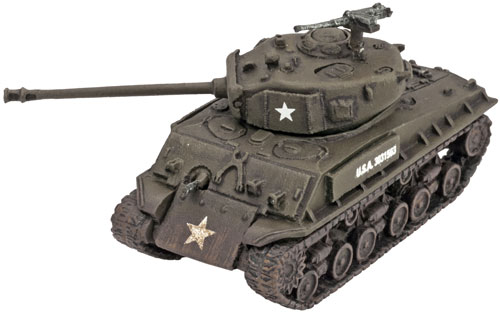
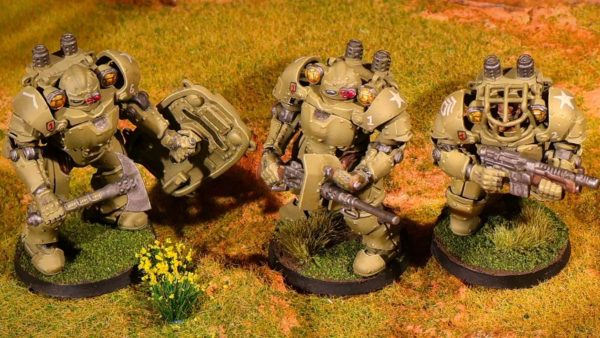
First up we have the tanks with the M4A3E8 Easy Eight which has also been uparmoured for the battlefield. This was considered to be one of the top tanks of the war and was kitted out for dealing with the anti-tank capabilities of the Germans. Not only was it more armoured but it also had dedicated infantry escorts to keep ambushers at bay.
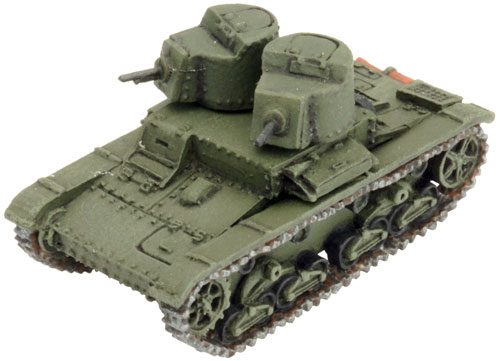
Below that we have the T-26 obr 1932 which was an adapted version of the Vickers used by the Russians. The armour on the turrets was lacking but the tank itself was used to support infantry on the battlefield so hopefully it wouldn't end up going against another tank.

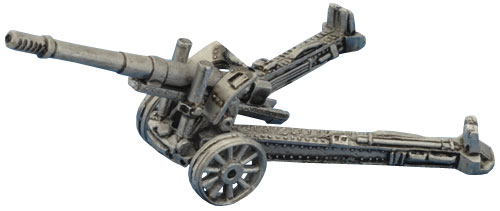
Next up we have some guns that probably wouldn't be facing off against armour as much as hitting emplacements and infantry on the battlefield. The first of these is the 107mm obr 1910-30 Gun and the second is a 152mm obr 1931 Gun-Howitzer which will be making craters all over the place.
Will you be picking up these for Flames of War?


![StarCraft Tabletop Miniatures Game Pre-Orders Live Now [Updated]](https://images.beastsofwar.com/2026/03/starcraft-tmg-news-cover-600-338.jpg)

Nice cannons. Makes me think of Baldrick’s poem from Blackadder Goes Forth.
Thank you! Thank you! The Sherman Easy-8! Just in time for “Fury,” and at last we Yanks have a FoW answer for the British and their beloved Fireflies!
I think the firefly was (Hobart) type stop gap tank just to stay in the game wasn’t it? At the start anyway.
From what I remember ( @lafayette and @johnlyons will probably know more about this), the British wanted a replacement for the 6-pounder ATG in the desert campaign. At the very end in Tunisia, they deployed the first operational batteries of 17-pounder ATGs (towed) and were very pleased with the results. Given the L56 8.8cm gun in the Tiger, the L70 7.5cm gun coming out in the Panther, and the even larger version of the 8.8 cm (L70) in the Nashhorn, Elefant, and others on the drawing board, it was clearly time to get this 17-pounder in an Allied tank, thus the Firefly.
I don’t think any were ready for Sicily or the initial Salerno landings in Italy. Pretty sure it was a Normandy debut.
The Firefly definitely came out first (before the Easy 8). Both guns are 76mm, but the Firefly’s muzzle brake looks VERY different I’m assuming its a different gun?
I have no idea if either one gun was more powerful was better or not. I just go off of detailed wargames I’ve played that feature the two tanks side by side. These games give both guns the same striking power and range, but the Easy 8 tank a slightly better defense. I *believe* this is because of “wet storage,” when they started storing ammunition more safely to reduce the Sherman’s infamous fire risk.
Again, totally deferring to other “experts on the panel” here.
I am just speculating hear but the 17 pounder was a common gun with plenty of ammo so they could spare some to rearm the tanks with a heavier gun quickly?
Quite possible. I just remember the few towed 17 lbrs that made it into Tunisia performed amazingly well against PzKpfw IVs and even the newest Tigers, both in hitting power and range, at least in comparison to their ineffectual 6-pounder 57mms and (by that stage of the war) sad little 2-pounder 40mms.
The challenge a lot of armies faced back then was how to get their great antitank guns into a tank. There’s not a lot of room in a turret. 🙂 The Germans struggled with this practically the whole war, their first half-attempt was the cut-down version of the 88 in the Tiger (which is why I always grind my teeth when people say the Tiger mounted “the dreaded” 88) It wasn’t the same gun! 🙂
Bigger, high-velocity guns need bigger mantlets, bigger recoil braces, and a longer recoil path in the turret, and longer shells. All this means a bigger turret, which sometimes requires larger turret rings and bigger drive hydraulics in the hull. Tanks are basically designed and built around the gun, so when you try to upgrade the gun, you’ve got quite a project ahead of you. 🙂
The 8.8cm KwK36 in Tiger Ie had a 56 caliber barrel as did the Flak36 and both had near identical ballistics, so I wouldn’t call it cut-down half-attempt. 🙂
Lessening the barrel length changes speed, penetration, range, & probably accuracy lessening all off the advantages’ off the bigger gun to start with.
That’s like fitting an F1 car with the best engine out their then using standard fuel.
Yes, I know. But the 8.8 cm Kwk 36 didn’t have shorter barrel length compared to the 8.8cm flak 18/36/37! Both had barrel length of 56 calibers and nearly identical penetration values.
KwK 36 wasn’t some kind of a stop-gap solution that had to sacrifice penetration or accuracy to fit the gun in to a tank. It delivered the same ballistic performance as the 8.8cm flak guns using the same ammunition.
Granted, but the Tiger I’s 8.8 had to install a muzzle brake to reduce recoil. The FlaK 18 and 36 guns did not. So yes, same 88mm, same L56 caliber, but still a different (and at least for AP purposes, slightly diminished) gun, since reduced muzzle velocity means reduced range, accuracy . . . well, you guys know. 🙂
BTW, are those recoil tubes on the top and/or bottom of the FlaK models? I always wondered.
Although to be honest, I’m also reading about FlaK 41s, which extended the same basic muzzle brake-less design to 71 or even 74 length calibers . . . I might have been thinking of those when comparing to the Tiger I’s 88mm.
Either way, I was just trying to make the point that the Tiger I’s 88 was not the end-all be-all that many seem to thing it is, especially when compared to weapons like the PaK 43 and the 88s in the Nashhorn, Ferdinand / Elefant, FlaK 41s, King Tigers, etc. I know you guys know that as fellow aficionados. 🙂 “88” is just one of those things where many people hear the word and think they’re all the same.
Oh yes. On that point we agree. Despite its reputation 88L56 was by no means the pinnacle of AT weapons of WW2.
Some of you may find this interesting
http://the.shadock.free.fr/Surviving_Panzers.html
Bookmarked. Thanks!
Found this on the net for a bit of background.
Before the QF 6-pounder had entered service, the British predicted that it would soon be inadequate given the increasing amour of German tanks. In late 1940 design of a replacement was started, and was largely complete by the end of 1941. A prototype production line was set up that spring, and with the appearance of Tiger I tanks in North Africa, the first 100 prototype 17-pounder anti-tank guns were quickly sent off to help counter this new threat. So great was the rush that they were sent before proper carriages had been developed, and the guns had to be mounted in the carriages of 25-pounder gun-howitzers. These early weapons were known as 17/25-pounders and given the codename Pheasant. They first saw action in February 1943. Fully developed 17-pounders started production in 1943 and were first used during the Italian Campaign.
A Sherman Firefly with the 17-pounder
The 17-pounder outperformed all other Allied amour-piercing guns, and was quickly adapted for use on various tank chassis. However, few tanks were capable of carrying such a large gun due to the limitation of the size of their turret ring. It was expected that a 75 mm gun under development by Vickers would be used for tanks, but this did not enter service. The British had plans in hand for a tank – based on the Cromwell then under development – to carry the 17-pounder. However the problems inherent in the modifications meant the result, the Cruiser Mark VIII Challenger, was delayed and relatively few built.
However, the British devised a conversion for their US-supplied M4 Sherman tanks to take the 17-pounder and it was rushed into service in time for D-Day as the Sherman Firefly. The gun (a modified design was produced specifically for the Firefly) had to be rotated through 90 degrees to fit into the turret of the Sherman, i.e. it lay on its side, and an additional box was welded to the back of the turret to take the radio which was moved to allow for the breech and its recoil.[2] More Shermans were converted until about 50% of Shermans in British service were Fireflies.
The British also converted some of their US-produced M10 tank destroyers, replacing the 3-inch (76 mm) gun with the 17-pounder; the resulting vehicles were called 17pdr SP Achilles or just 17-pdr M10.
Great info on the Pheasant, @zorg . I’d heard the name but never knew it came about due to a hybrid carriage design. I think I head “Tank God John” say something about the Firefly having to rotate its gun on its side “gangster style” 🙂 in order to fit in the turret.
I’ve played Achilles tank destroyers in Panzer Leader, definitely one of my favorite British units. Believe it or not the Firefly does not get a very good reflection in that game, but not for any technical reasons. In that game, each individual playing piece is an entire platoon / troop, and most British divisions organized their armor into four-tank troops, three regular 75mm Shermans and one Firefly. The Americans, meanwhile, organized either five-tank platoons of Shermans or five-tank platoons of Easy-8s. So not only does the British troop unit take a hit for only including four tanks, but there’s actually only one Firefly in it averaged with three “vanilla” Shermans.
Anyway, the point of that long story is simply that in the game, if you want a stand-alone unit-piece of armor comprised only five or six 17-pounders, Achilles is the way to go, and why it’s one of my favorite British pieces.
The m10 the Ferrari of tanks the wildcat I thing was the name? with the open top turret.
I think the M10 was the Wolverine. The “Hellcat” was the M18, which was the next tank destroyer to follow the M10.
http://www.electric-image.co.uk/mv/armour/Hellcat/Hellcat.html
Ridiculously fast, armed with a powerful 90mm gun, but very thin-skinned. Like they say when designing tanks . . . protection, firepower and mobility . . . choose two. 🙂
Hellcat that’s the one! with the aircraft engine that froze the crew by sucking cold air through the open turret. as you say made for speed crews loved the open turret except when snipers were about.
In a lot of games they are difficult to use because of their thin armor. Also they came out late in the war so they aren’t featured in many strictly “historical” scenarios, and when they do, are usually up against the German zoo (Panthers and Tigers, oh my!) I don’t know too much about FoW or BA, but the one game I play that does them justice is Panzer Leader, where they can use the “split move and fire” rule due to their rotating turret. They fire from cover, and then quickly fall back or displace or relocate before the Germans can get a return fire phase. This gives them a big advantage over German tank destroyers in that game, since weapons like the StG or JgPz series DON’T have a rotating turret, and so can’t use that rule.
Are you talking about the M18 Hellcat?…It first saw service in 41 in the desert when it was armed with a 37mm gun, in fact the US supplied China
Eventually it got a 76mm gun but its high muzzle flash often gave them away to German crews
Personally I would use them in opportunity fire mode and then retreat like hell once they had fire
Well, hot damn. I did not know about the earlier versions of the Hellcat or its earlier track record in service. Awesome! Clicking around a few sites I found a little more information that I think explains the disconnect on my end.
The 37mm version was the “T49 GMC” (gun motor carriage), in development when the US entered World War II and still in development by the middle of 42 when they realized that 37mm just wouldn’t cut it. They upgraded to a 57mm while still in development, and finally to a T67 75mm version and finally the 76.2mm version called the T70. Serial production started in July of 43 and lasted until October of 44. This is what eventually came to be called the M18 Hellcat.
http://www.militaryfactory.com/armor/detail.asp?armor_id=250
Other sites are mentioning the service in China, however. I can only assume they used some of the earlier 37mm versions in China? Maybe sent over the prototypes? Continued building the T49 prototypes in parallel to the continued development of the M18?
Some sites also claim the 37mm vehicles fought in Africa. But I have honestly NEVER heard of this, I think the site(s) may be screwy (Wikipedia flatly contradicts itself on this matter). American involvement in North Africa is not a very big topic 🙂 and it’s not easy to “lose” something in its scope. “Tank destroyers” of this era were either M10 Wolverines or 37mm guns mounted on the back of half tracks, as seen at Sidi Bou Zid, Kesserine Pass, and El Guettar. Unfamiliar tanks in China I could see, I’ve never read, written, or gamed in China. North Africa is another story, and while I’d never say it was impossible, I would honestly be surprised.
However, if there’s a reputable source that has 37mm T49 “pre M-10s” in North Africa, or a photo of them in North Africa, please link! I would never claim to know everything and new stuff is always fun! 🙂
I saw a program about a museum rebuilding a hellcat. They went back to the bare metal found frame No followed tank through military records right back to the crew. Invited the last member of the crew to look round the museum then went on to show the tanks they were still working on for him to confronted with the finished working tank. He was speechless
Those must have been a blast to drive. I’ve read about road speeds up to 55 and 60 mph. You had it right earlier when you compared them to sports cars, fast and verrry fragile. 🙂