












Technology Meets Tabletop Gaming In The Lands Of Ruin Kickstarter
February 24, 2016 by deltagamegirl22


I'm all for holding a beautiful, hardbound rule book in hand, but there is definitely something to say for streamlining. The fellas at 6th Extinction Games have put together a rather interesting, pretty fantastic looking tabletop game that embraces technology to make a less cumbersome game play experience.
Their Kickstarter, Lands of Ruin: Hybrid Tabletop Gaming As It Should Be if live right now and looks to offer some really cool benefits to the table.
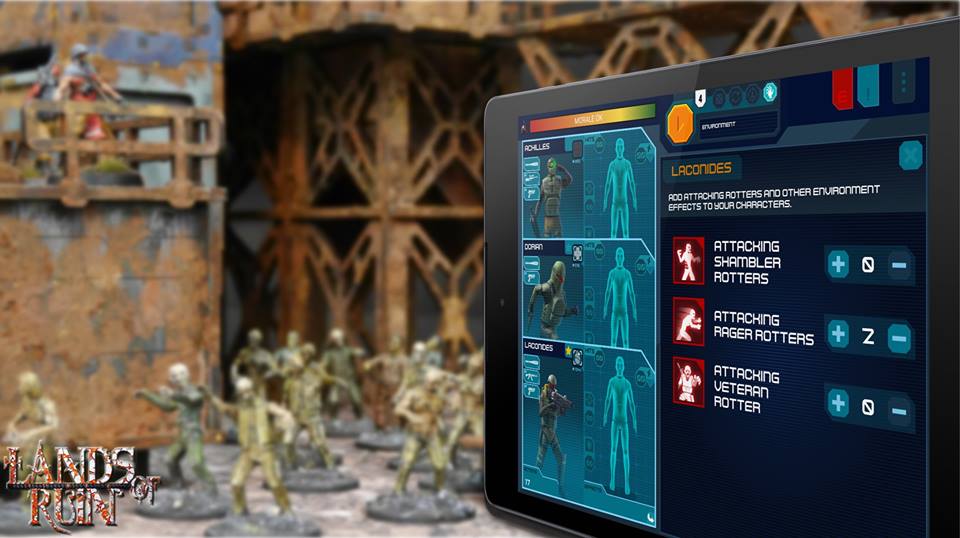
Lands of Ruin is a 28mm post apocalyptic game for two or more players that promises to offer gamers an immersive experience by combining aspects of MMO's & RPG's into their game by use of a tablet or device.
The best way this is noted is by the integration of the rules at your fingertips. This allows you a quick way to jump in and get playing and really enjoy the game, without feeling like you can't play until you read the 200 page rule book or it's not fun when you have to dig into the rule book constantly to confirm whether you are doing something right. (a perfect tie in to the conversation on XLBS this weekend!)
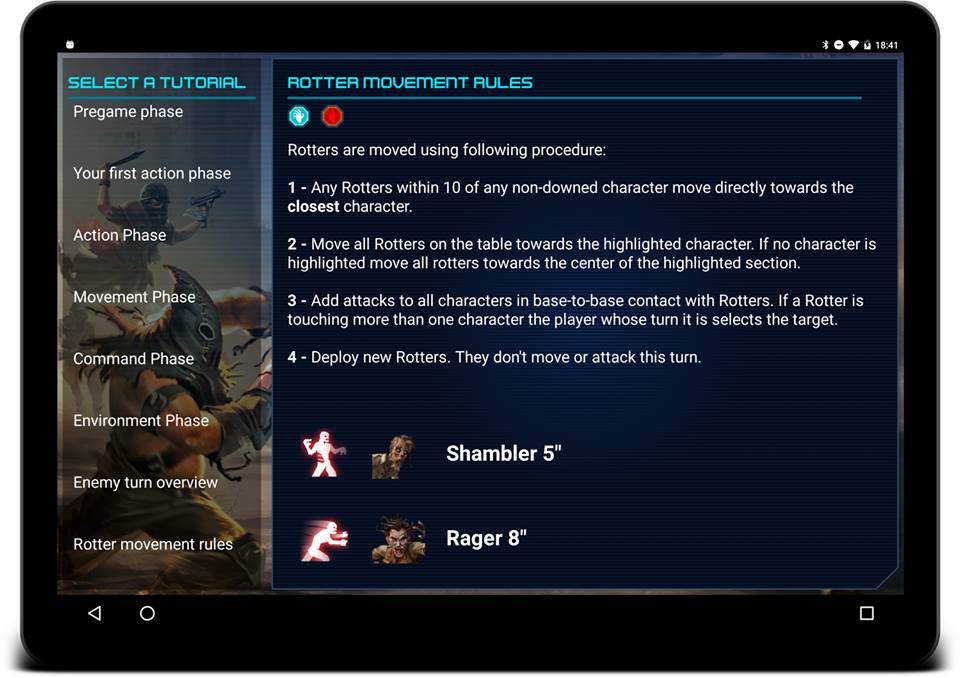
The Command Console app will do a lot of the calculating of bonuses and such for you, but still allow you the hands on and social aspect of tabletop gaming that we all know and love. You measure your moves, you physically move your minis, and you roll your dice. The app just pretties it up for you.
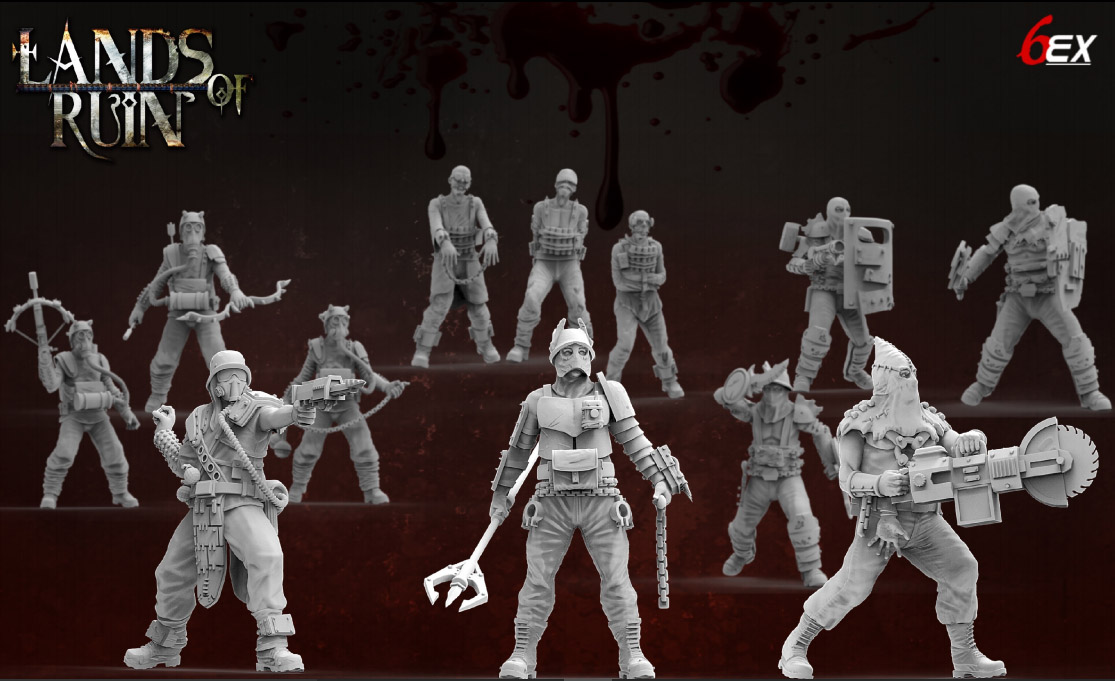

You get eye catching, colorful art for your characters so you can easily see what their abilities are and where their health is at. The app also provides an overview of the map and the location of the minis in play- at least the ones you can see.
The game offers a nice little bonus of keeping characters intended to be stealthy hidden. If you're sniper is hidden away in a building, your opponent will now know it initially until something happens for them to be discovered.

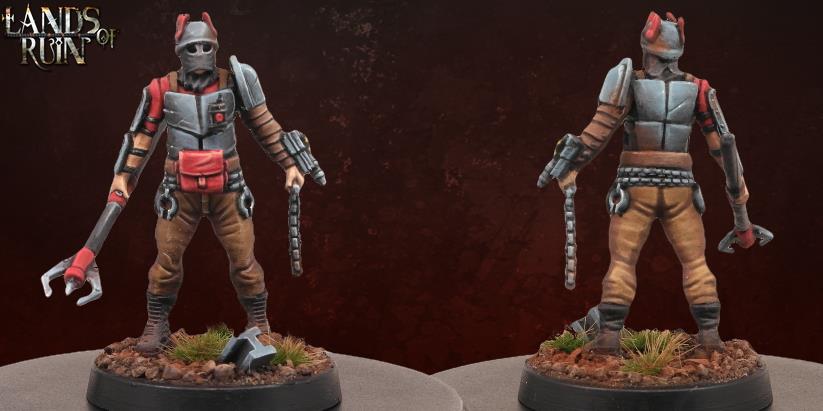
To keep the game even more interactive, Lands of Ruin adds a level of complexity with the IA controlled NPC's of diseased/undead. In a post apocalyptic world there are the those who have survived and are trying to thrive, and there are the others.
These AI miniatures are controlled by the Command Console and will bend and change the activities in the game whether you like it or not, so it's not just you and the other guys you need to worry about.
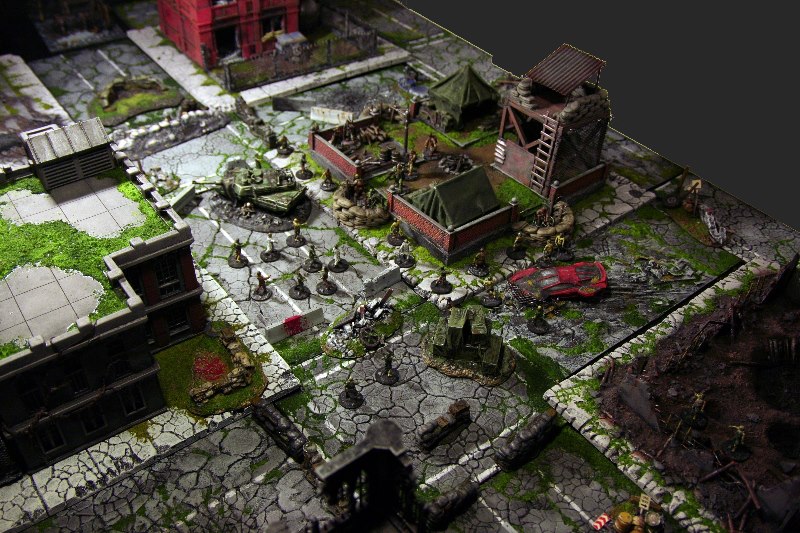
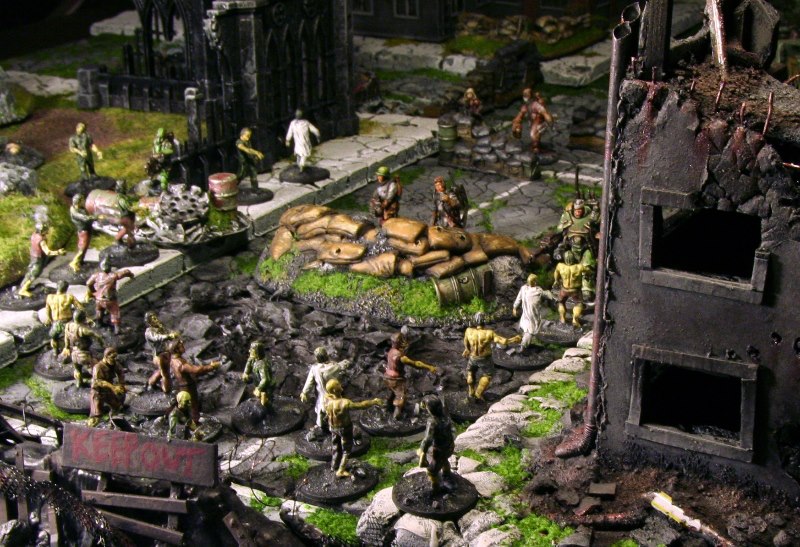
I'm very anxious to have a look at this one up close. I'll confess that my last experience with a hybrid game left me a little underwhelmed in both the overall look of the figures and how the technology piece made me feel disconnected from the game- but this one has me reconsidering. I like the art direction for the game and minis, and they look like proper tabletop miniatures.
The app piece looks interesting enough and I appreciate the fact that it doesn't do everything for you. It keeps you involved enough to feel like you're still in control of the game. And if you can't finish a game?
The app stores your game progress for you to pick it up another time - also a very handy aspect when life gets in the way of your gaming.
How do you feel about embracing the technology offered in the Lands of Ruin?
Supported by (Turn Off)

Supported by (Turn Off)
Supported by (Turn Off)


Thank you for the nice article, Dawn!
For any questions just add them below. I’m more than happy to answer any 🙂
This actually sounds like one of the better combinations of tech and tabletop. A properly interactive digital rulebook is always handy.
And the AI controlled NPCs being sorted digitally and without the hassle of a deck of cards is an excellent idea. I can imagine it being a really quick way to set the difficulty of your game.
Thanks @irredeemable!
NPCs are something that we have big plans for. We implemented Rotters (=zombies) as the first proof-of-concept type as they are relatively simple.. i.e. they’re attracted by noise and once they’re close by they just attack. Pretty simple.. The next iteration will be mutated monsters (failed military experiments escaped to the wastelands) These creatures track blood and warm bodies. The app will still be able to handle them but the feel of these monsters must be different than just basically brainless Rotters.
The next step after that is, and this is what I’m really excited about, is the old, decaying warmachines that have long lost their command centers but are still executing their last commands. These are not intelligent robots (like, let’s say, Terminator) but instead pre-programmed droids. These droids will be preprogrammed in the app and they will execute a script guiding their behaviour.
What makes these warmachines interesting is that, at first, they’re unpredictable as there’s little you can know about their programming (unless you have equipment to do that.. hacking!). However, you can follow them and observe their behaviour to gain understanding and to make an educated guess about how they will react to different situations. The programming they have when they enter the battlefield might be selected semi-randomly by the app but their behaviour after that is not random. That non-randomness allows player to “play” the NPCs against their opponent… if you have figured out correctly how they behave! 🙂
Sorry for getting carried away. I’m really excited about the opportunities the technology we have has created. While for now we only have the core gameplay created the 3+ years of development has taught us what can be done and how. We can’t wait to get going with the advanced features!
OK, I will start asking probing questions.
Now Exilis was a flop, as was Golem Arcana (I was rather vocal in my critique of that game), because either the tech made the minis redundant, or in the case of Golem Arcana, the app was solving dated games design – sure if you are running a battletech hybrid with tons of modifiers flying round then of course an app to manage it will make life better, but you are then just solving dated games design.
Now to me there are better games that use apps. Leaders: A Combined Game, mixes Risk with and app, to allow for the type of gameplay typically seen in a Civ computer game, and so allow for secret actions to be managed fairly along with tech trees etc.
So how does the app in this game add value to a normal wargame? How does it help run the game, and not solve self imposed poor design decisions? How does it still make the minis and table relevant to the game?
Hey @doctorether,
Thank you for your probing questions 🙂 I’m more than happy to respond! Keep the questions coming!
That’s something that was very important to us from the beginning. GA, and EI both suffer from the same symptom, as you mention, there’s no reason to have the tabletop part. It doesn’t add anything.
For us, from the very beginning we wanted to create Lands of Ruin as tabletop first app second. i.e. we didn’t want to create technology for technology’s sake. We wanted to keep all the features that make tabletop gaming great on the tabletop. Miniatures, line of sight, free movement and dice rolling are all parts of the hobby that makes the experience what it is.
The parts that don’t add to the tabletop experience can be streamlined and hidden from the players. Tracking wounds, assigning actions, calculating movement values, counting bullets, comparing values to get target numbers etc. are things that players can do without. Our Command Console app takes care of all that while providing access to the information if the players want it.
Our goal was to build a game that retains all the best parts of miniature gaming and that has to feel like a tabletop miniature game but let players get to the good parts faster and let the players focus on their tactics
The app also allows us to do things that are simply impossible or too tedious otherwise. We take into account what the weight characters are carrying, how many bullets they carry and have spent and track wounds, effects and morale in a detailed way. All of this adds very interesting dynamic to the gameplay. There are much fewer on/off switches in the game and much more gradients of situations.
One of the biggest benefit of the app is asymmetric information. Players don’t always know everything about their opponent and their characters. For example in case of wounds and damage effects only the owning player knows the exact effect (dead, unconscious, etc ) while the opponent only knows roughly what happened (the character is down).
I’d disagree with you slightly about the tons modifiers. They’re only a design flaw if they get in the way. Modifiers model reality. As we still boil down action to dice rolling in most games (in our’s as well) modifiers is what tilts the luck to the right direction. In our cases we model weapons and situations in a very detailed way but take great care that we can do everything possible automatically. Playing the game in a way that you get the modifiers to your side is what wins games. Closer modelling of reality enables more tactics and focuses more to gameplay instead of luck or list building. In that sense our system with the app allows us to model reality in much higher detail than a game without companion app and without slowing down the game at all.
NPCs and Games Master we already discussed in the previous response. That’s one of the key features that the app enables.
We talk a lot about different design decisions we made and features in our blog posts. Check out the “features” boxes on our front page and the blog posts clicking them takes you: http://landsofruin.com/
Thank you again for taking the time to looking into our game. I hope my explanations answered some of your questions. If anything was not explained or you have any other points please don’t hesitate to ask more. I really appreciate the discussion!
To keep the conversation fair for those here and not on the KS page.
@6th Extinction.
My point about modifiers, comes really from a point of view of a) wargaming for 23+ years b) running plenty of rpgs over that time too c) being a games designer myself and d) being a computational chemist who creates models of chemical simulations – I model reality on various scales with different degrees of simplification – the question is always what is the added value?
Basically my point is that the granularity of the rules have to serve a purpose, are transparent, and also easily managed. I personally hate rules in wargames that rely a lot on divisions and multiplication of numbers, simply because that adds a lot of fractions into the numbers and it makes determining values less clear for the end user.
So far you have answered everything else fine. So I guess the app relies on knowing the “region” or “zone” a model is in, not the exact position?
Hi @doctorether
I also wanted to add some things relating to your great questions.
Another thing the app allows us to do, is that in Lands of Ruin, you have truly hidden characters in play, as well as secret actions. This relates to what Juhani was saying as well. An example of a hidden character would be a sniper. The point of a sniper is that the opponent doesn’t know the sniper’s position, allowing for an ambush attack. With the Command Console app, the player with the sniper indicates the sniper’s position on his tablet, but places nothing on the table – no tokens, no mini, no markers. This means that the opponent does not have the slightest clue that a sniper is even in play until the sniper fires on them, or their own characters discover the sniper’s location. The app tracks this information, and assesses each turn if the sniper’s location is discovered by any nearby opponents.
This is also how certain traps, mines, etc. are handled in the game.This allows for more asymmetric, and realistic game mechanics and tactics.
Additionally, in Lands of Ruin, the environment has a greater effect on the battle. We can use the app to simulate night time battles, low visibility weather (like fog), NPC threats, etc. and we can do it automatically. What this means is that if the battle is happening in foggy weather, visibility and accuracy are negatively impacted (along with many other factors). The app automatically simulates this by adjusting any relevant modifiers to player actions throughout the game. Some characters might have equipment that overcomes some of these environmental effects (night vision, a torch, etc.). The app will track all of these things without requiring the player to remember everything.
However, most players like seeing all of the stats, tables, charts, and modifiers. We have kept that in the app, for those who want to analyze their strategy and tactics, but it stays out of the way until you ask for it.
The app also logs all of this data, records all actions and results, and will make it possible to easily and automatically create a battle report from a game. By using the tablet’s camera, photos and videos can be taken during the game, and the app will insert these into the correct places in the battle reports.
Some of these features are already in the app on the Google Play Store, and others are currently being developed. Over the last 3 and a half years we’ve investigated and planned many more exciting and innovative features. These will be added to the app iteratively over the coming months. Another great thing about the app is that as soon as a new feature, mission, items, character, or tribe is developed, all players will have access to it immediately through updating the app. We can keep the game “living” instead of it being “what you get in the box is all you get.”
Please keep the questions coming! We are making some new videos for our YouTube channel, and questions and feedback give us topics to discuss in these videos.
For some reason BoW doesn’t allow me to reply to your comment below so I have to add this here..
@doctorether,
Great. Totally agree with you about the transparency being important. If players don’t understand why things happen they cannot plan and therefore they’re actually not playing the game 🙂
Divisions and multiplication is used very rarely in Lands of Ruin. The only place anything is actually either is used is for figuring out how much the weight of a character’s equipment adds movement penalty. Otherwise all the calculations are simple and can be followed by players.
Maybe a good example of this is this screenshot:

You can see that the attacker’s skills, weapon modifiers, defender’s armour, modifiers from movement and skills and wounds are all there for the user to look if they’re interested to understand why the target number is what it is. Our general design guideline is that all the information is there but players don’t *have to* pay attention to it to play and enjoy the game.
The added value in this case is: added speed to gameplay and added tactical options without hindering gameplay.
Yes, the region (or map section how we call it in the rules) is enough for the app. That enables noise tracking and A.I. logic without forcing players spend time inputting information to the app. Exact position is not needed.
Im in on the KS as i like that the app does all the mundane things during gameplay
@doctorether
Yes, the app requires only an approximate position, rather than an exact position of characters.
We agree that the environmental effects and modifiers should serve a purpose, and we try only to include things that we thoroughly test with our community of players. If we see that something is frustrating, or just redundant we remove it. What we try to do is simulate the realities of a battlefield in a way that isn’t always done very well, or is not possible, while keeping the game light, fast, and easy to learn.
We avoid leaving things solely up to the luck of the dice, but the app always clearly tells the user – this is what you need to roll to succeed/fail in this particular action. You can always look up the calculations, but you are free to just immerse yourself and enjoy the game and look at them later too.
I don’t think this would be for me, largely due to theme. However I would suggest some play demonstration videos – from comments above and the video the thing that stands out for me is how does having all these tracked abilities enhance the game play? Also do you have to move the models on the table and on the app? Plus it seems to hint at a sizable rpg/campaign element is that correct?
Best of luck with the campaign
@dags
Great questions. Of course any game can’t be for everyone, and that’s to be expected. We have some gameplay videos on our YouTube channel. We’re kind of new to making these battle report videos, but we’re getting better. If you would like to see some specific aspect of gameplay in a future video, please let us know. We’re always happy to produce more content.
https://www.youtube.com/watch?v=p5NoLTyaUE8
You primarily move the minis on the table, and at the end of your turn, you just tap the approximate location of your characters. The app only needs to know which section of the map a character ends their turn in. We did many iterations of this, since we didn’t want it to be a pain to sync with the app. It actually takes about a second to tell the app where all of your team is.
You are correct about the RPG/campaign element. We intend for Lands of Ruin to be a narrative-driven game, and we will allow for advancing your team/characters over time. This is just an option though, you can play in more of a campaign mode, or in a one-off battle mode.
Regarding how the tracked abilities enhance the gameplay,we have several blog posts about this subject on our website. Check out the “features” boxes on our front page and the blog posts clicking them takes you: http://landsofruin.com/
We also go into more detail in our YouTube videos. Ultimately, it adds a deeper and richer atmosphere to the game where it isn’t just about one player vs. another player. It’s one player, vs. another player vs. the environment. Imagine the tablet app like a game master. You are trying to fight a battle, but at the same time the environment may cause advantages or hinderances, and other, dangerous NPC creatures can come and go from the game table. We always say in our game, the tabletop is not the edge of the world.
In modern, real-world battles, you seldom have any occurrence of two equally matched armies meeting on opposite sides of a static, unpopulated battlefield. There are always unknown factors and risks from the environment, the civilian population (in our case deadly creatures), etc. Also the battlefield is never isolated from the surrounding areas. We simulate this level of realism and immersion in Lands of Ruin in many ways, to the point where you can think of the app as an AI 3rd player that affects the battle – sometimes in your favor, and sometimes not.
We will be releasing more videos demonstrating how this works in the coming weeks. If you have more questions or feedback, we are always glad to hear it. Lands of Ruin will be a very community-driven game, and anyone who happens to be in Munich is welcome to come try the game for themselves with us.
Hey @dags,
I’d like to add one thing to what Rick said in his response.
“how does having all these tracked abilities enhance the game play?”
In short, all this speedup the gameplay a lot. Our goal was to make the game “a after-work-game” i.e. you can come home, meet with your mate and play a round or two on a weeknight. All this without dumbing down the gameplay or the game itself. In it’s current a game lasts about 45 minutes to an hour. Being able to play a game in a short amount of time but still having a lot of tactical options is something that allows players (and us!) to play much more without getting tired of the game. 🙂
Sounds interesting and the figures look good.
Thank you @zorg !
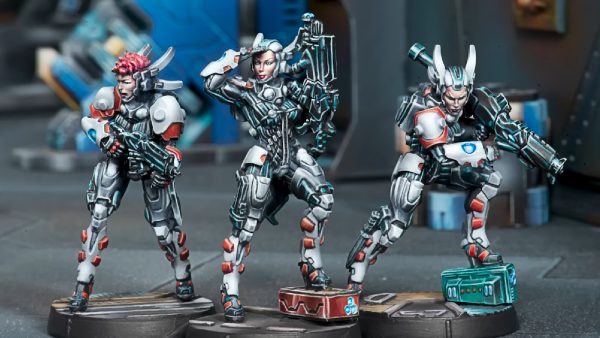
For the initial look of your game it falls into the post apocalypse field that I like. I will say that what seems different from the other predecessors games mentioned above is the models look nice as in you would collect them for the hobby side of gaming. The other two games just seem to make models just for the sake of getting something on the table.
As a hobbiest first I hope the quality of the models are worth getting into the game.
Thanks for the comment @manpug !
Yes, we’re miniature gamers as well and board-game quality isn’t good enough for our liking. While we’re new to this (as in miniature production) we work with experienced people. We just received the first pre-production run of our miniatures yesterday and sent them out to a lot of people to review. So hopefully you will be able to see independent opinions about them over the web and YouTube next week.
I like the quality and the sculpts we made a lot but then again, I’m one of the creators of the game and just trusting my word might be difficult. 😉
@manpug
In addition to what Juhani said, I wanted to point out that our game is extremely narrative heavy, and story driven. If you like post apocalypse settings, you might enjoy reading our short stories and world history. We wanted our game to be rich, community influenced, and engaging. If you find time to read any of it, please let me know what you think. More will be released tomorrow.
You can download our “Voices from the Waste” here: http://landsofruin.com/downloads.html
It’s intentionally written in a fragmented and somewhat vague manner, as we want the story to unfold over time, with input from the player community. It’s meant to be a collection of scraps of information from often unreliable or biased narrators. New scraps of information will become available for players to “find” as they fight battles. Only by analyzing all the scraps for oneself can a holistic view of the game world be deduced. It’s in an early draft state currently, but we will be providing it in a physical, published version in the near future.